Archive | DPE RSS feed for this section

“We Are the Resistance and We Are Winning.”

1 Jan

By Thomas Ultican 1/1/2020

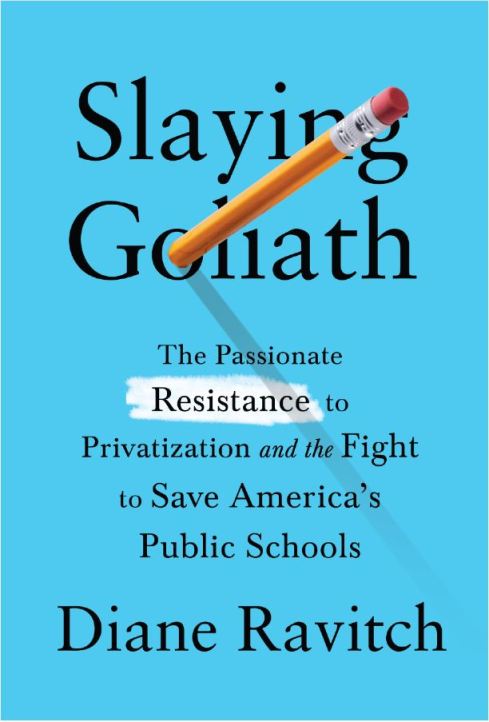
Historian and former United States Assistant Secretary of Education, Diane Ravitch’s, new book, Slaying Goliath: The Passionate Resistance to Privatization and the Fight to Save America’s Public Schools is due for release January 21. This masterpiece weaves together recent history with illuminating data concerning “corporate driven education reforms.

The reported community response to self-anointed reformers is spiritually uplifting. Ravitch presents strong evidence that resistance to their reforms is carrying the day.  She declares, “Judged by their own chosen metrics – standardized test scores – the fake ‘reforms’ failed.”

Diane tells a deeply personal story of her own journey through the education wars while bringing to life the experiences of teachers, students and parents harmed by “fake reforms.” In this captivating read, Ravitch describes the fight to save the commons.
Goliath_0001

Disruption and Changing Course

There is a parallel between Diane Ravitch and Elizabeth Warren. Both Warren and Ravitch were scholars whose research led them to a profound change of thought. Warren was fundamentally a moderate Republican when she began researching bankruptcy law. Ravitch was an advocate of top down standards based education reform. Through their personal research both these women awakened to personal error and went out to make amends. Warren became the bane of the banking industry and a tiger in Democratic politics. Ravitch threw up a stop sign in front of “corporate education reform” and has become its most virulent opponent.

When I mentioned something Ravitch wrote in 2012 to a teacher colleague, that veteran teacher in my neighboring classroom expressed open hostility toward her. He remembered Lamar Alexander’s resident scholar in the Department of Education and her full throated advocacy of standards and testing accountability. He remembered her papers published by the Brookings Institute. Since then, Ravitch has overcome many of her skeptics by working harder than anyone else and fearlessly leading the fight to save authentic public education.

In Slaying Goliath Ravtich shares,

“Having worked as assistant secretary of education for the Office of Educational Research and Improvement in the administration of President George H. W. Bush and for many years in some of the nation’s leading conservative think tanks, I had hoped that privatization and testing would produce sweeping improvement, especially for the neediest students. It didn’t. I couldn’t pretend otherwise. I came to realize that the privatization movement was a continuation of a decades-long campaign by right-wingers who hated public schools, which they derisively called ‘government schools.’ I renounced my own past views and determined to expose the well-funded smear campaign against American public schools and their teachers.”

What should we call the proponents of the choice agenda fueled by standardized testing driven accountability? What do we call those wealthy elites financing the push for charter schools, vouchers and public school closures? Ravitch refuses to call them “reformers” or what they promote “reform.” She recites various appellations people use; “deformers,” or the “financial privatization cabal,” or the “Destroy Public Education Movement.” She observes that “reform” has positive connotations that denotes ‘“improvement,’ ‘progress,’ and ‘uplift.’”

An oft stated goal of this corporate driven agenda is disruption. Disruption is an odd management theory championed at Harvard University in 1995. It posits disruption as a needed ingredient for innovation-driven growth. Ravitch decided they have named themselves.

“They are Disrupters. They are masters of chaos, which they inflict on other people’s children, without a twinge of remorse.”

From the beginning of the book on, Ravitch refers to the “Disrupters.”

Strategy of the Disrupters

A natural starting point for analyzing the era of the Disrupters is the Reagan administration’s 1983 polemic, “A Nation at Risk.” Ravitch shares that Ronald Reagan assumed the presidency with three goals for public education; (1) abolish the US Department of Education, (2) restore school prayer and (3) introduce school vouchers for religious and other private schools.

His Secretary of Education, Terrel Bell, had other ideas. To save the department, he established “The National Commission on Excellence in Education.” In its report written by American business leaders and a venerated scientist, they did not call for prayer or vouchers, however, they blamed public education for the nation’s economic struggles which Ravitch saw as “no less destructive.” She cites an NPR report in which the authors candidly admitted that the data was “‘cherry-picked’ to make American public schools look as bad as possible.

When the Department of Energy commissioned engineers at the Sandia Nation Laboratories to study the current status of American education in 1990, they criticized “The Nation at Risk” as overly alarmist. Sandia found that test scores, graduation rates, and other indicators were actually improving. In Slaying Goliath, Ravitch’s shares an insiders perspective. She writes,

“At the time, I was assistant secretary of education for education research and improvement, and in 1992, I attended the Energy Department’s briefing about the Sandia report. I accompanied David Kearns, former CEO of Zerox, who was deputy secretary of education, to the meeting. He was outraged by the Sandia report, which contradicted the view of the Department of Education that American public schools were failing and needed radical change. The Energy Department never published the report, but it was immediately leaked to hundreds of influential researchers, who wrote about its findings. In retrospect, the Sandia report got it right. The late Gerald Bracey, a prolific and outspoken education researcher, was highly critical of the conventional wisdom, which I was then defending. I hereby personally apologize to him. He was right. The “crisis in education” was a politically inspired hoax, or as the eminent researchers David Berliner and Bruce Biddle later called it, a ‘Manufactured Crisis.’”

What do disrupters want? They want:

  • Inexperienced teachers with little or no training from organizations like Teach For America.
  • To replace teachers with machine teaching (“blended learning” – “personalized learning”).
  • To move fast and break things including school systems, historic schools and communities.
  • To eliminate local democratic control over schools.
  • To eliminate teacher tenure and seniority rights.
  • To eliminate teacher defined benefit pensions.
  • To eliminate teachers unions.
  • To evaluate teachers and schools with standardized test scores.
  • To lower taxes and reduce spending on education.

Ravitch goes into significant detail about who are the disrupters. She calls out the billionaires in the private sector driving the school choice agenda and highlights their spending. She states, “Every Republican governor is a disrupter, because they actively support privatization by charters and vouchers.” However, she notes that rural Republican officials understand that public schools are the anchors of their communities and do not support privatization. The Democratic Party also has many disrupters but not in as great of numbers as the Republicans and generally no Democrats support vouchers. The last two Democratic Presidents, Bill Clinton and Barack Obama, were disrupters.

Conservative groups supporting disruption include the far right Heritage Foundation and the libertarian Cato Institute. Ravitch asserts, “The radical right-wing American Legislative Exchange Council (ALEC) is the key organization in the world of disruption advocacy.

She lists more than a dozen pro-disrupter “think-tanks” on the right including the Thomas B. Fordham Institute and the Center for Education Reform which Ravitch describes as liking “every choice in schooling except public schools.

Before his 1998 election to the governorship of Florida, Jeb Bush served on the board of the Heritage Foundation where he developed his education plans. Diane cites his A+ Plan for education as the “template for disruption.” It combines choice, competition, high-stakes testing, grading schools with A-F grades and accountability as the formula for excellence in education.

Two “liberal” groups, the Center for American Progress (CAP) and Democrats for Education Reform (DFER), push most of the disrupter agenda. In her description of DFER Ravitch writes,

“In 2005, several hedge fund managers – Witney Tilson, Ravenel Boykin Curry IV, John Petry and Charles Ledley – launched Democrats for Education Reform at a posh party on Central Park South in Manhattan, where the inaugural speaker was a young senator from Illinois named Barack Obama. DEFR, as it is deceptively called, was founded to support school privatization by making strategic campaign contributions. Inspired by DFER, charter schools became the pet passion of Wall Street.”

“It is likely difficult to throw a beanbag in a corporate or Wall Street boardroom without hitting a member of the board of a charter chain.”

The Victorious Resistance
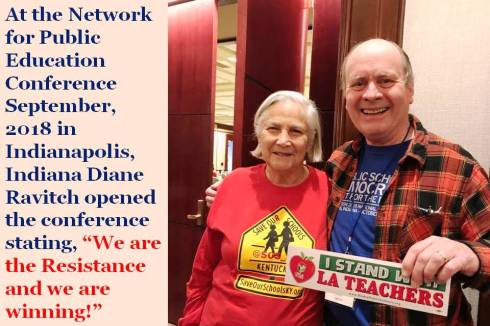
Tom and Diane in Indianapolis

Tom Ultican and Diane Ravitch at the 2018 NPE Conference

The picture above was taken just over two months before the historic LA teachers strike on January 14, 2019. Following the massive teachers strikes in West Virginia, Oklahoma and Arizona, the LA strike was the first one led by a sanctioned teachers union. When the teachers settled their strike after nine days, they did not get any bump in the original take home pay offer but they won big.

USA Today reported, “‘this is much more than a labor agreement,’ said UTLA President Alex Caputo-Pearl. ‘It’s a very broad compact that gets to social justice, educational justice.’” The Los Angeles agreement included class size reductions in all grade levels, 300 additional school nurses, 80 new teacher librarians, one counselor for every 500 students and a 3 percent raise for teachers.

In Arizona, a group of six women established Save Our Schools Arizona to fight the Koch brothers initiated large voucher expansion proposal which was adopted by the Arizona state government. At the Indianapolis NPE conference, Beth Lewis and Sharon Kirsch of SOS Arizona were presented the first of a planned annual Phyllis Bush Award. Against all odds they landed a citizens’ initiative stopping the voucher expansion on to the November 6, 2018 ballot. Later we learned their initiative won with a whopping 65% of the vote.

Ravitch tells these stories and many more of the resistance taking on Goliath and winning.

The saga of Douglas County Colorado being taken over by school privatization forces in 2011 is unique and uplifting. The disrupters immediately established a district school voucher program. That was only the beginning of their agenda, but a bi-partisan group of parents fought back. Today there are no disrupters left on the school board in Douglas County and there are no vouchers.

The account of Barbara Madeloni, President of the Massachusetts Teachers Association (MTA), leading the fight to stop the state from increasing the number of charter schools is amazing. The contest was played out at the ballot box over a referendum to expand the number of charters known as Question-2. Ravitch reports that the MTA directed Madeloni to negotiate with legislators and quotes Madeloni’s negotiating position,

We are glad to talk, but we will not accept any deal that involves any new charter schools. Now, what do you want to talk about?

Question-2 lost 68% to 32%. One of the largest contributors to the yes-on-2 campaign was the world’s now second richest women hailing from Bentonville, Arkansas, Alice Walton. She is an heir to the Walmart fortune.

A Concluding Analysis

Ravitch’s books like The Death and Life of the Great American School System and Reign of Error are scholarly efforts that serve for years as references. Yet, they are written in a fashion that gives the average reader access to the material in an enjoyable and understandable way. I believe that in Slaying Goliath: The Passionate Resistance to Privatization and the Fight to Save America’s Public Schools, Ravitch has upped her game. The stories are riveting and the scholarship underlying them is first rate. This is another game changing book from Diane Ravitch.

Twitter: @tultican
Manufactured Education Crisis Engenders Violence

18 Dec

By Thomas Ultican 12/17/2019

On October 23, the regularly scheduled Oakland Unified School District (OUSD) board meeting descended into chaos accompanied by violent reaction from school police. One parent received a broken rib; two elementary school teachers reported severe bruising and a small mother suffered two torn ligaments and a meniscus tear. They were protesting the closing of Kaiser elementary school which is the result of a manufactured crisis beyond the control of the local school board. Billionaire “philanthropists” and the state of California created and exacerbated Oakland’s chronic budget issues.

Today’s budget problems stem back to the state assuming control of OUSD in 2003. Ken Epstein of Oakland Crossings described the situation when the state installed an administrator. “At the time, State Schools’ Supt. O’Connell [Democrat] and influential State Senator Don Perata [Democrat] were instrumental in putting together a deal requiring the district to accept a $100 million loan, even though it was only $37 million in debt.”

The Alameda County Office of Education and the Fiscal Crisis and Management Assistance Team (FCMAT), a state-funded nonprofit that advises districts on financial matters, both played a large role in pushing OUSD into receivership (2003-2009) and forcing the district to take a $100 million state loan. OUSD did not ask for the loan. They had enough money in construction funds to cover the shortfall if the state would approve borrowing from that fund. The state had given other districts this kind of permission but refused it to Oakland.

Kathy Murphy reported in the 2009 East Bay Times, “Six years after the largest state loan ever made to a California school district, the Oakland school district is emerging from state receivership $89 million in debt.” After six years of state administration, the budget deficit grew from $37 million to $89 million.

O’Connell Selects Eli Broad’s Trainee as Administrator

In 2002, the multi-billionaire Eli Broad (rhythms with toad) decided to establish his own training academy for school administrators. With no background in education or experience other than attending public school in Detroit, Broad was so rich he could just do it. He did not believe schools had an education problem; he believed they had a management problem. It was his theory that large urban school districts did not need education leadership – consultants can be hired for that – they needed business management leadership.

One of the key management ideas taught at the Broad Academy is “right-sizing.” It is probably in the Broad School Closure Handbook; Closing Schools as a Means for Addressing Budgetary Challenges that the first use of the terminology “right sizing” is applied to a school district. Now this Broad construct has slipped into common usage by Oakland’s political and administrative leaders.

Another key component undermining OUSD was the state’s Fiscal Crisis Management Assistance Team (FCMAT). In 1991, new California, Governor Pete Wilson, signed the team into law. FCMAT (pronounced “fick-mat”) is a state sponsored non-profit located in Kearn County. It is supposed to help school districts identify and solve fiscal problems. However, FCMAT has developed a reputation as a neoliberal organization that has a racial bias against schools in Black and Brown neighborhoods. An Oakland school leader admitted they felt FCMAT was biased against Oakland.

When OUSD discovered its budget shortfall in 2003, FCMAT started pushing for a state takeover and Oakland Mayor, Jerry Brown, seemed to welcome it. Majority reports that when OUSD proposed covering the shortfall with construction funds,

“Tom Henry, the CEO of California’s Fiscal Crisis and Management Team (FCMAT) opposed this plan, and Mayor Brown questioned it heavily. (During a state takeover, FCMAT would be responsible for monitoring the school district’s financial progress.) Phone records later obtained by the Oakland Tribune revealed over 40 phone calls on key dates between Brown, Henry, and Randolph Ward, who would end up in charge of OUSD when it was placed under state control, in the two months before the state takeover.”

A California central coast politician named Jack O’Connell was elected California’s Superintendent of Public Instruction in 2002. He selected Randolph Ward, a Broad Academy graduate, to be Oakland’s state administrator. When O’Connell ran for state superintendent, his largest campaign donors had been Netflix CEO Reed Hastings ($250,000), venture capitalist John Doerr ($205,000), and Eli Broad ($100,000). Brown described the state takeover as a “total win” for Oakland.

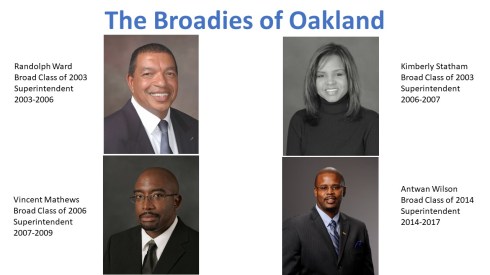
The Broadies of Oakland

2003-2017 Broad Academy Graduates and Superintendents of OUSD

Broad Academy graduates are often disparagingly called Broadies.

The OUSD information officer in 2003 was Ken Epstein. He recounts a little of what it was like when Ward became the administrator:

“I remember a school board meeting where Ward and the board were on stage. Each item on the agenda was read aloud, and Ward would say, “passed.” Then the next item was read. In less than an hour, the agenda was completed. At that point, Ward said, “Meeting adjourned” and walked out of the board room and turned out the lights, leaving board members sitting in the dark.”

When Ward arrived in Oakland, the district was in the midst of implementing the Bill Gates sponsored small school initiative which is still causing problems. The recently closed Roots that caused so much discontent in January was one of the Gates small schools. Ward opened 24 of them (250-500 students) which in practice meant taking an existing facility and dividing it into two to five schools. He closed fourteen regularly sized schools.

Upon Ward’s arrival in Oakland there were 15 charter schools and when he left for San Diego three years later there were 28 charter schools.

Epstein related a story from attending a district leader’s cabinet meeting when Ward asked a Broad trained accountant to get numbers on how much money would be saved by closing a school. Three weeks later the accountant said no savings and Ward responded, “Then go back and figure out another reason for closing schools.”

Kimberly Statham who was a classmate of Ward’s at the Broad Academy took his place in 2006. The following year a third Broad Graduate, Vincent Mathews took her place.

After a short period of no Broadie in the superintendent’s seat, Antwan Wilson was hired in 2014. Shortly after that, the New York Times reported that the Broad Foundation had granted the district $6 million for staff development and other programs over the last decade. The Broad Center also subsidized the salaries of at least 10 ex-business managers who moved into administrative jobs at the district office.

Kyla Johnson-Trammell, an Oakland resident and educator with OUSD, was named to replace Antwan Wilson in 2017. When he exited to lead Washington DC’s schools, Wilson left a mess in Oakland. Mother Jones magazine said Wilson saddled the district with a $30 million deficit. The article continued, “A state financial risk report from August 2017 concluded that Oakland Unified, under Wilson, had ‘lost control of its spending, allowing school sites and departments to ignore and override board policies by spending beyond their budgets.”’

The preponderance of the problems in OUSD are related to the state takeover, FCMAT and the leadership provided by Broad Academy graduates.

School Board Under Attack from All Sides

A March Oakland Post article says,

“A new report from the Fiscal Crisis Management and Assistance Team (FCMAT) indicates that the State of California, represented by FCMAT and the Alameda County Superintendent of Education, is requiring the school district to make budget cuts of jobs and programs totaling about $30 million this year, regardless of any costs generated by increased salaries for teachers and other school employees.”

The Alameda Civil Grand Jury says the district has run a debt of $20 to $30 million for the past fifteen years. It states, “School occupancy must be assessed and painful decisions made regarding closure and consolidation as soon as possible.”

In 2018, the Alameda County Office of Education rejected OUSD’s three-year budget plan saying it did not adequately address needed budget reductions; prompting school activist Ahsan Nilofer to ask, “What will FCMAT and the County Office consider to be an adequate plan?”

Another drag on the district’s finances is this past school year; the district had to pay FCMAT and the county $1.4 million for their services.

At the same time the coalition “Oakland Not for Sale” demands:

  1. “Stop School Closures”
  2. “End the School to Prison Pipeline”
  3. “Stop the charter school takeover”
  4. “Let the people see the money”

This is the organization that led the demonstration at the board meeting in October that ended in violence and chaos.

Mike Hutchinson of the Oakland Public Education Network says that OUSD ended the 2018-2019 school year with a $21 million surplus not a deficit. He also has announced that he will be running for the district-5 board seat in 2020.

A board member explained that $4 million of that claimed surplus comes from the board purposely underestimating title 1 and title 4 money from the Department of Education because they did not trust the actions of the Trump administration. The rest of the money is thought to be in restricted funds that can only be spent of designated categories.

The board was forced to adopt the 2019-2020 budget without good numbers to rely upon. An EdSource article relates that “Board member Shanthi Gonzales said staff didn’t give the board enough details about department budgets, school budgets or even how many employees the district has, what they do and how much they earn.” However, the district’s state trustee said district operations would come to “a screeching halt” if the board didn’t meet its June 30 budget approval deadline.

In addition to all of these problems, billionaires and their school privatization organizations are attempting to purchase the school board. In Oakland the on the ground political organization leading the privatization agenda is GO Public Schools.

Go Political Spending Chart

Funding to GO Public School Independent Expenditures Effort

School Board Winners Finance Chart

Winning OUSD Board Member Campaign Support

In the 2018 election, Gary Yee was the recipient of almost $146,000 in independent expenditure support from mostly billionaires working to privatize public schools in Oakland. His victory makes him the third member of the seven seat board to owe their election to GO Public Schools.

FCMAT from the state of California, the Alameda County Office of Education and the Alameda County Grand Jury are all ordering the OUSD school board to make budget cuts and close schools. At the same time residents of the city don’t want to hear about schools being closed and with reason do not believe the state and county budget analysis. Unfortunately, the only place they can express their outrage is at the local school board. However, there are some really good people on this board who are being put through a ringer by forces beyond their control. No matter what they do, it is loudly criticized and they are personally demonized as selling out the city.

The fundamental problem is Oakland has a dual education system with 37,000 students in public schools and 15,000 in charter schools. It costs more to operate two systems. Every school district in California that has more than 10% of their students in charter schools has severe financial problems. Oakland has the largest percentage of charter school students in the state with 29% so financial issues should be the expectation.

This is an education crisis that was manufactured by the super wealthy and implemented by neoliberal politicians.

Twitter: @tultican

Ed Tech about Profits NOT Education

10 Dec

By Thomas Ultican 12/10/2019

Anthony Kim founded Education Elements in 2010. He sold Provost Systems – which built virtual schools – to Edison Schools in 2008 and was ready for a new project. His new company sells personalized learning systems and consulting services to several school districts. Education Elements is one of more than a hundred ed tech companies being supported by venture capital organizations hoping for one big score. It is representative of the education technology startup business.

With education businesses there is opportunity for magnificent profits because of the large scale of education spending. The United States alone spends $650 billion a year on public education. If businesses can convince people that learning at a digital screen is equivalent to or even better than a teacher led classroom, education technology would become America’s next great profit center minting many new billionaires. This allure of lavish profits is driving education technology.

The Venture Capital Firms

Crunchbase, which analyzes venture capital and startups, lists five venture capital companies investing in Education Elements.

Harmony is the only one of the five venture funds that does not focus specifically on education technology. They simply say, “Over the past 20 years, we have invested over $750 million in 80 companies.” They list their current investments which includes Education Elements.

NewSchools Venture Fund is the most strident in its commitment to disrupting public education. NewSchools is a non-profit that claims they are a “venture philanthropy working to reimagine public education investing in education entrepreneurs.” Their venture portfolio contains more than 150 companies.

Every year NewSchools hosts a “Summit” in Oakland, California which they state brings together more than 1,200 educators, entrepreneurs, community leaders, funders, and policy makers to share ideas on how to “reimagine learning.” The “Platinum” sponsors for the 2020 gathering are the Chan Zuckerberg Initiative and The Walton Family Foundation who are also well-known leaders in the movement to monetize and privatize public education.

New Schools Venture Fund Donors

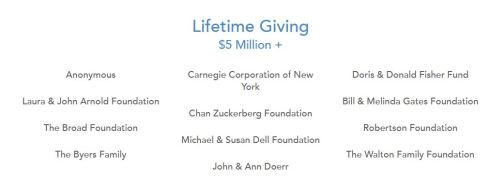
Twelve Organizations Contributing $5 Million Plus to NewSchools Venture Fund

Eleven of the twelve organizations listed above are known for promoting market based education reform. The twelfth, Anonymous, most likely has the same ideology.

Rethink Education is the third venture fund. It claims to focus on Crucial Life Skills, Personalized Learning, Vocational Preparation, Curation of Workforce Learning Resources, College Dropout Prevention.” Jenny Abramson is the founder and Managing Partner of Rethink. She is a former Teach For America (TFA) corps member and a board member of the Washington DC charter school, DC Prep.

Imagine K12 is the forth fund investing in Education Elements. It was founded in 2011 as a startup accelerator for education technology companies. In 2016 Imagine merged with Y Combinator. The joint companies have invested in over 100 education technology focused companies.

Tugboat Ventures is the fifth fund invested in Education Elements which is one of its 35 listed properties.

The Board of Directors

Board of Education Elements

The Education Elements’ Board – (from Elements’ Web Page)

Dave Whorton, the founder of Tugboat Ventures, was also a founding board member of the NewSchools Venture Fund serving there from 1998-2015.

Howard Behar was a former president of Starbucks until his retirement in 2003. He served as a Director on Starbucks board 1996-2008. In 2014, Behar became a board member of the Biller Family Foundation. The Biller Foundation from Seattle Washington is notoriously pro-public school privatization. They have partnership relations with Green Dot, Partnership for Los Angeles, Stand for Children and Summit Public Schools.

Green Dot is a large charter school chain originally founded in Los Angeles. Partnership for Los Angeles was established by former Los Angeles Mayor, Antonio Villaraigosa when his efforts to take over the school system were thwarted. Stand for Children is a dark money pro-school privatization organization from Portland, Oregon. Summit Public Schools is financially supported by the Chan Zuckerberg Initiative. It provides computer based learning.

Jack Witlin was a Deloitte Consulting Principal. He retired in 2014 after a 44-years career. Witlin became a director of Education Elements in 2017.

Michael B. Horn serves as the head of strategy and senior partner for the Entangled Group, an education venture studio. He is also the co-founder of and distinguished fellow at the Clayton Christensen Institute for Disruptive Innovation. He has written extensively about disruption as the savior of public education. He calls for disruptive change driven by technology and school privatization.

In a delightful takedown of disruption theory in the New Yorker, Jill Lepore riddled Clayton Christensen’s “The Innovator’s Dilemma.” One of his big examples was Seagate Technology. According to Christensen, Seagate disrupted the computer industry with its 5 ¼ inch floppy disk but was disrupted and doomed to failure when it was late to the market with a 3 ½ inch drive. Lepore noted,

“In 1997, the year Christensen published “The Innovator’s Dilemma,” Seagate was the largest company in the disk-drive industry, reporting revenues of nine billion dollars. Last year, Seagate shipped its two-billionth disk drive.”

Most educators and anyone with common sense would tell us that the last thing students in a poverty stricken community need is more disruption.

Education Elements’ Leaders

Anthony Kim is the Chief Executive Officer of Education Elements. He started his career in education by helping higher education institutions with technology projects and data. He founded Provost Systems which developed online schools. After selling Provost to Edison Schools in 2008, he spent two years there as Executive Vice President of online education. Kim founded Education Elements in 2010.

Amy Jenkins, the Chief Operating Officer and Managing General Partner, began her education career as a TFA middle school English teacher in Oakland, California. After two years, she left the classroom for the education “reform” industry including a stint with NewSchools Venture Fund. Jenkins earned an AB in political science from Dartmouth and an MBA from Harvard.

Angela Kennedy-Toon is also known as Angela Chubb. She is another Managing Partner at Education Elements. She claims to have started her education career in a classroom 27-years ago and to have founded a charter school in Pennsylvania. Angela lives in Wichita, Kansas and was married to the late John Chubb who along with Terry E. Moe co-wrote Politics, Markets, and America’s Schools. That 1990 publication gave great momentum to school privatization and recommended ending locally elected school boards.

Angela says she follows Checker Finn, Michael Horn, Frederick M. Hess, Wendy Kopp and Jeanne Allen. People who have been observing education politics will recognize this list as all strident supporters of privatizing public education.

Angela’s facebook page has some wonderful pictures with Todd and Sarah Palin. Sadly on my recent trip to Anchorage, I learned that Todd and Sarah are divorcing.

Keara Mascareñaz is also a Managing Partner. After graduation from college she joined TFA and taught in a primary classroom for two years. She then worked for TFA for five years. Keara became a NextGen Fellow at the Pahara Institute in 2016 before joining Education Elements. Reed Hastings and Diane Tavenner are on the Board of Directors at Pahara which is a strong indication of the pro-public education privatization bias of Pahara.

Ray Rozycki is listed as Executive Advisor. He previously worked with CEO Anthony Kim at Provost Systems where he served as Chief Officer of Digital Education and VP of Virtual Education. Ray is involved with designing instructional and assessment platforms and developing formative assessments and eCourses.

Selling Bad Pedagogy and Enfeebled Expertise

Do to lobbying by billionaires like Bill Gates and Reed Hastings, the latest update to the national education law turned the US Department of Education (USED) into an education technology sales hub. Critically for companies like Education Elements, the federal technology pitch includes Competency Based Education (CBE). In order to have an inexpensive cyber based education system, there must be small skills that can be drilled and then tested. The USED says,

Competency-based strategies provide flexibility in the way that credit can be earned or awarded, and provide students with personalized learning opportunities. These strategies include online and blended learning, dual enrollment and early college high schools, project-based and community-based learning, and credit recovery, among others.

Unfortunately CBE is just an update of previous failed teaching strategies. In the 1970’s it was called Mastery Learning and in the 1990’s it was called Outcome Based Education. CBE is simply putting Mastery Leaning on a computer instead of using worksheets and paper assessments. It is still bad pedagogy. Computer based credit recovery is the fraud engendering the recent soaring graduation rates.

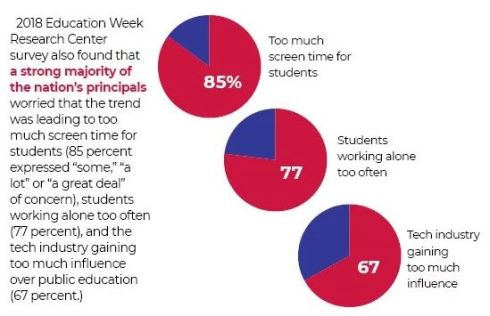
With no evidence to support their claim, Education Elements posts, “Personalized learning improves student engagement and achievement, develops students to be lifelong learners, and better prepares them for college and careers.” However, a Rand study commissioned by Bill Gates found no evidence for this claim. Also, the vast majority of school principals believe that students are experiencing too much screen time and the Organization for Economic Co-operation and Development said in a 2015 report that heavy users of computers in the classroom “do a lot worse in most learning outcomes.

Dr. Nicholas Kardaras wrote “Screens In Schools Are a $60 Billion Hoax” for Time magazine. When discussing health risks associated with student screen time, he stated, “over two hundred peer-reviewed studies point to screen time correlating to increased ADHD, screen addiction, increased aggression, depression, anxiety and even psychosis.”

Education Elements also sells its consulting services to school districts. It asserts;

“We help your best people improve in several ways:

  • Develop action steps to prioritize and implement instructional approaches aligned to your district’s strategic plan.
  • Design new processes and methods to increase capabilities of teams.
  • Develop fluency in problem solving through design thinking strategies.
  • Build skills needed to become designers of learning focused on classroom design, content selection, and other key competencies for personalizing learning.”

There are few districts in America that do not have a deeper bench when it comes to education theory, practical application and leadership talent than Education Elements. If a school district is buying these kinds of services and education technology programs, they are wasting money and harming students.

Twitter: @tultican

Wealthy White Elites Attacking Little Rock School District

2 Dec

By Thomas Ultican 12/2/2019

In an apparent reaction to the 2014 school board election, new Republican Governor Asa Hutchinson and the state of Arkansas assumed stewardship of Little Rock School District (LRSD). A law passed January 28, 2015 authorizing the takeover requires the state to give control back to Little Rock voters by January, 2020. New racially motivated proposals hearkening back to the days of openly racist governor, Orville Faubus, ensure minority residents lose their democratic rights. Big money from the Waltons – the world’s wealthiest family – is driving privatization and segregation within LRSD.

A leading Little Rock community activist, Reverend Anika Whitfield, said in an interview, “The Governor, the Attorney General and the state legislature are all controlled by the Walton family.” In 2016 when new Superintendent Mike Poore came to Little Rock from Bentonville, Arkansas (headquarter of the Walton family), Whitfield was suspicious and asked him about his relationship with Walmart’s owners. He replied, “I know you all are apprehensive; I don’t even know Jim Walton.”

Driving Corporate Education Reform in Little Rock

Littls Sis Map Attacking Little Rock Schools

Little Sis Map Showing Leaders of the Attack on LRSD

In 2007, Arkansans for Education Reform (AFER) was established in Bentonville, Arkansas. AFER files taxes under IRS rule 501 C3 which means it is categorized as a charity. In 2013, Arkansas Learns was founded in Little Rock, Arkansas. Arkansas Learns files taxes as a 501 C6 organization which means it claims to be a profession service organization. Both types of organizations are tax exempt. Individuals can receive a tax deduction when contributing to a 501 C3 organization like AFER but the organization is prohibited from supporting a particular political candidate or engaging in lobbying activities. A 501 C6 organization is a professional business entity that can use the dues it receives to lobby but the contributions are not tax deductible.

The Little Sis map above shows total donations of $845,769 for 2016 and 2017 going to the 501 C3, AFER. Later, AFER grants $465,000 to Arkansas Learns plus it pays Gary Newton, $477,920 in salary over the same two years. The forms identify Newton as the AFER Executive Director working 40 hours a week which makes him the unpaid President and CEO of Arkansas Learns. If Newton’s salary is included; AFER sent more money to Arkansas Learns than its total receipts for 2016 and 2017.

Is this a tax scam claiming charity tax breaks for money intended for political purposes?

Starting from the top of the map and working counterclockwise the following is a brief bio of these Arkansas elites pushing their school privatization agenda:

William T. Dillard III is the grandson of department store founder William T. Dillard. He lives in Little Rock, Arkansas and is Vice President of Dillards Inc. which has 330 stores in 28 states.

Jim Walton is one of the leaders of the World’s wealthiest family. He is cited by Barons as the 10th Wealthiest person in the world. Walton lives in Bentonville, Arkansas and serves on the Walmart Board of directors.

Walter Hussman is Publisher of the Arkansas Democrat-Gazette and is President & CEO of WEHCO Media, Inc. Hussman is a third-generation newspaperman. His father was publisher of the Camden News, and his grandfather was publisher of the Texarkana Gazette. From his home in Little Rock, Hussman controls 13 daily newspapers, 11 weekly newspapers and 13 cable television companies in six states.

Claiborne Deming’s grandfather was Charles H. Murphy Sr., a South Arkansas banker, timberland owner and oilman who started Murphy Oil. In 1994, Deming became the CEO of Murphy Oil. In a business relationship with Walmart, Murphy built gasoline stations and small convenience stores on Supercenter parking lots. This business became a publicly-traded company with over 1,400 sites across the South and Midwest.

Randy Zook is the President and Chief Executive Officer of the Arkansas State Chamber of Commerce. For 34 years, he worked for Atlantic Envelope Company of Atlanta, Georgia, serving as President and CEO of the company from 1989 to 2004. He is on the boards of KIPP Schools in Helena-West Helena. His wife, Diane Zook is Chairperson of the Arkansas State Board of Education.

Gary Newton is former executive vice president of the Little Rock Regional Chamber of Commerce. He was recruited by Luke Gordy, founding executive director of AERF, to create and become the first president and CEO of what has become Arkansas Learns. Upon Gordy’s retirement, he also assumed management responsibility for AERF. Gary’s aunt is Arkansas State School Board Chairperson, Diane Zook.

It is noteworthy that the four influential businessmen supporting AERF and Arkansas Learns are white winners of the lucky sperm lottery.

Max Brantley of the Arkansas Times gives a peek into how these wealth men’s ideas are spread. On September 9, he wrote,

“The Democrat-Gazette, both in its news and editorial columns, has become a reliable platform for Newton and so-called “choice” advocates. (Still no mention in that newspaper of some groundbreaking writing by UA school reformers about the inadvisability of state takeovers of public school districts, the failure in Arkansas’s management of LRSD being a case in point.)

“But back to Newton. The D-G identifies him only as executive director of Arkansas Learns. There, he lobbies for the business community on education issues. Its directors, the newspaper did not mention, include Walter Hussman, publisher of the Democrat-Gazette ….”

Some of Newton’s ideas carried in the Democrat-Gazette include killing the last remaining teachers bargaining unit in the state; leaving the state in control of hiring and firing school superintendents; putting the state in control of schools judged as failures by standardized testing; and one proposal was to divide the Little Rock School District into three autonomous districts — central, southwest and west. Brantley says, “You might as well call them the black, brown (Latino) and white districts.”

“Those People Can’t Be in Charge.”

Historian Barclay Key moved to Little Rock in 2012 with his wife and three school aged children. In 2013, he felt the board member for his zone was unacceptable and got involved in the coming election. The candidate he supported was a teacher named, Tara Shephard, who worked with at risk children. She along with a new candidate in another zone, C. E. McAdoo, won their seats. The following year Key’s colleague at University of Arkansas Little Rock, Jim Ross, won a seat as did Joy Singer.

Key wrote,

“The seven-member board now had four black representatives and a strong white ally in Jim. Democracy was working for people who were committed to improving our schools, and the newest members took their seats in October.” (Emphasis added.)

“But the gods of white supremacy must be appeased. Despite the LRSD board’s plans for the future and full cooperation with the state, on January 28, 2015, the state board of education voted 5-4 to take over the entire LRSD on the pretense that six of our forty-eight schools were in ‘academic distress.”’ (All five yes voters had been appointed by Democrat Mike Beebe.)

“One cannot possibly overlook the state’s role in suppressing black political power and local white elites supporting that suppression. Even though students in the LRSD have been majority black for forty years, a white majority controlled the school board until 2006. We had a democratically elected board with three new black members and a strong white ally. The state board of education replaced our democratically elected board with Tony Wood, the white state education commissioner. He literally had no specific plans for the LRSD or the “academically distressed” schools, outside of what was already occurring.”

Little Rock School Desegregation 1957

Eight of the Little Rock Nine at Central High School 1957 (AP File Photo)

Nearly 80% of the 25,000 students enrolled in Little Rock public schools are students of color. 62% are black, 15% are Hispanic and 19% are white. That is a big change from the 100% white schools that existed in 1957. Responding to the Supreme Court decision Brown versus the Board of Education, President Dwight D. Eisenhower sent in the 101st airborne to escort nine brave children past Governor Orville Faubus and a mob of angry white supremacists into the halls of Central High School. However, the present efforts to abrogate minority voting rights are causing citizens of south Little Rock to refer to their governor as Asa “Faubus” Hutchinson.

In 2014 when minority communities elected a majority-minority voting block to the LRSD board, calls started coming for the state to take over the district. The Little Rock Chamber of Commerce President & CEO, Jay Chessir, joined with school Board member, Leslie Fisken, in demanding the state take action. Walter Hussman’s Democrat-Gazette ran editorials calling for a state takeover of LRSD. The stated reason for the take-over was that six of the forty-eight district schools were in “academic distress.” Fisken, who is white, had also charged that the new board was dysfunctional.”

Since the state took control of the LRSD, KUAR, Little Rock Public Radio, reports that there has been little observable improvement. Reporter Daniel Breen observed, “Since 2015, the metrics for determining the letter grade schools received has changed, but the number of “F” rated schools has jumped from six to eight.”

According to state law, school districts taken over for “academic distress” must be returned within five years. The state must come up with criteria for the schools to meet before the transition and if the criteria are not met there are three options; consolidate, annex or reconstitute the district. Lawyer Ali Nolan says annex and consolidate are out because of ongoing desegregation lawsuits in neighboring districts. That leaves reconstitution but that already happened in Little Rock when the state took control. Therefore, the meaning of reconstitution in Little Rock is not clear.

The KUAR report continued,

“The district will reach that five-year mark in January, but the state only set the exit criteria last February. The criteria, based on results of the ACT Aspire test, weren’t met last spring.”

Based on the results of one standardized test that does not measure school or teaching quality, the Arkansas State Board of Education seems to be trying to avoid returning democratic control of LRSD. At a September meeting, they proposed giving Democratic control over schools not in rated ‘F’ which meant that white north Little Rock could democratically run their schools but majority-minority south Little Rock could not. The immediate adverse reaction caused the board to pull this plan back. Breen noted, “Many drew comparisons to school segregation, which Little Rock Central High was infamously at the center of in 1957.”

Now the state board has issued a new plan. Olivia Paschal reporting for Facing South notes,

“Though the board abandoned the initial plan to keep some schools under state control, the new draft plan gives the state board power to approve the district’s superintendent, stipulates that the teachers’ union not be recognized as a bargaining agent, and requires state Department of Education approval over the district’s budget.

“’We decided at that point we needed to take a stand for our kids,’ Teresa Knapp Gordon, president of the 1,800-member teachers’ union, told Facing South. ‘Our members authorized us to do whatever was necessary up to and including a strike. At this point it’s clear that they intend to resegregate our district and use our kids as pawns.’”

Conclusion

Little Rock is fighting against a long history of white supremacy and racism. January 2020 could be a pivotal time for throwing off the yoke of discrimination. Having children of both financial and racial disparities integrated into the same school is best for all students rich, poor, black, brown or white. Democracy is the path of American governance that made it the world’s leading country and oligarchs opposing that path must be stopped. Will Arkansas embrace the light of locally controlled public education or the darkness of racism and white supremacy?

Twitter: @tultican

i-Ready Sells 50-Years-Old Education Failure

23 Nov

By Thomas Ultican 11/23/2019

i-Ready sells digital math and English lessons to school districts. It provides diagnostic testing which recommends interventions for struggling students that it then provides. i-Ready’s pedagogy embraces competency based education (CBE) a theory promoted by the US Department of Education and blended learning theory also financially supported by the federal government. CBE is the latest name for an education theory that failed in both the 1970’s and 1990’s. Blended learning theory is an experiment with almost no research supporting it but lots of research pointing to its health risks. Students dislike i-Ready.

June 2018, I wrote “i-Ready Magnificent Marketing Terrible Teaching.” It received decent traffic for the first four days, but strangely the traffic never slowed. This year, it is my most accessed article averaging over 700 hits per month.

Curriculum Associates and Bad Education Philosophy

The Massachusetts based company Curriculum Associates (CA) distributes i-Ready and its related testing services. When founded in 1969, it was providing worksheets in support of Mastery Learning curriculum which is similar to today’s CBE. They are the same failed theories delivered by different mediums. CBE and Mastery Learning theory also go by many other names including outcome based education; performance based education; standards based education; high performance learning; transformational education and break-the-mold schools, among others.

Benjamin Bloom and his collaborators developed what almost all teachers in America know as “Bloom’s Taxonomy.” The taxonomy was originally conceived as a method for identifying the learning objectives that test questions addressed. At the time, Bloom was the Director of the Board of Examinations of the University of Chicago and he enlisted measurement experts from across the country to aid in his question classification project. Their final product was published in 1956 under the title, Taxonomy of Educational Objectives (Bloom, Engelhart, Furst, Hill, & Krathwohl).

David R. Krathwohl, Professor of Education Emeritus at Syracuse University, explained that Bloom saw the Taxonomy as more than a measurement tool. He says Bloom believed it could serve as a:

  • “common language about learning goals to facilitate communication across persons, subject matter, and grade levels;
  • “basis for determining for a particular course or curriculum the specific meaning of broad educational goals, such as those found in the currently prevalent national, state, and local standards;
  • “means for determining the congruence of educational objectives, activities, and assessments in unit, course, or curriculum;” (Emphasis added.)

In the late 1960’s Bloom outlined “Learning for Mastery” which was based on both the Taxonomy and the theoretical work of John B. Carroll. Carroll had proposed that if each student was allowed the time needed to learn a subject to some criterion level, then she could attain that level. In other words, almost all students could master academic subjects.

In the 1970’s “Learning for Mastery” became “Mastery Learning” and was evolving. However, critics were questioning its methods and outcomes. Many teachers started referring to it as “seats and sheets.

In 1976, James H. Block and Robert B. Burns, two education professors from the University of California Santa Barbra, published a lengthy defense of Mastery Learning. In their defense, they described the related Personalized System of Instruction (PSI) as an individually based, student-paced approach to mastery instruction wherein students typically learn independently of their classmates. They state:

“The theoretical basis for this strategy lay in B. F. Skinner’s pioneering work in operant conditioning and the application of that work in the programmed instruction movement of the 1960s. Some of the basic features of this movement have been summarized by Hartley (1974, p. 279).

  1. “The learner should be given some clear idea of where he is going, i.e., the terminal behavior.
  2. “The instruction leading to this behavior must be sequenced into small steps.
  3. “The learner should work on each step alone and at his own pace.
  4. “At each step, the learner should be encouraged to actively respond.
  5. “The learner should receive immediate knowledge of results concerning the correctness or appropriateness of these responses.” (Emphasis added.)

Mastery Learning outcomes were not encouraging. A 1982 paper in Learning by George N. Schmidt said, A city-wide elementary school reading program that emphasizes mastery learning … is blamed for the declining reading test scores of high school students there.”

When Chicago finally abandoned Mastery Learning, teacher Kenneth S. Goodman wrote in an Education Week article, “Perhaps what, more than any other factor, brought down the program was that it was imposed on teachers: …” (Emphasis added.)

As Mastery Learning was careening toward the dustbin of failed education ideas, Bill Spady, self-proclaimed father of Outcome-Based Education (OBE), was organizing a group of Mastery Learning advocates to join him in promoting OBE. Spady explained,

In January of 1980 we convened a meeting of 42 people to form the Network for Outcome-Based Schools. Most of the people who were there—Jim Block, John Champlin—had a strong background in mastery learning, since it was what OBE was called at the time. But I pleaded with the group not to use the name “mastery learning” in the network’s new name because the word “mastery” had already been destroyed through poor implementation.

Peter Greene the author of the blog “Curmudgucation” and Senior Contributor for education at Forbes discussed the demise of OBE in a 2015 Post. He noted, “This was the dawn of TSWBAT (the student will be able to…) which meant that every single objective had to be paired with some observable student behavior.” It is likely that almost all teachers in America have been plagued at one time or another by administrators insisting that a TSWBAT statement be posted for each day’s lesson.

The Clinton administration embraced OBE and its development of education curricular standards. However, the standards associated with OBE were peppered with politically charged non-cognitive objectives like:

“All students understand and appreciate their worth as unique and capable individuals, and exhibit self-esteem.

“All students apply the fundamentals of consumer behavior to managing available resources to provide for personal and family needs.

“All students make environmentally sound decisions in their personal and civic lives.”

OBE was extremely unpopular with practicing educators. However, what really killed it was the reaction from the political right. As Greene noted, “Rush Limbaugh, Bill Bennett, Pat Robertson and most especially Phyllis Schafly were sure that OBE was here to socially engineer your child into some bleeding heart gay-loving liberal twinkie.” Another OBE vulnerability was absolutely no evidence or research indicated it actually worked.

Competency Based Education (CBE) and i-Ready

CBE is OBE on a screen. The objectives have been simplified into discrete sets of small competencies that can be assessed by digital algorithm. These objectives which align with common core state standards are derived from the ideas developed through Mastery Learning and OBE.

In 2008, i-Ready’s CEO, Rob Waldron, took the reins at Curriculum Associates (CA) and steered it into the digital education business. CA became an education technology company.

The timing was good. Jeb Bush soon established a well funded campaign to promoted digital learning (students at screens). Donald Cohen, chairperson of the nonprofit, In the Public Interest release a trove of emails that brought to light the forces financing Bush’s education technology initiative. Cohen said the emails “conclusively reveal that FEE [Foundation for Excellence in Education] staff acted to promote their corporate funders’ priorities, and demonstrate the dangerous role that corporate money plays in shaping our education policy.

Lee Fan reporting for the Nation magazine said these funders included the American Legislative Exchange Council (Koch Industries), K12 Inc., Pearson, Apex Learning (launched by Microsoft co-founder Paul Allen), Microsoft, McGraw-Hill Education, Bill and Melinda Gates, Michael and Susan Dell among others. With this kind of financial and political support, the fact that educating students by putting them at screens was an untested theory was not a hindrance.

Competency Based Education has not performed as theorized. This month, an article in Ed Week shared,

“The evidence base is very weak at this point,” said Pane, who led a Gates-funded study of about 40 personalized-learning schools, finding modest gains and big implementation challenges.”

“Critics such as independent researcher Audrey Watters warn that personalized learning is a pretext for ‘massive data collection’ and surveillance of students.”

Ed Week CBE Graphic

Results of Education Weeks School Principals Technology Survey

Parents, Teachers and Students Dislike i-Ready

This Urban dictionary says, “Iready is commonly used as a form of child torture in the US education system.

This definition aptly expresses the sentiments of many respondents to i-Ready blogs:

  1. Teacher: “I got no information on iReady about my students that I didn’t already know.”
  2. Parent: “I’ve only heard teachers say that iready gave them the same information they already have about students. IOW, it has no value.”
  3. Student: “I hate I-ready, when I do it I get the same lessons every time.”
  4. Student: “i hate doing iready”
  5. Teacher: “Most kids view computer programs as games. So it changes the mind set of many students from what am I learning to how can I beat this game.”
  6. Parent: “It is abusive to a student’s rights!”
  7. Teacher: “My eighth graders deliberately answer the diagnostic test questions incorrectly because they’ve discovered this results in easier (faster) lessons.”
  8. Parent: “My son hates it.”
  9. Student: “i am a kid in 4th grade who is supposed to be doing iready not writing this but i cant and wont because it is too stupid boring and downright horrible!”
  10. Student: “yeah I am not supposed to save this but what are we kids getting out of I ready I know nothing but a f’d up way to learn nothing but sh!t”
  11. Student: “i agree it sucks”
  12. Parent: “I wonder what you’d see for responses if you asked kids if they liked school in general? Using student quotes about a program is a poor metric when most young students would rather be doing something else on a computer (like Fortnite). Wrong metric.”
  13. Student 1 Response: “well here’s a kids response school sucks but i would rather jump off a cliff than do another iready lesson!”
  14. Student 2 Response: “That isn’t true for all students like me I’m an A student but I hate iready (even though I play games a lot)”
  15. Student: “I am a gifted student in an I-ready school who hates I-ready so much that I created a rebel alliance against it.”

A Florida parent named Deb Herbage wrote a scathing account about i-Ready i-Ready?…………More Like i-SCAM and Other Deceptions.In it she excoriates Jeb Bush saying,

“We have i-Ready, IRLA, Canvas, Nearpod, ReadyGen, MobyMax and a host of other ‘experimental’ programs and software that have been deceptively deployed in our schools that our kids are actively testing and helped ‘validate’ and refine. … With all these partnerships and alliances – it can become difficult to track these companies but they all seem to point in the same direction – Jeb Bush, the Foundation for Excellence in Education, Common Core, education reform, the US DOE, the NGA, the CCSSO and the state of Florida.”

Kassia Omohundro Wedekind is an elementary math teaching specialist and the author of Math Exchanges: Guiding Young Mathematicians in Small-Group Meetings. She recently published to her blog, “Why iReady is Dangerous.” Wedekind observed, “iReady, and assessments of this nature, overwhelming identify poor students and students of color as most in need of intervention.”

Conclusions

Programmed instruction, Mastery Learning, Outcome Based Education and Competency Based Education all were imposed on teachers and mostly imposed by non-educators. Instead of learning from practicing educators, theorists turned to behaviorist philosophy to create their ideologies. In the 21st century, education technology has also been imposed on educators, but not by misguided reformers. It is being sold by some of the largest corporations in the world who are looking for profits. Not all education technology is bad but lifeless lessons delivered on screens are harming both student health and their intellectual growth.

Twitter: @tultican

Big Win for Denver Public Schools

7 Nov

By Thomas Ultican 11/7/2019

Denver voters rejected the portfolio model of school management on Tuesday. Candidates endorsed by the teachers union were the victors and the “corporate school reform” candidates lost. Leading up to the election, the education focused publication Chalkbeat pointed out,

“If candidates backed by the Denver teachers union win at least two of the three seats, union-backed members will have a majority on the board for the first time in recent history. That could set the stage for a shift away from encouraging school choice and school autonomy to more heavily investing in traditional schools.”

The teachers union endorsed candidates won all three of the seats up for election.

Big Money No Longer Enough

The board of directors’ at-large seat is voted on by the entire city. There were three candidates vying for the at-large seat: Tay Anderson, Alexis Menocal Harrigan and Natela Alexandrovna Manuntseva. Anna DeWitt filed for the seat and raised some money but was not on the ballot. Manuntseva did not have enough resources or organizational support to compete. The race was essentially between Anderson and Harrigan.

Harrigan was the most politically connected of the nine school board candidates. A Denver Post biography noted,

“Menocal Harrigan currently works in advocacy for expanding computer science education. She previously was an education adviser to then-Gov. John Hickenlooper, a Denver City Council aide and a staff member for Sen. Michael Bennet, who helped launch DPS’s current reform agenda during his time as superintendent.”

Anderson’s biography on the other hand looks anything but formidable. The Denver Post reported,

“Anderson, a Manual High School graduate, ran unsuccessfully for the District 4 seat in 2017, when he was 18. He currently works as restorative practices coordinator at North High School.”

Tay is now 21-years-old.

Harrigan received large contributions from Colorado billionaire, Phillip Anschutz, and from billionaire Michael Bloomberg’s daughter who lives in New York, Emma Bloomberg, and from a billionaire Teach For America champion from Silicon Valley, Arthur Rock. In total, she had over $350,000 supporting her campaign. Three independent expenditure committees spent more than $190,000 dollars in her support including $127,000 from Students for Education Reform (SFER).

It should be noted that Phillip Anschutz has a billion-dollar foundation located in Denver and owns Walden Publishing. Walden Publishing  was behind the school privatization movies ‘Won’t Back Down’ and ‘Waiting for Superman.’

Surprisingly, Tay Anderson had more than $125,000 supporting his election including $40,000 from the Denver Classroom Teachers Association (DCTA). Committees that bundle many individual contributions are allowed to make large direct donations.

At-Large Votes

Denver City Official Election Results DPS At-Large Director

The board of directors’ seat-1 contest was a three way race between Diana Romero Campbell, Radhica Nath and Scott Baldermann.

Nath was endorsed by other groups skeptical of reform, including the Working Families Party and local parent and student group Padres & Jóvenes Unidos.

Baldermann was endorsed by DCTA.

Romero Campbell had the backing of groups that favor the district’s reforms, such as the advocacy organizations Stand for Children and Students for Education Reform.

Campbell is President of Scholars Unlimited, which offers tutoring and other educational programs. She previously was director of early learning and education at Mile High United Way.  Like Harrigan, she received donations from Anschutz and Bloomberg. She also had more than $100,000 in support from the same three independent expenditure committees as Harrigan: SFER, Students Deserve Better and Ready Colorado Action Fund.

However, Campbell’s in excess of $250,000 supporting her election was dwarfed by her opponent Scott Baldermann and she was not happy about that.  It does seem a little ironic to see a “corporate reform” candidate complaining about being outspent.

Scott Baldermann’s Denver Post bio says, “he is PTA president at Lincoln Elementary and a stay-at-home father. He previously owned an architecture business.” Evidently, Baldermann is wealthy enough to finance his own campaign with more than $350,000 while contributing $10,000 to both Tay Anderson’s and Brad Laurvick’s campaigns.

District 1 Votes

Denver City Official Election Results DPS Director Seat-1

The contest for the board of directors’ seat-5 was the most competitive of the day. The teachers union endorsed Brad Laurvick for the position. He is a Methodist pastor who participated in rallies in support of striking teachers. He has a son in DPS and a daughter who hasn’t reached school age.

Candidate Tony Curcio had the support of groups that favor many of the current reforms, including the advocacy organizations Stand for Children and Students for Education Reform. He also received support from Emma Bloomberg and the same three independent expenditure committees as Harrigan and Campbell: SFER, Students Deserve Better and Ready Colorado Action Fund. Curcio had almost $250,000 in campaign support.

Julie Bañelos, a former school teacher who ran for the board in 2017, was the third candidate for seat-5. She currently works for Catholic Charities and has an impressive resume as an educator. She is an outspoken opponent of the “corporate reform.” Part of her answer for why she was running says,

“The governing body of DPS needs a champion of equity for all our students, particularly for our black, indigenous, and people of color, English language learners, students receiving special education services, and LGBTQ+ youth. As a public servant, I will materialize the values of the whole community, not the interests of the powerful few.”

Bañelos had more than $14,000 in campaign support which would have been more than adequate a few years ago, but in 2019 with the other two candidates wielding more than $200,000 in support it was not sufficient.

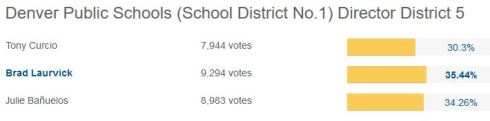
District 5 Votes

Denver City Official Election Results DPS Director Seat-5

The three candidates endorsed by Stand for Children and Students for Education Reform appear to be the only candidates who supported the portfolio model of school governance. They received less than one-third of the vote. Candidates opposing privatizing public schools and closing schools received greater than two-thirds of the votes cast.

A Big Repudiation of the Portfolio Model of School Governance

Jeanne Kaplan was a former school board director in Denver and is a blogger. In a 2017 article, “What’s Next”, she described how the board was captured:

“2009 was … the first time outside money appeared in [School] Board Election campaigns. Stand for Children came with the goal of making the board “more reform oriented”… In spite of their $30,000 expenditure per candidate – which at the time was unheard of – our side, as Osborne notes, won the election. Each following election more and more reform money … appeared …. In addition to Stand, Democrats for Education Reform, Students First, and wealthy local businessmen, both Democrats and Republicans, … put enormous amounts of money and human capital to be sure … a unanimous board was achieved. Much of the money while identified by independent expenditure committee remains hidden as to who is making the individual contributions. In 2011 the people were able to hold on to a ‘mighty minority’ of three: 4-3. In 2013 the minority dwindled to one: 6-1. In 2015 the Board was unanimously ‘reform’: 7-0.”

The portfolio model which promotes disruption as a virtue is anti-union. It is not conducive to stable harmonious relations with either labor or communities and it is anti-democratic. Denver is held up as an exemplar of school reform; however the outcomes look more like a warning. Expanding achievement gaps; bloating administration; significantly increasing segregation; ending stable community schools; inefficiently busing children out of their neighborhoods and stripping citizens of their democratic rights are among the many jarring results.

This election result was a public repudiation of the portfolio model.

Neerav Kingsland, the Executive Director of the City Fund, recently wrote,

“Last year, Arnold Ventures commissioned CREDO (out of Stanford University) to study the effects of charter, innovation, and traditional schools in select cities across the country.

“Most of the cities included in the study were cities where Arnold Ventures (and now The City Fund) have partnered with local leaders to expand high-quality schools.”

The City Fund is a $200,000,000 dollar fund dedicated to expanding the portfolio model of school governance. The funds come from billionaires Reed Hastings (Netflix), John Arnold (Enron), Bill Gates (Microsoft) and Michael Dell (Dell). City Fund is very secretive about its operations.

In his post, Kingsland tried to defend the miserable results coming from Denver which he cites as the national example for the portfolio model. The truth is transportation costs are up because of the inefficient structure. Administration costs have zoomed compared to the rest of the state of Colorado and the achievement gap is among the largest in the nation. On the 2019 NAEP reading and math tests, Denver’s students were still below both the national average and were also significantly outperformed by comparable cities like San Diego and Austin.

When Kingsland says “expand high-quality schools,” he means charter schools. And for him “quality” means the school scores well on standardized tests. Lawyers like Kingsland probably don’t understand how useless those tests are for evaluating teachers or schools. If they do, it must be an inconvenient truth.

Obviously, the Denver voters have seen through the corporate smoke and mirrors and are calling for a change. No more closing schools in a poor community because they have low test scores. Instead, help those schools and their educators. No more bringing in unqualified Teach For America corps member and pretending that they are ready to lead classrooms. No more following the dictates of the American Legislative Exchange Council and removing public schools from the purview of the elected school board. No more pretending that politicians and businessmen know better how to run schools than trained experienced educators.

No more using the portfolio model to privatize public schools.

Twitter: @tultican
Dallas Chamber of Commerce Accelerates Attack on Public Schools

24 Oct

By Thomas Ultican 10/24/2019

Elites living in upscale mostly white Dallas communities are spending heavily to privatize public schools. Dallas demographics are basically a three way split with Hispanics (41.7%), whites (29.1%) and blacks (24%). However, whites living in trendy neighborhoods like Highland Park where Teach For America (TFA) founder Wendy Kopp grew up dominate the business community. In 2012, 16-years after a group of wealthy outsiders failed in their effort to take over Dallas public schools a new privatization agenda was launched.

When reporting on the 2012 takeover effort, award winning columnist of the Texas Observer, Jim Schutze, described that first attempt,

“In 1996, when well-funded, mainly white reformers came in with big manila folders of statistics under their arms preaching about outcomes and incomes, there was open warfare. Board meetings dissolved into riots.

“The New Black Panthers threatened to show up at school headquarters armed with shotguns. Tangles between angry speakers and district security guards were beginning to make board meetings look like Total Nonstop Action Wrestling.

“The New Black Panthers painted the white school board members as bogus crackers. Then a neighbor of one white trustee proved them right by wiretapping the trustee using racial slurs. The superintendent resigned. The next superintendent got sent to the pen. A dismal series of financial scandals ensued. The school district wound up looking like bad fruit erupted in the merciless Texas sun. So here we go again?”

In 2011, the Dallas Chamber of Commerce paid for local political leaders to visit Denver, Los Angeles and Houston to learn more about charter schools. Superintendent Michael Hinojosa and trustee Bernadette Nutall were in the group.

Before 2012, Dallas school board elections were very low key affairs. Two of the three incumbent school board trustees up for reelection ran unopposed in 2011 and the third district trustee had resigned. Mike Morath stepped forward to take that district two trusteeship. It was pretty much unheard of for a school board candidate to have raised as much as $10,000 for a campaign; however even though running unopposed, Morath’s campaign contributions totaled $28,890.00 and he spent $16,773.07.

Writing for In These Times, George Joseph explained the political change in a 2014 article:

“But since the beginning of 2012, hundreds of thousands of Super PAC dollars from Dallas’ richest neighborhoods began flowing into nearly all of the district’s school board elections. 

“Since 2011, Educate Dallas, a PAC backed by the Dallas Regional Chamber (the local Chamber of Commerce), has raised $661,953 in cash on hand for its school board war chest, and the Dallas-based education reform PAC Kids First, led by millionaire tech CEO Ken Barth, has raised $661,616. The majority of their donations come from Dallas’ famous aristocrats, including Barth, Ross Perot, Ray Hunt—an oil heir with a net worth of $5.8 billion—and Harlan Crow, a real estate heir and buddy of Clarence Thomas.”

In 2012, incumbent Bernadette Nutall was provided a campaign war chest of $54,527.06 to fend off a challenge by an unknown youth. Nutall had supported closing eleven “underutilized” schools in her district which made her popular at the chamber but angered much of her district. In that same election, Dan Micciche received $56,479.57 to run against Trustee Bruce Parrot in district-3. With an almost 60 to 1 spending advantage, Micciche easily won.

Once the new board was seated it proceeded to fire Superintendent Michael Hinojosa and replace him with Mike Miles a graduate of billionaire Eli Broad’s Superintendents Academy. At the time, Miles was serving as superintendent of schools for Harrison School District-2 in Colorado Springs. The Dallas morning news stated that Miles had “been compared with Michelle Rhee, the go-get-em chancellor who has been villainized and lauded as she tries to repair the shattered Washington, D.C. school system.” The lone vote opposed to the Miles hire came from district-6 Trustee Carla Ranger. Ranger posted an informative quote from the Colorado Gazette on her blog:

“That tough and visionary approach to education is what impressed the Texans.  Blackburn [Board President Lew Blackburn] said that they liked the steps Miles took to improve Harrison, including pay for performance and the intense performance evaluations.”

The article “Dallas Chamber of Commerce Disrupts Dallas Schools summarizes Miles three year tenure,

“Miles’s reforms included a new principal evaluation process which led to large turnover. He also instituted a merit pay system for teachers and hired Charles Glover a 29-year-old administrator of the Dallas TFA branch to be Chief Talent Officer in DISD. After just under three years, he had managed to alienate the black and Hispanic communities as well as many experienced teachers and principals.”

In 2015, Michael Hinojosa was rehired as Dallas Superintendent of schools.

The year before, Trustee Mike Morath had proposed a scheme based on an obscure Texas law that would eliminate the democratically elected school board and accelerate charter school growth. George Joseph reporting on Morath’s “home rule” plan wrote,

Three inside city sources told the Dallas Morning News that the mayor and school board trustee Mike Morath, a major force behind the home rule effort, view home rule as best chance to replace the elected school board with complete mayoral control or at least an appointed school board. One source claimed the mayor’s spokesperson told him that “the mayor would run DISD or oversee it. You wouldn’t have trustees. If you did, they wouldn’t be making decisions.”

Morath’s “home rule” plan was quickly embraced by the local chamber of commerce through a political action non-profit, Support Our Public Schools. Houston billionaire and former Enron trader John Arnold contributed $150,000 to the cause. Communities throughout Dallas rose up and to defeat the plan but Morath’s prominence grew.

In 2015, new Texas Governor Greg Abbott appointed Mike Morath Commissioner of Education. With no education training and a few months experience as a substitute teacher, Morath became Abbott’s best possible choice. Conservative writer Donna Garner declared, “I cannot think of very many people whom Gov. Greg Abbott could have appointed who would have been a worse choice than Mike Morath as Texas Commissioner of Education.”

Chamber of Commerce and Billionaires Continue Buying School Board Elections

Stacy Schusterman

Tulsa Billionaire Stacy Schusterman a Dallas School Board Election Donor; Sampson-Energy

In 2017, Miguel Solis the incumbent from district-8 ran unopposed. In district-6, the incumbent Joyce Forman had token opposition and easily won with 87% of the vote. In district-2, the incumbent Dustin Marshall was in for a dog fight. In fact, his opponent Lori Kirkpatrick almost won outright during the general election with 49.8% of the vote to Marshall’s 47.0%. In the runoff, Marshall handily beat Kirkpatrick 66.3% to 33.7%. Money was the difference. Marshall could outspend Kirkpatrick by more than 6 times with his $338,302.63 funding advantage over her $52,913.76.

Chris Tackett put Dustin Marshall’s contributors into a pie chart.

Dustin Marshall Contributors Chris Tackett

Chris Tackett Pie Chart of 2017 Support for Marshall

The May 4, 2019 school board elections for districts 4, 5 and 7 had similar results. The chamber of commerce slate won a clean sweep, while candidates supported by community groups, the PTA and teachers’ associations were swamped under the massive spending.

Karla Garcia was forced into a runoff by her district-4 opponent Camile White. The three big corporate PACs Ascend, Kids First and Educate Dallas all generously supported Garcia enabling her to outspend White by a ratio of 18 to 1. Garcia’s $90,132.69 campaign fund allowed her to spend more than $78 for each vote received.

In District-5, Maxie Johnson outspent his opponent David King by more than 10 to 1. Educate Dallas, Kids First and the Texas Organizing Project all made large contributions to his total campaign fund of $74,992.93.

There was a bit of a contest in district-7. The chamber candidate Ben Mackey was opposed by Brent McDougal who had considerable community support. Mackey’s total campaign contributions of $138,416.27 was by far the largest in the May election and it dwarfed McDougal’s surprisingly large trove of $35,910.76. In addition to contributions from Educate Dallas and Kids First, Mackey got a $10,000 contribution from Tulsa billionaire Stacey Schusterman.

Dallas Chamber Joins State Republican Leaders and Billionaires in School Privatization Project   

Texas blogger Lynn Davenport recently wrote about a school board plan to turn over Martin Luther King, Jr. Arts Academy to a private operator. This plan is based on the 2017 state law, Senate Bill 1882, that pays districts $1800 for each student put in privately operated schools. In this case, a highly regarded non-profit CitySquare which has no experience running schools would operate Martin Luther King, Jr. Arts Academy as a charter school. In her discussion of the district policy change that would make this possible, Kirkpatrick wrote,

“MLK, Jr. Learning Center is a neighborhood school that was selected last year as a choice school, an arts academy being referred to as a ‘Baby Booker T.’ Trustee Joyce Foreman is the lone dissenter against the privatization agenda in Dallas ISD. She is up against a supermajority of trustees winning the race to hand the neighborhood and open-enrollment schools to non-educators and non-profits under the controversial SB 1882. Trustee Foreman asked, ‘Why would we want someone else to run our best schools?”’

A school board election commentary in the Dallas Morning News by metro columnist Sharon Grigsby had the title, “Good riddance to naysayers — Dallas ISD kids finally get the trustees they deserve.” In other words, anyone who speaks out against the privatization agenda is a “naysayer.”

Dallas’s largest and most influential newspaper also ran an editorial decryingso much resistance to this school district exploring partnerships with outside organizations.” Partnerships are a way of privatizing public schools by turning them over to charter schools or other nonprofits. The Dallas Morning News is clearly an integral part of the chamber of commerce push to privatize public schools in Dallas.

As insightful education writer Nancy Bailey notes, “The partners, not the public, will own Dallas’s public schools.”

Since Greg Abbott has been governor he has signed two laws that accelerate public school privatization and end local control. House Bill 1842 mandatesintervention in and sanction of a public school that has received an academically unsuccessful performance rating for at least two consecutive school years ….” Senate Bill 1882 incentivizes school districts to hand over control of failing neighborhood schools to charter operators (referred to as “partnerships”). In Dallas local leaders are proposing using this provision to hand over control of open enrollment schools whether they are failing or not.

There have been twelve Texas schools that have been taken over by private operators under the provisions of SB 1882 and have a set of new grades. Some schools saw testing score improvement but most did not.

Texas Tribune Partnership Chart

Texas Tribune Chart of First SB1882 Privatized Schools with Grades

These privatization decisions are all being made based on standardized testing which is completely incapable of assessing school quality. The only thing they are good at is assessing a student’s family financial condition and providing propaganda for privatization.

Republican Governor Greg Abbott’s Commissioner of Education, Mike Morath, has created a program called the System of Great Schools. It is a plan to implement the portfolio model of school governance throughout the state of Texas. It is identical to the plan that billionaires Reed Hasting, John Arnold, Bill Gates and Michael Dell are financing through The City Fund. The portfolio school system management model systematically removes public schools from governance by elected boards and puts them under private control.

Dallas has a good public education system with a long history of success. That system is being hijacked by wealthy elites and their political henchmen. An awakened citizenry can stop this travesty.

Twitter: @tultican

Maybe Betsy DeVos was a Good Thing

17 Oct

By Thomas Ultican 10/17/2019

It is clear that President Trump selected a billionaire enemy of public education to be in charge of schools. However, Betsy DeVos is so easy to dislike and has shined such a big light on the destroy-public-education (DPE) movement that Democrats are fleeing the school choice agenda. If Hillary Clinton had become President, her policies may have permanently damage universal free public education. When WikiLeaks leaked John Podesta’s emails, Hillary Clinton’s campaign Policy Book and its K-12 public education policy recommendations were revealed. Those recommendations were aligned with the DPE playbook supported by neoliberals.

Group Thinks’ Historical Background

In the last two decades of the 20th century, there was a general consensus reached by governing elites that America’s public education system was in dire straits and needed reform. The impetus for this goes back to the Reagan era’s “A Nation at Risk”.  It masqueraded as a research paper, but was actually a polemic based on faulty understanding and a misreading of data. In 1991, researchers at the Sandia Laboratory in New Mexico debunked the main points of “A Nation at Risk,” but their report was barely noticed. A growing consensus based on a century old illusion had developed among policy wonks, politicians and leaders in education philanthropy. They all accepted beltway common knowledge and agreed on a broad outline of what needed to be done to confront the “undeniable failure” of public education:

  • Institute standards
  • Use testing to hold schools accountable
  • Apply business based leadership principles and personel
  • Create alternate pathways for teacher certification
  • Develop competition
  • Provide school choice
  • Marginalize teachers unions
  • End the federalist system of school governance (i.e. locally elected school boards)

In 1985, the Democratic Leadership Council (DLC) was established by Al From. Politico described the DLC thusly:

“The DLC was formed in the 1980s – the debacle of the 1984 Mondale campaign was a key motivator – to wage just that kind of intra-party war against what From and his allies saw as interest-group liberals content to consign the Democratic Party to minority status. The group and its best-known chairman, then-Arkansas Gov. Bill Clinton, pushed balanced budgets, free trade, tough-on-crime policies, and welfare reform – all of which alienated the base, but became a key part of Clinton’s “New Democrat” agenda and his presidential legacy.”

The DLC was made up of a group of neoliberal politicians who took over the Democratic Party in the 1990s.  

When Bill and Hillary arrived in Washington DC, a large number of youthful “New Democrats” with elite educations joined them. Many, like Bruce Reed, had already worked in Clinton’s presidential campaign. Marc Tucker, a leader in the standards-driven education reform movement, saw like-minded reformers who also believed that the public school system was outdated and failing. In the infamous “Hillary Letter,” which Tucker began with the salutation “Dear Hillary,” he laid out several reform ideas that would completely change how education is done. He began:

“First, a vision of the kind of national — not federal — human resources development system the nation could have. … What is essential is that we create a seamless web of opportunities, to develop one’s skills that literally extends from cradle to grave and is the same system for everyone — young and old, poor and rich, worker and full-time student. It needs to be a system driven by client needs (not agency regulations or the needs of the organization providing the services), guided by clear standards that define the stages of the system for the people who progress through it, and regulated on the basis of outcomes that providers produce for their clients, not inputs into the system.”

In 1989, Arkansas Governor Bill Clinton had joined President George H. W. Bush at the University of Virginia in Charlottesville for an education conference. The Charlottesville joint communiqué listed the four areas of agreement reached at the summit:

“The President and the nation’s Governors have agreed at this summit to:

  • Establish a process for setting national education goals;
  • Seek greater flexibility and enhanced accountability in the use of Federal resources to meet the goals, through both regulatory and legislative changes;
  • Undertake a major state-by-state effort to restructure our education system; and
  • Report annually on progress in achieving our goals.”

Clinton’s 1994 reauthorization of the Elementary and Secondary Education Act (ESEA) embodied these principles. It called for all states to create standards and curricular frameworks. Though not mandatory, the Act along with the Clinton’s proposed goals 2000 prepared the way for the No Child Left Behind Act in 2001, which was a federal takeover of public education.

In 1998, Bill Clinton wrote: “We have worked to raise academic standards, promote accountability, and provide greater competition and choice within the public schools, including support for a dramatic increase in charter schools.”

The Position Book

In December 2014, Dan Schwerin, Hillary Clinton’s speech writer, wrote in an email to John Podesta,

“We wanted to share with you this long book of policy memos that we gave to HRC for vacation reading.  As noted in the cover memo, this reflects months of work by a team of about a dozen volunteers who conducted more than 100 interviews with thought leaders in a wide range of fields.”

The K-12 section of the Position Book was presented by Ann O’Leary, who is now California Governor Gavin Newsom’s chief of staff. A Fortune magazine biography of O’Leary described her:

“O’Leary is a diehard policy wonk, especially keen on anything that affects families or education. As Clinton’s Senate aide in 2001, she was at the center of No Child Left Behind—a once popular education initiative that has since soured in the public mind. ‘It was a really important moment,’ she says of the law, which Ted Kennedy crafted and George W. Bush signed. ‘When you look back at what happened, this was serious, bipartisan, constructive work. We were committed to high standards and helping states get there.”’

In the Position Book, O’Leary informs Clinton,

“In preparing for our thinking on K-12 proposals, I solicited a memo from Chis Edley, who recently chaired the National Commission on Educational Equity and Excellence, to go along with the memo you previously received from Neera and Catherine Brown. I also had good conversations with Laurene Powell Jobs and Bruce Reed (highlights of my conversation noted below), and Dan solicited some thoughts from Kate Childs Graham (who is Randi’s speech writer). I have reached out to Linda Darling-Hammond and Randi Weingarten to solicit their ideas as well, and will schedule those conversations after the holidays.

On O’Leary’s conversation with Bruce Reed: Reed worked as a policy director in the 1992 Clinton-Gore campaign and then worked in various capacities throughout the duration of the administration. In 2001, he became CEO of the DLC and served there until it shut down in 2011 at which time he became Chief of Staff for Vice President Joe Biden. In November 2013, Reed left the Obama administration to become President of the Broad Foundation. Professor Jim Horn notes, “This is someone who has never taught a day in his life at any grade level nor had any background in pedagogy or education.”

Hillary-Clinton-Eli-Broad

Hillary and Her Long Time Friend Ely Broad at a Wedding – Google Images

The Reed highlights include;

  1. Hillary’s initial instincts still hold true – choice in the form of charters, higher standards and making this a center piece of what we do as a country
  2. Challenge of education reform: school districts are pretty hard, if not impossible, to reform – they are another broken part of democracy
  3. If you create the Silicon Valley of education improvement, which is what New Orleans has, you can get there; Denver does it, …. pro charter; pro portfolio system for public schools
  4. Personalized learning tools – modeled in Summit Charters

Here is a different perspective. Summit learning has big money behind it but it is encountering big resistance from students and parents. The reality is that New Orleans’ schools are inefficient, undermine communities, have extremely high management and transportation costs, and still struggle academically. Denver’s schools have turned into a dystopian nightmare since neoliberal Democrats and big money Republicans took control. Democratic local control of schools is the bedrock of American democracy. The portfolio system in an undemocratic scheme to privatize public schools.

On O’Leary’s conversation with Laurene Powell Jobs: Laurene Powell Jobs is famous for having been married to technology genius Steve Jobs. She is a billionaire and co-owns Atlantic magazine. She studied economics and political science at University of Pennsylvania and received an MBA from Stanford; no education training. In 1997, she founded the Emerson Collective which promotes impact investing. She is board chair of The XQ Institute and College Track.

Highlights from Jobs recommendations;

  1. Re-design entire K-12 system – we know how to do it, but it comes down to political will.
  2. Think about Charters as our R&D … must allow public schools to have leaders that can pick their team and be held accountable
  3. Need to increase IQ in the teaching sector: Teach for America; they are a different human capital pipeline
  4. Need to use technology to transform – technology allows teachers and children to focus on content mastery versus seat time; … This is happening with Sal Kahn and schools in the Bay Area

Some tough realities undermine Jobs’ ideas. Her experiment in redesigning schools has met with failure and it is much more likely that new innovative education developments will come from public schools than charters. Jobs believes teachers are dim bulbs and that Teach For America (TFA) youths with no academic training and a five week summer course are better than the teachers she disrespects. TFA is a plague on American education and there is no way they should be receiving teaching credentials that take more than a year to earn. Her technology claim is also specious. The Organization of Economic Cooperation and Development’s Andreas Schleicher noted when discussing a recent OECD study,

“In most countries, the current use of technology is already past the point of optimal use in schools. We’re at a point where computers are actually hurting learning.”

Some input from Neera Tanden and Catherine Brown: Neera Tanden served in both the Obama and Clinton administrations. She is currently the President of the Center for American Progress (CAP). Catherine Brown is a Senior Fellow at CAP. She worked on NCLB author George Miller’s congressional staff prior to becoming vice president of policy at TFA. She was also a senior consultant for Leadership for Educational Equity which is an organization that works to get TFA alumni elected to school boards. Neera and Catherine mainly presented political analysis but share these ideas.

  1. In spite of the challenges that remain, the standards-based reforms implemented over the last two decades have resulted in significant, positive change.
  2. Teach For America … offers a powerful proof point that it is possible to diversify the teaching force while retaining a high bar.

These points were both complete fallacies.

Ann O’Leary also informed Clinton, “There is strong agreement that we need high academic standards in our public school system and that the Common Core will help us to be more globally competitive.”

The Policy Book had no voices championing the public education system or suggesting it needed protecting.

Observations

The Clinton team was going to advance the DPE agenda. Unlike Betsy DeVos, they were not going to alienate neoliberal Democrats. In the final analysis, she and her policy wonks would have done far more damage to public education than we are seeing now.

This history also highlights the importance of being relentless in discovering what is the real education agenda of our Presidential candidates? Trump gave us DeVos. Enough said. Biden was part of Race to the Top, his brother is a charter school entrepreneur and his chief of staff became President of the Broad Foundation. Bernie Sanders is very clear and supportive of public education. He has put out a wonderfully thought-out Marshal Plan for Public Education. Elizabeth Warren has come out in full voiced support for public education and her plan zeros out federal dollars to charter schools. She has published a well thought out plan for public education. Pete Buttigieg is raking in large donations from DPE proponents like Reed Hastings.

Is Inspire Charter School the Next A3 Education?

9 Oct

By Thomas Ultican 10/9/2019

Inspire Charter School mirrors the methods of A3 Education. It employs practices strikingly similar to those that led to May’s 67-count indictment against A3’s leaders. Furthermore, the California Charter School Association (CCSA) took the unusual step of sharing concerns about Inspire and A3 with California authorities. Both are virtual schools that concentrate on obtaining authorization from small school districts. These systems have a similar structure in which a central organization controls the schools that are contracting with it and they transfer funds among multiple organizations making it difficult to monitor their activities. Students at Inspire and A3 struggle academically.

Inspire picture 5

The First Inspire Charter School Opened in 2014

The Acton-Aqua Dulce Unified School District is infamous for authorizing suspect charter applications while not having the resources to adequately monitor those schools. It enrolls 1085 public school students and 14,734 charter school students. Acton-Aqua Dulce authorized Inspire’s first charter school which was located in Los Angeles County. Strangely, Inspire Charter grew from 151 students in the 2014-15 school year to 4,321 students in the 2018-19 school year and then closed up shop this June 30th.

Founder Nick Nichols needed a program that would service his target audience of home school students.  The Inspire 2016 tax form shows that he purchased curriculum from Academic Arts and Action for $149,625. This is notable because the chairman of Academic Arts and Action was Jason Schrock and the President was Sean McManus. That is the same Schrock and McManus indicted in the A3 scandal.

The education writer for the San Diego Union Tribune (UT), Kristen Taketa, has been relentlessly pursuing the Inspire story. She explains one of the the charters selling points,

“Inspire parents have been able to spend state-provided money on expenses they say are educational, from Disneyland annual passes to private ice skating coaching. The list of places where Inspire parents could spend school funds has included Costco, Amazon, Big Air Trampoline Park, Medieval Times, Guitar Center and the DNA testing company 23 and Me, according to Inspire’s list of approved vendors.”

Inspire provides each parent $2600 to $3000 to spend on field trips and other educational resources.

In 2015, Inspire rolled out a successful but legally questionable method for attracting students. They offered parents $200 paid out of enrichment funds for every student they recruited and they incentivized staff $100 in extra work hours for each learner they signed.

Last year Nick Nichols oversaw nine schools with 23,300 total students. In the 2016-17 school year, Inspire took in $76,018,441 yet their debt was skyrocketing. Their pay for officers went from $65,318 for the 2014-15 school year to $2,011,898 in the 2016-17 school year. Nick Nichols did especially well.

Inspire Income-Debt-Wages-Table

Data from Inspire Tax Documents

The UT’s Taketa reports, “Inspire expects to pull in $285 million in state funding this school year.”

Inspire just secured another $50,000,000 loan from the California School Finance Authority. With booming student daily attendance income and large financial backing from the state, it is strange that Nick Nichols chose now to take a temporary leave of absence. Former Mount Diablo Superintendent of Schools and Inspire’s chief operating officer, Steven Lawrence, is taking over as executive director.

Unethical and Academically Miserable

It is not just the CCSA but other destroy-public-education (DPE) groups like APLUS+, who labels itself “the leading voice for the personalized learning choice” are alarmed by Inspire. Aplus+ director Jeff Rice stated, “We are all concerned about actors like this who are repeatedly violating generally acceptable best practices.” Rice removed Inspire as a member school in 2016.

In March of 2018, the Winship-Robbins school district threatened to rescind Inspire North’s charter because of what then-Superintendent Laurie Goodman called “gross financial management.” Taketa revealed, “Four months after she issued the notice of violation to Inspire, Goodman left her job at Winship-Robbins and became Inspire’s director of leadership development, according to her LinkedIn profile.”

Inspire Charter School Network

Authorizing Districts are Small with Histories of Lax Charter Oversight

Shortly after the A3 Education indictments, Carol Burris, writing in the Washington Post’s Answer Sheet observed, “From 2009-2015, McManus was the CEO of the Academy of Arts and Science Charter Schools for which he served as CEO from 2009-2016, developing his model of using cash-strapped, small districts as authorizers of online charter schools that draw students from all over adjoining counties in exchange for fees.” Herbert “Nick” Nichols has followed the same strategy at Inspire.

With the coming 2-year moratorium on virtual schools in California, it appears there was a big push to get six new schools authorized before 2020. Taketa shared, “Inspire has been submitting petitions to districts this summer to open new schools, but it withdrew at least two after district officials questioned Inspire’s practices.” Irvine Unified School District had their lawyer respond to Inspire’s charter school petition. The lawyer presented more than 100 requests for more information including:

“What systems, policies, and procedures does Inspire have in place to ensure that public school charter funds are being spent in a proper manner and that a gift of public funds is not taking place?”

“Does Inspire require parents to produce receipts for all purchases?”

“Has Inspire conducted an audit of these funds to be sure that they are properly spent?”

“Is the charter school required to contract with Inspire or may it contract with other vendors for services?”

Four Inspire Charter schools changed their name this summer. San Diego’s Inspire South became Cabrillo Point Academy and Inspire Central is now Yosemite Valley Charter. Inspire North has changed to Feather River Charter and Inspire Kern’s new name is Blue Ridge Academy. They all removed Inspire from their name. Attorney Sarah Sutherland who has represented school districts in charter school litigation noted, “They can morph their existence and change their names faster than anyone can keep up with recognizing they’re the same organization.”

Charter school competitors believe Inspire is using unethical practices to poach from other schools. Terri Schiavone, the Founder and Director of Golden Valley Charter School in Ventura said her school is one of many that are losing students to Inspire Charter.

Schiavone claimed on NBC channel 39, “They target a school and then they try to get as many of their teachers and students as possible.” She said families and teachers are given incentives like using instructional funds to buy tickets to theme parks and there is a lack of oversight and accountability. Schiavone also points out that parents can buy whatever they want from vendors who she says are not fingerprinted or qualified.

The UT’s Taketa observed, “There are virtually no state rules about how home school charter families are allowed to use enrichment funds, partly because home school charters are not well-known outside of home school circles.”

Inspire picture 2

An Enrichment Opportunity Posted on the Inspire Facebook Page

Poor academic performance plagues Inspire. The graduation rate was only 69 percent last year and just 7 of 209 graduates met California state college admissions requirements.

In 2014, California adopted the California Assessment of Student Performance and Progress (CAASPP) System. These Smarter Balanced assessments are new computer-based tests that measure student knowledge of California’s English and mathematics common core standards. The results show 2 categories for students who achieved an arbitrary expectation level and 2 categories for students who did not. For simplicity the 2 met expectations results are added together. Using these results, the following comparison data table was constructed.

Testing Data Comparison Chart

CAASPP Data Comparing Inspire Results with California Results

Standardized testing does not do a good job of measuring school quality, but it does a very good job of identifying poverty and language learners. That is what makes these results so stunningly awful for Inspire. California data shows 60.9 percent students in poverty and 19.3 percent English language learners. Inspire schools report 38.8 percent students in poverty and 2 percent English language learners. With their demographic advantage, it is difficult to explain away Inspires miserable testing results.

Opinion

There are a few obvious questions about Inspire Schools that need an answer. Why did Nick Nichols step down in September? Why did Inspire close its oldest and apparently lucrative school? Is any district attorney currently investigating Inspire? If not, why not?

Terri Schiavone also mentioned on Channel 39 News,

“It’s very desirable for some parents to enroll in schools in which nobody’s looking over their shoulder. They can utilize whatever curriculum they want, including religious curriculum, which is illegal if using public dollars.”

The National Center for Education Statistics did a 2003 study on why parents choose to homeschool their children. They found that 72% cited being able to “provide religious or moral instruction”.

In 2001, Dick and Betsy DeVos sat down for a lengthy interview at The Gathering which Jay Michaelson described as the “hub of Christian Right organizing.” Betsy said,

There are not enough philanthropic dollars in America to fund what is currently the need in education…Our desire is to confront the culture in ways that will continue to advance God’s kingdom.

Dick lamented the fact that schools have displaced churches as the center of community activities. He says that Bill Bennett’s new K12 Inc. cyber schools although not Christian could be a great help to evangelical homeschoolers.

I have always felt that it is an Americans right to choose where their children are educated. I also believe in free universal public education. However, it should not be the responsibility of taxpayers to pay for people’s private choices. If parents do not want their children in the free taxpayer funded school system, that is fine, but that choice should not be subsidized by the government.

Cyber schools have consistently achieved horrible academic results and at the same time been the center of amazing corruption and greed. Just look at what happened at A3 Education. It is time to end public spending on cyber education and to remember President Ulysses S. Grant’s admonition,

“Leave the matter of religion to the family altar, the church, and the private school, supported entirely by private contributions. Keep the church and state forever separate.”

New Orleans Education is Inefficient Expensive and Sad

2 Oct

By Thomas Ultican 10/2/2019

New Orleans’s public schools were targeted by the destroy-public-education (DPE) movement even before hurricane Katrina struck. Today, they are the national example of a privatized school system. DPE operatives like Neerav Kingsland, the former chief executive of New Schools for New Orleans and Managing Director of the secretive City Fund, use New Orleans to promote the portfolio management theory of school governance and to attract philanthropic dollars to their cause. However, the reality is that New Orleans’ schools are inefficient, undermine communities, have extremely high management and transportation costs, and still struggle academically. They are a sad but typical example of market-based education reform.

In 2002, George Bush signed into law the update of the Elementary and Secondary Education act known as “No Child Left Behind” (NCLB). Alfie Kohn published a 2004 article, “Test Today, Privatize Tomorrow; Using Accountability to ‘Reform’ Public Schools to Death.” In it, he discussed the idea that the NCLB accountability measures were purposely designed to open a path for privatizing schools. He wrote,

 “We now have corroboration that these fears were entirely justified. Susan Neuman, an assistant secretary of education during the roll-out of NCLB, admitted that others in Bush’s Department of Education ‘saw NCLB as a Trojan horse for the choice agenda – a way to expose the failure of public education and blow it up a bit’’’ (Claudia Wallis, ‘No Child Left Behind: Doomed to Fail?’, Time, June 8, 2008).”

26-george-bush-signs-nclb-act-2002

George Bush Signs NCLB Law January 8, 2002 – Ron Edmonds/AP-File

In 2003, Louisiana state government passed a school take-over law aimed at the low scoring schools in New Orleans. The law created the Recovery School District (RSD) which would manage the schools the state took. School performance scores (SPS) were given to schools based on testing data, attendance, dropout rates and graduation rates. Receiving an SPS rating of academically unacceptable four years in a row made a school vulnerable to takeover.

By the end of the 2004-2005 school year, the state had taken over five New Orleans schools. RSD turned all five into charter schools operated by four groups: University of New Orleans; Middle School Advocates, Inc.; Knowledge Is Power Program; and Institute for Academic Excellence. All set to begin in the 2005-06 school year.

However, privatizing five schools did little to solve the corruption problem endemic in the Orleans Parrish School Board. There were six interim superintendents between 1998 and 2005. With a lack of stable central leadership, corruption, graft, and incompetence persisted. An FBI investigation led to 11 indictments in 2004 and by end of the school year in May 2005 the district was effectively bankrupt.

In July, the Orleans Parish School Board (OPSB) contracted with Alvarez & Marsal, a financial turnaround firm from New York City with little experience in public schools. The first Alvarez & Marsal status report said,

“The conditions we have found are as bad as any we have ever encountered. The financial data that exists is (sic) unreliable, there has not been a clean audit since FY 2001-2002, there is no inventory of assets, the payroll system is in shambles, school buildings are in deplorable condition and, up to now, there has been little accountability.”

In late August 2005, Hurricane Katrina struck.

Aug 30 2015 Photo by David J. Phillip - AP

August 30, 2005 Photo by David J. Phillip/AP

Before Katrina, OPSB, which ran the public schools in New Orleans, operated 123 schools; in the spring following the storm, it was running just four.

With OPSB out of the road and RSD in charge, philanthropies like the Gates and Broad foundations were ready to help. According to Mayor Ray Nagin who is in prison,

“They said, ‘Look, you set up the right environment, we will fund, totally fund, brand-new schools for the city of New Orleans. But we don’t want to go through what you’ve been through. All that struggle you’ve been having with that school board. We don’t want to do that. We want to come in clean.’”

In her 2007 book The Shock Doctrine, Naomi Klien labeled the action of these school reform philanthropists a prime example of “disaster capitalism” which she described as “orchestrated raids on the public sphere in the wake of catastrophic events, combined with the treatment of disasters as exciting market opportunities.” She also observed, “In sharp contrast to the glacial pace with which the levees were repaired and the electricity grid brought back online, the auctioning-off of New Orleans’ school system took place with military speed and precision.”

In 2010, Obama’s Secretary of Education Arne Duncan infamously said, “I think the best thing that happened to the education system in New Orleans was Hurricane Katrina.”

In 2009, Louisiana’s Board of Elementary and Secondary Education (BESE) made it more difficult for schools to remain academically acceptable, effectively ending most of the remaining public schools in New Orleans. BESE raised the minimum SPS score for Academically Unacceptable status to 65 for the 2010-11 school year and 75 for the 2011-12 school year. In the coming school year 2019-2020, there will be no public schools in New Orleans. RSD has transferred management of charter schools to the Orleans Parish School Board which has renamed itself NOLA Public Schools.

NOLA Public Schools is Inefficient and Ineffective

At the 2016 Network for Public Education conference in Raleigh, North Carolina, the Bloomberg chair of business journalism at Baruch College of CUNY, Andrea Gabor, presented at a breakout session. She was working on a book subsequently published in 2018 with the title After the Education Wars. Andrea made it clear that she was not anti-charter school and in her book she presents the story of one particularly successful charter school, Morris Jeff, which exemplified the Deming approach to business management. She had just returned from New Orleans where she encountered many black families who were initially positive about the new charter schools after Katrina, but were now angry.

One New Orleans parent at the North Carolina session explained that during her eighth grade year she was in a class with 55-students. Their room was not air-conditioned and they were restricted to running the fan 10-minutes each hour to save on electrical costs. With the news of large scale spending on schools in black communities, residents did not care about the governance structure. It was the first significant spending on education in their neighborhoods in living memory.

OPSB was established in 1841 with a large assist from the champion of common schools, Horace Mann. However, Louisiana was a slave state and it was illegal to educate slaves. Gabor noted, “In 1867, Robert Mills Lusher, a new state superintendent of education and a ‘rabid Confederate and outspoken racist,’ argued that all-white schools should be ‘properly preserved as a bastion of white supremacy.”’ With the end of reconstruction in 1877, the schools in New Orleans were resegregated and remained that way until the 1960s.

Charter school advocates talk about the corruption and dysfunction in OPSB, however Gabor stated:

“But you don’t hear much talk these days about the legacy of white supremacy that disenfranchised the city’s majority-black residents and sought to keep them in ignorance. (As recently as the turn of the millennium, 50% of the city’s entire population was functionally illiterate.) Nor will you hear much about how the city’s white citizens fought hard against integration well into the 1960s and then, when the gig was up, fled the schools.” (Emphasis added)

Six percent of k-12 students in New Orleans are white, yet the academically top ranked and most sot after high schools are Lusher Charter School which is 53.2% white and Benjamin Franklin High School which is 40.2% white.

One more quotation from Andrea Gabor’s After the Education Wars:

“Since 2006, the average renewal rate of charter schools has been 64.8 percent. That means well over one-third of the charter schools launched since Hurricane Katrina have failed so badly that they have either been taken over or closed.”

Professor of Economics Doug Harris and his team at Tulane University are contracted to study school performance in New Orleans. It must be difficult to maintain neutrality when sharing office space on the seventh floor of 1555 Poydras Street with the pro-privatization group New Schools for New Orleans. Harris claims public schools improved considerably after Hurricane Katrina. In his new study, he attributes that success to performance-based closures and takeovers, as well as charter openings.

However, hurricane Katrina created major changes in New Orleans. The Enrollment was about 62,000 before the storm, and is 48,000 now. It is not only smaller, but less impoverished, with less concentrated poverty. Many of the poorest families left and never returned. Originally, per student spending was increased dramatically to get the schools back up and running. Now, the student spending is $1,400 per student more than before Katrina.

Professor Bruce Baker of Rutgers University reviewed Harris’s study and disagreed with his conclusion. He thinks the post Katrina changes were so ubiquitous that before and after comparison studies will never be dispositive. Baker says,

“I’m not convinced that the data available have sufficient additional precision to answer any more useful policy questions. Perhaps more importantly, the uniqueness of the policy context, conditions and changes induced by “the storm” will always severely limit any policy implications for other settings.”

Today in New Orleans, it is not uncommon for students living within view of a school, to get on a bus and travel five miles to their assigned schools. Writing in the Washington Post, Emma Brown explained, “Students were no longer assigned to schools via attendance boundaries; instead, they decided where they wanted to go and entered lotteries for a chance to enroll.” The concept of a community school that a student and all her neighborhood friends and family attended has been eliminated. Brown also shared:

“It was state officials, elected by the state’s white majority, who took over the schools from the local school board, elected by the city’s black majority. The teachers who were fired were mostly black; many of those teaching now are white, and they come from somewhere else.”

“Students traveled an average of 1.8 miles further to get to school in 2011-2012 than they did before Katrina, according to the Education Research Alliance of New Orleans.”

“One in four students attended a school more than five miles away from home.”

Transportation is not the only inefficiency in the privatized system. Since each of the charter school organizations are stand alone learning education agencies, they must have their own set of administrators. Administrative costs have dramatically risen for NOLA education. However, the cost for teachers has been reduced by replacing the formerly experienced black educators that constituted 73% of the teaching staff with mostly white Teach For America corps members who have no academic training or experience in teaching.

A huge problem with low attendance bedevils the privatized system and an extraordinary 30% of NOLA teachers resigned last year. The latest state test scores (LEAP) were released, and the scores in New Orleans stalled or dipped.

Former Assistant Secretary of Education Diane Ravitch sums up:

“So, here is the New Orleans model: Close almost all public schools. Replace them with private charters. Fire all the teachers. Replace most of the teachers with inexperienced, ill-trained TFA recruits. Close low-performing charters and replace them with other charters. Keep disrupting and churning. In the first two years, scores will go up, then stall. By year eight, “quality” will stagnate or decline. The schools will be highly stratified and racially segregated. The few high-performing schools will have selective admissions.”

Twitter: @tultican