Tag Archives: Politics

The South’s Long War on Black Literacy

14 Apr

By Thomas Ultican 4/14/2025

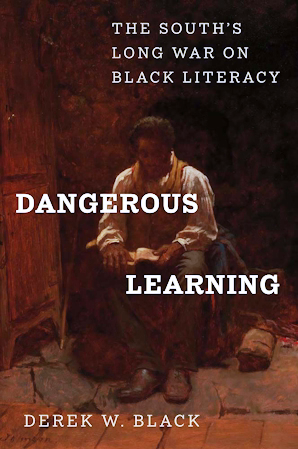
Derek Black’s masterpiece of research, Dangerous Learning, reveals the centuries of struggle for Black Americans to become educated. When I arrived at the Network for Public Education conference April 4, I ran into Professor Black (University of South Carolina Law School) and mentioned to him I almost finished reading his book on the airplane. He absurdly wanted to know how boring I found it. The truth is that this beautifully written book is extremely engaging.

Denmark Vesey

Growing up in Idaho, my knowledge of American slavery is quite lacking. I had never heard of Denmark Vesey, who played a major role in the suppression of education for slaves.

Joseph Vesey was a slave trader who brought 390 enslaved people including Demark to St. Thomas and Saint-Domingue (now known as Haiti) in 1781. Joseph’s slave ship brings the first record of the approximately 14-year-old Denmark. He was sold in Haiti along with the other 390 people but it seems he feigned epilepsy and Joseph was forced to take him back. Soon after, Denmark became Captain Vesey’s trusted assistant.

Black tells this story in about 20 pages in the book. I will cut it down a little.

Denmark learned to read and in 1799 he won the lottery ($1500). He paid Joseph $600 for his freedom and through various means; Denmark became highly educated. He was also inspired by the slave revolution in Haiti. Denmark became an authority on the Bible being known in the community as “a man of the book”. (Page 16) He taught classes at the African Church which became the famous African Methodist Episcopal Zion Church also known as the AME Church. Denmark was obsessed with learning and read widely including classical literature.

In the Old Testament, Vesey found the story of the Israelites’ path from slavery. He taught his friends how the children of Israel were delivered from bondage in Egypt. Professor Black explains:

“In it [the Old Testament], Vesey found a God who stood on the side of the oppressed, not the oppressor, and who intervened in the world not to reinforce slavery but to free the Israelites from it. God consistently assured the Israelites that He would deliver their enemies into their hands if they would follow His will. And following His will did not mean turning the other cheek, fleeing from conflict, or suffering in silence. It often meant smiting those who stood against them, including women and children.”   (Page 20)

In 1822, Vesey having been deeply and fundamentally changed by his literacy planned a slave rebellion. He chose July 14th for the liberation of Black people in Charleston.  The plan was workable but an enslaved man came forward on May 30th claiming he had been recruited to participate in a slave revolt. After that, Vesey’s plans fell apart and he along with his co-conspirators were put to death. Black noted, “When Frederick Douglass implored crowds of Black men to join the Union Army in 1863, he offered a simple message: ‘Remember Denmark Vesey of Charleston.’” (Page 35)

Unfortunately, it was remembering Denmark Vesey that pushed southerners into an all out suppression of Black literacy that lasted well into the twentieth century.
Suppressing Education

The last open debate on slavery in the South was conducted by the Virginia legislature in 1832. William M. Rivas, a lawyer and member of a wealthy colonial family claimed that elite planters had “held the state’s democratic process in a death grip for decades.” (Page 107) He said they had intentionally limited education not just for slaves but for poor and middle-class White people as well.

While the North was engaged in developing a state supported public education system, the South, under the influence of wealthy elites, absolutely opposed state funding for education.

It was a shock for me to discover that Thomas Jefferson was a white supremacist. In Notes on the State of Virginia he wrote that Black people were “inferior to whites in the endowments of both of body and mind.” (Page 65) He said that this reality posed a powerful obstacle to emancipation.

After the 1832 debate, censorship and anti-literacy in the South took on a life of their own. The South became more and more isolated and intolerant.

For the slaves, seeking literacy was hidden and secretive. Finding the time to study was difficult and a flickering candle could draw attention and suspicion. It is reported that enslaved people would study in caves or in holes they created in the woods.

“In Mississippi, people told of holes large enough to accommodate a group. They called them ‘pit schools.’” (Page 188)

After the Civil War, former slaves were able to openly attend school and the Reconstruction Act of 1867 attempted to force states to pay for it. The Act created three requirements for states to be readmitted to the Union: extend the vote to black men, ratify the 14th Amendment and guarantee a republican form of government. Black noted, “A republican form of government meant, among other things, ensuring public education.” (Page 244)

However the citizens of the south were not going to accept Black people having equal rights. Terrorist groups attacked schools and teachers. The more Union troops were drawn down, the greater the violence became.
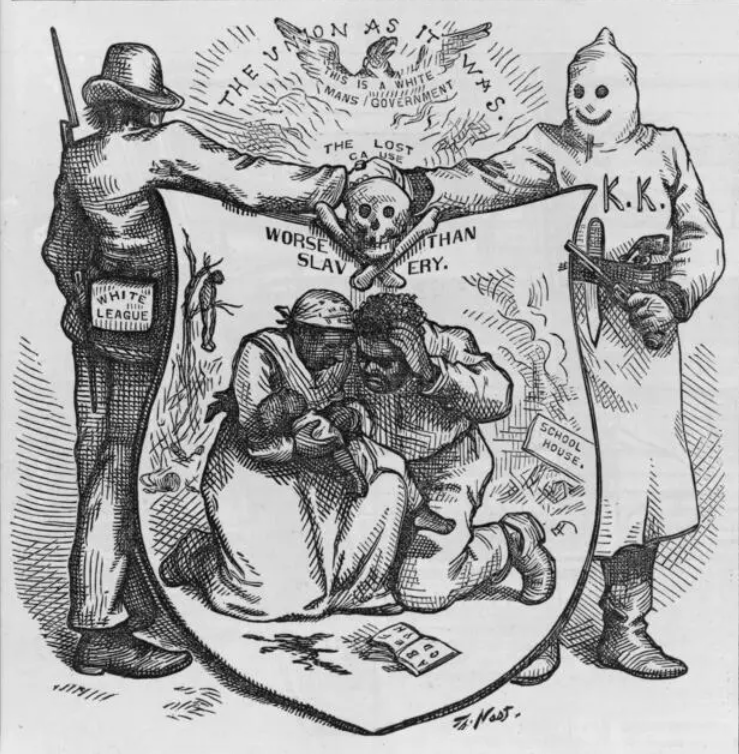
1874 Harper’s Political Cartoon by Thomas Nast

During Reconstruction, 631 attacks on black schools have been documented. White citizens of Tennessee under the leadership of the KKK destroyed 76 Black schools. (Page 261)

In order to secure victory in the 1877 Presidential race, Rutherford B. Hayes agreed to a compromise between southern Democrats and pro-business Republicans to end Reconstruction. Soon after, southern states started rewriting the required constitutions they needed to rejoin the Union. There was a two pronged agenda: “disenfranchise Black voters, and segregate and underfund Black education.” (Page 168) Jim Crow laws became enshrined in the new southern state constitutions.

In 1896, the Plessy v. Ferguson case held up the bogus concept of separate but equal facilities. That same year saw a new Louisiana law that took Black male voter registration from 95.6% of the population to 1.1% by 1904. In 1902, Nicolas Bauer, a man that would become superintendent of public schools in New Orleans, wrote:

“I realize from my limited observation that to teach the negro (sic) is a different problem. His natural ability is of a low character and it is possible to bring him to a certain level beyond which it is impossible to carry him. That point is reached in the fifth grade of our schools.”

The lack of justice and abundance of ignorance is what the Supreme Court tried to rectify with Brown v. Board of Education.

The fact is these two centuries of hostility toward educating all American citizens is still causing harm. Derek Black’s Dangerous Learning is a must read for anyone that cares about justice.

Teach Truth

23 Feb

By Thomas Ultican 2/23/2021

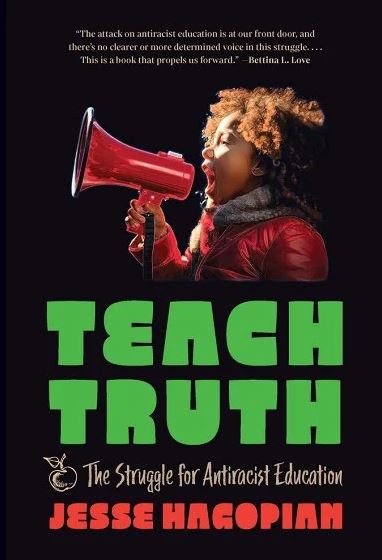
In “Teach Truth: The Struggle for Antiracist Education,” Author Jesse Hagopian takes his readers inside the struggle and shares Black culture. At the 2018 Indianapolis Network for Public Education conference, Journey for Justice Chairman, Jitu Brown, introduced Jesse as “a freedom fighter who happens to be a teacher.” What I did not understand then is that he also happens to be man who can write.  This book is exceptional.

Jesse defines two concepts that he uses throughout the book: uncritical race theory and truthcrime law.

He states, “Uncritical race theory denies that racism exists at all, or maintains that racism primarily victimizes white people, or rejects any systemic or institutional analysis in favor of an inter personal explanation that understands racism as only sporadic and merely the product of individual bias.” (Page 7)

He explains:

“A truthcrime is any act of honest pedagogy in a jurisdiction where truthful teaching has been outlawed. Truthcrime is enforced disremembering. A truthcrime law, then, is one that makes lying to children obligatory and effectively renders honest educators as truthcriminals.” (Page 16)

Interesting Take on CRT

A goofball white guy from Seattle, Washington became famous by attacking critical race theory (CRT) in a completely dishonest way. Unfortunately, right-wing billionaire money trumpeted his assertions. At a time when the vast majority of America’s teachers had never heard of CRT, he claimed that public schools were indoctrinating students with CRT. For a short period of time, CRT became the racist rights number one anti-public schools slogan and a Republican campaign tool.

CRT emerged amongst scholars and lawyers in the late 1970s and early 80s as a way to understand the forces upon Black citizens after Brown v. Board of Education in 1955, The Civil Right act of 1964 and the Voting Rights act of 1965. It was pretty much the purview of graduate school seminars. (Page 6)

At a June, 2022 “Road to Majority Policy Conference” in Nashville, Tennessee, Texas Senator Ted Cruz declared, “Let me tell you right now, critical race theory is bigoted, it is a lie, and it is every bit as racist as the Klansmen in white sheets.” Hagopian observed, “The irony here is profound; while Cruz compares those who teach CRT to the KKK, his own attack on antiracist education aligns with one of the Klan’s primary objectives: thwarting Black education and antiracist pedagogy—which they have done ferociously throughout US history.” (Page 40)

Hagopian discusses why feckless Democrats did not effectively respond to the GOP’s CRT attacks. He gives the example of Democrat Terry McAuliffe’s race for the Virginia Governorship against Glenn Youngkin. When Youngkin made a full throated attack on CRT calling it “toxic” and “flagrant racism, plain and simple” that is a “poisonous left-wing doctrine,” McAuliffe replied, “I don’t think parents should be telling schools what they should teach.” This response might have cost him the race. (Page 150)

Why was McAuliffe’s answer so weak in this contest between two multimillionaire white men? Hagopian think he knows. He says, “Because many liberal politicians don’t actually support CRT, they are placed in a difficult spot during elections when Republicans attack it.” Although opposing bigotry, they do not want to support a movement that could upset their corporate sponsors. (Page 150)

Diane Ravitch wondered why so many people were silent in the face of a coordinated effort to teach inaccurate history? She wrote:

“Where was Bill Gates? Although right-wing nuts attacked Bill Gates for spreading CRT, Gates said nothing to defend schools and teachers against the attacks on them. He is not known for shyness. He uses his platform to declare his views on every manner of subject. Why the silence about teaching the nation’s history with adherence to the truth? Why no support for courageous teachers who stand up for honesty in the curriculum?” (Page 153)

Hagopian concludes, “Their lack of gusto for racial, economic, and social justice stems instead from the fact that, as with the GOP, they are predominantly funded by white billionaires who see no advantage to teaching students about systematic racism or capitalist exploitation.” (Page 156)

President Trump invokes maximum hyperbole with his unenlightened view of CRT:

“Getting critical race theory out of our schools in not just a matter of values, it’s also a matter of national survival. We have no choice, the fate of any nation ultimately depends upon the willingness of its citizens to lay down—and they must do this—lay down their very lives to defend their country” (Page 79)

Billionaire Dollars Push the Lie

Jesse began his career as a teacher at Hendley Elementary School in South Washington DC. The school’s neighborhood had a dearth of grocery stores and jobs. Hendley had a completely segregated 100% African American student population. It was 2001 and that September, the World Trade Center attack was coincident with him becoming an educator.  (Page 223)

He tells the story of his first year teaching noting seeing a police officer jack-up a fifth grade boy against a wall; the boys feet were dangling. The student was accused of throw paper in class. Jesse also describes a whole in the middle of the classroom chalkboard that his students called a bullet hole.

A poster session on US history revealed another hole in the classroom. The posters were all hung on a Friday and that weekend it rained. Upon arriving at school on Monday morning, Jesse found the floor flooded and the posters soaked. After the second classroom flooding, he wised-up and put a large trash bin below the hole in the roof. His work orders to fix the roof were never filled.

Hagopian observes, “I received a graduate degree in education theory that year by witnessing the cynicism of our nation’s ability to mobilize armies to bomb people on the other side of the world while refusing to find the money to fix the hole in the ceiling of my classroom or properly care for these children in the shadow of the White House.” (Page 224)

The attack on teaching truth in America’s classrooms is being financed by right-wing billionaires. People like Julie Fancelli, an heir of the Publix grocery fortune, former secretary of public education, Betsy DeVos, oil magnate, Charles Koch, the secretive electronics billionaire, Barre Seid, and so many more.

Jesse notes that:

“Maintaining an economic system such as ours, where eighty-one billionaires have more wealth than the bottom half of all people on Earth, doesn’t just happen by accident. It takes careful investment in institutions that shape ideas, and those investments see the biggest returns in the mass media and the system of schooling.” (Page 157)

A Surprise to Me

I was aware that homosexuality was illegal in America until the 1970s and that the legal turning point came in 1969 at the Stonewall Inn. This gay bar in Greenwich Village was the site of a gay uprising when police raided the bar. Today’s annual pride festivals originate from and celebrate the Stonewall riot.

What I did not know until reading Teach Truth is that the rebellion was led by Marsha P. Johnson and a host of Black and Brown queer people. (Page 97-98)

I highly recommend reading this book. It is full of surprises like this one.

San Diego School Board Election Outcomes

17 Dec

By Thomas Ultican 12/17/2024

Before the recent election, I wrote recommendations for several school board seats in San Diego County. The San Diego County Registrar of Voters has posted the final official results which are transcribed here with a few comments.

San Diego County Board of Education

Gregg Robinson in district-1 and Guadalupe Gonzalez in district-2 ran unopposed and were easily reelected.

In district-4

ERIN EVANS174,25368.29%My Recommendation
SARAH SONG80,91631.71% 

NOTE: Song was an enthusiastic candidate with some support but Evans was clearly more qualified. The county board of education looks to be in good shape.

San Diego Unified School District (SDUSD)

Richard Barrera district-D and Sharon D. Whitehurst-Payne district-E, ran unopposed and were elected. 

SABRINA BAZZO40,28950.93%My Recommendation
CRYSTAL TRULL38,81849.07% 

NOTE: This result surprised me. Brazzo is a very qualified member of the board supporting public education. Trull has the academic qualifications to serve but she is also a Howard Jarvis anti-tax ideologue and seems to base her education evaluations exclusively on standardized testing. It appears SDUSD dodged a big problem by less that 1% of the vote.

Sweetwater Union High School District (SUHSD)

Trustee Area 2

ADRIAN E. ARANCIBIA21,22656.72%My Recommendation
ANGELICA S. MARTINEZ16,19543.28% 

Trustee Area 4

RODOLFO “RUDY” LOPEZ19,19262.68%My Recommendation
OLGA ESPINOZA11,42637.32% 

NOTE: Both outcomes seemed reasonable and SUHSD should be well served.

Poway Unified School District (PUSD)

Trustee Area A

TIM DOUGHERTY10,06355.09% 
DEVESH VASHISHTHA8,20544.91%My Recommendation

Trustee Area E

DAVID CHENG6,52838.34% 
CRAIG POND6,38637.51% 
CINDY SYTSMA4,11124.15%My Recommendation

NOTE: In Poway Area E, I recommended for Systema because of her strong background as an educator and former county sheriff however I think David Cheng is also an excellent choice. In Area A, I was bothered by two of Dougherty’s listed supporters, Carl DeMaio and Michael Allman. However, Dougherty looks like a normal civic minded guy and to be a supporter of public schools.

Chula Vista Elementary School District (CVESD)

Seat Number 2

LUCY UGARTE80,82469.85%My Recommendation
SHARMANE ESTOLANO34,88530.15% 

Seat Number 4

FRANCISCO TAMAYO34,22729.61% 
KATE BISHOP27,68123.94%My Recommendation
TANYA WILLIAM26,23222.69% 
JESUS F. PARTIDA15,97713.82% 
ZENITH KHAN11,4919.94% 

NOTE: Educator Lucy Ugarte was the logical choice for seat 2. I have always liked Francisco Tamayo but his odd decision to run for seat number 4 while holding seat 1 caused me to recommend against him. For outsiders, it is difficult to get a good feel for what is happening. It seems that incumbent, Kate Bishop, had alienated several people in the district including Tamayo. The new board should be fine but now has two seats to fill with Tamayo moving to seat 4 and seat 5 member, Caesar Fernandez, becoming a Chula Vista city council member.

Vista Unified School District (VUSD)

Trustee Area 1

MIKE MARKOV6,72851.91%My Recommendation
AMANDA “MANDY” REMMEN6,23448.09% 

Trustee Area 4

CIPRIANO VARGAS3,37139.06% 
FRANK NUNEZ3,07535.63% 
ZULEMA GOMEZ2,18425.31%My Recommendation

Trustee Area 5

SUE MARTIN9,54060.39%My Recommendation
ANTHONY “TJ” CROSSMAN6,25839.61%   

NOTE: The outcomes here seem fine for the school District. Incumbent, Cipriano Vargas, was the pick of the Democratic Party and many political heavy hitters but I was more moved by Gomez’s support from sitting school board members and fellow educators.

San Marco Unified School District (SMUSD)

Trustee Area A

HEIDI HERRICK7,04756.04% 
CARLOS ULLOA5,52743.96%My Recommendation

Trustee Area B

SARAH AHMAD7,09658.98%My Recommendation
BRITTANY BOWER4,93541.02% 

Trustee Area D

LENA LAUER MEUM5,94958.77% 
JAIME CHAMBERLIN4,17441.23%My Recommendation

NOTE: This new board could have problems.

Grossmont Union High School District (GUHSD)

Area 1

CHRIS FITE13,92343.30%My Recommendation
RANDALL DEAR10,48532.61% 
DEBRA HARRINGTON4,61414.35% 
AZURE CHRISAWN3,1329.74% 

Area 2

SCOTT ECKERT14,76836.64% 
JAY STEIGER13,64533.85%My Recommendation
JIM STIERINGER7,98019.80% 
MARSHA J. CHRISTMAN3,9149.71% 

NOTE: This looks like a decent outcome for GUHSD. Far right candidate, Randall Dear, was rejected even with his large cash advantage. Scott Eckert was not my first choice but he is a solid choice who cares about the district.

San Dieguito Union High School District (SDUHSD)

Trustee Area 2

JODIE WILLIAMS10,12651.22%My Recommendation
KELLY FRIIS9,64348.78% 

Trustee Area 4

MICHAEL ALLMAN8,99051.12% 
KEVIN SABELLICO8,59548.88%My Recommendation

NOTE: I was really sad to see MAGA man, Michael Allman, reelected. He has been a polarizing character since first being elected in 2020.

Escondido Union High School District (EUHSD)

Trustee Area 3

CHRISTI KNIGHT7,53865.36% 
CLAY BROWN3,99534.64%My Recommendation

Trustee Area 4

RYAN S. WILLIAMS7,84864.66% 
DARA CZERWONKA4,28935.34%My Recommendation

NOTE: In Area 3, Clay Brown dropped out of the race. Both incumbents, Christi Knight and Ryan S. Williams, were reelected. I felt there needed to be some people with education experience on the board.

Oceanside Unified School District (OUSD)

Trustee Area 2

ELEANOR EVANS6,17851.51%My Recommendation
EMILY ORTIZ WICHMANN5,81548.49% 

Trustee Area 5

MIKE BLESSING6,35453.44%My Recommendation
ROSIE HIGUERA5,53646.56% 

NOTE: The wins by incumbents, Eleanor Evans and Mike Blessing, were good news for Oceanside.

Twelve races were won by candidates I endorsed and ten went against my recommendations. Overall, there was only one of the ten districts I reviewed that I felt was hurt by this election. In San Marcos, they got rid of an incumbent with deep education experience, Carlos Ulloa, leaving SMUSD with little education knowledge. More troubling was they just elected a pro-school-choice trustee to its board.

Representative Lauren Boebert’s Controversial High School Civics Address

23 Apr

By Thomas Ultican 4/23/2023

When it was learned that Lauren Boebert the gun enthusiast who represents Colorado’s third congressional district was going to address middle and high school students in Dolores, there was angst. Emails to The Journal, the local newspaper, expressed concern that it would be a political event and some parents worried that the congresswoman would be packing a concealed weapon. The fact that parents and media were barred from attending heightened tensions. Fortunately, The Journal was able to force its way in.

According to the 2020 census, Dolores, Colorado is a small community of 885 people located in Montezuma County. It sits in the middle of rugged mountainous terrain making up the Southwest portion of the state. Dolores is part of Boebert’s congressional district which covers about 50,000 square miles of sparsely populated territory and constitutes almost half of the Colorado land mass. It is an interesting twist that Montezuma County has Dolores County on its northern border.

Colorado Annotated Congressional District Map

In the 2021/22 school year, Dolores’s middle school reported 209 students and its high school 168. The school demographics are about 79% White, 16% Hispanic and a small percentage of Indians and Asians.

For Boebert’s event, students were free to opt out. After the affair, Superintendent Reece Blincoe estimated that 250 students attended Boebert’s presentation.

Two days before Boebert arrived, the school district emailed parents with details of her visit. It said the Representative would provide a “rare chance to hear from the sitting congresswoman from our region and to promote civic engagement.” The missive stated that no parents could attend and that she would not carry a firearm on campus. It said the students were not required to attend and an alternative classroom would be available. The message stressed that Boebert’s visit would “NOT” be a political event.

Following the student assembly, when The Journal reporter in attendance asked about the safety and political concerns of some parents, Boebert replied,

“That’s really unfortunate that they would politicize something like this, and it was certainly an honor for me to be there. I wasn’t making anything political of it. You know, just explaining the basics of civics and government and the way things operate and giving them kind of an insider’s look without a partisan lens. I’m not sure exactly what the safety concern would be. But I think that it was well received and the students were amazing, friendly and welcoming … they were a joy,”

The day following the event, The Journal reported that she did get quite political:

 “Boebert contended that the response to COVID-19 infringed on liberties during the pandemic and told students they should know about those issues and let it motivate them to stand up for their freedom.

‘“I was happy being a mom,’ Boebert said. ‘I was a business owner, but I saw government over-regulating, overtaxing, overspending and destroying everything that we were working so hard to build.’”

The Durango Herald wrote an editorial stating,

“We strongly support students engaging in civic matters. But we’re uncomfortable with U.S. Rep. Lauren Boebert’s visit on Wednesday to Dolores High School because her talk ventured beyond governance into political territory.”

“According to our latest news story, she spoke about “moral decay”; becoming aware of issues that could infringe on students’ rights; the Freedom Caucus, a conservative group of GOP representatives; and liberties infringed on during the pandemic. Apparently, she also told students they should know about those issues and let it motivate them to stand up for their freedom.

“Come on! This is Boebert’s brand on stage in front of students without parents present.”

“Tom Burris, superintendent of Montezuma-Cortez School District, said he had previously received an email from Boebert’s team inquiring about an assembly with middle and high school students. Burris said he respectively declined, saying MCSD was “focusing energies on students in the classroom and academics.”’

The Denver Post reports that in the 2022 congressional election Montezuma County voted 57% for Boebert and 43% for her opponent Adam Frisch. So this event was clearly in an area of political strength for the Congresswoman. However, in her 2022 re-election effort, she only won the district by a margin of 546 votes out of the 327,132 cast or by a 0.17% margin.

This prompted several parents to believe that her visit was nothing but a campaign maneuver trying to capture new soon to graduate high school voters for 2024.

Like her or loath her, the fact is that Boebert is a very divisive personality. Even though her political support in the county is strong, her opposition is impassioned. The Post speculated this was because,

“Boebert has a history of espousing anti-LGBTQ views. She’s called women “weaker” than men, criticized the separation of church and state and made Islamophobic comments implying a colleague in Congress might be a terrorist. Political and religious experts say her Christian nationalist rhetoric presents a danger to the country’s democratic foundations.

Molly Cooper, a district parent, explained at a recent school board meeting, “This is about Boebert herself, the hate she spews and the policies she continues to support and put forward that vilify those that are different from her.”

An A3 Surprise

A concerned parent said this was all started when High School Social Studies teacher Ed Miller and Principal Justin Schmitt invited Representative Boebert to the school in October 2022, but she declined. The Boebert team appears to have decided to run a low key barely concealed series of campaign events at local high schools and reached out to Dolores in early March. The school scheduled an assembly for March 15.

The shocking revelation here is not only that Representative Boebert is willing to use public schools for partisan politics but that Dolores High School has convicted A3 conspirator Justin Schmitt as principal. It turns out he grew up and attended school there. In October, 2019 while under indictment for conspiracy to defraud the state of California out of $80,000,000, Schmitt was hired as Dean of Students in Dolores. The Journal reported that then Superintendent Lis Richard claimed he is “an extraordinary administrator.” And she continued,

“I promise you that we are aware of anything you may have heard and we stand by him in full support. He is the right person for our secondary dean of students position. His passion, dedication and wisdom are exemplary.”

Eric Beste the San Diego lawyer representing Schmitt in the A3 case emphasized that Schmitt was a salaried employee and not an A3 business owner. In other words, he was just a working guy caught up in the illegal scheming of his employer and was not a criminal at heart.

The next year Schmitt was hired as interim Principal at Dolores High School. The April 16, 2020 announcement of the appointment carried in The Journal stated, ‘“If he does not meet the ‘conditions set’ (if he is found guilty of anything more than a misdemeanor), his position will be ‘terminated,’ the update states.” However, Superintendent Richards declared, “I think it is fair to mention that a misdemeanor is not a disqualifier for licensure and I still stand by that Mr. Schmitt did nothing illegal ….”

I wrote about the A3 scandal in the summer of 2019 and it was clear to me that Justin Schmitt was not a peripheral player. He was always among the five people mentioned in stories about the indictments. I used, “The Grand Jury of San Diego County heard the testimony of 72 witnesses and voted out a 67-count indictment against Sean McManus, Jason Schrock, Justin Schmitt, Eli Johnson, Steven Zant and six others.” He was the office manager the other conspirators were communicating through.

Schmitt came to A3 through his connection with the Colorado online charter school system Foundations of Learning. At one time, he listed himself on his LinkedIn page as the Foundations of Learning Director of Schools. When McManus and Schrock bought Foundations of Learning to manage Mosaic online Justin Schmitt came with the purchase. Mosaic eventually became Valiant Academy through which Schmitt supervised the summer school sports scam.

In 2022, as part of the nobody goes to jail resolution to the A3 theft, the Voice of San Diego reported,  

“Schmitt pleaded guilty to a felony count of taking money in order to conceal crime. The charge was later reduced to a misdemeanor and Schmitt was sentenced to one year probation.”

In August 2021, Reece Blincoe was introduced as interim Superintendent of Dolores School District. He had previously served as superintendent for the Brownwood ISD in Brownwood, Texas. It appears that after seven years he was forced out of Brownwood with an agreement that included $300,000 for his resignation. There was no claim of malfeasance against Blincoe but there were rumors that it had to do with an unsubstantiated claim of bullying.

Blincoe, Schmitt and the rest of their team come out of the Boebert episode looking badly used and inept. What do they do when Boebert’s Democratic challenger Adam Frisch comes to Dolores and requests a similar event? How can a public school that has already hosted one politician legitimately turn away another politician? There is no good answer.

Community Schools Promises and Pitfalls

28 Sep

By Thomas Ultican 9/28/2022

Community school developments are surging in jurisdictions across the country. Since 2014, more the 300 community schools have been established in New York and this month Education Secretary Miguel Cardona was touting them at an event in Pennsylvania. In May, the California State Board of Education announced $635 million in grants for the development of these schools and in July, they disclosed a $4.1 billion commitment to community schools over the next seven years. However, some critiques are concerned about a lurking vulnerability to profiteering created by the Every Student Succeeds Act (ESSA).

What are Community Schools?

For decades America has turned a blind eye to the embarrassing reality that in many of our poorest communities the only functioning governmental organization or commercial enterprise is the local public school. No grocery stores, no pharmacies, no police stations, no fire stations, no libraries, no medical offices and so on leaves these communities bereft of services for basic human needs and opportunities for childhood development. Community schools are promoted as a possible remedy for some of this neighborhood damage.

The first priority for being a community school is being a public school that opens its doors to all students in the community.

A Brookings Institute study explains,

“According to the Coalition for Community Schools, a community school is ‘both a place and a set of partnerships between the school and other community resources. Its integrated focus on academics, health and social services, youth and community development, and community engagement leads to improved student learning, stronger families, and healthier communities.’ In community schools, every family and community member is a partner in the effort to build on students’ strengths, engage them as learners, and enable them to reach their full potential.”

The Brookings article notes that although community schools have a different looks in different communities they all have four common pillars: (1) “Expanded and enriched learning time,” (2) “Active family and community engagement,” (3) “Collaborative leadership and practices” and (4) “Integrated student supports.”

That means health care including vision and hearing is available through the schools as well as family housing and nutrition support. Families and other community members are encouraged to contribute both labor and leadership to the schools. Community services provided by governmental agencies also have site based coordinators.

Joshua Starr is the CEO of PDK International and the former Superintendent of Montgomery County Schools in Maryland. In a recent article for Kappan, he claims to “strongly support the community school model” but perceives some speed bumps. He asks, “Does the community school movement suffer from the “give me more stuff” syndrome? And concludes it probably does. However, his two biggest concerns are (1) the use of resources and (2) the use of data.

He points out that there are multiple streams of revenue coming into Title I schools and worries that these streams, meant in part to promote parental engagement, need to be administered wisely.  He makes clear his belief in the importance of family engagement but asks, “However, before agreeing to fund additional staff positions, shouldn’t we make sure that every staff member who has a family-facing responsibility in their job description is actually doing that work (and doing it effectively)?”    

Starr claims that by the end of the first quarter of 1st grade, it is possible to identify whether or not a student is on track to graduate. He notes that a student who is failing every class and has accumulate many absences is quickly noticed but the students who fail one class and only has a few absences are often overlooked.

He concluded,

“All of this is to say that the process of identifying and responding to students’ needs is enormously complicated. Ideally, schools will begin with early warning indicators to identify kids who aren’t on track to graduate on time, teachers and staff will know how to interpret that data, school leaders will give them time and resources to build relationships with students and families, and school teams will coordinate among district resources and community assets to provide the supports children and families need.”

Profiteering Hawks Looking to Feast on Community Schools

There has been some encouraging anecdotal evidence from several of the original community schools. In March, Jeff Bryant wrote an article profiling two such schools for the Progressive, but there are also bad harbingers circling these schools. In the same paper from Brookings quoted above, there is a call to scale the “Next Generation Community Schools” nationally. They advocate engaging charter school networks and expanding ArmeriCorps. Brookings also counsels us, “Within the Department of Education, use Every Student Succeeds Act (ESSA) guidance and regulations to advance a next generation of community schools.”

Brookings was not through promoting a clearly neoliberal agenda for community schools. Their latest paper about them notes,

“There is a significant and growing interest in the community schools strategy among federal, state, and local governments seeking to advance educational and economic opportunities and address historic educational inequities exacerbated by the COVID-19 pandemic. Building off this momentum and with support from Ballmer Group, four national partners—the Center for Universal Education at the Brookings Institution (CUE), the Children’s Aid National Center for Community Schools (NCCS), the Coalition for Community Schools (CCS) at IEL, and the Learning Policy Institute (LPI)—are collaborating with education practitioners, researchers, and leaders across the country to strengthen the community schools field in a joint project called Community Schools Forward.” (Emphasis added)

Steve Ballmer was Bill Gates financial guy at Microsoft and is the billionaire owner of the Los Angeles Clippers. His Ballmer Group recently gifted $25,000,000 to the City Fund to advance privatization of public education in America. This is the group that funded the supposedly “unbiased” report from Brookings.

John Adam Klyczek is an educator and author of School World Order: The Technocratic Globalization of Corporatized Education. New Politics published his article Community Schools and the Dangers of Ed Tech Privatization in their Winter 2021 Journal. Klyczek declares,

“Bottom-up democracy through community schools sounds like a great idea. However, the Every Student Succeeds Act (ESSA), the federal legislation funding pre-K-12 schools that replaced “No Child Left Behind,” requires ‘full-service’ community schools to incorporate public-private partnerships that facilitate ‘wrap-around services’ managed by data analytics. Consequently, ESSA incentivizes the corporatization of community schools through ‘surveillance capitalism.”’

He contends that ESSA’s mandate for “full-service” public-private partnerships creates “structured corporatization” paths similar to those in charter schools. Klyczek claims the mandates are a greater threat to privatization than current high stakes testing because in addition to academic data they are mandated to collect data on health care, crime prevention, workforce training and other wrap-around services. He states, “In other words, community schools are required to track data pertaining to the health, crime risk, and workforce readiness of community ‘stakeholders.”’

A Washington DC educator and union leader, Dylan Craig, responded to Klyczek in the same 2021 Winter Journal. He wrote,

“This leads me to what is perhaps the most striking assumption in Klyczek’s response: Union and community pressure is not just prone to but will inevitably succumb to corporate co-optation. Again, I find this reading deterministic and overly pessimistic. It is due to public pressure that the ESSA included language for community schools.”

“Now, if democratic control were to be gained in individual schools as I propose, local community members and unions could better organize around the issues that Klyczek discusses, potentially finding methods to meet the current data-reporting requirements in ways that serve the individual school and not tech oligarchs. If a suitable method cannot be found, communities can fight to change the language.”

 Conclusion

Although I appreciate the positive we-can-do-it attitude Dylan Craig exhibits, I find John Adam Klyszek’s analysis more persuasive. Klyszek may be a little over the top, but seeing the wealthiest owner in the NBA, Steve Ballmer, underwriting research on community schools shows me that these schools are certainly privatization targets. The 2015 rewrite of the Elementary and Secondary Education Act was a delight for neoliberal politicians and their billionaire patrons. It opened the door to market based solutions for many education needs including community schools.

In the 1930’s the great historian Arnold Toynbee observed in his masterpiece, A Study of History: “The bread of universal education is no sooner cast upon the waters than a shoal of sharks arises from the depths and devours the children’s bread under the educator’s very eyes.”

It is going to be a challenge to keep profiteers from devouring the promise of community schools.

“We Are the Resistance and We Are Winning.”

1 Jan

By Thomas Ultican 1/1/2020

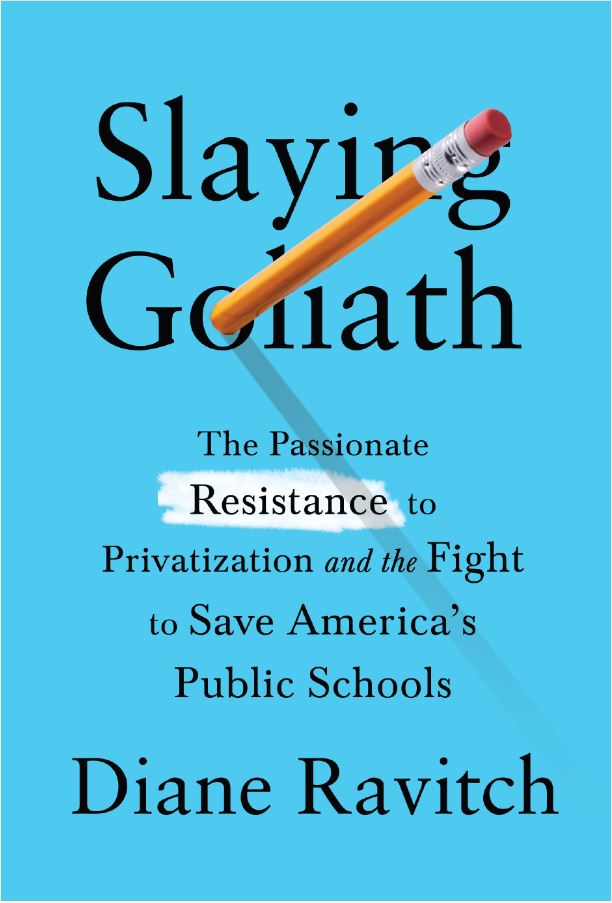
Historian and former United States Assistant Secretary of Education, Diane Ravitch’s, new book, Slaying Goliath: The Passionate Resistance to Privatization and the Fight to Save America’s Public Schools is due for release January 21. This masterpiece weaves together recent history with illuminating data concerning “corporate driven education reforms.

The reported community response to self-anointed reformers is spiritually uplifting. Ravitch presents strong evidence that resistance to their reforms is carrying the day.  She declares, “Judged by their own chosen metrics – standardized test scores – the fake ‘reforms’ failed.”

Diane tells a deeply personal story of her own journey through the education wars while bringing to life the experiences of teachers, students and parents harmed by “fake reforms.” In this captivating read, Ravitch describes the fight to save the commons.

Goliath_0001

Disruption and Changing Course

There is a parallel between Diane Ravitch and Elizabeth Warren. Both Warren and Ravitch were scholars whose research led them to a profound change of thought. Warren was fundamentally a moderate Republican when she began researching bankruptcy law. Ravitch was an advocate of top down standards based education reform. Through their personal research both these women awakened to personal error and went out to make amends. Warren became the bane of the banking industry and a tiger in Democratic politics. Ravitch threw up a stop sign in front of “corporate education reform” and has become its most virulent opponent.

When I mentioned something Ravitch wrote in 2012 to a teacher colleague, that veteran teacher in my neighboring classroom expressed open hostility toward her. He remembered Lamar Alexander’s resident scholar in the Department of Education and her full throated advocacy of standards and testing accountability. He remembered her papers published by the Brookings Institute. Since then, Ravitch has overcome many of her skeptics by working harder than anyone else and fearlessly leading the fight to save authentic public education.

In Slaying Goliath Ravtich shares,

“Having worked as assistant secretary of education for the Office of Educational Research and Improvement in the administration of President George H. W. Bush and for many years in some of the nation’s leading conservative think tanks, I had hoped that privatization and testing would produce sweeping improvement, especially for the neediest students. It didn’t. I couldn’t pretend otherwise. I came to realize that the privatization movement was a continuation of a decades-long campaign by right-wingers who hated public schools, which they derisively called ‘government schools.’ I renounced my own past views and determined to expose the well-funded smear campaign against American public schools and their teachers.”

What should we call the proponents of the choice agenda fueled by standardized testing driven accountability? What do we call those wealthy elites financing the push for charter schools, vouchers and public school closures? Ravitch refuses to call them “reformers” or what they promote “reform.” She recites various appellations people use; “deformers,” or the “financial privatization cabal,” or the “Destroy Public Education Movement.” She observes that “reform” has positive connotations that denotes ‘“improvement,’ ‘progress,’ and ‘uplift.’”

An oft stated goal of this corporate driven agenda is disruption. Disruption is an odd management theory championed at Harvard University in 1995. It posits disruption as a needed ingredient for innovation-driven growth. Ravitch decided they have named themselves.

“They are Disrupters. They are masters of chaos, which they inflict on other people’s children, without a twinge of remorse.”

From the beginning of the book on, Ravitch refers to the “Disrupters.”

Strategy of the Disrupters

A natural starting point for analyzing the era of the Disrupters is the Reagan administration’s 1983 polemic, “A Nation at Risk.” Ravitch shares that Ronald Reagan assumed the presidency with three goals for public education; (1) abolish the US Department of Education, (2) restore school prayer and (3) introduce school vouchers for religious and other private schools.

His Secretary of Education, Terrel Bell, had other ideas. To save the department, he established “The National Commission on Excellence in Education.” In its report written by American business leaders and a venerated scientist, they did not call for prayer or vouchers, however, they blamed public education for the nation’s economic struggles which Ravitch saw as “no less destructive.” She cites an NPR report in which the authors candidly admitted that the data was “‘cherry-picked’ to make American public schools look as bad as possible.

When the Department of Energy commissioned engineers at the Sandia Nation Laboratories to study the current status of American education in 1990, they criticized “The Nation at Risk” as overly alarmist. Sandia found that test scores, graduation rates, and other indicators were actually improving. In Slaying Goliath, Ravitch’s shares an insiders perspective. She writes,

“At the time, I was assistant secretary of education for education research and improvement, and in 1992, I attended the Energy Department’s briefing about the Sandia report. I accompanied David Kearns, former CEO of Zerox, who was deputy secretary of education, to the meeting. He was outraged by the Sandia report, which contradicted the view of the Department of Education that American public schools were failing and needed radical change. The Energy Department never published the report, but it was immediately leaked to hundreds of influential researchers, who wrote about its findings. In retrospect, the Sandia report got it right. The late Gerald Bracey, a prolific and outspoken education researcher, was highly critical of the conventional wisdom, which I was then defending. I hereby personally apologize to him. He was right. The “crisis in education” was a politically inspired hoax, or as the eminent researchers David Berliner and Bruce Biddle later called it, a ‘Manufactured Crisis.’”

What do disrupters want? They want:

  • Inexperienced teachers with little or no training from organizations like Teach For America.
  • To replace teachers with machine teaching (“blended learning” – “personalized learning”).
  • To move fast and break things including school systems, historic schools and communities.
  • To eliminate local democratic control over schools.
  • To eliminate teacher tenure and seniority rights.
  • To eliminate teacher defined benefit pensions.
  • To eliminate teachers unions.
  • To evaluate teachers and schools with standardized test scores.
  • To lower taxes and reduce spending on education.

Ravitch goes into significant detail about who are the disrupters. She calls out the billionaires in the private sector driving the school choice agenda and highlights their spending. She states, “Every Republican governor is a disrupter, because they actively support privatization by charters and vouchers.” However, she notes that rural Republican officials understand that public schools are the anchors of their communities and do not support privatization. The Democratic Party also has many disrupters but not in as great of numbers as the Republicans and generally no Democrats support vouchers. The last two Democratic Presidents, Bill Clinton and Barack Obama, were disrupters.

Conservative groups supporting disruption include the far right Heritage Foundation and the libertarian Cato Institute. Ravitch asserts, “The radical right-wing American Legislative Exchange Council (ALEC) is the key organization in the world of disruption advocacy.

She lists more than a dozen pro-disrupter “think-tanks” on the right including the Thomas B. Fordham Institute and the Center for Education Reform which Ravitch describes as liking “every choice in schooling except public schools.

Before his 1998 election to the governorship of Florida, Jeb Bush served on the board of the Heritage Foundation where he developed his education plans. Diane cites his A+ Plan for education as the “template for disruption.” It combines choice, competition, high-stakes testing, grading schools with A-F grades and accountability as the formula for excellence in education.

Two “liberal” groups, the Center for American Progress (CAP) and Democrats for Education Reform (DFER), push most of the disrupter agenda. In her description of DFER Ravitch writes,

“In 2005, several hedge fund managers – Witney Tilson, Ravenel Boykin Curry IV, John Petry and Charles Ledley – launched Democrats for Education Reform at a posh party on Central Park South in Manhattan, where the inaugural speaker was a young senator from Illinois named Barack Obama. DEFR, as it is deceptively called, was founded to support school privatization by making strategic campaign contributions. Inspired by DFER, charter schools became the pet passion of Wall Street.”

“It is likely difficult to throw a beanbag in a corporate or Wall Street boardroom without hitting a member of the board of a charter chain.”

The Victorious Resistance

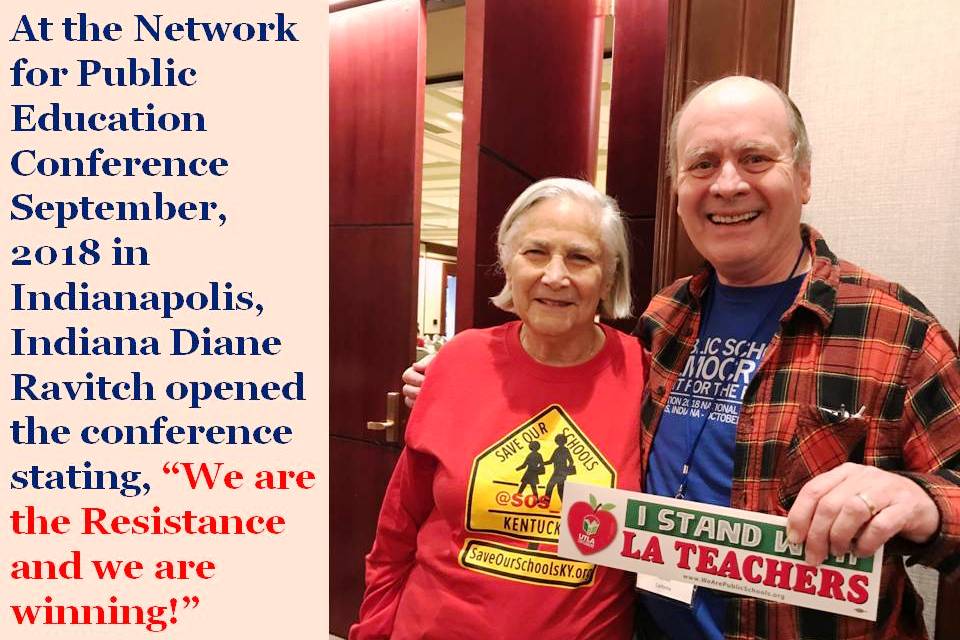
Tom and Diane in Indianapolis

Tom Ultican and Diane Ravitch at the 2018 NPE Conference

The picture above was taken just over two months before the historic LA teachers strike on January 14, 2019. Following the massive teachers strikes in West Virginia, Oklahoma and Arizona, the LA strike was the first one led by a sanctioned teachers union. When the teachers settled their strike after nine days, they did not get any bump in the original take home pay offer but they won big.

USA Today reported, “‘this is much more than a labor agreement,’ said UTLA President Alex Caputo-Pearl. ‘It’s a very broad compact that gets to social justice, educational justice.’” The Los Angeles agreement included class size reductions in all grade levels, 300 additional school nurses, 80 new teacher librarians, one counselor for every 500 students and a 3 percent raise for teachers.

In Arizona, a group of six women established Save Our Schools Arizona to fight the Koch brothers initiated large voucher expansion proposal which was adopted by the Arizona state government. At the Indianapolis NPE conference, Beth Lewis and Sharon Kirsch of SOS Arizona were presented the first of a planned annual Phyllis Bush Award. Against all odds they landed a citizens’ initiative stopping the voucher expansion on to the November 6, 2018 ballot. Later we learned their initiative won with a whopping 65% of the vote.

Ravitch tells these stories and many more of the resistance taking on Goliath and winning.

The saga of Douglas County Colorado being taken over by school privatization forces in 2011 is unique and uplifting. The disrupters immediately established a district school voucher program. That was only the beginning of their agenda, but a bi-partisan group of parents fought back. Today there are no disrupters left on the school board in Douglas County and there are no vouchers.

The account of Barbara Madeloni, President of the Massachusetts Teachers Association (MTA), leading the fight to stop the state from increasing the number of charter schools is amazing. The contest was played out at the ballot box over a referendum to expand the number of charters known as Question-2. Ravitch reports that the MTA directed Madeloni to negotiate with legislators and quotes Madeloni’s negotiating position,

We are glad to talk, but we will not accept any deal that involves any new charter schools. Now, what do you want to talk about?

Question-2 lost 68% to 32%. One of the largest contributors to the yes-on-2 campaign was the world’s now second richest women hailing from Bentonville, Arkansas, Alice Walton. She is an heir to the Walmart fortune.

A Concluding Analysis

Ravitch’s books like The Death and Life of the Great American School System and Reign of Error are scholarly efforts that serve for years as references. Yet, they are written in a fashion that gives the average reader access to the material in an enjoyable and understandable way. I believe that in Slaying Goliath: The Passionate Resistance to Privatization and the Fight to Save America’s Public Schools, Ravitch has upped her game. The stories are riveting and the scholarship underlying them is first rate. This is another game changing book from Diane Ravitch.

Twitter: @tultican

The Best Book of 2019 – Kochland

26 Dec

By Thomas Ultican 12/26/2019

This may be the finest book thus far in the twenty-first century. Kochland; The Secret History of Koch Industries and Corporate Power in America is the second book by former agribusiness reporter for the Associated Press, Christopher Leonard. His first book, The Meat Racket; The Secret Takeover of America’s Food Business received rave reviews; however, Kochland is uniquely special. It is an economic history of America since 1967 that shows the deep changes in our economy that have given rise to a new kind of capitalism. Kochland is told through the lens of Koch Industries whose “annual revenue is larger than that of Facebook, Goldman Sachs, and US Steel combined.”

Leonard weaves an epic tale of brilliance, philosophical intransigence, greed and ruthlessness. Over almost 600 pages, this enjoyable read clearly elucidates many of the troubling outcomes from the last 50 years like the rolling blackouts in California and the destruction of the labor movement.

Fred Koch, the family patriarch, graduated in Chemical Engineering from Massachusetts Institute of Technology (MIT) in 1922. In 1927, he won a patent for an improved petroleum refining process. Do to legal issues surrounding his patent, Fred ended up working in Stalin’s Russia between 1929 and 1932. This experience informed his extreme anti-communist views. He later joined with Robert Welch and a group of businessmen to establish the virulently anti-communist John Birch Society. In 1960, he published the pamphlet “A Businessman Looks at Communism” in which he claimed that the National Education Association was a communist front organization and that public school books were filled with pro-communist propaganda.

In 1961 Fred convinced his son Charles to leave his new job at Arthur D. Little, Inc. and come back to Wichita to work for the family business. Charles went to work there after an impressive career at MIT earning a BS in general engineering 1957, an MS in nuclear engineering 1958 and an MS in Chemical Engineering 1960.

Kochland is also the story of Charles Koch. In 1966, after five years working for his father, he became the CEO of the company then known as Rock Island Oil & Refining Company. After his father Fred died in 1967, Charles took a disparate set of assets – a cattle ranch, a minority share in an oil refinery and a gas gathering business – and stitched them together into the company the family renamed Koch Industries as a tribute to their father. Today it is the second largest privately held corporation in the world. Largest.org lists Cargill, the corporation headquartered in Minnesota and founded in 1865, as the world’s largest privately held company with revenue of $114.7 billion. Koch Industries revenue for the same year came in at $110 billion.

Charles Koch Wichita Business Journal

Charles Koch during a 2014 Interview with the Wichita Business Review

After Charles took over the company, he also started reading everything he could about what made people tick and how societies functioned. Leonard says, “Koch read the work of Karl Marx and other socialist thinkers. He read books on history, on economics, on philosophy and on psychology.” When he was a boy, his father had impressed upon him the evils witnessed in Russia and a fear of government overreach.

It was the works of Austrian economists and philosophers like Ludwig Von Mises and Friedrich Hayek that attracted Koch. He has been described as a libertarian and a conservative but “classical liberal” is a more apt description. Leonard observed, “Hayek, in particular, put forward a radical concept of capitalism and the role that markets should play in society, and his thinking had an enduring effect on Charles Koch.”

In writing about Koch’s 1974 speech to a Dallas gathering, Leonard noted, “Koch chastised the business community for having been seduced by the thinking behind the New Deal.” Koch declared, “Anti-capitalist feelings in the United States are probably more virulent today than ever before.” He went on to say that business leaders needed to fight back and proposed a campaign based on four elements:

  • Education: Public universities needed to be populated with people who would advocate for free enterprise and do research to support it.
  • Media Outreach: Businesses should appropriately “reward” the media when they promote free markets and withdraw support when they attack them.
  • Litigation: “Announce publicly and vigorously, both as individual companies and through associations, that they will not cooperate with the government beyond the legally compelled minimum in developing or complying with control programs.”
  • Political influence: Koch recommended lobbying and “litigation to affect bureaucratic behavior.” He cautioned that the temptation to game the system through lobbying ultimately undercuts business; therefore it should be a “limited program.”

Leonard reports,

“Charles Koch would remain remarkably true to this basic game plan over the next forty years. The only part that would change significantly would be the ‘limited’ nature of lobbying and campaign contributions. Koch would eventually build one of the largest lobbying and political influence machines in US history. But the rest of the plan was executed almost exactly as he laid it out in 1974.”

The First Big Cash Cow

In 1969, Charles Koch completed a secret plan to go from being a minority share holder to sole owner of the Pine Bend Oil Refinery near Rosemount, Minnesota. He convinced J. Howard Marshall to sell his share in the refinery for stock in the newly formed Koch Industries. He then went to the now minority owner, Great Northern, and convinced them to sell its stake. Leonard says, “Charles Koch saw something in the refinery that others didn’t see.”

Pine Blend

The Pine Bend Refinery – StartTribune Photo

Pine Bend was one of the few refineries in the United States that had access to a special form of Canadian Oil that was very cheap and it was set up to refine the dirty oil. Koch sold gasoline from Pine Blend into a retail market that was particularly expensive. Pretty much all executives at Koch industries call Pine Blend a “cash cow.” This acquisition continuously supplies the Koch machine with cash.

Leonard recounts in detail the decades-long family struggle over control of Koch Industries. During this period Charles refused to take the corporation public much to the chagrin of brothers Fred and Bill. Charles and David came out of the fight as co-owners of the company.

Koch was accused of stealing oil from Native Americans by errantly measuring the amount of crude drawn from storage tanks. They were also cited for breaking environmental protection laws at both their refineries (Pine Blend and Corpus Christy). Koch was gaining a reputation as a criminal corporation.

Koch Industries is infused with Charles Koch’s Market Base Management (MBM) theory. MBM is the common language spoken by all managers and most workers at Koch. It guides everything from trading to labor management to safety. Its glaring failure is the inability to solve safety problems at Georgia-Pacific. Deaths and major injuries are on the rise there. MBM when applied in labor relations is anti-union and creates a difficult high pressure environment for hourly wage earners.

Koch’s trading organizations along with the Koch financed American Legislative Exchange Council (ALEC) were heavily involved in the deregulation of California’s electrical grid and the underlying corruption that led to rolling blackouts across the state.

Koch was also a big players in the derivatives markets that played a central role in the 2008 financial meltdown.

Christopher Leonard chronicles all of these episodes and provides deep insight. He explains how the shift from managerial theory in the 1960’s to agency theory in the late 1970’s had changed corporate governance. His relationships created with scientists, managers, laborers and union officials and the telling of their stories sheds new light on the internal operations of Koch Industries.

He shows how neoliberalism captured both major American political parties and describes Koch’s development of the largest most effective political influence organization in America. Koch constructed his political assets patiently over the past fifty years. Sometimes known as the “Kochtopus,” it includes political organizations like Americans for Prosperity and think-tanks like CATO Institute. When the state based organizations are included, these political pressure entities number into the hundreds.

Koch’s entire corporate structure is always focused on gathering information which is one of the primary reasons under-girding its success. Koch always has an information advantage during negotiations. In the early 2000’s, Koch’s traders started learning about the effects fracking would have on energy markets. Operating under the radar, Koch built an oil superhighway (pipelines) out of the Eagle Ford region of south Texas to its Corpus Christy refinery and a Koch shipping terminal. When fracking caused millions of barrels of oil to start flowing from Eagle Ford, Koch had another “cash cow.”

However, the enormous profits from Corpus Christy and Pine Blend were being threatened by efforts in the Obama administration to fight global warming.

Koch Defeats Climate Change Legislation

Leonard states, “Koch Industries, Exxon-Mobil, and other firms spent millions of dollars to support the idea that there was an ‘alternative’ view about climate change between 1991 and 2009.” In 2009, it was Koch’s political network that undermined and eventually killed the Waxman-Markey “cap and trade” bill, the last major federal attempt to fight the growth in greenhouse gasses causing global warming.

Climate Denier Scientist Paid by Koch

Wei-Hock “Willie” Soon – Harvard-Smithsonian Center for Astrophysics (Greenpeace)

Willie Soon claimed that the variation in earth temperature had to do with changes in the sun’s output. He was lavishly supported by Kock. Soon never mentioned in his 11 papers; the more than $1.2 million dollars he received from the fossil fuel industry. The New York Times reported, “Charles R. Alcock, director of the Harvard-Smithsonian Center, acknowledged … that Dr. Soon had violated the disclosure standards of some journals.”

Head of the Goddard Institute for Space Studies, Gavin A. Schmidt said, “The science that Willie Soon does is almost pointless.”

It was congressman Mike Pence of Indiana who made the final argument on the house floor against Cap and Trade. But it was the Koch political machine that finally killed the bill in the senate. Koch’s intentionally obscured and complex organization led the fight. Their primary target was Republicans who stood against Koch on the issue of climate change. Leonard explains,

“These Republicans were the primary targets for a reason. Koch’s long-term plan was to reshape the Republican party, and these members would be made an example of. The strategy wasn’t necessarily new. But the means that Koch used to pursue were unprecedented.”

“In 2009 and 2010, Koch Industries’ political network created new Republican candidates, seemingly out of nowhere, who rose up and challenged sitting congressmen and senators. Koch’s chosen candidates attacked the incumbents from the right claiming that the Republican Party was insufficiently conservative and too accommodating of the Obama agenda. The overwhelming message was that comprise with Democrats must end.”

Charles Koch and Donald Trump see eye to eye on denying climate change and have forged a path of coexistence if not mutual admiration.

Kochland tells a long complex story that illuminates political and economic developments since 1967. When David Koch died in August, his much younger wife, Julia Flesher Koch, surpassed Alice Walton as the richest woman in the world. Charles Koch turns 85 in 2020. Will the new leadership that will certainly come to Koch Industries chart a less politically authoritarian direction which is not based on Malthusian concepts of social construction?

Twitter: @tultican

Big Win for Denver Public Schools

7 Nov

By Thomas Ultican 11/7/2019

Denver voters rejected the portfolio model of school management on Tuesday. Candidates endorsed by the teachers union were the victors and the “corporate school reform” candidates lost. Leading up to the election, the education focused publication Chalkbeat pointed out,

“If candidates backed by the Denver teachers union win at least two of the three seats, union-backed members will have a majority on the board for the first time in recent history. That could set the stage for a shift away from encouraging school choice and school autonomy to more heavily investing in traditional schools.”

The teachers union endorsed candidates won all three of the seats up for election.

Big Money No Longer Enough

The board of directors’ at-large seat is voted on by the entire city. There were three candidates vying for the at-large seat: Tay Anderson, Alexis Menocal Harrigan and Natela Alexandrovna Manuntseva. Anna DeWitt filed for the seat and raised some money but was not on the ballot. Manuntseva did not have enough resources or organizational support to compete. The race was essentially between Anderson and Harrigan.

Harrigan was the most politically connected of the nine school board candidates. A Denver Post biography noted,

“Menocal Harrigan currently works in advocacy for expanding computer science education. She previously was an education adviser to then-Gov. John Hickenlooper, a Denver City Council aide and a staff member for Sen. Michael Bennet, who helped launch DPS’s current reform agenda during his time as superintendent.”

Anderson’s biography on the other hand looks anything but formidable. The Denver Post reported,

“Anderson, a Manual High School graduate, ran unsuccessfully for the District 4 seat in 2017, when he was 18. He currently works as restorative practices coordinator at North High School.”

Tay is now 21-years-old.

Harrigan received large contributions from Colorado billionaire, Phillip Anschutz, and from billionaire Michael Bloomberg’s daughter who lives in New York, Emma Bloomberg, and from a billionaire Teach For America champion from Silicon Valley, Arthur Rock. In total, she had over $350,000 supporting her campaign. Three independent expenditure committees spent more than $190,000 dollars in her support including $127,000 from Students for Education Reform (SFER).

It should be noted that Phillip Anschutz has a billion-dollar foundation located in Denver and owns Walden Publishing. Walden Publishing  was behind the school privatization movies ‘Won’t Back Down’ and ‘Waiting for Superman.’

Surprisingly, Tay Anderson had more than $125,000 supporting his election including $40,000 from the Denver Classroom Teachers Association (DCTA). Committees that bundle many individual contributions are allowed to make large direct donations.

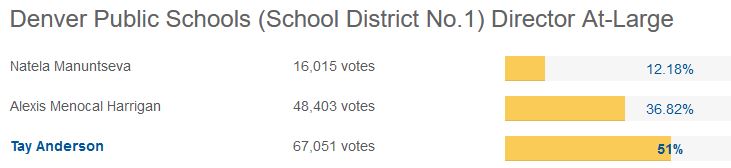
At-Large Votes

Denver City Official Election Results DPS At-Large Director

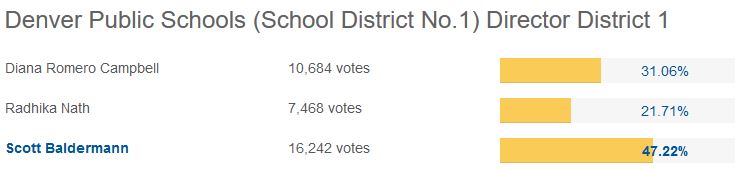
The board of directors’ seat-1 contest was a three way race between Diana Romero Campbell, Radhica Nath and Scott Baldermann.

Nath was endorsed by other groups skeptical of reform, including the Working Families Party and local parent and student group Padres & Jóvenes Unidos.

Baldermann was endorsed by DCTA.

Romero Campbell had the backing of groups that favor the district’s reforms, such as the advocacy organizations Stand for Children and Students for Education Reform.

Campbell is President of Scholars Unlimited, which offers tutoring and other educational programs. She previously was director of early learning and education at Mile High United Way.  Like Harrigan, she received donations from Anschutz and Bloomberg. She also had more than $100,000 in support from the same three independent expenditure committees as Harrigan: SFER, Students Deserve Better and Ready Colorado Action Fund.

However, Campbell’s in excess of $250,000 supporting her election was dwarfed by her opponent Scott Baldermann and she was not happy about that.  It does seem a little ironic to see a “corporate reform” candidate complaining about being outspent.

Scott Baldermann’s Denver Post bio says, “he is PTA president at Lincoln Elementary and a stay-at-home father. He previously owned an architecture business.” Evidently, Baldermann is wealthy enough to finance his own campaign with more than $350,000 while contributing $10,000 to both Tay Anderson’s and Brad Laurvick’s campaigns.

District 1 Votes

Denver City Official Election Results DPS Director Seat-1

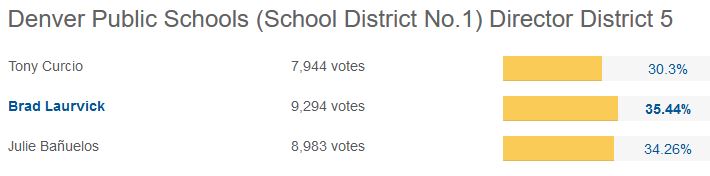
The contest for the board of directors’ seat-5 was the most competitive of the day. The teachers union endorsed Brad Laurvick for the position. He is a Methodist pastor who participated in rallies in support of striking teachers. He has a son in DPS and a daughter who hasn’t reached school age.

Candidate Tony Curcio had the support of groups that favor many of the current reforms, including the advocacy organizations Stand for Children and Students for Education Reform. He also received support from Emma Bloomberg and the same three independent expenditure committees as Harrigan and Campbell: SFER, Students Deserve Better and Ready Colorado Action Fund. Curcio had almost $250,000 in campaign support.

Julie Bañelos, a former school teacher who ran for the board in 2017, was the third candidate for seat-5. She currently works for Catholic Charities and has an impressive resume as an educator. She is an outspoken opponent of the “corporate reform.” Part of her answer for why she was running says,

“The governing body of DPS needs a champion of equity for all our students, particularly for our black, indigenous, and people of color, English language learners, students receiving special education services, and LGBTQ+ youth. As a public servant, I will materialize the values of the whole community, not the interests of the powerful few.”

Bañelos had more than $14,000 in campaign support which would have been more than adequate a few years ago, but in 2019 with the other two candidates wielding more than $200,000 in support it was not sufficient.

District 5 Votes

Denver City Official Election Results DPS Director Seat-5

The three candidates endorsed by Stand for Children and Students for Education Reform appear to be the only candidates who supported the portfolio model of school governance. They received less than one-third of the vote. Candidates opposing privatizing public schools and closing schools received greater than two-thirds of the votes cast.

A Big Repudiation of the Portfolio Model of School Governance

Jeanne Kaplan was a former school board director in Denver and is a blogger. In a 2017 article, “What’s Next”, she described how the board was captured:

“2009 was … the first time outside money appeared in [School] Board Election campaigns. Stand for Children came with the goal of making the board “more reform oriented”… In spite of their $30,000 expenditure per candidate – which at the time was unheard of – our side, as Osborne notes, won the election. Each following election more and more reform money … appeared …. In addition to Stand, Democrats for Education Reform, Students First, and wealthy local businessmen, both Democrats and Republicans, … put enormous amounts of money and human capital to be sure … a unanimous board was achieved. Much of the money while identified by independent expenditure committee remains hidden as to who is making the individual contributions. In 2011 the people were able to hold on to a ‘mighty minority’ of three: 4-3. In 2013 the minority dwindled to one: 6-1. In 2015 the Board was unanimously ‘reform’: 7-0.”

The portfolio model which promotes disruption as a virtue is anti-union. It is not conducive to stable harmonious relations with either labor or communities and it is anti-democratic. Denver is held up as an exemplar of school reform; however the outcomes look more like a warning. Expanding achievement gaps; bloating administration; significantly increasing segregation; ending stable community schools; inefficiently busing children out of their neighborhoods and stripping citizens of their democratic rights are among the many jarring results.

This election result was a public repudiation of the portfolio model.

Neerav Kingsland, the Executive Director of the City Fund, recently wrote,

“Last year, Arnold Ventures commissioned CREDO (out of Stanford University) to study the effects of charter, innovation, and traditional schools in select cities across the country.

“Most of the cities included in the study were cities where Arnold Ventures (and now The City Fund) have partnered with local leaders to expand high-quality schools.”

The City Fund is a $200,000,000 dollar fund dedicated to expanding the portfolio model of school governance. The funds come from billionaires Reed Hastings (Netflix), John Arnold (Enron), Bill Gates (Microsoft) and Michael Dell (Dell). City Fund is very secretive about its operations.

In his post, Kingsland tried to defend the miserable results coming from Denver which he cites as the national example for the portfolio model. The truth is transportation costs are up because of the inefficient structure. Administration costs have zoomed compared to the rest of the state of Colorado and the achievement gap is among the largest in the nation. On the 2019 NAEP reading and math tests, Denver’s students were still below both the national average and were also significantly outperformed by comparable cities like San Diego and Austin.

When Kingsland says “expand high-quality schools,” he means charter schools. And for him “quality” means the school scores well on standardized tests. Lawyers like Kingsland probably don’t understand how useless those tests are for evaluating teachers or schools. If they do, it must be an inconvenient truth.

Obviously, the Denver voters have seen through the corporate smoke and mirrors and are calling for a change. No more closing schools in a poor community because they have low test scores. Instead, help those schools and their educators. No more bringing in unqualified Teach For America corps member and pretending that they are ready to lead classrooms. No more following the dictates of the American Legislative Exchange Council and removing public schools from the purview of the elected school board. No more pretending that politicians and businessmen know better how to run schools than trained experienced educators.

No more using the portfolio model to privatize public schools.

Twitter: @tultican

Dallas Chamber of Commerce Accelerates Attack on Public Schools

24 Oct

By Thomas Ultican 10/24/2019

Elites living in upscale mostly white Dallas communities are spending heavily to privatize public schools. Dallas demographics are basically a three way split with Hispanics (41.7%), whites (29.1%) and blacks (24%). However, whites living in trendy neighborhoods like Highland Park where Teach For America (TFA) founder Wendy Kopp grew up dominate the business community. In 2012, 16-years after a group of wealthy outsiders failed in their effort to take over Dallas public schools a new privatization agenda was launched.

When reporting on the 2012 takeover effort, award winning columnist of the Texas Observer, Jim Schutze, described that first attempt,

“In 1996, when well-funded, mainly white reformers came in with big manila folders of statistics under their arms preaching about outcomes and incomes, there was open warfare. Board meetings dissolved into riots.

“The New Black Panthers threatened to show up at school headquarters armed with shotguns. Tangles between angry speakers and district security guards were beginning to make board meetings look like Total Nonstop Action Wrestling.

“The New Black Panthers painted the white school board members as bogus crackers. Then a neighbor of one white trustee proved them right by wiretapping the trustee using racial slurs. The superintendent resigned. The next superintendent got sent to the pen. A dismal series of financial scandals ensued. The school district wound up looking like bad fruit erupted in the merciless Texas sun. So here we go again?”

In 2011, the Dallas Chamber of Commerce paid for local political leaders to visit Denver, Los Angeles and Houston to learn more about charter schools. Superintendent Michael Hinojosa and trustee Bernadette Nutall were in the group.

Before 2012, Dallas school board elections were very low key affairs. Two of the three incumbent school board trustees up for reelection ran unopposed in 2011 and the third district trustee had resigned. Mike Morath stepped forward to take that district two trusteeship. It was pretty much unheard of for a school board candidate to have raised as much as $10,000 for a campaign; however even though running unopposed, Morath’s campaign contributions totaled $28,890.00 and he spent $16,773.07.

Writing for In These Times, George Joseph explained the political change in a 2014 article:

“But since the beginning of 2012, hundreds of thousands of Super PAC dollars from Dallas’ richest neighborhoods began flowing into nearly all of the district’s school board elections. 

“Since 2011, Educate Dallas, a PAC backed by the Dallas Regional Chamber (the local Chamber of Commerce), has raised $661,953 in cash on hand for its school board war chest, and the Dallas-based education reform PAC Kids First, led by millionaire tech CEO Ken Barth, has raised $661,616. The majority of their donations come from Dallas’ famous aristocrats, including Barth, Ross Perot, Ray Hunt—an oil heir with a net worth of $5.8 billion—and Harlan Crow, a real estate heir and buddy of Clarence Thomas.”

In 2012, incumbent Bernadette Nutall was provided a campaign war chest of $54,527.06 to fend off a challenge by an unknown youth. Nutall had supported closing eleven “underutilized” schools in her district which made her popular at the chamber but angered much of her district. In that same election, Dan Micciche received $56,479.57 to run against Trustee Bruce Parrot in district-3. With an almost 60 to 1 spending advantage, Micciche easily won.

Once the new board was seated it proceeded to fire Superintendent Michael Hinojosa and replace him with Mike Miles a graduate of billionaire Eli Broad’s Superintendents Academy. At the time, Miles was serving as superintendent of schools for Harrison School District-2 in Colorado Springs. The Dallas morning news stated that Miles had “been compared with Michelle Rhee, the go-get-em chancellor who has been villainized and lauded as she tries to repair the shattered Washington, D.C. school system.” The lone vote opposed to the Miles hire came from district-6 Trustee Carla Ranger. Ranger posted an informative quote from the Colorado Gazette on her blog:

“That tough and visionary approach to education is what impressed the Texans.  Blackburn [Board President Lew Blackburn] said that they liked the steps Miles took to improve Harrison, including pay for performance and the intense performance evaluations.”

The article “Dallas Chamber of Commerce Disrupts Dallas Schools summarizes Miles three year tenure,

“Miles’s reforms included a new principal evaluation process which led to large turnover. He also instituted a merit pay system for teachers and hired Charles Glover a 29-year-old administrator of the Dallas TFA branch to be Chief Talent Officer in DISD. After just under three years, he had managed to alienate the black and Hispanic communities as well as many experienced teachers and principals.”

In 2015, Michael Hinojosa was rehired as Dallas Superintendent of schools.

The year before, Trustee Mike Morath had proposed a scheme based on an obscure Texas law that would eliminate the democratically elected school board and accelerate charter school growth. George Joseph reporting on Morath’s “home rule” plan wrote,

Three inside city sources told the Dallas Morning News that the mayor and school board trustee Mike Morath, a major force behind the home rule effort, view home rule as best chance to replace the elected school board with complete mayoral control or at least an appointed school board. One source claimed the mayor’s spokesperson told him that “the mayor would run DISD or oversee it. You wouldn’t have trustees. If you did, they wouldn’t be making decisions.”

Morath’s “home rule” plan was quickly embraced by the local chamber of commerce through a political action non-profit, Support Our Public Schools. Houston billionaire and former Enron trader John Arnold contributed $150,000 to the cause. Communities throughout Dallas rose up and to defeat the plan but Morath’s prominence grew.

In 2015, new Texas Governor Greg Abbott appointed Mike Morath Commissioner of Education. With no education training and a few months experience as a substitute teacher, Morath became Abbott’s best possible choice. Conservative writer Donna Garner declared, “I cannot think of very many people whom Gov. Greg Abbott could have appointed who would have been a worse choice than Mike Morath as Texas Commissioner of Education.”

Chamber of Commerce and Billionaires Continue Buying School Board Elections

Stacy Schusterman

Tulsa Billionaire Stacy Schusterman a Dallas School Board Election Donor; Sampson-Energy

In 2017, Miguel Solis the incumbent from district-8 ran unopposed. In district-6, the incumbent Joyce Forman had token opposition and easily won with 87% of the vote. In district-2, the incumbent Dustin Marshall was in for a dog fight. In fact, his opponent Lori Kirkpatrick almost won outright during the general election with 49.8% of the vote to Marshall’s 47.0%. In the runoff, Marshall handily beat Kirkpatrick 66.3% to 33.7%. Money was the difference. Marshall could outspend Kirkpatrick by more than 6 times with his $338,302.63 funding advantage over her $52,913.76.

Chris Tackett put Dustin Marshall’s contributors into a pie chart.

Dustin Marshall Contributors Chris Tackett

Chris Tackett Pie Chart of 2017 Support for Marshall

The May 4, 2019 school board elections for districts 4, 5 and 7 had similar results. The chamber of commerce slate won a clean sweep, while candidates supported by community groups, the PTA and teachers’ associations were swamped under the massive spending.

Karla Garcia was forced into a runoff by her district-4 opponent Camile White. The three big corporate PACs Ascend, Kids First and Educate Dallas all generously supported Garcia enabling her to outspend White by a ratio of 18 to 1. Garcia’s $90,132.69 campaign fund allowed her to spend more than $78 for each vote received.

In District-5, Maxie Johnson outspent his opponent David King by more than 10 to 1. Educate Dallas, Kids First and the Texas Organizing Project all made large contributions to his total campaign fund of $74,992.93.

There was a bit of a contest in district-7. The chamber candidate Ben Mackey was opposed by Brent McDougal who had considerable community support. Mackey’s total campaign contributions of $138,416.27 was by far the largest in the May election and it dwarfed McDougal’s surprisingly large trove of $35,910.76. In addition to contributions from Educate Dallas and Kids First, Mackey got a $10,000 contribution from Tulsa billionaire Stacey Schusterman.

Dallas Chamber Joins State Republican Leaders and Billionaires in School Privatization Project   

Texas blogger Lynn Davenport recently wrote about a school board plan to turn over Martin Luther King, Jr. Arts Academy to a private operator. This plan is based on the 2017 state law, Senate Bill 1882, that pays districts $1800 for each student put in privately operated schools. In this case, a highly regarded non-profit CitySquare which has no experience running schools would operate Martin Luther King, Jr. Arts Academy as a charter school. In her discussion of the district policy change that would make this possible, Kirkpatrick wrote,

“MLK, Jr. Learning Center is a neighborhood school that was selected last year as a choice school, an arts academy being referred to as a ‘Baby Booker T.’ Trustee Joyce Foreman is the lone dissenter against the privatization agenda in Dallas ISD. She is up against a supermajority of trustees winning the race to hand the neighborhood and open-enrollment schools to non-educators and non-profits under the controversial SB 1882. Trustee Foreman asked, ‘Why would we want someone else to run our best schools?”’

A school board election commentary in the Dallas Morning News by metro columnist Sharon Grigsby had the title, “Good riddance to naysayers — Dallas ISD kids finally get the trustees they deserve.” In other words, anyone who speaks out against the privatization agenda is a “naysayer.”

Dallas’s largest and most influential newspaper also ran an editorial decryingso much resistance to this school district exploring partnerships with outside organizations.” Partnerships are a way of privatizing public schools by turning them over to charter schools or other nonprofits. The Dallas Morning News is clearly an integral part of the chamber of commerce push to privatize public schools in Dallas.

As insightful education writer Nancy Bailey notes, “The partners, not the public, will own Dallas’s public schools.”

Since Greg Abbott has been governor he has signed two laws that accelerate public school privatization and end local control. House Bill 1842 mandatesintervention in and sanction of a public school that has received an academically unsuccessful performance rating for at least two consecutive school years ….” Senate Bill 1882 incentivizes school districts to hand over control of failing neighborhood schools to charter operators (referred to as “partnerships”). In Dallas local leaders are proposing using this provision to hand over control of open enrollment schools whether they are failing or not.

There have been twelve Texas schools that have been taken over by private operators under the provisions of SB 1882 and have a set of new grades. Some schools saw testing score improvement but most did not.

Texas Tribune Partnership Chart

Texas Tribune Chart of First SB1882 Privatized Schools with Grades

These privatization decisions are all being made based on standardized testing which is completely incapable of assessing school quality. The only thing they are good at is assessing a student’s family financial condition and providing propaganda for privatization.

Republican Governor Greg Abbott’s Commissioner of Education, Mike Morath, has created a program called the System of Great Schools. It is a plan to implement the portfolio model of school governance throughout the state of Texas. It is identical to the plan that billionaires Reed Hasting, John Arnold, Bill Gates and Michael Dell are financing through The City Fund. The portfolio school system management model systematically removes public schools from governance by elected boards and puts them under private control.

Dallas has a good public education system with a long history of success. That system is being hijacked by wealthy elites and their political henchmen. An awakened citizenry can stop this travesty.

Twitter: @tultican

Maybe Betsy DeVos was a Good Thing

17 Oct

By Thomas Ultican 10/17/2019

It is clear that President Trump selected a billionaire enemy of public education to be in charge of schools. However, Betsy DeVos is so easy to dislike and has shined such a big light on the destroy-public-education (DPE) movement that Democrats are fleeing the school choice agenda. If Hillary Clinton had become President, her policies may have permanently damage universal free public education. When WikiLeaks leaked John Podesta’s emails, Hillary Clinton’s campaign Policy Book and its K-12 public education policy recommendations were revealed. Those recommendations were aligned with the DPE playbook supported by neoliberals.

Group Thinks’ Historical Background

In the last two decades of the 20th century, there was a general consensus reached by governing elites that America’s public education system was in dire straits and needed reform. The impetus for this goes back to the Reagan era’s “A Nation at Risk”.  It masqueraded as a research paper, but was actually a polemic based on faulty understanding and a misreading of data. In 1991, researchers at the Sandia Laboratory in New Mexico debunked the main points of “A Nation at Risk,” but their report was barely noticed. A growing consensus based on a century old illusion had developed among policy wonks, politicians and leaders in education philanthropy. They all accepted beltway common knowledge and agreed on a broad outline of what needed to be done to confront the “undeniable failure” of public education:

  • Institute standards
  • Use testing to hold schools accountable
  • Apply business based leadership principles and personel
  • Create alternate pathways for teacher certification
  • Develop competition
  • Provide school choice
  • Marginalize teachers unions
  • End the federalist system of school governance (i.e. locally elected school boards)

In 1985, the Democratic Leadership Council (DLC) was established by Al From. Politico described the DLC thusly:

“The DLC was formed in the 1980s – the debacle of the 1984 Mondale campaign was a key motivator – to wage just that kind of intra-party war against what From and his allies saw as interest-group liberals content to consign the Democratic Party to minority status. The group and its best-known chairman, then-Arkansas Gov. Bill Clinton, pushed balanced budgets, free trade, tough-on-crime policies, and welfare reform – all of which alienated the base, but became a key part of Clinton’s “New Democrat” agenda and his presidential legacy.”

The DLC was made up of a group of neoliberal politicians who took over the Democratic Party in the 1990s.  

When Bill and Hillary arrived in Washington DC, a large number of youthful “New Democrats” with elite educations joined them. Many, like Bruce Reed, had already worked in Clinton’s presidential campaign. Marc Tucker, a leader in the standards-driven education reform movement, saw like-minded reformers who also believed that the public school system was outdated and failing. In the infamous “Hillary Letter,” which Tucker began with the salutation “Dear Hillary,” he laid out several reform ideas that would completely change how education is done. He began:

“First, a vision of the kind of national — not federal — human resources development system the nation could have. … What is essential is that we create a seamless web of opportunities, to develop one’s skills that literally extends from cradle to grave and is the same system for everyone — young and old, poor and rich, worker and full-time student. It needs to be a system driven by client needs (not agency regulations or the needs of the organization providing the services), guided by clear standards that define the stages of the system for the people who progress through it, and regulated on the basis of outcomes that providers produce for their clients, not inputs into the system.”

In 1989, Arkansas Governor Bill Clinton had joined President George H. W. Bush at the University of Virginia in Charlottesville for an education conference. The Charlottesville joint communiqué listed the four areas of agreement reached at the summit:

“The President and the nation’s Governors have agreed at this summit to:

  • Establish a process for setting national education goals;
  • Seek greater flexibility and enhanced accountability in the use of Federal resources to meet the goals, through both regulatory and legislative changes;
  • Undertake a major state-by-state effort to restructure our education system; and
  • Report annually on progress in achieving our goals.”

Clinton’s 1994 reauthorization of the Elementary and Secondary Education Act (ESEA) embodied these principles. It called for all states to create standards and curricular frameworks. Though not mandatory, the Act along with the Clinton’s proposed goals 2000 prepared the way for the No Child Left Behind Act in 2001, which was a federal takeover of public education.

In 1998, Bill Clinton wrote: “We have worked to raise academic standards, promote accountability, and provide greater competition and choice within the public schools, including support for a dramatic increase in charter schools.”

The Position Book

In December 2014, Dan Schwerin, Hillary Clinton’s speech writer, wrote in an email to John Podesta,

“We wanted to share with you this long book of policy memos that we gave to HRC for vacation reading.  As noted in the cover memo, this reflects months of work by a team of about a dozen volunteers who conducted more than 100 interviews with thought leaders in a wide range of fields.”

The K-12 section of the Position Book was presented by Ann O’Leary, who is now California Governor Gavin Newsom’s chief of staff. A Fortune magazine biography of O’Leary described her:

“O’Leary is a diehard policy wonk, especially keen on anything that affects families or education. As Clinton’s Senate aide in 2001, she was at the center of No Child Left Behind—a once popular education initiative that has since soured in the public mind. ‘It was a really important moment,’ she says of the law, which Ted Kennedy crafted and George W. Bush signed. ‘When you look back at what happened, this was serious, bipartisan, constructive work. We were committed to high standards and helping states get there.”’

In the Position Book, O’Leary informs Clinton,

“In preparing for our thinking on K-12 proposals, I solicited a memo from Chis Edley, who recently chaired the National Commission on Educational Equity and Excellence, to go along with the memo you previously received from Neera and Catherine Brown. I also had good conversations with Laurene Powell Jobs and Bruce Reed (highlights of my conversation noted below), and Dan solicited some thoughts from Kate Childs Graham (who is Randi’s speech writer). I have reached out to Linda Darling-Hammond and Randi Weingarten to solicit their ideas as well, and will schedule those conversations after the holidays.

On O’Leary’s conversation with Bruce Reed: Reed worked as a policy director in the 1992 Clinton-Gore campaign and then worked in various capacities throughout the duration of the administration. In 2001, he became CEO of the DLC and served there until it shut down in 2011 at which time he became Chief of Staff for Vice President Joe Biden. In November 2013, Reed left the Obama administration to become President of the Broad Foundation. Professor Jim Horn notes, “This is someone who has never taught a day in his life at any grade level nor had any background in pedagogy or education.”

Hillary-Clinton-Eli-Broad

Hillary and Her Long Time Friend Ely Broad at a Wedding – Google Images

The Reed highlights include;

  1. Hillary’s initial instincts still hold true – choice in the form of charters, higher standards and making this a center piece of what we do as a country
  2. Challenge of education reform: school districts are pretty hard, if not impossible, to reform – they are another broken part of democracy
  3. If you create the Silicon Valley of education improvement, which is what New Orleans has, you can get there; Denver does it, …. pro charter; pro portfolio system for public schools
  4. Personalized learning tools – modeled in Summit Charters

Here is a different perspective. Summit learning has big money behind it but it is encountering big resistance from students and parents. The reality is that New Orleans’ schools are inefficient, undermine communities, have extremely high management and transportation costs, and still struggle academically. Denver’s schools have turned into a dystopian nightmare since neoliberal Democrats and big money Republicans took control. Democratic local control of schools is the bedrock of American democracy. The portfolio system in an undemocratic scheme to privatize public schools.

On O’Leary’s conversation with Laurene Powell Jobs: Laurene Powell Jobs is famous for having been married to technology genius Steve Jobs. She is a billionaire and co-owns Atlantic magazine. She studied economics and political science at University of Pennsylvania and received an MBA from Stanford; no education training. In 1997, she founded the Emerson Collective which promotes impact investing. She is board chair of The XQ Institute and College Track.

Highlights from Jobs recommendations;

  1. Re-design entire K-12 system – we know how to do it, but it comes down to political will.
  2. Think about Charters as our R&D … must allow public schools to have leaders that can pick their team and be held accountable
  3. Need to increase IQ in the teaching sector: Teach for America; they are a different human capital pipeline
  4. Need to use technology to transform – technology allows teachers and children to focus on content mastery versus seat time; … This is happening with Sal Kahn and schools in the Bay Area

Some tough realities undermine Jobs’ ideas. Her experiment in redesigning schools has met with failure and it is much more likely that new innovative education developments will come from public schools than charters. Jobs believes teachers are dim bulbs and that Teach For America (TFA) youths with no academic training and a five week summer course are better than the teachers she disrespects. TFA is a plague on American education and there is no way they should be receiving teaching credentials that take more than a year to earn. Her technology claim is also specious. The Organization of Economic Cooperation and Development’s Andreas Schleicher noted when discussing a recent OECD study,

“In most countries, the current use of technology is already past the point of optimal use in schools. We’re at a point where computers are actually hurting learning.”

Some input from Neera Tanden and Catherine Brown: Neera Tanden served in both the Obama and Clinton administrations. She is currently the President of the Center for American Progress (CAP). Catherine Brown is a Senior Fellow at CAP. She worked on NCLB author George Miller’s congressional staff prior to becoming vice president of policy at TFA. She was also a senior consultant for Leadership for Educational Equity which is an organization that works to get TFA alumni elected to school boards. Neera and Catherine mainly presented political analysis but share these ideas.

  1. In spite of the challenges that remain, the standards-based reforms implemented over the last two decades have resulted in significant, positive change.
  2. Teach For America … offers a powerful proof point that it is possible to diversify the teaching force while retaining a high bar.

These points were both complete fallacies.

Ann O’Leary also informed Clinton, “There is strong agreement that we need high academic standards in our public school system and that the Common Core will help us to be more globally competitive.”

The Policy Book had no voices championing the public education system or suggesting it needed protecting.

Observations

The Clinton team was going to advance the DPE agenda. Unlike Betsy DeVos, they were not going to alienate neoliberal Democrats. In the final analysis, she and her policy wonks would have done far more damage to public education than we are seeing now.

This history also highlights the importance of being relentless in discovering what is the real education agenda of our Presidential candidates? Trump gave us DeVos. Enough said. Biden was part of Race to the Top, his brother is a charter school entrepreneur and his chief of staff became President of the Broad Foundation. Bernie Sanders is very clear and supportive of public education. He has put out a wonderfully thought-out Marshal Plan for Public Education. Elizabeth Warren has come out in full voiced support for public education and her plan zeros out federal dollars to charter schools. She has published a well thought out plan for public education. Pete Buttigieg is raking in large donations from DPE proponents like Reed Hastings.