Archive | education RSS feed for this section

Faulty Billionaire Financed Education “Study”

9 Apr

By Thomas Ultican 4/9/2020

This January, the new organization Brightbeam and its CEO Chris Stewart published The Secret Shame: How America’s Most Progressive Cities Betray Their Commitment to Educational Opportunity for All.” The name clearly indicates the paper’s political leanings and the underlying data is suspicious. The paper is a polemic rather than a study. Like many “reports” coming from what Diane Ravitch labels the “disrupter” community, this 33-page document has not been submitted for peer-review. Never-the-less, it has been widely disseminated as legitimate research to the Brightbeam network including Education Post. It has also gone to hard right media like The Blaze and found its way into mainstream media like NBC and the Boston Herald.

About Brightbeam

Last year, Brightbeam was created to be the umbrella organization for the Education Post and other digital media sites. Brightbeam is the new operating name for the Results in Education Foundation (RIEF) which is the legal moniker for the obscure billionaire financed organization providing the operating funds for this new digital publishing group. Brightbeam also controls the cyber platforms, Citizen Education and Project Forever Free and it has influence over at least fourteen local internet publications in various American cities.

The billionaires financing Brightbeam include Michael Bloomberg, Alice Walton, Jim Walton, Laurene Jobs Powell and Mark Zuckerberg.

Chris Stewart who was named CEO of Brightbeam has been on the payroll at RIEF since its founding in 2014. The last available tax record puts his 2017 salary at $226,417.

The new “report” says, “Brightbeam is a nonprofit network of education activists demanding a better education and a brighter future for every child.” A more apt description would be “a billionaire created organization dedicated to privatizing public schools and undermining teacher professionalism.”

Evaluating the “Study”

In his introduction to the paper, Stewart claims, “Students in America’s most progressive cities face greater racial inequity in achievement and graduation rates than students living in the nation’s most conservative cities.” Concerning the purportedly extra-large racial achievement gaps in “progressive cities” the paper states, “Of all the factors we looked at, progressivism is the greatest predictor.”

The authors’ explanation of their approach is skimpy. They write,

“To determine a rationale for what is a progressive city and what is a conservative city we relied on criteria developed independently by political scientists Chris Tausanovitch and Christopher Warshaw, who pooled data from seven large surveys of U.S. public opinion to rank the nation’s biggest cities in terms of conservatism. We then selected the 12 most conservative cities and the 12 least conservative cities from that list to establish the conservative and progressive cities that make up the base of this report.”

With those cities in mind, we pulled the publicly available school achievement and graduation data from public school districts in each of those cities. When we analyzed the achievement gaps between black and white students and the gaps between Latino and white students we found larger gaps than readers might expect from cities where progressive residents presumably hold the most political, administrative and cultural power.

Tausanovitch’s and Warshaw’s paper seems like a reasonable way to identify conservative and progressive leanings in cities. It is a five year old study and presumably attitudes have not gone through a sea change in that amount of time. However, the premise that the political ideology between those cities would have a dramatic effect on the achievement of minority students seems unlikely.

More troubling than the premise is the contention that standardized testing conducted using different testing regimes in 24 locations makes a valid comparison. Standardized testing provides data of questionable value even when everyone is taking the same test, but trying to align data from multiple testing types is fraught with error. The study provides almost no information about the data and methodology used.

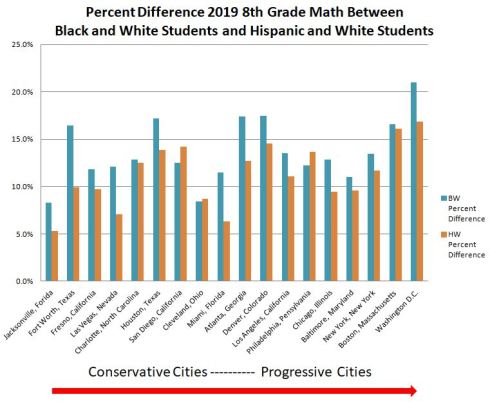
On page nine, the study claims that the Black-White mathematics proficiency gap is 41.3% in progressive cities and 26.2% in conservative cities. This claim was checked by using the 2019 Nation Assessment of Education Progress (NAEP) 8th grade math data for the 18 cities on the Tausnovich/Warshaw list that also had 2019 NAEP data. The average scale scores were subtracted and the difference was divided by the white student average scale score. The largest gap found was 21% in Washington DC. Even the 26.2% gap Brightbeam reported in conservative cities is a puzzle and the 41.3% number for progressive cities appears to be ludicrous.

Grade 8 Math Gap

Education Achievement Gaps Based on NAEP Data

San Francisco and Washington DC were rated respectively as number 1 and number 2 most progressive cities in the United States. The Brightbeam report states that in mathematics the Black-White achievement gap is 58% in San Francisco and 62% in Washington DC. Washington DC had the highest gap measured with NAEP data at 21%, however, that is almost 3 times less that the Brightbeam reported 62% claim.

San Francisco does not have easily attainable NAEP testing data, so the California Assessment of Student Performance and Progress (CAASPP) data for 2019 was used to check the gap claim. To calculate achievement gap measurements, percentages of all tested students who met or exceeded standards were summed for each ethnicity. Then a simple subtraction between the results of the various ethnic groups provided an achievement percentage difference. Using this method the Black-White achievement gap for mathematics was 32.7%. Outrageously high, but hardly the 58% gap that Brightbeam asserted.

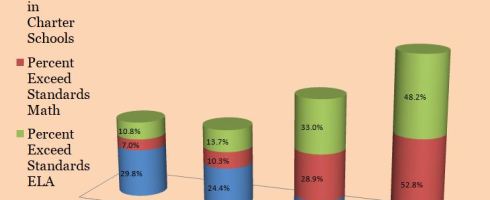
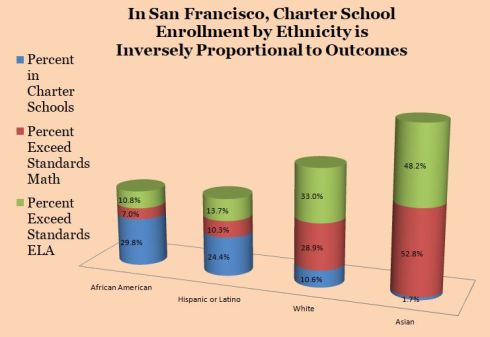
While researching the achievement gaps in San Francisco, a fascinating correlation was discovered. The more an ethnic group utilized charter schools the worse their group’s education achievement.

San Francisco Charter Enrollment Chart

Negative Correlation for Academic Achievement in Charter Schools

The Brightbeam report states, “…three of the 12 conservative cities — Virginia Beach, Anaheim, and Fort Worth — have effectively closed the gap in at least one of the academic categories we looked at, literally achieving a gap of zero or one.” To test this claim, the same methodology used for San Francisco was applied to Anaheim using 2019 CAASPP data for both Black-White and Hispanic-White achievement gaps in math and English language arts. The results are in the Table 1.

Table 1: Anaheim Education Achievement Gaps

Compared

ELA Gap Math Gap
Black – White 14.6% 10.5%
Hispanic-White 22.2% 16.0%

Clearly, the Education Achievement Gaps are much more significant than the zero or one point gaps which Brightbeam declares.

A 2018 Brookings Institute study of education achievement gaps in America said that gaps were still too large between demographic groups but that they have been steadily improving. On the other hand, they noted, “In contrast to the improvement in racial and ethnic achievement gaps, however, achievement gaps based on students’ eligibility for free or reduced-price lunch—our best proxy for poverty in the NAEP data—do not show much progress.”

Another Brightbeam contention involves graduation rates. It praises the rates in Oklahoma City noting, “The Oklahoma City public school district only graduates 73% of its high school students in four years but the graduation rate is 10 percentage points higher for black students than for white students and 5 percentage points higher for Latino students than for whites.”

While this statement is true, it implies that the cause for the relative higher success rate for Black and Hispanic students in Oklahoma City is the conservative nature of the city. Brightbeam ignores the huge five-year demographic change among the graduates and the 18.5% drop in the white graduation rate. That is not a success to be celebrated.

Table 2: Graduation Rates in Oklahoma City

Ethnicity 2014 2018
Graduation Rate Demographic Mix Graduation Rate Demographic Mix
Black 75.8% 9.7% 77.8% 25.9%
Hispanic 77.6% 11.8% 75.9% 52.7%
White 84.7% 55.1% 66.3% 12.5%

Fraudulent digital credit recovery has rendered high school graduation rates a meaningless parameter for measuring school merit. America’s high school graduation rates peaked at about 77% in 1970 and then drifted down for almost four decades to 69% in 2007. By 2012 – after the education technology industry became involved with providing high school credits – 81% of the freshman cohort in America graduated on time. Bizarrely, students have been allowed to finish semester long classes in less than a week and obvious cheating is being ignored.

Selling Out the Black Community

The Brightbeam report is targeting the black community with its anti-public schools and anti-progressive message. Their report concludes, “All of us have an outstanding debt to our children. But, to return to the words of Martin Luther King, Jr., America, and most especially these progressive cities, has given our black and brown children a bad check, a check which has come back marked “insufficient funds.”

Keith Benson, Ed. D, is an amazing educator, thinker and leader in Camden, New Jersey. Keith is currently head of the Camden Education Association and has spent 14 years in the Camden classrooms. He is also active in and been a leader of the Camden branch of the NAACP. Last year Keith published “Seeing No Evil, “For the Children”:Identifying the Black education reform establishment’s purposeful blind spots in advocating for expansion of corporate education reforms.” This insightful paper addresses the kind of destructive leadership provided by billionaire funded Black led organizations like Brightbeam. Benson wrote:

“…in decades before where education reform, namely school choice was largely a fringe issue championed by anti-union, ideological white conservatives, today’s education reform movement gained momentum as pro-reform white benefactors expanded their public relations campaign to include Black and Latino ‘leaders’ to accomplish the same goal of collapsing urban public schools and teacher unions.”

“Michael Reagan, in ‘Think of the Children’ takes the ‘for the children’ argument to task calling it ‘pure BS…obvious political BS that has been used by politicians of both major parties’ and by people who lack ‘a legitimate or a reasonable argument.’ It is my contention here that the billionaire funded education reform movement and the Black Education Reform Establishment acting against urban public education for ‘the children,’ follows a similar rhetorical pattern.”

“In sum, through the education reform movement’s desire to close ‘failing schools’ and weaken teachers unions, it was experienced black teachers who bore the brunt of their contradictory advocacy which has only gained in strength and in allies that now includes the socially liberal, and persons of color. And while some critiques of urban public schools are accurate and warrant decisive systemic corrective action, it is simultaneously accurate that the single demographic most impacted by the policies advocated by today’s reformers are black educators, specifically, black women. Thus, while the Black Education Reform Establishment, as well as their wealthy white funders continuously champion dismantling urban teacher unions and closing “failing” schools in the name of benefiting the best hopes for urban black children, the Black Education Reform Establishment is targeting the same teachers most likely to help students of color achieve academically and usher them into post-secondary education.” (Emphasis added)

The billionaire sponsored paper from Chris Stewart and Brightbeam is not a study; not even close. It is propaganda. Mark Twain attributed Benjamin Disraeli with saying “There are three kinds of lies: lies, damn lies and statistics.” The Brightbeam paper grossly violates all three of these categories of lies.

New Guides for Researchers, Bloggers and Parents

4 Apr

By Thomas Ultican 4/4/2020

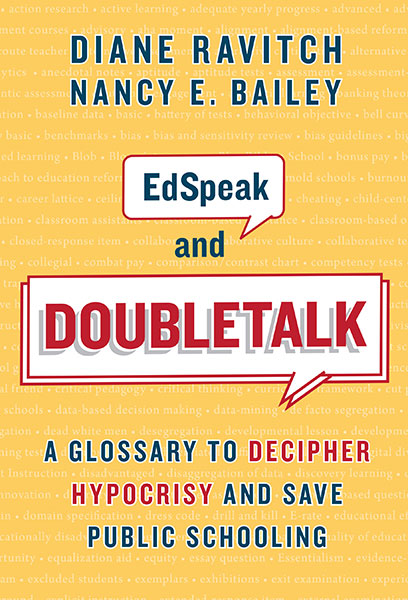
Two new sources provide guidance for researching and decoding education jargon. At the beginning of the year, Teacher College Press published Diane Ravitch’s and Nancy Bailey’s EdSpeak and Doubletalk; A Glossary to Decipher Hypocrisy and Save Public Schooling. Near February’s completion, Garn Press published Mercedes Schneider’s new book, A Practical Guide To Digital Research: Getting the Facts and Rejecting the Lies , in which Schneider explains the investigative tools and techniques she uses plus provides examples from her own work.

A Practical Guide to Digital Research

Practical Guide

The fifth Network for Public Education (NPE) conference was held in Indianapolis, Indiana during October of 2018. I attended the session “Where did all this Money Come from: Locating and Following the Dark Money Trail” which was presented by Darcie Cimarusti, Andrea Gabor and Mercedes Schneider.

Cimarusti writes a blog called Mother Crusader which opens with the line “Never intended to become a parent advocate until I watched the great schools in my little town come under attack.” Darcie also works part time for NPE where she is half the two person staff and does research. Gabor is a Bloomberg chair of business journalism at Baruch College. She is a researcher who currently has ten books listed on Amazon. The MC of the session was the author of Guide to Digital Research, Mercedes Schneider.

The session had three presentations and a question and answer period. Darcie introduced the LittleSis data base and oligrapher. She shared her LittleSis map creation  “Louisiana 2011: Jeb Bush Calls and Billionaire Dollars Follow” and demonstrated its interactive functions. Andre presented “990S: Mining Nonprofit Tax Returns” where she used forms from the Eli and Edythe Broad Foundation and the Walton Family Foundation to explain how to read them and where to find them. Finally, Mercedes used examples from New York to share how she researches campaign finance data.

In her new book, Mercedes reflects back on that NPE session and notes:

“In preparing for our presentation, Darcie asked me to send her the information I wished to include in my presentation slides.

“In that moment, I thought, ‘To do this justice, my slides would need to be the length of a book. And there’s no time for me to write a book before we present.

“So, the book was on my mind, particularly on one Saturday after the 2018 NPE.”

Schneider also shares, “Thus, the initial idea for this publication stemmed from my desire to equip parents and other community members to investigate the activities and spending of individuals and groups associated with market-based ed reform.”

This is Mercedes Schneider’s fourth book. She is a Louisiana native with secondary education degrees in English, German and guidance counseling.  Mercedes also has a PhD in applied statistics and research. Her three previous books are A Chronicle of Echoes: Who’s Who in the Implosion of American Public Education, The Common Core Dilemma: Who Owns Our Schools? and School Choice: The End of Public Education?

The educator, blogger and Forbes commentator Peter Greene when praising Mercedes work and her new book stated,

“… A Practical Guide To Digital Research: Getting the Facts and Rejecting the Lies is a thorough look at how to go cyberdigging, looking at both the techniques and the tools that can be used to uncover whatever truth is lurking out there. Because she provides plenty of examples and demonstrations of how these tools and techniques have worked for her, Schneider also gives us a sort of greatest hits collection.”

An example of one of those greatest hits Greene alludes to is when she reported in Chronicle of Echoes that Randi Weingarten, the President of the American Federation of Teachers only taught full time for one semester. In the new book, she reveals how she found this information and that Weingarten’s legal name is Rhonda Weingarten.

Another hit was how she was able to discover who the anonymous donor to Education Post was. In 2014, the Washington Post introduced the new ed reform organization Education Post and stated its initial funding came from “the Broad Foundation, Bloomberg Philanthropies, the Walton Family Foundation and an anonymous donor.” By reviewing the 2014 tax forms of the known donors, she was able to learn that they were actually giving their grants to the Results in Education Foundation which was financing Education Post. Once she found the name of the actual foundation she was able to reveal that Laurene Powell Jobs was the anonymous donor.

Schneider uses many episodes like the two mentioned above to demonstrate how to use different investigative tools and provides practical evidence for how she has applied them. The book is a wonderful extension to that 2018 NPE presentation.

EdSpeak and Doubletalk

EdSpeak

Thanks to the authors and the facilities at Teacher’s College, this is a living book. At the book’s cyber address, there is a link to a 58 page downloadable supplement as well as an updates tab.

Diane Ravitch explains in the introduction that she originally published EdSpeak in 2006, however she concludes:

“In the years since, a sea change has occurred in education and in the vocabulary used to describe plans, policies, pedagogy, and priorities. I realized that EdSpeak had become obsolete because times had changed.”

Diane says she found the perfect collaborator, Nancy Bailey, who is passionate about education and “knew more than I did about the language of the classroom, and who, as an experienced teacher, had firsthand experience of the impact of policy at the school and classroom level.”

Regents’ Professor of Education Emeritus at Arizona State University, David Berliner applauded the book. He writes,

“This glossary provides excellent and accurate definitions of the educational terms common to our times. Novice educators, school board members, and parents of school-age children can all use this book to decode the specialized vocabulary of this profession. In addition, the authors are unapologetically strong believers in our public schools, and it shows, making this book much more valuable. This is a glossary with an attitude, and because of that, I endorse it even more strongly.”

Concerning that last line, Ravitch states,

“This book is more than a glossary. It has a point of view – about public schools, about teachers and teaching, and particularly about the insidious efforts to undermine public schools and the teaching profession.”

The book is arranged into 18 chapters with each chapter arranged alphabetically. The online supplement has another 9 chapters.

How to use this reference book. One might have heard of a group called School Board Partners. A quick look at the books index would send you to page 78 in “Chapter 11: School Reform Groups and Terms, or ‘Money Talk.’” There you would find the description of School Board Partners:

“A group that pretends to be concerned about public schools and communities, but that encourages choice and privatization goals. School Board Partners claims that school boards are failing kids, and school board members need the help of outside mentors so they will make the right decisions to promote change and ‘buck the status quo.’ Their deceptive title is intended to confuse the public and to substitute themselves for existing state and national school board associations, which advocate on behalf of public schools. School Board Partners is currently funded by the same corporate reform groups that fund Education Cities, which include the Arnold, Dell, Gates, Kauffman, and Walton Family Foundations. Its real goal is to dissolve the school board’s connection to its own community and make it part of the privatization movement. Their current targeted cities include Atlanta, Baton Rouge, Denver, Detroit, Indianapolis, Los Angeles, Memphis, New Orleans, Oakland, and Stockton.”

In the book supplement there are definitions of terms like “restorative justice” and “backward mapping.” One of my favorite definitions, I found in the supplement was “research shows.” It is defined as,

“A phrase often used to evoke authority and end discussions even when research is equivocal. Parents and other non-educators must be wary of accepting the claim that ‘research shows’ a given outcome unless they receive a clear, impartial summary of the evidence.”

These two books bring light to the corrupt billionaire led privatization of America’s public schools and provide some tools that citizens can use to fight back. As an unapologetic advocate for elected school board led public schools, I hardily recommend these two new publications.

Rick Smith Interview with Thomas Ultican

20 Mar

By Thomas Ultican 3/20/2020

Rick Smith is a radio talk show host from Pennsylvania. He moderates the Rick Smith Show. On Wednesday (3/18/2020) Rick had me on his two hour show for a 15 minute segment. The central point of our discussion revolved around cyber education which students throughout America are being forced into because of the current pandemic.


The City Fund Spending Prolifically to Privatize Public Education

2 Mar

By Thomas Ultican 3/2/2020

The City Fund has joined the Walton Foundation, the Broad Foundation, and the Chan Zuckerberg Initiative (CZI) in the upper echelon of spending to privatize public education. (Gates is in a spending zone of his own.)  City Fund grants are of the same magnitude as CZI’s and approximately half the size as those from the Walton foundation. Since its establishment in July, 2018, City Fund reports issuing $110 million in large grants defined as more than $200,000; smaller grants not accounted for. Founders John Arnold and Reed Hastings have also provided the associated political action group, Public School Allies, with $15 million.

Reorganizing and Retooling the Attack on Public Schools

Little SiS City Fund Map

Reorganizing the Attack Little Sis Map

On the ides of March (2018), the Indy Star reported that David Harris the CEO of Mind Trust in Indianapolis was leaving to join a new national organization. Since Julius Caesar’s assassination, events linked to the ides of March are often viewed with alarm. This event portended a reorganized attack on public education and a new billionaire financed entity dedicated to establishing the portfolio model of public school management throughout America.

Until February of 2020, the secretive City Fund did not even have a web site. On July 31, 2018, City Fund Managing Partner, Neerav Kingsland, took to his blog and made public The City Fund – a new non-profit – and named its founding staff. He also arranged for a small group interview with The 74. Matt Barnum of Chalkbeat wrote an introductory piece called With big names and $200 million, a new group is forming to push for the ‘portfolio model.’” In December 2018, Barnum reported that The City Fund was starting an associated political action organization called Public School Allies. Since those few 2018 articles, The City Fund has operated in the dark.

This February they finally launched a web site and made available some accounting for their spending over the last year and a half. Because City Fund is a non-profit organization, they must soon file tax documents that will reveal in even more detail their spending and organizational structure. Their new transparency is apparently related to the imminent non-profit tax reporting requirements.

The Little SiS map above outlines some for the 2018 reorganization for the coming relentless attack on democratically run public schools. There were changes at The Mind Trust. It was co-founded in 2006 by Indianapolis Mayor Bart Peterson and the youthful lawyer he chose as his education guy, David Harris. It became the prototype corporate education reform local organization. In 2010, Harris and Mind Trust Vice President, Ethan Gray founded the Cities of Education Entrepreneurship Trust (CEE-Trust) which became Education Cities in 2014 after its disaster in Kansas City. This organization was designed to scale the Indianapolis methods of school privatization nationally.

In the 2018 reorganization, Mind Trust continued under new leadership and Education Cities was divided into two new school choice promoting organizations; School Board Partners and Community Engagement Partners. City Fund gave both new organizations $250,000 in seed money. Two lawyers, David Harris and Kameelah Shaheed-Diallo, left Mind Trust to become partners at City Fund. To insure Mind Trust’s continued success as an anti-democratic school privatizing organization, City Fund provided the new leadership with $18,000,000.

School Board Partners is an organization looking to co-opt elected school board members into furthering the portfolio model of education reform. They claim to offer training for school board members however every state requires school board members to go through training provided by the state. Community Engagement Partners purpose is continuing Education City’s support for local organizations that are working to privatize public education and instituting Betsy DeVos’s school choice agenda.

Education Cities CEO Ethan Gray became a Partner at The City Fund. Gray’s Director of Finance and Operations, Kevin Leslie, became Director of Grants and Operations at the City Fund. Education Cities Managing Partner Carrie Douglass became founding leader of School Board Education Partners. Senior Fellow Charles MacDonald is now Executive Director of Community Engagement Partners (CEP) and Associate Partner Rebecca Weinberg Jones became CEP Deputy Director.

Neerav Kingsland worked at both Arnold Ventures and The Hastings Fund before becoming Managing Partner of City Fund. He was also a board member of the California Charter Schools Association. Chris Barbic, the co-founder of YES Prep, worked at Arnold Ventures after a disastrous tenure leading Tennessee’s turnaround schools. He became a partner at City Fund in 2018. Noor Iqbal worked at Arnold Ventures and then for about a month at Mind Trust before becoming the Chief of Staff for City Fund. Ken Bubp worked first at Mind Trust, then Arnold Ventures and is now a Partner at City Fund.

Public School Allies

Founding City Fund staff member Gary Borden is no longer on the team, but he really is. Borden is now Managing Director of Public School Allies the 501 C4 organization established by City Fund to administer their political influence campaign. A lawyer by profession, Borden holds a bachelor’s degree from Pennsylvania State University, majoring in economics and international business, and JD from Georgetown University. Before taking on Public School Allies, Borden was executive director of California Charter Schools Association Advocates (CCSA Advocates), which is CCSA’s political influence organization. Borden lives in Oakland, California.

For last November’s elections in Louisiana, Borden sent $1,500,000 to Louisiana Federation of Children which also received large contributions from California billionaire William Oberndorf plus Arkansas billionaires Alice and Jim Walton. These funds were used for independent expenditures supporting choice friendly candidates; five running for the state school board and 20 vying for the state legislature.

Campaign Spending by PSA

Clips from Campaign Reports in Newark, Camden and Saint Louis

In the spring of 2019, Borden sent $60,000 to the Newark group Great Schools for All PAC in support of the charter friendly school board candidates of the Moving Newark Forward slate. All three won handily, beating out a slate that was more skeptical of charter schools that had less than $10,000 to spend. Chalkbeat reports, “According to Borden, Public School Allies has also given $25,000 to New Jersey’s Democratic Assembly Campaign Committee, as well as $1,000 each to New Jersey senate president Steve Sweeney and state assembly member Eliana Pintor Marin, both Democrats.”

In the fall of 2019, for the first time since 2013 voters in Camden, New Jersey were selecting three school board members, but only for an advisory role. Still, Borden sent $296,901 to a group in Camden, New Jersey called Campaign for Great Camden Schools to support three school board candidates; Troy Still, Nyemah Gillespie, and Falio Leyba-Martinez.   Gillespie and Leyba-Martinez won but Still came in forth behind Elton Curtis who bested Still 1683 to 1610 votes.

In the spring of 2019, Saint Louis had just ended a lengthy state school takeover and two school board seats were up for election. Leadership for Education Equity was supporting former Teach For America (TFA) corps member Tracee Miller both monetarily and with campaign services for one of the two open seats. The other TFA corps member running in the election was Adam Layne. Layne had only gathered $155 in campaign contributions when Borden gave the Civic PAC $20,000 for independent expenditures in support of Layne. Of the seven candidates running, Miller and Layne appeared least qualified but with the outside funding they won the two seats.

The fall of 2019 also saw a special election for Atlanta’s school board district 2. The winning candidate Aretta Baldon, a KIPP charter school parent and founding member of the parent group Atlanta Thrive, received $1,500 from Public School Allies. The campaign filing incorrectly lists the donor as “Campaign for Great Public Schools” which was the original name of Public School Allies.

Developing the Privatization Infrastructure

City Fund has spent large amounts of money developing local organizations to promote implementation of the portfolio model of public education management. The portfolio model directs closing schools that score in the bottom 5% on standardized testing and reopening them as charter schools or Innovation schools. In either case, the local community loses their right to hold elected leaders accountable, because the schools are removed from the school board’s portfolio. It is a plan that guarantees school churn in poor neighborhoods, venerates disruption and dismisses the value of stability and community history.

Not only is City Fund supporting these organizations with large grants they are embedding City Fund Partners on the Boards of these local non-profit organizations. As stated above, Mind Trust in Indianapolis received an $18,000,000 grant and City Fund Partner David Harris will remain on the Mind Trust board. Harris is also on the board of School Education Partners in San Antonio, Texas keeping an eye on the $4,800,000 investment there.

Kevin Huffman began his education career as a TFA corps member in Huston Texas; he became a lawyer, married Michelle Rhee, and was an executive at TFA. Tennessee Governor Bill Haslam named Huffman Commissioner of education in 2011. Today, he is a Partner at City Fund and sits on the boards of City Fund grantees Memphis Education fund (granted $5,000,000) and RedefinED Atlanta (granted $2,750,000).

City Fund Partner, Ken Bubp, sits on the board of New Schools for Baton Rouge which received a grant for $13,487,500.

RootEd the former Blue Schools in Denver, Colorado was given a $21,000,000 grant without selecting a City Fund Partner for their board.

In Oakland California, four groups received a total $6,091,666. $4,250,000 of that total went to Educate 78 which has long been funded by Reed Hastings.

The Silicon Schools Fund was given two grants; $666,666 for operations in Oakland, California and $900,000 for operations in Stockton, California.

City Fund provided money to TFA, Relay Graduate School and several charter school chains including grants totaling $6,735,000 to three KIPP schools.

They sent the University of Washington Foundation $875,000 for the benefit of the Center on Reinventing Public Education, the originators and steadfast promoters of the portfolio model of public education.

What is Driving Arnold and Hastings?

In 1990, the Brookings Institute published Politics, Markets, and America’s Schools co-written by John Chubb and Terry Moe. That highly publicized book gave great momentum to school privatization. Moe and Chubb called for ending locally elected school boards claiming that poor academic performance was “one of the prices Americans pay for choosing to exercise direct democratic control over their schools.”

In a December speech, Reed Hastings said,

“Let’s year by year expand the nonprofit school sector. We know the school district is probably not going to like it, but we’re not against them. We’re for good schools, period. If there’s a very high-performing school district school, let’s keep it. But the low-performing school district public school — let’s have a nonprofit public school take it over.”

It looks like Hastings and Arnold have a blind belief in business and disrespect the public sector. These two billionaires are victims of the bad ideology Chubb and Moe promoted. Somehow, they succumbed to the belief that democracy is bad and must be replaced by corporate entities.

Their organization constantly claims that charter schools outperform public schools. However, those claims are invariably based on non-peer reviewed papers produced by organizations they and other “deformers” financially support. Standardized testing results have a long and now well documented history of misuse and obfuscation.

The latest CREDO study from Stanford University is exactly that kind of questionable study. It is based on Education Growth models which are not reliable and their study has never been submitted for peer review. This kind of terrible evidence should not be accepted as a reason to destroy America’s public education system. We should not allow profiteering private companies to assume the responsibility for educating America’s youth. However, that is exactly what the billionaires who founded City Fund are selling.

Twitter: @tultican

The Dallas Model Episode 2: Who is Behind the Corporate Education Reform Agenda in Dallas

24 Feb

Amplifying Profits Selling Harmful Pedagogy

19 Feb

By Thomas Ultican 2/19/2020

Amplify education Inc. has a two decade history of trying to profit by selling education technology. The bottom line is even if their pedagogy was good – which it is not – it would be unhealthy for children. The big dream of replacing teachers with digital screens and making gobs of money has a fatal flaw. The last thing 21st century children need is more screen time. Amplify’s lessons are dangerously unhealthy and deliver low quality teaching.

A History of Profiteers and Disrupters

Greg Gunn a former associate of the Carlyle Group who had earned a Masters of Electrical Engineering from MIT joined with Larry Berger to found Wireless Generation. Berger was a graduate of Yale University with a BA and had been a White House fellow working on Educational Technology at NASA during the Clinton administration. In 2010, News Corporation paid $360 million dollars to acquire Wireless Generation and renamed it Amplify Education, Inc. Including performance incentives, Larry Berger pocketed $40 million and agreed to stay on as head of curriculum.

Amplify Political Celeberties

Amplify a Commercial Venture Profiteering off Public Education

The mogul, Rupert Murdoch, proposed buying a million I-Pads for delivering classroom instruction. However, the Apple operating system did not allow the flexibility needed to load the Wireless Generation software. Amplify chose a device manufactured by the Taiwanese company Asus. The android operating system met their needs and the tablets were well regarded in the market place but they were not designed to withstand the demands of school use. One other issue was that Wireless Generation had never developed curriculum but Murdoch wanted to beat Pearson and Houghton Mifflin to the digital education market place.

In July 2012, Amplify publicized its development partnership with AT&T. Ralph de la Vega, President and CEO, AT&T Mobility declared, “Together, we plan to bring to market a 4G mobile tablet-based experience that we believe will significantly enhance teaching and learning for grades K-12.”

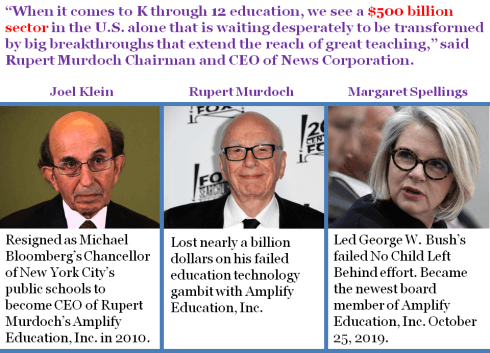
The following March, Amplify announced its new tablet for teachers and students. CEO Joel Klein stated,

“We want to transform the way teachers teach and students learn. Technology has revolutionized the world, but not the classroom. Our hope is that this tablet will help change that.”

That same March of 2013, Amplify also won a $12.5 million dollar contract with the Smarter Balanced Assessment Consortium to develop a digital library of formative assessments. It was the second contract awarded to Amplify by Smarter Balanced. The first one came in 2012 calling for Amplify to partner with ETS developing software to analyze results from common core assessments. Both were part of the $175 million dollar grant by the US Department of Education to the Smarter Balanced Consortium.

The corporate plan was rolling along nicely and then the wheels came off. In Guilford County, North Carolina the school district won a Race to the Top grant of $30 million dollars which it used to experiment with digital learning. The district’s plan called for nearly 17,000 students in 20 middle schools to receive Amplify tablets over the next three years. When a charger for one of the tablets overheated, the plan was halted. Only two months into the experiment, not only had a charger malfunctioned but another 175 chargers had various issues and 1500 screens had broken.

The following year Amplify tried to reestablish itself as a leading player in the digital learning markets. CEO Joel Klein called the new offerings a potential “game-changer” and “unlike anything anyone has ever seen in public education.” The company claimed the Guilford County problems had been fixed.

By August of 2015, News Corporation announced it was exiting the education business. The corporation took a $371 million dollar right off to get out of the digital curriculum business. The next month, News Corporation announced it had sold Amplify to members of its staff. In the deal orchestrated by Joel Klein, he would remain as a board member and Larry Berger would assume leadership of the company.

A New Billionaire Savior Appears

It was soon learned that the real buyer of Amplify was Laurene Powell Jobs, wife of the late Steve Jobs co-founder of Apple. She purchased Amplify through her non-profit the Emerson Collective.

Ed Surge reported, “Emerson Collective has also invested in a slew of edtech startups including AltSchool, FreshGrade, Nearpod and, most recently Udacity’s $105 million round. She is also on the board of NewSchools Venture Fund (an investor in EdSurge.)” In the same month that she bought Amplify, Powell Jobs launched XQ: The Super School Project, a $50 million challenge inviting teams to submit plans to re-invent high schools.

Laurene Powell Jobs has no respect for public school educators and the schools they work in. When Wiki Leaks leaked the Clinton campaign’s emails, Powell Jobs’ recommendations to Hillary Clinton were revealed. She offered four uninformed policy positions in a conversation with Ann O’Leary:

  1. “Re-design entire K-12 system – we know how to do it, but it comes down to political will.
  2. “Think about Charters as our R&D … must allow public schools to have leaders that can pick their team and be held accountable.
  3. “Need to increase IQ in the teaching sector: Teach for America; they are a different human capital pipeline.
  4. “Need to use technology to transform – technology allows teachers and children to focus on content mastery versus seat time; …”

When “we know how to do it” does not include significant input from practicing professional educators, the reasoning is obviously erroneous.

Charter schools have been R&D for fraud, embezzlement and abuse but certainly not for delivering positive innovations. Her slap at teachers unions and work place protections for teachers is consistent with other billionaires and with creating professional educator shortages.

While I was working in public schools, I found the teachers to be every bit as intellectually competent as any of the engineers I met while working in Silicon Valley. Suggesting that Teach For America teachers are even remotely competent to lead a classroom shows gross ignorance of education reality. They are uneducated and untrained.

Technology has a place in education. It is essential for schools to have modern functional lab equipment. Students need access to good word processing programs and video recording equipment to engage in creative endeavors. Some lessons can be supplemented by technology but screens will never replace a live professional educator.

Real education requires life to life communion between teacher and student. Daisaku Ikeda, writes in his book Soka Education,

“Recognizing each student as a unique personality and transmitting something through contacts between that personality and the personality of the instructor is more than a way of implanting knowledge: it is the essence of education.”

Socrates likened this to being “kindled by a leaping spark” between teacher and student. Low cost learning at a screen is spiritless, amoral and dead.

There has been a refocus on “personalized learning” since the Powell Jobs acquired Amplify. (How can isolation at a screen be called “personalized learning?”) In a puff piece about Amplify, Ainslee Harris claims,

“Amplify booked $59 million in revenue in 2016, its first year of independence, and $74 million in 2017. This year, it’s on track to book $125 million, making it one of the few education startups to break the $100 million mark.”

The Powell Jobs team has taken control of the Amplify board. Russlyn Ali (Managing Director of Education at the Emerson Collective), Brad Powell (Managing Partner of Emerson Collective) and former Secretary of Education Margaret Spellings have joined Larry Berger on the board. People like Stacy Childress (CEO of New Schools Venture Fund), Linda Roberts (Office of Education Technology, US Department of Education) and James B. Hunt Jr. (Former Governor of North Carolina) have departed.

Bad Pedagogy and Unhealthy Practices

The vast majority of America’s school principals believe that students are experiencing too much screen time and the Organization for Economic Co-operation and Development (OECD) said in a 2015 report that heavy users of computers in the classroom “do a lot worse in most learning outcomes.” The OECD runs the international testing known as PISA. They came to their conclusion by analyzing the results from the more than 70 countries whose data they monitor.

Dr. Nicholas Kardaras wrote “Screens In Schools Are a $60 Billion Hoax” for Time magazine. When discussing health risks associated with student screen time, he stated, “over two hundred peer-reviewed studies point to screen time correlating to increased ADHD, screen addiction, increased aggression, depression, anxiety and even psychosis.”

A recent post by Nancy Bailey addressed problems with Amplify’s Core Knowledge Language Arts (CKLA) program for teaching reading. Teacher evaluation committees from Rochester, New York and Tulsa, Oklahoma condemned the program. Some of the comments:

“It builds on content so kids in primary grades learn about ancient civilizations, and it shows some vertical articulation, but it doesn’t have good scope and sequence when learning skills. It’s not developmentally appropriate to introduce a skill or curriculum or new learning concept and then not refer to it again for a very long time.”

One teacher said that her principal was “very disappointed that there wasn’t a lot of neat stuff in the hall, but CKLA doesn’t allow for much creative-type work. I didn’t want to hang worksheets in the hall.”

“I wouldn’t want my children taught this way. I don’t know the rationale behind adopting it. The curriculum doesn’t light up the eyes of kids. It removes the autonomy from the teacher. I guess if people have come through an alternate route and don’t have a teaching degree, you can teach it without much experience.”

The math and science programs are just as regressive. In Seattle, an anonymous donor paid $100,000 to have Amplify Science piloted in 20 middle schools. An NPR report noted,

“Former school board member Peters said it’s difficult to compare results the first year of a new test: Pass rates dropped across the board in 2018 when it was introduced. But her analysis shows pass rates dropped the most at the Seattle schools using Amplify Science — despite the curriculum’s promise to help students meet the new standards.”

‘“The students that fared the worst were low-income students using Amplify Science,’ Peters wrote in an email to the board.”

Because of political pressure to implement computer learning, Seattle’s school board ignored the pleas of teachers and parents and bought the Amplify Science program. Its biggest selling point was that it is aligned with the Next Generation Science standards which are also an abomination.

Conclusion

The reason schools are buying these terrible education technology frauds is that professional educators are no longer making curricular decisions. All large modern businesses including schools require a significant digital infrastructure. This means that there must be an information technology group headed by an expert. That expert who loves technology and has no pedagogical expertise becomes the leading voice concerning the purchase of digital equipment. That explains in part why school districts in financial difficulty are still purchasing pricey education technology software and hardware. Board members believe they have no choice and that they are implementing professional advice.

Amplify Education, Inc. is another modern snake oil salesman. The only reason they did not disappear in 2003 is that the federal government and investors like Rupert Murdoch have poured billions of dollars into this company. It is past time for the fraudulent STEM ideology, education testing scam and the sale of low quality education technology products to be stopped. Taxpayers are being fleeced, schools are being bankrupted and children are being harmed.

Twitter: @tultican

Harvard Propaganda Supports Mind Trust Madness

4 Feb

By Thomas Ultican 2/4/2020

Ivy League schools are losing their luster to the stranglehold of billionaire money. The Program on Education Policy and Governance (PEPG) at the Harvard Kennedy School produces Education Next. It is not the kind of objective journal expected from an academic institution. The driving force behind PEPG is Paul Peterson a choice zealot who trained many of the academics contributing to Education Next.

Influenced by super-wealthy people like Bill Gates and the Walton family, Education Next’s reform ideology undermines democratic control of public schools. It promotes public school privatization with charter schools and vouchers. The contributors to the Education Next blog include Chester E. Finn, Jay P. Greene, Eric Hanushek, Paul Hill, Michael Horn, Robin J. Lake and Michael Petrilli. Robin Lake’s new article The Hoosier Way; Good choices for all in Indianapolisis an all too common example of Education Next’s biased publishing.

The Propaganda Source

The portfolio model was a response to John Chubb’s and Terry Moe’s 1990 book, Politics, Markets, and America’s Schools, which claimed that poor academic performance was “one of the prices Americans pay for choosing to exercise direct democratic control over their schools.” It is interesting that the late John Chubb was a committed conservative living in Charles Koch’s hometown of Wichita, Kansas. His widow, Angela Kennedy-Toon, still lives there and is a Managing Partner at an Ed Tech company. Her company profile lists Angela’s close education follows as Chester Finn, Michael Horn, Frederick Hess, Wendy Kopp and Jeanne Allen.

It was a social scientist Paul Hill who developed the portfolio model of school management.

Paul Hill studied political science at Seattle University then completed a Masters in political science at Ohio State in 1966. With the election of Richard Nixon in 1969, Hill, who was working as a Republican congressional staffer, got an administration job as a Research staff member, Office of Economic Opportunity. In 1972, Hill was awarded a Doctorate in Political Science by Ohio State University and became Assistant Director for Policy Studies, The National Institute of Education,U.S. Department of Health, Education, and Welfare. He was there until Democrat Jimmy Carter was elected president in 1977. After leaving government service, Hill worked as a social science researcher at the Rand Corporation for the next two decades.

In 1993, Hill founded the Center on Reinvention Public Education (CRPE) on the campus of the University of Washington. While building his organization, he also worked out the mechanics of ending democratic control of public education. His solution is known as the portfolio model of school governance.

The portfolio model directs closing schools that score in the bottom 5% on standardized testing and reopening them as charter schools or Innovation schools. In either case, the local community loses their right to hold elected leaders accountable, because the schools are removed from the school board’s portfolio. It is a plan that guarantees school churn in poor neighborhoods, venerates disruption and dismisses the value of stability and community history.

Robin Lake was one of Hill’s first hires at CRPE. She became his closest confederate and when he decided to reduce his work load in 2012, Lake took his place as the Director of CRPE. Lake and Hill co-wrote dozens of papers almost all of which deal with improving and promoting charter schools. Since the mid-1990s Lake has been publishing non-stop to promote the portfolio model of school management and charter schools. Lake’s new article up on Education Next is her latest in praise of the portfolio agenda for resting school control from local voters.

Like a large number of the contributors to Education Next, neither Robin Lake nor her mentor Paul Hill have practiced or formally studied education. None-the-less, they have been successful at selling their brand of education reform; which is privatization. They describe their organization, CRPE, as engaging in “independent research and policy analysis.” However, Media and Democracy’s Source Watch tagged the group an “industry-funded research center that . . . receives funding from corporate and billionaire philanthropists as well as the U.S. Department of Education.” A report from Seattle Education lists some of the funders:

  • The Bill & Melinda Gates Foundation
  • The Broad Foundation
  • Fund for Educational Excellence
  • Michael and Susan Dell Foundation
  • National Alliance for Public Charter Schools
  • The Seattle Foundation
  • US Department of Education
  • Walton Family Foundation
  • The Brookings Institute
  • The Business Roundtable

Education Next Cover

Harvard’s Education Next Makes Propaganda Look Swell – Lake’s Article Header

Undermining Public Schools

“The Hoosier Way” recounts what Lake depicts as the heroic history of Republican State Senator Teresa Lubbers’ seven-year long campaign to enact a charter school law in Indiana. It explains that in 2001, Lubber finally won when Democratic Governor Frank O’Bannon signed her bill into law. Lake goes on to explain, “Over the next decade, under Governor Mitch Daniels and state schools chief Tony Bennett, state legislators passed a whole package of reform bills: launching a voucher initiative, expanding charters and giving them rights to unused district buildings, allowing virtual charters, and overhauling teacher accountability.”

These are all presented as positive things for students in Indiana and especially in Indianapolis where newly elected Democratic Mayor Bart Peterson embraced charter schools.

During the 1999 mayors race Peterson hired David Harris a 27-year old lawyer with no education background to be his education guy. Under the states new charter school law, mayors were given the power to bestow charters. David Harris was soon running Mayor Peterson’s charter school office. By 2007 Harris and Peterson had authorized 16 charter schools in Indianapolis.

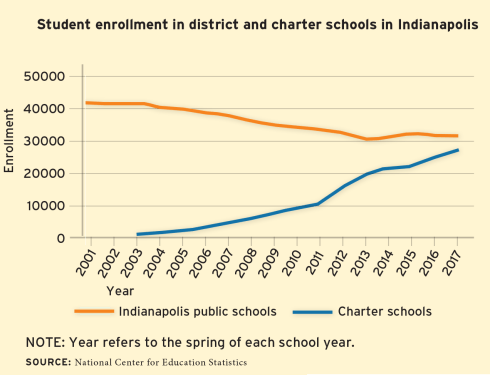
Today, charter schools which are not accountable to local residents of Indianapolis are serving nearly 50% of the cities students. Plus, 10,000 of the 32,000 Indianapolis Public School (IPS) students are in Innovation schools which are also not accountable to local voters. The organization most responsible for the loss of democratic control over publicly financed schools in Indianapolis is The Mind Trust.

Indianapolis enrollment graph Changed

The First Charter Schools in Indianapolis Opened in 2003

Tony Bennett served as Superintendent of public schools in Indiana during the administration of Republican Governor Mitch Daniels. Bennett was “widely known as a hard-charging Republican reformer associated with Jeb Bush’s prescriptions for fixing public schools: charter schools, private school vouchers, tying teacher pay to student test scores and grading schools on a A through F scale.” He left Indiana to become Florida’s Education Commissioner in 2013, but soon resigned over an Indiana scandal involving fixing the ratings of the Crystal House charter school which was owned by a republican donor.

In 2011 before leaving, Bennett was threatening to take action against Indianapolis schools. The Mind Trust responded to Bennett with a paper called Creating Opportunity Schools.” Lake writes,

“In response to a request from Bennett, The Mind Trust put out a report in December 2011 calling for the elimination of elected school boards and the empowerment of educators at the local level. … At the same time, Stand for Children, an education advocacy nonprofit, was raising money to get reform-friendly school-board members elected, and much of the public debate centered on The Mind Trust’s proposal. … A new board was elected in 2012 (the same year Mike Pence became governor) and the board quickly recruited a young new superintendent, Lewis Ferebee, to start in September 2013.” (Emphasis added)

Lewis Ferebee was a member of Jeb Bush’s Chiefs for Change. He was selected to continue the Jeb Bush theory of education reform. It is the theory Bush developed while serving on the board of the Heritage Foundation in the 1990s.

Stand for Children is the infamous dark money organization that funnels money from financial elites into local school board elections. The organization began after Jonah Edelman helped his mother Marian Wright Edelman, founder and president of the Children’s Defense Fund, with a 1996 rally. He took advantage of the situation and the contacts to start Stand for Children. In the early 2000s, Edelman’s pro-privatization anti-union agenda alienated many of his early supporters.

A 2016 paper from the neoliberal organization Progressive Policy Institute explains how The Mind Trust looked to attract like minded national organizations to Indianapolis:

“The Mind Trust convinced Teach For America (TFA), The New Teacher Project (now TNTP), and Stand for Children to come to Indianapolis, in part by raising money for them. Since then TFA has brought in more than 500 teachers and 39 school leaders (the latter through its Indianapolis Principal Fellowship); TNTP’s Indianapolis Teaching Fellows Program has trained 498 teachers; and Stand for Children has worked to engage the community, to educate parents about school reform, and to spearhead fundraising for school board candidates.”

Lake states, “Ferebee, Harris, and Kloth formed what one observer called a civic triangle to focus on creating high-performing schools.” By “high performing schools” they mean charter schools dominated by unqualified TFA temp teachers who have assimilated the school privatization philosophy. The third member of the “civic triangle” is Jason Kloth, a Teach for America alumnus, named deputy mayor of education by Republican Mayor Greg Ballard.

Lake also informs us that “The Mind Trust brought school-board members and local civic leaders to New Orleans, which was implementing the portfolio model—characterized by broad school choice for families (based on a “portfolio” of charter and district-run schools), plus autonomy paired with accountability for educators.”

However, members of the black and brown community including the NAACP started realizing that it was their communities that were being robbed of public schools. Lake noted,Despite support from local newspapers’ editorial boards, the black community recoiled and many people saw The Mind Trust as a group of elitists writing plans to take over the local schools.”  In 2013, to counter these problems, The Mind Trust hired a beautiful young black female lawyer, Kameelah Shaheed-Diallo, to change its approach to minority communities and solve the issue.

Robin Lake concludes that testing data from a recent CREDO study at Stanford University shows the success of the portfolio model in Indianapolis. Dr. Jim Scheurich, Urban Education Studies Doctoral Program Indiana University – Indianapolis (IUPUI), points out that Lake didn’t mention that the CREDO report and its methodology have been criticized by the University of Colorado’s National Education Policy (nepc.colorado.edu) center multiple times. Scheurich also notes that CREDO “receives large pro-charter funding.”

The CREDO study claims to meaningfully measure learning growth to 0.01 of a standard deviation (σ). The reality is Growth models are plagued by error and do not give reliable measurements. There is no way a difference of 0.01 σ can be measured meaningfully. Furthermore, the CREDO studies are not peer reviewed which makes them clearly untrustworthy.

The Metastasizing Affliction

Robin Lake is the director of CRPE which birthed the portfolio model and is engaged in pushing the model into schools nationwide. In 2018, two billionaires, Reed Hastings and Jon Arnold, agreed to put up $100 million each toward promoting the portfolio model of school management. Since then, billionaires Bill Gates, Michael Dell and Steve Ballmer have all contributed to their new organization, The City Fund.

Ethan Gray was Vice President of The Mind Trust before he and David Harris founded an organization called Education Cities. Education Cities became the national organization spreading their ideology. In the summer of 2018, David Harris, Ethan Gray and Kameelah Shaheed-Diallo all left their respective organizations to become founding employees of The City Fund.

There is a deep corruption infesting elite institutions in America. For Harvard University to publish biased articles by people with well known agendas exemplifies this metastasizing affliction.

Denver, Colorado has a school district that is often held up as an exemplar of the portfolio model. Far from being an exemplar it is a dystopian nightmare and warning. This year, Denver voters defeated the dark money controlling their school board. Big money was no longer enough. Indianapolis voters need to follow Denver’s example and throw off the billionaire’s yoke.

Twitter: @tultican

Providence Public Schools Threatened

13 Jan

By Thomas Ultican 1/13/2020

November 1, 2019, Angélica Infante-Green, Rhode Island’s new Commissioner of Education, announced the state was taking over Providence Public Schools. A neoliberal Democratic governor, a like minded mayor and the chamber of commerce appear to be instituting a school privatization agenda.

All power over schools in the state is held by the governor and mayors. Citizens do not have the right vote for local school leaders and school system leaders are subordinates of mayors. This structural weakness in Rhode Island has left public education vulnerable to the whims of a governor or mayor that does not respect professional educators and public education.

In 2011, Mayor Angel Taveras fired all of the teachers of Providence. In a recent article, Go Local Providence called it a “big bold idea” and seemed to lament that the teachers union got the firings reversed within a few days. This prompted Diane Ravitch to comment,

“Apparently the News Team wants the state commissioner to fire all the teachers now and is egging her on to do so.”

“Who will want to teach in a district where teachers are disposable, like tissues?

“Will Teach for America supply the new teachers after the existing workforce has been fired? Will they agree to stay longer than two years?”

Setting Up Providence Public Schools

Latino Public Radio reported on March 26, 2019, “The Council on Elementary and Secondary Education voted unanimously this evening, with the support of the full Rhode Island Board of Education, to appoint Angélica Infante-Green as the next Commissioner of Education.” This was really a pro forma vote. Governor Gina Raimondo selected Infante-Green as well as all of the state school board. Once Raimondo made her choice, it was a done deal.

RI Neoliberals

Recently Raimondo was judged to be the most unpopular governor in America. The Providence Journal reported in October:

“The second-term Democrat’s job performance is viewed unfavorably by 56% of registered voters, according to website Morning Consult, the most negative response during her time in office and the highest in the country. Only 36% of poll respondents, surveyed between July 1 and Sept. 30, viewed her favorably.”

Gina attended private school while growing up in Providence. She studied economics at Harvard and sociology at Oxford University. Following Oxford she earned a juris doctorate from Yale Law.

Raimondo worked in Massachusetts at the venture capital firm Village Ventures which was backed by Bain Capital before she ran to be Rhode Island State Treasurer in 2010. A puff piece in News Week describes how Gina defeated labor union opposition to roll back pension funds. The piece states, “The changes she persuaded the Democrat-controlled Legislature to pass over union opposition will save about $3 billion by delaying retirement, suspending cost-of-living increases and offering workers 401(k)-type savings plans.”

Her neoliberal pension reform plan matches the thinking of Charles Koch and the Cato Institute. The corporate supported American Legislative Exchange Council provides legal templates for reforming pension funds that look very much like Raimondo’s Rhode Island pension reforms.

Following her first term election in 2014, Raimondo selected Ken Wagner, a deputy of John King’s in the New York State Department of Education, to be Rhode Island’s Commissioner of Education. The New York Regents Chancellor, Merryl Tisch, praised Wagner and said he would be a big loss but was a great choice for Rhode Island. Wagner replaced Deborah Gist who left for the superintendent’s job in Tulsa, Oklahoma.

Last year, the governor was faced with making another education commissioner choice. While it is unclear why Wagner resigned the position in March 2019, Raimondo was prepared to immediately select Angélica Infante-Green who trained under Joel Klien and Michael Bloomberg in New York City. Infante-Green is a former Teach for America Corp member who began her career in New York City.

According to Angélica’s LinkedIn page, she taught at PS 4M, CS 77X, and South Park High School between 1994 and 1998. All of her administrative experience appears to revolve around bilingual education. She has never been a superintendent or a principal, which makes her an odd choice to lead Rhode Island’s schools.

However, she was in the first cohort of future chiefs at Jeb Bush’s Chief’s for Change. Their official comment on Angélica’s hiring came from Chief’s for Change board member Pedro Martinez. He said, “We applaud Gov. Gina Raimondo for selecting a commissioner with a deep commitment to creating and expanding opportunities for all students.” Martinez is the Broad trained administrator who is instituting the billionaire financed portfolio model of education reform in San Antonio, Texas; a model that posits disruption as good and democracy as a hindrance.

Researchers from John Hopkins University conducted a review of Providence Public Schools. Their report begins,

“In May 2019, the Johns Hopkins Institute for Education Policy led a review of the Providence Public School District (PPSD). We did so at the invitation of the Rhode Island Department of Education (RIDE) Commissioner, Ms. Angélica Infante-Green, with the support of Governor Gina Raimondo and Mayor Jorge Elorza. The Partnership for Rhode Island funded the review.”

Infante-Green officially assumed her position on April 29 and in May she already had arranged for corporate money to finance a study of PPSD.

The corporate money came from The Partnership for Rhode Island, a group of leading CEO’s in the state. The Governor and the Mayor supported the new Commissioner of Education’s invitation for the study to be done. When the report was released, media, politicians and business executive started vehemently denouncing PPSD as a dysfunctional failure.

Parnership for Rhode Island

Corporations Represented by the Partnership’s Chief Executives Officers

Mayor Jorge Elorza is a product of PPSD where he claims to have barely graduated. He went to community college then studied accounting at University of Rhode Island which led to an auditing position at PricewaterhouseCooper in New York. He obtained a law degree from Harvard in 2003. After the death of a friend in 2005, Elorza said he was motivated to leave Wall Street and return to Providence where he taught Law at Roger Williams University School of Law. He first ran for Mayor of Providence and won in 2014.

The Johns Hopkins study was commissioned in May and presented in June and by July 19th Mayor Elorza officially petitioned the state to takeover PPSD.

In June, the PPSD Superintendent, Christopher N. Maher stepped down. He said it was for family reasons but admitted that the layers of bureaucracy, which have been identified by previous superintendents as the reason for leaving was a factor. He is cited in the Johns Hopkins report saying the Mayor micro-manages the district and that he had to get city council permission to spend more than $5,000. He felt powerless.

In a clear indication that the teachers union was going to be targeted, the new interim superintendent hired to replace Maher was the former Central Falls School District Superintendent, Frances Gallo. She was the administrator praised by Arne Duncan in 2010 for firing all of the teachers at Central Falls High School.

Poverty and Language Learners Underlie PPSD’s Testing Data Struggles

The Johns Hopkins report was based on interviews with the mayor, the city council, the superintendent plus students, teachers and parents from 12 of PPSD’s 41 schools. The report notes, “While we scrupulously report what our team heard and observed, it is very important to note that it was not within our purview to confirm, through further research, the veracity of what we were told by different leaders and district stakeholders.” In other words, this was a very limited review, but it has been widely cited as proof the school district is a disaster.

There are many interesting comments and claims in the report, but the main proof of failure at PPSD is testing data. The report states,

“We know from existing data that student achievement in Providence has been low for decades. Despite the hard work of countless teachers, administrators, and city employees, the latest RICAS scores show that, across the grade levels, a full 90 percent of students are not proficient in math, and a full 86 percent are not proficient in English Language Arts.”

The district’s web page description of the student body makes it obvious why the students are struggling on standardized tests. PPSD reports,

“Our schools are diverse learning communities. Approximately 65% of our students are Latinx, 16% Black, 9% White, 5% Asian, 4% Multi-racial and 1% Native American.

“Approximately 31% of students are multilingual learners, and about 16% of students receive special education services. Approximately 55% of students come from homes where English is not the primary language spoken. Combined, our students and families speak 55 different languages and hail from 91 countries of origin.”

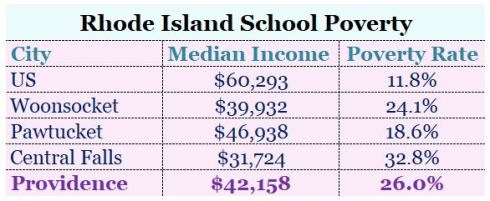
Providence is also one of the poorest urban areas in Rhode Island.

Poverty Comparison

US Census Data Showing Income and Poverty Rates

The cities listed on the chart above all have school districts that the Rhode Island Department of Education calls ”CSI” Comprehensive Support and Improvement Schools.

Professor Noliwe Rooks writes in her book Cutting Schools, “While the standardized testing gap between people of color and whites and Asian Americans is bad, it’s nothing compared to the gap between the poor and the wealthy.”

Professor Rooks also coined the term “segrenomics” to describe the business strategy of profiting specifically from high levels of racial and economic segregation. It appears that this is the plan for Providence.

The Johns Hopkins report states, “We note one particular success that consistently emerged across all constituencies: Every group noted the presence of many devoted teachers, principals, and some district leaders who go above and beyond to support student success.” The best hope for PPSD is they have a teachers union that will stand against the Mayor’s love affair with often useless education technology and the forces working to privatize public education.

Twitter: @tultican

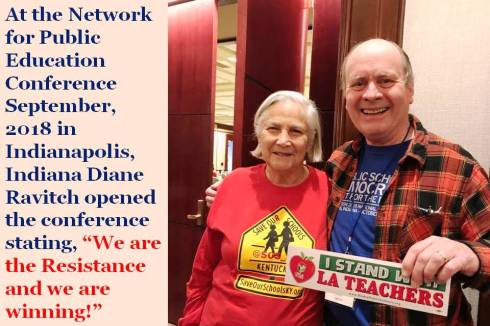
“We Are the Resistance and We Are Winning.”

1 Jan

By Thomas Ultican 1/1/2020

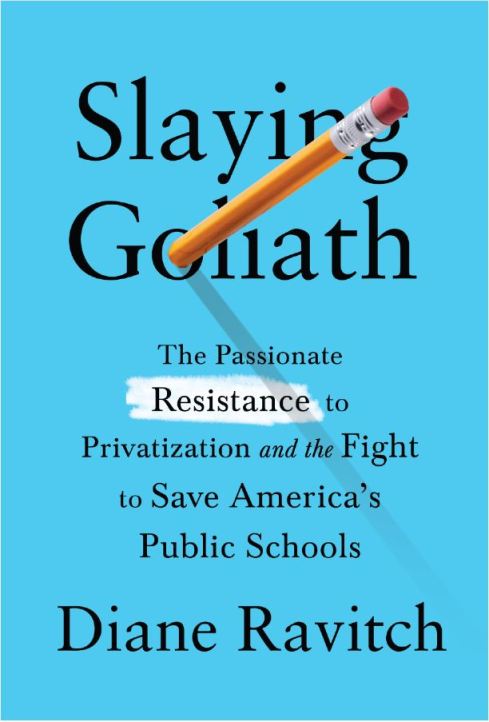
Historian and former United States Assistant Secretary of Education, Diane Ravitch’s, new book, Slaying Goliath: The Passionate Resistance to Privatization and the Fight to Save America’s Public Schools is due for release January 21. This masterpiece weaves together recent history with illuminating data concerning “corporate driven education reforms.

The reported community response to self-anointed reformers is spiritually uplifting. Ravitch presents strong evidence that resistance to their reforms is carrying the day.  She declares, “Judged by their own chosen metrics – standardized test scores – the fake ‘reforms’ failed.”

Diane tells a deeply personal story of her own journey through the education wars while bringing to life the experiences of teachers, students and parents harmed by “fake reforms.” In this captivating read, Ravitch describes the fight to save the commons.

Goliath_0001

Disruption and Changing Course

There is a parallel between Diane Ravitch and Elizabeth Warren. Both Warren and Ravitch were scholars whose research led them to a profound change of thought. Warren was fundamentally a moderate Republican when she began researching bankruptcy law. Ravitch was an advocate of top down standards based education reform. Through their personal research both these women awakened to personal error and went out to make amends. Warren became the bane of the banking industry and a tiger in Democratic politics. Ravitch threw up a stop sign in front of “corporate education reform” and has become its most virulent opponent.

When I mentioned something Ravitch wrote in 2012 to a teacher colleague, that veteran teacher in my neighboring classroom expressed open hostility toward her. He remembered Lamar Alexander’s resident scholar in the Department of Education and her full throated advocacy of standards and testing accountability. He remembered her papers published by the Brookings Institute. Since then, Ravitch has overcome many of her skeptics by working harder than anyone else and fearlessly leading the fight to save authentic public education.

In Slaying Goliath Ravtich shares,

“Having worked as assistant secretary of education for the Office of Educational Research and Improvement in the administration of President George H. W. Bush and for many years in some of the nation’s leading conservative think tanks, I had hoped that privatization and testing would produce sweeping improvement, especially for the neediest students. It didn’t. I couldn’t pretend otherwise. I came to realize that the privatization movement was a continuation of a decades-long campaign by right-wingers who hated public schools, which they derisively called ‘government schools.’ I renounced my own past views and determined to expose the well-funded smear campaign against American public schools and their teachers.”

What should we call the proponents of the choice agenda fueled by standardized testing driven accountability? What do we call those wealthy elites financing the push for charter schools, vouchers and public school closures? Ravitch refuses to call them “reformers” or what they promote “reform.” She recites various appellations people use; “deformers,” or the “financial privatization cabal,” or the “Destroy Public Education Movement.” She observes that “reform” has positive connotations that denotes ‘“improvement,’ ‘progress,’ and ‘uplift.’”

An oft stated goal of this corporate driven agenda is disruption. Disruption is an odd management theory championed at Harvard University in 1995. It posits disruption as a needed ingredient for innovation-driven growth. Ravitch decided they have named themselves.

“They are Disrupters. They are masters of chaos, which they inflict on other people’s children, without a twinge of remorse.”

From the beginning of the book on, Ravitch refers to the “Disrupters.”

Strategy of the Disrupters

A natural starting point for analyzing the era of the Disrupters is the Reagan administration’s 1983 polemic, “A Nation at Risk.” Ravitch shares that Ronald Reagan assumed the presidency with three goals for public education; (1) abolish the US Department of Education, (2) restore school prayer and (3) introduce school vouchers for religious and other private schools.

His Secretary of Education, Terrel Bell, had other ideas. To save the department, he established “The National Commission on Excellence in Education.” In its report written by American business leaders and a venerated scientist, they did not call for prayer or vouchers, however, they blamed public education for the nation’s economic struggles which Ravitch saw as “no less destructive.” She cites an NPR report in which the authors candidly admitted that the data was “‘cherry-picked’ to make American public schools look as bad as possible.

When the Department of Energy commissioned engineers at the Sandia Nation Laboratories to study the current status of American education in 1990, they criticized “The Nation at Risk” as overly alarmist. Sandia found that test scores, graduation rates, and other indicators were actually improving. In Slaying Goliath, Ravitch’s shares an insiders perspective. She writes,

“At the time, I was assistant secretary of education for education research and improvement, and in 1992, I attended the Energy Department’s briefing about the Sandia report. I accompanied David Kearns, former CEO of Zerox, who was deputy secretary of education, to the meeting. He was outraged by the Sandia report, which contradicted the view of the Department of Education that American public schools were failing and needed radical change. The Energy Department never published the report, but it was immediately leaked to hundreds of influential researchers, who wrote about its findings. In retrospect, the Sandia report got it right. The late Gerald Bracey, a prolific and outspoken education researcher, was highly critical of the conventional wisdom, which I was then defending. I hereby personally apologize to him. He was right. The “crisis in education” was a politically inspired hoax, or as the eminent researchers David Berliner and Bruce Biddle later called it, a ‘Manufactured Crisis.’”

What do disrupters want? They want:

  • Inexperienced teachers with little or no training from organizations like Teach For America.
  • To replace teachers with machine teaching (“blended learning” – “personalized learning”).
  • To move fast and break things including school systems, historic schools and communities.
  • To eliminate local democratic control over schools.
  • To eliminate teacher tenure and seniority rights.
  • To eliminate teacher defined benefit pensions.
  • To eliminate teachers unions.
  • To evaluate teachers and schools with standardized test scores.
  • To lower taxes and reduce spending on education.

Ravitch goes into significant detail about who are the disrupters. She calls out the billionaires in the private sector driving the school choice agenda and highlights their spending. She states, “Every Republican governor is a disrupter, because they actively support privatization by charters and vouchers.” However, she notes that rural Republican officials understand that public schools are the anchors of their communities and do not support privatization. The Democratic Party also has many disrupters but not in as great of numbers as the Republicans and generally no Democrats support vouchers. The last two Democratic Presidents, Bill Clinton and Barack Obama, were disrupters.

Conservative groups supporting disruption include the far right Heritage Foundation and the libertarian Cato Institute. Ravitch asserts, “The radical right-wing American Legislative Exchange Council (ALEC) is the key organization in the world of disruption advocacy.

She lists more than a dozen pro-disrupter “think-tanks” on the right including the Thomas B. Fordham Institute and the Center for Education Reform which Ravitch describes as liking “every choice in schooling except public schools.

Before his 1998 election to the governorship of Florida, Jeb Bush served on the board of the Heritage Foundation where he developed his education plans. Diane cites his A+ Plan for education as the “template for disruption.” It combines choice, competition, high-stakes testing, grading schools with A-F grades and accountability as the formula for excellence in education.

Two “liberal” groups, the Center for American Progress (CAP) and Democrats for Education Reform (DFER), push most of the disrupter agenda. In her description of DFER Ravitch writes,

“In 2005, several hedge fund managers – Witney Tilson, Ravenel Boykin Curry IV, John Petry and Charles Ledley – launched Democrats for Education Reform at a posh party on Central Park South in Manhattan, where the inaugural speaker was a young senator from Illinois named Barack Obama. DEFR, as it is deceptively called, was founded to support school privatization by making strategic campaign contributions. Inspired by DFER, charter schools became the pet passion of Wall Street.”

“It is likely difficult to throw a beanbag in a corporate or Wall Street boardroom without hitting a member of the board of a charter chain.”

The Victorious Resistance

Tom and Diane in Indianapolis

Tom Ultican and Diane Ravitch at the 2018 NPE Conference

The picture above was taken just over two months before the historic LA teachers strike on January 14, 2019. Following the massive teachers strikes in West Virginia, Oklahoma and Arizona, the LA strike was the first one led by a sanctioned teachers union. When the teachers settled their strike after nine days, they did not get any bump in the original take home pay offer but they won big.

USA Today reported, “‘this is much more than a labor agreement,’ said UTLA President Alex Caputo-Pearl. ‘It’s a very broad compact that gets to social justice, educational justice.’” The Los Angeles agreement included class size reductions in all grade levels, 300 additional school nurses, 80 new teacher librarians, one counselor for every 500 students and a 3 percent raise for teachers.

In Arizona, a group of six women established Save Our Schools Arizona to fight the Koch brothers initiated large voucher expansion proposal which was adopted by the Arizona state government. At the Indianapolis NPE conference, Beth Lewis and Sharon Kirsch of SOS Arizona were presented the first of a planned annual Phyllis Bush Award. Against all odds they landed a citizens’ initiative stopping the voucher expansion on to the November 6, 2018 ballot. Later we learned their initiative won with a whopping 65% of the vote.

Ravitch tells these stories and many more of the resistance taking on Goliath and winning.

The saga of Douglas County Colorado being taken over by school privatization forces in 2011 is unique and uplifting. The disrupters immediately established a district school voucher program. That was only the beginning of their agenda, but a bi-partisan group of parents fought back. Today there are no disrupters left on the school board in Douglas County and there are no vouchers.

The account of Barbara Madeloni, President of the Massachusetts Teachers Association (MTA), leading the fight to stop the state from increasing the number of charter schools is amazing. The contest was played out at the ballot box over a referendum to expand the number of charters known as Question-2. Ravitch reports that the MTA directed Madeloni to negotiate with legislators and quotes Madeloni’s negotiating position,

We are glad to talk, but we will not accept any deal that involves any new charter schools. Now, what do you want to talk about?

Question-2 lost 68% to 32%. One of the largest contributors to the yes-on-2 campaign was the world’s now second richest women hailing from Bentonville, Arkansas, Alice Walton. She is an heir to the Walmart fortune.

A Concluding Analysis

Ravitch’s books like The Death and Life of the Great American School System and Reign of Error are scholarly efforts that serve for years as references. Yet, they are written in a fashion that gives the average reader access to the material in an enjoyable and understandable way. I believe that in Slaying Goliath: The Passionate Resistance to Privatization and the Fight to Save America’s Public Schools, Ravitch has upped her game. The stories are riveting and the scholarship underlying them is first rate. This is another game changing book from Diane Ravitch.

Twitter: @tultican

Manufactured Education Crisis Engenders Violence

18 Dec

By Thomas Ultican 12/17/2019

On October 23, the regularly scheduled Oakland Unified School District (OUSD) board meeting descended into chaos accompanied by violent reaction from school police. One parent received a broken rib; two elementary school teachers reported severe bruising and a small mother suffered two torn ligaments and a meniscus tear. They were protesting the closing of Kaiser elementary school which is the result of a manufactured crisis beyond the control of the local school board. Billionaire “philanthropists” and the state of California created and exacerbated Oakland’s chronic budget issues.

Today’s budget problems stem back to the state assuming control of OUSD in 2003. Ken Epstein of Oakland Crossings described the situation when the state installed an administrator. “At the time, State Schools’ Supt. O’Connell [Democrat] and influential State Senator Don Perata [Democrat] were instrumental in putting together a deal requiring the district to accept a $100 million loan, even though it was only $37 million in debt.”

The Alameda County Office of Education and the Fiscal Crisis and Management Assistance Team (FCMAT), a state-funded nonprofit that advises districts on financial matters, both played a large role in pushing OUSD into receivership (2003-2009) and forcing the district to take a $100 million state loan. OUSD did not ask for the loan. They had enough money in construction funds to cover the shortfall if the state would approve borrowing from that fund. The state had given other districts this kind of permission but refused it to Oakland.

Kathy Murphy reported in the 2009 East Bay Times, “Six years after the largest state loan ever made to a California school district, the Oakland school district is emerging from state receivership $89 million in debt.” After six years of state administration, the budget deficit grew from $37 million to $89 million.

O’Connell Selects Eli Broad’s Trainee as Administrator

In 2002, the multi-billionaire Eli Broad (rhythms with toad) decided to establish his own training academy for school administrators. With no background in education or experience other than attending public school in Detroit, Broad was so rich he could just do it. He did not believe schools had an education problem; he believed they had a management problem. It was his theory that large urban school districts did not need education leadership – consultants can be hired for that – they needed business management leadership.

One of the key management ideas taught at the Broad Academy is “right-sizing.” It is probably in the Broad School Closure Handbook; Closing Schools as a Means for Addressing Budgetary Challenges that the first use of the terminology “right sizing” is applied to a school district. Now this Broad construct has slipped into common usage by Oakland’s political and administrative leaders.

Another key component undermining OUSD was the state’s Fiscal Crisis Management Assistance Team (FCMAT). In 1991, new California, Governor Pete Wilson, signed the team into law. FCMAT (pronounced “fick-mat”) is a state sponsored non-profit located in Kearn County. It is supposed to help school districts identify and solve fiscal problems. However, FCMAT has developed a reputation as a neoliberal organization that has a racial bias against schools in Black and Brown neighborhoods. An Oakland school leader admitted they felt FCMAT was biased against Oakland.

When OUSD discovered its budget shortfall in 2003, FCMAT started pushing for a state takeover and Oakland Mayor, Jerry Brown, seemed to welcome it. Majority reports that when OUSD proposed covering the shortfall with construction funds,

“Tom Henry, the CEO of California’s Fiscal Crisis and Management Team (FCMAT) opposed this plan, and Mayor Brown questioned it heavily. (During a state takeover, FCMAT would be responsible for monitoring the school district’s financial progress.) Phone records later obtained by the Oakland Tribune revealed over 40 phone calls on key dates between Brown, Henry, and Randolph Ward, who would end up in charge of OUSD when it was placed under state control, in the two months before the state takeover.”

A California central coast politician named Jack O’Connell was elected California’s Superintendent of Public Instruction in 2002. He selected Randolph Ward, a Broad Academy graduate, to be Oakland’s state administrator. When O’Connell ran for state superintendent, his largest campaign donors had been Netflix CEO Reed Hastings ($250,000), venture capitalist John Doerr ($205,000), and Eli Broad ($100,000). Brown described the state takeover as a “total win” for Oakland.

The Broadies of Oakland

2003-2017 Broad Academy Graduates and Superintendents of OUSD

Broad Academy graduates are often disparagingly called Broadies.

The OUSD information officer in 2003 was Ken Epstein. He recounts a little of what it was like when Ward became the administrator:

“I remember a school board meeting where Ward and the board were on stage. Each item on the agenda was read aloud, and Ward would say, “passed.” Then the next item was read. In less than an hour, the agenda was completed. At that point, Ward said, “Meeting adjourned” and walked out of the board room and turned out the lights, leaving board members sitting in the dark.”

When Ward arrived in Oakland, the district was in the midst of implementing the Bill Gates sponsored small school initiative which is still causing problems. The recently closed Roots that caused so much discontent in January was one of the Gates small schools. Ward opened 24 of them (250-500 students) which in practice meant taking an existing facility and dividing it into two to five schools. He closed fourteen regularly sized schools.

Upon Ward’s arrival in Oakland there were 15 charter schools and when he left for San Diego three years later there were 28 charter schools.

Epstein related a story from attending a district leader’s cabinet meeting when Ward asked a Broad trained accountant to get numbers on how much money would be saved by closing a school. Three weeks later the accountant said no savings and Ward responded, “Then go back and figure out another reason for closing schools.”

Kimberly Statham who was a classmate of Ward’s at the Broad Academy took his place in 2006. The following year a third Broad Graduate, Vincent Mathews took her place.

After a short period of no Broadie in the superintendent’s seat, Antwan Wilson was hired in 2014. Shortly after that, the New York Times reported that the Broad Foundation had granted the district $6 million for staff development and other programs over the last decade. The Broad Center also subsidized the salaries of at least 10 ex-business managers who moved into administrative jobs at the district office.

Kyla Johnson-Trammell, an Oakland resident and educator with OUSD, was named to replace Antwan Wilson in 2017. When he exited to lead Washington DC’s schools, Wilson left a mess in Oakland. Mother Jones magazine said Wilson saddled the district with a $30 million deficit. The article continued, “A state financial risk report from August 2017 concluded that Oakland Unified, under Wilson, had ‘lost control of its spending, allowing school sites and departments to ignore and override board policies by spending beyond their budgets.”’

The preponderance of the problems in OUSD are related to the state takeover, FCMAT and the leadership provided by Broad Academy graduates.

School Board Under Attack from All Sides

A March Oakland Post article says,

“A new report from the Fiscal Crisis Management and Assistance Team (FCMAT) indicates that the State of California, represented by FCMAT and the Alameda County Superintendent of Education, is requiring the school district to make budget cuts of jobs and programs totaling about $30 million this year, regardless of any costs generated by increased salaries for teachers and other school employees.”

The Alameda Civil Grand Jury says the district has run a debt of $20 to $30 million for the past fifteen years. It states, “School occupancy must be assessed and painful decisions made regarding closure and consolidation as soon as possible.”

In 2018, the Alameda County Office of Education rejected OUSD’s three-year budget plan saying it did not adequately address needed budget reductions; prompting school activist Ahsan Nilofer to ask, “What will FCMAT and the County Office consider to be an adequate plan?”

Another drag on the district’s finances is this past school year; the district had to pay FCMAT and the county $1.4 million for their services.

At the same time the coalition “Oakland Not for Sale” demands:

  1. “Stop School Closures”
  2. “End the School to Prison Pipeline”
  3. “Stop the charter school takeover”
  4. “Let the people see the money”

This is the organization that led the demonstration at the board meeting in October that ended in violence and chaos.

Mike Hutchinson of the Oakland Public Education Network says that OUSD ended the 2018-2019 school year with a $21 million surplus not a deficit. He also has announced that he will be running for the district-5 board seat in 2020.

A board member explained that $4 million of that claimed surplus comes from the board purposely underestimating title 1 and title 4 money from the Department of Education because they did not trust the actions of the Trump administration. The rest of the money is thought to be in restricted funds that can only be spent of designated categories.

The board was forced to adopt the 2019-2020 budget without good numbers to rely upon. An EdSource article relates that “Board member Shanthi Gonzales said staff didn’t give the board enough details about department budgets, school budgets or even how many employees the district has, what they do and how much they earn.” However, the district’s state trustee said district operations would come to “a screeching halt” if the board didn’t meet its June 30 budget approval deadline.

In addition to all of these problems, billionaires and their school privatization organizations are attempting to purchase the school board. In Oakland the on the ground political organization leading the privatization agenda is GO Public Schools.

Go Political Spending Chart

Funding to GO Public School Independent Expenditures Effort

School Board Winners Finance Chart

Winning OUSD Board Member Campaign Support

In the 2018 election, Gary Yee was the recipient of almost $146,000 in independent expenditure support from mostly billionaires working to privatize public schools in Oakland. His victory makes him the third member of the seven seat board to owe their election to GO Public Schools.

FCMAT from the state of California, the Alameda County Office of Education and the Alameda County Grand Jury are all ordering the OUSD school board to make budget cuts and close schools. At the same time residents of the city don’t want to hear about schools being closed and with reason do not believe the state and county budget analysis. Unfortunately, the only place they can express their outrage is at the local school board. However, there are some really good people on this board who are being put through a ringer by forces beyond their control. No matter what they do, it is loudly criticized and they are personally demonized as selling out the city.

The fundamental problem is Oakland has a dual education system with 37,000 students in public schools and 15,000 in charter schools. It costs more to operate two systems. Every school district in California that has more than 10% of their students in charter schools has severe financial problems. Oakland has the largest percentage of charter school students in the state with 29% so financial issues should be the expectation.

This is an education crisis that was manufactured by the super wealthy and implemented by neoliberal politicians.

Twitter: @tultican