Archive | DPE RSS feed for this section

Texas Hangs Sword of Damocles Over Houston Schools

3 Feb

When the Houston Independent School District (HISD) Board refused to privatize four schools, state takeover of the district became likely. States taking over school districts have an awful track record. Takeovers in Philadelphia, Newark, Detroit and Tennessee have been long running disasters for students, parents, schools and communities. So the idea that Texas will likely seize HISD – a district the Texas Education Agency (TEA) assigned a grade of B on its new A – F grading system – is bizarre.

HISD is the largest school district in the state of Texas and the 7th largest in the United States. The nine HISD Board members are an impressive group whose children attend district schools. Seven of them are products of HISD. They all are college graduates and most earned advanced degrees. Seven of them have both teaching and administrative experience in public schools. Anne Jung was a high school science teacher who earned a master’s in physics at Harvard. Jolanda Jones is a Rhodes Scholar and an NCAA heptathlon champion with a Juris Doctorate from the University of Houston. Wanda Adams was a scholarship winning athlete who attended Kashmere High School which is one of the four schools TEA might shutter. She is an Emmy winning college graduate who has been named to multiple top 50 lists in Houston area plus has served two terms on the Houston city council.

Richard Carranza became HISD superintendent in August of 2016. In March of 2018, he resigned to take a similar position in New York City Schools. With the HISD board’s impressive resumes and the fact that their last top hire was considered the best administrator in America to lead the nation’s largest school district, it was startling to read Governor Greg Abbott’s January 3rd tweet,

“What a joke. HISD leadership is a disaster. Their self-centered ineptitude has failed the children they are supposed to educate. If ever there was a school board that needs to be taken over and reformed it’s HISD. Their students & parents deserve change.”

A counter observation based on biographies is that every elected board member in HISD is more qualified to be an education leader than Mike Morath, the guy Abbott appointed Texas Commissioner of Education. They all are more educated with advanced degrees in clinical psychology, physics, law, education leadership etceteras compared to Morath’s bachelors degree in business. The board members have decades of experience working in public schools compared to Morath’s six months as an untrained long term sub teaching a computer science; a class outside of his field of study.

Morath tried to privatize the Dallas Independent School District while a board Trustee. It appears that Abbott might have a similar agenda for the entire state and that is why he selected this unqualified person to lead the state’s schools.

Terrible Education Policy Driven by Benighted Legislation

Takeover Authors

In 2015 Governor Abbott signed HB 1842 into law. It mandates “intervention in and sanction of a public school that has received an academically unsuccessful performance rating for at least two consecutive school years ….”

The law mandates that if a district does not implement an approved plan to turn the school around “the commissioner shall [may] order:

  • appointment of a board of managers to govern the district as provided by Section 39.112(b) [repurposing of the campus under this section];
  • alternative management of the campus under this section; or
  • closure of the campus.”

The bill allows districts to present a turnaround plan in which the district could be designated an “innovation district.” If after five consecutive years of bad tests scores at any district campus an “innovation district” would lose its designation and be subject to the above sanctions.

HB 1842 passed by large margins; 26-5 in the senate and 125-18 in the house. It is doubtful that many of the legislators fully understood that they were putting their constituent’s democratic rights in jeopardy when they voted for this bill.

In 2017, Senate Bill 1882 incentivized privatizing schools in minority neighborhoods. Sarah Becker an HISD parent and school psychologist explains,

“In the spring of 2017, just months before the sanctions of HB1842 were slated to go into effect; the legislature passed Texas Senate Bill 1882, which gave school boards another option for these so-called failing schools. SB1882 encouraged school districts to hand over control of these neighborhood schools to charter operators (referred to as “partnerships”) the year before schools would get ratings for the fifth year. In exchange, the school and its board would get a reprieve from Representative Dutton’s death penalty for two years and, as a bonus, would receive extra funding for every student enrolled in one of these charter-controlled schools.

“With one law the death penalty (1842) and the other law the price of clemency (1882), these two laws now work together to coerce local school boards to be the hand of privatizing their own neighborhood schools. One by one, schools are turned over to private, appointed organizations by local politicians that want to save their fledgling political careers, and in turn, these “partnerships” provide cover for conservative leaders that would have a hard time explaining to Texans how their state undermined local control of schools with state-mandated takeovers and closures.”

This combination of laws is based on the faulty premise that school quality can be measured by standardized testing. The famed education scholar Linda Hammond-Darling mentioned last week in an Ohio presentation,

“There’s about a 0.9 correlation between the level of poverty and test scores. So, if the only thing you measure is the absolute test score, then you’re always going to have the high poverty communities at the bottom and then they can be taken over.” (Emphasis added)

A correlation of 1 means it is a certainty and – 1 means it cannot happen. A correlation of 0.5 means there is a mild positive relationship. The 0.9 correlation with family wealth is the only correlation above 0.5 for any of the researched variables such as schools, teachers, sex or race.

In 1998, Noel Wilson wrote a major peer reviewed scholarly paper, “Educational Standards and the Problem of Error”. Wilson’s paper basically says that the level of error associated with standardized testing is so high it makes these tests unreliable as evaluative tools.

A year later, James Popham of the UCLA graduate school of education also wrote a peer reviewed paper on testing. In his Education Leadership article based on the paper he concluded,

“Educators should definitely be held accountable. The teaching of a nation’s children is too important to be left unmonitored. But to evaluate educational quality by using the wrong assessment instruments is a subversion of good sense. Although educators need to produce valid evidence regarding their effectiveness, standardized achievement tests are the wrong tools for the task.” (Emphasis added)

The science has not changed. Standardized test results will not evaluate a school’s quality but will identify poverty. The new approach in Texas guarantees that parents in minority mostly poor communities will have their democratic rights and public schools taken away. It may not be a racist intent but it certainly brings about a racist outcome. If this were not true at least one school in a majority white affluent neighborhood would be identified as “failing”.
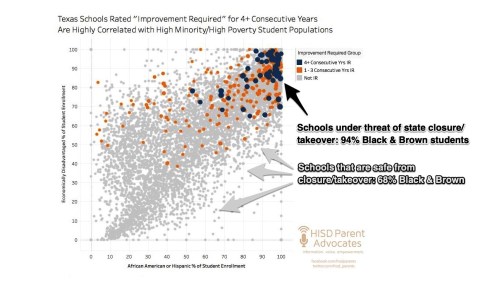
TexasIR4_Correlated_w_RacePoverty2

HISD Parent Advocate Demographic Map of Houston Schools

Failure Demgraphics

Demographic Data from HISD

Houston’s Long Relationship with Destroy Public Education Ideology

Teach For America (TFA) or as my friend Ciedie Aech calls them the “teach-for-a-minute girls” came to Houston in 1991. A TFA teacher is a temporary employee with a bachelor’s degree and five-weeks of summer training from TFA. A new career teacher has a bachelor’s degree, a year of student teaching in conjunction with a year of teacher education classes. The TFA temp will normally leave after 2 years if not before. It would not be unusual for a career teacher to still be at a school 30-years later.

The new career teacher will likely not be confident or competent their first year. Most new teachers find an informal mentor on staff that guides them. The TFA temp normally does not have a clue about how unprepared they are. Because career teachers were so denigrated during their training, TFA teachers are reluctant to ask the advice of a veteran.

To label TFA teachers highly qualified or even qualified is to dissemble.

TFA is another of the destroy-public-education (DPE) organizations that only exists because of billionaire dollars. In her book Chronicle of Echoes, Mercedes Schneider documented that in 1995 TFA was $1.2 million in debt despite receiving a $2 million dollar federal grant.  Founder Wendy Kopp was able to scrape by with four $10 million gifts from the Broad foundation, the Dell foundation, Dan and Doris Fisher (Gap founders), and The Rainwater Charitable Funds. In 2011, the Walton Family gave TFA $49.5 million and since then money from billionaires has continuously poured in; even Houston’s own John Arnold has sent them more than $7 million.

In 1994, two teachers from TFA Houston with no training and three years teaching experience, Michael Feinberg and Dave Levin, founded KIPP charter school in Houston and New York. Schneider noted in Chronicle, “By 2000 Feinberg and Levin were receiving funding from Donald and Doris Fisher.” The Fisher’s co-founded the KIPP foundation where they were joined on the board by Carrie Walton Penner (Walmart heir), Mark Nunnely (Bain Capital) and Reed Hasting (Netflix) among others.

Chris Barbic another Houston TFA teacher with limited experience followed in Feinberg and Levin’s footsteps to founded YES Prep the next year. This charter was seen as miraculous. Gary Rubinstein was a fellow TFA teacher and personal friend of Barbic’s in Houston. He often shoots down miracle claims by charter schools. Gary wrote of Yes Prep,

“In 2010, YES was awarded a million dollars by Oprah Winfrey, in part because of their incredible record of getting 100% of their 12th graders to be accepted into college.  This was before people knew to ask, ‘But what percent of your 9th graders remained in the school to become 12th graders?’”

KIPP which uses a 19th century “no excuses” pedagogy has 25 schools in Houston and YES Prep has grown to 18 schools. Rubinstein concluded the article cited above with:

“So is YES Prep failing its Black students and then abandoning them when it serves YES for them to do so?  I can’t be certain, but the data makes me pretty confident that the answer is YES.”

YES Prep and KIPP are two more DPE organizations that only exist because a group of billionaires dedicated to privatizing public education gave them millions of dollars. It is not because they are superior schools but because they are not public.

The fraudulent “Texas miracle” that led to the No Child Left Behind (NCLB) Act and the federal takeover of public education came from Houston. Roderick Paige was the HISD Superintendent that rode that “miracle” all the way to the office of United States Secretary of Education.

Paige’s strategy was to give bonuses to school leaders that hit bench marks and fire those that didn’t. Drop out rates plunged and test scores soared. Later in was learned that the “Texas miracle” like all school miracle claims was a fraud. They cooked the books on dropout data and principals raised 10th grade testing scores by holding low scoring 9th graders back and then promoting them to 11th grade the next time they were due to test.

It is close to a consensus conclusion that NCLB was a colossal and damaging failure. Its strategy of test and punish became test and privatize. Alfie Kohn published a 2004 article, “Test Today, Privatize Tomorrow; Using Accountability to ‘Reform’ Public Schools to Death.” In a 2008 addendum, he wrote of the suspicion that schools were purposely setup for failure:

“We now have corroboration that these fears were entirely justified. Susan Neuman, an assistant secretary of education during the roll-out of NCLB, admitted that others in Bush’s Department of Education ‘saw NCLB as a Trojan horse for the choice agenda – a way to expose the failure of public education and ‘“blow it up a bit’’’ (Claudia Wallis, ‘No Child Left Behind: Doomed to Fail?’, Time, June 8, 2008).”

Some Observations

With the HB 1842 and SB 1882, the Texas legislature has created an education code that eerily mirrors NCLB. It has reinstituted the test and punish theory using the same faulty methodology for evaluating schools – standardized testing. Is this the result of ignorance or something far more sinister?

Local Houston billionaire and former Enron trader John Arnold has joined forces with San Francisco billionaire Reed Hastings to privatize America’s schools. They have each pledged $100,000,000 to their new City Fund dedicated to selling the portfolio model of school governance. TEA Commissioner Mike Morath recently started the System of Great Schools which is a strategy roadmap and toolkit for implementing the portfolio model for school governance, a model that posits disruption and school privatization as good for Texas.

Fewer and fewer schools in a portfolio district are controlled by a vote of the community. I believe in democracy and local control. How do Texas politicians justify undermining democracy and local control? What a strange group of conservatives.

Texas Public Schools in Portfolio District Crosshairs

26 Jan

By T. Ultican 1/26/2019

Radical market theorists are reshaping Texas education governance by instituting the portfolio district school model. It is a scheme promoted by the University of Washington based think tank, Center on Reinventing Public Education (CRPE). To advance this design, the accountability system and justifications for closing public schools is adopted from Rahm Emanuel’s Chicago Public Schools. This top down plan is being guided by Mike Morath Commissioner of the Texas Education Agency (TEA).

A quick glance at the CRPE web site reveals they see Texas as a target of opportunity. It states,

“We’re currently working on:

“…

“Analyzing how state education agencies can support local leaders on the portfolio strategy, such as through the Texas Education Agency’s new System of Great Schools Network.”

A few of the benefits that TEA claims for the System of Great Schools (SGS):

  • “Membership in a professional learning community of superintendents and senior staff that come together regularly to build understanding of the SGS strategy, …”
  • “Regular connection points with Commissioner Morath.”
  • “The district increases access to school choice options and helps families identify and attend their best-fit school.”

TEA’s SGS web site offers a complex excel file with a roadmap for implementing SGS strategies.

sgs implementation road map

Image of SGS Roadmap Excel Page Labeled “Top 12 Deliverables”

The “School Performance Framework” hyperlink in the Excel sheet opens Chicago Public School’s “School Quality Ratings Policy (SQRP) Handbook.” Much of the “objective” justification used for closing 50 Chicago schools in one year is in the handbook. Those 50 schools were almost all in predominantly African-American neighborhoods and employed mostly African-American teachers.

Enacting Unproven Agendas like this is not Conservative

On January 20, 2015 Republican Greg Abbott became the 48th Governor of Texas. One of his early decisions was to appoint Mike Morath Commissioner of Education. The very conservative Donna Garner – a Trump supporting retired school teacher and education policy commentator for Education View – was not impressed. She wrote,

“As a conservative, I appreciate Gov. Greg Abbott for the many courageous positions he has taken for Texas; but he really missed it on this one!

“I cannot think of very many people whom Gov. Greg Abbott could have appointed who would have been a worse choice than Mike Morath as Texas Commissioner of Education.”

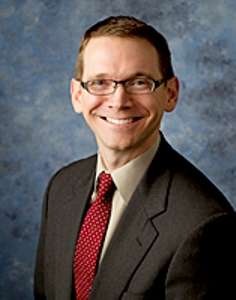
mike_morath

Mike Morath from his TEA Biography Page

Morath’s appointment continues a more than a decade long period of Texas Education Commissioners lacking proven education training or experience. His education background consists of serving four years as a Trustee for the Dallas Independent School District and teaching an advanced computer science class at his high school alma mater after the previous teacher resigned suddenly. He completed the year.

Morath has referred to himself as a “super-nerd.” In 2015, the Dallas News stated, “Morath, 38, is a numbers whiz who excelled academically, earning his business degree in 2 1/2 years at George Washington University in Washington, D.C.”

Morath started a company that developed a management information system that streamlined federal food programs for low-income families. At age 36, he made enough money selling the company to semi-retire. Dallas Magazine shared,

“His next goal: searching for his special purpose. An evangelical Christian, Morath believed God would lead the way to this discovery.”

The same Dallas Magazine article also reported that his fellow Dallas Trustees found him “an arrogant wonk who won’t listen to others.” They were especially alienated when Morath tried to privatize the entire district using an obscure never used 1995 Texas law authorizing Home Rule Charters. The Texas Observer reported,

“The idea came from Mike Morath, a Dallas ISD trustee since 2011, when he ran unopposed for an open seat. He’s part of the new generation on the school board, an entrepreneur and policy wonk backed by the Dallas Regional Chamber’s Educate Dallas PAC.

“Morath tells the Observer he spotted an off-hand mention of home-rule charters in a news story about another Texas city….  

“Drafting a home-rule charter, he figured, could be just the thing to give Dallas ISD the freedom it needs to make real changes. Morath shared the idea with a handful of local lawyers and businessfolk, and they in turn founded Support Our Public Schools.”

There were several big dollar contributors for Support Our Public Schools which is a 501 C4 organization meaning it is not tax exempt because its main purpose is to promote a political agenda. It is a dark money fund. Only Houston billionaire John Arnold openly admitted giving large sums to the group.

Garner made an interesting observation in her piece denouncing Morath’s appointment. She defined two types of schools:

  • Type 1 Education: More than a century of children educated in democratically run public schools by certificated teachers. They used technology like Big Chief Tablets and pencils to learn reading, writing, mathematics, science, and civics. They participated in physical exercise and team sports. They attended the school in their neighborhood which likely had several generations of history. “Americans became the leaders of the world because of the many scientists, inventors, technicians, entrepreneurs, engineers, writers, historians, and businessmen who used their Type #1 education to elevate themselves to great heights.
  • Type 2 Education: A philosophy of education that opens the door to subjective, digitized curriculum and assessments found in Common Core the Bill Gates financed national education standards pushed by the Obama administration and CSCOPE the Texas attempt to impose standards based scripted lessons on all teachers and schools. It is the same “innovative” school model pushed by the Texas Association of School Boards and the Texas Association of School Administrators; their 21st century transformational “visioning” approach to education. An approach that embraces the technology industry’s future ready agenda which supports greedy consultants, lobbyists, and vendors who make a fortune off education’s “Golden Goose” of public dollars.

future-ready-pledge

Promotion for the Future Ready Pledge by the Office of Education Technology

Garner’s article about Mike Morath’s appointment concluded,

“Mike Morath is not the right person for the Texas Commissioner of Education. He will not support whole-heartedly the Type #1 curriculum standards that the elected members of the Texas State Board of Education have worked so hard to adopt.  Morath’s philosophy of education is very closely attuned to that of the Obama administration’s Type #2 Common Core.  I am terribly disappointed in Gov. Abbott’s choice of Mike Morath as the Texas Commissioner of Education.”

Test to Privatize

Standardized-testing is NOT capable of measuring either school or teacher quality. The only strong statistical correlation related to standardized-testing is family wealth. In a paper on the limitations of standardized-testing the non-profit organization FairTest wrote,

“Test validity, experts explain, resides in the inferences drawn from assessment results and the consequences of their uses. Relying solely on scores from one test to determine success or progress in broad areas such as reading or math is likely to lead to incorrect inferences and then to actions that are ineffective or even harmful. For these and other reasons, the standards of the testing profession call for using multiple measures for informing major decisions – as does the ESEA legislation.” (Emphasis Added)

It is not an accident that 100% of schools designated as failures and slated for intervention are in poor communities. Likewise, it is not surprising that there has never been a school in a middle class community designated for closure or other interventions. It is only the schools in poor and almost exclusively minority communities that are slated for state intervention in Texas.

To evaluate a school, information about the accreditation of its teachers and their years of experience would be meaningful. As would information about class sizes, art programs, music programs and physical training. A review of the condition of the facilities would also make sense. Surveying students, teachers and parents would yield actionable information. Evaluating schools on the basis of standardized-testing is indefensible.

In 2012, TEA promulgated a rule that required any school designated a failure five years in a row based on the State of Texas Assessment of Academic Readiness (STARR) testing must undergo state intervention. In 2018, the first 52-schools that require intervention appeared on the states to-do-list.

An example of the interventions to expect comes from San Antonio. The Rivard Report shared,

“One of the schools that received an “improvement required” was Ogden Elementary in SAISD, which now has received a failing grade for five consecutive years. However, because of a partnership SAISD leveraged with Relay Graduate School of Education, state law permits Ogden reprieve from accountability consequences for an additional two years.”

Relay Graduate School of Education is a fraudulent school started by the charter school industry. In 2015, Seton Hall’s Danial Katz described the school for Huffington Post:

“For those who are unfamiliar, Relay “Graduate School of Education” was singled out as an innovator by Secretary of Education Arne Duncan last November, but it is a “Graduate School of Education” that has not a single professor or doctoral level instructor or researcher affiliated with it. In essence, it is a partnership of charter school chains Uncommon Schools, KIPP, and Achievement First, and it is housed in the Uncommon Schools affiliated North Star Academy. Relay’s “curriculum” mostly consists of taking the non-certified faculty of the charter schools, giving them computer-delivered modules on classroom management (and distributing copies of Teach Like a Champion), and placing them under the auspices of the “no excuses” brand of charter school operation and teachers who already have experience with it.”

The San Antonio Relay Graduate School is led by Dean Annie Hoffman. Prior to joining Relay, Hoffman completed her Masters of Education in Language and Literacy at the Harvard Graduate School of Education. She began her teaching career at Sherman Elementary in the Houston Independent School District.

Down the road in Houston, people are fighting mad about the threat to turn 10 schools over to a charter management organization to avoid state sanctions. Last spring, the Chronicle reported,

“HISD administrators sought to stave off potential sanctions by giving control over the 10 schools to a charter school operator, Energized For STEM Academy Inc., but district leaders retreated from that recommendation Wednesday. Their decision came less than 24 hours after a raucous school board meeting ended with two arrests and about 100 members of the public, nearly all of whom opposed the charter proposal, temporarily forced out of the administration building.”

“Had HISD trustees voted to surrender control over the schools, all of which serve predominately black and Hispanic student populations in high-poverty neighborhoods, the district could have received a two-year reprieve from any state sanctions.”

Six of the schools with a long track record of low tests scores were able to meet the required standards to have the threat removed. However, four schools still need to score well to ensure the district is not taken over by Mike Morath’s TEA. January 3rd, Governor Abbott tweeted,

“What a joke. HISD leadership is a disaster. Their self-centered ineptitude has failed the children they are supposed to educate. If ever there was a school board that needs to be taken over and reformed it’s HISD. Their students & parents deserve change.”

Charles Kuffner weighed in at Off the Kuff. He speculated,

“It should be clear why the state has been reluctant to step in, despite Greg Abbott’s nasty tweet. If the TEA takes over, then the TEA owns all of the problems that HISD is trying to solve. … That’s not their job, and there’s nothing in the track record of past takeovers by state agencies, here and elsewhere, to suggest they’ll do any better at it than HISD has done. There’s a reason why Abbott hasn’t had much to say about this since his Trumpian Twitter moment.

Bigger Money is Driving the Portfolio School District Model

In July of 2018, former Enron trader, John Arnold, joined forces with San Francisco billionaire and Netflix CEO, Reed Hastings. They each pledged $100,000,000 to a new non-profit dedicated to selling the portfolio model of school governance. They call it City Fund. Gates and Dell have also contributed to City Fund.

William J. Mathis and Kevin G. Welner, University of Colorado Boulder wrote a short paper “The ‘Portfolio’ Approach to School District Governance.” Their basic definition explains,

“Generally speaking, four reform strategies are combined, in varying degrees, in portfolio districts:  (1) performance-based (generally test-based) accountability, (2) school-level de-centralization of management, (3) the reconstitution or closing of “failing” schools, and (4) the expansion of choice, primarily through charter schools.”

The portfolio model promotes disruption as a virtue and posits no value for stable neighborhood schools. As schools are closed or reconstituted, the new schools are not democratically controlled. For example, the portfolio district in Denver, Colorado has 204 schools but 108 of them are no longer governed by the school board. They are governed either by private charter school companies or non-profit organizations.

texas portfolio model map

Map from the Texas Systems of Great Schools Web Site

Concluding Observations

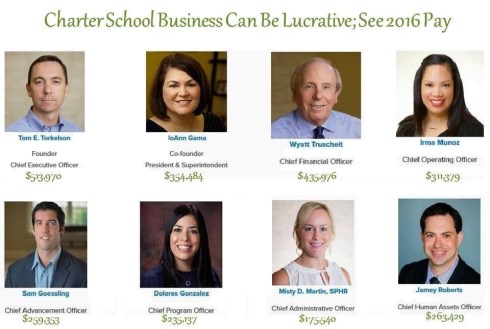
In 2016, the highest paid Superintendent of Schools in Texas was Mark Henry from the Cypress-Fairbanks Independent School District. He received $383,402 to administer a 116,000 student district. At the IDEA charter school chain which has less than 36,000 students, that same year CEO Tom Torkelson made $513,970 and CFO, Wyatt Truscheit received $435,976. Plus, President JoAnn Gama took in $354,484 which is more than all but three public school superintendents in the state of Texas.

It is clear why charter school executives are for them, but data says charters do no better than public schools and are creating havoc with the public education system.

It is not just conservatives who are having issues with privatizing the public education system. Three Democratic Texas legislators, Gina Hinojosa, Mary González and Shawn Thierry reported,

“When charters cherry-pick students, neighborhood schools are left to educate a disproportionate percentage of more challenging children. Neighborhood schools are required by law to enroll all kids, regardless of disciplinary history, special needs or family challenges. Educating children who face more challenges in life is more expensive; the cost falls disproportionately on local public school districts.

“Yet, charters receive more funding from the state per student than 95 percent of all students in Texas. In El Paso, charters receive $1,619 more per student than El Paso ISD. In Austin, charters receive $1,740 more per student than AISD. This funding disparity holds true for many of the largest school districts.

“This lopsided funding model results in increasing funding for charter schools and decreasing it for traditional public schools. In the 2018-2019 biennium, charter schools received $1.46 billion more than the prior biennium, and traditional public schools received $2.68 billion less.

“Ultimately, this parallel system of exclusive schools, funded with increasingly more public money, is often a false promise that results in less access and less funding for many of our kids.”

Denver’s Portfolio Model School District Is a Failure!

19 Jan

By T. Ultican 1/19/2019

Here is a predictable outcome from the portfolio district. On Jan. 18, 2019, a press release from the Denver Classroom Teachers Association (DCTA) says,

After ten hours of negotiations today, the Denver Classroom Teachers Association and Denver Public Schools were unable to reach an agreement on a fair compensation system for 5,700 teachers and special service providers. DCTA members will vote Saturday and Tuesday on whether or not to strike.

The portfolio model which promotes disruption as a virtue is anti-union. It is not conducive to stable harmonious relations with either labor or communities and it is anti-democratic. Denver is held up as an exemplar of school reform; however the outcomes look more like a warning. Increasing achievement gaps; a bloating administration; significantly increasing segregation; ending stable community schools; and stripping citizens of their democratic rights are among the many jarring results.

Former Denver School Board Director, Jeanne Kaplan, wrote extensively about an article in EducationNext championing school reforms in Denver. It was based on a podcast by the guru of school reform and privatization in the Clinton administration, David Osborne. Kaplan noted,

“2009 was … the first time outside money appeared in [School] Board Election campaigns. Stand for Children came with the goal of making the board “more reform oriented”… In spite of their $30,000 expenditure per candidate – which at the time was unheard of – our side, as Osborne notes, won the election. Each following election more and more reform money … appeared …. In addition to Stand, Democrats for Education Reform, Students First, and wealthy local businessmen, both Democrats and Republicans, … put enormous amounts of money and human capital to be sure … a unanimous board was achieved. Much of the money while identified by independent expenditure committee remains hidden as to who is making the individual contributions. In 2011 the people were able to hold on to a “mighty minority” of three: 4-3. In 2013 the minority dwindled to one: 6-1. In 2015 the Board was unanimously “reform”: 7-0.

This has become a central thesis of the portfolio model strategy. A Chalkbeat article quotes Ethan Gray of Education Cities on the strategy. Gray who recently went to work at the new City Fund which was established specifically to sell the portfolio model said, “We’re skeptical that systems themselves will actually go through some sort of self-driven transformation.” Chalkbeat reported that the new plan for growth had three strategies.

  • Strategy #1: Apply outside pressure. (Increase pressure on school districts by bringing in outside competition and supporting local competing initiatives.)
  • Strategy #2: Push for one-stop school enrollment. (This forces public school districts to help the privatized schools and gives them an equivalency in the eyes of the public.)
  • Strategy #3: Create a very different power structure. (Use financial resources to change the makeup of existing governing boards or establish mayoral appointed boards.)

In the 2017 Denver Public School Board election, four of the seven seats were on the ballot. The results:

  • At large seat: Former Lieutenant Governor Barbra O’Brian defeated a field of three candidates 40% to 35% to 24%. O’Brian spent $8.94 per vote, Robert Speth spent $0.77 per vote and Julie Banuelos spent $0.33 per vote.
  • Distict 2: Angela Corbian a former Teach For America (TFA) corps member beat Xochitl “Sochi” Gaytan who had union support. Unfortunately, Gaytan had to spend time cleaning up after union blunders. The winner Corbian is currently an organizer for Leadership for Educational Equity (LEE) the TFA offshoot that trains former corps members “to engage civically.” Cobian’s support included $67,000 from DFER’s Raising Colorado and tens of thousands of dollars from local and national “reformers.”
  • District 3: Dr. Carrie Olson, a 33-year DPS teacher won this seat with very little financial or people support from the teachers union. She astonishingly defeated Mike Johnson the incumbent who raised over $100,000 on his own and received almost another $100,000 from DFER and Stand for Children. Olson’s victory reduces the “reform” majority back to 6-1.
  • District 4: Jennifer Bacon another former TFA corps member won. She raised $70,000 on her own and shockingly received $139,000 from the teachers union. Bacon also received reformer money from TFA national board member Arthur Rock. The incumbent Rachael Espiritu had a large war chest of $97,000 from DFER and $93,000 that she raised but Espiritu was running in a district that had had its fill of reform. A third candidate in this district was 19-year-old Tay Anderson.

When analyzing this election, Jeanne Kaplan said the biggest losers were “Denver’s teachers, who are paying dues to an organization that turned its back on a 33 year teacher and endorsed a heavily funded alum of TFA…”

Dismal Results from Denver’s Portfolio District

school segragation chart

Chart of Racial Isolation Based on October Count for School Year 2017-18

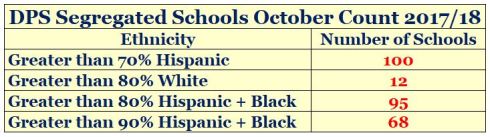
Of Denver’s 204 schools, One-hundred have a population that is greater than or equal to 70% Hispanic. When the Hispanic and black students are summed 68 schools have 90% or more students from these minority groups. The AP reported in 2017 that charter schools were among the nation’s most segregated schools. There analysis found, “As of school year 2014-2015, more than 1,000 of the nation’s 6,747 charter schools had minority enrollment of at least 99 percent, and the number has been rising steadily.”

Racial isolation is a characteristic of districts employing the portfolio model. This kind of profound segregation runs afoul of federal law, good education and decency. It does not comply with the 1954 Supreme Court decision known as Brown versus the Board of Education of Topeka, Kansas.

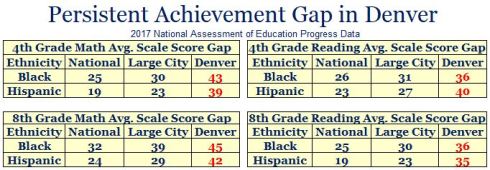
The big selling point for modern school reform was closing the achievement gap. The achievement gap is measured by finding the average score differences between ethnicity groups on standards based tests. A 2011 report in Education Week stated, With the passage of the No Child Left Behind Act of 2001, closing achievement gaps among these various student groups became a focus of federal education accountability…”

achievment gap 2017

Table of Reading and Math Achievement Gaps Derived from NAEP Testing Data

In the tables above – based on average scale scores – it shows national results have a smaller gap than the large city results. Predictably, Denver has among the nation’s largest achievement gaps after two-decades of “billionaire” led reform.

In the fall of 2015, the Center on Reinventing Public Education  (CRPE) which is the central think tank promoting portfolio models ranked Denver Public Schools 45th out of 50 urban districts for improving graduation rates.

Denver’s pro-privatization citizen oversight group, A+ Colorado (formerly A+ Denver) in a recently released report, showed concern over the district’s progress stating,

“Let’s be clear: There has been progress in DPS, particularly in comparison to other Colorado districts. But some student learning outcomes are stalled or improving far too slowly for the district to be successful.”

DPS received another black-eye this January when a Chalkbeat headline revealed, “Denver has 1 administrator for every 7.5 instructional staff — far above state average.” The article presented the following chart for administrators in Denver compared to the rest of the state over the past ten years.

administrator growth chart

Chart of Administration Growth during the “Reform Era”

In 2017 the New York Times ran an interactive article about a new way to compare schools. The article said,

“It’s true that children in prosperous districts tend to test well, while children in poorer districts on average score lower. But in this analysis, which measures how scores grow as student cohorts move through school, the Stanford researcher Sean Reardon argues that it’s possible to separate some of the advantages of socioeconomics from what’s actually happening in schools.”

The New York Times picked the comparison schools while the reader picks the district of interest. This simulator attempts to correlate by years of learning. The average between 3rd  and 8th grade should be five years. After 13 years of disruption and “reform,” Denver remains a little below average with lackluster growth.

student growth models

After Five Years Denver’s Eighth Graders Still below Average

All the closing schools and disrupting neighborhoods brought little or no significant change. Denver’s students are still measured as being about the same amount behind in 8th grade as when they started 3rd grade.

A 2015 hiring analysis revealed that DPS paid TFA $5000 to $7000 per recruit? TFA teachers are two year temps with a college degree and five-weeks of training. From 2012-2015, Denver taxpayers paid TFA $520,600 for 232 recruits at traditional schools and over $800,000 for 267 recruits at charter schools. DCTA President Henry Roman stated that teacher turnover is a crisis in DPS. He claims the average teacher tenure has dropped to two years.

Traditional teacher new hires have a college degree, one-year of post graduate pedagogy study and a year of supervised student teaching. They arrive at schools with the expectation of making teaching a career.

The reliance on untrained teachers along with recognizing and using a fake graduate school created by the charter industry explains why all of the spending on reform has not resulted in better performance. The fake graduate school is Relay Graduate School. It’s Denver Dean, Therese Zosel-Harper, is working on her PhD. Relay is an obviously fake graduate school because it has no credentialed education scholars on staff.

Where did the Portfolio District Model Originate?

A Rand Corporation researcher named Paul Hill founded the Center on Reinventing Public Education (CRPE) on the campus at the University of Washington three years after John Chubb and Terry Moe wrote a popular book, Politics, Markets, and America’s Schools which was published in 1990 by The Brookings Institution. That book which was a sensation among neo-liberals called for the end of elected school boards. Hill began thinking about the mechanics for making that happen.

In 2002, Hill wrote a paper sponsored by the Annie E. Casey Foundation calling for changes in school governance,

“… [T]he last few decades of education reform have shown us that simply tinkering at the edges is not enough to ensure that changes will take place. Reforms need to be comprehensive and needs to affect every level of the education system.”

Hill’s statement and the book by Chubb and Moe were both motivated by the conviction that public schools in America were failing. It was not true then nor was it true in 1889, 1942, 1955, 1959, 1963 nor is it true now.

Jim Arnold and Peter Smagorinsky wrote,

“Admiral Rickover published “American Education, a National Failure” in 1963, and in 1959 LIFE magazine published “Crisis in Education” that noted the Russians beat us into space with Sputnik because “the standards of education are shockingly low.” In 1955 Why Johnny Can’t Read became a best seller, and in 1942 the NY Times noted only 6% of college freshmen could name the 13 original colonies and 75% did not know who was President during the Civil War. The US Navy in 1940 tested new pilots on their mastery of 4th grade math and found that 60% of the HS graduates failed. In 1889 the top 3% of US high school students went to college, and 84% of all American colleges reported remedial courses in core subjects were required for incoming freshmen.”

The paragraph above recalls more than a century of national failure to properly educate our citizenry yet in that same century America became the world’s leader economically, scientifically, militarily and culturally. Does this mean that education quality does not matter or is it more likely that the perception of American education failing – is and was an illusion? Based on this illusion of failure are we being driven toward failure with unproven market theories? That is what the portfolio theory is. It is an unproven market theory of education governance.

William J. Mathis and Kevin G. Welner, University of Colorado Boulder wrote a short paper “The ‘Portfolio’ Approach to School District Governance.” Their basic definition explains,

“Generally  speaking,  four  reform  strategies  are  combined,  in  varying  degrees,  in  portfolio  districts:  (1)  performance-based  (generally  test-based)  accountability,  (2)  school-level  de-centralization of management, (3) the reconstitution or closing of “failing” schools, and (4) the expansion of choice, primarily through charter schools.”

In Denver there are 204 schools; 106 public schools, 42 charter schools and 56 innovation schools. In accordance with portfolio district theory, Denver residents no longer have the right to vote on the governance of 108 of their publicly financed schools. In addition, both charter schools and innovation schools are generally non-union.

The innovation school concept is promoted nationally by the American Legislative Exchange Council (ALEC). According to ALEC model legislation these schools “are provided a greater degree of autonomy and can waive some statutory requirements.” In Denver, innovation schools are given a three year contract during which they are run by a non-profit. The results (testing data) at the end of the contract will dictate whether the experiment on the school children continues.

Innovation schools have only existed in Colorado since 2009. When the DPS board approved them in 2016, Board President Anne Rowe claimed, “I’m trying to think of a time I’ve been more excited, more proud, more optimistic about what we can achieve for kids.”

Conclusions

While Interviewing DCTA President Henry Roman, Jeff Fard said when he moves into a neighborhood he expects to register his kids in the local community school. “If I don’t like the school, I expect to roll up my sleeves and work to make it better.” If he still doesn’t like the school, he will pay for them to go to a private school. This is how it is supposed to be in America; people work for the betterment of their own community and pay for their own choices. However, if you live in portfolio districts like Denver, unseen and unelected forces control the neighborhood.

As Jitu Brown and the Journey for Justice have declared,

“We are not fooled by the ‘illusion of school choice.’ The policies of the last twenty years, driven more by private interests than by concern for our children’s education, are devastating our neighborhoods and our democratic rights.”

It is past time for the citizens of Denver to take back their democratic rights and their public schools.

Destroy Public Education Forces Retooling for 2019

26 Dec

By T. Ultican 12/26/2018

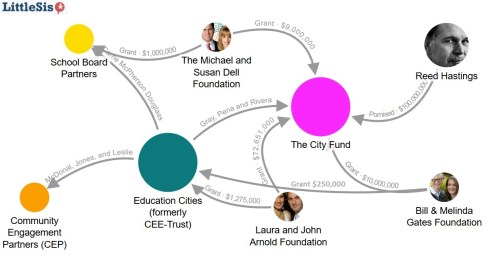
The destroy public education (DPE) national coordinating organization, Education Cities, has been closed, with its assets and personnel distributed to three new organizations; The City Fund, School Board Partners and Community Engagement Partners. And there is more. In an interview with The 74, City Fund’s Managing Partner, Neerav Kingsland, revealed the establishment a new political action committee under IRS code 501 C4 called Public School Allies.

In October, the California Charter Schools Association (CCSA) announced that its leader for the past 10 years, Jed Wallace, would step down in January, 2019. The new President of CCSA will be Myrna Castrejón who is currently Director of Great Public Schools Now (GPSN). The announcement says of Wallace’s future, “He will move onto a new role advising charter school organizations across the United States.” Under Wallace’s leadership the CCSA replaced the California Teachers Association as the state’s largest lobbying effort on education issues.

The LittleSis map below shows the money coming into The City Fund and the new postings for the former Education Cities’ staff. During the interview cited above, Kirkland said, “Along with the Hastings Fund and the Arnold Foundation, we’ve also received funds from the Dell Foundation, the Gates Foundation, the Walton Family Foundation, and the Ballmer Group.” The amount of money given by the Walton family and Ballmer is unknown.

Little Sis Map of Reorganization

Reorganizing DPE Forces (see Interactive Map here)

Matt Barnum of Chalkbeat reported that City Fund has started spending to promote the “portfolio model” of education reform. Barnum stated,

“Kingsland said The City Fund has given to The Mind Trust, which focuses on Indianapolis Public Schools; RootED in Denver; City Education Partners in San Antonio; the Newark Charter School Fund and the New Jersey Children’s Foundation; The Opportunity Trust in St. Louis; and RedefinED Atlanta. In Nashville, The City Fund gave directly to certain charter schools.”

The City Fund’s central agenda is promoting the portfolio model of school reform. The portfolio model posits treating schools like stock holdings and trimming the failures by privatizing them or closing them. The instrument for measuring failure is the wholly inappropriate standardized test which reflects student family wealth but does not identify education quality. Testing and the portfolio model inevitably lead to an ever more privatized system – especially in poor communities – that strips parents and taxpayers of their democratic rights. Objections to the portfolio model include:

  1. It creates constant churn and disruption. Students in struggling neighborhoods need stable environments they can trust.
  2. Democratically operated schools are the foundation of American democracy. The portfolio model ignores the value of these democratic incubators.
  3. Parents and taxpayer lose the ability to hold elected officials accountable for school operations.

Even voucher enthusiast Jay P. Greene of the University of Arkansas wrote an open letter to John Arnold warning against the portfolio model. He noted, “The Arnold Foundation invests heavily in another initiative that promotes rigorous science for medical and policy decision-making, yet they do not seem to apply that same standard of proof to their own education strategy.

Myrna Castrejón and Great Public Schools Now (GPSN)

Myrna Castrejón attended college at the flagship Seventh-day Adventist school Andrews University. From there she matriculated to the University of Wisconsin where she took graduate work in Anthropology and Border Studies. She has spent time at various non-profits focused on education reform in both El Paso, Texas and Los Angeles, California. In 2003, she went to work for the CCSA.

By 2015, Castrejón was the Senior Vice President, Government Affairs, at CCSA where she led their Advocates group. At the end of the year, she left her $231,000 position to establish GPSN where her  pay raised to $255,133 for the first year.

GPSN was a start-up non-profit in 2016, however, it was extremely well financed. The Walton family gave $400,000 and Eli Broad sent $4,927,500 but the big money came from Bill Gates a whopping $24,985,965. With this money, Castrejón was able to finance a public relations campaign that gave her amazing access to the Los Angeles Unified School District’s board, especially Ref Rodriguez and Monica Garcia at the start and later with Nick Malvoin, Garcia and Superintendent Austin Buetner.

That first year, she was able to grant Teach for America $4,200,000 in order “to increase the pipeline of high quality teachers in LA schools.” She also sent $500,000 to Boston’s Building Excellent Schools to recruit two fellows for founding, opening and leading “high achieving charter schools” in LA.

This past October she organized a “town-hall meeting” with “250 parents” to promote the charter industries dream of a common application for all schools. LAUSD Board President, Monica Garcia, Board member, Nick Malvoin and Superintendent Austin Buetner were all there to support her agenda.

Buetner at Great Schools Now Event June 29_2018

GPSN One Application Event with Austin Buetner (picture from #onecityallkids)

Myrna Castrejón has been a very effective leader in the DPE effort to privatize schools in Los Angeles and throughout California. That is why she will be the next leader of CCSA, the big dog among California’s DPE forces.

School Board Partners

Matt Barnum a reporter for Chalkbeat obtained a trove of emails between Myrna Castrejón and officials at LAUSD through a public information request. He made the 315 pages of emails accessible in his article, “New group will try to connect school board members pushing for ‘dramatic change’ in these 10 cities.”

The emails show that Ref Rodriguez, Monica Garcia and Nick Malvoin were more like partners with Castrejón than public representatives. This August, Castrejón messaged Garcia and Malvoin about the Launch of School Board Partners. She wrote,

“I am forwarding a networking and support opportunity that one of our partners is launching to advance the work of quality and equity in urban districts. School Board Partners is a new, spin off organization of the former Education Cities network, of which GPSN is a member. As you can see from Carrie’s description, their aim is create a Board level community of practice and make available resources and support for participating members on site and remote.

“This is at NO cost to participating Board members. If this is of interest to you, the initial cohort will launch October 1-3 in Denver. Let me know if I can connect you more directly. See the general description below, and the link to the live page that explains their work in more detail. I hope you find this helpful!

“Myrna”

The email that Castrejón forwarded was from Carrie McPherson Douglass, the CEO, of School Board Partners, which was in its first month or two of operation. The key portion of Douglas’s message reads,

“For year 1, our list of priority cities is: Atlanta, Baton Rouge, Denver, Detroit, Indianapolis, Los Angeles, Memphis, New Orleans, Oakland, San Antonio and Stockton.

“In each of these cities, we plan to support 1-3 school board members by providing these three sets of supports:

“1.  A national community of diverse school board members who are working to lead bold change in their respective communities. The network will meet annually in person and communicate virtually throughout the year as needed. Members of the network will learn together and support each other, as well as benefit from the support and resources of the team at School Board Partners.

“2.  A personal coach/mentor to support each individual school board member as they develop as an elected official and leader of change in your city.

“3.  Pro-bono consulting services to help school board members research, plan and execute thoughtful change initiatives specific to your board and city. Our first national convening of school board members will be held in Denver Oct 1st-3rd.”

Both Garcia and Malvoin indicate great interest in the group but cited a conflict with the October date. Garcia said her Pahara group was meeting then and Nick said a looming strike and some board business would make those dates difficult. Castrejón agreed to put them both in direct contact with Carrie Douglass.

Carrie McPherson Douglass from EC bio

Carrie Douglass’s Profile Picture on the Education Cities Cyber sight

Carrie Douglass was the Managing Partner at Education Cities. She signed their tax forms and made really good money. The tax form’s list her 2014 salary at $154,343, her 2015 salary at $168,942 and her 2016 salary at $182,595.

Before Education Cities, Carrie served as the Senior Director of Strategy and Innovation at the Rogers Family Foundation in Oakland, an Education Cities member, where she developed a blended learning pilot. Prior to joining Rogers, Carrie was the Director of Human Resources at Aspire Public Schools.

Carry earned a B.A. from the University of Portland, Oregon, in Education and Music. She was awarded an M.B.A. at Boston University specializing in Finance, Strategy and Non-profit Management.

Douglass lives and works from the beautiful little city of Bend, Oregon on the eastern side of the Cascade Mountains. Last year she was elected to the local school board.

This founding leader of School Board Partners is a “Broadie.” She completed the two year Broad Residency program (2007-2009) while working at Aspire. Her quote on the Broad Alumni page reads,

“I am amazed that Americans have accepted mediocrity from our public school system for so long. The status quo must end. The Broad Residency provides an opportunity for professionals with a wide variety of experiences to bring innovative solutions to the table, while simultaneously developing a deep understanding of the historical context to ensure appropriate solutions for urban education.”

In other words this very white woman from an extraordinarily white area of the United States believes Broad gave her the kind of “deep understanding” required for saving the black and brown children in Atlanta, Baton Rouge, Denver, Detroit, Indianapolis, Los Angeles, Memphis, New Orleans, Oakland, San Antonio and Stockton. What could go wrong?

In a private email, Peter Greene responded to the establishment of School Board Partners with, “I call BS.” The point being that every state requires school board members to go through training and existing reputable private organizations like the California School Board Association also make many training and research resources available to board members. California’s Department of Consumer Affairs provides a plethora of training opportunities and informs all new Board members, “California … requires every appointed board member to complete a training and orientation program offered by the Department of Consumer Affairs (DCA) within one year of assuming office.

School Board Partners is not a good Samaritan group filling a void. It is a DPE organization looking to co-opt elected board members into furthering the portfolio model of education reform.

Community Engagement Partners

This new organization is not well defined and their web presence is not much more informative than the non-existent web presence of The City Fund. Three former employees of Education Cities are developing this new DPE organization.

Kevin Leslie “provides finance and operations support to Education Cities and its two new initiatives: Community Engagement Partners and School Board Partners.

Rebecca Weinberg Jones is the Deputy Director of Community Engagement Partners (CPE). She attended Vassar College and earned a Masters in Urban Education Policy from Brown University. Her LinkedIn page says of CEP,

“Community Engagement Partners, an initiative of Education Cities, supports education organizations and leaders as they partner with and learn from their local communities with the goal of creating and sustaining great schools. We believe that the change necessary to ensure that every child has access to a high-quality school is only possible and sustainable when those most impacted by educational inequity are partners in the work and decision making.”

Charles McDonald is the Executive Director for CEP. In the past, he served as Senior Managing Director, External Affairs for Teach For America – South Carolina. He also served as Program Manager for Education Pioneers Greater Boston Analyst and Graduate School Fellowship programs for two years.

A paper McDonald wrote while at Education Cities is the only document linked on the CEP web page. It purportedly points to their purpose. In it he obseved,

“After nearly a decade of catalyzing and implementing nationally-recognized education reforms, The Mind Trust made an intentional shift from solely focusing on grasstops-driven reform efforts to recognizing the need to partner with key grassroots stakeholders and civic leaders with deep ties to the communities most impacted by educational inequity. In 2013, the organization hired Indianapolis native Kameelah Shaheed-Diallo [now at The City Fund] to help lead efforts to better align The Mind Trust’s strategy to the needs and values of the community and build a base of community support for educational equity.”

It seems like the CEP purpose will be to continue Education City’s efforts to organize and support on the ground DPE forces in America’s cities.

Some Final Comments

This October, Diane Ravitch addressed #NPE2018Indy asserting, “We are the resistance and we are winning!” 2018 certainly was a hopeful year for the friends of public education and professional educators. Charter school growth has stagnated and “choice” has been shown to be a racist attack rather than an expanded right. In Arizona, an ALEC driven voucher scheme was soundly defeated and in California, Tony Thurmond turned back the nearly $50 million dollar effort to make a charter school executive Superintendent of Public Instruction.

The DPE response is a new more opaque and better funded effort narrowly focused on its theory of quality schools through the portfolio model. It is yet another effort to transform education with no input from educators. Without billionaire money tipping the scales of democracy; vouchers and charter schools would disappear because they are bad policy. Educators ache to focus on improving public education but must use their energy fighting for the survival of America’s public education system, the world’s greatest and most successful education institution.

America’s teachers are educators who will continue sharing lessons on how to recognize highly paid political agents and profitable propaganda centers masquerading as “think tanks.” I predict, even with the greater spending and reorganization, 2019 will be an awful year for the DPE forces.

Review and Preview Thurmond v Tuck

1 Dec

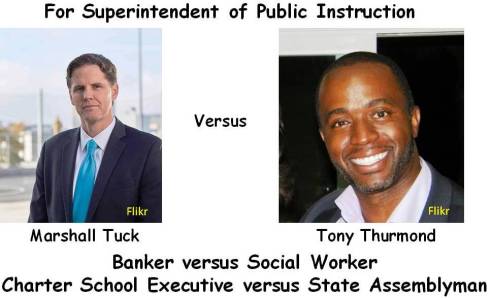
This year’s biggest election win in California was for the down-ballot office, Superintendent of Public Instruction (SPI). Tony Thurmond defeated Marshall Tuck in a proxy battle between billionaires supporting public school privatization and teachers’ unions fighting for democratically run neighborhood schools. More than $61,000,000 was spent on the SPI office doubling the previous $30,000,000 spending record set in 2014 when Tuck lost to Tom Torlakson.

Director of research at California Target Book, Rob Pyers, reported this year’s total election spending in California realized a new level. Target Book publisher Darry Sragow commented, “If blowing through the billion-dollar campaign spending ceiling in California doesn’t give pause to everyone in politics, I don’t know what will.”

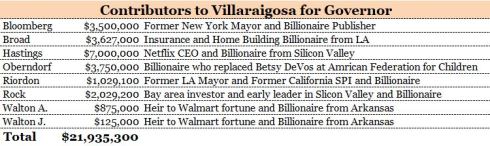
Of the eight state-wide constitutional offices on the ballot, the governor’s race topped spending at $108,221,028 and the SPI race came in second totaling $61,170,451. Spending in the governor’s race was also heavily impacted by billionaires supporting the charter school industry. California has an open primary in which the top two vote getters reach the general election ballot regardless of party. Before June’s voting, billionaires lavished Anthony Villaraigosa’s campaign unprecedented independent expenditure money trying to get him to the November ballot.

Billionaires for Villaraigosa

Spending By Eight Billionaires for Villaraigosa over Newsom in 2018 Primary Election

When Villaraigosa lost badly in the June 6 primary, many of the same billionaires listed above turned their full attention toward electing Marshall Tuck SPI.

Following a brief career in investment banking, Tuck took a job at the politically connected Green Dot charter schools. Steve Barr a former chair of the Democratic Party who had served on national campaigns for Bill Clinton, Gary Hart and Michael Dukakis founded Green Dot charter schools in 1999. He hired Truck in 2002 to be Chief Operating Officer (COO) and eventually promoted him to President and COO.

When Los Angeles Mayor Anthony Villaraigosa was rebuffed in his efforts to take control of Los Angeles Unified School District, he convinced a few donors to underwrite the takeover of ten schools in areas which had suffered years of poor standardized testing results. They created a non-profit called Partnership for LA. Villaraigosa tapped Marshall Tuck to lead the Partnership.

Tuck was extremely unpopular at the Partnership. The Sacramento Bee reported, “Teachers passed a vote of no confidence at nine of the schools at the end of the first year, leading to independent mediation.”

During this education reform era in which connections are more important than skill, experience and training, Tuck remained in good standing with the Destroy Public Education (DPE) financiers. Subsequent to loosing the formerly most expensive SPI race in California’s history; Tuck’s benefactors took care of him. Despite no training as an educator, he was given a job as Educator-in-Residence at the New Teacher Center. Bill Gates provides much of the centers funding including grants totaling $26,305,252 since 2009.

Reviewing the Campaign Contributions

Direct contributions to a candidate are no longer of primary importance. The money given to “independent expenditure” committees has no contribution limits. Legally, these committees are supposed to be separate from the candidate and are not to coordinate with the candidate’s campaign; however, the committees are often doing the bidding of the same people who created the candidate.

In Tuck versus Thurmond, the direct giving only accounted for 12% of total money spent. Although the direct money spent was comparatively small, it was revealing. In this race the contribution limit was $7,300 and it could be given twice (once for the primary and once for the general). Tuck received 377 maximum contributions for a total of $2,748,500. Thurmond received 170 maximum contributions for a total of $1,234,854.

The race is generally viewed as a battle between billionaires and teachers unions, but that obscures some realities. Tuck’s maximum contributions came from 259 sources of which 257 were individuals. Thurmond’s Maximum contributions came from 129 sources of which 16 were individuals. Tuck received max contributions from 76 non-employed people, 65 financial industry employees, 39 corporate executives and 29 billionaires. Thurmond received a maximum contribution from one billionaire, Tom Steyer and two corporate executives, Stewart Resnick and Linda Ray Resnick, who also were maximum contributors for Tuck.

The groups who gave maximum contributions to Thurmond were almost all organized by labor unions. Surprisingly, much of the money came from voluntary contributions and not union dues. For example, the California State Retirees PAC, made a maximum contribution to Thurmond. The largest amount contributed to the PAC by the 1404 contributors was $15.50. Another example is The California Federation of Teachers COPE which made two max donation to Thurmond. The money came from 1326 member organizations like the San Jose Federation of Teacher Local 957 whose members made voluntary contributions totaling to $73,391.

It was the PACs who drove the election financially.

Independent Expenditures Map

Independent Expenditure Example Map of EdVoice for the Kids PAC

The LittleSis map above shows eight billionaires contributing $9,769,200 to EdVoice for the Kids PAC. Plus four of them send $2,664,600 to Charter Public Schools PAC sponsored by the California Charter Schools Association. That PAC contributes another $2,900,000 to the Ed Voice PAC. EdVoice then sends $17,953,882 to Students, Parents and Teachers Supporting Marshall Tuck which spends $22,013,408 on things like TV ads, radio spots and mailers.

The spending by the three PACs and the billionaires were verified using records provided by the Cal-access data base for major donors. The total of independent expenditures for Tuck is a conservative estimate based on multiple news reports. The independent expenditures on behalf of Tuck were more than the record setting $30,000,000 total for this contest in 2014.

Students, Parents and Teachers Supporting Marshal Tuck was a project of EdVoice. No students, teachers or parents are listed among the contributors to this PAC unless George Hume, Chairman of Basic American or investor Michael Stoppelman have children. This PAC name looked and sounded good when providing a deceptive and legally required source for political advertisements.

The opening page of EdVoice’s internet site says, “EdVoice is a nonprofit organization advocating for policies to increase measurable student achievement for all students in California and eliminate inequality of educational opportunity in public schools.” In other words, they promote using testing to label public schools failures and promote Betsy DeVos’s school choice ideology.

Bill Lucia, a connected Republican operative, is President and COO of Ed Voice. His Ed Voice biography states, “Prior to joining EdVoice, Lucia served as Senior Vice President for Advocacy and Policy, leading the advocacy and legal defense team at the California Charter Schools Association(CCSA). Before joining CCSA, Lucia worked as Senior Assessment Policy Liaison for Educational Testing Service, and prior to that, spent five years in Washington D.C. working as a senior official in the U.S. Department of Education and in the U.S. Senate.”

EdVoice is not a big money organization. In 2016, its total income was $400,136. However at least two billionaires associated with privatizing public education are board members, Eli Broad and Carrie Walton Penner. Susan Bloomfield is also on the board.

The Campaign

In March 2017, Marshall Tuck announced his candidacy for SPI. In April, Tony Thurmond announced. By the end of 2017, four candidates had joined the race with the addition of Lily Ploski and Steven Ireland.

Marshall Tuck had name recognition and solid campaign funding. By August 2017, Thurmond announced $1,000,000 in campaign contributions and early endorsements from Senator Kamala D. Harris, SPI Tom Torlakson, the California Federation of Teachers, and the State Building and Construction Trades Council of California. From that point on, the race was mainly between Tuck and Thurmond but Ploski’s and Ireland’s entry made it difficult for either Tuck or Thurmond to win 50% of the votes during the primary which would have ended the race.

When the year began, many supporters of public education were concerned because the candidate apposing Marshall Tuck was a one-term Assemblyman from Richmond, California with no name recognition. Not only that, he was a black man vulnerable to the race card. Then the Judases at the Association of California School Administrators endorsed Marshall Tuck for SPI.

That might have been the point at which Thurmond demonstrated he was a special guy. On the weekend of January 20th he spoke at the CTA delegates meeting. He already had their endorsement since October, but in this speech the delegates met a charismatic candidate who brought them to their feet cheering. He declared “no privatization of public schools in California. Not in this state. Not on my watch.”

At the California Democratic Party convention in February, the delegates overwhelmingly endorsed Thurmond over Tuck. Much of the sentiment at that San Diego convention was that Tuck was not a real Democrat. He was seen as being awash in Republican money while espousing their policies.

When Tuck tried to speak to the convention delegates, he was booed off the stage. Amusingly, Lee Ohanian of the Hoover Institute at Stanford University wrote an article titled “David Versus Goliath: A School Reformer Takes on the Democratic Party and Unions.” Amazingly in this article Tuck is David and Thurmond is Goliath. Ohanian wrote,

“A few months ago Marshall Tuck, a Democratic candidate who is running for the state office of California Superintendent of School (sic) Instruction, went to the California Democratic Party Convention to speak to his party about how to create better K–12 education in California. He went to the podium, but didn’t get a word out. Well, he may have said “I,” but that would have been about it. He was shouted down with a chorus of boos that drowned out his voice. The boos continued until his allotted time expired. No state Democratic party (sic) official quieted the crowd. The message was clear: this particular Democratic candidate, who wishes to change the status quo, is not welcome in his party. And you thought that the Democratic party embraced diversity?”

And you thought Stanford University was a credible research institution?

Thurmond turned out to be a consistent and gifted politician who won support at almost all debates, editorial interviews and campaign events.

A San Diego Union editorial read, “In his interview with us, Assemblyman Tony Thurmond, D-Richmond, who finished second to Tuck in the June primary, seemed just as affable but not nearly as ambitious as Tuck.” In case that was too subtle; Tony is a black man.

On November 6, Thurmond became the first African American elected to statewide office in four decades.

The Preview is Looking Good

Calmatters interviewed Thurmond during the campaign.

‘“We talked to voters across the state and told them what this election means for each of us: it means giving every kid the opportunity to succeed in the 21st century, not just the ones that show the most potential,’ Thurmond said.

‘“It means funding our public schools at the level they deserve, not pouring money into our jails in prisons. It means providing mental health treatment for kids, not arming them with guns.”’

Calmatters also stated,

“Thurmond had said he favored a ‘pause’ on the growth of charters in California while the state examines the long-term impact they’ve had so far on its public education system. The assemblyman also said he supported more charter-school oversight and sympathized with school districts that had taken financial hits after losing students to charter schools.”

Politico reported on Thurmond’s first public statements since Tuck conceded.

“He called for a temporary ban on any new K-12 charter schools in the state, addressing reporters at the Sacramento union hall of the State Building & Construction Trades Council of California. He said the state has reached a ‘tipping point’ with too many charters that have financially harmed public school districts, POLITICO’s Angela Hart reports.”

‘“I believe that we shouldn’t open new schools without providing the resources for those schools,’ said Thurmond, a Democratic assemblyman. ‘It is time to have perhaps a pause on the opening of new schools until we get clear about how we will fund any new schools.”’

“While charter school advocates believe their programs can force positive changes in traditional campuses, Thurmond took issue with the notion of ‘competition,’ which he framed in a negative light.”

‘“The truth of the matter is you cannot open new schools — charter or otherwise — and serve all the students in this state,” he said. “So if the model is built on saying let’s have competition in education, then you’re certainly leaving certain students to suffer and to not have the resources they need.”’

Thrive Charter Schools All Hat and No Cattle

17 Nov

Excellent public relations and marketing mask a substandard educational program at the inappropriately named Thrive Public [sic] Schools (TPS). The misleading name indicates that this private business is a public school. It is not. Four years of assessments confirm that both San Diego Unified School District (SDUSD) and the County Office of Education (COE) were correct in 2014 when they denied TPS’s charter petition.

January 7, 2014 SDUSD staff felt that TPS was not ready to open and reported to the board, “Staff recommends approval of the petition to establish Thrive Public School (Thrive) Charter School, for a five-year term beginning July 1, 2015 and ending June 30, 2020.” TPS leaders wanted a charter starting July 1, 2014. SDUSD board concluded TPS is “demonstrably unlikely to successfully implement the program” and denied the petition.

Founder Nicole Assisi turned to Voice of San Diego which was founded by one of her benefactors, Buzz Woolley. They ran her public complaint in which she declared,

“It was not the finest hour for the SDUSD board of trustees, which ignored district staff diligence and its own existing policies to deny a school that would have served the influx of families in Mission Valley. The neighborhood, by the way, does not currently have a single public elementary school. Families drive miles to get to their ‘neighborhood’ school.”

“Thankfully, the County Board of Education has an opportunity to right this wrong when our appeal comes before them next week.”

March 27, 2014 COE staff reviewed the appeal and concluded TPS presents an “unsound educational program and does not contain reasonably comprehensive descriptions of required elements.” Interestingly, one of the reasons for denial was that the petitioner did not clearly identify the intended location for the new school. None of the four current TPS schools are in Mission Valley.

On July 9, 2014, the State Board of Education (SBE) which has gained a reputation for rubber stamping charter school petitions approved the TPS charter unanimously. Many of the Brown appointed SBE board members come directly from the charter industry.

This November 13, the SDUSD board took up TPS’s new petition for a five year charter beginning July 1, 2019, and ending June 30, 2024. Trustees unanimously rejected TPS’s renewal. In case of rejection the SDUSD staff  notes say, “Thrive must submit its renewal documents to the SBE by December 2, 2018, to comply with the SBE’s renewal submission timelines.”

Kristen Taketa reporting on the TPS decision for the San Diego Union said the state requires charter schools to either perform as well as comparable district schools on state testing, or it must improve its test scores over time. Taketa reported,

“The district’s analysis found that Thrive met neither of those benchmarks. … Thrive’s test scores have also declined every year since it opened in 2014.

‘“Where it may not capture the true value of what is happening and taking place at this school — as we’ve already said, the school is more than a score — it is the standard that we are stuck with,’ Trustee Mike McQuary said of the test scores at Tuesday’s board meeting.

“At the same time trustees claimed their hands were tied in denying Thrive’s renewal, however, trustees said Thrive was failing to meet an “extremely low bar” that all but two[out of 44] San Diego Unified charter schools have been able to meet in the past five years.”

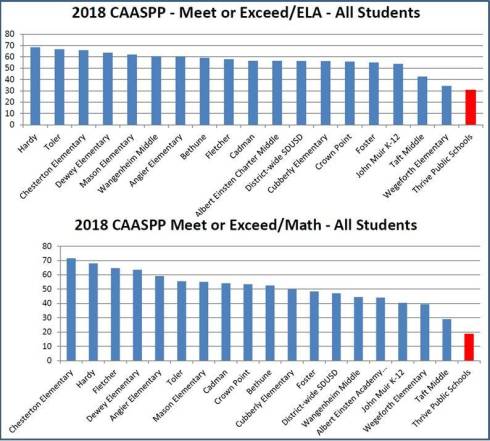
In the Public Interest (ITPI), a bay area think tank, took a look at TPS’s charter renewal petition and noticed that the comparison schools listed were inappropriate because they did not serve a similar population. Even so, TPS outcomes were deficient.  ITPI stated,

“When comparing TPS to schools with similar student populations, the results are even starker. Below we examine TPS performance compared with a set of schools in San Diego Unified School District with similar student populations ….”

The ITPI policy brief is packed with charts that show Thrive students are not testing well. Three of their graphics follow.

Thrive Data Set 1

California Assessment of Student Performance and Progress Adjusted Peer Group Comparisons

Thrive Data Set 2

TPS and SDUSD Math and English Performance over Past Four Years

SDUSD’s staff report on the TPS petition contained many similar damning data sets. The TPS outcomes have fallen every year since its opening four years ago and schools in the peer group all significantly outperform TPS.

That data looks bad and even more troubling are the reports of uncontrolled bullying of SDUSD students by TPS students.

Thrive was the Creation of Big Money and Political Influence

Nicole and Danial FB

Daniel Assisi on his Facebook Page with TPS Founder and Wife, Nicole Assisi

Nicole Assisi, the founder of Thrive Charter Schools attended Coronado High School, a public school in Coronado, California. She matriculated to UCLA where she earned a multi-subject teaching credential. Her first teaching job was leading English classes at San Diego’s Mira Mesa High School in the 2002-2003 school year.

In 2003, she moved on to High Tech High where she worked until 2005 or 2006. Her linked in profile says she worked at High Tech until 2006 but it also says that in 2005 she went to Los Angeles to be an Assistant Principal at Camino Nuevo Charter Academy. Her husband Daniel was director of Information technology at Camino Nuevo from 2006 to 2008.

In 2008 Nicole became Principle on special assignment at De Vinci Schools (Formerly Wiseburn 21st Century Charter). At DeVinci Schools, she worked with Don Braun who played a key role in undermining the Inglewood Public School District. That same year her husband Daniel Assisi went to work for the California Charter Schools Association (CCSA).

Nicole left De Vinci schools and returned to San Diego in 2013 to start TPS. The 34-years-old Nicole was provided with $8,960 from the Charter School Growth Fund and $100,000 from the Gates supported Educause to start her “non-profit.”

Once she obtained the charter authorization from the SBE, money flowed. The known list of 2014 donations:  Buzz Woolley’s Girard Foundation granted her $108,000; Gate’s Educause sent $254,500; Charter School Growth Fund kicked in $175,000 and the Broad Foundation delivered $150,000 for a total of $688,000. The next year, Broad gave another $50,000 and the New Schools Venture Fund pitched in $100,000. There is another $144,000 promised from Educause.

Destroy public education (DPE) careers pay well. Tax records reveal that Nicole’s start up “non-profit” has been lucrative. Her pay: year one $122,301; year two $133,747 and year three $142,541. Her husband holds a senior management position at the CCSA which means DPE money flows his way as well.

In 2017, TPS announced its big plan which stands to make founder and CEO Assisi a wealthy woman. A San Diego Union report said,

“The 35,000-square-foot facility will be the fourth San Diego campus for Thrive Schools and will open in about 12 months at the former site of Bayside Community Center at 6882 Linda Vista Road.”

“The project’s cost became more affordable for Thrive through the federal New Markets Tax Credit Program, which gives tax credits to for-profit businesses that are helping revitalize low-income communities.”

“Civic San Diego was eligible for the program and was allowed to sell the tax credits to whoever was making the investment. In this case, the credits were sold to the bank lending money to Thrive to buy the site.”

Although paid for with tax money, the deed will belong to Thrive Public Schools and CEO Nicole Assisi. This spring, ITPI published “Fraud and Waste in California’s Charter Schools” which noted,

“Schools constructed with private funding subsidized by New Market Tax Credits or acquired with private funds but whose mortgage payments are reimbursed through the Charter Facilities Grant Program (known as “SB740”) are typically owned without restriction.”

All Hat

The old cowboy expression all hat and no cattle perfectly describes TPS. Their team is politically connected, supported by deep pocketed foundations intent on privatizing public education and has excellent marketing support but their schools are not very good.

TPS has developed support from neoliberal and conservative politicians. Their listed supporters:

  • Dede Alpert,  Former Assembly Woman and State Senator
  • Ben Boyce, Manager of Public Affairs at Southwest Strategies
  • Lisa Corr, Partner, Young Minney and Corr, LLP
  • Rod Dammeyer, Chairman, CAC; Board Member, Ca. Charter Schools Ass. & High Tech High
  • Tom Davis, Director of Events and Corporate Sponsorships, CALSA
  • Jon Dean, Chief Information Officer, Summit Public Schools
  • Donna Elder, Dept. Chair of Educational Leadership and Teacher Education, National U.
  • Kerry Flanagan,Cheif of Staff, California Charter Schools Association
  • Stanley V. Heyman, President, Heyman & Associates
  • Ben Hueso, State Senator
  • Heather Lattimer,Associate Dean, USD School of Leadership & Education Sciences
  • Diane Levitt, Director of K-12 Education, Cornell
  • Chet Pipkin, Founder, President and CEO of Belkin International
  • Robert Schwartz, Senior Advisor, New Teacher Center
  • Rebecca Tomasini, Founder and CEO, The Alvo Institute
  • Tom Torlakson, Superintendent of Public Instruction for the State of California
  • Jed Wallace, President and Chief Executive Officer, California Charter Schools Association
  • Matthew Wunder, Chief Executive Officer, Da Vinci Schools
  • Mark Wyland, State Senator

Looking elsewhere on their web-pages one finds that Boyce, Davis, Elder, Heyman and Flanagan are Thrive board members. With few exceptions, the other supporters are either school privatization friendly politicians or active participants in the DPE movement.

TPS’s board member and public affairs guy, Boyce, generates excellent media coverage. For example, KPBS ran two articles that appear to take TPS claims and publish them without fact checking. One of their articles describes how Thrive is doing a wonderful job with special education children. It claims, “At Thrive, students are in the 96th percentile for academic growth, meaning while all the students may not be at grade level, they’re improving more quickly than the majority of their peers nationally.”

The same PBS article stated, “Since opening three years ago, TPS’s special needs population has grown from 11 to 16 percent of the student body.” However, based on TPS’s report to the state the 2017-2018 school year special education student percentage was 9.2 percent.

A few years ago the former on camera CNN reporter, Campbell Brown, started a publication supporting privatized education called The 74. It is primarily funded by the Walton Family Foundation which was formed by the heirs of the Walmart fortune. The Walton’s also fund the Charter School Growth fund and other DPE organizations. Earlier this year The 74 ran a puff piece with the title “Thrive Schools: How an Innovative California Charter Network Grew to 700 Students & 4 Campuses in Only 4 Years Through a Focus on Math, Literacy & ‘the Light of Kindness’” Surprisingly, they described a co-located Thrive elementary school,

“The Juanita Hills campus is co-located with Carver Elementary, a pre-K-5 school that enrolls much higher proportions of disadvantaged students and English learners than Thrive. The two facilities share the same lot, but a long blue line has been painted down the center to separate them. A Thrive parent complained that though Carver had its own library on-site, Thrive kids couldn’t use it.”

The biggest national publicist for TPS is Tom Vander Ark. He has a long history of championing students at computer screens. He was also the first education advisor for the Bill and Melinda Gates Foundation. Vander Ark described the TPS education program,

“Curriculum such as Readers’ and Writers’ Workshop and CGI Math provide collaborative opportunities for small groups to work directly with the teacher, while other students work on Chromebooks or iPads.

“The middle school team uses Google Classroom to make and manage assignments. Math software includes ST Math and Zearn.

On October 26 the New York Times ran three articles about the dangers of screen time for children. One was called, “The Digital Gap Between Rich and Poor Kids Is Not What We Expected.” The header for the article reads,

“America’s public schools are still promoting devices with screens — even offering digital-only preschools. The rich are banning screens from class altogether.”

The children trapped inside the TPS schools are being sacrificed to the toxic ed-tech agenda.

Some Final Points

Thrive Public [sic] Schools is a private business that does contract work for the state government. There are two requirements for the label public school. One is being financed by tax payers which TPS is. The other is being governed by an elected body that sets and collects taxes which TPS is not. TPS is not a public school just like Hazard construction doing work for the county is not a public construction company. The public in the name is simply deceptive marketing.

For most of two centuries, public schools in America have been the incubators of democracy. Privatizing public education is undermining American democracy.

It costs more to run two or more school systems. Charter schools are in essence school districts. To finance multiple systems requires either higher taxes or per child spending in public schools must be reduced. The second option is the one being used. The experience of Kansas City Public Schools illuminates this issue.

Bad schools like TPS survive because they are good at marketing; have deep pocketed benefactors and political allies.

Charter schools have developed a history of fraud, abuse and instability. It used to be “another day another charter school scandal.” Now, it’s multiple scandals every day. Sure there are fraud and scandal associated with all large organizations but the charter industry is out of control.

We urgently need a moratorium on new charter schools until the obvious harm being visited upon communities by the charter industry is understood and students are protected.

Lessons from the Continuing Attack on Kansas City’s Schools

11 Nov

By Thomas Ultican 11/11/2018

For three decades relentless harm has been visited upon public schools in Kansas City, Missouri. This city provides stark evidence for the fallacy of school choice and the folly of employing standardized testing results to gauge school quality.

Leaders from the Kansas City Public Schools (KCPS) presented at the recent Network for Public Education (NPE) conference in Indianapolis, Indiana. This article is in part based on that presentation.

The Major Cause of Racial and Economic Segregation

Richard Rothstein, Senior Fellow of the Chief Justice Earl Warren Institute on Law and Social Policy at the University of California (Berkeley) School of Law, wrote about segregation as a function of government housing policy. He noted,

“With Federal Housing Administration (FHA) and then, after World War II, Veterans Administration (VA) guarantees, white middle-class families could buy suburban homes with little or no down payments and extended 30-year amortization schedules. Monthly charges were often less than rents the families had previously paid to housing authorities or private landlords.

“The government had an explicit policy of not insuring suburban mortgages for African Americans.”

KC Population Change

Population Shift Graphic Presented by Kansas City Public School Leaders at #NPE18Indy

As Rothstein reported, the dramatic population shifts in Kansas City began with the establishment of the FHA in the mid 1930’s and accelerated with the VA guarantees after WWII. The graphic above shows that trend continuing.

In 2007, a popular Democratic state senator from Independence, Victor Callahan, led an effort to remove seven schools from Kansas City by transferring them to the Independence School District. He also claimed that the Kansas City school district should disappear. Gwendolyn Grant, leader of the Greater Kansas City Urban League, supported the move contending that a more racially homogeneous school board would be less contentious. The move was ratified by large majorities in both Kansas City and Independence. It seems that Kansas City’s school teachers provided the only opposition to the transfer.

As a result, Kansas City Public Schools (KCPS) became even more racially isolated. Today, the district is almost 90% minorities (65% black and 25% Hispanic). Ninety-percent of students qualify for free and reduced lunches which indicates high rates of student poverty.

In 1998, Missouri legislators enacted a charter school law that affects only two cities, Kansas City and Saint Louis. Evidently, legislators from rural areas would not vote for the law unless it was restricted to cities with populations greater than 500,000 people of which there are only two. The state department of education informs parents,

“Any student residing in the Kansas City 33 School District or the St. Louis Public School District may choose to attend a charter school if they reside within either city.

“As of August 2018, there are 20 LEAs [Local Education Agency] in Kansas City operating within 40 buildings and 16 LEAs in St Louis within 36 buildings.”

Local education agency means it operates as a school-district.

In 1964 Kansas City’s school enrollment was 77,000 students. Since then, the District enrollment has plummeted to less than 15,000 students.

Kansas City School Enrollment

Historical Enrollment Data Presented at #NPE18Indy

KCPS’s Unique History Highlights Fatal Flaw in School Choice Agenda

Education commentator at Forbes, Peter Greene, states the charter school dilemma, “You cannot run multiple school districts for the same amount of money you used to spend to operate just one.”

Greene’s point was illustrated during the KCPS presentation in Indianapolis.

Springfield, Missouri is a small city of just over 150,000 people in the Missouri Ozarks. Its school district is almost exactly the same population size as KCPS plus the Kansas City charter schools.  The Kansas City student population totals 26,500 students and Springfield Public Schools have 25,800 students.

In Kansas City there are 110 schools operated by the equivalent of six district administrations. Springfield has 53 schools run by one district administration. Kansas City’s education environment is very difficult for parents to navigate with its 23 different types of schools. Choosing between k-2, prek-5, 1-7, 6-12 etceteras, parents have a difficult time knowing how to guide their child into a coherent program. In Springfield, the education path is clearly defined.

The next two charts are from the NPE presentation. They show some of the comparative financial outcomes of a public system and the hybrid privatized and public system in Kansas City.

Efficiency Comparison 2

Efficiency Comparison I between KC’s Choice System and Springfield’s Public System

Efficiency 1

Efficiency Comparison II between KC’s Choice System and Springfield’s Public System

The KC/Springfield data strongly supports the obvious conclusion that maintaining classroom spending levels in public schools while expanding charter schools requires an increase in tax money. Without more money, the charter school experiment is being financed by reducing spending on public school students.

Destroy Public Education (DPE) Forces in Kansas City

All public schools throughout America have been harmed by the federal test and punish theory of education reform. The major fallacy of this theory is the tool for measuring school quality is useless. Not only is standardized testing not capable of measuring school or teacher quality, because of the problem of error associated with testing, reality is often opposite from the results.

Throwing darts blind folded would be an equally accurate method for judging schools as standardized testing. Eugenics was the genesis for standardized testing and only the profit motive keeps the testing fraud alive. School grades consistently outperform SAT scores for predicting college success yet we continue forcing families to pay for these tests.

A new study “What Do Test Scores Miss? The Importance of Teacher Effects on Non–Test Score Outcomes,” by C. Kirabo Jackson professor of human development and social policy at Northwestern University was recently published. The conservative publication Education Next carried an article by Professor Jackson describing his findings. He concluded,

“I find that, while teachers have notable effects on both test scores and non-cognitive skills, their impact on non-cognitive skills is 10 times more predictive of students’ longer-term success in high school than their impact on test scores. We cannot identify the teachers who matter most by using test-score impacts alone, because many teachers who raise test scores do not improve non-cognitive skills, and vice versa.”

In the 1980’s a federal court ordered Kansas City to address the growing racial isolation. The method chosen was big spending on magnet schools and other expensive big ticket items in an attempt to lure white students back. It did not work nor did it raise the only measure of success that mattered – test scores.

Joshua M. Dunn an assistant professor of political science at the University of Colorado studied the Kansas City desegregation experiment. He wrote,

“In the mid 1980s, federal district court judge Russell Clark ordered a complete overhaul of the school district.   No expense was spared.  All told, the court spent more than $2 billion in its quest to improve the KCMSD.  Every high school and middle school and half the district’s elementary schools became magnet schools with special themes such as classical Greek, Slavic studies, and agribusiness.  Special themes required special facilities, such as petting zoos, robotics labs, and a model United Nations facility with simultaneous translation capability.  One high school was so extravagant it was dubbed the ‘Taj Mahal.'” [Note: KCMSD stands for Kansas City Missouri School District which was the name before 2007.]

Previous to 2009, the ongoing destruction of KCPS was based on stinking thinking; then the real destroy public schools (DPS) players arrived. John Covington, a 2008 graduate of the fake-unaccredited Broad Academy, became the Superintendent of schools on July 1, 2009.

The Broad Academy for school administrator training was founded by billionaire Eli Broad. His theory is that top school administrators need business backgrounds and education experience is not required; consultants can be hired for that. Broad has poured literally hundreds of millions of dollars into privatizing public education.

By 2008, Kansas City had closed 30 of its schools which reduced the number to 61 schools. During Covington’s first year he claimed that diplomas from KCPS “aren’t worth the paper they’re printed on.” His solution for this situation and a looming budget deficit was to close another 29 schools and layoff 285 teachers.

Fortuitously, his mentor Eli Broad had just updated his School Closure Guide.  The first line of the guide says, “This is a guide for school district operators considering school closures to address significant budgetary challenges.”

With no warning or explanation, Covington resigned in August, 2011. The reason finally came to light in a 2016 Kansas City Star article by Joe Robertson. Joe reported that Covington had told several head hunters that he had no intention of leaving KCPS:

“Then came a call from one of Covington’s contacts at The Broad Foundation. … Be ready, his contact told him, to receive a call from the foundation’s founder — Eli Broad.”

“The call came from Spain, Covington said. He (Broad) said, ‘John, I need you to go to Detroit’”

“That, Covington says, is the reason he left.”

“On Aug. 26, 2011, two days after he resigned as superintendent of the Kansas City Public Schools, John Covington was introduced as the sole candidate for chancellor of a new statewide school system in Michigan.”

Covington was the founding principle of The Education Achievement Authority. He administered the schools taken over by the state including fifteen schools in Detroit. The Authority was an abject failure.

Robertson’s article also noted,

“Reform-minded forces as powerful as state Education Commissioner Chris Nicastro and the Kauffman Foundation saw a chance to completely reshape public education in Kansas City and came to roost while lawmakers fought unsuccessfully into the final minutes of the 2012 legislative session to give the state the immediate power to take over the district.”

Ewing Marion Kauffman was a graduate of public schools. Before his death in 1993 he spent money and time promoting public schools. He was an eagle scout and he established the Kansas City Royal baseball team. He would undoubtedly hate the idea that the $2 billion foundation he established is now being used to undermine public education in his city.

Kauffman Foundation money was used to bring CEE-Trust to Kansas City. It was a Bill Gates funded spin off from Indianapolis’s proto-type privatizing organization The Mind Trust. The CEE-Trust mandate was to implement the portfolio theory of education reform. When local’s got wind of a backroom deal that had given CEE-Trust a $385,000 state contract to create a plan for KCPS things went south. A 2017 Chalkbeat Article says, “In 2013, a plan to reshape Kansas City’s schools was essentially run out of town.” It became so bad that CEE-Trust changed its name to Education Cities.

Now the same local-national money combination is funding a new group, SmartschoolKC, with the same portfolio district agenda. The new collaboration is funded by the Kauffman Foundation, the Hall Family Foundation, and the Walton Family Foundation.

The portfolio model posits treating schools like stock holdings and trimming the failures by privatizing them or closing them. The instrument for measuring failure is the wholly inappropriate standardized test. This model inevitably leads to an ever more privatized system that strips parents and taxpayers of their democratic rights. Objections to the portfolio model include:

  1. It creates constant churn and disruption. The last thing students in struggling neighborhoods need is more uncertainty.
  2. Democratically operated schools in a community are the foundation of American democracy. Promoters of the portfolio model reject the civic value of these democracy incubators.
  3. Parents and taxpayer no longer have an elected board that they can hold accountable for school operations.

As Jitu Brown and the Journey for Justice have declared,

“We are not fooled by the ‘illusion of school choice.’ The policies of the last twenty years, driven more by private interests than by concern for our children’s education, are devastating our neighborhoods and our democratic rights.”

New Team Leading KCPS

KCPS Team

KCPS Team Presenting at #NPE18Indy – Photo by Ultican

Mark Bedell certainly made a positive impression at the recent NPE conference in Indianapolis.

Unlike many youthful school leaders in America, Bedell did not come from Teach for America. He actually studied education. He has a BA in history, a master’s in education leadership and a doctorate in school leadership. He worked for twelve years as a teacher and in various administrative positions for the Houston Independent School District.

In 2012, he accompanied his Houston colleague, Dallas S. Dance, to Baltimore when the thirty-one year old Dance became the Superintendent of Schools. By 2016, Dance was on his way to jail and Bedell’s positive reviews brought him to the helm of KCPS.

Linda Quinley prepared the data for the NPE presentation. She came across as very competent.

Jennifer Wolfsie is a former parent who navigated KCPS’s Byzantine system with her own children and is a KCPS Board member. She is a staunch advocate for public education. The Kansas City Star has published her opinion pieces.

Bedell says that he believes charter schools are not going away. He is proposing a model for public schools and charter schools working together under public school leadership for the good of all students in an integrated system. The proposal presented in some detail sounded well thought out with tough minded requirements for privatized schools.

However, some of us are skeptical if operating non-democratic schools harmoniously within a democratic system is feasible. It sounds eerily like the Systems of Schools proposal by GO public education in Oakland, California. Diane Ravitch commented,

“I first heard that claim from Joel Klein, who became chancellor after being pushed out as CEO of Bertelsmann. Zero education experience. That was 2002.

“Months after starting, he said he would transform NYC from a “school system” to a “system of schools.” Last week, I heard that the Broadie superintendent of Atlanta presented the same language as innovative.”

I think that Bedell and the present team have a chance to significantly improve the education landscape in Kansas City. The question is will they be led by their ideals or will they come under the influence of enemies of democracy and public education like Rex Sinquefield?

My Favorite School is Just 23 Miles from Downtown Kansas City in Blue Springs, Missouri.

Thomas J Ultican Elementary

Twitter: @tultican

Big Spending on Privatizing Public Schools in San Antonio

19 Oct

By Thomas Ultican 10/19/2018

Federal dollars are supplementing deep pocketed Destroy Public Education (DPE) forces in an effort to privatize schools in San Antonio, Texas. The total monetary support for the preferred charter school systems exceeds $200,000,000. One “DPE” publication, The 74, published a lengthy piece glorifying the attack on San Antonio’s democratically run schools and praised local elites including the school superintendent trained by Arne Duncan and Eli Broad for leading the decimation of public schools in San Antonio’s poorest neighborhoods.

The article cited above ends with this disclosure:

“The George W. Brackenridge Foundation provided financial support for this project to The 74 [local San Antonio money]. The Walton Family Foundation [Walmart money with long history for working to privatize schools] , Bloomberg Philanthropies [Former NY Mayor spends heavily on charter school promotion], Carnegie Corporation of New York [Supports charter schools like Summit], the Bill & Melinda Gates Foundation [Paid for Common Core and lavishes money on charter schools], The Eli and Edythe Broad Foundation [Literally wrote a guide to closing public schools], the Doris and Donald Fisher Fund [Biggest and earliest funder of KIPP], the Charles and Lynn Schusterman Family Foundation [Tulsa Foundation that supports privatization friendly school board candidates across the nation], the Karsh Family Foundation [Oaktree Capital Management money from LA – supporters of KIPP], and Jon Sackler [Purdue Pharmaceutical money from oxycontin – supports school privatization school board candidates]  provide financial support to both KIPP and The 74.”

In other words, this article was a paid advertisement selling the privatization agenda. The George W. Brackenridge Foundation from San Antonio made a first time “contribution” to The 74 for this article to be published. An example of the author, Beth Hawkins, shading the facts reads,

“In 2009, a woman named Victoria Rico visited one of what were then KIPP San Antonio’s two public charter schools. A lawyer and the product of a family with a legacy in the city’s philanthropic community, Rico had been appointed to the board of the George W. Brackenridge Foundation, whose sole area of giving was K-12 education.”

“Rico was blown away by what she saw at the school and began visiting other charter schools that were successfully replicating — opening new campuses where students were enjoying high academic growth.”

The message conveyed is a San Antonio elite with no agenda happened to visit a KIPP charter school and what she saw was so wonderful it called her to action. No mention of her having held board seats at three charter management organizations (CMO) Great Hearts Texas, Basis and IDEA. She is still on the IDEA board which seems like a conflict of interest considering she is in charge of grants from the Brackenridge foundation which gives to IDEA.

Victoria Rico’s Anti-Public School Crusade

Rico Graphic

Rico Picture from IDEA Board Web-Page

Victoria grew up with a family of three sisters in San Antonio. Her father James Lavoy Branton attended the US Air Force Academy and in 1961 earned a Juris Doctorate (JD) from the University of Texas. He and her mother Molly settled in San Antonio where they were very successful both locally and regionally.

Victoria followed in her father’s footsteps. She also achieved a JD from the University of Texas at Austin after earning a bachelor’s degree from Harvard University. Upon completing her education, she returned to San Antonio, married and went to work in the local philanthropic community. Her new husband made a success of his cyber security and online corporate training companies which he founded.

In 2011, Rico published a proposed strategy for San Antonio to replicate charter schools which she believed to be “high-performing.” Victoria also invited leaders of the charitable network Philanthropy Roundtable and representatives of charter school networks to two meetings in San Antonio. Her message was that the city’s private and family foundations could make a greater collective impact if they joined forces to help underwrite new charter schools.

Out of these meetings, Rico founded a new organization, Choose to Succeed, to lead the collective effort to expand charter networks in San Antonio. Her goal was to add four more charter CMO’s to the exiting two currently operating in the city, KIPP and IDEA. The four new CMO’s she planned to court were BASIS Schools, Carpe Diem Schools, Great Hearts Academies, and Rocketship Education.

The 74 article reported on the strategy,

“Cultivating their growth in San Antonio would require more than $50 million in local donations, about $24 million of which has already been raised thanks to hefty pledges from Harvey Najim and his foundation, the Ewing Halsell Foundation, Graham Weston’s 80/20 Foundation and others. Cheering them on are former mayors Henry Cisneros and Phil Hardberger.

“The room oozed money, a point Rico’s husband Martin made when he announced that the software company he owns had pledged $50,000 and challenged others to pledge, too, noting that some there could raise him by a factor of 100.

“Notably absent was H-E-B Chairman Charles Butt, a billionaire well-known for his education philanthropy….

“His office said he was unavailable to comment on the Choose to Succeed initiative.

“H-E-B’s primary area of focus remains on improving and investing in our teachers and our Texas Public Schools,” company spokeswoman Dya Campos said in an e-mail.”

Rico is clearly a talented advocate for her cause. In January of 2013 My San Antonio reported,

‘”We have a real chance here,’ said Victoria Rico, chairwoman and trustee at San Antonio’s George W. Brackenridge Foundation, one of several organizations involved in the effort, called Texans Deserve Great Schools.

“Dan Patrick, the Senate education chairman, joined Rico at the group’s news conference, where he and others pointed to test scores that lag behind other states and nations as evidence that education in Texas needs reform.”

“Patrick said he was excited about the ‘comprehensive, multi-approach (school) choice plan’ put forward by the consortium.”

“Several of the group’s proposed changes favor charter schools, such as lifting the current cap on charters, providing facilities funding for charter schools and strengthening the state’s “parent trigger” law to make it easier for parents to intervene in struggling schools, including turning them into charters.

“’Our purpose as Texans Deserve Great Schools is to be a resource to the leadership of Texas,’ said Caprice Young, vice president of education for Houston’s Laura and John Arnold Foundation.

“Others involved in the effort include the Austin-based Texas Institute for Education Reform and Parent Revolution, a California-based organization that promotes parent trigger laws.”

The leaders at the meeting are some of America’s most well known advocates for the “DPE” agenda. Dan Patrick is the ex-bomb-throwing-conservative talk show host from Houston who is now the Lieutenant Governor of the state. He tries every year to push through a school voucher law that would allow taxpayer money to go to religious schools.

Before working for John Arnold, Caprice Young was the first President of the California Charter Schools Association. She is now the head of the mysterious Tukish Imam, Fethullah Gülen’s charter schools in California.

Rico’s campaign has been very successful in raising money. The 74 article claims they have raised $50,000,000 from local philanthropists. That number seems plausible. Between 2012 and 2016, three relatively obscure foundations contributed almost $20,000,000 to the six preferred CMO’s and Rico’s Choose to Succeed.

local money

Data from Tax Form 990 for Halsell, Najim and Brackenridge

The national spending by billionaire controlled funds for expanding charter schools is stunning. One example is The Charter School Growth Fund, which is under the influence of the Walmart heirs. That fund gifted IDEA Charter Schools $7,515,000 between 2013 and 2016. However, private funds cannot match the US Department of Education’s largesse. Between 2010 and 2018, the Department of Education granted IDEA $108,490,824 and over the same period gave KIPP $238,953,951.

Pedro Martinez Brought in to Sheppard the “DPE” Plan

Martinez Graphic

Martinez Photo from San Antonio District

Martinez is not an educator. He has never run a classroom or studied pedagogy. However, he does have a Masters in Business Administration from DePaul University and got his start in education working for Arne Duncan at the Chicago Public Schools (CPS). Before leaving Chicago, he became the Chief Financial Officer at CPS.

Pedro attended Eli Broad’s faux school administrator academy in 2009. Broad’s theory is that school system leaders do not need an education background because they can hire consultants for that. It also appears that the Broad academy teaches a harsh top down style of leadership.

In 2011, George N. Schmidt reporting for Substance News in Las Vegas wrote, “Pedro Martinez resurrected as ‘instructional’ guru… Broad Foundation places former Chicago finance chief in Las Vegas administration.” In 2012, Martinez was on a short list of two people to become the Superintendent of Schools in Philadelphia. He lost out to fellow Broad trainee, William Hite. That same year he took the Superintendent position in Reno, Nevada.

Martinez was fired after just two years on the job in Reno for reasons that are shrouded in mystery. It seems to have had something to do with his firing the district’s police chief, Mike Mieras. The Reno News Review alluded to a common problem plaguing Broad trained leaders; authoritarianism leading to a disgruntled staff. The report said,

“District sources by the dozen have been leaking information, reluctant to go public—suggesting that Martinez has created an unhealthy climate of fear. Many of those sources have the same view, that Martinez wants only department heads who agree with him, and Mieras did not fill the bill. They also say the talk of departmental “restructuring” is a blind behind which the firing took place.”

After Reno, Martinez got a political appointment to be Superintendent-in-Residence for Nevada’s Department of Education where he was an advisor to the Governor’s office. In less than a year, leaders in San Antonio decided he was the most qualified person in America to be their Superintendent.

Pedro is a favorite of “DPE” groups. On the San Antonio Independent School District (SAISD) internet site, Martinez’s biography says, “He is a member of Chiefs for Change, a nonprofit, bipartisan network of diverse state and district education chiefs.” That is Jeb Bush’s organization dedicated to privatizing schools and selling technology into classrooms.

The 74, article praised Martinez embrace of the phony Relay Graduate School of education created by the charter school industry with no professor’s of education. The report said,

“Martinez’s decision to invite Relay to run schools — and train new district teachers — is something other districts are watching, says Magee. ‘The partnership with Relay is groundbreaking for a variety of reasons,’ he says. ‘One is that Pedro told Relay, ‘“You are going to be training teachers for our system, and we want to embed your training in our district.’”

The Magee quoted above is Mike Magee, a leader for Bush’s Chiefs for Change organization.

Martinez brought in Democracy Prep to take over Stewart Elementary and he has opened two schools to be run by Relay Graduate School.

District enrollment in SAISD is declining and ripping a hole in budgets. Martinez admits that the influx of charter schools is the cause but he embraces them anyway. To compensate for the falling enrollment, he laid off 31 administrators and 132 teachers. Now there are calls for Martinez to be fired; not because of the layoffs but because teachers were laid off on the basis of performance evaluations instead of by the contract rules.

Running Multiple School Districts Costs More

Peter Greene is an education commentator at Forbes. He explains why multiple schools systems drive up costs for education. This is one of his examples:

“Let’s assume that … six districts employ the same number of teachers that the old single district did. They probably don’t, because students don’t leave in neat class-sized numbers, so if five out of twenty-five fifth graders leave the public school, it can’t cut a fifth grade teaching position, but the charter will still have to hire one for those five new students. But let’s assume that the numbers work perfectly, and the exact same number of teachers is employed. Each of the six systems will still need its own superintendent (or CEOs or whatever you want to call your highest muckity-muck), building principals, psychologist, business manager, cafeteria manager– the list can be as long as you like, down to dean of student activities and administrative assistants all around. The six districts will employ more personnel than one did– and many of the “extra” hires will be the priciest personnel.”

Each charter management organization is a school district and the San Antonio plan is to grow six new districts concentrated in the Hispanic neighborhoods of zip code 78207. The residents are told that the public schools are failing and are shown misrepresented testing data as proof. They are promised “high quality schools” from the private sector. It is a lie from upside down world; the public schools which are being stolen are the “high quality schools.”

I will end with the words of a local San Antonio hero of public education, Luke Amphlett. He wrote,

“While school privatization ‘reformers’ are backed by big money donors and corporations, opponents include San Antonio’s Our Schools Coalition of community members, teachers, and parents, the Movement for Black Lives, the Network for Public Education, and the NAACP – the nation’s oldest and largest civil rights organization.

“It’s big corporate money versus civil rights organizations, community groups, and teachers. The choice could hardly be starker. That’s why charter advocates pretend this argument is about teachers’ contracts and unions that are scared of change: if they were to tell the public the truth, they’d lose the argument before it started.”

Twitter: @tultican

Editorial Demands “DPE” Operative Leads California’s Schools

6 Oct

A recent editorial in the San Diego Union called for electing a former banker and charter school chief as Secretary of Public Instruction (SPI). Following a familiar destroy public education (DPE) script; the editor creates a false crisis as the predicate for an urgent need to elect charter school executive, Marshall Tuck, over California State Assemblyman, Tony Thurmond.

Another Phony Baloney Education Crisis

The piece opens by stating,

“The 21st century has been a transformative time in public education. While most educators were disappointed with the mixed results of the 2002 federal law that linked aid to improving test scores — the No Child Left Behind Act — some states have seen dramatic progress. In union strongholds like Massachusetts and New Jersey, and in nonunion states like Florida and Texas, reforms that emphasize accountability from students, parents, teachers and administrators alike — and that use evidence-based best practices to standardize and improve teaching tactics — have boosted student achievement. These four states’ 2017 scores in the massive National Assessment of Educational Progress confirm this success.”

Stunningly a group that cheered on the federal take-over of public education by the No Child Left Behind ACT (NCLB) admits the results were “mixed.”  “Mixed” is a soft way of characterizing the abject and destructive failure that was NCLB. The editor implies that NCLB theory actually worked when citing the use of “evidence-based best practices to standardize and improve teaching tactics” as the reason for improved scores by the good schools on National Assessment of Educational Progress (NAEP) testing.

The writer informs us that California, instead of following the example of these four exemplary states instituted the mistaken Local Control Funding Formula and asserts,

“It came as no surprise when a thorough review by CALmatters last year found little evidence of improved academic performance after $31 billion in funding had been pumped into schools with high numbers of struggling students.”

“This history shows the urgency of electing Marshall Tuck as the next state superintendent of public instruction.”

Testing data has a long history of misuse. Thirty-five years ago the Regan administration published “A Nation at Risk” which was not an independently refereed paper. Rather it was a polemic that kicked off the “DPE” movement. If it had been refereed, the course of public education reform probably would have taken a different path. One of the key indicators used to prove that American schools were failing was the declining scores on SAT exams. This year Anya Kamenetz reporting for National Public Radio observed,

“In the early 1960s, college-going was still rare. It was mostly top students, largely well-off white males, who took standardized tests like the SAT and applied to college.”

Kamenetz agreed that the SAT scoring averages were indeed falling but speculated that it was the result of the robustly expanded test taking base. She also reported on the all but ignored review of American education testing data done by engineers at the Sandia National Laboratories. Their analysis refuted the “A Nation at Risk” claims. ‘”To our surprise, on nearly every measure, we found steady or slightly improving trends,’ one of the authors, Robert Huelskamp, later wrote.”

To test the San Diego Unions damning claims against California’s public schools, eighth grade math results from NAEP testing are compared.

NAEP Data 8th Math

NAEP 8th Grade Math Data with Percentage of English Language Learners

In 1998, an Australian, Noel Wilson, published his dissertation “Educational Standards and the Problem of Error.” His work that has never been refuted basically says that error in standardized testing is too large to reliably compare student outcomes. Another major strike against standardized testing is called Campbell’s Law. Psychologist Donald Campbell observed, “The more any quantitative social indicator is used for social decision-making, the more subject it will be to corruption pressures and the more apt it will be to distort and corrupt the social processes it is intended to monitor.”

Even with knowledge of the above, it is still interesting that between 2013 and 2017 only California did not see a decline in math results. That is the exact time period which the San Diego Union indicated that California’s schools were in decline because of the new funding formula. It is true that California’s scores are lower than the four states cited as exemplary, but it does not take much digging to find a compelling explanation.

It is well known that English language learners (ELL) score significantly lower on standardized testing. The federal data cited on the chart above shows how much larger the ELL population in California is than in any other state. Texas has the country’s 2nd largest ELL population at 16.8% but that is significantly less than California’s 21% ELL.

This year Education Week did a report on K-12 spending per student in the fifty states: California $9,417; Florida $9,737; Massachusetts $14,569; New Jersey $16,337 and Texas $8,485. In the Public Interest reports California is America’s 41st ranked state in per student spending.

The Brown administration pushed through a change in some of how schools are financed called the Local Control Funding Formula (LCFF). The state education bureaucracy used to dictate how moneys for programs like language learner support was spent. The LCFF gives local districts and counties control over how that money is spent and prescribes how their spending plan must be generated through an open process that includes parents, teachers and administrators. LCFF did not – as the editor said – pump $31 billion new dollars into schools; it changed how those dollars are administered.

The editorial calls for the more authoritarian top down approach to administration than the democratically designed LCFF scheme. The CALmatters report referred to is from a new non-partisan newsgroup out of Sacramento. There report actually said,

“Two years after the state adopted the new funding formula, it created new tests for measuring student performance. Experts say it’s too early to draw sweeping conclusions from the new test scores in 2015 and 2016, but they are still troubled that the early results show little improvement for the neediest students and, in many cases, a widening achievement gap.”

Billionaires Spending Big on Tuck

Tuck Direct Contributions

A Few of Tuck’s 327 Maximum Direct Contributors ID#1395234

The Waltons control Walmart and have been spending heavily to privatize public schools for more than three decades.

Bill Bloomfield is a rich guy from LA who has also poured $7,000,000 into independent expenditures for Tuck.

The Rogers family is the main local force behind the privatization of Oakland’s school system.   

Doris Fisher founded The Gap with her husband Don. They have spent extensively promoting charter schools and were the first significant benefactors for the KIPP franchise.

Eli Broad is the only person to found two fortune 500 companies. He announced plans to charterize half of Los Angeles’s schools and published a guide for closing public schools.

John Scully was the former CEO of Apple and consistently supports school privatization.

David Horowitz is a Republican activist who gained notoriety for his anti-affirmative action campaign.

Author Rock is Silicon Valley royalty who spends lavishly to support school privatization.

Peter Chernin was COO of Rupert Murdoch’s News Corp. He is also a movie producer of some note.

Reed Hastings is possibly the most dedicated destroy public education billionaire. He sat on the board of the California Charter Schools Association for many years.

Richard Riordan is the billionaire former Mayor of Los Angeles who spends millions on public school privatization.

John Arnold is the ex-Enron executive who did not go to jail. He and Reed Hastings have each invested $100 million in a new national school privatizing organization called The City Fund.

Jonathan Sackler is the heir to the billionaire inventors of Oxycontin. Besides selling addictive drugs, Jonathan invests in the privatization of America’s schools.

Les Biller is a former CEO of Wells Fargo bank. He and his wife have a foundation in Seattle, Washington where they give heavily to charter schools.

Julian Roberson Jr. is a hedge fund manager in Chicago who thinks California really needs Marshal Tuck.

Stacy Schusterman is an energy industry heir from Tulsa, Oklahoma. She has been particularly active in California school board elections.

Michael Bloomberg is the billionaire former New York mayor who spawned Joel Klein, Eva Moskowitz and Michelle Rhee. He spends heavily on California school board elections.

The big money is not in direct contributions like those listed above. It is in the money for independent expenditure committees that do not have contribution limits. For example, the Ed Voice for the Kids Pac has already reported spending over $13,000,000 in support of Tuck (Id 1243091). There are many more of these PACs spending money to elect Tuck such as Education Reform Now Advocacy for Tuck and Charter Public Schools Political Action Committee.

PAC Money and Other Contributions Effecting Legislation

The teaching profession has historically always been vulnerable to political attack and intrigue. During my first year teaching, I experienced the effect of not having job protection. The daughter of a locally influential family lost her teaching position at another school. My principal took my position away and gave it to her. It was not because I was doing a poor job. In fact, he offered me a contract the next fall. Removing teacher job protections will make the profession even less desirable than it is now; it will undermine professionalism among educators and harm schools.

The union editorial criticized Thurman writing, “And his actions in July 2017 — when he openly sabotaged an effort by Assemblywoman Shirley Weber, D-San Diego, to improve teacher tenure laws — showed that his loyalties, as with Torlakson, are more with the adult employees of schools than with students.”

Weber receives significant campaign money from the DPE movement. Ed Voice for the Kids Pac has given her $6,700. Doris Fisher has contributed $4,400. John Scully has given $6,000. Reed Hastings has given her $2,000. The California Charter Schools Association has contributed $6,000. The Charter Public Schools Pac kicked in $1,000. The Charter Schools Pac gave $3,300. “DPE” forces have contributed a total of $29,400 to Weber’s 2018 campaign (Id 1393376).

Weber introduced a bill to extend the probationary period for teachers from two to three years and strip them of due process rights. Taking away teacher protections has been a constant theme of the school privatization advocates. Thurmond countered Weber’s bill by introducing a similar bill that extended the probationary period but did not strip teachers of due process. The editor’s claim that professional educators only care about adults comes from upside-down world. The San Diego Union does not want teachers to have job protections equal to permanent employees at National Steel and Ship Building Company.

Dog-Whistles and Triumph Versus a Record of Failure

Candidates

Tony Thurmond was born in Monterey, California. His father was stationed at the Fort Ord Army base. Tony’s father abandoned his family of four children. Thurmond’s Panamanian immigrant mother became a school teacher and moved the family to San Jose.

Tragedy struck six-years-old Tony when his mother died of cancer. Tony and a brother moved to Philadelphia where they were raised by a cousin.

After graduating from high school in Philadelphia, Tony matriculated to Temple University where he was elected student body president and received a BA in psychology. He attended graduate school at Bryn Mawr earning a dual masters in Law and Social Policy and Social work.

The most disgusting statement in the San Diego Union editorial read, “In his interview with us, Assemblyman Tony Thurmond, D-Richmond, who finished second to Tuck in the June primary, seemed just as affable but not nearly as ambitious as Tuck.” In case that was too subtle; Tony is a black man.

After rising above his traumatic childhood and becoming educated, Tony married and returned to California in 1998. For the 20 years preceding his election to the California State Assembly, Thurmond served in various positions at non-profit social service agencies. Tony says it was his public school education that helped him become at 20-year social worker and serve on a school board, a city council and now the California State Assembly.

Tony has two daughters in public school.

Marshall Tuck received an MBA from Harvard University in 2000 and a BA in Political Science from University of California Los Angeles in 1995. He grew up in the San Francisco Bay area and has a wife and son.

He spent some time as a consultant at Mitt Romney’s Bain & Co. He was an investment analyst at the Upper Manhattan Empowerment Zone. He moved to Los Angeles to work at Salomon Brothers as an investment banker focused on both mergers and acquisitions. After a brief stint in sales for a Software company, in 2002, Tuck was hired by Green Dot Charter Schools as Chief Operating Officer.

In 2007, Los Angeles Mayor Anthony Villaraigosa had been rebuffed in his efforts to take control of Los Angeles Unified School District. He did convince a few donors to underwrite the takeover of a small number of schools in areas which had suffered years of poor standardized test results. They created a non-profit called Partnership for LA and Villaraigosa tapped Marshall Tuck to lead the Partnership.

Tuck had by then become the CEO of Green Dot. The year he left for the Partnership, Green Dot schools posted nine of the fifty lowest SAT scores among Los Angeles schools.

Tuck was extremely unpopular at the Partnership. The Sacramento Bee reported, “Teachers passed a vote of no confidence at nine of the schools at the end of the first year, leading to independent mediation.” An online education news paper in Los Angeles, School Matters, reported,  “Many of us hoped that when right-wing business banker Marshall Tuck was ignominiously forced to step down as the ‘CEO’ of the Partnership for Los Angeles Schools (PLAS), that we might have heard the last of Tuck altogether.”

Tuck’s authoritarianism and lack of education background has led to serial failures, however, those forces trying to privatize California’s public schools find his style to their liking.

In 2014, when Tuck lost the most expensive SPI race in California’s history, his allies were there to take care of him. Even though he has no training as an educator, he was made Educator-in-Residence at the New Teacher Center (NTC). Bill Gates has granted NTC $26,305,252 since 2009.

This Contest is Very Important If You Value American Democracy

Marshall Tuck is the representative of the Destroy Public Education billionaires who are spending massive amounts of money to get him elected. It is widely understood that elected school boards are the soil from which American democratic government rejuvenates itself. Dark “DPE” forces are undermining democracy in this country by destroying the people’s 200-years-old public education system. They must be stopped.


A Texas Sized Destroy Public Education IDEA

29 Sep

By T. Ultican 9/29/2018

First it was KIPP, then it was YES Prep and now IDEA has become the point of the destroy public education (DPE) spear in Texas. KIPP flourished because GAP founders Don and Doris Fisher gave them big money. YES Prep so excited Oprah that she presented them with a million dollar check during a TV interview. Now, John Arnold has given IDEA $10 million to expand into Houston and the El Paso based Council on Regional Economic Expansion and Educational Development has pledged another $10 million for IDEA to expand into El Paso.

The oddest DPE inspired plan of all comes from Austin, Texas. In 2016, the Austin American Statesman reported that the relatively small KLE foundation is committing $16 million to IDEA. Odd because that represents more than half of the foundation’s assets and is 20 times greater than any previous grant. The Statesman article says, “The financial gift … will more than double IDEA Austin’s previous expansion plans by 2022, and the charter school says the donation will help it boost enrollment to 20,000 students, more than 12 times as many as it has now.”

A recent article in the Santa Fe New Mexican says about the IDEA growth initiative, “Those plans include expanding to 173 pre-K, elementary, middle and high schools from Texas to Louisiana and Florida by 2022 — a goal of serving 100,000 students compared to 35,595 today.”

YES Prep, KIPP and IDEA have many similarities. All three charter school systems were started by Teach for America (TFA) alums. None of the founders had more than three years experience teaching, nor did they have any education training other than a five week TFA summer course. It is perplexing when industry leaders like Walton, Fisher, Broad and Gates lavish inexperienced and untrained school founders with millions of dollars.

Marketing and Publicity Are IDEA’s Strength

Patrick Michels of the Texas Observer wrote,

“IDEA is one of the hottest charter chains in Texas today, based in the Rio Grande Valley, with a recent expansion into Central Texas. The chain just won a $29 million federal Race To the Top grant, an extremely competitive program that only one other Texas school won (another charter, Harmony Public Schools).”

“IDEA is part of a preferred class of charters in Texas today, along with KIPP, Yes Prep and Harmony.”

This was written in December, 2012, the day after community members in Austin had succeeded in driving IDEA out of their neighborhood.

The other charter system that won Race to the Top money is believed to be part of Fethullah Gulen’s charter empire. The Houston Chronicle reported, “Long criticized by conservative Texans for alleged ties to a controversial Turkish scholar, the state’s largest charter school system now faces attacks from inside the Turkish government.” Turkey’s government accuses the Gulen cult of fermenting the coup attempt against President Erdogan and financing it with charter school money.

The IDEA internet site’s biography of co-founder Tom Torkelson states,

“By 2009, the U.S. News and World Report ranked IDEA Donna College Preparatory as the 13th best high school and second best charter high school in the nation. Also in 2009, IDEA Public Schools was the first-ever charter organization to be named the best school system in the state of Texas and received the H-E-B Excellence in Education Award. Today, The Washington Post’s latest rankings of America’s Most Challenging High Schools ranked all seven of IDEA’s eligible College Preparatory high schools in the top 200 high schools nationwide and in the top 50 in Texas.

A Huffington Post article describes the U.S. News school ranking methodology, “[The] rankings today were derived from its list of top high schools published in 2009 based on participation rates and how students in those schools performed on math and science AP exams.” U.S. News uses advanced class registration rates and testing data for their rankings. These are not a valid measures of school or teacher quality.

In 2016, Jay Mathews of the Washington Post rated IDEA charter high school the most challenging in the nation. Mathews rates schools by what he calls “the Challenge Index,” which is total number of Advanced Placement, International Baccalaureate and Cambridge tests given at a school each year and divide by the number of seniors who graduated in May or June. Charter schools that shed students without replacing them now own all of the top spots in this index; not deeply meaningful.

The H-E-B Excellence in Education award is given out by the H-E-B stores. In 2016 Caleb Swaringen a teacher at IDEA College Preparatory McAllen received $1,000 for himself and $1,000 for his school for receiving the H-E-B leadership award. H-E-B, with sales of more than $23 billion, operates more than 380 stores in Texas and Mexico. H-E-B awards are based on recommendations from the public.

2016 was a very good year for IDEA publicity. At the National Charter Schools conference, Gregory McGinity, executive director of The Broad Foundation, announced that IDEA had won the $250,000 broad prize. Broad also gave IDEA another $392,333 that same year.

IDEA claims “Since our first graduating class in 2007, 100% of our seniors have been accepted to colleges and universities nationwide.” They claim they educate under-served students and that their schools outperform other schools (meaning on testing).

Jeb Bush’s ExcelinEd and The Texas Public Policy Foundation just published a new paper calling for Texas to streamline the charter application. They note that charter school growth has slowed and blame the onerous application process. They ask, “Why are public charter schools growing at slower rates if they have served communities so well?”

What Happens When IDEA’s Claims are Examined?

The name, IDEA Public Schools, is misleading. IDEA is not a public school. Just like a construction company contracted by a city to replace sewer lines is not a public corporation. In a recent Busted Pencils pod cast, Network for Public Education (NPE) Executive Director Carol Burris explained that to be a public school requires two aspects: (1) The school must be publicly funded and (2) the school must be governed by an elected local entity such as a district board.

Diane Ravitch recently noted that courts have ruled that charter schools are not public schools. She shared,

“They are privately managed corporate schools. Federal courts have ruled that charter schools are ‘not state actors.’ The NLRB has ruled that charter schools are “not state actors.”’

In 2011, Austin’s then Superintendent of Schools Meria Carstarphen contracted with IDEA to assume the management of two elementary schools. Much of the community was outraged.

Statewide Organizing Community eMpowerment (SOCM) sponsored community forums on the IDEA question. They recounted,

“During the forums, it soon became amply clear that IDEA’s “direct teaching” curriculum consisted of little more than constant preparation for standardized tests with the students endlessly parroting answers to questions anticipated to be on the state’s Texas Assessment of Knowledge and Skills (TAKS). IDEA later even admitted that its students in the Rio Grande Valley wore uniforms which were color-coded, not on the basis of grade or age, but on standardized test-score achievement, thus insuring the humiliation of older siblings by their more test-savvy younger brothers and sisters attending the same school!”

A humorous Austin blogger who goes by Walter Crunkite related an incident from the first meeting between the community and IDEA leadership. He said,

“Tom Torkelson, CEO of IDEA, responds to an Eastside Memorial student’s question about Special Education.  Torkelson states that he doesn’t believe in dyslexia.  ‘Dys-teach-ia’ is the problem.”

In late 2011, The Texas American Federation of Teachers (TAFT) contracted Professor Ed Fuller to research IDEA’s claims. He is employed as an Associate Professor and Director of the Center for Evaluation and Education Policy Analysis in the Education Policy Studies department in the College of Education of Penn State University and as Associate Director for Policy for the University Council for Educational Administration (UCEA). Fuller asserts,

“TAFT NEVER asked me to arrive at specific conclusions. They simply asked me to examine the data and report back.”

Fuller’s report is quite lengthy. He examines three claims: (1) IDEA educates “under-served” student populations; (2) One-hundred percent of IDEA graduates enroll in post-secondary institutions of education; and, (3) IDEA Charter schools outperform other schools.

Professor Fuller posted the report on his personal blog where he writes,

“My conclusions, for those of you who don’t want to read through the post, are as follows:

“1)      IDEA Charter schools do not enroll “under-served” students regardless of the measure used to identify “under-served.” Specifically, as compared to schools in the same market, IDEA schools enroll lower percentages of economically disadvantaged students, special education students, bilingual education students, students requiring modifications or accommodations on the Texas Assessment of Knowledge and Skills (TAKS), and students scoring below average on the TAKS mathematics or TAKS readings tests.

“2)      IDEA Charter schools send 100% of graduates to post-secondary institutions of higher education only if the actual number of graduates is the group of students examined. If we consider the number of students starting in the 9th grade … the percentage of IDEA students … is, at best, around 65% for the cohort of 9th grade students in 2009.

“3)      One reason why IDEA secondary schools outperform [on testing] high schools in the same area is because IDEA Charter schools lose a greater proportion of lower performing students than higher performing students. …”

Carstarphen’s Austin Independent School District (AISD) attacked Fuller’s report with a report of their own. Fuller wrote a defense of his study and noted that Dr. Julian Vasquez-Heilig, then a researcher at UT Austin and now Director of the Doctorate in Educational Leadership at California State University Sacramento, had this to say about the two reports: “Dr. Fuller’s work is very comprehensive,” and “The AISD rebuttal is very weak in its methodology.”

David Knight and David deMatthews warn the people of El Paso that “choice” is not all that it is cracked up to be. They wrote,

“The IDEA charter chain is known for having a high graduation rate, but also known for the large number of its graduates who flunk out of college.”

“IDEA’s growth can also create an undue burden and disrupt natural proportions of students with disabilities enrolled in traditional public schools if they engage in what has been called ‘creaming’ or ‘cherry-picking’ students. According to 2016-17 publicly available data, all IDEA charter schools in Hidalgo, Texas, enroll only 4.8 percent of students with disabilities, while the state average is 8.8 percent.”

AlterNet carried an article by another critic of IDEA, Danny Weil. He stated, “IDEA is a retail charter outfit that standardizes curriculum downwards, away from critical thinking, embracing instead rote memorization and regurgitation, or what I call the ‘anorexic/bulimic’ learning model of intellectual atrophy, ossification, and decay.”

Money! Money! Money!

2016 Salaries

IDEA Leadership Photos with 2016 Salary Data

Compared with the highest paid Superintendents of Schools in Texas, three executives from IDEA would be in the top ten plus Torkelson and Truscheit would be numbers one and two respectively on the top paid list. The fourteen highest paid staff at this “non-profit” each received more than $150,000 per year for a total dispersal of $3,581,436.

At the end of 2016, IDEA’s asset value climbed to $680,172,540 and their year’s income was $332,775,059.

In addition to the $36 million dollars in support detailed above, between 2013 and 2016, IDEA received $1,914,875 from the Dell foundation  and $7,515,000 from the Charter School Growth Fund. They have also received $4,598,715 from the Gates Foundation.

A group of internal emails stolen from IDEA in 2011 have led to accusations that IDEA fired a 20-year veteran teacher and replaced her with a much cheaper Teach For America (TFA) teacher. Torkelson also wrote that TFA persistently selects teachers who perform better than those found with IDEA’s own hiring formula. It was revealed that of 135 new hires that year, 35 would come from TFA. Torkelson said IDEA would increase its hiring of TFA members to sustain its regional corps in the face of deep state budget cuts to TFA.

The problem here is that TFA teachers are unprepared to be in a classroom. They have not studied teaching methods nor have they completed the typical one year of student teaching under the supervision of an experienced credentialed educator. They are new college graduates with five weeks of TFA summer training. In Ciedie Aech’s delightful book Why is You Always Got to Be Trippin? She reports,

“As a journalist followed the teaching year of a suddenly deployed troop of Teach-For-A-Minute miracle workers, ultimately, he found only one greenhorn to be exceptionally able. (And so many others who were both frighteningly and disastrously unprepared.)”

John Arnold, IDEA’s New Billionaire Bestie

When Enron was collapsing in 2001, John Arnold was leading their energy trading group. Somehow, when his executive pals like Former CEO Jeffrey Skilling were going to prison, Arnold received an $8 million bonus. The company’s collapse decimated the retirement savings of rank and file employees. Many of these employees like those at Portland General Electric were only vaguely aware that Enron had acquired their company.

Ironically, Arnold soon started campaigning to end pensions. David Sirota reported that Arnold joined with The Pew Charitable Trust in the effort. Sirota asserts that the, “Pew-Arnold partnership began informally in 2011 and 2012 when both organizations marshaled resources to try to set the stage for retirement benefit cuts in California, Florida, Rhode Island and Kansas.” They succeeded in Florida, Rhode Island and Kansas.

Tyler O’neil tells us that John and Laura Arnold are Democrats. He notes,

“In the 2018 cycle, the Laura & John Arnold Foundation has given $930,244, and 83 percent to Democrats and liberals. John Arnold bundled between $50,000 and $100,000 for Barack Obama in 2008. The couple were slated to host a $10,000-per-ticket Obama fundraiser featuring Michelle Obama in October 2011.

“Both Laura and John Arnold donated $23,900 to the Democratic National Committee in 2008. Laura Arnold has donated more than $50,000 to the Democratic Senatorial Campaign Committee (DSCC).”

Most recently, John has joined with Reed Hastings in a national effort to destroy public education.

A Few Assertions

Without the staggeringly large monetary gifts from Billionaires, the IDEA system of schools would not exist.

IDEA’s education program is substandard and without the publicity primed by billionaire financed media outlets, they would be disparaged if noticed at all.

IDEA’s growth harms public schools because of the significant stranded costs incurred when children leave for the new parallel privatized school system.

IDEA has become, primarily, a road to massive wealth for a few insiders.