Tag Archives: Graduation Rates

California Schools Navigated the Pandemic Well

12 Nov

By Thomas Ultican 11/11/2026

Total enrollment in California’s taxpayer funded schools has dropped from 6,226,737 students in 2015 to 5,731,260 in 2025. While the state’s 2025 total population has grown to 39,529,000 from 38,700,000 in 2015, new born babies have gone from 491,748 in 2015 to 393,222 in 2025. A probable reason for these contradictory data sets is that the median age in the state has grown by 2.5 years over these ten years and younger people are less inclined to have children. Even though this has put a strain on schools, graduation rates are surprisingly high.

Last week, San Diego Union education reporter, Kristen Taketa, wrote about how this is playing out in San Diego County. She noted that 88% of the county’s publicly supported high school students graduated in 2026. That was an increase of about 6% from the year before the COVID-19 pandemic and all but four county school districts graduated more than 90% of their seniors.

Taketa observed, “Charter high schools fared worse than district schools — only 73% of charter school students in the county graduated within four years, compared with 92% of district students.”

She also cited USC education professor Morgan Polikoff’s observation that graduation rates are the easiest accountability measure to manipulate.

Polikoff is a technocrat who promotes growth models which are often fueled by bad data, are opaque and force accepting the views of mathematics experts like himself. Polikoff has shared, “I’m on the board of the Data Quality Campaign and I’ve written extensively (and favorably) about the role of accountability in promoting educational improvement.”

Many educators and academics believe test-based accountability favored by the Data Quality Campaign is misguided and especially harmful to schools and students in poorer districts.

Suspicious Graduation Rates
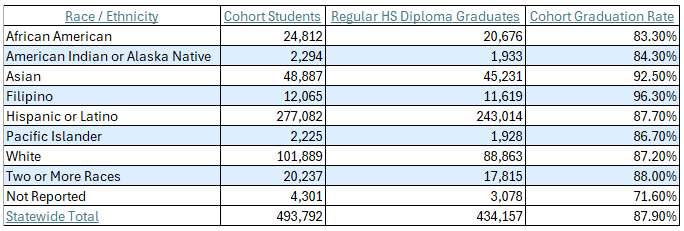
California High School Graduation Rates 2025

America’s high school graduation rates peaked at about 77% in 1970 and then drifted down for almost four decades to 69% in 2007. Then online credit recovery arrived and rates started zooming up. In 2016, over 83% of California’s freshman cohort graduated on time and in 2012, 81% of the freshman cohort in America graduated on time. In 2017, I wrote about the credit recovery scam. This leads me to reluctantly agree with Professor Polikoff’s observation that graduation rates are easily manipulated and are not a solid accountability metric.

I am personally not disturbed by the idea that a significant number of students did not honestly meet their district’s graduation requirements, but I do think there needs to be more transparency and a rethinking of what those requirements should be.

San Diego Unified, which reported a 94% graduation rate, like most other districts leaned heavily on credit recovery to improve graduation rates.

Credit recovery students are able to gain graduation credits in as short a time as one day. According to several teacher friends who have taught teacher led credit recovery, there is no real instruction, just filling in packets (“seats and sheets”). I have heard many students say, “I don’t care if I fail, I’ll do credit recovery.” Why not? It’s easier.

Professor Adam Tyner wrote “Is Credit Recovery as Bad as the Say?” He Stated:

“Since in-person proctoring of these exams is rare, what’s even worse is that 91 percent of the assessment questions could be easily answered with a simple Google search. Many of these questions have been floating around the internet since 2015, with answers readily available on numerous websites. The process for retaking tests previously failed is also alarmingly lenient. Students retaking unit exams, known as “post-tests,” can review all their previous answers along with the correct ones before attempting the exam again, often with the questions in the exact same order. This method maximizes the student’s likelihood of passing the exam without actually understanding the material, further diminishing the credibility of these assessments.”

Academic Performance 
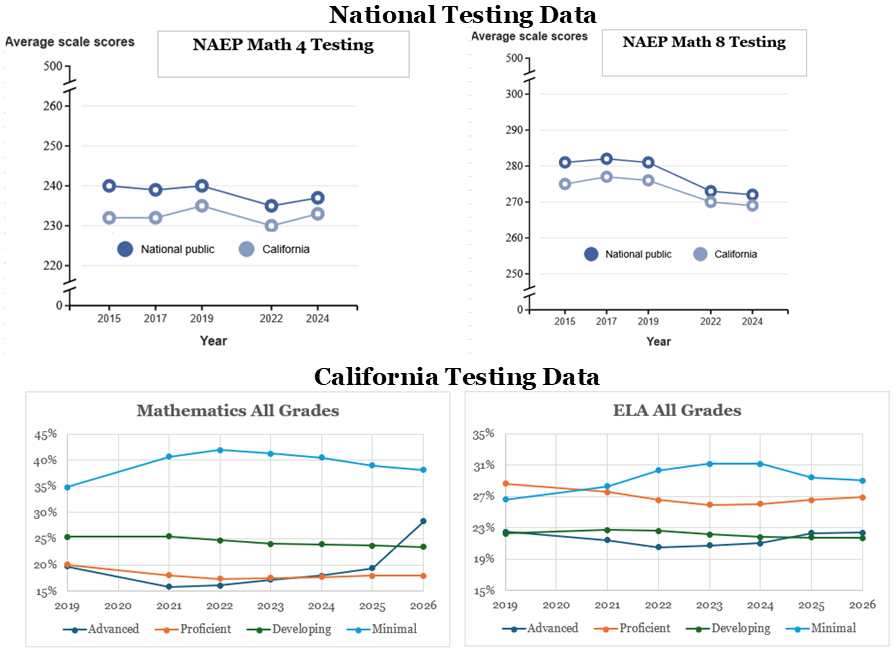
Testing Data Graphs from National and California Testing

The top two graphs above are of math testing data from the National Assessment of Education Progress (NAEP) testing and the bottom graphs are of state of California yearly testing. Both data sets have no data from the 2020-2021 school year. The California data is aggregated for students in all school years and the National data is for two specific grades, 4th and 8th. The 2026 national data is yet to be released but in California the 2026 data is available.

For California high school students, the descriptors Advanced, Proficient, Developing and Minimal have specific student requirements attached. For example, student scoring Advanced in math are not required to take a fourth year of math. Otherwise, these descriptors are indicative of student scoring in specific data ranges.

These graphs and several more that I perused indicate that most students quickly came back on course with the exception of the lowest scoring students. While the advanced group appears to have made a complete recovery, the other three groups have come close but have yet to make a full recovery. However, it should be pointed out these differences are small enough that they may be misleading.

Taketa’s article noted that last year UC San Diego faculty claimed 8.5% of incoming freshmen were assigned remedial math courses a jump up from 0.5% five years prior. This may have been a result of being out of the classroom for one year just three years prior to matriculation.

On the national level, it seems that the students in California and the students nationwide are performing in a similar vain. Although California has excellent schools, its unusually large immigrant population (English language learners) depresses NAEP scoring below the national average.

Public School Privatization

The billionaire financed school privatization movement is advancing in California especially in the southern end of the state. There is almost no school voucher presence in the state but charter schools keep gaining a bigger percentage of students. While the state’s enrollment is shrinking, charter school enrollment keeps inching up. In the 2025-2026 school year, charter schools enrolled 727,870 California students coming to 12.7% if total taxpayer funded enrollment.

The state’s two largest county populations account for a significant amount of the charter school student population. Los Angeles County’s charter enrollment actually dropped by 4,096 students in 2026 but the percentage of county students in charter schools rose by 0.1% to 16.3%. San Diego County, which has the state’s second largest population, saw the percentage of charter school students in the county zoom to 19.2% of all publicly financed students. San Diego added 2,590 charter school students in 2026 with total enrollment climbing to 90,806 students.

Four of the five largest county populations in California enroll more than half of the state’s charter school students; Los Angeles County, San Diego County, Riverside County and San Bernadino County. Interestingly, the state’s third largest county population resides in Orange County which is sandwiched between Los Angeles and San Diego counties but has about a third of San Diego County’s charter penetration at 6.7% of taxpayer funded students.

Conclusion

The data tells a story of decent performance through the pandemic era by California’s public schools. The academic data has mostly maintained but unfortunately, so has the privatization agenda. Having 12.7% of students in state funded privatized schools is not good. Be clear, that is just the taxpayer supported private schools and does not count the students whose parents pay out of their own pocket for their children to attend private schools.

All in all, California public education deserves high marks for how well it navigated the pandemic era. In a time of aging demographics, that is reducing student numbers and billionaire money working against public schools, districts have managed the shrinking reality well and continued providing quality outcomes.

Credit Recovery Farce Generates Spectacular Graduation Rates

8 Jun

By Thomas Ultican 6/8/2017

A miracle has occurred. America’s high school graduation rates peaked at about 77% in 1970 and then drifted down for almost four decades to 69% in 2007. Astoundingly, even with increased graduation requirements rates have shot up.

Many school districts in California now require all students to meet course requirements for entering the University of California system to graduate from high School. That is a dramatic increase in academic rigor. Yet, in 2016, over 83% of California’s freshman cohort graduated on time. In 2012, 81% of the freshman cohort in America graduated on time. These record setting numbers are the result of knuckleheaded political policy, cheating and credit recovery.

What is Credit Recovery and Where did it Come from?

In the 1990’s politicians like Bill Clinton and Jeb Bush were pushing for standards in education and accountability measures. Jeb Bush’s infamous school grading system called for 25% of a high school’s grade to be based on graduation rates. Bill Clinton wrote in 1998,

“We have worked to raise academic standards, promote accountability, and provide greater competition and choice within the public schools, including support for a dramatic increase in charter schools.”

“We know that all students can learn to high standards, and that every school can succeed if it has clear instructional goals and high expectations for all of its students; ….”

Donald T. Campbell’s 1976 paper presented a theory about social change that is now widely revered as Campbell’s Law: “The more any quantitative social indicator is used for social decision-making, the more subject it will be to corruption pressures and the more apt it will be to distort and corrupt the social processes it is intended to monitor.”

Exactly as the Social Scientist, Campbell, postulated, this national push to increase the standards of school rigor and to use social indicators (graduation rates and high stakes testing) to evaluate schools has introduced distortion and corruption.

How were school leaders going to protect their institutions and their own jobs from the ravages of horribly shortsighted and uninformed education policy? The solution was obvious; teach to the test and find a way to raise graduation rates.

To the rescue, came both the Walton Family Foundation and the Bill and Melinda Gates Foundation along with many other lesser contributors. They perceived it was time for advancing the privatization of public education and accelerating the adoption of technology in education. Credit recovery was a perfect vehicle.

A mouthpiece for these foundations, the Education Commission of the States, explains:

“Credit recovery is an alternative to course repetition for students who have previously failed a course needed for high school graduation. Programs may be offered via computer software, online instruction (including through a state’s virtual high school or a local virtual school) or teacher-guided instruction (small group or one-on-one), and are typically targeted at the standards in which students were deficient, rather than all standards in the original course.

“Programs should be self-paced and competency-based ….”

Another organization significantly financed by Walton and Gates iNACOL (International Association for k-12 Online Learning) promotes a virulent form of computer based education known as CBE. I discussed CBE in a previous post: “CBE is basically outcome based education moved to digital space. Outcome based education was the new 1990’s name given to a previously failed strategy known as mastery education (AKA ‘seats and sheets’).” The fundamental theory of CBE is that education can be reduced to discrete pieces of knowledge. It’s bad theory.

iNACOL also weighed in on credit recovery:

“Our country has been trying to address the graduation crisis in many ways.”

“Today, one of the root issues is the older students who are missing a significant number of credits do not have the time to sit in class again, thus competency-based programs are a better option.”

Echoing the unsubstantiated “Nation at Risk” iNACOL does not see foolish policy or growing poverty leading to stagnate or falling graduation rates. It sees a CRISIS!

With credit recovery students are able to gain graduation credits in as short a time as a day. According to several teacher friends who have taught teacher led credit recovery, there is no real instruction, just filling in packets (“seats and sheets”). I have heard many students say, “I don’t care if I fail, I’ll do credit recovery.” Why not? It’s easier.

How Fraudulent is Online Credit Recovery?

At the high school where I taught this year, I overheard a pair of administrators speaking in hushed tones about the fraud going on in the learning center. In our district, there are twelve learning centers which are technically separate schools. They provide online credit recovery for students who have not earned enough credits. The discussion was about seeing students using smartphones to answer the test questions provided by Apex Learning. The fact that this behavior was being tolerated was what galled them.

As is made clear in a recent series of eight article about credit recovery published by Slate Magazine, cheating on credit recovery is not unique at all.

Zoë Kirsch wrote in her Slate article, The New Diploma Mills:

“Almost 90 percent of school districts use some form of credit recovery, according to a 2011 report from the National Center for Education Statistics (the center doesn’t distinguish between online and other forms). And data cited by the International Association for K-12 Online Learning, a trade group, shows that at least 75 percent of districts use some form of online learning. So, we can say this about online credit recovery: It’s pretty big.”

Kirch’s article also reports that in Nashville, graduation rates increased from 70 percent in 2007 to 81.6 percent in 2015 following the introduction of online credit recovery. Even more stunning, in Los Angeles the graduation rate grew from 54 percent to 75 percent in a single year when credit recovery was introduced in 2015.

A supervisor of credit recovery at East Gadsden High in Florida was informed that some students there were paying one another to do online coursework. When she reported it to the district, an administrator there told her to “leave it alone.” “There’s some things you can’t fix.”

The article “Fast. Isolating. Superficial.” by Stephen Smiley shares,

“She [Elizabeth Bieze, the guidance counselor who oversees the virtual lab at Sullivan High School Chicago] adds that it’s not atypical for students to recover credits for yearlong classes in under a week. ‘They do really well in the pretest, they get to skip a bunch of stuff, and they just take the final exam,’ she says. ‘It has helped our graduation rate immensely.’”

Stephen also found this:

“‘Anyone wanna do a math credit recovery for me I’ll pay you,’ read one tweet posted by a student in Erie, Pennsylvania, in August. ‘If anyone wants to go online and do my chemistry credit recovery I’d be more than happy to give you my username and password,’ wrote another student in Arkansas. Naturally, online learning companies like Edgenuity and Apex insist that most don’t actually follow through and that the chatter is mostly empty boasting.

“That may be so, but I didn’t have too much trouble finding students online who insisted they had cheated without being caught. One of them, Joseph, who is a 17-year-old senior at a Long Island high school in New York, said his online English class was uninspiring, so he paid a buddy $200 to complete it.”

Stephen also wrote a second article for Slate, “I Am an Online Credit Recovery Dropout.” In it he describes a personal experience of taking a few online courses. Stephen concluded,

“But I also came to appreciate what many students had told me about virtual learning: Compared with regular school, there’s less interaction with teachers, fewer opportunities for creative expression, and little chance to bounce around ideas with classmates. While online learning clearly has some strengths (programs can be tailored to individual needs, for instance), it’s hard to get away from an overarching conclusion: The experience as a whole can be pretty boring and lonely.”

Why is Credit Recovery Flourishing?

Francesca Berardi wrote “Take These Students, Please” about online credit recovery in Chicago. Surprising to me, it turns out that former basketball star Magic Johnson is a significant participant in the industry. Francesca notes,

“During Emanuel’s administration, Magic Johnson has become a major player in Chicago’s education world: Bridgescape operates five programs across the city, serving more than 850 students, and as the Chicago Tribune reported, in March 2015 another of Johnson’s companies, SodexoMAGIC, received an $80 million contract to take over janitorial services for several Chicago Public School buildings. Following the contract, Johnson donated $250,000 to Emanuel’s campaign for re-election.

“Not surprisingly, last September, Emanuel announced that in just five years the high school graduation rate had jumped from roughly 50 percent to 73.5 percent.”

‘’’The district is giving high school diplomas for programs that are nowhere near comparable to regular high schools,’ said Troy LaRaviere, president of the Chicago Principals & Administrators Association and a fierce critic of Emanuel’s administration.”

Zoë Kirsch and Stephen Smiley teamed up to write “Why Bad Online Courses Are Still Taught in Schools.” The article opens with this story from Florida:

“Last year, the Florida Department of Education rejected the company Online Education Ventures, which failed to provide descriptions of its virtual courses in science, social studies, and English (it provided descriptions of the math courses, but they didn’t meet state standards). A year earlier, the state disqualified Mosaica Online because the company didn’t show it could provide timely information about its courses. And it said no to Odysseyware, since it failed to outline student anti-discrimination policies or show how its products could meet the needs of students with disabilities.

“But here’s the rub: Those companies are still allowed to sell their products to schools in Florida. Public school districts can still use public money to educate students with discredited products like Online Education Ventures.’”

“The conservative American Legislative Exchange Council has made expanding online learning—unfettered and in all of its forms—one of its priorities. … ALEC has quietly but effectively helped mostly Republican lawmakers pass the kinds of laws the online learning companies want—laws that, for instance, require all graduating high school students to complete at least one virtual class.”

According to Zoe and Stephen, no states are doing a good job of regulating online learning and credit recovery. “As it happens, one of the most rigorous judges of online credit recovery classes is the NCAA. The NCAA’s standard is higher than what any state government requires for its students.”

Some Conclusions and Recommendations

Credit recovery has introduced a corruption into public education.

Online learning is only better than no other alternative. It is lifeless and dull. Some people claim there are ways to make it better, but I seriously doubt that it will ever match a classroom with a teacher to stimulate supervised dialog as a learning vehicle.

The push for credit recovery is a blatant scheme to impose privatized online learning.

Until this corruption has been eradicated, diplomas that are awarded based on credit recovery should have a reduced status to legitimately earned high school diplomas. That will at least reduce the incentive to “get it in credit recovery.”

Of all the increased academic requirements, the requirement for advanced mathematics to graduate from high schools is the most counterproductive. Most college graduates will never have a reason to make a binomial expansion or mathematically describe a conic section. Roll back these stupid requirements. Every student is not going to Berkeley.

Notes:

The five Slate Magazine articles I cited above are more on point for my article but these three articles cited below are also valuable reads.

Bottom of the Class By Francesca Berardi and Zoë Kirsch highlights some of the worst online companies.

Online Education Doesn’t Have to Be Isolating By Sarah Carr discusses some ways online learning can be done well.

Just Take It Again By Stephen Smiley describes how some of the online design makes it easy but not authentic.