
By Thomas Ultican 6/18/2026
A new report from the Network for Public Education (NPE) documents the ongoing demolition of public schools. For more than a century, public education has provided the means by which the diverse American public became naturally homogenized. At the same time, they have made the US’s vast population the most well-educated people on the planet. For not easily understood reasons, over the past 40-years, the ultra-right and the uber-rich have been attacking America’s public schools.
The NPE conclusion to their report — “Public School in America; Measuring Each State’s Commitment to Democratically Governed Schools” — states:
“This report tells a clear and troubling story. Across the country, statehouses are making deliberate choices — choices that defund neighborhood schools, strip teachers of dignity and professional standing, leave vulnerable children without protection, and redirect billions of public dollars to private alternatives that are too often beyond public control. These are not accidents of policy or the unintended consequences of well-meaning reform. They are the predictable results of an ideological campaign, decades in the making, whose architects have been candid about their ultimate goal: the elimination of public education as Americans have known it.” (NPE Report page 26)
Report Basis
Carol Burris, the director of NPE, led this report. She is a former New York city school principal and has been conducting research on the state of America’s public schools for more than a decade.
To ensure an objective finding, Carol and her team developed a set of four standards each weighted with different point totals. The maximum points possible were 102.
The expansion of privatization and student protection was set to 58 points. For this evaluation, charter schools and vouchers deducted from the totals for various reasons. For example, states lost 2 points if they had a voucher program that does not require accreditation for private schools. States also lost 2 points if they allowed multi-school charter authorizations based on a company having one school receiving a charter contract.
The student protection part of this standard was concerned with how school privatization laws protected students. States lost 2 points if they had a voucher program that allowed discrimination based on religion or if LGBTQ students were not protected.
Conditions for Teaching and learning were valued at 24 points. States were evaluated on the existence of laws banning discrimination and if those laws protected all students. They also looked at student teacher ratios and corporal punishment rules.
School funding was given a total of 16 points. It ranks statehouses based on how responsibly they fund public education — evaluating both the adequacy and equity of school financing — and on whether they pay teachers a living wage.
Protection for homeschooled students was given 4 points. The homeschooling segment is America’s fastest growing and some states do not require any homeschooling information. Most states with homeschooling rules require that schooling instructors have education qualifications but often that simply means possessing a GED. (NPE Report page 7)
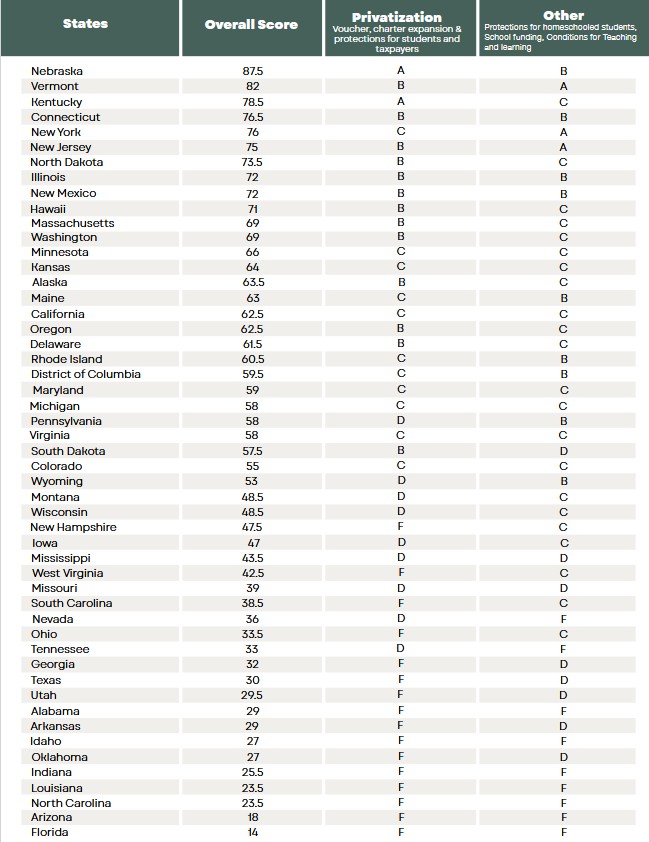
Nebraska with 87.5 points and Vermont with 82 points were the only two states that scored more than 80 out of the 102 possible points. They were awarded an A. The B range was pegged between 64 and 79 points with 13 states in that range. Another 13 states with scores between 50 and 63 received a C. Six states with scores between 40 and 49 received a D and 17 states with scores below 40 were assigned F. Florida had America’s worst score at 14. (NPE Report page 9)
The NPE report lists state scores from highest to lowest in the following table. (NPE Report page 10)
An Observation from the Report
School choice programs generally increase segregation with vouchers enabling outright discrimination using public money. The publicly financed discrimination against gay students is difficult for me to understand. I grew up on a ranch in Idaho where we routinely had homosexual animals appear in our herds. This happened often enough that it was clearly not a rare event. I always believed that homosexuality amongst humans was naturally occurring and also not a rare event. So, when I see bullies or benighted people attacking the LGBTQ community, I am repulsed.
NPE highlighted Dayspring Christian Academy a voucher school in Lancaster, Pennsylvania. The school states it “retains the right to refuse enrollment to or to expel any student who engages in sexual immorality, including any student who professes to be homosexual/bisexual/transgender or is a practicing homosexual/bisexual/transgender, as well as any student who condones, supports, or otherwise promotes such practices (Leviticus 20:13, Romans 1:27).” Not only are gay people discriminated against but anyone who does not join in the bigotry is also to be expelled. Remember, public tax dollars are paying for this. (NPE Report page 11)
I looked up their references and they both have similar wordings. Leviticus 20:13 says, “If a man also lie with mankind, as he lieth with a woman, both of them has committed an abomination: they shall surely be put to death; their blood shall be upon them.” This thousands of years old statement is meanspirited and heartless. Plus, I might point out, most gay men do not “lieth with a woman.” These ancient religious texts have symbolic value but should never be interpreted literally. It is sad that some Christians use the Bible as an excuse to discriminate and even worse that the public is forced to pay for it.
Conclusion
While it is true that the NPE report is awash in data and facts making it somewhat tedious to read, it is only 28 pages of statements and 16 pages of appendix. I encourage everyone to read it and see how far right-wing ideologues and their billionaire funders have come toward ending public education in America. It is a crisis that must be met or our democracy and the American way of life will be ended.
The report quotes Tiffany Justice, founder of Moms for Liberty, when a ProPublica reporter asked the then visiting fellow at The Heritage Foundation what percentage of children should be in public schools? She replied:
“I hope to get to zero. If America’s public schools cease to exist tomorrow, America would be a better place.” (NPE Report page 6)
This is the position of the radical-right. Conservatives and liberals alike should be alarmed.
In 2009, Diane Ravitch finished writing her book The Death and Life of the Great American School System. In it she discussed the “billionaires boys’ club.” On page 278 she states:
“Since I concluded my book in November 2009, I discovered that the billionaire boys’ club extends far beyond the big three foundations I wrote about in Chapter 10: Gates, Broad, and Walton. It includes super-rich individuals from Wall Street and the high-technology sector who have decided to have a go at reforming public education, …”
What most of us did not appreciate at the time is that what these ultra-wealthy were after was monetizing, privatizing and ending universal free public education.
In 2018, NPE held a convention in Indiana. Ravitch opened that gathering stating, ““We are the resistance and we are winning!” Teacher bloggers across the country were destroying the billionaires on social media and their education agendas were stymied. Then COVID happened. During that time Facebook made major changes to how it distributed posts. Soon bloggers like me who would have thousands of readers suddenly only had a few hundred. Many effective education bloggers just gave up.
Today, we have a billionaire President running the Heritage Foundations education agenda playbook. For the first time in American history the federal government in sponsoring vouchers and his billionaire secretary of education is dismantling the department. Public education is facing a crisis.
If you value democracy, community and public schools, it is time to go to the ramparts and fight off the “billionaire boys’ club.”


Recent Comments