
By Thomas Ultican 8/24/2026
Big technology oligarchs are pushing their dangerous not-ready-for-prime-time artificial intelligence (AI) products into America’s schools. Their relentless drumbeat says don’t miss out because all schools need to implement AI tools now. Why the big rush? Technology writer Audrey Watters explains, “I mean, other than the desperate need of the tech sector to prove that the trillions of dollars invested in this endeavor will soon show some profit and that – unlike crypto and Web 3.0 – this isn’t just some giant fraud being perpetrated so executives can buy more private islands.”
Be assured, Audrey knows what she’s writing about. In fact, famed education historian, Diane Ravitch, claimed, “Audrey Watters is one of the best–maybe the very best–writers about Ed-tech.”
In her discussion of AI in education, Audrey is clearly not a fan with reasons. She shouts, ‘“AI” may be one of the biggest threats to teaching and learning, to epistemology and pedagogy that society has ever faced.” Prolific writer, Corey Doctorow, is in agreement with Audrey when he declares:
“AI is alarming for many reasons: it’s a dangerous financial bubble, an environmental catastrophe, and a tool for eroding wages and labor power. But in addition to all that, AI is an epistemic disaster.”
Both writers highlight the danger to epistemology which examines the nature, origin and limits of knowledge. Epistemologists study the concepts of belief, truth and justification. Doctorow and Watters are concerned that AI perverts this branch of philosophy.
Watters has shared:
“When we talk about AI in education, we talk less about what automation and algorithms can do and more about what they will someday be able to do, what we’d like to see the classroom become. What we talk about when we talk about AI in education: … Science fiction. Myth. Made-up histories and made-up futures.”
AI in Education
For decades, purveyors of technology have targeted education as a profit center. They have tried to sell putting kids at screens instead of hiring expensive teachers and they promote using tech for tutoring. The sector has produced an endless stream of applications designed to control schools and educators. AI is just another feeble technology pointed at students and schools. Professionals in the education sphere are not impressed.
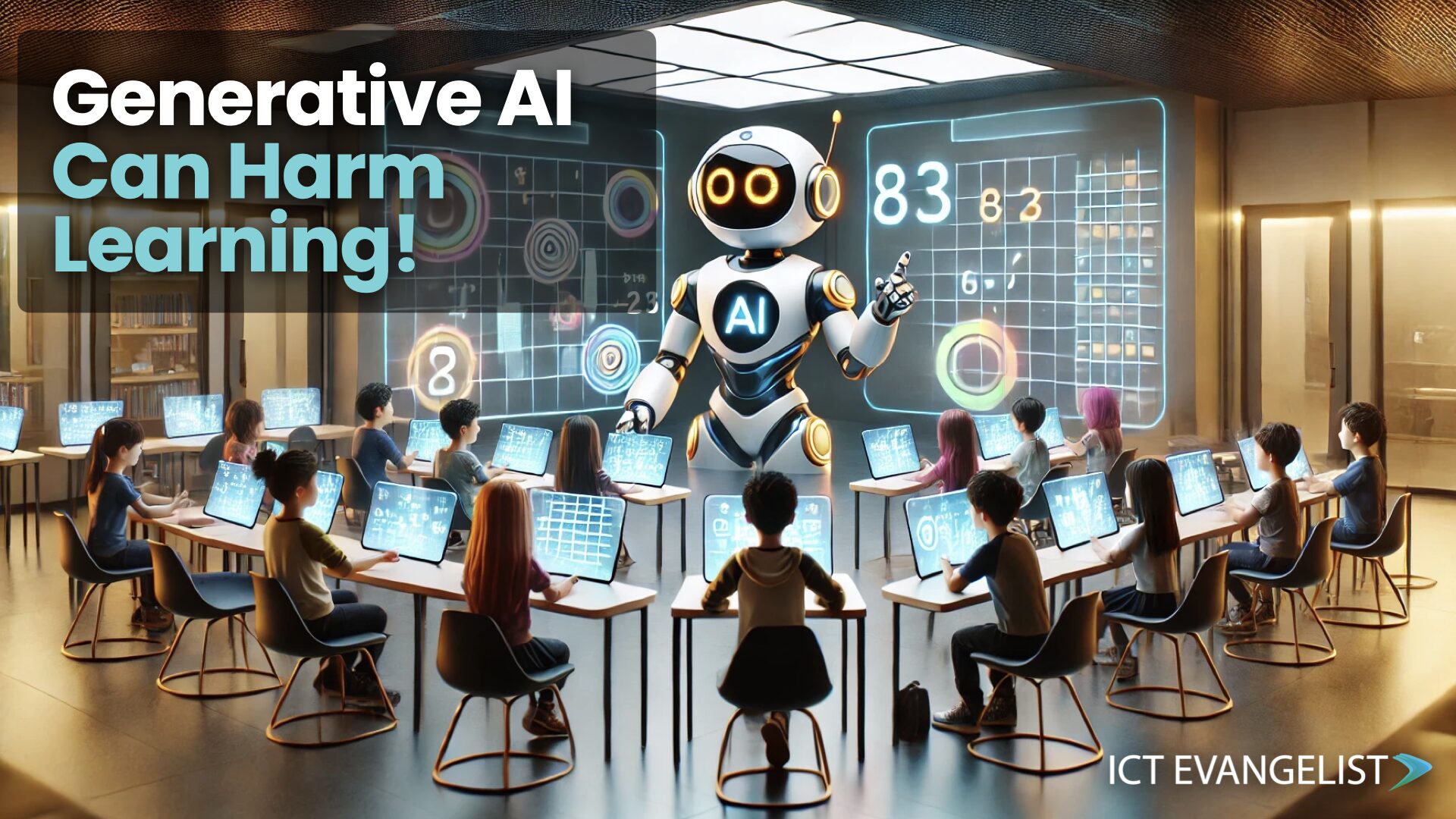
Randi Weingarten, President of the American Federation of Teachers (AFT), spoke extensively about AI in a May speech to the National Press Club in Washington. Weingarten proposed a near total ban on computer screens for second grade and younger students. She also called for banning student-facing AI in elementary school, arguing that children need to build foundational skills which are undermined by algorithmic shortcuts.
Weingarten shared a concern about research showing that in a survey 88% of teachers reported student attention spans were shrinking. She pointed to online platforms like TikTok and YouTube as causative. Randi noted work by cognitive scientist Daniel T. Willingham’s suggesting students are not incapable of focusing, but are increasingly unwilling to do so when schoolwork feels dull by comparison to their online lives.
Last year, the AFT announced $23 million in funding from Open AI, Anthropic and Microsoft for a National Academy of AI Instruction to train up to 400,000 educators. The new entity will train teachers “on how to use AI tools for tasks like generating lesson plans.” University of Mississippi researcher, Mark Watkins, described this announcement as “a gigantic public experiment that no one has asked for.” However, teachers for the most part have gotten no AI training and this is an effort to fill that void.
After being quiet for more than a year, the Trump administration has finally provided guidance about AI and ed-tech in general. The vacant US Surgeon General’s office sent an advisory urging families and schools to reduce children’s screen time. It suggested that schools limit their computers to computer labs, invest in physical textbooks and “prioritize pen-and-paper curricula, hands-on activities and social activities for all grade levels.”
Sadly, the education department followed up with a totally unreasonable attack on America’s teachers. Education Department Press Secretary Savannah Newhouse responded to Weingarten’s allegation about the administrations lack of leadership on AI, not by addressing her statement, but by attacking the union. Newhouse’s bogus polemic presented with no foundation stated, “If there’s finally going to be an honest conversation about the damage done to American students, it should begin with the teachers unions’ enthusiastic support for a federal bureaucracy that has spent over $3 trillion only to watch student outcomes decline, along with their relentless push to keep schools shuttered during COVID,” NAEP data does not show a decline and while students were less likely to get sick than teachers, it was still a frightening problem; so, yes many teachers were worried.
AI in Education Dangers
Local parent organizations in New York City are calling for an AI moratorium in that city’s schools. They point to a growing opposition to AI and “to evidence that it represents substantial risk to student privacy, cognitive development and skills, critical thinking, creativity, mental health, and the environment.”
AI in school turned into a hyper-plagiarizing issue when ChatGPT became ubiquitous in classrooms. Mass plagiarization has left, educators, administrators and students grappling with AI policies and ethics.
A recent Rand Corporation study says, “As of December 2025, 67 percent of students endorsed the statement “The more students use AI for their schoolwork, the more it will harm their critical thinking skills”
A Brightly analysis says, “The biggest risk of AI tools in education is security.” Students have little understanding of how much personal data is being harvested. In addition, psychologists and educators believe computer interfaces are stopping the development of critical thinking and social-emotional learning. Children lose natural creativity which is replaced by dependence on digital tools.
There are also clear ethical concerns with AI. Its answers come from tainted sources which are often violent and sexually derived. These sources are informed by racism, misogyny, homophobia, nationalism, antisemitism, etcetera which come from the internet. AI is even trained on child pornography. The AI well is poisoned.
The Center for Universal Education at Brookings posted a major AI study this January. A key takeaway stated:
“Ultimately, we find that at this point in its trajectory, the risks of utilizing AI in education overshadow its benefits. This is largely because the risks of AI differ in nature from its benefits—that is, these risks undermine children’s foundational development, for example, when trust between students and teachers is diminished—a current risk of AI implementation—the benefits of AI-enriched teaching and learning materials cannot be fully realized. Understanding the distinction between enriched and diminished learning experiences is an important first step toward mitigating AI’s risks and harnessing its benefits in education.” (Page 12)
Conclusion
Like all new technologies, AI has potential to contribute to society but it also has potential to do harm. A lot of the information about AI is hype from billionaires. In the introduction to their book The AI Con, Emily Bender and Alex Hanna write:
“We are writing now, in late 2024, from the inside of what feels like the height of the AI hype bubble. As we say on the podcast: each time we think we’ve reached peak AI hype—the summit of bullshit mountain—we discover there’s worse to come.”
If you have not read these brilliant ladies’ book, it is not too late.
The bottom line is that in many cases we are being lied to about AI. It does have risks and its adoption into education needs to be slowed significantly.

Recent Comments