Tag Archives: education

School Choice is a Bamboozle a Hornswoggle a Flimflam

3 Aug

By Thomas Ultican 8/3/2018

Two central ideologies behind school-choice are markets always make superior decisions and the cost of having local control of schools is poor outcomes. Both ideas are demonstrably untrue, but big money and power politics keep them alive.

In 2017, a national survey showed a dramatic drop in support for charter schools. A related Chalkbeat article said,

The survey, conducted by the school choice-friendly journal Education Next, found that slightly more Americans support charter schools, 39 percent, than oppose them, at 36 percent. But that marks a drop from 51 percent support just last year — one of the biggest changes in public opinion seen in the long-running survey, according to Harvard professor and the magazine’s editor-in-chief Marty West.

An internet search of “charter school growth slowing” brings up articles from around the country concerning the charter slow down. Education Week noted, “Last year, more charter schools closed than opened in the Bay Area for the first time since California passed its charter law in 1992. (California was the second state to allow charters to open.)”

To address this choice crisis, two Billionaires are starting a new national organization. A July 31, 2018 Chalkbeat article by Matt Barnum explains,

“The City Fund, as the group is being called, will push cities to expand charter schools and district schools with charter-like autonomy. It represents a big increase in visibility and influence for advocates of the “portfolio model” of running schools, a strategy that’s been adopted by cities like New Orleans, Denver, and Indianapolis.

“The group was announced Tuesday morning on the blog of Neerav Kingsland, who leads education giving at The Laura and John Arnold Foundation. According to a separate presentation created by the group and viewed by Chalkbeat, the Arnold Foundation and the Hastings Fund have already given the group over $200 million.”

Reed Hastings (Netflix Founder and CEO) is a charter school advocate who served on the board of the California Charter School Association; was the primary advocate of California’s charter school co-location law; and was also a key supporter for lifting charter school limits in California. He is a primary investor in DreamBox Learning, a company creating software to teach kids at computers. He famously stated that elected school boards need to be done away with.

John Arnold made his fortune at Enron and a hedge fund. He retired at 38-years-old. His private non-profit, the Laura and John Arnold foundation supports privatizing schools and ending democratic local control. He gives lavishly to charter schools (example: Gifted the Charter Growth Fund – $13 million).

The portfolio model of school reform calls for viewing schools like assets in a stock portfolio. Based primarily on the results of standardized testing the bottom scoring 5% of schools should be closed and replaced with new charter or innovation schools (charter like district schools). A serious flaw in this plan is the problem of error causes standardized testing to be useless for evaluating schools or teachers. Testing is a terrible ruler.

Former Assistant US Secretary of Education, Diane Ravitch, reacted to Arnold and Hasting promoting portfolio districts noting,

“Bonafide Reformer Jay P. Greene of the University of Arkansas has written several posts arguing that the portfolio model is a failure and that it is no different from a school district (although it is privately controlled). Read here. and here. The latter post is advice written to the Arnold Foundation about why it should not invest in the portfolio model. Sad. They didn’t listen.”

Innovation schools are promoted by the American Legislative Exchange Council (ALEC). They are district schools which present an operation plan for improving test outcomes and then receive autonomy to carry out the plan. Whether innovation or charter, local control of schools by democratic means is ended.

Disruption is not a good feature in education. The portfolio theory violates the need for stability. Brooke Havlik writing for Nova Education’s “Science and Learning” published “Psychologists Find School Stability a Factor in Achievement Gap.” Brooke stated, “Two new studies published this month suggest that changing schools may have a negative impact on cognitive development and student performance, especially for students experiencing chronic, high-levels of poverty.” (emphasis added)

In cities like Denver and Indianapolis, the portfolio model almost exclusively effects schools in poor and minority communities. In other words, the students most negatively impacted by this theory have their schools closed and the community loses its democratic rights.

A New Paper from In The Public Interest (ITPI) Documents the Flimflam  

This spring, ITPI published “Fraud and Waste in California’s Charter Schools.” The report documents $149,000,000 fraudulently purloined by factions of the California charter-school industry. The total of stealing stated is a summation of cases cited in media reports. The actual amount stolen is much larger.

The ITPI report also reveals how fortunes are created by gaining control of publicly financed assets. The report discloses,

“While charter schools constructed with general obligation bonds cannot be sold or used for anything other than the authorized school, schools constructed with tax-exempt conduit bonds become the private property of the charter operator. Even if the charter is revoked, neither the state nor a local school district can take control of this property. Additionally, schools constructed with private funding subsidized by New Market Tax Credits or acquired with private funds but whose mortgage payments are reimbursed through the Charter Facilities Grant Program (known as “SB740”) are typically owned without restriction.”

The American Federation of Teacher (AFT) released a new white paper, “Report on the Aftermath of the Great Depression: A Decade of Neglect.” It shares,

“Moody’s Investors Service, the bond rating agency, found that not only do charter schools tend to proliferate in areas where school districts already are under economic and demographic stress, but that charter schools tend to “pull students and revenues away from districts faster than the districts can reduce their costs.” As a result, charter schools also can add to school district credit risks, increasing the cost of borrowing. A growing body of research documents this impact.”

  • “Los Angeles: Each student leaving for a charter cost the district $3,900 in lost services.
  • “Philadelphia: Two different studies in Philadelphia found the cost of lost services to be between $4,828 and $6,898 per pupil leaving.
  • “North Carolina: A student leaving an urban North Carolina school district costs between $500 and $700 in lost services. The effect is smaller in non-urban districts.”

A Case Study in Destroy Public Education (DPE) (Part 1)

R.B. Buzz Woolley is a wealth philanthropist and venture capitalist from La Jolla, California. A San Diego Reader report from 2011 said of him,

“On the political front, meanwhile, Woolley personally donated $6500 to the California Charter Schools PAC in March and $25,000 to the Alliance of California Charter Schools Independent Expenditure Committee in June. In May, he also kicked in $10,000 for Californians Against Special Interests, a primarily GOP group mounting an initiative for a so-called paycheck-protection measure banning direct deductions of labor union dues.”

Buzz and The Mushroom House

In 2015 Woolley Purchased the Mushroom House for $5 Million

In 2005, Buzz Woolley and longtime columnist Neil Morgan founded Voice of San Diego. It was the first digital nonprofit news organization to serve a local community in the country. Besides his interest in using new technologies for media, Woolley also is enthusiastic about education technology in the classroom. In 2013 Woolley’s Girard Foundation sent over $500,000 to companies developing software for “personalized” education and competency-based education.

In 2004, Buzz Wooley was the President of the then new Charter School Growth Fund. That year, Don Fisher (Gap Inc.) and Wooley each contributed $100,000 to the fund. They were the only contributors. John Walton (Walmart) and Greg Penner (Walmart) joined the board. The next year, Buzz Wooley resigned as President.

Charter Fund Officers 2005

Image is from the Charter School Growth Fund 2005 Tax Form

The other important figure in the Thrive Public Schools case study is Nicole Assisi. Nicole attended Coronado High School and UCLA where she earned a multisubject teaching credential. Her first teaching job was leading English classes at San Diego’s Mira Mesa High School – 2002-2003 school year.

In 2003, she moved on to High Tech High where she was a teacher and project-based learning trainer until 2005 or 2006. Her linked in profile says she worked at High Tech until 2006 but it also says that in 2005 she went to Los Angeles to be an Assistant Principal at Camino Nuevo Charter Academy. In 2008, she moved on to be Principle on special assignment at De Vinci Schools (Formerly Wiseburn 21st Century Charter). She left De Vinci schools and returned to San Diego in 2013.

Nicole_CMO

Nicole Assisi from the Thrive Public Schools Web-Site

Along the way, Nicole earned a master’s degree in English and Communication/Media Studies from University of San Diego – 2004 and a Doctorate in Education from the University of Southern California – 2010.

A Case Study in Destroy Public Education (DPE) (Part 2)

The 34-years-old Nicole was provided with $8,960 from the Charter School Growth Fund and $100,000 from the Gates supported Educause to come to San Diego and start a charter school.

In the fall of 2013 she submitted a charter proposal to San Diego Unified School District (SDUSD) and then withdrew it. Soon after, she did the same thing at the Grossmont School District. Finally, in November, she resubmitted her completed proposal to San Diego Unified.

SDUSD’s charter review committee recommended her proposed Thrive Public Schools be authorized to start September 1, 2015 instead of 2014. They felt she needed more time to get a school organized and populated. In a surprise move the SDUSD Board voted 3-2 to reject the petition.

The next day Buzz Woolley’s Voice of San Diego ran an opinion piece by Nicole. She called herself “a sacrificial lamb” and said the Board “made a mockery of the entire charter-approval process, which I worked diligently to navigate.” She also wrote, “Thankfully, the County Board of Education has an opportunity to right this wrong when our appeal comes before them next week.”

The county also turned down the charter with a 3-2 vote. The county review committee had recommended against approving the charter.

Nicole really had no worries because the pro-school-privatizing State Board of Education (SBE) would come to her rescue. Though the law encourages the SBE to respect the decisions of counties and districts, it seldom does. In the spring, SBE voted 9-0 to authorize Thrive Public Schools.

The money started flowing Nicole’s direction. The known list of 2014 donations:  Woolley’s Girard Foundation $108,000, Gate’s Educause $254,500, Charter School Growth Fund $175,000 and the Broad Foundation $150,000 for a total of $688,000. The next year, Broad gave another $50,000 and the New Schools Venture Fund sent $100,000. There is another $144,000 promised from Educause.

Nicole has opened two more schools and a fourth set to open in September. Choice promoting publication, The 74, describes a co-located Thrive elementary school,

“The Juanita Hills campus is co-located with Carver Elementary, a pre-K-5 school that enrolls much higher proportions of disadvantaged students and English learners than Thrive. The two facilities share the same lot, but a long blue line has been painted down the center to separate them. A Thrive parent complained that though Carver had its own library on-site, Thrive kids couldn’t use it.”

Tom Vander Ark is a well-known promoter of education technology and public-school privatization. He described the Thrive education program,

“Curriculum such as Readers’ and Writers’ Workshop and CGI Math provide collaborative opportunities for small groups to work directly with the teacher, while other students work on Chromebooks or iPads.

“The middle school team uses Google Classroom to make and manage assignments. Math software includes ST Math and Zearn.

Kids at computers running software programs is lifeless, boring and de-personalized. It is bad education.

Thrive has actively developed the support of many neo-liberal and conservative politicians. Among their listed supporters are: State Senator Ben Hueso (D); Dede Alpert (D), Former Assembly Woman and State Senator; Kerry Flanagan, Chief of Staff, California Charter Schools Association; Tom Torlakson (D), Superintendent of Public Instruction for the State of California; Jed Wallace, President and Chief Executive Officer, California Charter Schools Association; Mark Wyland (R), State Senator. These people are enemies of public education supporting the same benighted policies as Betsy DeVos.

The three existing Thrive schools opened in the administrative area of SDUSD known as the Crawford Cluster. Like most cities, it is in San Diego’s poor and minority communities where the privatization efforts are focused. One of the reasons SDUSD’s Board rejected the Thrive petition was to protect the existing schools. There were already four charter schools within the cluster boundaries.

Crawford Cluster Map

Crawford Cluster Map from SDUSD

In 2017, Thrive announced its big advance which stands to make founder and CEO Assisi a wealthy woman. The report in the San Diego Union says,

“The 35,000-square-foot facility will be the fourth San Diego campus for Thrive Schools and will open in about 12 months at the former site of Bayside Community Center at 6882 Linda Vista Road.”

“The project’s cost became more affordable for Thrive through the federal New Markets Tax Credit Program, which gives tax credits to for-profit businesses that are helping revitalize low-income communities.”

“Civic San Diego was eligible for the program and was allowed to sell the tax credits to whoever was making the investment. In this case, the credits were sold to the bank lending money to Thrive to buy the site.”

Although paid for with tax money, the deed will belong to Thrive Public Schools and CEO Nicole Assisi.

Some Ending Observations

Thrive Public Schools is a net negative for San Diego. SDUSD is far more professional, stable and capable. Thrive undermines SDUSD budgets and divides people like the students at Carver Elementary. The charter school experiment has failed. It was a bad idea and needs to end.

Put these schools under the supervision of elected school boards and quit stealing tax payer money. School choice truly is a Bamboozle; a Hornswoggle.

San Joaquin Valley in the DPE Crosshairs

15 Jul

Efforts to privatize public schools in the San Joaquin (pronounced: whah-keen) Valley are accelerating. Five disparate yet mutually reinforcing groups are leading this destroy public education (DPE) movement. For school year 2017-2018, taxpayers sent $11.5 billion to educate K-12 students in the valley and a full $1 billion of that money was siphoned off to charter schools. This meant that education funding for 92% of students attending public schools has been significantly reduced on a per student basis.

In July 2017, California’s State Superintendent of Education, Tom Torlakson, announced the revised 2017-2018 budget for K-12 education totaled $92.5 billion. Dividing this number by the total of students enrolled statewide provides an average spending per enrolled student ($14,870). The spending numbers reported above were found by multiplying $14,870 by students enrolled.

The five groups motivating privatization of public schools are:

  • People who want taxpayer supported religious schools.
  • Groups who want segregated schools.
  • Entrepreneurs profiting from school management and school real estate deals.
  • The technology industry using wealth and lobbying power to place products into public schools and supporting technology driven charter schools.
  • Ideologs who fervently believe that market-based solutions are always superior.

The Big Valley

The San Joaquin Valley is America’s top agricultural producing region, sometimes called “the nation’s salad bowl” for the great array of fruits and vegetables grown in its fertile soil. Starting near the port of Stockton, the valley is 250 miles long and is bordered on the west by coastal mountain ranges. Its eastern boundary is part of the southern two-thirds of the Sierra bioregion, which features Yosemite, Kings Canyon, and Sequoia National Parks. It ends at the San Gabriel Mountains in the south.

Seven counties (Stanislaus, San Joaquin, Merced, Tulare, Kings, Fresno and Kern) govern the valley. Its three major cities are Fresno (population 525,000), Stockton (population 310,000) and Bakersfield (population 380,000). The entire valley has a population of more than 4 million with 845,369 K-12 students enrolled for the 2017-2018 school year.

Ironically, in possibly the world’s most prolific food producing area, there is food insecurity. In 2009 the problem became particularly severe. Sabine Blaizin reported, “The state of California declared a state of emergency in Fresno County, and from July to October, was trucking in tons of food to the hungry and unemployed.” Since 2009, the economic conditions in the valley have slowly but steadily improved.

San Joaquin Valley Map

Valley Can Published this Map with the San Joaquin Valley in Green

Some Data Observations

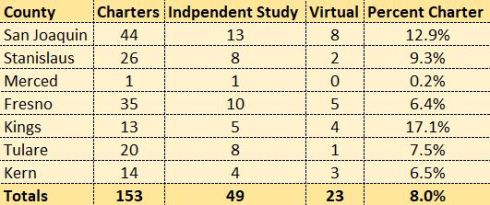
In her 2017 report on California’s out of control charter school system, Carol Burris made a point about the unsavory nature of the independent study charter school. She pointed out that these schools have poor attendance and terrible graduation rates. Unfortunately, they are easy to set up and very profitable. Of all the independent study charters, the virtual charters have the worst performance data and are widely seen as fraudulent. About one-third of the valley’s charters are independent study and half of those are virtual.

Charter Numbers Table

As the table above shows, Kings county is already at 17.1% charter penetration which is about the same percentage as San Diego. It is likely that Kings county district schools are struggling financially because they cannot adjust fast enough to the loss of students to the charter system. Several studies, including Professor Gordon Lafer’s “Breaking Point,” have documented this threat to public school systems caused by these minimally-regulated privatized schools.

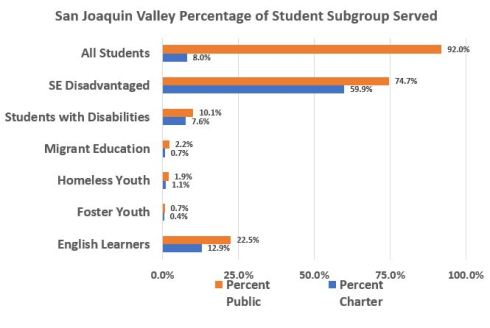
The charter school industry notoriously avoids the more expensive students to educate such as special education students. The following chart shows that same trend is prevalent in the valley. In every category of more difficult and expensive students to serve, the charter school industry has managed to avoid their fair share.

Subgroup Percentages

GO Public Schools Targets Fresno

In Oakland, California, GO is the political organizer working on the ground to privatize public schools. It funnels money to charter school incubation and other needs. The national organizing group for privatizing public schools, Education Cities, lists GO as its partner. GO is a non-profit operating under federal tax code 501-C3. Great Oakland Public Schools is GO’s dark money organization that takes advantage federal tax code 501-C4 to funnel unattributed money into mainly school board elections.

A December 2017 article in the Fresno Bee reported,

“Dozens of parents and community members attended a meeting at the Big Red Church on Wednesday to discuss how to improve Fresno Unified and the success of its students – but it wasn’t hosted by the district.

“Go Public Schools, a nonprofit that has worked with struggling schools in Oakland, created a branch of the organization in Fresno earlier this year, with the goal of ‘expanding access to quality education in Fresno’s most historically under-served neighborhoods.’

“Since Go Public Schools Fresno opened in June, it has hosted “house parties” across the city, where parents exchange ideas in their homes, and offered a 10-week course to Spanish-speaking parents, teaching them how to become more engaged in community issues and urging them to attend school board meetings.”

Go Public Schools Executive Director in Fresno is Diego Arambula. The article pointed out that Diego’s brother, Assemblyman Dr. Joaquin Arambula, D-Fresno,  was present. This is another example of pretend progressives adopting the school privatization policies promoted by Betsy DeVos, Eli Broad, the Walmart heirs and David Koch’s American Legislative Exchange Council (ALEC).

GO’s current campaign in Fresno is the Choosing Our Future Initiative. They claim,

“Our path forward is built on a set of 3 policy recommendations:

  • “21st century Success: We need to redefine success as it relates to the 21st century and commit to every child graduating prepared to succeed.
  • “Individualized Student Plans: We want to empower both students and educators with individualized data to ensure every child is making adequate annual progress toward graduating prepared to succeed. …
  • “Innovation Zone: Create an Innovation Zone to design and support transformational school models.”

Goal one is related to the DeVosian meme that schools have not changed in 100 years. The second goal is about selling technology. Their individualized learning plan undoubtedly includes “personalized learning” on digital devices. It is an unproven approach, likely to fail. The final goal is a call for the ALEC supported ideology to reduce democratic input into local school policy. It claims schools should be autonomous and freed from elected school boards and legislatures. This theory is being implemented in Denver, Philadelphia and elsewhere, a plan that posits disruption as a positive value for educating children.

Local elites like Larry Powell the former Fresno County Superintendent of Schools are supporting GO’s school privatization plan. Powell’s bio at the Central Valley Community Foundation says he has a daily radio feature called “Good News with Larry Powell” on iHeart Radio and is a Political Analyst on the NBC and CBS affiliates in Fresno. He has also served on 12 non-profit boards.

A recent editorial by Powell in the Fresno Bee echoes Betsy DeVos’s spurious “schools have not changed in 100 years.” Powell wrote,

“Amazing work has been done by our educators, but our core school model has remained largely unchanged. It’s been said that if Rip Van Winkle were to awaken today, the only thing he would recognize is public education.”

This well-known community leader who spent 43 years as a high school wrestling coach, history teacher and an administrator made this claim. Anyone who has spent time in a public-school classroom, knows this is not true. Powell gave his full-throated endorsement to all three of the GO policy recommendations; even praising the anti-democratic ALEC inspired innovation schools. He claimed,

“We must ensure that our educators are given the freedom to design a school model and system that best meets the needs of their current students. An innovation zone will provide school sites who are in the zone with additional academic and financial flexibility in exchange for increased accountability.”

It is unclear where that increased accountability comes from because the local school board loses their oversight ability. DPE forces generally define accountability based exclusively on standardized testing results which do not provide reliable information about teaching or school quality. Standardized tests are a proven waste of money, providing ways for businesses to purloin education dollars.

The June 21 2018 issue of the Fresno Bee published, “Kepler will keep operating after all. Does that mean Fresno is friendly to charter schools?” Reporter Aleksandra Appleton noted that even the California Charter School Association recommended the Kepler charter school’s authorization be revoked. Her lead sentence read, “The Kepler Neighborhood School will keep operating after the Fresno County Schools Board voted 4-1 Thursday to approve the charter school’s appeal, effectively reversing an earlier decision by Fresno Unified that would have led to the school’s closure.”

Stockton Got Their Broadie

Billionaire, Eli Broad, has been relentless in his efforts to privatize public education. To spearhead this goal, the Edythe and Eli Broad foundation created an unaccredited administrators school that teaches Broad’s management philosophy and ideology.

Broad-trained administrators are famous for hiring consultants, bad relations with teachers, large technology purchases and saddling school districts with debt. In May, Oklahoma educator and historian, John Thompson, wrote a series of articles documenting these perceptions about Broad academy graduates (1, 2, and 3).

Reporting in 2016, the New York Times Motoko Rich said of Broad, “His foundation has pumped $144 million into charter schools across the country, is embroiled in a battle to expand the number of charters in his home city and has issued a handbook on how to close troubled public schools.”

John Deasy is perhaps the most infamous of all Broadies. In 2014 when Deasy was forced out as Superintendent of Los Angeles Unified School District, the New York Times reported,

“Mr. Deasy, a strong proponent of new technology in schools and of holding teachers accountable for improving student test scores, had faced mounting criticism from board members and teachers who saw him as an enemy. He testified against teachers’ unions this year in a lawsuit in which a California judge ruled that tenure protection laws deprived students of their basic right to an education and violated their civil rights.

“Detractors also criticized Mr. Deasy, who led the second-largest school district in the country, for the difficult rollout of an ambitious $1.3 billion plan to give iPads to every student in the district, which has an enrollment of 640,000 across 900 schools.”

Amazingly, this May the Stockton Unified School District Board voted 7-0 to hire John Deasy to be the superintendent of schools. Evidently, they wanted a star and were willing to pay the price. The Recordnet gave some partial details of Deasy’s agreement,

“His contract is set for three years and salary will be $275,000.

“Several gasps and laughs were heard as Board President Angela Phillips read aloud the employment agreement, which includes a $700 a month allowance for vehicle, cellphone and internet costs, plus mileage, five weeks’ vacation and various expenses. Deasy’s contract also states SUSD will reimburse him for moving and housing costs to Stockton not to exceed $15,000.”

It’s the Scammiest

In the 1980’s, Kraft Corporation ran a delightful commercial for their macaroni and cheese product. An ebullient little black boy who apparently had lost a baby tooth, looked at the camera and exalted, “It’s the cheesiest.” Every time that commercial came on, it made me smile.

But looking at the New Jerusalem School District of Tracy, California, I always think, “it’s the scammiest.” It doesn’t make me smile.

The districts wed site shares the history of the name:

“The Ebe Family came across the plains in covered wagons and settled near here about 1865.  In 1874, Mr. Henry Ebe, newly settled, donated two acres of land to San Joaquin County for a school in this area. In exchange for this, he required that the school be given the name “New Jerusalem’.” 

New Jerusalem does not look like a public-school district. It has a three-member elected board, a superintendent, an Assistant Superintendent for Business Services, a Budget Analyst, a person in charge of Accounts Payable, a Human Resources person, a Payroll department, a person in charge of the Nutrition Program and a person in charge of its Transportation Program. In 2016-2017 the district only had 29 kindergarten students in its one school. This large organization is supported by the 13 charter schools New Jerusalem authorizes.

New Jerusalem Enrollment

2016-2017 Data provided by the California Department of Education

Of their 13 charter schools, 8 are virtual. New Jerusalem authorized a charter school that is 250 miles away in Simi Valley, California and another one sixty miles away in Stockton, California.

The New Jerusalem web site provides instructions and forms for starting a charter school and getting it authorized by them.

A Final Perspective

The San Joaquin Valley is in the charter industry’s crosshairs. Their agenda is privatizing public schools and ending local control by democratic process. Most people are not surprised that libertarians, like David Koch, want to end public education but are often blindsided by Democrats supporting the same agenda.

Educate yourself and your neighbors. Don’t let people tell you that your local school is terrible and the Gates, Broad and Walton supported charter schools are superior. Both propositions are false.

Open Letter to the California Charter Schools Association

26 May

To: Steven Baratte, Managing Director, Communications, Southern California, California Charter Schools Association (CCSA)

Reference: Your May 21, 2018, email message to San Diego Free Press (SDFP)

Your message began, “I am the managing director of communications in Southern California for the California Charter Schools Association and wanted to introduce myself because I have seen an increase of charter-related stories on your website.” Then you claim without evidence, “Many of the stories contain inaccuracies about California charter schools and perpetuate falsehoods.”

Mr. Baratte, don’t you think a serious claim like this deserves a little evidence; a few examples? Every charter school article in SDFP has been rigorously documented and provides hot links to the documentation. One might disagree with the conclusions, but the evidence presented is accurate and well-sourced.

Furthermore, the writers of these articles are not paid. They, unlike paid employees of the CCSA, have no dog in this hunt. Evidence informs them that public education is under assault by the same anti-public-school and pro-privatization forces who created your organization. There is a shared belief among these writers that public schools are an irreplaceable foundation for our amazing democratic form of government. Furthermore, losing them would invite a dystopian future.

You write,

“While I think we can have differences of opinions on the value of charter schools, I also think we all want honest and accurate journalism. Most notably, in California, charter schools are free, public, and open to all.”

Unfortunately, charter schools have become profit centers for real estate developers and charter management organizations. Instead of fulfilling their original mission to be education innovators, they have too often become fraud infested enterprises lusting after tax dollars. It did not have to be this way.

San Diego Schools

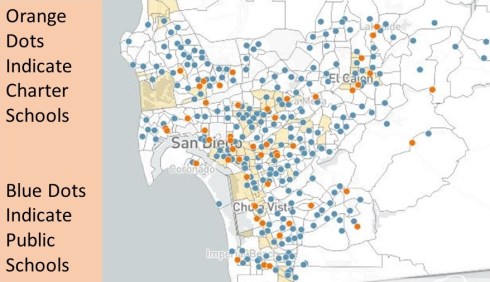
San Diego Schools Map Created Using Fordham Foundation School Mapping Tool.

Here is some honest accuracy. Charter schools are not public schools and though theoretically open to all, they have a well-documented history of avoiding more costly students. A 2013 report from the National Center for Education Statistics supports that claim. This month an even more definitive report published by In The Public Interest was written by University of Oregon’s Professor Gordon Lafer. He offered this example,

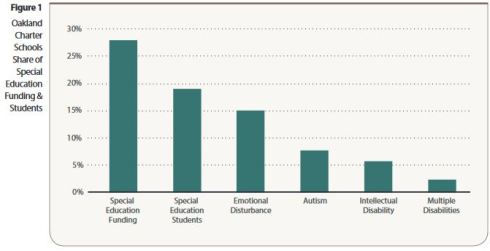
“In 2015-16, for instance, charter schools accounted for 28 percent of all Oakland-area students (that is, all students who lived within the district boundaries and attended either charter schools or traditional public schools), and thus, under California’s special education funding model, received 28 percent of all special education funding for Oakland-area students. But they enrolled far less than their share of Oakland-area special needs students—just 19 percent of the total. The imbalance is yet more extreme in the most serious categories of special need. Of the total number of emotionally disturbed students attending either charter or traditional public schools in Oakland, charter schools served only 15 percent. They served only eight percent of all autistic students, and just two percent of students with multiple disabilities.”

Oakland Special Education funding

Calling charter-schools public-schools is false. It is political spin. That is too nice. It is a lie.

When the city of San Diego contracts with a construction company to repair roads, that company is still a private company. When the state of California approves a contract, known as a charter, with a private company to educate students, the company gets paid with tax dollars. It is still a private company and is not required to comply with open meeting laws, elected school boards, much of the state education code and budget transparency like a public school. They are private businesses.

You continue,

“To lump them in with, or call them, private schools is a disservice to those who could benefit from a public charter school and is wrong. And to suggest they are being privatized is also inaccurate. In California, all but a handful of charter schools are non-profits.  We are working on legislation to make all charters in California non-profit.”

Whether they are for-profit or non-profit they are private companies and the distinction between for-profit and non-profit is quite obscure. For example, Mary Bixby, San Diego’s pioneer in the strip mall charter school business, puts children at computers running education software. Very little personal teacher-student interaction takes place but teenagers who don’t like to get up in the morning can go to the strip mall and earn credits toward graduation. In 2015, the non-profit Mary founded paid her a “salary” of $340,810 and her daughter Tiffany Yandell received $135,947.

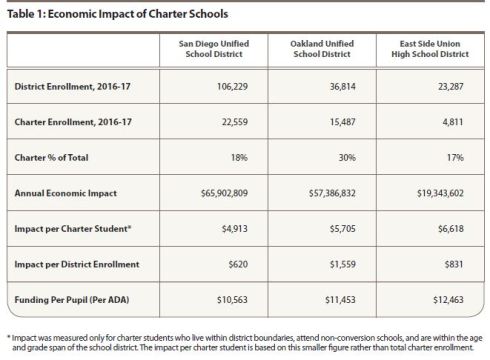
There probably are some students who benefit from charter schools, but that benefit means students in public school lose. The state attendance money follows the student to the charter school, but the costs don’t all go along. Professor Lafer’s study shows that the lasting impact per student is almost $5,000 dollars or more. In April, Hellen Ladd and John Singleton of Duke University presented a paper documenting similar outcomes in North Carolina. A study at Syracuse University by Robert Bifulco and Randall Reback also reported similar results in New York.

The following chart from Professor Lafer’s report presents the documented impacts experienced by three California school districts including San Diego Unified.

Cost of losing charter students

This chart says that every time a student in San Diego leaves the district there are less per-student resources available for those who remain. It costs more to finance two systems, plus many inefficiencies are introduced.

Isn’t CCSA a Political Organization Representing Wealth Elites and Charter School Operators Supporting School Privatization?

Mr. Barratte, you explained in your message, “They [charter schools] are authorized by school districts, county offices of education, or the state and are accountable to them, their parents and students.”

To address this statement, let me first introduce Carol Burris who retired from an award-winning career as a New York school administrator. She is the Executive Director of the Network for Public Education (NPE), a coalition of teachers, parents and students working to preserve public education in America. Burris conducted a yearlong study of the California Charter School Industry and last year, published a lengthy report called Charters and Consequences. She noted,

“CCSA does not disclose its funders on its website nor on its 990 form, but given its Board of Directors, who makes the list of big donors is not difficult to guess.

 “The 2017 Board of Directors include New York’s DFER founder, Joe Williams, a director of the Walton Education Coalition; Gregory McGinty, the Executive Director of Policy for the Broad Foundation; Neerav Kingsland, the CEO of the Hastings Fund; and Christopher Nelson, the Managing Director of the Doris & Donald Fisher Fund. Prior Board members include Reed Hastings of Netflix and Carrie Walton Penner, heir to the Walmart fortune.

 “The real power, however, sits in CCSA’s related organization, CCSA Advocates, a not-for-profit 501(c)(4) whose mission is to increase the political clout of charter schools on local school boards, on county boards, and in Sacramento. It is at all three levels that charters can be authorized in the state.”

In 2016, CCSA Advocates changed the nature of the San Diego county board of education elections by pouring hundreds of thousands of dollars into it. Previously it was a low-profile election in which local education professionals with small campaign budgets ran for seats on the board. CCSA succeeded in replacing two board members that they viewed as unfriendly to charter schools.

Now, CCSA Advocates is putting $162,000 behind Eric Lund’s bid to unseat incumbent Alicia Munoz and sending another $162,000 to support Cheryl James-Ward over incumbent Rick Shea. James-Ward is a charter school advocate and wife of ex-San Diego County Superintendent of Schools Randy Ward who trained at the infamous Broad academy. Like many Broad trained administrators, Ward is facing legal issues over money he awarded himself while in the Superintendent’s position.

The San Diego Union ran an issues piece in which Lund and Munoz answered a set of identical questions. The charter schools question read,

“The County Office of Education has been caught up in disputes over charter school authorizations, with some arguing that it has been hostile to applications at the behest of teachers unions which oppose charters. How do you think the county office has handled this issue?”

The CCSA supported candidate, Eric Lund, replied,

“Special-interest teachers unions are engaged in a full assault on great education in our county. They favor teachers before our kids by not assessing fairly each school that comes before the county Board of Education.

 “Past votes related to public charter schools have been directly along the lines of board members supported by unions. This demonstrates that special-interest teachers unions are controlling the board to block charter schools throughout San Diego. This is not in the interest of, or good for, our families and children.”

 Did Lund really say that teachers are against great education? Wow!

Munoz answered,

“A significant responsibility of County Boards of Education is to hold hearings on charter school appeals that have previously been denied by local school districts. The County Board of Education is not hostile to charter schools. In the last four years, the county board has approved one countywide charter application and three appeals. In addition, the board upheld one revocation and denied three appeals.

“The Education Code clearly spells out the criteria County Boards of Education must consider when deciding whether to approve or deny a charter school appeal. To arrive at an informed decision, the board relies on staff recommendations that are derived from hundreds of hours of work reviewing applications and evaluates each appeal based on educational and financial obligations. As public elected officials, board members have the fiduciary duty to protect the county office from financial liabilities, which is an important consideration in the appeal process.”

Does CCSA want rubber stamps for charter schools serving on school boards? It looks that way. Someone looking to protect children and the tax paying public is not appreciated. CCSA will spend hundreds of thousands of dollars to get rid of them.

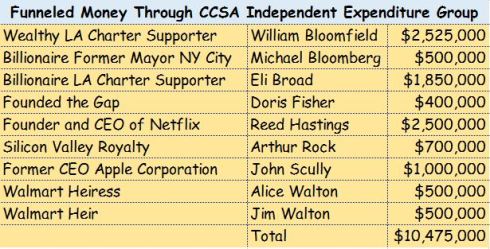
Burris reporting about CCSA money said, “Although it is a membership organization, only $1.6 million dollars came from charter school dues.” The rest of the greater than $22 million came from deep pockets (2014 data). When it comes to the California Charter School Association Advocates, the contributions can be verified and are jaw dropping. Since January 2017, nine people have donated more than $10 million dollars to CCSA Advocates and that is just the ones I found in a few hours poking around the state of California major donors data base.

Table of Billionaire Contributions

Nine Wealthy Elites Not from San Diego Who Powerfully Influence Local Elections

While poking around, I noticed that Reed Hastings contributed $2,000 to San Diego Assembly Women Shirley Weber. The note accompanying the donation says, “MADE THROUGH INTERMEDIARY CCSA ADVOCATES FOR GREAT PUBLIC SCHOOLS, FPPC ID# 1392154, 2350 KERNER BLVD., SUITE 250 SAN RAFAEL, CA 94901.” Maybe this donation helps us understand why she is so opposed to teachers having job protections such as due process and seniority rights.

One of the charter authorization appeals that county school board turned down was from College Preparatory Middle School (CPMS). The school in a church basement that was authorized by Steve Van Zant and the Mountain Empire School District. In 2016, Van Zant pleaded guilty to felony charges related to kickbacks. Concurrently the local school district went to court to stop satellite districts like Mountain Empire from authorizing schools out of their own district and won.

CCSA spent more than $70 thousand dollars defending CPMS. In a related case you defended the Van Zant style out-of-district charter authorizations saying, “This ruling will also impact students and parents who attend the resource centers by requiring them to travel longer distances or change programs, in some cases.”

At the same time this charter school scandal was occurring, CPMS was proposing a new school site with a suspicious sounding real estate plan. The San Diego Union explained,

“Under the financial arrangement, a Utah charter school developer and a Delaware subsidiary of a real estate trust headquartered in Missouri would finance the project with millions of California education dollars. College Prep would lease the new campus from the financiers for more than $620,000 a year, or 9.5 percent of the project cost. The charter could buy the campus after five years for 125 percent of the projected $6.8 million cost of the project.”

When seeking a new authorization authority to replace Mountain Empire School district, CPMS was rejected by the La Mesa-Spring Valley school district. It appealed to the county, but staff at the county concluded the proposal was not sound. The County Board of Education turned down the appeal. In March the San Diego Union reported that the California state board of education had authorized the CPMS charter by a vote of 9 to 2.

The Union Tribune report continued,

“School co-founder Mitch Miller said the next step for College Prep is building a larger school on land at 10269 Madrid Way in Spring Valley.

“Miller said construction would take about nine months, with the hope the school would open in January 2019 or shortly thereafter. The school will stay housed in La Mesa until the Spring Valley campus is ready.”

The charter school authorization process with multiple levels of authorization does not offer real protection, supervision or accountability for charter schools. I think we need a moratorium on charter schools while we put them all under the supervision of an elected school board. Only locally elected school boards should be allowed to authorize charter schools and they should operate under the rules of public entities supported by tax dollars.

Mr. Baratte, I see that you are on the board of a newly minted charter school in Linda Vista. You did not make the list of the top ten compensated employees at CCSA; all receiving more than $150,000 per year. However, you are doing well enough to donate $1,000 yearly to the Voice of San Diego. When a person’s large income is at stake, convincing them that what they are doing is wrong is not easy, but destroying public education in America is wrong. And that is what the charter industry is doing.

Democracy’s Schools: A Good Read

21 May

By Thomas Ultican 5/21/2018

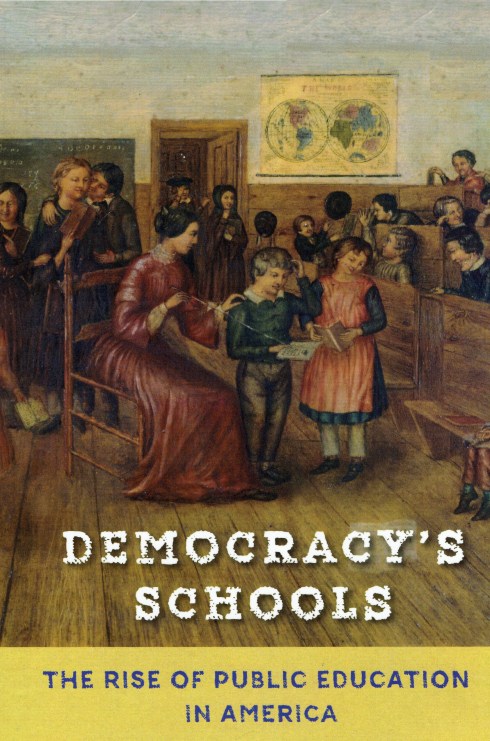
The unprecedented development of a pan American public education system arose between the end of the Revolutionary War and the beginning of the Civil War. In Democracy’s Schools, Johann Neem explains the origins of the egalitarian spirit manifested in the uniquely American system, the system’s rapid development from the bottom up and he presents evidence about ideological debates that are still unresolved in the twenty-first century. These explanations are informed by impressive scholarship.

Cover Photo_05192018

The Cover Art for Democracy’s Schools Employs Charles Frederick Bosworth’s Oil on Wood Painting, “The New England School” (ca. 1852)

Massachusetts philosopher and Unitarian church minister, William Ellery Channing, had a profound influence on egalitarianism in public education. He believed that within each person were “germs and promises of growth to which no bounds can be set.” Everyone was seen as inherently equal and deserving of education that develops the capacity for creating “self-culture.” Neem paraphrases Channing, “To educate some for work and others to appreciate beauty was to commit a crime against human nature.”

Neem states, “Nobody made the case for self-culture more strongly than Horace Mann.” Mann trained as a lawyer after graduating from Brown University. “In contrast to Democrats like Andrew Jackson, Whigs like Mann believed that the state had an obligation to improve individuals and society by developing their moral, intellectual, and economic potential.”

Mann’s wife of two years died in 1832. His deep depression caused good friend Elizbeth Peabody to introduce him to Reverend Channing. The reverend had a profound influence on Mann’s understanding of education. When Massachusetts established a board of education in 1837, Mann became its first secretary.

The establishment of public high schools exposed deeply held difference about education. The common schools which educated through the equivalent of middle school were rapidly embraced. With Mann leading the charge, they were adopted in one community after another. However, many Americans did not trust reformers calling for the establishment of public high schools. They wondered if higher education wasn’t just a way to justify elite privilege.

To reformers, public high schools would expose the most talented children to the kind of education that had been the exclusive heritage of the wealthy. However, their arguments did not prevail, and the public high school development advanced slowly. Neem reports, “by 1890, only 6.7 percent of fourteen- to seventeen-year-olds were enrolled.”

Writing about the “overlapping consensus” for public education, Neem says,

“Since its inception, American public education has served many masters. It sought to educate citizens, to promote self-culture, and simultaneously to prepare people for success in the workplace. The public schools reflected the complicated aspirations of policy makers, education reformers, citizens, parents, teachers, and students. In America, schools benefited from an overlapping consensus in which the various stakeholders did not always agree on why schools existed but agreed that they ought to exist. This overlapping consensus fueled the dramatic growth in public school enrollment between the Revolutionary and Civil War.

“But since Americans did not always agree on the purposes of education, public schools also generated intense political conflicts. Perhaps for most Americans, schools were practical institutions. They gave young children basic skills, reinforced the community’s morals, and prepared them to be citizens and productive members of society. But to reformers, public schools would also elevate the human spirit. To do that, the following chapters argue, reformers sought to transform the content of curriculum and how teachers taught and ultimately, to make public schools free and universal.”

Jackson to Trump 200 Years; Same Dynamic

I agree with Newt Gingrich (a politician named after a salamander), the first Democratic President, Andrew Jackson, and today’s insurgent Republican President, Donald Trump, have commonality. In 1828, Jackson, one of the largest slave owners in Tennessee, became the champion of the common man against elites. In 2016, Trump, the wealthy New York real estate developer, cultivated the aura of a champion of the common people fighting against elite privilege.

In 1818, education reformers were pushing for liberal education for all free children. University of North Carolina President, Joseph Caldwell worried that many Americans had “become avowed partizans of mental darkness against light” who were “glorying in ignorance.” Jackson’s supporters did not trust elites and thought classical liberal education was old fashioned and elitist. They wanted just the basics of reading, writing and mathematics. These sentiments and concerns are still heard today.

Channing taught that the purpose of education was to develop human beings in God’s image. His protégé, Horace Mann, was attracted to the new “science” of phrenology. Phrenology conceived of the brain as malleable which gave Mann added confidence concerning the value of universal education. In some ways, today’s standards and testing are the modern equivalent of phrenology; uninformed, potentially harmful yet a policy guide.

An enduring tenant of American public education was championed by Ohio’s superintendent of schools. He argued that both girls and boys were endowed with the faculties “of memory, of reason, of conscience, of imagination, and of will” therefore, school must ensure “all of these are to be developed” in both sexes.

It was widely believed that self-control was the key for education to cultivate the best within us. “Otherwise, people would not be free, or self-made, but remain an unformed bundle of impulses with no ability to resist immediate temptation.” There were to be no excuses. Discipline was the precondition to freedom and a key purpose of education.

The first development in a new American community was invariably the establishment of a school. Community members naturally accepted that their religious beliefs would be reinforced at school. Neem described the understanding, “A good education required shaping character, and this required religion.” However, efforts to accommodate all faiths meant eliminating those ideas that were not common. The American Sunday School Union questioned the public schools’ determination “To Diffuse Knowledge without Religion.”

In a heated debate with Frederick Packard, American Sunday School Union Corresponding Secretary, Horace Mann upheld non-sectarianism. Packard responded that Mann’s non-sectarianism reflected the sectarian principles of his own Unitarian church.

Neem shares, “The Sunday school movement emerged in order to ensure that young Americans would receive the religious education that they did not get in common schools.”

The belief that Christianity belongs in the public education curriculum is still strongly    embraced by some sectors of today’s pluralistic society*. In 2001, Dick and Betsy DeVos answered questions for the Gathering where Dick complained that church has retreated from its central role in communities and has been replaced by the public school. He said it is our hope “churches will get more and more active and engaged in education.”

*Betsy DeVos while channeling Margret Thatcher claimed there in no such thing as society.

Development and Pedagogy

There was a divide between those who supported the reformers’ programs and those who wanted just the basics of reading and cyphering. Better-off farmers were generally in favor of liberal education including studying the classics. Poorer citizens had a tendency to embrace the less costly and more practical basics only. Neem reports, “Because of their political power and the way the tax burden fell largely upon them, slaveholding elites spread an antitax gospel to convince ordinary whites that taxes were a bad thing.” Today that same gospel is advocated by wealthy elites in America’s two major political parties with a more determined effort coming from conservative funders. (emphasis added)

America’s schools were a battlefield. Violence was used as both a method of discipline and motivation. Lessons were almost exclusively memorization and regurgitation. If the recitation was incorrect students were regularly struck across the cheek, ear or bottom. Students often had their hands struck harshly and repeatedly for minor infractions. Harsh discipline combined with drill and skill pedagogy is still practiced in modern “no excuses” charter schools.

Reformers were convinced that authoritarian pedagogy was ineffectual. They started looking to innovations in Europe for guidance. As early as 1817, Archibald Murphey of North Carolina was informing the state legislature about new approaches to education in Europe. In 1819, a New York school teacher, John Griscom, published A Year in Europe. Both Murphey and Griscom praised the schools of Prussia and the Swiss educator, Johann Pestalozzi.

In 1843, Horace Mann married Mary Peabody and for their honeymoon they toured schools in Europe. Mann recognized that schools in democracies could not promote “passive obedience to government, or of blind adherence to the articles of a church.” On the other hand, he was enamored by the organization of the Prussian schools. Schools were divided into age-based grades to facilitate age appropriate pedagogy. Most of all Mann was impressed by the teachers of Prussia. He called for improvement in the status of the teaching profession in Massachusetts and improvement in training.

A popular alternative to the Prussian model and Pestalozzi’s views on pedagogy was Lancasterianism named for its originator, Joseph Lancaster. Neem explains the popularity of Lancaster’s approach,

“This approach had several advantages. First, it was cheap because Lancaster relied on older students to teach. Second, some considered Lancaster’s emphasis on repetition and competition to be effective. In groups of ten or twelve, led by a monitor, students drilled in reading, spelling, or arithmetic. Each day, every student was ranked publicly, motivating students to excel or, at least, to avoid embarrassment. Students received “merit tickets” for behavior and performance.”

Mann worried that Lancasterianism taught students to compete for external rewards and glory instead of developing appropriate moral character. He felt the system deprived students the benefit of a qualified well-prepared teacher. Mann wrote, “One must see the difference between the hampering, binding, misleading instruction given by an inexperienced child, and the developing, transforming, and almost creative power of an accomplished teacher.” Reminds one of Texas businessmen paying cash rewards to students for passing AP exams, the push for scripted education and Teach for America.

Mann was so taken by his European experience, that he wrote in official reports of the inspiring, engaging, loving classrooms he observed in Prussia. Boston’s schoolmasters replied that education “amateurs” like Mann rarely cared about what actual teachers might think. Neem notes, “The teachers felt insulted by Mann’s tone, which suggested that Prussia’s teachers were doing great things while back at home every teacher was incompetent.”

Reformers believed that by tapping into children’s curiosity and interest they would become independent learners. Experienced teachers knew that students also needed discipline, or they would only engage in what they liked. Educators felt that though nice to appeal to children’s moral sense still “Massachusetts was not some prelapsarian Eden.”

Maybe the blindness to practical classroom reality explains some of Bill Gates’s serial education reform failures.

Charter Schools and America’s Curriculum

After the Revolutionary War, states recognized the need for an educated citizenry and schools, but they lacked the capacity to develop and fund public education. Concurrent with building public schools, state governments also encouraged citizens to create charter schools called academies. By 1855 there were more than 6,000 of these state-chartered schools operating compared to almost 81,000 common schools. Neem observed,

“But American leaders ultimately concluded that academies were unable to meet the nation’s need for an educated public and worse, that they exacerbated the division between the haves and have-nots. In the post-Revolutionary era, Massachusetts governor Samuel Adams asserted that academies increase inequality because well-off families who sent their children to academies would be less willing to pay taxes for the state’s common schools. ‘Citizens,’ Adams argued, ‘will never willingly and cheerfully support two systems of schools.’”

So, charter schools were not an invention of Ray Budd in a 1970’s paper. They had existed since the time of the American Revolution, however, nineteenth century politicians and reformers concluded they were not a good fit for democratically sponsored education.

Reverend William Holmes McGuffey was a stern task master in the classroom. He expected good behavior and would tolerate nothing less. He also disliked rote memorization and recitation pedagogy. In the 1820’s, McGuffey wrote the first edition of his reader. Its readings were laced with moral lessons and Biblical verses. It taught a protestant ethic. Between 1836 and 1920, the reader sold as many as 122 million copies and most of these copies were used by several students. It has been said that McGuffey was responsible for “making the American mind.”

In post-revolutionary war America, large numbers of Catholic Immigrants arrived, and they did not like the anti-Catholic lessons taught in common schools. Protestants viewed Catholics as antidemocratic because of their allegiance to the Pope who opposed democratic reform in Europe. Catholics did not want their children abused in common schools. They started developing their own school system and wanted government support for their schools. This was just one of multiple pressure points creating the “Bible wars.”

The fight over religion in school became so intense that in 1876 President Ulysses S. Grant declared:

‘“Leave the matter of religion to the family altar, the church, and the private school, supported entirely by private contributions. … Keep the church and state forever separate. With these safeguards I believe the battles which created the Army of Tennessee will not have been fought in vain.”

I have touched lightly on just a few of the early developments in public education chronicled in great depth by Neem. My main take away from this read is that in developing universal free public education in America the foundation for democracy was forged. That foundation is under attack today. Read this book and you will deepen and reinforce your own need to protect America’s public schools.

Newest Existential Threat to Oakland’s Public Schools

10 May

By T. Ultican 5/10/2018

A “Systems of Schools” plan has been introduced by the destroy public education (DPE) forces in Oakland, California. The plan basically posits that with 30 percent of students in charter schools, the system has become inefficient. Therefore, the school board needs to review resources and close schools in areas with too many seats and overlapping programs.

However, since Oakland’s school board has no authority over charter schools it is only public schools that can be closed or downsized unless charter schools voluntarily cooperate.

Continuing the Big Lie

A memorable line from “A Nation at Risk” reads,

“If an unfriendly foreign power had attempted to impose on America the mediocre educational performance that exists today, we might well have viewed it as an act of war. As it stands, we have allowed this to happen to ourselves.”

Yesterday (May 7, 2018) Steve Hinnefeld writing about this report for the blog School Matters noted,

“As Anya Kamenetz of NPR reported recently, its authors were sure the education system needed change and set out to create a report that justified what they thought. Remarkably, they cited falling SAT scores as evidence of decline – at a time when many more college-bound students were taking the test, leading to lower average scores.

“The authors ‘were hell-bent on proving that schools were bad,’ Lynn University professor James Guthrie told Kamenetz. ‘They cooked the books to get what they wanted.’

“A 1990 report produced by the Energy Department’s Sandia National Laboratories broke down the flaws in the “A Nation at Risk” analysis but got little attention.

 ‘“It was great stuff,’ Golarz [former Indiana school administrator] said. ‘I remember, when it came out, thinking, ‘Finally, somebody’s unraveled this damn thing and showed all the flaws.’ But nobody read it.”’

“Nation at Risk” set the model for the DPE movement. Public education was so popular that to privatize it required denigrating it. Over the last 35 years, the DPE movement has developed an approach using local money in concert with national money to promote charter schools, denigrate public schools and campaign for privatization friendly policies like unified enrollment. The local money in Oakland is provided by the Rogers Family Foundation.

The article “Oakland is California’s Destroy Public Education Petri Dish” describes the Rogers Family Foundation and it relationship to GO Public Schools Oakland, Educate78 (previously New Schools Venture Fund) and the Oakland Public Education Fund. The late T. Gary Rogers foundation is like the queen bee of DPE Oakland with the other organizations carrying out various political and financial activities including spawning AstroTurf organizations.

The well-financed and robustly staffed DPE-oriented GO is leading the ground assault. 1Oakland, a GO led AstroTurf organization, bashes public schools and promotes the “Systems of Schools” legislation. The 1Oakland web-page states, “In September of 2017, GO Public Schools Oakland brought together community, family, and student leaders to launch 1Oakland, a campaign that is working for an exceptional, equitable, and sustainable education system that reflects our commitment to all Oakland students.”

On the GO web-site a statement from Boris Aguilar, a 1Oakland Leader, is accompanied by typically misleading statements denigrating Oakland Unified School District (OUSD). It claims,

“In the 1990s and early 2000s, families organized and established charter schools and small schools as alternatives to OUSD’s overcrowded, low-performing schools. These schools often times provided creative and culturally responsive curricula in contrast to OUSD’s one-size-fits-all, “teacher-proof” scripted curriculum.”  

The organizing for charter schools in Oakland did not come from local families. It came from billionaires and politicians including Bill Gates, Reed Hastings, Eli Broad, Carrie Walton-Penner, Jerry Brown and several other elites. The small-schools initiative was Bill Gates’s first big failed education reform idea. Small-schools generated many headlines like this one from the Washington Post, “How Much Bill Gates’s Disappointing Small-Schools Effort Really Cost.” The one-size-fits-all philosophy and scripted curriculum promoted by “education reformers” from the Bush and Obama administrations are far more prevalent in charter schools than public schools. When properly adjusted for poverty, OUSD testing outcomes reflect a high-quality steadily improving public school system.

Oakland Reach  is another AstroTurf organization with GO fingerprints on it. The Oakland citizens involved with this organization appear sincere and to have well-founded grievances. Unfortunately, they are being used to steal high-quality public schools from their own neighborhoods.

Oakland charter concentration and wealth maps

Oakland’s charter schools are all in the minority dominated flats with none in the wealthier Oakland hills as shown by these maps from Fordham and Maplight.

This new initiative’s  executive director, Lakisha Young, is also paid staff at GO. Sources say that some Oakland Reach leaders traveled to Memphis, Tennessee to be trained by Memphis Lift. Memphis Lift is an AstroTurf parent organization that has enough money to pay $15 an hour for parent “volunteers” to knock on doors. Teach for America promotes Memphis list on their web site.

The new message by these organizations is “we only want quality education and don’t care whether it comes from charter schools or public schools. People in our neighborhoods deserve to choose what is right for their children and grandchildren. ‘System of Schools’ will enable managing our portfolio of schools more efficiently.” A public school advocate, Jane Nylund commented, “Essentially, the campaign is designed to embrace what I would call a Kumbaya moment; a way to deal with what CRPE calls ‘toxic local politics.”’

CRPE is the Bill Gates financed Center for Reinventing Public Education on the campus at the University of Washington. CRPE is leading the charge for portfolio districts which means managing a portfolio of schools like a stock portfolio; close the losers and open new schools. This theory ignores the well-known damage that instability causes students; especially those living in poverty.

The article “Education Cities is the National Organizer for the Destroy Public Education (DPE) Movement” relates how this national umbrella organization is providing leadership for privatizing public education across America. A recent Education Cities update says,

“Educate78 has started an #OUSDBudget blog series to delve into the Oakland Unified School District budget crisis. Most recently, the series has been tackling the question of whether Oakland has too many schools.  Educate78 is also excited to celebrate the launch of two initiatives from one of its major grantees, GO Public Schools. The new  Oakland REACH , a parent-led advocacy group and  1Oakland  –  a community-driven campaign  working with educators and elected officials to advocate for  policies that promote partnership and creatively re-design the school system in service of all students.”

The Citizens United Decision Effect on Oakland’s Schools

John Dunbar writing for Public Integrity explained,

“The Citizens United ruling, released in January 2010, tossed out the corporate and union ban on making independent expenditures and financing electioneering communications. It gave corporations and unions the green light to spend unlimited sums on ads and other political tools, calling for the election or defeat of individual candidates.

 “In a nutshell, the high court’s 5-4 decision said that it is OK for corporations and labor unions to spend as much as they want to convince people to vote for or against a candidate.”

The first year that the Citizens United ruling effected Oakland’s school board election was 2012. It is now apparent that corporations and the billionaires who control them have a lot more money than labor unions or anyone else. James Harris, who proposed the “System of Schools” legislation, was the only 2012 challenger to unseat an incumbent. Reporting on that election, the East Bay Times said,

“This year’s school board elections have involved vigorous campaigning and far more money than usual — and, unlike recent election years, all four races were contested.

 “GO Public Schools, a group of parents, teachers and community members that formed in 2008, is more charter school-friendly than the union’s leaders, and it has promoted changes to traditional union staffing rules, which the union has opposed. The GO Public Schools PAC has received three large donations of $49,000 or more, including — most recently — the California Charter Schools Association, bringing its fundraising total to nearly $185,000.

 “The group threw its weight behind Hinton Hodge, Torres and Harris, mostly through independent expenditures and the organizing of volunteers. By contrast, the Oakland teachers union PAC, which is backing Pecot, Fuentes and Hutchinson, expected to raise about $20,000.”

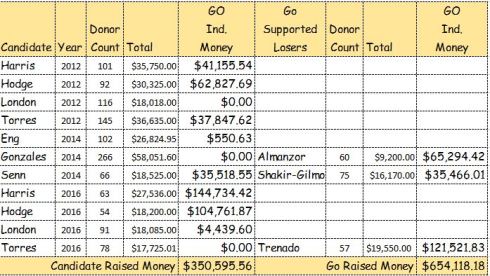
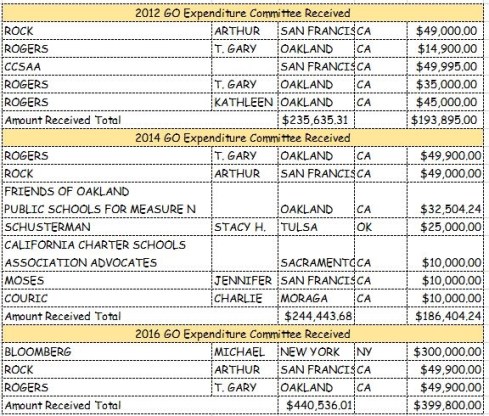
The big money from billionaires was mostly funneled through Great Oakland Public Schools which is GO’s independent expenditure committee registered under tax code 501 C4. The following tables are based on data from the City of Oakland Public Ethics Commission.

Go Expenditure Committee Table 2

In 2012, the support of GO helped Harris defeat incumbent board member Spearman in a close race. In addition, several well-known wealthy people gave maximum contributions to Harris, Hodge and Torres.

2012 Harris, Hodge and Torres
Received Max $700 Contributions from
Bloomberg Michael New York NY
Bradley Katherine Washington DC
Penner Greg Atherton CA
Rock Arthur San Francisco CA
GO-PAC Sponsored Oakland CA
Tepper David Short Hills NJ
Fournier Alan Far Hills NJ
Fournier Jennifer Far Hills NJ

Michael Bloomberg is the famous billionaire and former mayor of New York city. Katherine Bradley was the publisher of the Washington Post. Laurene Jobs Powell was Apple founder, Steve Jobs, wife. Stacy Schusterman inherited the Schusterman fortune and runs the $2-billion Schusterman Family Foundation. Greg Penner married into Walmart money. His wife Carrie is one of the richest women in the world. Arthur Rock is Silicon Valley royalty. He had a hand in founding several famous companies including Intel. David Tepper is a billionaire hedge fund manager from New Jersey as is Alan Fournier.

Go Expenditure Committee Table

The table above is of money contributed by a few wealthy elites compared to the total that GO’s independent expenditure committee recieved.

In 2016 Go spent a quarter of a million dollars to insure Harris and Hodge stayed on the board. In 2012 they had freely spent to elect Roseann Torres to the board, but in 2016 they spent $121,000 failing to have her unseated. Go has verbally supported London and Eng but provided them with little actual support. Go spent $65,000 to oppose Shanthi Gonzales.

The Board Discussed “Systems of Schools”

Board member James Harris proposed the “Systems of Schools” legislation. At the April 25th Board meeting, he said that Oakland had too many district and charter school programs. Because Oakland is the first California city to reach 30% charter penetration, he claimed Oakland had a unique need for his “Systems of Schools” plan. He rebutted the idea that the plan cannot work because the state law does not give the Board any power over charter schools. He compared that to accepting segregation and not taking any action just because it goes against unjust laws.

Board Vice President Jamoke Hinton-Hodge said she likes the “Systems of Schools” concept and that she was for charter schools because “traditional schools haven’t served black people well.” She also called for unity saying that GO, Oakland Education Association and “Diane Ravitch’s funded organization” need to find a way to work together.

I am guessing that Diane Ravitch is surprised to learn that she is funding an organization.

Director Roseann Torres said she did not see how “Systems of Schools” could work. She asked, “How do we enforce something if charters don’t come to the table?” She also noted that she was getting “100’s of emails” opposing the plan.

Board members Eng, London and Senn were non-committal but they all called for dialog and encouraged VP Hodge, Director Harris and Director Shanthi Gonzalez to sit down together and try to find some points of agreement.

I attended a presentation given by Shanthi Gonzales last fall and was favorably impressed. I wrote asking for her opinion. She was forthcoming and unambiguous. Her email response said,

“Director Harris is not wrong that there are areas in which we need to work together more, and special ed is the major one. As a result of the consistent dumping of high-needs students, we have a seriously unsustainable situation in OUSD, which is one of the drivers of our current budget crisis.

“But there is nothing stopping charter schools from ceasing their discriminating against SPED and high-needs students; they do not need a policy to do what they are legally required to do. The real goal is access to one of our parcel taxes, Measure G, and for us to kick OUSD students out of their own buildings to make more space for their students (they don’t like the split-site offers that we are legally forced to provide because we don’t have any more vacant sites).

 “A recent report from GO, the main supporters of this policy, found that OUSD spends $1400 on average more per student than charter schools in Oakland do, and they see that as unfair. Given that the same report also found that we have more SPED students, with more severe learning differences, and the students with the most severe academic challenges, it seems entirely appropriate to me that we would have more funding per student – serving higher needs students is expensive.

 “Until there is evidence to demonstrate what charters are saying, that they want to serve students more equitably, I do not see a need for this policy. Charter schools can simply do what they are legally required to do until they have evidence to demonstrate that they are serving students equitably. Then we can talk about a system of schools.

 “That is how I see it.”

Gordon Lafer, Ph.D., University of Oregon Labor and Education Researcher, has written a startling new paper for In the Public Interest called Breaking Point: The Cost of Charter Schools for Public School Districts. One of the tables in the paper demonstrates the special education issue Director Gonzales mentioned.

Oakland Special Education funding

This graphic shows how Oakland’s charter schools not only take fewer special education students but avoid high cost students leaving them to district schools.

Professor Lafer documents the debilitating costs for public schools caused by charter school expansion. Costs for which they cannot easily adjust. He reports,

“In a first-of-its-kind analysis, this report reveals that neighborhood public school students in three California school districts are bearing the cost of the unchecked expansion of privately managed charter schools. In 2016-17, charter schools led to a net fiscal shortfall of $57.3 million for the Oakland Unified School District, $65.9 million for the San Diego Unified School District, and $19.3 million for Santa Clara County’s East Side Union High School District.”

Oakland may be close to losing their public schools but cities like San Diego and Los Angeles are not far behind. We desperately need a charter school moratorium and for all publicly financed schools to be put under elected board control.

Newest Existential Threat to Oakland’s Public Schools

10 May

A “Systems of Schools” plan has been introduced by the destroy public education (DPE) forces in Oakland, California. The plan basically posits that with 30 percent of students in charter schools, the system has become inefficient. Therefore, the school board needs to review resources and close schools in areas with too many seats and overlapping programs.

However, since Oakland’s school board has no authority over charter schools it is only public schools that can be closed or downsized unless charter school voluntarily cooperate.

Continuing the Big Lie

A memorable line from “A Nation at Risk” reads, “If an unfriendly foreign power had attempted to impose on America the mediocre educational performance that exists today, we might well have viewed it as an act of war. As it stands, we have allowed this to happen to ourselves.”

Yesterday (May 7, 2018) Steve Hinnefeld writing about this report for the blog School Matters noted,

“As Anya Kamenetz of NPR reported recently, its authors were sure the education system needed change and set out to create a report that justified what they thought. Remarkably, they cited falling SAT scores as evidence of decline – at a time when many more college-bound students were taking the test, leading to lower average scores.

 “The authors ‘were hell-bent on proving that schools were bad,’ Lynn University professor James Guthrie told Kamenetz. ‘They cooked the books to get what they wanted.’

“A 1990 report produced by the Energy Department’s Sandia National Laboratories broke down the flaws in the ‘A Nation at Risk’ analysis but got little attention.

 ‘“It was great stuff,’ Golarz [former Indiana school administrator] said. ‘I remember, when it came out, thinking, ‘Finally, somebody’s unraveled this damn thing and showed all the flaws.’ But nobody read it.”’

“Nation at Risk” set the model for the DPE movement. Public education was so popular that to privatize it required denigrating it. Over the last 35 years, a model for the DPE movement required local money to unite with national money to promote charter schools, denigrate public schools and campaign for privatization friendly policies including unified enrollment. The local money in Oakland is the Rogers Family Foundation.

The article “Oakland is California’s Destroy Public Education Petri Dish” describes the Rogers Family Foundation and it relationship to GO Public Schools Oakland, Educate78 (previously New Schools Venture Fund) and the Oakland Public Education Fund. The late T. Gary Rogers foundation is like the queen bee of DPE Oakland with the other organizations carrying out various political and financial activities including spawning AstroTurf organizations.

The well-financed and robustly staffed DPE oriented GO is leading on the ground in Oakland. 1Oakland is a GO led AstroTurf organizations bashing public schools. The 1Oakland web-page states, “In September of 2017, GO Public Schools Oakland brought together community, family, and student leaders to launch 1Oakland, a campaign that is working for an exceptional, equitable, and sustainable education system that reflects our commitment to all Oakland students.” 1Oakland has two visible purposes; (1) promote the “Systems of Schools” plan and (2) bash Oakland public schools.

A statement from Boris Aguilar, a 1Oakland Leader, is accompanied by a misleading denigration of Oakland Unified School District (OUSD). It claims,

“In the 1990s and early 2000s, families organized and established charter schools and small schools as alternatives to OUSD’s overcrowded, low-performing schools. These schools often times provided creative and culturally responsive curricula in contrast to OUSD’s one-size-fits-all, “teacher-proof” scripted curriculum.”  

The organizing for charter schools in Oakland did not come from local families. It came from billionaires including Bill Gates, Reed Hastings, Eli Broad, Carrie Walton-Penner and several others. The small-schools initiative was Bill Gates’s first big failed education reform idea. Small-schools generated many headlines like this one from the Washington Post, “How Much Bill Gates’s Disappointing Small-Schools Effort Really Cost.” The one-size-fits-all philosophy and scripted curriculum promoted by “education reformers” from the Bush and Obama administrations are far more prevalent in charter schools than public schools. When properly adjusted for poverty, OUSD testing outcomes reflect a high-quality improving organization.

Another AstroTurf organizations with GO fingerprints on it is Oakland Reach. The Oakland citizens involved with this organization appear sincere and to have well-founded grievances. Unfortunately, they are being used to steal high-quality public schools from their own neighborhoods.

This new initiative has an executive director, Lakisha Young, who is also paid staff at GO. Sources say that some Oakland Reach leaders traveled to Memphis, Tennessee to be trained by Memphis Lift. Memphis Lift is an AstroTurf parent organization that has enough money to pay $15 an hour for parents to knock on doors. Teach for America promotes Memphis list on their web site.

The new message from these organizations is “we only want quality education and don’t care whether it comes from charter schools or public schools. People in our neighborhoods deserve to choose what is right for their children and grandchildren. ‘System of Schools’ will enable managing our portfolio of schools more efficiently.” A public school advocate, Jane Nylund commented, “Essentially, the campaign is designed to embrace what I would call a Kumbaya moment; a way to deal with what CRPE calls ‘toxic local politics.”’

CRPE is the Bill Gates financed Center for Reinventing Public Education on the campus at the University of Washington. CRPE is leading the charge for portfolio districts which means managing a portfolio of schools like a stock portfolio; close the losers and open new schools. This theory ignores the well-known damage that instability causes students; especially those living in poverty.

The article “Education Cities is the National Organizer for the Destroy Public Education (DPE) Movement” relates how this national umbrella organization is providing leadership for privatizing public education across America. A recent Education Cities update says,

“Educate78 has started an #OUSDBudget blog series to delve into the Oakland Unified School District budget crisis. Most recently, the series has been tackling the question of whether Oakland has too many schools.  Educate78 is also excited to celebrate the launch of two initiatives from one of its major grantees, GO Public Schools. The new  Oakland REACH , a parent-led advocacy group and  1Oakland  –  a community-driven campaign  working with educators and elected officials to advocate for  policies that promote partnership and creatively re-design the school system in service of all students.”

The Citizens United Decision Effect on Oakland’s Schools

John Dunbar writing for Public Integrity explained,

“The Citizens United ruling, released in January 2010, tossed out the corporate and union ban on making independent expenditures and financing electioneering communications. It gave corporations and unions the green light to spend unlimited sums on ads and other political tools, calling for the election or defeat of individual candidates.

 “In a nutshell, the high court’s 5-4 decision said that it is OK for corporations and labor unions to spend as much as they want to convince people to vote for or against a candidate.”

The first year that the Citizens United ruling effected Oakland’s school board election was 2012. It is now apparent that corporations and the billionaires who control them have a lot more money than labor unions or anyone else. James Harris, who proposed the “Systems of Schools” Legislation, was the only 2012 challenger to unseated an incumbent. Reporting on the 2012 election, the East Bay Times said,

“This year’s school board elections have involved vigorous campaigning and far more money than usual — and, unlike recent election years, all four races were contested.

 “GO Public Schools, a group of parents, teachers and community members that formed in 2008, is more charter school-friendly than the union’s leaders, and it has promoted changes to traditional union staffing rules, which the union has opposed. The GO Public Schools PAC has received three large donations of $49,000 or more, including — most recently — the California Charter Schools Association, bringing its fundraising total to nearly $185,000.

 “The group threw its weight behind Hinton Hodge, Torres and Harris, mostly through independent expenditures and the organizing of volunteers. By contrast, the Oakland teachers union PAC, which is backing Pecot, Fuentes and Hutchinson, expected to raise about $20,000.”

The big money from billionaires was mostly funneled through Great Oakland Public Schools which is GO’s independent expenditure committee registered under tax code 501 C4. The following tables are based on data from the City of Oakland Public Ethics Commission.

Candidate Year Donor
Count
Total

Raised

GO
Ind.
Money
Go
Supported
Losers
Donor
Count
Total

Raised

GO
Ind.
Money
Harris 2012 101 $35,750 $41,155        
Hodge 2012 92 $30,325 $62,827        
London 2012 116 $18,018 $0        
Torres 2012 145 $36,635 $37,847        
Eng 2014 102 $26,824 $550        
Gonzales 2014 266 $58,051 $0 Almanzor 60 $9,200 $65,294
Senn 2014 66 $18,525 $35,518 Shakir-Gilmore 75 $16,170 $35,466
Harris 2016 63 $27,536 $144,734        
Hodge 2016 54 $18,200 $104,761        
London 2016 91 $18,085 $4,439        
Torres 2016 78 $17,725 $0 Trenado 57 $19,550 $121,521
Candidate Raised Money $350,595 Go Raised Money $654,118

In 2012, the support of GO helped Harris defeat incumbent board member Spearman in a close race. In addition, several well-known wealthy people gave maximum contributions to Harris, Hodge and Torres.


2012 Harris, Hodge and Torres
Received Max $700 Contributions from
Bloomberg Michael New York NY
Bradley Katherine Washington DC
Penner Greg Atherton CA
Rock Arthur San Francisco CA
GO-PAC Sponsored   Oakland CA
Tepper David Short Hills NJ
Fournier Alan Far Hills NJ
Fournier Jennifer Far Hills NJ

Michael Bloomberg is the well know billionaire and former mayor of New York city. Katherine Bradley was the publisher of the Washington Post. Laurene Jobs Powell was Apple founder, Steve Jobs, wife. Stacy Schusterman inherited the Schusterman fortune and runs the $2 billion Schusterman Family Foundation. Greg Penner married into Walmart money. His wife Carrie is one of the richest women in the world. Arthur Rock is Silicon Valley royalty. He had a hand in founding several famous companies including Intel. David Tepper is a billionaire hedge fund manager from New Jersey as is Alan Fournier.

Go Expenditure Committee Table

In 2016 Go spent a quarter of a million dollars to insure Harris and Hodge stayed on the board. In 2012 they had freely spent to elect Roseann Torres to the board, but in 2016 they spent $121,000 trying to have her unseated. Go has verbally supported London and Eng but provided them with little actual support. Go spent $65,000 to oppose Shanthi Gonzales.

The Board Discussed “Systems of Schools”

Board member James Harris proposed the “Systems of Schools” legislation. At the April 25th Board meeting, he said that Oakland had too many district and charter school programs. Because Oakland is the first California city to reach 30% charter penetration, he claimed Oakland had a unique need for “systems of schools.” He rebutted the idea that the plan cannot work because the state law does not give the Board any power over charter schools. He compared that to accepting segregation and not taking any action just because it goes against unjust laws.

Board Vice President Jamoke Hinton-Hodge said she likes the “Systems of Schools” concept and that she was for charter schools because “traditional schools haven’t served black people well.” She also called for unity saying that GO, Oakland Education Association and “Diane Ravitch’s funded organization” need to find a way to work together.

I am guessing that Diane Ravitch is surprised to learn that she is funding an organization.

Director Roseann Torres said she did not see how “Systems of Schools” could work. She asked, “How do we enforce something if charters don’t come to the table?” She also noted that she was getting “100’s of emails” opposing the plan.

Board members Eng, London and Senn were non-committal but they all called for dialog and encouraged VP Hodge, Director Harris and Director Shanthi Gonzalez to sit down together and try to find some points of agreement.

I attended a presentation given by Shanthi Gonzales in the fall and was favorably impressed. I wrote asking for her opinion. She was forthcoming and unambiguous. Her email response said,

“Director Harris is not wrong that there are areas in which we need to work together more, and special ed is the major one. As a result of the consistent dumping of high-needs students, we have a seriously unsustainable situation in OUSD, which is one of the drivers of our current budget crisis.

 “But there is nothing stopping charter schools from ceasing their discriminating against SPED and high-needs students; they do not need a policy to do what they are legally required to do. The real goal is access to one of our parcel taxes, Measure G, and for us to kick OUSD students out of their own buildings to make more space for their students (they don’t like the split-site offers that we are legally forced to provide because we don’t have any more vacant sites).

“A recent report from GO, the main supporters of this policy, found that OUSD spends $1400 on average more per student than charter schools in Oakland do, and they see that as unfair. Given that the same report also found that we have more SPED students, with more severe learning differences, and the students with the most severe academic challenges, it seems entirely appropriate to me that we would have more funding per student – serving higher needs students is expensive.

“Until there is evidence to demonstrate what charters are saying, that they want to serve students more equitably, I do not see a need for this policy. Charter schools can simply do what they are legally required to do until they have evidence to demonstrate that they are serving students equitably. Then we can talk about a system of schools.

 “That is how I see it.”

Gordon Lafer, Ph.D., University of Oregon Labor and Education Research has written a startling new paper for In the Public Interest called Breaking Point: The Cost of Charter Schools for Public School Districts. One of the tables in the paper demonstrates the special education issue Director Gonzales mentioned.

Oakland Special Education funding

This graphic shows how Oakland’s charter schools not only take less special education students but avoid high cost students leaving them to district schools.

Professor Lafer documents the debilitating costs for public schools caused by charter school expansion. He reports,

“In a first-of-its-kind analysis, this report reveals that neighborhood public school students in three California school districts are bearing the cost of the unchecked expansion of privately managed charter schools. In 2016-17, charter schools led to a net fiscal shortfall of $57.3 million for the Oakland Unified School District, $65.9 million for the San Diego Unified School District, and $19.3 million for Santa Clara County’s East Side Union High School District.”

Oakland may be close to losing their public schools but cities like San Diego and Los Angeles are not far behind. We desperately need a charter school moratorium and for all publicly financed schools to be put under elected board control.

School Transformation Without School Improvement in Atlanta’s all Charter District

1 May

Since the 2015 all charter district reforms in Atlanta, the so called “education gap” has grown significantly. This is reflected in both state and federal testing data.

I recently wrote about Superintendent Castarphen and her history of bullying staff and working to privatize public education. That post was motivated by an email from Ed Johnson providing his initial review of the just released TUDA (Trial Urban District Assessment) data from the 2017 testing cycle.

Mr. Johnson is a longtime advocate for public education. He is a native Georgian, a former NSA analyst and an expert in Deming inspired quality management. His writings have been published in many places including the Atlanta Journal-Constitution and he has been a candidate for the Atlanta Public Schools (APS) board. With his permission, I am posting his more deepened analysis of recent testing data from Atlanta.

NAEP TUDA 2017: A follow-on systemic look at Atlanta

The earlier preliminary look at NAEP TUDA (National Assessment of Educational Progress, Trial Urban District Assessment) biennial results for Atlanta Public Schools (APS; “Atlanta”) offered the immediate data story that, in recent years, since 2015, the district’s White-Black academic achievement gaps have been made unusually worse.  It was also noted that Georgia Milestones Assessment System (GMAS) annual results for Atlanta, from 2015 through 2017, coupled with Georgia Criterion-Referenced Competence Tests (CRCT) annual results for Atlanta, from 2012 through 2014, tell the same story.

Told either way, negative contributing factors in the story are implicated to be, in general, disruptive school choice as charter schools and school turnaround without school improvement.  Being driven more by ideology than pedagogy, and inclined to serve would-be oligarchs’ interests more than the public’s interests, the Atlanta Public Schools Leadership (APSL) have pressed these negative contributing factors into the district over just the past few years.  It began in 2014, with the school board hiring Meria Joel Carstarphen, Ed.D., as Atlanta superintendent.  Notably, Dr. Carstarphen once publicly proclaimed having been “trained,” presumably by her alma mater, Harvard University Graduate School of Education, to do the school turnaround work school board members wanted done.

Now by looking strictly district-level at APS, NAEP TUDA results tell a similar story of academic achievement made unusually worse since 2015.  Here, however, the story is systemic and implicates, again, school choice as charter schools and school transformation without school improvement as having detectably disrupted for the worse the district’s continuous (not to be confused with continual) upward trend since TUDA inception in each grade and subject assessed, those being 4th Grade Mathematics (4GM) and 8th Grade Mathematics (8GM), since 2003; and, 4th Grade Reading (4GR) and 8th Grade Reading (8GR), since 2002.  The “control charts” accessed in the PDF and PowerPoint links offer the story in pictures. (PowerPoint National Assessment of Educational Progress: Trial Urban District Assessment of Atlanta Public Schools through 2017, Revised.  PDF here.)

Johnson TUDA Testing Atlanta Graphic

This Fourth Grade Math Chart is an Example of TUDA Data Mr. Johnson Shared.

Johnson State Testing Atlanta Graphic

This Chart is an Example of Georgia State Testing Data Mr. Johnson Shared.

However, before going to the control charts in the PowerPoint for the story in pictures, consider the following points by W. Edwards Deming and Donald J. Wheeler (my emphasis and inserts):

“Is this chart difficult?  Patrick mastered it at age 11.  This was his science project at school.  A good start in life.  Some essential theory of variation could obviously be taught in the 5th grade.  Pupils would come out of school with knowledge in their heads, not merely information.”

—W. Edwards Deming.  The New Economics for Industry, Government, Education Second Edition (pp. 209-210).

“Figures come in, but the figures go on to charts to detect trends. The management now understand the distinction between common causes of variation, and special causes [of variation].”

—ibid. (p. 40)

“It is a mistake to suppose that the control chart furnishes a test of significance—that a point beyond a control limit is ‘significant.’  This supposition is a barricade to understanding.”

—ibid. (p. 177)

“Certain patterns of points on a control chart may also indicate a special cause.”

—ibid. (pp. 201-202)

“Before you can use data to justify any action, you must be able to detect a potential signal within the data.  Otherwise you are likely to be interpreting noise.”

—Donald J. Wheeler.  Understanding Variation: The Key to Managing Chaos Second Edition (p. 31).

After considering the story the control charts in the PowerPoint portray, one might ask: Why might Atlanta NAEP TUDA results for each of MG4, MG8, RG4, and RG8 have so suddenly shifted down for the worse in 2015 and pretty much stayed there through 2017?  And about MG8, ask: Why did it go “out of control” for the worse in 2017?

Luck, perhaps?  Certainly, one might think it was inevitable that each of the four continuous upward trends in Atlanta NAEP TUDA results, from 2002 or 2003 through 2013, would end.  After all, if one were to get six or seven heads in a row on as many flips of a coin then suddenly get tails on the very next flip, or if one were to get six or seven snake eyes in a row on as many rolls of two die then suddenly get seven on the very next roll, one might dismissively conclude: “About time.”  Or, one’s curiosity might be aroused: “Hmm.  What’s going on, here?”

Or, one might ask: What in Atlanta has been in effect since about 2015 likely to have caused the district to experience a sudden sustained shift down for the worse in each of NAEP TUDA MG4, MG8, RG4, and RG8 results?

Well, Atlanta has had school choice as charter schools and school reform without school improvement in effect since about 2015.  This being the case, the research paper Social Class and Parent-Child Relationships: An Interpretation, by Melvin L. Kohn, offers insight more rational than, it’s luck:

“We, too, found that working-class parents value obedience, neatness, and cleanliness more highly than do middle-class parents, and that middle-class parents in turn value curiosity, happiness, consideration, and—most importantly—self-control more highly than do working-class parents.  We further found that there are characteristic clusters of value choice in the two social classes: working-class parental values center on conformity to external prescriptions, middle-class parental values on self-direction.  To working-class parents, it is the overt act that matters: the child should not transgress externally imposed rules; to middle-class parents, it is the child’s motive and feelings that matter: the child should govern himself.”

Arguably, APSL’s school choice as charter schools and school turnaround without school improvement lend credence to Kohn’s research findings.  Specifically, simple observations of behavior make it clear that Harvard-trained Meria Carstarphen brought into APS with her hiring, in 2014, a way of thinking that calls for deliberately and intentionally playing on low- and working-class parents’ values of “obedience, neatness, and cleanliness” and “conformity to external prescriptions,” so as to manipulate the parents to believe and accept their children deserve training more so than education, even psychologically abusive training (i.e., operant conditioning, as developed at Harvard University).  The picture below clearly illustrates the matter.  And it is a matter that contrasts sharply with educating, more so than training, elite- and middle-class children rooted in their parents’ values of “curiosity, happiness, consideration, and … self-control” and “self-direction.”

Kindezi Charter School Picture

Photo from the Kindezi Charter Schools’ Facebook Home Page

Perhaps understanding this, the contrast, helps explain why, during this month’s school board meeting, the superintendent bristled at and pushed back on school board member Erika Mitchell’s proclamation to work with the Harper-Archer Elementary School community to include in the school’s reopening the planetarium the facility once housed when it was Harper-Archer High School.  A planetarium in the school might, quite wondrously and experientially, arouse “curiosity” in the children presumed to be of low- and working-class parents.  Can’t have that.  Curiosity aroused in such children would, of course, be contrary and disruptive to obedience and compliance training the children must get, so as to prepare them to produce, on demand, high enough scores on standardized tests to evidence being on track to “college and career ready.”

And perhaps understanding the contrast also helps explain why the APSL gives no mind to the wondrous, experiential, highly accessible world of nature right out in the backyard of Beecher Hills Elementary School.  Thus, yet another case of curiosity arousal suppression, and obedience and compliance reinforcement. Black children are deemed deserving, if only subliminally, because such is the state of their low- and working-class parents’ values.

Bottom line, results over time from both NAEP TUDA and Georgia standardized tests make it abundantly clear that, since school year 2014-2015, the APSL—the Atlanta school board and superintendent—have made schooling especially for Black children inherently more regressive, suppressive, oppressive, and untenable as a public good.  Couple that with their having made schooling more insidious, immoral, unethical, unjust, unequable, and racially discriminatory than it has ever been.

So now the APSL would dare concern themselves with early childhood education, expressly directed at low- and working-class parents of children between the ages of birth and pre-K?

Just how boldly sinister can they be?

By the way, reading the superintendent’s take on 2017 NAEP TUDA results for Atlanta can be instructive.  The superintendent demonstrates the usefulness of greatly restricting the scope and context of available data to extents that allow fabricating and serving up the best possible “good news” stories.  The superintendent comes off looking good but at the expense of losing sight of facts that might arouse, well, curiosity—well-informed curiosity.

Ed Johnson

Advocate for Quality in Public Education

****************************************************************

I have slightly edited Mr. Johnson’s emailed article to better fit this publishing format.

Choice and separate but equal schools first arose in the deep south in 1869. Of course, schools were not equal especially in terms of funding, but they were segregated. Following the Brown decision, southern governors latched onto Milton Friedman’s privatize everything ideas and embraced voucher schemes and schemes that were very similar to charter schools as a way to maintain segregation.

But this time around it is different. It is not just about segregation. It is about reducing the cost of public education. It is about tax reduction for elites and profiting off education dollars.

Laws have already been passed to designate teachers with as little as five-weeks of training “highly qualified.” In Arizona, public schools are giving high school graduates emergency credentials to work as long-term substitute teachers. In North Carolina private schools receiving government vouchers are certified even though they openly hire new high school graduates as teachers.

The promise of public education is being dismantled. Public schools with real teachers trained at university-based teacher education programs were once the expectation in America. High quality professionally run schools in every neighborhood used to be a birthright. The super-wealthy want compliant workers and no longer see a value in educating too many creative thinkers. Plenty of creative thinkers will come from high end private schools. Plus, people who think for themselves are dangerous.

The American public will eventually figure this out and demand their schools back. The first steps for undoing the damage include stopping vouchers and a moratorium on charter schools. All charter schools should be put under the management of elected school boards and TFA should be run out of town. No more fake teachers, fake schools and fake administers.

A Rotten Peach Poisoning Atlanta Public Schools

17 Apr

By Thomas Ultican 4/17/2018

Sadly, the Atlantic Public Schools (APS) are careening from one destructive tragedy to the next. On the heels of the great cheating scandal of 2009, APS hired a leader of the destroy public education (DPE) movement as schools’ chief. Her “district turnaround” model includes making APS an all charter system.

Somehow, I got included in an email conversation between Ed Johnson, well-known education activist from Atlanta, Georgia, and a group of professors who study education issues. Mr. Johnson who ran for the Atlanta school board and has had opinion pieces published by the Atlanta Journal-Constitution, shared data from the just released NEAP testing. He provided eight graphs supporting the following conclusions:

“This preliminary look at APS offers the immediate data story that, in recent years, APS White-Black academic gaps have been made worse.  It is the same data story the Georgia Milestones Assessment System also tells; details differ, of course.  So-called school transformation, school turnaround, school reform, school choice, and closing public schools and opening charter schools must be considered negative contributing factors, as they promote bold, disruptive change; scripted teaching; instruction delivery; personalized mechanistic learning; and rigid academic performance.  These matters are contrary to purposeful, systemic improvement of APS as a public institution or public good.”

I assume Mr. Johnson wound not mind sharing his statement from a private email. He clearly would like this story to be disseminated. On the other hand, I will share non-public statements for the professionals but not their names.

Professor A replied, “Atlanta has a superintendent who favors charters, TFA, Relay ‘Graduate School of Education,’ and all things Reformy. Austin was very happy to get her out.”

Professor B retorted, “Castarphen is a nightmare.”

Professor A responded, “I agree.”

A professional from Georgia noted,

“Yes indeed. She’s all the reform titans’ poster super— and having been in Atlanta a few years now she is very likely to move onto somewhere bigger and for a bigger paycheck soon. Consider yourself warned other major American cities.”

Meria Joel Castarphen

Carstarphan and her father

Picture from the Saporta Report

Carstarphen was born and raised in Selma, Alabama. Her mother was an educator who spent 30 years in the classroom. In addition to her mother, Meria was raised by her father, Joseph, along with three sisters. Bearing a light complexion and a magnetic smile, this articulate black woman radiates natural appeal.

She attended Tulane University where she earned a Bachelor of Arts in Political Science and Spanish. Upon graduation in 1992, she returned to Selma to teach middle school Spanish. After four years in the classroom, it was off to Harvard. In 2002, Harvard University Graduate School of Education awarded her a Doctor of Education in Administration, Planning and Social Policy Concentration in Urban Superintendency [I guess that is a word at Harvard].

Carstarphen’s career flourished, going to Columbus, Ohio in 1999 as Special Assistant to the Superintendent. In 2003, it was Kingsport, Tennessee to be Executive Director for comprehensive school improvement and accountability. Then, the District of Columbia Public Schools (DCPS) hired her to be their first ever, Chief Accountability Officer in 2004.

By 2006, the Washington Times reported, “The D.C. public school system’s $170,000 per-year chief accountability officer is scheduled to interview for a job with another school district today, less than 18 months after filling the newly created D.C. position.” The second highest paid employee at DCPS was headed for Saint Paul, Minnesota to be the boss.

Carstarphen the Bully Arrived in Saint Paul

Doug Belden of the Pioneer Press published a postmortem article called “Critics of Meria Carstarphen speak, hoping debate influences who succeeds her at helm of St. Paul schools.” Belden wrote of an interview with a local long-serving St. Paul Public Schools administrator:

“Mary Chorewycz says she used to tell people she wished Carstarphen had been a principal before becoming a superintendent, so she would have had the experience of not just coming up with a plan but also of working with people to get it enacted.

‘”If you verbally abuse those that must carry through that plan, it really diminishes the amount that is accomplished,’ said Chorewycz, former executive director of research and development, who left in 2007.”

 “One of the last straws for her, she said, was when Carstarphen came in one morning and harangued the group of nearly 20 senior leaders for about 40 minutes, telling them in a raised voice how incompetent they were.”

 “Chorewycz, an administrator in St. Paul schools for more than 30 years, said no superintendent in her experience “has prevented or inhibited so much through disrespect of people and ideas.”

During the three years from Carstarphen’s arrival in 2006, more than half of St. Paul’s top administrators left. Belden reported that the ranks of senior administration expanded, leading to a 20 percent increase in total administration salaries.

The Pioneer Press article quoted the district’s former Executive Director of Facilities, Patrick Quinn, “Meria’s confrontational style has rendered the administrative work environment toxic.”

Austin, Texas Hired a “Reformer”

To be fair, Carstarphen took on a difficult situation to become the superintendent of Austin Independent School District (AISD). Unfortunately, she used Austin’s financial issues to advance a DPE agenda. The Austin Statesman reported,

“Carstarphen has guided the district through difficult budget years. She and her administrative team inherited a $15 million shortfall in 2009-10 and closed that gap within one year, presenting a balanced 2010-11 budget. That same year, Carstarphen pushed the district to declare financial exigency — a state of fiscal emergency that would give the district greater leeway in terminating employees, including those with current contracts. The board balked at the idea, but less than two years later, in February 2011, followed her recommendation, which made way to ax more than 1,100 positions.” (emphasis added)

The “greater leeway in terminating employees” is a repeating theme for Carstarphen. Getting out from under state education law and gutting teachers’ rights are key levers in DPE aligned “reform.”

In 2011, Carstarphen ignored mandates to consult with the teachers union over school “turnarounds” and signed an agreement to turn the operation of Allan Elementary School and Eastside Memorial High School over to IDEA charter schools. Eastside Memorial High School had struggled for more than a decade to meet the standardized testing benchmarks set by the state of Texas and NCLB. Previously it was the first school in Texas shut down, reorganized and reopened under a new name. Allan Elementary  met the Texas benchmarks but this school in a heavily Hispanic neighborhood was also targeted for charter management.

The community near these schools fought back as reported in the Austin Statesman:

“The school board approved the partnership with what critics say was little discussion, prompting a backlash from students, parents and residents who protested outside the board room and marched in the streets. The charter operator also moved into Allan Elementary in the fall of 2012; 85 percent of students transferred out.”

Vincent Tovar a parent whose wife teaches in AISD, laid out a timeline of the IDEA debacle in his blog “Walter Crunkite.” The first entry says,

“November 3, 2011: First Community Meeting at Martin Middle School.  Tom Torkelson, CEO of IDEA, responds to an Eastside Memorial student’s question about Special Education.  Torkelson states that he doesn’t believe in dyslexia.  “Dys-teach-ia” is the problem.”

A group of education activists from Tennessee, SOCM, also produced a lengthy document about the IDEA opposition. They said,

“During the forums, it soon became amply clear that IDEA’s “direct teaching” curriculum consisted of little more than constant preparation for standardized tests with the students endlessly parroting answers to questions anticipated to be on the state’s Texas Assessment of Knowledge and Skills (TAKS). IDEA later even admitted that its students in the Rio Grande Valley wore uniforms which were color-coded, not on the basis of grade or age, but on standardized test-score achievement, thus insuring the humiliation of older siblings by their more test-savvy younger brothers and sisters attending the same school!”

A researcher from Penn State University, Dr. Ed Fuller, produced a study that severely undermined the claims that IDEA charter schools were producing miraculous education outcomes.

In the November 2012 elections, three board members were replaced. In December, the new board cancelled the IDEA contract but Eastside – because of NCLB and Texas law – required a turnaround plan. The following month, Carstarphen indicated that the district did not have time to create an in-house plan, so a new private operator would be needed.

In 2014, the official annual board review of the superintendent praised Carstarphen for some work but criticized her relationships with community and staff. They did not offer a contract extension.

Vincent Tovar said, “Her corporate-reform-backed agenda didn’t fly here because we fought it, and that’s why she’s leaving.”

Austin Turned Against IDEA

Picture from SOCM Documentation of Austin Community Meeting, 2011

Hardcore DPE Style Reform Heads to Atlanta

Mark Niesse reporting for the Atlanta Journal-Constitution lead his Carstarphen story with “The probable next superintendent of Atlanta Public Schools is coming off a controversial tenure in Austin, Texas, where public ire over budget cuts and a school closing rose as much as the improved graduation rates and finances.”

Carstarphen found a perfect home. Georgia’s governor, Nathan Deal, is a DPE campaigner. His education agenda pushes the non-democratic takeover of public schools and supports privatizing them.

Carstarphen again encountered difficulties with her new employees. The Atlanta Journal-Constitution reported,

“The lawsuit, first filed in late 2015, contends the school district “has been attempting to replace experienced, higher-paid teachers with relatively inexperienced teachers at entry level salaries” since Carstarphen took over the top post in July of 2014.

 “The plaintiffs allege in court documents that the school district conducted investigations, or “witch-hunts,” against long-serving teachers.”

Another Journal-Constitution report says,

‘“After the big cheating scandal they brought in someone and basically her philosophy was, I’m going to change the culture of APS,’ said Lori Hamilton, an attorney representing the teachers. ‘And that meant out with the old.”’

 “In a separate pending lawsuit, another group of former Atlanta educators is suing the school district in connection with the decision to hire charter school groups to manage several low-performing schools.”

Atlanta magazine ran a sponsored article from the Atlanta Public Schools called “Atlanta Public Schools embarks on another full year of its journey of transformation.” The article states,

“As it moves into the 2017-2018 school year, Atlanta Public Schools (APS) continues a journey of transformation that creates choice-filled lives for each and every child in Atlanta.”

 “APS is in its second year as a Charter District, … A hallmark of the APS Charter System Plan is the implementation of signature programming for each school cluster, including International Baccalaureate, STEM, or College and Career Preparatory.”

 “In addition to the district’s core academic curriculum, APS’ Social Emotional Learning efforts … now span the district.”

Not only does APS now embrace DPE-inspired frauds, like STEM and SEL, it openly partners on the district web site with some of the most virulent promoters of privatizing America’s schools. There is a notice titled “Walton Family Foundation to Support Atlanta Public Schools Turnaround Efforts; $2.1 million investment will also expand access to student and school performance data.” The message from the Waltons says,

“We commend Superintendent Carstarphen and APS leadership for taking bold steps to improve schools in Atlanta, and know that students, parents, and educators will all benefit from these initiatives,” said Marc Sternberg, K-12 Education Director at the foundation. “Children win when parents have the opportunity to choose a great school from multiple high-quality options, and cities win when high-quality schools can grow to serve all students.”

The APS web site describes a charter district and provides a link to a PowerPoint presentation promoting it. APS officially writes,

“A charter system is a school district that operates under a performance-based contract between the local board and the state board of education. Under the Charter System, Atlanta Public Schools would gain freedom and flexibility from many state education laws and regulations in exchange for increased accountability for student achievement. A key element to charter system is moving decision making closer to where learning takes place. That means leaving decisions to the school system and to the schools within the system. It also means involving more people in the decision making process.”

Fight for High Quality Public Schools in Every Neighborhood

Atlanta, Georgia, is losing its neighborhood public schools run by elected school boards, just like Washington DC, Denver, Oakland and Indianapolis. Many American urban areas are headed in the same direction. New Orleans has already lost nearly all its public schools.

This is a tragedy. A 200-year legacy of quality public schools in every American community and neighborhood is being stolen from the people. The result will be horrible. Government spending on education further reduced and people with children paying out of pocket for competent schools. The unifying aspect of public education will be sundered.

There is a point of view that says, “The top priority of government is education.” Today, wealthy elites for reasons of personal religious view; out of control hubris; and economic greed are stealing this gift inherited from our forefathers.

“We are many, they are few.” People have the power and it is time to use it to end this mindless destruction of our free high-quality and professionally run universal public education system.

Fake Teachers, Fake Schools, Fake Administrators Courtesy of DPE

11 Apr

By T. Ultican 4/11/2018

The destroy public education movement (DPE) has given us Teach for America (Fake Teachers), Relay Graduate School (Fake Schools) and from the Broad Superintendents Academy (Fake administrators). None of these entities are legitimately accredited, yet they are ubiquitous in America’s major urban areas.

There was a time in the United States of America when scoundrels perpetrating this kind of fraud were jailed and fined. Today, they are not called criminals; they are called philanthropists. As inequitable distribution of wealth increases, democratic principles and humane ideology recedes.

It is time to fight the 21st century robber-barons and cleanse our government of grifters and sycophants.

Philanthropy in America is undermining the rule of law and democratic rights. Gates, Walton, Broad, DeVos, Bradley, Lily, Kaufman, Hall, Fisher, Arnold, Hastings, Anschutz, Bloomberg, Jobs, Zuckerberg, Dell and the list goes on. They have afflicted us with Teach for America (TFA), charter Schools, vouchers, phony graduate schools, bad technology and bogus administrators implementing their agendas.

Without these “philanthropists” and their dark money schemes none of this would exist. Public schools would be healthy and teenage suicide rates would be going down; not up. Instead we have mindless testing, harmful technology and teaching on the cheap.

This “philanthropy” is about profits, reducing tax burdens on the wealthy, imposing religious dogma and subjugation of non-elites. It is harmful to America’s children. The attack on public education was never primarily about benefiting children. It certainly was never based on concern for minority populations.

The Absurdity of Fake Teachers from TFA

 Over the last five years, there have been several wonderful books written on the politics of education reform and the best of them all have a chapter on Wendy Kopp and TFA. Diane Ravitch gave us Reign of Error, Dana Goldstein wrote The Teacher Wars and Mercedes Schneider produced A Chronicle of Echoes. I wrote a review of Chronicle. These three books are masterpieces of scholarship and research, however, my favorite book about the politics of education is Why You Always Got to be Trippin by Ciedie Aech which is a masterpiece of sarcasm.

The basic pitch of TFA has changed since Wendy Kopp’s 1989 senior thesis, “An Argument and Plan for the Creation of the Teacher Corps.” Later when creating TFA, Kopp reached out to the National Education Association (NEA). NEA VP, Sharon Robinson responded, “Even a suggestion that acceptable levels of expertise could develop in short termers simply doesn’t mesh with what those of us in the business know it takes to do the job – much less with what our young need and deserve” (Goldstein).

Kopp replied that the new teacher corps was merely “an emergency response to a shortage of experienced, qualified teachers” in high-needs schools, “and would therefore not be telling the nation that its inexperienced members were preferable to, or as qualified as experienced teachers” (Goldstein).

However, in 1997, Kopp founded The New Teachers Project now called TNTP and installed first year TFA alum, Michelle Rhee, to lead it. TNTP advertised itself as an agency helping people transition into teaching from other careers and also providing professional development to school districts. The Rhee led TNTP infamously initiated a relentless campaign of teacher-bashing. TNTP was virulently anti-teachers’ union and anti-tenure. Rhee inspired headlines throughout the country like these from California, State Needs ‘Lemon’ Law For Teachers, California Schools May Get Break from Bad Teachers  and Escape Hatch for Incompetent Teachers Closed .

The message was clear. Public education was failing because of bad teachers. TFA and TNTP offered the solution.

Mercedes Schneider described another TFA mission change:

“Though the TFA website notes that Kopp’s organization has ‘aggressively worked to grow and deepen [TFA] impact,’ Kopp’s initial push had nothing to do with placing former TFAers in educational leadership positions. By 2001, TFA began to clearly publicize its now-twofold mission: Yes, to continue to place ‘top talent’ in the classroom in two-year, Peace-corps style. However, in addition, TFA would enable those ‘teacher leaders’ to ‘force systemic change to ensure educational equity.’” 

Wendy Kopp was a child of wealth from the tony Dallas neighborhood of Highland Park. She attended Highland Park High with a predominantly white student body and a 95% graduation rate (Schneider). That graduation rate was before the current credit recovery fraud.

While at Princeton, Kopp became editor-in-chief of the student magazine “Business Today” which was founded in 1968 by Steve Forbes. Having a circulation of 200,000 in 1987, it could charge businesses $5,000 a year for advertising (Schneider). She demonstrated her ability to raise money and developed many personal contacts with important CEO’s while running “Business Today.”

After graduating with a BA degree in Public and International Affairs, she went to New York to start her Peace-corps styled non-profit. Kropp’s first grant for $26,000 came from Exon-Mobil. Union-Carbide gave her free New York office space. She sent fellow Texan Ross Perot her business plan and he came through with a $500,000 challenge grant which helped TFA raise an addition $1.5 million. Her first hire was a friend of her brother’s, Whitney Tilson (Goldstein). Tilson would later create the Democrats for Education Reform (DFER).

Early on, there was serious push-back against TFA by education professionals. After observing the TFA summer training in 1990, Education Professor Deborah Appleman called it “ludicrous.” In 1994, Linda Darling-Hammond, then a researcher at Columbia University’s Teachers College, excoriated TFA for being “a frankly missionary program” that elevated the resume building of its recruits over the educational needs of poor children (Goldstein).

Because of this pushback and Kopp’s lack of management training and experience, TFA went through a series of existential crises. Schneider noted, “Despite the financial and organizational issues and bad press, Kopp managed to scrape by and carry TFA with her into the new millennium.”

Schneider also wrote about improving the financial fortunes at TFA,

“…Wendy Kopp declared that she had a force of young, predominantly-Ivy-League idealists for sale, and Big Money arrived on the scene to make the purchase. No more insolvency issues for Wendy Kopp and TFA.”

 The money that came in is truly staggering to contemplate. Here is one paragraph from Diane Ravitch:

“When the U.S. Department of Education ran a competition in 2010 for the most innovative programs in education, with four top prizes of $50 million, TFA was one of the winners (the KIPP charter chain, headed by Wendy Kopp’s husband, Richard Barth, also won $50 million). In 2011, a group of foundations led by the Broad Foundation made a gift of $100 million to TFA. In the same year, the Walton Family Foundation – one of the nation’s most conservative foundations – pitched in $49.5 million, the largest single education grant made that year by a foundation committed to privatization. TFA also received federal funding through AmeriCorps grants and an annual congressional earmark of $20 million. In the five years from 2006 to 2010, TFA raised an astonishing $907 million in foundation grants, corporate gifts and government funding.”

TFA has been remarkably successful everywhere except in the classroom. These temporary teachers with virtually no training nor experience are not ready to run a class. Because a large percentage of TFA teachers do not stay past two years, it is impossible to run long term studies of their effect on students. However, it is well known that TFA induced teacher churn harms children. Today, a significant number of charter school teachers come from TFA.

Ciedie Aech faced some of the most virulent forces of the DPE movement while teaching in Denver, Colorado. Her comments about TFA are both amusing and prescient. She wrote,

“Good teachers; well, good teachers, and oh surely this was obvious – even glaringly self-apparent in the fast pace of magical days devoted to a truer national compassion: Good teachers? – Were young.”

 “Oh, those Teach-For-A-Minute girls, he now declared snidely. Really, who was surprised? Everybody knew: You couldn’t count on them.”

 “Despite their designated unreliability; despite, even, their surely ungrateful lack of loyalty for stoically sticking around and “taking” the abuses created by an ever-shifting, funding-lucrative reform – huge numbers of these oft-labeled undependable Teach-For-A-Minute girls (and oh, yes, a lesser number of surely just as undependable Teach-For-A-Minute boys) were now being ever more massively produced.”

 “As a journalist followed the teaching year of a suddenly deployed troop of Teach-For-A-Minute miracle workers, ultimately, he found only one greenhorn to be exceptionally able. (And so many others who were both frighteningly and disastrously unprepared.)”

Charter Industry Has Created A Fake Education Graduate School

The well-known blogger, Peter Greene AKA the Curmugducator, has a knack for colorfully and accurately summarizing creepy agendas. He concludes an article about Relay Graduate School:

“Reformsters have managed to build and fund an entire alternate education universe in which they make up their own credentials, their own schools, their own entire system built on a foundation of nothing but money, connections, and huge brass balls. There’s never been anything like it since hucksters pitched medicinal snake oil off the back of a wagon, and it would be kind of awesomely amazing, like watching a python consume an entire elephant– except that instead of an elephant, this parallel shadow system is gutting public education in the communities where it is most needed.”

The Alliance for Philadelphia Public schools learned that their schools were using training materials from Relay Graduate School (RGS). Kate Peterson, a graduate student at Arcadia University, investigated Relay’s founders and programs for Alliance. Her policy brief apprised,

“Relay Graduate School of Education is a stand-alone school based in New York City. It began as Teacher U in 2007, when Dave Levin, co-founder of KIPP Public Charter Schools, and Norman Atkins, co-founder of Uncommon Schools, decided to develop a program that would supply their charter schools and others with high-quality teachers, which they deemed as scarce. They partnered with the founder of Achievement First, Dacia Toll, to create their program. Receiving $10 million from Larry Robbins, founder of the hedge fund Glenview Capital Management and current board member of Relay, and $20 million from the non-profit The Robin Hood Foundation, the three charter school leaders partnered with Hunter College in New York to implement their program ….

 “In 2011, it was renamed Relay Graduate School of Education and was granted a charter by the New York State Board of Regents ….”

Peterson also pointed out that the lack of scholarship and experience in education among the three founders. She wrote,

“Based on their backgrounds, it is apparent that all three charter and Relay founders have little education and training in teaching. Atkins opened a charter a year after graduating with a M.A. in educational leadership with little to no experience teaching. Levin founded KIPP two years after working for Teach for America with no formal education in teaching as well. Toll too founded a charter a year after graduating with her J.D. and teaching certificate with very little experience in education. After founding these charters, they did not go on to be teachers in them, but rather managers of them. Thus, Relay’s founders began a teacher training program without much formal education and experience in teaching themselves.”

Mercedes Schneider took another look at RSG this March (2018) and began her piece,

“Relay Graduate School of Education (RGSE) is a corporate reform entity whose “deans” need not possess the qualifications that deans of legitimate graduate schools possess (i.e., Ph.D.s; established professional careers in education, including publication in blind-review journals).”

There are now fifteen “deans” of RSG each running a stand-alone campus that they themselves founded. Mercedes notess that twelve of the fifteen have light teaching experience with TFA and also reports on the qualifications of all the “deans.” She concludes with:

“There you have it: 15 “deans”; no Ph.D.s (but one almost); no bachelors degrees in education; no refereed publications, and not a one “dean” qualified for a tenure-track position in a legitimate college of education. But who needs legitimacy when you can franchise yourself into a deanship?”

The Unaccredited Broad Superintendent Academy Trains Public Education Destroyers

Eli Broad, estimated to be worth $6 billion, made his fortune by building two fortune-500 companies, KB Homes and Sun America. He is a product of public education but is determined to privatize the system.

The Broad Academy is an unaccredited administration training program for school leaders run by the Broad Foundation.

Broad’s theory is that public school administrators and elected school boards lack the financial background to run large organizations. Motoko Rich’s Times article explained, ‘“The new academy,’ he said, would ‘dramatically change this equation’ by seeking candidates in educational circles as well as recruiting from corporate backgrounds and the military, introducing management concepts borrowed from business.”

In her book, The Death and Life of the Great American School System, Diane Ravitch related what she learned about Broad’s thinking during a 2009 meeting with him. She wrote,

“He believes that school systems should run as efficiently as private sector enterprises. He believes in competition, choice, deregulation, and tight management. He believes that people perform better if incentives and sanctions are tied to their performance. He believes that school leaders need not be educators, and that good managers can manage anything if they are surrounded by smart assistants. Broad told an audience in New York City in 2009, ‘We don’t know anything about how to teach or reading curriculum or any of that. But what we do know about is management and governance.’ The Broad education agenda emphasizes the promotion of charter schools, the adoption of corporate methods for school leadership, and changes in the way teacher are compensated.”

Broad is rich so his ideas about education – which are based on little beyond opinion – are taken seriously. He has created an administrators school that ignores 200 years of public school and scholarly experience. It is ludicrous that any state would accept this kind of training as legitimate. Unfortunately, graduates from the fake Broad academy are working in school systems across America.

Past Time to Say, “I’m mad as hell and I’m not going to take it anymore.”

Fake School

Time to stop the bi-partisan theft of public education from Americans. Stop fake teachers entering classrooms. Stop fake administrators doing damage like Deasy in LA or Bersin in San Diego or Wilson in Oakland or White in Louisiana or Bobb in Detroit or Klein in New York or etc. Perpetrators of a fake graduate schools are criminals. Temporary teachers with no credentials, no training and no experience are a hoax. Billionaire trained administrators are a menace. Time to end this charade.

Destroy Public Education Proponent Advocates Vouchers

4 Apr

Late in March (2018), the Center for American Progress (CAP) released a report on vouchers. CAP, a neoliberal leaning think tank, sums up Their report with this quote, “How bad are school vouchers for students? Far worse than most people imagine.”

After reading the report, I distributed it through my twitter feed. I am not a big fan of CAP, but felt the report was valuable except for their continued support for the charter school choice agenda. I guess they are only half as bad as DeVos.

The next day Corey A. DeAngelis, a policy analyst at the Cato Center for Educational Freedom, replied to my tweet with a link to his post refuting the CAP study.

CATO CAP Voucher bogus tweet

DeAnelis’s Tweet Which Promotes his Own Post at cato.org

DeAnelis’s bio on the Cato web site says,

“Corey A. DeAngelis is a Policy Analyst at the Cato Center for Educational Freedom. He is also a Distinguished Doctoral Fellow and Ph.D. candidate in Education Policy at the University of Arkansas in Fayetteville, and a Policy Advisor and Contributing Editor for the Heartland Institute.”

Before we get into Corey’s post, let us review some background material.

Is It a Conservative Theory or a Religious Conversion?

In 2012 Jane Mayer published “The Kochs vs. Cato” in the New Yorker. It was a story about a law suit the Koch brothers had filed reasserting control over the Cato institute. It is a fascinating story in which Mayer shares this:

“Cato was co-founded by Edward Crane and Charles Koch, in the nineteen-seventies, with Koch’s money; the lawsuit notes that the original corporate name was the Charles Koch Foundation, Inc. Crane once recounted to me, ‘Charles said what would it take to keep me in the libertarian movement. He was very impressed. I said, My bank account is empty. He said, How much do you need? I’d been impressed with Brookings and A.E.I., and told him it would be good to have a libertarian think tank. Charles said, I’ll give it to you.’ Koch steered millions to the think tank.”

The web site Conservative Transparency adds,

“Cato is well known for advocating limited government and deregulation, especially the privatization of Social Security. Cato has for the most part stuck to libertarian principles, advocating for the elimination of many federal agencies while also supporting the decriminalization of marijuana and opposing bans on gay marriage.”

For many years, one of the stars supported by the Cato institute was Milton Friedman, the 1976 Nobel Prize winner for economics and the father of vouchers. How he won the Nobel Prize is difficult to comprehend. In 1995, Friedman wrote a policy brief for Cato on the fortieth anniversary of his famous 1955 essay proposing vouchers, “The Role of Government in Education.

In the 1995 policy brief, Friedman claims:

“Our elementary and secondary educational system needs to be radically restructured. Such a reconstruction can be achieved only by privatizing a major segment of the educational system–i.e., by enabling a private, for-profit industry to develop that will provide a wide variety of learning opportunities and offer effective competition to public schools.”

When calling for radical change to a successful public-education system, good reason is required. The often repeated lie, “public-education is failing.” is an illusion. It was never failing and is the foundation of American democracy and liberty. Destroying public-education is an act of treason.

Friedman:

The most feasible way to bring about a gradual yet substantial transfer from government to private enterprise is to enact in each state a voucher system that enables parents to choose freely the schools their children attend.”

This ideology is a religiously held belief positing that private enterprise is always more efficient and cost effective than a government enterprise. However, privatized police forces, privatized prisons, privatized armies and privatized fire departments are clearly problematic.

Friedman:

“With minor exceptions, no one has succeeded in getting a voucher system adopted, thanks primarily to the political power of the school establishment, more recently reinforced by the National Education Association and the American Federation of Teachers, together the strongest political lobbying body in the United States.”

This is pure propaganda. The military industrial complex, big pharma, banking and trial lawyers all dwarfed the power of teachers’ unions in 1995. Teachers were highly respected and this was a way to attack teachers’ indirectly. Furthermore, libertarian ideology loathes unionism.

Friedman:

“The quality of schooling is far worse today than it was in 1955.”

This is a bizarre lie. To sell vouchers, a used-ideology salesman will say anything.

Friedman:

 “About 90 percent of our kids now go to so-called public schools, which are really not public at all but simply private fiefs primarily of the administrators and the union officials.”

He must have known this is not true. Democratically elected school boards running schools give parents real voice and power over schools; a voice and power that is completely lost in a privatized system.

Friedman:

 “Hardly any activity in the United States is technically more backward. We essentially teach children in the same way that we did 200 years ago: one teacher in front of a bunch of kids in a closed room.”

To get this straight, the father of vouchers believes teaching methods in America have not changed since 1795. Why did anyone ever listen to this blathering fool?

Friedman:

“I believe that the only way to make a major improvement in our educational system is through privatization to the point at which a substantial fraction of all educational services is rendered to individuals by private enterprises.”

This economist from the University of Chicago thinks we should ignore Mann, Dewey, and history. His religious belief in free markets dictates destroying public-education in America and privatizing it.

My thesis is that the theoretical foundation for privatizing school and all aspects of American society is based on a fanatical faith in unfettered market economies. A peek at Friedman’s acolyte Corey A. DeAngelis’s twitter page reinforces this thesis.

Corey DeAngelis Twitter Page

Screenshot of Corey DeAngelis’s Twitter Page April 2, 2018

Ignoring Outcomes to Promote an Ideology

Corey comes from upside-down world. He opens his CAP refutation with “It looks like we have another terrible case of cherry-picking the evidence.” Maybe someone from the University of Arkansas and the Cato Institute naturally assumes everyone is “cherry-picking.”

The CAP study reports:

“This analysis builds on a large body of voucher program evaluations in Louisiana, Indiana, Ohio, and Washington, D.C., all of which show that students attending participating private schools perform significantly worse than their peers in public schools! especially in math. A recent, rigorous evaluation of the D.C. Opportunity Scholarship Program from the U.S. Department of Education reaffirms these findings, reporting that D.C. students attending voucher schools performed significantly worse than they would have in their original public school.”

Because Corey is from the Walton family supported University of Arkansas graduate school, his attack on the Ohio voucher study took some research jujitsu. The Ohio study was conducted under the auspicious of the Fordham Institute and paid for by the Walton Family Foundation. Corey wrote:

“The Ohio program used a cutoff variable – the performance of the child’s public school – to determine program eligibility. However, the researchers used student observations that were not right around the cut point and even removed the observations that were closest to the discontinuity.”

Sounds like this study used unjustifiable techniques to purposely obtain bad results with vouchers. It is doubtful that Fordham was trying to discredit vouchers.

He says, “The Indiana study was also non-experimental, as it compared voucher students to those remaining in traditional public schools.”

It is almost impossible to put together an experimental design when studying vouchers. The last Washington DC study by the Department of Education seems to be the only fully experimental voucher study ever done and it is not likely to be repeated.

An odd statement by DeAngelis,

“The CAP review heavily relies on the most recent experimental evaluation of the D.C. voucher program. It just so happens to be one of the only two voucher experiments in the world to find negative effects on student test scores.”

The D.C. study is very powerful evidence that students attending voucher schools lagged the performance of their peers on testing. Louisiana, Indiana and Ohio saw similar results. The results carry extra significance because these new research results are the first truly large scaled studies of vouchers ever.

Some Voucher History and “Cherry-Picking”

Milwaukee’s first voucher program in America was established in 1990. Alex Molnar, Research Professor at the University of Colorado Boulder shared this history:

“The pro-voucher coalition has always had a diverse cast of characters representing a volatile combination of interests. The author of the 1990 voucher bill, Annette “Polly” Williams, an African-American Democratic member of the Wisconsin Assembly, saw her voucher plan as a way of supporting African-American community schools and weakening the hold that white-dominated institutions had over the education of black children. To Michael Joyce, the president of Milwaukee’s right-wing Bradley Foundation, the voucher program represented a step toward the sort of unrestricted, free market plan first envisioned by economist Milton Friedman. Polly Williams gave the program legitimacy as an effort to empower poor (primarily African-American) parents, and Michael Joyce provided millions of dollars to help keep the program visible and the public-policy pot boiling. Wisconsin’s conservative Republican governor, Tommy Thompson, and Milwaukee’s “New Democrat” mayor, John Norquist, provided a bipartisan cheerleading squad. For Gov. Thompson, vouchers fit nicely in the general privatization and deregulatory trajectory he has charted for Wisconsin’s public institutions. For Mayor Norquist, the voucher program offers a chance to stem white flight–if students attending Milwaukee’s overwhelmingly white Roman Catholic school system become eligible for taxpayer-financed vouchers. And for the Catholic Church, vouchers are a potentially vital fiscal lifeline.”

The legislation authorizing vouchers mandated a yearly study of their effects. Between 1991 and 1995 studies at the University of Wisconsin-Madison by political science professor John Witte, failed to find achievement advantage for students attending voucher schools. The voucher program was losing support and in 1996 the Wall Street Journal published an editorial, “School Choice Data Rescued From Bad Science,” By Jay P. Greene and Paul E. Peterson. They claimed:

“The unions tout a study by John Witte of the University of Wisconsin that purports to find no educational benefits from vouchers. But Mr. Witte’s study is so methodologically flawed as to be worthless.”

“We have just completed a new, carefully designed analysis that finds that vouchers make a big difference.”

Jay P. Greene is now at the University of Arkansas. Paul E. Peterson is a Senior Fellow at the Hoover Institution at Stanford University and Senior Editor of Education Next, a conservative pro-voucher journal. These two “researchers” and their organizations have a reputation for supporting vouchers.

A second reanalysis of the Witte data conducted by Cecilia Rouse of Princeton University purported to show an academic advantage for Milwaukee voucher students in math but not reading. A follow-up study by Rouse found that low-income students attending Milwaukee public schools served by a state class-size reduction and enrichment program significantly outperformed voucher students in reading and scored as well in math.

In 2009, Greg Forster, a senior fellow with the Friedman Foundation for Educational Choice, published a paper called “A Win-Win Solution” in Education Next where Paul E. Peterson is Senior Editor. The premise of the paper is not only do voucher students outperform public school students on standardized testing but public schools improve because of the competition.

It is a bit hard to believe the spur of competition would overcome the negative effects of removing students and money from a public school. In his review of the “Win-Win Solution” Professor Christopher Lubienski of the  University of Illinois stated, “In truth, existing research provides little reliable information about the competitive effects of vouchers, and this report does little to help answer the question.”

Lubienski notes that the report is based on seventeen previous studies and outlines many objections regarding assumptions and conclusions by the author. He also points out some misrepresentations of work done by other researchers who were not part of the pro-voucher group at the Friedman Foundation. His analysis concluded with:

“Further, all but three of the 17 reports were from this group or by authors who are affiliated with other pro-voucher organizations such as the Hoover Institute or Harvards Program on Educational Policy and Governance. The three remaining studies, authored by scholars at Stanford, Princeton, and Wisconsin-Madison, are the most rigorous (that is, more likely to use student-level data) and find the most modest effects for choice.”

 “It is worth noting that this finding comes from an organization that bills itself as “the nations leading voucher advocates … Because of its announced agenda on this issue, publications such as this would benefit greatly from undergoing a blinded peer review prior to publication, which would likely identify problems with data, methods and interpretations. Such peer review is typical in university-based research in order to instill some objective measure of quality. The arcane (but key) details in these types of research reports can often require a fair degree of trust from readers who lack technical methodological expertise.”

Libertarianism is a Mistake

An Austrian named Friedrich Hayek wrote a libertarian manifesto called “The Road to Serfdom.” This book was a bit of a sensation and in 1950 brought him to the University of Chicago. Ronald Regan and Margret Thatcher both praised Hayek. He was opposed to centralized government, programs like Social Security and became a large influence on the young scholars at the University of Chicago, including Milton Friedman. It is the bad philosophy of this economic theorist that is guiding billionaires, like the Koch brothers, and leading to the destruction of public-education in America and throughout the world.

Basically, libertarianism says, “I got mine. You get yours.”; a philosophy that barely acknowledges the concepts of social good or humanism. To save public education, we must defeat this self-centered and fanatical ideology whose adherents not so long ago were considered extremists on the fringes of American society.