Indiana’s Destroy Public Education Leader is Going National

19 Mar

By Thomas Ultican 3/19/2018

Last week, a press release from The Mind Trust announced that founder and CEO, David Harris was leaving. Writing for Chalkbeat, Dillon Peers McCoy reported:

“Now, Harris is moving on from the city he helped shape to the national stage, although he still plans to live in Indianapolis. The national group is in the early stages of development, said Harris, who declined to provide more details about his co-founders or their plans. A release from The Mind Trust said the new organization aims to “help cities around the country build the right conditions for education change.”

Not the First Attempt to Go National

This is at least the third attempt Harris has made to take his brand to a national scale. In 2011, Ethan Gray then Vice-President of The Mind Trust became the founder and CEO of CEE-Trust. David Harris was on the Board. In the CEE-Trust’s earliest available web-page it states:

“CEE-Trust is led by The Mind Trust, an Indianapolis-based non-profit that supports education innovation and reform.”

 “CEE-Trust is funded by the Bill & Melinda Gates Foundation and The Joyce Foundation. CEE-Trust is also grateful for the past support of the Carnegie Corporation of New York.”

CEE-Trust ran into rejection and legal malfeasance accusations in Kansas City. Chalkbeat reporter Matt Barnum says of the episode, “In 2013, a plan to reshape Kansas City’s schools was essentially run out of town.” Soon after that, CEE-Trust was renamed Education Cities.

In 2015, Harris motivated the establishment of a Mind Trust clone in Cincinnati, called Accelerate Great Schools. Doug Martin, the author of Hoosier School Heist, reports that “Patrick Herrel, a former Teach for America recruiter and past vice president of recruitment for The Mind Trust, was picked by the corporate powers-that-be in 2015 to lead the Accelerate Great Schools.”

Gayle Crosby, a recent Indiana Public Schools board member, shared that in less than two years (January 2017) Herrel was back in Indianapolis:

“This month the brand new IPS board saw it fit to appoint Patrick Herrel to be the Director of Student Enrollment and Options.”

“Patrick left the Mind Trust and Indianapolis to be the Director of the Mind Trust #2 in Cincinnati.  Now he is back to run Student Enrollment and Options at IPS.  And he doesn’t come cheap:” $110,000 per year.

Who is Behind the New National Organization and Why Harris?

Harris is a lawyer and a political operative, not an educator. He never studied education nor has he ever spent meaningful time in front of a classroom and it seems he never attended public school. He does not understand education but he does understand the use of political power. He has a demonstrated ability to advocate, organize and use the levers of government. He is in possession of an innate wisdom; unfortunately, it is an evil wisdom.

His Mind Trust Bio tells us that he was a 27-year-old lawyer working at the Indianapolis law firm of Baker & Daniels when he joined Democrat Bart Peterson’s campaign for mayor to be his “education guy.” He spent five years as Mayor Peterson’s Charter Schools Director.

All of the news accounts about Harris leaving Mind Trust repeat this same talking point from the Mind Trust news release, “The Mind Trust also has recruited top national organizations such as Teach For America, TNTP and Stand for Children to Indianapolis.”

TNTP was called The New Teachers Project when Michelle Rhee used it to gain a national reputation by bashing teachers. TNTP and Teach For America (TFA) were founded by Wendy Kopp whose husband, Richard Barth, is CEO of the KIPP charter school chain. Without the generous funding by Gap founder Doris Fisher, KIPP would be unknown. TNTP and TFA only exist because of massive funding by Dell, Broad, Arnold, Gates, and Walton. Stand for Children is little more than a dark money conduit for the billionaire dollars flowing into the destroy public education (DPE) movement’s political campaigns.

Intellectually, these organizations are lightweights when it comes to education leadership and pedagogy. However, they have become the billionaire’s school privatization army. Many TFA members spend their two years in a classroom; then became a well-financed charter school founder or a teacher trainer at TNTP or a well-funded school board candidate.

If Harris knew anything about education, he would have never shunned the departments of education at the University of Indiana or Indiana State University or Purdue University. He would not have turned to TNTP to train school leaders. He would have never recruited TFA teachers with no education studies, no experience and five weeks of training. Obviously, improved education was not the goal.

Now that Harris is stepping down at The Mind Trust, he is being replaced by TFA alum, Brandon Brown.

David Harris and Brandon Brown

Photo from Chalkbeat of Brandon Brown (left) and David Harris (right) by Dylan Peers McCoy.

Lately, things have been really good at The Mind Trust. Last April (2017) Lindsey Erdody writing for the Indiana Business Journal said, “Mind Trust [is] drawing big dollars from national donors.” Lindsey quotes David Harris,

“I think we have recognized in the last year or so the significant national interest in supporting the work that’s happening here,” CEO David Harris said. “I don’t want to suggest we haven’t gotten any national funding before, but the big funding is really coming in now.” (emphasis added)

Erdody continued:

“Since 2015, The Mind Trust has raised $31 million, with sizable donations from national entities, including the Arkansas-based Walton Family Foundation and Austin, Texas-based Michael and Susan Dell Foundation.”

However, the biggest donation comes from Mr. Enron, John Arnold – $11.1 million. Erdody quotes Arnold,

 ‘“If Indianapolis is successful in doubling the number of kids that are attending high-quality schools, it will be one of the best investments that the Arnold Foundation has made,’ Arnold said in the video. ‘Indianapolis has this great chance and opportunity to show the nation what can be done.”’

I wrote a post about The Mind Trust in January. In it I shared the following table of grants supporting Harris’s organization.

Lilly Endowment

2014 Mind Trust $4,929,000

2015 Mind Trust $18,000

2016 Mind Trust $7,170,000

Total $12, 117,000

{Big Pharma Money}

Gates Foundation

The Mind Trust

Oct. 2012 – $1,420,000

Aug. 2011 $539,334

Total $1,959,334

{Microsoft Money}


Walton Family Foundation

2013 Mind Trust $23,000

2014 Mind Trust $650,000

2015 Mind Trust $1,200,000

Total $1,873,000

{Walmart Money}


Arnold Fund

The Mind Trust $11,075,000

{Enron Money}

 There is no official word about the new national organization’s co-founders, but it is nearly certain that Gates, Walton, Dell and Arnold will be involved.

The advent of this new organization must mean that the billionaire education privatizers are not happy with the results so far. Education Cities is just not getting it done. The billionaires want Harris to take the lead and not one of his lieutenants. Since, he is already making $300,000 a year at The Mind Trust, I can’t wait to see how much this new organization is going to pay him.

The David Harris Reform Agenda

Harris will use legislative initiatives and big money to undermine democratic control of schools and teachers’ unions. He will claim that laws protecting teachers and students are interfering with the ability to improve schools. He will push the “reformer” lie that public schools are failing. He will claim that this privatization agenda is only motivated by the conviction that “every child deserves a great school.”

Jim Scheurich, Professor IUPUI School of Education recently wrote an article he called, “Business is a Horrible Model for Education and ‘Educational Reform.”’ In it he states,

“This Big Money, working through the Mind Trust network, put up the money to get all of the current school board members elected. To do this, while it used to take $3-5,000 to run successfully for the school board, it now take $50-80,000. Thus, the Mind Trust network and the Big Money behind it made it nearly impossible for ordinary local people to run for the school board, and thus they bought the current school board.”

Denisa R. Superville writing in EdWeek about Harris’s resignation reports,

“The Mind Trust was a supporter of a 2014 state law that allowed Indianapolis to create ‘Innovation Network Schools’—schools that were freed from some of the restrictions on traditional public schools, including giving those schools full operational autonomy.  While the Innovation Network Schools remain part of the Indianapolis district, their teachers are not covered by the district’s collective bargaining agreement. 

In conjunction with the city and the school district, The Mind Trust launched the Innovation Network Fellowship to help school leaders refine their designs for new schools or to restart struggling ones. The group has helped to support 17 such schools.

Innovation schools are an agenda of the American Legislative Exchange Council (ALEC). Their web site summarizes the proposal:

“The Innovation Schools and School Districts Act creates a mechanism for schools, groups of schools, and districts to adopt plans that try new ways of delivering instruction and/or allocating resources. It creates a new classification of school districts, “Districts of Innovation,” that have one or more schools implementing these plans. Districts of innovation are provided a greater degree of autonomy and can waive some statutory requirements.” (like honoring union contracts)

David Osborne reporting for the neoliberal Progressive Policy Institute (PPI) was full of praise for The Mind Trust. In describing their embrace of innovation schools, he said,

“Today it is innovating again: Indianapolis Public Schools (IPS) is authorizing ‘innovation network schools’: district schools with performance contracts and full charter-style autonomy. Some are charters, some are startups, and some are existing IPS schools that have converted to innovation network status. All have independent boards organized as 501(c)3 not-for-profit organizations; all are outside the teachers’ union contract; and all use IPS school buildings. …Though other cities have their own versions of ‘innovation schools’ or ‘pilot schools,’ only Indianapolis has given them the full autonomy and accountability charters enjoy.” (emphasis added)

Stephen Goldsmith, Professor of practice at the Harvard Kennedy School and director of the Innovations in American Government Program, wrote in Governing magazine praising The Mind Trust. He highlighted the push for “Innovation Schools” writing:

The result was the creation of what are called “Innovation Network Schools” launched by the Mind Trust. Indianapolis now has nine of these schools, with more to come, that are accountable to and part of the Indianapolis Public Schools but whose teachers and principals operate with significant entrepreneurial freedom and with an authority to mold their schools as they see fit.”

The Koch brother funded ALEC, the neoliberals at the PPI, and the neoliberals at the Harvard Kennedy School all sing from the same hymnal. They are all preaching that teachers unions are an impediment to improving education, as is democratic control of schools by local communities. David Harris and his DPE allies teach that regulations controlling schools are stopping innovation and positive school reform. They advocate creating unelected entities and giving them unfettered control of schools. The only accountability will be meeting measurable objective targets on standardized testing.

Rules setup by district and state governments responsible for schools have a purpose. They are there to protect children, teachers and taxpayers. They are there to insure competencies in hiring and curricular selection. A Voice of San Diego article highlights one example of the increased risk to students from privatized schools not required to follow district and state regulations:

“California public schools are seen nationally as the gold standard for seismic safety under an exacting law called the Field Act.”

“[N]ot all schools are subject to the rules. Preschools aren’t covered by them. Private schools are covered by a separate, slightly less demanding law, which doesn’t apply at all to older private schools. And charter schools, which are publicly funded but independently run, don’t fall under the Field Act unless they accept state facilities money — something that is rare here — or use district buildings.”  

Conclusion

Before David Harris came on the seen in Indianapolis, there were professionally managed high-quality public schools in every neighborhood. Parents knew that just down the block their second grader was safe and cared for by certificated trained education professionals. That is gone.

After the Harris announcement, a victim of his style of education reform, shared:

‘“I honestly think that if The Mind Trust … hadn’t been in Indianapolis over the past 10 or 11 years, that IPS would not be decimated and flailing like it is now,’ said Chrissy Smith, a parent and member of the IPS Community Coalition, a local group that is critical of the current administration. ‘We would not see innovation schools coming in. We would not see the proliferation of charter schools.”’

Twitter: @tultican

DeVos Damages Detroit Schools

9 Mar

By T. Ultican 3/9/2018

The destroy public education (DPE) movement’s most egregious outcome may be in Detroit and it is being driven by a virulent Christian ideology.

In 2001, Dick and Betsy DeVos answered questions for the Gathering. Dick DeVos opined that church has retreated from its central role in communities and has been replaced by the public school. He said it is our hope “churches will get more and more active and engaged in education.” Betsy noted “half of our giving is towards education.”

Jay Michaelson writing for the Daily Beast described the Gathering:

“The Gathering is a hub of Christian Right organizing, and the people in attendance have led the campaigns to privatize public schools, redefine “religious liberty” (as in the Hobby Lobby case), fight same-sex marriage, fight evolution, and, well, you know the rest.”

“The Gathering is an annual event at which many of the wealthiest conservative to hard-right evangelical philanthropists in America—representatives of the families DeVos, Coors, Prince, Green, Maclellan, Ahmanson, Friess, plus top leaders of the National Christian Foundation—meet with evangelical innovators with fresh ideas on how to evangelize the globe. The Gathering promotes “family values” agenda: opposition to gay rights and reproductive rights, for example, and also a global vision that involves the eventual eradication of all competing belief systems that might compete with The Gathering’s hard-right version of Christianity.”

In the Gathering interview, Betsy talks about how she and Dick both come from business oriented families. From their experience, they understand how competition and choice are key drivers to improve any enterprise. She says public education needs choice and competition instead of forcing people into government run schools.

She was also asked how she felt about home schooling? She replied, “we like home schools a lot,” and humorously shared, “not sure our daughters do, they were homeschooled for three years.” Then Dick added how impressed he was with Bill Bennet’s new project, K-12. He said it wasn’t a Christian oriented on-line curriculum but it was a complete education program that could help homeschoolers.

By the 1990’s Dick and Betsy DeVos were successfully influencing Michigan education policies and using private giving to drive their agenda. Christina Rizga wrote about the DeVos’s philanthropy for Mother Jones.

“… [T]here’s the DeVoses’ long support of vouchers for private, religious schools; conservative Christian groups like the Foundation for Traditional Values, which has pushed to soften the separation of church and state; and organizations like Michigan’s Mackinac Center for Public Policy, which has championed the privatization of the education system.”

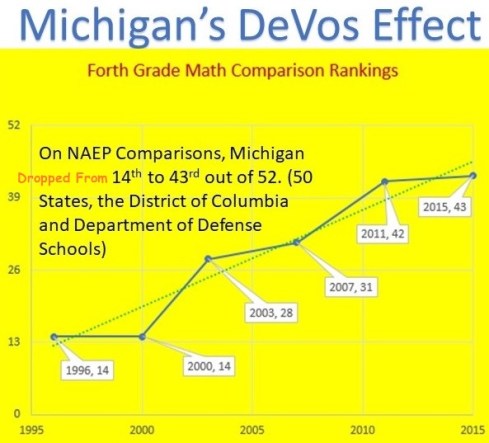
As the new century opened, the DeVos agenda was being ever more adopted in Lancing. If improving the education of children in Michigan was the goal, then the DeVos education agenda has proved to be a clear failure. On the other hand, if destroying public education to accommodate privatized Christian schools was the goal, they are still on track.

DeVos Effect on NAEP Progress Graph

Going from 14th to 43rd is Anti-Progress – Graph Based on NAEP Data

This result from Michigan is consistent with education testing correlations throughout the world. Julie Halpert a writer from Ann Arbor, Michigan just published a new article in Atlantic Magazine called “What if America Didn’t have Public Schools.” In it she reports,

On a regional assessment conducted by the United Nations between 2004 and 2008, students in the all-public Cuba outperformed the largely private Chile in sixth-grade reading and sixth-grade math. In fact, Cuba is the only Latin American country with scores significantly higher than the regional average in both math and reading. Even the best students in Chile, Darling-Hammond of the Learning Policy Institute says, ‘couldn’t come close to touching’ Cuba’s results.

In his book Education and the Commercial Mindset, Samuel E. Abrams tells the story of the Swedes opting to privatize their schools. He wrote:

“Basic to the UR [the Swedish Educational Broadcasting Company] series was a crisis of faith in Swedish education known as ‘PISA shock.’ Of all OECD nations, only Sweden had seen scores on the triennial Program for International Student Assessment (PISA) successively drop with each administration of the exam since its introduction in 2000.”

Sarah and Christopher Lubienski conducted probably the largest and most comprehensive study of its kind, examining achievement in public and private or independent schools. Their study was published in 2014 by The University of Chicago Press under the title “The Public School Advantage: Why Public Schools Outperform Private Schools.” Some key findings:

“Further analyses indicate that academic growth is greater for students in public schools than for those in private schools.”

“While a simplistic look at the evidence suggests that private school students indeed score higher, closer scrutiny of the evidence rather conclusively demonstrates that this in not because public schools are failing but because they serve less advantaged students. In fact, public schools in this study actually add more value to their students’ learning.”

For the DPE movement, evidence about quality or outcomes in education are not relevant. For the billionaires driving education reform, it is about ideology and business.

DeVos Led Privatization Agenda Wreaked Havoc in Detroit

In 1999, under then Governor John Engler’s lead, Michigan did away with the elected school board in Detroit. They followed Chicago’s example and gave school control to the mayor. President Clinton had proclaimed mayoral control a success there.

The Associated Press’s Corey Williams explained:

“In the late 1990s, then-Gov. John Engler, a Republican, wanted to intervene in districts where more than 80 percent of students failed the state proficiency test or the dropout rate was higher than 25 percent. The state said the graduation rate of the 180,000-student Detroit district was about 30 percent; district officials said it was closer to 52 percent.”

 “The state returned control to an elected board in 2005, even though Detroit students still ranked among Michigan’s worst on standardized tests, the district was $48 million in debt and had a $150 million budget shortfall.”

 “There was never anything pointing to this financial crisis” before the takeover, said Martinez, who with other school board members were forced from office in 1999. “When we left office, … we had a $90 million surplus.”

The reinstated 2005 school board did not fare well. It had a huge debt to deal with and by 2007 an FBI corruption investigation. Williams reported that a long-time vendor, Norman Shy, pleaded guilty in federal court to receiving $2.7 million as part of a kickback scheme in which some principals and an administrator issued bogus orders for supplies.

One of the big drivers causing student enrollment to drop in Detroit public schools were the privatization efforts led by Betsy DeVos and her family. In 2001, the family started the Great Lakes Education Project (GLEP), whose political action committee aggressively lobbies for charter schools.

According to Politico’s Zack Stanton, “In 2002, the first election of GLEP’s existence, its PAC had more money than the Michigan Education Association, United Auto Workers, or any Democratic-affiliated PAC in the state.”

Stanton continues:

“…, 16 years after the DeVoses’ failed constitutional amendment, this constant push has totally remade Michigan education. The cap on the number of charter schools eliminated and attempts to provide public oversight have been defeated, making Michigan’s charters among the most-plentiful and least-regulated in the nation. About 80 percent of Michigan’s 300 publicly funded charters are operated by for-profit companies, more than any other state.”

Steven Henderson reporting for the Detroit Free Press adds:

“The results of this free-for-all have been tragic for Michigan children, and especially for those in Detroit, where 79% of the state’s charters are located.”

Table of a Developing Financial Crisis in Detroit Public Schools

School Year Budget Balance Student Population Governance
1998-1999 $90,000,000 180,000 Elected School Board
1999-2005 $150,000 ,000 150,000 Mayor
2005-2009 $200,000,000 95,000 Elected School Board
2009-2011 $284,000,000 67,000 1st Emergency Manager – Bobb
2016 Total Debt $2,100,000,000 48,000 Emergency Manager – 4
Total Decrease in State Money 1999 to 2016 $788,000,000

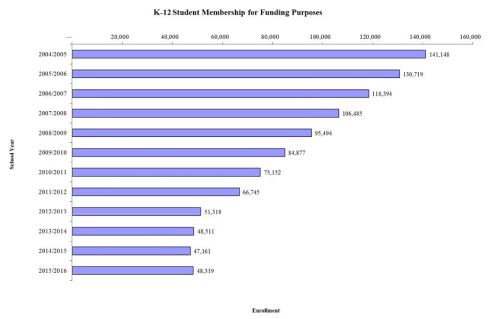
The main cause of the red ink at Detroit Public Schools (DPS) is stranded costs associated with a dramatic drop in enrollment. The extra-costs associated with privatizing DPS were all born by the public schools.

Enrollment Graph

Copied from the 2015-2016 DPS State Financial Report.

Not acknowledging their own role in creating the financial crisis in Detroit, the state government again pushed the elected school board aside in 2009. Education policy was theoretically left under the purview of the school board but financial management would be the responsibility of a governor appointed emergency manager. This time it was a Democratic Governor, Jenifer Granholm who selected a graduate of the unaccredited Broad superintendents’ academy class of 2005, Robert Bobb, to be the manager.

Not only did Granholm select a Broad academy graduate, but Eli Broad paid part of his $280,000 salary. Sharon Higgins, who studies the Broad academy, reports that a civil rights group and a coalition of teachers who oppose charter schools questioned “whether Bobb was in conflict of interest for accepting $89,000 of his salary from a foundation that supports private and charter schools.”

Bobb made significant cuts to DPS. He closed many schools and eliminated 25% of the districts employees. He also sold several school buildings. The Detroit News reported in March 2010, “Instead of a $17 million surplus Bobb projected for this fiscal year, spending has increased so much Bobb is projecting a $98 million deficit for the budget year that ends June 30.”

Bobb blamed unforeseeable costs related to declining enrollment. Curt Guyette at the Metro-Times relates that many people blamed spending on high priced consultants and contracts. Guyette provided this example:

“Of particular note was Barbara Byrd-Bennett, hired by Bobb on a nine-month contract to be the district’s chief academic and accountability auditor. She received a salary of nearly $18,000 a month plus an armed personal driver. In addition, Byrd, a former chief executive officer of Cleveland’s public schools system, ‘brought with her at least six consultants who are collectively being paid more than $700,000 for about nine months of work,’ according to a 2009 Detroit Free Press article.”

In 2011, Republican Governor Rich Snyder ushered through two laws that had a negative effect on DPS. The first law, Public Act 4, gave the emergency manager total control and removed all powers from the elected school board. The second law, Public Act 436, created a state school district called the Education Achievement Authority (EAA) which took effect in 2013.

The EAA’s first task was to take over 15 of Detroit’s lowest performing schools. This immediately removed another 11,000 students from DPS and further stressed its finances.

Counting Robert Bobb there were five emergency managers at DPS between 2009 and 2016. Mercedes Schneider reports that “The most recent Detroit Public Schools emergency manager, Darnell Earley, is chiefly responsible for water contamination in Flint, Michigan.

By 2016, the schools of DPS were in such a disgraceful condition that the New York Times called them “crumbling” and “destitute.” The Times’ article included this quote: ‘“We have rodents out in the middle of the day,’ said Ms. Aaron, a teacher of 18 years. ‘Like they’re coming to class.”’

July 1, 2017 the EAA returned the fifteen schools to DPS and the Michigan legislature finally acted to mitigate the debt crisis created in Holland and Lancing not Detroit. Also on July 1, 2017 Nikolai Vitti the new superintendent of DPS took on the challenge or rehabilitating the public schools of Detroit.

The Destroy Public Education (DPE) Model Still Running

The researchers from Indiana who defined the DPE model are Gail Cosby, Nate Williams and Jim Scheurich. I paraphrased their model this winter in a December post:

  1. Business is the best model for schools.
  2. A local-national collaboration between wealthy conservatives. (Sometimes far right)
  3. Huge infusion of new dollars into school board elections. (Dark Money)
  4. Unified enrollment.
  5. Teach for America (or any instant-teacher-certification program) and groups like Teach Plus controlling professional development of teachers.
  6. Innovations Schools. An ALEC sponsored charter conversion model.
  7. A funding conduit for national-local wealthy individuals and organizations to support local DPE initiatives.
  8. Integration of charter schools into traditional public schools with rules favoring charter schools.
  9. Developing networks of local organizations or affiliates that collaborate on the agenda.
  10. Support for gentrification.

Education Cities bills itself as a national leader in the DPE movement. On their web-page, they list Detroit Children’s Fund and The Skillman Foundation as their partners in Detroit.

The Skillman Foundation has a little more than $400 million and they seem to be the main local financiers of the DPE movement in Detroit. Detroit Children’s Fund (DCF) appears to be the political organizers. DCF says of itself:

“Detroit Children’s Fund (DCF) has partnered with School Empowerment Network (SEN) to offer an intensive development opportunity for school leadership teams.”

“DCF is powered by a deep partnership with the Skillman Foundation. The Foundation has been working in Detroit since 1960 and is recognized as lead advocate for children in the city. Detroit Children’s Fund and the Skillman Foundation share staff, allowing DCF to leverage the Foundation’s deep relationships and knowledge.”

Instead of partnering with the venerable education departments at Michigan State and University of Michigan, Skillman partners with lightly credentialed and inexperienced non-profits to provide teacher professional development. Only a privatization agenda explains this strange behavior.

In the last few years, Skillman has made grants to; TFA $850,000, Education Cities $85,000,  and Relay Graduate School $40,000.

The DPE movement is harming America. What the Amway clan has done to Detroit should be labeled a hate crime. It is treason. We must protect our right to freedom of conscious. Our public schools are a cornerstone of America’s great democratic experiment and the source of protection for liberty. Do not bow down to the lords of Mammon, fight their greed and dangerous religious agenda.

Awful Plight of the Washington D.C. Schools

2 Mar

By T. Ultican 3/2/2018

Washington D.C. schools are classified as a portfolio district by the Center for Reinventing Public Education (CRPE). CRPE is the Bill Gates funded think tank on the campus of the University of Washington whose primary function is to promote portfolio district governance. Oligarchs and politicians call D.C. an education model. I agree. It is like when my mother held up Glenn Elmore as a model for me saying; “When you graduate from high school you’re not going to sponge off your parents the way that lazy freeloader, Glenn Elmore, sponges off his family.” [name changed]

Portfolio district management means closing some percentage of “failing schools” as determined by standardized testing and replacing them with innovation schools, charter schools, or voucher schools. In the same way a stock portfolio is managed, the continuous closing of “failing schools” and replacing them with “superior schools” is the path to education nirvana.

Only someone who has never worked with children and especially children living in poverty, could even remotely imagine this kind of disruption would lead to better schools and healthier children.

The charter school industry along with many billionaires and famous politicians call the Washington D.C. schools a great success illuminating the path for education nationwide. That is a destructive lie. The results of twenty years of portfolio style reform in Washington D.C. are grim.

The conservatives at the National Review see it. Theodore Kupfer wrote last week:

“Had attendance and credit-recovery policies been properly followed, the glitzy graduation-rate gains Obama touted would have been wiped out. Nat Malkus, an education-policy scholar at the American Enterprise Institute, puts the proper graduation rate at 51 percent — about where it was in 2011. School reform in D.C. was the education-policy success story of the 2010s; it turns out to be a fraud. (emphasis added)

A consequence of mayoral control of the schools in D.C. is politicians like the good press coverage touting school success. They have little interest in bad news. Last year, Rachel M. Cohen writing for the liberal oriented Prospect offered this observation:

“One Reason it’s become so easy for advocates to spin the city’s school reforms is that despite DCPS’s claims of being “data-driven,” comprehensive, accessible data actually remains hard to come by. As a result, it is hard for researchers to get a sense of how specific policies are working, and for the public to hold school leaders accountable.

 “Mathematica’s Glazerman agrees it has been difficult at times to obtain DCPS information to conduct research. ‘The researchers want to do research, they want access to data, and the people who control the data don’t want to give it up, except under tightly controlled circumstances,’ he says. ‘Researchers need independence and access to data, and they shouldn’t have to worry about whether the agency is going to look good—both in whether they undertake the study, and how they report results from their study.”’

In the wake of the stunning 2017 graduation fraud scandal in the D.C. schools, Valerie Strass writing for the Washington Post, said,

“On Oct. 28, 2015, the D.C. Public Schools district put out a statement lauding itself with this headline: “DC Public Schools Continues Momentum as the Fastest Improving Urban School District in the Country.”

“For years, that has been the national narrative about the long-troubled school district in the nation’s capital: After decades of low performance and stagnation, the system was moving forward with a “reform” program that was a model for the nation. The triumphant story included rising standardized test scores and “miracle” schools that saw graduation rates jump over the moon in practically no time. Arne Duncan, President Barack Obama’s education secretary for seven years, called it “a pretty remarkable story” in 2013.

“That tale is looking a lot less remarkable in the wake of revelations that educators and administrators, feeling pressure from their bosses to boost graduation rates and student performance, allowed many students who did not have the requisite qualifications to graduate.

“A city study — undertaken after media reports revealed the situation — found that more than 900 of 2,758 students who graduated from a D.C. public school last year either failed to attend enough classes or improperly took makeup classes. At one campus, Anacostia High in Southeast Washington, nearly 70 percent of the 106 graduates received 2017 diplomas despite violating some aspect of city graduation policy.”

 At the end of the article, Strauss asks a pertinent question,

“When are school reformers nationwide who have had a love affair with the D.C. model going to give it up?”

An Independent Evaluation

In 2007, the District of Columbia passed a law (Public Education Reform Amendment Act [PERAA]) that gave control of its public schools to the mayor. The law also called for a future independent evaluation of how well the public schools fared under new governance, to be carried out by a committee of the National Research Council (NRC) of the National Academy of Sciences.

A three year-long study was chaired by Carl Cohn (Co-chair), School of Educational Studies, Claremont Graduate University and Lorraine McDonnell (Co-chair), Department of Political Science, University of California, Santa Barbara. The study focused on the seven-year period from 2007 to 2013.

In the fall of 2015, I wrote an article about this lengthy study that summarizes the findings in some detail. Besides Cohn and McDonnell, a group of about 30 scholars contributed to the report.

They noted that when 50% of the students are in charter schools, parents, educators and administrators have no way of monitoring education practices or spending. D.C. functionally has 62 school districts. One for all the public schools and one for each of the 61 charter school management organizations that operate in private. The report states:

“There are no standardized formats or definitions in charter schools’ budgets or audits, though the PCSB [Public Charter School Board] is making progress in this area. The adequacy study also commented on the difficulty of ascertaining charter facility costs. In addition, the charter management organizations’ accounts are not open to the public, and there have been cases of mismanagement.” (Page 72)

“Because each charter school is an independent local education agency, the charter sector did not (and does not) have any overarching strategy to improve teacher quality (or any other factor in education).” (Page 79)

“The U.S. Department of Education has recently reported that that D.C. is among the worst school systems in the nation in providing appropriate educational opportunities for students with disabilities, and it has the worst record of any state in the country for meeting federal special education goals.” (Page 131)

It is startling to realize that the following reported results are inflated by fraudulent diplomas:

“D.C.’s public schools have had among the worst on-time graduation rates in the country. For the class of 2014, the overall rate was 61 percent, compared with the national average of 81 percent (Chandler, 2014d). For DCPS schools, the graduation rate was 58 percent—up 2 percentage points from the previous year; for the charter schools, it was 69 percent—down almost 7 points.” (Page 154)

The NRC study also analyzed data studies from EDCORE (Education Consortium for Research and Evaluation). This little-known result came to light:

“The EDCORE analyses by sector also showed that, although both DCPS [D.C. Public Schools] and charter students showed improvement, the magnitude of the gains were higher for DCPS students in every year.” (Page 177) (emphasis added)

Washington D.C.’s Destroy Public Education (DPE) Politics

In 1968, the US congress brought some democracy to the residents of Washington DC. An 11-member school board elected by city residence was to run the schools. In 1995, Bill Clinton and Newt Gingrich teamed up to bring charter schools to D.C. A city referendum in 2000 gave the mayor the right to appoint four of the school board members. Then came the PERRA act in 2007 which eliminated the school board. It:

  • established Department of Education headed by the Deputy Mayor,
  • established Office of the State Superintendent of Education,
  • established Office of Public Education Facilities Modernization (OPEFM),
  • established Office of the Ombudsman for Public Education,
  • established Interagency Collaboration and Services Integration Commission (ICSIC),
  • established State Board of Education (replacing Board of Education), and
  • gave Public Charter School Board chartering authority for all charter schools.

It took political action and money to make this happen. Like The Mind Trust in Indianapolis, Washington D.C. has Friends of Choice in Urban Schools (FOCUS) to direct the ground game for privatizing D.C.’s schools. FOCUS was established as a tax-exempt foundation in 1996. On their 2006 web-page leading up to the PERRA act in 2007, they stated:

“We believe that what ails public schooling in the District should be treated by focusing school reform efforts on the creation of large numbers of schools that:

  • Are independent of the school system or have autonomous status within the school system, including control over personnel, finances, and the academic program;
  • Enroll only students whose parents choose to have them attend; and
  • Maintain a constant focus on literacy and implement a comprehensive approach to closing the achievement gap”

The political operatives at FOCUS are well compensated through the large donations from the Walton Foundation and other “philanthropic” non-profits. In addition, they received tax payer money for some of their efforts to help establish charter schools. The following is a hyper-linked table of funders and partners. FOCUS PARTNERS

In 2007, Washington D.C. elected a new mayor, Adrian Fenty. Not only was he the new chief executive of the city, he was also the new Czar of education. The NRC report observed:

“The specific strategies that Fenty and the chancellor he appointed, Michelle Rhee, chose were prominent on the national reform agenda: an emphasis on improving human capital using recruitment, evaluation, and compensation of educators; data-driven decision making; more uniform standards across schools; and greater school-level accountability through the use of student testing and other indicators.” (Page 40)

John Merrow is a resident of Washington DC and a longtime education reporter for NPR. In 2013, he shared his view of Fenty’s choice for chancellor in his piece Michelle Rhee’s Reign of Error. He describes the utter lack of requisite training and experience Rhee and her team brought:

“The 37-year-old Michelle Rhee had been a surprise choice to lead the schools. After college, she joined Teach for America and taught for three years in a low-income school in Baltimore. After earning a graduate degree in public policy at Harvard, she took over a fledgling non-profit that recruits mid-career professionals into teaching, The New Teacher Project. In that role, she eventually ended up supervising 120 employees. As Chancellor, Rhee would be managing a school system with 55,000 students, 11,500 employees and a budget of nearly $200 million.

“She surrounded herself with people with no experience running a large urban school system. Her deputy would be her best friend, Kaya Henderson, another former Teach for America corps member who was then Vice President for Strategic Partnerships at TNTP. She would be managing the District’s 11,500 employees.”

The New Teachers Project (TNTP) which was founded by Wendy Kopp made a name for itself under Michelle Rhee by bashing teachers. This group of what Ciedie Aech calls the “teach-for-a-minute girls” was in charge. They had no training or experience, but they believed test based accountability was the answer. As John merrow wrote:

“And the novice Chancellor was basing nearly everything on the DC-CAS. [D.C.’s Standardized Tests]”

“Millet [Associate Superintendent Francisco Millet] had no doubt that Rhee was sending the message that they would be fired if they didn’t achieve those guarantees. ‘Absolutely. Principals were scared to death that, if their test scores did not go up, they were going to be fired. And they knew that she could do it.’”

This kind of pressure led to a massive cheating scandal that if it had been properly investigated would had put more people in prison than the Atlanta scandal did – including Rhee. Instead, these fraudulent results were held up as proof of concept. The 2009 confidential Sanford memo made the fact of the scandal clear.

Excerpt from Sanford Memo

Clipped from the Memo from Sandy Sanford to DCPS in 2009.  (WTR – Wrong to Right.)

One final quote from John Merrow:

“The erasures stayed buried for years. The official who had spotted the problem and urged Rhee to investigate has kept her mouth shut. Five months after she had informed Rhee of the widespread erasures, Deborah Gist resigned to become State Superintendent in Rhode Island. Rhee now publicly praises her efforts there. Sandy Sanford, who earned roughly $9,000 for his work on the memo, has been paid at least $220,000 by DCPS for various services.”

A Few Last Words

The effect of privatizing schools in D.C. is that the gap in scoring on tests between races has gotten larger. Teacher quality has gotten less certain. There are less minority teachers now and per pupil spending has gone from “$13,830 per student to $17,574, an increase of 27%, compared to 10% inflation in the Washington-Baltimore region.” There has been virtually no gain in testing scores and Washington D.C. schools remain the bottom scoring schools in the nation on the National Assessment of Education Performance.

Type Washington D.C. schools into a Google search and page after page of charter school advertising appears. A parent could seek guidance by going to the Great Schools web page for an evaluation, but that would be like going to the Ford dealer and asking which car is the best.

Washington D.C.’s schools have become expensive and unmanageable. There is no way to insure teacher competency or budgetary honesty, which means stealing is occurring. The D.C. public schools are still the best performing and safest schools in the area. (Charter schools are not public schools. They are private businesses that have a government contract.)

It is time for Mayor Muriel Bowser to step up and select a proven professional educator to lead D.C.’s schools. No more administrators from the unaccredited Broad academy or TFA wunderkinds. It is time to bring in a real professional with a record of achievement to get K-12 education in Washington D.C. on track.

Destroy Public Education (DPE) for Dummies

22 Feb

By T. Ultican 2/22/2018

America’s public education system is being deliberately destroyed. If you graduated from high school in the 1950’s, 60’s, 70’s or 80’s, it is such an unthinkable concept that it is difficult to even imagine. Not only is it possible, it is happening and a lot of damage has already occurred.

Just this morning, I learned that a Republican legislator has proposed privatizing all the schools in Muncie, Indiana. Almost all the schools in New Orleans were privatized after hurricane Katrina. Half the schools in Washington DC and a quarter of the schools in Los Angeles are privatized. However, ninety percent of America’s K-12 students attend public schools. (Note: Charter schools are not public schools, they are schools run by private businesses that have government contracts.)

DPE Movement False Taking Points

  • Public schools are failing.
  • Teachers’ unions fight for the status quo and against education reform.
  • Standardized testing is a tool that fairly holds teachers and schools accountable.
  • Standardized testing proves America’s schools are not competitive internationally.
  • Teacher quality can be assessed with value added measures.
  • University professors of education are out of touch and an obstacle to school improvement.
  • Teacher training and professional development is better run by non-profit organizations and consultants than universities.
  • A college graduate with five weeks of training is qualified to be a teacher.
  • Experience over rated when it comes to good teaching.
  • Advanced training such as a master’s degree in education is not worth extra pay.
  • No excuses charter schools are superior to neighborhood public schools.
  • Business principles and experience are the key ingredients needed for reforming public schools.
  • Market forces and competition are the principles required to improve schools.
  • Public education needs disruption.
  • Schools districts should be managed using the portfolio model – close failing schools and replace them with higher performing charter schools or voucher schools.
  • Failing schools should be transformed into successful schools by changing the administration and replacing the existing teachers.

None of these points are true but they are repeated so often by extremely wealthy people and their sycophants that they sound true. It is all a part of the one great lie, “public schools are failing!”

Seminal Events Along the Destroy Public Education (DPE) Trajectory

In 1983, Terrel ‘Ted’ Bell, the 2nd Secretary of Education in the United States, created the “National Commission on Excellence in Education.” It gave us the infamous “A Nation at Risk.” Beyond just claiming that public education in America was failing and needed drastic reform; the claimants said that reform needed the leadership of people who were not professional educators.

A Nation at Risk: The Imperative for Education Reform” looked deceptively like a genuine peer review research paper, however, it was not. It was a political polemic attacking public education written by businessmen and a famous Nobel Prize winning chemist, Glenn Seaborg. Without substantiation they said, “the educational foundations of our society are presently being eroded by a rising tide of mediocrity that threatens our very future as a Nation and a people.” And claimed, “If an unfriendly foreign power had attempted to impose on America the mediocre educational performance that exists today, we might well have viewed it as an act of war.”

In 1991, Julie Miller wrote about a research study conducted by the Sandia Laboratory in New Mexico. Her Education Week article, “Report Questioning ‘Crisis’ in Education Triggers an Uproar,” is one of the few reports on this government study that seriously questioned claims in “A Nation at Risk.” Miller’s lead paragraph reads,

“Three researchers at a federally funded research center in New Mexico have sparked an uproar with a study of American education that concludes that policymakers and pundits who bemoan a system-wide crisis are both overstating and misstating the problem.”

“A Nation at Risk” propelled us down the road toward education standards, testing and competition as drivers for education reform. A huge mistake.

The Washington Post ran a retrospective article asking “experts” which president deserves the moniker “education president?” Christopher T. Cross, chairman of an education policy consulting firm replied:

“… The unlikely duo of George H.W. Bush and Bill Clinton were the driving forces to put education on the national map in a significant way. Bush did it by convening the Charlottesville Summit in September of 1989, Clinton by securing passage of the Improving American’s Schools Act as an amendment to ESEA and the Goals 2000 Educate America Act, both within a few months of each other in 1994. What Bush had begun, with Clinton’s support as then-governor of Arkansas, Clinton saw to fruition.

“The significance of these actions is that they did cast the die for accountability in the use of federal funds, made an attempt at national assessments in math and reading, and did create national goals for education.”

Charlottsvill Summit 1989 Bush

President Bush and the nation’s Governors on the steps of the University of Virginia at Charlottesville, September 28, 1989. – Picture from the Bush Library

The Charlottesville joint communiqué listed the four areas of agreement reached at the summit:

“The President and the nation’s Governors have agreed at this summit to:

  • Establish a process for setting national education goals;
  • Seek greater flexibility and enhanced accountability in the use of Federal resources to meet the goals, through both regulatory and legislative changes;
  • Undertake a major state-by-state effort to restructure our education system; and
  • Report annually on progress in achieving our goals.”

In 1998, Bill Clinton wrote:

“We have worked to raise academic standards, promote accountability, and provide greater competition and choice within the public schools, including support for a dramatic increase in charter schools.”

The philosophy of education these “education presidents” put forward accelerated the harm being perpetrated on public schools. It was completely misguided and undermined local democratically oriented control of schools. At least with local control vast harm to the entire nation is not possible.

From 2002 to 2011, The Committee on Incentives and Test-Based Accountability in Public Education established by the National Research Council studied the results and unintended consequences of test based accountability. When looking at high school exit exams they concluded, “The evidence we have reviewed suggests that high school exit exam programs, as currently implemented in the United States, decrease the rate of high school graduation without increasing achievement.”

A 2013 study by Tom Loveless at the Brookings Institute stated,

“Education leaders often talk about standards as if they are a system of weights and measures—the word “benchmarks” is used promiscuously as a synonym for standards. But the term is misleading by inferring that there is a real, known standard of measurement. Standards in education are best understood as aspirational, and like a strict diet or prudent plan to save money for the future, they represent good intentions that are not often realized.”

In 2001, Ted Kennedy and George W. Bush united to complete the federal takeover of public education. The federal education law rewrite that they promoted was called No Child Left Behind (NCLB). It mandated standardized testing, incentivized charter schools and demanded schools be held accountable; judged solely by testing results.

Standardized testing is not capable of measuring school or teacher quality, but makes a great messaging tool that can misleadingly indicate that schools are failing. The education writer, Alfie Kohn, wrote in his article, “Test Today, Privatize Tomorrow:

“We now have corroboration that these fears were entirely justified. Susan Neuman, an assistant secretary of education during the roll-out of NCLB, admitted that others in Bush’s Department of Education “saw NCLB as a Trojan horse for the choice agenda – a way to expose the failure of public education and ‘blow it up a bit’” (Claudia Wallis, “No Child Left Behind: Doomed to Fail?”, Time, June 8, 2008).”

Barak Obama and the Democratic Party’s embrace of neoliberal ideology in regard to education became apparent at the 2008 Democratic National Convention in Denver. The hedge fund dominated group Democrats for Education Reform convinced Obama to dump his presumptive Secretary of Education nominee, Linda Hammond-Darling, and appoint Arne Duncan. Obama and Duncan put into place the test centric and competition oriented Race to the Top (RTTT) initiative. For the first time ever, in accord with neoliberal theory, states were forced to compete for education dollars.

RTTT was all about objective measures and competition. To win RTTT monies, states had to agree to enact Common Core State Standards (or their equivalent), evaluate teachers and schools based on testing results and open a path for more privatized schools (charter schools). The Democratic governor of New York, Andrew Cuomo, enthusiastically embraced RTTT even parroting Milton Friedman, saying he wanted to destroy “the public-school monopoly.”

Consistently in the background of the DPE movement from the late 1970’s on has been an evangelical Christian disdain for public schools. Writer Katherine Stewart’s book, The Good News Club, The Christian Right’s Stealth Assault on America’s Children chronicles the undermining of the separation of church and state in school.

Stewart witnessed the infamous Texas school book selection process in 2010 dominated by evangelicals. She describes attending evangelical missionary conferences aimed at infiltrating schools and converting students. She describes President Trump’s lawyer, Jay Sekulow, winning at the Supreme Court arguing against the separation of church and state in public schools. All Americans concerned about – freedom of religion; Shielding children from unwanted religious indoctrination at school; and protecting public education – should be concerned.

U.S. Secretary of Education, Betsy DeVos is a devout member of an evangelical church, Mars Hill Bible Church. It seems apparent that our education secretary has an evangelically based anti-public education agenda. Arguing the relative merits of school policies with her misses the point.

It is more likely that religious ideology is the point.

A Large Group of Billionaires are Funding and Steering the DPE Movement

Charter Schools have proven to be second rate, unstable and plagued by fraud. There are some exceptions but the experiment would have been abandoned as a failure without the unrelenting support of billionaires.

It is the same with voucher schools. Only high end expensive private schools compete well with public education but a poor person with a voucher still cannot afford the tuition. Affordable voucher schools are substandard. However, vouchers have opened the door for government support of religious schools and that is probably why voucher laws keep getting proposed.

There are many billionaires pouring money into the DPE movement. The following is a little about just a few of them.

Bill Gates (Microsoft founder – Harvard dropout) – Spends about $500 million a year on education – he pushes portfolio district theory, charter schools, Teach for America (TFA), standards, testing, teacher merit pay, and the list of bad ideas goes on. He has spent multiple billions of dollars on the writing and institution of the common core state standards. He also spends big money influencing education research and education journalism. Makes large political contributions.

Reed Hastings (Netflix Founder and CEO) – Charter school advocate who served on the board of the California Charter School Association; was the primary advocate of California’s charter school co-location law; Investor in DreamBox Learning a company creating software to teach kids at computers. Has said that elected school boards need to be done away with. Supports TFA. Makes large political contributions.

Michael Bloomberg (Publisher and former New York mayor) – Charter school supporter, supports education technology and TFA. Makes large political contributions.

John Arnold (Made a fortune at Enron and with a Hedge fund; retired at 38 years old) – Supports the portfolio model of education and school choice, gives big to charter schools and TFA. Makes large political contributions.

The Walton Family (Wealthiest family in America, owns Walmart) – Support charter schools, vouchers and TFA. Makes large political contributions.

Eli Broad (Real Estate Developer and Insurance Magnate) – Supports charter schools, TFA and other efforts the undermine the teaching profession. Makes large political contributions.

No less important are Mark Zuckerberg, Laurene Powell-Jobs, Doris Fisher, Michael Dell and several more.

This billionaire group all gives large contributions to TFA. Although, these youthful college graduates have no training in education, they are useful troops on the ground in a cult like environment. Most TFA candidates are unaware of their complicity in undermining public education in America.

The super wealthy can legally contribute large sums of money for local elections without publicity. They take advantage of federal tax code 501 C4 that allows them to give to a dark money organization like Betsy DeVos’s American Federation of Children which then funnels the money into the current hot campaign.

Across the United States, school board elections have become too expensive for most common citizens to participate. Elections that used to cost less than $5,000 to run a successful campaign are now costing over $35.000. In the last school board election in Los Angeles more than $30 million was spent.

Conclusions

It is unlikely that government spending on education will end any time soon. However, as schools are increasingly privatized, public spending on education will decrease.

Today, we have come to expect high quality public education. We expect trained certificated teachers and administrators to staff our schools. We expect reasonable class sizes and current well-resourced curriculum. It is those expectations that are being shattered.

Many forces are attacking public education for diverse reasons, but the fundamental reason is still rich people do not like paying taxes. Choice and the attack on public education, at its root, is about decreasing government spending and lowering taxes.

Standards Based Education Reform is Toxic

14 Feb

By T. Ultican 2/14/2018

In 1983, lawyers, business titans and famous scientists ushered in the era of standards based reform with the infamous “A Nation at Risk.” This political polemic masquerading as a scholarly paper proclaimed a crisis in American education. It propelled us careening down a path of harm. Harm for children; harm for educators; harm for communities; harm for schools and harm for democracy.

During my first quarter at UCSD’s teacher education program, I was assigned many readings including Alfie Kohn’s The Schools Our Children Deserve. By 1999, the time of the books writing, Clinton’s Goals 2000 was in force and many states were already adopting high school exit exams and other standardized testing practices. Although not impressed by this theory of education improvement, Alfie was more focused on improving education practices in public schools.

He asked,

“Is it possible that we are not really as well educated as we’d like to think? Might we have spent a good chunk of our childhoods doing stuff that was exactly as pointless as we suspected it was at the time?”

Kohn believes in progressive education and opposes behaviorism. He embraces the ideas of Dewey and Piaget; he is a constructivist. He railed against traditional classroom management, teacher centered instruction, homework and grading policies. One of his criticisms of education reform in 1999 says, “The dominant philosophy of fixing schools consists of saying, in effect, that ‘what we’re doing is OK, we just need to do it harder, longer, stronger, louder, meaner, and we’ll have a better country.

Less than five years latter Kohn would write:

“I just about fell off my desk chair the other day when I came across my own name in an essay by a conservative economist who specializes in educational issues. The reason for my astonishment is that I was described as being ‘dead set against any fundamental changes in the nation’s schools.’ Now having been accused with some regularity of arguing for too damn many fundamental changes in the nation’s schools, I found this new criticism more than a bit puzzling. But then I remembered that, during a TV interview a couple of years ago, another author from a different right-wing think tank had labeled me a ‘defender of the educational status quo.’”

Standards Based Education Reform is Based on Bad Theory

Professor Ellen Brantlinger of Indiana University was an early critic of standards based education reform (SBR). Unlike the promoters of SBR, Brantlinger was a scholar whose work was peer reviewed. In a 1997 paper published in Review of Education Research, she observed that ideology preserves “existing social structures and power relations” and that SBR was based on uncritical ideology that venerated the dominant culture and subjugated minority cultures.

In another article, An Application of Gramsci’s ‘Who Benefits?’ to High-Stakes Testing, Brantlinger wrote:

“It seems reasonable to conclude that a number of parties reap rewards from high-stakes testing. Turning to Gramsci’s idea of hegemony (that powerful groups in society strive to maintain and strengthen their dominance by offering new evidence to justify it), it is plausible to assume that high-stakes tests facilitate the win/lose situations that justify hierarchical social relations and dominant groups’ material and status advantages.”

After the Common Core State Standards were released, Tom Loveless of the Brookings Institute conducted a study to ascertain the expected benefit from the new standards. He concluded, “Despite all the money and effort devoted to developing the Common Core State Standards—not to mention the simmering controversy over their adoption in several states—the study foresees little to no impact on student learning.

He came to this conclusion in part by looking at the effect on testing results due to varying quality in state standards on the National Education Performance Assessments (NEAP).

Loveless also noted:

“Education leaders often talk about standards as if they are a system of weights and measures—the word “benchmarks” is used promiscuously as a synonym for standards. But the term is misleading by inferring that there is a real, known standard of measurement. Standards in education are best understood as aspirational, and like a strict diet or prudent plan to save money for the future, they represent good intentions that are not often realized.”

Loveless countered one of the more loudly proclaimed reasons for national curriculum guided by national standards:

“In the U.S., advocates of a national curriculum have for years pointed to nations at the top of TIMSS and PISA rankings and argued that because those countries have national curriculums, a national curriculum must be good. The argument is without merit. What the advocates neglect to observe is that countries at the bottom of the international rankings also have a national curriculum.”

Mathew DiCarlo writing for the Shanker Blog cited the work of Eric Hanushek, Jonah Rockoff and others to note that family background constitutes more than half the cause for scholastic achievement. He reported:

“But in the big picture, roughly 60 percent of achievement outcomes is explained by student and family background characteristics (most are unobserved, but likely pertain to income/poverty). Observable and unobservable schooling factors explain roughly 20 percent, most of this (10-15 percent) being teacher effects. The rest of the variation (about 20 percent) is unexplained (error).”

Professor Paul Thomas from Furman University shared his conclusion in an article published by Alternet “Corporations Are Behind the Common Core State Standards — And That’s Why They’ll Never Work.” He wrote,

“Noted earlier, the evidence from standards-based education has revealed that standards, testing, and accountability do not succeed in raising test scores. Related, the evidence on teaching shows that focusing on direct instruction and content acquisition is also ineffective. …. Additionally, we have ample evidence that standards and high-stakes tests do not create the democratic outcomes we seek in schools such as critical thinking, creativity, and equity of opportunity.”

Geometry Standards Posted

Teachers Are Forced to Post Standards and Teach to the Test – Photo by Ultican

Harming Students, Teachers, Schools and Communities

The real standards in a standards-based education system are the standards that get tested or as Center for Education Policy President and CEO Jack Jennings put it, “What gets tested gets taught.” A natural narrowing of curriculum occurs.

Professor Julian Vasquez Heilig of California State University Sacramento recently shared some corroboration of Jennings point on his blog “Cloaking Inequality.” In a piece he called From Segregated, to Integrated, to Narrowed. there is a documented account of a first-year chemistry teacher so focused on Texas testing that “The entire chemistry course was solely designed to drill students for science exit testing by utilizing multiple-choice worksheets.” The article included this outcome from Julian’s research:

“Vasquez Heilig (2011) studied majority-minority urban and rural schools in Texas and found that teachers (11 of 33) and principals (6 of 7) in his study detailed aspects of ‘teaching to the test’ and the impact of exit testing on the narrowing of the curriculum. A high school administrator in the study acknowledged that schools are paying attention to constraints created by the current educational policy system: There’s no way around it, I mean you’d be a fool if you did not play that game, I guess you can call it … . You can easily end up being labeled unacceptable if you did not prepare the students to take the test … . Two weeks before the TAKS [Texas’s standardized tests] date we pull out the kids … . We let the teachers know you’re not going to see these kids for 4 days. For 4 days we do what we call the TAKS blitz.”

The National Research Council (NRC) is a part of the National Academies. It was founded in 1916 to study issues related to coordinating science and technology research for America’s possible involvement in World War I. The NRC conducted a nine-year study of the standards based education reforms mandated by the No Child Left Behind (NCLB) law. Here are a few of its findings:

“Incentives will often lead people to find ways to increase measured performance that do not also improve the desired outcomes.”

“The evidence we have reviewed suggests that high school exit exam programs, as currently implemented in the United States, decrease the rate of high school graduation without increasing achievement.”

“To help explain why test-based incentives sometimes produce negative effects on achievement, researchers should collect data on changes in educational practice by the people who are affected by the incentives.”

Standards Based Education Reform Destroyed Schools in Poor and Minority Neighborhoods

In an article he called Test Today, Privatize Tomorrow – Using Accountability to “Reform” Public Schools to Death Alfie Kohn shared,

“As Lily Tomlin once remarked, ‘No matter how cynical you become, it’s never enough to keep up.’

“I try to imagine myself as a privatizer. How would I proceed? If my objective were to dismantle public schools, I would begin by trying to discredit them. I would probably refer to them as “government” schools, hoping to tap into a vein of libertarian resentment. I would never miss an opportunity to sneer at researchers and teacher educators as out-of-touch “educationists.” Recognizing that it’s politically unwise to attack teachers, I would do so obliquely, bashing the unions to which most of them belong. Most important, if I had the power, I would ratchet up the number and difficulty of standardized tests that students had to take, in order that I could then point to the predictably pitiful results. I would then defy my opponents to defend the schools that had produced students who did so poorly.”

Jessica Bacon an Education Professor from City University, New York and Professor Beth A. Ferri from the school of education Syracuse University studied the demise of Westvale, a K-5 urban elementary school in New York state. Their paper is called The impact of standards-based reform: applying Brantlinger’s critique of ‘hierarchical ideologies’.”

It is a story that has repeated itself too often. Westvale served a population that does not test well. The demographics of the school: 95% free and reduced lunch, 40% limited English proficiency, and 20% students with disabilities. The racial makeup of the school was: 50% Hispanic, 35% African-American, and 10% white.

Because Westvale elementary could not meet the testing targets set by the NCLB law, the state of New York categorized them as “Persistently Lowest Achieving” which meant the district had to select one of four remediation methods. The district chose the transformation model.

The paper reports, “Unfortunately, during this process, Westvale also ‘transformed’ from a school that had been moving towards a fully inclusive model, to one that reverted to a variety of segregated, tracked, and pullout classes.”

Today, many schools in communities that test poorly are being privatized as either charter schools, innovation schools or voucher schools.

In an Education Week article, ‘Defies Measurement’ Illustrates Failures of Test-Focused Policy,” David B. Cohen writes,

“In ‘Defies Measurement,’ teacher-turned-filmmaker Shannon Puckett gathers the recollections and reflections of twenty-three former students, parents, and teachers from Chipman Middle School in Alameda, California, and illustrates how a nurturing school community was gradually dismantled by the test-and-punish dynamics of education reform under No Child Left Behind. Puckett, who taught at Chipman and quit because of the changes following from NCLB, also contextualizes the eventual closure of the school, and the devaluation of what it stood for, in the broader context of education reform and accountability efforts nationwide.”

A school in which I had worked was closed because of the NCLB law. I wrote of about the Unwarranted Demise of Mar Vista Middle School.” The piece began:

“In February, while attending a science teacher’s professional development at Mar Vista High School, I first heard the rumor that Mar Vista Middle School (MVM) was going to be closed, all of its staff dismissed and the school reopened as a charter school. Since 1961, this venerable institution has been a treasure in the poverty-stricken neighborhood situated one mile north of the world’s busiest border crossing (San Diego-Tijuana). At the March 11, 2013 board meeting (Sweetwater Union High School District) the rumor was confirmed, a restructuring plan for MVM was approved. Or as one person observed, ‘they legally stole an asset belonging to a poor community for their own purposes.’”

It turned out that the community successfully fought off the charter school conversion. The remedy became close the school and reopen it as a focus or theme school with a transformed staff. Fifty percent of the original staff was sent packing. The school is not much changed today because it is still serving the same community, but it is now called Mar Vista Academy and many lives were disrupted.

Some Last Words

Last September, the Labour Party in New Zealand captured control of the government. The news service Stuff reported, “Labour campaigned hard on scrapping National Standards in the lead-up to the September election on the basis they were neither ‘national or standard’.” Labour has rid the country of standards based education reform.

Last week brought a new initiative from the Labour government to rid the country of charter schools. Stuff quotes Education Minister Chris Hipkins,

“Both National Standards and charter schools were driven by ideology rather than evidence. Both were rejected by the vast majority of the education sector. The Government’s strong view is that there is no place for them in the New Zealand education system.”

There are twin lies supporting standards based education reform and the destruction of public education in the United States. The first lie promotes the illusion that public education in this country is failing. It never was failing nor is it failing now. The second lie is driven by market based ideology. It posits that privately-run charter schools are superior to “government schools.” A group of researchers in Massachusetts studied the results after 20 years of the 1993 state education law enactment. They reported:

“While some charter high schools with a large percentage of low-income students score high on MCAS [Massachusetts standardized tests], these schools rank much lower on the SATs. What’s more, research indicates many students from high-scoring charter schools do not fare well in college, as measured by six-year college completion rates.”

Hopefully, a political party in the United States will also realize that protecting public education is good politics. I don’t care what letter they use after their name – D, G, I or R – they will have my vote.

Denver’s Schools are a Dystopian Nightmare

4 Feb

By Thomas Ultican 2/4/2018

A group of Democratic politicians aligned with local monied interests decided to “save” Denver’s public schools. The man chosen to turn-around the “failing” school system was Michael Bennet, now the junior senator from Colorado. His history of success working for Philip Anschutz and his complete lack of experience in education somehow made him the choice.

For the two years prior to becoming Superintendent, Bennet served as chief of staff for Denver’s new Democratic mayor, John Hickenlooper. John is now the governor of Colorado replacing Denver’s former district attorney, Bill Ritter also a Democrat. Bill chose not to run for a second term.

This group of liberal Democrats initiated the Destroy Public Education (DPE) movement in Denver.

Bennet originally came west with Susan Daggett, also a Yale law graduate who he soon married. She had accepted a job with the Sierra Club Legal Defense Fund in Montana. Michael grew up in Washington DC, his childhood witnessed a who’s who of Democratic Party luminaries because his father served as an aide to Vice President Hubert Humphrey, among others. Bennett was born in India where his father was aide to Chester Bowles, then the US ambassador to India.

The Rocky Mountain News reported on Bennet, “He worked six years for billionaire businessman Philip Anschutz, helping engineer lucrative oil and movie-theater deals, making himself wealthy in the process.”

In her wonderful book Why is You Always Got to Be Trippin? Ciedie Aech explains how these liberals sold DPE style reform.

“… ‘I wouldn’t send my children there.’

“Progressive declarations like this one, coming as they did from privileged-class and generally non-minority but avowed open-minded citizens, oh, they just made so much sense – to other privileged-class and generally non-minority but compassionately troubled advocates. Holding test scores high, progressive thinkers waved what they argued to be incontrovertible truth.”

“What was undoubtedly required? Was the immediate “non-negotiable” reformation of our nation’s lowest-income, lowest-scoring schools.”

Bad Ideology Based on Bad Assumptions

David Osborne writing in the reliably pro-DPE publication Education Next stated,

“In 2005, DPS was floundering. Out of 98,000 seats, 31,000 were empty, and many school buildings were half full. Almost 16,000 Denver students had left DPS for private or suburban schools. A financial crisis loomed, in the form of pension contributions the district could not afford.”

The DPS superintendents position was open, graduation data looked bad and so did testing data. The Denver Public Schools (DPS) board wanted radical change. They blithely ignored two highly qualified female candidates – Dr. Patricia Harvey, Superintendent of Saint Paul Public Schools and Christine Johnson, President of the Community College of Denver – choosing Michael Bennett to be the next Superintendent.

In 1997, I took some business trips to the big Connor Corporation disk drive factory in Longmont about 35 miles north of Denver. IBM and other tech companies had built several large factories out on the grassy planes where the buffalo used to roam. These facilities were so big they had Burger Kings, Pizza Huts and other fast food outlets in the factory lunch rooms.

Several sizeable single-family housing projects were visible during the drive between Denver and Longmont. Housing and industrial policy made suburban living appealing, which meant DPS was losing students.

Concurrently with my visits, the state of Colorado started using standardized testing with its public schools.

Osborne’s Education Next article continued:

“DPS was so dysfunctional, Bennet concluded, that he could not fix it without significant outside pressure. So he asked several foundation leaders to create an organization of civic leaders, chaired by two former mayors, to push for change and support the board when it promoted reform. They called the initiative A+ Denver, and it has championed the portfolio strategy, along with the Piton, Donnell-Kay, and Gates Family foundations.”

A key DPE playbook move is to leverage out of town money with local money and political muscle to purloin control of public schools. DPS schools were not dysfunctional nor were they failing. In several Denver neighborhoods, the schools were the only functional government entity.

Ms. Aech identified the perceived problem in Why is You Always Got to Be Trippin?.

“With great fanfare, these vigorously charted and impressively color-coded scores were poignantly presented to the nation. Here, citizens, was ironclad proof. Proof that poor and minority schools – oh, undoubtedly, my, just look at those test scores; these schools were surely, wall to wall? – Filled with bad teachers.”

To retrain all those bad teachers in Denver, Bennet turned to the high priestess of the bad teacher movement, Michelle Rhee and her The New Teacher’s Project (TNTP). He also started importing Wendy Kopp’s Teach For America (TFA) candidates.

More wisdom from Why is You Always Got to Be Trippin?.

“Good teachers; well, good teachers, and oh surely this was obvious – even glaringly self-apparent in the fast pace of magical days devoted to a truer national compassion: Good teachers? – Were young.”

The portfolio management theory of education councils paring away the losers the way a stock portfolio is managed. Close failing schools and replace them with a more efficiently managed charter school like a KIPP school.

The year that Bennet became superintendent, the heirs of the Walmart fortune opened the Charter School Growth Fund just 20 miles up highway-25 from downtown Denver.  Carrie Walton Penner, sits on the board of the fund and Carrie’s husband, Greg Penner, is a director. Annie Walton Proietti, niece of Carrie, works for a KIPP school in Denver. There are other Walton family members living in and frequenting the Denver area.

Joining the Walmart school privatizers is Bennet’s business mentor Philip Anschutz. He has a billion-dollar foundation located in Denver and owns Walden Publishing. “Walden Publishing company was “behind the anti-teachers’ union movies ‘Won’t Back Down’ and ‘Waiting for ‘Superman.’”

These wealth powered people along with several peers promote school privatization and portfolio district management ideology.

There is a widely held fundamental misconception that standardized testing proves something about the quality of a school. There is a belief among people who have never studied the issue that testing can be used to objectively evaluate teacher quality. It cannot! A roulette wheel would be an equally accurate instrument for measuring school and teacher quality.

Another Non-Educator with No Training

In 2007, Bennet asked Tom Boasberg, a childhood friend, to join DPS as his chief operating officer. Trained as a lawyer, Boasberg had worked closely as chief of staff to the chairman of Hong Kong’s first political party in the early 1990s, when the colony held its first elections in its 150 years of British rule. Before DPS, Boasberg worked for eight years at Level 3 Communications, where he was Group Vice President for Corporate Development.

In the spring of 2008, Bennet and Boasberg were ready to tackle the pension crisis seen as sucking money out of classrooms. One month after the collapse of Lehman Brothers, Boasberg and Bennet convinced the DPS board to buy a $750,000,000 complicated instrument with variable interest rates. During the melt-down of 2008 Denver’s interest rates zoomed up making this a very bad deal for DPS. (Banking was supposed to be Bennet and Boasberg’s strength.)

A brief produced at the Harvard Graduate School of Education provides some history (and cheers the privatization of Denver’s schools).

“In 2008, DPS launched its School Performance Framework (SPF), used to rate schools’ performance based on a series of indicators, the most important of which was the year to year academic growth of students on state assessments.”

“In 2009 Bennet was elected a U.S. Senator and the board appointed Boasberg as superintendent.”

Somehow, Boasberg graduated from the unaccredited Broad Superintendents Academy in 2009 while serving as Chief Operating Officer of DPS. He has since become a member of Jeb Bush’s national DPE oriented group, Chiefs for Change as has the new Colorado State Commissioner of Education, Katy Anthes.

When Michael Bennet was running for his Senate seat, Colorado Pol studied his effect as Superintendent by analyzing Colorado’s CSAP data. They noticed that “the composite, 2000/2001 – 2003/2004 was the best run for DPS.” That run spans the years just before Bennet became Superintendent.

CSAP Data

Colorado Pol’s Graph of the CSAP data.

The Portfolio Model of School District Management is Ridiculous

I recently went to Idaho for my high school reunion. There were six of us there from my first-grade class of eleven. Nearly all the living members from the 47 of us who graduated together were there. A special bond develops between people who spend their formative years together.

During my fifteen years teaching at Mar Vista High School, I witnessed the same phenomena occurring with my students. Students would often tell me stories about each other from grade school and middle school. When those children graduated, they had formed the same difficult to describe deep human bonds I experienced.

Destroying human development opportunities by closing schools to “fix” education does not just seem foolish; it seems inhumane.

The need for stability in education is overwhelmingly documented. Brooke Havlik writing for Nova Education’s Science and Learning published Psychologists Find School Stability a Factor in Achievement Gap. Brooke wrote in the lead paragraph, “Two new studies published this month suggest that changing schools may have a negative impact on cognitive development and student performance, especially for students experiencing chronic, high-levels of poverty.” (emphasis added)

Yet we read in the Tom Boasberg’s biography at Scholastic.com, “… each year it [DPS] closes a half-dozen schools and creates 10 to 15 new ones, all while raising the “on-time” graduation rate from 60 to 70 percent.” This is not a heartless educator; this is a banker.

A questioning observation from Ms. Aech in Why is You Always Got to Be Trippin?.

“Why was it, the question kept rising up over the years. Well, why was it that those schools most quickly and aggressively labeled as “drop-out factories” – schools slated for closure or an endless chain of reforms, schools forced through the fatal destabilization of restructure and redesign, schools branded publicly as being underused failures, schools negatively marked with the highly publicized letter grade of an F – well, why was it that such a large percent of these schools (shoot, pretty much all of them) had traditionally served as a home to non-dominant-culture, non-privileged-class, minority students?”

Running Multiple School Systems Adds Cost

The basic breakdown of K-12 schools in Denver; 104 traditional public schools, 58 innovation schools and 59 charter schools.

The 58 innovation schools belong to DPS but have contracts with the district giving them more autonomy. There is a process in place where a principal can write a plan about how his school will do things differently and will meet some specific testing targets. If the plan is accepted, the principal is free to run the school according to the plan and does not need to follow district operating procedures.

If the district operating rules are not important, why do any schools need to follow them? It looks like the district is abrogating its responsibilities to lead schools and institute wise policies through this Innovation school scheme.

The 104 traditional public schools have been led for the last thirteen years by non-educators.

The 59 charter schools have their own administrations. Some of them are independently run. Most of them are in various charter management organizations.

The fact is this kind of a system costs more to run. To hire competent teachers and maintain reasonable class sizes – taxes and spending need to be increased for a hybrid-system of both public and multiple private managements. Multiple management systems are more costly.

TFA Teachers are Untrained and Ineffective

According to Teach for America Colorado, this year there are 145 more TFA teachers in the Denver area. These kids get five weeks of training in the summer and then they are called teachers.

Putting untrained people in classrooms used to be against the law and it is still immoral.

Another observation from Ms. Aech in Why is You Always Got to Be Trippin?.

“As a journalist followed the teaching year of a suddenly deployed troop of Teach-For-A-Minute miracle workers, ultimately, he found only one greenhorn to be exceptionally able. (And so many others who were both frighteningly and disastrously unprepared.)”

TFA has effectively become storm troopers for the billionaires trying to disrupt, privatize and end public education. They are cheap, young and follow orders, but they are not even minimally trained educators.

Some New Data

This past December the New York Times ran an interactive article about a new way to compare schools. Reporters Emily Badger and Kevin Quealy describe:

“It’s true that children in prosperous districts tend to test well, while children in poorer districts on average score lower. But in this analysis, which measures how scores grow as student cohorts move through school, the Stanford researcher Sean Reardon argues that it’s possible to separate some of the advantages of socioeconomics from what’s actually happening in schools.”

I ran a simulation comparing Anne Arundel County, Maryland, Milwaukee, Chicago and Denver. I only picked Denver. The New York Times picked the comparison schools. This simulator tries to correlate years of learning. The average between third and 8th grade should be five years. After 13 years of disruption and “reform,” Denver is not quite average.

National Eighth Grade Test Scores

Interactive Simulation result from the New York Times.

It is time for common sense to prevail. Bankers and Billionaires don’t know how to run schools. College graduates with no training do not know how to teach. Running multiple school administrations costs more.

Denver’s public schools were never failing. They probably needed more resources especially in poorer neighborhoods, but the schools labeled as failures were the anchors of poor-minority neighborhoods. Destroying their schools was akin to a hate crime. Maybe it would be fairer to call it a stupidity crime.

I have become a one issue voter. I do not care if you have an R or D after your name on the ballot. I want to know if you are ready to defend public education against charter schools, vouchers and fake teachers? Do you respect professional educators or do you think politicians should run schools by top down fiat? Are you ready to stand up to the out of control billionaire class for the sake of students?


The Association of California School Administrators (ACSA) Back-Stabs Public Education

26 Jan

ACSA endorsed a candidate for California State Superintendent of Public Instruction who actively works to privatize public schools. As a participant in the Destroy Public Education (DPE) movement, he supports initiatives undermining the teaching profession and good pedagogy.

Established in 1971 to advance the cause of public education, the ACSA has joined ranks with groups working to end taxpayer supported universal public education. The endorsement of Marshall Tuck over Tony Thurmond for Superintendent makes this clear.

Tuck and Thurmond are both Democrats. Thurmond is a progressive and Tuck is a neoliberal. The California Teachers Association (CTA) endorses Thurmond as do a long list of elected officials and organizations including Senator Kamala Harris.

Jenifer Berkshire’s article “How Education Reform Ate the Democratic Party,” describes neoliberals:

“‘The solutions of the thirties will not solve the problems of the eighties,’ wrote Randall Rothenberg in his breathless 1984 paean to this new breed [of Democrats], whom he called simply ‘The Neoliberals.’ His list of luminaries included the likes of Paul Tsongas, Bill Bradley, Gary Hart and Al Gore …. …, the ascendancy of the neoliberals represented an economic repositioning of the Democratic Party…. The era of big, affirmative government demanding action—desegregate those schools, clean up those polluted rivers, enforce those civil rights and labor laws—was over.”

Candidates Photo Fixed

Pictures snipped from campaign cyber sites and reformatted by Ultican.

Tony Thurmond spoke at the CTA delegates meeting in October 2017. He won their endorsement. The CTA news release said:

“We won’t stand for vouchers and we will not allow the privatization of public schools in the great state of California,” Thurmond told cheering delegates. He declared that resolving the teacher shortage is key to closing student achievement gaps. “I don’t know how we close the achievement gaps without closing the teacher shortage in the state.”

When Marshall Tuck answered the ACSA’s questions about “school choice,” he wrote:

“I believe it is important to preserve and strategically expand high-quality public school options for parents, …. These public options can take many forms: some are magnet programs that focus on a particular academic discipline, some are charter schools that have flexibility to innovate with new practices, and some are specialty programs, like those that focus on the arts or sciences.”

Billionaires Support Marshall Tuck

Besides the ACSA, many mega-wealthy people support Marshall Tuck. During his close loss for the same office in 2014, Tuck raised unprecedented amounts of money. Near the conclusion of that race, Tim Murphy of Mother Jones reported:

“The most expensive race in California this year isn’t the governor’s race, … it’s the race for state education superintendent, where incumbent Tom Torlakson and challenger Marshall Tuck have combined to spend nearly $30 million. Tuck, who has received big bucks from Walmart heir Alice Walton and former New York City mayor Michael Bloomberg, is pledging to rein in the powerful California Teachers Association, ….”

Under California campaign rules, a candidate seeking state office can accept no more than $7300 a year from a single entity. Because we’ve entered a new year, it is possible for individuals to have given as much as $14,600. The following table is from data reported to California Secretary of State as of 1/22/2018. Billionaires love Tuck!

Contributor Names Amount
Michael Bloomberg $14,600
Carrie (Walton) & Gregory Penner $14,600
Alice Walton $7,300
Jim Walton $7,300
Edith and Eli Broad $29,200
Richard Riordan $7,300
Laurene Powell Jobs $7,300
Reed Hastings $7,300
Doris Fisher $14,600
John Fisher $14,600
Laura Fisher $14,600
Elizabeth Stroud Fisher $7,300
Robert Fisher $7,300
William Fisher $7,300
John and Regina Scully $29,200
Brad Gerstner $7,300
Jonathan Sackler $7,300
Andrew Horowitz $7,300
David Horowitz $7,300

A Biographical Sketch of Marshall Tuck

Tuck was raised on the peninsula just south of San Francisco in the upper-middle class community of Burlingame, California. It is a mixed race community with about a 68% white, 20% Asian, 13% Hispanic and 1% black population. The median home price is more than $1,000,000.

There is no data on siblings or his parents. Tuck’s campaign cyber presence does say he is “The son of a teacher … and [he] attended parochial elementary school and public middle and high schools.”

After high school he attended UCLA, where he was a 1995 graduate with a BA in political science. In 2000, he gained an MBA from Harvard Business.

During Tuck’s 2014 race the Sacramento Bee reported, “After graduating from UCLA, he worked for two years in mergers and acquisitions at Salomon Brothers in Los Angeles.”

Tuck’s 2005 bio for the Green Dot charter schools says, “He also spent time as a consultant at Bain & Co., an investment analyst at the Upper Manhattan Empowerment Zone….” The bio also stated:

“Marshall Tuck joined Green Dot Public Schools in July 2002 as Chief Operating Officer in charge of both operations and finance. Prior to joining Green Dot, Marshall was the General Manager of the Strategic Accounts group at Model N (an enterprise software company), where he led a division focused on opening new markets for the company.”

Steve Barr a politically connected operative from the neoliberal wing of the Democratic party founded Green Dot Public Schools in 1999. He called the schools, public schools, but that is marketing. Green Dot is a private company which has a charter to run a school.

Barr has been active in politics throughout his professional career serving on the national campaigns of President Clinton, Senator Gary Hart and Governor Michael Dukakis and as a finance chair for the Democratic Party.

In 2007, a frustrated Antonio Villaraigosa, LA’s lusty mayor, had just failed to gain control over the Los Angeles Unified School District. He joined with some wealthy supporters to form a non-profit in collaboration with the district, targeting struggling schools in low-income communities for intervention. If school staff voted to opt in, the Partnership offered an alternative approach to improving student achievement, promising a collaborative role in shaping curriculum and running their schools.

The Sacramento Bee reported, “Tuck’s four years at Green Dot caught the attention of Villaraigosa, who selected him to lead the Partnership for Los Angeles Schools.”

There is not much detail available about why Tuck and the Partnership for Los Angeles Schools separated. In 2014 the blog School Matters stated, “Many of us hoped that when right-wing business banker Marshall Tuck was ignominiously forced to step down as the ‘CEO’ of the Partnership for Los Angeles Schools (PLAS), that we might have heard the last of Tuck altogether.”

Most recently, Tuck worked as an Educator-in-Residence at the New Teacher Center (NTC), a nonprofit organization working with school districts. It is notable that the Gates foundation has granted this Santa Cruz based organization a total of $18,305,252 since 2009.

Tuck’s Claims of Proven Leadership Success Are Baseless

At Green Dot he worked in finance and operations. It is unlikely that he had much impact on pedagogy. It is unreasonable to either credit or blame him for testing results. In addition, it is a well-known fact that standardized testing results do not measure teaching or school quality.

However, if one uses testing outcomes at Green Dot to bolster claims of proven leadership, then that data becomes relevant. When an LA Times report about charter schools says, “The lowest-performing, based on test scores, is the large Green Dot chain …,” bragging seems more like lying.

The Partnership for Los Angeles Schools suffered many failures during Tuck’s leadership. Teachers and parents revolted against what they called a top-down autocratic leadership after originally voting to join the Partnership.

The Sacramento Bee reported,

“… the Partnership also was marked at times by conflict with the local teachers’ union over recession-driven layoffs and tensions with teachers at the schools who felt their input was not being considered. Teachers passed a vote of no confidence at nine of the schools at the end of the first year, leading to independent mediation.”

The Bee gave voice to several teachers in the report.

‘“As teachers and parents and students, we just wanted to have an agency for what we thought would benefit our school community and benefit learning,’ Baranwal said. ‘And time and time again, they would come in and make the decision.’

‘“It all just came back down to test scores,’ Baranwal said. ‘It’s not allowing space for people to be looked at holistically. Teachers are not just a test score, students are not just a test score.’

“Gillian Russom, a high school history and geography teacher whose campus ultimately spun off from the Partnership, echoed those concerns: ‘Again and again, we felt that he decided what he wanted to do and pushed it through in a very managerial style,’ she said.”

The Bee article also noted that test scores were not so good:

“While Partnership campuses have improved by an average of almost 72 points on the state’s 1,000-point Academic Performance Index, …, the district as a whole rose almost as much during the same period.”

“That same year, the majority of Partnership campuses performed below average compared with California schools with a similar student demographic.”

Why – with all the extra resources the Partnership was given and their focus on testing – did schools test so poorly? The Partnership’s tax records reveal more than $9,000,000 a year in philanthropic donations to less than 20 schools. Additionally, the Wasserman foundation was providing many free services.

Tucks embrace of Teach for America (TFA) harmed the academic program. TFA teachers are youthful college graduates with no education training or experience outside of a five-week summer institute. A 2015 announcement from TFA shows that they were supplying more than 150 teachers to the Partnership.

The Partnership has less than 15,000 of LA Unified School District’s 700,000 students. Assuming that teachers average 20 students each, the Partnership would have about 750 teachers. That means that more than 20% of the teachers in the Partnership were untrained TFA candidates.

Tuck Opposes Workplace Protection for Teachers

John Fensterwald reporting on a Torlakson versus Tuck debate for Ed Source wrote:

“As he has done throughout his campaign, Tuck condemned Torlakson’s appeal of a Superior Court judge’s ruling in Vergara v. the State of California, overturning laws creating tenure in two years, governing dismissals and requiring layoffs by seniority.”

Tenure is defined as “status granted to an employee, usually after a probationary period, indicating that the position or employment is permanent.” Tenure insures K-12 teachers certain rights such as seniority protection and due process. It protects teachers from unjust attacks by powerful community members. It does not preclude firing for cause. I have witnesses several tenured teachers being fired for relatively benign reasons.

Since Socrates time, teachers have always been vulnerable to unjust social attacks.

When Tuck says he had to lay off more effective teachers than ones with seniority, I wonder how he measured that? Teaching is very difficult to evaluate. The seniority system works well; it is not perfect but it stops the firing of more expensive older teachers and diminishes favoritism. Which are both common problems at educational institutions.

Talk to any experienced teacher and they will tell you how much better at teaching they were after ten years than they were after five. Experience combined with training is the only certain path forward.

Assembly Women Shirly Weber of San Diego authored a bill (AB 1220) that would extend the teacher probationary period to three years and end seniority rights. Tuck told the ACSA, “It was disappointing that last-minute politicking was able to stall those efforts; that my opponent in this race was a primary obstacle to AB 1220’s passage, ….” (emphasis added)

Assemblyman Tony Thurmond offered a counter bill (AB 1164) that also extended the probationary period to three years but did not end seniority rights.

Thurmond’s bill also reinvigorates the peer review and evaluation or PAR process. The legislative analyst noted research showing, “PAR is a rigorous alternative to traditional forms of teacher evaluation and development, with research showing that peer review is far superior to principals’ evaluations in terms of rigor and comprehensiveness.”

Both Thurmond and Tuck agree that we have a teacher shortage in California. It does not make much sense – at least at present – to make the profession less attractive by removing legal protections.

Some Background on Tony Thurmond

Unlike his opponent, Thurmond could never be accused of “being born on third-base and thinking he hit a triple.” His mother was an immigrant from Panama. He was born at Fort Ord in Monterey, California, where his father, a native of Detroit, was training for Viet Nam service. Tony’s father abandoned the family of four children and it was not until Tony was 39 years-old that he saw his father again.

The family moved with their mother to San Jose, California where she was employed as a teacher. Tragedy soon struck when the six years-old Tony’s mother succumbed to cancer. He and a brother moved to Philadelphia where they were raised by a cousin.

Tony went to Temple University where he earned a BA in psychology and became the student body president.

He did his graduate work at Bryn Maw College (Bryn Mawr, PA) receiving a dual Masters Degrees in Law and Social Policy and Social Work.

Tony returned to the Bay Area with his wife Kristen in 1998. He soon had two daughters, Maya and Jayden.

For the 20 years preceding his election to the California State Assembly, Thurmond served in various positions at non-profit social service agencies.

His elective offices held are:

  • 2005-2008 Served on the Richmond City Council.
  • 2008-2012 Member of West Contra County School Board.
  • 2014-present Member of the California State Assembly

Conclusion

This is not the first time the ACSA has embraced billionaire education “reform.” In 2014, they refused to endorse Tom Torlakson over Marshall Tuck for Superintendent. On the ACSA webpage, teacher-basher, Katie Haycock’s Edtrust is championed as a partner. Now, this endorsement shows the ACSA to be a willing pawn in the DPE movement.

It is time for school administrators who believe in public education to act with good conscious and resign from the ACSA.

Education Cities is the National Organizer for the Destroy Public Education (DPE) Movement

20 Jan

By Thomas Ultican 1/20/2018

Update 1/27/2020: Later in 2018 both Doug Harris and Ethan Gray left their respective organizations to join The City Fund. The Mind Trust continued under new leadership and Education Cities was divided into two new school choice promoting organizations; School Board Partners and Community Engagement Partners.

The Mind Trust’s CEO Doug Harris and Vice President Ethan Gray were ready to take their Indianapolis school privatization methods on the road. In 2010, Harris and Gray founded CEE-Trust which became Education Cities in 2014. They were selling The Mind Trust’s secret sauce to DPE organizations nationwide.

Today the Education Cities web site defines the organization:

“An Education City is an aspiration – a vision for the future where all children can access great public schools. The Education Cities network includes 33 city-based organizations in 25 cities across the country working to improve public education.”

The following graphic was snipped from the Education Cities Site. The blood red lettering was added. If your city is on this map, there is an active DPE effort using a form of The Mind Trust playbook and it is well financed. A hyper-text list of these cities and the organizations is provided at the end of this post.

Our Members Map Fixed

Doug Harris is on the board at Education Cites and according to tax records, The Mind Trust has provided Education Cities with $1,582,769 in grants over the last three years. However, Ethan Gray is named as the CEO and Founder by the Education Cities official web site.

Gray is a seasoned DPE leaders. “Before his role at Education Cities, Ethan served as Vice President of The Mind Trust where he helped develop the ‘Opportunity Schools’ plan for transforming the Indianapolis Public Schools. …

“He is a past member of the Board of Directors for the STRIVE Prep network of charter schools in Colorado, as well as the National Advisory Boards of Families for Excellent Schools, EdFuel, and Innovative Schools in Wilmington, Delaware.”

The Mind Trust Spread Their Wings in 2010

The oldest available Education Cities cyber presence is from February 2011. Its original name was The Cities of Education Entrepreneurship Trust (CEE-Trust). The page stated:

“CEE-Trust is a network of city-based education reform organizations, initiatives, and foundations dedicated to accelerating the growth of entrepreneurial education ventures.

“Our Goals:

  • To help members attract, support, and expand the impact of entrepreneurial education ventures in their cities.
  • To facilitate the growth of both established and emerging entrepreneurial education initiatives.
  • To increase the number of city-based organizations that support and advocate on behalf of education entrepreneurs.”

“CEE-Trust is funded by the Bill & Melinda Gates Foundation and The Joyce Foundation. CEE-Trust is also grateful for the past support of the Carnegie Corporation of New York.”

Key Step for Destroying Public Education (DPE)

In 2012, CEE-Trust produced a paper called Kick-Starting Reform. In the forward, Ethan Gray writes:

“The Mind Trust has engaged in this kind of work in Indianapolis since 2006. We launched the CEE-Trust network in 2010 to connect with other, similarly focused city-based education reform organizations.”

“During these conversations we often hear a similar set of concerns and questions:”

  • How can we attract more talent to the education sector in our city?
  • How can we get more great charter schools in our city?
  • How can we leverage our resources to drive systemic change?
  • What would it take to start a CEE-Trust member organization in our city?

“The purpose of this paper is to answer these questions and help leaders in different cities identify the key elements to starting a new city-based education reform organization. We draw from the examples of three nationally noted CEE-Trust member organizations: The Mind Trust in Indianapolis, New Schools for New Orleans, and The Skillman Foundation in Detroit.”

A fair description of the New Orleans experience would be dismal. They fired 7,000 experience black educators and replaced them mostly with untrained TFA candidates. In the process of privatizing New Orleans’ schools, they lost over 10,000 students. Children are busing for hours every day even though there are schools within blocks of their home. Even the vaunted test scores that are manipulated to make public schools look like failures have not improved – no substantive improvement from pre-Katrina days.

Detroit is such a disaster, that they are hoping the formerly disparaged Detroit Public Schools can save the day.

However, “Kick-Starting Reform”, praises these as effective reform efforts and lists the secret formula that makes them wonderful.

All three local DPE organizations agree on three principals. (1) New school leaders are needed and the ready solution is TFA and TNTP or other equivalent groups. (2) Seeding the development of a portfolio of schools is seen as crucial to “success.” (3) Local school board had to be either disbanded, populated with right minded individuals or put under mayoral control.

Faux Scholarship and Data Deception

Early 2016, Education Cities released a paper called the “Education Equality Index.” On a separate Education equality Index web site, two cohort organizations are identified, Education Cities and Great Schools. The latter is a group that rates schools in America based on testing data. Evidently, Education Cities is providing Great Schools with the data analysis.

When the “Education Quality Index” was originally released, its results were immediately published in DPE friendly media.

JerseyCan, a group working to privatize Camden’s schools posted on their blog, “New Jersey has a massive achievement gap, new index confirms.”

Edsurge published an article called “Low Income and Looking For a Successful School. Study Shows Choices Are Slim.” They claimed,

“The results show that in major cities such as Chicago, New York and Los Angeles students from low-income communities are performing higher than their more affluent peers. And Texas stands out as a state with several cities that have high-performing students from low-income backgrounds.”

Chalkbeat Colorado headlined their article, “Denver and Aurora achievement gaps among nation’s widest, index finds.” They also stated, “The Education Equality Index, released Tuesday, is billed as a first-of-its kind comparative measure of achievement gaps on annual assessments in the 100 largest U.S. cities at the school, city and state level.”

Soon even the reliably DPE focused 74 was noting that their seemed to be issues with this non-peer-reviewed paper. The 74 reported,

“Scores were given for each state, based on comparing test scores of low-income students to all students, and states were ranked, but soon a puzzling anomaly was pointed out on social media: States with higher poverty rates scored surprisingly well. In fact, the higher the poverty, the better the equality score.”

“Three researchers consulted by The 74 were generally skeptical that the methodology could be used to contrast schools and cities across different states, but said it could still hold value when looking within a given state.”

The 74 article ended with a classic disclosure statement: “Education Cities, GreatSchools, and The 74 all receive funding from the Walton Family Foundation.”

The six authors of the Equity Quality Index seem compromised by big money. A brief overview of the authors follows.

Betheny Gross: Dr. Gross oversees CRPE’s research initiatives, including analysis of personalized learning initiatives, portfolio management strategies, and charter schools. CRPE is funded by the Gates Foundation.

George Prevelige is from the Michael & Susan Dell Foundation. His resume does not compare favorably to the other authors. Possibly a line from the paper’s acknowledgements explains his presence: “We would like to thank the Michael and Susan Dell Foundation for their generous support of this project…”

Matt Chingos from the Urban Institute is an executive editor for Education Next (a pro-school privatization publication). He earned a Ph.D. in Government from Harvard University in 2010.

Jake Vigdor, University of Washington; His research has been supported by several foundations including the Laura and John Arnold Foundation, and the Bill and Melinda Gates Foundation. His curriculum vitae shows he earned a Ph.D. in Economics at Harvard University in 1999. He was also a visiting scholar at the American Enterprise Institute in 2012.

Doug Lauen, University of North Carolina; “To date much of my academic research falls into three areas: 1) school and classroom poverty composition, 2) educational accountability, and 3) school choice and charter schools.” His curriculum vitae notes a Ph.D. in Sociology, University of Chicago, 2006.

Bruce Fuller, University of California, Berkeley; Professor of education and public policy. He is director of the Policy Analysis for California Education (PACE), an independent policy research center based at UC Berkeley and Stanford University. Following graduate school at Stanford University, Prof. Fuller worked as a research sociologist at the World Bank. He taught comparative policy at Harvard University, before returning to California. Fuller’s work at PACE is funded by:

  • The Bill and Melinda Gates Foundation
  • The Dirk and Charlene Kabcenell Foundation
  • The James Irvine Foundation
  • Silver Giving Foundation
  • Stuart Foundation
  • The William and Flora Hewlett Foundation
  • The David and Lucille Packard Foundation
  • The Evelyn and Walter Haas, Jr. Fund
  • D. Bechtel Jr. Foundation
  • Walter and Elise Haas Fund
  • The Walter S. Johnson Foundation

Clearly all the researchers credited on this paper have a financial stake in advancing concepts like portfolio districts, vouchers and charter schools.

The reports methodology can be fairly paraphrased as being 100% based on standardized testing data. They took state test data and tried to statistically align data between states by using National Assessment of Educational Progress (NAEP) data. They also used federal free and reduced lunch data as a proxy for poverty.

The claim is then made that a meaningful comparison of education quality for students living in poverty can be made between all schools across the United States. This comparison in used to create a scale they name the “education equality index.”

This is a fantasy.

The work of the highly praised education scholar, W. James Popham, shows that the starting point is meaningless. As does the work of testing experts like David Berliner and Noel Wilson. Popham wrote a peer reviewed paper in 1999 he called, “Why Standardized Tests Don’t Measure Educational Quality.” This points to the fundamental weakness of the Bush-Obama education reform policies. The measuring stick was useless.

Or as one of my favorite education bloggers Peter Green put so eloquently this week,

“The entire reform system, the entire house of policy built by both administrations, is built on the foundation of one single narrowly-focused standardized test, the results of which are supposed to measure student achievement, teacher effectiveness, and school quality. The entire policy structure is held together and activated by data, and that data is being generated by means no more reliable than a gerbil tossing dice onto shag carpet in the dark.”

An Existential Crisis

The lead in a December 2017 Chalkbeat article read, “In 2013, a plan to reshape Kansas City’s schools was essentially run out of town.” Unfortunately, the report continued, “Four years later, a group with a similar policy agenda, some of same key funders, and whose leaders get advice from the engineers of the first plan, is making inroads.”

Ethan Gray and CEE-Trust with the backing of the Kauffman and Hall foundations, influential Missouri philanthropies, was hired to analyze how state control could turn around the Kansas City, Missouri public schools. This contract seemed out of compliance with contract procedures for state agencies in Missouri. It created a public backlash lead by a group called More2 who filed a public records request. The Chalkbeat report continued:

“Emails detail a hidden plan for Kansas City Public Schools,” blared a headline in the Kansas City Star in December 2013, based on information from More2. The paper described “a rushed bidding process, now criticized, that ultimately landed Indianapolis-based CEE-Trust a $385,000 contract to develop a long-range overhaul for the district’s failing schools.”

Gray’s report was released in January 2014. It claimed that the schools were failing and called for the introduction of a portfolio model as a reform. Chalkbeat says, “It also drew substantially from a 2011 blueprint released by the Indianapolis-based Mind Trust, ….”

Local groups including the NAACP and school teachers defeated the plan. Now an indigenous group supported by the Hall and Kaufman foundations named SchoolsmartKC is leading the DPE effort in Kansas City.  Gray and Education Cities support in the background.

Chalkbeat says Gray and Education Cities “is not going to be a leading voice like that again.” They quote Gray as saying,

‘“It’s not a role we anticipate playing frequently in the future,’ he said. ‘We don’t want to be out in front of this conversation — we want to be supporting local leaders who are pursuing this kind of work.’

The article continues,

“Gray is now focused on a growing national network of over 30 loosely connected independent nonprofits — some in places like Denver, where the model is already established, and others in cities like Kansas City, where their task is to push for change.”

After Kansas City, CEE-Trust became Education Cities.

Now SchoolsmartKC is The Mind Trust of Missouri and CEE-Trust has reinvented itself. Not everyone in the show me state is sold on the new DPE leader. Chalkbeat reported,

“Meanwhile, some remain wary of who is funding SchoolSmart. In addition to local philanthropies, SchoolSmart identifies the Walton Foundation as one of its core investors. Sufi said Hall, Kaufman, and Walton had together made a 10-year funding commitment of over $50 million.”

Conclusion

As I continue researching the various DPE schemes and scams to steal education tax dollars, I am reminded of the words Arnold Toynbee wrote in his A Study of History: “The bread of universal education is no sooner cast upon the waters than a shoal of sharks arises from the depths and devours the children’s bread under the educator’s very eyes.”

If we do not stop the DPE movement, the right to a free public education will parish. We must turn away that “shoal of sharks.”

Twitter: @tultican

Current DPE Members of Education Cities

Albuquerque, NM Excellent Schools New Mexico

Atlanta, GA redefinED atlanta

Baton Rouge, LA New Schools for Baton Rouge

Boise, ID Bluum

Boston, MA Boston Schools Fund and Empower Schools

Chicago, IL New Schools for Chicago

Cincinnati, OH Accelerate Great Schools

Denver, CO Gates Family Foundation and Donnell-Kay Foundation

Detroit, MI Detroit Children’s Fund and The Skillman Foundation

Indianapolis, IN The Mind Trust

Kansas City, MO SchoolSmart Kansas City

Las Vegas, NV Opportunity 180

Los Angeles, CA Great Public Schools Now

Memphis, TN Memphis Education Fund

Minneapolis, MN Great MN Schools and Minnesota Comeback

Nashville, TN Project Renaissance

New Orleans, LA New Schools for New Orleans

Oakland, CA Educate78 and Great Oakland Public Schools Leadership Center and Rogers Family Foundation

Philadelphia, PA Philadelphia School Partnership

Phoenix, AZ New Schools for Phoenix

Richmond, CA Chamberlin Family Foundation

Rochester, NY E3 Rochester

San Antonio, TX City Education Partners

San Jose, CA Innovate Public Schools

Washington, DC Education Forward DC and CityBridge Education

Twitter: @tultican

TNTP Making Big Bucks from the Destroy Public Education (DPE) Movement

13 Jan

By T. Ultican 1/13/2018

When TNTP comes to town, public school is targeted for education disruption. Clayton Christiansen probably thinks that is a good thing, but rational people who never went to Harvard correctly recognize that children need stability. TNTP tills the soil of privatization by undermining teacher professionalism and preaching a gospel of test-centric pedagogy.

Originally called The New Teachers Project, but like American Telephone and Telegraph becoming AT&T, they fancy TNTP.

In 2001 the TNTP web page described their founding:

“The New Teacher Project was formed in 1997 as a spin-off of Teach For America, …. Teach For America (TFA) has successfully recruited thousands of individuals into teaching in urban and rural areas, …. Wendy Kopp, the Founder and President of Teach For America, recognized the need for school districts to be able to replicate these effective recruiting and training practices. In this way, school districts could fill their classrooms with high quality teachers and begin to reduce teacher turnover. She established The New Teacher Project to address these very needs and promptly recruited Michelle Rhee to head up the new company.” (emphasis added)

In order to believe this, one must believe that a five-week course in the summer trumps a year at a college of education with at least a semester of supervised student teaching. It is also unlikely that significant numbers of these five-week wunderkinds will do much to reduce teacher turnover.

It is curious that TNTP reports their founding in 1997 but their tax returns show the year of formation to be 1995. Whatever the case, TNTP has struck gold.

The Money is Flowing

The big education philanthropies like the work TNTP is doing and are lavishing them with cash.

TNTP Money Graphic

Cash Flow Compiled from Tax Forms and Foundation Reports – by T. Ultican

In 2013 Mercedes Schneider reported on government grants to TNTP:

“Some TNTP initiatives also benefit from the support of federal grant programs and/or private funding. In 2010, TNTP was one of 49 organizations and institutions nationwide to win a federal Investing in Innovation (i3) grant.”

Schneider also wrote about the TNTP 2015 leadership shakeup in a post she called, “New TNTP President Among the First to Have Her NYC School’s Charter Revoked.” She shared:

“The TNTP bio blurb on Belcher includes a quick mention of her as founder of a New York City charter school: ‘Karolyn Belcher was one of TNTP’s first employees after its founding in 1997. After leaving for several years to found the John A. Reisenbach Charter School, one of the first three charter schools in New York State, she returned to TNTP in 2007.’

“What Belcher’s TNTP bio blurb does not mention is that Reisenbach, which operated only three years, from 09.2000 to 06/2004, has its charter revoked for its low test scores, teacher turnover, and financial issues.”

However, in a country dominated by big money education philanthropy, failure is not a big deal. In fact, by 2016, Belcher and several fellow early TFA cohort members were making big money at TNTP claiming to be education experts. Eleven of them were “earning” more than $200,000 yearly.

TNTP Top 15 Salaries edited

Snip Page 30 of TNTP Latest Form 990 filed in 2016

I suspect that most billionaires financing the DPE movement are true believers in their privatization and market theory of education reform. It is likely that they only talk with one another and have their damaging ideology ever further reinforced.

For the carpetbaggers from TFA, it looks like an old story. Reality is hard to recognize when your personal income is at stake; especially when that income is so grand.

Propagating the Billionaire Sponsored Education Ideology

Lubienski and Lubienski published “Why Public Schools Outperform Private Schools” in 2014. David Berliner a much published and widely respected scholar from Arizona State University, wrote of their paper:

“The Public School Advantage is a complete and thorough analysis of America’s many different kinds of schools—secular, charter, and public—and should end the arguments about which kind is better. Chris and Sarah Lubienski provide both the data and the clear explanations needed to understand the many false claims made about the superiority of schools that are not public. The result is a ringing endorsement of public school achievement.”

An excerpt from the Lubienski’s book was published by the National Education Policy Center (NEPC) in an anthology called “Learning from the Federal Market-Based Reforms.” Writing about researchers supporting market based reform and privatization they observe, “These … groups … having quite often declined or failed to pass their pro-market research findings through established, peer-reviewed academic journals, instead create alternative venues publishing and promoting their work – a strategy not unlike what is employed by corporate-funded deniers of climate change.” They also note that many authoritative claims about education are often little more the press releases with no evidence.

TNTP produced quasi-academic research papers like those described by Lubienski and Lubienski. A 2012 example is called “The Irreplaceables.” The paper defines the “irreplaceables” as the “top 20% of teachers in studied districts, as gauged by district data.” The gauge used is value added measures (VAM).

VAM has been widely discredited. By 2014, even the American Statistical Association weighed in with a paper concluding,

“The VAM scores themselves have large standard errors, even when calculated using several years of data. These large standard errors make rankings unstable, even under the best scenarios for modeling.”

 “The Irreplaceables” was not peer reviewed, but Bruce D. Baker a Professor in the Graduate School of Education at Rutgers wrote a review for the NEPC. Professor Baker asked, “Among those 2005-06 Irreplaceables, how do they reshuffle between 2006-07 & 2007-08? His answer is in the graphic below.

Baker Graph

Professor Bruce Baker’s Graph

Professor Baker amusingly explains,

“Hmm… now they’re moving all over the place. A small cluster do appear to stay in the upper right. But, we are dealing with a dramatically diminishing pool of the persistently awesome here.  And I’m not even pointing out the number of cases in the data set that are simply disappearing from year to year. Another post – another day.

“From 2005-2010: Of the thousands of teachers for whom ratings exist for each year, there are 14 in math and 5 in ELA that stay in the top 20% for each year! Sure hope they don’t leave!”

Another poor paper by TNTP was called the “Widget Effect: Our National Failure to Acknowledge and Act on Differences in Teacher Effectiveness.” This paper made a significant contribution to the attack on teachers. The authors define the “Widget Effect:”

“The Widget Effect describes the tendency of school districts to assume classroom effectiveness is the same from teacher to teacher. This decades-old fallacy fosters an environment in which teachers cease to be understood as individual professionals, but rather as interchangeable parts.”

It was a follow-on report from the earlier “Unintended Consequences: The Case for Reforming the Staffing Rules in Urban Teachers Union Contracts.” That report had generated a wide spate of teacher bashing in California as the following headlines and comments demonstrate.

September 29, 2006

Los Angeles Times

Escape Hatch for Incompetent Teachers Closed

“The New York nonprofit group New Teacher Project found in a November 2005 study of five districts including San Diego Unified that administrators had little discretion in filling roughly 40% of their vacancies because of union rules. Researchers also found that poorly performing teachers were transferring from school to school.”

September 10, 2006

San Francisco Chronicle

California Schools May Get Break from Bad Teachers

‘”There are a lot of states watching what’s happening in California, and I think it’ll have significant ramifications nationwide,’ said Michelle Rhee, chief executive officer of the New Teacher Project, a national nonprofit group that worked on the Scott bill.”

September 1, 2006

San Jose Mercury News

State Needs ‘Lemon’ Law For

“Scott’s bill could slow down the “dance of the lemons” — the annual migration of a minority of veteran teachers who either were burned out or who didn’t get along. They agreed to take voluntary transfers and gravitated to low-performing schools, where principals were desperate and parents less vigilant.”

The “Widget Effect,” faulted the fact that less than 1% of veteran teachers in America were evaluated as ineffective. The report called for multiple teacher evaluation inputs including the use of VAM. Arne Duncan, the new US Secretary of Education made the VAM component a requirement for winning Race to the Top school grants.

In 2017, two researchers looked into the effect of widely implementing the “Widget Effect” policy recommendations. In Revisiting the Widget Effect – by Matthew A. Kraft, Brown University and Allison F. Gilmour, Vanderbilt University, they state:

“In 2009, The New Teacher Project (TNTP)’s The Widget Effect documented the failure to recognize and act on differences in teacher effectiveness. We revisit these findings by compiling teacher performance ratings across 24 states that adopted major reforms to their teacher evaluation systems. In the vast majority of these states, the percentage of teachers rated Unsatisfactory remains less than 1%. However, the full distributions of ratings vary widely across states with 0.7% to 28.7% rated below Proficient and 6% to 62% rated above Proficient.”

Nothing changed with unsatisfactory ratings, but TNTP had clearly shown to be a major player in the world of education policy. They seemed to have gained greater influence on teacher evaluations than UCLA, University of Texas and Columbia University’s Teachers College combined.

Audrey Amrein-Beardsley is a former middle- and high-school mathematics teacher who received her Ph.D. in 2002 from Arizona State University in the Division of Educational Leadership and Policy Studies with an emphasis on Research Methods. She commented in a blog for NEPC about the “Widget Effect” driven policies in New Mexico. Writing:

“While Kraft and Gilmour assert that ‘systems that place greater weight on normative measures such as value-added scores rather than…[just]…observations have fewer teachers rated proficient’ …, I highly doubt this purely reflects New Mexico’s “commitment to putting students first.”

New Mexico Bell Curve Evaluation

Professor Amrein-Beardsley’s Graphic

“I also highly doubt that, as per New Mexico’s acting Secretary of Education, this was ‘not … designed with quote unquote end results in mind.’ That is, ‘the New Mexico Public Education Department did not set out to place any specific number or percentage of teachers into a given category.’ If true, it’s pretty miraculous how this simply worked out as illustrated… This is also at issue in the lawsuit in which I am involved in New Mexico, in which the American Federation of Teachers won an injunction in 2015 that still stands today ….”

During my fifteen years as a classroom teacher, I observed that the students do a pretty good job of getting rid of poor teachers. Teaching is a demanding job and the ability to deal with students is not a gift that everyone has. Fifty percent of teachers quit the profession within the first five years and that significantly reduces the number teachers who should not be there. Good administrators get rid of the rest before they achieve full contractual rights. It makes perfect sense to me that less than 1% of teachers are evaluated as unsatisfactory.

Besides Pseudo-Academic Studies TNTP Undermines Teacher Professionalism

By 2001, TNTP was humming along. On its web site the advertising stated:

“We leverage the highly successful strategies of Teach For America to recruit, select and develop new teachers for difficult-to-staff school districts.”

“We create and run high-quality alternate routes to attract and prepare exceptionally talented people from non-traditional backgrounds to teach, particularly for high need areas and hard-to-staff schools.”

“We set up and run pre-service training institutes for high-achieving individuals without prior education backgrounds.”

The theory seems to be that anyone who went to college or worked in certain fields can teach. All that is required is a little summer training and “high-achieving individuals” will be good to go.

The new secretary of education, Arne Duncan, seemed to embrace this ideology when he visited Columbia University Teachers College in 2009. He said,

“More than half of tomorrow’s teachers will be trained at colleges of education. The U.S. Department of Education estimates that schools and departments of education produce about 220,000 certified teachers a year. Now I am all in favor of expanding high-quality alternative certificate routes, like High Tech High, the New Teacher Project, Teach for America, and teacher residency programs. But these promising alternative programs produce fewer than 10,000 teachers per year.” (emphasis added)

Conclusion

Instead of relying on our amazing stable of genuine scholars doing the hard work of researching, studying, practicing and writing, we are being bamboozled into adopting the theories of neophytes that would never bite the hand of their paymasters. If TNTP has a contract with a school district, it is certain that district is a target for privatization.

TNTP is important for the DPE movement. It produces papers that undermine teacher professionalism and it works to circumvent proven teacher training led by universities. It also works to gain control of pedagogy in a way that narrows curriculum. Why? It is all about cutting costs and business transactions. It does not improve the quality of education in America; it harms it.

The Mind Trust Attack of Public Education is Led by Democrats

4 Jan

By Thomas Ultican 1/4/2018

The Mind Trust is the proto-type urban school privatizing design. Working locally, it uses a combination of national money and local money to control teacher professional development, create political hegemony and accelerate charter school growth. The destroy public education (DPE) movement has identified The Mind Trust as a model for the nation.

A Little History

In 1999, Bart Peterson became the first Democrat to win the Indianapolis mayor’s race since 1967. Peterson campaigned on the promise to bring charter schools to Indianapolis. He claimed, “We are simply in an age where cookie-cutter, one-size-fits-all, 1950s style education just doesn’t work for a lot of kids. The evidence is the dropout rate. The evidence is the number of at-risk kids who are failing at school.”

The new mayor joined with Republican state senator Teresa Lubbers to finally achieve her almost decade long effort of passing a charter school law in Indiana. In the new charter school law, Lubbers provided for the mayor of Indianapolis to be a charter school authorizer. Then Democratic governor, Frank O’Bannon, signed the legislation into law.

During his first run for office, Peterson invited David Harris a 27-year old lawyer with no education background to be his education guy. Harris became the director of the mayor’s new charter school office. By the 2006-2007 school year, the Peterson administration had authorized 16 charter schools.

In the summer of 2007 David Skinner reported for Education Next,

“Peterson himself says, “I’m not interested in striking ideological notes,” but he has certainly struck a chord with education thinkers like Andy Rotherham, former education adviser to President Clinton and co-founder of Education Sector in Washington, D.C. Rotherham says Peterson’s example proves that school choice is perfectly compatible with the philosophy of the left.”

And:

“Andy Rotherham says when he heard the mayor’s office had been granted chartering authority, he wanted in. Then a policy analyst at the Progressive Policy Institute, he believed Indianapolis could be a “proof point,” demonstrating that the sky wouldn’t fall if mayors began authorizing charter schools.”

A brief description of the Progressive Policy Institute from Source Watch says,

“The Progressive Policy Institute (PPI) was established in 1989 “and after the 1992 election gained notoriety as ‘Bill Clinton‘s idea mill.'” and a proponent of the Third Way. PPI is the think tank of the Democratic Leadership Council (DLC), founded in 1985 by PPI’s President, Will Marshall, and counts among its past chairs former President Bill Clinton, Congressman Richard Gephardt, and Senator Joseph I. Lieberman.”

These are the political theorists that gave us the “end of welfare as you know it,” the end of the Glass-Steagall banking regulations and the privatization of public schools.

By 2006, Peterson and Harris decided to start a non-profit organization to accelerate their charter school plans. David Harris left the Peterson administration and became a co-founder with Mayor Peterson of The Mind Trust.

The Money Came Flowing

Lately, The Mind Trust does not mention its funders, but in 2010 they almost gleefully shared the information. The Wayback Machine allows a peek at the December 2010 message about contributors:

“The Mind Trust is very grateful to The Richard M. Fairbanks Foundation, which provided critical start-up funding for the organization and a subsequent grant to pay for core operational expenses through 2010. The Mind Trust would also like to recognize the following funders for their generous support of our programs and operations. Through 2010, they have contributed mightily to the $10,967,356 raised since our inception, and most importantly, their contributions to children are incalculable and stand as testament to the importance of the mission we are all undertaking together.”

They also listed their contributors from 2006 to 2010.

  • The Richard M. Fairbanks Foundation
  • Lilly Endowment
  • The Cummins Foundation
  • The Challenge Foundation
  • Lumina Foundation for Education
  • The Annie E. Casey Foundation
  • The Joyce Foundation
  • Ann M. and Chris Stack
  • Ruth Lilly Philanthropic Foundation
  • The Indianapolis Foundation, an affiliate of the Central Indiana Community Foundation
  • The Lacy Foundation/LDI, Ltd.
  • Bowen Engineering Corporation
  • Carnegie Corporation of New York
  • The David and Anne Knall Family
  • Efroymson Family Fund, a CICF Fund
  • Rollin Dick
  • The Two Oaks Fund of the Indianapolis Foundation
  • The W. C. Griffith Foundation
  • The Ackerman Foundation
  • Eli Lilly and Company Foundation
  • Michael L. Smith and Susan L. Smith Family Fund
  • The Ayres Foundation
  • Blackwell Williams Fund, a fund of the Indianapolis Foundation
  • Education Reform Now
  • John and Sarah Lechleiter
  • Myrta J. Pulliam Charitable Trust
  • Arthur Jordan Foundation
  • Moore Foundation
  • Indianapolis Monumental Marathon
  • City of Indianapolis, Community Crime Prevention Program

Their impressive board of directors in 2010 was a virtual who’s who of Indianapolis elites.

The Mind Trust Board of Directors in 2010

Bart Peterson Senior Vice President of Corporate Affairs and Communications, Eli Lilly and Company, and Former Mayor, City of Indianapolis (Chair)
Jean Blackwell Executive Vice President of Corporate Responsibility, Cummins Inc. and CEO of the Cummins Foundation
Alecia DeCoudreaux Vice President and General Counsel, Lilly USA
Mark Miles President and CEO, Central Indiana Corporate Partnership
Ann Murtlow President and CEO, Indianapolis Power and Light
Jane Pauley Former Anchor, NBC’s TODAY and Founding Co-Host, Dateline NBC
Beverley Pitts President, University of Indianapolis
Joyce Rogers Vice President for Development, Ivy Tech Community College
Andrew Rotherham Co-Founder and Co-Director, Education Sector
Ariela Rozman CEO, The New Teacher Project
David Shane President and CEO, LDI, Ltd., LLC
Bill Shrewsberry President and CEO, Shrewsberry and Associates
Don Stinson Superintendent, MSD of Decatur Township
Eugene White Superintendent, Indianapolis Public Schools

It is noteworthy that no school teachers or parent organization leaders are on this board which is dominated by corporate leaders and politicians. It is possible that one of the four school organization chief administrators taught at one time during their career but no one with recent classroom experience is represented.

By 2007, David Harris was being recognized as a rising star in the DPE movement. The Wayback Machine made available this 2007 news release by the NewSchools Venture Fund:

“The Aspen Institute and NewSchools Venture Fund today launched the Entrepreneurial Leaders for Public Education Fellowship Program with the announcement of its inaugural class of Fellows from across the country. The program is designed to recognize and support a new generation of entrepreneurial leaders prepared to address the crucial challenge of transforming public education.”

David Harris was included in that list of education entrepreneurial leaders along with:

  • Russlynn Ali, Vice President, The Education Trust, Executive Director, The Education Trust – West
  • Chris Barbic, Founder & Head of Schools, YES Prep Public Schools
  • Richard Barth, CEO, Knowledge is Power Program (KIPP)
  • Michael Bennet, Superintendent, Denver Public Schools
  • Larry Berger, CEO, Wireless Generation
  • Phoebe Boyer, Executive Director, Tiger Foundation
  • Susan Colby, Partner & Head of San Francisco Office, The Bridgespan Group
  • Gretchen Crosby-Sims, Education Program Manager, Joyce Foundation
  • John Deasy, CEO, Prince George’s County Public Schools
  • Lauren Dutton, Formerly of City Year, Edison Schools and NewSchools Venture Fund
  • James Forman, Jr., Associate Professor of Law, Georgetown University, Co-Founder and Chairman of the Board, Maya Angelou Public Charter School
  • David Harris, President & CEO, The Mind Trust
  • Kaya Henderson, Vice President for Strategic Partnerships, The New Teacher Project
  • Hosanna Mahaley Johnson, President, Atlanta Local Education Fund, Former Executive Officer for the Office of New Schools, Chicago Public Schools
  • Kristen Kane, COO, New York City Department of Education
  • Dan Katzir, Managing Director, The Broad Foundation
  • Janet Murguía, President & CEO, National Council of La Raza
  • Jeremy Nowak, President, The Reinvestment Fund
  • Tony Recasner, CEO, Middle School Advocates, Head of School, New Orleans Charter Middle School, Head of School, Samuel J. Green Charter School
  • Ref Rodriguez, Founder & Co-CEO, Partnerships to Uplift Communities
  • Jon Schnur, CEO & Co-Founder, New Leaders for New Schools
  • Jim Shelton, Program Director, Education Division, Bill & Melinda Gates Foundation
  • Elisa Villaneuva Beard, COO, Teach For America
  • Joanne Weiss, Partner & COO, NewSchools Venture Fund

Now that is a motley crew of education “deformers.”

Lately the money has really been flowing. Five principals at The Mind Trust are “earning” more than $150,000 per year and David Harris is making double that. It might not be Eva Moskowitz money but in Indianapolis or anywhere else it is pretty good.

The big foundations are continuing to send big money:

Lilly Endowment

2014 Mind Trust $4,929,000

2015 Mind Trust $18,000

2016 Mind Trust $7,170,000

Total $12, 117,000

{Big Pharma Money}

Gates Foundation

The Mind Trust

Oct. 2012 – $1,420,000

Aug. 2011 $539,334

Total $1,959,334

{Microsoft Money}


Walton Family Foundation

2013 Mind Trust $23,000

2014 Mind Trust $650,000

2015 Mind Trust $1,200,000

Total $1,873,000

{Walmart Money}


Arnold Fund

The Mind Trust $11,075,000

{Enron Money}

The large contributions have allowed The Mind Trust to accelerate spending. The chart below details income and spending reported on the 2014, 2015 and 2016 tax forms, the last years for which data is available.

Mind Trust SpendingData taken for tax form 990 years 2014, 2015, and 2016

The Work of Privatizing Public Education

December 2016 the not so Progressive Policy Institute (PPI) published a lengthy piece lauding privatization and choice in public schools. They held Indianapolis up as being a leader in developing 21st century schools and The Mind Trust as the catalyst. The paper stated:

“A key reason is The Mind Trust, founded in 2006 by Mayor Peterson and David Harris as a kind of venture capital outfit for the charter sector, to raise money and recruit talent. The Mind Trust convinced Teach For America (TFA), The New Teacher Project (now TNTP), and Stand for Children to come to Indianapolis, in part by raising money for them. Since then TFA has brought in more than 500 teachers and 39 school leaders (the latter through its Indianapolis Principal Fellowship); TNTP’s Indianapolis Teaching Fellows Program has trained 498 teachers; and Stand for Children has worked to engage the community, to educate parents about school reform, and to spearhead fundraising for school board candidates. The Mind Trust has also raised millions of dollars and offered start-up space, grants, and other help to eight nonprofit organizations and 17 new schools, with more to come.”

The PPI claims that bringing in 500 teachers who commit for just two years and have only five weeks of teacher training improves education. This is supposedly better than bringing in experienced teachers or newly minted teachers who are committed to a career in education and have between one and two years of teacher training at a university.

They are also saying that having Stand for Children invade Indianapolis with their dark money and undermine local democratic processes is desirable.

Instead of raising millions of dollars to improve public schools, The Mind Trust is using that money in a way that undermines the education of two-thirds of the students in Indianapolis who attend those public schools.

PPI does admit that not everyone in Indianapolis likes what The Mind Trust is doing. I recently wrote about three scholars who are raising awareness of the resulting damage to Indianapolis schools. PPI tries to minimize their effect stating,

“There are a few headwinds, however. The local branch of the NAACP has long been anti-charter. Though it doesn’t have much of a following, its leaders, plus one outgoing school board member who opposes the innovation network and two local professors, staged a series of forums this fall, called ‘Rise Up Indy Against The Mind Trust.’

In an opinion piece for Campbell Browns 74-million, David Harris stated,

“Consider Ohio, which has had a charter school law on the books for nearly two decades. For years, communities there lacked long-term strategies to build strong charter schools and also lacked local agents pushing for change. As a result, charters in the Buckeye State have been mostly a disappointment, with gains among charter students lagging peers in traditional public schools.”

Doug Martin is an expert on the corporate and theocratic assault against public education. He is also the author of Hoosier School Heist, the book which exposes the corruption, scandals, and campaign financing behind so-called school reform in Indiana and elsewhere. In a post carried on Professor Jim Horn’s Schools Matters Blog, Martin suggests the motivation for Harris’s opinion piece. He notes,

“Besides having the Mind Trust’s David Harris and Earl Martin Phalen and corporate school grandfather Howard Fuller (a BAEO/Edison connected operative who played a role in school privatization in Indiana and Philly) as board members, the Mind Trust spin-off Education Cities is being funded by well-known school privatization billionaire organizations like the Walton Foundation, the Dell Foundation, the Gates Foundation, the Kauffman Foundation, and the foundation started by Eli Broad, the Broad Foundation.”

In other words, Harris is ready to expand his empire and he is explaining why Cincinnati and other cities need what he is selling.

Conclusions

Lubienski and Lubienski conducted a large scale research of education data and came to the surprising conclusion that public schools outperform privatized schools. They also saw that most of the “studies” that claimed otherwise were paid for by advocates and not peer reviewed. The claims of success by The Mind Trust seem to fit this description like print to wood block.

Twitter: @tultican