Tags: Dallas Independent School District, Dallas ISD, Greg Abbott, Ken Barth, Mike Miles, Mike Morath

By Thomas Ultican 2/20/2020
Katherine Stewart’s The Power Worshippers: Inside the Dangerous Rise of Religious Nationalism is a brilliant piece of investigative journalism. It shines a light on significant threats to American pluralism and representative democracy. The religious rights amazing successes now influence every aspect of American life, from the White House to local governments, from schools to hospitals. Stewart documents the origins of “the Russia thing” and the evangelical embrace of Donald Trump. She clarifies that the Christian right is not fighting a culture war; it is a political war waged against the institutions of American democracy and freedom of conscience.

Ralph Drollinger: “I started sending him my Bible studies when he was running his campaign and Trump has been writing notes back to me ever since, in a positive sense. He likes loyalty.”
Paula White about Trump: “It is God that raises up a king.”
Franklin Graham on Trump’s election: “God’s had intervened.”
David Barton called Trump: “God’s guy.”
Sarah Huckabee Sanders claimed God: “wanted Trump to become president.”
Ralph Reed stated: “There has never been anyone who has defended us and fought for us who we have loved more than Donald J. Trump.”
Rick Ridings said when he asked God how the nation will learn to change: “The Lord said, ‘It must play, the Trump card.’”
Ed Martin stated: “The Donald Trump administration has been a blessing on America like we’ve never seen.”
These sentiments are expressed by leaders of Christian Nationalism throughout this book. If you don’t recognize some of the names, it is important to understand that they are having a large influence on education, social justice and foreign policy in America and beyond. Stewart brings them out of the shadows and illuminates their roles.
Pastor D. James Kennedy asserted that children in Public Schools were being “brainwashed in Godless secularism.” In 2003, the DeVos family’s Christian Reformed Church warned that “not only does there exist a climate of hostility to the Christian Faith, the legitimate and laudable educational goal of multi-culturalism is often used as a cover to introduce pagan and New Age spiritualities such as deification of mother earth (Gaia) and to promote social causes such as environmentalism.” The report also claimed that “government schools” had “become aggressively and increasingly secular in the last forty years.”
In his sermon called “A Godly Education,” Kennedy exclaimed, “The infusion of an atheistic, amoral, evolutionary, socialistic, one-world, anti-American system of education in our public schools, has indeed become such that if it had been done by and enemy, it would be considered an act of war.” After denouncing Horace Mann as “a Unitarian,” Kennedy declared, “The modern, public education system was begun in an effort to deliver children from the Christian religion.”
Environmentalism is termed a “false religion.” Stewart quotes the young pastor who took her to a Christian political event in North Carolina, “It’s ten degrees hotter than normal, and these people don’t believe in climate science.” The conservative Christian Cornwall Alliance for the Stewardship of Creation declares, “There is no convincing scientific evidence that human contribution to greenhouse gases is causing dangerous global warming.” The Christian Nationalist political organization Culture Impact Center has claimed that environmentalism is a “litany of the Green Dragon” and “one of the greatest threats to society and the church today.”
Many of the roots of Christian Nationalism can be trace to the antebellum period and theological theories supporting slavery. Calvinist philosopher R. J. Rushdoony was an admirer of these preachers and claimed that “some people are by nature slaves and will always be so.” Although some of his writing was uncomfortable for leaders in the nationalist movement, his ideas form a significant amount of the ideology embraced by today’s right wing Christian thinking. He was the first to claim the First Amendment aimed to establish freedom “not from religion, but for religion.”
Katherine Stewart explains Rushdoony’s perspective,
“The defeat of the orthodox side in the Civil War, Rushdoony realized, ‘paved the way for the rise of the unorthodox Social Gospel.’ The ‘Social Gospel,’ as Rushdoony understood it, is the mistaken belief that Christianity would have us use the power of government to reform society along lines that conform with Jesus’ teachings about loving thy neighbor. This unwanted fruit of defeat in the Civil War, Rushdoony came to think, blossomed into the next great enemy of Christian civilization. The enemy was, in a word, the New Deal.”
Rushdoony died in 2001. One of his contemporaries from the 1930’s, James W. Fifield Jr., thought he had the answer to Rushdoony’s concern. “To combat the horrors of the New Deal, Fifield proposed to energize the nation’s Protestant pastors.” He felt the New Dealers were breaking the 8th commandment. When they used the power of government to tax the rich and give to the poor, it violated “God’s word: Thou shalt not steal.” Stewart says, “In Fifield’s mind, the Social Gospel was just another word for communism, and it had to be stopped.”
Kareem Abdul-Jabbar arrived at UCLA in 1968. A couple years later, over at Muni-gym in San Diego’s Balboa Park, Jabbar’s UCLA replacement Bill Walton was dominating pickup games. It was Ralph Drollinger’s misfortune to follow in the footsteps of these two storied big men onto the campus in Westwood. During the 74-75 season, 7’2” Drollinger began the season as the starting center and his play was far below his predecessors. Capital Weekly described, “he was cruelly jeered on the court, and calls for his benching by fans and media grew ever louder.”
Going into the NCAA basketball tournament, Drollinger’s playing time had been reduced significantly. The final game of the tournament was at the San Diego Sports Arena where I was working. It was the legendary coach John Wooden’s last game. The only substitute Wooden used in the final game was Drollinger and in 16 minutes he scored 10 points and grabbed 13 rebounds. He was the key to Wooden and UCLA winning their 10th national championship in 12 years. It was one of the most thrilling sporting events I ever witnessed.
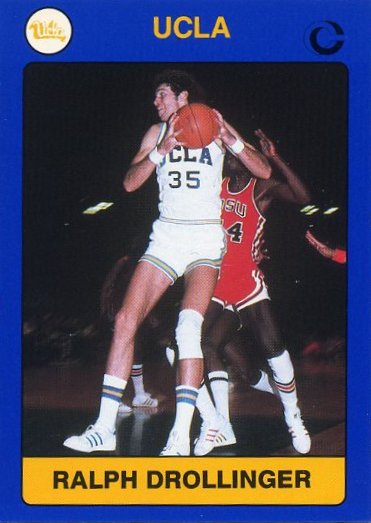
Drollinger During the 74-75 Season
In Chapter 2, I was surprised to learn that Ralph Drollinger was a central leader in the Christian nationalist movement. Stewart speculates, “In the past two years, perhaps no Christian nationalist leader has had better luck playing the inside game than Ralph Drollinger.” He now leads a weekly “Bible study” for Trump cabinet member and other administration officials. Vice President Mike Pence has attended some of Drollinger’s studies.
After UCLA, Drollinger played with the evangelistic team, Athletes in Action, and had a brief stint with the Dallas Mavericks. He and his wife Karen Rudolph Drollinger had three children together. She left him in order to take up a relationship with a woman. It must have been brutal for Drollinger because he views homosexual relationships as “detestable acts,” “profane actions of immorality” and an “abomination.” Drollinger’s attitude toward homosexuality is widely shared on the Christian right.
He, like most of the other leaders profiled in The Power Worshippers, is a committed and unapologetic advocate of gender hierarchy in the home, at work and at church. Drollinger teaches,
“The respect of the submissive wife to her husband then, becomes a tremendous physical picture of the interrelationships existing amongst the members of the Trinity, i.e. the Son’s respect for the Father’s authority. This human modeling is essential to the woof and warp of successful cultures….”
He apparently absorbed these principles while pursuing a masters of divinity from the strict Calvinist and patriarchal brand of theology taught at The Master’s Seminary in Los Angeles. The “hyper-conservative” pastor John MacArthur has led the Seminary since 1986. One of MacArthur’s sermons, “The Willful Submission of the Christian Wife,” tells women to “rank yourself under” husbands. He declares, “Your task is at home.” He explains, “A women’s task, a woman’s work, a woman’s employment, a woman’s calling is to be at home.”
Drollinger was an early enthusiastic supporter of Trump. He is also an enthusiastic advocate of corporal punishment declaring, “When rebellion is present, to speak without spanking is woefully inadequate.” Additionally, Drollinger calls environmentalism a “false religion” and says certain initiatives to protect animal species and preserve natural resources “miss the clear proclamation of God in Genesis.”
Peter Montgomery a senior fellow at People for the American Way says that in his “Bible study” classes, Drollinger teaches public officials “that the Bible mandates adherence to right-wing policy positions on a wide range of issues, including environmental regulation, the death penalty, abortion, LGBTQ equality and more.” Dollinger writes, “Leaders must incentivize individuals and industries (which includes unencumbering them from the unnecessary burdens of government regulations).” He teaches that “God is pro private property ownership” and says the flat tax is “God-ordained.” He states that social welfare programs “have no basis in Scripture.”
There are many characters in the Christian Nationalist movement highlighted in The Power Worshippers. Like Drollinger, they all advocate policies leading to a Christian theocracy. Obfuscation and distorting American history are common practices by the religious nationalists Stewart documents.
Paul Weyrich coined the term “moral majority.” He also co-founded the Heritage Foundation, The Free Congress Foundation and the American Legislative Exchange Council. Weyrich and The Free Congress Foundation were labeled dominionists by the Anti-Defamation League.
Historian Randall Balmer explains how abortion was seized upon as an issue:
“It wasn’t until 1979 – a full six years after Roe – that evangelical leaders, at the behest of conservative activist Paul Weyrich, seized on abortion not for moral reasons, but as a rallying-cry to deny President Jimmy Carter a second term. Why? Because the anti-abortion crusade was more palatable than the religious right’s real motive: protecting segregated schools.”
Balmer asked Weyrich about his claim that it was an attempt by the IRS to rescind tax-exempt status of Bob Jones University because of its racially discriminatory policies that animated the religious right and not abortion. Balmer says, “He was adamant that, yes, the 1975 action by the IRS against Bob Jones University was responsible for the genesis for the Religious Right in the 1970s.”
Paul Weyrich made 12 trips to Russia and Eastern Europe before his death in 2008 and became a strong supporter of closer relations with Russia. Stewart reports, “He was writing and speaking frequently in defense of Russia and facilitating visits between U.S. conservatives and Russian political leaders.”
In 2013, Bryan Fischer of the American Family Association called Putin a “lion of Christianity.” In 2014, Franklin Graham defended Putin for his efforts “to protect his nations’ children from the damaging effects of any gay and lesbian agenda.” He also lamented that Americans have ‘abdicated our moral leadership.” In 2015 Graham met privately with Putin for 45-minutes. In 2016, Mike Pence said Putin was “a stronger leader in his country than Barack Obama has been in this country.” It seems that Trump’s embrace of Putin and other despotic world leaders is an outcome of Religious Nationalism.
This is Katherine Stewart’s second book. In 2009, she was nonplussed to find a Christian group had established their “Good News” club at her daughter’s elementary school. This led to the 2012 book The Good News Club which I highly recommended for its brilliant scholarship and research. In The Power Worshippers, Stewart continued investigating the forces invading America’s public schools. In the words of Nancy MacLean, “Katherine Stewart presents chilling evidence that millions of American churchgoers are being inflamed and exploited by a cynical, well-funded alliance of power seekers.”
Stewart connects the dots between radical theocratic groups working to turn America into a Christian theocracy and extreme free-market libertarians. She undertook the enormous task of revealing who these “Power Worshippers” are. They pull the strings of government power in communities, statehouses and at the federal level. Read this book and encourage everyone you know to read this important book as well.
Twitter: @tultican
By Thomas Ultican 2/19/2020
Amplify education Inc. has a two decade history of trying to profit by selling education technology. The bottom line is even if their pedagogy was good – which it is not – it would be unhealthy for children. The big dream of replacing teachers with digital screens and making gobs of money has a fatal flaw. The last thing 21st century children need is more screen time. Amplify’s lessons are dangerously unhealthy and deliver low quality teaching.
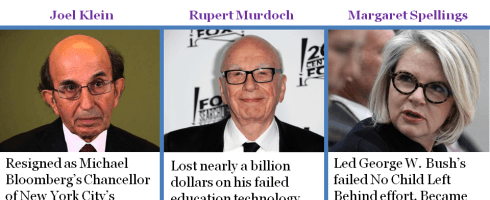
Greg Gunn a former associate of the Carlyle Group who had earned a Masters of Electrical Engineering from MIT joined with Larry Berger to found Wireless Generation. Berger was a graduate of Yale University with a BA and had been a White House fellow working on Educational Technology at NASA during the Clinton administration. In 2010, News Corporation paid $360 million dollars to acquire Wireless Generation and renamed it Amplify Education, Inc. Including performance incentives, Larry Berger pocketed $40 million and agreed to stay on as head of curriculum.
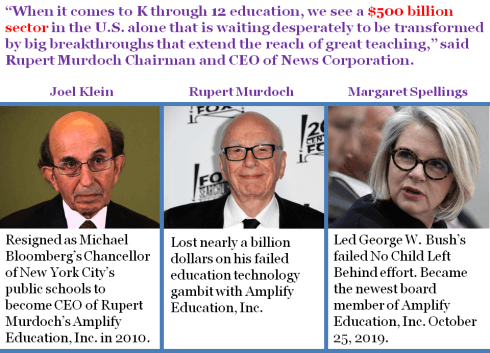
Amplify a Commercial Venture Profiteering off Public Education
The mogul, Rupert Murdoch, proposed buying a million I-Pads for delivering classroom instruction. However, the Apple operating system did not allow the flexibility needed to load the Wireless Generation software. Amplify chose a device manufactured by the Taiwanese company Asus. The android operating system met their needs and the tablets were well regarded in the market place but they were not designed to withstand the demands of school use. One other issue was that Wireless Generation had never developed curriculum but Murdoch wanted to beat Pearson and Houghton Mifflin to the digital education market place.
In July 2012, Amplify publicized its development partnership with AT&T. Ralph de la Vega, President and CEO, AT&T Mobility declared, “Together, we plan to bring to market a 4G mobile tablet-based experience that we believe will significantly enhance teaching and learning for grades K-12.”
The following March, Amplify announced its new tablet for teachers and students. CEO Joel Klein stated,
“We want to transform the way teachers teach and students learn. Technology has revolutionized the world, but not the classroom. Our hope is that this tablet will help change that.”
That same March of 2013, Amplify also won a $12.5 million dollar contract with the Smarter Balanced Assessment Consortium to develop a digital library of formative assessments. It was the second contract awarded to Amplify by Smarter Balanced. The first one came in 2012 calling for Amplify to partner with ETS developing software to analyze results from common core assessments. Both were part of the $175 million dollar grant by the US Department of Education to the Smarter Balanced Consortium.
The corporate plan was rolling along nicely and then the wheels came off. In Guilford County, North Carolina the school district won a Race to the Top grant of $30 million dollars which it used to experiment with digital learning. The district’s plan called for nearly 17,000 students in 20 middle schools to receive Amplify tablets over the next three years. When a charger for one of the tablets overheated, the plan was halted. Only two months into the experiment, not only had a charger malfunctioned but another 175 chargers had various issues and 1500 screens had broken.
The following year Amplify tried to reestablish itself as a leading player in the digital learning markets. CEO Joel Klein called the new offerings a potential “game-changer” and “unlike anything anyone has ever seen in public education.” The company claimed the Guilford County problems had been fixed.
By August of 2015, News Corporation announced it was exiting the education business. The corporation took a $371 million dollar right off to get out of the digital curriculum business. The next month, News Corporation announced it had sold Amplify to members of its staff. In the deal orchestrated by Joel Klein, he would remain as a board member and Larry Berger would assume leadership of the company.
It was soon learned that the real buyer of Amplify was Laurene Powell Jobs, wife of the late Steve Jobs co-founder of Apple. She purchased Amplify through her non-profit the Emerson Collective.
Ed Surge reported, “Emerson Collective has also invested in a slew of edtech startups including AltSchool, FreshGrade, Nearpod and, most recently Udacity’s $105 million round. She is also on the board of NewSchools Venture Fund (an investor in EdSurge.)” In the same month that she bought Amplify, Powell Jobs launched XQ: The Super School Project, a $50 million challenge inviting teams to submit plans to re-invent high schools.
Laurene Powell Jobs has no respect for public school educators and the schools they work in. When Wiki Leaks leaked the Clinton campaign’s emails, Powell Jobs’ recommendations to Hillary Clinton were revealed. She offered four uninformed policy positions in a conversation with Ann O’Leary:
When “we know how to do it” does not include significant input from practicing professional educators, the reasoning is obviously erroneous.
Charter schools have been R&D for fraud, embezzlement and abuse but certainly not for delivering positive innovations. Her slap at teachers unions and work place protections for teachers is consistent with other billionaires and with creating professional educator shortages.
While I was working in public schools, I found the teachers to be every bit as intellectually competent as any of the engineers I met while working in Silicon Valley. Suggesting that Teach For America teachers are even remotely competent to lead a classroom shows gross ignorance of education reality. They are uneducated and untrained.
Technology has a place in education. It is essential for schools to have modern functional lab equipment. Students need access to good word processing programs and video recording equipment to engage in creative endeavors. Some lessons can be supplemented by technology but screens will never replace a live professional educator.
Real education requires life to life communion between teacher and student. Daisaku Ikeda, writes in his book Soka Education,
“Recognizing each student as a unique personality and transmitting something through contacts between that personality and the personality of the instructor is more than a way of implanting knowledge: it is the essence of education.”
Socrates likened this to being “kindled by a leaping spark” between teacher and student. Low cost learning at a screen is spiritless, amoral and dead.
There has been a refocus on “personalized learning” since the Powell Jobs acquired Amplify. (How can isolation at a screen be called “personalized learning?”) In a puff piece about Amplify, Ainslee Harris claims,
“Amplify booked $59 million in revenue in 2016, its first year of independence, and $74 million in 2017. This year, it’s on track to book $125 million, making it one of the few education startups to break the $100 million mark.”
The Powell Jobs team has taken control of the Amplify board. Russlyn Ali (Managing Director of Education at the Emerson Collective), Brad Powell (Managing Partner of Emerson Collective) and former Secretary of Education Margaret Spellings have joined Larry Berger on the board. People like Stacy Childress (CEO of New Schools Venture Fund), Linda Roberts (Office of Education Technology, US Department of Education) and James B. Hunt Jr. (Former Governor of North Carolina) have departed.
The vast majority of America’s school principals believe that students are experiencing too much screen time and the Organization for Economic Co-operation and Development (OECD) said in a 2015 report that heavy users of computers in the classroom “do a lot worse in most learning outcomes.” The OECD runs the international testing known as PISA. They came to their conclusion by analyzing the results from the more than 70 countries whose data they monitor.
Dr. Nicholas Kardaras wrote “Screens In Schools Are a $60 Billion Hoax” for Time magazine. When discussing health risks associated with student screen time, he stated, “over two hundred peer-reviewed studies point to screen time correlating to increased ADHD, screen addiction, increased aggression, depression, anxiety and even psychosis.”
A recent post by Nancy Bailey addressed problems with Amplify’s Core Knowledge Language Arts (CKLA) program for teaching reading. Teacher evaluation committees from Rochester, New York and Tulsa, Oklahoma condemned the program. Some of the comments:
“It builds on content so kids in primary grades learn about ancient civilizations, and it shows some vertical articulation, but it doesn’t have good scope and sequence when learning skills. It’s not developmentally appropriate to introduce a skill or curriculum or new learning concept and then not refer to it again for a very long time.”
One teacher said that her principal was “very disappointed that there wasn’t a lot of neat stuff in the hall, but CKLA doesn’t allow for much creative-type work. I didn’t want to hang worksheets in the hall.”
“I wouldn’t want my children taught this way. I don’t know the rationale behind adopting it. The curriculum doesn’t light up the eyes of kids. It removes the autonomy from the teacher. I guess if people have come through an alternate route and don’t have a teaching degree, you can teach it without much experience.”
The math and science programs are just as regressive. In Seattle, an anonymous donor paid $100,000 to have Amplify Science piloted in 20 middle schools. An NPR report noted,
“Former school board member Peters said it’s difficult to compare results the first year of a new test: Pass rates dropped across the board in 2018 when it was introduced. But her analysis shows pass rates dropped the most at the Seattle schools using Amplify Science — despite the curriculum’s promise to help students meet the new standards.”
‘“The students that fared the worst were low-income students using Amplify Science,’ Peters wrote in an email to the board.”
Because of political pressure to implement computer learning, Seattle’s school board ignored the pleas of teachers and parents and bought the Amplify Science program. Its biggest selling point was that it is aligned with the Next Generation Science standards which are also an abomination.
The reason schools are buying these terrible education technology frauds is that professional educators are no longer making curricular decisions. All large modern businesses including schools require a significant digital infrastructure. This means that there must be an information technology group headed by an expert. That expert who loves technology and has no pedagogical expertise becomes the leading voice concerning the purchase of digital equipment. That explains in part why school districts in financial difficulty are still purchasing pricey education technology software and hardware. Board members believe they have no choice and that they are implementing professional advice.
Amplify Education, Inc. is another modern snake oil salesman. The only reason they did not disappear in 2003 is that the federal government and investors like Rupert Murdoch have poured billions of dollars into this company. It is past time for the fraudulent STEM ideology, education testing scam and the sale of low quality education technology products to be stopped. Taxpayers are being fleeced, schools are being bankrupted and children are being harmed.
Twitter: @tultican

By Thomas Ultican 2/4/2020
Ivy League schools are losing their luster to the stranglehold of billionaire money. The Program on Education Policy and Governance (PEPG) at the Harvard Kennedy School produces Education Next. It is not the kind of objective journal expected from an academic institution. The driving force behind PEPG is Paul Peterson a choice zealot who trained many of the academics contributing to Education Next.
Influenced by super-wealthy people like Bill Gates and the Walton family, Education Next’s reform ideology undermines democratic control of public schools. It promotes public school privatization with charter schools and vouchers. The contributors to the Education Next blog include Chester E. Finn, Jay P. Greene, Eric Hanushek, Paul Hill, Michael Horn, Robin J. Lake and Michael Petrilli. Robin Lake’s new article “The Hoosier Way; Good choices for all in Indianapolis” is an all too common example of Education Next’s biased publishing.
The portfolio model was a response to John Chubb’s and Terry Moe’s 1990 book, Politics, Markets, and America’s Schools, which claimed that poor academic performance was “one of the prices Americans pay for choosing to exercise direct democratic control over their schools.” It is interesting that the late John Chubb was a committed conservative living in Charles Koch’s hometown of Wichita, Kansas. His widow, Angela Kennedy-Toon, still lives there and is a Managing Partner at an Ed Tech company. Her company profile lists Angela’s close education follows as Chester Finn, Michael Horn, Frederick Hess, Wendy Kopp and Jeanne Allen.
It was a social scientist Paul Hill who developed the portfolio model of school management.
Paul Hill studied political science at Seattle University then completed a Masters in political science at Ohio State in 1966. With the election of Richard Nixon in 1969, Hill, who was working as a Republican congressional staffer, got an administration job as a Research staff member, Office of Economic Opportunity. In 1972, Hill was awarded a Doctorate in Political Science by Ohio State University and became Assistant Director for Policy Studies, The National Institute of Education,U.S. Department of Health, Education, and Welfare. He was there until Democrat Jimmy Carter was elected president in 1977. After leaving government service, Hill worked as a social science researcher at the Rand Corporation for the next two decades.
In 1993, Hill founded the Center on Reinvention Public Education (CRPE) on the campus of the University of Washington. While building his organization, he also worked out the mechanics of ending democratic control of public education. His solution is known as the portfolio model of school governance.
The portfolio model directs closing schools that score in the bottom 5% on standardized testing and reopening them as charter schools or Innovation schools. In either case, the local community loses their right to hold elected leaders accountable, because the schools are removed from the school board’s portfolio. It is a plan that guarantees school churn in poor neighborhoods, venerates disruption and dismisses the value of stability and community history.
Robin Lake was one of Hill’s first hires at CRPE. She became his closest confederate and when he decided to reduce his work load in 2012, Lake took his place as the Director of CRPE. Lake and Hill co-wrote dozens of papers almost all of which deal with improving and promoting charter schools. Since the mid-1990s Lake has been publishing non-stop to promote the portfolio model of school management and charter schools. Lake’s new article up on Education Next is her latest in praise of the portfolio agenda for resting school control from local voters.
Like a large number of the contributors to Education Next, neither Robin Lake nor her mentor Paul Hill have practiced or formally studied education. None-the-less, they have been successful at selling their brand of education reform; which is privatization. They describe their organization, CRPE, as engaging in “independent research and policy analysis.” However, Media and Democracy’s Source Watch tagged the group an “industry-funded research center that . . . receives funding from corporate and billionaire philanthropists as well as the U.S. Department of Education.” A report from Seattle Education lists some of the funders:
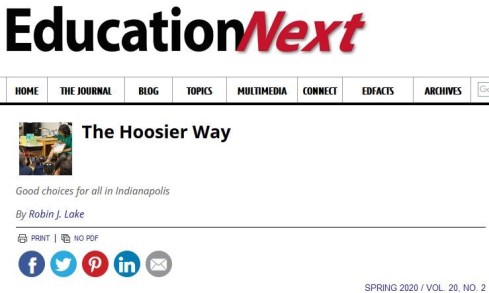
Harvard’s Education Next Makes Propaganda Look Swell – Lake’s Article Header
“The Hoosier Way” recounts what Lake depicts as the heroic history of Republican State Senator Teresa Lubbers’ seven-year long campaign to enact a charter school law in Indiana. It explains that in 2001, Lubber finally won when Democratic Governor Frank O’Bannon signed her bill into law. Lake goes on to explain, “Over the next decade, under Governor Mitch Daniels and state schools chief Tony Bennett, state legislators passed a whole package of reform bills: launching a voucher initiative, expanding charters and giving them rights to unused district buildings, allowing virtual charters, and overhauling teacher accountability.”
These are all presented as positive things for students in Indiana and especially in Indianapolis where newly elected Democratic Mayor Bart Peterson embraced charter schools.
During the 1999 mayors race Peterson hired David Harris a 27-year old lawyer with no education background to be his education guy. Under the states new charter school law, mayors were given the power to bestow charters. David Harris was soon running Mayor Peterson’s charter school office. By 2007 Harris and Peterson had authorized 16 charter schools in Indianapolis.
Today, charter schools which are not accountable to local residents of Indianapolis are serving nearly 50% of the cities students. Plus, 10,000 of the 32,000 Indianapolis Public School (IPS) students are in Innovation schools which are also not accountable to local voters. The organization most responsible for the loss of democratic control over publicly financed schools in Indianapolis is The Mind Trust.
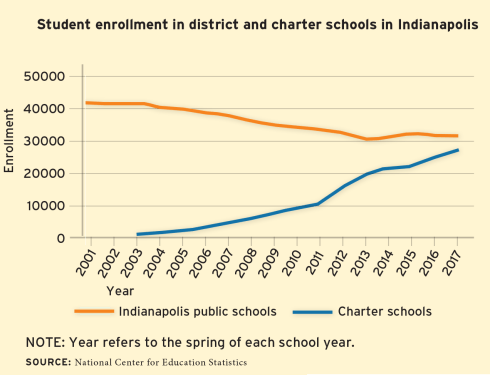
The First Charter Schools in Indianapolis Opened in 2003
Tony Bennett served as Superintendent of public schools in Indiana during the administration of Republican Governor Mitch Daniels. Bennett was “widely known as a hard-charging Republican reformer associated with Jeb Bush’s prescriptions for fixing public schools: charter schools, private school vouchers, tying teacher pay to student test scores and grading schools on a A through F scale.” He left Indiana to become Florida’s Education Commissioner in 2013, but soon resigned over an Indiana scandal involving fixing the ratings of the Crystal House charter school which was owned by a republican donor.
In 2011 before leaving, Bennett was threatening to take action against Indianapolis schools. The Mind Trust responded to Bennett with a paper called “Creating Opportunity Schools.” Lake writes,
“In response to a request from Bennett, The Mind Trust put out a report in December 2011 calling for the elimination of elected school boards and the empowerment of educators at the local level. … At the same time, Stand for Children, an education advocacy nonprofit, was raising money to get reform-friendly school-board members elected, and much of the public debate centered on The Mind Trust’s proposal. … A new board was elected in 2012 (the same year Mike Pence became governor) and the board quickly recruited a young new superintendent, Lewis Ferebee, to start in September 2013.” (Emphasis added)
Lewis Ferebee was a member of Jeb Bush’s Chiefs for Change. He was selected to continue the Jeb Bush theory of education reform. It is the theory Bush developed while serving on the board of the Heritage Foundation in the 1990s.
Stand for Children is the infamous dark money organization that funnels money from financial elites into local school board elections. The organization began after Jonah Edelman helped his mother Marian Wright Edelman, founder and president of the Children’s Defense Fund, with a 1996 rally. He took advantage of the situation and the contacts to start Stand for Children. In the early 2000s, Edelman’s pro-privatization anti-union agenda alienated many of his early supporters.
A 2016 paper from the neoliberal organization Progressive Policy Institute explains how The Mind Trust looked to attract like minded national organizations to Indianapolis:
“The Mind Trust convinced Teach For America (TFA), The New Teacher Project (now TNTP), and Stand for Children to come to Indianapolis, in part by raising money for them. Since then TFA has brought in more than 500 teachers and 39 school leaders (the latter through its Indianapolis Principal Fellowship); TNTP’s Indianapolis Teaching Fellows Program has trained 498 teachers; and Stand for Children has worked to engage the community, to educate parents about school reform, and to spearhead fundraising for school board candidates.”
Lake states, “Ferebee, Harris, and Kloth formed what one observer called a civic triangle to focus on creating high-performing schools.” By “high performing schools” they mean charter schools dominated by unqualified TFA temp teachers who have assimilated the school privatization philosophy. The third member of the “civic triangle” is Jason Kloth, a Teach for America alumnus, named deputy mayor of education by Republican Mayor Greg Ballard.
Lake also informs us that “The Mind Trust brought school-board members and local civic leaders to New Orleans, which was implementing the portfolio model—characterized by broad school choice for families (based on a “portfolio” of charter and district-run schools), plus autonomy paired with accountability for educators.”
However, members of the black and brown community including the NAACP started realizing that it was their communities that were being robbed of public schools. Lake noted, “Despite support from local newspapers’ editorial boards, the black community recoiled and many people saw The Mind Trust as a group of elitists writing plans to take over the local schools.” In 2013, to counter these problems, The Mind Trust hired a beautiful young black female lawyer, Kameelah Shaheed-Diallo, to change its approach to minority communities and solve the issue.
Robin Lake concludes that testing data from a recent CREDO study at Stanford University shows the success of the portfolio model in Indianapolis. Dr. Jim Scheurich, Urban Education Studies Doctoral Program Indiana University – Indianapolis (IUPUI), points out that Lake didn’t mention that the CREDO report and its methodology have been criticized by the University of Colorado’s National Education Policy (nepc.colorado.edu) center multiple times. Scheurich also notes that CREDO “receives large pro-charter funding.”
The CREDO study claims to meaningfully measure learning growth to 0.01 of a standard deviation (σ). The reality is Growth models are plagued by error and do not give reliable measurements. There is no way a difference of 0.01 σ can be measured meaningfully. Furthermore, the CREDO studies are not peer reviewed which makes them clearly untrustworthy.
Robin Lake is the director of CRPE which birthed the portfolio model and is engaged in pushing the model into schools nationwide. In 2018, two billionaires, Reed Hastings and Jon Arnold, agreed to put up $100 million each toward promoting the portfolio model of school management. Since then, billionaires Bill Gates, Michael Dell and Steve Ballmer have all contributed to their new organization, The City Fund.
Ethan Gray was Vice President of The Mind Trust before he and David Harris founded an organization called Education Cities. Education Cities became the national organization spreading their ideology. In the summer of 2018, David Harris, Ethan Gray and Kameelah Shaheed-Diallo all left their respective organizations to become founding employees of The City Fund.
There is a deep corruption infesting elite institutions in America. For Harvard University to publish biased articles by people with well known agendas exemplifies this metastasizing affliction.
Denver, Colorado has a school district that is often held up as an exemplar of the portfolio model. Far from being an exemplar it is a dystopian nightmare and warning. This year, Denver voters defeated the dark money controlling their school board. Big money was no longer enough. Indianapolis voters need to follow Denver’s example and throw off the billionaire’s yoke.
Twitter: @tultican

 tultican
Recent Comments