Archive | technology RSS feed for this section

Hi-Tech Profit Motive and Power Trumps Good Pedagogy

9 Nov

By Thomas Ultican 11/9/2017

“The Silicon Valley assault must be turned away, not because they’re bad people but because they are peddling snake oil,” says veteran education writer, John Merrow. He is referencing education technology sales. In the last 10 years, titans of the tech industry have dominated K-street. Hi-tech is now the big dog spending twice as much as the banking industry on lobbying lawmakers.

They funds think tanks to promote their agendas like coding in every public school in America or one to one initiatives (a digital device for every student) or digital learning. Researchers working in think tanks like the New America Foundation will be disciplined if they upset a corporate leader like Google’s Eric Schmidt; ask Barry Lynn.

Writing for the Guardian, Ben Tarnoff reports, “Tech’s push to teach coding isn’t about kids’ success – it’s about cutting wages.” The premise is that coding is “a skill so widely demanded that anyone who acquires it can command a livable, even lucrative, wage.”

The flaw here is that there is no need for a flood of new programmers. It will only drive down wages, which have already stagnated, and that is the point. A 2013 Economic Policy Institute research paper stated:

“For every two students that U.S. colleges graduate with STEM degrees, only one is hired into a STEM job.”

“In computer and information science and in engineering, U.S. colleges graduate 50 percent more students than are hired into those fields each year; of the computer science graduates not entering the IT workforce, 32 percent say it is because IT jobs are unavailable, and 53 percent say they found better job opportunities outside of IT occupations.”

School leaders are the primary targets of the ed-tech sales pitch. They are flown to conferences at pricy resorts where vendors pay thousands of dollars to meet with them. Writing for the New York Times, Singer and Ivory report about Hewlett Packard’s big score in Baltimore via the office of Superintendent Dallas Dance. They observed:

“In some significant ways, the industry’s efforts to push laptops and apps in schools resemble influence techniques pioneered by drug makers. The pharmaceutical industry has long cultivated physicians as experts and financed organizations, like patient advocacy groups, to promote its products.”
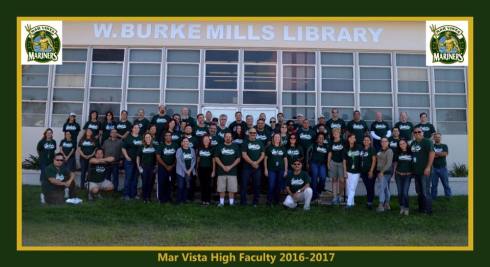
MVH Staff Oct 2016

Some Ed-tech Sales Targets

Personalized Learning and Summit Schools

 Diane Tavenner is the Board Chair of the California Charter Schools Association (CCSA). Her bio at CCSA informs us:

“In 2003, Diane founded Summit Preparatory Charter High School in Redwood City. Today, Summit Prep is ranked by Newsweek as one of 10 miracle high schools in the nation that is transforming student lives. 100% of Summit’s graduates exceed the entrance requirements for the UC/CSU system and 97% of the graduates have been accepted to at least one four year college.”

Kristina Rizga’s lengthy article in November’s Mother Jones magazine is called “Inside Silicon Valley’s Big-Money Push to Remake American Education – Personalized learning is the latest trend to catch the eye of tech moguls—and Betsy DeVos. But does it work?” Her article, focuses on Tavenner’s schools. With 97% of graduates accepted to a four-year college, Rizga reports a fly in the ointment:

“But even as students thrived and Tavenner began opening more Summit schools around the Bay Area, administrators started learning that high school success wasn’t translating once Summit students headed off to college. In 2011, when Tavenner and her team surveyed students from their first class, the responses depressed them: Only a little more than half were on track to graduate.”

In addition, they learned that more than one-third of their students in colleges required remedial classes which indicated a high risk of not graduating. The reality was that students over at Mountain View High School, where Tavenner once taught, were being better prepared for college. The “miracle” schools were not that miraculous.

Originally, Summit schools focused on personalized learning like that championed by the popular bay area private schools, Montessori and Waldorf. Each student would have a personalized learning plan instead of the typical structure of lectures and textbooks, identical worksheets and being sorted by age. With the depressing 2011 data in mind, Tavenner added a new wrinkle, marring personalized learning with technology. Summit gained enhanced attention from education leaders, policy makers, and enthusiastic tech billionaires.

In 2013 Mark Zuckerberg offered to help. The new core of Summit’s personalized approach is the Summit Learning Platform, designed in partnership with Facebook. The software provides students with a daily overview of their responsibilities and progress, which are marked against their yearly personalized academic goals.

Since 2014, 330 schools in 40 states have signed up to adopt the Summit model. They are betting on an untested hypothesis that tech can save costs, increase engagement and allow teachers more time to provide individualized instruction.

Huge sums of money are flowing into this endeavor. Rizga writes:

“In a recent speech, Zuckerberg said he plans to “upgrade” the majority of about 25,000 public middle and high schools over the next decade. He and Chan have also pledged to donate “hundreds of millions of dollars per year” to bring personalized learning to other schools through the new Chan Zuckerberg Initiative, …. They aren’t alone: Bill Gates’ foundation has committed $300 million to the movement since 2009, and Netflix founder Reed Hastings has invested at least $11 million into personalized math software.”

Julian Cortella worked at Summit from near its beginning. He left in part due to concerns about the new tech infused Summit. The low-tech Summit campus, where he taught, was outscoring the tech infused ones. Rizga paraphrased him, “A former mechanical engineer who spent significant time working in Silicon Valley startups, Cortella is not against technology in the classrooms. Instead, he says his 13 years of hands-on classroom experience tell him that the tech enthusiasts rely too much on untested assumptions.”

Larry Cuban taught Tavenner at Stanford. She credits Cuban and Linda Darling-Hammond with being particularly inspirational. Rizga shares his observation:

“Cuban told me one of Summit’s key strengths is its skilled, well-trained teachers—teachers get eight weeks of paid time to improve their craft during the school year, in addition to one paid month during the summer—who use technology to achieve specific goals and their professional judgment to make decisions on how and why certain learning will take place.”

Not only are Summit’s achievements over-blown, but it is not a model easily replicated. What public school can offer teachers competitive wages and this much professional development? Public schools don’t get money from Eli Broad, Bill Gates and the Silicon Valley Foundation.

Experimenting on Other People’s Children

Many of the education initiatives coming from Silicon Valley are also reckless experiments. A recent experiment was called Altschools. A 2015 news release from Altschools said:

“May 4, 2015 – AltSchool kicks off Teacher Appreciation Week with $100 million in funding to further its vision to reinvent U.S. education from the ground up. Founders Fund and Andreessen Horowitz led the round with Mark Zuckerberg and Priscilla Chan’s donor-advised fund at Silicon Valley Community Foundation. Additional investment came from Emerson Collective, First Round Capital, Learn Capital, John Doerr, Harrison Metal, Jonathan Sackler, Omidyar Network and Adrian Aoun.”

“In 2013, founder Max Ventilla and his team … began AltSchool by asking, how would school look if we designed it from scratch today?”

“In 2013, there were 20 students in one school. This year, there will be up to 500 students in eight schools. And soon, AltSchool will start offering its model to schools nationwide, so that each child can access a high-quality education that will help them reach their full potential.”

On Novermber 1st, Bloomberg reported:

“Max Ventilla sold investors on a promise to build modern, technology-infused schools that would revolutionize education. The former Google executive convinced Mark Zuckerberg and prominent venture capitalists to commit $175 million to his startup, AltSchool. The company built at least nine grade schools in California and New York, some equipped with ceiling-mounted video cameras, an abundance of computers, custom apps, robots and 3D printers.

“But five years after opening, the for-profit venture has yet to solve a basic business equation. Despite charging about $30,000 for tuition, AltSchool’s losses are piling up as it spends at a pace of about $40 million per year. The San Francisco company is now scaling back …. In an interview, Ventilla said it’s all part of the plan. The startup is shifting its focus to selling technology to other schools, a business which has struggled to date but that he said has a more promising future.”

So that means, those rich kids in Palo Alto are looking for a new school. They will be fine, but the bad news is now we have another software company peddling their unproven wares. Watch out Reed Hastings, DreamBox has a new competitor!

No Independent Rigorous Research Supports Recent Technology Spending by Schools

An Edweek article  by Benjamin Herold opens with a quote from veteran teacher, Tiffany Dunn of Kentucky. ‘”This whole thing is coming from the tech industry, which doesn’t understand that what kids need is someone to love them and get excited about them,’ Dunn said. ‘I’m not aware of any research that says sticking a child in front of a computer for hours on end does them any good.”’

The massive purchase of technology here in San Diego is not an aberration. Herold reveals, “Schools are buying in: 97 percent of district leaders surveyed by the Education Week Research Center last year indicated that their districts had invested in some form of personalized learning.”

In the article, Herold also reported that Alfie Kohn called personalized learning, “behaviorism on a screen.” Also, Michael Petrilli said it encourages a “reductionist type of education” that “breaks learning into little bits and scraps and bytes of disparate skills, disconnected from an inspiring, coherent whole.”

Herold shared some quotes from ed-tech experts. Audrey Watters has written, “When Facebook promises personalization, it’s really about massive data collection.” And from Stirling University in the United Kingdom, Lecturer Ben Williamson says, “We need to open up a bigger debate about whether we really want Silicon Valley establishing this new model of data-driven schooling. These are people whose vision for reforming public education puts their own industry in charge.”

The Bill and Melinda Gates Foundation contracted with the Rand Corporation to make a study of digital learning, the results seem legitimate but not that supportive. The best the lead researcher, John Pane, could say to the Hechinger Report was, “What I hope happens is people see this is a promising approach, but it requires a lot of things to fall into place for it to work right.”

Susan Payne Carter, assistant professor of economics at the United States Military Academy, Major Kyle Greenberg, research analyst at the Army’s Human Resources Command and Michael S. Walker, research analyst at the Office of Cost Assessment and Program Evaluation within the Office of the Secretary of Defense wrote about a West Point study of laptops in the classroom. The study at West Point results:

“Overall, students in our sample did relatively well on the final exam, but those who were prohibited from using Internet-connected devices during class did best. … Students in classrooms where only tablets were allowed under strict conditions did slightly better, with an average score of 71.4 percent, but they still had lower scores than students in the technology-free group.”

Carter et al also share the from the literature:

“In K–12 schools, where students do not typically take lecture notes, a growing body of research has found no positive impact of expanded computer or Internet access. For example, a 2002 study by Joshua Angrist and Victor Lavy found that installing computers throughout elementary and middle schools in Israel had no effect on student achievement, even though their teachers used more computer-aided instruction. Another study, published in 2006 by Austan Goolsbee and Jonathan Guryan, found that the federal E-Rate program expanded California students’ Internet access by 66 percent over four years but did not have an impact on student achievement (see “World Wide Wonder?” research, Winter 2006). Other studies have found no link between enhanced student outcomes and expanded information-technology spending, universal-laptop programs, and providing students with home computers.”

Conclusion

Large amounts of money are being wasted. Massive spending on ed-tech is not supported by research and in fact may be doing great harm. Will some ed-tech products come to be viewed in the same way people now view the miracle drug thalidomide? The “Digital Promise” is a digital Trojan horse fleecing tax payers and stealing from children.

Personalized and Blended Learning are Money Grabs

5 Oct

By T. Ultican 10/5/2017

Big tech and their friends at big banking have turned to public education budgets for a new profit center. In the latest version of the federal education law, compliant legislators provided for both industries. They gave bankers social impact bonds and incentivized education technology. There are solid reasons to think both decisions harm most Americans while lining the pockets of corporate elites. I discuss some of the technology portion here.

The Every Student Succeeds Act (ESSA) is a reauthorization and amendment of the Elementary and Secondary Education Act of 1965. Big money for technology is written into Title’s I and IV of ESSA. This federal law specifies large grants to promote both “blended learning” and “personalized learning.” It also legally defines “blended learning.”

‘‘(1) BLENDED LEARNING.—The term ‘blended learning’ means a formal education program that leverages both technology-based and face-to-face instructional approaches—(A) that include an element of online or digital learning, combined with supervised learning time, and student- led learning, in which the elements are connected to provide an integrated learning experience; and (B) in which students are provided some control over time, path, or pace.” (From official pdf of the law page 1969)

The term personalized learning is somewhat nebulous so I will define it. “Personalized Learning” is a euphemistic term that indicates lessons delivered on a digital device. These lessons are often organized with a playlist and come with a claim of using artificial intelligence to tailor the lessons to the recipient. The scheme is related to competency base education (CBE) and normally includes conferring micro-credentials or badges for competencies completed.

Title-I of ESSA authorizes the following spending schedule:

‘‘(1) $15,012,317,605 for fiscal year 2017;

‘‘(2) $15,457,459,042 for fiscal year 2018;

‘‘(3) $15,897,371,442 for fiscal year 2019; and

‘‘(4) $16,182,344,591 for fiscal year 2020.” (pdf page 1815)

A large percentage of this spending is earmarked for digital education; however, it is difficult to tell what the exact percentage is. However, it is clear that Title-I authorizes spending tens of billions of tax payer dollars on education technology.

Title-IV also authorizes spending on technology and this spending is 100% for technology. Title-IV states:

“There are authorized to be appropriated to carry out this subpart $1,650,000,000 for fiscal year 2017 and $1,600,000,000 for each of fiscal years 2018 through 2020.” (pdf page 1982)

Title-IV also specifies what uses can be made of the funds:

‘‘(1) providing educators, school leaders, and administrators with the professional learning tools, devices, content, and resources to—(A) personalize learning to improve student academic achievement; (B) discover, adapt, and share relevant high-quality educational resources; (C) use technology effectively in the classroom, including by administering computer-based assessments and blended learning strategies; and (D) implement and support school- and district-wide approaches for using technology to inform instruction, support teacher collaboration, and personalize learning;

“(2) building technological capacity and infrastructure, which may include—(A) procuring content and ensuring content quality; and (B) purchasing devices, equipment, and software applications in order to address readiness shortfalls;

‘‘(3) developing or using effective or innovative strategies for the delivery of specialized or rigorous academic courses and curricula through the use of technology, including digital learning technologies and assistive technology …” (pdf page 1981)

Old Rock School

Reputable Education Research Does Not Support this Spending

The Canadian Publication, “The Walrus” distributed a piece called The Failure of the iPad Classroom.” In the article, author, David Sax, shared some insights from Larry Cuban, a professor of education at Stanford University. Cuban, lives and works in Silicon Valley. Like myself, he began as a hopeful evangelist for education technology, but slowly turned into one of education technologies most prominent skeptics. Sax wrote:

“Cuban cites three reasons that policymakers typically use to justify the purchase of new technology for schools. First, the technology will improve student achievement and marks. Second, the technology will change traditional teaching to nontraditional teaching. Third, the technology will better prepare students for the modern workplace. At best, Cuban says, there is contradictory evidence for the third reason, little for the second, and none for the first.”

Mr. Sax made many cogent statements about education technology in “The Failure of the iPad Classroom.” This statement is a good example:

“Dollars spent on digital education technology are dollars that cannot be spent on teachers, building maintenance, or textbooks. It is money that has been pulled from programs in art, sports, music, and drama. Even though the research shows one of the greatest factors in reading improvements in students is the presence of school libraries, the number of libraries across school boards in the United States has declined dramatically. The logic behind this is often that libraries are pointless in the age of Google and eBooks, and that money would be better spent buying tablets or drones.”

The Organization for Economic Co-operation and Development said in a 2015 report that heavy users of computers in the classroom “do a lot worse in most learning outcomes” and that: “In the end, technology can amplify great teaching, but great technology cannot replace poor teaching.”

John Vallance, a Cambridge scholar and headmaster of Australia’s top K-through-12 school, Sydney Grammer, has said: “I think when people come to write the history of this period in education…this investment in classroom technology is going to be seen as a huge fraud.”

There has also been surprising research coming out of Canada: Students don’t prefer e-learning over traditional education. In a 2011 study, researchers found that students preferred “ordinary, real-life lessons” to using technology.

Researcher Dr. Kentaro Toyama, expecting to find a digital educational cure for the perceived ailments in education, came to understand what he calls technology’s Law of Amplification.” Technology can help education where it’s already doing well, but it does little for mediocre educational systems. Worse, in dysfunctional schools, it “can cause outright harm.”

The Dark Side of Screen Time

Education psychologist and author ofFailure to Connect: How Computers Affect Our Children’s Minds”, Jane Healy, spent years doing research into computer use in schools and, while she expected to find that computers in the classroom would be beneficial, now feels that “time on the computer might interfere with development of everything from the young child’s motor skills to his or her ability to think logically and distinguish between reality and fantasy.”

Dr. Nicholas Kardaras (Aug 31, 2016) wrote Screens In Schools Are a $60 Billion Hoax for Time magazine. When discussing health risks associated with student screen time, he stated, “over two hundred peer-reviewed studies point to screen time correlating to increased ADHD, screen addiction, increased aggression, depression, anxiety and even psychosis.”

Jean M. Twenge, professor of psychology at San Diego State University and the author of Generation Me and iGen recently wrote an article for Atlantic magazine about the damage screen time is doing. She shared about the current group of teenagers she labels iGen,

“Psychologically, however, they are more vulnerable than Millennials were: Rates of teen depression and suicide have skyrocketed since 2011. It’s not an exaggeration to describe iGen as being on the brink of the worst mental-health crisis in decades. Much of this deterioration can be traced to their phones.”

Reasonably Unbiased Research Instigated by an Industry Supporter Not Supportive

When the Bill and Melinda Gates Foundation contracted with the Rand Corporation to make a study of digital learning, the results were not very supportive. The best the lead researcher could say to the Hechinger Report was, “What I hope happens is people see this is a promising approach, but it requires a lot of things to fall into place for it to work right,” Pane said. “People need to have patience; they need to do it a while. Teachers and students need to get used to it.”

In other words, he is saying digital learning is “promising” but not proven. In this country, it seems we have an exaggerated belief in the capabilities of technology to improve anything. I personally had little doubt that education technology would lead to dramatic improvements. It does have positive uses but our refusal to see its limitations is causing damage.

The Rand study collected data on schools that received funding from the Next Generation Learning Challenges (NGLC). A note from the report describes NGLC:

“The NGLC initiative is managed by EDUCAUSE, a nonprofit association dedicated to advancing the use of information technology in higher education, in association with other organizational partners, including the League for Innovation in the Community College, the International Association for K–12 Online Learning, and the Council of Chief State School Officers. NGLC receives primary funding from the Bill & Melinda Gates Foundation, with additional support from the William and Flora Hewlett Foundation, the Eli and Edythe Broad Foundation, and the Michael and Susan Dell Foundation. The initiative supports school districts, charter management organizations, and partner organizations that embrace PL as a means to dramatically increase college readiness rates, particularly among low-income students and students of color.”

There were 40 participating schools in the study and the data generated was predominately surveys of students, teachers and administrators. There was a small-scale analysis of standardized testing data based on MAP testing at 32 of the schools. Comparisons were made with a “virtual comparison group.” The study noted several possible biases in the data. The conclusion for one-year achievement comparisons says:

“We estimated positive treatment effects of approximately 0.09 in mathematics and 0.07 in reading, as shown in …. Only the mathematics estimate is statistically significant. These effect sizes translate to gains of about 3 percentile points; specifically, a student who would have performed at the median in the comparison group is estimated to have performed 3 percentile points above the median in an NGLC school in both subjects.” (Rand study page 34)

Let us ignore the fact that standardized testing is useless. Since the advent of No Child Left Behind’s test and punish philosophy of education improvement, every educator knows that teaching to a test will improve test scores. Computer based education is fundamentally a method for drilling for the test. It is surprising that these estimated effect sizes are so small and even insignificant for reading.

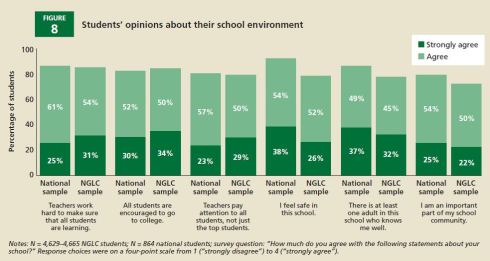
The survey data in the Rand study compares the NGLC schools in the study group with a national sample. I was surprised to learn that NGLC students do not feel as safe.

Rand Student Opinion Survey

From page 24 of the Rand Study

Bad Education Philosophy is the Source of “Personalized Learning” Failure

The behaviorist ideology of B.F. Skinner informs “competency based education.” CBE is the computer based approach that replaces the failed 1990’s behaviorist learning method called Outcome Based Education. Outcome Based Education is a renamed attempt to promote the 1970’s “mastery education” theory. Mastery education’s failure was so complete that it had to be renamed. It was quickly derided by educators as “seats and sheets.” These schemes all posit that drilling small skills and mastering them is the best way to teach. It has not worked yet.

Today’s proponents of behaviorist education hope that technology including artificial intelligence backed by micro-credentials and badges will finally make behaviorism a winner. It will not because little humans are not linear learners. Non-alignment with human nature is a fundamental flaw in this approach. In addition, behaviorism is not known as a path to creativity or original thinking. Those paths are created between teachers and students through human contact; paths undermined by “digital education.”

Artificial intelligence is more science fiction than reality. Computer scientist Roger Schank, a pioneering researcher in artificial intelligence notes,

“The AI [artificial intelligence] problem is very very hard. It requires people who work in AI understanding the nature of knowledge; how conversation works; how to have an original thought; how to predict the actions of others; how to understand why people do what they do; and a few thousand things like that. In case no one has noticed, scientists aren’t very good at telling you how all that stuff works in people. And until they can there will be no machines that can do any of it.”

With no unbiased positive proof of concept, hundreds of billions of taxpayers’ dollars which were earmarked for education are being spent on technology. It is likely that much of this spending will cause harm and that schemes like “personalized learning” will not deliver benefit to anyone who is not invested in a hi-tech industry.

These dollars could have been spent on better facilities, smaller classes, and better teacher education. Instead, the money is wasted on dubious theories propounded by leaders in hi-tech industries and forces looking to privatize public education.

Selling Education Technology Via the Federal Education Technology Plan

28 Sep

By Thomas Ultican 9/28/2017

In January the Office of Education Technology, a unit of the U.S. Department of Education, released its 2017 National Education Technology Plan Update (NETP). The update is not a reasoned meditation on the use of education technology informed by our nations vast academic research infrastructure. It is a polemic hyping the use of technology in America’s classrooms. Director Joseph South, Office of Educational Technology US Department of Education, concludes his introductory remarks:

“…, it is now more apparent than ever that the courageous efforts of educators to embrace the role of thoughtful, reflective innovators who work collaboratively with each other and alongside their students to explore new learning models, new digital learning environments, and new approaches to working, learning, and sharing is essential if we want technology to be an effective tool to transform learning.” (page 2)

The question is, do we want digital learning environments? Are they conducive to creative and healthy development? Are there dangers involved with this approach? Are we moving along a technologically driven path without the requisite caution? The NEPT is not troubled by such doubts.

I do not oppose the use of technology in America’s classrooms. I taught high school math and physics and at one time I worked in Silicon Valley as a researcher in the magnetic recording industry. However, the best use of technology in school settings is developed by education professionals and not by technology product developers. The educators goal is better pedagogy. The developers goal is a new widget (often with a short life span) that wins in the market place.

Audrey Watters has been writing about technology in education for most of the 21st century. Audrey’s latest book is The Curse of the Monsters of Education Technology published in 2016. He made these remarks to a class at MIT on September 7th.

“I don’t believe we live in a world in which technology is changing faster than it’s ever changed before. I don’t believe we live in a world where people adopt new technologies more rapidly than they’ve done so in the past. (That is argument for another talk, for another time.) But I do believe we live in an age where technology companies are some of the most powerful corporations in the world, where they are a major influence – and not necessarily in a positive way – on democracy and democratic institutions. (School is one of those institutions. Ideally.) These companies, along with the PR that supports them, sell us products for the future and just as importantly weave stories about the future.”

I quote Watters here because his statement about the major influence of technology companies is completely borne out by a cursory read of the NETP 2017. It is not just in the US where the outsized influence of these giant technology companies is being felt. In August, the Open Review of Education Research Journal published a paper from New Zealand by Noeline Wright and Michael Peters. In Response to a 2007 document from the New Zealand Ministry of Education they wrote:

“This document advocates e-pedagogy, social learning and student-centred approaches. The lure of what digital technologies can offer in properly constructed learning contexts masks some of the ways in which it can be interpreted to fit a neo-liberal, privatised, deprofessionalised education agenda. This is an agenda using big data to create mastery learning feedback loops for learners. It is cheaper, more efficient and involves fewer teachers. However, a key issue with this kind of thrust is that the capabilities needed for successful citizenship and employment centre on creativity, adaptability, critical thinking and nuanced understandings of complex ideas. Mastery learning, instead, is often focused on providing behaviourist instant feedback, rewarding content knowledge rather than an ability to argue, critique, create and repurpose. This is because content ‘facts’ can be quantified and machine assessed.”

A Look at The NETP for 2017

Selling SEL and Technology

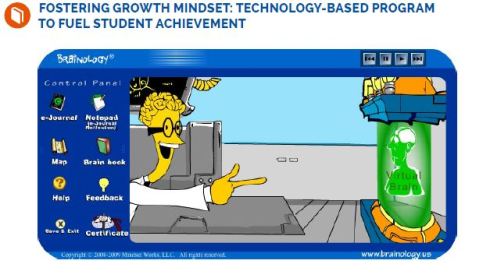
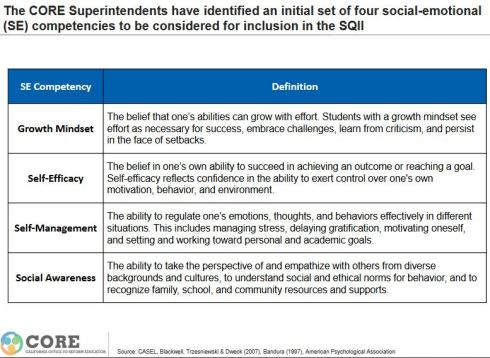
This graphic from page 11 is followed with, “A key part of non-cognitive development is fostering a growth mindset about learning. Growth mindset is the understanding that abilities can be developed through effort and practice and leads to increased motivation and achievement.” (proof?)

The next sentence informs readers, “The U.S. Department of Education has funded several growth mindset–related projects, including a grant to develop and evaluate SchoolKit, a suite of resources developed to teach growth mindset quickly and efficiently in schools.”

Once a student demonstrates they can pass the government sanctioned attitude test, they can get a micro-credential. Today, in China, one can earn citizenship merit badges. Behavior badging in China is explained in this video about gamifying good citizenship. Behavior modification is now a part of micro-credentialing promoted by the NETP.

The NETP is organized into five topics; Learning, Teaching, Leadership, Assessment and Infrastructure. By the time the reader gets to Assessment and Infrastructure some of the material gets redundant. Each topic is addressed with a set of assertions supported almost exclusively by antidotal evidence. After assertions are made, a report on how some school or district has successfully implemented the technology. Page one of the plan informs readers:

“This document contains examples and resource materials that are provided for the user’s convenience. The inclusion of any material is not intended to reflect its importance, nor is it intended to endorse any views expressed, or products or services offered. These materials may contain the views and recommendations of various subject matter experts as well as hypertext links, contact addresses and websites to information created and maintained by other public and private organizations. The opinions expressed in any of these materials do not necessarily reflect the positions or policies of the U.S. Department of Education.”

This disclaimer is completely disingenuous. This is exactly what the document does; it promotes these materials. On page after page the services and products endorsed invariably have large endowments from the technology industry. For example, a page 11 statement,

“For the development of digital citizenship, educators can turn to resources such as Common Sense Education’s digital citizenship curriculum or the student technology standards from the International Society for Technology in Education (ISTE).”

When we look at the ISTE web-site, we learn that Dallas Dance the former Baltimore superintendent of schools who is under criminal investigation is on the board of directors. At the site you can read all about the benefits of being a corporate member of ISTE. We also discover that:

“Year around sponsor Microsoft Corporation is Supporting bold education reform, Microsoft’s mission is simple: support bold education reform to help prepare students for today’s highly competitive workforce, and support our U.S. educators with software and programs that fuel powerful learning and digital-age skills.”

In addition, the Bill and Melinda Gates Foundation has also kicked in $1.4 million to ISTE.

Common Sense says it’s “the nation’s leading independent non-profit organization dedicated to empowering kids to thrive in a world of media and technology.” It also claims that 40% of its support comes from private foundations. In January the Gate’s foundation gave them another quarter of a million dollars. They have many working relationships with tech companies and an interesting board of directors including; Manny Maceda, Partner, Bain & Company; Gene T. Sykes Managing Director, Goldman, Sachs & Co.; and Bill McGlashan, Managing Partner, TPG Growth.

It is possible to make a count of all of the similar kinds of examples to these in the NETP but it takes a while. In another claim, the NETP states, “Technology access when equitable can help close the digital divide and make transformative learning opportunities available to all learners.” (Page 17) The example given is from San Francisco:

“BGC [Black Girls Code], founded in 2001 by Kimberly Bryant, an electrical engineer, aims to “increase the number of women of color in the digital space by empowering girls of color to become innovators in STEM subjects, leaders in their communities, and builders of their own futures through exposure to computer science and technology.”

How can I find fault here? To start with STEM is and always was a fraud. As for BGC, there is a reason that Verizon, Adobe, Salesforce, AT&T, Google, Oracle and others are giving BGC money. The New York Times reports that coding is being pushed into schools by the Titans of tech. There is an obvious down side to this corporate agenda; What if in a decade coding is no longer a skill in demand? Education priorities should not be driven by self-interested amateurs.

One of the more disturbing ideas promoted by NEPT appears on page 39. The example comes from a school district in Wisconsin that used the Digital Promise educator micro-credentialing framework as a guide, teachers in the district took a technology proficiency self-assessment, which they used as a baseline for their personal professional growth. The teachers then worked by themselves and in collaborative teams to develop specific professional learning goals aligned to district strategic goals, which they submitted to district leadership for approval.

The NETP explains,

“Once these goals are approved, the teachers establish measurable benchmarks against which they can assess their progress. Both the goals and benchmarks are mapped to specific competencies, which, in turn, are tied to micro-credentials that can be earned once teachers have demonstrated mastery. Demonstrations of mastery include specific samples of their work, personal reflections, classroom artifacts, and student work and reflections, which are submitted via Google Forms to a committee of 7 to 10 teachers who review them and award micro-credentials.” (emphasis added)

Digital Promise is a technology industry Pied Piper and their supporters are the most famous in the pantheon of technology industry “philanthropy”. The list includes Bill and Melinda Gates, Chan and Zuckerberg, Bill and Flora Hewlett; Michael and Susan Dell, Laurene Jobs and on and on.

The proceeding three examples were selected somewhat randomly. They are not necessarily the most disturbing or most egregious examples of the technology industry driving education policy through the National Education Technology Plan. There are at least twenty more cases that are equally as eye popping or more so. These are just three examples that demonstrate the unhealthy influence the technology industry has over education policy.

Conclusion

The ubiquitous power of the technology industry both in terms of money and political influence makes the gilded age look like a paragon of democratic action. They are selling bad products that are harming America’s world envied public education system. Our students have never scored particularly well on standardized tests when compared to the rest of the world, but they have outscored everyone by a wide margin when it came to creative thinking, developing new industries and advancing civilization.

These giant greed infested technology companies with their neoliberal and libertarian ideologies have tremendous wealth which gives them great political power. However, as Diane Ravich has said, “they are few, we are many.” The people still control. We need to keep doing what educators do. We need to educate America about this ongoing dangerous attack on our schools and our democracy. We need to keep exposing these profiteers lusting after tax dollars that are supposed to go to educate America’s children.

Two but Not Two Frauds: STEM and Education Technology

19 Sep

By T. Ultican 9/19/2017

Last year, IBIS Capital produced a report for EdTechXGlobal stating, “Education technology is becoming a global phenomenon, … the market is projected to grow at 17.0% per annum, to $252bn by 2020.” Governments in Europe and Asia have joined the US in promoting what Dr. Nicholas Kardaras called a “$60 billion hoax.” He was referring specifically to the one to one initiatives.

An amazing paper from New Zealand, “Sell, sell, sell or learn, learn, learn? The EdTech market in New Zealand’s education system – privatisation by stealth?” exposes the promoters of EdTech there as being even more bullish on EdTech. “The New Zealand business organisation (they spell funny) EDTechNZ, indicates on its website that educational technology is the fastest growing sector of a global smart education market worth US$100 billion, forecast to grow to US$394 by 2019.”

These initiatives are fraud based agendas because they focus on advancing an industry but are sold as improving schools. Unfortunately, good education is not the driver; money is. Speaking this month to a class at MIT, Audrey Watters shared insights into the phenomena,

“But I do believe we live in an age where technology companies are some of the most powerful corporations in the world, where they are a major influence – and not necessarily in a positive way – on democracy and democratic institutions. (School is one of those institutions. Ideally.) These companies, along with the PR that supports them, sell us products for the future and just as importantly weave stories about the future.”

As Trevor Noah explains in this short video this influence is not called bribery.

STEM Fraud

I was the head “tribologist” (study of things that rub together) at Sunward Technologies in San Diego, when in 1995 it was purchased by Read Rite Corporation of Milpitas (Silicon Valley). Three years earlier, every interview for graduating engineers at San Diego State University was cancelled because of the downturn in demand. In 1993, our personnel department screened more than 100 resumes before I was asked to interview five candidates for a job opening in my lab. The final decision was difficult because all five were well-qualified.

When I arrived in Silicon Valley in 1996 there did not seem to be any difficulty hiring engineers, but corporations were cannibalizing each other. As soon as a company made a technical advancement, their engineers were being pursued by competitors. This looked to be a significant motivator for hi-tech corporations lobbying for H-1B visas. H-1B visas tied the worker to the company that sponsored the visa.

In January of this year Congresswomen, Zoe Lofgren introduced a bill to reform the H-1B visa abuses. Her press release said,

“My legislation refocuses the H-1B program to its original intent – to seek out and find the best and brightest from around the world, and to supplement the U.S. workforce with talented, highly-paid, and highly-skilled workers who help create jobs here in America, not replace them,” said Lofgren. “It offers a market-based solution that gives priority to those companies willing to pay the most. This ensures American employers have access to the talent they need, while removing incentives for companies to undercut American wages and outsource jobs.”

To me this is the same malarkey she was spreading in 1996 when I arrived in the bay area. In 1998 the Tech Law Journal Congressional Scorecard rated Lofgren, a Democrat from Silicon Valley, in the top ten for supporting the high-tech industry. The Law Journal explained its ranking metric,

“All 100 Senators and all 435 Representatives were rated on a 0 to 100 scale on the basis of their support for high tech.  The scorecard utilized five objective criteria (roll call votes on, and sponsorship of, bills pertaining to encryption, Internet tax moratorium, securities litigation reform, H1B visas, as well as membership in the Internet Caucus.” [emphasis added]

Before the H-1B visa program, when a technology change eliminated a function, the engineers and technicians effected would be transferred to other departments. After H-1B, they were laid off and hiring firms would find ways to claim that only an H-1B applicant could fill the jobs in those other departments. The corporations gained indentured servant like control and wages stagnated.

By 2001, I was in graduate school at UCSD where I first heard about the need for schools to help train more STEM (Science Technology Engineering and Math) professionals. Like most people, I drank the Kool-aide. But, we were all victims of a misinformation campaign being waged by leaders in high-tech. As Jay Schalin observed,

“The real facts suggest that, in many STEM specialties, there is a labor glut, not a shortage.”

“The apparent misinformation continues to this day. Microsoft founder Bill Gates has been particularly vocal about supposed shortages of skilled labor in the computer industry.”

By 2004, a Rand Corporation study was already questioning these claims.

“Concerns about the size and adequacy of the U.S. scientific, technical, engineering, and mathematics workforce have grown amid fears of a dwindling labor pool and concern that this may erode U.S. leadership in science and technology and could complicate mobilization of appropriate manpower for homeland security. In the past, such fears have failed to materialize, and surpluses have been more common than shortages.”

In a 2014 Atlantic Magazine article, Michael S. Teitelbaum reported,

“No one has been able to find any evidence indicating current widespread labor market shortages or hiring difficulties in science and engineering occupations that require bachelors degrees or higher, although some are forecasting high growth in occupations that require post-high school training but not a bachelors degree. All have concluded that U.S. higher education produces far more science and engineering graduates annually than there are S&E job openings—the only disagreement is whether it is 100 percent or 200 percent more.”

The trumpeting of a “STEM shortage crisis in America” is and always was a hoax. This same con is deforming public education. The new Common Core State Standards and the Next Generation Science Standards were motivated respectively by Bill Gates (Microsoft) and Louis Gerstner (IBM). As a result they devalue humanities and glorify science and engineering based on this same fraudulent STEM claim. There must be a thousand charter schools that advertise themselves as STEM academies.

OLYMPUS DIGITAL CAMERA

Here in California this same lie is being used to promote yet another attack on local control of public schools. In July, Raul Bocanegra (D-San Fernando) announced new legislation that would create a State authorized STEM school for 800 students. It would be privately managed and sited in Los Angeles county.

The news organization Capital and Main stated, “For a district that is already the largest charter school authorizer in the nation and is still gun-shy after recently fending off a takeover attempt by billionaire school choice philanthropist Eli Broad, any scheme that promises further stratification is an existential threat.”

Diane Ravitch claimed, “LAUSD already has STEM schools, but this is Eli’s STEM school, and he really wants it.” The billionaire real-estate mogul and insurance salesman is widely believed to be the driving force behind this legislation.

The proposal would be an end run around local control. Instead of local school districts supervising the new charter school, the state board of education would be the authorizer and supervisor. It is an extreme idea that perverts further an already perverted state charter school law.

Strangely, that did not stop the two most important newspapers in southern California from supporting it.

The LA Times which gets $800,000 a year from Eli Broad wrote a really strange editorial in which it admitted that the law would be problematic and undermine local governance. But it fell back on a favorite billionaire inspired reform reason for supporting the law, “But right now, the overriding concern should be providing as many great public schools for low-income kids as we can manage.” Those billionaires just love love love poor and minority children.

The San Diego Union-Tribune editorial page gushed over the idea of creating a new privatized school based on the fraudulent STEM premise and thwarting local control. The main beguiling point was delivered in this paragraph;

“So it sounded like a great idea when two San Fernando Valley Democrats — Assemblyman Raul Bocanegra and state Sen. Anthony Portantino — introduced a bill to build a pioneering state-run STEM (Science, Technology, Engineering and Math) middle and high school in downtown Los Angeles. The idea is even more appealing because it called for educating talented minority students from poor communities without the same opportunities enjoyed by students in wealthier areas. The cherry on top was that deep-pocketed Angelenos with a desire to make the California tech world more diverse are behind this concept — that could be a model elsewhere — and are eager to provide supplemental funding.”

It seems the fourth estate no longer ferrets out fraud and corruption but is instead complicit in these nefarious plots.

Unfortunately, Education Technology is Greed Driven

Hi-Tech and digital initiatives are careening down a dark road. Because of the extreme power of hi-tech corporations like Apple, Google, Microsoft, IBM, and many others, the development of education technology is being driven by their needs and not the needs of students. Students have become their guinea pigs as they release one untested technology after another into America’s classrooms.

Technology has a potential to enhance education but it also has the potential to cause great damage.

A century ago, there were people taking correspondence courses and getting great value from them. Today, the modern equivalent of the correspondence course is the online class.

However, students at screens like correspondence students will never achieve equal benefit to students with a teacher, because the teacher-student relationship is the most important aspect in education.

Teacher-student relationships are different than those with friends, parents or siblings. My personal experience was that I felt a genuine selfless love for my students and we communicated about many things; often personal but mostly academic. I also felt a need to protect them. In America’s public schools, a student might have that kind of close relationship with more than 40 adults during their 12 years in school. This is where the great spark of creativity and learning leaps from teacher to student.

I have put students at screens in my career, but I never found great benefit in the exercise. I found technologies like graphing utilities to be highly beneficial, but it was the interaction with my students that was of most value for deep learning, enhancing creativity and developing a love for learning. If technologies destroy these relationships then they become a net evil.

I quoted Audrey Watters speaking to an MIT class about hi-tech corporations and the stories they weave. Here is her description of those stories:

“These products and stories are, to borrow a phrase from sociologist Neil Selwyn, ‘ideologically-freighted.’ In particular, Selwyn argues that education technologies (and again, computing technologies more broadly) are entwined with the ideologies of libertarianism, neoliberalism, and new forms of capitalism – all part of what I often refer to as the “Silicon Valley narrative” (although that phrase, geographically, probably lets you folks here at MIT off the hook for your institutional and ideological complicity in all this). Collaboration. Personalization. Problem-solving. STEM. Self-directed learning. The ‘maker movement.’ These are all examples of how ideologies are embedded in ed-tech trends and technologies – in their development and their marketing. And despite all the talk of ‘disruption’, these mightn’t be counter-hegemonic at all, but rather serve the dominant ideology and further one of the 21st century’s dominant industries.”

A faculty colleague of mine said, “the last thing 21st century students need is more screen time.” I believe Jean M. Twenge, professor of psychology at San Diego State University and the author of Generation Me and iGen would enthusiastically agree. She recently wrote an article for Atlantic magazine describing the dangers of screen time to the current teen generation she calls the iGen. Based on her research she said,

“Teens who spend three hours a day or more on electronic devices are 35 percent more likely to have a risk factor for suicide, such as making a suicide plan. (That’s much more than the risk related to, say, watching TV.)”

“The results could not be clearer: Teens who spend more time than average on screen activities are more likely to be unhappy, and those who spend more time than average on nonscreen activities are more likely to be happy.”

“There’s not a single exception. All screen activities are linked to less happiness, and all nonscreen activities are linked to more happiness.”

“In 2011, for the first time in 24 years, the teen suicide rate was higher than the teen homicide rate.”

Obviously, many of our institutions have been corrupted by the immense power of concentrated wealth and especially by hi-tech industries. The money being chased is enormous, but there are more of us. If we educate ourselves, our families and our neighbors we can reform these greed driven forces into forces for good, but we need to pay attention.

San Diego Schools Embrace Untested “Depersonalized” Learning

21 Jun

By Thomas Ultican 6/21/2017

San Diego Unified School District (SDUSD) is spending lavishly on technology despite their budgets being decimated by California’s unaccountable charter school industry. During the 2016-17 school year, SDUSD bought digital badging and 16,000 new Chromebooks.

“The district is struggling with a projected $124 million shortfall to its $1.4 billion budget, and have issued in the neighborhood of 1,500 layoff notices to full and part-time employees” reports the San Diego Union.

This kind of insanity seems to be a national movement. There is almost no evidence supporting these new theories of technology driven education. Yet, the leaders of financially strapped SDUSD are spending to have their students become experimental subjects for learning products produced by technology companies.

A recent article in the NY Times by Natasha Singer describes how DreamBox (a widely distributed math learning program) is popular with children but not for doing the math but for doing things like spending points to customize their avatar. Singer writes,

“So far there is little proof that such technologies significantly improve achievement. Adaptive learning courseware, for instance, generally did not improve college students’ grades or their likelihood of completing a course, according to a 2016 report on some of these programs by the S.R.I. Education research group.”

“Badges, We Don’t Need No Stinking Badges”

My friend, Tim, graduated for University City High School this year and invited me to attend his ceremony. I went to the school’s website for parking instructions, where I saw this:

Digital Badge

The badge image contained a hotlink to the SDUSD website which notifies the reader:

“Starting winter 2016, San Diego Unified will begin awarding achievement by issuing digital badges. Digital badges are virtual tokens issued as recognition of a skill, or behavior demonstrated, or an achievement a student has earned.”

Much of this informational page is little more than a corporate advertisement with a video claiming how wonderful and popular digital badging is. The instructions for getting started say SDUSD offers ninety-five high school badges and 20 elementary and middle school badges. Students and parents are informed:

“Students will be notified of badges through their Gmail email account accessible through their Google apps for education.”

Elementary and Middle School Badges

SDUSD also informs us that they won’t just be Cub Scout style merit badges. Soon, students will receive “micro-credentials” that will be recorded in their records kept by University of California San Diego extension.

This all looks harmless enough but it is not! Behind the digital badging scheme is a toxic combination of corporate greed and hubris. As digital badging grows, classical teacher led education will be undermined in all but exclusive high end private schools. It is yet another path to education on-the-cheap driven by profit motives instead of pedagogic expertise.

Additionally, badging is a data mining corporations dream come true. Students will lose all semblance of privacy.

Behavior badging in China is explained in this video about gamifying good citizenship. It gives me the creeps; however, behavior modification is already part of digital badging.

Emily Talmage teaches public school in Maine, where badging started a couple years ago. She describes what she’s learned:

‘“By collecting skill-based badges, the record of achievement begun in secondary school becomes the foundation upon which workers build their capabilities and tell their stories to employers,’ explains the infamous testing-behemoth, Pearson Education.

Knowledgeworks recently described the new learning system as an ‘ecosystem,’ in which the role of the traditional teacher will soon be obsolete.

“With major investments from Wall Street, leaders in the online learning, ed-tech, and student loan industries, and even celebrity billionaires like Mark Zuckerberg of Facebook and Reed Hastings of Netflix, the transformation has recently been picking up speed. Meanwhile, political groups on both the left and right are moving the system forward by lobbying for ‘personalized,’ competency-based policies and ‘innovative’ assessment systems.” [Note: Reed Hastings of Netflix is also owner of DreamBox Learning, Founder of Rocketship charter schools and a board member of California Charter Schools Association.]

“Personalized learning” is the Orwellian name given to computer delivered education. It is isolating and devoid of human interaction. There is nothing personal about it. It truthfully should be labeled de-personalized learning.

Adults Engaged with Students are Key to Intellectual Growth

America’s public education system was wildly successful right up to the advent of modern education reform. There were problems but the creativity of America’s students led to cultural, scientific and economic leadership in the world. No other country comes close to matching the US in either Nobel Prizes awarded or new industries created. The non-coercive (no high stakes testing) learning environment of our public schools allowed students to create wonderful respectful relationships with many adults and develop according to their own personality.

Daisaku Ikeda, the founder of the Soka Schools, discusses the importance of teachers in his book Soka Education, “Recognizing each student as a unique personality and transmitting something through contacts between that personality and the personality of the instructor is more than a way of implanting knowledge: it is the essence of education.” Ikeda also mentions that Socrates likened this to being “kindled by a leaping spark” between teacher and student.

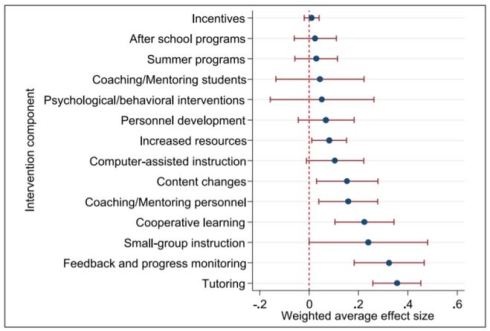
This May, Fredrik DeBoer posted results from a January study by Jens Dietrichson, Martin Bøg and Trine Filges. In his post, DeBoer explains the science behind the study and praises its methodology. He also shares some of the results that are behind a pay wall. The abstract for the report called “Academic Interventions for Elementary and Middle School Students With Low Socioeconomic Status.” states,

“This systematic review and meta-analysis seeks to identify effective academic interventions for elementary and middle school students with low socioeconomic status. Included studies have used a treatment-control group design, were performed in OECD and EU countries, and measured achievement by standardized tests in mathematics or reading. The analysis included 101 studies performed during 2000 to 2014, 76% of which were randomized controlled trials.

Weighted Average Effect Size

This graphic from DeBoer’s post is a comparative graph of the weighted average effect size. The impact of each intervention component is shown in terms of standard deviations on the horizontal axis. The five most effective interventions all require human interaction. If we are led by evidence, then we must admit that the human component in education is crucial.

There are Reasons Education Technology is More Popular than Effective

In 2013, SDUSD created the i21now committee and gave it ninety days to prepare a report on education technology going forward. The committee made up of 104 individuals included Cindy Martin SDUSD Superintendent, several other district executives, seven classroom teachers and thirty-five representatives of corporations and foundations promoting digital learning.

Corporations/Foundations Count
Apex Learning 2
Apple 3
At&t 4
Cisco 2
Cox 3
Dell 1
Houghton Mifflin Harcourt 1
iEngage Mobility 1
Intel Foundation 1
Lenovo 2
Microsoft 3
Partnership for Children 1
Project Tomorrow 1
Promethean 1
Qualcomm 3
Reality Changers 1
SENTRE Partners 1
Time=Warner 2
ViaSat 1
XO 1
Total 35

In general, the teachers and IT professionals who volunteer to be on a technology committees are themselves technophiles likely to be biased. Of course, the representatives of the network, software and hardware corporations who comprise an outsized share of the committee membership are there to promote their products.

Project Tomorrow has a representative on the i21now committee. I have written previously about the influence Project Tomorrow had on the school district where I worked (Sweetwater Union High School District). One of the teacher members of our technology committee sent us all data and brochures from Speak Up praising computer based education and de-personalized learning. Project Tomorrow and Speak Up are both part of tomorrow.org.

More than 90 corporations and non-profits are referenced as financial supporters of tomorrow.org. Included amongst the contributors are both the American Federation of Teachers and the National Education Association.

It is not surprising that the i21now committee mapped a technology path forward that is nearly identical to the positions promoted by large technology corporations and tomorrow.org. The executive summary of their report has 21 bullet point. Here are a few that caught my eye.

“Pursue new funding sources and repurposing current funding by moving expenditures away from textbooks and structured classrooms toward virtual learning, digital content and personalized learning.”

“Provide students with mobile access to broadband connectivity anytime/anyplace, while leveraging resources and partnerships to drive down costs.”

“Ensure sustainable funding to provide access at home and beyond for all students.”

“Support upgraded wireless, wired, and 1:1 environments, plus building systems and VOIP (Voice over Internet Protocol), while ensuring accessibility with digital dashboards and portals.”

“Incorporate reputable online resources and real-time data to differentiate instruction and engage students with real-world content.”

“Implement competency-based learning and problem-solving-based assessment, aligned with Common Core standards.”

The last bullet point calls for competency-based learning. This is not a new idea and it has failed miserably in both the 1970’s and the 1990’s. The theory is that education can be chunked down into discrete learning standards or competencies.

In the 1970’s this theory was called mastery learning. Soon educators were derisively calling it “sheets and seats.” It failed so miserably as a pedagogical practice that it was renamed. In the 1990’s it was called outcome based education. The new name did not help because the theory was still bogus.

Badging and competency-based learning are yet another incarnation of this behaviorist theory of education. Just because it is being done on a computer does not mitigate the fact that it is based on a bad theory of human behavior.

I do not say that education technology and learning programs have no value, but I have never seen an exemplary learning program. At their core, they all eventually become computer based drill and skill. Teachers have known for a long time that this is a bad pedagogical method widely denigrated as “drill and kill.”

The implementation of technology in the classroom will never reach its potential until that implementation and design is led by educators. Some of my friends believe that the badging and competency-based education are an existential threat to public education. I don’t. It is a bad product and parents do not want their children sitting at computer terminals. They expect them to be in authentic learning environments with competent experienced teachers.

Rich people will never accept this enervated method of education for their children.

Credit Recovery Farce Generates Spectacular Graduation Rates

8 Jun

By Thomas Ultican 6/8/2017

A miracle has occurred. America’s high school graduation rates peaked at about 77% in 1970 and then drifted down for almost four decades to 69% in 2007. Astoundingly, even with increased graduation requirements rates have shot up.

Many school districts in California now require all students to meet course requirements for entering the University of California system to graduate from high School. That is a dramatic increase in academic rigor. Yet, in 2016, over 83% of California’s freshman cohort graduated on time. In 2012, 81% of the freshman cohort in America graduated on time. These record setting numbers are the result of knuckleheaded political policy, cheating and credit recovery.

What is Credit Recovery and Where did it Come from?

In the 1990’s politicians like Bill Clinton and Jeb Bush were pushing for standards in education and accountability measures. Jeb Bush’s infamous school grading system called for 25% of a high school’s grade to be based on graduation rates. Bill Clinton wrote in 1998,

“We have worked to raise academic standards, promote accountability, and provide greater competition and choice within the public schools, including support for a dramatic increase in charter schools.”

“We know that all students can learn to high standards, and that every school can succeed if it has clear instructional goals and high expectations for all of its students; ….”

Donald T. Campbell’s 1976 paper presented a theory about social change that is now widely revered as Campbell’s Law: “The more any quantitative social indicator is used for social decision-making, the more subject it will be to corruption pressures and the more apt it will be to distort and corrupt the social processes it is intended to monitor.”

Exactly as the Social Scientist, Campbell, postulated, this national push to increase the standards of school rigor and to use social indicators (graduation rates and high stakes testing) to evaluate schools has introduced distortion and corruption.

How were school leaders going to protect their institutions and their own jobs from the ravages of horribly shortsighted and uninformed education policy? The solution was obvious; teach to the test and find a way to raise graduation rates.

To the rescue, came both the Walton Family Foundation and the Bill and Melinda Gates Foundation along with many other lesser contributors. They perceived it was time for advancing the privatization of public education and accelerating the adoption of technology in education. Credit recovery was a perfect vehicle.

A mouthpiece for these foundations, the Education Commission of the States, explains:

“Credit recovery is an alternative to course repetition for students who have previously failed a course needed for high school graduation. Programs may be offered via computer software, online instruction (including through a state’s virtual high school or a local virtual school) or teacher-guided instruction (small group or one-on-one), and are typically targeted at the standards in which students were deficient, rather than all standards in the original course.

“Programs should be self-paced and competency-based ….”

Another organization significantly financed by Walton and Gates iNACOL (International Association for k-12 Online Learning) promotes a virulent form of computer based education known as CBE. I discussed CBE in a previous post: “CBE is basically outcome based education moved to digital space. Outcome based education was the new 1990’s name given to a previously failed strategy known as mastery education (AKA ‘seats and sheets’).” The fundamental theory of CBE is that education can be reduced to discrete pieces of knowledge. It’s bad theory.

iNACOL also weighed in on credit recovery:

“Our country has been trying to address the graduation crisis in many ways.”

“Today, one of the root issues is the older students who are missing a significant number of credits do not have the time to sit in class again, thus competency-based programs are a better option.”

Echoing the unsubstantiated “Nation at Risk” iNACOL does not see foolish policy or growing poverty leading to stagnate or falling graduation rates. It sees a CRISIS!

With credit recovery students are able to gain graduation credits in as short a time as a day. According to several teacher friends who have taught teacher led credit recovery, there is no real instruction, just filling in packets (“seats and sheets”). I have heard many students say, “I don’t care if I fail, I’ll do credit recovery.” Why not? It’s easier.

How Fraudulent is Online Credit Recovery?

At the high school where I taught this year, I overheard a pair of administrators speaking in hushed tones about the fraud going on in the learning center. In our district, there are twelve learning centers which are technically separate schools. They provide online credit recovery for students who have not earned enough credits. The discussion was about seeing students using smartphones to answer the test questions provided by Apex Learning. The fact that this behavior was being tolerated was what galled them.

As is made clear in a recent series of eight article about credit recovery published by Slate Magazine, cheating on credit recovery is not unique at all.

Zoë Kirsch wrote in her Slate article, The New Diploma Mills:

“Almost 90 percent of school districts use some form of credit recovery, according to a 2011 report from the National Center for Education Statistics (the center doesn’t distinguish between online and other forms). And data cited by the International Association for K-12 Online Learning, a trade group, shows that at least 75 percent of districts use some form of online learning. So, we can say this about online credit recovery: It’s pretty big.”

Kirch’s article also reports that in Nashville, graduation rates increased from 70 percent in 2007 to 81.6 percent in 2015 following the introduction of online credit recovery. Even more stunning, in Los Angeles the graduation rate grew from 54 percent to 75 percent in a single year when credit recovery was introduced in 2015.

A supervisor of credit recovery at East Gadsden High in Florida was informed that some students there were paying one another to do online coursework. When she reported it to the district, an administrator there told her to “leave it alone.” “There’s some things you can’t fix.”

The article “Fast. Isolating. Superficial.” by Stephen Smiley shares,

“She [Elizabeth Bieze, the guidance counselor who oversees the virtual lab at Sullivan High School Chicago] adds that it’s not atypical for students to recover credits for yearlong classes in under a week. ‘They do really well in the pretest, they get to skip a bunch of stuff, and they just take the final exam,’ she says. ‘It has helped our graduation rate immensely.’”

Stephen also found this:

“‘Anyone wanna do a math credit recovery for me I’ll pay you,’ read one tweet posted by a student in Erie, Pennsylvania, in August. ‘If anyone wants to go online and do my chemistry credit recovery I’d be more than happy to give you my username and password,’ wrote another student in Arkansas. Naturally, online learning companies like Edgenuity and Apex insist that most don’t actually follow through and that the chatter is mostly empty boasting.

“That may be so, but I didn’t have too much trouble finding students online who insisted they had cheated without being caught. One of them, Joseph, who is a 17-year-old senior at a Long Island high school in New York, said his online English class was uninspiring, so he paid a buddy $200 to complete it.”

Stephen also wrote a second article for Slate, “I Am an Online Credit Recovery Dropout.” In it he describes a personal experience of taking a few online courses. Stephen concluded,

“But I also came to appreciate what many students had told me about virtual learning: Compared with regular school, there’s less interaction with teachers, fewer opportunities for creative expression, and little chance to bounce around ideas with classmates. While online learning clearly has some strengths (programs can be tailored to individual needs, for instance), it’s hard to get away from an overarching conclusion: The experience as a whole can be pretty boring and lonely.”

Why is Credit Recovery Flourishing?

Francesca Berardi wrote “Take These Students, Please” about online credit recovery in Chicago. Surprising to me, it turns out that former basketball star Magic Johnson is a significant participant in the industry. Francesca notes,

“During Emanuel’s administration, Magic Johnson has become a major player in Chicago’s education world: Bridgescape operates five programs across the city, serving more than 850 students, and as the Chicago Tribune reported, in March 2015 another of Johnson’s companies, SodexoMAGIC, received an $80 million contract to take over janitorial services for several Chicago Public School buildings. Following the contract, Johnson donated $250,000 to Emanuel’s campaign for re-election.

“Not surprisingly, last September, Emanuel announced that in just five years the high school graduation rate had jumped from roughly 50 percent to 73.5 percent.”

‘’’The district is giving high school diplomas for programs that are nowhere near comparable to regular high schools,’ said Troy LaRaviere, president of the Chicago Principals & Administrators Association and a fierce critic of Emanuel’s administration.”

Zoë Kirsch and Stephen Smiley teamed up to write “Why Bad Online Courses Are Still Taught in Schools.” The article opens with this story from Florida:

“Last year, the Florida Department of Education rejected the company Online Education Ventures, which failed to provide descriptions of its virtual courses in science, social studies, and English (it provided descriptions of the math courses, but they didn’t meet state standards). A year earlier, the state disqualified Mosaica Online because the company didn’t show it could provide timely information about its courses. And it said no to Odysseyware, since it failed to outline student anti-discrimination policies or show how its products could meet the needs of students with disabilities.

“But here’s the rub: Those companies are still allowed to sell their products to schools in Florida. Public school districts can still use public money to educate students with discredited products like Online Education Ventures.’”

“The conservative American Legislative Exchange Council has made expanding online learning—unfettered and in all of its forms—one of its priorities. … ALEC has quietly but effectively helped mostly Republican lawmakers pass the kinds of laws the online learning companies want—laws that, for instance, require all graduating high school students to complete at least one virtual class.”

According to Zoe and Stephen, no states are doing a good job of regulating online learning and credit recovery. “As it happens, one of the most rigorous judges of online credit recovery classes is the NCAA. The NCAA’s standard is higher than what any state government requires for its students.”

Some Conclusions and Recommendations

Credit recovery has introduced a corruption into public education.

Online learning is only better than no other alternative. It is lifeless and dull. Some people claim there are ways to make it better, but I seriously doubt that it will ever match a classroom with a teacher to stimulate supervised dialog as a learning vehicle.

The push for credit recovery is a blatant scheme to impose privatized online learning.

Until this corruption has been eradicated, diplomas that are awarded based on credit recovery should have a reduced status to legitimately earned high school diplomas. That will at least reduce the incentive to “get it in credit recovery.”

Of all the increased academic requirements, the requirement for advanced mathematics to graduate from high schools is the most counterproductive. Most college graduates will never have a reason to make a binomial expansion or mathematically describe a conic section. Roll back these stupid requirements. Every student is not going to Berkeley.

Notes:

The five Slate Magazine articles I cited above are more on point for my article but these three articles cited below are also valuable reads.

Bottom of the Class By Francesca Berardi and Zoë Kirsch highlights some of the worst online companies.

Online Education Doesn’t Have to Be Isolating By Sarah Carr discusses some ways online learning can be done well.

Just Take It Again By Stephen Smiley describes how some of the online design makes it easy but not authentic.

One to One Initiative Threatens Public Education

27 Mar

By Thomas Ultican 3/27/2017

One to one classroom agendas have a dark side that includes the destruction of public schools as we know them; where teachers and students interact. It’s a dystopian ideology that posits students earning education badges while working in isolation at a digital screen.

This month, the entire staff at my high school received an email from a colleague who recently volunteered to be on our district’s technology committee. The message said in Part:

“In doing research for next year’s Technology Plan I came across some interesting data collected by the Speak Up 2015 Research Project.

“Although this particular data is from 2015 it still makes a lot of great points! Click on the links below, I promise it is a quick read.  Enjoy!”

The email message included three links to infographics provided by tomorrow.org.

What do Parents Really Think about Digital Learning

Looking Inside Today’s Digital Classroom

10 Things Everyone Should Know About K12 Students’ Digital Learning

These infographics claim that to be the result of authentic unfiltered data from respectively; 38,613 K-12 parents nationwide, 38,157 K-12 educators nationwide and 505,676 K-12 students, parents and educators nationwide. Ever since my Viet Nam war experience, I have been less trusting. I seek verification for all claims. I want to know the research methodology and who is paying.

Project tomorrow’s research is based on volunteers who engage with their web site answering survey questions. The web site is mostly an advertisement for implementing digital learning and a guide for how to lobby local schools to implement it. It has an agenda and a profound bias.

There are more than 90 corporations and non-profits listed as supporters of tomorrow.org, the cyber-space marketing address for this group. Many other organizations are lavishly financed by corporations to promote competency based education CBE including Future Ready. In addition to the eighteen largest contributors pictured below, both the American Federation of Teachers and the National Education Association are contributors to tomorrow.org.

Corporations Sponsoring Project Tommorrow

My School District’s technology committee is being influenced by the corporate sponsors of tomorrow.org. Last time the district technology plan was updated (2014) the technology committee was swayed by Project Red which is supported by many of the same corporations as Project Tomorrow and Future Ready. All three organizations promote one-to-one education at a computer screen.

A fellow teacher presciently commented, “The last thing 21st century students need is to be put in front of another screen.

Last year when writing about this same issue, I wrote, “When congress passed the new education law (ESSA), the United States Department of Education (USED) became the nation’s leading education technology sales force.” USED works to sell “blended learning”; “competency based education”; “personalized learning”; “linked learning”; etc. These initiatives have at least four things in common; they all profit technology companies; they all are unproven; they all promote unhealthy education practices; and they overturn a student’s right to privacy.

Competency Based Education (CBE) Updates a Failed Strategy from the 1990’s

Obama’s Education Department was an unabashed supporter of CBE and the new federal education law ESSA provides money to encourage CBE. On the Department of Education web-site, it defines CBE:

“Competency-based strategies provide flexibility in the way that credit can be earned or awarded, and provide students with personalized learning opportunities. These strategies include online and blended learning, dual enrollment and early college high schools, project-based and community-based learning, and credit recovery, among others.”

“By enabling students to master skills at their own pace, competency-based learning systems help to save both time and money. Depending on the strategy pursued, competency-based systems also create multiple pathways to graduation, make better use of technology, support new staffing patterns that utilize teacher skills and interests differently, take advantage of learning opportunities outside of school hours and walls, and help identify opportunities to target interventions to meet the specific learning needs of students.”

This all sounds great except CBE is basically outcome based education moved to digital space. Outcome based education was the new 1990’s name given to a previously failed strategy known as mastery education (AKA “seats and sheets”). Outcome based education failed miserably around the world. The big advantage for CBE is that giant profits are possible for corporate providers, especially technology companies.

I never expected to quote Phyllis Schlafly but she wrote a prescient report in 1993, “What’s Wrong With Outcome-Based Education?” She said:

“Alexander Solzhenitsyn, the famous Russian author and former political prisoner in Soviet Gulags, said in a speech in the mid-1970s: ‘Coexistence on this tightly knit earth should be viewed as an existence not only without wars . . . but also without [government] telling us how to live, what to say, what to think, what to know, and what not to know.’”

“Unfortunately, that’s what Outcome-Based Education is — a process for government telling our children how to live, what to say, what to think, what to know, and what not to know. What the children say, think and know must conform to the liberal Politically Correct ideology, attitudes and behaviour.”

Maybe you dismiss Phyllis Schlafly as a paranoid right wing cook, but this video about how the Chinese are gamifying good citizenship should give you the creeps. Teachers hated outcome-based education, but it was the extreme right that delivered the death blow.

Emily Talmage teaches public school in Maine, where CBE is being piloted. She describes what she’s learned:

‘“By collecting skill-based badges, the record of achievement begun in secondary school becomes the foundation upon which workers build their capabilities and tell their stories to employers,’ explains the infamous testing-behemoth, Pearson Education.

“Knowledgeworks recently described the new learning system as an ‘ecosystem,’ in which the role of the traditional teacher will soon be obsolete.

“With major investments from Wall Street, leaders in the online learning, ed-tech, and student loan industries, and even celebrity billionaires like Mark Zuckerberg of Facebook and Reed Hastings of Netflix, the transformation has recently been picking up speed. Meanwhile, political groups on both the left and right are moving the system forward by lobbying for ‘personalized,’ competency-based policies and ‘innovative’ assessment systems.”

The educator known by his wonderful blog, Curmudgucation, Peter Greene, recently wrote:

“Personalized learning, whether we’re talking about a tailored-for-you learning program on your computer screen or a choose the school you’d like to go to with your voucher, is not about actual personalization. It’s about another path for marketing, a way of personalizing the marketing of the product, the edu-commodity that someone is already trying to make money from.”

There is presently a Tennessee court case asking the provocative question, “does a student have a right to a teacher or is a computer enough?”

What is the Proper Place for Digital Education?

The one-to-one initiative being marketed as personalized learning makes little sense. Having tax payers provide a tablet or laptop computer to every student is crazy. It is obviously not personalized learning any more than correspondence school was personalized learning in the middle 20th century. Some student with unique situations may succeed with cheap on-line learning but as a strategy for most students, there is no reason to think it will work.

Our spending for public education needs to be submitted to a rigorous cost-benefit analysis. As much fun as it may be to give every child a digital learning device, the quality of learning would likely be more improved if the school district used that money to reduce class sizes by one or two students. The one to one digital initiative is an unproven theory for improved education but class size reduction is a proven theory.

However, having sufficient computer resources available for students to use makes sense. It might be a good idea to make classes like keyboarding (typing) available and highly encouraged. My students are amazed when they see me typing without looking at the keyboard. That is a skill that has served me well and I think our students should have that opportunity.

Even cyber-course work could be valuable, if it is not mainly about maximizing profits. In his book, Teaching Minds, the cognitive scientist and pioneer in online learning, Roger Schank, makes the point that good online education costs as much as good classroom education. Class size still matters and the learning project designs must be well thought-out and relative to the particular class of students. However, today’s K-12 cyber-schools are really cyber-frauds.

The bottom line with technology spending and use in the classroom is that very aggressive well financed corporate sales teams see schools as a huge market. In addition, federal dollars are getting earmarked by corporate friendly politicians for technology spending. Therefore, it is prudent to look at how valuable this technology really is and not be swayed by the hype.

It is unlikely that good use of technology in education is going to come from the Bill Gates funded Kahn Academy or Tom Vander Ark. It is much more likely that most of the excellent thinking on use of technology in education will come from America’s classroom teachers. Let’s not be bamboozled or intimidated. It is classroom teachers that know what is valuable for learning.

Education Reform Musing

14 Feb

By Thomas Ultican 2/14/2017

I have done a lot of whining about “corporate education reform” and the “test and punish” theory of education reform and “standards based” top down education. I am in full agreement with the conclusion Kristina Rizga reached after her four years’ study of Mission High in San Francisco, “The more time I spent in classrooms, the more I began to realize that most remedies that politicians and education reform experts were promoting as solutions for fixing schools were wrong.”

However, I am tired of being Debbie Downer. So, I will share my thoughts on a positive path of improvement for education in America.

Democracy and Local Control

Never let foreigners decide how and what should be taught in your kid’s school. By foreigners, I mean anyone that has never been in the school and lives more than 50 miles away.

Reed Hastings of Netflix was such a heartfelt liberal that he even joined the Peace Corps. He taught mathematics in Africa. Yet, in 2000, this once liberal crusader used his vast wealth to lift the cap on charter schools in California. Today he may be even more infamous for telling the California Charter Schools Association that elected school boards are anachronisms and should be replaced by non-profits running charter schools.

This is the problem with the uber-wealthy and their political assets controlling education. As statistics expert Gene Glass wrote “success in business has proven to them that their circle of competence knows no bounds.” It is my firm belief that the wisdom of the masses expressed through democratic processes is far superior to the dictates of any one of us including political titans and the billionaires.

In 1891, at the NEA gathering in Toronto Canada, Francis W. Parker of Chicago representing the Cook County Normal School declared:

“The soul seeking peace and comfort under the dominance and permanence of fixed ideals shrinks with dismay from the inevitable blunders, stupidity, ignorance and calamities that invariably accompany all democratic growth. The short road of centralization seems to reach in a day that which takes years to accomplish under the patient waiting for that slow dawning of intelligence which leads to right action on the part of democratic communities.

“Our foreign critics mistake variety and honest individual striving for chaos. That which has its birth in the desires and intelligence of the people, and is applied by the will of the people, becomes an organic, permanent factor in the progress of civilization of that people. It is rooted and grounded upon the people-“Vox POTTI. Vox dei.” But that which is imposed upon a people by any authority below heaven breaks into atoms when the intelligence and power of a people can reach and control it.

Centralized power may be a necessity for infancy, but manhood sheds it off for the strong wings of freedom.

In 1916, John Dewey wrote in his book Education and Democracy,

“An aim must, then, be flexible; it must be capable of alteration to meet circumstances. An end established externally to the process of action is always rigid. Being inserted or imposed from without, it is not supposed to have a working relationship to the concrete conditions of the situation.”

It is not just writers from Mother Jones or 19th and early 20th century American educators who warn of the deleterious effects associated with centralized power and ridged standards. The famed Japanese Buddhist philosopher and educator, Daisaku Ikeda writes in his book Soka Education:

“I have in the past called for the principle of the separation of powers to be expanded to give education a status and independence equal to that accorded the executive, legislative and judicial branches of government. Because education is a profound endeavor that shapes the individuals of future generations, it should be completely independent of political interference.”

Throughout his long illustrious career Mr. Ikeda has developed friendships and established what Peter Greene calls “thinky tanks.” In the book mentioned above, Ikeda quotes Columbia University’s Professor Robert Thurman’s answer to a question he received at the Ikeda founded Boston Research Center for the 21st Century. He was asked how he views the role of education in society. Thurman replied, “I think the question should rather be; what is the role of society in education? Because in my view education is the purpose of human life?”

The former Rector of the National University of Cordoba, Argentina, Francisco J. Delich is a friend who Ikeda wrote about in his book, Unforgettable Friends. Ikeda imparted:

“Having been driven from the lectern by the government in the past [1976-1983], Dr. Delich is very deeply and personally aware of the evil of allowing government to control education. He wants to build a society in which political leaders respect educators. Education, he believes, is the very foundation of the nation.”

Rizga, Parker, Dewey, Ikeda, Thurman and Delich contravene the thinking of the billionaire class who believe schools should be centrally commanded like the monopolistic enterprises by which they were enriched. People of great moral purpose believe in democratic processes. They understand it is impossible for capitals of power to satisfactorily meet the educational needs of any community by imposition. Democratic processes based locally is the true foundation for developing education. In America, the heart of that development is the board managed public school.

Democratize Schools

 At the school, the power of principals should be reduced and the power teacher department leaders increased. Instead of running schools like a factory with a central figure in charge, schools should be run by committees made up of educators, students, community members and administrators. Many schools in California already have a faculty advisory committees made up of teachers and administrators. They also have school site councils consisting of students, parents and teachers. These groups should run the school.

Today, the only path for advancement available to educators is to leave the classroom and become an administrator. Instead of losing our best teachers to management, pay department heads more and utilize their expertise to improve teaching.

It is unrealistic to expect any one individual (the principal) to be an expert in all disciplines. Make the department chairs the curriculum experts. Add requirements to their position like a master’s degree and ten years of experience. The selection of the department head should remain the purview of the department staff.

Administrators should run school functions like facilities, registration, discipline enforcement, etc. The policies that they administer would be developed by the faculty advisory committee and the school site council.

In other words, let’s democratize our schools and respect all voices including students. District managers should be just that. They should be there to take care of budgets and personnel matters. Schools should not be subservient to districts. Quite the opposite; the district is there to serve the school. We need to get rid of the American ideology that posits a fabled superstar leader. Rather we need to embrace democratic action.

Curriculum

The concept of standards based education was motivated by the undeniable fact that good curriculum is a requirement for outstanding education. Unfortunately, this is the path to authoritarian top down control with its associated negative outcomes. I have written about some of these negative outcomes here.

Today, many states have adopted two sets of terrible education standards which I wrote about here, here, here and here. In a nutshell, standards do not really fit the needs of any schools and they are enforced by authoritarian means based on pseudo-science.

Standards based testing is totally useless for measuring anything other than the economic health of the community being tested. Standards based test cannot evaluate schools, teaching or student learning. As soon as high stakes are tied to them, they become a complete fraud.

We have the best trained teaching force in the history of America. Our teachers are fully capable of designing the curriculum for their schools. Strong department teacher leaders working collaboratively will produce much better curriculum tailored to that community for less money. Because the teachers who developed the curriculum believe in it and are personally invested in its success, they will do a better job of delivering it.

Reality Versus Marketing

Betsy DeVos who is completely unqualified by experience or training has just been confirmed as Secretary of Education. However, this is nothing new. Arne Duncan was also confirmed as Secretary of Education and he was completely unqualified by experience or training. Bill Gates, Eli Broad and the Walmart heirs wield great influence over our present increasingly autocratic education system and none of them have the kind of experience or training that their level of influence requires. This is our present reality.

Bill Gates has made silly claims like experience, advanced degrees and class size are not that important to teaching and learning. Just yesterday, I read this post, “The Rise of Crony Appointees and the Inexpert Ruling Class” by Professor Paul Thomas of Furman University, Greenville SC. He observed that “Education and education policy have been a playground for Innovators! who have no historical context or real experience in day-to-day teaching and learning.”

Public education is not a business. It’s an environment in which human beings grow intellectually, physically and socially. There is no product and it’s not really a service. Education is unique and trying to fit it into a business box may have seemed like a reasonable idea, but it didn’t work. Business leaders make poor education leaders because they do not have education expertise.

The truth is that expertise based on training and experience are crucial for any endeavor. A deep problem in some charter school chains is they were founded by people who rejected education expertise, scholarship and training. I give details about these schools in this post. There are many possible motives for our current odd propensity as a society to reject professionalism in education and pursue fool’s gold, but whatever the excuse we are harming America.

Yes there are failing schools in America. The cause for that failure are racial segregation, poverty, misguided political policies, racism and graft especially by politicians. The schools in Oklahoma City that John Thompson described fell into their miserable state because of top down mandates and lack of funding. Schools in Newark were the victim of decades of graft.

The failure of all of these schools would have been avoided if professional educators and parents were the dominant voices in the operation of schools.

The cost of testing and technology has drained enormous (unknowable?) amounts of money out of America’s classrooms. In his massive study of the rise and fall of civilizations, the great historian Arnold Toynbee observed in his A Study of History, “The bread of universal education is no sooner cast upon the waters than a shoal of sharks arises from the depths and devours the children’s bread under the educator’s very eyes.”

We are spending enough money to have splendid houses of learning from coast to coast but education monies are being squandered by politicians and business elites. Squandered on impractical or even harmful ideas like “personalized learning” (a kid at a screen running a program provided by Reed Hastings) or “blended learning” (fraudulent schools in the strip mall giving graduation credits for spending time at a computer) and endless testing. The last thing kids in the 21st century need is more screen time.

To create truly great schools, democratize them, limit technology and use teacher generated assessments.  Stop the money drain and use those resources and good sense to:

  1. Reduce class sizes
  2. Increase teacher pay and teacher education requirements
  3. Value experience
  4. Respect and unleash the vast amount of talent on the staff of every school in America.
  5. Believe in democracy.

“Say it Ain’t So” NEA and AFT

6 Jan

By Thomas Ultican 1/6/2017

In 1919, the biggest baseball star in Chicago and possibly all of America was “Shoeless Joe” Jackson. After “Shoeless Joe” and seven other members of the Chicago White Sox were convicted of fixing the 1919 World Series, the Chicago Daily News headline – “Say it ain’t so, Joe” – was the anguished plea from fans and especially hero-worshipping boys. Today, when I look at America’s teachers’ unions, I feel similar emotions to the ones those disappointed boys must have felt.

The leadership of both the American Federation of Teachers (AFT) and the National Education Association (NEA) are not protecting educators and public schools. They campaigned for and support the new education law ESSA. They lend their name to advance Competency Based Education (CBE). They promote Social Emotional Learning (SEL). In the last election, both unions immediately endorsed a candidate with a greater than two-decade record of promoting policies undermining professional educators and privatizing public schools.

The California Teachers Association (affiliate of NEA) publishes, California Educator. There are two main thrusts in the December 2016 issue; implementation of Social Emotional Learning (SEL) and promotion of STEM (Science Technology Engineering and Math) education.

NGSS like its sibling CCSS codifies terrible education theory that arose at the behest of a corporate leader, Louis Gerstner (RJR-Nabisco CEO). (To be fair Gerstner did not just sell cigarettes; he also worked at IBM.)

Selling Social Emotional Learning

I have positive opinions of Buddhist philosophy, however, western fads like mindfulness, where the psychological underpinnings of the Buddhist principles are not well understood, annoy me. Here is a quote from the December California Educator:

“The gentle sound of chimes is followed by the teacher’s voice asking students to focus on being in the here and now at Pioneer Elementary School in Union City.

“Neena Barreto is helping transitional kindergartners regulate their own nervous systems through practicing the art of mindfulness.”

In another short piece about Michelle Cauley, we are told:

“Cauley, one of six SEL facilitators with Los Angeles Unified School District, teaches children how to deal with their emotions by using calming techniques such as deep breathing and counting to 10. She provides professional development to educators in the Second Step SEL program, which offers K-8 lesson plans training.”

The Second Step SEL program is a product of the Committee for Children. They describe themselves:

“Committee for Children is a global nonprofit dedicated to fostering the safety and well-being of children through social-emotional learning and development. We are the world’s largest provider of research-based education programs that have helped over 9 million children in 26,000 schools develop vital social-emotional skills to avoid violence, bullying, and sexual abuse. From Iowa to Iraq, Chile to Chicago, we are helping children around the globe stay safe, respect themselves and others, succeed in school today, and build a better world tomorrow.”

Califronia Educator quotes Cauley,

“Kids should be getting these skills at home, but they’re not. Now students are teaching these skills to their families.”

All of this may seem positive, warm and fuzzy, but this last quote is problematic. Is there a darker side of SEL which includes inappropriate intrusion of government into family life and child rearing? A wise old saying alerts us that “the road to hell is paved with good intentions.”

Joy Pullman, managing editor of The Federalist, comments on SEL Boosters:

“The federal government has pushed states to create initiatives like this by demanding in the new federal law that replaces No Child Left Behind, called the Every Student Succeeds Act, that states include “non-academic measures” in school ratings. Despite this, all the leading researchers in this nascent field say the sorts of quasi-psychological measures are not at all reliable enough to be used to rate schools, states, or individual children. That’s not stopping boosters, however (it rarely does).”

One of those boosters is the California Office to Reform Education or CORE. I have written about this faux government agency. It is financed by – the usual we know better than any professional educators “non-profits.” CORE districts has made social emotional learning 40% of school evaluation. The following graphic is taken from their pilot SEL document sent to participants.

core-districts-sel

Jane Robbins is an attorney and a senior fellow with the American Principles Project in Washington, DC.  Writing in Townhall She states:

“According to the monolithic progressive-education establishment in this country, SEL is the next big thing to fix the problems with public education. The same was true of outcome-based education, and Common Core, and fads infinitum. But this fad isn’t just ineffective, it’s dangerous. Parents should demand a halt to pseudo-psychology – and a restoration of their autonomy in raising their children.”

The big Kahuna in the SEL movement is CASEL (Collaborative for Academic, Social, and Emotional Learning). In 2010 CASEL asked Joseph Durlak, PhD, Professor emeritus of Psychology, Loyola University Chicago, to conduct of study of SEL. His investigation was the first large scale study of SEL and it showed impressive results. The main funding for the study came from William T. Grant Foundation and the Lucile Packard Foundation for Children’s Health. The summary of claims:

“This article presents findings from a meta-analysis of 213 school-based, universal social and emotional learning (SEL) programs involving 270,034 kindergarten through high school students. Compared to controls, SEL participants demonstrated significantly improved social and emotional skills, attitudes, behavior, and academic performance that reflected an 11-percentile-point gain in achievement.”

This study was a meta-analysis of data collected between 1955 and 2007. There are three main bias problems with meta-analysis studies. Number one is the obvious problem of a researcher shading the data, the second common problem is a good meta-analysis of badly designed studies will still result in bad statistics. The third – and I suspect most relevant here – is the file drawer problem characterized by negative or non-significant results being tucked away in a cabinet.

In September 2011, Berkley’s Julie Suttie reported about Durlak’s paper in the journal Greater Good. Professor Suttie wrote:

“While these results are encouraging to SEL researchers and practitioners, not all large-scale studies have provided such hearty endorsements of SEL lately. Last fall, the Institute of Education Sciences (IES), the research arm of the U.S. Department of Education, released a report that evaluated seven different SEL programs, including Positive Action, and the results were underwhelming.

“In the study, for each SEL program, a research team compared a group of five to seven schools running that program with other schools in the same district not employing the program. When the researchers looked at their results, they saw no significant differences in social and emotional literacy between the schools that received SEL training and those that didn’t, and no increases in academic achievement or decreases in problematic behavior. In other words, the SEL programs appeared to be duds.”

The December California Educator makes the NEA commitment to SEL obvious and the AFT provides free lesson plans for teaching SEL. The teachers’ unions are backing another Bill Gates promoted set of top down standards to be forced on public schools. To quote the Turko Files, “It’s just not right!”

STEM is and Always was a Fraud

In the 1990’s, I was working in Silicon Valley. The papers were full of reports about the shortage of American trained engineers. Our Democratic congresswomen, Zoe Lofgren promised to work with Democratic President, Bill Clinton to open the doors to foreign talent – to expand the H1B visa program.

In 1993, just the year before Zoe began her congressional campaign to save Silicon Valley, every company interviewing engineering graduates at San Diego State University cancelled the interviews. By 1995, in the San Jose area, engineers were rapidly changing jobs as companies tried to steal each other’s secrets and talent. One of the main motives for promoting the fraudulent H1B visa program was not as much driving salaries down as it was the fact that engineers working on those visas could not change companies.

The biggest justification for the H1B visa program was that we were not training enough math, science and engineering professionals. The reality I saw was people who could have easily applied their skill set in a different area that had a need – were laid off. New hires from India or China were given those open positions.

California Educator does not question the assumptions about needing to inspire more students into STEM (Science, Technology, Engineering, and Math) it just asserts “STEM education is taking off.” The union organ then regales us with real-life examples of STEM teaching heroes and heroines.

We read, “For Camie Walker’s elementary students, engineering makes math and science relevant.” Camie is quoted as saying “To me, engineering is the path-way between math and science and language arts, so students can make connections to what they are learning in ways they never could before.”

We are also assured that “Her STEM program incorporates Next Generation Science Standards and Common Core.”

Another piece in California Educator starts, “This year, Jason Diodati’s upper-level engineering students are building battling drones.” The article continues, ‘“They’ll have to rebuild the ones that get destroyed,’ says Diodati, who teaches physics and engineering at Templeton High School in Templeton, near San Luis Obispo.”

Neither Walker or Diodati are teaching engineering. They are teaching project based science. Engineering is a branch of applied physics that people cannot study until they develop advanced mathematics and science skills. Generally, people do not study engineering until their second year at a university and not in real depth until their third year.

I like the concept of teaching project based math and science, but mislabeling it engineering to placate businessmen in engineering companies has doomed the NGSS science standards. These standards have kindergarten engineering standards that are somehow supposed to be unique from kindergarten science standards. Standards based mechanized education is horrible education theory and horrible unnecessarily and confusing science standards are a disaster.

The Institute of Electrical and Electronics Engineers magazine, Spectrum proclaimed “The STEM Crisis Is a Myth.” They counselled “Forget the dire predictions of a looming shortfall of scientists, technologists, engineers, and mathematicians.

Writing for the James G. Martin Center for Academic Renewal, Jay Schalin observed,

“Everybody knows that the best way to get ahead today is to get a college degree.  Even better is to major in one of the STEM (science, technology, engineering, and math) subjects, where the bulk of the jobs of the present and future lie. Politicians, business leaders, and academics all herald the high demand for scientists and engineers.

“But they are, for the most part, wrong. The real facts suggest that, in many STEM specialties, there is a labor glut, not a shortage.”

“The apparent misinformation continues to this day. Microsoft founder Bill Gates has been particularly vocal about supposed shortages of skilled labor in the computer industry.”

Walter Hickey writing at the Business Insider reputed,

“We clearly don’t have a STEM shortage. If we did, rudimentary economics would kick in and show either low unemployment for new majors or a rising price of computer science labor. People wouldn’t say they’re out of the industry because of no jobs.”

Michael S. Teitelbaum wrote a powerful piece on this issue for Atlantic magazine titled “The Myth of the Science and Engineering Shortage.” He reported:

“A compelling body of research is now available, from many leading academic researchers and from respected research organizations such as the National Bureau of Economic Research, the RAND Corporation, and the Urban Institute. No one has been able to find any evidence indicating current widespread labor market shortages or hiring difficulties in science and engineering occupations that require bachelors degrees or higher, although some are forecasting high growth in occupations that require post-high school training but not a bachelors degree. All have concluded that U.S. higher education produces far more science and engineering graduates annually than there are S&E job openings—the only disagreement is whether it is 100 percent or 200 percent more.”

If the NEA and the AFT are going to be our public voice, they have got to stop promoting corporate education reform. Stop promoting SEL standards, Common Core State Standards, NGSS science standards, STEM education fraud, Competency Based Education and the federal education law ESSA that benefits everyone but students, teachers and taxpayers. Teachers unions must fight these corporate inspired raids on education funding and their effort to de-professionalize teaching.

Education Discernments for 2017

28 Dec

By Thomas Ultican 12/28/2016

The education journalist Kristina Rizga spent four years embedded at Mission High School in San Francisco and apprehended this key insight concerning modern education reform: “The more time I spent in classrooms, the more I began to realize that most remedies that politicians and education reform experts were promoting as solutions for fixing schools were wrong.” (Mission High page ix)

California Adopts Reckless Corporate Education Standards

Standards based education is bad education theory. Bad standards are a disaster. I wrote a 2015 post about the NGSS science standards concluding:

 “Like the CCSS the NGSS is an untested new theory of education being foisted on communities throughout America by un-American means. These were not great ideas that attained ‘an agreement through conviction.’ There is nothing about this heavy handed corporate intrusion into the life of American communities that promises greater good. It is harmful, disruptive and expensive.”

 Louis Gerstner (RJR Nabisco and IBM – CEO) instigated the NGSS standards. They are so poorly written that California adopted them and then started a rewrite.

A group of billionaires influence California’s education policy; Bill Gates, Eli Broad, Reed (school boards suck) Hastings, Carrie Walton Penner, Doris Fisher and others. At their insistence, the state adopted both the nationally-flailing common core state standards (CCSS), and the unworkable next generation science standards (NGSS).

These two sets of standards are examples of bad top down education policies imposed on schools by the super-rich and associated politicos.

‘Profitization’ Movement is Destroying Good Public Education

In a brilliant article, psychometrics expert, Gene V Glass stated, “A democratically run public education system in America is under siege. It is being attacked by greedy, union-hating corporations and billionaire boys whose success in business has proven to them that their circle of competence knows no bounds.”

Up until recently, there has been a relentless effort to evaluate schools and teachers based upon standardized test scores. George Bush’s No Child Left Behind act made the testing of math and English almost the sole evaluative measure for schools. This misguided ideology was used to demonize and destroy many wonderful schools in poor communities.

I wrote about Ciedie Aech’s wonderfully sarcastic book, Why You Always Got to be Trippin? The following quote from Ciedie illuminates the unjust treatment schools in the wrong zip-code faced when judged by testing incapable of measuring school quality or student growth.

“Why was it, the question kept rising up over the years. Well, why was it that those schools most quickly and aggressively labeled as ‘drop-out factories’ – schools slated for closure or an endless chain of reforms, schools forced through the fatal destabilization of restructure and redesign, schools branded publicly as being underused failures, schools negatively marked with the highly publicized letter grade of an F – well, why was it that such a large percent of these schools (shoot, pretty much all of them) had traditionally served as a home to non-dominant-culture, non-privileged-class, minority students?”

 “Personalized Learning” Leads to Big Bucks

This year it became clear that the big profits in education were no longer in standardized testing. The real money ‘reformsters’ were lusting after was in charter schools especially cyber charters; charter school real-estate deals; and competency based education (CBE). Fortunately for profiteering entrepreneurs, the United States Congress passed a rewrite of the federal education law calling it Every Student Succeeds Act (ESSA).

I wrote to my congressman saying, ESSA is worse than NCLB. It provides money to accelerate privatizing public education, incentivizes CBE and even continues the baseless standardized testing mandates. And it has provisions for financial companies to get into taxpayer pockets via social impact bonds. ESSA takes care of everyone but students and taxpayers.

In a recent post, I noted:

“When congress passed the new education law (ESSA), the United States Department of Education was transformed into the nation’s leading education technology sales force. The Secretary of Education became a shill for a group of corporations and their ‘non-profit’ foundations working to sell ‘blended learning’; ‘competency based education’; ‘personalized learning’; ‘linked learning’; etc. These initiatives have at least four things in common; they all profit technology companies; they all are unproven; they all promote unhealthy education practices; and they overturn a student’s right to privacy.”

Competency based education is actually a failed idea from the 1990’s but this time it supposed to work because it is delivered by a computer. One of America’s leading experts on CBE and the destruction it promises for America’s public schools is Emily Talmage. She writes:

“Knowledgeworks recently described the new learning system as an ‘ecosystem,’ in which the role of the traditional teacher will soon be obsolete.

“With major investments from Wall Street, leaders in the online learning, ed-tech, and student loan industries, and even celebrity billionaires like Mark Zuckerberg of Facebook and Reed Hastings of Netflix, the transformation has recently been picking up speed. Meanwhile, political groups on both the left and right are moving the system forward by lobbying for ‘personalized,’ competency-based policies and ‘innovative’ assessment systems.”

It is an education policy that only a toxic mix of hubris and greed could spawn.

Real education requires a life to life communion between teacher and student. Daisaku Ikeda, the founder of Soka Schools, touches on this subject in his book Soka Education, “Recognizing each student as a unique personality and transmitting something through contacts between that personality and the personality of the instructor is more than a way of implanting knowledge: it is the essence of education.” Socrates likened this to being “kindled by a leaping spark” between teacher and student. Low cost on-line learning is spiritless, amoral and dead.

The author and practicing educator, Mercedes Schneider shares, “The current technological challenge for classroom teachers is not teaching students how to use technology. It’s weening kids from phones and other such personalized technology long enough for them to learn to interact with a world that is not accessed by swiping a touch screen or typing with their thumbs.”

Schools are spending huge amounts of money on electronic tablets and laptop computers to institute profit incentivized “personalized” education theories. Conversely, I recommend eliminating all student screen time until high school. In high school, I would only have students use technology for writing reports, science experiments and essays. The last thing 21st century students need is more screen time and they deserve to have their privacy protected and not hoovered up by data mining corporations.

Jack Schneider writing in the Atlantic magazine asked some provocative questions:

“Thus, despite the fact that there is often little evidence in support of utopian schemes like ‘personalized online learning,’ which would use software to create a custom curriculum for each student, or ‘value-added measures’ of teachers, which would determine educator effectiveness by running student test scores through an algorithm, many people are willing to suspend disbelief. Why? Because they have been convinced that the alternative—a status quo in precipitous decline—is worse. But what if the schools aren’t in a downward spiral? What if, instead, things are slowly but steadily improving? In that light, disruption—a buzzword if ever there was one—doesn’t sound like such a great idea.”

He went on in the article to show that public schools have indeed continued to progress.

There Are Failing Schools and They Need Repair

Why did so many parents in poor urban communities embrace charter schools? The fact is some of their schools were horrid and had been that way for as long as they could remember. When someone said, they would spend some money on the schools, parents jumped at the chance to improve their child’s school.

I heard this story at the National Public Education conference in Raleigh North Carolina. A mother from New Orleans gave her personal school experience. She said that before Katrina, the schools in the poorer sections of New Orleans were an abomination. It was normal for middle schools to have 55 children in classes, with no fans or air conditioning.

In her book School Choice, Mercedes Schneider, a product of New Orleans’ education, confirmed “Not only were the schools segregated, but more tragically, the parish refused to construct new schools for the growing black student population. Not just separate schools for whites and blacks but not of equal quality by design.”

John Thompson’s A Teacher’s Tale presents convincing evidence that taking disciplinary control policies away from local administrators and teachers in his Oklahoma high school directly contributed to violence, terrible attendance and safety issues. He describes packs of out of control gang affiliated students roaming hallways instead of attending classes, while site administrators were not allowed by state bureaucracies to take the kind of effective action needed to create a positive and safe learning environment.

On the ridiculous theory that public education needs disruption to improve, John writes, “Inner city schools need more disruption like we need another gang war.”

Failing schools are not failing because of teachers’ unions, tenure laws or bad teachers. They are failing because of bad education policy dictated by politicians and businessmen. They are failing because of racism and prejudice which are the main motivators for school choice. And they are failing because of corruption.

Dale Russakoff’s book The Prize details the epic fail of Mark Zuckerberg’s $100,000,000 gift which was matched by another $100,000,000 from several other philanthropic organizations and individuals. Intended to fix the poorly performing schools of Newark, New Jersey, it failed by every conceivable benchmark. It’s a story of feckless politicians, arrogant reformers and amazing teachers. It tells of the unmitigated degradation of the urban center of a once great American city and the difficulties facing Newark’s educators charged with the impossible task of righting that urban decline in their classrooms.

The real prize in Newark was the public education budget which corrupt politicians used to feather their own nest.

As Detroit so glaringly demonstrates, charter schools although not intrinsically bad schools, are a danger to public education. Peter Greene the educator and commentator explains:

“One of the great lies of the charter-choice movement is that you can run multiple school districts for the price of one.

“A school district of, say, 2,000 students can lose 75 students and with them about $750,000 dollars of revenue, and somehow that district of 1,925 students can operate for three quarter of a million dollars less. And how does the district deal with that loss of revenue? By closing a building – because the more school buildings you operate, the more it costs.”

A study this year in Los Angeles reported that charter schools are draining $600 million a year from the Los Angeles Unified School District. Because of fixed costs, schools must reduce services and increase class sizes to remain fiscally viable. If the privatized system becomes too large too fast, the public system will collapse. And the privatized system needs the board run school system to take the students they don’t want.

We have overwhelming evidence that charter schools are generally not as good as board run schools on almost all measures including the misleading standardized testing results. We know charters increase segregation; we know charter fraud is rampant; we know charters close when business goes bad and we know they drive education costs up. It is time for common sense to prevail.

2017

With the coming of Trump and Betsy Devos, everything I read leads me to believe that the federal government will continue and accelerate the failed Bush/Obama education policies. However, it will be out in the open because there are no fake progressives in this group to hide behind. Americans of all stripes do not want their public education system parceled out and sold. Most conservative like most liberals believe in public education. They do not want their schools taken over by faceless corporations and distant bureaucracies.

A national consensus on the need to protect America’s truly great public education system is probable.

Education profiteers will over-reach in 2017 and we will make significant strides toward winning back local control of our schools.