Archive | DPE RSS feed for this section

Richie Rich’s Schools Targeted by Destroy Public Education Movement

21 Sep

Schools in wealthy white communities are no longer immune to the destroy public education (DPE) movement. A review of San Dieguito Union High School District (SDUHSD) in San Diego County makes the point.

SDUHSD serves an area within the 1845 Mexican land grant to Juan Osuna known as Rancho San Dieguito. Osuna’s 1822 adobe home still stands on a knoll in the Rancho Santa Fe section. The school district includes the beach communities of Del Mar, Solana Beach, Encinitas and Carlsbad. Away from the beach it covers the communities of Rancho Santa Fe and Camel Valley.

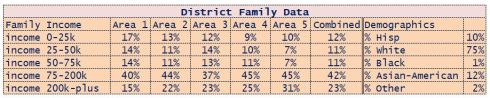
A 2017 study sponsored by SDUHSD indicates how financially comfortable the families in this school district are.

Table 1: Economic Data
District Family Data

Sixty-five percent of the students come from families making more than $75,000 and almost a quarter of those families are making greater than $200,000 a year. Whites and Asians constitute 87% of the district population.

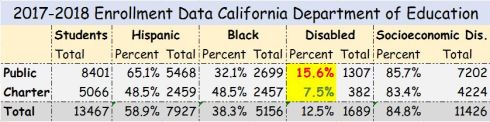
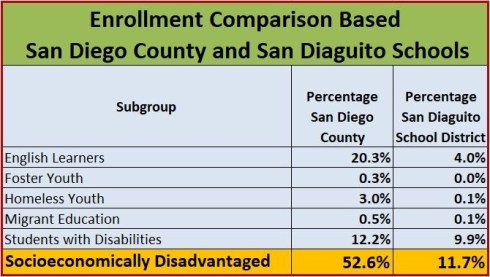
California’s 2017-2018 enrollment data by subgroups shows the dramatic difference between SDUHSD and the rest of San Diego County.

Table 2: Subgroup Percentages
Enrollment Data Table

During the no child left behind (NCLB) era, the school I worked at had 75% English learners and 80% socioeconomically disadvantaged. The big metric that literally determined whether a school survived was the academic performance index (API). Its 1,000 point scale score was based on California’s standardized testing. Early on my school focused on scoring higher than a 600 API and latter we challenged a 700 API. Failure to meet those goals, meant by NCLB rules, the school would be closed, a minimum of 50% of the staff would be let go and new management would assume the school (possibly a charter group). If a school scored more than an 800 API, it was golden. SDUHSD averaged over 900 API as a district. Schools for poor kids and minorities were set up for possible failure, but schools for wealthy people’s children were safe.

“The Times They Are A-Changin”

Alfie Kohn published a 2004 article, “Test Today, Privatize Tomorrow; Using Accountability to ‘Reform’ Public Schools to Death.” He noted schools were purposely setup for failure and wrote,

“We now have corroboration that these fears were entirely justified. Susan Neuman, an assistant secretary of education during the roll-out of NCLB, admitted that others in Bush’s Department of Education ‘saw NCLB as a Trojan horse for the choice agenda – a way to expose the failure of public education and ‘“blow it up a bit’’’ (Claudia Wallis, ‘No Child Left Behind: Doomed to Fail?’, Time, June 8, 2008).”

No schools in middle or upper-middle class neighborhoods ever failed API and faced NCLB’s existential penalty. However, these neighborhoods are no longer exempt from attack by DPE forces.

Naturally, the five elementary school districts that feed into SDUHSD have similar subgroup and demographic data as SDUHSD. In 2006, the ten elementary schools in Encinitas Union School District (EUSD) scored 75% proficient or advanced in mathematics and 74% proficient or advanced in English language arts on California’s testing. By comparison, San Diego County schools scored 57% proficient or advanced in mathematics and 49% proficient or advanced in English language arts. That is when a proposal came forward to create a charter school for gifted students in Encinitas.

Maureen Mo Muir, a member of the SDUHSD board, previously served on the EUSD board. In her online resume, she claims to be “Founder and member of charter with emphasis on the gifted and differentiated curriculum (under the guidance of USC Education Professor Sandra Kaplan).” Her school was called the Theory into Practice Charter School (TIP). It is surprising that she still brings attention to her part in the TIP fiasco.

State records show that TIP opened September 5, 2006 and closed August 5, 2008. A scathing article in the Voice of San Diego, painted a picture of malfeasance and fraudulent practices. The lengthy article details a trail of charter schools failures, odd failed corporations and many fraud claims following the founding leaders of TIP. Reporter Emily Alpert wrote,

“Principal Deborah Hazelton, an Oceanside elementary teacher, created Theory Into Practice Academy, a charter school that taught all children with the same rigor and complexity as gifted children.”

“Shortly after the [new] bylaws [which gave Hazelton’s company control] materialized, [Mike] Hazelton was hired as chief operating officer for $95,000 for the rest of the academic year. Two months later the school reported a $28,000 first-year deficit, instead of the $6,000 to $12,000 surplus Mike Hazelton had predicted. Its outstanding loans still worried the Encinitas superintendent. Yet the school also bolstered Deborah Hazelton’s pay from $87,000 to $110,000.”

“And in January the Hazeltons asked the board to start paying their corporation 1.5 percent of its annual revenues and a onetime $35,000 fee for curriculum and administrative support.”

“The corporation was overseen by a group that included the Hazeltons and teacher Lisa Bishop, who were already earning salaries from the school, and University of Southern California educator Sandra Kaplan, who sat on both boards.” (Emphasis added)

The TIP charter was revoked August 5, 2008. It was the last charter school within the SDUHSD boundaries until 2016.

I Believe in School Choice

America’s public education system with locally elected school boards is widely viewed as the bedrock upon which the world’s oldest democracy resides. A key advantage for American children was they were not barred from middle-school or high-school by a standardized test; a common practice in most countries. There were no high stakes tests in the United States.

One measuring stick demonstrating how successful the American system was might be Nobel Prize winners since 1949: America has 313 laureates; India 7; and China 8. The US has never won at standardized testing but leads the world in creative thinkers.

In 2016 a new school was proposed in the Solana Beach. The School of Universal Learning (SOUL) petitioned SDUHSD for a charter. Marisa Bruyneel-Fogelman and Dr. Wendy Kaveney are cited as founders. The mission statement from the petition says they will “provide exceptional education that awakens individuals to know who they are, discover their passions and purpose, and thrive holistically, to achieve both mental and life mastery.”

In the presentation to the SDUHSD board, the following images among many similar ones were shown.

SOUL Presentation

New Age Philosophy Being Taught in Taxpayer Funded School.

SOUL Presentation 2

This looks wonderful but should taxpayers be expected to fund it?

SDUHSD’s board rejected the petition by a vote of 5-0. They gave the SOUL team an eight-page list of issues that needed addressing before the board could confer a charter. As an example, one of the items required,

“Clarification or revision to the SOUL Charter School’s recommended course sequencing for its students. Specifically, the Petition describes a four-year course sequence which appears to indicate that students should take up to eight courses per year to accomplish the recommended sequence. However, the bell schedule and narrative included in the Petition indicate that students will take only six classes, in addition to Integra.”

SOUL appealed the decision to the San Diego County Board of Education. That board voted 3-2 against giving a full 3-year charter but voted 5-0 to bestow a 2-year charter.

I believe in a parent’s right to choose their children’s school. If they want to send them to the New Universal Teaching School (NUTS) or Encinitas Country Day or Santa Fe Christian School, that is their prerogative. But don’t expect taxpayers to pay for that choice. They already pay for free public education.

School Board Election in Less than Two Months

Both libertarian-Republicans and neoliberal-Democrats are attacking public schools. The article A Layman’s Guide to the Destroy Public Education Movement lists five separate groups that are working to end democratically controlled public schools. When voting this November, it will be important to identify if a candidate is associated with one or more of these groups.

  1. People who oppose public education on religious grounds often seeking taxpayers supported religious schools.
  2. People who want segregated schools where their children will not have to attend school with “those people.”
  3. People supporting both privatized schools and entrepreneurs profiting from school management and/or school real estate deals.
  4. Members of the technology industry which is using wealth and lobbying power to place many inappropriate products and practices into public schools. They often also promote technology driven charter schools.
  5. Ideologues who fervently believe that market-based solutions are always superior.

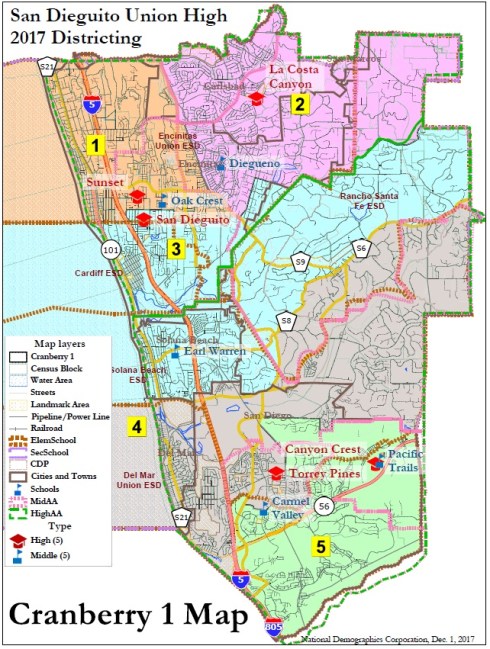
For the first time, SDUHSD is electing school board members by area. During this election cycle, seven candidates are running for seats in 3 of the five Areas; 1, 3 and 5. The even numbered seats will be on the ballot in 2020.
SDUHSD Area Map

SDUHSD Area Map

Area 1, which is in west Encinitas, has two candidates, Maureen Mo Muir who is an incumbent and Amy Flicker a well know politically active resident serving on various committees and boards.

Mo Muir fits with both groups 3 and 5 of the DPE movement. She is very unpopular with teachers for her votes on bond spending and contract negotiations. She claims to be instrumental in founding the failed TIP charter school. Muir was endorsed by the San Diego County Republican Party for the board seat she now holds.

Amy Flicker is the President of the Paul Ecke Central Elementary PTA. She has been a commissioner on the Encinitas Environmental Commission. That is the group that started the plastic bag crusade that ended grocery store plastic bags in California. She is also a member of two bond oversight committees; one in the Encinitas School District and the other in SDUHSD. Flicker is endorsed by the San Diego Democratic Party.

Amy Flicker is the choice most likely to protect public education.

Area 3, is made up of Cardiff, Solana Beach and Rancho Santa Fe. It has two candidates, Melisse Mossy and Rhea Stewart.

Rhea Stewart served on the Cardiff Elementary School District Board from 2006-2010. Stewart has the endorsement of the San Diego Democratic Party. She belongs to group 4 of the DPE movement. She is strongly related to the technology industry and its pedagogical snake oil. Her LinkedIn page lists more than ten ed-tech professional associations including Apex Learning: Mathematics and Science Instructional Designer 2014 – 2017; West Ed: Mathematics Content Specialists Ed 2013 – 2014; Aventa Learning: Mathematics and Science Program Supervisor 2011 – 2013; and K12, Inc.: Mathematics Content Specialist 2007 – 2010.

Melisse Mossy is married to Jason Mossy, head of the Mossy Auto group. She has taught school and is very involved in philanthropic activities.

Mossy belongs to group 1 of the DPE movement. She does not seem committed to public education and one wonders what her real agenda is. In a promotional video for the Santa Fe Christian School, Mossy says that if she could design a school it would be like this school where for the teachers it is more like a ministry. She states, “I used to be a teacher in the public school environment and I have seen the worst case scenario. This is the farthest thing from it.”

Even though Rhea Stewart’s professional life is wrapped around an industry that is undermining good pedagogy, I would still vote for her over a wealthy individual with a religious agenda.

Area 5, consists of Del Mar and Carmel Valley. There are three candidates for this seat, Lea Wolf, Kristin Gibson and Cheryl James-Ward.

Lea Wolf has lived in the Carmel Valley area for 20 years and has a daughter attending a district school. On her LinkedIn page she bills herself as a fiscal conservative. In a LinkedIn recommendation for David Andresen, she wrote, “David has been a tremendous resource for me as a entrepreneur since we met at San Diego Chamber of Commerce.” She has founded several technology companies including Deeds for Kids and IQNet Interactive.  Lea seems to fit in both group 4 and 5 of the DPE movement although not stridently so.

Kristin Gibson is currently President of the Del Mar Union School District. Kristin taught elementary school in the La Mesa-Spring Valley School District. Currently, she works as an educational consultant, which includes lecturing for San Diego State University’s School of Teacher Education, providing professional development for in-service teachers, and contributing to projects at the Center for Research in Mathematics and Science Education. She is a member of the National Council of Teachers of Mathematics and the National Council of Supervisors of Mathematics.  Kristin does not appear to belong in any of the DPE groups.

Cheryl James-Ward is a professor of education leadership at San Diego State University, an administrator at the e3 Civic High charter school and wife of former superintendent of San Diego County Schools, Randy Ward. In June, she was a candidate for the San Diego County Board of Education. Even though the California Charter Schools Association spent more than $130,000 in independent expenditures for her campaign, she lost. Cheryl James-Ward is a devoted member of group 3 of the DPE movement.

In an interview with the San Diego Union, James-Ward said, “This is unfortunate as charters are public schools just like district schools. … There is also the misnomer that charters are taking money from district schools.”

Charter schools are no more public schools than Hazard Construction is a public corporation because they do some government contracts. To be a public school requires two things; (1) paid for by taxpayers and (2) public has a say in the governance. With charters the public does not have a say. Several major studies in the last five years have shown that charters do drain significant money from public schools including the latest one by Professor Gordon Lafer, “Breaking Point: The Cost of Charter Schools for Public School Districts.”

For Area 5, Kristin Gibson is the best choice.

Some Observations

Public schools in all neighborhoods are now targeted by the DPE movement. In San Dieguito, five of the seven school board candidates have a relationship with one or more of the DPE groups. Only Kristin Gibson (Area 5) and Amy Flick (Area 1) seem likely to stand up for the SDUHSD’s public schools against all privatizing and profiteering efforts.

America’s public education system is a priceless legacy that is under attack. We must be vigilant about who we elect to lead it. Members of both of America’s tribes, Democrats and Republicans are responsible for this outrage. Be informed. Don’t just vote your club; vote to save public education in America.
A Layman’s Guide to the Destroy Public Education Movement

9 Sep

By T. Ultican 9/9/2018

The destroy-public-education (DPE) movement is the fruit of a relatively small group of billionaires. The movement is financed by several large non-profit organizations. Nearly all of the money spent is free of taxation. Without this spending, there would be no wide-spread public school privatization.

It is generally recognized that the big three foundations driving DPE activities are The Bill and Melinda Gate Foundation (Assets in 2016 = $41 billion), The Walton Family Foundation (Assets in 2016 = $3.8 billion), and The Eli and Edythe Broad Foundation (Assets in 2016 = $1.8 billion).

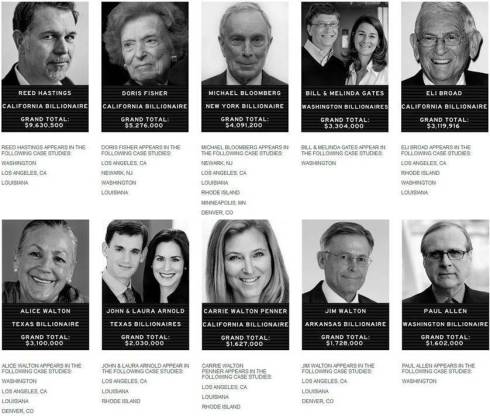
Yesterday, the Network for Public Education published “Hijacked by Billionaires: How the Super Rich Buy Elections to Undermine Public Schools.” This interactive report lists the top ten billionaires spending to drive their DPE agenda with links to case studies for their spending.

Top 10 Billioaires

These Images Come from the New NPE Report

Short Explanation of the Label DPE

The modern education reform apostate, Diane Ravitch, was Assistant Secretary of Education under Lamar Alexander from1991-93. She was an academic who held many research positions including the Brown Chair in Education Studies at the Brookings Institution and served in multiple capacities in different federal education administrations. Like all of her closest allies, she believed in the power of accountability, incentives and markets for reforming schools.

In 2010, Diane shocked her friends by publishing, The Death and Life of the Great American School System; How Testing and Choice Are Undermining Education.  In chapter 1 she wrote,

“Where once I had been hopeful, even enthusiastic about the potential benefits of testing, accountability, choice, and markets, I now found myself experiencing profound doubts about these same ideas. I was trying to sort through the evidence about what was working and what was not. I was trying to understand why I was increasingly skeptical about these reforms, reforms that I had supported enthusiastically.”

“The short answer is that my views changed as I saw how these ideas were working out in reality. The long answer is what will follow in the rest of this book.” (Ravitch 2)

In the book, Ravitch wrote, “I call it the corporate reform movement not because everyone who supports it is interested in profit but because its ideas derive from business concepts about competition and targets, rewards and punishments, and ‘return on investment.’  (Ravitch 251)

Ravitch labled modern education reform “corporate education reform” and the label stuck.

Last year, researchers from the Indiana University Purdue University Indianapolis (IUPUI) led by professor Jim Scheurich, who coordinates the urban studies program there, perceived a pattern in the destruction of the public schools. That pattern became the “destroy public education” model. As Ravitch’s “corporate education reform” became more organized and ruthless, the Scheurich team’s DPE model became a better descriptor.

Ravitch posted the Indiana team’s DPE model on her blog. The model is outline here with explanations.

  1. Business is the best model for schools. Starting with the infamous Regan era report, “A Nation at Risk,” the claim that “private business management is superior” has been a consistent theory of education reform promoted by corporate leaders like RJR Nabisco’s Louis Gerstner, Microsoft’s Bill Gates, Wal-Mart’s Walton family and Sun America’s Eli Broad. It is a central tenet of both neoliberal and libertarian philosophy.
  2. Institute local-national collaboration between wealthy neoliberals and other conservatives to promote school privatization and the portfolio model of school management. One example among many comes from Kansas City, Missouri. School Smart Kansas City does the local retail political activity, the $2.1 billion Kaufman foundation provides the local money and various national organizations like The Charter School Growth Fund that is controlled by the Wal-Mart heirs provides the outside money.
  3. Direct large sums of money through advocacy organizations to recruit, train and finance pro-privatization school board candidates. One such organization is Jonah Edelman’s Oregon based Stand for Children which functions as a conduit for outsiders to funnel money into local school board elections.
  4. Undermine and eliminate locally elected school boards. The 1990 book by John E. Chubb and Terry M. Moe, Politics, Markets, and America’s Schools, claimed that poor performance was “one of the prices Americans pay for choosing to exercise direct democratic control over their schools.” The book was hugely influential and its anti-democratic theory is a central ideology of DPE led reform.
  5. Institute a portfolio system of school district management that includes public schools, charter schools and Innovation Schools. School boards lose their oversight powers with both charter schools and Innovations schools. Portfolio theory posits closing the bottom 5% of schools based on standardized testing and reopening them as either charter schools or innovation schools. Standardized testing does not identify teaching or school quality but it does identify student poverty levels. This scheme guarantees that public schools in poor and minority communities will be privatized. While there is no evidence supporting this theory, there is evidence that it causes harm.
  6. Implement a unified enrollment system. Over the past 200 years, public schools in America have become a widely respected governmental institution. By forcing them to include charter schools in their enrollment system, the charter schools are provided an unearned equivalency. Charters are not publicly governed nor must they accept any student who applies in their area.
  7. Hire minimally trained teachers from Teach for America (TFA) or other instant-teacher-certification programs. By undermining the teaching profession, costs can be reduced; however general teacher quality will also be reduced. In 2007, Los Angeles Mayor, Anthony Villaraigosa, selected the Green Dot Charter Schools’ CEO, Marshall Tuck, to lead 18 schools in an experiment called the Partnership for LA. With millions of dollars to supplement the schools, Tuck failed to produce any real improvements. His error was hiring a significant numbers of untrained TFA teachers which more than offset his funding advantages.
  8. Use groups like Teach Plus and TNTP to provide teacher professional development. The most effective opponents of the destruction of public education have been teachers. By controlling teacher training, new pro-privatization attitudes can be fostered.
  9. Create teacher fellowships that develop teacher support for the privatization agenda. In Indiana, on a yearly basis, the $11 billion Lily Foundation gives out many $12,000 Teacher Creativity Fellowships. In Oakland California the DPE organization GO Oakland gives nearly 20 Fellowships a year.
  10. Institute networks of local organizations or affiliates that collaborate on the agenda. The newest national organization designed to develop these networks launched in July. It is called The City Fund. John Arnold, ex-Enron executive, and Reed Hasting, CEO of Netflix, each invested $100 million to start this donor directed fund. Bill Gates has already sent them $10 million to spend toward privatizing Oakland, California’s schools.

In densely populated areas, the DPE agenda invariably is coherent with an urban renewal effort often derisively labeled “gentrification.” Too often urban renewal has been accomplished by pushing the poorest citizens out without making any provisions for them. When renewal is only about economic advantage, it further harms already traumatized citizens.

Five Disparate Groups are United in Destroying Public Education

Group A) People who oppose public education on religious grounds and seek taxpayers supported religious schools. In 2001, when Dick and Betsy DeVos answered questions for the Gathering, Dick opined that church has retreated from its central role in communities and has been replaced by the public school.

At the same time that Dick and Betsy were speaking to the Gathering, Jay Sekulow, who is now a lawyer in the Trump administration, was in the process of successfully undermining the separation of church and state before the Supreme Court.

When the evangelical Christian movement gained prominence with Jerry Falwell’s moral majority and Pat Robertson’s 700-Club, they generated huge sums of money. A significant portion of that money was spent on legal activism.

In 1990, Pat Robertson brought Sekulow together with a few other lawyers to form the American Center for Law and Justice (ACLJ).  The even more radical Alliance Defense Fund (ADF) which declares it is out to defeat “the homosexual agenda” joined the ACLJ in the attack on the separation of church and state. In her important book, The Good News Club, The Christian Right’s Stealth Assault on America’s Children, Katherine Stewart described their ultimate triumph,

“An alien visitor to planet First Amendment could be forgiven for summarizing the entire story thus: Clarence Thomas and Antonin Scalia, together with a few fellow travelers on the Supreme Court and their friends in the ADF and ACLJ, got together and ordered that the United States should establish a nationwide network of evangelical churches housed in taxpayer-financed school facilities.” (Stewart 123/4)

Today, for the first time, taxpayers in America are paying for students to attend private religious schools.

B) People who want segregated schools where their children will not have to attend school with “those people.” A typical example from San Diego is The Old Town Academy (OTA). It is like a private school financed with public school dollars. A Voice of San Diego report noted, “Chris Celentino, OTA’s current board chair and one of the school’s founding members, said when the school opened with a class of 180 students, half came from families that would otherwise send their kids to private schools.” 

In 1955, Milton Friedman published “The Role Of Government in Education” which called for privatizing public schools. Mercedes Schneider writes of the reality of this theory in her book School Choice; The End of Public Education?,

“Even as Friedman published his 1955 essay, school choice was being exploited in the South, and state and local governments were complicit is the act. It took the federal government and district courts decades to successfully curb the southern, white-supremacist intention to offer choice to preserve racial segregation.” (Schneider 28)

The AP reported in 2017,

“National enrollment data shows that charters are vastly over-represented among schools where minorities study in the most extreme racial isolation. As of school year 2014-2015, more than 1,000 of the nation’s 6,747 charter schools had minority enrollment of at least 99 percent, and the number has been rising steadily.”

C) Entrepreneurs profiting from school management and school real estate deals.

This spring, In The Public Interest (ITPI) published “Fraud and Waste in California’s Charter Schools.” The report documents $149,000,000 fraudulently purloined by factions of the California charter-school industry. The total stealing stated is a summation of cases cited in media reports. The actual amount stolen is much larger.

The ITPI report also reveals how in California fortunes are created by gaining control of publicly financed assets. The report discloses,

“…, schools constructed with tax-exempt conduit bonds become the private property of the charter operator. Even if the charter is revoked, neither the state nor a local school district can take control of this property.”

This week Steven Singer a well known teacher activist from Pennsylvania wrote, “Thanks to some Clinton-era tax breaks, an investor in a charter school can double the original investment in just seven years!”

Singer also addressed the profiteering by administrators: “New York City Schools Chancellor, Richard Carranza is paid $345,000 to oversee 135,000 employees and 1.1 million students. CEO of Success Academy charter school chain, Eva Moskowitz handles a mere 9,000 students, for which she is paid $782,175.

It is the same story in California. Charter school administrators are lining their non-profit pockets with huge salaries. In 2015, San Diego’s Mary Bixby, CEO of the Altus schools (34 mostly mall store learning centers) paid herself $340,810 and her daughter Tiffany Yandell $135,947. Up in Los Angeles in 2016, CEO of the 22 school Green Dot organization, Cristina de Jesus, was paid $326,242 while the CEO of the five schools Camino Nuevo Charter Academy was compensated $193,585. That same year in Oakland the CEO of the three schools Envision Education took in $229,127.

Huge wealth is being generated from taxpayers with little oversight.

D) The technology industry is using wealth and lobbying power to place products into public schools and heaping praise on technology driven charter schools. “The Silicon Valley assault must be turned away, not because they’re bad people but because they are peddling snake oil,” wrote veteran education writer, John Merrow. In the last 10 years, titans of the tech industry have dominated K-street. Hi-tech is now spending twice as much as the banking industry on lobbying lawmakers.

They fund think tanks to promote their agendas like coding in every public school in America or one to one initiatives (a digital device for every student) or digital learning. Researchers working in think tanks like the New America Foundation will be disciplined if they upset a corporate leader like Google’s Eric Schmidt. Barry Lynn was sent packing for being honest.

Writing for the Guardian Ben Tarnoff reports, “Tech’s push to teach coding isn’t about kids’ success – it’s about cutting wages.” The premise is that coding is “a skill so widely demanded that anyone who acquires it can command a livable, even lucrative, wage.”

The flaw here is that there is no need for a flood of new programmers. It will only drive down wages, which have already stagnated, and that is the point. A 2013 Economic Policy Institute research paper stated, “For every two students that U.S. colleges graduate with STEM degrees, only one is hired into a STEM job.”

E) Ideologues who fervently believe that market-based solutions are always superior. Some representatives of this group are Charles and David Koch, inheritors of Koch Industries. They are fervent libertarians who have established and support many organizations that work to privatize public education. The world’s richest family is also in this group. They are the heirs of Wal-Mart founder, Sam Walton. Like the Koch brothers, they too are determined to privatize public education.

Jane Mayer writing in the New Yorker about a legal struggle to control the Cato Institute stated, “Cato was co-founded by Edward Crane and Charles Koch, in the nineteen-seventies, with Koch’s money; the lawsuit notes that the original corporate name was the Charles Koch Foundation, Inc.” For many years, one of the stars supported by the Cato institute was Milton Friedman, the father of vouchers. The Walton Family Foundation contributes regularly to the Cato Institute and spent significant money promoting voucher legislation in many US states.

The Koch brothers are a major force behind the American Legislative Exchange Council (ALEC). ALEC writes model legislation which in some conservative states is written into law with little debate and no changes. The innovation schools that remove elected school board control are a product of ALEC model legislation.

The DPE Movement is Real, Well Financed and Determined

While growing up in America, I had a great belief in democracy instilled in me. Almost all of the education reform initiatives coming from the DPE forces are bunkum, but their hostility to public education convinces me they prefer a plutocracy or even an oligarchy to democracy. The idea that America’s education system was ever a failure is and always has been an illusion. It is by far the best education system in the world plus it is the foundation of American democracy. If you believe in American ideals, protect our public schools.

DPE Forces Over-Represented on Charter Law “Action Team”

28 Aug

California’s lame duck Superintendent of Public Instruction, Tom Torlakson, has formed an Action Team to review laws governing charter schools. Six of the thirteen Action Team members work for the destroy public education (DPE) movement. Ninety percent of the state’s students attend public schools yet 23% of the Action Team are charter school management executives. Also, 23% of the team are graduates of Eli Broad’s unaccredited school administrators’ academy.

Torlakson is quoted in the annoucement,

“In the past few years, we have updated virtually our entire K–12 education system. Now it’s time to look at the key laws governing charter schools, which have not been significantly changed in 26 years, to see how they can be modernized to better meet the needs of all public school students, including those who attend charter schools.”

This statement is malarkey. The original 1992 law capped charters growth at 100 schools statewide with no more than 10 in any one district. In 1998, Assembly Bill (AB) 544 expanded the statewide cap to 250 and allowed for an additional 100 charters each year thereafter. In 2000, proposition 39, which was advertised as a means to pass school bonds, had a little noticed provision that mandated charter school co-location with public schools. Legislation enacted in 2002 created the Charter Schools Facilities Program, which authorizes bond financing for new charter school buildings. A 2004 EdSource paper stated, “Since the passage of Senate Bill 1448—the Charter Schools Act of 1992—more than 30 other laws have addressed the operation, over sight, or funding of charter schools.”

 “Aren’t charter schools better quality than public schools?”

I have often heard this question from many otherwise well-informed people. It indicates a victory for marketing when this destructive myth persists.

The Executive Director of Network for Public Education (NPE), Carol Burris, spent a year studying California’s charter schools. In her 50-page finalized report called “CHARTERS AND CONSEQUENCES: An Investigative Series” she wrote,

“The majority of charter vs public studies indicate that overall achievement of charter schools is the same or worse than public schools. Like public schools, charters vary in student outcomes.… The charter high school graduation rate is 70%, far below the public high school rate of 85%.”

Charter schools operating outside of local democratic control should not exist because:

  • Elected school boards administering local schools are the bedrock of American democracy. Charter schools are private companies that are not accountable to voters.
  • Charter schools introduce inefficiency into the public education system by necessitating multiple administrations. It costs significantly more to fund these duplicate systems. The added costs reduce money supporting classrooms in both charter and public schools.
  • Charter schools are exacerbating school segregation. The AP reported in 2017,

“National enrollment data shows that charters are vastly over-represented among schools where minorities study in the most extreme racial isolation. As of school year 2014-2015, more than 1,000 of the nation’s 6,747 charter schools had minority enrollment of at least 99 percent, and the number has been rising steadily.”

In June, the Schott Foundation and NPE published “GRADING THE STATES A Report Card on Our Nation’s Commitment to Public Schools.” California was given a D+. The state’s charter school law is considered one of the nation’s most damaging. The reports says,

“Although the public school system is not perfect and has continual room for improvement, it is still the cornerstone of community empowerment and advancement in American society. The required inclusivity of the public school setting provides more opportunity for students to learn in culturally, racially, and socioeconomically integrated classrooms and schools, and that promotes social-emotional and civic benefits for students.”

“We look forward to the day when all charter schools are governed not by private boards, but by those elected by the community, at the district, city or county level.”

The California charter school law is causing real damage. In The Public Interest (ITPI) published “Breaking Point: The Cost of Charter Schools for Public School Districts” written by University of Oregon Professor, Gordon Lafer. The Introduction states,

“In 2016-17, charter schools led to a net fiscal shortfall of $57.3 million for the Oakland Unified School District, $65.9 million for the San Diego Unified School District, and $19.3 million for Santa Clara County’s East Side Union High School District. The California Charter School Act currently doesn’t allow school boards to consider how a proposed charter school may impact a district’s educational programs or fiscal health when weighing new charter applications.” (emphasis added)

These three districts are not the only ones in financial trouble. Los Angeles Unified School District (LAUSD) reportedly lost a half-billion dollars to charter schools in the 2014-2015 school year. LAUSD just claimed, “L.A. Unified faces a $504 million deficit for this current school year.” Their smaller neighbor in Inglewood is also having a debt crisis caused by unplanned charter school expansion.

Earlier this year, besides publishing Professor Lafer’s paper, ITPI also did their own research and published “Fraud and waste in California’s charter schools.” This paper begins,

“Public funding of California’s charter schools now tops $6 billion annually. … Most public school districts aren’t given adequate resources to oversee operators, especially large charter management organizations (CMOs), while all lack the statutory authority to effectively monitor and hold charter schools accountable. … waste in California’s charter schools has reached over $149 million.”

The California charter school law is in desperate need of reform, but is the Torlakson “Action Team” up to the task?

The Action Team

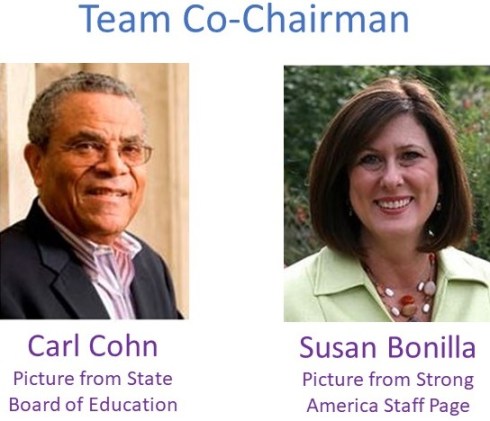
1 cochairman

Carl Cohn was twice appointed to the California State Board of Education (SBE) by Governor Jerry Brown. His second appointment announcement said,

“Cohn has been a professor and co-director of the Urban Leadership Program at Claremont Graduate University since 2009. He was a distinguished leader in residence at San Diego State University from 2007 to 2008 and superintendent of schools at the San Diego Unified School District from 2005 to 2007. … Cohn is a Democrat.”

In 2015, the Governor removed Cohn from the SBE and appointed him as the first executive director of the California Collaborative for Educational Excellence, a state agency created in 2013 to help local districts navigate the state’s new local control funding formula.

Cohn has always been friendly towards charter schools if not a promoter. In 2007 he commented to the Voice of San Diego, “I want to make it clear that I like what’s going on at some of these charters, and I believe that district schools can learn from them.” Last year, Cohn was a featured speaker at the San Diego charter schools conference hosted by the Charter School Development Center, a non-profit that claims, “We Fight Against regulatory creep that distracts charter leaders from improving student achievement.”

Susan Bonilla was a high school English teacher at Mount Diablo Unified School District before she entered politics. After three years as a county supervisor, this Democrat won a seat in the state Assembly in 2010.

Bonilla was especially focused on STEM education and still promotes it. She surprisingly wrote a legislative proposal that would have reduced teacher work protections, increased probationary time and undermined seniority rights. It would have essentially made the decisions in the Vergara case state law.

Regarding another piece of legislation, the San Jose Mercury News reported, “Assemblywoman Susan Bonilla introduced Assembly Bill 1084 in response to this newspaper’s investigation of K12 Inc., the publicly traded Virginia company behind a profitable but low-performing network of ‘virtual’ academies serving about 15,000 students across the state.” The article pointed out that a student logged in for one-minute was considered present and that fewer than half the students graduated. Eventually, Bonilla shelved the bill when it became watered down.

Although not taking any other actions against charters, this bill to stop the fraudulent K12’s practices infuriated charter supporters. In 2015, the Sacramento Bee reported on her losing a race for the District 7 state Senate:

“The race attracted unprecedented levels of outside spending, with more than $7 million streaming into the district during the two-month runoff alone, more than three times what the candidates were able to raise.”

“Labor unions backed Bonilla, while the business community, charter schools and Los Angeles businessman Bill Bloomfield supported Glazer.”

Since 2017, Bonilla has been State Director in California of Council for a Strong America, a national organization focused on increasing spending on children and families.

2 charter executives

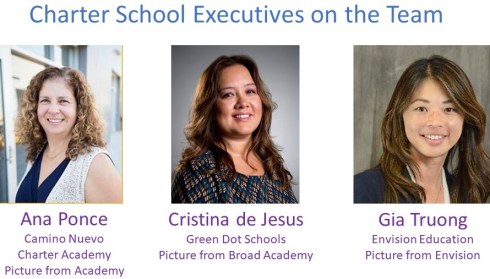
Cristina de Jesus is the President and Chief Executive Officer of Green Dot Public Schools California. She oversees twenty-two middle and high schools across Los Angeles serving 11,500 students for which she is compensated handsomely. During the fiscal year ending June 30, 2017, Green Dot’s tax forms revealed her total income as $326,242 while the schools took in $148,484,811.

Cristina is an alumnus of the Broad Administrators Academy class of 2016-2017.

Ana Ponce is the Chief Executive Officer of Camino Nuevo Charter Academy which is a neighborhood network of 5 elementary and secondary schools serving about 2000 students within the greater MacArthur Park neighborhood near Downtown Los Angeles. Tax records show that the Academy took in $43,377,256 in the fiscal year ending June 2016. Ana was compensated $193,585.

Originally from Mexico, Ana grew up in the neighborhood where her schools are located. She is an alumnus of Teach for America and The Broad Academy class of 2015-2016. She was profiled by the Aspen Institute.

Ponce is also the California Charter Schools Association Board Secretary and she was inducted into the Charter Schools Hall of Fame by the National Alliance for Public Charter Schools.

Gia Truong is Chief Executive Officer at Envision Education. Envision has two strategies: operating charter schools and providing training and consulting services to others through its Envision Learning Partners division.

For the fiscal year ending June 30, 2016 tax records show that Envision took in $16,558,401 and Gia was compensated $229,127.

Gia attended Brown University where she earned a master’s in teaching social studies. She gained her administrative credential through the New Leader Principal Residency program. New Leaders (formerly “New Leaders for New Schools”) was founded in 2000 by a group including Jonathan Schnur, former education policy analyst for President Bill Clinton.

3 Privatizing Organzations

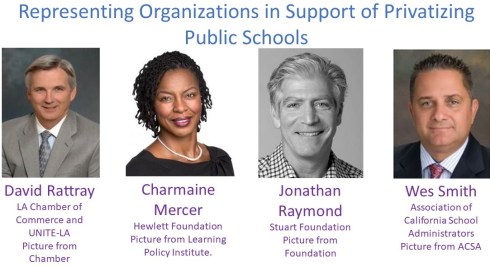
David Rattray oversees the Center for Education Excellence & Talent Development at the Los Angeles Chamber of Commerce and UNITE-LA, the School-to-Career Partnership of Los Angeles. Rattray officially joined the Chamber in 2003.

Rattray and UNITE-LA have called for “a common, unified enrollment system for all public schools serving Los Angeles children ….”

Rattray also sits on the Board of Directors at Learning Policy Institute. It is a “think tank” financed by many foundations associated with school privatization. These funders include S.D. Bechtel, Jr. Foundation; Chan Zuckerberg Initiative; William and Flora Hewlett Foundation; Nellie Mae Education Foundation; David and Lucile Packard Foundation and the Stuart Foundation.

Charmain Mercer served as a Senior Researcher for the Learning Policy Institute and is now a Program Officer at the William and Flora Hewlett Foundation. Charmaine received her Ph.D. in politics and education policy from Claremont Graduate University, as well as her master’s degree in political science.

In a previous role, she served as the vice president for standards, assessment, and deeper learning at the Alliance for Excellent Education. Former Virginia Governor, Bob Wise, leads the Alliance which promotes “personalized learning” a misleading euphemism for isolating America’s children at digital devices.

Jonathan Raymond has led the Stuart Foundation as its president since July 2014. In the fiscal year ending Dec. 31, 2016 his total compensation was stated as $522,725. It may be unfair to say this foundation is for privatizing public schools. They appear to be focused on how to improve education and have not taken a strong stand either for or against charter schools.

President Raymond on the other hand has taken several positions embraced by school privatization leaders like Eli Broad.

In July, 2014, the Sacramento Bee reported,

“Jonathan Raymond came into the Sacramento City Unified School District nearly five years ago as a hard-charging superintendent, bucking the teachers union on tenure rules and seeking to use test scores in performance evaluations.”

“Forget about the flourish that was Raymond, who was a product of The Broad Superintendents Academy, which trains business and education leaders how to run school districts. Raymond arrived at Sacramento without a traditional schools background, having served as a nonprofit leader and private lawyer rather than working through the ranks.”

“Teachers also were angered over Raymond’s “Priority Schools” program to overhaul struggling campuses. The district inserted new principals, who were given authority to remove teachers regardless of tenure protections, which led to a legal battle.”

Raymond closed seven Sacramento schools in minority neighborhoods through his “Priority Schools” program.

Wes Smith, Ed. D. is Executive Director for the Association of California School Administrators (ACSA). In 2014, Smith and the ACSA refused to endorse either candidate in the heated Superintendent of Public Instruction (SPI) contest between, former charter school administrator, Marshall Tuck, and incumbent, Tom Torlakson.

This year the former investment banker, Tuck, is again running for SPI. Shockingly, after personally interviewing both Tuck and his opponent, Tony Thurmond, the ACSA endorsed the school privatization candidate, Tuck.

A tweet from the ACSA read, ‘“ACSA is proud to endorse a candidate who not only understands education leadership but is committed to working with educational leaders to improve student access and outcomes as well.’ – ACSA Executive Director Dr. Wesley Smith.”4 Public Education Support

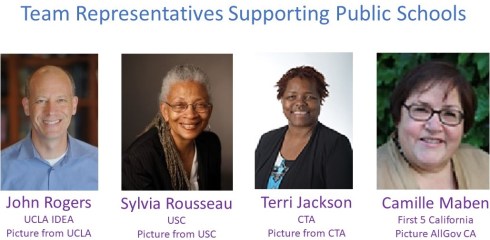
John Rogers is a Professor at UCLA’s Graduate School of Education.  He also serves as the Faculty Director of Center X, which houses UCLA’s Teacher Education Program, Principal Leadership Program, and professional development initiatives.

He lists his research interests as

  • Re-envisioning public engagement and democratic education today in light of John Dewey’s scholarship and practice.
  • Understanding what and how youth learn about economic, social, and racial inequality inside and outside of schools.
  • Examining and developing strategies for engaging urban youth, community members, and educators in equity-focused school reform.

In a Capital and Main release, John Rogers noted that if Eli Broad is successful in taking over half the students in LAUSD then the district would lose its ability to maintain its financial integrity.

Sylvia Rousseau is an expert on diversity, urban school reform and school leadership. She is Professor of Clinical Education at USC’s Rossier School of Education. Sylvia is a former principal of Santa Monica High School; a former LAUSD assistant superintendent of Secondary School Services and a former superintendent of Local District 7, which means she took on the problems facing education in Watts.

Testifying about charter schools Rousseau commented,

“In the midst of the many conversations about charter schools offering a choice to parents, districts have the responsibility to ensure that parents have viable options. Otherwise it is not choice. As we move forward in the name of reform and progress, it is important to keep asking the equity question: who is benefiting and who is not. … When charter schools infringe on districts’ ability to fulfill this public mandate for all children, they have violated the public mandate.”

Terri Jackson has years of experience with both teaching and involvement in California Teachers Association (CTA) activities. She was re-elected as CTA Board member for District C representing Alameda and Contra Costa counties. This term ends June 25, 2019.

Jackson is the only practicing teacher on the Team. She has taught for 33 years and is currently a fourth-grade teacher at Stewart Elementary School in the West Contra Costa Unified School District.

Camille Maben: A seven-member First 5 California Commission selected the 16-year veteran of the California Department of Education, Camille Maben, as its executive director in November 2012. Maben was a strategic advisor to Superintendent Delaine Eastin from 1998 to 2003. Maben, a registered Democrat, has served on the Rocklin Unified School District Board of Trustees for 16 years.

Not too Hopeful about Torlakson’s Review Team.

With so many members of the team drawing huge salaries if the status quo is maintained, it is unlikely they will create many policy ideas for ending the destruction of public education.

I agree with the Schott Foundation, NPE and the NAACP that we need a charter school moratorium. During the moratorium, legislation can be written that carefully puts existing charter schools under the management of elected school boards.

The argument that says “remove rules and let educators do what they know is best” being the path to improved education is foolish and disingenuous. It is like saying “remove automobile safety rules and allow manufactures to build the kind of safe fuel-efficient cars they know are best” will insure safer more efficient vehicles. It is a silly argument and the reality is that large privatized charter school management organizations will continue to impose rules on teachers.

Let us embrace democracy for running schools instead of plutocratic nonsense.


DPE 2.0 The City Fund

18 Aug

By Thomas Ultican 8/18/2018

Billionaire Netflix CEO, Reed Hastings, has joined with billionaire former Enron executive, John Arnold, to launch an aggressive destroy public education (DPE) initiative. They claim to have invested $100 million each to start The City Fund. Neerav Kingsland declares he is the Fund’s Managing Partner and says the fund will help cities across America institute proven school reform successes such as increasing “the number of public schools that are governed by non-profit organizations.”

Ending local control of public schools through democratic means is a priority for DPE forces. In 2017, EdSource reported on Hastings campaign against democracy; writing, “His latest salvo against school boards that many regard as a bedrock of American democracy came last week in a speech he made to the annual conference of The National Alliance for Public Charter Schools in Washington D.C., attended by about 4,500 enthusiastic charter school advocates, teachers and administrators.”

When announcing the new fund, Kingsland listed fourteen founding members of The City Fund. There is little professional classroom teaching experience or training within the group. Chris Barbic was a Teach for America (TFA) teacher in Houston, Texas for two years. Similarly, Kevin Huffman was also a TFA teacher in Houston for three years. The only other member that may have some education experience is Kevin Shafer. His background is obscure.

The operating structure of the new fund is modeled after a law firm. Six of the fourteen founding members are lawyers: Gary Borden; David Harris; Kevin Huffman; Neerav Kingsland; Jessica Pena and Kameelah Shaheed-Diallo.

Ready to Pilfer Community Schools and End School Boards

In a 2012 published debate about school reform, Kingsland justified his call for ending democratic control of public education writing,

“I believe that true autonomy can only be achieved by government relinquishing its power of school operation. I believe that well regulated charter and voucher markets – that provide educators with public funds to operate their own schools – will outperform all other vehicles of autonomy in the long-run. In short, autonomy must be real autonomy: government operated schools that allow “site level decision making” feels more Orwellian than empowering – if we believe educators should run schools, let’s let them run schools.”

This is a belief in “the invisible hand” of markets making superior judgements and private businesses always outperforming government administration. There may be some truth here, but it is certainly not an ironclad law.

The City Fund has distinct roots stretching back to early 2016. On April 4 that year, Kingsland announced on his blog, Relinquishment, “Very excited about this update: Ken Bubp and Chris Barbic are joining the combined efforts of the Laura and John Arnold Foundation and Hastings Fund.”

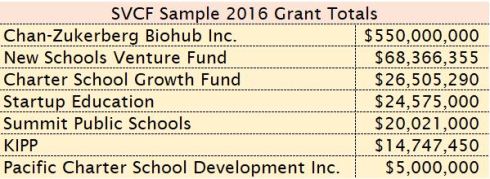
In January of 2016, Philanthropy News Digest reported, “Netflix founder and CEO Reed Hastings has announced that he has created a $100 million fund at the Silicon Valley Community Foundation (SVCF) that will be focused on education.”

SVCF is a donor directed fund, so Hastings’s fund is dark money with no way of tracking where its tax-free spending is directed. The SVCF 2016 tax form shows Neerav Kingsland earning $253,846 as a Managing Director of the Hastings fund. He was also simultaneously serving as Senior Education Fellow at the Arnold Foundation and was on the board at the California Charter Schools Association.

The SVCF was founded in 2006 and has grown to be one of the largest non-profit charities in America. The tax form cited above shows a total income in 2016 of $4.4 billion and end of year assets of $7.2 billion while making grants totaling to $1.9 billion.

SVCF Grants

A March 2018 article in Chalkbeat reported,

“Eleven years after founding a nonprofit that has dramatically reshaped Indianapolis schools, David Harris is stepping down to help launch an as yet unexplained national education group.”

“The national group is in the early stages of development, said Harris, who declined to provide more details about his co-founders or their plans. A release from The Mind Trust said the new organization aims to ‘help cities around the country build the right conditions for education change.’”

Much of the description of The City Fund sounds like the activities of the national DPE organization, Education Cities. At the end of July, the Education Cities web-site disclosed,

“Today, we are announcing that Education Cities is undergoing an evolution that we think will better support local education leaders.

“Several staff from Education Cities – including our Founder and CEO, Ethan Gray – are partnering with colleagues from the philanthropic, non-profit, district, charter, and state sectors to create a new non-profit organization called The City Fund.”

The City Fund has not shared a web-address, but they have clearly started work. Four of the announced members have updated their LinkedIn profiles indicating they started working for The City Fund in either June or July.

The City Fund’s central agenda is promoting the portfolio model of school reform. Schools scoring in the bottom 5% on standardized testing are to be closed and reopened as charter schools or Innovation schools. In either case, the local community loses their right to hold elected leaders accountable, because the schools are removed from the school boards portfolio. Even Jay P. Greene of the University of Arkansas wrote an open letter to John Arnold warning about what a bad idea the portfolio model is. He began, “The Arnold Foundation invests heavily in another initiative that promotes rigorous science for medical and policy decision-making, yet they do not seem to apply that same standard of proof to their own education strategy.’

A Brief Introduction to The City Fund Staff

Staff Photos

The Founding City Fund Staff

All but two of the City Fund staff photos were taken from LinkedIn. Gary Borden’s photos is from his Aspen Institute bio. Doug Harris’s photo was clipped from a Chalkbeat article.

Chris Barbic founded one of the first miracle charter schools, YES Prep of Houston, Texas. Based on the claim that 100% of YES Prep’s students were accepted at four-year colleges, Oprah Winfrey gave them a check for $1,000,000. In an open letter to Barbic, his former Teach for America (TFA) colleague, Gary Rubinstein made it clear that there was no miracle.

Chris left Houston and YES Prep to become Superintendent of the state of Tennessee’s Achievement School District. He would be working under his old Houston TFA buddy Kevin Huffman. He accepted the challenge to turnaround the bottom 5% of schools in Tennessee (about 85 schools) so that they are, based on their test scores, in the top 25% in five years. This was a fool’s errand, but politicians and amateur educators did not know it.

Barbic earned a bachelor’s degree in English from Vanderbilt University. His only formal training in education was as a member of the class of 2011 at Eli Broad’s unaccredited school administrators’ academy.

By 2014 while staring at one bad set of standardized test results after another and making no progress toward lifting the bottom 5% of schools into the top 25% of schools, Chris had a heart attack. The following summer (2015), he revealed his resignation for health and family reasons.

In 2016, the Arnold Foundation reported Chris was going to be a Senior Education Fellow at the foundation.

Gary Borden is Senior Vice President for charter school advocacy at the California Charter Schools Association (CCSA). Earlier this year he traveled the state supporting Anthony Villaraigosa’s failed campaign for governor. Borden asserted, “Any sort of an artificial pause on growth of charter schools is really detrimental to what parents have ultimately said they want and need in their public education system.”

Gary was appointed Deputy Executive Director of the California State Board of Education by Governor Arnold Schwarzenegger. He is on the board of two charter schools, Fenton Charter Public Schools and East Bay Innovation Academy.

Borden has undergraduate degrees in Economics and International Business from Pennsylvania State University, and a law degree from Georgetown University. His only  training in education is as a Fellow of the 17th class of the Pahara – Aspen Education Fellowship and a member of the Aspen Global Leadership Network – fundamentally a study in privatizing schools.

Ken Bubp says he is a Partner at The City Fund. Ken earned a Bachelor of Arts in History form Taylor University and an MBA from Indiana University – Kelley School of Business. He shows no training or experience in education.

From 2011 to 2016, he held various executive positions at The Mind Trust where he worked for Doug Harris. John Arnold made him a Senior Education Fellow at his foundation in 2016.

Bubp is a board member at New Schools for Baton Rouge working to expand charter school penetration and institute the portfolio model of school management.

Beverly (Francis) Pryce earned a degree in Journalism from Florida International University, a master’s certificate in Non-Profit Management from Long Island University and Accounting Management certification from Northeastern University.

After a brief period as a journalist at WINK-TV News, Beverly went to work for the Democrats for Education Reform (DFER).

Ethan Gray reports he will be a Partner at The City Fund. He was the Founder and CEO of Education Cities, a national nonprofit that supports the privatization of public schools. Before his role at Education Cities, Ethan served as Vice President of The Mind Trust where he helped develop the “Opportunity Schools” which are another type of school organization that ends democratic control.

Ethan holds an MA from the Harvard Graduate School of Education in education policy and management. He is a past member of the Board of Directors for the STRIVE Prep network of charter schools in Colorado, as well as the National Advisory Boards of Families for Excellent Schools, EdFuel, and Innovative Schools in Wilmington, Delaware.

David Harris: During his first run for Mayor, Bart Peterson invited David Harris a 27-year old lawyer with no education background to be his education guy. Harris became the director of the mayor’s new charter school office. In 2006, Harris and Peterson founded The Mind Trust.

The Mind Trust is the proto-type urban school privatizing design. Working locally, it uses a combination of national money and local money to control teacher professional development, create political hegemony and accelerate charter school growth. The destroy public education (DPE) movement has identified The Mind Trust as a model.

He is a founding member and served as chairman of the Charter Schools Association of Indiana. He also has been a board member of the National Association of Charter Schools Authorizers.

Kevin Huffman: After serving three years as a TFA teacher in Houston, this 1992 graduate of Swarthmore returned to New York to study law. After a brief stint as a lawyer he rejoined TFA as Executive Vice President. He also married Michelle Rhee.

In 2011, Governor Bill Haslam of Tennessee selected Huffman to be Education Commissioner. By 2014, the Tennessean’s lead read, “Polarizing Tennessee Education Commissioner Kevin Huffman is stepping down from his position, leaving a legacy that includes historic test gains as well as some of the fiercest clashes this state has ever seen over public schools”.

Former Assistant Secretary of Education, Diane Ravitch, reported one such clash, the effort to force Nashville to accept Great Hearts Academy. She wrote,

“This is the same Arizona-based outfit that has been turned down four times by the Metro Nashville school board because it did not have a diversity plan. Because of its rejection of Great Hearts, the Nashville schools were fined $3.4 million by Tennessee’s TFA state commissioner of education Kevin Huffman.”

Noor Iqbal has a Bachelor of Arts in History and Economics from Harvard University and studied at the London Schools of Economics and Political science. She has been working at the Arnold foundation since 2017.

Neerav Kingsland says his title at The City Fund is Managing Partner. Before going to the Arnold Foundation in 2015, Neerav and two other law students formed the Hurricane Katrina Legal Clinic, which assisted in the creation of New Schools for New Orleans. Kingsland would become the chief executive officer of this organization dedicated to privatizing all the public schools in New Orleans.

Mark Webber from Rutgers University made an observation about this Kingsland statement,

“This transformation of the New Orleans educational system may turn out to be the most significant national development in education since desegregation. Desegregation righted the morality of government in schooling. New Orleans may well right the role of government in schooling.” [emphasis by Mark]

Webber’s observation,

“You know what’s astonishing about that sentence? The blatant refusal to acknowledge that the most significant transformation in NOLA’s schools has been the reintroduction of segregation.”

Jessica Pena is a lawyer and was a Partner at Ethan Gray’s Education Cities. Prior to her role at Education Cities, Jessica spent six years with the Philadelphia School Partnership (PSP), an Education Cities member organization. Jessica was a founding PSP team member.

Liset Rivera shared that she is the Event Manager at The City Fund. Previously she was the Event Manager for Stanford University and for KIPP schools. She has a degree in marketing from San Jose State University.

Kameelah Shaheed-Diallo is a lawyer. She will be a Partner at Education Cities. Kameela was a senior executive at David Harris’s The Mind Trust. She studied Law at Indiana University and Sociology at DePaul. She has a biography at the Pahara Institute.

Gabrielle Wyatt earned a Master’s in Public Policy Social and Urban Policy from Harvard Kennedy School of Government. Well known New Jersey journalist Bob Braun reported on Gabrielle in Newark,

“Until last August, Wyatt was only making $75,000 a year but Cami gave her an 80 percent raise from $75,000 to $135,000 for what the Christie administration calls a “promotion—normal career progression.”  Like so many of Cami’s cronies, Wyatt was imported from the New York City Department of Education, that nest of educational entrepreneurs that gave the world Christopher Cerf.”

Kevin Shafer: Little is known about Shafer. He might be the Chief Innovation Officer at Camden City Public Schools. That Kevin Shafer is on the Jounce Partners advisory board and he attended the Strategic Data Conference that Rick Hess was speaking at. He was listed as an organizer.

One Last Point

Regarding non-profit spending, the IRS rules state that tax-exempt funds, “may not attempt to influence legislation.” The Silicon Valley Community Fund, The City Fund, and many other funds spending to change how education is governed are breaking this rule with impunity.

School Choice is a Bamboozle a Hornswoggle a Flimflam

3 Aug

By Thomas Ultican 8/3/2018

Two central ideologies behind school-choice are markets always make superior decisions and the cost of having local control of schools is poor outcomes. Both ideas are demonstrably untrue, but big money and power politics keep them alive.

In 2017, a national survey showed a dramatic drop in support for charter schools. A related Chalkbeat article said,

The survey, conducted by the school choice-friendly journal Education Next, found that slightly more Americans support charter schools, 39 percent, than oppose them, at 36 percent. But that marks a drop from 51 percent support just last year — one of the biggest changes in public opinion seen in the long-running survey, according to Harvard professor and the magazine’s editor-in-chief Marty West.

An internet search of “charter school growth slowing” brings up articles from around the country concerning the charter slow down. Education Week noted, “Last year, more charter schools closed than opened in the Bay Area for the first time since California passed its charter law in 1992. (California was the second state to allow charters to open.)”

To address this choice crisis, two Billionaires are starting a new national organization. A July 31, 2018 Chalkbeat article by Matt Barnum explains,

“The City Fund, as the group is being called, will push cities to expand charter schools and district schools with charter-like autonomy. It represents a big increase in visibility and influence for advocates of the “portfolio model” of running schools, a strategy that’s been adopted by cities like New Orleans, Denver, and Indianapolis.

“The group was announced Tuesday morning on the blog of Neerav Kingsland, who leads education giving at The Laura and John Arnold Foundation. According to a separate presentation created by the group and viewed by Chalkbeat, the Arnold Foundation and the Hastings Fund have already given the group over $200 million.”

Reed Hastings (Netflix Founder and CEO) is a charter school advocate who served on the board of the California Charter School Association; was the primary advocate of California’s charter school co-location law; and was also a key supporter for lifting charter school limits in California. He is a primary investor in DreamBox Learning, a company creating software to teach kids at computers. He famously stated that elected school boards need to be done away with.

John Arnold made his fortune at Enron and a hedge fund. He retired at 38-years-old. His private non-profit, the Laura and John Arnold foundation supports privatizing schools and ending democratic local control. He gives lavishly to charter schools (example: Gifted the Charter Growth Fund – $13 million).

The portfolio model of school reform calls for viewing schools like assets in a stock portfolio. Based primarily on the results of standardized testing the bottom scoring 5% of schools should be closed and replaced with new charter or innovation schools (charter like district schools). A serious flaw in this plan is the problem of error causes standardized testing to be useless for evaluating schools or teachers. Testing is a terrible ruler.

Former Assistant US Secretary of Education, Diane Ravitch, reacted to Arnold and Hasting promoting portfolio districts noting,

“Bonafide Reformer Jay P. Greene of the University of Arkansas has written several posts arguing that the portfolio model is a failure and that it is no different from a school district (although it is privately controlled). Read here. and here. The latter post is advice written to the Arnold Foundation about why it should not invest in the portfolio model. Sad. They didn’t listen.”

Innovation schools are promoted by the American Legislative Exchange Council (ALEC). They are district schools which present an operation plan for improving test outcomes and then receive autonomy to carry out the plan. Whether innovation or charter, local control of schools by democratic means is ended.

Disruption is not a good feature in education. The portfolio theory violates the need for stability. Brooke Havlik writing for Nova Education’s “Science and Learning” published “Psychologists Find School Stability a Factor in Achievement Gap.” Brooke stated, “Two new studies published this month suggest that changing schools may have a negative impact on cognitive development and student performance, especially for students experiencing chronic, high-levels of poverty.” (emphasis added)

In cities like Denver and Indianapolis, the portfolio model almost exclusively effects schools in poor and minority communities. In other words, the students most negatively impacted by this theory have their schools closed and the community loses its democratic rights.

A New Paper from In The Public Interest (ITPI) Documents the Flimflam  

This spring, ITPI published “Fraud and Waste in California’s Charter Schools.” The report documents $149,000,000 fraudulently purloined by factions of the California charter-school industry. The total of stealing stated is a summation of cases cited in media reports. The actual amount stolen is much larger.

The ITPI report also reveals how fortunes are created by gaining control of publicly financed assets. The report discloses,

“While charter schools constructed with general obligation bonds cannot be sold or used for anything other than the authorized school, schools constructed with tax-exempt conduit bonds become the private property of the charter operator. Even if the charter is revoked, neither the state nor a local school district can take control of this property. Additionally, schools constructed with private funding subsidized by New Market Tax Credits or acquired with private funds but whose mortgage payments are reimbursed through the Charter Facilities Grant Program (known as “SB740”) are typically owned without restriction.”

The American Federation of Teacher (AFT) released a new white paper, “Report on the Aftermath of the Great Depression: A Decade of Neglect.” It shares,

“Moody’s Investors Service, the bond rating agency, found that not only do charter schools tend to proliferate in areas where school districts already are under economic and demographic stress, but that charter schools tend to “pull students and revenues away from districts faster than the districts can reduce their costs.” As a result, charter schools also can add to school district credit risks, increasing the cost of borrowing. A growing body of research documents this impact.”

  • “Los Angeles: Each student leaving for a charter cost the district $3,900 in lost services.
  • “Philadelphia: Two different studies in Philadelphia found the cost of lost services to be between $4,828 and $6,898 per pupil leaving.
  • “North Carolina: A student leaving an urban North Carolina school district costs between $500 and $700 in lost services. The effect is smaller in non-urban districts.”

A Case Study in Destroy Public Education (DPE) (Part 1)

R.B. Buzz Woolley is a wealth philanthropist and venture capitalist from La Jolla, California. A San Diego Reader report from 2011 said of him,

“On the political front, meanwhile, Woolley personally donated $6500 to the California Charter Schools PAC in March and $25,000 to the Alliance of California Charter Schools Independent Expenditure Committee in June. In May, he also kicked in $10,000 for Californians Against Special Interests, a primarily GOP group mounting an initiative for a so-called paycheck-protection measure banning direct deductions of labor union dues.”

Buzz and The Mushroom House

In 2015 Woolley Purchased the Mushroom House for $5 Million

In 2005, Buzz Woolley and longtime columnist Neil Morgan founded Voice of San Diego. It was the first digital nonprofit news organization to serve a local community in the country. Besides his interest in using new technologies for media, Woolley also is enthusiastic about education technology in the classroom. In 2013 Woolley’s Girard Foundation sent over $500,000 to companies developing software for “personalized” education and competency-based education.

In 2004, Buzz Wooley was the President of the then new Charter School Growth Fund. That year, Don Fisher (Gap Inc.) and Wooley each contributed $100,000 to the fund. They were the only contributors. John Walton (Walmart) and Greg Penner (Walmart) joined the board. The next year, Buzz Wooley resigned as President.

Charter Fund Officers 2005

Image is from the Charter School Growth Fund 2005 Tax Form

The other important figure in the Thrive Public Schools case study is Nicole Assisi. Nicole attended Coronado High School and UCLA where she earned a multisubject teaching credential. Her first teaching job was leading English classes at San Diego’s Mira Mesa High School – 2002-2003 school year.

In 2003, she moved on to High Tech High where she was a teacher and project-based learning trainer until 2005 or 2006. Her linked in profile says she worked at High Tech until 2006 but it also says that in 2005 she went to Los Angeles to be an Assistant Principal at Camino Nuevo Charter Academy. In 2008, she moved on to be Principle on special assignment at De Vinci Schools (Formerly Wiseburn 21st Century Charter). She left De Vinci schools and returned to San Diego in 2013.

Nicole_CMO

Nicole Assisi from the Thrive Public Schools Web-Site

Along the way, Nicole earned a master’s degree in English and Communication/Media Studies from University of San Diego – 2004 and a Doctorate in Education from the University of Southern California – 2010.

A Case Study in Destroy Public Education (DPE) (Part 2)

The 34-years-old Nicole was provided with $8,960 from the Charter School Growth Fund and $100,000 from the Gates supported Educause to come to San Diego and start a charter school.

In the fall of 2013 she submitted a charter proposal to San Diego Unified School District (SDUSD) and then withdrew it. Soon after, she did the same thing at the Grossmont School District. Finally, in November, she resubmitted her completed proposal to San Diego Unified.

SDUSD’s charter review committee recommended her proposed Thrive Public Schools be authorized to start September 1, 2015 instead of 2014. They felt she needed more time to get a school organized and populated. In a surprise move the SDUSD Board voted 3-2 to reject the petition.

The next day Buzz Woolley’s Voice of San Diego ran an opinion piece by Nicole. She called herself “a sacrificial lamb” and said the Board “made a mockery of the entire charter-approval process, which I worked diligently to navigate.” She also wrote, “Thankfully, the County Board of Education has an opportunity to right this wrong when our appeal comes before them next week.”

The county also turned down the charter with a 3-2 vote. The county review committee had recommended against approving the charter.

Nicole really had no worries because the pro-school-privatizing State Board of Education (SBE) would come to her rescue. Though the law encourages the SBE to respect the decisions of counties and districts, it seldom does. In the spring, SBE voted 9-0 to authorize Thrive Public Schools.

The money started flowing Nicole’s direction. The known list of 2014 donations:  Woolley’s Girard Foundation $108,000, Gate’s Educause $254,500, Charter School Growth Fund $175,000 and the Broad Foundation $150,000 for a total of $688,000. The next year, Broad gave another $50,000 and the New Schools Venture Fund sent $100,000. There is another $144,000 promised from Educause.

Nicole has opened two more schools and a fourth set to open in September. Choice promoting publication, The 74, describes a co-located Thrive elementary school,

“The Juanita Hills campus is co-located with Carver Elementary, a pre-K-5 school that enrolls much higher proportions of disadvantaged students and English learners than Thrive. The two facilities share the same lot, but a long blue line has been painted down the center to separate them. A Thrive parent complained that though Carver had its own library on-site, Thrive kids couldn’t use it.”

Tom Vander Ark is a well-known promoter of education technology and public-school privatization. He described the Thrive education program,

“Curriculum such as Readers’ and Writers’ Workshop and CGI Math provide collaborative opportunities for small groups to work directly with the teacher, while other students work on Chromebooks or iPads.

“The middle school team uses Google Classroom to make and manage assignments. Math software includes ST Math and Zearn.

Kids at computers running software programs is lifeless, boring and de-personalized. It is bad education.

Thrive has actively developed the support of many neo-liberal and conservative politicians. Among their listed supporters are: State Senator Ben Hueso (D); Dede Alpert (D), Former Assembly Woman and State Senator; Kerry Flanagan, Chief of Staff, California Charter Schools Association; Tom Torlakson (D), Superintendent of Public Instruction for the State of California; Jed Wallace, President and Chief Executive Officer, California Charter Schools Association; Mark Wyland (R), State Senator. These people are enemies of public education supporting the same benighted policies as Betsy DeVos.

The three existing Thrive schools opened in the administrative area of SDUSD known as the Crawford Cluster. Like most cities, it is in San Diego’s poor and minority communities where the privatization efforts are focused. One of the reasons SDUSD’s Board rejected the Thrive petition was to protect the existing schools. There were already four charter schools within the cluster boundaries.

Crawford Cluster Map

Crawford Cluster Map from SDUSD

In 2017, Thrive announced its big advance which stands to make founder and CEO Assisi a wealthy woman. The report in the San Diego Union says,

“The 35,000-square-foot facility will be the fourth San Diego campus for Thrive Schools and will open in about 12 months at the former site of Bayside Community Center at 6882 Linda Vista Road.”

“The project’s cost became more affordable for Thrive through the federal New Markets Tax Credit Program, which gives tax credits to for-profit businesses that are helping revitalize low-income communities.”

“Civic San Diego was eligible for the program and was allowed to sell the tax credits to whoever was making the investment. In this case, the credits were sold to the bank lending money to Thrive to buy the site.”

Although paid for with tax money, the deed will belong to Thrive Public Schools and CEO Nicole Assisi.

Some Ending Observations

Thrive Public Schools is a net negative for San Diego. SDUSD is far more professional, stable and capable. Thrive undermines SDUSD budgets and divides people like the students at Carver Elementary. The charter school experiment has failed. It was a bad idea and needs to end.

Put these schools under the supervision of elected school boards and quit stealing tax payer money. School choice truly is a Bamboozle; a Hornswoggle.

End of Public Schools in Milwaukee?

23 Jul

By T. Ultican 7/23/2018

This past school year, Wisconsin taxpayers sent $250,000,000 to religious schools. Catholics received the largest slice, but protestants, evangelicals and Jews got their cuts. Wisconsin’s Department of Public Instruction (DPI) reveals that private Islamic schools took in $6,350,000. Of the 212 schools collecting voucher money, 197 were religious schools.

The Wisconsin voucher program was expanded before the 2014-2015 school year. The Milwaukee Journal Sentinel reported, “Seventy-five percent of eligible students who applied for taxpayer-funded subsidies to attend private and religious schools this fall in the statewide voucher program already attend private schools, ….”

Money taken from the public schools attended by the vast majority of Milwaukee’s students is sent to private religious schools. Public schools must adjust for stranded costs while paying to serve a higher percentage of special education students because private schools won’t take them. Forcing public schools to increase class sizes, reduce offerings such as music and lay off staff.

A mounting social division like those faced after the civil war is developing. Katherine Stewart shared that history in her stunning book, The Good News Club:

By the latter half of the nineteenth century, Lutherans as well as Catholics had developed extensive systems of parochial education. For many Protestants, however, the loss of students from those denominations was not a welcome development. It was feared that the combined force of the Lutheran and Catholic electorate would endanger the existence of public education altogether. The tensions between those who wanted universal public education and those who wanted their schools to look like their churches continued to grow. In 1874, President Ulysses S. Grant declared that if a new civil war were to erupt, it would be fought not across the Mason-Dixon Line but at the door of the common schoolhouse. In an 1876 speech in Des Moines, Iowa, he articulated the conclusion many people had already drawn concerning the continuing struggles over religion in the public schools: “Leave the matter of religion to the family altar, the church, and the private school, supported entirely by private contributions,” he said. “Keep the church and state forever separate. With these safeguards I believe the battles which created the Army of Tennessee will not have been fought in vain.” (pages 73-74) (emphasis added)

Privatizing Public Schools Not Achieving Predictions

John E. Chubb was a cofounder of the for-profit Edison Schools and a senior fellow at the Brookings Institute. Terry M. Moe was a professor of political science at Stanford University and a senior fellow at the Hoover Institution. Chubb and Moe co-authored Politics, Markets, and America’s Schools which was published by Brookings Institution Press on June 1, 1990 the same year that Milwaukee became the sight of the nation’s first school voucher program.

Chubb and Moe claimed public education was incapable of reforming itself, because the institution was owned by vested interests. They were dismissive of democratically elected school boards asserting that poor academic performance was “one of the prices Americans pay for choosing to exercise direct democratic control over their schools.”

Diane Ravitch wrote Reign of Error: The Hoax of the Privatization Movement and the Danger to America’s Public Schools. In it she noted: “In 1990, John Chubb and Terry Moe described school choice as ‘a panacea’ that ‘has the capacity all by itself to bring about the kind of transformation that, for years, reformers have been seeking to engineer in myriad other ways.”’ (page 207)

Unfortunately, Milwaukee jumped on the speculative school privatization path. Chubb and Moe have been proven wrong. Voucher programs are not testing well. A recent paper from the Center for American Progress summarized the four latest and largest voucher study research efforts which all strongly indicated vouchers are bad education policy.

In December, 2017, an education writer for the Milwaukee Journal Sentinel, Alan J. Borsuk wrote, “Massachusetts and Wisconsin charted separate paths in the 1990s, and you can see the results today.” He stated,

“In the early 1990s, Massachusetts and Wisconsin were getting about the same overall results on measures such as the National Assessment of Educational Progress (NAEP), the closest thing there is to a nationwide test of student achievement.”

“In that period, Wisconsin acted to hold down increases in spending and property taxes for schools. Massachusetts acted to improve outcomes for students and increase spending, especially in places where overall success was weak.”

TUDA Graphs

Graphs Based on NEAP Trial Urban District Assessment Data for 8th Graders

The graphs above are a sample of the endless NEAP data sets illustrating Borsuk’s point.

The Wisconsin Education Association Council published a 2017 research brief that concluded:

“One of the most significant findings about the Milwaukee voucher program to date is that 41 percent of voucher schools failed since the program’s inception. Start-ups and unaffiliated voucher schools were the most likely to falter.”

“Research in Wisconsin and other states consistently shows little to no voucher school advantage, and in fact often documents significant ill-effects on students including: school closings, high rates of student attrition for lower-performing students, and decreased assessment scores in math and reading.”

In 2016, Mercedes Schneider book School Choice was published by Teachers College Press. In it she reported,

“In sum, what Wisconsin has is a 25-year-old urban school voucher program that has not produced student outcomes that surpass those of its public schools but that is not regulated. As a result, this system … allows for unchecked fraud and discrimination – even as it stands to expand.” (Choice Page 41)

Milwaukee’s Fox News channel six reported in 2016,

“More than 50 schools have shut down since the Milwaukee Parental Choice Program started, leaving students in chaos and taxpayer money unaccounted for.” 

‘”There’s government money available for people who want to open up a building and call it a school. All you have to do is get the children and [for that] all you have to do is come up with a catchy slogan,’ Rep. Mandela Barnes (D-Milwaukee) said.”

Governor Scott Walker’s 2015 budget effectively removed all caps on students from poor and middle-class families throughout the state of Wisconsin receiving private school vouchers. The pro-privatization publication EdChoice explains the 2018-2019 eligibility rules,

“Wisconsin families with income no more than 220 percent of the federal poverty level ($55,220 for a family of four in 2018–19) and reside outside of either the Milwaukee Public Schools or the Racine Unified School District are eligible. Moreover, a family’s income limit increases by $7,000 if the student’s parents or legal guardians are married. Each district will have an enrollment cap of 1 percent of its public school district enrollment. This cap will increase by one percentage point each year until the enrollment limit reaches 10 percent, then there will no longer be a cap.”

Voucher Growth

Wisconsin Department of Public Instruction Data Shows the Rapid Growth of Voucher Schools in Racine and Milwaukee

A Robust Charter School Industry Operates in Milwaukee

A 2014 report in the Milwaukee Journal Sentinel said,

“Nearly 11% of public schools in Wisconsin are charter schools, the fourth-highest rate in the nation and double the national average, according to a recently released report from the National Alliance for Public Charter Schools.”

“In Milwaukee, 32% of public schools are charters, according to Wisconsin Department of Public Instruction data.”

The Wisconsin Department of Public Instruction (DPI) defines two basic charter school structures. District charter schools which are authorized by public school districts and “independent charter schools” which are authorized by: The chancellor of any institution in the University of Wisconsin System; Each technical college district board; Waukesha County Executive; College of Menominee Nation; Lac Courte Orielles Ojibwa Community College; UW- System Office of Educational Opportunity. In either case DPI states, “The Wisconsin charter school law gives charter schools freedom from most state rules and regulations in exchange for greater accountability for results.”

The district authorized charter schools are a kind of hybrid charter school and innovation school. Innovation schools are promoted by David and Charles Koch through the American Legislative Exchange Council (ALEC). According to ALEC model legislation these schools “are provided a greater degree of autonomy and can waive some statutory requirements.” Neither charter schools nor innovation schools are operated by the elected school board. In other words, parents have no elected representative they can hold responsible for the operation of the school.

In October 2017, the United States Department of Education selected Wisconsin for a $95 million charter schools grant. The DPI notice of this grant said,

“Our federal grant will help us expand charter school access throughout Wisconsin, especially for our high school kids who are from low-income families,” said State Superintendent Tony Evers.”

“Over the five-year grant period, the Wisconsin Charter Schools Program will support the opening of 80 new or replicated quality charter schools and the expansion of 27 high-quality charter schools in the state.”

Sadly, Tony Evers is one of the Democrats who want to replace Scott Walker as governor.

On July 8, the Wisconsin State Journal ran a stridently incorrect editorial. They stated,

“Every charter school in Wisconsin is a public school.

“The many Democrats running for governor should memorize this fact, because some of them are getting it wrong.

“Charter schools should not be confused with voucher schools, which are mostly private religious schools that receive public money for lower-income students to attend.”

Charter schools are privately managed companies that sell education services to the state. They are not much different than a construction company contracting to do road work. Just because they receive tax dollars does not make them a public company. In the most recent Busted Pencils pod cast, Network for Public Education (NPE) Executive Director Carol Burris made the point that to be a public school requires two aspects. (1) The school must be publicly funded and (2) the school must be publicly governed. Parents have no vote on the governance of a charter school.

Burris also discussed the research paper jointly produced this June by NPE and The Schott Foundation, Grading the States: A Report Card on Our Nation’s Commitment to Public Schools. Not only did Wisconsin receive a failing grade, it was deemed to have the worst charter school laws in America. The reasons included: One of five states to allow for profit charter schools; if a school fails the property belongs to the charter owners not the taxpayers; nation’s longest renewal period of 5-years; and no conflict of interest requirements.

Destroy Public Education (DPE) Model Functioning in Milwaukee

The DPE model was first defined by researchers at the University of Indiana Purdue University Indianapolis (UIPUI). These scholars were Doctor Jim Scheurich coordinator of the Urban Education Studies doctoral program, Gail Cosby a doctoral candidate at UIPUI and Nate Williams who earned his doctorate there and now teaches at Knox College.

They concluded that a DPE model was being instituted throughout the nation. Three important points in the model are: (1) a funding conduit for national-local wealthy individuals and organizations to support local DPE initiatives; (2) the development of local organization networks that collaborate on the privatization agenda; and (3) a local-national collaboration between wealthy mostly conservative groups.

The national money flowing into Milwaukee to privatize public education comes from the usual sources including the Walton Family Foundation, the Bill and Melinda Gates Foundation, the Joyce Foundation and several others national non-profits.

The big local money is from the very conservative Lynde and Harry Bradley Foundation. In 2016, the Bradley Foundation gave generously to ALEC, Freedomworks Foundation, The Federalists Society and Betsy DeVos’s Mackinac Center. Locally they gave $375,000 to the Badger Institute, $500,000 to the Wisconsin Institute for Law and Liberty (WILL) and $100,000 each to Schools that Can Milwaukee and Partners Advancing Values in Education (PAVE). These appear to be yearly gifts.

Concerning school privatization in Milwaukee, the contributions to WILL and the Badger Institute are particularly noteworthy. The following statements on the WILL web site are from members of the Board of directors:

‘“WILL’s legal team was the missing link in education reform in Wisconsin and their research capabilities enhance our ability to develop effective policy.’  Jim Bender President, School Choice Wisconsin”

‘“WILL is at the forefront of the effort to expand parental choice in education. Whether publishing reports on how to craft high-quality choice policies or rigorous fiscal analyses that influence the debates in Madison, or even suing the state education bureaucracy for its failure to follow the law, WILL can be counted upon to fight for Wisconsin families.’ Jason Bedrick Director of Policy at EdChoice”

‘“After a lifetime of involvement in America’s conservative movement, I am proud to say that WILL is one of the most successful organizations I’ve been a part of and happy to see it grow and impact public policy.’ Mike Grebe Former Chairman, Bradley Foundation.”

The Badger Institute says of itself,

“The Badger Institute, formerly the Wisconsin Policy Research Institute, is a nonpartisan, not-for-profit institute established in 1987 working to engage and energize Wisconsinites …. The institute’s research and public education activities are directed to identify and promote public policies in Wisconsin that are fair, accountable and cost-effective.”

The Bradley foundation supplies the money, WILL provides the legal work and The Badger Institute lobbies the state. The school privatization ground game in Milwaukee is now run exclusively by PAVE. It has annexed Schools That Can Milwaukee. Borsuk writing in the Journal Sentinel observed,

I referred to Schools That Can Milwaukee in the past tense because it and another long-time Milwaukee education non-profit, known as PAVE, are merging. Plans for the merged organization are expected to be unveiled in coming months. There have been hints that some major players in town want a new approach to encouraging school improvement. Will the new organization be a vehicle for that? Keep an eye on this.”

Some Parting Thoughts

In the Zelman v. Simmons-Harris case, the Supreme Court ruled in a 5-4 decision that vouchers to religious school did not violate the Establishment Clause of the Constitution. This decision re-wrote more than a century worth of precedence and further eroded the separation of church and state. No matter how this case was decided, it is patently un-American to force citizens to send money to religious organizations that they do not support.

Privatizing public education is a horrible idea. Public-schools are the bedrock upon which America’s democracy is built. Now strange conservatives and their fellow traveler in the Democratic party, the neoliberals, are claiming that democratically elected school boards are an anachronism. Know this; if someone is opposing democratic governance, they are proposing totalitarian rule by the wealthy.

San Joaquin Valley in the DPE Crosshairs

15 Jul

Efforts to privatize public schools in the San Joaquin (pronounced: whah-keen) Valley are accelerating. Five disparate yet mutually reinforcing groups are leading this destroy public education (DPE) movement. For school year 2017-2018, taxpayers sent $11.5 billion to educate K-12 students in the valley and a full $1 billion of that money was siphoned off to charter schools. This meant that education funding for 92% of students attending public schools has been significantly reduced on a per student basis.

In July 2017, California’s State Superintendent of Education, Tom Torlakson, announced the revised 2017-2018 budget for K-12 education totaled $92.5 billion. Dividing this number by the total of students enrolled statewide provides an average spending per enrolled student ($14,870). The spending numbers reported above were found by multiplying $14,870 by students enrolled.

The five groups motivating privatization of public schools are:

  • People who want taxpayer supported religious schools.
  • Groups who want segregated schools.
  • Entrepreneurs profiting from school management and school real estate deals.
  • The technology industry using wealth and lobbying power to place products into public schools and supporting technology driven charter schools.
  • Ideologs who fervently believe that market-based solutions are always superior.

The Big Valley

The San Joaquin Valley is America’s top agricultural producing region, sometimes called “the nation’s salad bowl” for the great array of fruits and vegetables grown in its fertile soil. Starting near the port of Stockton, the valley is 250 miles long and is bordered on the west by coastal mountain ranges. Its eastern boundary is part of the southern two-thirds of the Sierra bioregion, which features Yosemite, Kings Canyon, and Sequoia National Parks. It ends at the San Gabriel Mountains in the south.

Seven counties (Stanislaus, San Joaquin, Merced, Tulare, Kings, Fresno and Kern) govern the valley. Its three major cities are Fresno (population 525,000), Stockton (population 310,000) and Bakersfield (population 380,000). The entire valley has a population of more than 4 million with 845,369 K-12 students enrolled for the 2017-2018 school year.

Ironically, in possibly the world’s most prolific food producing area, there is food insecurity. In 2009 the problem became particularly severe. Sabine Blaizin reported, “The state of California declared a state of emergency in Fresno County, and from July to October, was trucking in tons of food to the hungry and unemployed.” Since 2009, the economic conditions in the valley have slowly but steadily improved.

San Joaquin Valley Map

Valley Can Published this Map with the San Joaquin Valley in Green

Some Data Observations

In her 2017 report on California’s out of control charter school system, Carol Burris made a point about the unsavory nature of the independent study charter school. She pointed out that these schools have poor attendance and terrible graduation rates. Unfortunately, they are easy to set up and very profitable. Of all the independent study charters, the virtual charters have the worst performance data and are widely seen as fraudulent. About one-third of the valley’s charters are independent study and half of those are virtual.

Charter Numbers Table

As the table above shows, Kings county is already at 17.1% charter penetration which is about the same percentage as San Diego. It is likely that Kings county district schools are struggling financially because they cannot adjust fast enough to the loss of students to the charter system. Several studies, including Professor Gordon Lafer’s “Breaking Point,” have documented this threat to public school systems caused by these minimally-regulated privatized schools.

The charter school industry notoriously avoids the more expensive students to educate such as special education students. The following chart shows that same trend is prevalent in the valley. In every category of more difficult and expensive students to serve, the charter school industry has managed to avoid their fair share.

Subgroup Percentages

GO Public Schools Targets Fresno

In Oakland, California, GO is the political organizer working on the ground to privatize public schools. It funnels money to charter school incubation and other needs. The national organizing group for privatizing public schools, Education Cities, lists GO as its partner. GO is a non-profit operating under federal tax code 501-C3. Great Oakland Public Schools is GO’s dark money organization that takes advantage federal tax code 501-C4 to funnel unattributed money into mainly school board elections.

A December 2017 article in the Fresno Bee reported,

“Dozens of parents and community members attended a meeting at the Big Red Church on Wednesday to discuss how to improve Fresno Unified and the success of its students – but it wasn’t hosted by the district.

“Go Public Schools, a nonprofit that has worked with struggling schools in Oakland, created a branch of the organization in Fresno earlier this year, with the goal of ‘expanding access to quality education in Fresno’s most historically under-served neighborhoods.’

“Since Go Public Schools Fresno opened in June, it has hosted “house parties” across the city, where parents exchange ideas in their homes, and offered a 10-week course to Spanish-speaking parents, teaching them how to become more engaged in community issues and urging them to attend school board meetings.”

Go Public Schools Executive Director in Fresno is Diego Arambula. The article pointed out that Diego’s brother, Assemblyman Dr. Joaquin Arambula, D-Fresno,  was present. This is another example of pretend progressives adopting the school privatization policies promoted by Betsy DeVos, Eli Broad, the Walmart heirs and David Koch’s American Legislative Exchange Council (ALEC).

GO’s current campaign in Fresno is the Choosing Our Future Initiative. They claim,

“Our path forward is built on a set of 3 policy recommendations:

  • “21st century Success: We need to redefine success as it relates to the 21st century and commit to every child graduating prepared to succeed.
  • “Individualized Student Plans: We want to empower both students and educators with individualized data to ensure every child is making adequate annual progress toward graduating prepared to succeed. …
  • “Innovation Zone: Create an Innovation Zone to design and support transformational school models.”

Goal one is related to the DeVosian meme that schools have not changed in 100 years. The second goal is about selling technology. Their individualized learning plan undoubtedly includes “personalized learning” on digital devices. It is an unproven approach, likely to fail. The final goal is a call for the ALEC supported ideology to reduce democratic input into local school policy. It claims schools should be autonomous and freed from elected school boards and legislatures. This theory is being implemented in Denver, Philadelphia and elsewhere, a plan that posits disruption as a positive value for educating children.

Local elites like Larry Powell the former Fresno County Superintendent of Schools are supporting GO’s school privatization plan. Powell’s bio at the Central Valley Community Foundation says he has a daily radio feature called “Good News with Larry Powell” on iHeart Radio and is a Political Analyst on the NBC and CBS affiliates in Fresno. He has also served on 12 non-profit boards.

A recent editorial by Powell in the Fresno Bee echoes Betsy DeVos’s spurious “schools have not changed in 100 years.” Powell wrote,

“Amazing work has been done by our educators, but our core school model has remained largely unchanged. It’s been said that if Rip Van Winkle were to awaken today, the only thing he would recognize is public education.”

This well-known community leader who spent 43 years as a high school wrestling coach, history teacher and an administrator made this claim. Anyone who has spent time in a public-school classroom, knows this is not true. Powell gave his full-throated endorsement to all three of the GO policy recommendations; even praising the anti-democratic ALEC inspired innovation schools. He claimed,

“We must ensure that our educators are given the freedom to design a school model and system that best meets the needs of their current students. An innovation zone will provide school sites who are in the zone with additional academic and financial flexibility in exchange for increased accountability.”

It is unclear where that increased accountability comes from because the local school board loses their oversight ability. DPE forces generally define accountability based exclusively on standardized testing results which do not provide reliable information about teaching or school quality. Standardized tests are a proven waste of money, providing ways for businesses to purloin education dollars.

The June 21 2018 issue of the Fresno Bee published, “Kepler will keep operating after all. Does that mean Fresno is friendly to charter schools?” Reporter Aleksandra Appleton noted that even the California Charter School Association recommended the Kepler charter school’s authorization be revoked. Her lead sentence read, “The Kepler Neighborhood School will keep operating after the Fresno County Schools Board voted 4-1 Thursday to approve the charter school’s appeal, effectively reversing an earlier decision by Fresno Unified that would have led to the school’s closure.”

Stockton Got Their Broadie

Billionaire, Eli Broad, has been relentless in his efforts to privatize public education. To spearhead this goal, the Edythe and Eli Broad foundation created an unaccredited administrators school that teaches Broad’s management philosophy and ideology.

Broad-trained administrators are famous for hiring consultants, bad relations with teachers, large technology purchases and saddling school districts with debt. In May, Oklahoma educator and historian, John Thompson, wrote a series of articles documenting these perceptions about Broad academy graduates (1, 2, and 3).

Reporting in 2016, the New York Times Motoko Rich said of Broad, “His foundation has pumped $144 million into charter schools across the country, is embroiled in a battle to expand the number of charters in his home city and has issued a handbook on how to close troubled public schools.”

John Deasy is perhaps the most infamous of all Broadies. In 2014 when Deasy was forced out as Superintendent of Los Angeles Unified School District, the New York Times reported,

“Mr. Deasy, a strong proponent of new technology in schools and of holding teachers accountable for improving student test scores, had faced mounting criticism from board members and teachers who saw him as an enemy. He testified against teachers’ unions this year in a lawsuit in which a California judge ruled that tenure protection laws deprived students of their basic right to an education and violated their civil rights.

“Detractors also criticized Mr. Deasy, who led the second-largest school district in the country, for the difficult rollout of an ambitious $1.3 billion plan to give iPads to every student in the district, which has an enrollment of 640,000 across 900 schools.”

Amazingly, this May the Stockton Unified School District Board voted 7-0 to hire John Deasy to be the superintendent of schools. Evidently, they wanted a star and were willing to pay the price. The Recordnet gave some partial details of Deasy’s agreement,

“His contract is set for three years and salary will be $275,000.

“Several gasps and laughs were heard as Board President Angela Phillips read aloud the employment agreement, which includes a $700 a month allowance for vehicle, cellphone and internet costs, plus mileage, five weeks’ vacation and various expenses. Deasy’s contract also states SUSD will reimburse him for moving and housing costs to Stockton not to exceed $15,000.”

It’s the Scammiest

In the 1980’s, Kraft Corporation ran a delightful commercial for their macaroni and cheese product. An ebullient little black boy who apparently had lost a baby tooth, looked at the camera and exalted, “It’s the cheesiest.” Every time that commercial came on, it made me smile.

But looking at the New Jerusalem School District of Tracy, California, I always think, “it’s the scammiest.” It doesn’t make me smile.

The districts wed site shares the history of the name:

“The Ebe Family came across the plains in covered wagons and settled near here about 1865.  In 1874, Mr. Henry Ebe, newly settled, donated two acres of land to San Joaquin County for a school in this area. In exchange for this, he required that the school be given the name “New Jerusalem’.” 

New Jerusalem does not look like a public-school district. It has a three-member elected board, a superintendent, an Assistant Superintendent for Business Services, a Budget Analyst, a person in charge of Accounts Payable, a Human Resources person, a Payroll department, a person in charge of the Nutrition Program and a person in charge of its Transportation Program. In 2016-2017 the district only had 29 kindergarten students in its one school. This large organization is supported by the 13 charter schools New Jerusalem authorizes.

New Jerusalem Enrollment

2016-2017 Data provided by the California Department of Education

Of their 13 charter schools, 8 are virtual. New Jerusalem authorized a charter school that is 250 miles away in Simi Valley, California and another one sixty miles away in Stockton, California.

The New Jerusalem web site provides instructions and forms for starting a charter school and getting it authorized by them.

A Final Perspective

The San Joaquin Valley is in the charter industry’s crosshairs. Their agenda is privatizing public schools and ending local control by democratic process. Most people are not surprised that libertarians, like David Koch, want to end public education but are often blindsided by Democrats supporting the same agenda.

Educate yourself and your neighbors. Don’t let people tell you that your local school is terrible and the Gates, Broad and Walton supported charter schools are superior. Both propositions are false.

iReady Magnificent Marketing Terrible Teaching

27 Jun

By Thomas Ultican 6/27/2018

iReady is an economically successful software product used in public schools, by homeschoolers and in private schools. It utilizes the blended learning practices endorsed by the recently updated federal education law known as the Every Student Succeeds Act (ESSA). iReady employs competency-based education (CBE) theory which is also advocated by ESSA. The outcome is iReady drains money from classrooms, applies federally supported failed learning theories and undermines good teaching. Children hate it.

Public education in America contends with four dissimilar but not separate attacks. The school choice movement is motivated by people who want government supported religious schools, others who want segregated schools and still others who want to profit from school management and the related real estate deals. The forth big threat is from the technology industry which uses their wealth and lobbying power to not only force their products into the classroom, but to mandate “best practices” for teaching. These four streams of attack are synergistic.

Profiting from Education Law

A group of billionaires with varying motives are using their vast wealth to shape America’s education agenda to their own liking. The last rewrite of the Elementary and Secondary Education Act of 1965 called ESSA was larded up with provisions like the big money for technology which is listed in Title’s I and IV. It also specifies generous grants to promote both “blended learning” and “personalized learning.” (See page 1969 of the official law.) Charter schools, vouchers and social impact bonds are promoted in ESSA. All these initiatives drain money from the classroom and none have been credibly shown to improve education outcomes.

Billionaires Fixing Education

Some of the Unelected and Untrained Billionaires Driving America’s Education Policy

iReady is marketed by Curriculum Associates (CA) of Billerica, Massachusetts. It was originally formed in 1969 to publish workbooks. In 2008, their octogenarian CEO, Frank Ferguson decided it was time to hang up his spurs. Ron Waldron an equities manager at Berkshire Partners was Ferguson’s unlikely choice to take the reins. Unlikely, because he came to CA from the equities industry famous for selling company assets while sticking the debt with the original company. (The results are profits for the equities firm and bankruptcy for the managed company. An obviously criminal enterprise made legal through lobbying.)

Previous to working at Berkshire Partners, Waldron had a history of developing companies that profited off education law. From his biography at LinkedIn:

  • Northwestern: 1983-1987 BA American Studies
  • Harvard Business School: 1990-1992 MBA
  • Kaplan VP: 1992-1996
  • Score! Education Centers CEO: 1996-2001
  • Jumpstart CEO: 2002-2006
  • Berkshire Partners Operating Executive: 2006-2008
  • Curriculum Associates CEO: 2008 – Present

In 1946 at Brookline, NY, Stanley H. Kaplan started a test preparation business for Scholastic Aptitude Test (SAT) takers. By 1984, when he sold the business to the Washington Post, Kaplan had more the 100 SAT prep centers nationwide. When Waldron became Vice President of Kaplan, Stanley H. Kaplan still worked there. This was Waldron’s introduction to the testing industry.

In 1992 Score! tutoring centers started in Palo Alto, California. Four years latter, Kaplan bought Score! and Waldron moved over to become the CEO. Glen Tripp worked at Score!, the company his brother co-founded. He says of its demise:

“Over the next few years, we gained more resources and responsibilities than we ever could have dreamed of. We grew from 14 centers to 130 centers. But we lost our culture along the way. We brought in talent faster than we were able to absorb it. We invested less in our culture-building traditions. Our program got stale, and our performance faltered. Eventually, SCORE! was shut down. We had built something amazing and then watched it crumble.”

Kaplan and Score! profited off a provision in George Bush’s and Edward Kennedy’s 2001 rewrite of the Education Law, No Child Left Behind (NCLB). The United States Department of Education published this notice:

“This federal law allows parents to choose other public schools or take advantage of free tutoring if their child attends a school that needs improvement. … The law also supports the growth of more independent charter schools, funds some services for children in private schools, and provides certain protections for homeschooling parents.” (emphasis added)

I worked at a school in a poor and minority community and our school was designated as “needs improvement” by the federal government based on standardized testing. The school was forced to offer free tutoring services at places like Score! and write a letter to all parents indicating we were a “failing school.” I do not remember any positive results coming from the tutoring, but my workload increased. I had to provide the tutoring service regular updates about what my classes were doing.

Kaplan and Score! were shuttered in 2009.

Jumpstart was founded in 1994 as a non-profit aimed at providing children in poor often minority communities with pre-kindergarten programs. Waldron left the Washington Post family of companies to become CEO of Jumpstart in 2002. It is from Jumpstart, America got the infamous concept, “kindergarten readiness.” This relatively small “non-profit” still has more than eight people “earning” over $125,000 annually.

Waldron timed his 2008 move to Curriculum Associates (CA) well. Jeb Bush launched Foundation for Excellence in Education (FEE) in 2008. In close cooperation with the Koch funded American Legislative Exchange Council (ALEC) and his major contributor, Bill Gates, FEE launched Digital Learning Now. That same year, as reported in Mercedes Schneider’s book Common Core Dilemma, Bill and Melinda Gates agreed with Gene Wilhoit, President of the Council of Chief State School Officers (CCSSO) and David Coleman founder of Student Achievement Partners (SAP) to provide millions of dollars for the creation of the Common Core State Standards (CCSS) (Schneider 140).

Two years ago (2016), a self-described soccer-mom from Florida, Deb Herbage, wrote a well-documented article about the CA flagship product iReady. She gave it the title “i-Ready?…………More Like i-SCAM and Other Deceptions.” Herbage wrote:

i-Ready Diagnostic exploded onto the scene like … other “competency based education” (CBE) curriculums since the implementation of the Common Core State Standards (CCSS).  It is now believed by many that the implementation of the CCSS and the focus on the standardized tests that went along with the CCSS was yet another extremely, well-crafted and timed implementation to distract parents, teachers, students and some school officials while district and state officials put in place the many ed-tech companies, corporations, investors, foundations, and non-profit companies … who all quickly and methodically jumped on the CCSS bandwagon …. While we were distracted with the CCSS and end of year standardized testing – in school districts all across the state of Florida and across the country, i-Ready Diagnostic, owned by Curriculum Associates, implemented and deployed their much touted “progress monitoring” curriculum – i-Ready Diagnostic.”

iReady Utilizes Discredited Education Theory

A report from the University of Utah Reading Clinic describes iReady as “a technology-based diagnostic (i-Ready Diagnostic) and instruction program for reading.” It continues,

“The Diagnostic Assessment is adaptive in that it adjusts the difficulty level of the questions presented depending on student response to previous questions. Upon completion of the assessment, the program links the student to lessons to complete online.” 

“i-Ready is a blended learning program. … with downloadable, teacher-led lessons that correlate with the online lessons.”

iReady mathematics uses the same approach as the reading program. The lessons are CCSS aligned and delivered with competency-based-education (CBE) principles.

The United States Department of Education promotes CBE claiming:

“Competency-based strategies provide flexibility in the way that credit can be earned or awarded, and provide students with personalized learning opportunities. These strategies include online and blended learning, dual enrollment and early college high schools, project-based and community-based learning, and credit recovery, among others.”

CBE is the updated name for outcome-based education which was the 1990’s name for Benjamin Bloom’s mastery learning. Dr. Bill Spady, sociologist and director of the International Center on Outcome-Based Restructuring, defined the connection between OBE and Mastery Learning in an article entitled “On Outcome Based Education: A Conversation with Bill Spady” (Educational Leadership, Dec. 1992-Jan. 1993):

“In January of 1980 we convened a meeting of 42 people to form the Network for Outcome-Based Schools. Most of the people who were there — Jim Block, John Champlin — had a strong background in Mastery Learning, since it was what OBE was called at the time. But I pleaded with the group not to use the name ‘mastery learning’ in the network’s new name because the word ‘mastery’ had already been destroyed through poor implementation.”

A 2015 Journal article by Cathie Norris and Elliot Soloway is called “A Brief Critique of Mastery/Competency Learning.” In it they make this important point:

“Our objection to mastery/competency/personalized learning is about how a learner comes to develop that mastery/competency. Reading a website, listening to a podcast that may or may not be complemented with a PowerPoint presentation and viewing a video-recorded lecture are various direct instruction strategies. And, it is well known that children can be drilled, drilled, drilled to successfully pass standardized tests: ‘… [there is] conclusive evidence that an appropriately instituted mastery approach to instruction yields improvement in student achievement…’ But there is no evidence that the type of ‘knowledge’ gained through direct instruction enables students to solve ‘uncharted problems,’ the sorts of problems that arise in living in our globally connected world. Just the opposite. “Knowledge” gained through direct instruction is memorized, so that information remains inert and unconnected to all the other knowledge in a learner’s head. And as Dewey points out, the core of learning is the ‘…intentional noting of connections…”’

The CBE theory of education has a long history of failure dating back to the 1920’s, however, it is one of the few methods available that can be easily delivered economically by digital means.

Instead of a structured course with a teacher, students will log into a computer and demonstrate competencies in an online environment. “Personalized learning” is a euphemism for a computer-based course delivered in isolation.

It is a terrible idea! The last thing a 21st Century student needs is to be shoved in front of another lifeless digital device. Students need to interact with “highly qualified” certificated teachers.

Computers are good at drilling information and conducting fact checks. However, educators have known for more than a century that this kind of teaching is destructive. To create understanding, all the modes of learning must be actively engaged. Drill and skill destroys the desire to learn and undermines development of creativity.

The educator known for his wonderful blog, Curmudgucation, Peter Greene, wrote:

“Personalized learning, whether we’re talking about a tailored-for-you learning program on your computer screen or a choose the school you’d like to go to with your voucher, is not about actual personalization. It’s about another path for marketing, a way of personalizing the marketing of the product, the edu-commodity that someone is already trying to make money from.”

Kassia Omohundro Wedekind, a teacher from Virginia, recently published her article, “Why iReady is Dangerous.” Teachers like Kassia exist in almost every school and district. It is professional educators like her that children need and not corporate software packages. Wedekind shares,

“When I started working for Fairfax County Public Schools twelve years ago I knew very little about math or how children learn math. But I was lucky to end up in a district that invests in teachers. I had amazing math coaches (who inspired me to become a math coach!) and support from the Title I office, I took courses in Cognitively Guided Instruction (CGI) and Developing Mathematical Ideas (DMI), learned how to use the Investigations curriculum well, and wrote a book about nurturing young mathematicians through small group instruction. I say this to point out that tremendous resources were poured into me (and many others!) as a classroom teacher and a coach to help me learn to listen to students and teach and assess responsively.

“The best ‘screener’ is a knowledgeable teacher and our first question of any potential assessment should be, ‘Does it provide a window into student thinking or is student thinking hidden behind scale scores and graphs?”’

Children Hate iReady

Top three iReady definitions from the Urban Dictionary:

  • A stupid online computer program that supposedly brings your grades up but, instead, brings your grades down when you forget to do them. But worst of all, it’s built for common core.
  • A website for students that teachers think will help their grade, but in reality it makes them want to kill themselves.
  • A website that causes suicidal thoughts, depression, ptsd, anxiety, and adhd.

Valerie Strauss of the Washington Post reports on 7-year-old Saige Price’s having gone at the New Jersey Board of Education.  Saige is in second grade at Briarwood Elementary School in the Florham Park School District, New Jersey.  Sage’s final comment was,

“When I got a low score [on the iReady] I would have to go back to the computer lab until I got a higher score.  I hated it.  It should be against the law.”

Deb Herbage shared several parent responses in her article:

“My son hates it because if he gets a question wrong, it throws him back a couple of levels ….. it “reads” to the kids, therefore taking away any reading practice they may get ….. and it is a huge data mining program. The license with the county states that although the data belongs to the county, Curriculum Associates have a perpetual, worldwide, royalty-free license to use that data!”

“It’s a new program so there is little to no data collected yet on reliability. Our kids are guinea pigs.”

“All I know is that my daughter, in the 4th grade, read on a 4th grade level in 2nd grade never got past the 3rd grade work on IReady.  Everytime she made one mistake it threw her back to kindergarten. All it did was make her hate reading, hate the computer worse than she did and slowly destroyed all of the hard work we’d done building her confidence.”

iReady is Popular in Schools Led by Privatizer Friendly Administrators

On December 14, 2015, the Atlanta school board authorized superintendent Meria Joel Carstarphen (who I have chronicled) to execute a $350,000 contract to purchase iReady Diagnostic.

In 2016, a local Baltimore blog tracking the implementation of STAT an ed-tech initiative advanced by the criminally indicted superintendent, Dallas Dance, carried a guest blog called “Advice to BCPS Parents from “Wrench in the Gears” and Why iNACOL Loves ESSA.” It began,

“Recent days have seen an uptick in conversations about online Competency-based Education or CBE, the scary wave of educational transformation rapidly sweeping over the country.  BCPS students, teachers, and parents are at the front edge of this wave with STAT.”

If your school system is using iReady, someone in leadership is drinking the Kool-Aid or is corrupt. These programs are an absolute waste of education dollars and they harm students.

Philadelphia Story: Another School Choice Failure

12 Jun

By T. Ultican 6/12/2018

For the last two decades, Pennsylvania’s political leaders have attempted to improve schools in Philadelphia without spending money. In 2001, Governor Thomas Ridge turned to Chris Whittle and his Edison Project to study the school system and create a reform plan. That December, the state of Pennsylvania disbanded the local school board and assumed total control of the district. Since then, citizens of Philadelphia have endured – with minimal input – a relentless school choice agenda and the loss of public schools in their neighborhoods.

Politicians – not wanting to spend on education – often claim the problem is public schools have become bloated and inefficient. This assertion is normally paired with an attack on teachers’ unions as being the enemy of good pedagogy and progress. The medicine offered to solve these ills is competition and market forces. It is theorized that competition will improve management and force teachers to do their job better. After two decades of implementing this theory in Philadelphia; test scores are still low, communities are still plagued by poverty and fraud is rampant. Worst of all, the public-school system has been significantly harmed.

Samuel E. Abrams wrote the book Education and the Commercial Mindset which begins with an examination of the Edison Project in Philadelphia. Abrams reports,

“In urban Philadelphia, property values are low and poverty is high. In 2000-2001, Philadelphia spent $7,944 per student on schools. The five school districts along the Main Line of the region’s commuter rail system, which services suburbanites living northwest of Philadelphia spent $11,421 per student.”

In the summer of 2001 just before leaving to become the first head of the Homeland Security, Governor Ridge commissioned Chris Whittle’s Edison Project to produce for $2.7 million a report on how to boost test scores and contain costs in Philadelphia. Ridge famously said, “Nearly a quarter million children are educated in it – or, truth be told, not educated.” (Abrams 110) Ridge’s successor, Lieutenant Governor Mark Schweiker was just as brutal saying, “After all, only 13 percent of the district’s high school juniors are able to read the newspapers with basic comprehension. And that’s not counting those who drop out.” (Abrams 110)

Edison’s report was not impartial. Both the Philadelphia Inquirer and the Philadelphia Daily News called it a charade. (Abrams 116) The report was overly critical of the school district and recommended that the Edison Project be put in charge of running it. Edison also called for reforming “failing” schools by turning them into charter schools or other private management.

Helen Gym (now on the Philadelphia city council) speaking for Asian Americans United, asked, “If this [privatization] is so innovative why aren’t they doing it in Lower Merion?” (Abrams 114) This turns out to have been a perceptive question. Lower Merion is 85% white and rich. Still today, there appear to be no charter schools in Lower Merion Township. Charter schools mostly exist in poor communities without the political capital to protect their schools.

Philadelphia PA Charter School Map

Created Using Fordham Institute’s Charter School Mapping Facility

On December 21, 2001, Philadelphia became the largest school district ever taken over by a state government. The district was to be led by a five-member School Reform Commission (SRC). Three of the members would be named by the governor and two by Philadelphia’s mayor. Edison was named the lead consultant to the district and given management of 20 of the 42 schools identified as most in need of improvement.

That summer, the SRC hired Paul Vallas to lead the school district. Bruce Dixon of the Black Agenda Report wrote an article, “Serial School Privatizer “Chainsaw Paul” Vallas Gets Ready For His Next Job,” about Vallas’s political aims. In it he recalled Vallas’s record,

“Vallas next landed in Philadelphia, where, he surrounded himself with the usual dubious cloud of yes-men and consultants, engineered the privatization of a significant chunk of that city’s public schools, selling off public buildings to charter operators and well-connected developers and firing hundreds more mostly black teachers. … Vallas’s “blame the teachers, blame the deficits, blame the parents” rhetoric and practice exactly matched those of … Michelle Rhee. He left Philly schools in shambles, just in time to make New Orleans in the wake of Hurricane Katrina.”

This may be a little unfair, but Vallas certainly has promoted the privatization of public schools wherever he served. He also opened the door for billionaire Eli Broad to infest Philadelphia with administrators trained at his unaccredited Broad Academy.

Broad believes that leaders of school district need financial and business management skills but require little or no experience in education. He also says that the best way to reform education is through competition and market forces.

Vallas is an example of the kind of school leader Broad sought to foster. He was someone who had little to no experience in education but understood finance. When Mayor Daily gained control of Chicago’s public schools, he made his budget director, Paul Vallas, the CEO of Chicago Public Schools.

Here Come the Broadies

Philadelphia Daily News columnist Will Bunch titled a 2013 opinion piece Broad Street Bully. In describing Broad trained administrators, he wrote,

“Paul Vallas, a former Illinois state budget director who arrived from Chicago in 2002 to take over Philadelphia’s schools, was an early archetype – and he won a $4.3 million grant from the Broad Foundation three years later to train new principals in an Academy for Leadership in Philadelphia Schools. His short-term successor here – a retired Army colonel named Tom Brady – was a graduate of a Broad academy.”

This was not the Tom Brady the Philadelphia Eagles defeated on the gridiron this past February. This Tom Brady was a 25-year Army veteran with no public school experience who attended the Broad Academy class of 2004.

Vallas left Philadelphia for New Orleans in the fall of 2007 and Brady led Philadelphia’s schools on an interim basis while the SRC searched for a permanent replacement.

In February, 2008, the SRC hired the late Arlene Ackerman, who had an Ed.D in Administration, Planning and Social Policy from Harvard. She came to Philadelphia from the Broad Center in Los Angeles where she was the first Superintendent in Residence at the Broad Superintendents Academy. Previous to that she had served as Superintendent of Schools in Washington DC (1998-2000) and San Francisco (2000-2005). In her obituary, the New York Times reported,

“In San Francisco, ‘she was unwilling to listen to different points of view and not able to work with the entire Board of Education,’ Mark Sanchez, its president, said in an interview with The Philadelphia Inquirer in 2008.”

By 2009, Ackerman was not only Superintendent of Philadelphia Schools, she was the newest member of the Broad Center Board of Directors. The following is the list of the board of directors from the Broad Center news release:

  • Joel I. Klein, board chair, chancellor, New York City Department of Education
  • Barry Munitz, board vice chair, trustee professor, California State University, Los Angeles
  • Dan Katzir, board secretary/treasurer, managing director, The Eli and Edythe Broad Foundation
  • Dr. Arlene Ackerman, superintendent, The School District of Philadelphia
  • Richard Barth, chief executive officer, KIPP Foundation
  • Louis Gerstner, Jr., senior advisor, The Carlyle Group
  • Dr. Maria Goodloe-Johnson, superintendent, Seattle Public Schools
  • Wendy Kopp, chief executive officer and founder, Teach For America
  • Mark A. Murray, president, Meijer Retail and Grocery Supercenters
  • Michelle Rhee, chancellor, District of Columbia Public Schools
  • Margaret Spellings, former U.S. secretary of education

Along with Ackerman on this list of well-known school privatization advocates is the power couple, Wendy Kopp and Richard Barth. Wendy founded Teach for America which now has a large presence in Philadelphia. Before Richard became CEO of the KIPP charter chain he was the Vice President in charge of operations in Philadelphia for the Edison Project. He went to KIPP in 2006. (Abrams 138)

Ackerman’s most lasting Philadelphia reform which is still in play today was called Imagine 2014. Ken Derstine an education blogger from Philadelphia noted, “While state funding to the district increased during the later part of the 2000’s under Governor Ed Rendell, much of this increased funding, and temporary funding from federal stimulus money, was devoted to School Superintendent Arlene Ackerman’s Imagine 2014 initiative which poured money into charters, Promise Academies, and Renaissance Schools.”

The Imagine 2014 initiative is still the official board policy promulgated by the SRC. It is a policy driving public school closures, undermining district control and encouraging privatized schools. The policy introduction states:

“The Renaissance Schools initiative is articulated in the School District of Philadelphia’s “Imagine 2014” strategic plan and is predicated on the belief that the School District has chronically underperforming schools that are not serving the needs of students and families and have not made adequate yearly progress as defined by state and federal laws, and that these schools need fundamental change to facilitate a transformation of the learning environment. With an urgency to dramatically improve the learning environment in these underperforming schools, the School District is seeking innovative ways to transform low-performing schools through new school models that include: in-district restructuring (Innovation Schools) and external partnerships (Contract Schools and Charter Schools).”

Innovation schools are promoted by the American Legislative Exchange Council (ALEC). ALEC is a politically conservative organization that publishes model legislation which is often introduced verbatim by Republican state law makers across America. ALEC receives major funding from the Charles Koch Foundation. The Philadelphia innovation school design meets the specifications of ALEC’s innovation school model legislation.

Phi Delta Kappan is a professional journal for education, published by Phi Delta Kappa International, since 1915. EdWeek carried an article by Julie Underwood and Julie Mead of Phi Delta Kappan discussing the effect and purpose of ALEC generated model education legislation. Their list of purposes includes, “Reduce the influence of or eliminate local school districts and school boards (Ladner, LeFevre, & Lips, 2010, p. 96) to be carried out through model legislation such as Charter Schools Act, Innovation Schools Act ….”

Ackerman was given a $900,000 severance in 2011 after she and Mayor Michael Nutter had a disagreement over which charter management company would be given control of Martin Luther King High School.

Joel Mathis reporting for Philadelphia Magazine wrote, “The Boston Consulting Group was brought into the District shortly after Ackerman left to continue Imagine 2014 ….” The interim superintendent chosen to replace Ackerman was Leroy Nunery who had “an extensive background in the private sector, including a two-year stint overseeing the charter school division of the former Edison Schools, a controversial for-profit educational management company.” Nunery was not a Broadie but Eli Broad (rhymes with toad) would have approved.

The School Reform Commission picked William Hite to continue Ackerman’s imagine 2014 which is now called the Renaissance Schools Initiative. A Broad Center posts says, “William Hite served as area assistant superintendent for Cobb County School District before joining The Broad Academy class of 2005.” In 2013, Hite led the effort that resulted in closing 23 public schools. His original list called for closing 37 schools. He has also enthusiastically promoted both innovation schools and charter schools.

Hellen Gym

Public-School Champion and Council Women, Hellen Gym, Speaks Against School Closings

The destroy public education (DPE) playbook calls for a combination of outside money, local money and a local political leadership group. The national school privatizing umbrella organization Education Cities identifies Philadelphia School Partnership (PSP) as the their cohort in Philadelphia.

PSP is a 501 C3 (non-profit) organization officially listed with the IRS as The Philadelphia Schools Project. PSP has an associated 501 C4 (independent political expenditures) organization called Philadelphia Schools Advocates. PSP lists among its $5 million donors: The J. Mahlon Buck, Jr. Family, Michael & Susan Dell Foundation, Bill & Melinda Gates Foundation, Hamilton Family Foundation, Dorrance H. Hamilton, Patricia Kind, Jeannie and Mike O’Neill, Charlie Ryan.

The Results

A 2014 article in the Pennsylvania Gazette sums it up succinctly,

“Maybe you heard about the sixth-grader who died several hours after suffering an asthma attack at a school lacking the budget for a nurse last fall. Maybe you read about the firing this spring of three principals embroiled in a standardized-test cheating scandal that implicated 140 educators in 33 city schools. If you’ve caught any news about public education in Philadelphia recently, chances are it hasn’t been good. Headlines about the city’s school system have been so alarming, and so frequent, that it’s hard to know where to begin.”

Standardized testing is useless for evaluating schools, districts or teachers. These testing results do correlate very well with wealth or lack of same in a child’s home. Since the 1990’s they have been used to label schools in poor communities as “failing.” It is a fraud.

However, since the gauge being used to privatize Philadelphia’s schools is standardized testing shouldn’t the privatizers be hoisted on their own petard. Based on testing data, the last two decades of DPE reforms have FAILED miserably.

In 2009, Philadelphia joined Trial Urban District Assessment (TUDA). The National Assessment of Education Progress tests the TUDA districts every two years. For a simple comparison, I have graphed the 8th grade mathematics and reading scores in Philadelphia, Boston, Chicago, Detroit, Washington DC and the national average.

Math and Reading

Graphs of NAEP TUDA Composite Scores Data

After two decades of closing and privatizing schools in Philadelphia to “improve tests scores,” these scores provide testimony to how fraudulent school reform has been.

Parents have also been learning by tough experience that charter schools are not public schools. In December 2014, two low-performing charter schools – Walter Palmer Leadership Learning Partners and Wakisha – ran out of money and closed suddenly just before the winter break.

This displaced more than 1,500 students and left parents and guardians in a nightmarish scramble to find another option. Since charter schools are private businesses and cannot be forced to take students, the public schools had to find a place for them.

The SRC recently shared,

“The SRC will remain as the governing body for the School District of Philadelphia until June 30, 2018. Mayor Kenney appointed nine members to the Philadelphia Board of Education (BOE) in April 2018. Beginning in July 2018, the Board will oversee the School District of Philadelphia.”

Still the citizens of Philadelphia will not be able to elect a representative to the school board that they can hold accountable for decisions about schools. Mayor control of schools is against American tradition and undemocratic.

It is time to end this billionaire driven fiscal! It is time to boycott all charter schools because they are like wood rot destroying the main pillar of democracy, public-education.


Are Public Schools in Inglewood, California a Warning?

3 Jun

By Thomas Ultican 6/3/2018

In 2006, the relatively small Inglewood Unified School District (IUSD) had over 18,000 students and was a fiscally sound competent system. Today, IUSD has 8,400 students, is 30% privatized and drowning in debt. In 2012, the state of California took over the district, usurped the authority of the elected school board and installed a “State Trustee” to run it. IUSD is on its sixth state appointed trustee in six years.

This crisis was created by politicians and wealthy elites. It did not just happen. Understanding the privatization of Inglewood’s schools through the choice agenda is instructive of the path that could lead to the end of public schools in California.

Kicking Off the Choice Agenda

Inglewood is east of the 405 freeway in Los Angeles county between Watts and the Los Angeles International Airport. Today, it is part of a giant urban megalopolis but 50 years ago it was a distinctly separate community that was predominantly middle class and mostly white. Now it is populated mainly by working class poor African Americans and Hispanics. 84.8% of the students in Inglewood qualify as socioeconomically disadvantaged.

IUSD was originally incorporated in 1888. I asked Professor Larry Lawrence to help me understand Inglewood’s schools. He replied, “Of course, if you want a long view of Inglewood schools I would be glad to go through the history. My mother began attending them in 1914, graduated from Inglewood High School in 1926, came back to teach in 1929, and stayed for 41 years. I also went all the way through and came back to teach, leaving in 1966 to go to UCLA (just after the Watts Riots of the summer of 1965 – no connection to me leaving).”

Larry taught mathematics at Morningside High School. The enrollment records at Morningside mirrors what has happened to enrollment in IUSD. In the 2005-2006 school year the high school enrolled 1,535 students. This year (2017-2018) the enrollment dropped to 751. What happened?

Moringside Higg

California Department of Education Enrollment Data for Morningside High School

To understand the causes for the harm to Inglewood’s public schools and how profoundly unjust those causes are, one must first know about standardized testing and the No Child Left Behind (NCLB) law. The most important metric for judging schools and teaching utilized by NCLB were the “objective” results of standardized testing. Unfortunately, the big standardized test is completely useless for evaluating schools, teachers or learning.

In 1998, an Australian, Noel Wilson, wrote a definitive paper, “Education Standards and the Problem of Error,” showing why standardized testing should not be used to evaluate schools or teaching. His work has been verified repeatedly. The education writer, Alfie Kohen wrote in his 1999 book The Schools Our Children Deserve “… eliminate standardized tests, since we could get the same results by asking a single question: ‘How much money does your mom make?’” The only correlated result from standardized testing is the economic condition of the students to their test scores.

In 2001, President George Bush (R) and Massachusetts Senator Ted Kennedy (D) teamed up to pass NCLB. This law required every state to adopt standards and institute standardized testing. The federal government then used the state testing data to decide if schools were making Adequate Yearly Progress (AYP) toward 100% of their students being proficient in math and English by 2014. The law also “disaggregated” results by subgroups such as English language learners, special education, white, African American, Hispanic and others. If any one of those subgroups failed AYP, then the school failed.

A first year AYP failure was not a serious problem but the second consecutive year of failure to meet AYP goals meant being designated a “School in Need of Improvement” (SINI). This designation came with several requirements including sending a letter to parents telling them that the school was failing to meet AYP. It gave parents a list of options such as free tutoring and transfer to a non-failing school. The federal government designated Morningside High School a SINI in 2005 so before the 2006-2007 school year every parent got a letter saying the school was failing according to the United States Department of Education.

Because, nearly 85% of students in Inglewood met the definition of socioeconomic disadvantaged and standardized testing accurately reflected economic condition, all the schools in the IUSD were soon labeled failing by the federal government. Concurrent with these completely illegitimate conclusions the district started its precipitous decline.

Alfie Kohn published a 2004 article he called, “Test Today, Privatize Tomorrow; Using Accountability to ‘Reform’ Public Schools to Death.” In it, he discussed the idea that the NCLB accountability measures were purposely designed to open a path for privatizing schools. He wrote,

“As Lily Tomlin once remarked, “No matter how cynical you become, it’s never enough to keep up.’”

“We now have corroboration that these fears were entirely justified. Susan Neuman, an assistant secretary of education during the roll-out of NCLB, admitted that others in Bush’s Department of Education ‘saw NCLB as a Trojan horse for the choice agenda – a way to expose the failure of public education and ‘“blow it up a bit’’’ (Claudia Wallis, ‘No Child Left Behind: Doomed to Fail?’, Time, June 8, 2008).”

It is a widely held conclusion that NCLB was a failed education initiative. If privatizing schools was its true intent, then NCLB was a success.

Invasion of the Charter

Reed Hastings CEO of Netflix was such a heartfelt liberal that he even joined the Peace Corps and taught mathematics in Africa. That is his only teaching experience. In 2000, he used his vast wealth to get the cap on charter schools in California lifted. He also told a gathering of the California Charter Schools Association (CCSA) that elected school boards are anachronisms and should be replaced by non-profits running charter schools.

In 2000, Proposition 39 was also supported by Reed Hastings and other pro-school-privatization billionaires. Due to the no-new-tax mantra of conservatives, schools were having a difficult time raising money to build needed facilities. Proposition 39 lowered the vote threshold required to pass a bond. Unfortunately, hidden within the laws language was a requirement for underutilized public schools to share their facilities with charter schools. With no debate the public unknowingly voted for co-location of charter schools with public schools.

When proposition 39 is coupled with the pro-charter authorizing system in California, citizens lose all democratic control over their local schools. As former Assistant Secretary of Education, Diane Ravitch shared:

“District officials in California have confided in me that it is virtually impossible to stop a charter proposal, no matter how bad it is or how little it is needed. If the district turns down the proposal, the charter advocates appeal to the Los Angeles County School Board, where they are often approved. In the off-chance that both the district and the county turn down their proposal, the advocates appeal to the state, where they are almost certain to win approval.”

At the start of the millennium, Inglewood had 18 schools. Now, it has at least 31 schools.

Inglewood Charter Schools

Charter Schools Operating in Inglewood, California

With the federal government proclaiming that IUSD schools are failing, a fertile area for charter school establishment was cultivated. Most people do not know much about schools and education policy so of course many concerned parents wanted to move their children out of the “failing district schools.”

The IUSD schools were never failing nor are charter schools their equivalent. Certainly, there are some good classrooms in charter schools but they come with the charter industries’ record of fraud, abuse and instability.  When one of these private businesses closes their doors as has happened too frequently, district schools must take in all their students. Unlike charter schools, public schools cannot reject a student.

Professor Gordon Lafer recently published the paper Breaking Point: The Cost of Charter Schools for Public School Districts which shows that a significant amount of the costs for a student stays with the district when a student transfers to a charter school. In addition, Lafer noted that charter schools avoid special education students and most especially higher cost more severely handicapped special education students.

Enrollment Data Chart by Tom

Inglewood Compiled Data; Charters Avoiding Disabled Students

The above chart is based on enrollment data for the 2017-2018 school year. It shows that Inglewood charter schools are avoiding more than half their share of special education students. Also, the total number of students enrolled in Inglewood charter and public schools combined is almost 5,000 less than the 2006 public school enrollment of 18,000. It appears that there are less students in the district and some resident students are attending schools outside of the district boundaries.

The State of California has Failed Inglewood

On April 6, 2018 the sixth Inglewood state trustee, Thelma Meléndez de Santa Ana, wrote parents about the districts budget,

“When I began in August, I learned that the district faced an $8 million shortfall.”

“The result of rising costs and Inglewood Unified’s inadequate planning, even after the cost savings measures implemented to date, as of March 15th is now a $7 million budget shortfall.”

San Diego Unified School District (SDUSD) has 130,000 students. It is 15.5 times larger than IUSD. A $7 million deficit for IUSD is equivalent to a $108 million deficit for SDUSD.

In 2012, the Daily Breeze reported on Kent Taylor the first “State Trustee” assigned to Inglewood,

“… Taylor was thrust into a high-profile, high-pressure situation when California state schools chief Tom Torlakson recruited him from the top job at the Southern Kern Unified School District in hopes Taylor could rescue Inglewood Unified from the financial quicksand.”

“Two months later, he was pressured to resign for making financial commitments with the teachers union without approval from the California Department of Education.”

What happened with Taylor was never fully explained. He got a job in the neighboring Lennox school district and within the year became their superintendent. He is still the superintendent in Lennox.

The state replaced Taylor with the school finances leader serving directly under him, La Tanya Kirk-Carter. She had been recruited from Beverly Hills Union High School District by the state to head up the business division and “help lead the recovery.” She was supposed to be a temporary replacement until a new permanent trustee was hired, but served out the rest of the 2012-2013 school year.

The third Trustee assigned by State Superintendent Tom Torlakson was veteran administrator Don Brann. He was still serving as Vice President of the Board of Directors for the Da Vinci Schools, college-preparatory charter schools in Hawthorne. For 15 years, Brann was Superintendent of the Wiseburn School District in Hawthorne, which is a close neighbor to Inglewood.

In a somewhat ironic twist, Brann’s success in turning around Wiseburn School District (WSD) was partially due to his inter-district enrollment plan, a plan that drew students from IUSD. WSD increased enrollment by touting the district’s small class sizes and availability of space for after school programs to attract students from surrounding areas.

Brann resigned after one year and Torlakson recruited Vincent Mathews the leader of the San Jose schools to be the Trustee. Mathews is a 2006 alumnus of the unaccredited Broad Academy for school administrators. He also served as Educator in Residence at the NewSchools Venture Fund. In 2001, Mathews was principle of the for-profit Edison Charter Academy.

Mathews stayed 18 months in Inglewood before accepting the Superintendents position in San Francisco. He is the longest serving state trustee so far.

About Mathew’s tenure, the LA Times noted,

“A recent report by the state’s Fiscal Crisis and Management Assistance Team found that, under Matthews, Inglewood had left day-to-day tasks to consultants, hadn’t monitored its budget and had underestimated its salary costs by about $1 million. The district had also overestimated its revenue, in part by incorrectly counting the number of students.”

Jason Spencer became Torlakson’s fifth appointment when he was selected Interim State Administrator to succeed Matthews.

Now, Inglewood has another Broad Academy graduate from the class of 2006, Thelma Meléndez de Santa Ana. Her bio at the Broad Center says,

“Thelma Meléndez de Santa Ana began her career as a bilingual first-grade teacher and brought her first-hand teaching experience to leadership roles in several urban school districts throughout Southern California — including Pomona, Santa Ana and Los Angeles — as well as the U.S. Department of Education, where she served as assistant secretary for elementary and secondary education. In that role, she helped draft the Blueprint for Reform, an Obama administration plan for continuing improvements begun in the Elementary and Secondary Education Act.”

Is this the Future?

NCLB set the table. Students in poor communities were guaranteed to produce bad test results. Billionaires were pouring huge money into developing the charter school industry. State leaders were putting privatization friendly leaders in charge of school districts. The state trustees were never in place long enough to provide stable leadership.

Eli Broad attended public school and went on to become the only person ever to develop two Fortune 500 companies, Sun America and KB Homes. Broad, who is worth $6 billion, decided that public schools should be privatized and established a school for administrators to promote his ideology.

In Oakland, the first state trustee was a Broad Academy graduate named Randy Ward and three more of the next 6 superintendents who followed Ward were also Broad trained. Oakland suffered nine superintendents in 13 years.

In Inglewood, one trustee was a charter school founder who was concurrently serving as a board member of the charter school and the last two superintendents were Broad trained. Inglewood received six state appointed trustees in six years.

How much longer before large school districts like San Diego and Los Angeles – with 25% or more of their students in privatized schools – are forced into bankruptcy and taken over by the state? Both districts are currently running massive deficits caused primarily by charter school privatization and unfair special education costs.