Tag Archives: vouchers

Shocking GOP Effort to End Public Schooling

21 Sep

By Thomas Ultican 9/21/2025

This year, state legislators have proposed in excess of 110 laws pertaining to public education. Of those laws, 85 were centered on privatizing K-12 schools. Republican lawmakers sponsored 83 of the pro-privatization laws. Which begs the question, has the Grand Old Party become the Grifting Oligarchs Party? When did they become radicals out to upend the foundation of American greatness?

The conservative party has a long history of being anti-labor and has always been a hard sell when it came to social spending. However, they historically have supported public education and especially their local schools. It seems the conservative and careful GOP is gone and been replaced by a wild bunch. It is stupefying to see them propose radical ideas like using public money to fund education savings accounts (ESA) with little oversight. Parents are allowed to use ESA funds for private schools (including religious schools), for homeschool expenses or educational experiences like horseback riding lessons.

A review of all the 2025 state education legal proposals was used to create the following table.

In this table, ESA indicates tax credit funded voucher programs. There have been 40 bills introduced to create ESA programs plus another 20 bills designed to expand existing ESA programs. Most of 2025’s proposed laws are in progress but the governors of Texas, Tennessee, Idaho and Wyoming have signed and ratified new ESA style laws. In addition, governors in Indiana, South Carolina and New Hampshire signed laws expanding ESA vouchers in their states.

None of the 16 proposals to protect public education or 3 laws to repeal an existing ESA program were signed by a governor or passed by a legislature.

Fighting in the Courts

June 13th, the Wyoming Education Association (WEA) and nine parents filed a lawsuit challenging the Steamboat Legacy Scholarship Act, Wyoming’s new voucher program. The suit charged:

“… the program violates the Wyoming Constitution in two key ways. One for directing public dollars to private enterprises, which the lawsuit says is clearly prohibited. The second for violating the constitution’s mandate that Wyoming provide ‘a complete and uniform system of education.”’

On July 15, District Court Judge Peter Froelicher granted a preliminary injunction against the state’s universal voucher program. He wrote, “The Court finds and concludes Plaintiffs are, therefore, likely to succeed on the merits of their claims that the Act fails when strict scrutiny is applied.” The injunction will remain in effect until the “Plaintiffs’ claims have been fully litigated and decided by this Court.”

Laramie County Court House

Last year, The Utah Education Association sued the state, arguing that the Utah Fits All Scholarship Program violated the constitution. April 21st, District Court Judge Laura Scott ruled that Utah’s $100-million dollar voucher program is unconstitutional. At the end of June, the Utah Supreme Court agreed to hear an appeal of Scott’s ruling. However, the decision seems well founded.

The Montana Legislature, in 2023, established a statewide Education Savings Account (ESA) voucher program. It allows families of students with disabilities to use public funds deposited into personal bank accounts for private educational expenses. In April this year, Montana Quality Education Coalition and Disability Rights Montana brought suit to overturn this program. In July, the Montana Federation of Public Employees and the organization Public Funds Public Schools joined the plaintiffs in the suit. The legal action awaits its day in court.

At the end of June, the Missouri State Teachers Association sued to end the enhanced MOScholars program which began in 2021 funded by a tax credit scheme. This year in order to expand the program; the states legislature added $51-million in tax payer dollars to the scheme. The teachers’ suit claims this is unconstitutional and calls for the $51-million to be eliminated.

Milton Friedman’s EdChoice Legal Advocates joined the state in defending the MOScholars program. Their July 30th message said, “On behalf of Missouri families, EdChoice Legal Advocates filed a motion to intervene as defendants in the lawsuit brought by the Missouri National Education Association (MNEA) challenging the state’s expanded Empowerment Scholarship Accounts Program, known as MOScholars.” It is unlikely EdChoice Legal Advocates are representing the wishes of most Missouri families.

In South Carolina, the state Supreme Court ruled in 2024 that its Education Trust Fund Scholarship Program was unconstitutional. The lawsuit was instituted by the state teachers union, parents and the NAACP. The program resumed this year after lawmakers revised it to funnel money from the lottery system instead of the general fund. 

The South Carolina effort has been twice ruled unconstitutional for violating prohibitions against using public funds for the direct benefit of private education. Legislators are proposing funneling the money through a fund that then goes to a trustee and then to parents, who then use it for private schools. 

 Sherry East, president of the South Carolina Education Association stated:

“We just don’t agree, and we think it’s unconstitutional.”

“We’ve already been to court twice. The Supreme Court has ruled twice that it is unconstitutional. So, we don’t understand how they’re trying to do a loophole or a workaround. You know, they’re trying to work around the Constitution, and it’s just a problem.” 

The South Carolina fight seems destined to return to the courts but they have vouchers for now.

Last year in Anchorage, Alaska, Superior Court Judge Adolf Zeman concluded that there was no workable way to construe the state statues in a way that does not violate constitutional spending rules. Therefore, the relevant laws “must be stuck down in their entirety.” This was the result of a January 23, 2023 law suit alleging that correspondence program allotments were “being used to reimburse parents for thousands of dollars in private educational institution services using public funds thereby indirectly funding private education in violation … of the Alaska Constitution.” Alaska has many homeschool students in the correspondence program.

Plaintiff’s attorney Scott Kendall believes the changes will not disrupt correspondence programs. He claims:

“What is prevented here is this purchasing from outside vendors that have essentially contorted the correspondence school program into a shadow school voucher program. So that shadow school voucher program that was in violation of the Constitution, as of today, with the stroke of a pen, is dead.”

The Big Problem

GOP legislators are facing a difficult problem with state constitutions prohibiting sending public dollars to private schools. The straight forward solution would be to ask the public to ratify a constitutional amendment. However, voucher programs have never won a popular vote so getting a constitutional change to make vouchers easier to institute is not likely.

Their solutions are Rube Goldberg type laws that create 100% tax credits for contributing to a scholarship fund. A corporation or individual can contribute to these funds and reduce their tax burden by an equal amount. Legislators must pretend that since the state never got the tax dollars it is constitutional. Lawyers who practice bending the law might agree but common sense tells us this is nonsense.

The big problem for the anti-public school Republicans is voucher schools are not popular. They have never once won a public referendum.

Promoting Vouchers to Destroy Public Education

15 May

By Thomas Ultican 5/15/2025

It is clear that the motive for financing voucher adoption has never been about improved education or democratic principles. Pro-voucher billionaires are using their stolen opulence to end taxpayer funded education for all. Vouchers are their most effective tool in this venture.

The latest mania is a wild scheme to give parents bank accounts from which to pay for their children’s education. These so called education savings accounts (ESA) are not really vouchers. They just directly transfer public money to private citizens while shunning accountability measures.

What could possibly go wrong?

ESAs used to be systems like the Coverdell ESA or the 529 tax advantaged plans where a parent put money in an account for their child’s higher education. Today, ESAs are states giving money directly to individuals and telling them to use it to educate their children almost any way they see fit. Wealthy people, who send their children to private schools, now get a nice chunk of change from the state.

Writing in the billionaire funded education propaganda channel, The 74, Jeb Bush is ecstatic about the new ESA voucher program just arm twisted into existence by the Texas governor. Bush declares:

“After decades of debating private school choice, Texas has delivered a monumental victory for its students and families. With the passage of a $1 billion education savings account (ESA) program, Texas joins a growing list of states giving parents real power to customize their children’s education. But this is more than just a win for Texas families — it is a moment of national significance that can reshape how ESA programs work across the country.”

All of the hyperlinks, in Bush’s declaration, are to former articles from The 74 pushing school privatization.

Abbott Lying to Texans about Vouchers

Why is it that when given a chance to vote on vouchers, people always vote against these “monumental” victories? Before billionaires destroyed their political careers, even Republican politicians from rural Texas opposed vouchers. They could see that the only winners would be wealthy people in cities like Dallas. Where rural people live, there were no privates schools to take vouchers. The ESA scheme transfers wealth from rural areas to urban areas by underfunding public education to pay for vouchers.

The Economic Policy Institute reported in 2023, “An analysis of voucher programs in seven states found an unmistakable trend of decreased funding for public schools as a result of voucher expansion.”

Texas Can Expect a Fraud Fest

The right-wing Texas Policy Research champions ESAs and informs:

“Education Savings Accounts (ESAs) represent a more flexible alternative to vouchers. Instead of directing public funds solely toward private school tuition, ESAs allow parents to use the money for a variety of educational expenses. ESAs function like a debit account that parents can use to pay for tuition as well as other approved education-related costs, such as tutoring, online courses, special education services, and homeschooling resources.”

There are two big problems with this approach. Instead of the school, private or public, managing their child’s education now parents who normally have no training or expertise in education must do it. Secondly, handing out money to thousands of parents for their children’s education is a giant management problem. Fraud and abuse are guaranteed.

In February, two Phoenix men 21 and 20 years-old were convicted of voucher fraud. They pleaded guilty to money laundering, agreed to pay $196,526.33 in restitution and were given supervised probation. 

Two Colorado residents, Bowers and Hewitt, were recently indicted for submitting fraudulent applications for 43 “ghost” children.

Just over a year ago, three employees of the Arizona Department of Education and two others were indicted for fraud, conspiracy, computer tampering, illegally conducting an enterprise, money laundering and forgery related to the ESA Program.

The defendants approved ESA applications for minor students, both real and fictitious, and admitted them into the program by using false, forged or fraudulent documentation such as fake birth certificates, and falsified special education evaluations. The defendants approved and funded these fictitious student’ ESA accounts and expenses for reimbursement which went to their own benefit.

Save Our Schools Arizona summarized an ABC15 receipts study documenting extravagant ESA spending by parents:

  • $3,400 for one purchase at a golf store
  • $10,000 for one purchase at a sewing machine company 
  • $19,000 for more than 100 passes to Arizona Snowbowl Ski Resort
  • $100,000 for extravagant appliances that freeze dry food which cost $3,000 each
  • $350,000 for “Ninja Warrior” training centers, trampoline parks & climbing gyms
  • $400,000 for trendy, indoor hydroponic tower gardens that cost $1,000 each
  • $1.2 million for martial arts instruction

Save Our Schools Arizona also reported on ESA Director John Ward’s explanation:

“Even a $4000 piano for a single family? Director John Ward explained, ‘These are absolutely allowable. Now, if it was a luxury piano, some type of grand piano, baby grand, we may not approve that as a luxury item.’ So, ‘luxury’ pianos aren’t approved, but what about ‘luxury’ driving lessons in BMWs and Teslas? According to Ward, ‘while you may think this may not be a good use of that family’s ESA funding, at the end of the day, they get a fixed amount of money, and if that’s how they’re going to choose to use it, that’s their prerogative.”’

Most people hope that responsible public servants would not create this kind of unaccountable taxpayer funded system but that is the nature of the ESA voucher scheme. Arizona’s ESA program, which now serves over 70,000 students across the state, is staffed by 32 employees. 

Failed Policy

Josh Cowen writing about vouchers in his book, The Privateers states, “The purpose was and is to do away with schools existing as a core function of democracy and stand up instead a privately held, sectarian, and theocratic version of publicly funded education.” The results with vouchers the past 20-years have been abysmal. From an education policy standpoint, no one would recommend continuing with them.

In February 2017, Kevin Carey’s article in the New York Times was a rude awakening for voucher hawking billionaires. He reported on three voucher studies.

The first was a 2015 voucher study in Indiana that showed significant drops in math results.

This was followed by results from a Louisiana study showing voucher students having huge comparative losses in both English and Math. Carey wrote, “Martin West, a professor at the Harvard Graduate School of Education, calls the negative effects in Louisiana ‘as large as any I’ve seen in the literature’ — not just compared with other voucher studies, but in the history of American education research.”

Finally the conservative think tank, Thomas B. Fordham Institute that is a proponent of school choice, did a Walton Family Foundation financed study of a large voucher program in Ohio. They reported, “Students who use vouchers to attend private schools have fared worse academically compared to their closely matched peers attending public schools.”

Reviewing these and other results prompted Professor Cowen to remark, “… the evidence against vouchers is actually overwhelming.”

Conclusion

The only reason vouchers schemes are gaining ground is because billionaires like the Walton Family, Betsy DeVos and Charles Koch are spending lavishly to make it happen. They target Republican politicians, who oppose vouchers, by funding primary challengers. They have created and funded the state policy network (SPN).  Influence Watch reports, “The SPN has close ties to the American Legislative Exchange Council (ALEC) with the two organizations sharing many members, and the SPN supporting policies formulated by ALEC and its members.” SPN is a network of 167 conservative and libertarian think tanks throughout the United States and Canada which coordinate efforts to support billionaire policy goals, raise funds, and amplify the influence of its members.

One billionaire policy goal is to end free universal public education.

SPN is an anti-democratic movement created to subvert the will of people. There has never been a voucher program to win an election. Vouchers only occur where Republican politicians can ram them through state legislatures and then fight tooth and nail to keep them off ballots.

The billionaire created voucher movement is harming American students and undermining democracy.

That Way Madness Lies

4 Jul

By Thomas Ultican July 4, 2024

Valerie Strauss introduced America to Karen McKeegan Fraid and her That Way Madness Lies blog in 2013. In the pre-corporate billionaire-owned Washington Post, Strauss wrote the pro-public education Answer Sheet blog. Fraid created the “Reformy to English” dictionary as an aid for understanding the world of billionaire funded school-reform with her motivation being:

“I have done fairly extensive reading into their ideas as well as about their actions, and something struck me last week while I was rereading the Broad Foundation’s School Closure Guide (yes, It really exists): it is like an English-speaker reading Voltaire in the original French.”

The “Reformy to English” dictionary is still presented in three volumes:

  1. http://karenfraid.tumblr.com/post/52189780597/reformy-to-english-dictionary-volume-one
  2. https://karenfraid.tumblr.com/post/52356987097/reformy-to-english-dictionary-volume-two
  3. https://karenfraid.tumblr.com/post/53900029533/reformy-to-english-volume-three

The question is after more than a decade, how are Fraid’s translations doing? For example, her quote about the Broad Foundation lost some of its relevance when Eli Broad died in 2021, two years after he paid $100 million to establish the Broad Center at Yale University.

“Reformy to English” Translations Review

Market-Based Reform (noun): A school of thought that relies on the financial and social studies illiteracy of the general population in order to convince the public that codifying the market power of campaign donors and tying the invisible hand’s ability to expose shitty and overpriced products and services for what they are (and thus allowing the free market to eliminate those companies and products from the economy through a lack of demand) will somehow avoid the inevitable market failure in the form of corruption, decreased productivity and out of control wealth gaps and a resulting economic collapse.  Market-Based Reform is a euphemism for “Corporate Subsidy Disbursement,” “Economic Power Grab” and “Fear-Based Economic Policy.”

This translation seems spot-on today but not quite as central like in 2013. The charter school movement was the big dog in market-based reform; however, the effort to privatize schools with vouchers recently has taken on a central role in the effort to destroy public education.

In an 2016 article for AlterNet, Jeff Bryant shared about his conversation with Jeffry Henig of Teachers College:

“Henig believes many conservatives view charter schools as a way to ‘soften the ground’ for potentially more private options, though he isn’t entirely sure ‘the Waltons view charters as a Trojan Horse for eventually providing vouchers universally.’”

21st Century Skills (plural noun): These are what students gain when an educator is replaced with an iPad.  How else will kids ever get enough screen time if we don’t provide it in schools?

This definition is still 100% accurate.

 “School Choice (noun): This is when politicians choose to close a public school and instead choose to pay their campaign donors to operate a charter school.  School choice also refers to subsidizing upper-income families and religious institutions with tax dollars, often redirected from “failing schools.”  School choice also refers to the choice made by charter and private schools to discriminate against students with disabilities, students in extreme poverty and high-risk students by choosing policies guaranteed to skim only the students that they choose.  School choice is also used as a tool to stem the tide of white flight, without having to convince white folks to spend time with those unlike themselves.

Fraid’s school choice definition holds up pretty well, with a caveat. In 2013, charter school discrimination was slowed down by state accountability regulations. With the ascendance of vouchers, laws were written to make discrimination based on race, religion, sexual orientation, scholastic strength, etc. acceptable. In fact, voucher school accountability is generally against the law; seen as government interference.

Outcome-Based Learning (noun): (Synonyms include Proficiency-Based Learning, Standards-Based Reform, Performance-Based Education, and any combination of any of the previous words that include at least one hyphen and no awareness of irony.)  An education philosophy in which the outcome or performance on assessments is the goal in and of itself.  Any learning that does not assist the student immediately in test performance is a waste of time and resources, since Reformers know that they never use anything that they learned in school in their jobs today.”

Outcome-based learning is a renamed attempt to promote the 1970’s “mastery learning” theory, a major flop. Today, competency-based education (CBE) is a digital screen approach for replacing the often derided outcome-based learning. These schemes all posit that drilling and mastering small skills is the best way to teach. It has not worked yet.

CBE is required to get rid of teachers and further develop kids learning at screens.

Fraid’s 2013 definition can be updated with competency-based learning but would still be the same drill-and-skill bad pedagogy.

High-Stakes Test (noun): An assessment in which the margin of error is often greater than the desired gains; nevertheless, such assessments have the power to close schools, fire teachers, cause children to repeat a grade, defund districts or schools, cause states and municipalities to lose funding, fire administrators, shame communities, stifle economic growth, increase dropout rates, disenfranchise parents and children, increase race-based segregation, increase crime rates, raise taxes, burden local governments, increase poverty, pit neighbors against each other, determine which students can attend well-funded schools or institutes of higher learning.”

Since 2013, parents and educators have come out so strongly against these tests that their destructive power was reduced. The fact that these norm-referenced exams are incapable of identifying learning or good teaching has not caused them to go away. Big testing corporations like Pearson, College Board and ACT make too much money from parents, schools and states to let it go. Testing is still being used as metrics for comparing schools, judging college acceptance and evaluating teachers.

No Child Left Behind (NCLB) (noun): Landmark piece of bipartisan legislation which basically codified the Lake Wobegon mantra that all children need to be above average, while also starting the push to make percentiles reign supreme.  That would now serve as a phenomenal example in a lesson on irony, except the forced over-reliance on standardized tests in said legislation has resulted in 10 years of skipping extended lessons on literary devices and understanding of statistics in favor of test-prep reading and math exercises that suck all of the joy out of life as we know it.  That fact is also ironic, but the kids will never know that now.”

The reference to Garrison Keillor’s Lake Wobegon is dated but the claim that NCLB was mathematically-challenged is true. In 2001, many scholars and educators were looking to improve student learning and teaching. NCLB put an end to these scholarly efforts and replaced them with test-based accountability. The fundamental problem is standards-based testing only reveals the financial condition of people in a schools’ zip-code. Based on misunderstood data and erroneous testing regimes, many great schools were labeled failures and shuttered.

It was a tragedy that still plagues America.

In 2013, I wrote The Unwarranted Demise of Mar Vista Middles School.I had worked there for one year and knew it to be a solid school with an excellent staff. Unfortunately, the student demographics shifted to the point that 76% were from low social-economic families, 75% were Hispanic students and 44% were language learners. There was just no way MVMS could meet the ill-designed testing targets demanded by NCLB.

Karen McKeegan Fraid deserves high praise for her often funny and irreverent but mostly prescient definitions. Eleven years ago, she made fun of the scoundrels who worked to end free taxpayer supported public education, some just being drawn to the scam for the $$$.

But, billionaire financiers are in it to destroy America’s public school system.

Promotion of Education Savings Accounts aka Vouchers

4 Feb

By Thomas Ultican 2/4/2024

Propaganda Rag, The 74, continuously endorses their billionaire funders’ agendas. On January 23, they were passing on lies about Education Savings Accounts (ESA), another name for school vouchers. The hidden deep pocket behind the fraudulent article was Charles Koch.

Christopher Leonard describes Koch’s economic philosophy in his masterpiece, Kochland:  

“Charles Koch became enamored with the thinking of economists and philosophers like Ludwig von Mises and Friedrich Hayek, two Austrian academics who did most of their formative work during the 1930s and 1940s. In later years, Charles Koch would be described as a libertarian or a conservative. But these were imperfect labels that didn’t capture his true world view. More than anything, he was an Austrian economist, or a ‘classical liberal,’ as he liked to call it. Hayek, in particular, put forward a radical concept of capitalism and the role that markets should play in society, and his thinking had an enduring effect on Charles Koch.” (Page 42)

As a “classical liberal,” Koch is opposed to Social Security, Medicare and public education. This is probably not a case of billionaire greed but his philosophical belief. He sees being taxed to pay for public schools and medical care for aging people as stealing. Hardcore libertarians believe people should pay their own way and believe children’s education, retirement and health care are individual responsibilities. 

Koch is an extremely bright MIT-trained doctorate in engineering and an astute politician.

Choice Propaganda

On January 23rd, The 74 published Three Things to Know About National Education Tax Credit Survey.” The three things are (1) most adults support education tax credits, (2) poor people show lowest support for them and (3) parents who support education tax credits also favor education savings accounts, public school open enrollment and part-time public school access.

The subtitle of the article says, “New YouGov poll found education tax credit support from 80 percent of K-12 parents — pointing to a growing interest in school choice options.”

Education tax credits and education savings accounts are new names for vouchers. How could the claims in this article be true if a voucher law has never received a positive vote from the public?

YouGov describes itself as “an international online research data and analytics technology group.” Founded in 2000 and based in the UK, it was apparently hired by Yes. Every Kid. to run a few surveys. The results are opposite from other surveys on the same subject.

A March 2023 survey by Reuters/Ipsos found that 36% of respondents showed some support for vouchers with only 15% strongly supporting them (See Page 11). One reason YouGov got such positive responses may be how the question was asked. The Reuters/Ipsos poll inquired about “Laws allowing government money to send students to private and religious schools, even if it reduces money for public schools?” It is unknown what YouGov asked.

An article posted at 538 explained,

“Complicating the picture further is the fact that several of the survey sponsors, such as EdChoice and yes. every kid., are advocacy organizations that support voucher programs, which means they may be incentivized to word their poll questions in a way that encourages respondents to indicate support for the programs. They may also be less transparent about how their polls are conducted and how their questions are worded. For example, polling from YouGov/yes. every kid. conducted in November and December of last year found a slight majority (54 percent) of Americans support ESAs, though a significant number (33 percent) were undecided on the issue. But the organization didn’t release complete toplines or question wording, so it’s not clear how much this result might have been influenced by the pollster’s framing of the issue.”

Koch Financed It

The 74 noted at the end of the article,

“Disclosure: Yes. Every Kid. operates as part of the wider Stand Together Trust network. Stand Together Trust provides financial support to The 74.

Stand Together was founded by Charles Koch in 2003 and, like all of his organizations, it is complicated and divided into six organizations today. The Stand Together about web page says:

“Stand Together was founded in 2003, but our story really started more than 50 years ago. It began with Charles Koch — a Forbes Top-25 philanthropist and the CEO of the largest private company in the country.

Today, Brian Hooks is the chairman and CEO of Stand Together. He is co-author with Charles of Believe in People: Bottom-Up Solutions for a Top-Down World and a 2021 TIME 100 Next honoree, featuring leaders shaping the future of their fields.

In 2013, Stand Together Trust (EIN 46-3508366) was formed. It gifted The 74 $277,000 in 2022 and provided Yes. Every Kid. with $2,010,000.

Looking through the latest non-profit tax filings by Stand Together Trust, Yes. Every Kid. Foundation (EIN 84-3535275) and Charles Koch Foundation (EIN 48-0918408), I noticed many of the board members are the same.

From Stand Together Trust: Brian Menkes Secretary, Derek Johnson Executive Director, Brian Hooks Director, Kara Hartnett Treasure, Charles Koch Director, Henrich Heuer – Keeps the records

From Yes. Every Kid. Foundation: Derek Johnson Director, Brian Menkes Secretary, Henrich Heuer Treasure

From Charles Koch Foundation: Charles Koch Chairman, Brian Menkes Secretary, Kara Hartnett Treasure, Brian Hooks Director

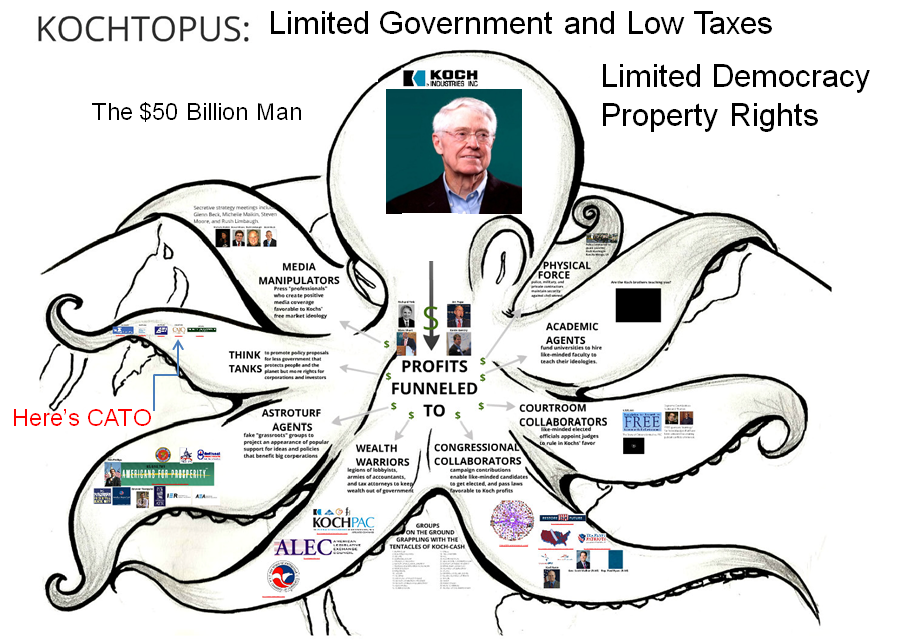
Kochtopus

The graphic above appeared December 13, 2013 on Progressive Collapse. The web site is no longer viable but their image is. It uses an octopus to demonstrate the vast influence Koch has created in areas of public interest. Since then, it has been shared by many. On the occasion of David Koch’s passing in 2019, the Guardian titled its article The Kochtopus: sprawling network keeps David Koch’s legacy thriving.”

In 2010, the Koch brothers staged one of their twice-yearly programs that became known as “Freedom Partners.” A brochure, accompanying invitations, highlighted a previous event in Aspen. The Guardian’s article reported:

“The most intriguing part of the brochure was a roll-call of names of those lured to previous “Freedom Partner” gatherings. It included the current vice-president, Mike Pence; the Wisconsin politician Paul Ryan, who would go on to become speaker of the House of Representatives; super-donors such as the hedge fund manager Ken Griffin, and most intriguingly of all two conservative justices of the US supreme court, Clarence Thomas and the late Antonin Scalia.”

Koch is known to be a shrewd businessman who supports voucher plans with as little oversight as possible. Education savings accounts are fraught with malfeasance. Peter Greene, reporting at Forbes noted:

“In Arizona, an audit found that parents had spent $700K of ESA money on beauty supplies and clothing. In Florida, where voucher-receiving schools openly discriminate against LGBTQ students, a new bill proposes that audits be performed only every three years. Kentucky’s new ESA bill proposes audits after the state has found evidence of misuse of funds, which seems like a rather late shutting of the barn doors. And the bill that the Iowa senate just fast-tracked in order to establish ESAs includes no call for any audits or oversight at all. (That may be in part why the Iowa Satanic Temple has announced their intention to establish the Iowa Satanic School.)”

For Charles Koch to support this kind of financial chicanery, there must be an ulterior motive. Most likely, the purpose is destroying America’s public school system and ending the voucher mess. His classical liberal ideology would be realized and universal free public education would be ended.

Koch once again extended his octopus-like tentacles when he joined the Walton Family to form the Vela Education Fund. Vela received their 501 C3 determination (EIN 84-4185046) from the IRS December 10, 2020. Stand Together’s latest form 990 filing listed $6,340,018 to Vela and the Walton Families Foundations (EIN-13-3441466) latest form 990 filing showed $5,000,000 to Vela.

It is clear that Vela is a Koch operation. Derek Johnson and Brian Menkes are on the board and Kara Hartnett is listed as Treasurer. These three people are on several Koch organization boards. This is one more weapon in Charles Koch’s quiver for ending public education.

Billionaires like Koch, the Walton family and former Education Secretary Betsy DeVos are intent on using their wealth to defeat democratic support for public schools and end Democracy’s Schools.” America can no longer afford to put up with billionaires and their non-democratic ways.

Time that voters tax billionaires out of existence.

School Choice is a Harmful Fraud

7 Sep

By Thomas Ultican 9/7/2020

Birthed in the bowels of the 1950’s segregationist south, school choice has never been about improving education. It is about white supremacy, profiting off taxpayers, cutting taxes, selling market based solutions and financing religion. School choice ideology has a long dark history of dealing significant harm to public education.

Market Based Ideology

Milton Friedman first recommended school vouchers in a 1955 essay. In 2006, he was asked by a conservative group of legislators what he envisioned back then. PRWatch reports that he said, “It had nothing whatsoever to do with helping ‘indigent’ children; no, he explained to thunderous applause, vouchers were all about ‘abolishing the public school system.”’ [Emphasis added]

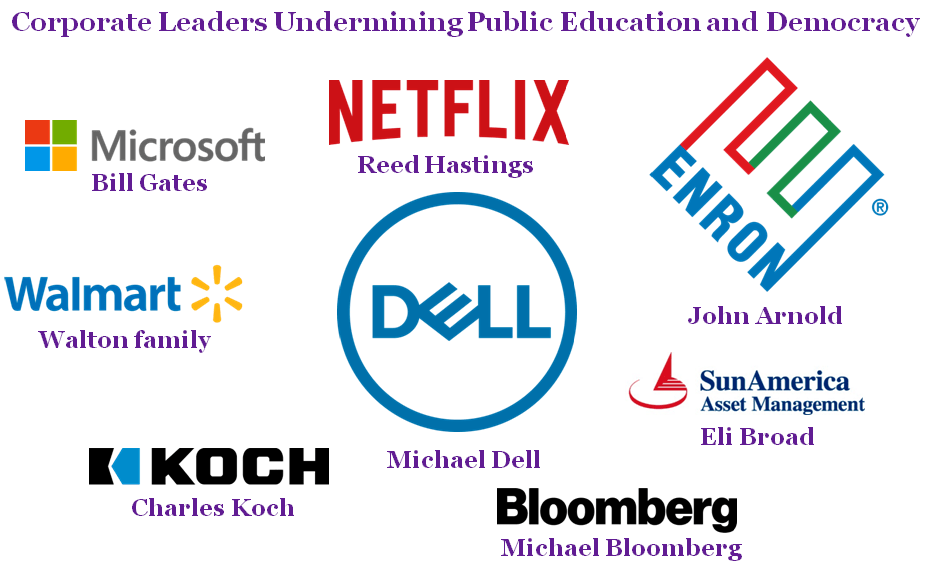
Market based ideologues are convinced that business is the superior model for school management. Starting with the infamous Regan era polemic,A Nation at Risk,” the claim that “private business management is superior” has been a consistent theory of education reform promoted by corporate leaders like IBM’s Louis Gerstner, Microsoft’s Bill Gates, Wal-Mart’s Walton family, Bloomberg LP’s founder, Michael Bloomberg and SunAmerica’s Eli Broad. It is a central tenet of both neoliberal and libertarian philosophy.

Charles Koch and his late brother David have spent lavishly promoting their libertarian beliefs. Inspired by Friedman’s doyen, Austrian Economist Friedrich Hayek, the brothers agreed that public education must be abolished.

To this and other ends like defeating climate change legislation, the Kochs created the American Legislative Exchange Council (ALEC). This lobbying organization has contributing members from throughout corporate America. ALEC writes model legislation and financially supports state politicians who promote their libertarian principles.

Like the Walton family and Betsy DeVos, Charles Koch promotes private school vouchers.

What is the main motive behind the mega-rich spending to undermine public education? Professor Maurice Cunningham of the University of Massachusetts claims what they really want are “lower state and local taxes.”

John Arnold is the billionaire Enron trader who did not go to prison when that company collapsed. He has joined forces with the billionaire CEO of Netflix, Reed Hastings, to sell the nation on the portfolio model of school management.  To achieve their goal, they created The City Fund. After its founding in 2018, Bill Gates, Michael Dell and Steve Ballmer all made significant contributions.

In brief, the portfolio model directs closing schools that score in the bottom 5% on standardized testing and reopening them as charter schools or Innovation schools. In either case, they will no longer come under the purview of an elected school board.

Because standardized testing only reliably correlates with family wealth, this system guarantees that schools in poor communities will all eventually be privatized.

In 2014, SFGATE reported, “Netflix CEO Reed Hastings, who suggests that democratically elected school boards are the problem with public education, says they should be replaced by privately held corporations.”

When it came to privatizing schools, vouchers were a tough sell. Jeffry Henig of Teachers College noted to writer Jeff Bryant, “The Walton foundation itself was one of the early organizations to transition from vouchers to charters.” In an AlterNet article Bryant explained,

“Henig believes many conservatives view charter schools as a way to “soften the ground” for potentially more private options, though he isn’t entirely sure “the Waltons view charters as a Trojan Horse for eventually providing vouchers universally.’”

John Walton read “A Nation at Risk” and that set off his hyper focus on reforming public education. Throughout the 1990s he campaigned endlessly for new voucher legislation and saw his efforts repeatedly rebuffed. Shortly before his death in 2005, John joined Don Fisher and Buzz Woolley in establishing the Charter School Growth fund. Around the same time the Walton Family Foundation began financing charter school startups in communities across America.

No matter how stinking the thinking, a billionaires beliefs have influence. The billionaire led push to privatize public education is based on at least four completely bogus ideas:

1 – “A Nation at Risk” was a misguided fraud but it is still the motivating prime point for corporate driven education “reform.” Former New York Times Education writer, Richard Rothstein states,

“A Nation at Risk based its analysis of declining student achievement entirely on average SAT scores which had dropped by about half a standard deviation from 1963 to 1980. But much of the decline had been due to the changing composition of SAT test takers — in the early 1960s, the preponderance of SAT test takers were high school students planning to apply to the most selective colleges. By 1983, the demographic composition of SAT test takers had mostly stabilized, and average SAT scores were again rising, not declining.”

2 – The growing belief among wealthy elites that elected school boards are the problem is ridiculous. Saying democracy is a discredited way to run publicly financed organizations and elected boards should be replaced by privately run businesses is UN-American.

3 – Market based ideologues religiously believe in Adam Smith’s invisible hand. They are sure comparative school performance will provide families with improving schools that are striving to win the market. These proponents trust that this system will efficiently remove low-performing schools. A 2015 paper notes,

“This idealized theory assumes that all consumers are equally desirable customers for which providers will compete …  just because parents can voice a choice in the system does not mean they will get the choice they want. In New Orleans, the most desirable schools choose their students to a substantial extent.”

4 – Our present Secretary of Education is emblematic of people who believe it is terrible that public schools have replaced churches as the center of community life. Betsy and Dick DeVos have been using their Amway generated wealth to tear down the separation between church and state. They believe the public should provide vouchers to private religious schools and they promote home schooling.

Choice Drives Segregation by Race and Class

It is well known that integrated schools are beneficial for all races and classes and for the social development of society. Professor Peter Piazza’s “School Diversity Notebook” provides a short summary of the research validating this statement.

Data does not inform the decisions to segregate schooling. As Professor Piazza states, “Decisions to segregate are made in the gut or maybe (sadly) in the heart, but not in the head.”

A Matt Barnum article about school integration discusses what happened:

‘“School integration didn’t fail,’ Berkeley economist Rucker Johnson, who has conducted some of the most far-reaching research on school integration, recently argued. ‘The only failure is that we stopped pursuing it and allowed the reign of segregation to return.”’

Adding more perspective, Sonya Ramsey wrote The Troubled History of American Education after the Brown Decision for the American Historian. It is made available by the Library of Congress. In that paper she reported,

“From 1954 to the late 1980s, the rate of black children attending white schools rose tremendously in the South, from 0 percent in 1954, to 43.5 percent by 1988, only declining after the dismantling of court ordered desegregation plans to 23.2 in 2011. The South remains the least segregated area of the nation. The current resegregation of the public school are due more to the declining support for desegregation by local districts, the federal government, and the Supreme Court. In 2007 Chief Justice John G. Roberts Jr. stated the following in his majority opinion in two court cases that used race in determining transfer policies and school plans to foster desegregation: “The way to stop race discrimination on the basis of race is to stop discriminating on the basis of race.” [17] This decision turned a blind eye to decades of racial discrimination in public schools and struck a deathblow to Brown. The federal government’s focus on assessment testing in the 1980s also placed less emphasis on enforcing desegregation.” [Note 17: https://www.nytimes.com/2007/06/29/washington/29scotus.html]

Today’s school choice advocates precisely echo the language and schemes created by southern segregationists in the 1950s.

Last year three researchers – Julian Vasquez Heilig from the University of Kentucky, T. Jameson Brewer from the University of North Georgia and Yohuru Williams from the University of St. Thomas – collaborated on a study of the segregating effects of charter schools. Their paper clearly documents that charter schools are accelerating resegregation. 

In the literature search section of the study, they reported that the conservative oriented “American Enterprise Institute (AEI) conducted a study of the entire universe of charter schools in the United States concluding that parents were self-segregating along racial and class lines but that such segregation was simply a result of a ‘well-functioning education market.”’ [Emphasis added]

The researchers concluded that “Many of the nation’s charters can even be classified as “apartheid schools”—a term coined by UCLA Professor Gary Orfield for schools with a White student enrollment of 1 percent or less.” And “double segregation by race and class is higher in charter schools” than in public schools.

A personal 2019 study of Washington DC charter schools revealed that 64 of the 116 charter schools would be classified “apartheid schools” using Professor Orfield’s definition.

For their study, Heilig at al accessed the Common Core of Data (CCD) – the Department of Education’s primary database on public elementary and secondary education in the United States. This data was brought together with census and zip code data to reveal related school site and community demographic data.

A common defense of charter schools is that they purposely serve highly segregated communities. However, the researchers discovered “even when comparing schools that are located near each other—that charter schools are more segregated than nearby public schools.”

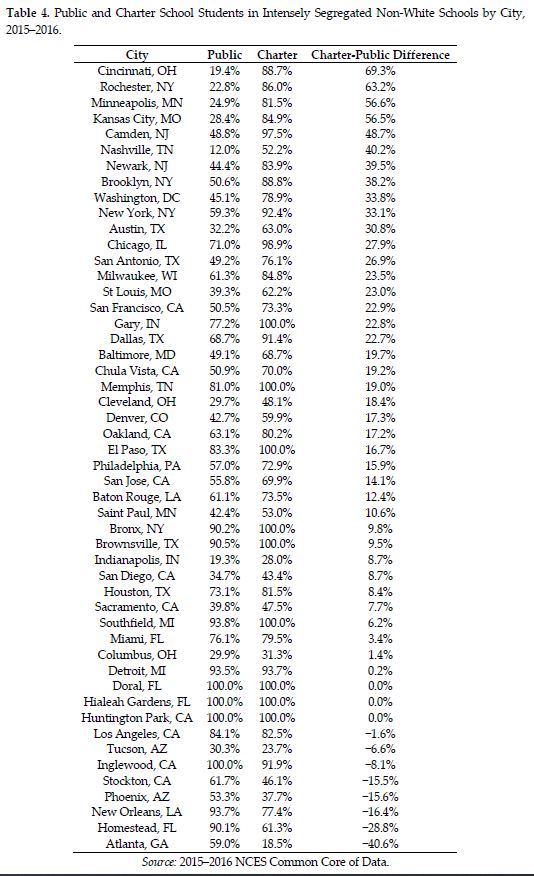
The paper contained six tables revealing the magnitude of segregation comparing charter schools with public schools. The following is Table 4 from the study that details growing charter school segregation in major cities.

Overall, the intensity of charter school segregation in America’s major cities is shocking. However, the city with the most charter schools, Los Angeles, looks relatively OK. This is a bit of an illusion because many of the charter schools in that city serve racially isolated white students.

In February, Anji Williams published “How Charter Schools in Hollywood Uphold the Racist Tradition of Redlining Segregation.” In Hollywood, the public middle school, La Conte, is almost 100% free and reduced lunch while the co-located Citizens of the World Charter School is more than 60% middle class.

The School Choice Advantage

For the Catholic Church and Evangelical Christians like Betsy DeVos, publicly provided vouchers for private religious schools opens a path to taxpayer support for their religious organizations. It is lamentable for their cause that every recent large scale study of vouchers have shown that students perform worse when they transfer to voucher schools.

For the Walton family, John Arnold and Charles Koch, school choice grants a path to undermining public education and lowering taxes. However, “when considering the extant literature on school performance comparisons, the minority of charter schools, at best, provide minimal academic benefits whereas the majority underperform public schools.” Worse yet, charter schools are unstable with half of them going out of business within 15 years.  

For Bill Gates, Reed Hastings and Michael Dell, school choice prepares a path for creating an education technology industry that has the promise of huge future profits. Unfortunately for them, digital learning has proven to have serious limitations. The Organization for Economic Co-operation and Development (OECD) said in a 2015 report that heavy users of computers in the classroom “do a lot worse in most learning outcomes.

For the white supremacist, school choice presents a path for not having their children attending school with “those people.” The data shows it clearly works for their purposes.

For the mission of public education and the future of America, school choice is an atrocious policy.

“We Are the Resistance and We Are Winning.”

1 Jan

By Thomas Ultican 1/1/2020

Historian and former United States Assistant Secretary of Education, Diane Ravitch’s, new book, Slaying Goliath: The Passionate Resistance to Privatization and the Fight to Save America’s Public Schools is due for release January 21. This masterpiece weaves together recent history with illuminating data concerning “corporate driven education reforms.

The reported community response to self-anointed reformers is spiritually uplifting. Ravitch presents strong evidence that resistance to their reforms is carrying the day.  She declares, “Judged by their own chosen metrics – standardized test scores – the fake ‘reforms’ failed.”

Diane tells a deeply personal story of her own journey through the education wars while bringing to life the experiences of teachers, students and parents harmed by “fake reforms.” In this captivating read, Ravitch describes the fight to save the commons.

Goliath_0001

Disruption and Changing Course

There is a parallel between Diane Ravitch and Elizabeth Warren. Both Warren and Ravitch were scholars whose research led them to a profound change of thought. Warren was fundamentally a moderate Republican when she began researching bankruptcy law. Ravitch was an advocate of top down standards based education reform. Through their personal research both these women awakened to personal error and went out to make amends. Warren became the bane of the banking industry and a tiger in Democratic politics. Ravitch threw up a stop sign in front of “corporate education reform” and has become its most virulent opponent.

When I mentioned something Ravitch wrote in 2012 to a teacher colleague, that veteran teacher in my neighboring classroom expressed open hostility toward her. He remembered Lamar Alexander’s resident scholar in the Department of Education and her full throated advocacy of standards and testing accountability. He remembered her papers published by the Brookings Institute. Since then, Ravitch has overcome many of her skeptics by working harder than anyone else and fearlessly leading the fight to save authentic public education.

In Slaying Goliath Ravtich shares,

“Having worked as assistant secretary of education for the Office of Educational Research and Improvement in the administration of President George H. W. Bush and for many years in some of the nation’s leading conservative think tanks, I had hoped that privatization and testing would produce sweeping improvement, especially for the neediest students. It didn’t. I couldn’t pretend otherwise. I came to realize that the privatization movement was a continuation of a decades-long campaign by right-wingers who hated public schools, which they derisively called ‘government schools.’ I renounced my own past views and determined to expose the well-funded smear campaign against American public schools and their teachers.”

What should we call the proponents of the choice agenda fueled by standardized testing driven accountability? What do we call those wealthy elites financing the push for charter schools, vouchers and public school closures? Ravitch refuses to call them “reformers” or what they promote “reform.” She recites various appellations people use; “deformers,” or the “financial privatization cabal,” or the “Destroy Public Education Movement.” She observes that “reform” has positive connotations that denotes ‘“improvement,’ ‘progress,’ and ‘uplift.’”

An oft stated goal of this corporate driven agenda is disruption. Disruption is an odd management theory championed at Harvard University in 1995. It posits disruption as a needed ingredient for innovation-driven growth. Ravitch decided they have named themselves.

“They are Disrupters. They are masters of chaos, which they inflict on other people’s children, without a twinge of remorse.”

From the beginning of the book on, Ravitch refers to the “Disrupters.”

Strategy of the Disrupters

A natural starting point for analyzing the era of the Disrupters is the Reagan administration’s 1983 polemic, “A Nation at Risk.” Ravitch shares that Ronald Reagan assumed the presidency with three goals for public education; (1) abolish the US Department of Education, (2) restore school prayer and (3) introduce school vouchers for religious and other private schools.

His Secretary of Education, Terrel Bell, had other ideas. To save the department, he established “The National Commission on Excellence in Education.” In its report written by American business leaders and a venerated scientist, they did not call for prayer or vouchers, however, they blamed public education for the nation’s economic struggles which Ravitch saw as “no less destructive.” She cites an NPR report in which the authors candidly admitted that the data was “‘cherry-picked’ to make American public schools look as bad as possible.

When the Department of Energy commissioned engineers at the Sandia Nation Laboratories to study the current status of American education in 1990, they criticized “The Nation at Risk” as overly alarmist. Sandia found that test scores, graduation rates, and other indicators were actually improving. In Slaying Goliath, Ravitch’s shares an insiders perspective. She writes,

“At the time, I was assistant secretary of education for education research and improvement, and in 1992, I attended the Energy Department’s briefing about the Sandia report. I accompanied David Kearns, former CEO of Zerox, who was deputy secretary of education, to the meeting. He was outraged by the Sandia report, which contradicted the view of the Department of Education that American public schools were failing and needed radical change. The Energy Department never published the report, but it was immediately leaked to hundreds of influential researchers, who wrote about its findings. In retrospect, the Sandia report got it right. The late Gerald Bracey, a prolific and outspoken education researcher, was highly critical of the conventional wisdom, which I was then defending. I hereby personally apologize to him. He was right. The “crisis in education” was a politically inspired hoax, or as the eminent researchers David Berliner and Bruce Biddle later called it, a ‘Manufactured Crisis.’”

What do disrupters want? They want:

  • Inexperienced teachers with little or no training from organizations like Teach For America.
  • To replace teachers with machine teaching (“blended learning” – “personalized learning”).
  • To move fast and break things including school systems, historic schools and communities.
  • To eliminate local democratic control over schools.
  • To eliminate teacher tenure and seniority rights.
  • To eliminate teacher defined benefit pensions.
  • To eliminate teachers unions.
  • To evaluate teachers and schools with standardized test scores.
  • To lower taxes and reduce spending on education.

Ravitch goes into significant detail about who are the disrupters. She calls out the billionaires in the private sector driving the school choice agenda and highlights their spending. She states, “Every Republican governor is a disrupter, because they actively support privatization by charters and vouchers.” However, she notes that rural Republican officials understand that public schools are the anchors of their communities and do not support privatization. The Democratic Party also has many disrupters but not in as great of numbers as the Republicans and generally no Democrats support vouchers. The last two Democratic Presidents, Bill Clinton and Barack Obama, were disrupters.

Conservative groups supporting disruption include the far right Heritage Foundation and the libertarian Cato Institute. Ravitch asserts, “The radical right-wing American Legislative Exchange Council (ALEC) is the key organization in the world of disruption advocacy.

She lists more than a dozen pro-disrupter “think-tanks” on the right including the Thomas B. Fordham Institute and the Center for Education Reform which Ravitch describes as liking “every choice in schooling except public schools.

Before his 1998 election to the governorship of Florida, Jeb Bush served on the board of the Heritage Foundation where he developed his education plans. Diane cites his A+ Plan for education as the “template for disruption.” It combines choice, competition, high-stakes testing, grading schools with A-F grades and accountability as the formula for excellence in education.

Two “liberal” groups, the Center for American Progress (CAP) and Democrats for Education Reform (DFER), push most of the disrupter agenda. In her description of DFER Ravitch writes,

“In 2005, several hedge fund managers – Witney Tilson, Ravenel Boykin Curry IV, John Petry and Charles Ledley – launched Democrats for Education Reform at a posh party on Central Park South in Manhattan, where the inaugural speaker was a young senator from Illinois named Barack Obama. DEFR, as it is deceptively called, was founded to support school privatization by making strategic campaign contributions. Inspired by DFER, charter schools became the pet passion of Wall Street.”

“It is likely difficult to throw a beanbag in a corporate or Wall Street boardroom without hitting a member of the board of a charter chain.”

The Victorious Resistance

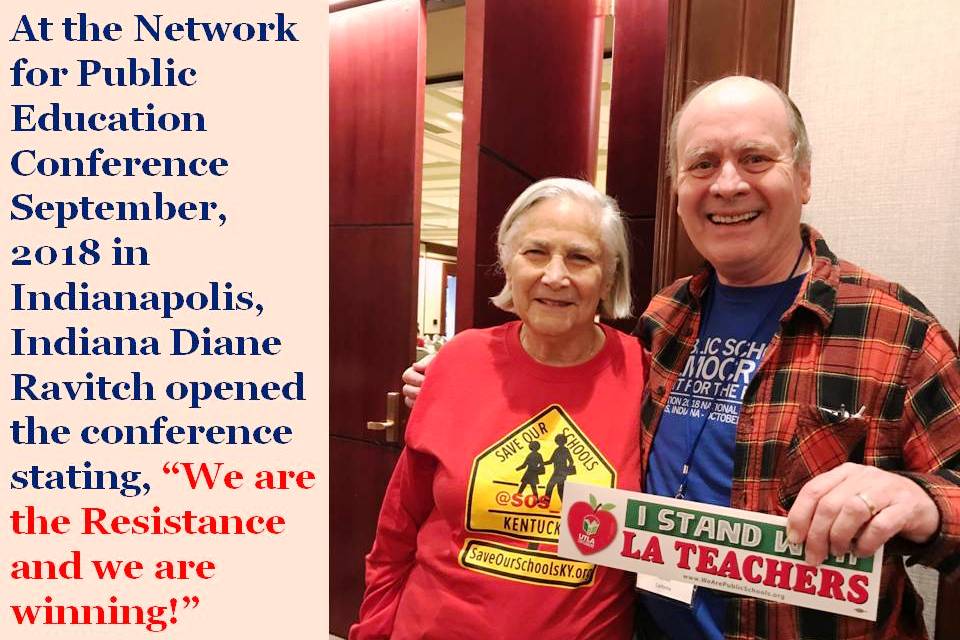
Tom and Diane in Indianapolis

Tom Ultican and Diane Ravitch at the 2018 NPE Conference

The picture above was taken just over two months before the historic LA teachers strike on January 14, 2019. Following the massive teachers strikes in West Virginia, Oklahoma and Arizona, the LA strike was the first one led by a sanctioned teachers union. When the teachers settled their strike after nine days, they did not get any bump in the original take home pay offer but they won big.

USA Today reported, “‘this is much more than a labor agreement,’ said UTLA President Alex Caputo-Pearl. ‘It’s a very broad compact that gets to social justice, educational justice.’” The Los Angeles agreement included class size reductions in all grade levels, 300 additional school nurses, 80 new teacher librarians, one counselor for every 500 students and a 3 percent raise for teachers.

In Arizona, a group of six women established Save Our Schools Arizona to fight the Koch brothers initiated large voucher expansion proposal which was adopted by the Arizona state government. At the Indianapolis NPE conference, Beth Lewis and Sharon Kirsch of SOS Arizona were presented the first of a planned annual Phyllis Bush Award. Against all odds they landed a citizens’ initiative stopping the voucher expansion on to the November 6, 2018 ballot. Later we learned their initiative won with a whopping 65% of the vote.

Ravitch tells these stories and many more of the resistance taking on Goliath and winning.

The saga of Douglas County Colorado being taken over by school privatization forces in 2011 is unique and uplifting. The disrupters immediately established a district school voucher program. That was only the beginning of their agenda, but a bi-partisan group of parents fought back. Today there are no disrupters left on the school board in Douglas County and there are no vouchers.

The account of Barbara Madeloni, President of the Massachusetts Teachers Association (MTA), leading the fight to stop the state from increasing the number of charter schools is amazing. The contest was played out at the ballot box over a referendum to expand the number of charters known as Question-2. Ravitch reports that the MTA directed Madeloni to negotiate with legislators and quotes Madeloni’s negotiating position,

We are glad to talk, but we will not accept any deal that involves any new charter schools. Now, what do you want to talk about?

Question-2 lost 68% to 32%. One of the largest contributors to the yes-on-2 campaign was the world’s now second richest women hailing from Bentonville, Arkansas, Alice Walton. She is an heir to the Walmart fortune.

A Concluding Analysis

Ravitch’s books like The Death and Life of the Great American School System and Reign of Error are scholarly efforts that serve for years as references. Yet, they are written in a fashion that gives the average reader access to the material in an enjoyable and understandable way. I believe that in Slaying Goliath: The Passionate Resistance to Privatization and the Fight to Save America’s Public Schools, Ravitch has upped her game. The stories are riveting and the scholarship underlying them is first rate. This is another game changing book from Diane Ravitch.

Twitter: @tultican

DC Charter School Performance “Almost” Matches Public Schools

8 Sep

By T. Ultican 9/8/2019

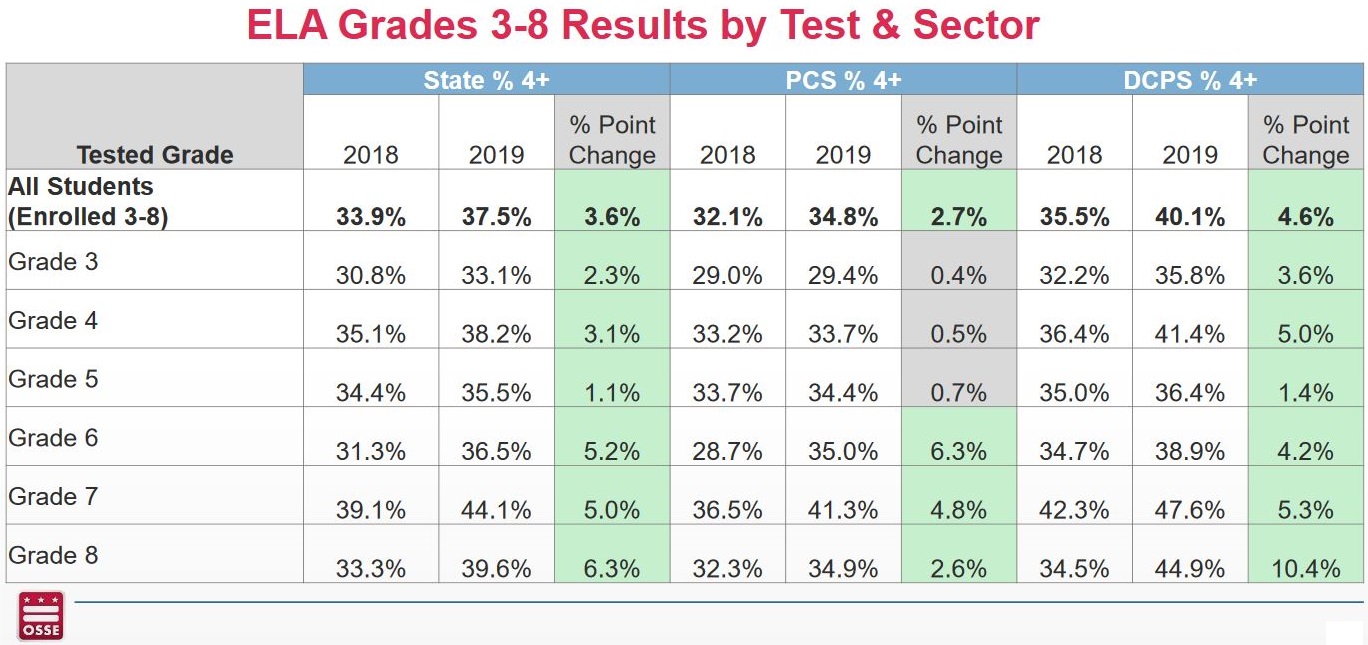
Washington DC charter schools did not significantly outperform public schools or even match them on the last two years of PARCC testing. These disappointing results for the charter school industry come almost a quarter-century after Bill Clinton and Newt Gingrich teamed up to bring neoliberal education reform to Washington DC. As their “reforms” accelerated, residents were assured that innovative privatized schools would bring better outcomes and performance gaps would close. None of that happened. Instead, public schools have been disappearing; democratic rights have been taken away; “segrenomics” has motivated change and corruption is rampant.

It is important to note that standardized testing data has only two legitimate outcomes. These tests are not capable of measuring school or teacher quality but they do provide a huge revenue stream for companies like the testing giant Pearson Corporation and they create propaganda for disrupting and privatizing public schools. No group has put more stock in standardized testing data than the charter school industry. Since many charter schools are known to center their curriculum on preparing for tests like PARCC, it is surprising that for the last few years, Washington DC’s public schools have outperformed charters.

The PARCC testing consortium claims that on their 5-point scale, “Students who performed at level 4 and above have demonstrated readiness for the next grade level/course and, eventually, college and career.” The Washington DC, Office of the State Superintendent of Education (OSSE) is in charge of PARCC testing. OSSE reports the data in terms of percentage of students scoring greater than or equal to 4.

ELA 3-8 PARCC Data

ELA Data from the OSSE Report

Math 3-6 PARCC Data

Math Data from the OSSE Report

In the data above, DCPS indicates the District of Columbia Public Schools; PCS indicates Public Charter Schools and State indicates the sum of the two. The inappropriately named Public Charter School Board which oversees charter schools in the city asserts, “Public charter schools serve a student body that is equally or at times more disadvantaged, while outperforming traditional public schools.” The data shown above highlights the board’s bias.

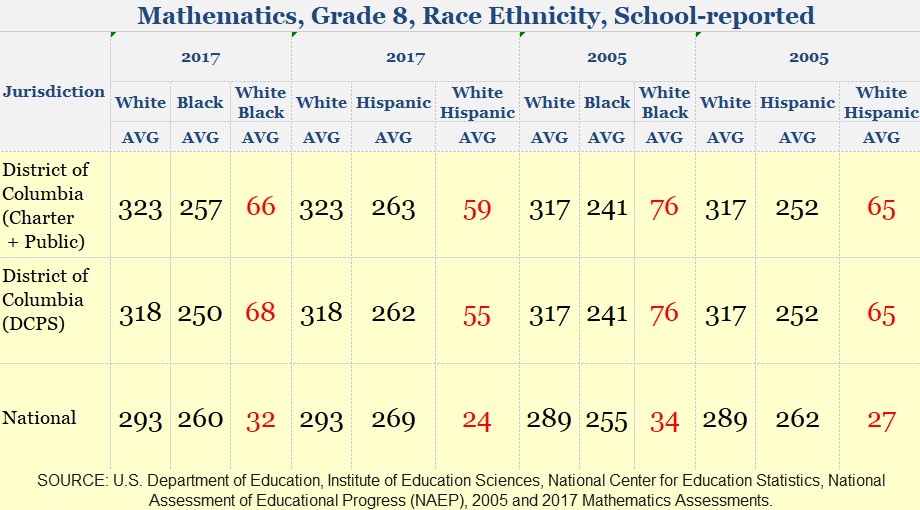
Sociologists point out that testing reliability is undermined when employed for accountability. Donald T. Campbell famously observed, “The more any quantitative social indicator is used for social decision-making, the more subject it will be to corruption pressures and the more apt it will be to distort and corrupt the social processes it is intended to monitor.” The National Assessment of Education Progress (NEAP) testing does not have any high stakes associated with it. The following NEAP data looks at education performance gaps between races.

Gap Data 2005-2017

Red Numbers Indicate the Performance Gaps in 2005 and 2017

The chart above shows that DC performance gaps have shrunk, however, they are still the largest in the nation and more the twice the National Average. An interesting side note; another portfolio district, Denver, also has very high student performance gaps.

The other school choice initiative forced onto DC by Congress is vouchers. In 2003 the Opportunity Scholarship Program was sneaked into an omnibus bill. It authorized $20 million yearly to be spent on vouchers in the district. That means all taxpayers are paying for DC students to attend religious schools.

A recent Center for American Progress report on vouchers observed:

“This analysis builds on a large body of voucher program evaluations in Louisiana, Indiana, Ohio, and Washington, D.C., all of which show that students attending participating private schools perform significantly worse than their peers in public schools! especially in math. A recent, rigorous evaluation of the D.C. Opportunity Scholarship Program from the U.S. Department of Education reaffirms these findings, reporting that D.C. students attending voucher schools performed significantly worse than they would have in their original public school.”

With public schools outperforming charter schools, academic performance gaps being the largest in the nation and voucher students falling behind their peers, Valerie Strauss of the Washington Post asks a pertinent question,

“When are school reformers nationwide who have had a love affair with the D.C. model going to give it up?”

Why Don’t Washington DC Residents Merit Democracy?

The US Census Bureau estimates that on July 1, 2018 Wyoming’s populations was 577,737; Alaska’s population was 737,438 and Washington DC’s population was 702,455. Alaska and Wyoming both have two senators and a congressman representing them. Washington DC only has one congressman with limited voting privileges.

In 1968, the US congress gave the residents of Washington DC the right to vote for an 11-member school board. In 1996, the President appointed DC Financial Responsibility and Management Board (the “Control Board”) reduced the school boards power and claimed the authority to appoint the superintendent. In 2000, a DC referendum reduced the school board to 9 members and gave the Mayor the right to appoint 4 members. Finally, in 2007, the DC District Council passed the Public Education Reform Amendment Act (PERAA). This act transferred almost all management authority to the mayor and created the present school system organization.

There are four main Components of the Washington DC school system:

  1. The State Board of Education (SBE) which has the city’s only publicly elected school board. It sets some standards but has little actual power.
  2. The Office of the State Superintendent of Education (OSSE) is in charge of testing, data reporting, transportation, and athletics.
  3. Public Charter School Board (PCSB) is a 7-member board appointed by the Mayor. It was created in 1996 and is the sole charter school authorizer in Washington DC. It also has the power to rescind a charter.
  4. District of Columbia Public Schools (DCPS) is the public school system serving more than half of Washington DC’s students.

The Mayor has almost dictatorial control over the school system with very little input from teachers, students or parents. When Muriel Bowser was elected Mayor in 2014, she inherited DCPS Chancellor, Kaya Henderson. Bowser appointed Jennifer Niles as her chief education advisor with the title Deputy Mayor for Education. Niles was well known in charter school circles having founded the E. L. Haynes Charter School in 2004. Niles was forced to resign when it came to light that she had made it possible for DCPS Chancellor Antwan Wilson to secretly transfer his daughter to a preferred school against his own rules.

Bowser has an affinity for education leaders that have gone through Eli Broad’s unaccredited Superintendents Academy. She is a Democratic politician who appreciates Broad’s well documented history of spending lavishly to privatize public-schools. When Kaya Henderson resigned as chancellor in 2016, Antwan Wilson from the Broad Academy class of 2012-2014, was Bowser’s choice to replace her. Subsequent scandal forced the Mayor to replace both the Chancellor and the Deputy Mayor in 2018. For Chancellor, she chose Louis Ferebee who is not only a member of Jeb Bush’s Chiefs for Change, but is also a graduate with the Broad Academy class of 2017-2018. Her new Deputy Mayor choice was Paul Kihn Broad Academy Class of 2014-2015.

With the control Mayor Bowser has over public education, the DCPS webpage now looks more like a vote for Bowser publication than a school information sight.

DC Public Schools Welcome Page

Image of the DCPS Home Webpage Taken on 9/7/2019

Corruption and “Segrenomics” Infest DC Schools

Noliwe Rooks’ book, Cutting School: Privatization, Segregation and the End of Public Education, says uplifting all children requires racial and economic integration. It warns against separate but equal education. In the book, Professor Rooks defines Segrenomics:

“While not ensuring educational equality, such separate, segregated, and unequal forms of education have provided the opportunity for businesses to make a profit selling schooling. I am calling this specific form of economic profit segrenomics. Segrenomics, or the business of profiting specifically from high levels of racial and economic segregation, is on the rise.”

In the 2018-2019 school year Washington DC had 116 charter schools reporting attendance. Of that number 92 or 82% of the schools reported more than 90% Black and Hispanic students. Thirty charter schools or 26% reported over 98% Black students. These are startlingly high rates of segregation.

Of the 15 KIPP DC charter schools, all of them reported serving 96% or more Black students. According to their 2017 tax filings, seven KIPP DC administrators took home $1,546,494. The smallest salary was $184,310.

In addition to charter school profiteering, the seven people Mayor Bowser appointed to lead the Public Charter School Board seem more like charter industry insiders than protectors of the public trust.

The PCSB Board:

Rick Cruz (Chair) – Chief Executive Officer of DC Prep Public Charter School; formerly worked at the Network for Teaching Entrepreneurship, Teach for America and America’s Promise Alliance. Currently, he is Executive Director of Strategic Partnerships at The College Board

Saba Bireda (Vice Chair) – Attorney at Sanford Hiesler, LLP, served under John King at the U.S. Department of Education.

Lea Crusey (Member): Has served at Teach for America, advisory board for KIPP Chicago, StudentsFirst, and Democrats for Education Reform.

Steve Bumbaugh (Treasurer) – Manager of Breakthrough Schools at CityBridge Foundation.

Ricarda Ganjam (Secretary) – More than 15 years as Management Consultant with Accenture; consulted on KIPP DC’s Future Focus Program.

Naomi Shelton (Member) – Director of Community Engagement at KIPP Foundation.

Jim Sandman (Member): President of the Legal Services Corporation.

It appears that charter schools in DC are starting to cannibalize each other. A relatively new company called TenSquare is using its connections at the PCSB to advance its charter school turnaround service. Last year Rachel M. Cohen wrote “Behind the Consulting Firm Raking In Millions From D.C. Charter Schools; Is TenSquare effective—or just connected?” Cohen’s lengthy article stated, “TenSquare is the brainchild of Josh Kern, who graduated from Georgetown Law School in 2001 and founded Thurgood Marshall Academy—a legal-themed charter high school—immediately afterward.” TenSquare started operating in 2011. Cohen reported:

One common criticism of TenSquare is that its business model is, in a sense, circular: It can effectively hire itself. When TenSquare is brought in to assess a charter’s alleged deficiencies, it is well positioned to recommend that the charter correct those deficiencies with TenSquare’s own turnaround services.

“It’s a racket,” says Jenny DuFresne, a former charter principal whose school contracted with TenSquare. “It’s a bunch of good old boys who are talking to each other and scratching each other’s backs. Like honestly, that’s all it is.”

A disturbing quote concludes Rachel Cohen’s article:

‘“If you talk to charter people off the record around the city, you’ll find most are afraid to speak honestly about TenSquare,’ says Donald Hense, the now-retired founder and CEO of Friendship Public Charter School. ‘But they’re also afraid if they don’t hire the company then their charters will be revoked.”’

End Notes

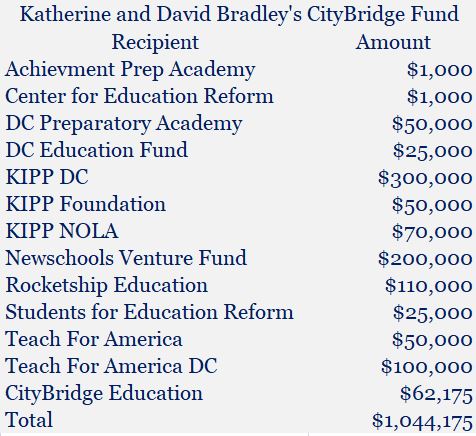
Well known national foundations that spend for school choice and market reform of education send multiple millions of dollars yearly to advance school privatization in Washington DC. These include the Edythe and Eli Broad Foundation, the Bill and Malinda Gates Foundation and the Walton Family Foundation. Locally, David and Katherine Bradley, owners of Atlantic media, have established the CityBridge Foundation. They are also spending seven figures to privatize the city’s public schools.

CityBridge

Spending to Privatize Public Schools in 2017

With all this spending, surprisingly, the expansion of charter schools in Washington DC has slowed or possibly stopped. The promised benefits from privatization have not materialized but community disruption has.

Twitter: @tultican

Five Decades of ‘MarketWorld’ Education Reform

27 Jul

By T. Ultican 7/27/2019

There has been a fifty-year push to reform education using business management principles. In the period, Harvard Business School has trumped Columbia Teacher College concerning pedagogy. Unfortunately, the results are an unmitigated disaster for most communities and students. This market based endeavor – financed by billionaires – has transformed public schools into non-democratic profit centers. It is the precursor to the ultimate goal of dismantling universal free public education.

The radical right is pushing to privatize everything from policing; to prisons; to schools. They have spread the gospel that governments are incapable of solving problems but businessmen can. In his first inaugural address, Ronald Reagan declared “…, government is not the solution to our problem; government is the problem.” Viewing society as consisting of “makers” and “takers,” these apostles of privatization fear the tyranny of democratic majorities. They strive to make property rights the paramount civil right.

When it came to privatizing school, the right originally tried to use vouchers, but that was a tough sell. Jeffry Henig an Education Professor at Teachers College, “The Walton foundation itself was one of the early organizations to transition from vouchers to charters.” In his AlterNet article Bryant explained,

“Henig believes many conservatives view charter schools as a way to “soften the ground” for potentially more private options, though he isn’t entirely sure “the Waltons view charters as a Trojan Horse for eventually providing vouchers universally.’”

When putative progressive organizations like the Center for American Progress or Democrats for Education Reform promote charter schools they are promoting an anti-democratic and anti-union position. When politicians like Corey Booker and Joe Biden say they support public charter schools, they are in fact supporting the radical right’s privatization agenda. When Bill Clinton eliminated depression era banking rules and “welfare as you know it” plus campaigned for school choice; he was advancing Charles Koch’s ideology.

Two recent books have brought the privatization agenda into sharp relief.

The first book is Democracy in Chains: The Deep History of the Radical Right’s Stealth plan for America by Nancy MacLean. Through serendipitous good fortune, MacLean stumbled onto Nobel Prize laureate James M. Buchanan’s unorganized papers shortly after his 2013 passing. They were in boxes and stacked on tables in his George Mason University cabin. The other more well known American Nobel Prize winning economist from the right is the Milton Friedman. However, MacLean discovered that Charles Koch, the financier of the radical right “bypassed Friedman for Buchanan.

The other book is Winners Take All: The Elite Charade of Changing the World by Anand Giridharadas. He takes the reader inside the worlds of elite philanthropy in New York City and of thought leaders in Aspen, Colorado. He writes,

And what these winners wanted was for the world to be changed in ways that had their buy-in – think charter schools over more equal public school funding, or poverty-reducing tech companies over antitrust regulation of tech companies. The entrepreneurs were willing to participate in making the world better if you pursued that goal in a way that exonerated and celebrated and depended on them.

James M. Buchanan, John C. Calhoun and Segregation

James M. Buchanan grew up in Tennessee. His grandfather had been an unpopular governor of the state; however Buchanan was raised in near poverty. It was his academic abilities that took him from the obscurity of Middle Tennessee State Teachers College to a doctorate in economics from the University of Chicago in 1948. The youthful socialist became a “zealous advocate of market order.” It was at the University of Chicago where Buchanan met Friedrich August Hayek and the Austrian School of Economics.

Writing in Atlantic Magazine Sam Tanenhaus disclosed, “Hayek initiated Buchanan into the Mont Pelerin Society, the select group of intellectuals who convened periodically to talk and plot libertarian doctrine.” After World War II ended, The Mont Pelerin Society was a relatively small group of economists mostly from Europe and the United States who were widely viewed as a fringe group. They were against initiatives such as social security, universal health care and public education. The title of Hayek’s 1944 book The Road to Serfdom encapsulates their antipathy to any government social endeavors.

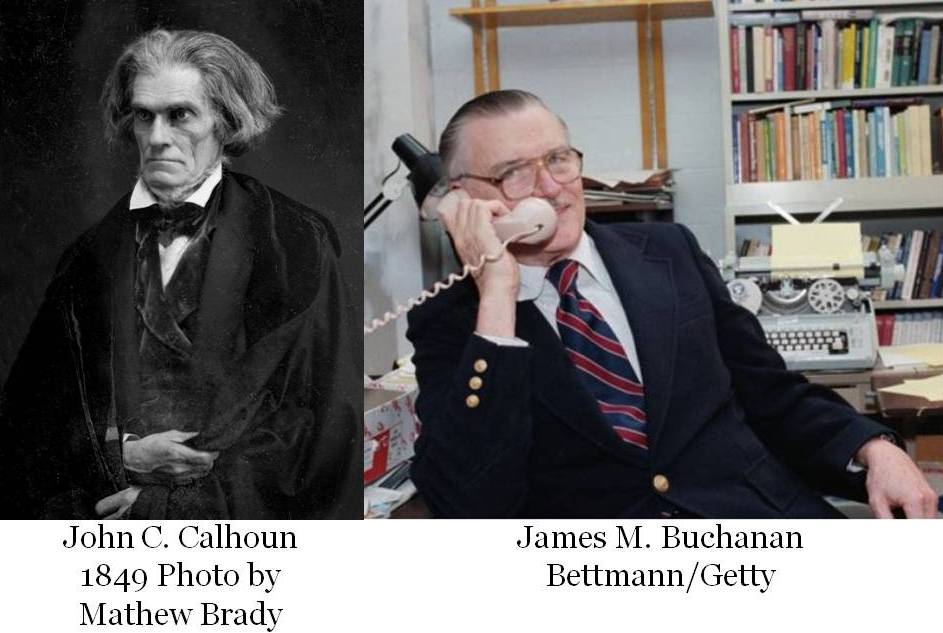
Professor MacLean, who is a historian from Duke University, compared Buchanan’s economic ideology with John C. Calhoun. Calhoun was a son of the antebellum south, a senator from South Carolina and a Vice President of the United States. MacLean quotes him stating, “A ‘government based in the naked principle that the majority ought to govern,’ was sure to filch other men’s property and violate their ‘liberty.’” Calhoun was also a leading defender of slavery. In his most famous speech he said slavery is “instead of an evil, a good–a positive good.

Buchanan and Calhoun

Buchanan’s first plumb teaching assignment came at the University of Virginia in 1956. This was also when the “massive resistance movement” to Brown versus the Board of education and desegregation of public schools in Virginia was heating up.

In 1959, Buchanan joined with another new hire at the university, G. Warren Nutter (who later became a key Goldwater advisor) to write “The Economics of Universal Education.” They argued that the root of the desegregation problem was that “state run” schools had become a “monopoly” that should be broken by privatization. They said if the state sold off their school buildings and equipment, they could limit their involvement in education to setting minimum standards. Then all kinds of schools might blossom.

Since MacLean’s book was published there has been some push back against her tying Buchanan and his paper to the “massive resistance movement” saying he did not involve himself in desegregation politics only in the economic issues of education. However, Buchanan and Nutter did state in their paper, “Every individual should be free to associate with persons of his own choosing.” In any case, schools in Virginia were closed. Black children stayed home while white children attended tax-subsidized private schools. In Prince Edward County, schools were locked closed from 1959-1964. MacLean says that for Buchanan segregation was just a side issue in his life-long libertarian pursuit.

Murray Newton Rothbard was an American economist of the Austrian School and a political theorist whose writings and personal influence played a seminal role in the development of modern right-libertarianism. MacLean discovered “Murray Rothbard encouraged Koch to study Lennin.” Not Lenin’s economics but his methods for advancing an unpopular ideology. On this point MacLean noted, “At a 1973 March log cabin meeting Buchanan stressed the key thing moving forward was that ‘conspiratorial secrecy is at all times essential.’”

In 1978, I saw the Communist Workers Party takeover the Iron Workers Union at National Steel and Ship Building Company (NASSCO) in San Diego. When watching the development of the radical right for the past few decades, similarities with the tactics of communist movement were unmistakable. Both movements are secretive, anti-democratic and motivated by extreme economic theory.

MacLean states, “The Mont Pelerin Society cause since the 1950’s is the end of public education.

Killing Public Education

In 1978, Congressman Ronald Mottl D-Ohio 23 introduced a bill promoting education standards. It was the first time a bill was proposed that amended the 1965 education law to promote a particular theory of education. Mottl’s bill went nowhere like another similar bill (H.R.371) introduced the next year by his colleague Tennyson Guyer R-Ohio 4. However, these were the first harbingers of education standards that emulated business practices.

In 1983, the Reagan administration produced the infamous “A Nation at Risk: The Imperative for Educational Reform.” This polemic was neither factually nor pedagogically well founded. Serious academic research has subsequently shown this non-peer reviewed writing to be the misguided work of amateurs. Its glorification of business practices opened the door for federal control of education and fostered standards based accountability. It made legislation like the proposals introduced by Mottl and Guyer viable.

In Winners, Giridharadas labels – modern social reform based on the belief that business leaders and market forces are the sure way to a better society – “MarketWorld.” He explains,

In an age defined by a chasm between those who have power and those who don’t, elites have spread the idea that people must be helped, but only in market-friendly ways that do not upset fundamental power equations.

Giridharadas shares three criteria for being a “MarketWorld” thought leader speaking at the Aspen Institute or the Clinton Global Initiative or the main TED talk stage. Thought leaders should:

  • Focus on the victim, not the perpetrator.” Condemning a perpetrator is a “win-losey” solution not a win-win.
  • Personalize the political.” If you want to be a thought leader and not be dismissed as a critic, your job is to help the public see problems as personal and individual dramas rather than collective and systemic ones.
  • Be constructively actionable.” … “People, especially the winners who shape tastes and patronize thought leaders, want things to be constructive, uplifting, and given to hope.

He gives examples including this one:

“What the thought leaders offer MarketWorld’s winners, wittingly or unwittingly, is the semblance of being on the right side of change. … Take, for example, the question of educating poor children in a time of declining social mobility. A true critic might call for an end to funding schools by local property taxes and the creation, as in many advanced countries, of a common national pool that funds schools more or less equally. What a thought leader might offer MarketWorld and its winners is a kind of intellectual counteroffer – the idea, say, of using Big Data to better compensate star teachers and weed out bad ones.”

Data shows that “MarketWorld” and libertarian philosophy has damaged public education and harmed all but the top 10% of wage earners in America. Giriharadas shares the following data table information and notes, “One hundred and seventeen million people had been completely shut off from economic growth since the 1970s.

Earning Level 1980 2014
Top 0.001 % $17,000,000 $122,000,000
Top 1% $428,000 $1,300,000
Top 10% $58,000 $116,000
Bottom 50% $16,000 $16,200

It is possible that Charles Koch and “MarketWorld” think this is a feature. To me, it looks like a powerful data set that says we need an empowered Government to protect Americans from ravenous billionaires and their self-serving anti-public education and anti-democratic views.

Twitter: @tultican

Apartheid Education and Segrenomics

7 Apr

By T. Ultican 4/7/2019

Noliwe Rooks new book Cutting School: Privatization, Segregation and the End of Public Education, her fourth, is a commanding account of the century’s long trend toward under-educating America’s Black and Brown children. Rooks is Director of American Studies at Cornell University where she is a Professor in Africana Studies and Feminist, Gender, and Sexuality Studies. The book is an illuminating peek inside the heart-breaking education experience of black and brown families.

Noliwe Rooks

Professor Noliwe Rooks

Well meaning white liberals are often blind to the true nature of the injustices they are inclined to fight. Here, a Black scholar elucidates the history of Black and Brown education in ways that edify. I grew up in rural Idaho and never met an African-American until I was 17 years-old. I saw public education through the lens of my almost all white school. Big cultural events in my home were school performances, high school sports and rodeos.  The few Mexican kids in our school were popular so I thought that was solid evidence that we were not racists. It was beyond my scope of understanding how different the American experience was for children being brutalized by racism. This book helps create that needed understanding.

Martin Luther King and his non-violent fight against racism absolutely moved my soul. However, I did not have a clue about how deep, vicious and sustained racist ideology was. I saw Bo Connor as an ignorant aberration not a representative of a widely held view. Most of all, it was not believable to me that people would purposely work to ensure that Black children were not educated even if they did not want them in the same school with their own children. More unbelievable is that today Black and Brown children are as segregated as they were in the 1970’s and their schools are monetized.

This book also answers the question, “Why are Black and Brown communities so vulnerable to the billionaire funded destroy public education (DPE) movement?”

Segrenomics

Rooks introduction begins by quoting John F. Kennedy,

“Simple justice requires that public funds, to which all taxpayers of all races contribute, not be spent in any fashion which encourages, entrenches, subsidizes, or results in … discrimination.”

She tells us that to lift all children up requires racial and economic integration and encourages us to educate poor students with wealthy students; not falling for the separate but equal fallacy. Unfortunately, today, poor children experience a recurrent push towards vocational education. Their schools often employ “cost effective” forms of funding and delivery such as cyber schools, students at screens and blended learning.  Rooks says,

“While not ensuring educational equality, such separate, segregated, and unequal forms of education have provided the opportunity for businesses to make a profit selling schooling. I am calling this specific form of economic profit segrenomics. Segrenomics, or the business of profiting specifically from high levels of racial and economic segregation, is on the rise.”

Segregation pays! Rooks cites Frederick Hess’s description of the focus on “90/90/90 schools.” That is 90% of the students are low income, 90% are of color and 90% fail to meet set academic standards. Philanthropic foundations, school reformers, and charter operators are in the business of educating poor Black and Hispanic kids attending these schools. As an example, the Knowledge is Power Program (KIPP) claims to serve nearly 80,000 students, 96% of who are Black or Latino and almost 90% are from families identified as poor. These segregated poor communities are the engines of growth for charter schools and other education businesses.

Wendy Kopp started Teach for America (TFA) based on her 1989 Princeton undergraduate thesis. Kopp spent the spring of her senior year contacting the CEO’s of several corporations and philanthropies. Rooks notes that it is significant to notice the people she did not meet with.  Based on Kopp’s memoir One Day, All Children, Rooks states,

“As she began to flesh out the specifics of her new venture to educate children in rural and urban areas who were at the bottom of the economic and educational ladder, she does not say that she met with parents, guardians, educators, teachers, or any number of stakeholders in the communities most likely to be impacted. Instead, she chronicles her meetings with representatives in business and finance whom she asks to help her get TFA off the ground.”

One business leaders Kopp met with was Chris Whittle founder of the Edison Schools. He tried to recruit her but she declined. However, she did marry one of his employees, Richard Barth. Following his time at Edison Schools, Barth became the CEO of KIPP, the charter schools founded by two early TFA corps members, Mike Feinberg and David Levin, both graduates of Yale.

One of Kopp’s first recruits to TFA was her brother’s Harvard roommate Whitney Tilson. He worked alongside Kopp as TFA co-founder for two years before leaving for a Wall Street Job. A decade after leaving TFA, Whitney Tilson – who was now running a hedge fund – became reengaged with education. Kopp invited him to one of the two original South Bronx KIPP schools where “he was immediately convinced that such schools were going to be the future of education.” Tilson started bringing his hedge fund friends and other investors to the South Bronx. He says, “KIPP was used as a converter for hedge fund guys … it went viral.” Justin Miller writing for the American Prospect noted, “You’d be hard-pressed to find a hedge fund guy who doesn’t sit on a charter-school board.

To counter political resistance for the privatization of public schools, Tilson and friends created a political pressure group called Democrats for Education Reform (DFER). Tilson claimed its mission was “to break the teacher unions’ stranglehold over the Democratic Party.” DFER identified then-Senator Barak Obama and then-Mayor of Newark Corey Booker as promising politicians willing the break the teachers union and promote charter schools.

Rooks informs us that TFA, KIPP, and other large players in the “reform movement” enjoyed burgeoning success by;

“… [P]romising to help poor children improve educationally and to narrow the achievement gap for students in areas that were highly racially segregated without addressing the poverty of segregation with which those students were surrounded. In some ways, it was the twenty-first-century updated version of the separate but equal doctrine the Supreme Court had struck down in the mid-twentieth century.”

The AP reported in 2017 that charter schools were among the nation’s most segregated schools. There analysis found, “As of school year 2014-2015, more than 1,000 of the nation’s 6,747 charter schools had minority enrollment of at least 99 percent, and the number has been rising steadily.”

This is segrenomics in action.

Apartheid Schools and the Saga of Polly Williams

During the reconstruction era (1868 – 1877), federal troops were stationed in the south to ensure Blacks freedom from slavery, the right of citizenship and the right to vote. Federal funds also made possible schools, teachers and school buildings for both white and Black students. In the Compromise of 1877 Democrats agreed to let Republican Rutherford B. Hayes become president in exchange for a complete withdrawal of federal troops from the South. Republicans agreed, and the new president, ordered the remaining federal troops out.

Southern legislators moved aggressively to end the political and education progress Blacks had made. Former slave holders in state and county governments removed Black elected officials and passed laws against integrated education. They also instituted laws forbidding the use of “white tax dollars” to educate Black students.

At the beginning of the twentieth-century Northern white philanthropists like the oil barren John D. Rockefeller Sr. and the President of Sears and Roebuck Julius Rosenwald recognized a financial need to educate southern Blacks. Rockefeller founded the General Education Board which was chartered by congress to shape the public education system in the United States. Rosenwald provided matching grants for black communities to build schools. By 1930, the Rosenwald fund had provided seed money for 5,000 rural schools. One-third of American Blacks in school were in a Rosenwald seeded school.

In 1901, John D. Rockefeller Jr. led a party through the south for a tour of the institutions that were educating “the Negro.” Rooks explains, “They were in accord with the popular thinking of the time that linked Black education to certain forms of work and Black people to narratives of racial inferiority.” Among the Rockefeller party was Charles Dabney, the president of the University of Tennessee. He cautioned, “We must recognize in all its relations that momentous fact that the negro is a child race, at least two thousand years behind the Anglo-Saxon in its development.

The members of the General Education Board decided that Blacks should only be exposed to vocational education. As northern philanthropist and General Education Board member William H. Baldwin declared, “This will permit the southern white laborer to perform the more expert labor, and to leave the fields, the mines and the simpler trades for the Negro.”

Black families were desperate for their children to be educated and made amazing sacrifices for schools. They had to build schools and finance their operations by themselves. In some southern states, not only could no tax money be used at schools for Black children, Blacks were still forced to pay taxes for the schools white children attended.

Beginning this century, much of the culture that created what Rooks aptly labels “apartheid schools” was still in play. Schools were still highly segregated and spending on schools attended by Black and brown children was purposely short changed. At the 2016 Network for Public Education conference, I heard a woman from New Orleans tell about being in an 8th grade class with 55 students and no air-conditioning. She said the classroom had one fan and it could only be run for 10-minutes out of each hour. These kinds of conditions made someone saying – they are going to start a charter school in the neighborhood and fund it well – sound good.

There are many examples of Black children excelling in school. In the 1930’s, Black children in company schools matched their white peers. There were astounding results from Black created privately operated community schools like the amazing Marva Collins’ Westside Preparatory School in Chicago, or Liller and William Green’s Ivy Leaf School in Philadelphia.

Annette Polly Williams was the key legislator that opened the way for America’s first large scale school voucher program. Williams served in the Wisconsin state senate for thirty years representing a Black section of Milwaukee. She was a passionate advocate for public education but like many members of her community was disillusioned by the lack of resources in their schools. She stated,

We wanted the children to stay in their own community and have the resources there. We had been fighting for years to improve the public schools, but it was falling on unresponsive ears.

Williams had served on the board of the Urban Day School, a nondenominational Black independent school run by Racine Dominican sisters and led by Sister Sarah Freiburger. Rooks explains,

“Sister Sarah believed that schools could be a positive force for inner-city children, and during the time when Williams was on the board, the school achieved high-flying results similar to those attained by Marva Collins’s Westside Prep, the Oakland Community School, and the Greens’ Ivy Leaf School. Over 80% of the children the school educated were Black and poor. Having already lost faith in the racially and economically segregated and funded public school system in Milwaukee, Williams was convinced that taxpayer support for schools like Urban Day were the best chance poor Black children had to finally receive a quality education.”

In 1989, Polly Williams joined with socially and fiscally conservative Republican Governor Tommy Thompson in his push for vouchers. With Williams on board, America’s first school voucher program was enacted.

By 1997, Williams began voicing concerns about the rapid expansion of the voucher program. Wisconsin was doing more to benefit white children attending Catholic schools and further impairing desegregation efforts. Up until then, she had received money for speaking honorariums and other support from the pro-choice crowd. After she voiced her concerns, Howard Fuller replaced her as the Black spokesperson for choice. In 1998, Williams observed, “Howard … is the person that the white people have selected to lead the choice movement now because I don’t cooperate.

Rooks describes a 2011 interview with the Milwaukee Journal Sentinel’s Howard Kane,

 “Williams went on to tell Kane that she had of course heard the concerns when she helped shape the legislation that would become ‘school choice’ – the cries from the opposition that it might eventually be expanded by politicians who wanted to damage the public school systems and teachers’ unions and were not primarily concerned with helping poor urban children learn. She explained that at the time she just didn’t want to believe it.”  

By the time Williams died in 2013, 75% of Wisconsin’s students receiving vouchers were already attending the school where they would spend the voucher. As Rooks notes, “they were able to use their taxpayer-funded vouchers to continue attending a segregated private school.

A Few Last Words

Noliwe Rooks’ new book is an outstanding look at the development of apartheid education and the deftly described modern era of segrenomics. I have not even scratched the surface of what is in this scholarly effort. I highly recommend that you read Cutting School: Privatization, Segregation and the End of Public Education.

Twitter: @tultican

End of Public Schools in Milwaukee?

23 Jul

By T. Ultican 7/23/2018

This past school year, Wisconsin taxpayers sent $250,000,000 to religious schools. Catholics received the largest slice, but protestants, evangelicals and Jews got their cuts. Wisconsin’s Department of Public Instruction (DPI) reveals that private Islamic schools took in $6,350,000. Of the 212 schools collecting voucher money, 197 were religious schools.

The Wisconsin voucher program was expanded before the 2014-2015 school year. The Milwaukee Journal Sentinel reported, “Seventy-five percent of eligible students who applied for taxpayer-funded subsidies to attend private and religious schools this fall in the statewide voucher program already attend private schools, ….”

Money taken from the public schools attended by the vast majority of Milwaukee’s students is sent to private religious schools. Public schools must adjust for stranded costs while paying to serve a higher percentage of special education students because private schools won’t take them. Forcing public schools to increase class sizes, reduce offerings such as music and lay off staff.

A mounting social division like those faced after the civil war is developing. Katherine Stewart shared that history in her stunning book, The Good News Club:

By the latter half of the nineteenth century, Lutherans as well as Catholics had developed extensive systems of parochial education. For many Protestants, however, the loss of students from those denominations was not a welcome development. It was feared that the combined force of the Lutheran and Catholic electorate would endanger the existence of public education altogether. The tensions between those who wanted universal public education and those who wanted their schools to look like their churches continued to grow. In 1874, President Ulysses S. Grant declared that if a new civil war were to erupt, it would be fought not across the Mason-Dixon Line but at the door of the common schoolhouse. In an 1876 speech in Des Moines, Iowa, he articulated the conclusion many people had already drawn concerning the continuing struggles over religion in the public schools: “Leave the matter of religion to the family altar, the church, and the private school, supported entirely by private contributions,” he said. “Keep the church and state forever separate. With these safeguards I believe the battles which created the Army of Tennessee will not have been fought in vain.” (pages 73-74) (emphasis added)

Privatizing Public Schools Not Achieving Predictions

John E. Chubb was a cofounder of the for-profit Edison Schools and a senior fellow at the Brookings Institute. Terry M. Moe was a professor of political science at Stanford University and a senior fellow at the Hoover Institution. Chubb and Moe co-authored Politics, Markets, and America’s Schools which was published by Brookings Institution Press on June 1, 1990 the same year that Milwaukee became the sight of the nation’s first school voucher program.

Chubb and Moe claimed public education was incapable of reforming itself, because the institution was owned by vested interests. They were dismissive of democratically elected school boards asserting that poor academic performance was “one of the prices Americans pay for choosing to exercise direct democratic control over their schools.”

Diane Ravitch wrote Reign of Error: The Hoax of the Privatization Movement and the Danger to America’s Public Schools. In it she noted: “In 1990, John Chubb and Terry Moe described school choice as ‘a panacea’ that ‘has the capacity all by itself to bring about the kind of transformation that, for years, reformers have been seeking to engineer in myriad other ways.”’ (page 207)

Unfortunately, Milwaukee jumped on the speculative school privatization path. Chubb and Moe have been proven wrong. Voucher programs are not testing well. A recent paper from the Center for American Progress summarized the four latest and largest voucher study research efforts which all strongly indicated vouchers are bad education policy.

In December, 2017, an education writer for the Milwaukee Journal Sentinel, Alan J. Borsuk wrote, “Massachusetts and Wisconsin charted separate paths in the 1990s, and you can see the results today.” He stated,

“In the early 1990s, Massachusetts and Wisconsin were getting about the same overall results on measures such as the National Assessment of Educational Progress (NAEP), the closest thing there is to a nationwide test of student achievement.”

“In that period, Wisconsin acted to hold down increases in spending and property taxes for schools. Massachusetts acted to improve outcomes for students and increase spending, especially in places where overall success was weak.”
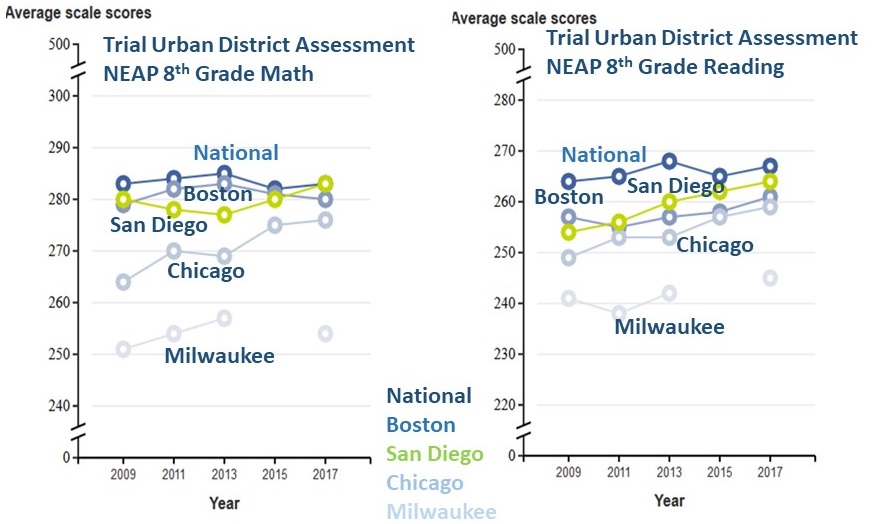
TUDA Graphs

Graphs Based on NEAP Trial Urban District Assessment Data for 8th Graders

The graphs above are a sample of the endless NEAP data sets illustrating Borsuk’s point.

The Wisconsin Education Association Council published a 2017 research brief that concluded:

“One of the most significant findings about the Milwaukee voucher program to date is that 41 percent of voucher schools failed since the program’s inception. Start-ups and unaffiliated voucher schools were the most likely to falter.”

“Research in Wisconsin and other states consistently shows little to no voucher school advantage, and in fact often documents significant ill-effects on students including: school closings, high rates of student attrition for lower-performing students, and decreased assessment scores in math and reading.”

In 2016, Mercedes Schneider book School Choice was published by Teachers College Press. In it she reported,

“In sum, what Wisconsin has is a 25-year-old urban school voucher program that has not produced student outcomes that surpass those of its public schools but that is not regulated. As a result, this system … allows for unchecked fraud and discrimination – even as it stands to expand.” (Choice Page 41)

Milwaukee’s Fox News channel six reported in 2016,

“More than 50 schools have shut down since the Milwaukee Parental Choice Program started, leaving students in chaos and taxpayer money unaccounted for.” 

‘”There’s government money available for people who want to open up a building and call it a school. All you have to do is get the children and [for that] all you have to do is come up with a catchy slogan,’ Rep. Mandela Barnes (D-Milwaukee) said.”

Governor Scott Walker’s 2015 budget effectively removed all caps on students from poor and middle-class families throughout the state of Wisconsin receiving private school vouchers. The pro-privatization publication EdChoice explains the 2018-2019 eligibility rules,

“Wisconsin families with income no more than 220 percent of the federal poverty level ($55,220 for a family of four in 2018–19) and reside outside of either the Milwaukee Public Schools or the Racine Unified School District are eligible. Moreover, a family’s income limit increases by $7,000 if the student’s parents or legal guardians are married. Each district will have an enrollment cap of 1 percent of its public school district enrollment. This cap will increase by one percentage point each year until the enrollment limit reaches 10 percent, then there will no longer be a cap.”
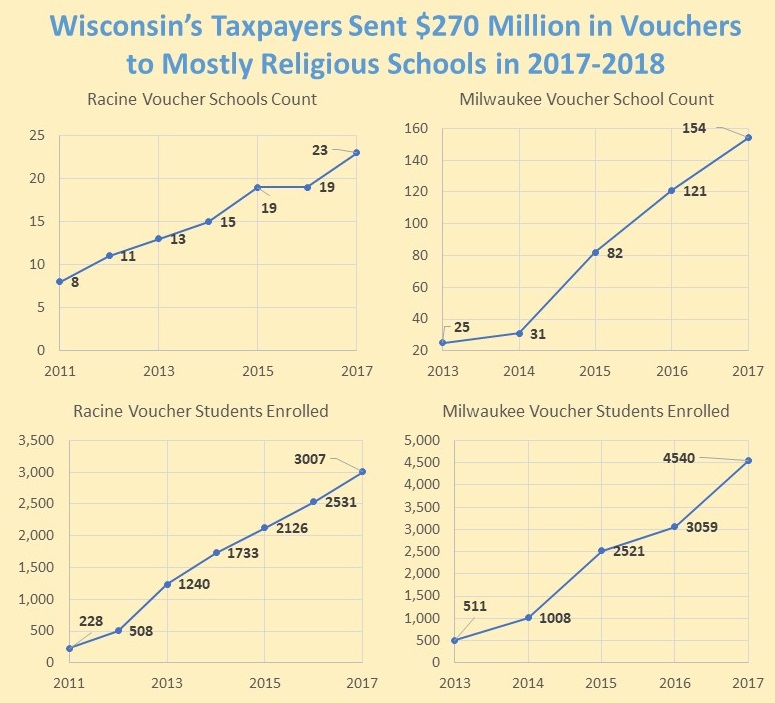
Voucher Growth

Wisconsin Department of Public Instruction Data Shows the Rapid Growth of Voucher Schools in Racine and Milwaukee

A Robust Charter School Industry Operates in Milwaukee

A 2014 report in the Milwaukee Journal Sentinel said,

“Nearly 11% of public schools in Wisconsin are charter schools, the fourth-highest rate in the nation and double the national average, according to a recently released report from the National Alliance for Public Charter Schools.”

“In Milwaukee, 32% of public schools are charters, according to Wisconsin Department of Public Instruction data.”

The Wisconsin Department of Public Instruction (DPI) defines two basic charter school structures. District charter schools which are authorized by public school districts and “independent charter schools” which are authorized by: The chancellor of any institution in the University of Wisconsin System; Each technical college district board; Waukesha County Executive; College of Menominee Nation; Lac Courte Orielles Ojibwa Community College; UW- System Office of Educational Opportunity. In either case DPI states, “The Wisconsin charter school law gives charter schools freedom from most state rules and regulations in exchange for greater accountability for results.”

The district authorized charter schools are a kind of hybrid charter school and innovation school. Innovation schools are promoted by David and Charles Koch through the American Legislative Exchange Council (ALEC). According to ALEC model legislation these schools “are provided a greater degree of autonomy and can waive some statutory requirements.” Neither charter schools nor innovation schools are operated by the elected school board. In other words, parents have no elected representative they can hold responsible for the operation of the school.

In October 2017, the United States Department of Education selected Wisconsin for a $95 million charter schools grant. The DPI notice of this grant said,

“Our federal grant will help us expand charter school access throughout Wisconsin, especially for our high school kids who are from low-income families,” said State Superintendent Tony Evers.”

“Over the five-year grant period, the Wisconsin Charter Schools Program will support the opening of 80 new or replicated quality charter schools and the expansion of 27 high-quality charter schools in the state.”

Sadly, Tony Evers is one of the Democrats who want to replace Scott Walker as governor.

On July 8, the Wisconsin State Journal ran a stridently incorrect editorial. They stated,

“Every charter school in Wisconsin is a public school.

“The many Democrats running for governor should memorize this fact, because some of them are getting it wrong.

“Charter schools should not be confused with voucher schools, which are mostly private religious schools that receive public money for lower-income students to attend.”

Charter schools are privately managed companies that sell education services to the state. They are not much different than a construction company contracting to do road work. Just because they receive tax dollars does not make them a public company. In the most recent Busted Pencils pod cast, Network for Public Education (NPE) Executive Director Carol Burris made the point that to be a public school requires two aspects. (1) The school must be publicly funded and (2) the school must be publicly governed. Parents have no vote on the governance of a charter school.

Burris also discussed the research paper jointly produced this June by NPE and The Schott Foundation, Grading the States: A Report Card on Our Nation’s Commitment to Public Schools. Not only did Wisconsin receive a failing grade, it was deemed to have the worst charter school laws in America. The reasons included: One of five states to allow for profit charter schools; if a school fails the property belongs to the charter owners not the taxpayers; nation’s longest renewal period of 5-years; and no conflict of interest requirements.

Destroy Public Education (DPE) Model Functioning in Milwaukee

The DPE model was first defined by researchers at the University of Indiana Purdue University Indianapolis (UIPUI). These scholars were Doctor Jim Scheurich coordinator of the Urban Education Studies doctoral program, Gail Cosby a doctoral candidate at UIPUI and Nate Williams who earned his doctorate there and now teaches at Knox College.

They concluded that a DPE model was being instituted throughout the nation. Three important points in the model are: (1) a funding conduit for national-local wealthy individuals and organizations to support local DPE initiatives; (2) the development of local organization networks that collaborate on the privatization agenda; and (3) a local-national collaboration between wealthy mostly conservative groups.

The national money flowing into Milwaukee to privatize public education comes from the usual sources including the Walton Family Foundation, the Bill and Melinda Gates Foundation, the Joyce Foundation and several others national non-profits.

The big local money is from the very conservative Lynde and Harry Bradley Foundation. In 2016, the Bradley Foundation gave generously to ALEC, Freedomworks Foundation, The Federalists Society and Betsy DeVos’s Mackinac Center. Locally they gave $375,000 to the Badger Institute, $500,000 to the Wisconsin Institute for Law and Liberty (WILL) and $100,000 each to Schools that Can Milwaukee and Partners Advancing Values in Education (PAVE). These appear to be yearly gifts.

Concerning school privatization in Milwaukee, the contributions to WILL and the Badger Institute are particularly noteworthy. The following statements on the WILL web site are from members of the Board of directors:

‘“WILL’s legal team was the missing link in education reform in Wisconsin and their research capabilities enhance our ability to develop effective policy.’  Jim Bender President, School Choice Wisconsin”

‘“WILL is at the forefront of the effort to expand parental choice in education. Whether publishing reports on how to craft high-quality choice policies or rigorous fiscal analyses that influence the debates in Madison, or even suing the state education bureaucracy for its failure to follow the law, WILL can be counted upon to fight for Wisconsin families.’ Jason Bedrick Director of Policy at EdChoice”

‘“After a lifetime of involvement in America’s conservative movement, I am proud to say that WILL is one of the most successful organizations I’ve been a part of and happy to see it grow and impact public policy.’ Mike Grebe Former Chairman, Bradley Foundation.”

The Badger Institute says of itself,

“The Badger Institute, formerly the Wisconsin Policy Research Institute, is a nonpartisan, not-for-profit institute established in 1987 working to engage and energize Wisconsinites …. The institute’s research and public education activities are directed to identify and promote public policies in Wisconsin that are fair, accountable and cost-effective.”

The Bradley foundation supplies the money, WILL provides the legal work and The Badger Institute lobbies the state. The school privatization ground game in Milwaukee is now run exclusively by PAVE. It has annexed Schools That Can Milwaukee. Borsuk writing in the Journal Sentinel observed,

I referred to Schools That Can Milwaukee in the past tense because it and another long-time Milwaukee education non-profit, known as PAVE, are merging. Plans for the merged organization are expected to be unveiled in coming months. There have been hints that some major players in town want a new approach to encouraging school improvement. Will the new organization be a vehicle for that? Keep an eye on this.”

Some Parting Thoughts

In the Zelman v. Simmons-Harris case, the Supreme Court ruled in a 5-4 decision that vouchers to religious school did not violate the Establishment Clause of the Constitution. This decision re-wrote more than a century worth of precedence and further eroded the separation of church and state. No matter how this case was decided, it is patently un-American to force citizens to send money to religious organizations that they do not support.

Privatizing public education is a horrible idea. Public-schools are the bedrock upon which America’s democracy is built. Now strange conservatives and their fellow traveler in the Democratic party, the neoliberals, are claiming that democratically elected school boards are an anachronism. Know this; if someone is opposing democratic governance, they are proposing totalitarian rule by the wealthy.