Tag Archives: education

FCMAT Attacks Weed Elementary

28 Jan

By Thomas Ultican 1/28/2025

In 1992, California inaugurated the Fiscal Crisis Management Assist Team (FCMAT) in the aftermath of the Richmond School District bankruptcy. It was set up as a quasi-autonomous non-governmental organization headquartered in Bakersfield. Unfortunately, from the beginning, FCMAT functioned as a tool of the politically connected and never provided actual assistance to districts dealing with financial matters. FCMAT, which is pronounced fick-mat, recently started attacking the Weed Union Elementary School District, a single-school district, based on little more than feelings and rumors.

Weed Elementary School is in Weed, California on the foothills of Mount Shasta, one of the twelve 14,000+ feet high mountains in California. Weed is 230 miles north of Sacramento along interstate-5 in Siskiyou County. Abner Weed came to the county in 1889 and became a business and political success. Weed founded the Weed lumber company and at one time his sawmills were the largest producers in the world. The town he built and its schools bear his name.

Weed California Entrance

Today, this small town of 2,900 people is not wealthy. The Weed Elementary school accountability report card shows 78% of its students are socioeconomically disadvantaged. This is the target of FCMAT’s warrantless attack.

Attack Background

Over the Thanksgiving break in 2019, there was some sort of flood at Weed Elementary School. The district took measures to clean up the district office, a conference room, two special day classrooms and the library. They believed that this was all that was required.

Soon after, the superintendent resigned and the district hired Jon Ray for the job in April, 2020. When Ray entered the school, he smelled an odder reminiscent of the mold infestation at a school where he previously worked. Ray hired a vendor to investigate and they found significant mold hidden in the walls.

Weed Elementary School

It seems that there was some bad blood between the Siskiyou County Office of Education and Jon Ray at Weed Union Elementary School District. In an interview, Ray voiced the opinion that most of those bad feelings were generated by his decision to open school for in person classes in August, 2020.

When the county superintendent received anonymous allegations of possible fraud, misappropriation of funds or other illegal fiscal practices at the Weed Union Elementary School District, he decided to call in FCMAT at a cost of $250,000. This is probably a decision he now regrets.

As Superintendent Ray was informed, FCMAT was not here to help. They were there to find issues and concluded in their report, “Based on the findings in this report, there is sufficient evidence to demonstrate that fraud, misappropriation of funds and/or assets, or other illegal fiscal practices may have occurred specific to bid splitting and other areas reviewed.”  (Report Page 28)

However, Mr. Ray’s response to FCMAT’s report is more convincing than the report. Most of the criticism of Weed Elementary was cited as feelings. For example, FCMAT stated:

“The district’s decision to use construction management multiprime (CMMP) as its construction method seemed questionable to both FCMAT and the county superintendent. … To the county superintendent and FCMAT, it seemed the district was reacting to issues as they arose rather than following a comprehensive plan”. (Report Page 6)

Superintendent Jon Ray responded:

“These comments are exemplary of the type of impressions and feelings that permeate the entire Report. Since FCMAT is claiming that its evidence supports grave accusations like fraud and misappropriation, it is shocking to find so many instances where the basis for these charges is solely the way it ‘seemed’ to FCMAT.” (Response Page 3)

Once you go thru the FCMAT report and all of its feelings you come to one substantive charge, bid splitting. The California Department of Education web site definition of bid splitting states:

“Bid splitting is intentionally dividing purchasing to avoid getting price quotes or going out to bid using a more formal procurement method. Per Public Contract Code 20116, It shall be unlawful to split or separate into smaller work orders or projects any work, project, service, or purchase for the purpose of evading the provisions of this article requiring contracting after competitive bidding.

Mr. Ray and the district responded, “FCMAT has not provided any evidence, fact, or document indicating that the District ever split any bid to avoid a bid limit; they did not because none exists.”

Several of the FCMAT report findings seem to undermine the fraud and bid splitting allegations. Starting on page 6 in the report they site (1) the District determined that managing smaller contracts without paying a general contractor’s mark-up provided a cost savings; and (2) the district determined that it could purchase equipment, materials and supplies for projects to both reduce a contractor’s mark-up and to ensure supplies would be available during a country-wide supply chain crisis.

In 2021 and 2022, due to COVID, prices for raw materials were exploding and contractors were reticent to make commitments. Jon Ray and the board at Weed Elementary saw no choice but to act as contractor and purchase the needed materials. This was not something they wanted to do but while operating their K-8 school, concluded it was something they had to do.

Michael Fine Behind the Scenes was the Problem

Michael Fine is the chief executive officer of FCMAT. He and his team have found a Bakersfield, California money tree. Transparent California reveals that in 2023, Fine was paid $383,879.87 and there were 11 other FCMAT employees who received more than $279,000 for the year and five more workers made more than $158,000. It is a lot cheaper to live in Bakersfield than Los Angeles, San Diego, San Francisco or Sacramento. To keep their money tree alive, they just need to keep the rich and powerful happy. That is not the people in Weed, California.

The Data Center Reported that in 1992 that FCMAT had a budget of $562,000 which ballooned to $35.6 million by 2002. They also criticized its use of no-bid contracts and lack of accountability. Los Angeles State Assembly Woman Jackie Goldberg called for an audit of FCMAT in 2003. The state auditor reported that FCMAT was providing value to districts but did criticize the over use of no-bid contracts. That appears to be the only audit ever done of FCMAT.

FCMAT actually does bad financial investigating. For example, in 2022, a FCMAT study claimed that Stockton Unified School District (SUSD) was headed for serious financial difficulties when the one time spending from the federal government is gone in fiscal year 2024-25. They said the district is spending one time funding on $26.3 million in salaries, benefits and services that appear essential.

It turned out that a FCMAT consultant who previously worked for the Stockton schools, Susan Montoya, apparently created phantom positions that were the source of the $30 million dollar shortage. It was SUSD that discovered that the $30 million budget deficit was a rouge not FCMAT.

Time to Audit and End FCMAT

There are terrible FCMAT experiences all over the Golden state. What is never found is a good experience or a story of how FCMAT helped a school district. School leaders just talk about how they survived FCMAT, how costly it was and in the happy cases how they finally got FCMAT off their back.

The money going thru FCMAT needs to be examined. The salaries are outrageous and the services worse than stink.

California schools could use some expert help not a police force making money from struggling schools by finding something on them so the state can takeover.

Time to end FCMAT and start over.

San Diego School Board Election Outcomes

17 Dec

By Thomas Ultican 12/17/2024

Before the recent election, I wrote recommendations for several school board seats in San Diego County. The San Diego County Registrar of Voters has posted the final official results which are transcribed here with a few comments.

San Diego County Board of Education

Gregg Robinson in district-1 and Guadalupe Gonzalez in district-2 ran unopposed and were easily reelected.

In district-4

ERIN EVANS174,25368.29%My Recommendation
SARAH SONG80,91631.71% 

NOTE: Song was an enthusiastic candidate with some support but Evans was clearly more qualified. The county board of education looks to be in good shape.

San Diego Unified School District (SDUSD)

Richard Barrera district-D and Sharon D. Whitehurst-Payne district-E, ran unopposed and were elected. 

SABRINA BAZZO40,28950.93%My Recommendation
CRYSTAL TRULL38,81849.07% 

NOTE: This result surprised me. Brazzo is a very qualified member of the board supporting public education. Trull has the academic qualifications to serve but she is also a Howard Jarvis anti-tax ideologue and seems to base her education evaluations exclusively on standardized testing. It appears SDUSD dodged a big problem by less that 1% of the vote.

Sweetwater Union High School District (SUHSD)

Trustee Area 2

ADRIAN E. ARANCIBIA21,22656.72%My Recommendation
ANGELICA S. MARTINEZ16,19543.28% 

Trustee Area 4

RODOLFO “RUDY” LOPEZ19,19262.68%My Recommendation
OLGA ESPINOZA11,42637.32% 

NOTE: Both outcomes seemed reasonable and SUHSD should be well served.

Poway Unified School District (PUSD)

Trustee Area A

TIM DOUGHERTY10,06355.09% 
DEVESH VASHISHTHA8,20544.91%My Recommendation

Trustee Area E

DAVID CHENG6,52838.34% 
CRAIG POND6,38637.51% 
CINDY SYTSMA4,11124.15%My Recommendation

NOTE: In Poway Area E, I recommended for Systema because of her strong background as an educator and former county sheriff however I think David Cheng is also an excellent choice. In Area A, I was bothered by two of Dougherty’s listed supporters, Carl DeMaio and Michael Allman. However, Dougherty looks like a normal civic minded guy and to be a supporter of public schools.

Chula Vista Elementary School District (CVESD)

Seat Number 2

LUCY UGARTE80,82469.85%My Recommendation
SHARMANE ESTOLANO34,88530.15% 

Seat Number 4

FRANCISCO TAMAYO34,22729.61% 
KATE BISHOP27,68123.94%My Recommendation
TANYA WILLIAM26,23222.69% 
JESUS F. PARTIDA15,97713.82% 
ZENITH KHAN11,4919.94% 

NOTE: Educator Lucy Ugarte was the logical choice for seat 2. I have always liked Francisco Tamayo but his odd decision to run for seat number 4 while holding seat 1 caused me to recommend against him. For outsiders, it is difficult to get a good feel for what is happening. It seems that incumbent, Kate Bishop, had alienated several people in the district including Tamayo. The new board should be fine but now has two seats to fill with Tamayo moving to seat 4 and seat 5 member, Caesar Fernandez, becoming a Chula Vista city council member.

Vista Unified School District (VUSD)

Trustee Area 1

MIKE MARKOV6,72851.91%My Recommendation
AMANDA “MANDY” REMMEN6,23448.09% 

Trustee Area 4

CIPRIANO VARGAS3,37139.06% 
FRANK NUNEZ3,07535.63% 
ZULEMA GOMEZ2,18425.31%My Recommendation

Trustee Area 5

SUE MARTIN9,54060.39%My Recommendation
ANTHONY “TJ” CROSSMAN6,25839.61%   

NOTE: The outcomes here seem fine for the school District. Incumbent, Cipriano Vargas, was the pick of the Democratic Party and many political heavy hitters but I was more moved by Gomez’s support from sitting school board members and fellow educators.

San Marco Unified School District (SMUSD)

Trustee Area A

HEIDI HERRICK7,04756.04% 
CARLOS ULLOA5,52743.96%My Recommendation

Trustee Area B

SARAH AHMAD7,09658.98%My Recommendation
BRITTANY BOWER4,93541.02% 

Trustee Area D

LENA LAUER MEUM5,94958.77% 
JAIME CHAMBERLIN4,17441.23%My Recommendation

NOTE: This new board could have problems.

Grossmont Union High School District (GUHSD)

Area 1

CHRIS FITE13,92343.30%My Recommendation
RANDALL DEAR10,48532.61% 
DEBRA HARRINGTON4,61414.35% 
AZURE CHRISAWN3,1329.74% 

Area 2

SCOTT ECKERT14,76836.64% 
JAY STEIGER13,64533.85%My Recommendation
JIM STIERINGER7,98019.80% 
MARSHA J. CHRISTMAN3,9149.71% 

NOTE: This looks like a decent outcome for GUHSD. Far right candidate, Randall Dear, was rejected even with his large cash advantage. Scott Eckert was not my first choice but he is a solid choice who cares about the district.

San Dieguito Union High School District (SDUHSD)

Trustee Area 2

JODIE WILLIAMS10,12651.22%My Recommendation
KELLY FRIIS9,64348.78% 

Trustee Area 4

MICHAEL ALLMAN8,99051.12% 
KEVIN SABELLICO8,59548.88%My Recommendation

NOTE: I was really sad to see MAGA man, Michael Allman, reelected. He has been a polarizing character since first being elected in 2020.

Escondido Union High School District (EUHSD)

Trustee Area 3

CHRISTI KNIGHT7,53865.36% 
CLAY BROWN3,99534.64%My Recommendation

Trustee Area 4

RYAN S. WILLIAMS7,84864.66% 
DARA CZERWONKA4,28935.34%My Recommendation

NOTE: In Area 3, Clay Brown dropped out of the race. Both incumbents, Christi Knight and Ryan S. Williams, were reelected. I felt there needed to be some people with education experience on the board.

Oceanside Unified School District (OUSD)

Trustee Area 2

ELEANOR EVANS6,17851.51%My Recommendation
EMILY ORTIZ WICHMANN5,81548.49% 

Trustee Area 5

MIKE BLESSING6,35453.44%My Recommendation
ROSIE HIGUERA5,53646.56% 

NOTE: The wins by incumbents, Eleanor Evans and Mike Blessing, were good news for Oceanside.

Twelve races were won by candidates I endorsed and ten went against my recommendations. Overall, there was only one of the ten districts I reviewed that I felt was hurt by this election. In San Marcos, they got rid of an incumbent with deep education experience, Carlos Ulloa, leaving SMUSD with little education knowledge. More troubling was they just elected a pro-school-choice trustee to its board.

Scam Education Study from Denver

16 Nov

By Thomas Ultican 11/16/2024

Another education study financed by Arnold Ventures and the Walton Family Foundation blurs education reality. Their 2022 model did not pass the laugh test so “researchers” from the University of Colorado Denver tried again. Unfortunately their claims still confuse correlation with causation. This error seems purposeful.

The study of school reform in Denver was conducted by the Center for Education Policy Analysis (CEPA). They state, “For the past three years CEPA has partnered with the Center on Reinventing Public Education to consider a paradigm-shifting approach to family and community engagement efforts in school districts.” It is a study apparently to justify and promote the portfolio model of school management, a system first proposed in 2009 by the founder of the Center for Reinventing Public Education (CRPE), Paul Hill.

In their 2022 study, this same team also used state testing data from years 2004/5 through 2018/19. They explained that the first 4-years of the research employed pre-reform data and the final 10-years were from the portfolio model reform period. The authors reported, “During the study period, the district opened 65 new schools, and closed, replaced, and restarted over 35 others.” (Page 7)

The National Education Policy Center contracted with Robert Shand to review the 2022 Denver study. Dr. Shand is Assistant Professor of Education Policy and Leadership at American University and an affiliated researcher with the Center for Benefit-Cost Studies of Education at Teachers College, Columbia University. Shand also did a review of the new 2024 study.

In his 2022 review, Shand agreed that the test scores for Denver Public Schools had gone up but he noted a few reasons why claiming these gains were because of the portfolio model was unreasonable:

  • Demographics shifting to a larger percentage of white students in Denver coincided with the reforms.
  • Per-student revenues increased in Denver by 22% but only 13% across Colorado.
  • Student-to-teacher ratio in Denver dropped from 17.9 to 14.9.
  • DPS was already showing academic improvement before implementation of the portfolio reforms.
  • Black and Hispanic/Latinx students were growing at approximately 0.06 standard deviations per year pre-reform and 0.03-0.04 standard deviations per year post-reform. (Page 7)

The 2024 Redo

Professor Shand’s summary response to the 2024 report states:

“While the new report does convincingly demonstrate that the gains are not significantly due to changing demographics, it fails to address other critiques of the prior study, including (1) that the portfolio model was undertheorized, with unclear mechanisms of action and insufficient attention to potential drawbacks; and (2) that circumstances, events, and resources besides the portfolio reform and student demographics were changing concurrently with the reform. Additionally, the report’s sweeping conclusion—that Denver’s reform is the most effective in U.S. history—is unsupported. The improved outcomes in Denver during this time period are impressive, but the authors seem overly determined to cite a package of favored reforms as the cause.” (Page 3)

While Shand agrees that demographic changes are not the whole reason for the improved test scores, they are a significant input. The chart above from USAFacts.org shows the typically higher scoring groups Asians and Whites going from 54.2% of the population to 58.9% in the 14 years from 2005 to 2019. During the same period, the Hispanic and Black population shrunk from 42.9% to 38.1% which resulted in a 9.5% shift in the population from a lower scoring to a higher scoring racial mix.

An even bigger impact on the scoring in Denver was the change in economic circumstances. Standardized testing is useless because the results are dependent on one variable, family wealth. Statisticians assign r values between -1 and +1 to results tested. Plus 1 signifies certainty, zero shows no influence and -1 indicates certainty in the opposite direction of expectations. The only input ever found with more than 0.3 r-value is family wealth at 0.9 r-value. The median family income in Denver is up significantly.

Two sources show how strongly Denver’s family income has grown. Neilsberg research shares that between 2010 and 2020 the median income grew from $61,394 to $82,335, a 25% growth. City-Data states:

“The median household income in Denver, CO in 2022 was $88,213, which was about the same as the median annual income of $89,302 across the entire state of Colorado. Compared to the median income of $39,500 in 2000 this represents an increase of 55.2%”

This kind of wealth growth over the 14 years the Denver researchers studied was bound to have a significant impact on testing results, but they ignored it. Add this to the 9% greater revenue for Denver schools and three less students per teacher compared to the rest of the state and of course Denver’s student made comparative testing gains.

Professor Shand mentions the damage caused by school turnaround efforts and closing schools noting the research indicates these are especially harmful events for students in low income or marginalized neighborhoods. (Page 6 and 7)  Shand concluded:

“In sum, this report provides some additional supporting evidence in favor of the tentative conclusion that Denver’s portfolio reform was positive. Importantly, the report also grossly exaggerates both the magnitude of the success and certainty behind the evidence for it. The findings should thus be interpreted with extreme caution. (Page 8)

He is being nice. He should have concluded that this report is school choice propaganda.

About the Report Authors

The lead author, Parker Baxter, is Director of the Center for Education Policy Analysis at the University Of Colorado Denver School Of Public Affairs. He previously was Director of Knowledge at the National Association of Charter School Authorizers. Parker is also a Senior Research Affiliate at the CRPE, where he worked on the District-Charter Collaboration Compact Project and the Portfolio School District Project. He is a former alumnus of Teach for America.

Anna Nicotera is a Senior Researcher at Basis Policy Research specializing in quantitative and qualitative applied research methods. She worked six years as Senior Director, Research and Evaluation for the National Alliance for Public Charter Schools. Nicotera was a Graduate Research Assistant at the National Center on School Choice, Vanderbilt University for four years.

David Stuit holds a Ph.D. in Leadership and Policy Studies from Vanderbilt University. He is a former Emerging Education Policy Scholar at the Thomas B. Fordham Institute, fellow at the Friedman Foundation for Educational Choice (Rebranded EdChoice), and member of the American Enterprise Institute’s K–12 working group. He began his career as a classroom teacher in Denver, Colorado.

Expecting an unbiased piece of research from this group is like learning about the dangers of smoking from Phillip-Morris.

Conclusion

The report by Baxter et al. was dutifully promoted by The 74. It is dangerous propaganda in favor of school choice. This report is another example of using arithmetic and titles to sell a farce.

Hyped AI New Personalized Learning

25 Apr

By Thomas Ultican 4/25/2024

In education today, Artificial Intelligence (AI) and personalized learning are the same thing. AI has been around for 70 years and is the technology that drove personalized learning. The release of ChatGPT in November 2022 caused buzz and may be responsible for Edtech sales-forces switching to AI from personalized learning. The personalized learning scam was exposed and AI became the shiny new object.

ChatGPT is a new language model developed by OpenAI. The basis is a giant data base to retrieve query answers and its breakthrough uses human style essays to deliver the responses. This makes cheating easier, giving teachers new issues to confront. To this point, blogger and educator Mercedes Schneider says “AI and I are not friends”, noting:

“As a teacher for many decades, I find increasingly more of my time consumed with devising means to ensure students complete my assignments without the easy-cheat, sustain-my-own-ignorance that AI enables in today’s students– and, it seems, an increasing number of (especially remote) professionals who may be using the corner-chopping ability AI offers to even hold multiple full-time positions.”

Schneider tested ChatGPT typing in “Could you provide some background info on Mercedes Schneider? She resides in Louisiana.” The answer revealed a weakness… much of the information was correct, some wrong, with other information, old and irrelevant. She did not attend University of Southern Louisiana nor received her PhD from LSU. Mercedes took her red pencil to this chatbot answer, “According to her website, she holds a Bachelor of Arts in secondary education ‘(TRUE)’, a Master of Education in gifted education ‘(FALSE)’, and a PhD in curriculum and instruction ‘(FALSE)’, all from the University of Southern Mississippi ‘(FALSE).’”

These errors may be unusual but the chatbot is unreliable.

What is AI?

“Artificial Intelligence” was first coined by Professor John McCarthy for a conference on the subject at Dartmouth College in 1956. It was also founded as an academic discipline in 1956.

Mathematician, computer scientist, and cryptanalyst, Alan Turing, described a test for verifying computer intelligence in a 1956 paper. He proposed a three-player game in which the human “interrogator” is asked to communicate via text with another human and a machine. If the interrogator cannot reliably identify the human, then the machine is judged “intelligent.”

Coursera states, “AI is an umbrella term that encompasses a wide variety of technologies, including machine learning, deep learning, and natural language processing (NLP).” However, none pass the Turing test for machines manifesting intelligence.

Machine-learning has been part of AI since its 1950s beginning. Algorithms are created to allow a machine to improve its performance on a given task automatically. Netflix uses it to create personalized recommendations, based on previous viewing history.

Deep-learning is advancement in machine-learning, layering algorithms into computer units referred to as neurons. Google Translate uses it for translation from one language to another.

Neural Network Cartoon

Natural language processing (NLP) is used in many products and services. Most commonly, NLP is used for voice-activated digital assistants on smartphones, email spam-scanning programs, and translation apps, deciphering foreign languages. ChatGPT uses large language models, an advancement to NLPs enabling a dialog format, to generate text in response to questions or comments posed.

Nick Bostrom, Director of the Future of Humanity Institute at the UK’s Oxford University, said, “A lot of cutting edge AI has filtered into general applications, often without being called AI because once something becomes useful enough and common enough it’s not labeled AI anymore.”

No machine has passed the Turing test. To this point there is no intelligence associated with AI, just algorithms. Another problem with powerful AI systems is they use a lot of electricity: by 2027, one researcher suggests that collectively, they could consume each year as much as a small country.

Should We Be Afraid?

In May 2023, Geoffrey Hinton, who won the Turing award in 2018 for “deep learning”, a foundation to much of AI in use today, spectacularly quit Google. He said companies, like Google, had stopped being proper stewards for AI in face of competition to advance the technology.

That same month a Scientific American article stated:

“A 2023 survey of AI experts found that 36 percent fear that AI development may result in a “nuclear-level catastrophe.” Almost 28,000 people have signed on to an open letter written by the Future of Life Institute, including Steve Wozniak, Elon Musk, the CEOs of several AI companies and many other prominent technologists, asking for a six-month pause or a moratorium on new advanced AI development.”

However other scientists in the field disagree.

The Guardian reported:

“Jürgen Schmidhuber, who has had a long-running dispute with Hinton and others in his industry over appropriate credit for AI research, says much of these fears are misplaced. He says the best counter to bad actors using AI will be developing good tools with AI.”

“And I would be much more worried about the old dangers of nuclear bombs than about the new little dangers of AI that we see now.”

Stanford professor, Andrew Ng, was a part of the Google brain project. He is not worried and in a recent interview stated:

“I can’t prove that AI won’t kill us all, which is akin to proving a negative, any more than I can prove that radio waves being emitted from Earth won’t allow aliens to find us and wipe us out. But I am not overly concerned about our radio waves leading to our extinction, and in a similar way I don’t see how AI could lead to human extinction.”

Meta’s chief AI scientist, Luan LeCun, scoffs at his peers dystopian attitudes, saying, “Some people are seeking attention, other people are naive about what’s really going on today.”

Hopefully dangers from AI are mitigated by the safety concerns addressed and development is not harmed by a flat-earth mentality.

Selling to Schools

Fast Company is a modern business news organization, tracking edtech sales and issues. Their April 16, 2024 article opened with,

“Between the pandemic and the rise of generative AI, the education sector has been in a permanent state of flux over the past few years. For a time, online learning platforms were ascendant, meeting the moment when workplaces and schools alike went remote (and later, hybrid). With the public debut of ChatGPT in 2022, edtech companies—such as edX, which was one of the first online learning giants to launch a ChatGPT plugin—jumped at the opportunity to integrate generative AI into their platforms, while teachers and administrators tried to understand what it could mean in the classroom.”

Generative AI is a tool that generates text, images, videos and other products.

I understand how K-12 students might want to become familiar with new AI tools but expecting them to be a boon to learning seems farfetched. Teachers need to find ways to stop students from misusing it. Clever as they are most students will not make good choices when realizing a chatbot can do homework.

Fast Company pointed out, schools are being inundated with new AI edtech products. George Veletsianos, Professor of learning technologies, University of Minnesota, recently gave purchasing guidance to school leaders in Conversation. Of his five points, point two seems especially relevant:

“Compelling evidence of the effect of GenAI products on educational outcomes does not yet exist. This leads some researchers to encourage education policymakers to put off buying products until such evidence arises. Others suggest relying on whether the product’s design is grounded in foundational research.”

“Unfortunately, a central source for product information and evaluation does not exist, which means that the onus of assessing products falls on the consumer. My recommendation is to consider a pre-GenAI recommendation: Ask vendors to provide independent and third-party studies of their products, but use multiple means for assessing the effectiveness of a product. This includes reports from peers and primary evidence.”

“Do not settle for reports that describe the potential benefits of GenAI – what you’re really after is what actually happens when the specific app or tool is used by teachers and students on the ground. Be on the lookout for unsubstantiated claims.”

Experience informs me that there will be many educational benefits from the overhyped AI but money hunger will be lurking. I am guessing AI currently will be of little use for teaching literature, mathematics or most sciences but will be a focus for computer science students.

Do not rush to implement AI tools in the K-12 environment.

Schools are more likely to be fleeced than left behind when the salesman calls. It may be the same person, who was selling “personalized learning” three or four years ago

…  but it is still BAD pedagogy.

Goodbye Doo Wop Don

27 Mar

By Thomas Ultican 3/27/2024

Don Shalvey, with his self-selected twitter handle @dooWopDon, passed away March 16th, succumbing to a lengthy battle with brain cancer. During his long education-centered career, he worked with billionaires including Reed Hastings, Bill Gates and Helen Schwab, to privatize public education. In 1993, Don’s San Carlos Learning Center became the first charter school in California and second in America.

Before he was a charter school founder and before he was a school teacher, he was a disc jockey. That is why his twitter was @dooWopDon.

When founding the charter in San Carlos, he was superintendent of a small K-8 district, a third of the way up the peninsula between San Jose and San Francisco. This event made an obscure education administrator into a rock star in the movement.

Don Shalvey September 14, 1944 – March 16, 2024

Lily Geismer writes about the Clinton administration and its embrace of education choice in her book Left Behind (page 244). In 1997, Bill and Hilary dropped off their daughter, Chelsea, for her freshman year at Stanford. The next morning they were in the gymnasium at Don’s San Carlos Learning Center for a roundtable discussion about charter schools (page 248). Geismer claimed, “The San Carlos event galvanized momentum for charter schools.”

At the time, there was a cap of 100 charter schools in California. Afterwards, “a thirty-something man with a goatee and Birkenstocks”, Reed Hastings, approached Shalvey, asking, “Do you ever think that there’ll be more than a hundred charter schools in California?” He talked Shalvey into helping to get rid of the charter school cap (page 249). “The combination of Don as Mr. Charming Establishment and me as a wealthy provocateur presented a unique challenge to the teachers union,” Hastings remembers in an interview.

Together, they successfully campaigned to end the charter school cap. At the same time, Hastings was starting his new company, Netflix. The two soon hooked up with John Doerr and NewSchools Venture Fund to invent the charter management organization (CMO). With $400,000 left from their campaign, they used it to create America’s first CMO, University Public Schools which later became Aspire.

Shalvey did most of the leg work.

The first Aspire charter school opened in 1999 in Stockton, California. During his career in education, Shalvey’s home was always a ranch in Linden, California about 10 miles from Stockton.

The Gates Foundation

From 2009 to 2020, Shalvey served as Deputy Director for K-12 Education at the Bill & Melinda Gates Foundation.

While he was at the Foundation, charter school enrollments grew by a half-million students, fueled in large part by the Charter School Growth Fund supported by Gates, the Walton family and other billionaires. The Fund was founded in 2004 by Buzz Woolley and Don Fisher (Tax ID 05-0620063). In 2005, John Walton replaced Buzz Woolley as president, indicating his privatization focus changed from vouchers to charter schools.

Gates gave Shalvey two big jobs. He was to implement Common Core standards and target teacher preparation. Unfortunately the standards were installed with no field testing. There were many good ideas within them but much of it was improperly aligned and had no buy-in from educators. There were also political issues. People saw this as Gates’ effort to take control of public education and create a centralized US education marketplace.

Focus on teacher preparation became another effort at privatizing every aspect of the education industry. Instead of working with established institutions like Columbia University or the University of California system, Shalvey and Gates looked toward private companies like the Teach for America (TFA) spinoff, TNTP.

Wendy Kopp founded TNTP (originally called The New Teachers Project) in 1997 and assigned Michelle Rhee, who had just finished a two-year TFA tour, to run it. Under Rhee’s leadership, TNTP became noted for teacher bashing.

Soon after Shalvey went to work for Gates in 2009, he became a member of the EdSource board. Gates was perhaps their largest funder and Don, his representative, remaining a board member until his passing.

Returns to Stockton

June 30 2020 was Shalvey’s last day at the Gates Foundation. For the entire time he worked for Gates, he commuted from the home he shared with wife, Sue, in Linden, California. He stated:

“For the past 50 years, the San Joaquin Valley has been my home. I’m thrilled to spend the final years of my career working to improve education for the young people in our wonderful Valley.”

The 75 year-old Shalvey was not ready to retire. He became CEO of a local non-profit called San Joaquin A+. There must have been secret negotiations before he left Gates because it is probably not a coincident that at the same time billionaire, Helen Schwab, made a $400,000 donation to the non-profit.

Shalvey’s new job was part-time, committing 20 hours a week to his CEO position. Tax records indicate San Joaquin A+ (Tax ID: 51-0536117) became tax-exempt in 2005. It was a relatively low key organization until his arrival. In 2019, they had net assets of $39,266. Shalvey was compensated $160,225 that first year and in 2021, $332,782. In the three years prior to his arrival, A+ had taken in $15,169. The haul in 2020 was $3,176,833 and in 2021, $3,942,790.

He was definitely a rainmaker and the question is what did his billionaire supporters expect back?

Don Shalvey was known to be a good guy with a big smile and able to work with people but some locals in Stockton disagree. Founder of Facebook news report 209 Times, Motecuzoma (Motec) Sanchez, wrote:

“Every time one of these devils dies, like with Alex Spanos, you see their legacy media puppets try to brainwash the public into believing what they did in their lifetime was admirable. Shalvey exploited poor Brown and Black kids in my hometown of Stockton, Modesto and beyond. And his creations, like a monster, continue to do so.”

The late Alex Spanos was a very successful real-estate developer from Stockton who purchased the San Diego Chargers in 1984. Motec felt Spanos was ruthless and that just the way his life story was glorified is how Don Shalvey’s life is being embellished today. From his ranch in Linden, Shalvey consistently ingratiated himself with billionaires, denigrated public schools and made profits. 

In 2022, two grand jury reports seemed out to demonize the local school districts board and leadership. A report in The 74 quoted Shalvey saying, “I think Stockton Unified might be the worst system in the country.” That was typical of the hyperbolic anti-public school statements he often made.

It is true that during John Deasy’s two years as Superintendent, the district had some financial issues which have been solved. With 82% of K-12 students coming from families of poverty, it is little wonder they did not test well but their graduation rates were reasonable and English language progress rates, among the best in the state. It is one more example of good schools in poor neighborhoods having test results used to unfairly undermine them.

Shalvey made a lot of money working to destroy public education but that money is not helping him now. He raised an admirable family and seemed to have many good traits. I feel bad about writing critically of the dead but he, unwittingly or not, made many bad choices, harming countless children.

I agree with Motec.

Don Shalvey should never be lionized.

New Orleans Education is Inefficient Expensive and Sad

2 Oct

By Thomas Ultican 10/2/2019

New Orleans’s public schools were targeted by the destroy-public-education (DPE) movement even before hurricane Katrina struck. Today, they are the national example of a privatized school system. DPE operatives like Neerav Kingsland, the former chief executive of New Schools for New Orleans and Managing Director of the secretive City Fund, use New Orleans to promote the portfolio management theory of school governance and to attract philanthropic dollars to their cause. However, the reality is that New Orleans’ schools are inefficient, undermine communities, have extremely high management and transportation costs, and still struggle academically. They are a sad but typical example of market-based education reform.

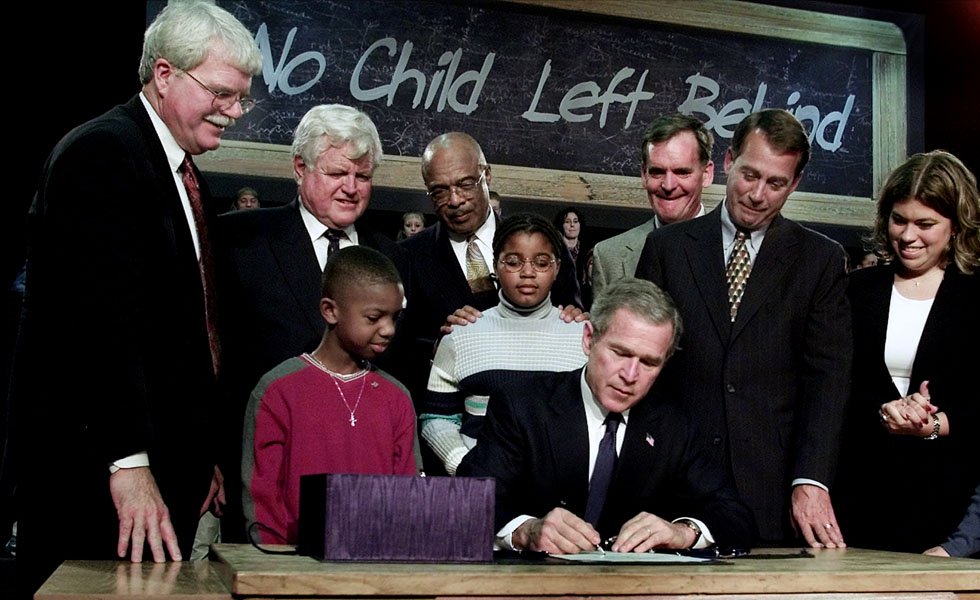
In 2002, George Bush signed into law the update of the Elementary and Secondary Education act known as “No Child Left Behind” (NCLB). Alfie Kohn published a 2004 article, “Test Today, Privatize Tomorrow; Using Accountability to ‘Reform’ Public Schools to Death.” In it, he discussed the idea that the NCLB accountability measures were purposely designed to open a path for privatizing schools. He wrote,

 “We now have corroboration that these fears were entirely justified. Susan Neuman, an assistant secretary of education during the roll-out of NCLB, admitted that others in Bush’s Department of Education ‘saw NCLB as a Trojan horse for the choice agenda – a way to expose the failure of public education and blow it up a bit’’’ (Claudia Wallis, ‘No Child Left Behind: Doomed to Fail?’, Time, June 8, 2008).”

26-george-bush-signs-nclb-act-2002

George Bush Signs NCLB Law January 8, 2002 – Ron Edmonds/AP-File

In 2003, Louisiana state government passed a school take-over law aimed at the low scoring schools in New Orleans. The law created the Recovery School District (RSD) which would manage the schools the state took. School performance scores (SPS) were given to schools based on testing data, attendance, dropout rates and graduation rates. Receiving an SPS rating of academically unacceptable four years in a row made a school vulnerable to takeover.

By the end of the 2004-2005 school year, the state had taken over five New Orleans schools. RSD turned all five into charter schools operated by four groups: University of New Orleans; Middle School Advocates, Inc.; Knowledge Is Power Program; and Institute for Academic Excellence. All set to begin in the 2005-06 school year.

However, privatizing five schools did little to solve the corruption problem endemic in the Orleans Parrish School Board. There were six interim superintendents between 1998 and 2005. With a lack of stable central leadership, corruption, graft, and incompetence persisted. An FBI investigation led to 11 indictments in 2004 and by end of the school year in May 2005 the district was effectively bankrupt.

In July, the Orleans Parish School Board (OPSB) contracted with Alvarez & Marsal, a financial turnaround firm from New York City with little experience in public schools. The first Alvarez & Marsal status report said,

“The conditions we have found are as bad as any we have ever encountered. The financial data that exists is (sic) unreliable, there has not been a clean audit since FY 2001-2002, there is no inventory of assets, the payroll system is in shambles, school buildings are in deplorable condition and, up to now, there has been little accountability.”

In late August 2005, Hurricane Katrina struck.

Aug 30 2015 Photo by David J. Phillip - AP

August 30, 2005 Photo by David J. Phillip/AP

Before Katrina, OPSB, which ran the public schools in New Orleans, operated 123 schools; in the spring following the storm, it was running just four.

With OPSB out of the road and RSD in charge, philanthropies like the Gates and Broad foundations were ready to help. According to Mayor Ray Nagin who is in prison,

“They said, ‘Look, you set up the right environment, we will fund, totally fund, brand-new schools for the city of New Orleans. But we don’t want to go through what you’ve been through. All that struggle you’ve been having with that school board. We don’t want to do that. We want to come in clean.’”

In her 2007 book The Shock Doctrine, Naomi Klien labeled the action of these school reform philanthropists a prime example of “disaster capitalism” which she described as “orchestrated raids on the public sphere in the wake of catastrophic events, combined with the treatment of disasters as exciting market opportunities.” She also observed, “In sharp contrast to the glacial pace with which the levees were repaired and the electricity grid brought back online, the auctioning-off of New Orleans’ school system took place with military speed and precision.”

In 2010, Obama’s Secretary of Education Arne Duncan infamously said, “I think the best thing that happened to the education system in New Orleans was Hurricane Katrina.”

In 2009, Louisiana’s Board of Elementary and Secondary Education (BESE) made it more difficult for schools to remain academically acceptable, effectively ending most of the remaining public schools in New Orleans. BESE raised the minimum SPS score for Academically Unacceptable status to 65 for the 2010-11 school year and 75 for the 2011-12 school year. In the coming school year 2019-2020, there will be no public schools in New Orleans. RSD has transferred management of charter schools to the Orleans Parish School Board which has renamed itself NOLA Public Schools.

NOLA Public Schools is Inefficient and Ineffective

At the 2016 Network for Public Education conference in Raleigh, North Carolina, the Bloomberg chair of business journalism at Baruch College of CUNY, Andrea Gabor, presented at a breakout session. She was working on a book subsequently published in 2018 with the title After the Education Wars. Andrea made it clear that she was not anti-charter school and in her book she presents the story of one particularly successful charter school, Morris Jeff, which exemplified the Deming approach to business management. She had just returned from New Orleans where she encountered many black families who were initially positive about the new charter schools after Katrina, but were now angry.

One New Orleans parent at the North Carolina session explained that during her eighth grade year she was in a class with 55-students. Their room was not air-conditioned and they were restricted to running the fan 10-minutes each hour to save on electrical costs. With the news of large scale spending on schools in black communities, residents did not care about the governance structure. It was the first significant spending on education in their neighborhoods in living memory.

OPSB was established in 1841 with a large assist from the champion of common schools, Horace Mann. However, Louisiana was a slave state and it was illegal to educate slaves. Gabor noted, “In 1867, Robert Mills Lusher, a new state superintendent of education and a ‘rabid Confederate and outspoken racist,’ argued that all-white schools should be ‘properly preserved as a bastion of white supremacy.”’ With the end of reconstruction in 1877, the schools in New Orleans were resegregated and remained that way until the 1960s.

Charter school advocates talk about the corruption and dysfunction in OPSB, however Gabor stated:

“But you don’t hear much talk these days about the legacy of white supremacy that disenfranchised the city’s majority-black residents and sought to keep them in ignorance. (As recently as the turn of the millennium, 50% of the city’s entire population was functionally illiterate.) Nor will you hear much about how the city’s white citizens fought hard against integration well into the 1960s and then, when the gig was up, fled the schools.” (Emphasis added)

Six percent of k-12 students in New Orleans are white, yet the academically top ranked and most sot after high schools are Lusher Charter School which is 53.2% white and Benjamin Franklin High School which is 40.2% white.

One more quotation from Andrea Gabor’s After the Education Wars:

“Since 2006, the average renewal rate of charter schools has been 64.8 percent. That means well over one-third of the charter schools launched since Hurricane Katrina have failed so badly that they have either been taken over or closed.”

Professor of Economics Doug Harris and his team at Tulane University are contracted to study school performance in New Orleans. It must be difficult to maintain neutrality when sharing office space on the seventh floor of 1555 Poydras Street with the pro-privatization group New Schools for New Orleans. Harris claims public schools improved considerably after Hurricane Katrina. In his new study, he attributes that success to performance-based closures and takeovers, as well as charter openings.

However, hurricane Katrina created major changes in New Orleans. The Enrollment was about 62,000 before the storm, and is 48,000 now. It is not only smaller, but less impoverished, with less concentrated poverty. Many of the poorest families left and never returned. Originally, per student spending was increased dramatically to get the schools back up and running. Now, the student spending is $1,400 per student more than before Katrina.

Professor Bruce Baker of Rutgers University reviewed Harris’s study and disagreed with his conclusion. He thinks the post Katrina changes were so ubiquitous that before and after comparison studies will never be dispositive. Baker says,

“I’m not convinced that the data available have sufficient additional precision to answer any more useful policy questions. Perhaps more importantly, the uniqueness of the policy context, conditions and changes induced by “the storm” will always severely limit any policy implications for other settings.”

Today in New Orleans, it is not uncommon for students living within view of a school, to get on a bus and travel five miles to their assigned schools. Writing in the Washington Post, Emma Brown explained, “Students were no longer assigned to schools via attendance boundaries; instead, they decided where they wanted to go and entered lotteries for a chance to enroll.” The concept of a community school that a student and all her neighborhood friends and family attended has been eliminated. Brown also shared:

“It was state officials, elected by the state’s white majority, who took over the schools from the local school board, elected by the city’s black majority. The teachers who were fired were mostly black; many of those teaching now are white, and they come from somewhere else.”

“Students traveled an average of 1.8 miles further to get to school in 2011-2012 than they did before Katrina, according to the Education Research Alliance of New Orleans.”

“One in four students attended a school more than five miles away from home.”

Transportation is not the only inefficiency in the privatized system. Since each of the charter school organizations are stand alone learning education agencies, they must have their own set of administrators. Administrative costs have dramatically risen for NOLA education. However, the cost for teachers has been reduced by replacing the formerly experienced black educators that constituted 73% of the teaching staff with mostly white Teach For America corps members who have no academic training or experience in teaching.

A huge problem with low attendance bedevils the privatized system and an extraordinary 30% of NOLA teachers resigned last year. The latest state test scores (LEAP) were released, and the scores in New Orleans stalled or dipped.

Former Assistant Secretary of Education Diane Ravitch sums up:

“So, here is the New Orleans model: Close almost all public schools. Replace them with private charters. Fire all the teachers. Replace most of the teachers with inexperienced, ill-trained TFA recruits. Close low-performing charters and replace them with other charters. Keep disrupting and churning. In the first two years, scores will go up, then stall. By year eight, “quality” will stagnate or decline. The schools will be highly stratified and racially segregated. The few high-performing schools will have selective admissions.”

Twitter: @tultican

“Let the Children Play” is Developmentally Appropriate Education

25 Sep

By T. Ultican 9/25/2019

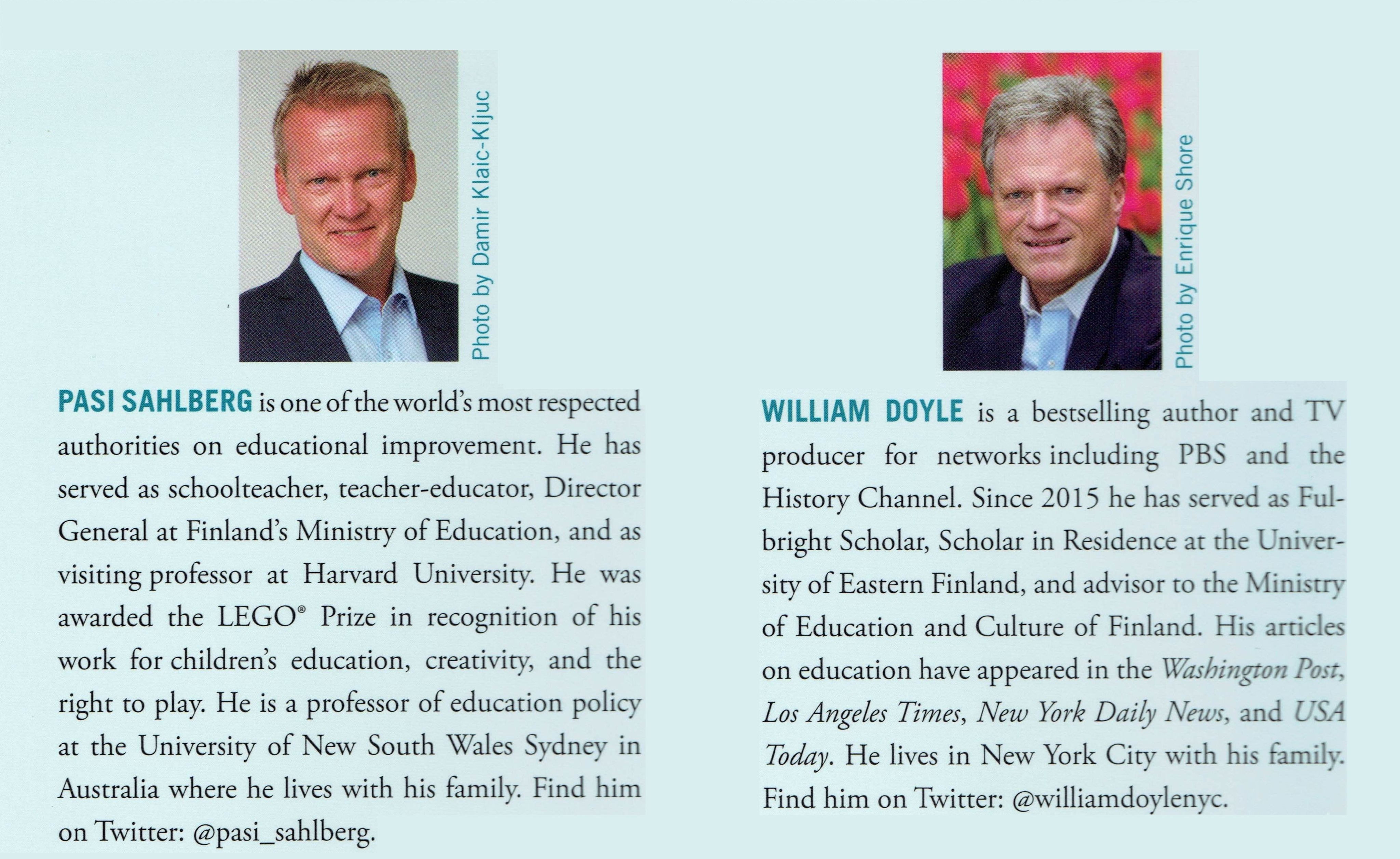
Two education experts and fathers have issued a clarion call to “Let the Children Play.” Pasi Sahlberg and William Doyle co-authored Let the Children Play: How More Play Will Save Our Schools and Help Children Thrive. These two fathers with young children were both shocked by the education system they found when the American scholar Doyle took his family to Finland and Finland’s Education Director General, Sahlberg, brought his family to the United States. Their book is a tour de force about play practices globally and the research supporting the developmental need for children to play.

The authors document the stunning reduction in authentic outdoor self-directed play children in the United States and around the world are experiencing. They share a large amount of scholarly data indicating what a big mistake it is to reduce recess and they identify the Global Education Reform Movement (GERM) as the cause for that policy error. Doyle and Sahlberg report on the amazing results both physically and academically being reported from diverse schools worldwide that have reintroduced significant authentic play. The book concludes with statements by 27 education scholars from Asia to Europe about the importance of high-quality play to human development.

Let The Children Play_0002

The Authors as Depicted on the Book Cover

In 2015 when William Doyle arrived in Finland as a visiting scholar with his wife and seven-year-old son, he found a school system that sent their children outside for 15-minutes every hour to participate in self-directed play. They sent children outside even when the temperature is as low as 5° Fahrenheit below which they stay inside to play. He shares that one day while watching children go to lunch one girl did a cartwheel in the hallway and noted “these children were expected to giggle, wiggle, and squirm from time to time, since that’s what children (especially boys) are biologically engineered to do …

That same year the former Director of Finland’s Ministry of Education, Pasi Sahlberg, came to Harvard as a visiting professor. He found a school system that was increasingly “based on stress, standardization, the de-professionalization of the teaching profession, and the systematic elimination of play in childhood education, even in kindergartens.” When he attempted to enroll his 3-year-old into a local preschool, he encountered “a stunning new concept in American education – ‘preschool readiness.’”  Sahlberg had heard that Harvard University which was in the neighborhood had developed the idea of “college-readiness” which had been pushed down as far as “kindergarten-readiness” for 5-year-olds. “But applying the idea to 3-year-olds seemed downright bizarre.

Yong Zhao is currently Foundation Distinguished Professor, School of Education, University of Kansas. He is quoted a few times in Let the Children Play. I heard this noted author and extremely amusing speaker address “college-readiness” and “kindergarten readiness” during his keynote speech at the Network for Public Education (NPE) conference in Chicago 2015. He said as a parent he was looking for “out-of-my-basement readiness.” Then he mentioned that he met Kim Kardashian in a Los Angeles elevator and observed, “Kim Kardashian has out-of-my-basement readiness.” He asserted that the only real “kindergarten-readiness” was if the school was ready for the five-year-old.

GERM is Eliminating Play

Pasi slide

Global Education Reform Slide by Sahlberg Presented at NPE 2018 in Indianapolis

Too often, curiosity and creativity are being sundered when children go to preschool, kindergarten or elementary school. “The global education race for ‘higher standards’ at lower financial costs have turned many schools to factories that try to produce standardized products efficiently on tight schedules.” Modern education reform is developmentally inappropriate. As Gloria Ladson-Billings, Distinguished Professor in Urban Education, University of Wisconsin-Madison states, “Anyone who fully understands child development knows that children’s ‘play’ is children’s ‘work.’”  

The Let the Children Play authors assert,

“The war against play is largely an unintended consequence of inept political attempts to ‘raise standards’ and ‘close the achievement gap’ by increasing ‘rigor’ and forcing academic demands on younger and younger children. It is a war being waged by an alliance of politicians, administrators, and ideologues, many of whom have one glaring weakness in common – they have little or no knowledge of how children actually learn. It is in effect, a conspiracy of ignorance, misguided policies, and misinformation.” (Emphasis added)

“This ‘GERM’ is … a virus spreading around the world, infecting school systems, and it is killing play in our schools.”

The book reports that according to data from the Torrance Tests of Creative Thinking (TTCT) “American children have suffered a startling drop of creativity” in the wake of recent decades of play deprivation. In 2011, Professor of Creativity and Innovation Kyung-Hee Kim of William and Mary reported on a review of 300,000 TTCT scores which had been constantly increasing until the 1980s and have been dropping steadily ever since. In the Creativity Research Journal, Kim reported “children have become less emotionally expressive, less energetic, less talkative and verbally expressive, less humorous, less imaginative, less unconventional, less lively and passionate, less perceptive, less apt to connect seemingly irrelevant things, less synthesizing, and less likely to see things from a different angle.”

There are many unsupported claims indicating that learning math and reading skills in preschool and kindergarten gives children an education advantage. Driven by people associated with GERM, these claims have led to an ever increasing academic focus for these children and a commensurate reduction in play. The advocacy group Defending the Early Years notes, “There is no research showing long-term advantages to reading at 5 compared to reading at 6 or 7.” Their founder Professor Nancy Carlsson-Paige, who happens to be Matt Damon’s mother, states,

“The research is clear. Faster is not better when it comes to early education; young children need play and hands-on interactions for genuine learning to occur.”

A 2015 study at Stanford University, “The Gift of Time? The school Starting Age and Mental Health”, found a strong mental health benefit to a later school starting age and there was also a likely academic payoff. A German study of 400,000 15-year-olds found no benefit to early entry into school. A Danish study found that by delaying kindergarten by one year, 11-year-olds saw a dramatic reduction in hyperactivity and attentions deficit. New York City University Professor Joshua Aronson shared, “I have learned that American kids don’t suffer from ‘Ritalin deficiency’; they suffer from a lack of nature, play, and freedom that their hunter-gather ancestors enjoyed. Play and exercise demonstrably boost academic achievement.”

Deeper Play is the Key

How Play Helps Children Learn and Grow

The authors warn that more play in not necessarily better. For play to provide the benefits described above it must be high-quality play. The authors call it “deeper play” and define it with five main ingredients:

  1. Self-direction: “Self-directed play means that we let children decide their own play in a safe and rich environment where they are comfortable to explore their own mind and potential.
  2. Intrinsically motivated: “In intrinsically motivated play, children behave or perform an action because they enjoy it and find inspiration in the action itself.”
  3. Use of imagination: “Sir Ken Robinson says that ‘imagination is the source of all human achievement,’ and it is therefore an essential condition for creativity and innovation.”
  4. A process orientation: “Process-oriented play is enjoyable for the sake of the activity itself, and is not concerned with an end result or product.”
  5. Positive emotions: “When children play, they should have a deep sense of enjoyment and fun, and may also feel joy, gratitude, inspiration, hope, love, and a sense of flow, or the full absorption in the process.”

In the book’s much more complete explanation of the use of imagination, the authors note how children’s habits of mind and imagination are being undermined by an overemphasis on standardization and testing which is narrowing curriculum. They claim, “Standardization has become the worst enemy of creativity and imagination in teaching and learning in school.”

An study by Professor Rebecca Marcon of the University of North Florida observed 343 preschool students at three different schools. One was academically oriented, one encouraged play-based learning and the third was a blend of the first two. In ongoing studies Marcon reported “children who were in a [play-based] preschool program showed stronger academic performance in all subject areas measured compared to children who had been in more academically focused or more middle-of-the-road programs.”

Let the Children Play discourages digital play. A clinical report from the American Academy of Pediatrics stated,

“Media (e.g., television, video games, and smart-phone and tablet applications) use often encourages passivity and the consumption of others’ creativity rather than active learning and socially interactive play. Most importantly, immersion in electronic media takes away time from real play, either outdoors or indoors.”

Reporting for the New York Times in October 2018, Nellie Bowles said that in Silicon Valley there is a “dark consensus about screens and kids”. She claimed, “Technologists know how phones really work, and many have decided they don’t want their own children anywhere near them.”

A 2015 report from the Organization of Economic Cooperation and Development (OECD) indicates that technology in classrooms has become a net negative. OECD’s Andreas Schleicher declared,

“In most countries, the current use of technology is already past the point of optimal use in schools. We’re at a point where computers are actually hurting learning.”

Play May Be Getting a Revival

There are several “play” pilot programs going on in the United States and throughout the world. In Fort Worth Texas, Professor Debbie Rhea of Texas Christian University created a program that tripled recess from 20-minutes a day to four separate 15-minute periods. In 2014, The Let’s Inspire Innovation in Kids (LiiNK) project started as a pilot in four schools; two using the program and two not using it to serve as a control group.  By fall of 2017 LiiNK had expanded to 20 schools serving 8,000 primary students. The authors report, “So far, the early results of Professor Rhea’s LiiNK experiment are so impressive, and so rapid, that the project may have the potential to trigger something close to a miracle in American education – more recess for children.”

China’s national Office of the Ministry of Education in 2017 announced a nationwide early education initiative with the theme “Play – Sparking the Joy of Childhood,” focusing on 3- to 6-year-olds. Academic subjects are banned.

There are play programs underway in Singapore, Tokyo, Seoul, Taipei, Shanghai and Hong Kong. New Zealand and Scotland have also started large play focused programs. A small school district on Long Island is reporting amazing results from their new play-focused program.

I encourage people who care about education to read this well documented and thorough report on the crisis of play in school.

TFA is Bad for America

18 Aug

By T. Ultican 8/19/2019

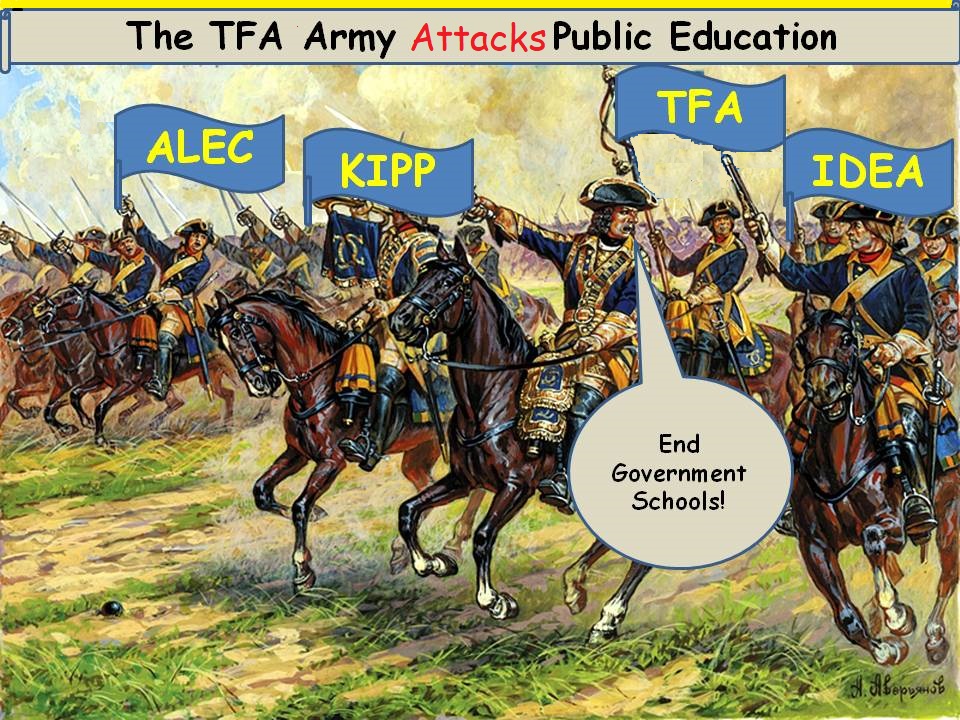
Teach For America (TFA) has become the billionaire financed army for privatizing public education. It is the number one source of charter school teachers and its alumni are carrying a neoliberal ideology into education leadership at all levels.

TFA undermines education professionalism and exacerbates teacher turnover. Its teachers are totally unqualified to run a classroom yet their political support caused the US Congress to label them as highly qualified teachers.

Big money and its political power have elevated TFA to being the nation’s most effective force driving the privatization of public education.

Defining  TFA Neoliberalism

This April, Angela M. Kraemer-Holland of DePaul University submitted her doctoral thesis in which she observed:

“TFA’s primary conception of itself is not as a teacher training organization, nor a non-university-based early entry recruitment program, but rather as a “movement” against a pressing and untenable social problem. Conclusions illuminate TFA’s efforts to shape participants’ understanding of teaching and learning—framing teaching as a temporary career—in order to create and sustain a broader movement in education and beyond that is reflective of neoliberal ideas.”

Kraemer-Holland’s conclusions echoes those of two TFA alumni working on their doctorates at Boston College, Randall Lahann and Emilie Mitescu Reagan. They co-wrote “Teach for America and the Politics of Progressive Neoliberalism” published by the Teacher Education Quarterly winter 2011. The classification of TFA as a progressive neoliberal organization is based on their definitions of these combined terms:

“Neoliberalism: Political ideology which calls for state policies that better enable entrepreneurs to compete in the free market. Policies which promote privatization, deregulation, individual choice, and the reduction of government expenditures are valued over those which increase, or promote the welfare state and government control of social and economic activity.”

“Progressivism: The idea that schooling and teacher education are crucial elements in the making of a more just society.”

Although neoliberalism is known to be a conservative ideology, within TFA there is the idea that the outcomes in education are more than just test scores and knowledge, but equity and justice as well. Lahann and Reagan write, “This space can be thought of as progressive neoliberalism.”

Whatever it is called, the faith is in the superiority of the market fundamentalism which Ruth Rosen defined as “the irrational belief that markets solve all problems.”

In the book Democracy in Chains, Nancy MacLean quoted former congressman and leader of the “Contract for America” Dick Armey. He summed up the neoliberal view succinctly, “The markets are rational, the government is dumb.

Neoliberal ideology has been on the ascendancy since the 1970’s coinciding with the founding of the libertarian think tanks Heritage Foundation and Cato Institute. There is an inherent anti-democratic sentiment attached to the theory.

In Democracy, Maclean provides a detailed description of the lavish spending since the 1950s by the billionaire brothers David and Charles Koch promoting their neoliberal based libertarian ideology. Charles Koch founded the Cato Institute. Their stands include an ultra-conservative property rights view and an anti-public education agenda.

Undermining Professionalism in Education

In the paper “Teach For America’s Preferential Treatment: School District Contracts, Hiring Decisions, and Employment Practices”, authors T. Jameson Brewer et al address why school districts want to hire TFA teachers. Their research led to these four points:

“(1) Districts realize the long-term savings potential that comes from converting open teaching positions to positions held exclusively for TFA (or otherwise short-term, not fully credentialed teachers).”

“(2) Districts are willing to pay additional up-front costs not only for the long-term savings but in the quest for increased test scores that can result from pedagogical practices of teaching-to-the-test that characterize TFA pedagogy.”

“(3) School board leaders have bought into the rhetoric of the ‘bad’ teacher and TFA represents a political opportunity to address that perception.”

“(4) In the case of a genuine teacher shortage, cost impacts become less important than filling positions.”

“While each rationale – or a combination of them – may explain why districts continue to honor and expand MOUs[memorandums of understanding] with TFA, we suggest that it is the long-term savings potential that is the most plausible.”

In the same paper it was mentioned that TFA alumni “tend to understand educational change through managerial terms; believing that inequity is a result of resource mismanagement and a lack of accountability and that solutions lay in merit pay for teachers, increased autonomy for leadership, standardization of curriculum, and an end to collective bargaining.

An article in Phi Delta Kappan had similar observations. In Rethinking Teach For America’s leadership models researchers, Tina Trujillo and Janelle Scott, noted that TFA alumni emphasized managerial goals. From their research they reported, “Over 80% of our participants depicted the causes of inequality in technical or managerial terms.”  The education reforms posited by the TFA alumni interviewed were:

  • “Scale back unions’ collective bargaining agreements in order to increase principals’ flexibility in personnel matters.”
  • “Increase teacher and principal effectiveness through tighter accountability.”
  • “Increase principal and teacher expectations.”
  • “Tie teacher compensation to student performance.”
  • “Hire better “talent.”’
  • “Standardize curricula and assessments.”
  • “Expand technology and data use.”

Clearly these former TFA corps members had completely assimilated the destroy public education message of failing schools, inept principals and bad teachers.

Prior to taking over a classroom, TFA teachers receive just five weeks of training. Their training is test centric and employs behaviorist principles. TFA corps members study Doug Lemov’s Teach Like a Champion.

Lemov never studied education nor taught. He became involved with the no-excuses charter movement in mid-1990s. As glowingly depicted by Elizabeth Green in Building A+ Better Teacher, Lemov observed classrooms to develop his teaching ideas.

Most trained professional educators find Lemov’s teaching theory regressive. Jennifer Berkshire published a post by Layla Treuhaft-Ali on her popular blog and podcast “Have You Heard.” Under the title “Teach Like its 1885” Layla wrote,

“As I was reading Teach Like A Champion, I observed something that shocked me. The pedagogical model espoused by Lemov is disturbingly similar to one that was established almost a century ago for the express purpose of maintaining racial hierarchy.”

Treuhaft-Ali added, “Placed in their proper racial context, the Teach Like A Champion techniques can read like a modern-day version of the *Hampton Idea,* where children of color are taught not to challenge authority under the supervision of a wealthy, white elite.”

Amber K. Kim, Ph.D. made the following observations about Teach Like A Champion:

“ TLAC strategies are not proven using empirical methodology and published in peer reviewed journals. If there are studies, what are the variables? n? p value?”

“ TLAC is for “Other people’s children” (L. Delpit). Of course some TLAC strategies are effective and even fun, but the strict adherence to TLAC as a bible for teaching is reserved for students of color and low SES [Social Economic Status].”

This year California Assemblywomen Cristina Garcia introduced a bill to end TFA hiring in the state. Garcia is a former classroom teacher and understands the importance of teaching staff stability. In an op-ed for the San Diego Union, She noted that 80% of TFA teachers are gone within three years. Coincidentally, that is the amount of classroom time researchers believe it takes for teachers to become proficient. Garcia stated,

“Third-party trainees lack crucial experience before entering a classroom, receiving only a few weeks of training and do not need to have a degree in education. For teacher-credentialing programs, hopeful educators take two years to complete their educational training and serve as a student teacher for another year before entering the classroom as its sole credentialed instructor.”

“Yes, California has struggled with a teacher shortage for decades. The answer to that shortage is not placing untrained educators in schools who leave after a two-year stint. When teachers leave after only a few years, it just exacerbates the issue. It’s a Band-Aid fix on a bullet-hole problem.”

Garcia ordered her bill to the inactive file in May.

TFA is the Billionaire Army

TFA Army

It seems like every major foundation gives to TFA. Besides Gates, Walton, Broad, Dell, Hastings, and Arnold, there is Bradley, Hall, Kaufman, DeVos, Skillman, Sackler and the list goes on. According to TFA’s 2016 tax form, the grants TFA received that year totaled more than $245 million. US taxpayer give TFA $40 million a year via the US Department of Education.

The Walton (Walmart) family has provided TFA more than $100,000,000. In 2013, their $20,000,000 grant gave $2,000 more per TFA teacher going to charter schools than for public school teachers. Annie Waldmen reporting for ProPublica observed,

“The incentives corresponded to a shift in Teach For America’s direction. Although only 7% of students go to charter schools, Teach For America sent almost 40% of its 6,736 teachers to them in 2018 — up from 34% in 2015 and 13% in 2008. In some large cities, charter schools employ the majority of TFA teachers: 54% in Houston, 58% in San Antonio and at least 70% in Los Angeles.”

To enhance the opportunities in leadership for TFA teachers, TFA created the non-profit Leadership for Education Equity (LEE). The LEE board includes Emma Bloomberg (Michael Bloomberg’s daughter); Steuart Walton (billionaire); Arthur Rock (billionaire) and Elisa Villanueva Beard (TFA-CEO).

LEE finances TFA members and alumni who run for political office and provides campaign training. All LEE members get at least $2,000 but members with the right attitude will also get individual donations from board members.

LEE, which received $29 million in contributions and grants in 2017, helped more than 150 alumni run in local and state races in 2018, according to an internal presentation obtained by ProPublica.

A LEE example: This May when Houston ISD voted to end their contract with TFA, board member Holly Vilaseca voted to renew it. Previously, Vilaseca had been a founding TFA teacher at a KIPP charter school. Walton family members and Arthur Rock gave a total of $20,000 to her 2017 school board campaign, in addition to $6,000 from LEE.

The history of the World is replete with examples of Youth movements being used by ruthless individuals for their own purposes. Four years ago, I wrote “Is TFA a Cult.” At the time, I thought that was somewhat farcical.

Today, I believe it is true. Idealistic youths are recruited, taught a neoliberal view of good governance and those that take the bait are shaped for leadership and lucrative careers.

TFA corps members and alumni are the ground forces for privatizing public education the pillar of American Democracy. TFA is bad for America.

Twitter: @tultican

Five Decades of ‘MarketWorld’ Education Reform

27 Jul

By T. Ultican 7/27/2019

There has been a fifty-year push to reform education using business management principles. In the period, Harvard Business School has trumped Columbia Teacher College concerning pedagogy. Unfortunately, the results are an unmitigated disaster for most communities and students. This market based endeavor – financed by billionaires – has transformed public schools into non-democratic profit centers. It is the precursor to the ultimate goal of dismantling universal free public education.

The radical right is pushing to privatize everything from policing; to prisons; to schools. They have spread the gospel that governments are incapable of solving problems but businessmen can. In his first inaugural address, Ronald Reagan declared “…, government is not the solution to our problem; government is the problem.” Viewing society as consisting of “makers” and “takers,” these apostles of privatization fear the tyranny of democratic majorities. They strive to make property rights the paramount civil right.

When it came to privatizing school, the right originally tried to use vouchers, but that was a tough sell. Jeffry Henig an Education Professor at Teachers College, “The Walton foundation itself was one of the early organizations to transition from vouchers to charters.” In his AlterNet article Bryant explained,

“Henig believes many conservatives view charter schools as a way to “soften the ground” for potentially more private options, though he isn’t entirely sure “the Waltons view charters as a Trojan Horse for eventually providing vouchers universally.’”

When putative progressive organizations like the Center for American Progress or Democrats for Education Reform promote charter schools they are promoting an anti-democratic and anti-union position. When politicians like Corey Booker and Joe Biden say they support public charter schools, they are in fact supporting the radical right’s privatization agenda. When Bill Clinton eliminated depression era banking rules and “welfare as you know it” plus campaigned for school choice; he was advancing Charles Koch’s ideology.

Two recent books have brought the privatization agenda into sharp relief.

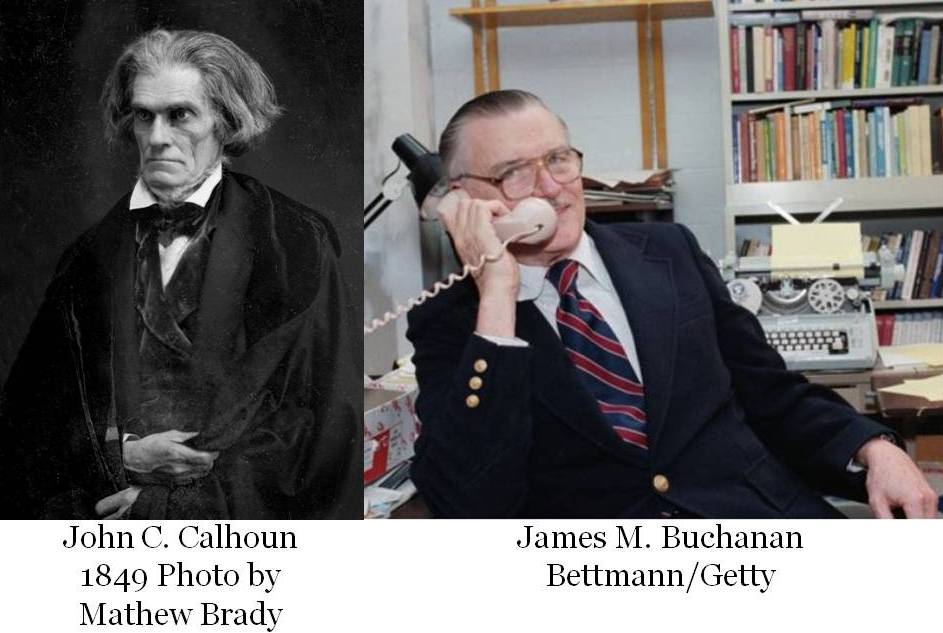
The first book is Democracy in Chains: The Deep History of the Radical Right’s Stealth plan for America by Nancy MacLean. Through serendipitous good fortune, MacLean stumbled onto Nobel Prize laureate James M. Buchanan’s unorganized papers shortly after his 2013 passing. They were in boxes and stacked on tables in his George Mason University cabin. The other more well known American Nobel Prize winning economist from the right is the Milton Friedman. However, MacLean discovered that Charles Koch, the financier of the radical right “bypassed Friedman for Buchanan.

The other book is Winners Take All: The Elite Charade of Changing the World by Anand Giridharadas. He takes the reader inside the worlds of elite philanthropy in New York City and of thought leaders in Aspen, Colorado. He writes,

And what these winners wanted was for the world to be changed in ways that had their buy-in – think charter schools over more equal public school funding, or poverty-reducing tech companies over antitrust regulation of tech companies. The entrepreneurs were willing to participate in making the world better if you pursued that goal in a way that exonerated and celebrated and depended on them.

James M. Buchanan, John C. Calhoun and Segregation

James M. Buchanan grew up in Tennessee. His grandfather had been an unpopular governor of the state; however Buchanan was raised in near poverty. It was his academic abilities that took him from the obscurity of Middle Tennessee State Teachers College to a doctorate in economics from the University of Chicago in 1948. The youthful socialist became a “zealous advocate of market order.” It was at the University of Chicago where Buchanan met Friedrich August Hayek and the Austrian School of Economics.

Writing in Atlantic Magazine Sam Tanenhaus disclosed, “Hayek initiated Buchanan into the Mont Pelerin Society, the select group of intellectuals who convened periodically to talk and plot libertarian doctrine.” After World War II ended, The Mont Pelerin Society was a relatively small group of economists mostly from Europe and the United States who were widely viewed as a fringe group. They were against initiatives such as social security, universal health care and public education. The title of Hayek’s 1944 book The Road to Serfdom encapsulates their antipathy to any government social endeavors.

Professor MacLean, who is a historian from Duke University, compared Buchanan’s economic ideology with John C. Calhoun. Calhoun was a son of the antebellum south, a senator from South Carolina and a Vice President of the United States. MacLean quotes him stating, “A ‘government based in the naked principle that the majority ought to govern,’ was sure to filch other men’s property and violate their ‘liberty.’” Calhoun was also a leading defender of slavery. In his most famous speech he said slavery is “instead of an evil, a good–a positive good.

Buchanan and Calhoun

Buchanan’s first plumb teaching assignment came at the University of Virginia in 1956. This was also when the “massive resistance movement” to Brown versus the Board of education and desegregation of public schools in Virginia was heating up.

In 1959, Buchanan joined with another new hire at the university, G. Warren Nutter (who later became a key Goldwater advisor) to write “The Economics of Universal Education.” They argued that the root of the desegregation problem was that “state run” schools had become a “monopoly” that should be broken by privatization. They said if the state sold off their school buildings and equipment, they could limit their involvement in education to setting minimum standards. Then all kinds of schools might blossom.

Since MacLean’s book was published there has been some push back against her tying Buchanan and his paper to the “massive resistance movement” saying he did not involve himself in desegregation politics only in the economic issues of education. However, Buchanan and Nutter did state in their paper, “Every individual should be free to associate with persons of his own choosing.” In any case, schools in Virginia were closed. Black children stayed home while white children attended tax-subsidized private schools. In Prince Edward County, schools were locked closed from 1959-1964. MacLean says that for Buchanan segregation was just a side issue in his life-long libertarian pursuit.

Murray Newton Rothbard was an American economist of the Austrian School and a political theorist whose writings and personal influence played a seminal role in the development of modern right-libertarianism. MacLean discovered “Murray Rothbard encouraged Koch to study Lennin.” Not Lenin’s economics but his methods for advancing an unpopular ideology. On this point MacLean noted, “At a 1973 March log cabin meeting Buchanan stressed the key thing moving forward was that ‘conspiratorial secrecy is at all times essential.’”

In 1978, I saw the Communist Workers Party takeover the Iron Workers Union at National Steel and Ship Building Company (NASSCO) in San Diego. When watching the development of the radical right for the past few decades, similarities with the tactics of communist movement were unmistakable. Both movements are secretive, anti-democratic and motivated by extreme economic theory.

MacLean states, “The Mont Pelerin Society cause since the 1950’s is the end of public education.

Killing Public Education

In 1978, Congressman Ronald Mottl D-Ohio 23 introduced a bill promoting education standards. It was the first time a bill was proposed that amended the 1965 education law to promote a particular theory of education. Mottl’s bill went nowhere like another similar bill (H.R.371) introduced the next year by his colleague Tennyson Guyer R-Ohio 4. However, these were the first harbingers of education standards that emulated business practices.

In 1983, the Reagan administration produced the infamous “A Nation at Risk: The Imperative for Educational Reform.” This polemic was neither factually nor pedagogically well founded. Serious academic research has subsequently shown this non-peer reviewed writing to be the misguided work of amateurs. Its glorification of business practices opened the door for federal control of education and fostered standards based accountability. It made legislation like the proposals introduced by Mottl and Guyer viable.

In Winners, Giridharadas labels – modern social reform based on the belief that business leaders and market forces are the sure way to a better society – “MarketWorld.” He explains,

In an age defined by a chasm between those who have power and those who don’t, elites have spread the idea that people must be helped, but only in market-friendly ways that do not upset fundamental power equations.

Giridharadas shares three criteria for being a “MarketWorld” thought leader speaking at the Aspen Institute or the Clinton Global Initiative or the main TED talk stage. Thought leaders should:

  • Focus on the victim, not the perpetrator.” Condemning a perpetrator is a “win-losey” solution not a win-win.
  • Personalize the political.” If you want to be a thought leader and not be dismissed as a critic, your job is to help the public see problems as personal and individual dramas rather than collective and systemic ones.
  • Be constructively actionable.” … “People, especially the winners who shape tastes and patronize thought leaders, want things to be constructive, uplifting, and given to hope.

He gives examples including this one:

“What the thought leaders offer MarketWorld’s winners, wittingly or unwittingly, is the semblance of being on the right side of change. … Take, for example, the question of educating poor children in a time of declining social mobility. A true critic might call for an end to funding schools by local property taxes and the creation, as in many advanced countries, of a common national pool that funds schools more or less equally. What a thought leader might offer MarketWorld and its winners is a kind of intellectual counteroffer – the idea, say, of using Big Data to better compensate star teachers and weed out bad ones.”

Data shows that “MarketWorld” and libertarian philosophy has damaged public education and harmed all but the top 10% of wage earners in America. Giriharadas shares the following data table information and notes, “One hundred and seventeen million people had been completely shut off from economic growth since the 1970s.

Earning Level 1980 2014
Top 0.001 % $17,000,000 $122,000,000
Top 1% $428,000 $1,300,000
Top 10% $58,000 $116,000
Bottom 50% $16,000 $16,200

It is possible that Charles Koch and “MarketWorld” think this is a feature. To me, it looks like a powerful data set that says we need an empowered Government to protect Americans from ravenous billionaires and their self-serving anti-public education and anti-democratic views.

Twitter: @tultican

The Billionaire Financed Racist Attack on Camden’s Schools

26 Jun

By T. Ultican 6/25/2019

The rape of public education in Camden, New Jersey is a classic example of “segrenomics.” In 1997, one of the only functioning organizations in the city of Camden was the public school system. This city often labeled “the most dangerous city in America” had 19,303 students registered into Camden City School District (CCSD). Ninety-five percent of those students were either Black (56.5%) or Hispanic (38.9%). In 2018, CCSD had 6800 students registered into its public schools.

In her masterpiece Cutting School, Noliwe Rooks defined “segrenomics.” She noted that to lift all children up requires racial and economic integration and she encourages us to educate poor students with wealthy students; not falling for the separate but equal fallacy. Unfortunately, today, poor children experience a recurrent push towards vocational education. Their schools often employ “cost effective” forms of funding and delivery such as cyber schools, students at screens and blended learning.  Rooks observes,

“While not ensuring educational equality, such separate, segregated, and unequal forms of education have provided the opportunity for businesses to make a profit selling schooling. I am calling this specific form of economic profit segrenomics. Segrenomics, or the business of profiting specifically from high levels of racial and economic segregation, is on the rise.”

Camden

Camden Images

Camden, New Jersey Images

When crossing the Delaware River from Philadelphia on the Ben Franklin Bridge, you arrive in Camden, New Jersey. The small city of 77,000 was incorporated in 1828. It was a prosperous manufacturing center up until the 1950’s when its population peaked at 125,000 and manufacturing jobs started leaving.

By the 1990’s corruption and violence were wracking the city. In December of 2000, Mayor Milton Milan was convicted of taking bribes. Ralph Natale the former boss of the Philadelphia-South Jersey mob turned state’s evidence against Milan. The Mayor’s predecessor, Arnold Webster pleaded guilty to illegally paying himself $20,000 in school district funds after he became mayor. A former CCSD board president pled guilty to embezzling $24,000. Worst of all, homicides were becoming common.

In 2012, the Daily Mail, a publication from the United Kingdom, ran an article about Camden, “The most dangerous town in America: Inside Camden, New Jersey where 39 people have been murdered this year.” It gave these bullet points:

  • 13 homicides in July – the most deadly month since a shooting spree in 1949
  • Murder rate was ten times New York City in 2011 — and on pace to be even higher this year
  • More than half of children live below the poverty line as city is ravaged by drugs
  • Police department forced to cut one third of officers in 2011 and arrests dropped to less than half of what they were in 2009

The web site Neighborhood Scout tracks violent crime in America. They state, “Our research reveals the 100 most dangerous cities in America with 25,000 or more people, based on the number of violent crimes per 1,000 residents.” From 2012 until today, Camden has been in the top 10 most dangerous American cities.

  • 2012 – 5th place
  • 2013 – 2nd place
  • 2014 – 3rd place
  • 2015 – 1st place
  • 2016 – 2nd place
  • 2017 – 4th place
  • 2018 – 4th place
  • 2019 – 8th place

To go along with political corruption and out of control violent crime, Camden is poverty racked. New Jersey TV 13 reported,

“Camden, N.J., is the poorest city in the nation. According to figures from the U.S. Census Bureau, nearly 32,000 Camden residents live below the poverty line. For a family of four, the poverty line is an annual household income of about $22,000.”

The Public Schools Are Failing – Really?

Alfie Kohn published a 2004 article, “Test Today, Privatize Tomorrow; Using Accountability to ‘Reform’ Public Schools to Death.” In it, he discussed the idea that the No Child Left Behind (NCLB) accountability measures were purposely designed to open a path for privatizing schools. He wrote,

“As Lily Tomlin once remarked, “No matter how cynical you become, it’s never enough to keep up.’”

“We now have corroboration that these fears were entirely justified. Susan Neuman, an assistant secretary of education during the roll-out of NCLB, admitted that others in Bush’s Department of Education ‘saw NCLB as a Trojan horse for the choice agenda – a way to expose the failure of public education and ‘“blow it up a bit’’’ (Claudia Wallis, ‘No Child Left Behind: Doomed to Fail?’, Time, June 8, 2008).”

In 2006, the state of New Jersey appointed a fiscal monitor to oversee all actions taken by the CCSD board. This was motivated in part by a cheating scandal and corruption concerns. As Mark Weber who blogs as the Jersey Jazz Man wrote, “The state appoints a fiscal monitor for the Camden district after members of the Legislature are shocked — shocked, I tell you! — that a city that has been under the thumb of a political machine for years might have some corruption.”

There appears to have been two types of cheating at CCSD. In type one, certain administrators were getting bonus for improved graduation rates and in the other type teachers were being pressured to cheat on the NCLB related testing.

The big downfall of high stakes testing and merit pay is they both drive unethical behavior. It is now clear that standardized testing only measures economic status. That explains why exclusively schools in high poverty areas have been closed for poor testing results. The tests of course do not measure the quality of the closed schools; they reflected average family income.

In 2011, Camden’s testing results and graduation rates were miserable. Only 45% of the student body graduated in four years and just 60% had graduated after five years. Graduation rates of less than 50% had persisted since the 1990’s. However, there have been success stories matriculating from Camden’s schools like Tevin Wooten of the Weather Channel.

It is disingenuous to blame Camden public schools, teachers and students for these poor outcomes.

Doctor Kerry Ressler is the lead investigator of the Grady Trauma Project. He has been interviewing inner-city residents and found that about two-thirds said they had been violently attacked and that half knew someone who had been murdered. At least 1 in 3 of those interviewed experienced symptoms consistent with PTSD at some point in their lives — and that’s a “conservative estimate” said Dr. Ressler. He stated,

“The rates of PTSD we see are as high or higher than Iraq, Afghanistan or Vietnam veterans. We have a whole population who is traumatized.

Marie Corfield who is “that teacher in that Chris Christie You Tube video” interviewed Doctor Keith Benson for her blog. Benson wears many hats. He is an Adjunct Professor at Rutgers Graduate School of Education, President of the Camden Education Association, Education Program Specialist for CCSD, Education Chair Camden NAACP and has a decade of classroom teaching experience. In the interview, he responded to a question about teaching traumatized children,

“When you’re dealing with children who live in concentrated poverty and a lot of violence, there are a lot of residual effects. … And that’s something that’s given very little regard by ‘reformers’ but it’s a very big hurdle in the educative process between teacher and student. So a lot of what we’re doing is building up students as individuals; showing love and care. And until we do those things, teaching content is a waste of time.”

“Some of these violent occurrences are in students’ families or their social network, so they bring those stories, that pain, that hurt into the classroom. What does that do to a child’s perspective on the future when people they care about have been seriously hurt or killed or incarcerated?”

In 2011, even while the Camden police and fire departments were imploding due to Governor Chris Christie’s budget cuts, the CCSD continued to take care of and educate the children. However, the schools had no control over the violence and poverty that their students were facing. Far from being failures, they were making heroic efforts to save as many children as possible. Those are the children and communities of color that politicians in New Jersey had turned their back on.

The Billionaire Attack

In January 2010, a big fan of privatizing public education, Chris Christy, assumed the the office of New Jersey Governor. In 1999, Christy had been a lobbyist for Chris Whittle and his Edison Schools. That is when Edison Schools had their Initial Public Offering. Their claim that Christy was touting said that they could educate America’s children at a profit and do it both cheaper and better than public schools.

The Jersey Jazz Man, Mark Webber, says the takeover of Camden schools was not inevitable. He claims, “The dismantling of Camden’s public school system was planned years ago, and that plan was funded by a California billionaire with an ideological agenda.

The California billionaire is Eli Broad. To advance the cause of public school privatization, Broad founded The Broad Academy, an unaccredited administration training program.

Broad’s theory is that public school administrators and elected school boards lack the financial background to run large organizations. Motoko Rich’s Times article explained, ‘“The new academy,’ he said, would ‘dramatically change this equation’ by seeking candidates in educational circles as well as recruiting from corporate backgrounds and the military, introducing management concepts borrowed from business.” He believes school leaders do not need expertise in education; consultants can be hired for that.

Broad was able to place several of his trainees into New Jersey including Bing Howell and Rochelle Sinclair. Howell served as a liaison to Camden for the creation of four Urban Hope Act charter schools. He reported directly to the deputy commissioner of education, Andy Smerick. Howell’s proposal for Camden suggests that he oversee the intervention through portfolio management — providing a range of school options with the state, not the district, overseeing the options.

The Urban Hope Act is a 2012 law that created a new class of charter schools called renaissance schools. It also has a teacher professional development component. Of all the excellent graduate schools of education in the state, the Act hands over professional development to Relay Graduate School, the fake graduate school started by the charter school industry.

The portfolio model posits treating schools like stock holdings and trimming the failures by privatizing them or closing them. The instrument for measuring failure is the wholly inappropriate standardized test. This model inevitably leads to an ever more privatized system that strips parents and taxpayers of their democratic rights. It was created through billionaire funding as a systematic way to remove democratic control of schools from local communities.

Governor Christie took control of Camden’s schools in March 2013. CBS News stated, “Christie says he’ll appoint a new superintendent and the state will ensure every student has books and technology.”  The state took control in June and in August, True Jersey reported,

“The city of Camden could soon be getting a new superintendent. Gov. Chris Christie announced his selection of Paymon Rouhanifard as the first State Superintendent of the Camden School District.”

At the time Rouhanifard was 32-years old. He had 2-years teaching experience as a TFA corps member and no experience leading schools. From 2009-2012, he worked for the NYC Department of Education. Mark Weber described his job,

“Rouhanifard’s job at the NYCDOE was to go around New York and close neighborhood schools so they could be replaced with charters. Obviously, this is why then-Education Commissioner Chris Cerf and Christie picked him for the job: he knows how to dismantle a public school system and turn it over to privatizers.”

Rouhanifard left his superintendent’s job in 2018 to become an Entrepreneur in Residence at the Walton Family Foundation. He also completed the Broad academy administration program in 2016.

Gates, Sackler, Arnold and the Walton Family have all joined Eli Broad in financing the privatization of Camden’s schools. Gates sent $2,700,000 to 50Can and $27,000,000 to the Charter Fund which are both organizations supplying money to privatize Camden’s schools. Jonathan Sackler sent $1,050,000 to 50Can. John Arnold sent $6,189,000 to the Charter Fund, $100,000 for common enrollment in Camden and $290,000 to Teach for America in Camden. The Walton family is the Charter Funds major donor and gives direct support to the charter school management companies in Camden.

Schools Disappearing

Privatization Chart Compares 2003 Enrollment Data with 2018

What chance does a small city that is poverty stricken and dominated by minority populations have against Billionaires who are out to end their right to vote on the control of their schools? This is what segrenomics looks like.