Tag Archives: Bill Gates

The EdReports Scam

19 Dec

By Thomas Ultican 12/19/2025

In order to monetize public education, billionaires started creating both for-profit and non-profit businesses to advance their agenda. ‘The 74’ recently wrote about changes at one of these organizations. EdReports was established in 2014 by Bill Gates associate, Eric Hirsch, and was fully funded in 2018. It masquerades as an independent non-profit that evaluates curriculum materials. It rates these materials based on their fidelity with the common core state standards and the science of reading.

During the Obama administration, billionaires became frustrated because teachers and friends of public education were destroying their messaging on social media. To counteract the success teachers were having, the super wealthy started creating new on-line media and liberally funding them. Their biggest success has been ‘The 74’ established by former CNN news anchor, Campbell Brown, and Michael Bloomberg’s education advisor, Romy Drucker. Its original funding came from, the Dick and Betsy DeVos Family Foundation, theWalton Family Foundation, the Doris and Donald Fisher Fund and Bloomberg Philanthropies, all of which are owned by multi-billionaires.

Education focused organizations are given legitimacy when ‘The 74’ writes puff pieces about them. A recent example is the October 2nd article, Eric Hirsch, EdReports’ Founding CEO, to Step Down – The next decade, one expert said, should consider the role of AI in curriculum and making materials more useful.It is a glowing account of how Eric Hirsch was able to “change the way school districts and parents think about curriculum.” The mention of AI in the sub-title is a timely promotion of the technology industries latest harmful edtech offering.

Eric Hirsch and EdReports

Hirsch earned a bachelor’s degree (1992) in political science and government from Tufts University, a medium sized liberal arts and research school in the greater Boston area. He went onto the University of Colorado in Boulder where he obtained a master’s in political science and government (1997). His first job out of college was in Denver working for the National Conference of State Legislators from 1997-2002.

After 4 years there, he went to work at the Alliance for Quality Teaching in Denver as executive director for a year and a half. He then spent four years in North Carolina as executive director of the Center for Teaching Quality. From there, he went to Santa Cruz, California for seven years working as chief officer, external affairs at the Bill Gates established New Teachers Center (NTC). His total earnings during his last year in Santa Cruz (2013) was reported to be $175,000 (TIN 26-2427526).

In 2014, Hirsch left NTC and traveled to Durham, North Carolina to found EdReports. It is unknown how or if he was paid. During the first four years from 2014-2017 EdReports (TIN 47-1171149) filed non-profit tax form 990N which indicates they had less than $50,000 in revenue which only required a post card tax filing. In 2018, EdReports took in over $15 million in contributions. They had to file an IRS form 990 and Hirsch’s declared income and benefits were reported exceeding $300,000.

EdReports claims it is:

“funded by the Carnegie Corporation of New York, Charles and Lynn Schusterman Family Philanthropies, Gates Foundation, Heising-Simons Foundation, Overdeck Family Foundation, W.K. Kellogg Foundation, Walton Family Foundation, and the William and Flora Hewlett Foundation.” The 2018 donation of $15 million included giving by Carnegie (TIN 13-1628151) $200,000, Overdeck (TIN 26-4377643) $390,000, Gates (TIN 56-2618866) $1,500,000 and Schusterman (TIN 73-1312965) $5,689,700.

It is very clear that EdReports, starting with its founding, is a billionaire sponsored organization.

EdReports rates curricula for their alignment to Common Core and the science of reading (SoR). In 2021, they gave both Lucy Calkins’s Units of Study and Fountas and Pinnell’s reading curricula, which were the most widely used reading curricula in America, its lowest ratings.

The National Council on Teacher Quality (NCTQ) is another billionaire funded organization selling SoR. Among their 5 action plans they highlight EdRepors in plan four. NCTQ claims it addresses “the use of high-quality curricula aligned to the science of reading.” They advise schools to sign on with EdReports which reviews reading materials and lets client schools know about their alignment with SoR.

The NCTQ report declares that “only nine states require districts to select high-quality reading curriculum materials” (HCTQ) and noted that forward-looking states, like Arkansas, partner with EdReports. This is a really strange claim. Arkansas students were 42nd of 52 states in fourth grade reading on the 2024 NAEP testing and their 8th graders were 37th of 52. Nothing wrong with these scores but they do not scream “forward-looking.”

For the billionaires this is all about monetizing education and controlling the source of curriculum. A key driver for this corporate takeover is so called High Quality Instructional Materials (HQIM) and being certified as such by EdReports. Whenever the words “high quality” are used to promote something in education, it is a good bet that swamp land is being sold.

Amplify is an edtech company controlled by billionaire Laurene Powell Jobs. On the Amplify website the HQIM rating is described:

“States and districts across the country are focusing on materials that have been rigorously reviewed and deemed high-quality by EdReports.org, the leading third-party curriculum reviewer (or, in Louisiana, by a Tier 1 designation). EdReports defines high-quality instructional materials as materials that are closely aligned to rigorous standards and easy to use.”

A strange attribute of the EdReports saga is they are good at making pretty reports but do not have nearly the expertise many districts have for evaluating curriculum. Besides districts, many university education departments are much more qualified to evaluate curriculum. Here in my hometown, San Diego, we have at least three universities whose education departments fit the bill, but when there is enough money behind a company, reality becomes less significant.

One big problem facing public schools is people like David Steiner of John Hopkins University. He knows better but purposefully misleads people to sell HQIM. For example, in his recent article in ‘The 74’, he wrote:

“In 2022, 26% of eighth-graders performed at or above proficient on the NAEP in math, and 31% in ELA. While NAEP standards are more demanding than those in most states, what this means (conservatively) is that more than half of the students in an average American public-school classroom lack grade-level skills and content knowledge.”

By implying that a proficient score which generally is seen as equivalent to B+ or A- is grade level instead basic which is about the same as a C, he claims “that more than half of the students in an average American public-school classroom lack grade-level skills and content knowledge.” In addition, he says that is a conservative estimate. The NAEP tests actually show more than 70% of America’s students are at or above basic which is grade level.

Some Final Words

David Steiner was supported into a leadership position in New York by billionaire Merryl Tisch. While at Hunter College, he was instrumental in establishing Relay Graduate School and served on its board of directors.

All of these billionaire lapdogs, support SoR. The reality is the there is no science involved with science of reading. It is based on a 1997 document search that did not include any original research and did not include all of the known reading domains.

SoR is mostly about privatizing and controlling curriculum.

Eric Hirsch in addition to leading EdReports (he plans to leave in July 2026) sits on the board of TPI-US. It is a private company selling teacher preparation as well as SoR. Their web site links to Emily Hanford’s 2022 “Sold a Story” here.

This is only a small slice of the billionaire spending to undermine and monetize public education.

We have a big problem in America. Billionaires have shown themselves unable to rationally, democratically and wisely administer these extraordinary assets. We need some form of tax driven redistribution of wealth if America is going to remain a democracy and save its treasured institutions like free universal public education. I suggest the top tax rate be raised to at least 65% and a wealth tax be applied; 5% (over $500 million in assets), 10% (over $1 billion in assets), 15% (over $50 billion in assets) and 20% (over $100 billion in assets). 

California Charter Schools Heading for 2026

11 Nov

By Thomas Ultican 11/11/2025

There was another major effort in Sacramento to reform charter school laws in order to head off a repeat of the A3 disaster. In May 2019, the San Diego District Attorney charged 11-people with scheming to use non-classroom based charter schools to steal more than $400 million from the state education budget. Eventually the A3 grifters all plead guilty, but shockingly no-one spent a day in jail. This year, state legislators failed again to reform purposefully weak charter school laws meanwhile the privatization movement is still infested with graft.

Billionaires have been the wind beneath the charter school movement’s wings.

The first California charter school was authorized in 1994. The original charter school law capped the number of schools at 100; however Netflix CEO, Reed Hastings, successfully campaigned to end that limitation.

The California Charter Schools Association (CCSA) was founded in 2003. John Walton, a billionaire member of America’s richest family, was on the first CCSA board. He died in a plane crash in 2005 and his billionaire niece, Carrie Walton Penner, assumed his seat on the board. She served on the CCSA board from 2005-2015. (TIN: 51-0465703)

Billionaire Reed Hastings was a CCSA board member from 2007 until 2015.

In Executive Director of the Network for Public Education (NPE) Carol Burris’s yearlong study of charter schools, she admits not knowing how much billionaire money goes to the CCSA but noted:

“The 2017 Board of Directors include New York’s DFER founder, Joe Williams, a director of the Walton Education Coalition; Gregory McGinty, the Executive Director of Policy for the Broad Foundation; Neerav Kingsland, the CEO of the Hastings Fund; and Christopher Nelson, the Managing Director of the Doris & Donald Fisher Fund. Prior Board members include Reed Hastings of Netflix and Carrie Walton Penner, heir to the Walmart fortune.

Other billionaires were also busy supporting the charter school movement. The history tab at the NewSchools Venture Fund (NSVF) website states:

“NewSchools Venture Fund was created in 1998 by social entrepreneur Kim Smith and venture capitalists John Doerr and Brook Byers.” (Byers and Doerr are colleagues from the Kleiner Perkins venture fund.)

“We were among the first and largest investors in public charter schools and the first to identify and support multisite charter management organizations, which launch and operate integrated networks of public charter schools.”

At the time, “entrepreneur Kim Smith” was a graduate student at Stanford. She was co-chair of the Stanford business school’s entrepreneur club and wanted to get Amazon founder Jeff Bezos as a speaker for the club. She asked an acquaintance, John Doerr, to help and he agreed on one condition. In an education session at Al Gore’s house, the name NewSchools had been created. Doerr wanted her to come up with a use for the name.

Bezos spoke at her club and she wrote a two page paper outlining NSVF.

The push by billionaires to privatize public education using charter schools has become clear. It makes little sense for the future of education in America but billionaires don’t care. Bill Gates and the Walton Family Foundation are the largest individual donors to NSVF totaling $226,881,394 in grants as documented in the 2020 article Organized to Disrupt. However, this is only a fraction of the total billionaire largess. Over the last 20 years, billionaires John Doerr, Laurene Powell Jobs and John Sackler have served on the NSVF board.

The billions of dollars invested in growing the charter school movement has lead to steady growth.

However, the rate of growth is decreasing. From 2014 to 2020 the California charter school growth averaged 5% a year. From 2021 to 2025 the growth has fallen to 1% a year.

Research by NPE revealed the Achilles heel plaguing charter schools; they are not stable. In the first three years of operation, more than 15% of charter schools close their doors and eventually half of all charter schools go out of business. Charter promoting organizations like CCSA and NSVF counter that charter schools get better test results, but testing by California’s Department of Education shows the opposite.

Results Posted by California Department of Education

Reforming the Charter School Law

More charter schools appear to be following the A3 path. Highlands Community Charter and Technical schools received the results of a scathing audit on June 24 this year. Auditors found that the school improperly received over $180 million in state funds. The entire 7-person board has resigned or been forced out.

The audit identified millions of dollars in over-payments stemming from inflated attendance figures. Investigators noted conflicts of interest, questionable expenditures, gifts and the hiring of unqualified individuals. A high-ranking employee earned $145,860 annually but lacked an expected bachelor’s degree. She is alleged to have secured the position through her mother, who served on the board at the time.

Inspire, another non-classroom based charter school system using a similar model to A3, was the subject of a state audit in 2019. The founder and CEO, Nick Nichols, had to resign and pay back $1,055,834 for advances he took. The 12 charter schools, which made up the system, all remained in business independently after the demise of Inspire.

Required 2022 tax forms show that at three former Inspire schools, 15 people are averaging $157,000 in salaries to supervise 7806 students. When I asked what has changed, a teacher at one of the schools responded, “Now we have multiple Inspires with each school being a location where families and friends are being hired into high paying jobs that they are not qualified to hold.”

Chair of the California Assembly Education Committee, Al Muratsuchi, introduced Assembly Bill 84 in response to the reports about charter school fraud. The Torrance Democrat, who intends to run for superintendent of public instruction in 2026, declared he has no intention of “going after the charter schools that are acting responsibly and providing good educational services for their kids.” He added, “AB 84 is about going after the bad actors that are committing fraud and engaging in corruption through the current lack of transparency and accountability that we have with our statewide charter oversight system.”

CCSA CEO Myrna Castrejón came out swinging. She claimed the anti-charter school forces have brought a “bare-knuckle” fight. The highly paid Castrejón asserted, “Make no mistake, we still have opponents who are not going to stop until they strip out our autonomy entirely and/or cripple us.”

I noticed when looking through CCSA tax documents that Castrejón received $199,128 in total salary and benefits in 2009. Since then she has continued to make huge money fighting to advance charter schools and keep them as unregulated as possible. She set out to destroy AB 84.

Muratsuchi introduced AB 84 on December 20th, 2024. In February 2025, Castrejón’s launched her counter attack. She got Sacramento Democratic Senator Angelique Ashby to introduce Senate Bill 414, which claimed, “This bill makes a broad set of changes to charter school law related to audit procedures, financial oversight, governance, and funding determinations.” The political fight became about which reform bill is better, with the charter school industry supporting SB 414 and public school educators supporting AB 84.

Interestingly, a perusal of Ashby’s campaign contributions listed Reed Hastings and his wife, Pat Quillin as big donors. It also shows a large contribution from a charter school PAC belonging to the California Charter Schools Association Advocates, the political arm of CCSA.  

After a protracted fight, Muratsuchi withdrew AB 84 with the expectation that Ashby would withdraw SB 414. However, there was a feeling among legislators that they needed to deliver something for the governor to sign. On 9/13/2025, SB 414 achieve final passage with 22 Democratic senators not voting.

In an email to EdSource, California Teachers Association President David Goldberg declared:

“SB 414 not only fails to address the issues that have led to massive cases of fraud in some charter schools, but it also significantly weakens existing requirements for non-classroom-based charter schools to prioritize spending on student learning. We urge the governor to veto this legislation and are dedicated to our fight for meaningful reform next year.”

Governor Newsom concurred. In his veto message, the governor wrote:

“I deeply appreciate the efforts of the author and the negotiating parties to develop legislation that builds on these recommendations and the findings from the State Controller. However, this bill falls short. While the oversight and auditing provisions are meaningful, other sections are unworkable, would face legal challenges, and require hundreds of millions of dollars to implement. Additionally, provisions added late in the legislative process undermine important agreements my Administration made during my first term.”

Myrna Castrejón and her billionaire supporters won this round and California’s charter school laws remain extremely vulnerable to the scofflaws that she represents.

Education Policy Harmed Sacramento

11 Jul

By Thomas Ultican 7/11/2025

California’s most venerable high school was destroyed by No Child Left Behind (NCLB) and the charter school industry. Established before the Civil War in 1856, Sacramento High School was the second-oldest high school west of the Mississippi. Driven by testing lunacy and NCLB mandates, Sacramento Unified’s board contentiously voted 4 – 3 to close the school. This came about in 2003 during the Bill Gates small schools are better era. He sent $3 million for the proposed St. Hope charter school to break Sacramento High into six smaller schools.

Kevin Johnson attended Sacramento High before staring in basketball for the University of California Berkeley. He was a gifted athlete which led to an amazing career in the National Basketball Association (NBA). His 1988–89 season was the first of three straight seasons in which he averaged at least 20 points and 10 assists, joining Oscar Robertson and Isiah Thomas as the only players in league history to accomplish that feat. His play in a 1994 playoff game provides insight into how good he was. He drove baseline and dunked over Rockets’ center Hakeem Olajuwon. It was part of a second consecutive 38-point, 12-assist effort.

While in the NBA, Johnson remained active in his home town. The Clinton Whitehouse noted:

“St. HOPE Academy, founded in 1989 by NBA All-Star Kevin Johnson, is a youth development organization in the Oak Park neighborhood of Sacrament. St. HOPE Academy was designed to supplement Sacramento’s public education system and offer a structured, positive environment for educational opportunities, leadership training, character development, spiritual growth and physical well-being.”  

Oak Park was Sacramento’s first suburb in the late 19th century. It was originally populated by White Americans. By the 1930s, Oak Park was victimized by redlining which pushed Black Americans into East Oak Park. In the 1960s, freeways completed the job of turning Oak Park into a Black zone of poverty which also led to increased crime and gangs. With Bush and Kennedy’s NCLB, the storied Sacramento High School in poverty stricken Oak Park was doomed for testing destruction.

The one variable that standardized testing correlates with is poverty. Standardized testing was never capable of evaluating schools or educators.

Good Intentions; Terrible Thinking

In January 2003, the Sacramento school board voted to close Sacramento High School. This came about after the state targeted the 1,800-student school for sanctions and possible takeover. Sacramento High had failed to raise student test achievement for two consecutive years. In that benighted era, great schools were destroyed because they served poor families.

In 2003, it appears that even before Sacramento High was closed powerful community leaders had decided to have St. Hope operate the school. In January, the board voted to close the high school and on March 3rd, they gave approval to St. Hope’s plan. The teachers union presented a reorganization plan of their own but it did not generate any meaningful support.

St. Hope not only had backing from Bill Gates, they brought in Stanford’s Linda Darling-Hammond to consult on their new school design. Margaret Fortune, who would later found a charter school company and serve as chairman of the California Charter Schools Association, came in as project manager. At the time, Fortune stated:

“Because of the attention we have been able to bring to the school from both educators and fund-raisers, we really have a good chance to turn the school around…. We have a real opportunity to make this one of the finest urban high schools in America.”

Kevin Johnson was elected mayor of Sacramento in 2008 in a landslide. However, before the election a scandal arose:

“The first major crack in St. HOPE’s gleaming facade, and a pivotal moment in the “Chartergate” narrative, emerged with the investigation into the misuse of AmeriCorps grant funds. In August 2008, Gerald Walpin, the Inspector General (IG) for the Corporation for National and Community Service (CNCS), initiated a referral for criminal and civil prosecution of Kevin Johnson to the U.S. Attorney’s Office.”  

Much to Walpin’s dismay, the justice department settlement stipulated that St. HOPE and Johnson were responsible for repaying approximately half of the $848,000 in AmeriCorps funding they had received. Johnson agreed to personally pay $73,836, the then-Executive Director Dana Gonzalez paid $1,000, and St. HOPE committed to repaying the remaining $350,000 over a decade. Crucially, the settlement did not compel any party to admit to misusing the funds.

At this time, Johnson’s new fiancée, Michelle Rhee did damage control. The LA Times reported:

“Michelle Rhee, the nationally known education reformer who is now head of the Washington, D.C., public schools, had several conversations with a federal inspector general in which she made the case for Johnson and the school he ran in Sacramento, according to the inspector general. Rhee, who had served on the board of the school and is now engaged to marry Johnson, said he was ‘a good guy.”’

There were also a couple allegations of sexual misconduct by Johnson over more than a decade, however, nothing ever came of them. Johnson married Rhee in 2011 and they have two daughters.

Kevin Johnson and Michelle Rhee

In 2003, St. Hope opened two charter schools. One was the replacement for Sacramento High School called Sacramento Charter High School and the other was a K-8 elementary school called St. Hope Ps7.

The schools have been struggling. The Sacramento Bee reported:

“At both PS7 and Sacramento Charter High, the rates of teachers with appropriate credentials started low and plummeted in recent years. In the 2020-21 school year, about 52% of PS7 teachers held an effective credential and two years later, that number fell to about 35%. Sacramento Charter High saw an even steeper decline, with around 63% in the 2020-21 school year, falling to around 26% by 2022-23.”

The St. Hope schools are operating in a poverty stricken neighborhood. However, the conditions in Oak Park, while still tough, have improved significantly, so these testing results are disheartening. The numbers in red indicate the gap between the state average and the school’s testing results. The level of negative results is concerning but even more concerning are their unfavorable comparisons between 2023 and 2024. The blue numbers in the right column indicate the changes between the two years.

When Sacramento Charter High School replaced Sacramento High School the enrollment was 1,800 students. By 2014, it had fallen to 986 students and in 2024 it reported just 413 students. St. Hope Ps7 reported 621 students in 2014. Its decrease is not so dramatic as the high school but Ps7 did lose a quarter of its enrollment reporting just 471 students in 2024.

Charter Renewal

To reiterate, the St. Hope schools have experienced a significant drop in percentage of credentialed teachers, they have horrible standardized testing results and enrollment at the schools is in serious decline. Yet, in September 2024, the Sacramento Unified school board voted 6 – 0 to renew the St. Hope charters for another 5 years.

If the board had not renewed the charters, St. Hope could have appealed to Sacramento County and if that did not work, they could have appealed to the State of California. One of the selling points for charter schools was that if they were not performing well, they would be closed. The reality is that a charter school in California is very difficult to close. Charter school reform legislation that is not driven by the charter school industry is needed.

The more I learn about Kevin Johnson and Michelle Rhee, the more I like them. I believe that their negative view of public education was a big mistake, but that they did care about schools and kids. Unfortunately, the privatization of public education is a huge mistake that is undermining American democracy.

California Charter School Movement Update

25 May

By Thomas Ultican 5/25/2025

Charter schools continue grabbing larger percentages of California students and have surpassed 700,000 in total enrollment. Their existing in California for more than 30-years means it is probable that some charter school students have parents who went to charters. None of this is because charter schools are superior to public schools or that many California public schools are bad. It is the right wing ideology of “school choice” and massive spending by billionaires driving charter growth. Sadly, it means we are undermining democracy and increasing segregation.

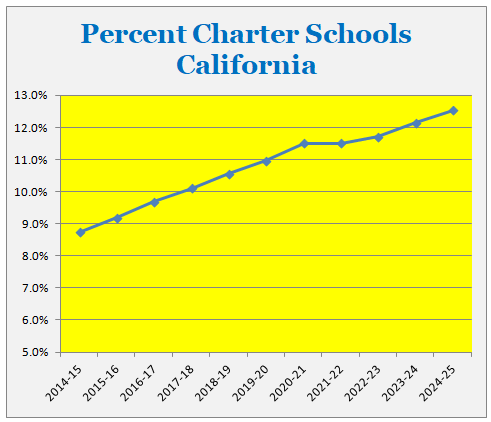
California enrollment data documents the continuing charter school growth. This first chart is of the percentage of charter school students in the state over the past decade.

As the chart shows, charter school students now make up 12.5% of publicly financed students in California.

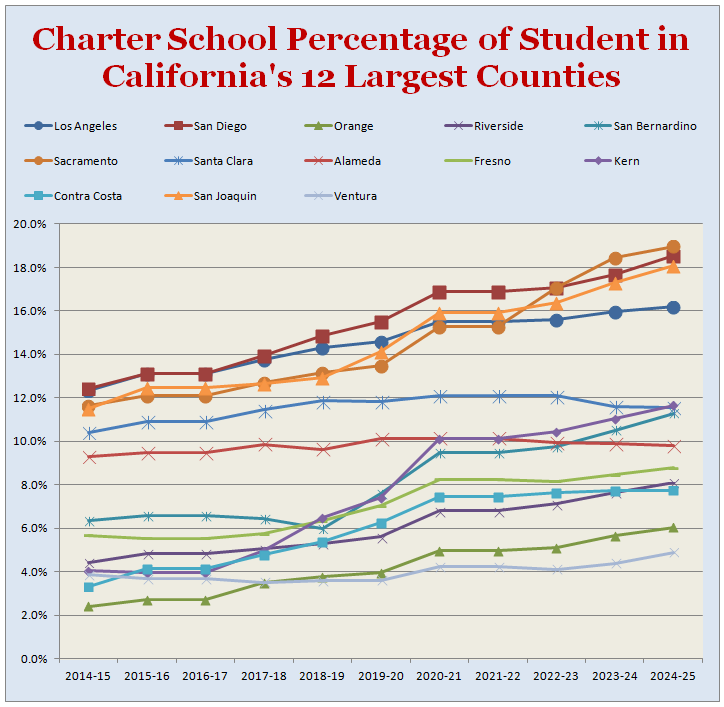
This next chart is of charter school growth in the 12 largest California counties. It provides insight into where the growth is occurring.

The four counties with more than 16% charter school students are Los Angeles, San Diego, Sacramento and San Joaquin. LA and San Diego are the two largest counties in the state but Sacramento is number six in size and San Joaquin is 11th. The third largest county in California is Orange and it only has a 6% charter enrollment. County population is not a good indicator for where charter schools will spread.

The growth in San Joaquin seems to have two important causes. The largest city, Stockton, is close to charter promoting organizations in Oakland and Sacramento. More importantly, Don Shalvey has always lived on his small ranch near Stockton. During his long education-centered career, he worked with billionaires including Reed Hastings, Bill Gates and Helen Schwab, to privatize public education. In 1993, Don’s San Carlos Learning Center became the first charter school in California and second in America. After retiring from his job at the Gates Foundation, he went to work for a small non-profit, San Joaquin A+, and turned it into a large well financed charter school promoting organization.

Massive Continuous Funding

Soon after legal means were provided for “school choice” by chartering, two organizations were developed to accelerate and sustain California charter schools; NewSchools Venture Fund (NSVF) and California Charter Schools Association (CCSA).

The history tab at the NSVF website states:

“NewSchools Venture Fund was created in 1998 by social entrepreneur Kim Smith and venture capitalists John Doerr and Brook Byers.” (Byers and Doerr are colleagues from the Kleiner Perkins venture fund.)

“We were among the first and largest investors in public charter schools and the first to identify and support multisite charter management organizations, which launch and operate integrated networks of public charter schools.”

Philanthropy Magazine notes that Reed Hastings helped “launch the NewSchools Venture Fund.”

Bill Gates and the Walton Family Foundation are the largest individual donors to NSVF with $226,881,394 of grants documented in Organized to Disrupt. However, this is only a fraction of the total billionaire largess. Besides receiving help from Reed Hastings over the last 20 years, billionaires John Doerr, Laurene Powell Jobs and John Sackler also served on the board.

CCSA is a charter school industry membership and support organization. In 2017, Executive Director of the Network for Public Education (NPE), Carol Burris, published Charter and Consequences. In this yearlong study of the charter school industry, she noted:

“CCSA does not disclose its funders on its website nor on its 990 form, but given its Board of Directors, who makes the list of big donors is not difficult to guess.

“The 2017 Board of Directors include New York’s DFER founder, Joe Williams, a director of the Walton Education Coalition; Gregory McGinty, the Executive Director of Policy for the Broad Foundation; Neerav Kingsland, the CEO of the Hastings Fund; and Christopher Nelson, the Managing Director of the Doris & Donald Fisher Fund. Prior Board members include Reed Hastings of Netflix and Carrie Walton Penner, heir to the Walmart fortune.

“The real power, however, sits in CCSA’s related organization, CCSA Advocates, a not-for-profit 501(c)(4) whose mission is to increase the political clout of charter schools on local school boards, on county boards, and in Sacramento.”

Beyond creating and financing organizations like NSVF and CCSA, a quick peek at any of the non-profit foundations these billionaires own reveals page after page of donations to individual charter schools and charter organizations.

Let’s not forget the $440 million federal dollars ticketed for charter school growth. Last year California’s share was $93 million and this year Secretary of Education, Linda McMahon, has raised that bribe to $500 million. California’s share will likely top $100 million.   

Buying Politicians

This morning the San Diego Union ran Kristen Taketa’s article about insider concerns over a small California charter school network, Elite Academic Academy. Former teacher Eric Shirley who taught home-school students there said he left after 5 years because he found several things fishy about the administration. That included Elite’s CEO, Meghan Freeman, living in a Montana resort town being paid more than $380,000 while founder Brent Woodward was still profiting from the academy.

Taketa shared,

“But Shirley’s biggest concern was that Elite was paying millions of dollars a year to an obscure third-party corporation — one created by Woodard. This corporation not only employs family members of Elite administrators in high-level jobs but also has paid him six-figure sums each year as a consultant.”

Shirley is one of three former Elite teachers who believe their charter network is the latest example of an operator of charter schools exploiting lax charter laws to misuse taxpayer funds.

In 2019, a San Diego Grand Jury indicted A3 charter school leaders for fraud and theft. The A3 Charter School conspirators fraudulently collected $400 million from the state of California, misappropriated more than $200 million and according to the Voice of San Diego’s Will Huntsberry outright stole $80 million. However, no effective measures have been taken since to remediate California’s laws.

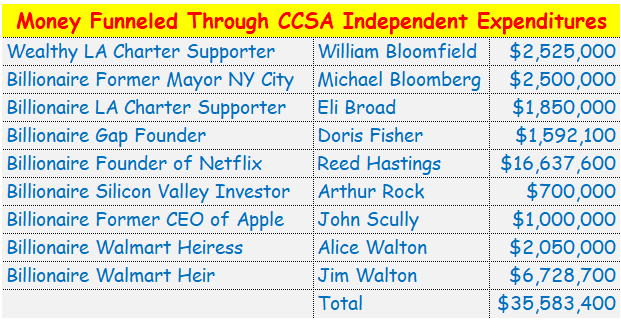
Taking advantage of the Supreme Court’s 2010 ruling in Citizens United v. Federal Election Commission case, billionaires have poured huge sums of money into California’s state and local elections. Most of this money hides in independent expenditure groups like EDVOICE FOR THE KIDS PAC; CALIFORNIA CHARTER SCHOOLS ASSOCIATION ADVOCATES INDEPENDENT EXPENDITURE COMMITTEE; CA CHARTER SCHOOL ASSOC INDEP EXP COMMITTEE; EDVOICE INDEPENDENT EXPENDITURE COMMITTEE; KIDS FIRST, SUPPORTING KELLY GONEZ, NICK MELVOIN, AND MARIA BRENES FOR LAUSD SCHOOL BOARD 2022 and KIDS FIRST, SUPPORTING TANYA ORTIZ FRANKLIN FOR LAUSD SCHOOL BOARD 2020.

Most of this Money went to LA School Board Elections

In 2019, James Walton of Arkansas made contributions to 29 California legislative candidates plus Reed Hastings provided contributions to 69 local and state political candidates. These are examples of billionaires buying influence.

A New Effort

California Assembly Bill 84 sponsored by Robert Garcia [D] and Al Muratsuchi [D] was voted out of the Assembly Committee on Education by a party line vote and forwarded to the Appropriations Committee on Friday (5/23/2025). The Assembly Appropriations Committee analysis summarizes:

“This bill establishes new requirements for charter schools and nonclassroom based (NCB) charter schools regarding auditing and accounting standards, and the funding determination process. This bill adds requirements to the contracting process, limits authorization of NCB charter schools by small school districts, makes changes to the authorizer oversight process, and clarifies that charter schools are subject to specified teacher credential and salary expense requirements.”

Since the criminality of the A3 charter organization, bills to solve the lack of charter school oversight in California have been proposed regularly. This time around, The Assembly Committee on Education Analysis lists almost 200 charter schools dutifully opposing the new bill.

The billionaire backers of “school choice” dislike lawmakers working to safeguard taxpayer supplied education dollars. Will the plutocrats win again or will Californians finally be protected from criminal education enterprises?

Billionaire Sponsored Malarkey from Education Trust

3 Dec

By Thomas Ultican 12/3/2024

Education Trust (aka EdTrust), using what it calls equity analysis, critiqued various states’ Every Student Succeeds Act (ESSA) required accountability plans. University of Northern Colorado’s Derek Gottlieb reviewed their study for the National Education Policy Center. An unimpressed Gottlieb claimed, “Despite the language of ‘equity’ and attention to ‘asset-based’ framings of educational data, the vision of what high-quality accountability structures would look like and would do simply recycles the naïve hopes that fueled the original push for NCLB.” EdTrust’s non-peer-reviewed study might also be opening the way for a new version of the Elementary and Secondary Education Act to replace the now ten-year-old ESSA.

EdTrust rings a preponderance of No Child Left Behind’s (NCLB) greatest hits in its one paragraph explaining why we need federal oversight:

“The purpose of public education is to provide students with the knowledge and skills they will need to succeed after high school; the ability to access and complete a postsecondary education, pursue a fulfilling career that earns a living wage, and meaningfully participate in our democracy. All students can succeed when provided with the resources and supports to achieve. Yet, generations of students — particularly students of color, students from low-income backgrounds, students with disabilities, and multilingual learners — have been systematically denied equitable access to these educational opportunities — inequities illuminated and exacerbated by the pandemic. Federal accountability requirements are designed to ensure parents, communities, system leaders, and policymakers can better understand which schools and districts are struggling to meet students’ needs and have student group disparities, and — most importantly — use this information to target additional resources and supports to address these needs.

They are saying that through testing we can identify “struggling schools,” which is similar to NCLB’s “failing schools” but not as harsh. They claim it will allow targeting those schools with “additional resources and support.” Honestly, that sounds a lot better than NCLB’s fire the staff and close the schools but EdTrust’s plan to pay for the “additional resources and support.” is not workable. To achieve the goal, they suggest using federal school improvement funds, a 7% set-aside from Title I funding.

Typically, Title I funding represents about 2% of a state’s education budget. Unfortunately, a 7% set-aside from a relatively small amount of money is not going to be sufficient. Even if we accept that “all students can succeed,” these amounts of additional resources will not do the job.

EdTrust makes a series of recommendations that cause many of us teaching in the first decade of the 21st century to shudder.

They advocate, lowering the minimum student sample size from 20 to 10 so certain subgroups are included in school ratings. When teaching statistics, most instructors would warn that population sizes less than 20 have too large of error ranges to be statistically useful. It is odd that known data wonks would make this absurd recommendation.

EdTrust advocates using growth and proficiency with similar weighting for school accountability measurements. The standardized testing data used to assign proficiency are extremely noisy and unreliable. The famed Australian researcher Noel Wilson wrote a seminal work in 1998 called Educational Standards and the Problem of Error.” His peer reviewed paper states standardized testing error is so large that meaningful inferences are impossible. Growth models use standardized testing data and run it through opaque mathematical regimes. It is literally garbage in garbage out.

Another EdTrust recommendation says, “Increase federal monitoring and require state reporting of ESSA school improvement provisions,” which echoes the old NCLB test and punish regime.  The report adds:

“Strong actions such as state takeovers have mixed evidence of success and when done need to be undertaken in collaboration with communities. However, having these state actions as options can help motivate school and district leaders to make strategic, systematic changes to policy and practice to raise performance.”

Which means, if you are in the wrong zip code, your school is going to be a closure victim.

Professor Gottlieb concluded his review of the EdTrust report:

“Without substantially increasing the resources to be targeted for distribution, there are real and hard limits on the productive value of monitoring and reporting, no matter how good or robust our measurements are. It is one thing to have imagined, in the late 1990s, that federal accountability policy alone could transform public education across the country to finally make good on national promises of equal opportunity. It is quite another thing to pitch a wonkier version of the same approach three decades later, with so many tweaks and nuances and consistently underwhelming “successes” in our rearview mirror.”

Education Trust and the Billionaires

Kati Haycock founded EdTrust in 1990 according to the organization’s 1997 web posting. In 1973, with her newly earned bachelor’s degree in political science, University of California President, Charles J. Hitch, made her director of affirmative action for the entire UC system. By 1989, she had earned a master’s in education from UC-Berkeley and was gaining trust in neoliberal Democratic circles as shown by her becoming Executive-Vice President of the Children’s Defense Fund. It appears EdTrust was not a standalone independent organization until 1996. It was originally founded as a unit of the American Association of Higher Education.  That is probably why the National Assessment Governing Board says EdTrust was founded in 1996. (Common Core Dilemma Pages 45-48)

Haycock, who was never a teacher, became influential in education policy by promoting test-score centered American school rooms. Concerning Haycock’s expertise, Mercedes Schneider declared, “It’s like writing a cookbook without ever having prepared a meal.” (Common Core Dilemma Page 48)

EdTrust was always a diehard test based education improvement supporter. In 2008, Republican Sam Graves and Democrat Tim Waltz introduce HR 6239 to suspend temporarily the school punishments required by NCLB. Haycock and EdTrust swung into action to fight the bill. They stated in a letter to congress:

“HR 6239 would turn back the clock to a time when our country simply ignored troubled schools. That approach, the norm for generations of federal education policy, failed miserably and has wasted billions of dollars and squandered the potential of millions of our fellow citizens.  As imperfect as NCLB may be and as uncomfortable as the law may make some adults, we can’t afford—not even for a moment—to turn away from the law’s commitment to identify and intervene in schools that are not making the grade.”

At about this same time, Education Trust joined with Achieve and the Thomas B. Fordham Foundation to promote IBM CEO, Louis Gerstner’s American Diploma Project (ADP). Gerstner never studied education nor taught but he went to school and hired many people who also went to school so he considered himself an education expert. His big thing was the need for education standards. In 2008, his ADP was subsumed into Bill Gates Common Core State Standards. Interestingly, Gates had even less education background than Gerstner, but he was really rich.

Since their inception, EdTrust has been very successful at attracting billionaire dollars. On their webpage, they list 50 entities that send them money which are mostly billionaires or billionaire financed. For tax purposes, EdTrust (TIN 52-1982223) is a tax deductible charity. Since 2014, they have received more than $24 million a year in deductible contributions.

That is a huge amount of money so I picked out four organizations to review in a little bit of detail. I chose the Gates Foundation because they send money to anyone undermining public schools, the Broad foundation out of nostalgia and curiosity, the Walton Family Foundation for the same reason as Gates and the Barr Foundation because of my friend Maurice Cunningham’s interest in them.

Amos Barr Hostetter, a cable company billionaire, founded the Barr Foundation in 1991 along with his wife Barbara but they made all of their contributions anonymously until 2010. Before then, Hostetter’s giving was hidden behind a veil of secrecy.

Conclusion

Having billions of dollars in private hands undermines democracy. The public likes their public schools, but enormous billionaire spending is driving down this regard. Propaganda like the EdTrust report is hard to counter.

If the common person is going to maintain any democratic control or rights, billionaires need to be taxed back to being millionaires.

Science of Learning; an Education Fraud

2 Oct

By Thomas Ultican 10/2/2024

On September 24, The 74 headline read, “What Happens When a 48K-Student District Commits to the ‘Science of Learning’ – In Frederick County, Maryland, test scores rose, achievement gaps shrank and even veteran educators slowly embraced the decidedly not-faddish fix.” This statement is mostly baloney used to sell the “science of learning.”

The article opens with a new first grade teacher discussing her next day’s math lesson with the school’s principal, Tracy Poquette. The third paragraph says,

“Poquette recommended the whiteboards. ‘You’re going to ask them to hold them up,’ Poquette coached Able, miming holding a whiteboard in the air. Then you can see their answers, and how they got to that. Every student is responding.”’

This seems fine but it is hardly innovative. This technique comes from the 20th century or maybe even the 19th century. The next paragraph states, “The sessions are meant to accelerate student learning and take some of the guesswork out of becoming an effective teacher, part of a larger district plan to incorporate research from the fields of neuroscience, educational psychology and cognitive science — often referred together broadly as the ‘science of learning.’”

They are selling baseless malarkey. Neuroscience and cognitive science still do not provide much usable insight into how students learn or what the best teaching methods are.

The claim of rising test scores is deliberately misleading. The scores may have risen a little but this is a case in which the cause is pretty clear. In statistics, the r-value correlation has a value between o and 1 for determining the effects of different inputs on education testing results. An r = 0 means there in no relationship and an r = 1 means the input is 100% determinative. Inputs like teacher, curriculum design, class size, etc. can be evaluated. The only input ever found with more than o.3 r-value is family wealth at a 0.9 r-value. Between 2021 and 2022, Frederick County, Maryland had “the largest net positive change in total income in the state.” As indicated by statistical analysis, of course test scores raised some.

These fraudulent claims about the “science of learning” are being financed by wealthy people wanting to implement competency based education (CBE). With its concentration on developing mastery of small discrete information bites, CBE makes kids learning at screens more possible. Since 2010, the annual GSV+ASU conference, which is a big deal with tech billionaires, has been striving toward this goal. At their 2023 conference in San Diego, Carnegie and ETS announced a new partnership to create functional testing for competency based education (CBE).

GSV (Global Silicon Valley) appears to have convinced Tim Knowles and the Carnegie Foundation to abandon the Carnegie Unit to open the way for CBE based testing and badges.

The Claims and Propaganda

The proponents of the “science of learning” claim that Pestalozzi, Herbart and Dewey, the fathers of progressive education, were wrong. They tell us that “problem based education” is counterproductive and that discovery approaches are harming children. They claim that direct instruction and drilling small bits of information to mastery are what children need.

Trish Jha, a research fellow at the Center for Independent Studies in Australia, just published a more than 15,000 word essay explaining why the “science of learning” is needed. She claims:

“Australian education needs to position the science of learning as the foundation for policy and practice.”

“Unfortunately, key pillars of Australian education policy do not reflect the science of learning, due to the far-reaching impacts of progressive educational beliefs dating back to the 18th century.”

These beliefs include that:

    • Students learn best when they themselves guide their learning and it aligns with their interest;
    • Rote learning is harmful;
    • Learning should be based on projects or experiences, and that doing this will result in critical and creative thinkers.”

But these beliefs are contradicted by the science of learning.”

Ms. Jha asserts, “The teaching approach best supported by the evidence is explicit instruction of a well-sequenced, knowledge-focused curriculum.” She sites E. D. Hirsh as one of her experts supporting this thinking.

It is part of a worldwide effort by wealthy people to digitized education under the cover of “science of learning”. In 2018, the Center for American Progress (CAP) wrote:

“This brief builds on the growing momentum for both the science of learning and school redesign. Last month, for instance, the XQ Institute released a policy guide for states on how best to redesign their schools. The document argued, among other things, that students should be able to learn at their own pace, progressing as they demonstrate mastery of key concepts.”

And CAP went on to quote XQ:

“[Competency-based education] isn’t about replacing what goes on in the classroom with less-demanding experiences outside of it. This is about integrating innovative approaches to teaching in the classroom with opportunities for students to develop practical, concrete skills in real world settings. And it’s about awarding credit for learning—demonstrated learning—no matter where or when the learning takes place.”

The XQ institute is the creation of noted anti-public school and teacher disparaging billionaire, Laurene Powell Jobs.

For 50 years, mastery-based education now called CBE has been a major flop. Established on the mind-numbing drill and skill approach, CBE undermines authentic learning. It has never worked.

Deans for Impact, a Billionaire Created Example

The Deans for Impact Supporters Page

Teach for America (TFA) is viewed by many people as the billionaires’ army for school privatization and the New Schools Venture Fund (NSVF) is the Swiss army knife of public school privatization. Deans for Impact (DFI) was created in 2015 with personnel from TFA and NSVF.

DFI founder, Benjamin Riley, was a policy director at NSVF. Riley stepped down as executive director of DFI in August 2022 and was replaced by another NSVF alumnus, Valarie Sakimura. Francesca Forzani, the current board president, spent 4 years as a TFA teacher in Greenville, Mississippi. The list of people from public school privatization promoting organizations who have served on the DFI board of directors is extensive:

Supporters of DFI have been very generous since the founding in 2015. The last year for which tax records are available was 2022. Federal tax forms 990-PF show:

  • Bill and Melinda Gate Foundation (TIN: 56-2618866)  $3,482,504
  • Charles and Lynn Schusterman Family Foundation (TIN: 73-1312965)  $2,135,000
  • Michael & Susan Dell Foundation (TIN: 36-4336415)  $2,375,000
  • The Joyce Foundation (TIN: 36-6079185)  $2,400,000
  • Carnegie Corporation of New York (TIN: 13-1628151) $875,000

These are huge sums of money but not for billionaires.

The Carnegie Corporation did not contribute to DFI until Timothy Knowles became president of the Carnegie Foundation for the Advancement of Teaching in 2021; probably not a coincidence.

Deans for Impact states:

“DFI believes all teacher-candidates should know the cognitive-science principles explored in The Science of Learning. And all educators, including new teachers, should be able to connect those principles to their practical implications for the classroom.”

Of course cognitive scientists do not agree on these principles and the neuroscience pitch is fantasy, but DFI is coming through with its deliverables.

Deans for Impact is just one small example of the many organizations billionaires have created to do their bidding.

Conclusions

The “science of learning” is another scam to defeat progressive education and replace it with kids at screens earning badges. Unfortunately, billionaire money distorts reality. “Science of learning” and “science of reading” are frauds not science. They are oligarch created deceptions bringing bad pedagogy and the end of free universal public education.

Goodbye Doo Wop Don

27 Mar

By Thomas Ultican 3/27/2024

Don Shalvey, with his self-selected twitter handle @dooWopDon, passed away March 16th, succumbing to a lengthy battle with brain cancer. During his long education-centered career, he worked with billionaires including Reed Hastings, Bill Gates and Helen Schwab, to privatize public education. In 1993, Don’s San Carlos Learning Center became the first charter school in California and second in America.

Before he was a charter school founder and before he was a school teacher, he was a disc jockey. That is why his twitter was @dooWopDon.

When founding the charter in San Carlos, he was superintendent of a small K-8 district, a third of the way up the peninsula between San Jose and San Francisco. This event made an obscure education administrator into a rock star in the movement.

Don Shalvey September 14, 1944 – March 16, 2024

Lily Geismer writes about the Clinton administration and its embrace of education choice in her book Left Behind (page 244). In 1997, Bill and Hilary dropped off their daughter, Chelsea, for her freshman year at Stanford. The next morning they were in the gymnasium at Don’s San Carlos Learning Center for a roundtable discussion about charter schools (page 248). Geismer claimed, “The San Carlos event galvanized momentum for charter schools.”

At the time, there was a cap of 100 charter schools in California. Afterwards, “a thirty-something man with a goatee and Birkenstocks”, Reed Hastings, approached Shalvey, asking, “Do you ever think that there’ll be more than a hundred charter schools in California?” He talked Shalvey into helping to get rid of the charter school cap (page 249). “The combination of Don as Mr. Charming Establishment and me as a wealthy provocateur presented a unique challenge to the teachers union,” Hastings remembers in an interview.

Together, they successfully campaigned to end the charter school cap. At the same time, Hastings was starting his new company, Netflix. The two soon hooked up with John Doerr and NewSchools Venture Fund to invent the charter management organization (CMO). With $400,000 left from their campaign, they used it to create America’s first CMO, University Public Schools which later became Aspire.

Shalvey did most of the leg work.

The first Aspire charter school opened in 1999 in Stockton, California. During his career in education, Shalvey’s home was always a ranch in Linden, California about 10 miles from Stockton.

The Gates Foundation

From 2009 to 2020, Shalvey served as Deputy Director for K-12 Education at the Bill & Melinda Gates Foundation.

While he was at the Foundation, charter school enrollments grew by a half-million students, fueled in large part by the Charter School Growth Fund supported by Gates, the Walton family and other billionaires. The Fund was founded in 2004 by Buzz Woolley and Don Fisher (Tax ID 05-0620063). In 2005, John Walton replaced Buzz Woolley as president, indicating his privatization focus changed from vouchers to charter schools.

Gates gave Shalvey two big jobs. He was to implement Common Core standards and target teacher preparation. Unfortunately the standards were installed with no field testing. There were many good ideas within them but much of it was improperly aligned and had no buy-in from educators. There were also political issues. People saw this as Gates’ effort to take control of public education and create a centralized US education marketplace.

Focus on teacher preparation became another effort at privatizing every aspect of the education industry. Instead of working with established institutions like Columbia University or the University of California system, Shalvey and Gates looked toward private companies like the Teach for America (TFA) spinoff, TNTP.

Wendy Kopp founded TNTP (originally called The New Teachers Project) in 1997 and assigned Michelle Rhee, who had just finished a two-year TFA tour, to run it. Under Rhee’s leadership, TNTP became noted for teacher bashing.

Soon after Shalvey went to work for Gates in 2009, he became a member of the EdSource board. Gates was perhaps their largest funder and Don, his representative, remaining a board member until his passing.

Returns to Stockton

June 30 2020 was Shalvey’s last day at the Gates Foundation. For the entire time he worked for Gates, he commuted from the home he shared with wife, Sue, in Linden, California. He stated:

“For the past 50 years, the San Joaquin Valley has been my home. I’m thrilled to spend the final years of my career working to improve education for the young people in our wonderful Valley.”

The 75 year-old Shalvey was not ready to retire. He became CEO of a local non-profit called San Joaquin A+. There must have been secret negotiations before he left Gates because it is probably not a coincident that at the same time billionaire, Helen Schwab, made a $400,000 donation to the non-profit.

Shalvey’s new job was part-time, committing 20 hours a week to his CEO position. Tax records indicate San Joaquin A+ (Tax ID: 51-0536117) became tax-exempt in 2005. It was a relatively low key organization until his arrival. In 2019, they had net assets of $39,266. Shalvey was compensated $160,225 that first year and in 2021, $332,782. In the three years prior to his arrival, A+ had taken in $15,169. The haul in 2020 was $3,176,833 and in 2021, $3,942,790.

He was definitely a rainmaker and the question is what did his billionaire supporters expect back?

Don Shalvey was known to be a good guy with a big smile and able to work with people but some locals in Stockton disagree. Founder of Facebook news report 209 Times, Motecuzoma (Motec) Sanchez, wrote:

“Every time one of these devils dies, like with Alex Spanos, you see their legacy media puppets try to brainwash the public into believing what they did in their lifetime was admirable. Shalvey exploited poor Brown and Black kids in my hometown of Stockton, Modesto and beyond. And his creations, like a monster, continue to do so.”

The late Alex Spanos was a very successful real-estate developer from Stockton who purchased the San Diego Chargers in 1984. Motec felt Spanos was ruthless and that just the way his life story was glorified is how Don Shalvey’s life is being embellished today. From his ranch in Linden, Shalvey consistently ingratiated himself with billionaires, denigrated public schools and made profits. 

In 2022, two grand jury reports seemed out to demonize the local school districts board and leadership. A report in The 74 quoted Shalvey saying, “I think Stockton Unified might be the worst system in the country.” That was typical of the hyperbolic anti-public school statements he often made.

It is true that during John Deasy’s two years as Superintendent, the district had some financial issues which have been solved. With 82% of K-12 students coming from families of poverty, it is little wonder they did not test well but their graduation rates were reasonable and English language progress rates, among the best in the state. It is one more example of good schools in poor neighborhoods having test results used to unfairly undermine them.

Shalvey made a lot of money working to destroy public education but that money is not helping him now. He raised an admirable family and seemed to have many good traits. I feel bad about writing critically of the dead but he, unwittingly or not, made many bad choices, harming countless children.

I agree with Motec.

Don Shalvey should never be lionized.

ETS and Carnegie Team Up for ‘Zombie’ Ed Policy

4 Jun

By Thomas Ultican 6/4/2023

Educational Testing Service (ETS) and Carnegie Foundation are partnering to create assessments for competency-based education, claiming it will revive the zombie education policy tainted by a five decade record of failure. The joint announcement was made at the April 2023 ASU+GSV conference in San Diego with Bill Gates as the keynote speaker. Ultimately, it was to make the Orwellian-named “personalized learning” viable for issuing digitally earned certifications.

ASU is Arizona State University and GSV is the private equity firm, Global Silicon Valley. GSV advertises “The sector’s preeminent collection of talent & experience—uniquely qualified to partner with, and to elevate, EdTech’s most important companies.” It profits from the corporate education ideology that holds job training as the purpose of public education.

Unfortunately, the US Department of Education is on board with digital learning and competency based education claiming,

“Digital tools can shift the focus of learning environments away from traditional metrics of progress — such as the number of hours spent in a classroom—toward more meaningful indicators of learning.”

“Digital learning can support competency-based education, in which students advance after demonstrating mastery of a key skill or concept. In a competency-based system, students work individually and in teams to continuously learn content and develop skills (e.g., communication, critical thinking, problem solving, creativity) and receive timely, differentiated support based on their individual needs. In this sense, competency-based education enables personalization and learning continuity, regardless of location.”

The 1970’s “mastery learning” was detested and renamed “outcome based education” in the 1990s. It is now called “competency based education” (CBE). The name changes were due to a five-decade long record of failure. CBE is a move to use “mastery leaning” techniques to create individualized certification paths. However it is still the same mind-numbing approach that the 1970s teachers began calling “seats and sheets.”

In the book A Wolf at the Schoolhouse Door, Jack Schneider and Jennifer Berkshire explain, “Because learning is deeply rooted in relationships, it can’t be farmed out to robots or time-saving devices.”

Unfortunately the potential for large profits is huge and serially failed education policies are zombies that will not die.

Selling CBE and Testing

‘The 74’ is an oligarch funded online, daily education publication, promoting the neoliberal agenda. Their cheerleading article about the Carnegie-ETS proposal had no pushback when quoting Carnegie President Timothy Knowles’ unlikely to be true statement,

“We’re in a position to do something that we hadn’t before. Unlike 20 years ago, we can actually reliably measure the skills that we know are predictive of success in postsecondary education and work”

Closest thing to any questioning of this came when the author quoted Michael Horn, a co-founder of Harvard’s Clayton Christensen Institute for Disruptive Education. This loud voice advocating the destruction of public education through privatization said,

“This part, from my reading of the literature on assessment, is both unproven and underdeveloped. So the how is going to be very important. I’m going to be very curious to see what the investments look like as they go forward, and I hope they don’t overpromise.”

‘The 74’ post also claims, “Competency-based learning and assessment has long been theorized as a preferable alternative to existing educational models.” These theories come from a range of philanthropic foundations and education-focused companies, many in attendance at ASU+GSV. Education professionals, not on some billionaire’s payroll, have completely different opinions.

Renewed neoliberal effort to revive CBE now has new players seeking to be big contributors while old hands are filling leadership roles. For example, at the best-known new group called Mastery Transcript Consortium, board member, Tom Vander Ark, the former education director at the Gates Foundation 1999-2006 remains engaged in pushing edtech.

There is very little real change. CBE continues to put kids at computers learning scripted chunks of information and testing for mastery, promising to increase edtech profits and reduce education costs especially teacher salaries. It is awful education and the children hate it.

Guys like Carnegie’s President Tim Knowles and ETS’s CEO Amit Sevak must justify 7 figure salaries by creating new tools and revenue streams for their benefactors. This begs the question, “How can an organization like Carnegie (TIN: 13-1628151) and ETS (TIN: 21-0634479) that pay salaries of more than $1,000,000 a year still be called non-profits?” 

The Big Push for CBE

Former reporter for Inside Higher Ed, Paul Fain, shares insights into the new push for CBE. He wrote,

Skills were a hot item at the summit in San Diego, particularly tech-enabled tools that seek to measure the knowledge and abilities of learners, and to convey them to employers. These discussions are drawing energy from the campaign led by Opportunity@Work and the Ad Council, which calls for employers to drop four-year degree requirements and to move toward skills-based hiring.”

Much of the momentum behind this thinking is the move toward a belief that the preeminent purpose of education is employment readiness. Philosophy, literature, art etc. are possibly only meaningful for children of the wealthy. The new push for CBE is toward a skills based education which wastes no time on useless frills. It is a system where children study in isolation at digital screens and earn skills badges at their own pace as they move through the menu driven learning units.

The big obstacle for this system of education is that testing has not proven reliable. Not only has it struggled to assess skills mastery it has not been proficient at predicting future success. This of course completely ignores the reality that CBE is a god awful theory of pedagogy.

In 1906, the Carnegie foundation developed the Carnegie Unit as a measure of student progress. For example, a student attending a class meeting one hour a day 3 times a week for 40 weeks earns one “unit” of high school credit for that 120 hours in class. Based on this, schools all over America pay attention to how many instructional minutes they schedule for every class.

In 2015, Carnegie completed a two-year study of the Carnegie Unit and proposals to revise the unit-based competency established on time. They concluded, “The Carnegie Unit continues to play a vital administrative function in education, organizing the work of students and faculty in a vast array of schools or colleges.” The report did not embrace competency-based standards. Now, Carnegie Foundation President Tim Knowles is calling for just such a change.

Education writer Derek Newton in an article for Forbes says he is hostile to the Carnegie-EST idea for a host of reasons but the major one is cheating. He shares,

“Cheating, academic misconduct as the insiders know it, is so pervasive and so easy that it makes a complete mockery of any effort to build an entire education system around testing. From middle school to grad school, from admissions tests to professional certifications, cheating is the bus-sized hole in the hull of assessment that renders any real voyage implausible. Right now, anyone can pretty easily buy a test-based credential without knowing anything at all. Just pay the fee, get the credential. And people do, every day.

“I am not talking about fake credentials. They are real, provided by the certifiers themselves. The sellers use software to take remote control of a test-taker’s computer and have a ringer take the exam for them.”

It is easy to cheat with rampant digitally enhanced systems. Newton observed, “But because of the credit hour system, which is designed to measure classroom instruction time, it’s still relatively hard to cheat your way to a full college degree.”

Conclusion

Derek Newton’s concern about cheating, difficult and expensive to combat, is valid.

To me, the biggest problem is that “mastery learning” is proven lousy pedagogy that is unaligned with how learning happens.

In his book Soka Education, Daisaku Ikeda writes,

“Recognizing each student as a unique personality and transmitting something through contacts between that personality and the personality of the instructor is more than a way of implanting knowledge: it is the essence of education.”

Socrates likened this education process to being “kindled by a leaping spark” between teacher and student. CBE, “mastery learning,” “outcome based education” or whatever name is given to teaching students in isolation is bad pedagogy, bordering on child abuse.

Selling Denver’s Portfolio Model by Confusing Correlation with Causation

5 May

By Thomas Ultican 5/5/2023

The 74 published an article about a University of Colorado Denver study that shows what a great success school reform has been in Denver. The research paper attributes that triumph to the portfolio school management model introduced by now Senator Michael Bennett during the 2007/8 school year. While testing results have significantly improved in Denver’s K-12 schools, the paper’s claims confuse correlation with causation.

As is often the case with articles in The 74, there is a bias toward the billionaire favored education policies. The 74 correspondent states, The results offer powerful evidence in favor of the so-called ‘portfolio management model,’ an educational strategy that began to take hold in major urban school systems in the mid-2000s.” And also reports the claim that the reforms “led to some of the most significant learning gains ever measured.”

To further establish how important and meaningful results in the new study are, The 74 turned to economist Douglas Harris from Tulane University. He has prospered producing studies touting New Orleans’s privatized school system. It is worth noting that the all charter school system in New Orleans is an inefficient disaster which still scores at the bottom in state standardized testing. Concerning the Denver study, Harris is quoted as saying,

“The effects are clearly large. Just as a loose approximation, if you leapfrog that many districts, clearly you’ve seen a lot of improvement.”

The data shows that Denver did make real progress based on testing data. The leapfrog that Harris mentions is that Denver went from near the bottom of the state’s districts on standardized testing to about the middle.

The 74 staff writer who produced the article is Kevin Mahnken. He makes a living writing articles that accentuate the message his billionaire paymasters want. His reports may not be exactly lies but are at the very least highly biased.

The 74 was founded in 2015 and originally funded by billionaires Dick and Betsy DeVos Family Foundation, the Walton Family Foundation, the Doris and Donald Fisher Fund, and Bloomberg Philanthropies. Since then, it has been the vehicle for spreading the billionaire message aimed at undermining public schools.

There are basically two groups of billionaires trying to privatize public education; libertarians and neoliberals. Both groups believe in markets and do not support democratic means. Libertarians like the Walton family and Charles Koch prefer vouchers. They think public programs like social security and public education are basically robbery and must be ended. Neoliberals like Bloomberg and Gates prefer charter schools. They feel that public programs should continue but are better run by private businesses. The 74 is their common vehicle for promoting their education perspectives.

The Portfolio Model

In 2009, the Center for Reinventing Public Education (CRPE) published Portfolio School Districts for Big Cities: An Interim Report.” Lead author Paul Hill and his associates stated,

“The report introduces the idea of a ‘portfolio school district,’ and shows how some leading school districts have put the idea into practice. A portfolio district is built for continuous improvement through expansion and imitation of the highest-performing schools, closure and replacement of the lowest-performing, and constant search for new ideas.”

Bill Gates, John Arnold, Michael Dell, the Walton Family and other billionaires fund CRPE which is headquartered on the campus at the University of Washington.

Portfolio School Districts is an organized idea for managing charter schools, innovation schools, public schools and voucher schools that make up the mix of schools in a district. Using standardized testing as a proxy for measuring quality, some percentage (5%) of the lowest performing schools will be closed every year. Invariably, the closed school will be replaced by a privatized structure outside of the purview of an elected school board. Also, because standardized testing only correlates with family wealth, the schools in the poorest communities will be privatized and subject to constant churn.

In 2018, John Arnold and Reed Hastings established the City Fund which has spent heavily to develop local organizations that promote the implementation of the portfolio model of public education management. Soon after the City Fund founding, Bill Gates, Steve Ballmer and Alice Walton also started funding the organization.

The leader of the Denver research project was Parker Baxter. In 2012, CRPE listed him as a “Senior Research Affiliate and distinguished expert in the field of education policy.” On that same page CRPE also declared, “CRPE is one of five national education policy organizations that co-founded the Policy Innovators in Education (PIE) Network, whose mission is to build, support, and promote a network of education advocacy organizations working to improve K-12 education in their states so that every student graduates world-ready.” One of the main points they advocate for is the portfolio model.

The System Level Effects of Denver’s Portfolio District Strategy

This study of school reform in Denver was conducted by the Center for Education Policy Analysis (CEPA). They state, “For the past three years CEPA has partnered with the Center on Reinventing Public Education to consider a paradigm-shifting approach to family and community engagement efforts in school districts.” CEPA director Parker Baxter led the study. The relationship with CRPE makes one wonder about bias in this study and Parker Baxter’s biography heightens that concern.

On his LinkedIn page Baxter shares that he was Director of Knowledge at the National Association of Charter School Authorizers (NACSA). He mentions being a Senior Research Affiliate at CRPE. Baxter asserts he was a Senior Legal Analyst working on the District-Charter Collaboration Compact Project and the Portfolio District Project. Says he served as Assistant Superintendent and the Executive Director of the Office of Parental Options at the Louisiana Department of Education and as Director of Charter Schools for Denver Public Schools (DPS). Parker claims being an aide to Senator Edward M. Kennedy where he worked on issues related to the No Child Left Behind Act. He is also a former special education teacher and an alumnus of Teach for America.

On page one of the report, it says, “This research is made possible by a multiyear grant from Arnold Ventures.” Just to be clear that is billionaire John Arnold the former Enron trader, co-founder of The City Fund and big spending advocate of the portfolio model of school district management.

The study did a lot of fancy arithmetic on state testing data and summarized their findings:

“Prior to the start of DPS reform efforts in 2008-09, DPS was among the bottom 10 districts in the state in ELA and math performance on state standardized assessments, ranking below the 5th percentile of districts. By 2018-19, DPS had risen to the 60th percentile of districts in ELA and the 63rd percentile of districts in math, outperforming more than 100 out of roughly 180 districts in the state. The 4-year high school graduation rate increased dramatically during the reform period as well, climbing from 43% in 2008 to 71% in 2019. Our results indicate that the reforms drove these improvements in student academic and graduation outcomes.” (Page 3)

The Denver study used school years 2004/5 through 2018/19 state testing data. The first 4-years of the research employed pre-reform data and the final 10-years were from the portfolio model reform period. The authors reported, “During the study period, the district opened 65 new schools, and closed, replaced, and restarted over 35 others.” (Page 7)

A Professional Review

Boulder, Colorado which is 30-miles up highway-36 from Denver is home to the University of Colorado Boulder which hosts the National Education Policy Center (NEPC). Early in the 21st century purported research papers started being published that were never subjected to peer review. NEPC tried to address this problem by assigning independent education professionals to review these studies. They contracted with Robert Shand to review the Denver study. He is an Assistant Professor of Education Policy and Leadership at American University and an affiliated researcher with the Center for Benefit-Cost Studies of Education at Teachers College, Columbia University.  

Professor Shand’s conclusion states:

“The recent study finds substantial system-level gains in math and ELA scores as well as graduation rates. These reported gains are indeed dramatic, but they were not experienced equally and may have widened achievement gaps. Further, attributing them specifically to the portfolio reforms seems premature for at least three reasons. First, many other changes, beyond the portfolio reforms, were occurring in the district at the same time. These included changes to funding, curriculum, leadership, teacher policies, and student demographics. Second, some gains, particularly among marginalized groups of students, predated the reforms. Third, the “portfolio” reforms themselves are diffuse and difficult to parse. For these reasons, the recent report succeeds in drawing attention to real academic gains in Denver over the past decade, but is less useful as a guide to how other districts could replicate that success.” (Page 3)

To substantiate these claims Shand shared the following points:

  • Demographics shifting to a larger percentage of white students in Denver coincided with the reforms.
  • Per-student revenues increased in Denver by 22% but only 13% across Colorado.
  • Student-to-teacher ratio in Denver dropped from 17.9 to 14.9.
  • DPS was already showing academic improvement before implementation of the portfolio reforms.
  • Black and Hispanic/Latinx students were growing at approximately 0.06 standard deviations per year pre-reform and 0.03-0.04 standard deviations per year post-reform.

Professor Shand succinctly determined, “Given the host of changes in the city and the district over the same time period as the portfolio reforms, attributing the gains to the portfolio reforms specifically is unwarranted by the evidence.(Emphasis added)

Baxter and his team at CEPA surely are aware of the difference between correlation and causation as is the education reporter from The 74, Kevin Mahnken. This indicates strongly that they were being purposefully deceitful or more straightforwardly THEY WERE LYING.

Corporations Invade Delaware Public Schools

18 Oct

By Thomas Ultican 10/18/2021

A multifaceted corporate plan for control of Delaware public education is in progress. Billionaires are financing numerous edtech projects that isolate children at screens. To validate literacy curriculum the state has turned to the International Dyslexia Association and their nonsense “science of reading” standards. A key driver for the corporate takeover is the so called High Quality Instructional Materials (HQIM) certified as such by EdReports.

Whenever the words “high quality” are used to promote something in education, it is a good bet that swamp land is being sold.

A private email from a Delaware teacher stated the situation succinctly,

“Over the past several years, it has seemed like Delaware was going in the right direction after the nightmare of Gov. Jack Markell and the RTTT grant. There was suddenly more of a focus on the whole child, starting in October of 2018 when Gov. John Carney announced that our state would adopt trauma-informed practices. … Teachers were beginning to breathe a sigh of relief that maybe our state would begin to implement more reasonable education practices than the rigid, scripted, market-based programs we have seen. Then all of a sudden this summer, this stuff about HQIM started popping up from DDOE. Schools were written up in The 74. Videos were made with the Knowledge Matters group …. Professional development was announced with TNTP.”

Delaware has one of the oldest public education systems in America. The History of Public Education in Delaware dates back to the 1792 state constitution which called for the establishment of public education as soon as possible (History page 19). In 1796, a permanent fund for public education was established (History page 19). In the following graphic a plaque identifies the historic Clayton Stone School built in 1805 on land donated by John Dickinson the “Penman of the American Revolution.” This is the legacy being threatened by corporate raiders.

Corner Stones of the Corporatization Plan

There was concern that Delaware’s children were falling behind due to the COVID pandemic. Monica Gant, Ph.D. from the Delaware Department of Education (DDOE) presented their strategy to accelerate learning in March. (Accelerating learning is highly questionable learning strategy.) Grant pitched, 

“DDOE is excited to use ESSER II funds to provide all Delaware public schools with five resources to support learning acceleration for students in literacy and mathematics for summer 2021:

Literacy Professional Learning and core HQIM Summer Booster content for raising 1-6 graders

Student access to online text repository (all students)

Access to Zearn Math Summer Intensive Series for all rising 1-8 graders

Zearn Professional Learning

High-dosage tutoring seats for multiple grades”

Under the heading “Literacy Professional Learning,” Professor Grant noted, “Participants will have a chance to apply their learning of the Science of Reading either through their district HQIM or utilize free OER (Open Education Resources) HQIM for this work.” And she announced that teachers will have the following professional materials available.

  • “Free OER – Core Knowledge Language Arts (CKLA) and Expeditionary Learning (EL)
  • Summer Booster provided by SchoolKit and TNTP
  • Districts already using American Reading Company (ARC) – Summer Booster provided by American Reading Company
  • Districts already using Bookworms – Bookworms Booster provided by UD (PDCE)”

Let’s unpack this a little. First, what is this ESSER II fund the DDOE is so excited about? ESSER II – Passed on Dec. 27, 2020 as part of the Coronavirus Response and Relief Supplemental Appropriations Act. Delaware received $182,885,104.

HQIM stands for high quality instructional materials. Amplify is the edtech company controlled by billionaire Laurene Powell Jobs. On the Amplify website they explain the HQIM qualifier,

“States and districts across the country are focusing on materials that have been rigorously reviewed and deemed high-quality by EdReports.org, the leading third-party curriculum reviewer (or, in Louisiana, by a Tier 1 designation). EdReports defines high-quality instructional materials as materials that are closely aligned to rigorous standards and easy to use.”

Unfortunately, EdReports is a creation of edtech money plus libertarian focused foundations and other neoliberal supporters of privatizing public education. EdReports shares its major sources of finance:

“EdReports is funded by Broadcom Corporation, the Bill & Melinda Gates Foundation, Carnegie Corporation of New York, Charles and Lynn Schusterman Family Philanthropies, the Helmsley Charitable Trust, the William and Flora Hewlett Foundation, the Overdeck Family Foundation, the Samueli Foundation, the Charles and Helen Schwab Foundation, the Stuart Foundation, the Walton Family Foundation, and the Oak Foundation.”

EdReports is not an unbiased or even a knowledgeable arbiter of best curriculum or pedagogy practices. It is part of a scheme to advance corporate control over education content.

Free OER is more of the same. It provides free digital resources which are delivered on a tablet or computer screen. OER reports that their top supporters are the Leona M. and Harry B. Helmsley Charitable Trust, Bill & Melinda Gates Foundation, William and Flora Hewlett Foundation, Draper Richards Kaplan Foundation, Charles and Lynn Schusterman Family Philanthropies and The Robin Hood Foundation. These are not legitimate philanthropies. Rather they are organizations with a political agenda who intend to profit from or privatize or end public education.

Both CKLA which is an Amplify product and Expeditionary Learning (EL) mentioned in the plan provide scripted lessons to a screen. Nancy Bailey wrote a scathing critique of CKLA that seems to fit EL as well. In it she quotes an Oklahoma teacher giving CKLA the only positive spin she could,

“I wouldn’t want my children taught this way. I don’t know the rationale behind adopting it. The curriculum doesn’t light up the eyes of kids. It removes the autonomy from the teacher. I guess if people have come through an alternate route and don’t have a teaching degree, you can teach it without much experience.”

The DDOE has adopted a rigidly scripted market-based program called “Bookworms” for K-5 literacy. It was developed locally by University of Delaware professor Sharon Walpole. However, this is another digital product that undermines teacher professionalism and is also part of OER’s national offerings.

The newer product being foisted on Delaware schools is Zearn. It is another digital learning platform similar to i-Ready and Amplify. Bill Gates (Foundation Tax Id: 56-2618866) and the New Schools Venture Fund (Foundation Tax Id: 94-3281780) are spending heavily to make this company founded in 2014 a success. Between 2016 and 2019 Gates gifted them more than $7,000,000.

Of the 16 leaders listed on Zearn’s first year (2014) web-site, five of them came from Mit Romney’s Bain & Company including Shalinee Sharma who still leads Zearn. Two of them were from Wireless Generation which eventually became Amplify which endured some spectacular failures.  

It is difficult to find independent research that evaluates Zearn. Though it is designed to maximize test scores, the only academic study found (from Johns Hopkins University) showed that Zearn treatment students did not outperform other public school students on standardized testing. However, since those tests are basically useless, that result does not mean much.

Zearn claims to be engaging for students and that students like the product. However, on an independent review site, students are brutal in their condemnation of Zearn with comments like, “I am in fifth grade and the thing has me doing stuff, my baby brother could do!” Worst of all, it is not healthy to put children at screens for long periods of time.

Propaganda Versus Reason

The Delaware teacher quoted above mentioned articles produced by Knowledge Matters about local schools appearing in The 74. Funders for The 74 include the Walton Family, Bill & Melinda Gates, the Emerson Collective (Laurene Powell Jobs), the Joyce Foundation, and Michael Bloomberg. So it was an easy lift for Knowledge Matters to place their articles touting corporate created literacy materials. This is all part of a billionaire funded anti-public education publishing cabal.

Knowledge Matters is hardly a fair unbiased commentator. Their steering committee includes Chester E. Finn, Thomas B. Fordham Institute; Kaya Henderson former Chancellor of the District of Columbia Public Schools; Joel Klein former Chancellor of the New York City Department of Education and David Steiner former New York State Commissioner of Education. All of these people have done damage to public education.

To guide the Delaware public schools’ literacy program, the DDOE has turned to The International Dyslexia Association (IDA) – who advocates the “science of reading” – to validate Delaware’s programs. The National Education Policy Center warned against, “Misrepresenting the ‘science of reading’ as settled science that purportedly prescribes systematic intensive phonics for all students.” And they stated that policy makers, “Should support the professionalism of K-12 teachers and teacher educators, and should acknowledge the teacher as the reading expert in the care of unique populations of students.” IDA is more about selling testing and promoting corporate created scripted literacy lessons than it is about helping students learn.

No teacher should be condemned to professional development from TNTP. This spinoff from Teach for America (TFA) is unqualified because of weak education scholarship and limited experience. Almost every Delaware school district has a more experienced and professional team than TNTP can provide. Without the huge funding they received from billionaires, TNTP would have never survived into the 21st century. TNTP is famous for writing papers that are not peer reviewed and often contravene evidence. Their papers do support the agenda of the billionaires funding them.

For more than 200 years, Delaware has been developing a world class education system. The districts and schools in the state are staffed by genuinely well trained and experienced staff. Instead of turning to TFA teachers who have little experience and less training for leadership in pedagogy, turn to your existing education professionals. Turn away from hubris and greed. Instead of buying scripted lessons that kill creativity in both teachers and students, let your high quality professional educators do their job.