Headline Says Don’t Protect Worst Teachers

18 Aug

By Thomas Ultican 8/18/2017

Another editorial in the San Diego Union attacks teachers and the California public education system. The author has a personal work history of harming California’s public schools by scheming to privatize them. The editorial was written by Rae Belisle. She is identified as a former member of California’s State Board of Education, but she is so much more than that.

Ms. Belise opened her attack,

“Competition for success in the 21st-century economy is increasingly tied to an educated workforce with strong science, technology, engineering and math skills.

“Parents, community and business leaders, and policy makers trying to keep and grow jobs in California should be shocked that in just a few short years California has won the race to the bottom.”

It is true that education is important to the future of any society, however, it is also important that education policy not be driven by a false narrative.

Her first sentence alludes to the widely promoted fraud that there is a Science Technology Engineering and Math (STEM) deficit in the US. There is not and there never was (see evidence here, here, here, here, and here). In fact, many American graduates have a difficult time finding jobs because the H1B visa program makes foreign graduates more attractive. Foreign workers are cheaper and corporations have more control over them.

Belisle echoed the language form employed by the forces for public school privatization. She says we should be SHOCKED at how California’s fourth graders living in poverty have the nation’s lowest scores on the National Assessment of Education Progress (NAEP). Her data is correct but the implication is disinformation.

Her clear innuendo is that public schools are failing and that bad teachers are a big part of the problem.

In her editorial she does note, “Over half of California’s K-12 students are in poverty, which makes our academic decline particularly alarming.” She does not mention that in addition to shocking student poverty, California has by far the largest percentage of language learners in the nation. The National Center for Education Statistics reports that in 2015, the national percentage of English language learners was 9.4%. California’s percentage was 22.4% followed by the state with next largest percentage of language learners, Texas at 15.4%.

A fair reading of the 2015 8th grade math data would note that California’s fourth graders are at the bottom of the nation but by the time they get to the eighth grade they have moved up nine places. Those not living in poverty are 30th out of 51 (data incudes District of Columbia). In other words, the teachers and the schools are doing their jobs in the face of a 50% poverty rate and having 22.4% of their students learning English.

Average 4-Math Calif vs Nation

A NAEP Graphic

It did not help that in the 1990’s, Belisle used her position as legal counsel for the State Board of Education to fight against bi-lingual education.

Schools cannot fix social conditions. It is political leaders that have failed to successfully address poverty and other social ills. In East Los Angeles, children are joining gangs that their great grandfather was in and we just let that disease fester. Political lawyers like Belisle blame teachers and schools for their failures and those of their paymasters.

Who is Raneene “Rae” Belisle

Belisle’s Bio at the Sacramento County Office of Education says,

“Formerly Chief Counsel to the California State Board of Education for many years, Ms. Belisle successfully defended the constitutionality of charter schools and the STAR test, and was most recently involved in the settlement of the Williams litigation.”

“… she served as Associate General Counsel and Team Leader for Government Relations with the Los Angeles Unified School District (LAUSD).  Her focus at LAUSD was the implementation of all aspects of the federal No Child Left Behind (NCLB) Act.”

When writing about the privatization of public schools in California, I recounted,

“Three key players in the assault on California’s public schools are Walmart heiress, Carrie Walton Penner, Netflix CEO, Reed Hastings and nativist republican politician, Steve Poizner. In 2001, they started EdVoice a lobbying organization that claims California schools are broken and must be reformed. In 2003 Poizner founded the CCSA. Walton Penner and Hastings remain as board members of both EdVoice and CCSA.”

After her stint, as chief counsel for the State Board of Education, she became the CEO of EdVoice. She remained in that position until 2010.

In 2009, Governor Arnold Schwarzenegger appointed her to be a member of the State Board of Education. A blogger name Sharon Higgins reported the strong opposition to her appointment.

“She was a full SBE participant for one year until March 2010 when the Senate refused to give her a confirmation hearing. They had received staunch opposition to Belisle. For instance, this was the first time in its 39-year history that the Association of California School Administrators had taken an active stance against a state board appointee, …. Belisle is a strong charter school advocate, who had previously given controversial legal advice to the SBE.”

The California Senate’s Rules Committee decided to let Belisle’s term expire and not hold a confirmation hearing. The California Watch described:

“The opposition came from some of the most influential educational and ethnic groups in the state. Several minority groups said Belisle’s legal advice to the education board during the late 1990s to early 2000s, stripped non-English speaking students of culturally sensitive textbooks and other classroom tools.

“The California Federation of Teachers, California School Board Association and Association of Calfornia School Administrators also questioned Belisle’s objectivity.”

It is fascinating why the Hindu America Foundation opposed her so vigorously. In a legal dispute with the State Board of Education, it appears that in defending the Board, Chief Counsel Belisle tried to bully the Hindus. They conveyed:

  • Belisle warned the law firm representing HAF to “watch out” because its client [HAF] had repeatedly threatened and harassed the CDE and SBE staff.
  • Belisle claimed that everyone at the SBE was fearful of them [HAF as well as other members of the Hindu American community].
  • Belisle repeatedly referred to HAF and members of the Hindu American community as “those people” who were “very dangerous.”
  • She made it clear to HAF’s attorney that she considered the Hindu Americans challenging the Board to be religious zealots and extremists.
  • During the course of HAF’s litigation, a thorough investigation of the public records was conducted. Not a single threatening letter nor record of threatening or harassing phone calls from HAF or members of the Hindu American community were found.

Belisle’s Main Point

In this editorial, she was advocating against a proposed amendment to California’s education law, AB 1164. On Facebook, EdVoice her old company informs us Belisle was right.

AB 1164 seems to be mostly about rules for money saved by districts, but it does have one section about probationary teachers. Belisle wrote,

“If passed, AB 1164 would only allow new teachers with two years of consecutive unsatisfactory ratings — the lowest rating possible — another year in the classroom along with increased job guarantees. Other new staff who may have struggled but showed signs of promise, and earned higher ratings such as needing improvement, would not even be eligible for another year of probation.”

The paragraph of AB 1164 that offends Belisle and EdVoice says:

“Before offering a third complete consecutive school year of employment as a probationary employee to an employee of the county superintendent of schools in a teaching position in schools or classes maintained by the county superintendent of schools requiring certification qualifications, the county superintendent of schools shall provide the probationary employee with written notice that includes, at a minimum, specific information on what performance-related improvements the probationary employee must achieve in order to obtain permanent employment status after the third year of probationary status. The information provided in the written notice shall be based on evaluations or reviews conducted by a permanent employee designated to conduct the evaluations or reviews pursuant to a collective bargaining agreement or by a school administrator.”

All this paragraph does is optionally extend the probationary period for one more year. That way the district does not have to discharge a teacher they think has promise while maintaining the option to release the teacher before they earn permanent status.

The California Teacher Association takes a position on all education law. They say very little about AB 1164 other than CTA Supports.

Oddly, Belisle wrote in her editorial:

“Discouraging principals from releasing the least effective adults on probation makes no sense. Why give adults who have already proven they are failing our children an easier path to a guaranteed lifetime job? This will make things harder, especially for our most vulnerable students and the hard-working effective teachers and school leaders who are doing the difficult work every day to improve results in the most challenging classrooms.”

Belisle is a lawyer who is steeped in education law, so, she must have another agenda. This law does none of these things. It gives principal’s more options and allows them to be more critical of a teacher’s performance during the probationary period without destroying careers. This law improves professional development and seems to make developing good teachers more likely.

Belisle adds, “Thurmond’s AB 1164 is the embodiment of back-room deals in Sacramento that sell out our children.” She charges Oakland Assembly member Tony Thurmond of some sort of back-room corruption of the worst type, but it is difficult to see his motives. Maybe this is like her charge that the members of the State Board of Education feared Hindus.

Conclusion

There is some sort of agenda here, but it is not clear what it is. Why did a lawyer with a long association to the education privatization movement in California write this article? I do not know. But her associations are clear: Schwarzenegger, Hastings, Walton, EdVoice.

These are not friends of public education, unless you include the unaccountable charter school industry as public schools. I don’t. They are privatized schools run by private boards with little or no public scrutiny.

The San Diego Union continues to run anti-public-school editorials. Belisle is just another paid mouthpiece for the billionaire agenda to monetize public schools and the paper is a willing megaphone.

Board Run Public School Districts

1 Aug

By Thomas Ultican 8/1/2017

It is not always pretty when the public gets a chance to voice its opinion, but it is democratic. In the last week, I attended the Sweetwater Union High School District (SUHSD) and the San Diego Unified School District (SDUSD) school board meetings. It was reminiscent of Dicken’s depiction of Paris and London.

Sweetwater which has been living a nightmare for most of the previous decade was like being at camp sitting around a bonfire singing “John Jacob Jinglehimer Smith.” It wasn’t quite Kumbaya but it was close.

SDUSD was the opposite. Parents, teachers and various community leaders came to engage in public debate. It was a war of words and philosophy. It was far from a Kumbaya moment. People made their case in a public forum and with one dreadful exception they did so in a respectful manner.

At SDUSD it was Sex and Islamophobia

There were two contentious issues at the SDUSD meeting; sex education and protecting Muslim students from bullying. At the July 24th school board meeting, the sex education issue was raised under the agenda item E.1, called Vision 2020 Quality Schools in Every Neighborhood or LCAP goal four.

Let me explain some school speak. There was a 2013 change in how California divides up money to districts. The new system was named the local control funding formula (LCFF). It required money earmarked for certain categories of spending – for example bilingual teacher training programs – to be bundled and distributed to districts under a certain set of rules for how the money is spent.

The California Department of Education describes the Local Control and Accountability Plans (LCAP),

“The LCAP is an important component of the LCFF [Local Control Funding Formula]. Under the LCFF all LEAs [Local Education Agencies] are required to prepare an LCAP, which describes how they intend to meet annual goals for all pupils, with specific activities to address state and local priorities identified pursuant to EC Section 52060(d).

In other words, these are the plans that allow districts to spend money that used to be earmarked for certain state directed categories of spending.

LCAP goal four, focuses on SDUSD’s wellness initiative including health education and the sexual health curriculum. When the district staff finished their presentation for this initiative, the public comment period allowed anyone who wanted to make a comment speak for three minutes. To speak all people were required to do is fill out a small request form and hand it to a Board staff member.

It was like living the movie “Back to the Future” where our DeLorean had just arrived in good old 1955. A relatively large group of people apparently from the same Christian sect started denouncing the sex education curriculum as pornographic and against God’s Law. People in the audience were holding up Bibles and cheering on their speakers. The speakers were protesting the curriculum from Advocates for Youth that SDUSD adopted.

One of the main points many speakers made is that some research used by Advocates comes from the University of Indiana’s, Kinsey Institute. The institute’s web-site tells readers, “Learn more about the science-based discoveries—both past and present—that reveal the complexity of sexuality and relationships.” It also says, “Since Dr. Alfred Kinsey’s groundbreaking research in 1948, the Kinsey Institute has changed the world’s understanding of human sexuality.” Many of the opponents of Advocates for Youth indicated that the research at the Kinsey Institute is evil.

One speaker who identified himself as John Moore, a retired engineer, said we cannot trust SDUSD to select a good curriculum because they are doing such a bad job of educating students. To bolster his point, he claimed that in the latest high school exit exam (2014) there was only a 30% pass rate. A check of state education department statistics revealed that  public schools in San Diego Unified had a more than 94% pass rate.

A well-coiffed handsome man in his forties said that he was Mr. Brookes here on behalf of Ernie Sanders or at least it sounded like he said Ernie Sanders. I am pretty sure it wasn’t Bernie Sanders.

Mr. Brookes said that this sex education program was against God’s Law and that it promoted deviance and rebellion. He cited Mathew 7-12 as evidence. How “do unto others as you would have done unto yourself” fits this debate is unclear. He also said that Planned Parenthood is evil and that they support this curriculum.

More speakers advocated for the sex-education curriculum than spoke against it. A teacher who taught the program refuted many of the claims as being misinformed or just untrue. Other speakers made the case that this is a well-researched and widely used program. Advocates for Youth is the basis for sex-education in major cities throughout America.

Although disagreeing with the opposition to the new sex-education curriculum, my impression was that these were moral people who truly care about their community and family. For one who values democracy, seeing this free exchange of ideas was witnessing community based democracy at its essence. Meetings of publicly elected school boards are incubators of Americana.

The Environment Became Disrespectful

Agenda item E.2 was called “Addressing Tolerance Through the Comprehensive School Counseling and Guidance Plan.” The summary in the Board Documents says:

“… the District will not tolerate the bullying of any student; and clarifies that our Muslim students will be treated equally with respect to bullying.   A calendar of observances to be created shall include holidays of all faiths for the purpose of enhancing mutual understanding and respect ….  Staff have not been assigned specifically to address the bullying of students of any single religion; rather, ….  The District’s instructional materials are and will continue to be consistent with state standards which address all major world religions in the context of world history and culture.  …  Finally, staff is redirected from forming a formal partnership with CAIR to forming an intercultural committee which shall include representatives of from all faiths and cultures and which shall provide input to District staff on issues of cultural sensitivities and the individual needs of various subgroups within our diverse community.”

This statement modifies much of the stance the school board took on April 4 when it adopted its plan to deal with Muslim students being bullied. The April 4 board document summary covering this topic said:

“This report will focus on the district’s plan to address Islamophobia and discrimination against Muslim students and their families, as directed by the Board of Education on July 26, 2016.  This plan, developed in collaboration with the Council on American-Islamic Relations (CAIR), and in alignment with AB 2845, is being brought forward for formal board adoption.”

That April 4, staff presentation listed several actions the district would take including:

  • Review district calendars to ensure Muslim Holidays are recognized
  • Provide resources and strategies to support students during the upcoming month of Ramadan
  • Explore and engage in formal partnerships with the Council on American-Islamic Relations (CAIR)

Charles LiMandri, President and chief council for the Freedom of Conscience Defense Fundfiled a lawsuit in federal court may 22, 2017 on behalf of Citizens for Quality Education San Diego; San Diego Asian Americans for Equality Foundation; Scott Hasson; Haoyin He; Xuexun Hu; Kevin and Melissa Steel; and Jose Velazquez. The individuals all were on behalf of their minor children. The key complaint in the lawsuit is:

“Under the guise of this antibullying program, Defendants have fallen in with the aforementioned religious organization to set up a subtle, discriminatory scheme that establishes Muslim students as the privileged religious group within the school community. Consequently, students of other faiths are left on the outside looking in, vulnerable to religiously motivated bullying, while Muslim students enjoy an exclusive right to the School District’s benevolent protection.”

Charles Limandri the Rancho Santa Fe lawyer who filed this lawsuit is a well-known activist in conservative causes. He was a vocal supporter of Proposition 8, the 2008 California initiative that banned same-sex marriage. His Defense Fund profile says of Limandri:

“Since 1983, he has handled numerous high-profile civil law and pro-bono religious liberty cases including defending the Mt. Soledad Cross, San Diego Firefighters, Priests for Life, JONAH and many other organizations in state and federal courts, as well as before the United States Supreme Court. Currently, Mr. LiMandri is defending David Daleiden, Founder of the Center for Medical Progress, who is being investigated for his Human Capital Project, which used undercover video to expose the abortion industry’s buying and selling of aborted baby body parts.”

The San Diego Union reported on some of Limandri’s comments about this lawsuit.

“LiMandri said parents and his law firm have other problems with the district’s actions, including its partnership with the Council for American-Islamic Relations, which he said has a mission ‘to change American society and advance radical Islam.’”

‘“Of particular concern is the School District’s active collaboration with CAIR, which has longstanding, verified ties to radical Islam,’ LiMandri said in a statement ….”

“LiMandri said the lawsuit against the district is not asking for any monetary relief, although San Diego Unified could face a hefty legal fee if the case continues into a lengthy fight.”

The Freedom of Conscience Defense Fund which runs out of LiMandri’s law office in Ranch Santa Fe is associated with a national network of conservative legal organizations under the umbrella of The Alliance Defending Freedom. This association of more than fifty organizations includes The Heritage Foundation, National Organization for Marriage, and the Federalist society.

The San Diego Asian Americans for Equality Foundation which put its name on the lawsuit seems to be an active political organization in San Diego working to protect the rights and further the interests of Asian Americans. The other organization that is party to the lawsuit, Citizens for Quality Education San Diego was founded by Mary Baker and is almost non-existent with no web-page or Facebook page.

Mary Baker is acting President of the San Diego/Orange County Chapter for the non-profit organization, Citizens’ Alliance for Property Rights and is co-founder and member of Citizens for Quality Education—San Diego. Mary serves on two Executive Boards as President of California Federation of Republican Women—Southern Division and Rancho Bernardo Republican Women Federated.

At the school board meeting, so many people signed up to speak on this issue that the board limited everyone to one minute. Almost all speakers spoke in support of the boards original April decision and urged the board to continue with its plan to create formal partnership with Council on American-Islamic Relations (CAIR).

The speaker representing the Jewish Defense League said that if one community is unsafe then all communities are unsafe.

The San Diego Education Association representative called for profession development highlighting the needs to combat Islamophobia.

Mr. Contreras from the San Diego High School PTA urged the board to work with CAIR and address Islamophobia.

A former SDUSD student said that Muslim hate crimes have increased 800% since 2001 and that his little sister in middle school was being bullied – including having students try to pull off her hijab.

Board member, John Lee Evans, made the point that all students needed to be protected from bullying but from time to time in America, certain communities become targets and they need special attention.

A man in the audience started screaming: “obey the law you criminals”, “we don’t want sharia law”, “you’re a bunch of criminals that’s why you are being sued”. He continued angrily screaming over speakers especially board members for an extended period.

A very frustrated looking school board President, Richard Barrera responded, “If we are getting this kind character attack, we can see what our students are dealing with.”

All the board members of SDUSD seem to be quality reasoned people. They clearly backed down on this issue and I don’t blame them. Even if they feel the lawsuit against them is without merit, they must deal with the reality of budget constraints. Limandri said he is not asking for any monetary relief, but pointed out that SDUSD could face a hefty legal bill if a lengthy fight ensues. Limandri’s allies have very deep pockets and this seems to be an issue they want to embrace.

A Trauma Informed District

In Chula Vista, the new school year has started with many words of praise for the school board and Superintendent Karen Janney. For many years construction company money influenced board elections and successive superintendents had used access to that money to control board members. Through these dark times, people like Nick Marinovich of the Bond Oversite Committee spoke out about the excesses and blocked many corrupt actions by publicly airing them at board meetings.

Eventually members of the construction industry, the superintendent of schools and four of five board member of Sweetwater Union High School (SUHSD) district pleaded guilty to felony corruption charges. A newly elected board has been in place for three years and they have brought such positive change that Marinovich and several other community members who used to battle against a corrupt board are giving heartfelt praise. At the same time, saying they will still be watching and taking positions that the board and the superintendent might not like.

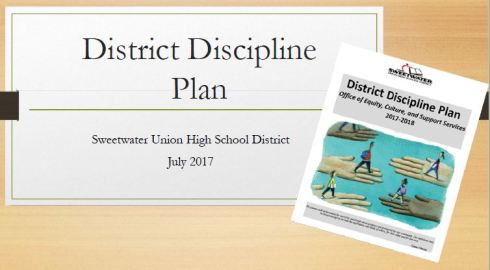
The big news at the July 24th board meeting was that SUHSD starting this school year will be a 100% trauma informed district. A new district discipline policy was presented. The presenter made it clear that this was not a plan in which students can do whatever they want with no consequences, but a constructive plan that includes restorative justice principles. Dr. Joe Fulcher and his team have been working on this plan for the past two years and they feel ready for full implementation in the 2017-2018 school year.

SUHSD Discipline Plan

Only at public schools with elected school boards, is the public allowed meaningful participation. Democracy is messy but it engenders the wisest outcomes. Don’t allow public schools to be stolen from your community by fantasy reform like Betsy DeVos’s siren song of school choice.

Editorial Peddles School Privatization Agenda

16 Jul

By Thomas Ultican 7/16/2017

The San Diego Union editor deserves the bunkum efficiency award for packing so much baloney in a scant four paragraphs. The first sentence of the editorial headlined “Still more bad faith from state ED board” says:

“The State Board of Education’s defining characteristic is its ardent defense of an education establishment more worried about the interests of teachers than students.”

It is true that the education establishment in California does listen to input from teachers and their unions, however, today the establishment is dominated by billionaires like Reed Hasting and Carrie Walton Penner. There are many other establishment powerhouses like the California Charter School Association (CCSA), representatives of the education testing industry and education technology profiteers.

As your newspaper reported, by May, 2016, the CCSA was spending heavily to win seats on the San Diego County Board of Education:

“The political arm of the California Charter Schools Association has spent $220,000 so far on the San Diego County Board of Education election this year, following a difficult period for the independently operated campuses in the region — one that’s been marked by unsuccessful appeals and a string of legal challenges.”

After the recent LA school board election, the LA Times wrote in an article titled “How L.A.’s school board election became the most expensive in U.S. history,”

“It’s an oversimplification to say the outcome was all about money, but charters spent more ($9.7 million compared with $5.2 million), and their candidates finished first in both races on Tuesday’s ballot.”

Clearly these forces for privatizing public schools in California are a significant part of the education establishment. They are anti-teachers’ unions, pro testing and have huge political clout. Governor Jerry Brown, who started two charter schools himself, has vetoed every piece of legislation that proposed any increased accountability on charter schools.

To say the establishment is “more worried about the interests of teachers than students,” is wrong. Or is it just a purposeful lie?

The interests of teachers and students are very similar and neither is getting a fair deal. Teachers and students are in the same overcrowded rooms, using the same facilities and have the same half-hour lunches. No one cares more for the welfare of students and understands more about good teaching than California’s professional educators.

The first paragraph concludes:

“This is once again on display with the state board’s response to the Every Student Succeeds Act, the 2015 federal law that replaced the 2002 No Child Left Behind measure and governs how school systems that receive federal funds must operate. While the new law is much less strict than the old one, it still mandates that schools must be taken over by state governments if they are at the bottom 5 percent of statewide assessments, graduate less than two-thirds of students or have ethnic groups with consistently weak test results.” (bolding added)

Here, I am ready to join with my conservative friends and call for the abolition of the United States Department of Education. Schools should be in the control of parents, teachers and students in the local community. The federal government has no business dictating school policy and especially dictating policy that is a known failure.

In 2009, the Obama administration announced plans to rapidly turn around 5,000 of the nation’s lowest performing schools. It was called the Scholastic School Improvement Grant program (SIG). Today, there is consensus among researchers that SIG was a complete failure. A study by Tina Trujillo, University of California, Berkeley and Michelle Renée, Annenberg Institute for School Reform, Brown University stated one its conclusions:

“Conceptually, one of the most frequent critiques of these studies was that they relied on a single measure of effectiveness standardized test scores. While relying on standardized test scores was methodologically problematic because it falsely assumed that the assessments were valid and reliable, doing so as the sole measure of effectiveness also led to narrow conceptions of student success and the purposes of education ignoring the social, civic, and broader academic aspects of schooling. … Student scores on standardized tests are far too narrow to be the sole indicators of school success in the democratic model of schooling.”

For three-decades, states have been taking over local schools. Unfortunately, we have a three-decade record of failure. Dale Russakoff’s book The Prize tells the story of Newark New Jersey’s thirty-years with state run schools including how they squandered a $100,000,000 gift from Mark Zuckerberg. In Newark, the teachers were never the problem and neither was tenure or the union. It was always corrupt politicians and grinding poverty creating traumatized children. The state only made it worse when it disenfranchised local citizens.

Detroit is another horrifying example of the complete failure of a state led turn around. A Michigan state officials, Barbra Byrd Bennett, is now serving time for taking kick-backs  and the schools are worse off. After two decades of state control we read in the New York Times,

“Michigan leapt at the promise of charter schools 23 years ago, betting big that choice and competition would improve public schools. It got competition, and chaos.

“Detroit schools have long been in decline academically and financially. But over the past five years, divisive politics and educational ideology and a scramble for money have combined to produce a public education fiasco that is perhaps unparalleled in the United States.”

The editor at the Union should be praising not denigrating the State Board of Education for trying to do the right thing in a tough spot. You should be pointing out how the Every Student Succeeds Act (ESSA) is terrible legislation that is more about selling technology, mandating testing and privatizing schools than it is about improving education.

As I wrote to Diane Feinstein, ESSA continues the testing mandate and spends large amounts of money promoting dubious technology initiatives such as “personalized learning” and “blended learning.” If these are truly good ideas they will be adopted without federal coercion. Every student in America is required to take a big standardized test in grades 3 – 8 and grade 11.

The big standardized test is useless. It tells us nothing about the quality of teachers or schools. Peter Greene known for his wonderful education blog, “Curmudgucation”, responded to an essay by Morgan Polikoff (USC Rossier), a long-time Big Standardized Test supporter:

“Polikoff’s problem remains– the BS Tests are junk that provide junk data and damage schools in the process. Accountability is a good idea, but the standards-based high-stakes tests that we’ve been subjected to for the past more-than-ten years are junk, and they do not provide a useful, reliable, or valid measure of school quality– not even sort of. Nor have they helped– not even incrementally.”

Like the way that ESSA supports social impact bonds which profit bankers and 1:1 initiatives which profit the technology industry; mandated testing is fueling the testing industry. These bad ideas are being used to transform tax money meant to benefit students into revenue streams for corporations.

These are the kind of corrupt purposes you should denounce instead of school leaders who are trying to finesse this horrible federal law and our thoroughly unqualified Secretary of Education, Betsy DeVos.

MAD-Magazine-We-the-Unqualified_589a0ac137da99.50962775

Instead, you tacitly support high stakes testing as a way of evaluating schools. You legitimize the federal government and the state of California taking over San Diego’s schools. How big government of you.

Your editorial continues:

“But the State Board of Education is instead on track to approve vague, mushy Every Student Succeeds standards by the U.S. Education Department’s September deadline that appear designed to impede accountability, not guarantee it.”

In May, your paper editorialized with the headline, “Board of Education is missing mark on college readiness.” The lead paragraph said:

“An unsatisfactory process is expected to come to a disappointing conclusion Wednesday when the State Board of Education grudgingly adopts measures to gauge student progress — forced to do so to ensure California receives federal education aid.”

That editorial also emphasized:

But it still requires that schools be taken over by state governments if they graduate less than two-thirds of their students, are at the bottom 5 percent of statewide assessments or have ethnic groups that have consistently weak test results. Under the proposal before the State Board of Education, beginning in fall 2017, schools will be evaluated on high school graduation rates; student results in English and math Common Core tests; gains made by English-language learners; and student suspension rates. Test scores in third-grade reading and eighth-grade math would be given additional emphasis.” (bolding added)

When coercing states to accept Common Core, Arne Duncan said state standards had to prepare students for “college and career readiness.” It was completely up to the states, but the department of education told them that Bill Gates’ Common Core satisfied “college and career ready.” It was a statement based on nothing; no research or historical evidence. In fact, California’s previous standards are widely viewed as better standards than common core.

A core problem is that standards based education is bad education. Along with the common core, the NGSS science standards are bad standards. Most states are moving away from them. So, I am ready to join you in beating up California’s education leaders for adopting bad education policies like NGSS and Common Core. They richly deserve the flogging.

However, it looks like you advocate these education standards and are for standardized testing as the only criteria for measuring schools and holding them accountable. That is just ignorance.

We have a wonderful method for holding schools accountable and giving them a constant path of improvement. In California, it is the Wester Association of Schools and Colleges (WASC) accrediting process. I have been through several WASC reviews and they are thorough and rigorous. A team of professional educators comes to the school and spends a week looking at everything and interviews as many stake holders as possible. Their report comes back with expectations to be met. This is real accountability performed by professionals that know education and can help. Testing is expensive and  worse than useless; it is misleading and destructive.

Your third paragraph says,

“Now The New York Times reports Education Secretary Betsy DeVos has rejected such attempts to game the federal law by other states, upending expectations that she would defer to local control.”

In an interview by EdWeek, the Senator who led the writing of ESSA and is also a former US Secretary of Education, Lamar Alexander, was not impressed. The interviewer writes,

‘”I think we have a case of an assistant secretary who hasn’t read the law carefully,’ Alexander, chairman of the Senate education committee, said in an interview. ‘The heart of the entire law … was that it’s the state’s decision to set goals, to decide what ‘ambitious’ means, to make decisions to help schools that aren’t performing well.’

“The technical, but important back story: Alexander was referring to a feedback letter Botel sent to Delaware on its ESSA plan, telling the state that it hadn’t been ‘ambitious’ enough in setting long-term goals for student achievement, sparking wonky outrage inside the Beltway and beyond.

“The education chairman noted in an interview that ESSA includes language specifically prohibiting the U.S. secretary of education from telling states what their goals can or can’t be—and that 85 senators voted to approve the new law.”

You end with;

“Will this lead to the board to do the right thing and adopt meaningful standards? There is no reason for optimism — because the board has a very different definition of what is the right thing to do than Californians who care about public schools.”

Common Core and NGSS standards and standardized testing are about monetizing schools and privatizing them. It appears that promoting that path is what you mean by “Californians who care about public schools.” Please realize that you and your fellow travelers are working to destroy a great public trust and a main pillar of democratic freedoms for “a few pieces of silver.”

Go Public, Trauma Informed Education and EnCorps

5 Jul

By Thomas Ultican 7/5/2017

A story of intrigue, real education reform and wealthy ignorance.

A film maker, Rita Grant, called asking me to join an expert education panel at San Diego State University (SDSU). She said she found me when reading Diane Ravitch’s blog and thought I would be a good fit. The event was a screening of the film Go Public at EnCorps’ Summer Residential Institute, followed by question and answers with the panel. I was not familiar with EnCorps, Go Public or Rita but nothing ventured nothing gained. So, I went.

I arrived at the Aztec Student Center in time to see about 150 people in matching EnCorps tee-shirts posing for pictures. Apparently, all of them had worked in a STEM (Science, Technology, Engineering and Mathematics) field and were recruited by EnCorps to enter the teaching profession. I was pleased to learn that it wasn’t another fraudulent path to becoming a teacher. Encorps recruits STEM professionals to become teachers or tutors. If they choose to teach, they are must complete an accredited teacher certification course.

EnCorps

I met a wonderful group of people, but their organization’s reason for being is misinformed. It’s another education reform organization created by a well-connected misinformed rich person with little relevant training or experience in education, Sherry Lansing.

To be fair unlike many wealthy education philanthropists, Lansing does have some experience. Her foundation web site says, she “spent four years after college teaching high school English and math at public schools throughout the Los Angeles area.” Lansing graduated with a Bachelor of Science Degree from Northwestern University in 1966. Her short experience is from five decades ago, an era with slide rules, mimeographs and typewriters. Maybe that experience is why – uniquely among wealthy school reformers – she seems to be a friend of public schools.

Lansing is known mainly for her career as a motion picture executive. Her bio at Huffington post says,

“During nearly 30 years in the motion picture business, Lansing was involved in the production, marketing, and distribution of more than 200 films, including Academy Award winners Forrest Gump (1994), Braveheart (1995), and Titanic (1997). In 1992, she was named Chairman and CEO of Paramount Pictures and began an unprecedented tenure that lasted more than 12 years. In 1980, she became the first woman to head a major film studio when she was appointed President of 20th Century Fox.

Lansing writes about founding EnCorps:

“California students rank 43rd in the nation in mathematics and science, according to the California STEM Learning Network. There are fewer than 1 in 6 in-state college students majoring in STEM, despite the fact that there are currently 1.5 million unfilled jobs in STEM fields in California, the STEM epicenter of our nation. How do we explain such sobering statistics?

“The solution to our STEM crisis is both obvious and exciting: Recruit and transition experienced STEM professionals into second careers as math and science teachers. They can both lead and revolutionize our most underserved school districts. Who better to teach and inspire our next generation of engineers and innovators than STEM professionals who have invaluable insight and real life STEM experience?

“This is the mission of the EnCorps Teachers Program, which I founded in 2007.”

Like the studies from the milk industry saying, “it does a body good” or drug companies selling us modernized snake oil, Sherry is citing statistics generated by an organization financed by Google, Cisco, Battelle and Time Warner. It’s wrong. There is not now nor has there ever been a shortage of STEM trained workers in California or America. Just a shortage of STEM trained workers willing to work as cheaply as some CEO’s would prefer.

Here is a quote from a 2013 article in the Columbia Journalism Review and this is not an outlier:

“Figures from the National Institutes of Health, the National Academies, the National Science Foundation, and other sources indicate that hundreds of thousands of STEM workers in the US are unemployed or underemployed. But they are not organized, and their story is being largely ignored in the debate over immigration reform.”

The Institute of Electrical and Electronics Engineers magazine, Spectrum proclaimed “The STEM Crisis Is a Myth.” They counselled “Forget the dire predictions of a looming shortfall of scientists, technologists, engineers, and mathematicians.”

Writing for the James G. Martin Center for Academic Renewal, Jay Schalin observed,

“Everybody knows that the best way to get ahead today is to get a college degree.  Even better is to major in one of the STEM (science, technology, engineering, and math) subjects, where the bulk of the jobs of the present and future lie. Politicians, business leaders, and academics all herald the high demand for scientists and engineers.

“But they are, for the most part, wrong. The real facts suggest that, in many STEM specialties, there is a labor glut, not a shortage.”

“The apparent misinformation continues to this day. Microsoft founder Bill Gates has been particularly vocal about supposed shortages of skilled labor in the computer industry.”

Walter Hickey writing at the Business Insider stated,

“We clearly don’t have a STEM shortage. If we did, rudimentary economics would kick in and show either low unemployment for new majors or a rising price of computer science labor. People wouldn’t say they’re out of the industry because of no jobs.”

Michael S. Teitelbaum wrote a piece for Atlantic magazine titled “The Myth of the Science and Engineering Shortage.” He reported:

“A compelling body of research is now available, from many leading academic researchers and from respected research organizations such as the National Bureau of Economic Research, the RAND Corporation, and the Urban Institute. No one has been able to find any evidence indicating current widespread labor market shortages or hiring difficulties in science and engineering occupations that require bachelors degrees or higher, although some are forecasting high growth in occupations that require post-high school training but not a bachelors degree. All have concluded that U.S. higher education produces far more science and engineering graduates annually than there are S&E job openings—the only disagreement is whether it is 100 percent or 200 percent more.”

So, Sherry there is no STEM crisis, but even a blind old squirrel is rumored to get a nut now and then. There is a looming national teacher shortage. Your organization is contributing to solving that situation and your people are wonderful. I was impressed by the recruits I met at SDSU.

Go Public

The main event of the evening was the screening of “Go Public,” a 90-minute long documentary to which Rita Grant was a contributor. “Go Public” is the story of one day at the Pasadena School District. Fifty film makers contributed segments that started with 5:30 AM alarm clocks going off in student homes and ended with those same students going to bed. It chronicled in detail a May Day in 2013 from the janitor unlocking school gates to students performing in after-school sports and music programs.

If you get a chance, see “Go Public,” do so. For any teacher, the scenes will be as if pulled directly from our own lived experience. “Go Public” shows how amazing public schools are and makes the point that everyone; parents, certificated staff and noncertificated staff, is key to the school’s success.

Rita told me that before she started making documentaries about public schools, she “had been drinking the Kool-aide.” I could relate. Before I started teaching, I believed that many teachers had become low quality burnouts who were failing students. Rita saw through the lenses of her cameras the reality of how amazing public schools are.

I believed I was on a quest to save public schools from “bad teachers.” At my first teaching assignment, I was startled to find nothing but dedication and professionalism. I have taught in both wealthy communities and poor ones, but the one constant has been the high quality of the teaching and dedication of the public-school staff.

Trauma Informed Education

The third member of our three-person panel was Godwin Higa, Principal of Cherokee Point Elementary School. Godwin is committed to “trauma informed education” for which his school is a model. Cherokee Point Elementary, part of the San Diego Unified School District (SDUSD), is in a low-income ethnically dominated neighborhood known for many social problems: gangs, drugs, domestic violence, poverty, murder, incarceration, deportation, etc.

higagirls

One-hundred percent of the students at Cherokee Point qualify for free and reduced lunch and all of the children have been exposed to adverse childhood experiences which are root causes for many issues including cognition being compromised. Principal Higa wrote about his school in EdWeek:

“The impact of childhood adversity and trauma–such as physical and emotional abuse or neglect, or mental illness, addiction or incarceration of a parent or close family member–can last through adulthood. Research shows that children exposed to adversity are at higher risk of chronic illnesses like heart disease and diabetes, learning difficulties in school, contact with the justice system, as well as addiction and economic hardship.”

Rita Grant has pointed her camera toward Principal Higa and the work he and his staff are doing. In this short video(6 minutes), the concept of a trauma informed school and restorative justice are highlighted. Instead of punishment, trauma informed is discipline through respect, dialog and understanding. Hige makes the point that knowing the students, their families and the issues they are living with is vital.

When Higa first arrived at Cherokee Point, he was receiving hundreds of student discipline referrals from teachers and others. In addition, there were several district level policies that mandated suspensions for certain categories of violations. Higa successfully lobbied the district into only enforcing the state mandated automatic suspension for bringing a weapon to school.

During our panel session, Higa said, that he did not suspend any students for the past three years and referrals have reduced to about 20 per year. Some of those twenty referrals were for things like “Phillipe missed breakfast this morning and he seems really hungry.” Mr. Higa said, “Those are the kind of referrals, I don’t mind getting.”

Higa described their method at Cherokee Point in his EdWeek article sited above:

“We follow a trauma-informed model and restorative justice practices that help students learn to cope with adversity and resolutions in a healthy and compassionate way. All of our teachers are trained to proactively engage students and their parents, and collectively create a plan to address both the conflict and the deeper underlying issues. Parent leaders are training other parents about trauma-informed care at monthly workshops. We also have trauma-informed and trained counselors on site who provide intensive support to students who suffer from major traumas that teachers alone are not trained to handle.”

In 2015, SDUSD adopted a plan to became a trauma informed district. Superintendent Cindy Martin was asked if she could see a difference at the pilot schools where trauma informed is in place. She said, “The minute you walk on the campus you can tell. The warmth of the school, the energy of the school and connectedness and kids that want to reach out and talk to you.”

Unfortunately, SDUSD is in a financial crush between the huge stranded costs associated with unplanned charter school expansion and spending on technology. The Voice of San Diego reports on the implementation of restorative justice and trauma informed schools:

“A lack of human and financial resources seems to be behind the slow rollout of San Diego Unified’s restorative justice program, in which students who’ve done something wrong work together with their victims to listen and heal. One district official said San Diego Unified allocates fewer financial resources to restorative justice programs compared with other school districts around the state.”

For more information about trauma informed schools visit the adverse childhood experiences web presence, Aces Too High.

There are some genuine school reforms that excite education professionals and trauma informed schools with restorative justice programs being one of them. It is too bad the billionaires are intent on computer based depersonalized education, blaming teachers for poverty and privatizing public schools. Their enormous wealth could do some good if they listened to professional educators instead of obsessing over their own biased uninformed opinions.

San Diego Schools Embrace Untested “Depersonalized” Learning

21 Jun

By Thomas Ultican 6/21/2017

San Diego Unified School District (SDUSD) is spending lavishly on technology despite their budgets being decimated by California’s unaccountable charter school industry. During the 2016-17 school year, SDUSD bought digital badging and 16,000 new Chromebooks.

“The district is struggling with a projected $124 million shortfall to its $1.4 billion budget, and have issued in the neighborhood of 1,500 layoff notices to full and part-time employees” reports the San Diego Union.

This kind of insanity seems to be a national movement. There is almost no evidence supporting these new theories of technology driven education. Yet, the leaders of financially strapped SDUSD are spending to have their students become experimental subjects for learning products produced by technology companies.

A recent article in the NY Times by Natasha Singer describes how DreamBox (a widely distributed math learning program) is popular with children but not for doing the math but for doing things like spending points to customize their avatar. Singer writes,

“So far there is little proof that such technologies significantly improve achievement. Adaptive learning courseware, for instance, generally did not improve college students’ grades or their likelihood of completing a course, according to a 2016 report on some of these programs by the S.R.I. Education research group.”

“Badges, We Don’t Need No Stinking Badges”

My friend, Tim, graduated for University City High School this year and invited me to attend his ceremony. I went to the school’s website for parking instructions, where I saw this:

Digital Badge

The badge image contained a hotlink to the SDUSD website which notifies the reader:

“Starting winter 2016, San Diego Unified will begin awarding achievement by issuing digital badges. Digital badges are virtual tokens issued as recognition of a skill, or behavior demonstrated, or an achievement a student has earned.”

Much of this informational page is little more than a corporate advertisement with a video claiming how wonderful and popular digital badging is. The instructions for getting started say SDUSD offers ninety-five high school badges and 20 elementary and middle school badges. Students and parents are informed:

“Students will be notified of badges through their Gmail email account accessible through their Google apps for education.”

Elementary and Middle School Badges

SDUSD also informs us that they won’t just be Cub Scout style merit badges. Soon, students will receive “micro-credentials” that will be recorded in their records kept by University of California San Diego extension.

This all looks harmless enough but it is not! Behind the digital badging scheme is a toxic combination of corporate greed and hubris. As digital badging grows, classical teacher led education will be undermined in all but exclusive high end private schools. It is yet another path to education on-the-cheap driven by profit motives instead of pedagogic expertise.

Additionally, badging is a data mining corporations dream come true. Students will lose all semblance of privacy.

Behavior badging in China is explained in this video about gamifying good citizenship. It gives me the creeps; however, behavior modification is already part of digital badging.

Emily Talmage teaches public school in Maine, where badging started a couple years ago. She describes what she’s learned:

‘“By collecting skill-based badges, the record of achievement begun in secondary school becomes the foundation upon which workers build their capabilities and tell their stories to employers,’ explains the infamous testing-behemoth, Pearson Education.

Knowledgeworks recently described the new learning system as an ‘ecosystem,’ in which the role of the traditional teacher will soon be obsolete.

“With major investments from Wall Street, leaders in the online learning, ed-tech, and student loan industries, and even celebrity billionaires like Mark Zuckerberg of Facebook and Reed Hastings of Netflix, the transformation has recently been picking up speed. Meanwhile, political groups on both the left and right are moving the system forward by lobbying for ‘personalized,’ competency-based policies and ‘innovative’ assessment systems.” [Note: Reed Hastings of Netflix is also owner of DreamBox Learning, Founder of Rocketship charter schools and a board member of California Charter Schools Association.]

“Personalized learning” is the Orwellian name given to computer delivered education. It is isolating and devoid of human interaction. There is nothing personal about it. It truthfully should be labeled de-personalized learning.

Adults Engaged with Students are Key to Intellectual Growth

America’s public education system was wildly successful right up to the advent of modern education reform. There were problems but the creativity of America’s students led to cultural, scientific and economic leadership in the world. No other country comes close to matching the US in either Nobel Prizes awarded or new industries created. The non-coercive (no high stakes testing) learning environment of our public schools allowed students to create wonderful respectful relationships with many adults and develop according to their own personality.

Daisaku Ikeda, the founder of the Soka Schools, discusses the importance of teachers in his book Soka Education, “Recognizing each student as a unique personality and transmitting something through contacts between that personality and the personality of the instructor is more than a way of implanting knowledge: it is the essence of education.” Ikeda also mentions that Socrates likened this to being “kindled by a leaping spark” between teacher and student.

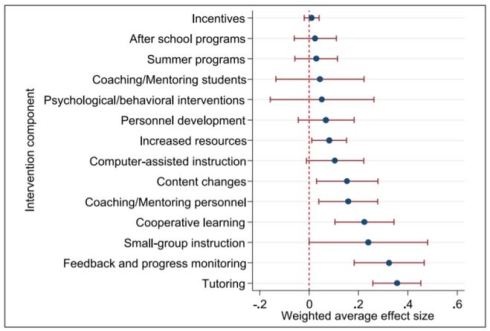
This May, Fredrik DeBoer posted results from a January study by Jens Dietrichson, Martin Bøg and Trine Filges. In his post, DeBoer explains the science behind the study and praises its methodology. He also shares some of the results that are behind a pay wall. The abstract for the report called “Academic Interventions for Elementary and Middle School Students With Low Socioeconomic Status.” states,

“This systematic review and meta-analysis seeks to identify effective academic interventions for elementary and middle school students with low socioeconomic status. Included studies have used a treatment-control group design, were performed in OECD and EU countries, and measured achievement by standardized tests in mathematics or reading. The analysis included 101 studies performed during 2000 to 2014, 76% of which were randomized controlled trials.

Weighted Average Effect Size

This graphic from DeBoer’s post is a comparative graph of the weighted average effect size. The impact of each intervention component is shown in terms of standard deviations on the horizontal axis. The five most effective interventions all require human interaction. If we are led by evidence, then we must admit that the human component in education is crucial.

There are Reasons Education Technology is More Popular than Effective

In 2013, SDUSD created the i21now committee and gave it ninety days to prepare a report on education technology going forward. The committee made up of 104 individuals included Cindy Martin SDUSD Superintendent, several other district executives, seven classroom teachers and thirty-five representatives of corporations and foundations promoting digital learning.

Corporations/Foundations Count
Apex Learning 2
Apple 3
At&t 4
Cisco 2
Cox 3
Dell 1
Houghton Mifflin Harcourt 1
iEngage Mobility 1
Intel Foundation 1
Lenovo 2
Microsoft 3
Partnership for Children 1
Project Tomorrow 1
Promethean 1
Qualcomm 3
Reality Changers 1
SENTRE Partners 1
Time=Warner 2
ViaSat 1
XO 1
Total 35

In general, the teachers and IT professionals who volunteer to be on a technology committees are themselves technophiles likely to be biased. Of course, the representatives of the network, software and hardware corporations who comprise an outsized share of the committee membership are there to promote their products.

Project Tomorrow has a representative on the i21now committee. I have written previously about the influence Project Tomorrow had on the school district where I worked (Sweetwater Union High School District). One of the teacher members of our technology committee sent us all data and brochures from Speak Up praising computer based education and de-personalized learning. Project Tomorrow and Speak Up are both part of tomorrow.org.

More than 90 corporations and non-profits are referenced as financial supporters of tomorrow.org. Included amongst the contributors are both the American Federation of Teachers and the National Education Association.

It is not surprising that the i21now committee mapped a technology path forward that is nearly identical to the positions promoted by large technology corporations and tomorrow.org. The executive summary of their report has 21 bullet point. Here are a few that caught my eye.

“Pursue new funding sources and repurposing current funding by moving expenditures away from textbooks and structured classrooms toward virtual learning, digital content and personalized learning.”

“Provide students with mobile access to broadband connectivity anytime/anyplace, while leveraging resources and partnerships to drive down costs.”

“Ensure sustainable funding to provide access at home and beyond for all students.”

“Support upgraded wireless, wired, and 1:1 environments, plus building systems and VOIP (Voice over Internet Protocol), while ensuring accessibility with digital dashboards and portals.”

“Incorporate reputable online resources and real-time data to differentiate instruction and engage students with real-world content.”

“Implement competency-based learning and problem-solving-based assessment, aligned with Common Core standards.”

The last bullet point calls for competency-based learning. This is not a new idea and it has failed miserably in both the 1970’s and the 1990’s. The theory is that education can be chunked down into discrete learning standards or competencies.

In the 1970’s this theory was called mastery learning. Soon educators were derisively calling it “sheets and seats.” It failed so miserably as a pedagogical practice that it was renamed. In the 1990’s it was called outcome based education. The new name did not help because the theory was still bogus.

Badging and competency-based learning are yet another incarnation of this behaviorist theory of education. Just because it is being done on a computer does not mitigate the fact that it is based on a bad theory of human behavior.

I do not say that education technology and learning programs have no value, but I have never seen an exemplary learning program. At their core, they all eventually become computer based drill and skill. Teachers have known for a long time that this is a bad pedagogical method widely denigrated as “drill and kill.”

The implementation of technology in the classroom will never reach its potential until that implementation and design is led by educators. Some of my friends believe that the badging and competency-based education are an existential threat to public education. I don’t. It is a bad product and parents do not want their children sitting at computer terminals. They expect them to be in authentic learning environments with competent experienced teachers.

Rich people will never accept this enervated method of education for their children.

Credit Recovery Farce Generates Spectacular Graduation Rates

8 Jun

By Thomas Ultican 6/8/2017

A miracle has occurred. America’s high school graduation rates peaked at about 77% in 1970 and then drifted down for almost four decades to 69% in 2007. Astoundingly, even with increased graduation requirements rates have shot up.

Many school districts in California now require all students to meet course requirements for entering the University of California system to graduate from high School. That is a dramatic increase in academic rigor. Yet, in 2016, over 83% of California’s freshman cohort graduated on time. In 2012, 81% of the freshman cohort in America graduated on time. These record setting numbers are the result of knuckleheaded political policy, cheating and credit recovery.

What is Credit Recovery and Where did it Come from?

In the 1990’s politicians like Bill Clinton and Jeb Bush were pushing for standards in education and accountability measures. Jeb Bush’s infamous school grading system called for 25% of a high school’s grade to be based on graduation rates. Bill Clinton wrote in 1998,

“We have worked to raise academic standards, promote accountability, and provide greater competition and choice within the public schools, including support for a dramatic increase in charter schools.”

“We know that all students can learn to high standards, and that every school can succeed if it has clear instructional goals and high expectations for all of its students; ….”

Donald T. Campbell’s 1976 paper presented a theory about social change that is now widely revered as Campbell’s Law: “The more any quantitative social indicator is used for social decision-making, the more subject it will be to corruption pressures and the more apt it will be to distort and corrupt the social processes it is intended to monitor.”

Exactly as the Social Scientist, Campbell, postulated, this national push to increase the standards of school rigor and to use social indicators (graduation rates and high stakes testing) to evaluate schools has introduced distortion and corruption.

How were school leaders going to protect their institutions and their own jobs from the ravages of horribly shortsighted and uninformed education policy? The solution was obvious; teach to the test and find a way to raise graduation rates.

To the rescue, came both the Walton Family Foundation and the Bill and Melinda Gates Foundation along with many other lesser contributors. They perceived it was time for advancing the privatization of public education and accelerating the adoption of technology in education. Credit recovery was a perfect vehicle.

A mouthpiece for these foundations, the Education Commission of the States, explains:

“Credit recovery is an alternative to course repetition for students who have previously failed a course needed for high school graduation. Programs may be offered via computer software, online instruction (including through a state’s virtual high school or a local virtual school) or teacher-guided instruction (small group or one-on-one), and are typically targeted at the standards in which students were deficient, rather than all standards in the original course.

“Programs should be self-paced and competency-based ….”

Another organization significantly financed by Walton and Gates iNACOL (International Association for k-12 Online Learning) promotes a virulent form of computer based education known as CBE. I discussed CBE in a previous post: “CBE is basically outcome based education moved to digital space. Outcome based education was the new 1990’s name given to a previously failed strategy known as mastery education (AKA ‘seats and sheets’).” The fundamental theory of CBE is that education can be reduced to discrete pieces of knowledge. It’s bad theory.

iNACOL also weighed in on credit recovery:

“Our country has been trying to address the graduation crisis in many ways.”

“Today, one of the root issues is the older students who are missing a significant number of credits do not have the time to sit in class again, thus competency-based programs are a better option.”

Echoing the unsubstantiated “Nation at Risk” iNACOL does not see foolish policy or growing poverty leading to stagnate or falling graduation rates. It sees a CRISIS!

With credit recovery students are able to gain graduation credits in as short a time as a day. According to several teacher friends who have taught teacher led credit recovery, there is no real instruction, just filling in packets (“seats and sheets”). I have heard many students say, “I don’t care if I fail, I’ll do credit recovery.” Why not? It’s easier.

How Fraudulent is Online Credit Recovery?

At the high school where I taught this year, I overheard a pair of administrators speaking in hushed tones about the fraud going on in the learning center. In our district, there are twelve learning centers which are technically separate schools. They provide online credit recovery for students who have not earned enough credits. The discussion was about seeing students using smartphones to answer the test questions provided by Apex Learning. The fact that this behavior was being tolerated was what galled them.

As is made clear in a recent series of eight article about credit recovery published by Slate Magazine, cheating on credit recovery is not unique at all.

Zoë Kirsch wrote in her Slate article, The New Diploma Mills:

“Almost 90 percent of school districts use some form of credit recovery, according to a 2011 report from the National Center for Education Statistics (the center doesn’t distinguish between online and other forms). And data cited by the International Association for K-12 Online Learning, a trade group, shows that at least 75 percent of districts use some form of online learning. So, we can say this about online credit recovery: It’s pretty big.”

Kirch’s article also reports that in Nashville, graduation rates increased from 70 percent in 2007 to 81.6 percent in 2015 following the introduction of online credit recovery. Even more stunning, in Los Angeles the graduation rate grew from 54 percent to 75 percent in a single year when credit recovery was introduced in 2015.

A supervisor of credit recovery at East Gadsden High in Florida was informed that some students there were paying one another to do online coursework. When she reported it to the district, an administrator there told her to “leave it alone.” “There’s some things you can’t fix.”

The article “Fast. Isolating. Superficial.” by Stephen Smiley shares,

“She [Elizabeth Bieze, the guidance counselor who oversees the virtual lab at Sullivan High School Chicago] adds that it’s not atypical for students to recover credits for yearlong classes in under a week. ‘They do really well in the pretest, they get to skip a bunch of stuff, and they just take the final exam,’ she says. ‘It has helped our graduation rate immensely.’”

Stephen also found this:

“‘Anyone wanna do a math credit recovery for me I’ll pay you,’ read one tweet posted by a student in Erie, Pennsylvania, in August. ‘If anyone wants to go online and do my chemistry credit recovery I’d be more than happy to give you my username and password,’ wrote another student in Arkansas. Naturally, online learning companies like Edgenuity and Apex insist that most don’t actually follow through and that the chatter is mostly empty boasting.

“That may be so, but I didn’t have too much trouble finding students online who insisted they had cheated without being caught. One of them, Joseph, who is a 17-year-old senior at a Long Island high school in New York, said his online English class was uninspiring, so he paid a buddy $200 to complete it.”

Stephen also wrote a second article for Slate, “I Am an Online Credit Recovery Dropout.” In it he describes a personal experience of taking a few online courses. Stephen concluded,

“But I also came to appreciate what many students had told me about virtual learning: Compared with regular school, there’s less interaction with teachers, fewer opportunities for creative expression, and little chance to bounce around ideas with classmates. While online learning clearly has some strengths (programs can be tailored to individual needs, for instance), it’s hard to get away from an overarching conclusion: The experience as a whole can be pretty boring and lonely.”

Why is Credit Recovery Flourishing?

Francesca Berardi wrote “Take These Students, Please” about online credit recovery in Chicago. Surprising to me, it turns out that former basketball star Magic Johnson is a significant participant in the industry. Francesca notes,

“During Emanuel’s administration, Magic Johnson has become a major player in Chicago’s education world: Bridgescape operates five programs across the city, serving more than 850 students, and as the Chicago Tribune reported, in March 2015 another of Johnson’s companies, SodexoMAGIC, received an $80 million contract to take over janitorial services for several Chicago Public School buildings. Following the contract, Johnson donated $250,000 to Emanuel’s campaign for re-election.

“Not surprisingly, last September, Emanuel announced that in just five years the high school graduation rate had jumped from roughly 50 percent to 73.5 percent.”

‘’’The district is giving high school diplomas for programs that are nowhere near comparable to regular high schools,’ said Troy LaRaviere, president of the Chicago Principals & Administrators Association and a fierce critic of Emanuel’s administration.”

Zoë Kirsch and Stephen Smiley teamed up to write “Why Bad Online Courses Are Still Taught in Schools.” The article opens with this story from Florida:

“Last year, the Florida Department of Education rejected the company Online Education Ventures, which failed to provide descriptions of its virtual courses in science, social studies, and English (it provided descriptions of the math courses, but they didn’t meet state standards). A year earlier, the state disqualified Mosaica Online because the company didn’t show it could provide timely information about its courses. And it said no to Odysseyware, since it failed to outline student anti-discrimination policies or show how its products could meet the needs of students with disabilities.

“But here’s the rub: Those companies are still allowed to sell their products to schools in Florida. Public school districts can still use public money to educate students with discredited products like Online Education Ventures.’”

“The conservative American Legislative Exchange Council has made expanding online learning—unfettered and in all of its forms—one of its priorities. … ALEC has quietly but effectively helped mostly Republican lawmakers pass the kinds of laws the online learning companies want—laws that, for instance, require all graduating high school students to complete at least one virtual class.”

According to Zoe and Stephen, no states are doing a good job of regulating online learning and credit recovery. “As it happens, one of the most rigorous judges of online credit recovery classes is the NCAA. The NCAA’s standard is higher than what any state government requires for its students.”

Some Conclusions and Recommendations

Credit recovery has introduced a corruption into public education.

Online learning is only better than no other alternative. It is lifeless and dull. Some people claim there are ways to make it better, but I seriously doubt that it will ever match a classroom with a teacher to stimulate supervised dialog as a learning vehicle.

The push for credit recovery is a blatant scheme to impose privatized online learning.

Until this corruption has been eradicated, diplomas that are awarded based on credit recovery should have a reduced status to legitimately earned high school diplomas. That will at least reduce the incentive to “get it in credit recovery.”

Of all the increased academic requirements, the requirement for advanced mathematics to graduate from high schools is the most counterproductive. Most college graduates will never have a reason to make a binomial expansion or mathematically describe a conic section. Roll back these stupid requirements. Every student is not going to Berkeley.

Notes:

The five Slate Magazine articles I cited above are more on point for my article but these three articles cited below are also valuable reads.

Bottom of the Class By Francesca Berardi and Zoë Kirsch highlights some of the worst online companies.

Online Education Doesn’t Have to Be Isolating By Sarah Carr discusses some ways online learning can be done well.

Just Take It Again By Stephen Smiley describes how some of the online design makes it easy but not authentic.

I Am Done – I Hope Public Education is Not

24 May

By Thomas Ultican 5/24/2017

June 2nd will be my last day as a classroom teacher. For the past 15 years, I have been teaching mathematics and physics. It has been exhilarating, it has been heart breaking. It reminds me of the way Charles Dicken’s opened A Tale of Two Cities,

“It was the best of times, it was the worst of times, it was the age of wisdom, it was the age of foolishness, it was the epoch of belief, it was the epoch of incredulity, it was the season of Light, it was the season of Darkness, it was the spring of hope, it was the winter of despair, ….”

During my tenure in education, costly efforts were made to improve schools. However, the welfare of country and children were too often ignored in pursuit of new markets. Vast fortunes were spent by philanthropists mostly on foolish and destructive agendas which often appeared self-serving.

In 2010, Rupert Murdock stated, “When it comes to K through 12 education, we see a $500 billion sector in the US alone ….” From one point of view, our commitment to children is laudable, but this huge amount of money has engendered darkness. Integrity and community too often succumbed to greed. Corporate and political leaders regularly bowed to dark human tendencies.

Difficult Time for a New Teacher

In 1998, Prince rereleased “Party like its 1999.” In 1999, I didn’t feel it. I was driving around Silicon Valley ready to move on. The party seemed over. Hearing co-workers drone on about stock options or being regaled by stories of new startups creating instant millionaires got stale. I enjoyed my work but hated the traffic. It was time to go home to San Diego and become a teacher.

By 2001, I was in graduate school at the University of California San Diego. At the same time, Ted Kennedy was teaming up with George W. Bush to federalize public education with the “No Child Left Behind” rewrite of the education law. When, I earned a master’s degree in education, NCLB was the law of the land.

The new federal law mandated standards based multiple choice exams. These exams were completely useless for measuring school or teacher quality or for guiding instruction. The only outcome from these tests with statistical significance is that they accurately identified the economic health of the school’s community.

Standards based testing has been both cynically and foolishly used to claim that public schools are failing thus opening the door to a national tragedy. The world’s greatest public education system and our bulwark for democracy is being privatized. Wonderful and venerable institutions in tough neighborhoods like Crenshaw High are being destroyed. The generational legacy that spawned the likes of Ice-T, Darryl Strawberry and Marques Johnson has been stolen from its community.

My second year of teaching was one of my favorite years. I was given a one year temporary contract to teach at Mar Vista Middle School. I really enjoyed the kids (me and middle schoolers think alike), but it was my interactions with the staff that always engenders fond joyful memories. I was incredulous a few years later, when the middle school was reconstituted because of failing test scores. At the time I wrote about the “Unwarranted Demise of Mar Vista Middle School.”

It seems there was an effort to charterize Mar Vista Middle School, however, the community quickly rejected that. The school was reconstituted by firing half of the staff and reopened as Mar Vista Academy. The only result of the reconstitution was disruption in the lives of teachers, parents and students. The school still serves the same neighborhood. At the high school where I now work, we have seen no substantive change in the readiness of students coming from this feeder school.

I Was Victimized by the First Honored DFER

In the master’s program, we did some student teaching during the first year and then in the second year we were given paid intern positions to teach three classes a day. When that school year ended most of my classmates were offered a position. I wasn’t. It could be that I was not a very good teacher or it might have been that I was 52 years-old and schools wanted younger new teachers.

I finally got a position at Bell Junior High School teaching four sections of physics and one section of honors physics to 9th graders. Each class had 36 students. My classes scored amazingly well on the district end of course exams. They scored especially well at the end of semester 2. San Diego Unified School District has more than 130,000 students. My honors physics class at Bell was the second highest scoring honors class in the district and my 4 regular classes were the top scoring out of the 13 sections of physics at Bell.

Bell junior high school consisted of mostly minority students including many language learners and free lunch recipients. Several or my students were afraid to walk home after school. The neighborhood was that tough. It was at Bell that I started to realize that the experienced teachers were amazing and not the worthless slugs that I had heard so much about.

In her book The Death and Life of the Great American School System, Diane Ravitch wrote about Alan Bersin a lawyer with no education experience being tapped to run what was arguably the top performing urban school systems in America. I have written about the Democrats for Education Reform (DFER) and Bersin. The following citation honoring Bersin is from the DFER web presence (it has since been removed):

“Appointed in 1998 as Superintendent of Public Education of the San Diego Unified School District, Bersin led the eighth largest urban school district in the country. In 2005, Governor Schwarzenegger appointed him as California’s Education Secretary. Bersin led the way as one of the nation’s first ‘non-traditional’ big city school leaders, promoting ambitious reform to raise the quality of education and bolster student achievement. …. Bersin was a founding board member of DFER.”

One feature of the “non-traditional” superintendent’s leadership was fear. At Bell, I witnessed three tenured teachers lose their jobs. Yes, a determined administrator can get rid of a tenured teacher. It appears there were targets for the number of teachers to be fired each year. It also seems that a certain percentage of new hires were required to be given unacceptable evaluations. I suspect being a new hire in my 50’s made me a target.

My final evaluation said that I was not able to control my classes and was not moving them towards achieving standards. The not moving them towards achieving standards comment meant that I could not even apply to be a substitute teacher. Ironically, my evaluation the next year by the principal at Mar Vista Middle School referenced classroom management as a particular strength.

Conclusions and Concerns

Standards based education is bad education theory. In the 1960’s Benjamin Bloom proposed mastery education in which instruction would be individualized and students would master certain skills before they moved ahead. By the 1970’s this idea had been married with B.F. Skinner’s behaviorist philosophy and teachers were given lists of discrete items for their students to master. The “reform” became derisively known as “seats and sheets.”

By the 1980’s corporate leaders and many politicians were turning these mastery skills into standards. In the 1990’s the IBM and former RJR Nabisco CEO, Louis Gerstner, made instituting education standards and standards based testing his mission in life. The result of his almost two decade effort are the Next Generation Science Standards and they are awful. I wrote about them here, here and here.

The other corporate leader that loves the concept of education standards is Bill Gates. Without him, there would be no Common Core State Standards. Bill Gates and Louis Gerstner share two traits, neither of them have any real experience or training in education and the education standards they have forced on America are horrible. I wrote about the Common Core standards here and here.

Vouchers have not led to better education outcomes. Allowing the privatization of public schools is foolhardy. Public schools are wonderful crucibles of democracy where parents have input. Vouchers undermine this democratic principle and they can be misused. Vouchers have been employed to force all taxpayers to fund religious schools and to promote segregation.

This March (2017) a Texas Superintendent of Schools, John Kuhn, informed the Association of Texas Professional Educators about vouchers. “Three different research studies published recently have found that voucher programs harm student learning—including one study sponsored by the Walton Family Foundation and the Fordham Institute, both proponents of vouchers. Students who use vouchers underperform their matched peers who stay in public schools.”

It is in all of our interest to adequately fund public education. Even if you do not want your children to attend a public school. On the other hand, tax money should not be spent on private or religious schools. If parents want that option, that is their right, but it is not the responsibility of society to fund their decision.

Charter schools are bad policy. There are some absolutely wonderful charters schools but the money they remove from the public system is causing significant damage to the schools that serve the vast majority of students.

If taxpayers want to fund charter schools they need to understand that it will cost more than just funding public schools. It costs more money to run multiple systems. Not providing adequate funding degrades the public system – bigger classes and less offerings. In extreme cases like Detroit, we see a complete collapse of both the public and charter systems.

Albert Shanker thought that charters could be used to unleash the creativity of teachers, but once he saw the early direction of the charter movement, he became a charter opponent. In her book School Choice, Mercedes Schneider shares this quote from Shanker:

“A pluralistic society cannot sustain a scheme in which the citizenry pays for a school but has no influence over how the school is run. … Public money is shared money, and it is to be used for the furtherance of shared values, in the interest of e pluribus unum. Charter schools and their like are definitely antithetical to this promise.” (Page 57)

When writing about Schneider’s School Choice I paraphrased her:

“Charter schools have never honestly out performed elected board directed public schools. In some cases, charter schools have gotten relatively good testing results, but on closer inspection these good testing results are not the result of good pedagogy. There are three common practices that help charters look good on testing; (1) instead of a balanced curriculum they focus on preparation for testing, (2) through various techniques, they only accept easier to educate students and (3) they do not back fill when students leave the school.”

Another bad idea is CBE. This big school privatization effort could be called the make Silicon Valley “great again” effort. It is known by various names: one-to-one, personalized education, blended learning, competency based education, etc. Its supporters, like Billionaires Reed Hastings and Bill Gates, are spending huge amounts of money promoting computer delivered education.

In 2010, the President-CEO of the Charter School Growth Fund (a Walton family effort), Kevin Hall, decided to purchase the struggling Dreambox Inc. of Bellevue, Washington for $15,000,000. He subsequently invested another $10,138,500 into Dreambox. [data from 2014 form 990]

A recent National Public Radio report on the Rocketship schools reported:

“Rocketship students often use adaptive math software from a company called Dreambox Learning. The company was struggling when Reed Hastings, the Netflix founder turned education philanthropist and investor, observed it in action at a Rocketship school several years ago. His investment allowed Dreambox to become one of the leading providers of math software in North America, currently used by about 2 million students.”

Reed Hastings is a funder of the Rocketship schools, a board member of the Charter Schools Association of California and the primary owner of Dreambox Learning. What he is not is a highly trained experienced educator.

An Organization for Economic-Cooperation and Development study concludes, “Investing heavily in school computers and classroom technology does not improve pupils’ performance.” The last thing 21st century children need is more screen time.

San Jose State’s education Professor Roxana Marachi provides access to information about the possible health risks involved with screen time and juvenile cell phone use. I recommend her Educational Psychology & Technology page. The CBS news magazine 60 Minutes, recently presented information about tech addiction being purposefully designed into digital devices.

Of course there is a place for technology in education, but that place should be driven by professionally experienced educators and not technology companies looking to enhance profitability.

My biggest take-away is that professional educators should be running education. The Regan era idea that business people, lawyers and Nobel Prize winning scientists were more equipped to lead America’s schools than experienced professional educators was a foolish error. Today, we have an amateur politician rich guy trying to run the country. His lack of experience is showing.

In the same way, insurance salesmen (Eli Broad), retailers (Doris Fisher) and technologists (Bill Gates) are harming America’s schools, because they do not know what they are doing. Experience and training matter in all fields of human endeavor and education is no different.

Shakespeare and the “Ocean Genius”

9 May

By Thomas Ultican 5/9/2017

Fortune smiled on me in April. I was invited to the “Folly Garden Theater” for a benefit supporting theater arts for middle and high school students. The open air theater sits in Walter and Mary Munk’s back yard. We were also celebrating the Bards 453 birthday.

When I arrived three middle schools students were performing a scene from ‘Much Ado about Nothing’ and there was the great man himself giving them his full attention. For the past seventeen years Walter and his wife have opened their home for this event. At 99 years-old, the man the New York Times called the “Einstein of the Oceans” is still encouraging students.

The outdoor theater stage is at the bottom of a terraced incline. Each of the four grass covered terrace levels are wide enough for one row of folding chairs. A large cement balcony with room for more than 50 people tops off the seating. Behind the stage area is an unmolested canyon leading down to the beach at the Scripps Institute, where Walter has been affiliated since the late 1930’s. It is an amazing ocean view in which colorful hang gliders arc gracefully on ocean breezes.

The students were in full costume. In a scene from ‘Henry IV’, the young man playing Fallstaff was particularly amusing in both dress and demeanor. The stage sound system made the flawless delivery of the almost 450 year-old lines by the Bard’s newest enthusiasts easy to hear. Clearly, the students involved had spent many hours perfecting their performances and were truly enjoying their day in the sun. Doctor Munk rose from his wheel chair multiple times to express appreciation for their performances.

This is one of many events sponsored by the San Diego Shakespeare Society. Inspired by the idea “Teach a child Shakespeare at an early age and they can learn anything,” the Society sponsors many events for K-12 students. Amongst the largest of these is the annual event held on the various stages in Balboa Park’s Prado area at which about 500 students perform 10-minute scenes.

The Adults

The emcee for our event was author and performer, Richard Lederer. Among his many credits, Richard founded the PBS show “A Way with Words.” Richard who came dressed for the occasion in a costume topped off by a giant felt hat, seems to feel that his best credits are his champion poker playing son and daughter (Howard Lederer and Annie Duke) and his poet daughter, Katy Lederer.

Mr. Lederer showed off his word mastery whenever he spoke. He was also the fund raiser auctioneer. One of the items he auctioned was poker lessons. He claimed that his having sired two national poker champions was proof of the value his lessons would bring. His light hearted style was a delight.

Alex Sandie, the President of the Shakespeare Society delivered a few brief remarks. Not only did he grow up in Sean Connery’s home town of Edinburgh, he also bears a remarkable resemblance. He lamented bad things coming in threes by noting that he is 3 inches shorter, 30 pounds lighter and $300 million poorer than his famous Scottish doppelganger. For the past 16 years this delightful man has been leading the Society’s effort to educate the public, especially youths.

The “Einstein of the Oceans”

For me meeting Walter Munk was a special treat. And like all truly great people, he was a humble delightful person who shows gratitude and appreciation for any effort. Kasey Kay wrapped up the afternoon by playing some wonderful renditions of Chopin and other classics. Walter was there listening intently and applauding enthusiastically. In one touching moment while Kasey was playing, Walter’s wife Mary stood behind him with her hands on his shoulders – Walter reached up with his left hand and held her right hand affectionately.

In 2015, Kate Galbraith wrote about Walter for the New York Times. She began the article:

“In 1942, with World War II in full swing, a young military scientist learned of the Allies’ plans to invade northwestern Africa by sea to dislodge the nearby Axis forces.

“The scientist, Walter Munk, who was in his mid-20s, hastily did some research and found that waves in the region were often too high for the boats carrying troops to reach the beaches safely. Disaster could loom. He mentioned it to his commanding officer, but was brushed off.

“’They must have thought about that,’ Dr. Munk, now 97, recalled being told. But the young scientist persisted, calling in his mentor at the Scripps Institution of Oceanography to help.

“They devised a way to calculate the waves the boats could expect to face. Their work helped the boats land in a window of relative calm, and the science of wave prediction took off, becoming part of the planning for the D-Day landings in 1944.”

I was standing in the entryway garden in front of the Munk home talking with a friend when we noticed a meter by meter bronze plaque memorializing Roger Revelle. Walter Munk and Roger Revelle are widely considered the two most important scientists in the history of global climate change studies. The meaning behind the plaque is revealed in a 2013 UC San Diego news release about Munk being presented the Revelle award. From the release:

“Commonly referred to as the “greatest living oceanographer,” Munk is widely recognized for his groundbreaking investigations of wave propagation, tides, currents, circulation and other aspects of the ocean and Earth. The 95-year-old scientist is still active at Scripps Institution of Oceanography at UC San Diego. His accomplishments have been recognized by a lengthy list of organizations from around the world. He won the National Medal of Science and the Kyoto Prize in Basic Sciences. He was the inaugural recipient of the Prince Albert I Medal in the physical sciences of the oceans, which Prince Rainier of Monaco created in cooperation with the International Association for the Physical Sciences of the Oceans. Most recently, the Royal Swedish Academy of Sciences announced Munk’s receipt of the Crafoord Prize.

“Yet for Munk, the Roger Revelle Medal is especially meaningful. ‘Roger was my best friend and the person who had the greatest influence on my career,’ said Munk, who received his Ph.D. in oceanography in 1947 from Scripps, where he went on to spend his entire academic career.”

Munk played a lead role in the Acoustic Thermometry of Ocean Climate (ATOC) project. Because sound travels through water at different rates depending on the temperature, Munk realized he could use sound to measure ocean temperatures. It gave him a method for tracking climate change.

Munk and Revelle cemented their long professional and personal relationship during a 1952 year long research voyage. They first went to the Eniwetok Atoll to monitor the hydrogen bomb test for possible tsunami issues. They didn’t find a tsunami but they did have to strip off their clothes and throw them overboard when they were doused with a nuclear polluted rain. This was Munk’s second trip to monitor the effect of nuclear testing on the oceans. He was also at the Bikini Atoll for the 1946 atomic bomb test where he put dye in the lagoons to see where the currents would disperse the radioactive products of the test.

1952 at Eniwetok Atol

New York Times Photo

After the hydrogen bomb test, Munk and Revelle spent many months doing ocean research in the beautiful islands of Tonga, Fiji, Tahiti, and the Marquesas, taking a full year to make their way back to San Diego.

In the 1960’s, the new University of California at San Diego campus quickly gained a reputation as one of the top public universities in America. This was due in no small measure to Revelle and Munk’s ability to recruit top young scientists.  Munk describes how they did it:

‘“Roger was a tremendous recruiter.… He became so interested in the work of these people and what they were doing that he could explain to them how they could do their work better at UC San Diego. He was a genuine participant in their dreams.”’

“Munk reminisced about his role in the recruiting effort. ‘Magically, Roger would turn up at our house with the recruits around martini time,’ said Munk. ‘He would show them the ocean view and we would have the martinis ready.’”

After my afternoon watching Shakespeare at that same house, I can see how effective the recruiting team of San Diego, Munk and Revelle was.

It was such a pleasure to see how great people share their largess. After years of watching pseudo philanthropy harm public schools, it was refreshing to see genuine public spirit on display.

Education Reform That Works

17 Apr

By Thomas Ultican 4/17/2017

The Teacher Powered Schools (TPS) movement has a history of success and is now in more than 100 schools. It won’t make anyone rich but it just might bring a new area of positive growth in the teaching and learning process.

It could be argued that TPS has been around since Socrates. More recently, Debra Meier’s efforts to democratize schools in New York and Boston along with her friend Ted Sizer’s thinking has set a foundation for today’s movement. The modern TPS movement stemming from the 1990’s accelerated in 2012 with the publication of Trusting Teachers with School Success by Kim Farris-Berg and Edward Dirkswager with Amy Junge.

By 1997, Debra Meier could open one of the first TPS schools, Mission Hill k-8 in Boston. Her glowing reputation led school officials who would normally have been quite skeptical to embrace her concept. A case study describes the school’s governance:

“A governing board, consisting of a council that represents parents, faculty, students and other community members, oversees the school to ensure the teacher team continues to meet the needs of students effectively but delegates decision-making authority to the teacher team. The teachers and the principal they selected collaborate on all decisions, including curriculum, staffing, and the school’s schedule. They involve all local education stakeholders in decisions regarding principal selection, determining the school’s mission, and approving staff-developed budget and human resources plans.”

Following 20 years of experience, a local New England news outlet reports,

“According to the Boston Public School District, 32% of students in the district will attend one of four types of teacher-powered or autonomous schools, like Mission Hill next year.”

In 2014 the Teacher Powered Schools initiative was launched. Their reported vision is:

“While the initiative recognizes the many other important efforts focused on teacher leadership and professionalism—for example, offering pathways for advancement without leaving the classroom, amplifying teachers’ voices, and fostering PLCs—its explicit focus is on empowering teacher teams to secure collective autonomy to design and run schools.”

The TPS initiative also provides a list of TPS schools and the following map of school locations.

School Map

 Teacher Powered Schools Have Diverse Supporters

 In a recent article about school choice, the founder of the Center for Teacher Quality, Barnett Berry wrote,

“But let me say, as many other scholars have as well, that the research is clear: ‘There is very little evidence that charter and traditional public schools differ meaningfully in their average impact on students’ standardized test performance.’”

He then commented on TPS:

“Now these are schools worth choosing—and all students should have the choice to be a part of them. Parents and students have choice in the TPS environment, and so do their teachers. In choosing Teacher-Powered Schools, we as a society put the public good back in public education.”

My friend Larry Lawrence instigated me writing this article when he sent me a link reporting on the 2017 TPS conference that he attended in LA. I forwarded the link on to my boss, the Superintendent of the Sweetwater Union High School District, Karen Janney.  She responded:

“I support the premise that TPS is learning and expanding with their work. I especially liked this paragraph:

“Teacher-Powered Schools center on eight practices that include a common purpose and vision, collaboration for the good of the whole school, ongoing learning, individualized student learning, holistic approach to discipline, multiple measures for student performance, teacher evaluation and improvement, and budget trade-offs to serve students.

“In fact, as a district, we are working towards many of those practices.”

Many people have commented on the book credited with accelerating the TPS movement by, Kim Farris-Berg and Edward Dirkswager with Amy Junge, Trusting Teachers with School Success. A few short snippet of these comments follow.

Linda Hammond-Darling, the famed Stanford researcher noted.

“While many school systems push authority upwards to administration and accountability for results downwards onto individual teachers, Trusting Teachers shows us what can happen when authority and accountability are brought together and teachers have a seat at every table.”

James A. Kelly, Founding President, National Board of Professional Teaching Standards observed,

“In this important book, the authors turn education reform upside-down. They propose that teachers be empowered to manage their own teaching and their student’s learning. Let’s put teachers in charge of teaching! The distinct contribution of this book is that it takes the reader into many highly successful schools in which “trusted” teachers already have professional responsibility for teaching and learning.

Michael Petrilli, Executive Vice President, Thomas B. Fordham Institute stated,

“We need ways to press the case for reform without alienating our great teachers, without turning them into the enemy, the problem, and the object of our disdain. This book describes one way to celebrate, engage and empower them.”

Adam Urbanski, President of the Rochester (NY) Teachers Association, Vice President of the American Federation of Teachers, and Founding Director of the Teacher Union Reform Network wrote:

“Unleashing the collective wisdom of teachers is the best hope for improving our public schools. This provocative, sensible and practical book offers concrete evidence that it can be done and, in fact, is being done. And now that we have already tried virtually everything else, let’s do the right thing and turn teacher-run schools from the exception into the norm.”

Education Publications are Noticing

A 2015 article in NEA Today by Mary Ellen Flannery describes the transition to a TPS structure by the teachers of the Reiche Community School in Portland, Maine. Flannery wrote,

“More than five years ago, when a well-liked principal moved along to another assignment, Reiche teachers and their union, the Portland Education Association, worked with district officials to put in place an alternative governance model.”

“Simply put, the teachers took over.”

Flannery declared,

“Although the governance structure may vary among the nation’s teacher-led schools, they all have teachers with a renewed sense of purpose and professional autonomy. ‘Every teacher has a voice here,’ says kindergarten teacher, Kevin Brewster, one of the original teacher-leaders at Reiche.”

Carrie Bakken is a program coordinator and teacher at the Avalon School in St. Paul, Minn., which she has worked at since it opened in 2001. Bakken published an article in edweek about the successes at her charter school opened with a TPS governance model. She asserts:

“With this kind of autonomy for teachers, Avalon School easily retains 95-100 percent of its teachers annually. This high rate of retention allows us to build ongoing relationships with one another, our students, and their families. It allows us to implement a strategic plan and continuously improve our learning program because we know the staff will be there to do the work.

“Best of all, this framework for governance seems to benefit students. Avalon has a higher percentage of students who are proficient on math and reading state tests than the average for St. Paul Public Schools, and each year 75-80 percent of our students go on to attend a post-secondary institution. Some other teacher-led schools around the country have experienced similar success.”

In a US News & World Report article, “A School Without Principals Yes Really,” Allie Bidwell also discusses the view of school principals. He conveys:

“Both Farrace and Gail Connelly, executive director of the National Association of Elementary School Principals, say that while they’re supportive of collaboration between principals and teachers, it’s too soon to tell whether teacher-led schools will be successful on a large scale. Effective principals, they say, know how to harness the talents of teachers within the school and provide more leadership opportunities for them – but it doesn’t happen in nearly enough schools.

“’From our perspective, it’s not a matter of either/or. It’s principals and teachers working in collaboration and leading today’s complex learning environment,’ Connelly says. ‘It takes both to really create the optimum learning environment that can help each and every child succeed.’”

“In Cincinnati, the Hughes STEM High School operates with a principal. But because the purpose of teacher-led schools is to promote teacher autonomy, all decisions are made by teachers in collaboration with the principal, who cannot veto what the teachers decide. The school has a district-approved principal as part of a collective bargaining agreement between the local school board and teachers’ union to ensure collective leadership.”

I did find a very strange article about how wonderful TPS is by Tom Van Der Arc. He praises the concept but nit-pics the term autonomous. Then for no apparent reason other than his need to sell privatizing schools and technology he writes:

”One of the exciting things about the shift to personal digital learning is the explosion of career options for learning professionals — more school models, more learning services, and more ways to contribute. In every other profession, there is a choice of working for a government services, a large private practice, a professional partnership, or as a sole practitioner. Teachers should have the same options.”

Why Isn’t TPS More Widely Embraced?

Perhaps a research paper out of the United Kingdom by Daniel Muijsa and Alma Harris points to the issue. They note that the UK is behind both the US and Australia when it comes to teacher leadership but see similar positive results emerging in the UK. The research found that high levels of engagement and involvement of staff in the developmental work of the school promoted high levels of self-esteem and a willingness among teachers to engage with new ideas. However, they reported some barriers to teacher leadership:

“The study found a wide variety of barriers to the development of teacher leadership. Three main categories emerged from the data. The first of these is the external educational context.”

“The proliferation of top-down initiatives emanating from central government was similarly viewed as stifling teacher initiative and leadership capabilities.”

“The lack of time for teachers to engage in activities outside of classroom teaching and administration appears to be a key inhibitor to teacher leadership, as it is to other educational initiatives.”

“Finally, the role of senior managers in some cases can be seen as a barrier particularly where not all senior managers are willing to relinquish control, where leadership from the head is seen as weak, or where senior managers are poor communicators.”

In February, I wrote “Education Reform Musing” in which I called for democratizing school governance. The TPS movement seems to accord exactly with my idea. And the charter schools that are embracing this philosophy appear to be making a positive contribution to public education in a way congruent with Albert Shanker’s vision.

One to One Initiative Threatens Public Education

27 Mar

By Thomas Ultican 3/27/2017

One to one classroom agendas have a dark side that includes the destruction of public schools as we know them; where teachers and students interact. It’s a dystopian ideology that posits students earning education badges while working in isolation at a digital screen.

This month, the entire staff at my high school received an email from a colleague who recently volunteered to be on our district’s technology committee. The message said in Part:

“In doing research for next year’s Technology Plan I came across some interesting data collected by the Speak Up 2015 Research Project.

“Although this particular data is from 2015 it still makes a lot of great points! Click on the links below, I promise it is a quick read.  Enjoy!”

The email message included three links to infographics provided by tomorrow.org.

What do Parents Really Think about Digital Learning

Looking Inside Today’s Digital Classroom

10 Things Everyone Should Know About K12 Students’ Digital Learning

These infographics claim that to be the result of authentic unfiltered data from respectively; 38,613 K-12 parents nationwide, 38,157 K-12 educators nationwide and 505,676 K-12 students, parents and educators nationwide. Ever since my Viet Nam war experience, I have been less trusting. I seek verification for all claims. I want to know the research methodology and who is paying.

Project tomorrow’s research is based on volunteers who engage with their web site answering survey questions. The web site is mostly an advertisement for implementing digital learning and a guide for how to lobby local schools to implement it. It has an agenda and a profound bias.

There are more than 90 corporations and non-profits listed as supporters of tomorrow.org, the cyber-space marketing address for this group. Many other organizations are lavishly financed by corporations to promote competency based education CBE including Future Ready. In addition to the eighteen largest contributors pictured below, both the American Federation of Teachers and the National Education Association are contributors to tomorrow.org.

Corporations Sponsoring Project Tommorrow

My School District’s technology committee is being influenced by the corporate sponsors of tomorrow.org. Last time the district technology plan was updated (2014) the technology committee was swayed by Project Red which is supported by many of the same corporations as Project Tomorrow and Future Ready. All three organizations promote one-to-one education at a computer screen.

A fellow teacher presciently commented, “The last thing 21st century students need is to be put in front of another screen.

Last year when writing about this same issue, I wrote, “When congress passed the new education law (ESSA), the United States Department of Education (USED) became the nation’s leading education technology sales force.” USED works to sell “blended learning”; “competency based education”; “personalized learning”; “linked learning”; etc. These initiatives have at least four things in common; they all profit technology companies; they all are unproven; they all promote unhealthy education practices; and they overturn a student’s right to privacy.

Competency Based Education (CBE) Updates a Failed Strategy from the 1990’s

Obama’s Education Department was an unabashed supporter of CBE and the new federal education law ESSA provides money to encourage CBE. On the Department of Education web-site, it defines CBE:

“Competency-based strategies provide flexibility in the way that credit can be earned or awarded, and provide students with personalized learning opportunities. These strategies include online and blended learning, dual enrollment and early college high schools, project-based and community-based learning, and credit recovery, among others.”

“By enabling students to master skills at their own pace, competency-based learning systems help to save both time and money. Depending on the strategy pursued, competency-based systems also create multiple pathways to graduation, make better use of technology, support new staffing patterns that utilize teacher skills and interests differently, take advantage of learning opportunities outside of school hours and walls, and help identify opportunities to target interventions to meet the specific learning needs of students.”

This all sounds great except CBE is basically outcome based education moved to digital space. Outcome based education was the new 1990’s name given to a previously failed strategy known as mastery education (AKA “seats and sheets”). Outcome based education failed miserably around the world. The big advantage for CBE is that giant profits are possible for corporate providers, especially technology companies.

I never expected to quote Phyllis Schlafly but she wrote a prescient report in 1993, “What’s Wrong With Outcome-Based Education?” She said:

“Alexander Solzhenitsyn, the famous Russian author and former political prisoner in Soviet Gulags, said in a speech in the mid-1970s: ‘Coexistence on this tightly knit earth should be viewed as an existence not only without wars . . . but also without [government] telling us how to live, what to say, what to think, what to know, and what not to know.’”

“Unfortunately, that’s what Outcome-Based Education is — a process for government telling our children how to live, what to say, what to think, what to know, and what not to know. What the children say, think and know must conform to the liberal Politically Correct ideology, attitudes and behaviour.”

Maybe you dismiss Phyllis Schlafly as a paranoid right wing cook, but this video about how the Chinese are gamifying good citizenship should give you the creeps. Teachers hated outcome-based education, but it was the extreme right that delivered the death blow.

Emily Talmage teaches public school in Maine, where CBE is being piloted. She describes what she’s learned:

‘“By collecting skill-based badges, the record of achievement begun in secondary school becomes the foundation upon which workers build their capabilities and tell their stories to employers,’ explains the infamous testing-behemoth, Pearson Education.

“Knowledgeworks recently described the new learning system as an ‘ecosystem,’ in which the role of the traditional teacher will soon be obsolete.

“With major investments from Wall Street, leaders in the online learning, ed-tech, and student loan industries, and even celebrity billionaires like Mark Zuckerberg of Facebook and Reed Hastings of Netflix, the transformation has recently been picking up speed. Meanwhile, political groups on both the left and right are moving the system forward by lobbying for ‘personalized,’ competency-based policies and ‘innovative’ assessment systems.”

The educator known by his wonderful blog, Curmudgucation, Peter Greene, recently wrote:

“Personalized learning, whether we’re talking about a tailored-for-you learning program on your computer screen or a choose the school you’d like to go to with your voucher, is not about actual personalization. It’s about another path for marketing, a way of personalizing the marketing of the product, the edu-commodity that someone is already trying to make money from.”

There is presently a Tennessee court case asking the provocative question, “does a student have a right to a teacher or is a computer enough?”

What is the Proper Place for Digital Education?

The one-to-one initiative being marketed as personalized learning makes little sense. Having tax payers provide a tablet or laptop computer to every student is crazy. It is obviously not personalized learning any more than correspondence school was personalized learning in the middle 20th century. Some student with unique situations may succeed with cheap on-line learning but as a strategy for most students, there is no reason to think it will work.

Our spending for public education needs to be submitted to a rigorous cost-benefit analysis. As much fun as it may be to give every child a digital learning device, the quality of learning would likely be more improved if the school district used that money to reduce class sizes by one or two students. The one to one digital initiative is an unproven theory for improved education but class size reduction is a proven theory.

However, having sufficient computer resources available for students to use makes sense. It might be a good idea to make classes like keyboarding (typing) available and highly encouraged. My students are amazed when they see me typing without looking at the keyboard. That is a skill that has served me well and I think our students should have that opportunity.

Even cyber-course work could be valuable, if it is not mainly about maximizing profits. In his book, Teaching Minds, the cognitive scientist and pioneer in online learning, Roger Schank, makes the point that good online education costs as much as good classroom education. Class size still matters and the learning project designs must be well thought-out and relative to the particular class of students. However, today’s K-12 cyber-schools are really cyber-frauds.

The bottom line with technology spending and use in the classroom is that very aggressive well financed corporate sales teams see schools as a huge market. In addition, federal dollars are getting earmarked by corporate friendly politicians for technology spending. Therefore, it is prudent to look at how valuable this technology really is and not be swayed by the hype.

It is unlikely that good use of technology in education is going to come from the Bill Gates funded Kahn Academy or Tom Vander Ark. It is much more likely that most of the excellent thinking on use of technology in education will come from America’s classroom teachers. Let’s not be bamboozled or intimidated. It is classroom teachers that know what is valuable for learning.