Big Changes and Controversy in Oakland

4 Jun

By Thomas Ultican 6/4/2025

It is always interesting in Oakland. A new school board with an education aligned majority was accused of firing the popular superintendent, Kyla Johnson-Trammell. There was some reality underlining the unfounded claim but she was not fired. One of the culprits responsible for the claim was my friend and long time Oakland activist, Mike Hutchinson. On this issue, he has aligned himself with the corporatist board faction which is a bad look for his brand.

Siding with Mike on this issue were board members Patrice Berry and Clifford Thomson. Some people might have a problem with labeling Berry and Thomson the corporatist faction however that is exactly how they appear. Empower Oakland and Families in Action supported both of these board members in the recent election. Left Coast Right Watch wrote about the two main leaders of Empower Oakland:

“The digital leadership consists of two people: Gagan Biyani, a tech CEO, and Reze Wong, a venture capitalist. Empower Oakland has deep ties to the crypto community, receiving contributions from Jesse Pollak, the founder of Coinbase, and Ilya Sukhar, a venture capitalist.”

Oaklanside, a local Oakland digital news source, wrote of Families in Action:

“Families in Action previously had a political action committee called the Families in Action for Justice Fund, which evolved out of a group called Power2Families that launched in 2020 to support charter-friendly candidates. That year, the committee received money from individuals like Michael Bloomberg, former mayor of New York City, Stacy Schusterman, an oil heiress and philanthropist, and Arthur Rock, a Silicon Valley investor.”

Patrice Berry is the chief impact officer at End Poverty in California, a nonprofit that advocates for a more equitable economy. Berry obviously has some good instincts. However, she was an advisor to the notoriously anti-public schools Oakland mayor, Libby Schaaf.

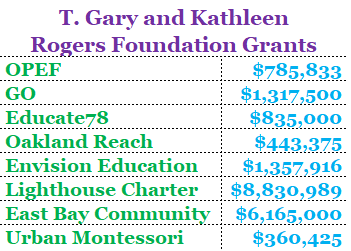
In his first run for the board (2020), Clifford Thomson received contributions from charter schools like Latitude 37.8 High School and Bay Tech Charter. He also was financially supported by the billionaire funded Educate78 as well as leaders from the Rogers Foundation and leaders at the corporate supported Partners In School Innovation.

Creating Chaos and Disunity

At the 2017 Network for Public Education conference in Oakland, I attended a presentation by a group of women who founded Educators for Democratic Schools (EDS). The group was made up of recently retired Oakland Unified School District (OUSD) educators fighting school privatization. Periodically they send me things they publish. Their May 26 report was called “Debunking False Narratives about the Oakland School Board.”

April 10th, Mike Hutchinson defied California rules for school board executive sessions and stated, “The board just voted today to force the superintendent out at the end of the year…” Board President Jennifer Brouhard interrupted him and said he was violating California law. She also tersely stated “The board took no final action.”

Following Hutchinson’s further statements and media coverage, Brouhard clarified:

“There is premature information in the media regarding the OUSD Superintendent transition. If there’s a vote in closed session to end the contract of the superintendent, it must be reported in open session immediately after. As reported out in open session, the board took no final action on the public employment item in closed session.”

Some members of the Oakland community have concluded that Hutchinson has become a toxic board member. Breach of confidentiality is one of the traits of a toxic board member cited by OnBoard.

Hutchinson was not wrong that the board wanted to end the relationship with Johnson-Trammell by the end of the year but calling it forcing her out is misleading.

The previous board worried that when Johnson-Trammell’s contract ended June 30, 2025, that they would be unable to agree on a new superintendent and asked her to stay two more years while they conducted a hunt for her replacement. To incentivize the request, they raise her salary to $640,000 and gave her the option to work on outside-the-district paid jobs. This contract was signed in August, 2024.

EDS reported:

“This year’s new Board majority, which took office in January 2025, had several reservations about the August 2024 contract:

“It required large expenditures in a time of fiscal constraints.

“Some Board members felt the selection of interim leadership was their prerogative.

“The contract gave Superintendent Johnson-Trammell authority but no daily responsibility, while those performing “routine leadership tasks” would have responsibility but no authority.

“Some Board members were concerned that transition planning by a lame-duck superintendent would discourage new applicants for the position.”

Evidently productive negotiations between the board and Johnson-Trammell occurred. On July 1, 2025, Denise Sadler will become interim superintendent. Johnson-Trammell will remain as superintendent emeritus until January 1, 2026. Sadler has for several years served in many administrative roles. She is liked and respected and in the early 1990s, she was president of the Oakland Educators Association.

The Good, Bad and Ugly

Kyla Johnson-Trammell is both revered and despised. In 2003, the state of California forced OUSD to accept a $100 million loan and took over the district. In 2009, the elected school board was reinstated but all budgets had to be pre-approved. Kyla became superintendent in 2017. Under her watch, the big loan has been slowly paid off and this June the final payment will be made which will end extra state and county oversight. In some circles, she is given great credit for this but not so much in others.

One long time pro-public education activist strongly expressed to me how much she admires and respects Kyla. 

I, on the other hand, got a jaundiced view of Kyla when shortly after becoming superintendent she was listed as a member of Jeb Bush’s Chiefs for Change. Throughout her tenure, she pushed to close schools and promoted education technology. Closing schools would bring a very small reduction in costs but remove local public school options from communities that have long been targeted by the billionaire financed charter school industry.

Even in her outgoing remarks, she touted AI as a way to individualize student learning.

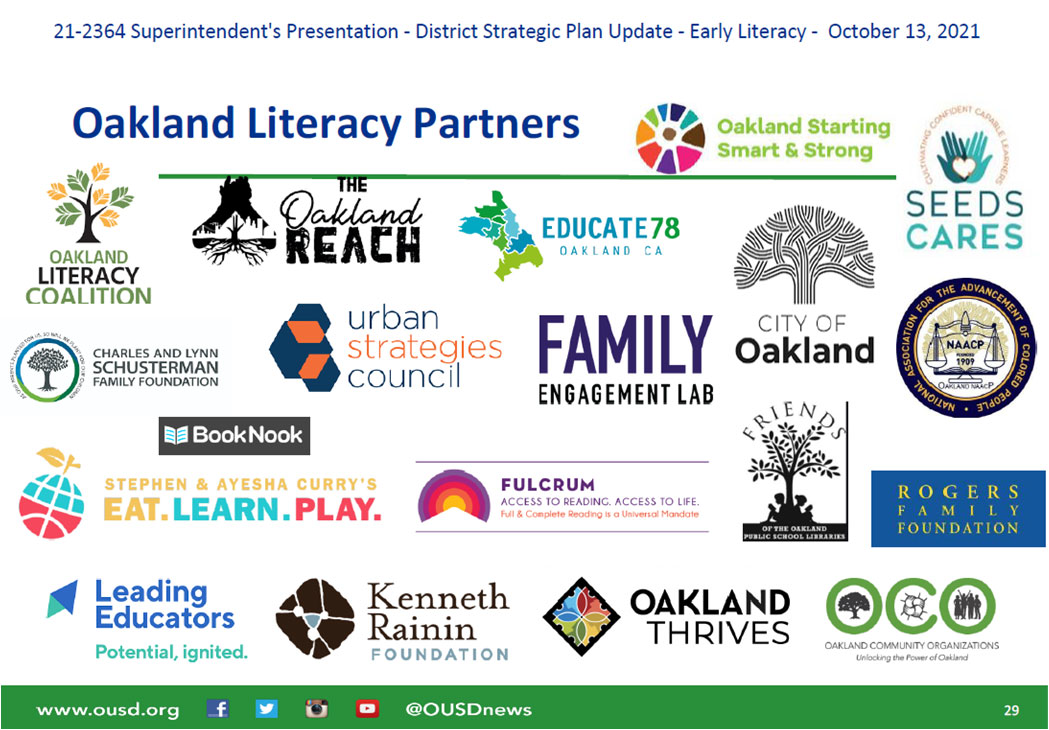
In 2021 Jan Malvin PhD, one of the EDS members, took a close look at the strategic plan update for early literacy. She shared the following graphic from the Kyla’s presentation.

Malvin observed:

“After the Superintendent presented her Strategic Plan Update for Early literacy in 2021, I looked up the 18 organizations on this slide. Of the 18, 13 appear to have a pro-charter schools bias, 1 has a pro-public schools bias (Oakland Public Library); and I was unable to determine any bias for 4 organizations.”

It is good news that billionaire spending on elections and charter schools has receded. Just before November’s election, Ashley McBride reported,

“Oakland school board races draw less spending by political groups this year – In past elections, billionaires, charter school groups, and unions spent heavy supporting and opposing candidates. While the union is still active, other groups are spending less.”

It is also healthy to observe that the relentless charter school growth in Oakland has reversed. The following chart using state attendance data shows the percentage of charter school students in Oakland has been declining since 2019.

There are big problems with this year’s budget that the school board will have to address. School districts throughout California are dealing with declining enrollment which is creating deficits. In Oakland, that decline is almost 5,600 students since 2017 leaving an estimated deficit of $75 million.

I am confident this board majority will put students and staff first when dealing with today’s financial issues.

Congratulations Oakland for getting out from under state control!!!

California Charter School Movement Update

25 May

By Thomas Ultican 5/25/2025

Charter schools continue grabbing larger percentages of California students and have surpassed 700,000 in total enrollment. Their existing in California for more than 30-years means it is probable that some charter school students have parents who went to charters. None of this is because charter schools are superior to public schools or that many California public schools are bad. It is the right wing ideology of “school choice” and massive spending by billionaires driving charter growth. Sadly, it means we are undermining democracy and increasing segregation.

California enrollment data documents the continuing charter school growth. This first chart is of the percentage of charter school students in the state over the past decade.

As the chart shows, charter school students now make up 12.5% of publicly financed students in California.

This next chart is of charter school growth in the 12 largest California counties. It provides insight into where the growth is occurring.

The four counties with more than 16% charter school students are Los Angeles, San Diego, Sacramento and San Joaquin. LA and San Diego are the two largest counties in the state but Sacramento is number six in size and San Joaquin is 11th. The third largest county in California is Orange and it only has a 6% charter enrollment. County population is not a good indicator for where charter schools will spread.

The growth in San Joaquin seems to have two important causes. The largest city, Stockton, is close to charter promoting organizations in Oakland and Sacramento. More importantly, Don Shalvey has always lived on his small ranch near Stockton. During his long education-centered career, he worked with billionaires including Reed Hastings, Bill Gates and Helen Schwab, to privatize public education. In 1993, Don’s San Carlos Learning Center became the first charter school in California and second in America. After retiring from his job at the Gates Foundation, he went to work for a small non-profit, San Joaquin A+, and turned it into a large well financed charter school promoting organization.

Massive Continuous Funding

Soon after legal means were provided for “school choice” by chartering, two organizations were developed to accelerate and sustain California charter schools; NewSchools Venture Fund (NSVF) and California Charter Schools Association (CCSA).

The history tab at the NSVF website states:

“NewSchools Venture Fund was created in 1998 by social entrepreneur Kim Smith and venture capitalists John Doerr and Brook Byers.” (Byers and Doerr are colleagues from the Kleiner Perkins venture fund.)

“We were among the first and largest investors in public charter schools and the first to identify and support multisite charter management organizations, which launch and operate integrated networks of public charter schools.”

Philanthropy Magazine notes that Reed Hastings helped “launch the NewSchools Venture Fund.”

Bill Gates and the Walton Family Foundation are the largest individual donors to NSVF with $226,881,394 of grants documented in Organized to Disrupt. However, this is only a fraction of the total billionaire largess. Besides receiving help from Reed Hastings over the last 20 years, billionaires John Doerr, Laurene Powell Jobs and John Sackler also served on the board.

CCSA is a charter school industry membership and support organization. In 2017, Executive Director of the Network for Public Education (NPE), Carol Burris, published Charter and Consequences. In this yearlong study of the charter school industry, she noted:

“CCSA does not disclose its funders on its website nor on its 990 form, but given its Board of Directors, who makes the list of big donors is not difficult to guess.

“The 2017 Board of Directors include New York’s DFER founder, Joe Williams, a director of the Walton Education Coalition; Gregory McGinty, the Executive Director of Policy for the Broad Foundation; Neerav Kingsland, the CEO of the Hastings Fund; and Christopher Nelson, the Managing Director of the Doris & Donald Fisher Fund. Prior Board members include Reed Hastings of Netflix and Carrie Walton Penner, heir to the Walmart fortune.

“The real power, however, sits in CCSA’s related organization, CCSA Advocates, a not-for-profit 501(c)(4) whose mission is to increase the political clout of charter schools on local school boards, on county boards, and in Sacramento.”

Beyond creating and financing organizations like NSVF and CCSA, a quick peek at any of the non-profit foundations these billionaires own reveals page after page of donations to individual charter schools and charter organizations.

Let’s not forget the $440 million federal dollars ticketed for charter school growth. Last year California’s share was $93 million and this year Secretary of Education, Linda McMahon, has raised that bribe to $500 million. California’s share will likely top $100 million.   

Buying Politicians

This morning the San Diego Union ran Kristen Taketa’s article about insider concerns over a small California charter school network, Elite Academic Academy. Former teacher Eric Shirley who taught home-school students there said he left after 5 years because he found several things fishy about the administration. That included Elite’s CEO, Meghan Freeman, living in a Montana resort town being paid more than $380,000 while founder Brent Woodward was still profiting from the academy.

Taketa shared,

“But Shirley’s biggest concern was that Elite was paying millions of dollars a year to an obscure third-party corporation — one created by Woodard. This corporation not only employs family members of Elite administrators in high-level jobs but also has paid him six-figure sums each year as a consultant.”

Shirley is one of three former Elite teachers who believe their charter network is the latest example of an operator of charter schools exploiting lax charter laws to misuse taxpayer funds.

In 2019, a San Diego Grand Jury indicted A3 charter school leaders for fraud and theft. The A3 Charter School conspirators fraudulently collected $400 million from the state of California, misappropriated more than $200 million and according to the Voice of San Diego’s Will Huntsberry outright stole $80 million. However, no effective measures have been taken since to remediate California’s laws.

Taking advantage of the Supreme Court’s 2010 ruling in Citizens United v. Federal Election Commission case, billionaires have poured huge sums of money into California’s state and local elections. Most of this money hides in independent expenditure groups like EDVOICE FOR THE KIDS PAC; CALIFORNIA CHARTER SCHOOLS ASSOCIATION ADVOCATES INDEPENDENT EXPENDITURE COMMITTEE; CA CHARTER SCHOOL ASSOC INDEP EXP COMMITTEE; EDVOICE INDEPENDENT EXPENDITURE COMMITTEE; KIDS FIRST, SUPPORTING KELLY GONEZ, NICK MELVOIN, AND MARIA BRENES FOR LAUSD SCHOOL BOARD 2022 and KIDS FIRST, SUPPORTING TANYA ORTIZ FRANKLIN FOR LAUSD SCHOOL BOARD 2020.

Most of this Money went to LA School Board Elections

In 2019, James Walton of Arkansas made contributions to 29 California legislative candidates plus Reed Hastings provided contributions to 69 local and state political candidates. These are examples of billionaires buying influence.

A New Effort

California Assembly Bill 84 sponsored by Robert Garcia [D] and Al Muratsuchi [D] was voted out of the Assembly Committee on Education by a party line vote and forwarded to the Appropriations Committee on Friday (5/23/2025). The Assembly Appropriations Committee analysis summarizes:

“This bill establishes new requirements for charter schools and nonclassroom based (NCB) charter schools regarding auditing and accounting standards, and the funding determination process. This bill adds requirements to the contracting process, limits authorization of NCB charter schools by small school districts, makes changes to the authorizer oversight process, and clarifies that charter schools are subject to specified teacher credential and salary expense requirements.”

Since the criminality of the A3 charter organization, bills to solve the lack of charter school oversight in California have been proposed regularly. This time around, The Assembly Committee on Education Analysis lists almost 200 charter schools dutifully opposing the new bill.

The billionaire backers of “school choice” dislike lawmakers working to safeguard taxpayer supplied education dollars. Will the plutocrats win again or will Californians finally be protected from criminal education enterprises?

Nichiren and the Opening of the Eyes

18 May

By Thomas Ultican 5/18/2025

My just published book, Nichiren and the Opening of the Eyes, is probably a bit of a surprise for public education advocates. For the past 15-years, I have been one of the loudest voices fighting against the demise of taxpayer funded free universal public schooling. However, long before I became an education advocate, I embraced Nichiren’s philosophy.

Strangely enough, I have been working on this book the entire time that I have been an outspoken advocate for public education.

The first paragraph of the book’s introduction shares:

“In February 1969, I was walking down Broadway in San Diego, California when a Japanese woman approached me. She spoke almost no English, but I understood her to say, “World Tribune; Buddhist discussion meeting; you go.” That was my first encounter with Nichiren and his declaration that chanting Nam-myoho-renge-kyo opened the path to Buddhahood, personal happiness, and world harmony.

In 1969, I was not the only one who had never heard of Nichiren Buddhism. Scholar Daniel Montgomery reported that in the 1930s, a Japanese monk chanted Nam-myoho-renge-kyo while his new friend Gandhi beat a chanting drum. Montgomery also stated that many self-help and new-age religious movements teach ideas that originated with Nichiren, but they often do not know the source.

My book is a biography of this 13th century Japanese monk whose tale rivals that of any historical figure. He came close to a violent end at least four times while spreading his message of Buddhist reform and human salvation. Living in a samurai-dominated society, this oracle once had an astronomical event save him from the executioner’s sword.

This is the most comprehensive biography of Nichiren ever produced in English.

I traced the life of a boy from his humble fishing village to his establishing what has become a world religion, now known as Nichiren Buddhism. Such a large percentage of the Japanese population started following Nichiren that rival Buddhist sects and governing authorities went to extraordinary lengths to thwart him.

In 13th century Japan, Nichiren joined Esai, Hōnen, Shinran and Dōgen as founders of new sectarian movements. Esai and Dogen established, respectively, Rinzan Zen and Sōtō Zen. Hōnen founded the Pure Land Sect and Shinran, the True Pure Land Sect. These schools founded by the five Buddhist monks, known as the “Kamakura reformers,” survived throughout the past 800 years.

Today, it is only Nichiren’s teachings that have moved past just surviving to stunning worldwide growth.

His philosophy was suppressed after he died, but along with all other Buddhist schools allowed to propagate with the advent of Meiji Imperialism in 1868.

Nichiren was a forward-thinking man with surprisingly modern views. It is remarkable to discover that many of this Dark Ages’ Japanese monk’s most important disciples were female, in a time when women were treated like property. He accepted the equality of the sexes as common sense and accorded women a respect equal to that given his male followers.

Nichiren was a prolific writer and his disciples went to considerable lengths to preserve his messages. Today, over four hundred of his letters and treatise are extant, including 146 in his own hand.  These were the backbone documentation for this project.

After 15-years, the book has finally arrived.

A Personal Journey

A press release referred to me as a veteran student of the Soka Gakkai indicating my background in Buddhist study. They asked, “How did a guy who grew up on a ranch in Idaho become a Buddhist?”

I was a 19 year-old sailor just returned to San Diego from a 9-month Southeast Asia tour on a Destroyer. We mostly worked in the Tonkin Gulf off the coast of Viet Nam. When walking past a small long-gone downtown park, Horton Plaza, I encountered the Japanese woman mentioned above. I was a little interested and too young to go to the bars, so I went with her. We arrived at a small former church where I met a guy who told me that by chanting Nam-Myoho-Renge-Kyo he was able to get a driver’s license in spite of five drunken driving charges. At the time, I was thinking this does not sound like a good thing.

The timing was right for me. Most of my buddies from the ship were over 21 and out in the bars doing the kind of sailor things we used to do together in the Philippines, so I would go to that little church and hangout. I was pretty sure it was a cult but was inexpensive and friendly. Every night the members would chant for about an hour to be successful. I thought chanting was fun and would join in. It turns out that anyone who chants Nam-Myoho-Renge-Kyo for any reason will start experiencing its power.

That is how I became a Buddhist. I was having great luck finding parking spots and getting green lights. More importantly, I was struck by the sincerity of the local members.

Since that time, I have had many much more profound and eye opening personal experiences but those early parking spots near the main entrance at the 32nd street naval station were important for my Buddhist journey.

Motivating the Writing

In 2010, I was reading an article by our international president, Daisaku Ikeda, in the SGI-USA publication, World Tribune. Ikeda, who I viewed as my teacher, encouraged all youth division members to write about Nichiren Buddhism. I decided since I was only 60 that I qualified as a youth and would work on a paper about Nichiren’s amazing treatise, “The Opening of the Eyes.”

I was teaching 150-170 high school students in math and physics so my paper made slow progress, but after a year, I started expanding the context. The more I worked on the piece, the more I looked at Nichiren’s overall life. Finally it occurred to me that I had never seen a complete biography of him. That is when I decided to write this book.

Now that it is done and in print, I am pleasantly surprised by how much I like it. Whether Buddhist or non-Buddhist, readers of this book will learn a lot and enjoy the read.

To find the book, go to Amazon and type: Ultican

Promoting Vouchers to Destroy Public Education

15 May

By Thomas Ultican 5/15/2025

It is clear that the motive for financing voucher adoption has never been about improved education or democratic principles. Pro-voucher billionaires are using their stolen opulence to end taxpayer funded education for all. Vouchers are their most effective tool in this venture.

The latest mania is a wild scheme to give parents bank accounts from which to pay for their children’s education. These so called education savings accounts (ESA) are not really vouchers. They just directly transfer public money to private citizens while shunning accountability measures.

What could possibly go wrong?

ESAs used to be systems like the Coverdell ESA or the 529 tax advantaged plans where a parent put money in an account for their child’s higher education. Today, ESAs are states giving money directly to individuals and telling them to use it to educate their children almost any way they see fit. Wealthy people, who send their children to private schools, now get a nice chunk of change from the state.

Writing in the billionaire funded education propaganda channel, The 74, Jeb Bush is ecstatic about the new ESA voucher program just arm twisted into existence by the Texas governor. Bush declares:

“After decades of debating private school choice, Texas has delivered a monumental victory for its students and families. With the passage of a $1 billion education savings account (ESA) program, Texas joins a growing list of states giving parents real power to customize their children’s education. But this is more than just a win for Texas families — it is a moment of national significance that can reshape how ESA programs work across the country.”

All of the hyperlinks, in Bush’s declaration, are to former articles from The 74 pushing school privatization.

Abbott Lying to Texans about Vouchers

Why is it that when given a chance to vote on vouchers, people always vote against these “monumental” victories? Before billionaires destroyed their political careers, even Republican politicians from rural Texas opposed vouchers. They could see that the only winners would be wealthy people in cities like Dallas. Where rural people live, there were no privates schools to take vouchers. The ESA scheme transfers wealth from rural areas to urban areas by underfunding public education to pay for vouchers.

The Economic Policy Institute reported in 2023, “An analysis of voucher programs in seven states found an unmistakable trend of decreased funding for public schools as a result of voucher expansion.”

Texas Can Expect a Fraud Fest

The right-wing Texas Policy Research champions ESAs and informs:

“Education Savings Accounts (ESAs) represent a more flexible alternative to vouchers. Instead of directing public funds solely toward private school tuition, ESAs allow parents to use the money for a variety of educational expenses. ESAs function like a debit account that parents can use to pay for tuition as well as other approved education-related costs, such as tutoring, online courses, special education services, and homeschooling resources.”

There are two big problems with this approach. Instead of the school, private or public, managing their child’s education now parents who normally have no training or expertise in education must do it. Secondly, handing out money to thousands of parents for their children’s education is a giant management problem. Fraud and abuse are guaranteed.

In February, two Phoenix men 21 and 20 years-old were convicted of voucher fraud. They pleaded guilty to money laundering, agreed to pay $196,526.33 in restitution and were given supervised probation. 

Two Colorado residents, Bowers and Hewitt, were recently indicted for submitting fraudulent applications for 43 “ghost” children.

Just over a year ago, three employees of the Arizona Department of Education and two others were indicted for fraud, conspiracy, computer tampering, illegally conducting an enterprise, money laundering and forgery related to the ESA Program.

The defendants approved ESA applications for minor students, both real and fictitious, and admitted them into the program by using false, forged or fraudulent documentation such as fake birth certificates, and falsified special education evaluations. The defendants approved and funded these fictitious student’ ESA accounts and expenses for reimbursement which went to their own benefit.

Save Our Schools Arizona summarized an ABC15 receipts study documenting extravagant ESA spending by parents:

  • $3,400 for one purchase at a golf store
  • $10,000 for one purchase at a sewing machine company 
  • $19,000 for more than 100 passes to Arizona Snowbowl Ski Resort
  • $100,000 for extravagant appliances that freeze dry food which cost $3,000 each
  • $350,000 for “Ninja Warrior” training centers, trampoline parks & climbing gyms
  • $400,000 for trendy, indoor hydroponic tower gardens that cost $1,000 each
  • $1.2 million for martial arts instruction

Save Our Schools Arizona also reported on ESA Director John Ward’s explanation:

“Even a $4000 piano for a single family? Director John Ward explained, ‘These are absolutely allowable. Now, if it was a luxury piano, some type of grand piano, baby grand, we may not approve that as a luxury item.’ So, ‘luxury’ pianos aren’t approved, but what about ‘luxury’ driving lessons in BMWs and Teslas? According to Ward, ‘while you may think this may not be a good use of that family’s ESA funding, at the end of the day, they get a fixed amount of money, and if that’s how they’re going to choose to use it, that’s their prerogative.”’

Most people hope that responsible public servants would not create this kind of unaccountable taxpayer funded system but that is the nature of the ESA voucher scheme. Arizona’s ESA program, which now serves over 70,000 students across the state, is staffed by 32 employees. 

Failed Policy

Josh Cowen writing about vouchers in his book, The Privateers states, “The purpose was and is to do away with schools existing as a core function of democracy and stand up instead a privately held, sectarian, and theocratic version of publicly funded education.” The results with vouchers the past 20-years have been abysmal. From an education policy standpoint, no one would recommend continuing with them.

In February 2017, Kevin Carey’s article in the New York Times was a rude awakening for voucher hawking billionaires. He reported on three voucher studies.

The first was a 2015 voucher study in Indiana that showed significant drops in math results.

This was followed by results from a Louisiana study showing voucher students having huge comparative losses in both English and Math. Carey wrote, “Martin West, a professor at the Harvard Graduate School of Education, calls the negative effects in Louisiana ‘as large as any I’ve seen in the literature’ — not just compared with other voucher studies, but in the history of American education research.”

Finally the conservative think tank, Thomas B. Fordham Institute that is a proponent of school choice, did a Walton Family Foundation financed study of a large voucher program in Ohio. They reported, “Students who use vouchers to attend private schools have fared worse academically compared to their closely matched peers attending public schools.”

Reviewing these and other results prompted Professor Cowen to remark, “… the evidence against vouchers is actually overwhelming.”

Conclusion

The only reason vouchers schemes are gaining ground is because billionaires like the Walton Family, Betsy DeVos and Charles Koch are spending lavishly to make it happen. They target Republican politicians, who oppose vouchers, by funding primary challengers. They have created and funded the state policy network (SPN).  Influence Watch reports, “The SPN has close ties to the American Legislative Exchange Council (ALEC) with the two organizations sharing many members, and the SPN supporting policies formulated by ALEC and its members.” SPN is a network of 167 conservative and libertarian think tanks throughout the United States and Canada which coordinate efforts to support billionaire policy goals, raise funds, and amplify the influence of its members.

One billionaire policy goal is to end free universal public education.

SPN is an anti-democratic movement created to subvert the will of people. There has never been a voucher program to win an election. Vouchers only occur where Republican politicians can ram them through state legislatures and then fight tooth and nail to keep them off ballots.

The billionaire created voucher movement is harming American students and undermining democracy.

DEI is NOT a Marxist Plot – It’s a Map to Justice

7 May

By Thomas Ultican 5/7/2025

Donald Trump kicked off his anti-DEI campaign during his first term by signing Executive Order 13950 which prohibited federal agencies and contractors from conducting DEI-related training. Now, he is back to complete his racist plan with new executive orders. Christopher Rufo and Robby Starbuck appear to be the phony intellectual heft behind his benighted agenda.

Many right-wingers are out to end Diversity, Equity and Inclusion (DEI) programs. The world’s richest man, Elon Musk, wrote on X, “DEI is just another word for racism.” Musk’s central complaint is DEI unfairly harms White people. Billionaire hedge-fund manager, Bill Ackman, wrote, “DEI is racist because reverse racism is racism, even if it is against white people.”  However, there is a long history of non-Whites in America not getting into schools or being hired when they clearly had the better credentials. Apparently this does not a concern to these White billionaires.

Rufo claims about DEI, “It’s the old Marxist idea of treating people unequally in order to equalize their outcomes.” Sadly, on the MAGA right, the politics of “red bating” has been rescued from Joe McCarthy’s ash heap. Calling someone a “commie” is a weak argument against DEI.

McKinsey & Company is not known to be an ultra-leftist organization still they provide a useful definition of DEI:

Diversity is defined as having a presence and representation of people who are different. This includes but is not limited to race, gender, disability, religion, sexual orientation, political affiliation, age, languages, and nationalities.

“Equity, which is often confused with equality, is defined as the act of implementing processes that are just and fair across the various groups of people.

“Inclusion is the state in which all groups feel included because they are recognized and receiving beneficial access to programs, systems and power and are not discouraged due to their personal characteristics. As these three definitions are combined, one can see evidence that DEI is needed.”

In the corporate world McKinsey & Company is not alone. Taylor Tedford of the Washington Post reported, “In his annual letter to shareholders this year [2023], JPMorgan Chase CEO Jamie Dimon emphasized that DEI ‘initiatives make us a more inclusive company and lead to more innovation, smarter decisions and better financial results for us and for the economy overall.’”

Boston Consulting Group is another entity not known for its leftist tendencies. It says DEI initiatives can boost profits, reduce employee attrition and increase employee motivation. This comes from their research based on data provided by more than 27,000 employees in 16 countries.

The fact is non-White males and women are not competing on a level playing field when it comes to hiring, admittance to training programs or gaining promotions. DEI programs work to rectify this. Now, the President is claiming it to be a “WOKE” agenda of liberals working against White people. That is simply a lie.

Rufo and Starbuck

Christopher Rufo was born August 26, 1984 and grew up in Sacramento, California. His path to fame and power in rightwing politics opened while he was a research fellow at the Christian think-tank, Discovery Institute. This small Seattle institute is most famous for promoting “intelligent design” in high school science classes and opposing Darwinian Theory.

In her book School Moms, Laura Pappano shared about Rufo:

“In ‘White Fragility’ Comes to Washington,’ Rufo claimed that diversity trainings at several federal agencies were part of ‘the creation of a new, radical political consciousness.’ He also miss-defined this new consciousness as CRT, writing, ‘Critical race theory—the academic discourse centered on the concepts of ‘whiteness,’ ‘white fragility’ and ‘white privilege’—is spreading rapidly through the federal government.’ The erroneous definition of CRT caught on. Rufo tweeted about it. Then, on August 17, 2020, Rufo was a guest on Fox’s Tucker Carlson Tonight, where he described critical race theory as spreading ‘like wildfire’ across American institutions.”’ (Page 77)

A few weeks later, Rufo, back on Carlson’s show, claimed, “Conservatives need to wake up that this is an existential threat to the United States” and looking into the camera stated:

The president and the White House, it is within their authority and power to immediately issue and executive order abolishing critical race theory. I call on the president to immediately issue this executive order.” (Page 78)

Amazingly, President Trump complied two days later.

Robby Starbuck is part of the Millennial Generation (also known as Generation Y) born 2/27/1989. He claims his mother and grandparents fled Cuba during the 1960s to escape the Castro regime. Starbuck began his career in Hollywood where he started a production company and worked on commercials, films and music videos for artists like Akon and Smashing Pumpkins.

Starbuck has become a leader for right-wing hostility to DEI programs, climate science and LGBTQ rights.

He claims corporate policies to slow down the effects of human-caused climate change do “nothing positive for society.” Starbuck says the climate has “always changed” and human beings have “very little control” over it. In their article about his activism, CNN states:

“This is false. It is the overwhelming consensus of scientists that human-generated fossil fuel pollution – what comes from burning coal, gas and oil – is the primary cause of global warming.”

He was an out spoken Republican in 2015. After not finding much support for his political ideology in California, He and his wife Landon moved to Tennessee. CNN reports, “Landon Starbuck has been a leading advocate in Tennessee for right-wing causes like banning both transgender-affirming medical care for minors and drag shows with children present.”

Starbuck hits on all of the right-wing agenda including during the pandemic when he campaigned against Covid-19 masks and vaccine mandates.

He asserted to CNN that corporate DEI programs are “evil” and a “Trojan horse for pushing leftism.”

Rufo and Starbuck are the brain trust behind President Trump’s anti-DEI posture.

A Map to Justice

In his Book Dangerous Learning, Derek Black laid out the almost two centuries of efforts to undermine black education.

The landmark case of Mendez v. Westminster in 1947 challenged the segregation of Mexican-American students in California schools. The treaty of Guadalupe Hidalgo in 1848 brought vast areas populated by Mexicans (present-day California, Arizona, New Mexico, Nevada, Utah, and parts of Colorado and Wyoming) into US control. Soon White populations turned intensely anti-Mexican and until the California case, Mexican children were segregated away from White students.

After the completion of the transcontinental railroad, Chinese immigrants who worked on the western end of the endeavor were looking for new opportunities. White westerners terrorized them away from their communities.

American Indian children were taken from their homes and put into reeducation camps aimed at destroying their Indian culture.

These acts were not because White people are so terrible. It was the fruit of ignorance. Never before had so many disparate cultures interacted. By dint of numbers and wealth, White people dominated. Physiologists tell us about three phenomena that promote racism; “categories, which organize people into distinct groups; factions, which trigger ingroup loyalty and intergroup competition; and segregation, which hardens racist perceptions, preferences and beliefs.”  These are all naturally occurring and the only solution to them is education.

A note of warning to the left is Harvard Professor Danielle Allen’s observation:

“Across the country, DEI bureaucracies have been responsible for numerous assaults on common sense — certain mandatory diversity training initiatives come to mind — but the values of lowercase-i inclusion and lowercase-d diversity remain foundational to healthy democracy.”

Yes, it is true that liberals can be just as boneheaded as right-wing ideologues. That said, being opposed to climate science is really stupid and opposition to all DEI initiatives is the same as supporting White nationalism.

San Diego’s Edtech Lollapalooza

29 Apr

By Thomas Ultican 4/29/2025

Titans of the digital universe and their minions gathered at the ASU+GSV conference in San Diego April 6-9. There was a lot of self-promotion and proposals for creating new education paradigm based on personalized learning powered by artificial intelligence (AI) were everywhere. This year it is almost impossible to find any reporting from the event by “negative Nellies” like myself, on the other hand there are many positive references like Forbes calling it “the Davos of Education.”

MRCC advertises itself as having “25+ years of experience designing and deploying innovative eLearning solutions in collaboration with the brightest thinkers.” On April 21, their Senior Director, Learning Solutions, Kevin Schroeder, published Top Five EdTech Trends from ASU+GSV Summit 2025.” His list:

“1. AI Is a Fundamental Literacy”

“2. Equity in Educational Technology Must Be Intentional”

“3. The Shift to Skills-Based Credentialing”

“4. AI-Driven Storytelling Platforms Gaining Traction”

“5. Collaboration Drives Innovation”

Under point one, he says AI is “a basic literacy on a par with reading and math.” This is surprising to me. I did not realize math was a basic literacy and whatever makes AI a basic literacy is truly puzzling.

It seems like points 2, 4 and 5 were just thrown in with little purpose. I agree edtech should strive for equity but wealthy people are not likely to want their children burdened with it. AI is known for plagiarism so I guess it makes a small amount of sense as a storytelling platform. As far as point 5 goes, if they can get students, teachers and parents to collaborate, it will drive sales.

Point 3 is particularly concerning. Schroeder states:

“Traditional academic transcripts are being replaced and/or supplemented by digital credentials that recognize hands-on skills and real-world experience. Apprenticeships, internships, and project-based learning are now key markers of learner growth.”

At the 2023 ASU+GSV conference, Carnegie and ETS announced a new partnership to create functional testing for competency based education (CBE). The Wellspring Project is one of the entities angling to profit off this scheme.

A Cision PRWeb report states,

“The first phase of the Wellspring Project, led by IMS and funded by the Charles Koch Foundation, explored the feasibility of dynamic, shared competency frameworks for curriculum aligned to workforce needs. … Using learning tools that leverage the IMS Competencies and Academic Standards Exchange® (CASE®) standard, the cohorts mapped co-developed frameworks, digitally linking the data to connect educational program offerings with employer talent needs.”

Because of the limitations put on learning by digital screens, the only reasonable approach possible is CBE. Unfortunately there is a long negative history associated with CBE. The 1970’s “mastery learning” was detested and renamed “outcome based education” in the 1990s. It is now called “competency based education” (CBE). The name changes are due to a five-decade long record of failure. It is still the same mind-numbing approach that 1970s teachers began calling “seats and sheets.”

CBE has the potential to increase edtech profits and reduce education costs by eliminating many teacher salaries. Unfortunately, it remains awful education and children hate it.

One justification for CBE based education is a belief that the purpose of education is employment readiness. Philosophy, literature, art etc. are for children of the wealthy. It is a push toward skills based education which wastes no time on “useless” frills. Children study in isolation at digital screens earning badges as they move through the menu driven learning units.

In 1906, Carnegie foundation developed the Carnegie unit as a measure of student progress. It is based on a credit hour system that requires a minimum time in class. Schools all over America pay attention to the total number of instructional minutes scheduled. A 2015 Carnegie study concluded, “The Carnegie Unit continues to play a vital administrative function in education, organizing the work of students and faculty in a vast array of schools or colleges.” Now, Carnegie Foundation President, Tim Knowles, is calling for CBE to replace the Carnegie unit.

Education writer Derek Newton writing for Forbes opposed the Carnegie-EST turn to CBE for many reasons but the major one is cheating. It is easy to cheat with digital systems. Newton observed, “But because of the credit hour system, which is designed to measure classroom instruction time, it’s still relatively hard to cheat your way to a full college degree.”

The Conference and People

ASU is Arizona State University and GSV is the private equity firm, Global Silicon Valley. GSV advertises itself as “The sector’s preeminent collection of talent & experience—uniquely qualified to partner with, and to elevate, EdTech’s most important companies.” Under their joint leadership, the ASU+GSV annual event has become the world’s premier edtech sales gathering. Sadly, privatizing public education is espoused by many presenters at the conference.

The involvement of ASU marks a big change in direction for the institution. It was not that long ago that David C. Berliner a renowned education psychologist was the dean of the Mary Lou Fulton Teachers College at ASU. At the same time, his colleague and collaborator, Gene V. Glass a Professor emeritus in both Psychology in Education and Education Leadership and Policy Studies was working with him to stop the destruction of public education. Glass is the researcher who coined the term “meta-analysis.” Their spirit has completely disappeared.

Recently the Center for Reinventing Public Education relocated from their University of Washington home to ASU.  

There were over 1,000 speakers listed for this shindig. They were listed in twelve categories. The “startup” group was the largest with 188 speakers. The “Corporate Enterprise” cohort had 136 speakers listed. Microsoft, Google, Pearson, Amazon, Curriculum Associates and many more had speakers listed under Corporate Enterprise.

Scheduled speakers included Pedro Martinez from Chicago Public Schools, Randi Weingarten from the American Federation of Teachers and Arne Duncan representing the Emerson Collective. Of note, the list of speakers included:

  • Michael Cordona – former US Secretary of Education
  • Glen Youngkin – Governor of Virginia
  • Angélica Infante Green – Rhode Island Commissioner of Education
  • Robin Lake – Director of Center for Reinventing Public Education
  • David Steiner – Executive Director John Hopkins Institute of Education Policy
  • Ted Mitchell – President American Council on Education
  • Timothy Knowles – President Carnegie Foundation
  • Sal Khan – Founder Khan Academy
  • Derrick Johnson – President and CEO of NAACP

Secretary of Education, Linda McMahon, spoke at the summit. Besides confusing AI for A1 several times including when saying we are going to start making sure that first graders, or even pre-Ks, have “A1” teaching every year. She also slandered public schools claiming the nation’s low literacy and math scores show it has “gotten to a point that we just can’t keep going along doing what we’re doing.” She is so out of touch with education practices that she believes putting babies at screens is a good idea and does not know that America’s students were set back by COVID but are actually well on their way to recovery.

Opinion

The amount of money and political power at the annual ASU+GSV event is staggering. It has now gotten to the point that there is almost no push back heard. The voices of astute professional educators are completely drowned out.

I have met Randi Weingarten on a few occasions and been in the audience for a speech by Derrick Johnson. I really do like and respect these people but I find their participation in San Diego unwise. Having progressive voices speaking at this conference gives cover to the billionaires who are destroying public education.

Student Outcome Focused Governance is Impuissant

21 Apr

By Thomas Ultican 4/21/2025

The night NPE2025 in Columbus ended; I ate dinner with two ladies from Pittsburgh. They informed me about Student Outcome Focused Governance (SOFG) which I had ignored but they were right to be concerned. It is one of those things like No Child Left Behind or Race to the Top that sounds so good but is really bad. Similar to these schemes, it uses standardized testing to undermine democratic control.

SOFG was created by The Council of the Great City Schools. Specifically, it was the brainchild of their director of Governance A. J. Crabill. Harvard University has created a training course to teach board members how to implement it.

The SOFG idea is school boards should be solely focused on student outcomes. They are supposed to create 3 to 5 SMART goals for improving student outcomes. SMART is an acronym that has been around in education circles for a few decades meaning specific, measurable, attainable, results-focused and time-bound. The measurable part of this is normally based on testing.

Here is an SOFG framework example SMART goal, “The percentage of free and reduced lunch-eligible students in kindergarten through 2nd grade who are reading/writing on or above grade level on the school system’s summative assessment will increase from W% on X to Y% by Z.”

The superintendent is the professional in the school who is to run all things and deal with non-student outcome items like school safety, transportation, maintenance, discipline and more. He is also tasked with achieving the boards 3 to 5 SMART goals. If something is not strictly student outcome focused, the board should not waste their time on it. That is the superintendent’s job.

The former Senior Campaign Manager of Democracy for America, Robert Cruickshank, reported on how SOFG is working in Seattle. His 2023 article begins:

“Parents and students from Franklin High School in Southeast Seattle packed the Seattle Public Schools (SPS) board of directors meeting on Wednesday, June 21, urging the board and the district to save the school’s beloved mock trial program from budget cuts. A few weeks earlier, families from nearby Washington Middle School had filled the room to oppose cuts to the school’s jazz band. Both schools are majority BIPOC; nearly a third of their students are Black.

“The board did not vote to save either program. Instead, board directors deferred to administrators, referencing the Student Outcome Focused Governance (SOFG) model as part of their discussion.”

Amazingly, mock trial programs and jazz band are not viewed as having anything to do with student outcomes. Therefore, instead of being able to petition elected representative on the school board, the parent’s only recourse was the superintendent who had already decided to cut these two programs.

This past October, Uriah Ward, a school board member from Saint Paul, Minnesota, went to SOFG training in Texas.  Writing in Medium he noted, “SOFG is anti-democratic.” He went on to say:

“One of us asked if we could create a goal about making schools safer for students. We were told no, because school safety is not a student outcome.

“Under Monitoring & Accountability, boards are supposed to spend no less than 50% of their time monitoring student outcomes, and are only allowed to evaluate the performance of the superintendent based on whether or not they have met the student outcomes goals.

“School safety isn’t a student outcome. Culturally-welcoming schools aren’t a student outcome. Small class sizes aren’t a student outcome. Healthy school lunches aren’t a student outcome. So many things that our community will ask us for are not considered student outcomes.

“The unelected district employees are the ultimate authority on all things outside of the 3–5 student outcomes goals. Even then, administrators are given complete autonomy to figure out how to meet those goals, with school board input or direction being banned.”

School Board in Action

The Genesis of the SOFG Model

The Council of the Great City Schools has tremendous influence with America’s urban school districts. Since its founding in 1956, the Council has grown from ten urban school districts to 78. It is a 501 C3 non-profit [TIN: 36-2481232] that has an unusual structure. Most non-profits have between 5 and 20 members on their boards; Great City Schools has 153 on its board. The member urban schools districts typically have a least two voting members on the board.

A. J. Crabill, The Council of the Great City Schools director of governance, is credited with developing the SOFG scheme. He also travels extensively training school boards to use it.

Interestingly, Crabill does not have a college education. Born in Kansas City, Missouri in 1979, Crabill spent time in and out of foster care.

In 2008, he won a seat on the Kansas City school board. The schools were in danger of losing accreditation and needed a superintendent. In 2009, Crabill and his board hired new Broad Superintendents Academy graduate John Covington to run the schools. During the first year of leadership by Covington and Crabill, they solved a looming budget deficit by closing 29 schools and laying-off 285 teachers.

In 2011, Covington resigned and the Kansas City School District lost its accreditation. He went to Detroit while many people in Kansas City blamed Crabill for Covington leaving. They claimed he had been too involved in district operations. It was not until 2016 that the Kansas City Star reported Covington did not want to leave Kansas City but Eli Broad called saying, “John, I need you to go to Detroit.” Two days later, on Aug. 26, 2011, Covington was introduced as the first superintendent of Michigan’s new Education Achievement Authority.

While serving on the school board, Crabill’s name was Airick Leonard West but in 2016 he changed it to Airick Journey Crabill. The new surname came from his childhood foster parents.  

That same year, Crabill left Kansas City to work for Mike Morath and the Texas Education Agency (TEA) as a deputy commissioner. When the Austin ISD needed help understanding the new Lone Star Governance (LSG) system they hired Ashley Paz. The Austin Chronicle reports:

“Paz was trained by one of the people most involved in the formation of LSG – a former TEA deputy commissioner, A.J. Crabill. The agency’s boss, Mike Morath, hired Crabill in 2016 to help create and administer Lone Star Governance. He was an LSG coach for years, and in 2020 he became a conservator sent by the TEA to deal with the DeSoto school district, south of Dallas.”

Crabill states on his website, “School systems do not exist to have great buildings, have happy parents, have balanced budgets, have satisfied teachers, provide student lunches, provide employment in the county/city, or anything else.” It seems to me that great schools need all those things.

Crabill recently suggested there ought to be “automatic recalls if student scores drop dramatically.” He is pushing the NCLB test and punish scheme. The big difference, it is delivered by a private institution and not a government entity.

Of course there is a billionaire behind The Council of the Great City Schools and A.J. Crabill. Bill Gates [TIN 56-2618866] has sent them more than $3 million in 2021 – 2023. This is almost half their recent grant dollars.

Opinion

In many ways, America’s school boards are the training ground and foundation for democratic ideals. Student Outcome Focused Governance is an anti-democratic attack on that structure. I recently checked the San Diego Unified School Districts web site and found to my dismay that they are supporting SOFG.  

Please join me in opposing this outrageously bad public policy.

The South’s Long War on Black Literacy

14 Apr

By Thomas Ultican 4/14/2025

Derek Black’s masterpiece of research, Dangerous Learning, reveals the centuries of struggle for Black Americans to become educated. When I arrived at the Network for Public Education conference April 4, I ran into Professor Black (University of South Carolina Law School) and mentioned to him I almost finished reading his book on the airplane. He absurdly wanted to know how boring I found it. The truth is that this beautifully written book is extremely engaging.

Denmark Vesey

Growing up in Idaho, my knowledge of American slavery is quite lacking. I had never heard of Denmark Vesey, who played a major role in the suppression of education for slaves.

Joseph Vesey was a slave trader who brought 390 enslaved people including Demark to St. Thomas and Saint-Domingue (now known as Haiti) in 1781. Joseph’s slave ship brings the first record of the approximately 14-year-old Denmark. He was sold in Haiti along with the other 390 people but it seems he feigned epilepsy and Joseph was forced to take him back. Soon after, Denmark became Captain Vesey’s trusted assistant.

Black tells this story in about 20 pages in the book. I will cut it down a little.

Denmark learned to read and in 1799 he won the lottery ($1500). He paid Joseph $600 for his freedom and through various means; Denmark became highly educated. He was also inspired by the slave revolution in Haiti. Denmark became an authority on the Bible being known in the community as “a man of the book”. (Page 16) He taught classes at the African Church which became the famous African Methodist Episcopal Zion Church also known as the AME Church. Denmark was obsessed with learning and read widely including classical literature.

In the Old Testament, Vesey found the story of the Israelites’ path from slavery. He taught his friends how the children of Israel were delivered from bondage in Egypt. Professor Black explains:

“In it [the Old Testament], Vesey found a God who stood on the side of the oppressed, not the oppressor, and who intervened in the world not to reinforce slavery but to free the Israelites from it. God consistently assured the Israelites that He would deliver their enemies into their hands if they would follow His will. And following His will did not mean turning the other cheek, fleeing from conflict, or suffering in silence. It often meant smiting those who stood against them, including women and children.”   (Page 20)

In 1822, Vesey having been deeply and fundamentally changed by his literacy planned a slave rebellion. He chose July 14th for the liberation of Black people in Charleston.  The plan was workable but an enslaved man came forward on May 30th claiming he had been recruited to participate in a slave revolt. After that, Vesey’s plans fell apart and he along with his co-conspirators were put to death. Black noted, “When Frederick Douglass implored crowds of Black men to join the Union Army in 1863, he offered a simple message: ‘Remember Denmark Vesey of Charleston.’” (Page 35)

Unfortunately, it was remembering Denmark Vesey that pushed southerners into an all out suppression of Black literacy that lasted well into the twentieth century.

Suppressing Education

The last open debate on slavery in the South was conducted by the Virginia legislature in 1832. William M. Rivas, a lawyer and member of a wealthy colonial family claimed that elite planters had “held the state’s democratic process in a death grip for decades.” (Page 107) He said they had intentionally limited education not just for slaves but for poor and middle-class White people as well.

While the North was engaged in developing a state supported public education system, the South, under the influence of wealthy elites, absolutely opposed state funding for education.

It was a shock for me to discover that Thomas Jefferson was a white supremacist. In Notes on the State of Virginia he wrote that Black people were “inferior to whites in the endowments of both of body and mind.” (Page 65) He said that this reality posed a powerful obstacle to emancipation.

After the 1832 debate, censorship and anti-literacy in the South took on a life of their own. The South became more and more isolated and intolerant.

For the slaves, seeking literacy was hidden and secretive. Finding the time to study was difficult and a flickering candle could draw attention and suspicion. It is reported that enslaved people would study in caves or in holes they created in the woods.

“In Mississippi, people told of holes large enough to accommodate a group. They called them ‘pit schools.’” (Page 188)

After the Civil War, former slaves were able to openly attend school and the Reconstruction Act of 1867 attempted to force states to pay for it. The Act created three requirements for states to be readmitted to the Union: extend the vote to black men, ratify the 14th Amendment and guarantee a republican form of government. Black noted, “A republican form of government meant, among other things, ensuring public education.” (Page 244)

However the citizens of the south were not going to accept Black people having equal rights. Terrorist groups attacked schools and teachers. The more Union troops were drawn down, the greater the violence became.

1874 Harper’s Political Cartoon by Thomas Nast

During Reconstruction, 631 attacks on black schools have been documented. White citizens of Tennessee under the leadership of the KKK destroyed 76 Black schools. (Page 261)

In order to secure victory in the 1877 Presidential race, Rutherford B. Hayes agreed to a compromise between southern Democrats and pro-business Republicans to end Reconstruction. Soon after, southern states started rewriting the required constitutions they needed to rejoin the Union. There was a two pronged agenda: “disenfranchise Black voters, and segregate and underfund Black education.” (Page 168) Jim Crow laws became enshrined in the new southern state constitutions.

In 1896, the Plessy v. Ferguson case held up the bogus concept of separate but equal facilities. That same year saw a new Louisiana law that took Black male voter registration from 95.6% of the population to 1.1% by 1904. In 1902, Nicolas Bauer, a man that would become superintendent of public schools in New Orleans, wrote:

“I realize from my limited observation that to teach the negro (sic) is a different problem. His natural ability is of a low character and it is possible to bring him to a certain level beyond which it is impossible to carry him. That point is reached in the fifth grade of our schools.”

The lack of justice and abundance of ignorance is what the Supreme Court tried to rectify with Brown v. Board of Education.

The fact is these two centuries of hostility toward educating all American citizens is still causing harm. Derek Black’s Dangerous Learning is a must read for anyone that cares about justice.

NPE2025 Columbus Impressions

8 Apr

By Thomas Ultican 4/8/2025

Last weekend, it was a rainy sad environment greeting the 2025 Network for Public Education (NPE) conference but inside the Columbus Hyatt it was blue-skies. When I left Ohio Monday morning, the local environment matched the hope and determination generated for three days.

The first conference event was a Friday evening session with Diane Ravitch and Professor Josh Cowen discussing vouchers. They made three things abundantly clear. As Cowen noted, “By every standard of the policy debate, vouchers have failed.” They always get defeated by voters at the poles and have become welfare for the wealthy. Funding for vouchers is wrecking state budgets.

As people were exiting the room, I got Diane and Pastor Charles Foster to pose for a picture. This created a wonderful example of tolerance and communication needed today. Ravitch is a Jew from New York City, Charles is a devout Baptist from Texas and I am a Nichiren Buddhist from California; yet we are all three genuine friends.

Charles and Diane

Day 2, Saturday

It was a marathon of sharing. At 8 AM, participants gathered in a large room for breakfast and speeches. Ravitch shared that “The Department of Education was not created to raise test scores but to raise equity.” She noted that America is a diverse country and that we must live with diversity and not deny it.

Jesse Piper, an NPE board member from rural Missouri, passionately ended the breakfast meeting claiming that when you start defunding schools, the community goes next. Jesse used the demise of her on small town as an example. Piper also stated, “Christian nationalism is teaching women to be submissive to their husbands and husbands to be submissive to their bosses.” She concluded by asserting to this large room full of public school educators, “You’re not indoctrinating students, that is what religious and private schools do.”

Jesse Piper

From there we broke into sessions in several rooms. Unfortunately, wonderful sessions were occurring at the same time making it hard to pick which one to attend. I presented on Science of Reading (SoR) in the first breakout presentations of the day. Nancy Bailey and Elena Aydarova PhD joined in the sharing. We had a large audience and people kindly told us they liked the presentations. (I am willing to share the Power Point file I used.)

Nancy Bailey

After lunch and a wonderful speech by John H. Jackson president of the Schott Foundation, I went to learn about Lifewise. I had no idea how fast that organization is growing. It was founded in 2018 in Ohio. There are now organizations in 26 states including California. Lifewise promotes RTRI (Release Time for Religious Instruction). Schools that participate must release children during the school day for a bus trip to the Lifewise facility where they learn a benighted form of Christianity based on the ancient Nicene Creed.

There are two types of states that authorize Lifewise, may-states and shall-states. Ohio just became a shall-state that mandates schools to participate if it is offered.

Lifewise wants kids younger than 14 because they are more successfully indoctrinated. When the kids come back to class, they show their presents and tell stories of ice cream parties. Kids that are at Lifewise often miss out on important learning. An Ohio science teacher showed pictures of his kids getting ready for the total eclipse that the Lifewise students missed.

That evening, we enjoyed a speech by the 2022 national teacher of the year, Kurt Russell. Russell says he no longer thinks of public education as important. Rather because it is the foundation of our democracy, it is vital, it is essential and “it is bigger than that; it is life.” Usually I am not impressed by someone being named teacher year whether it is of the school, district, county, state or the country. In this instance, he seemed totally deserving of the accolade.

Kurt Russell

Day 3, Sunday

I was really moved by the New Orleans presentation. We heard from a former charter school student and a brilliant mom. They made it clear that control is the byword in the district’s charter schools. The young man, a former charter school student, described a hair-raising ordeal which sounded like child abuse designed to keep the black community in its place.

Last year, when a charter school failed the superintendent replaced it with the first New Orleans public school since 2017. She was fired, but that is what the mom speaking to us claimed parents want. She said they desire that every time a charter school fails it is replaced by a more stable public school. Charter schools have become a revolving door with a large percentage of schools going out of business every year. Unfortunately, those in power want to maintain their portfolio model school district that does not include public schools.

She also said that charters in New Orleans are being sued regularly for some of their practices with children. However, there is almost no reporting about the suits because the settlements always include a non-disclosure agreement (NDA). She told the story of asking a KIPP administrator how many NDA’s they had created. He said none but when she retorted that she was in court just the week before and saw a KIPP NDA created, he backed off and promised to get back to her. She is not holding her breath.

The New Orleans Panel

The brunch time speaker was state representative from Texas, Gina Hinojosa, who has been in an all out battle with Texas Governor Greg Abbott to stop his universal voucher scheme. She says private equity is the plan that is causing billionaires Dunn, Wilks, Yass, Musk and others to finance vouchers in Texas. Hinajosa stresses that the most sinister aspect of the voucher plan is profiting through finance. She reports that a Texas Catholic Credit Union has already been established.

Gina Hinohosa

The last event on Sunday afternoon was special. American Federation of Teachers President, Randi Weingarten, presented us with a fiery speech when she introduced the final keynote speaker of the conference, Governor Tim Waltz of Minnesota.

Waltz was definitely not a disappointment. He made many vintage Waltz type statements:

“I know in this room I’m preaching to the choir. The choir needs to sing louder.”

“Some people say ‘I’m just not into politics.’ Well too damn bad, politics is into you.”

“We should not call them oligarchs, we should call them what they are greedy bastards.”

He was proud of the fact of being cited as the least wealthy person ever to run for Vice-President of the United States.

Waltz asserted that the middle class was built by public education and labor unions. As for what we are going through now, he speculates that it will get worse; so be ready for it.

Governor Waltz surprised us by staying in the room and taking picture with hundreds of us.

Tom and Tim

My impression was that this was the best NPE event to date. The breakout sessions that I attended were amazing and I did not hear of any disappointments. The keynote speakers were excellent and finishing with Governor Waltz was the cherry on top.

AI in School is the Latest Edtech Scam

30 Mar

By Thomas Ultican 3/30/2025

For more than thirty years, technology companies have looked to score big in the education sector. Instead of providing useful tools, they have schemed to take control of public education. At the onset of the twenty-first century, technologists claimed putting kids at computers was a game changer that would fix everything. They followed that up by promoting tablets with algorithmic lessons replacing teachers and claiming they provide better education. Today’s hoax is that artificial intelligence (AI) will make all these failed efforts work. What it actually does is undermine authentic learning. 

The release of ChatGPT in November 2022 is responsible for the Edtech sales-forces switching their sales pitches from personalized learning to AI. However, AI has always been at the root of personalized learning. It just did not have the advantage of large language models (LLM) that emulate writing in English. However, AI expert Yann LeCun notes:

“LLMs are really good at retrieval. They’re not good at solving new problems, [or] finding new solutions to new problems.”

Artificial Intelligence is a misnomer. There is no intelligence; just algorithms. The term, “Artificial Intelligence”, was first coined by Professor John McCarthy at a Dartmouth College conference in 1956. That same year AI became an academic discipline.

Machine-learning has been part of AI since its 1950s beginning. Algorithms are created to allow a machine to automatically improve its performance on a given task. For almost two decades, Netflix has used machine-learning to create personalized recommendations, based on a customer’s previous viewing history. Deep-learning is an advancement in machine-learning. It layers algorithms into computer units ridiculously referred to as neurons. Google Translate uses it for translation from one language to another.

With the advent of LLMs, the energy use associated with AI has risen dramatically. Professor Jonathan Koomey, who founded the End-Use Forecasting group at Lawrence Berkley National Laboratory, worked on a report funded by the US Department of Energy. He estimated that data centers currently use 176 TWh of our country’s electricity which is about 4.4% of it. Koomey forecasts that this consumption might double or even triple by 2028 to between 7% and 12% of our electricity usage.

Selling to Schools

For serious educators, AI is a set of computer algorithms, making cheating easy. It is another tool for creating an easier to control and more profitable education system. Billionaire Laurene Powell Jobs is a leader in the AI-revolution in education. Her Amplify digital lessons liberally apply AI and her XQ Institute is working to integrate AI into classrooms. Edward Montalvo, XQ institute’s senior education writer has claimed:

‘“The future of AI in education is not just about adopting new technologies; it’s about reshaping our approach to teaching and learning in a way that is as dynamic and diverse as the students we serve,’ XQ Institute Senior Advisor Laurence Holt said. … Through AI, we can also transcend the limitations of the Carnegie Unit — a century-old system in which a high school diploma is based on how much time students spend in specific subject classes.

“Changing that rigid system is our mission at XQ.”

The advocates of computer learning in K-12 classrooms need to get rid on the Carnegie Unit to maximize profits. The “unit” is a minimum requirement creating a nationwide agreed-upon structure. It does not control pedagogy or assessments but insures a minimum amount of time on task.

Education writer, Derek Newton’s article for Forbes, opposed ending the Carnegie unit for a host of reasons but the major one is cheating:

“Cheating, academic misconduct as the insiders know it, is so pervasive and so easy that it makes a complete mockery of any effort to build an entire education system around testing.” (See here)

“But because of the credit hour system, which is designed to measure classroom instruction time, it’s still relatively hard to cheat your way to a full college degree.”

The system XQ is trumpeting has students doing online lessons and then testing to receive a credit. It eliminates class levels and also undermines student socialization.

In a recent interview Kristen DiCerbo, Khan Academy’s chief leaning officer, mentioned that when ChatGPT was seeking more funding, they needed the Academy’s help. Bill Gates wanted improved performance as a condition for his support. Khan Academy helped train the new startup to pass the AP Biology exam which was a Gates requirement. This probably means that Khan gave ChatGPT access to his data base so they could feed the information into their LLM.

Earlier this year, an American Psychological Association (APA) magazine article claimed, “Much of the conversation so far about AI in education centers around how to prevent cheating—and ensure learning is actually happening—now that so many students are turning to ChatGPT for help.” The big downsides to AI includes students not thanking through problems and rampant cheating. In the AP physics classroom, I started seeing students turning in perfectly done assignments while being unable to solve the problems on an exam.

The APA article noted that for several years AI was powering learning management tools, such as Google Classroom, Canvas, and Turnitin. I experimented with Canvas for a few years and found two downsides and no upside. The front end of Canvas was terrible and they claimed ownership of all my work posted to Canvas. APA sees it as a positive that “educators are increasingly relying on AI products such as Curipod, Gradescope, and Twee to automate certain tasks and lighten their workload.”

Curipod is an AI edtech product from Norway focused on test prep.

Gradescope is an AI grading tool from Turnitin LLC.

Twee is an English language arts AI application that aids with lesson development and assessment.

These products are selling the fact that they use AI. However, they appear to be a waste of time that may marginally help a first or second year teacher.

Benjamin Riley is a uniquely free thinker. He spent five years as policy director at NewSchool Venture Fund and founded Deans for Impact. His new effort is Cognitive Resonance which recently published Education Hazards of Generative AI.” With his background, I was surprised to learn he does not parrot the party line. In an article this month Riley states:

“Using AI chatbots to tutor children is a terrible idea—yet here’s NewSchool Venture Fund and the Gates Foundation choosing to light their money on fire. There are education hazards of AI anywhere and everywhere you might choose to look—yet organization after organization within the Philanthro-Edu Industrial Complex continue to ignore or diminish this very present reality in favor of AI’s alleged “transformative potential” in the future. The notion that AI “democratizes” expertise is laughable as a technological proposition and offensive as a political aspiration, given the current neo-fascist activities of the American tech oligarchs—yet here’s John Bailey and friends still fighting to personalize learning using AI as rocket fuel.”

John Bailey is American Enterprise Institute’s AI guy. He has worked under Virginia Governor Glenn Youngkin, done some White House stints, was vice president of policy at Jeb Bush’s Foundation for Excellence in Education and is a member of the Aspen Global Leadership Network. In other words, he and his friends disdain public education and are true believers in big-tech.

Every time big-tech claims its new technology will be a game changer for public education they have either lied or are deluded by their own rhetoric. According to technology writer, Audrey Watters, generative AI is built on plagiarism. Besides being unethical, AI is also unhealthy. A new joint study by Open AI and MIT found that the more students ask questions of ChatGPT the more likely they are to become emotionally dependent on it.

The way AI is presently being marketed to schools obscures the reality it is another big-tech product that is both unhealthy and retards learning.