School Choice and White Supremacy like Two Peas in a Pod

9 Aug

By Thomas Ultican 8/9/2020

In Overturning Brown, Steve Suitts provides overwhelming evidence for the segregationist legacy of “school choice.” He shows that “Brown v Board” has been effectively gutted and “choice proved to be the white supremacists’ most potent strategy to defeat it. In the 21st century, that same strategy is being wielded to maintain segregation while destroying the separation of church and state.

(Note: In this article references to “Overturning Brown” given as Suitts page#)

Defeating Brown

On May 17 1954, the United States Supreme Court handed down a unanimous decision in the case of Brown versus the Board of Education of Topeka, Kansas. Chief Justice Earl Warren stated, “In the field of public education the doctrine of ‘separate but equal’ has no place.” He added it is “inherently unequal” and plaintiffs were “deprived of the equal protection of the laws guaranteed by the 14th Amendment.”

A large portion of the United States was not intensely affected by the ruling but in the Deep South, the response was hostility and a determination to fight. Southern politicians organized a “massive resistance” movement. In Jackson Mississippi, the editor of the Jackson Daily news declared, “This is a fight for white supremacy” (Suitts 31).

Governors and state legislators established commissions or committees “to develop options for preserving segregation.” (Suitts 18)

Wallace and Connor

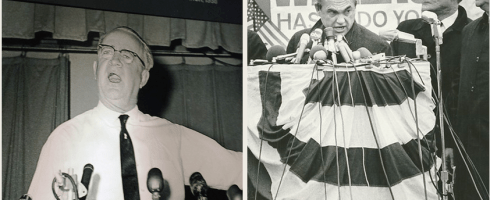
People like Mississippi Senator James Eastland, Birmingham Commissioner of Public Safety Bull Connor and Alabama Governor George Wallace are well remembered for their egregious support of “white supremacy.”

Eastland who served in the US Senate for 30-years stated, “I have no prejudice in my heart, but the white race is the superior race and the Negro race an inferior race and the races must be kept separate by law.”

Bull Connor employed Birmingham firemen and policemen using water hoses and police dogs against African-American demonstrators. It was after his arrest during those demonstrations that Martin Luther King wrote his famous Letter from the Birmingham Jail. He stated in the missive, “We know through painful experience that freedom is never voluntarily given by the oppressor; it must be demanded by the oppressed.”

In 1958, John Patterson, bested George Wallace for Governor of Alabama. Patterson, a proven segregationist and former Alabama attorney general, had attempted to put the NAACP out of business through a series of harassing lawsuits. The loss prompted Wallace to vow, “No other son-of-a-bitch will ever out-nigger me again.” (Suitts 26)

In 1963, Wallace won the Alabama Governor’s office. In his inaugural address, he attacked governmental overreach in Washington DC and “the illegal 14th amendment.” That is the amendment to the constitution that guarantees all citizens “equal protection under the law.” It was the central argument under-girding the Supreme Court’s “Brown” decision. In the address written by soon to be Klan leader Asa Carter (Suitts 26), Wallace famously called for “segregation now … segregation tomorrow … segregation forever.”

These infamous segregationists were not decisive in stopping what they called the “forced mixing” of students in school. It was the committees and commissions with their schemes for school choice leading to “virtual segregation” that effectively frustrated “Brown”.

Soon after the “Brown” decision, Alabama’s Boutwell Committee reported their plan which aimed for “virtual segregation.” The report decried “forced integration” claiming it would lead to “violence, disorder, and tension for the state and its children.” (Suitts 20)

The primary intellectual force behind the plan was a corporate attorney in Birmingham, Forney Johnston. He was a staunch segregationist who represented Alabama’s Big Mules:” coal, railroads, wealthy industrialists and investors. (Suitts 19)

The Boutwell plan posited four basic strategies for stopping compulsory “mixing” of races in schools. The key to the plan was school choice and not mentioning race as a reason for not admitting a student. The four main points:

  • Eliminate all prohibitions against the operation of mixed schools.
  • Remove from the state constitution any suggestion that there is a right of education and an obligation of the state to fund public school children. The state is to promote education in a manner and extent consistent with available resources, and the willingness and ability of the individual students.
  • Give local school officials the power to refuse admission to individuals or groups whose scholastic deficiencies would compel undue lowering of school standards.
  • Provide vouchers and other tax funds for both black and white children. (Suitts 21)

The plan called for a school choice system that enabled children “to attend all-White schools, all-Black schools, or desegregated schools in a state-financed system of public and private schools.” They called it the “Freedom of Choice Plan.”

The editor of the Montgomery Adviser called it “manicured Kluxism.” The plan was ratified by 61% of Alabama voters in 1956. (Suitts 22)

Southern segregationists often “condemned integration as the work of communists.” (Suitts 32) Adopting the language of University of Chicago libertarian economist Milton Friedman, they began denouncing the “monopoly of government schools” calling it “socialism in its purest form.” (Suitts 59)

By 1965, most voucher programs adopted in Southern states had been declared unconstitutional including indirect expenditures such as tax credits. (Suitts 49) Sill it is estimated that by the 1980s in the eleven states of the former Confederacy as much as 75% of private school white students were virtually segregated. (Suitts 64)

Cornell’s Professor Noliwe Rooks noted in Cutting School that using the federal government’s economic power finally broke the back of state-sanctioned segregation in the South. Rooks shared, “By 1973, almost 90 percent of southern schoolchildren attended integrated schools.”

Re-segregating America’s Schools

When nominating Ronald Reagan in 1984, the Republican Party platform stated its opposition to busing for desegregation, support of private school tuition tax credits and vouchers for low-income students to attend private schools. It was the first time a major political party had called for vouchers.

In his acceptance speech, President Regan asserted, “We must continue the advance by supporting discipline in our schools, vouchers that give parents freedom of choice; and we must give back to our children their lost right to acknowledge God in their classrooms.” (Suitts 72)

Steve Suitts observed:

“…, the southern states’ first plan for defeating court-ordered desegregation, the one that Johnston and Boutwell devised in 1954 in Alabama, is exactly what today’s advocates and supporters of vouchers seek to implement: no compulsory ‘race-mixing’ in schools and no mention of any intent to discriminate. What could be more American than the freedom of parents to choose their children’s school – private or public – with public financial support? (Suitts 91)

Segregation by caste and segregation by class are the two common types of segregation. Caste segregation is by skin tone and class segregation is by economics.

With class segregation, it is perfectly acceptable for a few Black and Brown students to be in a school with a majority of White students if their parents hold the requisite wealth. Both types of segregation are harmful to all students.

The 1975 Supreme Court decision, Milliken versus Bradley, struck down inter-district remedies to segregation. Professor Jack Schneider of the University of Massachusetts claims this decision was the “beginning of the end of school desegregation.” He stated, “In determining that school districts could not be compelled to integrate students across their borders, Milliken dramatically narrowed the promise of the 1954 Brown v. Board case.”

In his Milliken dissent, Justice Thurgood Marshall stated, “Unless our children begin to learn together, there is little hope that our people will ever learn to live together.”

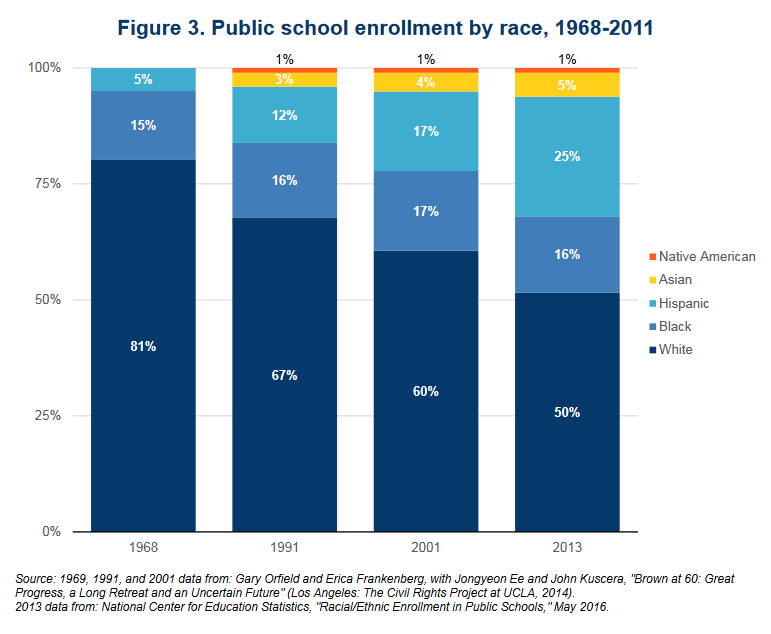
Public School Enrollment by Race Graphic

Brookings Chart Shows Growing Pluralism in American Schools

A paper from the Brookings Institute says, “School districts and metro areas that were released from court-ordered desegregation plans during the 1990s and 2000s showed a marked trend towards greater segregation, especially in the South.”

On the subject of desegregation trends, a Civil Right Project report from UCLA added,

“These trends began to reverse after a 1991 Supreme Court decision made it easier for school districts and courts to dismantle desegregation plans. Most major plans have been eliminated for years now, despite increasingly powerful evidence on the importance of desegregated schools.” (Emphasis Added)

In the 2002 Supreme Court ruling Zelman v. Simmons-Harris, the court ruled that publicly funded vouchers could be used to send children to religious schools providing that certain constitutional prerequisites were met. The divided court’s 5-4 decision allowed for taxpayers being forced by state law to send their dollars to religious schools.

In the Espinosa decision handed down this year, the Supreme Court again split 5-4 along what looks more like political lines than lines of legal judgment. Their decision means that if a state gives money to any private schools it cannot refuse money to religious schools.

Last week leaders of the Catholic Church in America penned an opinion piece championing a federal bailout. Cardinal Dolan, Cardinal O’Malley and Archbishop Gómez called for help with their fiscal problems. They stated,

“The most effective and immediate way to accomplish this is to fund scholarship assistance this summer to families who are economically disadvantaged and need such support. The scholarships would be used at Catholic or other non-government elementary or secondary schools. This approach would be similar to providing Pell grants that can be used at any institution of higher education, including religious institutions.”

In her fascinating book The Good News Club, Katherine Stewart quotes President Ulysses S. Grant’s diametrically opposite advice from that of the Catholic Church leaders. He said in 1876,

“Leave the matter of religion to the family altar, the church, and the private school, supported entirely by private contributions. Keep the church and state forever separate. With these safeguards, I believe the battles which created the Army of Tennessee will not have been fought in vain.”

Last fall, the Urban Institute studied where school segregation occurs. They concluded, “Holding school size constant, private and charter schools tend to have higher average contributions to segregation than traditional public schools.”

In the 1990s, charter schools first appeared. Since then, they have been significantly contributing to the re-segregation of America’s K-12 schools. A Brookings Institute study of segregation in schools reported,

“Charter schools are more segregated than TPS [traditional public school] at national, state, and metro levels. Black students in charter schools are far more likely than their traditional public school counterparts to be educated in intensely segregated settings. At the national level, 70 percent of black charter school students attend intensely segregated minority charter schools (which enroll 90-100 percent of students from under-represented minority backgrounds), or twice as many as the share of intensely segregated black students in traditional public schools.”

The growth of both charter schools and private schools has engendered growing segregation among America’s school children. This trend portends a divided inefficient society.

Professors Linda R. Tropp and Suchi Saxena along with many other sociologists and educators have conducted research identifying the clear benefit of and need for school integration. They state, “New social science research demonstrates the importance of fostering sustained interracial contact between youth in order to prepare them to thrive in a multiracial society.”

A research brief by Professor Genevieve Siegel-Hawley of Virginia Commonwealth University states,

“What is clear, however, is that racially diverse schools are not linked to negative academic outcomes for white students. And in a number of subjects, like math and science, diverse educational settings are consistently linked to higher test scores for whites. One analysis of 59 social science articles related to school composition effects on mathematics outcomes found, for instance, that math out-comes were higher at every grade level for students from all racial and SES backgrounds who attended racially and socioeconomically integrated schools.”

Conclusions

Steve Suitts book Overturning Brown: The Segregationist Legacy of the Modern School Choice Movement is strongly recommended for anyone interested in American education history or school policy.

To reverse the re-segregation of schools in America, stopping public school privatization is necessary.

The separation of church and state must be reestablished.

Infamous John Deasy Resigned under Suspicious Circumstances Again

29 Jul

By Thomas Ultican 7/29/2020

April 21, the Stockton Unified School District (SUSD) board accepted John Deasy’s letter of resignation effective June 15, 2020. His quitting mid-contract marked the third straight superintendent position he ended in a similar fashion. All three time, the resignation came with ethical charges and legal suspicions.

Stockton, California, was a gold rush town established in 1849. Situated 75 miles down the San Joaquin River from the Golden Gate Bridge at the north end of the San Joaquin valley, it is the farthest inland deep water port in California. Several waterfront scenes for the movie “On the Waterfront” were shot there.

Brando on the Waterfront

Brando “On the Waterfront” in Stockton 1954

Stockton is a small city of about 315,000 people and one of America’s most diverse. The demographic makeup is 42.1% Hispanic, 21.6% Asian, 20.8% White and 11.8 % Black. The city has a more than a 20% poverty rate; however, SUSD reports that 82% of their students live in poverty. The district enrolls 40,000 students into 54 schools.

Why Deasy resigned is not clear. Upon his resignation the 209 Times reported,

“Controversial superintendent John Deasy is out of Stockton Unified School District effective June 15th after agreeing to resign tonight amidst an investigation sources tell us into his actions and possible conflict of interests regarding a contract between board trustee Lange Luntao and the organization he is director of on behalf of Mayor Michael Tubbs, Reinvent Stockton Foundation.”

Bob Highfill of Record Net observed that there has been a 4-3 split on the school board for some time, which was reflected in the 4-3 decision to accept Deasy’s resignation. Board member Scot McBrian said that until this year he had been happy with Deasy’s work.

However, recently Deasy pushed for a $2 million waiver of development fees for a low-income housing project within the district. The reduction in fees to the school district was part of a project being pushed by Stockton Mayor Tubbs. When he did not get the required votes, an angered Deasy reworded the proposal and submitted it again. It was voted down again 4-3.

McBrian also mentioned problematic issues with the unions, the addition of six charter schools and a simultaneous roll-out of English and math curricula objected to by a number of teachers. Controversies surrounding the superintendent were mounting at the time of his resignation.

A 209 Times investigative article delved into the push to privatize public schools in Stockton and the three board member allies Deasy had helping him:

    1. “SUSD Trustee AngelAnne Flores is a current employee of Aspire Charter Schools in Stockton, and is part of a public alliance and voting block along with Lange Luntao and Candelaria Vargas. 
    2. “Lange Luntao is not only the best friend of Mayor Michael Tubbs …, but also simultaneously an SUSD Trustee and the Executive Director of Reinvent Stockton Foundation which is also the “Stockton Schools Initiative” and “Stockton Scholarship”. The Reinvent Stockton Foundation also has a contract with SUSD to farm data of students as well as promote their “stockton scholarships” scheme. 
    3. “Candelaria Vargas, is married to Max Vargas who is the personal assistant for Mayor Tubbs who endorsed and pushed for all three of these Trustees to be elected.

“All three of these SUSD Trustees are not only part of the “Reinvent” network, but are also members of an organization called School Board Partners that are seeking to push a Wall Street inspired “Portfolio” model of big corporate charter schools under the guise of “reform”, in “urban” cities across America including Stockton.”

In 2018, when billionaires John Arnold and Reed Hastings put up $100 million each to found The City Fund, other organizations they support were repurposed. Education Cities was divided into two new school choice promoting organizations, the above mentioned School Board Partners and Community Engagement Partners.

DoWopDonDon Shalvey (twitter handle @doWopDon), who joined with Netflix CEO Reed Hastings to found Aspire Charter Schools in 1998, has been working to enhance charter school penetration in Stockton. Today, Aspire is one of three charter schools looking to expand in Stockton. Shalvey left his post as the Gates Foundation Deputy Director of Education Programs, to lead the A+ non-profit organization in Stockton supporting Charter School growth.

As part of their investigation, the 209 Times reviewed and published emails between Shalvey, Deasy and others. They concluded, “What was hidden from the SUSD Board Members was the intimate relationship and secret communications the Superintendent had with Mr. Shalvey and his associates, which led to the fast-tracking of 6 Charter School petitions in SUSD, which were all amazingly approved via Consent Agenda – eliminating any discussion or input from the public.”

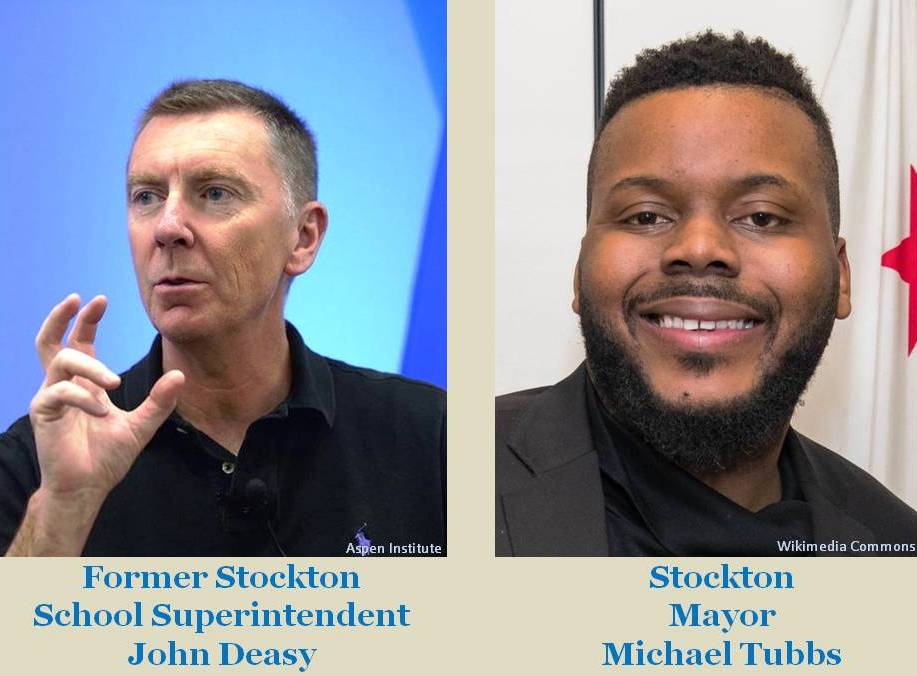
Deasy and Tubbs

John Deasy and the Mayor Providing Local Political Support

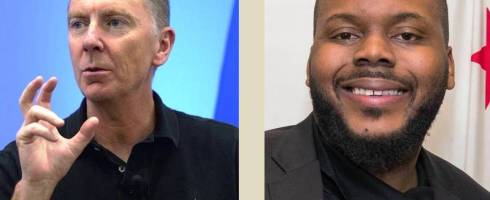
Mayor Michael Tubbs, a youthful African-American politician, was extremely angered by Deasy’s departure and blamed the four member faction that opposes his personal agenda. Tubbs stated,

“Given the gravity of the circumstances, there should be a serious discussion about whether Mendez and McBrian should be recalled, which I would be in favor of. I’ve heard from community members that are interested in considering a recall and I would be in 100% in favor of that. Our kids deserve nothing less than the best.”

There is a recall the school board effort underway in Stockton.

The obvious question is does Mayor Tubbs realize he has adopted the education agenda of US Secretary of Education Betsy DeVos, the very conservative Walton Family Foundation and the ultra-conservative libertarian mogul Charles Koch? Does Tubbs understand that he has embraced education policies Cornell’s Professor of African-American studies, Noliwe Rooks, derisively labels “segrenomics”; the profiting from selling education to segregated poor communities?

A Legacy of Controversy and Ethical Issues

In 2004, reporter Juliet McShannon writing for the Lookout News in Santa Monica, California noted, “Controversy seems to follow John Deasy.” At the time he had been leading Santa Monica Unified School district for almost three years.

Deasy came to Santa Monica after a five year stint as Superintendent of Coventry School District in Rhode Island. At the relatively small district of 6000 students, Deasy obtained one of the first small school development grants given out by the Bill and Melinda Gates Foundation. He also made national news when he launched a “pay for performance” initiative with Coventry teachers.

Standardized testing became his main metric for evaluating teachers, and he terminated the contracts of a number of teachers who did not meet his expectations.

In April 2001, Deasy abruptly resigned from Coventry effective June 1 to take the superintendent’s job in Santa Monica. He left behind financial problems and a small district that did not have time to find a new leader for the 2001-02 school year.

In 2006, Deasy graduated from Eli Broad’s superintendent’s training academy, which trains its candidates in a market-based data driven methodology. Billionaire Eli Broad is well known for his determination to privatize public education.

Deasy left Santa Monica to become superintendent of the very large Prince George’s County Schools in Maryland, the largest majority African-American county in the United States. This would be the first of three straight superintendents’ positions he would resign under suspicious circumstances.

When he arrived in Maryland, Deasy immediately started promoting charter schools and a teacher “pay for performance” agenda.

There was buzz in the area. Baltimore had Andres Alonzo firing teachers and closing schools and just a few miles the other way Michelle Rhee was promising to “fix” Washington DC’s schools by firing teachers and principals. These three superintendents were given the undeserved label “reformers.” It has become clear that they were just “disrupters.”

After two years on the job in Maryland, Deasy resigned.

That October 2008, the Baltimore Sun’s Liz Bowie speculated, “John Deasy is denying there’s any connection, but many people in the education community will continue to wonder whether the Prince George’s County superintendent would be moving on if there hadn’t been a dust-up in the past several weeks over how he got his doctoral degree.”

Bowie reported that “Deasy had been awarded a doctorate in philosophy from the University of Lousville in 2004 although he had only completed nine credits, or about a semester, there.” She also noted that Deasy had given his advisor, Robert Felner, a $125,000 contract from Santa Monica Unified and that Felner’s group received a total $375,000.

On September 29, 2008, a press release stated “The Bill & Melinda Gates Foundation announced today that Dr. John E. Deasy has been named deputy director of its education division within its United States Program.”

Two years later, with a big push from Eli Broad and the LA Mayor he politically supported, Antonio Villaraigosa, Deasy was hired as Deputy Superintendent of Los Angeles Unified School District (LAUSD). In January, 2011, he was named Superintendent.

At the time, other billionaire groups were also spending to influence the district. The LA-based Wasserman Foundation gave a $4.4 million grant, another $1.2 million came from the Walton Family Foundation, and smaller grants came from the Ford and Hewlett foundations to pay the salaries of more than a dozen key senior staffers in the district.

The staffers were working to advance the market-based data driven school reform agenda, charter schools, testing and competition.

Controversy came to LAUSD soon after Deasy took charge. When he walked into a classroom at Washington Preparatory High School being led by substitute teacher Patrena Shankling, he got into a dispute with her over the quality of the lesson plan and fired her on the spot. When a school teacher was implicated in an ugly sex scandal at Miramonte Elementary school, Deasy removed the entire staff from janitor to principal completely ignoring due process but gaining tough-guy headlines.

Deasy pushed charter school expansion and implementation of education technology. Two technology agendas appear to have led to his demise as Superintendent. He rolled out a completely incompetent student digital data system. It failed at scheduling students for classes, recording attendance and inputting grades; it was a disaster. But his I-pad fiasco was worse because it brought legal charges and an investigation by the FBI.

There were many things wrong with the $1.3 billion plan to put I-pads in the hands of every student but the suspicion that the bidding had been rigged put Deasy in legal jeopardy. Emails showed that he had been in negotiations with Apple and curriculum provider Pearson before any competitive bidding process started.

Interim Superintendent Ramon Corzine noted the bidding process had been plagued by “too many innuendoes [and] rumors.”

Deasy resigned before the legal investigation by the FBI and LA County District attorney got under way. This time the Broad Academy stepped in to hire him as “superintendent-in-residence.” That was in 2015.

In 2018, Deasy was off to be Superintendent in Stockton, resigning this year with ethical and legal malfeasance charges mounting.

Reopening Schools Issues and Evidence

21 Jul

By Thomas Ultican 7/21/2020

The President of the United States and his Secretary of Education have demanded schools open with in-person classes five days a week. Many parents are not confident their children will be safe and significant numbers of teachers are profoundly frightened. How does the rhetoric square with credible scientific evidence concerning the Covid-19 pandemic?

President Trump has tweeted,

“In Germany, Denmark, Norway,  Sweden and many other countries, SCHOOLS ARE OPEN WITH NO PROBLEMS. The Dems think it would be bad for them politically if U.S. schools open before the November Election, but is important for the children & families. May cut off funding if not open!”

Michelle Goldberg of the NY Times wrote, “… with their crude attempts at coercion, they’ve politicized school reopening just as Trump politicized mask-wearing and hydroxychloroquine.”

Goldberg goes on to cite American Federation of Teacher President, Randi Weingarten, as saying the administration just made reopening schools more difficult. Randi described Trumps threats to withhold school funding as “empty, but the distrust they have caused is not.”

Weingarten also reported hearing from many teachers who are concerned that reopening would be done rashly.

In an USA Today opinion piece, Lily Eskelsen Garcia, the President of America’s largest teachers’ union, charged, “… the Trump administration’s plan is appallingly reckless.” She also points out that the vast majorities of American schools have not returned to their 2008 funding levels and have lain off more than 300,000 employees.

Garcia argues that the Covid-19 induced revenue crisis is making opening schools safely impossible during the accelerating contagion.

Officials within the Trump administration are confidently claiming opening schools can be done safely. At a White House conference on reopening schools, Alex Azar, Secretary of Health and Human Services stated, “We can get back to school safely.” Regarding concerns that many schools do not meet Center for Disease Control (CDC) guidance, he stated, “CDC guidance is guidance and no-one should use it not to reopen schools.”

At the same conference, the President of the American Academy of Pediatrics (AAP), Dr. Sally Goza, said AAP “strongly advocates schools open safely.” She stated that “children are less likely to be infected” and “less likely to spread the virus.”

Goza contends that it is critically important for students to be physically present as long as safety measures can be maintained. She added that schools need more resources.

President Trump’s top economic advisor, Larry Kudlow, recently stated, “If we don’t reopen the schools that would be a setback to a true economic recovery.”

Secretary of Education Betsy DeVos says “It’s not a matter of if schools should reopen, it’s simply a matter of how.”

The Department of Education under DeVos’s leadership is pushing back against charges that they are politicizing school opening. A released statement said, “if anyone is politicizing this issue it’s the unions, who are Democrats’ operatives, who are fear-mongering and denying the science that says it’s safe and better for kids’ overall health to be back in school.”

Republican state administrations in Iowa and Florida have mandated that all schools in their states reopen 5-days a week with in person instruction.

In California, Democratic Governor, Gavin Newsom has ordered all schools in counties on the coronavirus “watch list” to open online only. That covers about 80% of the students in the nation’s most populous state.

The Washington Post’s Matt Viser reports that Democratic Presidential candidate Joe Biden has called for flexibility with reopening schools. Biden asserts, “If we do this wrong, we will put lives at risk and set our economy and our country back.”

Viser sums up Biden’s just released plan,

“Biden urged caution, saying that each district should make its own decisions based on local conditions, and that schools in areas with high infection rates should not reopen too soon. He also called on Congress to pass new emergency funding to help the schools.”

These confusing claims and counterclaims motivate looking into the best evidence the scientific community can provide.

What the Evidence Shows

White House Press Secretary Kayleigh McEnany said that “science should not stay in the way of school reopening.” She cited a Journal of the American Medical Association pediatrics study that found the risk of critical illness from Covid-19 for children is far less than the seasonal flu.

She stated, “The science is on our side here.” And added that states need to “simply follow the science” and open schools.

However, McEnany, did not make it clear that the study she cited involved just 48 children treated in U.S. and Canadian intensive care units. It is true that most were not critically ill but 18 needed ventilator treatment and two died.

Dr. Ashish Jha, director of the Harvard Global Health Institute, has noted that several studies from Europe and Asia have suggested that young children are less likely to get infected and to spread the virus. However, he says like the study McEnany cited, those studies are mostly small and flawed.

There is a new study that Dr. Jha describes as “one of the best studies we’ve had to date on this issue.”

The CDC has posted the study, Contact Tracing during Coronavirus Disease Outbreak, South Korea, 2020”, to its website. This large scale study looked at 59,073 contacts traced from 5,706 covid-19 confirmed patients between January 20 and March 27, 2020.

Korean Study Table 2

Korean Study Data Table Indexed by Patient Age

The important point in this table is that infants do transmit covid-19 but at a lower rate (between 1.3% and 13.7%). However, middle school and high school aged children transmitted the disease at a rate equal to all of the older groupings.

In the paper’s literature study, the authors observe, “… a recent report from Shenzhen, China, showed that the proportion of infected children increased during the outbreak from 2% to 13%, suggesting the importance of school closure.”

Schools have been reopening in various countries since this spring. A key characteristic that countries reopening schools took into consideration was virus transmission rates. Solid testing regimes and contract testing were believed essential.

The following table used reopening transmission rates data from a post by Dr. Nan Fulcher and Justin Parmenter plus the transmission rates for July 17th which were derived using the John Hopkins University Covid-19 Dashboard and Worldometer population data.

Covid Per 10,000 Foreign table

All of the counties in the table above with the exception of Israel have maintained low transmission rates while opening schools. In the Israeli case, The University of Washington Department of Global Health reports,

“Two weeks after school re-opening, COVID-19 outbreaks were observed in classrooms, including 130 cases in one school alone. By June 3, there were 200 confirmed COVID-19 cases and over 244 positive SARS-CoV-2 tests among students and staff across multiple schools.”

“Due to the crowded nature of the schools system, physical distancing of students within schools has not been widely adopted and control measures have focused on closing schools with reported cases, extensive testing, and quarantine of students and staff with a potential SARS-CoV-2 exposure.”

In his push to reopen schools, President Trump claims that many countries reopened school with no problem. That seems to be mostly true, however, it omits saying many counties did have issues. New Century Foundation Fellow, Connor Williams notes,

Aside from some early public-health setbacks, France has been able to keep schools open. But other communities have not been so lucky. Israel reclosed some schools after a spike in covid-19 cases. Beijing recently shuttered its schools again as the pandemic returned.”

While it does seem possible to safely reopen schools based on the experience of countries around the globe, the United States faces two major unresolved obstacles; facilities need upgrading and transmission rates need to be controlled.

The following Covid-19 transmission rates were calculated using data from Wikipedia’s 2020 population estimates and the John Hopkins Covid-19 Dashboard.

Covid Per 10,000 table

In addition to this data showing that in most states the Covid-19 transmission rates are ghastly, school facilities on average are in terrible shape.

The National Academies of Science, Engineering and Medicine just issued guidance for reopening schools. The Academies chair for the study, Enriqueta Bond, stated, “One of the shocks to me is that over 50 percent of the school buildings are awful.”

New York Times reporter Apoorva Mandavilli shared in a report on the Academies’ guidance, “Some 54 percent of public school districts need to update or replace facilities in their school buildings, and 41 percent should replace heating, ventilation and air-conditioning systems in at least half of their schools, according to an analysis by the Government Accountability Office.”

The Academies guidance says the cost of retrofits will total approximately $1.8 million for a school district with eight school buildings and around 3,200 students.

The evidence shows that most of America is not ready to reopen schools. The retrofits have not been started and the needed financing has not been approved. Transmission rates are out of control.

The Conclusion of Professionals

New York public school teacher, Christine Vaccaro, published an opinion piece in USA Today. Her ending statement is prescient:

“Abandoned by any semblance of national leadership during a raging pandemic, students, teachers and staff are being told to jump into the deep end and return to school buildings. They will be risking their lives and their families’ lives, and endangering their communities to do so. All the precious time and resources spent to implement hybrid models and social distancing protocols will be washed away with the building’s first positive COVID-19 case. Then it will be a hard pivot back home, using the same scattershot remote learning practices developed in an emergency.

“That is why the smartest, most practical strategy is marshaling energy and dollars into developing as robust and equitable a remote learning plan as possible. This is far from ideal. We know remote teaching is not even remotely teaching. But it will save lives, offer the most consistent education for our children this fall — and provide a solid foundation on which to build a stronger hybrid model, later in the year.”

New Century Foundation Fellow, Connor Williams, ended his article succinctly,

It’s time to face the central fact of a pandemic: There’s no way to pretend our way around flattening the curve. Until we actually stop the virus’s spread, efforts to reopen schools in most communities will fail.”

Don’t Sacrifice Teachers and Students to a Neoliberal God

8 Jul

By Thomas Ultican 7/8/2020

The US is not ready to open schools. We blew it. Let’s face reality squarely and quit making outcomes in our country even worse.

New York’s Michael Flanagan Ed. D. wrote,

“The pressure to reopen schools, and return to work, will continue to intensify, no matter how many new cases of Covid-19 there are each day, and the numbers are growing. Businesses, politicians and even health professionals are in the process of trying to convince us that sending our kids back to school will be safe.”

As if to prove Flanagan’s claim, Harvard’s “Education Next” published a Frederick Hess interview with Jeb Bush where he repeatedly emphasized,

“First and foremost, schools have to open with the health and safety of our students and teachers being paramount. But they have to open, or we will have huge economic, health, and social challenges.”

Not to be outdone by “low energy Jeb”, the President of the United States employed his normal elegance when tweeting,

“Schools in our country should be opened ASAP. Much very good information now available.”

Republican Congressmen, Jim Banks of Indiana and Tom Tiffany of Wisconsin, have introduced the Reopen Our Schools Act. Congressman Banks declared,

“Reopening our schools is the lynchpin to reopening our economy. Many parents rely on their kids going to school so they can go to work. To get our society up and running again, we need our children back in school.”

The Economist claims schools should be the first economic institutions to reopen and added,

“Those who work at home are less productive if distracted by loud wails and the eerie silence that portends jam being spread on the sofa. Those who work outside the home cannot do so unless someone minds their offspring.”

These neoliberal forces are promoting the idea that teachers and children must be thrust into an unsafe environment so the world’s economic engines can continue providing decent return on investment. Make no mistake, face to face teaching during this pandemic without proper conditions is fraught with danger.

Political leaders know that so they are racing to pass legislation indemnifying schools from legal liability.  In California, Assemblymember Patrick O’Donnell, D-Long Beach, and his coauthor State Senator Susan Rubio, D-LA, introduced AB1384 to shield schools. O’Donnell made this ludicrous statement,

“We need to do everything we can to protect the students, and the schools. My bill will indemnify school districts as long as they follow all the state and local health directives. We still want school districts to use best practices when it comes to student safety.”

In May, Mitch McConnell announced that the US Senate was taking up legislation to protect schools from lawsuits. He stated, “Can you image the nightmare that could unfold this fall when K-12 kids are still at home, when colleges and universities are still not open?”

When it comes to political malfeasance, Florida is determined not to be outdone. Richard Corcoran, Commissioner of Education, is the former Speaker of the House and a charter school owner.  On Monday, he released an order stating, “Upon reopening in August, all school boards and charter school governing boards must open brick and mortar schools at least five days per week for all students …”

The forced school reopening amounts to a conscription putting teachers, students and families at risk. Florida trails only New York and California in confirmed Covid-19 cases and Miami-Dade County is a national leader in cases. At this time, Covid-19 cases in the state are spiking to new record levels.

Obviously, Commissioner Corcoran’s order ignores health and safety. It is driven solely by a neoliberal ideology valuing commercial enterprise above human life.

Could-a Should-a Would-a

If the United States had acted decisively in late February and shut down businesses, instituted robust testing, contact tracing and social distancing, we probably could safely open schools now. It is also likely that more than 120,000 victims of the virus would be alive today.

Even in March when it became clear to everyone but a fringe element that we had a huge problem, a united response led by the federal government would have put us in position to reopen in-school education.

Instead of a united effort to effectively meet the Sars-CoV-2 crisis, we experienced politicization and demagoguery.

By the end of March, California had an effective shutdown in place with almost universal cooperation. Then ultra-conservative media started agitating against the shut down.

Purported healthcare professionals like neurosurgeon, Russell Blaylock, started discouraging mask wearing as did the discredited Irish scientist Delores Cahill.

In late April, The Conservative Daily Post reported on claims by two Bakersfield, California emergency room doctors, Dan Erickson and Artin Massihi. These doctors from Accelerated Urgent Care claimed that the nationwide lockdown policies are not an appropriate reaction to the “China-originated novel coronavirus” and were causing other healthcare problems to be ignored.

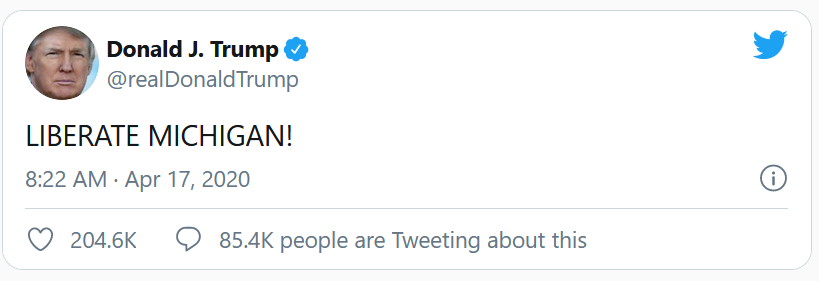
Kristi Noem, the Republican Governor of South Dakota, publically opposed CDC health guidelines saying, “I believe in our freedoms.” This happened just days after the President of the United States took to twitter and attacked the Democratic governors of Michigan, Minnesota and Virginia, calling for their states to be liberated.

Trump Liberate tweet

Attack on Governor Gretchen Whitmer for Implementing CDC Guidelines in her State

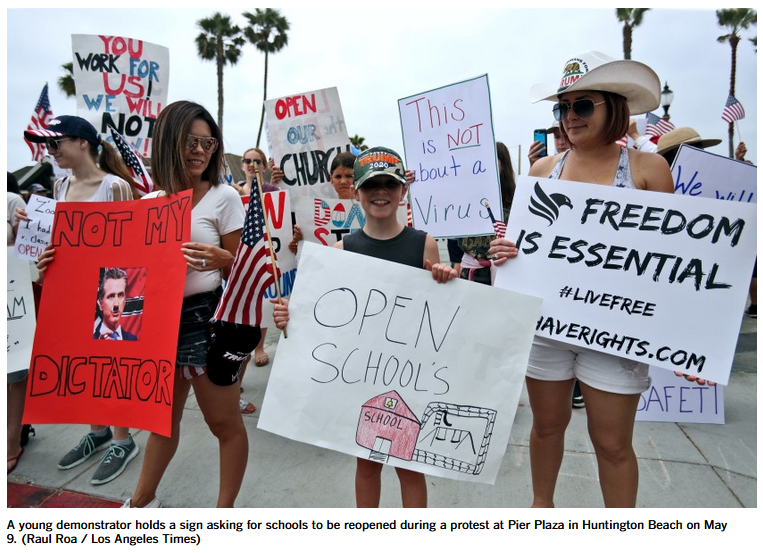
This constant degrading of the public response to Covid-19 led to more people joining in protest against state policies. Soon conservative groups were demanding that schools be reopened immediately.

LA Times Open Schools Gaphic

This Los Angeles Times Picture was taken in Orange County May 9, 2020

Because our response to the novel coronavirus was undermined, states do not meet the safety criteria for opening schools.

The Whitehouse has created an opening America website with proposed state or regional gating criteria.  They include:

“Downward trajectory of influenza-like illnesses (ILI) reported within a 14-day period AND Downward trajectory of covid-like syndromic cases reported within a 14-day period”

“Ability to quickly set up safe and efficient screening and testing sites for symptomatic individuals and trace contacts of COVID+ results”

“Ensure sentinel surveillance sites are screening for asymptomatic cases and contacts for COVID+ results are traced (sites operate at locations that serve older individuals, lower-income Americans, racial minorities, and Native Americans)”

“Ability to quickly and independently supply sufficient Personal Protective Equipment and critical medical equipment to handle dramatic surge in need”

America’s schools do not meet these “gating criteria.” Covid-19 infections in the United States are accelerating, so out of control that testing with contact tracing is not possible. The following Johns Hopkins graphic makes it clear that this situation will not ameliorate quickly.

Johns Hopkins World Comparison

The Johns Hopkins Graph is Normalized to Daily Cases per Million

Teachers and Students Will Not Be Safe

Neil Demause of Fairness & Accuracy Reporting wrote on July 3rd about opening businesses. He shared,

“Infectious disease experts say that offices can be the perfect petri dishes for viral spread, involving gatherings of a large number of people, indoors, for a long time, with recirculated air. As one study (Business Insider4/28/20) of a coronavirus outbreak at a Seoul call center showed, the virus can quickly spread across an entire floor, especially in a modern open-plan office.”

It is easy to extrapolate the Korean call center to the local 3rd grade classroom.

Dartmouth Immunologist Erin Bromage states, “We know that at least 44% of all infections–and the majority of community-acquired transmissions–occur from people without any symptoms (asymptomatic or pre-symptomatic people).” Professor Bromage also notes, “Social distancing rules are really to protect you with brief exposures or outdoor exposures.”

Pennsylvania educator Steven Singer observed, “And even if young people are mostly asymptomatic, chances are good they’ll spread this thing to the rest of us.” The paper Steven cited also states, “Although  clinical  manifestations  of  children’s  COVID-19  cases  were generally less severe than those of adults’ patients, young children, particularly infants, were vulnerable to infection.”

On Monday, The Daily Mail reported, “As many as half of coronavirus patients with NO symptoms may silently suffer ‘disturbing’ lung damage that leaves them oxygen-deprived without knowing it, study finds.”

Education professionals have been publishing concerns recently.

Rutgers University’s Mark Weber Ed. D. posted “How Schools Work: A Practical Guide for Policymakers During a Pandemic.” His list is not exhaustive but it gives the laymen an idea of the practicalities involved with doing school. It includes:

“The typical American school cannot accommodate social distancing of their student population for the duration of the school day.”

“Children, especially young children, cannot be expected to stay six feet away from everyone else during an entire school day.”

“Children cannot be expected to wear masks of any kind for the duration of a school day.”

The author and special education expert, Nancy Bailey, recently posted, 22 Reasons Why Schools Should NOT Reopen in the Fall.Among the 22 were:

“2. How Will the Flu and Covid-19 Tango?… Last January, before Covid-19 became well known, 27 children had died of the flu. What will the dance of these two illnesses look like in the fall?”

“8. Cost for Safety: The Council of State Chief School Officers estimate that schools will need $245 billion to safely reopen.”

“18. School Restrooms: … School bathroom conditions have always been a source of concern.”

“19. Teacher Qualifications: There are not enough teachers for smaller classes for social distancing. Experienced older teachers may not want to get sick. Will schools hire a glut of teachers without qualifications?”

Oakland, California high school history teacher and union organizer, Harley Litzelman, published “Teachers: Refuse to Return to Campus.”  He addressed among other issues, the likely large loss of teachers to the ill-fated open-schools-on-campus-now policy. Litzelman shared,

“A USA TODAY/Ipsos poll found that one in five teachers say they are unlikely to return to campus next year, signaling a tsunami of resignations. Chicago middle school teacher Belinda Mckinney-Childrey told ChalkBeat that “I can’t chance my health to go back. I love my job, I love what I do, but when push comes to shove, I think the majority of us will be like ‘I think we’re going to retire.’” Also, this is personal; my fiancée has serious asthma. She’s the best middle school English teacher I know, but she won’t teach next year if she’s forced to return to campus.”

Merrie Najimy, President of the Massachusetts Teachers Association, participated in a televised interview about her objection to Governor Baker’s plans to reopen schools. She was asked about the American Association of Pediatrics call for schools to open “as soon as possible.” Aren’t they aligned with Governor Baker’s position? Najimy pointed out, “The AAP does not have practical experience in school and … they are not absolutists.”

Steven Singer posted, “Do NOT Play Russian Roulette with Our Lives – No In-Person Schooling During a Pandemic.” In the article, Steven declares, “Reopening schools to in-person classes during the COVID-19 pandemic is tantamount to Russian Roulette with the lives of students, teachers and families.”

On Monday, education writer, Jenifer Berkshire, tweeted, “The school reopening fight just gets crazier – and more politically confusing. In growing # of states GOP now saying ‘open the schools or else’”

Community leaders, religious leaders and schools will need to work together for a solution to child care. There are many unused recreation centers, school facilities, libraries and church facilities available. Forcing children and teachers into an unsafe situation is not the only way to solve the child care dilemma.

In order to reopen schools safely, there are two non-negotiable imperatives. First, the rampaging virus must be brought under control through testing and robust contact tracing. Second, the US Senate must send schools $245 billion dollars to pay for the social distancing logistics, supplies, staff and transportation enhancements required.

Since there is no way to meet the first requirement and it is unlikely the Republican led Senate will meet the second. Let us quit pretending and concentrate our efforts on creating enhanced distance learning this fall.

Fraud at Sweetwater; Maybe but Unlikely

1 Jul

By Thomas Ultican 7/1/2020

For the past week, local San Diego TV and Print media have been filled with damning headlines like the NBC affiliate’s, Audit of Sweetwater Union High School District Finds Evidence of Fraud” or the online publication Voice of San Diego’s “Audit Finds Sweetwater Officials Deliberately Manipulated Finances.” Every local news outlet published the story with some version of these headlines.

On Monday June 23, the Fiscal Crisis Management Assist Team (FCMAT) presented the results of its long awaited audit of Sweetwater Union High School District’s (SUHSD) finances. The report authors state,

“Based on the findings in this report, there is sufficient evidence to demonstrate that fraud, misappropriation of funds and/or assets, or other illegal fiscal practices may have occurred in the specific areas reviewed.”

How Did SUHSD Arrive Here?

For Sweetwater, this is really a continuation of the course set by corrupt leadership a decade earlier. It is also emblematic of the financial stress all California school districts are facing. Kristen Taketa reporting for the San Diego Union noted in November 2018:

At least 10 districts in the county are projecting that they will not be able to meet their financial commitments next school year, including Chula Vista Elementary, Jamul-Dulzura Union, Mountain Empire Unified, Oceanside Unified, San Diego Unified, San Marcos Unified, San Ysidro, Sweetwater and Vista Unified. More districts won’t be able to meet their financial commitments after next year.

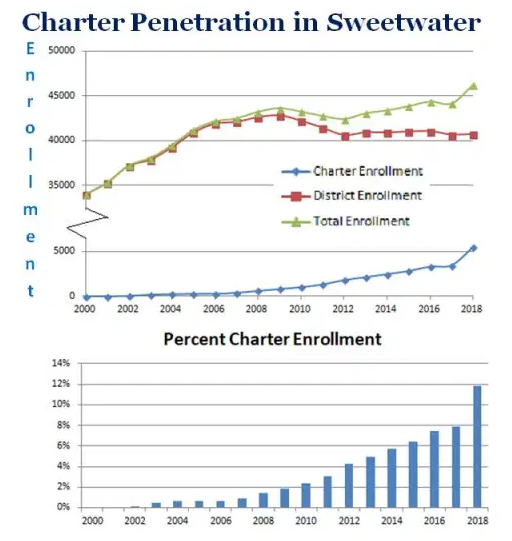
Three factors are mainly responsible for these growing financial stresses. The state has mandated a more than doubling of teacher retirement payments from 8.1% to 18.4% without providing extra assets. Special education costs have been soaring and enrollment has been shrinking due to an increase in state funded privately operated schools.

enrollment-graphs

The Drop in Attendance Accounts for a $20 Million Drop in Revenue

In April of 2014, four of the five Sweetwater board members (Jim Cartmill, Bertha Lopez, Pearl Quinones and Arlie Ricasa) plus Superintendent Jesus Gandara pled guilty to corruption charges and resigned. The fifth member of the five person board, John McCann left the board to run for a seat on the Chula Vista city council.

Cartmill and Lopez pled guilty to a misdemeanor charge of accepting gifts over the state limit. Quinones, Ricasa and Gandara were charged with felonies. Arlie Ricasa pled guilty receiving probation and a fine. Gandara was sentenced to 7-months jail time and fined $7,994.

Pearl Quinones also pled guilty and stated “I would have fought it to the very end if I had been able to afford to keep fighting it.” She received a three-year probation with the felony being reduced to a misdemeanor.

District Attorney Bonnie Dumanis called this a “pay-for-play” scheme stating,

“For years, public officials regularly accepted what amounted to bribes in exchange for their votes on multi-million dollar construction projects. This case is outrageous and shameful.”

In my opinion, Gandara was out of control and deserved the outcome. On the other hand, the school board members’ biggest mistake might have been being careless while the district attorney was planning to run for mayor.

I was politically opposed to the four indicted board members but never believed they were selling their votes and still don’t. I believe they did put the school district and the community first. Dumanis painted them with Superintendent Gandara’s malfeasance.

It is true that they all accepted a small number of free dinners and tickets to local sporting events and did not report some of them correctly. DA Dumanis over-charged them with misdemeanors and felonies that forced their resignations from the board. She could have more appropriately cited them with infractions which would have brought fines, however, the DA valued headlines over justice.

An entirely new five member school board was elected in November, 2014. After completing the school year with interim-superintendents, the board selected Karen Janney to be the new permanent Superintendent of SUHSD. That June 8, 2015 decision was a hailed by the board, the community and the teachers union.

In a 2019 interview, teacher’s union President Gene Chavira said he felt Janney made two critical errors. She rejected the expense of having a forensic audit performed on the district’s finances and she did not listen to board members and labor leaders when they encouraged her to bring in an outside leader for the finance department.

Janney had been a teacher, principal and assistant superintendent in the district. She evidently had formed a strong relationship with Karen Michel and wanted her to be the district’s Chief Financial Officer (CFO).

Michel and her number two, Douglas Martens, retired in June of 2018. There last official act was delivering the budget for school year 2018-19. The budget was approved by the board on June 25th and sent to the County Office of Education (COE) for final approval.

Jenny Salkeld was hired to replace Michel as CFO. In early September, Salkeld discovered a $20 million negative discrepancy in the budget and reported it to the Sweetwater leadership team which forwarded her report to the COE.

The County immediately disapproved of the SUHSD budget and brought in the Fiscal Crisis Management Assist Team (FCMAT) to investigate Sweetwater’s finances.

The FCMAT Audit

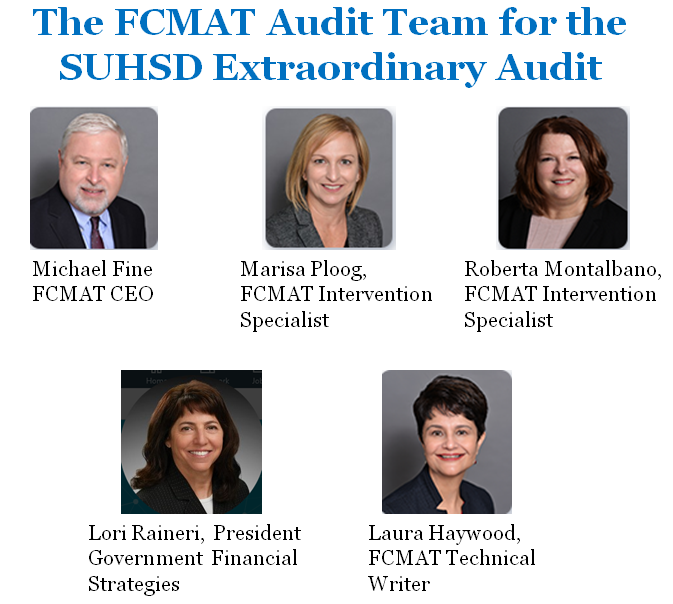
Audit Team

CEO Michael Fine and the Four Women Who Performed the SUHSD Extraordinary Audit

FCMAT was created and signed into law in 1991 by Governor Pete Wilson. The Kern County Superintendent of Schools office was selected as the administrative and fiscal agent for FCMAT. It is not a government entity but does receive financial support from the state.

FCMAT is organized as a non-profit. The purpose of FCMAT was to provide districts experiencing budget issues with professional leadership. However, they have developed a reputation for being more about helping political allies than struggling school districts.

The County’s official rejection of the 2018-19 budget was a trigger bringing in FCMAT to conduct a Fiscal Health Risk Analysis. On December 17th, 2018, the Analysis results were presented to Sweetwater’s board by FCMAT CEO Michael Fine. The Voice of San Diego reported,

“FCMAT’s chief executive officer Michael Fine told board members that 302 entries in the district’s accounting system were doctored to create the impression the district had more money than it really did. ‘That my friends and colleagues, is a cover-up,’ …”

Although Michael Fine’s charge of “cover-up” appears mistaken according to the new audit, it does point to a central problem that led to a bad budget. The audit revised the 302 “negative budget entry” count to 220 and explained the origin of these often inadequately documented inputs.

The auditors reported that SUHSD began the budgeting process by rolling the 2017-18 budget into the beginning template for the 2018-19 budget. This was not viewed as unusual, but projections concerning changing budget demands then needed to be inserted into the budget model and that was not satisfactorily done.

FCMAT states, “Interviews with staff … indicate that the district was not utilizing data from a position control system to project salaries and benefit obligations.”

Apparently the suspicious entries were the budget being updated based on actual costs when they arrived. These entries were suspicious because they were not documented in accordance with the California School Accounting Manuel.

I worked in SUHSD from 2002 – 2017 and these findings seem to confirm my own impression of unprofessionalism in the district office. It didn’t appear corrupt but there was little concern with meeting deadlines, crossing t’s and dotting i’s.

In the audit, FCMAT questioned delays in posting payroll transactions. They wondered if these delays were purposeful for hiding the understatement of salaries and benefits in the budget. They concluded it was not, but does give more evidence of the lack of professionalism in the financial department.

In the report, FCMAT says Superintendent Karen Janney, CFO Karen Michel, Director of Financial Services Douglas Martens and Financial Consultant Adam Bauer may be guilty of financial fraud over the February 2018 bond deal. However, much of the damning evidence comes down to the fact that they followed Bauer’s advice about the best path to guarantee a good bond rating.

Laws and methods had changed since the last time Sweetwater did a bond deal. It is difficult to understand why SUHSD not following previous processes with fidelity was considered suspicious.

FCMAT also claims Sweetwater officials should have known that the drop in ending revenue between 2016 and 2017 from $36,285,098 to $21,469,748 indicated deteriorating financial conditions. This was also part of FCMAT’s evidence for Sweetwater knowingly misleading the bond markets about the district’s financial health.

The “extraordinary audit” was triggered by FCMAT’s declaration in December 2018 of possible fraud and cover up. By agreement with the county the audit was quite limited and focused almost exclusively on the 2017-18 budget year and SUHSD internal budgeting processes.

By comparison, a forensic audit of SUHSD is estimated to cost as much as $2,000,000; the county cost for this “extraordinary audit” was estimated at $50,700.

The auditors did not look at data from previous years.

Going Forward

The audit was delivered Monday, 6/23/2020. The document reminds the district’s board, “Within 15 days of receipt of the report, the governing board is required to notify the county superintendent of its proposed actions regarding the county superintendent’s recommendations.”

Board member Paula Hall indicated this would not be a problem since they have already instituted many of the FCMAT suggestions. She also expressed how pleased she was with CFO Jenny Salkeld’s professionalism. Hall believes the district now has strong leadership in finance.

Governor Gavin Newsom signed the state budget on Monday, June 29th. Now Salkeld’s team needs to finish the 2020-21 budget and present it to the board.

Wednesday the 25th, the Sweetwater board met in a virtual executive session and put Karen Janney on paid administrative leave by a vote of 4-1. A board member said that in the uncertain legal climate they felt this move was needed to protect both the district and Janney.

The board also voted to lay off 223 employees and selected Dr. Moises Aguirre to serve as acting Superintendent.

Aguirre must now pick up the ball and continue the planning for opening school on August 3rd.

Dr. Aguirre faces the challenge of how to safely open schools in the Sars-CoV-2 era if that is even possible. If not, he and the Sweetwater team must find a way to make distance learning work for all 36,000 students.

My best guess is that there was no intentional fraud or purposeful financial misleading in SUHSD. It looks like there was a significant budget creation error that collided with state created structural deficits. I do not expect any prosecutions.

If meaningful changes are not made to California school financing, there are going to be many more districts running into these same structural deficits with no good solutions.

Reopening Schools and Debunking Demagoguery

21 Jun

By Thomas Ultican 6/21/2020

Education professionals throughout America are feverishly engaged in preparing for the first school year in the unprecedented Sars-Cov-2 era. Simultaneously, demagogues are pushing an often uninformed agenda.

For example, congressmen Jim Banks of Indiana and Tom Tiffany of Wisconsin have introduced legislation to force all schools to open with in-person classes by September or else lose federal funding.

At the same time McKinsey and Company, the 74 and other school privatization friendly groups are loudly proclaiming that an education gap disaster will devastate Black and Brown children if we do not reopen brick and mortar schools immediately.

Education Leaders are Getting Ready for Fall

Across California and the whole of the US, parents, students, teachers and administrators are involved in intense school reopening discussions with less than two months to go in some cases. County Health Departments in both Los Angeles and San Diego have indicated that masks will be mandatory for all students and school personnel.

California’s second largest school district, San Diego Unified School District (SDUSD), and other districts plan in-person, online and “hybrid” learning options. However, SDUSD will need an infusion of federal dollars to operate for the full year. Board President, John Lee Evans, says without financial help they will be forced to revert to all online learning in the winter semester.

On June 18th, Sweetwater Union High School District in Chula Vista, Calafornia held a virtual meeting for all stakeholders to lay out plans for starting school on August 3rd. It will include distance learning through August 28th and then implements students on campus in three phases. The initial transition to on campus learning limits the number of students to 10% of the student body at any one time. This would be ramped up to 20% and then eventually 50% of students would be allowed on campus at one time.

Districts are busy stockpiling surgical face masks and placing future orders. They are also ordering infrared thermometers, specialized cleaning supplies and personal protective equipment.

This kind of reopening planning is happening everywhere in America as the new school year approaches.

Perspective of the Pros in the Field

With school teachers facing a new school year, five veteran educators from San Diego County were interviewed. When all school campuses closed on March 13, these teachers participated in distance learning for the final three months of the school year.

They all felt that because of the hold harmless policies their districts embraced, the three months were not representative of what is possible. These five educators all taught at the high school level and when their students realized grades could only go up many students completely disengaged.

There was a large difference in engagement correlated with age. The more mature students were more engaged.

Student performance was related to type and level of classes. An AP physics teacher saw 90% attendance and felt most of his students did okay but not as well as his previous in person classes. He commented that, “some students seem to need the social environment in the classroom and became lost.”

On the other hand, the special education teacher co-teaching entry level math and English classes saw attendances of 25%-30%. As soon as his students found out about hold harmless, only a minority of students who were trying to raise their grades participated.

The Spanish teacher with 170 students on her rolls reports that 150 checked in but only about 40 who were trying to raise their grade actually engaged.

An AP literature teacher said that all of his AP students stayed with him until the AP exam but his one English 12 class, with the few exceptions of those who needed to raise their grades, basically checked out on March 13.

The literature teacher also mentioned that he felt like 100% distance learning was undermining his in-person credibility. Students communicate about their teachers and pass on who are the good teachers, whose classes are fun and who is interesting. They give each other tips on how to best navigate a certain teacher’s class. In cyber space, student-to-student communication is limited and it is almost impossible for a teacher to express their personality; be humorous, subtly sarcastic or employ irony.

The English and AP psychology teacher said after shifting to distance learning she thought she had found “nirvana.” Working from home, no commuting, grading was easy and then she started teaching a summer school session with 45 students who are re-taking a class they failed. She says, “Now, I am dealing with a different student population, the workload is overwhelming and students fake being in class.” She misses face to face classes.

The oldest teacher interviewed said if the fall reopening safety precautions were not robust, he might quit. One teacher was concerned about the possibility of bringing the virus home to her 85-years-old mother and another expressed mild concern about the implications of having been asthmatic as a child. The two youngest teachers expressed no concern about risk to their own health.

All five teachers were in favor of some form of hybrid model this fall. That would entail meeting all of their students on a weekly basis and conducting most lessons using distance learning principles. They seemed quite confident that this could be a successful model given the circumstances. Learning would still be at a high level but the social engagement teenagers need for mental health would be undermined.

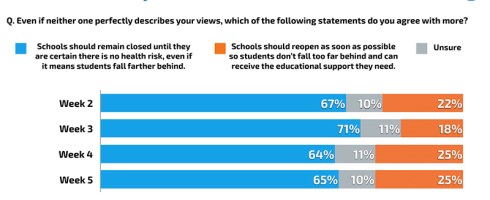
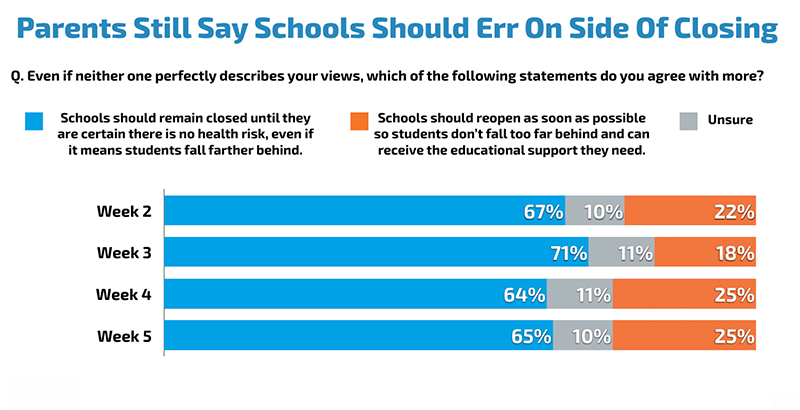
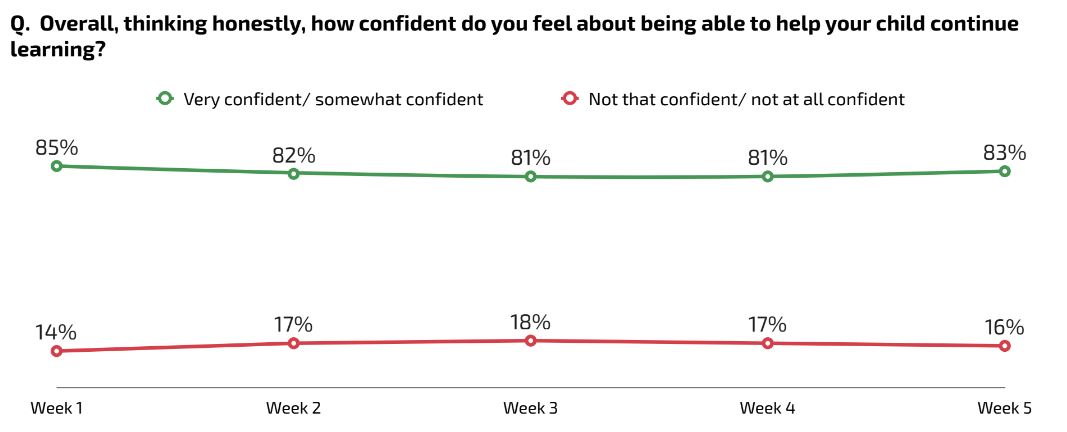
Echelon Insights at the Harvard Kennedy School recently queried parents about their concerns regarding education and Covid-19. Weekly surveys (April 27 – May 25) of 500 K-12 parents were conducted. It seems the San Diego teachers and American parents have aligned beliefs about the need for safety and the promise of strong learning.

Parent-surveyParent-survey Continue Learning

Parents are more concerned about safety than getting school opened as fast as possible and it appears they believe their child will continue learning.

Schools Must Reopen Immediately!!!

The headline on a June 1st article by McKinsey and Company screams, “COVID-19 and student learning in the United States: The hurt could last a lifetime.” The sub-title says, “New evidence shows that the shutdowns caused by COVID-19 could exacerbate existing achievement gaps.”

Much of the McKinsey article is based on the theoretical work of Erik Hanushek and Paul E. Peterson who have made careers out of creating biased studies designed to promote privatization of public education and undermine teacher professionalism. In addition, McKinsey relies heavily on information developed by Curriculum Associates the owners of I-Ready and data from NWEA the Portland based testing publisher that sells MAP testing.

Sounding very much like the authors of the infamous A Nation at Risk”, McKinsey claims:

“All told, we estimate that the average K–12 student in the United States could lose $61,000 to $82,000 in lifetime earnings (in constant 2020 dollars), or the equivalent of a year of full-time work, solely as a result of COVID-19–related learning losses.”

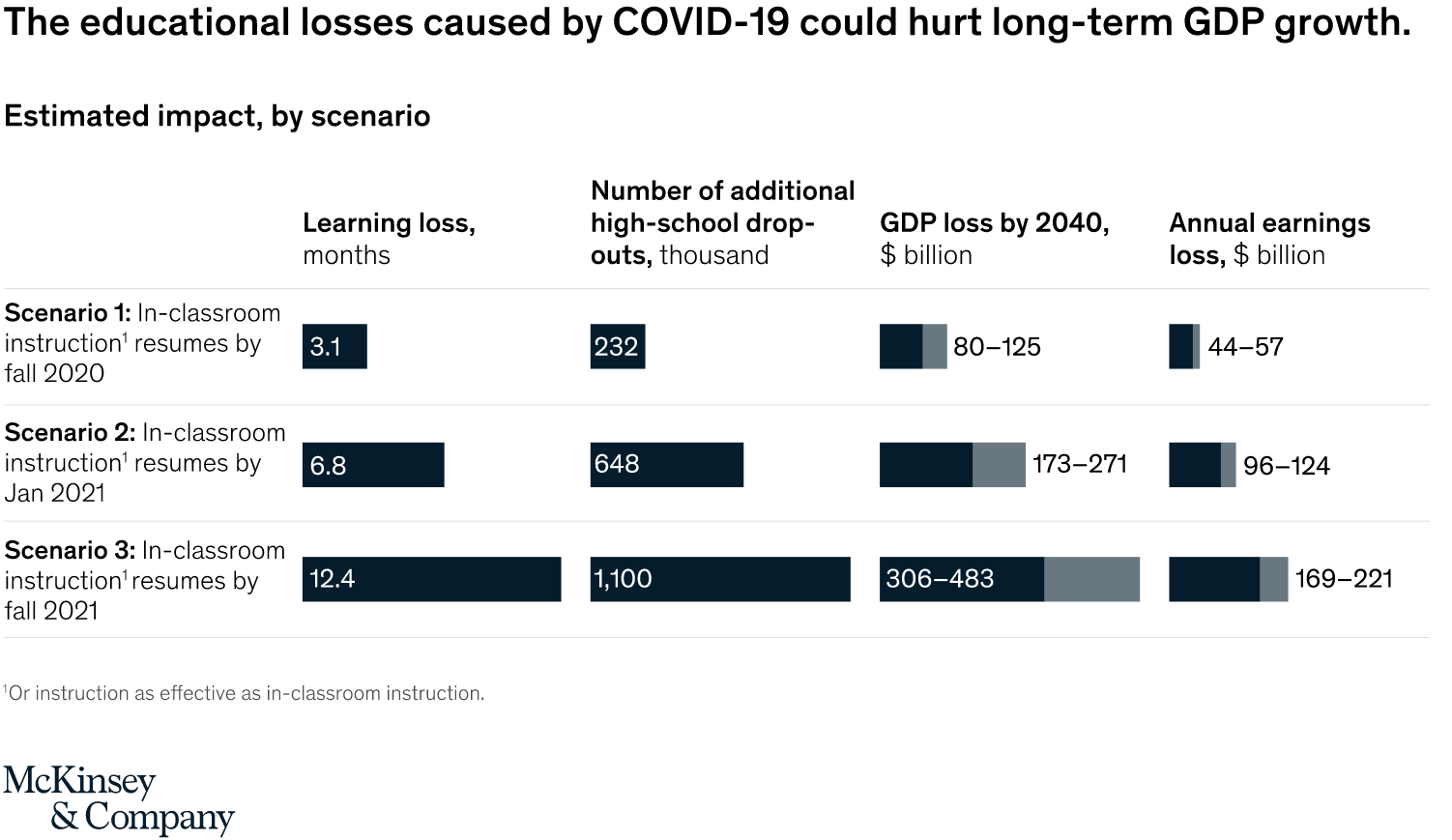
“Furthermore, if other countries mitigate the impact of lost learning and the United States does not, this will harm US competitiveness. By 2040, most of the current K–12 cohort will be in the workforce. We estimate a GDP loss of $173 billion to $271 billion a year—a 0.8 to 1.3 percent hit (Exhibit 5).”

Exibit 5 GDP Harmed

Exhibit 5 – What Magic Algorithms Produced this Fantasy?

At the billionaire created publication, The 74, a June 9th article ran under the heading, “New Research Predicts Steep COVID Learning Losses Will Widen Already Dramatic Achievement Gaps Within Classrooms.” The widening is supposed to happen because of poor parenting, lack of resources at home and learning gaps expanding during school closures.

They also make the senseless claim, “But now, especially without spring exams to guide them, schools will have no idea on day one of the 2020-21 school year what the array of needs in each class is.”

It should be noted that most teachers do their own student evaluations because they find the standardized testing data almost useless even if it is available when needed.

Republican Congressmen Jim Banks of Indiana and Tom Tiffany of Wisconsin have introduced the Reopen Our Schools Act. Congressman Banks stated,

“Reopening our schools is the lynchpin to reopening our economy. Many parents rely on their kids going to school so they can go to work. To get our society up and running again, we need our children back in school.”

Congressman Tiffany who joined congress this May added,

“These open-ended school shutdowns have set students back, made it harder for teachers to teach, and pushed parents to the breaking point. It’s time to reopen America and get back to school.”

In their announcement the congressmen referenced a Wall Street Journal report claiming remote learning this spring “didn’t work.” Like McKinsey and The 74, the Wall Street Journal references projections made in a May 27 paper by NWEA.

The Northwest Evaluation Association was founded in 1977 when a group of researchers and testing directors met at the Jolly Roger restaurant in Chehalis, Washington. The participants were unhappy with current standardized testing in the United States because it was the same test everywhere and unaligned with curriculum. They chose the small town of Chehalis because it was half way between Portland, Oregon and Seattle, Washington where most of the members lived. Today, the organization is known as NWEA.

NWEA is another education service business that abuses the non-profit federal tax laws. In 2018, they sold over $148,000,000 in testing services and their tax document shows sixteen people with salaries ranging from $200,000 to $513,172.

NWEA publishes MAP testing which tests mathematics and English three times each school year; fall, winter and spring. The tests are not aligned to one class level so they are only partially aligned with state curricular standards. That is in part why teachers at Seattle’s Garfield High School boycotted MAP testing contending, “the MAP is not worth the time and energy it takes to give.”

Using data from approximately 350,000 students who took MAP tests in school years 2017-18 and 2018-19, analysts at NWEA created a report based on projections that guessed at what the negative education effects from the school shut downs would be.

NWEA is known to have first rate psychometricians, however their expertise cannot make up for the noisy data known to exist with education testing or the fact that the growth models they use has never been satisfactorily validated or that their parabolic data fits might be inappropriate.

NWEA’s paper is well documented but still little more than a guess about education results made by people who are not professional educators. This is hardly the basis for insisting that we recklessly endanger the health of students, teachers and families by opening schools without making safety the number one priority.

Conclusion

The hybrid model for opening schools appears to be the best pandemic alternative. Students attend schools that are employing best health practices once a week. The rest of the week they participate in distance learning.

It has been widely espoused that poorer children do not have adequate equipment and connections for distance learning. However, most school districts have been providing devices and it should be possible for schools to setup socially distanced homework centers for students who don’t have available internet connections. For example, high school gymnasiums could easily accommodate 70 students safely distanced.

The reality is that we are facing a highly contagious virus to which human beings have no defense. This means that some cultural norms are not possible. Formerly in addition to academics, schools also were effectively daycare centers. In this environment, they cannot safely perform that function. Businesses, parents, schools and communities must work together to mitigate this unmet need.

Extra-curricular activities like sports, chorus, band and club meetings are not possible. That is a harsh consequence of the pandemic.

However, if professional educators and schools are supported, there is every reason to believe student learning can safely continue at a high rate, academic gaps will not increase and intellectual development will remain on track.

Organized to Disrupt

10 Jun

By Thomas Ultican 6/10/2020

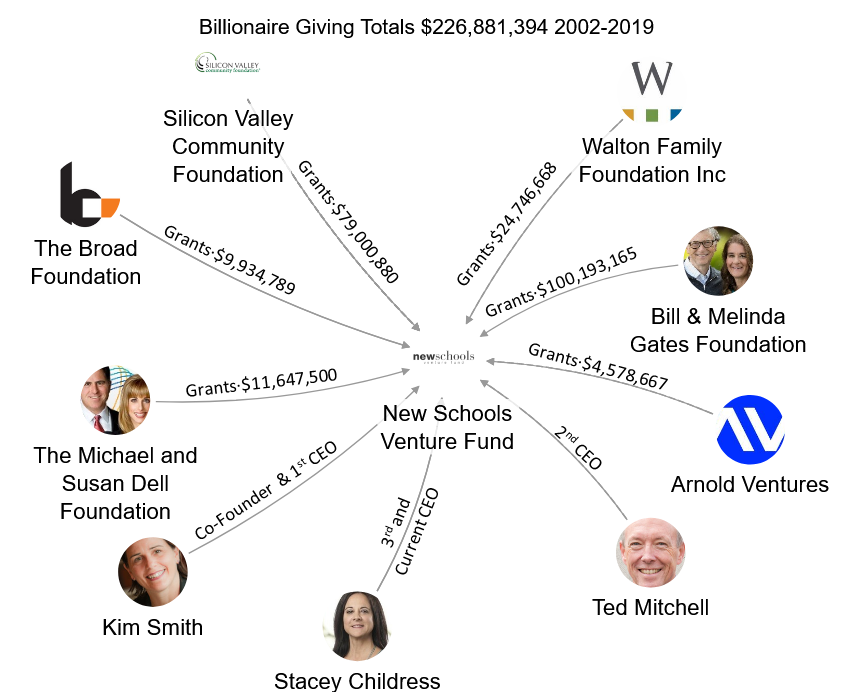
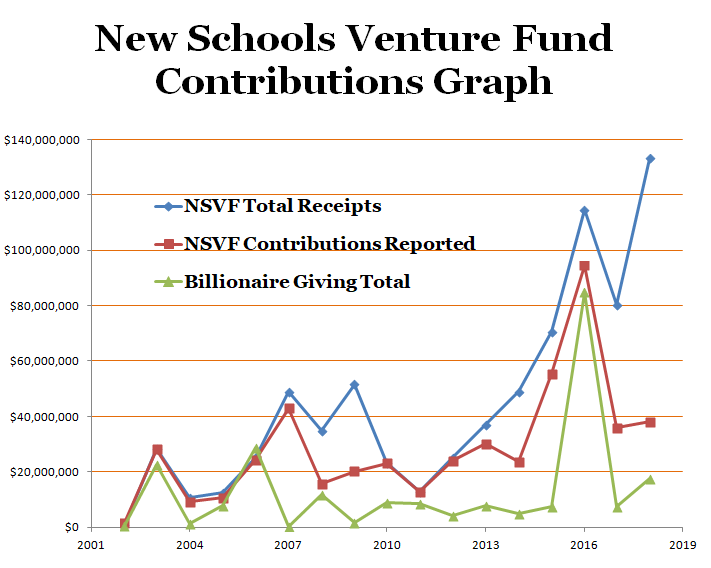
The New Schools Venture Fund (NSVF) is the Swiss army knife of public school privatization. It promotes education technology development, bankrolls charter school creation, develops charter management organizations and sponsors school leadership training groups. Since its founding in 1998, a small group of people with extraordinary wealth have been munificent in their support. NSVF is a significant asset in the billionaire funded drive to end democratically run public schools and replace them with privatized corporate structures.

1990’s Silicon Valley was a Happening Place

Mark Andreessen had just co-written the world’s first web-browser, Mosaic, before he came to town from the University of Illinois to co-found Netscape. John Doerr left Intel in 1980 to join the venture capital firm Kleiner Perkins where his reputation for picking winners became legendary. His wins include Amazon, AOL, Compaq, Electronic Arts, Google, Netscape and Twitter. Internet search engines were in their infancy when in 1999 Doerr convinced his partners to put $12.5 million into Google. Five years later that investment turned into billions.

Like elsewhere in America, every little strip mall in San Jose, California had a Blockbuster video rental store. In 1997, Reed Hastings and Netflix co-founder Mark Reynolds came up with a disruptive idea that put Blockbuster out of business. For a monthly fee, they offered DVD’s by mail with no late charges. Blockbuster did not adapt fast enough and went bankrupt.

In the Valley, everyone was aware that their business could be just one new technology innovation away from being the next Blockbuster.

“DoWopDon” Shalvey was the superintendent of schools in San Carlos, California a bedroom community about a third of the way up the peninsula between San Jose and San Francisco. When California passed its 1992 charter school legislation, Shalvey’s application for a charter turned into California’s first charter school. It officially opened in August 1994.

Apparently, Don Shalvey was an amateur DJ and very into music. His twitter handle is @dooWopDon.

Shalvey joined with Reed Hastings in writing a statewide initiative for the 1998 ballot that lifted the cap on charter schools and eased restrictions on starting one. At that time, Hastings was made president of Technology Network, a bipartisan lobbying group formed by Silicon Valley CEOs. With their support, the initiative quickly amassed more than a million signatures. Opposition from the teachers union ended as they were also fighting against other education proposals coming from Governor Pete Wilson’s office.

A deal was struck making the initiative unnecessary. Legislative leaders passed a bill containing the initiative’s key ingredients and union leader withheld their objections. The new bill green-lighted an unlimited number of charter schools and just as importantly the bill authorized a single board to oversee multiple charter schools. It was the birth of charter management organizations and a massive acceleration in new charter school development.

When Pete Wilson signed the new bill into law in May 1998, Shalvey and Hastings had $403,000 left in their initiative campaign fund. They decided to shift the money into a non-profit and founded what became the Aspire charter school network.

Meanwhile on the other side of the continent, Ann Smith graduated with a degree in political science and psychology from Columbia University in 1989 and started working for Wendy Kopp and the Teach For America (TFA) founding team. In 1993, she moved to the Silicon Valley area and co-founded the Bay Area Youth Consortium – AmeriCorps. In 1996, she left AmeriCorps to pursue a Masters in Business Administration at Stanford University.

Smith was co-chair of the Stanford business school’s entrepreneur club and she wanted to get Amazon founder Jeff Bezos as a speaker for the club. She asked her friend John Doerr to help and he agreed on one condition. In an education session at Al Gore’s house, the name NewSchools had been created. Doerr wanted her to come up with a use for the name.

Bezos spoke at the club and Smith worked on her assignment. She wrote a two page paper outlining the NewSchools Venture Fund. She had been inspired by what Don Shalvey and Reed Hastings had accomplished and thought to herself, “Why couldn’t entrepreneurial philanthropists come together to create networks of entrepreneurial education organizations?” Smith labeled the paper “Creating CMOs — scaling up with quality — with the help of venture-capital-style philanthropic investing.”

The history at the NSVF web-site says,

“NewSchools Venture Fund was created in 1998 by social entrepreneur Kim Smith and venture capitalists John Doerr and Brook Byers.” (Byers is a colleague of Doerr’s from Kleiner Perkins)

“We were among the first and largest investors in public charter schools and the first to identify and support multisite charter management organizations, which launch and operate integrated networks of public charter schools.”

“NewSchools’ work to support digital learning tools began at our inception in 1998.”

Philanthropy Magazine notes that Reed Hastings helped, “to launch the NewSchools Venture Fund.”

Big Money and Political Connections

LittleSis NSVF Map

LittleSis Map of NSVF Massive Funding By Billionaires

While there is little doubt the Bill Gates and The Walton Family Foundation are the largest individual donors to NSVF, the $226,881,394 in grants documented in the map above are only a fraction of the total billionaire largess. Besides receiving help from Reed Hastings, over the last 20-years, billionaires John Doerr, Laurene Jobs Powell and John Sackler have served on the board, but there is no information about any of their monetary contributions.

Kim Smith was the founding CEO of NSVF. The second CEO was Ted Mitchell the former President of Occidental College and a founding board member of NSVF. Mitchell replaced Kim Smith as CEO in September 2005 and held the position until 2014. From 2008-2010, he was simultaneously President of the California State Board of Education.

Mitchell has also served on the boards of New Leaders, Khan Academy, California Education Partners, Teach Channel, ConnectED, Hameetman Foundation, the Alliance for College-Ready Public Schools, Silicon Schools, Children Now, Bellwether Partners, Pivot Learning Partners, EnCorps Teacher Training Program, the National Alliance for Public Charter Schools, and the Green DOT Public Schools.

On May 8, 2014 EdSource reported, “Former State Board of Education president Ted Mitchell was confirmed Thursday as under secretary of education, the third-highest ranking official at the U.S. Department of Education.”

NSVF’s 2010 990-tax form had a note that claimed, “To date, the Organization has successfully received support from … the U.S. Department of Education.” From 2003-2007, NSVF reported $5,997,900 in grants from governmental sources. In 2008, the line requiring listing governmental grants separately disappeared from the 990-tax form. There is no longer an easily accessible method for gaining that information.

Contribution Graph

Enormous Grant Amounts Reported by NSVF and Selected Billionaires

In the graph above the billionaire giving in green is for yearly totals from the tax reports by the billionaires in the LittleSis Map above. The 2016 spike occurred because some unknown entity contributed $68,000,000 to NSVF through the donor directed foundation Silicon Valley Community Fund.

In 2016, Reed Hastings created a $100,000,000 fund within the Silicon Valley Community Fund. At the same time, Laurene Jobs Powell was serving on the board of NSVF when her XQ Institute was granted $24,750,000 in 2015 and $57,402,973 in 2016. Either one of them could have made the large contribution or maybe it was someone else.

Every year NSVF hosts a “Summit” in Oakland, California which they state brings together more than 1,200 educators, entrepreneurs, community leaders, funders, and policy makers to share ideas on how to “reimagine learning.” These “Summits” are a must attend for the disrupter community and they drive contributions.

To replace Mitchell as CEO when he left for the Department of Education in 2014, NSVF brought in Stacey Childress from the Bill and Melinda Gates Foundation. Childress earned an MBA from Harvard Business School in 2000. Afterwards, she spent a year co-founding an enterprise software sales company and then returned to Harvard where she was a Senior Lecturer and Executive Director. In 2010, Childress became Deputy Director of the Gates Foundation. She has been CEO of NSVF since arriving in 2014.

Both Mitchell and Childress have received NSVF salaries in excess of $500,000. The 2018 NSVF tax-form explanation of their compensation method reads,

“The organization obtained compensation studies from several independent sources to compile information used as a metric for salary increases … A subcommittee of the Board of Directors (BOD) conducts the review of the CEO and develops a recommendation for the full BOD.”

This is similar to the method that has ballooned executive pay in corporate America while line worker wages have stagnated. It is a method that justifies those at the top getting an ever greater share.

Investing in Privatization and Education Technology

NSVF claims they have invested in 117 Ed Tech companies, 187 charter schools and 55 diverse leaders programs.

Among their Ed Tech investments are Class Dojo, EdSurge, LearnZillion, Phet Interactive Simulations and Education Elements. When NSVF makes a major investment in an Ed Tech startup, they require a position on the companies governing board.

One of NSVF’s founding board members, Dave Whorton, is also the founder of Tugboat Ventures. When NSVF invested in Education Elements so did Tugboat Ventures. Dave Whorton was made a member of Education Elements Board of Directors where he efficiently keeps an eye on funds from both Tugboat and NSVF.

When first founded, NSVF invested heavily in Aspire Public Schools because of their plan to create a charter management organization. In 2001, they granted $1,095,000 of their total of $2,468,000 in giving to Aspire.

As their wealth grew the grants to charter schools became very similar to the grants their funders were making. They have funded DC Prep, Phalen Leadership Academy, Rocketship Education, Success Charter Network, Yu Ming Charter School and almost 200 more.

The Yu Ming Charter is essentially a private Mandarin immersion school that has just submitted a material revision to their expansion plan that was rejected in December. It has been alleged the Yu Ming does not want new students above the kindergarten level. A parent comment on the Berkeley Parent Network says, “The teachers seem reluctant to admit kids who aren’t quite up to par in Mandarin as it can be really overwhelming for students to be new and they don’t want to see them struggle and be under water from the get-go.” To which Oakland Educator Jane Nylund responded,

“Real, authentic public education is hard; we deal with struggling students every day as expected, standard educational practice. We don’t find a way to reject them because they are ‘struggling’. This honest assessment by an involved parent is just more evidence of a ‘public school’ in name only, and not in practice.”

NSVF’s diverse-leaders investing is aimed at replacing quality teacher education at universities with for profit organizations that have very limited expertise. It is also aimed at selling the privatization agenda. NSVF invested in Branch Alliance for Education Diversity, edfuel, MindWorks Collaborative, National Charter Collaborative, School Board Partners, TNTP and fifty more organizations.

School Board Partners came out of Education Cities when The City Fund was established. They appear to want influence over school board members by offering training; a function every state already provides. They are a part of selling the privatization agenda.

TNTP was rolled out of TFA by Wendy Kopp and Michelle Rhee. Before the billionaire driven push to privatize public education a “non-profit” company like TNTP would have gotten no consideration for training teachers because they are unqualified.

Final Comments

Kim Smith staid on the board at NSVF and in 2011 co-founded Bellwether Education Partners. The next year she founded the Pahara Institute where she is the CEO. Her 2016 pay reported on tax forms signed by her was $419,576. (Update: Smith recently stepped down as the Pahara CEO.)

DoWopDon (Don Shalvey) is now Deputy Director of the College Ready Team at the Bill and Melinda Gates Foundation.

NSVF along with scores of billionaire funded Foundations has been spending staggeringly large amounts of money to privatize public education and monetize it. This spending has been going on for decades now. So, why are about 90% of America’s students still attending public schools? The answer is simple.

The “disrupter” products are bad and Americans are not buying what their selling.

Persistent Billionaire Financed Attack on Oakland Public Schools Continues

29 May

By Thomas Ultican 5/29/2020

This month, a survey was launched in Oakland, California with the claim “This survey is a primary partnership between OUSD and GO Public Schools Oakland.” Apparently some Oakland Unified School District (OUSD) board members were stunned by the news and were not happy about raising the stature of a billionaire financed organization dedicated to privatizing public schools. It seems the survey resulted from a secret negotiation between OUSD administrators, GO and possibly some OUSD board members.

On May 13, when OUSD Director Shanti Gonzalez learned about the Survey, she wrote to Superintendent Kyla Johnson-Trammell,

Hi Kyla. Can you tell me more about the robocall that went out today that referred parents to GO’s website/survey and why it was decided to send this to parents? We don’t typically use our infrastructure to refer people to groups that engage in political activities, so I am curious.”

Two days later Gonzalez wrote again,

“I understand the desire to collaborate and avoid duplication of efforts, but please remember that GO plays two roles in the Oakland education arena. In this case, their intent was to support our efforts to understand families’ needs. Their other role is to shape the composition of the board of OUSD and ACOE [Alameda County Office of Education], and to support the growth of charter schools, at least historically.”

OUSD Director Roseann Torres was characterized as being hopping mad when she found out about the survey. In an interview Torres stated,

“The Superintendent will not respond to my emails about the survey. She doesn’t care that as a Director, I am her boss.”

On the other hand Director Jody London’s response to constituent questions about the survey indicates that she was informed. She writes,

“The OUSD Office of Equity and family engagement team are collaborating with GO and a number of other Office of Equity partners to reach as many families as possible with the survey that will provide very important information about our planning the reopening of school. The survey is standalone and initially only directed participants to GO if they wanted to provide information to receive the mailed school supplies thank you gift. That has now changed …”

“This more collaborative approach with a number of partners on the family survey will give us the best opportunity for a strong level of participation and useful feedback about reopening.”

Survey Sponsors 

Logos of the OUSD Survey Partners

Originally the above logos were depicted at the top of every page of the survey and a gift offering at the end of the survey required the takers to give their email addresses to GO Public Schools. After Oakland Education Association President Keith Brown became involved, the direction to GO Public Schools was replaced and logos at the top of each page were eliminated. People were directed to the OUSD web site to apply for the gift and the only logos shown were from OUSD and GO on the bottom of the intro page.

This survey is transparently GO’s and there is another survey by OUSD which is somewhat similar. The committee that created the second survey includes Teach For America (TFA), KIPP charter schools and others. It appears the content of both surveys are important to the charter industry. The GO survey seems to bias towards technology implementation and the other survey appears to be priming a unified enrollment system.

Privatization in Oakland Driven by Billionaire Dollars

Chris Stewart is a 2014 Bush Fellow, the CEO of Brightbeam and sits on the board of Great Schools. He feels the claims of billionaire dollars are unfair. He sees them as working to create “quality schools” or does his high six figure billionaire paid salary cause that opinion? Without billionaire dollars and a state take-over, Oakland public schools would be much healthier and the community would not be so divided.

The billionaire spending to privatize public schools in Oakland has been enormous.

Tax records document that just two foundations, The Bill and Melinda Gates Foundation (EIN: 56-2618866) and the Walton Family Foundation (EIN: 13-3441466) have spent more than $240,000,000 on privatization efforts in Oakland.

The Silicon Valley Community fund was formed in 2006. It has become an extremely large donor directed fund with reported assets of about $8 billion dollars. In 2018, it took in almost $6 billion dollars. Only three years of their 1,500 page long tax reports (EIN: 20-5205488) are searchable but just those three years show more than $15,000,000 spent on privatizing schools in Oakland including a 2017 gift to GO of $1,000,000.

This year, The City Fund – which was founded by two billionaires in 2018 – reported spending $7,591,666 on privatizing Oakland public schools. The City Fund supports the implementation of the “portfolio model” of school administration to drive privatization.

The portfolio model directs closing schools that score in the bottom 5% on standardized testing and reopening them as charter schools or Innovation schools. Oakland’s school board implemented this model in 2018 under the name “Citywide Plan.” The method makes it almost certain that schools in poorer and minority communities will be privatized.

In 2004, Don Fisher of the GAP and Buzz Wooley a San Diego investor put up $100,000 each to establish the Charter School Growth Fund. In 2005, Buzz Wooley resigned from the presidency and Jim Walton took his seat on the board. Since then the Walton Family Foundation has had significant influence over the fund. Between 2012 and 2017 the Charter School Growth Fund (EIN 05-0620063) spent $12,998,570 supporting privatized schools in Oakland.

The Ely and Edythe Broad Foundation (EIN 95-4686318) has spent a relatively modest $3,457,664 on privatized schools in Oakland. However, four different graduates of Broad’s strange education leaders training academy have served as superintendents of OUSD between 2003 and 2018. Diane Ravitch recently noted that “Broad Institute got accredited even though it has no faculty, no campus, no course catalogue ….” It was accredited by the Western States Schools and Colleges. There have been two common outcomes wherever “Broadies” serve; labor and community unrest accompanied by extreme budget issues.

The latest budget problems in Oakland trace directly to the tenure of Antwan Wilson the last Broad trained superintendent to run Oakland’s schools.

Are Billionaire Bought Board Members Now a Board Majority?

Roseann “Rosie” Torres is a lawyer who moved from her hometown of Stockton to Oakland in 2004. A civic organization she joined gave her a homework assignment to study the public school district budget. This opened her eyes to the tremendous inequities between the schools in the hills where she lived and those in the flats where much of Oakland’s minority population lived.

In 2012, school board member Noel Gallo convinced Rosie to run for the seat he was vacating so he could run for city council. Before his tenure on the school board SFGate reports, “In the mid-1990s, Gallo was a city employee during then-Mayor Jerry Brown’s two terms in office, working as a staff member for former City Manager Robert Bobb.” That is the same Robert Bobb who would take the Broad training course in 2005 and become the Detroit public school’s first emergency manager in 2009. Gallo introduced Rosie to GO Public Education.

In 2012, GO provided Torres with $37,847 in independent expenditures and helped her raise $36,635 in direct campaign contributions. These were historically large numbers but that same year GO was providing even larger campaign assistance to James Harris and Jumoke Hinton-Hodge. All three candidates were successful.

In addition, GO representatives introduced Torres to many Democratic politicians serving locally, at the state capital and in congress. Torres said she really did not know who GO was and it took her about six months after the election to figure it out.

After Torres turned against the GO privatization agenda, there assistance unsurprisingly ended. In 2016 when she ran for reelection, her total campaign money fell from the 2012 $74,000 to $17,725, however a group of local activists went to work for her and she won.

Torres will not be running for reelection this year. She needs a break from the pressure and drama.

In 2012, billionaires started actively engaging in local school board elections. All at once, school board elections in cities like Dallas became well funded and prohibitively expensive. That same year billionaires including Stacy Schusterman of Tulsa, Oklahoma, Michael Bloomberg of New York City, Laurene Jobs Powell of Palo Alto, California and others started making max donations to certain Oakland school board candidates.

The direct contribution limits of $700 made the independent expenditures with unlimited spending the place where most of their money went. In Oakland, that independent expenditure money was funneled though the GO Public School Advocates committee.

Table of Independent Expenditures

In 2018, $146,000 of Michael Bloomberg’s $250,000 contribution was put into the campaign to elect Gary Yee. Six years earlier, Yee was the focus of a recall campaign which was mainly about his push for closing schools. With Yee’s election, forces for privatization and school closing seem to have gained a solid majority on the OUSD board.

Some Closing Observations

The state government is also being corrupted by the prolific billionaire spending that is undermining democracy in America. In 2018, AB1840 which provided extra funding for financially strapped Oakland and Inglewood school districts was signed by Governor Brown. The root of their financial problems was the same; paying the extra unfunded costs associated with charter school openings and financial mismanagement by Broad trained superintendents.

One of the mandates for receiving financial help was the involvement of the Fiscal Crisis Management Assist Team (FCMAT) in stabilizing the budget. FCMAT was created and signed into law in 1991 by Governor Pete Wilson. The Kern County Superintendent of Schools office was selected as the administrative and fiscal agent for FCMAT. The purpose of FCMAT was to provide districts experiencing budget issues with professional leadership. However, this non-profit organization has developed a reputation for being more about helping political allies than struggling school districts.

FCMAT appears to have two strategies for solving district financial issues; laying-off personnel and closing schools.

On Memorial Day (May 25), the State Senate Fiscal Review Committee met to consider the May revise including AB1840 money for Oakland and Inglewood. Jane Nylund an Oakland resident and educator submitted a comment that reads in part,

“I strongly oppose the amendments of the Trailer Bill to AB 1840 regarding disbursements to Oakland Unified School District for 2020-21.”

“These amendments strip our local discretion to draw from the variety of strategies for fiscal solvency, listed as (c)(1)-(5). The language is clear:  the District “MAY” use the strategies. It is not mandated to use any particular one of them.

“Given the current situation with Covid-19, and all the unknowns that come with it regarding schools, it is completely inappropriate that OUSD is held hostage to sell property that it may find necessary to keep open in order to mitigate health risks of Covid-19.”

Community based schools run under the authority of an elected school board have served as the foundation for American democracy for two centuries. Feckless billionaires operating from hubris or theological commitment or a desire to avoid taxes or a pursuit of more wealth are sundering those foundations.

Will activists of good will be able to throw off the yoke of billionaire financed tyranny and defend their public schools in Oakland?

Eckhart Tolle Meets John Dewey

20 May

By Thomas Ultican 5/20/2020

Professor Michael J. Hynes new book Staying Grounded; 12 Principles for Transforming School Leader Effectiveness inspired this title. I have an aversion to self-help writings and new-age philosophy. After reading two chapters, that is exactly how I saw this book. It made me wonder why my friend Diane Ravitch recommended it. After reading a few more chapters, I got it. There is a lot to like. If the principles taught in this book were widely embraced, it would be a boon to education everywhere.

Staying Grounded Picture

In the introduction Hynes tells the reader that he will reveal his ideas concerning the purpose of schooling and how to ensure that each child reveals their potential. He opens by recommending the “philosophy that recognizes the fact that all children are different and meet them where they are.”

This a great starting point but it runs squarely into the devilish nature of standards based education. At the beginning of the new millennia, the cruel standards based philosophy began dominating classrooms. It was heartbreaking to observe students who although learning; were not learning fast enough. Instead of being encouraged while their intellectual abilities grew, they were crushed and taught to hate learning. That definitely was not meeting “them where they are.”

The book started naturally enough with principle one. It opened by quoting the Buddha, “It is better to conquer yourself than to win a thousand battles.” The point was that a busy administrator needed some regular self care. Buddhist philosophy is known as the inner path. Principle one was all about entering the inner path. It ends with another of the Buddha’s admired philosophical points, “When things change inside you … things change around you.”

Principle two continued imparting more new age philosophy to fix the budding administrator’s attitude. The reader is assured attitude is more important than aptitude in the life of a successful school leader. A positive attitude is held up as key. Hynes notes, “90% of the people you complain to don’t care and the other 10% are glad you have the problem.” An amusing and insightful quote, but it still only obliquely addressed education philosophy and leadership.

Principle three, “It’s All About Relationships” brought a big change to the tenor and usefulness of the book. In a vignette, a Deputy Superintendent named Julio V. Delgado shared, “Like many administrators, I was chasing scores, looking for a magic curriculum to close the achievement gap, and best of all, looking at what other districts were doing so I could replicate it ‘back home.’” He recognized a fundamental error in his approach and concluded, “It’s the connections and relationships we make and foster among others, that lead us to success and serve as the ultimate model for children as they develop.”

In the organization of each chapter the principle is stated, personal stories are shared by various school leaders interspersed with explanations of the principle. There are descriptions of the principles benefit to all stake holders – leaders, teachers, parents and students. The conclusion is practical guidance for how to implement the principle. Starting with principle three this section becomes specific and challenges the budding school leader with concrete suggestions. This is where I started seeing the great value in what Professor Hynes was sharing.

What is the Purpose of Education?

This is a question of central importance to the development of our culture and civilization. Professor Hynes addresses it by stating,

“It is important to recognize that other people, including many of your fellow educators, administrators, and our students’ parents might have a different point of view concerning what education should be all about. That’s okay! What’s important is that you define in your own words, your purpose of what education is to you.”

In responding to the question, I decided to look a little at what Hynes and others have written. Hynes quoted James Harvey, the President of the National Superintendents Roundtable, “K-12 education should prepare students for life – for college, for work, for living within a family and within a community, and for participating effectively in the democratic process.” Although future employment is needed for most young people, Harvey believes K-12 education is more than just job training.

Hynes also looked back to the great humanist Eleanor Roosevelt’s thoughts on the issue. In 1930, she wrote,

“Perhaps because there are so many books and the branches of knowledge in which we can learn facts are so multitudinous today, we begin to hear more frequently that the function of education is to give children a desire to learn and to teach them how to use their minds and where to go to acquire facts when their curiosity is aroused. Even more all-embracing than this is the statement made not long ago, before a group of English headmasters, by the Archbishop of York, that ‘the true purpose of education is to produce citizens.’”

“But there still remains a vast amount to be done before we accomplish our first objective-informed and intelligent citizens, and, secondly, bring about the realization that we are all responsible for the trend of thought and the action of our times.”

There is a danger lurking in Roosevelt’s view. While production of good citizens is an admirable goal, there is a dystopian risk of reinforcing the utilitarian view of human life. When she was writing these words, the Japanese and German education systems were focused on producing a certain type of personality reduced to a subordinate position and viewed as a means to other ends.

Daisaku Ikeda, the Buddhist teacher and founder of Soka schools, writes that Japan is suffering “the consequences of making education subordinate to bureaucratic and political agendas under the control of the Ministry of Education.” With the passage of the “No Child Left Behind” Act, the US abandoned the philosophy of local control and embraced the concept of a powerful bureaucracy steering education. As a society, we turned our backs on two centuries of steadily improving free universal public education and adopted a system vulnerable to political agendas.

That 2002 decision was a huge backwards step for “a society that serves the essential needs of education.” Columbia University’s Professor Robert Thurman, in an interview at Boston’s Ikeda Center, responded to the question, “How do you view the role of education in society…?” He replied,

“I think the question should rather be, What is the role of society in education? Because in my view education is the purpose of human life. It’s not that the purpose of education is to fit out humans to go and produce something.”

In his book Democracy and Education, John Dewey stated,

“Discipline, culture, social efficiency, personal refinement, improvement of character are but phases of the growth of capacity nobly to share in such a balanced experience. And education is not a mere means to such a life. Education is such a life. To maintain capacity for such education is the essence of morals. For conscious life is a continual beginning afresh.”

Dewey’s contemporary in Japan, Tsunesaburo Makiguchi, wrote,

“What is the purpose of national education? Rather than devise complex theoretical interpretations, it is better to start by looking to the lovely child who sits on your knee and ask yourself: What can I do to assure that this child will be able to lead the happiest life possible?”

The purpose of education is to create the space for people to fully manifest their abilities and express their inner essence while going through the natural stages of human development. In accord with Dewey, I believe, “To maintain capacity for such education is the essence of morals.” As Makiguchi said, assure that students can “lead the happiest life possible.”

Create a Better Education Structure

The rest of Michael Hynes book is filled with ideas for improving leadership skills in education. He advices superintendents to substitute teach and goes into great detail about how to derive the maximum benefit from the experience. Hynes spends four pages discussing shadowing students. He describes how to do it and its benefits. Hynes addresses many if not most of the issues a budding administrator needs to excel at in order to be a positive change maker. Administrators adopting Hynes 12-principles will benefit not only themselves but also their schools, students and communities.

However, this book can also be seen as dealing with the unfortunate outcomes of the authoritarian structural flaw innate to schools. The central figure (principal or superintendent) have the predominance of power in a system where administrators rule. Under this organization the only path to professional advancement is leaving the classroom to become an administrator.

I suggest changing this undemocratic autocratic scheme by employing democratic principles of governance that shares power between students, teachers and administrators.

Create an educator’s track the leads to advancement as a master teacher, department leader and curriculum expert. Teaching assignments and professional evaluations would fall under the responsibilities of this group. They would hold sway over new hires to their department.

When it came to school policies and final curricular decisions, students would be consulted and their input would have real significance.

Administrators would be responsible for facilities, daily discipline issues and communicating with parents.

The three groups would meet regularly and continually engage in dialog to reach consensus on all school issues.

Conclusion

Michael Hynes’s Staying Grounded is a good read filled with many wonderful concepts for improving school operations. I recommend the book.

Finally, I really liked this quote Hynes shared from Aristotle,

“It is the mark of an educated mind to be able to entertain a thought without accepting it.”

CREDO’s New Study Biased against Public Schools

14 May

By Thomas Ultican 5/14/2020

The Center for Research on Education Outcomes (CREDO) started releasing the results of its new Cities Study Project in mid-2019. It is not a coincidence that the cities chosen for the study have long been targeted for public school privatization. The ten cities selected are: Indianapolis; Baton Rouge; Camden; Kansas City; Memphis; New Orleans; Oakland; St. Louis; San Antonio; and Washington DC. This CREDO study is even more opaque and biased than its previous efforts.

Who is CREDO?

Hanushek and Raymond

Husband and Wife Team Who Founded CREDO

In the early 1980s, Margaret (Macke) Raymond was completing a lengthy graduate school agenda at the University of Rochester, a relatively small private university in Rochester, New York. She garnered an MS of public policy in 1980, a community medicine MS in 1982, an MA of political science in 1983 and finished with a PhD in political science in 1985. From 1985 to 2000 she ran Raymond Consulting and worked a few years in the telecommunications industry.

At that same time, Eric Hanushek was Professor of Economics and Political Science at Rochester University. The former Air Force cadet had earned a doctorate of Economics from the Massachusetts Institute of Technology in 1968. It was Hanushek’s 1981 paper “Throwing Money at Schools” that put him on the watch list of right leaning philanthropies and institutions. In his notice making missive he stated,

“The conventional wisdom about public schools is that they face serious problems in terms of performance and that improving schools requires additional money. However, the available evidence suggests that there is no relationship between expenditures and the achievement of students and that such traditional remedies as reducing class sizes or hiring better trained teachers are unlikely to improve matters.”

In a 1981 Ed Week commentary referencing this paper, Hanushek points to SAT testing as the gold standard for judging school performance. In complete accordance with the old aphorism, “to a man with a hammer all problems look like a nail,” Hanushek brags, “Advanced statistical techniques are employed to disentangle the influences on achievement of schools and teachers from those of other factors such as family backgrounds and student abilities.”

A 1999 announcement from Rochester University said, “The Center for Research on Education Outcomes has been established at the University of Rochester’s Wallis Institute of Political Economy…” In the same posting, it was revealed, “Two foundations have committed $1.25 million to fund a three-and one-half year initiative to address the current shortage of evaluation research in education policy matters.” CREDO never made the name of the two foundations public, but a knowledgeable academic says one of them was the Walton Family Foundation.

The announcement listed two employees of the new center, Eric Hanushek and Margaret Raymond. Hanushek was listed first but Raymond was cited as the founding Director.

CREDO moved from the University of Rochester to Stanford University’s Hoover Institute in July, 2000 which made networking in conservative circles much easier.  In CREDO’s 2nd year report, they stated that moving to the Hoover Institute brought them many new contacts including the New Schools Venture Fund, the District of Columbia Charter School Board, the Teacher Union Reform Network and others.

A description of the Hoover Institute from Source Watch says,

“The Hoover Institution is influential in the American conservative and libertarian movements, and the Institution has long been a place of scholarship for high profile conservatives with government experience. A number of fellows have connections to or positions in the Bush administration, and other Republican administrations. … Other fellows of the Institution include such high profile conservatives as Condoleezza Rice, George Shultz, Thomas Sowell, Shelby Steele, and Edwin Meese.”

Macke Raymond’s 2015 Hoover Institute Fellow’s profile says in part, “In partnership with the Walton Family Foundation and Pearson Learning Systems, Raymond is leading a national study of the effectiveness of public charter schools.” 

Valerie Strauss of the Washington Post has pointed out that Eric Hanushek

“… a Hoover economist was a pioneer in creating systems that evaluate teachers by student standardized tests, a method that many assessment experts say should not be used in the high-stakes ways that school reformers are using them. He is often cited in CREDO studies as a ‘principal investigator.”’

Discredited and Biased

The Forbes commentator, Peter Greene, wrote about Eric Hanushek for his popular blog Curmudgucation:

“Now when Hanushek says that teachers make a huge difference, he is obliquely referencing his own crazy-pants assertion that having a good first grade teacher will make you almost a million bucks richer over your lifetime (you can also find the same baloney being sliced by Chetty, Friedman, and Rockoff). Both researchers demonstrate their complete lack of understanding of the difference between correlation and causation.”

Greene also shares the following graphic that clearly highlights the difference between correlation and causation.

Divorce caused by Margarine consumption

Does Margarine Consumption Cause Divorce?

Business writer Andrea Gabor states that CREDO studies which compare charter schools with public schools start with two key assumptions “A) That standardized-test scores are an adequate measure of school quality and B) that creaming in charter schools does not exist.”

With regards to assumption ‘A’, using standardized testing for this purpose has been shown faulty from studies dating back to the eugenics movement (which originated high stakes standardized testing) to recent works debunking them for mistaking correlation versus causation and for not being able to compensate for the problem of error.

As for assumption B, there is no doubt that most charter schools push out and avoid students that are classified as special education, language learners or discipline problems. The data proving that is in state enrollment reports wherever charter schools exist.

In the new research labled “Cities Studies Project”, the Technical Appendix says the reports uses growth models but doesn’t share which of the many growth models it uses. It also says,

“In our study, scores for all these separate tests are transformed to a common scale. All test scores have been converted to standardized scores to fit a ‘bell curve’, in order to allow for year-to-year computations of growth.”

The Education Growth Model Handbook lists seven types of growth models in general use and their requirements. Most growth models require vertical scales but that does not seem possible with CREDO’s use of multiple tests many of which are not vertically scaled. Their mathematical conversions add another locus of error. Growth models have proven to be unstable and have never been satisfactorily validated.

The research methodology used in the “Cities Studies Project” appears to be the same as that used in CREDO’s 2015 Urban Charter School Study Report on 41 Regions.” A particularly troubling practice employed then and apparently still being used is the “virtual twin” method which creates a pro-charter school bias.

Professor Andrew Maul of UC Santa-Barbara reviewed the 2015 study for the National Education Policy Center. He noted the CREDO method does not compare charter school performance to actual public schools; rather it creates mathematical simulations. Maul described the “virtual twin” schema employed to develop a “virtual control record.” He reports,

“CREDO’s approach to this estimate is the construction of a ‘Virtual Control Record’ (VCR) for each student in a charter school, obtained by averaging together up to seven students in “feeder” public schools (i.e., those schools whose students transfer to charters) with the same gender, ethnicity, English proficiency status, eligibility for subsidized meals, special education status, grade level, and a similar score from a prior year’s standardized test (within a tenth of a standard deviation) as the specified charter student.”

Maul adds, “The study’s “virtual twin” technique is insufficiently documented, and it remains unclear and puzzling why the researchers use this approach rather than the more accepted approach of propensity score matching.”

The stipulation that “virtual twins” come from “feeder schools” biases the study in favor of charter schools. Andrea Gabor explained that in practice, CREDO used less than five students transferring to a charter school as the cutoff for using a particular public school’s data. She reports that the, “study excludes public schools that do NOT send students to charters, thus introducing a bias against the best urban public schools, especially small public schools that may send few, if any, students to charters.” Gabor gave the example of two well regarded New York title-1 schools, Global Technology Preparatory and West Side Collaborative which were excluded. They are noted for scoring well on testing, but did not meet the transfer criteria yet easily matched the required demographics.

The CREDO study is singularly focused on test results as determinate of school quality and ignores other advantages of public schools. It is a well known fact that many charter school systems like IDEA and Success Academy spend an inordinate amount of time teaching to and preparing for standardized tests. To these criticisms, Professor Mark Weber of Rutgers University adds a few more observations:

“Cities Studies Project” Technical Appendix states,

“To assist the reader in interpreting the meaning of effect sizes, we include an estimate of the average number of days of learning required to achieve a particular effect size. This estimate was calculated by Dr. Eric Hanushek and Dr. Margaret Raymond based on the latest (2017) 4th and 8th grade test scores from the National Assessment of Educational Progress (NAEP).”

Converstion to Days of Learning

The CREDO Days of Learning Conversion Table from “Cities Studies Project”

This metric seems to have been created with next to nothing validating it. Mark Webber quoted the psychometrician Michael T. Kane,

“The 2015 study (p. 5) cites a paper published in Education Next (Hanushek, Peterson & Woessmann, 2012) that asserts: “On most measures of student performance, student growth is typically about 1 full std. dev. on standardized tests between 4th and 8th grade, or about 25 percent of a std. dev. from one grade to the next.” (p. 3-4) No citation, however, is given to back up this claim: it is simply stated as a received truth.”

CREDO tells us that Hanushek and Raymond did something with NAEP data from 2017 but still do not offer any justification for the conversion. It appears at best to be sloppy science and the headlines engendered from it are nothing short of propaganda.

Using CREDO Claims to Sell Privatizing Public Schools

Neerav Kingsland the Managing Partner of the City Fund posted to his Blog last July when the first results from “Cities Studies Project” arrived explaining,

“Last year, Arnold Ventures commissioned CREDO (out of Stanford University) to study the effects of charter, innovation, and traditional schools in select cities across the country.”

“Most of the cities included in the study were cities where Arnold Ventures (and now The City Fund) have partnered with local leaders to expand high-quality schools.”

“Camden’s city level effects are large.”

“In just two years, scores are up ~.15 standard deviations in math and ~.05 standard deviations in reading (compared to similar schools across the state).”

The reality is those changes are very small. Noise in the data is a better explanation than awesome charter schools for these tiny differences.

In Indianapolis, the CEO of The Mind Trust, Brandon Brown, just wrote an Indy Star opinion piece stating,

“A 2019 study from Stanford University found that students who attend Innovation Network Schools achieve the equivalent of 53 additional days of learning in English and 89 additional days of learning in math each year when compared to their traditional public school peers. This equates to several years of additional learning during the span of a K-12 academic career, and the gains are largest for students of color and students from low-income backgrounds.”

In the billionaire financed effort to privatize public education, CREDO has become their source for data proving things like smaller class sizes and teacher professionalism are not important. The “Cities Studies Project” commissioned by an organization intent on privatizing public schools through promoting the portfolio management scheme – The City Fund – is biased toward the privatization agenda. Rather than shining the light of scholarly work on education policy, it obscures reality with obfuscation.