Just Finished Diane Ravitch’s New Book

25 Nov

By Thomas Ultican 11/25/2025

An Education; How I Changed My Mind About Schools and Almost Everything Else, is highly recommended especially for the thousands of us who consider her a friend. Diane is a very generous person with both her time and resources. I first met Diane through her blog in 2014, then in person at the 2015 NPE conference in Chicago. It was in this time period that she started posting some of my articles on her blog while simultaneously informing me about who was working to destroy public education. At the time, I did not realize what a privilege this was. Her latest book is an intimate memoir that introduces us to Diane Rose Silverstein of Houston, Texas born July 1, 1938. It tells the story of a Jewish Texan from of large struggling family becoming politically influential and a national treasure.

On a page following the dedication page, she quotes Ralph Waldo Emerson:

“Foolish consistency is the hobgoblin of little minds, adored by little statesmen and philosophers and devines.”

I knew that Diane had made a big change and reversed herself on test based accountability and other school reform agendas driven by conservatives and neoliberals. However, the courage this change took and the depth of her reversal were profoundly illuminated by reading this book.

Although growing up in a Roosevelt supporting family and being a registered Democrat, she became deeply conservative. Diane served on the board of the Thomas B. Fordham foundation, contributed to the Manhattan Institute and was a member of the Koret Task Force with the likes of Eric Hanushek and E. D. Hirsch Jr. Her best friends personally and politically all supported the ideas she abandoned. By reversing herself, she walked away from professional security and long held personal friendships. It was courageously principled but must have been a personally daunting move.

Me and Diane

The best part of “An Education” for me was Diane’s recounting growing up in Houston and going to a segregated public school. Her experience was just so relatable. She liked all the music my oldest sister liked. Cheating was rampant in her school just like mine and like her; I let my classmates copy my work. My rural Idaho school was kind of segregated but that was because only white people and a few Mexican families lived in the community. The Mexican kids were very popular in our school. I never met a Black person until I was a senior in high school and had only seen a few through a car window when vacationing in Kansas City. It was wonderful to find some commonalities.

I had studied engineering, worked in Silicon Valley and pretty much ignored education. But I did hear from Diane and her friends about what a failure public education had become. By 1999, I became tired of hearing about people becoming rich off their stock options, working on the next greatest hard drive or dealing with the atrocious San Jose traffic. I decided to return to San Diego and do something to help public education by enlisting in a master of education program at the University of California San Diego (UCSD).

The UCSD program was oriented toward constructivist education which I really liked. I read books by Alfie Kohn and papers by Lisa Delpit and was ready to revolutionize public education. Then I got to my first job at Bell Jr. High School and discovered that the teachers there were well informed pros with lots of experience. By comparison, I was not nearly as competent as most of them.

It was then that I started to see that I had been bamboozled about how bad public schools were and began looking for like minded people. Two books, David Beliner’s and Eugene Glass’s “50 Myths and Lies that Threaten America’s Public Schools” and Diane Ravitch’s “The Death and Life of the Great American School System” were like water for the thirsty. Soon after that, I found Diane’s blog and joined the Network for Public Education (NPE) along with many other public school advocates.

I saw Diane at the 2015 NPE conference in Chicago’s Drake Hotel. It was an absolutely inspiring event with a keynote by the amazing Yong Zhao. Although we started communicating a little by email, I did not meet Diane personally until NPE 2016 in Raleigh, North Carolina. It was there that the Reverend William Barber gave a truly inspiring speech.
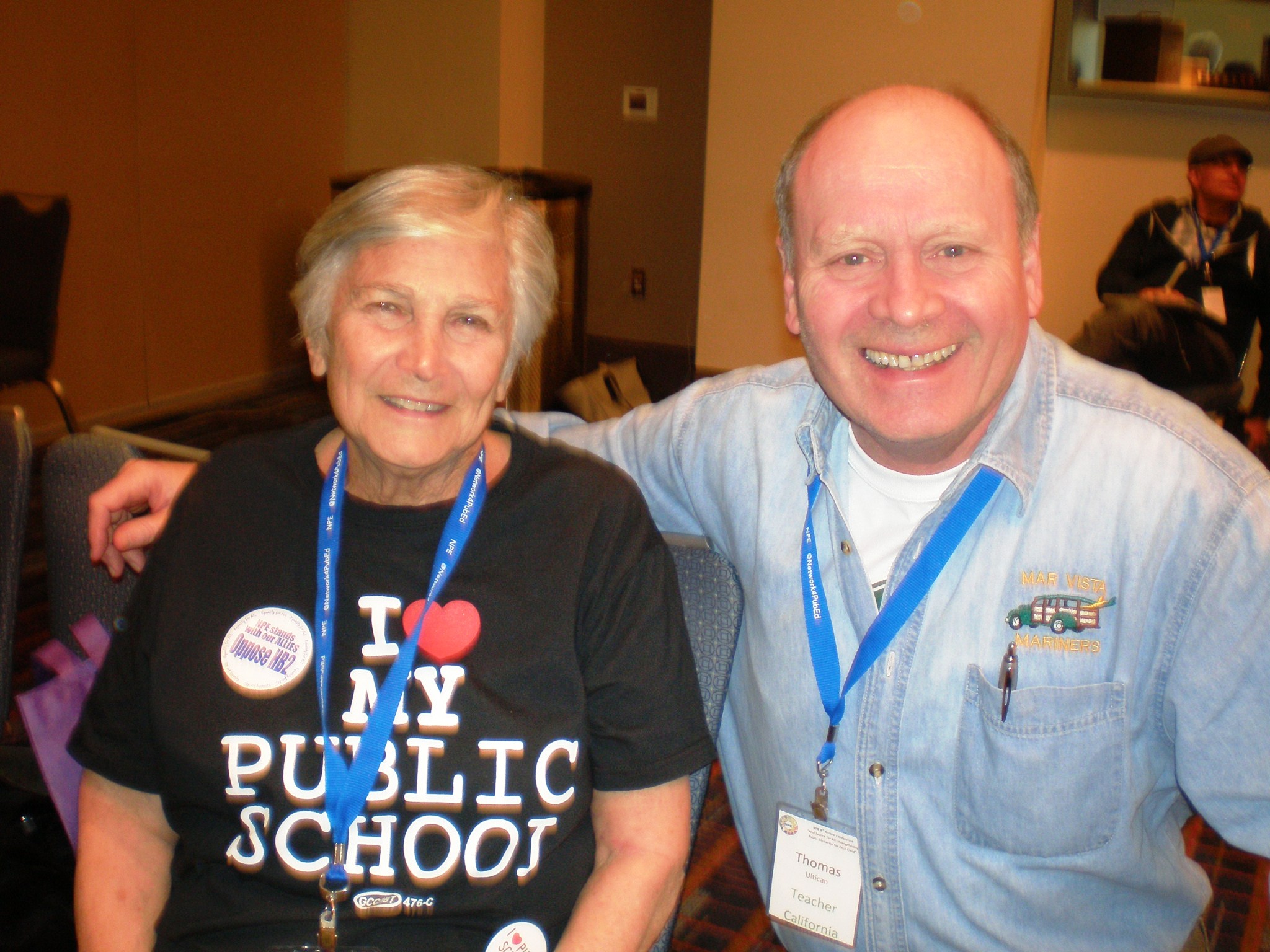
Tom Ultican and Diane Ravitch in Raleigh (by Ultican)

Over the years since, I have developed an ever growing admiration for this woman. She outworks everyone and never gives up. In 2021, Diane had a really difficult open heart surgery. In the book, she notes going into surgery on April 7 and waking up a week later. I wrote her that my chanting Nam-myoho-renge-kyo for her health and recovery had saved her life but she foolishly gave some credit to the other hundreds of people who were sending prayers and to her skilled doctors.

A year later, we had an NPE conference in Philadelphia. Diane was there and leading the proceeding but she was still weak. It was hardly noticeable but when she went to conduct an interview with Little Steven Van Zandt, he had to help her negotiate the two steps up to the platform.

Diane and Little Steven Van Zandt (by Ultican)

During my several trips to NPE conferences, I have met a Baptist preacher from Texas named Charles Foster Johnson. Charles has been a tireless fighter protecting public education and has developed an organization called Pastors for Children. I remember asking Diane if she ever thought she would be a friend and political ally with a Baptist preacher? She said, “No, never!” Earlier this year at NPE 2025 Diane and Charles asked me to take their picture. So there it was a Buddhist, a Jew and a Baptist working together and sharing friendship.
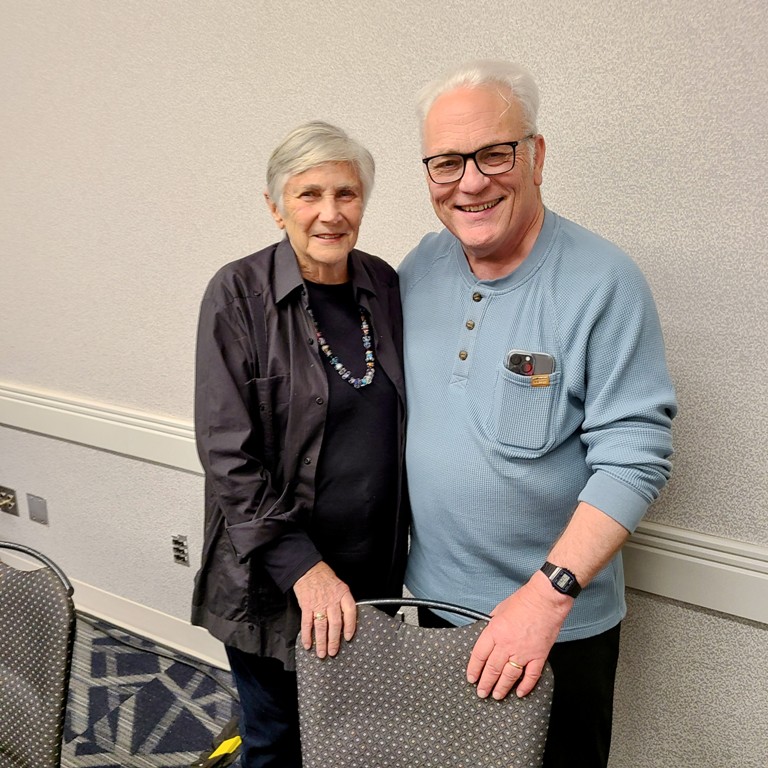
Diane Ravitch and Charles Foster Johnson 2025 (by Ultican)

Conclusion

Like I noted above, I had not paid any attention to public education so when I became aware of Diane, her blog and her book “The Death and Life of the Great American School System”, I was surprised to find how much seasoned educators despised Diane and could not trust her. Still to this day, I see education professionals taking shots at her and NPE. It is impossible for them to believe she changed her mind which brings to mind the words of Emerson, “Foolish consistency is the hobgoblin of little minds…” They just cannot accept new evidence.

I really enjoyed Diane’s latest book and encourage everyone to read it. She probably thinks this is her last book a sort of swan song. Somehow, I don’t think so. She is relentless and will almost certainly want to teach all of us about something in the future. I expect that in two or three years we will see another powerful book by Diane Ravitch.
Crazy-Pants Makes Crazy Prediction

19 Nov

By Thomas Ultican 11/18/2025

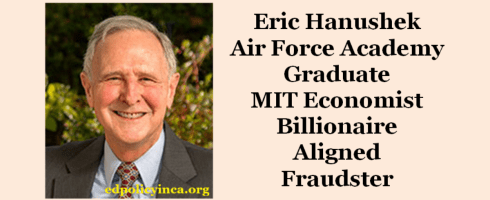
A propaganda rag, ‘The 74’, reported, “[R]esearch from Stanford estimates learning loss over the past decade has cost our country over $90 trillion in future growth.” The article was written by Eric Hanushek, a Stanford University economist, and Christy Hovanetz, an education researcher from Jeb Bush’s pro-school choice and pro-education technology organization, ExcelinEd. Unsurprisingly, the article linked above is a paper Hanushek wrote. Crazy-pants Eric has a long history of using his own papers to support new research which is typically long on assertions and short on convincing analysis.

Last year, he claimed COVID-19 “learning-loss” could cost America $31 trillion in future economic development. Hanushek’s latest paper asserts, “The present value of future lost growth would be approximately three times current GDP (which is $30 trillion).” The justification for this new assertion is more than uncertain. The new paper refers to a model from his 2011 paper written with Ludger Woessmann­ for the Organization of Economic Co-operation and Development. That paper was long on Arithmetic with several assumptions short on common sense. In his latest paper and this article, he is claiming that a small drop in the National Assessment of Education Progress (NAEP) scores added to what he calls “Covid learning loss” will cost America $90 trillion in future growth.

Eric Hanushek first gained notoriety with his 1981 paper, claiming “there is no relationship between expenditures and the achievement of students and that such traditional remedies as reducing class sizes or hiring better trained teachers are unlikely to improve matters.” This claim attracted conservative billionaires but had little relationship with reality. When providing solutions in ‘The 74’, Hanushek and Hovenetz contradict his 1981 paper writing:

“First, states need to invest in effective personnel. They can do this by incentivizing strong teaching and by supporting strong teaching through professional development in evidence-based practices such as use of high-quality instructional materials and assessment data to inform instruction.”

A few decades ago, a friend gifted me the book “An Incomplete Education” by Judy Jones and William Wilson. After my 1987 edition, Jones and Wilson have updated the book and republished several times. I fondly remembered their description of economists:

“Economists are fond of saying, with Thomas Carlyle, that economics is ‘the dismal science.’ As with much that economists say, this statement is half true. It is dismal.”

“Where once rulers relied on oracles to predict the future, today they use economists. Virtually every elected official, every political candidate, has a favorite economist to forecast economic benefits pinned to that official or candidate’s views.” (Incomplete Page 120)

It just so-happens that Eric Hanushek is an MIT trained economist who is good at creating reports that conform to the beliefs of conservative billionaires. His work is scientific propaganda masquerading as academic excellence.

Notices from Hanushek and Hovanetz

“No single event over the postwar period has had an impact on our educational system that comes close to that of the pandemic.” This statement from their article is hyperbole not fact.

The impact of vouchers in Washington DC and Ohio were worse than COVID-19. In his book, The Privateers, Josh Cowen shared that the losses due to COVID-19 were around -0.25 standard deviations while losses in DC due to vouchers were around -0.40 standard deviations and in Ohio they were as high as -0.50 standard deviations. (Privateers Page 6) However, these were not nationwide results. Unfortunately, we don’t have much information about the mumps, measles, flu and polio epidemics of the 1950s but there is every reason to believe their impact was close to that of the COVID-19 epidemic.

The authors hold up Mississippi, Tennessee and Louisiana as examples to emulate stating:

“Some states made noteworthy progress on NAEP this year: Mississippi, Louisiana and Tennessee. Each has a track record of high expectations and strong accountability.

“These states use an A–F school rating system that puts reading and math achievement front and center. They measure what matters — proficiency and growth — and they report results in a way families and educators can understand. Transparency and rigor are fueling their progress.”

The A—F school ratings system is worthless because it only measures parent income. As Diane Ravitch wrote on her blog:

“The highest rated schools have students with the highest income. The lowest rated schools have students with the lowest income.”

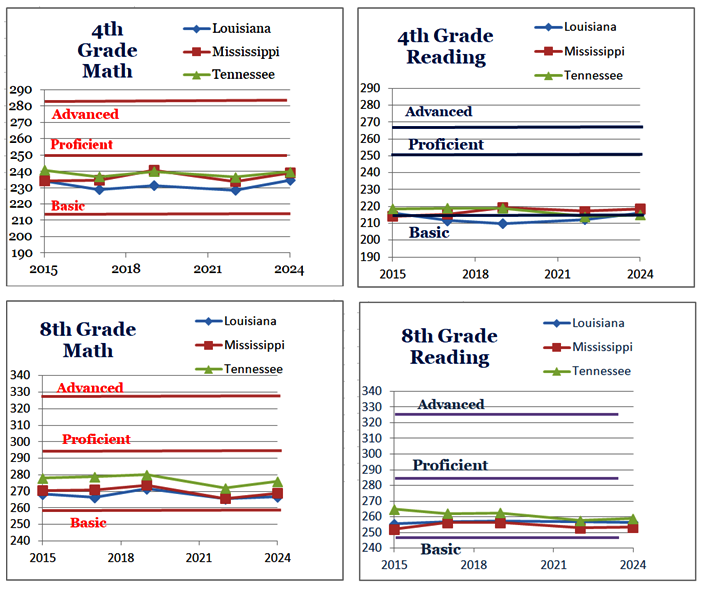
I wondered what Hanushek and friend were alluding to, so I graphed the average NAEP data for 4th and 8th grade reading and math since 2015 to see if it provided a clue.

NAEP Data for Louisiana, Mississippi and Tennessee

I added a bar indicating the NAEP cut scores for the 2024 NAEP designations of basic, proficient and advanced as a reference. It is well known that NAEP’s proficiency level is set well above grade level which means 70% of students not being rated proficient is not a bad score. Furthermore, writing in Forbes, Peter Greene shared, “An NCES report back in 2007 showed that while NAEP considers “basic” students not college ready, 50% of those basic students had gone on to earn a degree.”

The data graphed here indicates to me that all three states have solid public education programs. It is noteworthy that in reading their 4th graders only averaged basic but by 8th grade their average results were above basic. However, all three states are among the bottom 15 scoring states in the US and as we would expect are in the bottom 15 states in family income. What I do not see is why they are held out by Hanushek and Hovanetz as exemplars.

Concluding Remarks

The first blogger to label Eric Hanushek crazy-pants was Peter Greene. I have found Peter’s creativity worth stealing.

Let’s be clear, there is no such thing as learning loss involving students. This is a complete misnomer. Students may not achieve some state provided targets but they are always learning; maybe not what we want them to learn but always learning.

Eric Hanushek is a huckster for conservative billionaires. This latest claim is beyond farcical. Claiming to have knowledge of economic development in 40 years is fantasy and then tying that fantasy to NAEP testing data is bizarre. His $90 trillion claim for loss of future economic development would embarrass a carnival barker.

Hanushek is the guy who thinks education can be measured in days of learning which means that students learn in a near linear fashion. They absolutely do not but even this bogus claim would seem prescient when compared to this latest assertion.

Standardized testing only correlates with family income. To evaluate education based on this fictitious instrument is fraudulent. By extension, this makes economist Eric Hanushek a con artist.

California Charter Schools Heading for 2026

11 Nov

By Thomas Ultican 11/11/2025

There was another major effort in Sacramento to reform charter school laws in order to head off a repeat of the A3 disaster. In May 2019, the San Diego District Attorney charged 11-people with scheming to use non-classroom based charter schools to steal more than $400 million from the state education budget. Eventually the A3 grifters all plead guilty, but shockingly no-one spent a day in jail. This year, state legislators failed again to reform purposefully weak charter school laws meanwhile the privatization movement is still infested with graft.

Billionaires have been the wind beneath the charter school movement’s wings.

The first California charter school was authorized in 1994. The original charter school law capped the number of schools at 100; however Netflix CEO, Reed Hastings, successfully campaigned to end that limitation.

The California Charter Schools Association (CCSA) was founded in 2003. John Walton, a billionaire member of America’s richest family, was on the first CCSA board. He died in a plane crash in 2005 and his billionaire niece, Carrie Walton Penner, assumed his seat on the board. She served on the CCSA board from 2005-2015. (TIN: 51-0465703)

Billionaire Reed Hastings was a CCSA board member from 2007 until 2015.

In Executive Director of the Network for Public Education (NPE) Carol Burris’s yearlong study of charter schools, she admits not knowing how much billionaire money goes to the CCSA but noted:

“The 2017 Board of Directors include New York’s DFER founder, Joe Williams, a director of the Walton Education Coalition; Gregory McGinty, the Executive Director of Policy for the Broad Foundation; Neerav Kingsland, the CEO of the Hastings Fund; and Christopher Nelson, the Managing Director of the Doris & Donald Fisher Fund. Prior Board members include Reed Hastings of Netflix and Carrie Walton Penner, heir to the Walmart fortune.

Other billionaires were also busy supporting the charter school movement. The history tab at the NewSchools Venture Fund (NSVF) website states:

“NewSchools Venture Fund was created in 1998 by social entrepreneur Kim Smith and venture capitalists John Doerr and Brook Byers.” (Byers and Doerr are colleagues from the Kleiner Perkins venture fund.)

“We were among the first and largest investors in public charter schools and the first to identify and support multisite charter management organizations, which launch and operate integrated networks of public charter schools.”

At the time, “entrepreneur Kim Smith” was a graduate student at Stanford. She was co-chair of the Stanford business school’s entrepreneur club and wanted to get Amazon founder Jeff Bezos as a speaker for the club. She asked an acquaintance, John Doerr, to help and he agreed on one condition. In an education session at Al Gore’s house, the name NewSchools had been created. Doerr wanted her to come up with a use for the name.

Bezos spoke at her club and she wrote a two page paper outlining NSVF.

The push by billionaires to privatize public education using charter schools has become clear. It makes little sense for the future of education in America but billionaires don’t care. Bill Gates and the Walton Family Foundation are the largest individual donors to NSVF totaling $226,881,394 in grants as documented in the 2020 article Organized to Disrupt. However, this is only a fraction of the total billionaire largess. Over the last 20 years, billionaires John Doerr, Laurene Powell Jobs and John Sackler have served on the NSVF board.

The billions of dollars invested in growing the charter school movement has lead to steady growth.

However, the rate of growth is decreasing. From 2014 to 2020 the California charter school growth averaged 5% a year. From 2021 to 2025 the growth has fallen to 1% a year.

Research by NPE revealed the Achilles heel plaguing charter schools; they are not stable. In the first three years of operation, more than 15% of charter schools close their doors and eventually half of all charter schools go out of business. Charter promoting organizations like CCSA and NSVF counter that charter schools get better test results, but testing by California’s Department of Education shows the opposite.

Results Posted by California Department of Education

Reforming the Charter School Law

More charter schools appear to be following the A3 path. Highlands Community Charter and Technical schools received the results of a scathing audit on June 24 this year. Auditors found that the school improperly received over $180 million in state funds. The entire 7-person board has resigned or been forced out.

The audit identified millions of dollars in over-payments stemming from inflated attendance figures. Investigators noted conflicts of interest, questionable expenditures, gifts and the hiring of unqualified individuals. A high-ranking employee earned $145,860 annually but lacked an expected bachelor’s degree. She is alleged to have secured the position through her mother, who served on the board at the time.

Inspire, another non-classroom based charter school system using a similar model to A3, was the subject of a state audit in 2019. The founder and CEO, Nick Nichols, had to resign and pay back $1,055,834 for advances he took. The 12 charter schools, which made up the system, all remained in business independently after the demise of Inspire.

Required 2022 tax forms show that at three former Inspire schools, 15 people are averaging $157,000 in salaries to supervise 7806 students. When I asked what has changed, a teacher at one of the schools responded, “Now we have multiple Inspires with each school being a location where families and friends are being hired into high paying jobs that they are not qualified to hold.”

Chair of the California Assembly Education Committee, Al Muratsuchi, introduced Assembly Bill 84 in response to the reports about charter school fraud. The Torrance Democrat, who intends to run for superintendent of public instruction in 2026, declared he has no intention of “going after the charter schools that are acting responsibly and providing good educational services for their kids.” He added, “AB 84 is about going after the bad actors that are committing fraud and engaging in corruption through the current lack of transparency and accountability that we have with our statewide charter oversight system.”

CCSA CEO Myrna Castrejón came out swinging. She claimed the anti-charter school forces have brought a “bare-knuckle” fight. The highly paid Castrejón asserted, “Make no mistake, we still have opponents who are not going to stop until they strip out our autonomy entirely and/or cripple us.”

I noticed when looking through CCSA tax documents that Castrejón received $199,128 in total salary and benefits in 2009. Since then she has continued to make huge money fighting to advance charter schools and keep them as unregulated as possible. She set out to destroy AB 84.

Muratsuchi introduced AB 84 on December 20th, 2024. In February 2025, Castrejón’s launched her counter attack. She got Sacramento Democratic Senator Angelique Ashby to introduce Senate Bill 414, which claimed, “This bill makes a broad set of changes to charter school law related to audit procedures, financial oversight, governance, and funding determinations.” The political fight became about which reform bill is better, with the charter school industry supporting SB 414 and public school educators supporting AB 84.

Interestingly, a perusal of Ashby’s campaign contributions listed Reed Hastings and his wife, Pat Quillin as big donors. It also shows a large contribution from a charter school PAC belonging to the California Charter Schools Association Advocates, the political arm of CCSA.  

After a protracted fight, Muratsuchi withdrew AB 84 with the expectation that Ashby would withdraw SB 414. However, there was a feeling among legislators that they needed to deliver something for the governor to sign. On 9/13/2025, SB 414 achieve final passage with 22 Democratic senators not voting.

In an email to EdSource, California Teachers Association President David Goldberg declared:

“SB 414 not only fails to address the issues that have led to massive cases of fraud in some charter schools, but it also significantly weakens existing requirements for non-classroom-based charter schools to prioritize spending on student learning. We urge the governor to veto this legislation and are dedicated to our fight for meaningful reform next year.”

Governor Newsom concurred. In his veto message, the governor wrote:

“I deeply appreciate the efforts of the author and the negotiating parties to develop legislation that builds on these recommendations and the findings from the State Controller. However, this bill falls short. While the oversight and auditing provisions are meaningful, other sections are unworkable, would face legal challenges, and require hundreds of millions of dollars to implement. Additionally, provisions added late in the legislative process undermine important agreements my Administration made during my first term.”

Myrna Castrejón and her billionaire supporters won this round and California’s charter school laws remain extremely vulnerable to the scofflaws that she represents.

Christian Nationalists and Texas Public Schools

26 Oct

By Thomas Ultican 10/26/2025

In September, the fifth largest school district in Texas, Fort Worth Independent School District (FWISD), adopted Bluebonnet Learning’s program of instruction. Three of the nine board trustees voted against the adoption, calling it “state-sanctioned indoctrination.”  Their concerns were well founded.

Bluebonnet uses Biblical passages in its lessons. The Texas Education Agency (TEA) contracted with Public Consulting Group in Boston to create the new curriculum. Public Consulting Group subcontracted with curriculum writers including Texas Public Policy Foundation, with radical Christian nationalist billionaire Tim Dunn serving as vice president on its board, and Hillsdale College, a rightwing Christian college and charter school organization from Michigan.  TEA also hired a conservative educational publishing company co-founded by former Arkansas Gov. Mike Huckabee to provide content for the state’s proposed program. But so far, the state has refused to identify the authors who transformed Amplify’s program into the Bible infused Bluebonnet curriculum.

TEA has made adopting Bluebonnet attractive. FWISD estimates that implementing Bluebonnet will cost nearly $2.4 million, however, TEA is providing $60 for every enrolled student so the districts expects to receive $4 million from the state. In addition, the Amplify reading lessons required staff to create content, but Bluebonnet creates the content for them.

Many people believe the real reason FWISD adopted Bluebonnet’s lessons is an attempt to placate Mike Morath, TEA commissioner of education. One of FWISD’s schools, Leadership Academy at Forest Oak Sixth Grade, failed the Texas Starr Testing for a fifth straight year. This triggered a state law requiring Morath to take some form of action. His options include taking over the district and replacing its elected leaders.

Reverend Mary Spradlin of Pastors for Texas Children said the adoption of Bluebonnet looked like a move by the district to placate TEA Commissioner Mike Morath. She added, “If you feel like you must adopt it to avoid a takeover, we’ve already lost control.” Reed Biltz, governance chair of the League of Women Voters of Tarrant County, also opposed the adoption saying it looks like taking a bribe from TEA. Bilz noted, “The league opposes threats to basic constitutional rights.”

TEA Strips Democratic Rights in Fort Worth

Today’s (10/23/2025) Fort Worth Report announced, “Fort Worth ISD’s nine locally elected trustees are out as Texas officials stepped in Thursday after years of poor student outcomes.” Whether you believe FWISD Superintendent Karen Molinar’s claim that adopting Bluebonnet had nothing to do with a threatened state takeover or believe the opposite claims, it makes little difference now. The Report headline reads, “Texas takes control of FWISD in state’s second-largest public school intervention.”

Morath wrote, “Since the campus earned its fifth consecutive unacceptable academic rating in that year, the school’s subsequent closure has no bearing on, and does not abrogate, the compulsory action the statute requires the commissioner to take.” The commissioner was not required to get rid of the elected school board; that was his choice.

This is the same reason that the Houston ISD was taken over. One school in a high poverty community did not reach the designated cut scores on Texas Starr testing five years in a row.

Like all standardized testing, the Starr results only correlate strongly with family wealth. In FWISD, 85% of the students are either Black or Hispanic with 83% listed as economically disadvantaged. In Texas, this kind of data means a community’s democratic right to elect their school leaders will likely be stripped. Now the state’s largest and fifth largest school districts, which are in heavily democratic communities, have been taken over by the Christian nationalist running TEA.

Besides creating Bluebonnet, Texas political leaders are taking other measures to force Christianity into public schools. New state laws require displaying the Protestant version of the Ten Commandments in all classrooms. Gov. Greg Abbott also signed legislation in June that allows districts to offer a daily, voluntary period of time to pray and read the Bible or other religious texts. A 2023 law allows districts to hire chaplains as counselors.

Why has driving Protestantism into public schools become a state agenda?

Billionaire Dollars Driving Christian Nationalism

A year ago, Propublica published “A Pair of Billionaire Preachers Built the Most Powerful Political Machine in Texas. That’s Just the Start.” The article begins by telling the story of former Texas state representative Glenn Rogers. It would be hard to imagine a more conservative legislator, but he got crosswise with Billionaire oilmen and hardcore Christian nationalists Tim Dunn and Farris Wilks. Rogers believes two of his votes caused the problem. He voted against vouchers and voted to impeach Attorney General Ken Paxton, one of their most powerful allies.

In 2023, Hours before the Texas House overwhelmingly voted to impeach Ken Paxton in May, a well-funded supporter of the attorney general issued a threat to his fellow Republicans. A vote to impeach Paxton, Jonathan Stickland wrote on Twitter, “is a decision to have a primary.”

Stickland was the leader of Defend Texas Liberty, a political action committee that has donated millions of dollars to far-right candidates in the state. It is a key part of the constellation of political campaigns, institutions and dark-money groups that West Texas oil tycoons, Tim Dunn and Farris Wilks, have lavishly financed in their long-term crusade to push Texas to the extreme right. KSAT in San Antonio claims, “Over the past 20 years, Dunn and the Wilks brothers have sunk nearly $100 million into a sprawling mix of nonprofits, political campaigns, think tanks, fundraising committees and websites to advance their far-right religious, economic and anti-LGBTQ+ views.”

In October 2023, the Texas Tribune wrote, “Nick Fuentes is just the latest white supremacist embraced by Defend Texas Liberty.” The meeting between Defend Texas Liberty’s Jonathan Strickland and the pro-Nazi Fuentes caused such a backlash that Strickland was removed from his post. The political foes of Dunn and Wilks believed this issue would finally undermine their political juggernaut.

Instead, in 2024, Dunn and Wilks materialized large victories everywhere and grew stronger than ever. They defeated long time political foes and set their allies up to take over the state Legislature. According to KSAT, they left no doubt “as to who is winning a vicious civil war to control the state party.”

Too Much Money in Too Few Hands

This year, Texas Republicans finally forced vouchers onto a public that did not want them. In addition to the Christian nationalist money, Jeff Yass, the richest man in Pennsylvania, spent heavily to make vouchers a reality in Texas. Yass is a Jewish boy from the Bronx who co-founded Susquehanna, now a giant options trading and market making company. In the last year, according to Forbes, his net value has more than doubled from $27.6 billion to $59 billion.

Yass and his wife believe in school choice and that is their right. However, their unbelievably large fortune makes their opinion so much more important than those of the rest of us. It is the same with politics in Texas. Dunn and Wilks have such large fortunes they swamp the public’s will. Their lavish spending for Christian nationalism and Jesus in politics is overwhelming the majority of Texans.

This article provides one more piece of evidence making it clear something must be done about the growing menace of oligarchs in America. We need some sort of redistribution of assets in the United States and much higher taxes on the wealthy. The state of economic inequity is a major outcome of the Reagan revolution and it is destroying our democracy.

Beyond Resilience Katrina at 20

14 Oct

By Thomas Ultican 10/14/2025

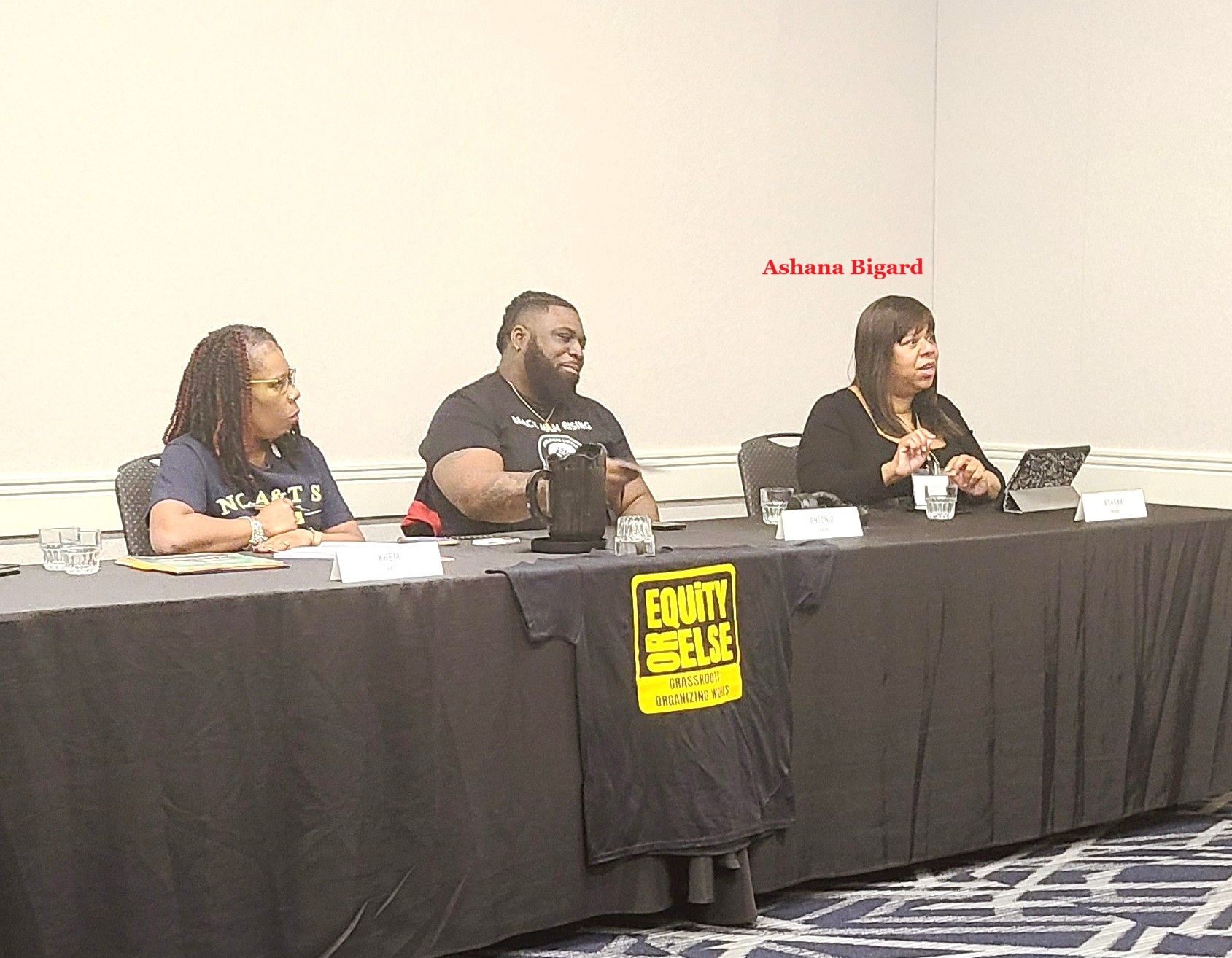
The book William Franz Public School is a well documented work that shines a light on the deep racism in New Orleans and especially in its public schools. The title is the school where 6-years-old Ruby Bridges accompanied by federal officers desegregated New Orleans’ schools to the chagrin of the 1,000 plus protesters out front. “The message rang clear; Louisiana’s strong commitment to the education of its White, wealthier children paralleled an equally strong commitment to keep its Black, poor residents uneducated and isolated, and thus economically and politically powerless.” (WFPS 11) That ugly racism still permeates New Orleans which made me question what are their Black residents thinking and feeling. Ashana Bigard’s book, “Beyond Resilience Katrina 20, brilliantly provides some answers.

Bigard and her family have been in New Orleans forever; she is at least fifth generation. Her large family is a big part of the soul of New Orleans. Ashana takes her readers into the Black community that has refused to be beaten down and defeated by wealthy White supremacists.

After Katrina, the people in power stole the public community schools, fired the mostly Black teaching force and brought in predominantly white kids from Teach for America (TFA) to teach. Ashana shares that story beginning with running from the storm and then fighting against injustice for the last 20-years.

Katrina Arrived

Hurricane Katrina arrived about a week before payday for much of the New Orleans community. Like many others, Ashana and her family had experienced hurricanes before. They really could not afford to travel so they chose to wait it out at home. The storm came through and made a direct hit on the city, it was loud and intense but the next morning things seemed OK.

It was a tough night, but they had successfully ridden out the storm and it was beautiful outside. Ashana decided to walk to the old New Orleans community of Carrollton to check on a friend. Downed trees were everywhere. On the way an old man informed her that if she did not “have a boat in your pocket” she better get out of there because the levees had failed and the water was coming. (Bigard Page 11)

Some people in the community believed the levees had been purposefully blown up. Ashana and her family quickly got it together to load up and head out for Houston where they stayed until New Orleans opened again.

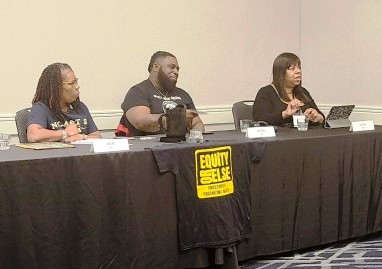
NPE 2025 Photo by Ultican

Back in New Orleans “the fraud was staggering” and media racism was appalling. Ashana noted:

“It seemed like every opportunity afforded to them, the media disparaged us calling us refugees and calling us looters. … White people getting food from stores to help each other … were described as ‘finding food.’ Black people doing the exact same thing were ‘looters’ and criminals who should be shot on sight, despite the fact that they had been left to die with no water, no food for days on end.” (Bigard Pages 32 and 33)

Rebuilding New Orleans

The work force in New Orleans is dominated by the Black community. However, when the rebuild started, local unions were frozen out. Wealthy carpetbaggers were running the show. Ashana sarcastically asks, “how could everybody get their money off the top if they were actually paying people real wages?”

There were no longer community schools that welcomed children or a city that was welcoming to its people. They soon began referring to their children’s schools as “test prep factories” and the kids called them “preparatory prison practice.” The youths of New Orleans named the new Knowledge is Power Program (KIPP) schools “kids in prison practice.” (Bigard Page 34)

Ashana worked at various non-profits as a student, parent and community counselor and advocate. She worked for families and friends of Louisiana’s incarcerated children where family members wanted to understand how their children first came into contact with the legal system.

Where were the arrests happening? Where were the summons coming from?” (Bigard Page 44)

The discovery didn’t take long. Ashana states, “The police inside the schools were arresting children for almost anything.” (Bigard Page 45) Best practices in adolescent development call for supportive environments, recognition of the biological realities of the teen years, and second chances not criminalization and punishment. This new school-to-prison pipeline was a complete abandonment of reason.

What developed in New Orleans was a harsh unforgiving no-excuses approach. This led to high expulsion rates and a 61% graduation rate.

Ben Kleban of College Prep charters told Ashana he would run his schools the way he wanted and if you don’t like it do what I did and start your own school. However, many PHDs, principals and academics from New Orleans applied to start schools almost none of them received a charter. (Bigard Page 54)

Ashana tells the story of counseling a teenage boy, a good student whose grades began falling for no apparent reason. Also he was becoming more and more despondent. After a week of discussion, he finally opened up about being sexually assaulted by a female TFA teacher. Apparently, the teacher succumbed to the adultification of young Black people. The student was blaming himself and tried to protect the teacher saying, “She came from Teach for America: they don’t give them much training.” (Bigard Page 98)

Ashana and her team were brought in to conduct a workshop on trauma: signs of trauma, solutions for trauma and how to deal with trauma in your classroom. Ten minutes into the workshop all 26 of the young White women were in tears. Ashana states:

“They were crying saying they were overwhelmed, suffering from secondary trauma, felt like they were crazy, and they all felt they were doing more harm than good. They had no support and when they went to Teach for America for support, they told them to try harder, and if they weren’t connecting, it was their fault because everyone else was doing a great job.”

The training developed into multiple unscheduled workshops that day as teachers went out and encouraged their colleagues to attend. Ashana says:

“I left the workshop understanding you never know all sides of the story and that there was a second wave of victims, and that was young, hopeful, starry-eyed white young people who thought this would be a great city to live in and a great opportunity and they could come and help out because of the teacher shortage which was caused by the firing of all our teachers and subsequently telling them that they had to take multiple tests to qualify to come back to teach while simultaneously telling young white children they only needed two weeks of training to do so.” (Bigard Pages 119-121)

The Legacy of Racism Lives On

To enroll children into the almost all charter system in New Orleans, parents must use OneApp. It runs the school choice algorithm but strangely only white children get into the best schools, not even if you’re a Black family in the upper middle class do you get a seat. It is common to see white people move to the city and magically get their children into schools with 100 children on the waiting list. Ashana notes, “They didn’t even know the school existed prior to moving to the city, but racism and classism still existed heavily within the new system.” (Bigard Page 268)

Ashana tells black people in New Orleans that poverty is not a moral failing. She says, “We start understanding that we are not broke we are stolen from.” (Bigard Page 318)

I have presented a few highlights in this delightful and insightful book. For me, Ashana’s book offers a rare view into the life of Black people fighting White supremacy and a story of love and family.

Bravo Ashana Bigard!

Public Education Shaped by 19th Century Dispute

8 Oct

By Thomas Ultican 10/8/2025

Horace Mann, frequently referred to as the “father of public education”, declared that public education should be nonsectarian. He was responding to a dispute in the Protestant community between the Congregationalists, Unitarians, Episcopalians, Lutherans, Presbyterians and other Protestant sects who were threatening to separate from the common schools and form their own parochial systems. Mann countered that schools should restrict themselves to commonly shared Protestant values. He believed such values were the principles of civic ethics necessary for participation in our republican form of government. Katherine Stewart reported, “Representatives of a number of sects immediately and vigorously attacked him, but large majorities agreed with this policy, and it soon became the norm in the ‘common school,’ or public school movement.”

As long as the overwhelming majority of Americans were Protestant, this solution was workable. However, the Catholic community was growing. The 25,000 American Catholics in 1790 represented less than 1% of the population. By 1820, their 195,000 members were 2% of American people. In 1830 they were at 318,000 (2.5%), in 1840 663,000 (3.9%) and in 1850 their ranks grew to 1,600,000 (6.9%). (See “Religion in America; A Political History” By Denis Lacorne Page 64) The Catholics were becoming a bigger group with growing influence.

In his book, “Schooled to Order: a Social History of Public Schooling in America” Professor David Nasaw noted that common school textbooks were filled with racist characterization of the Irish and disdain for the Pope. The Catholic clergy were described as “libertine, debauched, corrupt, wicked, immoral, profligate, indolent, slothful, bigoted, parasitic, greedy, illiterate, hypocritical and pagan.”  Catholic parents did not want to expose their children to this and they did not like daily readings from the King James Bible instead of their preferred Douai-Rheims Bible.

Before we go on, a little background on these two Bibles. The Douai–Rheims Bible is a translation of the Bible from the Latin Vulgate into English made by members of the English College, Douai, in the service of the Catholic Church. The New Testament portion was published in Reims, France, in 1582, and the Old Testament portion was published twenty-seven years later in 1610 by the University of Douai. The Latin Vulgate is a translation of Hebrew, Aramaic and Greek texts, accomplished in 382 mainly by Saint Jerome.

The King James Bible is an Early Modern English translation sponsored by King James I of the Christian Bible for the Church of England, commissioned in 1604 and published in 1611. The source material for the translation includes the Latin Vulgate plus Hebrew, Aramaic and Greek texts.

Although very similar to each other there are some differences. However, early 19th century bigotry trumped all differences. In her study of 19th century textbooks, Ruth Miller Elson showed that anti-Catholic propaganda was a staple of allegedly disinterested lessons on non-religious topics. In history, they learned “the Roman Catholic religion completed” the Roman Empire’s “degeneracy and ruin.” Lessons in patriotism taught that the founding fathers would never “have bowed to papal infallibility, or paid the tribute to St. Peter.” Evan textbooks that commended tolerance in matters of religion were “full of the horrible deeds of the Catholics.”

Maybe it is not so shocking how violent the Catholic-Protestant dispute became. One of the deadliest episodes in early American history occurred in 1844 when Protestants and Catholics took to the streets of Philadelphia. After two weeks of rioting, twenty-five people laid dead in the streets, more than one-hundred were wounded and dozens of homes as well as two churches were torched.

In 1859, a watershed moment occurred in Boston involving a ten-years old student, Thomas Whall. He refused to read the Ten Commandments at the beginning of his morning class at Eliot School, a Boston public school. Young Whall refused based on the fact that these Commandments were from the King James Bible. By this act he was breaking Massachusetts law. The principal “whipped” him on the hands with a rattan stick until his fingers were bleeding and Whall fainted. He would not yield. Whall’s fellow students followed his lead and refused to obey. Hundreds of them were expelled. (Lacorne Page 72)

After Whall’s father sued the principal for using excessive force, Judge Sebeus Maine found for the school and its principal. He said that Thomas’s refusal threatened the stability of the public school, “the granite foundation upon which our republican form of government rests.”He indicated the readings were free of dogma; it was all done objectively with no inappropriate comments. Therefore, there was no violation of freedom of conscience. (Lacorne Page 73)

Katherine Stewart reported:

“This incident led Catholic leaders to conclude that public schools could not serve their community. In response, they launched a movement to create Catholic parochial schools in Boston and across the nation.”

No Compromise

The disdain and prejudice against Catholics was deeply ingrained in Ohio. University of Cincinnati’s former writing coach, Deborah Rieselman quotes associate history professor Linda Przybyszewski:

‘“It was very respectable then to be anti-Catholic,’ notes Przybyszewski. ‘Neighborhoods were often segregated. In 1844, after Cincinnati newspapers carried stories of anti-Catholic riots on the east coast, a group of men threw sticks and rocks at a house occupied by Catholic clergy, according to a German priest who had immigrated to Cincinnati.”’

“Even the Rev. Lyman Beecher, Harriet Beecher Stowe’s father, was a vocal opponent of Catholics. Considered a progressive thinker because he was a black abolitionist and the founder of a Cincinnati seminary, Beecher preached a ‘papal conspiracy theory’ that Catholics would take over the West.”

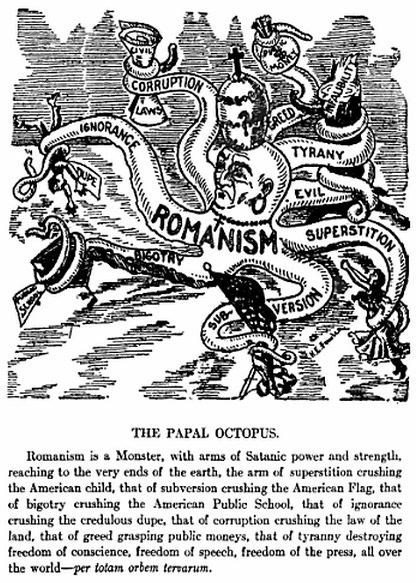
An Anti-Catholic Cartoon

In 1869, a fierce political and legal battle erupted in Cincinnati, Ohio. For some time there had been discussions on the school board about the possibility of uniting the public schools and the Catholic system. There were more than 12,000 students in the Catholic parochial system. One of the keys to the new plan was that there would be no Bible reading in classes.

Ohio State History Teacher, Harold M. Helfman, wrote:        

“The bitter clash between those maintaining pro-Bible and anti-Bible viewpoints was to drive both groups into positions of no surrender; their mutually hostile attitudes were to be seized upon by societies, editors, lecturers, ministers, and politicians bent on stirring up latent anti-Popery passions. The board of education’s action was destined to be the focus of a public opinion which plunged Cincinnati into a boiling caldron of fear and bigotry.”

Top legal minds in Ohio fought this battle out in the courts with the Ohio Supreme Court ruling in favor of the Board of Education and their no Bible reading plan. In a subsequent election, most of the board members who voted for the plan were reelected. Unfortunately, the attempts to unify the schools systems were ended by the associated vitriol.

The anti-Catholic bias in America was deeply held by many Protestants; lasting a long time. During the Presidential election campaign of 1960 between Kennedy and Nixon, former President Harry Truman was asked about the influence of the Pope on Kennedy. He cracked, “It’s not the Pope I’m afraid of, it’s the Pop.” Kennedy became the first Catholic ever elected President of the United States.

As late as 1887, the school day still contained “sacred song,” “the literature of Christendom” and “faithful and fearless Christian teachers,” according to a speech that Cincinnati superintendent E.E. White gave to the National Education Association that year. In 1957, my second grade teacher in King Hill, Idaho read a verse to us from the King James Bible every day.

During his second term, US Grant called on states to prohibit “the teaching in said schools of religious, atheistic, or pagan tenets” and ban “the granting of any school funds or school taxes . . . for the benefit or in aid, directly or indirectly, of any religious sect or denomination.” Grant concluded, “No sectarian tenets shall ever be taught in any school supported in whole or in part by the State, nation, or by the proceeds of any tax levied upon any community.”

James Blaine, a former Republican House Speaker with his own 1876 presidential ambitions, jumped at the political opportunity. He introduced a constitutional amendment seeking to codify Grant’s proposals. Although some argue that these provisions reflect a long and admirable history of separation of church and state advanced by the founders, others maintain that these provisions reflect hate and anti-Catholic bigotry that peaked in the 1870s with the national proposal.

Blaine’s amendment failed in the Senate but has been adopted into the constitution of 37 states. In 2020, the Supreme Court discussed the Blaine amendments in Espinoza vs. Montana. In their decision they the court described the Blaine amendments as being “born of bigotry.” This decision has significantly undermined prohibitions of tax dollars going to religious schools.

Thoughts on Protecting Schools and Children

There is little doubt that running multiple tax supported education systems is less efficient and more expensive. However, if that is what people want; it is doable. Unfortunately, many voucher schools and charter schools are not being held accountable. If we are to have these multiple systems, they must all adhere to public education standards and accountability. That means no discrimination and no turning away undesirable students. No anti-LGBTQ rules, no religious tests and no student academic qualifications when accepting tax payer money.

Billionaire-Financed Education Propaganda

29 Sep

By Thomas Ultican 9/29/2025

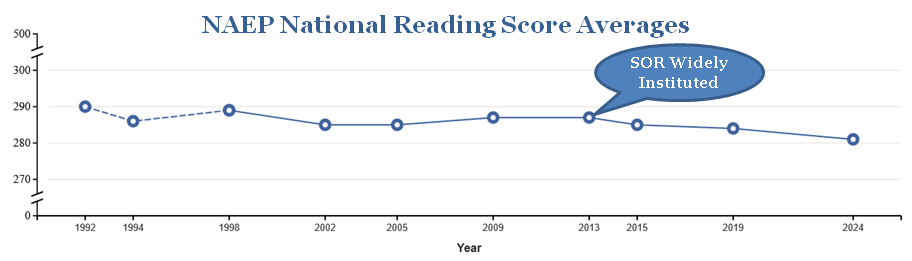
September 9th, propaganda rag, ‘The 74’, published a classic example of anti-public education flummery, COVID Worsened Long Decline in 12th-Graders’ Reading”. That long decline is a drop of nine points on a 500 point scale, but if the y-values on a line chart are manipulated it does look like a long decline. Starting with the 1994 data instead of the 1992 data that drop becomes 6 points, all of which occurred after science of reading was widely forced into classrooms starting about 2013. Whatever the cause for mildly declining reading scores, the article offers hair-on-fire analysis from pro-billionaire sources.

The 2024 math results had a 7-point decline from the highs; however 12th grade math data has only been gathered since 2005.

Professional Analysis – Really?

George Bush and Ted Kennedy gave us the No Child Left Behind (NCLB) act which significantly expanded the role of the federal government in education. Its philosophy of test and punish substantially increased the pressure to score well on testing. Since the only variable that higher test scores correlate with is family wealth, the high stakes meant that several outstanding schools in poor neighborhoods were destroyed. Another pernicious outcome of NCLB was the narrowing of curriculum.

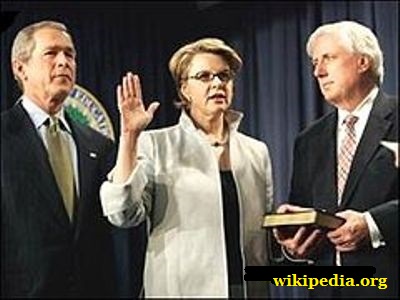
‘The 74’ turned to a person deeply associated with NCLB, former US Secretary of Education Margaret Spellings, for expert comments.

Near the conclusion of the Bush administration, Michelle R. Davis shared:

“Spellings, who has been working on education issues for Bush since the 1990s and his days as a Texas governor, is the person who from the very beginning has had to make NCLB work. She was a key architect of the law, arguably Bush’s most significant domestic accomplishment and a grand experiment for Republicans, who traditionally thought education should be left to the states.”

George Bush and Margaret Spellings at her Swearing in

In reality, NCLB was a major disaster and its testing ideology still harms schools. The big fallacy at its foundation is that error and variability are so rampant in standardized testing the scores are meaningless. An Ouija board would be just as accurate.

‘The 74’ reports that Spellings believes the last several administrations have squandered the power of the federal government and weakened its ability to push improvement. They quote her saying, “When you take your foot off the gas and stop using federal leadership, federal imperative around these performance issues, it shows up.” She claims the Every Student Succeeds Act, implemented by President Obama, was “less Muscular” than NCLB and asserts, “We know how to use the federal role in smarter ways to the benefit of kids, and we stopped doing it.”

In 2010, Diane Ravitch who had supported NCLB wrote the book “The Death and Life of the Great American School System” revealing her conclusion that she had been wrong. A book review by the anti-testing organization Fair Test stated:

“The book’s central chapter on NCLB describes, with exceptional clarity, the law’s flawed assumptions and failed prescriptions. She appropriately lambastes the goal of 100% proficiency, quoting her conservative friends Chester Finn and Frederick Hess saying the goal is ‘comparable to Congress declaring that every last molecule of water or air pollution would vanish by 2014.’ The important difference, she writes, is that ‘If pollution does not utterly vanish….no public official will be punished.’ The chapter concludes, ‘Good education cannot be achieved by a strategy of testing children, shaming educators, and closing schools.”’

Another expert source quoted by ‘The 74’ is Robin Like, Director of the Center for Reinventing Public Education (CRPE). Founder Paul Hill’s acolyte, Robin Lake, says these latest results are “frustrating.” She claims, “[T]hat if we don’t change course, things will be very bad — and things are very bad.”

In 2021, for mysterious reasons, this Bill Gates financed organization left the University of Washington for new digs at Arizona State University.

The sky is falling rhetoric is common for CRPE. Founder Hill was a member of Brooking’s cadre of researchers convinced that American public education was failing. Furthermore, they shared a general agreement that market based business principles were central to fixing schools and declared teachers unions and governance by locally elected school boards must be overturned if education was to be saved.

Much of the “research” done by CRPE undermines public education and promotes its privatization.

Lake worked on Doing School Choice Right” funded by the Lynde and Harry Bradley Foundation, Annie E. Casey Foundation, and Bill & Melinda Gates Foundation. CPRE listed two salient goals for their study:

  • “Create models for how school districts can oversee public schools in multiple ways—including direct operation, chartering, contracting, and licensing private schools to admit voucher students. This study is conducted in partnership with the National Charter School Research Project.”
  • “Examine issues involved in moving toward pupil-based funding, particularly technical, legal, and regulatory barriers.”

These themes are central to CRPE’s education ideology.

Billionaire Who Motivated ‘The 74’s’ Article

The article ends with two disclosures. (1) “This article was published with the support of XQ Institute” and (2) “The Future of High School Network and The 74 both receive financial support from the Carnegie Corporation of New York, XQ and the Walton Family Foundation.”

The Future of High School Network has one purpose and that is to end the Carnegie unit. More than receiving financial support from the Carnegie Corporation it is owned and founded by the corporation. EdTech leaders want to get rid of the Carnegie unit in order to institute their kids at screens education schemes.

The Carnegie unit is a minimum requirement creating a nationwide agreed-upon structure. It does not control pedagogy or assessments but insures a minimum amount of time on task.

Writer Derek Newton wisely pointed out in Forbes:

“Cheating … is so pervasive and so easy that it makes a complete mockery of any effort to build an entire education system around testing.”

“But because of the credit hour system, which is designed to measure classroom instruction time, it’s still relatively hard to cheat your way to a full college degree.”

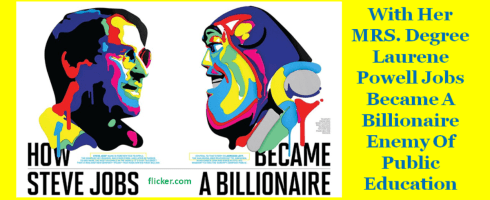
Laurene Powell Jobs is famous for having been married to technology genius and Apple founder Steve Jobs. She is a billionaire and co-owns Atlantic magazine. Jobs studied economics and political science at University of Pennsylvania and received an MBA from Stanford; has no education training. In 1997, she founded the Emerson Collective which promotes impact investing and she is board chair of The XQ Institute.

Billionaire Laurene Powell Jobs is a leader in the AI-revolution in education. Her Amplify digital lessons liberally apply AI and her XQ Institute is working to integrate AI into classrooms. Edward Montalvo, XQ institute’s senior education writer has claimed:

‘“The future of AI in education is not just about adopting new technologies; it’s about reshaping our approach to teaching and learning in a way that is as dynamic and diverse as the students we serve,’ XQ Institute Senior Advisor Laurence Holt said. … Through AI, we can also transcend the limitations of the Carnegie Unit — a century-old system in which a high school diploma is based on how much time students spend in specific subject classes.

“Changing that rigid system is our mission at XQ.”

Turns out Laurene Powell Jobs is a typical arrogant billionaire who thinks because they are rich they must be brilliant. With no education background, she is angling to revolutionize public education with harmful technology. She has no clue about the damage being wreaked.

Shocking GOP Effort to End Public Schooling

21 Sep

By Thomas Ultican 9/21/2025

This year, state legislators have proposed in excess of 110 laws pertaining to public education. Of those laws, 85 were centered on privatizing K-12 schools. Republican lawmakers sponsored 83 of the pro-privatization laws. Which begs the question, has the Grand Old Party become the Grifting Oligarchs Party? When did they become radicals out to upend the foundation of American greatness?

The conservative party has a long history of being anti-labor and has always been a hard sell when it came to social spending. However, they historically have supported public education and especially their local schools. It seems the conservative and careful GOP is gone and been replaced by a wild bunch. It is stupefying to see them propose radical ideas like using public money to fund education savings accounts (ESA) with little oversight. Parents are allowed to use ESA funds for private schools (including religious schools), for homeschool expenses or educational experiences like horseback riding lessons.

A review of all the 2025 state education legal proposals was used to create the following table.

In this table, ESA indicates tax credit funded voucher programs. There have been 40 bills introduced to create ESA programs plus another 20 bills designed to expand existing ESA programs. Most of 2025’s proposed laws are in progress but the governors of Texas, Tennessee, Idaho and Wyoming have signed and ratified new ESA style laws. In addition, governors in Indiana, South Carolina and New Hampshire signed laws expanding ESA vouchers in their states.

None of the 16 proposals to protect public education or 3 laws to repeal an existing ESA program were signed by a governor or passed by a legislature.

Fighting in the Courts

June 13th, the Wyoming Education Association (WEA) and nine parents filed a lawsuit challenging the Steamboat Legacy Scholarship Act, Wyoming’s new voucher program. The suit charged:

“… the program violates the Wyoming Constitution in two key ways. One for directing public dollars to private enterprises, which the lawsuit says is clearly prohibited. The second for violating the constitution’s mandate that Wyoming provide ‘a complete and uniform system of education.”’

On July 15, District Court Judge Peter Froelicher granted a preliminary injunction against the state’s universal voucher program. He wrote, “The Court finds and concludes Plaintiffs are, therefore, likely to succeed on the merits of their claims that the Act fails when strict scrutiny is applied.” The injunction will remain in effect until the “Plaintiffs’ claims have been fully litigated and decided by this Court.”

Laramie County Court House

Last year, The Utah Education Association sued the state, arguing that the Utah Fits All Scholarship Program violated the constitution. April 21st, District Court Judge Laura Scott ruled that Utah’s $100-million dollar voucher program is unconstitutional. At the end of June, the Utah Supreme Court agreed to hear an appeal of Scott’s ruling. However, the decision seems well founded.

The Montana Legislature, in 2023, established a statewide Education Savings Account (ESA) voucher program. It allows families of students with disabilities to use public funds deposited into personal bank accounts for private educational expenses. In April this year, Montana Quality Education Coalition and Disability Rights Montana brought suit to overturn this program. In July, the Montana Federation of Public Employees and the organization Public Funds Public Schools joined the plaintiffs in the suit. The legal action awaits its day in court.

At the end of June, the Missouri State Teachers Association sued to end the enhanced MOScholars program which began in 2021 funded by a tax credit scheme. This year in order to expand the program; the states legislature added $51-million in tax payer dollars to the scheme. The teachers’ suit claims this is unconstitutional and calls for the $51-million to be eliminated.

Milton Friedman’s EdChoice Legal Advocates joined the state in defending the MOScholars program. Their July 30th message said, “On behalf of Missouri families, EdChoice Legal Advocates filed a motion to intervene as defendants in the lawsuit brought by the Missouri National Education Association (MNEA) challenging the state’s expanded Empowerment Scholarship Accounts Program, known as MOScholars.” It is unlikely EdChoice Legal Advocates are representing the wishes of most Missouri families.

In South Carolina, the state Supreme Court ruled in 2024 that its Education Trust Fund Scholarship Program was unconstitutional. The lawsuit was instituted by the state teachers union, parents and the NAACP. The program resumed this year after lawmakers revised it to funnel money from the lottery system instead of the general fund. 

The South Carolina effort has been twice ruled unconstitutional for violating prohibitions against using public funds for the direct benefit of private education. Legislators are proposing funneling the money through a fund that then goes to a trustee and then to parents, who then use it for private schools. 

 Sherry East, president of the South Carolina Education Association stated:

“We just don’t agree, and we think it’s unconstitutional.”

“We’ve already been to court twice. The Supreme Court has ruled twice that it is unconstitutional. So, we don’t understand how they’re trying to do a loophole or a workaround. You know, they’re trying to work around the Constitution, and it’s just a problem.” 

The South Carolina fight seems destined to return to the courts but they have vouchers for now.

Last year in Anchorage, Alaska, Superior Court Judge Adolf Zeman concluded that there was no workable way to construe the state statues in a way that does not violate constitutional spending rules. Therefore, the relevant laws “must be stuck down in their entirety.” This was the result of a January 23, 2023 law suit alleging that correspondence program allotments were “being used to reimburse parents for thousands of dollars in private educational institution services using public funds thereby indirectly funding private education in violation … of the Alaska Constitution.” Alaska has many homeschool students in the correspondence program.

Plaintiff’s attorney Scott Kendall believes the changes will not disrupt correspondence programs. He claims:

“What is prevented here is this purchasing from outside vendors that have essentially contorted the correspondence school program into a shadow school voucher program. So that shadow school voucher program that was in violation of the Constitution, as of today, with the stroke of a pen, is dead.”

The Big Problem

GOP legislators are facing a difficult problem with state constitutions prohibiting sending public dollars to private schools. The straight forward solution would be to ask the public to ratify a constitutional amendment. However, voucher programs have never won a popular vote so getting a constitutional change to make vouchers easier to institute is not likely.

Their solutions are Rube Goldberg type laws that create 100% tax credits for contributing to a scholarship fund. A corporation or individual can contribute to these funds and reduce their tax burden by an equal amount. Legislators must pretend that since the state never got the tax dollars it is constitutional. Lawyers who practice bending the law might agree but common sense tells us this is nonsense.

The big problem for the anti-public school Republicans is voucher schools are not popular. They have never once won a public referendum.

AI is More Con than Reality

9 Sep

By Thomas Ultican 9/9/2025

The tech-industry bestowed name, “Artificial Intelligence (AI)”, is a head-fake; there is no intelligence, just algorithms. Sales are based more on fear of missing out than efficiently-usable machines. The authors of The AI Con: How to Fight Big Tech’s Hype and Create the Future We Want have some tongue in cheek renaming suggestions: ‘“mathy maths’, ‘a racist pile of linear algebra’, ‘stochastic parrots (referring to large language models specifically)’ or Systematic Approaches to Learning Algorithms and Machine Inferences (aka SALAMI)”. (Page 5) These witty writers are Dr. Emily Bender, professor of linguistics at the University of Washington, and Dr. Alex Hanna, director of research at the Distributed AI Research Institute and lecturer in the school of Information at the University of California, Berkeley.

While working in Silicon Valley in the 1990s, I wrote quite a bit of code automating friction testing in hard drives. The maximum forces occurred when drives started up. About fifty test drives with sensitive gauges were used to test 50,000 or more start-stops. Once the testers were setup, it was all automated with friction data being stored in files and when the test finished, the files would automatically be uploaded to a database which would graph the data and create a report. I thought it was really cool but the only intelligence involved was mine and the creators of the database. It was a set of algorithms and nothing more; that is all these “racist piles of linear algebra” are.

Large Language Models (LLMs)

The texts produced by LLMs are plausible on almost any subject, but this is highly misleading. The models consist solely of extensive information about what sets of words are similar and what words are likely to appear in what context. The outputs look just like something a person might have written and we humans naturally interpret it by imagining the mind behind the text. Unfortunately, there is no mind and it is important for us to let go of that imaginary mind we conceive.

The authors label LLMs like ChatGPT “synthetic text extruding machines”. (Page 31) Like plastic extrusion, LLMs force language collections through complicated computer algorithms to achieve a product that looks like language. However, there is no human thinking behind it.

LLMs and their cousins, synthetic image machine, are based on massive data theft and wanton energy use. The backbones of synthetic extruding machines are data centers which consume enormous amounts of energy. It is estimated that they will consume 1,580 terawatt-hours a year by 2034. A terawatt hour is the equivalent of a billion kilowatt hours. That amount of energy is the same as the total amount of energy predicted to be consumed by the world’s most populous country, India. (Page 159)

In 2016, the largest tech companies in the world signed on to the Paris climate accords. Google said they planned to be net-zero emissions by 2030 and Microsoft announced plans to be net-negative and remove all of the carbon it had produced since its founding in 1975. Now the companies are admitting they will dramatically miss their climate pledges because of these “racist piles of linear algebra.” (Page 160)

In addition to being energy gluttons, text and image extruding machines are water hogs. For every 5 to 50 prompts ChatGPT generates, about two cups of water are consumed. The large amounts of PFAS (“forever chemicals”) used to manufacture microchips is another environmental issue. “Synthetic text extruding machines” are an environmental disaster, but for billionaires it is all about profits. (Page 157)

Bender and Hana observe, “Today’s synthetic media extruding machines are all based on data theft and labor exploitation, and enable some of the worst, most perverse incentives of each of these attendant fields.” (Page 135)

Boosters and Doomers

At the 2023 eighth Insight Forum, which was closed to reporters and the public, Senator Chuck Schumer asked the participants what was the probability of doom. It is unknown what the precise answers were but Jared Kaplan, co-founder of the AI company Anthropic, and Aleksander Madry, head of Open AI preparedness, have both spoken about “catastrophic risks” if a model grew a mind of its own. Some of the participants spoke about the myriad benefits while others seemed to harbor existential fear. Bender and Hana label these groups Boosters and Doomers. (Page 1 and Page 138)

From the authors’ perspective, Booster and Doomers are on two sides of the same coin. One sees extrusion machines as leading to a world of abundance while the other fears a dystopian hellscape. “Neither depicts the real harms of actually existing automation, at best dismissing them as less important than the imaginary existential threats.” (Page 139)

Oddly, almost all AI Doomers think AI development is a good thing. Bender and Hana suspect a few Doomers are not being honest:

“But for some of them, it’s not really about trying to save humanity, but rather a running of the con: the supposed danger of the systems is a splashy way to hype their power, with the goal of scoring big investments in their own AI ventures (like Musk and Altman) or funding for their research centers (Like Bourgon). (Page 141)

Modern Eugenics

There are claims that machines will gain an advanced level of “general intelligence”. However, there is not an accepted definition of “artificial general intelligence” (AGI). Companies like OpenAI just avoid the question. Microsoft’s “Sparks” paper contains a preliminary definition of AGI. A prior version of the paper was published in a 1994 Wall Street Journal article signed by 52-psychologists. It proffered, “The consensus group defined intelligence as a very general mental capability that, among other things, involves the ability to reason, plan, solve problems, think abstractly, comprehend complex ideas, learn quickly and learn from experience.”

This was written in defense of Richard Herrnstein and Charles Murray’s 1994 book, “The Bell Curve”, which argues that there are significant differences between the inborn intelligence of different racial groups, and that those differences are due to genetics. A bastardized use of Alfred Binet’s work on intelligence testing was employed by three eugenicists, Henry Goddard, Lewis Terman and Robert Yerkes. They created tests biased towards middle-class white Americans and that bias persist in IQ testing to this day. (Page 35)

Bender and Hana state, The paradigm of describing ‘AI’ systems as having ‘humanlike intelligence’ or achieving greater-than-human ‘superintelligence’ rests on this same conception of ‘intelligence’ as a measurable quantity by which people (and machines) can be ranked.” (Page 36)

Billionaires—among them Elon Musk and Marc Andreessen—are setting the agenda for creating AGI and financially backing a modern-day eugenics. Musk repeats common eugenicist ideals claiming that there are not enough people and that humans (particularly the right humans) need to be having children at higher rates. Marc Andreessen echoed Musk’s thoughts when suggesting that elites from developed countries should be having more children. (Page 38)

Musk and Andreessen believe we are on the cusp of AGI development or are they just selling the con? Most people working on extruding machines are aiming to make a system that achieves what looks like human intelligence “to get ahead in what is already a crowded market.” (Page 39 and 40)

Today, there is no AGI; moreover it is unlikely that machines will ever develop “intelligence”.

Some Final Observations

“The AI Con” is packed with important information that could enable people to see through this billionaire-financed scam. Read it and convince your friends and family to study it as well.

Text and image extruding machines are not worth their costs to the environment and they have many hidden inefficiencies. It is wonderful that my smart-phone can assist me with texting, but I hate the AI driven enshitification of Google’s search engine.

Extruding machines are bad for education but people are out there hyping AI’s use in classrooms. The British Government has done serious harm to their health care system by mindlessly installing AI as a point of contact.

AI is not capable of doing science. A salient feature of extruding machines is they were designed to make stuff up.

 Bender and Hana correctly note, “The AI project has always been more fantasy that reality.”

Privatized Education Disaster in New Orleans

3 Sep

By Thomas Ultican 9/3/2025

August 29th was the twentieth anniversary of hurricane Katrina wiping out New Orleans. On this occasion, the billionaire-funded baloney machine is outdoing itself. Ravi Gupta wrote a post for ‘The 74’ called, The Inconvenient Success of New Orleans Schools.” The Washington Post assigned a guy from the United Kingdom, Ian Birrell, to write, Never seen before’: How Katrina set off an education revolution. I gave up my subscription to the Washington Post some time ago but my friend Gary Rubinstein wrote a post about Birrell’s article. He noted, “Supposedly based on recent research, it basically trotted out all the old bogus claims that I hadn’t heard anyone claim in at least ten years.”

The truth is that the all charter school district is a giant failure that even corruption rampant New Orleans is struggling to hide.

Before Katrina, Louisiana was passing laws aimed at taking over the New Orleans public school system and there was some merit to their endeavor. Six interim superintendents appeared between 1998 and 2005. An FBI investigation led to 11 indictments in 2004 and by end of the school year in May 2005 the district was effectively bankrupt. Unfortunately, the state created the Recovery School District (RSD) and turned to privatization to solve the problem.

By the end of the 2004-2005 school year, the state had taken over five New Orleans schools. RSD turned all five into charter schools operated by four groups: University of New Orleans; Middle School Advocates, Inc.; Knowledge Is Power Program; and Institute for Academic Excellence. All set to begin in the 2005-06 school year; however Katrina made landfall soon followed by “disaster capitalists” swooping like swarming buzzards.

Before Katrina, Orleans Parish School Board (OPSB), which ran the public schools in New Orleans, operated 123 schools; in the spring following the storm, it was running just four. With OPSB out of the road and RSD in charge, “pheaulanthropists” like the Walton family, Bill Gates and Eli Broad were ready to help.

2005 Devastation by Hurricane Katrina

In 2009, Louisiana’s Board of Elementary and Secondary Education (BESE) made it more difficult for schools to remain academically acceptable, effectively ending most of the remaining public schools in New Orleans. BESE raised the minimum school performance scores for academic unacceptability to 65 for the 2010-11 school year and 75 for the 2011-12 school year. By 2018, there were no public schools left.

Evaluating the Results

In her 2018 book, After the Education Wars, Andrea Gabor wrote, “To borrow another ancient military metaphor, the New Schools Venture Fund and its New Schools for New Orleans offshoot, is the Trojan horse that funnels outside money, expertise, and influence to New Orleans.” (Page 229) The majority of the school privatizing billionaires invested by funneling funds through New Schools Venture Fund and New Schools for New Orleans (NSNO). Most of the investing was in schools adhering to the KIPP no-excuses model.

Around 2014, Neerav Kingsland was leading NSNO. He would go on to work for Reed Hastings and then become the leader of the Hastings and John Arnold created City Fund designed to promote privatization and end voter directed public schools.

In his article for ‘The 74’, Ravi Gupta claims, “There’s no one better at parsing the data than Doug Harris, who chairs Tulane’s economics department and directs the Education Research Alliance for New Orleans.” It is almost impossible to check Harris’s work because he has proprietary control of much of the education data from New Orleans. Furthermore, confidence in his work is undermined by his team sharing office space on the seventh floor of 1555 Poydras Street with NSNO.

In June, Harris released The New Orleans Post-Katrina School Reforms: 20 Years of Lessons”. It is organized around twelve conclusions. Of course conclusion-1 claims improved student outcomes in testing scores, graduation rates and college going. (Page 8) Improved graduation rates and increased college going is a national trend for which it is hard to credit the all charter school system. The claim of improved testing results cannot be shown. Since the entire system was shut down and then reconstituted as a significantly smaller privatized organization, there is nothing to compare to that was not changed.

Gary Rubenstein explained:

“Reformers needed a new experiment where the schools would keep the same students they already had, but the staff at those schools would be replaced with nonunion charter school educators, and charter chains or start-up charter boards would run the schools. Race to the Top provided Tennessee the funding and incentive to test the reformers’ hypotheses.” (Doomed page 19)

This experiment demonstrated that it was not the public schools causing poor performance and privatizing them provided no improvement.

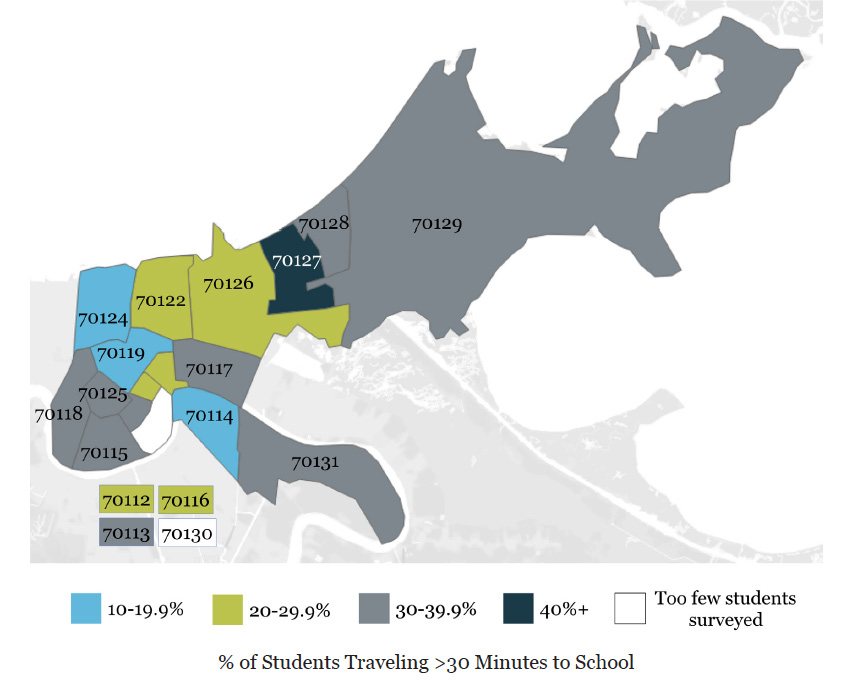
There are a few items in Harris’s report that do not support the privatized system. One of those is Conclusion-5: where he shares, “Transportation costs doubled, and students are traveling farther to get to school.”  (Page 20) From his map, it appears that more than 30% of the students are spending in excess of one-hour a day on busses which must be miserable and drives up costs.

In the report’s acknowledgement section, there is another reason to be skeptical of Doug Harris’s results. It says, “Second, we thank our funders, including Tulane and the Murphy Institute, but also the Laura and John Arnold Foundation, Spencer Foundation, William T. Grant Foundation, and Booth Bricker Foundation.”

Like almost all large foundations the Spencer Foundation (EIN: 36-6078558) with $667,415,167 in assets makes a few troubling grants but in general is supporting research and scholarship. The same could be said for the William T. Grant Foundation (EIN: 13-1624021) with $403,141,185 in assets.

However, The Booth-Bicker Fund (EIN: 72-0818077) with assets of $68,702,721 is spending heavily to promote privatized education and almost no organization in America has spent more to privatize public education than the Laura and John Arnold Foundation (EIN: 26-3241764) with its whopping $4,309,915,225 in assets. Of course, these large amounts of money are influencing Harris and his team.

What Do the Locals Say?

In April, at the NPE conference in Columbus, Ohio, Ashana Bigard and Antonio Travis presented on the all charter school system in New Orleans.  Antonio’s description of being a student in New Orleans sounded like classic child abuse. Mrs. Bigard informed us that New Orleans schools are being sued regularly because of their practices with children. However, there is almost no reporting about the suits because the settlements always include a non-disclosure agreement (NDA). She told the story of asking a KIPP administrator how many NDA’s they had created. He said none but when she responded that she was in court just the week before and saw a KIPP NDA created, he backed off and promised to get back to her. She is not holding her breath.

Ashana Bigard is on the Right

Last year, when a charter school failed, the superintendent replaced it with the first New Orleans public school since 2017. The superintendent was fired, but that is what Mrs. Bigard said parents want. She said they desire that every time a charter school fails it is replaced by a more stable public school. Charter schools have become a revolving door with a couple schools going out of business every year.

In her 2018 book, “After the Education Wars,” Andrea Gabor reported that a third of New Orleans charter schools had been shuttered.

Senator Joseph Bouie Jr. equated the NOLA school system to the “Tuskegee syphilis experiment.” Professor Bouie, former administrator of Southern University at New Orleans, had good reason for this analogy. At Tuskegee University, black men with syphilis were given no treatment even after penicillin was shown to be effective. Dozens of men died and their wives, children and untold number of others were infected. NOLA black residents had their community schools taken away and replaced by privatized schools, often miles away. This “experiment” stole their rights and bestowed the public schools to private actors.

In 2021, Secretary of Education Miguel Cardona visited the Orleans Public School District. He heard first-hand the growing disillusionment with the all charter system. Four of the six parents told him they wanted to go back to neighborhood schools. Parents complained about Teach for America placing unqualified teachers in schools and the One App process for not offering school choice where they lived.

Raynard Sanders who has over forty years of experience in teaching, education administration and community development, said the charter experiment has “been a total disaster in every area.” He asserted NOLA had “the worst test scores since 2006, the lowest ACT scores, and the lowest NAEP (National Assessment of Educational Progress) scores.”

In a letter to the editor, former OPSD superintendent, Barbara Ferguson, stated:

“The state took over 107 of New Orleans’ 120 public schools and turned them into charter schools. Last year, 56 of New Orleans’ 68 public schools had scores below the state average. Thus, after nearly 20 years, over 80% of New Orleans schools remain below the state average. This charter school experiment has been a failure.”