Propaganda from The 74 and University of Arkansas

26 Nov

By Thomas Ultican – 11/26/2023

The 74 published a blatant propaganda piece on Monday (11/20/2023), based on Still a Good Investment: Charter School productivity in Nine Cities, a paper from the University of Arkansas’s “School Choice Demonstration Project (SCDP). In this production, SCDP used its own previously debunked work to support ridiculous conclusions.

The Department of Education at University of Arkansas does not attempt to hide their anti-public school bias, as noted in the cited paper, “The College of Education and Health Professions established the Department of Education Reform in 2005.” Subsequently, “The School Choice Demonstration Project” was established and staffed by “leading school choice researchers and scholars” within the Department of Education Reform. (Page 3)

The paper’s executive summary states:

“In this study, we reexamine the productivity of publicly funded schools, using funding data from our charter school revenue report ‘Charter School Funding: Little Progress Towards Equity in the City.’ We also use achievement data from the Center for Research on Educational Outcomes’ (CREDO’s) city and national studies, the NAEP Data Explorer, and wage data from the Bureau of Labor Statistics. We have access to complete data for nine cities: Camden, New Jersey; Denver, Colorado; Houston, Texas; Indianapolis, Indiana; Memphis, Tennessee; New Orleans, Louisiana; New York City, New York; San Antonio, Texas; and Washington, DC.” (Page 4)

Phony Financial Data

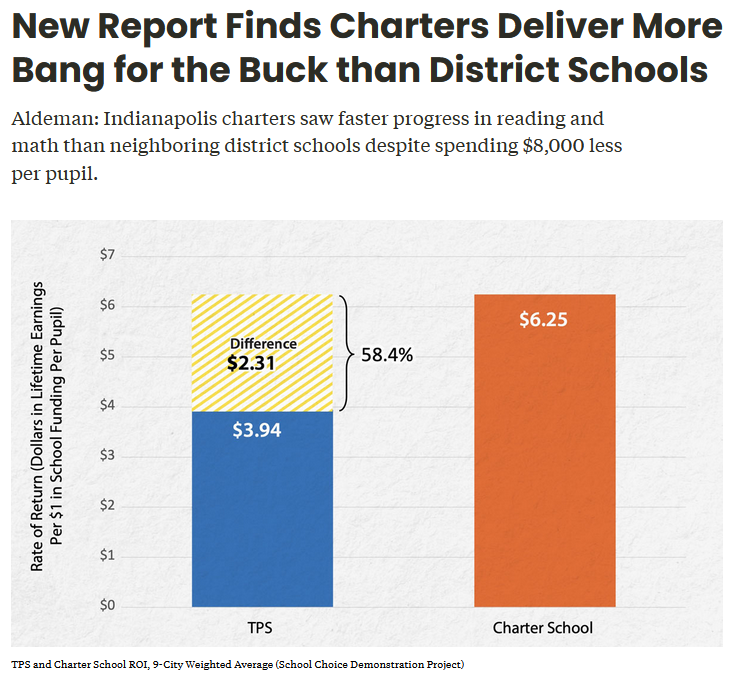
The 74 used the following graphic to open their propaganda piece:

That $8,000 less per student claim is based on a previous SCDP study, Charter School Funding: Little Progress Towards Equity in the City.” This September, researcher Mark Webber from Rutgers University posted at the National Education Policy Center: 

“The following problems have been repeatedly pointed out by disparate third-party reviewers. Yet there appears to be little or no willingness to move away from the flawed approaches, which continue to plague report after report.”

  • Inadequate documentation of data
  • Misunderstanding of financial transfers
  • Invalid conflation of individual schools and school districts as units of analysis
  • Invalid comparisons of student populations
  • Invalid comparisons of the functions of charter and district public schools
  • Unaccounted-for charter revenues
  • Neglect of the literature on charter school finances

In 2019, David S. Knight, University of Washington and Laurence A. Toenjes, University of Houston wrote Do Charter Schools Receive Their Fair Share of Funding? School Finance Equity for Charter and Traditional Public Schools.” By focusing on Texas, they demonstrated how difficult this question is and that the answer showed no significant difference.

In 2021, school finance expert, Bruce Baker reported:

“A report from the University of Arkansas Department of Education Reform asserts that charter schools, despite serving only marginally fewer children with disabilities than traditional public schools, are significantly shortchanged of funding for those children, in addition to being significantly shortchanged on funding in general. This assertion is erroneous because the report ignores substantial differences in the classifications, needs, and costs of children with disabilities in district-operated versus charter schools. To reach its incorrect conclusions, the report exclusively self-cites deeply flawed, self-published evidence of a general charter school funding gap, ignoring more rigorous studies yielding contradictory findings. The report adds no value to legitimate debate over the comparability or adequacy of general or special education funding of charter schools.”

 Fraudulent Testing Data

The SCDP report says, “Based on CREDO’s findings, we estimate that charter school students across nine cities perform 2.4 points (0.06 standard deviations, or SD) higher on the eighth grade reading NAEP exam and 1.3 points higher (0.03 SD) on the math exam, compared to matched TPS students.” (Page 5)

There are reasons to believe the CREDO findings are bunkum. They have exclusive access to the data they report on and their methodology is highly suspect. None of these studies are submitted for peer review.

CREDO is the Center for Research on Educational Outcomes, a part of the Hoover Institute at Stanford University in California. The Institute is a conservative center funded by groups like the Walton Family Foundation, a key part of the radical conservative movement to end our traditional public school system.

Macke Raymond is the head of CREDO. Her 2015 Hoover Institute Fellow’s profile says, “In partnership with the Walton Family Foundation and Pearson Learning Systems, Raymond is leading a national study of the effectiveness of public charter schools.” 

The Technical Appendix for the “Cities Studies Project” reports, using growth models without identifying which model and says:

“In our study, scores for all these separate tests are transformed to a common scale. All test scores have been converted to standardized scores to fit a ‘bell curve’, in order to allow for year-to-year computations of growth.”

The Education Growth Model Handbook lists seven types of growth models in general use and their requirements. Most growth models require vertical scales but that does not seem possible with CREDO’s use of multiple tests, many of which are not vertically scaled. Their mathematical conversions add a locus of error.

CREDO’s method does not compare charter school performance to actual public schools; rather, it creates mathematical simulations, called “virtual twins.” Business writer, Andrea Gabor, hired statistician, Kaiser Fung, to help explain the bias, inherent in CREDO’s approach. She reported that the “study excludes public schools that do NOT send students to charters, thus introducing a bias against the best urban public schools, especially small public schools that may send few, if any, students to charters.”

Professor Andrew Maul of UC Santa-Barbara noted when writing about a 2015 paper, “The study’s ‘virtual twin’ technique is insufficiently documented, and it remains unclear and puzzling why the researchers use this approach rather than the more accepted approach of propensity score matching.”

Earlier this year, Network for Public Education Director, Carol Burris, published “In Fact or Fallacy? An In-Depth Critique of the CREDO 2023 National Report, stating “The virtual twin matching methodology gives rise to a second issue: the exclusion of about one in five charter schools due to a lack of a match in feeder public schools for charter school students.” (Page 6)

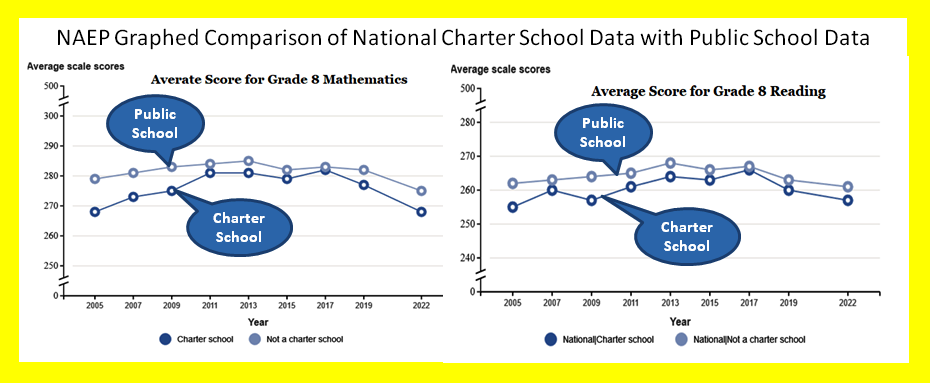
CREDO with its fancy math found that charter schools in the nine cities they studied outperformed public schools. However, there is no way to check the results since only they have access to the data. The graphs below were created by staff at the National Assessment of Education Progress, comparing eighth grade math and reading results for charter schools and public schools.

These are graphs of raw data, separated by type of school. Charter schools never outperformed public schools, making one wonder about CREDO’s results.

Conclusion

Since financial inputs and test-scores were determinative in this report, the rest of the report is just icing on a baloney cake. Even if based on pristine data, estimates of “lifetime earnings” are meaningless.

Patrick Wolf and his team should be embarrassed.

When the University of Arkansas puts out a study like this, it is amplified through rightwing media. The Center for Education Reform immediately posted an article, praising the recent work. The Indiana Capital Chronicle wrote how Indiana needs to shift more money away from public schools, based on this “research”. Epoch Times, The 74 and NJ Education Report all praise the Arkansas paper. Search engines also show a long list of links from the University of Arkansas and paper depositories where they upload their work.

If there is any push back, it would be an article from the National Education Policy Center or maybe something posted by Diane Ravitch.

It is interesting the choice industry has succumbed to lying, to make their case. The public school system is sound and taking it down while profiting is not happening.

This latest SCDP report is straight-up fraud.

Have California Charter Schools Stopped Growing?

20 Nov

By Thomas Ultican 11/18/2023

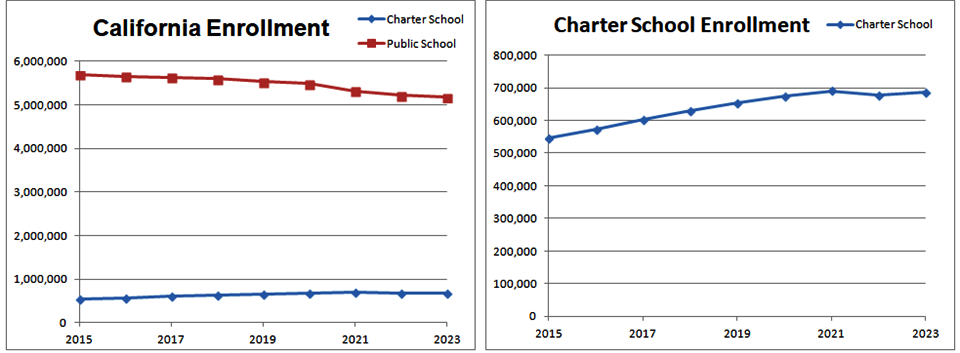
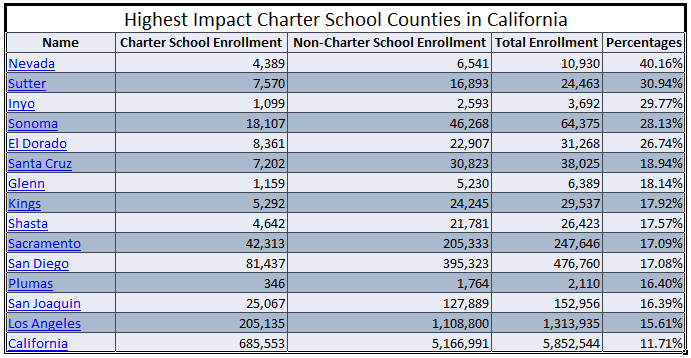
Last year, John Fensterwald reported in EdSource, A new chapter for charter schools in California as enrollment drops for first time in 3 decades. The 2023 charter movement showed, year over year, attendance growth but it was not half that of previous years and 5,104 students less than 2021.

Has the bloom come off the charter school rose?

Looking at some board of directors for EdSource adds significance to Fensterwald’s article. Don Shalvey founded California’s first charter school, partnered with Reed Hastings CEO of Netflix and Microsoft founder, Bill Gates, is on the board. Then there is Robert Sheffield, President of CORE, a pro-testing billionaire funded organization. Jannelle Kubinec, the CEO of WestEd, and Mary Jane Burke, on the WestED board also serve on the 10-member EdSource board.

EdSource is a big-wealth supported pro-charter school publication.

Fensterwald noted,

“Not since the first charter school opened in San Carlos, south of San Francisco, in 1994, has charter school enrollment fallen year over year.

“In 2020-21, the first full year of the pandemic, total enrollment statewide fell 4.4% while charter school enrollment actually increased 3.4%. But this year, enrollment in TK-12 school districts and charter schools both fell 1.8%: 110,000 students in district schools, 12,600 in charter schools, as measured as of Census Day last October.”

Why Charter School Growth Cooled

Corruption, instability and segregation are endemic to charter schools, developing a reputation for avoiding special education students and English language learners. Researchers and organizations, like the Network for Public Education (NPE), have made sure these issues stay in front of the public.

Law enforcement has taken down many charter scofflaws, especially in the cyber charter arena. The largest charter school theft occurred in California when A3 Charter School conspirators fraudulently collected $400 million from the state, misappropriated more than $200 million, and according to the Voice of San Diego, outright stole $80 million. This led to a few years of corrupt charter school stories in the media.

For a decade, NPE has been updating “Another Day Another Charter School Scandal.” This searchable site catalogs charter school thefts, school closures, profiteering and more.

The profiteering field takes the user to articles about people like John Helgeson, vice-president at Learn4Life, who according to Voice of San Diego’s reporting, “discovered a way to collect not just one, but two paychecks from California’s cash-strapped public school system.”

In her paper, Charters and Consequences,” Carol Burris addressed the phenomena of independent learning charter schools:

“There are 225 independent learning charter schools comprising nearly 20% of all charters in California. In San Diego County alone there are 35, including three associated with Learn4Life. The 2014 graduation rate for all of the students enrolled in San Diego’s independent center charters, including the more successful home-school programs, was only 44%. (Page 8) (San Diego Unified graduation rate was greater than 91%)

The infamous A3 Charter Schools were independent learning-centers. Mary Bixby is San Diego’s pioneer of the strip mall charter school business. In 1994, her Charter School of San Diego became the first charter school in the County. By 2015, Mary earned$340,810 from the non-profit she founded and her daughter, Tiffany Yandell, received $135,947.

Burris observed:

“Bixby, a board member of the charters and a full-time employee of one of the schools, also receives compensation for being ‘on-loan’ to two other Altus schools. Such obvious conflicts of interest would be illegal in a public school.” (Page 9)

Julian Vasquez Heilig, Provost and Vice-President for Academic Affairs Western Michigan University, joined T. Jameson Brewer from University of North Georgia and Yohuru Williams from University of St. Thomas to study segregating effects of charter schools. They concluded, “Charters are more likely to be segregated, even when controlling for local ethnoracial demographics” (Page 1) and discovered that “Many of the nation’s charters can even be classified as ‘apartheid schools’” (Page 2)—a term coined by UCLA Professor Gary Orfield for schools with a White student enrollment of one percent or less.

A 2016 Brookings Institute study of segregation in schools reported:

“Charter schools are more segregated than TPS [traditional public school] at national, state, and metro levels. Black students in charter schools are far more likely than their traditional public school counterparts to be educated in intensely segregated settings.” (Page 32)

My personal 2019 study of Washington DC charter schools revealed that 64 of the 116 charter schools would be classified “apartheid schools,” using Professor Orfield’s definition.

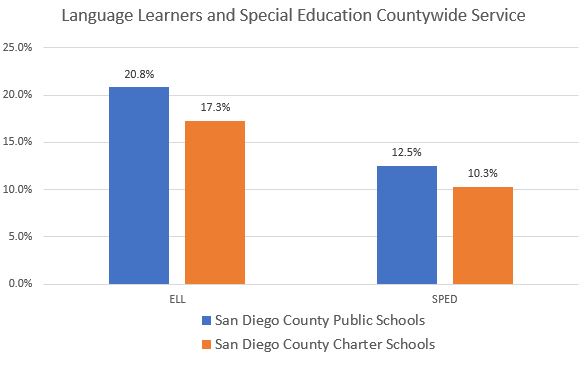
Since their inception, charter schools have been taking less special education and English language learners than public schools. A look at the data from any section of the country supports this statement. I made the following 2018 graph from San Diego County data.

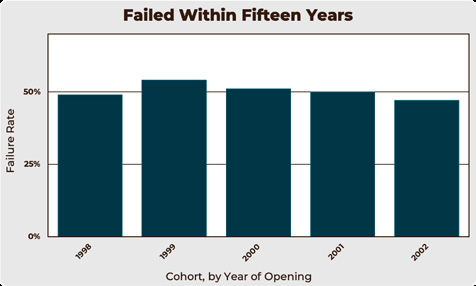
The most glaring problem for charter schools is instability, closing and going out of business at extremely high rates. Parents sometimes get a Friday notice about a Monday school closing. Carol Burris and team at NPE produced three reports, Asleep at the Wheel, Still Asleep at the Wheel and Broken Promises, detailing this tragedy with significant documentation.

The following graph presents the charter school failure rates within 15 years of opening.

How Charter Schools Continued to Expand

With a well-documented legacy of instability, corruption and segregation, it seems unreal that this privatized system still expands. Boatloads of billionaire dollars keeps it growing along with large incentives from the federal government.

The charter school movement in California was designed to create market-based solutions for public education, cut taxes and develop profit streams. Don Shalvey’s San Carlos Learning Center was the first charter school in California and site of Bill and Hillary Clinton’s 1997 roundtable discussion. At the meeting, Reed Hastings introduced himself to Shalvey; writer, Lily Geismer, claims Hastings needed Shalvey to give his education plans credibility. (Left Behind Page 249)

Two organizations, developed to accelerate and sustain charter schools, are NewSchools Venture Fund (NSVF) and California Charter Schools Association (CCSA).

The history tab at the NSVF website states:

“NewSchools Venture Fund was created in 1998 by social entrepreneur Kim Smith and venture capitalists John Doerr and Brook Byers.” (Byers and Doerr are colleagues from the Kleiner Perkins venture fund.)

“We were among the first and largest investors in public charter schools and the first to identify and support multisite charter management organizations, which launch and operate integrated networks of public charter schools.”

Philanthropy Magazine notes that Reed Hastings helped “launch the NewSchools Venture Fund.”

While there is little doubt Bill Gates and The Walton Family Foundation are the largest individual donors to NSVF, $226,881,394 of grants documented in Organized to Disrupt represents only a fraction of the total billionaire largess. Besides receiving help from Reed Hastings over the last 20 years, billionaires John Doerr, Laurene Powell Jobs and John Sackler also served on the board.

The hundreds of millions of dollars from these billionaires have have financed the startup of many charter schools, including Reed Hastings’ and Don Shalvey’s first-ever charter management organization. It created a continuous inventory of replacement schools for all of the schools that go out of business. To the billionaires, this churn looks like a good thing but it is a nightmare for students and parents.

 CCSA was formed as a nonprofit in 2003 with Caprice Young as CEO. John Walton, head of the Walton family, was an original board member. After John died, his niece, Carrie Walton Penner, joined the board in 2006. The next year Reed Hastings came onto the board. Penner and Hastings served until 2016 when both of them left and were replaced by employees.

Carol Burris conducted a yearlong study of the California Charter School Industry and published a lengthy report called Charters and Consequences, noting:

“CCSA does not disclose its funders on its website nor on its 990 form, but given its Board of Directors, who makes the list of big donors is not difficult to guess.

“The 2017 Board of Directors include New York’s DFER founder, Joe Williams, a director of the Walton Education Coalition; Gregory McGinty, the Executive Director of Policy for the Broad Foundation; Neerav Kingsland, the CEO of the Hastings Fund; and Christopher Nelson, the Managing Director of the Doris & Donald Fisher Fund. …

 “The real power, however, sits in CCSA’s related organization, CCSA Advocates, a not-for-profit 501(c)(4) whose mission is to increase the political clout of charter schools on local school boards, on county boards, and in Sacramento. It is at all three levels that charters can be authorized in the state.”

It is through CCSA Advocates that much of the huge spending on recent Los Angeles Unified School District board elections has been directed.

Opinion

With billionaire funding, it is difficult for the charter industry to fail.

Some people viewed charter schools as an experiment to prove how much better businesses could run schools than the public school system. There is a big lie being told that charter schools soundly outperform public schools. They do not. The fact is this 30-year old experiment has been a damaging and disruptive failure.

Reed Hastings, the Walton family, Michael Bloomberg, Bill Gates and other billionaires may never tire of trying to prove they were right.

It is past time to stop harming public schools.

Join NPE in the call for:

  • An immediate moratorium on creating new charter schools, including no replication or expansion of existing charter schools
  • End the federal charter school program that subsidizes and encourages charter expansion
  • Require certification of all charter school teachers and administrative staff, in accordance with public school requirements

Network for Public Education Goals

10 Nov

By Thomas Ultican 11/10/2023

Network for Public Education (NPE) issued two agendas at the conclusion of the October Washington DC Conference. NPE Director, Carol Burris, announced, “A Resolution in Support of Community-based Public Education, a Pillar of our Democracy” and Julian Vasquez Heilig, Provost and Vice President for Academic Affairs Western Michigan University, put forward “Freedom to Learn,” a kindergarten through university agenda.

Freedom to Learn

Since “A Nation at Risk” in 1983, public education has been under serious attack. In the 21st century, the attacks have become well-financed, deceptive and mean-spirited.

Christopher Rufo became the darling of autocracy with his attacks on diversity, equity and inclusion (DEI). In 2017, he was working at the Discovery Institute in Seattle, Washington which focuses on intelligent design and opposes Darwinian-based biology. When President Trump decided that DEI training for federal workers was deeply infected with critical race theory, Rufo, now at the rightwing Manhattan Institute, stated on the Tucker Carlson show, “It’s absolutely astonishing how critical race theory has pervaded every institution in the federal government.”

 He trained his sights on public schools, disingenuously claiming they were teaching critical race theory (CRT). Soon CRT became the name for anything bigots did not like. Billionaire-funded think-tanks, Manhattan Institute, Heritage Foundation and CATO Institute beat homophobia drums and blew bigotry trumpets against DEI.

Hostile state legislatures enacted laws that undermined public schools, community colleges and universities. They instituted curriculum bans, eradicated DEI programs and attacked science, as well as public health programs. Laws were passed allowing terrorist groups, like Mom’s for Liberty, to push mindless, censorship agendas while attacking librarians and teachers, branding them as groomers and child molesters. They also cut public school funding while promoting vouchers and other privatization schemes.

Time magazine ran an opinion piece by American Federation of Teachers President, Randi Weingarten, and Stand for Children’s CEO, Jonah Edelman. They observed:

“In a recent lecture at ultra-conservative Hillsdale College, culture war orchestrator Christopher Rufo detailed the strategy for replacing public education with a universal voucher system. ‘To get to universal school choice, you really need to operate from a premise of universal public school distrust,’ Rufo explained. Earlier in that same lecture, describing how to lay siege to institutions, he noted the necessity to create your own narrative and frame and advised his audience they ‘have to be ruthless and brutal.”’ (Emphasis Added)

Interestingly, the closer to the classroom, the better the image of public schools will be. In the 2022 Gallup survey, 84% of the general public rated their district’s public schools as passing. Parents gave them an 89% passing rates while they rated the entire nation at 73%.

The steady drumbeat of attacks on public education, starting with 1983’s “A Nation at Risk,” has harmed peoples’ view of public education but less than one might imagine. 

Professor Heilig introduced three targets:

  1. Promote “freedom to learn and access to education through working with coalition partners to support bills to increase federal and state funding for all levels of public education and protect the freedom to teach and the freedom to research.”
  2. Fight back “against legislative bans on the teaching of U. S. history, science and psychology, and other educational gag orders, and by defending individual educators who face harassment, discipline or termination as a result of these laws.”
  3. Support “efforts to provide more resources to our public schools, colleges and universities and the students who depend on them every day, resisting efforts to defund our preK-12 and higher education systems.”

Community-based Public Education

Carol Burris stated public education is the pillar of democracy and should be based on the common school design originally envisioned by Horace Mann. Public schools teach all who live within their boundaries, “regardless of race, ethnicity, creed, LGBTQ+ status, or learning ability.”

It is taxpayers who bear the responsibility for funding such schools and have the right to examine how tax dollars are used to educate children. Schools should be accountable to community residents who have the right and responsibility to elect those who govern them.

Extreme Instability of Charter Schools from NPE’s Broken Promises

In 2019, Jeff Bryant and Carol Burris co-authored Asleep at the Wheel, about the federal Charter School Program (CSP):

“We estimate that program funding has grown to well over $4 billion. That could bring the total of the potential waste to around $1 billion.”

This claim by NPE was widely criticized as an over-statement. Carol Burris and her small team made a very detailed study of the CSP program producing Still Asleep at the Wheel.” They discovered the estimates were low and 40% of charter schools receiving CSP grants had closed or did not open.

Charter schools were introduced in the 1990s as an education experiment with the potential to significantly improve American education. Since then, there were no positive changes, including no significant improvement in standardized test scores. On the other hand, they have divided communities, undermined public schools and driven up segregation.

It is legitimate to conclude the charter school experiment has been a three-decade failure but the federal government continues lavishly funding the CSP.

Burris shared a growing concern with efforts to privatize public education, remove governance from school communities and divert power to private boards, religious institutions, and both nonprofit and for profit corporations.

Therefore, NPE calls for a series of reforms to “preserve our public education system and protect the students who attend public schools.”

Recommended reforms include:

  • An immediate moratorium on creating new charter schools, including no replication or expansion of existing charter schools.
  • End CSP that subsidizes and encourages charter expansion.
  • Require certification of all charter school teachers and administrative staff in accordance with public school requirements.
  • All properties and equipment owned by charter schools become the property of the local public school district if the charter closes.
  • Prohibit charter schools from refusing transfer students mid-year if they have available space.
  • Pro rata reimbursement for school districts (or states) when students leave a charter school during the school year.

In 2018, the Center for American Progress, who would never be mistaken as hardcore lefties, wrote about the first five large scale voucher studies ever. They summed up the report stating:

“How bad are school vouchers for students? Far worse than most people imagine.”

Josh Cowen, University of Michigan, has studied vouchers for close to 30 years. At the conference, he stated, “If we were using evidence informed education policy, vouchers would have died 5 years ago.” Cowen also noted test score losses from voucher students are as large as or larger than those experienced in either Katrina or Covid-19. Data since 2013 shows that vouchers have been catastrophic.

Nevertheless, Carol Burris said, “We support a parent’s right to educate their child in a private school; however, we believe that private services should be funded privately and not by the public.”

Vouchers were originally the choice of southern segregationist in the late 1950s after the Brown v. Board of Education Supreme Court decision. In 2002, the Supreme Court ruling in the Zelman v. Simmons-Harris case held that publicly funded vouchers could be used to send children to religious schools. It was a 5-4 decision, authorizing state legislators to force taxpayers to send their dollars to religious schools.

Voucher programs are always instituted by legislative bodies. There has never been an education voucher program voted for by the public.

Carol Burris stated, “We advocate for the phase-out of all voucher programs.”

Until that happens, NPE is calling for several legislative actions including:

  • An immediate moratorium on the creation of new voucher programs or their expansion.
  • Require private schools that receive vouchers cannot discriminate in any form, including based on religion, gender, marital status, disability, achievement and LGBTQ+ status.
  • Mandate financial audits of voucher programs, participating private education providers and third-party voucher-granting organizations.
  • State to collect data on voucher school closures and year-to-year changes in tuition.
  • Require certification of all school teaching and administrative staff in schools that receive vouchers in accordance with public school requirements.
  • Require that voucher students, including micro and homeschool students, participate in the same state testing programs as public and charter students and the results be made publicly available.
  • Voucher school facilities are obligated to meet building codes.
  • Require pro rata voucher funding be returned to local, state, and federal sources if a student returns or transfers to public school.

Wrap-Up

Ever since the Clinton administration, there has been a well-financed attack on public education. Much of this has come from billionaires and the Catholic Church has played a key role in advancing the voucher movement. Ten years-ago NPE was formed by mostly educators to save public schools. During its first decade, NPE fought against the privatization movement through social media by raising awareness and giving teachers a voice.

As it heads into the second decade, NPE is promoting an agenda to undo the recent damage to public schools, calling for the common sense changes listed above.

Let’s do it!

Network for Public Education Was in Washington DC

2 Nov

By Thomas Ultican 11/2/2023

NPE met at the Capitol Hilton for a weekend conference beginning on Friday, October 27. The old hotel seemed well maintained. That first evening, Diane Ravitch interviewed James Harvey who was a key contributor to “A Nation at Risk.” We gathered in a larger conference room which caused Mr. Harvey to comment, “I remember being at a meeting in this room fifty years ago when we heard that Alexander Butterfield had just testified that there were tapes of the oval office.”

With that historical reference, the conference was off to a wonderful start.

“A Nation at Risk” is seen as an unfair turning point that undermined public education. Mr. Harvey’s job was to synthesize the input from members of the National Commission on Excellence in Education, created by Secretary of Education, Terrence Bell, and produce the report. He shared that two famous academics on the panel, Nobel Prize winner, Glen Seaborg, and physicist, Gerald Holton, were the driving forces for politicizing public education.

Diane Ravitch and James Harvey

That first night’s presentation was actually an added event for the benefit of us coming in on Friday afternoon. The conference had three keynote addresses, two panel discussions and seven breakout sessions. It was difficult to choose which breakout sessions to attend.

Pastors for Children

For session one, I attended “Mobilizing Faith Leaders as Public Education Allies.”  The amazing founder of Pastors for Children, Charles Foster Johnson, and his two cohorts were well reasoned and did not proselytize us. Their movement really does seem to be about helping communities and not building their church. Among Johnson’s points were:  

  • “Privatized religion teachers believe ‘God likes my tribe best.”
  • “We are the reason there is not a voucher program in Texas.”
  • “Conservatives and liberals come together over education.”
  • “Faith leaders have a different effect when lobbying politicians.”
  • “We are making social justice warriors out of fundamentalist Baptist preachers.”

Houston School Takeover

I have no intention of writing about each of the 7 sessions I attended, but the session on the Houston School District takeover needs mention.

Texas took-over Houston Independent School District (ISD) on June 1, 2023. It is the largest school district in the state and eighth largest in the country with more than 180,000 students attending 274 schools. The student demographics are 62% Hispanic, 22% African-American, 10% White and 4% Asian, with 79% identified as economically disadvantaged.

In 2021, Millard House II was selected by a unanimous vote of the Houston ISD school board to be Superintendent. Under his leadership, Houston ISD was rated a B+ district, a school in one of Houston’s poorest neighborhoods, and used to excuse the takeover received a passing grade on Texas’s latest STAR testing. The takeover board replaced House with Mike Miles, a charter school operator from Colorado, previously lasted 2 years of his five-year contract, to lead the Dallas ISD.

Ruth Kravetz talked at some length about the how angry Houstonians are and their effective grassroots organizing. Kravetz stated, “We want Mike Miles gone.” She noted that the local media started turning against the takeover when citizens were locked out of the first takeover board meetings.

Kravetz intoned:

  • “Teachers no longer need a certificate or college degree to teach in Houston ISD.”
  • “Seven year-olds are not allowed to use restrooms during instructional times. They must wait.”
  • “People are being fired for ridiculous reasons. Five people were fired last week over a made up story.”
  • Expect more student action against the takeover.
  • “Rolling sickouts are coming.”

Jessica Campos is a mother in one of Houston’s poorest communities. She said her school is made up of 98% Mexicans with 68% of them being Spanish speakers. She claims, “Our school community has been destroyed”, and reported all teachers were removed with many, replaced by uncertified teachers.

Daniel Santos (High School social studies teacher) said:

“It is all about dismantling our school district. We wear red-for-Ed every Wednesday and Mayor Turner lights up city hall in red.”

The Keynote Addresses

Gloria Ladson-Billings from the University of Wisconsin Madison delivered the first Keynote address on Saturday morning.

She said that we were really dealing with 4 pandemics:

  1. Covid-19
  2. George Floyd murder
  3. “Economic Shesession” (Large numbers of women were forced to leave the workforce.)
  4. Climate catastrophe

Professor Ladson-Billings claims the larger agenda is the complete eradication of public education in what she sees as an evolving effort:

  • The evacuation of the public spaces which are being privatized.
  • Affordable, Reliable and Dependable (public space keys) is being undermined.
  • Public housing is closing.
  • The last domino is public education!

Ladson-Billings says, “choice is a synonym for privatization.” There is money in the public and wealthy elites do not think the public should have it. Also noted was “We are in the business of citizen making.”  We do not want to go back to normal because it was not that great and ending on a positive note, “All is not lost – people on the ground in Florida are working hard to reverse it.”

History Professor Marvin Dunn from Florida was the lunch time keynote speaker. He has been working hard to educate the children of Florida about the states’ racist past, including giving guided tours of the site of the 1923 Rosewood Massacre of an African American community.

He noted that “Racism is in our national DNA” and shared that George Washington owned 500+ slaves. When he was 11 years-old, Washington was given his first slave. Still, 500 black soldiers were with him at the crossing of the Delaware river.

Another American icon mentioned by Professor Dunn was Thomas Jefferson. The third president of the United States was 41 years-old when first having sexual relations with Sally Hemings; she was 14.

Julian Vasquez Heilig, Josh Cowen and Jon Hale held a late afternoon public discussion on Saturday. The moderator, Heilig, made the point that instead of funding one system, now many states are funding three systems with the same amount of dollars.

Josh Cowen, from Michigan State University, noted that using evidence based data since 2013, vouchers have been catastrophic. If we were using evidence informed education policy, vouchers would have died 5 years ago. Test score losses from voucher students are greater than those experienced in either Katrina or Covid-19. He also noted that 20% – 30% of children give up their voucher each year.

He added don’t believe a word coming out of Iowa Governor Kim Reynolds’ mouth. She has instituted vouchers, opposed abortion and supported child labor.

Reynolds is pushing Christian nationalism.

Jon Hale, from the University of Illinois says white architects of choice have a 70 year history. He says it was never about improving schools. The white supremacist movement sprung up after Brown versus the Board of Education in 1954.

Becky Pringle of the National Education Association and Randi Weingarten of the American Federation of Teachers joined in conversation with Diane Ravitch.

Becky Pringle stated that the attack on public education is deliberate and schools must be reclaimed as a common good noting that more than 50% of today’s students are of color.

Pringle claimed that every single social system in the country is under attack and declared forcefully that elections matter!!

Weingarten asked how many schools are not talking about what is going on in the Middle East right now because they are scared stiff? She made three important points:

  • “The tool of the autocrat is apathy.”
  • “Find the things that unite us.”
  • “Make schools fun.”

The last Keynote speaker was Georgina Perez, Texas State School Board member from 2017 until January 2023.

Georgina introduced herself as a chick from west Texas and obviously there was real steel there. She said, regarding vouchers, “It is completely asinine to take a nickel from the 95% of students and give it to the 5%.”

Being from the border area, she naturally was looking out for the border raised students. Georgina said I could see that all of the “Spanish language EL’s were not dropping out; they were being pushed out.” In order to get what she wanted for them, she needed to work with some very staunch conservatives and was quite successful at it. For example, she got ethnics studies by having a steak dinner and drinking with David Bradley, making a friend. She is a powerful example of how conservatives and liberals can work together for education.

What I Found

Several participants showed up kind of down in the mouth. However, by the end of the conference they were heading back home with new energy and resolve. Billionaires are spending vast sums of money trying to end public school because if public education goes then all of the commons will follow. Their big problem is that vast wealth and spending is not a match for the grassroots organizing that is happening throughout America.

Diane Ravitch, Carol Burris and the members of NPE have become a bulwark for democracy and public education.

My First NPE Conference Revisited

2 Oct

By Thomas Ultican 10/2/2023

I traveled from San Diego to Chicago’s famous Drake Hotel for the Network for Public Education (NPE) conference in 2015. Karen Lewis, President of the Chicago Teachers’ Union and her union hosted the event and leaders of the National teachers unions, Lily Eskelsen García from the National Education Association and Randi Weingarten of the American Federation of Teachers were present.

Scholar author, Yong Zhao, was the day-one keynote speaker.

At the hotel early Friday evening, Anthony Cody, co-founder of NPE, standing on the entry stairs, greeted new arrivals. This tall man had developed a reputation as a renowned champion for public education. Steve Singer from Pennsylvania and T.C. Weber from Tennessee arrived right after me and I knew it was going to be special.

Karen Lewis was fresh-off leading a stunning victory by the Chicago teachers’ union. She had been planning to run for Mayor of Chicago but unfortunately was diagnosed with brain cancer. With her amazingly big heart, for the next several years, we communicated by telephone. It was stunning how she always had time for me even when sick. I miss her.

Day One

Next morning at breakfast, I met Professor Larry Lawrence, a lifelong education professional and friend of public education who just happens to live 20-miles up old Highway 101 from me. We became quite close. I wrote about Larry in my post, Breakfast with Professor Lawrence, laying out some of his awesome contributions to public education.

The first session kicked off with addresses by Chicago’s Jitu Brown and Newark student union leader, Tanisha Brown.

Jitu heads Journey for Justice and would become nationally recognized when he led a 34-day hunger strike, saving Chicago’s Dyett High School from Mayor Rahm Emanuel’s chopping block. He shared that once, a man from Chicago, claiming to be a community organizer, dipped his toe in the ocean and when it was cold, moved on. It was Barak Obama.

Tanisha Brown was part of a student movement to save Newark’s schools from being privatized and from, the authoritarian control of a former TFA member, Cami Anderson.

These two speakers got the conference off to a rousing start.

During graduate school at UCSD in 2001, I spent a lot of time looking at various reforms. Then, it meant improving education, not privatization. The work of Deborah Meyer particularly stood out. Her small class-size and student-centered efforts in both New York City and Boston were inspirational. Getting to meet her at this conference in Chicago was a special treat. She and her niece talked with me for almost an hour. NPE is one of the few places this could happen.

On the way to lunch, I encountered Annie Tan, a special education teacher, then working in Chicago. The tables were round and could seat more than 10 people. We found a table right next to the stage. It turned out that four people at our table were going to be holding the lunch-time discussion: Jennifer Berkshire, Julian Vasquez Heilig, Peter Greene and Jose Vilson.

Today, almost everyone in the fight to save public education knows Jennifer Berkshire but up until 2015, she was hiding her identity under the pseudonym, Edu-Shyster. Julian Vasquez Heilig is now the head of education at the University of Kentucky; then, he was a department chief at Sacramento State University in California. Peter Greene was a teacher blogger from rural Pennsylvania and known to some of us as the author of Crumuducation. Jose Vilson was a teacher blogger from New York City, with a large following. 

Also at the table was Adell Cothorne, the Noyes Elementary school principal, famous for exposing Michelle Rhee’s DC cheating scandal.

I will always appreciate Annie Tan, leading me up to that table. It was interesting that Peter Greene, his wife, Jose Vilson and I all play the trombone. Everyone knows that trombone players are the coolest members of the band.

The main event was a presentation by Professor Yong Zhao. Everybody was impressed and highly entertained. He had just published Who’s Afraid of the Big Bad Dragon?: Why China Has the Best (and Worst) Education System in the World. His book and presentation thoroughly discredit standards and standards-based testing.

Zhao is a funny guy. In 2015, readiness was a big education issue for the billionaire boys club … readiness for college, high school and even kindergarten, were written about in all big money education publications.

He said kindergarten readiness should mean “kindergartens are ready for children.” What he wanted for his children was “out of my basement readiness” and shared a personal experience of being in a Los Angeles elevator with Kim Kardashian, observing she had “out of my basement readiness”!

Union Leaders

In 2015, Bill Gates spent lavishly to control the direction of public education, giving large handouts to education journalists, education schools and teachers unions, in support of his proposal for the national Common Core State Standards. Activists at the Chicago meeting wanted the teachers unions not to accept Gates money, the underlying issue facing Lily Eskelsen García and Randi Weingarten as they took the stage in the main room for a Q & A session moderated by Diane Ravitch.

Both García and Weingarten were excellent presenters, consummate professionals, who did not disappoint. Most of the hour, Ravitch asked questions about topics, like teacher tenure and the scurrilous attack on classroom teachers. Answers from both union leaders received big positive responses.

The last question of the day was about the unions taking donations from Bill Gates. García and Weingarten both swore that their unions would no longer accept his gifts. This was not entirely true but did lead to that outcome eventually.

I personally got a chance to speak with García about diversity, saying in southern Idaho where I grew up, it might have a larger percentage of Mormons than Utah. She joked that in the Salt Lake school district, where she taught, diversity meant there were some Presbyterians in the class. Lily was genuine and warm.

Some Thoughts on NPE

Be careful about your travel itinerary… had to leave before the conference ended to catch the flight home, not realizing how much time was needed to get to the airport … will not make that mistake again.

The next NPE conference will be my sixth. That first one in Chicago awakened me to the crucial efforts Diane Ravitch, Carol Burris and the NPE board are making.

NPE is our most important organization in America fighting to preserve public education, the foundation of democracy. When we meet in Washington DC October 28 and 29, some of America’s most brilliant educators and leaders will be sharing information and firming up plans for our country. I hope you can be there.

Remember, the way public education fares directly affects how American democracy fares.

Gompers Preparatory Academy is Non-Union

25 Sep

By Thomas Ultican 9/25/2023

This June, the school named after famed labor leader Samuel L. Gompers voted 25-17 to become non-union. The San Diego Unified School District middle school was converted to a charter school in 2005. The final class of high school aged students graduated in 2007. New school staff came in without a union but formed one in 2019. Almost immediately some teachers, led by chemistry teacher Christie Chiscano, began working to leave the union, aided by The National Right to Work Legal Defense Foundation.

The Fascinating Gompers Story

In the 19th and early 20th century, Samuel Gompers rose up to be a major force in labor. He founded the American Federation of Labor in 1886 and led it as president until his death in 1924, with the exception of 1894. Among the many honors bestowed on him, several K-12 schools were named after him.

His San Diego namesake school opened in 1955 as a junior high and later became a secondary school.

In 2004, Gompers, struggling academically, was split into separate middle and high schools. The San Diego Unified School District (SDUSD) converted the 47th and Market streets campus into a charter middle school a year later. The high school was closed when its last students graduated in 2007.

In the fall of 2009, Gompers Charter Middle school started transitioning to Gompers Preparatory Academy (GPA) by adding one more grade each school year. By 2011, GPA enrolled the first senior class.

Unfortunately, these changes in the early 21st century were accompanied by student violence, subterfuge and bad management.

In the 1980s, SDUSD adopted a new strategy to integrate schools in poor neighborhoods with predominately brown and black students. Gompers became a science-focused magnet school. By the late 1990s, two problems arose. People living in the neighborhood were unhappy with the white kids being bused in while their children were shut out. Secondly, the business-friendly San Diego school board hired a lawyer named Alan Bersin to lead a district reform movement. Bersin wanted to use the magnet school funding for his “blueprint for success” and ended the magnet school programs at Gompers and other schools.

In her seminal book, The Death and Life of the Great American School System, Diane Ravitch shared about the San Diego school reform effort:

“What happened in San Diego from 1998 to 2005 was unprecedented in the history of school reform. The school board hired a non-educator as superintendent and gave him carte blanche to overhaul the district’s schools from top to bottom. Major foundations awarded millions to the district to support its reforms. Education researchers flocked to San Diego to study the dramatic changes. The district’s new leaders set out to demonstrate that bold measures could radically transform an entire urban district and close the achievement gap between students of different racial and ethnic groups.” (Page 47)

Ravitch pointed out that San Diego was an unusual place to pick for this kind of reform experiment because it was “widely perceived as one of the nation’s most successful urban school systems” (Page 48). There was nothing timid about Bersin’s reform efforts. Many changes based on his “blueprint for success” came, driven from top down with no discussion.

Curiously, a major component of “blueprint for success” was three hours of balanced literacy instruction in elementary school reading. Yet, today’s inheritors of Bersin’s reform ideology are all in on “science of reading,” meaning phonics, and disdain balanced literacy.

Gompers Preparatory Academy

By the spring of 2004, discipline at Gompers, a middle school and a high school on the same lot, had broken down. Bersin called Vincent Riveroll, the principal at nearby Keiller Leadership Academy, to Gompers. He was to help with lunch supervision and bring as many Keiller staff as could be spared.

Following that spring, Bersin asked Riveroll to become the principal of Gompers. Riveroll took the job and proceeded to charterize Gompers. He worked toward that goal throughout his first semester and by the second half of the 2004-2005 school year, Gompers became Gompers Middle School charter. That was also Alan Bersin’s last semester as superintendent of SDUSD.

A driving force for education research and experimentation in San Diego is the University of California San Diego (UCSD). The Center for Research on Educational Equity, Access and Teaching Excellence (CREATE) is a campus-based organization, particularly invested in closing learning gaps. In 1999, CREATE was involved in establishing a model charter called Preuss School on the UCSD campus. Similar to GPA, Preuss is a grade 6-12 school. When Gompers Middle School charter was established, then CREATE Director Hugh “Bud” Mehan became a founding board member and still serves on the board. Today, Mehan is joined on the 14-member board by current CREATE Director Mica Pollock and UCSD professor Rafael S. Hernandez.

Students at Gompers and Preuss get special admissions and scholarship benefits at UCSD.

The Preuss school students are chosen by lottery. There is a low income preference with no one in the family having graduated from college. The Gompers students come from the low income neighborhood that surrounds the school.

In the eyes of many people, Vincent Riveroll is a superhero for his work at Gompers.  A 2009 article in the San Diego Reader noted:

“Violence reigned supreme at Gompers. The school sits in a neighborhood that is home to more than 50 known gangs, and gang culture wasn’t suspended at school. If anything, it was exacerbated by kids from rival gangs being thrown together on one campus.”

“So, like Julius Caesar who crossed the Rubicon in 49 B.C. and started civil war in Rome, Vincent Riveroll, “with a group of committed teachers and staff members,” crossed 47th Street and started the war to reclaim Gompers.”

Teachers who have worked with Riveroll describe him as an inspiring leader and a visionary, possessed with charisma and passion. Parents like this man who has been named teacher of the year, educator of the year and selected as one of four principals nationwide to participate in the Public Education Leadership Program at Harvard University.

Every morning he greets the students ringing his large school bell and on Friday mornings he leads them in song and dance.

Dede Albert is a local San Diego County politician who served in both the state assembly and the state senate. She served on the Gompers Board of Directors from 2005 – 2010. Albert observed that no one other than Riveroll could have improved Gompers culture so dramatically. She claimed to have “often stood in awe” of his dedication and service.

With the strong connections Gompers has created with UCSD, nearly half the graduating seniors are accepted to the highly-selective university. Almost all students who decide to attend UCSD are given a full scholarship.

News Week credits Gompers Preparatory Academy with an incredible 94% graduation rate.

However, all is not sunshine and flowers. Inewsource, a respected non-profit publication focused on local news, ran a series of articles about Gompers in 2017.

Teacher Donny Powers said he realized within a short time that despite the public performances and constant promotion of the Gompers metamorphosis, it was all “this great kind of show, with nothing behind it and nothing deeper.”

Inewsource reported:

“Standardized tests show proficiency in math and English language arts at Gompers has gotten worse from 2011 to 2016. Forty percent of 11th-graders are below basic proficiency in English. Ninety-one percent didn’t reach the state standard for mathematics.”

The chart of SAT scores shown is from the Inewsource report. It clearly indicates that there is no way Gompers students could legitimately have more than half their students qualify for UCSD. One student got a 900 on his original SAT exam and on the second try he got 1100 out of the possible 2400 points. His application was turned down by San Diego State University but he got into UCSD with a full ride. This was not unusual.

Riveroll and his administrative staff put pressure on teachers to give good grades. Teachers were not ordered to change grades but they got the message.  A former 11th grade chemistry teacher described a review, in which Riveroll said:

“You killed these kids … These kids are not going to be able to graduate high school, they’re not going to be able to go to college, they’re going to end up in jail, because of you. How do you feel about yourself right now?”

Gompers and the Union

The Inewsource articles are credited or blamed for the teachers union coming to Gompers. Teacher Azucena Garcia was a Teach For America teacher from Lewis and Clark College in Portland, Oregon who also grew up in the Gompers’ Chollas View neighborhood. She came to Gompers in 2013 and became a full-time staff member in 2015.

Garcia felt that the administration was embarrassed by the articles so in the summer of 2018 they worked the teachers hard, preparing for classes. Already working 20 days longer than SDUSD teachers, the complaining began with the sentiment that decisions were too much top-down. She said, “We wanted to have a greater voice at the school.”

In 2019, the NEA had established a bargaining unit at Gompers. Immediately, long-time chemistry teacher, Cristy Chiscano started working on what became a 197-page document challenging the union. However her group’s lawyer missed the 2019 filing deadline and did not file the document until January 2020.

Teachers, like Chiscano, remembered Gompers when it was ruled by gangs and feared that a union would take them back to those days. Other teachers felt that the special arrangements they had with management were threatened. Basically a divide developed between the older teachers who opposed the union and the newer teachers who wanted a union.

In the summer of 2020, Gompers laid off 26 of 75 staff members. Many union members were suspicious that these layoffs were retaliation. However, by July the school rescinded the layoff when state budget numbers for 2020-2021 became clearer.

This was not just a fight between teachers at Gompers. The anti-union publication, California Globe, reported:

“National Right to Work Legal Defense Foundation staff attorneys are providing free legal aid to Gompers computer teacher Sean Bentz, who just submitted a petition to the California Public Employment Relations Board (PERB), requesting the agency hold a vote among his colleagues on whether to oust the union. The petition contains signatures of a majority of the teachers under the SDEA union’s control.” (That is the petition Cristy Chiscano put together evidently with the aid of the foundation.)

 The National Right to Work Legal Defense Foundation is a long-time player in the fight against unionism. Supported by such right-wing stalwarts as the Bradley Foundation, they never miss an opportunity to undermine unions and won in this effort to stop the union at Gompers.

Some Observations

SDUSD students who don’t attend Gompers go to Lincoln High school which is just 1.2 miles away. The demographics of the two schools are almost identical except that Gompers has middle-school aged children. 86% of Lincoln’s students are socioeconomically disadvantaged, yet they never had the discipline problems, like Gompers in 2004.

In other words, the gang problem was real but over-hyped at Gompers. It became a charter school for other reasons which did not make it better than nearby Lincoln High School.

Vincent Riveroll probably is a charismatic and effective leader, but he may have been at the school too long.

The Gompers’ connections to UCSD need to end. For more than a decade, students from this charter school have been taking seats away from more qualified students. It was a great experiment but its time has passed.

Cristy Chiscano, Sean Bentz and other staff at Gompers were able to get help from some hard-core right-wing anti-union leaders to rid the campus of the union. Bentz gets to keep his special extra work benefit and Chiscano maintains the status quo.

Today, teachers at Gompers are making significantly less than SDUSD teachers, work more hours, have less representation and substandard benefits. How is this acceptable???

Roll-Back Advanced Placement

29 Aug

By Thomas Ultican 8/29/2023

Advanced Placement (AP) in high school is an assault on good pedagogy. Teacher and author, Annie Abrams, reports, “The College Board is closing in on ownership of a national curriculum that holds not only high schools, but also universities to the company’s academic standards and its philosophy of education.” (Page 6) Pricey private high schools and colleges are abandoning AP but public schools are short changed.

John Dewey studied life and how it functions. In the first half of the twentieth century, America’s preeminent philosopher advanced pragmatism. Stanford University’s philosophy department states, “Use of Dewey’s ideas continues apace in aesthetics and art criticism, education, environmental policy, information theory, journalism, medicine, political theory, psychiatry, public administration, sociology, and of course in the philosophical areas to which Dewey contributed.”

In his book, Democracy and Education, Dewey wondered:

“Why is it, in spite of the fact that teaching by pouring in, learning by passive absorption, are universally condemned, that they are still so intrenched in practice? That education is not an affair of ‘telling’ and being told, but an active and constructive process, is a principle almost as generally violated in practice as conceded in theory.” (Page 46)

Alfred North Whitehead, a famous educator, philosopher and scientist, active in the late nineteenth and early twentieth century, wrote the three-volume Principia Mathematica (1910–1913), with his former student, Bertrand Russell. This was the 23rd of the 100 best non-fiction books in the century. Whitehead founded process philosophy and in his amazing essay, “The Aims of Education,” shared:

“In training a child to activity of thought, above all things we must beware of what I will call ‘inert ideas’—that is to say, ideas that are merely received into the mind without being utilized, or tested, or thrown into fresh combinations.” (Page 1)

“And I may say in passing that no educational system is possible unless every question directly asked a pupil at any examination is either framed or modified by the actual teacher of that pupil in the subject.” (Page 5)

“But the first requisite for educational reform is the school as a unit, with its approved curriculum based on its own needs, and evolved by its own staff. If we fail to secure that, we simply fall from one formalism into another, from one dung-hill of inert ideas into another.” (Page 13)

The greatest philosophers and education theorists of the twentieth century warned, in no uncertain words, against the College Board style of cram and exam. Instead of pragmatism and process philosophy, behaviorism is implemented with standards and standardized tests, accompanied by a trophy or punishment.

Short Changed: How Advanced Placement Cheats Students

Standardization in public schools began in 1892 with the Committee of Ten. There was consternation among elite schools over student quality. Charles William Elliot, President of Harvard University and a former chemist, led the group of men—all men—establishing the first standards. This was the terrible idea which opened the road for College Board and AP programs.

Annie Abrams’s Short Changed documented the road to AP and identified James Bryant Conant, Harvard University President <another chemist>, as leading the way. He believed in standards and standardized testing. Abrams stated, “Conant’s advocacy for reform based on intellectual merit and technocracy set the stage for the Advanced Placement program” (Page 23) and shared:

“ETS would produce test with scientific precision and the other organizations would guide the programs of testing. The College Board, the American Council on Education, and the Carnegie Foundation would come together under the aegis of the Educational Testing Service. The new agency’s trustees elected Conant chairman of the board.” (Page 41 and 42)

“Conant’s position of power represented a victory by believers in the notion of quantifiable IQ … Conant was obsessed with testing and admitting students on the basis of ‘aptitude’ instead of ‘achievement’ …” (Page 42)

“For Conant, an objective metric like the SAT would ensure rational, impartial selection of the next generation of leaders based on intellectual merit, which tests would be able to identify.” (Page 43)

Beginning in 1951 a major force, the Ford Foundation, supported four different approaches to the same goal of enriching education for the superior student. In 1953, it issued a paper on the four strategies, including the Blackmer report and the Kenyon plan. (Page 72)

The Kenyon plan, led by Gordon Keith Chalmers, produced “School and College Study of Admission with Advanced Standing.” Abrams noted it as the “most immediate blueprint for the AP program.” The Blackmer Committee developed “General Education in School and College,” recommending schools and colleges reconsider their roles in making education more efficient and meaningful.  

These two plans became the Advanced Placement program. (Page 13)

(Page 14)

The founders of AP did not want a national curriculum. However, beginning in 1955, with the first AP exams, the College Board started moving toward that eventuality.

Inside Higher Education reported in 2020:

“Ten years ago, AP teachers were given a course description with a brief curriculum outline and sample exams to study. They were given a fair amount of autonomy that replicated the academic freedom of a college professor. That is no longer the case.”

Bad Pedagogy from the Uninformed

In 2012, former college professor and AP teacher, John Tierney, wrote “AP Classes are a Scam” for Atlantic magazine, stating:

“To me, the most serious count against Advanced Placement courses is that the AP curriculum leads to rigid stultification — a kind of mindless genuflection to a prescribed plan of study that squelches creativity and free inquiry. The courses cover too much material and do so too quickly and superficially. … The AP classroom is where intellectual curiosity goes to die.”

Peter Gray PhD, writing for Psychology Today, learned that a group of high school teachers could not use his teaching methods. The classes were so scripted that to prepare the students for end of course exams, they could not make time for anything else.

Gray also noted, “The College Board has been a failure as an aid to education, but a resounding success as a business.” It continuously strives to bring in money, expand its customer base and add new fees. The president makes over a million dollars per year and upper executives, $300,000 to $500,000.

Nicholas Tampio, Professor of Political Science Fordham University, noted “AP courses should only count for high school credits and no more,” and shared “The AP has ‘quietly emerged as a below-the-radar national curriculum for able high school pupils and top-notch teachers.”’

Unfortunately, big money drives AP.

Rising Above the Gathering Storm is another polemic.

In 2005, Lamar Alexander announced one of the day’s star witnesses for the education committee:

“Peter O’Donnell is here, who is a member of the National Academy’s Committee that produced ‘The Gathering Storm,’ and his work in Dallas is one reason for the inclusion in ‘The Gathering Storm’ report of the advanced placement recommendations.”

Another modern edu-philanthropists with no education experience nor training, O’Donnell testified:

“The Advanced Placement Incentive Program succeeds because of three fundamental concepts: the high standards of Advanced Placement, which is built on a strong curriculum, rigorous national exams, and measurable results; emphasis on excellent teacher training; and financial incentives for teachers and students. Incentives are key to the success of our program. They provide extra pay for extra work and are paid by private donors.”

His program became the National Math and Science Initiative (NMSI). It calls for teacher merit pay, a hundred-year-old idea with a hundred-year failure record. Students get cash when they pass the AP exam!

Peter Greene wrote:

“While there may be similar-ish programs in districts across the country, the big dog in the AP bribery biz is the National Math and Science Initiative. NMSI is an organization that was launched ‘to address one of this nation’s greatest economic and intellectual threats – the declining number of students who are prepared to take rigorous college courses in math and science and are equipped for careers in those fields.’ You may recognize that as a classic reformster talking point– low test scores are a threat to our national security– and in fact, the big launching funders of NMSI include Exxon, the Michael and Susan Dell foundation, and the Gates Foundation.”

Elite private schools have been dropping AP courses. In 2018, Sidwell Friends, Georgetown Day, National Cathedral and St. Albans in the District of Columbia, as well as Landon and Holton-Arms School in Bethesda, Maryland and Potomac in McLean, Virginia all ended their relations with AP. That was just in the Washington DC area after querying 150 colleges and discovering students won’t face entrance penalties.

A Personal Experience

In 2004, I moved from middle school to high school to teach a combined regular and AP physics class. My eight AP students were taking six AP classes each. Flabbergasting!

There used to be an aphorism, saying, American high school students were the laziest in the world. They played sports, partied, did very little academic work, graduated and three months later, showed up in college as the top students in the world.

Low-pressured high schools were what students of the 1950s through the 1970s needed. They were not mature enough for college. Today, suicide rates are skyrocketing and intellectual curiosity has cratered.

·  AP classes are Not needed in high school!

A National Warning

14 Aug

By Thomas Ultican 8/14/2023

An unholy alliance between neoliberal Democrats and education reform oligarchs is harming Delaware public education. This is a lesson for the rest of the nation.

A new charter school law introduced to reduce principal professionalism is the latest example. Data clearly shows for almost two decades, top-down education reform has been ineffective and seriously damaged a once, exemplary system.

In March, Delaware Professional Standards Board recommended charter school certification requirements match public school rules. Kendall Massett, executive director of the Delaware Charter Schools Network, immediately responded, “All Delaware charter schools are led by highly qualified administrators.” She said charter school principals have a different role than public school leaders and need to be excellent marketeers to raise funds and drive enrollment.

Did she mean charter school principals don’t need to be professional educators?

For the Standards Board recommendation to take effect, adoption by the State Board of Education is required. Before they acted, Senate President Pro Tem David P. Sokola introduced senate bill 163 to relax certification rules for charter school principals.

The heart of Democrat Sokola’s legislation says:

“The bill creates new subsections in Section 507(c) of Title 14 of the Delaware Code to define the licensure and certification requirements more clearly within Chapter 5 of Title 14. Finally, the bill requires the Secretary of Education to work with the Delaware Charter Schools Network to create a qualified alternative licensure and certification pathway for charter school administrators engaged in the instruction of students (Instructional Administrators).”

Teachers’ union leader, Mike Matthews, wrote to the Senate Executive Committee:

“I was disheartened to see that SB 163 — a bill that will actually deprofessionalize the education profession — was introduced by Senator Sokola. I was even more disappointed — and concerned — to see it filed in the Senate Executive Committee instead of the Senate Education Committee where it belongs. Why was that?”

Bill was passed by the State Senate and is currently awaiting action in the House Administration Committee. The House Education Committee, like its counterpart in the Senate, is not involved.

Neoliberal Education Reform

A Delaware Live headline howls, School test scores dismal again despite new math, reading plans.” Two decades of 4th and 8th grade reading and math data on the National Assessment of Education Progress (NAEP) support the headline. NAEP is often referred to as the nation’s education report card. The above graphs beg the question, “what happened in 2010?”

Long-term NAEP data showed from 1971 until 2002, there was steady growth in math and reading. The steady growth ended concurrent with the adoption of the bipartisan Kennedy-Bush education reform, No Child Left Behind. The graphs illustrate this phenomenon.

Why did Delaware’s scores start falling?

In 2010 educator and blogger, Susan Ohanian, reported,

“Delaware and Tennessee came out on top in round one of RTTT: Delaware got $100 million (about $800 per student), and Tennessee $500 million (about $500 per student). Since these states radically changed their education strategies to receive what amounts to 7 percent of their total expenditures on elementary and secondary education, the feds are getting a lot of bang for the buck.”

The $4.5 billion dollar Obama era Race To The Top (RTTT) program was administered by Education Secretary Arne Duncan. Grants were given to states that complied with three key elements: (1) Evaluate teachers based on student test scores (2) Close and turn into charter schools public schools that continue to get low test scores (3) In low-test score schools, the principal and half of the staff are to be fired and replaced. In addition, states were encouraged to create more privately-managed charter schools. 

Education historian and former Assistant US Secretary of Education Diane Ravitch predicted the program’s utter failure when it was announced:

“All of these elements are problematic. Evaluating teachers in relation to student test scores will have many adverse consequences. It will make the current standardized tests of basic skills more important than ever, and even more time and resources will be devoted to raising scores on these tests. The curriculum will be narrowed even more than under George W. Bush’s No Child Left Behind, because of the link between wages and scores. There will be even less time available for the arts, science, history, civics, foreign language, even physical education. Teachers will teach to the test. There will be more cheating, more gaming the system.”

For more than a century, brilliant educators have been skeptical of top-down coerced education reform like those from Duncan, Obama, Bush and Kennedy. Alfred North Whitehead published his essay, “The Aims of Education,” in 1917, stating:

“I suggest that no system of external tests which aims primarily at examining individual scholars can result in anything but educational waste.” (Page 13)

“But the first requisite for educational reform is the school as a unit, with its approved curriculum based on its own needs, and evolved by its own staff. If we fail to secure that, we simply fall from one formalism into another, from one dung-hill of inert ideas into another.” (Page 13)

Former McKinsey Consultant and Democrat with neoliberal inclinations, Jack Markell, was elected Delaware Governor in 2009. His first major victory was winning the RTTT grant. He said:

“What’s really important today is where we go from here; whether we have the will to put our children first and move forward with reforms to improve our schools so that Delaware children can successfully compete for the best jobs in an increasingly competitive global economy. That won’t be easy, but we have proven in these past few months that it can be done.  I would like to thank all those who worked with us in support of our application and look forward to moving ahead to improve our schools.”

Markell praised then Senate Education Committee Chair, David Sokola, for his work on the RTTT grant proposal, the same Senator who just introduced legislation to soften certification requirements for charter school principals.

Since the RTTT announcement, Delaware has gone from consistently scoring above the national average on all NAEP testing to dropping well below.

Science of Reading is NOT the Answer

Delaware Live reported that because of the relative drop in reading scores, the state is implementing the “science of reading.” The article stated, “Today, after a decade of emphasizing training teachers in the science, Mississippi students handily outperform Delaware’s, which has dropped below the national average.”

While the scoring drop in Delaware looked real, the success in Mississippi was a mirage. The graphs to the left plot 2002, 2011 and 2022 NAEP scoring data for 4th and 8th grade reading. Delaware is graphed in red, Mississippi in green and National Public in blue. The 4th grade Mississippi data looked amazing but in 8th grade, they returned to being significantly below national average.

The anomaly is explained, in part, by Mississippi retaining all third graders who did not pass the state reading test. It made the 4th grade NAEP data look good but the 8th grade data indicated no earth-shaking advancement to emulate.

In 2021, Delaware’s Department of Education doubled down on oligarch-driven education reform. Monica Gant, Ph.D. from the Delaware Department of Education (DDOE), presented their strategy to accelerate learning in March 2021.

Under the heading “Literacy Professional Learning,” Professor Grant noted, “Participants will have a chance to apply their learning of the Science of Reading either through their district HQIM or utilize free OER (Open Education Resources) HQIM for this work.”

HQIM and OER are both programs financed by Bill Gates, Laurene Powell Jobs and other billionaires.

To guide Delaware public schools’ literacy program, DDOE has turned to the International Dyslexia Association (IDA) who advocates the “science of reading”, to validate Delaware’s programs. IDA is leading the effort to monetize dyslexia and establish state-mandated science of reading curriculum, purchased from specified vendors.

 While jurisdictions throughout the US saw a tick down in 2022 NAEP reading scores, Delaware’s scores, after a year of “science of reading”, were one the largest drops in America.

Final Observations

The reform movement in Delaware is still being pushed in a destructive direction. Senator Brian Pettyjohn, a Republican from Georgetown and member of the Senate Education Committee, commented on recent testing results:

“Our state must do more to hold school districts responsible for students’ academic success. The current mechanism in place for holding schools accountable is ineffective, and it is time for the state to establish a new system that recognizes school districts for their accomplishments and holds them responsible when they fall short of their objectives.”

The concern is understandable but his solution is wrong-headed. More mandates from politicians who do not understand education are not likely to be helpful.

There appears to be a privatization-promoting organization in Delaware called First State Educate. They just hired Julia Keleher as Executive Director. Serving as Secretary of Education in Puerto Rico, Keleher, who is not Puerto Rican, secured a new law allowing for charter schools and vouchers, as well as, the closure of hundreds of schools.

At a San Juan rally, protesters chanted, “Julia go home!”

Things went sideways for Keleher. December 17 2021, a federal judge in Puerto Rico sentenced her with six months prison, 12 months house arrest and a $21,000 fine. She pled guilty in June to two felony counts involving conspiracies to commit fraud.

Today she is another voice in Delaware, pushing for top-down reform and privatization of public education.

Delaware schools were most successful when local educators and school leaders took charge. Since then, after standards were imposed and teacher accountability mandated, school performance suffered. Alfred North Whitehead was right in 1917.

Give autonomy back to schools and professional educators. Politicians at state capitals have little understanding of local school needs or good pedagogy.

Empower teachers and Delaware education will shine again.

Propaganda from The 74 and Johns Hopkins University

1 Aug

By Thomas Ultican 8/1/2023

The 74 recently ran an opinion piece, America’s Education System Is a Mess, and It’s Students Who Are Paying the Price”. Author David Steiner, Executive Director of Johns Hopkins’ Institute for Education Policy, claimed, “The fundamental cause of poor outcomes is that policy leaders have eroded the instructional core & designed our education system for failure.” He was referencing the recent decline in math and reading scores on NAEP testing while ignoring The Stolen Year lost to a pandemic. Ironically, Steiner has been one of America’s most powerful education policy leaders for almost two decades.

The above graphs used NAEP Data Explorer, based on a 500-point scale, all scores fit within a 30-point range. Since 1992, reading and math scores have wiggled up and down on a small range. In 2022, almost all students missed one year of in-person instruction and in some states, like California, more than half the three years tested. If there had not been a dip in scoring, it would have been powerful proof about the uselessness of standardized testing.

Steiner claimed:

When the recent NAEP long-term trend results for 13-year-olds were published, the reactions were predictable: short pieces in the national press and apologetics in education blogs. COVID-19, we were told, was continuing to cast its long shadow. Despite nearly $200 billion in emergency federal spending on K-12 schooling, students are doing worse than a decade ago, and lower-performing students are today less capable of doing math than they were 35 years ago.”

He linked an almost hysterical report in The 74 about the NAEP testing “CRISIS” and a Washington Post article, citing COVID-19 as a cause. “Apologetics” points to a post by former Assistant Secretary of Education, Diane Ravitch, who asserted:

“The release of the NAEP Long-Term Trend data yesterday set off the usual hysterical reaction. The scores fell as a consequence of the pandemic, when most kids did not get in-school instruction.

“These are not secrets but they bear repeating:

“*Students don’t learn what is tested when they are not in school for long periods of time.

“*Learning online is inferior to learning in-person from a qualified teacher.

“*It’s better to lose points on a test than to risk serious illness or death or infecting a family member or teacher or other member of the school staff.”

Steiner tried to both-side the issue, using Ravitch’s concluding question, “Will politicians whip up a panicked response and demand more of what is already failing, like charter schools, vouchers, high-stakes testing, and Cybercharters or will they invest in reduced class sizes and higher teacher pay?” His counterpoint was, “On the other [hand], their conservative critics point to lack of school choice, poor teacher preparation programs and (more recently) the woke invasion of classrooms.

He seems to be speaking for himself.

Employing “woke” undermines credibility. “Woke” is a talking point, used by many GOP politicians but has no erudite meaning; it is baseless. He probably did not use CRT here because it is the worn-out 2021 unfounded attack on public education.

The opinion piece shows Steiner believes in a need to test students, younger than eight, and that standardized test scores should carry consequences for test takers. He is a big fan of high school exit exams, corporate style education standards and standardized testing. It can be inferred that he admired the “No Child Left Behind” and “Race to The Top” programs, foisted on America by Presidents Bush and Obama.

David Steiner

Escaping Nazism in 1940, David Steiner’s father, George Steiner, and his family emigrated from France to New York City. George met and married New Yorker, Zara Shakow, in 1955. They both became successful academics. He earned many honors and degrees, including a PhD from Harvard. She became an authority on international relations and served as vice-president for New Hall in Essex (UK). While living in Princeton, New Jersey, their son, David, was born in 1958.

Although birthed in the US, David grew up in Cambridge, England where he eventually attended the Perse School and earned a B.A. and M.A. from Balliol College Oxford University. Returning to America, he earned a political science PhD from Harvard University.

From 1999-2004, David served as a professor of education at Boston University and for two years, he worked at the National Endowment for the Arts. In 2005, he was appointed Dean of Hunter College City University of New York.

Billionaire, Merryl Tisch, became Chancellor of New York State Board of Regents in 2009 and believed in standardized testing so strongly that Diane Ravitch dubbed her, the doyenne of high-stakes testing.” Like the Heritage Foundation, she decried the government monopoly over public education and saw a like-minded educator in the Hunter College dean.

In 2008, Steiner created Teacher U at Hunter College, a new teacher preparation program, requested by charter school founders, Norman Atkins of Uncommon Schools, David Levine of KIPP charter school and Dacia Toll of Achievement First (Relay 59). This move coincided with Tisch’s thinking and the following year, she picked Steiner to be the New York State Commissioner of Education.

After he became Commissioner, the Board of Regents authorized independent teacher preparation graduate schools (Relay 60). It was a move to undercut the university-centered monopoly on education training that Tisch and he opposed.

In 2011, Teacher U became Relay Graduate School of Education. Steiner was a founding board member and is still on the board. Relay is a fraudulent school, privatizing teacher training.

Steiner bolstered his resume by supporting the neoliberal agenda, waiving the superintendent of schools job requirements, for Cathie Black, head of the Hearst magazine chain, to take over New York City public schools. Despite not having required teaching experience and professional degrees in administration, he claimed her “success” in business made her, in the words of Mayor Bloomberg, a “superstar manager.” She lasted on the job less than 100-days.

In an interview with Frederick Hess, Steiner proudly pointed to three policies he drove as Commissioner of Education: “commitment to standards-based curriculum”, “commitment to improved testing” plus “rethink and redesign teacher and principal certification.”

July 12, he was a guest speaker for a Pioneer Institute event. Pioneer Institute is affiliated with the very anti-public education State Policy Network. Recently appointed to Hoover Institute’s Practitioners Council, he serves with pro-privatization enemies of public education like Michael Horn, Patricia Levesque and Don Shalvey.

Johns Hopkins

In 1867, merchant, banker and railroad director, Johns Hopkins, bequeathed $7 million to establish America’s first research university in Baltimore. Since then, the private university has been a major success and boasts 29 Nobel Prize recipients. It is truly a world leader in medicine and the sciences.

It is sad to see billionaire dollars corrupting this respected institution and undermining public education. The following graphic shows some of the most virulent, anti-public education entities in America are supporters, listed on the Johns Hopkins’ Institute for Education Policy about page. From 2015-2018, the donor-directed Silicon Valley Community Foundation, a dark-money fund, sent $27,381,018 to Johns Hopkins.

Alum Michael Bloomberg is the largest donor to Johns Hopkins University. In 2018, he gave a whopping $1.8 billion to the school.

When neoliberal Democrats in Rhode Island decided to take over the Providence public school system, they contracted with Johns Hopkins to do a study. The school districts demographics were 65% Latinx, 16% Black, 9% White, 5% Asian, 4% Multi-racial and 1% Native American. In addition, 31% of students were multilingual learners, 16% received special education services and 55% came from homes where English is not the primary language. An unbiased study would have quickly revealed that the schools were not failing and the poor testing results reflect deep poverty, language learners and a large special education population.

The Johns Hopkins study was commissioned in May and presented in June. By July 19th, Mayor Elorza officially petitioned the state to take over schools.

Last year, The Institute for Education Policy at Johns Hopkins wrote a joint paper with Jeb Bush’s Chiefs for Change, calling for more testing.

When it comes to education, Johns Hopkins University has abandoned unbiased objectivity and joined a corrupted agenda.

The 74

The 74 was founded in 2015 by former CNN news anchor, Campbell Brown, along with Michael Bloomberg’s education advisor, Romy Drucker. Its original funding came from billionaires, Dick and Betsy DeVos Family Foundation, the Walton Family Foundation, the Doris and Donald Fisher Fund and Bloomberg Philanthropies. Since then, it has been the vehicle for spreading the billionaire message, undermining public schools.

Campbell Brown, the original face of The 74, supported charter schools, opposed teacher tenure and was convinced schools were full of sexual predators. In response to a reporter, she stated,  

“I agree we have a point of view; it’s a ­nonpartisan point of view. It’s a clear point of view, and that is that the public education system, in its current form, is broken, and there’s an urgency to fix it.”

Public education is being molested by billionaires, for different reasons. It is not broken.

Some billionaires see the non-sectarian nature of public education as a threat to their dreams of a Christian theocracy. Others are libertarians that oppose free universal public education. They believe everyone should pay their own way and not steal other people’s property through taxation. Many are firmly convinced that education should be run like a business and respond to market forces.

None are experts in pedagogy nor have experience in running schools.

NPE Throws Cold Water on CREDO Paper

23 Jul

By Thomas Ultican 7/23/2023

The Center for Research on Education Outcomes (CREDO) just released another pro-charter school study, “CREDO also acknowledges the Walton Family Foundation and The City Fund for supporting this research.” It is not a study submitted for peer review and so opaque that real scholars find the methodology and data sets difficult to understand. Carol Burris and her public school defenders at the Network for Public Education (NPE) have provided an in-depth critical review.

With the new CREDO study, Education Week’s Libby Stanford said that “charters have drastically improved, producing better reading and math scores than traditional public schools.’’  Rupert Murdoch’s Wall Street Journal declared charter schools are now “blowing away their traditional school competition.” Burris retorted with “despite the headlines, the only thing ‘blown away’ is the truth.” (Page 3)

Putting a CREDO Thumb on the Scale

CREDO uses massive data sets, unavailable to other researchers, getting minuscule differences which are statistically significant. No one can check their work. They employ a unique and highly discredited statistical approach called “virtual twins” to compare public school with charter school testing outcomes. Instead of reporting the statistical results in standard deviations, CREDO uses their “crazy pants” days of learning scheme.

NPE discovered that the “blowing away” public school results amounted to 0.011 standard deviations in math and 0.028 standard deviations in reading. The minuscule difference is “significant statistically but is meaningless from a practical standpoint” according to CREDO. In a 2009 report showing public schools with a small advantage, CREDO declared, “Differences of the magnitude described here could arise simply from the measurement error in the state achievement tests that make up the growth score, so considerable caution is needed in the use of these results.”

To give these almost non-existent differences more relevance, CREDO reports them as “days of learning” instead of standard deviation. “Days of learning” is a method unique to CREDO and generally not accepted by scholars. They claim charter school math students get 6 more “days of learning” and English students, 16 days.

CREDO Days of Learning Conversions

The above chart comes from the Technical Appendix of a previous CREDO study, which reveals that Eric Hanushek and Macke Raymond used NAEP data from 2017 to create the table. No justifications for the conversions are given. It appears to be sloppy science and headlines generated by its use are unfounded propaganda.

Bad Methodology

The CREDO method does not compare charter school performance to actual public schools. It creates mathematical simulations. Professor Andrew Maul of UC Santa-Barbara stated, “The study’s ‘virtual twin’ technique is insufficiently documented, and it remains unclear and puzzling why the researchers use this approach rather than the more accepted approach of propensity score matching.”

CREDO’s stipulation that “virtual twins” comes from “feeder schools,” favors charter schools. Management expert, Andrea Gabor, explained that CREDO used less than five student transfers to a charter school as the cutoff for a particular public school’s data. She notes the “study excludes public schools that do NOT send students to charters, thus introducing a bias against the best urban public schools, especially small public schools that may send few, if any, students to charters.”

This study is singularly focused on test results as determinate of school quality. Many charter systems, like IDEA and Success Academy, spend an inordinate amount of time preparing for standardized tests. This biases results.

Professor Mark Weber of Rutgers University adds a few more observations:

The NPE report highlights another source of bias for charter schools:

“In addition to their presence in a CREDO-identified feeder school, students are matched by gender, grade level, scores, race, and special education and English language learner status. Yet special education students are not a monolith. Research has consistently shown that charters take fewer special education students and enroll fewer students with more challenging disabilities than public schools.” (Page 9)

The combination of rejected methodologies, murky data studies and biases toward charter schools render the CREDO study useless. Minuscule advantages reported, favoring charter schools, indicate that in reality, public schools outperform charters.

The CREDO Story

In 1981, Massachusetts Institute of Technology trained economist, Eric Hanushek, wrote “Throwing Money at Schools.” Right-leaning philanthropies and institutions were drawn to his declaration:

“The conventional wisdom about public schools is that they face serious problems in terms of performance and that improving schools requires additional money. However, the available evidence suggests that there is no relationship between expenditures and the achievement of students and that such traditional remedies as reducing class sizes or hiring better trained teachers are unlikely to improve matters.”

In a 1981 Ed Week commentary referencing this paper, Hanushek points to SAT testing as the gold standard for judging school performance. He claims, “Advanced statistical techniques are employed to disentangle the influences on achievement of schools and teachers from those of other factors such as family backgrounds and student abilities.” This motivated him to push for teachers to be evaluated, using “value added measures”, that since have been thoroughly discredited.

At the time, he was teaching political science and economics at Rochester University and meeting his future wife, a significantly younger student, named Margret (Macke) Raymond. She completed her Rochester University political science PhD in 1985.

A 1999 announcement from the school said, “The Center for Research on Education Outcomes has been established at the University of Rochester’s Wallis Institute of Political Economy…” In the same posting, it revealed, “Two foundations have committed $1.25 million to fund a three-and one-half year initiative to address the current shortage of evaluation research in education policy matters.” CREDO never made the names of the two foundations public but a knowledgeable academic disclosed one of them was the Walton Family Foundation. It is documented that the Waltons give generously to CREDO.

The announcement listed Eric Hanushek first and Macke Raymond as founding Director.

CREDO moved to Stanford University’s Hoover Institute in July 2000 which made networking in conservative circles much easier.  Their 2nd year report stated that moving to the Hoover Institute brought many new contacts, including the New Schools Venture Fund, the District of Columbia Charter School Board, the Teacher Union Reform Network and others.

Public Schools are Superior to Charter Schools

Staffing in public schools is made up of mostly college graduates with certified state teaching credentials. Before the appearance of the billionaire-created Teach For America (TFA), nearly 100% of public school teachers had a year of teacher training and a bachelors degree or higher. A significant percentage of charter school teachers come from TFA with just five weeks of education training. Charters are typically not required to use certificated teachers.

The depth of experience in the public school teaching corps is larger than that of charter schools. A Fordham Institute article states:

“That being said, there is a bona fide but often unaddressed teacher shortage: experienced teachers in charter schools. In the United States, a third of charter teachers have fewer than three years of teaching experience, compared to only a fifth of public school teachers.”

“Comparative inexperience and youth in front of classrooms carries costs. More than any other school-related factor, a teacher’s efficacy matters most to student learning. And especially in the early years, nothing improves a teacher’s efficacy quite like experience.

Stability is important for school-aged children and especially for those growing up in difficult home environments. In 2020, NPE conducted an in-depth look at charter schools since their inception. They discovered that charters were closing at extremely high rates; 18% by year 3, 25% by year 5, 40% by year 10 and 50% by year 15. In some cases, charters closed their doors mid-semester without warning; this never happens in public schools.

Management in public schools must meet state credentialing requirements. They focus on good pedagogy, safe schools and parent engagement. In charter schools, supervisors are often untrained in education and make return on investment, a key goal.

Safety in public schools is state-mandated but charter schools can ignore some rules. In California, all public schools must be earthquake-safe facilities. Charter schools may not heed this requirement.

In 2013, Christopher A. Lubienski and Sarah Theule Lubienski published The Public School Advantage – Why Public Schools Outperform Private Schools. Nothing has happened over the last ten years that invalidates this scholarly work. Charter schools are private schools with a state contract, similar to garbage collection companies, contracting with a city. They are private companies, paid with taxpayer funds.

Charters are substandard education organizations that only survive because of marketing.