Bad Governance with Education Vouchers

19 Mar

By Thomas Ultican 3/19/2024

 February 26, a Maricopa County Grand Jury indicted six people, including three employees of Arizona’s education department, for forgery, fraud and money laundering. The forty counts charged were related to stealing from the Empowerment Scholarship Account (ESA) program. Attorney General Kris Mayes claimed the fact that three department of education employees were involved indicates a lack of adequate fraud prevention but ESA advocates say new guardrails are not needed.

Before arriving into the 21st century, protecting against malfeasance with tax-generated dollars was considered fundamental to good governance. Arguably, voucher programs violate this basic tenet.

In the 19th century, America led the world to universal free public education. If parents wanted to put their child in a private school for religious or other reasons, it was a choice with no expectation from taxpayers. Today, voucher supporters demand Americans pay for private choices and claim accountability is just a way for liberals to kill vouchers.

In our upside-down politics, liberals are now the accountability hawks and conservatives blindly support spending tax dollars with no accountability.

 An article in The 74 quoted Lisa Snell, a senior fellow at Stand Together, brushing off the Arizona indictments with:

“I don’t think there’s any program that can regulate out the possibility of bad actors.”

“In any sector, there are people that are taking advantage of taxpayer money.”

 Stand Together was created by Charles Koch in 2003 and supports The 74.

The article continues with a quote by a director of national research at Milton Friedman’s EdChoice:

“Government employees committing fraud is a tale as old as time, and by no means unique to education”.

Arizona’s Governor, Katie Hobbs, proposed tightening accountability for the ESA program. Among eight propositions, she suggested an outside auditor to track private school use of ESA money with fingerprint background checks and minimum education requirements for teachers at these schools.

Mostly Republican ESA supporters held a rally after Hobbs announced her plan. Arizona State Senator Jake Hoffman claimed, “We’re here today to talk about Katie Hobbs’ abhorrent plan to regulate by death by a thousand cuts the Empowerment Scholarship Accounts out of existence”.

Former Arizona Secretary of Education Cathy Hoffman said:

“Ultimately, the problems with this program are bigger than any superintendent. The ESA program does not have — and has never had — enough oversight to ensure tax dollars are being spent appropriately.”

Education Vouchers

There are three main types of education vouchers.

Type 1: Voucher programs originally geared toward low-income families, allowing parents to use public education funding for tuition (in part or in full) at private schools that otherwise would be unaffordable. This includes both religious and non-religious schools. Sixteen states and Washington DC have voucher programs.

Type 2: Tax-Credit Scholarships programs offer full or partial tax credits to individuals or corporations who donate to nonprofit scholarship funds. Eligible families (usually low or middle income), looking for help paying private school tuition, apply for this through the scholarship-granting organization in their state.

Type 3: Education Savings Accounts allow eligible parents who withdraw their child from public school to get a deposit of state funds into a savings account or ESA which they use for educational expenses. It can pay private school tuition and fees but, unlike other school choice programs, may be used for other qualified expenses, like online learning programs or tutoring. In some states, like Arizona, leftover funds can even be applied for higher education.

These programs are all marketed as providing “school choice” with a sales pitch, claiming children are stuck in “failing public schools” and vouchers give them a way out.

Critics of school choice deny this claim and say funds should be reserved for public schools that serve all children. Jessica Levin, deputy litigation director at Education Law Center notes, “so-called school choice is really the schools’ choice”. She is pointing at the way private schools can and do discriminate against students they do not want.

Levin goes on to say:

“States with voucher programs usually permit participating private schools to discriminate based on disability, religion, LGBTQ+ status, English proficiency and other factors that public schools could never use to exclude or discipline students.”

Diane Hirshberg, director and professor of education policy at the Institute of Social and Economic Research at the University of Alaska—Anchorage shares, “The idea that vouchers enhance parent choice does not account for differences in socioeconomic circumstances which may constrain a family’s ability to take advantage of these or the limitations for rural and remote places”.

La Jolla Country Day in San Diego illustrates one of Hirshberg’s points. Even $11,000 vouchers are not pay enough for the $44,000 tuition but would be a nice perk for rich parents, already sending their children there. Arizona’s average ESA vouchers pay parents between $6,000 and $9,000. Low income kids are not going to high end private schools.

The Fordham Institute’s Chester Finn declared,

“It’s one thing to say parents should be able to review curriculum and have more say in what the schools are teaching and what is in the library. It’s a different thing to say parents should actually control the dollars that are spent on behalf of their child’s education and should be able to decide where those dollars are going and where that education is being delivered.”

No one would claim that Ronald Reagan’s former Assistant Secretary of Education, Chester Finn, was not a conservative but his ideology also means support for competent governance.

Director of the National Education Policy Center, Kevin Welner, observed:

“The idea is to be deregulated. For advocates of vouchers, transparency is not a good thing. Protections against discrimination in private schools is not a good thing. Oversight and data reporting and data collection, program evaluations, and accountability back to the government, none of those things are good things if you are coming from the perspective of voucher zealots.”

Voucher Schools are not Performing

Besides the fact that vouchers take money away from public schools attended by more than 90% of America’s students, they are generating horrendous test results.

Joshua Cowen is a professor of Education Policy at Michigan State University. From 2005 to 2010, he was part of an official evaluation of the Milwaukee Parental Choice Program. They followed 2500 students in the program who were carefully matched with 2500 public school students. Cowen reported, “After five years, we found very little difference on test scores between the two groups.”

This evaluation seems like the highpoint for voucher school performance. In a Time magazine article Cowen shared:

“Although small, pilot-phase programs showed some promise two decades ago, new evaluations of vouchers in Washington, D.C., Indiana, Louisiana, and Ohio show some of the largest test score drops ever seen in the research record—between -0.15 and -0.50 standard deviations of learning loss. That’s on par with what the COVID-19 pandemic did to test scores, and larger than Hurricane Katrina’s impacts on academics in New Orleans.”

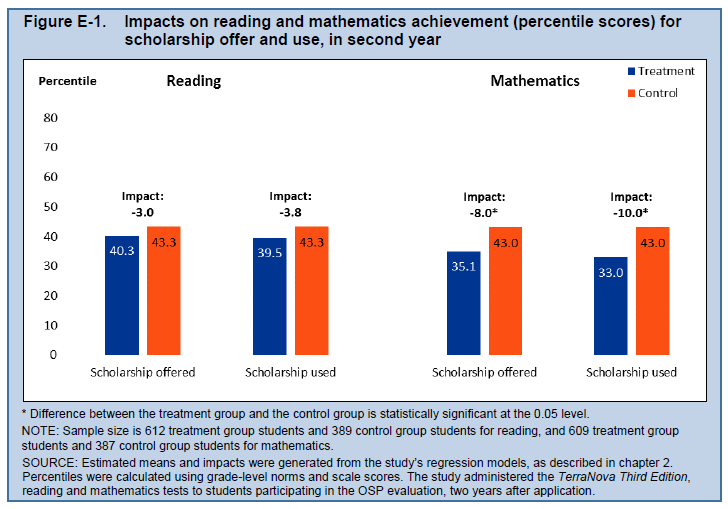
DC Voucher Study Graphic (Page xiv)

Another major issue with voucher schools is that 20% to 30% of students leave every year, either giving up their vouchers or are pushed out.

It is not just Professor Cowen who is writing about these dismal results. Chalkbeat’s Mathew Barnum reported in 2019:

“That’s the grim conclusion of the latest study, released Tuesday, looking at Louisiana students who used a voucher to attend a private school. It echoes research out of Indiana, Ohio, and Washington, D.C. showing that vouchers reduce students’ math test scores and keep them down for two years or more.”

Joe Waddington, University of Kentucky professor, noted, “We’ve started to see persistent negative effects of receiving a voucher on student math achievement.”

So who benefits from vouchers?

There are three groups:

  1. Parents with children already in private schools
  2. Operators of private schools  
  3. Religious zealots who believe public schools are evil and must be destroyed

Public dollars should only go to public schools. American taxpayers generously agreed to finance public education. They have never voted to burden themselves with financing private schools. Every time given an opportunity to vote on vouchers, they said NO.

Choice is an ideology that came out of the negative reaction to Brown versus the Board of Education in 1954. It pushes people into separate silos and exacerbates division.

It is a bigoted choice and drives segregation…

Subterfuge and Learning Loss Baloney

12 Mar

By Thomas Ultican 3/12/2024

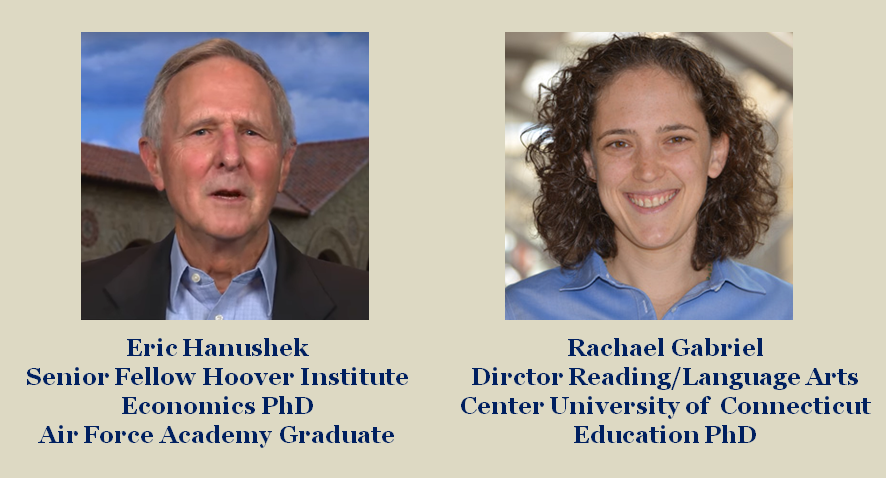
Crazy pants Eric Hanushek claims COVID “learning-loss” could cost American students $31 trillion in future earnings. He burst onto the education world’s consciousness with his 1981 paper, claiming “there is no relationship between expenditures and the achievement of students and that such traditional remedies as reducing class sizes or hiring better trained teachers are unlikely to improve matters.” This played well with billionaires from the Walton family but had no relationship with reality. Likewise, his January 2024 “learning-loss” claims were straight up baloney.

Learning-Loss Reality

In the summer and fall of 2020, NWEA, McKinsey, CREDO and others produced unfounded analysis of looming learning-loss disaster caused by school closures. Since there was no data, summer learning-loss was used as a proxy, a bad one. In 2019, Paul von Hippel’s investigation threw great doubt on the 1982 Baltimore study that powerfully supported summer learning-loss belief. He showed using modern testing analysis, learning-loss was doubtful and in some cases, students gained during the summer. This data, used to trumpet a national education crisis, had no validity.

Unfortunately, billionaire-financed organizations, out to undermine public schools, do not care.

From March 2020 to February 2021, almost a half-million people died of COVID-19. There were no vaccines or Paxlovid type drugs. Refrigerator trucks stored dead bodies and more than 2 million Americans were hospitalized, some on ventilators for months. Schools were closed; unemployment jumped to 15%, murder rates shot up by 30% and fear was rampant.

In this environment, teachers heroically switched to online education.

K-12 students lost parents, became isolated from friends and visited family members in hospitals. Many kids struggled with online classes over inadequate internet feeds, parents were losing jobs and children could not visit grandparents.

Of course the rates of learning decreased but less than one might expect.

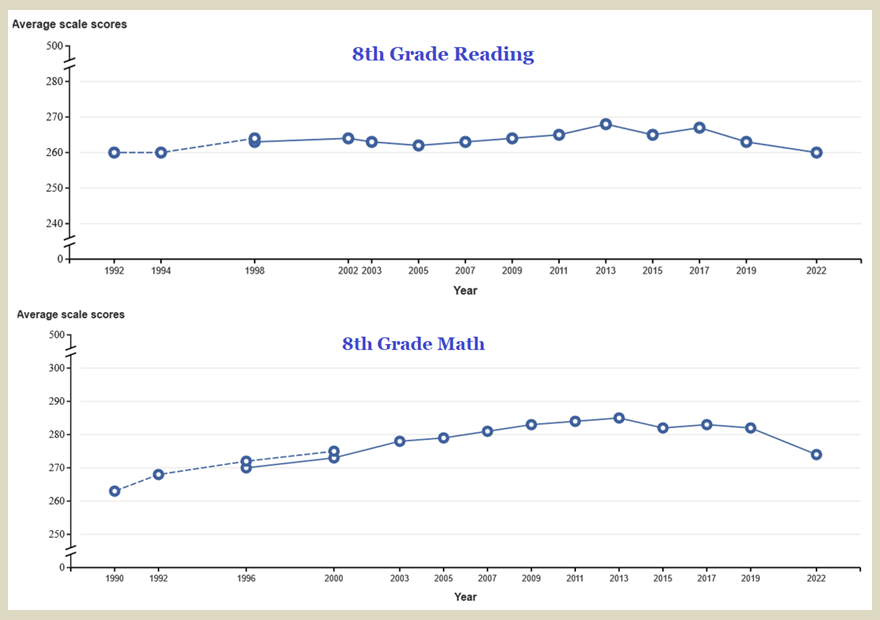
NEAP Data Explorer Graphs

The National Assessment of Education Progress (NAEP) 8th grade data graphs above show a modest decrease in both math and reading scores between 2019 and 2022. Reading fell by three points and math by eight points on a 500 point scale. I do not see catastrophe in these declines because given the context of the pandemic they strike me as rather small, with no signs of pending economic collapse.

Students have been out of school for months with medical or other reasons. I and others with this experience can testify that we were able to recover quickly. Claiming learning-loss disaster from COVID shutdown does not make sense.

Another interesting result from the 2022 NAEP test data comes from Commissioner Peggy Carr of the National Center for Education Statistics. She said, “There’s nothing in this data that tells us there is a measurable difference in the performance between states and districts based solely on how long schools were closed.”

To add further weight, New York Times opinion writer David Wallace-Wells wrote:

“In New York City, the nation’s largest school district, schools reopened in September 2020. There, average scores for reading fell by about a point for fourth graders and improved by about a point for eighth graders; in math, fourth-grade scores fell by nine points (statewide scores fell by 12) and eighth-grade scores fell by four points (statewide scores fell by six). In Los Angeles, the second-largest district, schools stayed closed through January 2021. There, average scores actually improved in fourth-grade reading, eighth-grade math and eighth-grade reading, where they improved by a robust nine points (to 257 from 248). Scores fell only in fourth-grade math (to 220 from 224).”

This January, the New York Times interactive posted Students Are Making a ‘Surprising’ Rebound From Pandemic Closures”, based on a joint project from Stanford and Harvard Universities. Its executive summary states:

“Despite the lack of improvement during 2022-23 on assessments provided by NWEA and Curriculum Associates, we find that student achievement did improve between Spring 2022 and Spring 2023: in fact, students recovered approximately one-third of the original loss in math (0.17 grade levels out of the 0.53 grade levels decline from 2019-2022) and one quarter of the loss in reading (0.08 grade levels out of the 0.31 grade level decline from 2019-2022). Such improvements in grade levels in a single school year mean that students learned 117 percent in math and 108 percent in reading of what they would typically have learned in a pre-pandemic school year. These gains are large relative to historical changes in math and reading achievement on the National Assessment of Educational Progress.”

George Bush’s Secretary of Education, Margaret Spelling, says, “We’re slowly recovering, but not fast enough.” That is from the woman who claimed 100% of America’s students would be above average by 2014. Without being a statistician, it never rang true to me. Her failure to recognize the great work of public schools says she has an agenda.

Outrageous Claims

Eric Hanushek’s new report claims, “Historical earnings patterns make it is possible to estimate what the learning losses documented by NAEP will cost the average student in the Covid-cohort: 6 percent lower lifetime earnings than those not in this cohort.” To document this, he links it to a publication by the Organization for Economic Co-operation and Development, referencing an article he wrote. Without evidence, he claimed Black students will have 8 percent lower lifetime earnings. His report is mostly unsupported assertions.

He states that “nations with more skilled populations grow faster” and asserts that pandemic learning losses mean the US will be less skilled, not growing as fast as “competitors”. Based on this, he postulated future economic losses for students of $28 trillion.

Seams he believes “competitors” would not have education setbacks from COVID.

Believing the pandemic brought harmful policy shifts, causing school quality to decline, he sees abandoning standardized test accountability as number one on his pantheon of bad moves. Teachers unions pushing for their preferred education policies seems wrong to Hanushek. After all, what do teachers know about good education? They are not trained MIT economists, like he is!

The one policy he sees bringing improvement is to put students with “top flight” teachers. This comes from the man who declared “hiring better trained teachers are unlikely to improve matters”.  Hanushek suggests, “The highly-effective teachers could teach larger classes or added sections of courses with both monetary incentives and additional support for this work.”

Remember he does not believe smaller class sizes are important.

Hanushek makes non-scientifically supported assertions and then amplifies them. Like dishonest scientists, he cites his own suspicious work as evidence for new claims. His days of learning test score conversions and estimates of economic loss are these kinds of mere postulations.

A Humanistic Perspective

Professor of literacy from the University of Connecticut, Rachael Gabriel, wrote a 2021 piece for the Washington Post Answer Sheet Blog claiming, “There is no such thing as learning loss.”  Her point was that even when not in school, young people are still learning. Professor Gabriel suggested:

“What if we imagined the “corona kids” had learned more than previous cohorts?

“What if we assumed they were more resilient, well-rounded, creative, and had even more potential than previous cohorts because of what they have lived through and lived without?

“What if we assumed that instead of behind, they were advanced in ways that matter beyond measure?”

Everyone should be confident that if schools and school teachers are allowed to do their job with no “expert” interference, students will be fine. Education and learning are not linear processes. When children are ready to learn, an explosion of growth occurs. It is the intellectual equivalent to that year I grew a foot taller.

Learning-loss is not the big danger facing America’s students. The real danger is the likes of McKinsey, NWEA, CREDO and research leaders like Eric Hanushek.

Public Education Attack Measured

7 Mar

By Thomas Ultican 3/7/2024

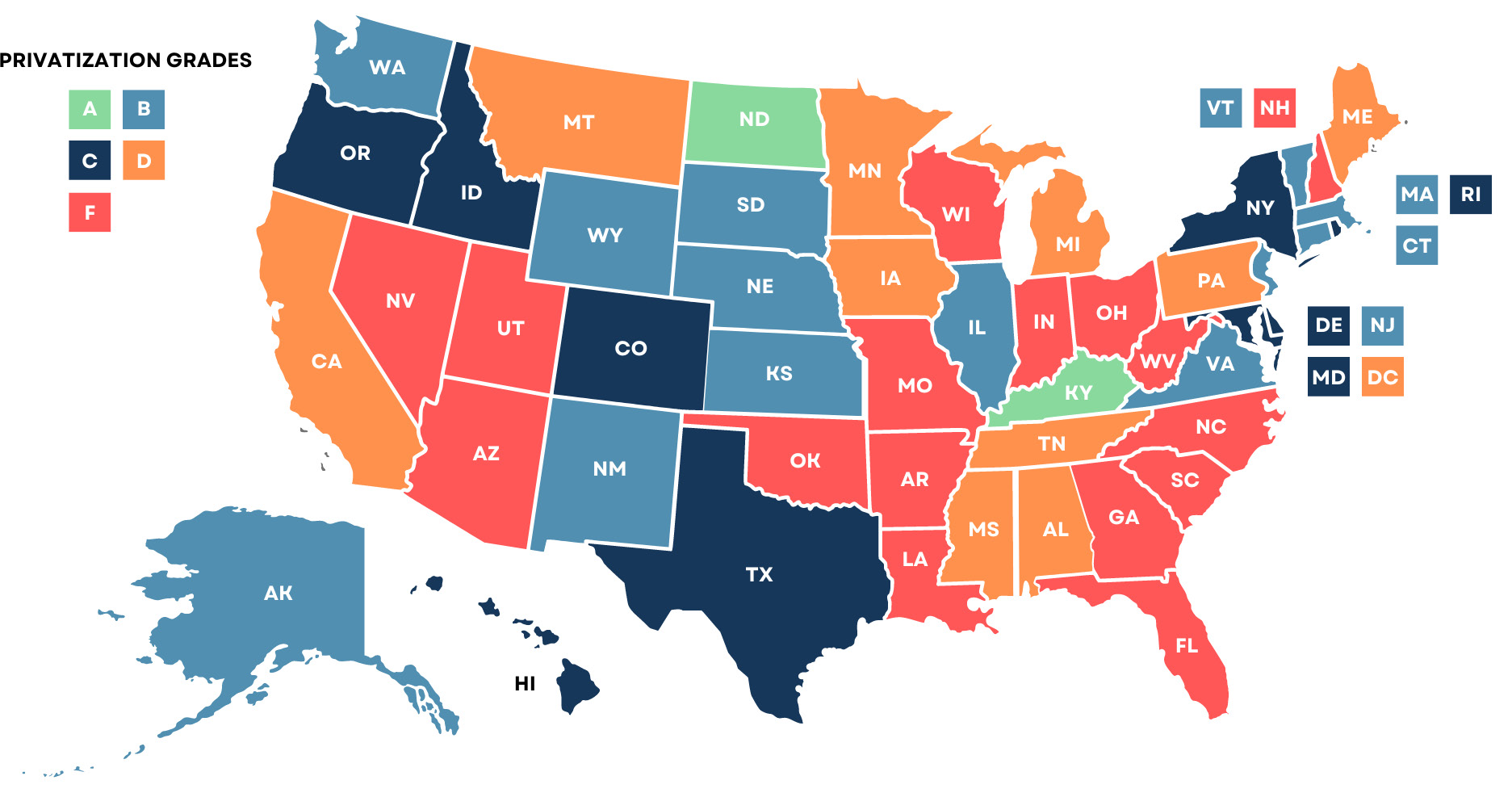
A new report from Network for Public Education (NPE) concludes, “The war on public education has always been a part of Christian nationalism” (Page 32). NPE graded America’s schools using a 111 point scale:  a) Voucher and Charter Expansion and Protections – 66 points, b) Homeschooling governance – 7 points, c) Financial Support for Public Schools – 14 points and d) Freedom to Teach and Learn – 24 points (Page 9). The results from these category totals indicate, among other things, the extent of radical Christian and billionaire libertarian influence in each state.

No state earned a perfect 111 points with North Dakota’s 98 points being the high score. NPE translated the scores into letter grades of A – F: A – 86 to 98, B – 78 to 85, C – 67 to 77, D – 55 to 66 and F – 54 and below (Page 10). The top five states, all with A’s, and bottom five states, all with F’s, are listed below (Page 11).

                                    Top and Bottom Five

A GradesScore F Grades Score
North Dakota98 Arkansas37.5
Connecticut93 North Carolina32
Vermont90.5 Utah29.5
Illinois89 Arizona22.5
Nebraska87 Florida19

Interesting Privatization Observations

Stunningly, voucher costs have grown exponentially since 2000 while private school enrollment shrunk, decreasing from 11.38% in 1999 to 9.97% in 2021 (Page 5). The only way this could happen is if the public started paying for students who were already in private schools.

Of the 240 new charter schools in the US from 2022-2023, thirty of them had 25 or fewer students. A comparison of the National Center for Education Statistics data between 2021 and 2022 revealed 139 charter schools closed (Page 5).

NPE reported:

“Neighborhood public schools remain the first choice of the overwhelming majority of American families. Despite their popularity, schools, which are embedded in communities and governed by elected neighbors, have been the target of an unrelenting attack from the extreme right” (Page 4).

The title for most privatized school system in the US belongs to Florida. Even there, with its 74% public school enrollment, the popularity is unchallenged (Page 6).  

Public schools enroll about 90% of America’s K-12 students.

A Pennsylvania investigation discovered that 100% of voucher schools examined, engaged in some form of discrimination. The schools’ decisions were based on LGBTQ status, disability, academic capacity, family religion and “even pregnancy”. Dayspring Christian Academy declared that supporting the rights of LGBTQ students was also a reason for being denied enrollment or expulsion (Page 12).

The District of Columbia and 30 states have voucher programs with many having multiple programs. Some states allow participants to be in more than one program. Middle class and wealthy families who never had children in public schools now have tax-dollar generated sources flowing toward them (Page 12).

We now have the ludicrous situation where poor people are supporting private school students from wealthy families.

Root of Christian Nationalism

Carol Burris and her team at NPE observed:

“The war on public education has always been a part of Christian nationalism. As that movement rises, so do the attacks on public schools. Randall Balmer of Dartmouth College argues in his piece in Politico that the origins of the political power of the Religious Right began not with Roe v. Wade but rather with Green v. Kennedy, which denied segregation academies tax-exempt status. According to Balmer, that decision gave religious conservative Paul Weyrich an opening to leverage Evangelical political power. Today, the Heritage Foundation, the organization he co-founded, is part of a billionaire-funded effort to destroy ‘government schools’ under the banner of school choice.” (Page 32)

In 1973, Paul Weyrich co-founded the Christian nationalist think-tank, The Heritage Foundation, which has been brutal to the America I love. They attacked the separation of church and state guaranteed in the 1st amendment to the US constitution, undermined democratic action and demanded fidelity to their ideals. In their world, it is forbidden to embrace humanistic principles, share resource or help non-Christians.

Katherine Stewart discussed Weyrich in her book, The Power Worshippers. After the Democratic Party’s embrace of civil rights, Richard Nixon’s “Southern strategy” became a winner. Stewart shared, “If the right could access the religious vote, Weyrich reasoned, power would be in its grasp” (Worshippers 60).

In historian, Randall Balmer’s book, Thy Kingdom Come: How the Religious Right Distorts the Faith and Threatens America, Weyrich claimed that it was the 1975 IRS action against Bob Jones University that caused the Religious Right’s rise, not abortion. Only after New Right leaders held a 1978 conference call to discuss strategy, was abortion was put on their political agenda (Worshippers 64).

With the Soviet Union’s fall, Weyrich saw an opportunity to unite with religious conservatives in Russia and Eastern Europe. Stewart noted:

“All told, Weyrich made more than a dozen trips to Russia and Eastern Europe in the aftermath of the fall of communism. At the time of his death in 2008, even as he was riding high on a wave of plutocratic money in the United States, he was writing and speaking frequently in defense of Russia and facilitating visits between U. S. conservatives and Russian political leaders.” (Worshippers 270)

The long relationship between Christian nationalists and Russian plutocrats informs us why some Republicans support Russia against Ukraine. A pro-Russian attitude goes along with opposing public education. To Christian nationalists, the enemy is secular humanism and public schools reek of it.

Weyrich spent the last decade of his life in excruciating pain. In 1996, he fell on black ice, suffering a spinal injury. By 2001 he required a wheel chair to get around and in 2005; both his legs were amputated from his knees down. He was in constant pain until his death in late 2008.

Why was Florida Last

The team at NPE has provided a fair and well researched assessment of public schools across America. Their four categories and weightings they used to compare schools from many jurisdictions are reasonable. Clearly privatization efforts do significant harm to public education; making giving them 51% of the grade acceptable. Assigning 22% of the grade to protect freedom to teach may be a little low but OK. School finance, getting 13% of the grade, is definitely not too much and 6% of the grade, coming for homeschooling protection, is a needed new category.

With homeschooling accelerating over the last two decades, the need to protect children educated at home has become more critical. The Coalition for Responsible Home Education  was founded by adults, who were themselves homeschooled. Their database contains documented stories of brutal neglect, including homeschooled children murdered, sexually assaulted, imprisoned, and starved. Unfortunately these stories almost never garner national attention. Students in brick and mortar schools also suffer this kind of abuse but they are around mandated reporters (teachers) every day and are not hidden from sight like homeschooled kids.

Using well-sourced data and a four-category rubric, NPE has provided parents throughout the United States with tools to evaluate their states education leadership.

NPE mentioned The Heritage Foundation and its connection to Christian nationalism, which is leading the war against public education. Before he was elected governor of Florida, Jeb Bush served on the Heritage board. It was there he developed his agenda for privatizing public education. His most influential adviser was Patricia Levesque, a graduate of Bob Jones University, the fundamentalist Christian school in South Carolina.

Little wonder that Florida was dead last in supporting public education in America.

Stalled California Charter Schools

29 Feb

By Thomas Ultican 2/29/2024

In California, from 2021 to 2023, 31 new charter schools opened but 63 closed. Since inception in 1994, charter school enrollment grew ever year until 2021. For the first time, charter school enrollment fell. This December, KIPP SoCal announced they were closing three of their 23 Los Angeles County schools. Alliance for College-Ready Public Schools and Green Dot Public Schools have also closed LA area schools.

The charter industry is struggling…

California State Enrollment Data

Los Angeles Unified School District

Los Angeles Unified School District (LAUSD) charter petitions used to arrive by the dozens but there were none this year. The 74 reported:

“Enrollment in the schools peaked in 2021, when the city’s charters enrolled nearly 168,000 students. Since then admissions have declined by nearly 11%, although not as fast as district schools.”

The “although not as fast as district schools” remark is disingenuous. In 2016, LAUSD enrollment was 639,337 and by 2023, had fallen to 538,295. This was a drop of almost 16% but over a much longer time period.

Since 2019, student enrollment in California declined by 5% and in Los Angeles County, the drop was 8.5% (California Data).

Howard Blum, reporting for the LA Times, stated:

Twenty years ago, L.A. Unified had close to 740,000 students and was building schools as fast as it could. District-operated schools currently enroll about 420,000 students — a decline caused by reduced immigration, families moving out of L.A., lower birthrates — and, until recently, the growth of charter schools.”

Carol Burris and Network for Public Education (NPE) published Broken Promises in 2020. A stunning find was that almost 50% of charter schools had closed their doors within the first 15 years of operation (Broken Page 19).

About 50% of Charter Schools Closures by Year 15

Parents, sold a story about superior charter schools, often end up dismayed. A typical response to the closing of KIPP Poder comes from parent Gina Alonzo:

“I was very angry — very, very upset — disappointed, because we didn’t get a warning. We didn’t get a notification of what was going on — the issues that they were having.”

“We were grown as a community here. Everybody knows each other. This is all my son knows. So I’m upset and I’m thinking about the trauma that this is going to cause him.”

Besides new state policies and falling student populations, people in the choice community see the LAUSD board as hostile to charter schools. In 2022, Rocio Rivas won the district-2 seat in a tightly fought battle, not called until two weeks after the election. With a pro-public school board member, replacing termed-out Monica Garcia, the board shifted away from school choice.

In 2017, billionaires (Hastings, Broad, Rock, Fisher and, multiple Waltons) poured huge dollars into the LAUSD election, outspending their opponents 2 to 1 in America’s most expensive school board election ever. They spent more than $6 million in just the 2020 district-7 race to maintain control of the board. The 2022 results flipped the script and billionaires lost control.

John Angeli is executive director of the Los Angeles Coalition for Excellent Public Schools, a group that represents some of the city’s largest charter operators. He points out that in 2024, two incumbent school board members are running for reelection with two retiring board members, leaving open seats. Angeli believes the board could tip back to his favor in November.

School Choice – A Bad Choice

Some charter schools are abominations but most of them are reasonable. Like public schools, they are staffed with excellent or mostly decent teachers and a few who should not be in the profession. Their standardized testing results are similar to those of public schools with two deficiencies. They are likely to close their doors anytime while a public school never closes mid-school year, with no notice. Also public schools unify communities while charter schools divide them.

Birthed in the bowels of the 1950’s segregationist south, school choice has never been about improving education. It is founded on white supremacy, profiting off taxpayers, cutting taxes, selling market based solutions and financing religion. School choice ideology has a long dark history of dealing significant harm to public education.

Steve Suitts’ book, Overturning Brown, provides overwhelming evidence for the segregationist legacy of “school choice.” “Brown v Board” has been effectively gutted with “choice” as the white supremacists’ most potent strategy. In the 21st century, choice is being wielded to maintain segregation and destroy separation of church and state.

Southern segregationists often condemned “integration as the work of communists” (Suitts 32). Adopting the language of University of Chicago libertarian economist, Milton Friedman, they began denouncing the “monopoly of government schools”, calling it “socialism in its purest form” (Suitts 59). This is the basis of so-called school choice.

A Brookings Institute study of segregation in schools reported:

“Charter schools are more segregated than TPS [traditional public school] at national, state, and metro levels. Black students in charter schools are far more likely than their traditional public school counterparts to be educated in intensely segregated settings. At the national level, 70 percent of black charter school students attend intensely segregated minority charter schools (which enroll 90-100 percent of students from under-represented minority backgrounds), or twice as many as the share of intensely segregated black students in traditional public schools”.

This is a big problem concerning all races. Professors Linda R. Tropp and Suchi Saxena along with many other sociologists and educators have conducted research identifying the clear benefit of and need for school integration. They state, “New social science research demonstrates the importance of fostering sustained interracial contact between youth in order to prepare them to thrive in a multiracial society”.

UCLA Professor Gary Orfield coined the phrase “apartheid schools” for schools with a White student enrollment of 1% or less. A personal 2019 study of Washington DC charter schools revealed that 64 of the 116 charter schools could be classified as “apartheid schools”.

Yesterday, Peter Greene posted an insightful article about the coalition-promoting school choice and their splintering. One of the points he made was:

“But what the alliance didn’t produce was results. Choice did not provide a sudden lifting of all boats, despite some data-torturing attempts to show otherwise. Data-driven instruction didn’t improve the data generated by either students or teachers. Underserved communities that were supposed to be rescued from failing schools by charters and choice too often had education policies done to them rather than with them. And then there was the gross miscalculation that was Common Core, which drew attack from all across the political spectrum”.

For the Catholic Church and Evangelical Christians, like Betsy DeVos, publicly provided vouchers for private religious schools open a path to taxpayer support for their organizations. It is lamentable for their cause that every recent large scale study of vouchers showed students perform worse when transferred to voucher schools.

What is the main motive behind mega-rich spending to undermine public education? Professor Maurice Cunningham of the University of Massachusetts claimed they really want “lower state and local taxes.”

John Arnold is the billionaire Enron trader who did not go to prison when that company collapsed. He has joined forces with the billionaire CEO of Netflix, Reed Hastings, to sell the nation on the portfolio model of school management.  To achieve their goal, they created The City Fund. After its founding in 2018, billionaires Bill Gates, Michael Dell and Steve Ballmer all made significant contributions.

In brief, the portfolio model directs closing schools that score in the bottom 5% on standardized testing and reopening them as charter schools or Innovation schools. In either case, they will no longer come under the purview of an elected school board. It is a march to oblivion for public schools because there will always be a bottom 5%.

Two central ideologies behind school choice are markets always make superior decisions and the cost of local control of schools is poor outcomes. Both ideas are demonstrably untrue but big money and power politics keep them alive.

It is good for America that charter schools are starting to struggle but it is heartbreaking for parents, hornswaggled by billionaires. Americans have always had school choice. If taxpayer funded public school are not wanted, there are always private schools, without the choice encumbering taxpayers.

Let’s join with the Network for Public Education and thoughtfully role back choice schools and put them under democratic control.

Stop fleecing taxpayers to finance privatized schools.

Time to Leave International PISA Testing

20 Feb

By Thomas Ultican 2/20/2024

February began with Progressive Policy Institute and The 74 teaming up for a Webinar on PISA math test results, declaring “Historically Underperforming PISA Scores are a Call to Action”. 

Dr. Yong Zhao, Foundation Distinguished Professor of Education at University of Kansas and among his many accolades, an appointed Professor of Educational Leadership at University of Melbourne, has a different view, stating:

“Since 2000, our scores on PISA have barely changed. While there’s much chatter about learning from other systems, it has not happened. There is no reason that the U.S. should continue its participation in PISA.”

Zhao sees standardized testing as undermining student creativity. PISA tests stress cognitive skills while noncognitive skills are more related to creativity and entrepreneurship. His book, Who’s Afraid of the Big Bad Dragon, describes how in 605 AD the Chinese government developed a testing system known as “keju” to select people for prestigious government positions. That system is now blamed for stifling creativity and scientific development. When westerners showed up in their ships, guided by compasses and using gunpowder, both invented in china, the Chinese could not defend themselves. Zhao writes, “In fact, the keju system has been held responsible for the decline of the Chinese empire.” (Big Bad Dragon page 35)

PISA 2022 Testing Results

A quick peek at PISA’s data presentation reveals average scores in everything have gone the wrong direction since bankers from the Organization of Economic Co-operation and Development (OECD) got involved. Furthermore, their baseless use of translating test scores into time is fraudulent.

Why would anyone pay attention to their views on education?

Progressive Policy Institute

Going into the 1984 Democratic convention, several politicians, not happy with the party’s direction, met in a San Francisco hotel room but did not take action. After Walter Mondale’s thumping by Ronald Reagan, the Democratic Leadership Council (DLC) was created based on a plan developed by Al From who believed that being independent from the Democratic Party would allow them to be more “entrepreneurial”. Current PPI Director, Will Marshall, was hired to be policy director (Left Behind Pages 43-45).

To drive their policy strategy, From and Marshall decided to establish a think tank. Seeing the way Heritage Foundation, American Enterprise Institute and Cato Institute had driven the conservative revolution in the 1970s and 1980s, they created a new idea-generating center called Progressive Policy Institute (PPI) (Left Behind Pages 112-113).

Early on, PPI came out with articles opposing minimum wages which many people saw as anti-union. Later, a PPI fellow, David Osborne, famously campaigned for an entrepreneurial government to meld public and private to maximize productivity and effectiveness. Lily Geismer said, “Osborne developed these ideas into a book cowritten with Ted Gaebler, called Reinventing Government: How the Entrepreneurial Spirit Is Transforming the Public Sector; which was released in 1992” (Left Behind Page 117).

Geismer continued:

“Under Osborne’s guidance, the DLC became one of the first political organizations to explore charter schools as a means of improving public education. Charters, along with the other programs, became a critical part of the new approach that DLC promised it would provide as the nation was starting a new decade.” (Left Behind Page 118)

It is no surprise to see PPI joining with The 74 to trash public education. Their “third way” agenda has a lot in common with the GOP driven school choice and anti-labor agenda.

For this Webinar, the PPI expert panel included Dr. Peggy G. Carr, Commissioner of the National Center for Education Statistics (NCES) in the U.S. Department of Education, Andreas Schleicher, Director of the Directorate of Education and Skills at the OECD and Jonathan A. Supovitz, Professor in charge of Organizations, Leadership, and Systems Division at University of Pennsylvania, Graduate School of Education. The moderator was PPI’s Tressa Pankovits, Co-Director of Reinventing America’s Schools.

Peggy Carr served in NCES for more than 20 years before Biden appointed her Commissioner. She is undoubtedly a gifted mathematician but knows little about America’s classrooms. Carr recently made headlines when the charter school she founded, Children’s Village Academy in North Carolina, was charged with paying exorbitant interest rates on a 15-year old loan she gave the school.

Andreas Schleicher is a fine mathematician but, just like Peggy Carr, he knows nothing about good education. His personal PISA involvement blinds him to how little value standardized testing is for evaluating student learning.

I really don’t want to say anything mean about moderator Tressa Pankovits because she is a fellow Aztec, unfortunately her resume reveals no training or experience as an educator. Still she is PPI’s “Co-Director of Reinventing America’s Schools, which researches innovations needed to create a 21st century model for public education that is geared to the knowledge economy.” It is hard to understand how her background qualifies for the position. Before she got this job she worked 10 years for Paul Vallas who hurt public schools in Chicago, Philadelphia, New Orleans and Bridgeport. He also has no training or experience as an educator.

The only educator in this group is Jonathan A. Supovitz. His values look shaky, based on the company he keeps.

PISA and the OECD

OECD was formed in 1961 as a follow-on to the Marshall plan, run by bankers and economists. Market Business states:

“All OECD member states claim to be market economies that are committed to democracy. The organization says it provides a platform where they:

  • Share and compare policy experiences.
  • Identify good practices.
  • Coordinate members’ international and domestic policies.
  • Seek answers to common problems.”

In 2014, German writers, Sija Graupe and Jochen Krautz, wrote “From Yardstick to Hegemony”, using OECD documents:

“The OECD Conference documentation of 1961 declares unequivocally: ‘It goes without saying that the educational system must be an aggregate of the economy, it is just as necessary to prepare people for the economy as real assets and machines. The educational system is now equal to highways, steel works and chemical fertilizers’”.

“What this unrealistic worldview setting in turn impedes is any critique or will to change because rather than being understood by the public as a theoretical construct it is, according to the neoliberal economist August Hayek, accepted by most as an immediately evident truth. Whether they are true or false, economic theories and all assessments based on these (such as PISA) determine reality. … As long as people believe having more PISA points is better than less in order to be successful economically they will, of course, do everything they can to acquire more. Education is then forced to uncritically yield to the pressure of comparative assessment, even if it is based on pure assertion.”

The meaningfulness of PISA testing results are pure assertion based on bad science.

Noel Wilson’s famous 1997 peer-reviewed thesis, Educational Standards and the Problem of Error fundamentally states the error involved in educational testing is so great that validity is compromised. In other words, standardized tests are not refined enough to make more than generalizations and are bunk for measuring learning or teaching.

Yong Zhao shared research showing an inverse relationship between test scores and economic development:

“In fact, a correlational analysis done in 2007 showed a negative correlation between international test scores and economic development (Baker, 2007). That is, countries with higher scores in the first international study did worse than countries with lower scores.” 

Because America does not filter students from the academic system before high school, tested populations do not compare well internationally. However, since 2010, in the yearly International Math Olympiad, the USA team has come in first four times and never finished lower than fourth … out of over 100 entrants.

So why are we still bothering with meaningless PISA exams???

School Moms Battle for Public Education

11 Feb

By Thomas Ultican 2/11/2024

Leading into the 2020-2021 school year, I started hearing about parents protesting mask mandates. It did not make sense. Soon, open schools now protests started in San Diego County. News came that Florida had mandated in-class school. These events turned out to be part of a new right-wing attack on public education. Journalist, Laura Pappano, explores this recent history in her book School Moms: Parent Activism, Partisan Politics, and the Battle for Public Education.

War Moms

Visiting the Marriott Tampa Bay in 2022 for first-ever Moms for Liberty (M4L) national gathering, Pappano described the conference rooms as “white, far-right Christian world”, adding:

“As I listened to keynote speeches and strategy session after strategy session, I saw speakers lay a foundation of a distorted groupthink. Then, like an ideological conveyor belt, the speakers carried the moms to ever crazier places, stirring fears that their children were being brain washed and indoctrinated into Marxist ideology and that they were being groomed by teachers to want to transition from one gender to another.” (Page 2)

Before COVID vaccines, Tina Descovich, who just lost her Brevard County school board seat, became angry about school mask mandates. M4L grew out of this anger. She joined Indian River County school board member, Tiffany Justice, and Sarasota County school board Director, Bridget Ziegler, to legally found M4L.

The first speaker at the Tampa rally was Florida Governor, Ron DeSantis, wanting people to recall that in July, 2020 Florida’s education department declared schools would return to in-person learning. He did not mention Florida Education Association’s Safe Schools Report that disclosed 46 COVID-related teacher deaths, 10 student deaths and 200,834 student-positive tests in school year 2020-2021. Knowing how much that last statistic spread COVID is impossible but it was a lot.

At the conference, DeSantis claimed:

“While they were infringing freedoms, we were lifting people up. We made sure that every single kid in this state had the right to go to school in person five days a week.”(Page 3)

A quick peek at data from the National Assessment of Education Progress (NAEP) shows little to no advantage for Florida students academically.

Pappano shared the drumbeat of fear in Tampa with:

“Parents were told that public schools are rooted in ‘Marxist ideologies’ and seek to brainwash their children—and not ‘brainwash in some cute way,’ said one speaker, the far-right cultural critic James Lindsay. ‘I mean brainwash in the sense of ‘she-now,’ which is Mandarin, which is literally what the Maoist prisons referred to as their program of thought reform.”’ (Page 6)

DeSantis told his audience about drawing “a line in the sand” with the “Don’t Say Gay Law”, prohibiting discussion of sex and gender identities in grades K-3. He claimed it lets parents send kids to school “without having woke ideology” and “have some first-grader be told that yeah, your parents named you Johnny and were born a boy, but maybe you are a girl.” (Page 7)

This has never happened in an American elementary school … but reality was not the point.

Former Education Secretary, Betsy DeVos, used “education freedom,” the new term for “school choice” to promote vouchers. Moms were told it was critical because public schools were a mess. (Page 8)

James Lindsay asked, “If you knew you were sending your children for thirty to thirty-five hours a week to a Maoist thought reform prison, Maoist brain-washing prison, what would you [do] differently?”, saying take “all lines of dedicated action to fix this system to get this crap able to be seen and identified for the crime against humanity that it is and pulled out of schools.”  

He declared: “You are War Moms!” (Page 7)

Not everything following the convention has been positive for M4L. February 3rd, 2024, CNN ran Moms for Liberty faces new challenges and growing pushback over its conservative education agenda. The article reported on the January 23rd Brevard County school board meeting, where M4Lstarted, with many quotes similar to this:

‘“Why are we banning books?’ asked Mindy McKenzie, a mom and nurse who is a member of Stop Moms for Liberty, which was formed to counter what it calls a far-right extremist group ‘pushing for book banning and destroying public education.”’

Critical Race Theory

In School Moms, Pappano addresses the headline-grabbing education concerns since 2020. Few issues stirred more animosity and notice than Christopher Rufo’s Critical Race theory (CRT).

Rufo was born August 26, 1984 and grew up in Sacramento, California. His path to fame and power in rightwing politics opened while he was a research fellow at the Christian think-tank, Discovery Institute. This small institute is most famous for promoting “intelligent design” in high school science classes and opposing Darwinian Theory.

While working at Discovery, Rufo lived in Seattle, Washington. When protestors drove police out of a precinct near Cal Anderson Park, erected barricades and established the Capitol Hill Autonomous Zone, he immediately jumped on the story and wrote pieces for Manhattan Institute’s City Journal, with titles like “Anarchy in Seattle.” (Page 76)

In “Cult Programming in Seattle”, he described a “racial-justice shakedown”, causing white employees to “abandon their ‘white normative behavior’ and learn to let go of their ‘comfort,’ ‘physical safety,’ ‘social status’ and ‘relationships with some other white people.’” He also quoted James Lindsay, the Maoist prison camp guy, calling it “the language of cult programming—persuading members they are defective in some predefined manner.”

Pappano reports:

“On July 18, 2020, he pressed harder. In ‘White Fragility’ Comes to Washington,’ Rufo claimed that diversity trainings at several federal agencies were part of ‘the creation of a new, radical political consciousness.’ He also miss-defined this new consciousness as CRT, writing, ‘Critical race theory—the academic discourse centered on the concepts of ‘whiteness,’ ‘white fragility’ and ‘white privilege’—is spreading rapidly through the federal government.’ The erroneous definition of CRT caught on. Rufo tweeted about it. Then, on August 17, 2020, Rufo was a guest on Fox’s Tucker Carlson Tonight, where he described critical race theory as spreading ‘like wildfire’ across American institutions.”’ (Page 77)

A few weeks later, Rufo, back on Carlson’s show, claimed, “Conservatives need to wake up that this is an existential threat to the United States” and looking into the camera stated:

The president and the White House, it is within their authority and power to immediately issue and executive order abolishing critical race theory. I call on the president to immediately issue this executive order.” (Page 78)

President Trump complied. Two days later on September 4, 2020, Russell Vought of the Office of Budget and Management wrote to all agencies, “The President has directed me to ensure that Federal agencies cease and desist from using taxpayer dollars to fund these divisive, un-American propaganda training sessions.” (Page 78)

CRT indoctrination was from the beginning a bogus claim. It is a legal theory, developed in the 1970s and 80s, looking at how race is affected by legal structures. This was almost exclusively the purview of graduate school legal debates. Forty years later, it has been drudged up to fuel a McCarthyesque style attack on educators and fight against inclusion. There is no evidence that it has ever been taught in the K-12 environment. Today, CRT is almost forgotten, as Rufo and the hard-right are focusing on destroying diversity, equity and inclusion (DEI).

Those opposing DEI are supporting segregation, privilege and exclusion. Antagonism to DEI indicates support for white supremacy and disapproval of judgments based on merit.

School Moms

Big education issues that appeared over the last three years are covered in this book.

The Seven Mountains mandate, placing the law of God above secular law, is addressed in Chapter 5. Pappano writes, “For Christian Extremists, LGBTQ+ individuals, and especially transgender students, are a deviation from ‘God’s design’ and a clear ‘problem’ in the ‘extremists’ quest for a Christian society.” (Page 116)

The movement to ban books is addressed in Chapter 3, “When librarians Come Under Attack.”

There are heart-wrenching stories from Texas, Tennessee, Minnesota and other states, of popular educators having careers ruined by zealots and racists.

The story of Free Staters, trying to destroy public education in New Hampshire, is included.

Not all is lost!

Pappano says, “In this new environment, everything had a side: masks, books, pride flags, pronouns, history lessons.” Before their children arrived, many mothers were high-functioning employees with skills. She asserts, “So one should not be surprised at the professional-level organizing going on in grassroots public education groups.” (Page 128)

School Moms: Parent Activism, Partisan Politics, and the Battle for Public Education

… is a worthwhile read.

Promotion of Education Savings Accounts aka Vouchers

4 Feb

By Thomas Ultican 2/4/2024

Propaganda Rag, The 74, continuously endorses their billionaire funders’ agendas. On January 23, they were passing on lies about Education Savings Accounts (ESA), another name for school vouchers. The hidden deep pocket behind the fraudulent article was Charles Koch.

Christopher Leonard describes Koch’s economic philosophy in his masterpiece, Kochland:  

“Charles Koch became enamored with the thinking of economists and philosophers like Ludwig von Mises and Friedrich Hayek, two Austrian academics who did most of their formative work during the 1930s and 1940s. In later years, Charles Koch would be described as a libertarian or a conservative. But these were imperfect labels that didn’t capture his true world view. More than anything, he was an Austrian economist, or a ‘classical liberal,’ as he liked to call it. Hayek, in particular, put forward a radical concept of capitalism and the role that markets should play in society, and his thinking had an enduring effect on Charles Koch.” (Page 42)

As a “classical liberal,” Koch is opposed to Social Security, Medicare and public education. This is probably not a case of billionaire greed but his philosophical belief. He sees being taxed to pay for public schools and medical care for aging people as stealing. Hardcore libertarians believe people should pay their own way and believe children’s education, retirement and health care are individual responsibilities. 

Koch is an extremely bright MIT-trained doctorate in engineering and an astute politician.

Choice Propaganda

On January 23rd, The 74 published Three Things to Know About National Education Tax Credit Survey.” The three things are (1) most adults support education tax credits, (2) poor people show lowest support for them and (3) parents who support education tax credits also favor education savings accounts, public school open enrollment and part-time public school access.

The subtitle of the article says, “New YouGov poll found education tax credit support from 80 percent of K-12 parents — pointing to a growing interest in school choice options.”

Education tax credits and education savings accounts are new names for vouchers. How could the claims in this article be true if a voucher law has never received a positive vote from the public?

YouGov describes itself as “an international online research data and analytics technology group.” Founded in 2000 and based in the UK, it was apparently hired by Yes. Every Kid. to run a few surveys. The results are opposite from other surveys on the same subject.

A March 2023 survey by Reuters/Ipsos found that 36% of respondents showed some support for vouchers with only 15% strongly supporting them (See Page 11). One reason YouGov got such positive responses may be how the question was asked. The Reuters/Ipsos poll inquired about “Laws allowing government money to send students to private and religious schools, even if it reduces money for public schools?” It is unknown what YouGov asked.

An article posted at 538 explained,

“Complicating the picture further is the fact that several of the survey sponsors, such as EdChoice and yes. every kid., are advocacy organizations that support voucher programs, which means they may be incentivized to word their poll questions in a way that encourages respondents to indicate support for the programs. They may also be less transparent about how their polls are conducted and how their questions are worded. For example, polling from YouGov/yes. every kid. conducted in November and December of last year found a slight majority (54 percent) of Americans support ESAs, though a significant number (33 percent) were undecided on the issue. But the organization didn’t release complete toplines or question wording, so it’s not clear how much this result might have been influenced by the pollster’s framing of the issue.”

Koch Financed It

The 74 noted at the end of the article,

“Disclosure: Yes. Every Kid. operates as part of the wider Stand Together Trust network. Stand Together Trust provides financial support to The 74.

Stand Together was founded by Charles Koch in 2003 and, like all of his organizations, it is complicated and divided into six organizations today. The Stand Together about web page says:

“Stand Together was founded in 2003, but our story really started more than 50 years ago. It began with Charles Koch — a Forbes Top-25 philanthropist and the CEO of the largest private company in the country.

Today, Brian Hooks is the chairman and CEO of Stand Together. He is co-author with Charles of Believe in People: Bottom-Up Solutions for a Top-Down World and a 2021 TIME 100 Next honoree, featuring leaders shaping the future of their fields.

In 2013, Stand Together Trust (EIN 46-3508366) was formed. It gifted The 74 $277,000 in 2022 and provided Yes. Every Kid. with $2,010,000.

Looking through the latest non-profit tax filings by Stand Together Trust, Yes. Every Kid. Foundation (EIN 84-3535275) and Charles Koch Foundation (EIN 48-0918408), I noticed many of the board members are the same.

From Stand Together Trust: Brian Menkes Secretary, Derek Johnson Executive Director, Brian Hooks Director, Kara Hartnett Treasure, Charles Koch Director, Henrich Heuer – Keeps the records

From Yes. Every Kid. Foundation: Derek Johnson Director, Brian Menkes Secretary, Henrich Heuer Treasure

From Charles Koch Foundation: Charles Koch Chairman, Brian Menkes Secretary, Kara Hartnett Treasure, Brian Hooks Director

Kochtopus

The graphic above appeared December 13, 2013 on Progressive Collapse. The web site is no longer viable but their image is. It uses an octopus to demonstrate the vast influence Koch has created in areas of public interest. Since then, it has been shared by many. On the occasion of David Koch’s passing in 2019, the Guardian titled its article The Kochtopus: sprawling network keeps David Koch’s legacy thriving.”

In 2010, the Koch brothers staged one of their twice-yearly programs that became known as “Freedom Partners.” A brochure, accompanying invitations, highlighted a previous event in Aspen. The Guardian’s article reported:

“The most intriguing part of the brochure was a roll-call of names of those lured to previous “Freedom Partner” gatherings. It included the current vice-president, Mike Pence; the Wisconsin politician Paul Ryan, who would go on to become speaker of the House of Representatives; super-donors such as the hedge fund manager Ken Griffin, and most intriguingly of all two conservative justices of the US supreme court, Clarence Thomas and the late Antonin Scalia.”

Koch is known to be a shrewd businessman who supports voucher plans with as little oversight as possible. Education savings accounts are fraught with malfeasance. Peter Greene, reporting at Forbes noted:

“In Arizona, an audit found that parents had spent $700K of ESA money on beauty supplies and clothing. In Florida, where voucher-receiving schools openly discriminate against LGBTQ students, a new bill proposes that audits be performed only every three years. Kentucky’s new ESA bill proposes audits after the state has found evidence of misuse of funds, which seems like a rather late shutting of the barn doors. And the bill that the Iowa senate just fast-tracked in order to establish ESAs includes no call for any audits or oversight at all. (That may be in part why the Iowa Satanic Temple has announced their intention to establish the Iowa Satanic School.)”

For Charles Koch to support this kind of financial chicanery, there must be an ulterior motive. Most likely, the purpose is destroying America’s public school system and ending the voucher mess. His classical liberal ideology would be realized and universal free public education would be ended.

Koch once again extended his octopus-like tentacles when he joined the Walton Family to form the Vela Education Fund. Vela received their 501 C3 determination (EIN 84-4185046) from the IRS December 10, 2020. Stand Together’s latest form 990 filing listed $6,340,018 to Vela and the Walton Families Foundations (EIN-13-3441466) latest form 990 filing showed $5,000,000 to Vela.

It is clear that Vela is a Koch operation. Derek Johnson and Brian Menkes are on the board and Kara Hartnett is listed as Treasurer. These three people are on several Koch organization boards. This is one more weapon in Charles Koch’s quiver for ending public education.

Billionaires like Koch, the Walton family and former Education Secretary Betsy DeVos are intent on using their wealth to defeat democratic support for public schools and end Democracy’s Schools.” America can no longer afford to put up with billionaires and their non-democratic ways.

Time that voters tax billionaires out of existence.

Father of Progressive Education Movement

28 Jan

By Thomas Ultican 1/28/2024

John Dewey called Colonel Francis Wayland Parker, “more than any other person… the father of the progressive education movement.” True, his 1902 passing predated the movement’s heyday by two decades but he was the root, a Civil War veteran and educator, passionate in his quest for better education.

Born (1837) in Bedford, New Hampshire, Colonel Parker was a product of public school. He began his career as a village teacher at 16 and eventually took charge of all grammar schools in his hometown, Piscataquis. Then at 21, he became the principal of a school in Carrolton, Illinois.

During the Civil War, he joined the Union Army as a private in 1861, was elected 1st Lieutenant and later made company commander with the rank of Captain. After being wounded at the Battle of Deep Bottom, Virginia in 1864 and the attack on Fort Fisher, North Carolina, he became commander of the 4th New Hampshire and was promoted to Lieutenant Colonel. From then on, he was referred to as Colonel Parker. He was captured, held prisoner in North Carolina in May 1865 and fortunately, the war ended.

After mustering out of the army, Colonel Parker resumed teaching and became head of the normal school in Dayton, Ohio. When an aunt died and bequeathed him $5,000, he traveled to Germany for pedagogy studies.

Progressive Education        

Pedagogy practiced in nineteenth century was teacher-centered with extreme discipline. Students were given texts to memorize and lots of drill.

In 1872, Colonel Parker enrolled at Humboldt University of Berlin. He examined new methods of pedagogy developed by European theorists, such as Jean-Jacques Rousseau, Friedrich Froebel, Johann Heinrich Pestalozzi and particularly Johann Friedrich Herbart.

Jean-Jacques Rousseau (1712 – 1778) considered his book, Emile or On Education, to be his greatest work, regarded by some as the first philosophy of education in Western culture with a serious claim to completeness. After the French Revolution, Emile served as the inspiration for what became France’s new national system of education. In the book, Rousseau played tutor to Emile and eventually, Sophie. It was here where his philosophy of education came to light. He gives advice like, “Always speak correctly before them, arrange that they enjoy themselves with no one as much as with you, and be sure that … their language will be purified on the model of yours without your ever having chided them.” (Emile Page 71)

Of course, no matter how advanced an 18th century man may be, his ideas can always use some perfecting. In discussing how women should be educated, Rousseau wrote:

“The first education of men depends on the care of women. Men’s morals, their tastes, their pleasures, their very happiness also depend on women. Thus the whole education of women ought to relate to men. To please men, to be useful to them, to make herself loved and honored by them, to raise them when young, to care for them when grown, to counsel them, to console them, to make their lives agreeable and sweet – these are the duties of women at all times, and they ought to be from childhood.” (Emile Page 365)

Johann Heinrich Pestalozzi fell in with radical philosophers who supported Rousseau in the mid-18th century. After Emile and Social Contract were published, Rousseau was condemned as a danger to Christianity and state. Pestalozzi’s group wanted freedom and at 19, he wrote many articles, got arrested, charged with helping a newspaper editor escape but was released after three days.

He decided to become an educator, especially of the poor. The Swiss Government put him in charge of an orphanage in Stanz. Here he realized the significance of a universal method of education and spent the rest of his life perfecting one.

German philosopher and educator, Johann Friedrich Herbart, spent a year studying with Pestalozzi. Herbart suggested Pestalozzi read the French book, The Application of Psychology to the Science of Education. Pestalozzi’s French was not great but what he comprehended threw “a flood of light upon my whole endeavor.” (Green, The Educational Ideas of Pestalozzi 48)

In 1805, King Christian the VII of Denmark gifted Pestalozzi a sum of money while he was starting a school at Yverdon. With this, Pestalozzi was able to spend several months writing Views and Experiences relating to the idea of Elementary Education.

Pestalozzi’s method was used by the cantonal school in Aarau that Albert Einstein attended. Einstein said of Aarau, “It made me clearly realize how much superior an education based on free action and personal responsibility is to one relying on outward authority.” (Isaacson, Einstein His Life and Universe 65)

Friedrich Wilhelm August Froebel (1782 – 1852) was the student of Johann Pestalozzi who laid a foundation for modern education, based on recognizing children’s unique needs and capabilities. He created the concept and coined the word kindergarten, which soon entered the English language.

Froebel’s insight recognized the importance of activity for a child’s learning, that games were integral to it and had educational worth. In his book, The Education of Man, he wrote, “A universal and comprehensive plan of human education must, therefore, necessarily consider at an early period singing, drawing, painting, and modeling; it will not leave them to an arbitrary, frivolous whimsicalness but treat them as serious objects for the school.” (Page 228)

Johann Friedrich Herbart (1776 – 1841) was a German philosopher, psychologist and founder of pedagogy as an academic discipline. Homeschooled by his mother until age 12, he studied at the Gymnasium for six years, particularly drawn to philosophy, logic and Kant’s work involving the nature of knowledge.

Stanford’s Encyclopedia of Philosophy says:

“Johann Friedrich Herbart … is known today mainly as a founding figure of modern psychology and educational theory. But these were only parts of a much grander philosophical project, and it was as a philosopher of the first rank that his contemporaries saw him. … In psychology and pedagogy, however, his influence was greater and longer lasting. While no one took over his philosophy or psychology (and especially the impenetrable mathematics) as a whole, certain aspects of his thought proved immensely fruitful. Indeed, without Herbart, the landscape of modern psychology and philosophy would be unrecognizable.”

For the educator, his 1841 book, Outlines of Educational Doctrine, is particularly important and was of great interest to Colonel Parker. In it, Herbart sometimes made concise statements, such as, “A method of study that issues in mere reproduction leaves children largely in a passive state, for it crowds out for the time being the thoughts they would have otherwise had.” (Page 61)In other places, he went into great detail about concepts like preparation, presentation, association, systemization and application.  

Returning to America

After Colonel Parker returned to the United States, he noted:

There was a great deal better way of teaching than anything I had done. Of course I had a great deal of enthusiasm and a great desire to work out the plan and see what I could do.

He almost immediately secured a position as superintendent of schools in Quincy, Massachusetts. Colonel Parker’s innovations, labeled the “Quincy Plan,” gave him a national reputation.

Quincy Plan was an experimental program, abandoning prescribed curricula of rote memorization and harsh discipline, replaced with meaningful learning and active understanding. However it had many detractors. In 1879, Quincy students participated in state examinations of traditional subjects. Test results revealed they surpassed all the other students in Massachusetts.

Parker surprisingly responded, “If you ask me to name the best of all in results, I should say, the more human treatment of little folks.”

The following three years, Colonel Parker served as superintendent of Boston public schools. Because of constant opposition to his methods, he left Massachusetts in 1883 to become principal of Cook County Normal School in Chicago, an institute dedicated to training elementary school teachers. Chicago brought strong support from many local luminaries such as Jane Addams, Rabbi Emil G. Hirsch, and Anita McCormack Blaine.

In 1899, to free Parker from the continual harassment by politicians and the school board, Anita McCormack Blaine endowed a private school for him and his faculty. The new Chicago Institute was planned, developed and classes started. It was soon proposed that the Chicago Institute join with the Department of Education to form the School of Education at the University of Chicago. This plan became official on July 1, 1901 with Colonel Parker as director for the School of Education and John Dewey remaining Head Professor in the Graduate School of Arts, Literature and Science. In March 1902, Parker died and John Dewey was appointed his successor in the School of Education.

Anita McCormack Blaine also convinced Colonel Parker to establish the Francis W. Parker School, a private school, in Chicago’s Lincoln Park. This school, established in 1899, was to operate according to Parker’s education principles. A second Francis W. Parker School was founded in San Diego in 1912 with a city population of only 39,000.

Both private schools are still operating and very successful today.

Billionaire Science-of-Reading Support

21 Jan

By Thomas Ultican 1/21/2024

National Center on Teacher Quality (NCTQ) released an unreviewed report (1-16-2024) on state laws, about teaching reading inadequacy. That day, The 74 ran an article about it, verified by an EdReports’ curriculum quality evaluation. These three entities are billionaire creations, used to chip away local control of schools.

In a 2012 Washington Post Answer Sheet Blog, Diane Ravitch shared,

“NCTQ was created by the Thomas B. Fordham Foundation in 2000. I was on the board of TBF at the time. Conservatives, and I was one, did not like teacher training institutions. We thought they were too touchy-feely, too concerned about self-esteem and social justice and not concerned enough with basic skills and academics.”

Kate Walsh led NCTQ from 2000 until 2022, retired and Heather Peske took over. During Walsh’s tenure, notoriety was gained by teaming with Newsweek and claiming America’s teacher education programs were unsatisfactory. Their research methods were widely panned. They Looked only at class syllabi and made no attempt to ascertain new teacher job performance before denigrating the programs. 

NCTQ’s rankings were endorsed by eight state school education chiefs, part of Jeb Bush’s Chiefs for Change: Janet Barresi, Oklahoma; Tony Bennett, Indiana; Steve Bowen, Maine; Chris Cerf, New Jersey; Deborah A. Gist, Rhode Island; Kevin Huffman, Tennessee; Eric Smith, Florida and Hanna Skandera, New Mexico.

Walsh also famously called for teacher merit pay and held up Washington DC’s schools as a good example. Critics called the Washington experiment a failure because of the high stakes and “significant differences” in percentage of teachers rated “highly effective” in low and high poverty schools. Teaching is so complicated, with no justifiable way for accurate evaluations for these high stakes.

Heather Peske has a resume that makes billionaire education reformers comfortable. After starting as an elementary teacher in Baton Rouge, Louisiana, she served as Director of Teacher Quality at The Education Trust and later, Vice President of Programs at Teach Plus. She was also named “Future Chief” by Chiefs for Change, became a Broad Academy Fellow and earned a doctorate in Administration, Planning, and Social Policy from Harvard Graduate School of Education.

Peske Report

Action 1 of the NCTQ report, named “Five Policy Actions to Strengthen Implementation of the Science of Reading,” began by calling for standards, “Many new teachers aren’t prepared to teach reading because only 26 states provide clear standards to teacher prep programs.” This translates to mean only 26 states provide billionaire-funded standards. NCTQ has been relentless in its attempts to undermine university-run teacher training.

Action 2 calls for “reviewing teacher prep programs to ensure they teach the science of reading,” claiming it is laudable that Indiana and Ohio have audited prep programs, ensuring focus on implementing the science-of-reading (SoR).

Action 3 requires elementary teacher candidates to pass a reading licensure test. The report cautions readers that some tests do not fully address all five core components of SoR, another call for turning over teacher selection to private entities.

Action 4 addresses “the use of high-quality curricula aligned to the science of reading.” NCTQ’s solution to this is to sign on with EdReports which reviews reading materials and lets client schools know its alignment with SoR.

The report claims “only nine states require districts to select high-quality reading curriculum materials” and noted that forward-looking states, like Arkansas, partner with EdReports.

Action 5 provides “professional learning and ongoing support to sustain implementation of science of reading.” Current elementary teachers are to receive high-quality professional learning in scientifically-based reading instruction and demonstrate their learning.

They claim Mississippi found that teachers’ ability to teach reading improved after participating in the Language Essentials for Teaching Reading and Spelling’s (LETRS) professional development program. Texas and North Carolina mandate LETRS training.

This report hinges on the belief that SoR is the only good method for teaching reading with no downside. United Kingdom went to a program similar to SoR in 2012. Last year reading researchers published a major study that concluded England’s over-emphasis on phonics instruction was harmful and caused reading test scores to go down.

NTCQ’s report was funded by The Joyce Foundation.

In August, Rachel Cohen wrote an informative and balanced article about SoR, reporting:

“Despite its close associations with the “science of reading” — LETRS has its own middling track record of effectiveness. One experimental study found teachers who were trained by LETRS did improve in their knowledge of reading science, but their students did not have statistically higher differences in achievement than teachers in the control group.”

She noted the Orton-Gillingham reading intervention, favored by SoR advocates, yielded mixed results and “wasn’t found to significantly boost comprehension or vocabulary.”

Cohen also wrote:

“Generally reading experts say the policies included in the new state reading laws are a “real mixed bag.” Some laws incorporate more research-backed ideas like coaching, while other endorsed approaches are more suspect. There is no clear amount of time that research shows should be spent daily on phonics, no established curriculum for the “science of reading” and studies on so-called decodable booksstrongly endorsed by some phonics advocates to help young students practice letter-sound combinations — have their own mixed research track record.”

There probably are some good ideas hidden in the SoR movement but it is certainly not settled-science nor the best way to teach reading. Billionaires are not invested in improving reading instruction. The SoR movement is another avenue for undermining local control in education doctrine and empowers private companies over state run universities.

Billionaire Team  

  1. National Center on Teacher Quality was formed in 2000(Tax ID: 04-3536571).
    •  2021 tax form lists 2 executives on their highest paid list: Kate Walsh (former president) $259,877 and Ashley Kincade $170,044.
    • Major funders include Charles and Lynn Schusterman, Joyce Foundation, Laura and John Arnold and the Walton Family Foundation.
    • Reported donations totaled $2,378,006.
  2. The 74 Media, Inc. was formed in 2013 with non-profit tax ID:47-2788684.
    • Top executive pay includes Steven Snyder $264,968, James Roberts $265,348, Kathleen Moore O’Connor $153,341, Beverly Weintraub $184,245, Dena Wilson $142,548, Laurel Hawkins $148,632 and Emmeline Zhao $142,407.
    • Major funding comes from Bill and Melinda Gates Foundation, the Carnegie Corporation, the Chan Zuckerberg Initiative, the Charles and Lynn Schusterman Family Foundation, the City Fund and the Walton Family Foundation.
    • Reported donations totaled $4,466,877.
  3. EdReports Org Inc. was formed in 2014 with non-profit tax ID: 47-1171149.
    • Top executive pay includes Eric Hirsh $304,596, Donnidra Johnson $196,788, Janna Chan $179,055, Courtney Allison $192,521 and Lauren Weisskirk $192,212.
    • Major funding comes from Bill & Melinda Gates Foundation, Broadcom Corporation, Carnegie Corporation of New York, The Charles and Helen Schwab Foundation, The Charles and Lynn Schusterman Family Philanthropies, Overdeck Family Foundation, The Walton Family Foundation, The William and Flora Hewlett Foundation and The W.K. Kellogg Foundation.
    • Reported donations totaled $7,419,702.
  4. Chiefs for Change was formed in 2014 with non-profit tax ID 47-2373903.
    • Top executive pay includes Leila Walsh $262,885, Robert Runcie (interim CEO) $208,930, Jamar Knox $253,457, Stephanie Zamorano $206,788, Kimberly Tang $188,753, Danielle Durban $198,705, Makese Motley $166,383 and Michael McGee (CEO thru 4/29/2022) $132,180.
    • Major funding from Walton Family Foundation, Overdeck Family Foundation, Bill and Malinda Gates Foundation, Michael and Susan Dell Foundation, Bloomberg Philanthropies, Blue Meridian Partners and Silicon Valley Community Foundation.
    • Reported donations totaled $24,294,635.

Wrapping Up

This report was produced and promoted by billionaire-created and funded organizations. Major funders listed are either billionaires or billionaire funded dark-money organizations. They pay big wages with an agenda and that does not support locally-controlled public schools. Worse, this is one small team, out of many, financed by the same people.

SoR has errors and is not settled-science. Balanced literacy probably has a better track record based on what works investigations.

Billionaires spend big money to continue chipping at local control … unconcerned about good education, only regarding national standards and control as important.

And … some want to end publicly-financed education!

Time to tax billionaires out of existence???

John Eaton, Hero of American Education

15 Jan

By Thomas Ultican 1/15/2024

John Eaton (1829 – 1906) was a clergyman, soldier, philanthropist, journalist, educator, and statesman. He was born to a farmer in Sutton, New Hampshire and attended Vermont’s Thetford Academy . After graduating from Dartmouth College in 1854, he studied at Andover Theological Seminary and in 1862 was ordained to the Presbyterian ministry. Eaton also earned a Master of Arts and Legum Doctor from Rutgers University.

After Dartmouth, as a school principal in Cleveland, Ohio his success led to an appointment as superintendent of the public schools of Toledo, Ohio … a position he held from 1856-59.

On August 15, 1861, he joined the 27th Ohio Volunteer Infantry as chaplain. In September 1862, Lincoln signed Proposition 95, soon known as the Emancipation Proclamation. The next month, Major General Ulysses S. Grant appointed Eaton superintendent of freedmen and made him supervisor of all military posts from Cairo, Georgia to Natchez, Mississippi and Fort Smith, Arkansas. On October 10, 1863, Grant made him colonel of the 63rd United States Colored Infantry.

 The following month, Eaton was tasked with Superintendent of Negro Affairs for the Department of the Tennessee (Grant’s Army). From 1863-64, he opened 74 schools, all black, in places like Memphis, Vicksburg, Natchez, Little Rock, Pine Bluff and others within the Union lines, with 13,320 pupils. (Page 296)

With this, the leading Christian denominations of the North commenced church schools, also supervised by General Eaton. As the Union army advanced, the few public schools for white children came under military control and were likewise put under his jurisdiction.

Professor Johann Neem shared, “Because of their political power and the way the tax burden fell largely upon them, slaveholding elites spread an antitax gospel to convince ordinary whites that taxes were a bad thing.” (Democracy’s Schools Page 92) Leading into the Civil War, there were no state-supported public schools in the south. Eaton’s efforts started the American common-school system in the South which, in succeeding years, led to revised constitutions in every reconstructed southern state, establishing publicly financed education.

Eaton was a force-of-nature endowed with a profound work ethic, natural ability at organizing and political acumen. He was confirmed brigadier general by the US Senate in 1866.

Post-Bellum National and International Education Leader

In 1867, he was selected superintendent of public instruction for the state of Tennessee and was instrumental in creating the state’s public education laws. This appointment allowed him to enforce them. The so-called “Eaton System” was not popular with the local population, yet for two years, he was able to establish a common-school system, servicing 185,000 Black and White students.

After he left Tennessee in 1869, the state legislature swept away the “Eaton System.” (Page 296) Eaton anticipated this outcome and in his final report to Tennessee’s Governor wrote:

“No state in the Union is now satisfied without an efficient system of free public schools. If this one, which has been inaugurated at such cost and with such care, is destroyed in Tennessee, it will necessarily be revived. It must be. Nothing can prevent it in any American state. ” (Page 297)

He was prescient. The system was temporarily checked but its essential features were soon re-adopted.

Author and clergyman A. D. Mayo (1823-1907) summed up the work of General Eaton:

“For more than twenty years, from 1862 to 1882, no man in the United States contributed more to the final establishment and increasing importance of the common-school system in the South than he. … Whatever may have come of his tremendous labors and those of his faithful assistants during these early years, working under a military supervision, it cannot be reasonably doubted that any competent reader of the educational literature thrown up in this period, with the commentary of subsequent events, will be forced to acknowledge that then and there was laid a permanent foundation for the new departure of a system of common schools in the South .” (Page 297)

General Eaton Goes to Washington

A new Department of education was created by Congress in 1867 with Dr. Henry Barnard as Commissioner. The public fear of dangerous centralization became so great that in 1870, the Senate changed it from a department to a bureau, attached to the Department of the Interior.

When U. S. Grant was inaugurated president (March 4, 1869), he discovered Commissioner Barnard wanted to leave. Grant decided to bring General Eaton to Washington and appointed him Commissioner of Education on March 16, 1870.

When Eaton arrived, appropriations for the National Bureau of Education had been reduced from $20,000 to $6,000 a year. He had a staff of two clerks, with the existence of a Bureau of Education threatened. (Page 298)

Employing phenomenal powers of organization, political acuity and work ethic, Eaton set out to build a National Bureau of Education, recognized favorably in the US and worldwide.

Dr. William T. Harris, who succeeded Eaton as Commissioner, stated:

“General Eaton was the true founder of this Bureau, in the sense that he established as the chief work of this Bureau, the annual collection of statistics by means of statistical schedules, which were sent to all institutions and all general officers to be filled out and returned to the Commissioner from year to year. In this way he trained educators to keep original records of their operations and made these records available for analysis and comparison.” (Page 299)

Eaton’s innovations in expanding public education included initiating kindergarten in the US, introducing domestic science, industrial and manual training, creating commercial, agricultural, art, and nurse-training schools, women in higher education, schools for the blind, for the learning-disabled, technical schools, free libraries, etc. (Page 300)

His influence went beyond the boundaries of the United States. He was tendered an honorary membership in the French “Ministry of Public Instruction,” which he declined because it was improper. The Department of Education of England also sought his advice. When the governments of Japan, South Africa, Egypt, Bulgaria, Brazil, Columbia, Peru, Chili, and Argentina awoke to the importance of educating the masses, General Eaton was solicited to map a suitable school system and expended great efforts to help these countries. (Page 301)

These labors undermined his health and in November 1886, against the wishes of the President, he felt compelled to resign his commission. In 1870, the Bureau had two clerks of low grade, 100 volumes in its library, $6,000 for maintenance and was considered a failure. By the time he left, the Bureau of Education had 38 paid clerks and 9,000 unpaid volunteer assistants in the United States and foreign lands collecting statistics. There were 18,000 volumes and 47,000 pamphlets in the library, the most extensive and complete pedagogic collection in existence at the time, with $102,284 for the maintenance of the Bureau. Its stellar global reputation was declared “the most influential educational office in the world.”

During the years from 1875 to 1886, General Eaton wielded a larger influence on educational affairs than any other person in America. (Page 301)

After Washington DC

From 1886 to 1891, Eaton was president of Marietta College. In 1895, he was appointed president of Sheldon Jackson College in Sitka, Alaska and in 1898, he became president of Westminster College in Salt Lake City. He also served as Councilor of the American Public Health Association, Vice-President of the American Association for the Advancement of Science and president of the Association of Social Science.

In 1899, owing to his experience organizing educational systems of several South American republics, the US Government called on him to reform the education system in Puerto Rico. General Eaton successfully replaced the Spanish system which profited certain privileged classes and abolished the “substitute system,” in which a person could draw the full salary of a teacher and employ a cheap substitute to do the teaching. The school curriculum was also reformed and the “fee system” eliminated, enabling children of poorer classes to attend school. He required educating girls as well as boys, changing an ancient, effete school culture into a modern one, founding the American school system in Puerto Rico.

General Eaton passed at home in Washington DC on 2-9-1906, survived by his wife Shirley, daughter Elsie Newton and two sons, Joseph Shirley Eaton and John Quincy Eaton.

His obituary in The Evening Star noted,

“In the death of Gen. Eaton the cause of public education meets with a severe loss, it is pointed out and his death will be regretted, not only by a host of friends in this city and elsewhere, but by many educational Institutions throughout the country.”