Gompers Preparatory Academy is Non-Union

25 Sep

By Thomas Ultican 9/25/2023

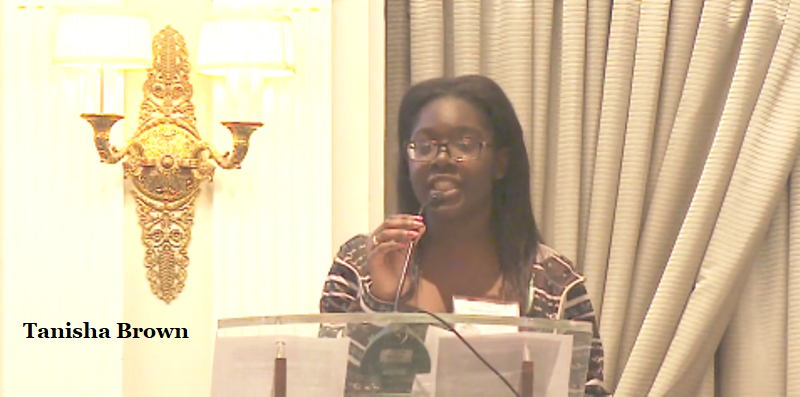
This June, the school named after famed labor leader Samuel L. Gompers voted 25-17 to become non-union. The San Diego Unified School District middle school was converted to a charter school in 2005. The final class of high school aged students graduated in 2007. New school staff came in without a union but formed one in 2019. Almost immediately some teachers, led by chemistry teacher Christie Chiscano, began working to leave the union, aided by The National Right to Work Legal Defense Foundation.

The Fascinating Gompers Story

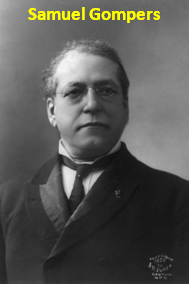
In the 19th and early 20th century, Samuel Gompers rose up to be a major force in labor. He founded the American Federation of Labor in 1886 and led it as president until his death in 1924, with the exception of 1894. Among the many honors bestowed on him, several K-12 schools were named after him.

His San Diego namesake school opened in 1955 as a junior high and later became a secondary school.

In 2004, Gompers, struggling academically, was split into separate middle and high schools. The San Diego Unified School District (SDUSD) converted the 47th and Market streets campus into a charter middle school a year later. The high school was closed when its last students graduated in 2007.

In the fall of 2009, Gompers Charter Middle school started transitioning to Gompers Preparatory Academy (GPA) by adding one more grade each school year. By 2011, GPA enrolled the first senior class.

Unfortunately, these changes in the early 21st century were accompanied by student violence, subterfuge and bad management.

In the 1980s, SDUSD adopted a new strategy to integrate schools in poor neighborhoods with predominately brown and black students. Gompers became a science-focused magnet school. By the late 1990s, two problems arose. People living in the neighborhood were unhappy with the white kids being bused in while their children were shut out. Secondly, the business-friendly San Diego school board hired a lawyer named Alan Bersin to lead a district reform movement. Bersin wanted to use the magnet school funding for his “blueprint for success” and ended the magnet school programs at Gompers and other schools.

In her seminal book, The Death and Life of the Great American School System, Diane Ravitch shared about the San Diego school reform effort:

“What happened in San Diego from 1998 to 2005 was unprecedented in the history of school reform. The school board hired a non-educator as superintendent and gave him carte blanche to overhaul the district’s schools from top to bottom. Major foundations awarded millions to the district to support its reforms. Education researchers flocked to San Diego to study the dramatic changes. The district’s new leaders set out to demonstrate that bold measures could radically transform an entire urban district and close the achievement gap between students of different racial and ethnic groups.” (Page 47)

Ravitch pointed out that San Diego was an unusual place to pick for this kind of reform experiment because it was “widely perceived as one of the nation’s most successful urban school systems” (Page 48). There was nothing timid about Bersin’s reform efforts. Many changes based on his “blueprint for success” came, driven from top down with no discussion.

Curiously, a major component of “blueprint for success” was three hours of balanced literacy instruction in elementary school reading. Yet, today’s inheritors of Bersin’s reform ideology are all in on “science of reading,” meaning phonics, and disdain balanced literacy.

Gompers Preparatory Academy

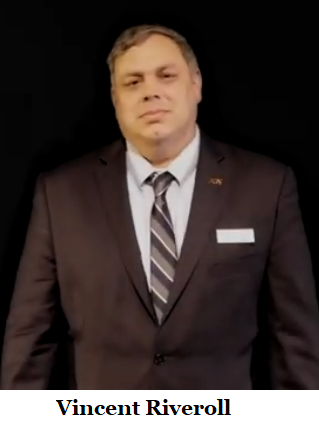
By the spring of 2004, discipline at Gompers, a middle school and a high school on the same lot, had broken down. Bersin called Vincent Riveroll, the principal at nearby Keiller Leadership Academy, to Gompers. He was to help with lunch supervision and bring as many Keiller staff as could be spared.

Following that spring, Bersin asked Riveroll to become the principal of Gompers. Riveroll took the job and proceeded to charterize Gompers. He worked toward that goal throughout his first semester and by the second half of the 2004-2005 school year, Gompers became Gompers Middle School charter. That was also Alan Bersin’s last semester as superintendent of SDUSD.

A driving force for education research and experimentation in San Diego is the University of California San Diego (UCSD). The Center for Research on Educational Equity, Access and Teaching Excellence (CREATE) is a campus-based organization, particularly invested in closing learning gaps. In 1999, CREATE was involved in establishing a model charter called Preuss School on the UCSD campus. Similar to GPA, Preuss is a grade 6-12 school. When Gompers Middle School charter was established, then CREATE Director Hugh “Bud” Mehan became a founding board member and still serves on the board. Today, Mehan is joined on the 14-member board by current CREATE Director Mica Pollock and UCSD professor Rafael S. Hernandez.

Students at Gompers and Preuss get special admissions and scholarship benefits at UCSD.

The Preuss school students are chosen by lottery. There is a low income preference with no one in the family having graduated from college. The Gompers students come from the low income neighborhood that surrounds the school.

In the eyes of many people, Vincent Riveroll is a superhero for his work at Gompers.  A 2009 article in the San Diego Reader noted:

“Violence reigned supreme at Gompers. The school sits in a neighborhood that is home to more than 50 known gangs, and gang culture wasn’t suspended at school. If anything, it was exacerbated by kids from rival gangs being thrown together on one campus.”

“So, like Julius Caesar who crossed the Rubicon in 49 B.C. and started civil war in Rome, Vincent Riveroll, “with a group of committed teachers and staff members,” crossed 47th Street and started the war to reclaim Gompers.”

Teachers who have worked with Riveroll describe him as an inspiring leader and a visionary, possessed with charisma and passion. Parents like this man who has been named teacher of the year, educator of the year and selected as one of four principals nationwide to participate in the Public Education Leadership Program at Harvard University.

Every morning he greets the students ringing his large school bell and on Friday mornings he leads them in song and dance.

Dede Albert is a local San Diego County politician who served in both the state assembly and the state senate. She served on the Gompers Board of Directors from 2005 – 2010. Albert observed that no one other than Riveroll could have improved Gompers culture so dramatically. She claimed to have “often stood in awe” of his dedication and service.

With the strong connections Gompers has created with UCSD, nearly half the graduating seniors are accepted to the highly-selective university. Almost all students who decide to attend UCSD are given a full scholarship.

News Week credits Gompers Preparatory Academy with an incredible 94% graduation rate.

However, all is not sunshine and flowers. Inewsource, a respected non-profit publication focused on local news, ran a series of articles about Gompers in 2017.

Teacher Donny Powers said he realized within a short time that despite the public performances and constant promotion of the Gompers metamorphosis, it was all “this great kind of show, with nothing behind it and nothing deeper.”

Inewsource reported:

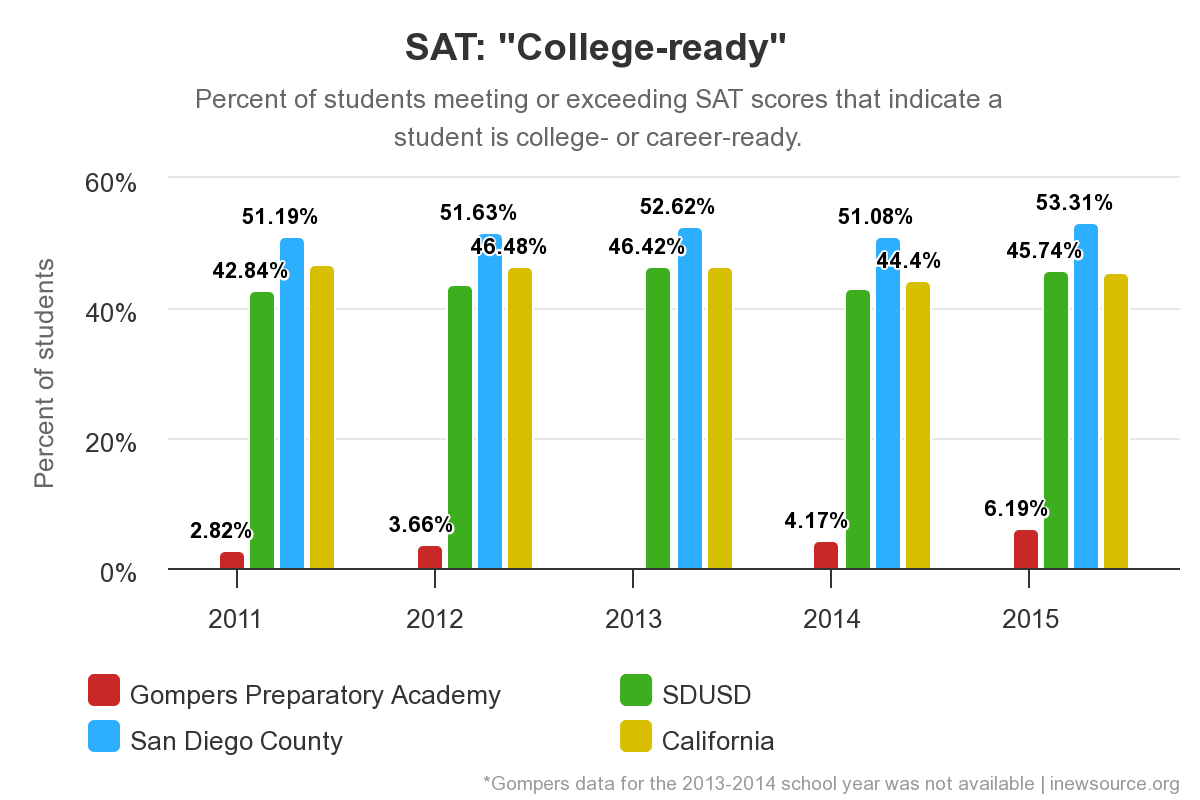
“Standardized tests show proficiency in math and English language arts at Gompers has gotten worse from 2011 to 2016. Forty percent of 11th-graders are below basic proficiency in English. Ninety-one percent didn’t reach the state standard for mathematics.”

The chart of SAT scores shown is from the Inewsource report. It clearly indicates that there is no way Gompers students could legitimately have more than half their students qualify for UCSD. One student got a 900 on his original SAT exam and on the second try he got 1100 out of the possible 2400 points. His application was turned down by San Diego State University but he got into UCSD with a full ride. This was not unusual.

Riveroll and his administrative staff put pressure on teachers to give good grades. Teachers were not ordered to change grades but they got the message.  A former 11th grade chemistry teacher described a review, in which Riveroll said:

“You killed these kids … These kids are not going to be able to graduate high school, they’re not going to be able to go to college, they’re going to end up in jail, because of you. How do you feel about yourself right now?”

Gompers and the Union

The Inewsource articles are credited or blamed for the teachers union coming to Gompers. Teacher Azucena Garcia was a Teach For America teacher from Lewis and Clark College in Portland, Oregon who also grew up in the Gompers’ Chollas View neighborhood. She came to Gompers in 2013 and became a full-time staff member in 2015.

Garcia felt that the administration was embarrassed by the articles so in the summer of 2018 they worked the teachers hard, preparing for classes. Already working 20 days longer than SDUSD teachers, the complaining began with the sentiment that decisions were too much top-down. She said, “We wanted to have a greater voice at the school.”

In 2019, the NEA had established a bargaining unit at Gompers. Immediately, long-time chemistry teacher, Cristy Chiscano started working on what became a 197-page document challenging the union. However her group’s lawyer missed the 2019 filing deadline and did not file the document until January 2020.

Teachers, like Chiscano, remembered Gompers when it was ruled by gangs and feared that a union would take them back to those days. Other teachers felt that the special arrangements they had with management were threatened. Basically a divide developed between the older teachers who opposed the union and the newer teachers who wanted a union.

In the summer of 2020, Gompers laid off 26 of 75 staff members. Many union members were suspicious that these layoffs were retaliation. However, by July the school rescinded the layoff when state budget numbers for 2020-2021 became clearer.

This was not just a fight between teachers at Gompers. The anti-union publication, California Globe, reported:

“National Right to Work Legal Defense Foundation staff attorneys are providing free legal aid to Gompers computer teacher Sean Bentz, who just submitted a petition to the California Public Employment Relations Board (PERB), requesting the agency hold a vote among his colleagues on whether to oust the union. The petition contains signatures of a majority of the teachers under the SDEA union’s control.” (That is the petition Cristy Chiscano put together evidently with the aid of the foundation.)

 The National Right to Work Legal Defense Foundation is a long-time player in the fight against unionism. Supported by such right-wing stalwarts as the Bradley Foundation, they never miss an opportunity to undermine unions and won in this effort to stop the union at Gompers.

Some Observations

SDUSD students who don’t attend Gompers go to Lincoln High school which is just 1.2 miles away. The demographics of the two schools are almost identical except that Gompers has middle-school aged children. 86% of Lincoln’s students are socioeconomically disadvantaged, yet they never had the discipline problems, like Gompers in 2004.

In other words, the gang problem was real but over-hyped at Gompers. It became a charter school for other reasons which did not make it better than nearby Lincoln High School.

Vincent Riveroll probably is a charismatic and effective leader, but he may have been at the school too long.

The Gompers’ connections to UCSD need to end. For more than a decade, students from this charter school have been taking seats away from more qualified students. It was a great experiment but its time has passed.

Cristy Chiscano, Sean Bentz and other staff at Gompers were able to get help from some hard-core right-wing anti-union leaders to rid the campus of the union. Bentz gets to keep his special extra work benefit and Chiscano maintains the status quo.

Today, teachers at Gompers are making significantly less than SDUSD teachers, work more hours, have less representation and substandard benefits. How is this acceptable???

Roll-Back Advanced Placement

29 Aug

By Thomas Ultican 8/29/2023

Advanced Placement (AP) in high school is an assault on good pedagogy. Teacher and author, Annie Abrams, reports, “The College Board is closing in on ownership of a national curriculum that holds not only high schools, but also universities to the company’s academic standards and its philosophy of education.” (Page 6) Pricey private high schools and colleges are abandoning AP but public schools are short changed.

John Dewey studied life and how it functions. In the first half of the twentieth century, America’s preeminent philosopher advanced pragmatism. Stanford University’s philosophy department states, “Use of Dewey’s ideas continues apace in aesthetics and art criticism, education, environmental policy, information theory, journalism, medicine, political theory, psychiatry, public administration, sociology, and of course in the philosophical areas to which Dewey contributed.”

In his book, Democracy and Education, Dewey wondered:

“Why is it, in spite of the fact that teaching by pouring in, learning by passive absorption, are universally condemned, that they are still so intrenched in practice? That education is not an affair of ‘telling’ and being told, but an active and constructive process, is a principle almost as generally violated in practice as conceded in theory.” (Page 46)

Alfred North Whitehead, a famous educator, philosopher and scientist, active in the late nineteenth and early twentieth century, wrote the three-volume Principia Mathematica (1910–1913), with his former student, Bertrand Russell. This was the 23rd of the 100 best non-fiction books in the century. Whitehead founded process philosophy and in his amazing essay, “The Aims of Education,” shared:

“In training a child to activity of thought, above all things we must beware of what I will call ‘inert ideas’—that is to say, ideas that are merely received into the mind without being utilized, or tested, or thrown into fresh combinations.” (Page 1)

“And I may say in passing that no educational system is possible unless every question directly asked a pupil at any examination is either framed or modified by the actual teacher of that pupil in the subject.” (Page 5)

“But the first requisite for educational reform is the school as a unit, with its approved curriculum based on its own needs, and evolved by its own staff. If we fail to secure that, we simply fall from one formalism into another, from one dung-hill of inert ideas into another.” (Page 13)

The greatest philosophers and education theorists of the twentieth century warned, in no uncertain words, against the College Board style of cram and exam. Instead of pragmatism and process philosophy, behaviorism is implemented with standards and standardized tests, accompanied by a trophy or punishment.

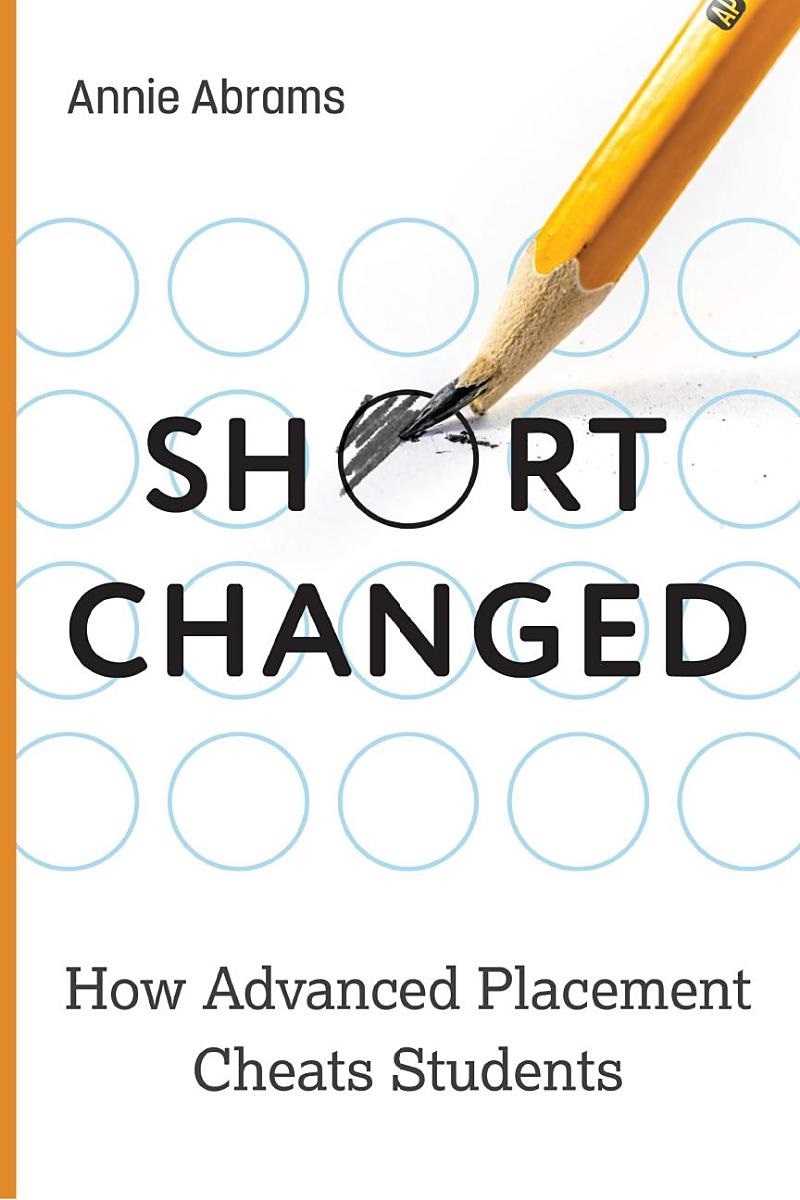
Short Changed: How Advanced Placement Cheats Students

Standardization in public schools began in 1892 with the Committee of Ten. There was consternation among elite schools over student quality. Charles William Elliot, President of Harvard University and a former chemist, led the group of men—all men—establishing the first standards. This was the terrible idea which opened the road for College Board and AP programs.

Annie Abrams’s Short Changed documented the road to AP and identified James Bryant Conant, Harvard University President <another chemist>, as leading the way. He believed in standards and standardized testing. Abrams stated, “Conant’s advocacy for reform based on intellectual merit and technocracy set the stage for the Advanced Placement program” (Page 23) and shared:

“ETS would produce test with scientific precision and the other organizations would guide the programs of testing. The College Board, the American Council on Education, and the Carnegie Foundation would come together under the aegis of the Educational Testing Service. The new agency’s trustees elected Conant chairman of the board.” (Page 41 and 42)

“Conant’s position of power represented a victory by believers in the notion of quantifiable IQ … Conant was obsessed with testing and admitting students on the basis of ‘aptitude’ instead of ‘achievement’ …” (Page 42)

“For Conant, an objective metric like the SAT would ensure rational, impartial selection of the next generation of leaders based on intellectual merit, which tests would be able to identify.” (Page 43)

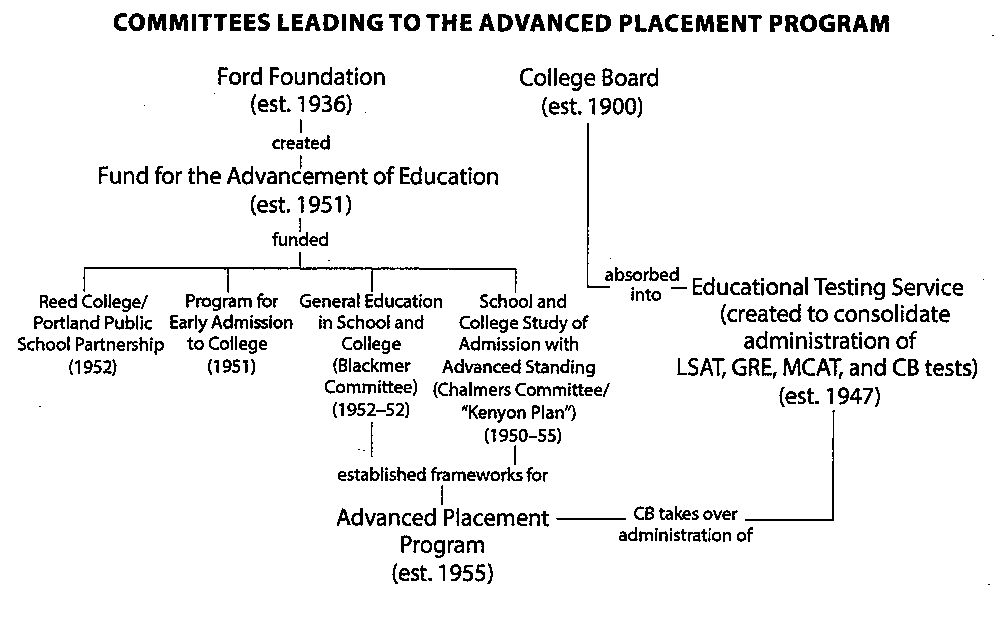
Beginning in 1951 a major force, the Ford Foundation, supported four different approaches to the same goal of enriching education for the superior student. In 1953, it issued a paper on the four strategies, including the Blackmer report and the Kenyon plan. (Page 72)

The Kenyon plan, led by Gordon Keith Chalmers, produced “School and College Study of Admission with Advanced Standing.” Abrams noted it as the “most immediate blueprint for the AP program.” The Blackmer Committee developed “General Education in School and College,” recommending schools and colleges reconsider their roles in making education more efficient and meaningful.  

These two plans became the Advanced Placement program. (Page 13)

(Page 14)

The founders of AP did not want a national curriculum. However, beginning in 1955, with the first AP exams, the College Board started moving toward that eventuality.

Inside Higher Education reported in 2020:

“Ten years ago, AP teachers were given a course description with a brief curriculum outline and sample exams to study. They were given a fair amount of autonomy that replicated the academic freedom of a college professor. That is no longer the case.”

Bad Pedagogy from the Uninformed

In 2012, former college professor and AP teacher, John Tierney, wrote “AP Classes are a Scam” for Atlantic magazine, stating:

“To me, the most serious count against Advanced Placement courses is that the AP curriculum leads to rigid stultification — a kind of mindless genuflection to a prescribed plan of study that squelches creativity and free inquiry. The courses cover too much material and do so too quickly and superficially. … The AP classroom is where intellectual curiosity goes to die.”

Peter Gray PhD, writing for Psychology Today, learned that a group of high school teachers could not use his teaching methods. The classes were so scripted that to prepare the students for end of course exams, they could not make time for anything else.

Gray also noted, “The College Board has been a failure as an aid to education, but a resounding success as a business.” It continuously strives to bring in money, expand its customer base and add new fees. The president makes over a million dollars per year and upper executives, $300,000 to $500,000.

Nicholas Tampio, Professor of Political Science Fordham University, noted “AP courses should only count for high school credits and no more,” and shared “The AP has ‘quietly emerged as a below-the-radar national curriculum for able high school pupils and top-notch teachers.”’

Unfortunately, big money drives AP.

Rising Above the Gathering Storm is another polemic.

In 2005, Lamar Alexander announced one of the day’s star witnesses for the education committee:

“Peter O’Donnell is here, who is a member of the National Academy’s Committee that produced ‘The Gathering Storm,’ and his work in Dallas is one reason for the inclusion in ‘The Gathering Storm’ report of the advanced placement recommendations.”

Another modern edu-philanthropists with no education experience nor training, O’Donnell testified:

“The Advanced Placement Incentive Program succeeds because of three fundamental concepts: the high standards of Advanced Placement, which is built on a strong curriculum, rigorous national exams, and measurable results; emphasis on excellent teacher training; and financial incentives for teachers and students. Incentives are key to the success of our program. They provide extra pay for extra work and are paid by private donors.”

His program became the National Math and Science Initiative (NMSI). It calls for teacher merit pay, a hundred-year-old idea with a hundred-year failure record. Students get cash when they pass the AP exam!

Peter Greene wrote:

“While there may be similar-ish programs in districts across the country, the big dog in the AP bribery biz is the National Math and Science Initiative. NMSI is an organization that was launched ‘to address one of this nation’s greatest economic and intellectual threats – the declining number of students who are prepared to take rigorous college courses in math and science and are equipped for careers in those fields.’ You may recognize that as a classic reformster talking point– low test scores are a threat to our national security– and in fact, the big launching funders of NMSI include Exxon, the Michael and Susan Dell foundation, and the Gates Foundation.”

Elite private schools have been dropping AP courses. In 2018, Sidwell Friends, Georgetown Day, National Cathedral and St. Albans in the District of Columbia, as well as Landon and Holton-Arms School in Bethesda, Maryland and Potomac in McLean, Virginia all ended their relations with AP. That was just in the Washington DC area after querying 150 colleges and discovering students won’t face entrance penalties.

A Personal Experience

In 2004, I moved from middle school to high school to teach a combined regular and AP physics class. My eight AP students were taking six AP classes each. Flabbergasting!

There used to be an aphorism, saying, American high school students were the laziest in the world. They played sports, partied, did very little academic work, graduated and three months later, showed up in college as the top students in the world.

Low-pressured high schools were what students of the 1950s through the 1970s needed. They were not mature enough for college. Today, suicide rates are skyrocketing and intellectual curiosity has cratered.

·  AP classes are Not needed in high school!

A National Warning

14 Aug

By Thomas Ultican 8/14/2023

An unholy alliance between neoliberal Democrats and education reform oligarchs is harming Delaware public education. This is a lesson for the rest of the nation.

A new charter school law introduced to reduce principal professionalism is the latest example. Data clearly shows for almost two decades, top-down education reform has been ineffective and seriously damaged a once, exemplary system.

In March, Delaware Professional Standards Board recommended charter school certification requirements match public school rules. Kendall Massett, executive director of the Delaware Charter Schools Network, immediately responded, “All Delaware charter schools are led by highly qualified administrators.” She said charter school principals have a different role than public school leaders and need to be excellent marketeers to raise funds and drive enrollment.

Did she mean charter school principals don’t need to be professional educators?

For the Standards Board recommendation to take effect, adoption by the State Board of Education is required. Before they acted, Senate President Pro Tem David P. Sokola introduced senate bill 163 to relax certification rules for charter school principals.

The heart of Democrat Sokola’s legislation says:

“The bill creates new subsections in Section 507(c) of Title 14 of the Delaware Code to define the licensure and certification requirements more clearly within Chapter 5 of Title 14. Finally, the bill requires the Secretary of Education to work with the Delaware Charter Schools Network to create a qualified alternative licensure and certification pathway for charter school administrators engaged in the instruction of students (Instructional Administrators).”

Teachers’ union leader, Mike Matthews, wrote to the Senate Executive Committee:

“I was disheartened to see that SB 163 — a bill that will actually deprofessionalize the education profession — was introduced by Senator Sokola. I was even more disappointed — and concerned — to see it filed in the Senate Executive Committee instead of the Senate Education Committee where it belongs. Why was that?”

Bill was passed by the State Senate and is currently awaiting action in the House Administration Committee. The House Education Committee, like its counterpart in the Senate, is not involved.

Neoliberal Education Reform

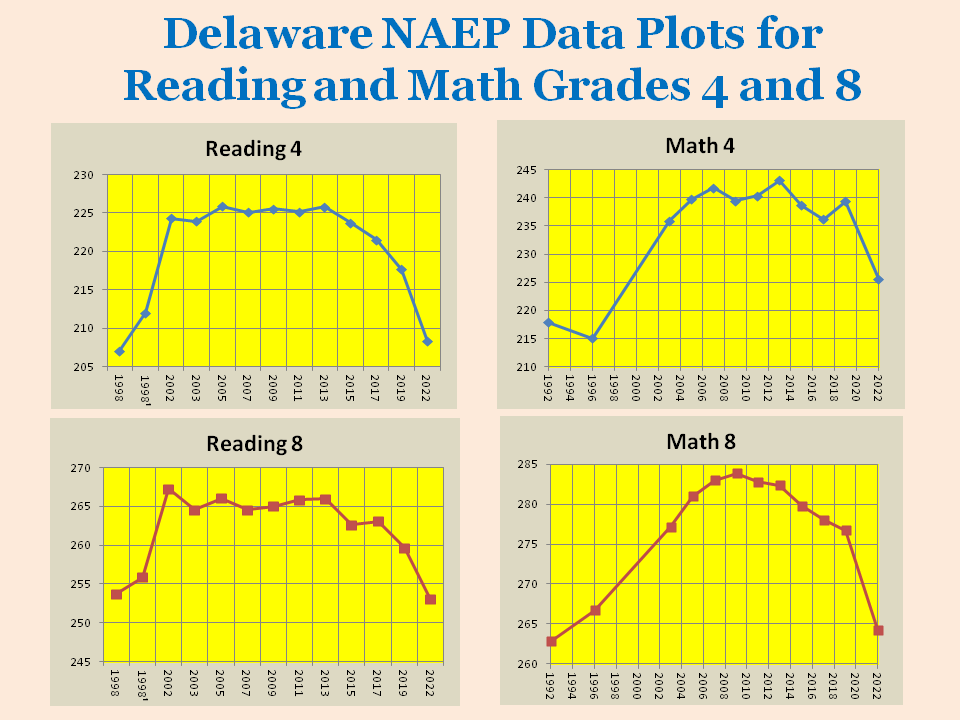
A Delaware Live headline howls, School test scores dismal again despite new math, reading plans.” Two decades of 4th and 8th grade reading and math data on the National Assessment of Education Progress (NAEP) support the headline. NAEP is often referred to as the nation’s education report card. The above graphs beg the question, “what happened in 2010?”

Long-term NAEP data showed from 1971 until 2002, there was steady growth in math and reading. The steady growth ended concurrent with the adoption of the bipartisan Kennedy-Bush education reform, No Child Left Behind. The graphs illustrate this phenomenon.

Why did Delaware’s scores start falling?

In 2010 educator and blogger, Susan Ohanian, reported,

“Delaware and Tennessee came out on top in round one of RTTT: Delaware got $100 million (about $800 per student), and Tennessee $500 million (about $500 per student). Since these states radically changed their education strategies to receive what amounts to 7 percent of their total expenditures on elementary and secondary education, the feds are getting a lot of bang for the buck.”

The $4.5 billion dollar Obama era Race To The Top (RTTT) program was administered by Education Secretary Arne Duncan. Grants were given to states that complied with three key elements: (1) Evaluate teachers based on student test scores (2) Close and turn into charter schools public schools that continue to get low test scores (3) In low-test score schools, the principal and half of the staff are to be fired and replaced. In addition, states were encouraged to create more privately-managed charter schools. 

Education historian and former Assistant US Secretary of Education Diane Ravitch predicted the program’s utter failure when it was announced:

“All of these elements are problematic. Evaluating teachers in relation to student test scores will have many adverse consequences. It will make the current standardized tests of basic skills more important than ever, and even more time and resources will be devoted to raising scores on these tests. The curriculum will be narrowed even more than under George W. Bush’s No Child Left Behind, because of the link between wages and scores. There will be even less time available for the arts, science, history, civics, foreign language, even physical education. Teachers will teach to the test. There will be more cheating, more gaming the system.”

For more than a century, brilliant educators have been skeptical of top-down coerced education reform like those from Duncan, Obama, Bush and Kennedy. Alfred North Whitehead published his essay, “The Aims of Education,” in 1917, stating:

“I suggest that no system of external tests which aims primarily at examining individual scholars can result in anything but educational waste.” (Page 13)

“But the first requisite for educational reform is the school as a unit, with its approved curriculum based on its own needs, and evolved by its own staff. If we fail to secure that, we simply fall from one formalism into another, from one dung-hill of inert ideas into another.” (Page 13)

Former McKinsey Consultant and Democrat with neoliberal inclinations, Jack Markell, was elected Delaware Governor in 2009. His first major victory was winning the RTTT grant. He said:

“What’s really important today is where we go from here; whether we have the will to put our children first and move forward with reforms to improve our schools so that Delaware children can successfully compete for the best jobs in an increasingly competitive global economy. That won’t be easy, but we have proven in these past few months that it can be done.  I would like to thank all those who worked with us in support of our application and look forward to moving ahead to improve our schools.”

Markell praised then Senate Education Committee Chair, David Sokola, for his work on the RTTT grant proposal, the same Senator who just introduced legislation to soften certification requirements for charter school principals.

Since the RTTT announcement, Delaware has gone from consistently scoring above the national average on all NAEP testing to dropping well below.

Science of Reading is NOT the Answer

Delaware Live reported that because of the relative drop in reading scores, the state is implementing the “science of reading.” The article stated, “Today, after a decade of emphasizing training teachers in the science, Mississippi students handily outperform Delaware’s, which has dropped below the national average.”

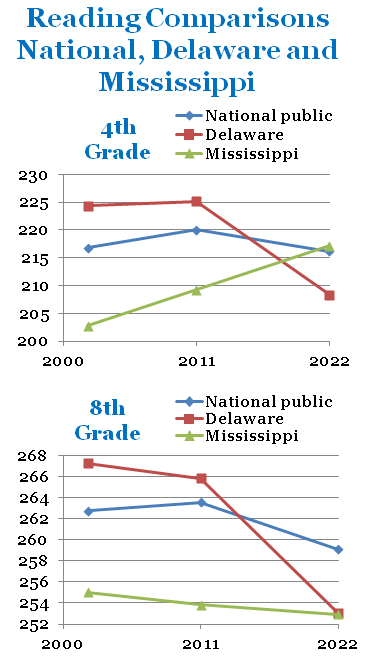
While the scoring drop in Delaware looked real, the success in Mississippi was a mirage. The graphs to the left plot 2002, 2011 and 2022 NAEP scoring data for 4th and 8th grade reading. Delaware is graphed in red, Mississippi in green and National Public in blue. The 4th grade Mississippi data looked amazing but in 8th grade, they returned to being significantly below national average.

The anomaly is explained, in part, by Mississippi retaining all third graders who did not pass the state reading test. It made the 4th grade NAEP data look good but the 8th grade data indicated no earth-shaking advancement to emulate.

In 2021, Delaware’s Department of Education doubled down on oligarch-driven education reform. Monica Gant, Ph.D. from the Delaware Department of Education (DDOE), presented their strategy to accelerate learning in March 2021.

Under the heading “Literacy Professional Learning,” Professor Grant noted, “Participants will have a chance to apply their learning of the Science of Reading either through their district HQIM or utilize free OER (Open Education Resources) HQIM for this work.”

HQIM and OER are both programs financed by Bill Gates, Laurene Powell Jobs and other billionaires.

To guide Delaware public schools’ literacy program, DDOE has turned to the International Dyslexia Association (IDA) who advocates the “science of reading”, to validate Delaware’s programs. IDA is leading the effort to monetize dyslexia and establish state-mandated science of reading curriculum, purchased from specified vendors.

 While jurisdictions throughout the US saw a tick down in 2022 NAEP reading scores, Delaware’s scores, after a year of “science of reading”, were one the largest drops in America.

Final Observations

The reform movement in Delaware is still being pushed in a destructive direction. Senator Brian Pettyjohn, a Republican from Georgetown and member of the Senate Education Committee, commented on recent testing results:

“Our state must do more to hold school districts responsible for students’ academic success. The current mechanism in place for holding schools accountable is ineffective, and it is time for the state to establish a new system that recognizes school districts for their accomplishments and holds them responsible when they fall short of their objectives.”

The concern is understandable but his solution is wrong-headed. More mandates from politicians who do not understand education are not likely to be helpful.

There appears to be a privatization-promoting organization in Delaware called First State Educate. They just hired Julia Keleher as Executive Director. Serving as Secretary of Education in Puerto Rico, Keleher, who is not Puerto Rican, secured a new law allowing for charter schools and vouchers, as well as, the closure of hundreds of schools.

At a San Juan rally, protesters chanted, “Julia go home!”

Things went sideways for Keleher. December 17 2021, a federal judge in Puerto Rico sentenced her with six months prison, 12 months house arrest and a $21,000 fine. She pled guilty in June to two felony counts involving conspiracies to commit fraud.

Today she is another voice in Delaware, pushing for top-down reform and privatization of public education.

Delaware schools were most successful when local educators and school leaders took charge. Since then, after standards were imposed and teacher accountability mandated, school performance suffered. Alfred North Whitehead was right in 1917.

Give autonomy back to schools and professional educators. Politicians at state capitals have little understanding of local school needs or good pedagogy.

Empower teachers and Delaware education will shine again.

Propaganda from The 74 and Johns Hopkins University

1 Aug

By Thomas Ultican 8/1/2023

The 74 recently ran an opinion piece, America’s Education System Is a Mess, and It’s Students Who Are Paying the Price”. Author David Steiner, Executive Director of Johns Hopkins’ Institute for Education Policy, claimed, “The fundamental cause of poor outcomes is that policy leaders have eroded the instructional core & designed our education system for failure.” He was referencing the recent decline in math and reading scores on NAEP testing while ignoring The Stolen Year lost to a pandemic. Ironically, Steiner has been one of America’s most powerful education policy leaders for almost two decades.

The above graphs used NAEP Data Explorer, based on a 500-point scale, all scores fit within a 30-point range. Since 1992, reading and math scores have wiggled up and down on a small range. In 2022, almost all students missed one year of in-person instruction and in some states, like California, more than half the three years tested. If there had not been a dip in scoring, it would have been powerful proof about the uselessness of standardized testing.

Steiner claimed:

When the recent NAEP long-term trend results for 13-year-olds were published, the reactions were predictable: short pieces in the national press and apologetics in education blogs. COVID-19, we were told, was continuing to cast its long shadow. Despite nearly $200 billion in emergency federal spending on K-12 schooling, students are doing worse than a decade ago, and lower-performing students are today less capable of doing math than they were 35 years ago.”

He linked an almost hysterical report in The 74 about the NAEP testing “CRISIS” and a Washington Post article, citing COVID-19 as a cause. “Apologetics” points to a post by former Assistant Secretary of Education, Diane Ravitch, who asserted:

“The release of the NAEP Long-Term Trend data yesterday set off the usual hysterical reaction. The scores fell as a consequence of the pandemic, when most kids did not get in-school instruction.

“These are not secrets but they bear repeating:

“*Students don’t learn what is tested when they are not in school for long periods of time.

“*Learning online is inferior to learning in-person from a qualified teacher.

“*It’s better to lose points on a test than to risk serious illness or death or infecting a family member or teacher or other member of the school staff.”

Steiner tried to both-side the issue, using Ravitch’s concluding question, “Will politicians whip up a panicked response and demand more of what is already failing, like charter schools, vouchers, high-stakes testing, and Cybercharters or will they invest in reduced class sizes and higher teacher pay?” His counterpoint was, “On the other [hand], their conservative critics point to lack of school choice, poor teacher preparation programs and (more recently) the woke invasion of classrooms.

He seems to be speaking for himself.

Employing “woke” undermines credibility. “Woke” is a talking point, used by many GOP politicians but has no erudite meaning; it is baseless. He probably did not use CRT here because it is the worn-out 2021 unfounded attack on public education.

The opinion piece shows Steiner believes in a need to test students, younger than eight, and that standardized test scores should carry consequences for test takers. He is a big fan of high school exit exams, corporate style education standards and standardized testing. It can be inferred that he admired the “No Child Left Behind” and “Race to The Top” programs, foisted on America by Presidents Bush and Obama.

David Steiner

Escaping Nazism in 1940, David Steiner’s father, George Steiner, and his family emigrated from France to New York City. George met and married New Yorker, Zara Shakow, in 1955. They both became successful academics. He earned many honors and degrees, including a PhD from Harvard. She became an authority on international relations and served as vice-president for New Hall in Essex (UK). While living in Princeton, New Jersey, their son, David, was born in 1958.

Although birthed in the US, David grew up in Cambridge, England where he eventually attended the Perse School and earned a B.A. and M.A. from Balliol College Oxford University. Returning to America, he earned a political science PhD from Harvard University.

From 1999-2004, David served as a professor of education at Boston University and for two years, he worked at the National Endowment for the Arts. In 2005, he was appointed Dean of Hunter College City University of New York.

Billionaire, Merryl Tisch, became Chancellor of New York State Board of Regents in 2009 and believed in standardized testing so strongly that Diane Ravitch dubbed her, the doyenne of high-stakes testing.” Like the Heritage Foundation, she decried the government monopoly over public education and saw a like-minded educator in the Hunter College dean.

In 2008, Steiner created Teacher U at Hunter College, a new teacher preparation program, requested by charter school founders, Norman Atkins of Uncommon Schools, David Levine of KIPP charter school and Dacia Toll of Achievement First (Relay 59). This move coincided with Tisch’s thinking and the following year, she picked Steiner to be the New York State Commissioner of Education.

After he became Commissioner, the Board of Regents authorized independent teacher preparation graduate schools (Relay 60). It was a move to undercut the university-centered monopoly on education training that Tisch and he opposed.

In 2011, Teacher U became Relay Graduate School of Education. Steiner was a founding board member and is still on the board. Relay is a fraudulent school, privatizing teacher training.

Steiner bolstered his resume by supporting the neoliberal agenda, waiving the superintendent of schools job requirements, for Cathie Black, head of the Hearst magazine chain, to take over New York City public schools. Despite not having required teaching experience and professional degrees in administration, he claimed her “success” in business made her, in the words of Mayor Bloomberg, a “superstar manager.” She lasted on the job less than 100-days.

In an interview with Frederick Hess, Steiner proudly pointed to three policies he drove as Commissioner of Education: “commitment to standards-based curriculum”, “commitment to improved testing” plus “rethink and redesign teacher and principal certification.”

July 12, he was a guest speaker for a Pioneer Institute event. Pioneer Institute is affiliated with the very anti-public education State Policy Network. Recently appointed to Hoover Institute’s Practitioners Council, he serves with pro-privatization enemies of public education like Michael Horn, Patricia Levesque and Don Shalvey.

Johns Hopkins

In 1867, merchant, banker and railroad director, Johns Hopkins, bequeathed $7 million to establish America’s first research university in Baltimore. Since then, the private university has been a major success and boasts 29 Nobel Prize recipients. It is truly a world leader in medicine and the sciences.

It is sad to see billionaire dollars corrupting this respected institution and undermining public education. The following graphic shows some of the most virulent, anti-public education entities in America are supporters, listed on the Johns Hopkins’ Institute for Education Policy about page. From 2015-2018, the donor-directed Silicon Valley Community Foundation, a dark-money fund, sent $27,381,018 to Johns Hopkins.

Alum Michael Bloomberg is the largest donor to Johns Hopkins University. In 2018, he gave a whopping $1.8 billion to the school.

When neoliberal Democrats in Rhode Island decided to take over the Providence public school system, they contracted with Johns Hopkins to do a study. The school districts demographics were 65% Latinx, 16% Black, 9% White, 5% Asian, 4% Multi-racial and 1% Native American. In addition, 31% of students were multilingual learners, 16% received special education services and 55% came from homes where English is not the primary language. An unbiased study would have quickly revealed that the schools were not failing and the poor testing results reflect deep poverty, language learners and a large special education population.

The Johns Hopkins study was commissioned in May and presented in June. By July 19th, Mayor Elorza officially petitioned the state to take over schools.

Last year, The Institute for Education Policy at Johns Hopkins wrote a joint paper with Jeb Bush’s Chiefs for Change, calling for more testing.

When it comes to education, Johns Hopkins University has abandoned unbiased objectivity and joined a corrupted agenda.

The 74

The 74 was founded in 2015 by former CNN news anchor, Campbell Brown, along with Michael Bloomberg’s education advisor, Romy Drucker. Its original funding came from billionaires, Dick and Betsy DeVos Family Foundation, the Walton Family Foundation, the Doris and Donald Fisher Fund and Bloomberg Philanthropies. Since then, it has been the vehicle for spreading the billionaire message, undermining public schools.

Campbell Brown, the original face of The 74, supported charter schools, opposed teacher tenure and was convinced schools were full of sexual predators. In response to a reporter, she stated,  

“I agree we have a point of view; it’s a ­nonpartisan point of view. It’s a clear point of view, and that is that the public education system, in its current form, is broken, and there’s an urgency to fix it.”

Public education is being molested by billionaires, for different reasons. It is not broken.

Some billionaires see the non-sectarian nature of public education as a threat to their dreams of a Christian theocracy. Others are libertarians that oppose free universal public education. They believe everyone should pay their own way and not steal other people’s property through taxation. Many are firmly convinced that education should be run like a business and respond to market forces.

None are experts in pedagogy nor have experience in running schools.

NPE Throws Cold Water on CREDO Paper

23 Jul

By Thomas Ultican 7/23/2023

The Center for Research on Education Outcomes (CREDO) just released another pro-charter school study, “CREDO also acknowledges the Walton Family Foundation and The City Fund for supporting this research.” It is not a study submitted for peer review and so opaque that real scholars find the methodology and data sets difficult to understand. Carol Burris and her public school defenders at the Network for Public Education (NPE) have provided an in-depth critical review.

With the new CREDO study, Education Week’s Libby Stanford said that “charters have drastically improved, producing better reading and math scores than traditional public schools.’’  Rupert Murdoch’s Wall Street Journal declared charter schools are now “blowing away their traditional school competition.” Burris retorted with “despite the headlines, the only thing ‘blown away’ is the truth.” (Page 3)

Putting a CREDO Thumb on the Scale

CREDO uses massive data sets, unavailable to other researchers, getting minuscule differences which are statistically significant. No one can check their work. They employ a unique and highly discredited statistical approach called “virtual twins” to compare public school with charter school testing outcomes. Instead of reporting the statistical results in standard deviations, CREDO uses their “crazy pants” days of learning scheme.

NPE discovered that the “blowing away” public school results amounted to 0.011 standard deviations in math and 0.028 standard deviations in reading. The minuscule difference is “significant statistically but is meaningless from a practical standpoint” according to CREDO. In a 2009 report showing public schools with a small advantage, CREDO declared, “Differences of the magnitude described here could arise simply from the measurement error in the state achievement tests that make up the growth score, so considerable caution is needed in the use of these results.”

To give these almost non-existent differences more relevance, CREDO reports them as “days of learning” instead of standard deviation. “Days of learning” is a method unique to CREDO and generally not accepted by scholars. They claim charter school math students get 6 more “days of learning” and English students, 16 days.

CREDO Days of Learning Conversions

The above chart comes from the Technical Appendix of a previous CREDO study, which reveals that Eric Hanushek and Macke Raymond used NAEP data from 2017 to create the table. No justifications for the conversions are given. It appears to be sloppy science and headlines generated by its use are unfounded propaganda.

Bad Methodology

The CREDO method does not compare charter school performance to actual public schools. It creates mathematical simulations. Professor Andrew Maul of UC Santa-Barbara stated, “The study’s ‘virtual twin’ technique is insufficiently documented, and it remains unclear and puzzling why the researchers use this approach rather than the more accepted approach of propensity score matching.”

CREDO’s stipulation that “virtual twins” comes from “feeder schools,” favors charter schools. Management expert, Andrea Gabor, explained that CREDO used less than five student transfers to a charter school as the cutoff for a particular public school’s data. She notes the “study excludes public schools that do NOT send students to charters, thus introducing a bias against the best urban public schools, especially small public schools that may send few, if any, students to charters.”

This study is singularly focused on test results as determinate of school quality. Many charter systems, like IDEA and Success Academy, spend an inordinate amount of time preparing for standardized tests. This biases results.

Professor Mark Weber of Rutgers University adds a few more observations:

The NPE report highlights another source of bias for charter schools:

“In addition to their presence in a CREDO-identified feeder school, students are matched by gender, grade level, scores, race, and special education and English language learner status. Yet special education students are not a monolith. Research has consistently shown that charters take fewer special education students and enroll fewer students with more challenging disabilities than public schools.” (Page 9)

The combination of rejected methodologies, murky data studies and biases toward charter schools render the CREDO study useless. Minuscule advantages reported, favoring charter schools, indicate that in reality, public schools outperform charters.

The CREDO Story

In 1981, Massachusetts Institute of Technology trained economist, Eric Hanushek, wrote “Throwing Money at Schools.” Right-leaning philanthropies and institutions were drawn to his declaration:

“The conventional wisdom about public schools is that they face serious problems in terms of performance and that improving schools requires additional money. However, the available evidence suggests that there is no relationship between expenditures and the achievement of students and that such traditional remedies as reducing class sizes or hiring better trained teachers are unlikely to improve matters.”

In a 1981 Ed Week commentary referencing this paper, Hanushek points to SAT testing as the gold standard for judging school performance. He claims, “Advanced statistical techniques are employed to disentangle the influences on achievement of schools and teachers from those of other factors such as family backgrounds and student abilities.” This motivated him to push for teachers to be evaluated, using “value added measures”, that since have been thoroughly discredited.

At the time, he was teaching political science and economics at Rochester University and meeting his future wife, a significantly younger student, named Margret (Macke) Raymond. She completed her Rochester University political science PhD in 1985.

A 1999 announcement from the school said, “The Center for Research on Education Outcomes has been established at the University of Rochester’s Wallis Institute of Political Economy…” In the same posting, it revealed, “Two foundations have committed $1.25 million to fund a three-and one-half year initiative to address the current shortage of evaluation research in education policy matters.” CREDO never made the names of the two foundations public but a knowledgeable academic disclosed one of them was the Walton Family Foundation. It is documented that the Waltons give generously to CREDO.

The announcement listed Eric Hanushek first and Macke Raymond as founding Director.

CREDO moved to Stanford University’s Hoover Institute in July 2000 which made networking in conservative circles much easier.  Their 2nd year report stated that moving to the Hoover Institute brought many new contacts, including the New Schools Venture Fund, the District of Columbia Charter School Board, the Teacher Union Reform Network and others.

Public Schools are Superior to Charter Schools

Staffing in public schools is made up of mostly college graduates with certified state teaching credentials. Before the appearance of the billionaire-created Teach For America (TFA), nearly 100% of public school teachers had a year of teacher training and a bachelors degree or higher. A significant percentage of charter school teachers come from TFA with just five weeks of education training. Charters are typically not required to use certificated teachers.

The depth of experience in the public school teaching corps is larger than that of charter schools. A Fordham Institute article states:

“That being said, there is a bona fide but often unaddressed teacher shortage: experienced teachers in charter schools. In the United States, a third of charter teachers have fewer than three years of teaching experience, compared to only a fifth of public school teachers.”

“Comparative inexperience and youth in front of classrooms carries costs. More than any other school-related factor, a teacher’s efficacy matters most to student learning. And especially in the early years, nothing improves a teacher’s efficacy quite like experience.

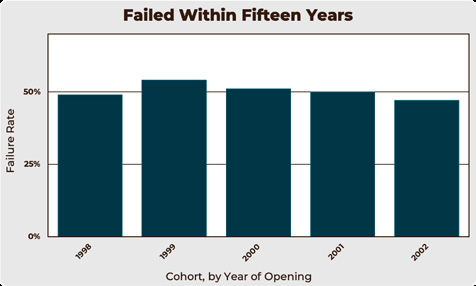
Stability is important for school-aged children and especially for those growing up in difficult home environments. In 2020, NPE conducted an in-depth look at charter schools since their inception. They discovered that charters were closing at extremely high rates; 18% by year 3, 25% by year 5, 40% by year 10 and 50% by year 15. In some cases, charters closed their doors mid-semester without warning; this never happens in public schools.

Management in public schools must meet state credentialing requirements. They focus on good pedagogy, safe schools and parent engagement. In charter schools, supervisors are often untrained in education and make return on investment, a key goal.

Safety in public schools is state-mandated but charter schools can ignore some rules. In California, all public schools must be earthquake-safe facilities. Charter schools may not heed this requirement.

In 2013, Christopher A. Lubienski and Sarah Theule Lubienski published The Public School Advantage – Why Public Schools Outperform Private Schools. Nothing has happened over the last ten years that invalidates this scholarly work. Charter schools are private schools with a state contract, similar to garbage collection companies, contracting with a city. They are private companies, paid with taxpayer funds.

Charters are substandard education organizations that only survive because of marketing.

GOP Activist Attacks Teachers’ Contract

16 Jul

By Thomas Ultican 7/16/2023

On June 12 2023, San Diego Unified School District (SDUSD) ratified a new 3-year contract with the teachers and paraeducators unions (San Diego Educators Association (SDEA) – California School Employees Association Paraeducators Chapter 759). Before the month ended, Todd Maddison of the conservative Parents Association placed a scathing indictment of the new contract in the Voice of San Diego. This relentless GOP led disparagement of teachers and public schools has become the standard operating procedure throughout America.

It is not obvious what Maddison wants. The headline for his opinion piece says “San Diego Unified Is Putting Adults First, Not Students.” It is incongruent with the new contract. He apparently thinks teachers are overpaid and a 15% pay raise is a theft of public money.

Contract Details

SDEA had been negotiating this 3-year deal with the district for more than a year. The last contract expired June 30, 2022. They demanded an 18% pay raise and settled for 15%.

Several other issues were also negotiated.

SDEA Chart Negotiated Pay Raise

The contract was ratified on June 12th by a 98% positive vote from SDEA members. Board Trustee Richard Barrera said, “With the agreement, we’re on our way to being able to tell young people you can pursue a career as an educator and still be able to raise a family in a place like San Diego at the same time. He said that first-year teachers can make $64,000 a year, those in the middle of their careers $105,000 and veterans, up to $124,000.

Other issues agreed to included:

  1. Community schools require a part-time community school coach at each campus
  2. Elementary schools, with more than 250 students, get a counselor three days a week, those with more than 375 students get one four days a week and schools with more than 500 students get a full-time counselor
  3. Full-time nurses remain in every comprehensive high school
  4. Middle and high school physical education classes capped at 50 students, down from 60
  5. Middle and high schools add a part-time restorative-justice position
  6. Transitional kindergarten classes are capped at 24 students and first grade through third-grade capped at 29 – all were previously capped at 35
  7. Every transitional kindergarten classroom will have an early-childhood teacher and a teacher with multiple-subject credentials
  8. Paid maternity leave doubled to six weeks

This negotiation ended with a substantial pay raise for teachers. Students got smaller classes throughout the K-12 system and improved staffing ratios in kindergarten. Both administration and teacher negotiators actually paid considerable attention to improving the plight of students.

Yet, Maddison claimed, “San Diego Unified Is Putting Adults First, Not Students,”

More Maddison Assertions…

He opened by saying:

“Anyone who follows K-12 education will tell you we’re facing a crisis. The latest National Assessment of Educational Progress (NAEP) numbers expose declines in academic performance to unprecedented levels …”

I follow K-12 education closely and do not see a crisis because the 2022 test scores wiggled down a few points. We just came through a pandemic and test preparation was not a priority. Give the children a chance to recover from the recent trauma and they will be fine unless faux educators convince us to do crazy things like high intensity tutoring, double math and mandatory summer school.

Maddison, the data analyst for Transparent California said:

“From SDUSD’s own payroll records, obtained using a legal public records request and posted for anyone to see on the Transparent California website, data show in 2022 the median total pay of a full time certificated employee was $102,024. For comparison, the latest U.S. Census Bureau data shows private workers with equivalent education in San Diego County made $87,784.”

His teacher salary data seems reasonable but professionals with “equivalent education” and time on the job are generally paid more than teachers.

San Diego is very expensive. Multiple rent tracking web sites report that the average two-bedroom apartment rents for over $3,200 a month. To attract and retain quality educators, a living wage is required to support more than bare survival.

Maddison writes:

“Last year, teachers had 27.8 percent of their pay contributed to their retirement. That’s a whopping 17.6 percent more than private workers, where total retirement contributions typically average 10.2 percent.”

This is disingenuous.

California teachers are not part of the Social Security system. They and their employers pay into the California teachers’ retirement system and have to contribute more to match the amount non-teachers accumulate.

He concludes his editorial claiming that SDUSD is financially unsound and quotes from the County Board of Education July 2022 response to the district’s budget proposal: “[T]he district will need to make budget reductions of approximately $129 million by fiscal year 2024-25 and an additional $53 million in 2025-26 in order to remain fiscally solvent and meet the required minimum reserve.”

On the same issue, he ignores the County’s September 2022 comment:  

“The Adopted Budget shows the district will be unable to meet its multi-year financial commitments in subsequent fiscal years without additional budget solutions; however, the district’s adopted budget was developed prior to adoption of the 2022-23 state budget. Actual state budget data should be incorporated into the district operating budget and multi-year projection during the First Interim Report process. Any necessary budget reductions should be detailed and approved by the board along with submission of the First Interim Report.”

The County was not concerned with the district’s solvency. They merely stated that under the current revenue stream, the budget needed to be adjusted for future requirements. As of September 2022, without knowing how much money was coming from the state, once enrollment was finalized and state contribution known, the district was directed to make any necessary budget adjustments and report.

The Parent Association

Todd Maddison’s biography says, “Todd is also a founding member of the Parent Association and is the San Diego County Chair of the California School Choice Foundation.”

Parent Association apparently grew out of the loud, right-leaning, pandemic protest movement. They were responding to President Trump and Education Secretary DeVos who were calling for schools to be opened in person. Maddison immediately joined in the call. In 2020, a July 12th Union Tribune article on the protest quoted him extensively.

It is true that children are less susceptible to COVID-19 infections but not immune. People working in schools, especially teachers, would be at risk, as would the children’s adult family members. On July 12 2020, with the first vaccines more than six months away, San Diego County reported 508 new infections with 2 more deaths. By November, the number of new cases was more than 1,000 per day.

On April 21 2021, the IRS granted the Parent Association tax exempt status as a charity under the 501-c3 rule (EIN 87-1693090), meaning donations are tax deductible. In July, their sister organization, the Parent Advocacy Center, was granted 501-c4 status (EIN 87-1487817). This means they don’t pay taxes but because they are a political action group, donations to them are not tax deductible.

Both organizations are registered in San Francisco, care of the James Sutton law firm, the campaign lawyers. The executive director of the Parent Association is Ginny Merrifield, a very connected operator in San Diego Republican circles and trustee of the E3 Civic High. She was also co-founder and trustee of the private and pricey Pacific Ridge School in Carlsbad, California and boardmember of governors for the $750 million San Diego Foundation. Her husband, Marshal, ran for San Diego city council as a Republican but was not elected.

When billionaire, Arthur Rock, put up hundreds of thousands to remove the San Francisco school board, Sutton and hedge fund founder Patrick Wolff of Grandmaster Capital, took the lead. Wolff founded Grandmaster Capital with seed funding from his billionaire friend, Peter Thiel. According to the hedge fund journal, they were initially brought together by a common interest in chess.

As county chair of the California School Choice foundation, Maddison campaigns for Education Savings Accounts, another name for vouchers. He writes about not being able to make the changes that failing public schools need and realized “The best way to give parents real power over school districts is to have the ability to take their money somewhere else.”

Are you sure that is not taxpayer money?

Observation

Research paper after research paper have over the last more than a decade consistently found terrible results from voucher schools. Last year, Professor Joshua Cohen wrote in the Hechinger Report, “After two decades of studying voucher programs, I’m now firmly opposed to them.”

Todd Madison and the wealthy right want to privatize public education and undermine teacher professionalism.

That is a mistake.

Public schools have been under assault by a well-funded group of oligarchs for more than 40 years. We have the best school system in the world. They are not now nor ever have been “failing.”

It is the height of foolishness to diminish this national treasure, the bedrock of American democracy. 

Chartered to Indoctrinate

3 Jul

By Thomas Ultican 7/3/2023

Carol Burris and team at Network for Public Education (NPE) just published, A Sharp Turn Right(STR). NPE President Diane Ravitch noted there are several problems associated with charter schools’ profiteering, high closure rates, no accountability…

“This new report, A Sharp Turn Right, exposes yet one more problem — the creation of a new breed of charter schools that are imbued with the ideas of right-wing Christian nationalism. These charter schools have become weapons of the Right as they seek to destroy democratically governed public schools while turning back the clock of education and social progress by a century.” (STR Pages 3 and 4)

STR focuses on two types of charter schools. One characterizes themselves as “classical academies” and the other touts “back to basics,” without noting they also employ the same “classical” curriculum. Both provide right-wing clues on their web-sites, alerting parents of alignment with Christian nationalism. Marketing is often red, white and blue, with pictures of the American founding fathers, and discussions on patriotism and virtue. Some schools include direct references to religion like Advantage Academy’s claim of educating students in afaith-friendly environment.”

STR further clarifies,

“These schools are distinguished by a classical “virtuous” curriculum combined with hyper-patriotism for Christian nationalist appeal. They are exemplified by charters that adopt The Hillsdale College 1776 Curriculum…” (STR Page 7)

Using keyword searches, NPE identified 273 active charter schools fitting this description and noted they surely missed more. Nearly 30% of them were for-profit; about double the rate for the charter sector in general. Almost 50% of them have opened since Donald Trump was inaugurated president in 2017. (STR Page 7)

Apparently the school founders want to turn the clock back to the nineteenth century. STR states,

“Founders of classical charters view the rejection of modern instructional practices as a selling point. Proponents of classical education vilify the progressive movement, accusing John Dewey and his followers of removing Christian ideals and redesigning schools to achieve social goals.” (STR Page 9)

It identifies the largest charter school systems indoctrinating students with Christian nationalist ideology and discloses where they are operating. Discussing, in some depth, Hillsdale College with its Barney charter schools and the large number of new charter affiliates, the report asserts:

“What they all have in common is teaching Hillsdale’s prescriptive 1776 curriculum, which disparages the New Deal and affirmative action while downplaying the effects of slavery. Climate change is not mentioned in the science curriculum; sixth-grade studies include a single reference to global warming.” (STR Page 15)

The reality is today’s taxpayers are forced to pay for schools teaching a form of Christianity associated with white superiority; politically indoctrinating students with specific rightist orthodoxy. What happened to the principal of separation of church and state? This charter schools for indoctrination movement must be stopped before American democracy is sundered.

Church and State

James Madison proposed the Bill of Rights to codify protections not addressed in the constitution. In the first article, four freedoms are guaranteed – freedom of speech, freedom the press, freedom of peaceable assembly and freedom of religion.

In an 1802 letter to the Danbury Baptist association of Connecticut, Thomas Jefferson explained,

“Believing with you that religion is a matter which lies solely between Man & his God, that he owes account to none other for his faith or his worship, that the legitimate powers of government reach actions only, & not opinions, I contemplate with sovereign reverence that act of the whole American people which declared that their legislature should ‘make no law respecting an establishment of religion, or prohibiting the free exercise thereof,’ thus building a wall of separation between Church & State.” (Emphasis added)

Katherine Stewart’s deeply researched book, The Good News Club, shares that tensions between Protestants and Catholics became fever-pitched in the 19th century. A student in Boston, named Thomas Whall, refused to recite the Protestant version of the Ten Commandments and was beaten for thirty minutes. In 1869, the Cincinnati Bible War over classroom Bible use raged in the streets. (Good News Pages 72 and 73)

Stress over religion in school mounted to the point that President Ulysses S. Grant in an 1876 speech counseled,

“Leave the matter of religion to the family altar, the church, and the private school, supported entirely by private contributions. Keep the church and state forever separate.” (Good News Pages 73-74)

Clarification of the Establishment Clause came in a 1947 Supreme Court decision over a New Jersey school board providing transportation costs for schools run by the Catholic Diocese. In Everson v. Board of Education, Justice Hugo Black stated in his majority opinion:

“The ‘establishment of religion’ clause of the First Amendment means at least this: Neither a state nor the Federal Government can set up a church. Neither can pass laws which aid one religion, aid all religions or prefer one religion over another. Neither can force nor influence a person to go to or remain away from church against his will or force him to profess a belief or disbelief in any religion. No person can be punished for entertaining of professing religious beliefs or disbeliefs, for church attendance or non-attendance. No tax in any amount, large or small, can be levied to support any religious activities or institutions, whatever they may be called or whatever form they may adopt to teach or practice religion.” (Emphasis added)

The 1962 Supreme Court decision in Engle v. Vitale ended prayer in school. This was not a particularly close call, with only Justice Potter in descent. Justice Black, writing for the majority, stated:

“We think that, by using its public school system to encourage recitation of the Regents’ prayer, the State of New York has adopted a practice wholly inconsistent with the Establishment Clause. There can, of course, be no doubt that New York’s program of daily classroom invocation of God’s blessings as prescribed in the Regents’ prayer is a religious activity.”

By the time Ronald Reagan was elected the 40th president of the United States, the “separation of church and state” had been firmly established.

America’s Riven Rights

Reagan’s nomination of the proclaimed originalist, Anthony Scalia, to the Supreme Court began the attack on the Establishment Clause. According to Jeffrey Toobin, author of The Nine: Inside the Secret World of the Supreme Court, Scalia maintained that the Constitution not only permits entanglement between church and state, but encourages it. (Good News Page 85) 

Katherine Stewart observed,

“According to Scalia, the secularism of today’s liberals is really just another religion – and an unattractive one at that, suitable for the weak of mind and character. It is the creed of relativism, which says that no belief is better than any other, and no value is better than any other. This philosophy of religion is the genuinely immovable part of Scalia’s judicial philosophy in cases involving religion, and it has proven to be the real source of his disdain for the Establishment Clause.” (Good News Page 86)

Scalia was a lonely voice on the court until 1991 when President Bush appointed Clarence Thomas.

The first big break for the anti-establishment forces came in the case of the LAX Board of Airport Commissioners v. Jews for Jesus. In the case, Jay Sekulow defended the constitutional right to stand in an Airport and hand out tracks about Jesus. The case was not controversial. Sekulow achieved a unanimous victory but more importantly, the new legal concept of speech from a religious viewpoint being protected was created.

Stewart writes, “Henceforth, Sekulow would appear repeatedly before the Supreme Court, playing a song with just one note: religious activity is really just speech from a religious viewpoint; therefore, any attempt to exclude religious activity is an infringement of the freedom of speech.” (Good News Page 90)

When Center Moriches Union School District turned down James Dobson’s request to use their facilities for a religious film series based on a no religious groups policy, Dobson sued. Sekulow claimed they were engaging in speech from a religious viewpoint and in 1991, the court ruled for Dobson, based on freedom of speech.

The Rosenberger v. University of Virginia case was decided in 1995, favoring Rosenberger with a split 5-4 decision. University student Rosenberger had asked for several thousand dollars from a student activity fund to subsidize the cost of “Wide Awake”, a Christian magazine. The court ruled that denial of funding based on the religious message amounted to viewpoint discrimination. Justice Souter noted that the University of Virginia was directly subsidizing religion by paying for a magazine that exhorts its readers to convert to Christianity.

In 1996, the Child Evangelism Fellowship applied to establish a Good News Club at the K-12 Milford Central School. The New York school had a policy of restricting the use of its property by organizations and individuals for religious purposes. In 2001, the Supreme Court ruled 6-3 in favor of the plaintiffs in Good News Club v. Milford Central School.

Stewart reports, “In his majority opinion, Justice Thomas laid out a philosophy that essentially destroyed the postwar consensus on the separation of church and state.” Scalia conquered with Thomas’s reasoning and said religion is such a complicated thing that the court should refrain from even attempting to define it. (Good News Page 95)

With their newfound allegiance, to the Free Speech clause the court majority created a dubious attack on the Establishment Clause. In Widmar v. Vincent, Justice Byron White observed:

“A large part of respondents’ argument … is founded on the proposition that, because religious worship uses speech, it is protected by the Free Speech Clause of the First Amendment. Not only is it protected, they argue, but religious worship qua speech is not different from any other variety of protected speech as a matter of constitutional principle. I believe that this proposition is plainly wrong. Were it right, the Religion Clauses would be emptied of any independent meaning in circumstances in which religious practice took the form of speech.”

In this light, Stewart asks the obvious question, “Was it the intention of the country’s founders to include redundant or meaningless clauses in the Constitution?”

Conclusion

Time to wake up and smell the coffee; the modern Supreme Court is corrupt and needs reformation. Instead of deciding issues based on law and precedence, they create theories designed to support a political philosophy rather than showing fidelity to the constitution. This reflects a complete degradation of jurisprudence. The poorly formed decisions regularly undermine the rights and protections the founders bestowed on citizens; all while some Justices appear to be ethically compromised.

For the first time in American history, billions of taxpayer dollars are flowing to private religious schools.  The STR report shines a light on charter schools with religious agendas. Even more disturbing, these new taxpayer funded privatized schools are literally indoctrination centers, teaching a depraved political ideology.

This cannot stand!

Cradle to Grave Surveillance

20 Jun

By Thomas Ultican 6/20/2023

Global Silicon Valley (GSV) has taken point of an effort to digitize life with crypto-world tools.

At the recent ASU+GSV conference, Carnegie and ETS announced a new partnership to create functional testing for competency based education (CBE). That was a big deal because CBE is central to what amounts to a cradle to grave surveillance. In this scheme, a new birth starts the initial record in an inerasable history of education, work and economic activity.  

Edtech leaders are creating a dystopian system of education and career tracking that makes Orwell look optimistic. With this, every American’s history will be held in his or her unalterable blockchain which needs CBE as the education method.

GSV is a venture capital firm founded in 2010 by Michael Moe. Like NewSchools Venture Fund, it focuses on edtech. GSV differs by being a private company with an even more radical libertarian ideology. In 2012, Moe and colleagues published American Revolution 2.0; How Education Innovation is Going to Revitalize America and Transform the U.S. Economy, a manifesto for turning kindergarten through university and beyond into a tokenized existence. Graduate kindergarten token, hospitalized token, immunized token, C in reading token and so on will be saved forever.

The chart above is from American Revolution 2.0 (page 292). Added annotations in red, point out key developments on this road map to a 100% tokenized and badged education system by 2027. Their 2013 call for “No Child Left Behind 2.0” looked suspiciously similar to Obama’s “Race to the Top.” “Marketplace for education information” by 2014 fitted right in with Killswitch’s claim, “Information is the new gold – it’s the new oil.”  

Several organizations fall under the main GSV group, including GSV Labs, GSV Asset Management and GSV Tomorrow, a commentary arm where investing trends and stories are disseminated. All stories link readers to the GSV landing page for the annual ASU+GSV Summit, claimed to be the “most impactful convening of leaders in education and talent tech” with over 5,000 attendees and 1,000 speakers from 45 different participating countries.

The annual American Educational Research Association conference and the ASU+GSV Summit take place at the same time.

Technology critic Audrey Watters noted,

“It’s hardly an insignificant scheduling gaffe. If nothing else, the dueling conference schedules tap into a powerful cultural trope, one that’s particularly resonant among Silicon Valley and education reform types: that education experts and expertise aren’t to be trusted, that research is less important than politics, that the “peer review” that matters isn’t the academic version, but rather the sort that drives a typical VC [venture capital] roadshow.”

Organizing Crypto-Education

1edtech was until recently known as IMS Global. They are a non-profit 501 c6 organization (TIN: 04-3489277), meaning only membership fees are tax deductible. However, recently it created a work-around for parties that want to give money and get a tax break. The new 1edtech Foundation is a 501 C3 organization (TIN: 83-1489371) which will gladly take your tax free donations and pass them along.

If a company’s new product is compliant with established technology protocols and able to communicate effectively with other certified products 1edtech will certify it. The organization also offers standards and frameworks around content integration, credentialing, analytics, and assessments. Major standards developed include:

  • LTI: The Learning Tools Interoperability standard provides a method for applications to integrate with learning management systems (LMSs).
  • OneRoster: A standard for sharing class rosters, course materials, and grades between a school’s student information system and edtech applications.
  • Open Badging: A type of digital badge that is verifiable, portable, and packed with information about skills and achievements.
  • Caliper Analytics: Enables institutions to collect learning data from digital resources.

The Wellspring Project is a major focus going forward for 1edtech. In this new learning model, digital credentials are valuable assets for institutions, individuals and employers. Wellspring seeks to build infrastructure that leverages these assets to help companies identify candidates for hiring. A Cision PRWeb report states,

“The first phase of the Wellspring Project, led by IMS and funded by the Charles Koch Foundation, explored the feasibility of dynamic, shared competency frameworks for curriculum aligned to workforce needs. Partnering with Education Design Lab and the Council for Adult and Continuing Education (CAEL), IMS organized cohorts of education providers and employers by common disciplines and related skills. Using learning tools that leverage the IMS Competencies and Academic Standards Exchange® (CASE®) standard, the cohorts mapped co-developed frameworks, digitally linking the data to connect educational program offerings with employer talent needs.”

This new vision of education dictates a kind of student transcript tied to credential accumulation, instead of earned units from graded classes. Roman Sterns, founder and executive director of Scaling Student Success, is all in for credentialing. He says the present high school transcript is a relic of the past, describes a new transcript type and excitedly announces,

“Fortunately, a version of this new kind of transcript has been developed and is being piloted now by schools affiliated with the Mastery Transcript Consortium (MTC). Launched in March 2017, membership has grown to over 300 schools. Most are independent schools, both in the U.S. and overseas, but increasingly public schools are opting in. The new transcript has no grades or numerical ratings, is customizable to align with school or district outcomes, and includes links to artifacts that demonstrate the level of student proficiency reported. The transcript’s consistent format allows for easy interpretation by colleges and universities.”

For 50 years, mastery-based education now called CBE has been a major flop. It is a piece of the crypto-education infrastructure, calling for bad pedagogy. Established on the mind-numbing drill and skill approach, CBE undermines authentic learning. A major glitch in edtech badging is mastery-style learning online becomes necessary for the credentialing process to function.

Internet of Education 3.0

An EdSurge posting reports,

“In the area of lifelong learning, the Learning Economy Foundation (LEF) aims to create a decentralized, blockchain-based network where skills and credentials are stored within a digital identity that follows the learner. Recently, LEF partnered with LEGO Foundation to create a gamified learning experience, called SuperSkills!, where elementary school students can select adventures and collect gifts as a result of learning core skills. Under the hood, the app uses the W3C’s Universal Wallet, a framework developed by MIT and LEF to store credentials within a blockchain-based identity. This identity is not locked down to one app or company, allowing learners to own their data and use it as they wish across their academic and professional lifetimes.”

The statement “allowing learners to own their data” is misleading. They do not have exclusive access to the data and cannot delete entries or correct errors. It is only personally useful for academic and job applications.

Last year, more than 1500 data scientists signed a letter to the US Senate, warning about the dangers of blockchains and their flaws. They stated in part,

“As software engineers and technologists with deep expertise in our fields, we dispute the claims made in recent years about the novelty and potential of blockchain technology. Blockchain technology cannot, and will not, have transaction reversal or data privacy mechanisms because they are antithetical to its base design. Financial technologies that serve the public must always have mechanisms for fraud mitigation and allow a human-in-the-loop to reverse transactions; blockchain permits neither.”

Blockchains are fundamental to the new edtech, described in Greg Nadeau’s slide presentation Internet of Education 3.0.” He is an edtech/blockchain enthusiast but some of his slides are both illuminating and troubling.

The cartoon above (slide 30) describes the complicated and opaque method needed to update blockchain data bases. A lot of work is done by the SSI/DID block. SSI or Self-sovereign identity summarizes all components of the decentralized identity model: digital wallets, digital credentials, and digital connections. Decentralized identifiers (DIDs) are a type of identifier enabling verifiable, decentralized digital identity. A DID refers to any subject (e.g., a person, organization, thing, data model, abstract entity, etc.) as determined by the controller of the DID.  

Once the data is published by an application or agency, it is there forever and cannot be altered.

Slide 78 in Nadeau’s presentation follows. It gives a frighteningly clear view of the extent of the surveillance being envisioned.

Final Thoughts

It appears that many brilliant mostly young technologists are working on the tools for crypto-world. How exhilarating to think you are developing a new realm full of promise and possibilities! I am reminded of the youthful physicists who gave us nuclear power and the bomb. Like the way atomic weapons have given man the frightening ability to end our species, crypto brings the possibility of human bondage and tyranny.

Serially failed CBE style of pedagogy is harmful education. The new worse idea, actively pursued, is putting children at computer screens and logging their every event in a permanent and inalterable record. It promises a dystopian future.

Mississippi Malarkey

11 Jun

By Thomas Ultican 6/11/2023

Nickolas Kristof’s opinion piece in the New York Times might not have been blatant lying but it was close. His depiction of the amazing education renaissance in Mississippi as a model for the nation is laughable. Lauding their third grade reading retention policies as enlightened, he claims their secret sauce for success is implementing the science of reading (SoR). This is based on a willful misreading of data while tightly embracing Jeb Bush’s futile education reform ideology.

Kristof gushes over Mississippi,

“So it’s extraordinary to travel across this state today and find something dazzling: It is lifting education outcomes and soaring in the national rankings. With an all-out effort over the past decade to get all children to read by the end of third grade and by extensive reliance on research and metrics, Mississippi has shown that it is possible to raise standards even in a state ranked dead last in the country in child poverty and hunger and second highest in teen births.” (Emphasis added)

The soaring national rankings claim is a crock. National Assessment of Education Progress (NAEP) is the most trusted testing standards by which entities are compared. NAEP provides a ranking of 53 jurisdictions, consisting of 50 states plus the District of Columbia, Puerto Rico and the Department of Defense Education Agency.  A table was constructed using the NAEP rankings.

From 2015 to 2022, testing outcomes for Mississippi fourth graders did “soar” past more than 20 states in both math and reading. But results from eighth grade expose those lofty outcomes as a mirage. In 2013, Mississippi followed Florida’s lead and introduced retaining all third graders who did not meet end of year reading exam targets. That is the probable reason for the improved fourth grade testing scores and why those illusory gains were erased by eighth grade.

Misusing data allows Kristof to end the paragraph indicating poverty is not an excuse for education failure. It reminds me of a statement written by education professor Kathryn Strom,

“The “no excuses” rhetoric (i.e, “poverty is not an excuse for failure”) is one that is dearly beloved by the corporate education reformers  because it allows them to perpetuate (what many recognize to be) the American myth of meritocracy and continue the privatization movement under the guise of “improving schools” while avoiding addressing deeply entrenched inequities that exist in our society and are perpetuated by school structures.” (Emphasis added)

To add heft to his argument that poverty is no excuse, Kristof quotes Harvard economist David Deming from the Harvard Kennedy School and Harvard Graduate School of Education, saying “Mississippi is a huge success story and very exciting.” He adds, “You cannot use poverty as an excuse.”

It is important to note that Harvard is famous for supporting privatization of public education and promoting failed scholarship. Deming is currently doing research with Raj Chetty and John Friedman. Along with Jonah Rockoff, Chetty and Friedman published the now thoroughly debunked value added measures (VAM) paper. Their faulty research caused many teachers to lose jobs before it was exposed as a fraud. Kristof is using an economist (not an educator) from a group best known for scholastic failure as his expert.

Kristof also indicates that spending is not important. He writes, “Mississippi has achieved its gains despite ranking 46th in spending per pupil in grades K-12.” If we look up at the 8th grade rankings, it seems they are getting what they paid for.

The Mississippi Miracle Uses the Jeb Bush Method

In 2000, former Netscape CEO Jim Barksdale came home to Mississippi and made reading education his cause. He and his wife put up 100-million dollars to establish the Barksdale Reading Institute. Barksdale also used his political influence to promote state spending on education. There have been some real gains in Mississippi and Barksdale’s effort likely aided that improvement. For Kristof, this was the beginning of a renaissance.

In 2013, Mississippi’s legislature adopted packages of education focused bills which included third grade mandatory reading retention. That same year, they hired a new state superintendent of education, Carey Wright, from the Washington, D.C., public school system. Kristof lavishes her with praise declaring, “Wright ran the school system brilliantly until her retirement last year, meticulously ensuring that all schools actually carried out new policies and improved outcomes.”

Of course the article was an opinion piece but even opinions should be tethered to some objective reality. When asserting a public servant is “brilliant” or was “meticulously ensuring” some supporting evidence should be provided.

Wright began her education career in 1972 as a teacher in Maryland. After just four years in the classroom, she transitioned to various administrative roles. When leading special education services in Montgomery County during the early 2000s, she was serving in the middle of a corporate education reform triumvirate. John Deasy was promoting charter schools and teacher “pay for performance” in Prince George County. Baltimore had Andres Alonzo firing teachers and closing schools. Just a few miles away, Michelle Rhee was promising to “fix” Washington DC’s schools by firing teachers and principals.

In 2010, Rhee hired Carey Wright to be chief academic officer for Washington DC public schools. Wright was an administrator in the DC schools during the height of the cheating scandals. Besides working with some of the most callus and harmful education leaders in American history, she is a member of Jeb Bush’s Chiefs for Change and a graduate of the late Eli Broad’s superintendent training academy. It is highly likely that being steeped in corporate education reform mythology is why Kristof views her as “brilliant.”

The darling of corporate education reformers is an army of unqualified teachers recruited by Teach For America (TFA). It is not unusual for a college graduate to take a five-week summer training course, teach in a charter school or public school for two years and then become an education expert for some either public or private agency. This is an absurdly irresponsible system but effective for wealthy individuals looking to privatize or end public education.

Kristoff notes, “Two Teach for America veterans, Rachel Canter and Sanford Johnson, in 2008 founded an organization called Mississippi First that has been a tireless advocate of raising standards.” Evidently a two-year stint as a temp teacher makes one a veteran. These two apparently are proceeding swimmingly along the corporate reform path.

Sanford Johnson’s biography includes teaching four years at Coahoma County High School (2003-2005) and two years at KIPP charter school (2005-2007), co-founding Mississippi First and becoming its Deputy Director (2008-2019) and today is Executive Director of Teach Plus. Teach Plus is the TFA formed group working to privatize teacher training. He also has another biography posted at the corporate education reform organization Pahara Institute. Johnson has made many corporate connections.

After two years (2004-2006) as a TFA temp teacher in Greenville, Mississippi, Rachel Canter went to Harvard University for a master’s in public policy. In 2008, back in Mississippi, she and Sanford Johnson founded Mississippi First with Rachel as director.

New PIE Network Partners’ Logos

Canter is still the director of Mississippi First and according to her PIE network BIO she was instrumental in the passage of the 2013 third grade retention bill. That year, the PIE network named Mississippi First “Game Changer of the Year.” She is now a board member of PIE along with Nina Reese President National Alliance for Public Charter Schools and Robin Lake Director Center for Reinventing Public Education.

Pontificating While Clueless

Kristof states, “With such a focus on learning to read, one of the surprises has been that Mississippi fourth graders have also improved significantly in math.” His entire article is based on the misunderstanding of data possibly through ignorance but more likely through ideological belief.

These graphs show that the fourth grade “miracle” disappears by eighth grade. They also illustrate the point Ferman University’s literary expert Paul Thomas makes: “But the greatest issue with tests data is that inexpert and ideologically motivated journalists and politicians persistently conform the data to their desired stories—sometimes crisis, sometimes miracle.”

Third grade retention improvement has not only been shown to disappear; it is harmful to the students retained. Kristof informs us that “A Boston University study this year found that those held back did not have any negative outcomes such as increased absences or placement in special education programs.” This study was commissioned by Jeb Bush’s ExcelinEd and only looked at students through sixth grade. It does not address disengagement or dropouts. Is Kristof being deliberately deceptive?

Kristof also makes a big deal out of Mississippi’s high school graduation rate climbing to 87 percent, surpassing the national average. This does look like real progress but graduation rates have become highly suspect. America’s high school graduation rates peaked at about 77% in 1970 and drifted down for almost four decades to 69% in 2007.  Since then, on-line credit recovery arrived and students are completing entire semester courses in as little as one day. This is a new corporate profit center where corruption is ignored.

Conclusions

Education historian and former Assistant Secretary of Education Diane Ravitch wrote,


“What’s worrisome about this article is that Kristof asserts that poverty doesn’t matter (it does); funding doesn’t matter (it does); class size doesn’t matter (it does). In his account, states that want to improve test scores can do it without raising teachers’ salaries, without upgrading buildings, without spending a nickel to improve the conditions of the schools or the well-being of children. Children who are hungry, lack medical care, and are homeless or ill-housed are not likely to learn as well as those who have advantages.

“Does this explain why so many rightwingers love “the science of reading”? Publishers are rolling out new programs. Education can be reformed in the cheap. Can’t expect taxpayers to foot the bill, can you?”

In this opinion piece, Nicholas Kristof touched on and promoted almost every billionaire inspired agenda item aimed at decreasing money going to public education. He acted as a representative of elites, advancing policies undermining education quality for common people.

This was not about improvement. It was about lowering taxes.

ETS and Carnegie Team Up for ‘Zombie’ Ed Policy

4 Jun

By Thomas Ultican 6/4/2023

Educational Testing Service (ETS) and Carnegie Foundation are partnering to create assessments for competency-based education, claiming it will revive the zombie education policy tainted by a five decade record of failure. The joint announcement was made at the April 2023 ASU+GSV conference in San Diego with Bill Gates as the keynote speaker. Ultimately, it was to make the Orwellian-named “personalized learning” viable for issuing digitally earned certifications.

ASU is Arizona State University and GSV is the private equity firm, Global Silicon Valley. GSV advertises “The sector’s preeminent collection of talent & experience—uniquely qualified to partner with, and to elevate, EdTech’s most important companies.” It profits from the corporate education ideology that holds job training as the purpose of public education.

Unfortunately, the US Department of Education is on board with digital learning and competency based education claiming,

“Digital tools can shift the focus of learning environments away from traditional metrics of progress — such as the number of hours spent in a classroom—toward more meaningful indicators of learning.”

“Digital learning can support competency-based education, in which students advance after demonstrating mastery of a key skill or concept. In a competency-based system, students work individually and in teams to continuously learn content and develop skills (e.g., communication, critical thinking, problem solving, creativity) and receive timely, differentiated support based on their individual needs. In this sense, competency-based education enables personalization and learning continuity, regardless of location.”

The 1970’s “mastery learning” was detested and renamed “outcome based education” in the 1990s. It is now called “competency based education” (CBE). The name changes were due to a five-decade long record of failure. CBE is a move to use “mastery leaning” techniques to create individualized certification paths. However it is still the same mind-numbing approach that the 1970s teachers began calling “seats and sheets.”

In the book A Wolf at the Schoolhouse Door, Jack Schneider and Jennifer Berkshire explain, “Because learning is deeply rooted in relationships, it can’t be farmed out to robots or time-saving devices.”

Unfortunately the potential for large profits is huge and serially failed education policies are zombies that will not die.

Selling CBE and Testing

‘The 74’ is an oligarch funded online, daily education publication, promoting the neoliberal agenda. Their cheerleading article about the Carnegie-ETS proposal had no pushback when quoting Carnegie President Timothy Knowles’ unlikely to be true statement,

“We’re in a position to do something that we hadn’t before. Unlike 20 years ago, we can actually reliably measure the skills that we know are predictive of success in postsecondary education and work”

Closest thing to any questioning of this came when the author quoted Michael Horn, a co-founder of Harvard’s Clayton Christensen Institute for Disruptive Education. This loud voice advocating the destruction of public education through privatization said,

“This part, from my reading of the literature on assessment, is both unproven and underdeveloped. So the how is going to be very important. I’m going to be very curious to see what the investments look like as they go forward, and I hope they don’t overpromise.”

‘The 74’ post also claims, “Competency-based learning and assessment has long been theorized as a preferable alternative to existing educational models.” These theories come from a range of philanthropic foundations and education-focused companies, many in attendance at ASU+GSV. Education professionals, not on some billionaire’s payroll, have completely different opinions.

Renewed neoliberal effort to revive CBE now has new players seeking to be big contributors while old hands are filling leadership roles. For example, at the best-known new group called Mastery Transcript Consortium, board member, Tom Vander Ark, the former education director at the Gates Foundation 1999-2006 remains engaged in pushing edtech.

There is very little real change. CBE continues to put kids at computers learning scripted chunks of information and testing for mastery, promising to increase edtech profits and reduce education costs especially teacher salaries. It is awful education and the children hate it.

Guys like Carnegie’s President Tim Knowles and ETS’s CEO Amit Sevak must justify 7 figure salaries by creating new tools and revenue streams for their benefactors. This begs the question, “How can an organization like Carnegie (TIN: 13-1628151) and ETS (TIN: 21-0634479) that pay salaries of more than $1,000,000 a year still be called non-profits?” 

The Big Push for CBE

Former reporter for Inside Higher Ed, Paul Fain, shares insights into the new push for CBE. He wrote,

Skills were a hot item at the summit in San Diego, particularly tech-enabled tools that seek to measure the knowledge and abilities of learners, and to convey them to employers. These discussions are drawing energy from the campaign led by Opportunity@Work and the Ad Council, which calls for employers to drop four-year degree requirements and to move toward skills-based hiring.”

Much of the momentum behind this thinking is the move toward a belief that the preeminent purpose of education is employment readiness. Philosophy, literature, art etc. are possibly only meaningful for children of the wealthy. The new push for CBE is toward a skills based education which wastes no time on useless frills. It is a system where children study in isolation at digital screens and earn skills badges at their own pace as they move through the menu driven learning units.

The big obstacle for this system of education is that testing has not proven reliable. Not only has it struggled to assess skills mastery it has not been proficient at predicting future success. This of course completely ignores the reality that CBE is a god awful theory of pedagogy.

In 1906, the Carnegie foundation developed the Carnegie Unit as a measure of student progress. For example, a student attending a class meeting one hour a day 3 times a week for 40 weeks earns one “unit” of high school credit for that 120 hours in class. Based on this, schools all over America pay attention to how many instructional minutes they schedule for every class.

In 2015, Carnegie completed a two-year study of the Carnegie Unit and proposals to revise the unit-based competency established on time. They concluded, “The Carnegie Unit continues to play a vital administrative function in education, organizing the work of students and faculty in a vast array of schools or colleges.” The report did not embrace competency-based standards. Now, Carnegie Foundation President Tim Knowles is calling for just such a change.

Education writer Derek Newton in an article for Forbes says he is hostile to the Carnegie-EST idea for a host of reasons but the major one is cheating. He shares,

“Cheating, academic misconduct as the insiders know it, is so pervasive and so easy that it makes a complete mockery of any effort to build an entire education system around testing. From middle school to grad school, from admissions tests to professional certifications, cheating is the bus-sized hole in the hull of assessment that renders any real voyage implausible. Right now, anyone can pretty easily buy a test-based credential without knowing anything at all. Just pay the fee, get the credential. And people do, every day.

“I am not talking about fake credentials. They are real, provided by the certifiers themselves. The sellers use software to take remote control of a test-taker’s computer and have a ringer take the exam for them.”

It is easy to cheat with rampant digitally enhanced systems. Newton observed, “But because of the credit hour system, which is designed to measure classroom instruction time, it’s still relatively hard to cheat your way to a full college degree.”

Conclusion

Derek Newton’s concern about cheating, difficult and expensive to combat, is valid.

To me, the biggest problem is that “mastery learning” is proven lousy pedagogy that is unaligned with how learning happens.

In his book Soka Education, Daisaku Ikeda writes,

“Recognizing each student as a unique personality and transmitting something through contacts between that personality and the personality of the instructor is more than a way of implanting knowledge: it is the essence of education.”

Socrates likened this education process to being “kindled by a leaping spark” between teacher and student. CBE, “mastery learning,” “outcome based education” or whatever name is given to teaching students in isolation is bad pedagogy, bordering on child abuse.