Not all edtech is negative but it is important to remember that private companies are in it for the money. Giant corporations and private equity firms require return on investment. Improving education comes in second to making profits and everyone in the business knows that the real edtech gold comes from data mining.
Dr Velislava Hillman is a visiting Fellow at the London School of Economics and Political Science (LSE). In a post on the LSE blog she writes,
The pro-edtech Education Research and Development Institute (ERDI) listed Hobson as a 2017 partner. This February the Daily Mail sold Hobson’s higher-ed focused Starfish business to the American company EAB for $90 million. They completed the divestiture of Hobson by selling the Naviance and Intersect businesses to U.S.-based PowerSchool for $320 million.
In the early 00s, my school district bought a student information system from Chancery Software Ltd. Unfortunately, the system was not ready for high school. Creating the master schedule was a nightmare. It took several years to get the system functioning well and then giant Pearson Corporation purchased Chancery and renamed it PowerSchool. That was 2006. In 2015, Pearson sold PowerSchool to Vista Equity Partners, a private equity group, in an all-cash deal worth $350 million.
Since then Vista has been adding more companies to PowerSchool. In 2018, Vista merged PowerSchool and PeopleAdmin with the investment buyout firm Onyx Corp. Bloomberg reports that this February PowerSchool filed “confidentially for a U.S. initial public offering that could value the education software provider at more than $6 billion.”
Lisa Cline’s and Andy Liddell’s article at the Campaign for a Commercial-Free Childhood states,
“Every time your child opens their Chromebook or takes out their iPad to do schoolwork, their digital footsteps are shared with the universe. Every click, search and browse becomes property of an app maker who can store it, sell it, and use it to create a profile of your kid.”
The 50-years old Family Educational Rights and Privacy Act, or FERPA law makes this illegal but there is no enforcement. When FERPA was written, the school records contained names, addresses, grades and a few comments all written on paper and stored in onsite filing cabinets. With scant federal oversight, the concept of student data has grown to a running log of a child’s every click over the course of their childhood, packaged into a profile and slapped with a price tag. Now when parents inquire about what information is being stored on their child “The schools point at the vendors” and “vendors point at the schools.” Parents get nothing!
Personalized Bad Education
Tom Vander Ark shamelessly hawks personalized education products and writes glowing articles about schools that put children in front of screens. In July 2020, Vander Ark, who was the first Gates Foundation’s director of education initiatives, wrote in Forbes about Juan Cabrera and the El Paso Independent School District (EPISD). The article states, ‘“Mr. Cabrera’s focus on ethics and character was a driver for most of our success; it made us rethink the why and how of our work in the best interest of students and community’ said Carmen Arrieta-Candelaria, Deputy Superintendent for Finance and Operations.”
In November 2020, the EPISD board unanimously voted to accept Juan Cabrera’s resignation. The resignation seems to have been prompted by irregularities with the districts technology contracting. When a new audit arrived in May, Arrieta-Candelaria was put on paid leave. Channel 9 El Paso reported, “An El Paso Independent School District audit found former Superintendent Juan Cabrera initiated contracts with two vendors for academic services that gave ‘an appearance of a conflict of interest due to social/professional relationships.”’
The audit says, “The former Superintendent directed Academics staff to acquire contracted services from Renaissance Learning (Renaissance), Engage Learning (E2L), and Con Mi Madre, which totaled approximately $2.32 million.” In the next section it notes, “Funds were not budgeted to cover the contracted services from E2L in the amount of approximately $1.08 million.”
This scandal is just starting to play out, however a look at the businesses involved is interesting. Renaissance Learning is funded by CapitalIG which belongs to Alphabet (formerly Google). They sell testing and personalized learning apps for math and English. Engage2Learn (E2L) is owned by Leeds Equity Partners, a New York Investment firm, which was an early identifier of the business growth prospects in the education market. E2L offers virtual coaching and personalized learning services. Con Me Madre is a local non-profit that seems not to be an edtech profit scheming organization.
One of the edtech businesses key to the data collection business is “personalized learning.” Itis isolated learning at a digital device and children hate it but it creates lots of data.
The 2015 hiring of David Steiner to lead the new Johns Hopkins’s Education Policy Institute marked a transition from scholarship to neoliberal indoctrination. Donor directed funds that hide their sources and well-known advocates of testing and “school choice” have sent boatloads of money to the new institution. Steiner and his patron, Merryl Tisch, were famous in New York for being virulently pro-standardized testing and enemies of the teaching profession.
On April 1, 1996, New York Republican Governor George Pataki appointed Merryl Tisch to the State Board of Regents. On April 1, 2009 she was elected Chancellor by her colleagues. Tisch’s biography at the University at Albany states that since joining the Board she “has been a leading advocate for expanded alternate certification policies.” The rabbi’s daughter who married into one of America’s wealthiest families soon found a like minded pro-testing neoliberal to champion. The Regents selected Hunter College Dean, David Steiner, to be the new state Commissioner of Education.
In 2008, Steiner created Teacher U at Hunter College. It was a new teacher preparation program requested by the charter industry and coincided with Tisch’s thinking. Steiner and Tisch believed that there was an unhealthy university based monopoly controlling teacher education. As Commissioner, he moved to weaken that “monopoly” in 2010 by granting “a provisional charter to authorize clinically-rich teacher programs to address shortages …”
The following year Steiner authorized and the state board approved non-institutions of higher education to grant master’s degrees in education accredited by New York State. Almost immediately, Teacher U became Relay Graduate School of Education and received accreditation from the state of New York. Steiner is also a founding board member of Relay and is still on its board of directors.
The other great policy agreement between Tisch and Steiner was on standards and test based accountability for teachers and schools. Tisch who has a doctorate in Education from Teachers College was honored by the school in 2013. That prompted education scholar Diane Ravitch to write that they were honoring the “doyenne of high-stakes testing.” In an interview with Frederick Hess, Steiner pointed with pride to three policies he drove as Commissioner of Education; “commitment to standards-based curriculum”, “commitment to improved testing” and worked to “rethink and redesign teacher and principal certification.”
Steiner completed his resume for supporting the neoliberal agenda by waiving the superintendent of schools job requirements in order for Cathie Black, head of the Hearst magazine chain, to take over New York City public schools. Despite not having the required teaching experience and professional degrees in administration, Steiner agreed that her “success” in business made her in the words of Mayor Bloomberg a “superstar manager.” She lasted on the job less than 100-days.
The Johns Hopkins Partnerships are Startling
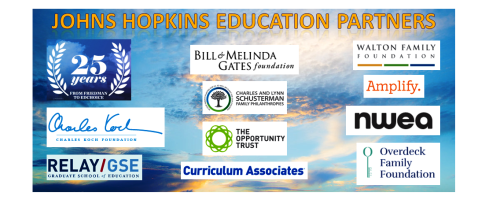
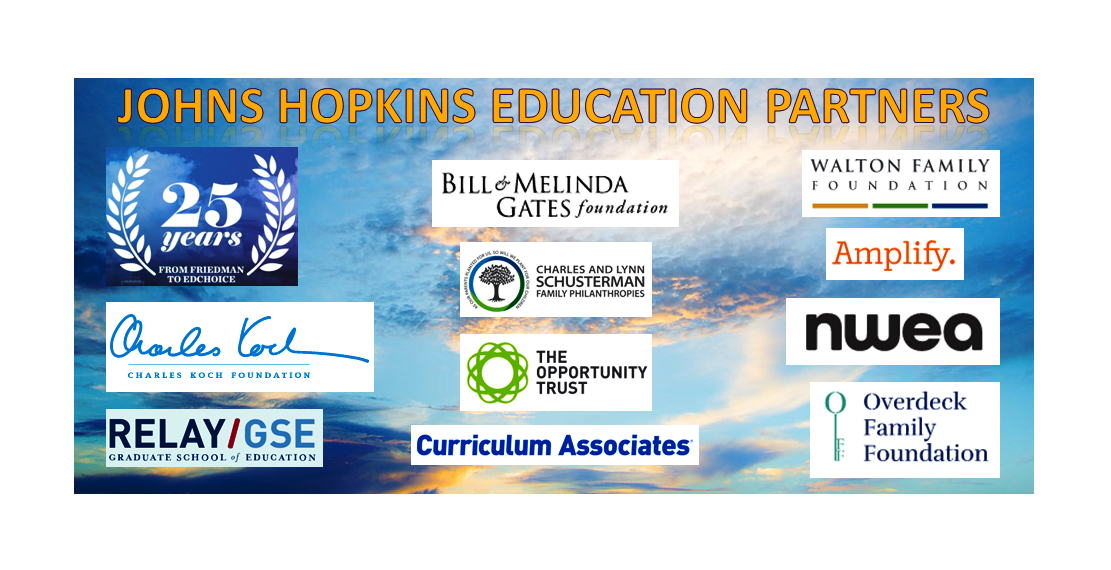
The Education Policy Institute at Johns Hopkins proudly lists sixty-seven partners on their about page. The eleven shown above are representative of the array of public school “disrupters” and edtech profiteers with whom they partner.
Becoming an advocate for deep pocketed libertarians and neoliberals has led to a gusher of dollars. Between 2018 and 2020 the Overdeck Family Foundation states it has granted John Hopkins $840,000.
John and Laura Overdeck are relatively new to being education “disrupters” but they have caught on fast. John is a former hedge fund guy and vice president at Amazon. Laura has an MBA from Wharton, is a trustee of Princeton and is on the advisory boards of the Khan Academy, Johns Hopkins Center for Talented Youth (CTY) and Stevens Institute of Technology. Their 2019 foundation tax form 990PF shows $627 million in assets.
Jeffery Epstein’s friend Bill Gates has been sending a steady stream of dollars. Although his giving is no longer transparent, his foundation tax forms show that between 2016 and 2018 he sent $2,194,000.
In 2006, two bay area foundations merged to form the multi-billion dollar Silicon Valley Community Foundation. It is a donor directed fund which allows wealthy individuals to secretly gift large sums of money without disclosure. From 2015-2018 they sent $27,381,018.
The Return on Investment
Basing themselves almost exclusively on testing data, a group of Democratic politicians including Governor Gina Raimondo decided to take over and reform Providence, Rhode Island’s “failing” public schools. The school districts demographics in 2019 was 65% Latinx, 16% Black, 9% White, 5% Asian, 4% Multi-racial and 1% Native American. In addition, 31% of students were multilingual learners, 16% received special education services and 55% came from homes where English is not the primary language. An unbiased study would have quickly found that the schools were not failing. Rather, the poor testing results were reflective of deep poverty, language learners and a large special education population.
Last year, The Institute for Education Policy at Johns Hopkins wrote a joint paper with Jeb Bush’s Chiefs for Change. It called for more testing. They claimed,
“As leaders prepare their school communities for the challenge of re-starting face-to-face as well as hybrid models, a coherent pathway for learning recovery and acceleration needs to include greater reliance on high-quality materials and instruction, and completing the circle with curriculum-based assessments.”
“We recommend formative and summative assessments tied to specific curricula that can be implemented under various circumstances.”
Sadly, education scholarship at Johns Hopkins has been abandoned for much more than just “30 pieces of silver.”
This January, California Democratic State Senator Anthony Portantino introduced SB237 mandating dyslexia testing and intervention. It is similar to a spate of bills across the US requiring a privatized approach to intervening with reading difficulties. Unfortunately, contrary to their claims, these initiatives are not based on well founded research. The perpetrators base themselves on the widely disparaged“science of reading” and are part of a well financed effort taking advantage of emotionally compromised parents and students.
The bill stipulates a specific set of dyslexia testing for all students kindergarten through third grade and requires the “State Board of Education to establish an approved list of culturally, linguistically, and developmentally appropriate screening instruments” to meet the mandate. The legislation also calls on local school districts to use “structured literacy instruction.”
When SB237 was introduced, Decoding Dyslexia CA, EdVoice and the Oakland NAACP were listed as co-sponsors. Decoding Dyslexia is one of the two international organizations promoting this type of legislation. EdVoice is a publishing organization with strong ties to the movement to privatize public education. Its 2003 founding board included Reed Hastings, Laurene Powell Jobs, Eli Broad and Don Fisher. Kareem Weaver is a leader of the Oakland NAACP literacy campaign and was a witness for the plaintiffs in the Vergara case to end teacher employment rights.
“Structured literacy” is a 2016 term pitched by the International Dyslexia Association (IDA). Fundamentally it is a method based on the work of Anna Gillingham and Samuel Orton in the 1930s. Rhode Island’s Department of Education describes it as an “explicit, systematic, diagnostic, cumulative instruction in phonological and phonemic awareness, phonics, syllable types, morphology, semantics, and syntax.” In other words, employ phonics and word decoding to remedy reading issues. IDA claims, “Popular reading approaches (eg., Guided Reading and Balanced literacy) are not effective for students with dyslexia because these approaches do not focus on decoding skills struggling readers need to succeed.”
Legislation not Supported by Research
IDA is an international organizations pushing for specific dyslexia legislation. Their remedies include utilizing private companies to solve student reading problems that public school will not or cannot. They also provide their own dyslexia teaching specialty certification. The obvious implication is that University based teachers’ education programs are incapable of addressing dyslexia.
“Dyslexia is a specific learning disability that is neurobiological in origin. It is characterized by difficulties with accurate and/or fluent word recognition and by poor spelling and decoding abilities.”
This definition is not supported by the community of education scholars. In fact, there is general agreement that there is no satisfactory definition for dyslexia nor is there a known way to screen for it.
A critical analysis of dyslexia legislation by a team of researcher from Ball State University and the University of Texas noted,
“After a multitude of studies across more than a century, researchers have failed to consistently identify characteristics or patterns that distinguish dyslexia from other decoding challenges. Many researchers and educators argue the construct is too vague and contradictory to be useful for educators.”
They continue, “There are no universally employed measures or procedures for identifying dyslexia.”
A paper by Peter Johnston and Donna Scanlon from The University at Albany asserts,
“The bottom line is that there are many definitions of, and theories about, dyslexia and simply no agreed-upon definition that allows schools, clinicians, researchers, or anyone else, to decide who is dyslexic in any valid or reliable way.
“From an instructional standpoint, there is no practical distinction between those classified as dyslexic and others at the low end of the normal distribution of word reading ability in the early elementary grades.”
Not only are there a plethora of scholarly studies that make the same points about the definition for dyslexia, there also are an equal number of research papers that thoroughly discredit the idea that “structured literacy” is a proven success.
In 2017 Rachael E. Gabriel of the University of Connecticut published “Converting to Privatization: A Discourse Analysis of Dyslexia Policy Narratives.” Her paper analyses how the agenda for privatizing dyslexia intervention is sold to legislators and school boards. She also shares results of studies on the “structured literacy” approach. Gabriel cites the US Department of Education’s What Works Clearinghouse reading research stating “structured literacy” is not supported by evidence.
Money is Driving this New Education Privatization Effort
Senate bill 237 was just moved out of committee to the Assembly. In the 2020 general election, an analysis of major donor California state spending revealed over $14 million dollars spent by a neoliberal cabal of billionaires and the political action committees they fund. Of that spending $1.5 million went to California state legislators. The table above shows the money that went to legislative members who are either on the Assembly and Senate education committees or are listed as co-sponsors for the dyslexia legislation.
Handing off teacher certifications to private organizations and using private companies to screen students is a huge mistake. Legislators should resist the temptation to micromanage public education. The best approach is to trust education professionals and university based scholars more than private actors with an agenda.
The Boston Consulting Group makes the fantastic assertion that, “Investing in early screening and teacher training would provide an astonishing 800% to 2000% return.” A policy brief from the Institute of Child Success indicates that special education pay for success has great return on investment potential.
Clearly the sharks are circling. Parents, legislators and schools need to be on high alert. Well funded organizations want our public school resources. For them, dyslexia is just another potential profit center.
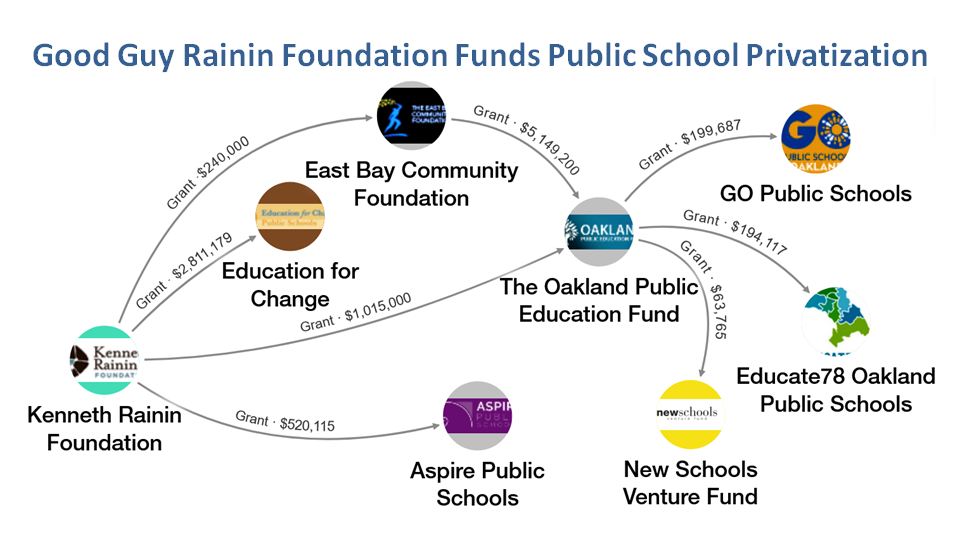
The Oakland Unified School District (OUSD) signed an agreement on March 10 to substitute i-Ready diagnostic testing for the Smarter Balanced Assessment Consortium (SBAC). The no cost agreement calls for the data to be given to Johns Hopkins University for comparative analysis with SBAC. Oakland teachers administering the program claim that the project is being financed by the Kenneth Rainin Foundation.
An Oakland fourth grade math teacher who administered the test stated that the it appeared to be designed to insure that students missed at least 50% of the problems. She observed,
“1) Multi-step unit conversions in the context of a word problem”
“2) Definitions/examples of independent and dependent variables”
“3) Simplification of algebraic equations with two variables”
These skills all appear to be well beyond what should be expected of 9- and 10-years-old students.
i-Ready is a product of Curriculum Associates (CA) out of Billerica, Massachusetts. It was originally formed in 1969 to publish workbooks. Ron Waldron an equities manager at Berkshire Partners took the reins in 2008 and immediately converted it to an ed-tech company.
i-Ready is a technology-based diagnostic testing program that also provides screen based instructional programs for math and reading.
Evidently many junior-high students who use i-Ready in the classroom are making internet searches for information about it. Possibly that explains why my i-Ready article written three years ago is still getting traffic. This May, it has received more than 1600 clicks. The latest two comments out of hundreds to the article are typical:
“i agree iready has caused a ton of stress for me as a 7th grade student.”
“I-ready needs to Die!”
Sales spiels normally tout the research evidence supporting i-Ready. However, there is no independent peer reviewed research backing CA’s claims. A 2019 study from WestEd is typical. The study was paid for by two billionaire non-profits reputed to favor privatizing and monetizing public education – The Bill and Melinda Gates Foundation and the Silicon Valley Education Foundation. In paragraph one the study says,
“Our quantitative analysis showed that students, regardless of their math proficiency, who spent a minimum of 45 minutes a week or more on the i-Ready lessons had a significant improvement in their scores on the Smarter Balanced Assessment Consortium Math Summative Assessment (SBAC) over students who did not.”
However, the next paragraph admits,
“During the observations, it was noted that the product was challenging for less proficient students to use, which was later confirmed by our quantitative analysis — many students who used i-Ready consistently enough to see its benefits were already meeting or exceeding standards in mathematics on the SBAC.”
This shows that better students willing to put in the time got better scores than weaker students who did not. Not too surprising; that would have been the case without i-Ready.
The Evaluator Appears Biased
Chiefs for Change and Johns Hopkins Wrote Joint 2020 Paper – The Return
The Institute for Education policy at Johns Hopkins joined Jeb Bush’s Chiefs for Change in calling for more testing. Their claim,
“As leaders prepare their school communities for the challenge of re-starting face-to-face as well as hybrid models, a coherent pathway for learning recovery and acceleration needs to include greater reliance on high-quality materials and instruction, and completing the circle with curriculum-based assessments.”
“We recommend formative and summative assessments tied to specific curricula that can be implemented under various circumstances.”
Johns Hopkins was also integral to the attack on the public schools in Providence, Rhode Island. In May 2019, the Johns Hopkins Institute for Education Policy led a review of the Providence Public School District (PPSD). They did so at the invitation of the Rhode Island Department of Education Commissioner, Ms. Angélica Infante-Green, with the support of Governor Gina Raimondo and Mayor Jorge Elorza. The Partnership for Rhode Island funded the review.
The foundation being cited as funding the i-Ready and Johns Hopkins study has assets of more than $600 million. Founder Kenneth Rainin was an entrepreneur from Toledo, Ohio who became wealthy manufacturing and selling laboratory pipettes. When he died in 2007, the foundation became the beneficiary of the majority of his estate.
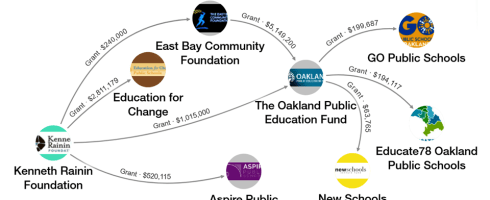
The Rainan Foundation has spent significant sums on advancing its “Seeds of Learning” reading program and the corporate control of public education. As the LittleSis map depicted above shows, the foundation sends large grants both directly and indirectly to billionaire funded “school choice” promoting organizations.
The “Seeds of Learning” program is supposed to improve reading education results through its preschool efforts. The lead story on the foundation’s web page is “Research Show Seeds of Learning Produces Quick Gains.” The research is not peer reviewed or independent. The Kenneth Rainin Foundation has spent more than $3 million for a Chicago company to produce the results. Report briefs are made available but not the study itself.
The dark side of the study is that they are testing 4- and 5-year olds in alliteration, letter naming, letter sounds, rhyming and vocabulary. That is child abuse. This appears to be an amateur created program that ignores the much greater need for babies to engage in self-directed play in safe and stimulative environments. “Seeds of Learning” is likely more personality damaging than it is helpful for reading.
Amateurs need to stop using their financial power to control education policy.
At 1:45 PM this Wednesday, the California State Board of Education (SBE) adopted a “student growth model” to evaluate student learning. It is a method fans of standardized test based accountability have been trumpeting. The big winner here is the testing giant Education Testing Services (ETS) who created the model to be used.
Board member Sue Burr who was appointed to the board by then Governor Jerry Brown made the motion for using the growth model. She carefully presented her motion directly from the state’s California Department of Education (CDE) staff report which recommended:
“The student growth model methodology, which includes using RG [residual growth] scores and the EBLP [Empirical Best Linear Prediction] hybrid approach to report aggregated student growth, and that the following score reporting be adopted:
“1. Report the EBLP weighted average for:
“1. Schools
“2. Student groups in a school
“3. The “All” student group in an County or District
“4. Student groups in a district with 500 or fewer students (with test scores)
“2. At the Local Education Agency level, report the simple average for all race/ethnicity and program participation student groups with more than 500 scores.”
Board member Patricia Ann Rucker seconded the motion. She is a legislative advocate for the California Teachers Association.
The measure was adopted by a unanimous 10-0 vote. The only member of the eleven-member board not voting for it was Board President Linda Darling-Hammond who was absent.
Developing an Accountability Model to Satisfy ESSA
In January 2016, the SBE discussed how to bring the state’s accountability vision in line with the federal Every Student Succeeds Act’s (ESSA) new accountability requirements. SBE received an information memorandum from the CDE stating,
“One such indicator would be a student-level growth model. This memorandum provides an overview of student-level growth models that can be used to communicate Smarter Balanced Summative Assessment results.”
In 2017, the state joined with testing vendor ETS to develop a Growth Model. After exploring several different models, the SBE selected the “residual gain” method for further study.
Again the state hired testing vendor ETS to evaluate the residual gain model in 2018. In a report, ETS stated that the model had low “cross-year stability.” In other words the results were not consistent. ETS developed an arithmetic manipulation method to solve the stability problem that they named the “Empirical Best Linear Prediction (EBLP).”
Student Growth Model Requires Opaque Math
The graphic above shows two types of growth models. One is the gain model which simply subtracts the third grade testing data from the fourth grade data to get a gain score. However, it is not really that simple. Mathematical manipulation is required to make the scale from the 3rd grade match the scale in 4th grade. This requires several assumptions that affect the results.
The method California has chosen adds another set of mathematical assumptions to create an expected outcome. That expected outcome is then subtracted from the 4th grade data to get the residual gain score. However since those scores are not stable, the ETS averaging scheme is being applied to make the results appear stable.
ETS is the Goliath of the standardized testing industry. It administers America’s most important standardized tests (including the SAT, PSAT, CLEP, AP, TOEFL, and Praxis exams) and develops many of them. ETS was organized as a non-profit in 1948. Today, their 2018 tax document shows this “non-profit” has revenues in excess of $1.5 billion. It also shows that 17 board members working 2-hours or less per week had an average income of $73,000 and 33 key employees had average incomes of over $533,000 per year with President Walter McDonald taking in $1,350,474.
The ETS “non-profit” is actually diving up a lot of profits.
Standards Based Education and Testing is Harming Kids
In December, Peter Greene put together a compendium of articles he has posted about the stupidity associated with standardized testing in schools. One particularly important article is about Daniel Koretz book the Testing Charade. This recognized testing expert from the Harvard Graduate School of Education gives us one more well-founded dismantling of the myth that standardized testing is anything other than destructive.
Student testing data does not indicate learning, teacher effectiveness or school quality and it is statistically noisy. A correlation study of how testing data is affected by various factors assigns r-values of between 1 and 0. A value of 1 means 100% correlated and a value of 0 means not correlated at all. When correlation studies are done with standardized testing data there is only one factor that has an r-value greater the 0.3 (weakly correlated) and that is family wealth which has an r-value of 0.9.
So if Burrito Canyon high school has excellent testing data that is always better than the scores at Pawn Valley high school, there is nothing known about the learning and teaching, but you can be confident students at Burrito Canyon have wealthier parents.
These growth models – that are now being used in almost every state in America – take in noisy testing data that has little valuable meaning and applies fancy arithmetic. It is the classic “garbage in – garbage out” situation.
Not only is standardized testing removing almost $2 billion dollars from America’s classrooms every year, it is doing damage to students. Standards based education is bad education theory because there are no standard children. Testing forces educators to teach to the test and it further narrows curriculum. Gifted education professionals have shown repeatedly that this methodology driven by corporations and billionaires is harmfully misguided.
Laurene Powell Jobs and Amplify Education are hosting a “Virtual Summit” which is what they’re calling this May’s sales event. Jobs is very confident that her billions qualify her to shape education policy. In her drive to privatize public education, she has accumulated and created several pro-edtech and anti-teacher organizations. She also provides leadership and money to other billionaire driven organizations promoting education technology while simultaneously denigrating public schools.
When Laurene’s husband, Steve Jobs, died in 2011 she inherited the rest of the billions the couple had derived from the company Steve founded, Apple Inc. Since then, her fortune has grown to more than $30 billion. Fundamentally, Jobs only qualification for shaping national education policy derives from her marrying the right guy.
“Re-design entire K-12 system – we know how to do it, but it comes down to political will.
“Think about Charters as our R&D … must allow public schools to have leaders that can pick their team and be held accountable.
“Need to increase IQ in the teaching sector: Teach for America; they are a different human capital pipeline.
“Need to use technology to transform – technology allows teachers and children to focus on content mastery versus seat time; …”
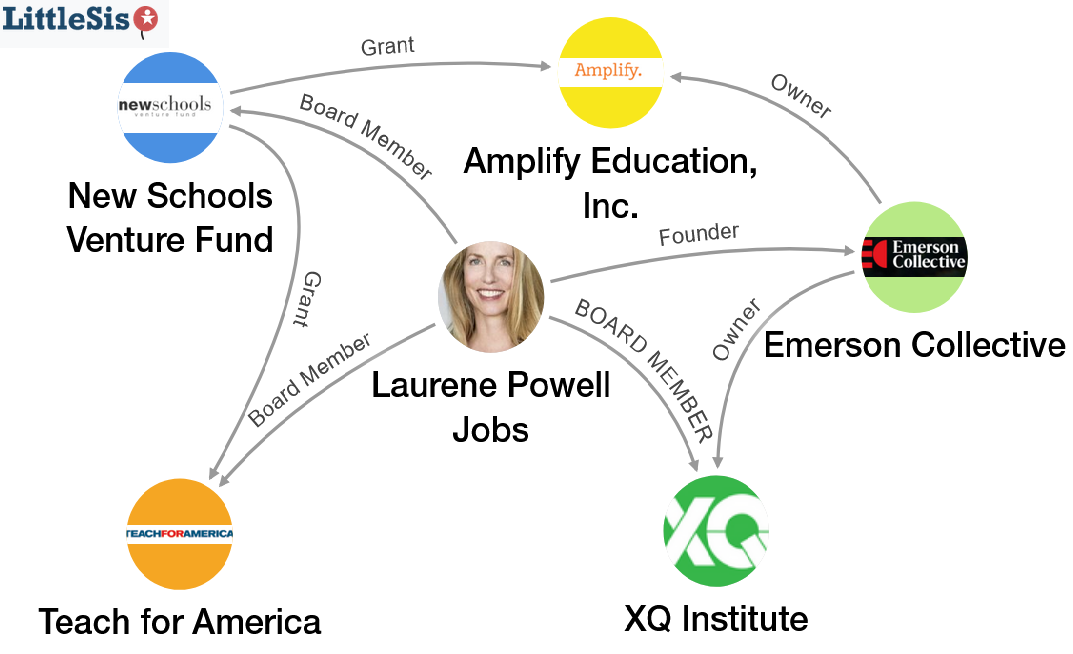
Some Laurene Powell Jobs Connections Mapped in LittleSis
The LittleSis map above has a hyperlink to the original in the caption. Shown here is a minimal display of Jobs’ connections within the movement to privatize and monetize public education. However, every line and name is hyperlinked on the original map to a large trove of information in the LittleSis data base.
The point of the map is that Jobs is the owner of Amplify through her non-profit organization, Emerson Collective.
The Amplify “Virtual Summit”
The May sales event was promoted in the Education Week Advertiser with the title “Reading Reimagined: Uncovering the Science Behind Personalized Learning.” All but one of the presenters at the daylong affair is an Amplify employee. They will emphasize three points:
“The Science of Reading in personalized learning.”
“What to look for in a personalized learning program.”
“How to leverage COVID-19 relief stimulus funding to combat instructional loss.”
Russ Walsh is a professional educator and blogger. Recently (4/26/2021), He began an article about the science of reading with,
“Call me crazy, but when I learned I had cancer a few years ago, I did not immediately consult a journalist. Instead I chose to see an oncologist. When COVID broke out, I threw in my lot with Dr. Fauci and other infectious disease scientists, instead of a former reality TV star who suggested I inject bleach. And so, when I want advice on reading instruction, I avoid the journalists, the parent lobbying groups, the reading program sales reps, and the agenda driven pseudo-education organizations, and I look to the experts.”
The professionals Russ pointed to were Peter Johnston and Deborah Scanlon of the University at Albany who have debunked the Science of Reading (SOR) in a new report. Russ quotes them as stating,
“There is no one right way to teach reading. Student’s difficulties are unique to the individual students. Better to assume that the instruction we are providing is not meeting the student’s needs and adjust accordingly, than to focus on one instructional approach.”
Professor Paul Thomas of Furman University has also been out spoken in his scorn for the science of reading ideology.
In a previous post, I defined the nebulous term personalized learning:
‘“Personalized Learning” is a euphemistic term that indicates lessons delivered on a digital device. These lessons are often organized with a playlist and come with a claim of using artificial intelligence to tailor the lessons to the recipient. The scheme is related to competency base education (CBE).”
For five decades, the CBE scheme, operating under several different names, has posited that drilling small skills for mastery is the best way to teach. It has not worked yet.
The Organization for Economic Co-operation and Development said in a 2015 report that heavy users of computers in the classroom “do a lot worse in most learning outcomes.”
Wireless Generation to Amplify
Greg Gunn a former associate of the Carlyle Group who had earned a Masters of Electrical Engineering from MIT joined with Larry Berger to found Wireless Generation. Berger was a graduate of Yale University with a BA and had been a White House fellow working on Educational Technology at NASA during the Clinton administration.
In 2010, News Corporation paid $360 million dollars to acquire Wireless Generation and renamed it Amplify Education, Inc.
By August of 2015, after spectacular failures in North Carolina, News Corporation announced it was exiting the education business. The corporation took a $371 million dollar write off to get out of the digital curriculum business. The next month, News Corporation announced it had sold Amplify to members of its staff. In the deal orchestrated by Joel Klein, he would remain as a board member and Larry Berger would assume leadership of the company.
It was soon learned that the real buyer of Amplify was Laurene Powell Jobs. Larry Berger is still leading the company.
Twenty years of studying education policy, politics and practices has been awakening. Seeing billionaires inflict their often misguided and unpopular beliefs on our nation’s public schools has made it clear how undemocratic and dangerous extreme wealth is. They have established voucher programs routinely sending taxpayer money to religious schools even though these programs have lost decisively whenever submitted to voters. In her book Slaying Goliath, Diane Ravitch labeled these 0.1% of Americans as disrupters. She asked and answered the question “what do disrupters want?” They want:
Inexperienced teachers with little or no training from organizations like Teach For America.
To replace teachers with machine teaching (“blended learning” – “personalized learning”).
To move fast and break things including school systems, historic schools and communities.
To eliminate local democratic control over schools.
To eliminate teacher tenure and seniority rights.
To eliminate teacher defined benefit pensions.
To eliminate teachers unions.
To evaluate teachers and schools with standardized test scores.
To lower taxes and reduce spending on education.
Controlling the Political Process
In 2018, the Network for Public Education (NPE) produced a masterful report detailing how school board elections are being stolen from local residents. In the introduction to “Hijacked by Billionaires: How the Super Rich Buy Elections to Undermine Public Schools,” the authors state, “This report provides some insight into how the very wealthy insert themselves into local elections through direct contributions, Independent Expenditure Committees and even non-profit organizations.”
The Billionaires Cited in “Hijacked by Billionaires”
In my post-election analysis of three elections, “School Board Elections 2020: The Good, The Bad and The Ugly,” I show that billionaires Alice Walton of Bentonville, Arkasas, Michael Bloomberg of New York, New York and Stacy Schusterman of Tulsa, Oklahoma poured hundreds of thousands of dollars into the school board races in Oakland, California and Indianapolis, Indiana.
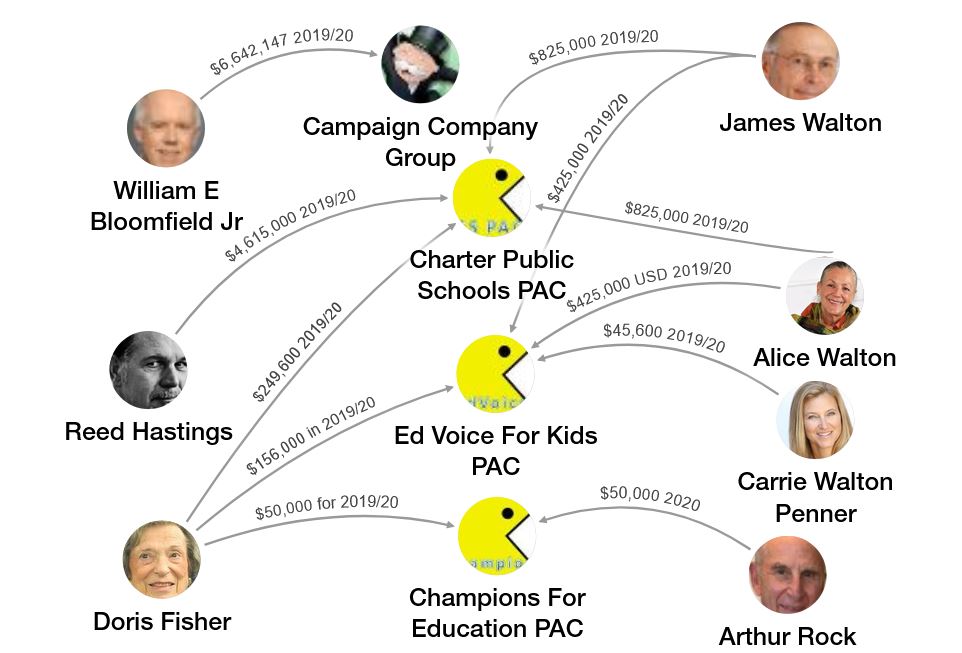
In that same election, the spending in Los Angeles and for California state offices was enormous. Through a combination of direct contributions and political action committees, seven billionaires put more than $14,000,000 into the 2020 election. The bulk of it went into the Los Angeles school board election with over $1,000,000 going to state assembly and senate races plus more than $1,000,000 went into five county board of education elections.
The Path of Billionaire Spending in California’s 2020 General Election
Similar election spending went on in New Orleans, Camden and many other jurisdictions mainly through Public School Allies the political arm of the City Fund founded by billionaires John Arnold and Reed Hastings.
In 2014, SFGATE reported, “Netflix CEO Reed Hastings, who suggests that democratically elected school boards are the problem with public education, says they should be replaced by privately held corporations.” Hastings said out loud a belief held among many of his anti-democracy peers.
Creating an Alternate Teacher Training Path
In their effort to privatize public education, billionaires have created alternate paths for teacher credentialing and professional development.
Mercedes Schneider writes in her book Chronicle of Echoes, “Wendy Kopp declared that she had a force of young, predominantly-Ivy League idealists for sale, and Big Money arrived on the scene to make the purchase.” Wendy Kopp is the founder of Teach For America (TFA) and the young idealists for sale were her “temp teachers” who have no intention of staying in the classroom. In 2011, the Walton Family Foundation donated $49.5 million to TFA. Many corporate donors also sent TFA $100,000 to $999,000: “Anheuser-Busch, ATT, Bank of America, Blue Cross/Blue Shield, Boeing, Cargill Chesapeake Energy, Chevron, Emerson, Entergy, ExxonMobil, Fedex, Fidelity Investment, GE, Marathon Oil, Monsanto, Peabody, Prudential, State Farm, Symantec, Travelers, Wells Fargo.”
These unqualified “temp teachers” have not studied teaching and they have no experience. A new teacher coming through a traditional program has taken many education courses and spent a year working with a master teacher as a supervised student teacher. TFA teachers typically have no education courses in college and get just five-weeks of classroom training in the summer.
TNTP is one of several organizations that only exist because billionaires have financed them. Wendy Kopp founded TNTP (originally called The New Teachers Project) in 1997. She assigned Michelle Rhee, who had completed a two year TFA tour, to lead it. Along with TNTP and TFA there are also the Broad Superintendents Academy and the fake school for professional educators called Relay Graduate School instilling the billionaire inspired privatization mindset.
Selling Technology and School Choice
With their enormous wealth, billionaires have poured more than $200,000,000 into organizations like New School Venture Fund to sell edtech and school choice; also funding think tanks (CREDO and CRPE) to provide a veneer of academic credibility.
To advance these sales they have created their own education media empire with The Education Post and The-74 as their flagships. Bill Gates has spent lavishly on publications like EdWeek turning them from a teacher resource into an edtech promoting outlet.
“An imbalance between rich and poor is the oldest and most fatal ailment of all republics.” —Plutarch (c. 46–120 ce)
“The top 1 percent owns more than 30 percent of America’s wealth. The poorest half owns just 2.5 percent. Wall Street bonuses alone are twice the amount of all the combined earnings of minimum-wage workers in this country. We are grotesquely, bizarrely, grossly unequal — unequal in cash, health care, schooling and access to clean air and water. Unequal in our access to power. And we are becoming more unequal by the year: Since Ronald Reagan became president, the income of the wealthiest 1 percent of Americans has doubled.”
As Louis Brandeis famously stated, “We can have democracy in this country, or we can have great wealth concentrated in the hands of a few, but we can’t have both.”
A new political PAC, “Campaign for Better San Francisco Public Schools,” demands that schools be opened for in person classes immediately. They also make two dubious claims, “The election process for choosing the Board of Education is not meeting the needs of San Francisco” and “Many large cities successfully use an appointment process to choose a Board of Education.”
San Francisco Democrats Embrace the Open Schools Now Agenda
Neoliberal forces especially from the Republican Party have been campaigning for schools to be opened immediately for more than a year. Republicans see it as a wedge issue that could help them win back suburban women. Carl Hulse’s New York Times article noted that “congressional Republicans have begun to hammer relentlessly on President Biden, Democrats and teachers’ unions to open schools quickly.”
Surprisingly, San Francisco Democrats have joined with the former president’s open-schools-now campaign. Mayor London Breed has even sued the school board trying to force them to reopen schools. Breed explained,
“Families right now aren’t able to plan for their futures. They can’t decide whether to accept a job offer because they don’t know when they’re going to be able to once again have their kids returned to the classroom. This is paralyzing our city and our residents, and I know that this is a drastic step, but I feel we are out of options at this point.”
Seeyew Mo, a computer scientist who uses his skills to develop political campaign tools, is the executive director of the Campaign for Better San Francisco Public Schools. In a recent bid for a seat on San Francisco’s Democratic County Central Committee, he was endorsed by Nancy Pelosi, London Breed and YIMBY among others. YIMBY is the yes in my Backyard advocates for safe, affordable housing in California often accused of advancing a gentrification agenda.
The Campaign for Better San Francisco Public Schools’ background article claims that school boards should be appointed not elected citing a 2013 article from the Center for American Progress (CAP) as evidence. The CAP article was sponsored by the Edythe and Eli Broad Foundation and reviewed by Thomas B. Fordham Institute. Both entities are infamous for promoting school privatization.
Political Action Committees must file a statement of purpose to legally spend money. When the Campaign for Better San Francisco Public schools filed their form, the treasure named was James Sutton a prominent San Francisco Lawyer and the principle officer named was hedge-fund founder Patrick Wolff.
Wolff founded Grandmaster Capital with seed funding from his billionaire friend Peter Thiel. According to the hedge fund journal, Wolff and Thiel were initially brought together by a common interest in chess. “Thiel is a serious chess player and Wolff began his career as a full-time, professional chess player, twice becoming US champion, hence the Grandmaster name.”
In 2018, Wolff wrote commentaries on education for the San Francisco Examiner. In one piece he declared,
“California is failing. San Francisco is failing. The status quo is unacceptable. The fate of our children’s education is literally our future.”
“But in the interest of full disclosure, I will report that I have met several times with Marshall Tuck and he has greatly impressed me with his knowledge, his passion, and his ideas. And Marshall Tuck has the full-throated endorsement of Arne Duncan, who was US Education Secretary under President Obama.”
Gentrification
The Wolff-Thiel connection and Mayor Breed’s appointment of Sonja Trauss to the Regional Planning Committee of the Association of Bay Area Governments has people worried.
Szeto and Meronek referenced Tory Becker the director of the anti- gentrification group LAGAI when writing about Trauss,
“Entrenched online in the libertarian strongholds of Reddit and TechCrunch, and in the real world through real estate- and tech-sponsored nonprofits like SPUR and YIMBY Action, Trauss’s followers live by the neoliberal belief that deregulation and building more housing, even if it’s only affordable to the richest of the rich, will trickle down and eventually make housing affordable for all. Her vision is Reagonomics ‘dressed up in a progressive sheep’s costume,’ according to Becker.”
San Francisco Supervisor Gordon Mar opposed Trauss’s appointment noting that the appointee must be able to bridge divisions across neighborhoods and ideologies. Mar claimed, “Sonja Trauss has a history of inflaming these divisions, rather than working across them” citing “the declaration that ‘gentrification is what we call the revaluation of black land to its correct price’” and “forcefully shouting down Chinatown community elders.”
Recall the Board
School district parents, Autumn Looijen and Siva Raj, filed a school board recall petition. They wanted to recall the entire board but the two members elected in November cannot be recalled this year. Looijen and Raj are tech workers who moved to the city last December. They claim the school board was too busy with school name changes instead of getting schools open.
In the original filing, Looijen is listed as treasure and Raj is listed as principal officer. In an amended filing, Looijen is listed as principal officer and the new treasure is James Sutton the same high priced San Francisco attorney as the PAC, Campaign for Better San Francisco Public Schools, used. One of Sutton’s junior lawyers, Dale Bellitto, is listed as Assistant Treasure. In 2015, she was a Teaching Fellow at KIPP Infinity charter school in New York City.
The Education Week Advertiser just notified me about an opportunity to be indoctrinated into the Cato Institute’s culture and education views. The ad proclaims, “The Cato Institute and the Sphere Education Initiative are excited to announce the return of Sphere Summit: Teaching Civic Culture Together for the Summer of 2021!” They generously offer impressive full scholarship programs for educators and administrators.
The money for all this comes from Charles Koch and associated libertarians. It is funneled through the Cato Institute which was originally called the Charles Koch Foundation, Inc. when he and fellow libertarian Edward Crane founded it in 1977. It is one of the many organizations and businesses that Charles Koch uses to advance his personal interests which are often referred to as the Kochtopus.
Sphere Summit Speakers
Ryan Bourne – According to libertarianism.org, he is “the R. Evan Scharf Chair for the Public Understanding of Economics at Cato.” Bourne writes about fiscal policy, inequality, minimum wages, infrastructure spending and rent control.He is a contributor to the Daily Telegraph and the UK website ConservativeHome.
Arnold Kling – A Senior Affiliated Scholar at the Mercatus Center at George Mason University to which the Charles Koch Foundation contributed a total of $29,156,700 in 2017 and 2018 (EIN: 48-0918408). He specializes in housing-finance policy, financial institutions, macroeconomics, and the inside workings of America’s federal financial institutions. He also is an adjunct scholar at the Cato Institute in Washington, DC.
Clark Neily – He is vice president for criminal justice at the Cato Institute. Neily served as co-counsel in the District of Columbia v. Heller case in which the Supreme Court held that the Second Amendment rights had been violated. The ruling overturned the District of Columbia’s handgun ban and requirement that lawfully owned rifles and shotguns be kept “unloaded and disassembled or bound by a trigger lock.”
Tom G. Palmer – He is a senior fellow at Cato Institute and director of Cato University. He is also a VP of the Institute for Humane Studies (HIS) at George Mason University and a VP for International Programs at the Atlas Network. HIS was co-founded by Charles Koch in 1974. An outgrowth of HIS, the American Energy Alliance, had a central role in Koch’s successful campaign defeating the Waxman-Markey cap and trade bill to limit greenhouse gasses (Kochland pages 448-449).
Jonathan Rauch – He is a senior fellow in the governance studies program at the Brookings Institute and author of books and articles on public policy, culture, and government. His many Brookings’ publications include the 2015 ebook Political Realism: How Hacks, Machines, Big Money, and Back-Room Deals Can Strengthen American Democracy.
Jeffrey Rosen – He is President and Chief Executive Officer of the National Constitution Center, a nonpartisan nonprofit organization whose mission is to educate the public about the U.S. Constitution. Rosen is also professor at The George Washington University Law School and a contributing editor of The Atlantic.
Nadine Strossen – She was president of the American Civil Liberties Union (ACLU) between1991 to 2008. Veteran National Review fans may be familiar with Strossen, because she was a friend and frequent sparring partner of William F. Buckley.
Darrell West – He is Co-Editor-in-Chief of TechTank. His current research focuses on artificial intelligence, robotics, and the future of work. West is also director of the John Hazen White manufacturing initiative and vice president of Governance Studies at the Brookings Institute.
It appears that the first four presenters will be delivering the libertarian message and the second four will be delivering a mixture of pro-edtech and pro-American positions. All eight speakers have two commonalities. They are professionals who will be paid well for their appearances and none of them have any k-12 teaching or administrating experience.
Four professional development workshops are to be presented by:
Foundation for Individual Rights in Education which was founded by Alan Charles Kors in 1999 to dismantle the so-called liberal bias in higher academia. Source Watch reports that they were part of the right wing State Policy Network.
The Bill of Rights Institute, established in September 1999 by the Charles G. Koch Foundation, is a Virginia based nonprofit that promotes teaching a conservative interpretation of the Constitution.
The National Constitution Center is a nonprofit institution devoted to the Constitution of the United States.
iCivics is a non-profit organization offering teachers digital civics education curriculum including games, digital tools, and lesson plans.
For more than fifty years, Charles Koch has been pouring money into advancing his libertarian free market philosophy. Koch has taken Austrian economic theory from its 1950s fringe thinking status to an influential force in American governance. This is a continuation of that effort. Targeting teachers and school leaders is designed to expand Koch’s ultra-conservative low tax and small government agenda.
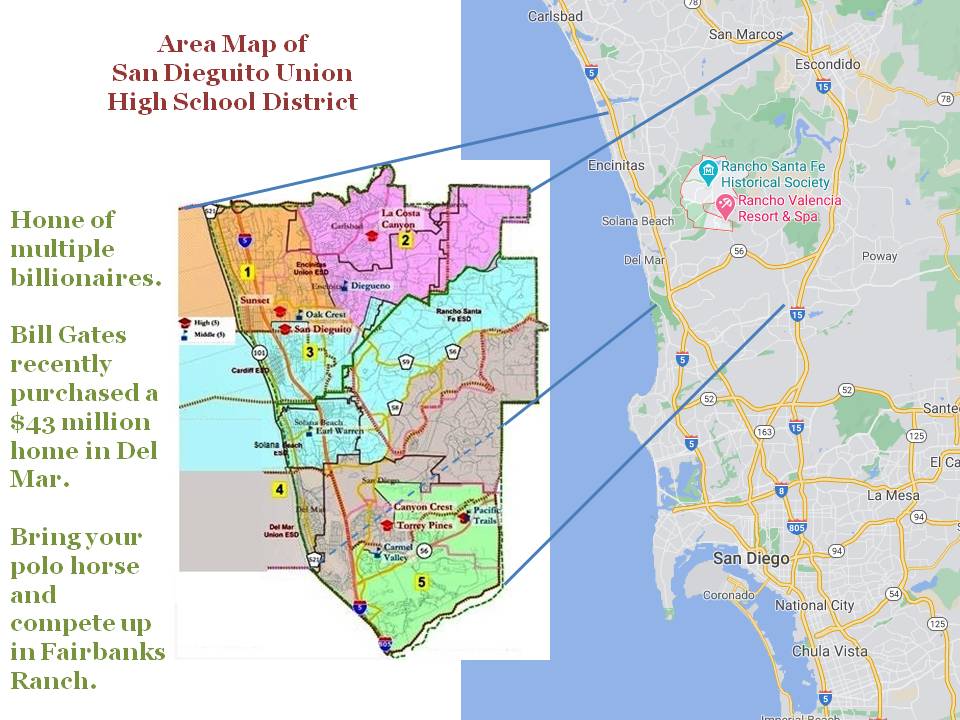
One of America’s wealthiest public school districts typifies the damage MAGA Republicans are doing to public schools. San Diego County’s San Dieguito Union High School District (SDUHSD) serves just over 13,000 students in five middle schools and five high schools. With former Republican congressional candidate Mike Allman’s narrow school board victory, the MAGA coalition has achieved a 3 to 2 majority.
This election result advances using school reopening as a political wedge issue. Normally nonpartisan school board elections have been turned into partisan political battle grounds.
“Schools in our country should be opened ASAP. Much very good information now available. @SteveHiltonx@FoxNews
— Donald J. Trump (@realDonaldTrump) May 25, 2020”
In July, the former Secretary of Education declared,
“School leaders across the country need to be making plans’ to have students in the classroom. There will be exceptions to the rule, but the rule should be kids go back to school this fall. And where there are little flare-ups or hot spots, that can be dealt with school by school or a case-by-case basis. There’s ample opportunity to have kids in school.”
Carl Hulse’s Feb. 12, 2021 New York Times article ran under the banner, “Republicans Seize on Shuttered Schools as a Political Rallying Cry” with a subtitle stating, “As President Biden struggles to keep his pledge to reopen schools in 100 days, Republicans in Congress are hammering at the issue as a way to win back alienated women and suburban voters.”
The SDUHSD school board election is a case study in using school reopening and hard ball politics in search of political gain.
Mike Allman’s Election Signaled MAGA Politics have Arrived
Michael Allman is a self-described “libertarian-leaning Republican.” He came to San Diego to work for Sempra Energy; is a former executive of Southern California Gas Co. and until 2016 was an executive at a software company called Bit Stew Systems. He received a BS in Chemical Engineering from Michigan State and an MBA at the libertarian economist Milton Friedman’s school, the University of Chicago.
He is a wealthy investor who lived in Rancho Santa Fe for twenty years before moving to Solana Beach.
Running for school board was Allman’s second foray into electoral politics. He ran in the 2018 district 52 congressional primary; a district in which he did not live. He was matched against incumbent Democrat Scott Peters and five fellow Republican challengers. Allman reported $415,109.45 total campaign spending in that race of which $300,000 came via his personal loan.
In 2020, Allman ran against Jane Lea Smith and Amy Caterina to become the Area 4 SDUHSD board Trustee. Caterina eventually dropped out and endorsed Allman but was still on the ballot. The former special education teachers and medical device researcher, Jane Lea Smith, proved to be stout competition. Allman won the seat with 7,507 votes to Smith’s 7,181 (42.3% to 40.5%).
Like in his congressional race, Allman ran for a school board position in an area where he does not live. He personally contributed $29,000 of his total $33,333.55 in campaign contributions received and loaned his campaign $30,000. He out-spent Smith who received a total of $14,096.01 in campaign contributions five to one. If the $7,066.88 in independent expenditures by the teachers union is included, the spending advantage drops to three to one.
Allman was clear about two points in his campaign to be on the board; schools must be opened full time for face to face instruction and the teachers union is the problem. Four days before the election he posted,
“Teachers unions’ goals are in direct conflict with those of school boards.
“I will be your independent voice on the board and will work for students, parents and taxpayers. I am not beholden or supported by the teachers union.”
A post by Allman at the end of August called for opening schools and joining his political movement. He wrote,
“The Teachers Union will demand that the return to in-class learning be delayed.
“If you would like to get involved to ensure that our schools open as quickly and safely as possible, please join this group. We have a SDUHSD Board Meeting in a couple of weeks, and we can make a difference!”
Allman provided a link to the private face book page “SDUHSD Families for School Reopening.” An education activist and student mother who was kicked off of the page says that Allman was the key voice and administrator of the group until he was elected. She claims he is still the key voice leading FB discussions in the group but is no longer an administrator.
Of the five people who are current administrators of “SDUHSD Families for School Reopening,”Ginny Merrifield and Alison Stratton seem to be the most politically involved.
Allison Stratton runs a marketing company and was very involved in Mike Levin’s 2018 successful campaign for the CA 49th congressional district seat. It is surprising to see a significant supporter of a Democratic congressman decide to back an Issa-like Republican. She is purportedly one of Allman’s most vocal allies. There are some activists who believe Allman is using the school board seat as a stepping stone to run against Levin for the 49th district in the next election.
Ginny Merrifield is a very connected operator in Republican circles. She is a trustee of the E3 Civic High charter school located in the San Diego Central Library. She was a co-founder and trustee of the private and pricey Pacific Ridge School in Carlsbad, California. She is on the board of governors for the $750 million San Diego Foundation. Her husband Marshal ran for San Diego city council as a Republican but was not elected. She is a very active and publicly open ally of Trustee Allman’s.
Recently Merrifield became the founding Executive Director of the Parent Association of North County (PANC). The contact address listed for PANC is 5965 Village Way, San Diego. It is a strip mall with only one education related business; Elite Educational Institute a tutoring, college consulting and SAT test preparation organization. Along with Executive Director Merrifield, PANC lists nine directors one from each of the nine north county school districts they claim to represent.
PANC publishes three organization objectives: reopen schools, grow membership and recruit substitutes. Regarding substitutes they say, “Due to a shortage of qualified substitutes, parents have created easy step-by-step instructions for parents to get a 30 day emergency substitute credential.”
PANC is not unique. On January 26, 2021, Edsource reported,
“Open Schools California includes parent groups in Los Angeles, San Francisco, San Diego, Richmond and other cities who say that distance learning has been a disaster for most students, and the state needs to push harder for safety measures that would allow campuses to reopen for in-person instruction. The group announced its formation Monday.”
In the city of San Diego the group Reopen SDUSD began posting on their new Face Book page in September 2020. They supported three pro-open schools candidates for the San Diego Unified School District board. All three were soundly defeated by the incumbents up for reelection.
“We are committed to exposing the truth about Reopen SDUSD @reopensandiegoschoolsnow. They are filled with anti-science, anti-vaccine, anti-testing voices. They don’t want our schools open safely, they want them open at any and all costs.”
Reopen SDUSD Exposed admits “not all Reopen SDUSD supporters are anti-mask, anti-vaccine, Q following nut jobs,” but they are aligned with them.
The San Diego Union reported on March 11, “Three parents filed a class-action lawsuit against San Diego Unified this week alleging that the state’s second-largest school district failed to provide sufficient in-person learning and sufficient access to online learning during the COVID-19 pandemic.” One of the plaintiffs is Reopen SDUSD co-founder Gina Smith.
Saturday March 13, 2021, PANC and Reopen SDUSD held a joint reopen schools rally in front of the county administration building in downtown San Diego. However, it does not appear that they attracted any local media attention.
Implementing the MAGA Politics of Division and Violence
In San Dieguito, the five member school board now has a three vote MAGA majority.
Maureen “Mo” Muir is the SDUHSD Board Trustee for Area one. In 2014, she was endorsed by the San Diego County Republican Party for what was then an open board seat. In 2018, the board was rearranged into Areas and Mo had a very difficult contest for the Area 1 seat; defeating Amy Flicker 7486 to 7291. In 2016, she also ran as a Republican for California’s 76th Assembly district and lost. Today she is the SDUHSD board President. This long time Republican finds herself in the uncomfortable position of having to support a radical MAGA style Republican agenda.
Joining Muir and Allman in the MAGA coalition is Melisse Mossy who is married to Jason Mossy, head of the Mossy Auto group and its many San Diego County dealerships. Mossy is a wealthy Christian house wife living in Rancho Santa Fe who does not seem to value the public school system. In a promotional video for the Santa Fe Christian School, Mossy says that if she could design a school it would be like this school where for the teachers it is more like a ministry. She states,
“I used to be a teacher in the public school environment and I have seen the worst case scenario. This is the farthest thing from it.”
Allman went to his first board meeting as a Trustee on December 15, 2020. He came ready to cause a stir by promoting four divisive agenda items.
Trustee Mossy introduced an Allman inspired proposal to change the time of the regularly scheduled Thursday at 5 PM board meetings to an alternating schedule of 9 AM and 5 PM. Allman seconded the motion. Minutes indicate that this motion was amended to alternating 3 PM and 5 PM. This change to a many years precedence will obviously make it more difficult for working people especially teachers to attend SDUHSD board meetings.
Allman wrote a proposal calling for a change to Rosenberg’s Rules of Order instead of using Roberts Rules of Order at Board meetings. According to Jurassic Parliament, the Rosenberg Rules are less Democratic giving more power to the chair and the majority. They are simpler with their rules stretching only to 10 pages compared to the 787 pages explaining the Roberts Rules, but that also gives the chair more power to make ruling interpretations. After a discussion the item was labeled a “future agenda item.”
Allman also proposed changing the boards legal council to Cory, Hargreaves & Savitch LLP. When the agenda item arose, Muir moved to make the change and Allman seconded the motion. It would be unusual for a public school district to hire this “school choice” promoting law firm. On the firm’s web site they state,
“If you view charter or private schools as opportunities to improve public education, we are aligned with you. We want to help you make a positive difference.”
After a discussion, Muir withdrew her motion and requested that a legal subcommittee to include Allman and Ms. Young meet with staff and review legal counsel options to recommend to the Board.
Allman’s big agenda item of the day was for all SDUHSD schools to open on January 4, 2021 for face to face instruction. Part of the resolution he authored stated, “The Governing Board designates Trustee Allman as the Board’s spokesperson for matters addressed by or arising from this Resolution.”
The board made it clear that all board members would be spokespersons and not just Allman. They also decided to start with one day a week in person before going five days a week on January 27. After that changes the MAGA coalition of Allman, Muir and Mossy provide the three required votes.
The San Dieguito teacher’s union immediately took legal action that stopped the in person school openings.
In late February, SDUHSD Superintendent Haley petitioned the state health department for an opening approval. The California Department of Public Health (CDPH) has offered a safety review process for school districts to request approval to reopen early while still in counties designated as “purple tier” for infection. Inexplicably, Haley announced that schools would open on March 8th before receiving word from the state.
When March 7th rolled around with no update from the state, PANC scheduled a rally to push for the approval, but that day the CDPH officially rejected the opening petitions from SDUHSD, Carlsbad Unified and Poway Unified. This apparently led to the following all too common MAGA style violence threat appearing on the Encinitas Votes face book page.
It would not be a real divide the community movement without a recall effort. In 2018, when Lea Wolf ran for the Area 5 Trustee position, she billed herself as a fiscal conservative and wrote in a recommendation for David Andresen, “David has been a tremendous resource for me as a entrepreneur since we met at San Diego Chamber of Commerce.” This founder of several technology companies who lost that school board race to Kristin Gibson is now leading an effort to recall Gibson.
On her website gathering recall signatures, she lists four reasons why Gibson’s performance is so egregious that she must be recalled: 1) Opposed letter grades during pandemic 2) Voted for $5.3 million Chrome books purchase 3) Approved 3.5% pay raise for Superintendent Haley and other administrators 4) Missed 2-thirds of last 9 board meetings.
In the votes for the Chrome book purchase and pay raises, she voted with the majority. Gibson, who lectures at San Diego State University and is a member of the National Council of Teachers of Mathematics and the National Council of Supervisors of Mathematics, disagreed last spring with a late change in grading policy from pass-fail to letter grade. At the time, Superintendent Haley was quoted,
“There’s no one voice, there’s no one decision that everybody is in agreement with. We acknowledge that. This is a very difficult time and a very difficult decision, we’ve never had a pandemic school closure and, hopefully, we will never have one again.”
Missing 2-thirds of the last 9 board meetings appears to be a lie. Since the end of June last year there have been 17 SDUHSD board meetings. Minutes show that Gibson attended 5 of 7 regular and 8 of 10 special board meetings. Three of her four absences occurred between 1/14/2021 and 2/1/2021. During that 2-week period she was dealing with a family crisis.
Even with all of the school districts in San Diego County issuing plans to open face to face in April, the MAGA Republicans continue to agitate. They blame teachers unions for keeping schools closed but surveys show that teachers and the general public have about the same opinion on opening schools in this pandemic. An article at the five-thirty-eight reports,
“According to a Feb. 11-14 Quinnipiac University poll, 47 percent of adults believe that schools are reopening in their community at about the right pace; just 27 percent believe it’s not happening quickly enough, and 18 percent think it’s happening too quickly. Likewise, a plurality (48 percent) of parents and guardians of K-12 students told YouGov/HuffPost that schools in their area were handling things “about right”; just 23 percent thought they were being too restrictive, while 19 percent thought they were taking too many risks. And educators are pretty happy too: 63 percent in the Hart Research/AFT poll said their school system has struck a good balance on the issue. Fifteen percent said that their school system had not done enough to resume in-person instruction, while 16 percent said it had gone too far to do so.”
Maybe rich people like Mike Allman and the former Secretary of Education, think teachers and students should take the risk and get back in school. But “little flare-ups or hot spots” are existential threats for many teachers and school staff. Now that vaccines are rolling out and schools are announcing reopening plans it seems foolish to rush it. Schools finally have the resources needed for a safe reopening and the staffs have vaccines being distributed that make them safer. Getting school open by May 1 is reasonable and prudent. Teachers, staff and students are not endangered unnecessarily.

















 tultican
Recent Comments