Archive | DPE RSS feed for this section

“Let the Children Play” is Developmentally Appropriate Education

25 Sep

By T. Ultican 9/25/2019

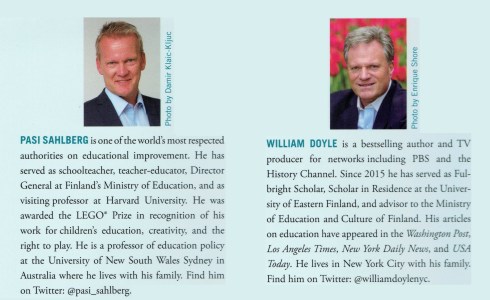
Two education experts and fathers have issued a clarion call to “Let the Children Play.” Pasi Sahlberg and William Doyle co-authored Let the Children Play: How More Play Will Save Our Schools and Help Children Thrive. These two fathers with young children were both shocked by the education system they found when the American scholar Doyle took his family to Finland and Finland’s Education Director General, Sahlberg, brought his family to the United States. Their book is a tour de force about play practices globally and the research supporting the developmental need for children to play.

The authors document the stunning reduction in authentic outdoor self-directed play children in the United States and around the world are experiencing. They share a large amount of scholarly data indicating what a big mistake it is to reduce recess and they identify the Global Education Reform Movement (GERM) as the cause for that policy error. Doyle and Sahlberg report on the amazing results both physically and academically being reported from diverse schools worldwide that have reintroduced significant authentic play. The book concludes with statements by 27 education scholars from Asia to Europe about the importance of high-quality play to human development.
Let The Children Play_0002

The Authors as Depicted on the Book Cover

In 2015 when William Doyle arrived in Finland as a visiting scholar with his wife and seven-year-old son, he found a school system that sent their children outside for 15-minutes every hour to participate in self-directed play. They sent children outside even when the temperature is as low as 5° Fahrenheit below which they stay inside to play. He shares that one day while watching children go to lunch one girl did a cartwheel in the hallway and noted “these children were expected to giggle, wiggle, and squirm from time to time, since that’s what children (especially boys) are biologically engineered to do …

That same year the former Director of Finland’s Ministry of Education, Pasi Sahlberg, came to Harvard as a visiting professor. He found a school system that was increasingly “based on stress, standardization, the de-professionalization of the teaching profession, and the systematic elimination of play in childhood education, even in kindergartens.” When he attempted to enroll his 3-year-old into a local preschool, he encountered “a stunning new concept in American education – ‘preschool readiness.’”  Sahlberg had heard that Harvard University which was in the neighborhood had developed the idea of “college-readiness” which had been pushed down as far as “kindergarten-readiness” for 5-year-olds. “But applying the idea to 3-year-olds seemed downright bizarre.

Yong Zhao is currently Foundation Distinguished Professor, School of Education, University of Kansas. He is quoted a few times in Let the Children Play. I heard this noted author and extremely amusing speaker address “college-readiness” and “kindergarten readiness” during his keynote speech at the Network for Public Education (NPE) conference in Chicago 2015. He said as a parent he was looking for “out-of-my-basement readiness.” Then he mentioned that he met Kim Kardashian in a Los Angeles elevator and observed, “Kim Kardashian has out-of-my-basement readiness.” He asserted that the only real “kindergarten-readiness” was if the school was ready for the five-year-old.

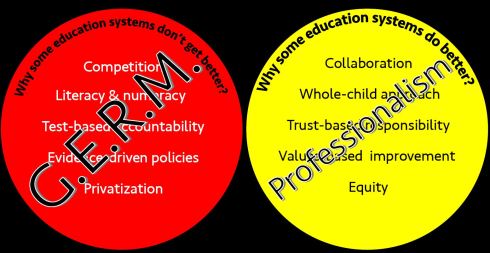
GERM is Eliminating Play
Pasi slide

Global Education Reform Slide by Sahlberg Presented at NPE 2018 in Indianapolis

Too often, curiosity and creativity are being sundered when children go to preschool, kindergarten or elementary school. “The global education race for ‘higher standards’ at lower financial costs have turned many schools to factories that try to produce standardized products efficiently on tight schedules.” Modern education reform is developmentally inappropriate. As Gloria Ladson-Billings, Distinguished Professor in Urban Education, University of Wisconsin-Madison states, “Anyone who fully understands child development knows that children’s ‘play’ is children’s ‘work.’”  

The Let the Children Play authors assert,

“The war against play is largely an unintended consequence of inept political attempts to ‘raise standards’ and ‘close the achievement gap’ by increasing ‘rigor’ and forcing academic demands on younger and younger children. It is a war being waged by an alliance of politicians, administrators, and ideologues, many of whom have one glaring weakness in common – they have little or no knowledge of how children actually learn. It is in effect, a conspiracy of ignorance, misguided policies, and misinformation.” (Emphasis added)

“This ‘GERM’ is … a virus spreading around the world, infecting school systems, and it is killing play in our schools.”

The book reports that according to data from the Torrance Tests of Creative Thinking (TTCT) “American children have suffered a startling drop of creativity” in the wake of recent decades of play deprivation. In 2011, Professor of Creativity and Innovation Kyung-Hee Kim of William and Mary reported on a review of 300,000 TTCT scores which had been constantly increasing until the 1980s and have been dropping steadily ever since. In the Creativity Research Journal, Kim reported “children have become less emotionally expressive, less energetic, less talkative and verbally expressive, less humorous, less imaginative, less unconventional, less lively and passionate, less perceptive, less apt to connect seemingly irrelevant things, less synthesizing, and less likely to see things from a different angle.”

There are many unsupported claims indicating that learning math and reading skills in preschool and kindergarten gives children an education advantage. Driven by people associated with GERM, these claims have led to an ever increasing academic focus for these children and a commensurate reduction in play. The advocacy group Defending the Early Years notes, “There is no research showing long-term advantages to reading at 5 compared to reading at 6 or 7.” Their founder Professor Nancy Carlsson-Paige, who happens to be Matt Damon’s mother, states,

“The research is clear. Faster is not better when it comes to early education; young children need play and hands-on interactions for genuine learning to occur.”

A 2015 study at Stanford University, “The Gift of Time? The school Starting Age and Mental Health”, found a strong mental health benefit to a later school starting age and there was also a likely academic payoff. A German study of 400,000 15-year-olds found no benefit to early entry into school. A Danish study found that by delaying kindergarten by one year, 11-year-olds saw a dramatic reduction in hyperactivity and attentions deficit. New York City University Professor Joshua Aronson shared, “I have learned that American kids don’t suffer from ‘Ritalin deficiency’; they suffer from a lack of nature, play, and freedom that their hunter-gather ancestors enjoyed. Play and exercise demonstrably boost academic achievement.”

Deeper Play is the Key

How Play Helps Children Learn and Grow

The authors warn that more play in not necessarily better. For play to provide the benefits described above it must be high-quality play. The authors call it “deeper play” and define it with five main ingredients:

  1. Self-direction: “Self-directed play means that we let children decide their own play in a safe and rich environment where they are comfortable to explore their own mind and potential.
  2. Intrinsically motivated: “In intrinsically motivated play, children behave or perform an action because they enjoy it and find inspiration in the action itself.”
  3. Use of imagination: “Sir Ken Robinson says that ‘imagination is the source of all human achievement,’ and it is therefore an essential condition for creativity and innovation.”
  4. A process orientation: “Process-oriented play is enjoyable for the sake of the activity itself, and is not concerned with an end result or product.”
  5. Positive emotions: “When children play, they should have a deep sense of enjoyment and fun, and may also feel joy, gratitude, inspiration, hope, love, and a sense of flow, or the full absorption in the process.”

In the book’s much more complete explanation of the use of imagination, the authors note how children’s habits of mind and imagination are being undermined by an overemphasis on standardization and testing which is narrowing curriculum. They claim, “Standardization has become the worst enemy of creativity and imagination in teaching and learning in school.”

An study by Professor Rebecca Marcon of the University of North Florida observed 343 preschool students at three different schools. One was academically oriented, one encouraged play-based learning and the third was a blend of the first two. In ongoing studies Marcon reported “children who were in a [play-based] preschool program showed stronger academic performance in all subject areas measured compared to children who had been in more academically focused or more middle-of-the-road programs.”

Let the Children Play discourages digital play. A clinical report from the American Academy of Pediatrics stated,

“Media (e.g., television, video games, and smart-phone and tablet applications) use often encourages passivity and the consumption of others’ creativity rather than active learning and socially interactive play. Most importantly, immersion in electronic media takes away time from real play, either outdoors or indoors.”

Reporting for the New York Times in October 2018, Nellie Bowles said that in Silicon Valley there is a “dark consensus about screens and kids”. She claimed, “Technologists know how phones really work, and many have decided they don’t want their own children anywhere near them.”

A 2015 report from the Organization of Economic Cooperation and Development (OECD) indicates that technology in classrooms has become a net negative. OECD’s Andreas Schleicher declared,

“In most countries, the current use of technology is already past the point of optimal use in schools. We’re at a point where computers are actually hurting learning.”

Play May Be Getting a Revival

There are several “play” pilot programs going on in the United States and throughout the world. In Fort Worth Texas, Professor Debbie Rhea of Texas Christian University created a program that tripled recess from 20-minutes a day to four separate 15-minute periods. In 2014, The Let’s Inspire Innovation in Kids (LiiNK) project started as a pilot in four schools; two using the program and two not using it to serve as a control group.  By fall of 2017 LiiNK had expanded to 20 schools serving 8,000 primary students. The authors report, “So far, the early results of Professor Rhea’s LiiNK experiment are so impressive, and so rapid, that the project may have the potential to trigger something close to a miracle in American education – more recess for children.”

China’s national Office of the Ministry of Education in 2017 announced a nationwide early education initiative with the theme “Play – Sparking the Joy of Childhood,” focusing on 3- to 6-year-olds. Academic subjects are banned.

There are play programs underway in Singapore, Tokyo, Seoul, Taipei, Shanghai and Hong Kong. New Zealand and Scotland have also started large play focused programs. A small school district on Long Island is reporting amazing results from their new play-focused program.

I encourage people who care about education to read this well documented and thorough report on the crisis of play in school.

Relay Graduate School: a Slick “MarketWorld” Education Fraud

18 Sep

By T. Ultican 9/18/2019

Relay Graduate School of Education is a private stand alone graduate school created and led by people with meager academic credentials. Founded by officials from the charter school industry, it is lavishly financed by billionaires.

Contending that traditional university based teacher education has failed; Relay prescribes deregulation and market competition. Relay does not offercoursework in areas typical of teacher education programs—courses such as school and society, philosophy of education, and teaching in democracy ….” Rather, Relay trains students almost exclusively in strict classroom management techniques.

Ken Zeichner is one of America’s leading academics studying teacher education. In a paper on alternative teacher preparation programs he noted that Match Teacher Residency and Relay “contribute to the inequitable distribution of professionally prepared teachers and to the stratification of schools according to the social class and racial composition of the student body.” Zeichner clarified,

“These two programs prepare teachers to use highly controlling pedagogical and classroom management techniques that are primarily used in schools serving students of color whose communities are severely impacted by poverty. Meanwhile, students in more economically advantaged areas have greater access to professionally trained teachers, less punitive and controlling management practices and broader and richer curricula and teaching practices. The teaching and management practices learned by the teachers in these two independent programs are based on a restricted definition of teaching and learning and would not be acceptable in more economically advantaged communities.”

Relay is another component of the destroy-public-education infrastructure that mirrors Professor Noliwe Rooks’ definition of segrenomics; “the business of profiting specifically from high levels of racial and economic segregation.”

Founding Relay Graduate School of Education

Relay’s foundation was laid when the Dean of City University of New York’s Hunter College school of education, David Steiner, was approached by Norman Atkins of Uncommon Schools, David Levin of KIPP charter schools, and Dacia Toll of Achievement First charter schools. Dean Steiner agreed to establish the kind of Teacher Preparation program at Hunter College that these three charter industry leaders wanted. The new program which began in 2008 and was called Teacher U.

Kate Peterson studied Relay for a Philadelphia group. She noted,

“Receiving $10 million from Larry Robbins, founder of the hedge fund Glenview Capital Management and current board member of Relay, and $20 million from the non-profit The Robin Hood Foundation, the three charter school leaders partnered with Hunter College in New York to implement their program ….”

The following year the newly elected and extremely wealthy Chancellor of the New York State Board of Regents, Merryl H. Tisch, tapped David Steiner to be Commissioner of Education.

Steiner and Tisch believed that there was an unhealthy university based monopoly of teacher education. Steiner moved to weaken that monopoly in 2010 by grantinga provisional charter to authorize clinically-rich teacher programs to address shortages such as in STEM areas as well as ‘students with disabilities and English language learners.’”

The following year Steiner authorized and the state board approved non-institutions of higher education to grant master’s degrees in education accredited by New York State.

Almost immediately, Teacher U became Relay Graduate School of Education and received accreditation from the state of New York. Steiner’s roll in the establishment of Relay was so prominent that he is still a member of Relay’s board of directors along with co-founders Atkins, Levin and Toll.

Relay Key Founders

Tisch and Steiner embodied a form of neoliberal ideology that the author Anand Giridharadas defined as “MarketWorld”. In Winners Take All Giridharadas explains,

“MarketWorld is an ascendant power elite that is defined by the concurrent drives to do well and do good, to change the world while also profiting from the status quo. It consists of enlightened businesspeople and their collaborators in the worlds of charity, academia, media, government and think tanks.”

Tisch and Steiner both embraced standardized testing as a legitimate measure of school and teacher quality. The former US Assistant Secretary of Education, Diane Ravitch, described Tisch as the “Doyenne of High-Stakes Testing.

Tisch and Steiner also looked to private business as a solution to perceived problems in education and they enthusiastically promoted Bill Gates’ Common Core State Standards.

When Steiner resigned as Commissioner in 2011, Tisch replaced him with John King who had a similar education philosophy.

The idea that university based teacher education programs are a monopoly that must be broken is a farce. It is advocating that professionally run education programs guided by people who have spent their lives researching and practicing education must be replaced by a privatized alternative.

Here in my hometown of San Diego, California we have four major teacher education programs. University of California San Diego and San Diego State University run the two publicly sponsored programs. The University of San Diego and National University run the two private school education programs. Those four competing programs are hardly monopolies plus they meet a high standard of professionalism, something Relay does not do.

As soon as Relay became New York’s first ever non-university associated and accredited education graduate school, billionaire money started rolling in. New Schools Venture Fund in Oakland, California sent them $500,000 in the founding year of 2011 and followed that with $1,500,000 in 2012.

Between Relay’s founding in 2011 and 2017, John Arnold, Bill Gates, Michael Dell, the Walton family plus the New School Venture Fund granted Relay $21,625,322. During its first year of operation, Relay received $10,403,909 in grants and contributions.

Relay’s Organization

Norman Atkins who was and still is the CEO of Uncommon Knowledge has assumed the leadership of Relay. Uncommon Knowledge, Inc. and Relay shared the same address until 2017 when Uncommon Knowledge became Together, Inc, which established a new address but kept their books at Atkins’ office.

Uncommon Knowledge has been very generous to Relay graduate school; granting them more than $5,000,000 between 2013 and 2017. While Atkins remains CEO of Uncommon his pay all comes from Relay.

Salaries

Top Salaries since Founding Reported on Relay’s Tax Forms

Mercedes Schneider looked at Relay in March (2018) and began her piece, “Relay Graduate School of Education (RGSE) is a corporate reform entity whose ‘deans’ need not possess the qualifications that deans of legitimate graduate schools possess (i.e., Ph.D.s; established professional careers in education, including publication in blind-review journals).”

Most Relay Deans were the founders of the Relay campus in their location. There are now seventeen Relay campuses which are in reality little more than a store front or an office. In the last year, Relay has gone from zero education doctorates to four.

Among the Deans, it appears that not one of them is qualified for tenure track at a legitimate college of education. Simply stated, Relay’s school leaders are not qualified education professionals.

When Relay tried for to go into California and Pennsylvania, both states refused them.  In an interview, Professor Zeichner remarked, “Their mumbo jumbo and smoke and mirrors game did not work however, in either CA or PA where the states ruled that Relay’s programs did not meet their state standards for teacher education programs.

Recently, there has been deterioration in the leadership at some Relay campuses. While in 2017, they all had deans, three no longer do.

In Memphis, founding Dean Michelle Armstrong left Relay to be coordinator of instructional support at the Pyramid Peak Foundation. In Nashville, founding Dean Linda Lenz has departed and so has founding Dean Jennifer Francis of New Orleans. It appears that none of the “deans” have been replaced at their respective campuses.

Teach like it is 1885

Seton Hall’s Danial Katz described the program of studies, “Relay’s ‘curriculum’ mostly consists of taking the non-certified faculty of the charter schools, giving them computer-delivered modules on classroom management (and distributing copies of Teach Like a Champion), and placing them under the auspices of the ‘no excuses’ brand of charter school operation and teachers who already have experience with it.”

A good reference for understanding where the Relay theory of education spawned is Elizabeth Green’s Building A+ Better Teacher. Green is definitely a member of “MarketWorld” and she venerates the no-excuses charter founders, but her closeness to them provided her with deep information about these schools and the thinking of their founders.

Green notes that Doug Lamov, the author of Teach Like a Champion(TLC), was part of a new class of educators “from the world of educational entrepreneurs.” Green observed,

Instead of epistemology, child psychology, and philosophy, their obsessions were data-based decision making, start-ups, and ‘disruption.’ They were more likely to know the name of Eric Hanushek, the economist who invented the value-added teacher evaluation model, than Judy Lanier.”

Doug Lamov decided to create a common taxonomy that Green described as “an organized breakdown of all the little details that helped great teachers excel.”  His list of techniques expanded to 49 and that became TLC. It was a behaviorist approach to classroom management and teaching. Some of the techniques are fine but the relentless application in a no-excuses environment stunts student creativity and need to know.

Most trained professional educators find Lemov’s teaching theory regressive. Jennifer Berkshire published a post by Layla Treuhaft-Ali. Under the title “Teach Like its 1885.” Layla wrote, “Placed in their proper racial context, the Teach Like A Champion techniques can read like a modern-day version of the *Hampton Idea,* where children of color are taught not to challenge authority under the supervision of a wealthy, white elite.”

Relay’s curriculum focuses on studying TLC through videos like this one. There is no lecture hall and no academic study of education. It is a 100% technical approach to building teachers who follow a script and teach their students to respond to cues.

Some Last Words

More from Professor Zeichner,

“Relay teachers work exclusively with ‘other people’s children’ and provide the kind of education that Relay staff would never accept for their own children. The reason that I use Lisa Delpit’s term ‘other people’s children’ here is to underline the point that few if any Relay staff and advocates for the program in the policy community would accept a Relay teacher for their own children. Most parents want more than a focus on standardized test scores for their children and this measure becomes the only definition of success in schools attended by students living in poverty.”

Relay practices the pedagogy of poverty and as Martin Haberman says,

“In reality, the pedagogy of poverty is not a professional methodology at all. It is not supported by research, by theory, or by the best practice of superior urban teachers. It is actually certain ritualistic acts that, much like the ceremonies performed by religious functionaries, have come to be conducted for their intrinsic value rather than to foster learning.”

DC Charter School Performance “Almost” Matches Public Schools

8 Sep

By T. Ultican 9/8/2019

Washington DC charter schools did not significantly outperform public schools or even match them on the last two years of PARCC testing. These disappointing results for the charter school industry come almost a quarter-century after Bill Clinton and Newt Gingrich teamed up to bring neoliberal education reform to Washington DC. As their “reforms” accelerated, residents were assured that innovative privatized schools would bring better outcomes and performance gaps would close. None of that happened. Instead, public schools have been disappearing; democratic rights have been taken away; “segrenomics” has motivated change and corruption is rampant.

It is important to note that standardized testing data has only two legitimate outcomes. These tests are not capable of measuring school or teacher quality but they do provide a huge revenue stream for companies like the testing giant Pearson Corporation and they create propaganda for disrupting and privatizing public schools. No group has put more stock in standardized testing data than the charter school industry. Since many charter schools are known to center their curriculum on preparing for tests like PARCC, it is surprising that for the last few years, Washington DC’s public schools have outperformed charters.

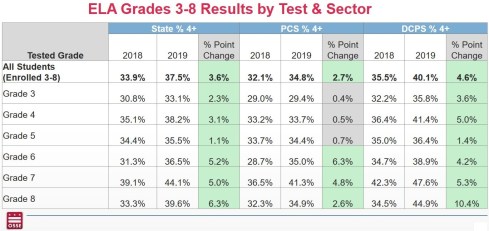
The PARCC testing consortium claims that on their 5-point scale, “Students who performed at level 4 and above have demonstrated readiness for the next grade level/course and, eventually, college and career.” The Washington DC, Office of the State Superintendent of Education (OSSE) is in charge of PARCC testing. OSSE reports the data in terms of percentage of students scoring greater than or equal to 4.

ELA 3-8 PARCC Data

ELA Data from the OSSE Report

Math 3-6 PARCC Data

Math Data from the OSSE Report

In the data above, DCPS indicates the District of Columbia Public Schools; PCS indicates Public Charter Schools and State indicates the sum of the two. The inappropriately named Public Charter School Board which oversees charter schools in the city asserts, “Public charter schools serve a student body that is equally or at times more disadvantaged, while outperforming traditional public schools.” The data shown above highlights the board’s bias.

Sociologists point out that testing reliability is undermined when employed for accountability. Donald T. Campbell famously observed, “The more any quantitative social indicator is used for social decision-making, the more subject it will be to corruption pressures and the more apt it will be to distort and corrupt the social processes it is intended to monitor.” The National Assessment of Education Progress (NEAP) testing does not have any high stakes associated with it. The following NEAP data looks at education performance gaps between races.

Gap Data 2005-2017

Red Numbers Indicate the Performance Gaps in 2005 and 2017

The chart above shows that DC performance gaps have shrunk, however, they are still the largest in the nation and more the twice the National Average. An interesting side note; another portfolio district, Denver, also has very high student performance gaps.

The other school choice initiative forced onto DC by Congress is vouchers. In 2003 the Opportunity Scholarship Program was sneaked into an omnibus bill. It authorized $20 million yearly to be spent on vouchers in the district. That means all taxpayers are paying for DC students to attend religious schools.

A recent Center for American Progress report on vouchers observed:

“This analysis builds on a large body of voucher program evaluations in Louisiana, Indiana, Ohio, and Washington, D.C., all of which show that students attending participating private schools perform significantly worse than their peers in public schools! especially in math. A recent, rigorous evaluation of the D.C. Opportunity Scholarship Program from the U.S. Department of Education reaffirms these findings, reporting that D.C. students attending voucher schools performed significantly worse than they would have in their original public school.”

With public schools outperforming charter schools, academic performance gaps being the largest in the nation and voucher students falling behind their peers, Valerie Strauss of the Washington Post asks a pertinent question,

“When are school reformers nationwide who have had a love affair with the D.C. model going to give it up?”

Why Don’t Washington DC Residents Merit Democracy?

The US Census Bureau estimates that on July 1, 2018 Wyoming’s populations was 577,737; Alaska’s population was 737,438 and Washington DC’s population was 702,455. Alaska and Wyoming both have two senators and a congressman representing them. Washington DC only has one congressman with limited voting privileges.

In 1968, the US congress gave the residents of Washington DC the right to vote for an 11-member school board. In 1996, the President appointed DC Financial Responsibility and Management Board (the “Control Board”) reduced the school boards power and claimed the authority to appoint the superintendent. In 2000, a DC referendum reduced the school board to 9 members and gave the Mayor the right to appoint 4 members. Finally, in 2007, the DC District Council passed the Public Education Reform Amendment Act (PERAA). This act transferred almost all management authority to the mayor and created the present school system organization.

There are four main Components of the Washington DC school system:

  1. The State Board of Education (SBE) which has the city’s only publicly elected school board. It sets some standards but has little actual power.
  2. The Office of the State Superintendent of Education (OSSE) is in charge of testing, data reporting, transportation, and athletics.
  3. Public Charter School Board (PCSB) is a 7-member board appointed by the Mayor. It was created in 1996 and is the sole charter school authorizer in Washington DC. It also has the power to rescind a charter.
  4. District of Columbia Public Schools (DCPS) is the public school system serving more than half of Washington DC’s students.

The Mayor has almost dictatorial control over the school system with very little input from teachers, students or parents. When Muriel Bowser was elected Mayor in 2014, she inherited DCPS Chancellor, Kaya Henderson. Bowser appointed Jennifer Niles as her chief education advisor with the title Deputy Mayor for Education. Niles was well known in charter school circles having founded the E. L. Haynes Charter School in 2004. Niles was forced to resign when it came to light that she had made it possible for DCPS Chancellor Antwan Wilson to secretly transfer his daughter to a preferred school against his own rules.

Bowser has an affinity for education leaders that have gone through Eli Broad’s unaccredited Superintendents Academy. She is a Democratic politician who appreciates Broad’s well documented history of spending lavishly to privatize public-schools. When Kaya Henderson resigned as chancellor in 2016, Antwan Wilson from the Broad Academy class of 2012-2014, was Bowser’s choice to replace her. Subsequent scandal forced the Mayor to replace both the Chancellor and the Deputy Mayor in 2018. For Chancellor, she chose Louis Ferebee who is not only a member of Jeb Bush’s Chiefs for Change, but is also a graduate with the Broad Academy class of 2017-2018. Her new Deputy Mayor choice was Paul Kihn Broad Academy Class of 2014-2015.

With the control Mayor Bowser has over public education, the DCPS webpage now looks more like a vote for Bowser publication than a school information sight.

DC Public Schools Welcome Page

Image of the DCPS Home Webpage Taken on 9/7/2019

Corruption and “Segrenomics” Infest DC Schools

Noliwe Rooks’ book, Cutting School: Privatization, Segregation and the End of Public Education, says uplifting all children requires racial and economic integration. It warns against separate but equal education. In the book, Professor Rooks defines Segrenomics:

“While not ensuring educational equality, such separate, segregated, and unequal forms of education have provided the opportunity for businesses to make a profit selling schooling. I am calling this specific form of economic profit segrenomics. Segrenomics, or the business of profiting specifically from high levels of racial and economic segregation, is on the rise.”

In the 2018-2019 school year Washington DC had 116 charter schools reporting attendance. Of that number 92 or 82% of the schools reported more than 90% Black and Hispanic students. Thirty charter schools or 26% reported over 98% Black students. These are startlingly high rates of segregation.

Of the 15 KIPP DC charter schools, all of them reported serving 96% or more Black students. According to their 2017 tax filings, seven KIPP DC administrators took home $1,546,494. The smallest salary was $184,310.

In addition to charter school profiteering, the seven people Mayor Bowser appointed to lead the Public Charter School Board seem more like charter industry insiders than protectors of the public trust.

The PCSB Board:

Rick Cruz (Chair) – Chief Executive Officer of DC Prep Public Charter School; formerly worked at the Network for Teaching Entrepreneurship, Teach for America and America’s Promise Alliance. Currently, he is Executive Director of Strategic Partnerships at The College Board

Saba Bireda (Vice Chair) – Attorney at Sanford Hiesler, LLP, served under John King at the U.S. Department of Education.

Lea Crusey (Member): Has served at Teach for America, advisory board for KIPP Chicago, StudentsFirst, and Democrats for Education Reform.

Steve Bumbaugh (Treasurer) – Manager of Breakthrough Schools at CityBridge Foundation.

Ricarda Ganjam (Secretary) – More than 15 years as Management Consultant with Accenture; consulted on KIPP DC’s Future Focus Program.

Naomi Shelton (Member) – Director of Community Engagement at KIPP Foundation.

Jim Sandman (Member): President of the Legal Services Corporation.

It appears that charter schools in DC are starting to cannibalize each other. A relatively new company called TenSquare is using its connections at the PCSB to advance its charter school turnaround service. Last year Rachel M. Cohen wrote “Behind the Consulting Firm Raking In Millions From D.C. Charter Schools; Is TenSquare effective—or just connected?” Cohen’s lengthy article stated, “TenSquare is the brainchild of Josh Kern, who graduated from Georgetown Law School in 2001 and founded Thurgood Marshall Academy—a legal-themed charter high school—immediately afterward.” TenSquare started operating in 2011. Cohen reported:

One common criticism of TenSquare is that its business model is, in a sense, circular: It can effectively hire itself. When TenSquare is brought in to assess a charter’s alleged deficiencies, it is well positioned to recommend that the charter correct those deficiencies with TenSquare’s own turnaround services.

“It’s a racket,” says Jenny DuFresne, a former charter principal whose school contracted with TenSquare. “It’s a bunch of good old boys who are talking to each other and scratching each other’s backs. Like honestly, that’s all it is.”

A disturbing quote concludes Rachel Cohen’s article:

‘“If you talk to charter people off the record around the city, you’ll find most are afraid to speak honestly about TenSquare,’ says Donald Hense, the now-retired founder and CEO of Friendship Public Charter School. ‘But they’re also afraid if they don’t hire the company then their charters will be revoked.”’

End Notes

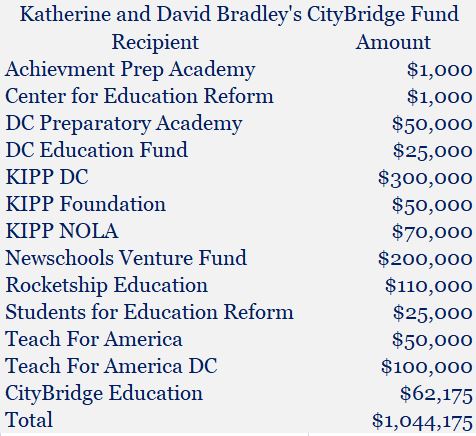
Well known national foundations that spend for school choice and market reform of education send multiple millions of dollars yearly to advance school privatization in Washington DC. These include the Edythe and Eli Broad Foundation, the Bill and Malinda Gates Foundation and the Walton Family Foundation. Locally, David and Katherine Bradley, owners of Atlantic media, have established the CityBridge Foundation. They are also spending seven figures to privatize the city’s public schools.

CityBridge

Spending to Privatize Public Schools in 2017

With all this spending, surprisingly, the expansion of charter schools in Washington DC has slowed or possibly stopped. The promised benefits from privatization have not materialized but community disruption has.

Twitter: @tultican

Broad’s Academy and Residencies Fuel the Destroy Public Education Agenda

29 Aug

By T. Ultican 8/29/2019

In 2002, the billionaire, Eli Broad, established his own education leadership training program. Although he is the only person ever to create two Fortune 500 companies, Broad, who attended public school, has no other experience or training in education. However he is so rich, he can just institute his opinions such as his belief that education knowledge is not needed to run large urban school systems; consultants can be hired for that knowledge.

Peter Greene, the author of the popular blog Curmudgucation, framed this absurdity in his own snarky fashion:

“But Broad does not believe that schools have an education problem; he believes they have a management problem. School leadership does not need an infusion of educational leadership– they need business guys, leadership guys. And so Broad launched the Superintendent’s Academy by ignoring completely the usual requirements for Superintendent certification or program accreditation. The Board Superintendent Academy exists by its own force of will. It’s kind of awesome– there is no external governing or certifying board of any sort declaring that the Broad Superintendent’s Academy is a legitimate thing, and yet, it exists and thrives.

“I myself plan to soon open the Curmudgucation Academy of Brain Surgery, or maybe a School Of  Fine Art Production. I have everything I need to make these highly successful, with the possible exception of enough power and money to get people to listen to me whether I know what the hell I’m talking about or not.”

In Pasi Sahlberg’s and William Doyle’s new book Let the Children Play, there are many anecdotes that demonstrate the fallacy of Broad’s education opinions. They describe the growing crisis developing especially in the lower grades and pre-school caused by a lack of play. School leaders frequently have no training in early childhood development leading one teacher to comment, “So often the people who have the most power to affect your teaching have no idea what appropriate, best practice looks like.” Another teacher reported sitting on the floor in a circle and singing “The Farmer in the Dell,” with a group of kindergarteners when the superintendent walked by and said, “You are going to stop singing and start teaching, right?”

School is a much more complex endeavor than running a business. A CEO at Honeywell can successfully transition to running House Hold Finance, but would find running Houston ISD beyond their scope. They wouldn’t even be aware of what they didn’t know.

Broad (rhymes with toad) is one of the billionaires driving a neoliberal agenda focused first and foremost on privatizing public education. Hastings, Arnold, Bloomberg, Walton, Rock, Fisher and Broad are all spending huge money for the cause. In the last LA School Board election, just this group spent more than $5,000,000 to capture the board. They all lavishly support both Teach for America and charter schools.

The Broad Fellowships for Education

The Fellowships for education were established in 2002 and has had 568 Fellows participate, including the 64 in the 2018-2020 cohort. The Broad Center states, Broad Residents attend eight in-person sessions over two years, taught by practitioners who know firsthand about the issues faced by urban school systems.” Residents will study among other topics:

  • “Theories of action”
  • “Budget and finance”
  • “Accountability, transparency and data-driven decision making”
  • “Labor-management relations”
  • “Innovative school models”

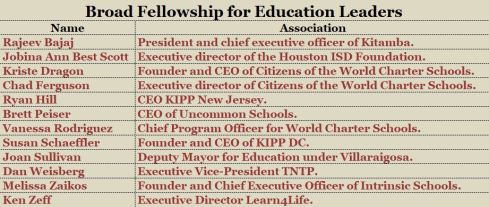
The following table lists the present Broad Fellowship trainers.

Broad Fellowship Leaders

Every “Broad Fellowship for Education Leader” is a member of an organization working to privatize public education. Joan Sullivan who served Antonio Villaraigosa as LA’s Deputy Mayor for Education is not a neutral voice.  In 2007, after failing to gain control of LA’s schools, Mayor Villaraigosa was able to arrange for about a dozen schools to be moved from LAUSD into a newly created non-profit Partnership for LA. The elected school board no-longer had jurisdiction over Partnership schools. When Marshal Tuck resigned as leader of Partnership, Villaraigosa appointed Joan Sullivan to replace him. Joan is also credited with the 2003 founding of a Bronx charter school before she moved to LA.

One of the highest profile Broad Fellows is Neerav Kingsland from the Broad Residency Class of 2009-2011. Last year, Kingsland was named Managing Partner of The City Fund. This new fund was founded when Billionaires Jon Arnold and Reed Hastings each pledged $100 million to promote the portfolio model of public school privatization. Before going to work at the Arnold Foundation in 2015, Neerav and two other law students formed the Hurricane Katrina Legal Clinic, which assisted in the creation of the privatizing organization New Schools for New Orleans. Kingsland became its chief executive officer. He is joined at the City Fund by Chris Barbic, first failed Superintendent of the Tennessee Achievement School District, Founder of YES Prep charter schools and alumni of Broad Superintendents Academy 2011.

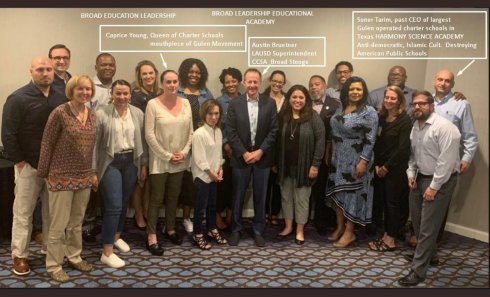
The Broad Superintendents Academy

Broad Leadership Academy

Austin Beutner with the Broad Academy Cohort 2019-2020 – (Tineye.com no result)

Not sure where the picture above originated. However, the people shown all do appear to be in the new 2019-2020 Broad Academy cohort with the exception of Austin Beutner. There is one correction. Caprice Young, the founder of the California Charter Schools Association (CCSA), is no longer a mouthpiece for Fethullah Gülen. In 2018, she became the National Superintendent for the Learn4Life, cyber school (home schooling) organization that is lucrative for operators but has terrible academic results.  This summer a San Diego Judge closed three Learn4Life centers because they were not authorized to be where they were operating.

There was a shift in focus at the Broad academy around 2012. When the operation first started in 2002 an attempt was made to bring new leadership into education including recruiting retired military flag officers. From 2002-2010, 21 retired military members attended the academy. From 2011-2019 there was one. During this later period, people working in the charter industry became dominate in academy cohorts. There have now been 243 people in the Broad Superintendents academy. Recently pro-privatization leaders like Tom Torkelson founder of IDEA Charters (2015-2016 cohort), Diane Tavenner founder Summit Charters (2015-2016 cohort), and Cristina de Jesus President of Green Dot Charters (2016-2017 cohort) feel it is important to participate in the Broad Academy. This year Sonar Tarim, founder of Harmony Charters, and Caprice Young, founder of CCSA, have continued the trend.

In 2012, the Washington Post reported about a leaked Broad Center memo that outlined a new “invitation-only group that will collaborate to address some of the most pressing challenges facing the education sector, help shape policy agendas, influence public opinion, coalesce political forces, and advance bold reforms on the ground.” The group would meet twice a year in Washington DC and “would accelerate the pace of reform.” The memo stated the following list of deliverables:

  • “It will create a powerful group of the most transformational and proven leaders.”
  • “It will become the go-to group for reform leaders to engage and move the most cutting edge work forward.”
  • “It will help create a more supportive environment and change the national landscape to make it easier for superintendents to define policy agendas, influence public opinion, coalesce political forces, and advance bold reforms on the ground.”
  • “The participants’ personal reform agendas and peer pressure from their colleagues will solidify their commitment to do whatever it takes to drive their systems and the education reform movement forward.”

When it comes to placing academy graduates, sometimes Eli Broad gets directly involved. In January 2009, Democratic Gov. Jennifer Granholm of Michigan turned to what was then a little-used state law, Public Act 72, to appoint an “emergency financial manager” charged with addressing Detroit Public School’s ongoing financial troubles. She chose Robert Bobb, a 2005 Broad Academy alumni. No doubt influencing the decision was the fact that Broad and the Kellogg Foundation agreed to pay $145,000 a year toward Bobb’s $425,000 a year salary.

Bobb’s history of failure in Detroit is well documented.

John Covington is a 2008 Broad Academy alumni. He became Superintendent of Kansas City Public Schools (KCPS) in 2009. During his first year, Covington claimed that diplomas from KCPS “aren’t worth the paper they’re printed on.” His solution for this situation and a looming budget deficit was to close 29 schools and layoff 285 teachers. This was in exact accord with the new Broad Academy School Closure guide whose first line reads, “While school closures can be an important component of any right-sizing plan to address a budget shortfall, properly executed closures require time, leadership attention, and money.”

Covington suddenly and mysteriously resigned from Kansas City in August of 2011. Local elites were stunned and blamed a school board member for hounding him out of town. It was years later before people there learned what happened. A contact at the Broad Center told Covington to be on the alert for a call from Eli Broad who happened to be in Spain at the time. When the call came Broad said, “John, I need you to go to Detroit.” Two days later, on Aug. 26, 2011, Covington was introduced as the first superintendent of Michigan’s new Education Achievement Authority.

Covington’s reputation was so harmed by his time in Michigan that he never got hired again to lead a school system.

Broad trained Superintendents have a history of bloated staffs leading to financial problems like John Deasy in Los Angeles (Ipad fiasco) or Antwan Wilson in Oakland. They also are notorious for top down management that alienates teachers and parents. Jean-Claude Brizard was given a 98% no confidence vote in Rochester, New York before Rahm Emanuel brought him to Chicago where the teachers union ran him out of town. Maria Goodloe-Johnson became Seattle’s superintendent in 2007. She was soon seen as a disruptive demon by teachers and parents. There was great glee when a financial mismanagement issue brought her down.

Conclusion

No school district trying to improve and provide high quality education should even consider hiring a candidate with Broad training on their resume. Neither the Residency nor the academy are legitimate institutions working to improve public education. Their primary agenda has always been privatizing schools and ending democratic control by local communities. That is why the founding billionaire, Eli Broad, is one of America’s most prolific financers of Charter Schools and organizations like Teach For America. He believes in markets and thinks schools should be privately run businesses.

Twitter: @tultican

TFA is Bad for America

18 Aug

By T. Ultican 8/19/2019

Teach For America (TFA) has become the billionaire financed army for privatizing public education. It is the number one source of charter school teachers and its alumni are carrying a neoliberal ideology into education leadership at all levels.

TFA undermines education professionalism and exacerbates teacher turnover. Its teachers are totally unqualified to run a classroom yet their political support caused the US Congress to label them as highly qualified teachers.

Big money and its political power have elevated TFA to being the nation’s most effective force driving the privatization of public education.

Defining  TFA Neoliberalism

This April, Angela M. Kraemer-Holland of DePaul University submitted her doctoral thesis in which she observed:

“TFA’s primary conception of itself is not as a teacher training organization, nor a non-university-based early entry recruitment program, but rather as a “movement” against a pressing and untenable social problem. Conclusions illuminate TFA’s efforts to shape participants’ understanding of teaching and learning—framing teaching as a temporary career—in order to create and sustain a broader movement in education and beyond that is reflective of neoliberal ideas.”

Kraemer-Holland’s conclusions echoes those of two TFA alumni working on their doctorates at Boston College, Randall Lahann and Emilie Mitescu Reagan. They co-wrote “Teach for America and the Politics of Progressive Neoliberalism” published by the Teacher Education Quarterly winter 2011. The classification of TFA as a progressive neoliberal organization is based on their definitions of these combined terms:

“Neoliberalism: Political ideology which calls for state policies that better enable entrepreneurs to compete in the free market. Policies which promote privatization, deregulation, individual choice, and the reduction of government expenditures are valued over those which increase, or promote the welfare state and government control of social and economic activity.”

“Progressivism: The idea that schooling and teacher education are crucial elements in the making of a more just society.”

Although neoliberalism is known to be a conservative ideology, within TFA there is the idea that the outcomes in education are more than just test scores and knowledge, but equity and justice as well. Lahann and Reagan write, “This space can be thought of as progressive neoliberalism.”

Whatever it is called, the faith is in the superiority of the market fundamentalism which Ruth Rosen defined as “the irrational belief that markets solve all problems.”

In the book Democracy in Chains, Nancy MacLean quoted former congressman and leader of the “Contract for America” Dick Armey. He summed up the neoliberal view succinctly, “The markets are rational, the government is dumb.

Neoliberal ideology has been on the ascendancy since the 1970’s coinciding with the founding of the libertarian think tanks Heritage Foundation and Cato Institute. There is an inherent anti-democratic sentiment attached to the theory.

In Democracy, Maclean provides a detailed description of the lavish spending since the 1950s by the billionaire brothers David and Charles Koch promoting their neoliberal based libertarian ideology. Charles Koch founded the Cato Institute. Their stands include an ultra-conservative property rights view and an anti-public education agenda.

Undermining Professionalism in Education

In the paper “Teach For America’s Preferential Treatment: School District Contracts, Hiring Decisions, and Employment Practices”, authors T. Jameson Brewer et al address why school districts want to hire TFA teachers. Their research led to these four points:

“(1) Districts realize the long-term savings potential that comes from converting open teaching positions to positions held exclusively for TFA (or otherwise short-term, not fully credentialed teachers).”

“(2) Districts are willing to pay additional up-front costs not only for the long-term savings but in the quest for increased test scores that can result from pedagogical practices of teaching-to-the-test that characterize TFA pedagogy.”

“(3) School board leaders have bought into the rhetoric of the ‘bad’ teacher and TFA represents a political opportunity to address that perception.”

“(4) In the case of a genuine teacher shortage, cost impacts become less important than filling positions.”

“While each rationale – or a combination of them – may explain why districts continue to honor and expand MOUs[memorandums of understanding] with TFA, we suggest that it is the long-term savings potential that is the most plausible.”

In the same paper it was mentioned that TFA alumni “tend to understand educational change through managerial terms; believing that inequity is a result of resource mismanagement and a lack of accountability and that solutions lay in merit pay for teachers, increased autonomy for leadership, standardization of curriculum, and an end to collective bargaining.

An article in Phi Delta Kappan had similar observations. In Rethinking Teach For America’s leadership models researchers, Tina Trujillo and Janelle Scott, noted that TFA alumni emphasized managerial goals. From their research they reported, “Over 80% of our participants depicted the causes of inequality in technical or managerial terms.”  The education reforms posited by the TFA alumni interviewed were:

  • “Scale back unions’ collective bargaining agreements in order to increase principals’ flexibility in personnel matters.”
  • “Increase teacher and principal effectiveness through tighter accountability.”
  • “Increase principal and teacher expectations.”
  • “Tie teacher compensation to student performance.”
  • “Hire better “talent.”’
  • “Standardize curricula and assessments.”
  • “Expand technology and data use.”

Clearly these former TFA corps members had completely assimilated the destroy public education message of failing schools, inept principals and bad teachers.

Prior to taking over a classroom, TFA teachers receive just five weeks of training. Their training is test centric and employs behaviorist principles. TFA corps members study Doug Lemov’s Teach Like a Champion.

Lemov never studied education nor taught. He became involved with the no-excuses charter movement in mid-1990s. As glowingly depicted by Elizabeth Green in Building A+ Better Teacher, Lemov observed classrooms to develop his teaching ideas.

Most trained professional educators find Lemov’s teaching theory regressive. Jennifer Berkshire published a post by Layla Treuhaft-Ali on her popular blog and podcast “Have You Heard.” Under the title “Teach Like its 1885” Layla wrote,

“As I was reading Teach Like A Champion, I observed something that shocked me. The pedagogical model espoused by Lemov is disturbingly similar to one that was established almost a century ago for the express purpose of maintaining racial hierarchy.”

Treuhaft-Ali added, “Placed in their proper racial context, the Teach Like A Champion techniques can read like a modern-day version of the *Hampton Idea,* where children of color are taught not to challenge authority under the supervision of a wealthy, white elite.”

Amber K. Kim, Ph.D. made the following observations about Teach Like A Champion:

“ TLAC strategies are not proven using empirical methodology and published in peer reviewed journals. If there are studies, what are the variables? n? p value?”

“ TLAC is for “Other people’s children” (L. Delpit). Of course some TLAC strategies are effective and even fun, but the strict adherence to TLAC as a bible for teaching is reserved for students of color and low SES [Social Economic Status].”

This year California Assemblywomen Cristina Garcia introduced a bill to end TFA hiring in the state. Garcia is a former classroom teacher and understands the importance of teaching staff stability. In an op-ed for the San Diego Union, She noted that 80% of TFA teachers are gone within three years. Coincidentally, that is the amount of classroom time researchers believe it takes for teachers to become proficient. Garcia stated,

“Third-party trainees lack crucial experience before entering a classroom, receiving only a few weeks of training and do not need to have a degree in education. For teacher-credentialing programs, hopeful educators take two years to complete their educational training and serve as a student teacher for another year before entering the classroom as its sole credentialed instructor.”

“Yes, California has struggled with a teacher shortage for decades. The answer to that shortage is not placing untrained educators in schools who leave after a two-year stint. When teachers leave after only a few years, it just exacerbates the issue. It’s a Band-Aid fix on a bullet-hole problem.”

Garcia ordered her bill to the inactive file in May.

TFA is the Billionaire Army

TFA Army

It seems like every major foundation gives to TFA. Besides Gates, Walton, Broad, Dell, Hastings, and Arnold, there is Bradley, Hall, Kaufman, DeVos, Skillman, Sackler and the list goes on. According to TFA’s 2016 tax form, the grants TFA received that year totaled more than $245 million. US taxpayer give TFA $40 million a year via the US Department of Education.

The Walton (Walmart) family has provided TFA more than $100,000,000. In 2013, their $20,000,000 grant gave $2,000 more per TFA teacher going to charter schools than for public school teachers. Annie Waldmen reporting for ProPublica observed,

“The incentives corresponded to a shift in Teach For America’s direction. Although only 7% of students go to charter schools, Teach For America sent almost 40% of its 6,736 teachers to them in 2018 — up from 34% in 2015 and 13% in 2008. In some large cities, charter schools employ the majority of TFA teachers: 54% in Houston, 58% in San Antonio and at least 70% in Los Angeles.”

To enhance the opportunities in leadership for TFA teachers, TFA created the non-profit Leadership for Education Equity (LEE). The LEE board includes Emma Bloomberg (Michael Bloomberg’s daughter); Steuart Walton (billionaire); Arthur Rock (billionaire) and Elisa Villanueva Beard (TFA-CEO).

LEE finances TFA members and alumni who run for political office and provides campaign training. All LEE members get at least $2,000 but members with the right attitude will also get individual donations from board members.

LEE, which received $29 million in contributions and grants in 2017, helped more than 150 alumni run in local and state races in 2018, according to an internal presentation obtained by ProPublica.

A LEE example: This May when Houston ISD voted to end their contract with TFA, board member Holly Vilaseca voted to renew it. Previously, Vilaseca had been a founding TFA teacher at a KIPP charter school. Walton family members and Arthur Rock gave a total of $20,000 to her 2017 school board campaign, in addition to $6,000 from LEE.

The history of the World is replete with examples of Youth movements being used by ruthless individuals for their own purposes. Four years ago, I wrote “Is TFA a Cult.” At the time, I thought that was somewhat farcical.

Today, I believe it is true. Idealistic youths are recruited, taught a neoliberal view of good governance and those that take the bait are shaped for leadership and lucrative careers.

TFA corps members and alumni are the ground forces for privatizing public education the pillar of American Democracy. TFA is bad for America.

Twitter: @tultican

TNTP is a Part of the Destroy Public Education Infrastructure

10 Aug

By T. Ultican 8/10/2019

TNTP is one of several organizations that only exist because billionaires have financed them. Wendy Kopp founded TNTP (originally called The New Teachers Project) in 1997. She assigned Michelle Rhee, who had recently finished a two year Teach For America (TFA) tour, to run TNTP. Along with TNTP and TFA there are also the Broad Superintendents Academy and the fake school for professional educators called Relay Graduate School forming a significant part of the infrastructure instilling a privatization mindset into the education community.

TNTP says it mission is to partner with educational entities to:

  • “Increase the numbers of outstanding individuals who become public school teachers; and
  • Create environments for all educators that maximize their impact on student achievement”

These are laudable goals but why would any school district or state education department turn to an organization with minimal academic background and experience to train teachers and school leaders? Michelle Rhee earned a B.A. in Government from Cornell and a master’s in public policy from Harvard with no education studies. In the Book Chronicle of Echoes, Mercedes Schneider observes that “Wendy Kopp was a child of privilege”. She left her exclusive Highland Park neighborhood in Dallas to study International Affairs at Princeton. Kopp had no education experience or training and Rhee had five weeks of training to go along with two years experience teaching elementary school in Baltimore.

Wendy and Michelle

Corporate Media Embraced Kopp and Rhee as Education Reformers (Google Images)

In 2001 despite lacking expertise in training educators, TNTP was able to report,

“In its first full year of operation, The New Teacher Project entered into 3 contracts, and in its second year of operation, the number of contracts jumped to 11. This year, The New Teacher Project has over 20 contracts, and is working with school districts, state departments of education and universities across the country.” And they stated, “We have worked with numerous clients across the country, including The New York City Board of Education, Massachusetts Department of Education, District of Columbia Public Schools and East Baton Rouge Parish School System.”

The Billionaire Drive to Privatize Public School

Before the billionaire driven push to privatize public education a “non-profit” company like TNTP would have gotten no consideration for training teachers because they were unqualified. If policy makers in New York wanted to create and alternative teacher certification path, they would have turned to an established institution like Columbia University’s Teachers College to create and manage the program. If Washington DC schools wanted to develop a teacher professional development program, they would have likely looked to the University of Maryland. These are places with more than a century of experience studying education and training its leaders.

Papers coming from leading education institutions like the University of Texas or the University of California are peer reviewed scholarly efforts. Whereas TNTP produces non-peer reviewed polemics like “Widget Effect: Our National Failure to Acknowledge and Act on Differences in Teacher Effectiveness” a paper that accelerated teacher bashing. It looked like a real research effort but it was submitted through friendly media avoiding professional criticism. In 2001, a banner on the TNTP web page falsely claimed, “No single factor has a greater influence on student achievement than teacher quality”. Of course family income, mental health and the language spoken at home are much more decisive.

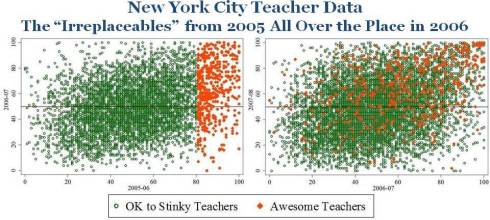
Another faux non-peer reviewed paper produced by TNTP was called “The Irreplaceables”. The paper defines the “irreplaceables” as the “top 20% of teachers in studied districts, as gauged by district data.” The gauge used was the widely discredited value added measures (VAM) which the American Statistical Association weighed in on stating,

“The VAM scores themselves have large standard errors, even when calculated using several years of data. These large standard errors make rankings unstable, even under the best scenarios for modeling”.

Although not a peer-reviewed paper, Bruce Baker of Rutgers University commented on the paper for the National Education Policy Center. He bluntly called it, “a report that is utterly ridiculous at many levels”. Baker powerfully demonstrated his point with the following graphs.

Irreplaceables

Baker’s Graphics Showing the Absurdity of the TNTP Claim

A central business of TNTP today, is training principals through its Pathways to Leadership in Urban Schools (PLUS). PLUS has a presence in Camden, Kansas City, New York, Philadelphia and San Francisco. In this program, PLUS provides academic training and places principal trainees in local district schools with contracted mentor principals.

Kansas City PLUS has a contract with Kansas City Public Schools (KCPS). They share about themselves:

“Kansas City PLUS is a two-year, practice-based principal certification residency and master’s program that helps talented educators become capable school leaders. With support from a leadership coach and experience managing teachers in a local school, our residents learn how to create a school culture in which students are challenged and inspired, and where teachers receive the feedback and support they need to grow.”

PLUS inadvertently shares the real reason KCPS contracted them instead of the Universities of Missouri or Kansas. TNTP lists among its partners:

The Ewing Marion Kauffman Foundation, which funds Kansas City PLUS, was established in the mid-1960s by the late entrepreneur and philanthropist Ewing Marion Kauffman.”

The Hall Family Foundation is a private philanthropic organization that makes grants to community programs in the greater Kansas City area.”

The Walton Family Foundation is working to expand opportunities and empower children and families with educational options. Since 1992, we have invested more than $1.3 billion in K-12 education and supported a quarter of the 6,700 charter schools created in the United States.”

At the end of 2016 the smallest of these three funds was the Hall Family Foundation with assets of $833,764,620. Without these monies, Kansas City would be training all of its principals through university programs.

The Kauffman Foundation is emblematic of a growing problem in the philanthropic world. Ewing Kauffman graduated from public school and supported public education with both time and money. It would be surprising if he supported the privatization effort his legacy is being used to promote. Today, the $2 billion fund he founded is led by Wendy Guillies. She serves on the boards of the Greater Kansas City Chamber of Commerce, KCSourcelink, MRI Global, Folience and the Enterprise Bank Advisory Board. The Kansas City Business Journal named her to the Power 100 list in 2016 and 2017, and TechWeek KC named her to the Tech 100 list. Obviously she is a very accomplished women but her resume is consistent with the pro-privatization views espoused by the American Legislative Exchange Council and their chief supporter, Charles Koch.

The PLUS Program has Issues

I became privy to some inside communications when contacted about the possibility of a class action suit against TNTP. The warning that follows summarizes some of the negative feelings percolating within the PLUS organization. With the heading “Beware” the following is from a Principal Intern:

“This organization advertises 60,000 – 100,000. This is to lure you to apply for the position. You will be paid teachers salary and that will be based on your years of teaching and the school district you are partnered with. They will not tell you this upfront. You will initially be contracted as a teacher under a title such as “Instructional Coach”. You will work the same hours as your Mentor Principal. Your will work days that teachers are off, even though you are contracted as a teacher. Be prepared for an unorganized bunch of Plus Leaders who are mean and evil spirited, that lie and have no clue as to what they are doing. Be prepared to be treated like your personal life doesn’t matter, under the direction of an insecure clueless coach and unstable PLUS Leader. Even the Program Manager was incompetent and was belittled by the PLUS Leaders on many occasions.

“PLUS promises so much and offers very little. You have been warned. They attack your personal character and take things personally. Once you challenge them about anything, you will be targeted and provoked.

“In the end they will decide if you will become a principal, not the university, based on TNTP standards. You will also pay expensive tuition for a degree and certification that is offered much cheaper at other universities (for non-university curriculum in coursework). This information was also not given in the beginning.”

Claims of racial discrimination were also raised as a motive for a class action suit.

Unaccountable and Absurd Organizations that Should be Stopped

The ridiculous contention that TFA, TNTP, Relay Graduate School and The Broad Superintendents Academy are organizations that local elected officials should embrace is detailed in the post “Fake Teachers, Fake Schools, Fake Administrators Courtesy of DPE.” These organizations have one purpose and it is NOT improving education. They exist to advance the privatize everything agenda most wealthy elites support. The super-wealthy fear democracy and do not feel it is right for “makers” like themselves to be paying to educate the children of “takers” who should be responsible for educating their own children.

Working for these want-to-be oligarchs is lucrative. The last tax return from TNTP (Sep. 2017) listed the top 12 paid employees and all of them made more than $200,000 per year. “Thirty pieces of silver” is not worth undermining democratic rights and free universal public education.

Twitter: @tultican

Five Decades of ‘MarketWorld’ Education Reform

27 Jul

By T. Ultican 7/27/2019

There has been a fifty-year push to reform education using business management principles. In the period, Harvard Business School has trumped Columbia Teacher College concerning pedagogy. Unfortunately, the results are an unmitigated disaster for most communities and students. This market based endeavor – financed by billionaires – has transformed public schools into non-democratic profit centers. It is the precursor to the ultimate goal of dismantling universal free public education.

The radical right is pushing to privatize everything from policing; to prisons; to schools. They have spread the gospel that governments are incapable of solving problems but businessmen can. In his first inaugural address, Ronald Reagan declared “…, government is not the solution to our problem; government is the problem.” Viewing society as consisting of “makers” and “takers,” these apostles of privatization fear the tyranny of democratic majorities. They strive to make property rights the paramount civil right.

When it came to privatizing school, the right originally tried to use vouchers, but that was a tough sell. Jeffry Henig an Education Professor at Teachers College, “The Walton foundation itself was one of the early organizations to transition from vouchers to charters.” In his AlterNet article Bryant explained,

“Henig believes many conservatives view charter schools as a way to “soften the ground” for potentially more private options, though he isn’t entirely sure “the Waltons view charters as a Trojan Horse for eventually providing vouchers universally.’”

When putative progressive organizations like the Center for American Progress or Democrats for Education Reform promote charter schools they are promoting an anti-democratic and anti-union position. When politicians like Corey Booker and Joe Biden say they support public charter schools, they are in fact supporting the radical right’s privatization agenda. When Bill Clinton eliminated depression era banking rules and “welfare as you know it” plus campaigned for school choice; he was advancing Charles Koch’s ideology.

Two recent books have brought the privatization agenda into sharp relief.

The first book is Democracy in Chains: The Deep History of the Radical Right’s Stealth plan for America by Nancy MacLean. Through serendipitous good fortune, MacLean stumbled onto Nobel Prize laureate James M. Buchanan’s unorganized papers shortly after his 2013 passing. They were in boxes and stacked on tables in his George Mason University cabin. The other more well known American Nobel Prize winning economist from the right is the Milton Friedman. However, MacLean discovered that Charles Koch, the financier of the radical right “bypassed Friedman for Buchanan.

The other book is Winners Take All: The Elite Charade of Changing the World by Anand Giridharadas. He takes the reader inside the worlds of elite philanthropy in New York City and of thought leaders in Aspen, Colorado. He writes,

And what these winners wanted was for the world to be changed in ways that had their buy-in – think charter schools over more equal public school funding, or poverty-reducing tech companies over antitrust regulation of tech companies. The entrepreneurs were willing to participate in making the world better if you pursued that goal in a way that exonerated and celebrated and depended on them.

James M. Buchanan, John C. Calhoun and Segregation

James M. Buchanan grew up in Tennessee. His grandfather had been an unpopular governor of the state; however Buchanan was raised in near poverty. It was his academic abilities that took him from the obscurity of Middle Tennessee State Teachers College to a doctorate in economics from the University of Chicago in 1948. The youthful socialist became a “zealous advocate of market order.” It was at the University of Chicago where Buchanan met Friedrich August Hayek and the Austrian School of Economics.

Writing in Atlantic Magazine Sam Tanenhaus disclosed, “Hayek initiated Buchanan into the Mont Pelerin Society, the select group of intellectuals who convened periodically to talk and plot libertarian doctrine.” After World War II ended, The Mont Pelerin Society was a relatively small group of economists mostly from Europe and the United States who were widely viewed as a fringe group. They were against initiatives such as social security, universal health care and public education. The title of Hayek’s 1944 book The Road to Serfdom encapsulates their antipathy to any government social endeavors.

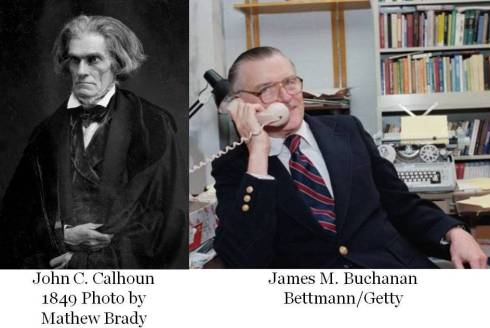
Professor MacLean, who is a historian from Duke University, compared Buchanan’s economic ideology with John C. Calhoun. Calhoun was a son of the antebellum south, a senator from South Carolina and a Vice President of the United States. MacLean quotes him stating, “A ‘government based in the naked principle that the majority ought to govern,’ was sure to filch other men’s property and violate their ‘liberty.’” Calhoun was also a leading defender of slavery. In his most famous speech he said slavery is “instead of an evil, a good–a positive good.

Buchanan and Calhoun

Buchanan’s first plumb teaching assignment came at the University of Virginia in 1956. This was also when the “massive resistance movement” to Brown versus the Board of education and desegregation of public schools in Virginia was heating up.

In 1959, Buchanan joined with another new hire at the university, G. Warren Nutter (who later became a key Goldwater advisor) to write “The Economics of Universal Education.” They argued that the root of the desegregation problem was that “state run” schools had become a “monopoly” that should be broken by privatization. They said if the state sold off their school buildings and equipment, they could limit their involvement in education to setting minimum standards. Then all kinds of schools might blossom.

Since MacLean’s book was published there has been some push back against her tying Buchanan and his paper to the “massive resistance movement” saying he did not involve himself in desegregation politics only in the economic issues of education. However, Buchanan and Nutter did state in their paper, “Every individual should be free to associate with persons of his own choosing.” In any case, schools in Virginia were closed. Black children stayed home while white children attended tax-subsidized private schools. In Prince Edward County, schools were locked closed from 1959-1964. MacLean says that for Buchanan segregation was just a side issue in his life-long libertarian pursuit.

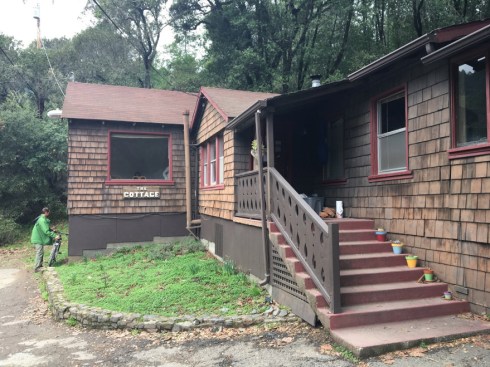
Murray Newton Rothbard was an American economist of the Austrian School and a political theorist whose writings and personal influence played a seminal role in the development of modern right-libertarianism. MacLean discovered “Murray Rothbard encouraged Koch to study Lennin.” Not Lenin’s economics but his methods for advancing an unpopular ideology. On this point MacLean noted, “At a 1973 March log cabin meeting Buchanan stressed the key thing moving forward was that ‘conspiratorial secrecy is at all times essential.’”

In 1978, I saw the Communist Workers Party takeover the Iron Workers Union at National Steel and Ship Building Company (NASSCO) in San Diego. When watching the development of the radical right for the past few decades, similarities with the tactics of communist movement were unmistakable. Both movements are secretive, anti-democratic and motivated by extreme economic theory.

MacLean states, “The Mont Pelerin Society cause since the 1950’s is the end of public education.

Killing Public Education

In 1978, Congressman Ronald Mottl D-Ohio 23 introduced a bill promoting education standards. It was the first time a bill was proposed that amended the 1965 education law to promote a particular theory of education. Mottl’s bill went nowhere like another similar bill (H.R.371) introduced the next year by his colleague Tennyson Guyer R-Ohio 4. However, these were the first harbingers of education standards that emulated business practices.

In 1983, the Reagan administration produced the infamous “A Nation at Risk: The Imperative for Educational Reform.” This polemic was neither factually nor pedagogically well founded. Serious academic research has subsequently shown this non-peer reviewed writing to be the misguided work of amateurs. Its glorification of business practices opened the door for federal control of education and fostered standards based accountability. It made legislation like the proposals introduced by Mottl and Guyer viable.

In Winners, Giridharadas labels – modern social reform based on the belief that business leaders and market forces are the sure way to a better society – “MarketWorld.” He explains,

In an age defined by a chasm between those who have power and those who don’t, elites have spread the idea that people must be helped, but only in market-friendly ways that do not upset fundamental power equations.

Giridharadas shares three criteria for being a “MarketWorld” thought leader speaking at the Aspen Institute or the Clinton Global Initiative or the main TED talk stage. Thought leaders should:

  • Focus on the victim, not the perpetrator.” Condemning a perpetrator is a “win-losey” solution not a win-win.
  • Personalize the political.” If you want to be a thought leader and not be dismissed as a critic, your job is to help the public see problems as personal and individual dramas rather than collective and systemic ones.
  • Be constructively actionable.” … “People, especially the winners who shape tastes and patronize thought leaders, want things to be constructive, uplifting, and given to hope.

He gives examples including this one:

“What the thought leaders offer MarketWorld’s winners, wittingly or unwittingly, is the semblance of being on the right side of change. … Take, for example, the question of educating poor children in a time of declining social mobility. A true critic might call for an end to funding schools by local property taxes and the creation, as in many advanced countries, of a common national pool that funds schools more or less equally. What a thought leader might offer MarketWorld and its winners is a kind of intellectual counteroffer – the idea, say, of using Big Data to better compensate star teachers and weed out bad ones.”

Data shows that “MarketWorld” and libertarian philosophy has damaged public education and harmed all but the top 10% of wage earners in America. Giriharadas shares the following data table information and notes, “One hundred and seventeen million people had been completely shut off from economic growth since the 1970s.

Earning Level 1980 2014
Top 0.001 % $17,000,000 $122,000,000
Top 1% $428,000 $1,300,000
Top 10% $58,000 $116,000
Bottom 50% $16,000 $16,200

It is possible that Charles Koch and “MarketWorld” think this is a feature. To me, it looks like a powerful data set that says we need an empowered Government to protect Americans from ravenous billionaires and their self-serving anti-public education and anti-democratic views.

Twitter: @tultican

Reforming California’s Dysfunctional Charter School Law

18 Jul

By T. Ultican 7/17/2019

Members of the California legislature have engaged in an internecine battle over charter schools. Even the California Charter Schools Association (CCSA) has expressed concern over lawless cyber charters and filed the first known complaint with the California Department of Education over A3 Education and Valiant Prep which were recently charged with stealing a stunning $50 million. California State Sen. John Moorlach (R) is warning that 85% of school districts in California are running deficits. Governor Gavin Newsom has statedrising charter school enrollments in some urban districts are having real impacts on those districts’ ability to provide essential support and services for their students.”

The drive to privatize schools in Oakland, San Diego and Los Angeles has been fueled by enormous sums of money spent on elections. Billionaires led by Eli Broad and Richard Riordan have successfully installed a former investment banker – a proponent of school privatization with no education experience – as Superintendent of Schools for Los Angeles. In Oakland, hundreds of thousands of dollars have been donated to pro-privatization independent expenditure committees and a similar amount has been donated directly to charter friendly candidates running for that city’s school board. Very few of the donations come from Oakland. The story is similar in San Diego.

With so many extremely wealthy individuals like Michael Bloomberg from New York City, Stacy Schusterman from Tulsa, Oklahoma and Alice Walton from Bentonville, Arkansas continually making six and seven figure donations to privatize public schools in California, the defenders of public education are fighting with all they have against what they see as an undemocratic attack by oligarchs. At the same time, many charter school leaders are feeling insecure and under attack.

It is this Gordian Knot that legislators are addressing. As Upton Sinclair observed, “It is difficult to get a man to understand something when his salary depends on not understanding it.

California’s new Democratic governor does not seem as mindlessly pro-charter school as the outgoing Democrat but his long time backers and chief of staff have public school advocates concerned. The Sacramento Bee reportedGavin Newsom turns to top Hillary Clinton adviser to launch administration.” That would be his Chief of Staff, Ann O’Leary, whose Fortune magazine biography says she was a key voice in creating the No Child Left Behind (NCLB) law. She defends NCLB stating, “We were committed to high standards and helping states get there.

For those of us working in classrooms in 2001, it became clear that O’Leary’s education ideology harmed students and facilitated privatizing public schools. Her theory comes from the neoliberal business mindset that venerates market based solutions and competition. The writer Anand Giridharadas recently labeled this philosophy “MarketWorld.”

Leading up to the 2018 general election, the Los Angeles Times ran an in-depth article about the eight elite San Francisco families that have funded Newsom’s political success. Although his own family was not particularly wealthy, they did provide him with connections to the wealthy elite. The Times story included,

“He has said he was primarily raised by his mother, who at times struggled to make ends meet. But Gordon and Ann Getty viewed him as a son, according to interviews the couple gave to the San Francisco Chronicle and W Magazine, and they provided him with experiences his parents could not afford, including an African safari when he was a teen, Newsom said in an earlier interview with The Times.

‘“It all goes back to the Gettys as far as Gavin is concerned,’ said Jerry Roberts, former managing editor of the San Francisco Chronicle and an expert on Bay Area politics.”

The Getty’s are the heirs of John Paul Getty. However, of the eight families described in the Time’s article it is the Fishers and Pritzkers that most concern public school advocates. Doris Fisher and her late husband Don founded The Gap. They were the first major contributors to KIPP charter schools and Don was a cofounder of the Charter School Growth fund. Doris continuously contributes to efforts for privatizing public education. The Fisher family has provided more than $300,000 in contributions to Newsom since 1998.

The Pritzker family are heirs to the Hyatt Hotel empire. Penny Pritzker was Barack Obama’s campaign treasure and his Commerce Secretary. As Secretary of Commerce, she used the Malcolm Baldrige award to promote charter schools in the mall. In Chicago, the family financed a charter school called Pritzker College Prep which is part of the Noble Network of Charter Schools. Since 1998, the Pritzker family has donated more than $600,000 to Newsom.

Newsom and the SF Billionaires

Newsom Hob Knobbing with San Francisco Elites (from the LA Times)

Legislature Takes on the Issue

Four bills were introduced in February aimed at reforming the charter law. Newly elected Senator María Elena Durazo from Los Angeles submitted SB 756 for a moratorium on new charters. Over at the assembly education committee three reform bills were presented AB 1505, 1506 and 1507. AB 1506 would have introduced a new meaningful cap on new charter schools. In May, both SB 756 and AB 1506 were pulled by their respective authors. The Los Angeles School Report said,

“On Wednesday, Sen. Maria Elena Durazo sidelined the Senate moratorium bill, which she authored. The bill would have placed a two-year halt on new charter schools in the state unless the Senate passed further regulations. The measure could return for consideration next January, according to Senate rules.

“The next day, Assemblyman Kevin McCarty opted to hold his bill on the last day it was eligible for a vote in the chamber. AB 1506 would have mandated a statewide cap on charter schools…”

Now the battle is centered on AB 1505 and AB 1507. 1505 increases local control over chartering and reduces rights of appeal and 1507 bans charters not authorized by the district in which they operate.

On July 9th, EdSource reported,Governor’s team jumps into fray over contested charter school bill.” It said,

“On Wednesday, the Senate Education Committee held a hearing on Assembly Bill 1505, which included a substantial number of amendments that Newsom’s office submitted after numerous discussions between his advisers and representatives of charter schools, organized labor and the bill’s author, Assemblyman Patrick O’Donnell, D-Long Beach, according to sources familiar with the discussions.

“With the final vote expected at day’s end, Senate Education Committee Chairwoman Connie Leyva, D-Chino, characterized the amended bill as ‘the makings of a deal with the governor’s office’ and said she is ‘cautiously optimistic’ that remaining issues can be resolved over the summer for passage in the fall.”

Scholar and former US assistant Secretary of Education, Diane Ravitch, reacted to this news with a post on her blog titled, “California: Is Governor Gavin Newsom Selling Out to the Charter Industry?” Diane points out that the one thing the charter Industry has going for it is money. She noted that politicians are always in search of money for their next campaign and says, “Big donors always find open doors.

Back in the Education Committees

The Assembly Education Committee chairman is Patrick O’Donnell a 20-year classroom teacher who worked mostly in middle school. He is leading AB 1505 through the difficult legislative process. The authors of the bill are San Jose Assembly member Ash Karla and East Bay Senator Nancy Skinner who are both representing areas suffering at the hands of the charter industry.

The other bill still alive is AB 1507 which blocks districts from authorizing charter schools out of their own boundaries. Assembly members Patrick O’Donnell, Kevin McCarty and Christy Smith authored this bill.

The Assembly Education Committee has seven members; five Democrats and two Republicans.  One of the first big hurdles for these two bills came at an April 10th hearing. It was the first opportunity to keep these bills alive or kill them. Charter school supporters came out in droves to talk the bills down. It was during this hearing that Assembly member Shirley Weber from San Diego said “since the four coauthors are here this is a done deal.” Weber also said she did not think these bills addressed the right issues and announced she would not be supporting them. Interestingly, Weber did not vote against the bill, she just didn’t vote. The bills passed out of committee by a vote of 4 to 1 with the lone descent coming from the only Republican in attendance Kevin Kiley.

There was a similar dynamic when these bills finally arrived at the Senate Education Committee this July. The Senate Committee is also a seven member committee with five Democrats and Two Republicans. Democratic Senator Steven Glazer said “781 public schools in the state have poor performance” and “We have failures all across the state.” Like Weber he was not satisfied with the content of the bills and said we need to worry about too many students in failing schools. Glazer did not make clear what he based his failing schools charges on. However, the charges by the Contra Costa Senator are similar to the charges made by leaders of the school privatization movement like the current US Secretary of Education, Betsy DeVos.

Both AB 1505 with the Governor’s amendments and AB 1507 were voted out of the Senate committee by identical 4 to 3 votes. The two Republicans and Glazer were the no votes.

Possibly Weber and Glazer agree with DeVos and her choice advocacy and that is why privatizing money is going to them or did they take this anti-public school position to attract that money? In any case, privatization money is flowing their way.

Glazer and Webber

Data from California Secretary of State Glazer ID #1377665 and Weber ID #1393376

When these two bills went to the Assembly for a floor vote, every Republican voted no or didn’t vote. Weber didn’t vote and Glazer joined two other Democrats voting no. The final tallies were AB 1505 44 yes 19 no with 17 not voting and AB 1507 54 yes 18 no with 8 not voting.

As a child growing up in a Republican community in Idaho, I remember Republicans as being very pro-public education and suspicious of big business and big centralized government. What happened to my grandfather’s Republican Party? How can it be that not one Republican during any of the votes taken supported protecting our public schools from plunder by large charter management organizations or stood against the demise of Democratic local control of schools?

If we consider the development of political action committees (PAC) for privatizing public school, the anti-democratic nature becomes stark. If your holdings are $2 or $3 billion, then you are generating at least $100 million income every year. So, donating $1 million to four PACs is not a strain. That means besides creating a huge pot for independent expenditures, the 4 PACs will also send 4 more max donations to your favored candidates. No matter how bad the idea being pushed, this kind of spending gives it consideration and drowns out opposition.

The Bills and Amendments

Former State Sen. Gary Hart, a Democrat who represented Santa Barbara in the Assembly and Senate for 20 years, authored the original 1992 California charter school law. Sue Burr, a current member of the State Board of Education, played a major role in drafting it. EdSource interviewed Sen. Hart last year. Reporter John Fensterwald noted that the financial impact on a district was not part of the law and asked, “Was it brought up at the time?” Hart replied,

“I don’t think so. The law didn’t have large-scale financial ramifications. We were talking about 100 charters statewide.”

The original law capped charter schools at 100 statewide. In 1998, the cap was raised to 250 with a 100 schools a year escalator thereafter. Today, there are 1310 active charter schools in California and the current cap statewide is 2,250 for the 2018-19 school-year. Neither this uncontrolled growth with essentially no cap nor its financial implications were addressed in the original law.

As originally proposed, AB 1505 would have given all school districts broad authority to reject a charter school’s application and renewal after considering the financial impact on neighborhood schools and the district. That provision has been restricted to just school districts already certified as being in financial crisis.

The amended version also sides with charter schools in changing the language back to “shall” issue a charter to a petitioner who met the state requirements from the less demanding “may” issue the charter.

None of Governor Newsom’s amendments are more demanding on the charter industry and most make things easier on the industry.

While Mayor of Oakland; Jerry Brown created a military charter school with the National Guard. Language added to the education funding bill AB 75 in December was automatically added to the charter law. That mysterious language seems written solely for the benefit of Brown’s school.

“Notwithstanding any other law, a charter school in operation as of July 1, 2019, that operates in partnership with the California National Guard may dismiss a pupil from the charter school for failing to maintain the minimum standards of conduct required by the Military Department.”

The Oakland Military Institute had tried during its reauthorization to be allowed to dismiss students who had too many demerits. The Chartering Authorities rejected the request. They felt that demerits were given for such minor offenses as not having a badge sewn on correctly and that a student should only be dismissed from a public school in extreme circumstances. Now the charter school’s questionable request is written into law.

Conclusions

Money is still ruling but even the watered down bills as amended are better than what we have now, so it is important to keep pushing for their passage.

A parent and fellow Bay Area resident named Jane Nylund wrote a letter to Newsom expressing her disappointment at his amendments. Diane Ravitch posted the letter. I encourage you to read the whole letter. It makes many strong points. Jane personalized the letter noting,

“You and I have something in common-we both attended well-resourced public high schools. You went to Redwood High School in Marin, and I attended Miramonte High School in Orinda, located in what is now one of the wealthiest suburbs in the East Bay. Lucky us.

“The irony regarding your potential alliance with privatization groups like CCSA is that, because of your severe dyslexia, you would have been rejected by the same schools that are now being touted as “high quality seats”, aggressively marketed as superior to real public schools because of test scores. According to the bio I read, you were rejected from a private prep school and enrolled in your local public high school instead. So you have first-hand experience with the idea that real public schools enroll all children, not just the easy ones.”

Charter Scandal a Product of Shabby Law and Ignored Oversight

7 Jul

By T. Ultican 7/7/2019

Notoriously clever operators of an online charter empire were indicted for allegedly stealing $50 million dollars. The Grand Jury of San Diego County heard the testimony of 72 witnesses and voted out a 67-count indictment against Sean McManus, Jason Schrock, Justin Schmitt, Eli Johnson, Steven Zant and six others. The charges were centered on the byzantine operations of the A3 Education organization which took full advantage of weak charter school laws in California.

From the indictment,

“Conspirators knowingly obtained state funding for children who were not assigned certificated teachers as required by law, were not in contact with the charter school, and who were not provided any educational services during the dates claimed.”

“Conspirators themselves, and through subordinates courted small school districts across California who were suffering budget woes and suggested they authorize charter schools as a means to generate additional state funding for the district in the form of oversight fees.”

The Small District Authorizer Model

Carol Burris was one of the first people to identify McManus as a predator. In her 2017 investigative report “Charters and Consequences”, she wrote about the Wise school which calls itself a Waldorf inspired charter school. She noted,

“No one really seems to be wise to Wise—except perhaps California STEAM Sonoma, which claims Wise Academy as its project.”

“The former Academy of Arts and Sciences CEO, Sean McManus, described Wise as “a boutique program that people usually have to pay for, so to be part of a free charter school appeals to a lot of people in the area.” Wise and the state funding it brings left the Academy of Arts and Sciences, and so did Sean McManus, who is now listed as the CEO of a new corporation–California STEAM Sonoma.”

“Despite its classroom schedule, Wise refers to itself as a ‘learning based resource center.’ This classification allows California STEAM Sonoma to sponsor the program, and the Liberty School District to acquire the cash cow.”

Wise is still in operation under the name Heartwood Education Collaborative. McManus exited the Academy of Arts and Science (AAS) in 2016. AAS renamed itself Compass Charter Schools. Shortly after leaving AAS, McManus cofounded A3 Education with Jason Schrock.

Heartwood Educational Collaborative

Heartwood (AKA Wise) Education Collaborative Independent Journal Photo

Carol Burris recently posted,

From 2009-2015, McManus was the CEO of the Academy of Arts and Science Charter Schools for which he served as CEO from 2009-2016, developing his model of using cash-strapped, small districts as authorizers of online charter schools that draw students from all over adjoining counties in exchange for fees.”

“And who gave the seed money to start this adventure?”

“The U.S. Department of Education’s Charter Schools Program (CSP) did.”

“Eleven Academy of Arts and Sciences charter schools that used the for-profit K-12 curriculum received a total of $2,825,000 from the CSP state grant to California. Today, all 11 schools are closed.”

McManus and his associates at A3 implemented the small district authorizer model with a vengeance.

Previously, one of McManus’s first forays into using small district authorizers was with New Jerusalem Elementary School District which authorized the Academy of Arts and Sciences – San Joaquin and CalSTEM – San Joaquin. For unknown reasons, AAS closed both those schools and its renamed successor Compass Charter Schools has departed San Joaquin County. New Jerusalem only had 22 Public School Students this year but it had 4,809 Charter School Students, few of whom lived in their Tracy, California area. New Jerusalem appears more sinister than just a cash strapped small district.

Apparently, part of the problem McManus had at AAS was that some of their schools were blended learning academies which meant they had physical addresses. This led to a law suit by Los Angeles Unified School District for opening schools in their district without notification and the closure of some schools. A3 Education has been careful to only implement Independent study; AKA 100% cyber schools with no physical addresses for students.

A3 Small District Model

Based on California Department of Education Enrollment 2018-2019

All of the schools listed above with the various districts have the same business address, 3300 Irvine Ave. #330 Newport Beach, Ca 92660 which is A3 Education’s business address. The non-profit tax filings available for theses schools all show this address and have some combination of Rob Sikma, Kevin Tu, Eric Johnson and Klarc Kover on their boards. As an example see these legal documents for California Steam San Bernardino, California Steam Sonoma, University Prep and Uplift California.

Board member Eric Johnson is probably the person indicted in San Diego under the name Eli Johnson. Board members Sikma, Tu and Kover all testified before the grand jury investigating A3.

Various California news sources reported details about the alleged scheme to steal $50 million. San Diego’s Courthouse News wrote about the funding of the charter schools,

“The funds were then transferred to multiple companies owned by McManus and Schrock, including A3 Education, A3 Consulting, Global Consulting Services and Mad Dog Marketing. The money was spent on start-up investments and real estate and some funds were wired directly to themselves or family members, according to the indictment.”

“Another co-defendant, Steve Van Zant, 56, created the company EdCBO to provide back office services for A3 Charter Schools. He hid his involvement with EdCBO and McManus by filing all corporate paperwork under another person’s name, prosecutors say.”

The Los Angeles Times stated,

“From the affiliated businesses, at least $8.18 million went into personal bank accounts, some in Australia, and into charitable trust accounts for McManus, Schrock and their wives, and $500,000 went to a family member of McManus, according to the indictment.”

“McManus and Schrock also used $1.6 million of A3 Education’s funds to buy a private residence for McManus in San Juan Capistrano, the indictment states.”

“The alleged violations included Valiant Academy paying A3 about $3.6 million during the 2017-18 fiscal year. The invoices were approved for payment by McManus at A3 and another man, neither of whom were employees of the charter school, according to the district’s report.”

“The school also paid Mad Dog Marketing — a company that has common ownership with A3 — $288,000 during the 2017-18 fiscal year, according to the report.”

The Voice of San Diego added,

“An early step in establishing the A3 empire came when Steve Van Zant, a former superintendent of Dehesa Elementary School District, “brokered” the sale of an online nonprofit charter school to A3 for $1.5 million, prosecutors say.”

“In winter 2017, Chris Thibodeau was performing an annual audit of Cal Prep Sutter in Sutter County …. He noticed that McManus was listed as the CEO of Cal Prep Sutter, but that the school was also doing business with McManus’s company A3 Education.

The Voice of San Diego explained that prosecutors allege McManus and Schrock fabricated a set of minutes dated July 6, 2016 that said McManus was replaced as CEO by codefendant Eli Johnson. They purportedly used these false documents to allay Thibodeau’s concern about “related transactions.”

Sean McManus appears to have fled the country and is thought to be in his native Australia. The other 10-defendents have entered not guilty pleas.

State Charter Law was Designed to be Weak

Cyber Charters in California can serve all of the students in the home county of the authorizing district plus all of the students from bordering counties. That means these eight small school districts gave A3 access to millions of students.

A3 Athorizer Map

Voice of San Diego Map of Counties Served by A3

In the school year 2018-2019, Dehesa Elementary had 5010 students in online only schools. Of those 2267 were in kindergarten to third grade or 45.2% of the total. There were similar numbers in the other districts. Why would people put babies in front of computer screens? It must be that the main attraction for these cyber schools is home-schooling.

Since home-schooling does nothing to build community and is driven mostly by religious convictions, why should taxpayers fund it? All Americans should have freedom of choice, but taxpayers should not be expected to pay for private choices. The public already provides the world’s best public education system for free; taking funds from those public schools for the benefit of a small minority is inequitable.

The state of California puts more than $80 billion annually into k12 education. Because that money is a natural target for profiteers and scammers, extra vigilance is needed. However, California’s charter school law was developed to provide minimum vigilance.

During its early stages, several billionaires like Carry Walton Penner, Reed Hastings and Arthur Rock made sure the California charter school law was designed to limit governmental rules and oversight. For example, charter schools are not required to meet the earthquake standards prescribed in the 1933 Field Act, which holds public schools to higher building code requirements. Since that laws enactment no public schools have collapsed in an earthquake. The picture of the Education Collaborative School above is evidence that students in a known earthquake zone are now at increased risk of injury and death.

A few weeks ago Louis Freedberg observed that a key weakness in California’s chartering law is that there are no standards for authorizers and a lack of expertise. He also wrote about the number of charter authorizers saying, “unlike many states, California has hundreds of them: 294 local school districts, 41 county offices of education, along with the State Board of Education.” Among these 336 authorizers, several are school districts of less than 1,000 students which have neither the capacity nor training to supervise charter schools. Some of these small districts look more like charter school grafters than public school districts.

A state audit dated October 17, 2017 reported,

“ActonAgua Dulce Unified’s and New Jerusalem’s decisions to authorize the outofdistrict charter schools we reviewed may have resulted partly from weaknesses in the districts’ authorization processes. Specifically, neither of the two districts has an adequate process for ensuring that petitions comply with state law.”

This state audit which was promptly ignored by Governor Brown and the legislature was pointing directly at the weaknesses in California’s chartering law that A3 Education is accused of exploiting. A3 is not the only organization that is using these weaknesses. K-12 Inc. is selling products into both A3 and California Virtual Academy. Furthermore, K-12’s relationship with California Virtual is legally questionable. Pearson Corporation is using Connections Academy to market their online products and Epic is also looking to expand their own dubious online schools.

Not only are state officials not reacting to warnings from auditors, they are providing the offenders loans through the Charter School Revolving Loan program. The A3 schools have received over $2,000,000 in loans through this program.

A majority of Governor Gavin Newsom’s Charter School Policy Task Force supported banning authorizing charter schools outside of district boundaries. Secretary of Public Instruction, Tony Thurmond explained,

“Prohibiting districts from authorizing charter schools located outside of district boundaries would allow for greater local control and oversight of charter schools. In addition, such a prohibition would limit the potential for the detrimental practice of using oversight fees as a revenue stream, while incurring only limited expenses associated with authorizing the charter school.”

In addition, the task force unanimously backed a call to “create a statewide entity to provide training for authorizers.” A majority also proposed enacting “a one-year moratorium on the establishment of new virtual charter schools.” Concerning this last point Thurmond’s report said, “There  has  been  growing  concern  that  virtual  charter  schools  are  operated  without  appropriate academic rigor and oversight, providing a sub-par education for their students …”

A Few Points and Observations

A3 Education was looking to expand across the country. In 2016, Johnson, Schrock and McManus put together a proposal for Ohio Steam Columbus. The Colorado group Thompson School District Reform Watch reports that Justin Schmitt is still involved with Foundations Learning and Colorado’s Online Charter’s. They also note that Schmitt has virtual charter school interests in Arizona. Schmitt brought Mosaica virtual schools to California which A3 purchased and evidently Schmitt was part of the purchase. It is also interesting that A3’s Marketing Director, Mary Clare Coyle, lives in Jacksonville, Florida.

In an April EdWeek article, Arianna Prothero and Alex Harwin reported,

Nationally, half of all virtual charter high schools had graduation rates below 50 percent in the 2016-17 school year.The most high-profile study, done by economists at Stanford University in 2015, found that students attending an online charter school made so little progress in math over the course of a year that it was as if they hadn’t attended school at all.”

The charter school experiment is a national disaster. It has clearly failed and virtual charter schools have a lengthy history of corruption and poor performance. Shut them down and only allow elected school boards to provide online education. It is time for an extended moratorium on new charter schools while existing charter schools are carefully transitioned to management by elected school boards.

Maybe Alice Walton and Charles Koch think property rights are the only freedom to be valued. Maybe they want to end public education. Maybe they think markets are a magic elixir that never fails. I don’t! I agree with the statement in Nancy MacLean’s Democracy in Chains,Market fundamentalism – the irrational belief that markets solve all problems ….” I believe in democracy, human rights and public education.


The Billionaire Financed Racist Attack on Camden’s Schools

26 Jun

By T. Ultican 6/25/2019

The rape of public education in Camden, New Jersey is a classic example of “segrenomics.” In 1997, one of the only functioning organizations in the city of Camden was the public school system. This city often labeled “the most dangerous city in America” had 19,303 students registered into Camden City School District (CCSD). Ninety-five percent of those students were either Black (56.5%) or Hispanic (38.9%). In 2018, CCSD had 6800 students registered into its public schools.

In her masterpiece Cutting School, Noliwe Rooks defined “segrenomics.” She noted that to lift all children up requires racial and economic integration and she encourages us to educate poor students with wealthy students; not falling for the separate but equal fallacy. Unfortunately, today, poor children experience a recurrent push towards vocational education. Their schools often employ “cost effective” forms of funding and delivery such as cyber schools, students at screens and blended learning.  Rooks observes,

“While not ensuring educational equality, such separate, segregated, and unequal forms of education have provided the opportunity for businesses to make a profit selling schooling. I am calling this specific form of economic profit segrenomics. Segrenomics, or the business of profiting specifically from high levels of racial and economic segregation, is on the rise.”

Camden

Camden Images

Camden, New Jersey Images

When crossing the Delaware River from Philadelphia on the Ben Franklin Bridge, you arrive in Camden, New Jersey. The small city of 77,000 was incorporated in 1828. It was a prosperous manufacturing center up until the 1950’s when its population peaked at 125,000 and manufacturing jobs started leaving.

By the 1990’s corruption and violence were wracking the city. In December of 2000, Mayor Milton Milan was convicted of taking bribes. Ralph Natale the former boss of the Philadelphia-South Jersey mob turned state’s evidence against Milan. The Mayor’s predecessor, Arnold Webster pleaded guilty to illegally paying himself $20,000 in school district funds after he became mayor. A former CCSD board president pled guilty to embezzling $24,000. Worst of all, homicides were becoming common.

In 2012, the Daily Mail, a publication from the United Kingdom, ran an article about Camden, “The most dangerous town in America: Inside Camden, New Jersey where 39 people have been murdered this year.” It gave these bullet points:

  • 13 homicides in July – the most deadly month since a shooting spree in 1949
  • Murder rate was ten times New York City in 2011 — and on pace to be even higher this year
  • More than half of children live below the poverty line as city is ravaged by drugs
  • Police department forced to cut one third of officers in 2011 and arrests dropped to less than half of what they were in 2009

The web site Neighborhood Scout tracks violent crime in America. They state, “Our research reveals the 100 most dangerous cities in America with 25,000 or more people, based on the number of violent crimes per 1,000 residents.” From 2012 until today, Camden has been in the top 10 most dangerous American cities.

  • 2012 – 5th place
  • 2013 – 2nd place
  • 2014 – 3rd place
  • 2015 – 1st place
  • 2016 – 2nd place
  • 2017 – 4th place
  • 2018 – 4th place
  • 2019 – 8th place

To go along with political corruption and out of control violent crime, Camden is poverty racked. New Jersey TV 13 reported,

“Camden, N.J., is the poorest city in the nation. According to figures from the U.S. Census Bureau, nearly 32,000 Camden residents live below the poverty line. For a family of four, the poverty line is an annual household income of about $22,000.”

The Public Schools Are Failing – Really?

Alfie Kohn published a 2004 article, “Test Today, Privatize Tomorrow; Using Accountability to ‘Reform’ Public Schools to Death.” In it, he discussed the idea that the No Child Left Behind (NCLB) accountability measures were purposely designed to open a path for privatizing schools. He wrote,

“As Lily Tomlin once remarked, “No matter how cynical you become, it’s never enough to keep up.’”

“We now have corroboration that these fears were entirely justified. Susan Neuman, an assistant secretary of education during the roll-out of NCLB, admitted that others in Bush’s Department of Education ‘saw NCLB as a Trojan horse for the choice agenda – a way to expose the failure of public education and ‘“blow it up a bit’’’ (Claudia Wallis, ‘No Child Left Behind: Doomed to Fail?’, Time, June 8, 2008).”

In 2006, the state of New Jersey appointed a fiscal monitor to oversee all actions taken by the CCSD board. This was motivated in part by a cheating scandal and corruption concerns. As Mark Weber who blogs as the Jersey Jazz Man wrote, “The state appoints a fiscal monitor for the Camden district after members of the Legislature are shocked — shocked, I tell you! — that a city that has been under the thumb of a political machine for years might have some corruption.”

There appears to have been two types of cheating at CCSD. In type one, certain administrators were getting bonus for improved graduation rates and in the other type teachers were being pressured to cheat on the NCLB related testing.

The big downfall of high stakes testing and merit pay is they both drive unethical behavior. It is now clear that standardized testing only measures economic status. That explains why exclusively schools in high poverty areas have been closed for poor testing results. The tests of course do not measure the quality of the closed schools; they reflected average family income.

In 2011, Camden’s testing results and graduation rates were miserable. Only 45% of the student body graduated in four years and just 60% had graduated after five years. Graduation rates of less than 50% had persisted since the 1990’s. However, there have been success stories matriculating from Camden’s schools like Tevin Wooten of the Weather Channel.

It is disingenuous to blame Camden public schools, teachers and students for these poor outcomes.

Doctor Kerry Ressler is the lead investigator of the Grady Trauma Project. He has been interviewing inner-city residents and found that about two-thirds said they had been violently attacked and that half knew someone who had been murdered. At least 1 in 3 of those interviewed experienced symptoms consistent with PTSD at some point in their lives — and that’s a “conservative estimate” said Dr. Ressler. He stated,

“The rates of PTSD we see are as high or higher than Iraq, Afghanistan or Vietnam veterans. We have a whole population who is traumatized.

Marie Corfield who is “that teacher in that Chris Christie You Tube video” interviewed Doctor Keith Benson for her blog. Benson wears many hats. He is an Adjunct Professor at Rutgers Graduate School of Education, President of the Camden Education Association, Education Program Specialist for CCSD, Education Chair Camden NAACP and has a decade of classroom teaching experience. In the interview, he responded to a question about teaching traumatized children,

“When you’re dealing with children who live in concentrated poverty and a lot of violence, there are a lot of residual effects. … And that’s something that’s given very little regard by ‘reformers’ but it’s a very big hurdle in the educative process between teacher and student. So a lot of what we’re doing is building up students as individuals; showing love and care. And until we do those things, teaching content is a waste of time.”

“Some of these violent occurrences are in students’ families or their social network, so they bring those stories, that pain, that hurt into the classroom. What does that do to a child’s perspective on the future when people they care about have been seriously hurt or killed or incarcerated?”

In 2011, even while the Camden police and fire departments were imploding due to Governor Chris Christie’s budget cuts, the CCSD continued to take care of and educate the children. However, the schools had no control over the violence and poverty that their students were facing. Far from being failures, they were making heroic efforts to save as many children as possible. Those are the children and communities of color that politicians in New Jersey had turned their back on.

The Billionaire Attack

In January 2010, a big fan of privatizing public education, Chris Christy, assumed the the office of New Jersey Governor. In 1999, Christy had been a lobbyist for Chris Whittle and his Edison Schools. That is when Edison Schools had their Initial Public Offering. Their claim that Christy was touting said that they could educate America’s children at a profit and do it both cheaper and better than public schools.

The Jersey Jazz Man, Mark Webber, says the takeover of Camden schools was not inevitable. He claims, “The dismantling of Camden’s public school system was planned years ago, and that plan was funded by a California billionaire with an ideological agenda.

The California billionaire is Eli Broad. To advance the cause of public school privatization, Broad founded The Broad Academy, an unaccredited administration training program.

Broad’s theory is that public school administrators and elected school boards lack the financial background to run large organizations. Motoko Rich’s Times article explained, ‘“The new academy,’ he said, would ‘dramatically change this equation’ by seeking candidates in educational circles as well as recruiting from corporate backgrounds and the military, introducing management concepts borrowed from business.” He believes school leaders do not need expertise in education; consultants can be hired for that.

Broad was able to place several of his trainees into New Jersey including Bing Howell and Rochelle Sinclair. Howell served as a liaison to Camden for the creation of four Urban Hope Act charter schools. He reported directly to the deputy commissioner of education, Andy Smerick. Howell’s proposal for Camden suggests that he oversee the intervention through portfolio management — providing a range of school options with the state, not the district, overseeing the options.

The Urban Hope Act is a 2012 law that created a new class of charter schools called renaissance schools. It also has a teacher professional development component. Of all the excellent graduate schools of education in the state, the Act hands over professional development to Relay Graduate School, the fake graduate school started by the charter school industry.

The portfolio model posits treating schools like stock holdings and trimming the failures by privatizing them or closing them. The instrument for measuring failure is the wholly inappropriate standardized test. This model inevitably leads to an ever more privatized system that strips parents and taxpayers of their democratic rights. It was created through billionaire funding as a systematic way to remove democratic control of schools from local communities.

Governor Christie took control of Camden’s schools in March 2013. CBS News stated, “Christie says he’ll appoint a new superintendent and the state will ensure every student has books and technology.”  The state took control in June and in August, True Jersey reported,

“The city of Camden could soon be getting a new superintendent. Gov. Chris Christie announced his selection of Paymon Rouhanifard as the first State Superintendent of the Camden School District.”

At the time Rouhanifard was 32-years old. He had 2-years teaching experience as a TFA corps member and no experience leading schools. From 2009-2012, he worked for the NYC Department of Education. Mark Weber described his job,

“Rouhanifard’s job at the NYCDOE was to go around New York and close neighborhood schools so they could be replaced with charters. Obviously, this is why then-Education Commissioner Chris Cerf and Christie picked him for the job: he knows how to dismantle a public school system and turn it over to privatizers.”

Rouhanifard left his superintendent’s job in 2018 to become an Entrepreneur in Residence at the Walton Family Foundation. He also completed the Broad academy administration program in 2016.

Gates, Sackler, Arnold and the Walton Family have all joined Eli Broad in financing the privatization of Camden’s schools. Gates sent $2,700,000 to 50Can and $27,000,000 to the Charter Fund which are both organizations supplying money to privatize Camden’s schools. Jonathan Sackler sent $1,050,000 to 50Can. John Arnold sent $6,189,000 to the Charter Fund, $100,000 for common enrollment in Camden and $290,000 to Teach for America in Camden. The Walton family is the Charter Funds major donor and gives direct support to the charter school management companies in Camden.

Schools Disappearing

Privatization Chart Compares 2003 Enrollment Data with 2018

What chance does a small city that is poverty stricken and dominated by minority populations have against Billionaires who are out to end their right to vote on the control of their schools? This is what segrenomics looks like.