Tag Archives: Robin Lake

Billionaire-Financed Education Propaganda

29 Sep

By Thomas Ultican 9/29/2025

September 9th, propaganda rag, ‘The 74’, published a classic example of anti-public education flummery, COVID Worsened Long Decline in 12th-Graders’ Reading”. That long decline is a drop of nine points on a 500 point scale, but if the y-values on a line chart are manipulated it does look like a long decline. Starting with the 1994 data instead of the 1992 data that drop becomes 6 points, all of which occurred after science of reading was widely forced into classrooms starting about 2013. Whatever the cause for mildly declining reading scores, the article offers hair-on-fire analysis from pro-billionaire sources.
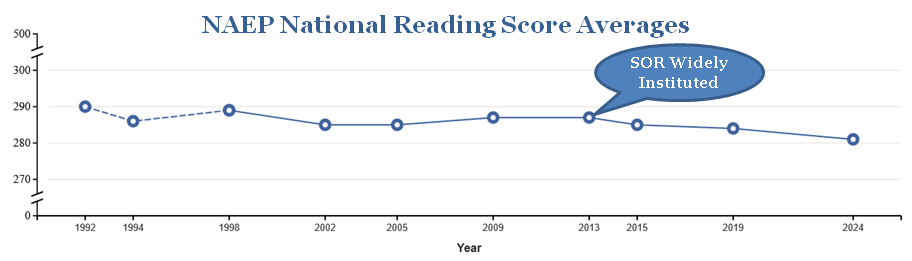
The 2024 math results had a 7-point decline from the highs; however 12th grade math data has only been gathered since 2005.

Professional Analysis – Really?

George Bush and Ted Kennedy gave us the No Child Left Behind (NCLB) act which significantly expanded the role of the federal government in education. Its philosophy of test and punish substantially increased the pressure to score well on testing. Since the only variable that higher test scores correlate with is family wealth, the high stakes meant that several outstanding schools in poor neighborhoods were destroyed. Another pernicious outcome of NCLB was the narrowing of curriculum.

‘The 74’ turned to a person deeply associated with NCLB, former US Secretary of Education Margaret Spellings, for expert comments.

Near the conclusion of the Bush administration, Michelle R. Davis shared:

“Spellings, who has been working on education issues for Bush since the 1990s and his days as a Texas governor, is the person who from the very beginning has had to make NCLB work. She was a key architect of the law, arguably Bush’s most significant domestic accomplishment and a grand experiment for Republicans, who traditionally thought education should be left to the states.”
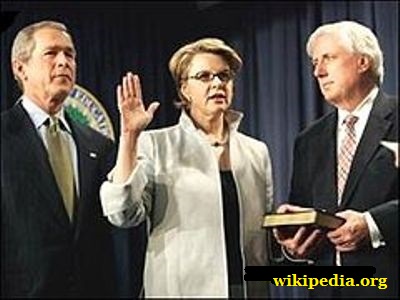
George Bush and Margaret Spellings at her Swearing in

In reality, NCLB was a major disaster and its testing ideology still harms schools. The big fallacy at its foundation is that error and variability are so rampant in standardized testing the scores are meaningless. An Ouija board would be just as accurate.

‘The 74’ reports that Spellings believes the last several administrations have squandered the power of the federal government and weakened its ability to push improvement. They quote her saying, “When you take your foot off the gas and stop using federal leadership, federal imperative around these performance issues, it shows up.” She claims the Every Student Succeeds Act, implemented by President Obama, was “less Muscular” than NCLB and asserts, “We know how to use the federal role in smarter ways to the benefit of kids, and we stopped doing it.”

In 2010, Diane Ravitch who had supported NCLB wrote the book “The Death and Life of the Great American School System” revealing her conclusion that she had been wrong. A book review by the anti-testing organization Fair Test stated:

“The book’s central chapter on NCLB describes, with exceptional clarity, the law’s flawed assumptions and failed prescriptions. She appropriately lambastes the goal of 100% proficiency, quoting her conservative friends Chester Finn and Frederick Hess saying the goal is ‘comparable to Congress declaring that every last molecule of water or air pollution would vanish by 2014.’ The important difference, she writes, is that ‘If pollution does not utterly vanish….no public official will be punished.’ The chapter concludes, ‘Good education cannot be achieved by a strategy of testing children, shaming educators, and closing schools.”’

Another expert source quoted by ‘The 74’ is Robin Like, Director of the Center for Reinventing Public Education (CRPE). Founder Paul Hill’s acolyte, Robin Lake, says these latest results are “frustrating.” She claims, “[T]hat if we don’t change course, things will be very bad — and things are very bad.”

In 2021, for mysterious reasons, this Bill Gates financed organization left the University of Washington for new digs at Arizona State University.

The sky is falling rhetoric is common for CRPE. Founder Hill was a member of Brooking’s cadre of researchers convinced that American public education was failing. Furthermore, they shared a general agreement that market based business principles were central to fixing schools and declared teachers unions and governance by locally elected school boards must be overturned if education was to be saved.

Much of the “research” done by CRPE undermines public education and promotes its privatization.

Lake worked on Doing School Choice Right” funded by the Lynde and Harry Bradley Foundation, Annie E. Casey Foundation, and Bill & Melinda Gates Foundation. CPRE listed two salient goals for their study:

  • “Create models for how school districts can oversee public schools in multiple ways—including direct operation, chartering, contracting, and licensing private schools to admit voucher students. This study is conducted in partnership with the National Charter School Research Project.”
  • “Examine issues involved in moving toward pupil-based funding, particularly technical, legal, and regulatory barriers.”

These themes are central to CRPE’s education ideology.

Billionaire Who Motivated ‘The 74’s’ Article

The article ends with two disclosures. (1) “This article was published with the support of XQ Institute” and (2) “The Future of High School Network and The 74 both receive financial support from the Carnegie Corporation of New York, XQ and the Walton Family Foundation.”

The Future of High School Network has one purpose and that is to end the Carnegie unit. More than receiving financial support from the Carnegie Corporation it is owned and founded by the corporation. EdTech leaders want to get rid of the Carnegie unit in order to institute their kids at screens education schemes.

The Carnegie unit is a minimum requirement creating a nationwide agreed-upon structure. It does not control pedagogy or assessments but insures a minimum amount of time on task.

Writer Derek Newton wisely pointed out in Forbes:

“Cheating … is so pervasive and so easy that it makes a complete mockery of any effort to build an entire education system around testing.”

“But because of the credit hour system, which is designed to measure classroom instruction time, it’s still relatively hard to cheat your way to a full college degree.”

Laurene Powell Jobs is famous for having been married to technology genius and Apple founder Steve Jobs. She is a billionaire and co-owns Atlantic magazine. Jobs studied economics and political science at University of Pennsylvania and received an MBA from Stanford; has no education training. In 1997, she founded the Emerson Collective which promotes impact investing and she is board chair of The XQ Institute.

Billionaire Laurene Powell Jobs is a leader in the AI-revolution in education. Her Amplify digital lessons liberally apply AI and her XQ Institute is working to integrate AI into classrooms. Edward Montalvo, XQ institute’s senior education writer has claimed:

‘“The future of AI in education is not just about adopting new technologies; it’s about reshaping our approach to teaching and learning in a way that is as dynamic and diverse as the students we serve,’ XQ Institute Senior Advisor Laurence Holt said. … Through AI, we can also transcend the limitations of the Carnegie Unit — a century-old system in which a high school diploma is based on how much time students spend in specific subject classes.

“Changing that rigid system is our mission at XQ.”

Turns out Laurene Powell Jobs is a typical arrogant billionaire who thinks because they are rich they must be brilliant. With no education background, she is angling to revolutionize public education with harmful technology. She has no clue about the damage being wreaked.

Center for Reinventing Public Education the Billionaires’ Advocate

27 Aug

By Thomas Ultican 8/26/2020

In 1993, Political Science Professor Paul T. Hill established the Center for Reinventing Public Education (CRPE) at the Daniel J. Evans School of Public Affairs on the University of Washington campus. The research group Hill founded is steeped in public school failure ideology. On their web site Hill let it be known “The Center has a definite point of view.” Among the points listed are:

“The ineffectiveness of big city public schools clouds the futures of millions of children.”

“Incremental efforts to improve urban public education without disturbing the school boards, unions, and central office administrators have failed, largely because roles, missions, and interests of those organizations are incompatible with effective schooling.”

“There are now far too few good public schools in big cities, in part because the entire structure of city school systems, from regulation and funding to teacher selection and professional development, is hostile to school quality.”

“To create good schools in urban areas where academic failure is the norm, we need an entirely different way of creating and operating schools.”

The CRPE 1999 “about” statement says,

“The Center pursues a national program of research and development on such proposals as charter schools, school contracting, choice, and school system decentralization, via alliances with the Brookings Institution, The RAND Corporation, Vanderbilt University, and the University of Chicago.”

Professor Hill, a Non-Resident Senior Fellow at the Brookings Institute, was a member of Brookings’ cadre of researchers convinced that American public education was failing. Furthermore, they shared a general agreement that market based business principles were central to the solution. They believed teacher’s unions and governance by locally elected school boards must overturned.

In 1990, Bookings had published John Chubb’s and Terry Moe’s book, Politics, Markets, and America’s Schools in which they asserted that poor academic performance was “one of the prices Americans pay for choosing to exercise direct democratic control over their schools.” A few years later, Brookings published Fixing Urban Schools co-written by Hill and Mary Beth Celio. It was a call for running schools by contracting with private operators like the Edison Project.

From its 1993 founding thru 1999, CRPE survived by doing research projects for the Brookings Institute, the Rand Corporation, the United States Department of education, the National Business Roundtable and a few others.

crpe-robinpaul

Hill hired researcher Robin Lake the year after founding CRPE. Lake conducted research on charter schools, contracting, and standards-based school decentralization. She led the evaluation of The National Business Roundtable’s national systemic reform initiative.

Big Money Started Arriving

CRPE was fortunate to be in Seattle, Washington where the world’s richest man decided to implement his opinions concerning education. The fact that he was so rich appeared to be his only qualification for what became an outsized influence over public education.

Bill Gates first big education “reform” initiative was his small schools agenda. He believed that smaller schools were more conducive to learning and retention than larger ones. To implement his small schools scheme, he contracted with CRPE to do evaluations and provide implementation advice.

The CRPE web site reported their involvement stating, “The project, supported by a generous gift from the Bill & Melinda Gates Foundation, provides a range of services to new and emerging small schools that have an organizational structure and philosophical commitment compatible with the attributes of high achieving schools.”

Because all donations to CRPE go through the University of Washington Foundation, it is often difficult to identify the specific amounts of money granted to CRPE. In 1999, the Gates Foundation donated $2,000,000 to the Daniel J Evans School of Public Affairs to support Northwest Education. It is likely most of that money went to CRPE but not certain.

In 2000, Gates donated another $750,000. This time stating the donation is ‘to develop resources which will promote the creation of small high schools.” It is a reasonable assumption that all of this money was directed to CRPE.

In 2004, CRPE proudly reported,

“Over the past 10 years the Center has received support from many organizations and foundations. We would like to recognize and thank the

In 2009 CRPE Struck Gold

“School choice” has a long history of fermenting segregation. That history stems back to the negative reaction in the South to the Supreme Court’s 1954 ruling in Brown v Board of Education. In Brown, the court overturned the public school policy of “separate but equal” saying it was “inherently unequal” and that it deprived the plaintiffs of the “equal protection of the law” prescribed in the 14th amendment.

Modern “school choice” ideology promoted by many white billionaires is little different from the strategies of southern segregationist in the 1950s and 60s. It still increases segregation and creates an “inherently unequal” and racist education system.

Promoting “school choice” has become a specialty at CRPE.

Doing School Choice Right” was a CRPE project funded by the Lynde and Harry Bradley Foundation, Annie E. Casey Foundation, and Bill and Melinda Gates Foundation. CPRE listed two salient goals for their study:

    • “Create models for how school districts can oversee public schools in multiple ways—including direct operation, chartering, contracting, and licensing private schools to admit voucher students. This study is conducted in partnership with the National Charter School Research Project.”
    • “Examine issues involved in moving toward pupil-based funding, particularly technical, legal, and regulatory barriers.”

Out of this study, the “portfolio school” management model was created. In October 2009, CRPE published Portfolio School Districts for Big Cities: An Interim Report.” Lead author Paul Hill and associates stated,

“The report introduces the idea of a ‘portfolio school district,’ and shows how some leading school districts have put the idea into practice. A portfolio district is built for continuous improvement through expansion and imitation of the highest-performing schools, closure and replacement of the lowest-performing, and constant search for new ideas.”

In other words, it is an organized idea for managing the charter schools, innovation schools, public schools and voucher schools that make up the mix of schools in a district. Using standardized testing as a proxy for measuring quality, some percentage (5%) of the lowest performing schools will be closed every year. Invariably, the closed school will be replaced by a privatized structure outside of the purview of an elected school board.

Professors David Berliner and Gene Glass are leading experts in the education research community. In a recent article they convincingly demonstrated – again – that the only strongly correlated outcome associated with education standardized testing is family wealth.

That means that under the “portfolio school district” scheme public schools in poor neighborhoods will be closed and replace by privatized “choice” schools.

This novel idea brought CRPE a new mix of funders. Between 2012 and 2018, foundation tax records show that the Walton Family Foundation (EIN: 13-3441466) granted almost $4 million, the Bill and Melinda Gates Foundation (EIN: 56-2618866) granted over $6 million, the Laura and John Arnold Foundation (EIN: 26-3241764) granted more than $4.5 million and the Michael & Susan Dell Foundation (EIN: 36-4336415) gifted more than $1.3 million.

Unlike the other contributors to the University of Washington Foundation, The Gates Foundation does not explicitly name CPRE in its tax records. The $6 million dollar figure is a conservative estimate made from tax record descriptions.

This year, a CRPE news release stated that the Walton family had granted another $650,000 in support of 2020 operations. The new portfolio model induced funding stream appears to be continuing.

For the fiscal year ending June 30 2018, The University of Washington Foundation (EIN 94-3079432) took in grants totaling $132,838,893. After distributing the money they had a balance of $9,300,536 which is consistent with its past practices. Interestingly, Bill Gates Sr. is a Director of the fund.

By 2019, CRPE quit sharing who it funders are. In 2018, their listed funders were:

    • The Bill & Melinda Gates Foundation
    • Carnegie Corporation of New York
    • Laura and John Arnold Foundation
    • Michael and Susan Dell Foundation
    • US Department of Education
    • Walton Family Foundation  

Changes at CRPE

CRPE went through big changes in 2012. Paul Hill stepped down as director (semi-retired) and was replaced by his longtime associate Robin Lake. The Center moved from the Daniel J. Evans School of Public Affairs to the Bothell campus also on the University of Washington campus.

That same year, CRPE for the first time announced “policy partners.” They stated, “CRPE is one of five national education policy organizations that co-founded the Policy Innovators in Education (PIE) Network, whose mission is to build, support, and promote a network of education advocacy organizations working to improve K-12 education in their states so that every student graduates world-ready.”

Image Clipped From PIE Home Page

The other “policy partner” listed in 2012 was CEE-Trust. In 2010, Doug Harris and Ethan Gray of The Mind Trust founded CEE-Trust. Its mission was to become a catalyst for new Mind Trust style organizations nationwide promoting school choice. The CEE-Trust web site revealed,

“CEE-Trust is funded by the Bill & Melinda Gates Foundation and The Joyce Foundation. CEE-Trust is also grateful for the past support of the Carnegie Corporation of New York.”  

After a debacle in Kansas City, CEE-Trust changed its name to Education Cities in 2014. By 2015, CRPE was listing three “policy partners:” Education Cities, Policy Innovators in Education and a new one the National Center for Special Education in Charter Schools (NCSECS). Today, CRPE Director Robin Lake is the board chair of NCSECS.

Education Cities was broken up into two new organizations in 2018. The founder, Ethan Gray, became a founding partner at John Arnold’s and Reed Hastings’ new organization The City Fund. Matt Barnum of Chalkbeat reported, “With big names and $200 million, a new group is forming to push for the ‘portfolio model.”’

It appears CRPE has found another deep pocketed “policy partner.”