Tag Archives: Public Schools

An Educators Preference for the Next California Governor – John Chiang

2 Nov

By Thomas Ultican 11/2/2017

It seemed like identifying the best option for our next governor would be difficult. It wasn’t. The next governor will most likely come from the big three in the Democratic party; Gavin Newsom, Anthony Villaraigosa or John Chiang. Republican, John Fox is fighting against history and Delaine Eastin has yet to raise enough money to be taken seriously. Breitbart favorite, Travis Allan, has raised even less money than Eastin.

The Case for John Chiang (pronounced chung)

Recently, I asked the head of a Democratic Assembly member’s staff who the member was supporting for governor. He would not say but shared his own opinion. He said Jerry Brown had been successful as governor because of his fiscal responsibility. The staffer said that John Chiang was the only Democratic candidate who would control the spending of California’s democratically dominated assembly.

The 55 years-old Chiang’s education and experience include a degree in finance from the University of South Florida; a law degree from Georgetown; past work experience that includes tax law specialist for the IRS and an attorney for the California state controller’s office.

Chiang’s career in public office began in 1997 when he was appointed to the California Board of Equalization, and then was elected the following year to the same position. Chiang won re-election in 2002, and then went on to serve two terms as California state controller. In 2014, he was elected California state treasurer.

Gridlock and rancor dominated Sacramento in 2008. Governor Arnold Schwarzenegger, reacted to the ensuing budget crisis by ordering state worker’s pay to be slashed and thousands of others to be laid off. Chiang refused to comply. “Frankly, [the governor] is just trying to make me do something that’s improper and illegal,” Chiang told the San Francisco Chronicle.

The New Yorker chronicled this episode dubbing Chiang an unlikely hero,

“Under Schwarzenegger’s plan, the workers would receive their full salaries once a budget was approved. But California had enough cash in its accounts, and, in Chiang’s view, the Governor’s move could violate the Fair Labor Standards Act. Moreover, he thought, it was cruel. It was the height of the financial crisis, and mortgage defaults were up more than a hundred per cent over the previous year.”

“The Sacramento Bee, adapting the iconic image of a protester at Tiananmen Square, published a cartoon that depicted Chiang as a lone resister before a line of Hummers, with “Arnold” stenciled on the bumper of the lead vehicle. The Liberal O.C., a progressive blog, nicknamed him ‘the Controllernator.’”

Schwarzenegger sued Chiang but eventually, Schwarzenegger’s replacement, Jerry Brown, dropped the legal action.

An NBC report on Chiang notes:

“Chiang’s campaign site lists an extensive rundown of his accomplishments as controller and currently as treasurer that include restructuring the state’s debt during the recession “to generate $2 billion for schools, infrastructure and public safety” and imposing sanctions on Wells Fargo following a scandal that revealed over 2 million fake bank accounts.”

Because of the relentless attacks on public schools and educators, candidate views on education are key. Many self-styled “progressive democrats,” have adopted education positions attacking teachers’ unions and promoting privatization (Rahm Emanuel, Corey Booker, Antonio Villaraigosa). Some position statements promulgated by Chiang’s campaign:

“In 1988, California voters approved Proposition 98, which requires a minimum percentage of the state budget to be spent on K-12 education. Unfortunately, while Proposition 98 was meant to create a constitutional “floor” for education spending, it has turned into a political ceiling. As a result, California is grossly under-invested in public education.”

“We also must protect the collective bargaining rights of our educators, classified employees, professors, early childhood educators and child care providers. It is critically important that the people who interact with our students and children every day have a seat at the table and a voice on the job to advocate for the best conditions possible for our children to learn.”

“We must also increase both the quantity and quality of California’s early childhood education programs and assure free access for all working families.

“We also know that small class sizes are the key to improving student learning. We need to expand the Class Size Reduction program so our students have every opportunity to learn.”

“Cities and states across the nation are jumping on board and are finding innovative solutions to provide two free years of community college. California needs to find a way to get to that place, where we make community college free while ensuring students are on the right path through participation and graduation.”

“To reclaim the promise of quality education, we must ensure that children and their families have access to wraparound services to meet their social, emotional and health needs.”

Money, Money, Money

John Cox, the Republican gubernatorial candidate from Rancho Santa Fe, is fighting an uphill battle and he has yet to share his views on issues like education.

When Pete Wilson was running for reelection as governor in 1994, he used proposition 187 as a wedge issue. The proposition established a state-run citizenship screening system and prohibited illegal aliens from using non-emergency health care, public education, and other services in California. Another Republican candidate for governor, Ron Unz, campaigned against bilingual education. Both positions alienated many people in the Hispanic community.

Even more damaging to the image of the Republican party in California is the widely held view that they cannot govern. Californians blamed them for repeated failures to pass a budget which led to service interruptions and layoffs. Originally, Democrat, Gray Davis was blamed. However, his Republican replacement, Arnold Schwarzenegger, was also unable to pass a budget. So, intransient Republican legislators inherited Gray’s reputation as the source of the problem.

John Cox is not likely to become governor, but his views about political corruption are interesting. He states:

“Think about it. Legislators are largely funded, not by the voters, but by the lobbyists whose bills they’re going to vote on.

“You couldn’t have designed a system more fraught with temptation, or ripe for reform.”

Reforming California’s system of government appears to be Cox’s sole issue. In a system that makes it impossible that someone without access to financial resources be taken seriously, Mr. Cox became relevant. He donated himself $3,000,000.

Money on Hand July 31_2017

Campaign Funds Report to State of California

A Daily News article from this May reported on the effect of the Los Angeles School Board election for those advocating a privatized education system:

“Advocates for change include Netflix founder Reed Hastings and developer Eli Broad, who have poured millions of dollars into pro-charter groups that fund political campaigns. Their recent win in Los Angeles “portends a massive investment in the superintendent’s race and the governor’s race,” said Mike Trujillo, a Democratic political consultant who worked on campaigns for Kelly Gonez and Nick Melvoin, the newly elected Los Angeles school board members.

“There is not a better motivator than the nectar of victory to push along the issue that you care about, and that’s improving public education and ensuring that every child in every school has a high-quality teacher,” Trujillo said.

“Trujillo worked closely with Antonio Villaraigosa when, as mayor of Los Angeles, he bucked the teachers union and took control of several low-performing schools. Now running for governor, Villaraigosa has signaled that education will be a focus of his campaign. In his speech at the Democratic convention, Villaraigosa called the education split ‘the most important civil rights battle of our generation.’”

The largest contributors to both Gavin Newsom and Antonio Villaraigosa are Stewart and Lynda Resnick, the billionaires behind Fiji Water and POM Wonderful juice contributed $116,800 to Newsom and $112,000 to Villaraigosa.

Gavin Newsom also got large contributions from Trump supporter Peter Thiel, from George Soros and from Laurene Powell Jobs.

Villaraigosa scored big contributions from fans of privatizing public education; Eli and Edythe Broad ($112,800), Anschutz Entertainment Group ($56,400), and Reed Hastings ($56,400).

Chiang’s big money contributions come mostly from wealthy Chinese business people like CC and Regina Yin, owners of dozens of McDonalds restaurants who contributed $94,600.

Newsom and Villaraigosa on Education 

Villaraigosa has education views that are almost identical to the hedge fund supported group Democrats for Education Reform and the California Charter School Association. He will surely receive more large amounts of funding from these entities and their fellow travelers. His anti-teachers’ union message is popular with billionaires.

The attacks on the teachers’ union are disingenuous. Teachers’ unions are driven by impassioned idealistic young women who believe in social justice and public education. Trying to make them into enemies of the public is a cynical ploy. It is especially damaging in an era when working people have less and less protection from mega-wealth.

Gavin Newsom in more nuanced than Villaraigosa but no friend of public education. Last month Newsom responded to a question about charter schools:

“I’m not interested in the stale and raging debate about which side, which camp you’re on – are you with the charter people, are you anti-charter, are you with the teachers, are you anti-teacher. I’ve been hearing that damn debate for ten damn years. With all due respect, I got four kids. I have an eight-year-old, second grade. I have a five, three and a one year old. I’m not gonna wait around until they’ve all graduated to resolve whether Eli Broad was right or whether or not the CTA was wrong. I’m not interested in that debate. I’m interested in shaping a different conversation around a 21st century education system that brings people together, that could shape public opinion, not just here in the state, but could shape an agenda more broadly across the country, particularly in a time of Betsy DeVos and Donald Trump. We need that kind of leadership.”

During Newsom’s last run for governor in 2010, he said:

“To close this achievement and opportunity gap, underperforming public schools need more resources, and above all, real accountability for results. Accountability means ending social promotion, measuring student performance with standards-based assessments, and testing teachers for subject-matter competency.”

Newsom adopted the manifesto, “A New Agenda for the New Decade” and his goals for 2010 were:

  • Turn around every failing public school.
  • Make charter schools an option in every state and community.
  • Offer every parent a choice of public schools to which to send his or her child.
  • Make sure every classroom has well-qualified teachers who know the subjects they teach, and pay teachers more for performance.
  • Create a safe, clean, healthy, disciplined learning environment for every student.
  • Make pre-kindergarten education universally available.

Newsom has not repeated his call for charter schools, merit pay and standardized testing in 2017 but he has not retracted them either.

Newsom also embraces the tech industry. He joins their attempt to control curriculum by promoting computer science education as a core subject in k-12 schools and in universities. He also promotes their fraudulent STEM shortage propaganda.

Does Character Matter?

In 2007 both Gavin Newsom and Antonio Villaraigosa were involved with illicit affairs.

The San Francisco Chronicle reported,

“San Francisco Mayor Gavin Newsom’s re-election campaign manager resigned Wednesday after confronting the mayor about an affair Newsom had with his wife while she worked in the mayor’s office, City Hall sources said.”

Meanwhile in LA the Daily News reported:

“The revelation of a romantic relationship with television newswoman Mirthala Salinas came to light in a Daily News story today after the mayor had dodged months of questions about the breakup of his marriage.”

“For the sometimes rocky marriage of the mayor and his wife, who merged their surnames Villar and Raigosa when they married some 20 years ago, it was the beginning of the end.”

Shouldn’t bad personal conduct be a red flag when bestowing public trust?

Conclusion

If Delaine Eastin were financially more viable, then this recommendation would have been more difficult. I think I would have ended in the same place because of Chiang’s financial acumen but Eastin has always been a feisty leader with good instincts.

For the reasons stated above, I am supporting John Chiang to be California’s next governor.
American Style Taliban Invading Public Education

26 Oct

By Thomas Ultican 10/26/2017

Christian soldiers have been marching off to war and elementary school is the battle ground. Writer Katherine Stewart’s book, The Good News Club, The Christian Right’s Stealth Assault on America’s Children provides the disturbing evidence.

The Good News Clubs are after school programs, sponsored by evangelical Christians, in elementary schools across America. Stewart begins her narrative by describing how the 2001 arrival of a Good News Club in Seattle’s Loyal Height’s Elementary School splintered the community and created enduring angst.

Some parents reacted by removing their children from the school. Stewart quotes one dispirited parent as saying:

‘“Before, we were all Loyal Heights parents together,’ sighs Rockne. ‘Now we’re divided into groups and labels: you’re a Christian; you’re the wrong kind of Christian; you’re a Jew; you’re an atheist.’”

The wrong kind of Christians include all New Age churches, United Methodists, Congregationalists, Catholics and Episcopalians. We Buddhists, Hindus, Jews and Muslims can just forget about it.

The episode in Seattle conjures images of the nineteenth century religious riots in America.

Horace Mann, a Unitarian, became Massachusetts’s secretary of education in 1837. He resolved the conflicts around religious ideology being taught in school by restricting religious teachings to commonly shared Protestant values.

Stewart informs about the result, “Representatives of a number of sects immediately and vigorously attacked him, but large majorities agreed with this policy, and it soon became the norm in the ‘common school,’ or public school, movement.”

She continues, “Common school textbooks at the time were filled with racist characterizations of the Irish, and the Pope and his clergy were described as ‘libertine, debauched, corrupt, wicked, immoral, profligate, indolent, slothful, bigoted, parasitical, greedy, illiterate, hypocritical, and pagan,’ according to … Professor of History, David Nasaw.” Of course, the growing immigrant Catholic population did not like it.

  • In 1844 religious riots broke out in Philadelphia.
  • In 1859 Boston had its turn for rioting. A Catholic boy refused to recite the Protestant version of the 10 commandments and was beaten for thirty-minutes.
  • In 1869 a Bible War raged in Cincinnati when the school board tried to assuage sectarian conflict by banning reading the Protestant Bible in school.

Stewart apprises her readers of how seriously America’s leaders took these disputes, “In 1874, President Ulysses S. Grant declared that if a new civil war were to erupt, it would be fought not across the Mason-Dixon Line but at the door of the common schoolhouse.” Stewart says concerns over religion in public schools continued growing and prompted another Grant speech in 1876:

‘“Leave the matter of religion to the family altar, the church, and the private school, supported entirely by private contributions,’ he said. ‘Keep the church and state forever separate. With these safeguards I believe the battles which created the Army of Tennessee will not have been fought in vain.’”

Great landmark decisions on the relationship between religion and school were decided by the Supreme Court in the 1962 and 1963 with eight to one decisions banning formal prayer in school. Stewart observes that these decisions received three votes from the four conservative judges on the panel. She explains the reasoning:

“This approach drew principally upon the Establishment Clause of the First Amendment, which, according to Thomas Jefferson’s interpretation, erects ‘a wall of separation between church and state.’”

Clarence Thomas and Antonin Scalia Tear Down that Wall

The evangelical Christian movement gained prominence beginning with Jerry Falwell’s moral majority in 1979 and the arrival of in 1977 of Pat Robertson’s 700-Club on ABC. These two movements developed large followings and generated huge sums of money. A significant portion of that money was spent on legal activism.

Stewart quotes Clarence Darrow who is famous for among other things representing John Scopes in Tennessee’s “monkey trial.” Darrow declared:

“I knew that education was in danger from the source that has always hampered it – religious fanaticism.”

In the same vain, when discussing the legal strategy of the Christian right, Stewart asserts:

“It is an attempt to use the principles of tolerance to secure a place for intolerance, discrimination and religious bigotry in the public schools and elsewhere.”

A significant figure in the tearing down of the separation of church and state is Jay Sekulow, who as general counsel for the “Jews for Jesus” began arguing cases before the Supreme Court. Sekulow was born to a Jewish family in Brooklyn. He converted to evangelical Christianity while attending Atlanta Baptist College (now Mercer University).

In 1990, Pat Robertson brought Sekulow together with a few other lawyers to form the American Center for Law and Justice (ACLJ).  Stewart conveys:

“The new outfit lined up alongside the Liberty Counsel, which was founded in 1989 by Mathew and Anita Staver and became affiliated with Jerry Falwell’s Liberty University in 2004. In 1994, the Alliance Defense Fund, or ADF, added its name to the growing roster of Christian legal defense organizations with the backing of a group that reads like a Who’s Who of the new Christian Right: Bill Bright, founder of Campus Crusade for Christ; D. James Kennedy, founder of Coral Ridge Ministries; Larry Burkett, founder of Christian Financial Concepts; James Dobson, founder of Focus on Family; Marlin Maddoux, President of International Christian Media; Donald Wildmon, founder of American Family Association; and more than two dozen other prominent Christian ministries and organizations.”

In 2001, this massive legal artillery succeeded in undermining the separation of church and state most significantly with its victory in Good News Club v. Milford Central School. The upstate New York K-12 school denied a Good News Club’s application to run an after-school club. The denial was based on school policy and concerns about violating the Establishment clause. Stewart laid out the history and arguments for this case and concluded:

“The explosion of school-based church-planting in New York and across the nation that began in 2002 did not reflect a spontaneous eruption of religious enthusiasm. It was simply the direct consequence of the Supreme Court’ decision in the case of Good News Club v. Milford Central School in 2001. An alien visitor to planet First Amendment could be forgiven for summarizing the entire story thus: Clarence Thomas and Antonin Scalia, together with a few fellow travelers on the Supreme Court and their friends in the ADF and ACLJ, got together and ordered that the United States should establish a nationwide network of evangelical churches housed in taxpayer-financed school facilities.”

Church-Planting

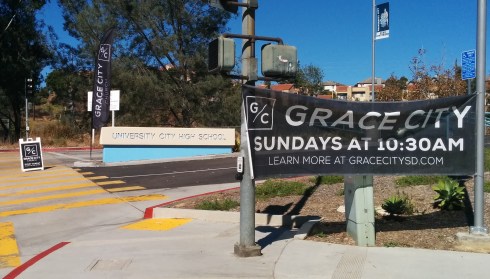
 On Sunday Morning in San Diego, California if you are driving up Genesee Avenue toward the University Town Center mall you will pass the Grace City church. Most residence would think of it as University City High School, but starting in 2015 it became the domain of an evangelical Christian sect on Sundays.

UC High_Grace City

University City High School/Grace City – Photo by T. Ultican

Originally proposed in 1962, bonds to build University City High School were not passed until 1976. Legal roadblocks delayed the construction until 1980. The schools web site concludes its history of the school’s founding:

“In September 1981, the school opened. Twenty years of effort finally bore fruit. In every phase of the battle, the crucial factor to success was the willingness of the concerned, active and involved University City community who gave time, effort and money to carry the project through to its successful conclusion. A grassroots effort to build a community high school resulted in the beautiful, well-equipped complex.”

It is certain that many of the community residence who worked for and paid for University City High School would be shocked that the facility is now in regular use to advance a particular religious sect. Even more disturbing, that sect did not originate from within the community but was “planted” by non-resident proselytizing evangelicals.

Grace Citie’s founding family is Randall Tonini who served in the Compassion Christian Church of Savannah, Georgia and his wife Laura who met Randall at Johnson University in Knoxville, Tennessee. Johnson University is a private Christian University. They left Savannah to come to San Diego on a religious mission.

The Grace City web presence states, “We are a part of a larger network of churches planted with the partnership of Stadia to bring the Gospel throughout San Diego County.”

Stadia’s “who we are” statement proclaims:

“Stadia began in the fall of 2003, when leaders of the Northern California Evangelistic Association (NCEA) met with leaders of the Church Development Fund (CDF) to create a nationwide church planting organization called Stadia. Since then, Stadia and our partners have planted almost 289+ U.S. churches and 189+ global churches and has mobilized sponsorship of over 25,000 children in impoverished communities.”

And about children they state:

“Children are close to the heart of God. So they are close to the heart of Stadia. “And whoever welcomes one such child in my name, welcomes me.” 85% of those who make a decision to follow Jesus do so between the ages of 4 and 14.”

Luis Bush, a Christian big picture strategist, was the first to call it the “4/14 Window.” Stewart discusses this issue at length and adds profound context and insight. One of her many paragraphs on the subject reads:

“Bush’s ideas lit up the skies of the missionary community like a bright flare in the night, illuminating the path for evangelicals worldwide and missionaries in particular. ‘Political movements (like Nazism and Communism) trained legions of children with the goal of carrying their agenda beyond the lifetimes of their founders…. Even the Taliban places great emphasis on recruiting children,’ wrote Dr. Wes Stafford, president of Compassion International, one of the largest worldwide missionary groups, in an introduction to Bush’s 2009 book, The 4-14 Window: Raising Up a New Generation to Transform the World. ‘May God inspire you to join us in His battle for the little ones!’”

In discussing this ominous ideology towards other people’s children, Stewart’s thoughts resonate:

“It is easy enough to dismiss these new missionaries on account of their extremely narrow notion of what constitutes Christianity. It is easy to disdain them in the same way that they disdain United Methodists, Roman Catholics, and U.S. Episcopalians. It isn’t hard for most observers to detect the authoritarian impulses and undercurrents of hostility and aggression that drive them to seek ‘spiritual’ authority over others and embolden them to pit children against children, children against schools, children against their own parents.”

Fellowship of Christian Athletics

For the past few decades, I have been seeing more and more athletes at every level pointing skyward when they hit a home-run or score a touchdown. As a kid, I saw BYU players joining in public prayer after games, but now I see public high school kids doing that. From Stewart, I learned that this did not just happen. It is a result of a well-funded campaign led by a group called the Fellowship of Christian Athletes (FCA).

With funding from people like Truett Cathy, founder of Chick-Fil-A, and non-profits like the Bradley Foundation, FCA has infiltrated sports programs at all levels, marketing their version of “muscular Christianity” to impressionable young men and women. FCA leaders imbed themselves in teams and form sports “huddles.” Thus a peer pressure forms that indicates not precipitating in the prayers and the overt religious gestures means not being a team player. Stewart shared:

“In San Diego, California, a long-serving vice principal who wishes to remain anonymous observes that thirty years ago, prayer played a peripheral role in high school sports. Now, he says, there are FCA huddles at nearly every high school in the region.”

Conclusion

Katherine Stewart’s book is written in an enjoyable and fascinating fashion and her personal research is extraordinary. The account of witnessing the infamous Texas school book wars of 2010 or her telling of attending evangelical missionary conferences or her description of the misinformation being disseminated to teenagers in the now federally financed “abstinence-only” sex education programs are illuminating. All Americans concerned about – freedom of religion; Shielding children from unwanted religious indoctrination at school; and protecting public education – should read this book. Reading this book has been an eye-opening experience.

U.S. Secretary of Education, Betsy DeVos is a devout member of an evangelical church, Mars Hill Bible Church. It is a widely held view within the evangelical movement that public education is a godless secular movement that provides an opening for Satan. That explains why so many evangelicals home school their children. It seems likely that our education secretary has an evangelically based anti-public education agenda. Arguing the relative merits of school policies misses the point.

It is more likely that religious ideology is the point.

Twitter: @tultican

NMSI Pushes Bad Education Policies Based on Junk Science

12 Oct

By T. Ultican 10/12/2017

Last Week, I got this message from a colleague in the Sweetwater Union High School District: “you doing ok, brother Ultican? I have a question for you.  In your tireless research and writing on education schemes and scams, what have you learned about NMSI?  They’re in our district now and I’ve got a bad feeling about the direction it’s taking.” In the words of Dr. Johnny Fever, “Sometimes paranoia is just good thinking.”

The National Math and Science Initiative (NMSI) was founded by a group of Dallas area lawyers and businessmen. Tom Luce is identified as the founder and Rex Tillerson, the CEO of ExxonMobil and present US Secretary of State, provided the financing.

An ExxonMobil web-page announced:

“ExxonMobil became a founding sponsor of the National Math and Science Initiative (NMSI) in 2007 with a $125 million commitment to the non-profit organization, which provides scalable and rigorous program solutions that empower school communities to prepare all students to succeed in college and the workforce.”

Some Background on the Founder

NMSI founder Tom Luce’s bio at the George W. Bush Presidential Center states:

Tom Luce

From the George W. Bush Presidential Center

“Tom Luce, Chief Executive Officer, was a founding partner of Hughes & Luce, LLP, a prominent Texas law firm. … He served as U.S. Assistant Secretary of Education for Planning, Evaluation and Policy Development during the George W. Bush administration ….”

“From 2007 to 2011, he was founding CEO of the National Math and Science Initiative, Inc. Additionally, Tom served on Dell, Inc.’s Board of Directors from 1991 until 2012. … He presently serves as the Chairman of the Board for the National Math and Science Initiative.”

Tom Luce is a lawyer not an educator but his fingerprints are all over some of the worst education policies in the history of our country. His bio at the George W. Bush Whitehouse archives says, “… Luce is perhaps best known for his role in 1984 as the chief of staff of the Texas Select Committee of Public Education, which produced one of the first major reform efforts among public schools.” The chairman of that committee was Ross Perot.

A former Texas Lieutenant Governor, Bill Hobby, wrote in 2010 about that 1984 education reform law:

“Remarkably, most of the reforms initiated in House Bill 72 persist to this day. The teacher test was never repeated, but the statewide student tests are a hallmark of Texas education. They also served as the model for President George W. Bush’s ‘No Child Left Behind’ federal legislation.”

Mark Twain said, “To a man with a hammer, everything looks like a nail.” For Ross Perot, the founder of Electronic Data Systems the problems in education looked like data problems. He and his Chief of Staff, Tom Luce, decided standardized testing and data analysis were the prescription for failing public schools. Unfortunately, standardized testing is totally useless for analyzing learning and public schools were not actually failing.

Tom Luce was also directly involved in implementing NCLB (a spectacular education reform failure) while serving at the US Department of Education.

A Fraudulent Paper from the National Academies Motivated the Formation of NMSI

RISING ABOVE THE GATHERING STORM was published by the National Academies in 2005. The title of this paper echoes Winston Churchill’s The Gathering Storm which chronicled the lead up to World War II. The name like its predecessor “A Nation at Risk” indicates that the United States is in imminent danger of losing its superior economic and scientific lead in the world and education is the fundamental problem. Like “A Nation at Risk,” “Rising Above the Gathering Storm” is also a polemic that cannot stand up to scrutiny.

The late Gerald W. Bracey from Stanford University illuminated several false claims that were foundational to the papers arguments. He recited the Academies declaration, ‘”Last year more than 600,000 engineers graduated from institutions of higher education in China, … In India the figure was 350,000. In America, it was about 70,000.'”

Bracey continued,

“Naturally, given this lofty pedigree, the statistics then materialized in the New York Times, Boston Globe, Chicago Tribune and on many Web sites. While Times columnist Thomas L. Friedman did not use these specific numbers in his 2005 bestseller, ‘The World Is Flat,’ he did write that Asian universities currently produce eight times as many bachelor’s degrees in engineering as U.S. universities do.”

Bracey discussed the growing doubt about these numbers and cited credible peer reviewed research:

“After an exhaustive study, researchers at Duke University also pummeled the numbers. In a December 2005 analysis, ‘Framing the Engineering Outsourcing Debate,’ they reported that the United States annually produces 137,437 engineers with at least a bachelor’s degree while India produces 112,000 and China 351,537. That’s more U.S. degrees per million residents than in either other nation.”

This is an example of the kind of subterfuge that is being used to promote the unsupportable claim that education in America is not producing enough science, technology, engineering and math (STEM) workers.

The impetus and money for writing RISING ABOVE THE GATHERING STORM came from the United States Senate:

“Senator Alexander indicated that the Energy Subcommittee of the Senate Energy and Natural Resources Committee, which he chairs, had been given the authority by the full committee’s chair, Senator Pete Domenici, to hold a series of hearings to identify specific steps that the federal government should take to ensure the preeminence of America’s science and technology enterprise. Senator Alexander asked the National Academies to provide assistance in this effort by selecting a committee of experts from the scientific and technical community to assess the current situation and, where appropriate, make recommendations.”

By 2006 that series of hearings seemingly led to President Bush proposing legislation to solve the “crisis” in STEM education. Senate Bill 2198, “Protecting America’s Competitive Edge” came before the senate Health, Education, Labor and Pensions committee on March 6, 2006. Although, the PACE bill never became law, the record of this senate hearing chaired by Lamar Alexander is instructive. It is also where the birth of NMSI came to light.

Arden L. Bement, Jr., Director, National Science Foundation, (one of the academies) said during his testimony:

“As you are well aware, the National Science Foundation has been selected to play a major role in the President’s American Competitiveness Initiative. One of the cornerstones of our involvement is preparing the Nation’s scientific, technological, engineering, and mathematics workforce for the 21st century while improving the quality of math and science education in America’s schools.”

“When three quarters of American colleges find it necessary to offer courses in remedial mathematics and 22 percent of entering freshman take these courses, it is clear that our high schools are not doing the job they should be doing.”

Here a spokesman for the National Academies is revealing that they have a big government contract to fix education. They are not likely to say, “public schools don’t need fixing” and the comment about remedial courses for freshman is meritless. There has always been a substantial number of students needing remedial courses – see the 1892 committee of 10 report.

James B. Hunt, the former Governor of North Carolina testified,

“A recent report on 30 countries and the Organization for Economic Cooperation and Development showed that of those 30 countries–you have probably heard these figures–the United States is 15th in reading, 18th in science, 24th in math. Of the G-8 countries, the eight countries, we are 7th in 10th grade mathematics.

“Now, those are the facts, folks.”

Governor, that was lame. Researchers around the world have been questioning the methodology employed by PISA and especially the value of their international rankings. For a good discussion of the useless nature of PISA comparisons see Yong Zhao’s Who’s Afraid of the Big Bad Dragon? starting on page 167. Or take a peek at Noel Wilson’s paper “Education Standards and the Problem of Error” for a discussion of the absolute folly of standardized testing.

James B. Hunt Jr. also testified. He said, “It is a well-documented fact that the single most important element in a student’s academic success is that student’s teacher.”

That is just ignorance. Parents and their economic conditions are far more important.

Senator Edward Kennedy remarked,

“By 2009, 6 million jobs will go unfilled because our youth will not be qualified to hold them. To keep America competitive, we need more students with degrees in math, science, and critical-need foreign languages.”

That is at a minimum uninformed. Kennedy repeats the lack of STEM educated graduates misinformation. He is selling the big lie.

Lamar Alexander announced one of the day’s star witnesses,

“Peter O’Donnell is here, who is a member of the National Academy’s Committee that produced ‘The Gathering Storm,’ and his work in Dallas is one reason for the inclusion in ‘The Gathering Storm’ report of the advanced placement recommendations.”

Peter O’Donnell is a wealthy businessman from Dallas, Texas and a huge contributor to the University of Texas at Austin. He is described by the American Statesman:

“O’Donnell is something of a godfather in the state Republican Party, having chaired it for several years in the 1960s. He was a top adviser to Bill Clements during his successful 1978 campaign to become the state’s first GOP governor in more than 100 years, and he has contributed to many Republican candidates in Texas and across the nation.”

Like most modern edu-philanthropists, he has no education experience or training. He testified about his foundation’s Advanced Placement Initiative which became NMSI:

“The Advanced Placement Incentive Program succeeds because of three fundamental concepts: the high standards of Advanced Placement, which is built on a strong curriculum, rigorous national exams, and measurable results; emphasis on excellent teacher training; and financial incentives for teachers and students. Incentives are key to the success of our program. They provide extra pay for extra work and are paid by private donors.”

He went on to describe the principles which were adopted by NMSI:

“These recommendations will provide public schools in the U.S. with outstanding math and science teachers on a scale equal to the size of the problem. The recommendations are based on six concepts:

  1. High standards;
  2. Measurable results;
  3. Integrated curriculum for math and science for grades 6-12;
  4. Quality teacher training that is based on content;
  5. Incentives to teachers and students based on academic results;
  6. Implementation vehicle in each State to manage the programs to ensure quality control and accountability.

There is general agreement that these six concepts will strengthen education, especially in math and science.”

In other words, NMSI calls for teacher merit pay, a hundred-year-old idea with a hundred years of failure to back it up. It employs top down control by using College Board to design curriculum and train educators. It calls for bribing students to study hard which most education theorists would agree is a way to undermine a student’s need to know and harms self-motivation.

NMSI has been moving into San Diego for a while. It is not just in the Sweetwater School District, in 2015 Serra High School of the San Diego Unified School District held an NMSI AP Incentive Awards Night. The announcement says, “Over $32,000 will be given out to 178 current students and graduates. Three students will be given $500 checks!”

Wealthy Texas conservatives say we should turn away from education professionals at Stanford or those at the California State University and the University of California systems. We should embrace the teach to the test education philosophy of College Board and bribe students to get them engaged. We should do this even though there is no independent evidence supporting NMSI’s claims of success.

I Will Let the Curmudgucator Conclude my Article

Three years ago, Peter Greene wrote about NMSI:

“While there may be similar-ish programs in districts across the country, the big dog in the AP bribery biz is the National Math and Science Initiative. NMSI is an organization that was launched ‘to address one of this nation’s greatest economic and intellectual threats – the declining number of students who are prepared to take rigorous college courses in math and science and are equipped for careers in those fields.’ You may recognize that as a classic reformster talking point– low test scores are a threat to our national security– and in fact, the big launching funders of NMSI include Exxon, the Michael and Susan Dell foundation, and the Gates Foundation. Partners also include the US Department of Education and the College Board, because why not fund an advocacy group that is telling everyone that your product is really important. This isn’t philanthropy– it’s marketing.”

Twitter: @tultican

Personalized and Blended Learning are Money Grabs

5 Oct

By T. Ultican 10/5/2017

Big tech and their friends at big banking have turned to public education budgets for a new profit center. In the latest version of the federal education law, compliant legislators provided for both industries. They gave bankers social impact bonds and incentivized education technology. There are solid reasons to think both decisions harm most Americans while lining the pockets of corporate elites. I discuss some of the technology portion here.

The Every Student Succeeds Act (ESSA) is a reauthorization and amendment of the Elementary and Secondary Education Act of 1965. Big money for technology is written into Title’s I and IV of ESSA. This federal law specifies large grants to promote both “blended learning” and “personalized learning.” It also legally defines “blended learning.”

‘‘(1) BLENDED LEARNING.—The term ‘blended learning’ means a formal education program that leverages both technology-based and face-to-face instructional approaches—(A) that include an element of online or digital learning, combined with supervised learning time, and student- led learning, in which the elements are connected to provide an integrated learning experience; and (B) in which students are provided some control over time, path, or pace.” (From official pdf of the law page 1969)

The term personalized learning is somewhat nebulous so I will define it. “Personalized Learning” is a euphemistic term that indicates lessons delivered on a digital device. These lessons are often organized with a playlist and come with a claim of using artificial intelligence to tailor the lessons to the recipient. The scheme is related to competency base education (CBE) and normally includes conferring micro-credentials or badges for competencies completed.

Title-I of ESSA authorizes the following spending schedule:

‘‘(1) $15,012,317,605 for fiscal year 2017;

‘‘(2) $15,457,459,042 for fiscal year 2018;

‘‘(3) $15,897,371,442 for fiscal year 2019; and

‘‘(4) $16,182,344,591 for fiscal year 2020.” (pdf page 1815)

A large percentage of this spending is earmarked for digital education; however, it is difficult to tell what the exact percentage is. However, it is clear that Title-I authorizes spending tens of billions of tax payer dollars on education technology.

Title-IV also authorizes spending on technology and this spending is 100% for technology. Title-IV states:

“There are authorized to be appropriated to carry out this subpart $1,650,000,000 for fiscal year 2017 and $1,600,000,000 for each of fiscal years 2018 through 2020.” (pdf page 1982)

Title-IV also specifies what uses can be made of the funds:

‘‘(1) providing educators, school leaders, and administrators with the professional learning tools, devices, content, and resources to—(A) personalize learning to improve student academic achievement; (B) discover, adapt, and share relevant high-quality educational resources; (C) use technology effectively in the classroom, including by administering computer-based assessments and blended learning strategies; and (D) implement and support school- and district-wide approaches for using technology to inform instruction, support teacher collaboration, and personalize learning;

“(2) building technological capacity and infrastructure, which may include—(A) procuring content and ensuring content quality; and (B) purchasing devices, equipment, and software applications in order to address readiness shortfalls;

‘‘(3) developing or using effective or innovative strategies for the delivery of specialized or rigorous academic courses and curricula through the use of technology, including digital learning technologies and assistive technology …” (pdf page 1981)

Old Rock School

Reputable Education Research Does Not Support this Spending

The Canadian Publication, “The Walrus” distributed a piece called The Failure of the iPad Classroom.” In the article, author, David Sax, shared some insights from Larry Cuban, a professor of education at Stanford University. Cuban, lives and works in Silicon Valley. Like myself, he began as a hopeful evangelist for education technology, but slowly turned into one of education technologies most prominent skeptics. Sax wrote:

“Cuban cites three reasons that policymakers typically use to justify the purchase of new technology for schools. First, the technology will improve student achievement and marks. Second, the technology will change traditional teaching to nontraditional teaching. Third, the technology will better prepare students for the modern workplace. At best, Cuban says, there is contradictory evidence for the third reason, little for the second, and none for the first.”

Mr. Sax made many cogent statements about education technology in “The Failure of the iPad Classroom.” This statement is a good example:

“Dollars spent on digital education technology are dollars that cannot be spent on teachers, building maintenance, or textbooks. It is money that has been pulled from programs in art, sports, music, and drama. Even though the research shows one of the greatest factors in reading improvements in students is the presence of school libraries, the number of libraries across school boards in the United States has declined dramatically. The logic behind this is often that libraries are pointless in the age of Google and eBooks, and that money would be better spent buying tablets or drones.”

The Organization for Economic Co-operation and Development said in a 2015 report that heavy users of computers in the classroom “do a lot worse in most learning outcomes” and that: “In the end, technology can amplify great teaching, but great technology cannot replace poor teaching.”

John Vallance, a Cambridge scholar and headmaster of Australia’s top K-through-12 school, Sydney Grammer, has said: “I think when people come to write the history of this period in education…this investment in classroom technology is going to be seen as a huge fraud.”

There has also been surprising research coming out of Canada: Students don’t prefer e-learning over traditional education. In a 2011 study, researchers found that students preferred “ordinary, real-life lessons” to using technology.

Researcher Dr. Kentaro Toyama, expecting to find a digital educational cure for the perceived ailments in education, came to understand what he calls technology’s Law of Amplification.” Technology can help education where it’s already doing well, but it does little for mediocre educational systems. Worse, in dysfunctional schools, it “can cause outright harm.”

The Dark Side of Screen Time

Education psychologist and author ofFailure to Connect: How Computers Affect Our Children’s Minds”, Jane Healy, spent years doing research into computer use in schools and, while she expected to find that computers in the classroom would be beneficial, now feels that “time on the computer might interfere with development of everything from the young child’s motor skills to his or her ability to think logically and distinguish between reality and fantasy.”

Dr. Nicholas Kardaras (Aug 31, 2016) wrote Screens In Schools Are a $60 Billion Hoax for Time magazine. When discussing health risks associated with student screen time, he stated, “over two hundred peer-reviewed studies point to screen time correlating to increased ADHD, screen addiction, increased aggression, depression, anxiety and even psychosis.”

Jean M. Twenge, professor of psychology at San Diego State University and the author of Generation Me and iGen recently wrote an article for Atlantic magazine about the damage screen time is doing. She shared about the current group of teenagers she labels iGen,

“Psychologically, however, they are more vulnerable than Millennials were: Rates of teen depression and suicide have skyrocketed since 2011. It’s not an exaggeration to describe iGen as being on the brink of the worst mental-health crisis in decades. Much of this deterioration can be traced to their phones.”

Reasonably Unbiased Research Instigated by an Industry Supporter Not Supportive

When the Bill and Melinda Gates Foundation contracted with the Rand Corporation to make a study of digital learning, the results were not very supportive. The best the lead researcher could say to the Hechinger Report was, “What I hope happens is people see this is a promising approach, but it requires a lot of things to fall into place for it to work right,” Pane said. “People need to have patience; they need to do it a while. Teachers and students need to get used to it.”

In other words, he is saying digital learning is “promising” but not proven. In this country, it seems we have an exaggerated belief in the capabilities of technology to improve anything. I personally had little doubt that education technology would lead to dramatic improvements. It does have positive uses but our refusal to see its limitations is causing damage.

The Rand study collected data on schools that received funding from the Next Generation Learning Challenges (NGLC). A note from the report describes NGLC:

“The NGLC initiative is managed by EDUCAUSE, a nonprofit association dedicated to advancing the use of information technology in higher education, in association with other organizational partners, including the League for Innovation in the Community College, the International Association for K–12 Online Learning, and the Council of Chief State School Officers. NGLC receives primary funding from the Bill & Melinda Gates Foundation, with additional support from the William and Flora Hewlett Foundation, the Eli and Edythe Broad Foundation, and the Michael and Susan Dell Foundation. The initiative supports school districts, charter management organizations, and partner organizations that embrace PL as a means to dramatically increase college readiness rates, particularly among low-income students and students of color.”

There were 40 participating schools in the study and the data generated was predominately surveys of students, teachers and administrators. There was a small-scale analysis of standardized testing data based on MAP testing at 32 of the schools. Comparisons were made with a “virtual comparison group.” The study noted several possible biases in the data. The conclusion for one-year achievement comparisons says:

“We estimated positive treatment effects of approximately 0.09 in mathematics and 0.07 in reading, as shown in …. Only the mathematics estimate is statistically significant. These effect sizes translate to gains of about 3 percentile points; specifically, a student who would have performed at the median in the comparison group is estimated to have performed 3 percentile points above the median in an NGLC school in both subjects.” (Rand study page 34)

Let us ignore the fact that standardized testing is useless. Since the advent of No Child Left Behind’s test and punish philosophy of education improvement, every educator knows that teaching to a test will improve test scores. Computer based education is fundamentally a method for drilling for the test. It is surprising that these estimated effect sizes are so small and even insignificant for reading.

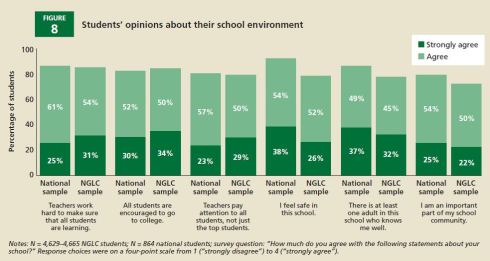
The survey data in the Rand study compares the NGLC schools in the study group with a national sample. I was surprised to learn that NGLC students do not feel as safe.

Rand Student Opinion Survey

From page 24 of the Rand Study

Bad Education Philosophy is the Source of “Personalized Learning” Failure

The behaviorist ideology of B.F. Skinner informs “competency based education.” CBE is the computer based approach that replaces the failed 1990’s behaviorist learning method called Outcome Based Education. Outcome Based Education is a renamed attempt to promote the 1970’s “mastery education” theory. Mastery education’s failure was so complete that it had to be renamed. It was quickly derided by educators as “seats and sheets.” These schemes all posit that drilling small skills and mastering them is the best way to teach. It has not worked yet.

Today’s proponents of behaviorist education hope that technology including artificial intelligence backed by micro-credentials and badges will finally make behaviorism a winner. It will not because little humans are not linear learners. Non-alignment with human nature is a fundamental flaw in this approach. In addition, behaviorism is not known as a path to creativity or original thinking. Those paths are created between teachers and students through human contact; paths undermined by “digital education.”

Artificial intelligence is more science fiction than reality. Computer scientist Roger Schank, a pioneering researcher in artificial intelligence notes,

“The AI [artificial intelligence] problem is very very hard. It requires people who work in AI understanding the nature of knowledge; how conversation works; how to have an original thought; how to predict the actions of others; how to understand why people do what they do; and a few thousand things like that. In case no one has noticed, scientists aren’t very good at telling you how all that stuff works in people. And until they can there will be no machines that can do any of it.”

With no unbiased positive proof of concept, hundreds of billions of taxpayers’ dollars which were earmarked for education are being spent on technology. It is likely that much of this spending will cause harm and that schemes like “personalized learning” will not deliver benefit to anyone who is not invested in a hi-tech industry.

These dollars could have been spent on better facilities, smaller classes, and better teacher education. Instead, the money is wasted on dubious theories propounded by leaders in hi-tech industries and forces looking to privatize public education.

Selling Education Technology Via the Federal Education Technology Plan

28 Sep

By Thomas Ultican 9/28/2017

In January the Office of Education Technology, a unit of the U.S. Department of Education, released its 2017 National Education Technology Plan Update (NETP). The update is not a reasoned meditation on the use of education technology informed by our nations vast academic research infrastructure. It is a polemic hyping the use of technology in America’s classrooms. Director Joseph South, Office of Educational Technology US Department of Education, concludes his introductory remarks:

“…, it is now more apparent than ever that the courageous efforts of educators to embrace the role of thoughtful, reflective innovators who work collaboratively with each other and alongside their students to explore new learning models, new digital learning environments, and new approaches to working, learning, and sharing is essential if we want technology to be an effective tool to transform learning.” (page 2)

The question is, do we want digital learning environments? Are they conducive to creative and healthy development? Are there dangers involved with this approach? Are we moving along a technologically driven path without the requisite caution? The NEPT is not troubled by such doubts.

I do not oppose the use of technology in America’s classrooms. I taught high school math and physics and at one time I worked in Silicon Valley as a researcher in the magnetic recording industry. However, the best use of technology in school settings is developed by education professionals and not by technology product developers. The educators goal is better pedagogy. The developers goal is a new widget (often with a short life span) that wins in the market place.

Audrey Watters has been writing about technology in education for most of the 21st century. Audrey’s latest book is The Curse of the Monsters of Education Technology published in 2016. He made these remarks to a class at MIT on September 7th.

“I don’t believe we live in a world in which technology is changing faster than it’s ever changed before. I don’t believe we live in a world where people adopt new technologies more rapidly than they’ve done so in the past. (That is argument for another talk, for another time.) But I do believe we live in an age where technology companies are some of the most powerful corporations in the world, where they are a major influence – and not necessarily in a positive way – on democracy and democratic institutions. (School is one of those institutions. Ideally.) These companies, along with the PR that supports them, sell us products for the future and just as importantly weave stories about the future.”

I quote Watters here because his statement about the major influence of technology companies is completely borne out by a cursory read of the NETP 2017. It is not just in the US where the outsized influence of these giant technology companies is being felt. In August, the Open Review of Education Research Journal published a paper from New Zealand by Noeline Wright and Michael Peters. In Response to a 2007 document from the New Zealand Ministry of Education they wrote:

“This document advocates e-pedagogy, social learning and student-centred approaches. The lure of what digital technologies can offer in properly constructed learning contexts masks some of the ways in which it can be interpreted to fit a neo-liberal, privatised, deprofessionalised education agenda. This is an agenda using big data to create mastery learning feedback loops for learners. It is cheaper, more efficient and involves fewer teachers. However, a key issue with this kind of thrust is that the capabilities needed for successful citizenship and employment centre on creativity, adaptability, critical thinking and nuanced understandings of complex ideas. Mastery learning, instead, is often focused on providing behaviourist instant feedback, rewarding content knowledge rather than an ability to argue, critique, create and repurpose. This is because content ‘facts’ can be quantified and machine assessed.”

A Look at The NETP for 2017

Selling SEL and Technology

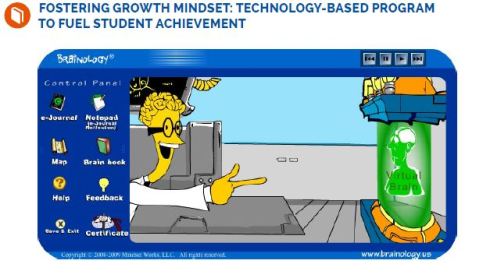
This graphic from page 11 is followed with, “A key part of non-cognitive development is fostering a growth mindset about learning. Growth mindset is the understanding that abilities can be developed through effort and practice and leads to increased motivation and achievement.” (proof?)

The next sentence informs readers, “The U.S. Department of Education has funded several growth mindset–related projects, including a grant to develop and evaluate SchoolKit, a suite of resources developed to teach growth mindset quickly and efficiently in schools.”

Once a student demonstrates they can pass the government sanctioned attitude test, they can get a micro-credential. Today, in China, one can earn citizenship merit badges. Behavior badging in China is explained in this video about gamifying good citizenship. Behavior modification is now a part of micro-credentialing promoted by the NETP.

The NETP is organized into five topics; Learning, Teaching, Leadership, Assessment and Infrastructure. By the time the reader gets to Assessment and Infrastructure some of the material gets redundant. Each topic is addressed with a set of assertions supported almost exclusively by antidotal evidence. After assertions are made, a report on how some school or district has successfully implemented the technology. Page one of the plan informs readers:

“This document contains examples and resource materials that are provided for the user’s convenience. The inclusion of any material is not intended to reflect its importance, nor is it intended to endorse any views expressed, or products or services offered. These materials may contain the views and recommendations of various subject matter experts as well as hypertext links, contact addresses and websites to information created and maintained by other public and private organizations. The opinions expressed in any of these materials do not necessarily reflect the positions or policies of the U.S. Department of Education.”

This disclaimer is completely disingenuous. This is exactly what the document does; it promotes these materials. On page after page the services and products endorsed invariably have large endowments from the technology industry. For example, a page 11 statement,

“For the development of digital citizenship, educators can turn to resources such as Common Sense Education’s digital citizenship curriculum or the student technology standards from the International Society for Technology in Education (ISTE).”

When we look at the ISTE web-site, we learn that Dallas Dance the former Baltimore superintendent of schools who is under criminal investigation is on the board of directors. At the site you can read all about the benefits of being a corporate member of ISTE. We also discover that:

“Year around sponsor Microsoft Corporation is Supporting bold education reform, Microsoft’s mission is simple: support bold education reform to help prepare students for today’s highly competitive workforce, and support our U.S. educators with software and programs that fuel powerful learning and digital-age skills.”

In addition, the Bill and Melinda Gates Foundation has also kicked in $1.4 million to ISTE.

Common Sense says it’s “the nation’s leading independent non-profit organization dedicated to empowering kids to thrive in a world of media and technology.” It also claims that 40% of its support comes from private foundations. In January the Gate’s foundation gave them another quarter of a million dollars. They have many working relationships with tech companies and an interesting board of directors including; Manny Maceda, Partner, Bain & Company; Gene T. Sykes Managing Director, Goldman, Sachs & Co.; and Bill McGlashan, Managing Partner, TPG Growth.

It is possible to make a count of all of the similar kinds of examples to these in the NETP but it takes a while. In another claim, the NETP states, “Technology access when equitable can help close the digital divide and make transformative learning opportunities available to all learners.” (Page 17) The example given is from San Francisco:

“BGC [Black Girls Code], founded in 2001 by Kimberly Bryant, an electrical engineer, aims to “increase the number of women of color in the digital space by empowering girls of color to become innovators in STEM subjects, leaders in their communities, and builders of their own futures through exposure to computer science and technology.”

How can I find fault here? To start with STEM is and always was a fraud. As for BGC, there is a reason that Verizon, Adobe, Salesforce, AT&T, Google, Oracle and others are giving BGC money. The New York Times reports that coding is being pushed into schools by the Titans of tech. There is an obvious down side to this corporate agenda; What if in a decade coding is no longer a skill in demand? Education priorities should not be driven by self-interested amateurs.

One of the more disturbing ideas promoted by NEPT appears on page 39. The example comes from a school district in Wisconsin that used the Digital Promise educator micro-credentialing framework as a guide, teachers in the district took a technology proficiency self-assessment, which they used as a baseline for their personal professional growth. The teachers then worked by themselves and in collaborative teams to develop specific professional learning goals aligned to district strategic goals, which they submitted to district leadership for approval.

The NETP explains,

“Once these goals are approved, the teachers establish measurable benchmarks against which they can assess their progress. Both the goals and benchmarks are mapped to specific competencies, which, in turn, are tied to micro-credentials that can be earned once teachers have demonstrated mastery. Demonstrations of mastery include specific samples of their work, personal reflections, classroom artifacts, and student work and reflections, which are submitted via Google Forms to a committee of 7 to 10 teachers who review them and award micro-credentials.” (emphasis added)

Digital Promise is a technology industry Pied Piper and their supporters are the most famous in the pantheon of technology industry “philanthropy”. The list includes Bill and Melinda Gates, Chan and Zuckerberg, Bill and Flora Hewlett; Michael and Susan Dell, Laurene Jobs and on and on.

The proceeding three examples were selected somewhat randomly. They are not necessarily the most disturbing or most egregious examples of the technology industry driving education policy through the National Education Technology Plan. There are at least twenty more cases that are equally as eye popping or more so. These are just three examples that demonstrate the unhealthy influence the technology industry has over education policy.

Conclusion

The ubiquitous power of the technology industry both in terms of money and political influence makes the gilded age look like a paragon of democratic action. They are selling bad products that are harming America’s world envied public education system. Our students have never scored particularly well on standardized tests when compared to the rest of the world, but they have outscored everyone by a wide margin when it came to creative thinking, developing new industries and advancing civilization.

These giant greed infested technology companies with their neoliberal and libertarian ideologies have tremendous wealth which gives them great political power. However, as Diane Ravich has said, “they are few, we are many.” The people still control. We need to keep doing what educators do. We need to educate America about this ongoing dangerous attack on our schools and our democracy. We need to keep exposing these profiteers lusting after tax dollars that are supposed to go to educate America’s children.

Headline Says Don’t Protect Worst Teachers

18 Aug

By Thomas Ultican 8/18/2017

Another editorial in the San Diego Union attacks teachers and the California public education system. The author has a personal work history of harming California’s public schools by scheming to privatize them. The editorial was written by Rae Belisle. She is identified as a former member of California’s State Board of Education, but she is so much more than that.

Ms. Belise opened her attack,

“Competition for success in the 21st-century economy is increasingly tied to an educated workforce with strong science, technology, engineering and math skills.

“Parents, community and business leaders, and policy makers trying to keep and grow jobs in California should be shocked that in just a few short years California has won the race to the bottom.”

It is true that education is important to the future of any society, however, it is also important that education policy not be driven by a false narrative.

Her first sentence alludes to the widely promoted fraud that there is a Science Technology Engineering and Math (STEM) deficit in the US. There is not and there never was (see evidence here, here, here, here, and here). In fact, many American graduates have a difficult time finding jobs because the H1B visa program makes foreign graduates more attractive. Foreign workers are cheaper and corporations have more control over them.

Belisle echoed the language form employed by the forces for public school privatization. She says we should be SHOCKED at how California’s fourth graders living in poverty have the nation’s lowest scores on the National Assessment of Education Progress (NAEP). Her data is correct but the implication is disinformation.

Her clear innuendo is that public schools are failing and that bad teachers are a big part of the problem.

In her editorial she does note, “Over half of California’s K-12 students are in poverty, which makes our academic decline particularly alarming.” She does not mention that in addition to shocking student poverty, California has by far the largest percentage of language learners in the nation. The National Center for Education Statistics reports that in 2015, the national percentage of English language learners was 9.4%. California’s percentage was 22.4% followed by the state with next largest percentage of language learners, Texas at 15.4%.

A fair reading of the 2015 8th grade math data would note that California’s fourth graders are at the bottom of the nation but by the time they get to the eighth grade they have moved up nine places. Those not living in poverty are 30th out of 51 (data incudes District of Columbia). In other words, the teachers and the schools are doing their jobs in the face of a 50% poverty rate and having 22.4% of their students learning English.

Average 4-Math Calif vs Nation

A NAEP Graphic

It did not help that in the 1990’s, Belisle used her position as legal counsel for the State Board of Education to fight against bi-lingual education.

Schools cannot fix social conditions. It is political leaders that have failed to successfully address poverty and other social ills. In East Los Angeles, children are joining gangs that their great grandfather was in and we just let that disease fester. Political lawyers like Belisle blame teachers and schools for their failures and those of their paymasters.

Who is Raneene “Rae” Belisle

Belisle’s Bio at the Sacramento County Office of Education says,

“Formerly Chief Counsel to the California State Board of Education for many years, Ms. Belisle successfully defended the constitutionality of charter schools and the STAR test, and was most recently involved in the settlement of the Williams litigation.”

“… she served as Associate General Counsel and Team Leader for Government Relations with the Los Angeles Unified School District (LAUSD).  Her focus at LAUSD was the implementation of all aspects of the federal No Child Left Behind (NCLB) Act.”

When writing about the privatization of public schools in California, I recounted,

“Three key players in the assault on California’s public schools are Walmart heiress, Carrie Walton Penner, Netflix CEO, Reed Hastings and nativist republican politician, Steve Poizner. In 2001, they started EdVoice a lobbying organization that claims California schools are broken and must be reformed. In 2003 Poizner founded the CCSA. Walton Penner and Hastings remain as board members of both EdVoice and CCSA.”

After her stint, as chief counsel for the State Board of Education, she became the CEO of EdVoice. She remained in that position until 2010.

In 2009, Governor Arnold Schwarzenegger appointed her to be a member of the State Board of Education. A blogger name Sharon Higgins reported the strong opposition to her appointment.

“She was a full SBE participant for one year until March 2010 when the Senate refused to give her a confirmation hearing. They had received staunch opposition to Belisle. For instance, this was the first time in its 39-year history that the Association of California School Administrators had taken an active stance against a state board appointee, …. Belisle is a strong charter school advocate, who had previously given controversial legal advice to the SBE.”

The California Senate’s Rules Committee decided to let Belisle’s term expire and not hold a confirmation hearing. The California Watch described:

“The opposition came from some of the most influential educational and ethnic groups in the state. Several minority groups said Belisle’s legal advice to the education board during the late 1990s to early 2000s, stripped non-English speaking students of culturally sensitive textbooks and other classroom tools.

“The California Federation of Teachers, California School Board Association and Association of Calfornia School Administrators also questioned Belisle’s objectivity.”

It is fascinating why the Hindu America Foundation opposed her so vigorously. In a legal dispute with the State Board of Education, it appears that in defending the Board, Chief Counsel Belisle tried to bully the Hindus. They conveyed:

  • Belisle warned the law firm representing HAF to “watch out” because its client [HAF] had repeatedly threatened and harassed the CDE and SBE staff.
  • Belisle claimed that everyone at the SBE was fearful of them [HAF as well as other members of the Hindu American community].
  • Belisle repeatedly referred to HAF and members of the Hindu American community as “those people” who were “very dangerous.”
  • She made it clear to HAF’s attorney that she considered the Hindu Americans challenging the Board to be religious zealots and extremists.
  • During the course of HAF’s litigation, a thorough investigation of the public records was conducted. Not a single threatening letter nor record of threatening or harassing phone calls from HAF or members of the Hindu American community were found.

Belisle’s Main Point

In this editorial, she was advocating against a proposed amendment to California’s education law, AB 1164. On Facebook, EdVoice her old company informs us Belisle was right.

AB 1164 seems to be mostly about rules for money saved by districts, but it does have one section about probationary teachers. Belisle wrote,

“If passed, AB 1164 would only allow new teachers with two years of consecutive unsatisfactory ratings — the lowest rating possible — another year in the classroom along with increased job guarantees. Other new staff who may have struggled but showed signs of promise, and earned higher ratings such as needing improvement, would not even be eligible for another year of probation.”

The paragraph of AB 1164 that offends Belisle and EdVoice says:

“Before offering a third complete consecutive school year of employment as a probationary employee to an employee of the county superintendent of schools in a teaching position in schools or classes maintained by the county superintendent of schools requiring certification qualifications, the county superintendent of schools shall provide the probationary employee with written notice that includes, at a minimum, specific information on what performance-related improvements the probationary employee must achieve in order to obtain permanent employment status after the third year of probationary status. The information provided in the written notice shall be based on evaluations or reviews conducted by a permanent employee designated to conduct the evaluations or reviews pursuant to a collective bargaining agreement or by a school administrator.”

All this paragraph does is optionally extend the probationary period for one more year. That way the district does not have to discharge a teacher they think has promise while maintaining the option to release the teacher before they earn permanent status.

The California Teacher Association takes a position on all education law. They say very little about AB 1164 other than CTA Supports.

Oddly, Belisle wrote in her editorial:

“Discouraging principals from releasing the least effective adults on probation makes no sense. Why give adults who have already proven they are failing our children an easier path to a guaranteed lifetime job? This will make things harder, especially for our most vulnerable students and the hard-working effective teachers and school leaders who are doing the difficult work every day to improve results in the most challenging classrooms.”

Belisle is a lawyer who is steeped in education law, so, she must have another agenda. This law does none of these things. It gives principal’s more options and allows them to be more critical of a teacher’s performance during the probationary period without destroying careers. This law improves professional development and seems to make developing good teachers more likely.

Belisle adds, “Thurmond’s AB 1164 is the embodiment of back-room deals in Sacramento that sell out our children.” She charges Oakland Assembly member Tony Thurmond of some sort of back-room corruption of the worst type, but it is difficult to see his motives. Maybe this is like her charge that the members of the State Board of Education feared Hindus.

Conclusion

There is some sort of agenda here, but it is not clear what it is. Why did a lawyer with a long association to the education privatization movement in California write this article? I do not know. But her associations are clear: Schwarzenegger, Hastings, Walton, EdVoice.

These are not friends of public education, unless you include the unaccountable charter school industry as public schools. I don’t. They are privatized schools run by private boards with little or no public scrutiny.

The San Diego Union continues to run anti-public-school editorials. Belisle is just another paid mouthpiece for the billionaire agenda to monetize public schools and the paper is a willing megaphone.

Board Run Public School Districts

1 Aug

By Thomas Ultican 8/1/2017

It is not always pretty when the public gets a chance to voice its opinion, but it is democratic. In the last week, I attended the Sweetwater Union High School District (SUHSD) and the San Diego Unified School District (SDUSD) school board meetings. It was reminiscent of Dicken’s depiction of Paris and London.

Sweetwater which has been living a nightmare for most of the previous decade was like being at camp sitting around a bonfire singing “John Jacob Jinglehimer Smith.” It wasn’t quite Kumbaya but it was close.

SDUSD was the opposite. Parents, teachers and various community leaders came to engage in public debate. It was a war of words and philosophy. It was far from a Kumbaya moment. People made their case in a public forum and with one dreadful exception they did so in a respectful manner.

At SDUSD it was Sex and Islamophobia

There were two contentious issues at the SDUSD meeting; sex education and protecting Muslim students from bullying. At the July 24th school board meeting, the sex education issue was raised under the agenda item E.1, called Vision 2020 Quality Schools in Every Neighborhood or LCAP goal four.

Let me explain some school speak. There was a 2013 change in how California divides up money to districts. The new system was named the local control funding formula (LCFF). It required money earmarked for certain categories of spending – for example bilingual teacher training programs – to be bundled and distributed to districts under a certain set of rules for how the money is spent.

The California Department of Education describes the Local Control and Accountability Plans (LCAP),

“The LCAP is an important component of the LCFF [Local Control Funding Formula]. Under the LCFF all LEAs [Local Education Agencies] are required to prepare an LCAP, which describes how they intend to meet annual goals for all pupils, with specific activities to address state and local priorities identified pursuant to EC Section 52060(d).

In other words, these are the plans that allow districts to spend money that used to be earmarked for certain state directed categories of spending.

LCAP goal four, focuses on SDUSD’s wellness initiative including health education and the sexual health curriculum. When the district staff finished their presentation for this initiative, the public comment period allowed anyone who wanted to make a comment speak for three minutes. To speak all people were required to do is fill out a small request form and hand it to a Board staff member.

It was like living the movie “Back to the Future” where our DeLorean had just arrived in good old 1955. A relatively large group of people apparently from the same Christian sect started denouncing the sex education curriculum as pornographic and against God’s Law. People in the audience were holding up Bibles and cheering on their speakers. The speakers were protesting the curriculum from Advocates for Youth that SDUSD adopted.

One of the main points many speakers made is that some research used by Advocates comes from the University of Indiana’s, Kinsey Institute. The institute’s web-site tells readers, “Learn more about the science-based discoveries—both past and present—that reveal the complexity of sexuality and relationships.” It also says, “Since Dr. Alfred Kinsey’s groundbreaking research in 1948, the Kinsey Institute has changed the world’s understanding of human sexuality.” Many of the opponents of Advocates for Youth indicated that the research at the Kinsey Institute is evil.

One speaker who identified himself as John Moore, a retired engineer, said we cannot trust SDUSD to select a good curriculum because they are doing such a bad job of educating students. To bolster his point, he claimed that in the latest high school exit exam (2014) there was only a 30% pass rate. A check of state education department statistics revealed that  public schools in San Diego Unified had a more than 94% pass rate.

A well-coiffed handsome man in his forties said that he was Mr. Brookes here on behalf of Ernie Sanders or at least it sounded like he said Ernie Sanders. I am pretty sure it wasn’t Bernie Sanders.

Mr. Brookes said that this sex education program was against God’s Law and that it promoted deviance and rebellion. He cited Mathew 7-12 as evidence. How “do unto others as you would have done unto yourself” fits this debate is unclear. He also said that Planned Parenthood is evil and that they support this curriculum.

More speakers advocated for the sex-education curriculum than spoke against it. A teacher who taught the program refuted many of the claims as being misinformed or just untrue. Other speakers made the case that this is a well-researched and widely used program. Advocates for Youth is the basis for sex-education in major cities throughout America.

Although disagreeing with the opposition to the new sex-education curriculum, my impression was that these were moral people who truly care about their community and family. For one who values democracy, seeing this free exchange of ideas was witnessing community based democracy at its essence. Meetings of publicly elected school boards are incubators of Americana.

The Environment Became Disrespectful

Agenda item E.2 was called “Addressing Tolerance Through the Comprehensive School Counseling and Guidance Plan.” The summary in the Board Documents says:

“… the District will not tolerate the bullying of any student; and clarifies that our Muslim students will be treated equally with respect to bullying.   A calendar of observances to be created shall include holidays of all faiths for the purpose of enhancing mutual understanding and respect ….  Staff have not been assigned specifically to address the bullying of students of any single religion; rather, ….  The District’s instructional materials are and will continue to be consistent with state standards which address all major world religions in the context of world history and culture.  …  Finally, staff is redirected from forming a formal partnership with CAIR to forming an intercultural committee which shall include representatives of from all faiths and cultures and which shall provide input to District staff on issues of cultural sensitivities and the individual needs of various subgroups within our diverse community.”

This statement modifies much of the stance the school board took on April 4 when it adopted its plan to deal with Muslim students being bullied. The April 4 board document summary covering this topic said:

“This report will focus on the district’s plan to address Islamophobia and discrimination against Muslim students and their families, as directed by the Board of Education on July 26, 2016.  This plan, developed in collaboration with the Council on American-Islamic Relations (CAIR), and in alignment with AB 2845, is being brought forward for formal board adoption.”

That April 4, staff presentation listed several actions the district would take including:

  • Review district calendars to ensure Muslim Holidays are recognized
  • Provide resources and strategies to support students during the upcoming month of Ramadan
  • Explore and engage in formal partnerships with the Council on American-Islamic Relations (CAIR)

Charles LiMandri, President and chief council for the Freedom of Conscience Defense Fundfiled a lawsuit in federal court may 22, 2017 on behalf of Citizens for Quality Education San Diego; San Diego Asian Americans for Equality Foundation; Scott Hasson; Haoyin He; Xuexun Hu; Kevin and Melissa Steel; and Jose Velazquez. The individuals all were on behalf of their minor children. The key complaint in the lawsuit is:

“Under the guise of this antibullying program, Defendants have fallen in with the aforementioned religious organization to set up a subtle, discriminatory scheme that establishes Muslim students as the privileged religious group within the school community. Consequently, students of other faiths are left on the outside looking in, vulnerable to religiously motivated bullying, while Muslim students enjoy an exclusive right to the School District’s benevolent protection.”

Charles Limandri the Rancho Santa Fe lawyer who filed this lawsuit is a well-known activist in conservative causes. He was a vocal supporter of Proposition 8, the 2008 California initiative that banned same-sex marriage. His Defense Fund profile says of Limandri:

“Since 1983, he has handled numerous high-profile civil law and pro-bono religious liberty cases including defending the Mt. Soledad Cross, San Diego Firefighters, Priests for Life, JONAH and many other organizations in state and federal courts, as well as before the United States Supreme Court. Currently, Mr. LiMandri is defending David Daleiden, Founder of the Center for Medical Progress, who is being investigated for his Human Capital Project, which used undercover video to expose the abortion industry’s buying and selling of aborted baby body parts.”

The San Diego Union reported on some of Limandri’s comments about this lawsuit.

“LiMandri said parents and his law firm have other problems with the district’s actions, including its partnership with the Council for American-Islamic Relations, which he said has a mission ‘to change American society and advance radical Islam.’”

‘“Of particular concern is the School District’s active collaboration with CAIR, which has longstanding, verified ties to radical Islam,’ LiMandri said in a statement ….”

“LiMandri said the lawsuit against the district is not asking for any monetary relief, although San Diego Unified could face a hefty legal fee if the case continues into a lengthy fight.”

The Freedom of Conscience Defense Fund which runs out of LiMandri’s law office in Ranch Santa Fe is associated with a national network of conservative legal organizations under the umbrella of The Alliance Defending Freedom. This association of more than fifty organizations includes The Heritage Foundation, National Organization for Marriage, and the Federalist society.

The San Diego Asian Americans for Equality Foundation which put its name on the lawsuit seems to be an active political organization in San Diego working to protect the rights and further the interests of Asian Americans. The other organization that is party to the lawsuit, Citizens for Quality Education San Diego was founded by Mary Baker and is almost non-existent with no web-page or Facebook page.

Mary Baker is acting President of the San Diego/Orange County Chapter for the non-profit organization, Citizens’ Alliance for Property Rights and is co-founder and member of Citizens for Quality Education—San Diego. Mary serves on two Executive Boards as President of California Federation of Republican Women—Southern Division and Rancho Bernardo Republican Women Federated.

At the school board meeting, so many people signed up to speak on this issue that the board limited everyone to one minute. Almost all speakers spoke in support of the boards original April decision and urged the board to continue with its plan to create formal partnership with Council on American-Islamic Relations (CAIR).

The speaker representing the Jewish Defense League said that if one community is unsafe then all communities are unsafe.

The San Diego Education Association representative called for profession development highlighting the needs to combat Islamophobia.

Mr. Contreras from the San Diego High School PTA urged the board to work with CAIR and address Islamophobia.

A former SDUSD student said that Muslim hate crimes have increased 800% since 2001 and that his little sister in middle school was being bullied – including having students try to pull off her hijab.

Board member, John Lee Evans, made the point that all students needed to be protected from bullying but from time to time in America, certain communities become targets and they need special attention.

A man in the audience started screaming: “obey the law you criminals”, “we don’t want sharia law”, “you’re a bunch of criminals that’s why you are being sued”. He continued angrily screaming over speakers especially board members for an extended period.

A very frustrated looking school board President, Richard Barrera responded, “If we are getting this kind character attack, we can see what our students are dealing with.”

All the board members of SDUSD seem to be quality reasoned people. They clearly backed down on this issue and I don’t blame them. Even if they feel the lawsuit against them is without merit, they must deal with the reality of budget constraints. Limandri said he is not asking for any monetary relief, but pointed out that SDUSD could face a hefty legal bill if a lengthy fight ensues. Limandri’s allies have very deep pockets and this seems to be an issue they want to embrace.

A Trauma Informed District

In Chula Vista, the new school year has started with many words of praise for the school board and Superintendent Karen Janney. For many years construction company money influenced board elections and successive superintendents had used access to that money to control board members. Through these dark times, people like Nick Marinovich of the Bond Oversite Committee spoke out about the excesses and blocked many corrupt actions by publicly airing them at board meetings.

Eventually members of the construction industry, the superintendent of schools and four of five board member of Sweetwater Union High School (SUHSD) district pleaded guilty to felony corruption charges. A newly elected board has been in place for three years and they have brought such positive change that Marinovich and several other community members who used to battle against a corrupt board are giving heartfelt praise. At the same time, saying they will still be watching and taking positions that the board and the superintendent might not like.

The big news at the July 24th board meeting was that SUHSD starting this school year will be a 100% trauma informed district. A new district discipline policy was presented. The presenter made it clear that this was not a plan in which students can do whatever they want with no consequences, but a constructive plan that includes restorative justice principles. Dr. Joe Fulcher and his team have been working on this plan for the past two years and they feel ready for full implementation in the 2017-2018 school year.

SUHSD Discipline Plan

Only at public schools with elected school boards, is the public allowed meaningful participation. Democracy is messy but it engenders the wisest outcomes. Don’t allow public schools to be stolen from your community by fantasy reform like Betsy DeVos’s siren song of school choice.

Editorial Peddles School Privatization Agenda

16 Jul

By Thomas Ultican 7/16/2017

The San Diego Union editor deserves the bunkum efficiency award for packing so much baloney in a scant four paragraphs. The first sentence of the editorial headlined “Still more bad faith from state ED board” says:

“The State Board of Education’s defining characteristic is its ardent defense of an education establishment more worried about the interests of teachers than students.”

It is true that the education establishment in California does listen to input from teachers and their unions, however, today the establishment is dominated by billionaires like Reed Hasting and Carrie Walton Penner. There are many other establishment powerhouses like the California Charter School Association (CCSA), representatives of the education testing industry and education technology profiteers.

As your newspaper reported, by May, 2016, the CCSA was spending heavily to win seats on the San Diego County Board of Education:

“The political arm of the California Charter Schools Association has spent $220,000 so far on the San Diego County Board of Education election this year, following a difficult period for the independently operated campuses in the region — one that’s been marked by unsuccessful appeals and a string of legal challenges.”

After the recent LA school board election, the LA Times wrote in an article titled “How L.A.’s school board election became the most expensive in U.S. history,”

“It’s an oversimplification to say the outcome was all about money, but charters spent more ($9.7 million compared with $5.2 million), and their candidates finished first in both races on Tuesday’s ballot.”

Clearly these forces for privatizing public schools in California are a significant part of the education establishment. They are anti-teachers’ unions, pro testing and have huge political clout. Governor Jerry Brown, who started two charter schools himself, has vetoed every piece of legislation that proposed any increased accountability on charter schools.

To say the establishment is “more worried about the interests of teachers than students,” is wrong. Or is it just a purposeful lie?

The interests of teachers and students are very similar and neither is getting a fair deal. Teachers and students are in the same overcrowded rooms, using the same facilities and have the same half-hour lunches. No one cares more for the welfare of students and understands more about good teaching than California’s professional educators.

The first paragraph concludes:

“This is once again on display with the state board’s response to the Every Student Succeeds Act, the 2015 federal law that replaced the 2002 No Child Left Behind measure and governs how school systems that receive federal funds must operate. While the new law is much less strict than the old one, it still mandates that schools must be taken over by state governments if they are at the bottom 5 percent of statewide assessments, graduate less than two-thirds of students or have ethnic groups with consistently weak test results.” (bolding added)

Here, I am ready to join with my conservative friends and call for the abolition of the United States Department of Education. Schools should be in the control of parents, teachers and students in the local community. The federal government has no business dictating school policy and especially dictating policy that is a known failure.

In 2009, the Obama administration announced plans to rapidly turn around 5,000 of the nation’s lowest performing schools. It was called the Scholastic School Improvement Grant program (SIG). Today, there is consensus among researchers that SIG was a complete failure. A study by Tina Trujillo, University of California, Berkeley and Michelle Renée, Annenberg Institute for School Reform, Brown University stated one its conclusions:

“Conceptually, one of the most frequent critiques of these studies was that they relied on a single measure of effectiveness standardized test scores. While relying on standardized test scores was methodologically problematic because it falsely assumed that the assessments were valid and reliable, doing so as the sole measure of effectiveness also led to narrow conceptions of student success and the purposes of education ignoring the social, civic, and broader academic aspects of schooling. … Student scores on standardized tests are far too narrow to be the sole indicators of school success in the democratic model of schooling.”

For three-decades, states have been taking over local schools. Unfortunately, we have a three-decade record of failure. Dale Russakoff’s book The Prize tells the story of Newark New Jersey’s thirty-years with state run schools including how they squandered a $100,000,000 gift from Mark Zuckerberg. In Newark, the teachers were never the problem and neither was tenure or the union. It was always corrupt politicians and grinding poverty creating traumatized children. The state only made it worse when it disenfranchised local citizens.

Detroit is another horrifying example of the complete failure of a state led turn around. A Michigan state officials, Barbra Byrd Bennett, is now serving time for taking kick-backs  and the schools are worse off. After two decades of state control we read in the New York Times,

“Michigan leapt at the promise of charter schools 23 years ago, betting big that choice and competition would improve public schools. It got competition, and chaos.

“Detroit schools have long been in decline academically and financially. But over the past five years, divisive politics and educational ideology and a scramble for money have combined to produce a public education fiasco that is perhaps unparalleled in the United States.”

The editor at the Union should be praising not denigrating the State Board of Education for trying to do the right thing in a tough spot. You should be pointing out how the Every Student Succeeds Act (ESSA) is terrible legislation that is more about selling technology, mandating testing and privatizing schools than it is about improving education.

As I wrote to Diane Feinstein, ESSA continues the testing mandate and spends large amounts of money promoting dubious technology initiatives such as “personalized learning” and “blended learning.” If these are truly good ideas they will be adopted without federal coercion. Every student in America is required to take a big standardized test in grades 3 – 8 and grade 11.

The big standardized test is useless. It tells us nothing about the quality of teachers or schools. Peter Greene known for his wonderful education blog, “Curmudgucation”, responded to an essay by Morgan Polikoff (USC Rossier), a long-time Big Standardized Test supporter:

“Polikoff’s problem remains– the BS Tests are junk that provide junk data and damage schools in the process. Accountability is a good idea, but the standards-based high-stakes tests that we’ve been subjected to for the past more-than-ten years are junk, and they do not provide a useful, reliable, or valid measure of school quality– not even sort of. Nor have they helped– not even incrementally.”

Like the way that ESSA supports social impact bonds which profit bankers and 1:1 initiatives which profit the technology industry; mandated testing is fueling the testing industry. These bad ideas are being used to transform tax money meant to benefit students into revenue streams for corporations.

These are the kind of corrupt purposes you should denounce instead of school leaders who are trying to finesse this horrible federal law and our thoroughly unqualified Secretary of Education, Betsy DeVos.

MAD-Magazine-We-the-Unqualified_589a0ac137da99.50962775

Instead, you tacitly support high stakes testing as a way of evaluating schools. You legitimize the federal government and the state of California taking over San Diego’s schools. How big government of you.

Your editorial continues:

“But the State Board of Education is instead on track to approve vague, mushy Every Student Succeeds standards by the U.S. Education Department’s September deadline that appear designed to impede accountability, not guarantee it.”

In May, your paper editorialized with the headline, “Board of Education is missing mark on college readiness.” The lead paragraph said:

“An unsatisfactory process is expected to come to a disappointing conclusion Wednesday when the State Board of Education grudgingly adopts measures to gauge student progress — forced to do so to ensure California receives federal education aid.”

That editorial also emphasized:

But it still requires that schools be taken over by state governments if they graduate less than two-thirds of their students, are at the bottom 5 percent of statewide assessments or have ethnic groups that have consistently weak test results. Under the proposal before the State Board of Education, beginning in fall 2017, schools will be evaluated on high school graduation rates; student results in English and math Common Core tests; gains made by English-language learners; and student suspension rates. Test scores in third-grade reading and eighth-grade math would be given additional emphasis.” (bolding added)

When coercing states to accept Common Core, Arne Duncan said state standards had to prepare students for “college and career readiness.” It was completely up to the states, but the department of education told them that Bill Gates’ Common Core satisfied “college and career ready.” It was a statement based on nothing; no research or historical evidence. In fact, California’s previous standards are widely viewed as better standards than common core.

A core problem is that standards based education is bad education. Along with the common core, the NGSS science standards are bad standards. Most states are moving away from them. So, I am ready to join you in beating up California’s education leaders for adopting bad education policies like NGSS and Common Core. They richly deserve the flogging.

However, it looks like you advocate these education standards and are for standardized testing as the only criteria for measuring schools and holding them accountable. That is just ignorance.

We have a wonderful method for holding schools accountable and giving them a constant path of improvement. In California, it is the Wester Association of Schools and Colleges (WASC) accrediting process. I have been through several WASC reviews and they are thorough and rigorous. A team of professional educators comes to the school and spends a week looking at everything and interviews as many stake holders as possible. Their report comes back with expectations to be met. This is real accountability performed by professionals that know education and can help. Testing is expensive and  worse than useless; it is misleading and destructive.

Your third paragraph says,

“Now The New York Times reports Education Secretary Betsy DeVos has rejected such attempts to game the federal law by other states, upending expectations that she would defer to local control.”

In an interview by EdWeek, the Senator who led the writing of ESSA and is also a former US Secretary of Education, Lamar Alexander, was not impressed. The interviewer writes,

‘”I think we have a case of an assistant secretary who hasn’t read the law carefully,’ Alexander, chairman of the Senate education committee, said in an interview. ‘The heart of the entire law … was that it’s the state’s decision to set goals, to decide what ‘ambitious’ means, to make decisions to help schools that aren’t performing well.’

“The technical, but important back story: Alexander was referring to a feedback letter Botel sent to Delaware on its ESSA plan, telling the state that it hadn’t been ‘ambitious’ enough in setting long-term goals for student achievement, sparking wonky outrage inside the Beltway and beyond.

“The education chairman noted in an interview that ESSA includes language specifically prohibiting the U.S. secretary of education from telling states what their goals can or can’t be—and that 85 senators voted to approve the new law.”

You end with;

“Will this lead to the board to do the right thing and adopt meaningful standards? There is no reason for optimism — because the board has a very different definition of what is the right thing to do than Californians who care about public schools.”

Common Core and NGSS standards and standardized testing are about monetizing schools and privatizing them. It appears that promoting that path is what you mean by “Californians who care about public schools.” Please realize that you and your fellow travelers are working to destroy a great public trust and a main pillar of democratic freedoms for “a few pieces of silver.”

One to One Initiative Threatens Public Education

27 Mar

By Thomas Ultican 3/27/2017

One to one classroom agendas have a dark side that includes the destruction of public schools as we know them; where teachers and students interact. It’s a dystopian ideology that posits students earning education badges while working in isolation at a digital screen.

This month, the entire staff at my high school received an email from a colleague who recently volunteered to be on our district’s technology committee. The message said in Part:

“In doing research for next year’s Technology Plan I came across some interesting data collected by the Speak Up 2015 Research Project.

“Although this particular data is from 2015 it still makes a lot of great points! Click on the links below, I promise it is a quick read.  Enjoy!”

The email message included three links to infographics provided by tomorrow.org.

What do Parents Really Think about Digital Learning

Looking Inside Today’s Digital Classroom

10 Things Everyone Should Know About K12 Students’ Digital Learning

These infographics claim that to be the result of authentic unfiltered data from respectively; 38,613 K-12 parents nationwide, 38,157 K-12 educators nationwide and 505,676 K-12 students, parents and educators nationwide. Ever since my Viet Nam war experience, I have been less trusting. I seek verification for all claims. I want to know the research methodology and who is paying.

Project tomorrow’s research is based on volunteers who engage with their web site answering survey questions. The web site is mostly an advertisement for implementing digital learning and a guide for how to lobby local schools to implement it. It has an agenda and a profound bias.

There are more than 90 corporations and non-profits listed as supporters of tomorrow.org, the cyber-space marketing address for this group. Many other organizations are lavishly financed by corporations to promote competency based education CBE including Future Ready. In addition to the eighteen largest contributors pictured below, both the American Federation of Teachers and the National Education Association are contributors to tomorrow.org.

Corporations Sponsoring Project Tommorrow

My School District’s technology committee is being influenced by the corporate sponsors of tomorrow.org. Last time the district technology plan was updated (2014) the technology committee was swayed by Project Red which is supported by many of the same corporations as Project Tomorrow and Future Ready. All three organizations promote one-to-one education at a computer screen.

A fellow teacher presciently commented, “The last thing 21st century students need is to be put in front of another screen.

Last year when writing about this same issue, I wrote, “When congress passed the new education law (ESSA), the United States Department of Education (USED) became the nation’s leading education technology sales force.” USED works to sell “blended learning”; “competency based education”; “personalized learning”; “linked learning”; etc. These initiatives have at least four things in common; they all profit technology companies; they all are unproven; they all promote unhealthy education practices; and they overturn a student’s right to privacy.

Competency Based Education (CBE) Updates a Failed Strategy from the 1990’s

Obama’s Education Department was an unabashed supporter of CBE and the new federal education law ESSA provides money to encourage CBE. On the Department of Education web-site, it defines CBE:

“Competency-based strategies provide flexibility in the way that credit can be earned or awarded, and provide students with personalized learning opportunities. These strategies include online and blended learning, dual enrollment and early college high schools, project-based and community-based learning, and credit recovery, among others.”

“By enabling students to master skills at their own pace, competency-based learning systems help to save both time and money. Depending on the strategy pursued, competency-based systems also create multiple pathways to graduation, make better use of technology, support new staffing patterns that utilize teacher skills and interests differently, take advantage of learning opportunities outside of school hours and walls, and help identify opportunities to target interventions to meet the specific learning needs of students.”

This all sounds great except CBE is basically outcome based education moved to digital space. Outcome based education was the new 1990’s name given to a previously failed strategy known as mastery education (AKA “seats and sheets”). Outcome based education failed miserably around the world. The big advantage for CBE is that giant profits are possible for corporate providers, especially technology companies.

I never expected to quote Phyllis Schlafly but she wrote a prescient report in 1993, “What’s Wrong With Outcome-Based Education?” She said:

“Alexander Solzhenitsyn, the famous Russian author and former political prisoner in Soviet Gulags, said in a speech in the mid-1970s: ‘Coexistence on this tightly knit earth should be viewed as an existence not only without wars . . . but also without [government] telling us how to live, what to say, what to think, what to know, and what not to know.’”

“Unfortunately, that’s what Outcome-Based Education is — a process for government telling our children how to live, what to say, what to think, what to know, and what not to know. What the children say, think and know must conform to the liberal Politically Correct ideology, attitudes and behaviour.”

Maybe you dismiss Phyllis Schlafly as a paranoid right wing cook, but this video about how the Chinese are gamifying good citizenship should give you the creeps. Teachers hated outcome-based education, but it was the extreme right that delivered the death blow.

Emily Talmage teaches public school in Maine, where CBE is being piloted. She describes what she’s learned:

‘“By collecting skill-based badges, the record of achievement begun in secondary school becomes the foundation upon which workers build their capabilities and tell their stories to employers,’ explains the infamous testing-behemoth, Pearson Education.

“Knowledgeworks recently described the new learning system as an ‘ecosystem,’ in which the role of the traditional teacher will soon be obsolete.

“With major investments from Wall Street, leaders in the online learning, ed-tech, and student loan industries, and even celebrity billionaires like Mark Zuckerberg of Facebook and Reed Hastings of Netflix, the transformation has recently been picking up speed. Meanwhile, political groups on both the left and right are moving the system forward by lobbying for ‘personalized,’ competency-based policies and ‘innovative’ assessment systems.”

The educator known by his wonderful blog, Curmudgucation, Peter Greene, recently wrote:

“Personalized learning, whether we’re talking about a tailored-for-you learning program on your computer screen or a choose the school you’d like to go to with your voucher, is not about actual personalization. It’s about another path for marketing, a way of personalizing the marketing of the product, the edu-commodity that someone is already trying to make money from.”

There is presently a Tennessee court case asking the provocative question, “does a student have a right to a teacher or is a computer enough?”

What is the Proper Place for Digital Education?

The one-to-one initiative being marketed as personalized learning makes little sense. Having tax payers provide a tablet or laptop computer to every student is crazy. It is obviously not personalized learning any more than correspondence school was personalized learning in the middle 20th century. Some student with unique situations may succeed with cheap on-line learning but as a strategy for most students, there is no reason to think it will work.

Our spending for public education needs to be submitted to a rigorous cost-benefit analysis. As much fun as it may be to give every child a digital learning device, the quality of learning would likely be more improved if the school district used that money to reduce class sizes by one or two students. The one to one digital initiative is an unproven theory for improved education but class size reduction is a proven theory.

However, having sufficient computer resources available for students to use makes sense. It might be a good idea to make classes like keyboarding (typing) available and highly encouraged. My students are amazed when they see me typing without looking at the keyboard. That is a skill that has served me well and I think our students should have that opportunity.

Even cyber-course work could be valuable, if it is not mainly about maximizing profits. In his book, Teaching Minds, the cognitive scientist and pioneer in online learning, Roger Schank, makes the point that good online education costs as much as good classroom education. Class size still matters and the learning project designs must be well thought-out and relative to the particular class of students. However, today’s K-12 cyber-schools are really cyber-frauds.

The bottom line with technology spending and use in the classroom is that very aggressive well financed corporate sales teams see schools as a huge market. In addition, federal dollars are getting earmarked by corporate friendly politicians for technology spending. Therefore, it is prudent to look at how valuable this technology really is and not be swayed by the hype.

It is unlikely that good use of technology in education is going to come from the Bill Gates funded Kahn Academy or Tom Vander Ark. It is much more likely that most of the excellent thinking on use of technology in education will come from America’s classroom teachers. Let’s not be bamboozled or intimidated. It is classroom teachers that know what is valuable for learning.

Billionaires Push School Privatization

14 Mar

By Thomas Ultican 3/14/2017

President Donald Trump visited a private religious school in Florida on March 2, 2017, signaling once again that his education agenda will focus on school choice.

Trump DeVos Rubio in Florida

Photo by Alex Brandon of the AP taken from report in the Las Vegas Review-Journal.

The argument for privatization schemes like charter schools and vouchers is that public schools in many low-income neighborhoods are abhorrent failures. Worse yet, the poor families living there have no affordable education options and are trapped. The question is asked, “why don’t poor people have some of the same choices as wealthier people?”

A possible solution is proposed, “Instead of sending public dollars to ‘failing schools,’ vouchers could be given to parents so their children can attend private schools.” Another popular option is to use tax policy and monetary incentives to encourage privately operated charter schools. The claim is made that – because of market forces and reduction in both operating rules and oversight – charter schools will innovate and provide improved pedagogy. The traditional public schools which are encumbered by state regulations and teachers’ unions will learn from these charter school innovations and market forces will cause them to also improve.

Unfortunately, there are three base assumptions here that are wrong. While it is true that some schools have been so poorly resourced and politically damaged by both racism and corruption that they are an abomination, in general America’s public school system is amazingly great – not failing, great!

Secondly, voucher-fed private schools are not that good. Private schools that compare favorably with public schools are much more expensive than any proposed vouchers.

As for the charter school claims; they have not innovated, they have increase education costs and the lack of oversight has resulted in an endless stream of scandal. In addition, the improved pedagogy which has been touted in advertising is refuted by refereed studies.

President Trump proposed spending $20 billion supposedly by repurposing title I funds to promote “school choice.” That is a stunning number. It is equal to more than two-thirds of the spending on the Manhattan Project. The US spent about $1.9 billion on the atomic bomb development. That was estimated to be equivalent to $30 billion in 2013. Another estimate says $2 billion in 1945 dollars was equivalent to $26 billion in 2016. Mr. Trump is calling for a nearly Manhattan Project sized effort to privatize America’s public schools. Does he believe public schools in America are in that kind of crisis or is this just another feckless politician demagoging education for his own selfish purposes?

Mercedes Schneider’s book School Choice makes a powerful arguments for why “school choice” is not only an idea that is unsupported by evidence but will cause extensive damage to our world’s greatest democratic institution. She shared this quote from the longtime teachers’ union leader and one of the original supporters of charter schools, Albert Shankar.

“A pluralistic society cannot sustain a scheme in which the citizenry pays for a school but has no influence over how the school is run. … Public money is shared money, and it is to be used for the furtherance of shared values, in the interest of e pluribus unum. Charter schools and their like are definitely antithetical to this promise.”

Vouchers.

Russ Walsh teaches college reading at Rider University and publishes the blog, “Russ on Reading.” This March he wrote “School Vouchers: Welfare for the Rich, the Racist, and the Religious Right.” That’s certainly a novel take on the “3-Rs” of education. In this piece, Mr. Walsh explains vouchers:

“What are vouchers exactly? School vouchers come in many forms and since the general public is typically opposed to voucher schemes, politicians who favor them have come up with a variety of Orwellian doublespeak names for them like Opportunity Scholarships, Education Choice Scholarships, or the Education Savings Accounts. Another way states have found to get around calling vouchers vouchers is the scholarship tax credit. These schemes allow individuals and corporations to direct their tax monies to private institutions who then use the money for scholarships for students.”

Trump and DeVos went to a Catholic School in Orlando to praise and encourage Florida’s use of scholarship tax credits which appear to run afoul of the first amendment to the United States constitution’s establishment clause. It redirects public dollars to religious schools which does entangle church and state. The Americans United for Separation of Church and State say voucher programs undermine religious liberty.

In Florida, the tax credit voucher is called Florida corporate tax credits. A Florida League of Women Voters report states, “In 2006, the Florida Supreme Court ruled that vouchers paid by the treasury were unconstitutional. Florida corporate tax credits (FTC) became the vehicle to fund what initially were private school scholarships for children from disadvantaged families.”

This month a Texas Superintendent of Schools, John Kuhn, informed the Association of Texas Professional Educators about vouchers:

“Three different research studies published recently have found that voucher programs harm student learning—including one study sponsored by the Walton Family Foundation and the Fordham Institute, both proponents of vouchers. Students who use vouchers underperform their matched peers who stay in public schools.

“You heard me right. I’m not just saying that vouchers don’t help very much. I’m saying voucher programs result in students learning less than if the voucher programs didn’t exist. Giving a student a voucher to improve his education is like giving a struggling swimmer a boulder to help him swim. The Walton Foundation study said: ‘Students who use vouchers to attend private schools have fared worse academically compared to their closely matched peers attending public schools.’ A study of the voucher program in Louisiana found very negative results in both reading and math. Kids who started the voucher program at the 50th percentile in math dropped to the 26th percentile in a single year. Vouchers are so harmful to children that a Harvard professor called their negative effect ‘as large as any I’ve seen in the literature.’”

Evidence from Sweden, New Zealand, Chile and several American metropolitan areas has consistently shown that privatizing schools with vouchers not only does not improve education outcomes, it harms them. When the monies for voucher programs are removed from public education budgets, the opportunities for the 85% of our students attending public schools are reduced.

Privately Run Charter Schools

At the behest of the Los Angeles Unified School District’s teacher’s union MGT of America studied the costs associated with charter schools in LA. MGT reported, “these data indicate that LAUSD has a nearly $600 million impact from independent charter schools.” Running dual school systems increases costs. Therefore, the evidence for benefit from charter schools needs to be clear and convincing.

The National Education Policy Center at the University of Colorado recently published a compilation of refereed studies under the title Learning from the Federal Market-Based Reforms. A paper by Miron and Urschel says of charter school studies, “For example, all of the California studies either found mixed or positive results, while four out of the five Michigan studies and three out of the four Ohio studies produced negative results.”

In Learning, Miron and Urschel also noted:

“A third factor that overshadows the body of evidence on school choice is the predominance of partisan researchers and activist organizations that carry out the research. Especially in the areas of home schooling, vouchers, and charter schools, the bulk of studies that find positive impacts in favor of school choice have been conducted by advocacy groups.”

Two consistent features of modern education governance are that politicians and business men who have power enforce their own particular biases even though lacking both educational experience and knowledge. The second feature is education policy is not based on refereed peer reviewed research by professionals.

For decades, John Walton and the Walton Family Foundation promoted vouchers as the ideal fix for what Walton saw as needing fixed. In a Washington Post article Jeff Bryant wrote:

“Fully inculcated with Friedman’s philosophies, and motivated by the myth of school failure spread by the Reagan administration, the Waltons were ready for their education revolution to begin.”

After a series of defeats trying to promote vouchers, the foundation transitioned the privatization agenda to advancing charter schools. Bryant continued:

“According to a pro-union website, another member of the Walton family, Carrie Walton Penner, sits on the board of the foundation connected to the prominent KIPP charter school chain—on which the Walton Family Foundation has lavished many millions in donations—and is also a member of the California Charter Schools Association. Carrie’s husband, Greg Penner, is a director of the Charter Growth Fund, a ‘non-profit venture capital fund’ investing in charter schools.”

Search “charter school investment” and at least two pages of paid ads for charter school investment funds will appear. In March 2015, the Walton Family Foundation and the Bill and Melinda Gates Foundation co-sponsored an event in Manhattan called “Bonds and Blackboards: Investing in Charter Schools.” In the Business Insider report on this event, reporter Abby Jackson wrote:

“Hedge funds and other private businesses are particularly interested in the growth and success of charter schools. The growth of charter networks around the US offer new revenue streams for investing, and the sector is quickly growing. Funding for charter schools is further incentivized by generous tax credits for investments to charter schools in underserved areas.”

An article by the Education Law Center’s Wendy Lecker states,

“As noted in a 1996 Detroit Metro Times article, while the DeVos’ ultimate aim was to abolish public education and steer public funds to parochial schools, they knew not to be blatant about that goal. Thus, they chose a vehicle that blurred the lines between public and private schools- a “gateway drug” to privatizing public education: charter schools.”

Here in California we have a plethora of billionaires and other wealthy people working to expand charter school penetration including; Bill Gates, Reed Hastings, Eli Broad, Doris Fischer, Carrie Walton Penner and the list continues.

America’s Public Schools Rock

As I wrote in a 2014 post, the declaration that America’s public education system is failing has a long history. Diane Ravitch reported the following quote from Jim Arnold & Peter Smagorinsky on her blog.

“Admiral Rickover published “American Education, a National Failure” in 1963, and in 1959 LIFE magazine published “Crisis in Education” that noted the Russians beat us into space with Sputnik because “the standards of education are shockingly low.” In 1955 Why Johnny Can’t Read became a best seller, and in 1942 the NY Times noted only 6% of college freshmen could name the 13 original colonies and 75% did not know who was President during the Civil War. The US Navy in 1940 tested new pilots on their mastery of 4th grade math and found that 60% of the HS graduates failed. In 1889 the top 3% of US high school students went to college, and 84% of all American colleges reported remedial courses in core subjects were required for incoming freshmen.”

By the middle of the 20th century, cities and villages throughout the USA had developed an impressive educational infrastructure. With the intent of giving every child in America the opportunity for 12 years of free education, this country was the world’s only country not using high stakes testing to deny the academic path to more than a third of its students. The physical infrastructure of our public schools was of high quality and schools were staffed with well-trained experienced educators.

This system that is the foundation – to the greatest economy in the world, the most Nobel Prize winners and democratic government – has passed the exam of life. It is clearly the best education system in the world. To diminish and undermine it is foolhardy. Arrogant greed-blinded people are trying to steal our legacy.