Tag Archives: Public education

Speaking Up for Diane Ravitch

17 Jan

By Thomas Ultican 1/17/2017

January 7th this year, Diane Ravitch posted “STOP: Our Government Wants to Create a National Database about Everyone, Including YOUR Children.” As with many of Diane’s posts, she was amplifying the work of someone else. This time it was a post by Cheri Kiesecker at the “Missouri Education Watchdog.” It provided evidence about the dangerous loss of privacy facing American society – especially students. It highlighted the big money in datamining. I forwarded Diane’s post through Facebook and Twitter. Soon, that post was shared again on Facebook where it drew more than fifty mostly derogatory comments. Not about datamining or profiteering but about Diane Ravitch.

Attacking Public Educations Best Ally

The person who shared from my Facebook page wrote, “I stopped sharing any of Diane Ravitch’s posts but I had to share this one from Gretchen Logue ‘s blog from October 2016.” One comment read, “I stopped reading her blathering a while ago. To think she didn’t understanding what was being done until the latter part of 2016 is simply horrifying, her being a ‘leader’ in the education advocacy arena.” Another commenter impugned her integrity writing, “Diane has also promoted groups on her website that her sons company has major investments in… salesforce being one – and what do you think it’s mission is? Expansion of Digital learning.”

It seems that Diane’s mostly youthful and idealistic detractors charge her with not understanding that competency based education (CBE) is an existential threat to public schools and the teaching profession. I find this disquieting because I absolutely love what I see from some of these detractors. I see their passion for good, their skilled intelligence and their selfless dedication. I wonder why can’t they see that Diane Ravitch is their best and most important ally?

Outcome based education was one of those great education fads of the 1990’s and it was a total dud. Digital badging and students “learning” from software packages developed by Reed Hastings’ company are repugnant ideas. It is an attempt at profiting from education on the cheap. Is it possible that even wealthy corporate sponsors cannot continuously sell bad ideas? Abraham Lincoln is credited with saying, “You can fool some of the people all of the time and all of the people some of the time, but you can’t fool all of the people all of the time.”

Possibly Diane Ravitch judges the privatization movement supported by standardized testing, charters and vouchers as a more imminent threat to universal public education? Diane and I are not close friends but I have met her a couple times and enjoyed enough one on one dialog to know that she does not miss much. It is unlikely that she is not aware of the CBE threat. It is likely she has not developed the same sense of urgency for the issue as some of her detractors.

OLYMPUS DIGITAL CAMERA

OLYMPUS DIGITAL CAMERA

The trombone playing educator and philosopher from rural Pennsylvania, Peter Greene, gave voice to my feelings about attacks like this on Diane Ravitch:

“This is (one of) my problems with Movements– too often things descend into an argument about which people are pure enough, right enough, aligned enough, to deserve our loyalty or fealty. The Reformsters have had their ongoing sturm and drang about maintaining the coalition between left and right. On the public-school side, there are frequent arguments about whether or not certain figures deserve the respect they have, or should be cast out into the darkness because they haven’t taken the right position on A or X.

“I have never understood these arguments, these quests for purity. First of all, you know who sees the world exactly the same way I do? Nobody. Second, you know who in this world I give my unquestioning fealty and allegiance, whose word I will absolutely accept and follow, no questions asked? Nobody. You know who I expect to follow me without question and agree with whatever I have to say without debate? Also nobody. You see the pattern.”

Corporate Reformers and Fellow Travelers Take Aim

In December 2011, Kevin Carey who works for Education Sector, a think tank in Washington, wrote a lengthy biography and critique of Ravitch for the New Republic. The article paints a somewhat negative picture of Diane but it makes some interesting points. In discussing her becoming the face of the anti-corporate reform movement Carey theorizes:

“Ravitch was the perfect person to lead the resistance. Her identity as an academic gave her an implied expertise and impartiality; her government service gave her credibility. Added to this was the assumed integrity of the convert. In November 2010, she penned an influential critique of Waiting for Superman in The New York Review of Books, providing an intellectual blueprint for left-leaning critics of education reform. Jon Stewart invited her on “The Daily Show.” From there, it was a direct path to the “Save Our Schools” rally outside the White House. The die-hard reform opponents needed Diane Ravitch, and, in her own way, Diane Ravitch needed them, too.”

Diane routinely appears as a guest opinion writer in the most important newspapers and magazines in the country: The New Yorker, the New York Times, the LA Times, the Washington Post, etc. No other supporter of public education has near that access, but reformers like Bill Gates, Eli Broad, Arne Duncan, Michelle Rhee, Campbell Brown and many more have unfettered media access for their message.

Carey made two more points in his refutation of Ravitch that I found resonant with my own experience. Carey noted:

“MANY OF Ravitch’s former conservative allies declined to be interviewed for this article. She is, by all accounts, a warm friend who inspires strong loyalty and affection. She maintains a wry, level tone when speaking in public. And, although I had published a critical review of Death and Life, she graciously agreed to meet with me, and we had an amiable conversation over a two-hour lunch at an outdoor café.”

Carey’s article also reports on Diane’s important role in the conservative education reform community:

“In 1983, the Reagan administration published an iconic report titled A Nation at Risk, denouncing U.S. schools for lax academic standards. Ravitch was deeply skeptical of what she saw as the unstructured, relativistic ideas of progressives. She and Checker Finn, a conservative thinker (and, later, a Reagan official), formed the Educational Excellence Network to promote standards-based reform.

“Ravitch’s role in conservative education reform was not as a generator of ideas; others developed the framework of standards and market competition. Rather, she served as a kind of scribe who could communicate the movement’s agenda with clarity. Her arguments were mostly unconcerned with evidence—there was little at the time, since reforms like vouchers were largely untried.”

Carey concludes with his best attempt to demean and put Ravitch in her place:

“The most consistent thing about Ravitch has been her desire to be heard. In many ways, she has never left the cramped, argumentative office of The New Leader in the 1960s. Her genius was in the construction of a public identity of partial affiliation—a university-based historian who never wrote an academic dissertation, a former government official whose career in public service lasted less than two years, an overseer of the national testing program with no particular expertise in testing, and a champion of public school teachers who has never taught in a public school. She enjoys the credibility of the sober analyst while employing all the tools of the polemicist.”

Carey’s efforts to undermine Ravitch’s credibility are mild when compared with the tough piece written by Sol Stern of the Manhattan Institute in City Journal. Stern’s attack is a throwback to McCarthyism:

“Another tenet of the far Left is that progressives should have “no enemies on the left,” and Ravitch apparently agrees. Thus, she has praised the former Weather Underground terrorist and radical educator William Ayers for his contributions to the anticorporate insurgency. (She concedes that Ayers made some political “mistakes” in the sixties.) Ravitch has also had kind words for leftist education activist and onetime Ayers ally Mike Klonsky. On her blog, she recounted visiting two universities in Chicago in 2010, with Klonsky as her host. “For me, the fallen-away conservative, it was a trip getting to know Mike, because he had long ago been a leader of the SDS, which was a radical group in the 1960s that I did not admire. So meeting him and discovering that he and his wife Susan were thoughtful, caring, and kind people was an experience in itself.” Ravitch apparently didn’t know, or preferred not to disclose, that Klonsky broke with Ayers’s Weather Underground faction to create a Maoist-oriented party in the U.S. and then spent several years in China during the horrific Cultural Revolution, attending state dinners with the Great Helmsman.”

One of the strangest attacks on Ravitch comes from Jim Horn, Professor of Educational Leadership at Cambridge College, Cambridge, MA., who has a blog, “School Matters.” Horn implies that Ravitch does not attack CBE and personalized learning as hard as he thinks she should because she is corrupt. This past August, Horn wrote:

“One has to wonder if she is aware that her son’s company could profit handsomely from some of those millions in federal seed money for turning children into alienated computer-compliant drones.

“What is clear is that the Ravitch team is always alert for any comment at her blog that could indicate Ravitch’s lack of understanding of an issue or any comment that would question her real commitment to the public education system that she claims to support.”

It is true that Ravitch’s son Joseph appears to be a successful banker. He left Goldman-Saks to form the Raine Group a few years ago and they appear to be doing well per this NY Times article. They are not focused on school profiteering but it would be difficult for an investment banking group not to have investments in a company that doesn’t have some connection to education technology, consulting, or publishing.

It is hard to fathom Horn’s dislike of Ravitch. Mercedes Schneider wrote about Horn taking a strange post charging Ravitch with being complicit in union busting to attack.

“When Horn read Carroll’s post and realized it provided an opening for him to attack Diane Ravitch, I wonder if he wet himself from glee. He launches right into Ravitch and her being paid by Pearson to speak at the National Association of School Psychologists (NASP) convention in 2012 and of her receiving “her hefty speaking fee” as though Ravitch had been bought by Pearson. Horn assumes as much since he was unable to locate Ravitch’s speech online (his only link in his post other than a quote from The Hunger Games).

“Horn really did not want Ravitch to be paid by Pearson to speak. But she was, and she admitted it and added that she was “thrilled to be paid by Pearson to tell thousands of psychologists how lousy the standardized tests are.”

“Sounds fine to me. You see, I read Ravitch’s speech.

“The tone of Horn’s writing is such that one knows he wants Ravitch to be guilty of something. Surely her accepting “a fat payout” from Pearson to speak at NASP is evidence of the corruption he just knows is at her core, right?”

Diane Ravitch is Giving Voice to Educators

It was through Diane Ravitch’s blog that I learned of Jennifer Berkshire, Mercedes Schneider, Peter Greene, Jonathan Pelto, Carol Buris and a host of others. Any blogger who has had Diane link to their article knows about the “Ravitch bump.” With her large audience, Diane is amplifying wonderful voices who are fighting to save mandatory universal free public education.

Diane joined with Anthony Cody, Julian Vasquez Helieg and others to form the Network for Public Education (NPE). It was at the Chicago 2015 NPE convention that Mercedes Schneider told me how Diane reached out to her, convinced her to write a book and helped her find a publisher. Since then, Mercedes has written three important scholarly works detailing the big money interests with political power harming public education (Chronicle of Echoes, Common Core Dilemma, School Choice).

Diane has credited Debra Meier with convincing her that she was wrong about everything. Also, Ravitch notes John Maynard Keynes’s apocryphal quote: ‘When the facts change, I change my mind. What do you do, sir?’ When Ravitch first supported education reform ideas like standards and vouchers, there was no data. In her seminal book The Death and Life of the Great American School System Diane explained, “The more uneasy I grew with the agenda of choice and accountability, the more I realized that I am too ‘conservative’ to embrace an agenda whose end result is entirely speculative and uncertain.”

I am convinced that Diane is a lot more right than wrong. I did not agree with her about the Every Student Succeeds Act and I saw no reason to believe that Hillary Clinton would be anything but a misguided enemy of good public schools.

Yet, I still see Diane Ravitch as the greatest asset supporters of public education have.
“Say it Ain’t So” NEA and AFT

6 Jan

By Thomas Ultican 1/6/2017

In 1919, the biggest baseball star in Chicago and possibly all of America was “Shoeless Joe” Jackson. After “Shoeless Joe” and seven other members of the Chicago White Sox were convicted of fixing the 1919 World Series, the Chicago Daily News headline – “Say it ain’t so, Joe” – was the anguished plea from fans and especially hero-worshipping boys. Today, when I look at America’s teachers’ unions, I feel similar emotions to the ones those disappointed boys must have felt.

The leadership of both the American Federation of Teachers (AFT) and the National Education Association (NEA) are not protecting educators and public schools. They campaigned for and support the new education law ESSA. They lend their name to advance Competency Based Education (CBE). They promote Social Emotional Learning (SEL). In the last election, both unions immediately endorsed a candidate with a greater than two-decade record of promoting policies undermining professional educators and privatizing public schools.

The California Teachers Association (affiliate of NEA) publishes, California Educator. There are two main thrusts in the December 2016 issue; implementation of Social Emotional Learning (SEL) and promotion of STEM (Science Technology Engineering and Math) education.

NGSS like its sibling CCSS codifies terrible education theory that arose at the behest of a corporate leader, Louis Gerstner (RJR-Nabisco CEO). (To be fair Gerstner did not just sell cigarettes; he also worked at IBM.)

Selling Social Emotional Learning

I have positive opinions of Buddhist philosophy, however, western fads like mindfulness, where the psychological underpinnings of the Buddhist principles are not well understood, annoy me. Here is a quote from the December California Educator:

“The gentle sound of chimes is followed by the teacher’s voice asking students to focus on being in the here and now at Pioneer Elementary School in Union City.

“Neena Barreto is helping transitional kindergartners regulate their own nervous systems through practicing the art of mindfulness.”

In another short piece about Michelle Cauley, we are told:

“Cauley, one of six SEL facilitators with Los Angeles Unified School District, teaches children how to deal with their emotions by using calming techniques such as deep breathing and counting to 10. She provides professional development to educators in the Second Step SEL program, which offers K-8 lesson plans training.”

The Second Step SEL program is a product of the Committee for Children. They describe themselves:

“Committee for Children is a global nonprofit dedicated to fostering the safety and well-being of children through social-emotional learning and development. We are the world’s largest provider of research-based education programs that have helped over 9 million children in 26,000 schools develop vital social-emotional skills to avoid violence, bullying, and sexual abuse. From Iowa to Iraq, Chile to Chicago, we are helping children around the globe stay safe, respect themselves and others, succeed in school today, and build a better world tomorrow.”

Califronia Educator quotes Cauley,

“Kids should be getting these skills at home, but they’re not. Now students are teaching these skills to their families.”

All of this may seem positive, warm and fuzzy, but this last quote is problematic. Is there a darker side of SEL which includes inappropriate intrusion of government into family life and child rearing? A wise old saying alerts us that “the road to hell is paved with good intentions.”

Joy Pullman, managing editor of The Federalist, comments on SEL Boosters:

“The federal government has pushed states to create initiatives like this by demanding in the new federal law that replaces No Child Left Behind, called the Every Student Succeeds Act, that states include “non-academic measures” in school ratings. Despite this, all the leading researchers in this nascent field say the sorts of quasi-psychological measures are not at all reliable enough to be used to rate schools, states, or individual children. That’s not stopping boosters, however (it rarely does).”

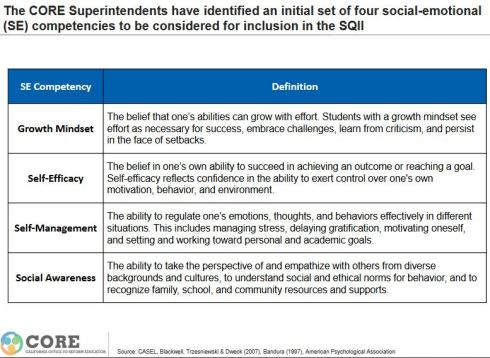
One of those boosters is the California Office to Reform Education or CORE. I have written about this faux government agency. It is financed by – the usual we know better than any professional educators “non-profits.” CORE districts has made social emotional learning 40% of school evaluation. The following graphic is taken from their pilot SEL document sent to participants.

core-districts-sel

Jane Robbins is an attorney and a senior fellow with the American Principles Project in Washington, DC.  Writing in Townhall She states:

“According to the monolithic progressive-education establishment in this country, SEL is the next big thing to fix the problems with public education. The same was true of outcome-based education, and Common Core, and fads infinitum. But this fad isn’t just ineffective, it’s dangerous. Parents should demand a halt to pseudo-psychology – and a restoration of their autonomy in raising their children.”

The big Kahuna in the SEL movement is CASEL (Collaborative for Academic, Social, and Emotional Learning). In 2010 CASEL asked Joseph Durlak, PhD, Professor emeritus of Psychology, Loyola University Chicago, to conduct of study of SEL. His investigation was the first large scale study of SEL and it showed impressive results. The main funding for the study came from William T. Grant Foundation and the Lucile Packard Foundation for Children’s Health. The summary of claims:

“This article presents findings from a meta-analysis of 213 school-based, universal social and emotional learning (SEL) programs involving 270,034 kindergarten through high school students. Compared to controls, SEL participants demonstrated significantly improved social and emotional skills, attitudes, behavior, and academic performance that reflected an 11-percentile-point gain in achievement.”

This study was a meta-analysis of data collected between 1955 and 2007. There are three main bias problems with meta-analysis studies. Number one is the obvious problem of a researcher shading the data, the second common problem is a good meta-analysis of badly designed studies will still result in bad statistics. The third – and I suspect most relevant here – is the file drawer problem characterized by negative or non-significant results being tucked away in a cabinet.

In September 2011, Berkley’s Julie Suttie reported about Durlak’s paper in the journal Greater Good. Professor Suttie wrote:

“While these results are encouraging to SEL researchers and practitioners, not all large-scale studies have provided such hearty endorsements of SEL lately. Last fall, the Institute of Education Sciences (IES), the research arm of the U.S. Department of Education, released a report that evaluated seven different SEL programs, including Positive Action, and the results were underwhelming.

“In the study, for each SEL program, a research team compared a group of five to seven schools running that program with other schools in the same district not employing the program. When the researchers looked at their results, they saw no significant differences in social and emotional literacy between the schools that received SEL training and those that didn’t, and no increases in academic achievement or decreases in problematic behavior. In other words, the SEL programs appeared to be duds.”

The December California Educator makes the NEA commitment to SEL obvious and the AFT provides free lesson plans for teaching SEL. The teachers’ unions are backing another Bill Gates promoted set of top down standards to be forced on public schools. To quote the Turko Files, “It’s just not right!”

STEM is and Always was a Fraud

In the 1990’s, I was working in Silicon Valley. The papers were full of reports about the shortage of American trained engineers. Our Democratic congresswomen, Zoe Lofgren promised to work with Democratic President, Bill Clinton to open the doors to foreign talent – to expand the H1B visa program.

In 1993, just the year before Zoe began her congressional campaign to save Silicon Valley, every company interviewing engineering graduates at San Diego State University cancelled the interviews. By 1995, in the San Jose area, engineers were rapidly changing jobs as companies tried to steal each other’s secrets and talent. One of the main motives for promoting the fraudulent H1B visa program was not as much driving salaries down as it was the fact that engineers working on those visas could not change companies.

The biggest justification for the H1B visa program was that we were not training enough math, science and engineering professionals. The reality I saw was people who could have easily applied their skill set in a different area that had a need – were laid off. New hires from India or China were given those open positions.

California Educator does not question the assumptions about needing to inspire more students into STEM (Science, Technology, Engineering, and Math) it just asserts “STEM education is taking off.” The union organ then regales us with real-life examples of STEM teaching heroes and heroines.

We read, “For Camie Walker’s elementary students, engineering makes math and science relevant.” Camie is quoted as saying “To me, engineering is the path-way between math and science and language arts, so students can make connections to what they are learning in ways they never could before.”

We are also assured that “Her STEM program incorporates Next Generation Science Standards and Common Core.”

Another piece in California Educator starts, “This year, Jason Diodati’s upper-level engineering students are building battling drones.” The article continues, ‘“They’ll have to rebuild the ones that get destroyed,’ says Diodati, who teaches physics and engineering at Templeton High School in Templeton, near San Luis Obispo.”

Neither Walker or Diodati are teaching engineering. They are teaching project based science. Engineering is a branch of applied physics that people cannot study until they develop advanced mathematics and science skills. Generally, people do not study engineering until their second year at a university and not in real depth until their third year.

I like the concept of teaching project based math and science, but mislabeling it engineering to placate businessmen in engineering companies has doomed the NGSS science standards. These standards have kindergarten engineering standards that are somehow supposed to be unique from kindergarten science standards. Standards based mechanized education is horrible education theory and horrible unnecessarily and confusing science standards are a disaster.

The Institute of Electrical and Electronics Engineers magazine, Spectrum proclaimed “The STEM Crisis Is a Myth.” They counselled “Forget the dire predictions of a looming shortfall of scientists, technologists, engineers, and mathematicians.

Writing for the James G. Martin Center for Academic Renewal, Jay Schalin observed,

“Everybody knows that the best way to get ahead today is to get a college degree.  Even better is to major in one of the STEM (science, technology, engineering, and math) subjects, where the bulk of the jobs of the present and future lie. Politicians, business leaders, and academics all herald the high demand for scientists and engineers.

“But they are, for the most part, wrong. The real facts suggest that, in many STEM specialties, there is a labor glut, not a shortage.”

“The apparent misinformation continues to this day. Microsoft founder Bill Gates has been particularly vocal about supposed shortages of skilled labor in the computer industry.”

Walter Hickey writing at the Business Insider reputed,

“We clearly don’t have a STEM shortage. If we did, rudimentary economics would kick in and show either low unemployment for new majors or a rising price of computer science labor. People wouldn’t say they’re out of the industry because of no jobs.”

Michael S. Teitelbaum wrote a powerful piece on this issue for Atlantic magazine titled “The Myth of the Science and Engineering Shortage.” He reported:

“A compelling body of research is now available, from many leading academic researchers and from respected research organizations such as the National Bureau of Economic Research, the RAND Corporation, and the Urban Institute. No one has been able to find any evidence indicating current widespread labor market shortages or hiring difficulties in science and engineering occupations that require bachelors degrees or higher, although some are forecasting high growth in occupations that require post-high school training but not a bachelors degree. All have concluded that U.S. higher education produces far more science and engineering graduates annually than there are S&E job openings—the only disagreement is whether it is 100 percent or 200 percent more.”

If the NEA and the AFT are going to be our public voice, they have got to stop promoting corporate education reform. Stop promoting SEL standards, Common Core State Standards, NGSS science standards, STEM education fraud, Competency Based Education and the federal education law ESSA that benefits everyone but students, teachers and taxpayers. Teachers unions must fight these corporate inspired raids on education funding and their effort to de-professionalize teaching.

Education Discernments for 2017

28 Dec

By Thomas Ultican 12/28/2016

The education journalist Kristina Rizga spent four years embedded at Mission High School in San Francisco and apprehended this key insight concerning modern education reform: “The more time I spent in classrooms, the more I began to realize that most remedies that politicians and education reform experts were promoting as solutions for fixing schools were wrong.” (Mission High page ix)

California Adopts Reckless Corporate Education Standards

Standards based education is bad education theory. Bad standards are a disaster. I wrote a 2015 post about the NGSS science standards concluding:

 “Like the CCSS the NGSS is an untested new theory of education being foisted on communities throughout America by un-American means. These were not great ideas that attained ‘an agreement through conviction.’ There is nothing about this heavy handed corporate intrusion into the life of American communities that promises greater good. It is harmful, disruptive and expensive.”

 Louis Gerstner (RJR Nabisco and IBM – CEO) instigated the NGSS standards. They are so poorly written that California adopted them and then started a rewrite.

A group of billionaires influence California’s education policy; Bill Gates, Eli Broad, Reed (school boards suck) Hastings, Carrie Walton Penner, Doris Fisher and others. At their insistence, the state adopted both the nationally-flailing common core state standards (CCSS), and the unworkable next generation science standards (NGSS).

These two sets of standards are examples of bad top down education policies imposed on schools by the super-rich and associated politicos.

‘Profitization’ Movement is Destroying Good Public Education

In a brilliant article, psychometrics expert, Gene V Glass stated, “A democratically run public education system in America is under siege. It is being attacked by greedy, union-hating corporations and billionaire boys whose success in business has proven to them that their circle of competence knows no bounds.”

Up until recently, there has been a relentless effort to evaluate schools and teachers based upon standardized test scores. George Bush’s No Child Left Behind act made the testing of math and English almost the sole evaluative measure for schools. This misguided ideology was used to demonize and destroy many wonderful schools in poor communities.

I wrote about Ciedie Aech’s wonderfully sarcastic book, Why You Always Got to be Trippin? The following quote from Ciedie illuminates the unjust treatment schools in the wrong zip-code faced when judged by testing incapable of measuring school quality or student growth.

“Why was it, the question kept rising up over the years. Well, why was it that those schools most quickly and aggressively labeled as ‘drop-out factories’ – schools slated for closure or an endless chain of reforms, schools forced through the fatal destabilization of restructure and redesign, schools branded publicly as being underused failures, schools negatively marked with the highly publicized letter grade of an F – well, why was it that such a large percent of these schools (shoot, pretty much all of them) had traditionally served as a home to non-dominant-culture, non-privileged-class, minority students?”

 “Personalized Learning” Leads to Big Bucks

This year it became clear that the big profits in education were no longer in standardized testing. The real money ‘reformsters’ were lusting after was in charter schools especially cyber charters; charter school real-estate deals; and competency based education (CBE). Fortunately for profiteering entrepreneurs, the United States Congress passed a rewrite of the federal education law calling it Every Student Succeeds Act (ESSA).

I wrote to my congressman saying, ESSA is worse than NCLB. It provides money to accelerate privatizing public education, incentivizes CBE and even continues the baseless standardized testing mandates. And it has provisions for financial companies to get into taxpayer pockets via social impact bonds. ESSA takes care of everyone but students and taxpayers.

In a recent post, I noted:

“When congress passed the new education law (ESSA), the United States Department of Education was transformed into the nation’s leading education technology sales force. The Secretary of Education became a shill for a group of corporations and their ‘non-profit’ foundations working to sell ‘blended learning’; ‘competency based education’; ‘personalized learning’; ‘linked learning’; etc. These initiatives have at least four things in common; they all profit technology companies; they all are unproven; they all promote unhealthy education practices; and they overturn a student’s right to privacy.”

Competency based education is actually a failed idea from the 1990’s but this time it supposed to work because it is delivered by a computer. One of America’s leading experts on CBE and the destruction it promises for America’s public schools is Emily Talmage. She writes:

“Knowledgeworks recently described the new learning system as an ‘ecosystem,’ in which the role of the traditional teacher will soon be obsolete.

“With major investments from Wall Street, leaders in the online learning, ed-tech, and student loan industries, and even celebrity billionaires like Mark Zuckerberg of Facebook and Reed Hastings of Netflix, the transformation has recently been picking up speed. Meanwhile, political groups on both the left and right are moving the system forward by lobbying for ‘personalized,’ competency-based policies and ‘innovative’ assessment systems.”

It is an education policy that only a toxic mix of hubris and greed could spawn.

Real education requires a life to life communion between teacher and student. Daisaku Ikeda, the founder of Soka Schools, touches on this subject in his book Soka Education, “Recognizing each student as a unique personality and transmitting something through contacts between that personality and the personality of the instructor is more than a way of implanting knowledge: it is the essence of education.” Socrates likened this to being “kindled by a leaping spark” between teacher and student. Low cost on-line learning is spiritless, amoral and dead.

The author and practicing educator, Mercedes Schneider shares, “The current technological challenge for classroom teachers is not teaching students how to use technology. It’s weening kids from phones and other such personalized technology long enough for them to learn to interact with a world that is not accessed by swiping a touch screen or typing with their thumbs.”

Schools are spending huge amounts of money on electronic tablets and laptop computers to institute profit incentivized “personalized” education theories. Conversely, I recommend eliminating all student screen time until high school. In high school, I would only have students use technology for writing reports, science experiments and essays. The last thing 21st century students need is more screen time and they deserve to have their privacy protected and not hoovered up by data mining corporations.

Jack Schneider writing in the Atlantic magazine asked some provocative questions:

“Thus, despite the fact that there is often little evidence in support of utopian schemes like ‘personalized online learning,’ which would use software to create a custom curriculum for each student, or ‘value-added measures’ of teachers, which would determine educator effectiveness by running student test scores through an algorithm, many people are willing to suspend disbelief. Why? Because they have been convinced that the alternative—a status quo in precipitous decline—is worse. But what if the schools aren’t in a downward spiral? What if, instead, things are slowly but steadily improving? In that light, disruption—a buzzword if ever there was one—doesn’t sound like such a great idea.”

He went on in the article to show that public schools have indeed continued to progress.

There Are Failing Schools and They Need Repair

Why did so many parents in poor urban communities embrace charter schools? The fact is some of their schools were horrid and had been that way for as long as they could remember. When someone said, they would spend some money on the schools, parents jumped at the chance to improve their child’s school.

I heard this story at the National Public Education conference in Raleigh North Carolina. A mother from New Orleans gave her personal school experience. She said that before Katrina, the schools in the poorer sections of New Orleans were an abomination. It was normal for middle schools to have 55 children in classes, with no fans or air conditioning.

In her book School Choice, Mercedes Schneider, a product of New Orleans’ education, confirmed “Not only were the schools segregated, but more tragically, the parish refused to construct new schools for the growing black student population. Not just separate schools for whites and blacks but not of equal quality by design.”

John Thompson’s A Teacher’s Tale presents convincing evidence that taking disciplinary control policies away from local administrators and teachers in his Oklahoma high school directly contributed to violence, terrible attendance and safety issues. He describes packs of out of control gang affiliated students roaming hallways instead of attending classes, while site administrators were not allowed by state bureaucracies to take the kind of effective action needed to create a positive and safe learning environment.

On the ridiculous theory that public education needs disruption to improve, John writes, “Inner city schools need more disruption like we need another gang war.”

Failing schools are not failing because of teachers’ unions, tenure laws or bad teachers. They are failing because of bad education policy dictated by politicians and businessmen. They are failing because of racism and prejudice which are the main motivators for school choice. And they are failing because of corruption.

Dale Russakoff’s book The Prize details the epic fail of Mark Zuckerberg’s $100,000,000 gift which was matched by another $100,000,000 from several other philanthropic organizations and individuals. Intended to fix the poorly performing schools of Newark, New Jersey, it failed by every conceivable benchmark. It’s a story of feckless politicians, arrogant reformers and amazing teachers. It tells of the unmitigated degradation of the urban center of a once great American city and the difficulties facing Newark’s educators charged with the impossible task of righting that urban decline in their classrooms.

The real prize in Newark was the public education budget which corrupt politicians used to feather their own nest.

As Detroit so glaringly demonstrates, charter schools although not intrinsically bad schools, are a danger to public education. Peter Greene the educator and commentator explains:

“One of the great lies of the charter-choice movement is that you can run multiple school districts for the price of one.

“A school district of, say, 2,000 students can lose 75 students and with them about $750,000 dollars of revenue, and somehow that district of 1,925 students can operate for three quarter of a million dollars less. And how does the district deal with that loss of revenue? By closing a building – because the more school buildings you operate, the more it costs.”

A study this year in Los Angeles reported that charter schools are draining $600 million a year from the Los Angeles Unified School District. Because of fixed costs, schools must reduce services and increase class sizes to remain fiscally viable. If the privatized system becomes too large too fast, the public system will collapse. And the privatized system needs the board run school system to take the students they don’t want.

We have overwhelming evidence that charter schools are generally not as good as board run schools on almost all measures including the misleading standardized testing results. We know charters increase segregation; we know charter fraud is rampant; we know charters close when business goes bad and we know they drive education costs up. It is time for common sense to prevail.

2017

With the coming of Trump and Betsy Devos, everything I read leads me to believe that the federal government will continue and accelerate the failed Bush/Obama education policies. However, it will be out in the open because there are no fake progressives in this group to hide behind. Americans of all stripes do not want their public education system parceled out and sold. Most conservative like most liberals believe in public education. They do not want their schools taken over by faceless corporations and distant bureaucracies.

A national consensus on the need to protect America’s truly great public education system is probable.

Education profiteers will over-reach in 2017 and we will make significant strides toward winning back local control of our schools.

About ‘The Prize’

21 Dec

By Thomas Ultican 12/21/2016

Dale Russakoff’s book details the epic fail of Mark Zuckerberg’s $100,000,000 gift which was matched by another $100,000,000 from several other philanthropic organizations and individuals. Intended to fix the poorly performing schools of Newark, New Jersey it failed by every conceivable benchmark. It’s a story of feckless politicians, arrogant reformers and amazing teachers. It tells of the unmitigated degradation of the urban center of a once great American city and the difficulties facing Newark’s educators charged with the impossible task of righting that urban decline in their classrooms.

Russakoff wrote this in her conclusion:

“For four years, the reformers never really tried to have a conversation with the people of Newark. Their target audience was always somewhere else, beyond the people whose children and grandchildren desperately needed to learn and compete for a future. Booker, Christie, and Zuckerberg set out to create a national “proof point” in Newark. There was less focus on Newark as its own complex ecosystem that reformers needed to understand before trying to save it. Two hundred million dollars and almost five years later, there was at least as much rancor as reform.” (page 209)

Clearly standardized test scores are a poor measure of school quality. Stuart S. Yeh presented this paper on value added measures (VAM) of teacher and school quality based on testing and concluded “VAM is not reliable.” There are several more peer reviewed papers like this and a warning from the American Statistical Association against the use of VAM to evaluate schools and teachers. Nevertheless, the basic meterstick for top-down reform is the standardized test which inevitably leads to GIGO (garbage in; garbage out).

Not surprisingly reform based on standardized testing and reformer arrogance meant the $200 million brought regression not improvement. Dale reported, “…, throughout the district, proficiency had declined in both literacy and math in every tested grade on the state standardized test since 2011, the year before Anderson arrived.” Anderson is Cami Anderson the former Joel Klein deputy from New York City brought in to lead Newark’s reform. This evaluation is of course somewhat unfair because it is based on the misguided but favored tool of “corporate education reformers”.

Corporate Education Reform

Stan Karp writing in the Washington Post defines “corporate education reform” and  lists a set of policy agendas associated:

“Corporate education reform” refers to a specific set of policy proposals currently driving education policy at the state and federal level.  These proposals include:

*increased test-based evaluation of students, teachers, and schools of education

*elimination or weakening of tenure and seniority rights

*an end to pay for experience or advanced degrees

*closing schools deemed low performing and their replacement by publicly funded, but privately run charters

*replacing governance by local school boards with various forms of mayoral and state takeover or private management

*vouchers and tax credit subsidies for private school tuition

*increases in class size, sometimes tied to the firing of 5-10% of the teaching staff

*implementation of Common Core standards and something called “college and career readiness” as a standard for high school graduation:”

The reform that Zuckerberg, Booker and Christie were bringing to Newark included this entire list except for vouchers and tax credit subsidies for private school tuition which were on the horizon. In addition, they instituted another piece of long favored but widely discredit reform – merit pay. On this point Russakoff states:

 “… teachers consistently tell researchers that, given the choice, they would opt for a good principal and supportive working conditions over merit pay. Indeed, research had found no correlation between merit pay and student achievement, although reformers and venture philanthropists were fighting hard to make it a staple of new teacher contracts.” (page 193)

 Feckless Politicians

Newark was one of America’s premier cities prior to World War II, however, a culture of political corruption featuring patronage jobs became dominate in the city. The biggest slice of patronage became the Newark Public School system. Control of the schools became known as “the prize.” By the start of the 1960’s this corrupt political system was firmly and culturally established. Russakoff depicted the history:

“Although black residents were approaching a majority in the city, they were politically powerless to force local officials to address evidence of police brutality, substandard housing, or collapsing public education. An Italian American political machine, which became dominant in the early 1960s, displacing Irish bosses, tightly controlled city hall and the schools, along with patronage jobs, contracts, and – it was well known – lucrative kickbacks from organized crime. Former U.S. representative Hugh Addonizio, the mayor at the time, famously explained his motivation for leaving the prestige of Congress to run such an impoverished city: “There’s no money in Washington, but you can make a million bucks as mayor of Newark.” (page 17)

Finally, on July 12, 1967, Newark exploded into six days of rioting. In the following election Kenneth Gibson became the first black mayor of a northeastern city. He defeated Addonizio who was on trial for extortion and later convicted. Gibson and his successor Sharpe James became convicted felons as well. Cory Booker was the first Newark mayor in forty-four years not be indicted.

April 13, 1995, the Newark Public schools were taken over by the state of New Jersey. Curiously, according to the New York Times article, judge Stephen G. Weiss “said today that his main reason for ordering a takeover was that too many Newark schoolchildren failed statewide tests.”

A belief in democratic processes leads one to look askance at moves by states and cities to usurp the powers of local elected school boards. And baseless standardized tests should never be accepted as the excuse to close schools. However, in the face of extreme malfeasance, common sense dictates action to protect citizens. Russakoff tells of just such documented corruption leading to dangerous conditions for children:

“In 1994, state Department of Education investigators cited gross mismanagement, corruption, and instructional failure throughout the Newark district, even as school board members treated themselves to public cars, tropical junkets, and expensive meals. The investigators found rat infestation, asbestos, and high levels of lead paint in a rented building being used as an elementary school. The school board was negotiating to buy the building, worth about $120,000, for $2.7 million. It turned out to be owned, through a sham company, by two school principals prominent in Italian American politics. They were indicted on multiple charges and later acquitted.” (page 19)

Unfortunately over the next 20-years, the state had made no real progress in changing the school system from being employer of last resort to an educational system first and foremost. The central office was still bloated and contracts were still based on patronage.

In rode Cory Booker, a high school football star who went on to play tight-end for Stanford University. He was the scion of black professionals and grew-up in suburbia. Booker was a Rhodes scholar and attended Yale Law. He had a magnetic personality and his Yale classmates like Secretary of Education, John King and Connecticut Governor, Danial Malloy knew he was destined for big things.

Cory went to Newark to build his resume. He was a master of self-promotion and a gifted salesman. Best of all, he was just the kind of leader investors and philanthropists were hoping for. He was an articulate black man who was as at home in board rooms. Booker was someone with whom they could deal. Russakoff says that “Booker was a valuable asset for the almost universally white, rich, Republican voucher movement, which along with the charter movement introduced him to some of his major political donors.” (page 11)

The Prize begins with the story of the clandestine meeting between Booker and the former US attorney from the Newark area, Chris Christie. It was during their drive through Christie’s childhood neighborhood that Christie and Booker made a secret agreement to reform Newark’s schools.

They realized their plan would not be well received in Newark but their hubris was so great that they were completely convinced of their own righteousness; eschewing democratic principal for authoritarian control. Russakoff makes the decision vivid:

“Early in the summer of 2010, months after their nighttime ride, Booker presented Christie with a proposal, stamped ‘Confidential Draft,’ titled ‘Newark Public Schools – A Reform Plan.’ It called for imposing reform from the top down, warning that a more open political process could be taken captive by unions and machine politicians. ‘Real change has casualties and those who prospered under the pre-existing order will fight loudly and viciously,’ the proposal said. Seeking consensus would undercut real reform. One of the goals was to ‘make Newark the charter school capital of the nation.’ The plan called for an ‘infusion of philanthropic support’ to recruit teachers and principals through national school-reform organizations, build sophisticated data accountability systems, and weaken tenure and seniority protections. Philanthropy, unlike government funding, required no public review of priorities or spending. Christie approved the plan, and Booker began pitching it to major donors.” (page 20)

My grandfather ran sheep at a place called Warm-Springs, just up the canyon from the Hemingway compound near the Sun Valley Resort in Idaho. When I was a child, my grandfather and I ran into Earnest Hemingway in a local Ketchum, Idaho barber shop. It was here that Cory Booker’s growing national fame got him a ticket to the “invitation-only extravaganza of deal-making and schmoozing for media moguls and investors.” (page 22) It was here that Booker convinced Zuckerberg to make the $100 million-dollar donation. Russakoff describes the scene:

“Booker and Zuckerberg met at a buffet dinner one night on the deck of Herbert Allen’s Sun Valley townhouse, overlooking a golf course and stream. They shared a table with Amazon’s Jeff Bezos and media executive Michael Eisner, among others. Afterward, Zuckerberg invited Booker on a walk and explained that he was looking for a city poised to upend the forces impeding urban education, where his money could make the difference and create a national model. Booker responded with a pitch that showcased what made him such a dazzling fundraiser.” (page 24)

Within a few years, the two central political figures who instigated the reform of Newark’s schools had moved on leaving behind a mess. Chris Christie was intent on running for president and Cory Booker decided on the US Senate. Their ambition far out overshadowed any commitment to Newark and its schools.

Some Lessons and Observations

Charter schools are not necessarily bad. The descriptions of efforts made at both charter schools and Cami Anderson’s Renew Schools (which were reconstituted district schools) are impressive. However, if the decision has been taken to blow up the district and start over a partially privatized system is an error. The cost of education per child increases significantly when financing two public systems. The outcome will be that the district will lose more money than their fixed costs will be reduced. At the same time, they will become the dumping ground for problem children and expensive students that the privatized system shuns. This is exactly what has led to the demise of Detroit’s schools and Newark appears to be on the same path.

Democratically constituted systems will never be successfully reformed by authoritarian means.

In Newark, the teachers were never the problem and neither was tenure or the union. It was always corrupt politicians and grinding poverty creating traumatized children. Yes, schools need to be improved, but they are not social agencies equipped to solve the profound social problems leading to poor academic performance. At close observation, it is obvious that the public-school teachers in Newark were heroes who should have been the touchstone for school improvement.

Closing public schools and privatizing education is a mistake. Fix our schools; don’t undermine them.

Consultants are like vultures. If they are being relied upon, then your financial bones are being picked. Let me end with one more quote from The Prize:

“The going rate for consultants in Newark and elsewhere on the East Coast was $1,000 a day, and their pay comprised more than $20 million of the $200 million in philanthropy spent or committed in Newark. ‘Everyone’s getting paid, but Raheem still can’t read,’ observed Vivian Cox Fraser, president of the Urban League of Essex County, where Newark is located.” (page 71)

Two thumbs up for The Prize.

San Diego Schools Awash in Technology Malpractice

5 Nov

By Thomas Ultican 11/6/2016

Every year, school districts in San Diego County are wasting $10’s of millions on technology. This spending binge harms education and is difficult for school boards to oppose. Worst of all children and good pedagogy are being harmed.

ESSA Promotes Technology over Good Pedagogy

When congress passed the new education law (ESSA), the United States Department of Education (USED) was transformed into the nation’s leading education technology sales force. Secretary of Education John King has effectively become a shill for a group of corporations and their “non-profit” foundations working to sell “blended learning”; “competency based education”; “personalized learning”; “linked learning”; etc. These initiatives have at least four things in common; they all profit technology companies; they all are unproven; they all promote unhealthy education practices; and they overturn a student’s right to privacy.

The former governor of West Virginia, Bob Wise, has been leading the Alliance for Excellence in Education since 2005. On their web presence the Alliance lists this group of supporters: Anonymous, AT&T Foundation, Bill & Melinda Gates Foundation, Carnegie Corporation of New York, GE Foundation, James Irvine Foundation, Kern Family Foundation, National Public Education Support Fund, Nellie Mae Education Foundation, State Farm, Stuart Foundation, and William & Flora Hewlett Foundation. For unknown reasons, the biggest dollars appear to come from anonymous. This foundation is just one example, there are hundreds of non-profits like this supported by many of these same groups. They sound well-intentioned but their main motive is monetizing and controlling education in a way that supports corporate desires.

Bob Wise’s organization sponsors Future Ready which says, “The Alliance for Excellent Education leads Future Ready in partnership with the U.S. Department of Education and a vast coalition of both national and regional organizations.” Pictured below are 3 of the 12 rows of sponsors advertised on their web site. It is disturbing that the two major teachers’ unions, American Federation of Teachers and the National Education Association are there along with the national PTA.

future-ready

Future Ready asks every superintendent of schools in the United States to take its pledge in exchange for some sort of support. Here is the opening statement for the Future Ready pledge:

future-ready-pledge

Signing up for this pledge is a bit arduous, however, almost every school superintendent in San Diego County has signed it; including Sweetwater’s Karen Janney and San Diego Unified’s Cindy Marten.

Practically speaking, the pledge means giving every child a device capable of providing both their lessons and their assessments. The Future Ready vision is for lessons delivered by software packages from various vendors including Microsoft, Pearson and Google. Students will then be awarded digital badges recorded in their profile in the cloud. The vision is to eliminate school as we know it (except for high end private schools).

Another of the ubiquitous non-profits working to monetize schools, ACT Foundation, teamed with the Institute for the Future to produce a video called “Learning is Earning”. It imagines a dystopian future for all Americans provided by technology companies.

A recent Texas study found that “there was no evidence linking technology immersion with student self-directed learning or their general satisfaction with schoolwork.” And the New York Times reported recently on classroom use of technology in Arizona, where “The digital push aims to go far beyond gadgets to transform the very nature of the classroom.” As the Times reported, “schools are spending billions on technology, even as they cut budgets and lay off teachers, with little proof that this approach is improving basic learning.”

A blogger who goes by the name Wrenchinthegears has created a series of posts about the digital education being promulgated by Silicon Valley billionaires, politicians and federal bureaucrats: From Neighborhood Schools to Learning Eco-Systems, A Dangerous Trade and Questions We Should be asking about “Future Ready” Schools plus Wrenchinthegears has provide an amazing slide show analyzing the threat we face. He/she concludes in Trade You a Backpack of Badges for a Caring Teacher & Well-resourced School:

“In this brave new world, education will no longer be defined as an organic, interdisciplinary process where children and educators collaborate in real-time, face-to-face, as a community of learners. Instead, 21st century education is about unbundling and tagging discrete skill sets that will be accumulated NOT with the goal of becoming a thoughtful, curious member of society, but rather for attaining a productive economic niche with as little time “wasted” on “extraneous” knowledge as possible. The problem, of course, is that we know our children’s futures will depend on flexibility, a broad base of knowledge, the ability to work with others, and creative, interdisciplinary thinking, none of which are rewarded in this new ‘personalized pathway/badging’ approach to education.”

A school teacher in Maine named Emily Talmage was one of the first educators to realize the seriousness of this current attack on public education. While the rest of us were focused on limiting the damage from standardized testing, she saw that the monetizing groups had moved on to “Ed Reform 2.0” and were actually leveraging opposition to testing to advance their agenda. In her most recent post, she writes:

“Lately, the MacArthur Foundation has been everywhere that Ed Reform 2.0 (personalized, competency-based, digital learning) has been – sponsoring conferences at the U.S. Department of Education on the merits of Social Impact Bonds, awarding grants to promote digital learning efforts, and even gaining recognition for their work with Mozilla and HASTAC in advancing the competency-based “digital badging” agenda from the Clinton Global Initiative. (Yeah – the Clinton’s are involved in this too, in a big way.)”

In this same post Ms. Talmage reports on the use of digital education in China:

“Under the auspices of corporate giants Tencent and Alibaba, Chinese citizens will be required by 2020 to earn a character credit score based on their actions on social media. If you post government-approved articles, for example, you’ll earn points that you can then show off to your friends.  [It gets even creepier than that, watch this video she linked into her post.]

“And if you’re now thinking: but that’s China! That could never happen here! Consider the fact that Facebook CEO Mark Zuckerberg – now a major investor in personalized learning initiatives across the country – is quite fond of Sesame Credit’s sponsor, Jack Ma of Alibaba.

“According to the Wall Street Journal, ‘Mr. Zuckerberg said he was optimistic about China’s future development because the country focused on science and technology education.’”

 San Diego Schools Buy In

 The Sweetwater Union High School District (SUHSD) is a 7th through 12th grade school system serving 40,000 students in south San Diego, Chula Vista, National City and Imperial Beach. SUHSD’s 2014 technology plan says;

“According to Project RED, ‘The daily use of technology in core classes correlates highly to desirable Education Success Measures [and] was one of the top five indicators of better discipline, better attendance, and increased college attendance.’ And yet, many 1:1 schools reported using the technology only weekly or less frequently for many classes. In fact, the researchers concluded that 80 percent of schools under-utilize technologies they have already purchased.”

 The official SUHSD technology plan is highly influenced by the research of Project Red. So, what is Project Red? Is this a well-known education research center led by the most well respected education professionals in America? It is not! It’s a non-profit financed by Intel, HP, Pearson and Smart. In other words, it is a group of ‘vulture philanthropists’ tilling the soil for sales. To paraphrase Peter Greene, it is like Ford’s PR firm reporting that their new Focus is the most advanced car in the world.

SUHSD embraced 1:1 digital learning first by rolling out I-pads for all students beginning with 7th graders in 2012. This year, they have changed course; are retrieving the I-pads and replacing them with Chinese laptops from Lenov running on the Microsoft Windows operating system 10.1. It is widely believed this operating system is harvesting vast amounts of data from users, which means student’s privacy is sundered.

San Diego Unified School District (SDUSD) is a k-12 district serving more the 100,000 students. It too has succumbed to the under researched but very profitable 21st century digital learning agenda. In their July 2014 i21 report, the committee charged with mapping SDUSD’s technology future recommended:

  • “Provide equity of access to all students with individual devices and 24/7 connectivity”
  • “Evaluate a blended model of district-supplied and student-owned devices “
  • “Implement competency-based learning and problem-solving-based assessments, aligned with Common Core standards”

On October, 5 2016, a San Diego Union Tribune article announced that SDUSD has agreed to purchase and distribute to students 16,000 Google Chromebooks. It stated, “Google announced a collaboration with the San Diego Unified School District this week, and sent its ‘chief education evangelist’ to tour campuses and meet with teachers and students to see first-hand how the company’s equipment, apps and search engines are used.”

In January 2016, Senator Al Franken wrote a letter to Google expressing his concerns about student privacy. The Electronic Frontier Foundation reported:

“After we filed our complaint with the Federal Trade Commission (FTC) about Google’s unauthorized collection of personal information from school children using Chromebooks and the company’s educational apps, we heard from hundreds of parents around the country concerned about K-12 student privacy. This week, an important voice in Washington joined their growing chorus.

“On Wednesday, Senator Al Franken (D-MN) wrote a letter to Google CEO Sundar Pichai asking for information about the privacy practices of Google Apps for Education (GAFE). Several of his questions reflect concern over the issues we raised with the FTC. Sen. Franken is the ranking member of the Senate Judiciary Subcommittee on Privacy, Technology and the Law.”

SUHSD and SDUSD are purchasing more than 30,000 laptops this year, which means they must also have the infrastructure to support these devices. In addition, all of the education applications require the school districts to purchase licenses that must be periodically renewed. That is a lot of money to spend on technology.

Both SUHSD and SDUSD have embraced blended learning. To start the school year, the teaching staff at Sweetwater was solicited to apply for the new blended learning specialist position; now there is a blended learning specialist at every school. Blended learning means children working independently at screens with some teacher instruction. It is the preferred method of the infamous mall charter schools which have been revealed as not just producing substandard education but too often are obvious frauds.

The August 31, 2016 issue of Time Magazine carried an article by Dr. Nicholas Kardaras called “Screens In Schools Are a $60 Billion Hoax.” In this article, he argues that putting children in front of digital devices is bad learning strategy which has known deleterious health effects. The paragraph quoted below outlines some of these health problems and provides a powerful and diverse set of linked references supporting his arguments.

“Tech in the classroom not only leads to worse educational outcomes for kids, which I will explain shortly, it can also clinically hurt them. I’ve worked with over a thousand teens in the past 15 years and have observed that students who have been raised on a high-tech diet not only appear to struggle more with attention and focus, but also seem to suffer from an adolescent malaise that appears to be a direct byproduct of their digital immersion. Indeed, over two hundred peer-reviewed studies point to screen time correlating to increased ADHD, screen addiction, increased aggression, depression, anxiety and even psychosis.”

 What is a Better Alternative for Good Education?

I just finished reading Samuel Abrams book Education and the Commercial Mindset (see review here). In his reporting on the ill-fated Edison Project, Abrams discussed their troubled high end private school in New York City, Avenues. For financial reasons, Avenues had to raise class sizes to an average of 18 students, while their competitors in the high-end education market like Dalton maintained class sizes of 14 to 15 (page 145). The wealthy are not putting their children in front of screens and they do value smaller class sizes.

If we truly want 21st century education in America, there are three simple strategies that have been proven to work. They are the strategies implemented by the unambiguously most successful education system in the Western Hemisphere, the public-school system in Finland.

1) Require a master’s degree, thorough pedagogical training, and licensing before allowing a teacher into a classroom. This requires educators to be paid commensurate with other professionals, however, if we truly want the best, we must pay for the best.

2) Reduce average class sizes to less than 20 students. Bill Gates has said class size is not so important, but he sent his children to a high-end private school with class sizes of less than 20.

3) Make trained experienced educators the leading voices in education policy. Bill Gates, Reed Hastings, Louis Gerstner and their ilk are arrogant uninformed amateurs whose vast power due to wealth makes them dangerous.

Education and the Commercial Mindset

21 Oct

By Thomas Ultican 10/21/2016

Samuel E. Abrams has created a masterpiece of research and reason illuminating the successes and failures of the forces favoring privatization of public education. His new book published by Harvard University Press is Education and the Commercial Mindset.

Starting with Chris Whittle and his infamous Channel One on TV and the ill-fated Edison Education, Abrams documents the triumphs and failures of profit based education. He shares the thinking and biographies of key characters working to privatize education and includes voices warning about the unsavory consequences of this agenda; not only in America, but worldwide.

Evidence of Valuable Education Reform Policies

My big take-away from this book was solidified in the last two chapters that discussed privatization efforts in Europe and South America. It explains why both Chile and Sweden have begun undoing their privatized systems. Abrams wrote:

“Much as many Chileans at the same time were protesting their nation’s long-standing system of for-profit school management, initiated in 1981, Swedish critics started to raise their voices in opposition. The Chilean adversaries would soon prevail, with President Michele Bachelet declaring in January 2015 that her government would phase out for-profit school management.

“Basic to the UR [the Swedish Educational Broadcasting Company] series was a crisis of faith in Swedish education known as ‘PISA shock.’ Of all OECD nations, only Sweden had seen scores on the triennial Program for International Student Assessment (PISA) successively drop with each administration of the exam since its introduction in 2000.” (Page 275)

The one country in Scandinavia that plotted its own course, Finland, has a very similar population distribution as its neighbors yet on PISA its scores are significantly better. Finland also achieved about the same result differential when compared to the United States. Here is a chart I reproduced from the book (Page 287):

pisa-results-graphic

To address a chronic teacher shortage – especially in science classes – Norway, Denmark and Sweden have all introduced Teach for America type programs. Now there is a Teach for Norway, a Teach for Denmark and a Teach for Sweden. On the contrary, Finland sets itself ”apart from not only Sweden but also Denmark and Norway as the only Nordic nation requiring all teachers to have a master’s degree before taking over a classroom.” (Page 280) The Finn’s significantly boosted teacher pay to equality with other professions and reduced class sizes. There is no teacher shortage in Finland.

Where Norway, Sweden and Denmark have embraced standardized testing of certain critical classes like language and mathematics, Finland has chosen to monitor its schools using sampling techniques similar to the NEAP testing in the United States. In addition, Finland samples all classes including music and art.

The Finns also have a different attitude toward who should be leading education than their Nordic neighbors or the United States. Abrams reports, “Of the many officials I interviewed at the Finnish Ministry of Education and Culture, the FNBE, FINEEC, and the Helsinki Department of Education, all had been teachers for at least four years and several had taught more than ten.” (Page 289)

If the intention is great education and not merely profiting from tax payers or creating education on the cheap, then the Finish results indicate three important policy principles to consider:

1) Put highly trained well paid teachers in every classroom.

2) Respect the professional judgment of educators and have them lead education.

3) Significantly reduce class sizes.

For Profit Education and Modern Reform Efforts

In the spring of 1991, George Bush announced his America 2000 education agenda and the New America Schools Development Corporation (NASDC). NASDC was defined as “a private-sector research and development fund of at least $150 million to generate innovation in education.” (Page 20) Alcoa CEO Paul O’Neill was named as its first chairman. The Regan administration published “A Nation at Risk”, which was written by leaders in the business community and NASDC was clearly a business community driven entity charged with fixing America’s “failing” public schools. Abrams described the committee:

“O’Neill was soon after replaced by Thomas Kean, president of Drew University and former Republican governor of New Jersey. Kean’s fifteen fellow board members comprised some of most powerful people in American business, including Louis Gerstner, chairman of RJR Nabisco; Frank Shrontz, chairman of Boeing; Lee Raymond, president of Exxon; James R. Jones, chairman and CEO of the American Stock Exchange; John Ong, chairman of BF Goodrich; and Paul Tagliabue, commissioner of the National Football League. Their mission was to lead the way in breaking the mold of conventional schooling.” (page 21)

America had turned its back on professional educators and put its faith in these powerful CEO’s to remediate all that was believed plaguing public schools. A few years latter Diane Ravitch would derisively label this CEO led reform effort “corporate education reform.”

Concurrent with Bush’s America 2000, Chris Whittle had sold his Channel One and was putting together a for profit education organization called the Edison Project. Whittle was the consummate salesman. “In a coup that made the front page of the New York Times on May 26, 1992, Whittle lured Benno Schmidt from the presidency of Yale University and thereby brought the Edison Project national attention and clout overnight.” (Page 27) As Abrams documents, Whittle and Schmidt made grandiose claims regarding the future of the Edison Project:

“Despite this lack of experience in K-12 education, Schmidt, along Whittle, spoke with conviction about what ailed it and what should be done. They contended that no cause in the United States was as pressing as K-12 education and no remedy as promising as for-profit management. In the front-page article in the New York Times announcing Schmidt’s decision to leave Yale to lead Edison, Schmidt and Whittle forecasted that Edison could have a revolutionary impact. Whittle placed the company’s mission in the context of the Cold War and employed the language of historical inevitability: ‘You have to have a West Berlin for East Berlin to fall, and what we’re really doing here is building West Berlin.’ Schmidt added: ‘The reason this hasn’t been done before is that this thing is a matter of D-Day dimensions. Only someone with a high tolerance for risk would even be willing to contemplate it.’ Schmidt predicted, ‘If this venture succeeds, there’s nothing that could be done, aside from changing human nature that could be more constructive for our society.’” (Page 28)

Toward Edison’s Failure

Abrams obviously spent a lot of time not only researching but visiting various facilities and interviewing key actors in the story of privatized education in America. It is fascinating to learn how many of the leaders in the Edison Project have continued the quest to privatize America’s schools. I think two episodes involving Edison are particularly illustrative of privatized failure; one in Baltimore and the other in Philadelphia.

Citizens in middle and working class neighborhoods were not interested in replacing their public schools with for profit schools. However, blighted neighborhoods like those in Baltimore which became the locations for HBO’s The Wire, were fertile markets for Edison. In March of 2000, the Maryland School Board identified seven Baltimore primary schools that were not performing well and they selected Edison to run four of those elementary schools. The other three schools continued under the supervision of the local school district.

The bottom line was Edison came in with some really good people and made many facilities upgrades, but the three schools that stayed in the public system outperformed the Edison schools on language arts and math testing. When the only metric for good education is testing data, it signaled the eventual end for Edison in Baltimore.

In 2000, Tom Ridge paid Edison $2.7 million dollars to study Philadelphia’s schools and make recommendations. Abrams writes about the reaction to this contract:

“Even Brandon Dobell, an analyst at Credit Suisse First Boston who was bullish on Edison, expressed disapproval of the arrangement. Along with Howard M. Block, an analyst at Bank of America Securities, Dobell took the consulting contract to mean that Edison would end up running a cluster of the city’s schools and, on that account, forecasted greater earning potential for the company. A report Dobell coauthored termed the contract ‘a strong endorsement for the Edison value proposition – perhaps the strongest we have seen thus far in Edison’s lifetime.’ Indeed, Edison’s stock spiked 6 percent on the day of the announcement of the contract. Yet Dobell saw the conflict of interest inherent in commissioning a study from a company that stood likely to recommend its own services. ‘This contract is a bit strange,’ Dobell said to a reporter for the Philadelphia Inquirer. ‘It is kind of like putting a fox in charge of the henhouse.’” (Page 104)

Eventually, after much political upheaval, Edison was awarded 23 Philadelphia schools. While Abrams details many issues faced by Edison, it was the intractable problems plaguing public schools; poverty, lack of funding and bad education policy dictated from above that were beyond Edison’s ability to conquer.

I am reminded of a story I heard from a New Orleans resident about why parents there initially embraced the charter movement. As a young woman, going to underfunded schools in the black community, she had been in middle school classes with 55 students. Furthermore, the administration would only allow teachers to run the classroom fan for 10 minutes every hour. It was oppressively hot and students would watch the clock like a hawk so they got the fan on immediately when it was time. After Katrina, political leaders said they were going to put money into schools in her neighborhood. That was new and sounded good.

Pennsylvania finances its schools almost exclusively with property taxes. In urban Philadelphia, property values are low and poverty is high. In 2000-2001, Philadelphia spent $7,944 per student on schools. The five school districts along the Main Line of the region’s commuter rail system, which services suburbanites living northwest of Philadelphia spent $11,421 per student. Even though Edison got some extra funding they could not overcome this double whammy that has also vexed the public schools system. Education on the cheap, does not work; especially in blighted neighborhoods.

In 2013, Edison ceased to exist. The bulk of EdisonLearning was sold to a supplementary educational services company in Camden, New Jersey, called Catapult Learning.

Abrams also does a thorough job of documenting the rise of the charter school industry, especially the no-excuses charters. It is fascinating to see how many young executives at Edison became key leaders in the charter school industry or went to work for foundations like the Fisher Foundation which support charter schools.

Both the for profit education initiative and charter school development were led by people with no deep education experience or theoretical knowledge. For example the famous KIPP charter school chain was started by two “Teach for a Minute Boys” with no education background and only two years elementary school teaching experience.

Abrams presents convincing arguments that KIPP and other no-excuses charter systems cannot possibly be scaled up to educate all American children. These systems have a history of burning out teachers and they rely on public schools to take in the children they expel or council out.

For people interested in public education, Education and the Commercial Mindset is an important asset. The privatization movement has been fueled by a misunderstanding of effect and cause. Public schools were struggling, not due to misguided pedagogy or “bad teachers”, but from bad policy and an unwillingness to adequately fund education in poor communities. The top down and misguided federally driven remedies and for profit cannibalism have only made the problem worse.

Twitter: @tultican


Charter School Scourge Invading Sweetwater

1 Oct

By Thomas Ultican 10/1/2016

Chula Vista, California

On Monday evening (9/26/2016), the board of the Sweetwater Union High School District (SUHSD) had petitions from three charter schools; two requesting charter renewals and one for a new school. The two renewals are co-located charters that were started by SUHSD’s previous board (four of the five resigned as part of plea deals) and the new petition is for an independent study charter.

My first teaching job was in SUHSD as a paid certificated intern, teaching 3 out of a possible 5 classes a day while completing a master’s in education at UCSD. At my new job, I was soon regaled with stories of corruption in Sweetwater instigated by superintendent, Ed Brand. I never witnessed direct evidence of this widely and firmly held belief. Brand’s first stint as SUHSD Superintendent was from 1995 to 2005.

It was surprising in 2011, when the SUHSD Board brought Brand back. He had resigned as Superintendent of San Marcos Unified in 2006, less than a year after leaving Sweetwater to assume that position.

An article in the San Diego Union speculated that Brand was pushed out in San Marcos for unethical hiring and political practices. It says in part:

“… accounts have emerged of other things not in keeping with San Marcos Unified’s image. They include Brand’s ordering the hiring of a teacher, whose husband is a state education official, even though a panel of elementary school principals in charge of hiring voted not to offer her a job; a staff party for management aboard a 112-foot historic yacht; and two outsiders infusing cash into a school board candidate’s campaign.”

The state education official was Scott Himelstein then Deputy Secretary of Education/Chief of Staff and later Acting Secretary of Education for the State of California. In that capacity he served as chief policy advisor to Governor Arnold Schwarzenegger on K-12 and higher education.

William D. Lynch was a source of outside money and according to the Union article cited above, “The High Spirits yacht, where Himelstein hosted the party, is owned by multimillionaire businessman William D. Lynch….” Lynch is an ally of Brand’s and of state Secretary of Education Alan Bersin, former superintendent of San Diego city schools. Lynch is also a philanthropist who runs the William D. Lynch Foundation for Children, which promotes literacy. Scott Himelstein is the foundation’s former president.

Given who he associates with it was not surprising to learn that Ed Brand promotes privatizing public schools. Upon returning to Sweetwater, he started working on a new charter school idea. His dream was to develop a k-16 charter system and with support from several long time cronies, he had a charter proposal written. Susan Mitchell who has an almost forty-year working relationship with Brand was the lead petitioner for the school originally named Ivy League Prep Academy but soon renamed Stephen H. Hawking Math and Science Charter School.

Like Mitchell, most of the stated charter school founders also had similar long term associations with Brand. Before the courts and voters replaced the SUHSD school board, Brand was able to open a second charter school named Stephen W. Hawking II Science, Technology, Engineering, Art and Math Charter. The schools were started as K-6 schools not through 16.

Co-Location

After the passage of proposition 13 in 1978, it became almost impossible to pass a bond issue for the construction of new school facilities in California. Amendments that gutted proposition 13’s 2/3 requirements for passing bond measures always looked popular initially but were soundly defeated come election day. In 2000, proposition 39 was narrowly written so it only reduced the requirement to pass school bonds and it required a 55% majority. A big loud political battle ensued but proposition 39 prevailed.

The charter school industry was able to slip a clause into proposition 39 that required school districts to make any excess capacity available to charter schools. This crucial point was barely noticed and not debated publically at all.

Co-location is a very disruptive unsound education policy. As Gary Cohn reported in Huffington post:

 ‘“One of the difficult things about having a charter school co-located on a district public school campus is that . . . the two schools end up competing for those things that are necessary to provide a quality education for the students,’ says Robin Potash, an elementary school teacher and chair of the United Teachers Los Angeles (UTLA) Proposition 39 Committee. ‘That includes competing for the same students.”’

 In a July 10, 2015 article for La Prensa, Susan Lazzaro wrote:

“Community advocate Maty Adato asked the Sweetwater Union High School board a provocative charter school question at the June 22 board meeting. Trustees were deliberating on the renewal of facility contracts for Stephen Hawking charters I & II. The charters are for grades K-6 and Adato wanted to know if Sweetwater, a 7 -12 district, must give up unused classroom space to a K-6 charter.”

This is a question that seems bound for the courts because besides being bad policy, in order for this co-location mandate to be hidden in proposition 39, the law had to be poorly written. Lazzaro also noted a question from one of the five new board members, Paula Hall, “What happens, she asked, if the charter schools want more of our classroom space?” Another question without an answer.

Hawking I is co-located with Castle Park Middle School and Hawking II is co-located with Southwest Middle School. This is a clear illustration of the irrationality of the charter school movement from the standpoint of the taxpayer. In these two campuses there are four administrations doing the job that two administrations did 5 years earlier. The charter school movement is driving up the education cost per student which means either class sizes must increase or school taxes must increase; probably both.

In addition, taxpayers within the school district’s boundaries obligated themselves with bonds and other taxes to pay for these schools. Now, the buildings have been partially taken out of public control and their elected representatives no longer have legal authority to represent constituent interests.

The charter school movement puts tax dollars outside of democratic control with little accountability. Even with strict public accountability, malfeasance and criminality occur. It should come as no surprise that fraud and abuse are escalating in this low accountability charter school era.

A fundamental charter school theory postulates that elected representatives developed emasculating education code depriving public schools of the opportunity for innovation and improvement. Charter schools freed from accountability promised to untie this Gordian knot and market forces were expected to drive improvement. After 20 years, we see that charter schools are better at marketing than public schools but only rarely match the public school teaching prowess. For the first time nationally, education progress appears to have slowed with the rise of charter schools.

pisa-2000-to-2012

Independent Study Charter

 Carol Burris, the Executive Director of National Public Education is currently publishing a series of articles about the charter school movement. In the second installment carried by the Washington Post she writes about independent study charters.

“Although the original intent of the independent charters may well have been to scoop up at-risk kids and give them a second chance, the lack of criteria for student placement, along with inadequate regulations have led to obvious abuses. There are now far too many independent learning charter schools whose operators, some with no background or expertise in education, make substantial salaries, ….”

The third charter school petition at Monday’s school board meeting was for a proposed new independent study charter, ACATL Leadership Academy. Their Facebook page describes ACATL’s vision:

“ACATL Leadership Academy’s (ALA) mission is to create an educational system that ensures social justice by acknowledging, understanding and healing institutionalized racism, poverty, and marginalization.

“ALA will be a non-classroom based 9-12 grade charter high school within the Sweetwater Union High School District, and will be a reed in our community known for its innovation, flexibility and strength.

“ALA will serve students 14 thru 22 years of age and will set a goal of recapturing students who have left the traditional school system. ALA will partner with students, parents and family (relatives), and community organizations to address social justice issues our youth encounter in San Ysidro, California – the San Diego International Border region of the United States.”

 This sounds great, however, taxpayers have already established Learning Centers at every high school in the SUHSD.

The public school system also provides an Adult School in San Ysidro  which is an opportunity local taxpayers are providing for “recapturing students who have left the traditional school system.” Now taxpayers are being asked to compete with themselves and support yet another facility with no real needs assessment.

In other words, publicly financed schools are already performing the same function ACATL proposes with the advantage of having highly trained experienced psychologists, councilors and certificated teachers working with students. This request for taxpayer money to be taken from Sweetwater schools to finance someone’s heartfelt dream makes little sense, but California’s charter school law pretty much guarantees ACATL will get a charter.

Carrol Burris in the article I cited above also spoke to the profit motive of these kind of schools:

“In addition, running independent learning centers can be very lucrative. One of San Diego County’s largest networks of independent learning centers is the Altus Institute. It advertises on billboards and runs ads in movie theaters and on television.  Altus operates Audeo Charter, Audeo Charter II, the Charter School of San Diego and Laurel Academy. It has a total K-12 enrollment of about 3,000 students and takes in tens of millions of dollars in state and federal revenue. Like Learn4Life, its learning centers are located in malls and office buildings. Its younger students are home-schooled.

“In 2014 compensation for Altus Institute President Mary Bixby was $371,160 — exceeding the total pay plus benefits of the superintendent of the San Diego Unified School District that serves nearly 130,000 students. Bixby is a board member of the charters, a full-time employee of one of the schools and also receives compensation for being “on-loan” to two other Altus schools. Such obvious conflicts of interest would be illegal in a public school.”

 Segregation by Choice

Last year a new charter school, Imperial Beach Charter, opened up next door to my high school. A local resident remarked to me, “the people west of 13th street don’t want their kids going to school with those kids at Mar Vista Academy.”

A blogger going by the moniker educationrealist posted this observation:

“I offer this up as opinion/assertion, without a lot of evidence to back me: most parents know intuitively that bad teachers aren’t a huge problem. What they care about, from top to bottom of the income scale, is environment. Suburban white parents don’t want poor black and Hispanic kids around. Poor black and Hispanic parents don’t want bad kids around. (Yes, this means suburban parents see poor kids as mostly bad kids.)”

 I recently reviewed Mercedes Schneider’s new book, School Choice. On page 22 she writes:

“Thus, what is clear about tuition grants, scholarships, or grants-in-aid, and the history of American public education is that these were tools used to preserve segregation. There it is: The usage of choice for separating school children into those who are ‘desirable’ and those who are not.”

This following table shows the demographic difference between the Mar Vista Academy (the public school) and Imperial beach charter.

School Hispanic or Latino White not Hispanic English Learners Free & Reduced Price Meals
Imperial Beach Charter 514 (59%) 250 (29%) 160 (18 %) 544 (62%)
Mar Vista Academy 714 (82%) 45 (5%) 277 (32 %) 679 (78%)

Conclusions:

Too often, charter schools are just rouges to make taxpayers finance private schools.

Charter schools have not shown significant educational improvements and they come with significant risks. Last year the Center for Media and Democracy reported:

“Nearly 200 charters have closed in California, nearly one of every five that have opened. Their failures have included stunning tales of financial fraud, skimming of retirement funds, and financial mismanagement, material violations of the law, massive debt, unsafe school conditions, lack of teacher credentials, failure to conduct background checks, terrible academic performance and test results, and insufficient enrollment.”

In other words, many charter schools are unstable and they have shut down with no notice even mid-way through a school year.

Charter schools increase the cost of education because of the required redundant administration for the same number of students and private sector administrative incomes are normally much higher than public employment rates.

All of the charter requests to SUHSD should be denied, but under present law if that happens either the county or the state will grant the charter. Past time for an immediate moratorium on new charter schools in California. Unwinding this unstable costly charter school system will benefit students and taxpayers.

The charter school industry wasn’t an organic development. Politicians and their wealthy masters created it with massive incentives. The federal government is spending billions on promoting charters plus foundations such as the Bill and Malinda Gates Foundation, the Walton Family Foundation, the Edith and Eli Broad Foundation and the Fisher Foundation provide unimaginably large sums of money toward these privatization efforts yearly. If the elites succeed in destroying and monetizing our public education system, the opportunities for middle and working class people will significantly diminish. Just look at Detroit to see what the future holds for the poor.

The charter school movement is undemocratic and irrational. It needs to end.

Twitter: @tultican

NPE Conference Day 1 Notes

26 Apr

After breakfast at the historic Drake hotel, the proceedings were given a rousing start by the moderator Anthony Cody and the opening speakers, Tanisha Brown of the Newark Students Union and Jitu Brown, National Director of Journey for Justice and an NPE Board member.

Tanisha is a beautiful full of life, idealistic student who is fighting against the corrupt takeover of the Newark public schools by the state of New Jersey and especially the authoritarian control of a former TFA member, Cami Anderson. Tanisha reminded me of the brilliant and talented students from my own high school. It is incredible how insightful and bright a 17 year-old can be.

I was particularly struck by her story of Allen. Allen was a kid from a struggling family who became involved with the Newark Student Union. Allen became discouraged by the injustice being meted out. One day, Allen just quit showing up. When a Union member finally was able to contact Allen, he informed them he was done and had joined a Gang.

Jitu was uplifting and brilliant. Two of his stories resonated with me and one of his conclusions was disturbing but rang true. Jitu is community organizer in Chicago. He told us that community organizing is never ending and vastly deep like the ocean. He said there was once a man from Chicago who claimed to be a community organizer but that he really just dipped his toe in the ocean and when it was cold moved on.

Mr. Brown told the story of staging a 3 year campaign just to get the windows in Einstein Elementary school in Chicago cleaned. He said small victories like that one are important and must be celebrated.

He talked about the kind of value system that made lynching a public spectacle that was celebrated by the dominant society. He said that is the same value system that says it is OK to close community schools. These are the same values that allow people to call today’s school “reform” a civil rights issue. These are not reformers, they are colonizers. “Colonizers are not the civil rights movement; we are!”

During the first session of the day that I attended, I found the opportunity meet and converse with one of my longtime heroines, Debra Meier. What a thrill! In this session the union leader from Little Rock shared how in 5 days they were able to defeat the Walton’s. The key was when they were able to remind the PTA that they stood for community based schools. The Arkansas legislature could ignore teachers, administrators and school boards but they could not ignore the parents.

The next session I went to was with the Tennessee Bats. By the time that was over, I was unbelievably inspired. Larry Profit is amazing and my former colleague, Mary Holden has found a place to make a difference. Their story of standing up to the incredible attack on public education and the fear it has engendered in Tennessee’s education community and now winning more than they are losing was motivating. There recipe of getting everyone involved especially parents was a wonderful message. One teacher said that her association with the Bats “has saved me mentally, emotionally and professionally.”

It’s late so I will write more soon about lunch with Peter Greene and EduShyster, plus the awesome keynote speech by Yong Zhao. In addition, there was an hour plus with the incomparable Mercedes and a wonderful panel on teaching for social justice.

Illusion Motivates Education Reform

29 Dec

By Thomas Ultican 12/29/2014

My earliest memory of public education criticism was overhearing my mother and her teacher colleagues talking about a book memorably named, “Why Johnny Can’t Read.” It was a sensation that implicitly stated that public education in America was a dismal failure and that the nation was on a path to its own cultural and fiscal demise. Recently Jim Arnold & Peter Smagorinsky wrote this amazing paragraph about the history of declaring the failure of America’s public education system:

“Admiral Rickover published “American Education, a National Failure” in 1963, and in 1959 LIFE magazine published “Crisis in Education” that noted the Russians beat us into space with Sputnik because “the standards of education are shockingly low.” In 1955 Why Johnny Can’t Read became a best seller, and in 1942 the NY Times noted only 6% of college freshmen could name the 13 original colonies and 75% did not know who was President during the Civil War. The US Navy in 1940 tested new pilots on their mastery of 4th grade math and found that 60% of the HS graduates failed. In 1889 the top 3% of US high school students went to college, and 84% of all American colleges reported remedial courses in core subjects were required for incoming freshmen.”

The paragraph above recalls more than a century of national failure to properly educate our citizenry yet in that same century America became the world’s leader economically, scientifically, militarily and culturally. Does this mean that education quality does not matter or is it more likely that the perception of American education failing – is and was an illusion?

By the middle of the 20th century, cities and villages throughout the USA had developed an impressive educational infrastructure. With the intent of giving every child in America the opportunity for 12 years of free education, this country was the world’s only country not using high stakes testing to deny the academic path to more than a third of its students. The physical infrastructure of our public schools was of high quality and schools were staffed with well trained experienced educators.

Furthermore, a trained administrative structure was in place and the path to continuous improvement had been established. No one should deny that public education can be improved, but what is also undeniable is that America’s current system has a history of producing successful citizens. To call public education in America a failure is to make better the enemy of good. It promotes a destructive illusion.

I feel a surrealistic connection to what might be the most important driver ever for this destructive illusion. Terrel ‘Ted’ Bell, Ronald Reagan’s Secretary of Education, instigated a commission that gave us the infamous, “Nation at Risk.” Beyond just claiming that public education in America was failing and needed drastic reform; the claimants said that reform needed the leadership of people who were not professional educators.

First of all, the idea that you should ignore the advice of practicing professionals concerning any field of human endeavor is foolhardy, but foolhardiness permeates modern education reform. It is through Bell I feel a chimerical connection to imprudent reform.

Bell was from Lava Hot Springs, Idaho. I too grew up in rural Idaho. He attended Albion State Normal School in southern Idaho. That was my mother’s alma mater as well as that of more than half of my public school teachers. Like most of the Albion graduates, Bell taught while continuing his own education. He eventually earned a doctorate of education from the University of Utah. This man with roots close to my own became a key instrument in advancing the attack on America’s public schools, which he loved.

Bell’s “Nation at Risk” was a political document written by business men and famous scientists. It claimed without substantiation or peer review that the very fate of the nation was at risk because of our failing schools. The authors said “the educational foundations of our society are presently being eroded by a rising tide of mediocrity that threatens our very future as a Nation and a people” and claimed, “If an unfriendly foreign power had attempted to impose on America the mediocre educational performance that exists today, we might well have viewed it as an act of war.”

The paper was a very successful polemic and not an honest scholarly effort. Its prejudicial analysis of education was based on unsupported beliefs and ignored data that countered those beliefs. “Nation at Risk” significantly advanced the destructive illusion that public education was failing and the rescue must be led by corporate chieftains.

Terrel Bell was a idealist and an realist. He supported the department of education and Medicare. He had a profound religious faith in Mormonism. As a classroom chemistry teacher for many years, he devoted his life to public education. Bell was an unlikely choice to head Ronald Regan’s Department of Education. Bell, however, was picked because of his high standing as a leader of education policy in the Nixon and Ford administrations which purchased him favorable standing among the education community.

Bell was supposed to oversee the demise of the department of education and support the states’ rights views (definitely not national standards) of the new President, but he had his own agenda. Bell said, “There are three things to emphasize in teaching: The first is motivation, the second is motivation, and the third is (you guessed it) motivation.” It is strange that an experienced educator with this kind of understanding about the crucial nature of motivation for learning would be a champion of national education standards. But he was.

By the 1980’s, many education theorist and observers knew that wherever standards had been tried they tended to circumscribe curriculum and engender jejune pedagogy which stunted the intrinsic motivation to learn. In many ways, Bell is typical of a modern education reformer. He was idealistic, moral, selfless and believed fiercely in the destructive illusion that American public education was failing.

Teach for America and the ‘education entrepreneurs’ who developed the “no excuses” charter school movement also spring from that same kind of idealistic passion based on the heartfelt belief that America’s schools are failing and that they have a mission to save our country’s future.

People like Doug Lemov, Stacey Boyd and John King deeply believed that public schools were failing. With no substantial background in education (which they saw as a strength), they started ‘no-excuse’ charter schools. Deriding education theories taught by university professors, it was clear to them that the first item to fix in schools was discipline so they put children in uniforms, made many rules about everything the children did and enforced those rules harshly. In some ways, it was reminiscent of 19th century teaching.

‘Education entrepreneurs’, because they have no respect for education professionals, are doomed to reinventing the wheel. The truth is that even with the tremendous financial and political support their movement secured; the results have been mixed at best and as far as improving education practices they are abysmal failures.

The truly difficult outcome from these disciples of economist like Eric Hanushek instead of educators like John Dewey is that they are still true believers in the need to ‘disrupt’ public education because it is failing. Everything they have done and believed in about education is based on the failure illusion that they hang onto tenaciously.

The godfather of the ‘education entrepreneurs’ seems to be the MIT trained economist, Eric Hanushek. His major claim to fame is proposing value added measures (VAM) to evaluate schools and teachers. Economists often function today as modern era soothsayers. To me Hanushek is little more than a mountebank.

His VAM has been widely criticized as being statistically absurd, but that hasn’t stopped “elite” schools like MIT and Stanford from singing his hosannas. Hanushek reminds me of a description of economists in the book “An Incomplete Education“:

“Economists are fond of saying, with Thomas Carlyle, that economics is ‘the dismal science.’ As with much of what economists say, this statement is half true. It is dismal.”

Hanushek’s bad science has done a lot to advance the perfidious illusion that American schools are failing.

I too was a victim of the American schools are failing myth. I decided to become an educator in 1999. I left a successful career as a research scientist working in the recording industry to become an educator. With strong beliefs about the importance of public education, I saw myself as a talented guy who could make major contributions to righting the distressed ship of public education.

My mindset wasn’t that different than that of the ‘education entrepreneurs.’ I was not in the classroom for many months when I started to realize I might be the most inept teacher at my school. Teaching is more difficult than being a research scientist and experience in teaching is also more important. It became clear to me that I had been bamboozled. The teaching profession and the condition of public schools in San Diego County in 2002 had never been in better shape.

It is interesting the way this deception has manifested in the neighborhoods of America. In middle class and upper middle class neighborhoods, people believe the illusion but are thankful that their own neighborhood public schools are such wonderful exceptions.

Here in San Diego, parents at Torrey Pines Elementary School or Challenger Middle School or Poway High School love their schools and would fight for them. At the same time they believe that public schools in poor neighborhoods are failing. The result is that people in poor neighborhoods who don’t have the political capital to fight for their schools no longer can send their children to quality public schools.

They must send them to charter schools or drive them to another neighborhood. Poor communities are having their wonderful public institutions like the venerable Compton High School taken from them.

I will conclude with words that the great historian Arnold Toynbee wrote in his masterpiece study of five millennia of human development concerning publicly supported education. He observed that “The bread of universal education is no sooner cast upon the waters than a shoal of sharks arises from the depths and devours the children’s bread under the educator’s very eyes.” I hope this was a warning not a prophecy!