Tag Archives: NPE

Just Finished Diane Ravitch’s New Book

25 Nov

By Thomas Ultican 11/25/2025

An Education; How I Changed My Mind About Schools and Almost Everything Else, is highly recommended especially for the thousands of us who consider her a friend. Diane is a very generous person with both her time and resources. I first met Diane through her blog in 2014, then in person at the 2015 NPE conference in Chicago. It was in this time period that she started posting some of my articles on her blog while simultaneously informing me about who was working to destroy public education. At the time, I did not realize what a privilege this was. Her latest book is an intimate memoir that introduces us to Diane Rose Silverstein of Houston, Texas born July 1, 1938. It tells the story of a Jewish Texan from of large struggling family becoming politically influential and a national treasure.

On a page following the dedication page, she quotes Ralph Waldo Emerson:

“Foolish consistency is the hobgoblin of little minds, adored by little statesmen and philosophers and devines.”

I knew that Diane had made a big change and reversed herself on test based accountability and other school reform agendas driven by conservatives and neoliberals. However, the courage this change took and the depth of her reversal were profoundly illuminated by reading this book.

Although growing up in a Roosevelt supporting family and being a registered Democrat, she became deeply conservative. Diane served on the board of the Thomas B. Fordham foundation, contributed to the Manhattan Institute and was a member of the Koret Task Force with the likes of Eric Hanushek and E. D. Hirsch Jr. Her best friends personally and politically all supported the ideas she abandoned. By reversing herself, she walked away from professional security and long held personal friendships. It was courageously principled but must have been a personally daunting move.

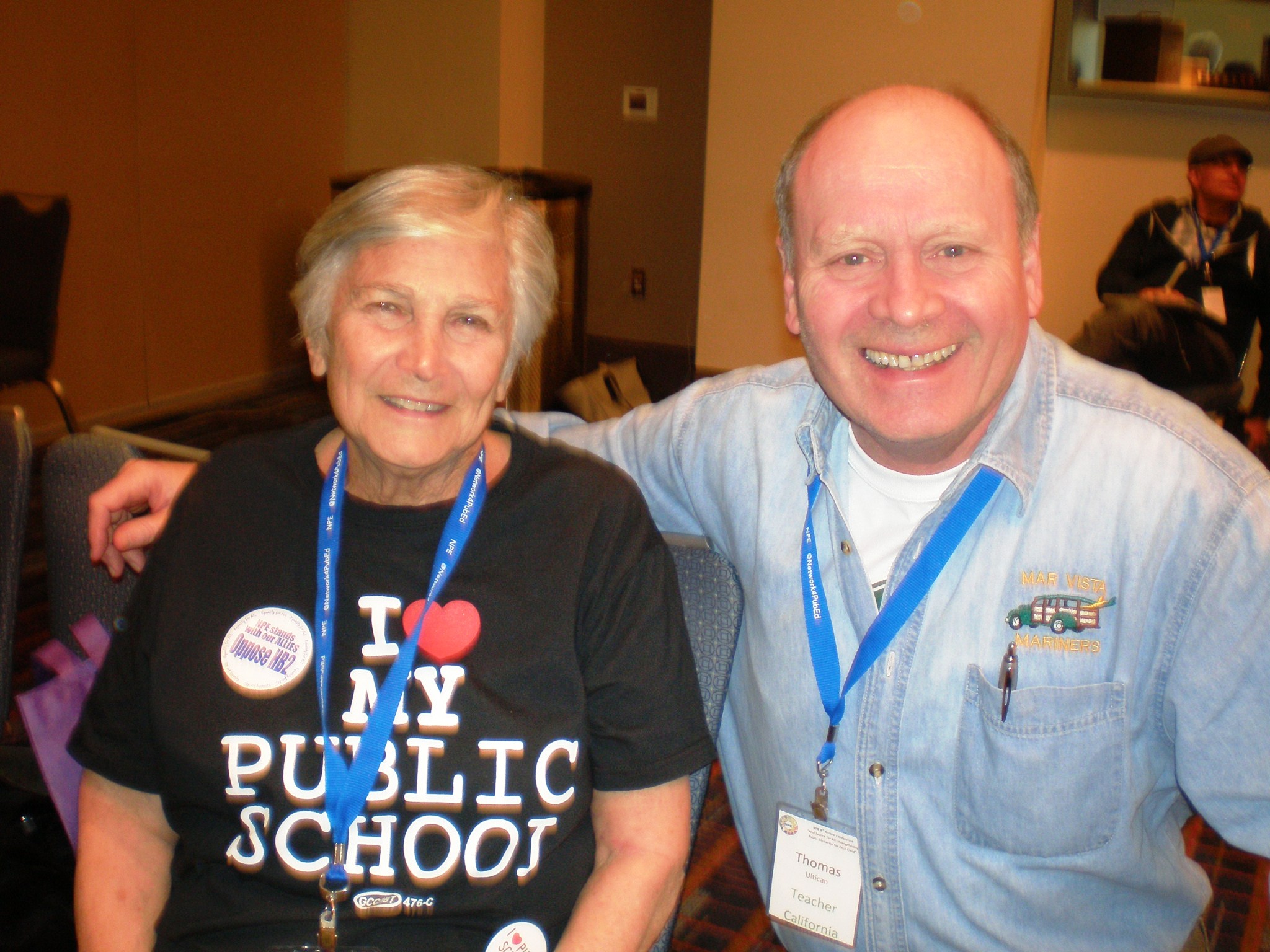
Me and Diane

The best part of “An Education” for me was Diane’s recounting growing up in Houston and going to a segregated public school. Her experience was just so relatable. She liked all the music my oldest sister liked. Cheating was rampant in her school just like mine and like her; I let my classmates copy my work. My rural Idaho school was kind of segregated but that was because only white people and a few Mexican families lived in the community. The Mexican kids were very popular in our school. I never met a Black person until I was a senior in high school and had only seen a few through a car window when vacationing in Kansas City. It was wonderful to find some commonalities.

I had studied engineering, worked in Silicon Valley and pretty much ignored education. But I did hear from Diane and her friends about what a failure public education had become. By 1999, I became tired of hearing about people becoming rich off their stock options, working on the next greatest hard drive or dealing with the atrocious San Jose traffic. I decided to return to San Diego and do something to help public education by enlisting in a master of education program at the University of California San Diego (UCSD).

The UCSD program was oriented toward constructivist education which I really liked. I read books by Alfie Kohn and papers by Lisa Delpit and was ready to revolutionize public education. Then I got to my first job at Bell Jr. High School and discovered that the teachers there were well informed pros with lots of experience. By comparison, I was not nearly as competent as most of them.

It was then that I started to see that I had been bamboozled about how bad public schools were and began looking for like minded people. Two books, David Beliner’s and Eugene Glass’s “50 Myths and Lies that Threaten America’s Public Schools” and Diane Ravitch’s “The Death and Life of the Great American School System” were like water for the thirsty. Soon after that, I found Diane’s blog and joined the Network for Public Education (NPE) along with many other public school advocates.

I saw Diane at the 2015 NPE conference in Chicago’s Drake Hotel. It was an absolutely inspiring event with a keynote by the amazing Yong Zhao. Although we started communicating a little by email, I did not meet Diane personally until NPE 2016 in Raleigh, North Carolina. It was there that the Reverend William Barber gave a truly inspiring speech.

Tom Ultican and Diane Ravitch in Raleigh (by Ultican)

Over the years since, I have developed an ever growing admiration for this woman. She outworks everyone and never gives up. In 2021, Diane had a really difficult open heart surgery. In the book, she notes going into surgery on April 7 and waking up a week later. I wrote her that my chanting Nam-myoho-renge-kyo for her health and recovery had saved her life but she foolishly gave some credit to the other hundreds of people who were sending prayers and to her skilled doctors.

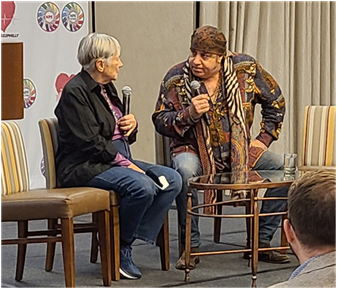
A year later, we had an NPE conference in Philadelphia. Diane was there and leading the proceeding but she was still weak. It was hardly noticeable but when she went to conduct an interview with Little Steven Van Zandt, he had to help her negotiate the two steps up to the platform.

Diane and Little Steven Van Zandt (by Ultican)

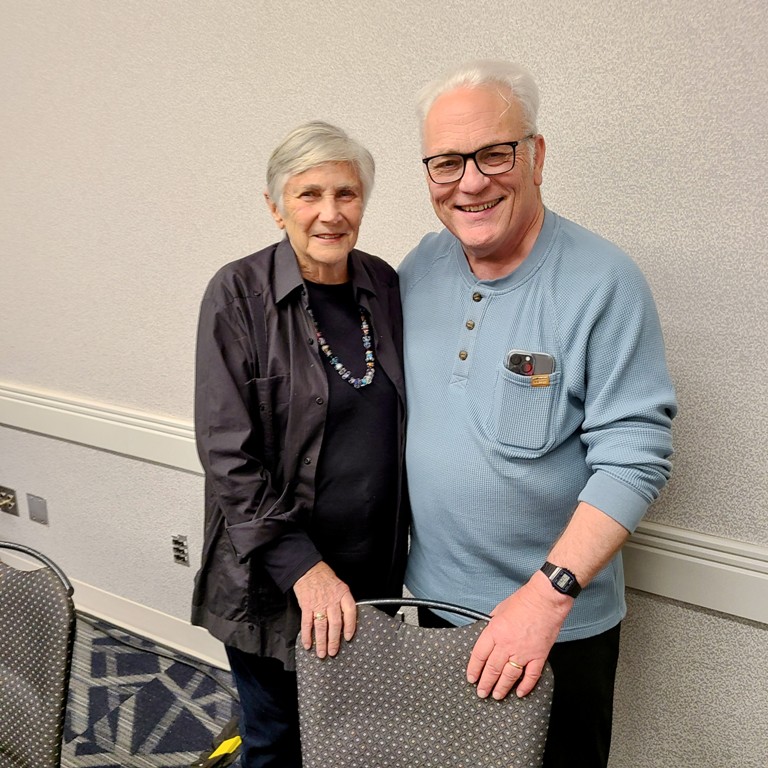
During my several trips to NPE conferences, I have met a Baptist preacher from Texas named Charles Foster Johnson. Charles has been a tireless fighter protecting public education and has developed an organization called Pastors for Children. I remember asking Diane if she ever thought she would be a friend and political ally with a Baptist preacher? She said, “No, never!” Earlier this year at NPE 2025 Diane and Charles asked me to take their picture. So there it was a Buddhist, a Jew and a Baptist working together and sharing friendship.

Diane Ravitch and Charles Foster Johnson 2025 (by Ultican)

Conclusion

Like I noted above, I had not paid any attention to public education so when I became aware of Diane, her blog and her book “The Death and Life of the Great American School System”, I was surprised to find how much seasoned educators despised Diane and could not trust her. Still to this day, I see education professionals taking shots at her and NPE. It is impossible for them to believe she changed her mind which brings to mind the words of Emerson, “Foolish consistency is the hobgoblin of little minds…” They just cannot accept new evidence.

I really enjoyed Diane’s latest book and encourage everyone to read it. She probably thinks this is her last book a sort of swan song. Somehow, I don’t think so. She is relentless and will almost certainly want to teach all of us about something in the future. I expect that in two or three years we will see another powerful book by Diane Ravitch.

More Proof: Charter School Experiment FAILED

25 Oct

By Thomas Ultican 10/25/2024

Two new reports detail the high closure rates of charter schools and the negative effect of school closures on students. In 2020, Network for Public Education (NPE) produced Broken Promises,” the first ever comprehensive study of charter school closure rates. Their just released new report, Doomed to Fail,” updates “Broken Promises.” In May, Houston researcher, Jeonghyeok Kim, published The Long Shadow of School Closures: Impacts on Students’ Educational and Labor Market Outcomes.” Taken together these two new studies demonstrate why the charter school industry is a dangerous failure.

Since the inception of charter schools in the 1990s, billionaires and entrepreneurs have worked to sell these privatized schools. Under Bill Clinton’s leadership, the Democratic Leadership Council embraced school choice believing in the power of the entrepreneurial economy to reform schools (Left Behind Pages 122-127). The federal government started experimenting with charter schools. A rewrite of the 1994 Elementary and Secondary Education Act included a provision for a new federal Charter School Program. In 1995, the new program granted a total of $4,539,548 to nine states. Today, $400 million federal dollars are spent yearly to promote charter schools and oversight is relatively weak.

There is no denying that some charter schools are excellent, however, in general they are unstable. As NPE has documented their closure rates are so high as to be a big risk for parents and students.

Doomed to Fail

Reformers believed that a large-scale charter experiment would either prove or disprove the superiority of charter schools. In 2006, after Hurricane Katrina, Louisiana turned to the new Recovery School District (RSD) and all the schools in New Orleans became charter schools. However, because the students who returned to New Orleans were different from those in the city before, and there was an enormous influx of philanthropic funding, it was impossible to determine if the charter experiment worked.

Gary Rubenstein explained:

“Reformers needed a new experiment where the schools would keep the same students they already had, but the staff at those schools would be replaced with nonunion charter school educators, and charter chains or start-up charter boards would run the schools. Race to the Top provided Tennessee the funding and incentive to test the reformers’ hypotheses.” (Doomed page 19)

The theory was that “failing” schools in the bottom 5% of testing data would be taken over by charter schools. The goal was to show that these privatized schools would soon be in the top 25% of schools on testing results. It was a complete failure. None of the 33 charterized schools ever left the bottom.

This experiment demonstrated that it was not the public schools causing poor performance and privatizing them provided no improvement. The type of school, charter or public, made no difference. However, unstable schools are harmful and “Doomed to Fail” shows that charter schools induce a failure rate crap shoot.

The NPE report describes how professional marketing campaigns convince parents that the new charter school is different and better than the nearby public school. “Doomed to Fail” states:

“However, as hundreds of thousands of families have found, enrolling your child in a charter school comes with enormous risk. Charter schools close at far higher rates than public schools. And, unlike public school districts where infrequent closures are orderly with the district finding a new school for the child, charter school closures are often chaotic and abrupt, taking parents by surprise.” (Doomed Page 1)

“Doomed to Fail” Page 11

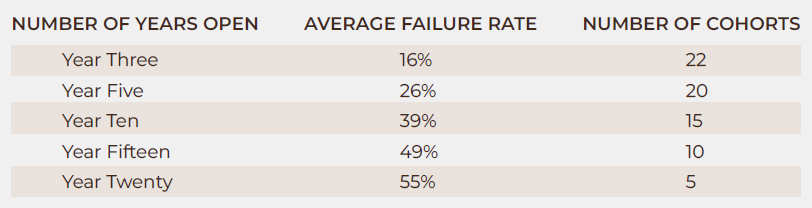
Researcher Ryan Pfleger, Ph.D. used the federal Common Core of Data to create the table above. Each cohort is comprised of every year’s batch of new charter schools. The table informs us that 16% of new charter schools close their doors within the first three years. The ten 15-year cohorts failed at a 49% rate which is a 1% improvement over the 2020 “Broken Promises” report. However, the huge federal COVID payments of 2021 probably kept many schools in business that otherwise would have failed. The 20-year failure rate of 55% makes it clear that failure keeps happening and that more than half of all charter schools close their doors forcing families to make other arrangements.

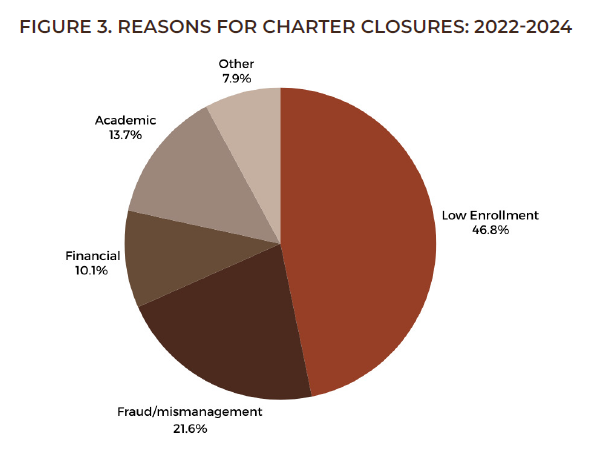
The charter industry says their schools are more academically accountable and are closed if they do not meet the agreed to goals. However, NPE’s research discovered that this was the cause for only a minority of the schools that closed. Not being able to maintain enough enrollment to be viable or corruption and mismanagement were the cause in more than 68% of closures. 

“Doomed to Fail” Page 13

Closures Bring Long Term Negative Effects

In 2019, Matt Barnum of Chalkbeat reported on 17 studies of the effect of school closures on students. There were differing results but in general reading and math scores suffered but after three years, the academic effects seemed to have disappeared.

Researcher Jeonghyeok Kim took a longer range look at the student outcomes and the results were surprising. Like other studies, Kim’s showed a short term academic decline and then recovery within three years. However, he also discovered long term discipline issues, lowered college completion rates and reduced incomes.

In EdWeek, Libby Stanford reported, “Kim centered his research around a dataset of 470 Texas schools that closed from 1998 to 2015.” Stanford also noted, “In a study of federal enrollment data from 2000 to 2018, researchers at the Stanford Graduate School of Education found that majority-Black schools were three times more likely to close than schools with smaller enrollments of Black students.” Since Kim associated the harshest closed school outcomes with economically disadvantaged families, this represents a double whammy.

The abstract from Kim’s paper states:

“Each year, over a thousand public schools in the US close due to declining enrollments and chronic low performance, displacing hundreds of thousands of students. Using Texas administrative data and empirical strategies that use within-student across-time and within-school across-cohort variation, I explore the impact of school closures on students’ educational and labor market outcomes. The findings indicate that experiencing school closures results in disruptions in both test scores and behavior. While the drop in test scores is recovered within three years, behavioral issues persist. This study further finds decreases in post-secondary education attainment, employment, and earnings at ages 25–27. These impacts are particularly pronounced among students in secondary education, Hispanic students, and those from originally low-performing schools and economically disadvantaged families.”

Kim’s ground breaking research shows that the negative effects of experiencing a school closure are not just short term, but appear to be a life long hindrance.

Conclusion

NPE’s new study, “Doomed to Fail,” makes it clear how unstable privatized schools are. The study also reports on charter skullduggery and specific school closures like Jubilee academy, sharing:

“On August 14, 2023, Jubilee Academies Highland Park in San Antonio, Texas, began the school year. Two weeks later, parents were informed that the school would close by mid-September. Families would have to find another school or agree to bus their child to another Jubilee school. Two hundred and ten students were displaced.” (Doomed Page 14)

When “Doomed to Fail” is combined with Jeonghyeok Kim’s new research, it is clear that parents are risking the future of their children when they enroll them in a charter school.

To be clear, trusting your child to a charter school is a bad idea.

NPE Throws Cold Water on CREDO Paper

23 Jul

By Thomas Ultican 7/23/2023

The Center for Research on Education Outcomes (CREDO) just released another pro-charter school study, “CREDO also acknowledges the Walton Family Foundation and The City Fund for supporting this research.” It is not a study submitted for peer review and so opaque that real scholars find the methodology and data sets difficult to understand. Carol Burris and her public school defenders at the Network for Public Education (NPE) have provided an in-depth critical review.

With the new CREDO study, Education Week’s Libby Stanford said that “charters have drastically improved, producing better reading and math scores than traditional public schools.’’  Rupert Murdoch’s Wall Street Journal declared charter schools are now “blowing away their traditional school competition.” Burris retorted with “despite the headlines, the only thing ‘blown away’ is the truth.” (Page 3)

Putting a CREDO Thumb on the Scale

CREDO uses massive data sets, unavailable to other researchers, getting minuscule differences which are statistically significant. No one can check their work. They employ a unique and highly discredited statistical approach called “virtual twins” to compare public school with charter school testing outcomes. Instead of reporting the statistical results in standard deviations, CREDO uses their “crazy pants” days of learning scheme.

NPE discovered that the “blowing away” public school results amounted to 0.011 standard deviations in math and 0.028 standard deviations in reading. The minuscule difference is “significant statistically but is meaningless from a practical standpoint” according to CREDO. In a 2009 report showing public schools with a small advantage, CREDO declared, “Differences of the magnitude described here could arise simply from the measurement error in the state achievement tests that make up the growth score, so considerable caution is needed in the use of these results.”

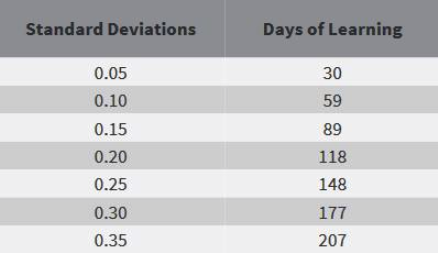
To give these almost non-existent differences more relevance, CREDO reports them as “days of learning” instead of standard deviation. “Days of learning” is a method unique to CREDO and generally not accepted by scholars. They claim charter school math students get 6 more “days of learning” and English students, 16 days.

CREDO Days of Learning Conversions

The above chart comes from the Technical Appendix of a previous CREDO study, which reveals that Eric Hanushek and Macke Raymond used NAEP data from 2017 to create the table. No justifications for the conversions are given. It appears to be sloppy science and headlines generated by its use are unfounded propaganda.

Bad Methodology

The CREDO method does not compare charter school performance to actual public schools. It creates mathematical simulations. Professor Andrew Maul of UC Santa-Barbara stated, “The study’s ‘virtual twin’ technique is insufficiently documented, and it remains unclear and puzzling why the researchers use this approach rather than the more accepted approach of propensity score matching.”

CREDO’s stipulation that “virtual twins” comes from “feeder schools,” favors charter schools. Management expert, Andrea Gabor, explained that CREDO used less than five student transfers to a charter school as the cutoff for a particular public school’s data. She notes the “study excludes public schools that do NOT send students to charters, thus introducing a bias against the best urban public schools, especially small public schools that may send few, if any, students to charters.”

This study is singularly focused on test results as determinate of school quality. Many charter systems, like IDEA and Success Academy, spend an inordinate amount of time preparing for standardized tests. This biases results.

Professor Mark Weber of Rutgers University adds a few more observations:

The NPE report highlights another source of bias for charter schools:

“In addition to their presence in a CREDO-identified feeder school, students are matched by gender, grade level, scores, race, and special education and English language learner status. Yet special education students are not a monolith. Research has consistently shown that charters take fewer special education students and enroll fewer students with more challenging disabilities than public schools.” (Page 9)

The combination of rejected methodologies, murky data studies and biases toward charter schools render the CREDO study useless. Minuscule advantages reported, favoring charter schools, indicate that in reality, public schools outperform charters.

The CREDO Story

In 1981, Massachusetts Institute of Technology trained economist, Eric Hanushek, wrote “Throwing Money at Schools.” Right-leaning philanthropies and institutions were drawn to his declaration:

“The conventional wisdom about public schools is that they face serious problems in terms of performance and that improving schools requires additional money. However, the available evidence suggests that there is no relationship between expenditures and the achievement of students and that such traditional remedies as reducing class sizes or hiring better trained teachers are unlikely to improve matters.”

In a 1981 Ed Week commentary referencing this paper, Hanushek points to SAT testing as the gold standard for judging school performance. He claims, “Advanced statistical techniques are employed to disentangle the influences on achievement of schools and teachers from those of other factors such as family backgrounds and student abilities.” This motivated him to push for teachers to be evaluated, using “value added measures”, that since have been thoroughly discredited.

At the time, he was teaching political science and economics at Rochester University and meeting his future wife, a significantly younger student, named Margret (Macke) Raymond. She completed her Rochester University political science PhD in 1985.

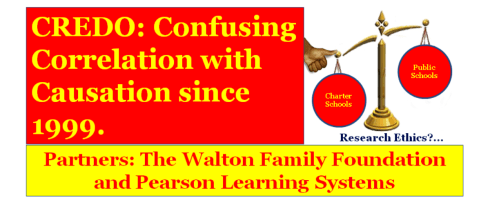
A 1999 announcement from the school said, “The Center for Research on Education Outcomes has been established at the University of Rochester’s Wallis Institute of Political Economy…” In the same posting, it revealed, “Two foundations have committed $1.25 million to fund a three-and one-half year initiative to address the current shortage of evaluation research in education policy matters.” CREDO never made the names of the two foundations public but a knowledgeable academic disclosed one of them was the Walton Family Foundation. It is documented that the Waltons give generously to CREDO.

The announcement listed Eric Hanushek first and Macke Raymond as founding Director.

CREDO moved to Stanford University’s Hoover Institute in July 2000 which made networking in conservative circles much easier.  Their 2nd year report stated that moving to the Hoover Institute brought many new contacts, including the New Schools Venture Fund, the District of Columbia Charter School Board, the Teacher Union Reform Network and others.

Public Schools are Superior to Charter Schools

Staffing in public schools is made up of mostly college graduates with certified state teaching credentials. Before the appearance of the billionaire-created Teach For America (TFA), nearly 100% of public school teachers had a year of teacher training and a bachelors degree or higher. A significant percentage of charter school teachers come from TFA with just five weeks of education training. Charters are typically not required to use certificated teachers.

The depth of experience in the public school teaching corps is larger than that of charter schools. A Fordham Institute article states:

“That being said, there is a bona fide but often unaddressed teacher shortage: experienced teachers in charter schools. In the United States, a third of charter teachers have fewer than three years of teaching experience, compared to only a fifth of public school teachers.”

“Comparative inexperience and youth in front of classrooms carries costs. More than any other school-related factor, a teacher’s efficacy matters most to student learning. And especially in the early years, nothing improves a teacher’s efficacy quite like experience.

Stability is important for school-aged children and especially for those growing up in difficult home environments. In 2020, NPE conducted an in-depth look at charter schools since their inception. They discovered that charters were closing at extremely high rates; 18% by year 3, 25% by year 5, 40% by year 10 and 50% by year 15. In some cases, charters closed their doors mid-semester without warning; this never happens in public schools.

Management in public schools must meet state credentialing requirements. They focus on good pedagogy, safe schools and parent engagement. In charter schools, supervisors are often untrained in education and make return on investment, a key goal.

Safety in public schools is state-mandated but charter schools can ignore some rules. In California, all public schools must be earthquake-safe facilities. Charter schools may not heed this requirement.

In 2013, Christopher A. Lubienski and Sarah Theule Lubienski published The Public School Advantage – Why Public Schools Outperform Private Schools. Nothing has happened over the last ten years that invalidates this scholarly work. Charter schools are private schools with a state contract, similar to garbage collection companies, contracting with a city. They are private companies, paid with taxpayer funds.

Charters are substandard education organizations that only survive because of marketing.

Chartered to Indoctrinate

3 Jul

By Thomas Ultican 7/3/2023

Carol Burris and team at Network for Public Education (NPE) just published, A Sharp Turn Right(STR). NPE President Diane Ravitch noted there are several problems associated with charter schools’ profiteering, high closure rates, no accountability…

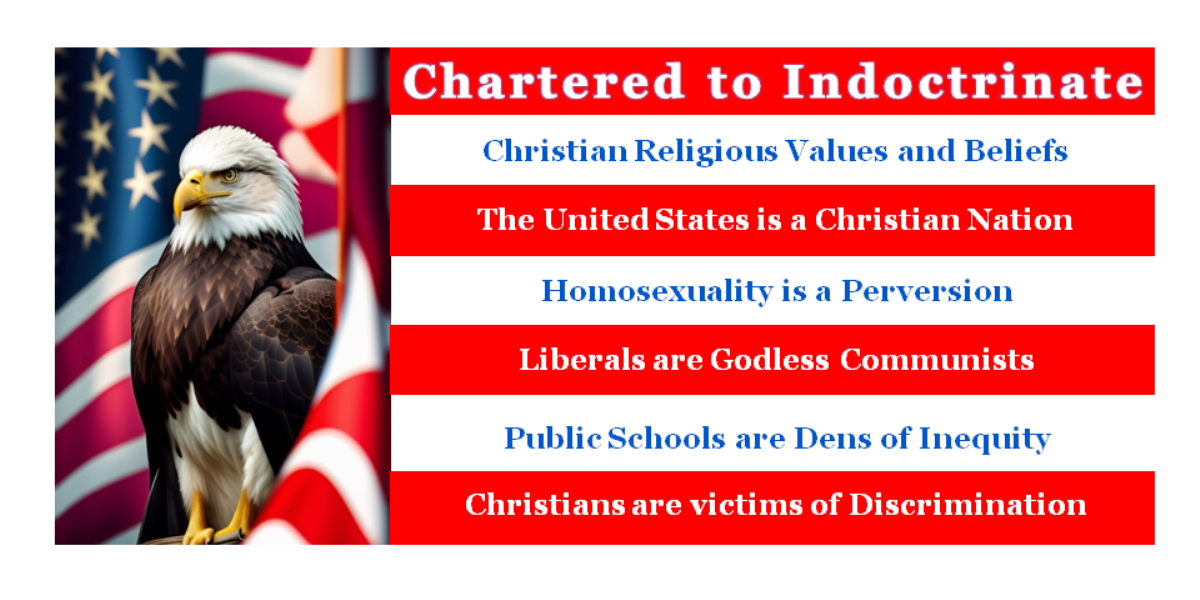
“This new report, A Sharp Turn Right, exposes yet one more problem — the creation of a new breed of charter schools that are imbued with the ideas of right-wing Christian nationalism. These charter schools have become weapons of the Right as they seek to destroy democratically governed public schools while turning back the clock of education and social progress by a century.” (STR Pages 3 and 4)

STR focuses on two types of charter schools. One characterizes themselves as “classical academies” and the other touts “back to basics,” without noting they also employ the same “classical” curriculum. Both provide right-wing clues on their web-sites, alerting parents of alignment with Christian nationalism. Marketing is often red, white and blue, with pictures of the American founding fathers, and discussions on patriotism and virtue. Some schools include direct references to religion like Advantage Academy’s claim of educating students in afaith-friendly environment.”

STR further clarifies,

“These schools are distinguished by a classical “virtuous” curriculum combined with hyper-patriotism for Christian nationalist appeal. They are exemplified by charters that adopt The Hillsdale College 1776 Curriculum…” (STR Page 7)

Using keyword searches, NPE identified 273 active charter schools fitting this description and noted they surely missed more. Nearly 30% of them were for-profit; about double the rate for the charter sector in general. Almost 50% of them have opened since Donald Trump was inaugurated president in 2017. (STR Page 7)

Apparently the school founders want to turn the clock back to the nineteenth century. STR states,

“Founders of classical charters view the rejection of modern instructional practices as a selling point. Proponents of classical education vilify the progressive movement, accusing John Dewey and his followers of removing Christian ideals and redesigning schools to achieve social goals.” (STR Page 9)

It identifies the largest charter school systems indoctrinating students with Christian nationalist ideology and discloses where they are operating. Discussing, in some depth, Hillsdale College with its Barney charter schools and the large number of new charter affiliates, the report asserts:

“What they all have in common is teaching Hillsdale’s prescriptive 1776 curriculum, which disparages the New Deal and affirmative action while downplaying the effects of slavery. Climate change is not mentioned in the science curriculum; sixth-grade studies include a single reference to global warming.” (STR Page 15)

The reality is today’s taxpayers are forced to pay for schools teaching a form of Christianity associated with white superiority; politically indoctrinating students with specific rightist orthodoxy. What happened to the principal of separation of church and state? This charter schools for indoctrination movement must be stopped before American democracy is sundered.

Church and State

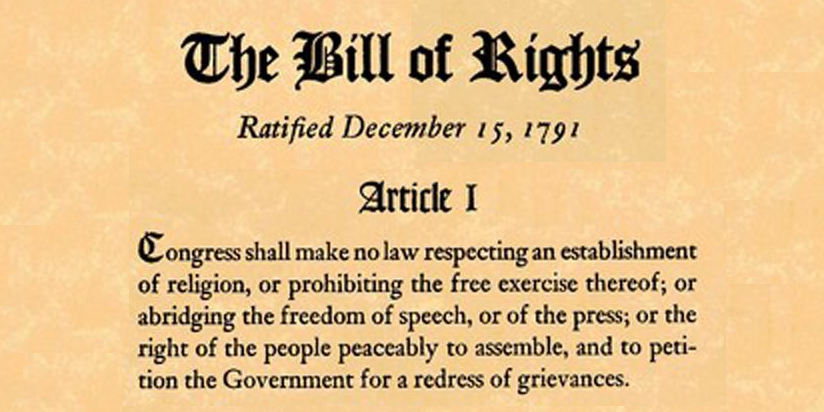
James Madison proposed the Bill of Rights to codify protections not addressed in the constitution. In the first article, four freedoms are guaranteed – freedom of speech, freedom the press, freedom of peaceable assembly and freedom of religion.

In an 1802 letter to the Danbury Baptist association of Connecticut, Thomas Jefferson explained,

“Believing with you that religion is a matter which lies solely between Man & his God, that he owes account to none other for his faith or his worship, that the legitimate powers of government reach actions only, & not opinions, I contemplate with sovereign reverence that act of the whole American people which declared that their legislature should ‘make no law respecting an establishment of religion, or prohibiting the free exercise thereof,’ thus building a wall of separation between Church & State.” (Emphasis added)

Katherine Stewart’s deeply researched book, The Good News Club, shares that tensions between Protestants and Catholics became fever-pitched in the 19th century. A student in Boston, named Thomas Whall, refused to recite the Protestant version of the Ten Commandments and was beaten for thirty minutes. In 1869, the Cincinnati Bible War over classroom Bible use raged in the streets. (Good News Pages 72 and 73)

Stress over religion in school mounted to the point that President Ulysses S. Grant in an 1876 speech counseled,

“Leave the matter of religion to the family altar, the church, and the private school, supported entirely by private contributions. Keep the church and state forever separate.” (Good News Pages 73-74)

Clarification of the Establishment Clause came in a 1947 Supreme Court decision over a New Jersey school board providing transportation costs for schools run by the Catholic Diocese. In Everson v. Board of Education, Justice Hugo Black stated in his majority opinion:

“The ‘establishment of religion’ clause of the First Amendment means at least this: Neither a state nor the Federal Government can set up a church. Neither can pass laws which aid one religion, aid all religions or prefer one religion over another. Neither can force nor influence a person to go to or remain away from church against his will or force him to profess a belief or disbelief in any religion. No person can be punished for entertaining of professing religious beliefs or disbeliefs, for church attendance or non-attendance. No tax in any amount, large or small, can be levied to support any religious activities or institutions, whatever they may be called or whatever form they may adopt to teach or practice religion.” (Emphasis added)

The 1962 Supreme Court decision in Engle v. Vitale ended prayer in school. This was not a particularly close call, with only Justice Potter in descent. Justice Black, writing for the majority, stated:

“We think that, by using its public school system to encourage recitation of the Regents’ prayer, the State of New York has adopted a practice wholly inconsistent with the Establishment Clause. There can, of course, be no doubt that New York’s program of daily classroom invocation of God’s blessings as prescribed in the Regents’ prayer is a religious activity.”

By the time Ronald Reagan was elected the 40th president of the United States, the “separation of church and state” had been firmly established.

America’s Riven Rights

Reagan’s nomination of the proclaimed originalist, Anthony Scalia, to the Supreme Court began the attack on the Establishment Clause. According to Jeffrey Toobin, author of The Nine: Inside the Secret World of the Supreme Court, Scalia maintained that the Constitution not only permits entanglement between church and state, but encourages it. (Good News Page 85) 

Katherine Stewart observed,

“According to Scalia, the secularism of today’s liberals is really just another religion – and an unattractive one at that, suitable for the weak of mind and character. It is the creed of relativism, which says that no belief is better than any other, and no value is better than any other. This philosophy of religion is the genuinely immovable part of Scalia’s judicial philosophy in cases involving religion, and it has proven to be the real source of his disdain for the Establishment Clause.” (Good News Page 86)

Scalia was a lonely voice on the court until 1991 when President Bush appointed Clarence Thomas.

The first big break for the anti-establishment forces came in the case of the LAX Board of Airport Commissioners v. Jews for Jesus. In the case, Jay Sekulow defended the constitutional right to stand in an Airport and hand out tracks about Jesus. The case was not controversial. Sekulow achieved a unanimous victory but more importantly, the new legal concept of speech from a religious viewpoint being protected was created.

Stewart writes, “Henceforth, Sekulow would appear repeatedly before the Supreme Court, playing a song with just one note: religious activity is really just speech from a religious viewpoint; therefore, any attempt to exclude religious activity is an infringement of the freedom of speech.” (Good News Page 90)

When Center Moriches Union School District turned down James Dobson’s request to use their facilities for a religious film series based on a no religious groups policy, Dobson sued. Sekulow claimed they were engaging in speech from a religious viewpoint and in 1991, the court ruled for Dobson, based on freedom of speech.

The Rosenberger v. University of Virginia case was decided in 1995, favoring Rosenberger with a split 5-4 decision. University student Rosenberger had asked for several thousand dollars from a student activity fund to subsidize the cost of “Wide Awake”, a Christian magazine. The court ruled that denial of funding based on the religious message amounted to viewpoint discrimination. Justice Souter noted that the University of Virginia was directly subsidizing religion by paying for a magazine that exhorts its readers to convert to Christianity.

In 1996, the Child Evangelism Fellowship applied to establish a Good News Club at the K-12 Milford Central School. The New York school had a policy of restricting the use of its property by organizations and individuals for religious purposes. In 2001, the Supreme Court ruled 6-3 in favor of the plaintiffs in Good News Club v. Milford Central School.

Stewart reports, “In his majority opinion, Justice Thomas laid out a philosophy that essentially destroyed the postwar consensus on the separation of church and state.” Scalia conquered with Thomas’s reasoning and said religion is such a complicated thing that the court should refrain from even attempting to define it. (Good News Page 95)

With their newfound allegiance, to the Free Speech clause the court majority created a dubious attack on the Establishment Clause. In Widmar v. Vincent, Justice Byron White observed:

“A large part of respondents’ argument … is founded on the proposition that, because religious worship uses speech, it is protected by the Free Speech Clause of the First Amendment. Not only is it protected, they argue, but religious worship qua speech is not different from any other variety of protected speech as a matter of constitutional principle. I believe that this proposition is plainly wrong. Were it right, the Religion Clauses would be emptied of any independent meaning in circumstances in which religious practice took the form of speech.”

In this light, Stewart asks the obvious question, “Was it the intention of the country’s founders to include redundant or meaningless clauses in the Constitution?”

Conclusion

Time to wake up and smell the coffee; the modern Supreme Court is corrupt and needs reformation. Instead of deciding issues based on law and precedence, they create theories designed to support a political philosophy rather than showing fidelity to the constitution. This reflects a complete degradation of jurisprudence. The poorly formed decisions regularly undermine the rights and protections the founders bestowed on citizens; all while some Justices appear to be ethically compromised.

For the first time in American history, billions of taxpayer dollars are flowing to private religious schools.  The STR report shines a light on charter schools with religious agendas. Even more disturbing, these new taxpayer funded privatized schools are literally indoctrination centers, teaching a depraved political ideology.

This cannot stand!

Charter School Experiment FAILURE Documented Again

17 Aug

By Thomas Ultican 8/17/2020

Marketing and lack of oversight have obscured the failure of the charter school industry. The latest research reported by Carol Burris and her team at the Network for Public Education (NPE) documents the atrocious going out of business rate among charter schools.

The United States Education Department (USED) has invested more than $4 billion promoting the industry but has not effectively tracked the associated fraud, waste and failures. After 25-years of charter schooling, Broken Promises is the first comprehensive study of their closure rates.

Charter School Myths and Promises

Former American Federation of Teachers (AFT) union President, Albert Shanker, is often cited as the father of charter schools. His Wikipedia entry says, “In 1988, Shanker was the first to propose charter schools in the U.S.” He was not, nor was he central to charter school development.

Five years before Shanker’s famous 1988 speech in which he mentioned charter schools, the Reagan administration had published the infamous A Nation at Risk. In his speech, Shanker was clearly responding to that report as well as President Reagan’s call for choice in education and his own belief that American education was not serving the majority of students well.

At the time, Shanker was reading Ray Budde’s book from which he appropriated the terminology “charter.” In his 1988 speech, Shanker proposed,

“The school district and the teacher union would develop a procedure that would encourage any group of six or more teachers to submit a proposal to create a new school.”

“That group of teachers could set up a school within that school which ultimately, if the procedure works and it’s accepted, would be a totally autonomous school within that district.”

“I would approve such a proposal if it included a plan for faculty decision making, for participative management; team teaching; a way for a teaching team to govern itself; and a provision that shows how such a subunit would be organized so the teachers would no longer be isolated in the classroom throughout their professional lives, but would have the time to be available to share ideas and talk to and with each other.”

The actual development of charter schools was far different. Education Writer Rachel Cohen described what arose,

“At its outset, the real power in the charter coalition was what might be termed the ‘technocratic centrists’: business leaders, moderate Republicans, and DLC members looking for Third Way solutions that couldn’t be labeled big-government liberalism. While charters have drawn praise from other quarters—for instance, some educators and progressive activists see them as tools for racial and economic justice—these groups have never formed the heart of charters’ power base.”

In 1991, Bill Clinton – then Arkansas Governor and Chairman of the Democratic Leadership Council (DLC) – embraced the technocratic version of charter schools as a “Third Way” solution. Shanker would later complain, “It is almost impossible for us to get President Clinton to stop endorsing [charters] in all his speeches.”

By the time charter schools were birthed in Minnesota, Albert Shanker had agreed with several of the main points presented in “A Nation at Risk.” In accord with the DLC, Shanker stated,

“The reforms that resulted from A Nation At Risk and the other reports constituted a much-needed corrective to the softness of schools in the late ’60s and throughout the ’70s. Yes, we needed schools that had standards, and we still do.”

However, the public school failure belief was based on little more than illusion.

While writing an NPR article on the 35th anniversary of “A Nation at Risk,” Anya Kamenetz discovered that the report “never set out to undertake an objective inquiry.” Two of the authors admitted to her that they were “alarmed by what they believed was a decline in education, and looked for facts to fit that narrative.” The dubious evidence presented in their report would have never withstood a rigorous peer review process.

Some powerful evidence points in the opposite direction and indicates that the results from US public schools in the 60s and 70s were actually a great success story.

One measuring stick demonstrating that success is Nobel Prize winners. Since 1949, America has had 383 laureates; the second place country, Great Britain, had 132. In the same period, India had 12 laureates and China 8.

Stanford’s Center for Education Policy Analysis report on education achievement gaps states, “The gaps narrowed sharply in the 1970s and the first half of the 1980s, but then progress stalled.”

The digital revolution and the booming biotech industry were both created by students mostly from the supposedly “soft public schools” of the 60s and 70s.

In his 1999 book, The Schools Our Children Deserve, Education writer Alfie Kohn described the philosophy of current education reform saying it “consists of saying in effect, that ‘what we’re doing is OK, we just need to do it harder, longer, stronger, louder, meaner and we’ll have a better country.”’

Corporate groups, Third Way Democrats and the AFT all called for manufacturing style standards to be applied to public education. Unfortunately, standards based education has proven to be toxic; leading to jejune classes and the sundering of creativity. Children are learning to hate learning.

In his book Winners Take All, Anand Giridharadas calls modern social reform based on the belief that business leaders and market forces are the sure way to a better society “MarketWorld.” Charter schools are a “MarketWorld” education reform that has brought disruption, harm to public schools and accelerating segregation. They have produced superior marketing not superior education.

Broken Promises

Broken Promises opens by quoting the words of student mother Elouise Matthews to the Orleans Parish School Board:

“I am a parent of Mary D. Coghill [Charter School]. For the last three years I have had to place my kids at different schools each year because the schools keep closing. My child was attending MCPA, that school closed. He then went to Medard Nelson, that school closed. Now, he is at Coghill and y’all are trying to close that school. I am tired of moving my child every year because y’all are closing schools.”

In the modern era of school choice, the one choice New Orleans parent do not have is sending their children to a stable public school. New Orleans is a 100% privatized school district. It is the epitome of “MarketWorld” education reform.

“Broken Promises” looked at cohorts of newly opened charter schools between 1998 and 2017. Ryan Pfleger, Ph.D. led the analysis of charter schools closures utilizing the Department of Education’s Common Core of Data (CCD).

Before 1998, the massive government data base did not uniquely identify charter schools and the last complete data set available for all schools in America was 2017.

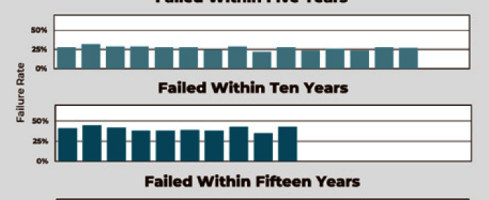
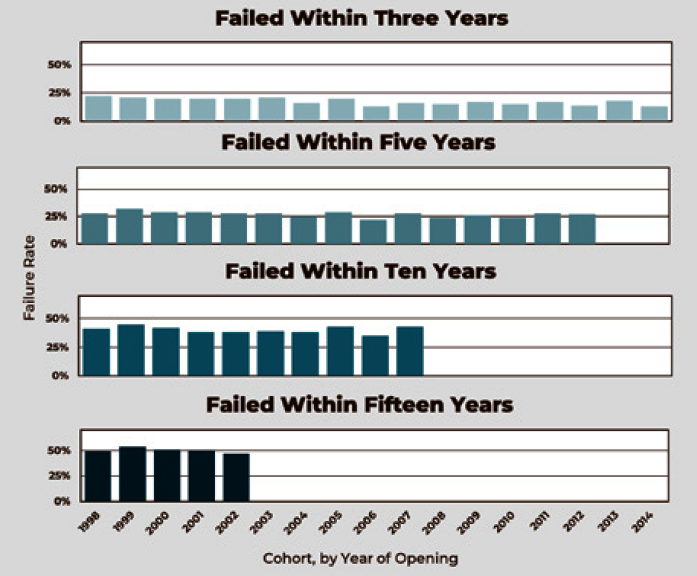
Startup charter school cohorts were identified by year and the cohort closure rates were tracked at 3, 5, 10 and 15 years after opening. The overall failure rates discovered were 18% by year-3, 25% by year-5, 40% by year-10 and 50% by year-15.

The NPE team discovered that half of all charter schools in America close their doors within fifteen years.

All Cohort Failure Graphic

Graphic from Broken Promises Showing Charter School Failure Rates

Many charter schools close within their first year of operations. “Broken Promises” shares the story of several of these quick failures. The following story was based on a TV newscast in North Carolina:

On a Thursday morning in September of 2014, parents dropped their children off at the Concrete Roses STEM Academy charter school in Charlotte, North Carolina. Families were handed a notice that the school would close the very next day. The school had claimed (and was funded for) an enrollment of 300 students although actual enrollment was only 126.

 Concrete Roses STEM Academy was open for only one month.

Because Concrete Rose STEM Academy closed before officially reporting attendance to the federal government in October, they do not count as a failed school. In the CCD database, they never showed students thus did not meet the criteria for having opened.

Burris and team document close to a million students being displaced by school closures. These displaced students then put tremendous pressure on public schools which are required to take them in.

“Broke Promises” also cites National Education Association research showing that “52 percent of students displaced by charter closings receive free or reduced-price lunch.”

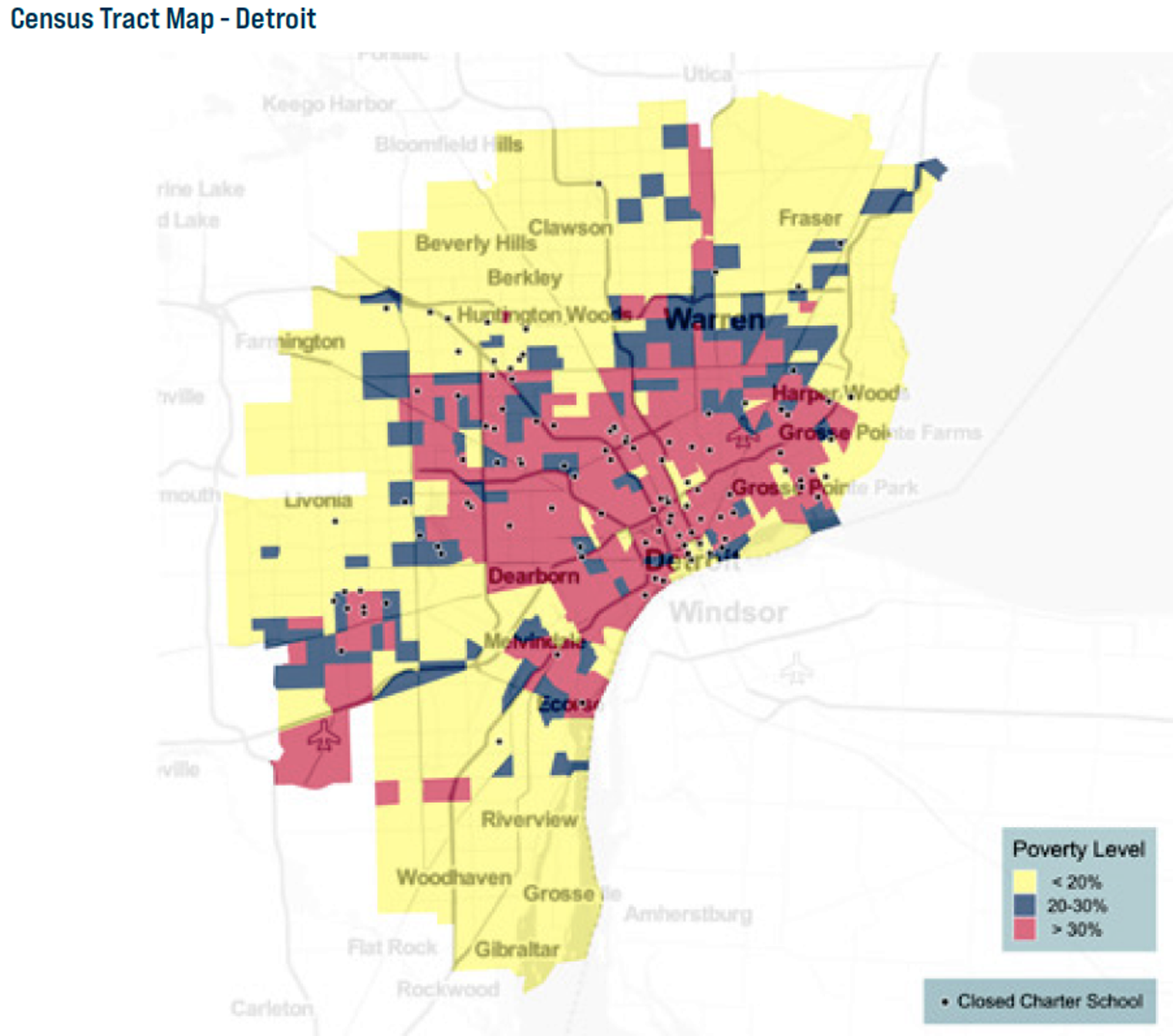
Census tract maps collated with charter school closures were utilized to understand where the closures were happening. In Detroit for example, they noted that between 1998 and 2015 245-charter schools opened of which 106 had closed (43%) by 2017.

The report states, “Fifty-nine percent of the failures were located in tracts with 30 percent or above rates of poverty, although there were a far greater number of tracts with lower levels of poverty.”

Census Tract Map Showing High Poverty Neighborhoods with Highest Charter Churn.

Mounting Evidence Shows Charter Schools Are Bad Policy

As charter schools started becoming a more significant part of local school districts, fiscal impacts mounted. In 2014, researchers Robert Bifulco from Syracuse University and Randall Reback from Bernard College published a study of the fiscal impacts in the public schools of Buffalo and Albany, NY. They estimated that the net costs in Buffalo were between $633 and $744 per pupil and in Albany between $976 and $1,070 per pupil. Thus, public school students were suffering reduced fiscal support in order to finance charter schools.

In 2016, Professor Bruce Baker of Rutgers University produced Exploring the consequences of charter school expansion in U.S. cities for the Economic Policy Institute. In the summary of this report he stated,

“Other reports have shown how high test scores and popularity of charter schools could be the byproducts of using data from cherry-picked charter schools that serve cherry-picked or culled populations. This report adds further insights for the debate on how expanding charter schools as a policy alternative achieves the broader goal. Specifically, it shows that charter expansion may increase inequity, introduce inefficiencies and redundancies, compromise financial stability, and introduce other objectionable distortions to the system that impede delivery of an equitable distribution of excellent or at least adequate education to all children.”

In 2017, NPE Executive Director Carol Burris produced “Charters and Consequences.” In it she stated,

“… nearly every day brings a story, often reported only in local newspapers, about charter mismanagement, failure, nepotism or outright theft and fraud.”

“This report … is the result of a year-long exploration of the effects of charter schools and the issues that surround them.”

To accompany the report, NPE started an ongoing web page, #AnotherDayAnotherCharterScandal, which catalogues and makes available the horrific charter industry record of fraud and malfeasance.

In 2018, Professors Helen F. Ladd of Duke University and John D. Singleton of Syracuse University published The Fiscal Externalities of Charter Schools: Evidence from North Carolina. Like the study of Buffalo and Albany they found powerful evidence that it was costing schools in Durham, NC $3600 per student lost to charters. The paper also stated, “We find smaller, though sizable, Net Fiscal Impacts in the non-urban districts and considerable heterogeneity across them.”

That same year professor Gordon Lafer of the University of Oregon published Breaking Point: The Cost of Charter Schools for Public School Districts.” Lafer stated,

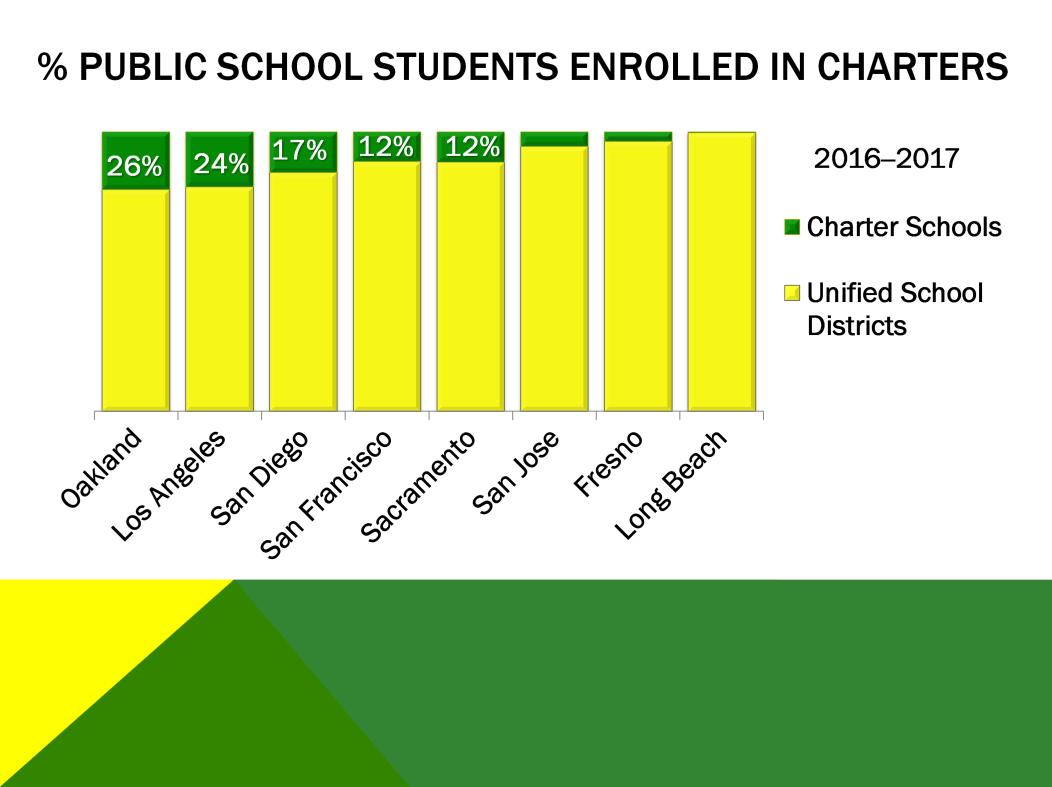
“In 2016-17, charter schools led to a net fiscal shortfall of $57.3 million for the Oakland Unified School District, $65.9 million for the San Diego Unified School District, and $19.3 million for Santa Clara County’s East Side Union High School District. The California Charter School Act currently doesn’t allow school boards to consider how a proposed charter school may impact a district’s educational programs or fiscal health when weighing new charter applications.”

Last year, NPE published two investigations of the federal Charter Schools Program (CSP). In Asleep at the Wheel, they stated, “We estimate that program funding has grown to well over $4 billion. That could bring the total of the potential waste to around $1billion.” At a congressional hearing, Education Secretary Betsy DeVos speaking about the report testified, “The report that you referenced has been totally debunked as propaganda.”

In response, NPE redoubled efforts and in December published Still Asleep at the Wheel where they documented that their conservative claims in the first report under-reported the extent of wasted money and negligence associated with the CSP.

Time to join with the NAACP in their 2018 call for a charter school moratorium. With the industries record of creaming, advancing segregation and self-dealing, charter profiteering can not be accepted. Charters have not delivered significant education improvements just disruption, community harm and fraud. School chartering is a FAILED experiment.

Federal Charter Schools Program a Fountain of Corruption and Disruption

19 Apr

By Thomas Ultican 4/19/2020

Last year, the Network for Public Education (NPE) published two investigations of the federal Charter Schools Program (CSP). The first one called Asleep at the Wheel came in March. In it they made several claims including that hundreds of millions of dollars had gone to schools that never opened or were shut down.

The authors, Carol Burris and Jeff Bryant, stated, “Therefore, we recommend that Congress end funding for new charter grants coming from CSP.”

Betsy DeVos, the Secretary of Education, harshly criticized the report to Congress saying, “It makes sweeping conclusions without supporting data or methodological rigor.”  In response, NPE redoubled efforts and in December published Still Asleep at the Wheel where they documented that their conservative claims in the first report under-reported the extent of negligence associated with the CSP.

DeVos Graphic

US Secretary of Education Betsy DeVos

The Charter Schools Program

After Walter Mondale’s crushing defeat in 1984, a group of mostly southern Democrats including Bill Clinton founded the Democratic Leadership Council (DLC). According to a 1997 article in the New Republic,

“… [T]he DLC’s mission was to wrest the Democratic Party away from its left-wing establishment—particularly minority interest groups and labor unions—in order to transform it into a party that championed middle-class values. The old Democrats called for minimum wage increases, antipoverty programs, protectionism, and school busing; the DLC’s self-described new Democrats sought balanced budgets, welfare reform, free trade agreements, and charter schools.”

In his book Kochland, Christopher Leonard wrote, “If the new era was defined by any term, it was still the soupy and ambiguous term of ‘neoliberalism,’ which combined the machinery of a welfare state with deregulatory efforts for the select few special interest groups that had the money and lobbying power to make their case heard in Washington, DC.”

The Charter Schools Program was established in Title 10 of the 1994 reauthorization of the Elementary and Secondary Education Act (ESEA) of 1965. The purposes cited were to provide support for the planning, program design, and initial implementation of charter schools. The intent stated was to enhance parent and student choices among public schools.  The business men and politicians writing the law believed these choices and standards would result in higher student achievement. In his paper “Schooling the State: ESEA and the Evolution of the U.S. Department of Education,” Patrick McGuinn explained,

“In the 1994 ESEA reauthorization, President Clinton—a former “education governor” and ‘New Democrat’— secured changes that would push states to increase performance reporting and embrace educational accountability. Under this new ESEA and a companion piece of legislation, Goals 2000, states were required to establish academic standards in each grade and create tests to assess whether students had mastered the standards. The tests were to be administered to all poor children at least once in grades three through five, six through nine, and ten through twelve.”

In “Still Asleep,” Burris recites,

“Begun with just $6 million in 1995, Congressional appropriations for the CSP jumped to $190 million by 2001 and nearly $219 million in 2004. In 2019, the federal Charter Schools Program was funded with $440 million in taxpayer dollars.”

The charter school theory was that these privately operated schools without interference from state education departments and local school districts would unleash dramatic innovation and improvement. In response to “Asleep,” DeVos wrote Representative Grijalva stating, “Stanford University’s Center for Research on Education Outcomes has shown that charter school students outperform their peers in traditional public schools.” However, her Education department’s 2019 study concluded that charter schools do not get better academic results than public schools.

When Bill Clinton first pushed charter school legislation, it was promoted as an experiment. The experiment is now 25-years old. This new class of privatized schools has come with many unintended consequences. They have driven up education costs through the inefficiencies associated with running dual systems; they have undermined teacher professionalism; they have weakened one of the great pillars of democracy in America and they have diminished the role of schools as a unifying historical entity in neighborhoods.

Unfortunately, they have not unleashed dramatic innovation and improvement; just disruption.

Asleep at the Wheel

The March 2019 paper “Asleep at the Wheel,” states in the executive summary,

“The federal outlays we examined are not modest expenditures amounting to little more than rounding errors. In its 2015 analysis, CSP stated that since its inception in 1994, the program had provided $3.3 billion to fund the startup, replication, and expansion of charter schools, creating 40 percent of operational public charter schools in the nation. We estimate that program funding has grown to well over $4 billion. That could bring the total of the potential waste to around $1billion.

“The waste of public dollars on closed charter schools is not the only concern. Of the grant recipients that manage to stay open, we uncovered extensive evidence that raises serious questions as to whether or not these schools are truly ‘high quality,’ meeting the CSP goal of providing equitable access for disadvantaged students.

“Through detailed examination of CSP’s application process, and by comparing claims made by charter grant applicants to information on state databases and school websites, we found numerous examples of federal tax dollars being misspent due to an inattentive process that routinely accepts applicants’ claims without scrutiny.”

“The CSP’s own analysis from 2006-2014 of its direct and state pass through funded programs found that nearly one out of three awardees were not currently in operation by the end of 2015.”

On April 10, 2019, Secretary of Education DeVos testified before the House Committee on Education and Labor where she was repeatedly queried about different claims made in “Asleep at the Wheel.” When Wisconsin Congressman Pocan asked about the more than $200 million grant to IDEA Charter Schools and their plan to lease a private jet for 6-years at $2 million per year, DeVos deflected and never answered the question but she did say, “The report that you referenced has been totally debunked as propaganda.”

That was a lie. It still has not been totally debunked or even seriously challenged.

In a written reply to follow up questions by the committee DeVos stated,

“Quite simply, the Network for Public Education is anti-reform, anti-charter and anti-choice; accordingly, its report represents nothing more than a political attack.”

“Unfortunately, several of your colleagues appear to have embraced this report without a careful examination of it. This rush to judgment risks fracturing the longstanding bipartisan support for public charter schools, which so many American families have come to rely upon as the only alternative to failing public schools.”

 “What isn’t debatable is that the Network for Public Education had a purpose when it published its report: to smear public charter schools, the CSP program and its grantees under the guise of research. It makes sweeping conclusions without supporting data or methodological rigor.”

“Since 2001, of the 5,265 charter schools that have received funding through a State entity or directly from the Department, 634 did not open and are unlikely to open in the future. As the developers of these schools received only CSP “planning” funds, which serve the specific purpose of enabling a charter school developer to explore the feasibility of opening a new charter school, the average award size for these schools was significantly lower than the average award size for CSP “implementation” grants and subgrants. In total, the funds awarded comprise less than 3.5 percent of the more than $2 billion in total awards made to public charter schools during the same period.”

The President of NPE, Diane Ravitch, has a long history of championing standards based education reform informed by standardized testing. It was only after reviewing years of data around 2007 that she concluded it was not working. She certainly never gave up on the idea of improving public education.

Her criticism of charter schools has been the lack of oversight, profiteering and fraud that have plagued the industry.

As far as school “choice” is concerned. In her book School Choice, educator and NPE supporter Mercedes Schneider quoted a 2012 Educational Research Alliance study noting, “The combined pressure to enroll a greater number of students and raise test scores to meet state targets seems to have created perverse incentives, encouraging the practice of screening and selecting students.”

Schneider observed, “[Milton] Friedman’s idea of the market as a disinterested player in the game of choice simply is not consistent with practice.”

Ironically, Secretary DeVos has a well known anti-public education bias. Christina Rizga wrote about the DeVoses’ philanthropy for Mother Jones stating,

“… [T]here’s the DeVoses’ long support of vouchers for private, religious schools; conservative Christian groups like the Foundation for Traditional Values, which has pushed to soften the separation of church and state; and organizations like Michigan’s Mackinac Center for Public Policy, which has championed the privatization of the education system.”

DeVos asserting NPE “makes sweeping conclusions without supporting data or methodological rigor” is a baseless claim. The reasons no one has been able to convincingly refute the conclusions in either “Asleep” or “Still Asleep” is because of the quality of the supporting data used and the careful rigor applied.

DeVos indicated that the spending on “ghost charters” [charters that never opened] was not nearly as high as stated. In a Washington Post article, Burris used DeVos’s data to defend the paper.

DeVos stated, “In total, the funds awarded comprise less than 3.5 percent of the more than $2 billion in total awards made to public charter schools during the same period.” Burris pointed out,

“The total for grants in the 2015 data set we used for our report is $1,794,548,157. Of that amount, 3.5 percent is $62,809,185. Our report said $45.5 million was wasted on ghost schools. Again, it appears as if we did not catch all of the waste.”

Burris also noted that of the 5,265 grantee schools DeVos cited only 3,138 were still in existence according to a department contracted WestEd presentation. That means 2,127 schools either never opened or were closed; a rate of 40.4% of all charters that were funded from active grants during those years. In “Still Asleep,” the percentage of failed charter schools over the same period was stated as 37%.

In other words, using DeVos’s numbers and official reports contracted by the US Department of Education for checking; the NPE numbers proved to be conservative and accurate.

Conclusion

Both “Asleep” and “Still Asleep” are well researched important studies illuminating the profound corruption in the federal Charter School Program.

“Still Asleep” notes, “Hundreds of millions of dollars sent to states with few rules of the road have resulted in the massive waste of federal tax dollars, as grants were doled out to individuals who had no credentials or experience to open up a new school.”

“Asleep” and “Still Asleep” are forty and forty-eight pages in length respectively. The data presented and the illustrative charter school antidotes are meticulously documented. These two documents reveal a corrupt raid on taxpayer money which is negatively impacting K-12 education in America.

The “Still Asleep” recommendations seem like common sense. They urge:

“We therefore strongly recommend that Congress end appropriations for new charter school grants in the upcoming budget and continue funding only for obligated amounts only to legitimate projects. Once those grants have been closed, we recommend that the CSP be ended and that charter schools continue to receive federal support only through other federal funding streams such as Title I and IDEA. Students, not charter school entrepreneurs, should benefit from federal funds.

“We also recommend thorough audits by Congress of previous grant awards, the establishment of regulations to ensure grant awards still under term are being responsibly carried out and that misspent money is returned to the federal coffers.”

NPE Indianapolis: “We Are Winning!”

29 Oct

By Thomas Ultican 10/29/2018

Diane Ravitch opened the fifth Network for Public Education (NPE) conference stating, “We are the resistance and we are winning!” She noted that “reformers” were envious of our domination of social media. When they hired mercenaries to staff their own multimillion dollar web-publications to counter us; they failed. We still dominate social media.

Ravitch listed a long string of victories including:

Leonie Haimson and her Class Sizes Matters organization successfully fought Bill Gates’ $100,000,000 Inbloom data base project that would have abrogated the privacy rights of countless children and their parents.

Jitu Brown led a thirty-two day hunger strike that saved the Walter Dyett high school, the only open enrollment high school in the Bronzeville community of Chicago.

Charter school growth has slowed significantly. Without the literally billions of dollars from “fauxlanthropists” and the federal government these often corrupt private businesses would have gone the way of the Edsel.

Diane concluded, “We’re winning. David is beating Goliath.”

Ravitch then introduced the famed Finish educator, Pasi Sahlberg, who coined the apt acronym for the worldwide school privatization phenomena by calling it the Global Education Reform Movement (GERM). Sahlberg began with stressing that what happens in the United States is extremely important because what we do here affects the rest of the world.  He said, “You are making progress. The global situation is getting better.”

Pasi Sahlberg has served at the World Bank ​ in Washington, DC ​, the European Commission ​ in Italy and acted as an external expert to the Organization for Economic Cooperation and Development (OECD) advising governments in more than 50 countries. He is a former Director General ​ at Finland’s Ministry of Education ​ and a Visiting professor ​ of Practice ​ at Harvard Graduate School of Education. He also chairs the Open Society Foundation​’s Education Board and is a member of the Governing board ​ of the University of Oulu​, the Centre on International Education Benchmarking and the International Council of Education Advisors (ICEA) for the Scottish Government ​.  He is currently working in Australia as a Professor of Education Policy at the University of New South Wales in Sidney.

Pasi slide

Pasi’s Slide Demarking Bad Education Policy and Good Education Policy

Professor Sahlberg’s presentation dealt with the negative effects being observed throughout the planet due to implementation of “GERM” policies. He shared several data sets including one implicating “GERM” initiatives in the degradation of student mental health. The following slide shows a correlation between screen time pushed by captains of technology industries such as Mark Zuckerberg and student mental health.
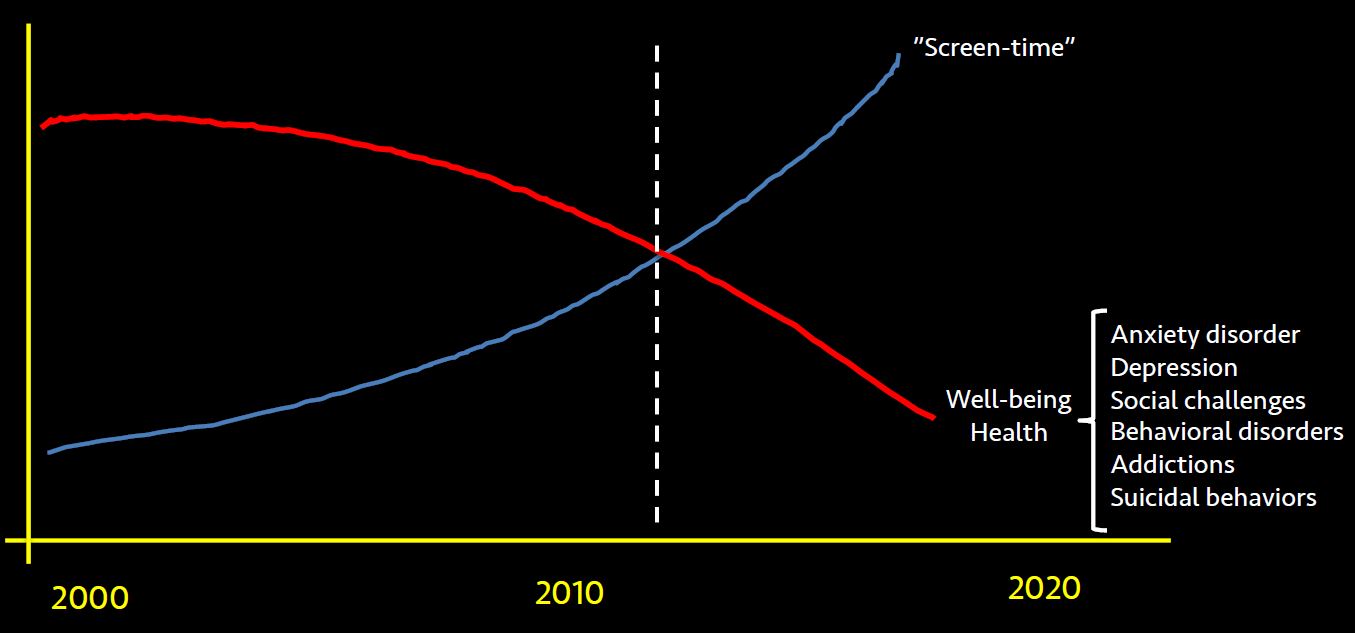
Pasi Screen Time Slide

Slide Shows Correlation Between Screen-time and Mental Health

He also shared some surprising conclusions from education researchers at the World Band and the (OECD).

“School choice advocates often argue that the introduction of market mechanisms in education allows equal access to high quality schooling for all…However evidence does not support these perceptions, as choice and associated market mechanisms can enhance segregation.” –OECD, 2012

“There is no consistent evidence that private schools deliver better learning outcomes than public schools. Numerous risks, such as the exclusion of disadvantaged or less able or desirable students, social segregation, exploitation of families for profit and the undermining of public education [exist].” –World Bank, 2017

Pasi ended his presentation on a similar note to Diane’s. He listed off places around the world where “GERM” is being reversed:

Sweden is in the process of reversing the unexpectedly sad results of their 1990’s decision to embrace school privatization.

Chile (the first victim of “GERM”) is “abolishing school selection, banning for-profit schools and investing in the teaching profession.”

Scotland is embracing a whole-child curriculum that focuses on equity and strengthening the role of play in the lower grades.

Liberia is now resisting privatization by for-profit foreign operators and the de-professionalizing of education.

Australia is reviewing the value of NAPLAN their standardized testing program. They are focusing on equity, well-being and early childhood education.

Singapore is mandating less testing, less student rankings, and more whole-child education.

New Zealand is removing national education standards, adopting less testing, abolishing charter schools, and encouraging more teacher and student voices. The new government won office by campaigning on a public education platform opposed to standards, testing and privatization.

Professor Sahlberg concluded by saying, “The problem is not completely solved but we are moving in the right direction.”

SOS Arizona the First Recipients of the Phyllis Bush Award

This year, NPE established a new award for community activism and named it after founding board member Phyllis Bush. The new to be annual award went to Save Our Schools Arizona. Two passionate women from Arizona, Beth Lewis and Sharon Kirsch received the award for SOS Arizona which stopped David and Charles Koch’s plan to massively expand vouchers in Arizona.

SOS Arizona Grass Roots Award

Sharon Kirsch and Beth Lewis Receive the Phyllis Bush Award for SOS Arizona from Phyllis Bush – Photo by Anthony Cody

After being ignored by state legislators who passed the Koch brother’s voucher law, they were demoralized. When Governor Doug Ducey dutifully signed the law, Beth and SOS Arizona decided to fight. They ignored all advice and precedence by staging an unlikely referendum signature drive. SOS Arizona surprised the professionals by running a successful campaign forcing the voucher law to the ballot which under Arizona law put it on hold.

Immediately, the Koch brothers set up a legal challenge and the SOS Arizona team had to fund raise to hire legal representation. After fighting and winning all the way to the state supreme court, SOS Arizona prevailed and the fate of the voucher law will be decided by the state’s voters on November 6.

Machine Learning and Data Mining Two Trojan Horses from the Technology Industry
Machine Learning

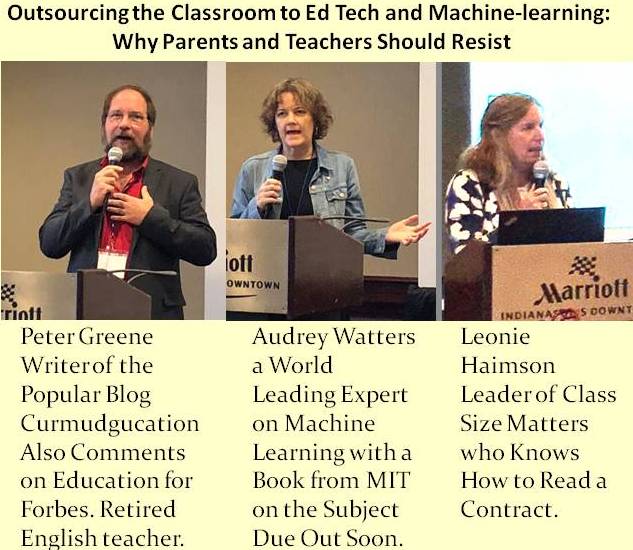
This Expert Panel Delivered a Powerful Message on Tech Inspired Student Harm

Leonie Haimson, who has a long successful history of working to protect student privacy, said a key understanding is that nothing is free. When a technology company provides software, computers, tablets or any other tech product for free, they expect something back – data. And even if you trust company “Z” to respect your privacy, it is likely that the data collected at schools will be stolen if not sold.

Audrey Watters apprised about the history of education technology, teaching machines and the failure of tech companies to come anywhere close to meeting their predictions.  She shared, “Thomas Edison famously predicted in 1922, for example, ‘I believe that the motion picture is destined to revolutionize our educational system and that in a few years it will supplant largely, if not entirely, the use of textbooks.”’

Audrey defined artificial intelligence (AI) as little more than predictive algorithms based on statistics. She gave two reasons parent and teachers should resist “personalized learning” and the oversold AI. First, the software is proprietary which means we only see the inputs and outputs but not the decision making process. Second she asserted,

“Algorithms are biased, in part, because they’re built with data that’s biased, data taken from existing institutions and practices that are biased. They’re built by people who are biased. (Bless your hearts, white men, who think you are the rational objective ones and the rest of us just play ‘identity politics.’)”

Peter Greene reinforced Audrey’s claims about AI being yet one more over-hyped product from the technology industry which comes with peril for students. He said it is as if somebody walked into your classroom and said these three students belong in the advanced class and those three should be moved to the remedial class but will not tell you how they know. You would not listen to them and you certainly should not be run by a black box with a secret algorithm.

Little Sis the Antidote for Big Brother

Grading the States

NPE in cooperation with the Schott Foundation recently published Grading the States. The breakout session on that topic became more of an advanced seminar in researching tax documents and coalitions of groups working to privatize public education.

Schneider described how non-profit organization must file tax forms that detail their giving called a form 990. Mercedes also explained that there is also a form 990 PF and if that is the form filed, the filer must also list contributions to the private foundation. Gates and Walton file form 990 PF.

Gabor explained how to find these forms. She said she prefers the Foundation Center for her personal searches. Andrea noted that finding some foundations can be difficult and that it is often better to use less information in a search when the common foundation name yields no results.

Andrea Gabor’s latest book is called After the Education Wars: How Smart Schools Upend the Business of Reform.

Darcie Cimarusti did a lot of the research for the new report, Hijacked by Billionaires: How the Super Rich Buy Elections to Undermine Public Schools. She shared her use of LittleSis in doing that research. It is a free database detailing the connections between powerful people and organizations. Who do the wealthiest Americans donate their money to? Where did White House officials work before they were appointed? Which lobbyists are married to politicians, and who do they lobby for?

One form of data presentation from LittleSis is mapped connections. The screen grab below is of a map created by Darcie showing the moneyed connection around the 2017 LA school board election. On LittleSis, all of the shown paths are rollovers or links to data. For example, the link from Reed Hastings to the California Charter Schools Association (CCSA) reveals $8,520,500 going to their independent expenditures committee.
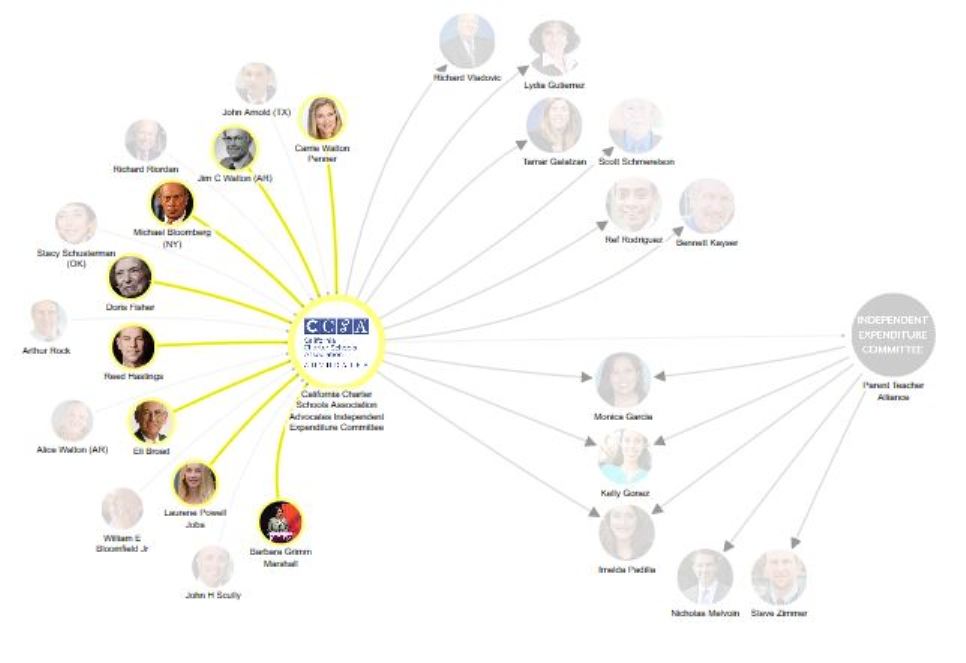
LittleSis Map by Darci

Darcie’s Map of Billionaire Donations to the CCSA Independent Expenditure Committee

NPE’s Diverse Environment is Manifesting Youthful Leaders

Jitu Brown is National Director of the Journey for Justice (J4J), an alliance of grassroots groups fighting against privatization and for sustainable community schools in over 28 cities including Atlanta, Baltimore, Birmingham, Boston, Chicago, Dayton, Denver, Detroit, Eupora and Kilmichael Mississippi, Los Angeles, Newark, Patterson, Camden, Jersey City, Milwaukee, Minneapolis, New Orleans, New York City, Brooklyn, Oakland, Philadelphia, Pittsburgh, Wichita and Johannesburg, South Africa!

This year Jitu and J4J came with a message:

“We are not fooled by the ‘illusion of school choice.’ The policies of the last twenty years, driven more by private interests than by concern for our children’s education, are devastating our neighborhoods and our democratic rights. Only by organizing locally and coming together nationally will we build the power we need to change local, state, and federal policy and win back our public schools.”

J4J introduced their #WeChoose campaign which has seven pillars:

  1. A moratorium on school privatization.
  2. The creation of 10,000 community schools.
  3. End zero tolerance policies in public schools now. (Supports restorative justice)
  4. Conduct a national equity assessment.
  5. Stop the attack on black teachers. (In 9 major cities impacted by school privatization there has been a rapid decline in the number of black teachers.)
  6. End state takeovers, appointed school boards and mayoral control.
  7. Eliminate the over-reliance on standardized tests in public schools.

For a real treat check out this video of Jitu Brown leading the NPE conference in a chant he learned from a high school student in Chicago.

Jitu Brown introduced Sunday morning’s keynote speaker, Jesse Hagopian, a youthful teacher leader from Seattle, Washington. Jitu declared, “Jesse is a freedom fighter who happens to be a teacher.”

Jesse’s address was called “Black Lives Matter at School.” He reported that Black Lives Matter at School Week was observed by 20 cities in 2017 and that he hoped to further expand the movement. Hagopian listed three demands: (1) End zero tolerance discipline and replace it with restorative justice; (2) Hire more black teachers (he noted there are 26,000 less black teachers since 2010) and (3) Teach ethnic studies including black history.

Saturday evening’s keynote speaker was Helen Gym, a city council member from Philadelphia whose political career was launched by fighting the horrible attack on public education in her city. Helen is a small person of Korean decent but she has giant courage and is an impassioned orator. Her address to the conference was titled “Victories for Public Ed in Philly.” Thanks to Helen and her friends, the seventeen-year long state takeover of Philadelphia’s public schools has ended. They now have a school board. Helen’s basic message was “we only get what we are organized to take.”
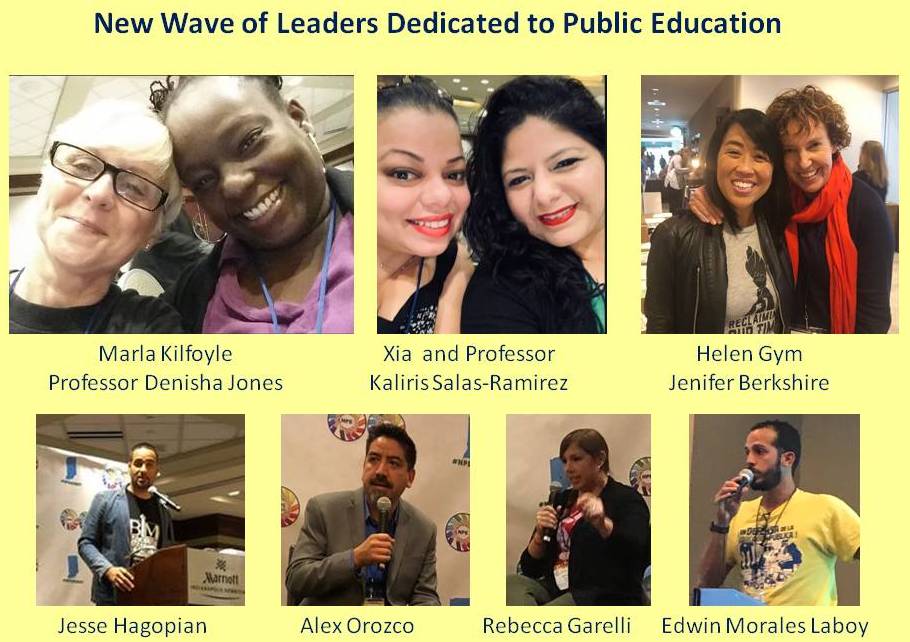
New Leaders

Sampling of a Youthful Wave of Education Champions at #NPE18Indy

The NAACP was in the House

The conference ended with an address by Derrick Johnson, President of the NAACP. Derrick grew up in pre-DeVosian Detroit, which meant he attended authentic high quality public schools. He now lives in Jackson, Mississippi with his wife and children.

Derrick Johnson close

Derrick Johnson, President of NAACP, Speaking at #NPE18Indy – Photo by Anthony Cody

Derrick said the NAACP was not opposed to charter schools, but is calling for a moratorium until there is transparency in their operations and uniformity in terms of requirements. He said NAACP conducted an in depth national study of charter schools and found a wide range of problems that needed to be fixed before the experiment is continued.

Johnson has been quoted saying “For the NAACP, we have been far more aggressive toward bad public schools then we’ve ever been against charter schools.” He said “We believe the same [accountability] for public schools should apply to charter schools.”

When Jesse Hagopian asked Mr. Johnson about how best to promote Black Lives Matter at School. He responded positively to Hagopian but did add a note of caution saying it was extremely important that the movement be inclusionary.

A Personal Perspective

Almost four years ago, I attended my first NPE conference in Chicago. I was very motivated by what I saw and heard, however, I did have a concern. It seemed like the movement was dominated by older white teachers like me, who were approaching retirement age. I thought that did not bode well for the future of our movement to save quality public education.

This year the conference was even more motivational with a big positive difference. A large wave of diverse youthful professionals have taken leadership. The future looks very bright with so many brilliant young people who are growing their expertise in research and organizing. These youthful leaders are determined to save our public schools. They are standing up for a social good that is not related to Mammonism or self promotion. They are the resistance that is winning.

For me personally, I had the opportunity to cultivate deeper friendships with the many wonderfully individuals who I first met at NPE Chicago. That included once again speaking with my personal heroine and friend, Diane Ravitch. Diane and I were even able to take our fourth annual picture.

Diane and I B

Diane Ravitch and Tom Ultican at #NPE18Indy – photo from Diane’s phone

Roll Up the Failed Charter School Experiment

24 Nov

By T. Ultican 11/24/2017

This month the, NPE (Network for Public Education) released a stunning report called “Charters and Consequences.” NPE Executive Director Carol Burris stated, “… nearly every day brings a story, often reported only in local newspapers, about charter mismanagement, failure, nepotism or outright theft and fraud.” About the report she writes, “This report … is the result of a year-long exploration of the effects of charter schools and the issues that surround them.”

This 50-page report’s conclusion is shared on the last page:

For all of the reasons above and more, the Network for Public Education regards charter schools as a failed experiment that our organization cannot support. If the strength of charter schools is the freedom to innovate, then that same freedom can be offered to public schools by the district or the state.

“At the same time, we recognize that many families have come to depend on charter schools and that many charter school teachers are dedicated professionals who serve their students well. It is also true that some charter schools are successful. We do not, therefore, call for the immediate closure of all charter schools, but rather we advocate for their eventual absorption into the public school system. We look forward to the day when charter schools are governed not by private boards, but by those elected by the community, at the district, city or county level.”

The Charter School System is Not Sustainable

The report begins with a relatively deep dive into the wild west of charter schools, California. It summarizes:

“Everyone I spoke with accepted that charters have a place in the state, and in many instances, they acknowledged that charters serve children well.  However, all had deep concerns about the lack of charter transparency, accountability, and their fiscal impact on public schools.”

NPE held a conference in Oakland this past October. One breakout session was titled, “Holding the Line, Fighting Charter Growth in Oakland, CA.” The presenters explained why they view charter expansion as an existential threat to public education.

Shelly Weintraub introduced the four members of the expert panel starting with herself:

“I taught in Oakland for 15 years and then coordinated the history social science program for the next 20.

“Jan [Malvin] was a researcher from the University of California and a parent activist who helped gather a lot of data for our presentation.

“Alison [McDonald] taught with me at Fremont High. She became a principal of a small school called Life Academy, and then went on to become the assistant superintendent in charge of all the high schools in our district.

“Renee [Swayne] was an elementary teacher, focusing on 3rd grade. She also helped to run the History-Social Science program and then taught middle school in Oakland Unified Schools.”

Chater schools by city

Weintraub used the graphic above to introduce the subject of the session:

“Why is Oakland important? We feel this graphic helps answer that question. Oakland has a larger proportion of students in charter schools than any other large urban district in California. …. That’s why we fear that we’re reaching a tipping point, beyond which our district will no longer be able to exist as a viable school district.”

She explained:

“Many costs associated with the student stay with the district – for example, the cost of the school itself or the maintenance of the facility. The cost that remains is sometimes referred to as a “stranded cost.” Researchers in other areas have estimated that the stranded cost to a district of a student’s departure can be almost 50%. Thus, Oakland’s huge proportion of charters is leaving us with immense debt that likely means school closures, staff reductions, and more.”

The bottom line is that adding a privately-operated charter school system to public education drives up costs and introduces inefficiencies into the system. As a result, the vast majority of children who attend public schools in cities like Oakland, San Diego and Los Angeles have their resources reduced (mainly by larger class sizes and reduced facilities maintenance) to cover the unreimbursed costs engendered by charter school expansion.

Big Profits, Big Salaries and Marketing

“Charters and Consequences” documents the rise of the mall schools:

“In addition, running independent learning centers can be very lucrative. One of San Diego County’s largest networks of independent learning centers is the Altus Institute. It advertises on billboards and runs ads in movie theaters and on television.  Altus operates Audeo Charter, Audeo Charter II, the Charter School of San Diego and Laurel Academy. It has a total K-12 enrollment of about 3,000 students and takes in tens of millions of dollars in state and federal revenue.”

Charter administration pay is amazing. From the report:

“In 2014 compensation for Altus Institute president Mary Bixby was $371,160—exceeding the total pay plus benefits of the Superintendent of the San Diego Unified School District that serves nearly 130,000 students. Bixby, a board member of the charters and a full-time employee of one of the schools, also receives compensation for being “on-loan” to two other Altus schools. Such obvious conflicts of interest would be illegal in a public school.”

These mall schools have terrible graduation rates and students that do graduate may have cheated their way to a diploma. One of the big money-making schemes of the last decade is “credit recovery” at learning centers. America’s high school graduation rates peaked at about 77% in 1970 and then drifted down for almost four decades to 69% in 2007. Astoundingly, even with increased graduation requirements rates have shot up.

In 2016, over 83% of California’s freshman cohort graduated on time. In 2012, 81% of the freshman cohort in America graduated on time. These record setting numbers are the result of cheating and credit recovery.

Because of political connections, these absurd practices are not being checked. For example, in 2015, billionaire Penny Pritzker, then Secretary of Commerce, presented Mary Bixby the Malcolm Baldrige National Quality Award which recognizes U.S. organizations in the business, health care, education, and nonprofit sectors for performance excellence. Naturally, the award is a marketing tool for Bixby’s schools.

Mary Bixby’s salary looks inflated next to a public-school administrator, but others in the charter school industry are making much more as documented in the report:

“In 2014, KIPP co-founder, David Levin received a compensation package of nearly $475,000 from the Foundation. Co-founder Mike Feinberg received $219,596 from KIPP Inc., which manages the Houston charters, and still another $221,461 from the KIPP Foundation. According to the organization’s 990s, Feinberg works 50 hours a week for the Houston Schools, plus 40 hours a week for the Foundation—clearly an impossibility.”

In New York city, Eva Moskowitz runs the Success Academy system of charter schools. Based on test scores, her schools have pundits praising them as miracle schools. No accolade seems too grandiose for the schools run by this former New York City Councilman and Democrat. Moskowitz has cashed in. From the report,

“Levin’s and Feinberg’s salaries are dwarfed, however, when compared with the compensation package of Success Academy’s Eva Moscowitz, who received $600,000 in 2014 as the CEO of 41 charter schools.”

The profits at cyber charters are enormous as this antidote illustrates:

“Profits can become so lucrative, that Pennsylvania Cyber Charter founder, Nick Trombetta was able to siphon off $8 million dollars of taxpayer dollars for extravagant homes and an airplane. When Trombetta was finally arrested, it was not for the exorbitant profits, which were legal, but for tax fraud.”

Newsweek and the Washington Post regularly list Arizona’s Basis schools as the best schools in America. With this kind of publicity, the Basis owners get away with paying their management company, which they own, outsized fees. From the paper:

“BASIS General Administrative costs alone amounted to nearly $12 million for less than 9,000 students, while the six largest public school districts serve a quarter million students for less than $10 million in General Administrative costs.”

The Key to Success in Charters is Not Great Pedagogy – It’s Creaming

Both Basis Schools and Success Academy use the same tactics. Set up methods to selectively enroll more desired students, drive out students that do not meet expectations and do not accept new students into a cohort. See the following tabular evidence prepared from data in the NPE report.

Basis and Success Academy

On Wednesday (November 22), the New Orleans Tribune ran a scathing editorial about the complete failure and the fraudulent imposition of the post Katrina Recovery School District (RSD). The editorial cites the same tactics Basis and Success Academy use as tools employed to venerate some RSD schools. The editor writes:

“We know the truth. Schools like Benjamin Franklin, Lusher, Warren Easton and a few others have always been top performers. They were the schools OPSB were left with after the reformers pillaged and plundered. Decades before Katrina, long before the RSD and even before high-stakes testing became the order of the day, these schools benefited from selective admission processes and extraordinary resources that were not available at many other public schools in the city.”

“So that Lusher and Ben Franklin are two of the top 10 schools in the state does little to impress us. When these campuses get to cherry-pick who they want to educate and weed out others, it becomes a lot easier to get results.”

The Charter School Experiment Failed and It is Time for Change

The New Orleans Times editorial summarizes the after Katrina reality:

“To be sure, some of the same media outlets finally reporting the near truth about the failure of these schools as if it is some eye-opener have been some of the same outlets responsible for driving the false narrative of the reform’s success by either suppressing the truth or pushing falsehoods.”

And continues:

“It’s been 12 years since our schools were hijacked. And 12 years later, many of them are performing just as poorly as they were before they were stolen. To learn that charter operators set up goals they knew were unattainable just to get their charters approved and their hands on public money and facilities is indefensible.”

Public education in America is one of the world’s great success stories. A combination of foolishness, arrogance and greed led to a continuous drumbeat of slander for America’s pillar of democracy, equity and freedom. This nonsense has opened the door to harm for our country and its values. We must again embrace democracy when governing education paid for by public dollars and reject totalitarian schemes. After all, democracy is one of the great American values, if we lose that we lose America.

The NPE paper “Charters and Consequences” is an honest, unbiased study that should be read and shared widely. We should all embrace the papers concluding call for legislative action to institute the following:

  • An immediate moratorium on the creation of new charter schools, including no replication or expansion of existing charter schools.
  • The transformation of for-profit charters to non-profit charters.
  • The transformation of for-profit management organizations to non-profit management organizations.
  • All due process rights for charter students that are afforded public school students, in all matters of discipline.
  • Required certification of all school teaching and administrative staff.
  • Complete transparency in all expenditures and income.
  • Requirements that student bodies reflect the demographics of the served community.
  • Open meetings of the board of directors, posted at least 2 weeks prior on the charter’s website.
  • Annual audits available to the public.
  • Requirements to follow bidding laws and regulations.
  • Requirements that all properties owned by the charter school become the property of the local public school if the charter closes.
  • Requirements that all charter facilities meet building codes.
  • Requirements that charters offer free or reduced-price lunch programs for students.
  • Full compensation from the state for all expenditures incurred when a student leaves the public school to attend a charter.
  • Authorization, oversight and renewal of charters transferred to the local district in which they are located.
  • A rejection of all ALEC legislation regarding charter schools that advocates for less transparency, less accountability, and the removal of requirements for teacher certification.

“Until charter schools become true public schools, the Network for Public Education will continue to consider them to be private schools that take public funding.”

NPE Conference Day 1 Notes

26 Apr

After breakfast at the historic Drake hotel, the proceedings were given a rousing start by the moderator Anthony Cody and the opening speakers, Tanisha Brown of the Newark Students Union and Jitu Brown, National Director of Journey for Justice and an NPE Board member.

Tanisha is a beautiful full of life, idealistic student who is fighting against the corrupt takeover of the Newark public schools by the state of New Jersey and especially the authoritarian control of a former TFA member, Cami Anderson. Tanisha reminded me of the brilliant and talented students from my own high school. It is incredible how insightful and bright a 17 year-old can be.

I was particularly struck by her story of Allen. Allen was a kid from a struggling family who became involved with the Newark Student Union. Allen became discouraged by the injustice being meted out. One day, Allen just quit showing up. When a Union member finally was able to contact Allen, he informed them he was done and had joined a Gang.

Jitu was uplifting and brilliant. Two of his stories resonated with me and one of his conclusions was disturbing but rang true. Jitu is community organizer in Chicago. He told us that community organizing is never ending and vastly deep like the ocean. He said there was once a man from Chicago who claimed to be a community organizer but that he really just dipped his toe in the ocean and when it was cold moved on.

Mr. Brown told the story of staging a 3 year campaign just to get the windows in Einstein Elementary school in Chicago cleaned. He said small victories like that one are important and must be celebrated.

He talked about the kind of value system that made lynching a public spectacle that was celebrated by the dominant society. He said that is the same value system that says it is OK to close community schools. These are the same values that allow people to call today’s school “reform” a civil rights issue. These are not reformers, they are colonizers. “Colonizers are not the civil rights movement; we are!”

During the first session of the day that I attended, I found the opportunity meet and converse with one of my longtime heroines, Debra Meier. What a thrill! In this session the union leader from Little Rock shared how in 5 days they were able to defeat the Walton’s. The key was when they were able to remind the PTA that they stood for community based schools. The Arkansas legislature could ignore teachers, administrators and school boards but they could not ignore the parents.

The next session I went to was with the Tennessee Bats. By the time that was over, I was unbelievably inspired. Larry Profit is amazing and my former colleague, Mary Holden has found a place to make a difference. Their story of standing up to the incredible attack on public education and the fear it has engendered in Tennessee’s education community and now winning more than they are losing was motivating. There recipe of getting everyone involved especially parents was a wonderful message. One teacher said that her association with the Bats “has saved me mentally, emotionally and professionally.”

It’s late so I will write more soon about lunch with Peter Greene and EduShyster, plus the awesome keynote speech by Yong Zhao. In addition, there was an hour plus with the incomparable Mercedes and a wonderful panel on teaching for social justice.