Tag Archives: New Orleans

Charter Schools in a Racist Big Easy

8 Dec

By Thomas Ultican 12/8/2025

New Orleans was the site of the largest slave market in America. In the late 18th and early 19th centuries, more than 135,000 slaves were purchased in the Big Easy. This racist legacy has survived up until today in many of its White citizens, business leaders and politicians. The book William Frantz Public School states, “By the 1920s, Orleans Parish School Board members and district administrators vehemently voiced their belief that White supremacy should guide public policy and stated their willingness to employ any means, including the use of force, to maintain inequality between the two races.” (William Frantz Page 4) After the Supreme Court’s Brown decision, long-time state senator William Rainach headed a strategy committee that condemned integration as the work of communists and created the all-White Louisiana’s Citizens’ Councils (Overturning Brown page 34). Leading up to hurricane Katrina, many White citizens continued working to maintain the ideal of White supremacy.   

This summer, Tulane University’s Education Research Alliance (ERA) created and published The New Orleans Post-Katrina School Reforms: 20 Years of Lessons.” This report was published June 2, 2025 by authors Douglas Harris and Jamie Carroll. In an alliance with Network for Public Education (NPE), Kristen Buras PhD, who has been studying New Orleans schools since the hurricane, wrote a paper countering many of the claims made in the ERA paper.

There is reason to believe the two ERA writers are incapable of doing unbiased research in the education realm.

In 2023, Diane Ravitch disclosed that while serving as Secretary of Education, billionaire Betsy DeVos gave $10 million to establish a research center on school choice. The longtime advocate of school choice was not apt to give the money to academics likely to throw cold water on her life’s work. The grant went to Tulane University in the only American city that has no public schools. Ravitch noted, “The organization she funded is called the National Center for Research on Education Access and Choice (REACH), led by economist Douglas Harris.”

Jamie Carrol who attended an all-girls high school in Maryland was a Teach for America (TFA) teacher 2008-2010 in New Orleans. She went on to earn a Doctorate of Philosophy from the University of Texas. Today, she works as a researcher for Betsy DeVos’s REACH.

In her Paper, The Stories Behind the Statistics: Why a Report on “Large Achievement Gains” in Charter Schools Harms New Orleans’ Black Students”, Kristen Buras shares that the amazingly pro-charter school Arnold Foundation has spent lavishly to advance charter schools in New Orleans; in 2012 $15 million for “education reform” in New Orleans, then another $25 million to be managed by the Charter School Growth fund and New Schools for New Orleans (NSNO), and 2014-2017 grants to Tulane University and ERA of more than $5 million. Buras comments, “Grants from this consistently pro-charter foundation helped launch and sustain ERA’s work.”  (Buras Page 17) 

Recently, two of America’s most active funders of charter schools awarded nearly $1 Million to REACH: the Walton Foundation and the City Fund (Buras Page 18). The Walton family, who owns Walmart, is the wealthiest family in the world and the largest private funder of charter schools in the US. The City Fund was created by billionaires Reed Hastings and John Arnold. They each put in $100 million to create an organization specifically for spurring the spread of charter schools.

Do Not be Naïve

Even before hurricane Katrina, there were efforts for the state to take over New Orleans’s public schools. Tulane University President Scott Cowen was quite influential in the development of the state of Louisiana’s education policies. In 2003, Cowen was involved in the creation of the Recovery School District (RSD) that was to take control over “failing schools” in New Orleans and reform them. After Katrina, Cowen headed the education committee of Mayor Nagin’s Bring Back New Orleans Commission. In early 2006, Cowen’s committee released a report recommending that New Orleans become the nation’s first all-charter school district (Buras Page 18). 

Scott Cowen established Tulane University’s Cowen Institute, a predecessor of ERA. Buras reported on conducting interviews with Cowen’s staff in 2009 noting:

“I asked about the institute’s mission. Like ERA, they characterized their work as neutral. One staff member shared: ‘We don’t advocate for an all-charter system because we don’t feel there’s adequate research [at this point] to indicate that charters will outperform non-charters.’ Instead, the staff portrayed the Cowen Institute as an ‘honest broker’ and ‘objective observer.’ Yet, NSNO, TFA, and other pro-charter school groups were given free office space in the same suite as the Cowen Institute.” (Buras Page 18)

To this day, ERA shares office space on the seventh floor of 1555 Poydras Street with NSNO.

Since its inception, NSNO has been all about building the all-charter school system in New Orleans. A peak at their tax records (EIN: 02-0773717) shows Neerav Kinsland appearing on the board in 2010 and earning $117,000 as chief of strategy. In 2011 he became CEO earning $146,000 and over the next two years he was paid $207,000 and $223,000 as CEO. But that wasn’t good enough. Since then, he has worked for billionaires John Arnold and Reed Hastings, served on the California Charter School Association board and is now leading the City Fund.

After Katrina, Black teachers decreased from 71% in 2005 to 49% in 2014, then rose to 56% in recent years. They were paid less than white counterparts in the same teaching and administrative positions (Buras Page 13). Experienced Black teachers were replaced by mostly White college graduates from TFA with just 5 weeks of training as an educator.

Students in the Big Easy are forced to take long bus rides often past, within walking distance neighborhood schools, to get their assigned charter school. It is not unusual for them to soon be traumatized by one of New Orleans multiple school closures. Somehow, white children in New Orleans rarely experience school closures.

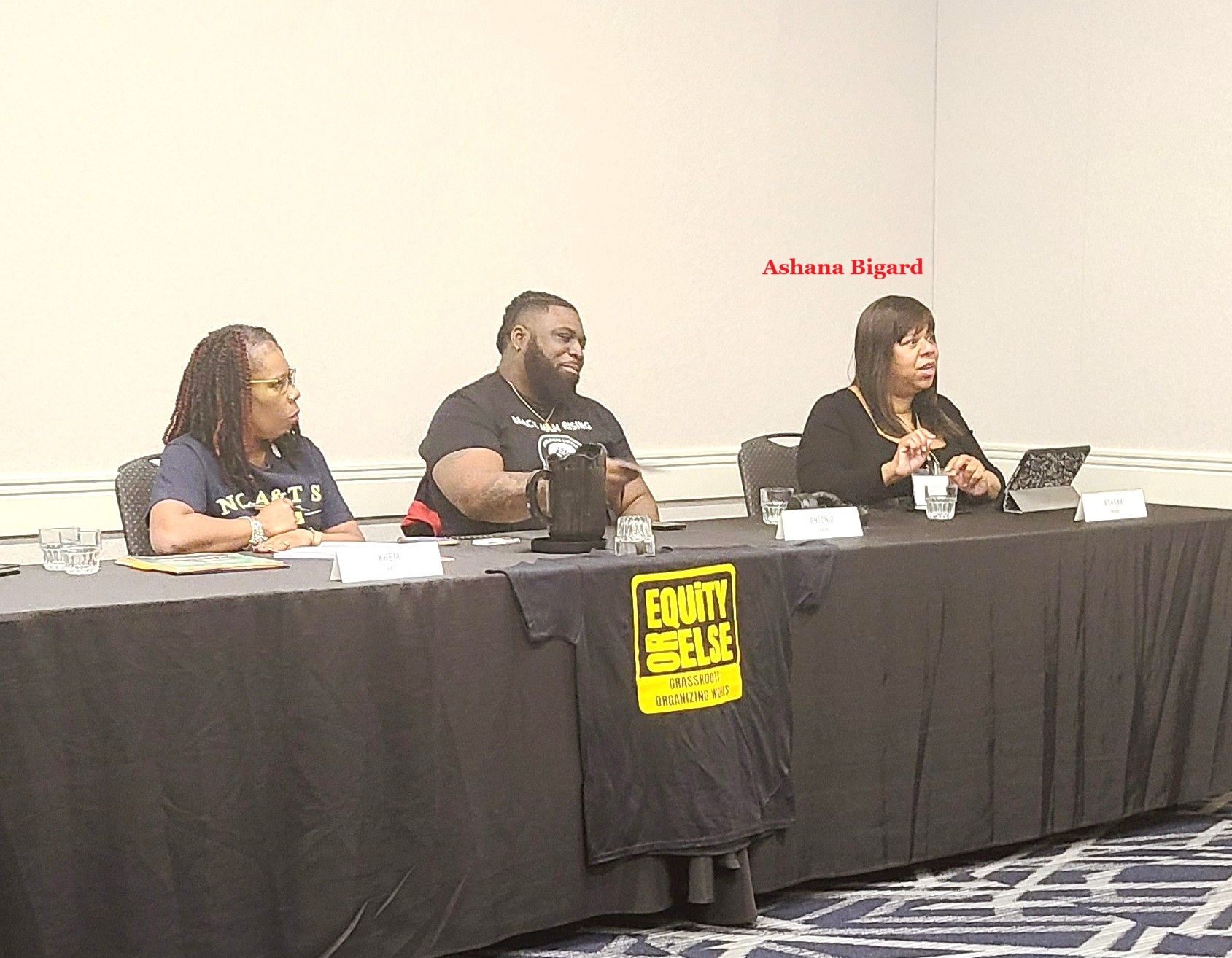
Ashana Bigard shared in her book “Beyond Resilience Katrina 20about the racist enrollment process in the all-charter school system. To enroll children, parents must use OneApp. It runs the school choice algorithm but strangely only white children get into the best schools, not even if you’re a Black family in the upper middle class do you get a seat. It is common to see White people move to the city and magically get their children into schools with 100 children on the waiting list. Ashana notes, “They didn’t even know the school existed prior to moving to the city, but racism and classism still existed heavily within the new system.” (Bigard Page 268)

Cheating Charters

The state cheated to create the conditions for developing the all-charter school system. Before Katrina, the cut point for school failure was 60 on a 200-point scale. After Katrina, through Act 35, the state legislature raised the cut point to 87.4, which was just below the state average. This maximized the number of public schools that the RSD could seize. Then, as charter schools were opened, the cut point for failure was lowered back to 60 (Buras Page 19).

The Times-Picayune reported that “data published by the Louisiana Department of Education vastly underreported the number of expulsions in charter schools.” For the 2007-2008 period, state data from a sample of 19 RSD charter schools listed only 4 students as having been expelled. The Lafayette Academy admitted to the Times-Picayune that 14 students were expelled that year; the state reported zero for Lafayette. (Buras Page 16)

In 2011-2012, 34% of schools in New Orleans had an out of school suspension (OSS) rate at or above 20%. Since 2009, charter schools have suspended students at rates sometimes double and triple the state average which was not that great to begin with. (Buras Page 15)

In 2015, SciTech Academy allowed students to take tests for one another, at home or multiple times (Buras Page 21).

Students coded as “transferred out of state” are excluded from the state’s metric. The inordinate use of the out of state code by charters seemed to be masking the true dropout figures which improved their state ratings (Buras Page 21).

At Landry-Walker, 78% of students scored “good” or “excellent” on the biology EOC and 78% on the geometry EOC. Only “good” or “excellent” scores earn points on the state’s metric. Yet, 52 of the 257 students who scored “good” or “excellent” on the EOC exam received a D or F in the class. By 2017, the Louisiana inspector general’s office had uncovered enough evidence of criminal wrongdoing at Landry-Walker that the local district attorney was alerted (Buras Page 21).

In her report, Buras says these are likely just the tip of the iceberg when it comes to charter school test cheating. Yet these inflated scores and school ratings are used by ERA to claim good academic results in New Orleans’s charter system. The willingness to ignore the cheating problem is appalling.
Beyond Resilience Katrina at 20

14 Oct

By Thomas Ultican 10/14/2025

The book William Franz Public School is a well documented work that shines a light on the deep racism in New Orleans and especially in its public schools. The title is the school where 6-years-old Ruby Bridges accompanied by federal officers desegregated New Orleans’ schools to the chagrin of the 1,000 plus protesters out front. “The message rang clear; Louisiana’s strong commitment to the education of its White, wealthier children paralleled an equally strong commitment to keep its Black, poor residents uneducated and isolated, and thus economically and politically powerless.” (WFPS 11) That ugly racism still permeates New Orleans which made me question what are their Black residents thinking and feeling. Ashana Bigard’s book, “Beyond Resilience Katrina 20, brilliantly provides some answers.

Bigard and her family have been in New Orleans forever; she is at least fifth generation. Her large family is a big part of the soul of New Orleans. Ashana takes her readers into the Black community that has refused to be beaten down and defeated by wealthy White supremacists.

After Katrina, the people in power stole the public community schools, fired the mostly Black teaching force and brought in predominantly white kids from Teach for America (TFA) to teach. Ashana shares that story beginning with running from the storm and then fighting against injustice for the last 20-years.

Katrina Arrived

Hurricane Katrina arrived about a week before payday for much of the New Orleans community. Like many others, Ashana and her family had experienced hurricanes before. They really could not afford to travel so they chose to wait it out at home. The storm came through and made a direct hit on the city, it was loud and intense but the next morning things seemed OK.

It was a tough night, but they had successfully ridden out the storm and it was beautiful outside. Ashana decided to walk to the old New Orleans community of Carrollton to check on a friend. Downed trees were everywhere. On the way an old man informed her that if she did not “have a boat in your pocket” she better get out of there because the levees had failed and the water was coming. (Bigard Page 11)

Some people in the community believed the levees had been purposefully blown up. Ashana and her family quickly got it together to load up and head out for Houston where they stayed until New Orleans opened again.

NPE 2025 Photo by Ultican

Back in New Orleans “the fraud was staggering” and media racism was appalling. Ashana noted:

“It seemed like every opportunity afforded to them, the media disparaged us calling us refugees and calling us looters. … White people getting food from stores to help each other … were described as ‘finding food.’ Black people doing the exact same thing were ‘looters’ and criminals who should be shot on sight, despite the fact that they had been left to die with no water, no food for days on end.” (Bigard Pages 32 and 33)

Rebuilding New Orleans

The work force in New Orleans is dominated by the Black community. However, when the rebuild started, local unions were frozen out. Wealthy carpetbaggers were running the show. Ashana sarcastically asks, “how could everybody get their money off the top if they were actually paying people real wages?”

There were no longer community schools that welcomed children or a city that was welcoming to its people. They soon began referring to their children’s schools as “test prep factories” and the kids called them “preparatory prison practice.” The youths of New Orleans named the new Knowledge is Power Program (KIPP) schools “kids in prison practice.” (Bigard Page 34)

Ashana worked at various non-profits as a student, parent and community counselor and advocate. She worked for families and friends of Louisiana’s incarcerated children where family members wanted to understand how their children first came into contact with the legal system.

Where were the arrests happening? Where were the summons coming from?” (Bigard Page 44)

The discovery didn’t take long. Ashana states, “The police inside the schools were arresting children for almost anything.” (Bigard Page 45) Best practices in adolescent development call for supportive environments, recognition of the biological realities of the teen years, and second chances not criminalization and punishment. This new school-to-prison pipeline was a complete abandonment of reason.

What developed in New Orleans was a harsh unforgiving no-excuses approach. This led to high expulsion rates and a 61% graduation rate.

Ben Kleban of College Prep charters told Ashana he would run his schools the way he wanted and if you don’t like it do what I did and start your own school. However, many PHDs, principals and academics from New Orleans applied to start schools almost none of them received a charter. (Bigard Page 54)

Ashana tells the story of counseling a teenage boy, a good student whose grades began falling for no apparent reason. Also he was becoming more and more despondent. After a week of discussion, he finally opened up about being sexually assaulted by a female TFA teacher. Apparently, the teacher succumbed to the adultification of young Black people. The student was blaming himself and tried to protect the teacher saying, “She came from Teach for America: they don’t give them much training.” (Bigard Page 98)

Ashana and her team were brought in to conduct a workshop on trauma: signs of trauma, solutions for trauma and how to deal with trauma in your classroom. Ten minutes into the workshop all 26 of the young White women were in tears. Ashana states:

“They were crying saying they were overwhelmed, suffering from secondary trauma, felt like they were crazy, and they all felt they were doing more harm than good. They had no support and when they went to Teach for America for support, they told them to try harder, and if they weren’t connecting, it was their fault because everyone else was doing a great job.”

The training developed into multiple unscheduled workshops that day as teachers went out and encouraged their colleagues to attend. Ashana says:

“I left the workshop understanding you never know all sides of the story and that there was a second wave of victims, and that was young, hopeful, starry-eyed white young people who thought this would be a great city to live in and a great opportunity and they could come and help out because of the teacher shortage which was caused by the firing of all our teachers and subsequently telling them that they had to take multiple tests to qualify to come back to teach while simultaneously telling young white children they only needed two weeks of training to do so.” (Bigard Pages 119-121)

The Legacy of Racism Lives On

To enroll children into the almost all charter system in New Orleans, parents must use OneApp. It runs the school choice algorithm but strangely only white children get into the best schools, not even if you’re a Black family in the upper middle class do you get a seat. It is common to see white people move to the city and magically get their children into schools with 100 children on the waiting list. Ashana notes, “They didn’t even know the school existed prior to moving to the city, but racism and classism still existed heavily within the new system.” (Bigard Page 268)

Ashana tells black people in New Orleans that poverty is not a moral failing. She says, “We start understanding that we are not broke we are stolen from.” (Bigard Page 318)

I have presented a few highlights in this delightful and insightful book. For me, Ashana’s book offers a rare view into the life of Black people fighting White supremacy and a story of love and family.

Bravo Ashana Bigard!

New Orleans Education is Inefficient Expensive and Sad

2 Oct

By Thomas Ultican 10/2/2019

New Orleans’s public schools were targeted by the destroy-public-education (DPE) movement even before hurricane Katrina struck. Today, they are the national example of a privatized school system. DPE operatives like Neerav Kingsland, the former chief executive of New Schools for New Orleans and Managing Director of the secretive City Fund, use New Orleans to promote the portfolio management theory of school governance and to attract philanthropic dollars to their cause. However, the reality is that New Orleans’ schools are inefficient, undermine communities, have extremely high management and transportation costs, and still struggle academically. They are a sad but typical example of market-based education reform.

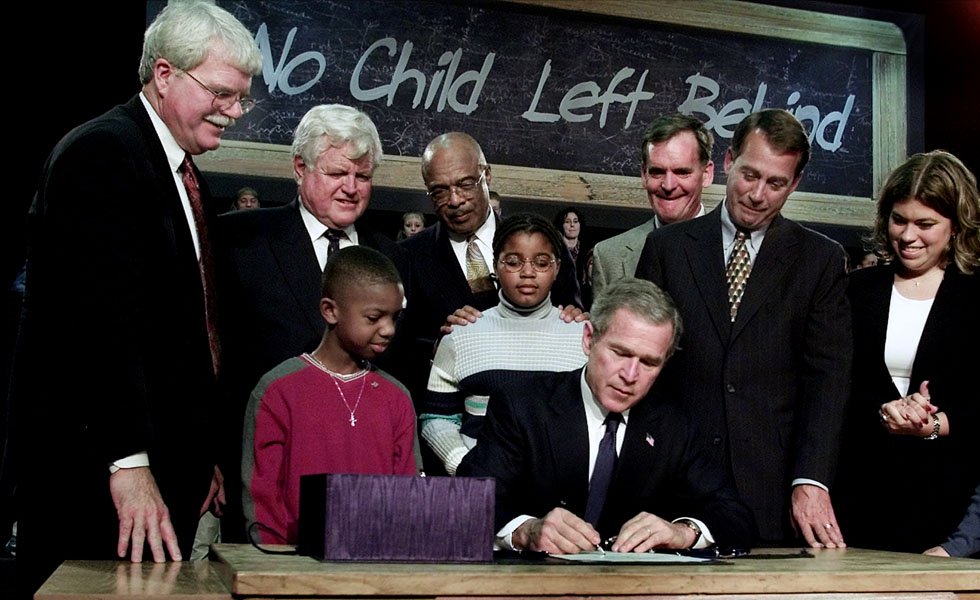
In 2002, George Bush signed into law the update of the Elementary and Secondary Education act known as “No Child Left Behind” (NCLB). Alfie Kohn published a 2004 article, “Test Today, Privatize Tomorrow; Using Accountability to ‘Reform’ Public Schools to Death.” In it, he discussed the idea that the NCLB accountability measures were purposely designed to open a path for privatizing schools. He wrote,

 “We now have corroboration that these fears were entirely justified. Susan Neuman, an assistant secretary of education during the roll-out of NCLB, admitted that others in Bush’s Department of Education ‘saw NCLB as a Trojan horse for the choice agenda – a way to expose the failure of public education and blow it up a bit’’’ (Claudia Wallis, ‘No Child Left Behind: Doomed to Fail?’, Time, June 8, 2008).”

26-george-bush-signs-nclb-act-2002

George Bush Signs NCLB Law January 8, 2002 – Ron Edmonds/AP-File

In 2003, Louisiana state government passed a school take-over law aimed at the low scoring schools in New Orleans. The law created the Recovery School District (RSD) which would manage the schools the state took. School performance scores (SPS) were given to schools based on testing data, attendance, dropout rates and graduation rates. Receiving an SPS rating of academically unacceptable four years in a row made a school vulnerable to takeover.

By the end of the 2004-2005 school year, the state had taken over five New Orleans schools. RSD turned all five into charter schools operated by four groups: University of New Orleans; Middle School Advocates, Inc.; Knowledge Is Power Program; and Institute for Academic Excellence. All set to begin in the 2005-06 school year.

However, privatizing five schools did little to solve the corruption problem endemic in the Orleans Parrish School Board. There were six interim superintendents between 1998 and 2005. With a lack of stable central leadership, corruption, graft, and incompetence persisted. An FBI investigation led to 11 indictments in 2004 and by end of the school year in May 2005 the district was effectively bankrupt.

In July, the Orleans Parish School Board (OPSB) contracted with Alvarez & Marsal, a financial turnaround firm from New York City with little experience in public schools. The first Alvarez & Marsal status report said,

“The conditions we have found are as bad as any we have ever encountered. The financial data that exists is (sic) unreliable, there has not been a clean audit since FY 2001-2002, there is no inventory of assets, the payroll system is in shambles, school buildings are in deplorable condition and, up to now, there has been little accountability.”

In late August 2005, Hurricane Katrina struck.

Aug 30 2015 Photo by David J. Phillip - AP

August 30, 2005 Photo by David J. Phillip/AP

Before Katrina, OPSB, which ran the public schools in New Orleans, operated 123 schools; in the spring following the storm, it was running just four.

With OPSB out of the road and RSD in charge, philanthropies like the Gates and Broad foundations were ready to help. According to Mayor Ray Nagin who is in prison,

“They said, ‘Look, you set up the right environment, we will fund, totally fund, brand-new schools for the city of New Orleans. But we don’t want to go through what you’ve been through. All that struggle you’ve been having with that school board. We don’t want to do that. We want to come in clean.’”

In her 2007 book The Shock Doctrine, Naomi Klien labeled the action of these school reform philanthropists a prime example of “disaster capitalism” which she described as “orchestrated raids on the public sphere in the wake of catastrophic events, combined with the treatment of disasters as exciting market opportunities.” She also observed, “In sharp contrast to the glacial pace with which the levees were repaired and the electricity grid brought back online, the auctioning-off of New Orleans’ school system took place with military speed and precision.”

In 2010, Obama’s Secretary of Education Arne Duncan infamously said, “I think the best thing that happened to the education system in New Orleans was Hurricane Katrina.”

In 2009, Louisiana’s Board of Elementary and Secondary Education (BESE) made it more difficult for schools to remain academically acceptable, effectively ending most of the remaining public schools in New Orleans. BESE raised the minimum SPS score for Academically Unacceptable status to 65 for the 2010-11 school year and 75 for the 2011-12 school year. In the coming school year 2019-2020, there will be no public schools in New Orleans. RSD has transferred management of charter schools to the Orleans Parish School Board which has renamed itself NOLA Public Schools.

NOLA Public Schools is Inefficient and Ineffective

At the 2016 Network for Public Education conference in Raleigh, North Carolina, the Bloomberg chair of business journalism at Baruch College of CUNY, Andrea Gabor, presented at a breakout session. She was working on a book subsequently published in 2018 with the title After the Education Wars. Andrea made it clear that she was not anti-charter school and in her book she presents the story of one particularly successful charter school, Morris Jeff, which exemplified the Deming approach to business management. She had just returned from New Orleans where she encountered many black families who were initially positive about the new charter schools after Katrina, but were now angry.

One New Orleans parent at the North Carolina session explained that during her eighth grade year she was in a class with 55-students. Their room was not air-conditioned and they were restricted to running the fan 10-minutes each hour to save on electrical costs. With the news of large scale spending on schools in black communities, residents did not care about the governance structure. It was the first significant spending on education in their neighborhoods in living memory.

OPSB was established in 1841 with a large assist from the champion of common schools, Horace Mann. However, Louisiana was a slave state and it was illegal to educate slaves. Gabor noted, “In 1867, Robert Mills Lusher, a new state superintendent of education and a ‘rabid Confederate and outspoken racist,’ argued that all-white schools should be ‘properly preserved as a bastion of white supremacy.”’ With the end of reconstruction in 1877, the schools in New Orleans were resegregated and remained that way until the 1960s.

Charter school advocates talk about the corruption and dysfunction in OPSB, however Gabor stated:

“But you don’t hear much talk these days about the legacy of white supremacy that disenfranchised the city’s majority-black residents and sought to keep them in ignorance. (As recently as the turn of the millennium, 50% of the city’s entire population was functionally illiterate.) Nor will you hear much about how the city’s white citizens fought hard against integration well into the 1960s and then, when the gig was up, fled the schools.” (Emphasis added)

Six percent of k-12 students in New Orleans are white, yet the academically top ranked and most sot after high schools are Lusher Charter School which is 53.2% white and Benjamin Franklin High School which is 40.2% white.

One more quotation from Andrea Gabor’s After the Education Wars:

“Since 2006, the average renewal rate of charter schools has been 64.8 percent. That means well over one-third of the charter schools launched since Hurricane Katrina have failed so badly that they have either been taken over or closed.”

Professor of Economics Doug Harris and his team at Tulane University are contracted to study school performance in New Orleans. It must be difficult to maintain neutrality when sharing office space on the seventh floor of 1555 Poydras Street with the pro-privatization group New Schools for New Orleans. Harris claims public schools improved considerably after Hurricane Katrina. In his new study, he attributes that success to performance-based closures and takeovers, as well as charter openings.

However, hurricane Katrina created major changes in New Orleans. The Enrollment was about 62,000 before the storm, and is 48,000 now. It is not only smaller, but less impoverished, with less concentrated poverty. Many of the poorest families left and never returned. Originally, per student spending was increased dramatically to get the schools back up and running. Now, the student spending is $1,400 per student more than before Katrina.

Professor Bruce Baker of Rutgers University reviewed Harris’s study and disagreed with his conclusion. He thinks the post Katrina changes were so ubiquitous that before and after comparison studies will never be dispositive. Baker says,

“I’m not convinced that the data available have sufficient additional precision to answer any more useful policy questions. Perhaps more importantly, the uniqueness of the policy context, conditions and changes induced by “the storm” will always severely limit any policy implications for other settings.”

Today in New Orleans, it is not uncommon for students living within view of a school, to get on a bus and travel five miles to their assigned schools. Writing in the Washington Post, Emma Brown explained, “Students were no longer assigned to schools via attendance boundaries; instead, they decided where they wanted to go and entered lotteries for a chance to enroll.” The concept of a community school that a student and all her neighborhood friends and family attended has been eliminated. Brown also shared:

“It was state officials, elected by the state’s white majority, who took over the schools from the local school board, elected by the city’s black majority. The teachers who were fired were mostly black; many of those teaching now are white, and they come from somewhere else.”

“Students traveled an average of 1.8 miles further to get to school in 2011-2012 than they did before Katrina, according to the Education Research Alliance of New Orleans.”

“One in four students attended a school more than five miles away from home.”

Transportation is not the only inefficiency in the privatized system. Since each of the charter school organizations are stand alone learning education agencies, they must have their own set of administrators. Administrative costs have dramatically risen for NOLA education. However, the cost for teachers has been reduced by replacing the formerly experienced black educators that constituted 73% of the teaching staff with mostly white Teach For America corps members who have no academic training or experience in teaching.

A huge problem with low attendance bedevils the privatized system and an extraordinary 30% of NOLA teachers resigned last year. The latest state test scores (LEAP) were released, and the scores in New Orleans stalled or dipped.

Former Assistant Secretary of Education Diane Ravitch sums up:

“So, here is the New Orleans model: Close almost all public schools. Replace them with private charters. Fire all the teachers. Replace most of the teachers with inexperienced, ill-trained TFA recruits. Close low-performing charters and replace them with other charters. Keep disrupting and churning. In the first two years, scores will go up, then stall. By year eight, “quality” will stagnate or decline. The schools will be highly stratified and racially segregated. The few high-performing schools will have selective admissions.”

Twitter: @tultican