Tag Archives: NAEP

Crazy-Pants Makes Crazy Prediction

19 Nov

By Thomas Ultican 11/18/2025

A propaganda rag, ‘The 74’, reported, “[R]esearch from Stanford estimates learning loss over the past decade has cost our country over $90 trillion in future growth.” The article was written by Eric Hanushek, a Stanford University economist, and Christy Hovanetz, an education researcher from Jeb Bush’s pro-school choice and pro-education technology organization, ExcelinEd. Unsurprisingly, the article linked above is a paper Hanushek wrote. Crazy-pants Eric has a long history of using his own papers to support new research which is typically long on assertions and short on convincing analysis.

Last year, he claimed COVID-19 “learning-loss” could cost America $31 trillion in future economic development. Hanushek’s latest paper asserts, “The present value of future lost growth would be approximately three times current GDP (which is $30 trillion).” The justification for this new assertion is more than uncertain. The new paper refers to a model from his 2011 paper written with Ludger Woessmann­ for the Organization of Economic Co-operation and Development. That paper was long on Arithmetic with several assumptions short on common sense. In his latest paper and this article, he is claiming that a small drop in the National Assessment of Education Progress (NAEP) scores added to what he calls “Covid learning loss” will cost America $90 trillion in future growth.

Eric Hanushek first gained notoriety with his 1981 paper, claiming “there is no relationship between expenditures and the achievement of students and that such traditional remedies as reducing class sizes or hiring better trained teachers are unlikely to improve matters.” This claim attracted conservative billionaires but had little relationship with reality. When providing solutions in ‘The 74’, Hanushek and Hovenetz contradict his 1981 paper writing:

“First, states need to invest in effective personnel. They can do this by incentivizing strong teaching and by supporting strong teaching through professional development in evidence-based practices such as use of high-quality instructional materials and assessment data to inform instruction.”

A few decades ago, a friend gifted me the book “An Incomplete Education” by Judy Jones and William Wilson. After my 1987 edition, Jones and Wilson have updated the book and republished several times. I fondly remembered their description of economists:

“Economists are fond of saying, with Thomas Carlyle, that economics is ‘the dismal science.’ As with much that economists say, this statement is half true. It is dismal.”

“Where once rulers relied on oracles to predict the future, today they use economists. Virtually every elected official, every political candidate, has a favorite economist to forecast economic benefits pinned to that official or candidate’s views.” (Incomplete Page 120)

It just so-happens that Eric Hanushek is an MIT trained economist who is good at creating reports that conform to the beliefs of conservative billionaires. His work is scientific propaganda masquerading as academic excellence.

Notices from Hanushek and Hovanetz

“No single event over the postwar period has had an impact on our educational system that comes close to that of the pandemic.” This statement from their article is hyperbole not fact.

The impact of vouchers in Washington DC and Ohio were worse than COVID-19. In his book, The Privateers, Josh Cowen shared that the losses due to COVID-19 were around -0.25 standard deviations while losses in DC due to vouchers were around -0.40 standard deviations and in Ohio they were as high as -0.50 standard deviations. (Privateers Page 6) However, these were not nationwide results. Unfortunately, we don’t have much information about the mumps, measles, flu and polio epidemics of the 1950s but there is every reason to believe their impact was close to that of the COVID-19 epidemic.

The authors hold up Mississippi, Tennessee and Louisiana as examples to emulate stating:

“Some states made noteworthy progress on NAEP this year: Mississippi, Louisiana and Tennessee. Each has a track record of high expectations and strong accountability.

“These states use an A–F school rating system that puts reading and math achievement front and center. They measure what matters — proficiency and growth — and they report results in a way families and educators can understand. Transparency and rigor are fueling their progress.”

The A—F school ratings system is worthless because it only measures parent income. As Diane Ravitch wrote on her blog:

“The highest rated schools have students with the highest income. The lowest rated schools have students with the lowest income.”

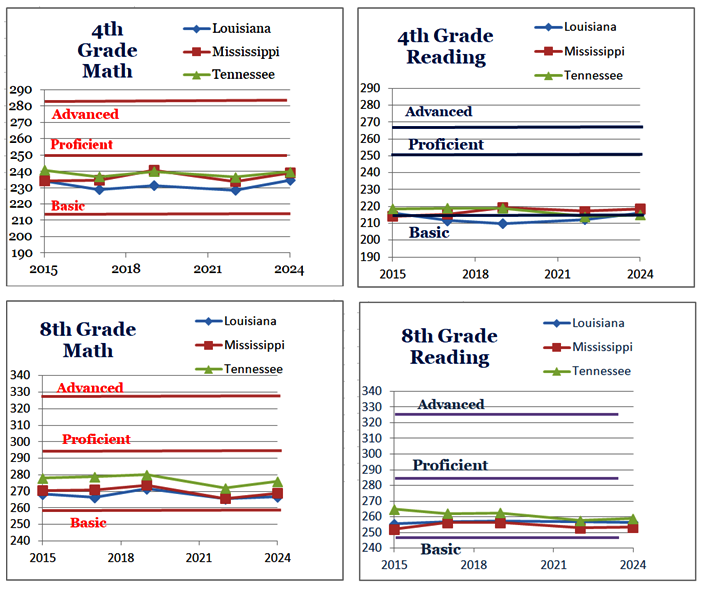
I wondered what Hanushek and friend were alluding to, so I graphed the average NAEP data for 4th and 8th grade reading and math since 2015 to see if it provided a clue.

NAEP Data for Louisiana, Mississippi and Tennessee

I added a bar indicating the NAEP cut scores for the 2024 NAEP designations of basic, proficient and advanced as a reference. It is well known that NAEP’s proficiency level is set well above grade level which means 70% of students not being rated proficient is not a bad score. Furthermore, writing in Forbes, Peter Greene shared, “An NCES report back in 2007 showed that while NAEP considers “basic” students not college ready, 50% of those basic students had gone on to earn a degree.”

The data graphed here indicates to me that all three states have solid public education programs. It is noteworthy that in reading their 4th graders only averaged basic but by 8th grade their average results were above basic. However, all three states are among the bottom 15 scoring states in the US and as we would expect are in the bottom 15 states in family income. What I do not see is why they are held out by Hanushek and Hovanetz as exemplars.

Concluding Remarks

The first blogger to label Eric Hanushek crazy-pants was Peter Greene. I have found Peter’s creativity worth stealing.

Let’s be clear, there is no such thing as learning loss involving students. This is a complete misnomer. Students may not achieve some state provided targets but they are always learning; maybe not what we want them to learn but always learning.

Eric Hanushek is a huckster for conservative billionaires. This latest claim is beyond farcical. Claiming to have knowledge of economic development in 40 years is fantasy and then tying that fantasy to NAEP testing data is bizarre. His $90 trillion claim for loss of future economic development would embarrass a carnival barker.

Hanushek is the guy who thinks education can be measured in days of learning which means that students learn in a near linear fashion. They absolutely do not but even this bogus claim would seem prescient when compared to this latest assertion.

Standardized testing only correlates with family income. To evaluate education based on this fictitious instrument is fraudulent. By extension, this makes economist Eric Hanushek a con artist.

New NAEP Scores No Reason to Panic

4 Feb

By Thomas Ultican 2/4/2025

Billed as the Nations Report Card, the National Assessment of Education Progress (NAEP) just released data from the 2024 testing window. The first NAEP assessments occurred in 1969 and in 1996 school testing in all states became mandatory every two years. Almost since the beginning, the testing results have been treated as a crisis moment. This year, both math and reading data came in lower than pre-pandemic levels. To the reform group, Education Trust, this is a time for action but it seems more likely that less action might be in order. The last two decades of education reform have been a harmful disaster. So prudence in our response is a better course.

The problem with all this data is summed up nicely by Peter Greene:

“As long time readers know …, I’m not one to get excited about scores on the Big Standardized Test, despite the claims that it will tell us How Schools Are Doing. There are lots of reasons to suspect that America’s Gold Standard of Testing is not all the gold standardy. And there is one serious lesson to be learned, which is that having all this cold hard data doesn’t actually change a damned thing— everyone just “interprets” it to support whatever it is they wanted to do anyway.

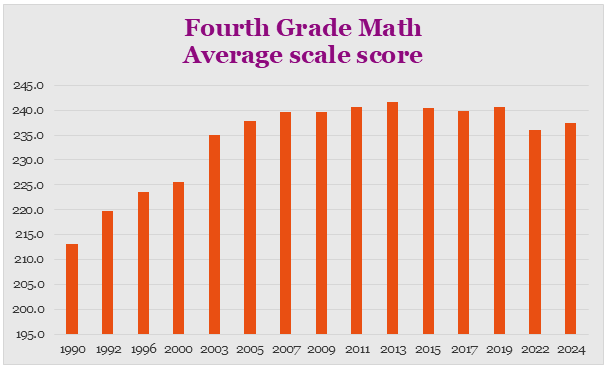
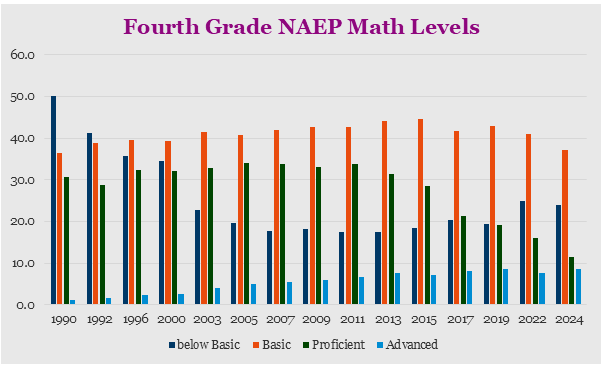
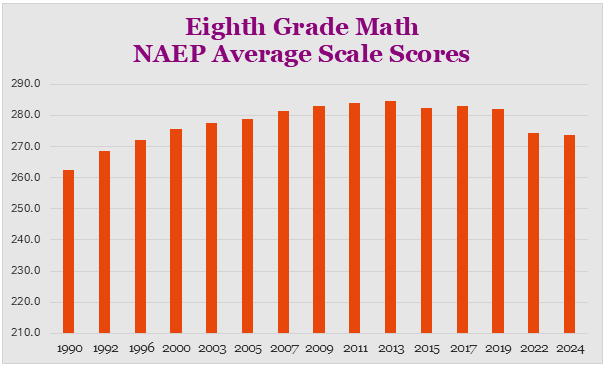
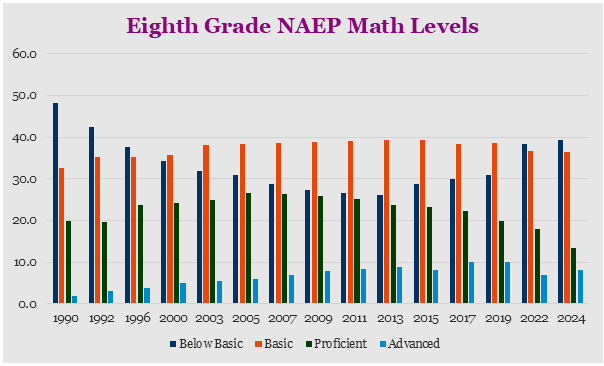
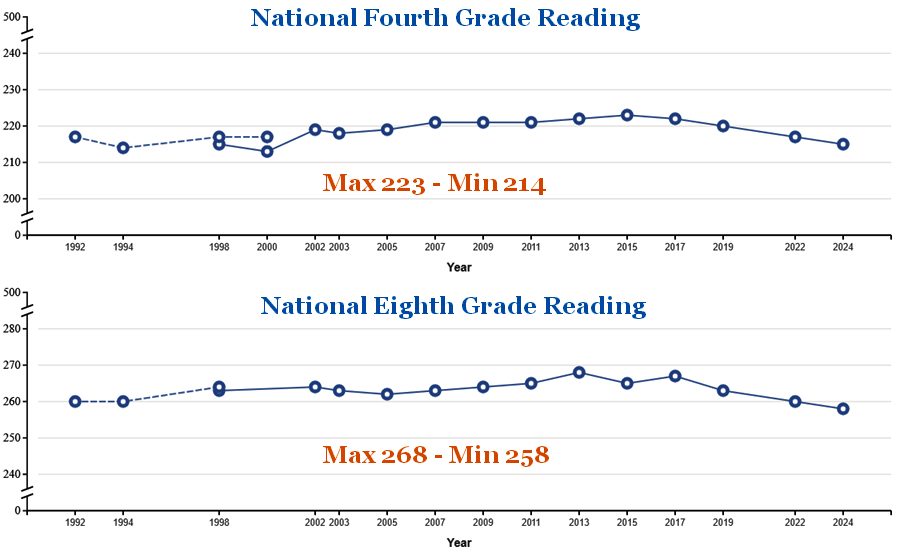
Plots of the average testing results covering math and reading for the past 32-years do not inspire much insight even if you believe in standardized testing.

The plots above were created from NAEP Data. Since 1992, both sets, which are plotted on a 500 point scale, wiggled up and down within a 10 point range.

In 2020, COVID-19 happened and this year’s 4th graders joined in-school classes a year or more late. The 8th graders missed at least their 5th grade in-school classes and some of them missed significantly more. During that year or more out of school, a tendency for truancy developed. So it is not surprising that their testing scores are not stellar, but they are still within the 10-point historical range.

Reading Scores Down

Peggy Carr, Commissioner of the National Center for Education Statistics (NCES) said, “Student achievement has not returned to pre-pandemic levels, reading scores continue to decline, and our lowest performing students are reading at historically low levels.”

For the past decade, there has been a major dispute over how to teach reading in the United States. Dozens of states have overhauled their reading instruction to adopt so called science of reading (SoR) methods. These changes came about largely due to a well financed corporate driven campaign that has drowned out literary experts.

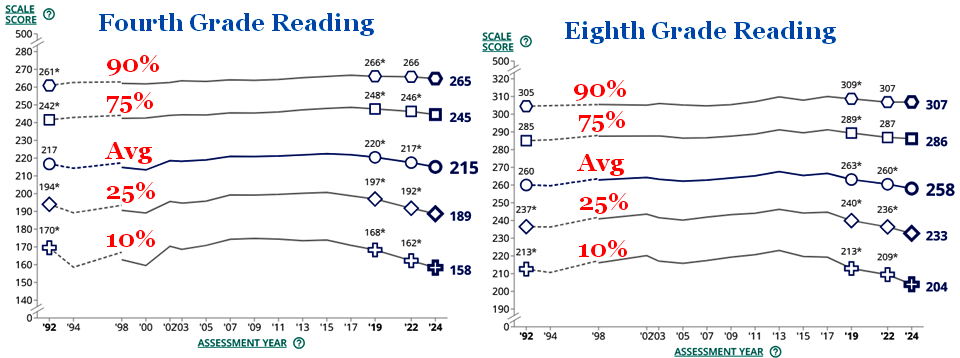
NAEP created charts based on reading data disaggregated by scoring percentiles are shown below.

In both the 4th grade and 8th grade charts reading scores started declining about 2015 and have fallen every testing window since. At about the same time, balanced literacy, which was the nation’s most popular method for teaching reading, started being replaced by SoR. The correlation between SoR and the dip in reading scores is obvious but may be misleading. Chalkbeat reports,And while federal education officials are usually reticent to explain what caused a particular increase or decrease in scores, Carr cautioned that the near-universal dips in reading should not be taken as evidence that reading reforms have not worked.”

I have believed for some time that SoR is less about good teaching and more about profits, so it is tempting to discount Dr. Carr’s warning. Standardized testing has serious limitations and it would be hypocritical to discount it only when I did not like the results and then hale the outcomes that I liked.

However, the NAEP data since 2017 certainly provides NO support for SoR.

Math Staying Steady

The 2024 math results for fourth-grade improve by 3% over 2022 but were still 2% lower than the pre-pandemic 2019 testing. Eighth-graders treaded water in 2024 with scores that were not significantly different from 2022 and were 8% lower than 2019.

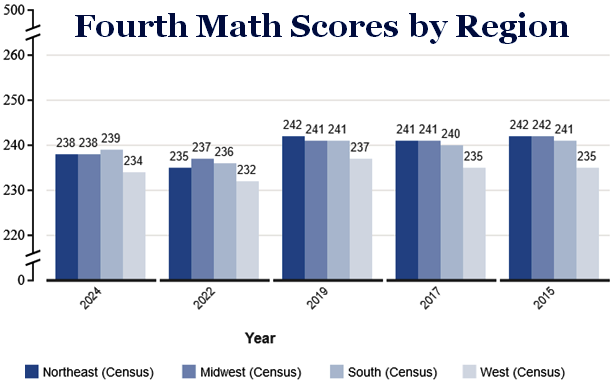
NAEP allows researchers to break down scores by region. I created this bar graph of fourth grade math for the last five testing windows. The South, Midwest and Northeast had almost identical scores while the west lagged by 4-6 percent. Would we all like to see better scores? of course. On the other hand, there is nothing here that looks dire. In 2022, there was a small drop in scores and in 2024 about half of the drop was overcome.

Absenteeism is probably holding back score recovery in both math and reading. It is generally considered that when a student misses more than 10% of the school year they are chronically absent. National Public Radio (NPR) has reported, the rates of chronic absenteeism doubled during the pandemic. NAEP also asked students, during this last testing cycle, how many days they had missed in the previous month. NPR notes that, “Across the board, lower-performing students were more likely to report missing five or more days of school in the previous month, compared with higher-performing students.”

Some Final Observations

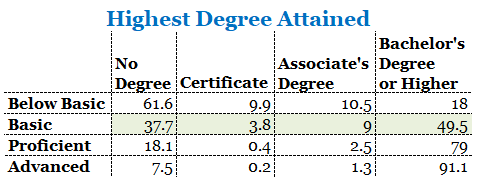
 In 2007, NCES performed a study on what happened to the 1992 NAEP participants. They were interested in how the four attainment level, Below Basic, Basic, Proficient and Advanced, matched student outcomes.

The key results are shown in the table above. It looks like the levels have misleading names. Half of the students in the Basic group achieved a bachelor’s degree or higher. This means that they were college ready and academically proficient. The NAEP labels are aligned too high; therefore misleading.

In 2019, Diane Ravitch commented on that year’s NAEP data: “After a generation of disruptive reforms—No Child Left Behind and Race to the Top, VAM and Common Core—after a decade or more of disinvestment in education, after years of bashing and demoralizing teachers, the National Assessment of Educational Progress (NAEP) for 2019 shows the results:

‘“Over the past decade, there has been no progress in either mathematics or reading performance, and the lowest-performing students are doing worse,”’ said Peggy Carr, the associate commissioner of the National Center for Education Statistics, which administers the NAEP. ‘“In fact, over the long term in reading, the lowest-performing students—those readers who struggle the most—have made no progress from the first NAEP administration almost 30 years ago.”’

SoR became the billionaire reform de jure in 2019. No Child Left Behind, Race to the Top, VAM and Common Core had come to be seen as either failures or frauds. Profiteers hoped the new SoR strategy would lead to privatizing and controlling all aspects of education and they made great efforts to promote it. Will the 2024 NAEP results be the beginning of the end for their greedy dreams?

Whatever the case, Ravitch’s 2019 NAEP analysis still holds true. The 2024 NAEP results are nothing to celebrate but certainly are not a crisis. After all, they are based on standardized testing that is not capable of measuring learning or teaching. Family wealth is about the only thing to which NAEP data correlates.

A National Warning

14 Aug

By Thomas Ultican 8/14/2023

An unholy alliance between neoliberal Democrats and education reform oligarchs is harming Delaware public education. This is a lesson for the rest of the nation.

A new charter school law introduced to reduce principal professionalism is the latest example. Data clearly shows for almost two decades, top-down education reform has been ineffective and seriously damaged a once, exemplary system.

In March, Delaware Professional Standards Board recommended charter school certification requirements match public school rules. Kendall Massett, executive director of the Delaware Charter Schools Network, immediately responded, “All Delaware charter schools are led by highly qualified administrators.” She said charter school principals have a different role than public school leaders and need to be excellent marketeers to raise funds and drive enrollment.

Did she mean charter school principals don’t need to be professional educators?

For the Standards Board recommendation to take effect, adoption by the State Board of Education is required. Before they acted, Senate President Pro Tem David P. Sokola introduced senate bill 163 to relax certification rules for charter school principals.

The heart of Democrat Sokola’s legislation says:

“The bill creates new subsections in Section 507(c) of Title 14 of the Delaware Code to define the licensure and certification requirements more clearly within Chapter 5 of Title 14. Finally, the bill requires the Secretary of Education to work with the Delaware Charter Schools Network to create a qualified alternative licensure and certification pathway for charter school administrators engaged in the instruction of students (Instructional Administrators).”

Teachers’ union leader, Mike Matthews, wrote to the Senate Executive Committee:

“I was disheartened to see that SB 163 — a bill that will actually deprofessionalize the education profession — was introduced by Senator Sokola. I was even more disappointed — and concerned — to see it filed in the Senate Executive Committee instead of the Senate Education Committee where it belongs. Why was that?”

Bill was passed by the State Senate and is currently awaiting action in the House Administration Committee. The House Education Committee, like its counterpart in the Senate, is not involved.

Neoliberal Education Reform

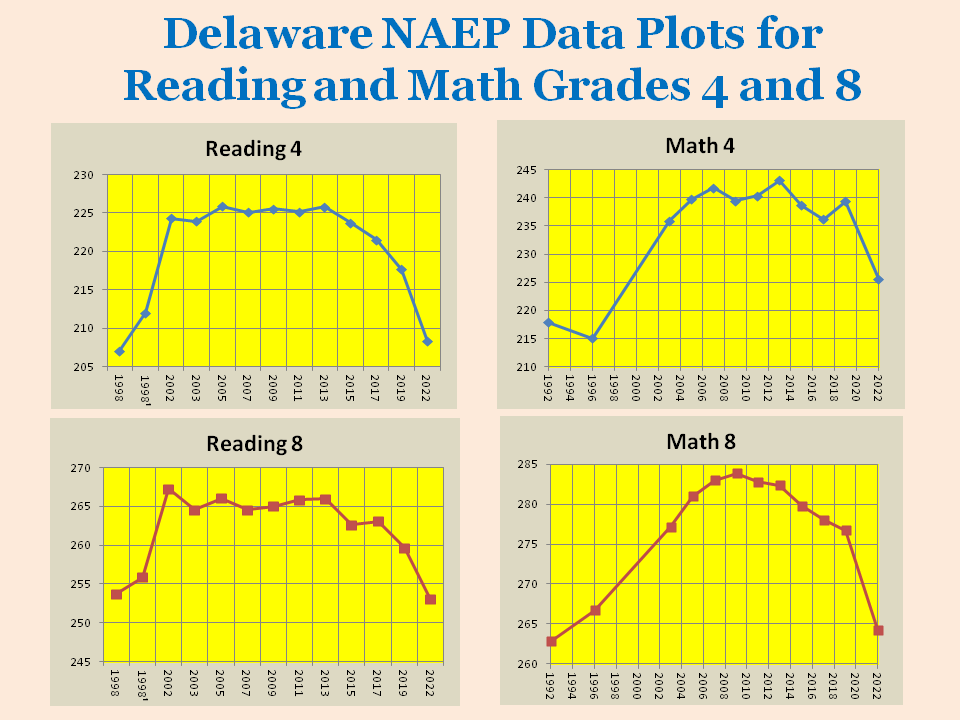
A Delaware Live headline howls, School test scores dismal again despite new math, reading plans.” Two decades of 4th and 8th grade reading and math data on the National Assessment of Education Progress (NAEP) support the headline. NAEP is often referred to as the nation’s education report card. The above graphs beg the question, “what happened in 2010?”

Long-term NAEP data showed from 1971 until 2002, there was steady growth in math and reading. The steady growth ended concurrent with the adoption of the bipartisan Kennedy-Bush education reform, No Child Left Behind. The graphs illustrate this phenomenon.

Why did Delaware’s scores start falling?

In 2010 educator and blogger, Susan Ohanian, reported,

“Delaware and Tennessee came out on top in round one of RTTT: Delaware got $100 million (about $800 per student), and Tennessee $500 million (about $500 per student). Since these states radically changed their education strategies to receive what amounts to 7 percent of their total expenditures on elementary and secondary education, the feds are getting a lot of bang for the buck.”

The $4.5 billion dollar Obama era Race To The Top (RTTT) program was administered by Education Secretary Arne Duncan. Grants were given to states that complied with three key elements: (1) Evaluate teachers based on student test scores (2) Close and turn into charter schools public schools that continue to get low test scores (3) In low-test score schools, the principal and half of the staff are to be fired and replaced. In addition, states were encouraged to create more privately-managed charter schools. 

Education historian and former Assistant US Secretary of Education Diane Ravitch predicted the program’s utter failure when it was announced:

“All of these elements are problematic. Evaluating teachers in relation to student test scores will have many adverse consequences. It will make the current standardized tests of basic skills more important than ever, and even more time and resources will be devoted to raising scores on these tests. The curriculum will be narrowed even more than under George W. Bush’s No Child Left Behind, because of the link between wages and scores. There will be even less time available for the arts, science, history, civics, foreign language, even physical education. Teachers will teach to the test. There will be more cheating, more gaming the system.”

For more than a century, brilliant educators have been skeptical of top-down coerced education reform like those from Duncan, Obama, Bush and Kennedy. Alfred North Whitehead published his essay, “The Aims of Education,” in 1917, stating:

“I suggest that no system of external tests which aims primarily at examining individual scholars can result in anything but educational waste.” (Page 13)

“But the first requisite for educational reform is the school as a unit, with its approved curriculum based on its own needs, and evolved by its own staff. If we fail to secure that, we simply fall from one formalism into another, from one dung-hill of inert ideas into another.” (Page 13)

Former McKinsey Consultant and Democrat with neoliberal inclinations, Jack Markell, was elected Delaware Governor in 2009. His first major victory was winning the RTTT grant. He said:

“What’s really important today is where we go from here; whether we have the will to put our children first and move forward with reforms to improve our schools so that Delaware children can successfully compete for the best jobs in an increasingly competitive global economy. That won’t be easy, but we have proven in these past few months that it can be done.  I would like to thank all those who worked with us in support of our application and look forward to moving ahead to improve our schools.”

Markell praised then Senate Education Committee Chair, David Sokola, for his work on the RTTT grant proposal, the same Senator who just introduced legislation to soften certification requirements for charter school principals.

Since the RTTT announcement, Delaware has gone from consistently scoring above the national average on all NAEP testing to dropping well below.

Science of Reading is NOT the Answer

Delaware Live reported that because of the relative drop in reading scores, the state is implementing the “science of reading.” The article stated, “Today, after a decade of emphasizing training teachers in the science, Mississippi students handily outperform Delaware’s, which has dropped below the national average.”

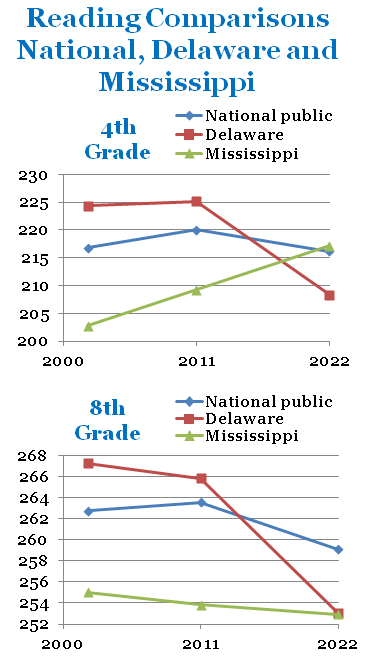
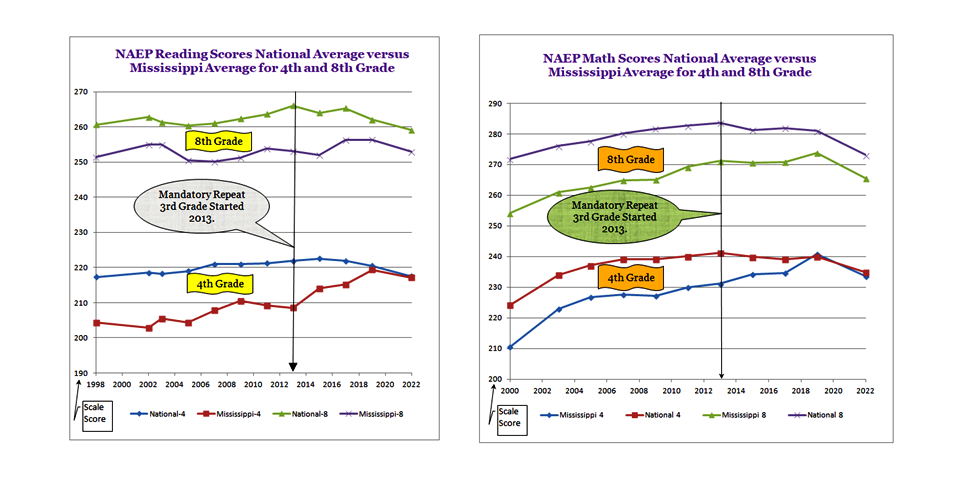
While the scoring drop in Delaware looked real, the success in Mississippi was a mirage. The graphs to the left plot 2002, 2011 and 2022 NAEP scoring data for 4th and 8th grade reading. Delaware is graphed in red, Mississippi in green and National Public in blue. The 4th grade Mississippi data looked amazing but in 8th grade, they returned to being significantly below national average.

The anomaly is explained, in part, by Mississippi retaining all third graders who did not pass the state reading test. It made the 4th grade NAEP data look good but the 8th grade data indicated no earth-shaking advancement to emulate.

In 2021, Delaware’s Department of Education doubled down on oligarch-driven education reform. Monica Gant, Ph.D. from the Delaware Department of Education (DDOE), presented their strategy to accelerate learning in March 2021.

Under the heading “Literacy Professional Learning,” Professor Grant noted, “Participants will have a chance to apply their learning of the Science of Reading either through their district HQIM or utilize free OER (Open Education Resources) HQIM for this work.”

HQIM and OER are both programs financed by Bill Gates, Laurene Powell Jobs and other billionaires.

To guide Delaware public schools’ literacy program, DDOE has turned to the International Dyslexia Association (IDA) who advocates the “science of reading”, to validate Delaware’s programs. IDA is leading the effort to monetize dyslexia and establish state-mandated science of reading curriculum, purchased from specified vendors.

 While jurisdictions throughout the US saw a tick down in 2022 NAEP reading scores, Delaware’s scores, after a year of “science of reading”, were one the largest drops in America.

Final Observations

The reform movement in Delaware is still being pushed in a destructive direction. Senator Brian Pettyjohn, a Republican from Georgetown and member of the Senate Education Committee, commented on recent testing results:

“Our state must do more to hold school districts responsible for students’ academic success. The current mechanism in place for holding schools accountable is ineffective, and it is time for the state to establish a new system that recognizes school districts for their accomplishments and holds them responsible when they fall short of their objectives.”

The concern is understandable but his solution is wrong-headed. More mandates from politicians who do not understand education are not likely to be helpful.

There appears to be a privatization-promoting organization in Delaware called First State Educate. They just hired Julia Keleher as Executive Director. Serving as Secretary of Education in Puerto Rico, Keleher, who is not Puerto Rican, secured a new law allowing for charter schools and vouchers, as well as, the closure of hundreds of schools.

At a San Juan rally, protesters chanted, “Julia go home!”

Things went sideways for Keleher. December 17 2021, a federal judge in Puerto Rico sentenced her with six months prison, 12 months house arrest and a $21,000 fine. She pled guilty in June to two felony counts involving conspiracies to commit fraud.

Today she is another voice in Delaware, pushing for top-down reform and privatization of public education.

Delaware schools were most successful when local educators and school leaders took charge. Since then, after standards were imposed and teacher accountability mandated, school performance suffered. Alfred North Whitehead was right in 1917.

Give autonomy back to schools and professional educators. Politicians at state capitals have little understanding of local school needs or good pedagogy.

Empower teachers and Delaware education will shine again.

Mississippi Malarkey

11 Jun

By Thomas Ultican 6/11/2023

Nickolas Kristof’s opinion piece in the New York Times might not have been blatant lying but it was close. His depiction of the amazing education renaissance in Mississippi as a model for the nation is laughable. Lauding their third grade reading retention policies as enlightened, he claims their secret sauce for success is implementing the science of reading (SoR). This is based on a willful misreading of data while tightly embracing Jeb Bush’s futile education reform ideology.

Kristof gushes over Mississippi,

“So it’s extraordinary to travel across this state today and find something dazzling: It is lifting education outcomes and soaring in the national rankings. With an all-out effort over the past decade to get all children to read by the end of third grade and by extensive reliance on research and metrics, Mississippi has shown that it is possible to raise standards even in a state ranked dead last in the country in child poverty and hunger and second highest in teen births.” (Emphasis added)

The soaring national rankings claim is a crock. National Assessment of Education Progress (NAEP) is the most trusted testing standards by which entities are compared. NAEP provides a ranking of 53 jurisdictions, consisting of 50 states plus the District of Columbia, Puerto Rico and the Department of Defense Education Agency.  A table was constructed using the NAEP rankings.

From 2015 to 2022, testing outcomes for Mississippi fourth graders did “soar” past more than 20 states in both math and reading. But results from eighth grade expose those lofty outcomes as a mirage. In 2013, Mississippi followed Florida’s lead and introduced retaining all third graders who did not meet end of year reading exam targets. That is the probable reason for the improved fourth grade testing scores and why those illusory gains were erased by eighth grade.

Misusing data allows Kristof to end the paragraph indicating poverty is not an excuse for education failure. It reminds me of a statement written by education professor Kathryn Strom,

“The “no excuses” rhetoric (i.e, “poverty is not an excuse for failure”) is one that is dearly beloved by the corporate education reformers  because it allows them to perpetuate (what many recognize to be) the American myth of meritocracy and continue the privatization movement under the guise of “improving schools” while avoiding addressing deeply entrenched inequities that exist in our society and are perpetuated by school structures.” (Emphasis added)

To add heft to his argument that poverty is no excuse, Kristof quotes Harvard economist David Deming from the Harvard Kennedy School and Harvard Graduate School of Education, saying “Mississippi is a huge success story and very exciting.” He adds, “You cannot use poverty as an excuse.”

It is important to note that Harvard is famous for supporting privatization of public education and promoting failed scholarship. Deming is currently doing research with Raj Chetty and John Friedman. Along with Jonah Rockoff, Chetty and Friedman published the now thoroughly debunked value added measures (VAM) paper. Their faulty research caused many teachers to lose jobs before it was exposed as a fraud. Kristof is using an economist (not an educator) from a group best known for scholastic failure as his expert.

Kristof also indicates that spending is not important. He writes, “Mississippi has achieved its gains despite ranking 46th in spending per pupil in grades K-12.” If we look up at the 8th grade rankings, it seems they are getting what they paid for.

The Mississippi Miracle Uses the Jeb Bush Method

In 2000, former Netscape CEO Jim Barksdale came home to Mississippi and made reading education his cause. He and his wife put up 100-million dollars to establish the Barksdale Reading Institute. Barksdale also used his political influence to promote state spending on education. There have been some real gains in Mississippi and Barksdale’s effort likely aided that improvement. For Kristof, this was the beginning of a renaissance.

In 2013, Mississippi’s legislature adopted packages of education focused bills which included third grade mandatory reading retention. That same year, they hired a new state superintendent of education, Carey Wright, from the Washington, D.C., public school system. Kristof lavishes her with praise declaring, “Wright ran the school system brilliantly until her retirement last year, meticulously ensuring that all schools actually carried out new policies and improved outcomes.”

Of course the article was an opinion piece but even opinions should be tethered to some objective reality. When asserting a public servant is “brilliant” or was “meticulously ensuring” some supporting evidence should be provided.

Wright began her education career in 1972 as a teacher in Maryland. After just four years in the classroom, she transitioned to various administrative roles. When leading special education services in Montgomery County during the early 2000s, she was serving in the middle of a corporate education reform triumvirate. John Deasy was promoting charter schools and teacher “pay for performance” in Prince George County. Baltimore had Andres Alonzo firing teachers and closing schools. Just a few miles away, Michelle Rhee was promising to “fix” Washington DC’s schools by firing teachers and principals.

In 2010, Rhee hired Carey Wright to be chief academic officer for Washington DC public schools. Wright was an administrator in the DC schools during the height of the cheating scandals. Besides working with some of the most callus and harmful education leaders in American history, she is a member of Jeb Bush’s Chiefs for Change and a graduate of the late Eli Broad’s superintendent training academy. It is highly likely that being steeped in corporate education reform mythology is why Kristof views her as “brilliant.”

The darling of corporate education reformers is an army of unqualified teachers recruited by Teach For America (TFA). It is not unusual for a college graduate to take a five-week summer training course, teach in a charter school or public school for two years and then become an education expert for some either public or private agency. This is an absurdly irresponsible system but effective for wealthy individuals looking to privatize or end public education.

Kristoff notes, “Two Teach for America veterans, Rachel Canter and Sanford Johnson, in 2008 founded an organization called Mississippi First that has been a tireless advocate of raising standards.” Evidently a two-year stint as a temp teacher makes one a veteran. These two apparently are proceeding swimmingly along the corporate reform path.

Sanford Johnson’s biography includes teaching four years at Coahoma County High School (2003-2005) and two years at KIPP charter school (2005-2007), co-founding Mississippi First and becoming its Deputy Director (2008-2019) and today is Executive Director of Teach Plus. Teach Plus is the TFA formed group working to privatize teacher training. He also has another biography posted at the corporate education reform organization Pahara Institute. Johnson has made many corporate connections.

After two years (2004-2006) as a TFA temp teacher in Greenville, Mississippi, Rachel Canter went to Harvard University for a master’s in public policy. In 2008, back in Mississippi, she and Sanford Johnson founded Mississippi First with Rachel as director.

New PIE Network Partners’ Logos

Canter is still the director of Mississippi First and according to her PIE network BIO she was instrumental in the passage of the 2013 third grade retention bill. That year, the PIE network named Mississippi First “Game Changer of the Year.” She is now a board member of PIE along with Nina Reese President National Alliance for Public Charter Schools and Robin Lake Director Center for Reinventing Public Education.

Pontificating While Clueless

Kristof states, “With such a focus on learning to read, one of the surprises has been that Mississippi fourth graders have also improved significantly in math.” His entire article is based on the misunderstanding of data possibly through ignorance but more likely through ideological belief.

These graphs show that the fourth grade “miracle” disappears by eighth grade. They also illustrate the point Ferman University’s literary expert Paul Thomas makes: “But the greatest issue with tests data is that inexpert and ideologically motivated journalists and politicians persistently conform the data to their desired stories—sometimes crisis, sometimes miracle.”

Third grade retention improvement has not only been shown to disappear; it is harmful to the students retained. Kristof informs us that “A Boston University study this year found that those held back did not have any negative outcomes such as increased absences or placement in special education programs.” This study was commissioned by Jeb Bush’s ExcelinEd and only looked at students through sixth grade. It does not address disengagement or dropouts. Is Kristof being deliberately deceptive?

Kristof also makes a big deal out of Mississippi’s high school graduation rate climbing to 87 percent, surpassing the national average. This does look like real progress but graduation rates have become highly suspect. America’s high school graduation rates peaked at about 77% in 1970 and drifted down for almost four decades to 69% in 2007.  Since then, on-line credit recovery arrived and students are completing entire semester courses in as little as one day. This is a new corporate profit center where corruption is ignored.

Conclusions

Education historian and former Assistant Secretary of Education Diane Ravitch wrote,


“What’s worrisome about this article is that Kristof asserts that poverty doesn’t matter (it does); funding doesn’t matter (it does); class size doesn’t matter (it does). In his account, states that want to improve test scores can do it without raising teachers’ salaries, without upgrading buildings, without spending a nickel to improve the conditions of the schools or the well-being of children. Children who are hungry, lack medical care, and are homeless or ill-housed are not likely to learn as well as those who have advantages.

“Does this explain why so many rightwingers love “the science of reading”? Publishers are rolling out new programs. Education can be reformed in the cheap. Can’t expect taxpayers to foot the bill, can you?”

In this opinion piece, Nicholas Kristof touched on and promoted almost every billionaire inspired agenda item aimed at decreasing money going to public education. He acted as a representative of elites, advancing policies undermining education quality for common people.

This was not about improvement. It was about lowering taxes.

The Phony NAEP Crisis

1 Nov

By Thomas Ultican 11/1/2022

The recent data release by the National Assessment of Education Performance (NAEP) for mathematics has inspired balderdash. Jeb Bush called itAlarming.” A Chalkbeat headline characterized it as a massive drop.” Harvard’s Tom Kane wrote that it signaled “ enormous learning losses.”  The Heritage Foundation’s Lindsey Burke was able to place her article in many outlets with the subtle headline, “New NAEP Test Scores Are a Disaster. Blame Teachers Unions.”

In reality, the score drops were not massive and learning loss which probably isn’t actually a thing was not enormous. However, if the purveyors of doom can convince enough people it is a crisis, then they can advance their own pet agendas such as ending public education.

NAEP (pronounced nape) testing which is known as the nation’s report card was originally implemented in 1969. The tests use a combination of standardized testing and sampling. The Washington Post reports that this year 224,000 fourth-graders from 5,700 schools and 222,000 eighth-graders from 5,100 schools were sampled. Sampling certainly makes more sense than states paying testing companies to test every student but standardized testing is still not a capable tool for measuring learning.

It is not just me saying it. Unlike the scientifically well behaved data associated with genetics study, standardized testing data is extremely noisy. The famed Australian researcher Noel Wilson wrote a seminal work in 1998 called Educational Standards and the Problem of Error.” His peer reviewed paper which has never been credibly refuted says error in standardized testing is so large that meaningful inferences are impossible. Unfortunately, the paper has been ignored.

Wilson’s paper was followed a year later by a paper from UCLA’s Education Professor James Popham which stated, “Although educators need to produce valid evidence regarding their effectiveness, standardized achievement tests are the wrong tools for the task.”

It does seem that with all of the tests taken, data gathered and arithmetic performed, the tests must be telling us something but what? We know that the one thing this kind of test correlates to is the student’s family wealth. Education researcher Linda Darling-Hammond puts that correlation at an r-value of 0.9. An r-value of 1 on the 0-1 scale says it is a dead certainty like men not becoming pregnant. No other variable studied has a strong influence meaning they mainly input noise into the data.

So what caused the downward turn in 2022 NAEP math data for 4th and 8th graders? Is it really related to learning and should it be a large concern?

Let’s Go to the Scoreboard

Everyone has the right to access the NAEP Data Explorer and create their own data reports and charts. The tested years, the jurisdictions, data types, the subject, etcetera may be manipulated to shape a report. It is possible to compare states, public schools and private schools, districts, etc. There are limitations such as charter school data being lumped with public school data.

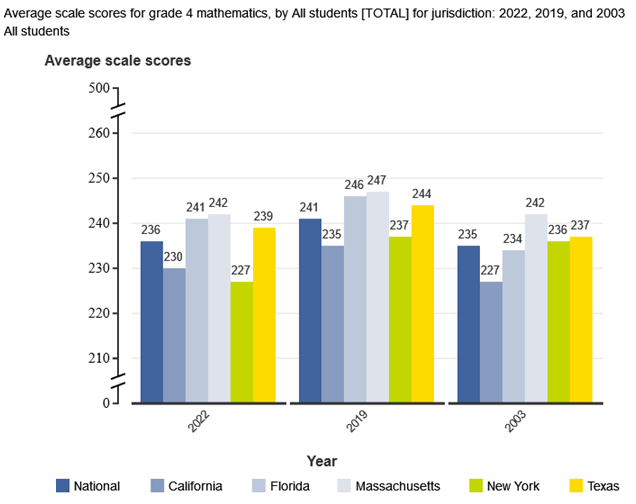
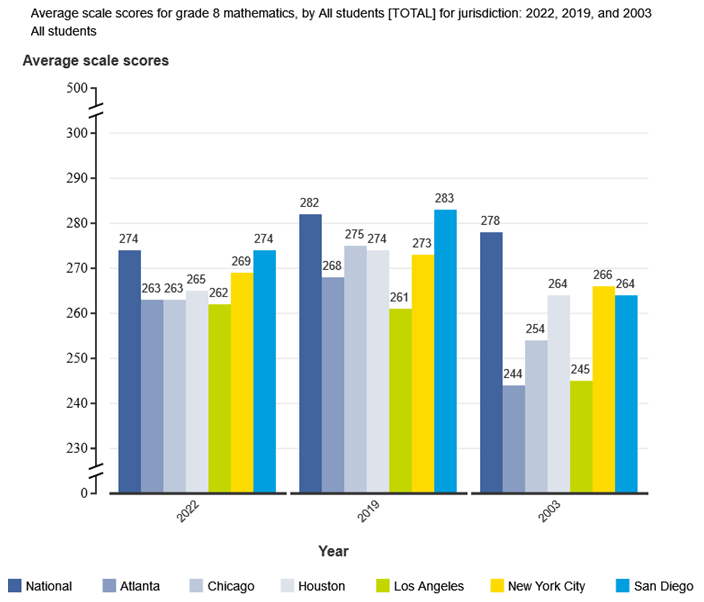
In the following charts, I chose mathematics either 4th or 8th grade in tested years 2003, 2019, 2022. I selected the average scale scores which are based on a 500 point scale.

Data Explorer Graphed Fourth Grade State Comparisons

One of the first observations to make is that the 500 point scale scores are plotted on a 60-point graph scale which visually magnifies any differences by more than 8 times. The national average scores go from 235 in 2003 to 241 in 2019 and then 236 in 2022. If we use the lowest data point for a denominator that five point drop from 2019 represents a 2% drop, but if we use the 500 point scale as the denominator which we should that purported enormous drop is just 1%.

Of the five large states queried, only New York had a larger than 5 point drop. Its 10-point drop calculates to a 2% decline.

The Walton Family financed publication The 74 is known to support libertarian positions on education policy. Some people claim they are biased against public schools. The 74 recently claimed in a headline, “Strong Link in Big City Districts’ 4th-Grade Math Scores to School Closures.” Under the previous president, the political right railed against health care policies like masking, vaccination and closing schools. By September 2020 there were loud sometimes violent open-schools-now protests at school boards meetings in many states and jurisdictions. The 74 article looks like an attempt to say “see we were right” but the data does not support their specious claim.

For evidence, they turned to the Koch addled economist Emily Oster. She is the Brown University professor that argued in the summer of 2020 that children should be back in school. At the same time, she cast doubt on masking. With the new NAEP results, she again supports the libertarian cause stating, “The districts with more remote learning have larger test score losses.” This appears to be something she just said with no evidence.

If we look at the states graphed above, the only outlier is New York with its 10-point drop, but California, Texas, Florida and Massachusetts all had 5-point drops.

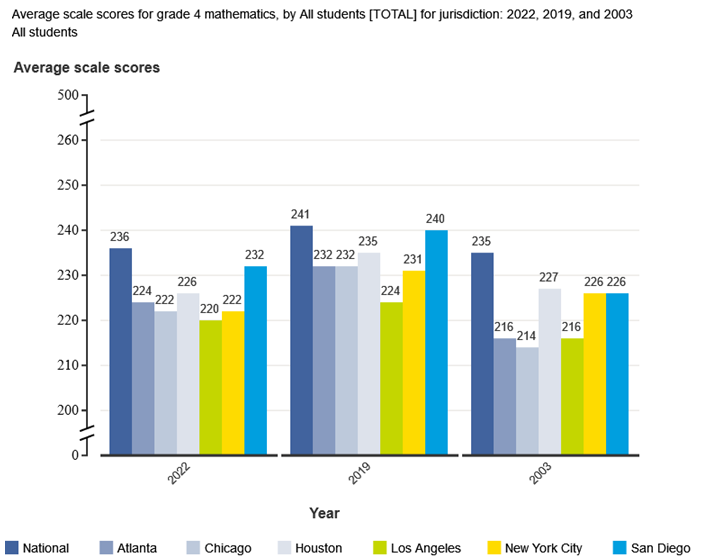
District Comparisons of Fourth Grade Mathematics Scale Scores

Oster’s claim was about big city districts. If we look at these big city data sets there does not appear to be real differences. All of the big city districts had an 8- to 9-point drops in their fourth grade test between 2019 and 2022. Whether they opened early or stayed closed longer.

Education reporters note that test score drops in eighth grade were worse than those in fourth grade. On the 500-point scale the average drop in fourth grade was five points while in eighth grade it was eight points or 1% and 1.6% respectively.

Eighth Grade Mathematics by District


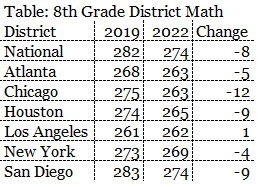
It is true that the national math data for eighth graders showed an average 8-point drop in 2022. However, the declines were not uniform between districts. The country’s second largest school district in Los Angeles actually returned a positive result and the 4-point decline in the nation’s largest school district was relatively modest.

There is no way the eighth grade testing result for the nation’s two largest school districts could fairly be characterized as a crisis. It is also noteworthy that these two districts were closed longer than most others in the nation.


The Roots of the Down Turn

America’s students like everyone else suffered through a two year pandemic-inspired nightmare. Did anyone really expect that on average they would perform at par?

One of the difficult pandemic related student manifestations was increased violence. As schools were reopening, Homeland Security notified them, “The reduced access to services coupled with the exposure to additional risk factors suggests schools — and the communities in which they are located — will need to increase support services to help students adjust to in-person learning as they cope with the potential trauma associated with the pandemic response.” Schools around the country saw a dramatic increase in fighting and insolent behavior.

This past July, the Washington Post reported, “The data, collected as the 2021-2022 school year was winding down, also showed that more than 70 percent of schools saw increases in chronic student absenteeism since the onset of the pandemic and about half of the schools reported increased acts of disrespect toward teachers and staff.”

Many school districts started experiencing crippling staff shortages and the NAEP testing came at a particularly inconvenient time. During the January to March, 2022 testing window, the nation experienced the omicron variant infection explosion. CDC data shows that during the testing window infection rates grew to more than 200 people out of every 100,000 in population becoming infected daily.

Disaster Capitalism Needs a Crisis

Amway Billionaire and dominion supporter Betsy DeVos said the NAEP data showed that children should no longer be “hostages” in a “one-size-fits-none system that isn’t meeting their needs.” She has been spending for decades to get rid of the secular public schools she sees as an evil.

Like every education crisis since 1983’s “A Nation at Risk” this is another manufactured crisis. The crisis rhetoric used to justify incessant accountability layered onto a constant process of new standards and new tests is, as Berliner and Biddle documented, a manufactured lie.

In writing about the pandemic effects on schools, John Merrow reported, “Secretary of Education Miguel Cardona, who called the results ‘appalling and unacceptable,’ told a group of reporters that the results are ‘a moment of truth for education,’ adding ‘How we respond to this will determine not only our recovery, but our nation’s standing in the world.”’

And even more over the top than Cardona, Harvard’s Tom Kane wrote in the Atlantic,

“[S]tudents at low-poverty schools that stayed remote had lost the equivalent of 13 weeks of in-person instruction. At high-poverty schools that stayed remote, students lost the equivalent of 22 weeks. Racial gaps widened too: In the districts that stayed remote for most of last year, the outcome was as if Black and Hispanic students had lost four to five more weeks of instruction than white students had.”

When people start using the sham CREDO days of learning metric, I am pretty sure they are dissembling. This is the kind of stuff that caused Professor Paul Thomas to declare, “But mostly, I hate the lies, political, media, and commercial interests that are eager to shout “crisis!” because in the spirit of the good ol’ U.S. of A., there is money to made in all that bullshit.

Cardona’s Department of Education is known to embrace at least three methods for helping struggling students raise their test scores: 1) extend school day and year, 2) mandatory summer school and 3) ‘high-dosage tutoring,’ where one trained tutor works with no more than four students, three times a week for an entire year. In other words our Education Secretary who is a former New Leaders Fellow embraces a method that may raise test scores but promises to undermine engagement and the joy of learning. It is a corporate solution, not an educator’s solution.

The NAEP test scores are not a crisis but bad education leadership, suspect scholarship and billionaire meddling are. It is time to get out of the road of educators and let them do their job. No high-dosage tutoring, no extended days and no forced summer schools.

The children are not broken. If they missed some lessons over the past two years, unfettered educators will quickly resolve the issues. Students who have not been convinced that education and learning are onerous and hateful will be fine. Cardona, Kane and DeVos are the crisis.

School Transformation Without School Improvement in Atlanta’s all Charter District

1 May

Since the 2015 all charter district reforms in Atlanta, the so called “education gap” has grown significantly. This is reflected in both state and federal testing data.

I recently wrote about Superintendent Castarphen and her history of bullying staff and working to privatize public education. That post was motivated by an email from Ed Johnson providing his initial review of the just released TUDA (Trial Urban District Assessment) data from the 2017 testing cycle.

Mr. Johnson is a longtime advocate for public education. He is a native Georgian, a former NSA analyst and an expert in Deming inspired quality management. His writings have been published in many places including the Atlanta Journal-Constitution and he has been a candidate for the Atlanta Public Schools (APS) board. With his permission, I am posting his more deepened analysis of recent testing data from Atlanta.

NAEP TUDA 2017: A follow-on systemic look at Atlanta

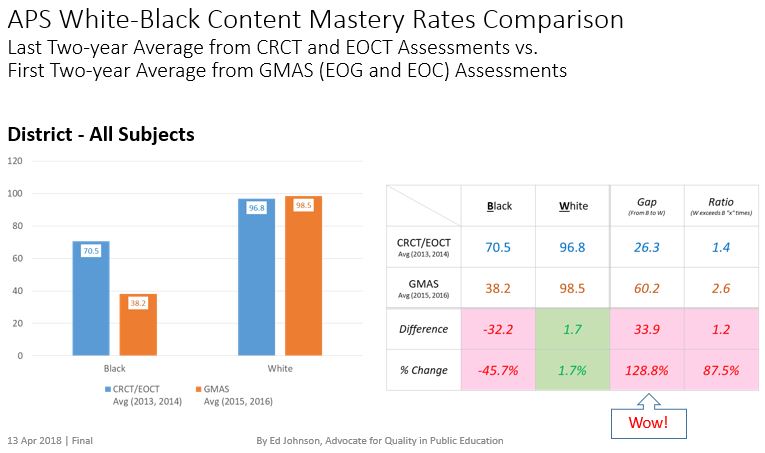
The earlier preliminary look at NAEP TUDA (National Assessment of Educational Progress, Trial Urban District Assessment) biennial results for Atlanta Public Schools (APS; “Atlanta”) offered the immediate data story that, in recent years, since 2015, the district’s White-Black academic achievement gaps have been made unusually worse.  It was also noted that Georgia Milestones Assessment System (GMAS) annual results for Atlanta, from 2015 through 2017, coupled with Georgia Criterion-Referenced Competence Tests (CRCT) annual results for Atlanta, from 2012 through 2014, tell the same story.

Told either way, negative contributing factors in the story are implicated to be, in general, disruptive school choice as charter schools and school turnaround without school improvement.  Being driven more by ideology than pedagogy, and inclined to serve would-be oligarchs’ interests more than the public’s interests, the Atlanta Public Schools Leadership (APSL) have pressed these negative contributing factors into the district over just the past few years.  It began in 2014, with the school board hiring Meria Joel Carstarphen, Ed.D., as Atlanta superintendent.  Notably, Dr. Carstarphen once publicly proclaimed having been “trained,” presumably by her alma mater, Harvard University Graduate School of Education, to do the school turnaround work school board members wanted done.

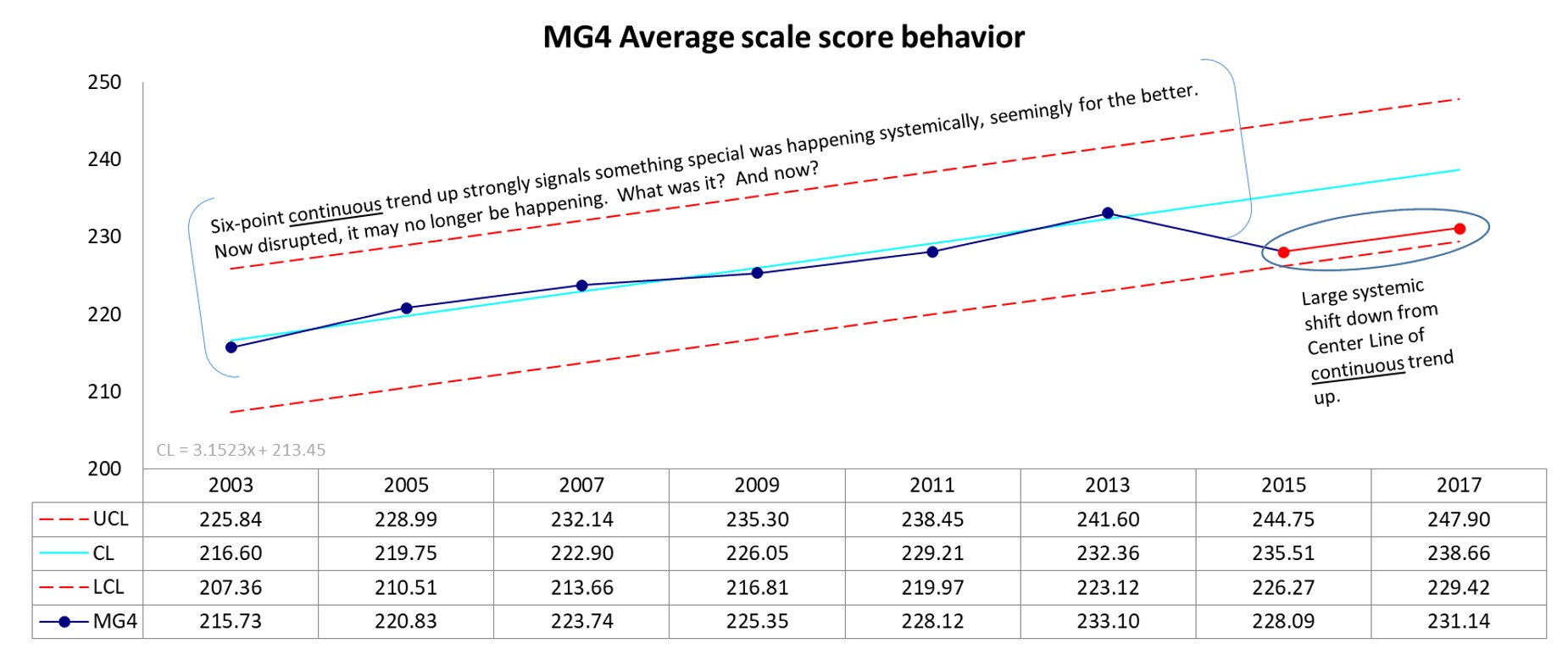
Now by looking strictly district-level at APS, NAEP TUDA results tell a similar story of academic achievement made unusually worse since 2015.  Here, however, the story is systemic and implicates, again, school choice as charter schools and school transformation without school improvement as having detectably disrupted for the worse the district’s continuous (not to be confused with continual) upward trend since TUDA inception in each grade and subject assessed, those being 4th Grade Mathematics (4GM) and 8th Grade Mathematics (8GM), since 2003; and, 4th Grade Reading (4GR) and 8th Grade Reading (8GR), since 2002.  The “control charts” accessed in the PDF and PowerPoint links offer the story in pictures. (PowerPoint National Assessment of Educational Progress: Trial Urban District Assessment of Atlanta Public Schools through 2017, Revised.  PDF here.)

Johnson TUDA Testing Atlanta Graphic

This Fourth Grade Math Chart is an Example of TUDA Data Mr. Johnson Shared.

Johnson State Testing Atlanta Graphic

This Chart is an Example of Georgia State Testing Data Mr. Johnson Shared.

However, before going to the control charts in the PowerPoint for the story in pictures, consider the following points by W. Edwards Deming and Donald J. Wheeler (my emphasis and inserts):

“Is this chart difficult?  Patrick mastered it at age 11.  This was his science project at school.  A good start in life.  Some essential theory of variation could obviously be taught in the 5th grade.  Pupils would come out of school with knowledge in their heads, not merely information.”

—W. Edwards Deming.  The New Economics for Industry, Government, Education Second Edition (pp. 209-210).

“Figures come in, but the figures go on to charts to detect trends. The management now understand the distinction between common causes of variation, and special causes [of variation].”

—ibid. (p. 40)

“It is a mistake to suppose that the control chart furnishes a test of significance—that a point beyond a control limit is ‘significant.’  This supposition is a barricade to understanding.”

—ibid. (p. 177)

“Certain patterns of points on a control chart may also indicate a special cause.”

—ibid. (pp. 201-202)

“Before you can use data to justify any action, you must be able to detect a potential signal within the data.  Otherwise you are likely to be interpreting noise.”

—Donald J. Wheeler.  Understanding Variation: The Key to Managing Chaos Second Edition (p. 31).

After considering the story the control charts in the PowerPoint portray, one might ask: Why might Atlanta NAEP TUDA results for each of MG4, MG8, RG4, and RG8 have so suddenly shifted down for the worse in 2015 and pretty much stayed there through 2017?  And about MG8, ask: Why did it go “out of control” for the worse in 2017?

Luck, perhaps?  Certainly, one might think it was inevitable that each of the four continuous upward trends in Atlanta NAEP TUDA results, from 2002 or 2003 through 2013, would end.  After all, if one were to get six or seven heads in a row on as many flips of a coin then suddenly get tails on the very next flip, or if one were to get six or seven snake eyes in a row on as many rolls of two die then suddenly get seven on the very next roll, one might dismissively conclude: “About time.”  Or, one’s curiosity might be aroused: “Hmm.  What’s going on, here?”

Or, one might ask: What in Atlanta has been in effect since about 2015 likely to have caused the district to experience a sudden sustained shift down for the worse in each of NAEP TUDA MG4, MG8, RG4, and RG8 results?

Well, Atlanta has had school choice as charter schools and school reform without school improvement in effect since about 2015.  This being the case, the research paper Social Class and Parent-Child Relationships: An Interpretation, by Melvin L. Kohn, offers insight more rational than, it’s luck:

“We, too, found that working-class parents value obedience, neatness, and cleanliness more highly than do middle-class parents, and that middle-class parents in turn value curiosity, happiness, consideration, and—most importantly—self-control more highly than do working-class parents.  We further found that there are characteristic clusters of value choice in the two social classes: working-class parental values center on conformity to external prescriptions, middle-class parental values on self-direction.  To working-class parents, it is the overt act that matters: the child should not transgress externally imposed rules; to middle-class parents, it is the child’s motive and feelings that matter: the child should govern himself.”

Arguably, APSL’s school choice as charter schools and school turnaround without school improvement lend credence to Kohn’s research findings.  Specifically, simple observations of behavior make it clear that Harvard-trained Meria Carstarphen brought into APS with her hiring, in 2014, a way of thinking that calls for deliberately and intentionally playing on low- and working-class parents’ values of “obedience, neatness, and cleanliness” and “conformity to external prescriptions,” so as to manipulate the parents to believe and accept their children deserve training more so than education, even psychologically abusive training (i.e., operant conditioning, as developed at Harvard University).  The picture below clearly illustrates the matter.  And it is a matter that contrasts sharply with educating, more so than training, elite- and middle-class children rooted in their parents’ values of “curiosity, happiness, consideration, and … self-control” and “self-direction.”

Kindezi Charter School Picture

Photo from the Kindezi Charter Schools’ Facebook Home Page

Perhaps understanding this, the contrast, helps explain why, during this month’s school board meeting, the superintendent bristled at and pushed back on school board member Erika Mitchell’s proclamation to work with the Harper-Archer Elementary School community to include in the school’s reopening the planetarium the facility once housed when it was Harper-Archer High School.  A planetarium in the school might, quite wondrously and experientially, arouse “curiosity” in the children presumed to be of low- and working-class parents.  Can’t have that.  Curiosity aroused in such children would, of course, be contrary and disruptive to obedience and compliance training the children must get, so as to prepare them to produce, on demand, high enough scores on standardized tests to evidence being on track to “college and career ready.”

And perhaps understanding the contrast also helps explain why the APSL gives no mind to the wondrous, experiential, highly accessible world of nature right out in the backyard of Beecher Hills Elementary School.  Thus, yet another case of curiosity arousal suppression, and obedience and compliance reinforcement. Black children are deemed deserving, if only subliminally, because such is the state of their low- and working-class parents’ values.

Bottom line, results over time from both NAEP TUDA and Georgia standardized tests make it abundantly clear that, since school year 2014-2015, the APSL—the Atlanta school board and superintendent—have made schooling especially for Black children inherently more regressive, suppressive, oppressive, and untenable as a public good.  Couple that with their having made schooling more insidious, immoral, unethical, unjust, unequable, and racially discriminatory than it has ever been.

So now the APSL would dare concern themselves with early childhood education, expressly directed at low- and working-class parents of children between the ages of birth and pre-K?

Just how boldly sinister can they be?

By the way, reading the superintendent’s take on 2017 NAEP TUDA results for Atlanta can be instructive.  The superintendent demonstrates the usefulness of greatly restricting the scope and context of available data to extents that allow fabricating and serving up the best possible “good news” stories.  The superintendent comes off looking good but at the expense of losing sight of facts that might arouse, well, curiosity—well-informed curiosity.

Ed Johnson

Advocate for Quality in Public Education

****************************************************************

I have slightly edited Mr. Johnson’s emailed article to better fit this publishing format.

Choice and separate but equal schools first arose in the deep south in 1869. Of course, schools were not equal especially in terms of funding, but they were segregated. Following the Brown decision, southern governors latched onto Milton Friedman’s privatize everything ideas and embraced voucher schemes and schemes that were very similar to charter schools as a way to maintain segregation.

But this time around it is different. It is not just about segregation. It is about reducing the cost of public education. It is about tax reduction for elites and profiting off education dollars.

Laws have already been passed to designate teachers with as little as five-weeks of training “highly qualified.” In Arizona, public schools are giving high school graduates emergency credentials to work as long-term substitute teachers. In North Carolina private schools receiving government vouchers are certified even though they openly hire new high school graduates as teachers.

The promise of public education is being dismantled. Public schools with real teachers trained at university-based teacher education programs were once the expectation in America. High quality professionally run schools in every neighborhood used to be a birthright. The super-wealthy want compliant workers and no longer see a value in educating too many creative thinkers. Plenty of creative thinkers will come from high end private schools. Plus, people who think for themselves are dangerous.

The American public will eventually figure this out and demand their schools back. The first steps for undoing the damage include stopping vouchers and a moratorium on charter schools. All charter schools should be put under the management of elected school boards and TFA should be run out of town. No more fake teachers, fake schools and fake administers.