Tag Archives: Margret (Macke) Raymond

Bizarre WAPO Opinion Piece by Hanushek and Raymond

18 Jun

By Thomas Ultican 6/17/2025

It was “déjà vu all over again” when Eric Hanushek and his wife Macke Raymond shared their views in the Washington Post. They cited Michelle Rhee and Mike Miles as exemplary education leaders, merit pay as good education policy and turned to A Nation at Risk for support. Governor Abbott took over Houston’s schools and installed Miles as superintendent but here Hanushek and Raymond were referencing his long ago stint in Dallas.

I am no longer a reader of the Washington Post. When Bezos decided his paper would not endorse a candidate for president, I cancelled my subscription. However, a friend felt I needed to see this article and sent me a copy.

Billionaires like Bezos are destroying America and all of its venerable institutions. Hanushek and Raymond are Stanford based billionaire tools.

While working on her PhD in Political Science at the University of Rochester, Macky fell in love with her much older professor, Eric Hanushek, and eventually married him.

Today, Raymond is the director of CREEDO. Her 2015 Hoover Institute Fellow’s profile says in part, “In partnership with the Walton Family Foundation and Pearson Learning Systems, Raymond is leading a national study of the effectiveness of public charter schools.” 

Are the billionaires guarding the hen house?

Rhee and Miles

The Hanushek and Raymond opinion piece states:

“In 2009, under the leadership of then-Chancellor Michelle Rhee, Washington implemented the IMPACT program — a revamped teacher evaluation system that is linked directly to classroom effectiveness and that provides large increases in base salaries for the most effective teachers and dismissal for the least effective. This program has shown that focusing on student learning is rewarded with improved student performance, and that student-focused incentives work.”

This is a totally bunkum statement and is followed by another world of bunkum claim:

“Under the leadership of then-Superintendent Mike Miles, Dallas in 2015 switched to a salary system based on a sophisticated evaluation of teacher effectiveness. It then used this system to provide performance-based bonuses to teachers who would agree to go to the lowest-performing schools in the district. Two things happened: First, the best teachers responded to the incentives and were willing to move to the poorest-performing schools. Second, within two years, these schools jumped up to the district average.”

The linked evidence in the Dallas claim is to an Education Next article written by Hanushek and friends. In it, he claimed, “In the four years after Dallas adopted new performance-based teacher evaluation and compensation systems, student performance on standardized tests improved by 16 percent of a standard deviation in math and 6 percent in reading, while scores for a comparison group of similar Texas schools remained flat.”

Sixteen percent of a standard deviation of growth in math after 4 years sounds weak and 6% of a standard deviation growth in reading does not seem much more the noise in the data.

Hanushek gained notoriety with his 1981 paper, claiming “there is no relationship between expenditures and the achievement of students and that such traditional remedies as reducing class sizes or hiring better trained teachers are unlikely to improve matters.” This played well with billionaires from the Walton family but had no relationship with reality. The history of crazy pants unsupported statements like this have long caused me to seek verification for whatever he says.

Hanushek and Raymond claim that both Dallas and Washington DC saw comparatively superior testing outcomes than other urban areas in the US. The evidence they provide is a link to the NAEP Trial Urban District Assessment (tuda). I graphed 4th and 8th grade math tuda data between 2009 and 2024 for the Large City composite, Dallas, DC, Baltimore and San Diego. Nothing substantive popped out in my graphs.

I decided to subtract the 4th grade scores from the 8th grade scores to get a sense of how the students were progressing. The results graphed below stunned me with their clarity. Baltimore, which traditionally has low scores, San Diego, which traditionally scores well and the Large City composite had fairly consistent increases of about 40 points. Dallas and DC both fell below a 30 points increase.

Billionaires Take Over

Michelle Rhee came out of Teach for America (TFA) where she taught for three years in a Baltimore elementary school. She returned to New York, TFA and Wendy Kopp to help found the New Teachers Project which is now known as TNTP. New York Chancellor of Public Schools, Joe Klein, who worked for multi-billionaire Mayor Michael Bloomberg, recommended the 37-year-old Rhee to be Washington DC’s new superintendent.

During Rhee’s three year reign of terror, she replaced half of DC’s teachers and a third of its principals. She was consumed with raising test scores and scorned those who did not share her devotion to standardized testing. Her relentless pressure to raise test scores brought some early gains and produced a major cheating scandal.

DC principal, Adell Cothorne, lost her job for insisting upon increased test security when she learned that teachers were violating testing protocols. I had lunch with Adell at the 2015 NPE conference in Chicago. She struck me as a proud Black woman with poise, immense courage and profound character.

After Rhee left DC schools, she started StudentsFirst and led a national crusade to abolish teacher tenure and promote school choice. Billionaires and their friends provided her organization with millions of dollars. (Reign of Error Pages 145-155)

Before 2012, Dallas school board elections were very low key affairs. Two of the three incumbent school board trustees up for reelection ran unopposed in 2011.

Writing for In These Times, George Joseph explained the political change, “But since the beginning of 2012, hundreds of thousands of Super PAC dollars from Dallas’ richest neighborhoods began flowing into nearly all of the district’s school board elections.” 

The billionaires contributing included Ross Perot, Ray Hunt and Justice Thomas’s buddy Harlan Crow.

Once the new 2012 board was seated, it fired Superintendent Michael Hinojosa and replaced him with Mike Miles, a graduate of billionaire Eli Broad’s Superintendents Academy.

The article “Dallas Chamber of Commerce Disrupts Dallas Schools summarized Miles three year tenure:

“Miles’s reforms included a new principal evaluation process which led to large turnover. He also instituted a merit pay system for teachers and hired Charles Glover a 29-year-old administrator of the Dallas TFA branch to be Chief Talent Officer in DISD. After just under three years, he had managed to alienate the black and Hispanic communities as well as many experienced teachers and principals.”

Like Michelle Rhee, he also believed in standardized test based accountability and merit pay.

Concluding Information

Reporting for NPR on the 35th anniversary of A Nation at Risk, Ana Kamenetz discovered, “They started out already alarmed by what they believed was a decline in education, and looked for facts to fit that narrative.”

A decade before Ana’s report, Florida education professor, James Guthrie, noted, “They cooked the books to get what they wanted.”

In 1990, Sandia engineers set out to add weight to A Nation at Risk. They disaggregated the data by race and sex and were surprise to find that every group advanced during the 1963 to 1980 period. The growing numbers of SAT test takers was driven by poor, minority and female students, causing the test averages to drop.

A Nation at Risk was a fraudulent paper and America’s students were actually healthy and doing well, which means public schools were healthy and doing well.

Merit pay is a Taylorist scheme that appeals to many American business leaders, but has a long history of employee dissatisfaction and output quality issues. Researchers at Vanderbilt University studied merit pay for teachers and found no significant gains in testing data and in New York researchers documented negative results.

Unfortunately, billionaires own the media and publish opinion pieces by hired frauds like Hanushek and Raymond.

Lying to Sell School Choice

20 Oct

By Thomas Ultican 10/20/2024

Progressive Policy Institute (PPI) and The 74 are lying about education gaps to promote “school choice.” The 74’s October 10 headline says, “In Cities With School Choice, Low-Income Kids Catching up to Wealthier Peers.” The article is based on a report from the PPI’s Reinventing America’s Schools. The non-peer reviewed report assaults scholarship and is based on other billionaire paid nonsense.

Progressive Policy Institute

Tressa Pankovits, the Co-director of PPI’s Reinventing America’s Public Schools, authored the propagandistic report. She came to PPI after 10 years as CEO of Vallas Group inc. Her PPI bio says the Vallas Group was, “led by esteemed education and public finance expert Paul Vallas.”  It should be noted Vallas is not universally esteemed in New Orleans, Philadelphia or Chicago where he did his best to privatize their schools and demean teachers.

PPI pushes conservative ideology while dressing it up like progressive philosophy. The biography of its founder, Will Marshal, states, “Founded in 1989, PPI started as the intellectual birthplace of the New Democrat and ‘Third Way’ movements, earning a reputation as President Bill Clinton’s ‘idea mill.”’

Lily Geismer’s book, Left Behind, claims that the Democrats failed attempt to solve inequality demonstrates how Bill Clinton “ultimately did more to sell free-market thinking than even Friedman and his acolytes” (Left Behind Page 13). She went on to note that Journalist Charles Peters called Clinton and his core supporters, neoliberals. Geismer noted:

“Peters meant it not as a pejorative but as a positive. … Neoliberals, he observed, ‘still believe in liberty and justice and a fair chance for all, in mercy for the afflicted and help for the down and out,’ but ‘no longer automatically favor unions and big government’” (Left Behind Page 18). [Emphasis added]

Historian Arthur Schlesinger labeled the DLC “a quasi-Reaganite formation” and accused them of “worshiping at the shrine of the free market” (Left Behind Page 46). DLC stands for Democratic Leadership Council which is also referred to as “New Democrats.”

David Osborne was an early fellow at PPI. He developed his view of entrepreneurial government into a 1992 book written with Ted Gaebler, called Reinventing Government: How the Entrepreneurial Spirit is Transforming the Public Sector.” In their book the authors “made the case for what they called ‘entrepreneurial schools,’ which would compete among each other for customers” (A Wolf at the School House Door Page 84).  Under Osborne’s influence, “the DLC became one of the first political organizations to explore charter schools as a means of improving public education” (Left Behind Page 118). Osbourn became a senior advisor for Vice President Al Gore and founded PPI’s Reinventing America’s Public Schools. He is still its Director Emeritus.

Reinventing America’s Public Schools is aggressively for school privatization through charter schools. They are funded by the Walton Family Foundation (TIN: 13-3441466), the Broad Foundation (TIN: 95-4686318), and the Arnold Foundation (TIN: 26-3241764). These are the billionaires paying the freight and they want their deliverables.

Propaganda Masquerading as Research

There are two main claims being asserted in the report. One is that achievement gaps are shrinking in areas with significant school choice. The second claim is that charter schools do not negatively impact public schools. The 74 quotes Brandon Brown, CEO of the Mind Trust in Indianapolis, saying, “[A] lot of the evidence shows that the growth of high-quality charter schools does not come at the expense of the school district.” Both of these claims are farcical.

The PPI report claims:

“Stanford University’s Center for Research on Education Outcomes (CREDO) has undertaken many local studies and, in 2023, released its third major national report in a series spread out over the past 30 years. In that massive study, CREDO researchers assessed the performance of students at 6,200 charter schools in 29 states between 2014 and 2019, confirming that charter-school students, on average, outperformed their peers in demographically-matched traditional public schools” (Report Page 6).

If we believed the CREDO results, the differences of 0.011 standard deviations in math and 0.028 standard deviations in reading are so small as to be meaningless. In addition, the CREDO methodology is highly suspect. Professor Andrew Maul of UC Santa-Barbara stated, “The study’s ‘virtual twin’ technique is insufficiently documented, and it remains unclear and puzzling why the researchers use this approach rather than the more accepted approach of propensity score matching.”

Economics writer, Andrea Gabor, noted the “study excludes public schools that do NOT send students to charters, thus introducing a bias against the best urban public schools, especially small public schools that may send few, if any, students to charters.” Schools sending less than 5 students to charters are excluded from the study. In addition, the CREDO study makes no adjustment for charter schools creaming students which means charters teach fewer special education and language learner students than do public schools.

Macke Raymond is the current director of CREDO. In 2015, her Hoover Institute Fellow’s profile said, “In partnership with the Walton Family Foundation and Pearson Learning Systems, Raymond is leading a national study of the effectiveness of public charter schools.” The 2023 report was their third in this series of studies. Her partners have too much skin in the game to be viewed as unbiased.

The PPI report looks at 10 cities “with more than one-third of students enrolled in bricks-and-mortar charter or charter-like schools.” PPI claims, “In every one of these cities, students have significantly closed the gap in outcomes between low-income students and all students statewide between 2010-11 and 2022-23” (Report Page 10). (Emphasis added)

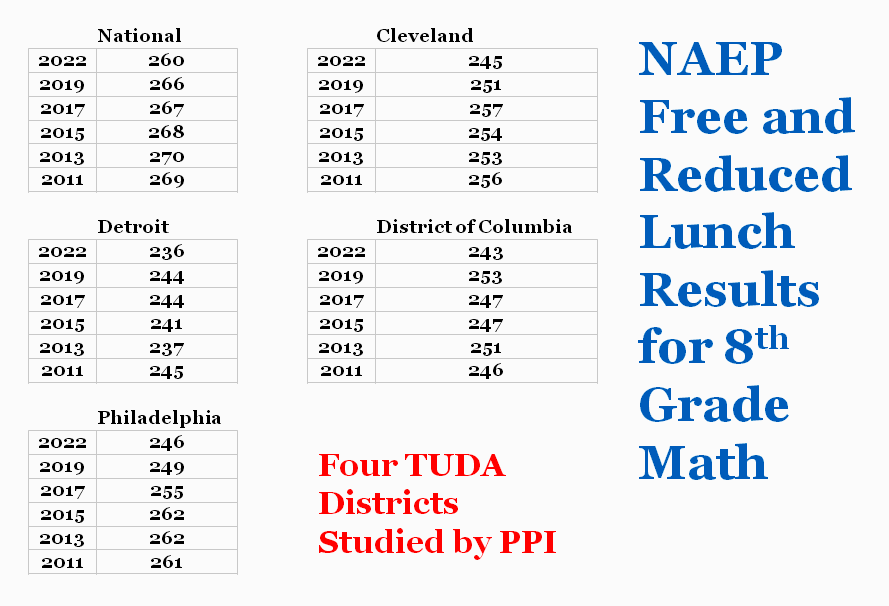
In the beginning of the standardized testing craze, outcome gaps between racial groups were a big concern. Then Sean Reardon and his team at Stanford discovered that these gaps in testing results were more likely poverty driven. There is almost no information about where PPI got the data to support their claims. Most of the 10 cities studied are in states that have changed test types and venders since 2011. This makes the state tests somewhat difficult to use for comparing gap changes if the data required could be attained. However four of the cities PPI studied are in the NAEP (National Assessment of Education Progress) Trial Urban District Assessment (TUDA) group; Cleveland, District of Columbia, Detroit and Philadelphia.

Using the NAEP data explorer to look at 8th grade math, the results for students receiving free or reduced lunch was found. Free and reduced lunch is generally believed to be a good indicator of poverty and 8th grade math is a subject that all students take. There was almost no change over the 12 years cited.

Only the national results saw a 3% improvement and the four studied cities saw testing declines of more that 1%. The PPI report states, “In all of these 10 cities, the data show that in the last decade (school years 2010-2011 through 2022-2023), low-income urban students closed the gap with statewide test score averages by 25-40% (Report Page 10). This is a surprising and difficult claim to accept. In fact, it looks like an outright lie.

Conclusion

It has been clear that The 74 was a billionaire propaganda rag ever since its original funding was provided by the Dick and Betsy DeVos Family Foundation, the Walton Family Foundation, the Doris and Donald Fisher Fund and Bloomberg Philanthropies.

PPI appears to be an organization stuck in its 1990s neoliberal ideology with their misguided belief that markets are always the superior path to improvement.

Both organizations seem to be missing out on ethics. Here they have joined in a lie to sell school choice.

NPE Throws Cold Water on CREDO Paper

23 Jul

By Thomas Ultican 7/23/2023

The Center for Research on Education Outcomes (CREDO) just released another pro-charter school study, “CREDO also acknowledges the Walton Family Foundation and The City Fund for supporting this research.” It is not a study submitted for peer review and so opaque that real scholars find the methodology and data sets difficult to understand. Carol Burris and her public school defenders at the Network for Public Education (NPE) have provided an in-depth critical review.

With the new CREDO study, Education Week’s Libby Stanford said that “charters have drastically improved, producing better reading and math scores than traditional public schools.’’  Rupert Murdoch’s Wall Street Journal declared charter schools are now “blowing away their traditional school competition.” Burris retorted with “despite the headlines, the only thing ‘blown away’ is the truth.” (Page 3)

Putting a CREDO Thumb on the Scale

CREDO uses massive data sets, unavailable to other researchers, getting minuscule differences which are statistically significant. No one can check their work. They employ a unique and highly discredited statistical approach called “virtual twins” to compare public school with charter school testing outcomes. Instead of reporting the statistical results in standard deviations, CREDO uses their “crazy pants” days of learning scheme.

NPE discovered that the “blowing away” public school results amounted to 0.011 standard deviations in math and 0.028 standard deviations in reading. The minuscule difference is “significant statistically but is meaningless from a practical standpoint” according to CREDO. In a 2009 report showing public schools with a small advantage, CREDO declared, “Differences of the magnitude described here could arise simply from the measurement error in the state achievement tests that make up the growth score, so considerable caution is needed in the use of these results.”

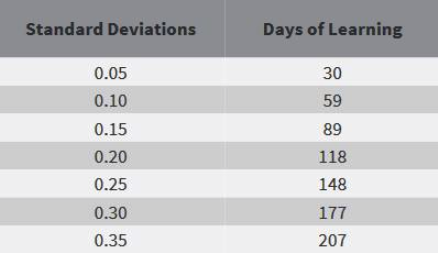
To give these almost non-existent differences more relevance, CREDO reports them as “days of learning” instead of standard deviation. “Days of learning” is a method unique to CREDO and generally not accepted by scholars. They claim charter school math students get 6 more “days of learning” and English students, 16 days.

CREDO Days of Learning Conversions

The above chart comes from the Technical Appendix of a previous CREDO study, which reveals that Eric Hanushek and Macke Raymond used NAEP data from 2017 to create the table. No justifications for the conversions are given. It appears to be sloppy science and headlines generated by its use are unfounded propaganda.

Bad Methodology

The CREDO method does not compare charter school performance to actual public schools. It creates mathematical simulations. Professor Andrew Maul of UC Santa-Barbara stated, “The study’s ‘virtual twin’ technique is insufficiently documented, and it remains unclear and puzzling why the researchers use this approach rather than the more accepted approach of propensity score matching.”

CREDO’s stipulation that “virtual twins” comes from “feeder schools,” favors charter schools. Management expert, Andrea Gabor, explained that CREDO used less than five student transfers to a charter school as the cutoff for a particular public school’s data. She notes the “study excludes public schools that do NOT send students to charters, thus introducing a bias against the best urban public schools, especially small public schools that may send few, if any, students to charters.”

This study is singularly focused on test results as determinate of school quality. Many charter systems, like IDEA and Success Academy, spend an inordinate amount of time preparing for standardized tests. This biases results.

Professor Mark Weber of Rutgers University adds a few more observations:

The NPE report highlights another source of bias for charter schools:

“In addition to their presence in a CREDO-identified feeder school, students are matched by gender, grade level, scores, race, and special education and English language learner status. Yet special education students are not a monolith. Research has consistently shown that charters take fewer special education students and enroll fewer students with more challenging disabilities than public schools.” (Page 9)

The combination of rejected methodologies, murky data studies and biases toward charter schools render the CREDO study useless. Minuscule advantages reported, favoring charter schools, indicate that in reality, public schools outperform charters.

The CREDO Story

In 1981, Massachusetts Institute of Technology trained economist, Eric Hanushek, wrote “Throwing Money at Schools.” Right-leaning philanthropies and institutions were drawn to his declaration:

“The conventional wisdom about public schools is that they face serious problems in terms of performance and that improving schools requires additional money. However, the available evidence suggests that there is no relationship between expenditures and the achievement of students and that such traditional remedies as reducing class sizes or hiring better trained teachers are unlikely to improve matters.”

In a 1981 Ed Week commentary referencing this paper, Hanushek points to SAT testing as the gold standard for judging school performance. He claims, “Advanced statistical techniques are employed to disentangle the influences on achievement of schools and teachers from those of other factors such as family backgrounds and student abilities.” This motivated him to push for teachers to be evaluated, using “value added measures”, that since have been thoroughly discredited.

At the time, he was teaching political science and economics at Rochester University and meeting his future wife, a significantly younger student, named Margret (Macke) Raymond. She completed her Rochester University political science PhD in 1985.

A 1999 announcement from the school said, “The Center for Research on Education Outcomes has been established at the University of Rochester’s Wallis Institute of Political Economy…” In the same posting, it revealed, “Two foundations have committed $1.25 million to fund a three-and one-half year initiative to address the current shortage of evaluation research in education policy matters.” CREDO never made the names of the two foundations public but a knowledgeable academic disclosed one of them was the Walton Family Foundation. It is documented that the Waltons give generously to CREDO.

The announcement listed Eric Hanushek first and Macke Raymond as founding Director.

CREDO moved to Stanford University’s Hoover Institute in July 2000 which made networking in conservative circles much easier.  Their 2nd year report stated that moving to the Hoover Institute brought many new contacts, including the New Schools Venture Fund, the District of Columbia Charter School Board, the Teacher Union Reform Network and others.

Public Schools are Superior to Charter Schools

Staffing in public schools is made up of mostly college graduates with certified state teaching credentials. Before the appearance of the billionaire-created Teach For America (TFA), nearly 100% of public school teachers had a year of teacher training and a bachelors degree or higher. A significant percentage of charter school teachers come from TFA with just five weeks of education training. Charters are typically not required to use certificated teachers.

The depth of experience in the public school teaching corps is larger than that of charter schools. A Fordham Institute article states:

“That being said, there is a bona fide but often unaddressed teacher shortage: experienced teachers in charter schools. In the United States, a third of charter teachers have fewer than three years of teaching experience, compared to only a fifth of public school teachers.”

“Comparative inexperience and youth in front of classrooms carries costs. More than any other school-related factor, a teacher’s efficacy matters most to student learning. And especially in the early years, nothing improves a teacher’s efficacy quite like experience.

Stability is important for school-aged children and especially for those growing up in difficult home environments. In 2020, NPE conducted an in-depth look at charter schools since their inception. They discovered that charters were closing at extremely high rates; 18% by year 3, 25% by year 5, 40% by year 10 and 50% by year 15. In some cases, charters closed their doors mid-semester without warning; this never happens in public schools.

Management in public schools must meet state credentialing requirements. They focus on good pedagogy, safe schools and parent engagement. In charter schools, supervisors are often untrained in education and make return on investment, a key goal.

Safety in public schools is state-mandated but charter schools can ignore some rules. In California, all public schools must be earthquake-safe facilities. Charter schools may not heed this requirement.

In 2013, Christopher A. Lubienski and Sarah Theule Lubienski published The Public School Advantage – Why Public Schools Outperform Private Schools. Nothing has happened over the last ten years that invalidates this scholarly work. Charter schools are private schools with a state contract, similar to garbage collection companies, contracting with a city. They are private companies, paid with taxpayer funds.

Charters are substandard education organizations that only survive because of marketing.

CREDO’s New Study Biased against Public Schools

14 May

By Thomas Ultican 5/14/2020

The Center for Research on Education Outcomes (CREDO) started releasing the results of its new Cities Study Project in mid-2019. It is not a coincidence that the cities chosen for the study have long been targeted for public school privatization. The ten cities selected are: Indianapolis; Baton Rouge; Camden; Kansas City; Memphis; New Orleans; Oakland; St. Louis; San Antonio; and Washington DC. This CREDO study is even more opaque and biased than its previous efforts.

Who is CREDO?

Hanushek and Raymond

Husband and Wife Team Who Founded CREDO

In the early 1980s, Margaret (Macke) Raymond was completing a lengthy graduate school agenda at the University of Rochester, a relatively small private university in Rochester, New York. She garnered an MS of public policy in 1980, a community medicine MS in 1982, an MA of political science in 1983 and finished with a PhD in political science in 1985. From 1985 to 2000 she ran Raymond Consulting and worked a few years in the telecommunications industry.

At that same time, Eric Hanushek was Professor of Economics and Political Science at Rochester University. The former Air Force cadet had earned a doctorate of Economics from the Massachusetts Institute of Technology in 1968. It was Hanushek’s 1981 paper “Throwing Money at Schools” that put him on the watch list of right leaning philanthropies and institutions. In his notice making missive he stated,

“The conventional wisdom about public schools is that they face serious problems in terms of performance and that improving schools requires additional money. However, the available evidence suggests that there is no relationship between expenditures and the achievement of students and that such traditional remedies as reducing class sizes or hiring better trained teachers are unlikely to improve matters.”

In a 1981 Ed Week commentary referencing this paper, Hanushek points to SAT testing as the gold standard for judging school performance. In complete accordance with the old aphorism, “to a man with a hammer all problems look like a nail,” Hanushek brags, “Advanced statistical techniques are employed to disentangle the influences on achievement of schools and teachers from those of other factors such as family backgrounds and student abilities.”

A 1999 announcement from Rochester University said, “The Center for Research on Education Outcomes has been established at the University of Rochester’s Wallis Institute of Political Economy…” In the same posting, it was revealed, “Two foundations have committed $1.25 million to fund a three-and one-half year initiative to address the current shortage of evaluation research in education policy matters.” CREDO never made the name of the two foundations public, but a knowledgeable academic says one of them was the Walton Family Foundation.

The announcement listed two employees of the new center, Eric Hanushek and Margaret Raymond. Hanushek was listed first but Raymond was cited as the founding Director.

CREDO moved from the University of Rochester to Stanford University’s Hoover Institute in July, 2000 which made networking in conservative circles much easier.  In CREDO’s 2nd year report, they stated that moving to the Hoover Institute brought them many new contacts including the New Schools Venture Fund, the District of Columbia Charter School Board, the Teacher Union Reform Network and others.

A description of the Hoover Institute from Source Watch says,

“The Hoover Institution is influential in the American conservative and libertarian movements, and the Institution has long been a place of scholarship for high profile conservatives with government experience. A number of fellows have connections to or positions in the Bush administration, and other Republican administrations. … Other fellows of the Institution include such high profile conservatives as Condoleezza Rice, George Shultz, Thomas Sowell, Shelby Steele, and Edwin Meese.”

Macke Raymond’s 2015 Hoover Institute Fellow’s profile says in part, “In partnership with the Walton Family Foundation and Pearson Learning Systems, Raymond is leading a national study of the effectiveness of public charter schools.” 

Valerie Strauss of the Washington Post has pointed out that Eric Hanushek

“… a Hoover economist was a pioneer in creating systems that evaluate teachers by student standardized tests, a method that many assessment experts say should not be used in the high-stakes ways that school reformers are using them. He is often cited in CREDO studies as a ‘principal investigator.”’

Discredited and Biased

The Forbes commentator, Peter Greene, wrote about Eric Hanushek for his popular blog Curmudgucation:

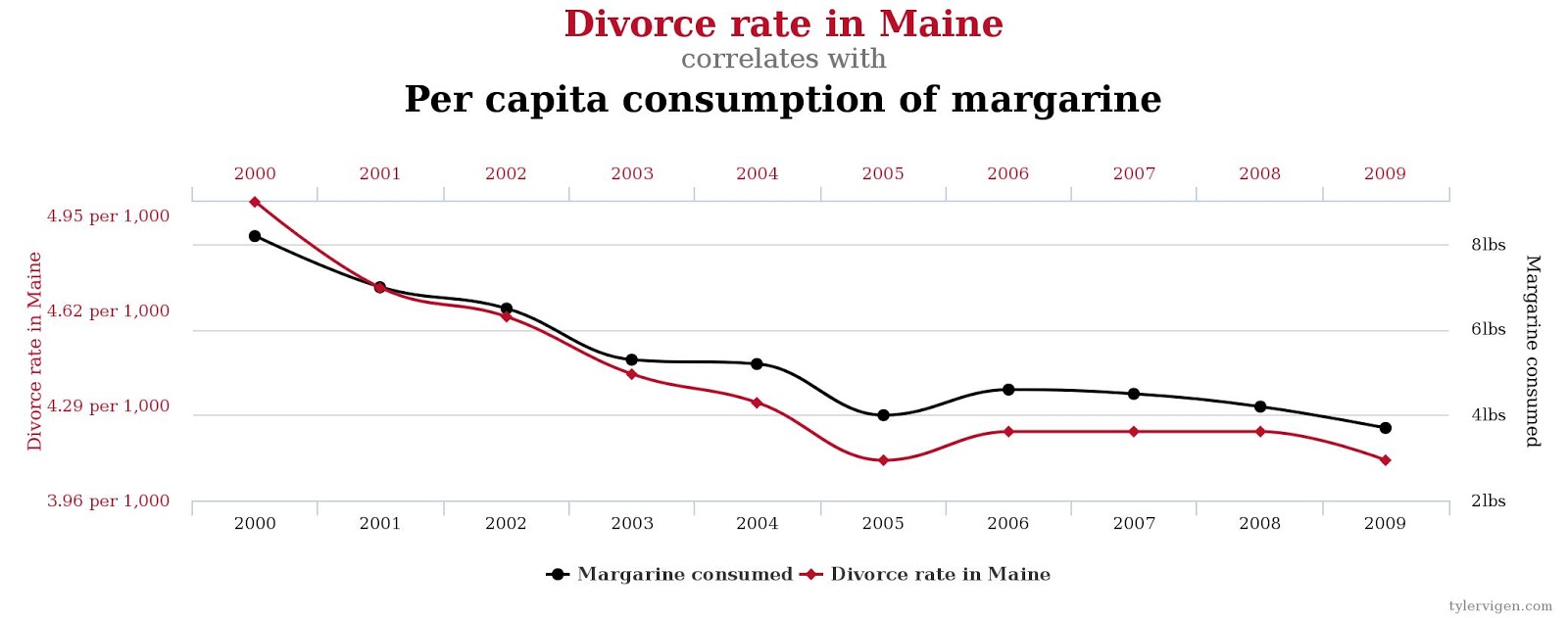
“Now when Hanushek says that teachers make a huge difference, he is obliquely referencing his own crazy-pants assertion that having a good first grade teacher will make you almost a million bucks richer over your lifetime (you can also find the same baloney being sliced by Chetty, Friedman, and Rockoff). Both researchers demonstrate their complete lack of understanding of the difference between correlation and causation.”

Greene also shares the following graphic that clearly highlights the difference between correlation and causation.

Divorce caused by Margarine consumption

Does Margarine Consumption Cause Divorce?

Business writer Andrea Gabor states that CREDO studies which compare charter schools with public schools start with two key assumptions “A) That standardized-test scores are an adequate measure of school quality and B) that creaming in charter schools does not exist.”

With regards to assumption ‘A’, using standardized testing for this purpose has been shown faulty from studies dating back to the eugenics movement (which originated high stakes standardized testing) to recent works debunking them for mistaking correlation versus causation and for not being able to compensate for the problem of error.

As for assumption B, there is no doubt that most charter schools push out and avoid students that are classified as special education, language learners or discipline problems. The data proving that is in state enrollment reports wherever charter schools exist.

In the new research labled “Cities Studies Project”, the Technical Appendix says the reports uses growth models but doesn’t share which of the many growth models it uses. It also says,

“In our study, scores for all these separate tests are transformed to a common scale. All test scores have been converted to standardized scores to fit a ‘bell curve’, in order to allow for year-to-year computations of growth.”

The Education Growth Model Handbook lists seven types of growth models in general use and their requirements. Most growth models require vertical scales but that does not seem possible with CREDO’s use of multiple tests many of which are not vertically scaled. Their mathematical conversions add another locus of error. Growth models have proven to be unstable and have never been satisfactorily validated.

The research methodology used in the “Cities Studies Project” appears to be the same as that used in CREDO’s 2015 Urban Charter School Study Report on 41 Regions.” A particularly troubling practice employed then and apparently still being used is the “virtual twin” method which creates a pro-charter school bias.

Professor Andrew Maul of UC Santa-Barbara reviewed the 2015 study for the National Education Policy Center. He noted the CREDO method does not compare charter school performance to actual public schools; rather it creates mathematical simulations. Maul described the “virtual twin” schema employed to develop a “virtual control record.” He reports,

“CREDO’s approach to this estimate is the construction of a ‘Virtual Control Record’ (VCR) for each student in a charter school, obtained by averaging together up to seven students in “feeder” public schools (i.e., those schools whose students transfer to charters) with the same gender, ethnicity, English proficiency status, eligibility for subsidized meals, special education status, grade level, and a similar score from a prior year’s standardized test (within a tenth of a standard deviation) as the specified charter student.”

Maul adds, “The study’s “virtual twin” technique is insufficiently documented, and it remains unclear and puzzling why the researchers use this approach rather than the more accepted approach of propensity score matching.”

The stipulation that “virtual twins” come from “feeder schools” biases the study in favor of charter schools. Andrea Gabor explained that in practice, CREDO used less than five students transferring to a charter school as the cutoff for using a particular public school’s data. She reports that the, “study excludes public schools that do NOT send students to charters, thus introducing a bias against the best urban public schools, especially small public schools that may send few, if any, students to charters.” Gabor gave the example of two well regarded New York title-1 schools, Global Technology Preparatory and West Side Collaborative which were excluded. They are noted for scoring well on testing, but did not meet the transfer criteria yet easily matched the required demographics.

The CREDO study is singularly focused on test results as determinate of school quality and ignores other advantages of public schools. It is a well known fact that many charter school systems like IDEA and Success Academy spend an inordinate amount of time teaching to and preparing for standardized tests. To these criticisms, Professor Mark Weber of Rutgers University adds a few more observations:

“Cities Studies Project” Technical Appendix states,

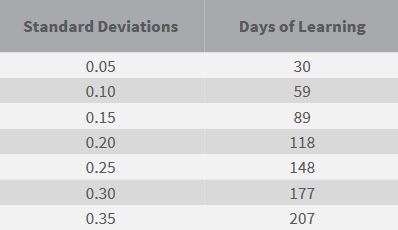
“To assist the reader in interpreting the meaning of effect sizes, we include an estimate of the average number of days of learning required to achieve a particular effect size. This estimate was calculated by Dr. Eric Hanushek and Dr. Margaret Raymond based on the latest (2017) 4th and 8th grade test scores from the National Assessment of Educational Progress (NAEP).”

Converstion to Days of Learning

The CREDO Days of Learning Conversion Table from “Cities Studies Project”

This metric seems to have been created with next to nothing validating it. Mark Webber quoted the psychometrician Michael T. Kane,

“The 2015 study (p. 5) cites a paper published in Education Next (Hanushek, Peterson & Woessmann, 2012) that asserts: “On most measures of student performance, student growth is typically about 1 full std. dev. on standardized tests between 4th and 8th grade, or about 25 percent of a std. dev. from one grade to the next.” (p. 3-4) No citation, however, is given to back up this claim: it is simply stated as a received truth.”

CREDO tells us that Hanushek and Raymond did something with NAEP data from 2017 but still do not offer any justification for the conversion. It appears at best to be sloppy science and the headlines engendered from it are nothing short of propaganda.

Using CREDO Claims to Sell Privatizing Public Schools

Neerav Kingsland the Managing Partner of the City Fund posted to his Blog last July when the first results from “Cities Studies Project” arrived explaining,

“Last year, Arnold Ventures commissioned CREDO (out of Stanford University) to study the effects of charter, innovation, and traditional schools in select cities across the country.”

“Most of the cities included in the study were cities where Arnold Ventures (and now The City Fund) have partnered with local leaders to expand high-quality schools.”

“Camden’s city level effects are large.”

“In just two years, scores are up ~.15 standard deviations in math and ~.05 standard deviations in reading (compared to similar schools across the state).”

The reality is those changes are very small. Noise in the data is a better explanation than awesome charter schools for these tiny differences.

In Indianapolis, the CEO of The Mind Trust, Brandon Brown, just wrote an Indy Star opinion piece stating,

“A 2019 study from Stanford University found that students who attend Innovation Network Schools achieve the equivalent of 53 additional days of learning in English and 89 additional days of learning in math each year when compared to their traditional public school peers. This equates to several years of additional learning during the span of a K-12 academic career, and the gains are largest for students of color and students from low-income backgrounds.”

In the billionaire financed effort to privatize public education, CREDO has become their source for data proving things like smaller class sizes and teacher professionalism are not important. The “Cities Studies Project” commissioned by an organization intent on privatizing public schools through promoting the portfolio management scheme – The City Fund – is biased toward the privatization agenda. Rather than shining the light of scholarly work on education policy, it obscures reality with obfuscation.