Tag Archives: Jennifer Berkshire

Citizen’s Guide and Defense Manual

5 Aug

By Thomas Ultican 8/5/2024

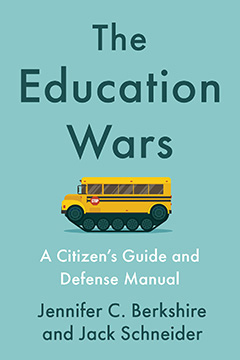
Jennifer Berkshire and Jack Schneider just published The Education Wars. In their 2020 book, A Wolf at the School House Door, the focus was the rightwing and neoliberal attacks on public education. In this new book, they address actions taken to end taxpayer funded universal public education and the resistance. It is a handbook and guide.

Historian and author of Democracy in Chains, Nancy MacLean noted:

“Who would want to ‘take down the education system as we know it’—and why? Read this fast-paced, lucid, and gripping account to understand who is behind the escalating attacks on public education and what, exactly, they seek.”

Parker J. Palmer, author of The Courage to Teach, highlighted the unique dilemma facing public education in America, commenting:

“We’ve argued about our schools from the earliest days of public education. But never before have our public schools been threatened with a well-financed strategy to bring the system down, replace education with indoctrination, shred our social fabric, undermine opportunity for millions of kids, and consign them to second-class citizenship. This is a vital handbook for all who want to enlist in the never-ending struggle for a ‘more perfect union.’”
What’s in it for Billionaires?

Eric Anderson, cited in the book, worked in a Bavarian-themed restaurant for the mother of Betsy DeVos and Eric Prince. He shares about waiting tables and overhearing billionaires’ conversations which gave him insights. In his 2023 article about DeVos pushing for vouchers in Pennsylvania, he stated:

“Equality does not serve the ruling classes well. It never has, which is why the plutocrats lobby so hard against it. It’s why they pursue agendas, such as school vouchers, that are guaranteed to exacerbate inequality.”

“An uneducated populace is bad for democracy, but it’s great for the rich and powerful, who can more easily pull the wool over the eyes of voters. The less able you are to reason, the more amenable you are to lies and smokescreens and dog whistles (e.g., ‘school choice,’ ‘parental rights,’ etc.). Education liberates. Ignorance subjugates.”

While many self-styled school reformers seek profits, for billionaires, the motive is securing control over democratic processes to solidify their privileged positions in society.

The push for vouchers by Charles Koch and Betsy DeVos has multiple purposes. Vouchers undermine public schools and voucher laws are written to limit government oversight. Furthermore, this creates an environment for indoctrinating students with conservative beliefs.

Getting rid of oversight is key for voucher-pushing billionaires. The authors also note:

“Want to sow a revolt against the largest expense in most state budgets? Make it impossible for the public to see where their tax dollars are going.” (Page 22)

Public Schools are Better than Ever

One important point made early in the handbook is that public schools have continually improved as have student outcomes. On NAEP, the nation’s report card, scores have increased over the last 50 years. Since the 1980s, graduation rates have soared from less than 70% to almost 90%.

Teachers and curriculum have significantly improved. Back in Glenn’s Ferry, Idaho where I attended school, almost all teachers were graduates of Albion Normal school. It was a two-year institution for teacher training after which they went directly into the classroom. The highest math my algebra instructor studied was algebra I. Today, a vast majority of teachers have at least a bachelor’s degree plus a year of supervised teaching practice. Math, science, social studies and English teachers are experts in their field.

Public schools continue to become more equitable. Into the 1950s, a separate curriculum was provided for girls, low-income students and students of color, emphasizing domestic or industrial training. The Education Wars states, “Schools were segregated by race, students with disabilities were mostly turned away and students not proficient in English were isolated in schools with limited academic opportunities.” (Page 14)

Work still needs to be done but the campaign for equal schooling has come a long way.

In the 1970s, both Republicans and Democrats decided that the primary purpose of school was to prepare students for jobs. Democrats especially advanced the idea that education was the way to address the nation’s deepening wealth gap. They saw education as expanding the middle class without resorting to politically-challenging ideas like wealth redistribution.

Since then, public education has been expected to solve poverty: “The view that education is a ‘passport out of poverty,’ as Lyndon Johnson insisted, holds deep sway.” (Page 43) The reality is the biggest indicator of poor education performance is poverty and schools have no control over the wealth of neighborhoods in which they reside. It is not surprising that these institutions disappoint when held responsible for things out of their control.

Schools Attacked in New Era of Fierce Partisanship

 At a Moms for Liberty event in 2023, Donald Trump claimed public schools were infested by “Marxist lunatics and perverts.” He also said he would “liberate our children” by cutting federal funding to any school pushing “inappropriate racial, sexual, or political content on our children.” (Page 45)

Over the top rhetoric like this has become common place, even though there is scant evidence to support it.

Since its founding in 1973, Heritage Foundation has been fanning the flames of school culture ideology. They see it as the key to undermining faith in public schools. Over the decades, specific issues have changed but their goal of ending public education has persisted.

In 1992, while stumping for president, Patrick Buchanan claimed he would be the president of parents. He said, “I will shut down the U.S. Department of Education, and parental rights will prevail in our public schools again.” (Page 80)

Today, his claim has become parental rights, almost exclusively for religious conservatives as these disingenuous and divisive calls continue. A Virginia law governing the treatment of transgender and non-binary students allows parents of other students objecting to a student’s preferred pronouns, based on the First Amendment’s guarantee of religious freedom.

The handbook shares:

“Justifying this policy, Governor Glenn Youngkin’s administration pointed to what it identified as parents’ fundamental rights. But a more accurate explanation is that the rights of certain parents are being privileged above others.”   (Page 89)

Milton Friedman’s vouchers have become taxpayer-funded discrimination. Civil rights attorney, Jeffrey Spitzer-Resnick, suggested, “Let’s stop calling it a ‘choice program’ and let’s call it a private discriminatory education program funded with your tax dollars.” (Page 109)

Education as a Public Good

In the final chapter, “Reclaiming Education as a Public Good,” Beth Lewis of Saving Our Schools Arizona says:

The defining issue here is: Do you care about other people’s kids or not? Do we want to live in a world that’s based on the understanding of a public good, or one where only the individual good matters? (Page 134)

The authors assert, “We can start by reducing the responsibility that education bears for achieving minimal social and economic security.” (Page 145)

Currently schools are asked to do the impossible and blamed for failing. Literally billions of dollars are being spent to destroy public education, the foundation of Democracy.

The Education Wars is a handbook to help parents and citizens recognize feckless attacks and defeat them.

America’s public education system is a treasure and if lost, will never come back.

My First NPE Conference Revisited

2 Oct

By Thomas Ultican 10/2/2023

I traveled from San Diego to Chicago’s famous Drake Hotel for the Network for Public Education (NPE) conference in 2015. Karen Lewis, President of the Chicago Teachers’ Union and her union hosted the event and leaders of the National teachers unions, Lily Eskelsen García from the National Education Association and Randi Weingarten of the American Federation of Teachers were present.

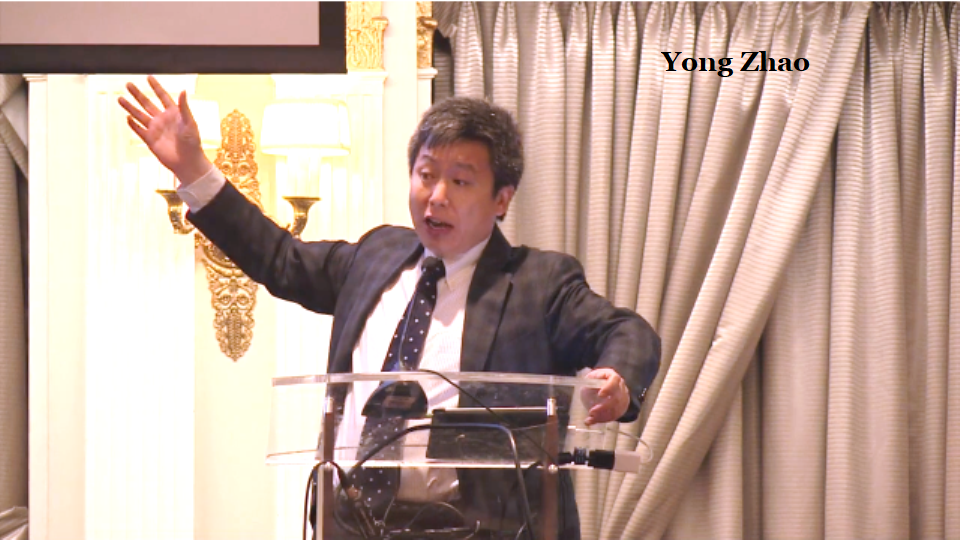
Scholar author, Yong Zhao, was the day-one keynote speaker.

At the hotel early Friday evening, Anthony Cody, co-founder of NPE, standing on the entry stairs, greeted new arrivals. This tall man had developed a reputation as a renowned champion for public education. Steve Singer from Pennsylvania and T.C. Weber from Tennessee arrived right after me and I knew it was going to be special.

Karen Lewis was fresh-off leading a stunning victory by the Chicago teachers’ union. She had been planning to run for Mayor of Chicago but unfortunately was diagnosed with brain cancer. With her amazingly big heart, for the next several years, we communicated by telephone. It was stunning how she always had time for me even when sick. I miss her.

Day One

Next morning at breakfast, I met Professor Larry Lawrence, a lifelong education professional and friend of public education who just happens to live 20-miles up old Highway 101 from me. We became quite close. I wrote about Larry in my post, Breakfast with Professor Lawrence, laying out some of his awesome contributions to public education.

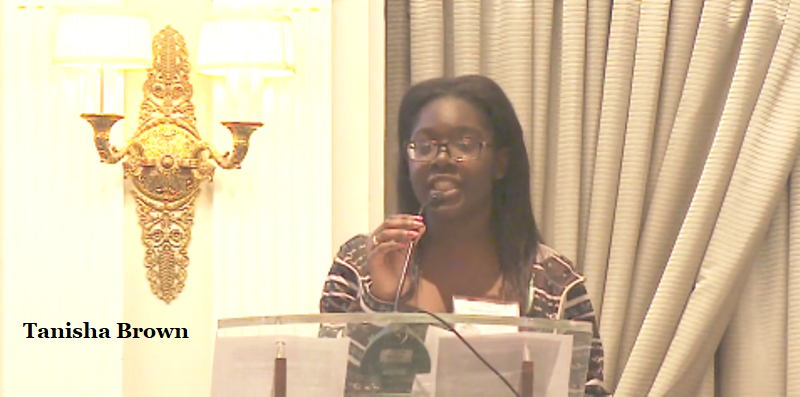
The first session kicked off with addresses by Chicago’s Jitu Brown and Newark student union leader, Tanisha Brown.

Jitu heads Journey for Justice and would become nationally recognized when he led a 34-day hunger strike, saving Chicago’s Dyett High School from Mayor Rahm Emanuel’s chopping block. He shared that once, a man from Chicago, claiming to be a community organizer, dipped his toe in the ocean and when it was cold, moved on. It was Barak Obama.

Tanisha Brown was part of a student movement to save Newark’s schools from being privatized and from, the authoritarian control of a former TFA member, Cami Anderson.

These two speakers got the conference off to a rousing start.

During graduate school at UCSD in 2001, I spent a lot of time looking at various reforms. Then, it meant improving education, not privatization. The work of Deborah Meyer particularly stood out. Her small class-size and student-centered efforts in both New York City and Boston were inspirational. Getting to meet her at this conference in Chicago was a special treat. She and her niece talked with me for almost an hour. NPE is one of the few places this could happen.

On the way to lunch, I encountered Annie Tan, a special education teacher, then working in Chicago. The tables were round and could seat more than 10 people. We found a table right next to the stage. It turned out that four people at our table were going to be holding the lunch-time discussion: Jennifer Berkshire, Julian Vasquez Heilig, Peter Greene and Jose Vilson.

Today, almost everyone in the fight to save public education knows Jennifer Berkshire but up until 2015, she was hiding her identity under the pseudonym, Edu-Shyster. Julian Vasquez Heilig is now the head of education at the University of Kentucky; then, he was a department chief at Sacramento State University in California. Peter Greene was a teacher blogger from rural Pennsylvania and known to some of us as the author of Crumuducation. Jose Vilson was a teacher blogger from New York City, with a large following. 

Also at the table was Adell Cothorne, the Noyes Elementary school principal, famous for exposing Michelle Rhee’s DC cheating scandal.

I will always appreciate Annie Tan, leading me up to that table. It was interesting that Peter Greene, his wife, Jose Vilson and I all play the trombone. Everyone knows that trombone players are the coolest members of the band.

The main event was a presentation by Professor Yong Zhao. Everybody was impressed and highly entertained. He had just published Who’s Afraid of the Big Bad Dragon?: Why China Has the Best (and Worst) Education System in the World. His book and presentation thoroughly discredit standards and standards-based testing.

Zhao is a funny guy. In 2015, readiness was a big education issue for the billionaire boys club … readiness for college, high school and even kindergarten, were written about in all big money education publications.

He said kindergarten readiness should mean “kindergartens are ready for children.” What he wanted for his children was “out of my basement readiness” and shared a personal experience of being in a Los Angeles elevator with Kim Kardashian, observing she had “out of my basement readiness”!

Union Leaders

In 2015, Bill Gates spent lavishly to control the direction of public education, giving large handouts to education journalists, education schools and teachers unions, in support of his proposal for the national Common Core State Standards. Activists at the Chicago meeting wanted the teachers unions not to accept Gates money, the underlying issue facing Lily Eskelsen García and Randi Weingarten as they took the stage in the main room for a Q & A session moderated by Diane Ravitch.

Both García and Weingarten were excellent presenters, consummate professionals, who did not disappoint. Most of the hour, Ravitch asked questions about topics, like teacher tenure and the scurrilous attack on classroom teachers. Answers from both union leaders received big positive responses.

The last question of the day was about the unions taking donations from Bill Gates. García and Weingarten both swore that their unions would no longer accept his gifts. This was not entirely true but did lead to that outcome eventually.

I personally got a chance to speak with García about diversity, saying in southern Idaho where I grew up, it might have a larger percentage of Mormons than Utah. She joked that in the Salt Lake school district, where she taught, diversity meant there were some Presbyterians in the class. Lily was genuine and warm.

Some Thoughts on NPE

Be careful about your travel itinerary… had to leave before the conference ended to catch the flight home, not realizing how much time was needed to get to the airport … will not make that mistake again.

The next NPE conference will be my sixth. That first one in Chicago awakened me to the crucial efforts Diane Ravitch, Carol Burris and the NPE board are making.

NPE is our most important organization in America fighting to preserve public education, the foundation of democracy. When we meet in Washington DC October 28 and 29, some of America’s most brilliant educators and leaders will be sharing information and firming up plans for our country. I hope you can be there.

Remember, the way public education fares directly affects how American democracy fares.

Democracy and Education

20 Dec

By Thomas Ultican 12/19/2020

Democracy and free universal public education are foundational American ideologies. They have engendered world renowned success for our experiment in government “by the people”. Two new books – Schoolhouse Burning by Derek Black and A Wolf at the Schoolhouse Door by Jack Schneider and Jennifer Berkshire – demonstrate that these principles which were integral to the American experiment are shockingly under serious attack by wealthy elites.

After his father Fred died in 1967, Charles Koch took a disparate set of assets – a cattle ranch, a minority share in an oil refinery and a gas gathering business – and stitched them together. Today it is the second largest privately held corporation in the world. In the excellent 2019 book, Kochland, Christopher Leonard states, “Koch would eventually build one of the largest lobbying and political influence machines in US history.”

Both the introduction to A Wolf at the Schoolhouse Door and the “Through History’s Eyes” chapter of Schoolhouse Burning mention the same quote from Charles Koch. In 2018, the Koch network held its annual three day gathering near Palm Springs, California. It was a 700-person confab of some of the richest people in America. Black wrote,

“Charles Koch told the audience that ‘we’ve made more progress in the last five years than I had in the last 50…. The capabilities we have now can take us to a whole new level…. We want to increase the effectiveness of the network … by an order of magnitude. If we do that, we can change the trajectory of the country.’ One of the donors at the summit explained that education is ‘the lowest hanging fruit for policy change in the United States today … I think this is the area that is most glaringly obvious.’

“Let that sink in for a moment; change the trajectory of the country and do it through education. In other words, the agenda is not to improve education. The agenda is to change America.”

In Kochland, Leonard gave some context to the effects of the progress for the 160,000 households in the wealthiest 0.1% that Charles Koch was addressing,

“In 1963, the top 0.1 percent of households possessed 10 percent of all American wealth. By 2012, they possessed 22 percent. This gain came as the vast majority of Americans’ lost ground. The bottom 90 percent of Americans possessed about 35 percent of the nation’s wealth in the mid-1980s. By about 2015, their share had fallen to 23 percent.”

Clearly, the great transfer of wealth in America has been from the working class to billionaires and privatizing public education is seen as key to continuing and accelerating that trend.

Schoolhouse Burning Documents the Legal Evolution of Public Education

In the introduction Derek Black states,

“From it first days, the nation’s theory of government depended on educated citizens. The founders feared that democracy without education would devolve into mob rule, open doors to unscrupulous politicians, and encourage hucksters to take advantage of citizens even as they stood in line to vote.”

The Massachusetts Constitution of 1780 is the oldest working constitution in the world and had great influence in the writing of the US Constitution. It divided the powers of government into three branches – the executive, the legislature and the judiciary. Its education clause states that, “wisdom and knowledge … diffused generally among the body of the people [are] necessary for the preservation of their rights and liberties…. [Thus,] it shall be the duty of the legislatures and magistrates, in all future periods of the commonwealth, to cherish the … public schools.”

Before the US Constitution was adopted, public education was written into the national legal framework. Black notes that every bound volume of the current United States Legal Code begins with a section called Front Matter which includes the four “organic laws” in chronological order. It is made up of the 1776 Declaration of Independence, the 1777 Articles of Confederation, the 1787 Northwest Ordinance and the 1789 US Constitution.

Black outlined how the Northwest Ordinance fits,

“…, the Northwest Ordinance’s substance is a constitutional charter of sorts. Practically speaking, it established the foundational structure for the nation to grow and organize itself for the next two centuries. Precise rules for dividing up land, developing the nation’s vast territories, and detailing the path that these territories would follow to become states are not the work of everyday legislation. They are the work of a national charter. Those rules and their effects remain in place to this day.

“From this perspective, the Northwest Ordinance’s education agenda cannot be separated from our constitutional structure and vision. And it was under this constitutional structure and vision that George Washington, John Adams, Thomas Jefferson and James Madison took office and served as presidents of the United States. To no surprise, all would assert education’s utmost importance and call for its expansion.”

In the north, the ideals of public education were fully embraced and the only debate was over the details. It was different in the antebellum south where poorer whites paid almost no taxes and the wealthiest southerners paid two-thirds of all taxes. Johann Neem explains in Democracy’s Schools, “Because of their political power and the way the tax burden fell largely upon them, slaveholding elites spread an antitax gospel to convince ordinary whites that taxes were a bad thing”

During the period of reconstruction following the civil war, the US congress made provisions for freed slave education and political rights to be enforced by federal troops.  The thirteenth amendment to the constitution which passed December 6, 1865 abolished slavery. In 1866, the fourteenth amendment which prohibited discrimination in various aspects of life and extended citizenship to African Americans was adopted.

Requirements for states being readmitted to the union included ratification of the 14th amendment and adopting a constitution that conforms to the “Constitution of the United States in all respects.”  This last provision was a demand to establish a republican form of government which in turn meant enshrining public education in their state constitution. Because of growing signs of recalcitrance, Congress imposed an education commitment as an explicit condition for the last three states to reenter the Union – Virginia, Texas and Mississippi.

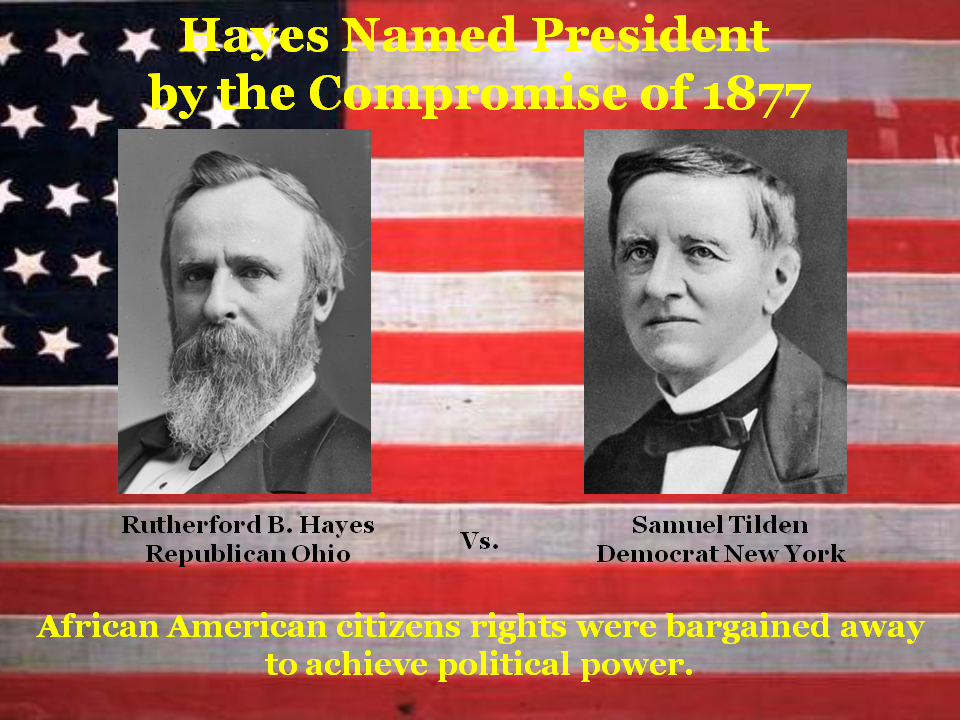
The compromise of 1877 undermined legal protections for black people in the south and financial support for public education. A closely divided corrupt election pitted a Republican abolitionist from Ohio, Rutherford Hayes, against the Democrat Samuel Tilden of New York. Tilden gained the most votes but 20 electors were disputed. A committee of 8 Republicans and 7 Democrats decided Hayes would become President provided he agree that

  • Troops will be recalled from the statehouse property in the three states. [South Carolina, Florida and Louisiana]
  • “Funds will be provided to build the Texas and Pacific Railroad.
  • “A southerner will be appointed as Postmaster General.
  • “Funds will be appropriated to rebuild the economy in the South.
  • “The solution to the race problem will be left to the state governments.”

All decisions were made on party line votes of 8 Republicans for and 7 Democrats opposed.

Throughout the south, segregated schools were soon mandated, spending on educating the newly minted citizens was reduced to lower taxes and voting rights were restricted. Black writes,

“Planters saw the value of competent workers but no value in ‘inflat[ing] the economic and political expectations of workers.’ The only thing education would accomplish would be to ‘spoil good field hands.’ Even worse, education would lead blacks to push for even more social and political equality.”

Thurgood Marshall and other lawyers from the NAACP won many court victories including the famous Brown vs. the Board of Education case that declared education “must be made available to all on equal terms.” Black says the one phrase the court omitted in its 1954 opinion was a clear declaration that education is a fundamental right.

After that case, the Supreme Court expanded desegregation efforts. In the early 1970s a backlash came with the election of Richard Nixon. Nixon campaigned against the Supreme Court and especially against forced desegregation. Between 1969 and 1974, he appointed four justices – Burger, Rehnquist, Powell and Blackmun. Rehnquist held the view that Plessy v. Ferguson which Brown overturned had been correctly settled. Even more troubling, Justice Powell while on the Richmond, Virginia school board and later the Virginia state school board supported school segregation and the massive resistance movement against Brown.

In the 1974 case of Millikan v. Bradley, the court dealt a death blow to desegregation efforts. Black shared,

“By a vote of 5-4, the Court insisted that plaintiffs needed to show intentional school segregation, not just in Detroit’s city schools, but in its suburban districts, too. Absent that, lower courts could not order metropolitan-wide school desegregation.”

By the 1990s, no new Federal Court orders to end school segregation were in the works and those underway were being ended. Since then schools have been re-segregating.

“Are You Trying to Scare People?”

A senior scholar asked this question after reviewing an early draft of A Wolf at the Schoolhouse Door. The authors’ response was, “In a word, yes.”

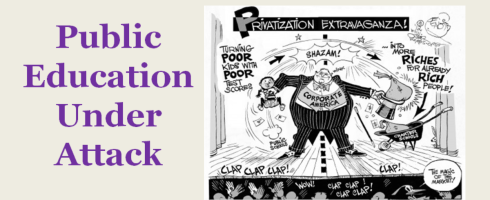
Schneider and Berkshire declare that ideas which for multiple decades have been considered fringe thinking are now central. The radical right and especially leaders in the religious right like Trump’s Secretary of Education, Betsy DeVos, denounce the whole concept of public education.

So, what do these ever more potent deep pocketed funders and conservative politicians want? The authors lay out the four main principles of the radical right.

“1. Education is a personal good, not a collective one.”

“2. Schools belong in the domain of the free market, not the government.”

“3. To the extent that they are able, ‘consumers’ of education should pay for it themselves.”

“4. Unions and other forms of collective power are economically inefficient and politically problematic.”

The conservative enemies of public education today sound like Fred Koch and his John Birch Society did in the 50s and 60s. From A Wolf at the Schoolhouse Door,

‘“Elementary and secondary education in the U.S. is the country’s last remaining socialist enterprise,’ declared Joseph Bast, CEO of the libertarian Heartland Institute, in a 2002 blog post. Bast was explaining his distaste for public education while making the case for so-called universal private school vouchers, which conservatives view as a way station en route to whole-sale privatization.”

The socialist charge has also been directed at teachers. Writing about the 2018 teacher uprisings Schneider and Berkshire explain,

“They demanded that the wealthy pay higher taxes to fund public education, employing a hashtag slogan – #RedforEd.… While the slogan, and the cause it represented, attracted widespread public support, conservative critics saw #RedforEd as something more nefarious. Leaders of Arizona’s teacher protest movement, warned one Republican state representative were using ‘teachers and our children to carry out their socialist movement.’”

The push to privatize public education had foundered until charter schools appeared and a newly formed Democratic Leadership Council (DLC) was created to push the Democratic Party more to the center. A Wolf at the Schoolhouse Door reports, “When the DLC unveiled its official agenda at a 1991 gathering in Cleveland, its head, a rising young Southern governor named Bill Clinton, gave school choice a full-throated endorsement.”

Not only has the push to privatize public education been a bipartisan effort of political elites from both major political parties but even more strangely they have also joined together in attacking labor. From the book:

“The irony is that weakening the influence of organized labor – teachers’ unions in particular – has been largely a bipartisan cause. Bill Clinton made his attack on Arkansas teachers a centerpiece of his 1983 gubernatorial campaign, burnishing his image as a new breed of Democrat who wasn’t afraid to take on the party’s own ‘special interests.’ And during Barack Obama’s eight years in the White House, tough talk against teachers’ unions as protectors of the status quo emerged as party orthodoxy. ‘It’s time to start rewarding good teachers, stop making excuses for bad ones,’ Obama proclaimed in a 2009 speech in which he praised the idea of merit pay for teachers, long a favorite policy tool of Republicans.”

In A Wolf at the Schoolhouse Door, Schneider and Berkshire explain the pursuit of profits in education and the push to implement virtual learning. They ruminate on the history of government regulation (child labor – meat industry – healthcare products and practices) and the push to end regulation. Here like in school privatization there is a religious like belief in markets to be self-regulating and superior to any “big government” organization.

They delve into the marketing that comes along with market driven privatized education. Especially interesting is the potential for micro-targeting student families using companies like Facebook. It enables schools to target only certain demographics.

They also address teachers being pushed into the gig-economy and its ramifications.

The push for “personalized learning” at computers employing AI algorithms to guide students through lessons instead of teachers has the twin goals of reducing teacher costs and creating an edtech market. With cyber-schools, costs are reduced in two ways, facilities requirements are significantly cheaper and with their large class sizes teacher costs are reduced. Even more promising for cost reduction at cyber-schools is the prospect that all classes can be conducted by hourly paid gig workers. Schneider and Berkshire note:

“Of course, the replacement of flesh-and-blood teachers by personalized learning programs will not be universal. Students from privileged families will continue to be educated much as they always have been, with students and teachers coming together as communities of learners.”

Concluding Remark

There is a lot to these books. They highlight the multiple dangerous paths our nation is on which is indeed scary. Together Schoolhouse Burning and A Wolf at the Schoolhouse Door paint – a maybe not probable – but a very possible grim picture for the future of public education in America. Even grimmer is that this attack on universal free public school is also an attack of America’s 250-year experiment with government “of the people, by the people and for the people.” It is a credible attack on democracy.