Tag Archives: Charter schools

Malcolm Baldrige Award Promotes School Privatization

25 Nov

The November 18 San Diego Union reported: “The Charter School of San Diego is among four recipients awarded the 2015 Malcolm Baldrige National Quality Award, a top presidential honor for performance in the public and private sectors.”

Malcolm Baldrige National Quality Award: “An award established by the U.S. Congress in 1987 to raise awareness of quality management and recognize U.S. companies that have implemented successful quality management systems. Awards can be given annually in six categories: manufacturing, service, small business, education, healthcare and nonprofit. The award is named after the late Secretary of Commerce Malcolm Baldrige, a proponent of quality management. The U.S. Commerce Department’s National Institute of Standards and Technology manages the award, and ASQ administers it.”

I had never heard of San Diego’s first charter school which was founded in 1994. In the past many hoaxes have been perpetrated concerning education, so I decided to do a little digging. I asked, “What made this charter school worthy of a literally one-in-a-million presidential honor?” I found the award was not based on merit! For example, the school is into year four of needs program improvement (meaning failing) under the No Child Left Behind act.

The award announcement came from Commerce Secretary, Penny Priztker. She is quoted as saying:

“The winners were chosen for their ‘outstanding commitment to sustainable excellence through innovation, improvement and visionary leadership.’ The Charter School of San Diego won in the education category for its ability to help students who despite enrolling ‘academically behind and at risk of never receiving a high school diploma, 94-98 percent of those enrolled have graduated from the Charter School of San Diego or successfully transitioned back to a traditional public school.’”

This implies the charter school saves children who can’t make it in public school and even heals their issues to the extent they can go back to public school! That is just fabrication.

It is true that over 70% of Charter School of San Diego students are labeled socioeconomically disadvantaged but that is not unusual. The public school where I work, Mar Vista Senior High School, matches that and has more than twice as many English learners as the charter school. My school and the charter school make a good comparison.

In the March, 2015, all California charter and public schools administered the California High School Exit exam. The March administration was given to sophomores and is the main component of the federally mandated Adequate Yearly Progress evaluation. My school and the charter school had the following results:

Mar Vista Senior High School (420 tested) Passing Rates

Math: All Students : 84% Socioeconomic: 81% English Learners: 65%
English All Students: 85% Socioeconomic: 82% English Learners: 60%

Charter School of San Diego (320 tested) Passing Rates

Math: All Students : 79% Socioeconomic: 76% English Learners: 62%
English All Students: 84% Socioeconomic: 82% English Learners: 63%

When I looked at this data, it seemed to me that my high school, which has also been labeled a failing school for the past five years just like the charter school, looked pretty good. We had more than double the English Language Learners, the same percentage of socioeconomically disadvantaged students and our sophomores outperformed theirs. In addition, our dropout rates are lower.

To understand what is happening here, I looked at the principals involved starting with Penny Pritzker. According to Forbes, “The Hyatt heiress has carefully positioned herself at the intersection of wealth and politics, becoming Commerce Secretary in 2013 after working as a key Obama fundraiser. (She also donated $250,000–just to his second inauguration celebration.)” She is worth about $2.4 billion.

It seems that Billionaires are more interested in profits and advancing private business than world class education for the children of ordinary people. That $700 billion a year spent on education in the United States is too enticing. It turns a billionaire green with desire.

Tom Vander Ark, the well known shill for “corporate education reform” really likes Charter School of San Diego. He wrote in 2014:

“I met Mary Searcy Bixby in the fall of 1999 in a converted retail space in an outdoor shopping mall in San Diego (the same day I visited Larry Rosenstock in a vacant warehouse that become [sic] High Tech High). When I was a public school superintendent, my team had created an alternative school in a mall so I immediately liked the idea. As founder of The Charter School of San Diego, Mary had created (what I’m pretty sure was) the first flex school network as an “independent study” charter school launching in 1994. Five years later, Mary had 19 locations including converted retail and commercial real estate locations serving over 2,000 students. Students attended in two shifts, studied online and print instructional materials, and progressed at their own pace.”

“Altus Institute is the parent corporation to a network of charter schools that includes The Charter School of San Diego (est. 1994), Audeo Charter School (est. 2001), Mirus Secondary School (est. 2007), and Laurel Preparatory Academy (est. 2013). Altus Schools strive to help students achieve by creating alternative educational options that put students’ needs first and to deeply reduce dropout rates.”

Vander Ark is a former officer of the Democrats for Education Reform and an enthusiastic proponent of education technology including cyber-schools. The Democrats for Education Reform are the group that brought us Arne Duncan. Financed by several hedge fund operators, they are huge proponents of privatizing public education with charter schools.

Mary Searcy Bixby, the founder and CEO of Charter School of San Diego, is from San Diego where she attended Marian Catholic High School and obtained both a BA in English and an MA in curriculum and instruction from the local Catholic university, University of San Diego.

Recently, Tom Davis a long time educator and school leader joined Bixby as Educational Reform Project Director. Davis is retired from more than 40 years in public schools and does have deep experience and training.

A few items of interest were revealed by the Altus Institutes form 990 filings. The most current available form 990 covered 2012 and predates Davis’s arrival. Bixby’s total compensation that year was $297,000. She is getting into Eva Moscowitz type earnings and her per-student rate is much higher than Eva’s. In 2010, someone or some entity gave Bixby’s schools $4,500,000 in new buildings and property; which established a strong base for expansion.

This joint statement from Bixby and Davis is on their website:

“We appreciate Ted Kolderie (Senior Associate, Education Evolving), Eric Premack (Executive Director, Charter Schools Development Center), Jed Wallace (President and CEO, California Charter Schools Association), and Pat Hyndman (Chairperson, Vistage) for sharing their expertise and thoughtful insight. Thank you for your courtesy, professionalism, and genuine interest and warmth.

“Thanks to Gail Audrict (Orleans Parish School Board), Alexina Medley (Warren Easton Charter School), and Maggie Runyan-Shefa (New Schools for New Orleans) for sharing the New Orleans experience with Davis and Bixby. Educational Reform in New Orleans is inspring [sic] the education leaders across the United States. The extraordinary model New Orleans provides us leads others to a new way of thinking.”

The Malcolm Baldrige award that Charter School of San Diego displays on its web site is part of a coordinated attack on public schools. There is nothing special about that charter school and public schools in San Diego provide better education.

Charter schools harm public education by diverting tax dollars to private pockets and opening the path of corruption, instability and segregation.

Disturbingly this attack is being led by the Democratic Party. For decades the Democrats prided themselves on supporting and protecting public education. Now, they attack teachers and work to privatize public schools. Who will join the righteous fight to save America’s great public education system from a corrupted political system and corporate greed?
(Condensed) D.C. Schools: A Portrait of “Corporate Education Reform” Failure

23 Oct

This summer the National Academy of Sciences produced a lengthy report for the city of Washington D.C. documenting the effects of their 2007 Public Education Reform Amendment Act (PERAA).[1] The report is a powerful set of data and observations that damn “Corporate Education Reform.”

What is “Corporate Education Reform”?

In 1996, Louis Gerstner, CEO of IBM, hosted the National Governor’s Association conference at the IBM conference facility in Palisades, New York. This conference with the exception of one Asian man was an all white, all male conference made up of 49 CEO’s and 40 governors. There were no educators involved.

At the conference, the Governors established their own non-profit and non-governmental corporation called Achieve Inc. Gerstner was named Achieve’s chairman. Achieve Inc. subsequently supervised the writing of both the Common Core State Standards and the Next Generation Science Standards. While Bill Gates’ Council of Chief State School Officers owns the copyright for Common Core, Gerstner’s Achieve Inc. owns the copyright for the Next Generation Science Standards.

Former Assistant Secretary of Education, Diane Ravitch, is the first person I noticed calling this education reform movement led by super-wealthy business men with no education experience or training “corporate education reform.”

Eliminate Local Control and Privatize

In 1968 D.C. finally got democratic control over their schools only to experience complete loss of parental control with the passage of Public Education Reform Amendment Act in 2007. Mayor, Fenty became czar of education.

In 1995 and 1996 New Gingrich and Bill Clinton teamed up to start the privatization of education process in D.C. by weakening the elected school board and establishing charter schools.

“… by 2014, the percentage [of charter schools] was 44 percent. PCSB [Public Charter School Board] reports that there are approximately 100 individual charter schools, governed by 61 chartering organizations, which function as school districts, …” Pg 31

With almost 50% of the D.C. students in charter schools governance in certain aspect of education is not possible. As the report says:

“There are no standardized formats or definitions in charter schools’ budgets or audits … In addition, the charter management organizations’ accounts are not open to the public ….” (Page 72)

Charter schools are making matters worse; public money is spent with no oversight.

“The U.S. Department of Education has recently reported that that D.C. is among the worst school systems in the nation in providing appropriate educational opportunities for students with disabilities, and it has the worst record of any state in the country for meeting federal special education goals.” (Page 131)

The report notes the D.C. schools have a “crisis in absenteeism” and:

“D.C.’s public schools have had among the worst on-time graduation rates in the country.” (Page 154)

The report also says that charter school gains in test performance over time do not match public schools.

“The EDCORE analyses by sector also showed that, although both DCPS [D.C. Public Schools] and charter students showed improvement, the magnitude of the gains were higher for DCPS students in every year.” (Page 177)

Mayoral Control and VAM Evaluation

In 2007, the city of Washington D.C. completed its embrace of “corporate education reform” when Mayor Fenty assumed total control of all public schools and named Michelle Rhee, a Teach for America alumni with limited experience, chancellor. She made standardized testing and value added measures (VAM) the dominant factor in evaluating schools and teachers.

Education reporter, John Merrow, summed up Rhee’s tenure of just over three years running D.C.’s schools:

“To date, nearly 600 teachers have been fired, most because of poor performance ratings.

“After just two years of Rhee’s reforms, 33% of all teachers on the payroll departed; after 4 years, 52% left.”

“Some of the bloom came off the rose in March 2011 when USA Today reported on a rash of ‘wrong-to-right’ erasures on standardized tests and the Chancellor’s reluctance to investigate.”

Outcomes for the D.C. schools are some of the worst in the nation. Their scores on NAEP [National Assessment of Education Progress] testing still lag the nation. The problem has never been schools or even “corporate education reform.” The problem is rampant poverty.

The problem is rampant and unaddressed poverty.

D.C. Schools: A Portrait of “Corporate Education Reform” Failure

21 Oct

By T. Ultican 10/21/2015

This summer the National Academy of Sciences produced a lengthy report for the city of Washington D.C. documenting the effects of their 2007 Public Education Reform Amendment Act (PERAA).[1] It describes a system that has adopted the “corporate education reform” approach to improving public education. The report is a powerful set of data and observations that damn this genre of reform.

What is “Corporate Education Reform”?

In 1995, Louis Gerstner, CEO of IBM, attended the National Governor’s Association meeting and made an impassioned speech about the crisis in education and the critical and immediate need for national standards in education. As Mercedes Schneider explained in her book Common Core Dilemma, this was not a well timed call to arms. Liz Chaney had just finished destroying Bill Clinton’s national history standards, which made the subject of national education standards radioactive.

Gerstner wasn’t deterred. He hosted the 1996 National Governor’s Association conference at the IBM conference facility in Palisades, New York. This conference with the exception of 1 Asian man was an all white, all male conference made up of 49 CEO’s and 40 governors.[2] There were no educators involved.

The main outcome of this conference was the Governors established their own non-profit and non-governmental corporation called Achieve Inc. Achieve was tasked with promoting and writing national education standards. Gerstner was named Achieve’s chairman. Achieve Inc. subsequently supervised the writing of both the Common Core State Standards and the Next Generation Science Standards. While Bill Gates’ Council of Chief State School Officers owns the copyright for Common Core, Louis Gerstner’s Achieve Inc. owns the copyright for the Next Generation Science Standards. In Dilemma, Mercedes Schneider summed it up, “No need to meaningfully involve teachers in changes that Achieve, Inc. had already decided needed to be instituted.”[3]

Former Assistant Secretary of Education, Diane Ravitch, is the first person I noticed calling this education reform movement led by super-wealthy business men with no education experience or training “corporate education reform.” It seems an appropriate appellation and as the D.C. schools report shows it is also misguided and damaging.

Key tenants of “corporate education” reform are: (1) Eliminate direct democracy (no elected school boards) (2) Evaluate teachers based on value added measures derived from standardized testing (3) privatize public education by promoting the charter school movement (4) make teaching a non-professional endeavor (5) use testing data to label public schools in poor and minority neighborhoods failures (6) use draconian turn-around models which require firing all the administration and at least 50% of a school’s staff (7) replace “failed” public schools with charter schools (8) destroy teachers unions and blame teachers and their unions for “failing” schools (9) promote standards based education and testing (10) apply merit pay schemes. This list could easily be extended.

Eliminate Local Control and Privatize

In 1995 and 1996, Bill Clinton in concert with Newt Gingrich and the Republican controlled house established charter schools in Washington D. C. and undermined the power of the elected school board. Of course the excuse was “failing” schools but that was not true. The schools might have needed some improved professional leadership, but it was the communities that were failing not the schools.

It is like the educator and commentator from Pennsylvania, Steven Singer, writes:

“Poverty is skyrocketing. It’s been on the rise for at least three decades, but since the economy collapsed in 2008, the ranks of the poor have swollen like an untreated wound left to fester and rot. …Claiming that education alone can resolve this problem is like saying all a starving person really needs is a fork and spoon. But that won’t help if he has nothing to eat!”

It is true poverty damaged students are not performing well on standards based tests, however, the Science Academy report shows that white students in the more affluent neighborhoods of D.C. are scoring above the national average. Schools in failing neighborhoods are being blamed for the fact that 73 percent of the students in D.C. live in unsafe impoverished neighborhoods.

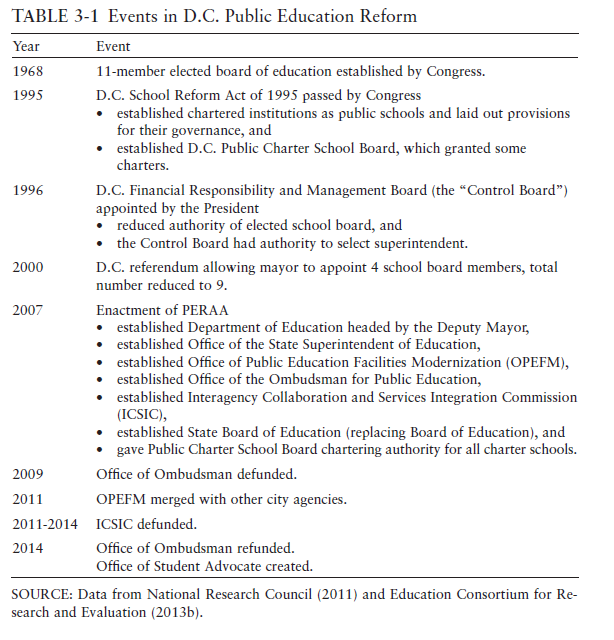
Democracy time line

This chart from the report shows the attack on democratic processes in D.C. from finally getting democratic control over their schools in 1968 to complete loss of parental control with the passage of Public Education Reform Amendment Act. D.C. joined the other “corporate reform” cities such as Chicago, Los Angeles and New York in establishing the mayor as czar of education significantly diminishing the effect parents and teachers have on education policy.

By 1995, D.C. schools were charging down the path of “corporate education reform” when Bill Clinton signed the D.C. school reform act introducing charter schools and establishing the charter school board. The growth of charter school privatization movement is startling with charter schools enrolling nearly 50% of D.C. students in 2015. From the report:

“… by 2014, the percentage was 44 percent. PCSB [Public Charter School Board] reports that there are approximately 100 individual charter schools, governed by 61 chartering organizations, which function as school districts, or local education agencies (LEAs). D.C. has one of the largest percentages of a city’s students enrolled in charters nationwide, and D.C. is viewed as a leader by proponents of charter schools.” Pg 31

With almost 50% of the D.C. students in charter schools governance in certain aspect of education is not possible. Originally, charter schools were supposed to be laboratories that were freed from the more stringent rules for public schools so they could try new ideas. However, when 50% of the students are in charter schools, parents, educators and administrators have no way of monitoring education practices or spending. D.C. functionally has 62 school districts. One for all the public schools and one for each of the 61 charter school management organizations that operate in private. As the report says:

“There are no standardized formats or definitions in charter schools’ budgets or audits, though the PCSB [Public Charter School Board] is making progress in this area. The adequacy study also commented on the difficulty of ascertaining charter facility costs. In addition, the charter management organizations’ accounts are not open to the public, and there have been cases of mismanagement.” (Page 72)

“Because each charter school is an independent local education agency, the charter sector did not (and does not) have any overarching strategy to improve teacher quality (or any other factor in education).” (Page 79)

This lack of accountability is costing the public schools money and at the same time there is no way to know how the charter schools are spending money especially when it comes to special education and second language learners. The structure of education in D.C. is failing special education students. From the report:

“In another DCPS [D.C. Public Schools] official’s view, the problem is that a charter school will receive all the required supplementary special education funds for a student while DCPS is still expected to provide supplements that a student requires, such as dedicated aides or home or hospital services. This official also noted that DCPS has no authority to address problems in charter schools: it can only report noncompliance to PCSB [Public Charter Schools Board] and to OSSE [Office of the State Superintendant of Education].” (Page 129)

“The U.S. Department of Education has recently reported that that D.C. is among the worst school systems in the nation in providing appropriate educational opportunities for students with disabilities, and it has the worst record of any state in the country for meeting federal special education goals.” (Page 131)

“Another city official we interviewed commented that “there is no monitoring arm for how LEAs [Local Education Agencies] serve the ELL [English Language Learners] population.” For example, this person noted, the city provides $4,200 in funds in addition to the $11,000 allocated under the uniform per student funding formula (an additional $6,000 is provided for each special education student), but there is no structure for monitoring what LEAs [Local Education Agency] do with these funds or determining whether they are addressing students’ basic needs. At the same time, charter schools have no consistent source of technical assistance or other resources, such as professional development, to help ensure that they are providing what English-language learners need. As a city official noted, “there is no way for people to know if they are doing it right.”’ (Page 133)

One of the largest problems created by the lack of cohesiveness between the charter schools and the public schools system is that students are being lost. These lost students become what Dr. Mark Naison has labeled “the Disposables.” Dr. Naison writes:

“They are the more than 90 million Americans of working age who are not in the labor force and do not have regular jobs.

“They are the millions of teenagers who dropped out or were pushed out of school in cities like Detroit and Memphis and New Orleans and Los Angeles and Chicago and have disappeared from view because the divisions between charter schools and public schools have made it impossible to develop a coherent strategy to make sure no child is lost.”

The report notes the D.C. schools have a “crisis in absenteeism” and a terrible graduation rate.

“D.C.’s public schools have had among the worst on-time graduation rates in the country. For the class of 2014, the overall rate was 61 percent, compared with the national average of 81 percent (Chandler, 2014d). For DCPS schools, the graduation rate was 58 percent—up 2 percentage points from the previous year; for the charter schools, it was 69 percent—down almost 7 points.” (Page 154)

“Nationally, for 2012-2013, the overall rate increased from 78 to 81 percent; for blacks it increased from 66 to 68 percent, and for Hispanic students it increased from 71 to 76 percent.” (Page 189)

The report also contained this nugget suggesting that charter school gains in test performance over time do not match public schools.

“The EDCORE analyses by sector also showed that, although both DCPS [D.C. Public Schools] and charter students showed improvement, the magnitude of the gains were higher for DCPS students in every year.” (Page 177)

Mayoral Control and VAM Evaluation

A central tenant of “corporate education reform” is to limit democratic processes by ending elected local school boards. Democracy is always more difficult to administer than authoritarian control from a centralized power like a mayor. Of course this means that parents and teachers will not have much of a voice (if any) in how their local school; is run, what it teaches or what its policies are. In 2007, the city of Washington D.C. completed its embrace of “corporate education reform” when the Mayor Renty assumed total control of all public schools. The report observes:

“The specific strategies that Fenty and the chancellor he appointed, Michelle Rhee, chose were prominent on the national reform agenda: an emphasis on improving human capital using recruitment, evaluation, and compensation of educators; data-driven decision making; more uniform standards across schools; and greater school-level accountability through the use of student testing and other indicators.” (Page 40)

Fenty chose a person with five weeks of Teach for America training and three years’ experience teaching first grade to be chancellor. It was an odd choice, but she was connected to the lawyer, Joel Klein, who Michael Bloomberg had selected to run New York’s schools. Mayoral control seems to always value political considerations over professional competence when selecting public school leaders. For example, in Chicago, Daly chose Duncan and in Los Angeles, Villaraigosa chose Deasy; neither man had significant professional credentials or experience in education.

The agenda chosen was straight out of the “corporate education reform” playbook. They blamed teachers and principals for poor testing and graduation results, they instituted teacher evaluations base in large part on growth models known as value added measures and they introduced merit pay for teachers and principals. Survival in the Rhee-Fenty schools would depend foremost on high stakes testing.

Education reporter, John Merrow, summed up Rhee’s tenure of just over three years running D.C.’s schools:

“Ms. Rhee made her school principals sign written guarantees of test score increases. It was “Produce or Else” for teachers too. In her new system, up to 50% of a teacher’s rating was based on test scores, allowing her to fire teachers who didn’t measure up, regardless of tenure. To date, nearly 600 teachers have been fired, most because of poor performance ratings. She also cut freely elsewhere–closing more than two-dozen schools and firing 15% of her central office staff and 90 principals.”

“For teachers, DCPS has become a revolving door. Half of all newly hired teachers (both rookies and experienced teachers) leave within two years; by contrast, the national average is understood to be between three and five years. Veterans haven’t stuck around either. After just two years of Rhee’s reforms, 33% of all teachers on the payroll departed; after 4 years, 52% left.”

For more than 100 years, political leaders have every few years proposed merit pay as a way to motivate good performance. This idea does not have a great track record in most industries, because it undermines unity of purpose. In education, it has been a total failure laced with fraud, but this does not stop “corporate education reformers” from insisting on merit pay. Rhee’s merit pay scheme, which pays bonuses of up to $25,000, led to a cheating scandal. Merrow’s report continued:

“Some of the bloom came off the rose in March 2011 when USA Today reported on a rash of ‘wrong-to-right’ erasures on standardized tests and the Chancellor’s reluctance to investigate. With subsequent tightened test security, Rhee’s dramatic test scores gains have all but disappeared. Consider Aiton Elementary: The year before Ms. Rhee arrived, 18% of Aiton students scored proficient in math and 31% in reading. Scores soared to nearly 60% on her watch, but by 2012 both reading and math scores had plunged more than 40 percentile points.”

After two decades of adopting the “corporate education reform” agenda, the D.C. schools are damaged. Curriculum has been narrowed by hyper-focus on high stakes testing, which only accurately identifies economic conditions in the neighborhood. With just 25% of students attending their local community school and many community schools closed these once pillars of community support have been toppled. Parents have no effective place to bring grievances and experienced professional educators have been pushed out in favor of new hires, many of whom are unqualified Teach for America replacements on temporary contracts.

All this disruption and still the outcomes from the D.C. schools are some of the worst in the nation. They still have an attendance crisis and a graduation crisis. Their scores on NAEP [National Assessment of Education Progress] testing is still at the bottom of the nation. The problem is not the schools or even the misguided “corporate education reform.” The problem is rampant and unaddressed poverty in the neighborhoods of our nation’s capital. The problem has never been our public schools; it has always been poverty.

  • “National Research Council. (2015). An Evaluation of the Public Schools of the District of Columbia: Reform in a Changing Landscape. Committee for the Five-Year (2009-2013) Summative Evaluation of the District of Columbia’s Public Schools. Board on Testing and Assessment, Division of Behavioral and Social Sciences and Education. Washington, D.C.: The National Academies Press.”
  • Schneider, Mercedes. Common Core Dilemma “Who Owns Our Schools?” Teacher’s College Press, New York and London, ©2015 by Teacher’s College, Columbia University.
  • Ibid.

Standardized Control

24 Sep

By Thomas Ultican 9/24/2015

“He had been educated only in that innocent and ineffectual way in which the Catholic priests teach the aborigines, by which the pupil is never educated to the degree of consciousness, but only to the degree of trust and reverence, and a child is not made a man but kept a child.” [1] Henry David Thoreau’s description of his visitor at Walden’s pond seems a likely description of the result of standards based education and testing. Known derisively as “test and punish” education, standards based education is a behaviorist theory. This is a philosophy that is antithetical to human growth and development; to the development of capable actors in a democratic society.

Education is a social science. Societies are so complex that cause and effect relationships are obscured. Therefore, education theories are not provable in the same way as physics theories. Our beliefs about education are necessarily driven more by philosophy than experimental result. Of course skilled social scientists observe pedagogy in action and share their observations, but it’s still only good guidance and not a proven principle like buoyancy.

During graduate school at UCSD, my chemistry buddy and I would marvel at the kind of weak evidence that was offered as proof for education theories. In my previous career, I had seen theories with substantial evidence supporting them – obliterated. There used to be a theory that the paramagnetic limit for the amount of information that could be magnetically stored was 20 gigabits in a square inch. I was on a team that demonstrated 78 gigabits in a square inch. That breakthrough has led to today’s cheap terabyte hard-drives and the abandonment of a popular theory. In social science, theories are never so clearly defeated.

Today, education is rife with unproven assertions which are often not tested at all. Such as: standards based education is good, a national curriculum is needed, common core standards are internationally bench-marked, college and career readiness standards must be implemented, international testing is producing important data proving the failure of US schools, standards based testing is meaningful, teacher evaluations should include value added measures, no-excuses charter schools are good pedagogy, public schools are failing, private business can do education better and cheaper, teachers and their unions are the biggest obstacles to improved education. The list of assertions without proof in education is seemingly endless.

It is how we think about human value that is the prism by which we must construct our education programs. Last year, two German writers, Sija Graupe and Jochen Krautz, wrote an article about the Organization for Economic Cooperation and Development (OECD) “From Yardstick to Hegemony.” They tell us that “ the OECD which – as initiator of the PISA assessment process – has since the 1960s and on its own account “become central, providing indicators of educational performance that not only evaluate but also help shape public policy.”

Gaupe and Krautz make their point through quoting OECD documents:

“The OECD program has declared war on the established plurality of educational goals and discourses (which have consistently reflected and renewed these goals) in order to replace it with a single novel concept: ‘Schools should lay the very foundation for the attitudes, desires and expectations motivating a nation to pursue progress and to think and act economically.’

“The OECD Conference documentation of 1961 declares unequivocally: ‘It goes without saying that the educational system must be an aggregate of the economy, it is just as necessary to prepare people for the economy as real assets and machines. The educational system is now equal to highways, steel works and chemical fertilizers”. Thus the claim can be made “without blushing and with good economic conscience that the accumulation of intellectual capital is comparable to the accumulation of real capital – and in the long range may outmatch it.'”

The OECD has it philosophically backward and that leads directly to behaviorism and dehumanized education. The OECD views citizens as state assets instead of seeing the state as existing for the benefit of its citizens. From Yardstick to Hegemony contains this clear analysis of the situation:

“The environment to which pupils and students are to adapt is not the economy of real experience but rather a mere ideal concept generated by mainstream economists, particularly those of the Chicago School of Economics who, in their pursuit of ‘economic imperialism’, have applied it to education: Its concept of a market is a purely abstract super-conscious price and coordination mechanism according to which all human activity must be aligned. What this unrealistic worldview setting in turn impedes is any critique or will to change because rather than being understood by the public as a theoretical construct it is, according to the neoliberal economist August Hayek, accepted by most as an immediately evident truth. Whether they are true or false, economic theories and all assessments based on these (such as PISA) determine reality. Those who choose criteria as a yardstick for everything else establish an arbitrary point of standardization where verification need not be feared. These ungrounded criteria then become – untested and without further thought – the defining norm for all further actions. As long as people believe having more PISA points is better than less in order to be successful economically they will, of course, do everything they can to acquire more. Education is then forced to uncritically yield to the pressure of comparative assessment, even if it is based on pure assertion.

In 1891, the National Education Association met in Toronto, Canada. It was at this meeting that James H. Baker’s committee made its report on the need for standardizing education. It’s a natural tendency that as a movement matures people will appear who want to standardize it. The main argument for needed standardization was the difficulty high schools were having creating classes that prepared students for entry requirements at Universities because the requirements were so varied. The Baker Committee report led to the establishment of the Committee of Ten and the first curricular standards in the United States in 1894.

I wanted to read the Baker Report myself and while looking for it I found a wonderful essay called “The School of the Future” by Francis W. Parker from the Cook County Normal School, Chicago, Illinois. He was writing about the common school movement (page 82):

“It was the inspired conviction of our forefathers that common education is as essential to democratic government and growth as air is to life. Our forefathers had an inspiration and a belief; they had no prescribed plan, or no precedent for that plan. They did not have the least conception of the mighty growth of the seed which they planted.

“The common school furnishes the essential principles in the development and perpetuation of a democracy, and its growth and progress has been purely democratic; it has been and is, “of the people, for the people, and by the people.” The common school had its birth in the New England school district; and the New England school district with the town is the root from which sprung all the democratic forms of government which have developed in our country. In a word, the spirit and nourishment of the common-school system has always depended, and depends today, entirely upon the will of the majority. State and national officials are given little more than advisory influences.

“There has been no active attempt at centralization. It is exceedingly difficult for our foreign friends and critics to understand our so-called school system. They are accustomed to look upon public schools from the standpoint of centralization, which produces uniformity, conformity and evenness, so that the endless variety, the total lack of uniformity, the innumerable differences which our schools present, is to them almost incomprehensible.

“Each and every school district has a pronounced individuality. Every state and stage of progress, from the early nebulous formative period to the highest products of Oswego and Bridgewater, may now be found in adjoining districts.

“The soul seeking peace and comfort under the dominance and permanence of fixed ideals shrinks with dismay from the inevitable blunders, stupidity, ignorance and calamities that invariably accompany all democratic growth. The short road of centralization seems to reach in a day that which takes years to accomplish under the patient waiting for that slow dawning of intelligence which leads to right action on the part of democratic communities.

“Our foreign critics mistake variety and honest individual striving for chaos. That which has its birth in the desires and intelligences of the people, and is applied by the will of the people, becomes an organic, permanent factor in the progress of civilization of that people. It is rooted and grounded upon the people-‘Vox populi. Vox dei.’ But that which is imposed upon a people by any authority below heaven breaks into atoms when the intelligence and power of a people can reach and control it.

“Centralized power may be a necessity for infancy, but manhood sheds it off for the strong wings of freedom.”

The renowned historian, Arnold Toynbee established criteria for judging whether a civilization was in a stage of growth or decline. He wrote:

“We must ask whether, as we look back over the ground we have traversed, we can discern any master tendency at work, and we do in fact unmistakably decry a tendency towards standardization and uniformity: a tendency which is correlative and opposite of the tendency towards differentiation and diversity which we have found to be the mark of the growth stage of civilizations.”[2]

I believe there is a superior way. Both John Dewey and the Japanese educator Tsunesaburo Makiguchi counseled against standardized education. Dewey stated “Imposing an alleged uniform general method upon everybody breeds mediocrity in all but the very exceptional.”[3] And Makiguchi theorized that “Education integrated into the life of society will yield benefits of well-planned living, without the undesirable effect of mechanical uniformity an inherent danger in standardized education.”[4]

In 1894, when the Committee of Ten was doing its work, very few teachers were well educated. Many only had high school diplomas. It is understandable that education leaders felt the need to provide teachers with detailed curricular guidance. Today that is not the case.

Salesmen trying to advance their charter schools might claim that they are innovative but they are not. The no-excuses charter schools are little more than behaviorist test preparation institutions. It is regressive education that borders on child abuse. The charter school movement which was originally viewed as an innovation incubator, but it has devolved into a blatant scheme to enhance corporate profits at the expense of tax payers.

There is an alternative. In 2015, there is scarcely a school district that does not have multiple professionals in education with doctorates and masters degrees on staff. Our public schools are perfectly positioned to lead American education to new heights and they do not need imposed standards. We have the intellectual and human resources needed for unlimited advancement, but they are being stymied by politicians and billionaire dilettantes that have no understanding of what good education is.

Stop all this imposing standards and testing baloney and allow our highly educated, dedicated and skillful national teaching corps to once again dazzle the world. Preserve our amazing public education system and protect it from voracious profiteers and their schemes to steal public funding for education.

  1. Thoreau Henry David, Walden, Thomas Y. Crowell Company (Apollo Edition, 1966) © 1961. Page 196
  2. Arnold Toynbee (DC Somervell), “A study of History” abridgement Volume 1 – VI, Oxford University Press, 1946, page 555
  3. Dewey, John. Democracy and Education. New York: Macmillan, 1916. Page 203
  4. Ikeda, Daisaku. Soka Education. Santa Monica, California: Middleway Press. 2001 Page 18

Lunch with Larry

6 Sep

I recently wrote an open message to my congressman, Scott Peters, urging him to reject the proposed rewrite of the Elementary and Secondary Education Act. In it I said, “When fads like “new math”, “phonics only” or “whole word” came along, they infected many jurisdictions but not a majority of the country. As their weaknesses manifested, these fads were abandoned before serious damage occurred.” Federally centered power would end that protection from bad policy. After reading this post, Professor Larry Lawrence invited me to lunch to discuss “new math.”

I met Larry briefly in Chicago at the April NPE conference. I knew he lived in Carlsbad, California less than 30 miles north of my San Diego home. I was intrigued by his proposal to get together and discuss the “Zen of teaching math.” So I agreed to meet him at a spot between our homes.

Larry has been called a “consummate teacher of math” and has a significant pedigree. After graduating from Morningside High School in Inglewood, California, Larry did his undergraduate work at Occidental College where he was a classmate of star quarterback, Jack Kemp. Barack Obama also attended Occidental. When finished there, Larry went on to Columbia University’s Teacher’s College pursuing a Masters degree.

It was at Columbia that Larry was introduced to a more profound grasp of the principles of mathematics and how students can successfully develop mathematical thinking. In 1958, almost 30 years before California’s 1985 adoption of “teaching for understanding” also referred to as “new math”, Larry was learning from the movement’s fathers. (1)

Referring to the 1985 adoption of “teaching for understanding” Elizabeth Green tells us in her book Building A+ Better Teacher, “… the California teachers were struggling to understand students’ ideas, figure out what the students needed to know, and then use that information to respond.” (2) Larry and I agreed that this was the essential weakness with “teaching for understand” – the elementary school teachers did not have the training to do it.

On day one of his first math class at Columbia (Advance Algebra), the teacher gave an instruction for an assignment that stumped Larry. He went throughout the dorm asking everyone he could find to explain to him what “one to one correspondence” meant. No one knew! In 1958, few people apprehended the fundamental principles of mathematics.

Larry also brought along a prompt from his professor. I have shared the setup here:

Arithmetic by mail: Stan Brown had a pen pal, Al Moore, who lived in Alaska. Stan and Al corresponded quite frequently. Stan liked to receive letters from Al because he wrote about interesting things like hunting and fishing and prospecting for gold. Al enjoyed hearing about the things Stan did, especially about school, for Al had had very little opportunity to attend school. One day, Al wrote to ask if Stan would mind teaching him some arithmetic. Stan agreed but decided he needed to know how much Al already knew. So, in his next letter to Al he included a simple test, and asked Al to write in the answers and to return the test to him. Al sent the test back immediately; he said it was very easy and asked Stan to send some harder questions next time.

Take 2 away from 21.                                                  1

What is half of 3?                                                        ͻ

Add 5 to 7.                                                                  57

Does 2 x 4 ½ equal 9?                                                No

Which is larger, .000065 or .25?                                .000065

How many times does 3 go into 8?                             Twice

How many times does 9 go into 99?                           Twice

Which is larger, 3 or 23?                                              23

What is a number smaller than 4?                               4 (written smaller)

What is a number larger than 4?                                 4 (written larger)

Some of Al’s reasoning follows.

Anyone can see that 3 goes into 8 twice, and pretty neatly too, without any 2 left over. You put 3 into 8 the regular way and then you turn another 3 around and put it in on the other side of the 8.

In question 4, you don’t even need a ruler to tell that 2 x 4 ½ is different from 9.

In question 8, 23 is larger than 3 because 23 already has a 3 in it and a 2 added on in front.

Larry was an early adopter of “new math” when in 1959 he returned to Morningside High School to teach mathematics. Since taking that decision, he has dedicated his life to improving education in California. In the early 1960’s, Larry may have been the first California teacher to teach calculus in high school.

His career includes a stint at UCLA working in the lab school then known as Seeds. In 1975, he received his doctorate from UCLA and went on to work as director of curriculum for the Turlock School District. He also served as the principal of an elementary school in Upland California. In 1982, he returned to UCLA to again work in the lab school training elementary school teachers how to teach mathematics.

Larry’s story is also the story of education reform gone wrong. There are many Larry Lawrence’s out there who have dedicated their lives to understanding teaching and learning. They are a treasure. They have both theoretical knowledge and practical experience, but as Elizabeth Green reports (and then praises) people like Doug Lemov and Stacy Boyd purposefully shunned people like Larry when they formulated their “no excuses” charter school movement and embraced pedagogy spiced with “disruption.”

Larry told me that in 1993 he got involved with developing a charter school. The lab school at UCLA was having a difficult time surviving and they decided to become a charter. In retrospect, Larry says that was a mistake because on the whole, charters are damaging the public education system. Whether they are good or bad, “charters harm public education.”

It was a wonderful lunch at a second floor corner table overlooking the Pacific Ocean. The drive from La Jolla along old highway 101 to the Ki restaurant in Cardiff by the Sea is among the most breathtakingly beautiful drives in America. The restaurant Larry chose had a wide variety of; wraps, smoothies, tofu dishes and teas. The staff knew Larry by name. I had the cheeseburger.

  1. Green, Elizabeth. Building A+ Better Teacher, W.W. Norton & Company New York and London, ©2014 by Elizabeth Green – page 102
  2. Ibid. page 105

Response to Dianne Feinstein

23 Aug

Senator Feinstein, I am responding to you via open letter to address not just you but as many leaders as possible about education policy in America. At the outset, I want you to know that I have admired you since those horrible days when Dan White killed Harvey Milk and Mayor Moscone and you were called upon to lead a wounded city. This message is not an attack on you, but rather, it is an attempt to educate about a harmful and widely held misconception regarding education testing.

In the message to me you wrote:

“I recognize that standardized tests have clear limitations and are not a cure-all for our nation’s education challenges; however, I also believe testing is an important tool for measuring student and school performance in order to ensure that every child receives a quality education. Standardized testing makes it possible for parents to see the progress their child is making and teachers to know when to correct course in their instruction.”

Now, I realize that this view, though unsupportable, is and has been for some time the belief of a majority of politicians and education bureaucrats in our nation’s capital. In the past, I did not appreciate how deeply this idea had permeated political thought. It therefore left me completely confused about why both Republican and Democratic leaders abandoned their own principles when it came to education.

I wondered, “Why have Democrats adopted test and punish policies that have clearly become a key tool for destroying public schools? Why have people like Barack Obama advocated charter schools that are little more than publicly financed private schools with little accountability? Why do Elizabeth Warren, Bernie Sanders and Hillary Clinton all seem to believe that a massive testing program will protect schools in poor and minority neighborhoods?”

On the other side of the isle, it is just as strange. Since the days of Abraham Lincoln, Republicans have stood for individual rights and local control but for two decades they have authored laws transferring control of education from local communities to the federal government. George H. W. Bush signed legislation that promoted federal involvement in local schools and his son sponsored, as his signature achievement, the “No Child Left Behind” law that gave control of school policy to the federal government.

Why is Jeb Bush such a long time and until recently vocal proponent of federal standards of education (the poorly written common core and next generation science standards)? Why did Orin Hatch vote against the Murphy opt-out amendment to the “Every Child Achieves Act?” Why was even Ronald Regan’s secretary of education, Terrell Bell, an early leader promoting the federalization of public education?

A very witty blogger named Peter Greene posted a comment about the recent education policy debate by Republican presidential candidates:

“GOP pols have the message– local control is great and the American Way and they totally support it except when they have to take it away from places that suck. Parents should be free to choose from an assortment of great schools, or at least from the assortment of charter schools that we say they should have. And parents who want to exert local control by keeping their community school intact (like, say, the hunger strikers of Chicago or the protesters of Newark)– well, they can’t have it.”

I started to wonder if our entire political class had become completely corrupted by money and power. Fortunately, that did not really make sense to me. I now believe I have plumbed the essence of the dilemma. Our political leaders do not understand the limitations of testing and especially standardized testing. The truth is that standardized testing is incapable of evaluating teacher or school quality, but there is a widely held belief it can.

A book written in 1999 by the education writer Alfie Kohn points directly at the disconnection:

“… it is an open secret among educators that much of what the scores are indicating is just the socioeconomic status of the students who take them. One educator suggests we should save everyone a lot of time and money by eliminating standardized tests, since we could get the same results by asking a single question ‘How much money does your mom make?’”[1]

That is the point. Standardized testing has a tremendous correlation to the economic conditions of the neighborhood in which the students live. This is the only variable that does have a high correlation with testing results. The environmental component of test results is so strong that it completely masks inputs like quality of teaching or quality of school. For the past more than a decade we have been mistakenly destroying great schools in poor communities based on a widely held misunderstanding of what the data means.

The famed education measurement expert, Gene V Glass, announced this month that he is no longer working in education measurement, because of its misuse. He asserted:

“The degrading of public education has involved impugning its effectiveness, cutting its budget, and busting its unions. Educational measurement has been the perfect tool for accomplishing all three: cheap and scientific looking.”

Last spring I heard Professor Yong Zhao speak. In his often humorous remarks he said that American students have never compared well on international testing. He then said, “The real question is why America is still here?” This instigated much laughter. The point is that standardized testing could not elucidate the greatness of America’s schools.

Here are a couple quotes from Professor Zhao’s latest book:

“’Out of the one billion people who have been educated in Mainland China since 1949, there have been no Nobel prize winner,’ Zheng wrote in an article. ‘This forcefully testifies [to] the power of education in destroying creativity on behalf of the [Chinese] society.’”

“The only way China will win the global competition of the future is for the West to begin educating the way China does.” [2]

I realize that when the federal government spends large sums of money there must be some form of accountability. Standardized testing has no real benefit to schools and misleads governance. It does not provide meaningful feedback to parents or teachers and it does serious harm to the classroom by narrowing curriculum and encouraging drill and skill pedagogy.

It is a mistake for congress to make specifics of education policy such as requiring standards and testing, the tool of accountability. I can think of three requirements that congress could make of states receiving title I funding that would significantly improve schools:

  1. All teachers must be fully certificated for the course they teach. (Professionalism is important for success in the classroom.)
  2. No classes can have more the thirty-two students. (Class size is very important especially in communities suffering the ravages of poverty and these are the very communities title I is designed to support.)
  3. All schools must successfully win accreditation by their regional accrediting association. (As I have written about this in other posts, this is real accountability by professional educators looking deeply into school function and giving important feedback.)

As we know, the “Every Child Achieves Act” (S. 1177) to reauthorize the Elementary and Secondary Education Act (Public Law 107-110) passed the Senate and will be conferenced with the House reauthorization bill, the “Student Success Act” (H.R. 5). Both laws enshrine federal requirements for standards, testing and remediation of schools that are judged failures by this regime. Therefore, I urge you to stop this bill until the profoundly damaging and wasteful testing requirements are removed. Please protect public education from circling vultures.

1) Kohn, Alfie. The Schools Our Children Deserve, Houghton Mifflin Company, New York, © 1999, page 77.
2) Zhao, Yong. Who’s Afraid of the Big Bad Dragon? Jossey-Bass a Wiley Brand, ©2014

A Response to Congressman Peters

11 Jul

I received a reply from Congressman Peters (D-California 52) this April to my message against HR-5, “The Student Success Act.” The Congressman made several assertions concerning education that I discuss here in an open response.

Opening assertions by Congressman Peters:

“In an increasingly global economy, it is critical that we make educational investments that put our students in a position to compete with the rest of the world. For years, the United States has trailed countries like China and India not only in education investments, but also in student achievement. When crafting education bills, Congress should be sure that it is taking steps to close that gap, rather than broadening it.”

This paragraph states several widely held false beliefs. First of all the United States out spends India and China on education combined. According to the worldbank and a Chinese government data report for 2012, India spent less than 4% of GDP ($2.1 trillion) or about $80 Billion; China spent 4.2% of GDP ($10.36 trillion) or about $430 Billion; and the US spent more than 5% of GDP ($17.42 trillion) or about $800 Billion on education. Our education spending almost doubles India and China’s combined spending and per child we spend many times more than either country.

Student achievement measures depend upon what you want. If the goal is creative students who can innovate and lead happy lives then our system is clearly out producing India and China. One measuring stick might be Nobel Prize winners since 1949: America had 313 laureates; India 7; and China 8. Of the 8 Chinese, the Dalai Lama and Liu Xiaobo who won peace prizes both are considered criminals – Xiaobo is still in a Chinese prison; four are scientists who earned their degrees in the United States or Great Britain; and only the two literature recipients were educated in China. To recap, since 1949 two international and widely recognized citations for Chinese educated students compared to 313 such citations from our world’s best American education system.

It is common for business and political leaders to believe that standardized tests like the Programme for International Student Assessment (PISA) that is promoted by the Organization for Economic Development and Cooperation are reliable indicators of school quality and student achievement. For several reasons they are not. Walter Hahn from the University of Utah recently returned to Europe to investigate the changes in education since he left. He reports that about age eleven most students are tracked into either a university path or various non-university paths. Testing of the non-university track students is not typical. Same is true in Asia. We test everyone. Researchers also point to many other problems with international testing.

It is true that US students have never been top scorers on international testing, but large segments of our students are very competitive. However, focus on testing leads to bad pedagogy. Professor Yong Zhao of the University of Oregon has written extensively about the problem with hyper-focus on testing in China. He reports that the Chinese government has been trying since the 1970’s to reform its test focused education system. However, because of the culture steeped in millennia of testing is so ingrained, Chinese parents insure test preparation. It is normal in China to put children in test preparation private academies after school and on weekends.

Some of my colleagues have been paid to go to China and demonstrate teaching while Chinese delegations searching for education improvement have visited and observed at my high school, Mar Vista High School. They do not care that our federal government labels my school as “failing.” No one in China thinks they have a great education system. Professor Zhao recently wrote, “The only way China will win the global competition of the future is for the West to begin doing education the way China does.”[1]

Standards based testing is misleading. Professor Haladyna and associates conducted a highly regarded study that shows as soon as high stakes are tied to these tests, their validity is undermined. When institutions, teachers and students gain experience with high stakes tests they find ways to focus primarily on test preparation. I was even taught by a consultant at a teacher training, “if it is not on the test, it is a waste of time to teach it.”

Another example of how high stakes undermine test results is the SAT. For three decades, SAT scores have gone up, an industry has emerged to prepare students for the tests and the predictability of future success based on test results has gotten worse. The data is quite clear that high school grades with all their flaws are much more predictive of future collegiate success than SAT test results.

Your colleague Congresswomen, Susan Davis (D-California 53), asked me “how can schools be held accountable without testing?” This indicates a belief that standardized testing is a valid measure of school or teacher quality. Today, few people outside of the testing industry believe that to be the case. When No Child Left Behind (NCLB) forced high stakes testing on the nation, it did not enforce school accountability. Ironically, based on testing results, public schools were blamed for the result of poverty by the political and businessmen who were actually responsible. Kind of anti-accountability don’t you think?

To Congresswomen Davis’ question, the National Assessment of Education Progress (NAEP) testing because it does not have high stakes attached is a reliable metric. The best school accountability is performed by regional accrediting agencies which send in teams of current educators who spend a week or more evaluating each school. They interview; administrators, teachers, students, non-certified staff and parents. They visit every class room and analyze all school documents including action plans. Finally they give useful feedback with a clear idea of what they expect in the way of improvement going forward.

I bring all this up because the re-write of the Elementary and Secondary Education Act (ESEA) has been revived. Thank you for voting against the Student Success Act this July 8. I am hoping if the Orwellian named Senate version “Every Child Achieves Act” ever comes to conference you can help improve this law.

Poverty is clearly the over arching problem in education. We have great public schools with the most educated work force American education has ever witnessed, but we have out of control child poverty and it shows up as the key driver in every statistic. Here is some data from the department of education:

In 2013, approximately 21 percent of school-age children were in families living in poverty, an increase of 4% since 1990. But that poverty is much more damaging to certain ethnicities and as this table reveals it is reflected in testing results.
Ethnicity                               White          Asian         Black         Hispanic
Living in Poverty                   13%             13%          39%            32%
NAEP 8th Grade Math           294              306           263            272
NAEP 8th Grade Reading      276             280            250            255

Pretty much all of the schools that were labeled as “failing schools” by NCLB and slated for closure or “turnaround” were in high poverty areas; while no schools in upper middle class neighborhoods were touched. Having worked in both kinds of schools, I can assure you the teaching in the wealthier neighborhoods in California is not significantly better than the teaching in poorer ones. Teachers talk disparagingly about being punished for working in the wrong zip code.

STEAM initiatives and federal test and punish programs will not solve the achievement gaps among schools as long as pervasive poverty is allowed to persist. Sending education dollars to charter schools that now have a known history of disruptive financial failure and fraud will only hurt America’s students. Please get the federal government out of the business of running schools. Give the schools back to local control. NCLB was a huge mistake and we need a course correction.

In 1910, Commissioner of Education Elmer Ellsworth Brown wrote about the genius of the American system of education:

“Our educational organization answering as it does to our federal plan of government presents peculiar advantages as regards the making of a varied flexible yet inherently unified system of instruction. It is an organization not readily understood by foreigners. It offers many obstacles to the carrying out of any plans for rapid and uniform improvement. Yet the self governing character of its several members is of itself an incalculable advantage. Whatever unity is attained must be an inner unity an agreement through conviction.”

The hugely successful public education system in America has always come from the people of their own volition adopting the education ideas that best fit their own community. Soviet style command and control education undermines the great crucible of democracy that is public education and dooms the creative American spirit. Please end the disastrous experiment in federal control of education.

1) Zhao, Yong. Who’s Afraid of the Big Bad Dragon? Jossey-Bass, San Francisco, © John Wiley and Sons, Inc. 2014.

“Is TFA a CULT?”

12 May

By T. Ultican 5/12/2015

This question arose from the audience at a recent NPE (Network for Public Education) colloquium on the TFA (Teach for America) – my answer, “no, TFA is not a cult.” However, the question is not without merit. Cynical actors are taking advantage of sincere young people for personal power and profit. In the same way that military organizations take undisciplined and timid youths, isolate them, stress them and indoctrinate them with a certain ethic.

TFA indoctrinates its new corps members with a behaviorist and market based education ideology. It is not the Peoples Temple in Guyana but it is in the words of Chad Sommer “an incubator for transforming social justice minded youths into advocates for Koch-brothers style education policies.”

NPE held its 2015 convention two blocks up the street from Lake Michigan in the historic Drake Hotel. Sunday morning, I went from breakfast with hundreds of BATs, teachers, and parents, who believe public education is important enough to fight for, to a session focused on the TFA. On my way, I passed by a large open room with thirty or so well appointed tables just off the lobby. Since the construction of the Drake in 1920, high tea has been served there every day.

I recalled the story a teacher from Minnesota told me. In 1947, a public school teacher from a poverty stricken rural community not far from Minneapolis had driven her five eighth-graders to Chicago and treated them to high tea at the Drake. My new friend from Minnesota said that her eighty-year-old mother still counts that among the greatest memories of her life.

The expert panel at the TFA session:

Moderator: Julian Vasquez Heilig, Director of the Doctorate in Educational Leadership Program at Sacramento State University and a founding board member of the NPE.

Professor, Terica Butler earned her Doctoral degree from the Department of Instruction and Curriculum Leadership at University of Memphis in May 2014. Her research emphasis was on alternative paths to teacher credentialing which included researching the training of TFA corps members.

Annie Tan, is currently a special education teacher in Chicago public schools with a master degree in special education. She was a member of TFA corps class of 2011 placed in a Chicago charter school.

Chad Sommer, with a degree in marketing, became a member of the TFA corps class of 2011 placed in Chicago public elementary school.

 Jameson Brewer, Ph.D. student in Educational Policy, Organization and Leadership at the University of Illinois at Champaign-Urbana was a member of TFA corps class of 2010 placed at Carver High School in Atlanta, Georgia.

Katie Osgood is a special education teacher in Chicago currently working at a psychiatric hospital. She also taught special education in the Chicago Public Schools. She holds a Masters in Elementary and Special Education from DePaul University.

It may be possible to criticize the quality of some of this panel’s judgments, but one point is clear, their research and advocacy will not pave the way to personal profit or power in the same way that being pro-TFA could.

A path to political power and prestige is available to corps members and researchers who support these three positions: (1) Education outcomes are the responsibility of teachers and there are no excuses for teachers who fail to raise test scores. (2) Authoritarian leadership is required in both the classroom and in the administration of schools. (3) Market based principles are the path to scholastic improvement and standardized testing is the only reliable measurement of that improvement. Each of the panel members pushed back against these market-based “reform” positions that are profoundly embedded within TFA.

Professor Heilig opened the proceedings with a few brief personal remarks. He told us of his own experience at forums to discuss TFA and facing rooms packed by TFA corps members and supporters. He also mentioned that TFA with the backing of large private funding from organizations like the Gates, Broad and Walton foundations pays staffers on Ed-committees in Washington DC for both the Democrats and the Republicans.

TFA is an organization that is both willing and able to play power politics to get its agenda enacted.

Professor Butler observed that the summer five week training course did not equip the corps members for a full time teaching schedule in the fall. Summer-school students are only in class for four hours a day and there were normally four corps members assigned to each class. That meant that the TFA corps member student taught by sharing a class and only taught for 1 hour a day. Then in the fall they were hit with six hours a day in a classroom by themselves.

Jameson Brewer and Annie Tan were unusual corps members. They studied education in school and joined TFA to get a job when they could not find a full time teaching position. Somehow even during the height of the depression, TFA was able to place its corps members in classrooms across America.

Jameson who went through a university credentialing program prior to TFA told us that he became an example of how well TFA teachers perform in the classroom. He also shared the following table of data with us comparing TFA preparation with preparation by a typical teacher education program.

Student teaching Methods Observations
TFA 16-18 hour 125 hours 2
Typical TEP 630 hours 496 80

Chad Sommer was more typical of the TFA experience. He has written that I was “naively seduced by TFA’s do-gooder marketing pitch. I charged ahead on a mission to close the academic ‘achievement gap’ that TFA blames on incompetent (read unionized) teachers.” With a marketing degree in hand and five weeks of training which included a heavy dose of Doug Lemov’s Teach Like a Champion (part of the TFA recipe for teaching), Chad became a new elementary school teacher at a public school in Chicago.

All three former TFA corps members agree that they were taking jobs that would otherwise have gone to a trained educator and Jameson Brewer says he directly replaced an experienced certificated teacher much to the chagrin of the principal that was forced to hire him.

The TFA Message to Corps Members

The fundamental messages these corps members received during training were that public schools in America are failing and the cause is bad teaching. Social conditions are just an excuse. Great teachers can overcome “achievement gaps” and not raising test scores means that the teacher is a failure. These failing teacher are said to have succumbed to “the soft bigotry of low expectations.” The sole arbiter of success in a classroom is test scores. This was all part of the TFA academic impact model.

Teach for America and the ‘education entrepreneurs’ who developed the “no excuses” charter school movement (mostly TFA alums) believe that America’s schools are failing and that they have a mission to save our country’s future. People like Doug Lemov, Stacey Boyd and John King, with no substantial background in education (which they see as a strength), started schools.

They Derided education theories taught by university professors. It was clear to them that the first item to fix in schools was discipline so they put children in uniforms, made many rules about everything the children did and enforced those rules harshly. It reminds professional educators of 19th century pedagogy.

Based on behaviorist theory, the “no excuses” model is completely authoritarian and autocratic. While a really skilled practitioners might raise test scores employing these harsh tactics, there are terrible side effects. Students learn to hate learning and creativity is sundered. To use professor Zhao’s metaphor – Rudolph the red-nosed reindeer will be killed.

Annie’s Story

I met Annie Tan at breakfast on Saturday morning. As I was headed into lunch after the morning sessions I encountered Annie again. Being a friendly engaging person, she invited me to go with her to find a table. We walked to the front of the giant room accommodating at least 35 tables for 12 and sat down with Jose Vilson, the well-known blogger from New York, Peter Greene AKA Curmudgucation, Jennifer Berkshire AKA EduShyster, and Adell Cothorne, the principle who blew the whistle on Michelle Rhee. Also at the table was Peter Greene’s wife. It was an amazing hour and I discovered that Peter, his wife and Jose are trombone player like myself. Later, I learned that Peter and his wife met through their participation in a community orchestra.

Annie Tan graduated from Columbia University with an emphasis in special education. When she could not get a job, she joined the TFA and was sent to Chicago. Annie was assigned as a special education teacher at a charter school in Chicago. She was the only special education teacher on staff for grades K-4.

The only support she received was during her monthly TFA advisory visits. The school was led by a TFA alum and most of the staff was current or former TFA corps members. Few staff member had more than three years’ experience. In February, Annie’s TFA supervisor (not the principal) informed her she was failing as a teacher by not moving her students fast enough towards success on standardized testing and may be fired.

At the end of the year, she was fired. Four years later, she has a master’s degree in special education and is succeeding as a teacher in the Chicago Public School system.

I know from my personal experience that being labeled a failure is psychically devastating. Primary tenets of corporate inspired “reform” include disruption, labeling a certain percentage of people failures and firing them as a warning to those left behind.

During my first year of teaching, I worked under the Alan Bersin administration in San Diego. Diane Ravitch tells the story of Bersin and the corporate “reform” piloting done by San Diego Unified School District in her book, The Death and Life of the Great American School System. I was fired for not moving my students toward achieving standards even though my classes scored extremely well on the district end of course exams.

I had a credential in math, a credential in physics and high test scores but that was all trumped by the requirement to let go a certain number of first year teachers. I was a fifty year-old and that is probably the reason I was targeted. Even though I felt certain the firing had very little to do with my actual performance in the classroom, I was bothered by self-doubt about my abilities as an educator for the next decade.

I am guessing the Annie still believes in some corner of her mind that she failed at her first teaching job and that thought still undermines her confidence. Authoritarianism is a horrible creed and especially horrible when applied to an education environment.

TFA is a Cult

A great warrior for public education, Katie Osgood, made these three assertions: “TFA is a cult; its corps members are exhausted, isolated and only have TFA to attach to.” “TFA is destroying communities of color: they drive out teachers of color.” And “Tenure is a children’s right.” While I quibbled with her use of the term cult, I recognize she is the psychiatric professional and I certainly agree that they do use the techniques she describes to change youthful idealistic minds toward a market based ideology.

Her last two claims are unvarnished truth. Katy has been identified by TFA as the number one opponent of TFA on social media. She is relentless and impassioned. I am glad she is on my side. In her “An Open Letter to Teach for America Recruits” Katie writes:

“Many of you no doubt believe you are joining a progressive education justice movement; that is the message TFA sells so well. But TFA is not progressive. The data-driven pedagogy, the fast-track preparation, the union-busting, the forced exploitation of your labor, the deep-pocketed affiliation with corporate education reform are all very conservative, very anti-progressive ideas.”

And

“Ask yourself: Since when did billionaires, financial giants, or hedge fund managers on Wall Street begin to care about the education of poor black and brown children in America? If you follow the money, you will see the potential for mass profit through privatization, new construction, union-busting, and educational service industries. Why would a group dedicated to educational justice partner with these forces?”

On further reflection, I think TFA just might be a cult.

Illusion Motivates Education Reform

29 Dec

By Thomas Ultican 12/29/2014

My earliest memory of public education criticism was overhearing my mother and her teacher colleagues talking about a book memorably named, “Why Johnny Can’t Read.” It was a sensation that implicitly stated that public education in America was a dismal failure and that the nation was on a path to its own cultural and fiscal demise. Recently Jim Arnold & Peter Smagorinsky wrote this amazing paragraph about the history of declaring the failure of America’s public education system:

“Admiral Rickover published “American Education, a National Failure” in 1963, and in 1959 LIFE magazine published “Crisis in Education” that noted the Russians beat us into space with Sputnik because “the standards of education are shockingly low.” In 1955 Why Johnny Can’t Read became a best seller, and in 1942 the NY Times noted only 6% of college freshmen could name the 13 original colonies and 75% did not know who was President during the Civil War. The US Navy in 1940 tested new pilots on their mastery of 4th grade math and found that 60% of the HS graduates failed. In 1889 the top 3% of US high school students went to college, and 84% of all American colleges reported remedial courses in core subjects were required for incoming freshmen.”

The paragraph above recalls more than a century of national failure to properly educate our citizenry yet in that same century America became the world’s leader economically, scientifically, militarily and culturally. Does this mean that education quality does not matter or is it more likely that the perception of American education failing – is and was an illusion?

By the middle of the 20th century, cities and villages throughout the USA had developed an impressive educational infrastructure. With the intent of giving every child in America the opportunity for 12 years of free education, this country was the world’s only country not using high stakes testing to deny the academic path to more than a third of its students. The physical infrastructure of our public schools was of high quality and schools were staffed with well trained experienced educators.

Furthermore, a trained administrative structure was in place and the path to continuous improvement had been established. No one should deny that public education can be improved, but what is also undeniable is that America’s current system has a history of producing successful citizens. To call public education in America a failure is to make better the enemy of good. It promotes a destructive illusion.

I feel a surrealistic connection to what might be the most important driver ever for this destructive illusion. Terrel ‘Ted’ Bell, Ronald Reagan’s Secretary of Education, instigated a commission that gave us the infamous, “Nation at Risk.” Beyond just claiming that public education in America was failing and needed drastic reform; the claimants said that reform needed the leadership of people who were not professional educators.

First of all, the idea that you should ignore the advice of practicing professionals concerning any field of human endeavor is foolhardy, but foolhardiness permeates modern education reform. It is through Bell I feel a chimerical connection to imprudent reform.

Bell was from Lava Hot Springs, Idaho. I too grew up in rural Idaho. He attended Albion State Normal School in southern Idaho. That was my mother’s alma mater as well as that of more than half of my public school teachers. Like most of the Albion graduates, Bell taught while continuing his own education. He eventually earned a doctorate of education from the University of Utah. This man with roots close to my own became a key instrument in advancing the attack on America’s public schools, which he loved.

Bell’s “Nation at Risk” was a political document written by business men and famous scientists. It claimed without substantiation or peer review that the very fate of the nation was at risk because of our failing schools. The authors said “the educational foundations of our society are presently being eroded by a rising tide of mediocrity that threatens our very future as a Nation and a people” and claimed, “If an unfriendly foreign power had attempted to impose on America the mediocre educational performance that exists today, we might well have viewed it as an act of war.”

The paper was a very successful polemic and not an honest scholarly effort. Its prejudicial analysis of education was based on unsupported beliefs and ignored data that countered those beliefs. “Nation at Risk” significantly advanced the destructive illusion that public education was failing and the rescue must be led by corporate chieftains.

Terrel Bell was a idealist and an realist. He supported the department of education and Medicare. He had a profound religious faith in Mormonism. As a classroom chemistry teacher for many years, he devoted his life to public education. Bell was an unlikely choice to head Ronald Regan’s Department of Education. Bell, however, was picked because of his high standing as a leader of education policy in the Nixon and Ford administrations which purchased him favorable standing among the education community.

Bell was supposed to oversee the demise of the department of education and support the states’ rights views (definitely not national standards) of the new President, but he had his own agenda. Bell said, “There are three things to emphasize in teaching: The first is motivation, the second is motivation, and the third is (you guessed it) motivation.” It is strange that an experienced educator with this kind of understanding about the crucial nature of motivation for learning would be a champion of national education standards. But he was.

By the 1980’s, many education theorist and observers knew that wherever standards had been tried they tended to circumscribe curriculum and engender jejune pedagogy which stunted the intrinsic motivation to learn. In many ways, Bell is typical of a modern education reformer. He was idealistic, moral, selfless and believed fiercely in the destructive illusion that American public education was failing.

Teach for America and the ‘education entrepreneurs’ who developed the “no excuses” charter school movement also spring from that same kind of idealistic passion based on the heartfelt belief that America’s schools are failing and that they have a mission to save our country’s future.

People like Doug Lemov, Stacey Boyd and John King deeply believed that public schools were failing. With no substantial background in education (which they saw as a strength), they started ‘no-excuse’ charter schools. Deriding education theories taught by university professors, it was clear to them that the first item to fix in schools was discipline so they put children in uniforms, made many rules about everything the children did and enforced those rules harshly. In some ways, it was reminiscent of 19th century teaching.

‘Education entrepreneurs’, because they have no respect for education professionals, are doomed to reinventing the wheel. The truth is that even with the tremendous financial and political support their movement secured; the results have been mixed at best and as far as improving education practices they are abysmal failures.

The truly difficult outcome from these disciples of economist like Eric Hanushek instead of educators like John Dewey is that they are still true believers in the need to ‘disrupt’ public education because it is failing. Everything they have done and believed in about education is based on the failure illusion that they hang onto tenaciously.

The godfather of the ‘education entrepreneurs’ seems to be the MIT trained economist, Eric Hanushek. His major claim to fame is proposing value added measures (VAM) to evaluate schools and teachers. Economists often function today as modern era soothsayers. To me Hanushek is little more than a mountebank.

His VAM has been widely criticized as being statistically absurd, but that hasn’t stopped “elite” schools like MIT and Stanford from singing his hosannas. Hanushek reminds me of a description of economists in the book “An Incomplete Education“:

“Economists are fond of saying, with Thomas Carlyle, that economics is ‘the dismal science.’ As with much of what economists say, this statement is half true. It is dismal.”

Hanushek’s bad science has done a lot to advance the perfidious illusion that American schools are failing.

I too was a victim of the American schools are failing myth. I decided to become an educator in 1999. I left a successful career as a research scientist working in the recording industry to become an educator. With strong beliefs about the importance of public education, I saw myself as a talented guy who could make major contributions to righting the distressed ship of public education.

My mindset wasn’t that different than that of the ‘education entrepreneurs.’ I was not in the classroom for many months when I started to realize I might be the most inept teacher at my school. Teaching is more difficult than being a research scientist and experience in teaching is also more important. It became clear to me that I had been bamboozled. The teaching profession and the condition of public schools in San Diego County in 2002 had never been in better shape.

It is interesting the way this deception has manifested in the neighborhoods of America. In middle class and upper middle class neighborhoods, people believe the illusion but are thankful that their own neighborhood public schools are such wonderful exceptions.

Here in San Diego, parents at Torrey Pines Elementary School or Challenger Middle School or Poway High School love their schools and would fight for them. At the same time they believe that public schools in poor neighborhoods are failing. The result is that people in poor neighborhoods who don’t have the political capital to fight for their schools no longer can send their children to quality public schools.

They must send them to charter schools or drive them to another neighborhood. Poor communities are having their wonderful public institutions like the venerable Compton High School taken from them.

I will conclude with words that the great historian Arnold Toynbee wrote in his masterpiece study of five millennia of human development concerning publicly supported education. He observed that “The bread of universal education is no sooner cast upon the waters than a shoal of sharks arises from the depths and devours the children’s bread under the educator’s very eyes.” I hope this was a warning not a prophecy!