Sex Discrimination Education Law

2 Jun

By Thomas Ultican 6/2/2024

Joe Biden promised, when running for president, to undo the damage to Title IX implemented during the Trump and DeVos era. The 1972 amendment to the US education law enacted rules against sexual discrimination at all schools receiving federal dollars. This was a fix to the 1964 civil rights law which lacked protection in schools based on a students’ sex. During the three year process of developing new guidelines, the Education Department received over 300,000 comments. The rules were announced in April and will go into effect in August.

Under Trump’s rules, there was no protection for LGBTQ+ students. That will change.

Biden’s changes will replace a narrow definition of sex-based harassment with a wider range of conduct. They reverse a requirement that schools only investigate alleged incidents on their campus. Also ended are demands for in-person live hearings in courtroom-like settings where the person accused of sexual misconduct, or their lawyer, can question the accuser.

Betsy DeVos called Biden’s new rules a “radical rewrite” of the law. She claimed it was an “endeavor born entirely of progressive politics, not sound policy.” Kel O’Hara, a senior attorney at Equal Rights Advocates, had a much different take:

“The new regulations put an end to unfair and traumatic grievance procedures that favor harassers. No longer will student survivors be subjected to processes that prioritize the interests of their perpetrators over their own well being and safety.”

Genesis of Title IX 

Bernice Sandler, known as “The Godmother of Title IX”, earned a master’s degree in Clinical and School Psychology and in 1952 married Jerrold Sandler. The couple had two children. Bernice returned to school at the University of Maryland where she earned a Doctor of Education in Counseling and Personnel Services.

Sandler began teaching at Maryland part-time but her application for a full-time position was continually denied. When inquiring why, Bernice was told she “comes on too strong for a woman” and that she was “just a housewife who went back to school.”

This led Bernice to joining the Women’s Equity Action League (WEAL). While researching the strategies of African American civil rights activists, she discovered that in 1968, President Lyndon B. Johnson further amended the civil rights restrictions on companies receiving federal dollars from discriminating on the basis of race, color, religion and national origin, by adding gender.

Bernice realized that most universities had federal contracts and were illegally not hiring women. Between 1969 and 1971, she and WEAL filed sex discrimination charges against 250 schools, including the University of Wisconsin, Columbia University and the entire state university and college systems of California, New Jersey and Florida.

In 1970, she filed a class-action lawsuit against all universities in America.

In the same year, Edith Green was an education policy expert and Democratic Congresswoman from Oregon. The sudden flurry of enforcement requests piqued her interest and caused Green to begin hearings on sex discrimination at federally funded universities.

Persuaded by testimonies put forth during the hearings, Representative Patsy Mink of Hawaii joined Green in drafting legislation prohibiting sex discrimination in education.

In the Senate, Indiana Democrat, Birch Bayh, led the legislation. Bayh’s wife, the former Marvella Hern, was an outstanding student from Oklahoma. Marvella was drawn to the work of Thomas Jefferson, founder of the University of Virginia. She wanted to go to that college but her application was returned with a note saying, “Women need not apply.”

Bayh was a co-recipient of the NCAA Gerald R. Ford Award at the 2006 convention. In an interview he shared with NCAA News about Title IX:

“We spent 26½ years together with Marvella teaching me about what it was really like being a woman in a man’s world. Without her, I know I wouldn’t understand the importance of this legislation.”

When the legislation was formed, Senator Bayh wrote the 37 words that became Title IX:

“No person in the United States shall, on the basis of sex, be excluded from participation in, be denied the benefits of, or be subjected to discrimination under any education program or activity receiving Federal financial assistance.”

On Title IX’s 50th anniversary in 2022, The Harvard Gazette interviewed Jeannie Suk Gersen, Professor of Law, and Susan Ware PhD historian.

Gersen noted the motivation for the law, “Women faced blatant educational inequality, such as exclusion from certain colleges and universities or from certain programs and spaces within those schools, higher admissions standards than men, more frequent tenure denials than men, and myriad other imposed disadvantages relative to men.”

Ware shared her opinion on why the law made such dramatic and rapid change:

“Once you point out that the men’s crew team has its own boathouse and the women have to change in their van and they don’t have showers, anybody can see that’s not fair, and it’s not equal. So just making a list of things that need to be addressed and having Title IX to back you up was a very effective way to get change.

Those changes came quickly. By the early 1980s, women were receiving about 40% of the resources compared to men for collegiate sports programs. Title IX is often presented as a zero-sum game; “if women win, men lose.”

Ware shared one of her favorite quotes, “There’s men, there’s women, and there’s football.”

A Bipartisan Effort

June 23 1972, President Richard Nixon signed Title IX into law. One of the biggest supporters of the legislation was Alaskan Republican Senator, Ted Stevens. He believed young women should have equal opportunity to their male counterparts for participating in school athletics. His support gained him a reputation as “protector of Title IX.”

On March 1 1972, the Senate version of Title IX overwhelmingly passed (88-6). Ten days later, the House version passed (275-125). After the bill went through conference committee, the Senate agreed (63-15) and the House voted (218-180) to pass it into law.

This bill not only upended intercollegiate sports but also touched many other corners of the campus. It forced shifts in hiring, promotion, admissions, reckoning on sexual harassment and assault.

There has also been a dramatic change in college graduation rates. Pew research showed that in 1970, 8% of women and 14% of men graduated. In 2021, those college graduation numbers became 39% for women and 37% for men.  

Title IX opened a path of justice and equality in America.

Biden’s new rules have made the law more robust and fair.

A Conversation on the Science of Reading

27 May

By Thomas Ultican 5/27/2024

Two eminent professors of instruction and literacy teamed up to write Fact-Checking the Science of Reading.” P David Pearson of UC Berkeley and Robert J. Tierney of University of British Columbia are Emeritus Professors with high reputation in their respective countries.

In the introduction, they inform us that Emily Hanford’s 2022 “Sold a Story” podcasts motivated them to write. In particular, they noted:

  1. “A consistent misinterpretation of the relevant research findings; and
  2. “A mean-spirited tone in her rhetoric, which bordered on personal attacks directed against the folks Hanford considered to be key players in what she called the Balanced Literacy approach to teaching early reading.” (Page XIV)

Their book presents 10 claims related to science of reading (SoR), each followed up with a three-step evaluation: “a) Unpacking the evidence presented for its validity; b) Offering our reading of the evidence; and c) Concluding with a revised version of the claim that we can support.”

An Example

The 5th claim cited states, “The Three-Cueing System (Orthography, Semantics and Syntax) has been soundly discredited.”

Orthography uses phonics type approaches to sound out unknown words. Does it look right? With the second cue, syntactic, a student tries to understand what is written. Does it sound right? What would make it conform to grammar rules? Semantics is the last of the three cues. Does it make sense?

The authors presented three pages of evidence about claim 5. For example they shared:

“Consequently poor readers fail to develop the decoding skills necessary for facile word identification, and their accuracy and fluency appear to flounder. Good readers, on the other hand, are able to successfully enlist phonemic awareness and the letter-sound correspondences to decode, and then understand, words. These differences between good and poor are taken as evidence that accurate and automatic word recognition is key to developing fluent reading for meaning. This view lends credence to the argument that phonics is the more expeditious approach to beginning reading expertise—and that approaches enlisting multiple cueing systems are flawed, misguided and perhaps even harmful to young readers (Hanford, 2018; 2019; Moats, 2000) (Page 57)

They, with years of experience studying reading education, noted:

“Criticisms of the three-cueing system are based on a combination of anecdotal evidence and opinion (Seidenberg, 2017; Moats, 2000), including extrapolations from static comparisons of the strategies of good and poor readers. They do not examine specific interventions involving the three-cueing system, such as the Interactive Strategies Approach (Vellutino & Scanlon, 2002; Scanlon et al., 2024), or the work of Marie Clay (1993: 1998) on Reading Recovery.” (Page 57)

The two quotes above came from the “unpacking the evidence presented for its validity” section of evaluation. Their next section, “offering our reading of the evidence”, stated:

“The only way we can make sense of the arguments marshaled against the three-cueing system is to infer that the opponents object to its use in pedagogy rather than in reading theory. Many of the most vocal critics of the three-cueing system either espouse or support models of the expert reading process that posit an important role for all three of these information sources.” (Page 58)

This part became fairly dense with descriptions and graphics for three reading models, David Rumelhart’s Interactive Model of Reading, PB Gough’s One Second of Reading Model and Rumelhart’s & McClelland’s Parallel Distributed Processing Model. Interestingly, these employed all three of the Three-Cueing domains: Semantics, Syntactic and Orthography. Today, the models are widely praised by many of those objecting to the Three-Cueing system.

They concluded “reading of the evidence” by stating, “Significant support for a more inclusive orientation has also emerged from several studies comparing multiple cueing approaches with singular emphasis on phonics,” citing examinations of the Interactive Strategies Approach (ISA) by Vellutino and Scanlon 2002, Scanlon and Anderson 2020 and Scanlon et al. 2024. It is a plan that intends to help readers develop word-solving strategies and uses orthographic, phonological, syntactic, semantic and lexical cues. (Page 63)

Pearson and Tierney asserted:

“Drawing from 25 years of research regarding the use of this approach with beginning and struggling readers as well as middle grade students, they found that the ISA, more so than other approaches, offers readers a form of self-teaching. This advantage supports readers’ successful, ongoing enlistment of phonics for word learning in the context of their engagement with ‘natural’ texts (i.e., texts that are not contrived to ensure a preset repetition of selected words or word families, or not specifically designed for research purposes).” (Page 64)

The final part of their analysis created a revised version of the claim they can support. The authors don’t disparage the claim. Rather they state:

“To rely on extrapolations from comparisons of good and poor readers while ignoring research on the efficacy of multiple cueing pedagogical approaches seems short-sighted. Prudently, in her discussions of cueing systems, Adams (1998) did not deny their possible role, but instead suggested the need for more research on their use with beginning readers. We believe that the work of Scanlon and her colleagues (2024) has answered Adams’ call by demonstrating that a ‘full tool box’ of word solving strategies, as reflected in their ISA interventions, enhances word solving, word reading, orthographic mapping, and understanding connected text.”

Pearson and Tierney do not agree that Three-Cueing has been soundly discredited; they provide evidence that cueing systems are successful teaching strategies. For example, when developing student comprehension, focusing primarily on phonics instruction does not measure up to cueing systems.

Settled Science is an Oxymoron

Science is a natural commitment to modesty “is always provisional; ever-ready to be tweaked, revised, or replaced by the next theoretical insight or empirical findings.” As Reinking, Hruby and Risko (2023) stated “settled science is an oxymoron.” In the case of SoR, not only is it not settled science, many literacy researchers believe it is a substandard approach. (Page 20)

SoR advocates say when teaching reading, the “settled science” of phonics “first and fast”, should be applied. They are working to make it against the law to disagree, claiming other forms of instruction cause child harm. SoR reading theory may have some holes but their political power is unquestioned and global. Laws mandating SoR have been enacted in 40 US states, UK, Canada, Australia, New Zealand and other English-speaking countries. These rules limit teacher autonomy and attempt to make reading a scripted subject. (Page XII)

The Orwellian labeled science of reading (SoR) is not based on sound science. It more accurately should be called “How to Use Anecdotes to Sell Reading Products.” In 1997, congress passed legislation, calling for a reading study. From Jump Street, establishment of the National Reading Panel (NRP) was a doomed effort. The panel was given limited time for the study (18 months) which was a massive undertaking, conducted by twenty-one unpaid volunteers. NRP fundamentally did a meta-analysis in five reading domains, ignoring 10 other important reading domains. In other words, they did not review everything and there was no new research. They simply searched for reading studies and averaged the results to give us “the science of reading.”

SoR’s real motivation is to sell products, not helping children struggling to read. Scholars like Pearson and Tierney are ignored and swept away by a podcaster with no credentials.

For the sake of the future, we must stop legally mandating SoR as a solution to a fraudulent “reading crisis” and put our trust in education professionals.

Henry Barnard and the Department of Education

21 May

By Thomas Ultican 5/21/2024

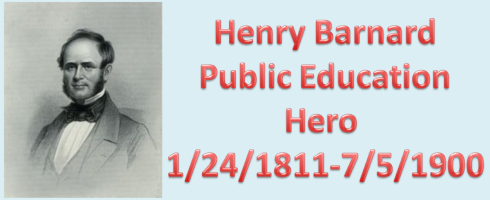
In 1867, Henry Barnard was appointed the first Commissioner of the new US Department of Education. Today that position is called Secretary of Education. The Department came into being with President Johnson’s signature on March 2nd and was followed by Barnard’s being sworn in as Commissioner on March 11th. Powerful forces opposed to a federal takeover of schools abolished the department on July 20, 1868. It officially became the Bureau of Education, attached to the Department of Interior, where it remained until 1979.  Barnard continued as Commissioner of the Bureau until March 15, 1870. (BARNARD Pages 106-108)

Henry Barnard’s contribution to establishing the common school system and the ideals of pedagogy in America and Europe were remarkable. Boone, an early 2oth century writer, stated that “in magnitude and detail, in permanency of result and general cooperation, Barnard’s work in Rhode Island was scarcely second to that of Horace Mann in Massachusetts.” (Barnard Page 61)

Barnard’s Early Life

On January 24, 1811, Henry was born at home in Hartford, Connecticut and was named after his is father, a well-to-do Puritan farmer. His mother, the former Elizabeth Andrus, unfortunately died when Henry was just four. Still he wrote, “It was my blessed inheritance to be born in a family in which chore-doing and mutual help was the rule and habit and happiness.” There were siblings, at least one brother and one sister.  (Barnard Page 7)

Hartford Connecticut Home Where Henry Barnard was Born and Died

In the late 1600s, Connecticut’s Governor Hopkins founded the Hartford Grammar School that Henry attended. He detested that school but would later change his mind, realizing it was “a school of equal rights, where merit, and not social position, was the acknowledged basis of distinction and therefore the fittest seminary to give the schooling essential to the American citizen.” At 13 years old, he transferred to Monson Academy in Hampton County, Massachusetts. (Barnard Page 8)

Fifteen year old Henry entered Yale in 1826 and graduated with a bachelors of arts in 1830. He would return to Yale in 1833 to study law and was admitted to the Bar in 1835.

Barnard was sent home from Yale for his part in the 1828 “bread and butter rebellion”, over poor food in the mandatory dining hall. During this short stay at home, his sister became ill. It was then that Henry first learned of the Pestalozzi from her attending physician, Dr. Eli Todd. The doctor was acquainted with American Pestalozzian, William McClure, and both shared a high opinion of the Swiss educator. (Barnard Page 11)

Upon his graduation, Yale President, Jeremiah Day, advised Henry to teach school for a year. He took a teaching position in Tioga County, Pennsylvania. This would be his only classroom teaching experience but it gave him a deeper perspective of pedagogy than other school reformers of his day. (Barnard Page 14)

After leaving Tioga County and before returning home to Hartford, he made a tour of Auburn, Ithaca, Niagara, and Rochester. It was the first of many important trips he would take.

Political and Professional Life

Barnard became an ardent Whig. The Whig party appeared around 1830 in opposition to the Democratic President, Andrew Jackson. Henry’s strong anti-Jackson feelings were expressed in speeches and by his attendance at the 1831 Whig convention as a delegate. (Barnard Page 14) Illinois Congressman, Abraham Lincoln, was also a Whig.

In 1837, without running for office, he was elected as one of two Hartford delegates to the Connecticut general assembly. Horace Mann of Massachusetts described him as having “fine powers of oratory, wielding a ready and able pen, animated by a generous and indomitable spirit, willing to spend and be spent in the cause of benevolence and humanity.” (Barnard Page 24)

Barnard introduced a bill “to provide for the better supervision of the common schools.” This law created a state committee to supervise schools and Barnard was appointed the new Secretary of the Connecticut Education Committee. (Barnard Page 26)

Washington DC Normal School

He was convinced the quality of educator in America’s common schools must be improved, writing, “No one sends a shoe to be mended, or a horse to be shod, or a plow to be repaired, except to an experienced workman, and yet parents will employ teachers who are to educate their children for two worlds,” without their careful training. (Barnard Page 44)

Henry’s two main focuses became the development of normal schools for teacher training and graded schools for children. He outlined the graded schools: 1) primary schools, with the “teachers all females and the children below 8 years of age”, 2) secondary schools, comprising children from 8 to 12 years of age and 3) high schools for boys and girls. To achieve these goals he attended hundreds of meetings with community members where he gave eloquent and inspiring speeches. (Barnard Page 29)

Barnard also spoke to these issues in other states. He had made such a convincing two-hour speech supporting graded schools in Barre, Massachusetts, that Horace Mann offered, “If you will deliver that in 10 places, I’ll give you $1,000.” (Barnard Page 48)

In 1842, Barnard and the common-school education system suffered a setback. A new Democratic administration swept the Whigs out of power in Connecticut and neither he nor the system was popular with the Democrats. (Barnard Page 49)

Horace Mann reported:

“Four years ago a new System was established in Connecticut which was most efficiently and beneficently administered under the auspices of one of the ablest best of men: but it is with unspeakable regret that I am compelled to add that within the last month all his measures for improvement have been suffered to fall.” (Barnard Page 48)

Rhode Island quickly took advantage of Connecticut’s firing Barnard. In 1843, Rhode Island Governor, James Fenner, invited him to “test the practicability of his own plans of educational reform.” Over the next four years he organized a “revolution in the public opinion and the educational system of the State; a revolution which is without a parallel …” (Barnard Page 54)

Following Barnard’s death on July 5, 1900, the Hartford Courant shared:

  • Yale 1826-1830
  • Admitted to the Connecticut Bar 1835
  • Nominated without his knowledge to serve in the Connecticut legislature and was elected 1837
  • Ushered through with unanimous support laws to provide better supervision by establishing the Board of Commissioners of Common Schools. After originally declining to lead the commission he took the post 1838 
  • Visited Europe 7 times to study education. Corresponded with Marshall, Clay and Webster. He met with Wordsworth, Lockhart, De Quincey, Carlyle and others.
  • Secretary of Connecticut State Board of Education 1838-42
  • Superintendent of schools in Rhode Island 1843-49
  • Superintendent Connecticut State Normal School and secretary of the board of education 1850-54
  • President of the state university of Wisconsin 1857-63
  • President of St. John’s College, Annapolis 1865-66
  • US commissioner of education 1867-70

The Courant’s memorial stated,

“The work of Dr. Barnard, which is monumental, and with which his name will be associated in all coming time, is his work in educational literature, as a writer, editor and publisher. He has done more than any man before or since to give to the English speaking world the best thoughts of the world on education. His collected writings include 52 volumes, averaging 500 pages, comprising 800 individual treatises. The article on school architecture alone had a circulation of more than 10,000 copies.”

There was one disagreement between Mann and Barnard. In spring of 1943, Mann and his new bride, Mary Peabody, took a European honeymoon. He was captivated by the schools he saw in Prussia (Democracy’s Schools Page 104). On the contrary, Barnard found that Prussian students were, “subjected to the depressing and repressing influences of a despotic government and of a state of society in which everything is fixed both by law and the iron rule of custom.” (Barnard Page 48)

The author of Henry Barnard’s Interior Department biography, Barnard C. Steiner, wrote this tribute:

“The greatest contribution  yet made by the United States to the uplifting-genius of the world’s progress was the establishment of the free public school supported by general taxation and directed by the State, and Horace Mann and Henry Barnard were ‘the men to whom America owes the organization of the public-school system.’” (Barnard Page 32)

A Call for Segregation, Exclusion and Caste

8 May

By Thomas Ultican 5/8/2024

Republicans, following the lead of Manhattan Institute’s Christopher Rufo, are out to end Diversity, Equity and Inclusion (DEI) programs. The world’s richest man, Elon Musk, wrote on X, “DEI is just another word for racism.” Rufo’s and Musk’s central complaint is DEI unfairly harms white people. Billionaire hedge-fund manager, Bill Ackman, wrote, “DEI is racist because reverse racism is racism, even if it is against white people.”  It is easy to conclude, these men are calling for policies leading back to 1876 and segregation, exclusion and caste (SEC).

Bill Ackman is not a GOP shill. He is a neoliberal who has donated hundreds of thousands of dollars to Al Gore, Barack Obama and Pete Buttigieg. When Musk responded to a post on X, blaming Jews for flooding countries in the West with “hordes of minorities,” calling it “actual truth,” Ackman leaped to his defense with Elon Musk is not an antisemite.” This is as hard to believe as Republicans are warriors against anti-Semitism. After all, the Republican Party is the main vector for the anti-Semitic “replacement theory.” A theory claiming Jews are involved in a plot to inundate the U.S. with undocumented immigrants who will “replace” the ebbing white majority and keep the GOP out of power.

Writing in the Wall Street Journal about his role in bringing down Harvard’s first ever black female President, Claudine Gay, Rufo ignored claims of plagiarism and anti-Semitism brought against her and focused on efforts ending DEI in higher education. Gay’s chief critic was Bill Ackman. In a long statement, he claimed DEI was the “root cause” of anti-Semitism at Harvard.

Ending DEI at College

Medical Schools Do Not Want Students Who Look and Think Alike

The Chronicle of Higher Education reports at least 82 bills opposing DEI in higher education have been filed in 20 states since 2023. Twelve of them became law in Idaho, Indiana, Florida, Texas and other states lead by GOP politicians. Kevin Stitt, the Governor of Oklahoma, signed an executive order in December, ending spending on DEI, claiming:

“Encouraging our workforce, economy, and education systems to flourish means shifting focus away from exclusivity and discrimination, and toward opportunity and merit. We’re taking politics out of education and focusing on preparing students for the workforce.”

The OU student newspaper reported, “Offices that are focused on African American, Hispanic, or LGBTQ+ students likely violate the Executive Order.”

Florida has a long dark history of racism, ranging from fighting in the civil war for rights to own black people to the 1923 Ocoee massacre that powerful Floridians are trying to hide. Totally in keeping with this racist past, Tallahassee Democrat reported the DeSantis administration pushed to gut diversity, equity and inclusion programs in higher education. In May 2023, the Governor signed a bill banning state public colleges and universities from spending money on DEI. He asserted:

“This bill says the whole experiment with DEI is coming to an end in the state of Florida. We are eliminating the DEI programs.”

In June 2023, Texas Governor Greg Abbott signed a bill, dismantling DEI programs in higher education. It was introduced into the state senate by State Senator Brandon Creighton. Afterwards, Creighton claimed, “With this bold, forward-thinking legislation to eliminate DEI programs, Texas is leading the nation, and ensuring our campuses return to focusing on the strength of diversity and promoting a merit-based approach where individuals are judged on their qualifications, skills, and contributions.”

Dallas Morning News reported:

“The bill was challenged by Democrats every step of the way, from the Senate higher education subcommittee to the House floor. But starting in January 2024, Texas campuses must eliminate DEI offices, mandatory DEI statements and training.”

Abbott also signed a related law, reducing tenure protection for college professors. As a result, higher education institutions in Texas are finding it more difficult to attract top professors.

Stephanie Saul of the New York Times notes that some schools are finding workarounds to mitigate damage. Whereas both University of Florida and University of Texas ended their DEI programs and terminated administrators and staff, Florida State University and University of Tennessee took steps to save employees and continue some valuable services that would otherwise be lost.

Florida State University did it mostly by changing title names and reclassifying positions of employees, already working in DEI to give them new roles; an approach that did not require laying anyone off. This left in place some of the previous DEI department’s work. The school reshuffled jobs and turned the Equity, Diversity and Inclusion Office into the Office of Equal Opportunity Compliance and Engagement.

At University of Tennessee, the DEI program is now called Division of Access and Engagement. The newly named department is still working to diversify the campus and beat back injustice. Unfortunately Tennessee lawmakers have become wise to the workaround. A bill introduced in January specifically stated that no such offices should be operating “regardless of name or designation.” White GOP lawmakers are steadfastly opposed to diversity, equity and inclusion. They see it as a “WOKE” plot foisted on them by liberals.

Corporations and DEI

Corporations Value Diversity

Surprisingly America’s corporations are quite bullish on DEI. Taylor Tedford of the Washington Post shared, “In his annual letter to shareholders this year, JPMorgan Chase CEO Jamie Dimon emphasized that DEI ‘initiatives make us a more inclusive company and lead to more innovation, smarter decisions and better financial results for us and for the economy overall.’” Many large companies tout DEI as leading to business success. A 2023 study of 1200 firms by McKinsey & Company found organizations with the highest racial, ethnic and gender representation are 39% more likely to outperform. A Moody’s study found companies with greater diversity on their boards and in executive leadership have higher ratings.

However conservative opponents of DEI are attacking corporations in court. Last September, a federal judge in Washington State threw out the lawsuit alleging Starbucks violated its duty to shareholders by endeavoring to diversify its workforce. The suit was based on the company’s goals of hiring more people of color, attracting diverse suppliers and tying executive pay to achieving diversity goals.

Growing legal, social and political attacks cause some organizations to delete DEI from public view. They are not necessarily abandoning it but rewriting policies that once emphasized race and gender to prioritize inclusion for all.

Opinion

Manhattan Institute’s, Christopher Rufo, worked at Discovery Institute, dedicated to replacing Darwinian biology with “intelligent design”. There, he developed a talent for tapping into white insecurities with racially dishonest tropes, like abuse of critical race theory (CRT). As the CRT furor began to wane, Rufo turned to another racially-sensitive topic, reframing DEI as being against white people.

Sadly the GOP, which used to have ideals and ethics, joined this campaign. The fact is non-white males and women are not competing on a level playing field when it comes to hiring, admittance to training programs or gaining promotions. DEI programs work to rectify this. Now, Republicans are turning this on its head, claiming it is the “WOKE” agenda of liberals working against white people. This racially-tinged attack on women and minorities demonstrates how bankrupt the GOP ideology has become.

Doubtlessly there are some legitimate grievances with DEI but that does not mean it should be destroyed. Some aspects of the movement may need reformation but America needs this tool. Instead of lamenting people who are different, we need to awaken to the fact that these differences should be celebrated as the key to our greatness.

Conservative lawmakers have set themselves up by opposing diversity, fighting against equal opportunity and ignoring inclusion.

Their fight against DEI is not a good look … it appears racist, caring only about whites.

Reselling NCLB … No Kidding!

1 May

By Thomas Ultican 5/1/2024

Neoliberals joined with libertarians to “reform” public education. Their tools were big money and propaganda distributed by media outlets like The 74, support by The Walton family (EIN 13-3441466) and Bill Gates (EIN 56-2618866). This year, regular columnist for The 74, Chad Aldeman, is trying to claim that lifting No Child Left Behind (NCLB) school accountability sanctions is responsible for the public school testing “data decline”.

Aldeman came east from the University of Iowa, with his BA in Public Policy, to gain a Masters in Public Policy from William and Mary University. His first job in 2008 was with the neoliberal Education Sector which states, “Since our founding in 2005, Education Sector has established our expertise in key issue areas—including educational choice, human capital, K–12 accountability, and higher education—and gained credibility as an independent leader in the field.” (emphases added)

After three years, Aldeman joined Arne Duncan’s Department of Education as a Confidential Assistant and left the Department in 2012 for neoliberal oriented Bell Weather Education Partners as a Principal, working there until 2020.

Diane Ravitch said of Bell Weather in 2016:

“Bellwether, co-founded by Andrew Rotherham, is a leading force in the corporate reform movement. Rotherham has been a columnist for TIME. Currently he is on the board of Campbell Brown’s THE 74.

“Among its clients: TN Achievement School District, National Alliance for Public Charter Schools, NewSchools Venture Fund, Rhode Island Department of Education, Stranahan Foundation, Walton Family Foundation, Stand for Children, CEE-Trust, Goodwill Education Initiatives, Harmony Public Schools (Gulen charter schools), TNTP, Rocketship Education (charter chain), KIPP, IDEA charter schools, The Mind Trust, Chiefs for Change, TeachPlus, and the Black Alliance for Education Options.”

 I used this quote, because Bellweather’s list of clients has gotten much larger, extra disgusting but not more illuminating.

Bottom-line: Aldeman is steeped in anti-public school dogma.

Going on the Attack

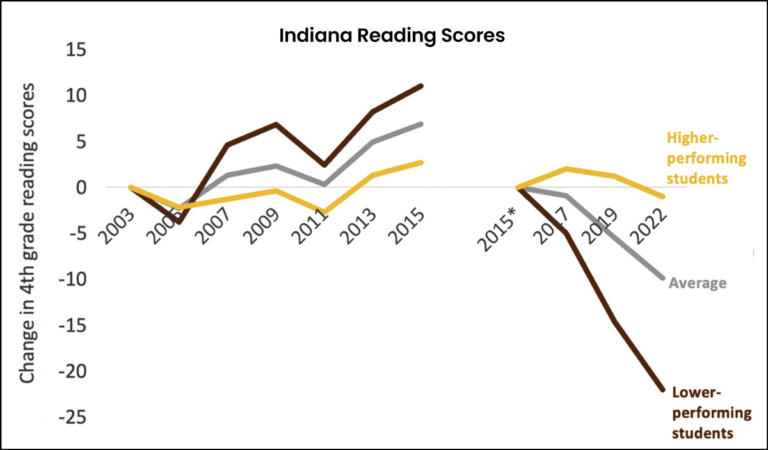
 Aldeman’s latest piece for The 74 is called Gaps Widening Between Indiana’s Highest- and Lowest-Performing Students, claiming that since approximately 2013 education outcomes as measured by test scores were bad. He stated gaps between highest- and lowest-performing students were widening while overall scores declined and this was not just an Indiana problem but a national one.

The following is one of his graphs, Indiana 4th grade reading outcomes.

Chad Aldeman Graph from The 74

In the article he stated from 2003 to 2015, the average gains went up by 7 points and from 2015 to 2022, the average losses were 10 points. What he did not mention was where the test data came from and what its maximum scale was. If this happened to be a testing performance based on a 1,000 point scale, a 10 point change is fairly meaningless even if you believe in standards-based testing.

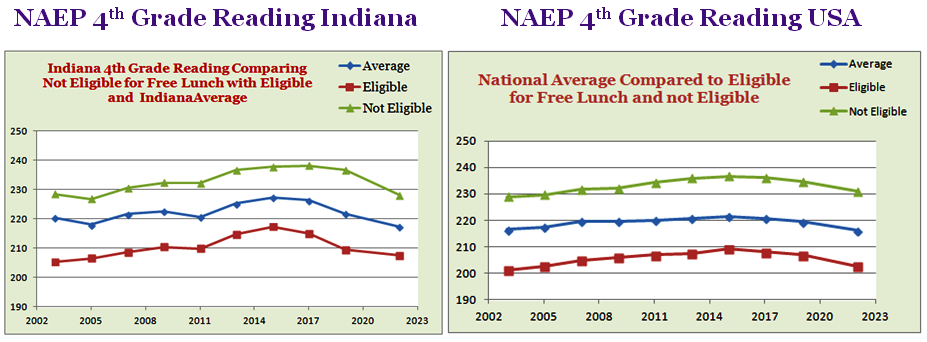
To check if there was any reality to Aldeman’s graph, I interrogated data from the National Assessment of Education Progress (NAEP). Using free lunch as a proxy for low-performing students, both national data and Indiana data for 4th grade reading was graphed. NAEP, known as the nation’s report card, has given the same type of reading exams since 1992. Indiana changed its ELA testing regime in 2018 which makes evaluating data from 2010 when the last testing method was adopted, difficult to impossible. It lacks continuity.

Reading data is scored on a 500 point scale. Scores above 250 and below 190 are meaningless for the 4th grade reading test. Testing score gaps between students eligible for free lunch and those not, in the US, wavered between 26 and 28 points. In Indiana, it varied from 20 to 23 points with one outlier in 2019 at 27 points. The gap between top and bottom has been unchanged within a 3 or 4 point range. Since 1992, 4th grade reading data average for the nation has wiggled up and down within a ten point range. The first test data in 1992 came in at a 217 points average and was also 217 points in 2022.

 From 1970 to 1992, America’s schools showed slow but steady improvement in education-testing outcomes but since the era of standards, testing and accountability, improvement basically stopped. Education, run by billionaires and politicians instead of educators, failed to improve testing outcomes.

What Happened?

Alderman stated in his latest article that it is not just an Indiana problem but that “49 of 50 states, the District of Columbia and 17 out of 20 of the large cities that participated in NAEP … saw a widening of their achievement gap over the last decade.” He did not share which tests showed widened achievement gaps nor which cohorts were compared. NAEP reports on reading scores for 4th and 8th grade do not show a significant change in scoring gaps between Black and White students and comparisons in other ethnic groups also were steady.

After asking what has caused this (non-existent) achievement gap increase, Alderman posited several possible reasons: Common Core state standards (CCSS), per-pupil spending, technology and social media. He said the timing for CCSS fit but did not explain why states where CCSS was never adopted had the same problem. For per-pupil spending, he claimed that more money was getting to classrooms, which defies education-spending reports, making his claim a little shady. For technology and social media, he said other countries with similar problems, did not see testing declines … a declaration made with no evidence cited.

He finally made his real point, “I argue that the weakening of school accountability pressures after the No Child Left Behind Act was passed is responsible for a large portion of the drop.” Those of us, who were in classrooms and witnessed the test-and-punish philosophy damage to public education, disagree. How many great public schools were labeled “failures and closed” because they existed in low income zip codes?

If this decline were real, wouldn’t the privatization of public education be the most likely culprit? Charter schools came first followed by vouchers and more charter schools. Data clearly shows that vouchers harm student-testing performance. Furthermore both charter schools and voucher schools leech money from public education budgets.

Conclusions

The 74 was founded in 2015 by former CNN news anchor, Campbell Brown, along with Michael Bloomberg’s education advisor, Romy Drucker. Its original funding came from the Dick and Betsy DeVos Family Foundation,  Walton Family Foundation, Doris and Donald Fisher Fund and Bloomberg Philanthropies. Since then, it has been the vehicle for spreading the billionaire message of privatization and undermining public schools.

Some billionaires see the non-sectarian nature of public education as a threat to their dreams of a Christian theocracy. Others are libertarians that oppose free universal public education, believing everyone should pay one’s own way and not steal people’s private properties using taxation. The Neoliberals are convinced that education should be run like a business and react to market forces.

Responding to the mission of The 74, Chad Aldeman’s series of articles, like those of many of his colleagues, are pure propaganda, shaping data to support his neoliberal ideology instead of honestly reporting facts. Unfortunately this kind of fake “journalism” is flooding email boxes and web pages throughout America every day.

Hyped AI New Personalized Learning

25 Apr

By Thomas Ultican 4/25/2024

In education today, Artificial Intelligence (AI) and personalized learning are the same thing. AI has been around for 70 years and is the technology that drove personalized learning. The release of ChatGPT in November 2022 caused buzz and may be responsible for Edtech sales-forces switching to AI from personalized learning. The personalized learning scam was exposed and AI became the shiny new object.

ChatGPT is a new language model developed by OpenAI. The basis is a giant data base to retrieve query answers and its breakthrough uses human style essays to deliver the responses. This makes cheating easier, giving teachers new issues to confront. To this point, blogger and educator Mercedes Schneider says “AI and I are not friends”, noting:

“As a teacher for many decades, I find increasingly more of my time consumed with devising means to ensure students complete my assignments without the easy-cheat, sustain-my-own-ignorance that AI enables in today’s students– and, it seems, an increasing number of (especially remote) professionals who may be using the corner-chopping ability AI offers to even hold multiple full-time positions.”

Schneider tested ChatGPT typing in “Could you provide some background info on Mercedes Schneider? She resides in Louisiana.” The answer revealed a weakness… much of the information was correct, some wrong, with other information, old and irrelevant. She did not attend University of Southern Louisiana nor received her PhD from LSU. Mercedes took her red pencil to this chatbot answer, “According to her website, she holds a Bachelor of Arts in secondary education ‘(TRUE)’, a Master of Education in gifted education ‘(FALSE)’, and a PhD in curriculum and instruction ‘(FALSE)’, all from the University of Southern Mississippi ‘(FALSE).’”

These errors may be unusual but the chatbot is unreliable.

What is AI?

“Artificial Intelligence” was first coined by Professor John McCarthy for a conference on the subject at Dartmouth College in 1956. It was also founded as an academic discipline in 1956.

Mathematician, computer scientist, and cryptanalyst, Alan Turing, described a test for verifying computer intelligence in a 1956 paper. He proposed a three-player game in which the human “interrogator” is asked to communicate via text with another human and a machine. If the interrogator cannot reliably identify the human, then the machine is judged “intelligent.”

Coursera states, “AI is an umbrella term that encompasses a wide variety of technologies, including machine learning, deep learning, and natural language processing (NLP).” However, none pass the Turing test for machines manifesting intelligence.

Machine-learning has been part of AI since its 1950s beginning. Algorithms are created to allow a machine to improve its performance on a given task automatically. Netflix uses it to create personalized recommendations, based on previous viewing history.

Deep-learning is advancement in machine-learning, layering algorithms into computer units referred to as neurons. Google Translate uses it for translation from one language to another.

Neural Network Cartoon

Natural language processing (NLP) is used in many products and services. Most commonly, NLP is used for voice-activated digital assistants on smartphones, email spam-scanning programs, and translation apps, deciphering foreign languages. ChatGPT uses large language models, an advancement to NLPs enabling a dialog format, to generate text in response to questions or comments posed.

Nick Bostrom, Director of the Future of Humanity Institute at the UK’s Oxford University, said, “A lot of cutting edge AI has filtered into general applications, often without being called AI because once something becomes useful enough and common enough it’s not labeled AI anymore.”

No machine has passed the Turing test. To this point there is no intelligence associated with AI, just algorithms. Another problem with powerful AI systems is they use a lot of electricity: by 2027, one researcher suggests that collectively, they could consume each year as much as a small country.

Should We Be Afraid?

In May 2023, Geoffrey Hinton, who won the Turing award in 2018 for “deep learning”, a foundation to much of AI in use today, spectacularly quit Google. He said companies, like Google, had stopped being proper stewards for AI in face of competition to advance the technology.

That same month a Scientific American article stated:

“A 2023 survey of AI experts found that 36 percent fear that AI development may result in a “nuclear-level catastrophe.” Almost 28,000 people have signed on to an open letter written by the Future of Life Institute, including Steve Wozniak, Elon Musk, the CEOs of several AI companies and many other prominent technologists, asking for a six-month pause or a moratorium on new advanced AI development.”

However other scientists in the field disagree.

The Guardian reported:

“Jürgen Schmidhuber, who has had a long-running dispute with Hinton and others in his industry over appropriate credit for AI research, says much of these fears are misplaced. He says the best counter to bad actors using AI will be developing good tools with AI.”

“And I would be much more worried about the old dangers of nuclear bombs than about the new little dangers of AI that we see now.”

Stanford professor, Andrew Ng, was a part of the Google brain project. He is not worried and in a recent interview stated:

“I can’t prove that AI won’t kill us all, which is akin to proving a negative, any more than I can prove that radio waves being emitted from Earth won’t allow aliens to find us and wipe us out. But I am not overly concerned about our radio waves leading to our extinction, and in a similar way I don’t see how AI could lead to human extinction.”

Meta’s chief AI scientist, Luan LeCun, scoffs at his peers dystopian attitudes, saying, “Some people are seeking attention, other people are naive about what’s really going on today.”

Hopefully dangers from AI are mitigated by the safety concerns addressed and development is not harmed by a flat-earth mentality.

Selling to Schools

Fast Company is a modern business news organization, tracking edtech sales and issues. Their April 16, 2024 article opened with,

“Between the pandemic and the rise of generative AI, the education sector has been in a permanent state of flux over the past few years. For a time, online learning platforms were ascendant, meeting the moment when workplaces and schools alike went remote (and later, hybrid). With the public debut of ChatGPT in 2022, edtech companies—such as edX, which was one of the first online learning giants to launch a ChatGPT plugin—jumped at the opportunity to integrate generative AI into their platforms, while teachers and administrators tried to understand what it could mean in the classroom.”

Generative AI is a tool that generates text, images, videos and other products.

I understand how K-12 students might want to become familiar with new AI tools but expecting them to be a boon to learning seems farfetched. Teachers need to find ways to stop students from misusing it. Clever as they are most students will not make good choices when realizing a chatbot can do homework.

Fast Company pointed out, schools are being inundated with new AI edtech products. George Veletsianos, Professor of learning technologies, University of Minnesota, recently gave purchasing guidance to school leaders in Conversation. Of his five points, point two seems especially relevant:

“Compelling evidence of the effect of GenAI products on educational outcomes does not yet exist. This leads some researchers to encourage education policymakers to put off buying products until such evidence arises. Others suggest relying on whether the product’s design is grounded in foundational research.”

“Unfortunately, a central source for product information and evaluation does not exist, which means that the onus of assessing products falls on the consumer. My recommendation is to consider a pre-GenAI recommendation: Ask vendors to provide independent and third-party studies of their products, but use multiple means for assessing the effectiveness of a product. This includes reports from peers and primary evidence.”

“Do not settle for reports that describe the potential benefits of GenAI – what you’re really after is what actually happens when the specific app or tool is used by teachers and students on the ground. Be on the lookout for unsubstantiated claims.”

Experience informs me that there will be many educational benefits from the overhyped AI but money hunger will be lurking. I am guessing AI currently will be of little use for teaching literature, mathematics or most sciences but will be a focus for computer science students.

Do not rush to implement AI tools in the K-12 environment.

Schools are more likely to be fleeced than left behind when the salesman calls. It may be the same person, who was selling “personalized learning” three or four years ago

…  but it is still BAD pedagogy.

Defend the People’s Schools

19 Apr

By Thomas Ultican 4/19/2024

I am sure you’ll be shocked to your core but there are some really bad people out there trying to end publicly-financed free education.

Since the beginning to the 21st millennium, misguided wealthy people have been attacking public education. The reasons range from religion to hubris. Betsy DeVos thinks secular education is an insult to her Christian God. Bill Gates believes he knows more than anyone else and Charles Koch is opposed to all government-sponsored social action. That would all be fine if they were not billionaires, using immense wealth to impose their way.  

Truth-in-Funding (TiF) offers tools for opposing their propaganda with a webpage providing links to 25 organizations, working to protect public schools. Organizations such as National Education Policy Center, Network for Public Education and Education Law Center share links to their research along with toolkits for delivering the message.

The Truth-in-Funding Group

TiF’s homepage states:

“School voucher programs use public funds to pay for private education costs. These programs are spreading despite overwhelming evidence that they are harmful public policy.”

And their about page says:

“This website offers a wide range of tools from groups that oppose vouchers and other efforts to divert public funding in education. We work to protect the vital institution of public education and ensure all students have access to welcoming, well-resourced public schools.”

Highlighted Materials

Network for Public Education (NPE) was founded in 2013 by a middle-school teacher from Oakland, California, Anthony Cody and former Education Department official and education historian, Diane Ravitch. Soon after the founding, past New York principal of the year, Carol Burris, came on board as director. NPE has focused on uniting friends of public schools, researching the reality behind school choice and creating tools to protect public education.

Ravitch Introducing Keynote Speaker Gloria Ladson-Billings

At NPE Washington DC October 2023

One of NPE’s many “Toolkits”, which are concise two-page documents, is Do charter schools and school vouchers “hurt” public schools? The answer is:

“Yes.

“Charter schools, vouchers, and other “choice” options redirect public money to privately operated education enterprises, some of which operate for profit. That harms your public schools by siphoning off students, resources, and funding and reducing the ability of public schools to serve the full range of student needs and interests.”

This conclusion was justified with four paragraphs of explanation and eight examples from across America.

Policy Matters Ohio is a non-profit policy research institute. Funded by mostly small foundations and individual donations they claim to “create a more vibrant, equitable, sustainable and inclusive Ohio through research, strategic communications, coalition building and policy advocacy.”

Their 2023 Ohio voucher study concluded:

  • “Ohio is currently ranked 46th for per-pupil equitable distribution of funding. State funding that is allocated towards vouchers should be directed to public schools so that students can get the resources they need to thrive.
  • “Ohio public schools need funding, especially our largest urban school districts with high concentrations of Black, Brown, and Economically disadvantaged students (CCS example)
  • “Ohio is ranked 40th in starting teacher salaries, and falls below the national average. Funding allocated towards vouchers takes away from money that should be invested in our educators. Can help us to recruit and retain more teachers in the state
  • “Private schools can choose to kick back a child, but as of right now they would be able to keep the money that was awarded, this needs to be changed so that private schools are not benefiting from public dollars for a child they are not educating .
  • “With universal vouchers comes universal bussing costs for public-school districts who bear the cost of transporting all district voucher students to private schools. Property taxes will continue to rise as the public is forced to pay a billion dollars for private school tuition, which will strain lower income districts.”

With the advent of billionaire-financed attacks on public education, non-peer reviewed policy reports and education outcome studies have become prevalent. In response, a group of scholars created the National Education Policy Center (NEPC), housed at the University of Colorado to test the claims being made.

In 2023, there was a legislatively mandated report by the Georgia Department of Audits and Accounts estimating costs and benefits of the state’s new Qualified Education Expense tax credit (QEEC). It is a tax credit school voucher scheme that provides families with “scholarships”. These programs can be controversial because they send taxpayer funding to private schools which serve primarily religious schools that regularly exclude students based on faith, sexual orientation or disability. The Georgia report concluded the state would save money with these vouchers.

David S. Knight, University of Washington, studied the report for NEPC and concluded:

“Taken together, little evidence or data supports the report’s main findings and conclusions. If more accurate parameters are used to generate cost estimates, particularly for the switcher rate and for the cost savings of declining enrollment, a different picture emerges. While the report concludes that the tax-credit scholarship program will have a positive fiscal impact, a far more likely scenario, and one that has already played out in other states, is that the tax credit will cost Georgia taxpayers millions of dollars, potentially requiring future cuts to public services, while providing a cash bonus to many wealthy families.”

A visitor to the TiF library page discovers 13 hyper-linked categories including “Graphics” where I found this:

A Big Concern

 At the bottom of TiF’s main page, below the 25 hyper-linked partners, is a link to Partnership for the Future of Learning (PFL) with an invitation to visit their website.

Learning Policy Institute is listed as a member of the PFL network, founded in 2015 with Stanford professor Linda Darling-Hammond in charge and offices in Palo Alto and Washington DC. San Francisco-based Sandler Foundation was the lead funder with Atlantic Philanthropies, S.D. Bechtel, Jr. Foundation, Ford Foundation, William and Flora Hewlett Foundation. Stuart Foundation also provided initial support.

The Ford, Bechtel and Hewlett foundations have often supported initiatives that undermine public schools. The Hewlett foundation joined Zuckerberg and Kellogg in funding PFL. Hewlett’s 2022 form 990-PF (EIN: 94-1655673) reports grants of $600,000 to NWEA, $533,336 to Education Trust and $1,935,000 to the Aspen Institute.

Learning Policy Institute’s 2022 tax report lists Darling-Hammond’s salary at over $500,000 (EIN: 47-2772048). She has a history of being both supportive of public education and a problem. My friend, Steven Singer, titled his 2018 post about Darling-Hammond, Linda Darling-Hammond vs. Linda-Darling Hammond – How a Once Great Educator Got Lost Among the Corporate Stooges.” While often brilliant, she does not seem to value the importance of school governance.

Another PFL partner, WK Kellogg Foundation, is one of America’s largest grant-making organizations. A quick perusal of their 990-PF tax forms (EIN: 38-1359264) showed many grants to clearly worthwhile causes. Unfortunately they also give money to organizations like Teach For America, who pawns off fake temp-teachers on America’s students. Their 2021 form gives the most recent spending data available from Kellogg, with the following partial table of giving:

PFL cites Teach Plus as a network partner. It is a private company trying to monetize teacher-training, established in 2007 by Celine Coggins, a professor at Harvard Innovation Labs. Her Harvard resume says, “Under Celine’s leadership, Teach Plus grew to over 30,000 participating teachers and a $10M annual operating budget by offering groundbreaking programs in leadership development and advocacy.” The actual groundbreaking was the effort to replace teacher-leadership and -training by established public universities like UCLA, University of Texas and University of Illinois, with a for-profit company.

PFL may be a true friend of public education but some of the organizations they listed are not. Until they clean their house of organizations that harm public education, TiF should reconsider giving them a link on their otherwise pristine webpage.

I do not want to overemphasize TiF’s one questionable link but am sensitive about the issue. Every national education news source now receives funding from Bill Gates. In addition, other billionaire enemies of public schools also contribute to school news outlets like The 74, education week etc. There are few places for the public to get true un-slanted education news.  

So far Truth-in-Funding appears to be a valuable resource for fighting misinformation and saving universal free public education.

Jobs’ Reading Scam

10 Apr

By Thomas Ultican 4/10/2024

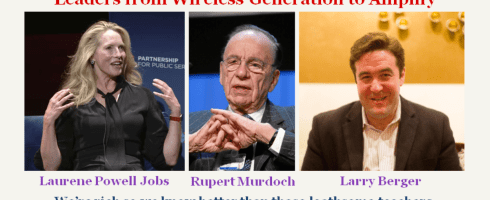
Laurene Powell Jobs controls Amplify, a kids-at-screens education enterprise. In 2011, she became one of the wealthiest women in the world when her husband, Steve, died. This former Silicon Valley housewife displays the arrogance of wealth, infecting all billionaires. She is now a “philanthropist”, in pursuit of both her concerns and biases. Her care for the environment and climate change are admirable but her anti-public school thinking is a threat to America. Her company, Amplify, sells the antithesis of good education.

I am on Amplify’s mailing list. April third’s new message said,

“What if I told you there’s a way for 95% of your students to read at or near grade level? Maybe you’ve heard the term Science of Reading before, and have wondered what it is and why it matters.”

Spokesperson, Susan Lambert, goes on to disingenuously explain how the Science of Reading (SoR) “refers to the abundance of research illustrating the best way students learn to read.”

This whopper is followed by a bigger one, stating:

“A shift to a Science of Reading-based curriculum can help give every teacher and student what they need and guarantee literacy success in your school. Tennessee school districts did just that and they are seeing an abundant amount of success from their efforts.”

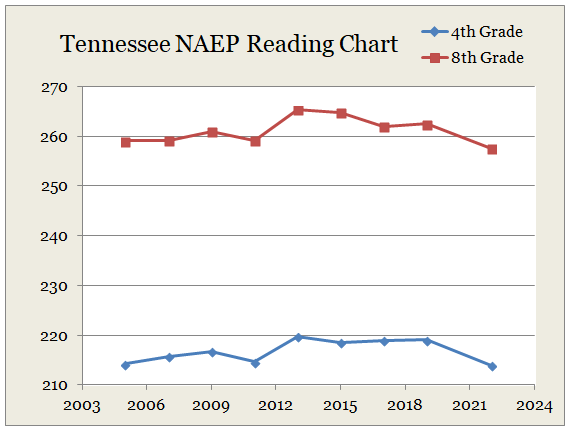
A shift to SoR-based curriculum is as likely to cause harm as it is to bring literacy success. This was just a used-car salesman style claim. On the other hand, the “abundance of success” in Tennessee is an unadulterated lie. National Assessment of Education Progress (NAEP) tracks testing over time and is respected for education testing integrity. Tennessee’s NAEP data shows no success “from their efforts.” Their reading scores since 2013 have been down, not a lot but do not demonstrate an “abundance of success”.

NAEP Data Plot 2005 to 2022

Amplify’s Genesis

Larry Berger and Greg Dunn founded Wireless Generation in 2000 to create the software for lessons presented on screens. Ten years later, they sold it to Rupert Murdoch and his News Corporation for $360 million. Berger pocketed $40 million and agreed to stay on as head of curriculum. Wireless Generation was rebranded Amplify and Joel Klein was hired to run it.

Murdoch proposed buying a million I-pads to deliver classroom instruction. However, the Apple operating system was not flexible enough to run the software. The android system developed at Google met their needs. They purchased the Taiwanese-made Asus Tablets, well regarded in the market place but not designed for the rigors of school use. Another issue was that Wireless Generation had not developed curriculum but Murdoch wanted to beat Pearson and Houghton Mifflin to the digital education market place … so they forged ahead.

In 2012, the corporate plan was rolling along until the wheels came off. In Guilford County, North Carolina, the school district won a Race to the Top grant of $30 million dollars which it used to experiment with digital learning. The district’s plan called for nearly 17,000 students in 20 middle schools to receive Amplify tablets. When a charger for one of the tablets overheated, the plan was halted. Only two months into the experiment, they found not only had a charger malfunctioned but another 175 chargers had issues and 1500 screens were kid-damaged.

This was the beginning of the end.

By August of 2015, News Corporation announced it was exiting the education business. The corporation took a $371 million dollar write-off. The next month, they announced selling Amplify to members of its staff. In the deal orchestrated by Joel Klein, who remained a board member, Larry Berger assumed leadership of the company.

Three months later, Reuters reported that the real buyer was Laurene Powell Jobs. She purchased Amplify through her LLC, the Emerson Collective. In typical Powell Jobs style, no information was available for how much of the company she would personally control.

Because Emerson Collective is an LLC, it can purchase private companies and is not required to make money details public. However, the Waverley Street Foundation, also known as the Emerson Collective Foundation, is a 501 C3 (EIN: 81-3242506) that must make money transactions public. Waverly Street received their tax exempt status November 9, 2016.

SoR A Sales Scam

The Amplify email gave me a link to two documents that were supposed to explain SoR: (Navigating the shift to evidence-based literacy instruction 6 takeaways from Amplify’s Science of Reading: The Symposium) and (Change Management Playbook Navigating and sustaining change when implementing a Science of Reading curriculum). Let’s call them Symposium and Navigating.

Navigating tells readers that it helps teachers move away from ineffective legacy practices and start making shifts to evidence-based practices. The claim that “legacy practices” are “ineffective” is not evidence-based. The other assertion that SoR is evidence-based has no peer-reviewed research backing it.

Sally Riordan is a Senior Research Fellow at the University College London. In Britain, they have many of the same issues with reading instruction. In her recent research, she noted:

“In 2023, however, researchers at the University of Warwick pointed out something that should have been obvious for some time but has been very much overlooked – that following the evidence is not resulting in the progress we might expect.

“A series of randomised controlled trials, including one looking at how to improve literacy through evidence, have suggested that schools that use methods based on research are not performing better than schools that do not.”

In Symposium, we see quotes from Kareem Weaver who co-founded Fulcrum in Oakland, California and is its executive director. Weaver also was managing director of the New School Venture Fund, where Powell Jobs served on the board. He works for mostly white billionaires to the detriment of his community. (Page 15)

Both Symposium and Navigating have the same quote, “Our friends at the Reading League say that instruction based on the Science of Reading ‘will elevate and transform every community, every nation, through the power of literacy.”’

Who is the Reading League and where did they come from?

Dr. Maria Murray is the founder and CEO of The Reading League. It seems to have been hatched at the University of Syracuse and State University of New York at Oswego by Murray and Professor Jorene Finn in 2017. That year, they took in $11,044 in contributions (EIN: 81-0820021) and in 2018, another $109,652. Then in 2019, their revenues jumped 20 times to $2,240,707!

Jorene Finn worked for Cambria Learning Group and was a LETRS facilitator at Lexia. That means the group had serious connections to the corporate SoR initiative before they began.

With Amplify’s multiple citations of The Reading League, I speculated that the source of that big money in 2019 might have been Powell Jobs. Her Waverly Street Foundation (AKA Emerson Collective Foundation) only shows one large donation of $95,000,000 in 2019. It went to the Silicon Valley Community Foundation (EIN: 20-5205488), a donor-directed dark money fund.

There is no way of following that $95 million.

The Reading League Brain Scan Proving What?

Professor Paul Thomas of Furman University noted the League’s over-reliance on brain scans and shared:

Many researchers in neurobiology (e.g., Elliott et al., 2020; Hickok, 2014; Lyon, 2017) have voiced alarming concerns about the validity and preciseness of brain imaging techniques such as functional magnetic resonance imaging (fMRI) to detect reliable biomarkers in processes such as reading and in the diagnosis of other mental activity….

“And Mark Seidenberg, a key neuroscientist cited by the “science of reading” movement, offers a serious caution about the value of brain research: “Our concern is that although reading science is highly relevant to learning in the classroom setting, it does not yet speak to what to teach, when, how, and for whom at a level that is useful for teachers.”

“Beware The Reading League because it is an advocacy movement that is too often little more than cherry-picking, oversimplification, and a thin veneer for commercial interests in the teaching of reading.”

The push to implement SoR is a new way to sell what Amplify originally called “personalized learning.” This corporate movement conned legislators, many are co-conspirators, into passing laws forcing schools and teachers to use the SoR-related programs, equipment and testing.

SoR is about economic gain for its purveyors and not science based.

When politicians and corporations control education, children and America lose.

Fan of Standards-Based Grading?

2 Apr

By Thomas Ultican 4/2/2024

With the new century, public education encountered virulent standards, standards-based testing and a call for standards-based grading (SBG). While schools were inundated with standards and testing, SBG was not such a success. Since the pandemic, a renewed push for SBG rose. On March 16 2024, corporate education mouthpiece, The 74, published “Why is a Grading System Touted as More Accurate, Equitable So Hard to Implement?”

Answer: Maybe it is bad education policy?

Charter schools and vouchers claimed to save poor minority children from “failed” public schools. They wanted to bring fairness but instead brought segregation, no-excuses schools and discrimination. Similarly, SBG is neither about accuracy nor equity; it is about teaching to the test and implementing thoroughly debunked mastery learning.

What is SBG?

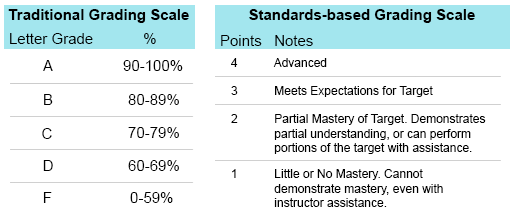
Common Goals Systems Inc. is typical of companies in the education business making it a good source to explain SBG and they share the following math report card example:

Their SBG definition states:

“In SBG, grading is based on demonstration of mastery. Students attempt standards-aligned activities (projects, worksheets, quizzes, essays, presentations, etc.). Teachers assess the student output and choose the appropriate mastery level that was demonstrated. In standards-based education, teaching is responsive to learning.” (Emphasis added.)

I never met a teacher who was not responsive to learning, no matter the grading system.

Power School sells school management programs that include grading tools. They state, “Since standards-based reporting is designed to only reflect true evidence of learning, parents get a clear picture of what the student has or hasn’t mastered without the influence of other factors, such as effort and attitude.”

Teachers and most parents believe effort and attitude have a lot to do with developing “true evidence of learning.”

Valerie L. Marsh, PhD from the University of Rochester, wrote a research brief about SBG:

“The emphasis in SBG is to promote teaching and learning that meet learning goals based on standards. Moreover, students are assessed on their level of mastery of specified standards rather than points accrued for individual assignments (Iamarino, 2014). Teachers then base course grades on students’ progress in meeting the standards (Lewis, 2022).” (Page 3)

When a group of Bay Area upper middle-class parents successfully reversed their districts move to SBG, EdSurge reported, “‘Standards-based grading’ treats homework as unscored practice, eliminates extra credit and focuses on proving mastery of material.” Dublin Unified School District’s parents were displeased with the new SBG pilot effort.

In July 2023, the school board voted 3-2 to end the experiment.

In the same article, Cody Whitehouse, a social studies teacher at Wilson College Prep high school in Phoenix, shared his experience with the district’s roll-out of SBG. At first, he was enthusiastic about allowing multiple opportunities to demonstrate learning but soon soured on it. Students quickly learned that homework was not being graded and stopped doing it!

Whitehouse said, “It’s teaching to the test — the assessment is all that matters.”

Grading Scale Comparison

Problem with Standards Based Education

In 2015, I wrote:

“The learning standards upon which high stakes testing is based come from a mistaken philosophy of pedagogy that posits: a standardized learning rate, standardized interests, linear learning progression, developmental alignment, etc. Humans are not standard. Some learn to speak at 16 months and some don’t acquire that skill until 72 months. Some are short, others are tall. Some are fast, other are not. A child from urban Chicago has different perceptions and interests than a child from Winnemucca, Nevada. A global curriculum will not meet the needs of an endlessly diverse population. One size truly does not fit all. Even if it did, it would still be a bad idea to have political entities in centers of power deciding what that curriculum should be.”

Reinforcing education standards by tying grades to them is a colossal error.

Arnold Toynbee (1889 – 1975) was perhaps the world’s most read, translated and discussed living scholar. His 10-volume masterpiece, “A Study of History”, was an enormous success and a 1-volume abridged version of the first 6 volumes by David Somervell sold more than 300,000 copies in 1947. Like most people, that was the version I read and found this quote:

“We must ask whether, as we look back over the ground we have traversed, we can discern any master tendency at work, and we do in fact unmistakably decry a tendency towards standardization and uniformity: a tendency which is correlative and opposite of the tendency towards differentiation and diversity which we have found to be the mark of the growth stage of civilizations.” (Page 555)

For politicians, oligarchs and many scholars, there is a powerful desire to control public education. They see teachers as inept and needing to be managed from Albany or Sacramento or Washington DC. Standards were seen as the path forward. They became more and more prescriptive with test and punish methods to enforce adherence. SBG is one more tool for developing faithfulness to standards.

Good schools in poor zip codes have been shuttered because they were not making adequate yearly progress based on testing results. There was no recognition that standardized testing results almost completely aligned with community wealth.

Since the pandemic, a new billionaire-financed movement has arisen to end the public education we know and replace it with a digital badging scheme. For this to work, mastery learning must be adopted and is likely the biggest reason SBG is being promoted.

In his 1916 book, Democracy and Education (page 122), John Dewey stated,

“An aim must, then, be flexible; it must be capable of alteration to meet circumstances. An end established externally to the process of action is always rigid.”

Mastery Learning violates Dewey’s warning.

In 1968, Benjamin Bloom published a small paper titled “Learning for Mastery”. This publication, Bloom’s Taxonomy and John Carroll’s work were combined to create “Mastery Learning”. 

Competency-based education (CBE) is the digital screen approach that replaced the failed 1990’s Outcome-based education. Outcome-based education is a renamed attempt to promote the 1970’s “mastery learning” theory. Mastery education’s failure was so complete that it had to be renamed. It was quickly derided by educators as “seats and sheets.” These schemes all posit that drilling small skills and mastering them is the best way to teach. It has not worked yet.

Summing it Up

Thomas R. Guskey, PhD University of Kentucky, is considered a world authority on grading practices and supports SBG. In 2001, he wrote the peer-reviewed article “Helping Standards Make the Grade”, responding to a widely held criticism of grades in K-12 schools. The curriculum expert, Robert Marzano, stated grades “are so imprecise that they are almost meaningless.”

I have a lot of respect for these scholars but it seems they were wrong.

Multiple studies have demonstrated that high school grades are more predictive of college success than standardized tests from ACT or SAT. The head of a 2020 University of Chicago study, Elaine M. Allensworth, reported “The bottom line is that high school grades are powerful tools for gauging students’ readiness for college, regardless of which high school a student attends, while ACT scores are not.”

I do not believe there is anything nefarious about either Marzano or Guskey. Their opposition to traditional grading is not well-supported and a grading scheme tied to standards promotes bad drill and skill education. Yet, their efforts were sincere.

There is something nefarious about Michael Moe and his company GSV Ventures. Several organizations fall under the main GSV group, including GSV Labs, GSV Asset Management and GSV Tomorrow, a commentary arm where investing trends and stories are disseminated. They link readers to the GSV landing page for the annual ASU+GSV Summit, claimed to be the “most impactful convening of leaders in education and talent tech” with over 5,000 attendees and 1,000 speakers from 45 different participating countries.

GSV appears to have convinced Tim Knowles and Carnegie Foundation to abandon the Carnegie Unit for CBE based badges.

Edtech leaders are creating a dystopian system of education and career tracking, making Orwell look optimistic. With this, every American’s history will be held in an unalterable blockchain which needs CBE as the education method to function.

It will be a goldmine for tech companies…

the big reason tech billionaires push Standards-Based Grading…

Goodbye Doo Wop Don

27 Mar

By Thomas Ultican 3/27/2024

Don Shalvey, with his self-selected twitter handle @dooWopDon, passed away March 16th, succumbing to a lengthy battle with brain cancer. During his long education-centered career, he worked with billionaires including Reed Hastings, Bill Gates and Helen Schwab, to privatize public education. In 1993, Don’s San Carlos Learning Center became the first charter school in California and second in America.

Before he was a charter school founder and before he was a school teacher, he was a disc jockey. That is why his twitter was @dooWopDon.

When founding the charter in San Carlos, he was superintendent of a small K-8 district, a third of the way up the peninsula between San Jose and San Francisco. This event made an obscure education administrator into a rock star in the movement.

Don Shalvey September 14, 1944 – March 16, 2024

Lily Geismer writes about the Clinton administration and its embrace of education choice in her book Left Behind (page 244). In 1997, Bill and Hilary dropped off their daughter, Chelsea, for her freshman year at Stanford. The next morning they were in the gymnasium at Don’s San Carlos Learning Center for a roundtable discussion about charter schools (page 248). Geismer claimed, “The San Carlos event galvanized momentum for charter schools.”

At the time, there was a cap of 100 charter schools in California. Afterwards, “a thirty-something man with a goatee and Birkenstocks”, Reed Hastings, approached Shalvey, asking, “Do you ever think that there’ll be more than a hundred charter schools in California?” He talked Shalvey into helping to get rid of the charter school cap (page 249). “The combination of Don as Mr. Charming Establishment and me as a wealthy provocateur presented a unique challenge to the teachers union,” Hastings remembers in an interview.

Together, they successfully campaigned to end the charter school cap. At the same time, Hastings was starting his new company, Netflix. The two soon hooked up with John Doerr and NewSchools Venture Fund to invent the charter management organization (CMO). With $400,000 left from their campaign, they used it to create America’s first CMO, University Public Schools which later became Aspire.

Shalvey did most of the leg work.

The first Aspire charter school opened in 1999 in Stockton, California. During his career in education, Shalvey’s home was always a ranch in Linden, California about 10 miles from Stockton.

The Gates Foundation

From 2009 to 2020, Shalvey served as Deputy Director for K-12 Education at the Bill & Melinda Gates Foundation.

While he was at the Foundation, charter school enrollments grew by a half-million students, fueled in large part by the Charter School Growth Fund supported by Gates, the Walton family and other billionaires. The Fund was founded in 2004 by Buzz Woolley and Don Fisher (Tax ID 05-0620063). In 2005, John Walton replaced Buzz Woolley as president, indicating his privatization focus changed from vouchers to charter schools.

Gates gave Shalvey two big jobs. He was to implement Common Core standards and target teacher preparation. Unfortunately the standards were installed with no field testing. There were many good ideas within them but much of it was improperly aligned and had no buy-in from educators. There were also political issues. People saw this as Gates’ effort to take control of public education and create a centralized US education marketplace.

Focus on teacher preparation became another effort at privatizing every aspect of the education industry. Instead of working with established institutions like Columbia University or the University of California system, Shalvey and Gates looked toward private companies like the Teach for America (TFA) spinoff, TNTP.

Wendy Kopp founded TNTP (originally called The New Teachers Project) in 1997 and assigned Michelle Rhee, who had just finished a two-year TFA tour, to run it. Under Rhee’s leadership, TNTP became noted for teacher bashing.

Soon after Shalvey went to work for Gates in 2009, he became a member of the EdSource board. Gates was perhaps their largest funder and Don, his representative, remaining a board member until his passing.

Returns to Stockton

June 30 2020 was Shalvey’s last day at the Gates Foundation. For the entire time he worked for Gates, he commuted from the home he shared with wife, Sue, in Linden, California. He stated:

“For the past 50 years, the San Joaquin Valley has been my home. I’m thrilled to spend the final years of my career working to improve education for the young people in our wonderful Valley.”

The 75 year-old Shalvey was not ready to retire. He became CEO of a local non-profit called San Joaquin A+. There must have been secret negotiations before he left Gates because it is probably not a coincident that at the same time billionaire, Helen Schwab, made a $400,000 donation to the non-profit.

Shalvey’s new job was part-time, committing 20 hours a week to his CEO position. Tax records indicate San Joaquin A+ (Tax ID: 51-0536117) became tax-exempt in 2005. It was a relatively low key organization until his arrival. In 2019, they had net assets of $39,266. Shalvey was compensated $160,225 that first year and in 2021, $332,782. In the three years prior to his arrival, A+ had taken in $15,169. The haul in 2020 was $3,176,833 and in 2021, $3,942,790.

He was definitely a rainmaker and the question is what did his billionaire supporters expect back?

Don Shalvey was known to be a good guy with a big smile and able to work with people but some locals in Stockton disagree. Founder of Facebook news report 209 Times, Motecuzoma (Motec) Sanchez, wrote:

“Every time one of these devils dies, like with Alex Spanos, you see their legacy media puppets try to brainwash the public into believing what they did in their lifetime was admirable. Shalvey exploited poor Brown and Black kids in my hometown of Stockton, Modesto and beyond. And his creations, like a monster, continue to do so.”

The late Alex Spanos was a very successful real-estate developer from Stockton who purchased the San Diego Chargers in 1984. Motec felt Spanos was ruthless and that just the way his life story was glorified is how Don Shalvey’s life is being embellished today. From his ranch in Linden, Shalvey consistently ingratiated himself with billionaires, denigrated public schools and made profits. 

In 2022, two grand jury reports seemed out to demonize the local school districts board and leadership. A report in The 74 quoted Shalvey saying, “I think Stockton Unified might be the worst system in the country.” That was typical of the hyperbolic anti-public school statements he often made.

It is true that during John Deasy’s two years as Superintendent, the district had some financial issues which have been solved. With 82% of K-12 students coming from families of poverty, it is little wonder they did not test well but their graduation rates were reasonable and English language progress rates, among the best in the state. It is one more example of good schools in poor neighborhoods having test results used to unfairly undermine them.

Shalvey made a lot of money working to destroy public education but that money is not helping him now. He raised an admirable family and seemed to have many good traits. I feel bad about writing critically of the dead but he, unwittingly or not, made many bad choices, harming countless children.

I agree with Motec.

Don Shalvey should never be lionized.