Soka Education and Reform

4 Jul

By Thomas Ultican – 7/4/2016

Soka Education is an education reform movement advanced by the Buddhist lay organization, Soka Gakkai or “Value Creation Society.” For more than a century, reform education advocates such as John Dewey have proposed a humanistic approach to education. Although they have shown considerable success in demonstration classrooms, there has been little general implementation of their ideas.

The Swiss psychologists, Jean Piaget called Dewey’s discovery-based approach to education “constructivism.” Piaget believed that “children play an active role in making sense of things, `constructing’ reality rather than just acquiring knowledge.”1 The philosophy of constructivism” is a move away from the educational philosophies of behaviorism and social conservatism advocated by men like B. F. Skinner and Edward K. Thorndike.

Ellen Lagemann, an education historian, writes, “One cannot understand the history of education in the United States during the twentieth century unless one realizes the Edward K. Thorndike won and John Dewey lost.”2 The same general situation in education appears to exist throughout the world. Behaviorist authoritarian models of education dominate.

It could be that the Soka Education movement is the first large scale, long term and determined effort to utilize reform or humanistic student-centered education in the world.

At the Dawn of the 20th century, the father of Soka Education, Tsunesaburo Makiguchi, an elementary school teacher and principal in Tokyo, developed a theory of education that he called “Value Creating Pedagogy.” He also gained a reputation for causing trouble of some sort wherever assigned. Mr. Makiguchi’s problems were rooted in the prevailing educational theories of his day.

The closing decades of the 19th century witnessed Japan going through huge social change. It changed from nearly seven hundred years of military rule by the samurai classes back to Imperial rule and embarked on a mad dash toward industrialization. It changed from four hundred years of self-imposed isolation to a path of international engagement.

Education policy became a debate between the forces that felt the purpose of education was to build citizens who were self-assured and of independent minds and those that advocated the development of obedient and loyal subjects for the Meiji government. Historian Dayle M. Bethel tells us that “the latter group won the debate.”3 Bethel says, “Makiguchi’s entire educational career was a protest against the production of subjects.”4

In 1928, Makiguchi converted to Nichiren Buddhism and was soon convinced that Nichiren Buddhism and his philosophy of “Value Creating Pedagogy” were synergistic. In 1930, he started an organization for educational reform called Soka Kyoiku Gakkai or “Value Creating Educators Society” based not only on his theories of education but also on Nichiren Buddhism. This organization became more and more about religion than educational reform as militarism and state sponsored Shinto enveloped Japan.

Japanese society was completely devastated during World War II. Makiguchi and all of the leaders of the “Value Creating Educators Society” were imprisoned as thought criminals in 1943. Makiguchi died in prison in 1944. After being released from prison in 1945, Makiguchi’s disciple, Josei Toda, rebuilt the organization as a Buddhist laymen’s society and renamed it Soka Gakkai or “Value Creation Society.”

Today, Soka Gakkai is the world’s largest Buddhist sect and the largest religious movement in Japan. In the 1960’s, the Soka Gakkai returned to its roots as an educator’s society and began constructing an education system based on Makiguchi’s “Value Creating Pedagogy.”

Dayle M. Bethel wrote of Makiguchi: “Out of his battles with Japanese educational structures of his time and his association with a few like-minded colleagues there emerged pedagogical views and ideas that are worthy of study by English-speaking scholars, worthy in their own right and also because these views and ideas seem likely to have significant impact on Japanese society during the years ahead.”5

Today, the leader of Soka Gakkai International (SGI) and Soka Education is Dr. Daisaku Ikeda. In a 1996 speech at Teachers College, Columbia University, he said, “Greatly influenced by the views of Dewey, Makiguchi asserted that the purpose of education must be the lifelong happiness of learners. He further believed that true happiness is to be found in a life of value creation.”6

Bethel writes, “With reference to Western scholars there is scarcely a single major figure in the fields of education and social science, from the time of Plato to the early decades of the twentieth century, to whose work he did not make some reference.”7 Makiguchi was very aware of and appreciated Western ideas about education, but he did not just accept these ideas. Makiguchi believed in the acid test of experience. Those ideas that proved of merit in actual practice were to be accepted and those that did not were to be discarded.

Although an admirer of Dewey’s ideas on education, Makiguchi perceived a flaw in the formulation of Pragmatism and offered his own refinement based on a corrected philosophy of value.

Makiguchi specified the central importance of value in pedagogy: “The object of ‘The System of Value-creating Pedagogy’ lies in searching for the law of cause and effect in guiding the life of the students. Needless to say, the object of life lies in the pursuit of value.”8

The components of value that Makiguchi postulated were good, gain and beauty as opposed to those of good, beauty and truth postulated by the neo-Kantian Pragmatists of his era. Makiguchi’s formulation replaced the Kant school’s value triad component – truth – with gain. Makiguchi asserted, “Truth is that which is expressed exactly as an object is, through observing it objectively and determining its invariable elements as its intrinsic nature. On the other hand, value is that which is produced by the relationship between object and subject, and if either of the two should change, the value will vary accordingly.”9 He stated that truth was not evaluative in nature because it was either truth or not truth.

From this, he made the point that truth was a cognitive outcome or objective and value was an emotional outcome or subjective. Therefore, a great error in understanding occurs when people mistake cognition for evaluation. Makiguchi declared, “Considering the aspect of the present world, I believe nothing is as evil as the confusion of cognition and evaluation, since the mixing of the two makes it hard for a person to understand and causes him to assume an uncertain attitude toward his choice and decision.”10

Based on his own philosophical view, Makiguchi used his experience as a classroom teacher and elementary school principal to create practical guidance for educators to use in implementing his system of “Value Creating Pedagogy.” He proposed ideas that were congruent with many of Dewey’s:

 “In-school education should be closely connected in practice with actual social life so that it can transform unconscious living into fully conscious participation in the life of society. Education integrated into the life of society will yield benefits of well-planned living, without the undesirable effect of mechanical uniformity an inherent danger in standardized education.”11

 Makiguchi opposed the type of education that emphasized cramming knowledge into the student. He advocated an experiential based learning process. He opposed high stakes testing. He said that students and teachers should be cooperative partners in a community of learners.

Looking at the development of education in the United States through the lens of Makiguchi’s “Value Creating Pedagogy” gives a fresh view of American education.

As an aside, the word soka is a neologism created by Makaguchi’s disciple, Josei Toda. It is a combination of the Japanese words sozo (creation) and kachi (value).12

The most influential figure in the early development of education in the United States was Thomas Jefferson. He viewed education as necessary for personal happiness and the wise selection of governmental leaders in a democracy.

He believed that people in general had the innate wisdom required for a representative democracy to succeed and that education was the means by which to tap that ability. He reasoned that the creator must have endowed us with a “moral sense of conscience” which “is as much a part of man as his leg or arm. In a greater or less degree it may be strengthened by exercise, as may any particular limb of the body.”13

Jefferson believed education was the mechanism by which moral virtue could be made manifest. With his Aristotelian view that happiness was attainable only if the rational part of one’s nature governed the appetites,14 he, like Makiguchi, saw the purpose of education as seeking value.

About the French Revolution, Jefferson wrote, “it has failed in its first effort, because the mobs of the cities, the instrument used for its accomplishment, debased by ignorance, poverty and vice, could not be restrained to rational action.”15

Jefferson saw education as the cause for developing from common farmers the enlightened citizenry that would take the rational action a successful republican democracy requires. Jefferson averred, “The qualifications for self government are not innate. They are the result of habit and long training.”16

In Jefferson’s era, the United States was an agrarian society with large estates in the south employing slave labor and small self-sufficient family farms in the north. Farming accounted for 90% of American economic activity.17

Into this environment, Jefferson proposed a four-tiered model of universal public education. Tier one was to be a state supported three-year elementary school for “all free children male and female.” Tier two was to be a grammar school for boys selected by merit from elementary school and kept in boarding school at state expense. These boys were to be the future leaders of society. Jefferson saw them as the “natural aristocracy” based on “virtue and talent.” Tier three was to be the university, which was to focus on liberal arts and develop cognitive skills as opposed to vocational skills. Tier four called for life-long self-education for which Jefferson proposed public libraries.18

If we examine Jefferson’s proposals from the viewpoint of Soka Pedagogy, we find general agreement. For example, Dr. Ikeda recently stated, “I believe that a liberal arts education should be the core element of the first half of every university degree course, as it provides a general understanding of humanity.”19

Certainly Makiguchi would have agreed enthusiastically with universal education. Speaking of his students who were not from upper-class families, Makiguchi protested, “Even though they may be covered with dust or dirt, the brilliant light of life shines from their soiled clothes. Why does no one try to see this?”20

Makiguchi parts ways with the proposal to use school as a sorting device for picking a “natural aristocracy.” Makiguchi was completely egalitarian and he opposed “cutthroat competition” and “examination hell.”21 Today, Makiguchi’s heirs are actively promoting education as a valuable lifelong pursuit.

Jefferson considered his successful campaign against the union of church and state as one of his major victories for intellectual freedom. Ironically, he believed in a very authoritarian form of pedagogy and he left no record of objection to the religious content and authoritarian nature of the instruction practiced in the colonial schools.

Jefferson’s view of pedagogy would later to be known as faculty psychology. It contended that the mind had distinct “faculties” that must be strengthened through exercise. Researchers tell us, “… he conceived the mind as an empty vessel to be ‘filled’ with useful facts.”22 Children of that era were required to memorize religious pieces like the Lord’s Prayer and recite them. They were encouraged to learn numbers because it would help them reference material in the Bible. The messages of their learning materials were both moral and Protestant.23 These views of education are antithetical to Soka Pedagogy.

During Jefferson’s lifetime, few of his proposals for education were actually adopted, but his ideals of universal education, intellectual freedom and the benefit of an enlightened citizenry reverberate into today’s discussions of education. Following in Jefferson’s footsteps, the next great development in American education was the common school movement championed most notably by Horace Mann.

Concurrent with the beginning of the 19th century, four shifts in social structure started to dominate in American society. People began to move from farms to urban centers. Many new immigrants began to arrive from Europe and they were not just coming from England. They were from Ireland, Italy and other places. Many of them were Catholic and many did not speak English. Slaves from the south began to migrate to the northeast.

There was also a general population migration from the Northeast to the Midwest. Most political leaders viewed all these social forces with foreboding. Social reformers advanced the common school as the solution to these strains and claimed that the need for common schools was no less than the very survival of the nation.24

With the challenges of industrialization, immigration and urbanization, public schools became the fabric of social integration. Horace Mann became the spokes-person for schools being the instrument of social integration.25

It was Mann’s point of view that children in the common school were to receive a common moral education based on the general principles of the Bible and on common virtues. The moral values to be taught in public school were Protestant values and the political values were those of republican democracy.

Joel Spring observes, “The combination of moral and political instruction meant that the student leaving the common school would share with fellow students a set of moral and political beliefs; the result would be the creation of a society with a consensus of political and moral values.”26

Common schools were to be supported by state taxes and to be free to all. Rich and poor children would learn to live together. They would learn to see wealth as an outward sign of inner salvation and the rich would learn the value of charity.27

It is this use of education for other purposes than intellectual development that Makiguchi and the heirs to his legacy would object. In an essay Dr. Ikeda wrote:

 “Learning is the very purpose of human life, the primary factor in the development of personality, that which makes human beings truly human. Nevertheless, development of personality has consistently been reduced to a subordinate position and viewed as a means to other ends. This view has prevailed worldwide throughout modern history, particularly in the twentieth century.

The educational system has therefore been reduced to a mere mechanism that serves national objectives, be they political, military, economic or ideological. A certain type of personality, not the full development of personality, has been sought, as if casting individuals from a uniform mold. Treating education as a means rather that an end reinforces a utilitarian view of human life itself.”28

 The most famous text of the common school system was the McGuffey Reader. The goals of the stories in this text were to teach reading and to impart moral lessons. One interesting moral lesson explicitly taught in the McGuffey Readers of 1843 is the spirit of charity. Five of the 29 stories dealing with boys’ character had a theme of charity.29

A researcher, Richard Mosier, summarized the dominant attitude of the McGuffey Readers: “It was argued that the poor would always be with us, that the best for them was charity and benevolence, but that no one need be poor. There are, argued the apostles of acquisition, numerous avenues to success that stand open for the sober, and frugal, the thrifty, and the energetic.”30

Americans heard echoes of those moral messages in President George W. Bush’s call for faith based and private charitable organizations to take a more active role in solving America’s social problems.

As Joel Spring noted, “Catholics objected to the use in school of the King James Version of the Bible and of textbooks that contained anti-Catholic statements.”31 Former slaves were not welcome in most common schools.

In addition, stratified cognitive theory supported stratified schooling. For example, Native Americans were sent to separate boarding schools.32 Ironically, the common school itself became a force for segregation. Social conditions and events undermined the common school principal of a single unifying common education.

Political ideology also had an effect on the common school. Democrats viewed centralized control of the schools as an attempt to promote and protect special privileges for the upper class. They preferred local control of schools to centralized state bureaucracies that characterized common schools.

The McGuffey Readers reflected the political view of the common school proponents who were politically aligned with the Whigs. Whigs believed in government intervention in public affairs and in central control. Spring observes, “To a certain extent, the struggle between Whigs and Democrats was a struggle between incipient bureaucracy and democratic localism.”33 Workingmen’s groups wanted the schools to teach how to exercise political power not just basic principles of government and a common republican creed.34

This type of partisan political struggle over education is strongly opposed by the Soka movement. Dr. Ikeda calls for a paradigm shift in our view of education to rid it of the deleterious effects of political interference.

He quotes Professor Robert Thurman of Columbia University’s answer to the question: How do you view the role of education in society? Professor Thurman replied, “I think the question should rather be: What is the role of society in education? Because in my view education is the purpose of human life.”35

In the 1920’s and 30’s, Makiguchi and his successor Toda both campaigned at the risk of their lives against the nationalistic education that was pushing Japan toward war. Today, Ikeda calls for giving “education a status and independence equal to that accorded the executive, legislative and judicial branches of government.”36

At the end of the nineteenth century, America experienced an era of dynamic change. David Tyack reports, “In 1860, the United States lagged behind England, France, and Germany in its industrial output: by 1894 it led the world and produced almost as much in value as those three nations combined.

Schools also expanded in size and complexity in those years to a point where America also surpassed other nations in its educational output.”37 Schools took on a new technical role. They began preparing the new work force and sorting them by ability for the positions in the factories of this new industrial age.

William T. Harris was an intellectual leader in the development of American Education philosophy during the late nineteenth century. He served as the U.S. Commissioner of Education and was for several years the superintendent of schools in Saint Louis. He declared, “The first requisite of the school is Order: each pupil must be taught first and foremost to conform his behavior to a general standard.”

He pointed out that a modern industrial society requires, “conformity to the time of the train, to the starting of work in the manufactory.”38 Researcher David Tyack says, “In the view of most urban school-men of the late nineteenth century, schools should inculcate obedience to bureaucratic norms overtly and with zest.”39

The schools became a “rational sorting device.”40 The rational used for sorting students into positions in the new industrial society was the merit displayed by the student. In the late nineteenth century in Chicago, newspapers referred to the annual examinations to get into high school as the “Olympic Games” and education administrators boasted about how the examinations fostered useful competition.41

From the days of the McGuffey Reader, Americans have been convinced that the way one gets ahead is by applying the good-old Protestant ethic of hard work. Success is seen as being completely up to the individual and it is individual accomplishment that is lionized. This is the “achievement ideology” in America and it is pervasive.42

Princeton Sociologists, Davis and Moore, observed that, “Social inequality is … an unconsciously evolved device by which societies insure that the most important positions are conscientiously filled by the most qualified persons.”43 School has become the implement by which America stratifies itself.

Ralph Turner has defined the system of stratification in America as “contest mobility.” He defines “contest mobility” as “a system in which elite status is the prize in an open contest and is taken by the aspirants’ own efforts.”44

The objective of this system is to give elite status to those who earn it rather than by ascription for some innate trait. This method accords nicely with the American “achievement ideology.” It logically follows that if one failed to reach a desired position, one would blame themselves. Moreover, one would recognize that the position went to the person who earned it.

“Achievement ideology” and “contest mobility” are organizing folk norms in America. Turner explains, “organizing folk norms are reflected in specific value judgements…irrespective of the logic expressed.”45 He also says, “Under contest mobility in the United States, education is valued as a means of getting ahead, but the contents of education are not highly valued in their own right.”46 One reason for textbooks being the central source of information in American Schools is that the system wide exams focus on that material in them.47 This implies that the contest is more important than the content.

Many researchers think the “achievement ideology” in America has undermined intellectual curiosity. For example, Alfie Kohn the noted education authority from Harvard University said, “Surprising as it may seem, the evidence suggests that our long-term goals for children and schools are less likely to be realized when teachers, parents, and the students themselves become preoccupied with standards and achievement.”48

He says a student “may persevere at a task when they’ve been told they have to do well. But a genuine interest in the task – or excitement about the whole idea of learning – often begins to evaporate as soon as achievement becomes the main point.”49 In 1959, Talcott Parsons, one of Kohn’s predecessors at Harvard, made a similar observation: “I think that an important part of the anti-intellectualism in American youth culture stems for the importance of the selective process through the educational system…”50

Makiguchi was very critical of the use of examinations to sort children. Bethel says, “The cramming of useless, soon-to-be-forgotten information in order to pass tests was to him the height of folly and represented in acute form the deeper sickness of the whole educational system.”51

In the foreword to The System of Value-Creating Pedagogy Makiguchi wrote: “I am driven by the intense desire to prevent the present deplorable situation – ten million of our children and students forced to endure the agonies of cutthroat competition, the difficulty of getting into good schools, the examination hell and the struggle for jobs after graduation – from afflicting the next generation.”52

At approximately the same time that Makiguchi was working to reform education in Japan, his contemporary, John Dewey, was fighting a similar battle in the United States. Discovery learning and child-centered learning are themes associated with Dewey’s methods of education. Although Makiguchi found fault with Dewey’s pragmatic philosophy, the two were in deep agreement about the need for humanistic and student-centered education to inform the industrial era.

Unfortunately, neither of these educators’ views prevailed and today we see the same sort of authoritarian factory-modeled education that they were trying to reform in practice virtually everywhere in the world.

In 1982, Kathleen Wilcox did a comparative ethnographic study of a classroom in a lower-middle-class neighborhood and an upper-middle-class neighborhood classroom. The classrooms studied were less than fifteen miles apart, were first-grade level and were in a major metropolitan area in California.

An ethnographic study looks closely at the culture of the subjects being observed on an intimate level. In this case, the expectations and responses of teachers and students in the two different environments were compared in detail. One of Wilcox’s conclusions was: “A vast array of cultural clues cue the teacher as to the child’s likely future position in the work hierarchy, and the teacher in turn behaves in such a way as to socialize the child for and encourage the child toward this position.”53 This view of education is called reproduction theory.

If this is indeed the reality, possibly the root of the problem is that the goal of education is wrong or has been obscured. Makiguchi wrote, “What is the purpose of national education? Rather than devise complex theoretical interpretations, it is better to start by looking to the lovely child who sits on your knee and ask yourself: What can I do to assure that this child will be able to lead the happiest life possible?”54

In the late 1950s, Erich Fromm wrote, “Few parents have the courage and independence to care more for their children’s happiness than for their ‘success.’”55 In the 1990’s, education researcher David Labaree claimed that financial success has become the driving force of American education above happiness, humanistic goals or public rationales.56

In 1983, the Reagan administration sponsored the National Commission on Excellence in Education, which produced a document entitled “A Nation at Risk.” Interestingly, there were few professional educators involved in the National Commission on Excellence in Education.

The opening paragraph of this non-peer reviewed article said in part: “We report to the American people that while we can take justifiable pride in what our schools and colleges have historically accomplished and contributed to the United States and the well-being of its people, the educational foundations of our society are presently being eroded by a rising tide of mediocrity that threatens our very future as a Nation and a people.”57

This document had a huge political impact and has led to many attempts at education reform throughout America. The main thrust of this document was a call for better teachers and an increased emphasis on the basics. The document called on the students to be given more homework and longer instructional time. Dr. Kohn would characterize this call for education reform as saying, “what we’re doing is OK, we just need to do it harder, longer, stronger, louder, meaner, and we’ll have a better country.”58

From the viewpoint of Makiguchi or Dewey or Kohn or Fromm or Ikeda or Socrates or Thurman or the great preponderance of education thinkers, the fundamental purpose of education presented by this reform proposal is wrong. The National Commission on Excellence in Education states in “A Nation at Risk:”

 “If only to keep and improve on the slim competitive edge we still retain in world markets, we must dedicate ourselves to the reform of our educational system for the benefit of all – old and young alike, affluent and poor, majority and minority. Learning is the indispensable investment required for success in the “information age” we are entering.”59

 In other words, according to The National Commission on Excellence in Education, education is foremost about economics and economic development – education is foremost about the needs of the nation. This is antithetical to the thinking of the world’s great educators.

Teaching processes are cultural products. Stiegler and Hiebert did video studies of classrooms in Germany, the United States and Japan and noticed education practices that were unique to each culture, but did not cross cultures. They wrote, “Teaching, like other cultural activities, is learned through informal participation over long periods of time. It is something one learns to do more by growing up in a culture that by studying it formally.”60

Although, most education philosophers would have significant problems with some of the conclusions of “A Nation at Risk,” they would all agree that teachers are a vital key to accomplishing positive education reform. Improving teaching means changing not only the culture of education but also changing the culture of the society at large.

In 1960, Daisaku Ikeda, was inaugurated as president of Soka Gakkai and under his leadership the organization started expanding its orientation beyond religious propagation to include peace work, cultural advancement and education reform. The organization continued its tremendous growth in Japan and started growing internationally.

On the anniversary of his inauguration, May 3, 1961, Ikeda announced the creation of a new Cultural Bureau with departments of Economics, Politics, Education and Speech. Later an Arts Department was added to the Cultural Bureau. This purposeful entry into secular life sets the Soka Gakkai apart from the other new religious movements that appeared in Japan following World War II. Dr. Bethel speculates:

  “It is my conclusion that much of the philosophical rationale for this secular emphasis, as well as the pedagogical means for implementing it, has grown out of Ikeda’s study of Makiguchi’s work. Study and analysis of Makiguchi’s and Ikeda’s writings reveal in both a central concern for the welfare of the individual in a mass society. Out of this concern for the individual there emerges in both Makiguchi and Ikeda a common model for social reform that sees education as the key factor in the reform process.”61

 In 1968, the Soka Gakkai began the Soka School System by opening a boys’ junior and senior high school in Tokyo. Bethel believes that Makiguchi’s education “proposals are not greatly different than those of Dewey or from a number of today’s educators who are making similar proposals. Makiguchi’s primary claim to uniqueness lies in the fact that Ikeda and the Soka Gakkai are now attempting to implement his proposals, as Murata puts it, ‘on a grand scale.’”62

The table below lists some of the landmark events since the development of the Soka School System started.

Table 1: Soka System Development Dates
1968 Soka Junior/ Senior High Schools open as boys’ school (Tokyo).

1971

Soka University opens.

1973

Kansai Soka Junior and Senior High Schools open as girls’ school.

1976

Sapporo Soka Kindergarten opens.

1978

Tokyo Soka Elementary School opens.

1982

Soka High Schools in Kansai and Tokyo become coeducational.

1982

Kansai Soka Elementary School opens.

1985

Soka Women’s College is established.

1987

Soka University of America – Los Angeles. (Graduate School)

1988

The Study Centers of Wild Birds are established

1992

Hong Kong Soka Kindergarten opens.

1993

Singapore Soka Kindergarten opens.

1995

Malaysia Soka Kindergarten opens.

1997

The Institute of Soka Education opened.

2001

Soka University of America’s (SUA) Aliso Viejo campus opens.

2001

Brazil Soka Kindergarten opens Sao Paulo, Brazil.

2002

Brazil Soka Elementary School opens Sao Paulo Brazil

2005

SUA accredited by Western Association of Schools and Colleges

2007

Graduate school transferred to SUA campus

2008

Soka Happiness Kindergarten Seoul, Korea

2011

Soka Performing Art Center Opened at SUA

2014

SUA-Education Leadership and Societal Change Masters Program

As Table 1 shows, the Soka School System is continuing to expand. Now, there is a yearly graduation of thousands of students from Soka School facilities. Since opening in 1971, the Kansai Soka High School has graduated more than 20,000 students and now continuously graduates a class of about 500 students. Tokyo Soka High School graduates about 400 students per year.

Soka University Japan has a total enrollment of about 9000 students. The Soka University of America graduate school in Los Angeles, which opened in 1987, offers a Masters of Arts in English as a Second Language Education and has an average graduating class of about thirty students a year. It was moved to the Soka University of America campus in 2007.

The Soka University of America, which opened in 2001, in Orange County California offers a liberal arts undergraduate curriculum. The schools web site reports:

“Soka University (SUA), a private, four-year liberal arts college and graduate school located in Aliso Viejo, CA, has been consistently appearing in the top national rankings for Best Value Colleges and Most Diverse Colleges. US News & World Report’s “Best Colleges 2016” ranked SUA in the Top Five in both Best Value and Ethnic Diversity among National Liberal Arts Colleges and #1 in Foreign Student Factor (highest percentage of International Students.)

“Soka offers an 8:1 student/faculty ratio and study abroad for every undergraduate student.  About 60% of Soka University’s students come from the US and 40% have come from more than 40 other countries.  Admitted students whose annual family income is $60,000 or less may be eligible for Soka Opportunity Scholarships which cover full tuition.  Additional scholarship opportunities are available for higher income levels.”63

In addition to these institutions there are approximately 1000 elementary and eight hundred junior high students going to Soka schools in Tokyo and Osaka.64 There are also a number of children attending a Soka Elementary school in Brazil and Soka Kindergarten schools in Japan, Singapore, Malaysia, Hong Kong and Brazil.

Interviews with teachers and students who are veterans of the Soka system helped bring the actual functioning of the schools into focus. The big difference that the eight teachers and students interviewed all commented on about the experience in Soka Schools compared with other schools was the family feeling generated. Students see their teachers as friends and the teachers are involved with the lives of each student.

One student told of going from elementary school through Soka Women’s College before coming to the United States to continue her education. She attended Glendale Community College in the Los Angeles area and then completed her degree in microbiology at University of California San Diego. The biggest difference in school for her in the United States was not feeling protected. Unlike at the Soka Schools, in America, she felt completely on her own.

There is a spirit of egalitarianism at the Soka Schools. At the Soka High School in Tokyo, the teachers meet for fifteen minutes every morning to make final communications before the teaching day starts. They meet in the large one room office that all of the teachers and administrators share. The students have free access to the office and to any teacher or administrator in the office.

Soka High Schools employ a version of tracking in which all of the students are put into one of eight academic tracks. The tracks are generally assigned according to the students’ interest, however, tracks 7 and 8 are advanced science and math tracks in which students that want to go to one of the prestigious public universities are groomed. These students get a different type of academic preparation and normally take courses in “cram school” as well.

From elementary school through high school, most classes have about forty students in them. This would conform to the class size of other schools in Japan. Stigler and Hiebert reported that the average eighth grade classroom size was “thirty-seven in Japan.”65

John Koepke, who attended Soka University in Tokyo and then taught for four years at Soka High School believes that Soka High School’s size is being held to 1200 students to ensure good communication between faculty and students. He said the school was smaller than similar schools in the neighborhood.

Alfie Kohn’s writes, “Interestingly, some prominent educators, including Deborah Meier, Thomas Sergiovanni, and the late John Holt have argued that the size of each class is less important that the size of the school.”66 Of course, this was Bill Gates first big reform idea. However, the structure of the classrooms in the Japanese Soka Schools may have more to do with the dictates of the Ministry of Education than it does with reform education.

It is easy for students going through that Soka School system to get into the next level of school. The only requirement is passing the previous grade and going to an interview at the next level of school with their parents. Students from Soka High School are almost automatically accepted at Soka University, but students from outside of the Soka System go through a rigorous exam process to get into the Soka System.

In addition, the incoming student’s grades from high school are heavily factored into the acceptance formulas at Soka University and Soka Women’s College. Therefore, at Soka High School only the track 7 and 8 students who want to go to one of the famous public universities take cram school to prepare for the national exams.

During interviews, the Soka educators pointed out that in Japan the Ministry of Education controls all aspects of education including textbooks. If a school is going to be accredited, it can only use the textbooks that are prescribed. It is a difficult and time consuming process to get a change approved. If a College wants to offer a new field of study, it must get approval from the Ministry of Education.

In the years leading to the opening of Soka University of America (SUA), Dr. Ikeda put special emphasis on the importance of the creation of this institution. As an example he said, “As its founder, I am committed to bold experimentation and full implementation of the ideals of value-creating education.”67 This comment seems to indicate that Dr. Ikeda expects value-creating pedagogy to be advanced to new levels at SUA.

Dr. Alfred Balitzer, the first Dean of the Faculty and Professor of Political Science at SUA, suggested in an interview that there is enhanced political freedom for schools to experiment with education in the United States, but he felt that Dr. Ikeda has more reasons than that for his expectations of SUA. He said that Dr. Ikeda wants an International student body and that the United States is the best location for that purpose. One of the stated purposes of SUA is the development of global citizens.68 He also mentioned that Dr. Ikeda feels in the United States that all issues can be discussed with a kind of openness that does not exist in Japan.

SUA students are required to participate in a study or intern program outside of the United States before they graduate. The SUA classes are small seminar style classes with the teachers taking the role of mentor. Students and teachers are encouraged to develop close relationships in which the students feel free to ask questions.

The leaders of Soka Education are implementing humanistic student-centered education on an unprecedented scale. Alfie Kohn says, “It would seem that traditional education sometimes provides students with basic skills but rarely with a penetrating understanding of what lies behind those skills, how they’re connected, or how they can be thoughtfully applied.”69 Makiguchi and his successor Daisaku Ikeda would agree. Dr. Ikeda defines what it means to be well educated:

“Those who may be considered truly well-educated people possess their own clear system of values, their own clear beliefs and opinions, not borrowed from someone else. They base their lives on their own firm convictions, and they do not simply follow convention. They refuse to be led astray by others, and they are armed with broad knowledge and a sharp intelligence with which to penetrate the essence of life and society. These are the qualities of a well-educated person.”70

Soka Education is striving to show a way to create this kind of well-educated person and reform-minded educators should observe this experiment with hope.

Notes:

1) Kohn, Alfie. The Schools our Children Deserve. Boston – New York: Houghton Mifflin Company. 1999. Page 5.

2) Ibid., Page 7 (Langemann quote in Kohn).

3) Bethel, Dayle M. Makiguchi The Value Creator. New York – Tokyo: Weatherhill Inc. First edition 1973, First paperback edition 1994. Page 29.

4) Ibid.

5) Ibid., Page 18.

6) Ikeda, Daisaku. “Education Toward Global Civilization.” speech at Teacher’s College, Columbia University. June 13, 1996 in Soka Education. Santa Monica, California: Middleway Press. 2001. Page 100.

7) Bethel, Dayle M. Makiguchi The Value Creator. New York – Tokyo: Weatherhill Inc. First edition 1973, First paperback edition 1994. Page 43.

8) Makiguchi, Tsunesaburo. Philosophy of Value. Trans. Soka Gakkai Overseas Bureau. Tokyo: Seikyo Press. 1964. Page ix. (Originally published in Japanese in 1930).

9) Ibid., Page 24.

10) Ibid., Page 15.

11) Ikeda, Daisaku. “John Dewey and Tsunesaburo Makiguchi: Confluences of Thought and Action.” June 2001 essay in Soka Education. Santa Monica, California: Middleway Press. 2001. Page 18.

12) Ibid.

13) Tozer et al. School and Society. New York: McGraw-Hill, 1995. Page 29.

14) Ibid.

15) Ibid., Page 30

16) Ibid., Page 30

17) Mehan, Hugh. “The Democratic Conception of Education.” TEP126 Class Lecture. University of California, San Diego. 4 April, 2002.

18) Tozer et al. School and Society. New York: McGraw-Hill, 1995.

19) Ikeda, Daisaku. “Serving the Essential Needs of Education.” September 29, 2000 essay in Soka Education. Santa Monica, California: Middleway Press. 2001. Page 90.

20) Ikeda, Daisaku. “John Dewey and Tsunesaburo Makiguchi: Confluences of Thought and Action.” June 2001 essay in Soka Education. Santa Monica, California: Middleway Press. 2001. Page 11.

21) Ibid. Page 7.

22) Tozer et al. School and Society. New York: McGraw-Hill, 1995. Page 36.

23) Mehan, Hugh. “The Democratic Conception of Education.” TEP126 Class Lecture. University of California, San Diego. 4 April, 2002.

24) Mehan, Hugh. “Education for Democracy in the Common School Era – Part 1.” TEP126 Class Lecture. University of California, San Diego. 9 April 2002.

25) Mehan, Hugh. “Education for Democracy in the Common School Era – Part 2.” TEP126 Class Lecture. University of California, San Diego. 11 April 2002.

26) Spring, Joel. The American School, 1642-1985. New York: Congman, 1986. Page 87.

27) Ibid.

28) Ikeda, Daisaku. “Serving the Essential Needs of Education.” September 29, 2000 essay in Soka Education. Santa Monica, California: Middleway Press. 2001. Page 70.

29) Spring, Joel. The American School, 1642-1985. New York: Congman, 1986. Page 142.

30) Mossier, Richard. Quoted in Spring, Joel. The American School, 1642-1985. New York: Congman, 1986. Page 144.

31) Spring, Joel. The American School, 1642-1985. New York: Congman, 1986. Page 102.

32) Mehan, Hugh. “Education for Democracy in the Common School Era – Part 1.” TEP126 Class Lecture. University of California, San Diego. 9 April 2002.

33) Spring, Joel. The American School, 1642-1985. New York: Congman, 1986. Page 100.

34) Ibid.

35) Ikeda, Daisaku. “Serving the Essential Needs of Education.” September 29, 2000 essay in Soka Education. Santa Monica, California: Middleway Press. 2001. Page 70.

36) Ibid., Page 78

37) Tyack, David. The one Best System: A History of American Urban Education. Cambridge Massachusetts: Harvard University Press. 1974. Page 29.

38) Haris, William T. quoted in Tyack, David. The one Best System: A History of American Urban Education. Cambridge Massachusetts: Harvard University Press. 1974. Page 43.

39) Tyack, David. The one Best System: A History of American Urban Education. Cambridge Massachusetts: Harvard University Press. 1974. Page 40.

40) Mehan, Hugh. “The Technical Conception of Education.” TEP126 Class Lecture. University of California, San Diego. 11 April 2002.

41) Ibid., Page 57.

42) Mehan, Hugh. “The Technical Conception of Education.” TEP126 Class Lecture. University of California, San Diego. 16 April 2002.

43) Davis, Kingsley and Wilbert E. Moore. “Some Principals of Stratification.” American Sociological Review Volume 10, number 2. 1945. Page 243.

44) Turner, Ralph. “Sponsored and Contest Mobility and the School System.” American Sociological Review. 1959. Page 856.

45) Ibid., Page 857.

46) Ibid., Page 863.

47) Tyack, David. The one Best System: A History of American Urban Education. Cambridge Massachusetts: Harvard University Press. 1974.

48) Kohn, Alfie. The Schools Our Children Deserve. Boston and New York: Houghton Mifflin Company. 1999. Page 27.

49) Ibid., Page 28.

50) Parsons, Talcott. “The School Class as a Social System: Some of Its Functions in American Society.” Harvard Education Review – Volume 29 – Number 4. Fall 1959. Page 312.

51) Bethel, Dayle M. Makiguchi The Value Creator. New York – Tokyo: Weatherhill Inc. First edition 1973, First paperback edition 1994. Page 75.

52) Ikeda, Daisaku. “John Dewey and Tsunesaburo Makiguchi: Confluences of Thought and Action.” June 2001 essay in Soka Education. Santa Monica, California: Middleway Press. 2001. Page 9.

53) Wilcox, Kathleen “Differential Socialization in the Classroom: Implications for Equal Opportunity.” from Spindler, George (ed.). Doing the Ethnography of Schooling: Educational Anthropology in Action. New York: Holt, Rinehart & Winston, 1982. Page 304.

54) Ikeda, Daisaku. “John Dewey and Tsunesaburo Makiguchi: Confluences of Thought and Action.” June 2001 essay in Soka Education. Santa Monica, California: Middleway Press. 2001. Page 10.

55) Fromm, Erich. Foreword to Summerhill by A.S. Neill. New York: Hart. 1960.

56) Kohn, Alfie. The Schools Our Children Deserve. Boston and New York: Houghton Mifflin Company. 1999. Page 119.

57) National Commission on Excellence in Education. “A Nation at Risk.” Washington, D.C. Government Printing Office. 1983. Page 595.

58) Kohn, Alfie. The Schools Our Children Deserve. Boston and New York: Houghton Mifflin Company. 1999. Page 16.

59) National Commission on Excellence in Education. “A Nation at Risk.” Washington, D.C. Government Printing Office. 1983. Page 596.

60) Stigler, James W. and James Hiebert. The Teaching Gap. New York: The Free Press. 1999. Page 86.

61) Bethel, Dayle M. Makiguchi The Value Creator. New York – Tokyo: Weatherhill Inc. First edition 1973, First paperback edition 1994. Page 98.

62) Ibid., Page 149.

63) Soka University of America. http://www.soka.edu/about_soka/default.aspx, accessed July, 2016.

64) Soka Gakkuen. “History of Soka Schools.”  http://www.kansai.soka.ed.jp/. 2002.

65) Stigler, James W. and James Hiebert. The Teaching Gap. New York: The Free Press. 1999. Page 28.

66) Kohn, Alfie. The Schools our Children Deserve. Boston – New York: Houghton Mifflin Company. 1999. Page 156.

67) Ikeda, Daisaku. “Serving the Essential Needs of Education.” September 29, 2000 essay in Soka Education. Santa Monica, California: Middleway Press. 2001. Page 89.

68) Ibid.

69) Kohn, Alfie. The Schools our Children Deserve. Boston – New York: Houghton Mifflin Company. 1999. Page 233.

70) Ikeda, Daisaku. Soka Education. Santa Monica, California: Middleway Press. 2001. Page 187.

List of Works Cited:

Bethel, Dayle M. Makiguchi The Value Creator. New York – Tokyo: Weatherhill Inc. First edition 1973, First paperback edition 1994.

Davis, Kingsley and Wilbert E. Moore. “Some Principals of Stratification.” American Sociological Review Volume 10, number 2. 1945.

Ikeda, Daisaku. Soka Education. Santa Monica, California: Middleway Press. 2001.

Kohn, Alfie. The Schools our Children Deserve. Boston – New York: Houghton Mifflin Company. 1999.

Makiguchi, Tsunesaburo. Philosophy of Value. Trans. Soka Gakkai Overseas Bureau. Tokyo: Seikyo Press. 1964.

Mehan, Hugh. “The Democratic Conception of Education.” TEP126 Class Lecture. University of California, San Diego. 4 April, 2002.

Mehan, Hugh. “Education for Democracy in the Common School Era – Part 1.” TEP126 Class Lecture. University of California, San Diego. 9 April 2002.

Mehan, Hugh. “Education for Democracy in the Common School Era – Part 2.” TEP126 Class Lecture. University of California, San Diego. 11 April 2002.

Mehan, Hugh. “The Technical Conception of Education – Part 1.” TEP126 Class Lecture. University of California, San Diego. 11 April 2002.

Mehan, Hugh. “The Technical Conception of Education – Part 2.” TEP126 Class Lecture. University of California, San Diego. 16 April 2002.

National Commission on Excellence in Education. “A Nation at Risk.” Washington, D.C. Government Printing Office. 1983.

Neil A.S. Summerhill. New York: Hart. 1960.

Soka Gakkuen. “History of Soka Schools.”  http://www.kansai.soka.ed.jp/. 2002.

Spring, Joel. The American School, 1642-1985. New York: Congman, 1986.

Tozer et al. School and Society. New York: McGraw-Hill, 1995.

Turner, Ralph. “Sponsored and Contest Mobility and the School System.” American Sociological Review. 1959.

Tyack, David. The one Best System: A History of American Urban Education. Cambridge Massachusetts: Harvard University Press. 1974.

Wilcox, Kathleen “Differential Socialization in the Classroom: Implications for Equal Opportunity.” from Spindler, George (ed.). Doing the Ethnography of Schooling: Educational Anthropology in Action. New York: Holt, Rinehart & Winston, 1982.

California’s Charter School Led CBE Invasion

29 Jun

By Thomas Ultican 6/29/2016

This January (2016), Fortune Magazine announced that Netflix CEO, Reed Hastings, has launched a new $100-million-dollar fund to support education initiatives and other groups. The notice goes on to state:

“Hastings is the fund’s sole trustee while Neerav Kingsland, the former CEO of charter school supporter New Schools for New Orleans, is serving as CEO. The fund’s website explains its philanthropic mission: “Currently, too many children do not have access to amazing schools. Our aim is to partner with communities to significantly increase the number of students who have access to rich and holistic educational experiences.”

The “rich and holistic educational experience” is to be delivered by charter schools employing competency based education (CBE).

Competency Based Education

The United States Department of Education promotes and describes CBE:

 “Transitioning away from seat time, in favor of a structure that creates flexibility, allows students to progress as they demonstrate mastery of academic content, regardless of time, place, or pace of learning. Competency-based strategies provide flexibility in the way that credit can be earned or awarded, and provide students with personalized learning opportunities. These strategies include online and blended learning, dual enrollment and early college high schools, project-based and community-based learning, and credit recovery, among others.”

 Instead of a structured course with a teacher, students will log into a computer and earn badges for demonstrating competencies in an online environment. “Personalized learning opportunities” is a euphemism for a computer based course delivered in isolation.

It is a terrible idea! The last thing a 21st Century student needs is to be shoved in front of another inert digital device. Students need to interact with “highly qualified” certificated teachers, adults who they can trust. Students need to; measure, calculate, weight, work in small groups, discuss ideas, write, and get professional feedback. Students need structure, stability and direction. None of this is provided online.

Technology in education is more of an expensive mirage than a useful tool and competency based education (CBE) is fool’s gold.

In 2003, I took the state of California’s 52-hour life insurance course. That meant 52 hours of seat time with an insurance industry veteran who made the subject come alive. Today that insurance course is online with an online exam. No real industry context is imparted and cheating on the exam is rampant.

This is the kind of education Hastings and his ilk are vigorously promoting. CBE means lower quality education delivered at great profit to corporate providers and testing companies.

CBE learning is embraced by President Obama, Bill Gates, Eli Broad, Reed Hastings, Education Secretary John King, The Walton family, the new federal education law, Pearson Corporation and many business executives. Few experienced education professionals not profiting from one of these entities support it.

Computers are good at drilling information and conducting fact checks. However, educators have known for more than a century that this kind of teaching is destructive. To create understanding, all of the modes of learning must be actively engaged. Drill and skill destroys the desire to learn and undermines development of creativity.

Big Money Being Poured into CBE

 In 2004, the Don and Doris Fisher Foundation along with the Schools Future Research Foundation each provided $100,000 to start the Charter Schools Growth Fund in Broomfield, Colorado. The Fisher Foundation is based on profits from GAP Inc. and the School Future Research Foundation was a Walton Family Foundation supported fund that seems to have disappeared. The original elected board of directors for the Charter School Growth Fund was comprised of John Walton, Don Fisher, and John Lock.

In 2010, the President-CEO of the Charter School Growth Fund, Kevin Hall, decided to purchase the struggling Dreambox Inc. of Bellevue, Washington for $15,000,000. By then the fund was so large and he could do it. He subsequently invested another $10,138,500 into Dreambox. [data from 2014 form 990]

A recent National Public Radio report on the Rocketship schools reported:

 “Rocketship students often use adaptive math software from a company called Dreambox Learning. The company was struggling when Reed Hastings, the Netflix founder turned education philanthropist and investor, observed it in action at a Rocketship school several years ago. His investment allowed Dreambox to become one of the leading providers of math software in North America, currently used by about 2 million students.”

 Kevin Hall left his $465,000 a year position at the Charter School Growth Fund to join Hastings on the board of Dreambox Inc. This company is now positioned to be the dominant supplier of software products into the CBE market. Pearson corporation has positioning itself to be the company that tests students and issues completion badges. If the big standardized test goes away, Pearson will do just fine supporting CBE.

In March, Emily Talmadge wrote a very interesting piece about CBE from a more national prospective. She reported:

“Since at least 2009, the Nellie Mae Education Foundation has poured millions of dollars into the latest ed reform craze that has made headlines recently due to investments of billionaires like Mark Zuckerberg of Facebook and Reed Hastings of Netflix.  When stripped of the misleading rhetoric that often surrounds it, “personalized learning” is the digital, data-driven system of schooling designed to trigger giant corporate profits along with tightly controlled, work-forced aligned learning outcomes.”

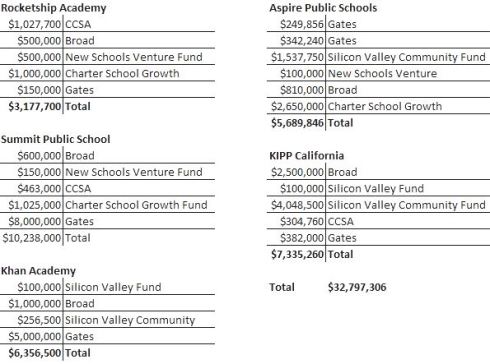
The foundations working to privatize public schools are almost all organized under IRS tax code 501(c)(3), which means they cannot engage in direct or even indirect support of political candidates and they must file an IRS form 990 every year. These forms detail who they gave money to and how much they pay top fund administrators. For following these and other rules, they become a tax free entity. The latest complete set of form 990’s is from tax year 2014 which details spending in 2013. The chart below is based on an analysis of selected 2014 form 990’s

Fund Totals

Fund Spending on Organizations Implementing CBE

 The 2013 spending of the following list of seven funds was analyzed: California Charter Schools Association (CCSA), The Edythe and Eli Broad Foundation (Broad), New Schools Venture Fund, Charter School Growth Fund, The Bill and Melinda Gates Foundation (Gates), The Silicon Valley Fund, The Silicon Valley Community Foundation. Other than the data for the Gates fund, the information all comes from 2014 form 990’s. The Gates data came from his foundation web site.

The spending on these five schools was extraordinary in that the amounts given are far greater than the amounts these organizations typically give to other charter schools. Most grants to charter schools from these funds are significantly less than $50,000 unless it is for startup purposes. So what made these five schools worthy of $33,000,000 in 2013? They are all testing CBE principles on their students.

A look at some of the key board members of these funds reveals a small community of wealthy true believers.

 KIPP Foundation: Doris Fisher, John Fisher, Reed Hastings, Carrie Walton Penner

Silicon Valley Fund: John Fisher, Ted Mitchell

New Schools Venture Fund: Lauren Powell Jobs, Ted Mitchell

Edythe and Eli Broad Foundation: Eli Broad, Gregory Mcginity

Charter School Growth Fund: Kevin Hall, John Fisher, Carrie Walton Penner

California Charter Schools Assoc.: Reed Hastings, Carrie Walton Penner, Gregory Mcginity

 The Silicon Valley Community Foundation is a little different than the other six organizations. It is not significantly about privatizing schools. There are many large community funds in California like this one and they support things ranging from community art to homeless shelters. However, funds like the San Diego Foundation and the Los Angeles Community Foundation have huge assets and they support charter schools at a much higher rate than they support public schools. A little light shined on these community foundations might make it less likely that they continue spending patterns that many of their board members probably do not understand.

All of this spending to undermine the present public education system is predicated on an article of faith held by wealthy (amateur education policy experts) reformers – “public schools are failing.”

In a June Atlantic Magazine article, Jack Schneider put it this way:

 “Thus, despite the fact that there is often little evidence in support of utopian schemes like “personalized online learning,” which would use software to create a custom curriculum for each student, or “value-added measures” of teachers, which would determine educator effectiveness by running student test scores through an algorithm, many people are willing to suspend disbelief. Why? Because they have been convinced that the alternative—a status quo in precipitous decline—is worse. But what if the schools aren’t in a downward spiral? What if, instead, things are slowly but steadily improving? In that light, disruption—a buzzword if ever there was one—doesn’t sound like such a great idea.”

 The evidence says America’s public schools are indeed continuously improving. But, misguided “do-gooders” are threatening to destroy the system and charter schools are the vehicle implementing their schemes. It is time for an OPT OUT of charter schools movement and a halt to CBE.

Privatizing California’s Public Schools

19 Jun

By Thomas Ultican 6/19/2016

The California Charter Schools Association (CCSA) and the Republican machine destroying public education in California or at least trying to privatize it; are promoting their jaded cause.

Three key players in the assault on California’s public schools are Walmart heiress, Carrie Walton Penner, Netflix CEO, Reed Hastings and nativist republican politician, Steve Poizner. In 2001, they started EdVoice a lobbying organization that claims California schools are broken and must be reformed. In 2003 Poizner founded the CCSA. Walton Penner and Hastings remain as board members of both EdVoice and CCSA.

About These Key Players

In a 2008 Sacramento Bee Article announcing Poizner’s run for governor, it said, “Poizner, 51, sold a high-tech business in 2000 for $1 billion and has spent more than $24 million of his own money to launch his political career. A socially moderate, pro-choice Republican, Poizner has gone to great lengths to woo the conservative base of the Republican Party, touting himself as a fiscal conservative.” In 2001, Poizner took a senior fellows position in the Bush white house. He was elected California’s insurance commissioner serving from 2007 to 2011.

Reed Hastings is famous for being the founding CEO of Netflix. Joanne Jacobs wrote a puff piece about Hastings for EducationNext, a conservative pro-school-privatization  publication. She opened the article:

 “Netflix CEO Reed Hastings has given millions of dollars to start charter schools. He’s put millions more into developing education software to personalize learning. But he doesn’t just give money. He makes things change. And he is not a fan of school boards.

 “The high-tech billionaire—he hit the “b” this year, according to Forbes—led and financed a 1998 campaign that forced the California legislature to liberalize its restrictive charter law. He served on the California Board of Education for four years. Hastings provided start-up funding for the Aspire Public Schools charter network and helped start and fund EdVoice, a lobbying group, and the NewSchools Venture Fund, which supports education entrepreneurs.”

 Many super-wealthy education reformers are not fans of democracy. There is a natural and dark human tendency to desire control over others. With their massive wealth, billionaire’s are capable of subverting democracy and enforcing their frequently uninformed opinions.

For decades, John Walton and the Walton Family Foundation promoted vouchers as the ideal fix for what Walton saw as needing fixed. In a Washington Post article Jeff Bryant wrote:

 “Fully inculcated with Friedman’s philosophies, and motivated by the myth of school failure spread by the Reagan administration, the Waltons were ready for their education revolution to begin.

 “John Walton launched the foundation’s battle for school choice by throwing both money and influence into a succession of voucher referendums throughout the 1990s and beyond — only to see the cause defeated at the ballot box time after time, as numerous studies have chronicled. The public, it would seem, was nowhere near as keen on the idea of vouchers as the Waltons and their ilk.”

 After a series of defeats, the foundation transitioned the privatization agenda to advancing charter schools. Bryant continued:

 “According to a pro-union website, another member of the Walton family, Carrie Walton Penner, sits on the board of the foundation connected to the prominent KIPP charter school chain—on which the Walton Family Foundation has lavished many millions in donations—and is also a member of the California Charter Schools Association. Carrie’s husband, Greg Penner, is a director of the Charter Growth Fund, a ‘non-profit venture capital fund’ investing in charter schools. And Annie Walton Proietti, the daughter of Sam Walton’s youngest son Jim, works for a KIPP school in Denver.”

 Carrie Walton Penner serves on the boards of several organizations, including the KIPP Foundation, the Charter School Growth Fund, the California Charter Schools Association, EdVoice, Innovate Public Schools and the Stanford University Graduate School of Education.

Reed Hastings is on the board of the California Charter Schools Association; the KIPP Foundation; DreamBox Learning, an education technology company; and the Pahara Institute, which provides fellowships to education leaders. On the business side, he served on Microsoft’s board until 2012 and is now on Facebook’s board.

This is a tight knit group of wealthy elites flexing their financial power to control education policy which means privatizing public schools.

The Hired Guns

Jeb Wallace is the CEO of CCSA. He is unusual in the pro-privatize set in that he did work in an elementary school in Los Angeles. He helped create a school within the school that led to a charter conversion. Wallace left LA to join Allen Bersin in San Diego to supervise charter schools in the San Diego Unified School District.

Bersin is cited by the Democrats for Education Reform as “a hero of education reform.” The citation says, “Appointed in 1998 as Superintendent of Public Education of the San Diego Unified School District, Bersin led the eighth largest urban school district in the country. In 2005, Governor Schwarzenegger appointed him as California’s Education Secretary. Bersin is a lawyer with no training in education. In her book, The Death and Life of the Great American School System, Diane Ravitch called Bersin’s tenure in San Diego a test run for corporate style education reform.

Wallace went from San Diego Unified to be COO of High Tech High, the new startup charter school sponsored by the Jacobs family, founders and major stock holders of Qualcomm Inc. The Bill and Melinda Gates Foundation provided a $9.4 million startup grant and has contributed another almost $4 million in support funding since 2000.

In 2009, Wallace moved on to be President and CEO of CCSA. The Association form 990 covering tax year 2013 listed his remuneration as $336,000.

Bill Lucia, who is the CEO of EdVoice, was a senior official at the Department of Education in the George W. Bush administration. Lucia has served as Executive Director of the State Board of Education and in a number of key staff positions within the California State Legislature, including Chief Consultant of the Assembly Education Committee, senior staff on the Budget and Appropriations Committees, and Chief of Staff and education consultant to the Chairman of the Senate Republican Caucus.

Lucia has worked in various senior education policy roles, including as COO and Director of Policy at EdVoice from March 2008 through March 2010. Prior to joining EdVoice, Lucia served as Senior Vice President for Advocacy and Policy, leading the advocacy and legal defense team at the California Charter Schools Association(CCSA). Before joining CCSA, Lucia worked as Senior Assessment Policy Liaison for Educational Testing Service.

The most recent EdVoice form 990 lists compensation to Lucia as more the $250,000.

Compassionate Love for Children Motivates the CCSA Board

This calls to mind the observation Ciedie Aech made in her wonderful book Why Is You Always Got To Be Trippin’:

 “So. When big money gets thrown around under the socially responsible guise of helping less powerful and politically disenfranchised citizens – benevolently offering that helpful leg up, so to speak; well, it’s a funny but historical trend that quite often this particular kind of money? Somehow, sort of, gets redirected.”

 Diane Tavenner the CCSA board Chairman is the Founder and CEO of Summit Public Schools, a non-profit charter management organization focused on Silicon Valley. Her reported charter school earnings for 2013 – $192,000.

Ana Ponce the CCSA board Secretary is Chief Executive Officer of Camino Nuevo Charter Academy (CNCA). CNCA is a neighborhood network of 5 elementary and secondary schools serving over 2000 students within the greater MacArthur Park neighborhood near Downtown Los Angeles. Her reported charter school earnings for 2013 – $205,000.

Christopher Nelson the CCSA Treasure is the Managing Director of the Doris & Donald Fisher Fund (Gap Inc. profits used to privatize public schools). His reported foundation earnings for 2013 – $475,000.

Cameron Curry a CCSA board member is the founder of the Classical Academy schools in north San Diego County. His organization has five sites serving 3,000 students. His reported charter school earnings for 2013 – $223,000.

Margaret Fortune a CCSA board member is the President and CEO of Fortune School of Education. There are five Fortune Schools in San Bernardino and Sacramento serving 1250 students. Her reported charter school earnings for 2013 – $226,000.

Gregory McGinity a CCSA board member is the Executive Director of Policy for The Broad Foundation. His reported foundation earnings for 2013 – $303,000.

The 2014 form 990 report to the IRS reveals that 12 employees of CCSA were paid more than $150,000 each in 2013.

Swaying Elections

 In the lead up to the San Diego County school board election on California’s June 7 primary ballot, the Voice of San Diego reported, “Partly to ensure charter schools get a fair review when they petition to open a school, CCSA is backing four challengers in the election: Powell, Jerry Rindone, Paulette Donnellon and former state Sen. Mark Wyland.” There are similar reports from around California of big money political activity supporting candidates thought to be more charter school friendly.

In 2013, the CCSA reported taking in $22,000,000. The Association declares itself to be a 501(c)(3) non-profit, which means CCSA must adhere to the associated regulations.

One of the regulations prohibits 501(c)(3)’s from engaging in electoral politics. IRS code states:

 “Under the Internal Revenue Code, all section 501(c)(3) organizations are absolutely prohibited from directly or indirectly participating in, or intervening in, any political campaign on behalf of (or in opposition to) any candidate for elective public office. Contributions to political campaign funds or public statements of position (verbal or written) made on behalf of the organization in favor of or in opposition to any candidate for public office clearly violate the prohibition against political campaign activity.  Violating this prohibition may result in denial or revocation of tax-exempt status and the imposition of certain excise taxes.” (emphasis added)

 It is hard to see how a fair reading of this code makes it possible for organizations like CCSA not to lose their 501(c)(3) status. Why are people like Carrie Walton Penner, Reed Hastings and Jeb Wallace allowed to flout this law with impunity?

When researching for this report, I noticed that the California Foundation which has over $3 billion in assets and donates to charter schools shares the same address as the CCSA. (Correction; they only share the same zip code.)

I also noticed that many of the key people involved in privatizing California’s public schools were significantly involved in California and national republican party politics. Having groups like the Democrats for Education Reform and the Obama administration joining these Republicans in the effort to privatize public schools is difficult to comprehend.

Public schools are important to both American democracy and a vibrant just culture. They are worth fighting to save from arrogance, ignorance and greed.

Governor “Charter School”

8 Jun

I recently commented on a Diane Ravitch post writing, “I love Governor ‘Moon-beam’; I detest Governor ‘Charter-School;’” referring to Governor of California, Jerry Brown.

Ed Source recently reported:

“Brown started two charter schools in Oakland when he was mayor of the city, and has fought, through vetoes, attempts to encroach on their independence or dilute protections in the state’s charter school enabling law. This year, he vetoed AB 787, which would have banned for-profit charters, which operate primarily online charter schools. Brown said proponents failed to make a case for the bill, and the bill’s ambiguous wording could have been interpreted to restrict the ability of nonprofit charter schools to continue using for-profit vendors.”

Two consistent features of modern education governance are that politicians and business men who have power enforce their own particular biases even though lacking both educational experience and knowledge. The second feature is education policy is NOT based on research. As Anthony Cody describes, “Sadly, Lubienski, Debray, and Scott discovered that ‘research played virtually no part in decision making for policymakers, despite their frequent rhetorical embrace of the value of research.’”

Governor Brown (in the face of mounting evidence) is more concerned about the future of the charter industry than he is about fraud and the diminution of public schools. He obviously believes that public schools are failing and that privatized schools are the path to better education. Neo-liberal philosophy increasingly embraced by the Democratic party postulates that “private business will always outperform government institutions.”

Is it Cyber-Charter or Cyber-Fraud?

The private businesses being protected by Brown, cyber-schools, are increasingly seen as extremely poor quality and more fraud than education alternative. In February Steven Rosenfeld reported, “For the second time in three months, the Walton Family Foundation—which has spent more than $1 billion to create a quarter of the nation’s 6,700 public charter schools—has announced that all online public school instruction, via cyber charter schools, is a colossal disaster for most K-12 students.”

Steven Singer an education commentator and activist from Pennsylvania stated it succinctly, “If you’re a parent, you’d literally be better off having your child skip school altogether than sending her to a cyber charter. LITERALLY! But if you’re an investor, online charters are like a free money machine. Just press the button and print however much cash you want!”

The nation’s largest cyber-charter chain is Michael Milken’s K-12 Inc. (remember his junk bond fraud conviction) The state legislation, AB 787, that Brown vetoed was inspired by the suspicious activities of California Virtual Academy and its contracted management organization K-12 Inc.

Since California Virtual Academy is a non-profit it is supposed to operate independently from its contracted management company, K-12 Inc. In a series of articles focused of the failure of California’s on-line charter schools, Jesse Califati at the San Jose Mercury News described:

“According to the nonprofit’s application for tax-exempt status, California Virtual Academy at San Mateo has a board of directors whose members should be willing to cut ties with the company if they feel the school is getting a raw deal. Indeed, the application specifies that all agreements between K12 and the school are the result of ‘arm’s-length’ negotiations.

“But a review of minutes from the 2014-15 school year’s board meetings and records of the board’s relationship to administrators hand-picked by K12 suggest the board has little or no independence from the company. A K12 employee led the board meetings, and all 35 resolutions she encouraged the board to endorse won unanimous approval.

“The board’s open public meetings are held during the workday in a conference room or around an administrator’s desk in the Daly City-based Jefferson Elementary School District, which authorized the academy’s charter. And board members rarely attend the meetings in person. They usually just call in from home.

“All told, the board spent an average of 13 minutes in each meeting.”

 In another piece Califati recounted:

 “Michael Kirst, president of the State Board of Education, worked for K12 as a consultant before Gov. Jerry Brown appointed him to the post in 2011. In March 2015, the board voted against shuttering a school run by the company that California Department of Education staff said should close because it was in financial disarray, marking the only time such a recommendation has been ignored.”

Privatized Systems Are Unstable and Increase Costs

The well-known education commentator Peter Greene states:

“Charters close because charter schools are businesses, and businesses close when it is not financially viable for them to stay open.

“The free market will never work for a national education system. Never. Never ever.

“A business operating in a free market will only stay in business as long as it is economically viable to do so. And it will never be economically viable to provide a service to every single customer in the country.”

 Center for Media and Democracy “has calculated, nearly 2,500 charter schools have shuttered between 2001 and 2013, affecting 288,000 American children enrolled in primary and secondary schools, and the failure rate for charter schools is much higher than for traditional public schools.”

In addition to the unstable nature of free market charter schools, it is not possible to run a public education system and a privatized education system for the same amount of money as just a public system. In order to maintain the same level of support to classrooms and satisfy the quest for public school choice, it will require taxes to be increased to finance the dual system.

MGT Consulting conducted a research study of the charter school costs to Los Angeles Unified School Districts (LAUSD). In addition to the over $500 million dollars in lost revenue from students leaving the system, LAUSD incurred almost $100 million dollars in un-recouped administrative costs to oversee the charter schools. The school district has more than 40 people assigned to state mandated charter school oversight responsibilities.

A researcher at Columbia University Teachers College, Jason B. Cook looked into local community cost effects spurred by charter school competition. Among the discoveries he documents:

“A key finding of this study is that charter competition also decreases the TPSD [Traditional Public School District] revenues raised through property taxes by depressing appraised district-level residential property values.  I also find that charter competition causes districts to spend less on instructional and other current expenditures and spend more on new construction capital outlays. This reallocation is more than a simple proportional change. A one percentage point increase in charter competition increases the overall amount that TPSDs spend on capital outlays by 7.3 percent.”

 “Successful Charters” Have Glaring Flaws

The KIPP charter chain has approximately 100 schools and is widely considered to be a charter school success story. Center for Media and Democracy looked at their tax records from 2013 and saw these highlights:

“KIPP received more than $18 million in grants from American tax dollars and more than $43 million from other sources, primarily other foundations;

“KIPP spent nearly $14 million on compensation, including more than $1.2 million on nine executives who received six-figure salaries, and nearly $2 million more on retirement and other benefits;

“KIPP also spent over $416,000 on advertising and a whopping $4.8 million on travel; it paid more than $1.2 to the Walt Disney World Swan and Resort;

“It also paid $1.2 million to Mathematica for its data analysis; that’s the firm that was used to try to rebut concerns about KIPP’s performance and attrition rates.”

Mary Ann Zehr wrote about a Western Michigan study of KIPP for Education Week:

“KIPP charter middle schools enroll a significantly higher proportion of African-American students than the local school districts they draw from, but 40 percent of the black males they enroll leave between grades 6 and 8, says a new nationwide study by researchers at Western Michigan University.

 “’The dropout rate for African-American males is really shocking,’ said Gary J. Miron, a professor of evaluation, measurement, and research at the university, in Kalamazoo, and the lead researcher for the study. “Kipp is doing a great job of educating students who persist, but not all who come.”

In a related story the headline on Mike Klonsky’s latest post says, “Chicago neighborhood schools, not charters, [are] the driving force behind rising grad rates.” Based on findings by the University of Chicago’s Consortium on Chicago School Research, Mike continues, “Well, it’s that time of year when the media spotlight is on all the privately-run charter schools that supposedly enroll 100% of their students in a college program. Of course they fail to mention they mean 100% of the 25% or fewer that make it from freshman year to the graduation ceremony.”

If the charter school generated dropout students are not misplaced by the dual system like the thousands of unaccounted for students in New Orleans, it is the public schools which must take them in.

It’s Not About Children; It’s About the Benjamin’s

Charter schools were originally considered an experiment. After a quarter of a century of doing considerable harm to local communities, and showing no unambiguously documented education successes (not even matching public school performance on testing), common sense dictates that we end this experiment. Unfortunately, charter schools have become an industry and feckless organizations like the California Charter School Association (CCSA) are spending millions of dollars to privatize public schools.

During the run-up to the recent California primary (June 7), it was an unpleasant surprise to learn that CCSA was spending $300,000 where I live on the four San Diego County Board of Education seats that were on the ballot. Diane Ravitch shared how much money the national charter industry was spending in California; posting on her widely followed blog, “There you have it: with all the issues facing the state, one-third of the $28 million spent by outside groups on state races is coming from charter advocates.” Charter schools have become an industrial complex. It is not about improved schools or choice; it’s only about the money.

Caprice Young was the first president of the California Charter Schools Association. Today she is leading the Magnolia Public Schools, a California Charter School chain that is known to be part of the controversial Turkish Imam, Fethullah Güllen’s charter school empire. The Los Angeles based education activist Robert D. Skeels posted:

“Magnolia, its parent Pacifica Institute, and their cult leader Fethullah Gülen are all high profile Armenian Genocide deniers. To make matters worse, their entire public relations campaign is paid for with money that is supposed to be used in classrooms. Magnolia enlisted the help of the California Charter Schools Association (CCSA) for this Gülen misinformation campaign, and CCSA’s “CEO” Jed Wallace is quoted in the press release in which misrepresentations about both Magnolia’s connections to the Gülen Network, and their audit results appear.

“The CCSA is currently attacking an Armenian candidate running for California Assembly, spending obscene amounts of money. That the CCSA, Jed Wallace, and Caprice Young are simultaneously attacking Armenian candidates for office, while working hand-in-hand with organizations that actively deny the Armenian Genocide is highly disconcerting.”

Last night (June 7) I heard Donald Trump call America’s schools “failed.” That must be the same lie that Governor “Charter-School” believes. America’s public schools are amazing. Even after two decades of denigration and slander by elites, our public schools are still the foremost education system in the world. Don’t allow greed and foolishness to destroy this bedrock of American democracy.


Charter Schools Strip Public System

27 May

By Thomas Ultican 5/27/2016

United Teachers of Los Angeles (UTLA) contracted with MGT of America Consulting, LLC for a report on costs to Los Angeles Unified School District (LAUSD) caused by charter schools. MGT reported, “these data indicate that LAUSD has a nearly $600 million impact from independent charter schools. By far, the most significant financial impact to LAUSD is in the area of declining enrollment lost to charter schools” which they estimated as a “total net revenue loss in 2014-15 $508,280,866.” Within a few days the California Charter Schools Association (CCSA) began attacking the report in an open letter to the LAUSD Board of Education.

CCSA said of the report: “This report is riddled with inaccuracies;” “It draws sweeping and often irresponsible conclusions based on limited information and obsolete data;” “It paints a distorted picture of charter schools’ role in L.A. Unified’s financial portfolio;” “Charters are essential to the district’s success.”

A fair reading of the report reveals that MGT’s representative was conservative, clear, careful and reasoned. MGT is a private research firm that has expertise in analyzing school and other governmental systems. They accepted a contract with the UTLA to research a set of specific questions and they do not appear to have a dog in this fight. Conversely, the $15 million budget that California Charter Schools Association (CCSA) has to promote charter schools gives them an undeniable agenda.

CCSA Disputes and Reality

There are 24 findings stated in the MGT report. Each of the findings is explained in some detail and the source of the data is given. The CCSA disputes four of these findings in their open letter. The refutations bring to mind arguments about how many angles can dance on the head of a pin.

CCSA disputed the special education findings. MGT found, “the district has both a higher proportion of special education students than the charter schools (13.4% vs. 8.1%, as of December 2013) and of that proportion, has double the percentage of higher cost ‘Moderate to Severe’ special education students than its charters (30% vs 15%), as reported in the data compiled for the Independent Financial Review Panel report published November 10, 2015.”

CCSA says, “The report uses a number of outdated and erroneous statistics that paint a misleading picture of both the proportion of students with disabilities in charters schools and the fiscal impact on the District.” They claim a “recent analysis” shows the LAUSD over identifies special education students. They also point to data from the Office of the Independent Monitor that shows that LA charter school only served 3% less special education students in 2013-2014 not the 5% difference shown in the report. Why there is a discrepancy between the data provided by the Independent Monitor and LAUSD is not clear. The following chart based on data provided by LAUSD and the state of California indicates for some reason the percentage of charter school students in LAUSD is increasing.

SPED Percent LA

It may be that the CCSA is more worried about possible changes to California law than they are about this report. They stated, “The UTLA/MGT ‘Finding 5’ regarding Proposition 39 oversight fees is false. If a school district, such as the Los Angeles Unified School District, charges a pro rata share, the facilities are not substantially rent free and the school district cannot charge the 3% oversight fee.” On this subject the MGT report explains, “LAUSD has fifty-six (56) charter schools currently co-located in LAUSD facilities and has elected to use the “pro rata share” approach for facilities charges. By doing so, the district may have determined it may not also charge the 3% oversight fee. However, the majority of the costs included in the pro rata calculation are direct costs that charters should already be paying that are associated with occupancy of the facilities (e.g. utilities, custodial, trash, grounds, etc.).” It does not look like a false claim at all but just a suggestion for the district to save a few dollars from going into the pockets of CCSA clients.

Poor Law Harming Local Schools

The MGT study illustrates how charter school law in California is fashioned to favor privately operated charter schools over public schools. If a local community passed a bond measure in the 1980’s to build a new public school, it is the law in California that the members of that local community – who still might be paying for that public school – will have no choice but to allow a private operator move into the facility. In addition, the charter school law requires the local school district to incur many direct and indirect costs to support charter schools.

In California, since its statehood, a super-majority (67%) was required to pass a school bond measure. In 2000, after losing an effort that March to mitigate the super-majority rules and the infamous proposition 13 limitations, supporters brought forward proposition 39 that would reduce school-bond super-majorities to 55% and did not seriously threaten proposition 13 protections enacted in 1978. It passed 53% to 47% in November.

In the official ballot summary for proposition 39 in the November 7, 2000 election the support message was signed by Lavonne Mcbroom, President California State PTA; Jacqueline N. Antee, AARP State President; and Allan Zaremerg, President California Chamber of Commerce. The statement against the proposition was signed by Jon Coupal, Chairman Save Our Homes Committee, Vote No on Proposition 39, a Project of the Howard Jarvis Taxpayers Association; Dean Andal, Chairman Board of Equalization, State of California; and Felicia Elkinson, Past President Council of Sacramento Senior Organizations.

This proposition was a battle royal with every media source and elected official bloviating endlessly about the righteousness of their side. However, like in the official ballot measure statements, there was no discussion of the charter school co-location funding requirement in article six of the proposition.

When proposition 39 is coupled with the undemocratic charter authorizing system in California, citizens lose all democratic control of their local schools. With the three levels of government having the power to authorize charter schools it is almost impossible to turn down an charter request no matter how bad the schools previous history is or how inundated a community might be with certain types of schools. As former Assistant Secretary of Education, Diane Ravitch writes:

 “District officials in California have confided in me that it is virtually impossible to stop a charter proposal, no matter how bad it is or how little it is needed. If the district turns down the proposal, the charter advocates appeal to the Los Angeles County School Board, where they are often approved. In the off-chance that both the district and the county turn down their proposal, the advocates appeal to the state, where they are almost certain to win approval.”

CCSA Influencing Elections

Here in San Diego, it appears the CCSA is trying to pack the San Diego County Board of Education with charter school proponents. Four of the five seats on the Board are up for election on June 7. The Voice of San Diego reported, “Nine candidates will vie for the openings, including four incumbents: Gregg Robinson, Mark Anderson, Guadalupe Gonzalez and Rick Shea. All except Shea are community college educators.” And they continue, “CCSA is backing four challengers in the election: [Mark] Powell, Jerry Rindone, Paulette Donnellon and former state Sen. Mark Wyland.”

Evidently the fact that “The County Board denied six of the seven charters it has reviewed since 2011 is a cause for corporate spending. In all of those cases, County Board members went along with the recommendations of staff members who reviewed the document.” The County Board only reviews cases that have already been turned down by local school districts.

Stop Authorizing Charter at Least until Law Fixed

Public education run by democratic processes is a major good. The past two decades of school reform have produced nothing but negative results and profits. The more enthusiastically the corporate and billionaire driven reforms have been embraced the worse the results (see Denver, New Orleans and Washington DC). It is time to stop all new charter school authorizations in California. It is time to reject the Common Core State Standards and the Next Generation Science Standards. It is time to embrace professional educators working democratically within local communities to restore public education in America. It is time to protect our great inherited legacy – public education – which is definitely not a privatized market driven education.

Competency Based Education and San Diego

15 May

By Thomas Ultican 5/15/2016

A May 4 San Diego Unified School District  press release “announced a significant reduction in the amount of high-stakes standardized testing at local schools.” The next day, May 5, former Assistant Secretary of Education, Diane Ravitch, wrote on her blog, “I met [SDUSD] Superintendent Cindy Marten when she was a principal. I could see her love for the children and her respect for teachers. For her courage in doing what is best for children, I add her to the honor roll of the blog.” Two days later, May 7, Emily Talmage (educator and blogger from Maine who has notable expertise regarding Competency Based Education, {CBE}) wrote, “A closer look at San Diego Unified’s agenda reveals that instead of shedding corporate-driven, top-down reforms as Ravitch claims, the district is instead embracing the highly profitable yet woefully under-researched 21st century version of ed reform that is rapidly sweeping the nation.” Talmage was referring to CBE.

Looking into the matter myself, I have concluded that both of these women are correct. Cindy Marten has been wonderful and the reduction in testing is real and significant. I work in a school district adjacent to Cindy’s and we too have recently selected a true professional leader who works for good, Karen Janney. Even though both of these women are extraordinary leaders, their school districts are targeted by corporate sponsors of what Emily insightfully labeled “the highly profitable yet woefully under-researched 21st century version of ed reform.”

Cindy Marten and StriveTogether

Talmage implies that Cindy Marten is in league with Bill Gates and his ilk because she is listed as hosting a StriveTogether conference in San Diego, October 2014. StriveTogether uses the creepy subtitle “Every Child. Cradle to Career.” Its parent organization is KnowledgeWorks whose self described purpose is; “Every student experiences meaningful personalized learning that enables him or her to thrive in college, career and civic life.” This means a software driven curriculum delivered by a digital device. KnowledgeWorks has a large corporate sponsorship comprised mainly of companies associated with technology and testing. But I don’t think Marten intended to align herself with StriveTogether or Bill Gates.

In 2011, the Sol Price Foundation started the City Heights Partnership for Children where Marten was serving as principal of Central Elementary. In 2013 the United Way took over management of City Heights Partnership for Children. Marten’s relationship with StriveTogether is through Partnership for Children and United Way. Talmage is correct about StriveTogether being a terrible front for corporate raiders targeting education dollars and Marten should rethink representing Partnership for Children at any events associated with StriveTogether. However, Gates money is ubiquitous and it is difficult to be socially engaged and not have some relationship with organizations that Gates supports; for example the PTA, AFT and NEA.

The 70-person committee tasked with creating a plan for San Diego Unified’s digital path forward last reported in December 2014. One of their goals that they provided to Marten and the school board was “implement competency-based learning and problem-solving-based assessment, aligned with Common Core standards.” This also can be correctly interpreted to mean a software driven curriculum delivered by a digital device and tested on-line.

As a classroom teacher for the past fifteen years, I find these goals reprehensible. Common Core is a set of standards paid for by Bill Gates, copyrighted by a non-profit Bill Gates finances and written by testing corporation employees (mostly College Board and ACT). The standards are poorly written and horribly aligned. Competency Base Education is one of those awful agendas that will facilitate purloining education dollars but sounds reasonable to people who have no significant time in a classroom or have been out of the classroom so long they have forgotten how important the human connection is for a successful learning process.

Daisaku Ikeda, the founder of the Soka Schools, touches on this subject in his book Soka Education, “Recognizing each student as a unique personality and transmitting something through contacts between that personality and the personality of the instructor is more than a way of implanting knowledge: it is the essence of education.” Ikeda also mentioned that Socrates likened this to being “kindled by a leaping spark” between teacher and student. Low cost on-line learning is spiritless, amoral and dead.

Why so much Spending on Technology?

 Education is my fifth career. My previous career was as a researcher in Silicon Valley developing advanced recording devices. I wrote code to run test equipment and take data. The database I developed would handle automatic data inputs and produce presentable reports. I evolved into a technology loving geek. When I became a teacher, it was clear to me that technology was the wave of the future which would significantly improve teaching. I was wrong.

Technologists who are often entrepreneurs; government organizations under the influence of these entrepreneurs; school information technology leaders; and fans of technology form a formidable vanguard of support for the untested belief in the efficacy of digital based education. And when these groups meet, they easily succumb to the dangers of group think.

On October 23, 2015, most of the top technologists in San Diego County schools gathered to brief each other on what they were doing and to learn about new education technologies. The event was billed as a “Market Briefing.” The news release by The Center for Digital Education said. “The Center for Digital Education hosted a Market Briefing event in San Diego, CA. IT leaders from some of the largest districts in San Diego were [on] hand for a special briefing on their technology plans, priorities and focus for the coming years.”

The Center for Digital Education belongs to eRepublic. Take a quick look at the eRepublic web pages and you will learn how eRepublic can help you create and market digital products to all levels of government. They are not education specialist. They are sales facilitators, who understand how to co-opt government employees and make them allies. At conferences like “Market Briefing,” digital tools are seen as unquestionably essential to the path forward for 21st century education.

The Obama administration is 100% on board with Competency Based Education. His department of education has literally hundreds of citations from reports, mostly by think tanks supported by technology companies, which sell the virtues of CBE. The department’s stance on CBE is made clear here:

 “Transitioning away from seat time, in favor of a structure that creates flexibility, allows students to progress as they demonstrate mastery of academic content, regardless of time, place, or pace of learning. Competency-based strategies provide flexibility in the way that credit can be earned or awarded, and provide students with personalized learning opportunities. These strategies include online and blended learning, dual enrollment and early college high schools, project-based and community-based learning, and credit recovery, among others. This type of learning leads to better student engagement because the content is relevant to each student and tailored to their unique needs. It also leads to better student outcomes because the pace of learning is customized to each student.”

This statement is typical of the statements supporting CBE and other digital learning schemes. It is all assertion with no evidence. The Achilles heel of “corporate education reform” continues to be that the evidence does not support the claims.

When the government and corporate America is applying so much pressure for schools to embrace CBE and other digital strategies, it is little wonder that school boards and superintendents acquiesce. This week, the leadership (which I like and respect) in my school district (Sweetwater) announced that the board voted to: “Accept the technology task force recommendation to continue purchasing student devices for grades 9-10, and direct staff to enter into contracts and execute lease agreements for such purchase, and to maintain the iPad program at middle schools for the 2016-2017 school year, and allow the technology task force to continue its work for the 2016-2017 school year.” If they had conducted a more thorough cost benefit analysis, they might have hired more teachers or janitors instead of purchasing I-pads and laptops.

The Sweetwater Union High School District’s technology plan was published in 2014 before the present leadership took the helm. However, it is clear that the push for a 1:1 digital device ratio and facilitating online learning are still being pursued. The evidence supporting these policies in the Technology plan is provided by corporate America. Here is an example:

 “’Schools with a 1:1 student/computer ratio are cutting the dropout rate and reaping this broader benefit.’ On another front, there are the cost-savings associated with reduced printing, copying and paper usage. According to Project RED, ‘It is estimated that high schools where every student has a computer and which use an LMS [learning management system] could cut copy budgets in half. On a national basis that would equate to savings of $400M a year for high schools alone.’” (page 81)

 This is just one of many statements citing Project Red as evidence for these policies. The problem is Project Red in not an independent research organization without an agenda. They are funded by some of the largest companies in the world including Pearson Corporation, a company that hopes to dominate the online education world.

Technology does have a place in education and online learning is possible. But, it cannot be done on the cheap. Computer learning systems that are little more than drill and skill systems are terrible. School leaders need informed educators and constituents to help them protect community schools from corporate greed and government malfeasance. One to one digital policies do not pass a rigorous cost-benefit analysis and Competency Based Education appears to be more scam than legitimate education policy.

A Recommendation for Beyond Measure

1 May

By Thomas Ultican 5/1/2016

Vicki Abeles, the director of the documentary film “Race to Nowhere”, writes about the damage modern education reform is doing to our children and our culture. Her book, Beyond Measure, subtitled “Rescuing an Overscheduled, Over Tested, Underestimated Generation” jumps into the readers face starting with the amazing poem in the forward and continues gaining powerful momentum through chapter five. Abeles is trained in law and not education and that fact leads to my one criticism; her suggested solution, starting in chapter six, reflects the tendency of those without deep educational experience to discover silver bullets that will fix everything.

Abeles writes, “Without even realizing it, our driving goal has become all about preparing for the college application, not preparing for the college experience or life beyond. Performing, not learning. Amassing credentials, not growing. Not even really living.” (page 7)

She writes of observing her own daughters’ growing stress and of her staying up until midnight or later to do homework. But the event that got her attention was the suicide of 13-year-old Devon Marvin. Devon was viewed as one of the success stories in the community. When her mother Jane investigated Devon’s emails and text messages, the only cause for the suicide appeared to be a math test. “’She was torn up about this math.’ Jane told me. ‘Here’s a child who had always been so successful on so many fronts – and a stupid math grade.’” (page 9)

Abeles explains how eighteen-year-old Emily recounted slipping into deep depression her junior year and contemplating suicide. Here is Emily’s powerful quote that Abeles shares:

 “Junior year is supposedly the most important in high school and my effort just wasn’t going to cut it, not if I wanted to go to a decent college, and without a degree from a top university I was not going to be successful…. I had failed. All those years of late nights studying for AP classes followed by 5 AM water polo or swim practices, what would they come to? Nothing, just like me. In a world where we must excel in not one but many areas, I had not done so in any. I would rather be dead than face the years to come, sure to be filled with constant reminders of my failure. In my mind, there was only one way out.” (page 10)

 After sharing powerful anecdotal evidence, Adele opens chapter one, “Sicker, Not Smarter”, with a quote from Saint Louis University School of Medicine professor and pediatrician Stuart Slavin:

 “My personal feeling is that we are conducting an enormous and unprecedented social experiment on an entire generation of American children, and the evidence of a negative impact on adolescent mental health is overwhelming. This is particularly disturbing given the fact that having mental health problems in the teen years predisposes to mental health problems in adulthood. It is even more profoundly disturbing when one considers that there is absolutely no evidence that this educational approach actually leads to better educational outcomes.” (page 15)

 Abeles developed personal contact with multiple mental health and brain development experts in the writing of this book. She writes:

 “We think of the years from zero to three as the critical period for brain development, but Temple University neuroscientist Laurence Steinberg underscores that adolescence is another one. ‘[T]he brain’s malleability makes adolescence a period of tremendous opportunity – and great risk,’ writes Steinberg. ‘If we expose our young people to positive, supportive environments, they flourish. But if the environments are toxic, they will suffer in powerful and enduring ways.’” (page 31)

 The book takes on many of the bad ideas in education “reform”. She spends chapter three debunking the idea that rigorous daily homework assignments and longer hours are desirable. Among the many pieces of evidence she cites that homework is out of control, harming family life and not valuable is the comparison with Finland. “One of the consistent superstars on this test [PISA], Finland, logs the least homework time – an average of less than 3-hours per week for 15-year-olds (and Finish students spend fewer days and hours each day in school than their American counterparts).” (page 76)

Chapter four is titled “Testing: Learning Beyond the Bubble.” Abeles writes: “The outcome is not, as the tests intended, a good education for all. In fact, it is nearly the opposite. Standardized tests have driven American education into a vise grip of regimentation.” (page 99)

And she makes the cogent point:

 “Policy makers made matters even worse when they attached powerful consequences to standardized test scores – teachers’ job evaluations, schools’ funding, and students’ high school diplomas and college admissions – thereby plunging the entire American education system into a stultifying culture of fear.” (page 100)

 Abeles not only debunks the value of standardized testing but provides evidence of the mental health harm high stakes testing is engendering. She cites the work of Brent Fulton, Richard Scheffler, and Stephen Hinshaw at UC Berkeley who looked into 2015 ADHD rates. They found evidence that rates shot up dramatically with the introduction of high stakes testing. (page 106)

Abeles turned to solutions in chapter 6 and here I have a small criticism. In her research for this book and other projects she became enamored with High Tech High in San Diego. The High Tech High (HTH) program and curriculum evolved from the work of Larry Rosenstock and colleagues in the New Urban High School Project, an initiative of the U.S. Department of Education’s Office of Vocational and Adult Education.

Gary Irwin son of Qualcomm founder Jacob Irwin and Bill Gates were the main financiers of the startup of HTH. Gary Irwin is still involved with HTH as the Chair of its board of directors.

HTH uses a constructivist approach to education called problem based learning. At HTH students work with teaching teams that guide 50 students. My friend, Professor Larry Lawrence, toured HTH this March and related observing some of the same attributes Abeles notes. Students were relaxed, happy and seemingly engaged in their projects. However, Professor Lawrence soon noted that the high school only had one math class for all students. This concerned him. A student guide confessed that she did not feel challenged in her math class.

Also, public schools do not have the financial wherewithal to have only 50 students assigned to a team of teachers. This is California where we equitably provide financing for students to attend schools that have teachers serving 180 students each day in classes often exceeding 40 students.

In 2001, I was enrolled in a master’s of education program at UCSD. At the time, I was enamored with Dewey’s constructivist ideas and the problem based approach to teaching. Unfortunately, California state standards and NCLB rules made it impossible for public schools to implement or continue with these ideas.

Today, as I study problem based learning, I perceive that it is not a magic elixir for improving education. It is simply a promising idea that can be implemented along with other teaching strategies.

Not everyone is happy with the preparation of students from HTH because of their somewhat narrow approach to learning. I do not want to denigrate HTH, but some educators have complained that students from HTH are not well prepared for the college classroom. Whatever the reality is, the HTH approach is not the sole “silver bullet.”

The bottom line is that Vicki Abeles’ book is an important work that brings to light many aspects of the terrible damage being done by the test, punish and privatize era of education reform.

To Diane Feinstein Re. John King

26 Apr

By Thomas Ultican 4/26/2016

To: Senator Diane Feinstein

United States Senate

331 Hart Senate Office Building

Washington, D.C. 20510

From: Thomas Ultican

Dear Senator Feinstein,

Thank you for your courteous response to my entreaty to oppose the appointment of John King as the United States Secretary of Education.

The central point of what you wrote was:

“On March 14, 2016, I joined 48 of my colleagues to confirm King’s nomination.  While we may disagree on his nomination, please know that I respect your opinion and appreciate hearing your feedback.  I look forward to working with him as Congress continues to work towards providing a high-quality education to every student and ensure a successful future.”

I am writing back to share my belief that a shockingly large percentage of public education teachers feel abandoned by the Democratic Party. John Kings appointment was one more slap in the face. I personally am aware of several teachers who have reluctantly registered with the Green Party.

In 2008, teachers across America embraced the candidacy of Barack Obama. His spokesperson on education was Stanford University’s, Linda Darling-Hammond. Her embrace of standardized education gave me pause, but she was a professional educator with deep experience. I and others felt a great sense of betrayal, when Darling-Hammond was pushed aside for a political operative from Chicago with almost no professional experience as an educator, Arne Duncan.

Since then, the Obama administration has championed one horrible education policy after another. Duncan worked to de-professionalize teaching, privatize public education and make school a corporate profit center.

The “No Child Left Behind” legislation that was championed by the “liberal lion”, Ted Kennedy seriously damaged public education, undermined democratic control of schools and legitimized labeling schools and teachers as failures. And the testing schemes used to make those demoralizing judgments were not capable of such a determination.

Saddest of all is that minority teachers, because they often work in the poorest communities, have suffered the most from NCLB’s misguided accountability scheme based on unsound science.

The federal control of education has arrived with testing hell for students and enormous stress. All levels of education are dealing with dramatically increased mental illness manifested as student depression and self-mutilation. Despite the emotional and financial costs, testing score improvements have slowed and the scoring gap between minority students and white students has increased.

Standardized testing which has its American roots in the eugenics movement of the 1920’s and 1930’s is not a capable measure of good teaching or good schools. It is a fraud. As the education activist Steven Singer observed, “Practitioners like Carl Brigham used IQ tests to PROVE white people were just the best … He went on to refine his work into an even better indicator of intelligence that he called the Scholastic Aptitude Test or S.A.T.”

My personal opinion is that standardized testing is a scam, a waste of both taxpayer and student money. SAT, ACT and Pearson should not receive one more penny from taxpayers for their harmful misleading products and public universities should be encouraged to drop these bogus tests as part of the application requirements. High school grades are still the most reliable indicator of success in college.

There were bad schools before NCLB and Race to the Top, before charter schools; however they were the result of terrible state policies and not teachers or schools. Privatizing public schools just makes stealing taxpayer money easier.

Before Katrina, the schools in the poorer sections of New Orleans were an abomination. It was normal for middle schools to have 55 children in classes, with no fans or air conditioning.

When charter schools came to New Orleans the minority communities embraced them because they hoped that finally some money would be put into their schools. Unfortunately, this story is turning uglier every day. Because the charter schools are independent, thousands of students have fallen through the cracks; there are more than 10,000 New Orleans’ youths between the ages of 16 and 24 who are not in school and are not working.

And the heroic black educators of New Orleans have been replaced by TFA teachers with no experience and almost no training.

These are the result of amateurs believing that professionalism in education is not important.

Obama’s “Race to the Top” has done more damage than NCLB for that same reason.

Yes, Dr. John King, Jr. has and appealing story and impressive credentials from well thought of Ivy League schools. He does not have deep experience as an educator and his ham-handed tenure as the New York Commissioner of Education accelerated the hatred for Common Core and standardized testing in New York. He was a failure. John King made the opt-out of testing movement so robust.

I think your colleague from Utah, Senator Mike Lee, made cogent points when he said:

“I have studied Dr. King’s professional record, most notably his time in New York’s Department of Education, and I’ve reviewed the transcript of his confirmation hearing. Based on the policies that he’s supported, the bipartisan opposition he has invited throughout his career and his uncompromising commitment to the designs of bureaucrats and central planners over the lived experiences of parents and teachers, I believe it would be grave error for the Senate to confirm Dr. King’s nomination at this time. Indeed, I believe it would be difficult for anyone to support Dr. King’s nomination on the basis of his record.

“The problem is not that Dr. King lacks experience; on paper, you might think that Secretary of Education is the logical next step in his career. After three years as a teacher and a brief stint managing charter schools, Dr. King has risen through the ranks of education bureaucracy, climbing from one political appointment to the next. But do we really think that someone who has spent more time in a government agency than in a classroom is better suited to oversee federal education policy. And, more to the point, what matters isn’t the jobs that someone has held but the policies that person has advanced.”

Dr. King has promoted the privatization of the American public school system and the demise of local democratic control of public schools. Charter schools are not public schools. No parent has the right to attend their board meetings, look at their records or vote for their leadership. They are private businesses – often fraudulent – draining education dollars away from students.

At this point, all I can say is please watch him vigilantly. It is totally predictable that he will attempt to arrogate power to himself in ways totally in opposition to the spirit of the recent education law, ESSA. It is totally predictable that he will ignore the counsel of professional educators in favor schemes put forward by testing and technology companies.

Charter School Movement Out of Control

3 Apr

By Thomas Ultican 4/3/2016

In response to the polemic “A Nation at Risk”, charter schools were proposed as a means to improve education while finessing state education laws. They were essentially viewed as lab schools that would innovate and then transfer those innovations to the public school system. They have failed. Their academic performance which is often misrepresented as sensational is – at best – no better than public schools. Today, they are clearly driving increased segregation, harming community schools and increasing costs. Currently, the most powerful charter school promotions do not tout them as a way to improve education; rather they are now seen as a way to make money. It is time to stop school privatization which is actually leading to “A Nation at Risk.”

Investment Opportunity

Just search “charter school investment” and a list of articles from the New York Times, Forbes, Business Insider, the Washington Post and many more will appear. In March 2015, the Walton Family Foundation and the Bill and Melinda Gates Foundation co-sponsored an event in Manhattan called “Bonds and Blackboards: Investing in Charter Schools.” In the Business Insider report on this event, reporter Abby Jackson wrote:

 “Hedge funds and other private businesses are particularly interested in the growth and success of charter schools. The growth of charter networks around the US offer new revenue streams for investing, and the sector is quickly growing. Funding for charter schools is further incentivized by generous tax credits for investments to charter schools in underserved areas.”

Andre Agassi and Sean “Puff Daddy” Combs are fronting charter school development. What are an uneducated tennis player and a misogynistic rapper doing running schools? The LA times reports, “Add Sean “Diddy” Combs to the list of millionaires trying to fix American education. At the charter school the music mogul is opening in Harlem, teachers will be called ‘Illuminators’ and social justice will be key.” I am not sure how much social justice and illumination students will get from the words of their founder posted by Mercedes Schneider on her blog:

 “Nigga hungry like Cujo

Smoking that Pluto

No ticking time like hand on the rope

Nigga feel beautiful

No park brake but a nigga in neutral”

 The Mythic Charter School Success

There often appears in the media stories about the amazing success of charter schools. Almost all of these success stories are based on standardized testing results. Eva Moskowitz’s Success Academy charter chain in New York City is often held up as one of these amazing charter school successes. The New York Times reported in an article titled “At a Success Academy Charter School, Singling Out Pupils Who Have ‘Got to Go’”:

 “Success Academy, the high-performing charter school network in New York City, has long been dogged by accusations that its remarkable accomplishments are due, in part, to a practice of weeding out weak or difficult students. The network has always denied it. But documents obtained by The New York Times and interviews with 10 current and former Success employees at five schools suggest that some administrators in the network have singled out children they would like to see leave.”

 Recently, Rutgers University researcher Mark Weber published a report about the amazing results in Newark, New Jersey at the North Star Academy charter school a member of the Uncommon Schools charter chain (that’s the no-excuses charter chain Secretary of Education John King came from) Here is the data proving North Star’s myth inspiring results.

 “Take the most recent PARCC exams in New Jersey. About 41% of the state’s 11th graders met or exceeded expectations on the test.

 In Essex County, high-income Millburn High School (2.2% economically disadvantaged) saw 57% of students scoring proficient or advanced on the assessment. The juniors at Livingston High School (1.5 % economically disadvantaged) earned 56.5%.

 A few miles away, the juniors at Newark-based North Star Academy (83.7% economically disadvantaged) earned an 80.6% pass rate.”

What Weber shows in his report is the attrition rate at North Star is huge. Every year classes get smaller and testing results improve. North Star has a comparatively small special education enrollment, few language learners and a high expulsion rate. Also Chris Christie’s old high school, Livingston and Millburn High School have high opt out rates. So on the tests that don’t affect the students (PARCC), North Star actually outperformed the two famous public high schools, but on SAT testing that matters to the students the results reverse. North Star with its extra assets from philanthropy is doing good work but it is hardly a miracle.

Worrisome – School to Prison Pipeline

On March 16, the University of California Los Angeles’s Civil Rights Project released the results of a first-ever analysis of school discipline records for the nation’s more than 5,250 charter schools. A disturbing number are suspending big percentages of their black students and students with disabilities at highly disproportionate rates compared to white and non-disabled students.

The press release outlines these key findings:

“Study finds many charter schools feeding ‘school to prison pipeline.’”

“The comprehensive analysis by the Center for Civil Rights Remedies at the UCLA Civil Rights Project identified 374 charter schools across the country that had suspended 25% or more of their entire student body during the course of the 2011-12 academic year. The comprehensive review also revealed:

  • “Nearly half of all black secondary charter school students attended one of the 270 charter schools that was hyper-segregated (80% black) and where the aggregate black suspension rate was 25%.
  • More than 500 charter schools suspended black charter students at a rate that was at least 10 percentage points higher than that of white charter students.
  • Even more disconcerting, 1,093 charter schools suspended students with disabilities at a rate that was 10 or more percentage points higher than that of students without disabilities.
  • Perhaps most alarming, 235 charter schools suspended more than 50% of their enrolled students with disabilities.”

 Who Runs Charter Schools

Fetullah Gulen is a Turkish Imam living in exile in western Pennsylvania. Gülen is a powerful and determined opponent of the Turkish Prime Minister Recep Tayyip Erdogan and the leader of the Gulen charter school movement which has grown to over 160 schools in the United States.

A lawyer named Robert R. Amsterdam penned a piece about Gulen for The Hill. He stated:

 “Our law firm has been engaged by the Republic of Turkey – a key NATO ally in a hotbed region – to conduct a wide-ranging investigation into the operations and geopolitical influence of the Gülen organization, which is behind the Coral Academy of Science [serving on military bases in Nevada] and over 140 other public charter schools scattered across 26 American states.  Our investigation, still in its early stages, reveals that the Gülen organization uses charter schools and affiliated businesses in the U.S. to misappropriate and launder state and federal education dollars, which the organization then uses for its own benefit to develop political power in this country and globally.”

 Mr. Amsterdam also claims:

 “Aside from defrauding American taxpayers, the Gülen organization has an even more ominous objective in the United States.  The organization is one of the country’s largest recipients of H1-B “specialty occupation” visas, which it uses to import Turkish teachers into its charter schools, supposedly because local U.S. talent is not available to fill math and science teaching positions in its charter schools.  The Gülen organization illegally threatens to revoke these visas unless the Turkish teachers agree to kick back part of their salary to the organization.”

 Charter Power Politics Trumps Democracy

California’s Gulen charter schools are called Magnolia Public Schools. In Anaheim, California the local school district rejected the Magnolia Public Schools submission for a charter. Magnolia appealed to the Orange county Board of Education and was again rebuffed. However the state authorizer granted the charter. In a law suit filed by Anaheim school leaders, teachers, parents and others these allegations are made:

 “Magnolia illegally grants large contracts to affiliated vendors that have numerous overlapping connections with their own employees and board of directors. This nepotistic awarding of contracts to affiliated vendors poses illegal conflicts of interest, both individual and organizational, and is evidence of rampant self-dealing at the California taxpayer’s expense.

The audit found that over 69% of the transactions reviewed at the audited Magnolia schools were unaccounted for, evidencing weak internal controls and provoking larger concerns about how Magnolia’s funds are actually being used.

Magnolia has spent hundreds of thousands of tax dollars to secure H-1B visas for foreign teachers, the large majority of which hail from Turkey, which is not an approved employee expense under federal law.”

 The founder of the California Charter Schools Association, Caprice Young, is now leading the Magnolia Public Schools. The LA Times reported on the problems at Magnolia and Young’s ascension to leadership saying, “Critics have asserted that the Magnolia campuses are among more than 100 charter schools that have ties to a U.S.-based Turkish cleric, Fethullah Gulen. In an interview, Young said that she is not aware of any direct links with Gulen.” I wonder how many other charter school chains she is aware of that are dominated by Turkish teachers and administrators?

It is obvious that today’s charter school promoters are not concerned primarily (if at all) with the good of the community or children. It seems they only care about their business goals like achieving 1,000,000 California students in their privatized education system.

Fraud is rampant in charter school organizations and reports of student abuse are on the rise. Public schools in America never were failing and charter schools have caused a lot more harm than good. There are some wonderful charter schools and they should be saved, but do we really want useless cyber schools or suspect education at the local mall?

Do we really want to abandon democratic principles in favor portfolio districts (The operational theory behind portfolio districts is based on a stock market metaphor—the stock portfolio under the control of a portfolio manager. If a stock is low-performing, the manager sells it. As a practical matter, this means either closing the school or turning it over to a charter school or other management organization.)? Remember; stability is important for the development of healthy children and that is one thing charter schools and portfolio style churn do not provide.

Breakfast with Professor Lawrence

25 Mar

By Thomas Ultican 3/25/2016

Tuesday was another spectacular day in southern California and I was cruising up old Highway 101 to meet Larry Lawrence for a late breakfast. We met at the Ki café just south of Swami’s and the Kook. Swami’s is a famous surfing spot in Encinitas, California and the Kook is an often redecorated statue near the San Elijo State Beach. The Ki specializes in smoothies, juices and healthy meals prepared from organic products including the coffee I had with breakfast. Larry is a regular there. He directed me to a seat at his favorite table with an awe inspiring view of the Pacific Ocean. A scintillating three hour conversation about saving public schools ensued.

Professor Lawrence has reservations about standardized education. He illustrated them with a personal experience.

In 1962, he attended a class during the summer put on by the University of Illinois Committee on the School of Mathematics. In December 1951, the Colleges of Education, Engineering and Liberal Arts and Sciences established the University of Illinois Committee on School Mathematics (UICSM) to investigate a new pedagogy for high school mathematics. When he returned to Morningside High School in Inglewood, California, Larry convinced a colleague from the middle school to go take the course with him the following summer.

Two years later, Larry was teaching geometry and one of his classes was composed of the students out of his middle school friend’s honors algebra class. Larry soon discovered that this teacher had gotten so bogged down with teaching new ideas like set theory and algebra properties that he had not completed most of the fundamentals of algebra. His students were lost. Therefore, Larry changed the class he was teaching from geometry and made it algebra I. The administration supported his decision with almost no reservations. In today’s standardized environment, Larry is quite certain no professional educator would be allowed to make that kind of call.

The weekend of February 28th Professor Lawrence was at the United Opt Out conference in Philadelphia. He sees opt out as one of the most effective means of fighting today’s mean spirited greed driven education reform. He says the destruction to Philadelphia’s public school system by test driven reform and privatization is pervasive and profound. He called it truly sad.

On March 3, he was in Los Angeles at a meeting of TEAch (Transparency, Equity and Accountability in CHarter schools). He estimates an attendance of 80 people including Joan Kramer (retired teacher, activist, author of the Turtle Learning blog), Jackie Goldberg (former California State Assemblywoman, founding member of the progressive caucus and former student of Professor Lawrence at Morningside High), Steve Zimmer (President of the Los Angeles Unified School District), Scott Schmerelson (LAUSD board member) and the Red Queen of LA (The well known blogger). The moderator was Susan Phillips. These activists gathered to form strategies for saving public schools from the destruction caused by the billionaire financed charter school movement.

On March 8th, Larry was in Anaheim where Superintendent of Schools, Michael Matsuda was hosting a viewing of “Killing Ed.” He says, “This is an excellent documentary about the Gulen Charter Empire that needs to be shown to everyone.” On this occasion he also got to speak with Tina Andres (Southern California BAT leader).

On March 9th, he represented the Occidental Alumni in Education and toured the original High Tech High in San Diego.   After a brief meeting with the schools CEO and philosophical guide, Larry G. Rosenstock, Larry and one other Occidental alumnus were lead through the High Tech schools by two student “ambassadors” for almost two and a half hours.

High Tech schools were started with the support of Qualcomm founder, Irwin Jacobs and Bill Gates in 2000. Larry saw a very casual environment with small classes. Curriculum at High Tech is all presented using problem based learning, also known as the constructivist approach which derives from the thinking of John Dewey. High Tech has a robust professional development program for teachers which supports the constructivist ideal. It also confers a  masters in education, through the profession development program.

During the tour, Larry noticed that everyone was taking the same math class. When he asked the “ambassadors” about it, one of them said “yeah, that’s frustrating. I am good at math and I am not being challenged.” Overall, he rated the school as first rate but did see a few warts.

I have had a few students come into my classes from High Tech High who really hated it and a teacher friend of mine at Southwestern Community College says the students from High Tech struggle with a non-problem based learning environment.

Professor Lawrence shared some personal experience and knowledge that leads him to believe that High Tech system will eventually fail because it has no robust structure in place like public schools.

UCLA started a lab school in 1882. In 1925, Corinne A. Seeds was hired to lead the school. She like Larry Rosenstock was a Dewian and was a dynamic forceful personality. Seeds became a key figure in developing and promoting progressive education during the 1930s, ’40s and ’50s. When Seeds was in charge, the school flourished. Seeds retired in 1957 and for three years the school floundered.

Then fortune shined on the school again with the arrival of another dynamic personality in 1960, John Goodlad. In his New York Times obituary it said, “Professor Goodlad proposed a radically new model of schools, in which elementary school students would not be divided into specific grades and their work would not be graded.” Larry worked with Goodlad at what was then called the Seeds school and he still promotes this idea. I see a lot of merit in it as well.

In 1987, Goodlad left UCLA and the Seeds school. After that the school, suffered tremendous financial duress without its charismatic leader. In the 1990’s, Seeds tried to solve its problems by becoming a charter school and today it is a private school that calls itself a lab school.

Professor Lawrence thinks that when the charismatic founding leader of High Tech is gone it will face a bleak future as well. Not being part of the democratically supported and supervised system will eventually catch up with High Tech and undermine the good work being done there.

On March 19th, Larry got an email from Karen Wolfe (education activist and parent) inviting him to Sunday morning breakfast in LA with Diane Ravitch. At 6 AM Sunday morning he was headed north on Highway 5 for breakfast with Karen, Diane, Tina Andres, Ellen Lubic and Josh Leibner. His commitment to public education and energy to fight for it has inspired me.

We left lunch challenging each other to think of some way to bring together the disparate activists in San Diego who support public education. We are hoping that we might be able to join with other southern California activist at the National Public Education conference this April in Raleigh, North Carolina and advance our struggle for the salvation of public education in our part of the country.