The New Broad Center at Yale

19 Jul

By Thomas Ultican 7/19/2021

December 5, 2019, the LA Times reported “Broad Center to move from L.A. to Yale along with $100-million gift.” On that occasion, the well known blogger Mercedes Schneider described the Los Angeles-based “Broad Center,” which includes the “Broad Academy” and “Broad Residency”  as a “pseudo-credentialing mechanism for would-be leaders espousing market-based ed reform…” The new Ivy League center has adopted Eli Broad’s philosophy while giving it a sheen of academic respectability.

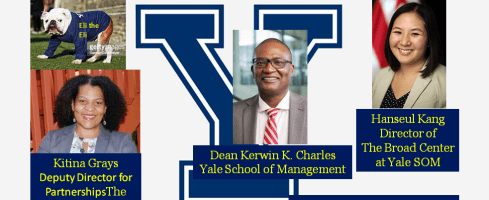
On July 1, 2019, Kerwin K. Charles was selected as dean of the Yale School of Management (SOM). Evidently, while looking around for a way to secure his Broad Center legacy, Eli Broad found the new leadership at Yale SOM a comfortable fit.

Blogger Jan Resseger says the $100 million gift means “that mega philanthropist, Eli Broad is buying a prestigious institutional home for a training program he alone devised.” The development of the Broad program was quite stunning. A billionaire with no education training or experience just decided he would start an education management training program. Broad’s only qualification was his immense wealth derived from business.

This June, The Broad Center at Yale SOM enrolled its first cadre of 17 Fellows into the Fellowship for Public Education Leadership program.

Continues Anti-Public School Ideology

In January, The Broad Center at Yale SOM hosted a virtual forum for The Broad Center (TBC) alumni. Their report paraphrased Professor Charles as saying, “The 2021 gathering … exemplified how Yale SOM will draw on the expertise of TBC alumni as it applies its approach to education leadership.”

The inaugural Executive Director of the new Broad Center is Hanseul Kang. She comes to New Haven from her post as Superintendent of Education for the District of Columbia. At the forum she stated,

“We will continue to draw inspiration and strength from what The Broad Center has been historically. Our engagement with all of you in the alumni network is going to continue.”

Kang was a member of the Broad Residency class of 2012-2014. At that time, she was serving as Chief of Staff for the Tennessee Department of Education while her fellow Broadie, Chris Barbic, was setting up the doomed to fail Tennessee Achievement School District.

Last month, the Broad Center at Yale SOM posted,

“We are thrilled to share the news that Katina Grays … will be joining The Broad Center at Yale SOM as our new Deputy Director for Partnerships!”

“As a Broad alum herself, Katina has developed strong relationships with transformative leaders across the TBC network.  Katina has led high-impact work and complex initiatives in senior leadership roles at KIPP NYC and at the Tennessee Department of Education, and previously worked at the Connecticut Department of Education.”

At the January forum, one of the key presenters was Pedro Martinez (Broad Academy 2009), Superintendent of the San Antonio Independent School District.

The post Big Spending on Privatizing Public Schools in San Antonio shares,

“Martinez is not an educator. He has never run a classroom or studied pedagogy. However, he does have a Masters in Business Administration from DePaul University and got his start in education working for Arne Duncan at the Chicago Public Schools (CPS).”

Yale’s Inaugural Fellowship for Public Education Leadership

The new Broad Center’s original seventeen trainees are comprised of 6-people from charter management organizations and 11-people from public education organizations. Naturally, the six charter school people are there to advance their careers supporting the privatization of public schools. Likewise, the 11-public school employees appear to be there to advance their own careers but not necessarily to advocate for privatizing public schools. There are two public school people that do appear to be angling for the billionaire financed privatization track.

Melissa Kim is Deputy Chancellor, District of Columbia Public Schools which has a reputation for facilitating public education privatization. She certainly had a working relationship with Broad Center Director Hanseul Kang in DC and is now in the first cohort training at The Broad Center Yale SOM.

Antonio Burt is Chief Academic Officer, Shelby County Schools, Tennessee. He appears to be on the fast track to a school privatization career. He is a board member of the new non-profit First-8-Memphis.  It was launched in 2019 as the fiscal agent to oversee public and private funding for early education initiatives. Burt joins a board made up predominately of local financial institution leaders. First-8 praises Burt as an education “reformer” who has led schools to success:

“One of those schools, Ford Road Elementary, was named a “Reward School” (performing in the top 5%) by the state of Tennessee after having been performing in the bottom 5% of all schools in the state of Tennessee. Ford Road achieved this honor two consecutive years (2012-2014).”

This is not totally a lie; just mostly. Their misleading framing has to do with the “Reward School” definition. The reality is that Ford Road Elementary which serves a high poverty community does not test well and has never escaped Tennessee’s bottom 5% of schools based on testing results. The last evaluation report for the school in 2019 listed it as targeted for support and improvement.

Conclusion

The former US Assistant Secretary of Education, Diane Ravitch, recently wrote about the merger of the National Superintendents Roundtable and the Schlechty Center noting, “If your school board is looking for a new superintendent who believes in public schools, these are the go-to sources.”  This contrasts to Broad trained Superintendents who have a history of bloated staffs, financial problems and are notorious for top down management that alienates teachers and parents. If your district hires a Broadie, it has become a target for disruption and privatization.

Significantly, Eli Broad chose a business institute instead of an education school to continue his training program. The Broad Center at Yale SOM appears to be in complete fidelity with the late Eli Broad’s privatize the commons ideology.

PTA: Reform Obstacle or Trusted Parent Advocate?

12 Jul

By Thomas Ultican 7/13/2021

Founded in 1897, the ubiquitous PTA has been a long time powerful voice in legislative halls. With their many victories, they have developed enemies especially among school privatization advocates. However, the reports of their imminent demise have proven inaccurate. PTA’s robust 2019 tax form (EIN: 36-2169155) and a reported membership of more than 4 million indicates they will be viable for some time to come.

Radical Right Opposes another American Institution

One of the first big hit pieces on the PTA came from the Brookings Institute in 2001. Thomas Toch claimed that the PTA was floundering because they were “out of step with many parents’ demands for change in public education.”

Toch also claimed that the PTA was working with teachers to slow the pace of reform, “The organization rejects the belief of many would-be school reformers today that public schools would work harder to improve if they had to compete for students and financing.”

Toch concluded,

“There is a big role for PTA’s to play in rallying parents to the cause of school improvement. But critics say that unless the National PTA relinquishes its defense of the educational status quo, and unless local chapters define parent involvement far more ambitiously, the century-old cultural icon is likely to continue its decline, a consequence, they say, that would make little difference in the schools.”

Tom DeWeese writes for the ultra-right American Policy Center. They advertise themselves as having “30 years leading the fight for property rights and sovereignty” and “speaking out on the threat of UN Agenda 21/Sustainable Development Policy.” In a post, Deweese says,

“Over the past two or more decades the NEA and the American Federation of Teachers (AFT) have been actively pursuing control of the PTA. They saw its potential to be just what it has become – a tool in the arsenal to push union agendas.”

For their Summer 2021 Journal, Harvard University’s Education Next decided to rerun a 2011 article by Bruno Manno called NOT Your Mother’s PTA.” Manno is senior advisor for K–12 education reform at the Walton Family Foundation. He wrote,

“The PTA has worked to advance social changes that improved the lives of young people, including championing the creation of child labor laws, reorganizing the juvenile justice system, and improving a variety of children’s services. But today, its orientation to K–12 issues is most aptly described by education analyst Charlene Haar as an ‘echo…of the teachers unions.”’

Manno says, “Truth be told, few in today’s K–12 education reform movement look to the PTA to fight for dramatic change or engage in direct conflict with the public education establishment.” He recommends three organizations he says will enlist parents in education reform; Parent Revolution, Education Reform Now, and Stand for Children. The fine print at the end of the article informs the reader that all three organizations are funded by America’s wealthiest family through their Walton Family Foundation.

This March, the Daily Wire ran the post, How The PTA Sold Out Parents For Politics During Schools’ Biggest Crisis.” Daily Wire is owned by the billionaire Wilks Brothers, who made their money through fracking. The Wilks are part of the extreme Christian right.

The article attacks the PTA for being “essentially absent from the public debate on reopening schools.”  It also says they engage in an “embrace of divisive racial rhetoric that has alienated parents…” The Wire is aghast that at the PTA March Legislative Conference “the agenda focused not on getting kids back into school, but on a series of liberal political priorities.”

Great History but Some Questionable Positions

In the era before women successfully demanded the right to vote, Alice McLellan Birney and Phoebe Apperson Hearst founded the Congress of Mothers to support public schools. Hearst’s wealth gained during the California gold rush provided the organization with funding.  The name was officially changed to the National Congress of Parents and Teachers in 1924 when they started referring to themselves as the PTA.

In 1926, the National Congress of Colored Parents and Teacher was founded by Selena Sloan Butler. In 1970, the two organizations united with leaders from both groups taking key leadership roles.

Through its advocacy, the PTA has successfully lobbied for legislation to:

  • Create kindergarten classes
  • Establish child labor laws
  • Implement public health service
  • Supply hot and healthy lunches
  • Devise a juvenile justice system
  • Institute mandatory immunization
  • Include arts in education
  • Initiate enhanced school safety

PTA’s century and a quarter of activism supporting children’s education has seen it battling the enemies of public school:

In 1978, the PTA helped to form a national coalition to Save Public Education; to fight tuition tax credit legislation. The coalition succeeded in the 95th Congress.

In 2002, a PTA news release opposing school vouchers was picked up by Good Morning America, ABC World News Tonight, and 20/20.

In 2003, PTA collaborated with the National Education Association to develop guides on parent involvement, supplemental services for children, and help children in math, science, and reading.

Unfortunately, PTA has bowed to the billionaire financed education reform agenda. In 2009, it became an endorsing partner for the Common Core State Standards.

The PTA has two glaringly errant education policy positions. It endorsedpublic charter” schools and embraced standards and testing. There is no real difference between for profit and non-profit charter schools. They are both about profits. Generally by being a non-profit, a charter school is labeled a “public charter,” but they are often run by for profit charter management companies and these non-profits tend to pay high administrative salaries. When it comes to testing, there is a mountain of evidence against it.

The radical UN-American ultra-right disparages public education, teachers, democratically elected school boards, reasonable public health policies, vaccinations against a pandemic and the PTA. They are a menace.

Questioning Mastery Learning and Growth Mindset

6 Jul

By Thomas Ultican 7/6/2021

This summer the Los Angeles Unified School District is offering professional development and a salary point credit to teachers for taking the “Mastery Learning” training. The district’s statement of introduction says, “Mastery Learning and Grading is a growth-mindset approach to K-12 teaching and learning…” They further state that by, “… implementing research-based systems honoring individual variation in learning styles, Mastery Learning and Grading allows more students to succeed …”

Unfortunately, these are known failed teaching strategies. Mastery learning failed spectacularly in the 1970s and growth-mindset implementation in classrooms has been a disaster. “Research-based systems honoring individual variation in learning styles”, is a totally debunked theory. In the abstract to his 2016 paper, Paul Kirschner pleads,

“Finally, nearly all studies that report evidence for learning styles fail to satisfy just about all of the key criteria for scientific validity. This article delivers an evidence-informed plea to teachers, administrators and researchers to stop propagating the learning styles myth.”

Mastery Learning

The roots of mastery learning theory reach back to the beginning of the 20th century. In his 1916 book, Democracy and Education (page 122) John Dewey stated,

“An aim must, then, be flexible; it must be capable of alteration to meet circumstances. An end established externally to the process of action is always rigid.”

Another professor at Columbia University contemporary to John Dewey was Edward Thorndike. He became famous in psychology circles for his work on learning theory. That work led to the development of operant conditioning practices within Behaviorism. In 1910, he created the first widely accepted standardized achievement test; it measured handwriting skills. In the 1920s, he focused on intelligence testing.

Ellen Lagemann, an education historian, wrote (Kohn page 7), “One cannot understand the history of education in the United States during the twentieth century unless one realizes the Edward K. Thorndike won and John Dewey lost.”

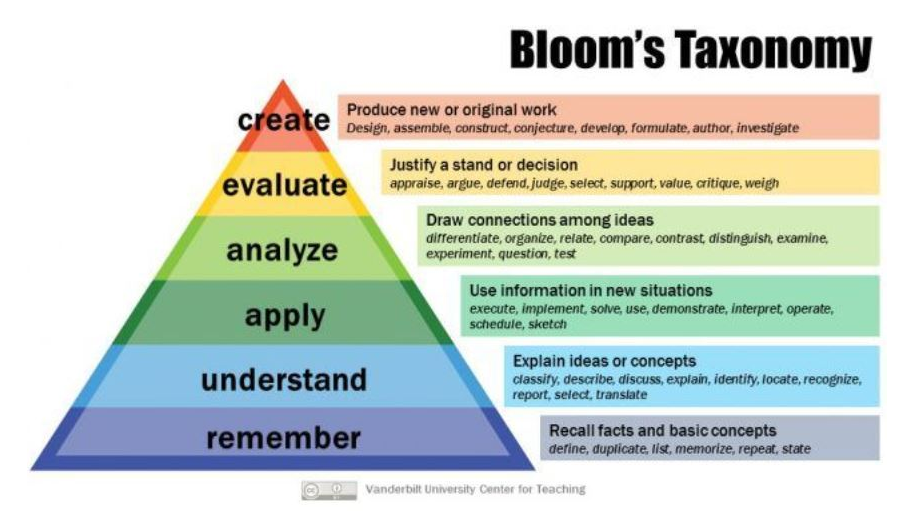
In the 1930s, Benjamin Bloom appeared at Pennsylvania State University where he earned a Bachelors and Masters in psychology. Not long after completing his doctorate in education at the University of Chicago, he became University Examiner; a position he held until 1959. In 1948, Bloom convened a meeting of college and university examiners from throughout the country to discuss the possibility of designing a common framework for classifying the wide variety of intended learning outcomes that the examiners routinely encountered. Based on this work, Bloom published The Taxonomy of Educational Objectives, The Classification of Educational Goals. By 1960, it was simply known as Bloom’s Taxonomy.

Vanderbilt University Published this Bloom’s Taxonomy Graphic

In 1968, Bloom published a small paper titled “Learning for Mastery.”His central thesis was that most students (perhaps more than 90%) could master what they were expected to learn in school if they were given enough time. Bloom, unlike Thorndike, believed that intelligence was not fixed and that it could grow. The paper, the taxonomy and work by John Carroll were combined to become “Mastery Learning.”  

The theory proposed that learning goals must be clearly stated for the student. Students were to be provided with some sort of lesson (mostly direct instruction) and upon completing the lesson the student was to be assessed. If they passed the assessment, they moved on to the next lesson. If they did not pass, they were assigned another lesson on the same goal. This process was to be repeated until mastery was achieved.

The “mastery learning” theory violated Dewey’s admonition that goals (aim) must be flexible but it fit perfectly with Thorndike’s behaviorist ideology.

In 1977, the Chicago and Washington DC public school systems adopted master learning. By 1980, they had abandoned the scheme as a failure. The failure was so glaring and so public that the founder of Outcome Based Education (OBE), William Spady, is quoted as saying,

“In January of 1980 we convened a meeting of 42 people to form the Network for Outcome-Based Schools. Most of the people who were there … had a strong background in Mastery Learning, since it was what OBE was called at the time. But I pleaded with the group not to use the name “mastery learning” in the network’s new name because the word “mastery” had already been destroyed through poor implementation.”

Spady blamed poor implementation but a 2018 research study said of “Mastery Learning”,

“Our objection to mastery/competency/personalized learning is about how a learner comes to develop that mastery/competency … Passing an MCQ test isn’t the objective of education; being able to “learn … how to learn…” and being able to solve uncharted problems are the objectives of education.”

Growth Mindset

Graphic from Page 11 of the 2017 National Education Technology Plan

The Technology Plan states without evidence,

“A key part of non-cognitive development is fostering a growth mindset about learning. Growth mindset is the understanding that abilities can be developed through effort and practice and leads to increased motivation and achievement.”

The US Department of Education made many claims like this one with no evidentiary support. To her credit, the creator of Growth Mindset, Carol Dweck, has acknowledged issues with implementation of the theory. She says,

“Growth mindset is even more complex than we imagined. In the beginning, as I have freely admitted, we did not recognize the complexity of the implementation.”

A large-scale study of 36 schools in the UK, in which either pupils or teachers were given training, found that the impact on pupils directly receiving the intervention did not have statistical significance, and that the pupils whose teachers were trained made no gains at all.

Scholar Carl Hendrick notes that Dweck’s growth mindset research has not been replicated robustly and “like its educational-psychology cousin ‘grit’ – can have the unintended consequence of making students feel responsible for things that are not under their control: that their lack of success is a failure of moral character.”

Incentivizing teachers to study unproven and debunked education theories is like feeding them pedagogical poison.

Neoliberal Forces Dominate Public Education in Sacramento

29 Jun

By Thomas Ultican 6/29/2021

Two pieces of legislation are racing through California’s state legislature both advancing the school privatization agenda. A third piece designed to protect taxpayers from the ravenous charter industry has been squashed. Public schools and sound pedagogy are being harmed by a radical market based ideology. Democrats continue their complicity in this conservative agenda.

Governor Newsom’s Charter School Give Away

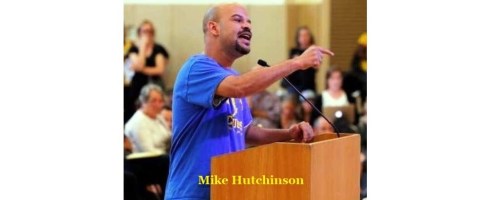
A few weeks ago, Oakland school board Trustee Mike Hutchinson raised alarm bells about Governor Newsom’s education budget trailer bill. Hutchinson wrote on Facebook, “Buried on page 95 is a clause that would extend the length of every charter school’s charter, so that every charter school in California will get two extra years before they would be required to go through a renewal process.” California’s Department of Finance definition states, “The Trailer Bill Language is the implementing language of the California State Budget Bill.” It is where California governors execute their agenda.

Oakland School Board Trustee Mike Hutchinson

For his first chief of staff, Gavin Newsom selected Ann O’Leary. That was a very clear signal that he would not be a reliable friend for public schools. O’Leary was on Hillary Clinton’s senate staff in 2001 where she was deeply involved in writing the No Child Left Behind education bill. She was latter a senior policy advisor on Clinton’s 2016 presidential campaign and is a well known neoliberal who has been a long time cheerleader for the charter industry. Although O’Leary resigned as Chief of Staff this past December, her neoliberal ideology seems to permeate Newsom’s education policy.

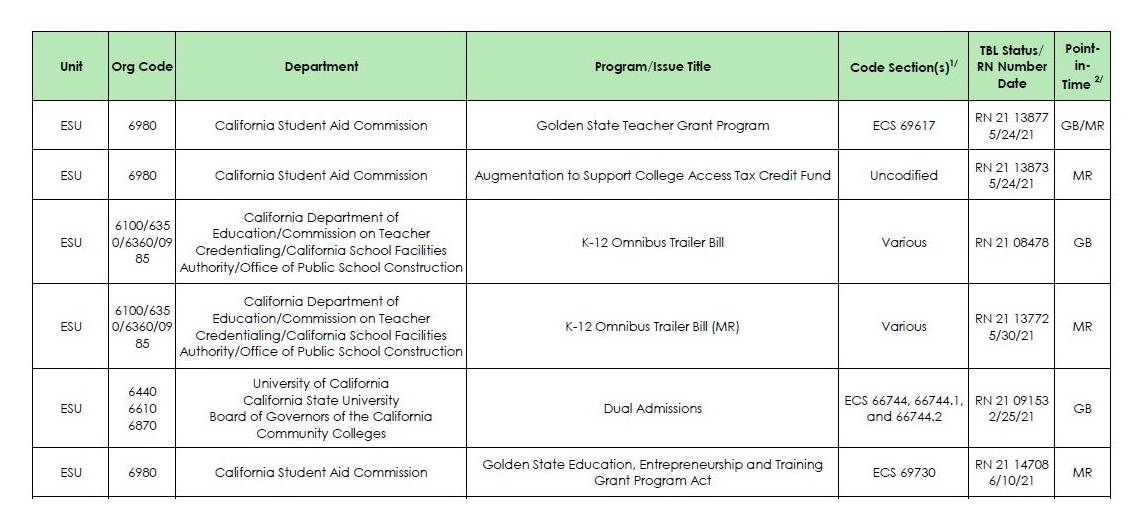
From Page 7 of 22 – 2021-22 Governor’s Budget / May Revision Trailer Bills

The picture above was clipped from page 7 of the list of trailer bills promulgated by the governor’s office. The “K-12 Omnibus Trailer Bill (MR)” with tracking number RN 21 12772 states on page 95,

“Section 47607.4 is added to the Education Code, to read: 47607.4. Notwithstanding the renewal process and criteria established in Sections 47605.9, 47607, and 47607.2 or any other law, effective July 1, 2021, all charter schools whose term expires on or between January 1, 2022, and June 30, 2025, inclusive, shall have their term extended by two years.  (Emphasis added)

Monetizing Dyslexia

Early this year, California Democratic State Senator Anthony Portantino proposed SB237 mandating dyslexia testing and intervention. It appears to be speeding through the state legislature with little opposition. On June 1st it passed on the senate floor with 39 yeses, zero no’s and one did not vote. The legislation awaits a final vote on the assembly floor.

The bill stipulates a specific set of dyslexia testing for all students kindergarten through third grade and requires the “State Board of Education to establish an approved list of culturally, linguistically, and developmentally appropriate screening instruments” to meet the mandate. The legislation also calls on local school districts to use “structured literacy instruction.”

Jan Malvin is a retired University of California researcher with a PhD in Educational Psychology from Northwestern University. She states,

“Formal diagnostic assessment is the only way to identify dyslexia or decoding challenges. The drive for universal screening and other dyslexia-specific policy is ‘a privatization agenda in which public schools become mandated consumers for a growing dyslexia industry, and in which the nature of instruction for students with reading difficulties is narrowly prescribed.”’

While the idea of dyslexia is not a new concept, many current papers make the point that “across more than a century, researchers have failed to consistently identify characteristics or patterns that distinguish dyslexia from other decoding challenges.” In a December 2020 report for the Literacy Research Association, Peter Johnston and Donna Scanlon of the University at Albany stated, “Current efforts at dyslexia screening are misleading about 50 percent of the time.”

While many children do have trouble learning to read and there is reason to believe dyslexia is real, a simple industry provided screening test for K-3 students is likely to misidentify significant numbers of students; labeling some as dyslexic who are not and missing an equal number who are.

Many researchers like Rachael E. Gabriel of the University of Connecticut point out that while the called for “structured literacy” approach has not been disproven even the US Department of Education’s What Works Clearinghouse states it is “not supported by evidence.”

The list of supporters for SB237 is long and the only California organization that was formally opposed to SB237 in time to be listed in the state’s bill analysis is Californians Together. They were a group formed in 1988 to fight against that year’s proposition 227 which prohibited bilingual education. Tax records show that they are a modest in size non-profit headquartered in Long Beach, California.

Other organizations that have since announced their opposition to SB237 include the California Association for Bilingual Education (CABE), California School Boards Association (CSBA), Association of California School Administrators (ACSA), and California Teachers Association (CTA).

No Charter School Reform or Taxpayer Protection

When San Diego District Attorney Summer Stephan brought down the $50 million A-3 charter scam, she noted, “People v. McManus revealed many weaknesses in the State’s education system in the areas of fraud enforcement, student data tracking, auditing, school finance, and oversight of charter schools.”

To address these weaknesses Assembly Members Daniel O’Donnell, Cristina Garcia, and Kevin McCarty introduced AB1316. The California Charter Schools Association (CCSA) expressed strong opposition to the bill.  As education writer Carl Peterson observed, “Unfortunately, AB1316 was placed in the inactive file by a political system unwilling to risk the wrath of the California Charter School Association.”

This year is turning into a very bad year for public education in California. Neoliberal Democrats and the CCSA are having their way.

Edtech is Business First – Part 2

24 Jun

By Thomas Ultican 6/24/2021

The pandemic brought a bonanza for online content providers and classroom organizing software. Programs like Google Classroom and Class Dojo which previously seemed superfluous performed a needed service during the crisis. Unfortunately, some of the edtech companies whose businesses spiked were taking advantage of the situation to sell profitable but harmful products based on bad education theory.

Content Providers

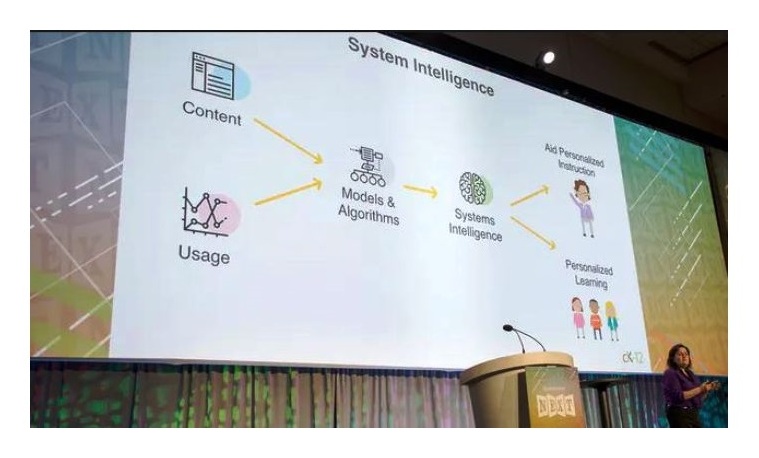
Neeru Kosala Presenting for her Non-Profit (Photo Credit CK-12)

Neeru Khosla is the founder and CEO of CK-12, a nonprofit that she started in 2007 to deliver free digital books, particularly on math and science topics. She has the same qualification to reform education as many of our lead education “disrupters”; she’s a billionaire. Her company claims to be providing high-quality, free resources and by free they also mean no pro-accounts or data collection.

Khosla is a mother who trained as a molecular biologist and later earned a masters from the Stanford Graduate School of Education but does not seem to have any classroom experience. Her husband, Vinod Khosla, is a venture capitalist whose massive wealth appears tied to early investments in Google (now Alphabet).

To finance CK-12, the couple uses two private philanthropies, Amar Foundation and CK-12 Foundation. For the past several tax cycles Amar Foundation (EIN 94-3055731) has liquidated about $9 million in Alphabet stock and forwarded the cash to CK-12 Foundation (EIN 20-8007128) which uses it to pay salaries and finance digital content development.

When the pandemic started this barely noticed service saw their registrations expand by 460 percent. Unfortunately, yet another billionaire amateur educator has gotten a larger megaphone to push the “personalized learning” agenda.

The Khan Academy is another content provider that saw their traffic soar in 2020. Originally, the academy generated an image of this selfless Silicon Valley guy, Sal Khan, making math education videos and distributing them for free. In 2007, he formed his non-profit but it was not until 2010 that Bill Gates (EIN 56-2618866) and other billionaires began sending him money.

It turns out that Sal Khan is not so selfless. His non-profit is making him wealthy. Khan Academy tax records (EIN 26-1544963) reveal that between 2010 and 2019 his salary totaled $6,009,694 and since 2015 his yearly salary has been more than $800,000. Between 2012-2017, the Gate Foundation gifted the Khan Academy $12,951,598 and the Overdeck Foundation (EIN 26-4377643) has kicked in $2,154,300.

In 2019, Khan Academy took in $92,559,725 of which only $27,629,684 was from contributions. The Academy has turned into a big-revenue generating non-profit.

In October 2020, Khan Academy announced a new joint effort with NWEA called Khan Academy Districts. There sales pitch says “Khan Academy has partnered with NWEA, creators of MAP® Growth™, to empower teachers to differentiate their instruction based on assessment results and meet the needs of all students.”

NWEA is the company that generated a lot of buzz with their covid-learning loss “research.” NWEA sells standardized math and English testing. They take in noisy data (All standardized testing data is noisy and fraught with error) 3-times a school year, do some fancy arithmetic and report out student growth determinations.

Last year, App Annie reported, “April 8, 2020 The top 3 Education apps in the US by downloads during the week of Mar 22 were Google Classroom, Remind: Safe Classroom Communication and ClassDojo, which saw 580%, 290% and 565% growth, respectively, versus the weekly average in Jan 2020.” This is the ongoing pandemic phenomena that prompted CNBC’s April 23, 2021 article Ed tech’ is booming: Wall Street analysts reveal how to trade the $5 trillion education market.”

Selling Education Snake Oil

The 2016 rewrite of the Elementary and Secondary Education Act of 1965 named ESSA, specified big money for edtech in Title’s I and IV including grants promoting “personalized learning” (ESSA Page 1969). About the only workable training method using a computer is competency based education (CBE). It is a method of drilling small chunks of knowledge and then assessing the learning.

Unfortunately, CBE is just an update of previous failed teaching strategies. In the 1970’s it was called Mastery Learning and in the 1990’s it was called Outcome Based Education. CBE is simply putting Mastery Leaning on a computer instead of using worksheets and paper assessments. It is still bad pedagogy with a sixty-year history of not living up to its protagonist’s claims.

Not only is “personalized learning” bad pedagogy it is also unhealthy. Dr. Nicholas Kardaras wrote in “Time” magazine about health risks associated with student screen time. He noted that “over two hundred peer-reviewed studies point to screen time correlating to increased ADHD, screen addiction, increased aggression, depression, anxiety and even psychosis.” Also, the vast majority of school principals believe that students are experiencing too much screen time and the Organization for Economic Co-operation and Development said in a 2015 report that heavy users of computers in the classroom “do a lot worse in most learning outcomes.

Curriculum Associates (CA) distributes i-Ready and its related testing services. The company which was founded in 1969 to provide worksheets for Mastery Learning curriculum is selling CBE based digital curriculum today. Children isolated at digital screens running their algorithms is called “personalized learning.” Student comments on the article “iReady Magnificent Marketing Terrible Teaching make it clear how much they despise this product.

Amplify is another company selling “personalized learning.” After Rupert Murdoch and Joel Klein failed miserably to profit in the edtech arena when Murdoch purchased Generation Wireless and rebranded it Amplify, they took a $371 million write off and exited the business. The billionaire Laurene Powell Jobs’s “Emerson Collective” assumed control of Amplify.

A third company selling CBE based lessons delivered to a screen is Education Elements. They are the classic technology startup company being financed by five venture capital funds including New Schools Venture Fund.

Technology holds great promise for enhancing education, but when profit motives trump ethics it is like feeding poison to America’s children.

Edtech is Business First – Part 1

17 Jun

By Thomas Ultican 6/17/2021

Not all edtech is negative but it is important to remember that private companies are in it for the money. Giant corporations and private equity firms require return on investment. Improving education comes in second to making profits and everyone in the business knows that the real edtech gold comes from data mining.

Dr Velislava Hillman is a visiting Fellow at the London School of Economics and Political Science (LSE). In a post on the LSE blog she writes,

“It is hard, perhaps impossible, to go to school and not be registered by a digital technology. Cameras wire the premises; homework is completed using one business’s software application (eg Microsoft Word) that may be embedded onto another business’s platform (shared via Google); emails, bathroom trips, assessments, parental backgrounds  – all feed into digital systems that are owned, managed, used and repurposed by hundreds of thousands of invisible business hands.”

“Edtech companies thrive on digital data.”

In her post, Dr Hillman pointed to an edtech company that is very active in the UK:

Naviance, owned by Hobson, is a multi-layered data-collecting platform, which until February 2021 formed part of the Daily Mail and General Trust in the UK. The platform has access to a wide range of personal and sensitive information of students. It ‘tracks students as they move through elementary school, college and beyond”’.

The pro-edtech Education Research and Development Institute (ERDI) listed Hobson as a 2017 partner. This February the Daily Mail sold Hobson’s higher-ed focused Starfish business to the American company EAB for $90 million. They completed the divestiture of Hobson by selling the Naviance and Intersect businesses to U.S.-based PowerSchool for $320 million.

In the early 00s, my school district bought a student information system from Chancery Software Ltd. Unfortunately, the system was not ready for high school. Creating the master schedule was a nightmare. It took several years to get the system functioning well and then giant Pearson Corporation purchased Chancery and renamed it PowerSchool. That was 2006. In 2015, Pearson sold PowerSchool to Vista Equity Partners, a private equity group, in an all-cash deal worth $350 million.

Since then Vista has been adding more companies to PowerSchool. In 2018, Vista merged PowerSchool and PeopleAdmin with the investment buyout firm Onyx Corp. Bloomberg reports that this February PowerSchool filed “confidentially for a U.S. initial public offering that could value the education software provider at more than $6 billion.”

Lisa Cline’s and Andy Liddell’s article at the Campaign for a Commercial-Free Childhood states,

“Every time your child opens their Chromebook or takes out their iPad to do schoolwork, their digital footsteps are shared with the universe. Every click, search and browse becomes property of an app maker who can store it, sell it, and use it to create a profile of your kid.”

The 50-years old Family Educational Rights and Privacy Act, or FERPA law makes this illegal but there is no enforcement. When FERPA was written, the school records contained names, addresses, grades and a few comments all written on paper and stored in onsite filing cabinets. With scant federal oversight, the concept of student data has grown to a running log of a child’s every click over the course of their childhood, packaged into a profile and slapped with a price tag. Now when parents inquire about what information is being stored on their child “The schools point at the vendors” and “vendors point at the schools.” Parents get nothing!

Personalized Bad Education

Tom Vander Ark shamelessly hawks personalized education products and writes glowing articles about schools that put children in front of screens.  In July 2020, Vander Ark, who was the first Gates Foundation’s director of education initiatives, wrote in Forbes about Juan Cabrera and the El Paso Independent School District (EPISD). The article states, ‘“Mr. Cabrera’s focus on ethics and character was a driver for most of our success; it made us rethink the why and how of our work in the best interest of students and community’ said  Carmen Arrieta-Candelaria, Deputy Superintendent for Finance and Operations.”

In November 2020, the EPISD board unanimously voted to accept Juan Cabrera’s resignation. The resignation seems to have been prompted by irregularities with the districts technology contracting. When a new audit arrived in May, Arrieta-Candelaria was put on paid leave. Channel 9 El Paso reported, “An El Paso Independent School District audit found former Superintendent Juan Cabrera initiated contracts with two vendors for academic services that gave ‘an appearance of a conflict of interest due to social/professional relationships.”’

The audit says, “The former Superintendent directed Academics staff to acquire contracted services from Renaissance Learning (Renaissance), Engage Learning (E2L), and Con Mi Madre, which totaled approximately $2.32 million.” In the next section it notes, “Funds were not budgeted to cover the contracted services from E2L in the amount of approximately $1.08 million.”

This scandal is just starting to play out, however a look at the businesses involved is interesting. Renaissance Learning is funded by CapitalIG which belongs to Alphabet (formerly Google). They sell testing and personalized learning apps for math and English. Engage2Learn (E2L) is owned by Leeds Equity Partners, a New York Investment firm, which was an early identifier of the business growth prospects in the education market. E2L offers virtual coaching and personalized learning services. Con Me Madre is a local non-profit that seems not to be an edtech profit scheming organization.

One of the edtech businesses key to the data collection business is “personalized learning.” It is isolated learning at a digital device and children hate it but it creates lots of data.

Demise of Unbiased Education Research at Johns Hopkins

9 Jun

By Thomas Ultican 6/9/2021

The 2015 hiring of David Steiner to lead the new Johns Hopkins’s Education Policy Institute marked a transition from scholarship to neoliberal indoctrination. Donor directed funds that hide their sources and well-known advocates of testing and “school choice” have sent boatloads of money to the new institution. Steiner and his patron, Merryl Tisch, were famous in New York for being virulently pro-standardized testing and enemies of the teaching profession.

On April 1, 1996, New York Republican Governor George Pataki appointed Merryl Tisch to the State Board of Regents. On April 1, 2009 she was elected Chancellor by her colleagues. Tisch’s biography at the University at Albany states that since joining the Board she “has been a leading advocate for expanded alternate certification policies.” The rabbi’s daughter who married into one of America’s wealthiest families soon found a like minded pro-testing neoliberal to champion. The Regents selected Hunter College Dean, David Steiner, to be the new state Commissioner of Education.

In 2008, Steiner created Teacher U at Hunter College. It was a new teacher preparation program requested by the charter industry and coincided with Tisch’s thinking.  Steiner and Tisch believed that there was an unhealthy university based monopoly controlling teacher education. As Commissioner, he moved to weaken that “monopoly” in 2010 by grantinga provisional charter to authorize clinically-rich teacher programs to address shortages …”

The following year Steiner authorized and the state board approved non-institutions of higher education to grant master’s degrees in education accredited by New York State. Almost immediately, Teacher U became Relay Graduate School of Education and received accreditation from the state of New York. Steiner is also a founding board member of Relay and is still on its board of directors.

The other great policy agreement between Tisch and Steiner was on standards and test based accountability for teachers and schools. Tisch who has a doctorate in Education from Teachers College was honored by the school in 2013. That prompted education scholar Diane Ravitch to write that they were honoring the doyenne of high-stakes testing.” In an interview with Frederick Hess, Steiner pointed with pride to three policies he drove as Commissioner of Education; “commitment to standards-based curriculum”, “commitment to improved testing” and worked to “rethink and redesign teacher and principal certification.”

Steiner completed his resume for supporting the neoliberal agenda by waiving the superintendent of schools job requirements in order for Cathie Black, head of the Hearst magazine chain, to take over New York City public schools. Despite not having the required teaching experience and professional degrees in administration, Steiner agreed that her “success” in business made her in the words of Mayor Bloomberg a “superstar manager.” She lasted on the job less than 100-days.

The Johns Hopkins Partnerships are Startling

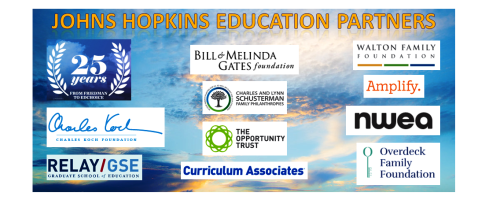
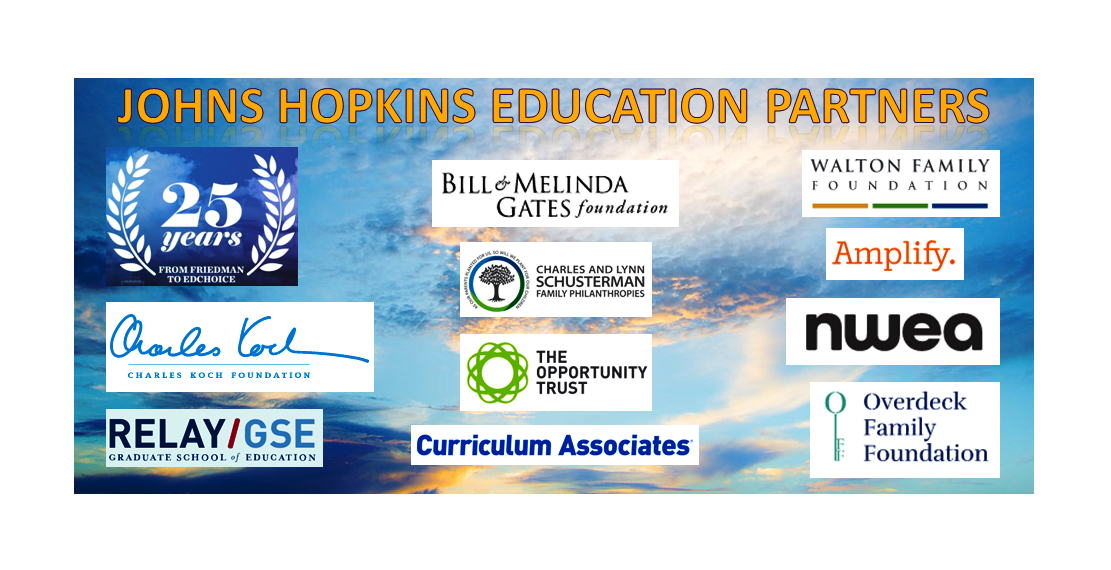
The Education Policy Institute at Johns Hopkins proudly lists sixty-seven partners on their about page. The eleven shown above are representative of the array of public school disrupters and edtech profiteers with whom they partner.

Becoming an advocate for deep pocketed libertarians and neoliberals has led to a gusher of dollars. Between 2018 and 2020 the Overdeck Family Foundation states it has granted John Hopkins $840,000.

John and Laura Overdeck are relatively new to being education “disrupters” but they have caught on fast. John is a former hedge fund guy and vice president at Amazon. Laura has an MBA from Wharton, is a trustee of Princeton and is on the advisory boards of the Khan Academy, Johns Hopkins Center for Talented Youth (CTY) and Stevens Institute of Technology. Their 2019 foundation tax form 990PF shows $627 million in assets.

Jeffery Epstein’s friend Bill Gates has been sending a steady stream of dollars. Although his giving is no longer transparent, his foundation tax forms show that between 2016 and 2018 he sent $2,194,000.

In 2006, two bay area foundations merged to form the multi-billion dollar Silicon Valley Community Foundation. It is a donor directed fund which allows wealthy individuals to secretly gift large sums of money without disclosure. From 2015-2018 they sent $27,381,018.

The Return on Investment

Basing themselves almost exclusively on testing data, a group of Democratic politicians including Governor Gina Raimondo decided to take over and reform Providence, Rhode Island’s “failing” public schools. The school districts demographics in 2019 was 65% Latinx, 16% Black, 9% White, 5% Asian, 4% Multi-racial and 1% Native American. In addition, 31% of students were multilingual learners, 16% received special education services and 55% came from homes where English is not the primary language. An unbiased study would have quickly found that the schools were not failing. Rather, the poor testing results were reflective of deep poverty, language learners and a large special education population.

“The situation was extreme,” says Ashley Berner, deputy director of the Johns Hopkins Institute for Education Policy. “I had never met so many dispirited students and teachers.” The Johns Hopkins study was commissioned in May and presented in June and by July 19th Mayor Elorza officially petitioned the state to take over the schools.

Last year, The Institute for Education Policy at Johns Hopkins wrote a joint paper with Jeb Bush’s Chiefs for Change. It called for more testing. They claimed,

“As leaders prepare their school communities for the challenge of re-starting face-to-face as well as hybrid models, a coherent pathway for learning recovery and acceleration needs to include greater reliance on high-quality materials and instruction, and completing the circle with curriculum-based assessments.”

“We recommend formative and summative assessments tied to specific curricula that can be implemented under various circumstances.”

Sadly, education scholarship at Johns Hopkins has been abandoned for much more than just “30 pieces of silver.”

Stinking Thinking Monetizes Dyslexia!

2 Jun

By Thomas Ultican 6/2/2021

This January, California Democratic State Senator Anthony Portantino introduced SB237 mandating dyslexia testing and intervention. It is similar to a spate of bills across the US requiring a privatized approach to intervening with reading difficulties. Unfortunately, contrary to their claims, these initiatives are not based on well founded research. The perpetrators base themselves on the widely disparaged “science of reading” and are part of a well financed effort taking advantage of emotionally compromised parents and students.

The bill stipulates a specific set of dyslexia testing for all students kindergarten through third grade and requires the “State Board of Education to establish an approved list of culturally, linguistically, and developmentally appropriate screening instruments” to meet the mandate. The legislation also calls on local school districts to use “structured literacy instruction.” 

When SB237 was introduced, Decoding Dyslexia CA, EdVoice and the Oakland NAACP were listed as co-sponsors. Decoding Dyslexia is one of the two international organizations promoting this type of legislation. EdVoice is a publishing organization with strong ties to the movement to privatize public education. Its 2003 founding board included Reed Hastings, Laurene Powell Jobs, Eli Broad and Don Fisher. Kareem Weaver is a leader of the Oakland NAACP literacy campaign and was a witness for the plaintiffs in the Vergara case to end teacher employment rights.

“Structured literacy” is a 2016 term pitched by the International Dyslexia Association (IDA). Fundamentally it is a method based on the work of Anna Gillingham and Samuel Orton in the 1930s. Rhode Island’s Department of Education describes it as an “explicit, systematic, diagnostic, cumulative instruction in phonological and phonemic awareness, phonics, syllable types, morphology, semantics, and syntax.” In other words, employ phonics and word decoding to remedy reading issues. IDA claims, “Popular reading approaches (eg., Guided Reading and Balanced literacy) are not effective for students with dyslexia because these approaches do not focus on decoding skills struggling readers need to succeed.”

Legislation not Supported by Research

IDA is an international organizations pushing for specific dyslexia legislation. Their remedies include utilizing private companies to solve student reading problems that public school will not or cannot. They also provide their own dyslexia teaching specialty certification. The obvious implication is that University based teachers’ education programs are incapable of addressing dyslexia.

IDA defines dyslexia,

“Dyslexia is a specific learning disability that is neurobiological in origin. It is characterized by difficulties with accurate and/or fluent word recognition and by poor spelling and decoding abilities.”

This definition is not supported by the community of education scholars. In fact, there is general agreement that there is no satisfactory definition for dyslexia nor is there a known way to screen for it.

A critical analysis of dyslexia legislation by a team of researcher from Ball State University and the University of Texas noted,

“After a multitude of studies across more than a century, researchers have failed to consistently identify characteristics or patterns that distinguish dyslexia from other decoding challenges. Many researchers and educators argue the construct is too vague and contradictory to be useful for educators.”

They continue, “There are no universally employed measures or procedures for identifying dyslexia.”

A paper by Peter Johnston and Donna Scanlon from The University at Albany asserts,

“The bottom line is that there are many definitions of, and theories about, dyslexia and simply no agreed-upon definition that allows schools, clinicians, researchers, or anyone else, to decide who is dyslexic in any valid or reliable way.

“From an instructional standpoint, there is no practical distinction between those classified as dyslexic and others at the low end of the normal distribution of word reading ability in the early elementary grades.”

Not only are there a plethora of scholarly studies that make the same points about the definition for dyslexia, there also are an equal number of research papers that thoroughly discredit the idea that “structured literacy” is a proven success.

In 2017 Rachael E. Gabriel of the University of Connecticut published “Converting to Privatization: A Discourse Analysis of Dyslexia Policy Narratives.” Her paper analyses how the agenda for privatizing dyslexia intervention is sold to legislators and school boards. She also shares results of studies on the “structured literacy” approach. Gabriel cites the US Department of Education’s What Works Clearinghouse reading research stating “structured literacy” is not supported by evidence.

Money is Driving this New Education Privatization Effort

Senate bill 237 was just moved out of committee to the Assembly. In the 2020 general election, an analysis of major donor California state spending revealed over $14 million dollars spent by a neoliberal cabal of billionaires and the political action committees they fund. Of that spending $1.5 million went to California state legislators. The table above shows the money that went to legislative members who are either on the Assembly and Senate education committees or are listed as co-sponsors for the dyslexia legislation.

Handing off teacher certifications to private organizations and using private companies to screen students is a huge mistake. Legislators should resist the temptation to micromanage public education. The best approach is to trust education professionals and university based scholars more than private actors with an agenda.

The Boston Consulting Group makes the fantastic assertion that, “Investing in early  screening  and  teacher  training  would  provide  an astonishing 800% to 2000% return.” A policy brief from the Institute of Child Success indicates that special education pay for success has great return on investment potential.

Clearly the sharks are circling. Parents, legislators and schools need to be on high alert. Well funded organizations want our public school resources. For them, dyslexia is just another potential profit center.

i-Ready, Johns Hopkins and Oakland Public Schools

26 May

By Thomas Ultican 5/26/2021

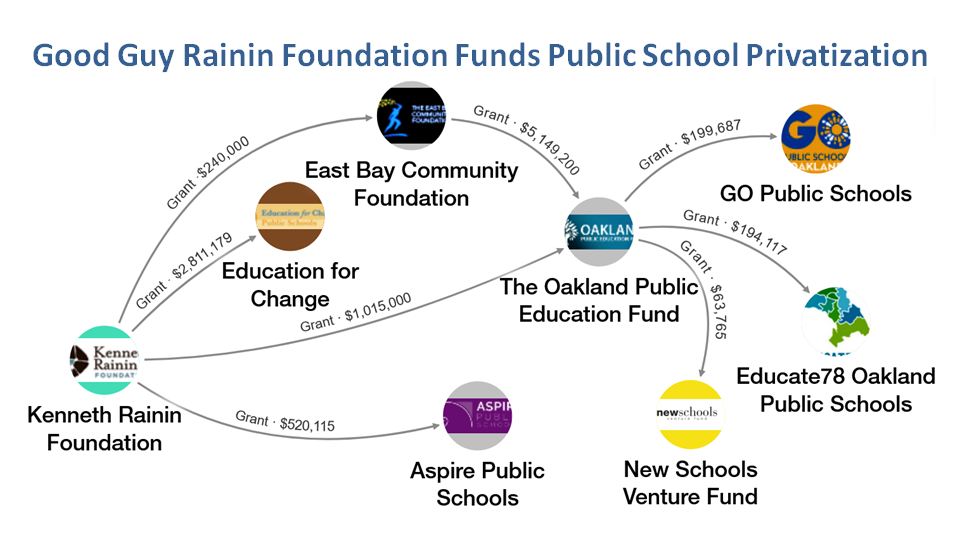
The Oakland Unified School District (OUSD) signed an agreement on March 10 to substitute i-Ready diagnostic testing for the Smarter Balanced Assessment Consortium (SBAC). The no cost agreement calls for the data to be given to Johns Hopkins University for comparative analysis with SBAC. Oakland teachers administering the program claim that the project is being financed by the Kenneth Rainin Foundation.

An Oakland fourth grade math teacher who administered the test stated that the it appeared to be designed to insure that students missed at least 50% of the problems. She observed,

“1) Multi-step unit conversions in the context of a word problem”

“2) Definitions/examples of independent and dependent variables”

“3) Simplification of algebraic equations with two variables”

These skills all appear to be well beyond what should be expected of 9- and 10-years-old students.

i-Ready is a product of Curriculum Associates (CA) out of Billerica, Massachusetts. It was originally formed in 1969 to publish workbooks. Ron Waldron an equities manager at Berkshire Partners took the reins in 2008 and immediately converted it to an ed-tech company.

That was the same year that former Florida Governor, Jeb Bush, launched Foundation for Excellence in Education (FEE) and in close cooperation with the American Legislative Exchange Council and his major contributor, Bill Gates, FEE launched Digital Learning Now. (FEE has been renamed ExcelinEd)

 i-Ready is a technology-based diagnostic testing program that also provides screen based instructional programs for math and reading.

Evidently many junior-high students who use i-Ready in the classroom are making internet searches for information about it. Possibly that explains why my i-Ready article written three years ago is still getting traffic. This May, it has received more than 1600 clicks. The latest two comments out of hundreds to the article are typical:

“i agree iready has caused a ton of stress for me as a 7th grade student.”

“I-ready needs to Die!”

Sales spiels normally tout the research evidence supporting i-Ready. However, there is no independent peer reviewed research backing CA’s claims. A 2019 study from WestEd is typical. The study was paid for by two billionaire non-profits reputed to favor privatizing and monetizing public education – The Bill and Melinda Gates Foundation and the Silicon Valley Education Foundation. In paragraph one the study says,

“Our quantitative analysis showed that students, regardless of their math proficiency, who spent a minimum of 45 minutes a week or more on the i-Ready lessons had a significant improvement in their scores on the Smarter Balanced Assessment Consortium Math Summative Assessment (SBAC) over students who did not.”

However, the next paragraph admits,

“During the observations, it was noted that the product was challenging for less proficient students to use, which was later confirmed by our quantitative analysis — many students who used i-Ready consistently enough to see its benefits were already meeting or exceeding standards in mathematics on the SBAC.”

This shows that better students willing to put in the time got better scores than weaker students who did not. Not too surprising; that would have been the case without i-Ready.

The Evaluator Appears Biased

Chiefs for Change and Johns Hopkins Wrote Joint 2020 Paper – The Return

The Institute for Education policy at Johns Hopkins joined Jeb Bush’s Chiefs for Change in calling for more testing. Their claim,

“As leaders prepare their school communities for the challenge of re-starting face-to-face as well as hybrid models, a coherent pathway for learning recovery and acceleration needs to include greater reliance on high-quality materials and instruction, and completing the circle with curriculum-based assessments.”

“We recommend formative and summative assessments tied to specific curricula that can be implemented under various circumstances.”

Johns Hopkins was also integral to the attack on the public schools in Providence, Rhode Island. In May 2019, the Johns Hopkins Institute for Education Policy led a review of the Providence Public School District (PPSD). They did so at the invitation of the Rhode Island Department of Education Commissioner, Ms. Angélica Infante-Green, with the support of Governor Gina Raimondo and Mayor Jorge Elorza. The Partnership for Rhode Island funded the review.

The Johns Hopkins study was commissioned in May and presented in June and based on the report  Mayor Elorza officially petitioned the state to takeover Providence Public Schools on July  19.

Kenneth Rainin Foundation Lost Their White Hats

The foundation being cited as funding the i-Ready and Johns Hopkins study has assets of more than $600 million. Founder Kenneth Rainin was an entrepreneur from Toledo, Ohio who became wealthy manufacturing and selling laboratory pipettes. When he died in 2007, the foundation became the beneficiary of the majority of his estate.

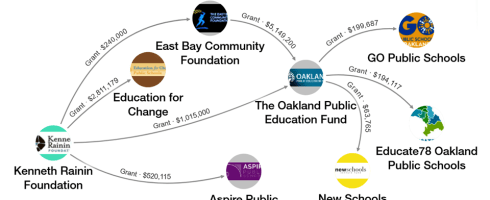
The Rainan Foundation has spent significant sums on advancing its “Seeds of Learning” reading program and the corporate control of public education. As the LittleSis map depicted above shows, the foundation sends large grants both directly and indirectly to billionaire funded “school choice” promoting organizations.

The “Seeds of Learning” program is supposed to improve reading education results through its preschool efforts. The lead story on the foundation’s web page is “Research Show Seeds of Learning Produces Quick Gains.” The research is not peer reviewed or independent. The Kenneth Rainin Foundation has spent more than $3 million for a Chicago company to produce the results. Report briefs are made available but not the study itself.

The dark side of the study is that they are testing 4- and 5-year olds in alliteration, letter naming, letter sounds, rhyming and vocabulary. That is child abuse. This appears to be an amateur created program that ignores the much greater need for babies to engage in self-directed play in safe and stimulative environments. “Seeds of Learning”  is likely more personality damaging than it is helpful for reading.

Amateurs need to stop using their financial power to control education policy.

A Scholarly Masterpiece: William Frantz Public School

19 May

By Thomas Ultican 4/18/2021

My wonderful friend from New Orleans, Mercedes Schneider, said of this meticulously researched book, “Intense, captivating, and horrible in its reality, William Frantz Public School is a story overdue for the telling – a must read for those seeking to understand New Orleans’ history and the lingering impact of White racial superiority upon the Black community and city infrastructure.” I concur. It is a captivating read.

At its 1938 founding, speakers proclaimed the new William Frantz Public School (WFPS) a “protection for democracy” and a “fortification against encroachment of those terrible ‘isms.’” (WFPS page 3)

However, racism did not just encroach; it dominated. WFPS was built to be a White students only school. Sitting on the border between the all white Florida neighborhood and the all Black Desire neighborhood, WFPS only served the White families. Worse still; the authors report,

“The Orleans Parish School Board built no schools between 1941 and 1951. As a result, existing neighborhood schools throughout the city faced overcrowding. The problem was particularly acute in Desire. Due to the severe overcrowding, many Black children attended school for only a fraction of the time as their White peers living in the Florida neighborhood.” (WFPS 9)

With the Brown versus the Board of education decision in 1954, the Supreme Court declared racial segregation as a school enrollment policy unconstitutional. Louisiana segregationists quickly coalesced to become leaders of their state’s “massive resistance” movement to oppose integration.

In 1955, a wealthy lawyer named Leander Perez and a state senator named William Rainich established the White Citizens’ Council in Louisiana. By that fall, the white supremacist organization had chapters in half of the state’s parishes and a statewide membership of 100,000. The New Orleans chapter would eventually grow to over 50,000 members. (WFPS 21)

As the White Citizens’ Council started calling for the public schools to be closed rather than integrated, a group named Save Our Schools (SOS) formed to oppose closing schools. The book notes, “Although ardent in their work, many perceived SOS as elite and ‘liberals allied with the Urban League, the Council of Jewish Women, [and] the league of Women Voters.’” (WFPS 24) Many SOS members sent their own children to all white public schools and though disagreeing about the Brown decision, they all agreed it was settled law.

The authors document political strong-arming, horrific acts of cruelty and the hysterical fear with which white racists fought to stop school integration. Their greatest horror was realized when one 6-years-old girl named Ruby Bridges was escorted into WFPS on November 14, 1960.  

The Times-Picayune ran an editorial with the headline “Dreadful Day Comes at Last” and the White Citizens’ Council started pressuring White parents to pull their children out of WFPS. Protestors surrounded the school, chanted racist slogans and intimidated anyone approaching the school. (WFPS 35)

In an attempt to keep some of the White children in WFPS, President Mary Sand and others from SOS organized car pools to deliver students to the front of the school so they would not be forced to go through the heckling crowd. “Like the families of the students they transported to WFPS, SOS drivers received crude and threatening telephone calls, up to 200 per day, from people who told the women they would ‘cut your cunt out and stuff it down your throat.’” (WFPS 59-60)

As a result of the intimidation tactics, New Orleans was able to defy court orders and schools remained virtually segregated. The following year:

“Black citizens started an unofficial boycott of White-owned department stores and threatened to cancel the Zulu parade, a traditional and popular Black parade, during the upcoming Mardi Bras. Rumors circulated that the entire Mardi Gras celebration would be canceled … By mid-December, city business leaders along with the Times-Picayune finally called for the end of the protests, intimidation, and vandalism.” (WFPS 69)

As the decade of the 90s opened the neighborhood around WFPS was in trouble. “Prostitutes worked the streets outside some schools, and an early 1990s poll of Black students from the Desire projects located near WFPS found 40% of Black students had seen a dead body and 72% had seen weapons being used.” (WFPS 121)

Seventy-five thousand Black children and 19,000 White children constituted Orleans Parish school district in the early 1990s with extreme poverty gripping the Black community. (WFPS 117)

By 1993, there were no White students attending WFPS. (WFPS 111)

In 1997, the state established its test based accountability scheme. (WFPS 128)

In 1998, WFPS was judged academically unacceptable. (WFPS 132)

In 2005, WFPS was put on the National Register of Historic Places. (WFPS 155)

In 2013, like the rest of the post Katrina schools in New Orleans, WFPS became a charter school. (WFPS 258)

Three white women who are not from New Orleans – Connie L. Schaffer, Meg White, and Martha Graham Viator – say they considered not writing this book because of that. It is our great good fortune that they did. Their scholarly and extremely readable effort shines some much needed light on the horrible racism and mistreatment the Black citizens of New Orleans.