Archive | technology RSS feed for this section

AI is More Con than Reality

9 Sep

By Thomas Ultican 9/9/2025

The tech-industry bestowed name, “Artificial Intelligence (AI)”, is a head-fake; there is no intelligence, just algorithms. Sales are based more on fear of missing out than efficiently-usable machines. The authors of The AI Con: How to Fight Big Tech’s Hype and Create the Future We Want have some tongue in cheek renaming suggestions: ‘“mathy maths’, ‘a racist pile of linear algebra’, ‘stochastic parrots (referring to large language models specifically)’ or Systematic Approaches to Learning Algorithms and Machine Inferences (aka SALAMI)”. (Page 5) These witty writers are Dr. Emily Bender, professor of linguistics at the University of Washington, and Dr. Alex Hanna, director of research at the Distributed AI Research Institute and lecturer in the school of Information at the University of California, Berkeley.

While working in Silicon Valley in the 1990s, I wrote quite a bit of code automating friction testing in hard drives. The maximum forces occurred when drives started up. About fifty test drives with sensitive gauges were used to test 50,000 or more start-stops. Once the testers were setup, it was all automated with friction data being stored in files and when the test finished, the files would automatically be uploaded to a database which would graph the data and create a report. I thought it was really cool but the only intelligence involved was mine and the creators of the database. It was a set of algorithms and nothing more; that is all these “racist piles of linear algebra” are.

Large Language Models (LLMs)

The texts produced by LLMs are plausible on almost any subject, but this is highly misleading. The models consist solely of extensive information about what sets of words are similar and what words are likely to appear in what context. The outputs look just like something a person might have written and we humans naturally interpret it by imagining the mind behind the text. Unfortunately, there is no mind and it is important for us to let go of that imaginary mind we conceive.

The authors label LLMs like ChatGPT “synthetic text extruding machines”. (Page 31) Like plastic extrusion, LLMs force language collections through complicated computer algorithms to achieve a product that looks like language. However, there is no human thinking behind it.

LLMs and their cousins, synthetic image machine, are based on massive data theft and wanton energy use. The backbones of synthetic extruding machines are data centers which consume enormous amounts of energy. It is estimated that they will consume 1,580 terawatt-hours a year by 2034. A terawatt hour is the equivalent of a billion kilowatt hours. That amount of energy is the same as the total amount of energy predicted to be consumed by the world’s most populous country, India. (Page 159)

In 2016, the largest tech companies in the world signed on to the Paris climate accords. Google said they planned to be net-zero emissions by 2030 and Microsoft announced plans to be net-negative and remove all of the carbon it had produced since its founding in 1975. Now the companies are admitting they will dramatically miss their climate pledges because of these “racist piles of linear algebra.” (Page 160)

In addition to being energy gluttons, text and image extruding machines are water hogs. For every 5 to 50 prompts ChatGPT generates, about two cups of water are consumed. The large amounts of PFAS (“forever chemicals”) used to manufacture microchips is another environmental issue. “Synthetic text extruding machines” are an environmental disaster, but for billionaires it is all about profits. (Page 157)

Bender and Hana observe, “Today’s synthetic media extruding machines are all based on data theft and labor exploitation, and enable some of the worst, most perverse incentives of each of these attendant fields.” (Page 135)

Boosters and Doomers

At the 2023 eighth Insight Forum, which was closed to reporters and the public, Senator Chuck Schumer asked the participants what was the probability of doom. It is unknown what the precise answers were but Jared Kaplan, co-founder of the AI company Anthropic, and Aleksander Madry, head of Open AI preparedness, have both spoken about “catastrophic risks” if a model grew a mind of its own. Some of the participants spoke about the myriad benefits while others seemed to harbor existential fear. Bender and Hana label these groups Boosters and Doomers. (Page 1 and Page 138)

From the authors’ perspective, Booster and Doomers are on two sides of the same coin. One sees extrusion machines as leading to a world of abundance while the other fears a dystopian hellscape. “Neither depicts the real harms of actually existing automation, at best dismissing them as less important than the imaginary existential threats.” (Page 139)

Oddly, almost all AI Doomers think AI development is a good thing. Bender and Hana suspect a few Doomers are not being honest:

“But for some of them, it’s not really about trying to save humanity, but rather a running of the con: the supposed danger of the systems is a splashy way to hype their power, with the goal of scoring big investments in their own AI ventures (like Musk and Altman) or funding for their research centers (Like Bourgon). (Page 141)

Modern Eugenics

There are claims that machines will gain an advanced level of “general intelligence”. However, there is not an accepted definition of “artificial general intelligence” (AGI). Companies like OpenAI just avoid the question. Microsoft’s “Sparks” paper contains a preliminary definition of AGI. A prior version of the paper was published in a 1994 Wall Street Journal article signed by 52-psychologists. It proffered, “The consensus group defined intelligence as a very general mental capability that, among other things, involves the ability to reason, plan, solve problems, think abstractly, comprehend complex ideas, learn quickly and learn from experience.”

This was written in defense of Richard Herrnstein and Charles Murray’s 1994 book, “The Bell Curve”, which argues that there are significant differences between the inborn intelligence of different racial groups, and that those differences are due to genetics. A bastardized use of Alfred Binet’s work on intelligence testing was employed by three eugenicists, Henry Goddard, Lewis Terman and Robert Yerkes. They created tests biased towards middle-class white Americans and that bias persist in IQ testing to this day. (Page 35)

Bender and Hana state, The paradigm of describing ‘AI’ systems as having ‘humanlike intelligence’ or achieving greater-than-human ‘superintelligence’ rests on this same conception of ‘intelligence’ as a measurable quantity by which people (and machines) can be ranked.” (Page 36)

Billionaires—among them Elon Musk and Marc Andreessen—are setting the agenda for creating AGI and financially backing a modern-day eugenics. Musk repeats common eugenicist ideals claiming that there are not enough people and that humans (particularly the right humans) need to be having children at higher rates. Marc Andreessen echoed Musk’s thoughts when suggesting that elites from developed countries should be having more children. (Page 38)

Musk and Andreessen believe we are on the cusp of AGI development or are they just selling the con? Most people working on extruding machines are aiming to make a system that achieves what looks like human intelligence “to get ahead in what is already a crowded market.” (Page 39 and 40)

Today, there is no AGI; moreover it is unlikely that machines will ever develop “intelligence”.

Some Final Observations

“The AI Con” is packed with important information that could enable people to see through this billionaire-financed scam. Read it and convince your friends and family to study it as well.

Text and image extruding machines are not worth their costs to the environment and they have many hidden inefficiencies. It is wonderful that my smart-phone can assist me with texting, but I hate the AI driven enshitification of Google’s search engine.

Extruding machines are bad for education but people are out there hyping AI’s use in classrooms. The British Government has done serious harm to their health care system by mindlessly installing AI as a point of contact.

AI is not capable of doing science. A salient feature of extruding machines is they were designed to make stuff up.

 Bender and Hana correctly note, “The AI project has always been more fantasy that reality.”

AI in School is the Latest Edtech Scam

30 Mar

By Thomas Ultican 3/30/2025

For more than thirty years, technology companies have looked to score big in the education sector. Instead of providing useful tools, they have schemed to take control of public education. At the onset of the twenty-first century, technologists claimed putting kids at computers was a game changer that would fix everything. They followed that up by promoting tablets with algorithmic lessons replacing teachers and claiming they provide better education. Today’s hoax is that artificial intelligence (AI) will make all these failed efforts work. What it actually does is undermine authentic learning. 

The release of ChatGPT in November 2022 is responsible for the Edtech sales-forces switching their sales pitches from personalized learning to AI. However, AI has always been at the root of personalized learning. It just did not have the advantage of large language models (LLM) that emulate writing in English. However, AI expert Yann LeCun notes:

“LLMs are really good at retrieval. They’re not good at solving new problems, [or] finding new solutions to new problems.”

Artificial Intelligence is a misnomer. There is no intelligence; just algorithms. The term, “Artificial Intelligence”, was first coined by Professor John McCarthy at a Dartmouth College conference in 1956. That same year AI became an academic discipline.

Machine-learning has been part of AI since its 1950s beginning. Algorithms are created to allow a machine to automatically improve its performance on a given task. For almost two decades, Netflix has used machine-learning to create personalized recommendations, based on a customer’s previous viewing history. Deep-learning is an advancement in machine-learning. It layers algorithms into computer units ridiculously referred to as neurons. Google Translate uses it for translation from one language to another.

With the advent of LLMs, the energy use associated with AI has risen dramatically. Professor Jonathan Koomey, who founded the End-Use Forecasting group at Lawrence Berkley National Laboratory, worked on a report funded by the US Department of Energy. He estimated that data centers currently use 176 TWh of our country’s electricity which is about 4.4% of it. Koomey forecasts that this consumption might double or even triple by 2028 to between 7% and 12% of our electricity usage.

Selling to Schools

For serious educators, AI is a set of computer algorithms, making cheating easy. It is another tool for creating an easier to control and more profitable education system. Billionaire Laurene Powell Jobs is a leader in the AI-revolution in education. Her Amplify digital lessons liberally apply AI and her XQ Institute is working to integrate AI into classrooms. Edward Montalvo, XQ institute’s senior education writer has claimed:

‘“The future of AI in education is not just about adopting new technologies; it’s about reshaping our approach to teaching and learning in a way that is as dynamic and diverse as the students we serve,’ XQ Institute Senior Advisor Laurence Holt said. … Through AI, we can also transcend the limitations of the Carnegie Unit — a century-old system in which a high school diploma is based on how much time students spend in specific subject classes.

“Changing that rigid system is our mission at XQ.”

The advocates of computer learning in K-12 classrooms need to get rid on the Carnegie Unit to maximize profits. The “unit” is a minimum requirement creating a nationwide agreed-upon structure. It does not control pedagogy or assessments but insures a minimum amount of time on task.

Education writer, Derek Newton’s article for Forbes, opposed ending the Carnegie unit for a host of reasons but the major one is cheating:

“Cheating, academic misconduct as the insiders know it, is so pervasive and so easy that it makes a complete mockery of any effort to build an entire education system around testing.” (See here)

“But because of the credit hour system, which is designed to measure classroom instruction time, it’s still relatively hard to cheat your way to a full college degree.”

The system XQ is trumpeting has students doing online lessons and then testing to receive a credit. It eliminates class levels and also undermines student socialization.

In a recent interview Kristen DiCerbo, Khan Academy’s chief leaning officer, mentioned that when ChatGPT was seeking more funding, they needed the Academy’s help. Bill Gates wanted improved performance as a condition for his support. Khan Academy helped train the new startup to pass the AP Biology exam which was a Gates requirement. This probably means that Khan gave ChatGPT access to his data base so they could feed the information into their LLM.

Earlier this year, an American Psychological Association (APA) magazine article claimed, “Much of the conversation so far about AI in education centers around how to prevent cheating—and ensure learning is actually happening—now that so many students are turning to ChatGPT for help.” The big downsides to AI includes students not thanking through problems and rampant cheating. In the AP physics classroom, I started seeing students turning in perfectly done assignments while being unable to solve the problems on an exam.

The APA article noted that for several years AI was powering learning management tools, such as Google Classroom, Canvas, and Turnitin. I experimented with Canvas for a few years and found two downsides and no upside. The front end of Canvas was terrible and they claimed ownership of all my work posted to Canvas. APA sees it as a positive that “educators are increasingly relying on AI products such as Curipod, Gradescope, and Twee to automate certain tasks and lighten their workload.”

Curipod is an AI edtech product from Norway focused on test prep.

Gradescope is an AI grading tool from Turnitin LLC.

Twee is an English language arts AI application that aids with lesson development and assessment.

These products are selling the fact that they use AI. However, they appear to be a waste of time that may marginally help a first or second year teacher.

Benjamin Riley is a uniquely free thinker. He spent five years as policy director at NewSchool Venture Fund and founded Deans for Impact. His new effort is Cognitive Resonance which recently published Education Hazards of Generative AI.” With his background, I was surprised to learn he does not parrot the party line. In an article this month Riley states:

“Using AI chatbots to tutor children is a terrible idea—yet here’s NewSchool Venture Fund and the Gates Foundation choosing to light their money on fire. There are education hazards of AI anywhere and everywhere you might choose to look—yet organization after organization within the Philanthro-Edu Industrial Complex continue to ignore or diminish this very present reality in favor of AI’s alleged “transformative potential” in the future. The notion that AI “democratizes” expertise is laughable as a technological proposition and offensive as a political aspiration, given the current neo-fascist activities of the American tech oligarchs—yet here’s John Bailey and friends still fighting to personalize learning using AI as rocket fuel.”

John Bailey is American Enterprise Institute’s AI guy. He has worked under Virginia Governor Glenn Youngkin, done some White House stints, was vice president of policy at Jeb Bush’s Foundation for Excellence in Education and is a member of the Aspen Global Leadership Network. In other words, he and his friends disdain public education and are true believers in big-tech.

Every time big-tech claims its new technology will be a game changer for public education they have either lied or are deluded by their own rhetoric. According to technology writer, Audrey Watters, generative AI is built on plagiarism. Besides being unethical, AI is also unhealthy. A new joint study by Open AI and MIT found that the more students ask questions of ChatGPT the more likely they are to become emotionally dependent on it.

The way AI is presently being marketed to schools obscures the reality it is another big-tech product that is both unhealthy and retards learning.

Jobs’ Reading Scam

10 Apr

By Thomas Ultican 4/10/2024

Laurene Powell Jobs controls Amplify, a kids-at-screens education enterprise. In 2011, she became one of the wealthiest women in the world when her husband, Steve, died. This former Silicon Valley housewife displays the arrogance of wealth, infecting all billionaires. She is now a “philanthropist”, in pursuit of both her concerns and biases. Her care for the environment and climate change are admirable but her anti-public school thinking is a threat to America. Her company, Amplify, sells the antithesis of good education.

I am on Amplify’s mailing list. April third’s new message said,

“What if I told you there’s a way for 95% of your students to read at or near grade level? Maybe you’ve heard the term Science of Reading before, and have wondered what it is and why it matters.”

Spokesperson, Susan Lambert, goes on to disingenuously explain how the Science of Reading (SoR) “refers to the abundance of research illustrating the best way students learn to read.”

This whopper is followed by a bigger one, stating:

“A shift to a Science of Reading-based curriculum can help give every teacher and student what they need and guarantee literacy success in your school. Tennessee school districts did just that and they are seeing an abundant amount of success from their efforts.”

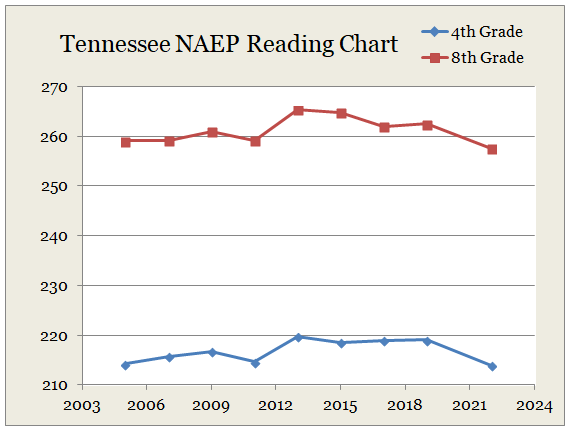
A shift to SoR-based curriculum is as likely to cause harm as it is to bring literacy success. This was just a used-car salesman style claim. On the other hand, the “abundance of success” in Tennessee is an unadulterated lie. National Assessment of Education Progress (NAEP) tracks testing over time and is respected for education testing integrity. Tennessee’s NAEP data shows no success “from their efforts.” Their reading scores since 2013 have been down, not a lot but do not demonstrate an “abundance of success”.

NAEP Data Plot 2005 to 2022

Amplify’s Genesis

Larry Berger and Greg Dunn founded Wireless Generation in 2000 to create the software for lessons presented on screens. Ten years later, they sold it to Rupert Murdoch and his News Corporation for $360 million. Berger pocketed $40 million and agreed to stay on as head of curriculum. Wireless Generation was rebranded Amplify and Joel Klein was hired to run it.

Murdoch proposed buying a million I-pads to deliver classroom instruction. However, the Apple operating system was not flexible enough to run the software. The android system developed at Google met their needs. They purchased the Taiwanese-made Asus Tablets, well regarded in the market place but not designed for the rigors of school use. Another issue was that Wireless Generation had not developed curriculum but Murdoch wanted to beat Pearson and Houghton Mifflin to the digital education market place … so they forged ahead.

In 2012, the corporate plan was rolling along until the wheels came off. In Guilford County, North Carolina, the school district won a Race to the Top grant of $30 million dollars which it used to experiment with digital learning. The district’s plan called for nearly 17,000 students in 20 middle schools to receive Amplify tablets. When a charger for one of the tablets overheated, the plan was halted. Only two months into the experiment, they found not only had a charger malfunctioned but another 175 chargers had issues and 1500 screens were kid-damaged.

This was the beginning of the end.

By August of 2015, News Corporation announced it was exiting the education business. The corporation took a $371 million dollar write-off. The next month, they announced selling Amplify to members of its staff. In the deal orchestrated by Joel Klein, who remained a board member, Larry Berger assumed leadership of the company.

Three months later, Reuters reported that the real buyer was Laurene Powell Jobs. She purchased Amplify through her LLC, the Emerson Collective. In typical Powell Jobs style, no information was available for how much of the company she would personally control.

Because Emerson Collective is an LLC, it can purchase private companies and is not required to make money details public. However, the Waverley Street Foundation, also known as the Emerson Collective Foundation, is a 501 C3 (EIN: 81-3242506) that must make money transactions public. Waverly Street received their tax exempt status November 9, 2016.

SoR A Sales Scam

The Amplify email gave me a link to two documents that were supposed to explain SoR: (Navigating the shift to evidence-based literacy instruction 6 takeaways from Amplify’s Science of Reading: The Symposium) and (Change Management Playbook Navigating and sustaining change when implementing a Science of Reading curriculum). Let’s call them Symposium and Navigating.

Navigating tells readers that it helps teachers move away from ineffective legacy practices and start making shifts to evidence-based practices. The claim that “legacy practices” are “ineffective” is not evidence-based. The other assertion that SoR is evidence-based has no peer-reviewed research backing it.

Sally Riordan is a Senior Research Fellow at the University College London. In Britain, they have many of the same issues with reading instruction. In her recent research, she noted:

“In 2023, however, researchers at the University of Warwick pointed out something that should have been obvious for some time but has been very much overlooked – that following the evidence is not resulting in the progress we might expect.

“A series of randomised controlled trials, including one looking at how to improve literacy through evidence, have suggested that schools that use methods based on research are not performing better than schools that do not.”

In Symposium, we see quotes from Kareem Weaver who co-founded Fulcrum in Oakland, California and is its executive director. Weaver also was managing director of the New School Venture Fund, where Powell Jobs served on the board. He works for mostly white billionaires to the detriment of his community. (Page 15)

Both Symposium and Navigating have the same quote, “Our friends at the Reading League say that instruction based on the Science of Reading ‘will elevate and transform every community, every nation, through the power of literacy.”’

Who is the Reading League and where did they come from?

Dr. Maria Murray is the founder and CEO of The Reading League. It seems to have been hatched at the University of Syracuse and State University of New York at Oswego by Murray and Professor Jorene Finn in 2017. That year, they took in $11,044 in contributions (EIN: 81-0820021) and in 2018, another $109,652. Then in 2019, their revenues jumped 20 times to $2,240,707!

Jorene Finn worked for Cambria Learning Group and was a LETRS facilitator at Lexia. That means the group had serious connections to the corporate SoR initiative before they began.

With Amplify’s multiple citations of The Reading League, I speculated that the source of that big money in 2019 might have been Powell Jobs. Her Waverly Street Foundation (AKA Emerson Collective Foundation) only shows one large donation of $95,000,000 in 2019. It went to the Silicon Valley Community Foundation (EIN: 20-5205488), a donor-directed dark money fund.

There is no way of following that $95 million.

The Reading League Brain Scan Proving What?

Professor Paul Thomas of Furman University noted the League’s over-reliance on brain scans and shared:

Many researchers in neurobiology (e.g., Elliott et al., 2020; Hickok, 2014; Lyon, 2017) have voiced alarming concerns about the validity and preciseness of brain imaging techniques such as functional magnetic resonance imaging (fMRI) to detect reliable biomarkers in processes such as reading and in the diagnosis of other mental activity….

“And Mark Seidenberg, a key neuroscientist cited by the “science of reading” movement, offers a serious caution about the value of brain research: “Our concern is that although reading science is highly relevant to learning in the classroom setting, it does not yet speak to what to teach, when, how, and for whom at a level that is useful for teachers.”

“Beware The Reading League because it is an advocacy movement that is too often little more than cherry-picking, oversimplification, and a thin veneer for commercial interests in the teaching of reading.”

The push to implement SoR is a new way to sell what Amplify originally called “personalized learning.” This corporate movement conned legislators, many are co-conspirators, into passing laws forcing schools and teachers to use the SoR-related programs, equipment and testing.

SoR is about economic gain for its purveyors and not science based.

When politicians and corporations control education, children and America lose.

Pitch AI Education?

9 Jan

By Thomas Ultican 1/9/2024

The Walton family (Tax Id: 13-3441466), Jonathon Sackler (Tax Id: 13-4119735), Lynn Schusterman (Tax Id: 73-1312965) and other billionaires fund The 74 Media, Inc. It has become a primary method for propagating their agenda. In December, The 74 published 7 Artificial Intelligence Trends That Could Reshape Education in 2024.” For serious educators, AI is a set of computer algorithms, making cheating easy. It is another tool for a dumbed-down, easier to control and more profitable education system.

Late Steve Jobs’ billionaire wife, Laurene Powell Jobs, founded the Emerson Collective. In 2015, Emerson Collective bought Amplify, a kids-at-screens education initiative that Rupert Murdoch gave up on. The same year, Jobs and Russlynn Ali founded XQ Institute and its XQ Super Schools project soon followed. In 2017, they put on a one-hour show, XQ Super Schools Live, simultaneously on four networks, ABC, CBS, NBC, and Fox. Talent featured included Ringo Starr, Tom Hanks, Samuel L. Jackson, Justin Timberlake, and Jennifer Hudson.

Jobs set out to use wealth to impose her views on reforming public education.

Her plans did not resonate deeply with the public so today she seems to be using wealth to push education technology and Amplify. The AI article linked was written by Edward Montalvo, XQ institute’s senior education writer. He writes:

‘“The future of AI in education is not just about adopting new technologies; it’s about reshaping our approach to teaching and learning in a way that is as dynamic and diverse as the students we serve,’ XQ Institute Senior Advisor Laurence Holt said. … Through AI, we can also transcend the limitations of the Carnegie Unit — a century-old system in which a high school diploma is based on how much time students spend in specific subject classes.

“Changing that rigid system is our mission at XQ.”

The article, linked by Montalvo, appeared in the September 11, 2023 issue of The 74, co-written by XQ’s Russlynn Ali and Carnegie’s Timothy Knowles. Ending the Carnegie Unit is crucial for the scheme to put children in front of computers earning badges. It is the only way to implement competency-based education (CBE), at a low price.

The fact that CBE and its forerunners have a 50-year history of failure seems not to be an issue.

Montalvo’s article was a sales job for AI products. He noted that an XQ Super School, PSI High in Sanford Florida, was engaging with AI. PSI tells us, “The program’s mastery-based grading system also helps ensure that students are fully prepared for college, career, and beyond.” Abandoning traditional education, they have replaced it with rubrics. There is no information about student performance 6-months down the road. How can AP courses be offered without traditional education? Yet, PSI says they are excited about AI.

AI has value but for pedagogy, it is limited. Educator and blogger, Mercedes Schneider, shared, “As a teacher for many decades, I find increasingly more of my time consumed with devising means to ensure students complete my assignments without the easy-cheat, sustain-my-own-ignorance that AI enables in today’s students – and, it seems, an increasing number of (especially remote) professionals who may be using the corner-chopping ability AI offers to even hold multiple full-time positions.

Dystopian Future is Possible

Jobs, XQ and Carnegie are far from the only forces out to blow up our current education system by pushing for a technology-based takeover. Many deep-pocketed fans promote education technology. The new push to eliminate the Carnegie unit is coming from a below-the-surface movement to digitize education. Global Silicon Valley (GSV) has taken leadership of an effort to program life with crypto-world tools.

GSV is a venture capital firm founded in 2010 by Michael Moe, a private company with a radical libertarian ideology. Moe and colleagues published American Revolution 2.0; How Education Innovation is Going to Revitalize America and Transform the U.S. Economy. This manifesto calls for turning kindergarten through university and beyond into a tokenized existence. Graduation from kindergarten gets a token, hospitalization gets a token, immunization gets a token, earn a C in reading gets a token and so on, will be forever saved in a blockchain.

This is a roadmap to “Big Brother.”

American Revolution 2.0 Page 292

At the April 2023 ASU+GSV conference in San Diego, Educational Testing Service (ETS) and Carnegie Foundation announced they are partnering to create assessments for CBE. Besides resting on a 50-year history of failure, the big obstacle for CBE is that testing has not proven reliable. This is the issue that Amit Savak of ETS and Tim Knowles of Carnegie are promising to solve. It is a key to the digitized education scheme becoming viable.

Much of the motivation for this thinking is a belief that the preeminent purpose of education is employment readiness. Philosophy, literature, art etc. are only meaningful for children of the wealthy. The new push for CBE and ending the Carnegie Unit is a move toward skill-based education, wasting no time on useless “frills.”

It is easy to cheat with digitally-enhanced systems. Derek Newton, writing for Forbes, observed, “But because of the credit hour system, which is designed to measure classroom instruction time, it’s still relatively hard to cheat your way to a full college degree.”

A good example of Newton’s point is high school credit recovery. America’s high school graduation rates peaked at about 77% in 1970 and then drifted down for almost four decades to 69% in 2007. Credit recovery at a computer screen was introduced in 2007. After that students were completing semester-long courses in as little as one day and cheating became rampant. In 2012, 81% of the freshman cohort in America graduated on time, an all-time record.

Roman Sterns, founder and executive director of Scaling Student Success, is all in for credentialing. He says the present high school transcript is a relic of the past, describes a new transcript type and excitedly reports:

“Fortunately, a version of this new kind of transcript has been developed and is being piloted now by schools affiliated with the Mastery Transcript Consortium (MTC). Launched in March 2017, membership has grown to over 300 schools. Most are independent schools, both in the U.S. and overseas, but increasingly public schools are opting in.”

EdSurge reports:

“In the area of lifelong learning, the Learning Economy Foundation (LEF) aims to create a decentralized, blockchain-based network where skills and credentials are stored within a digital identity that follows the learner. Recently, LEF partnered with LEGO Foundation to create a gamified learning experience, called SuperSkills!, where elementary school students can select adventures and collect gifts as a result of learning core skills.”

Crypto technology has created an environment where storing information about everyone in a blockchain is possible and the data can never be erased or corrected. This new edtech tool is described in Greg Nadeau’s slide presentation Internet of Education 3.0.” He is a crypto enthusiast but some of his slides troublingly point to a new tyranny of information.

Opinion

Between the Civil War and Bill Clinton’s presidency, American public education made slow, consistent improvement. With President Clinton’s standards, the momentum dropped and stopped with the advent of No Child Left Behind. Reagan era’s “A Nation at Risk” was the model for education reform, directed by non-educators. With the movement for “school choice,” vultures started circling over public education, looking for opportunities. Clearly, public education can be improved but success requires professional educators to lead, not politicians, entrepreneurs and amateurs.

The direction charted by GSV, XQ and the Carnegie Foundation is more than foolish … it is dangerous. An institution responsible for the developing the world’s oldest functioning democracy is being turned into a tool for repression.

Greedy, Mindless fools must be stopped!

Cradle to Grave Surveillance

20 Jun

By Thomas Ultican 6/20/2023

Global Silicon Valley (GSV) has taken point of an effort to digitize life with crypto-world tools.

At the recent ASU+GSV conference, Carnegie and ETS announced a new partnership to create functional testing for competency based education (CBE). That was a big deal because CBE is central to what amounts to a cradle to grave surveillance. In this scheme, a new birth starts the initial record in an inerasable history of education, work and economic activity.  

Edtech leaders are creating a dystopian system of education and career tracking that makes Orwell look optimistic. With this, every American’s history will be held in his or her unalterable blockchain which needs CBE as the education method.

GSV is a venture capital firm founded in 2010 by Michael Moe. Like NewSchools Venture Fund, it focuses on edtech. GSV differs by being a private company with an even more radical libertarian ideology. In 2012, Moe and colleagues published American Revolution 2.0; How Education Innovation is Going to Revitalize America and Transform the U.S. Economy, a manifesto for turning kindergarten through university and beyond into a tokenized existence. Graduate kindergarten token, hospitalized token, immunized token, C in reading token and so on will be saved forever.

The chart above is from American Revolution 2.0 (page 292). Added annotations in red, point out key developments on this road map to a 100% tokenized and badged education system by 2027. Their 2013 call for “No Child Left Behind 2.0” looked suspiciously similar to Obama’s “Race to the Top.” “Marketplace for education information” by 2014 fitted right in with Killswitch’s claim, “Information is the new gold – it’s the new oil.”  

Several organizations fall under the main GSV group, including GSV Labs, GSV Asset Management and GSV Tomorrow, a commentary arm where investing trends and stories are disseminated. All stories link readers to the GSV landing page for the annual ASU+GSV Summit, claimed to be the “most impactful convening of leaders in education and talent tech” with over 5,000 attendees and 1,000 speakers from 45 different participating countries.

The annual American Educational Research Association conference and the ASU+GSV Summit take place at the same time.

Technology critic Audrey Watters noted,

“It’s hardly an insignificant scheduling gaffe. If nothing else, the dueling conference schedules tap into a powerful cultural trope, one that’s particularly resonant among Silicon Valley and education reform types: that education experts and expertise aren’t to be trusted, that research is less important than politics, that the “peer review” that matters isn’t the academic version, but rather the sort that drives a typical VC [venture capital] roadshow.”

Organizing Crypto-Education

1edtech was until recently known as IMS Global. They are a non-profit 501 c6 organization (TIN: 04-3489277), meaning only membership fees are tax deductible. However, recently it created a work-around for parties that want to give money and get a tax break. The new 1edtech Foundation is a 501 C3 organization (TIN: 83-1489371) which will gladly take your tax free donations and pass them along.

If a company’s new product is compliant with established technology protocols and able to communicate effectively with other certified products 1edtech will certify it. The organization also offers standards and frameworks around content integration, credentialing, analytics, and assessments. Major standards developed include:

  • LTI: The Learning Tools Interoperability standard provides a method for applications to integrate with learning management systems (LMSs).
  • OneRoster: A standard for sharing class rosters, course materials, and grades between a school’s student information system and edtech applications.
  • Open Badging: A type of digital badge that is verifiable, portable, and packed with information about skills and achievements.
  • Caliper Analytics: Enables institutions to collect learning data from digital resources.

The Wellspring Project is a major focus going forward for 1edtech. In this new learning model, digital credentials are valuable assets for institutions, individuals and employers. Wellspring seeks to build infrastructure that leverages these assets to help companies identify candidates for hiring. A Cision PRWeb report states,

“The first phase of the Wellspring Project, led by IMS and funded by the Charles Koch Foundation, explored the feasibility of dynamic, shared competency frameworks for curriculum aligned to workforce needs. Partnering with Education Design Lab and the Council for Adult and Continuing Education (CAEL), IMS organized cohorts of education providers and employers by common disciplines and related skills. Using learning tools that leverage the IMS Competencies and Academic Standards Exchange® (CASE®) standard, the cohorts mapped co-developed frameworks, digitally linking the data to connect educational program offerings with employer talent needs.”

This new vision of education dictates a kind of student transcript tied to credential accumulation, instead of earned units from graded classes. Roman Sterns, founder and executive director of Scaling Student Success, is all in for credentialing. He says the present high school transcript is a relic of the past, describes a new transcript type and excitedly announces,

“Fortunately, a version of this new kind of transcript has been developed and is being piloted now by schools affiliated with the Mastery Transcript Consortium (MTC). Launched in March 2017, membership has grown to over 300 schools. Most are independent schools, both in the U.S. and overseas, but increasingly public schools are opting in. The new transcript has no grades or numerical ratings, is customizable to align with school or district outcomes, and includes links to artifacts that demonstrate the level of student proficiency reported. The transcript’s consistent format allows for easy interpretation by colleges and universities.”

For 50 years, mastery-based education now called CBE has been a major flop. It is a piece of the crypto-education infrastructure, calling for bad pedagogy. Established on the mind-numbing drill and skill approach, CBE undermines authentic learning. A major glitch in edtech badging is mastery-style learning online becomes necessary for the credentialing process to function.

Internet of Education 3.0

An EdSurge posting reports,

“In the area of lifelong learning, the Learning Economy Foundation (LEF) aims to create a decentralized, blockchain-based network where skills and credentials are stored within a digital identity that follows the learner. Recently, LEF partnered with LEGO Foundation to create a gamified learning experience, called SuperSkills!, where elementary school students can select adventures and collect gifts as a result of learning core skills. Under the hood, the app uses the W3C’s Universal Wallet, a framework developed by MIT and LEF to store credentials within a blockchain-based identity. This identity is not locked down to one app or company, allowing learners to own their data and use it as they wish across their academic and professional lifetimes.”

The statement “allowing learners to own their data” is misleading. They do not have exclusive access to the data and cannot delete entries or correct errors. It is only personally useful for academic and job applications.

Last year, more than 1500 data scientists signed a letter to the US Senate, warning about the dangers of blockchains and their flaws. They stated in part,

“As software engineers and technologists with deep expertise in our fields, we dispute the claims made in recent years about the novelty and potential of blockchain technology. Blockchain technology cannot, and will not, have transaction reversal or data privacy mechanisms because they are antithetical to its base design. Financial technologies that serve the public must always have mechanisms for fraud mitigation and allow a human-in-the-loop to reverse transactions; blockchain permits neither.”

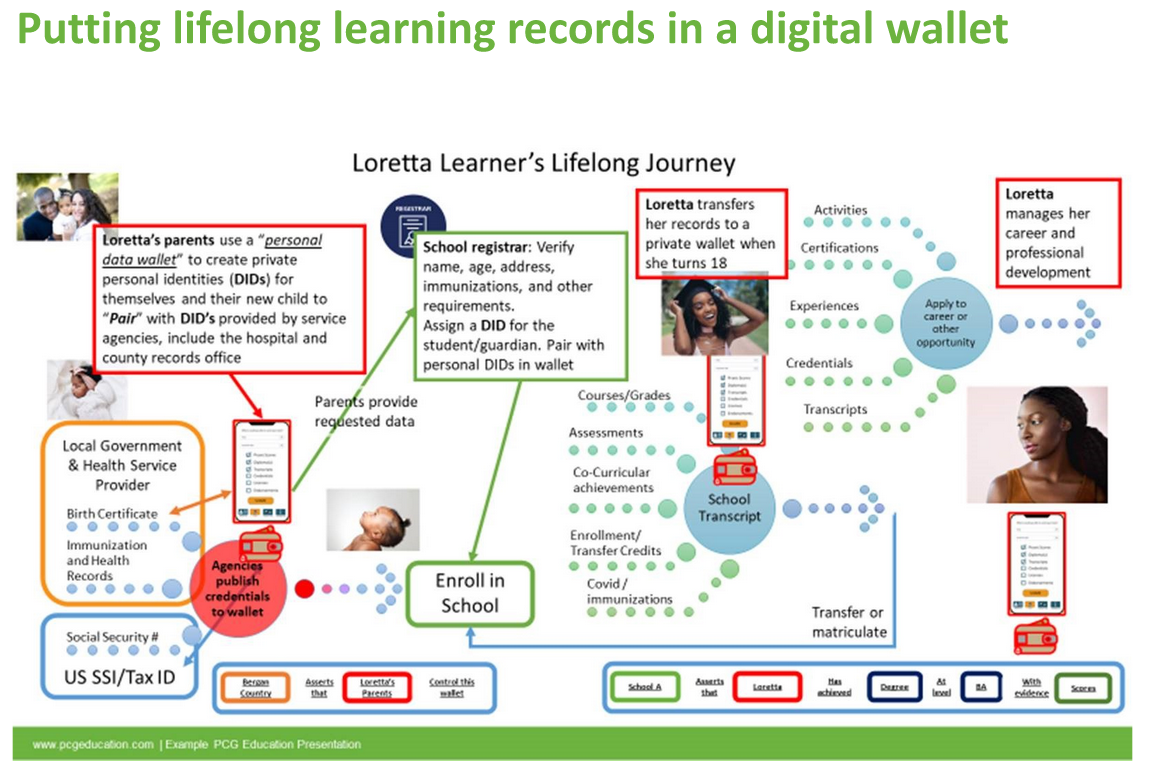
Blockchains are fundamental to the new edtech, described in Greg Nadeau’s slide presentation Internet of Education 3.0.” He is an edtech/blockchain enthusiast but some of his slides are both illuminating and troubling.

The cartoon above (slide 30) describes the complicated and opaque method needed to update blockchain data bases. A lot of work is done by the SSI/DID block. SSI or Self-sovereign identity summarizes all components of the decentralized identity model: digital wallets, digital credentials, and digital connections. Decentralized identifiers (DIDs) are a type of identifier enabling verifiable, decentralized digital identity. A DID refers to any subject (e.g., a person, organization, thing, data model, abstract entity, etc.) as determined by the controller of the DID.  

Once the data is published by an application or agency, it is there forever and cannot be altered.

Slide 78 in Nadeau’s presentation follows. It gives a frighteningly clear view of the extent of the surveillance being envisioned.

Final Thoughts

It appears that many brilliant mostly young technologists are working on the tools for crypto-world. How exhilarating to think you are developing a new realm full of promise and possibilities! I am reminded of the youthful physicists who gave us nuclear power and the bomb. Like the way atomic weapons have given man the frightening ability to end our species, crypto brings the possibility of human bondage and tyranny.

Serially failed CBE style of pedagogy is harmful education. The new worse idea, actively pursued, is putting children at computer screens and logging their every event in a permanent and inalterable record. It promises a dystopian future.

Corporations Invade Delaware Public Schools

18 Oct

By Thomas Ultican 10/18/2021

A multifaceted corporate plan for control of Delaware public education is in progress. Billionaires are financing numerous edtech projects that isolate children at screens. To validate literacy curriculum the state has turned to the International Dyslexia Association and their nonsense “science of reading” standards. A key driver for the corporate takeover is the so called High Quality Instructional Materials (HQIM) certified as such by EdReports.

Whenever the words “high quality” are used to promote something in education, it is a good bet that swamp land is being sold.

A private email from a Delaware teacher stated the situation succinctly,

“Over the past several years, it has seemed like Delaware was going in the right direction after the nightmare of Gov. Jack Markell and the RTTT grant. There was suddenly more of a focus on the whole child, starting in October of 2018 when Gov. John Carney announced that our state would adopt trauma-informed practices. … Teachers were beginning to breathe a sigh of relief that maybe our state would begin to implement more reasonable education practices than the rigid, scripted, market-based programs we have seen. Then all of a sudden this summer, this stuff about HQIM started popping up from DDOE. Schools were written up in The 74. Videos were made with the Knowledge Matters group …. Professional development was announced with TNTP.”

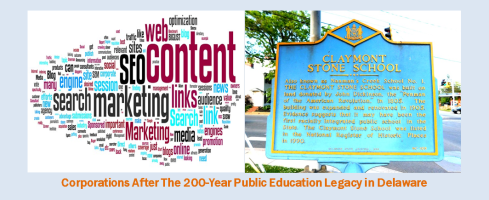
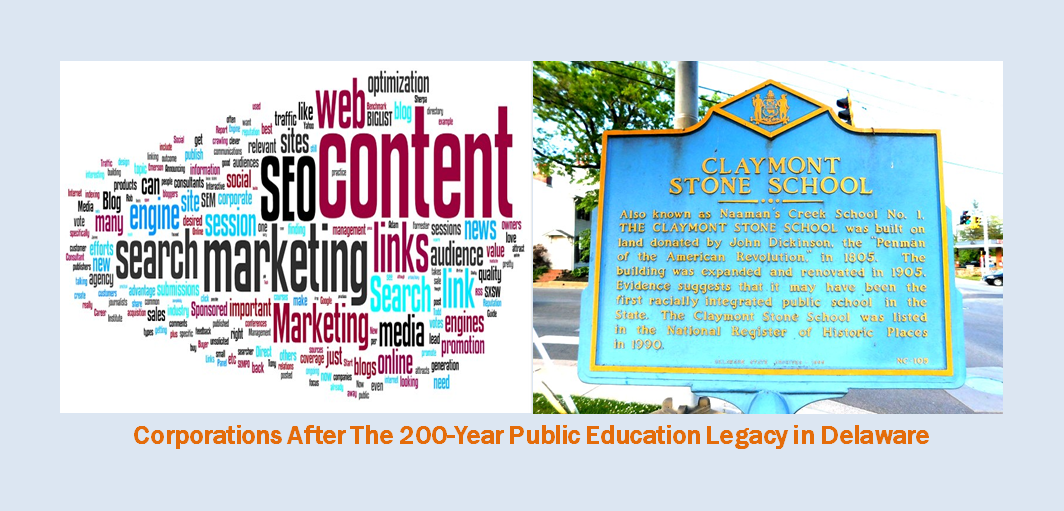
Delaware has one of the oldest public education systems in America. The History of Public Education in Delaware dates back to the 1792 state constitution which called for the establishment of public education as soon as possible (History page 19). In 1796, a permanent fund for public education was established (History page 19). In the following graphic a plaque identifies the historic Clayton Stone School built in 1805 on land donated by John Dickinson the “Penman of the American Revolution.” This is the legacy being threatened by corporate raiders.

Corner Stones of the Corporatization Plan

There was concern that Delaware’s children were falling behind due to the COVID pandemic. Monica Gant, Ph.D. from the Delaware Department of Education (DDOE) presented their strategy to accelerate learning in March. (Accelerating learning is highly questionable learning strategy.) Grant pitched, 

“DDOE is excited to use ESSER II funds to provide all Delaware public schools with five resources to support learning acceleration for students in literacy and mathematics for summer 2021:

Literacy Professional Learning and core HQIM Summer Booster content for raising 1-6 graders

Student access to online text repository (all students)

Access to Zearn Math Summer Intensive Series for all rising 1-8 graders

Zearn Professional Learning

High-dosage tutoring seats for multiple grades”

Under the heading “Literacy Professional Learning,” Professor Grant noted, “Participants will have a chance to apply their learning of the Science of Reading either through their district HQIM or utilize free OER (Open Education Resources) HQIM for this work.” And she announced that teachers will have the following professional materials available.

  • “Free OER – Core Knowledge Language Arts (CKLA) and Expeditionary Learning (EL)
  • Summer Booster provided by SchoolKit and TNTP
  • Districts already using American Reading Company (ARC) – Summer Booster provided by American Reading Company
  • Districts already using Bookworms – Bookworms Booster provided by UD (PDCE)”

Let’s unpack this a little. First, what is this ESSER II fund the DDOE is so excited about? ESSER II – Passed on Dec. 27, 2020 as part of the Coronavirus Response and Relief Supplemental Appropriations Act. Delaware received $182,885,104.

HQIM stands for high quality instructional materials. Amplify is the edtech company controlled by billionaire Laurene Powell Jobs. On the Amplify website they explain the HQIM qualifier,

“States and districts across the country are focusing on materials that have been rigorously reviewed and deemed high-quality by EdReports.org, the leading third-party curriculum reviewer (or, in Louisiana, by a Tier 1 designation). EdReports defines high-quality instructional materials as materials that are closely aligned to rigorous standards and easy to use.”

Unfortunately, EdReports is a creation of edtech money plus libertarian focused foundations and other neoliberal supporters of privatizing public education. EdReports shares its major sources of finance:

“EdReports is funded by Broadcom Corporation, the Bill & Melinda Gates Foundation, Carnegie Corporation of New York, Charles and Lynn Schusterman Family Philanthropies, the Helmsley Charitable Trust, the William and Flora Hewlett Foundation, the Overdeck Family Foundation, the Samueli Foundation, the Charles and Helen Schwab Foundation, the Stuart Foundation, the Walton Family Foundation, and the Oak Foundation.”

EdReports is not an unbiased or even a knowledgeable arbiter of best curriculum or pedagogy practices. It is part of a scheme to advance corporate control over education content.

Free OER is more of the same. It provides free digital resources which are delivered on a tablet or computer screen. OER reports that their top supporters are the Leona M. and Harry B. Helmsley Charitable Trust, Bill & Melinda Gates Foundation, William and Flora Hewlett Foundation, Draper Richards Kaplan Foundation, Charles and Lynn Schusterman Family Philanthropies and The Robin Hood Foundation. These are not legitimate philanthropies. Rather they are organizations with a political agenda who intend to profit from or privatize or end public education.

Both CKLA which is an Amplify product and Expeditionary Learning (EL) mentioned in the plan provide scripted lessons to a screen. Nancy Bailey wrote a scathing critique of CKLA that seems to fit EL as well. In it she quotes an Oklahoma teacher giving CKLA the only positive spin she could,

“I wouldn’t want my children taught this way. I don’t know the rationale behind adopting it. The curriculum doesn’t light up the eyes of kids. It removes the autonomy from the teacher. I guess if people have come through an alternate route and don’t have a teaching degree, you can teach it without much experience.”

The DDOE has adopted a rigidly scripted market-based program called “Bookworms” for K-5 literacy. It was developed locally by University of Delaware professor Sharon Walpole. However, this is another digital product that undermines teacher professionalism and is also part of OER’s national offerings.

The newer product being foisted on Delaware schools is Zearn. It is another digital learning platform similar to i-Ready and Amplify. Bill Gates (Foundation Tax Id: 56-2618866) and the New Schools Venture Fund (Foundation Tax Id: 94-3281780) are spending heavily to make this company founded in 2014 a success. Between 2016 and 2019 Gates gifted them more than $7,000,000.

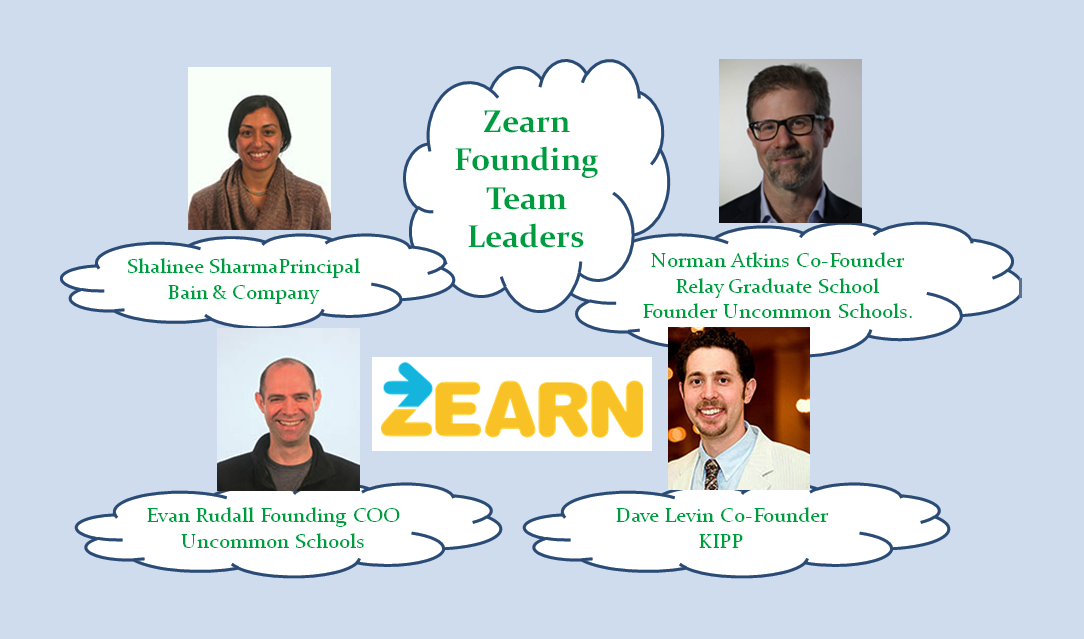
Of the 16 leaders listed on Zearn’s first year (2014) web-site, five of them came from Mit Romney’s Bain & Company including Shalinee Sharma who still leads Zearn. Two of them were from Wireless Generation which eventually became Amplify which endured some spectacular failures.  

It is difficult to find independent research that evaluates Zearn. Though it is designed to maximize test scores, the only academic study found (from Johns Hopkins University) showed that Zearn treatment students did not outperform other public school students on standardized testing. However, since those tests are basically useless, that result does not mean much.

Zearn claims to be engaging for students and that students like the product. However, on an independent review site, students are brutal in their condemnation of Zearn with comments like, “I am in fifth grade and the thing has me doing stuff, my baby brother could do!” Worst of all, it is not healthy to put children at screens for long periods of time.

Propaganda Versus Reason

The Delaware teacher quoted above mentioned articles produced by Knowledge Matters about local schools appearing in The 74. Funders for The 74 include the Walton Family, Bill & Melinda Gates, the Emerson Collective (Laurene Powell Jobs), the Joyce Foundation, and Michael Bloomberg. So it was an easy lift for Knowledge Matters to place their articles touting corporate created literacy materials. This is all part of a billionaire funded anti-public education publishing cabal.

Knowledge Matters is hardly a fair unbiased commentator. Their steering committee includes Chester E. Finn, Thomas B. Fordham Institute; Kaya Henderson former Chancellor of the District of Columbia Public Schools; Joel Klein former Chancellor of the New York City Department of Education and David Steiner former New York State Commissioner of Education. All of these people have done damage to public education.

To guide the Delaware public schools’ literacy program, the DDOE has turned to The International Dyslexia Association (IDA) – who advocates the “science of reading” – to validate Delaware’s programs. The National Education Policy Center warned against, “Misrepresenting the ‘science of reading’ as settled science that purportedly prescribes systematic intensive phonics for all students.” And they stated that policy makers, “Should support the professionalism of K-12 teachers and teacher educators, and should acknowledge the teacher as the reading expert in the care of unique populations of students.” IDA is more about selling testing and promoting corporate created scripted literacy lessons than it is about helping students learn.

No teacher should be condemned to professional development from TNTP. This spinoff from Teach for America (TFA) is unqualified because of weak education scholarship and limited experience. Almost every Delaware school district has a more experienced and professional team than TNTP can provide. Without the huge funding they received from billionaires, TNTP would have never survived into the 21st century. TNTP is famous for writing papers that are not peer reviewed and often contravene evidence. Their papers do support the agenda of the billionaires funding them.

For more than 200 years, Delaware has been developing a world class education system. The districts and schools in the state are staffed by genuinely well trained and experienced staff. Instead of turning to TFA teachers who have little experience and less training for leadership in pedagogy, turn to your existing education professionals. Turn away from hubris and greed. Instead of buying scripted lessons that kill creativity in both teachers and students, let your high quality professional educators do their job.

OUSD, the Digital Divide and Edtech – Be careful what you wish for

24 Jul

By  Steven Miller, July 22, 2021 (Guest Post by former Oakland Educator)

In 2018, Thomas Ultican wrote about the dangers of Edtech:

“Public education in America contends with four dissimilar but not separate attacks. The school choice movement is motivated by people who want government supported religious schools, others who want segregated schools and still others who want to profit from school management and the related real estate deals. The fourth big threat is from the technology industry which uses their wealth and lobbying power to not only force their products into the classroom, but to mandate “best practices” for teaching. These four streams of attack are synergistic.”

Edtech is now far more predominant everywhere today, after 2 COVID school years, which has resulted in the massive imposition of distance-learning.

Back in 2018, Education Week Research Center reported that a strong majority of the country’s principals  – 85% of those interviewed –  felt that too much screen time was not good for students – 77% felt students worked alone too often and 67% felt the tech industry had too much influence over public education.  And now Edtech is being established as the savior of our children.

That was then; this is now.

We all know, teachers, students, parents, communities – all the primary stake-holders – we all know that the new school year presents us with some of the greatest challenges we have ever faced in public education. Re-opening is a crisis and an emergency. So what is Edtech bringing to OUSD? Is it helping?

The education reporter for The Oaklandside, Ashley McBride, wrote on July 20, 2021:

“More than a year ago, the city of Oakland together with Oakland Unified School District and a group of nonprofit partners launched the Oakland Undivided campaign with an ambitious goal: to close the digital divide by raising enough money to purchase laptops and internet hotspots for every student in Oakland who needed them during the pandemic. At the time, public school students were required to learn from home virtually, but roughly 25,000 of them in Oakland lacked a computer, reliable internet, or both….”

“Today, as students prepare to head back to their classrooms full-time in the fall, nearly 97% of students in Oakland Unified School District have a computer and working internet at home, including 98% of students who are low-income, according to district data.”

Sounds like a good thing, a really good thing. The problem with Edtech, however, is not the digital technology. Technology is a tool that can be used well or turned against us. Technology can actually be employed to make schools better, not cheaper. The issue is how it is configured. As always, we must follow the money trail to really discover who benefits.

While OUSD is currently planning on fully re-opening, distance learning is an option. It will certainly be more pervasive in the classroom. Edtech makes its money off harvesting student data. Who will own the data this coming year, 2021-22?  Who can use the data? Do students or their parents control their own data?

The School Board must play a leading role in guaranteeing public policy here.

Chrome books store every single key stroke (and possibly every eye movement) on the cloud, which they own. Google Chromebooks also have a pre-installed program called “Gaggle”, which, we are told, scans student homework to look for depression, suicide ideation and likely various threats to shoot up the school. Google Classroom material is configured to surveille the students. Data and ever more data is the mother’s milk of Edtech. 

One problem is the people who control the data harvested from Edtech algorithms have increasing influence in creating the curriculum. This new private power in public schools is routinely used to undercut the role of experienced teachers and call the shots.

Whether corporations or big-shot administrators, the people who control this power love to spout about “healing the digital divide”. This is the corporate happy-speak that the OUSD school board, as well as their “private partners” and NGOs, traditionally have used to dress up policies that are demonstrated to work against student learning. But “healing the digital divide” with chrome books turns our children’s information into fodder for corporate profits.

Another favorite is “personalized learning”, supposedly something that Edtech will make available to every student and bring public education into the 21st Century. This myth is based on the same type of algorithms that Netflix and Amazon use to “personalize” their services to your interests. The biggest backers of personalized learning are Bill Gates, Google and the Chan- Zuckerberg Initiative.  As noted by blogger Peter Greene:

“Personalized learning, whether we’re talking about a tailored-for-you learning program on your computer screen or a choose the school you’d like to go to with your voucher, is not about actual personalization. It’s about another path for marketing, a way of personalizing the marketing of the product, the edu-commodity that someone is already trying to make money from.

“We’re being sold (and in many cases are arguing against) an AI that spits out just the digitized worksheet that Student 12-5452 needs to continue studies, but that’s not where we’re headed. Look, for instance, at the new, improved PSAT
that returns both a score and some recommendations. ‘Looks like you need to log in to Khan Academy’s lesson series for calculus.’ Or ‘You would really benefit from the AP Calculus course– talk to your guidance counselor today.”’

On March 21, 2021, OUSD signed an agreement to replace diagnostic testing from the Smarter Balanced Assessment Consortium with the notorious I-Ready. One of the funders of i-Ready is the Kenneth Rainnin Foundation, which also funds local Oakland privatizers like GO Public Schools, the Oakland Public Education Fund, the New Schools Venture Fund, Aspire charter schools, Educate 78 Oakland Public Schools, the East Bay Community Foundation, and Education for Change.

I-Ready is based in the techniques of behavioral modification that was fundamental to the highly discredited system of Competency Based Education that holds that children should learn alone and in isolation, taking constant tests to prove their “mastery”.

This reactionary and unproductive philosophy is also disguised as “performance-based education”, “standards-based education”, “outcome-based education”, and “programmed instruction” among others. I-Ready is Competency Based Education on a screen.

Funny thing, i-Ready regularly identifies Black, Indigenous, and students of color as failing. If the goal is to prove that Oakland children are “failing”, then i-Ready is the tool to use. But maybe it is not best to welcome students back and then give them standardized tests to measure how far behind they have fallen.

 Keeanga-Yamahtta Taylor wrote:

“The dystopian imagery of a ‘lost generation’ of Black youth is redolent of earlier moral panics: the discoveries of ‘crack babies’ in the nineteen-eighties and ‘super predators’ in the nineties were also rooted in anecdote-driven, pseudo-scientific evidence. Today’s evidence for the spiral of Black children is the tactically vague measurement of ‘learning loss.’ But no one needs to invent a new metric to discover that, during the worst crisis in modern American history, students might be falling behind.”

Ashley McBride describes another facet of Edtech coming to Oakland:

“The Oakland Reach, a parent advocacy group involved with the Oakland Undivided campaign, has been working with Sydewayz Cafe, an information technology business in Oakland, to provide tech support for the organization’s virtual family hub during the pandemic. In the fall, The Oakland Reach plans to launch a fellowship to give students and their families more intensive training in technology and digital platforms, said executive director Lakisha Young. They’ve also been helping families get a federal discount on broadband service.”

Here we have another private power with powerful influence in OUSD. Oakland Reach and the OUSD, in partnership, received a $900,000 grant from the notorious privatizers, the Center on Reinventing Public Education (CRPE) and The New Teacher Project, which supposedly trains teachers, but which pushes privatization. These organizations are part of a complex of billionaire-financed privatization networks like Teach For America, too many to name.

CRPE advocates that school boards should look at schools like a stock portfolio, get rid of the poor performers and invest in the successful stocks. When New Orleans privatized every single school as charters, CRPE came up with “the Blueprint Process”. OUSD used the Blueprint Process to justify closing 23 schools in 2018.

The OUSD School Board, in its grace and wisdom, still intends to close schools as the 2021-2022 school year begins. How many? The Board will announce its plan for school closures on August 16, one week after school begins. “Nothing says ‘Welcome back to school for a restorative restart’ than to tell schools filled with Black and brown students that we’re going to close your school or change your school because you’re not doing well,” said parent Kim Davis during a public comment portion of the meeting.

CRPE has developed a national network called “Education Cities” with the purpose of disrupting public schools. This corporate mob operates in 32 different cities across the country including Oakland, Cincinnati and Atlanta.

From Atlanta to Cincinnati to Oakland, a loosely connected network of nonprofit groups is working to reshape the way their school districts function. Their national scope has gone mostly unexamined, even as their influence is arguably far more likely to affect schools in the average American city than a Betsy DeVos-inspired voucher program.

CRPE also advocates to abolish the political control of public schools by elected school boards. They would be replaced by “Community Education Councils (CECs)”, which would exert “light local governance”. In addition, CRPE advocates for vouchers, what they call “backpack funding”:

A local CEC would have three essential functions: (1) assembling and disbursing funds for each student’s personal education fund; (2) monitoring the quality, innovativeness, and responsiveness to economic change of the learning options available to students; and (3) protecting students by ensuring valid information for choices among diverse learning experiences, monitoring equity of student placements, and identifying fraudulent or ineffective schools or learning providers.

Their essay on funding also discusses students’ personalized education funds, including so-called “back pack funding” that follows students through different learning experiences, and how they can be assembled and managed. The remainder of this essay focuses on the promotive and protective functions of light local governance.

The complex of “OUSD partners” that have banded together to enforce a corporate dictatorship for privatized and semi-privatized education is out in the open. It runs the gamut from chrome books to Oakland Reach to Oakland Undivided to the Center for Reinventing Public Education to the Gates Foundation to Michael Bloomberg, who has bought and paid for several school board members, and beyond.

Certainly, better and more equitable education technology is essential and a public priority. But the way this will be implemented threatens children in Oakland and across the country.

Key question that unravel the whole mess are:

“What are these corporate education reformers going to do with all the data your child will produce next year? Who owns it?”

Every click, every search, the amount of time a child spends on a project or on multiplication, whatever, becomes the property of the corporations that own the apps and the algorithms. They can store it, sell it, search it and configure it with AI, and even… create a profile of your kid that the corporation owns. In May, Dr Velislava Hillman a visiting Fellow at the London School of Economics shared,

“Naviance, owned by Hobson, is a multi-layered data-collecting platform, which until February 2021 formed part of the Daily Mail and General Trust in the UK. The platform has access to a wide range of personal and sensitive information of students. It tracks students as they move through elementary school, college and beyond.”

Hobson serves roughly 12 million students globally across 2000 institutions of post-secondary  education and some 8500 schools and school districts in 100 different countries. It focuses on student “life-cycle management.”

What will happen to Oakland students then when they graduate? Can they retrieve their “profile” from the corporations? What if a student has asthma, causing her to miss school at a rate 7.8% more than her cohort, perhaps taken as “race”, “class,” or measured against the easily developed “Obstruction Index”, which reports on non-cooperation as a behavior trait? 

Perhaps OUSD School Board members will tell us soon whether or not our children’s data will be exploited by corporations. That definitely is the national and international trend. Perhaps School Board members can explain how OUSD intends to protect the information of children – their legacy as living beings – and guarantee their rights to control their digital profile.

We can only hope… or maybe we should force the issue?

Edtech is Business First – Part 2

24 Jun

By Thomas Ultican 6/24/2021

The pandemic brought a bonanza for online content providers and classroom organizing software. Programs like Google Classroom and Class Dojo which previously seemed superfluous performed a needed service during the crisis. Unfortunately, some of the edtech companies whose businesses spiked were taking advantage of the situation to sell profitable but harmful products based on bad education theory.

Content Providers

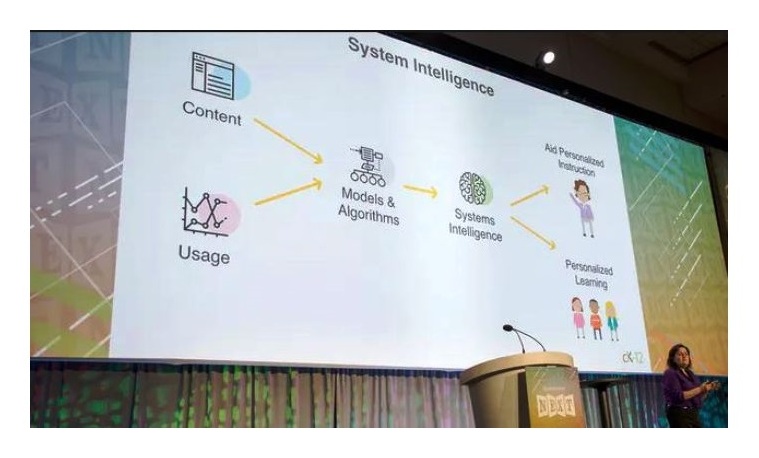
Neeru Kosala Presenting for her Non-Profit (Photo Credit CK-12)

Neeru Khosla is the founder and CEO of CK-12, a nonprofit that she started in 2007 to deliver free digital books, particularly on math and science topics. She has the same qualification to reform education as many of our lead education “disrupters”; she’s a billionaire. Her company claims to be providing high-quality, free resources and by free they also mean no pro-accounts or data collection.

Khosla is a mother who trained as a molecular biologist and later earned a masters from the Stanford Graduate School of Education but does not seem to have any classroom experience. Her husband, Vinod Khosla, is a venture capitalist whose massive wealth appears tied to early investments in Google (now Alphabet).

To finance CK-12, the couple uses two private philanthropies, Amar Foundation and CK-12 Foundation. For the past several tax cycles Amar Foundation (EIN 94-3055731) has liquidated about $9 million in Alphabet stock and forwarded the cash to CK-12 Foundation (EIN 20-8007128) which uses it to pay salaries and finance digital content development.

When the pandemic started this barely noticed service saw their registrations expand by 460 percent. Unfortunately, yet another billionaire amateur educator has gotten a larger megaphone to push the “personalized learning” agenda.

The Khan Academy is another content provider that saw their traffic soar in 2020. Originally, the academy generated an image of this selfless Silicon Valley guy, Sal Khan, making math education videos and distributing them for free. In 2007, he formed his non-profit but it was not until 2010 that Bill Gates (EIN 56-2618866) and other billionaires began sending him money.

It turns out that Sal Khan is not so selfless. His non-profit is making him wealthy. Khan Academy tax records (EIN 26-1544963) reveal that between 2010 and 2019 his salary totaled $6,009,694 and since 2015 his yearly salary has been more than $800,000. Between 2012-2017, the Gate Foundation gifted the Khan Academy $12,951,598 and the Overdeck Foundation (EIN 26-4377643) has kicked in $2,154,300.

In 2019, Khan Academy took in $92,559,725 of which only $27,629,684 was from contributions. The Academy has turned into a big-revenue generating non-profit.

In October 2020, Khan Academy announced a new joint effort with NWEA called Khan Academy Districts. There sales pitch says “Khan Academy has partnered with NWEA, creators of MAP® Growth™, to empower teachers to differentiate their instruction based on assessment results and meet the needs of all students.”

NWEA is the company that generated a lot of buzz with their covid-learning loss “research.” NWEA sells standardized math and English testing. They take in noisy data (All standardized testing data is noisy and fraught with error) 3-times a school year, do some fancy arithmetic and report out student growth determinations.

Last year, App Annie reported, “April 8, 2020 The top 3 Education apps in the US by downloads during the week of Mar 22 were Google Classroom, Remind: Safe Classroom Communication and ClassDojo, which saw 580%, 290% and 565% growth, respectively, versus the weekly average in Jan 2020.” This is the ongoing pandemic phenomena that prompted CNBC’s April 23, 2021 article Ed tech’ is booming: Wall Street analysts reveal how to trade the $5 trillion education market.”

Selling Education Snake Oil

The 2016 rewrite of the Elementary and Secondary Education Act of 1965 named ESSA, specified big money for edtech in Title’s I and IV including grants promoting “personalized learning” (ESSA Page 1969). About the only workable training method using a computer is competency based education (CBE). It is a method of drilling small chunks of knowledge and then assessing the learning.

Unfortunately, CBE is just an update of previous failed teaching strategies. In the 1970’s it was called Mastery Learning and in the 1990’s it was called Outcome Based Education. CBE is simply putting Mastery Leaning on a computer instead of using worksheets and paper assessments. It is still bad pedagogy with a sixty-year history of not living up to its protagonist’s claims.

Not only is “personalized learning” bad pedagogy it is also unhealthy. Dr. Nicholas Kardaras wrote in “Time” magazine about health risks associated with student screen time. He noted that “over two hundred peer-reviewed studies point to screen time correlating to increased ADHD, screen addiction, increased aggression, depression, anxiety and even psychosis.” Also, the vast majority of school principals believe that students are experiencing too much screen time and the Organization for Economic Co-operation and Development said in a 2015 report that heavy users of computers in the classroom “do a lot worse in most learning outcomes.

Curriculum Associates (CA) distributes i-Ready and its related testing services. The company which was founded in 1969 to provide worksheets for Mastery Learning curriculum is selling CBE based digital curriculum today. Children isolated at digital screens running their algorithms is called “personalized learning.” Student comments on the article “iReady Magnificent Marketing Terrible Teaching make it clear how much they despise this product.

Amplify is another company selling “personalized learning.” After Rupert Murdoch and Joel Klein failed miserably to profit in the edtech arena when Murdoch purchased Generation Wireless and rebranded it Amplify, they took a $371 million write off and exited the business. The billionaire Laurene Powell Jobs’s “Emerson Collective” assumed control of Amplify.

A third company selling CBE based lessons delivered to a screen is Education Elements. They are the classic technology startup company being financed by five venture capital funds including New Schools Venture Fund.

Technology holds great promise for enhancing education, but when profit motives trump ethics it is like feeding poison to America’s children.

Edtech is Business First – Part 1

17 Jun

By Thomas Ultican 6/17/2021

Not all edtech is negative but it is important to remember that private companies are in it for the money. Giant corporations and private equity firms require return on investment. Improving education comes in second to making profits and everyone in the business knows that the real edtech gold comes from data mining.

Dr Velislava Hillman is a visiting Fellow at the London School of Economics and Political Science (LSE). In a post on the LSE blog she writes,

“It is hard, perhaps impossible, to go to school and not be registered by a digital technology. Cameras wire the premises; homework is completed using one business’s software application (eg Microsoft Word) that may be embedded onto another business’s platform (shared via Google); emails, bathroom trips, assessments, parental backgrounds  – all feed into digital systems that are owned, managed, used and repurposed by hundreds of thousands of invisible business hands.”

“Edtech companies thrive on digital data.”

In her post, Dr Hillman pointed to an edtech company that is very active in the UK:

Naviance, owned by Hobson, is a multi-layered data-collecting platform, which until February 2021 formed part of the Daily Mail and General Trust in the UK. The platform has access to a wide range of personal and sensitive information of students. It ‘tracks students as they move through elementary school, college and beyond”’.

The pro-edtech Education Research and Development Institute (ERDI) listed Hobson as a 2017 partner. This February the Daily Mail sold Hobson’s higher-ed focused Starfish business to the American company EAB for $90 million. They completed the divestiture of Hobson by selling the Naviance and Intersect businesses to U.S.-based PowerSchool for $320 million.

In the early 00s, my school district bought a student information system from Chancery Software Ltd. Unfortunately, the system was not ready for high school. Creating the master schedule was a nightmare. It took several years to get the system functioning well and then giant Pearson Corporation purchased Chancery and renamed it PowerSchool. That was 2006. In 2015, Pearson sold PowerSchool to Vista Equity Partners, a private equity group, in an all-cash deal worth $350 million.

Since then Vista has been adding more companies to PowerSchool. In 2018, Vista merged PowerSchool and PeopleAdmin with the investment buyout firm Onyx Corp. Bloomberg reports that this February PowerSchool filed “confidentially for a U.S. initial public offering that could value the education software provider at more than $6 billion.”

Lisa Cline’s and Andy Liddell’s article at the Campaign for a Commercial-Free Childhood states,

“Every time your child opens their Chromebook or takes out their iPad to do schoolwork, their digital footsteps are shared with the universe. Every click, search and browse becomes property of an app maker who can store it, sell it, and use it to create a profile of your kid.”

The 50-years old Family Educational Rights and Privacy Act, or FERPA law makes this illegal but there is no enforcement. When FERPA was written, the school records contained names, addresses, grades and a few comments all written on paper and stored in onsite filing cabinets. With scant federal oversight, the concept of student data has grown to a running log of a child’s every click over the course of their childhood, packaged into a profile and slapped with a price tag. Now when parents inquire about what information is being stored on their child “The schools point at the vendors” and “vendors point at the schools.” Parents get nothing!

Personalized Bad Education

Tom Vander Ark shamelessly hawks personalized education products and writes glowing articles about schools that put children in front of screens.  In July 2020, Vander Ark, who was the first Gates Foundation’s director of education initiatives, wrote in Forbes about Juan Cabrera and the El Paso Independent School District (EPISD). The article states, ‘“Mr. Cabrera’s focus on ethics and character was a driver for most of our success; it made us rethink the why and how of our work in the best interest of students and community’ said  Carmen Arrieta-Candelaria, Deputy Superintendent for Finance and Operations.”

In November 2020, the EPISD board unanimously voted to accept Juan Cabrera’s resignation. The resignation seems to have been prompted by irregularities with the districts technology contracting. When a new audit arrived in May, Arrieta-Candelaria was put on paid leave. Channel 9 El Paso reported, “An El Paso Independent School District audit found former Superintendent Juan Cabrera initiated contracts with two vendors for academic services that gave ‘an appearance of a conflict of interest due to social/professional relationships.”’

The audit says, “The former Superintendent directed Academics staff to acquire contracted services from Renaissance Learning (Renaissance), Engage Learning (E2L), and Con Mi Madre, which totaled approximately $2.32 million.” In the next section it notes, “Funds were not budgeted to cover the contracted services from E2L in the amount of approximately $1.08 million.”

This scandal is just starting to play out, however a look at the businesses involved is interesting. Renaissance Learning is funded by CapitalIG which belongs to Alphabet (formerly Google). They sell testing and personalized learning apps for math and English. Engage2Learn (E2L) is owned by Leeds Equity Partners, a New York Investment firm, which was an early identifier of the business growth prospects in the education market. E2L offers virtual coaching and personalized learning services. Con Me Madre is a local non-profit that seems not to be an edtech profit scheming organization.

One of the edtech businesses key to the data collection business is “personalized learning.” It is isolated learning at a digital device and children hate it but it creates lots of data.

Ed Tech Spending Rampaging through North Carolina Public Schools

27 Oct

By Thomas Ultican 10/27/2020

A North Carolina cabal of school superintendents, politicians, consultants and technology companies has gone wild over the past seven years. In Chapel Hill, Education Elements obtained an illegitimate $767,000 contract. Chapel Hill-Carborro City Hills Schools (CHCCS) Assistant Superintendent of Business and Finance, Jennifer Bennett, supposedly ignored school board policy and agreed to the contract in secret. It seems that when the state and local schools are spending on education technology, policies and law are being ignored.

After the Education Elements negotiations, Bennett sent a message to their Managing Partner, Jason Bedford, saying, “Need to get you guys to modify the [contract] if you can since if we include the whole potential payment value, then we have to take this to the Board since over our $90K threshold ….” This seems very damning, however, local citizens think they are being gas lighted. In the comments section on the school boards web site, several parents expressed the same opinion as parent Jeff Safir who wrote,

“I find it hard to believe that Jennifer Bennett acted alone and was the only person aware of the money being spent on the Education Elements engagement and I don’t understand why she is able to serve out the rest of her contract in an alternate capacity when the position is at-will ….”

Education Elements was created with funding from NewSchools Venture fund and a four other venture capital groups that invest in education startups. As noted in a previous article, “There are few districts in America that do not have a deeper bench when it comes to education theory, practical application and leadership talent than Education Elements.”  In agreement with this point, parent Kavita Rajagopal wrote,

“There is zero information as to exactly what our taxpayer dollars even bought from EdElements. I have spoken to numerous (double digits) teachers and not a single one found the training to be novel or particularly eye opening. Why are there no teachers at the table?”

Particularly galling to CHCCS parents is the fact that 20 of 40 teaching assistants working in special education were let go at the same time this contract was consummated. Parent Payal Perera wrote, “I was appalled to learn that the EC support staff funding was cut, while $750K was available for these other things!”

Mary Ann Wolf is President of the CHCCS school board. She is also a long time proponent of education technology. In a 2010 paper she wrote,

“Personalized learning requires not only a shift in the design of schooling, but also a leveraging of modern technologies. Personalization cannot take place at scale without technology. Personalized learning is enabled by smart e-learning systems, which help dynamically track and manage the learning needs of all students, and provide a platform to access myriad engaging learning content, resources and learning opportunities needed to meet each students needs everywhere at anytime, but which are not all available within the four walls of the traditional classroom.”

Wolf is Director of the Digital Learning Programs at The Friday Institute for Educational Innovation, North Carolina State University and is a member of the Digital Promise Micro-credential Advisory Board. She also presents at Future Ready symposiums.

In other words, Board President Mary Ann Wolf isn’t just a fan of putting kids at digital screens. She is a well paid leader in the movement.  The headline on the Friday Institute’s homepage proclaims, “Coaching digital learning institute.”

At the Friday Institute, Wolf had a colleague named Lauren Acree who in 2019 took a position as Design Principle at Education Elements. Parents in CHCCS are suspicious about why Wolf never revealed her connection to Education Elements when the scandal erupted.

It is not just North Carolina school districts ignoring past practices, policies and laws concerning education technology spending. In 2018, Mark Johnson, the Republican Superintendent of Schools, led a group of three local politicians and two superintendents of schools on an all expense paid junket to Apple’s headquarters in Cupertino, California.

Seven months later, Johnson announced a $6.6 million I-pad contract to supply the devices to North Carolina public school students in kindergarten through third grade. It was a no-bid contract that bypassed the state Department of Information Technology.

Johnson has great connections but he is not qualified to lead schools. In 2016, 33-years-old Mark Johnson became North Carolina’s Superintendent of Public Instruction. He garnered 50.6% of the vote besting his opponents 49.4% tally.

The young lawyer vacated his position as corporate counsel at Inmar, an international technology company, where he had worked for three years to take the Superintendent’s position. His only training and experience in education was a two year temp teacher stint with Teach For America (TFA).

Although he clearly lacked the qualifications of Professor June Atkinson, the incumbent, several billionaires including Arthur Rock, Michael Bloomberg, Jonathan Sackler and Steuart Walton contributed heavily to his campaign.

In 2016, Johnson also received support from the Leadership for Education Equity (LEE) PAC. It supports TFA alumni running for office. The Silicon Valley billionaire, Arthur Rock, is a board member of LEE along with Michael Bloomberg’s daughter Emma. 

Superintendents Organized to Sell Education Technology

In 2015, the Raleigh law firm Everett Gaskins Hancock LLP established The Innovation Project (TIP) with ten superintendents from North Carolina’s public school districts. The more than 100-years-old firm has deep ties to the business and political communities in North Carolina’s capital. For example, their self published history notes,

“Ed Gaskins was a member of EGH’s other predecessor firm, Sanford & Cannon. Sanford & Cannon was formed in 1965 by Terry Sanford (1917-1998), former Governor of North Carolina, and Hugh Cannon (1931-2006), one of Governor Sanford’s senior advisors who served as counsel to the governor.”

Why did law firm Partner Gerry Hancock initiate TIP as a service of the Raleigh law firm in their offices at the historic Briggs Hardware Store? Whatever the real motive was, by 2017, TIP had 26 superintendents of public education signed up and were ready to move onto the campus at North Carolina State University as a non-profit.

The Innovation Project’s Strange Road to Non-Profit Status

The odd TIP path to non-profit status began in 2013 two years before it was founded. Joe Ableidinger received EIN 46-3120883 for the non-profit World Class Schools. He was attempting to start two charter schools using computer based instruction. In July 2013, World Class Schools received a $100,000 grant from the Educause’s Next Generation Learning Challenges fund. An intiative financed by the Bill and Melinda Gates foundation. The charter schools never opened and the non-profit changed its name to The Innovation Project in 2017.

TIP’s 2017 form 990 covering 7/1/2017 to 9/30/2018 is filed under the World Class Schools EIN 46-3120883 but with the new name. It lists two salaried employees Ann McColl and Joe Ableidinger.

In 2015, TIP received a startup grant of $150,000 from the Z. Smith Reynolds Foundation and soon after other foundations like the Belk Foundation and the W. K. Kellogg Foundation gave support. However a significant portion of their funding comes from membership dues. In a letter accompanying TIP’s invoices for the 2017-2018 school year, they announced cutting the dues from $36,000 to $30,000 per year.

TIP’s initiatives include establishing a virtual academy; creating their own version of turnaround schools called restart schools; establishing innovative classroom programs; addressing North Carolina’s teacher shortage and serving home-school families.

Unfortunately, this entire agenda with the exception of teacher shortages is being addressed by promoting education technology. For the teacher shortages, they have partnered with TNTP. In North Carolina, TIP could have partnered with the existing exemplary education professionals at University of North Carolina, North Carolina State University or Duke University to create alternate paths to teacher credentialing and professional development. Instead they chose to contract with the TFA created TNTP that is an unqualified light weight in education circles.

TIP also sites Mary Ann Wolf’s Friday Institute as a partner. (Update: On June 15 Wolf left the Friday Institute to become President of the Public Schools Forum also at North Carolina State University.)

On the TIP resource page, they list three sources under the category of Changes and Innovation.

  1. Center on Reinventing Public Education, Tracking Actions in Districts related to COVID-19
  2. Chiefs for Change,Tracking Innovation
  3. FutureEd, Tracking state legislation in response to COVID-19

Center on Reinventing Public Education is the billionaire financed organization promoting privatizing public education using the portfolio model of management. Chiefs for Change is the Jeb Bush founded organization promoting education technology, vouchers and charter schools. FutureEd sells the idea of putting children at digital screens instead of with actual teachers. This is the TIP agenda.

Dr. Lynn Moody, Superintendent of Rowan-Salisbury Schools, was one of the superintendents accompanying Mark Johnson on that free trip to Apple Inc. She is also a TIP member.

In the paper Personalizing Learning in a Digital World: Four key priorities for digital and personalized learning,” the Digital Learning Institute thanked “Dr. Lynn Moody, …” for helping make the report possible.  

When Tip member Cathy Moore was deputy superintendent of Wake County Public Schools she was featured in a promotional video on the Education Elements web site. Today she is the superintendent.

Mary Ellis is a TIP member from the Union County Public Schools (UCPS). In 2015, while acting as Superintendent for UCPS, Ellis started a private endeavor called Educatrx Inc. She had three partners, two district technology leaders and Jason Mooneyham from the Chinese computer manufacturing company Lenovo.

In 2016, Ellis had legal corruption charges brought against her for conflicts of interest when her company facilitated a few technology deals including purchasing 10,000 Chromebooks from Lenovo. The district attorney dropped the charges.

Ellis is also a TIP consultant. In the 2017 TIP tax form, she is listed as being paid $121,629 for her services.

TIP creates classes for the North Carolina Virtual Public School (NCVPS). After reviewing NCVPS, state auditor Beth Wood said, “Be concerned that these online classes may not be preparing your children for the next grade or for college.” In the audit, Wood noted that eight of 12 NCVPS courses audited did not meet required curriculum content standards and there was no assurance that 11 of the 12 NCVPS courses analyzed met adopted standards for rigor. 

The vast majority of America’s school principals believe that students are experiencing too much screen time and the Organization for Economic Co-operation and Development said in a 2015 report that heavy users of computers in the classroom “do a lot worse in most learning outcomes.

Dr. Nicholas Kardaras wrote “Screens In Schools Are a $60 Billion Hoax” for Time magazine. When discussing health risks associated with student screen time, he stated, “over two hundred peer-reviewed studies point to screen time correlating to increased ADHD, screen addiction, increased aggression, depression, anxiety and even psychosis.”

Not all education technology is bad, but there are limitations. Students eventually need good graphing calculators, spread sheets, word processing and modern data acquisition capability. However, when the technology is little more than worksheets delivered by a digital device like those from I-ready and Education Elements not only is the screen time required unhealthy, the lessons are hated by students and ineffective.

To conclude this piece, here is a list of the 26 North Carolina school districts and their leaders that sent $30,000 or more to The Innovation Project in 2017.

  1. Alamance-Burlington Schools
    Dr. William “Bruce” Benson, Superintendent
  2. Asheboro City Schools
    Dr. Terry Worrell, Superintendent
  3. Beaufort County Schools
    Paul Higgins, Instructional Technology Director
  4. Cabarrus County Schools
    Dr. Chris Lowder, Superintendent
  5. Chapel Hill-Carrboro City Schools
    Dr. Pam Baldwin, Superintendent
  6. Craven County Schools
    Dr. Meghan Doyle, Superintendent
  7. Cumberland County Schools
    Dr. Marvin Connelly, Superintendent
  8. Edgecombe County School
    Dr. Valerie Bridges, Superintendent
  9. Gaston County Schools
    Mr. Jeff Booker, Superintendent
  10. Hoke County Schools
    Dr. Freddie Williamson, Superintendent
  11. Iredell-Statesville Schools
    Dr. Brady Johnson, Superintendent
  12. Johnston County Schools
    Dr. D. Ross Renfrow, Superintendent
  13. Kannapolis City Schools
    Dr. Daron Buckwell, Superintendent
  14. Lenoir County Schools
    Dr. Brent Williams, Superintendent
  15. Lincoln County Schools
    Dr. Lory Morrow, Superintendent
  16. Moore County Schools
    Dr. Robert “Bob” P. Grimesey Jr, Superintendent
  17. Mount Airy City Schools
    Dr. Kim Morrison, Superintendent
  18. Onslow County Schools
    Dr. Rick Stout, Superintendent
  19. Person County Schools
    Dr. Rodney Peterson, Superintendent
  20. Rockingham County Schools
    Dr. Rodney Shotwell, Superintendent
  21. Rowan-Salisbury Schools
    Dr. Lynn Moody, Superintendent
  22. Vance County Schools
    Dr. Anthony Jackson, Superintendent
  23. Wake County Schools
    Dr. Cathy Moore, Superintendent
  24. Warren County Schools
    Dr. Ray Spain, Superintendent
  25. Wayne County Schools
    Dr. Michael Dunsmore, Superintendent
  26. Wilson County Schools
    Dr. Lane Mills, Superintendent