Archive | Justice RSS feed for this section

Charter Schools in a Racist Big Easy

8 Dec

By Thomas Ultican 12/8/2025

New Orleans was the site of the largest slave market in America. In the late 18th and early 19th centuries, more than 135,000 slaves were purchased in the Big Easy. This racist legacy has survived up until today in many of its White citizens, business leaders and politicians. The book William Frantz Public School states, “By the 1920s, Orleans Parish School Board members and district administrators vehemently voiced their belief that White supremacy should guide public policy and stated their willingness to employ any means, including the use of force, to maintain inequality between the two races.” (William Frantz Page 4) After the Supreme Court’s Brown decision, long-time state senator William Rainach headed a strategy committee that condemned integration as the work of communists and created the all-White Louisiana’s Citizens’ Councils (Overturning Brown page 34). Leading up to hurricane Katrina, many White citizens continued working to maintain the ideal of White supremacy.   

This summer, Tulane University’s Education Research Alliance (ERA) created and published The New Orleans Post-Katrina School Reforms: 20 Years of Lessons.” This report was published June 2, 2025 by authors Douglas Harris and Jamie Carroll. In an alliance with Network for Public Education (NPE), Kristen Buras PhD, who has been studying New Orleans schools since the hurricane, wrote a paper countering many of the claims made in the ERA paper.

There is reason to believe the two ERA writers are incapable of doing unbiased research in the education realm.

In 2023, Diane Ravitch disclosed that while serving as Secretary of Education, billionaire Betsy DeVos gave $10 million to establish a research center on school choice. The longtime advocate of school choice was not apt to give the money to academics likely to throw cold water on her life’s work. The grant went to Tulane University in the only American city that has no public schools. Ravitch noted, “The organization she funded is called the National Center for Research on Education Access and Choice (REACH), led by economist Douglas Harris.”

Jamie Carrol who attended an all-girls high school in Maryland was a Teach for America (TFA) teacher 2008-2010 in New Orleans. She went on to earn a Doctorate of Philosophy from the University of Texas. Today, she works as a researcher for Betsy DeVos’s REACH.

In her Paper, The Stories Behind the Statistics: Why a Report on “Large Achievement Gains” in Charter Schools Harms New Orleans’ Black Students”, Kristen Buras shares that the amazingly pro-charter school Arnold Foundation has spent lavishly to advance charter schools in New Orleans; in 2012 $15 million for “education reform” in New Orleans, then another $25 million to be managed by the Charter School Growth fund and New Schools for New Orleans (NSNO), and 2014-2017 grants to Tulane University and ERA of more than $5 million. Buras comments, “Grants from this consistently pro-charter foundation helped launch and sustain ERA’s work.”  (Buras Page 17) 

Recently, two of America’s most active funders of charter schools awarded nearly $1 Million to REACH: the Walton Foundation and the City Fund (Buras Page 18). The Walton family, who owns Walmart, is the wealthiest family in the world and the largest private funder of charter schools in the US. The City Fund was created by billionaires Reed Hastings and John Arnold. They each put in $100 million to create an organization specifically for spurring the spread of charter schools.

Do Not be Naïve

Even before hurricane Katrina, there were efforts for the state to take over New Orleans’s public schools. Tulane University President Scott Cowen was quite influential in the development of the state of Louisiana’s education policies. In 2003, Cowen was involved in the creation of the Recovery School District (RSD) that was to take control over “failing schools” in New Orleans and reform them. After Katrina, Cowen headed the education committee of Mayor Nagin’s Bring Back New Orleans Commission. In early 2006, Cowen’s committee released a report recommending that New Orleans become the nation’s first all-charter school district (Buras Page 18). 

Scott Cowen established Tulane University’s Cowen Institute, a predecessor of ERA. Buras reported on conducting interviews with Cowen’s staff in 2009 noting:

“I asked about the institute’s mission. Like ERA, they characterized their work as neutral. One staff member shared: ‘We don’t advocate for an all-charter system because we don’t feel there’s adequate research [at this point] to indicate that charters will outperform non-charters.’ Instead, the staff portrayed the Cowen Institute as an ‘honest broker’ and ‘objective observer.’ Yet, NSNO, TFA, and other pro-charter school groups were given free office space in the same suite as the Cowen Institute.” (Buras Page 18)

To this day, ERA shares office space on the seventh floor of 1555 Poydras Street with NSNO.

Since its inception, NSNO has been all about building the all-charter school system in New Orleans. A peak at their tax records (EIN: 02-0773717) shows Neerav Kinsland appearing on the board in 2010 and earning $117,000 as chief of strategy. In 2011 he became CEO earning $146,000 and over the next two years he was paid $207,000 and $223,000 as CEO. But that wasn’t good enough. Since then, he has worked for billionaires John Arnold and Reed Hastings, served on the California Charter School Association board and is now leading the City Fund.

After Katrina, Black teachers decreased from 71% in 2005 to 49% in 2014, then rose to 56% in recent years. They were paid less than white counterparts in the same teaching and administrative positions (Buras Page 13). Experienced Black teachers were replaced by mostly White college graduates from TFA with just 5 weeks of training as an educator.

Students in the Big Easy are forced to take long bus rides often past, within walking distance neighborhood schools, to get their assigned charter school. It is not unusual for them to soon be traumatized by one of New Orleans multiple school closures. Somehow, white children in New Orleans rarely experience school closures.

Ashana Bigard shared in her book “Beyond Resilience Katrina 20about the racist enrollment process in the all-charter school system. To enroll children, parents must use OneApp. It runs the school choice algorithm but strangely only white children get into the best schools, not even if you’re a Black family in the upper middle class do you get a seat. It is common to see White people move to the city and magically get their children into schools with 100 children on the waiting list. Ashana notes, “They didn’t even know the school existed prior to moving to the city, but racism and classism still existed heavily within the new system.” (Bigard Page 268)

Cheating Charters

The state cheated to create the conditions for developing the all-charter school system. Before Katrina, the cut point for school failure was 60 on a 200-point scale. After Katrina, through Act 35, the state legislature raised the cut point to 87.4, which was just below the state average. This maximized the number of public schools that the RSD could seize. Then, as charter schools were opened, the cut point for failure was lowered back to 60 (Buras Page 19).

The Times-Picayune reported that “data published by the Louisiana Department of Education vastly underreported the number of expulsions in charter schools.” For the 2007-2008 period, state data from a sample of 19 RSD charter schools listed only 4 students as having been expelled. The Lafayette Academy admitted to the Times-Picayune that 14 students were expelled that year; the state reported zero for Lafayette. (Buras Page 16)

In 2011-2012, 34% of schools in New Orleans had an out of school suspension (OSS) rate at or above 20%. Since 2009, charter schools have suspended students at rates sometimes double and triple the state average which was not that great to begin with. (Buras Page 15)

In 2015, SciTech Academy allowed students to take tests for one another, at home or multiple times (Buras Page 21).

Students coded as “transferred out of state” are excluded from the state’s metric. The inordinate use of the out of state code by charters seemed to be masking the true dropout figures which improved their state ratings (Buras Page 21).

At Landry-Walker, 78% of students scored “good” or “excellent” on the biology EOC and 78% on the geometry EOC. Only “good” or “excellent” scores earn points on the state’s metric. Yet, 52 of the 257 students who scored “good” or “excellent” on the EOC exam received a D or F in the class. By 2017, the Louisiana inspector general’s office had uncovered enough evidence of criminal wrongdoing at Landry-Walker that the local district attorney was alerted (Buras Page 21).

In her report, Buras says these are likely just the tip of the iceberg when it comes to charter school test cheating. Yet these inflated scores and school ratings are used by ERA to claim good academic results in New Orleans’s charter system. The willingness to ignore the cheating problem is appalling.

Christian Nationalists and Texas Public Schools

26 Oct

By Thomas Ultican 10/26/2025

In September, the fifth largest school district in Texas, Fort Worth Independent School District (FWISD), adopted Bluebonnet Learning’s program of instruction. Three of the nine board trustees voted against the adoption, calling it “state-sanctioned indoctrination.”  Their concerns were well founded.

Bluebonnet uses Biblical passages in its lessons. The Texas Education Agency (TEA) contracted with Public Consulting Group in Boston to create the new curriculum. Public Consulting Group subcontracted with curriculum writers including Texas Public Policy Foundation, with radical Christian nationalist billionaire Tim Dunn serving as vice president on its board, and Hillsdale College, a rightwing Christian college and charter school organization from Michigan.  TEA also hired a conservative educational publishing company co-founded by former Arkansas Gov. Mike Huckabee to provide content for the state’s proposed program. But so far, the state has refused to identify the authors who transformed Amplify’s program into the Bible infused Bluebonnet curriculum.

TEA has made adopting Bluebonnet attractive. FWISD estimates that implementing Bluebonnet will cost nearly $2.4 million, however, TEA is providing $60 for every enrolled student so the districts expects to receive $4 million from the state. In addition, the Amplify reading lessons required staff to create content, but Bluebonnet creates the content for them.

Many people believe the real reason FWISD adopted Bluebonnet’s lessons is an attempt to placate Mike Morath, TEA commissioner of education. One of FWISD’s schools, Leadership Academy at Forest Oak Sixth Grade, failed the Texas Starr Testing for a fifth straight year. This triggered a state law requiring Morath to take some form of action. His options include taking over the district and replacing its elected leaders.

Reverend Mary Spradlin of Pastors for Texas Children said the adoption of Bluebonnet looked like a move by the district to placate TEA Commissioner Mike Morath. She added, “If you feel like you must adopt it to avoid a takeover, we’ve already lost control.” Reed Biltz, governance chair of the League of Women Voters of Tarrant County, also opposed the adoption saying it looks like taking a bribe from TEA. Bilz noted, “The league opposes threats to basic constitutional rights.”

TEA Strips Democratic Rights in Fort Worth

Today’s (10/23/2025) Fort Worth Report announced, “Fort Worth ISD’s nine locally elected trustees are out as Texas officials stepped in Thursday after years of poor student outcomes.” Whether you believe FWISD Superintendent Karen Molinar’s claim that adopting Bluebonnet had nothing to do with a threatened state takeover or believe the opposite claims, it makes little difference now. The Report headline reads, “Texas takes control of FWISD in state’s second-largest public school intervention.”

Morath wrote, “Since the campus earned its fifth consecutive unacceptable academic rating in that year, the school’s subsequent closure has no bearing on, and does not abrogate, the compulsory action the statute requires the commissioner to take.” The commissioner was not required to get rid of the elected school board; that was his choice.

This is the same reason that the Houston ISD was taken over. One school in a high poverty community did not reach the designated cut scores on Texas Starr testing five years in a row.

Like all standardized testing, the Starr results only correlate strongly with family wealth. In FWISD, 85% of the students are either Black or Hispanic with 83% listed as economically disadvantaged. In Texas, this kind of data means a community’s democratic right to elect their school leaders will likely be stripped. Now the state’s largest and fifth largest school districts, which are in heavily democratic communities, have been taken over by the Christian nationalist running TEA.

Besides creating Bluebonnet, Texas political leaders are taking other measures to force Christianity into public schools. New state laws require displaying the Protestant version of the Ten Commandments in all classrooms. Gov. Greg Abbott also signed legislation in June that allows districts to offer a daily, voluntary period of time to pray and read the Bible or other religious texts. A 2023 law allows districts to hire chaplains as counselors.

Why has driving Protestantism into public schools become a state agenda?

Billionaire Dollars Driving Christian Nationalism

A year ago, Propublica published “A Pair of Billionaire Preachers Built the Most Powerful Political Machine in Texas. That’s Just the Start.” The article begins by telling the story of former Texas state representative Glenn Rogers. It would be hard to imagine a more conservative legislator, but he got crosswise with Billionaire oilmen and hardcore Christian nationalists Tim Dunn and Farris Wilks. Rogers believes two of his votes caused the problem. He voted against vouchers and voted to impeach Attorney General Ken Paxton, one of their most powerful allies.

In 2023, Hours before the Texas House overwhelmingly voted to impeach Ken Paxton in May, a well-funded supporter of the attorney general issued a threat to his fellow Republicans. A vote to impeach Paxton, Jonathan Stickland wrote on Twitter, “is a decision to have a primary.”

Stickland was the leader of Defend Texas Liberty, a political action committee that has donated millions of dollars to far-right candidates in the state. It is a key part of the constellation of political campaigns, institutions and dark-money groups that West Texas oil tycoons, Tim Dunn and Farris Wilks, have lavishly financed in their long-term crusade to push Texas to the extreme right. KSAT in San Antonio claims, “Over the past 20 years, Dunn and the Wilks brothers have sunk nearly $100 million into a sprawling mix of nonprofits, political campaigns, think tanks, fundraising committees and websites to advance their far-right religious, economic and anti-LGBTQ+ views.”

In October 2023, the Texas Tribune wrote, “Nick Fuentes is just the latest white supremacist embraced by Defend Texas Liberty.” The meeting between Defend Texas Liberty’s Jonathan Strickland and the pro-Nazi Fuentes caused such a backlash that Strickland was removed from his post. The political foes of Dunn and Wilks believed this issue would finally undermine their political juggernaut.

Instead, in 2024, Dunn and Wilks materialized large victories everywhere and grew stronger than ever. They defeated long time political foes and set their allies up to take over the state Legislature. According to KSAT, they left no doubt “as to who is winning a vicious civil war to control the state party.”

Too Much Money in Too Few Hands

This year, Texas Republicans finally forced vouchers onto a public that did not want them. In addition to the Christian nationalist money, Jeff Yass, the richest man in Pennsylvania, spent heavily to make vouchers a reality in Texas. Yass is a Jewish boy from the Bronx who co-founded Susquehanna, now a giant options trading and market making company. In the last year, according to Forbes, his net value has more than doubled from $27.6 billion to $59 billion.

Yass and his wife believe in school choice and that is their right. However, their unbelievably large fortune makes their opinion so much more important than those of the rest of us. It is the same with politics in Texas. Dunn and Wilks have such large fortunes they swamp the public’s will. Their lavish spending for Christian nationalism and Jesus in politics is overwhelming the majority of Texans.

This article provides one more piece of evidence making it clear something must be done about the growing menace of oligarchs in America. We need some sort of redistribution of assets in the United States and much higher taxes on the wealthy. The state of economic inequity is a major outcome of the Reagan revolution and it is destroying our democracy.

Nichiren and the Opening of the Eyes

18 May

By Thomas Ultican 5/18/2025

My just published book, Nichiren and the Opening of the Eyes, is probably a bit of a surprise for public education advocates. For the past 15-years, I have been one of the loudest voices fighting against the demise of taxpayer funded free universal public schooling. However, long before I became an education advocate, I embraced Nichiren’s philosophy.

Strangely enough, I have been working on this book the entire time that I have been an outspoken advocate for public education.

The first paragraph of the book’s introduction shares:

“In February 1969, I was walking down Broadway in San Diego, California when a Japanese woman approached me. She spoke almost no English, but I understood her to say, “World Tribune; Buddhist discussion meeting; you go.” That was my first encounter with Nichiren and his declaration that chanting Nam-myoho-renge-kyo opened the path to Buddhahood, personal happiness, and world harmony.

In 1969, I was not the only one who had never heard of Nichiren Buddhism. Scholar Daniel Montgomery reported that in the 1930s, a Japanese monk chanted Nam-myoho-renge-kyo while his new friend Gandhi beat a chanting drum. Montgomery also stated that many self-help and new-age religious movements teach ideas that originated with Nichiren, but they often do not know the source.

My book is a biography of this 13th century Japanese monk whose tale rivals that of any historical figure. He came close to a violent end at least four times while spreading his message of Buddhist reform and human salvation. Living in a samurai-dominated society, this oracle once had an astronomical event save him from the executioner’s sword.

This is the most comprehensive biography of Nichiren ever produced in English.

I traced the life of a boy from his humble fishing village to his establishing what has become a world religion, now known as Nichiren Buddhism. Such a large percentage of the Japanese population started following Nichiren that rival Buddhist sects and governing authorities went to extraordinary lengths to thwart him.

In 13th century Japan, Nichiren joined Esai, Hōnen, Shinran and Dōgen as founders of new sectarian movements. Esai and Dogen established, respectively, Rinzan Zen and Sōtō Zen. Hōnen founded the Pure Land Sect and Shinran, the True Pure Land Sect. These schools founded by the five Buddhist monks, known as the “Kamakura reformers,” survived throughout the past 800 years.

Today, it is only Nichiren’s teachings that have moved past just surviving to stunning worldwide growth.

His philosophy was suppressed after he died, but along with all other Buddhist schools allowed to propagate with the advent of Meiji Imperialism in 1868.

Nichiren was a forward-thinking man with surprisingly modern views. It is remarkable to discover that many of this Dark Ages’ Japanese monk’s most important disciples were female, in a time when women were treated like property. He accepted the equality of the sexes as common sense and accorded women a respect equal to that given his male followers.

Nichiren was a prolific writer and his disciples went to considerable lengths to preserve his messages. Today, over four hundred of his letters and treatise are extant, including 146 in his own hand.  These were the backbone documentation for this project.

After 15-years, the book has finally arrived.

A Personal Journey

A press release referred to me as a veteran student of the Soka Gakkai indicating my background in Buddhist study. They asked, “How did a guy who grew up on a ranch in Idaho become a Buddhist?”

I was a 19 year-old sailor just returned to San Diego from a 9-month Southeast Asia tour on a Destroyer. We mostly worked in the Tonkin Gulf off the coast of Viet Nam. When walking past a small long-gone downtown park, Horton Plaza, I encountered the Japanese woman mentioned above. I was a little interested and too young to go to the bars, so I went with her. We arrived at a small former church where I met a guy who told me that by chanting Nam-Myoho-Renge-Kyo he was able to get a driver’s license in spite of five drunken driving charges. At the time, I was thinking this does not sound like a good thing.

The timing was right for me. Most of my buddies from the ship were over 21 and out in the bars doing the kind of sailor things we used to do together in the Philippines, so I would go to that little church and hangout. I was pretty sure it was a cult but was inexpensive and friendly. Every night the members would chant for about an hour to be successful. I thought chanting was fun and would join in. It turns out that anyone who chants Nam-Myoho-Renge-Kyo for any reason will start experiencing its power.

That is how I became a Buddhist. I was having great luck finding parking spots and getting green lights. More importantly, I was struck by the sincerity of the local members.

Since that time, I have had many much more profound and eye opening personal experiences but those early parking spots near the main entrance at the 32nd street naval station were important for my Buddhist journey.

Motivating the Writing

In 2010, I was reading an article by our international president, Daisaku Ikeda, in the SGI-USA publication, World Tribune. Ikeda, who I viewed as my teacher, encouraged all youth division members to write about Nichiren Buddhism. I decided since I was only 60 that I qualified as a youth and would work on a paper about Nichiren’s amazing treatise, “The Opening of the Eyes.”

I was teaching 150-170 high school students in math and physics so my paper made slow progress, but after a year, I started expanding the context. The more I worked on the piece, the more I looked at Nichiren’s overall life. Finally it occurred to me that I had never seen a complete biography of him. That is when I decided to write this book.

Now that it is done and in print, I am pleasantly surprised by how much I like it. Whether Buddhist or non-Buddhist, readers of this book will learn a lot and enjoy the read.

To find the book, go to Amazon and type: Ultican

The South’s Long War on Black Literacy

14 Apr

By Thomas Ultican 4/14/2025

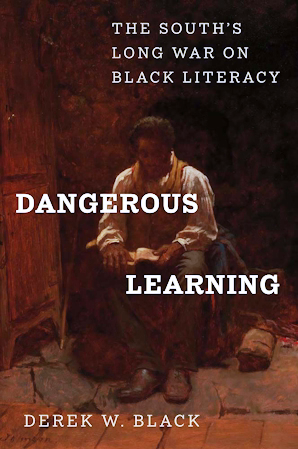
Derek Black’s masterpiece of research, Dangerous Learning, reveals the centuries of struggle for Black Americans to become educated. When I arrived at the Network for Public Education conference April 4, I ran into Professor Black (University of South Carolina Law School) and mentioned to him I almost finished reading his book on the airplane. He absurdly wanted to know how boring I found it. The truth is that this beautifully written book is extremely engaging.

Denmark Vesey

Growing up in Idaho, my knowledge of American slavery is quite lacking. I had never heard of Denmark Vesey, who played a major role in the suppression of education for slaves.

Joseph Vesey was a slave trader who brought 390 enslaved people including Demark to St. Thomas and Saint-Domingue (now known as Haiti) in 1781. Joseph’s slave ship brings the first record of the approximately 14-year-old Denmark. He was sold in Haiti along with the other 390 people but it seems he feigned epilepsy and Joseph was forced to take him back. Soon after, Denmark became Captain Vesey’s trusted assistant.

Black tells this story in about 20 pages in the book. I will cut it down a little.

Denmark learned to read and in 1799 he won the lottery ($1500). He paid Joseph $600 for his freedom and through various means; Denmark became highly educated. He was also inspired by the slave revolution in Haiti. Denmark became an authority on the Bible being known in the community as “a man of the book”. (Page 16) He taught classes at the African Church which became the famous African Methodist Episcopal Zion Church also known as the AME Church. Denmark was obsessed with learning and read widely including classical literature.

In the Old Testament, Vesey found the story of the Israelites’ path from slavery. He taught his friends how the children of Israel were delivered from bondage in Egypt. Professor Black explains:

“In it [the Old Testament], Vesey found a God who stood on the side of the oppressed, not the oppressor, and who intervened in the world not to reinforce slavery but to free the Israelites from it. God consistently assured the Israelites that He would deliver their enemies into their hands if they would follow His will. And following His will did not mean turning the other cheek, fleeing from conflict, or suffering in silence. It often meant smiting those who stood against them, including women and children.”   (Page 20)

In 1822, Vesey having been deeply and fundamentally changed by his literacy planned a slave rebellion. He chose July 14th for the liberation of Black people in Charleston.  The plan was workable but an enslaved man came forward on May 30th claiming he had been recruited to participate in a slave revolt. After that, Vesey’s plans fell apart and he along with his co-conspirators were put to death. Black noted, “When Frederick Douglass implored crowds of Black men to join the Union Army in 1863, he offered a simple message: ‘Remember Denmark Vesey of Charleston.’” (Page 35)

Unfortunately, it was remembering Denmark Vesey that pushed southerners into an all out suppression of Black literacy that lasted well into the twentieth century.

Suppressing Education

The last open debate on slavery in the South was conducted by the Virginia legislature in 1832. William M. Rivas, a lawyer and member of a wealthy colonial family claimed that elite planters had “held the state’s democratic process in a death grip for decades.” (Page 107) He said they had intentionally limited education not just for slaves but for poor and middle-class White people as well.

While the North was engaged in developing a state supported public education system, the South, under the influence of wealthy elites, absolutely opposed state funding for education.

It was a shock for me to discover that Thomas Jefferson was a white supremacist. In Notes on the State of Virginia he wrote that Black people were “inferior to whites in the endowments of both of body and mind.” (Page 65) He said that this reality posed a powerful obstacle to emancipation.

After the 1832 debate, censorship and anti-literacy in the South took on a life of their own. The South became more and more isolated and intolerant.

For the slaves, seeking literacy was hidden and secretive. Finding the time to study was difficult and a flickering candle could draw attention and suspicion. It is reported that enslaved people would study in caves or in holes they created in the woods.

“In Mississippi, people told of holes large enough to accommodate a group. They called them ‘pit schools.’” (Page 188)

After the Civil War, former slaves were able to openly attend school and the Reconstruction Act of 1867 attempted to force states to pay for it. The Act created three requirements for states to be readmitted to the Union: extend the vote to black men, ratify the 14th Amendment and guarantee a republican form of government. Black noted, “A republican form of government meant, among other things, ensuring public education.” (Page 244)

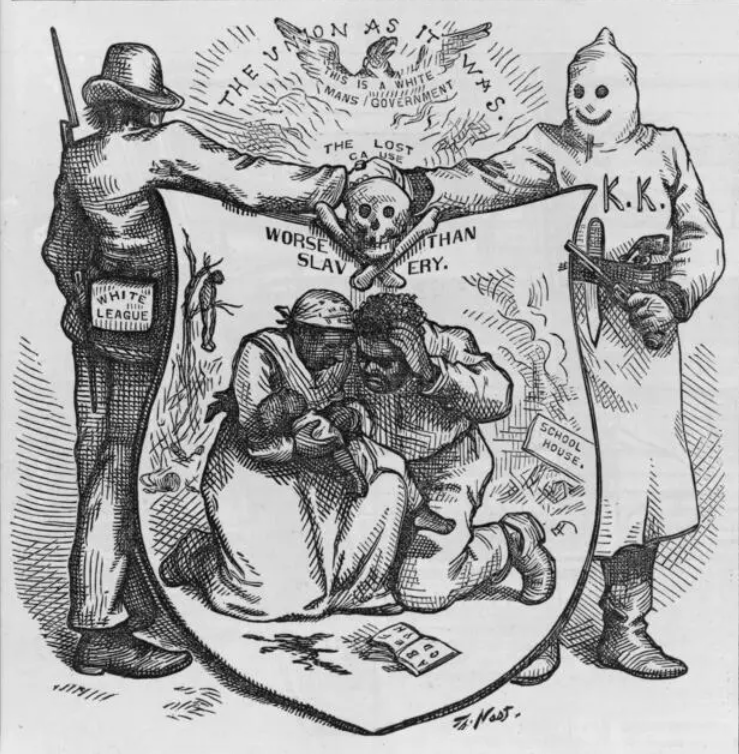
However the citizens of the south were not going to accept Black people having equal rights. Terrorist groups attacked schools and teachers. The more Union troops were drawn down, the greater the violence became.

1874 Harper’s Political Cartoon by Thomas Nast

During Reconstruction, 631 attacks on black schools have been documented. White citizens of Tennessee under the leadership of the KKK destroyed 76 Black schools. (Page 261)

In order to secure victory in the 1877 Presidential race, Rutherford B. Hayes agreed to a compromise between southern Democrats and pro-business Republicans to end Reconstruction. Soon after, southern states started rewriting the required constitutions they needed to rejoin the Union. There was a two pronged agenda: “disenfranchise Black voters, and segregate and underfund Black education.” (Page 168) Jim Crow laws became enshrined in the new southern state constitutions.

In 1896, the Plessy v. Ferguson case held up the bogus concept of separate but equal facilities. That same year saw a new Louisiana law that took Black male voter registration from 95.6% of the population to 1.1% by 1904. In 1902, Nicolas Bauer, a man that would become superintendent of public schools in New Orleans, wrote:

“I realize from my limited observation that to teach the negro (sic) is a different problem. His natural ability is of a low character and it is possible to bring him to a certain level beyond which it is impossible to carry him. That point is reached in the fifth grade of our schools.”

The lack of justice and abundance of ignorance is what the Supreme Court tried to rectify with Brown v. Board of Education.

The fact is these two centuries of hostility toward educating all American citizens is still causing harm. Derek Black’s Dangerous Learning is a must read for anyone that cares about justice.

Movement to Destroy American Democracy

12 Mar

By Thomas Ultican 3/12/2025

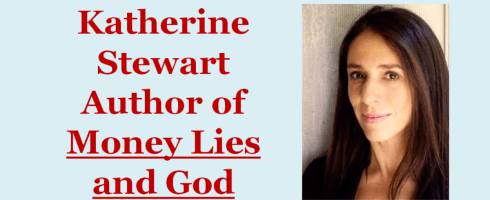
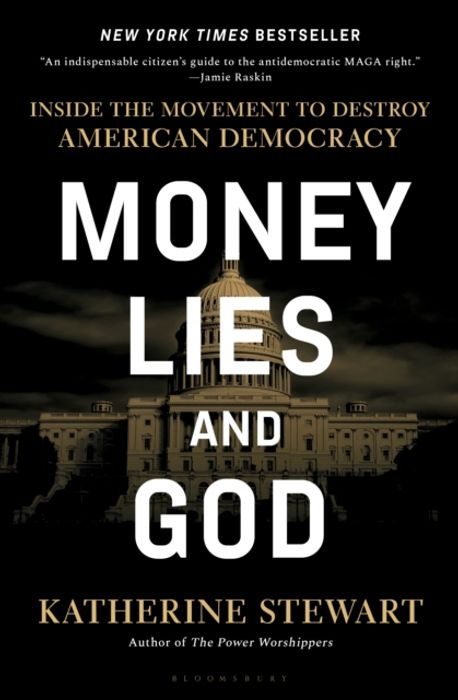
Author Katherine Stewart is a friend of mine. OK, we are not bosom buddies and have only met face to face once briefly. However, in 2017, I wrote about her book The Good News Club and we began communicating by email. In 2019, when she published The Power Worshippers, I again reviewed her book and our email communications were enhanced. Now, she has completed the trilogy with Money Lies and God, her just released book, which continues a deep dive into Christian nationalism and the extreme right’s anti-democratic agenda.

On Money Lies and God’s cover, Congressman Jamie Raskin insightfully labels the book, “An indispensable citizen’s guide to the antidemocratic MAGA right.”

Whenever I read a book, the first thing I do is read everything on the cover and all introductory material. I was amazed by the well known people commenting on this book. Besides Jamie Raskin, I was particularly stuck by comments from Nancy MacLean and Steve Schmidt. Not that their selected comments were so mind blowing but because they are such heroes of mine.

Maclean, the famous historian and author of “Democracy in Chains”, states, “A bracing must-read story of how the varied streams have merged into a mighty river moving toward massive destruction—and it explains how together, we can divert it.”

Schmidt, John McCain’s campaign manager, political strategist and cofounder of the Lincoln Project, wrote, “Pieces through the fog and noise to reveal the dangerous forces gathering, planning, and plotting against liberty.”

The comments made me think this book could be special. I was not disappointed.

Building toward a Trilogy

Living in Santa Barbra, California in the early 2000s, Stewart was stunned to learn that her daughter’s elementary school had a protestant after school program for students called “The Good News Club.” For the past almost two decades this discovery has driven her to research how religious organizations are now allowed to proselytize babies in public facilities. The more she dug, the scarier reality became.

A significant figure in the tearing down of the separation of church and state was lawyer Jay Sekulow. Born into a Jewish family he converted to evangelical Christianity in the 1980s. In 1990, Pat Robertson brought Sekulow together with a few other lawyers to form the American Center for Law and Justice (ACLJ) (notice how close the acronym is to ACLU). In 1994, the Alliance Defense Fund (ADF) added its name to the growing roster of well financed Christian legal organizations and is backed by groups that are a veritable who’s who of the Christian Right.

In 2001, this legal juggernaut succeeded again in their efforts to undermine the separation of church and state with its victory in Good News Club v. Milford Central School. Stewart commented:

“An alien visitor to planet First Amendment could be forgiven for summarizing the entire story thus: Clarence Thomas and Antonin Scalia, together with a few fellow travelers on the Supreme Court and their friends in the ADF and ACLJ, got together and ordered that the United States should establish a nationwide network of evangelical churches housed in taxpayer-financed school facilities.”  

The destruction of the first amendment was well underway.

In “The Power Worshippers”, Stewart dove deeply into the world of Christian nationalism. Among the many insightful items she shared were the actions of Paul Weyrich. He coined the term “moral majority.” He also co-founded the Heritage Foundation, The Free Congress Foundation and the American Legislative Exchange Council.

Weyrich made 12 trips to Russia and Eastern Europe before his death in 2008 and became a strong supporter of closer relations with Russia. Stewart reports, “He was writing and speaking frequently in defense of Russia and facilitating visits between U.S. conservatives and Russian political leaders.” (Power Page 270)

In 2013, Bryan Fischer of the American Family Association called Putin a “lion of Christianity.” In 2014, Franklin Graham defended Putin for his efforts “to protect his nations’ children from the damaging effects of any gay and lesbian agenda.” He also lamented that Americans have “abdicated our moral leadership.” In 2015, Graham met privately with Putin for 45-minutes. In 2016, Mike Pence said Putin was “a stronger leader in his country than Barack Obama has been in this country.” (Power Page 272)

Donald J. Trumpski’s embrace of Putin and other despotic world leaders is an outcome spurred by Christian nationalism.

Completing the Trilogy

In the introduction to “Money Lies and God”, Stewart states, “There is no world in which America will become the ‘Christian nation’ that it never actually was; there is only a world in which a theocratic oligarchy imposes a corrupt and despotic order in the name of sectarian values.”  (Money Page 7)

In these pages, Stewart expands beyond just the evangelical community to include the Conservative Catholic community that has joined forces with the evangelicals. The reader is introduced to Opus Dei, the ultraconservative and secretive Catholic group founded in fascist Spain. “Opus Dei does not disclose its membership, but Leonard Leo has a listed entry on the website of the Catholic Information Center in Washington, D.C., which is operated by Opus Dei …” (Money Page 43)

 Stewart reports on the big 2023 Mom’s for Liberty event in Philadelphia. That same year, she attended the Network for Public Education event in Washington D.C. which is where I had my face to face encounter with my “friend.” She writes extensively about both events.

The book does a lot of documenting of the tremendous amount of money right wingers are pouring into their agenda. She cites the spending by the DeVos-Prince family, Texan Tim Dunn, Jeff Yass, Richard Uihlein, the Corkerys, Mike Rydin, Rebekah Mercer, Charles Koch and more. You meet the Ziklag group, a secretive organizations for high net-worth Christian nationalists. A ProPublica article asserts, “Ziklag appears to be the first coordinated effort to get wealthy donors to fund an overtly Christian nationalist agenda …”

I was surprised that our American psychosis is being spread rapidly around the world. Stewart attended the 2023 National Conservatism Conference (NatCon) in London where she saw representatives of the ADF and the Heritage foundation.

Stewart summarizes the NatCon pitch:

“The sum of all our problems—and the greatest threat that the United States and its sister republics around the world have ever faced—is the rise of the ‘woke’ elite. Cosmopolitan, overeducated, gender-fluid, parasitic, anti-Christian idolaters who worship at the shrine of diversity, equity, and inclusion, the leaders of this progressive cabal are bent on elevating undeserving people of color while crushing hardworking ‘real’ Americans (or real Britons, or whoever is in the audience).” (Money Page 100)

In the “The Rise of the Spirit Warriors” chapter, Stewart notes,

“In October 2023, the spirit warriors notched another stunning victory when one of their own … became Speaker of the U.S. House of Representatives. Congressman Mike Johnson of Louisiana indicated on his first day as Speaker that God himself had a hand in his ascension to a position second in line to the presidency.” (Money Page 163)

Late in the book, Stewart contends, “The axis around which a sector of the global antidemocratic reaction now turns is an extraordinary alliance between a dominant wing of the Republican Party in the U.S. and the Russian dictator Vladimir Putin.” (Money Page 214)

I hope you read “Money Lies and God”.  It is an extraordinarily well written and researched endeavor.  

The Teachers

15 May

By Thomas Ultican 5/15/2023

Alexandra Robbins’ new book is an authentic look into the life, working environment, emotional struggles and triumphs of America’s K-12 teachers. The book opens up many unnecessary issues that America’s professional educators face as they try to give their best in the classroom. It also reminded me of my own teaching journey with its unjust treatments and eventual success.

The Book can be Purchased Here

It is Not Burnout

Teaching is a much higher stress job than it needs to be because of factors outside of the classroom. Robbins reports on a special education teacher named Prisha being left by herself in classes of 28 to 35 special education students when her co-teacher had to take a two month medical leave. The school’s staff was almost all first or second year teachers like Prisha who didn’t know what to do. The principal’s solution was to call all the special ed teachers “fucking morons” and start monitoring Prisha’s grade book. No actual support for a new teacher in a no win situation. (Teachers 217)

Robbins cites a gallop pole claiming that teachers tied with nurses for the highest rate of daily stress on the job among all occupations. She shares a study asserting, “It is confirmed that teachers have the highest burnout levels as compared to other professionals in social services.” (Teachers 218)

It needs to be noted that teaching only became high stress after the 1983 Department of Education report “A Nation at Risk.” That fraudulent polemic misused SAT data to cook the books and claim American public schools were failing. Later, Anya Kamenetz reported for NPR, “A 1990 report produced by the Energy Department’s Sandia National Laboratories broke down the flaws in the “A Nation at Risk” analysis but got little attention.”

“A Nation at Risk” was followed by a dramatic expansion of teacher responsibilities but no accompanying structural support. The report inspired a push for state-mandated testing. This led to a major demoralization of teachers when in 2002 No Child Left Behind (NCLB) became federal law. Robbins writes,

“NCLB, which mandated rigorous standardized testing and penalized schools and teachers based on students’ scores, remains ‘the worst federal education legislation ever passed by Congress. It was punitive, harsh, stupid, ignorant about pedagogy and motivation, and ultimately a dismal failure,’ as New York University research professor of education Diane Ravitch, a former assistant secretary of education and leading educational expert, has written.” (Teachers 224)

I remember in about 2007 a principal saying to me that school used to be fun; hopefully we’ll get back to that someday. Today, there is a large problem with teachers quitting the profession that is being attributed to burnout but it is more accurate to call it teacher frustration; a frustration with not being able to provide the kind of good pedagogy that their students and communities deserve.

Robbins points to a need for school leadership to step up to the plate. She writes,

“The responsibility for resolving teacher demoralization, or what the public calls burnout, should lie with districts and administrators. Telling teachers to relax doesn’t cut it. … Instead of halfheartedly attempting to mitigate the effects on teachers, school leaders should fix the underlying causes – their school climate, staffing numbers, and resources – not just to prevent employee demoralization, but because that’s how a proper workplace should operate.” (Teachers 228)

A Personal Experience with Education Reform

In Diane Ravich’s seminal book The Death and Life of the Great American School System, she describes how my home town of San Diego, California was chosen as an education reform test site. Ravitch noted that it was an unusual choice for where to launch a reform movement because San Diego was viewed as having “one of the nation’s most successful urban school systems.” (Page 50) In 1998, the former US Attorney for the southern district of California, Alan Bersin, was hired to be the school district superintendent and lead the reform experiment. The local education community was against hiring an uncertified non-educator to lead the district but the San Diego business community which held sway over the school board wanted it.

I started education graduate school at the University of California San Diego in 2001 and found that a few of my instructors were consulting on the district’s education reforms. Some of the changes being introduced were quite good but the authoritarian implementation alienated most of the district’s teachers who had no input into what was happening.

One major change affected me. It was mandated that all ninth graders take the new conceptual physics class. That caused the district a severe shortage of certified physics teachers. I had just completed my masters in education with a physics certificate. It was not long before I got an offer to be a probationary teacher via a telephone interview.

Turned out the Bell Jr. High principal was not being totally up front with me. Going to the district office to sign my contract, I was told the probationary positions were filled and was offered a temp contract. I discovered that teachers in California normally needed more than two years to become full time with job protections. Temp contracts do not count as tenure track teaching time.

The principal at Bell literally had a hole in her head having recently gone through brain surgery to remove a tumor. Two retired administers were convinced by the district to come back and serve as assistant principals, provide support during the convalescence and take over if medical issues arose. One of them became my evaluator.

In my first written evaluation, the AP wrote that discipline was a problem and that I never checked for student understanding. In a written response, I wrote that during the lab period she observed every team coming to me multiple times to have their lab progress reviewed and checked off before moving on to the next phase. I questioned her observation of not checking for student understanding? While my class may be a little free, all 36-students successfully completed and submitted their lab reports so class discipline was not leading to dysfunction. I should have added that the classes were too large for safe lab science activities.

One time the evaluator came in while I had the class working on a poster project. A student that had not had much success in school rushed up to her and proudly showed off his poster. She later told me that I should have written him a referral right then for leaving his group without permission. I was thinking what is wrong with a child engaged in learning? Why punish his new pride?

At Bell we had 13 sections of regular physics plus I taught the only section of honors physics. My classes tested amazingly well. The regular physics classes ranked 1, 2, 4 and 6 in comparison to all 13 sections at Bell. The honors physics class was the number 2 scoring class in the entire district. I was stunned at the end of the year when my evaluator said she could not recommend me for rehire because of “not moving classes toward achieving standards” and the lack of classroom disciple. The quoted line meant that I could not even apply for a substitute teaching position in San Diego Unified School District.

I talked to several district administrators who commiserated with me and even admitted how strange this looked but none of them felt they could do anything. The Bersin administration had set up an arbitrary quota system for teachers being fired and the percentage of new hires retained. It turns out a determined administrator can fire tenured teachers. This was aimed at keeping everyone following orders and not complaining. At Bell, I was the 50 year old new hire who was sacrificed to protect the younger teachers.

It is remarkable that the evaluation from my next school in another district noted discipline as one of my classroom strengths.

The Teachers is a Great Read

Alexandra Robbins uses the experience of three teachers during the 2021/22 school year as the backbone for her book. In the August chapter, she introduces Rebecca, Penny and Miguel. Month by month, Robbins reveals the sometimes horrific and sometimes triumphant experiences of these three amazing teachers. Along the way she shares insights, research and some eye-popping experience from other teachers. It is the most revealing and authentic view of teaching I have ever read.

I will end with this quote from page 279 which shows in gory detail why teacher opinions should be sought out and adhered to.

“Florida teachers compiled a mountain of evidence that public school was not the place for one particular student who had numerous mental health issues, was obsessed with guns, and was suspended 18 times in one school year. But it took five months to get him transferred to a special middle school – and when he was determined to attend public high school, Florida’s disability law allowed him to. The student was Nikola Cruz, the school Marjory Stoneman Douglas. In 2018, Cruz massacred 14 students and three staff members in one of the deadliest school shootings in history.”

EMOs Generating Profits and Harm

29 Jan

By Thomas Ultican 1/29/2023

Carol Burris, Darcie Cimarusti and the gang at Network for Public Education (NPE) just published “Charter for Profit: Pandemic Profiteering.” This is an update to their 2021 report Chartered for Profit: The Hidden World of Charter Schools Operated for Financial Gain. Both reports describe and document how the vast majority of for-profit charter schools hide their true nature when “By law, only the state of Arizona allows for-profit entities to be licensed to run charter schools.”(Page 3) The industry work around is to found schools as non-profit entities, but use a for-profit Education Management Organization (EMO) to run them.

To determine how many students were attending charter schools controlled by for-profit EMOs was no easy task. To confirm an EMO’s status, the authors utilized state business search engines. Once confirmed, the team turned to EMO websites for their lists of schools which were compared with the relevant state’s list of charter schools. EMOs that did not have a website required a deeper search for documentation. (Page 34)

In December 2022, Professor of Education Policy at Michigan State University Josh Cohen did an evaluation for the National Education Policy Center of a September 2022 Thomas B. Fordham Institute’s study. That study attempted to justify the for-profit charter sector. However, Cohen found the study itself did not match the rosy conclusions in the forward by Fordham executives Amber Northern and Michael Petrilli. In fact, it showed for-profits having lower student achievement, lower graduation rates, and higher absentee rates. Furthermore, students in for-profit virtual charters quickly fell significantly behind students in brick-and-mortar schools.

Education Management Organizations

The current NPE study reports,

“At the beginning of the 2022-2023 school year, we identified 1,305 charter schools, run by one of 150 EMOs. This is an increase since our 2021 report, which identified 1,138 for profit-run charter schools run by 141 EMOs. …

“During these two school years – as the pandemic wore on – the percentage of charter schools run by for-profits jumped from 15 percent to about 16.6 percent of the charter sector.” (Page 10)

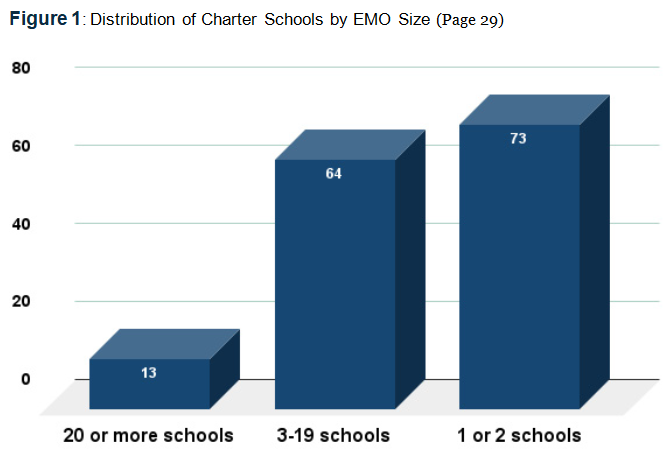
Those 150 EMOs were identified as belonging to one of three groups. The organizations with one or two charter schools could be labeled micro-EMOs. The mid-sized EMOs are constituted by three to nineteen schools while the large EMOs manage twenty or more schools.

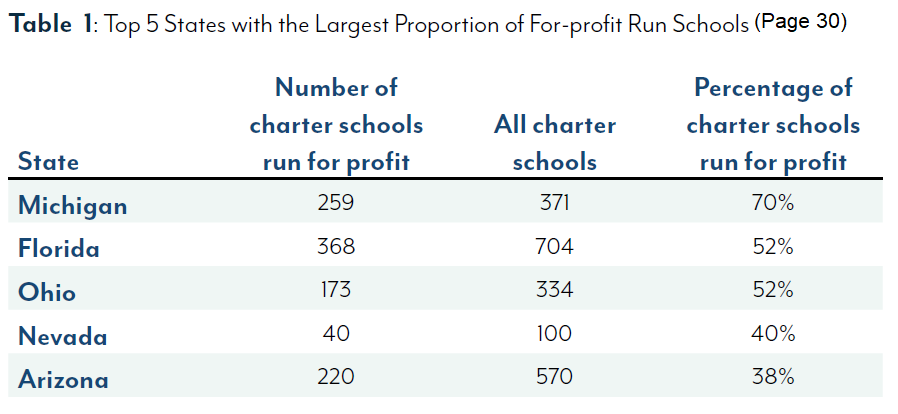
Most states allow for-profits to manage charter schools; however five states have a very large for-profit footprint. Three of the states – Michigan, Florida and Ohio – have a majority of their charters managed by for-profit companies.

Accessing those Sweet Taxpayer Dollars

For the last several years, it appears that the for-profit charter industry has been perfecting profiteering by applying insider deals, sweeps contracts and sweetheart business deals.

The NPE report described: Insider deals, formally referred to as related party transactions, occur when those who have control of a charter school’s decision-making process award contracts to their own companies or those owned by family members, colleagues, or friends. (Page 12)

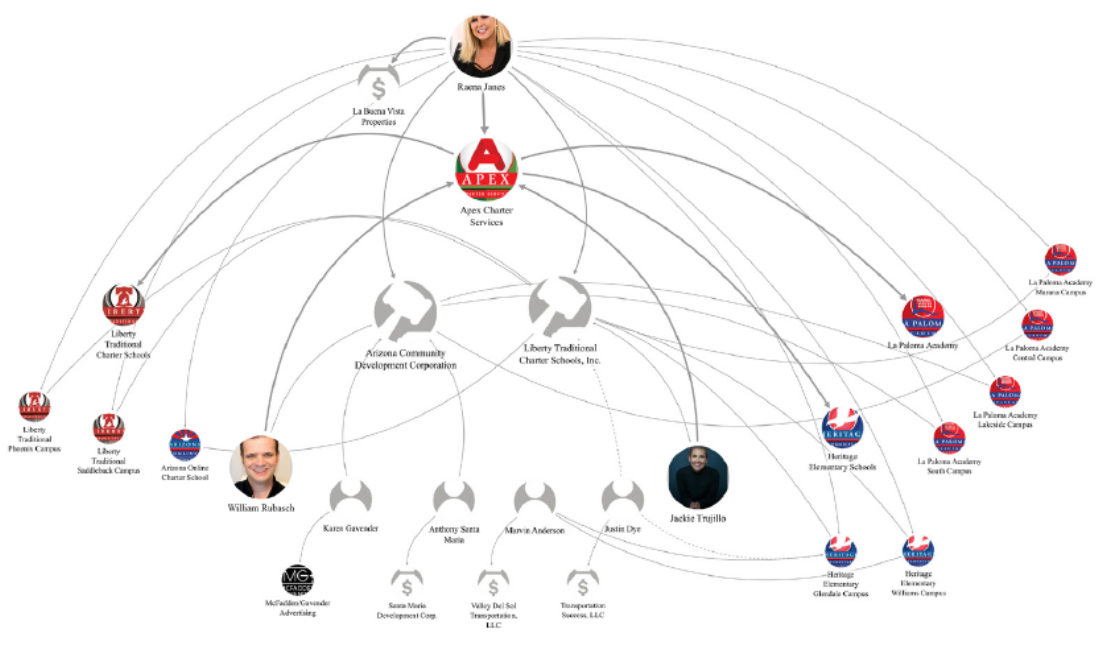
An example of this type of profiteering comes from Arizona and APEX Charter Services solely owned by Raena Janes. Her for-profit EMO manages nine charter schools. The schools are overseen by two non-profit boards; the Arizona Community Development Corporation and Liberty Traditional Charter Schools, Inc. However, the non-profit boards both consist of Raena Janes, her employees and her business partners.

Much more about the details of this Byzantine business structure can be found by delving into the LittleSis Map below. In 2018, I attended a presentation by Darcie Cimarusti on using the LittleSis data base and oligrapher. Since then Darcie has become a master at using these facilities. In the map below, she lays out the connections that have allowed Janes and a very small group of accomplices to over the last 12 years extract $33 million from Arizona’s state education budget. APEX’s complicated structure led to an Arizona state audit reporting,

“During consideration of the service agreement the Director disclosed her duality of interest and recused herself from discussion or voting on approval of the agreement. The disinterested members of the Board approved the agreement. “

However, there are no disinterested members of the Board. As Darcie documented, all of the board members have a stake in APEX being profitable.  

Click here to Access the Map of Documenting Insider Dealing at APEX

The NPE report includes several more examples of insider dealing.

Sweeps contracts are another vehicle EMOs employ to build profits. The report says, “A sweeps contract is an arrangement in which a charter school turns over all or nearly all of its public funding to an operator who then runs the school.” (Page 16)

In 2014, ProPublica published When Charter Schools Are Nonprofit in Name Only.” This prescient article focused on the actions of National Heritage Academies an EMO which today manages more than 100 schools. It reported,

“In Michigan, where NHA is the largest charter-school operator, state education regulators have voiced … frustrations about the degree to which these private firms are shielded from having to answer to the public about how money is spent.

‘“I can’t FOIA National Heritage Academies,’ said Casandra Ulbrich, Vice President of the Michigan State Board of Education, referring to the right to request public documents from public agencies. ‘I don’t know who they’re subcontracting with, I don’t know if they’re bid out. I don’t know if there are any conflicts of interest. This is information we as taxpayers don’t have a right to.’’’

Another seeps contract example from the NPE report is ACCEL Schools the fourth largest EMO with 54 schools of which the majority are in Ohio. In 2017, Akron Preparatory Schools signed a sweeps contract with ACCEL. The NPE report described the contract as muscular noting,

“From beginning to end, it not only details the sweeping services that ACCEL will provide but also makes it clear that the decision-maker will be the for-profit, not the board. ACCEL is the ‘exclusive custodian’ of all revenues, choosing the bank into which the funds are deposited and managing the accounts. The 18 percent fee from revenue received ensures that ACCEL makes a profit.” (Page 17)

The third big profit driver for EMOs is sweetheart real estate deals. Burris et.al shared, “When we began our investigations into chartering for profit, we were told that ‘the real money’ is made in real estate.” Academica, National Heritage Academy, Charter Schools USA, ACCEL, and Leona are the five largest for-profit EMOs. They all use related real estate corporations and employ contracts that put the EMO in charge of lease relationships. (Page 17)

The second largest EMO in the country is National Heritage Academies (NHA). NHA’s real estate arm is the Charter Development Company (CDC). Both NHA and CDC are owned by J.C. Huizenga, whose father and uncle created the huge multinational company Waste Management. The NPE paper reports,

“In 2021, Charter Development Company began selling off schools to a nonprofit called Campus Partners 1, which appears to have been formed for the sale. Campus Partners secured one billion in bond funding from La Paz County in Arizona. The president of the board of Campus Partners 1 was Huizenga’s personal attorney. The sale allows Huizenga to profit from the sale of the schools while still managing the lease and facilities through Huizenga’s Charter Development Company. This real estate deal will potentially net up to one billion dollars from the sale of schools that had been paid for with tax dollars. Even after the sale, the schools will pay the lease via CDC to the new nonprofit, meaning the taxpayer will continue to foot the bill for the buildings over and over again.” (Emphasis added) (Page 21)

This is just one of the outlined real estate swindles setup to fleece taxpayers and purloin education dollars. The report goes into more detail about this deal and shares several more outrageous episodes. 

Some Observations

Clearly the charter school industry has been corrupted by greed. In statehouses across America, it appears that education laws are being deliberately written to facilitate fraud and charter industry lobbyists work hard to keep it that way. Charter schools do clearly outperform voucher schools but that is not saying much.

Josh Cohen is a researcher who has been studying vouchers since the beginning of the millennium. At one time, he was pro-voucher but his own research and that of others changed his mind. In a recent article he wrote, “Large-scale independent studies in D.C., Indiana, Louisiana, and Ohio show that for kids who left public schools, harmful voucher impacts actually meet or exceed what the pandemic did to test scores.” The article is well sourced and yes he did claim that testing data shows that the negative affects of voucher schools education engenders worse learning loss than the pandemic.

Since voucher schools are substandard and charter schools are fraud centers that under-perform public schools, why do we have them? I believe it is because school choice is a racist and authoritarian agenda aimed at ending universal free public education in America. Obviously, choice has zero to do with improving education in America.

Atlas Shrugged is Boring and Silly

9 Jan

By Thomas Ultican 1/9/2023

Preparing to fly roundtrip from San Diego to Philadelphia, I pulled Atlas Shrugged from my bookshelf for reading material. I had originally purchased the book for five cents at a Point Loma garage sale in the 1990s but never got around to reading it. While flying, I read about 200 pages of the 1,084 page paperback version. The original published hard cover version was 1,164 pages. For the next few months, I completed the book by reading six pages a day while eating breakfast.

Libertarian politicians Paul Ryan, Ron Johnson and Rand Paul claim Austrian economist Friedrich Hayek and writer-philosopher Ayn Rand as their guiding lights. In 2012, Politico reported, “…, to bring new staffers up to speed, Ryan gives them copies of Hayek’s classic ‘Road to Serfdom’ and Rand’s ‘Atlas Shrugged’ — books he says inspires his political philosophy.” Hayek and Rand both subscribed to classical liberalism which means they believed in a political philosophy committed to limited government, the rule of law, individual liberties, and free markets with particular emphasis on property rights.

This knowledge was my underlying motive for reading Atlas Shrugged. I wanted to see for myself who Ayn Rand was and what she was teaching? What was so appealing to these Republican politicians?

Atlas Shrugged got a Chilly Reception

The book is quite odd. It is a romance, a mystery, a pirate story and a science fiction novel all rolled into one. The setting is a factious version of the United States. The endless descriptions of everything the characters were feeling and seeing became quite tedious but reading six pages a day made it readable – barely.

However, I did find the central character of the book, Dagny Taggart, a delight. Dagny is the granddaughter of Nat Taggart the founder of Taggart Continental the largest railroad in America. Dagny’s scumbag brother James becomes the CEO of the railroad but as COO, Dagny is the brilliant leader solving problems and making the trains run on time. She’s a force of nature that intimidates her brother.

Dagny’s three big love affairs are the backbone of the story. Her first lover is Francisco d’Anconia who is the heir to the world’s largest copper mining company out of Argentina. The second affair is with the married steel magnet Henry Reardon the inventor of Reardon steel which is lighter and more durable than conventional steel. Her final great love is John Galt the inventor of an engine that converts static electricity from the air into energy. Dagny never seems concerned about becoming pregnant and doesn’t. In this depiction of dystopian America, Galt is the instigator of an illegal strike by the “men of the mind.”

In the book, these “men of the mind” are continually being attacked by the “moochers” who loot their good works. The book’s title was originally “The Strike”, however the published title Atlas Shrugged came from the text where Francisco d’Anconia asks Henry Reardon what Atlas should do if “the greater [the Titan’s] effort, the heavier the world bore down on his shoulders”. With Reardon unable to answer, d’Anconia gives his own advice: “shrug”. (Atlas Shrugged Pages 131-132)

Rand scholar Mimi Reisel Gladstein wrote about the reaction to Atlas Shrugged. She observed, “Reviewers seemed to vie with each other in a contest to devise the cleverest put-downs; one called it ‘execrable claptrap’, while another said it showed ‘remorseless hectoring and prolixity.”’ The Time magazines review in October 1957 asked,

“Is it a novel? Is it a nightmare? Is it Superman – in the comic strip or the Nietzschean version?

In a delightful take down in the National Review, the man detested by the left for his testimony against Alger Hiss, Whittaker Chambers, scathingly observed,

“Out of a lifetime of reading, I can recall no other book in which a tone of overriding arrogance was so implacably sustained. Its shrillness is without reprieve. Its dogmatism is without appeal.”

 “Atlas Shrugged can be called a novel only by devaluing the term.”

Chambers was even less kind when judging Rand’s philosophy stating,

“The Message is the thing. It is, in sum, a forthright philosophic materialism. Upperclassmen might incline to sniff and say that the author has, with vast effort, contrived a simple materialist system, one, intellectually, at about the stage of the oxcart, though without mastering the principle of the wheel.”

Ayn Rand and Associates

Ayn Rand is her pen name. She was born Alissa Zinovievna Rosenbaum, to a bourgeois Jewish family in Petrograd, Russia (St. Petersburg today), on 2 February, 1905. She was 12 years old when Lenin and his communist revolution took power which led to great suffering in her immediate family. She was a history major at Petrograd University graduating in 1924. The next year, with her mother’s help, Alissa was able to secure permission to leave Russia and never looked back. 

While working for Cecil B. DeMille in Hollywood, she met actor Frank O’Connor. They were married in 1929 and remained so until he died in 1979. Professionally she was Ayn Rand but to family and friends she was Mrs. Alisa O’Connor. Alisa says Ayn is inspired by a not named Finnish writer and described Rand as an abbreviation of Rosenbaum.

In 1951, she and Frank moved to New York City where they developed an interesting group of friends. Among them were Janet Gaynor, art historian Mary Sures, economists Allen Greenspan, and Ludwig Von Mises.

Austrian economists Ludwig Von Mises and Friedrich Hayek promoted the classical liberal view of capitalism which attracted Charles Koch. Von Mises was one of the few critics that praised Atlas Shrugged. He declared,

“You have the courage to tell the masses what no politician told them: you are inferior and all the improvements in your conditions which you simply take for granted you owe to the effort of men who are better than you.

“If this is arrogance, as some of your critics observed, it still is the truth that had to be said in the age of the Welfare State.”

Rand’s Message

The whole point of the book is presenting Ayn Rand’s philosophy – Objectivism. It is her creation and the hokum ideological prism through which she viewed the world. It led her in 1964 to declare The Virtue of Selfishness.”

The Stanford Encyclopedia of Philosophy claims,

“Whereas Rand’s ideas and mode of presentation make Rand popular with many non-academics, they lead to the opposite outcome with academics. She developed some of her views in response to questions from her readers, but seldom took the time to defend them against possible objections or to reconcile them with the views expressed in her novels. Her philosophical essays lack the self-critical, detailed style of analytic philosophy, or any serious attempt to consider possible objections to her views. Her polemical style, often contemptuous tone, and the dogmatism and cult-like behavior of many of her fans also suggest that her work is not worth taking seriously.”

In Atlas Shrugged, it is a struggle between “looters” and the heroic elites who are the root of value creation. The “looters” are proponents of high taxation, big labor, government ownership, government spending, government planning, regulation, and redistribution while her moral paragons are creators from which all economic benefit emanates. The elites are superior beings who should be acknowledged and allowed to run their businesses without interference. It is the ultimate view of laissez-faire capitalism.

In a fascinating 1964 interview with Playboy Magazine, Rand makes some statements that reveal how ridiculous her philosophical views were.

“To begin with, man does not possess any instincts.”

“I believe that taxation should be voluntary…”

“My position is fully consistent. Not only the post office, but streets, roads, and above all, schools, should all be privately owned and privately run. I advocate the separation of state and economics.”

“The disasters of the modern world, including the destruction of capitalism, were caused by the altruist-collectivist philosophy. It is altruism that men should reject.”

In Atlas Shrugged, John Galt uses his scientific genius to hijack the nationwide broadcast addressing the mounting disaster in the country. In his three hour speech which covers more than sixty pages of text in the book, Rand lays out her philosophy. Here are a few quotes,

“There are two sides to every issue: one side is right and the other is wrong, but the middle is always evil.” (Page 978)

“The doctrine that ‘human rights’ are superior to ‘property rights’ simply means that some human beings have the right to make property out of others; since the competent have nothing to gain from the incompetent, it means the right of the incompetent to own their betters and to use them as productive cattle. Whoever regards this as human and right, has not right to the title of ‘human.’” (Page 986)

“The man at the top of the intellectual pyramid contributes the most to all those below him, but gets nothing except the material payment, receiving no intellectual bonus from others to add to the value of his time. The man at the bottom who, left to himself, would starve in his hopeless ineptitude, contributes nothing to those above him, but receives the bonus of all of their brains.” (Page 989)

“I swear – by my life and my love of it – that I will never live for the sake of another man, nor ask another man to live for mine.” (Page 993)

An Observation

Growing up on a ranch in Idaho, I had a grandfather who was an immigrant from Scotland and a staunch Republican. For years, he was a big fan of Senator William Borah and his brother was a fanatical anti-New Dealer. If it were not for the anti-labor stance of the Republicans, I could have been one myself. So what happened in the 1950s that has made this party so anti-common man and pro-elites?

I think it was the right’s embrace of the Austrian economists Friedrich Hayek and Ludwig Von Mises along with the sophomoric philosophy of Ayn Rand; hard to see much daylight between their ideas and fascism. Unfortunately, it is an ideology embraced today by too many of America’s political leaders on the right.

San Diego County School Board Election 2022

12 Sep

By Thomas Ultican 9/12/2022

The bedrock of American Democracy is the school board. Many of America’s leading politicians began their career serving on a school board. This November 8th, half of the school board positions in San Diego County will be on the ballot. Here is a review of the candidates in our ten largest school districts and the County Office of Education. Recommendations are included.

School board seats are supposedly non-partisan contests; however the Republican and Democratic parties have made recommendations in many of the matches. The Republicans do a formal endorsement while the Democrats identify party members on the ballot. In this post both methods are treated as endorsements.

San Diego County Board of Education

Public school students 399,786 – Charter school students 81,316 – Percent charter 16.9%

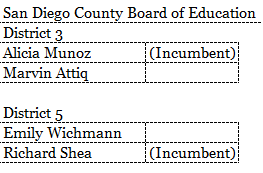
In District-3 which includes most of the southern end of the county, incumbent Alicia Muñoz faces off against Marvin Attiq. The Democrats endorse Muñoz and the Republicans endorse Attiq.

Attiq appears to be a barber with no background in education. Muñoz has been on the board since 2014 and teaches English at Cuyamaca College. She has a master’s degree in English from San Francisco State University and a bachelor’s in comparative literature from UC Berkley.

Recommendation: Alicia Muñoz.

District-5 runs along the coast north from Del Mar to camp Pendleton. Incumbent Richard Shea has the endorsement of the Democrats and Emily Wichmann is endorsed by the Republicans. Shea worked as a special assistant to the county superintendent and was originally appointed to a vacant seat in 2015. In 2016, he was elected to the office. Shea previously served as head teacher for the Juvenile Court Schools.

Based on her posts on Facebook, it appears Wichmann tacitly supports the anti-LGBTQ attacks and her LinkedIn page indicates she supports standardized testing. She also joins the pro-choice agenda of many in the Republican Party. Although Wichmann does not have any formal training or experience in education, her 24 years on the Oceanside Unified school board vests her with on the job training.

Recommendation: Richard Shea

San Diego Unified School District (SDUSD)

Public school students 95,250 – Charter school students 19,217 – Percent charter 16.8%

Area B represents northeastern San Diego from Scripps Ranch to Normal Heights. SDUSD is one of the few districts to require a primary to earn a spot on the general election ballot.

Godwin Higa is perhaps San Diego’s foremost expert on trauma informed education. Documentary film maker Rita Grant made a 2017 short film about Higa and his work at Cherokee Point Elementary School. He has more than 30 years experience as an educator and administrator. Find Higa’s campaign web page here.

Shana Hazan is a young mother with two elementary school aged daughters attending SDUSD schools. Her campaign web site shares an impressive list of endorsements including the Democratic Party and the San Diego Union Tribune. According to her linked in page, after earning a master’s in education from Northwestern University, she taught elementary school for two years. One year was at a charter school and the other at a Chicago public school. Since returning to San Diego, she has spent the last 12 years working at Jewish Family Services.

The amount of money flowing into Hazan’s campaign is concerning. The $93,000 she has already reported dwarfs the sums raised by any other San Diego school board candidate. By comparison, Higa reported $5,685. It is not just the amount but who is contributing that is worrisome. Her campaign reports show $1,500 from Alan Bersin, $1,500 from Scott Peters, $1,500 from Irwin Jacobs, $1,500 from Joan Jacobs, $1,500 from Allison Price, $1,500 from Robert Price and $1,000 from David Wax. Clearly neoliberal money is pouring in.

Recommendation: Godwin Higa

In Area C, Rebecca Williams is the anti-mask and anti-vaccine mandates candidate endorsed by the Republican Party. She has teaching experience in charter schools. She and her husband founded Valor Education a charter management organization whose classic education is a conservative response to progressive values. Williams has reported the second most money of any county school board candidate, $65,839.

Cody Peterson is an anthropology lecturer at University of California San Diego and a well-known environmentalist. He grew up in La Jolla attending public schools there. The Voice of San Diego stated, “[His] history of involvement, his progressive politics and his support of, and membership in local unions led to a cascade of endorsements from Democratic officials and many of San Diego’s most robust unions, like the San Diego Education Association, which represents SDUSD’s teachers.”

Recommendation: Cody Peterson

Sweetwater Union High School District (SUHSD)

Public school students 36,557 – Charter school students 1,469 – Percent charter 3.9%

This election brings a big change for Sweetwater. For the first time since 2014, two incumbent board members are not running.

Area 1 covers National City and northwest Chula Vista. Trustee Arturo Solis is the incumbent running unopposed.

Area 3 includes Bonita and Eastlake. Marquetta Brown has a campaign facebook page and web page. Elva Lopez-Zapeda also has a web page and is a long time elementary school educator. Noem Abrego lists herself as a community volunteer. Rebekkah Naputi has no known education background but she is endorsed by the Republican Party. Michael Black is a personal injury attorney who shows no education experience or background. An insider believes that the Sweetwater Teachers Association will endorse Elva Lopez-Zapeda.

Recommendation: Elva Lopez-Zapeda

 Area 5 represents Imperial Beach and south San Diego. Dante Garcia Pamintuan is a real estate agent who has been described as a MAGA Republican. He was a member of the Imperial Beach Chamber of Commerce board of directors in 2020. Marti Emerald is a well known investigative journalist and former San Diego city council member. She is endorsed by the Democratic Party. Neither Pamintuan nor Emerald has experience working with education.

Recommendation: Marti Emerald

Poway Unified School District (PUSD)

Public school students 35,192 – Charter school students 0 – Percent charter 0%

In the Northeast corner of Poway a battle is brewing for the Area B seat. Incumbent Ginger Couvrette was first elected to the board in 2018. She has the endorsement of the Republican Party and reports on her web page the support of Carl DeMaio and Joel Anderson.

Frida Brunzell holds a masters degree in chemical engineer. She is engaged with many Poway civic groups and is endorsed by the Democratic Party. Her campaign web page highlights the work she has done as a President of the Palomar Council PTA which oversees all of the PTA organizations in the district.

On Dave Nelson’s campaign web page, he makes clear the disdain he holds for present school board. He may be the MAGA candidate. Nelson states, “We parents have been taken over by mandates, CRT and Cancel Culture, which has devastating effects on our Schools and the Students’ ability to learn.”

Recommendation: Frida Brunzell

Area C is in north central Poway. Patrick Batten a former Marine and San Diego City council candidate is endorsed by the Republican Party and his web page lists several known Republican Politicians including Darrell Issa as supporters. Heather Plotzke is endorsed by the Democratic Party and her web page has a list Democratic Party groups that are supporting her. Neither Batten nor Plotzke list any experience in education. The third candidate Jason Bennett lists himself as a restaurateur and father. No other information is known about him.

Recommendation: Heather Plotzke

Area D is in south central Poway. The incumbent, Michelle O’Connor Ratcliff, teaches business law at the University of San Diego. Ratcliff, who has served on the PUSD board since 2014 and is endorsed by the Democratic Party. Janet Bremseth lists herself as a community volunteer. She is endorsed by the Republican Party. Bremseth has made no other information about herself available.

Recommendation: Michelle O’Connor Ratcliff.

Chula Vista Elementary School District (CVESD)

Public school students 22,188 – Charter school students 6,690 – Percent charter 23.2%

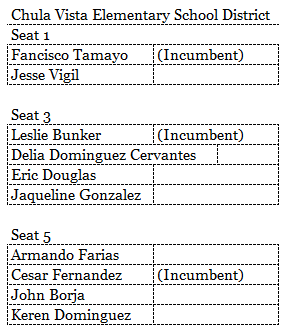
For Seat 1, incumbent Francisco Tamayo faces off against Jesse Vigil. Vigil is the former youth pastor at Eastlake Church and is presently director the San Diego branch of the charity Big Table. He is endorsed by the Republican Party.

Tamayo has been on the CVESD board since 2014. He worked in the SUHSD before transitioning to a position at the county board of education. He is endorsed by the Democratic Party.

Recommendation: Francisco Tamayo

Incumbent Leslie Bunker faces three challengers for Seat 3. She is both a former student and a 26 year teacher in CVESD. Serving since 2014, Bunker has the endorsement of the Democratic Party.

Delia Dominguez Cervantes lists herself as an education non-profit director. She is endorsed by the Republican Party. The other two candidates are blank slates. Eric Douglas lists himself as a retail manager and Jaqueline Gonzales says she is a parent and student advocate.

Recommendation: Leslie Bunker

Area 5 incumbent Cesar Fernandez also faces three challengers. Fernandez was appointed to the board in 2021. This will be his first election. His career in education includes more than 20-years teaching mathematics in SDUSD and SUHSD. He has a masters in curriculum and instruction and is endorsed by the Democratic Party.

Armando Farias is a former school board member. He currently works as director of human resources in the Coronado school district. He has a campaign web page here. John Borja is a former school teacher who recently ran for the Chula Vista city council. Keren Dominguez says she is an advocate, mother and educator. Other than her endorsement by the Republican Party little else is known about her.

Recommendation: Cesar Fernandez

San Marcos Unified School District (SMUSD)

Public school students 19,622 – Charter school students 113 – Percent charter 0.6%

Area C has 21-year high school councilor, Andres Ramos Martin, against a consultant at the nonprofit College Bound. She has a campaign web page. He has the endorsement of the Democratic Party.

Recommendation: Andres Ramos Martin

In Area E, incumbent board president Stacy Carlson is opposed by Associate Marriage and Family Therapist Sharyl Cavellier. Cavellier’s reference to Project Tomorrow’s 2021 Speakup survey indicates that she has been taken in by the billionaire financed education “reform” movement. Stacy Carlson left the banking and finance industry to start volunteering at SMUSD schools when her daughter was born 10 years ago. She has been on the board since 2014 and is endorsed by the Democratic Party.

Recommendation: Stacy Carlson

Vista Unified School District (VUSD)

Public school students 19,527 – Charter school students 2,565 – Percent charter 11.6%

Debbie Morton is the incumbent trustee for Area 2 which is on the east side of the district. Before being elected to the board in 2018 she taught school for 24 years. Her campaign web page is here.

Carla Rivera-Cruz was just named Director of Alumni and Network engagement by Latinos for Education. This is an organization financed by the Walton Family Foundation, the Chan-Zuckerberg Initiative and the NewSchools Venture Fund none of which are friends of public education.

Rena Marrocco is endorsed by the Democratic Party. She seems to be engaged in at least one local civic organization but not much is known about her background for the position.

Recommendation: Debbie Morton

In Area 3 on the west side of the district, incumbent Martha Alvarado is matched up against Jen Telles. Alvarado who is a military veteran and a bilingual educator was first elected to the board in 2018. She has the endorsement of the Democratic Party. Telles is endorsed by the Republican Party. This former accountant states on her campaign web page, “When my own children came along, I homeschooled for a period of time.”  

Recommendation: Martha Alvarado

Grossmont Union High School District (GUHSD)

Public school students 17,108 – Charter school students 4,966 – Percent charter 22.6%

Gary Woods, the incumbent in Area 3, taught online graduate courses at Liberty University and serves as executive director of the Equip Biblical Institute. He has been on the school board since 2008. Woods has the Republican Party’s endorsement.

Wood’s opponents Gabriel Lawson and Jo Hart Lloyd are both Community College educators. Lawson teaches psychology at Grossmont College and Lloyd is a councilor at San Diego City College. She is endorsed by the Democratic Party.

Recommendation: Jo Hart Lloyd

Jeanie Tyler is challenging Robert Shield the incumbent in Area 4. In a 2010 article about Shields campaign for re-election, East County Magazine reported, “Board trustee Shield, a middle school teacher, is endorsed by the San Diego Republican Party, California Pro-Life-Council, San Diego Union-Tribune ….” He still has the Republican Party endorsement.

Tyler is the Dean of Behavioral Science at San Diego City College. She is endorsed by the Democratic Party.

Recommendation: Jeanie Tyler

Area 5 incumbent, Jim Kelly, has been on the Grossmont board since at least 2006. Kelly is known to be a political brawler who has been accused of lying at times but his east county constituents keep putting him back on the board and the Republican Party keeps endorsing him.

Teacher Nancy Jennings has been endorsed by the Democratic Party for this seat. Terry Kohlenberg is also in the running in Area 5. He teaches communications and San Diego City College.

 Recommendation: Terry Kohlenberg

Oceanside Unified School District (OUSD)

Public school students 16,261 – Charter school students 2,410 – Percent charter 12.9%

Area 1 candidate Allison Mineau is endorsed by the Republican Party. Her campaign treasure is Briana Beleskie from Brian Billbray’s organization in Imperial Beach. On her Facebook page, she shares what an honor it was to be a speaker at a North County Patriots event. Her opponent is VUSD councilor Nancy Licona who is endorsed by the Oceanside Teachers Association and the Democratic Party.

Recommendation: Nancy Licona

In Area 3, Incumbent Stacy Begin is running unopposed.

In Area 4, Raquel (Rockie) Alvarez, the incumbent, works at Amador repair services and has been engaged in education studies at Grand Canyon University since 2019. Her opponent Tigran Ghukasyan is a bit of an enigma. The county lists him as on the ballot but none of his filing paperwork appears under a search by name or jurisdiction. He is listed as a being endorsed along with Alvarez by the Democratic Party.

Recommendation: Raquel Alvarez

Escondido Union High School District (EUHSD)

Public school students 7,166 – Charter school students 2,292 – Percent charter 24.2%

Bob Weller is facing Mickey E. Jackson for the vacated seat in Area 1. Retired industrial mechanic Mickey Jackson has the endorsement of the Democratic Party. However the Democrats incorrectly endorsed him for Area 2. Home mortgage strategist Bob Weller has the endorsement of all five sitting board members.

Recommendation: Bob Weller

Area 2 incumbent Bill Durney is running unopposed.

Area 5 has Katheryn McCarthy challenging incumbent Jon Petersen. Registered nurse McCarthy has a doctorate in nursing and teaches at USD. She is endorsed by the Democratic Party. Petersen is proud of his accomplishments in advancing career and technical education while on the board. He is endorsed by the Republican Party.

Recommendation: Jon Petersen

San Dieguito Union High School District (SDUHSD)

Public school students 12,704 – Charter school students 0 – Percent charter 0%

MAGA Mike Allman’s 2020 election to the SDUHSD board brought continuous turmoil and divisiveness. His outrageous agendas like creating a gerrymandered map to eliminate board members he didn’t like were passed because the other conservatives on the board felt obligated to support him. When Mo Muir withdrew her name as an Area 1 candidate on August 12, MAGA Mike desperately sprung into action recruiting like minded David Carattini to run for the open seat. The former Cost-Co manager who has no experience or training in education signed up for the position on August 17th the last possible day. He immediately got endorsed by the Republican Party.  

The other candidate for Area 1 is Rimga Viskanta. She is a former board member of the elementary school district in Encinitas and is endorsed by the Democratic Party.

Recommendation: Rimga Viskanta

In Area 3, this is the second go around for Jane Lea Smith the candidate supported by the Democratic Party. In 2020, Mike Allman defeated her by 326 votes for a seat on the board. Smith has a masters degree in special education and 16 years of experience as a teacher and school administrator. Property manager Sheila King has the support of the Republican Party. Daniel Hale lists himself as a software engineer. Neither is known to have an experience in education.

Recommendation: Jane Lea Smith

In Area 5 at the south end of the district, incumbent Julie Bronstein has 2 challengers, Georgia Ringler and Phan Anderson. Bronstein won the seat in a 2021 special election following Kristin Gibson’s resignation from the board. Her campaign page notes that professionally she is Managing Executive Director of Development in Health Sciences at UC San Diego. She is supported by the Democratic Party.

Georgia Ringler who list herself as parent seems to be the same person who sued her former employer, Scripp Research, for ignoring her religious objection to mandated COVID-19 vaccinations. Phan Anderson says she is a software engineer and parent. Anderson’s economic interest statement (form 700) indicates she is quite wealthy. Anderson has the endorsement of the Republican Party.

Recommendation: Julie Bronstein

Best Book of 2022 – Left Behind

24 Aug

By Thomas Ultican 8/24/2022

Lily Geismer has performed a great service to America. The Claremont McKenna College associate professor of history has documented the neoliberal takeover of the Democratic Party in the 1980’s and 1990’s. In her book, Left Behind: The Democrats Failed Attempt to Solve Inequality she demonstrates how Bill Clinton “ultimately did more to sell free-market thinking than even Friedman and his acolytes.” (Left Behind Page 13)

When in the 1970’s, Gary Hart, Bill Bradley, Michael Dukakis, Al Gore, Paul Tsongas, and Tim Wirth arrived on the scene in Washington DC they were dubbed “Watergate Babies.” By the 1980’s Tip O’Neill’s aid Chris Mathews labeled them “Atari Democrats” an illusion to the popular video game company because of their relentless hi-tech focus. Geismer reports,

“Journalist Charles Peters averred that ‘neoliberal’ was a better descriptor. Peters meant it not as a pejorative but as a positive. … Neoliberals, he observed, ‘still believe in liberty and justice and a fair chance for all, in mercy for the afflicted and help for the down and out,’ but ‘no longer automatically favor unions and big government.’” (Left Behind Pages 17-18) [Emphasis added]

Founding the DLC

In 1984, Lyndon Johnson’s son-in-law Charles Robb was the Democratic Governor of Virginia. He hosted a series of meetings in Washington and Virginia to develop a strategy for going forward. The meetings occurred shortly after Mondale’s huge loss to Ronald Reagan. It was decided they needed a new structure outside of the Democratic Party and Al From was tasked with writing the initial plan.

From’s scheme called for establishing the Democratic Leadership Council (DLC) to give the party a winning direction. Robb convinced From to become executive director of the nascent organization. From hired Will Marshal to be policy director. Geismer reveals,

“The architects recruited as founding members a lineup of fourteen senators, including Nunn, Chiles and Gore (who had just moved chambers); seventeen representatives, like Wirth, Gephardt, Leon Panetta of California, and Les Aspin of Wisconsin; and ten governors, such as Robb, Babbitt, James Blanchard of Michigan, Richard Lamm of Colorado, and Bill Clinton of Arkansas. … Of the total forty-one inaugural members, there were no women, two were men of color, and only four came from outside the Sunbelt.” (Left Behind Page 45)

Historian Arthur Schlesinger labeled the DLC “a quasi-Reaganite formation” and accused them of “worshiping at the shrine of the free market.”

Union pollster Victor Fingerhut called them “crypto-Republicans.”

Douglas Wilder a black Virginia politician criticized their “demeaning appeal to Southern white males.”

Others called them the “conservative white caucus” or the “southern white boys’ caucus.”

Jesse Jackson said its members “didn’t march in the ‘60s and won’t stand up in the ‘80s.” (Left Behind Pages 46-47)

In 1989, From convinced Bill Clinton to become the chairman of the DLC. That same year the DLC founded the Progressive Policy Institute to be their think tank competing with the Heritage Foundation and the CATO Institute. Today, it still spreads the neoliberal gospel.

The next year, the DLC issued the New Orleans statement which stated the “fundamental mission of the Democratic Party is to expand opportunity, not government.” The statement also claimed that a “free market regulated in the public interest, is the best engine of general prosperity.” (Left Behind Page 107)

At the DLC convention in early 1991, Clinton rejected criticism from people like Jesse Jackson and Ohio Senator Howard Metzenbaum (D-Ohio) stating, “choice is not a code word for elitism and racism.” Geismer notes that in his speech, “He then listed off the DLC proposals to address the problems of poverty with programs like childcare vouchers, public school choice, job training programs, and community policing.” (Left Behind Page 127) [Emphasis added]

It was at their 1991 convention that the DLC urged Congress to give President Bush fast track trade authority to negotiate the North American Free Trade Agreement (NAFTA). The Democratic establishment had not been warm to the idea and labor strongly objected.

After Clinton won the Democratic nomination, labor unions were in a difficult position. Geismer explained,

“Labor officials and the rank and file both had strong objections with Clinton’s position on free trade and were well aware of the New Democrats’ long-standing hostility toward unions. … Even though union members had gained more than a quarter of the delegate seats at the 1992 Democratic Convention, labor leaders made a conscious decision not to demand that Clinton openly advocate for unions in the platform or to temper his support for free trade. This calculation rested on their sense that Bush was a bigger threat to unions, and the movement should focus their energy on defeating him.” (Left Behind Page 133)

Once elected, Clinton turned away from New Deal liberalism and Johnson’s Great Society. He claimed that by increasing private sector activity in blighted urban areas and providing more credit these communities of poverty would be lifted up. He proposed creating enterprise zones “to create a small-business entrepreneurial economy in every underclass urban area …” (Left Behind Page 144)

Geismer describes a 1996 speech given by Hillary Clinton:

“Hillary Clinton took pains to emphasize the potential of micro-credit not just internationally but in the United States as well. The speech came just as states were implementing the requirements in the 1996 welfare reform act, which fulfilled Bill Clinton’s campaign pledge to ‘end welfare as we know it.’ The law terminated the assistance for women and children in place since the Roosevelt administration and served as a potent symbol of the Clinton administration’s attempt to put a nail in the coffin of New Deal liberalism.” (Left Behind Page 170)

In the fall of 1999, the Clinton administration negotiated with Senator Phil Gram (R-Texas) to end the Glass-Steagall act. This was the culmination of the administration’s support for deregulating the banking industry, which unleashed an historic wave of consolidations. The 2:45 AM deal ended the bank reforms President Roosevelt enacted to insure banks would never again make dangerous deals that led to failure and losing their depositors assets. (Left Behind Pages 309-312)

In retrospect, a good case can be made that the neoliberal agenda has been a disaster. The bank failures of 2008 almost brought down the entire World’s economy. Economic inequality has grown along with the creation of hundreds of billionaires both of which harm democracy. America’s childhood poverty rates are the highest in the developed world and homelessness plagues every moderately large city in America. It truly is “The Democrats’ Failed Attempt to Solve Inequality.”

The Attack on Public Education

The philosophy that guides people can also blind them. Neoliberals are so convinced by the magic of markets that they have fallen for the illusion that public education is failing. They are convinced that a business type accountability and market based competition are needed. It seems not to have occurred to them that the foundation for America becoming the economic, scientific and cultural leader of the world is public education. How can they overlook the fact that America’s public education system has produced by far the most Nobel Prize winners in the world? Evidently they believe that since it is not a market based system it must be failing. However, even the conservative publication Education Next just produced a study showing that public education results have been steadily improving for the last 50 years.

Vice President Al Gore was convinced public schools were failing and needed a new direction. During a monthly “Gore-Tech session”, the Vice President asked venture capitalist John Doerr, “If you Silicon Valley types are so smart, why can’t you do something to create new schools?” Doerr who had scored big with investments in Netscape, Amazon and Google, like Gore, was certain public schools required radical change. He wanted “better schools based on Silicon Valley’s principles of accountability, choice and competition.” (Left Behind Pages 233-234)

Two big results came from this conversation. Doerr, a notoriously successful venture capitalist, went home where he was integral to establishing the NewSchools Venture Fund which was one of the first venture philanthropies. It was dedicated to promoting charter schools and education technology. NewSchools collaborated with Reed Hastings and Don Shalvey to create America’s first Charter School Management organization. 

Geismer notes,

“Computer companies had long understood that getting a foothold in the nation’s schools was a potential goldmine. … As the participants at the Gore-Tech sessions took up education reform, the conversation quickly turned to the topic of charter schools, which were a favorite reform tool of the president.” (Left Behind Page 239)

Like other venture capitalists, NewSchools’ founders expect a return on investment. This return would be measured in test score gains rather than dollars. (Left Behind Page 255)

Al From told Clinton that in order to win reelection in 1996 he need to “grab the mantle” of charters and school choice for Democrats. Geismer avers,

“The 1996 State of the Union was most notable for Clinton’s declaration that the ‘era of big government is over.’ Elaborating on the theme, he also dared ‘every state to give all parents the right to choose which public school their children will attend; and to let teachers form new schools with a charter they can keep only if they do a good job.’” (Left Behind Page 244)

Some Parting Notes

Lily Geismer’s book is special. The scholarship is above reproach and she solidified my personal opinion about the neoliberal ideology and its implementation. I hope as many people as possible read this edifying book. It provides profound insight into the source of the stupefying inequality plaguing American society.

The book and this post put the neoliberal faction of the Democratic Party in an extremely bad light. However, it is important to remember that the neoliberal market driven agenda is embraced even more tenaciously by America’s conservative community and they don’t seem concerned about “a fair chance for all, in mercy for the afflicted and help for the down and out.”