Archive | January, 2024

Father of Progressive Education Movement

28 Jan

By Thomas Ultican 1/28/2024

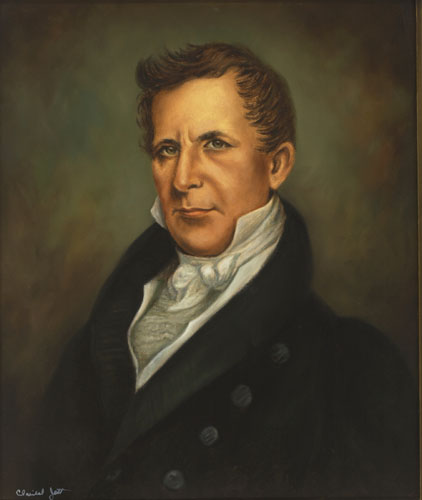
John Dewey called Colonel Francis Wayland Parker, “more than any other person… the father of the progressive education movement.” True, his 1902 passing predated the movement’s heyday by two decades but he was the root, a Civil War veteran and educator, passionate in his quest for better education.
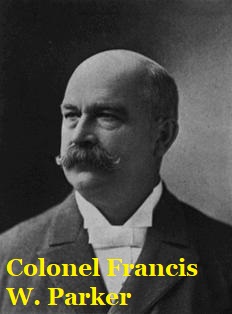
Born (1837) in Bedford, New Hampshire, Colonel Parker was a product of public school. He began his career as a village teacher at 16 and eventually took charge of all grammar schools in his hometown, Piscataquis. Then at 21, he became the principal of a school in Carrolton, Illinois.

During the Civil War, he joined the Union Army as a private in 1861, was elected 1st Lieutenant and later made company commander with the rank of Captain. After being wounded at the Battle of Deep Bottom, Virginia in 1864 and the attack on Fort Fisher, North Carolina, he became commander of the 4th New Hampshire and was promoted to Lieutenant Colonel. From then on, he was referred to as Colonel Parker. He was captured, held prisoner in North Carolina in May 1865 and fortunately, the war ended.

After mustering out of the army, Colonel Parker resumed teaching and became head of the normal school in Dayton, Ohio. When an aunt died and bequeathed him $5,000, he traveled to Germany for pedagogy studies.

Progressive Education        

Pedagogy practiced in nineteenth century was teacher-centered with extreme discipline. Students were given texts to memorize and lots of drill.

In 1872, Colonel Parker enrolled at Humboldt University of Berlin. He examined new methods of pedagogy developed by European theorists, such as Jean-Jacques Rousseau, Friedrich Froebel, Johann Heinrich Pestalozzi and particularly Johann Friedrich Herbart.
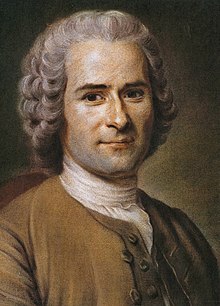
Jean-Jacques Rousseau (1712 – 1778) considered his book, Emile or On Education, to be his greatest work, regarded by some as the first philosophy of education in Western culture with a serious claim to completeness. After the French Revolution, Emile served as the inspiration for what became France’s new national system of education. In the book, Rousseau played tutor to Emile and eventually, Sophie. It was here where his philosophy of education came to light. He gives advice like, “Always speak correctly before them, arrange that they enjoy themselves with no one as much as with you, and be sure that … their language will be purified on the model of yours without your ever having chided them.” (Emile Page 71)

Of course, no matter how advanced an 18th century man may be, his ideas can always use some perfecting. In discussing how women should be educated, Rousseau wrote:

“The first education of men depends on the care of women. Men’s morals, their tastes, their pleasures, their very happiness also depend on women. Thus the whole education of women ought to relate to men. To please men, to be useful to them, to make herself loved and honored by them, to raise them when young, to care for them when grown, to counsel them, to console them, to make their lives agreeable and sweet – these are the duties of women at all times, and they ought to be from childhood.” (Emile Page 365)

Johann Heinrich Pestalozzi fell in with radical philosophers who supported Rousseau in the mid-18th century. After Emile and Social Contract were published, Rousseau was condemned as a danger to Christianity and state. Pestalozzi’s group wanted freedom and at 19, he wrote many articles, got arrested, charged with helping a newspaper editor escape but was released after three days.

He decided to become an educator, especially of the poor. The Swiss Government put him in charge of an orphanage in Stanz. Here he realized the significance of a universal method of education and spent the rest of his life perfecting one.

German philosopher and educator, Johann Friedrich Herbart, spent a year studying with Pestalozzi. Herbart suggested Pestalozzi read the French book, The Application of Psychology to the Science of Education. Pestalozzi’s French was not great but what he comprehended threw “a flood of light upon my whole endeavor.” (Green, The Educational Ideas of Pestalozzi 48)

In 1805, King Christian the VII of Denmark gifted Pestalozzi a sum of money while he was starting a school at Yverdon. With this, Pestalozzi was able to spend several months writing Views and Experiences relating to the idea of Elementary Education.

Pestalozzi’s method was used by the cantonal school in Aarau that Albert Einstein attended. Einstein said of Aarau, “It made me clearly realize how much superior an education based on free action and personal responsibility is to one relying on outward authority.” (Isaacson, Einstein His Life and Universe 65)
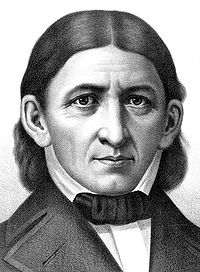
Friedrich Wilhelm August Froebel (1782 – 1852) was the student of Johann Pestalozzi who laid a foundation for modern education, based on recognizing children’s unique needs and capabilities. He created the concept and coined the word kindergarten, which soon entered the English language.

Froebel’s insight recognized the importance of activity for a child’s learning, that games were integral to it and had educational worth. In his book, The Education of Man, he wrote, “A universal and comprehensive plan of human education must, therefore, necessarily consider at an early period singing, drawing, painting, and modeling; it will not leave them to an arbitrary, frivolous whimsicalness but treat them as serious objects for the school.” (Page 228)
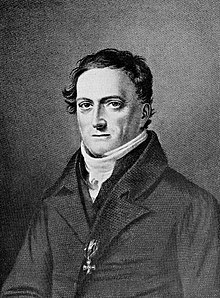
Johann Friedrich Herbart (1776 – 1841) was a German philosopher, psychologist and founder of pedagogy as an academic discipline. Homeschooled by his mother until age 12, he studied at the Gymnasium for six years, particularly drawn to philosophy, logic and Kant’s work involving the nature of knowledge.

Stanford’s Encyclopedia of Philosophy says:

“Johann Friedrich Herbart … is known today mainly as a founding figure of modern psychology and educational theory. But these were only parts of a much grander philosophical project, and it was as a philosopher of the first rank that his contemporaries saw him. … In psychology and pedagogy, however, his influence was greater and longer lasting. While no one took over his philosophy or psychology (and especially the impenetrable mathematics) as a whole, certain aspects of his thought proved immensely fruitful. Indeed, without Herbart, the landscape of modern psychology and philosophy would be unrecognizable.”

For the educator, his 1841 book, Outlines of Educational Doctrine, is particularly important and was of great interest to Colonel Parker. In it, Herbart sometimes made concise statements, such as, “A method of study that issues in mere reproduction leaves children largely in a passive state, for it crowds out for the time being the thoughts they would have otherwise had.” (Page 61)In other places, he went into great detail about concepts like preparation, presentation, association, systemization and application.  

Returning to America

After Colonel Parker returned to the United States, he noted:

There was a great deal better way of teaching than anything I had done. Of course I had a great deal of enthusiasm and a great desire to work out the plan and see what I could do.

He almost immediately secured a position as superintendent of schools in Quincy, Massachusetts. Colonel Parker’s innovations, labeled the “Quincy Plan,” gave him a national reputation.

Quincy Plan was an experimental program, abandoning prescribed curricula of rote memorization and harsh discipline, replaced with meaningful learning and active understanding. However it had many detractors. In 1879, Quincy students participated in state examinations of traditional subjects. Test results revealed they surpassed all the other students in Massachusetts.

Parker surprisingly responded, “If you ask me to name the best of all in results, I should say, the more human treatment of little folks.”

The following three years, Colonel Parker served as superintendent of Boston public schools. Because of constant opposition to his methods, he left Massachusetts in 1883 to become principal of Cook County Normal School in Chicago, an institute dedicated to training elementary school teachers. Chicago brought strong support from many local luminaries such as Jane Addams, Rabbi Emil G. Hirsch, and Anita McCormack Blaine.

In 1899, to free Parker from the continual harassment by politicians and the school board, Anita McCormack Blaine endowed a private school for him and his faculty. The new Chicago Institute was planned, developed and classes started. It was soon proposed that the Chicago Institute join with the Department of Education to form the School of Education at the University of Chicago. This plan became official on July 1, 1901 with Colonel Parker as director for the School of Education and John Dewey remaining Head Professor in the Graduate School of Arts, Literature and Science. In March 1902, Parker died and John Dewey was appointed his successor in the School of Education.

Anita McCormack Blaine also convinced Colonel Parker to establish the Francis W. Parker School, a private school, in Chicago’s Lincoln Park. This school, established in 1899, was to operate according to Parker’s education principles. A second Francis W. Parker School was founded in San Diego in 1912 with a city population of only 39,000.

Both private schools are still operating and very successful today.

Billionaire Science-of-Reading Support

21 Jan

By Thomas Ultican 1/21/2024

National Center on Teacher Quality (NCTQ) released an unreviewed report (1-16-2024) on state laws, about teaching reading inadequacy. That day, The 74 ran an article about it, verified by an EdReports’ curriculum quality evaluation. These three entities are billionaire creations, used to chip away local control of schools.

In a 2012 Washington Post Answer Sheet Blog, Diane Ravitch shared,

“NCTQ was created by the Thomas B. Fordham Foundation in 2000. I was on the board of TBF at the time. Conservatives, and I was one, did not like teacher training institutions. We thought they were too touchy-feely, too concerned about self-esteem and social justice and not concerned enough with basic skills and academics.”

Kate Walsh led NCTQ from 2000 until 2022, retired and Heather Peske took over. During Walsh’s tenure, notoriety was gained by teaming with Newsweek and claiming America’s teacher education programs were unsatisfactory. Their research methods were widely panned. They Looked only at class syllabi and made no attempt to ascertain new teacher job performance before denigrating the programs. 

NCTQ’s rankings were endorsed by eight state school education chiefs, part of Jeb Bush’s Chiefs for Change: Janet Barresi, Oklahoma; Tony Bennett, Indiana; Steve Bowen, Maine; Chris Cerf, New Jersey; Deborah A. Gist, Rhode Island; Kevin Huffman, Tennessee; Eric Smith, Florida and Hanna Skandera, New Mexico.

Walsh also famously called for teacher merit pay and held up Washington DC’s schools as a good example. Critics called the Washington experiment a failure because of the high stakes and “significant differences” in percentage of teachers rated “highly effective” in low and high poverty schools. Teaching is so complicated, with no justifiable way for accurate evaluations for these high stakes.

Heather Peske has a resume that makes billionaire education reformers comfortable. After starting as an elementary teacher in Baton Rouge, Louisiana, she served as Director of Teacher Quality at The Education Trust and later, Vice President of Programs at Teach Plus. She was also named “Future Chief” by Chiefs for Change, became a Broad Academy Fellow and earned a doctorate in Administration, Planning, and Social Policy from Harvard Graduate School of Education.

Peske Report

Action 1 of the NCTQ report, named “Five Policy Actions to Strengthen Implementation of the Science of Reading,” began by calling for standards, “Many new teachers aren’t prepared to teach reading because only 26 states provide clear standards to teacher prep programs.” This translates to mean only 26 states provide billionaire-funded standards. NCTQ has been relentless in its attempts to undermine university-run teacher training.

Action 2 calls for “reviewing teacher prep programs to ensure they teach the science of reading,” claiming it is laudable that Indiana and Ohio have audited prep programs, ensuring focus on implementing the science-of-reading (SoR).

Action 3 requires elementary teacher candidates to pass a reading licensure test. The report cautions readers that some tests do not fully address all five core components of SoR, another call for turning over teacher selection to private entities.

Action 4 addresses “the use of high-quality curricula aligned to the science of reading.” NCTQ’s solution to this is to sign on with EdReports which reviews reading materials and lets client schools know its alignment with SoR.

The report claims “only nine states require districts to select high-quality reading curriculum materials” and noted that forward-looking states, like Arkansas, partner with EdReports.

Action 5 provides “professional learning and ongoing support to sustain implementation of science of reading.” Current elementary teachers are to receive high-quality professional learning in scientifically-based reading instruction and demonstrate their learning.

They claim Mississippi found that teachers’ ability to teach reading improved after participating in the Language Essentials for Teaching Reading and Spelling’s (LETRS) professional development program. Texas and North Carolina mandate LETRS training.

This report hinges on the belief that SoR is the only good method for teaching reading with no downside. United Kingdom went to a program similar to SoR in 2012. Last year reading researchers published a major study that concluded England’s over-emphasis on phonics instruction was harmful and caused reading test scores to go down.

NTCQ’s report was funded by The Joyce Foundation.

In August, Rachel Cohen wrote an informative and balanced article about SoR, reporting:

“Despite its close associations with the “science of reading” — LETRS has its own middling track record of effectiveness. One experimental study found teachers who were trained by LETRS did improve in their knowledge of reading science, but their students did not have statistically higher differences in achievement than teachers in the control group.”

She noted the Orton-Gillingham reading intervention, favored by SoR advocates, yielded mixed results and “wasn’t found to significantly boost comprehension or vocabulary.”

Cohen also wrote:

“Generally reading experts say the policies included in the new state reading laws are a “real mixed bag.” Some laws incorporate more research-backed ideas like coaching, while other endorsed approaches are more suspect. There is no clear amount of time that research shows should be spent daily on phonics, no established curriculum for the “science of reading” and studies on so-called decodable booksstrongly endorsed by some phonics advocates to help young students practice letter-sound combinations — have their own mixed research track record.”

There probably are some good ideas hidden in the SoR movement but it is certainly not settled-science nor the best way to teach reading. Billionaires are not invested in improving reading instruction. The SoR movement is another avenue for undermining local control in education doctrine and empowers private companies over state run universities.

Billionaire Team  

  1. National Center on Teacher Quality was formed in 2000(Tax ID: 04-3536571).
    •  2021 tax form lists 2 executives on their highest paid list: Kate Walsh (former president) $259,877 and Ashley Kincade $170,044.
    • Major funders include Charles and Lynn Schusterman, Joyce Foundation, Laura and John Arnold and the Walton Family Foundation.
    • Reported donations totaled $2,378,006.
  2. The 74 Media, Inc. was formed in 2013 with non-profit tax ID:47-2788684.
    • Top executive pay includes Steven Snyder $264,968, James Roberts $265,348, Kathleen Moore O’Connor $153,341, Beverly Weintraub $184,245, Dena Wilson $142,548, Laurel Hawkins $148,632 and Emmeline Zhao $142,407.
    • Major funding comes from Bill and Melinda Gates Foundation, the Carnegie Corporation, the Chan Zuckerberg Initiative, the Charles and Lynn Schusterman Family Foundation, the City Fund and the Walton Family Foundation.
    • Reported donations totaled $4,466,877.
  3. EdReports Org Inc. was formed in 2014 with non-profit tax ID: 47-1171149.
    • Top executive pay includes Eric Hirsh $304,596, Donnidra Johnson $196,788, Janna Chan $179,055, Courtney Allison $192,521 and Lauren Weisskirk $192,212.
    • Major funding comes from Bill & Melinda Gates Foundation, Broadcom Corporation, Carnegie Corporation of New York, The Charles and Helen Schwab Foundation, The Charles and Lynn Schusterman Family Philanthropies, Overdeck Family Foundation, The Walton Family Foundation, The William and Flora Hewlett Foundation and The W.K. Kellogg Foundation.
    • Reported donations totaled $7,419,702.
  4. Chiefs for Change was formed in 2014 with non-profit tax ID 47-2373903.
    • Top executive pay includes Leila Walsh $262,885, Robert Runcie (interim CEO) $208,930, Jamar Knox $253,457, Stephanie Zamorano $206,788, Kimberly Tang $188,753, Danielle Durban $198,705, Makese Motley $166,383 and Michael McGee (CEO thru 4/29/2022) $132,180.
    • Major funding from Walton Family Foundation, Overdeck Family Foundation, Bill and Malinda Gates Foundation, Michael and Susan Dell Foundation, Bloomberg Philanthropies, Blue Meridian Partners and Silicon Valley Community Foundation.
    • Reported donations totaled $24,294,635.

Wrapping Up

This report was produced and promoted by billionaire-created and funded organizations. Major funders listed are either billionaires or billionaire funded dark-money organizations. They pay big wages with an agenda and that does not support locally-controlled public schools. Worse, this is one small team, out of many, financed by the same people.

SoR has errors and is not settled-science. Balanced literacy probably has a better track record based on what works investigations.

Billionaires spend big money to continue chipping at local control … unconcerned about good education, only regarding national standards and control as important.

And … some want to end publicly-financed education!

Time to tax billionaires out of existence???

John Eaton, Hero of American Education

15 Jan

By Thomas Ultican 1/15/2024

John Eaton (1829 – 1906) was a clergyman, soldier, philanthropist, journalist, educator, and statesman. He was born to a farmer in Sutton, New Hampshire and attended Vermont’s Thetford Academy . After graduating from Dartmouth College in 1854, he studied at Andover Theological Seminary and in 1862 was ordained to the Presbyterian ministry. Eaton also earned a Master of Arts and Legum Doctor from Rutgers University.

After Dartmouth, as a school principal in Cleveland, Ohio his success led to an appointment as superintendent of the public schools of Toledo, Ohio … a position he held from 1856-59.

On August 15, 1861, he joined the 27th Ohio Volunteer Infantry as chaplain. In September 1862, Lincoln signed Proposition 95, soon known as the Emancipation Proclamation. The next month, Major General Ulysses S. Grant appointed Eaton superintendent of freedmen and made him supervisor of all military posts from Cairo, Georgia to Natchez, Mississippi and Fort Smith, Arkansas. On October 10, 1863, Grant made him colonel of the 63rd United States Colored Infantry.

 The following month, Eaton was tasked with Superintendent of Negro Affairs for the Department of the Tennessee (Grant’s Army). From 1863-64, he opened 74 schools, all black, in places like Memphis, Vicksburg, Natchez, Little Rock, Pine Bluff and others within the Union lines, with 13,320 pupils. (Page 296)

With this, the leading Christian denominations of the North commenced church schools, also supervised by General Eaton. As the Union army advanced, the few public schools for white children came under military control and were likewise put under his jurisdiction.

Professor Johann Neem shared, “Because of their political power and the way the tax burden fell largely upon them, slaveholding elites spread an antitax gospel to convince ordinary whites that taxes were a bad thing.” (Democracy’s Schools Page 92) Leading into the Civil War, there were no state-supported public schools in the south. Eaton’s efforts started the American common-school system in the South which, in succeeding years, led to revised constitutions in every reconstructed southern state, establishing publicly financed education.

Eaton was a force-of-nature endowed with a profound work ethic, natural ability at organizing and political acumen. He was confirmed brigadier general by the US Senate in 1866.

Post-Bellum National and International Education Leader

In 1867, he was selected superintendent of public instruction for the state of Tennessee and was instrumental in creating the state’s public education laws. This appointment allowed him to enforce them. The so-called “Eaton System” was not popular with the local population, yet for two years, he was able to establish a common-school system, servicing 185,000 Black and White students.

After he left Tennessee in 1869, the state legislature swept away the “Eaton System.” (Page 296) Eaton anticipated this outcome and in his final report to Tennessee’s Governor wrote:

“No state in the Union is now satisfied without an efficient system of free public schools. If this one, which has been inaugurated at such cost and with such care, is destroyed in Tennessee, it will necessarily be revived. It must be. Nothing can prevent it in any American state. ” (Page 297)

He was prescient. The system was temporarily checked but its essential features were soon re-adopted.

Author and clergyman A. D. Mayo (1823-1907) summed up the work of General Eaton:

“For more than twenty years, from 1862 to 1882, no man in the United States contributed more to the final establishment and increasing importance of the common-school system in the South than he. … Whatever may have come of his tremendous labors and those of his faithful assistants during these early years, working under a military supervision, it cannot be reasonably doubted that any competent reader of the educational literature thrown up in this period, with the commentary of subsequent events, will be forced to acknowledge that then and there was laid a permanent foundation for the new departure of a system of common schools in the South .” (Page 297)

General Eaton Goes to Washington

A new Department of education was created by Congress in 1867 with Dr. Henry Barnard as Commissioner. The public fear of dangerous centralization became so great that in 1870, the Senate changed it from a department to a bureau, attached to the Department of the Interior.

When U. S. Grant was inaugurated president (March 4, 1869), he discovered Commissioner Barnard wanted to leave. Grant decided to bring General Eaton to Washington and appointed him Commissioner of Education on March 16, 1870.

When Eaton arrived, appropriations for the National Bureau of Education had been reduced from $20,000 to $6,000 a year. He had a staff of two clerks, with the existence of a Bureau of Education threatened. (Page 298)

Employing phenomenal powers of organization, political acuity and work ethic, Eaton set out to build a National Bureau of Education, recognized favorably in the US and worldwide.

Dr. William T. Harris, who succeeded Eaton as Commissioner, stated:

“General Eaton was the true founder of this Bureau, in the sense that he established as the chief work of this Bureau, the annual collection of statistics by means of statistical schedules, which were sent to all institutions and all general officers to be filled out and returned to the Commissioner from year to year. In this way he trained educators to keep original records of their operations and made these records available for analysis and comparison.” (Page 299)

Eaton’s innovations in expanding public education included initiating kindergarten in the US, introducing domestic science, industrial and manual training, creating commercial, agricultural, art, and nurse-training schools, women in higher education, schools for the blind, for the learning-disabled, technical schools, free libraries, etc. (Page 300)

His influence went beyond the boundaries of the United States. He was tendered an honorary membership in the French “Ministry of Public Instruction,” which he declined because it was improper. The Department of Education of England also sought his advice. When the governments of Japan, South Africa, Egypt, Bulgaria, Brazil, Columbia, Peru, Chili, and Argentina awoke to the importance of educating the masses, General Eaton was solicited to map a suitable school system and expended great efforts to help these countries. (Page 301)

These labors undermined his health and in November 1886, against the wishes of the President, he felt compelled to resign his commission. In 1870, the Bureau had two clerks of low grade, 100 volumes in its library, $6,000 for maintenance and was considered a failure. By the time he left, the Bureau of Education had 38 paid clerks and 9,000 unpaid volunteer assistants in the United States and foreign lands collecting statistics. There were 18,000 volumes and 47,000 pamphlets in the library, the most extensive and complete pedagogic collection in existence at the time, with $102,284 for the maintenance of the Bureau. Its stellar global reputation was declared “the most influential educational office in the world.”

During the years from 1875 to 1886, General Eaton wielded a larger influence on educational affairs than any other person in America. (Page 301)

After Washington DC

From 1886 to 1891, Eaton was president of Marietta College. In 1895, he was appointed president of Sheldon Jackson College in Sitka, Alaska and in 1898, he became president of Westminster College in Salt Lake City. He also served as Councilor of the American Public Health Association, Vice-President of the American Association for the Advancement of Science and president of the Association of Social Science.

In 1899, owing to his experience organizing educational systems of several South American republics, the US Government called on him to reform the education system in Puerto Rico. General Eaton successfully replaced the Spanish system which profited certain privileged classes and abolished the “substitute system,” in which a person could draw the full salary of a teacher and employ a cheap substitute to do the teaching. The school curriculum was also reformed and the “fee system” eliminated, enabling children of poorer classes to attend school. He required educating girls as well as boys, changing an ancient, effete school culture into a modern one, founding the American school system in Puerto Rico.

General Eaton passed at home in Washington DC on 2-9-1906, survived by his wife Shirley, daughter Elsie Newton and two sons, Joseph Shirley Eaton and John Quincy Eaton.

His obituary in The Evening Star noted,

“In the death of Gen. Eaton the cause of public education meets with a severe loss, it is pointed out and his death will be regretted, not only by a host of friends in this city and elsewhere, but by many educational Institutions throughout the country.” 

Pitch AI Education?

9 Jan

By Thomas Ultican 1/9/2024

The Walton family (Tax Id: 13-3441466), Jonathon Sackler (Tax Id: 13-4119735), Lynn Schusterman (Tax Id: 73-1312965) and other billionaires fund The 74 Media, Inc. It has become a primary method for propagating their agenda. In December, The 74 published 7 Artificial Intelligence Trends That Could Reshape Education in 2024.” For serious educators, AI is a set of computer algorithms, making cheating easy. It is another tool for a dumbed-down, easier to control and more profitable education system.

Late Steve Jobs’ billionaire wife, Laurene Powell Jobs, founded the Emerson Collective. In 2015, Emerson Collective bought Amplify, a kids-at-screens education initiative that Rupert Murdoch gave up on. The same year, Jobs and Russlynn Ali founded XQ Institute and its XQ Super Schools project soon followed. In 2017, they put on a one-hour show, XQ Super Schools Live, simultaneously on four networks, ABC, CBS, NBC, and Fox. Talent featured included Ringo Starr, Tom Hanks, Samuel L. Jackson, Justin Timberlake, and Jennifer Hudson.

Jobs set out to use wealth to impose her views on reforming public education.

Her plans did not resonate deeply with the public so today she seems to be using wealth to push education technology and Amplify. The AI article linked was written by Edward Montalvo, XQ institute’s senior education writer. He writes:

‘“The future of AI in education is not just about adopting new technologies; it’s about reshaping our approach to teaching and learning in a way that is as dynamic and diverse as the students we serve,’ XQ Institute Senior Advisor Laurence Holt said. … Through AI, we can also transcend the limitations of the Carnegie Unit — a century-old system in which a high school diploma is based on how much time students spend in specific subject classes.

“Changing that rigid system is our mission at XQ.”

The article, linked by Montalvo, appeared in the September 11, 2023 issue of The 74, co-written by XQ’s Russlynn Ali and Carnegie’s Timothy Knowles. Ending the Carnegie Unit is crucial for the scheme to put children in front of computers earning badges. It is the only way to implement competency-based education (CBE), at a low price.

The fact that CBE and its forerunners have a 50-year history of failure seems not to be an issue.

Montalvo’s article was a sales job for AI products. He noted that an XQ Super School, PSI High in Sanford Florida, was engaging with AI. PSI tells us, “The program’s mastery-based grading system also helps ensure that students are fully prepared for college, career, and beyond.” Abandoning traditional education, they have replaced it with rubrics. There is no information about student performance 6-months down the road. How can AP courses be offered without traditional education? Yet, PSI says they are excited about AI.

AI has value but for pedagogy, it is limited. Educator and blogger, Mercedes Schneider, shared, “As a teacher for many decades, I find increasingly more of my time consumed with devising means to ensure students complete my assignments without the easy-cheat, sustain-my-own-ignorance that AI enables in today’s students – and, it seems, an increasing number of (especially remote) professionals who may be using the corner-chopping ability AI offers to even hold multiple full-time positions.

Dystopian Future is Possible

Jobs, XQ and Carnegie are far from the only forces out to blow up our current education system by pushing for a technology-based takeover. Many deep-pocketed fans promote education technology. The new push to eliminate the Carnegie unit is coming from a below-the-surface movement to digitize education. Global Silicon Valley (GSV) has taken leadership of an effort to program life with crypto-world tools.

GSV is a venture capital firm founded in 2010 by Michael Moe, a private company with a radical libertarian ideology. Moe and colleagues published American Revolution 2.0; How Education Innovation is Going to Revitalize America and Transform the U.S. Economy. This manifesto calls for turning kindergarten through university and beyond into a tokenized existence. Graduation from kindergarten gets a token, hospitalization gets a token, immunization gets a token, earn a C in reading gets a token and so on, will be forever saved in a blockchain.

This is a roadmap to “Big Brother.”

American Revolution 2.0 Page 292

At the April 2023 ASU+GSV conference in San Diego, Educational Testing Service (ETS) and Carnegie Foundation announced they are partnering to create assessments for CBE. Besides resting on a 50-year history of failure, the big obstacle for CBE is that testing has not proven reliable. This is the issue that Amit Savak of ETS and Tim Knowles of Carnegie are promising to solve. It is a key to the digitized education scheme becoming viable.

Much of the motivation for this thinking is a belief that the preeminent purpose of education is employment readiness. Philosophy, literature, art etc. are only meaningful for children of the wealthy. The new push for CBE and ending the Carnegie Unit is a move toward skill-based education, wasting no time on useless “frills.”

It is easy to cheat with digitally-enhanced systems. Derek Newton, writing for Forbes, observed, “But because of the credit hour system, which is designed to measure classroom instruction time, it’s still relatively hard to cheat your way to a full college degree.”

A good example of Newton’s point is high school credit recovery. America’s high school graduation rates peaked at about 77% in 1970 and then drifted down for almost four decades to 69% in 2007. Credit recovery at a computer screen was introduced in 2007. After that students were completing semester-long courses in as little as one day and cheating became rampant. In 2012, 81% of the freshman cohort in America graduated on time, an all-time record.

Roman Sterns, founder and executive director of Scaling Student Success, is all in for credentialing. He says the present high school transcript is a relic of the past, describes a new transcript type and excitedly reports:

“Fortunately, a version of this new kind of transcript has been developed and is being piloted now by schools affiliated with the Mastery Transcript Consortium (MTC). Launched in March 2017, membership has grown to over 300 schools. Most are independent schools, both in the U.S. and overseas, but increasingly public schools are opting in.”

EdSurge reports:

“In the area of lifelong learning, the Learning Economy Foundation (LEF) aims to create a decentralized, blockchain-based network where skills and credentials are stored within a digital identity that follows the learner. Recently, LEF partnered with LEGO Foundation to create a gamified learning experience, called SuperSkills!, where elementary school students can select adventures and collect gifts as a result of learning core skills.”

Crypto technology has created an environment where storing information about everyone in a blockchain is possible and the data can never be erased or corrected. This new edtech tool is described in Greg Nadeau’s slide presentation Internet of Education 3.0.” He is a crypto enthusiast but some of his slides troublingly point to a new tyranny of information.

Opinion

Between the Civil War and Bill Clinton’s presidency, American public education made slow, consistent improvement. With President Clinton’s standards, the momentum dropped and stopped with the advent of No Child Left Behind. Reagan era’s “A Nation at Risk” was the model for education reform, directed by non-educators. With the movement for “school choice,” vultures started circling over public education, looking for opportunities. Clearly, public education can be improved but success requires professional educators to lead, not politicians, entrepreneurs and amateurs.

The direction charted by GSV, XQ and the Carnegie Foundation is more than foolish … it is dangerous. An institution responsible for the developing the world’s oldest functioning democracy is being turned into a tool for repression.

Greedy, Mindless fools must be stopped!

Hoover Institution 2023 “A Nation at Risk” Address

1 Jan

By Thomas Ultican 1/1/2024

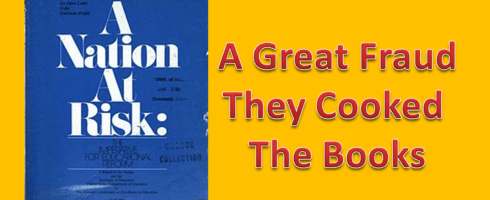
Amazingly, Hoover Institution marked 40+ years of “A Nation at Risk” (ANAR) by glorifying it. They published a 300+ page book, in November, claiming it was the stick that stirred the education reform pot. While their namesake’s mishandling of the 1929 Wall Street crash could be credited with inspiring Social Security, labor rights and many other New Deal reforms, ANAR brought nothing but pain to public schools. Fourteen writers, known for attacking public education and living on the right, created the material presented.

In 1983, Gerald Holton, then a physics professor at Harvard University, and a member of the National Commission on Excellence in Education, drafted some of the most alarmist language in ANAR, including: “If an unfriendly foreign power had attempted to impose on America the mediocre educational performance that exists today, we might well have viewed it as an act of war.”

Last year, I met James Harvey, who was responsible for getting ANAR ready to print. He viewed Holton’s line “to be utter bombast.” In a final editing session at the University of Utah, he and Commission Chairman, David Gardner, agreed to excise the line from the report. Harvey took ANAR back to Washington DC, gave the revision to the printer … and went on vacation.

Later, he learned commission member and Nobel Prize winning Chemist, Glenn Seaborg, had refused to sign off on the report until Holton’s line was restored.

When writing an ANAR thirty-fifth anniversary report for National Public Radio, Anya Kamenetz discovered the commission never set out to undertake an objective inquiry into the state of the nation’s schools. She wrote, They started out already alarmed by what they believed was a decline in education, and looked for facts to fit that narrative.”

A decade before, Florida education professor, James Guthrie, noted, “They cooked the books to get what they wanted.”

Salvatore Balbones wrote Education ‘reforms’ big lie for Salon, observing:

“The commission included 12 administrators, 1 businessperson, 1 chemist, 1 physicist, 1 politician, 1 conservative activist, and 1 teacher. No students or recent graduates. No everyday parents. No representatives of parents’ organizations. No social workers, school psychologists, or guidance counselors. No representatives of teacher’s unions (God forbid). Just one practicing teacher and not a single academic expert on education.”

In ANAR, the most convincing evidence given that America’s public schools were failing was a bullet point on page 11:

“The College Board’s Scholastic Aptitude Tests (SAT) demonstrate a virtually unbroken decline from 1963 to 1980. Average verbal scores fell over 50 points and average mathematics scores dropped nearly 40 points.”

This is the single most powerful piece of evidence providing proof that Americas’ schools were failing. It was also based on a lie or at best, ignorance.

In 1990, engineers at Sandia National Laboratory in New Mexico looked at the same data and found an error. Their findings appeared to have been suppressed. Gerald Bracey reported in Huffington Post, “Jim Raths of the University of Delaware and then an editor at the Journal of Educational Research made it the entirety of the May/June 1993 issue of that small journal.” That seems to be the only place it was ever published but some reporters and scholars saw the report in the early 1990s.

From their writings, we know the Sandia engineers disaggregated the data by race and sex. They found that every group advanced during the 1963 to 1980 period and continued to do so until 1988 when the data was gathered. The other simultaneous occurrence was the larger numbers of people testing every year. Increases were driven by poor, minority and female students, causing the test averages to drop.

ANAR was a fraudulent paper and America’s schools were actually healthy and doing well.

Selling a Fraud +40

Authors of Hoover Institution’s A Nation at Risk +40

NameSectionFieldAbout
Stephen L. BowenIntroductionPoliticianPaul LePage’s policy adviser and Director of Maine Heritage Policy Center.
Deborah StipekChapter 1EducationFormer Director of UCLA Seeds School. Stanford Graduate School of Ed.
Maria D. FitzpatrickChapter 2EconomicsDepartment of Policy and Management at Cornell University.
Michael HansenChapter 3EconomicsSenior Fellow on Education Policy Brookings Institution; labor economist
Thomas S. DeeChapter 4EconomicsStanford professor; member of the American Enterprise Institute
Robert PondiscioChapter 5EducationSenior Fellow at American Enterprise Institute; former teacher
Eric BettingerChapter 6EconomicsProfessor Stanford Graduate School of Education; education economists
Tom Vander ArkChapter 7FinanceExecutive Director of Education Gates Foundation; EdTech champion
Eric A. HanushekChapter 8EconomicsFather of evaluating teachers using value added measures; Co-founder of CREDO
Michael T. HartneyChapter 9Political ScienceSenior Fellow at the Manhattan Institute; Hoover Fellow
John D. SingletonChapter 10EconomicsProfessor of economics University of Rochester; Studies school boards.
Michael J. PetrilliChapter 11Political SciencePresident at Thomas B. Fordham Institute; editor Education Next
Cami AndersonChapter 12AdministratorIn 2011, appointed Superintendent of Newark Public Schools
Margaret “Macke” RaymondConclusionPolitical ScienceDirector of CREDO; married to Eric Hanushek who was her professor in Rochester.

A common theme in most of the essays presented is “ANAR did not cover this really important topic” and instructs readers about its importance. ANAR’s 38 recommendations are along the lines of fixing unacceptable teachers but not eliminating elected school boards. It seems blowing up the education system never occurred to the commission and that is criticized as a weakness by some of the authors.

ANAR did kick off an era of school reform that continued gaining momentum into the twenty-first century. In chapter 5, Robert Pondiscio claims, “Decades of education reform have left policymakers, educators, and students alike fatigued and unimpressed.” (Page 109) These reforms were often so misguided, destructive and self-serving that the word “reform” became an odorous term.

At its core, ANAR was an attack on the teaching profession. Chapters three and four address this. Michael Hansen observed ANAR did “encourage bringing qualified people from other occupations into teaching to support hard-to-staff fields, and these policies gained momentum.” (Page 66) Hansen cites Teach for America as a particularly outstanding example of an alternative certificate program. Evidently, college graduates with no training, mostly hired by charter schools to teach scripted lessons, are venerated by Senior Fellows from the Brookings Institution.

In the wake of ANAR, President Reagan backed merit pay for teachers. It is a reform with a long track record of failure, pre-dating ANAR and Reagan. When the present state controller of Houston’s schools, Mike Miles, was in Dallas, he introduced a merit pay program based on value-added measures. It unsurprisingly resulted in a drain of experience from the district. Senior teachers quit and left. It was one more example of merit pay not producing the hoped for result.

In chapter 9, Michael Hartney does not hold back on his anti-public school feelings. Christopher Rufo’s Manhattan Institute colleague says American K-12 education “is burdened by a century-old, one-size-fits-all governance model that prioritizes adult rather than student interests.” (Page-181) The “one-size-fits-all governance model” is also known as democracy. It is the system where local communities control their schools through elected representatives. The malarkey about prioritizing adults over students is meaningless rhetoric. No one other than parents cares more about students than public school teachers and officials.

Hartney calls for privatizing schools as the solution to his claimed burden. He states, “[F]or chronically low-performing systems, policymakers can disrupt the ‘district as monopoly’ education provider by pursuing a portfolio management model (PMM) strategy that takes districts out of the business of running schools and instead has them provide performance-based oversight in a diverse ecosystem of regulated, but still autonomous, schools of choice.” (Page-181) This piece of “argle-bargle” means turn your community’s schools over to private operators. Someone may get rich but the well-run, responsive public schools will be gone.

Michael Petrilli writes in chapter 11 that “student achievement plateaued and even started to decline in the 2010s.” (Page 226) He postulates that the softening of the No Child Left Behind accountability might be responsible. More likely, the hyper-focus on testing and standards were responsible for a general slowing in education progress since 2000.

Conclusion

It appears that Stanford’s Hoover Institution right-wingers are more interested in ending public education than reforming it.

A Nation at Risk started out as a fraud. Schools were not failing but ANAR produced phony data to show they were. Sure there were big problems within the public education system. Dale Russakoff’s The Prize documented extreme corruption within Newark, New Jersey’s public schools. Violence levels were unacceptably high in some school districts. However, ANAR ignored those problems. Instead, they speculated about how poor American scholarship opened the door for the Japanese taking over auto production, Koreans dominating steel and Germans ruling machine tools.

BUT they were wrong!

Those “terrible” American students were busy inventing the computer industry … internet, I-pad and smart phone, followed by a great surge in biotech. Maybe Glenn Seaborg won a Nobel Prize but he was completely blind about America’s schools or what good education looked like. He was a chemist, not a pedagogue. Conspicuously, there were no pedagogues on the National Commission on Excellence in Education.

Today, ANAR is still a weapon for undermining public schools. It is embraced by people on the far right to do away with public education while also attacking anything else belonging to the commons.