
Archive | June, 2023

Cradle to Grave Surveillance

20 Jun

By Thomas Ultican 6/20/2023

Global Silicon Valley (GSV) has taken point of an effort to digitize life with crypto-world tools.

At the recent ASU+GSV conference, Carnegie and ETS announced a new partnership to create functional testing for competency based education (CBE). That was a big deal because CBE is central to what amounts to a cradle to grave surveillance. In this scheme, a new birth starts the initial record in an inerasable history of education, work and economic activity.  

Edtech leaders are creating a dystopian system of education and career tracking that makes Orwell look optimistic. With this, every American’s history will be held in his or her unalterable blockchain which needs CBE as the education method.

GSV is a venture capital firm founded in 2010 by Michael Moe. Like NewSchools Venture Fund, it focuses on edtech. GSV differs by being a private company with an even more radical libertarian ideology. In 2012, Moe and colleagues published American Revolution 2.0; How Education Innovation is Going to Revitalize America and Transform the U.S. Economy, a manifesto for turning kindergarten through university and beyond into a tokenized existence. Graduate kindergarten token, hospitalized token, immunized token, C in reading token and so on will be saved forever.

The chart above is from American Revolution 2.0 (page 292). Added annotations in red, point out key developments on this road map to a 100% tokenized and badged education system by 2027. Their 2013 call for “No Child Left Behind 2.0” looked suspiciously similar to Obama’s “Race to the Top.” “Marketplace for education information” by 2014 fitted right in with Killswitch’s claim, “Information is the new gold – it’s the new oil.”  

Several organizations fall under the main GSV group, including GSV Labs, GSV Asset Management and GSV Tomorrow, a commentary arm where investing trends and stories are disseminated. All stories link readers to the GSV landing page for the annual ASU+GSV Summit, claimed to be the “most impactful convening of leaders in education and talent tech” with over 5,000 attendees and 1,000 speakers from 45 different participating countries.

The annual American Educational Research Association conference and the ASU+GSV Summit take place at the same time.

Technology critic Audrey Watters noted,

“It’s hardly an insignificant scheduling gaffe. If nothing else, the dueling conference schedules tap into a powerful cultural trope, one that’s particularly resonant among Silicon Valley and education reform types: that education experts and expertise aren’t to be trusted, that research is less important than politics, that the “peer review” that matters isn’t the academic version, but rather the sort that drives a typical VC [venture capital] roadshow.”

Organizing Crypto-Education

1edtech was until recently known as IMS Global. They are a non-profit 501 c6 organization (TIN: 04-3489277), meaning only membership fees are tax deductible. However, recently it created a work-around for parties that want to give money and get a tax break. The new 1edtech Foundation is a 501 C3 organization (TIN: 83-1489371) which will gladly take your tax free donations and pass them along.

If a company’s new product is compliant with established technology protocols and able to communicate effectively with other certified products 1edtech will certify it. The organization also offers standards and frameworks around content integration, credentialing, analytics, and assessments. Major standards developed include:

  • LTI: The Learning Tools Interoperability standard provides a method for applications to integrate with learning management systems (LMSs).
  • OneRoster: A standard for sharing class rosters, course materials, and grades between a school’s student information system and edtech applications.
  • Open Badging: A type of digital badge that is verifiable, portable, and packed with information about skills and achievements.
  • Caliper Analytics: Enables institutions to collect learning data from digital resources.

The Wellspring Project is a major focus going forward for 1edtech. In this new learning model, digital credentials are valuable assets for institutions, individuals and employers. Wellspring seeks to build infrastructure that leverages these assets to help companies identify candidates for hiring. A Cision PRWeb report states,

“The first phase of the Wellspring Project, led by IMS and funded by the Charles Koch Foundation, explored the feasibility of dynamic, shared competency frameworks for curriculum aligned to workforce needs. Partnering with Education Design Lab and the Council for Adult and Continuing Education (CAEL), IMS organized cohorts of education providers and employers by common disciplines and related skills. Using learning tools that leverage the IMS Competencies and Academic Standards Exchange® (CASE®) standard, the cohorts mapped co-developed frameworks, digitally linking the data to connect educational program offerings with employer talent needs.”

This new vision of education dictates a kind of student transcript tied to credential accumulation, instead of earned units from graded classes. Roman Sterns, founder and executive director of Scaling Student Success, is all in for credentialing. He says the present high school transcript is a relic of the past, describes a new transcript type and excitedly announces,

“Fortunately, a version of this new kind of transcript has been developed and is being piloted now by schools affiliated with the Mastery Transcript Consortium (MTC). Launched in March 2017, membership has grown to over 300 schools. Most are independent schools, both in the U.S. and overseas, but increasingly public schools are opting in. The new transcript has no grades or numerical ratings, is customizable to align with school or district outcomes, and includes links to artifacts that demonstrate the level of student proficiency reported. The transcript’s consistent format allows for easy interpretation by colleges and universities.”

For 50 years, mastery-based education now called CBE has been a major flop. It is a piece of the crypto-education infrastructure, calling for bad pedagogy. Established on the mind-numbing drill and skill approach, CBE undermines authentic learning. A major glitch in edtech badging is mastery-style learning online becomes necessary for the credentialing process to function.

Internet of Education 3.0

An EdSurge posting reports,

“In the area of lifelong learning, the Learning Economy Foundation (LEF) aims to create a decentralized, blockchain-based network where skills and credentials are stored within a digital identity that follows the learner. Recently, LEF partnered with LEGO Foundation to create a gamified learning experience, called SuperSkills!, where elementary school students can select adventures and collect gifts as a result of learning core skills. Under the hood, the app uses the W3C’s Universal Wallet, a framework developed by MIT and LEF to store credentials within a blockchain-based identity. This identity is not locked down to one app or company, allowing learners to own their data and use it as they wish across their academic and professional lifetimes.”

The statement “allowing learners to own their data” is misleading. They do not have exclusive access to the data and cannot delete entries or correct errors. It is only personally useful for academic and job applications.

Last year, more than 1500 data scientists signed a letter to the US Senate, warning about the dangers of blockchains and their flaws. They stated in part,

“As software engineers and technologists with deep expertise in our fields, we dispute the claims made in recent years about the novelty and potential of blockchain technology. Blockchain technology cannot, and will not, have transaction reversal or data privacy mechanisms because they are antithetical to its base design. Financial technologies that serve the public must always have mechanisms for fraud mitigation and allow a human-in-the-loop to reverse transactions; blockchain permits neither.”

Blockchains are fundamental to the new edtech, described in Greg Nadeau’s slide presentation Internet of Education 3.0.” He is an edtech/blockchain enthusiast but some of his slides are both illuminating and troubling.

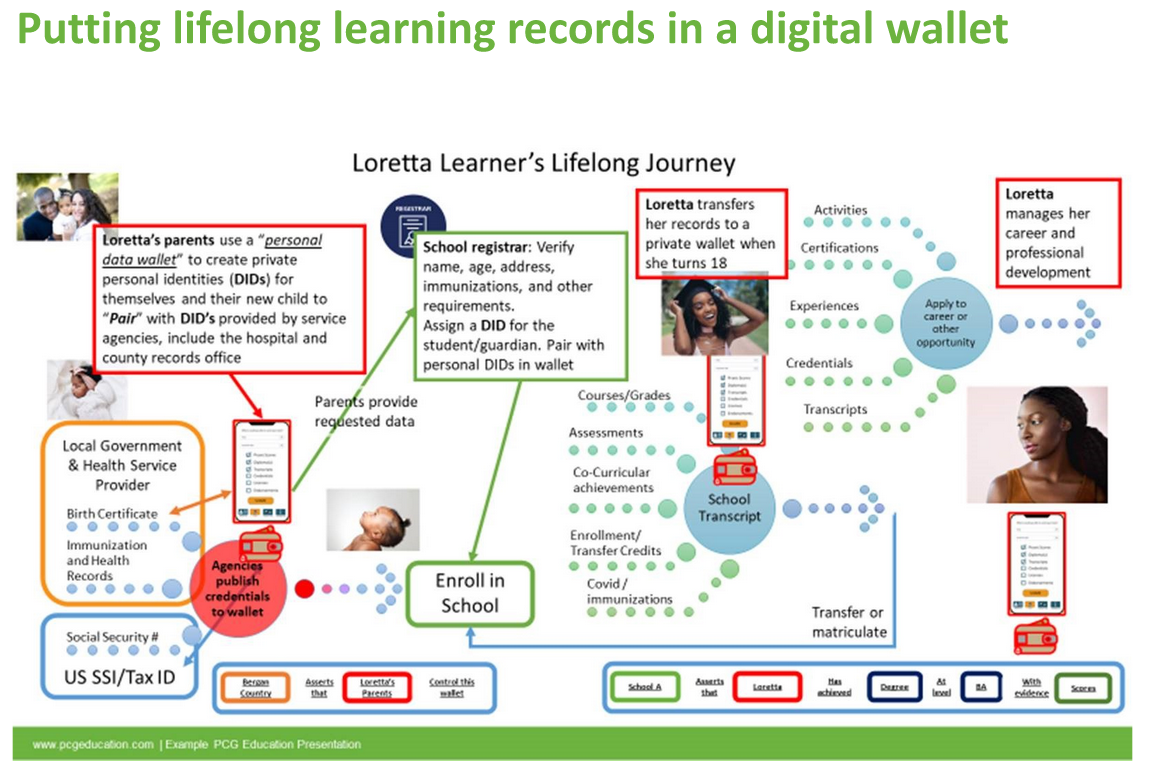
The cartoon above (slide 30) describes the complicated and opaque method needed to update blockchain data bases. A lot of work is done by the SSI/DID block. SSI or Self-sovereign identity summarizes all components of the decentralized identity model: digital wallets, digital credentials, and digital connections. Decentralized identifiers (DIDs) are a type of identifier enabling verifiable, decentralized digital identity. A DID refers to any subject (e.g., a person, organization, thing, data model, abstract entity, etc.) as determined by the controller of the DID.  

Once the data is published by an application or agency, it is there forever and cannot be altered.

Slide 78 in Nadeau’s presentation follows. It gives a frighteningly clear view of the extent of the surveillance being envisioned.
Final Thoughts

It appears that many brilliant mostly young technologists are working on the tools for crypto-world. How exhilarating to think you are developing a new realm full of promise and possibilities! I am reminded of the youthful physicists who gave us nuclear power and the bomb. Like the way atomic weapons have given man the frightening ability to end our species, crypto brings the possibility of human bondage and tyranny.

Serially failed CBE style of pedagogy is harmful education. The new worse idea, actively pursued, is putting children at computer screens and logging their every event in a permanent and inalterable record. It promises a dystopian future.

Mississippi Malarkey

11 Jun

By Thomas Ultican 6/11/2023

Nickolas Kristof’s opinion piece in the New York Times might not have been blatant lying but it was close. His depiction of the amazing education renaissance in Mississippi as a model for the nation is laughable. Lauding their third grade reading retention policies as enlightened, he claims their secret sauce for success is implementing the science of reading (SoR). This is based on a willful misreading of data while tightly embracing Jeb Bush’s futile education reform ideology.

Kristof gushes over Mississippi,

“So it’s extraordinary to travel across this state today and find something dazzling: It is lifting education outcomes and soaring in the national rankings. With an all-out effort over the past decade to get all children to read by the end of third grade and by extensive reliance on research and metrics, Mississippi has shown that it is possible to raise standards even in a state ranked dead last in the country in child poverty and hunger and second highest in teen births.” (Emphasis added)

The soaring national rankings claim is a crock. National Assessment of Education Progress (NAEP) is the most trusted testing standards by which entities are compared. NAEP provides a ranking of 53 jurisdictions, consisting of 50 states plus the District of Columbia, Puerto Rico and the Department of Defense Education Agency.  A table was constructed using the NAEP rankings.

From 2015 to 2022, testing outcomes for Mississippi fourth graders did “soar” past more than 20 states in both math and reading. But results from eighth grade expose those lofty outcomes as a mirage. In 2013, Mississippi followed Florida’s lead and introduced retaining all third graders who did not meet end of year reading exam targets. That is the probable reason for the improved fourth grade testing scores and why those illusory gains were erased by eighth grade.

Misusing data allows Kristof to end the paragraph indicating poverty is not an excuse for education failure. It reminds me of a statement written by education professor Kathryn Strom,

“The “no excuses” rhetoric (i.e, “poverty is not an excuse for failure”) is one that is dearly beloved by the corporate education reformers  because it allows them to perpetuate (what many recognize to be) the American myth of meritocracy and continue the privatization movement under the guise of “improving schools” while avoiding addressing deeply entrenched inequities that exist in our society and are perpetuated by school structures.” (Emphasis added)

To add heft to his argument that poverty is no excuse, Kristof quotes Harvard economist David Deming from the Harvard Kennedy School and Harvard Graduate School of Education, saying “Mississippi is a huge success story and very exciting.” He adds, “You cannot use poverty as an excuse.”

It is important to note that Harvard is famous for supporting privatization of public education and promoting failed scholarship. Deming is currently doing research with Raj Chetty and John Friedman. Along with Jonah Rockoff, Chetty and Friedman published the now thoroughly debunked value added measures (VAM) paper. Their faulty research caused many teachers to lose jobs before it was exposed as a fraud. Kristof is using an economist (not an educator) from a group best known for scholastic failure as his expert.

Kristof also indicates that spending is not important. He writes, “Mississippi has achieved its gains despite ranking 46th in spending per pupil in grades K-12.” If we look up at the 8th grade rankings, it seems they are getting what they paid for.

The Mississippi Miracle Uses the Jeb Bush Method

In 2000, former Netscape CEO Jim Barksdale came home to Mississippi and made reading education his cause. He and his wife put up 100-million dollars to establish the Barksdale Reading Institute. Barksdale also used his political influence to promote state spending on education. There have been some real gains in Mississippi and Barksdale’s effort likely aided that improvement. For Kristof, this was the beginning of a renaissance.

In 2013, Mississippi’s legislature adopted packages of education focused bills which included third grade mandatory reading retention. That same year, they hired a new state superintendent of education, Carey Wright, from the Washington, D.C., public school system. Kristof lavishes her with praise declaring, “Wright ran the school system brilliantly until her retirement last year, meticulously ensuring that all schools actually carried out new policies and improved outcomes.”

Of course the article was an opinion piece but even opinions should be tethered to some objective reality. When asserting a public servant is “brilliant” or was “meticulously ensuring” some supporting evidence should be provided.

Wright began her education career in 1972 as a teacher in Maryland. After just four years in the classroom, she transitioned to various administrative roles. When leading special education services in Montgomery County during the early 2000s, she was serving in the middle of a corporate education reform triumvirate. John Deasy was promoting charter schools and teacher “pay for performance” in Prince George County. Baltimore had Andres Alonzo firing teachers and closing schools. Just a few miles away, Michelle Rhee was promising to “fix” Washington DC’s schools by firing teachers and principals.

In 2010, Rhee hired Carey Wright to be chief academic officer for Washington DC public schools. Wright was an administrator in the DC schools during the height of the cheating scandals. Besides working with some of the most callus and harmful education leaders in American history, she is a member of Jeb Bush’s Chiefs for Change and a graduate of the late Eli Broad’s superintendent training academy. It is highly likely that being steeped in corporate education reform mythology is why Kristof views her as “brilliant.”

The darling of corporate education reformers is an army of unqualified teachers recruited by Teach For America (TFA). It is not unusual for a college graduate to take a five-week summer training course, teach in a charter school or public school for two years and then become an education expert for some either public or private agency. This is an absurdly irresponsible system but effective for wealthy individuals looking to privatize or end public education.

Kristoff notes, “Two Teach for America veterans, Rachel Canter and Sanford Johnson, in 2008 founded an organization called Mississippi First that has been a tireless advocate of raising standards.” Evidently a two-year stint as a temp teacher makes one a veteran. These two apparently are proceeding swimmingly along the corporate reform path.

Sanford Johnson’s biography includes teaching four years at Coahoma County High School (2003-2005) and two years at KIPP charter school (2005-2007), co-founding Mississippi First and becoming its Deputy Director (2008-2019) and today is Executive Director of Teach Plus. Teach Plus is the TFA formed group working to privatize teacher training. He also has another biography posted at the corporate education reform organization Pahara Institute. Johnson has made many corporate connections.

After two years (2004-2006) as a TFA temp teacher in Greenville, Mississippi, Rachel Canter went to Harvard University for a master’s in public policy. In 2008, back in Mississippi, she and Sanford Johnson founded Mississippi First with Rachel as director.

New PIE Network Partners’ Logos

Canter is still the director of Mississippi First and according to her PIE network BIO she was instrumental in the passage of the 2013 third grade retention bill. That year, the PIE network named Mississippi First “Game Changer of the Year.” She is now a board member of PIE along with Nina Reese President National Alliance for Public Charter Schools and Robin Lake Director Center for Reinventing Public Education.

Pontificating While Clueless

Kristof states, “With such a focus on learning to read, one of the surprises has been that Mississippi fourth graders have also improved significantly in math.” His entire article is based on the misunderstanding of data possibly through ignorance but more likely through ideological belief.

These graphs show that the fourth grade “miracle” disappears by eighth grade. They also illustrate the point Ferman University’s literary expert Paul Thomas makes: “But the greatest issue with tests data is that inexpert and ideologically motivated journalists and politicians persistently conform the data to their desired stories—sometimes crisis, sometimes miracle.”

Third grade retention improvement has not only been shown to disappear; it is harmful to the students retained. Kristof informs us that “A Boston University study this year found that those held back did not have any negative outcomes such as increased absences or placement in special education programs.” This study was commissioned by Jeb Bush’s ExcelinEd and only looked at students through sixth grade. It does not address disengagement or dropouts. Is Kristof being deliberately deceptive?

Kristof also makes a big deal out of Mississippi’s high school graduation rate climbing to 87 percent, surpassing the national average. This does look like real progress but graduation rates have become highly suspect. America’s high school graduation rates peaked at about 77% in 1970 and drifted down for almost four decades to 69% in 2007.  Since then, on-line credit recovery arrived and students are completing entire semester courses in as little as one day. This is a new corporate profit center where corruption is ignored.

Conclusions

Education historian and former Assistant Secretary of Education Diane Ravitch wrote,


“What’s worrisome about this article is that Kristof asserts that poverty doesn’t matter (it does); funding doesn’t matter (it does); class size doesn’t matter (it does). In his account, states that want to improve test scores can do it without raising teachers’ salaries, without upgrading buildings, without spending a nickel to improve the conditions of the schools or the well-being of children. Children who are hungry, lack medical care, and are homeless or ill-housed are not likely to learn as well as those who have advantages.

“Does this explain why so many rightwingers love “the science of reading”? Publishers are rolling out new programs. Education can be reformed in the cheap. Can’t expect taxpayers to foot the bill, can you?”

In this opinion piece, Nicholas Kristof touched on and promoted almost every billionaire inspired agenda item aimed at decreasing money going to public education. He acted as a representative of elites, advancing policies undermining education quality for common people.

This was not about improvement. It was about lowering taxes.

ETS and Carnegie Team Up for ‘Zombie’ Ed Policy

4 Jun

By Thomas Ultican 6/4/2023

Educational Testing Service (ETS) and Carnegie Foundation are partnering to create assessments for competency-based education, claiming it will revive the zombie education policy tainted by a five decade record of failure. The joint announcement was made at the April 2023 ASU+GSV conference in San Diego with Bill Gates as the keynote speaker. Ultimately, it was to make the Orwellian-named “personalized learning” viable for issuing digitally earned certifications.

ASU is Arizona State University and GSV is the private equity firm, Global Silicon Valley. GSV advertises “The sector’s preeminent collection of talent & experience—uniquely qualified to partner with, and to elevate, EdTech’s most important companies.” It profits from the corporate education ideology that holds job training as the purpose of public education.

Unfortunately, the US Department of Education is on board with digital learning and competency based education claiming,

“Digital tools can shift the focus of learning environments away from traditional metrics of progress — such as the number of hours spent in a classroom—toward more meaningful indicators of learning.”

“Digital learning can support competency-based education, in which students advance after demonstrating mastery of a key skill or concept. In a competency-based system, students work individually and in teams to continuously learn content and develop skills (e.g., communication, critical thinking, problem solving, creativity) and receive timely, differentiated support based on their individual needs. In this sense, competency-based education enables personalization and learning continuity, regardless of location.”

The 1970’s “mastery learning” was detested and renamed “outcome based education” in the 1990s. It is now called “competency based education” (CBE). The name changes were due to a five-decade long record of failure. CBE is a move to use “mastery leaning” techniques to create individualized certification paths. However it is still the same mind-numbing approach that the 1970s teachers began calling “seats and sheets.”

In the book A Wolf at the Schoolhouse Door, Jack Schneider and Jennifer Berkshire explain, “Because learning is deeply rooted in relationships, it can’t be farmed out to robots or time-saving devices.”

Unfortunately the potential for large profits is huge and serially failed education policies are zombies that will not die.

Selling CBE and Testing

‘The 74’ is an oligarch funded online, daily education publication, promoting the neoliberal agenda. Their cheerleading article about the Carnegie-ETS proposal had no pushback when quoting Carnegie President Timothy Knowles’ unlikely to be true statement,

“We’re in a position to do something that we hadn’t before. Unlike 20 years ago, we can actually reliably measure the skills that we know are predictive of success in postsecondary education and work”

Closest thing to any questioning of this came when the author quoted Michael Horn, a co-founder of Harvard’s Clayton Christensen Institute for Disruptive Education. This loud voice advocating the destruction of public education through privatization said,

“This part, from my reading of the literature on assessment, is both unproven and underdeveloped. So the how is going to be very important. I’m going to be very curious to see what the investments look like as they go forward, and I hope they don’t overpromise.”

‘The 74’ post also claims, “Competency-based learning and assessment has long been theorized as a preferable alternative to existing educational models.” These theories come from a range of philanthropic foundations and education-focused companies, many in attendance at ASU+GSV. Education professionals, not on some billionaire’s payroll, have completely different opinions.

Renewed neoliberal effort to revive CBE now has new players seeking to be big contributors while old hands are filling leadership roles. For example, at the best-known new group called Mastery Transcript Consortium, board member, Tom Vander Ark, the former education director at the Gates Foundation 1999-2006 remains engaged in pushing edtech.

There is very little real change. CBE continues to put kids at computers learning scripted chunks of information and testing for mastery, promising to increase edtech profits and reduce education costs especially teacher salaries. It is awful education and the children hate it.

Guys like Carnegie’s President Tim Knowles and ETS’s CEO Amit Sevak must justify 7 figure salaries by creating new tools and revenue streams for their benefactors. This begs the question, “How can an organization like Carnegie (TIN: 13-1628151) and ETS (TIN: 21-0634479) that pay salaries of more than $1,000,000 a year still be called non-profits?” 

The Big Push for CBE

Former reporter for Inside Higher Ed, Paul Fain, shares insights into the new push for CBE. He wrote,

Skills were a hot item at the summit in San Diego, particularly tech-enabled tools that seek to measure the knowledge and abilities of learners, and to convey them to employers. These discussions are drawing energy from the campaign led by Opportunity@Work and the Ad Council, which calls for employers to drop four-year degree requirements and to move toward skills-based hiring.”

Much of the momentum behind this thinking is the move toward a belief that the preeminent purpose of education is employment readiness. Philosophy, literature, art etc. are possibly only meaningful for children of the wealthy. The new push for CBE is toward a skills based education which wastes no time on useless frills. It is a system where children study in isolation at digital screens and earn skills badges at their own pace as they move through the menu driven learning units.

The big obstacle for this system of education is that testing has not proven reliable. Not only has it struggled to assess skills mastery it has not been proficient at predicting future success. This of course completely ignores the reality that CBE is a god awful theory of pedagogy.

In 1906, the Carnegie foundation developed the Carnegie Unit as a measure of student progress. For example, a student attending a class meeting one hour a day 3 times a week for 40 weeks earns one “unit” of high school credit for that 120 hours in class. Based on this, schools all over America pay attention to how many instructional minutes they schedule for every class.

In 2015, Carnegie completed a two-year study of the Carnegie Unit and proposals to revise the unit-based competency established on time. They concluded, “The Carnegie Unit continues to play a vital administrative function in education, organizing the work of students and faculty in a vast array of schools or colleges.” The report did not embrace competency-based standards. Now, Carnegie Foundation President Tim Knowles is calling for just such a change.

Education writer Derek Newton in an article for Forbes says he is hostile to the Carnegie-EST idea for a host of reasons but the major one is cheating. He shares,

“Cheating, academic misconduct as the insiders know it, is so pervasive and so easy that it makes a complete mockery of any effort to build an entire education system around testing. From middle school to grad school, from admissions tests to professional certifications, cheating is the bus-sized hole in the hull of assessment that renders any real voyage implausible. Right now, anyone can pretty easily buy a test-based credential without knowing anything at all. Just pay the fee, get the credential. And people do, every day.

“I am not talking about fake credentials. They are real, provided by the certifiers themselves. The sellers use software to take remote control of a test-taker’s computer and have a ringer take the exam for them.”

It is easy to cheat with rampant digitally enhanced systems. Newton observed, “But because of the credit hour system, which is designed to measure classroom instruction time, it’s still relatively hard to cheat your way to a full college degree.”

Conclusion

Derek Newton’s concern about cheating, difficult and expensive to combat, is valid.

To me, the biggest problem is that “mastery learning” is proven lousy pedagogy that is unaligned with how learning happens.

In his book Soka Education, Daisaku Ikeda writes,

“Recognizing each student as a unique personality and transmitting something through contacts between that personality and the personality of the instructor is more than a way of implanting knowledge: it is the essence of education.”

Socrates likened this education process to being “kindled by a leaping spark” between teacher and student. CBE, “mastery learning,” “outcome based education” or whatever name is given to teaching students in isolation is bad pedagogy, bordering on child abuse.