
Archive | May, 2023

“The Right to Read” is Horse Manure

27 May

By Thomas Ultican 5/27/2023

The new 80-minute video “The Right to Read” was created in the spirit of “Waiting for Superman.” It uses false data interpretations to make phony claims about a non-existent reading crisis. Oakland’s NAACP 2nd Vice President Kareem Weaver narrates the film. Weaver is a full throated advocate for the Science of Reading (SoR) and has many connections with oligarch financed education agendas. The video which released February 11, 2023 was made by Jenny Mackenzie and produced by LeVar (Kunta Kinte) Burton.

Since 2007, Jenny Mackenzie has been the executive director of Jenny Mackenzie Films in Salt Lake City. Neither Mackenzie nor Burton has experience or training as educators. However, Burton did star on the PBS series Reading Rainbow.” He worked on the show as an actor not a teacher.

One of the first media interviews about “The Right to Read” appeared on KTVX channel 4 in Salt Lake City. Ben Heuston from the Waterford Institute answered questions about the new film and the supposed “reading crisis” in American public schools. Heuston who has a PhD in psychology from Brigham Young University claimed that two-thirds of primary grade students in America read below grade level. That is a lie. He is conflating proficiency in reading on the National Assessment of Education Performance (NAEP) with grade level and should know better.

Diane Ravitch who served for seven years on the National Assessment Governing Board explained NAEP rating levels,

“Proficient is akin to a solid A. In reading, the proportion who were proficient in fourth grade reading rose from 29% in 1992 to 34% in 2011.”

“Basic is akin to a B or C level performance. Good but not good enough.”

“And below basic is where we really need to worry.”

Peggy Carr, commissioner of the National Center for Education Statistics, which administers NAEP, has stated that the basic level is generally viewed as grade-level achievement.

“The Right to Read” was filmed in Oakland, California with some of it done in first-grade teacher Sabrina Causey’s classroom at Markham Elementary School. There have been many public showings scheduled around the country but strangely none in Oakland. Causey claims she was using a bad Oakland Unified School District (OUSD) reading curriculum until Kareem Weaver brought her a program based on the SoR. She adopted it without OUSD approval. The film claims “The results were astounding.”

The Chart was Clipped from “The Right to Read” Trailer

Selling SoR

LeVar Burton and Jenny Mackenzie made media rounds to promote “The Right to Read.” They were booked on major shows like CBS’s Good Morning America and on cable news.  US News conducted an interview sharing that Burton and Mackenzie spoke “about the film and what they are calling ‘the literacy crisis’ within the United States.”

In the interview, Mackenzie claimed, “We need to have policy that supports scientifically proven evidence-based curricula.” While Burton asserted,

“The balanced approach doesn’t work. Whole language doesn’t work.”

“We also have a sort of an old boys’ network that has been established, and there are companies that make millions of dollars a year publishing and selling to schools curricula that do not work.”

There are two obvious observations here. Number one is that neither Mackenzie nor Burton have any professional expertise in reading pedagogy. Number two, it is their team that is setting the stage for businesses to make “millions of dollars a year” selling phonics centric reading curricula.

The chart in the graphic above is the same lie Ben Heuston from the Waterford Institute told on KTVX. Heuston’s father Dustin founded the Waterford Institute in 1976 to develop computer based education. He was using the world’s first commercial computer with the Motorola 68000 chip. Today, the institute is selling the digitally based Waterford Upstart reading program.

Heuston and colleagues are making great money working at the nonprofit. The twenty-two employees listed in the 2021 form 990 tax document are averaging a yearly income of $225,571 (TIN: 51-0202349). Those are some big salaries out in Utah. Maybe that explains the lying to support SoR.

Ben has stepped down as Waterford CEO and Andy Meyer has assumed the role. Waterford reports that Andy’s background includes several leadership positions in sales and marketing before becoming COO for Pearson’s digital learning business unit and later Senior VP of Digital Product Development for Pearson’s U.S. K-12 curriculum division. More recently, Andy served as CEO at Scientific Learning and as CSO at Renaissance.
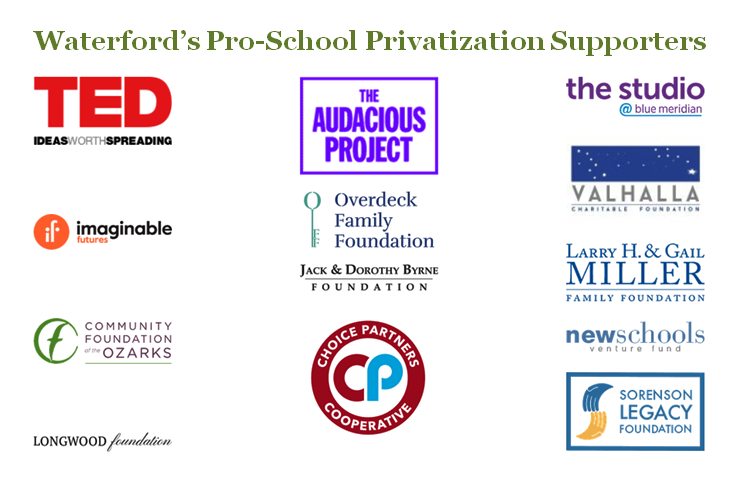
Kareem Weaver is a shameless promoter of anything oligarch funded. He is a Fellow at the Pahara Institute which was organized to train new privatization friendly education leaders. His bio there shares that he was a managing partner at the NewSchools Venture Fund and also executive director for the western region of New Leaders that received big financing from Walton, Broad, NewSchool Venture Fund and Gates. Weaver is also a member of the National Council on Teachers Quality.

Just this week Weaver was a featured presenter for a Reading Week edWebinar held by Lexia, a Cambium Learning Group company. They claim, “K12 educators and administrators will now have another opportunity to learn about aligning teaching practices with scientifically-researched methods.” Lexia is looking to cash in on SoR and Weaver is down in the muck slopping with them.

It is hard to imagine anyone being more sold out than Kareem Weaver.

Professionals Shake Their Heads in Frustration

Misinterpreting the data shown above is the basis for the specious crisis in reading claims. It is known that students develop at different rates and in the lower grades the differences can be dramatic. That explains some of the low scoring. All but a very small percentage of these fourth grader will be reading adequately when they get to high school.

America’s leading authorities on teaching reading are frustrated. Their voices are being drowned out by forces who want to monetize reading education and privatize it.

Peter Farruggio is a professor of bilingual education from the San Francisco Bay area and an organizer of anti-KLAN actions throughout California. Although his specialty was not teaching reading his experience with bilingual education and federal law caused him to work in the field. In our conversation, he explained to me how some of the data supporting high dose phonics instruction came about.

Farruggio observed that often when there were groups of students with reading disabilities, graduate students would take the opportunity to conduct a study. The treatment would be for the grad students to give intense phonics lessons. The children would learn to decode words including nonsense words from lists. Then they would be given a reading test on the lists. The students would successfully decode the words and the results would be pronounced successful but the children still could not read a sentence with comprehension.

Worst of all, Professor Farruggio fears this kind of teaching is undermining the ability to think.

Observations like this are wide spread among education professionals. This week Valerie Strauss put a piece in her Answer Sheet blog at the Washington Post written by three highly credentialed scholars dismayed by the oligarch financed nationwide push for SoR.

David Reinking, Professor of Education, Peter Smagorinsky, Professor of Language and Literacy Education, and David Yaden, Professor of Language Reading and Culture, state,

“As researchers and teacher educators, we, like many of our colleagues, shake our heads in resigned frustration. We believe phonics plays an important role in teaching children to read. But, we see no justifiable support for its overwhelming dominance within the current narrative, nor reason to regard phonics as a panacea for improving reading achievement.”

“Specifically, we do not see convincing evidence for a reading crisis, and certainly none that points to phonics as the single cause or a solution.”

“But crisis or not, is there evidence that more phonics instruction is the elixir guaranteed to induce higher reading achievement? The answer isn’t just no. There are decades of empirical evidence that it hasn’t and won’t.”

They point out that even the National Reading Panel report that all of this SoR malarkey is supposedly based on states, “Phonics should not become the dominant component in a reading program, neither in the amount of time devoted to it nor in the significance attached.”

This understanding is not new. The Reading First program during the George Bush years spent big dollars to study the use of intense phonics. Teachers were trained to deliver “scientific” reading instruction that included a numbing 1.5 to 3 hours of phonics instruction each day. The lead sentence in a 2008 Washington Post article stated, “Students enrolled in a $6 billion federal reading program that is at the heart of the No Child Left Behind law are not reading any better than those who don’t participate, according to a U.S. government report.”

Conclusion

Big money from billionaires is funding an effort to take control of primary education by selling the Science of Reading as a silver bullet. In the early 2000’s, schools were blamed for not fixing failing communities. The “proof” offered was students living in poverty stricken communities did not do well on standardized testing.

It put schools in a no win situation because the only strong correlation in standardized testing is with family income. Obviously, the broken communities were the problem not their schools. This subterfuge led to claims that reforming “failing schools” was the civil rights agenda of our time. Now “The Right to Read” is playing that same phony civil rights card. It is a contemptuous lie used to profit off the backs of the poor and people of color.

There is no reading crisis and the lionization of SoR is a push toward bad pedagogy. It is a sinister ploy that will harm each student and not just those living in poverty. There is currently a concerted effort to legislate SoR use in all primary classrooms which has either passed or is proposed in every state capital.

The Teachers

15 May

By Thomas Ultican 5/15/2023

Alexandra Robbins’ new book is an authentic look into the life, working environment, emotional struggles and triumphs of America’s K-12 teachers. The book opens up many unnecessary issues that America’s professional educators face as they try to give their best in the classroom. It also reminded me of my own teaching journey with its unjust treatments and eventual success.

The Book can be Purchased Here

It is Not Burnout

Teaching is a much higher stress job than it needs to be because of factors outside of the classroom. Robbins reports on a special education teacher named Prisha being left by herself in classes of 28 to 35 special education students when her co-teacher had to take a two month medical leave. The school’s staff was almost all first or second year teachers like Prisha who didn’t know what to do. The principal’s solution was to call all the special ed teachers “fucking morons” and start monitoring Prisha’s grade book. No actual support for a new teacher in a no win situation. (Teachers 217)

Robbins cites a gallop pole claiming that teachers tied with nurses for the highest rate of daily stress on the job among all occupations. She shares a study asserting, “It is confirmed that teachers have the highest burnout levels as compared to other professionals in social services.” (Teachers 218)

It needs to be noted that teaching only became high stress after the 1983 Department of Education report “A Nation at Risk.” That fraudulent polemic misused SAT data to cook the books and claim American public schools were failing. Later, Anya Kamenetz reported for NPR, “A 1990 report produced by the Energy Department’s Sandia National Laboratories broke down the flaws in the “A Nation at Risk” analysis but got little attention.”

“A Nation at Risk” was followed by a dramatic expansion of teacher responsibilities but no accompanying structural support. The report inspired a push for state-mandated testing. This led to a major demoralization of teachers when in 2002 No Child Left Behind (NCLB) became federal law. Robbins writes,

“NCLB, which mandated rigorous standardized testing and penalized schools and teachers based on students’ scores, remains ‘the worst federal education legislation ever passed by Congress. It was punitive, harsh, stupid, ignorant about pedagogy and motivation, and ultimately a dismal failure,’ as New York University research professor of education Diane Ravitch, a former assistant secretary of education and leading educational expert, has written.” (Teachers 224)

I remember in about 2007 a principal saying to me that school used to be fun; hopefully we’ll get back to that someday. Today, there is a large problem with teachers quitting the profession that is being attributed to burnout but it is more accurate to call it teacher frustration; a frustration with not being able to provide the kind of good pedagogy that their students and communities deserve.

Robbins points to a need for school leadership to step up to the plate. She writes,

“The responsibility for resolving teacher demoralization, or what the public calls burnout, should lie with districts and administrators. Telling teachers to relax doesn’t cut it. … Instead of halfheartedly attempting to mitigate the effects on teachers, school leaders should fix the underlying causes – their school climate, staffing numbers, and resources – not just to prevent employee demoralization, but because that’s how a proper workplace should operate.” (Teachers 228)

A Personal Experience with Education Reform

In Diane Ravich’s seminal book The Death and Life of the Great American School System, she describes how my home town of San Diego, California was chosen as an education reform test site. Ravitch noted that it was an unusual choice for where to launch a reform movement because San Diego was viewed as having “one of the nation’s most successful urban school systems.” (Page 50) In 1998, the former US Attorney for the southern district of California, Alan Bersin, was hired to be the school district superintendent and lead the reform experiment. The local education community was against hiring an uncertified non-educator to lead the district but the San Diego business community which held sway over the school board wanted it.

I started education graduate school at the University of California San Diego in 2001 and found that a few of my instructors were consulting on the district’s education reforms. Some of the changes being introduced were quite good but the authoritarian implementation alienated most of the district’s teachers who had no input into what was happening.

One major change affected me. It was mandated that all ninth graders take the new conceptual physics class. That caused the district a severe shortage of certified physics teachers. I had just completed my masters in education with a physics certificate. It was not long before I got an offer to be a probationary teacher via a telephone interview.

Turned out the Bell Jr. High principal was not being totally up front with me. Going to the district office to sign my contract, I was told the probationary positions were filled and was offered a temp contract. I discovered that teachers in California normally needed more than two years to become full time with job protections. Temp contracts do not count as tenure track teaching time.

The principal at Bell literally had a hole in her head having recently gone through brain surgery to remove a tumor. Two retired administers were convinced by the district to come back and serve as assistant principals, provide support during the convalescence and take over if medical issues arose. One of them became my evaluator.

In my first written evaluation, the AP wrote that discipline was a problem and that I never checked for student understanding. In a written response, I wrote that during the lab period she observed every team coming to me multiple times to have their lab progress reviewed and checked off before moving on to the next phase. I questioned her observation of not checking for student understanding? While my class may be a little free, all 36-students successfully completed and submitted their lab reports so class discipline was not leading to dysfunction. I should have added that the classes were too large for safe lab science activities.

One time the evaluator came in while I had the class working on a poster project. A student that had not had much success in school rushed up to her and proudly showed off his poster. She later told me that I should have written him a referral right then for leaving his group without permission. I was thinking what is wrong with a child engaged in learning? Why punish his new pride?

At Bell we had 13 sections of regular physics plus I taught the only section of honors physics. My classes tested amazingly well. The regular physics classes ranked 1, 2, 4 and 6 in comparison to all 13 sections at Bell. The honors physics class was the number 2 scoring class in the entire district. I was stunned at the end of the year when my evaluator said she could not recommend me for rehire because of “not moving classes toward achieving standards” and the lack of classroom disciple. The quoted line meant that I could not even apply for a substitute teaching position in San Diego Unified School District.

I talked to several district administrators who commiserated with me and even admitted how strange this looked but none of them felt they could do anything. The Bersin administration had set up an arbitrary quota system for teachers being fired and the percentage of new hires retained. It turns out a determined administrator can fire tenured teachers. This was aimed at keeping everyone following orders and not complaining. At Bell, I was the 50 year old new hire who was sacrificed to protect the younger teachers.

It is remarkable that the evaluation from my next school in another district noted discipline as one of my classroom strengths.

The Teachers is a Great Read

Alexandra Robbins uses the experience of three teachers during the 2021/22 school year as the backbone for her book. In the August chapter, she introduces Rebecca, Penny and Miguel. Month by month, Robbins reveals the sometimes horrific and sometimes triumphant experiences of these three amazing teachers. Along the way she shares insights, research and some eye-popping experience from other teachers. It is the most revealing and authentic view of teaching I have ever read.

I will end with this quote from page 279 which shows in gory detail why teacher opinions should be sought out and adhered to.

“Florida teachers compiled a mountain of evidence that public school was not the place for one particular student who had numerous mental health issues, was obsessed with guns, and was suspended 18 times in one school year. But it took five months to get him transferred to a special middle school – and when he was determined to attend public high school, Florida’s disability law allowed him to. The student was Nikola Cruz, the school Marjory Stoneman Douglas. In 2018, Cruz massacred 14 students and three staff members in one of the deadliest school shootings in history.”

Selling Denver’s Portfolio Model by Confusing Correlation with Causation

5 May

By Thomas Ultican 5/5/2023

The 74 published an article about a University of Colorado Denver study that shows what a great success school reform has been in Denver. The research paper attributes that triumph to the portfolio school management model introduced by now Senator Michael Bennett during the 2007/8 school year. While testing results have significantly improved in Denver’s K-12 schools, the paper’s claims confuse correlation with causation.

As is often the case with articles in The 74, there is a bias toward the billionaire favored education policies. The 74 correspondent states, The results offer powerful evidence in favor of the so-called ‘portfolio management model,’ an educational strategy that began to take hold in major urban school systems in the mid-2000s.” And also reports the claim that the reforms “led to some of the most significant learning gains ever measured.”

To further establish how important and meaningful results in the new study are, The 74 turned to economist Douglas Harris from Tulane University. He has prospered producing studies touting New Orleans’s privatized school system. It is worth noting that the all charter school system in New Orleans is an inefficient disaster which still scores at the bottom in state standardized testing. Concerning the Denver study, Harris is quoted as saying,

“The effects are clearly large. Just as a loose approximation, if you leapfrog that many districts, clearly you’ve seen a lot of improvement.”

The data shows that Denver did make real progress based on testing data. The leapfrog that Harris mentions is that Denver went from near the bottom of the state’s districts on standardized testing to about the middle.

The 74 staff writer who produced the article is Kevin Mahnken. He makes a living writing articles that accentuate the message his billionaire paymasters want. His reports may not be exactly lies but are at the very least highly biased.

The 74 was founded in 2015 and originally funded by billionaires Dick and Betsy DeVos Family Foundation, the Walton Family Foundation, the Doris and Donald Fisher Fund, and Bloomberg Philanthropies. Since then, it has been the vehicle for spreading the billionaire message aimed at undermining public schools.

There are basically two groups of billionaires trying to privatize public education; libertarians and neoliberals. Both groups believe in markets and do not support democratic means. Libertarians like the Walton family and Charles Koch prefer vouchers. They think public programs like social security and public education are basically robbery and must be ended. Neoliberals like Bloomberg and Gates prefer charter schools. They feel that public programs should continue but are better run by private businesses. The 74 is their common vehicle for promoting their education perspectives.

The Portfolio Model

In 2009, the Center for Reinventing Public Education (CRPE) published Portfolio School Districts for Big Cities: An Interim Report.” Lead author Paul Hill and his associates stated,

“The report introduces the idea of a ‘portfolio school district,’ and shows how some leading school districts have put the idea into practice. A portfolio district is built for continuous improvement through expansion and imitation of the highest-performing schools, closure and replacement of the lowest-performing, and constant search for new ideas.”

Bill Gates, John Arnold, Michael Dell, the Walton Family and other billionaires fund CRPE which is headquartered on the campus at the University of Washington.

Portfolio School Districts is an organized idea for managing charter schools, innovation schools, public schools and voucher schools that make up the mix of schools in a district. Using standardized testing as a proxy for measuring quality, some percentage (5%) of the lowest performing schools will be closed every year. Invariably, the closed school will be replaced by a privatized structure outside of the purview of an elected school board. Also, because standardized testing only correlates with family wealth, the schools in the poorest communities will be privatized and subject to constant churn.

In 2018, John Arnold and Reed Hastings established the City Fund which has spent heavily to develop local organizations that promote the implementation of the portfolio model of public education management. Soon after the City Fund founding, Bill Gates, Steve Ballmer and Alice Walton also started funding the organization.

The leader of the Denver research project was Parker Baxter. In 2012, CRPE listed him as a “Senior Research Affiliate and distinguished expert in the field of education policy.” On that same page CRPE also declared, “CRPE is one of five national education policy organizations that co-founded the Policy Innovators in Education (PIE) Network, whose mission is to build, support, and promote a network of education advocacy organizations working to improve K-12 education in their states so that every student graduates world-ready.” One of the main points they advocate for is the portfolio model.

The System Level Effects of Denver’s Portfolio District Strategy

This study of school reform in Denver was conducted by the Center for Education Policy Analysis (CEPA). They state, “For the past three years CEPA has partnered with the Center on Reinventing Public Education to consider a paradigm-shifting approach to family and community engagement efforts in school districts.” CEPA director Parker Baxter led the study. The relationship with CRPE makes one wonder about bias in this study and Parker Baxter’s biography heightens that concern.

On his LinkedIn page Baxter shares that he was Director of Knowledge at the National Association of Charter School Authorizers (NACSA). He mentions being a Senior Research Affiliate at CRPE. Baxter asserts he was a Senior Legal Analyst working on the District-Charter Collaboration Compact Project and the Portfolio District Project. Says he served as Assistant Superintendent and the Executive Director of the Office of Parental Options at the Louisiana Department of Education and as Director of Charter Schools for Denver Public Schools (DPS). Parker claims being an aide to Senator Edward M. Kennedy where he worked on issues related to the No Child Left Behind Act. He is also a former special education teacher and an alumnus of Teach for America.

On page one of the report, it says, “This research is made possible by a multiyear grant from Arnold Ventures.” Just to be clear that is billionaire John Arnold the former Enron trader, co-founder of The City Fund and big spending advocate of the portfolio model of school district management.

The study did a lot of fancy arithmetic on state testing data and summarized their findings:

“Prior to the start of DPS reform efforts in 2008-09, DPS was among the bottom 10 districts in the state in ELA and math performance on state standardized assessments, ranking below the 5th percentile of districts. By 2018-19, DPS had risen to the 60th percentile of districts in ELA and the 63rd percentile of districts in math, outperforming more than 100 out of roughly 180 districts in the state. The 4-year high school graduation rate increased dramatically during the reform period as well, climbing from 43% in 2008 to 71% in 2019. Our results indicate that the reforms drove these improvements in student academic and graduation outcomes.” (Page 3)

The Denver study used school years 2004/5 through 2018/19 state testing data. The first 4-years of the research employed pre-reform data and the final 10-years were from the portfolio model reform period. The authors reported, “During the study period, the district opened 65 new schools, and closed, replaced, and restarted over 35 others.” (Page 7)

A Professional Review

Boulder, Colorado which is 30-miles up highway-36 from Denver is home to the University of Colorado Boulder which hosts the National Education Policy Center (NEPC). Early in the 21st century purported research papers started being published that were never subjected to peer review. NEPC tried to address this problem by assigning independent education professionals to review these studies. They contracted with Robert Shand to review the Denver study. He is an Assistant Professor of Education Policy and Leadership at American University and an affiliated researcher with the Center for Benefit-Cost Studies of Education at Teachers College, Columbia University.  

Professor Shand’s conclusion states:

“The recent study finds substantial system-level gains in math and ELA scores as well as graduation rates. These reported gains are indeed dramatic, but they were not experienced equally and may have widened achievement gaps. Further, attributing them specifically to the portfolio reforms seems premature for at least three reasons. First, many other changes, beyond the portfolio reforms, were occurring in the district at the same time. These included changes to funding, curriculum, leadership, teacher policies, and student demographics. Second, some gains, particularly among marginalized groups of students, predated the reforms. Third, the “portfolio” reforms themselves are diffuse and difficult to parse. For these reasons, the recent report succeeds in drawing attention to real academic gains in Denver over the past decade, but is less useful as a guide to how other districts could replicate that success.” (Page 3)

To substantiate these claims Shand shared the following points:

  • Demographics shifting to a larger percentage of white students in Denver coincided with the reforms.
  • Per-student revenues increased in Denver by 22% but only 13% across Colorado.
  • Student-to-teacher ratio in Denver dropped from 17.9 to 14.9.
  • DPS was already showing academic improvement before implementation of the portfolio reforms.
  • Black and Hispanic/Latinx students were growing at approximately 0.06 standard deviations per year pre-reform and 0.03-0.04 standard deviations per year post-reform.

Professor Shand succinctly determined, “Given the host of changes in the city and the district over the same time period as the portfolio reforms, attributing the gains to the portfolio reforms specifically is unwarranted by the evidence.(Emphasis added)

Baxter and his team at CEPA surely are aware of the difference between correlation and causation as is the education reporter from The 74, Kevin Mahnken. This indicates strongly that they were being purposefully deceitful or more straightforwardly THEY WERE LYING.