Archive | July, 2020

Infamous John Deasy Resigned under Suspicious Circumstances Again

29 Jul

By Thomas Ultican 7/29/2020

April 21, the Stockton Unified School District (SUSD) board accepted John Deasy’s letter of resignation effective June 15, 2020. His quitting mid-contract marked the third straight superintendent position he ended in a similar fashion. All three time, the resignation came with ethical charges and legal suspicions.

Stockton, California, was a gold rush town established in 1849. Situated 75 miles down the San Joaquin River from the Golden Gate Bridge at the north end of the San Joaquin valley, it is the farthest inland deep water port in California. Several waterfront scenes for the movie “On the Waterfront” were shot there.

Brando on the Waterfront

Brando “On the Waterfront” in Stockton 1954

Stockton is a small city of about 315,000 people and one of America’s most diverse. The demographic makeup is 42.1% Hispanic, 21.6% Asian, 20.8% White and 11.8 % Black. The city has a more than a 20% poverty rate; however, SUSD reports that 82% of their students live in poverty. The district enrolls 40,000 students into 54 schools.

Why Deasy resigned is not clear. Upon his resignation the 209 Times reported,

“Controversial superintendent John Deasy is out of Stockton Unified School District effective June 15th after agreeing to resign tonight amidst an investigation sources tell us into his actions and possible conflict of interests regarding a contract between board trustee Lange Luntao and the organization he is director of on behalf of Mayor Michael Tubbs, Reinvent Stockton Foundation.”

Bob Highfill of Record Net observed that there has been a 4-3 split on the school board for some time, which was reflected in the 4-3 decision to accept Deasy’s resignation. Board member Scot McBrian said that until this year he had been happy with Deasy’s work.

However, recently Deasy pushed for a $2 million waiver of development fees for a low-income housing project within the district. The reduction in fees to the school district was part of a project being pushed by Stockton Mayor Tubbs. When he did not get the required votes, an angered Deasy reworded the proposal and submitted it again. It was voted down again 4-3.

McBrian also mentioned problematic issues with the unions, the addition of six charter schools and a simultaneous roll-out of English and math curricula objected to by a number of teachers. Controversies surrounding the superintendent were mounting at the time of his resignation.

A 209 Times investigative article delved into the push to privatize public schools in Stockton and the three board member allies Deasy had helping him:

    1. “SUSD Trustee AngelAnne Flores is a current employee of Aspire Charter Schools in Stockton, and is part of a public alliance and voting block along with Lange Luntao and Candelaria Vargas. 
    2. “Lange Luntao is not only the best friend of Mayor Michael Tubbs …, but also simultaneously an SUSD Trustee and the Executive Director of Reinvent Stockton Foundation which is also the “Stockton Schools Initiative” and “Stockton Scholarship”. The Reinvent Stockton Foundation also has a contract with SUSD to farm data of students as well as promote their “stockton scholarships” scheme. 
    3. “Candelaria Vargas, is married to Max Vargas who is the personal assistant for Mayor Tubbs who endorsed and pushed for all three of these Trustees to be elected.

“All three of these SUSD Trustees are not only part of the “Reinvent” network, but are also members of an organization called School Board Partners that are seeking to push a Wall Street inspired “Portfolio” model of big corporate charter schools under the guise of “reform”, in “urban” cities across America including Stockton.”

In 2018, when billionaires John Arnold and Reed Hastings put up $100 million each to found The City Fund, other organizations they support were repurposed. Education Cities was divided into two new school choice promoting organizations, the above mentioned School Board Partners and Community Engagement Partners.

DoWopDonDon Shalvey (twitter handle @doWopDon), who joined with Netflix CEO Reed Hastings to found Aspire Charter Schools in 1998, has been working to enhance charter school penetration in Stockton. Today, Aspire is one of three charter schools looking to expand in Stockton. Shalvey left his post as the Gates Foundation Deputy Director of Education Programs, to lead the A+ non-profit organization in Stockton supporting Charter School growth.

As part of their investigation, the 209 Times reviewed and published emails between Shalvey, Deasy and others. They concluded, “What was hidden from the SUSD Board Members was the intimate relationship and secret communications the Superintendent had with Mr. Shalvey and his associates, which led to the fast-tracking of 6 Charter School petitions in SUSD, which were all amazingly approved via Consent Agenda – eliminating any discussion or input from the public.”
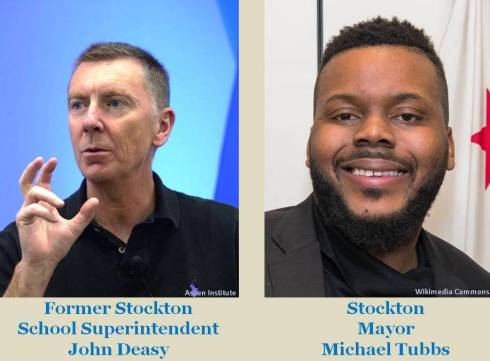
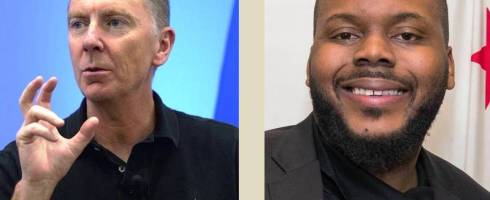
Deasy and Tubbs

John Deasy and the Mayor Providing Local Political Support

Mayor Michael Tubbs, a youthful African-American politician, was extremely angered by Deasy’s departure and blamed the four member faction that opposes his personal agenda. Tubbs stated,

“Given the gravity of the circumstances, there should be a serious discussion about whether Mendez and McBrian should be recalled, which I would be in favor of. I’ve heard from community members that are interested in considering a recall and I would be in 100% in favor of that. Our kids deserve nothing less than the best.”

There is a recall the school board effort underway in Stockton.

The obvious question is does Mayor Tubbs realize he has adopted the education agenda of US Secretary of Education Betsy DeVos, the very conservative Walton Family Foundation and the ultra-conservative libertarian mogul Charles Koch? Does Tubbs understand that he has embraced education policies Cornell’s Professor of African-American studies, Noliwe Rooks, derisively labels “segrenomics”; the profiting from selling education to segregated poor communities?

A Legacy of Controversy and Ethical Issues

In 2004, reporter Juliet McShannon writing for the Lookout News in Santa Monica, California noted, “Controversy seems to follow John Deasy.” At the time he had been leading Santa Monica Unified School district for almost three years.

Deasy came to Santa Monica after a five year stint as Superintendent of Coventry School District in Rhode Island. At the relatively small district of 6000 students, Deasy obtained one of the first small school development grants given out by the Bill and Melinda Gates Foundation. He also made national news when he launched a “pay for performance” initiative with Coventry teachers.

Standardized testing became his main metric for evaluating teachers, and he terminated the contracts of a number of teachers who did not meet his expectations.

In April 2001, Deasy abruptly resigned from Coventry effective June 1 to take the superintendent’s job in Santa Monica. He left behind financial problems and a small district that did not have time to find a new leader for the 2001-02 school year.

In 2006, Deasy graduated from Eli Broad’s superintendent’s training academy, which trains its candidates in a market-based data driven methodology. Billionaire Eli Broad is well known for his determination to privatize public education.

Deasy left Santa Monica to become superintendent of the very large Prince George’s County Schools in Maryland, the largest majority African-American county in the United States. This would be the first of three straight superintendents’ positions he would resign under suspicious circumstances.

When he arrived in Maryland, Deasy immediately started promoting charter schools and a teacher “pay for performance” agenda.

There was buzz in the area. Baltimore had Andres Alonzo firing teachers and closing schools and just a few miles the other way Michelle Rhee was promising to “fix” Washington DC’s schools by firing teachers and principals. These three superintendents were given the undeserved label “reformers.” It has become clear that they were just “disrupters.”

After two years on the job in Maryland, Deasy resigned.

That October 2008, the Baltimore Sun’s Liz Bowie speculated, “John Deasy is denying there’s any connection, but many people in the education community will continue to wonder whether the Prince George’s County superintendent would be moving on if there hadn’t been a dust-up in the past several weeks over how he got his doctoral degree.”

Bowie reported that “Deasy had been awarded a doctorate in philosophy from the University of Lousville in 2004 although he had only completed nine credits, or about a semester, there.” She also noted that Deasy had given his advisor, Robert Felner, a $125,000 contract from Santa Monica Unified and that Felner’s group received a total $375,000.

On September 29, 2008, a press release stated “The Bill & Melinda Gates Foundation announced today that Dr. John E. Deasy has been named deputy director of its education division within its United States Program.”

Two years later, with a big push from Eli Broad and the LA Mayor he politically supported, Antonio Villaraigosa, Deasy was hired as Deputy Superintendent of Los Angeles Unified School District (LAUSD). In January, 2011, he was named Superintendent.

At the time, other billionaire groups were also spending to influence the district. The LA-based Wasserman Foundation gave a $4.4 million grant, another $1.2 million came from the Walton Family Foundation, and smaller grants came from the Ford and Hewlett foundations to pay the salaries of more than a dozen key senior staffers in the district.

The staffers were working to advance the market-based data driven school reform agenda, charter schools, testing and competition.

Controversy came to LAUSD soon after Deasy took charge. When he walked into a classroom at Washington Preparatory High School being led by substitute teacher Patrena Shankling, he got into a dispute with her over the quality of the lesson plan and fired her on the spot. When a school teacher was implicated in an ugly sex scandal at Miramonte Elementary school, Deasy removed the entire staff from janitor to principal completely ignoring due process but gaining tough-guy headlines.

Deasy pushed charter school expansion and implementation of education technology. Two technology agendas appear to have led to his demise as Superintendent. He rolled out a completely incompetent student digital data system. It failed at scheduling students for classes, recording attendance and inputting grades; it was a disaster. But his I-pad fiasco was worse because it brought legal charges and an investigation by the FBI.

There were many things wrong with the $1.3 billion plan to put I-pads in the hands of every student but the suspicion that the bidding had been rigged put Deasy in legal jeopardy. Emails showed that he had been in negotiations with Apple and curriculum provider Pearson before any competitive bidding process started.

Interim Superintendent Ramon Corzine noted the bidding process had been plagued by “too many innuendoes [and] rumors.”

Deasy resigned before the legal investigation by the FBI and LA County District attorney got under way. This time the Broad Academy stepped in to hire him as “superintendent-in-residence.” That was in 2015.

In 2018, Deasy was off to be Superintendent in Stockton, resigning this year with ethical and legal malfeasance charges mounting.

Reopening Schools Issues and Evidence

21 Jul

By Thomas Ultican 7/21/2020

The President of the United States and his Secretary of Education have demanded schools open with in-person classes five days a week. Many parents are not confident their children will be safe and significant numbers of teachers are profoundly frightened. How does the rhetoric square with credible scientific evidence concerning the Covid-19 pandemic?

President Trump has tweeted,

“In Germany, Denmark, Norway,  Sweden and many other countries, SCHOOLS ARE OPEN WITH NO PROBLEMS. The Dems think it would be bad for them politically if U.S. schools open before the November Election, but is important for the children & families. May cut off funding if not open!”

Michelle Goldberg of the NY Times wrote, “… with their crude attempts at coercion, they’ve politicized school reopening just as Trump politicized mask-wearing and hydroxychloroquine.”

Goldberg goes on to cite American Federation of Teacher President, Randi Weingarten, as saying the administration just made reopening schools more difficult. Randi described Trumps threats to withhold school funding as “empty, but the distrust they have caused is not.”

Weingarten also reported hearing from many teachers who are concerned that reopening would be done rashly.

In an USA Today opinion piece, Lily Eskelsen Garcia, the President of America’s largest teachers’ union, charged, “… the Trump administration’s plan is appallingly reckless.” She also points out that the vast majorities of American schools have not returned to their 2008 funding levels and have lain off more than 300,000 employees.

Garcia argues that the Covid-19 induced revenue crisis is making opening schools safely impossible during the accelerating contagion.

Officials within the Trump administration are confidently claiming opening schools can be done safely. At a White House conference on reopening schools, Alex Azar, Secretary of Health and Human Services stated, “We can get back to school safely.” Regarding concerns that many schools do not meet Center for Disease Control (CDC) guidance, he stated, “CDC guidance is guidance and no-one should use it not to reopen schools.”

At the same conference, the President of the American Academy of Pediatrics (AAP), Dr. Sally Goza, said AAP “strongly advocates schools open safely.” She stated that “children are less likely to be infected” and “less likely to spread the virus.”

Goza contends that it is critically important for students to be physically present as long as safety measures can be maintained. She added that schools need more resources.

President Trump’s top economic advisor, Larry Kudlow, recently stated, “If we don’t reopen the schools that would be a setback to a true economic recovery.”

Secretary of Education Betsy DeVos says “It’s not a matter of if schools should reopen, it’s simply a matter of how.”

The Department of Education under DeVos’s leadership is pushing back against charges that they are politicizing school opening. A released statement said, “if anyone is politicizing this issue it’s the unions, who are Democrats’ operatives, who are fear-mongering and denying the science that says it’s safe and better for kids’ overall health to be back in school.”

Republican state administrations in Iowa and Florida have mandated that all schools in their states reopen 5-days a week with in person instruction.

In California, Democratic Governor, Gavin Newsom has ordered all schools in counties on the coronavirus “watch list” to open online only. That covers about 80% of the students in the nation’s most populous state.

The Washington Post’s Matt Viser reports that Democratic Presidential candidate Joe Biden has called for flexibility with reopening schools. Biden asserts, “If we do this wrong, we will put lives at risk and set our economy and our country back.”

Viser sums up Biden’s just released plan,

“Biden urged caution, saying that each district should make its own decisions based on local conditions, and that schools in areas with high infection rates should not reopen too soon. He also called on Congress to pass new emergency funding to help the schools.”

These confusing claims and counterclaims motivate looking into the best evidence the scientific community can provide.

What the Evidence Shows

White House Press Secretary Kayleigh McEnany said that “science should not stay in the way of school reopening.” She cited a Journal of the American Medical Association pediatrics study that found the risk of critical illness from Covid-19 for children is far less than the seasonal flu.

She stated, “The science is on our side here.” And added that states need to “simply follow the science” and open schools.

However, McEnany, did not make it clear that the study she cited involved just 48 children treated in U.S. and Canadian intensive care units. It is true that most were not critically ill but 18 needed ventilator treatment and two died.

Dr. Ashish Jha, director of the Harvard Global Health Institute, has noted that several studies from Europe and Asia have suggested that young children are less likely to get infected and to spread the virus. However, he says like the study McEnany cited, those studies are mostly small and flawed.

There is a new study that Dr. Jha describes as “one of the best studies we’ve had to date on this issue.”

The CDC has posted the study, Contact Tracing during Coronavirus Disease Outbreak, South Korea, 2020”, to its website. This large scale study looked at 59,073 contacts traced from 5,706 covid-19 confirmed patients between January 20 and March 27, 2020.

Korean Study Table 2

Korean Study Data Table Indexed by Patient Age

The important point in this table is that infants do transmit covid-19 but at a lower rate (between 1.3% and 13.7%). However, middle school and high school aged children transmitted the disease at a rate equal to all of the older groupings.

In the paper’s literature study, the authors observe, “… a recent report from Shenzhen, China, showed that the proportion of infected children increased during the outbreak from 2% to 13%, suggesting the importance of school closure.”

Schools have been reopening in various countries since this spring. A key characteristic that countries reopening schools took into consideration was virus transmission rates. Solid testing regimes and contract testing were believed essential.

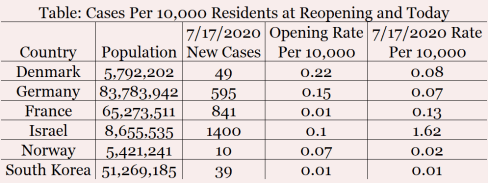
The following table used reopening transmission rates data from a post by Dr. Nan Fulcher and Justin Parmenter plus the transmission rates for July 17th which were derived using the John Hopkins University Covid-19 Dashboard and Worldometer population data.

Covid Per 10,000 Foreign table

All of the counties in the table above with the exception of Israel have maintained low transmission rates while opening schools. In the Israeli case, The University of Washington Department of Global Health reports,

“Two weeks after school re-opening, COVID-19 outbreaks were observed in classrooms, including 130 cases in one school alone. By June 3, there were 200 confirmed COVID-19 cases and over 244 positive SARS-CoV-2 tests among students and staff across multiple schools.”

“Due to the crowded nature of the schools system, physical distancing of students within schools has not been widely adopted and control measures have focused on closing schools with reported cases, extensive testing, and quarantine of students and staff with a potential SARS-CoV-2 exposure.”

In his push to reopen schools, President Trump claims that many countries reopened school with no problem. That seems to be mostly true, however, it omits saying many counties did have issues. New Century Foundation Fellow, Connor Williams notes,

Aside from some early public-health setbacks, France has been able to keep schools open. But other communities have not been so lucky. Israel reclosed some schools after a spike in covid-19 cases. Beijing recently shuttered its schools again as the pandemic returned.”

While it does seem possible to safely reopen schools based on the experience of countries around the globe, the United States faces two major unresolved obstacles; facilities need upgrading and transmission rates need to be controlled.

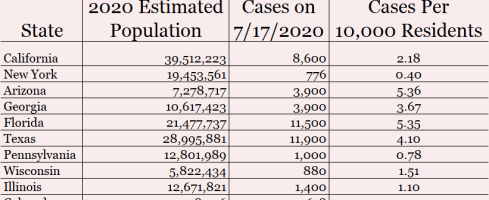
The following Covid-19 transmission rates were calculated using data from Wikipedia’s 2020 population estimates and the John Hopkins Covid-19 Dashboard.

Covid Per 10,000 table

In addition to this data showing that in most states the Covid-19 transmission rates are ghastly, school facilities on average are in terrible shape.

The National Academies of Science, Engineering and Medicine just issued guidance for reopening schools. The Academies chair for the study, Enriqueta Bond, stated, “One of the shocks to me is that over 50 percent of the school buildings are awful.”

New York Times reporter Apoorva Mandavilli shared in a report on the Academies’ guidance, “Some 54 percent of public school districts need to update or replace facilities in their school buildings, and 41 percent should replace heating, ventilation and air-conditioning systems in at least half of their schools, according to an analysis by the Government Accountability Office.”

The Academies guidance says the cost of retrofits will total approximately $1.8 million for a school district with eight school buildings and around 3,200 students.

The evidence shows that most of America is not ready to reopen schools. The retrofits have not been started and the needed financing has not been approved. Transmission rates are out of control.

The Conclusion of Professionals

New York public school teacher, Christine Vaccaro, published an opinion piece in USA Today. Her ending statement is prescient:

“Abandoned by any semblance of national leadership during a raging pandemic, students, teachers and staff are being told to jump into the deep end and return to school buildings. They will be risking their lives and their families’ lives, and endangering their communities to do so. All the precious time and resources spent to implement hybrid models and social distancing protocols will be washed away with the building’s first positive COVID-19 case. Then it will be a hard pivot back home, using the same scattershot remote learning practices developed in an emergency.

“That is why the smartest, most practical strategy is marshaling energy and dollars into developing as robust and equitable a remote learning plan as possible. This is far from ideal. We know remote teaching is not even remotely teaching. But it will save lives, offer the most consistent education for our children this fall — and provide a solid foundation on which to build a stronger hybrid model, later in the year.”

New Century Foundation Fellow, Connor Williams, ended his article succinctly,

It’s time to face the central fact of a pandemic: There’s no way to pretend our way around flattening the curve. Until we actually stop the virus’s spread, efforts to reopen schools in most communities will fail.”

Don’t Sacrifice Teachers and Students to a Neoliberal God

8 Jul

By Thomas Ultican 7/8/2020

The US is not ready to open schools. We blew it. Let’s face reality squarely and quit making outcomes in our country even worse.

New York’s Michael Flanagan Ed. D. wrote,

“The pressure to reopen schools, and return to work, will continue to intensify, no matter how many new cases of Covid-19 there are each day, and the numbers are growing. Businesses, politicians and even health professionals are in the process of trying to convince us that sending our kids back to school will be safe.”

As if to prove Flanagan’s claim, Harvard’s “Education Next” published a Frederick Hess interview with Jeb Bush where he repeatedly emphasized,

“First and foremost, schools have to open with the health and safety of our students and teachers being paramount. But they have to open, or we will have huge economic, health, and social challenges.”

Not to be outdone by “low energy Jeb”, the President of the United States employed his normal elegance when tweeting,

“Schools in our country should be opened ASAP. Much very good information now available.”

Republican Congressmen, Jim Banks of Indiana and Tom Tiffany of Wisconsin, have introduced the Reopen Our Schools Act. Congressman Banks declared,

“Reopening our schools is the lynchpin to reopening our economy. Many parents rely on their kids going to school so they can go to work. To get our society up and running again, we need our children back in school.”

The Economist claims schools should be the first economic institutions to reopen and added,

“Those who work at home are less productive if distracted by loud wails and the eerie silence that portends jam being spread on the sofa. Those who work outside the home cannot do so unless someone minds their offspring.”

These neoliberal forces are promoting the idea that teachers and children must be thrust into an unsafe environment so the world’s economic engines can continue providing decent return on investment. Make no mistake, face to face teaching during this pandemic without proper conditions is fraught with danger.

Political leaders know that so they are racing to pass legislation indemnifying schools from legal liability.  In California, Assemblymember Patrick O’Donnell, D-Long Beach, and his coauthor State Senator Susan Rubio, D-LA, introduced AB1384 to shield schools. O’Donnell made this ludicrous statement,

“We need to do everything we can to protect the students, and the schools. My bill will indemnify school districts as long as they follow all the state and local health directives. We still want school districts to use best practices when it comes to student safety.”

In May, Mitch McConnell announced that the US Senate was taking up legislation to protect schools from lawsuits. He stated, “Can you image the nightmare that could unfold this fall when K-12 kids are still at home, when colleges and universities are still not open?”

When it comes to political malfeasance, Florida is determined not to be outdone. Richard Corcoran, Commissioner of Education, is the former Speaker of the House and a charter school owner.  On Monday, he released an order stating, “Upon reopening in August, all school boards and charter school governing boards must open brick and mortar schools at least five days per week for all students …”

The forced school reopening amounts to a conscription putting teachers, students and families at risk. Florida trails only New York and California in confirmed Covid-19 cases and Miami-Dade County is a national leader in cases. At this time, Covid-19 cases in the state are spiking to new record levels.

Obviously, Commissioner Corcoran’s order ignores health and safety. It is driven solely by a neoliberal ideology valuing commercial enterprise above human life.

Could-a Should-a Would-a

If the United States had acted decisively in late February and shut down businesses, instituted robust testing, contact tracing and social distancing, we probably could safely open schools now. It is also likely that more than 120,000 victims of the virus would be alive today.

Even in March when it became clear to everyone but a fringe element that we had a huge problem, a united response led by the federal government would have put us in position to reopen in-school education.

Instead of a united effort to effectively meet the Sars-CoV-2 crisis, we experienced politicization and demagoguery.

By the end of March, California had an effective shutdown in place with almost universal cooperation. Then ultra-conservative media started agitating against the shut down.

Purported healthcare professionals like neurosurgeon, Russell Blaylock, started discouraging mask wearing as did the discredited Irish scientist Delores Cahill.

In late April, The Conservative Daily Post reported on claims by two Bakersfield, California emergency room doctors, Dan Erickson and Artin Massihi. These doctors from Accelerated Urgent Care claimed that the nationwide lockdown policies are not an appropriate reaction to the “China-originated novel coronavirus” and were causing other healthcare problems to be ignored.

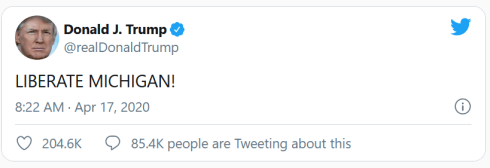
Kristi Noem, the Republican Governor of South Dakota, publically opposed CDC health guidelines saying, “I believe in our freedoms.” This happened just days after the President of the United States took to twitter and attacked the Democratic governors of Michigan, Minnesota and Virginia, calling for their states to be liberated.

Trump Liberate tweet

Attack on Governor Gretchen Whitmer for Implementing CDC Guidelines in her State

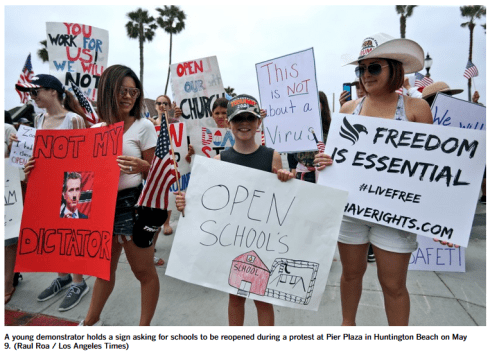
This constant degrading of the public response to Covid-19 led to more people joining in protest against state policies. Soon conservative groups were demanding that schools be reopened immediately.

LA Times Open Schools Gaphic

This Los Angeles Times Picture was taken in Orange County May 9, 2020

Because our response to the novel coronavirus was undermined, states do not meet the safety criteria for opening schools.

The Whitehouse has created an opening America website with proposed state or regional gating criteria.  They include:

“Downward trajectory of influenza-like illnesses (ILI) reported within a 14-day period AND Downward trajectory of covid-like syndromic cases reported within a 14-day period”

“Ability to quickly set up safe and efficient screening and testing sites for symptomatic individuals and trace contacts of COVID+ results”

“Ensure sentinel surveillance sites are screening for asymptomatic cases and contacts for COVID+ results are traced (sites operate at locations that serve older individuals, lower-income Americans, racial minorities, and Native Americans)”

“Ability to quickly and independently supply sufficient Personal Protective Equipment and critical medical equipment to handle dramatic surge in need”

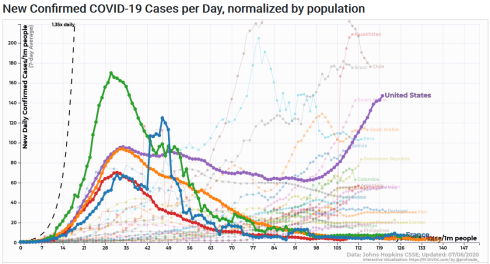
America’s schools do not meet these “gating criteria.” Covid-19 infections in the United States are accelerating, so out of control that testing with contact tracing is not possible. The following Johns Hopkins graphic makes it clear that this situation will not ameliorate quickly.

Johns Hopkins World Comparison

The Johns Hopkins Graph is Normalized to Daily Cases per Million

Teachers and Students Will Not Be Safe

Neil Demause of Fairness & Accuracy Reporting wrote on July 3rd about opening businesses. He shared,

“Infectious disease experts say that offices can be the perfect petri dishes for viral spread, involving gatherings of a large number of people, indoors, for a long time, with recirculated air. As one study (Business Insider4/28/20) of a coronavirus outbreak at a Seoul call center showed, the virus can quickly spread across an entire floor, especially in a modern open-plan office.”

It is easy to extrapolate the Korean call center to the local 3rd grade classroom.

Dartmouth Immunologist Erin Bromage states, “We know that at least 44% of all infections–and the majority of community-acquired transmissions–occur from people without any symptoms (asymptomatic or pre-symptomatic people).” Professor Bromage also notes, “Social distancing rules are really to protect you with brief exposures or outdoor exposures.”

Pennsylvania educator Steven Singer observed, “And even if young people are mostly asymptomatic, chances are good they’ll spread this thing to the rest of us.” The paper Steven cited also states, “Although  clinical  manifestations  of  children’s  COVID-19  cases  were generally less severe than those of adults’ patients, young children, particularly infants, were vulnerable to infection.”

On Monday, The Daily Mail reported, “As many as half of coronavirus patients with NO symptoms may silently suffer ‘disturbing’ lung damage that leaves them oxygen-deprived without knowing it, study finds.”

Education professionals have been publishing concerns recently.

Rutgers University’s Mark Weber Ed. D. posted “How Schools Work: A Practical Guide for Policymakers During a Pandemic.” His list is not exhaustive but it gives the laymen an idea of the practicalities involved with doing school. It includes:

“The typical American school cannot accommodate social distancing of their student population for the duration of the school day.”

“Children, especially young children, cannot be expected to stay six feet away from everyone else during an entire school day.”

“Children cannot be expected to wear masks of any kind for the duration of a school day.”

The author and special education expert, Nancy Bailey, recently posted, 22 Reasons Why Schools Should NOT Reopen in the Fall.Among the 22 were:

“2. How Will the Flu and Covid-19 Tango?… Last January, before Covid-19 became well known, 27 children had died of the flu. What will the dance of these two illnesses look like in the fall?”

“8. Cost for Safety: The Council of State Chief School Officers estimate that schools will need $245 billion to safely reopen.”

“18. School Restrooms: … School bathroom conditions have always been a source of concern.”

“19. Teacher Qualifications: There are not enough teachers for smaller classes for social distancing. Experienced older teachers may not want to get sick. Will schools hire a glut of teachers without qualifications?”

Oakland, California high school history teacher and union organizer, Harley Litzelman, published “Teachers: Refuse to Return to Campus.”  He addressed among other issues, the likely large loss of teachers to the ill-fated open-schools-on-campus-now policy. Litzelman shared,

“A USA TODAY/Ipsos poll found that one in five teachers say they are unlikely to return to campus next year, signaling a tsunami of resignations. Chicago middle school teacher Belinda Mckinney-Childrey told ChalkBeat that “I can’t chance my health to go back. I love my job, I love what I do, but when push comes to shove, I think the majority of us will be like ‘I think we’re going to retire.’” Also, this is personal; my fiancée has serious asthma. She’s the best middle school English teacher I know, but she won’t teach next year if she’s forced to return to campus.”

Merrie Najimy, President of the Massachusetts Teachers Association, participated in a televised interview about her objection to Governor Baker’s plans to reopen schools. She was asked about the American Association of Pediatrics call for schools to open “as soon as possible.” Aren’t they aligned with Governor Baker’s position? Najimy pointed out, “The AAP does not have practical experience in school and … they are not absolutists.”

Steven Singer posted, “Do NOT Play Russian Roulette with Our Lives – No In-Person Schooling During a Pandemic.” In the article, Steven declares, “Reopening schools to in-person classes during the COVID-19 pandemic is tantamount to Russian Roulette with the lives of students, teachers and families.”

On Monday, education writer, Jenifer Berkshire, tweeted, “The school reopening fight just gets crazier – and more politically confusing. In growing # of states GOP now saying ‘open the schools or else’”

Community leaders, religious leaders and schools will need to work together for a solution to child care. There are many unused recreation centers, school facilities, libraries and church facilities available. Forcing children and teachers into an unsafe situation is not the only way to solve the child care dilemma.

In order to reopen schools safely, there are two non-negotiable imperatives. First, the rampaging virus must be brought under control through testing and robust contact tracing. Second, the US Senate must send schools $245 billion dollars to pay for the social distancing logistics, supplies, staff and transportation enhancements required.

Since there is no way to meet the first requirement and it is unlikely the Republican led Senate will meet the second. Let us quit pretending and concentrate our efforts on creating enhanced distance learning this fall.

Fraud at Sweetwater; Maybe but Unlikely

1 Jul

By Thomas Ultican 7/1/2020

For the past week, local San Diego TV and Print media have been filled with damning headlines like the NBC affiliate’s, Audit of Sweetwater Union High School District Finds Evidence of Fraud” or the online publication Voice of San Diego’s “Audit Finds Sweetwater Officials Deliberately Manipulated Finances.” Every local news outlet published the story with some version of these headlines.

On Monday June 23, the Fiscal Crisis Management Assist Team (FCMAT) presented the results of its long awaited audit of Sweetwater Union High School District’s (SUHSD) finances. The report authors state,

“Based on the findings in this report, there is sufficient evidence to demonstrate that fraud, misappropriation of funds and/or assets, or other illegal fiscal practices may have occurred in the specific areas reviewed.”

How Did SUHSD Arrive Here?

For Sweetwater, this is really a continuation of the course set by corrupt leadership a decade earlier. It is also emblematic of the financial stress all California school districts are facing. Kristen Taketa reporting for the San Diego Union noted in November 2018:

At least 10 districts in the county are projecting that they will not be able to meet their financial commitments next school year, including Chula Vista Elementary, Jamul-Dulzura Union, Mountain Empire Unified, Oceanside Unified, San Diego Unified, San Marcos Unified, San Ysidro, Sweetwater and Vista Unified. More districts won’t be able to meet their financial commitments after next year.

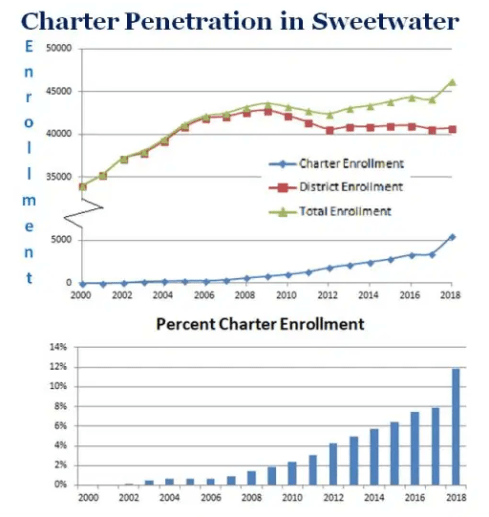
Three factors are mainly responsible for these growing financial stresses. The state has mandated a more than doubling of teacher retirement payments from 8.1% to 18.4% without providing extra assets. Special education costs have been soaring and enrollment has been shrinking due to an increase in state funded privately operated schools.

enrollment-graphs

The Drop in Attendance Accounts for a $20 Million Drop in Revenue

In April of 2014, four of the five Sweetwater board members (Jim Cartmill, Bertha Lopez, Pearl Quinones and Arlie Ricasa) plus Superintendent Jesus Gandara pled guilty to corruption charges and resigned. The fifth member of the five person board, John McCann left the board to run for a seat on the Chula Vista city council.

Cartmill and Lopez pled guilty to a misdemeanor charge of accepting gifts over the state limit. Quinones, Ricasa and Gandara were charged with felonies. Arlie Ricasa pled guilty receiving probation and a fine. Gandara was sentenced to 7-months jail time and fined $7,994.

Pearl Quinones also pled guilty and stated “I would have fought it to the very end if I had been able to afford to keep fighting it.” She received a three-year probation with the felony being reduced to a misdemeanor.

District Attorney Bonnie Dumanis called this a “pay-for-play” scheme stating,

“For years, public officials regularly accepted what amounted to bribes in exchange for their votes on multi-million dollar construction projects. This case is outrageous and shameful.”

In my opinion, Gandara was out of control and deserved the outcome. On the other hand, the school board members’ biggest mistake might have been being careless while the district attorney was planning to run for mayor.

I was politically opposed to the four indicted board members but never believed they were selling their votes and still don’t. I believe they did put the school district and the community first. Dumanis painted them with Superintendent Gandara’s malfeasance.

It is true that they all accepted a small number of free dinners and tickets to local sporting events and did not report some of them correctly. DA Dumanis over-charged them with misdemeanors and felonies that forced their resignations from the board. She could have more appropriately cited them with infractions which would have brought fines, however, the DA valued headlines over justice.

An entirely new five member school board was elected in November, 2014. After completing the school year with interim-superintendents, the board selected Karen Janney to be the new permanent Superintendent of SUHSD. That June 8, 2015 decision was a hailed by the board, the community and the teachers union.

In a 2019 interview, teacher’s union President Gene Chavira said he felt Janney made two critical errors. She rejected the expense of having a forensic audit performed on the district’s finances and she did not listen to board members and labor leaders when they encouraged her to bring in an outside leader for the finance department.

Janney had been a teacher, principal and assistant superintendent in the district. She evidently had formed a strong relationship with Karen Michel and wanted her to be the district’s Chief Financial Officer (CFO).

Michel and her number two, Douglas Martens, retired in June of 2018. There last official act was delivering the budget for school year 2018-19. The budget was approved by the board on June 25th and sent to the County Office of Education (COE) for final approval.

Jenny Salkeld was hired to replace Michel as CFO. In early September, Salkeld discovered a $20 million negative discrepancy in the budget and reported it to the Sweetwater leadership team which forwarded her report to the COE.

The County immediately disapproved of the SUHSD budget and brought in the Fiscal Crisis Management Assist Team (FCMAT) to investigate Sweetwater’s finances.

The FCMAT Audit

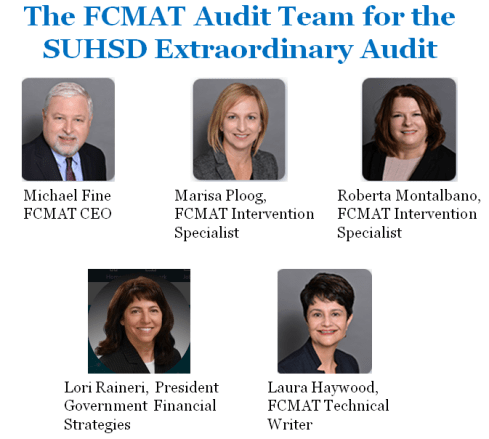
Audit Team

CEO Michael Fine and the Four Women Who Performed the SUHSD Extraordinary Audit

FCMAT was created and signed into law in 1991 by Governor Pete Wilson. The Kern County Superintendent of Schools office was selected as the administrative and fiscal agent for FCMAT. It is not a government entity but does receive financial support from the state.

FCMAT is organized as a non-profit. The purpose of FCMAT was to provide districts experiencing budget issues with professional leadership. However, they have developed a reputation for being more about helping political allies than struggling school districts.

The County’s official rejection of the 2018-19 budget was a trigger bringing in FCMAT to conduct a Fiscal Health Risk Analysis. On December 17th, 2018, the Analysis results were presented to Sweetwater’s board by FCMAT CEO Michael Fine. The Voice of San Diego reported,

“FCMAT’s chief executive officer Michael Fine told board members that 302 entries in the district’s accounting system were doctored to create the impression the district had more money than it really did. ‘That my friends and colleagues, is a cover-up,’ …”

Although Michael Fine’s charge of “cover-up” appears mistaken according to the new audit, it does point to a central problem that led to a bad budget. The audit revised the 302 “negative budget entry” count to 220 and explained the origin of these often inadequately documented inputs.

The auditors reported that SUHSD began the budgeting process by rolling the 2017-18 budget into the beginning template for the 2018-19 budget. This was not viewed as unusual, but projections concerning changing budget demands then needed to be inserted into the budget model and that was not satisfactorily done.

FCMAT states, “Interviews with staff … indicate that the district was not utilizing data from a position control system to project salaries and benefit obligations.”

Apparently the suspicious entries were the budget being updated based on actual costs when they arrived. These entries were suspicious because they were not documented in accordance with the California School Accounting Manuel.

I worked in SUHSD from 2002 – 2017 and these findings seem to confirm my own impression of unprofessionalism in the district office. It didn’t appear corrupt but there was little concern with meeting deadlines, crossing t’s and dotting i’s.

In the audit, FCMAT questioned delays in posting payroll transactions. They wondered if these delays were purposeful for hiding the understatement of salaries and benefits in the budget. They concluded it was not, but does give more evidence of the lack of professionalism in the financial department.

In the report, FCMAT says Superintendent Karen Janney, CFO Karen Michel, Director of Financial Services Douglas Martens and Financial Consultant Adam Bauer may be guilty of financial fraud over the February 2018 bond deal. However, much of the damning evidence comes down to the fact that they followed Bauer’s advice about the best path to guarantee a good bond rating.

Laws and methods had changed since the last time Sweetwater did a bond deal. It is difficult to understand why SUHSD not following previous processes with fidelity was considered suspicious.

FCMAT also claims Sweetwater officials should have known that the drop in ending revenue between 2016 and 2017 from $36,285,098 to $21,469,748 indicated deteriorating financial conditions. This was also part of FCMAT’s evidence for Sweetwater knowingly misleading the bond markets about the district’s financial health.

The “extraordinary audit” was triggered by FCMAT’s declaration in December 2018 of possible fraud and cover up. By agreement with the county the audit was quite limited and focused almost exclusively on the 2017-18 budget year and SUHSD internal budgeting processes.

By comparison, a forensic audit of SUHSD is estimated to cost as much as $2,000,000; the county cost for this “extraordinary audit” was estimated at $50,700.

The auditors did not look at data from previous years.

Going Forward

The audit was delivered Monday, 6/23/2020. The document reminds the district’s board, “Within 15 days of receipt of the report, the governing board is required to notify the county superintendent of its proposed actions regarding the county superintendent’s recommendations.”

Board member Paula Hall indicated this would not be a problem since they have already instituted many of the FCMAT suggestions. She also expressed how pleased she was with CFO Jenny Salkeld’s professionalism. Hall believes the district now has strong leadership in finance.

Governor Gavin Newsom signed the state budget on Monday, June 29th. Now Salkeld’s team needs to finish the 2020-21 budget and present it to the board.

Wednesday the 25th, the Sweetwater board met in a virtual executive session and put Karen Janney on paid administrative leave by a vote of 4-1. A board member said that in the uncertain legal climate they felt this move was needed to protect both the district and Janney.

The board also voted to lay off 223 employees and selected Dr. Moises Aguirre to serve as acting Superintendent.

Aguirre must now pick up the ball and continue the planning for opening school on August 3rd.

Dr. Aguirre faces the challenge of how to safely open schools in the Sars-CoV-2 era if that is even possible. If not, he and the Sweetwater team must find a way to make distance learning work for all 36,000 students.

My best guess is that there was no intentional fraud or purposeful financial misleading in SUHSD. It looks like there was a significant budget creation error that collided with state created structural deficits. I do not expect any prosecutions.

If meaningful changes are not made to California school financing, there are going to be many more districts running into these same structural deficits with no good solutions.