Tag Archives: Science of Reading

Billionaires Support Corrupted Science of Reading

1 Jul

By Thomas Ultican 7/1/2025

Science of Reading (SoR) was always a fraud; it is not based on sound science. In 1997, the National Reading Panel was established by congress and 21 volunteers were given 18 months to study reading education. They searched through academic papers, averaged results and made a report that billionaires now label the “science of reading.” June 25th, the oligarch established propagation rag, The 74, published yet another article employing obfuscation to sell SoR.

The article, “How Districts in Georgia, Maryland and D.C. Are Raising Reading Proficiency,” was written by Andrew Cuomo’s former education advisor, David Wakelyn PhD. While working for the National Governors Association, Wakelyn was part of the team that developed the Common Core State Standards. He also served as Deputy Secretary of Education in New York. Today, this former California school teacher has founded Upswing Labs where they conduct research supporting the SoR approach to literacy.

Selling SoR

The first article in a series of posts promoting the “Mississippi Miracle” was written by Wakelyn and Michael Hartney for the New York Post. Its headline read, NYC should look to the Mississippi Miracle to learn how to teach reading.” Upswing Labs produced two papers in June called Mississippi or Manhattan and Dynamic Districts & States: Where and How Literacy Is Improving.” The last article is Wakelyn’s The 74 article on June 25.

“Mississippi or Manhattan” presents the following graphic to show how superior Mississippi’s reading teaching is to New York City’s.
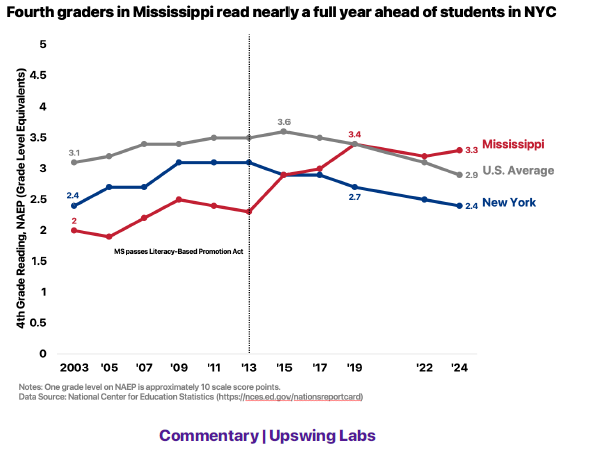
For unknown reasons, Wakelyn has converted the NAEP average scale scores to an undocumented grade equivalent. He claims one grade level is approximately 10 scale score points, but that makes no sense since the average scores are all above 200. However we do see that Mississippi had made impressive gains. A graph of the average scores shown below has the same shape as the Upswing Labs graph above.
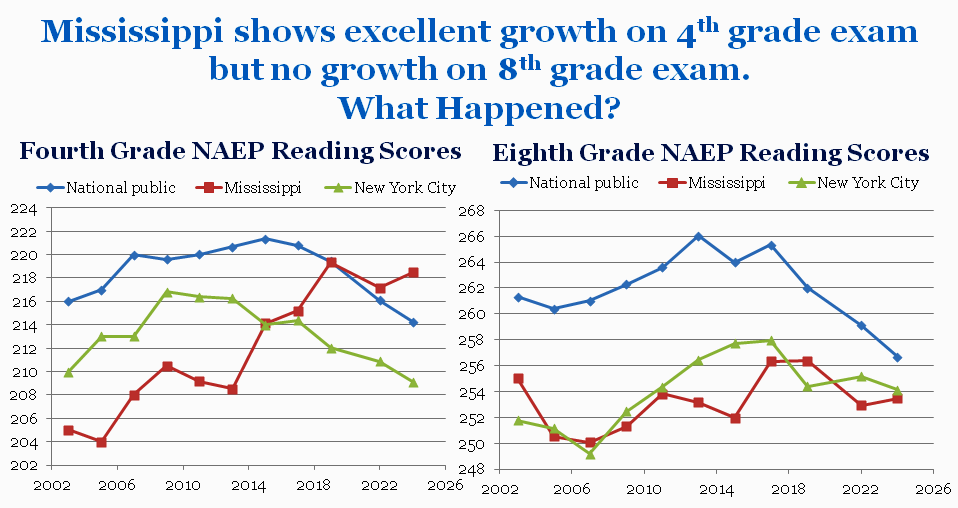
The graph on the left is of the average NAEP scale score for 4th grade reading in Mississippi (red), national public schools average (blue) and New York City (green) years 2003 to 2024. (Note: only the symbols on the graphs represent real data; the lines do not.) The graph on the right is configured the same way for 8th grade testing data. The NAEP data reveals that by 8th grade all of Mississippi’s impressive 4th grade gains have vanished.

These results are likely the result of Mississippi’s mandatory retention policy for third graders whose testing does not achieve the requirements for advancement. By holding back almost 10% of their 3rd graders, Mississippi has by far the highest 3rd grade retention rate in the country. Average 3rd grade retention for all states is 3% and many states have less than a 2% rate. Obviously, Mississippi’s weakest students spend an extra year in 3rd grade so it makes sense that their 4th grade NAEP reading scores have improved but by 8th grade the gains are gone.

This is the basis of the “Mississippi Miracle” and like much of the billionaire financed education agenda, it is a fraud. David Wakelyn earned a doctorate of education from the University of Wisconsin-Madison. He is certainly aware that the Mississippi data is problematic yet he promotes the distortion.

Maybe it is time for Universities like Wisconsin to consider rescinding doctoral degrees that are being used for lying to the public.   

The 74 Article

David Wakelyn’s article in The 74 is focused on selling the wonderful results from three exemplary districts, “Marietta City in the Atlanta suburbs; Allegany County, at the edge of the Appalachian Mountains in Maryland; and DC Prep, a K-8 public charter school network.” The three districts are small. The total numbers of 4th graders available for testing are DC Prep – 223, Marietta City – 681 and Allegany County – 553.

Wakelyn lauds the science of reading products these three districts have purchased. Why he chose them is a little mysterious. They are so small that they are statistically almost meaningless. He states:

“The districts launched deep, extended professional learning for all elementary teachers over two to three years.  Marietta City trained teachers with Top Ten Tools, a set of mini-courses on core elements of literacy and how to teach them, then added a year of training with Writing Revolution, a set of courses on teaching expository writing. In 2020, Allegany County began a two-year engagement with LETRS, to help teachers master the basics of reading and writing instruction — phonological awareness, phonics, fluency, vocabulary and comprehension.”  

Top Ten Tools is a product of the 95 percent group inc. founded by Susan L. Hall. It has 220 employees and took in $7.4 million last year. They are one of the many companies working to profit off SoR. Hall is also a Sopris West certified trainer for DIBELS (Dynamic Indicators of Basic Early Literacy Skills) and LETRS (Language Essentials for Teachers of Reading and Spelling). She is the author of “I’ve DIBEL’d, Now What?,” and a co-author with Louisa C. Moats of two books.

In 2023, Rachel Cohen wrote an informative article about SoR, noting about LETRS:

“Despite its close associations with the “science of reading” — LETRS has its own middling track record of effectiveness. One experimental study found teachers who were trained by LETRS did improve in their knowledge of reading science, but their students did not have statistically higher differences in achievement than teachers in the control group.”

The Writing Revolution (TRW) comes out of work by Dr. Judith Hochman of New York. A 2012 award-winning feature article, The Writing Revolution,” was published in The Atlantic about The Hochman Method giving her national exposure. In 2014, TRW became a 501 C3 tax-exempt non-profit. TRW is not an SoR focused company but they are profiting off public education and like many of today’s non-profit organizations have multiple 6-figure earners (TIN: 46-4970867).

Wakelyn also stated in The 74:

Both Marietta and Allegany improved the quality of their K-5 language arts curricula.  Marietta dropped giving students books they could already read — a popular practice that hasn’t been found to facilitate learning — and switched to Wit and Wisdom and a skills-based foundational class. Allegany stopped using Treasures and switched to Core Knowledge Language Arts. Both are highly rated by independent reviewers and are designed to build a deep and wide knowledge base using grade-level texts in science, history, literature and the arts.  

The “hasn’t been found to facilitate learning” comment is based on a blog by Timothy Shanahan. An early commenter to Shanahan’s post did not like that the article focused on learning level with no mention of content. The writer states, “I’m a retired elementary teacher and school principal, and it has been my experience that students are often thrilled to read materials whose content they find interesting or unique.”   

“Wit and Wisdom” is a scripted curriculum that has enemies on both the right and left.

Since “Treasures” is no longer in print, I would expect that schools are replacing it.

Core Knowledge Language Arts is controlled by Amplify and billionaire Laurene Powell Jobs. It is only lauded by other billionaire-controlled entities.

Conclusion

SoR is a dressed up version of George W. Bush’s Reading First Initiative from 2001. In 2008, The Center for Public Integrity reported, “An April 2008 study revealed the general ineffectiveness of Reading First and found that students in schools receiving funds for the program had no better reading skills than children in schools that did not.” Unfortunately, billionaire dollars kept the SoR malarkey alive.

The real reason for promoting SoR is the billionaire plan for resting control of education away from universities and ending democratic control of schools. The agenda is for all teacher education and training to be privatized. Organizations like TNTP and Relay Graduate School are sub-standard billionaire financed entities with political clout pushing aside public institutions.  

For billionaires, SoR has never been about better reading education. It is just one more element in their drive to eliminate democracy.

The “greedy bastards” lust for power and wealth is perverting everything.
The Undermining of Rhode Island Public Schools

23 Jul

By Thomas Ultican 7/23/2024

Gina Raimondo, Rhode Island’s unpopular governor, appointed the clearly unqualified Angélica Infante-Green as Commissioner of Education, in 2019. That was the year before Joe Biden selected Raimondo as Secretary of the Treasury. Infante-Green’s qualifications amounted to recommendations from New York’s Joel Klein and Jeb Bush. She was a former Teach For America (TFA) teacher in New York city who had never led a district nor been a school principal. Her first action on the job was to take over the Providence school district, the state’s largest.

Like all corporate sponsored “reformers,” Infante-Green took to propaganda rag, The 74, and updated on when, if ever, Providence will exit state control. However, Rhode Island exiting state control matters less than in most states with elected school boards because Mayors run schools. Providence Mayor Jorge Elorza officially petitioned the state to take over his schools, one of the poorer school districts in America. Politicos decided that schools were “failing” because of poor test scores.

Besides poverty, Providence’s schools are almost 70% latinx with 40% language learners. Famous educators like Pestalozzi, Herbert and Dewey would not have gotten test scores acceptable to the local business community. It was a case of testing to privatize, without care for public education and little comprehension of teaching or learning.

Hope High School in Providence

Infante-Green did not actually give much information about her plans for turning over management of the Providence school district to the city. She only shared:

“We said that in 2024, we’d look at how much progress has been made. But when that was decided in 2019, nobody anticipated a pandemic.”

Does she envision semi-permanent state control?

Feeding Corporate Friends

Part of the requirements in Rhode Island for a school to exit state receivership is an independent review. Of course, Infante-Green did not ask Brown University, Providence College or University of Rhode Island to conduct the review. She contracted with Massachusetts-based consulting firm, SchoolWorks, to lead an independent review.

SchoolWorks has a long history of supporting charter schools and privatization of public education. A tab on their web page advertises the only two categories of training they offer: For Charter School Authorizers and For Charter School Founders.

About For Charter School Founders, SchoolWorks says:

“Behind every successful charter school is a passionate group of individuals who dedicated their time and talent to envisioning a new school, garnering community support, and crafting a thoughtful and comprehensive charter school application. These are challenging, time-consuming tasks; and we celebrate pioneers like you for your commitment to innovating education.”

A link on the LittleSis data base provides some historical background for SchoolWorks. The CEO in 2016, Scott Blasdale, was a founding board member of the Massachusetts Charter School Association. He also was executive director and founding teacher of Academy of the Pacific Rim Charter Public School.

In the period that Richard Daley and Rham Emanuel were mayors of Chicago, SchoolWorks held consulting contracts for local public schools. They also consulted for KIPP schools, the Ewing Marion Kauffman Foundation and National Heritage Academies. The billion dollar Kauffman Foundation’s (EIN: 43-6064859) spending aligns with funding by Arnold, Dell, Gates and Walton, including generous gifts to TFA, Thomas B. Fordham Foundation, TNTP and Digital Promise.

Testing to Privatize

Johns Hopkins University was integral to the attack on public schools in Providence, Rhode Island. In May 2019, at the invitation of Infante-Green, Johns Hopkins Institute for Education Policy led a review of the Providence Public School District. The Partnership for Rhode Island, a group of local business leaders, funded the review.

The Johns Hopkins study was commissioned in May and presented in June. Based on the report, Providence Mayor Elorza officially petitioned the state to takeover Providence Public School District on July 19, 2019.

This request was based on testing data and Johns Hopkins not so unbiased report. In 2020, the Institute for Education policy at Johns Hopkins joined Jeb Bush’s Chiefs for Change to write a paper, calling for more standardized testing. This collaboration clearly indicated a penchant for school privatization and a tilt against public schools.

Adopting the Science of Reading

Infante-Green defended her school takeover methods stating:

“We have something called the Right to Read Act [which requires teachers to be trained in the science of reading]. By 2025, our K-8 teachers will all be trained, but we’re at about 75 percent.”

Science of Reading (SoR) is much more about profits and control than good teaching. SoR is not based on sound science and, more accurately, should be called “How to Use Anecdotes to Sell Reading Products.”

Professor Maren Aukerman, currently Werklund Research Professor at the University of Calgary, focuses on literacy education and democratic citizenship. She previously served on the faculty at Stanford University and University of Pennsylvania. Her recently published paper in the Literary Research Association on work by Goldstein, Hanford and others promoting SoR noted:

“The problem is not with recognizing that teaching phonics can play a facilitative role in having children learn to read; that insight is, indeed, important, if not particularly new. The problem is that this narrative distorts the picture to the point that readers are easily left with a highly inaccurate understanding of the so-called ‘science of reading.”’

Professor Paul Thomas of Furman University, with a deep background in teaching and education research, criticized of American Public Media’s Emily Hanford writing:

“As I have pointed out numerous times, there is a singular message to Hanford’s work; she has never covered research that contradicts that singular message.

“For example, not a peep about the major study out of England that found the country’s systematic phonics-first policy to be flawed, suggesting a balanced approach instead.

“And not a peep about schools having success with one of Hanford’s favorite reading programs to demonize.”

Nancy Bailey is an expert in special education and early reading instruction. In a recent posting, she declared:

“A troubling feature of the Science of Reading (SoR) is the connection between those who believe in the power of phonemes (and more) and those who want to privatize public schools. The old NCLB crowd has been rejuvenated and seems onboard with digital instruction replacing public schools and teachers.

Infante-Green’s claim that SoR is something wonderful and positive for public schools in Rhode Island is malarkey. It is a giveaway to corporations that harms students and undermines educators.

An Intriguingly Strange Claim

Infante-Green is quoted by The 74 stating:

“What’s interesting about Providence is that about 19,000 children apply to charter schools and there are only 22,000 students in the district. So they want charter schools.”

This assertion makes no sense. While it is not surprising that charter school enrollment in Rhode Island increased, the most recent (2021) available enrollment data showed 10,547 charter students. Claiming 19,000 student applications for privatized schools in Providence alone strains credibility.

Rhode Island’s Commissioner of Education promotes privatization.

It is true that since the pandemic, student enrollments have dropped and chronic absenteeism has grown throughout the nation. In Providence, both of these have soared. Even Central Falls, the most impoverished school district in Rhode Island, had a significantly lower absentee rates and better attendance than Providence. Commissioner of Education, Angelica Infante-Green, took over Providence schools five years ago, making no effective action while dropout rates climbed, students disappeared and many scholars coming to class sporadically.

Clearly, these schools would be in a better state if her takeover never happened.

It is time to quit playing privatization games with the public school system and return them to professionals in the district.

State takeovers have a nationwide record of failure and Providence is adhering to that history.

A Conversation on the Science of Reading

27 May

By Thomas Ultican 5/27/2024

Two eminent professors of instruction and literacy teamed up to write Fact-Checking the Science of Reading.” P David Pearson of UC Berkeley and Robert J. Tierney of University of British Columbia are Emeritus Professors with high reputation in their respective countries.

In the introduction, they inform us that Emily Hanford’s 2022 “Sold a Story” podcasts motivated them to write. In particular, they noted:

  1. “A consistent misinterpretation of the relevant research findings; and
  2. “A mean-spirited tone in her rhetoric, which bordered on personal attacks directed against the folks Hanford considered to be key players in what she called the Balanced Literacy approach to teaching early reading.” (Page XIV)

Their book presents 10 claims related to science of reading (SoR), each followed up with a three-step evaluation: “a) Unpacking the evidence presented for its validity; b) Offering our reading of the evidence; and c) Concluding with a revised version of the claim that we can support.”

An Example

The 5th claim cited states, “The Three-Cueing System (Orthography, Semantics and Syntax) has been soundly discredited.”

Orthography uses phonics type approaches to sound out unknown words. Does it look right? With the second cue, syntactic, a student tries to understand what is written. Does it sound right? What would make it conform to grammar rules? Semantics is the last of the three cues. Does it make sense?

The authors presented three pages of evidence about claim 5. For example they shared:

“Consequently poor readers fail to develop the decoding skills necessary for facile word identification, and their accuracy and fluency appear to flounder. Good readers, on the other hand, are able to successfully enlist phonemic awareness and the letter-sound correspondences to decode, and then understand, words. These differences between good and poor are taken as evidence that accurate and automatic word recognition is key to developing fluent reading for meaning. This view lends credence to the argument that phonics is the more expeditious approach to beginning reading expertise—and that approaches enlisting multiple cueing systems are flawed, misguided and perhaps even harmful to young readers (Hanford, 2018; 2019; Moats, 2000) (Page 57)

They, with years of experience studying reading education, noted:

“Criticisms of the three-cueing system are based on a combination of anecdotal evidence and opinion (Seidenberg, 2017; Moats, 2000), including extrapolations from static comparisons of the strategies of good and poor readers. They do not examine specific interventions involving the three-cueing system, such as the Interactive Strategies Approach (Vellutino & Scanlon, 2002; Scanlon et al., 2024), or the work of Marie Clay (1993: 1998) on Reading Recovery.” (Page 57)

The two quotes above came from the “unpacking the evidence presented for its validity” section of evaluation. Their next section, “offering our reading of the evidence”, stated:

“The only way we can make sense of the arguments marshaled against the three-cueing system is to infer that the opponents object to its use in pedagogy rather than in reading theory. Many of the most vocal critics of the three-cueing system either espouse or support models of the expert reading process that posit an important role for all three of these information sources.” (Page 58)

This part became fairly dense with descriptions and graphics for three reading models, David Rumelhart’s Interactive Model of Reading, PB Gough’s One Second of Reading Model and Rumelhart’s & McClelland’s Parallel Distributed Processing Model. Interestingly, these employed all three of the Three-Cueing domains: Semantics, Syntactic and Orthography. Today, the models are widely praised by many of those objecting to the Three-Cueing system.

They concluded “reading of the evidence” by stating, “Significant support for a more inclusive orientation has also emerged from several studies comparing multiple cueing approaches with singular emphasis on phonics,” citing examinations of the Interactive Strategies Approach (ISA) by Vellutino and Scanlon 2002, Scanlon and Anderson 2020 and Scanlon et al. 2024. It is a plan that intends to help readers develop word-solving strategies and uses orthographic, phonological, syntactic, semantic and lexical cues. (Page 63)

Pearson and Tierney asserted:

“Drawing from 25 years of research regarding the use of this approach with beginning and struggling readers as well as middle grade students, they found that the ISA, more so than other approaches, offers readers a form of self-teaching. This advantage supports readers’ successful, ongoing enlistment of phonics for word learning in the context of their engagement with ‘natural’ texts (i.e., texts that are not contrived to ensure a preset repetition of selected words or word families, or not specifically designed for research purposes).” (Page 64)

The final part of their analysis created a revised version of the claim they can support. The authors don’t disparage the claim. Rather they state:

“To rely on extrapolations from comparisons of good and poor readers while ignoring research on the efficacy of multiple cueing pedagogical approaches seems short-sighted. Prudently, in her discussions of cueing systems, Adams (1998) did not deny their possible role, but instead suggested the need for more research on their use with beginning readers. We believe that the work of Scanlon and her colleagues (2024) has answered Adams’ call by demonstrating that a ‘full tool box’ of word solving strategies, as reflected in their ISA interventions, enhances word solving, word reading, orthographic mapping, and understanding connected text.”

Pearson and Tierney do not agree that Three-Cueing has been soundly discredited; they provide evidence that cueing systems are successful teaching strategies. For example, when developing student comprehension, focusing primarily on phonics instruction does not measure up to cueing systems.

Settled Science is an Oxymoron

Science is a natural commitment to modesty “is always provisional; ever-ready to be tweaked, revised, or replaced by the next theoretical insight or empirical findings.” As Reinking, Hruby and Risko (2023) stated “settled science is an oxymoron.” In the case of SoR, not only is it not settled science, many literacy researchers believe it is a substandard approach. (Page 20)

SoR advocates say when teaching reading, the “settled science” of phonics “first and fast”, should be applied. They are working to make it against the law to disagree, claiming other forms of instruction cause child harm. SoR reading theory may have some holes but their political power is unquestioned and global. Laws mandating SoR have been enacted in 40 US states, UK, Canada, Australia, New Zealand and other English-speaking countries. These rules limit teacher autonomy and attempt to make reading a scripted subject. (Page XII)

The Orwellian labeled science of reading (SoR) is not based on sound science. It more accurately should be called “How to Use Anecdotes to Sell Reading Products.” In 1997, congress passed legislation, calling for a reading study. From Jump Street, establishment of the National Reading Panel (NRP) was a doomed effort. The panel was given limited time for the study (18 months) which was a massive undertaking, conducted by twenty-one unpaid volunteers. NRP fundamentally did a meta-analysis in five reading domains, ignoring 10 other important reading domains. In other words, they did not review everything and there was no new research. They simply searched for reading studies and averaged the results to give us “the science of reading.”

SoR’s real motivation is to sell products, not helping children struggling to read. Scholars like Pearson and Tierney are ignored and swept away by a podcaster with no credentials.

For the sake of the future, we must stop legally mandating SoR as a solution to a fraudulent “reading crisis” and put our trust in education professionals.

Jobs’ Reading Scam

10 Apr

By Thomas Ultican 4/10/2024

Laurene Powell Jobs controls Amplify, a kids-at-screens education enterprise. In 2011, she became one of the wealthiest women in the world when her husband, Steve, died. This former Silicon Valley housewife displays the arrogance of wealth, infecting all billionaires. She is now a “philanthropist”, in pursuit of both her concerns and biases. Her care for the environment and climate change are admirable but her anti-public school thinking is a threat to America. Her company, Amplify, sells the antithesis of good education.

I am on Amplify’s mailing list. April third’s new message said,

“What if I told you there’s a way for 95% of your students to read at or near grade level? Maybe you’ve heard the term Science of Reading before, and have wondered what it is and why it matters.”

Spokesperson, Susan Lambert, goes on to disingenuously explain how the Science of Reading (SoR) “refers to the abundance of research illustrating the best way students learn to read.”

This whopper is followed by a bigger one, stating:

“A shift to a Science of Reading-based curriculum can help give every teacher and student what they need and guarantee literacy success in your school. Tennessee school districts did just that and they are seeing an abundant amount of success from their efforts.”

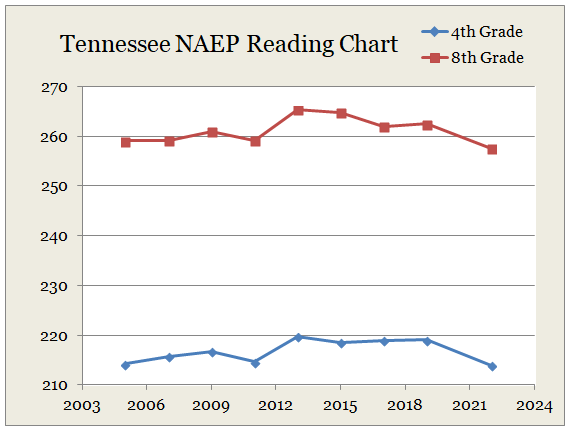
A shift to SoR-based curriculum is as likely to cause harm as it is to bring literacy success. This was just a used-car salesman style claim. On the other hand, the “abundance of success” in Tennessee is an unadulterated lie. National Assessment of Education Progress (NAEP) tracks testing over time and is respected for education testing integrity. Tennessee’s NAEP data shows no success “from their efforts.” Their reading scores since 2013 have been down, not a lot but do not demonstrate an “abundance of success”.

NAEP Data Plot 2005 to 2022

Amplify’s Genesis

Larry Berger and Greg Dunn founded Wireless Generation in 2000 to create the software for lessons presented on screens. Ten years later, they sold it to Rupert Murdoch and his News Corporation for $360 million. Berger pocketed $40 million and agreed to stay on as head of curriculum. Wireless Generation was rebranded Amplify and Joel Klein was hired to run it.

Murdoch proposed buying a million I-pads to deliver classroom instruction. However, the Apple operating system was not flexible enough to run the software. The android system developed at Google met their needs. They purchased the Taiwanese-made Asus Tablets, well regarded in the market place but not designed for the rigors of school use. Another issue was that Wireless Generation had not developed curriculum but Murdoch wanted to beat Pearson and Houghton Mifflin to the digital education market place … so they forged ahead.

In 2012, the corporate plan was rolling along until the wheels came off. In Guilford County, North Carolina, the school district won a Race to the Top grant of $30 million dollars which it used to experiment with digital learning. The district’s plan called for nearly 17,000 students in 20 middle schools to receive Amplify tablets. When a charger for one of the tablets overheated, the plan was halted. Only two months into the experiment, they found not only had a charger malfunctioned but another 175 chargers had issues and 1500 screens were kid-damaged.

This was the beginning of the end.

By August of 2015, News Corporation announced it was exiting the education business. The corporation took a $371 million dollar write-off. The next month, they announced selling Amplify to members of its staff. In the deal orchestrated by Joel Klein, who remained a board member, Larry Berger assumed leadership of the company.

Three months later, Reuters reported that the real buyer was Laurene Powell Jobs. She purchased Amplify through her LLC, the Emerson Collective. In typical Powell Jobs style, no information was available for how much of the company she would personally control.

Because Emerson Collective is an LLC, it can purchase private companies and is not required to make money details public. However, the Waverley Street Foundation, also known as the Emerson Collective Foundation, is a 501 C3 (EIN: 81-3242506) that must make money transactions public. Waverly Street received their tax exempt status November 9, 2016.

SoR A Sales Scam

The Amplify email gave me a link to two documents that were supposed to explain SoR: (Navigating the shift to evidence-based literacy instruction 6 takeaways from Amplify’s Science of Reading: The Symposium) and (Change Management Playbook Navigating and sustaining change when implementing a Science of Reading curriculum). Let’s call them Symposium and Navigating.

Navigating tells readers that it helps teachers move away from ineffective legacy practices and start making shifts to evidence-based practices. The claim that “legacy practices” are “ineffective” is not evidence-based. The other assertion that SoR is evidence-based has no peer-reviewed research backing it.

Sally Riordan is a Senior Research Fellow at the University College London. In Britain, they have many of the same issues with reading instruction. In her recent research, she noted:

“In 2023, however, researchers at the University of Warwick pointed out something that should have been obvious for some time but has been very much overlooked – that following the evidence is not resulting in the progress we might expect.

“A series of randomised controlled trials, including one looking at how to improve literacy through evidence, have suggested that schools that use methods based on research are not performing better than schools that do not.”

In Symposium, we see quotes from Kareem Weaver who co-founded Fulcrum in Oakland, California and is its executive director. Weaver also was managing director of the New School Venture Fund, where Powell Jobs served on the board. He works for mostly white billionaires to the detriment of his community. (Page 15)

Both Symposium and Navigating have the same quote, “Our friends at the Reading League say that instruction based on the Science of Reading ‘will elevate and transform every community, every nation, through the power of literacy.”’

Who is the Reading League and where did they come from?

Dr. Maria Murray is the founder and CEO of The Reading League. It seems to have been hatched at the University of Syracuse and State University of New York at Oswego by Murray and Professor Jorene Finn in 2017. That year, they took in $11,044 in contributions (EIN: 81-0820021) and in 2018, another $109,652. Then in 2019, their revenues jumped 20 times to $2,240,707!

Jorene Finn worked for Cambria Learning Group and was a LETRS facilitator at Lexia. That means the group had serious connections to the corporate SoR initiative before they began.

With Amplify’s multiple citations of The Reading League, I speculated that the source of that big money in 2019 might have been Powell Jobs. Her Waverly Street Foundation (AKA Emerson Collective Foundation) only shows one large donation of $95,000,000 in 2019. It went to the Silicon Valley Community Foundation (EIN: 20-5205488), a donor-directed dark money fund.

There is no way of following that $95 million.

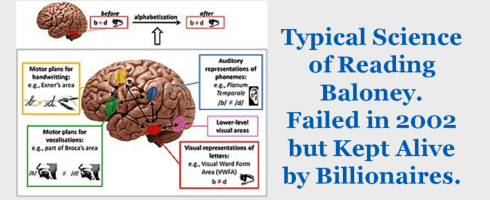
The Reading League Brain Scan Proving What?

Professor Paul Thomas of Furman University noted the League’s over-reliance on brain scans and shared:

Many researchers in neurobiology (e.g., Elliott et al., 2020; Hickok, 2014; Lyon, 2017) have voiced alarming concerns about the validity and preciseness of brain imaging techniques such as functional magnetic resonance imaging (fMRI) to detect reliable biomarkers in processes such as reading and in the diagnosis of other mental activity….

“And Mark Seidenberg, a key neuroscientist cited by the “science of reading” movement, offers a serious caution about the value of brain research: “Our concern is that although reading science is highly relevant to learning in the classroom setting, it does not yet speak to what to teach, when, how, and for whom at a level that is useful for teachers.”

“Beware The Reading League because it is an advocacy movement that is too often little more than cherry-picking, oversimplification, and a thin veneer for commercial interests in the teaching of reading.”

The push to implement SoR is a new way to sell what Amplify originally called “personalized learning.” This corporate movement conned legislators, many are co-conspirators, into passing laws forcing schools and teachers to use the SoR-related programs, equipment and testing.

SoR is about economic gain for its purveyors and not science based.

When politicians and corporations control education, children and America lose.

“The Right to Read” is Horse Manure

27 May

By Thomas Ultican 5/27/2023

The new 80-minute video “The Right to Read” was created in the spirit of “Waiting for Superman.” It uses false data interpretations to make phony claims about a non-existent reading crisis. Oakland’s NAACP 2nd Vice President Kareem Weaver narrates the film. Weaver is a full throated advocate for the Science of Reading (SoR) and has many connections with oligarch financed education agendas. The video which released February 11, 2023 was made by Jenny Mackenzie and produced by LeVar (Kunta Kinte) Burton.

Since 2007, Jenny Mackenzie has been the executive director of Jenny Mackenzie Films in Salt Lake City. Neither Mackenzie nor Burton has experience or training as educators. However, Burton did star on the PBS series Reading Rainbow.” He worked on the show as an actor not a teacher.

One of the first media interviews about “The Right to Read” appeared on KTVX channel 4 in Salt Lake City. Ben Heuston from the Waterford Institute answered questions about the new film and the supposed “reading crisis” in American public schools. Heuston who has a PhD in psychology from Brigham Young University claimed that two-thirds of primary grade students in America read below grade level. That is a lie. He is conflating proficiency in reading on the National Assessment of Education Performance (NAEP) with grade level and should know better.

Diane Ravitch who served for seven years on the National Assessment Governing Board explained NAEP rating levels,

“Proficient is akin to a solid A. In reading, the proportion who were proficient in fourth grade reading rose from 29% in 1992 to 34% in 2011.”

“Basic is akin to a B or C level performance. Good but not good enough.”

“And below basic is where we really need to worry.”

Peggy Carr, commissioner of the National Center for Education Statistics, which administers NAEP, has stated that the basic level is generally viewed as grade-level achievement.

“The Right to Read” was filmed in Oakland, California with some of it done in first-grade teacher Sabrina Causey’s classroom at Markham Elementary School. There have been many public showings scheduled around the country but strangely none in Oakland. Causey claims she was using a bad Oakland Unified School District (OUSD) reading curriculum until Kareem Weaver brought her a program based on the SoR. She adopted it without OUSD approval. The film claims “The results were astounding.”

The Chart was Clipped from “The Right to Read” Trailer

Selling SoR

LeVar Burton and Jenny Mackenzie made media rounds to promote “The Right to Read.” They were booked on major shows like CBS’s Good Morning America and on cable news.  US News conducted an interview sharing that Burton and Mackenzie spoke “about the film and what they are calling ‘the literacy crisis’ within the United States.”

In the interview, Mackenzie claimed, “We need to have policy that supports scientifically proven evidence-based curricula.” While Burton asserted,

“The balanced approach doesn’t work. Whole language doesn’t work.”

“We also have a sort of an old boys’ network that has been established, and there are companies that make millions of dollars a year publishing and selling to schools curricula that do not work.”

There are two obvious observations here. Number one is that neither Mackenzie nor Burton have any professional expertise in reading pedagogy. Number two, it is their team that is setting the stage for businesses to make “millions of dollars a year” selling phonics centric reading curricula.

The chart in the graphic above is the same lie Ben Heuston from the Waterford Institute told on KTVX. Heuston’s father Dustin founded the Waterford Institute in 1976 to develop computer based education. He was using the world’s first commercial computer with the Motorola 68000 chip. Today, the institute is selling the digitally based Waterford Upstart reading program.

Heuston and colleagues are making great money working at the nonprofit. The twenty-two employees listed in the 2021 form 990 tax document are averaging a yearly income of $225,571 (TIN: 51-0202349). Those are some big salaries out in Utah. Maybe that explains the lying to support SoR.

Ben has stepped down as Waterford CEO and Andy Meyer has assumed the role. Waterford reports that Andy’s background includes several leadership positions in sales and marketing before becoming COO for Pearson’s digital learning business unit and later Senior VP of Digital Product Development for Pearson’s U.S. K-12 curriculum division. More recently, Andy served as CEO at Scientific Learning and as CSO at Renaissance.

Kareem Weaver is a shameless promoter of anything oligarch funded. He is a Fellow at the Pahara Institute which was organized to train new privatization friendly education leaders. His bio there shares that he was a managing partner at the NewSchools Venture Fund and also executive director for the western region of New Leaders that received big financing from Walton, Broad, NewSchool Venture Fund and Gates. Weaver is also a member of the National Council on Teachers Quality.

Just this week Weaver was a featured presenter for a Reading Week edWebinar held by Lexia, a Cambium Learning Group company. They claim, “K12 educators and administrators will now have another opportunity to learn about aligning teaching practices with scientifically-researched methods.” Lexia is looking to cash in on SoR and Weaver is down in the muck slopping with them.

It is hard to imagine anyone being more sold out than Kareem Weaver.

Professionals Shake Their Heads in Frustration

Misinterpreting the data shown above is the basis for the specious crisis in reading claims. It is known that students develop at different rates and in the lower grades the differences can be dramatic. That explains some of the low scoring. All but a very small percentage of these fourth grader will be reading adequately when they get to high school.

America’s leading authorities on teaching reading are frustrated. Their voices are being drowned out by forces who want to monetize reading education and privatize it.

Peter Farruggio is a professor of bilingual education from the San Francisco Bay area and an organizer of anti-KLAN actions throughout California. Although his specialty was not teaching reading his experience with bilingual education and federal law caused him to work in the field. In our conversation, he explained to me how some of the data supporting high dose phonics instruction came about.

Farruggio observed that often when there were groups of students with reading disabilities, graduate students would take the opportunity to conduct a study. The treatment would be for the grad students to give intense phonics lessons. The children would learn to decode words including nonsense words from lists. Then they would be given a reading test on the lists. The students would successfully decode the words and the results would be pronounced successful but the children still could not read a sentence with comprehension.

Worst of all, Professor Farruggio fears this kind of teaching is undermining the ability to think.

Observations like this are wide spread among education professionals. This week Valerie Strauss put a piece in her Answer Sheet blog at the Washington Post written by three highly credentialed scholars dismayed by the oligarch financed nationwide push for SoR.

David Reinking, Professor of Education, Peter Smagorinsky, Professor of Language and Literacy Education, and David Yaden, Professor of Language Reading and Culture, state,

“As researchers and teacher educators, we, like many of our colleagues, shake our heads in resigned frustration. We believe phonics plays an important role in teaching children to read. But, we see no justifiable support for its overwhelming dominance within the current narrative, nor reason to regard phonics as a panacea for improving reading achievement.”

“Specifically, we do not see convincing evidence for a reading crisis, and certainly none that points to phonics as the single cause or a solution.”

“But crisis or not, is there evidence that more phonics instruction is the elixir guaranteed to induce higher reading achievement? The answer isn’t just no. There are decades of empirical evidence that it hasn’t and won’t.”

They point out that even the National Reading Panel report that all of this SoR malarkey is supposedly based on states, “Phonics should not become the dominant component in a reading program, neither in the amount of time devoted to it nor in the significance attached.”

This understanding is not new. The Reading First program during the George Bush years spent big dollars to study the use of intense phonics. Teachers were trained to deliver “scientific” reading instruction that included a numbing 1.5 to 3 hours of phonics instruction each day. The lead sentence in a 2008 Washington Post article stated, “Students enrolled in a $6 billion federal reading program that is at the heart of the No Child Left Behind law are not reading any better than those who don’t participate, according to a U.S. government report.”

Conclusion

Big money from billionaires is funding an effort to take control of primary education by selling the Science of Reading as a silver bullet. In the early 2000’s, schools were blamed for not fixing failing communities. The “proof” offered was students living in poverty stricken communities did not do well on standardized testing.

It put schools in a no win situation because the only strong correlation in standardized testing is with family income. Obviously, the broken communities were the problem not their schools. This subterfuge led to claims that reforming “failing schools” was the civil rights agenda of our time. Now “The Right to Read” is playing that same phony civil rights card. It is a contemptuous lie used to profit off the backs of the poor and people of color.

There is no reading crisis and the lionization of SoR is a push toward bad pedagogy. It is a sinister ploy that will harm each student and not just those living in poverty. There is currently a concerted effort to legislate SoR use in all primary classrooms which has either passed or is proposed in every state capital.

The Science of Profits and Propaganda

28 Dec

By Thomas Ultican 12/28/2022

The Orwellian labeled science of reading (SoR) is not based on sound science. It more accurately should be called “How to Use Anecdotes to Sell Reading Products.” In 1997, congress passed legislation calling for a reading study. From Jump Street, the establishment of the National Reading Panel (NRP) was a doomed effort. The panel was given limited time for the study (18 months) which was a massive undertaking conducted by twenty-one unpaid volunteers. The NRP fundamentally did a meta-analysis in five reading domains while ignoring 10 other important reading domains. In other words, they did not review everything and there was no new research. They simply searched for reading studies and averaged the results to give us “the science of reading.”

It has been said that “analysis is to meta-analysis as physics is to meta-physics.”

Setting up the Sale

Nancy Bailey is an expert in special education and early reading instruction. In a recent posting she shared,

“A troubling feature of the Science of Reading (SoR) is the connection between those who believe in the power of phonemes (and more) and those who want to privatize public schools. The old NCLB crowd has been rejuvenated and seems onboard with digital instruction replacing public schools and teachers.

“For example, former gov Jeb Bush has been crusading for the Science of Reading, praising Emily Hanford for her advocacy for the SoR, implying teachers haven’t understood how to teach reading.”

Also in the post by Bailey are links to about 30 companies who sponsored Bush’s reading summit. They are all looking to cash in on the SoR.

Professor Paul Thomas has a deep background in teaching and education research. He spent 20 years in high school English classrooms and another 20 years at Furman University teaching teachers. Thomas recently wrote,

“Those of us in literacy, specifically the field of reading, have been highlighting since 2018 that APM Reports (specifically the work of Emily Hanford) has been misrepresenting both the problems around reading achievement and how to teach reading.

“Hanford and APM Reports are ground zero for the deeply flawed “science of reading” (SoR) movement that now pervades mainstream media.”

Hanford’s status as a reporter at American Public Media (APM) makes her work very damaging. APM is a sister organization to the Public Broad Casting system which has a well earned reputation for being unbiased and accurate.

Hanford is not an expert in education or reading.  In 1994 she earned a BA in English from Amherst College and in 1996 she took a job as a reporter at Chicago’s public media station WBEZ. She has been in the public broadcasting system ever since.

Professor Thomas points out that Hanford’s reporting is biased toward SoR claims that she agrees with and ignores all other evidence. He states,

“As I have pointed out numerous times, there is a singular message to Hanford’s work; she has never covered research that contradicts that singular message.

“For example, not a peep about the major study out of England that found the country’s systematic phonics-first policy to be flawed, suggesting a balanced approach instead.

“And not a peep about schools having success with one of Hanford’s favorite reading programs to demonize.”

Hanford is a glaring symptom of the journalism plague that is infecting public education but hardly the only one. Dana Goldstein continues to write problematic articles for the New York Times. Her writing is also biased towards the privatization agenda as salve for reading education. Her degree from Brown University in European intellectual and cultural history does not make her an expert in education, none-the-less, she regularly gets many inches in the Times to pontificate about it.

Maren Aukerman is an education expert. Professor Aukerman is currently a Werklund Research Professor at the University of Calgary who focuses on literacy education and democratic citizenship. She previously served on the faculty at Stanford University and the University of Pennsylvania. Her recently published paper in the Literary Research Association focuses on the work of Goldstein, Hanford and others promoting the SoR movement. Aukerman outlined the fundamental message they’re selling,

“a) science has proved that there is just one way of teaching reading effectively to all kids – using a systematic, highly structured approach to teaching phonics;

“b) most teachers rely instead on an approach called balanced literacy, spurred on by shoddy teacher education programs;

“c) therefore, teachers incorporate very little phonics and encourage kids to guess at words;

“d) balanced literacy and teacher education are thus at fault for large numbers of children not learning to read well.

“The problem is not with recognizing that teaching phonics can play a facilitative role in having children learn to read; that insight is, indeed, important, if not particularly new. The problem is that this narrative distorts the picture to the point that readers are easily left with a highly inaccurate understanding of the so-called ‘science of reading.”’

Aukerman points to four fundamental flaws in their journalism: (1) Lack of Balance in Reporting , (2) Sensationalistic “Straw Man” Arguments, (3) A Myopic Lens Fetishizing Phonics Instruction and (4) Logical Fallacies. She gives examples for each of these claims. For example, a Logical Fallacy is not reporting research that shows students taught to read without systematic phonics “read more fluently.”

Mandating Dyslexia Testing and Structured Literacy

In January 2021, California State Senator Anthony Portantino a New Jersey transplant to the San Fernando Valley introduced SB237 which stipulates dyslexia testing for all students, kindergarten through third grade. The legislation also calls on local school districts to use “structured literacy instruction.” Although the bill was not adopted the concepts are still being actively pursued in Sacramento.

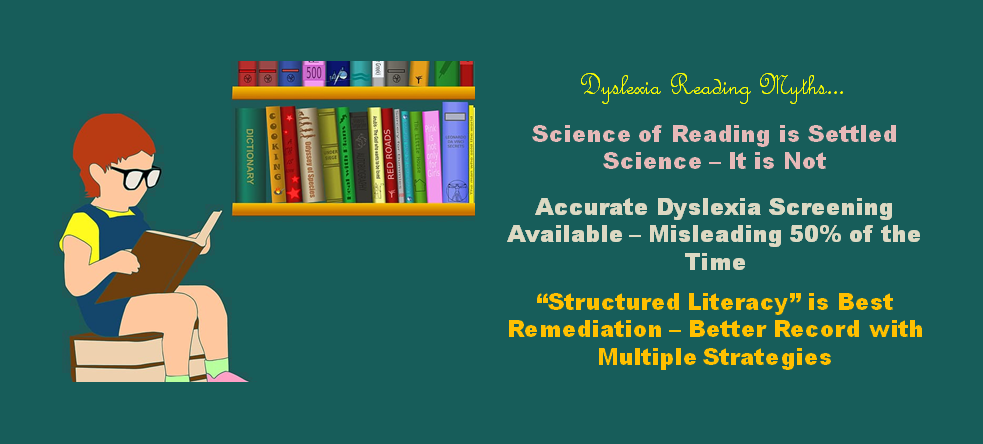
Today, forty states mandate dyslexia screening even though there is no consensus on how to define dyslexia. Some researchers even question its existence. Ball State University and University of Texas researchers have joined the chorus of scientists stating, “There are no universally employed measures or procedures for identifying dyslexia.” Commercially available tests misidentify both those that have a disability and those that don’t. Screening expert Dr. Amanda M. Vanderheyden reported that tools like The Shaywitz Dyslexia Screen have error rates of more than 50%. Vanderheyden also stated, “Readers may be surprised to learn that there is not a direct positive relationship between screening assessments and improved reading outcomes.”

Professor Rachael Gabriel makes this important observation about the screening tool Dynamic Indicators of Basic Early Literacy Skills (DIBELS), “Just like a 20-minute consult with a doctor is always better than health advice from an online calculator, a one-on-one conference with a teacher or reading specialist will always be better than DIBELS at diagnosing and understanding reading difficulty, ability and progress.”

Politicians in a growing number of states are mandating “structured literacy.” It is a systematic phonics approach to reading instruction based on the 1930s theories of Anna Gillingham and Samuel Orton. The advantage of this approach is that it can be easily packaged into commercial products. Both the Department of Education’s clearing house and the International Literacy Association state that this approach is not supported by research.

The Cynical Use of Dyslexia

In their studies, the research teams from Ball State University and the University of Texas noticed that an intricately linked closed circle of organizations are driving dyslexia discourse. The International Dyslexia Association (IDA), the Academic Language Therapy Association (ALTA), the International Multisensory Language Education Council (IMSLEC) and Decoding Dyslexia (DD) are the major players. The study states,

“… IMSLEC started as an IDA committee, and ALTA certifies dyslexia specialists in the multisensory language approach, which in turn is consistent with IDA’s standards for educator preparation in reading (Knowledge and Practice Standards, n.d.). The IDA began certifying teachers in 2016, in addition to accrediting dyslexia teacher training programs.”

DD has parent chapters in every state in the union and they all employ the same language from IMSLEC and IDA in their lobbying materials and mission statements. DD’s parent chapters are able to drive many people out to legislative hearings to testify on behalf of structured literacy programs and commercial dyslexia testing.

Associate Professor of Literacy Education at the University of Connecticut Rachael Gabriel has been studying parent engagement with reading issues. In her report, she shares several extracts from the oral and written testimonies given at various legislative sessions on special education. The testimonies are often emotionally delivered anecdotes that support the privatization agenda. In this typical statement, a student claims,

“I have dyslexia. Reading and math are really hard for me. I’ve had too many teachers that don’t understand how to teach me. Finally, this year I went to Lindamood Bell training and reading is getting easier.”

In her paper, Professor Gabriel also noted how parents are told that the public school teachers do not know how to teach reading especially to students with dyslexia. They are informed that dyslexia is often associated with other giftedness, a claim with no evidence other than anecdotal undocumented claims about Einstein and other famous people who are said to have been dyslexic. Those testifying regularly call for the five point DD agenda:

  1. “A universal definition and understanding of ‘dyslexia’ in the state education code.
  2. Mandatory teacher training on dyslexia, its warning signs and appropriate intervention strategies.
  3. Mandatory early screening tests for dyslexia.
  4. Mandatory dyslexia remediation programs, which can be accessed by both general and special education populations.
  5. Access to appropriate ‘assistive technologies’ in the public school setting for students with dyslexia.”

Some of what DD is calling for has been standard practice addressed in teacher education programs for decades. Some of it looks like a call to sell technology which often is worse than useless. Unfortunately, the screening tests will misidentify and harm many students. The call for a universal definition of dyslexia by political edict in education code is anti-science and bizarre.

Conclusions

The SoR movement is another example of oligarch spending diminishing professionalism in education. The combination of arrogance and too much money in a few hands is a disaster. The people who were on the NRP were dedicated professionals and the last thing they wanted was to harm reading education yet their report is being used for just that purpose.

It is probably true that many students with issues learning to read are not being well served, but turning to products from private companies to save the day is a mistake. School districts in most of the nation are starved for cash and administrators look for any way to cut spending. This is the root of the poor service for struggling students.

The answer is to drive more money into early education and insure that teachers are provided with extensive training in reading education. It should be the purview of these trained professionals to screen their students one-on-one for learning problems. Once those evaluations are made, the school staff should be charged with deciding on the appropriate response.

Stop the incessant neoliberal agenda of monetizing everything.

Shady Dyslexia Agenda Accelerating

28 Oct

By Thomas Ultican 10/28/2021

An intricately connected network of organizations is controlling dyslexia discourse in the US and taking over dyslexia screening and remediation. Thirty-nine states now have adopted dyslexia laws. Most of these laws contain the International Dyslexia association’s (IDA) remediation recommendation of being “multisensory, systematic, and structured.” Researchers Jo Worthy et al state, “This approach is not well supported by research, but it is officially sanctioned through legislation in many states and has had a profound effect on policy and practice.”

IDA, the Academic Language Therapy Association (ALTA), and the International Multisensory Language Education Council (IMSLEC) are three big players. IMSLEC started as an IDA committee, and ALTA certifies dyslexia specialists in the multisensory language approach, which is consistent with IDA’s Knowledge and Practice standards for educators. IDA began certifying teachers in 2016, in addition to accrediting dyslexia teacher training programs. The websites of these organizations link to each other and to Decoding Dyslexia, a network of parent organizations with chapters in every state. The mission statements and lobbying materials used by all Decoding Dyslexia sites employ language from IMSLEC and IDA.

Using Parents and Students

Rachael Gabriel is Associate Professor of Literacy Education at the University of Connecticut. When large numbers of people showed up at legislative hearings in Connecticut, she became interested in their unusual engagement and strangely similar comments. Gabriel used critical discursive psychology, positioning theory, and narrative policy analysis to analyze the dyslexia law advocacy. She says, “I argue that this narrative can be understood as a conversion narrative, which drives a privatization agenda in which public schools become mandated consumers for a growing dyslexia industry, and in which the nature of instruction for students with reading difficulties is narrowly prescribed.”

Gabriel shares several extracts from the oral and written testimonies given at the legislative session on special education. The first extract is from a student who introduced himself as a 10-year-old who was “here to speak in support of Bill RHB 5562, An Act Concerning Special Education to get dyslexia recognized in the State of Connecticut.”

“I have dyslexia. Reading and math are really hard for me. I’ve had too many teachers that don’t understand how to teach me. Finally, this year I went to Lindamood Bell training and reading is getting easier.”

This is a typical message indicating public school teachers do not know how to teach students with dyslexia but finally he was saved. Interestingly the private company Lindamood Bell’s training credited with making it possible for him to read is not one of several private companies that qualify as IDA certified reading specialists. In fact they report that many of their clients have previously been failed by a certified company. The certified companies all use some version of the 1930’s Orton-Gillingham method whose phonics centered practice IDA calls “structured literacy.”

An important psychological motivator for parents of children struggling with learning to read is the repeated claim that dyslexia is a brain centered condition often associated with giftedness. Statements similar to the following extract from a written comment are common.

“This is a disability worth our investment of time It is the disability of Speilberg [sic], Einstein, and Steve Jobs . . . Honor us and embrace us. We are continually the great minds of every generation. We are the ‘game changers.’”

The idea that dyslexia is associated with other kinds of giftedness is a wives tale. Johnston and Scanlon from the University at Albany wrote in their 2020 research paper,

“Public narratives about dyslexia commonly claim that people classified as dyslexic have an array of special positive attributes such as intelligence or creativity – more so than those not so classified. There is virtually no scientific evidence for these claims.”

Although the parent organization Decoding Dyslexia (DD) does not have a centralized leadership, each of the state organizations shares information from DD and IDA. They uniformly call for:

  1. “A universal definition and understanding of “dyslexia” in the state education code.
  2. Mandatory teacher training on dyslexia, its warning signs and appropriate intervention strategies.
  3. Mandatory early screening tests for dyslexia.
  4. Mandatory dyslexia remediation programs, which can be accessed by both general and special education populations.
  5. Access to appropriate “assistive technologies” in the public school setting for students with dyslexia.”

Parents with babies who struggle with reading are vulnerable to manipulation. The widely distributed message that dyslexia is a sign of high intelligence must be appealing. These parents are informed that their public school teachers do not know how to teach dyslexics. They are assured that private companies certified by IDA can accurately screen for dyslexia and provide the kind of “structured literacy” that saves children from academic disaster. The result is that whenever laws instituting the Decoding Dyslexia agenda are proposed large numbers of parents show up in support.

What is Dyslexia? What are the Myths?

The idea of dyslexia has been around for more than 100-years, but there is still no widely agreed upon definition. That means there is no consensus method for screening for dyslexia. Johnston and Scanlon reported in 2020,

“The bottom line is that there are many definitions of, and theories about, dyslexia and simply no agreed-upon definition that allows schools, clinicians, researchers, or anyone else, to decide who is dyslexic in any valid or reliable way.

From an instructional standpoint, there is no practical distinction between those classified as dyslexic and others at the low end of the normal distribution of word reading ability in the early elementary grades.”

Variations of this statement are quite widely available. A 2020 article in Reading Research Quarterly by J. G. Elliot states,

“I argue in this article that despite a proliferation of scientific findings, our understanding of dyslexia is marked by serious weaknesses of conceptualization, definition, and operationalization that not only are unscientific but also lead to impoverished practice in schools, social inequity in understanding and provision for many struggling readers, and reduced life chances for millions of students worldwide.”

IDA and DD promote mandatory early screening for dyslexia but the commercially available tools they promote are not up to the task. A 2017 article by Vanderheyden et al noted,

“In education, it is not uncommon for error rates to range from 50%–60%, meaning if a school assesses 100 children for whom 20 are “true positives” (i.e., truly have dyslexia), then most of the 20 (approximately 16–18) will be identified, but 50 to 60 students will be identified as false positive errors in the process.”

IDA bases its recommendations for reading remediation on the “science of reading” (SOR). In 2000, the National Reading Panel report claimed that its recommended phonics based word decoding methods were based on science. This kicked off a phenomenon often referred to as the “Reading Wars.” In 2004, David Pearson from UC Berkley’s Graduate School of education commented about the raging war,

“For example, several scholars, in documenting the practices of highly effective, highly regarded teachers, found that these exemplary teachers employed a wide array of practices, some of which appear decidedly whole language in character (e.g., process writing, literature groups, and contextualized skills practice) and some of which appear remarkably skills oriented (explicit phonics lessons, sight word practice, and comprehension strategy instruction). Exemplary teachers appear to find an easier path to balance than either scholars or policy pundits.”

In other words, SOR is definitely not settled science. Which means the IDA’s “structured literacy” is not a consensus driven approach.

In 2016, the International Literacy Association asserted,

“Both  informal  and  professional  discussions  about  dyslexia   often   reflect   emotional,   conceptual,   and   economic   commitments,   and   they   are   often   not   well   informed by research. Our beliefs and practices should be  grounded  by  what  emerges  from  the  available  evidence  (Elliott  &  Grigorenko,  2014;  Vellutino,  1979;  Washburn,  Joshi,  & Binks-Cantrell, 2011)

As  yet,  there  is  no  certifiably  best  method  for  teaching  children  who  experience  reading  difficulty  (Mathes  et  al.,  2005).  For  instance,  research  does  not  support  the  common  belief  that   Orton-Gillingham–based   approaches   are   necessary   for   students classified as dyslexic.”

IDA and the research papers cited here claim that as much as 20% of kindergarten and first grade students have reading issues. However, if their school has a professional intervention approach – that could be any of the interventions discussed here – by the time students reach high school less that 2% still have reading issues. Is it possible that the high number of students with reading difficulties in America is because reading is taught at a developmentally inappropriate age? On international testing Finish students test extremely well in reading and they don’t formally teach reading there until age 7.

Conclusion

The IDA organization has many professionals in reading education and the point here is not that they are wrong about screening and intervention pedagogy. The point is that the agenda they are promoting is far from settled science. They should continue to promote their beliefs but they need to stop using a legal strategy backed by power politics to force schools into becoming mandated consumers.

America’s public schools are staffed with an enormous number of well trained and experienced reading instructors. Denigrating them is not justified and is bad for reading education.

The International Dyslexia Association and Decoding Dyslexia are no longer advocates for students and parents. They have become predators using legal strategies and political power to feed an expanding dyslexia industry.

Dyslexia Industry Scores California Court Victory

4 Aug

By Thomas Ultican 8/4/2021

In a court settlement, Berkeley Unified School District (BUSD) agreed to implement inappropriate dyslexia remedies. The Disability Rights Education & Defense Fund (DREDF) claimed the district failed to identify students with reading disorders, including dyslexia, and did not provide them adequate services. To end the litigation begun in 2016, district leaders agreed to implement a universal screening program for reading disorders and adopt new reading intervention programs. BUSD also agreed to hire a nationally recognized outside consultants. District representatives disagreed with the charges but said the legal fight was becoming too expensive.

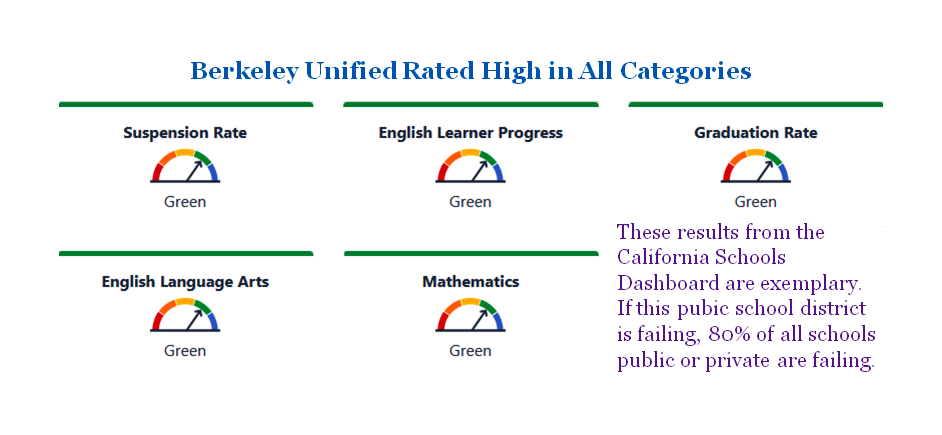
DREDF lawyers paint BUSD as a failing school system that makes no effort to identify students with learning disorders. They point out that only 70% of BUSD students are rated as proficient in reading by third grade. The lawyers cite the California School Dashboard’s 2017 data as evidence. However, the Dashboard which is a color coded evaluation of school performance shows BUSD performing at a high level.

From the 2017 California School Dashboard

Four students labeled A, B, C and D along with their parents or guardians are listed as plaintiffs. The DREDF filing states,

“When Student A started first grade, she was immediately placed in a Leveled Literacy Intervention (‘LLI’), a general reading intervention, since her reading abilities were significantly below her peers.  Student A’s teachers reported that she made some progress in LLI, but she continued to show emotional distress and displayed reading avoidant behaviors at home.”

The following year at age-7, student-A received average composite scores on several standardized tests and was put back in regular reading. Based on these results, the district turned down a special education declaration for the student.  DREDF lawyers claim that the “scores were too discrepant to calculate Student A’s processing speed and working memory …” In other words, they disagreed with the testing used.

Student-B came to BUSD in kindergarten. Within a few weeks, teachers recommended that his parents have a medical evaluation done. Later, his parents tried to home-school him and when that did not work out; they put him in a charter school. He was soon kicked out of the charter school and at age-6 he was back in BUSD. The school gave him a special education designation for ADHD. He was given a one-on-one tutor under the supervision of a special education teacher. DREDF found this inadequate because the tutor was not a trained special education teacher.

Student-B’s behavior deteriorated to the point of being suspended. BUSD placed him in a private school, Catalyst, which specialized in behavioral problems.  Catalyst gave up on student-B. In 2016 student-B was given a new medication for ADHD and his improved behavior allowed him to function in a regular classroom setting. DREDF claimed the district did not do enough.

Student-C was a ninth grader in 2015 when he transferred into BUSD from a private school. An independent evaluator had diagnosed him with dyslexia. BUSD concurred with the diagnosis and made a special education declaration. Student-C was given a 55-minute support class once a day, adaptive technology lessons 5-times a year and a weekly 15-minute meeting with his case manager. The student’s parents felt that he needed more and paid for some sort of private support services.

Student-D also came into ninth grade from a private school. During 3rd grade, the private school evaluated her as having reading difficulties. She was given several accommodations including extra time on tests. Student-D transferred in with all A’s and B’s on her report cards. Because she had such good grades BUSD determined that she did not qualify for special education services. Her grades remained high but she did poorly on the PSAT for which she was given no accommodations. Student-D was eventually given a 504 designation in time for her to take the SAT with accommodations. Her parents also paid for private support services.

Selling the Science of Reading

While it is true that experts estimate between 5 and 20 percent of all students have difficulties learning to read, this lawsuit is just another skirmish in the “science of reading” war. The dyslexia industry has adopted the position that phonics instruction is the only way to address reading difficulties. Further, they dismiss the expertise of school districts and teachers and strongly suggest only private companies have the elite expertise required to provide products that are capable of identifying and solving reading issues.

Professor Jim Horn has written extensively about the “science of reading” conflict and the bias of the National Reading Panel toward Alphabetics (phonemic awareness and phonics). In his 2003 review of Gerald Coles’ book Reading the Naked Truth: Literacy, Legislation, and Lies Horn shared,

“Coles concludes that the Panel’s ‘antipathy of anything that veers away from direct instruction model’ (p. 110) led them to the bizarre conclusion that there is not sustainable evidence, i.e, causal findings, to support the notion that children become better readers by reading and discussing books or by having encouragement and time provided to read books.”

In 2020, scholars at the National Education Policy Center addressed the still raging reading debate. They warned against, “Misrepresenting the ‘science of reading’ as settled science that purportedly prescribes systematic intensive phonics for all students.” And they stated that policy makers, “Should support the professionalism of K-12 teachers and teacher educators, and should acknowledge the teacher as the reading expert in the care of unique populations of students.” They also assert that David Pearson’s statement in a 2004 paper still rings true:

“For example, several scholars, in documenting the practices of highly effective, highly regarded teachers, found that these exemplary teachers employed a wide array of practices, some of which appear decidedly whole language in character (e.g., process writing, literature groups, and contextualized skills practice) and some of which appear remarkably skills oriented (explicit phonics lessons, sight word practice, and comprehension strategy instruction). Exemplary teachers appear to find an easier path to balance than either scholars or policy pundits.”

Inappropriate Solutions

The International Dyslexia Association and Decoding Dyslexia have been very successful at tapping into the emotions of parents over the issue of dyslexia. They routinely turn out hundreds of passionate people to legislative hearings trumpeting the dyslexia industry’s message which is to turn the problem over to private companies. In this linked video, Professor Rachael Gabriel discusses her research into how this consistent message has been created and delivered. It is a relatively new phenomenon with a large spate of dyslexia bills appearing in almost every state. 

To end the lawsuit, BUSD has agreed to test all students in kindergarten through 2nd grade with a DIBELS standardized assessment twice a year. The Berkeleyside reports, “For students in need of interventions, the district will implement Wilson Reading Systems or Slingerland, both of which are in line with standards set by the International Dyslexia Association.”

DIBELS, or Dynamic Indicators of Basic Early Literacy Skills, is a set of procedures and measures developed at the University of Oregon for assessing literacy development in students from kindergarten through sixth grade. Many educators and scholars loudly detest DIBELS. David Pearson wrote,

“I have decided to join that group of scholars and teachers and parents who are convinced that DIBELS is the worst thing to happen to the teaching of reading since the development of flash cards.

“I take this extreme position for a single reason—DIBELS shapes instruction in ways that are bad for students (they end up engaging in curricular activities that do not promote their progress as readers) and bad for teachers (it requires them to judge student progress and shape instruction based on criteria that are not consistent with our best knowledge about the nature of reading development).”

There are many more claims like this.

Both Slingerland and Wilson Reading Systems are based on the Orton-Gillingham approach. It was developmed in the 1930s and focused on phonics and sound decoding schemes. The International Literacy Association stated in 2016,

“As  yet,  there  is  no  certifiably  best  method  for  teaching  children  who  experience  reading  difficulty  (Mathes  et  al.,  2005).  For  instance,  research  does  not  support  the  common  belief that Orton-Gillingham–based approaches are necessary for students classified as dyslexic (Ritchey & Goeke, 2007; Turner, 2008;  Vaughn  &  Linan-Thompson,  2003).  Reviews  of  research  focusing  solely  on  decoding  interventions  have  shown  either  small  to  moderate  or  variable  effects  that  rarely  persist  over  time,  and  little  to  no  effects  on  more  global  reading  skills.” 

The US Department of Education established the What Works Clearing House which tried to establish a fair conclusion about education issues based on existing peer reviewed research. The three programs being replaced at BUSD, Read 180, LLI and Reading Recovery were evaluated as having positive results. Even though the Orton-Gillingham method has been around since the 1930’s there was not enough evidence to show a positive effect.

DREDF is not only the law firm that brought this case but they also are one of the organizations who officially supported SB237. This proposed state law mandates changes like those that DREDF was able to achieve in the law suit. Maybe DIBELS is not so bad and maybe the Orton-Gillingham approach is helpful for some students, but making these approaches a legal requirement is not rational. Trust education professionals and public schools over lawyers and private enterprise.

The U.S. District Court for the Northern District of California will hold a hearing for the case Nov. 4 to finalize the settlement.