Tag Archives: reform

The Education Method and Organization

24 Feb

By Thomas Ultican 2/24/2017

It was wonderful that day I met Larry Lawrence at a Chicago Hotel frequented by Al Capone (The Drake Hotel). We were in Chicago for the National Public Education conference. I soon discovered two things: Larry only lives thirty miles up the beach from me in San Diego, County and he knows a lot about education. Larry participated in some of the key developments in the history of education methodology. Saturday, we met for lunch and I am still over-stimulated.

This is the third time we have met at the Ki Restaurant in Cardiff overlooking the Pacific Ocean. All three times, Larry has come prepared with notes including an informal agenda. This time, I was pleased that he wanted to begin by talking about a proposed fundamental reorganization of school which decentralizes power and democratizes operations. I had made such a proposal in my latest article which Larry had read. This fit well with his thinking that was influenced among other things by his time at UCLA’s lab school working with John Goodlad and Madelyn Hunter.

The Math Wars

Dr. Lawrence’s professional experience began with “new math.” 1956 was Larry’s third year at Occidental. He had finished the advance Calculus course and decided to register for a class called “Modern Algebra.” After his first day in class, he started studying the class materials and came across a concept he had never seen before, “one to one correspondence”. That concept is now considered an essential understanding for preschool aged children but in 1956 he searched fruitlessly throughout his dorm for anyone who knew what it meant.

Larry spoke about the experience,

“This illustrates the absolute mechanical nature of my math education to that point. This is something I have carried with me throughout my teaching career. How even the concepts that we might consider simple, may have no meaning for our students when they have no context for understanding.”

In 1958, Larry moved on to Teacher College, Columbia University to study math education under the tutelage of Professor Howard Fehr. An obituary in the New York Times said of Professor Fehr:

“Dr. Howard F. Fehr, professor emeritus of mathematics education at Columbia University Teachers College and a founder of new math in the 1960’s, died yesterday at his home in Manhattan after a long illness. He was 80 years old.

“Dr. Fehr, who retired from teaching in 1967 but continued in educational work, was a prolific author and an internationally known educator whose textbooks were used around the world. As the principal author in 1961 of a 246-page report titled ‘New Thinking in School Mathematics,’ Dr. Fehr helped introduce into American classrooms a concept of study and teaching that departed radically from traditional methods.”

Larry recalls Dr. Fehr’s class, “His ‘basic’ course laid out the fundamentals of the ‘new math’ – number systems, characteristics of a field, relations, functions, etc.”

After Teachers College (1959), Larry returned to his old high school, Morningside High in Inglewood, where he created one of the first high school calculus courses in California. In the summers of 1962 and 63, he attended a six weeks training course at the University of Illinois which was a program on how to use the math materials developed by Max Beberman and Herbert Vaugh.

Ralph A. Raimi states that “Max Beberman is generally regarded as the father of the New Math, his teaching and his curriculum project having achieved nationwide fame long before the 1957 Sputnik raised mathematics education to the level of a national priority.” Raimi also reports, “His thesis director at Columbia was Howard Fehr, famous then and later as an authority on the teaching of school mathematics, and a man who directed the PhD theses of many future professors of mathematics education.”

One of the problems for “new math” was it was often rushed into schools before materials were properly vetted or teachers were properly trained. The Stanford Mathematical Study Group (SMSG) under the direction of Edward G. Begle started producing curricular materials in 1958. Unfortunately this SMSG material became derided as “some math some garbage.”

“New math” also gets conflated with the progressive pedagogy. According to E. D. Hirsch, William Heard Kilpatrick was “the most influential introducer of progressive ideas into American schools of education.” (The Schools We Need: Why We Don’t Have Them, Double Day, 1996)

David R. Klein wrote A Brief History of American K-12 Mathematics Education in the 20th Century for Math Cognition. In it he wrote of Kilpatrick’s contribution to the math wars,

“Reflecting mainstream views of progressive education, Kilpatrick rejected the notion that the study of mathematics contributed to mental discipline. His view was that subjects should be taught to students based on their direct practical value, or if students independently wanted to learn those subjects. This point of view toward education comported well with the pedagogical methods endorsed by progressive education. Limiting education primarily to utilitarian skills sharply limited academic content, and this helped to justify the slow pace of student centered, discovery learning; the centerpiece of progressivism. Kilpatrick proposed that the study of algebra and geometry in high school be discontinued ‘except as an intellectual luxury.’”

Klein added,

“Meanwhile in 1920, the National Council of Teachers of Mathematics (NCTM) was founded, largely at the instigation of the MAA [Math Association of America]. The first NCTM president, C. M. Austin, made it clear that the organization would “keep the values and interests of mathematics before the educational world” and he urged that ‘curriculum studies and reforms and adjustments come from the teachers of mathematics rather than from the educational reformers.’”

The math wars were thus engaged in the early twentieth century. By the dawn of the 21st century it appeared that the NCTM ideology had won the battle. Teaching math became based on teaching a set of discrete skills. However, today, much of the Common Core math teaching philosophy appears aligned with the progressive ideas of Dewey and Kilpatrick. Common Core also embraces the principles espoused by the proponents of “new math.” The “new math” was not really aligned with either side in the math wars but was more about teaching a cognitive understanding or foundation for learning mathematics and developing teaching methods.

Concerning the “new math,” Larry notes, “While it was a struggle for most teachers in the early years, the concepts have become part of the math curriculum of today.”

The influences on Professor Lawrence (Goodlad, Hunter, Fehr, Beberman, etc.) were experienced classroom teachers, developers of pedagogy and leaders in university teachers’ education departments. They were all exactly the kind of people that founders of the no-excuses charter school chains like John King, Doug Lemov, Mike Feinberg, Dave Levin and others disregarded. Instead, they turned to the economist Erik Hanushek for their guidance on good pedagogy.

Organizing Schools

In my article “Education Reform Musing” I proposed a democratized approach to school organization. Instead of a centralizing power in a principle, I advocated elevating the position of department head to lead circular development and establishing committees comprised of administrators, teachers, parents and students to set policies and resolve disputes. Larry was intrigued by this idea and wanted to discuss how it might fit into the structure that John Goodlad had introduced.

In 1959, the year before he became director of the lab school at UCLA, Goodlad wrote The Non-graded Elementary School. Amy Diniz of the University of Toronto comments:

“In the Non Graded Elementary School, Goodlad argued that the rigid graded education system is not designed to accommodate the realities of child development, including children’s abilities to develop skills at different rates to different levels. (Goodlad, 1963) Goodlad suggests that one limiting assumption embedded in the graded school structure is that children’s achievement patterns in different areas of study are going to be the same. However, in reality, most children progress quickly in certain subject areas while struggling in others. As Goodlad’s research demonstrates, it is very common to have a child in grade two have literacy skills of a grade three but math skills of a grade two. With a graded structure that assumes that a child will progress through each area of study at the same pace, a child is given no freedom to develop at the pace that is optimal for his/her needs.

“A second assumption in a graded system is that all students will learn the necessary skills within a year and then be ready to progress to the next predetermined level. In graded systems, students are all placed on an identical learning cycle with no room for diversity of learning patterns. (Kidd, 1973) Goodlad recognizes that under the graded system, the only options teachers have to adjust for students’ different learning capacities and rates are to either promote or hold back a student. However, there is ample evidence to suggest that both early promotion and non-promotion of a student are not strategies conducive for learning and development (Goodlad, 1963).”

I have taught remedial algebra at the high school level and have personally observed students learning math skills and concepts. Unfortunately, they were not learning fast enough to meet the state imposed standards, so, I was forced to give them failing grades. Worse than the graded system is the standardized system. Instead of meeting students where they are, we harm them because the standards do not match their cognitive development. School in America has long been a sorting system that separates the winners from the losers based on a meritocracy with elements of classism and racism coloring the decisions. Even if it were not flawed, the false perception that students achieve the same mental development at the same age convinces many students that they are not as valuable as others.

At lunch Professor Lawrence sketched out a possible alternative. Instead of age 5 kindergarten, age 6 first grade, age 7 second grade and so on, he postulated the possibility of leaning cohorts.

Cohort 1 for ages 5 to 8

Cohort 2 for ages 7 to 10

Cohort 3 for ages 9 to 12

Cohort 4 for ages 11 to 14

Cohort 5 for ages 13 to 16

Cohort 6 for ages 15 to 18

The overlapping age grouping is on purpose to allow teachers flexibility in moving students to new cohorts. The Diniz article describes Goodlad’s vision for this new structure:

“Two elements of Goodlad’s non-graded system include a longitudinal concept of curriculum and planned flexibility in grouping. Firstly, curriculum is centered on continual and sequential learning, with behavior and content running vertically through the curriculum (Goodlad, 1963). Longitudinal learning emphasizes that all skills learned are in fact base components of more complex skills to be learned in the future (Goodlad, 1963). Secondly, grouping is organized around achievement groups, interest groups, work-study groups or a combination of the three with some groupings being heterogeneous in skills (social sciences) and other groups being homogeneous in skill levels (reading).”

Developing a practical method for implementing Goodlab’s ideas was professor Lawrence’s job when in 1966 he joined the UCLA lab school which came under the purview of the UCLA Graduate School of Education. Lawrence says, “My task was to work within my team of teachers to develop a math program that would address the needs of our multiage, team-teaching organization. For the next few years, I explored a wide variety of programs that included SMSG materials and several others that began to be published in the late 60’s and early 70’s.”

John Goodlab was at the University of California, Los Angeles (UCLA) from 1960-1983, where he served as director of the Laboratory School and as dean of the Graduate School of Education (ranked first in America the last seven years of his tenure).

It is unfortunate that education reform became the domain of unqualified billionaires with no pedagogical understanding. It is time to take back our public school system. It is time to reengage with professionals. Privatizing public education is related to greed and foolishness. No excuse charters are related to abuse, segregation and arrogance. People who reject professionals for their own uninformed views are a menace to society. Let us build on the work of professionals like John Goodlab, Madilyn Hunter, Howard Fehr, Max Beberman and Larry Lawrence.
Rizga’s Mission High Informs

26 Jan

By Thomas Ultican 1/26/2017

What is authentic quality education? Reading books by teachers like John Thompson and Ciedie Aechs provides significant insight as they take us inside their schools. Kristina Rizga, a journalist who was imbedded within San Francisco’s Mission High, makes another wonderful contribution to this understanding. For four years, she sat in classes, interviewed students, teachers and administrators. At the same time she studied the pedagogical process with the guidance of friends like Larry Cuban. Her book, Mission High, significantly contributes to the comprehension of sound education.

Solutions for Fixing Schools Are Wrong

In the book’s preface, she declares, “The more time I spent in classrooms, the more I began to realize that most remedies that politicians and education reform experts were promoting as solutions for fixing schools were wrong.” For multiple decades, classroom teachers have been awakening to that same realization. This time it was an outsider who spent enough time to see how misguided test and punish education policies are; to see how misguided standardized approaches to education are.

Echoing Rizga’s point, The National Education Policy Center recently published a tome entitled, Learning from the Federal Market-Based Reforms. This following statement is in the introduction.

“Despite this legislative commitment to public schools, our lawmakers have largely eroded ESEA’s [Elementary and Secondary Education Act of 1965] original intent. Moving from assistance to ever increasing regulation, states gravitated toward test-based reforms in the minimum basic skills movement in the 1970s. A watershed event occurred in 1983 with the report, A Nation at Risk, which was predicated on international economic competitiveness and rankings on test scores. The report was succeeded by Goals 2000, the first federal Act to require states to develop standards-based test goals and measure progress toward them. The stringent and reductionist No Child Left Behind (NCLB) Act of 2001 then followed on its heels. At each step, our educational policies became more test-based, top-down, prescriptive, narrow and punitive, and federal support to build the most struggling schools’ capacity for improvement faded.”

In the author’s notes, Kristina reveals what being imbedded meant, how she worked and the kind of relationships she developed.

“In 2010 I started sitting in on the classrooms of Robert Roth, the first teacher I picked, observing him and his interactions with students. I spent about two years coming regularly to Roth’s classes, sometimes going to every class for weeks. Then I spent one year, on and off, in Hsu’s class and about six months, on and off, in McKamey’s and Anders’s classes. The classes were so intellectually engaging – more than most of the courses I took as an undergrad at UC Berkeley – that I often had to remind myself that I’m not a student. I also spent a great deal of time in at least thirty other classrooms at Mission and other schools, observing various teachers and different pedagogical approaches.”

Conquest by “Administrative Progressives”

Rizga’s book tells the story of four students, three teachers and the principal, Eric Guthertz. Interspersed within these individual stories are pedagogical analysis, observed outcomes and research citations.

Alfie Kohn quoted the education historian, Ellen Lagemann, in his book The Schools Our Children Deserve, “One cannot understand the history of education in the United States during the twentieth century unless one realizes the Edward K. Thorndike won and John Dewey lost.”

Rizga makes a similar point. She defines two groups of progressive reformers,

“Most historians identify two major strands in the Progressive education movement: ‘Administrative Progressives,’ who focused on the top-down organizational reforms to create ‘efficient’ schools to produce productive workers, and ‘Child-centered Progressives,’ who prioritized transforming learning and teaching at the classroom level to make schools more intellectually and emotionally engaging for students.”

In 1904, the famous “Child-centered Progressive,” John Dewey, left the Chicago Laboratory School. He was replaced by “Administrative Progressive,” Charles Judd. It was symbolic; Dewey was out and “Administrative Progressives” were in.

Today, we might say that educators are out and the Democrats for Education Reform are in. Billionaires’ opinions about how to do school swamp professional research. Community schools are no longer the purview of elected school board. Today’s school boards are being reduced to nothing more than vessels required to carry out federal and state mandates.

Misguided and Racist Reform

Rizga posits that in order to “scientifically” sort students into tracked systems, a reform that is still with us today, was instituted: IQ testing and standardized achievement tests. She shares the dark history of their inception:

“As author Anya Kamenetz eloquently documents, some of the creators of these early tests were racists, driven by ideology about the roots of inequality more than science, and were using these tests as ‘scientific’ tools to argue that intelligence and merit were fixed, genetically inherited qualities. One of the creators of the IQ tests, Lewis Terman, the chair of psychology at Stanford University, argued that the low test scores of ‘negroes,’ ‘Spanish-Indians,’ and Mexicans were racial characteristics, and he was a proponent of forced sterilization.”

Rizga cites the work of, Yong Zhao, now at the University of Kansas and an expert in education of testing, “He observes that despite America’s mediocre performance on international tests since the 1960’s, it still files more patents and wins more Nobel Prizes than any other country in the world.” “Zhao who went to school in China and worked there as a teacher, notes that the problem of ‘high test scores but low ability’ (gaofen dineng) is a widely recognized issue in Chinese society, …” A study, Zhao cites, discovered that the highest scoring students in their province on China’s National Higher Education Entrance Examination do not appear on any other lists of distinction such as prominent scientists, entrepreneurs, scholars, or engineers.

Through her account of students, teachers and administer, Rizga shows the debilitating effect of the top-down approach to education reform based on standardized testing. She describes how teachers and administrators struggled valiantly to mitigate the negative effects of modern “test and punish” school reform and its negative impact on students already burdened by poverty, language issues and other detriments.

Mission High Exists in Every Community

Mission High like all schools is unique. For various reasons many Mission students arrive at the school behind most students at their grade level. Mission has been threatened with closure, but the administration and teachers refuse to narrow the pedagogy. They continue to expose students to rigorous intellectually challenging material. Their students thrive. In fact, Mission teachers will tell you that the rigor and challenge is why students are engaged and growing. Rizga concurs, “Many schools respond by pushing low-income students into remedial classes and away from the intellectually challenging ones that most students I interviewed told me motivate them to come to school more than any other variable.”

While reading Mission High, I couldn’t help but reflect on the Mission Highs in which I have worked. Rizga’s description of Mission paints a picture of talented dedicated educators successfully slaying dragons for the sake of the children they have come to love.

I have worked in two high schools (Mar Vista High School and Southwest High School) that remind me of Mission High. And just like Mission both of these schools have immensely talented people dedicated to education who continue to walk into their buildings and fight every day to be able to give the students they have come to love great education.

Both Mar Vista and Southwest were forced to send letters home informing parents that the federal government had determined that these schools were “failing schools.” Parents were given the option to send their children to a not failing school in a better zip code. Very few parents transferred their children, because they saw what was happening in their community schools and knew these were good schools. However, many parents who had never had an experience with the schools did bus their children to that “good school” in a “good” zip code.

I have also worked in two middle schools in poorer neighborhoods and experienced the same mix of talent and dedication. One of those schools (Mar Vista Middle School) actually had half of the staff fired and the school reconstituted as Mar Vista Academy. A disruption that brought no positive change, but harmed both teachers and students. Disruption as an education policy is an “Alice through the looking glass” reform. It is crazy.

America has never had such a highly trained and effective teaching staff as today. If the “Administrative Progressives” would get out of the rode and the billionaire reformers would give educators the respect they deserve, schools in America would flourish as never before and once again be the bedrocks of American democracy.

Rizga’s Description of the Teachers

In the Epilogue, Rizga describes what she observed about the teachers, a description that completely accords with my own experience and observation of teaching.

“Mission High teachers never complained to me about being overworked, but that toll is obvious to any visitor who spends significant time with them in and out of school. Every teacher I met frequently worked more hours than anyone I have met in the white-collar world – journalism, tech, law, corporate, and nonprofit. For more than a decade, McKamey woke up at 5:00 a.m., got to school by 6:30 a.m., left school at 4:30 p.m. for a dance class, then worked almost every evening and every Sunday. Every teacher I knew often met with his or her colleagues to plan lessons on Saturdays or Sundays, unpaid, because they didn’t always have enough time to do it during the workweek, when they teach five classes, need to read and grade hundreds of assignments each week, and must plan the next lesson. Many teachers met with students after school and on the weekends, unpaid. The most effective educators, like Roth and McKamey, had twenty-five years of teaching under their belts, but how can we expect a new generation of teachers to work such hours and stay in the profession for decades? No wonder close to half of teachers leave the profession before they acquire five years of experience.”

Kristina Rizga’s Mission High makes a positive contribution to understanding what good teaching is and why top-down standardized management is a fatal error.

Education Discernments for 2017

28 Dec

By Thomas Ultican 12/28/2016

The education journalist Kristina Rizga spent four years embedded at Mission High School in San Francisco and apprehended this key insight concerning modern education reform: “The more time I spent in classrooms, the more I began to realize that most remedies that politicians and education reform experts were promoting as solutions for fixing schools were wrong.” (Mission High page ix)

California Adopts Reckless Corporate Education Standards

Standards based education is bad education theory. Bad standards are a disaster. I wrote a 2015 post about the NGSS science standards concluding:

 “Like the CCSS the NGSS is an untested new theory of education being foisted on communities throughout America by un-American means. These were not great ideas that attained ‘an agreement through conviction.’ There is nothing about this heavy handed corporate intrusion into the life of American communities that promises greater good. It is harmful, disruptive and expensive.”

 Louis Gerstner (RJR Nabisco and IBM – CEO) instigated the NGSS standards. They are so poorly written that California adopted them and then started a rewrite.

A group of billionaires influence California’s education policy; Bill Gates, Eli Broad, Reed (school boards suck) Hastings, Carrie Walton Penner, Doris Fisher and others. At their insistence, the state adopted both the nationally-flailing common core state standards (CCSS), and the unworkable next generation science standards (NGSS).

These two sets of standards are examples of bad top down education policies imposed on schools by the super-rich and associated politicos.

‘Profitization’ Movement is Destroying Good Public Education

In a brilliant article, psychometrics expert, Gene V Glass stated, “A democratically run public education system in America is under siege. It is being attacked by greedy, union-hating corporations and billionaire boys whose success in business has proven to them that their circle of competence knows no bounds.”

Up until recently, there has been a relentless effort to evaluate schools and teachers based upon standardized test scores. George Bush’s No Child Left Behind act made the testing of math and English almost the sole evaluative measure for schools. This misguided ideology was used to demonize and destroy many wonderful schools in poor communities.

I wrote about Ciedie Aech’s wonderfully sarcastic book, Why You Always Got to be Trippin? The following quote from Ciedie illuminates the unjust treatment schools in the wrong zip-code faced when judged by testing incapable of measuring school quality or student growth.

“Why was it, the question kept rising up over the years. Well, why was it that those schools most quickly and aggressively labeled as ‘drop-out factories’ – schools slated for closure or an endless chain of reforms, schools forced through the fatal destabilization of restructure and redesign, schools branded publicly as being underused failures, schools negatively marked with the highly publicized letter grade of an F – well, why was it that such a large percent of these schools (shoot, pretty much all of them) had traditionally served as a home to non-dominant-culture, non-privileged-class, minority students?”

 “Personalized Learning” Leads to Big Bucks

This year it became clear that the big profits in education were no longer in standardized testing. The real money ‘reformsters’ were lusting after was in charter schools especially cyber charters; charter school real-estate deals; and competency based education (CBE). Fortunately for profiteering entrepreneurs, the United States Congress passed a rewrite of the federal education law calling it Every Student Succeeds Act (ESSA).

I wrote to my congressman saying, ESSA is worse than NCLB. It provides money to accelerate privatizing public education, incentivizes CBE and even continues the baseless standardized testing mandates. And it has provisions for financial companies to get into taxpayer pockets via social impact bonds. ESSA takes care of everyone but students and taxpayers.

In a recent post, I noted:

“When congress passed the new education law (ESSA), the United States Department of Education was transformed into the nation’s leading education technology sales force. The Secretary of Education became a shill for a group of corporations and their ‘non-profit’ foundations working to sell ‘blended learning’; ‘competency based education’; ‘personalized learning’; ‘linked learning’; etc. These initiatives have at least four things in common; they all profit technology companies; they all are unproven; they all promote unhealthy education practices; and they overturn a student’s right to privacy.”

Competency based education is actually a failed idea from the 1990’s but this time it supposed to work because it is delivered by a computer. One of America’s leading experts on CBE and the destruction it promises for America’s public schools is Emily Talmage. She writes:

“Knowledgeworks recently described the new learning system as an ‘ecosystem,’ in which the role of the traditional teacher will soon be obsolete.

“With major investments from Wall Street, leaders in the online learning, ed-tech, and student loan industries, and even celebrity billionaires like Mark Zuckerberg of Facebook and Reed Hastings of Netflix, the transformation has recently been picking up speed. Meanwhile, political groups on both the left and right are moving the system forward by lobbying for ‘personalized,’ competency-based policies and ‘innovative’ assessment systems.”

It is an education policy that only a toxic mix of hubris and greed could spawn.

Real education requires a life to life communion between teacher and student. Daisaku Ikeda, the founder of Soka Schools, touches on this subject in his book Soka Education, “Recognizing each student as a unique personality and transmitting something through contacts between that personality and the personality of the instructor is more than a way of implanting knowledge: it is the essence of education.” Socrates likened this to being “kindled by a leaping spark” between teacher and student. Low cost on-line learning is spiritless, amoral and dead.

The author and practicing educator, Mercedes Schneider shares, “The current technological challenge for classroom teachers is not teaching students how to use technology. It’s weening kids from phones and other such personalized technology long enough for them to learn to interact with a world that is not accessed by swiping a touch screen or typing with their thumbs.”

Schools are spending huge amounts of money on electronic tablets and laptop computers to institute profit incentivized “personalized” education theories. Conversely, I recommend eliminating all student screen time until high school. In high school, I would only have students use technology for writing reports, science experiments and essays. The last thing 21st century students need is more screen time and they deserve to have their privacy protected and not hoovered up by data mining corporations.

Jack Schneider writing in the Atlantic magazine asked some provocative questions:

“Thus, despite the fact that there is often little evidence in support of utopian schemes like ‘personalized online learning,’ which would use software to create a custom curriculum for each student, or ‘value-added measures’ of teachers, which would determine educator effectiveness by running student test scores through an algorithm, many people are willing to suspend disbelief. Why? Because they have been convinced that the alternative—a status quo in precipitous decline—is worse. But what if the schools aren’t in a downward spiral? What if, instead, things are slowly but steadily improving? In that light, disruption—a buzzword if ever there was one—doesn’t sound like such a great idea.”

He went on in the article to show that public schools have indeed continued to progress.

There Are Failing Schools and They Need Repair

Why did so many parents in poor urban communities embrace charter schools? The fact is some of their schools were horrid and had been that way for as long as they could remember. When someone said, they would spend some money on the schools, parents jumped at the chance to improve their child’s school.

I heard this story at the National Public Education conference in Raleigh North Carolina. A mother from New Orleans gave her personal school experience. She said that before Katrina, the schools in the poorer sections of New Orleans were an abomination. It was normal for middle schools to have 55 children in classes, with no fans or air conditioning.

In her book School Choice, Mercedes Schneider, a product of New Orleans’ education, confirmed “Not only were the schools segregated, but more tragically, the parish refused to construct new schools for the growing black student population. Not just separate schools for whites and blacks but not of equal quality by design.”

John Thompson’s A Teacher’s Tale presents convincing evidence that taking disciplinary control policies away from local administrators and teachers in his Oklahoma high school directly contributed to violence, terrible attendance and safety issues. He describes packs of out of control gang affiliated students roaming hallways instead of attending classes, while site administrators were not allowed by state bureaucracies to take the kind of effective action needed to create a positive and safe learning environment.

On the ridiculous theory that public education needs disruption to improve, John writes, “Inner city schools need more disruption like we need another gang war.”

Failing schools are not failing because of teachers’ unions, tenure laws or bad teachers. They are failing because of bad education policy dictated by politicians and businessmen. They are failing because of racism and prejudice which are the main motivators for school choice. And they are failing because of corruption.

Dale Russakoff’s book The Prize details the epic fail of Mark Zuckerberg’s $100,000,000 gift which was matched by another $100,000,000 from several other philanthropic organizations and individuals. Intended to fix the poorly performing schools of Newark, New Jersey, it failed by every conceivable benchmark. It’s a story of feckless politicians, arrogant reformers and amazing teachers. It tells of the unmitigated degradation of the urban center of a once great American city and the difficulties facing Newark’s educators charged with the impossible task of righting that urban decline in their classrooms.

The real prize in Newark was the public education budget which corrupt politicians used to feather their own nest.

As Detroit so glaringly demonstrates, charter schools although not intrinsically bad schools, are a danger to public education. Peter Greene the educator and commentator explains:

“One of the great lies of the charter-choice movement is that you can run multiple school districts for the price of one.

“A school district of, say, 2,000 students can lose 75 students and with them about $750,000 dollars of revenue, and somehow that district of 1,925 students can operate for three quarter of a million dollars less. And how does the district deal with that loss of revenue? By closing a building – because the more school buildings you operate, the more it costs.”

A study this year in Los Angeles reported that charter schools are draining $600 million a year from the Los Angeles Unified School District. Because of fixed costs, schools must reduce services and increase class sizes to remain fiscally viable. If the privatized system becomes too large too fast, the public system will collapse. And the privatized system needs the board run school system to take the students they don’t want.

We have overwhelming evidence that charter schools are generally not as good as board run schools on almost all measures including the misleading standardized testing results. We know charters increase segregation; we know charter fraud is rampant; we know charters close when business goes bad and we know they drive education costs up. It is time for common sense to prevail.

2017

With the coming of Trump and Betsy Devos, everything I read leads me to believe that the federal government will continue and accelerate the failed Bush/Obama education policies. However, it will be out in the open because there are no fake progressives in this group to hide behind. Americans of all stripes do not want their public education system parceled out and sold. Most conservative like most liberals believe in public education. They do not want their schools taken over by faceless corporations and distant bureaucracies.

A national consensus on the need to protect America’s truly great public education system is probable.

Education profiteers will over-reach in 2017 and we will make significant strides toward winning back local control of our schools.

About ‘The Prize’

21 Dec

By Thomas Ultican 12/21/2016

Dale Russakoff’s book details the epic fail of Mark Zuckerberg’s $100,000,000 gift which was matched by another $100,000,000 from several other philanthropic organizations and individuals. Intended to fix the poorly performing schools of Newark, New Jersey it failed by every conceivable benchmark. It’s a story of feckless politicians, arrogant reformers and amazing teachers. It tells of the unmitigated degradation of the urban center of a once great American city and the difficulties facing Newark’s educators charged with the impossible task of righting that urban decline in their classrooms.

Russakoff wrote this in her conclusion:

“For four years, the reformers never really tried to have a conversation with the people of Newark. Their target audience was always somewhere else, beyond the people whose children and grandchildren desperately needed to learn and compete for a future. Booker, Christie, and Zuckerberg set out to create a national “proof point” in Newark. There was less focus on Newark as its own complex ecosystem that reformers needed to understand before trying to save it. Two hundred million dollars and almost five years later, there was at least as much rancor as reform.” (page 209)

Clearly standardized test scores are a poor measure of school quality. Stuart S. Yeh presented this paper on value added measures (VAM) of teacher and school quality based on testing and concluded “VAM is not reliable.” There are several more peer reviewed papers like this and a warning from the American Statistical Association against the use of VAM to evaluate schools and teachers. Nevertheless, the basic meterstick for top-down reform is the standardized test which inevitably leads to GIGO (garbage in; garbage out).

Not surprisingly reform based on standardized testing and reformer arrogance meant the $200 million brought regression not improvement. Dale reported, “…, throughout the district, proficiency had declined in both literacy and math in every tested grade on the state standardized test since 2011, the year before Anderson arrived.” Anderson is Cami Anderson the former Joel Klein deputy from New York City brought in to lead Newark’s reform. This evaluation is of course somewhat unfair because it is based on the misguided but favored tool of “corporate education reformers”.

Corporate Education Reform

Stan Karp writing in the Washington Post defines “corporate education reform” and  lists a set of policy agendas associated:

“Corporate education reform” refers to a specific set of policy proposals currently driving education policy at the state and federal level.  These proposals include:

*increased test-based evaluation of students, teachers, and schools of education

*elimination or weakening of tenure and seniority rights

*an end to pay for experience or advanced degrees

*closing schools deemed low performing and their replacement by publicly funded, but privately run charters

*replacing governance by local school boards with various forms of mayoral and state takeover or private management

*vouchers and tax credit subsidies for private school tuition

*increases in class size, sometimes tied to the firing of 5-10% of the teaching staff

*implementation of Common Core standards and something called “college and career readiness” as a standard for high school graduation:”

The reform that Zuckerberg, Booker and Christie were bringing to Newark included this entire list except for vouchers and tax credit subsidies for private school tuition which were on the horizon. In addition, they instituted another piece of long favored but widely discredit reform – merit pay. On this point Russakoff states:

 “… teachers consistently tell researchers that, given the choice, they would opt for a good principal and supportive working conditions over merit pay. Indeed, research had found no correlation between merit pay and student achievement, although reformers and venture philanthropists were fighting hard to make it a staple of new teacher contracts.” (page 193)

 Feckless Politicians

Newark was one of America’s premier cities prior to World War II, however, a culture of political corruption featuring patronage jobs became dominate in the city. The biggest slice of patronage became the Newark Public School system. Control of the schools became known as “the prize.” By the start of the 1960’s this corrupt political system was firmly and culturally established. Russakoff depicted the history:

“Although black residents were approaching a majority in the city, they were politically powerless to force local officials to address evidence of police brutality, substandard housing, or collapsing public education. An Italian American political machine, which became dominant in the early 1960s, displacing Irish bosses, tightly controlled city hall and the schools, along with patronage jobs, contracts, and – it was well known – lucrative kickbacks from organized crime. Former U.S. representative Hugh Addonizio, the mayor at the time, famously explained his motivation for leaving the prestige of Congress to run such an impoverished city: “There’s no money in Washington, but you can make a million bucks as mayor of Newark.” (page 17)

Finally, on July 12, 1967, Newark exploded into six days of rioting. In the following election Kenneth Gibson became the first black mayor of a northeastern city. He defeated Addonizio who was on trial for extortion and later convicted. Gibson and his successor Sharpe James became convicted felons as well. Cory Booker was the first Newark mayor in forty-four years not be indicted.

April 13, 1995, the Newark Public schools were taken over by the state of New Jersey. Curiously, according to the New York Times article, judge Stephen G. Weiss “said today that his main reason for ordering a takeover was that too many Newark schoolchildren failed statewide tests.”

A belief in democratic processes leads one to look askance at moves by states and cities to usurp the powers of local elected school boards. And baseless standardized tests should never be accepted as the excuse to close schools. However, in the face of extreme malfeasance, common sense dictates action to protect citizens. Russakoff tells of just such documented corruption leading to dangerous conditions for children:

“In 1994, state Department of Education investigators cited gross mismanagement, corruption, and instructional failure throughout the Newark district, even as school board members treated themselves to public cars, tropical junkets, and expensive meals. The investigators found rat infestation, asbestos, and high levels of lead paint in a rented building being used as an elementary school. The school board was negotiating to buy the building, worth about $120,000, for $2.7 million. It turned out to be owned, through a sham company, by two school principals prominent in Italian American politics. They were indicted on multiple charges and later acquitted.” (page 19)

Unfortunately over the next 20-years, the state had made no real progress in changing the school system from being employer of last resort to an educational system first and foremost. The central office was still bloated and contracts were still based on patronage.

In rode Cory Booker, a high school football star who went on to play tight-end for Stanford University. He was the scion of black professionals and grew-up in suburbia. Booker was a Rhodes scholar and attended Yale Law. He had a magnetic personality and his Yale classmates like Secretary of Education, John King and Connecticut Governor, Danial Malloy knew he was destined for big things.

Cory went to Newark to build his resume. He was a master of self-promotion and a gifted salesman. Best of all, he was just the kind of leader investors and philanthropists were hoping for. He was an articulate black man who was as at home in board rooms. Booker was someone with whom they could deal. Russakoff says that “Booker was a valuable asset for the almost universally white, rich, Republican voucher movement, which along with the charter movement introduced him to some of his major political donors.” (page 11)

The Prize begins with the story of the clandestine meeting between Booker and the former US attorney from the Newark area, Chris Christie. It was during their drive through Christie’s childhood neighborhood that Christie and Booker made a secret agreement to reform Newark’s schools.

They realized their plan would not be well received in Newark but their hubris was so great that they were completely convinced of their own righteousness; eschewing democratic principal for authoritarian control. Russakoff makes the decision vivid:

“Early in the summer of 2010, months after their nighttime ride, Booker presented Christie with a proposal, stamped ‘Confidential Draft,’ titled ‘Newark Public Schools – A Reform Plan.’ It called for imposing reform from the top down, warning that a more open political process could be taken captive by unions and machine politicians. ‘Real change has casualties and those who prospered under the pre-existing order will fight loudly and viciously,’ the proposal said. Seeking consensus would undercut real reform. One of the goals was to ‘make Newark the charter school capital of the nation.’ The plan called for an ‘infusion of philanthropic support’ to recruit teachers and principals through national school-reform organizations, build sophisticated data accountability systems, and weaken tenure and seniority protections. Philanthropy, unlike government funding, required no public review of priorities or spending. Christie approved the plan, and Booker began pitching it to major donors.” (page 20)

My grandfather ran sheep at a place called Warm-Springs, just up the canyon from the Hemingway compound near the Sun Valley Resort in Idaho. When I was a child, my grandfather and I ran into Earnest Hemingway in a local Ketchum, Idaho barber shop. It was here that Cory Booker’s growing national fame got him a ticket to the “invitation-only extravaganza of deal-making and schmoozing for media moguls and investors.” (page 22) It was here that Booker convinced Zuckerberg to make the $100 million-dollar donation. Russakoff describes the scene:

“Booker and Zuckerberg met at a buffet dinner one night on the deck of Herbert Allen’s Sun Valley townhouse, overlooking a golf course and stream. They shared a table with Amazon’s Jeff Bezos and media executive Michael Eisner, among others. Afterward, Zuckerberg invited Booker on a walk and explained that he was looking for a city poised to upend the forces impeding urban education, where his money could make the difference and create a national model. Booker responded with a pitch that showcased what made him such a dazzling fundraiser.” (page 24)

Within a few years, the two central political figures who instigated the reform of Newark’s schools had moved on leaving behind a mess. Chris Christie was intent on running for president and Cory Booker decided on the US Senate. Their ambition far out overshadowed any commitment to Newark and its schools.

Some Lessons and Observations

Charter schools are not necessarily bad. The descriptions of efforts made at both charter schools and Cami Anderson’s Renew Schools (which were reconstituted district schools) are impressive. However, if the decision has been taken to blow up the district and start over a partially privatized system is an error. The cost of education per child increases significantly when financing two public systems. The outcome will be that the district will lose more money than their fixed costs will be reduced. At the same time, they will become the dumping ground for problem children and expensive students that the privatized system shuns. This is exactly what has led to the demise of Detroit’s schools and Newark appears to be on the same path.

Democratically constituted systems will never be successfully reformed by authoritarian means.

In Newark, the teachers were never the problem and neither was tenure or the union. It was always corrupt politicians and grinding poverty creating traumatized children. Yes, schools need to be improved, but they are not social agencies equipped to solve the profound social problems leading to poor academic performance. At close observation, it is obvious that the public-school teachers in Newark were heroes who should have been the touchstone for school improvement.

Closing public schools and privatizing education is a mistake. Fix our schools; don’t undermine them.

Consultants are like vultures. If they are being relied upon, then your financial bones are being picked. Let me end with one more quote from The Prize:

“The going rate for consultants in Newark and elsewhere on the East Coast was $1,000 a day, and their pay comprised more than $20 million of the $200 million in philanthropy spent or committed in Newark. ‘Everyone’s getting paid, but Raheem still can’t read,’ observed Vivian Cox Fraser, president of the Urban League of Essex County, where Newark is located.” (page 71)

Two thumbs up for The Prize.

Charter School Scourge Invading Sweetwater

1 Oct

By Thomas Ultican 10/1/2016

Chula Vista, California

On Monday evening (9/26/2016), the board of the Sweetwater Union High School District (SUHSD) had petitions from three charter schools; two requesting charter renewals and one for a new school. The two renewals are co-located charters that were started by SUHSD’s previous board (four of the five resigned as part of plea deals) and the new petition is for an independent study charter.

My first teaching job was in SUHSD as a paid certificated intern, teaching 3 out of a possible 5 classes a day while completing a master’s in education at UCSD. At my new job, I was soon regaled with stories of corruption in Sweetwater instigated by superintendent, Ed Brand. I never witnessed direct evidence of this widely and firmly held belief. Brand’s first stint as SUHSD Superintendent was from 1995 to 2005.

It was surprising in 2011, when the SUHSD Board brought Brand back. He had resigned as Superintendent of San Marcos Unified in 2006, less than a year after leaving Sweetwater to assume that position.

An article in the San Diego Union speculated that Brand was pushed out in San Marcos for unethical hiring and political practices. It says in part:

“… accounts have emerged of other things not in keeping with San Marcos Unified’s image. They include Brand’s ordering the hiring of a teacher, whose husband is a state education official, even though a panel of elementary school principals in charge of hiring voted not to offer her a job; a staff party for management aboard a 112-foot historic yacht; and two outsiders infusing cash into a school board candidate’s campaign.”

The state education official was Scott Himelstein then Deputy Secretary of Education/Chief of Staff and later Acting Secretary of Education for the State of California. In that capacity he served as chief policy advisor to Governor Arnold Schwarzenegger on K-12 and higher education.

William D. Lynch was a source of outside money and according to the Union article cited above, “The High Spirits yacht, where Himelstein hosted the party, is owned by multimillionaire businessman William D. Lynch….” Lynch is an ally of Brand’s and of state Secretary of Education Alan Bersin, former superintendent of San Diego city schools. Lynch is also a philanthropist who runs the William D. Lynch Foundation for Children, which promotes literacy. Scott Himelstein is the foundation’s former president.

Given who he associates with it was not surprising to learn that Ed Brand promotes privatizing public schools. Upon returning to Sweetwater, he started working on a new charter school idea. His dream was to develop a k-16 charter system and with support from several long time cronies, he had a charter proposal written. Susan Mitchell who has an almost forty-year working relationship with Brand was the lead petitioner for the school originally named Ivy League Prep Academy but soon renamed Stephen H. Hawking Math and Science Charter School.

Like Mitchell, most of the stated charter school founders also had similar long term associations with Brand. Before the courts and voters replaced the SUHSD school board, Brand was able to open a second charter school named Stephen W. Hawking II Science, Technology, Engineering, Art and Math Charter. The schools were started as K-6 schools not through 16.

Co-Location

After the passage of proposition 13 in 1978, it became almost impossible to pass a bond issue for the construction of new school facilities in California. Amendments that gutted proposition 13’s 2/3 requirements for passing bond measures always looked popular initially but were soundly defeated come election day. In 2000, proposition 39 was narrowly written so it only reduced the requirement to pass school bonds and it required a 55% majority. A big loud political battle ensued but proposition 39 prevailed.

The charter school industry was able to slip a clause into proposition 39 that required school districts to make any excess capacity available to charter schools. This crucial point was barely noticed and not debated publically at all.

Co-location is a very disruptive unsound education policy. As Gary Cohn reported in Huffington post:

 ‘“One of the difficult things about having a charter school co-located on a district public school campus is that . . . the two schools end up competing for those things that are necessary to provide a quality education for the students,’ says Robin Potash, an elementary school teacher and chair of the United Teachers Los Angeles (UTLA) Proposition 39 Committee. ‘That includes competing for the same students.”’

 In a July 10, 2015 article for La Prensa, Susan Lazzaro wrote:

“Community advocate Maty Adato asked the Sweetwater Union High School board a provocative charter school question at the June 22 board meeting. Trustees were deliberating on the renewal of facility contracts for Stephen Hawking charters I & II. The charters are for grades K-6 and Adato wanted to know if Sweetwater, a 7 -12 district, must give up unused classroom space to a K-6 charter.”

This is a question that seems bound for the courts because besides being bad policy, in order for this co-location mandate to be hidden in proposition 39, the law had to be poorly written. Lazzaro also noted a question from one of the five new board members, Paula Hall, “What happens, she asked, if the charter schools want more of our classroom space?” Another question without an answer.

Hawking I is co-located with Castle Park Middle School and Hawking II is co-located with Southwest Middle School. This is a clear illustration of the irrationality of the charter school movement from the standpoint of the taxpayer. In these two campuses there are four administrations doing the job that two administrations did 5 years earlier. The charter school movement is driving up the education cost per student which means either class sizes must increase or school taxes must increase; probably both.

In addition, taxpayers within the school district’s boundaries obligated themselves with bonds and other taxes to pay for these schools. Now, the buildings have been partially taken out of public control and their elected representatives no longer have legal authority to represent constituent interests.

The charter school movement puts tax dollars outside of democratic control with little accountability. Even with strict public accountability, malfeasance and criminality occur. It should come as no surprise that fraud and abuse are escalating in this low accountability charter school era.

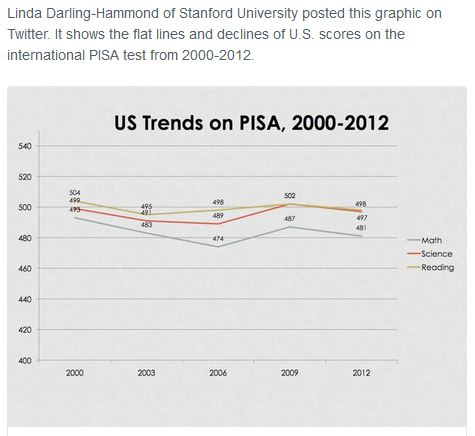
A fundamental charter school theory postulates that elected representatives developed emasculating education code depriving public schools of the opportunity for innovation and improvement. Charter schools freed from accountability promised to untie this Gordian knot and market forces were expected to drive improvement. After 20 years, we see that charter schools are better at marketing than public schools but only rarely match the public school teaching prowess. For the first time nationally, education progress appears to have slowed with the rise of charter schools.

pisa-2000-to-2012

Independent Study Charter

 Carol Burris, the Executive Director of National Public Education is currently publishing a series of articles about the charter school movement. In the second installment carried by the Washington Post she writes about independent study charters.

“Although the original intent of the independent charters may well have been to scoop up at-risk kids and give them a second chance, the lack of criteria for student placement, along with inadequate regulations have led to obvious abuses. There are now far too many independent learning charter schools whose operators, some with no background or expertise in education, make substantial salaries, ….”

The third charter school petition at Monday’s school board meeting was for a proposed new independent study charter, ACATL Leadership Academy. Their Facebook page describes ACATL’s vision:

“ACATL Leadership Academy’s (ALA) mission is to create an educational system that ensures social justice by acknowledging, understanding and healing institutionalized racism, poverty, and marginalization.

“ALA will be a non-classroom based 9-12 grade charter high school within the Sweetwater Union High School District, and will be a reed in our community known for its innovation, flexibility and strength.

“ALA will serve students 14 thru 22 years of age and will set a goal of recapturing students who have left the traditional school system. ALA will partner with students, parents and family (relatives), and community organizations to address social justice issues our youth encounter in San Ysidro, California – the San Diego International Border region of the United States.”

 This sounds great, however, taxpayers have already established Learning Centers at every high school in the SUHSD.

The public school system also provides an Adult School in San Ysidro  which is an opportunity local taxpayers are providing for “recapturing students who have left the traditional school system.” Now taxpayers are being asked to compete with themselves and support yet another facility with no real needs assessment.

In other words, publicly financed schools are already performing the same function ACATL proposes with the advantage of having highly trained experienced psychologists, councilors and certificated teachers working with students. This request for taxpayer money to be taken from Sweetwater schools to finance someone’s heartfelt dream makes little sense, but California’s charter school law pretty much guarantees ACATL will get a charter.

Carrol Burris in the article I cited above also spoke to the profit motive of these kind of schools:

“In addition, running independent learning centers can be very lucrative. One of San Diego County’s largest networks of independent learning centers is the Altus Institute. It advertises on billboards and runs ads in movie theaters and on television.  Altus operates Audeo Charter, Audeo Charter II, the Charter School of San Diego and Laurel Academy. It has a total K-12 enrollment of about 3,000 students and takes in tens of millions of dollars in state and federal revenue. Like Learn4Life, its learning centers are located in malls and office buildings. Its younger students are home-schooled.

“In 2014 compensation for Altus Institute President Mary Bixby was $371,160 — exceeding the total pay plus benefits of the superintendent of the San Diego Unified School District that serves nearly 130,000 students. Bixby is a board member of the charters, a full-time employee of one of the schools and also receives compensation for being “on-loan” to two other Altus schools. Such obvious conflicts of interest would be illegal in a public school.”

 Segregation by Choice

Last year a new charter school, Imperial Beach Charter, opened up next door to my high school. A local resident remarked to me, “the people west of 13th street don’t want their kids going to school with those kids at Mar Vista Academy.”

A blogger going by the moniker educationrealist posted this observation:

“I offer this up as opinion/assertion, without a lot of evidence to back me: most parents know intuitively that bad teachers aren’t a huge problem. What they care about, from top to bottom of the income scale, is environment. Suburban white parents don’t want poor black and Hispanic kids around. Poor black and Hispanic parents don’t want bad kids around. (Yes, this means suburban parents see poor kids as mostly bad kids.)”

 I recently reviewed Mercedes Schneider’s new book, School Choice. On page 22 she writes:

“Thus, what is clear about tuition grants, scholarships, or grants-in-aid, and the history of American public education is that these were tools used to preserve segregation. There it is: The usage of choice for separating school children into those who are ‘desirable’ and those who are not.”

This following table shows the demographic difference between the Mar Vista Academy (the public school) and Imperial beach charter.

School Hispanic or Latino White not Hispanic English Learners Free & Reduced Price Meals
Imperial Beach Charter 514 (59%) 250 (29%) 160 (18 %) 544 (62%)
Mar Vista Academy 714 (82%) 45 (5%) 277 (32 %) 679 (78%)

Conclusions:

Too often, charter schools are just rouges to make taxpayers finance private schools.

Charter schools have not shown significant educational improvements and they come with significant risks. Last year the Center for Media and Democracy reported:

“Nearly 200 charters have closed in California, nearly one of every five that have opened. Their failures have included stunning tales of financial fraud, skimming of retirement funds, and financial mismanagement, material violations of the law, massive debt, unsafe school conditions, lack of teacher credentials, failure to conduct background checks, terrible academic performance and test results, and insufficient enrollment.”

In other words, many charter schools are unstable and they have shut down with no notice even mid-way through a school year.

Charter schools increase the cost of education because of the required redundant administration for the same number of students and private sector administrative incomes are normally much higher than public employment rates.

All of the charter requests to SUHSD should be denied, but under present law if that happens either the county or the state will grant the charter. Past time for an immediate moratorium on new charter schools in California. Unwinding this unstable costly charter school system will benefit students and taxpayers.

The charter school industry wasn’t an organic development. Politicians and their wealthy masters created it with massive incentives. The federal government is spending billions on promoting charters plus foundations such as the Bill and Malinda Gates Foundation, the Walton Family Foundation, the Edith and Eli Broad Foundation and the Fisher Foundation provide unimaginably large sums of money toward these privatization efforts yearly. If the elites succeed in destroying and monetizing our public education system, the opportunities for middle and working class people will significantly diminish. Just look at Detroit to see what the future holds for the poor.

The charter school movement is undemocratic and irrational. It needs to end.

Twitter: @tultican

School Choice Barbecued Cajun Style

5 Sep

By Thomas Ultican 9/5/2016

Mercedes Schneider’s newest book continues her legacy of scholarship and philosophical prescience.  In School Choice; The End of Public Education? she documents and explains many facets of the issue. Three glaring problems with “school choice” as an education policy caught my eye: (1) Friedman’s choice ideology ends the concept of mandatory education for all, (2) “choice” has abandoned its original purpose and become a profiteering racket, and (3) “choice” is historically a method used to promote segregation.

School Choice Foundations

Austrian Economist Friedrich Hayek who believed in classical liberalism especially the concept that it is in the common interest that all individuals must be able to secure their own economic self-interest, without government direction. In September 1944, the University of Chicago Press published Hayek’s book The Road to Serfdom. It was squarely against government programs like social security and Roosevelt’s new deal.

In 1950, Hayek left the London School of Economics for the University of Chicago. It was there that Milton Friedman and a host of young scholars met their sole mate Hayek. They saw government social programs as seeds for tyranny and public education was no exception. Friedman became known as the father of school choice when he wrote, “The Role of Government in Education” advocating school vouchers for universal private education in 1955.

I knew all of this but Schneider unearthed an amazing quote from the paper I did not know. Friedman was not only opposed to schools run by democratically elected boards; he also believed mandates for compulsory education were an obstacle to freedom:

“Perhaps a somewhat greater degree of freedom to choose schools could be made available also in a governmentally administered system, but it is hard to see how it could be carried very far in view of the obligation to provide every child with a place.” (School Choice Page 32)

Schneider commented, “Here we have the idea that for the market to be at its best, it needs to be free from any obligation to educate all children.” And she continued in some depth clearly illuminating this anti-humanistic and fatally flawed theory that is the foundation of “school choice” theory.

A Legacy of Segregation

Mercedes Schneider is a product of segregated schools in St. Bernard Parish, Louisiana. She says the Orleans Parish schools she attended have a history that “does not inspire pride.” Not only were the schools segregated, but more tragically, the parish refused to construct new schools for the growing back student population. Not just separate schools for whites and blacks but not of equal quality by design.

After “Brown versus the Board of Education of Topeka” required the end of the farcical separate but equal policies, southern politicians turned to school choice and vouchers as a way to avoid integration. Milton Friedman’s timely paper was well received in the segregated south.

To this point Schneider states:

“Thus, what is clear about tuition grants, scholarships, or grants-in-aid, and the history of American public education is that these were tools used to preserve segregation. There it is: The usage of choice for separating school children into those who are ‘desirable’ and those who are not. Though it seems that most Southern states were ready participants in resisting the federal requirement to integrate their public education systems, Senator Byrd’s sentiment of ‘massive resistance’ was even formally declared in a U.S. legislative document commonly known as the ‘Southern Manifesto.’” (School Choice Page 22)

Today, it is not much different with the possible exception of more emphasis on class separation than in the past. Recently a blogger known as “educationrealist” posted this discerning observation:

“I offer this up as opinion/assertion, without a lot of evidence to back me: most parents know intuitively that bad teachers aren’t a huge problem. What they care about, from top to bottom of the income scale, is environment. Suburban white parents don’t want poor black and Hispanic kids around. Poor black and Hispanic parents don’t want bad kids around. (Yes, this means suburban parents see poor kids as mostly bad kids.) Asian parents don’t want white kids around to corrupt their little tigers, much less black or Hispanic. (White parents don’t really want too many Asians around, either, but that’s the opposite of the “bad kids” problem.)

“Parents don’t care much about teacher quality. They care a lot about peer group quality.”

Around 2003, a friend tried to convince my wife and I to send our daughter to High Tech High. This mother did not want her daughter to be exposed to all those bad influences at Mira Mesa High School. Mira Mesa High School is a quality school that graduates amazingly gifted students every year and sets them on to a course of academic and social success. But the new charter school that Bill Gates and Irwin Jacobs had put so much money into surely would not have all those feared “bad kids.”

“Begs to be Gamed”

“By 2015, according to the Education Commission of the States website, 42 states, the District of Columbia, and Puerto Rico all had charter school laws. Of these, 33 states had charter authorizing bodies, yet only 15 states and Washington, D.C., had standards for charter authorizers and the requirement that charter authorizers annually produce formal reports regarding the charter schools they oversee. Furthermore, only 11 states and the District of Columbia specify performance criteria to determine whether a charter should be continued or revoked.” (School Choice Page 59)

Charter schools have become the vogue privatization vehicle of the 21st century. Schneider presents a detailed background of charter school formation starting with Ray Budde’s 1974 conference paper that proposed a new structure for school management that he called “charter schools” and AFT President Albert Shanker’s 1988 fascination with Budde’s idea. Shanker extended Budde’s ideas with his own “school with-in a school” concept in which teachers would be authorized to experiment.

Shanker quickly became disenchanted by the direction the charter school movement took. It became clear to him that the new charter school laws made corruption and profiteering inevitable. In various articles, he highlighted the cases demonstrating how dangerous and poorly regulated charter schools were. He wrote of the Noah Webster schools gaming the system in Michigan for $4 million and of Washington D.C. giving a charter to a man charged with assault with a deadly weapon whose head of school security was a convicted felon. Schneider shares this quote from Shanker:

“A pluralistic society cannot sustain a scheme in which the citizenry pays for a school but has no influence over how the school is run. … Public money is shared money, and it is to be used for the furtherance of shared values, in the interest of e pluribus unum. Charter schools and their like are definitely antithetical to this promise.” (School Choice Page 57)

I was fascinated by the quotes from Addison Wiggins Forbes magazine article about why hedge fund operators are so pro-charter school industry. One quote reads:

“About the only thing charters do well is limit the influence of teachers’ unions. And fatten their investors’ portfolios.

“In part, it’s the tax code that makes charter schools so lucrative: … firms that invest in charters and other projects located in ‘underserved’ areas can collect a generous tax credit – up to 39% – to offset their costs.” (School Choice Page 101)

One of the most lucrative aspects of the charter industry seems to be facilities. Open a charter school and start a real estate company that specializes in leasing school facilities. Then you can charge yourself twice the going rates and the taxpayer picks up the bill. Schneider asks, “Why does the federal government not see through the potential real estate exploitation…?” Probably corruptions and cowardice have a lot to do with it.

Charter schools have never honestly out performed elected board directed public schools. In some cases, charter schools have gotten relatively good testing results, but on closer inspection these good testing results are not the result of good pedagogy. There are three common practices that help charters look good on testing; (1) instead of a balanced curriculum they focus on preparation for testing, (2) through various techniques, they only accept easier to educate students and (3) they do not back fill when students leave the school.

Instead of recognizing the amazing public education system we have in the United States our Congressional leaders are promoting charter schools both monetarily and with praise. Mercedes Quotes the Sense of Congress from their version of the new federal education law that is little more than a charter industry add. Paragraph 2 stated:

 “It is the sense of the Congress that charter schools are a critical part of our education system in this Nation and the Congress believes we must support opening more quality charter schools to help students succeed in their future.” (School Choice Page 151)

 Schneider concludes the charter school portion of the book with;

“Adequate monitoring of charter schools is not happening, by and large, and those individual using taxpayer money to serve their own interests by operating charter schools only contribute to damaging American public education” (School Choice Page 155)

 I have endeavored to give a taste of this wonderful effort by Mercedes Schneider and encourage everyone to not only read it but share it with others. If we educators can educate the public about how our legacy passed down from previous generations is being robbed, the public will stop these villains immediately. Remember, they are greedy cowards who will quail before public sanction.

Memo on Education to My Congressman, Scott Peters

24 Jul

By Thomas Ultican 7/24/2016

In 2000, you became my city councilman. Then in 2012, you became my Congressman in the 52nd District. I have always respected your work and integrity. However, when it comes to education, I see the Democratic Party as part of the problem and not the solution. Your latest response to me further reinforced my belief that politicians are being so propagandized by big money interests that they do not know what is real concerning education policy.

America’s Public Education System Trails No-One

Your last message to me contained several statements that I consider misguided. This paragraph is verbatim to one I received from you in July, 2015 and it is not defensible. Your office wrote:

“In an increasingly global economy, it is critical that we make educational investments that put our students in a position to compete with the rest of the world. For years, the United States has trailed China, India, and others not just in investment in education, but in student achievement. When making changes to education policy, Congress should be sure that it is closing that gap.”

It is well known that the United States spends far more on education than China and India combined, but more importantly the United States has never trailed China or India in education. On international testing some cities and countries around the world have achieved spectacular scores. However, these scores are averages and because our education system is much more universal we test all our students; they don’t. Plus, we have a huge number of students living in poverty.

But, on an even playing field, the team from the United States just won the world’s oldest international math and science competition for the second year in a row. In The International Mathematical Olympiad team USA came in first ahead of Korea, China, Taiwan, Russia, Singapore and the rest of the field from 109 countries.

Last year in response to my comments about HR 5 the pre-cursor to the new federal education law, ESSA, you made the same claim as above. At that time, I informed you of America’s continued unparalleled achievement in Nobel Prize winners:

 “Student achievement measures depend upon what you want. If the goal is creative students who can innovate and lead happy lives, then our system is clearly out producing India and China. One measuring stick might be Nobel Prize winners since 1949: America had 313 laureates; India 7; and China 8. Of the 8 Chinese, the Dalai Lama and Liu Xiaobo who won peace prizes both are considered criminals – Xiaobo is still in a Chinese prison; four are scientists who earned their degrees in the United States or Great Britain; and only the two literature recipients were educated in China. To recap, since 1949 two international and widely recognized citations for Chinese educated students compared to 313 such citations from our world’s best American education system.”

To wrap up the point I am making here, it is a slander of the world’s greatest education system to say that it is lagging any other country. It is just not true. When establishing policy in any field one must deal with reality not illusion.

STEAM and STEM are Frauds

Your message continued:

“That’s one of the reasons I support making key investments in Science, Technology, Engineering, Arts and Design, and Math (STEAM) education programs. STEAM programs prepare our students to be innovators, put them in position to add to San Diego’s rich legacy of scientific discovery and entrepreneurship, and close the achievement gap between ourselves and are largest global competitors.”

STEAM is derived from the fraudulent idea that the US is falling behind in STEM education. When I was working in Silicon Valley in the 1990’s, newspaper reports were full of baloney about the STEM shortage in America undermining our economic viability in the world. Congresswoman, Zoe Lofgren was championing the need for H1-B visas so American corporations could compete. The result is that there are less opportunities for America’s STEM educated students and here in your district all of the large apartment complexes are filled with Indian people working at QUALCOMM.

There was no shortage, but the STEM field wages were driven down. Here is a quote from a 2013 article in the Columbia Journalism Review and this is not an outlier; there are a host of articles with this same message.

“According to Miller, Neill told them this is not the argument “she normally encounters on this issue.” The conventional wisdom is that tech companies and universities can’t find enough homegrown scientists to hire, so they need to import them from China and India. Neill suggested to Miller and Shah that “we would have more impact if we represented a large, organized group.

“Miller and Shah are, in fact, part of a large group. Figures from the National Institutes of Health, the National Academies, the National Science Foundation, and other sources indicate that hundreds of thousands of STEM workers in the US are unemployed or underemployed. But they are not organized, and their story is being largely ignored in the debate over immigration reform.”

The point is that we do not need ill formed education policies paired with bad immigration policy based on false premises. Instead of STEM or the more politically acceptable STEAM education policies driven from capital cities, we need K-12 schools to provide solid liberal arts programs that will be the foundation for future student growth. Diane Ravitch, the former Assistant Secretary of Education from Bush 41’s administration, put it well in today’s (7/24/2016) New York Times:

“If we really cared about improving the education of all students, we would give teachers the autonomy to tailor instruction to meet the needs of the children in front of them and to write their own tests. We would insist that students in every school had an equal opportunity to learn in well-maintained schools, in classes of reasonable size taught by expert teachers. Anyone who wants to know how students in one state compare with students in other states can get that information from the N.A.E.P., the existing federal test.”

 ESSA May Be Worse Than NCLB

One more paragraph from your message to me says:

“Earlier in 2015, the House passed a version of the education bill – a much-needed update to No Child Left Behind – that did not achieve these goals so I did not support it. Since then, I have advocated to make it better. Through negotiations between the House and Senate, Congress came to an agreement on an update, called the Every Student Succeeds Act, which was a significant improvement. I was joined by over 350 Representatives in supporting the updated bill and the President signed it into law in early December.”

While there is little doubt that ESSA is better than the original house version it is still bad law. Daisaku Ikeda in a book called Unforgettable Friends, writes, “Having been driven from the lectern by the government in the past, Dr. Delich [Francisco J. Delich, Former Rector of the National University of Córdoba, Argentina] is very deeply and personally aware of the evil of allowing government to control education. He wants to build a society in which political leaders respect educators. Education, he believes, is the very foundation of the nation.” ESSA ergates power over schools away from parents and teachers and to the federal government.

This allows the uninformed and the corrupt too much opportunity to harm students nationwide. For example, large sums of money are earmarked for promoting the development of charter schools. Charter schools have not improved education in the least, but they have opened the door for fraud and profiteering at the expense of students.

Democracy is an important principle and no money should be spent on schools by the federal government if that money is not controlled by an elected body. Parents and teachers should control education using democratic processes to govern schools in their local community; not federal or state bureaucrats wielding authoritarian power.

ESSA also mandates standardized testing of all students in grades 3 – 8 and 11. This is a massive waste of money and harmful. For the first time ever student testing results on the nations report card, NAEP, stayed flat of fell during the last 10 years. Massive testing with punitive consequences has harmed not improved schools.

ESSA also provides money for competency based education (CBE) also known as personalize learning. The basic idea behind CBE is to have children sit at computers earning badges for demonstrating a learning competency. It is the worst kind of fill up the student with knowledge pedagogy imaginable but it does have huge profit potential. Emily Talmage a teacher and education writer from Maine has been sounding the alarm about this terrible idea. She writes:

“Although we were assured that the reauthorization of the Elementary and Secondary Education Act was intended to restore control to states and local districts, the truth is that much of the document was carefully crafted to enable a proliferation of “personalized learning.”

“KnowledgeWorks highlights the many ways that ESSA “opens the door” for personalized learning, including its Innovative Assessment Zones, resources for ‘21st Century Community Learning Centers,’ and grant money for technology available in virtually every section of the document.”

ESSA has made students and communities more vulnerable to being fleeced by corporate carpetbaggers and it increases the role of the federal government in local education policy.

America’s public school system is the foundation that made our great democratic experiment a resounding success. Allowing our schools to be stolen by profiteers actually creates a “Nation at Risk.” The federalized destruction of the public education system has become real. Please be alert to self-serving corporate actors and fight for the survival of the public education system in America.

Competency Based Education and San Diego

15 May

By Thomas Ultican 5/15/2016

A May 4 San Diego Unified School District  press release “announced a significant reduction in the amount of high-stakes standardized testing at local schools.” The next day, May 5, former Assistant Secretary of Education, Diane Ravitch, wrote on her blog, “I met [SDUSD] Superintendent Cindy Marten when she was a principal. I could see her love for the children and her respect for teachers. For her courage in doing what is best for children, I add her to the honor roll of the blog.” Two days later, May 7, Emily Talmage (educator and blogger from Maine who has notable expertise regarding Competency Based Education, {CBE}) wrote, “A closer look at San Diego Unified’s agenda reveals that instead of shedding corporate-driven, top-down reforms as Ravitch claims, the district is instead embracing the highly profitable yet woefully under-researched 21st century version of ed reform that is rapidly sweeping the nation.” Talmage was referring to CBE.

Looking into the matter myself, I have concluded that both of these women are correct. Cindy Marten has been wonderful and the reduction in testing is real and significant. I work in a school district adjacent to Cindy’s and we too have recently selected a true professional leader who works for good, Karen Janney. Even though both of these women are extraordinary leaders, their school districts are targeted by corporate sponsors of what Emily insightfully labeled “the highly profitable yet woefully under-researched 21st century version of ed reform.”

Cindy Marten and StriveTogether

Talmage implies that Cindy Marten is in league with Bill Gates and his ilk because she is listed as hosting a StriveTogether conference in San Diego, October 2014. StriveTogether uses the creepy subtitle “Every Child. Cradle to Career.” Its parent organization is KnowledgeWorks whose self described purpose is; “Every student experiences meaningful personalized learning that enables him or her to thrive in college, career and civic life.” This means a software driven curriculum delivered by a digital device. KnowledgeWorks has a large corporate sponsorship comprised mainly of companies associated with technology and testing. But I don’t think Marten intended to align herself with StriveTogether or Bill Gates.

In 2011, the Sol Price Foundation started the City Heights Partnership for Children where Marten was serving as principal of Central Elementary. In 2013 the United Way took over management of City Heights Partnership for Children. Marten’s relationship with StriveTogether is through Partnership for Children and United Way. Talmage is correct about StriveTogether being a terrible front for corporate raiders targeting education dollars and Marten should rethink representing Partnership for Children at any events associated with StriveTogether. However, Gates money is ubiquitous and it is difficult to be socially engaged and not have some relationship with organizations that Gates supports; for example the PTA, AFT and NEA.

The 70-person committee tasked with creating a plan for San Diego Unified’s digital path forward last reported in December 2014. One of their goals that they provided to Marten and the school board was “implement competency-based learning and problem-solving-based assessment, aligned with Common Core standards.” This also can be correctly interpreted to mean a software driven curriculum delivered by a digital device and tested on-line.

As a classroom teacher for the past fifteen years, I find these goals reprehensible. Common Core is a set of standards paid for by Bill Gates, copyrighted by a non-profit Bill Gates finances and written by testing corporation employees (mostly College Board and ACT). The standards are poorly written and horribly aligned. Competency Base Education is one of those awful agendas that will facilitate purloining education dollars but sounds reasonable to people who have no significant time in a classroom or have been out of the classroom so long they have forgotten how important the human connection is for a successful learning process.

Daisaku Ikeda, the founder of the Soka Schools, touches on this subject in his book Soka Education, “Recognizing each student as a unique personality and transmitting something through contacts between that personality and the personality of the instructor is more than a way of implanting knowledge: it is the essence of education.” Ikeda also mentioned that Socrates likened this to being “kindled by a leaping spark” between teacher and student. Low cost on-line learning is spiritless, amoral and dead.

Why so much Spending on Technology?

 Education is my fifth career. My previous career was as a researcher in Silicon Valley developing advanced recording devices. I wrote code to run test equipment and take data. The database I developed would handle automatic data inputs and produce presentable reports. I evolved into a technology loving geek. When I became a teacher, it was clear to me that technology was the wave of the future which would significantly improve teaching. I was wrong.

Technologists who are often entrepreneurs; government organizations under the influence of these entrepreneurs; school information technology leaders; and fans of technology form a formidable vanguard of support for the untested belief in the efficacy of digital based education. And when these groups meet, they easily succumb to the dangers of group think.

On October 23, 2015, most of the top technologists in San Diego County schools gathered to brief each other on what they were doing and to learn about new education technologies. The event was billed as a “Market Briefing.” The news release by The Center for Digital Education said. “The Center for Digital Education hosted a Market Briefing event in San Diego, CA. IT leaders from some of the largest districts in San Diego were [on] hand for a special briefing on their technology plans, priorities and focus for the coming years.”

The Center for Digital Education belongs to eRepublic. Take a quick look at the eRepublic web pages and you will learn how eRepublic can help you create and market digital products to all levels of government. They are not education specialist. They are sales facilitators, who understand how to co-opt government employees and make them allies. At conferences like “Market Briefing,” digital tools are seen as unquestionably essential to the path forward for 21st century education.

The Obama administration is 100% on board with Competency Based Education. His department of education has literally hundreds of citations from reports, mostly by think tanks supported by technology companies, which sell the virtues of CBE. The department’s stance on CBE is made clear here:

 “Transitioning away from seat time, in favor of a structure that creates flexibility, allows students to progress as they demonstrate mastery of academic content, regardless of time, place, or pace of learning. Competency-based strategies provide flexibility in the way that credit can be earned or awarded, and provide students with personalized learning opportunities. These strategies include online and blended learning, dual enrollment and early college high schools, project-based and community-based learning, and credit recovery, among others. This type of learning leads to better student engagement because the content is relevant to each student and tailored to their unique needs. It also leads to better student outcomes because the pace of learning is customized to each student.”

This statement is typical of the statements supporting CBE and other digital learning schemes. It is all assertion with no evidence. The Achilles heel of “corporate education reform” continues to be that the evidence does not support the claims.

When the government and corporate America is applying so much pressure for schools to embrace CBE and other digital strategies, it is little wonder that school boards and superintendents acquiesce. This week, the leadership (which I like and respect) in my school district (Sweetwater) announced that the board voted to: “Accept the technology task force recommendation to continue purchasing student devices for grades 9-10, and direct staff to enter into contracts and execute lease agreements for such purchase, and to maintain the iPad program at middle schools for the 2016-2017 school year, and allow the technology task force to continue its work for the 2016-2017 school year.” If they had conducted a more thorough cost benefit analysis, they might have hired more teachers or janitors instead of purchasing I-pads and laptops.

The Sweetwater Union High School District’s technology plan was published in 2014 before the present leadership took the helm. However, it is clear that the push for a 1:1 digital device ratio and facilitating online learning are still being pursued. The evidence supporting these policies in the Technology plan is provided by corporate America. Here is an example:

 “’Schools with a 1:1 student/computer ratio are cutting the dropout rate and reaping this broader benefit.’ On another front, there are the cost-savings associated with reduced printing, copying and paper usage. According to Project RED, ‘It is estimated that high schools where every student has a computer and which use an LMS [learning management system] could cut copy budgets in half. On a national basis that would equate to savings of $400M a year for high schools alone.’” (page 81)

 This is just one of many statements citing Project Red as evidence for these policies. The problem is Project Red in not an independent research organization without an agenda. They are funded by some of the largest companies in the world including Pearson Corporation, a company that hopes to dominate the online education world.

Technology does have a place in education and online learning is possible. But, it cannot be done on the cheap. Computer learning systems that are little more than drill and skill systems are terrible. School leaders need informed educators and constituents to help them protect community schools from corporate greed and government malfeasance. One to one digital policies do not pass a rigorous cost-benefit analysis and Competency Based Education appears to be more scam than legitimate education policy.

To Diane Feinstein Re. John King

26 Apr

By Thomas Ultican 4/26/2016

To: Senator Diane Feinstein

United States Senate

331 Hart Senate Office Building

Washington, D.C. 20510

From: Thomas Ultican

Dear Senator Feinstein,

Thank you for your courteous response to my entreaty to oppose the appointment of John King as the United States Secretary of Education.

The central point of what you wrote was:

“On March 14, 2016, I joined 48 of my colleagues to confirm King’s nomination.  While we may disagree on his nomination, please know that I respect your opinion and appreciate hearing your feedback.  I look forward to working with him as Congress continues to work towards providing a high-quality education to every student and ensure a successful future.”

I am writing back to share my belief that a shockingly large percentage of public education teachers feel abandoned by the Democratic Party. John Kings appointment was one more slap in the face. I personally am aware of several teachers who have reluctantly registered with the Green Party.

In 2008, teachers across America embraced the candidacy of Barack Obama. His spokesperson on education was Stanford University’s, Linda Darling-Hammond. Her embrace of standardized education gave me pause, but she was a professional educator with deep experience. I and others felt a great sense of betrayal, when Darling-Hammond was pushed aside for a political operative from Chicago with almost no professional experience as an educator, Arne Duncan.

Since then, the Obama administration has championed one horrible education policy after another. Duncan worked to de-professionalize teaching, privatize public education and make school a corporate profit center.

The “No Child Left Behind” legislation that was championed by the “liberal lion”, Ted Kennedy seriously damaged public education, undermined democratic control of schools and legitimized labeling schools and teachers as failures. And the testing schemes used to make those demoralizing judgments were not capable of such a determination.

Saddest of all is that minority teachers, because they often work in the poorest communities, have suffered the most from NCLB’s misguided accountability scheme based on unsound science.

The federal control of education has arrived with testing hell for students and enormous stress. All levels of education are dealing with dramatically increased mental illness manifested as student depression and self-mutilation. Despite the emotional and financial costs, testing score improvements have slowed and the scoring gap between minority students and white students has increased.

Standardized testing which has its American roots in the eugenics movement of the 1920’s and 1930’s is not a capable measure of good teaching or good schools. It is a fraud. As the education activist Steven Singer observed, “Practitioners like Carl Brigham used IQ tests to PROVE white people were just the best … He went on to refine his work into an even better indicator of intelligence that he called the Scholastic Aptitude Test or S.A.T.”

My personal opinion is that standardized testing is a scam, a waste of both taxpayer and student money. SAT, ACT and Pearson should not receive one more penny from taxpayers for their harmful misleading products and public universities should be encouraged to drop these bogus tests as part of the application requirements. High school grades are still the most reliable indicator of success in college.

There were bad schools before NCLB and Race to the Top, before charter schools; however they were the result of terrible state policies and not teachers or schools. Privatizing public schools just makes stealing taxpayer money easier.

Before Katrina, the schools in the poorer sections of New Orleans were an abomination. It was normal for middle schools to have 55 children in classes, with no fans or air conditioning.

When charter schools came to New Orleans the minority communities embraced them because they hoped that finally some money would be put into their schools. Unfortunately, this story is turning uglier every day. Because the charter schools are independent, thousands of students have fallen through the cracks; there are more than 10,000 New Orleans’ youths between the ages of 16 and 24 who are not in school and are not working.

And the heroic black educators of New Orleans have been replaced by TFA teachers with no experience and almost no training.

These are the result of amateurs believing that professionalism in education is not important.

Obama’s “Race to the Top” has done more damage than NCLB for that same reason.

Yes, Dr. John King, Jr. has and appealing story and impressive credentials from well thought of Ivy League schools. He does not have deep experience as an educator and his ham-handed tenure as the New York Commissioner of Education accelerated the hatred for Common Core and standardized testing in New York. He was a failure. John King made the opt-out of testing movement so robust.

I think your colleague from Utah, Senator Mike Lee, made cogent points when he said:

“I have studied Dr. King’s professional record, most notably his time in New York’s Department of Education, and I’ve reviewed the transcript of his confirmation hearing. Based on the policies that he’s supported, the bipartisan opposition he has invited throughout his career and his uncompromising commitment to the designs of bureaucrats and central planners over the lived experiences of parents and teachers, I believe it would be grave error for the Senate to confirm Dr. King’s nomination at this time. Indeed, I believe it would be difficult for anyone to support Dr. King’s nomination on the basis of his record.

“The problem is not that Dr. King lacks experience; on paper, you might think that Secretary of Education is the logical next step in his career. After three years as a teacher and a brief stint managing charter schools, Dr. King has risen through the ranks of education bureaucracy, climbing from one political appointment to the next. But do we really think that someone who has spent more time in a government agency than in a classroom is better suited to oversee federal education policy. And, more to the point, what matters isn’t the jobs that someone has held but the policies that person has advanced.”

Dr. King has promoted the privatization of the American public school system and the demise of local democratic control of public schools. Charter schools are not public schools. No parent has the right to attend their board meetings, look at their records or vote for their leadership. They are private businesses – often fraudulent – draining education dollars away from students.

At this point, all I can say is please watch him vigilantly. It is totally predictable that he will attempt to arrogate power to himself in ways totally in opposition to the spirit of the recent education law, ESSA. It is totally predictable that he will ignore the counsel of professional educators in favor schemes put forward by testing and technology companies.

Charter School Movement Out of Control

3 Apr

By Thomas Ultican 4/3/2016

In response to the polemic “A Nation at Risk”, charter schools were proposed as a means to improve education while finessing state education laws. They were essentially viewed as lab schools that would innovate and then transfer those innovations to the public school system. They have failed. Their academic performance which is often misrepresented as sensational is – at best – no better than public schools. Today, they are clearly driving increased segregation, harming community schools and increasing costs. Currently, the most powerful charter school promotions do not tout them as a way to improve education; rather they are now seen as a way to make money. It is time to stop school privatization which is actually leading to “A Nation at Risk.”

Investment Opportunity

Just search “charter school investment” and a list of articles from the New York Times, Forbes, Business Insider, the Washington Post and many more will appear. In March 2015, the Walton Family Foundation and the Bill and Melinda Gates Foundation co-sponsored an event in Manhattan called “Bonds and Blackboards: Investing in Charter Schools.” In the Business Insider report on this event, reporter Abby Jackson wrote:

 “Hedge funds and other private businesses are particularly interested in the growth and success of charter schools. The growth of charter networks around the US offer new revenue streams for investing, and the sector is quickly growing. Funding for charter schools is further incentivized by generous tax credits for investments to charter schools in underserved areas.”

Andre Agassi and Sean “Puff Daddy” Combs are fronting charter school development. What are an uneducated tennis player and a misogynistic rapper doing running schools? The LA times reports, “Add Sean “Diddy” Combs to the list of millionaires trying to fix American education. At the charter school the music mogul is opening in Harlem, teachers will be called ‘Illuminators’ and social justice will be key.” I am not sure how much social justice and illumination students will get from the words of their founder posted by Mercedes Schneider on her blog:

 “Nigga hungry like Cujo

Smoking that Pluto

No ticking time like hand on the rope

Nigga feel beautiful

No park brake but a nigga in neutral”

 The Mythic Charter School Success

There often appears in the media stories about the amazing success of charter schools. Almost all of these success stories are based on standardized testing results. Eva Moskowitz’s Success Academy charter chain in New York City is often held up as one of these amazing charter school successes. The New York Times reported in an article titled “At a Success Academy Charter School, Singling Out Pupils Who Have ‘Got to Go’”:

 “Success Academy, the high-performing charter school network in New York City, has long been dogged by accusations that its remarkable accomplishments are due, in part, to a practice of weeding out weak or difficult students. The network has always denied it. But documents obtained by The New York Times and interviews with 10 current and former Success employees at five schools suggest that some administrators in the network have singled out children they would like to see leave.”

 Recently, Rutgers University researcher Mark Weber published a report about the amazing results in Newark, New Jersey at the North Star Academy charter school a member of the Uncommon Schools charter chain (that’s the no-excuses charter chain Secretary of Education John King came from) Here is the data proving North Star’s myth inspiring results.

 “Take the most recent PARCC exams in New Jersey. About 41% of the state’s 11th graders met or exceeded expectations on the test.

 In Essex County, high-income Millburn High School (2.2% economically disadvantaged) saw 57% of students scoring proficient or advanced on the assessment. The juniors at Livingston High School (1.5 % economically disadvantaged) earned 56.5%.

 A few miles away, the juniors at Newark-based North Star Academy (83.7% economically disadvantaged) earned an 80.6% pass rate.”

What Weber shows in his report is the attrition rate at North Star is huge. Every year classes get smaller and testing results improve. North Star has a comparatively small special education enrollment, few language learners and a high expulsion rate. Also Chris Christie’s old high school, Livingston and Millburn High School have high opt out rates. So on the tests that don’t affect the students (PARCC), North Star actually outperformed the two famous public high schools, but on SAT testing that matters to the students the results reverse. North Star with its extra assets from philanthropy is doing good work but it is hardly a miracle.

Worrisome – School to Prison Pipeline

On March 16, the University of California Los Angeles’s Civil Rights Project released the results of a first-ever analysis of school discipline records for the nation’s more than 5,250 charter schools. A disturbing number are suspending big percentages of their black students and students with disabilities at highly disproportionate rates compared to white and non-disabled students.

The press release outlines these key findings:

“Study finds many charter schools feeding ‘school to prison pipeline.’”

“The comprehensive analysis by the Center for Civil Rights Remedies at the UCLA Civil Rights Project identified 374 charter schools across the country that had suspended 25% or more of their entire student body during the course of the 2011-12 academic year. The comprehensive review also revealed:

  • “Nearly half of all black secondary charter school students attended one of the 270 charter schools that was hyper-segregated (80% black) and where the aggregate black suspension rate was 25%.
  • More than 500 charter schools suspended black charter students at a rate that was at least 10 percentage points higher than that of white charter students.
  • Even more disconcerting, 1,093 charter schools suspended students with disabilities at a rate that was 10 or more percentage points higher than that of students without disabilities.
  • Perhaps most alarming, 235 charter schools suspended more than 50% of their enrolled students with disabilities.”

 Who Runs Charter Schools

Fetullah Gulen is a Turkish Imam living in exile in western Pennsylvania. Gülen is a powerful and determined opponent of the Turkish Prime Minister Recep Tayyip Erdogan and the leader of the Gulen charter school movement which has grown to over 160 schools in the United States.

A lawyer named Robert R. Amsterdam penned a piece about Gulen for The Hill. He stated:

 “Our law firm has been engaged by the Republic of Turkey – a key NATO ally in a hotbed region – to conduct a wide-ranging investigation into the operations and geopolitical influence of the Gülen organization, which is behind the Coral Academy of Science [serving on military bases in Nevada] and over 140 other public charter schools scattered across 26 American states.  Our investigation, still in its early stages, reveals that the Gülen organization uses charter schools and affiliated businesses in the U.S. to misappropriate and launder state and federal education dollars, which the organization then uses for its own benefit to develop political power in this country and globally.”

 Mr. Amsterdam also claims:

 “Aside from defrauding American taxpayers, the Gülen organization has an even more ominous objective in the United States.  The organization is one of the country’s largest recipients of H1-B “specialty occupation” visas, which it uses to import Turkish teachers into its charter schools, supposedly because local U.S. talent is not available to fill math and science teaching positions in its charter schools.  The Gülen organization illegally threatens to revoke these visas unless the Turkish teachers agree to kick back part of their salary to the organization.”

 Charter Power Politics Trumps Democracy

California’s Gulen charter schools are called Magnolia Public Schools. In Anaheim, California the local school district rejected the Magnolia Public Schools submission for a charter. Magnolia appealed to the Orange county Board of Education and was again rebuffed. However the state authorizer granted the charter. In a law suit filed by Anaheim school leaders, teachers, parents and others these allegations are made:

 “Magnolia illegally grants large contracts to affiliated vendors that have numerous overlapping connections with their own employees and board of directors. This nepotistic awarding of contracts to affiliated vendors poses illegal conflicts of interest, both individual and organizational, and is evidence of rampant self-dealing at the California taxpayer’s expense.

The audit found that over 69% of the transactions reviewed at the audited Magnolia schools were unaccounted for, evidencing weak internal controls and provoking larger concerns about how Magnolia’s funds are actually being used.

Magnolia has spent hundreds of thousands of tax dollars to secure H-1B visas for foreign teachers, the large majority of which hail from Turkey, which is not an approved employee expense under federal law.”

 The founder of the California Charter Schools Association, Caprice Young, is now leading the Magnolia Public Schools. The LA Times reported on the problems at Magnolia and Young’s ascension to leadership saying, “Critics have asserted that the Magnolia campuses are among more than 100 charter schools that have ties to a U.S.-based Turkish cleric, Fethullah Gulen. In an interview, Young said that she is not aware of any direct links with Gulen.” I wonder how many other charter school chains she is aware of that are dominated by Turkish teachers and administrators?

It is obvious that today’s charter school promoters are not concerned primarily (if at all) with the good of the community or children. It seems they only care about their business goals like achieving 1,000,000 California students in their privatized education system.

Fraud is rampant in charter school organizations and reports of student abuse are on the rise. Public schools in America never were failing and charter schools have caused a lot more harm than good. There are some wonderful charter schools and they should be saved, but do we really want useless cyber schools or suspect education at the local mall?

Do we really want to abandon democratic principles in favor portfolio districts (The operational theory behind portfolio districts is based on a stock market metaphor—the stock portfolio under the control of a portfolio manager. If a stock is low-performing, the manager sells it. As a practical matter, this means either closing the school or turning it over to a charter school or other management organization.)? Remember; stability is important for the development of healthy children and that is one thing charter schools and portfolio style churn do not provide.