Tag Archives: Randi Weingarten

San Diego’s Edtech Lollapalooza

29 Apr

By Thomas Ultican 4/29/2025

Titans of the digital universe and their minions gathered at the ASU+GSV conference in San Diego April 6-9. There was a lot of self-promotion and proposals for creating new education paradigm based on personalized learning powered by artificial intelligence (AI) were everywhere. This year it is almost impossible to find any reporting from the event by “negative Nellies” like myself, on the other hand there are many positive references like Forbes calling it “the Davos of Education.”

MRCC advertises itself as having “25+ years of experience designing and deploying innovative eLearning solutions in collaboration with the brightest thinkers.” On April 21, their Senior Director, Learning Solutions, Kevin Schroeder, published Top Five EdTech Trends from ASU+GSV Summit 2025.” His list:

“1. AI Is a Fundamental Literacy”

“2. Equity in Educational Technology Must Be Intentional”

“3. The Shift to Skills-Based Credentialing”

“4. AI-Driven Storytelling Platforms Gaining Traction”

“5. Collaboration Drives Innovation”

Under point one, he says AI is “a basic literacy on a par with reading and math.” This is surprising to me. I did not realize math was a basic literacy and whatever makes AI a basic literacy is truly puzzling.

It seems like points 2, 4 and 5 were just thrown in with little purpose. I agree edtech should strive for equity but wealthy people are not likely to want their children burdened with it. AI is known for plagiarism so I guess it makes a small amount of sense as a storytelling platform. As far as point 5 goes, if they can get students, teachers and parents to collaborate, it will drive sales.

Point 3 is particularly concerning. Schroeder states:

“Traditional academic transcripts are being replaced and/or supplemented by digital credentials that recognize hands-on skills and real-world experience. Apprenticeships, internships, and project-based learning are now key markers of learner growth.”

At the 2023 ASU+GSV conference, Carnegie and ETS announced a new partnership to create functional testing for competency based education (CBE). The Wellspring Project is one of the entities angling to profit off this scheme.

A Cision PRWeb report states,

“The first phase of the Wellspring Project, led by IMS and funded by the Charles Koch Foundation, explored the feasibility of dynamic, shared competency frameworks for curriculum aligned to workforce needs. … Using learning tools that leverage the IMS Competencies and Academic Standards Exchange® (CASE®) standard, the cohorts mapped co-developed frameworks, digitally linking the data to connect educational program offerings with employer talent needs.”

Because of the limitations put on learning by digital screens, the only reasonable approach possible is CBE. Unfortunately there is a long negative history associated with CBE. The 1970’s “mastery learning” was detested and renamed “outcome based education” in the 1990s. It is now called “competency based education” (CBE). The name changes are due to a five-decade long record of failure. It is still the same mind-numbing approach that 1970s teachers began calling “seats and sheets.”

CBE has the potential to increase edtech profits and reduce education costs by eliminating many teacher salaries. Unfortunately, it remains awful education and children hate it.

One justification for CBE based education is a belief that the purpose of education is employment readiness. Philosophy, literature, art etc. are for children of the wealthy. It is a push toward skills based education which wastes no time on “useless” frills. Children study in isolation at digital screens earning badges as they move through the menu driven learning units.

In 1906, Carnegie foundation developed the Carnegie unit as a measure of student progress. It is based on a credit hour system that requires a minimum time in class. Schools all over America pay attention to the total number of instructional minutes scheduled. A 2015 Carnegie study concluded, “The Carnegie Unit continues to play a vital administrative function in education, organizing the work of students and faculty in a vast array of schools or colleges.” Now, Carnegie Foundation President, Tim Knowles, is calling for CBE to replace the Carnegie unit.

Education writer Derek Newton writing for Forbes opposed the Carnegie-EST turn to CBE for many reasons but the major one is cheating. It is easy to cheat with digital systems. Newton observed, “But because of the credit hour system, which is designed to measure classroom instruction time, it’s still relatively hard to cheat your way to a full college degree.”

The Conference and People

ASU is Arizona State University and GSV is the private equity firm, Global Silicon Valley. GSV advertises itself as “The sector’s preeminent collection of talent & experience—uniquely qualified to partner with, and to elevate, EdTech’s most important companies.” Under their joint leadership, the ASU+GSV annual event has become the world’s premier edtech sales gathering. Sadly, privatizing public education is espoused by many presenters at the conference.

The involvement of ASU marks a big change in direction for the institution. It was not that long ago that David C. Berliner a renowned education psychologist was the dean of the Mary Lou Fulton Teachers College at ASU. At the same time, his colleague and collaborator, Gene V. Glass a Professor emeritus in both Psychology in Education and Education Leadership and Policy Studies was working with him to stop the destruction of public education. Glass is the researcher who coined the term “meta-analysis.” Their spirit has completely disappeared.

Recently the Center for Reinventing Public Education relocated from their University of Washington home to ASU.  

There were over 1,000 speakers listed for this shindig. They were listed in twelve categories. The “startup” group was the largest with 188 speakers. The “Corporate Enterprise” cohort had 136 speakers listed. Microsoft, Google, Pearson, Amazon, Curriculum Associates and many more had speakers listed under Corporate Enterprise.

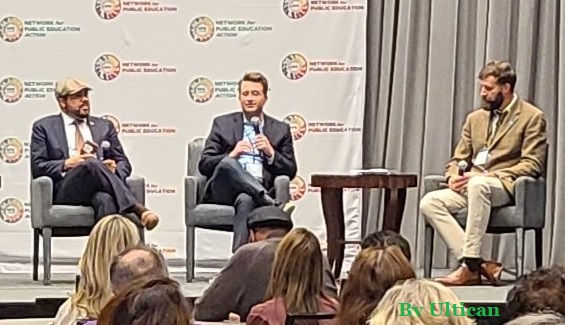
Scheduled speakers included Pedro Martinez from Chicago Public Schools, Randi Weingarten from the American Federation of Teachers and Arne Duncan representing the Emerson Collective. Of note, the list of speakers included:

  • Michael Cordona – former US Secretary of Education
  • Glen Youngkin – Governor of Virginia
  • Angélica Infante Green – Rhode Island Commissioner of Education
  • Robin Lake – Director of Center for Reinventing Public Education
  • David Steiner – Executive Director John Hopkins Institute of Education Policy
  • Ted Mitchell – President American Council on Education
  • Timothy Knowles – President Carnegie Foundation
  • Sal Khan – Founder Khan Academy
  • Derrick Johnson – President and CEO of NAACP

Secretary of Education, Linda McMahon, spoke at the summit. Besides confusing AI for A1 several times including when saying we are going to start making sure that first graders, or even pre-Ks, have “A1” teaching every year. She also slandered public schools claiming the nation’s low literacy and math scores show it has “gotten to a point that we just can’t keep going along doing what we’re doing.” She is so out of touch with education practices that she believes putting babies at screens is a good idea and does not know that America’s students were set back by COVID but are actually well on their way to recovery.

Opinion

The amount of money and political power at the annual ASU+GSV event is staggering. It has now gotten to the point that there is almost no push back heard. The voices of astute professional educators are completely drowned out.

I have met Randi Weingarten on a few occasions and been in the audience for a speech by Derrick Johnson. I really do like and respect these people but I find their participation in San Diego unwise. Having progressive voices speaking at this conference gives cover to the billionaires who are destroying public education.

Network for Public Education Goals

10 Nov

By Thomas Ultican 11/10/2023

Network for Public Education (NPE) issued two agendas at the conclusion of the October Washington DC Conference. NPE Director, Carol Burris, announced, “A Resolution in Support of Community-based Public Education, a Pillar of our Democracy” and Julian Vasquez Heilig, Provost and Vice President for Academic Affairs Western Michigan University, put forward “Freedom to Learn,” a kindergarten through university agenda.

Freedom to Learn

Since “A Nation at Risk” in 1983, public education has been under serious attack. In the 21st century, the attacks have become well-financed, deceptive and mean-spirited.

Christopher Rufo became the darling of autocracy with his attacks on diversity, equity and inclusion (DEI). In 2017, he was working at the Discovery Institute in Seattle, Washington which focuses on intelligent design and opposes Darwinian-based biology. When President Trump decided that DEI training for federal workers was deeply infected with critical race theory, Rufo, now at the rightwing Manhattan Institute, stated on the Tucker Carlson show, “It’s absolutely astonishing how critical race theory has pervaded every institution in the federal government.”

 He trained his sights on public schools, disingenuously claiming they were teaching critical race theory (CRT). Soon CRT became the name for anything bigots did not like. Billionaire-funded think-tanks, Manhattan Institute, Heritage Foundation and CATO Institute beat homophobia drums and blew bigotry trumpets against DEI.

Hostile state legislatures enacted laws that undermined public schools, community colleges and universities. They instituted curriculum bans, eradicated DEI programs and attacked science, as well as public health programs. Laws were passed allowing terrorist groups, like Mom’s for Liberty, to push mindless, censorship agendas while attacking librarians and teachers, branding them as groomers and child molesters. They also cut public school funding while promoting vouchers and other privatization schemes.

Time magazine ran an opinion piece by American Federation of Teachers President, Randi Weingarten, and Stand for Children’s CEO, Jonah Edelman. They observed:

“In a recent lecture at ultra-conservative Hillsdale College, culture war orchestrator Christopher Rufo detailed the strategy for replacing public education with a universal voucher system. ‘To get to universal school choice, you really need to operate from a premise of universal public school distrust,’ Rufo explained. Earlier in that same lecture, describing how to lay siege to institutions, he noted the necessity to create your own narrative and frame and advised his audience they ‘have to be ruthless and brutal.”’ (Emphasis Added)

Interestingly, the closer to the classroom, the better the image of public schools will be. In the 2022 Gallup survey, 84% of the general public rated their district’s public schools as passing. Parents gave them an 89% passing rates while they rated the entire nation at 73%.

The steady drumbeat of attacks on public education, starting with 1983’s “A Nation at Risk,” has harmed peoples’ view of public education but less than one might imagine. 

Professor Heilig introduced three targets:

  1. Promote “freedom to learn and access to education through working with coalition partners to support bills to increase federal and state funding for all levels of public education and protect the freedom to teach and the freedom to research.”
  2. Fight back “against legislative bans on the teaching of U. S. history, science and psychology, and other educational gag orders, and by defending individual educators who face harassment, discipline or termination as a result of these laws.”
  3. Support “efforts to provide more resources to our public schools, colleges and universities and the students who depend on them every day, resisting efforts to defund our preK-12 and higher education systems.”

Community-based Public Education

Carol Burris stated public education is the pillar of democracy and should be based on the common school design originally envisioned by Horace Mann. Public schools teach all who live within their boundaries, “regardless of race, ethnicity, creed, LGBTQ+ status, or learning ability.”

It is taxpayers who bear the responsibility for funding such schools and have the right to examine how tax dollars are used to educate children. Schools should be accountable to community residents who have the right and responsibility to elect those who govern them.

Extreme Instability of Charter Schools from NPE’s Broken Promises

In 2019, Jeff Bryant and Carol Burris co-authored Asleep at the Wheel, about the federal Charter School Program (CSP):

“We estimate that program funding has grown to well over $4 billion. That could bring the total of the potential waste to around $1 billion.”

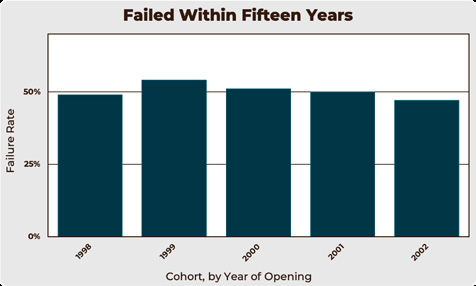
This claim by NPE was widely criticized as an over-statement. Carol Burris and her small team made a very detailed study of the CSP program producing Still Asleep at the Wheel.” They discovered the estimates were low and 40% of charter schools receiving CSP grants had closed or did not open.

Charter schools were introduced in the 1990s as an education experiment with the potential to significantly improve American education. Since then, there were no positive changes, including no significant improvement in standardized test scores. On the other hand, they have divided communities, undermined public schools and driven up segregation.

It is legitimate to conclude the charter school experiment has been a three-decade failure but the federal government continues lavishly funding the CSP.

Burris shared a growing concern with efforts to privatize public education, remove governance from school communities and divert power to private boards, religious institutions, and both nonprofit and for profit corporations.

Therefore, NPE calls for a series of reforms to “preserve our public education system and protect the students who attend public schools.”

Recommended reforms include:

  • An immediate moratorium on creating new charter schools, including no replication or expansion of existing charter schools.
  • End CSP that subsidizes and encourages charter expansion.
  • Require certification of all charter school teachers and administrative staff in accordance with public school requirements.
  • All properties and equipment owned by charter schools become the property of the local public school district if the charter closes.
  • Prohibit charter schools from refusing transfer students mid-year if they have available space.
  • Pro rata reimbursement for school districts (or states) when students leave a charter school during the school year.

In 2018, the Center for American Progress, who would never be mistaken as hardcore lefties, wrote about the first five large scale voucher studies ever. They summed up the report stating:

“How bad are school vouchers for students? Far worse than most people imagine.”

Josh Cowen, University of Michigan, has studied vouchers for close to 30 years. At the conference, he stated, “If we were using evidence informed education policy, vouchers would have died 5 years ago.” Cowen also noted test score losses from voucher students are as large as or larger than those experienced in either Katrina or Covid-19. Data since 2013 shows that vouchers have been catastrophic.

Nevertheless, Carol Burris said, “We support a parent’s right to educate their child in a private school; however, we believe that private services should be funded privately and not by the public.”

Vouchers were originally the choice of southern segregationist in the late 1950s after the Brown v. Board of Education Supreme Court decision. In 2002, the Supreme Court ruling in the Zelman v. Simmons-Harris case held that publicly funded vouchers could be used to send children to religious schools. It was a 5-4 decision, authorizing state legislators to force taxpayers to send their dollars to religious schools.

Voucher programs are always instituted by legislative bodies. There has never been an education voucher program voted for by the public.

Carol Burris stated, “We advocate for the phase-out of all voucher programs.”

Until that happens, NPE is calling for several legislative actions including:

  • An immediate moratorium on the creation of new voucher programs or their expansion.
  • Require private schools that receive vouchers cannot discriminate in any form, including based on religion, gender, marital status, disability, achievement and LGBTQ+ status.
  • Mandate financial audits of voucher programs, participating private education providers and third-party voucher-granting organizations.
  • State to collect data on voucher school closures and year-to-year changes in tuition.
  • Require certification of all school teaching and administrative staff in schools that receive vouchers in accordance with public school requirements.
  • Require that voucher students, including micro and homeschool students, participate in the same state testing programs as public and charter students and the results be made publicly available.
  • Voucher school facilities are obligated to meet building codes.
  • Require pro rata voucher funding be returned to local, state, and federal sources if a student returns or transfers to public school.

Wrap-Up

Ever since the Clinton administration, there has been a well-financed attack on public education. Much of this has come from billionaires and the Catholic Church has played a key role in advancing the voucher movement. Ten years-ago NPE was formed by mostly educators to save public schools. During its first decade, NPE fought against the privatization movement through social media by raising awareness and giving teachers a voice.

As it heads into the second decade, NPE is promoting an agenda to undo the recent damage to public schools, calling for the common sense changes listed above.

Let’s do it!

Network for Public Education Was in Washington DC

2 Nov

By Thomas Ultican 11/2/2023

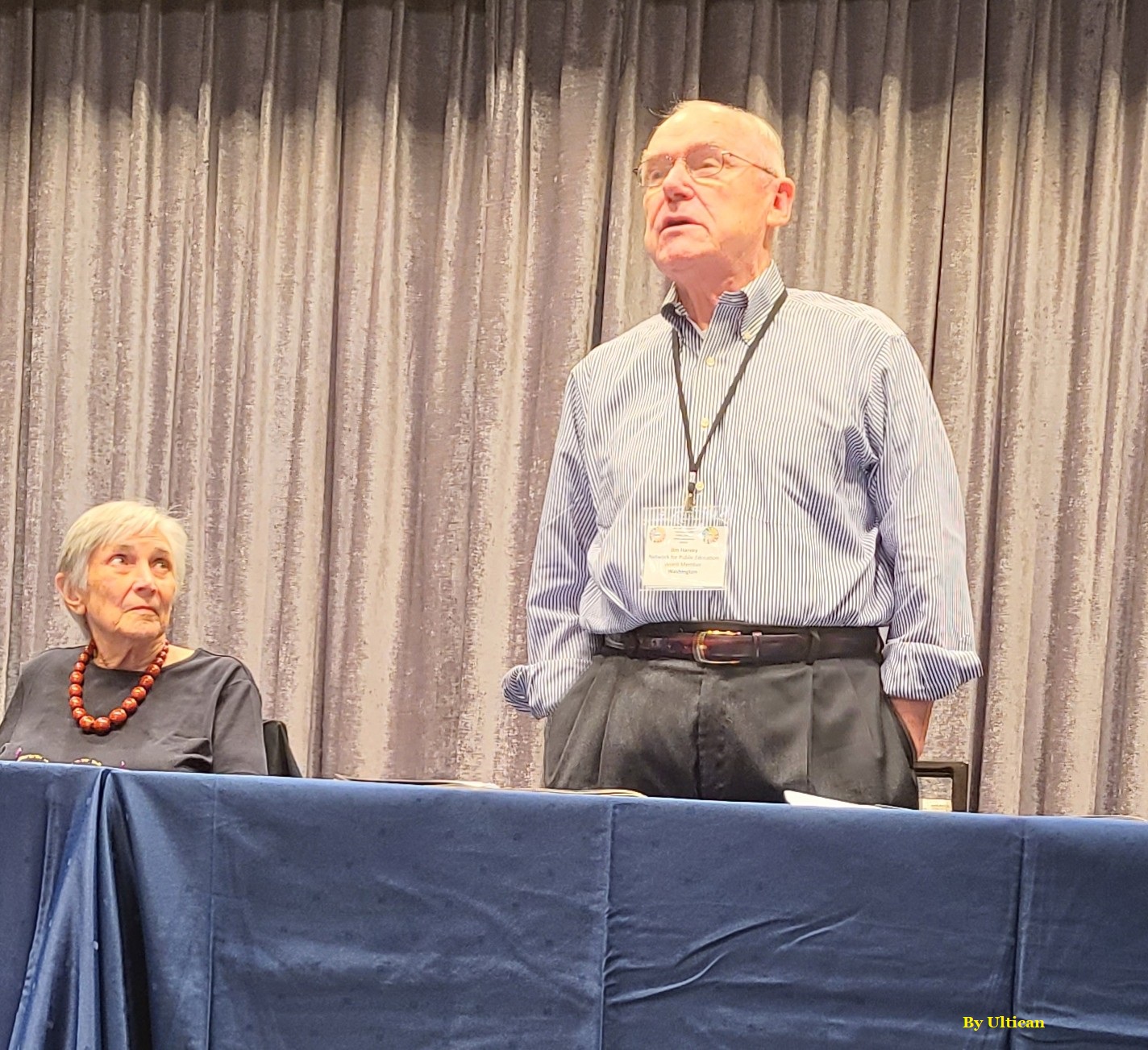
NPE met at the Capitol Hilton for a weekend conference beginning on Friday, October 27. The old hotel seemed well maintained. That first evening, Diane Ravitch interviewed James Harvey who was a key contributor to “A Nation at Risk.” We gathered in a larger conference room which caused Mr. Harvey to comment, “I remember being at a meeting in this room fifty years ago when we heard that Alexander Butterfield had just testified that there were tapes of the oval office.”

With that historical reference, the conference was off to a wonderful start.

“A Nation at Risk” is seen as an unfair turning point that undermined public education. Mr. Harvey’s job was to synthesize the input from members of the National Commission on Excellence in Education, created by Secretary of Education, Terrence Bell, and produce the report. He shared that two famous academics on the panel, Nobel Prize winner, Glen Seaborg, and physicist, Gerald Holton, were the driving forces for politicizing public education.

Diane Ravitch and James Harvey

That first night’s presentation was actually an added event for the benefit of us coming in on Friday afternoon. The conference had three keynote addresses, two panel discussions and seven breakout sessions. It was difficult to choose which breakout sessions to attend.

Pastors for Children

For session one, I attended “Mobilizing Faith Leaders as Public Education Allies.”  The amazing founder of Pastors for Children, Charles Foster Johnson, and his two cohorts were well reasoned and did not proselytize us. Their movement really does seem to be about helping communities and not building their church. Among Johnson’s points were:  

  • “Privatized religion teachers believe ‘God likes my tribe best.”
  • “We are the reason there is not a voucher program in Texas.”
  • “Conservatives and liberals come together over education.”
  • “Faith leaders have a different effect when lobbying politicians.”
  • “We are making social justice warriors out of fundamentalist Baptist preachers.”

Houston School Takeover

I have no intention of writing about each of the 7 sessions I attended, but the session on the Houston School District takeover needs mention.

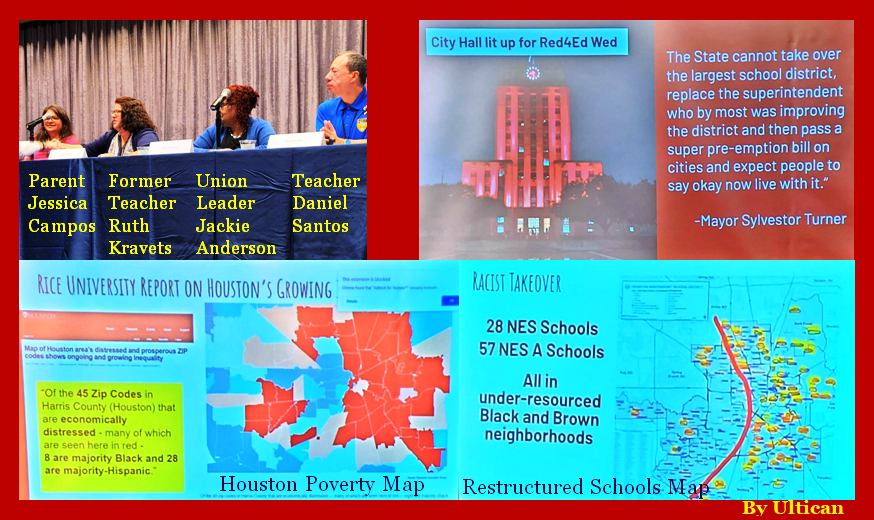
Texas took-over Houston Independent School District (ISD) on June 1, 2023. It is the largest school district in the state and eighth largest in the country with more than 180,000 students attending 274 schools. The student demographics are 62% Hispanic, 22% African-American, 10% White and 4% Asian, with 79% identified as economically disadvantaged.

In 2021, Millard House II was selected by a unanimous vote of the Houston ISD school board to be Superintendent. Under his leadership, Houston ISD was rated a B+ district, a school in one of Houston’s poorest neighborhoods, and used to excuse the takeover received a passing grade on Texas’s latest STAR testing. The takeover board replaced House with Mike Miles, a charter school operator from Colorado, previously lasted 2 years of his five-year contract, to lead the Dallas ISD.

Ruth Kravetz talked at some length about the how angry Houstonians are and their effective grassroots organizing. Kravetz stated, “We want Mike Miles gone.” She noted that the local media started turning against the takeover when citizens were locked out of the first takeover board meetings.

Kravetz intoned:

  • “Teachers no longer need a certificate or college degree to teach in Houston ISD.”
  • “Seven year-olds are not allowed to use restrooms during instructional times. They must wait.”
  • “People are being fired for ridiculous reasons. Five people were fired last week over a made up story.”
  • Expect more student action against the takeover.
  • “Rolling sickouts are coming.”

Jessica Campos is a mother in one of Houston’s poorest communities. She said her school is made up of 98% Mexicans with 68% of them being Spanish speakers. She claims, “Our school community has been destroyed”, and reported all teachers were removed with many, replaced by uncertified teachers.

Daniel Santos (High School social studies teacher) said:

“It is all about dismantling our school district. We wear red-for-Ed every Wednesday and Mayor Turner lights up city hall in red.”

The Keynote Addresses

Gloria Ladson-Billings from the University of Wisconsin Madison delivered the first Keynote address on Saturday morning.

She said that we were really dealing with 4 pandemics:

  1. Covid-19
  2. George Floyd murder
  3. “Economic Shesession” (Large numbers of women were forced to leave the workforce.)
  4. Climate catastrophe

Professor Ladson-Billings claims the larger agenda is the complete eradication of public education in what she sees as an evolving effort:

  • The evacuation of the public spaces which are being privatized.
  • Affordable, Reliable and Dependable (public space keys) is being undermined.
  • Public housing is closing.
  • The last domino is public education!

Ladson-Billings says, “choice is a synonym for privatization.” There is money in the public and wealthy elites do not think the public should have it. Also noted was “We are in the business of citizen making.”  We do not want to go back to normal because it was not that great and ending on a positive note, “All is not lost – people on the ground in Florida are working hard to reverse it.”

History Professor Marvin Dunn from Florida was the lunch time keynote speaker. He has been working hard to educate the children of Florida about the states’ racist past, including giving guided tours of the site of the 1923 Rosewood Massacre of an African American community.

He noted that “Racism is in our national DNA” and shared that George Washington owned 500+ slaves. When he was 11 years-old, Washington was given his first slave. Still, 500 black soldiers were with him at the crossing of the Delaware river.

Another American icon mentioned by Professor Dunn was Thomas Jefferson. The third president of the United States was 41 years-old when first having sexual relations with Sally Hemings; she was 14.

Julian Vasquez Heilig, Josh Cowen and Jon Hale held a late afternoon public discussion on Saturday. The moderator, Heilig, made the point that instead of funding one system, now many states are funding three systems with the same amount of dollars.

Josh Cowen, from Michigan State University, noted that using evidence based data since 2013, vouchers have been catastrophic. If we were using evidence informed education policy, vouchers would have died 5 years ago. Test score losses from voucher students are greater than those experienced in either Katrina or Covid-19. He also noted that 20% – 30% of children give up their voucher each year.

He added don’t believe a word coming out of Iowa Governor Kim Reynolds’ mouth. She has instituted vouchers, opposed abortion and supported child labor.

Reynolds is pushing Christian nationalism.

Jon Hale, from the University of Illinois says white architects of choice have a 70 year history. He says it was never about improving schools. The white supremacist movement sprung up after Brown versus the Board of Education in 1954.

Becky Pringle of the National Education Association and Randi Weingarten of the American Federation of Teachers joined in conversation with Diane Ravitch.

Becky Pringle stated that the attack on public education is deliberate and schools must be reclaimed as a common good noting that more than 50% of today’s students are of color.

Pringle claimed that every single social system in the country is under attack and declared forcefully that elections matter!!

Weingarten asked how many schools are not talking about what is going on in the Middle East right now because they are scared stiff? She made three important points:

  • “The tool of the autocrat is apathy.”
  • “Find the things that unite us.”
  • “Make schools fun.”

The last Keynote speaker was Georgina Perez, Texas State School Board member from 2017 until January 2023.

Georgina introduced herself as a chick from west Texas and obviously there was real steel there. She said, regarding vouchers, “It is completely asinine to take a nickel from the 95% of students and give it to the 5%.”

Being from the border area, she naturally was looking out for the border raised students. Georgina said I could see that all of the “Spanish language EL’s were not dropping out; they were being pushed out.” In order to get what she wanted for them, she needed to work with some very staunch conservatives and was quite successful at it. For example, she got ethnics studies by having a steak dinner and drinking with David Bradley, making a friend. She is a powerful example of how conservatives and liberals can work together for education.

What I Found

Several participants showed up kind of down in the mouth. However, by the end of the conference they were heading back home with new energy and resolve. Billionaires are spending vast sums of money trying to end public school because if public education goes then all of the commons will follow. Their big problem is that vast wealth and spending is not a match for the grassroots organizing that is happening throughout America.

Diane Ravitch, Carol Burris and the members of NPE have become a bulwark for democracy and public education.

My First NPE Conference Revisited

2 Oct

By Thomas Ultican 10/2/2023

I traveled from San Diego to Chicago’s famous Drake Hotel for the Network for Public Education (NPE) conference in 2015. Karen Lewis, President of the Chicago Teachers’ Union and her union hosted the event and leaders of the National teachers unions, Lily Eskelsen García from the National Education Association and Randi Weingarten of the American Federation of Teachers were present.

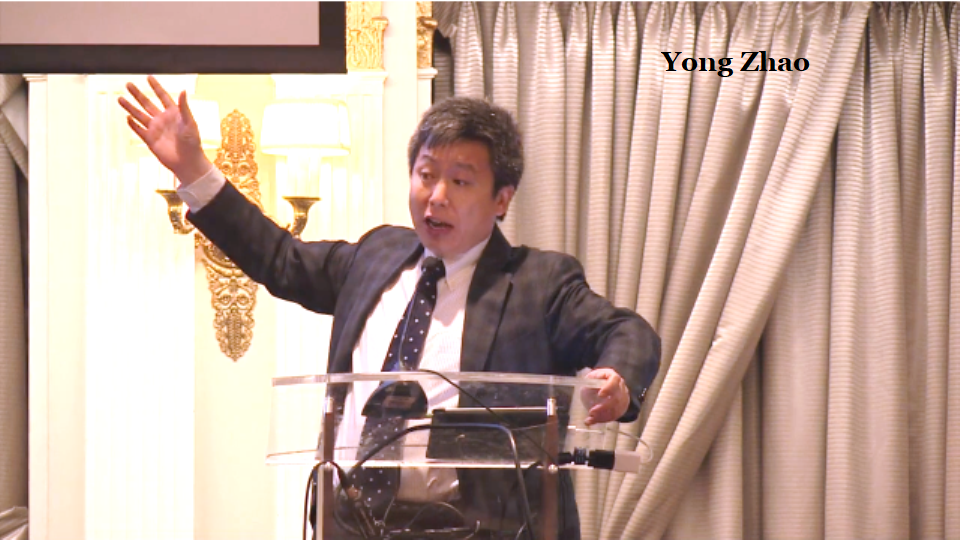
Scholar author, Yong Zhao, was the day-one keynote speaker.

At the hotel early Friday evening, Anthony Cody, co-founder of NPE, standing on the entry stairs, greeted new arrivals. This tall man had developed a reputation as a renowned champion for public education. Steve Singer from Pennsylvania and T.C. Weber from Tennessee arrived right after me and I knew it was going to be special.

Karen Lewis was fresh-off leading a stunning victory by the Chicago teachers’ union. She had been planning to run for Mayor of Chicago but unfortunately was diagnosed with brain cancer. With her amazingly big heart, for the next several years, we communicated by telephone. It was stunning how she always had time for me even when sick. I miss her.

Day One

Next morning at breakfast, I met Professor Larry Lawrence, a lifelong education professional and friend of public education who just happens to live 20-miles up old Highway 101 from me. We became quite close. I wrote about Larry in my post, Breakfast with Professor Lawrence, laying out some of his awesome contributions to public education.

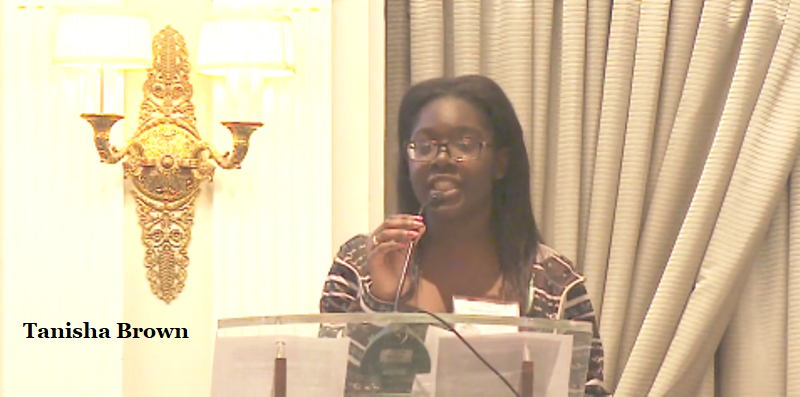
The first session kicked off with addresses by Chicago’s Jitu Brown and Newark student union leader, Tanisha Brown.

Jitu heads Journey for Justice and would become nationally recognized when he led a 34-day hunger strike, saving Chicago’s Dyett High School from Mayor Rahm Emanuel’s chopping block. He shared that once, a man from Chicago, claiming to be a community organizer, dipped his toe in the ocean and when it was cold, moved on. It was Barak Obama.

Tanisha Brown was part of a student movement to save Newark’s schools from being privatized and from, the authoritarian control of a former TFA member, Cami Anderson.

These two speakers got the conference off to a rousing start.

During graduate school at UCSD in 2001, I spent a lot of time looking at various reforms. Then, it meant improving education, not privatization. The work of Deborah Meyer particularly stood out. Her small class-size and student-centered efforts in both New York City and Boston were inspirational. Getting to meet her at this conference in Chicago was a special treat. She and her niece talked with me for almost an hour. NPE is one of the few places this could happen.

On the way to lunch, I encountered Annie Tan, a special education teacher, then working in Chicago. The tables were round and could seat more than 10 people. We found a table right next to the stage. It turned out that four people at our table were going to be holding the lunch-time discussion: Jennifer Berkshire, Julian Vasquez Heilig, Peter Greene and Jose Vilson.

Today, almost everyone in the fight to save public education knows Jennifer Berkshire but up until 2015, she was hiding her identity under the pseudonym, Edu-Shyster. Julian Vasquez Heilig is now the head of education at the University of Kentucky; then, he was a department chief at Sacramento State University in California. Peter Greene was a teacher blogger from rural Pennsylvania and known to some of us as the author of Crumuducation. Jose Vilson was a teacher blogger from New York City, with a large following. 

Also at the table was Adell Cothorne, the Noyes Elementary school principal, famous for exposing Michelle Rhee’s DC cheating scandal.

I will always appreciate Annie Tan, leading me up to that table. It was interesting that Peter Greene, his wife, Jose Vilson and I all play the trombone. Everyone knows that trombone players are the coolest members of the band.

The main event was a presentation by Professor Yong Zhao. Everybody was impressed and highly entertained. He had just published Who’s Afraid of the Big Bad Dragon?: Why China Has the Best (and Worst) Education System in the World. His book and presentation thoroughly discredit standards and standards-based testing.

Zhao is a funny guy. In 2015, readiness was a big education issue for the billionaire boys club … readiness for college, high school and even kindergarten, were written about in all big money education publications.

He said kindergarten readiness should mean “kindergartens are ready for children.” What he wanted for his children was “out of my basement readiness” and shared a personal experience of being in a Los Angeles elevator with Kim Kardashian, observing she had “out of my basement readiness”!

Union Leaders

In 2015, Bill Gates spent lavishly to control the direction of public education, giving large handouts to education journalists, education schools and teachers unions, in support of his proposal for the national Common Core State Standards. Activists at the Chicago meeting wanted the teachers unions not to accept Gates money, the underlying issue facing Lily Eskelsen García and Randi Weingarten as they took the stage in the main room for a Q & A session moderated by Diane Ravitch.

Both García and Weingarten were excellent presenters, consummate professionals, who did not disappoint. Most of the hour, Ravitch asked questions about topics, like teacher tenure and the scurrilous attack on classroom teachers. Answers from both union leaders received big positive responses.

The last question of the day was about the unions taking donations from Bill Gates. García and Weingarten both swore that their unions would no longer accept his gifts. This was not entirely true but did lead to that outcome eventually.

I personally got a chance to speak with García about diversity, saying in southern Idaho where I grew up, it might have a larger percentage of Mormons than Utah. She joked that in the Salt Lake school district, where she taught, diversity meant there were some Presbyterians in the class. Lily was genuine and warm.

Some Thoughts on NPE

Be careful about your travel itinerary… had to leave before the conference ended to catch the flight home, not realizing how much time was needed to get to the airport … will not make that mistake again.

The next NPE conference will be my sixth. That first one in Chicago awakened me to the crucial efforts Diane Ravitch, Carol Burris and the NPE board are making.

NPE is our most important organization in America fighting to preserve public education, the foundation of democracy. When we meet in Washington DC October 28 and 29, some of America’s most brilliant educators and leaders will be sharing information and firming up plans for our country. I hope you can be there.

Remember, the way public education fares directly affects how American democracy fares.

Reopening Schools Issues and Evidence

21 Jul

By Thomas Ultican 7/21/2020

The President of the United States and his Secretary of Education have demanded schools open with in-person classes five days a week. Many parents are not confident their children will be safe and significant numbers of teachers are profoundly frightened. How does the rhetoric square with credible scientific evidence concerning the Covid-19 pandemic?

President Trump has tweeted,

“In Germany, Denmark, Norway,  Sweden and many other countries, SCHOOLS ARE OPEN WITH NO PROBLEMS. The Dems think it would be bad for them politically if U.S. schools open before the November Election, but is important for the children & families. May cut off funding if not open!”

Michelle Goldberg of the NY Times wrote, “… with their crude attempts at coercion, they’ve politicized school reopening just as Trump politicized mask-wearing and hydroxychloroquine.”

Goldberg goes on to cite American Federation of Teacher President, Randi Weingarten, as saying the administration just made reopening schools more difficult. Randi described Trumps threats to withhold school funding as “empty, but the distrust they have caused is not.”

Weingarten also reported hearing from many teachers who are concerned that reopening would be done rashly.

In an USA Today opinion piece, Lily Eskelsen Garcia, the President of America’s largest teachers’ union, charged, “… the Trump administration’s plan is appallingly reckless.” She also points out that the vast majorities of American schools have not returned to their 2008 funding levels and have lain off more than 300,000 employees.

Garcia argues that the Covid-19 induced revenue crisis is making opening schools safely impossible during the accelerating contagion.

Officials within the Trump administration are confidently claiming opening schools can be done safely. At a White House conference on reopening schools, Alex Azar, Secretary of Health and Human Services stated, “We can get back to school safely.” Regarding concerns that many schools do not meet Center for Disease Control (CDC) guidance, he stated, “CDC guidance is guidance and no-one should use it not to reopen schools.”

At the same conference, the President of the American Academy of Pediatrics (AAP), Dr. Sally Goza, said AAP “strongly advocates schools open safely.” She stated that “children are less likely to be infected” and “less likely to spread the virus.”

Goza contends that it is critically important for students to be physically present as long as safety measures can be maintained. She added that schools need more resources.

President Trump’s top economic advisor, Larry Kudlow, recently stated, “If we don’t reopen the schools that would be a setback to a true economic recovery.”

Secretary of Education Betsy DeVos says “It’s not a matter of if schools should reopen, it’s simply a matter of how.”

The Department of Education under DeVos’s leadership is pushing back against charges that they are politicizing school opening. A released statement said, “if anyone is politicizing this issue it’s the unions, who are Democrats’ operatives, who are fear-mongering and denying the science that says it’s safe and better for kids’ overall health to be back in school.”

Republican state administrations in Iowa and Florida have mandated that all schools in their states reopen 5-days a week with in person instruction.

In California, Democratic Governor, Gavin Newsom has ordered all schools in counties on the coronavirus “watch list” to open online only. That covers about 80% of the students in the nation’s most populous state.

The Washington Post’s Matt Viser reports that Democratic Presidential candidate Joe Biden has called for flexibility with reopening schools. Biden asserts, “If we do this wrong, we will put lives at risk and set our economy and our country back.”

Viser sums up Biden’s just released plan,

“Biden urged caution, saying that each district should make its own decisions based on local conditions, and that schools in areas with high infection rates should not reopen too soon. He also called on Congress to pass new emergency funding to help the schools.”

These confusing claims and counterclaims motivate looking into the best evidence the scientific community can provide.

What the Evidence Shows

White House Press Secretary Kayleigh McEnany said that “science should not stay in the way of school reopening.” She cited a Journal of the American Medical Association pediatrics study that found the risk of critical illness from Covid-19 for children is far less than the seasonal flu.

She stated, “The science is on our side here.” And added that states need to “simply follow the science” and open schools.

However, McEnany, did not make it clear that the study she cited involved just 48 children treated in U.S. and Canadian intensive care units. It is true that most were not critically ill but 18 needed ventilator treatment and two died.

Dr. Ashish Jha, director of the Harvard Global Health Institute, has noted that several studies from Europe and Asia have suggested that young children are less likely to get infected and to spread the virus. However, he says like the study McEnany cited, those studies are mostly small and flawed.

There is a new study that Dr. Jha describes as “one of the best studies we’ve had to date on this issue.”

The CDC has posted the study, Contact Tracing during Coronavirus Disease Outbreak, South Korea, 2020”, to its website. This large scale study looked at 59,073 contacts traced from 5,706 covid-19 confirmed patients between January 20 and March 27, 2020.

Korean Study Table 2

Korean Study Data Table Indexed by Patient Age

The important point in this table is that infants do transmit covid-19 but at a lower rate (between 1.3% and 13.7%). However, middle school and high school aged children transmitted the disease at a rate equal to all of the older groupings.

In the paper’s literature study, the authors observe, “… a recent report from Shenzhen, China, showed that the proportion of infected children increased during the outbreak from 2% to 13%, suggesting the importance of school closure.”

Schools have been reopening in various countries since this spring. A key characteristic that countries reopening schools took into consideration was virus transmission rates. Solid testing regimes and contract testing were believed essential.

The following table used reopening transmission rates data from a post by Dr. Nan Fulcher and Justin Parmenter plus the transmission rates for July 17th which were derived using the John Hopkins University Covid-19 Dashboard and Worldometer population data.

Covid Per 10,000 Foreign table

All of the counties in the table above with the exception of Israel have maintained low transmission rates while opening schools. In the Israeli case, The University of Washington Department of Global Health reports,

“Two weeks after school re-opening, COVID-19 outbreaks were observed in classrooms, including 130 cases in one school alone. By June 3, there were 200 confirmed COVID-19 cases and over 244 positive SARS-CoV-2 tests among students and staff across multiple schools.”

“Due to the crowded nature of the schools system, physical distancing of students within schools has not been widely adopted and control measures have focused on closing schools with reported cases, extensive testing, and quarantine of students and staff with a potential SARS-CoV-2 exposure.”

In his push to reopen schools, President Trump claims that many countries reopened school with no problem. That seems to be mostly true, however, it omits saying many counties did have issues. New Century Foundation Fellow, Connor Williams notes,

Aside from some early public-health setbacks, France has been able to keep schools open. But other communities have not been so lucky. Israel reclosed some schools after a spike in covid-19 cases. Beijing recently shuttered its schools again as the pandemic returned.”

While it does seem possible to safely reopen schools based on the experience of countries around the globe, the United States faces two major unresolved obstacles; facilities need upgrading and transmission rates need to be controlled.

The following Covid-19 transmission rates were calculated using data from Wikipedia’s 2020 population estimates and the John Hopkins Covid-19 Dashboard.

Covid Per 10,000 table

In addition to this data showing that in most states the Covid-19 transmission rates are ghastly, school facilities on average are in terrible shape.

The National Academies of Science, Engineering and Medicine just issued guidance for reopening schools. The Academies chair for the study, Enriqueta Bond, stated, “One of the shocks to me is that over 50 percent of the school buildings are awful.”

New York Times reporter Apoorva Mandavilli shared in a report on the Academies’ guidance, “Some 54 percent of public school districts need to update or replace facilities in their school buildings, and 41 percent should replace heating, ventilation and air-conditioning systems in at least half of their schools, according to an analysis by the Government Accountability Office.”

The Academies guidance says the cost of retrofits will total approximately $1.8 million for a school district with eight school buildings and around 3,200 students.

The evidence shows that most of America is not ready to reopen schools. The retrofits have not been started and the needed financing has not been approved. Transmission rates are out of control.

The Conclusion of Professionals

New York public school teacher, Christine Vaccaro, published an opinion piece in USA Today. Her ending statement is prescient:

“Abandoned by any semblance of national leadership during a raging pandemic, students, teachers and staff are being told to jump into the deep end and return to school buildings. They will be risking their lives and their families’ lives, and endangering their communities to do so. All the precious time and resources spent to implement hybrid models and social distancing protocols will be washed away with the building’s first positive COVID-19 case. Then it will be a hard pivot back home, using the same scattershot remote learning practices developed in an emergency.

“That is why the smartest, most practical strategy is marshaling energy and dollars into developing as robust and equitable a remote learning plan as possible. This is far from ideal. We know remote teaching is not even remotely teaching. But it will save lives, offer the most consistent education for our children this fall — and provide a solid foundation on which to build a stronger hybrid model, later in the year.”

New Century Foundation Fellow, Connor Williams, ended his article succinctly,

It’s time to face the central fact of a pandemic: There’s no way to pretend our way around flattening the curve. Until we actually stop the virus’s spread, efforts to reopen schools in most communities will fail.”