Tag Archives: Paul Thomas

Strange Science of Reading Law Suit

20 Feb

By Thomas Ultican 2/20/2025

December 4, 2024, two law firms from New York and Chicago respectively filed a class action law suit against reading curriculum developers not steeped in science of reading (SoR).  One of the attorneys behind this Massachusetts suit, Benjamin Elga, said he listened to the Sold a Story podcast and immediately saw “an injustice that cried out for redress.” Their main claim is that “the National Reading Panel commissioned by Congress in 1997 confirmed, all credible education and literacy research shows that daily phonics instruction is necessary for literacy success” and that these curriculum developers were deliberately deceiving schools and parents when they did not focus on systematic phonics instruction.

The suit was brought against: Lucy Calkins and her Units of Study, Irene Fountas and Gay Su Pinnell and their Reading Resources, The Reading and Writing Project at Mossflower, Teachers College Columbia University, Greenwood Publishing Group, Heinemann Publishing and HMH Education Co.

First of Its Kind Law Suit

Never before have curriculum providers been targets of this type of suit.

In paragraph-22 of the filing, the plaintiffs claim, “For decades, scientists and educators have understood that the first step in teaching literacy is robust, daily, and extensive instruction in phonics.” Unfortunately, this statement is not true.

The ideology supporting phonics comes from the National Reading Panel (NRP) that was supervised by the National Institute of Child Health and Development (NICHD). NRP was founded in 1997 and presented its findings in 2000. The report was supposed to end the reading wars but it came under immediate attack including in the minority report by Joanne Yatvin, who wrote: “At its first meeting in the spring of 1998, the Panel quickly decided to examine research in three areas: alphabetics, comprehension, and fluency, thereby excluding any inquiry into the fields of language and literature.”

Yatvin was the superintendent of a school district in Oregon, held a PhD in education and was the only panel member with classroom experience teaching reading.

Yatvin published Babes in the Woods: The Wanderings of the National Reading Panelfor Kappan (January 1, 2002) in which she directly addressed the phonics piece:

“The situation worsened when the phonics report was not finished by the January 31 deadline. NICHD officials, who wanted it badly, gave that subcommittee more time without informing the other subcommittees of this special dispensation. The phonics report in its completed form was not seen, even by the whole subcommittee, of which I was a member, until February 25, four days before the full report was to go to press. By that time, not even all the small technical errors could be corrected, much less the logical contradictions and imprecise language. Although a few changes were made before time ran out, most of the report was submitted ‘as is.’ Thus the phonics report became part of the full report of the NRP uncorrected, undeliberated, and unapproved. For me, that was the last straw, and I informed my fellow panel members that I wanted my minority report to be included.”

The blow-back to the original report was strong. Elaine Garan is an award-winning researcher, author of Resisting Reading Mandatesand educator with 24 years of experience as a reading teacher.  In March 2001, she wrote, “Beyond the Smoke and Mirrors: A Critique of the National Reading Panel Report on Phonics” published by Kappan. When two NRP panel members, Linnea Ehri and Steven Stahl, attacked her in their Kappan article, she responded:

“I used the data and words of the National Reading Panel (NRP) to establish that its report was fatally flawed in terms of the fundamental research protocols, including validity, reliability and generalizability.  I established that, rather than living up to the highly publicized claims of ‘scientific’ accuracy, the report was riddled with errors.”

Garan was right. There are no “strong correlative and causal relationships between systematic phonics instruction and reading success.”

Despite the suits claim that “all credible education and literacy research shows that daily phonics instruction is necessary for literacy success”, there are in truth many highly credentialed scholars who disagree.  Posted on Ferman University Professor Paul Thomas’s blog are many articles with links to hundreds of scholars opposing SoR. In a recent post, he noted,

“The hand wringing over the 2024 NAEP reading results, however, seems to focus on learning loss and post-Covid consequences—not that reading achievement on NAEP was flat during the balanced literacy era and now has dropped steadily during the SOR era:”

Peter Johnston and Deborah Scanlon of the University at Albany debunked the Science of Reading (SoR) in this report.

Maren Aukerman is currently a Werklund Research Professor at the University of Calgary who focuses on literacy education and formerly served on the faculties at Stanford University and the University of Pennsylvania. She warns of journalists using logical fallacies to promote science of reading (SoR). For example, not reporting research showing students taught to read without systematic phonics “read more fluently.”

In 2023, a major study of teaching reading in the United Kingdom was released. The UK embraced a phonic first reading paradigm similar SoR in 2012. The researchers conclude an over-emphasis on phonics instruction caused reading test scores to go down. This matches what we have seen with this year’s National Assessment of Education Progress (NAEP) testing.
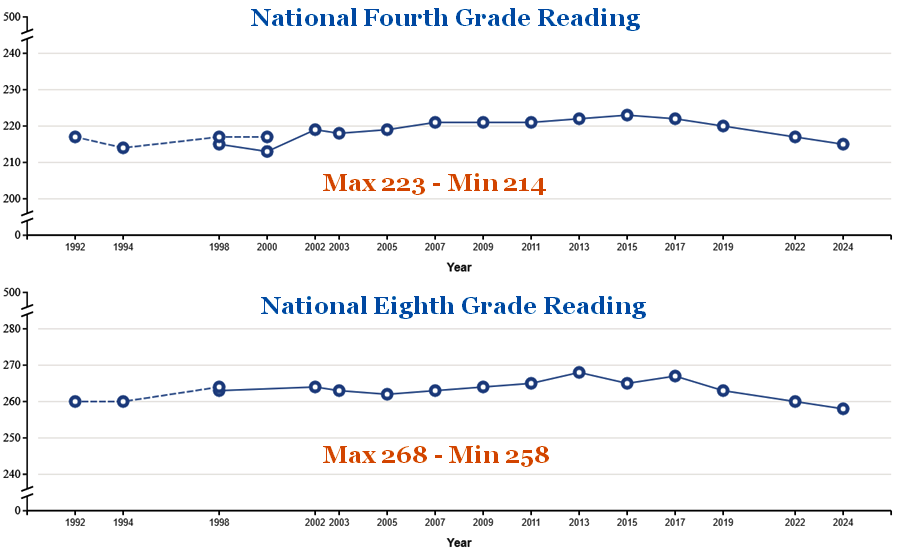
2024 NAEP Reading Results

Both nationally and internationally, many education researchers are openly opposed to SoR. Its support comes almost exclusively from billionaire sponsored researchers and publications.

Lawyers versus Educators

Two scholars, Robert J. Tierney, Dean Emeritus of the Faculty of Education at University of British Columbia, and Paul David Pearson, Evelyn Lois Corey Emeritus Professor of Instructional Science in the Berkeley School of Education at the University of California Berkeley, published the free to download “Fact-Checking the Science of Reading.”  

Lawyer Benjamin Elga said he listened to the Sold a Story podcast and it motivated his law suit. The education professionals wrote:

“Undoubtedly, for both of us, the precipitating event was Emily Hanford’s (2022) release of the six-part podcast, Sold a Story, broadcast by American Public Media beginning in late 2022. Hanford’s series motivated us to accelerate our response for many reasons—two of which were most pressing to us:

  1. A consistent misinterpretation of the relevant research findings; and
  2. A mean-spirited tone in her rhetoric, which bordered on personal attacks directed against the folks Hanford considered to be key players in what she called the Balanced Literacy approach to teaching early reading.” (Pages xiii and xiv)

Paragraph 39 of the law suit states, “Cueing methods have been roundly criticized for teaching children to guess rather than read.”
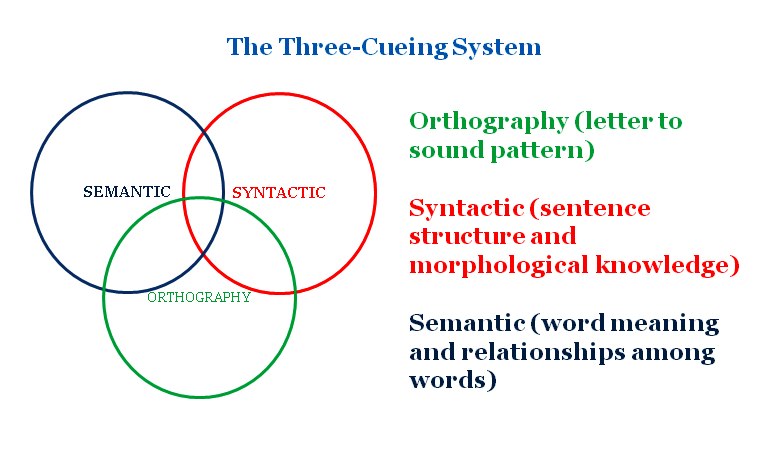
This above is a diagram of what they mean by cueing. Orthography uses phonics type approaches to sound out unknown words. Does it look right? With the second cue, syntactic, a student tries to understand what is written. Does it sound right? What would make it conform to grammar rules? Semantics is the last of the three cues. Does it make sense?

Cueing methods like all widely used reading curriculums embrace phonics as a tool but not as part of a daily structure.

Tierney and Pearson observed,

“It seems overly limiting to discredit the use of cueing systems based on what some might consider a restrictive assumption—that reading is entirely the accurate naming of words, rather than an act of meaning making that involves hypothesizing. To dismiss the use of context as an over-reliance on ‘guessing’ or ‘predicting’ ignores important evidence.” (Page 65)

Who Are These People?

With five lawyers listed on the class action law-suit, Kaplan & Grady is a firm in Chicago specializing in commercial and civil rights cases. Justice Catalyst Law (JCL) is a non-profit law firm from New York with two lawyers listed on the case. Both firms are fairly new, Kaplan & Grady was founded in 2022 and JCL was formed in 2018 per their tax filings (TIN 83-0932015).

Not much is known about the private company but in 2022, the non-profit took in $2,185,000 in contributions and Partner Benjamin Elga has connections to big Silicon Valley money. He is a Senior Fellow at American Economic Liberties Project to which The Irish Times reports that eBay founder Pierre Omidyar is a large contributor.

New court filings are due in March and the lawyers are demanding a jury trial.
The Undermining of Rhode Island Public Schools

23 Jul

By Thomas Ultican 7/23/2024

Gina Raimondo, Rhode Island’s unpopular governor, appointed the clearly unqualified Angélica Infante-Green as Commissioner of Education, in 2019. That was the year before Joe Biden selected Raimondo as Secretary of the Treasury. Infante-Green’s qualifications amounted to recommendations from New York’s Joel Klein and Jeb Bush. She was a former Teach For America (TFA) teacher in New York city who had never led a district nor been a school principal. Her first action on the job was to take over the Providence school district, the state’s largest.

Like all corporate sponsored “reformers,” Infante-Green took to propaganda rag, The 74, and updated on when, if ever, Providence will exit state control. However, Rhode Island exiting state control matters less than in most states with elected school boards because Mayors run schools. Providence Mayor Jorge Elorza officially petitioned the state to take over his schools, one of the poorer school districts in America. Politicos decided that schools were “failing” because of poor test scores.

Besides poverty, Providence’s schools are almost 70% latinx with 40% language learners. Famous educators like Pestalozzi, Herbert and Dewey would not have gotten test scores acceptable to the local business community. It was a case of testing to privatize, without care for public education and little comprehension of teaching or learning.

Hope High School in Providence

Infante-Green did not actually give much information about her plans for turning over management of the Providence school district to the city. She only shared:

“We said that in 2024, we’d look at how much progress has been made. But when that was decided in 2019, nobody anticipated a pandemic.”

Does she envision semi-permanent state control?

Feeding Corporate Friends

Part of the requirements in Rhode Island for a school to exit state receivership is an independent review. Of course, Infante-Green did not ask Brown University, Providence College or University of Rhode Island to conduct the review. She contracted with Massachusetts-based consulting firm, SchoolWorks, to lead an independent review.

SchoolWorks has a long history of supporting charter schools and privatization of public education. A tab on their web page advertises the only two categories of training they offer: For Charter School Authorizers and For Charter School Founders.

About For Charter School Founders, SchoolWorks says:

“Behind every successful charter school is a passionate group of individuals who dedicated their time and talent to envisioning a new school, garnering community support, and crafting a thoughtful and comprehensive charter school application. These are challenging, time-consuming tasks; and we celebrate pioneers like you for your commitment to innovating education.”

A link on the LittleSis data base provides some historical background for SchoolWorks. The CEO in 2016, Scott Blasdale, was a founding board member of the Massachusetts Charter School Association. He also was executive director and founding teacher of Academy of the Pacific Rim Charter Public School.

In the period that Richard Daley and Rham Emanuel were mayors of Chicago, SchoolWorks held consulting contracts for local public schools. They also consulted for KIPP schools, the Ewing Marion Kauffman Foundation and National Heritage Academies. The billion dollar Kauffman Foundation’s (EIN: 43-6064859) spending aligns with funding by Arnold, Dell, Gates and Walton, including generous gifts to TFA, Thomas B. Fordham Foundation, TNTP and Digital Promise.

Testing to Privatize

Johns Hopkins University was integral to the attack on public schools in Providence, Rhode Island. In May 2019, at the invitation of Infante-Green, Johns Hopkins Institute for Education Policy led a review of the Providence Public School District. The Partnership for Rhode Island, a group of local business leaders, funded the review.

The Johns Hopkins study was commissioned in May and presented in June. Based on the report, Providence Mayor Elorza officially petitioned the state to takeover Providence Public School District on July 19, 2019.

This request was based on testing data and Johns Hopkins not so unbiased report. In 2020, the Institute for Education policy at Johns Hopkins joined Jeb Bush’s Chiefs for Change to write a paper, calling for more standardized testing. This collaboration clearly indicated a penchant for school privatization and a tilt against public schools.

Adopting the Science of Reading

Infante-Green defended her school takeover methods stating:

“We have something called the Right to Read Act [which requires teachers to be trained in the science of reading]. By 2025, our K-8 teachers will all be trained, but we’re at about 75 percent.”

Science of Reading (SoR) is much more about profits and control than good teaching. SoR is not based on sound science and, more accurately, should be called “How to Use Anecdotes to Sell Reading Products.”

Professor Maren Aukerman, currently Werklund Research Professor at the University of Calgary, focuses on literacy education and democratic citizenship. She previously served on the faculty at Stanford University and University of Pennsylvania. Her recently published paper in the Literary Research Association on work by Goldstein, Hanford and others promoting SoR noted:

“The problem is not with recognizing that teaching phonics can play a facilitative role in having children learn to read; that insight is, indeed, important, if not particularly new. The problem is that this narrative distorts the picture to the point that readers are easily left with a highly inaccurate understanding of the so-called ‘science of reading.”’

Professor Paul Thomas of Furman University, with a deep background in teaching and education research, criticized of American Public Media’s Emily Hanford writing:

“As I have pointed out numerous times, there is a singular message to Hanford’s work; she has never covered research that contradicts that singular message.

“For example, not a peep about the major study out of England that found the country’s systematic phonics-first policy to be flawed, suggesting a balanced approach instead.

“And not a peep about schools having success with one of Hanford’s favorite reading programs to demonize.”

Nancy Bailey is an expert in special education and early reading instruction. In a recent posting, she declared:

“A troubling feature of the Science of Reading (SoR) is the connection between those who believe in the power of phonemes (and more) and those who want to privatize public schools. The old NCLB crowd has been rejuvenated and seems onboard with digital instruction replacing public schools and teachers.

Infante-Green’s claim that SoR is something wonderful and positive for public schools in Rhode Island is malarkey. It is a giveaway to corporations that harms students and undermines educators.

An Intriguingly Strange Claim

Infante-Green is quoted by The 74 stating:

“What’s interesting about Providence is that about 19,000 children apply to charter schools and there are only 22,000 students in the district. So they want charter schools.”

This assertion makes no sense. While it is not surprising that charter school enrollment in Rhode Island increased, the most recent (2021) available enrollment data showed 10,547 charter students. Claiming 19,000 student applications for privatized schools in Providence alone strains credibility.

Rhode Island’s Commissioner of Education promotes privatization.

It is true that since the pandemic, student enrollments have dropped and chronic absenteeism has grown throughout the nation. In Providence, both of these have soared. Even Central Falls, the most impoverished school district in Rhode Island, had a significantly lower absentee rates and better attendance than Providence. Commissioner of Education, Angelica Infante-Green, took over Providence schools five years ago, making no effective action while dropout rates climbed, students disappeared and many scholars coming to class sporadically.

Clearly, these schools would be in a better state if her takeover never happened.

It is time to quit playing privatization games with the public school system and return them to professionals in the district.

State takeovers have a nationwide record of failure and Providence is adhering to that history.

Jobs’ Reading Scam

10 Apr

By Thomas Ultican 4/10/2024

Laurene Powell Jobs controls Amplify, a kids-at-screens education enterprise. In 2011, she became one of the wealthiest women in the world when her husband, Steve, died. This former Silicon Valley housewife displays the arrogance of wealth, infecting all billionaires. She is now a “philanthropist”, in pursuit of both her concerns and biases. Her care for the environment and climate change are admirable but her anti-public school thinking is a threat to America. Her company, Amplify, sells the antithesis of good education.

I am on Amplify’s mailing list. April third’s new message said,

“What if I told you there’s a way for 95% of your students to read at or near grade level? Maybe you’ve heard the term Science of Reading before, and have wondered what it is and why it matters.”

Spokesperson, Susan Lambert, goes on to disingenuously explain how the Science of Reading (SoR) “refers to the abundance of research illustrating the best way students learn to read.”

This whopper is followed by a bigger one, stating:

“A shift to a Science of Reading-based curriculum can help give every teacher and student what they need and guarantee literacy success in your school. Tennessee school districts did just that and they are seeing an abundant amount of success from their efforts.”

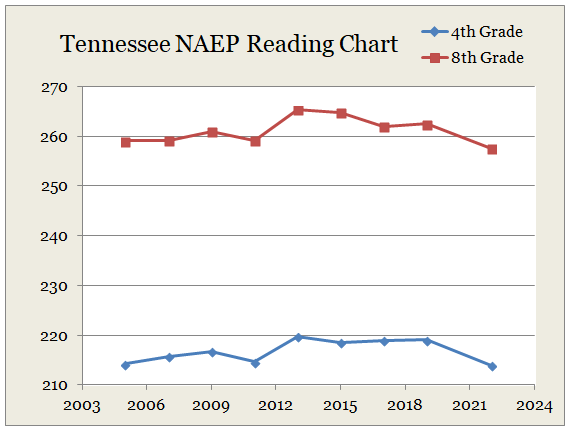
A shift to SoR-based curriculum is as likely to cause harm as it is to bring literacy success. This was just a used-car salesman style claim. On the other hand, the “abundance of success” in Tennessee is an unadulterated lie. National Assessment of Education Progress (NAEP) tracks testing over time and is respected for education testing integrity. Tennessee’s NAEP data shows no success “from their efforts.” Their reading scores since 2013 have been down, not a lot but do not demonstrate an “abundance of success”.

NAEP Data Plot 2005 to 2022

Amplify’s Genesis

Larry Berger and Greg Dunn founded Wireless Generation in 2000 to create the software for lessons presented on screens. Ten years later, they sold it to Rupert Murdoch and his News Corporation for $360 million. Berger pocketed $40 million and agreed to stay on as head of curriculum. Wireless Generation was rebranded Amplify and Joel Klein was hired to run it.

Murdoch proposed buying a million I-pads to deliver classroom instruction. However, the Apple operating system was not flexible enough to run the software. The android system developed at Google met their needs. They purchased the Taiwanese-made Asus Tablets, well regarded in the market place but not designed for the rigors of school use. Another issue was that Wireless Generation had not developed curriculum but Murdoch wanted to beat Pearson and Houghton Mifflin to the digital education market place … so they forged ahead.

In 2012, the corporate plan was rolling along until the wheels came off. In Guilford County, North Carolina, the school district won a Race to the Top grant of $30 million dollars which it used to experiment with digital learning. The district’s plan called for nearly 17,000 students in 20 middle schools to receive Amplify tablets. When a charger for one of the tablets overheated, the plan was halted. Only two months into the experiment, they found not only had a charger malfunctioned but another 175 chargers had issues and 1500 screens were kid-damaged.

This was the beginning of the end.

By August of 2015, News Corporation announced it was exiting the education business. The corporation took a $371 million dollar write-off. The next month, they announced selling Amplify to members of its staff. In the deal orchestrated by Joel Klein, who remained a board member, Larry Berger assumed leadership of the company.

Three months later, Reuters reported that the real buyer was Laurene Powell Jobs. She purchased Amplify through her LLC, the Emerson Collective. In typical Powell Jobs style, no information was available for how much of the company she would personally control.

Because Emerson Collective is an LLC, it can purchase private companies and is not required to make money details public. However, the Waverley Street Foundation, also known as the Emerson Collective Foundation, is a 501 C3 (EIN: 81-3242506) that must make money transactions public. Waverly Street received their tax exempt status November 9, 2016.

SoR A Sales Scam

The Amplify email gave me a link to two documents that were supposed to explain SoR: (Navigating the shift to evidence-based literacy instruction 6 takeaways from Amplify’s Science of Reading: The Symposium) and (Change Management Playbook Navigating and sustaining change when implementing a Science of Reading curriculum). Let’s call them Symposium and Navigating.

Navigating tells readers that it helps teachers move away from ineffective legacy practices and start making shifts to evidence-based practices. The claim that “legacy practices” are “ineffective” is not evidence-based. The other assertion that SoR is evidence-based has no peer-reviewed research backing it.

Sally Riordan is a Senior Research Fellow at the University College London. In Britain, they have many of the same issues with reading instruction. In her recent research, she noted:

“In 2023, however, researchers at the University of Warwick pointed out something that should have been obvious for some time but has been very much overlooked – that following the evidence is not resulting in the progress we might expect.

“A series of randomised controlled trials, including one looking at how to improve literacy through evidence, have suggested that schools that use methods based on research are not performing better than schools that do not.”

In Symposium, we see quotes from Kareem Weaver who co-founded Fulcrum in Oakland, California and is its executive director. Weaver also was managing director of the New School Venture Fund, where Powell Jobs served on the board. He works for mostly white billionaires to the detriment of his community. (Page 15)

Both Symposium and Navigating have the same quote, “Our friends at the Reading League say that instruction based on the Science of Reading ‘will elevate and transform every community, every nation, through the power of literacy.”’

Who is the Reading League and where did they come from?

Dr. Maria Murray is the founder and CEO of The Reading League. It seems to have been hatched at the University of Syracuse and State University of New York at Oswego by Murray and Professor Jorene Finn in 2017. That year, they took in $11,044 in contributions (EIN: 81-0820021) and in 2018, another $109,652. Then in 2019, their revenues jumped 20 times to $2,240,707!

Jorene Finn worked for Cambria Learning Group and was a LETRS facilitator at Lexia. That means the group had serious connections to the corporate SoR initiative before they began.

With Amplify’s multiple citations of The Reading League, I speculated that the source of that big money in 2019 might have been Powell Jobs. Her Waverly Street Foundation (AKA Emerson Collective Foundation) only shows one large donation of $95,000,000 in 2019. It went to the Silicon Valley Community Foundation (EIN: 20-5205488), a donor-directed dark money fund.

There is no way of following that $95 million.

The Reading League Brain Scan Proving What?

Professor Paul Thomas of Furman University noted the League’s over-reliance on brain scans and shared:

Many researchers in neurobiology (e.g., Elliott et al., 2020; Hickok, 2014; Lyon, 2017) have voiced alarming concerns about the validity and preciseness of brain imaging techniques such as functional magnetic resonance imaging (fMRI) to detect reliable biomarkers in processes such as reading and in the diagnosis of other mental activity….

“And Mark Seidenberg, a key neuroscientist cited by the “science of reading” movement, offers a serious caution about the value of brain research: “Our concern is that although reading science is highly relevant to learning in the classroom setting, it does not yet speak to what to teach, when, how, and for whom at a level that is useful for teachers.”

“Beware The Reading League because it is an advocacy movement that is too often little more than cherry-picking, oversimplification, and a thin veneer for commercial interests in the teaching of reading.”

The push to implement SoR is a new way to sell what Amplify originally called “personalized learning.” This corporate movement conned legislators, many are co-conspirators, into passing laws forcing schools and teachers to use the SoR-related programs, equipment and testing.

SoR is about economic gain for its purveyors and not science based.

When politicians and corporations control education, children and America lose.

Billionaire Sponsored Edtech Sales Pitch

29 Apr

By Thomas Ultican 4/29/2021

Laurene Powell Jobs and Amplify Education are hosting a Virtual Summit which is what they’re calling this May’s sales event. Jobs is very confident that her billions qualify her to shape education policy. In her drive to privatize public education, she has accumulated and created several pro-edtech and anti-teacher organizations. She also provides leadership and money to other billionaire driven organizations promoting education technology while simultaneously denigrating public schools.

When Laurene’s husband, Steve Jobs, died in 2011 she inherited the rest of the billions the couple had derived from the company Steve founded, Apple Inc. Since then, her fortune has grown to more than $30 billion. Fundamentally, Jobs only qualification for shaping national education policy derives from her marrying the right guy.

In 2016, Powell Jobs’ sent Hillary Clinton four uninformed education policy positions:

  1. “Re-design entire K-12 system – we know how to do it, but it comes down to political will.
  2. “Think about Charters as our R&D … must allow public schools to have leaders that can pick their team and be held accountable.
  3. “Need to increase IQ in the teaching sector: Teach for America; they are a different human capital pipeline.
  4. “Need to use technology to transform – technology allows teachers and children to focus on content mastery versus seat time; …”

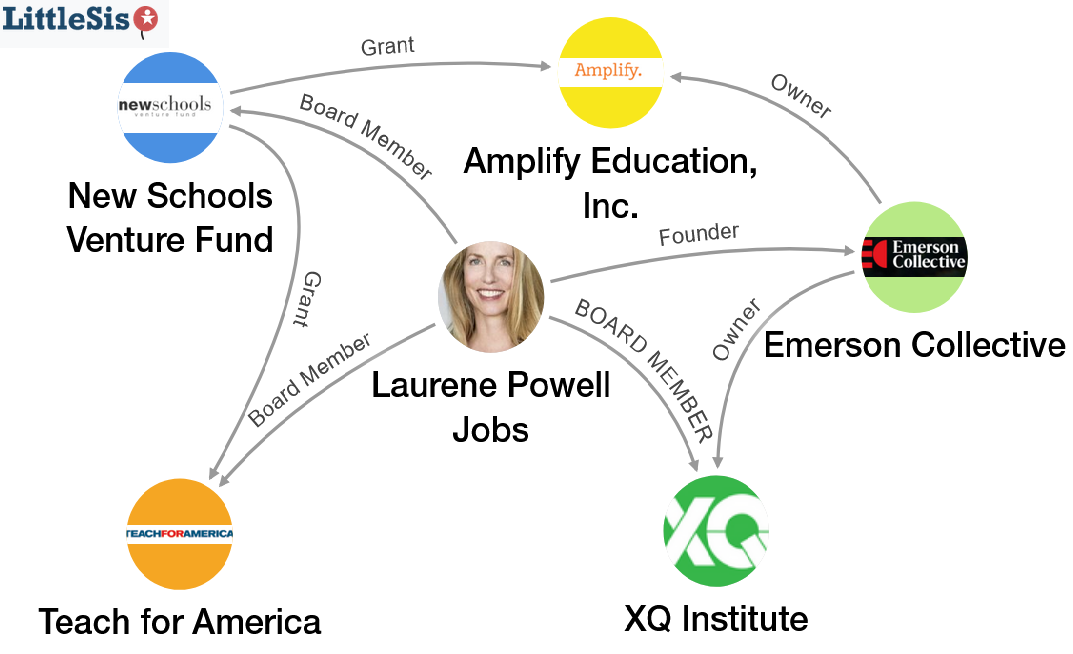
Some Laurene Powell Jobs Connections Mapped in LittleSis

The LittleSis map above has a hyperlink to the original in the caption. Shown here is a minimal display of Jobs’ connections within the movement to privatize and monetize public education. However, every line and name is hyperlinked on the original map to a large trove of information in the LittleSis data base.

The point of the map is that Jobs is the owner of Amplify through her non-profit organization, Emerson Collective.

The Amplify “Virtual Summit”

The May sales event was promoted in the Education Week Advertiser with the title “Reading Reimagined: Uncovering the Science Behind Personalized Learning.” All but one of the presenters at the daylong affair is an Amplify employee. They will emphasize three points:

  1. “The Science of Reading in personalized learning.”
  2. “What to look for in a personalized learning program.”
  3. “How to leverage COVID-19 relief stimulus funding to combat instructional loss.”

Russ Walsh is a professional educator and blogger. Recently (4/26/2021), He began an article about the science of reading with,

“Call me crazy, but when I learned I had cancer a few years ago, I did not immediately consult a journalist. Instead I chose to see an oncologist. When COVID broke out, I threw in my lot with Dr. Fauci and other infectious disease scientists, instead of a former reality TV star who suggested I inject bleach. And so, when I want advice on reading instruction, I avoid the journalists, the parent lobbying groups, the reading program sales reps, and the agenda driven pseudo-education organizations, and I look to the experts.”

The professionals Russ pointed to were Peter Johnston and Deborah Scanlon of the University at Albany who have debunked the Science of Reading (SOR) in a new report. Russ quotes them as stating,

“There is no one right way to teach reading. Student’s difficulties are unique to the individual students. Better to assume that the instruction we are providing is not meeting the student’s needs and adjust accordingly, than to focus on one instructional approach.”

Professor Paul Thomas of Furman University has also been out spoken in his scorn for the science of reading ideology.

In a previous post, I defined the nebulous term personalized learning:

‘“Personalized Learning” is a euphemistic term that indicates lessons delivered on a digital device. These lessons are often organized with a playlist and come with a claim of using artificial intelligence to tailor the lessons to the recipient. The scheme is related to competency base education (CBE).”

For five decades, the CBE scheme, operating under several different names, has posited that drilling small skills for mastery is the best way to teach. It has not worked yet.

The Organization for Economic Co-operation and Development said in a 2015 report that heavy users of computers in the classroom “do a lot worse in most learning outcomes.”

Wireless Generation to Amplify

Greg Gunn a former associate of the Carlyle Group who had earned a Masters of Electrical Engineering from MIT joined with Larry Berger to found Wireless Generation. Berger was a graduate of Yale University with a BA and had been a White House fellow working on Educational Technology at NASA during the Clinton administration.

In 2010, News Corporation paid $360 million dollars to acquire Wireless Generation and renamed it Amplify Education, Inc.

By August of 2015, after spectacular failures in North Carolina, News Corporation announced it was exiting the education business. The corporation took a $371 million dollar write off to get out of the digital curriculum business. The next month, News Corporation announced it had sold Amplify to members of its staff. In the deal orchestrated by Joel Klein, he would remain as a board member and Larry Berger would assume leadership of the company.

It was soon learned that the real buyer of Amplify was Laurene Powell Jobs. Larry Berger is still leading the company.