Tag Archives: Outcome Based Education

ETS and Carnegie Team Up for ‘Zombie’ Ed Policy

4 Jun

By Thomas Ultican 6/4/2023

Educational Testing Service (ETS) and Carnegie Foundation are partnering to create assessments for competency-based education, claiming it will revive the zombie education policy tainted by a five decade record of failure. The joint announcement was made at the April 2023 ASU+GSV conference in San Diego with Bill Gates as the keynote speaker. Ultimately, it was to make the Orwellian-named “personalized learning” viable for issuing digitally earned certifications.

ASU is Arizona State University and GSV is the private equity firm, Global Silicon Valley. GSV advertises “The sector’s preeminent collection of talent & experience—uniquely qualified to partner with, and to elevate, EdTech’s most important companies.” It profits from the corporate education ideology that holds job training as the purpose of public education.

Unfortunately, the US Department of Education is on board with digital learning and competency based education claiming,

“Digital tools can shift the focus of learning environments away from traditional metrics of progress — such as the number of hours spent in a classroom—toward more meaningful indicators of learning.”

“Digital learning can support competency-based education, in which students advance after demonstrating mastery of a key skill or concept. In a competency-based system, students work individually and in teams to continuously learn content and develop skills (e.g., communication, critical thinking, problem solving, creativity) and receive timely, differentiated support based on their individual needs. In this sense, competency-based education enables personalization and learning continuity, regardless of location.”

The 1970’s “mastery learning” was detested and renamed “outcome based education” in the 1990s. It is now called “competency based education” (CBE). The name changes were due to a five-decade long record of failure. CBE is a move to use “mastery leaning” techniques to create individualized certification paths. However it is still the same mind-numbing approach that the 1970s teachers began calling “seats and sheets.”

In the book A Wolf at the Schoolhouse Door, Jack Schneider and Jennifer Berkshire explain, “Because learning is deeply rooted in relationships, it can’t be farmed out to robots or time-saving devices.”

Unfortunately the potential for large profits is huge and serially failed education policies are zombies that will not die.

Selling CBE and Testing

‘The 74’ is an oligarch funded online, daily education publication, promoting the neoliberal agenda. Their cheerleading article about the Carnegie-ETS proposal had no pushback when quoting Carnegie President Timothy Knowles’ unlikely to be true statement,

“We’re in a position to do something that we hadn’t before. Unlike 20 years ago, we can actually reliably measure the skills that we know are predictive of success in postsecondary education and work”

Closest thing to any questioning of this came when the author quoted Michael Horn, a co-founder of Harvard’s Clayton Christensen Institute for Disruptive Education. This loud voice advocating the destruction of public education through privatization said,

“This part, from my reading of the literature on assessment, is both unproven and underdeveloped. So the how is going to be very important. I’m going to be very curious to see what the investments look like as they go forward, and I hope they don’t overpromise.”

‘The 74’ post also claims, “Competency-based learning and assessment has long been theorized as a preferable alternative to existing educational models.” These theories come from a range of philanthropic foundations and education-focused companies, many in attendance at ASU+GSV. Education professionals, not on some billionaire’s payroll, have completely different opinions.

Renewed neoliberal effort to revive CBE now has new players seeking to be big contributors while old hands are filling leadership roles. For example, at the best-known new group called Mastery Transcript Consortium, board member, Tom Vander Ark, the former education director at the Gates Foundation 1999-2006 remains engaged in pushing edtech.

There is very little real change. CBE continues to put kids at computers learning scripted chunks of information and testing for mastery, promising to increase edtech profits and reduce education costs especially teacher salaries. It is awful education and the children hate it.

Guys like Carnegie’s President Tim Knowles and ETS’s CEO Amit Sevak must justify 7 figure salaries by creating new tools and revenue streams for their benefactors. This begs the question, “How can an organization like Carnegie (TIN: 13-1628151) and ETS (TIN: 21-0634479) that pay salaries of more than $1,000,000 a year still be called non-profits?” 

The Big Push for CBE

Former reporter for Inside Higher Ed, Paul Fain, shares insights into the new push for CBE. He wrote,

Skills were a hot item at the summit in San Diego, particularly tech-enabled tools that seek to measure the knowledge and abilities of learners, and to convey them to employers. These discussions are drawing energy from the campaign led by Opportunity@Work and the Ad Council, which calls for employers to drop four-year degree requirements and to move toward skills-based hiring.”

Much of the momentum behind this thinking is the move toward a belief that the preeminent purpose of education is employment readiness. Philosophy, literature, art etc. are possibly only meaningful for children of the wealthy. The new push for CBE is toward a skills based education which wastes no time on useless frills. It is a system where children study in isolation at digital screens and earn skills badges at their own pace as they move through the menu driven learning units.

The big obstacle for this system of education is that testing has not proven reliable. Not only has it struggled to assess skills mastery it has not been proficient at predicting future success. This of course completely ignores the reality that CBE is a god awful theory of pedagogy.

In 1906, the Carnegie foundation developed the Carnegie Unit as a measure of student progress. For example, a student attending a class meeting one hour a day 3 times a week for 40 weeks earns one “unit” of high school credit for that 120 hours in class. Based on this, schools all over America pay attention to how many instructional minutes they schedule for every class.

In 2015, Carnegie completed a two-year study of the Carnegie Unit and proposals to revise the unit-based competency established on time. They concluded, “The Carnegie Unit continues to play a vital administrative function in education, organizing the work of students and faculty in a vast array of schools or colleges.” The report did not embrace competency-based standards. Now, Carnegie Foundation President Tim Knowles is calling for just such a change.

Education writer Derek Newton in an article for Forbes says he is hostile to the Carnegie-EST idea for a host of reasons but the major one is cheating. He shares,

“Cheating, academic misconduct as the insiders know it, is so pervasive and so easy that it makes a complete mockery of any effort to build an entire education system around testing. From middle school to grad school, from admissions tests to professional certifications, cheating is the bus-sized hole in the hull of assessment that renders any real voyage implausible. Right now, anyone can pretty easily buy a test-based credential without knowing anything at all. Just pay the fee, get the credential. And people do, every day.

“I am not talking about fake credentials. They are real, provided by the certifiers themselves. The sellers use software to take remote control of a test-taker’s computer and have a ringer take the exam for them.”

It is easy to cheat with rampant digitally enhanced systems. Newton observed, “But because of the credit hour system, which is designed to measure classroom instruction time, it’s still relatively hard to cheat your way to a full college degree.”

Conclusion

Derek Newton’s concern about cheating, difficult and expensive to combat, is valid.

To me, the biggest problem is that “mastery learning” is proven lousy pedagogy that is unaligned with how learning happens.

In his book Soka Education, Daisaku Ikeda writes,

“Recognizing each student as a unique personality and transmitting something through contacts between that personality and the personality of the instructor is more than a way of implanting knowledge: it is the essence of education.”

Socrates likened this education process to being “kindled by a leaping spark” between teacher and student. CBE, “mastery learning,” “outcome based education” or whatever name is given to teaching students in isolation is bad pedagogy, bordering on child abuse.

San Diego Schools Embrace Untested “Depersonalized” Learning

21 Jun

By Thomas Ultican 6/21/2017

San Diego Unified School District (SDUSD) is spending lavishly on technology despite their budgets being decimated by California’s unaccountable charter school industry. During the 2016-17 school year, SDUSD bought digital badging and 16,000 new Chromebooks.

“The district is struggling with a projected $124 million shortfall to its $1.4 billion budget, and have issued in the neighborhood of 1,500 layoff notices to full and part-time employees” reports the San Diego Union.

This kind of insanity seems to be a national movement. There is almost no evidence supporting these new theories of technology driven education. Yet, the leaders of financially strapped SDUSD are spending to have their students become experimental subjects for learning products produced by technology companies.

A recent article in the NY Times by Natasha Singer describes how DreamBox (a widely distributed math learning program) is popular with children but not for doing the math but for doing things like spending points to customize their avatar. Singer writes,

“So far there is little proof that such technologies significantly improve achievement. Adaptive learning courseware, for instance, generally did not improve college students’ grades or their likelihood of completing a course, according to a 2016 report on some of these programs by the S.R.I. Education research group.”

“Badges, We Don’t Need No Stinking Badges”

My friend, Tim, graduated for University City High School this year and invited me to attend his ceremony. I went to the school’s website for parking instructions, where I saw this:

Digital Badge

The badge image contained a hotlink to the SDUSD website which notifies the reader:

“Starting winter 2016, San Diego Unified will begin awarding achievement by issuing digital badges. Digital badges are virtual tokens issued as recognition of a skill, or behavior demonstrated, or an achievement a student has earned.”

Much of this informational page is little more than a corporate advertisement with a video claiming how wonderful and popular digital badging is. The instructions for getting started say SDUSD offers ninety-five high school badges and 20 elementary and middle school badges. Students and parents are informed:

“Students will be notified of badges through their Gmail email account accessible through their Google apps for education.”

Elementary and Middle School Badges

SDUSD also informs us that they won’t just be Cub Scout style merit badges. Soon, students will receive “micro-credentials” that will be recorded in their records kept by University of California San Diego extension.

This all looks harmless enough but it is not! Behind the digital badging scheme is a toxic combination of corporate greed and hubris. As digital badging grows, classical teacher led education will be undermined in all but exclusive high end private schools. It is yet another path to education on-the-cheap driven by profit motives instead of pedagogic expertise.

Additionally, badging is a data mining corporations dream come true. Students will lose all semblance of privacy.

Behavior badging in China is explained in this video about gamifying good citizenship. It gives me the creeps; however, behavior modification is already part of digital badging.

Emily Talmage teaches public school in Maine, where badging started a couple years ago. She describes what she’s learned:

‘“By collecting skill-based badges, the record of achievement begun in secondary school becomes the foundation upon which workers build their capabilities and tell their stories to employers,’ explains the infamous testing-behemoth, Pearson Education.

Knowledgeworks recently described the new learning system as an ‘ecosystem,’ in which the role of the traditional teacher will soon be obsolete.

“With major investments from Wall Street, leaders in the online learning, ed-tech, and student loan industries, and even celebrity billionaires like Mark Zuckerberg of Facebook and Reed Hastings of Netflix, the transformation has recently been picking up speed. Meanwhile, political groups on both the left and right are moving the system forward by lobbying for ‘personalized,’ competency-based policies and ‘innovative’ assessment systems.” [Note: Reed Hastings of Netflix is also owner of DreamBox Learning, Founder of Rocketship charter schools and a board member of California Charter Schools Association.]

“Personalized learning” is the Orwellian name given to computer delivered education. It is isolating and devoid of human interaction. There is nothing personal about it. It truthfully should be labeled de-personalized learning.

Adults Engaged with Students are Key to Intellectual Growth

America’s public education system was wildly successful right up to the advent of modern education reform. There were problems but the creativity of America’s students led to cultural, scientific and economic leadership in the world. No other country comes close to matching the US in either Nobel Prizes awarded or new industries created. The non-coercive (no high stakes testing) learning environment of our public schools allowed students to create wonderful respectful relationships with many adults and develop according to their own personality.

Daisaku Ikeda, the founder of the Soka Schools, discusses the importance of teachers in his book Soka Education, “Recognizing each student as a unique personality and transmitting something through contacts between that personality and the personality of the instructor is more than a way of implanting knowledge: it is the essence of education.” Ikeda also mentions that Socrates likened this to being “kindled by a leaping spark” between teacher and student.

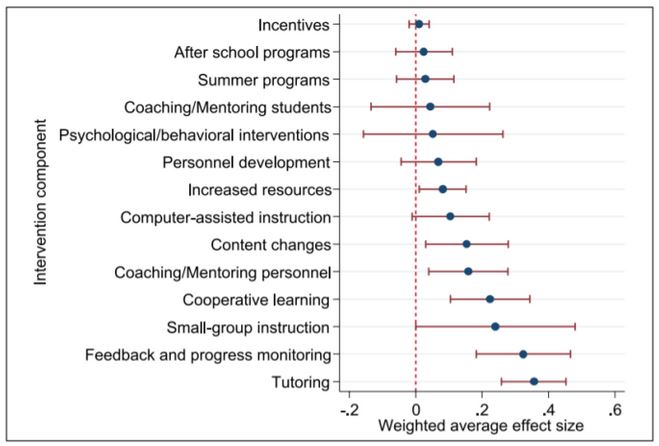
This May, Fredrik DeBoer posted results from a January study by Jens Dietrichson, Martin Bøg and Trine Filges. In his post, DeBoer explains the science behind the study and praises its methodology. He also shares some of the results that are behind a pay wall. The abstract for the report called “Academic Interventions for Elementary and Middle School Students With Low Socioeconomic Status.” states,

“This systematic review and meta-analysis seeks to identify effective academic interventions for elementary and middle school students with low socioeconomic status. Included studies have used a treatment-control group design, were performed in OECD and EU countries, and measured achievement by standardized tests in mathematics or reading. The analysis included 101 studies performed during 2000 to 2014, 76% of which were randomized controlled trials.

Weighted Average Effect Size

This graphic from DeBoer’s post is a comparative graph of the weighted average effect size. The impact of each intervention component is shown in terms of standard deviations on the horizontal axis. The five most effective interventions all require human interaction. If we are led by evidence, then we must admit that the human component in education is crucial.

There are Reasons Education Technology is More Popular than Effective

In 2013, SDUSD created the i21now committee and gave it ninety days to prepare a report on education technology going forward. The committee made up of 104 individuals included Cindy Martin SDUSD Superintendent, several other district executives, seven classroom teachers and thirty-five representatives of corporations and foundations promoting digital learning.

Corporations/Foundations Count
Apex Learning 2
Apple 3
At&t 4
Cisco 2
Cox 3
Dell 1
Houghton Mifflin Harcourt 1
iEngage Mobility 1
Intel Foundation 1
Lenovo 2
Microsoft 3
Partnership for Children 1
Project Tomorrow 1
Promethean 1
Qualcomm 3
Reality Changers 1
SENTRE Partners 1
Time=Warner 2
ViaSat 1
XO 1
Total 35

In general, the teachers and IT professionals who volunteer to be on a technology committees are themselves technophiles likely to be biased. Of course, the representatives of the network, software and hardware corporations who comprise an outsized share of the committee membership are there to promote their products.

Project Tomorrow has a representative on the i21now committee. I have written previously about the influence Project Tomorrow had on the school district where I worked (Sweetwater Union High School District). One of the teacher members of our technology committee sent us all data and brochures from Speak Up praising computer based education and de-personalized learning. Project Tomorrow and Speak Up are both part of tomorrow.org.

More than 90 corporations and non-profits are referenced as financial supporters of tomorrow.org. Included amongst the contributors are both the American Federation of Teachers and the National Education Association.

It is not surprising that the i21now committee mapped a technology path forward that is nearly identical to the positions promoted by large technology corporations and tomorrow.org. The executive summary of their report has 21 bullet point. Here are a few that caught my eye.

“Pursue new funding sources and repurposing current funding by moving expenditures away from textbooks and structured classrooms toward virtual learning, digital content and personalized learning.”

“Provide students with mobile access to broadband connectivity anytime/anyplace, while leveraging resources and partnerships to drive down costs.”

“Ensure sustainable funding to provide access at home and beyond for all students.”

“Support upgraded wireless, wired, and 1:1 environments, plus building systems and VOIP (Voice over Internet Protocol), while ensuring accessibility with digital dashboards and portals.”

“Incorporate reputable online resources and real-time data to differentiate instruction and engage students with real-world content.”

“Implement competency-based learning and problem-solving-based assessment, aligned with Common Core standards.”

The last bullet point calls for competency-based learning. This is not a new idea and it has failed miserably in both the 1970’s and the 1990’s. The theory is that education can be chunked down into discrete learning standards or competencies.

In the 1970’s this theory was called mastery learning. Soon educators were derisively calling it “sheets and seats.” It failed so miserably as a pedagogical practice that it was renamed. In the 1990’s it was called outcome based education. The new name did not help because the theory was still bogus.

Badging and competency-based learning are yet another incarnation of this behaviorist theory of education. Just because it is being done on a computer does not mitigate the fact that it is based on a bad theory of human behavior.

I do not say that education technology and learning programs have no value, but I have never seen an exemplary learning program. At their core, they all eventually become computer based drill and skill. Teachers have known for a long time that this is a bad pedagogical method widely denigrated as “drill and kill.”

The implementation of technology in the classroom will never reach its potential until that implementation and design is led by educators. Some of my friends believe that the badging and competency-based education are an existential threat to public education. I don’t. It is a bad product and parents do not want their children sitting at computer terminals. They expect them to be in authentic learning environments with competent experienced teachers.

Rich people will never accept this enervated method of education for their children.