Tag Archives: NEAP

TIMSS Scores Down Don’t Panic

13 Jan

By Thomas Ultican 1/13/2025

The latest round of international testing showed that US math scores fell between the 2019 assessment and the 2023 exam. Every four years the US participates in the Trends in International Mathematics and Science Study (TIMSS). In the 2023 cycle, fourth grade math fell by 18 points and eighth grade math fell by 27. An ABC News headline states, US students’ declining math scores are ‘sobering,’ expert says’” and the New York Times claims, U.S. Students Posted Dire Math Declines on an International Test. The reality is that these results are not wonderful but they are neither “sobering” nor “dire.”

It seems that every year there is a new data dump from a large scale assessment (LSA). Regular updates arrive from the National Assessment of Education Progress (NEAP) or the Progress in International Reading Literacy Study (PIRLS) or the testing sponsored by the international banking community, Programme for International Student Assessment (PISA). This winter the TIMSS data was released.

TIMMS and PIRLS

In 1958, a group of scholars, educational psychologists, sociologists, and psychometricians met at the UNESCO Institute for Education (UIE) in Hamburg, Germany, to confer about school effectiveness and student learning. In 1967, these early discussions led to the legal creation of the International Association for the Evaluation of Educational Achievement (IEA) headquartered in Amsterdam with a major data processing and research center in Hamburg. The every four years TIMSS assessment of math and science plus the every five years PIRLS assessment of reading are two of IEA’s major ongoing efforts.

The first IEA study began in 1959 and the completed report was published in 1962. In the forward, it stated:

“If the results so far, … are little more than suggestive, at least they offer real encouragement for believing that such researches can, in the future, lead to more significant results and begin to supply what Anderson has lamented as ‘the major missing link in comparative education’, which in his view is crippled especially by the scarcity of information about the outcomes or products of educational systems.” (Emphasis Added)

“Certainly the international group itself was sufficiently encouraged by the results of its first exploratory study to embark on a more ambitious one during which, at several key points in the secondary school cycle, as comparable samples of schoolchildren as can be obtained will be subjected to tests which bear close reference to curricula and educational aims in all the participating countries.” (Emphasis Added)

From their statements, it is clear that mathematically adept researchers saw testing as a valid way to study teaching and learning. The problem is they did not properly understand the tremendous influence of error in education testing. Family situations have extraordinarily greater influence on outcomes than either schools or teachers. These errors are so great that they obscure testing results.

The reporting on this first study was quite crude. Their use of standard deviations to communicate the results was difficult for non-experts to follow and their graphics were not well designed. These graphics came without legends and were therefore indecipherable but one graphic on page 29 did give a sense of comparison.
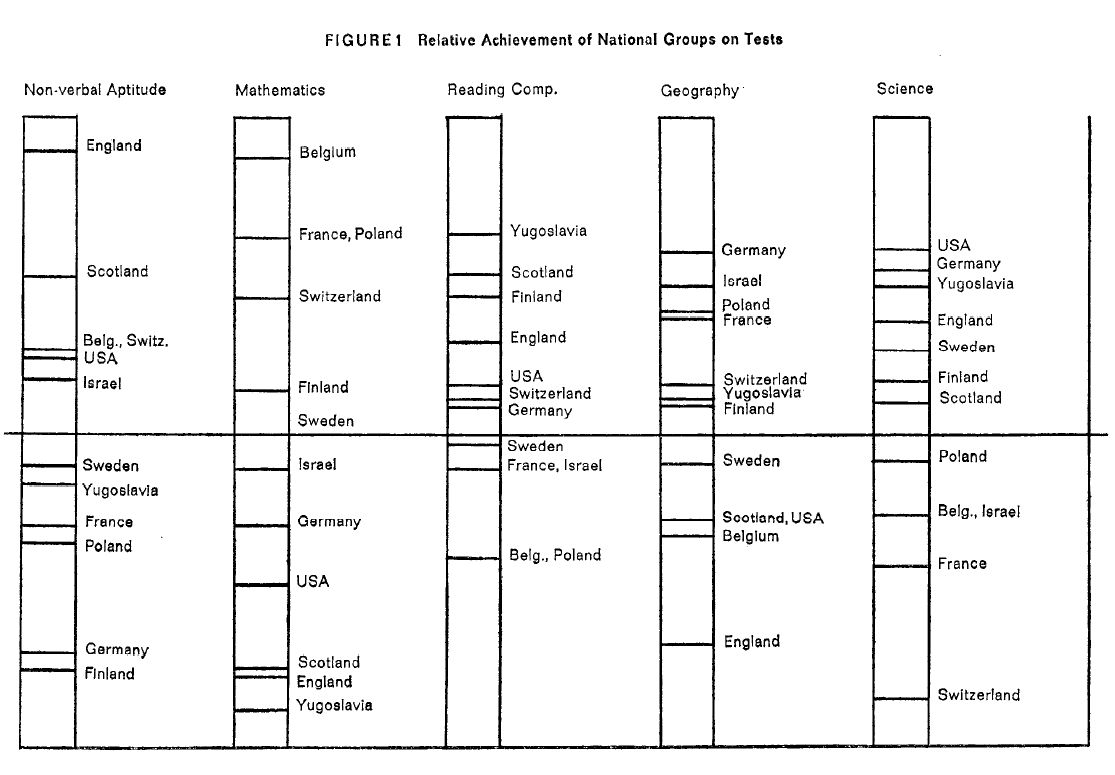
Looking at this graphic we can see that in 1959, the USA was pretty good in “Non-verbal Aptitude” whatever that is. It was relatively poor in math, OK in reading, weak in geography and super in science. This trend of the US being mostly average on international standardized assessments has persisted until today.

New Data from TIMSS

Forty-seven countries participated in the 2023 TIMSS 4th grade math study. Many of the countries studied were quite small with only Japan and the United States having populations of more than 100 million people. Using the World Population Review, I added population data to the TIMSS data and have put it into the following table for the 10 most populous countries assessed.
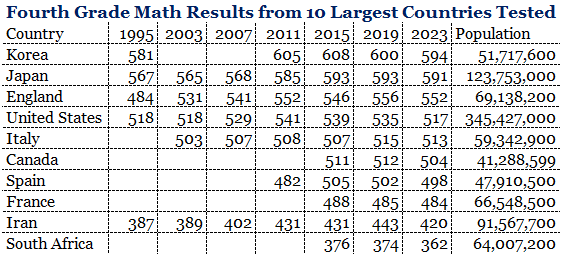
The table is organized in order of their average 2023 assessment results. Even though the US had an 18 point drop between 2019 and 2023, it still ranked fourth among the larger countries. The US had the second largest drop, but all of the large countries also had scoring decreases. The table reveals that the  US has a population almost three times the next largest country and the top two scoring countries have homoginous student populations with little diversity.

The National Center for Education Statistics (NCES) receives an expanded data set that they use to make many presentations of the outcomes. In a revealing set, NCES shows the effect of poverty on the US data with the following table which is reformatted.
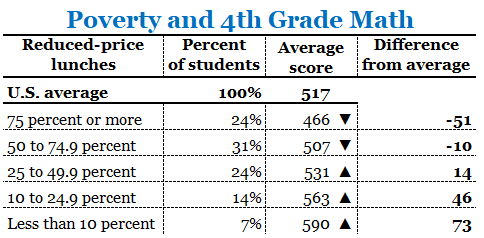
This table strongly suggests that the US decrease in scores was concentrated in the 24% of students among the group with 75% free and reduced price lunches, which is believed to be a good proxy for poverty. There are many reasons to think this group was more profoundly affected by the pandemic than other students. They were less likely to participate in virtual school, were living with people in high risk of contracting the disease and were more likely to be absent once schools opened.

LSA Reliability

Recently a British group, Assessment and Quality Insights, noticed that the PISA and TIMSS testing data showed opposite trends for British math, science and reading. TIMSS tests 12 year olds while PISA tests 15 year olds, but it is remarkable that the two assessments came up with opposite trends. Since 2012, PISA has reported falling scores in the three disciplines while TIMSS has shown rising scores.  

In 2020, Jake Anders et al, published Is Canada really an education superpower? The impact of non-participation on results from PISA 2015.” They stated:

“In this paper, we consider whether this is the case for Canada, a country widely recognised as high performing in the Programme for International Student Assessment (PISA). Our analysis illustrates how the PISA 2015 sample for Canada only covers around half of the 15-year-old population, compared to over 90% in countries like Finland, Estonia, Japan and South Korea.

This highlights a common problem with comparing international test scores. It is not clear who the student are that are being tested and if countries are juking the scores for political purposes.

Another problem with LSAs is highlighted by a paper from the University of Kansas, Side Effects of Large-Scale Assessments in Education.” They note that LSAs distort the purpose of education by misleading the public into believing these assessments reflect the quality of teaching. Also curriculums get narrowed when only core subjects of math and reading are assessed. Plus the assessments cause many educators to “teach to the test” and exam induced suicides are reported in “China, Hong Kong China, Taiwan China, Korea, Singapore, Cambodia, Vietnam, and Japan (Cui, Cheng, Xu, Chen, & Wang, 2011).”  (Page 9)

LSAs also bring moral corruption to education. According to psychologist Donald Campbell’s law, “The more any quantitative social indicator is used for social decision making, the more subject it will be to corruption pressures and the more apt it will be to distort and corrupt the social processes it is intended to monitor.” LSAs are not above this law. (Page 9)

Conclusion

LSAs are very expensive and more liable to mislead than enlighten. A lot of testing companies are making money, but education is not being well served. I have the same puzzlement as Professor Yong Zhao, who wrote, It doesn’t make sense: Why Is the US Still Taking the PISA? His arguments against PISA make a strong case against continuing with TIMSS and PIRLS as well.

To me this testing malarkey is how Corporations like Pearson get their hands on American taxpayer dollars and the taxpayers get worse than nothing for their spending.

Scrap all this international testing nonsense.
End of Public Schools in Milwaukee?

23 Jul

By T. Ultican 7/23/2018

This past school year, Wisconsin taxpayers sent $250,000,000 to religious schools. Catholics received the largest slice, but protestants, evangelicals and Jews got their cuts. Wisconsin’s Department of Public Instruction (DPI) reveals that private Islamic schools took in $6,350,000. Of the 212 schools collecting voucher money, 197 were religious schools.

The Wisconsin voucher program was expanded before the 2014-2015 school year. The Milwaukee Journal Sentinel reported, “Seventy-five percent of eligible students who applied for taxpayer-funded subsidies to attend private and religious schools this fall in the statewide voucher program already attend private schools, ….”

Money taken from the public schools attended by the vast majority of Milwaukee’s students is sent to private religious schools. Public schools must adjust for stranded costs while paying to serve a higher percentage of special education students because private schools won’t take them. Forcing public schools to increase class sizes, reduce offerings such as music and lay off staff.

A mounting social division like those faced after the civil war is developing. Katherine Stewart shared that history in her stunning book, The Good News Club:

By the latter half of the nineteenth century, Lutherans as well as Catholics had developed extensive systems of parochial education. For many Protestants, however, the loss of students from those denominations was not a welcome development. It was feared that the combined force of the Lutheran and Catholic electorate would endanger the existence of public education altogether. The tensions between those who wanted universal public education and those who wanted their schools to look like their churches continued to grow. In 1874, President Ulysses S. Grant declared that if a new civil war were to erupt, it would be fought not across the Mason-Dixon Line but at the door of the common schoolhouse. In an 1876 speech in Des Moines, Iowa, he articulated the conclusion many people had already drawn concerning the continuing struggles over religion in the public schools: “Leave the matter of religion to the family altar, the church, and the private school, supported entirely by private contributions,” he said. “Keep the church and state forever separate. With these safeguards I believe the battles which created the Army of Tennessee will not have been fought in vain.” (pages 73-74) (emphasis added)

Privatizing Public Schools Not Achieving Predictions

John E. Chubb was a cofounder of the for-profit Edison Schools and a senior fellow at the Brookings Institute. Terry M. Moe was a professor of political science at Stanford University and a senior fellow at the Hoover Institution. Chubb and Moe co-authored Politics, Markets, and America’s Schools which was published by Brookings Institution Press on June 1, 1990 the same year that Milwaukee became the sight of the nation’s first school voucher program.

Chubb and Moe claimed public education was incapable of reforming itself, because the institution was owned by vested interests. They were dismissive of democratically elected school boards asserting that poor academic performance was “one of the prices Americans pay for choosing to exercise direct democratic control over their schools.”

Diane Ravitch wrote Reign of Error: The Hoax of the Privatization Movement and the Danger to America’s Public Schools. In it she noted: “In 1990, John Chubb and Terry Moe described school choice as ‘a panacea’ that ‘has the capacity all by itself to bring about the kind of transformation that, for years, reformers have been seeking to engineer in myriad other ways.”’ (page 207)

Unfortunately, Milwaukee jumped on the speculative school privatization path. Chubb and Moe have been proven wrong. Voucher programs are not testing well. A recent paper from the Center for American Progress summarized the four latest and largest voucher study research efforts which all strongly indicated vouchers are bad education policy.

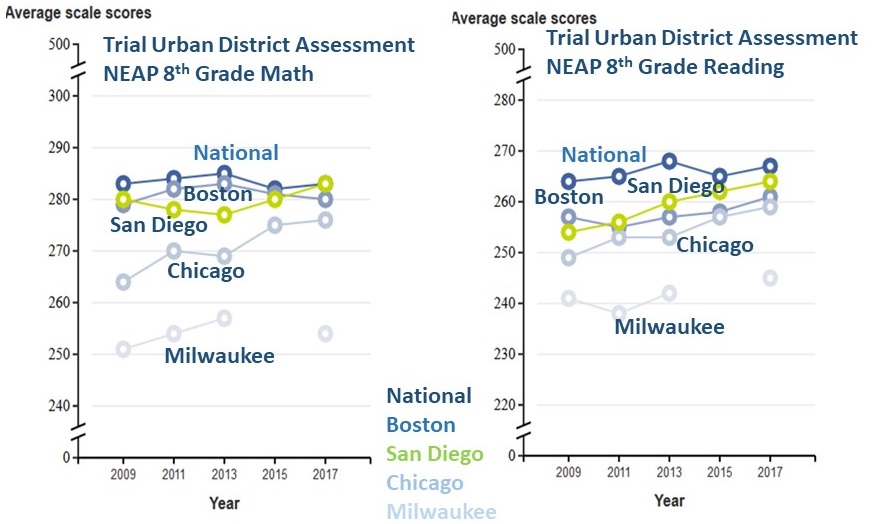
In December, 2017, an education writer for the Milwaukee Journal Sentinel, Alan J. Borsuk wrote, “Massachusetts and Wisconsin charted separate paths in the 1990s, and you can see the results today.” He stated,

“In the early 1990s, Massachusetts and Wisconsin were getting about the same overall results on measures such as the National Assessment of Educational Progress (NAEP), the closest thing there is to a nationwide test of student achievement.”

“In that period, Wisconsin acted to hold down increases in spending and property taxes for schools. Massachusetts acted to improve outcomes for students and increase spending, especially in places where overall success was weak.”

TUDA Graphs

Graphs Based on NEAP Trial Urban District Assessment Data for 8th Graders

The graphs above are a sample of the endless NEAP data sets illustrating Borsuk’s point.

The Wisconsin Education Association Council published a 2017 research brief that concluded:

“One of the most significant findings about the Milwaukee voucher program to date is that 41 percent of voucher schools failed since the program’s inception. Start-ups and unaffiliated voucher schools were the most likely to falter.”

“Research in Wisconsin and other states consistently shows little to no voucher school advantage, and in fact often documents significant ill-effects on students including: school closings, high rates of student attrition for lower-performing students, and decreased assessment scores in math and reading.”

In 2016, Mercedes Schneider book School Choice was published by Teachers College Press. In it she reported,

“In sum, what Wisconsin has is a 25-year-old urban school voucher program that has not produced student outcomes that surpass those of its public schools but that is not regulated. As a result, this system … allows for unchecked fraud and discrimination – even as it stands to expand.” (Choice Page 41)

Milwaukee’s Fox News channel six reported in 2016,

“More than 50 schools have shut down since the Milwaukee Parental Choice Program started, leaving students in chaos and taxpayer money unaccounted for.” 

‘”There’s government money available for people who want to open up a building and call it a school. All you have to do is get the children and [for that] all you have to do is come up with a catchy slogan,’ Rep. Mandela Barnes (D-Milwaukee) said.”

Governor Scott Walker’s 2015 budget effectively removed all caps on students from poor and middle-class families throughout the state of Wisconsin receiving private school vouchers. The pro-privatization publication EdChoice explains the 2018-2019 eligibility rules,

“Wisconsin families with income no more than 220 percent of the federal poverty level ($55,220 for a family of four in 2018–19) and reside outside of either the Milwaukee Public Schools or the Racine Unified School District are eligible. Moreover, a family’s income limit increases by $7,000 if the student’s parents or legal guardians are married. Each district will have an enrollment cap of 1 percent of its public school district enrollment. This cap will increase by one percentage point each year until the enrollment limit reaches 10 percent, then there will no longer be a cap.”

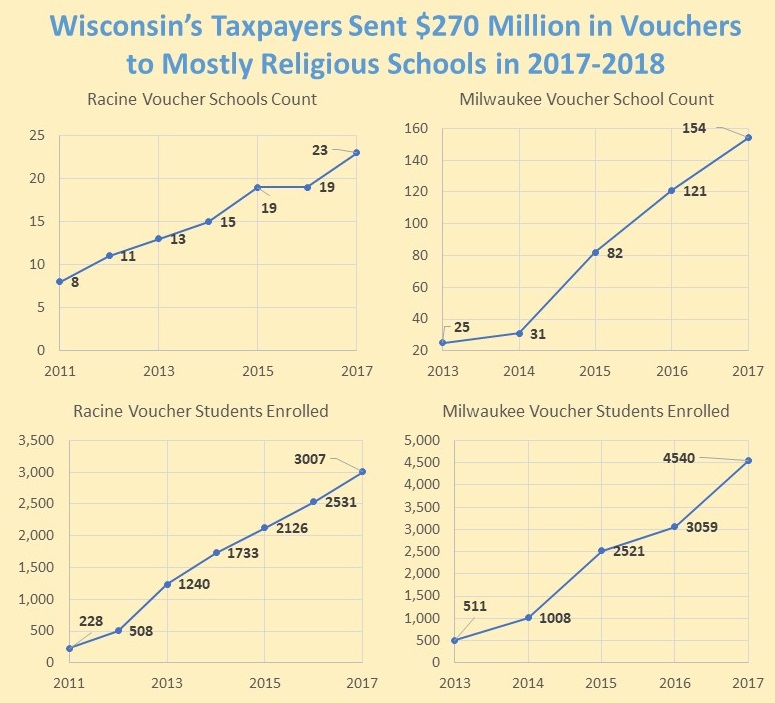
Voucher Growth

Wisconsin Department of Public Instruction Data Shows the Rapid Growth of Voucher Schools in Racine and Milwaukee

A Robust Charter School Industry Operates in Milwaukee

A 2014 report in the Milwaukee Journal Sentinel said,

“Nearly 11% of public schools in Wisconsin are charter schools, the fourth-highest rate in the nation and double the national average, according to a recently released report from the National Alliance for Public Charter Schools.”

“In Milwaukee, 32% of public schools are charters, according to Wisconsin Department of Public Instruction data.”

The Wisconsin Department of Public Instruction (DPI) defines two basic charter school structures. District charter schools which are authorized by public school districts and “independent charter schools” which are authorized by: The chancellor of any institution in the University of Wisconsin System; Each technical college district board; Waukesha County Executive; College of Menominee Nation; Lac Courte Orielles Ojibwa Community College; UW- System Office of Educational Opportunity. In either case DPI states, “The Wisconsin charter school law gives charter schools freedom from most state rules and regulations in exchange for greater accountability for results.”

The district authorized charter schools are a kind of hybrid charter school and innovation school. Innovation schools are promoted by David and Charles Koch through the American Legislative Exchange Council (ALEC). According to ALEC model legislation these schools “are provided a greater degree of autonomy and can waive some statutory requirements.” Neither charter schools nor innovation schools are operated by the elected school board. In other words, parents have no elected representative they can hold responsible for the operation of the school.

In October 2017, the United States Department of Education selected Wisconsin for a $95 million charter schools grant. The DPI notice of this grant said,

“Our federal grant will help us expand charter school access throughout Wisconsin, especially for our high school kids who are from low-income families,” said State Superintendent Tony Evers.”

“Over the five-year grant period, the Wisconsin Charter Schools Program will support the opening of 80 new or replicated quality charter schools and the expansion of 27 high-quality charter schools in the state.”

Sadly, Tony Evers is one of the Democrats who want to replace Scott Walker as governor.

On July 8, the Wisconsin State Journal ran a stridently incorrect editorial. They stated,

“Every charter school in Wisconsin is a public school.

“The many Democrats running for governor should memorize this fact, because some of them are getting it wrong.

“Charter schools should not be confused with voucher schools, which are mostly private religious schools that receive public money for lower-income students to attend.”

Charter schools are privately managed companies that sell education services to the state. They are not much different than a construction company contracting to do road work. Just because they receive tax dollars does not make them a public company. In the most recent Busted Pencils pod cast, Network for Public Education (NPE) Executive Director Carol Burris made the point that to be a public school requires two aspects. (1) The school must be publicly funded and (2) the school must be publicly governed. Parents have no vote on the governance of a charter school.

Burris also discussed the research paper jointly produced this June by NPE and The Schott Foundation, Grading the States: A Report Card on Our Nation’s Commitment to Public Schools. Not only did Wisconsin receive a failing grade, it was deemed to have the worst charter school laws in America. The reasons included: One of five states to allow for profit charter schools; if a school fails the property belongs to the charter owners not the taxpayers; nation’s longest renewal period of 5-years; and no conflict of interest requirements.

Destroy Public Education (DPE) Model Functioning in Milwaukee

The DPE model was first defined by researchers at the University of Indiana Purdue University Indianapolis (UIPUI). These scholars were Doctor Jim Scheurich coordinator of the Urban Education Studies doctoral program, Gail Cosby a doctoral candidate at UIPUI and Nate Williams who earned his doctorate there and now teaches at Knox College.

They concluded that a DPE model was being instituted throughout the nation. Three important points in the model are: (1) a funding conduit for national-local wealthy individuals and organizations to support local DPE initiatives; (2) the development of local organization networks that collaborate on the privatization agenda; and (3) a local-national collaboration between wealthy mostly conservative groups.

The national money flowing into Milwaukee to privatize public education comes from the usual sources including the Walton Family Foundation, the Bill and Melinda Gates Foundation, the Joyce Foundation and several others national non-profits.

The big local money is from the very conservative Lynde and Harry Bradley Foundation. In 2016, the Bradley Foundation gave generously to ALEC, Freedomworks Foundation, The Federalists Society and Betsy DeVos’s Mackinac Center. Locally they gave $375,000 to the Badger Institute, $500,000 to the Wisconsin Institute for Law and Liberty (WILL) and $100,000 each to Schools that Can Milwaukee and Partners Advancing Values in Education (PAVE). These appear to be yearly gifts.

Concerning school privatization in Milwaukee, the contributions to WILL and the Badger Institute are particularly noteworthy. The following statements on the WILL web site are from members of the Board of directors:

‘“WILL’s legal team was the missing link in education reform in Wisconsin and their research capabilities enhance our ability to develop effective policy.’  Jim Bender President, School Choice Wisconsin”

‘“WILL is at the forefront of the effort to expand parental choice in education. Whether publishing reports on how to craft high-quality choice policies or rigorous fiscal analyses that influence the debates in Madison, or even suing the state education bureaucracy for its failure to follow the law, WILL can be counted upon to fight for Wisconsin families.’ Jason Bedrick Director of Policy at EdChoice”

‘“After a lifetime of involvement in America’s conservative movement, I am proud to say that WILL is one of the most successful organizations I’ve been a part of and happy to see it grow and impact public policy.’ Mike Grebe Former Chairman, Bradley Foundation.”

The Badger Institute says of itself,

“The Badger Institute, formerly the Wisconsin Policy Research Institute, is a nonpartisan, not-for-profit institute established in 1987 working to engage and energize Wisconsinites …. The institute’s research and public education activities are directed to identify and promote public policies in Wisconsin that are fair, accountable and cost-effective.”

The Bradley foundation supplies the money, WILL provides the legal work and The Badger Institute lobbies the state. The school privatization ground game in Milwaukee is now run exclusively by PAVE. It has annexed Schools That Can Milwaukee. Borsuk writing in the Journal Sentinel observed,

I referred to Schools That Can Milwaukee in the past tense because it and another long-time Milwaukee education non-profit, known as PAVE, are merging. Plans for the merged organization are expected to be unveiled in coming months. There have been hints that some major players in town want a new approach to encouraging school improvement. Will the new organization be a vehicle for that? Keep an eye on this.”

Some Parting Thoughts

In the Zelman v. Simmons-Harris case, the Supreme Court ruled in a 5-4 decision that vouchers to religious school did not violate the Establishment Clause of the Constitution. This decision re-wrote more than a century worth of precedence and further eroded the separation of church and state. No matter how this case was decided, it is patently un-American to force citizens to send money to religious organizations that they do not support.

Privatizing public education is a horrible idea. Public-schools are the bedrock upon which America’s democracy is built. Now strange conservatives and their fellow traveler in the Democratic party, the neoliberals, are claiming that democratically elected school boards are an anachronism. Know this; if someone is opposing democratic governance, they are proposing totalitarian rule by the wealthy.