Tag Archives: Nancy MacLean

Movement to Destroy American Democracy

12 Mar

By Thomas Ultican 3/12/2025

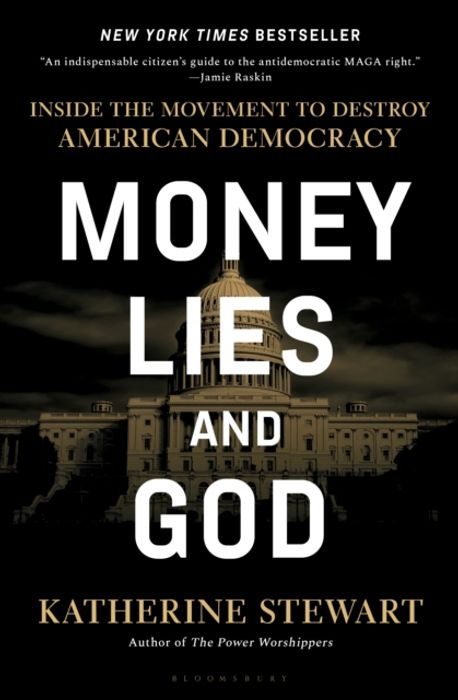
Author Katherine Stewart is a friend of mine. OK, we are not bosom buddies and have only met face to face once briefly. However, in 2017, I wrote about her book The Good News Club and we began communicating by email. In 2019, when she published The Power Worshippers, I again reviewed her book and our email communications were enhanced. Now, she has completed the trilogy with Money Lies and God, her just released book, which continues a deep dive into Christian nationalism and the extreme right’s anti-democratic agenda.

On Money Lies and God’s cover, Congressman Jamie Raskin insightfully labels the book, “An indispensable citizen’s guide to the antidemocratic MAGA right.”

Whenever I read a book, the first thing I do is read everything on the cover and all introductory material. I was amazed by the well known people commenting on this book. Besides Jamie Raskin, I was particularly stuck by comments from Nancy MacLean and Steve Schmidt. Not that their selected comments were so mind blowing but because they are such heroes of mine.

Maclean, the famous historian and author of “Democracy in Chains”, states, “A bracing must-read story of how the varied streams have merged into a mighty river moving toward massive destruction—and it explains how together, we can divert it.”

Schmidt, John McCain’s campaign manager, political strategist and cofounder of the Lincoln Project, wrote, “Pieces through the fog and noise to reveal the dangerous forces gathering, planning, and plotting against liberty.”

The comments made me think this book could be special. I was not disappointed.
Building toward a Trilogy

Living in Santa Barbra, California in the early 2000s, Stewart was stunned to learn that her daughter’s elementary school had a protestant after school program for students called “The Good News Club.” For the past almost two decades this discovery has driven her to research how religious organizations are now allowed to proselytize babies in public facilities. The more she dug, the scarier reality became.

A significant figure in the tearing down of the separation of church and state was lawyer Jay Sekulow. Born into a Jewish family he converted to evangelical Christianity in the 1980s. In 1990, Pat Robertson brought Sekulow together with a few other lawyers to form the American Center for Law and Justice (ACLJ) (notice how close the acronym is to ACLU). In 1994, the Alliance Defense Fund (ADF) added its name to the growing roster of well financed Christian legal organizations and is backed by groups that are a veritable who’s who of the Christian Right.

In 2001, this legal juggernaut succeeded again in their efforts to undermine the separation of church and state with its victory in Good News Club v. Milford Central School. Stewart commented:

“An alien visitor to planet First Amendment could be forgiven for summarizing the entire story thus: Clarence Thomas and Antonin Scalia, together with a few fellow travelers on the Supreme Court and their friends in the ADF and ACLJ, got together and ordered that the United States should establish a nationwide network of evangelical churches housed in taxpayer-financed school facilities.”  

The destruction of the first amendment was well underway.

In “The Power Worshippers”, Stewart dove deeply into the world of Christian nationalism. Among the many insightful items she shared were the actions of Paul Weyrich. He coined the term “moral majority.” He also co-founded the Heritage Foundation, The Free Congress Foundation and the American Legislative Exchange Council.

Weyrich made 12 trips to Russia and Eastern Europe before his death in 2008 and became a strong supporter of closer relations with Russia. Stewart reports, “He was writing and speaking frequently in defense of Russia and facilitating visits between U.S. conservatives and Russian political leaders.” (Power Page 270)

In 2013, Bryan Fischer of the American Family Association called Putin a “lion of Christianity.” In 2014, Franklin Graham defended Putin for his efforts “to protect his nations’ children from the damaging effects of any gay and lesbian agenda.” He also lamented that Americans have “abdicated our moral leadership.” In 2015, Graham met privately with Putin for 45-minutes. In 2016, Mike Pence said Putin was “a stronger leader in his country than Barack Obama has been in this country.” (Power Page 272)

Donald J. Trumpski’s embrace of Putin and other despotic world leaders is an outcome spurred by Christian nationalism.

Completing the Trilogy

In the introduction to “Money Lies and God”, Stewart states, “There is no world in which America will become the ‘Christian nation’ that it never actually was; there is only a world in which a theocratic oligarchy imposes a corrupt and despotic order in the name of sectarian values.”  (Money Page 7)

In these pages, Stewart expands beyond just the evangelical community to include the Conservative Catholic community that has joined forces with the evangelicals. The reader is introduced to Opus Dei, the ultraconservative and secretive Catholic group founded in fascist Spain. “Opus Dei does not disclose its membership, but Leonard Leo has a listed entry on the website of the Catholic Information Center in Washington, D.C., which is operated by Opus Dei …” (Money Page 43)

 Stewart reports on the big 2023 Mom’s for Liberty event in Philadelphia. That same year, she attended the Network for Public Education event in Washington D.C. which is where I had my face to face encounter with my “friend.” She writes extensively about both events.

The book does a lot of documenting of the tremendous amount of money right wingers are pouring into their agenda. She cites the spending by the DeVos-Prince family, Texan Tim Dunn, Jeff Yass, Richard Uihlein, the Corkerys, Mike Rydin, Rebekah Mercer, Charles Koch and more. You meet the Ziklag group, a secretive organizations for high net-worth Christian nationalists. A ProPublica article asserts, “Ziklag appears to be the first coordinated effort to get wealthy donors to fund an overtly Christian nationalist agenda …”

I was surprised that our American psychosis is being spread rapidly around the world. Stewart attended the 2023 National Conservatism Conference (NatCon) in London where she saw representatives of the ADF and the Heritage foundation.

Stewart summarizes the NatCon pitch:

“The sum of all our problems—and the greatest threat that the United States and its sister republics around the world have ever faced—is the rise of the ‘woke’ elite. Cosmopolitan, overeducated, gender-fluid, parasitic, anti-Christian idolaters who worship at the shrine of diversity, equity, and inclusion, the leaders of this progressive cabal are bent on elevating undeserving people of color while crushing hardworking ‘real’ Americans (or real Britons, or whoever is in the audience).” (Money Page 100)

In the “The Rise of the Spirit Warriors” chapter, Stewart notes,

“In October 2023, the spirit warriors notched another stunning victory when one of their own … became Speaker of the U.S. House of Representatives. Congressman Mike Johnson of Louisiana indicated on his first day as Speaker that God himself had a hand in his ascension to a position second in line to the presidency.” (Money Page 163)

Late in the book, Stewart contends, “The axis around which a sector of the global antidemocratic reaction now turns is an extraordinary alliance between a dominant wing of the Republican Party in the U.S. and the Russian dictator Vladimir Putin.” (Money Page 214)

I hope you read “Money Lies and God”.  It is an extraordinarily well written and researched endeavor.  
Citizen’s Guide and Defense Manual

5 Aug

By Thomas Ultican 8/5/2024

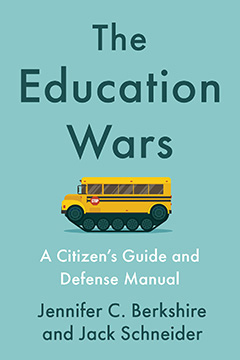
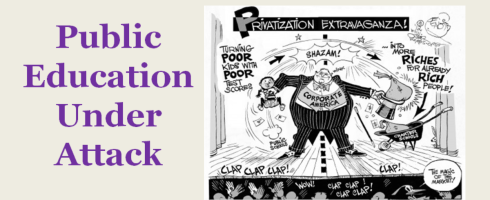
Jennifer Berkshire and Jack Schneider just published The Education Wars. In their 2020 book, A Wolf at the School House Door, the focus was the rightwing and neoliberal attacks on public education. In this new book, they address actions taken to end taxpayer funded universal public education and the resistance. It is a handbook and guide.

Historian and author of Democracy in Chains, Nancy MacLean noted:

“Who would want to ‘take down the education system as we know it’—and why? Read this fast-paced, lucid, and gripping account to understand who is behind the escalating attacks on public education and what, exactly, they seek.”

Parker J. Palmer, author of The Courage to Teach, highlighted the unique dilemma facing public education in America, commenting:

“We’ve argued about our schools from the earliest days of public education. But never before have our public schools been threatened with a well-financed strategy to bring the system down, replace education with indoctrination, shred our social fabric, undermine opportunity for millions of kids, and consign them to second-class citizenship. This is a vital handbook for all who want to enlist in the never-ending struggle for a ‘more perfect union.’”

What’s in it for Billionaires?

Eric Anderson, cited in the book, worked in a Bavarian-themed restaurant for the mother of Betsy DeVos and Eric Prince. He shares about waiting tables and overhearing billionaires’ conversations which gave him insights. In his 2023 article about DeVos pushing for vouchers in Pennsylvania, he stated:

“Equality does not serve the ruling classes well. It never has, which is why the plutocrats lobby so hard against it. It’s why they pursue agendas, such as school vouchers, that are guaranteed to exacerbate inequality.”

“An uneducated populace is bad for democracy, but it’s great for the rich and powerful, who can more easily pull the wool over the eyes of voters. The less able you are to reason, the more amenable you are to lies and smokescreens and dog whistles (e.g., ‘school choice,’ ‘parental rights,’ etc.). Education liberates. Ignorance subjugates.”

While many self-styled school reformers seek profits, for billionaires, the motive is securing control over democratic processes to solidify their privileged positions in society.

The push for vouchers by Charles Koch and Betsy DeVos has multiple purposes. Vouchers undermine public schools and voucher laws are written to limit government oversight. Furthermore, this creates an environment for indoctrinating students with conservative beliefs.

Getting rid of oversight is key for voucher-pushing billionaires. The authors also note:

“Want to sow a revolt against the largest expense in most state budgets? Make it impossible for the public to see where their tax dollars are going.” (Page 22)

Public Schools are Better than Ever

One important point made early in the handbook is that public schools have continually improved as have student outcomes. On NAEP, the nation’s report card, scores have increased over the last 50 years. Since the 1980s, graduation rates have soared from less than 70% to almost 90%.

Teachers and curriculum have significantly improved. Back in Glenn’s Ferry, Idaho where I attended school, almost all teachers were graduates of Albion Normal school. It was a two-year institution for teacher training after which they went directly into the classroom. The highest math my algebra instructor studied was algebra I. Today, a vast majority of teachers have at least a bachelor’s degree plus a year of supervised teaching practice. Math, science, social studies and English teachers are experts in their field.

Public schools continue to become more equitable. Into the 1950s, a separate curriculum was provided for girls, low-income students and students of color, emphasizing domestic or industrial training. The Education Wars states, “Schools were segregated by race, students with disabilities were mostly turned away and students not proficient in English were isolated in schools with limited academic opportunities.” (Page 14)

Work still needs to be done but the campaign for equal schooling has come a long way.

In the 1970s, both Republicans and Democrats decided that the primary purpose of school was to prepare students for jobs. Democrats especially advanced the idea that education was the way to address the nation’s deepening wealth gap. They saw education as expanding the middle class without resorting to politically-challenging ideas like wealth redistribution.

Since then, public education has been expected to solve poverty: “The view that education is a ‘passport out of poverty,’ as Lyndon Johnson insisted, holds deep sway.” (Page 43) The reality is the biggest indicator of poor education performance is poverty and schools have no control over the wealth of neighborhoods in which they reside. It is not surprising that these institutions disappoint when held responsible for things out of their control.

Schools Attacked in New Era of Fierce Partisanship

 At a Moms for Liberty event in 2023, Donald Trump claimed public schools were infested by “Marxist lunatics and perverts.” He also said he would “liberate our children” by cutting federal funding to any school pushing “inappropriate racial, sexual, or political content on our children.” (Page 45)

Over the top rhetoric like this has become common place, even though there is scant evidence to support it.

Since its founding in 1973, Heritage Foundation has been fanning the flames of school culture ideology. They see it as the key to undermining faith in public schools. Over the decades, specific issues have changed but their goal of ending public education has persisted.

In 1992, while stumping for president, Patrick Buchanan claimed he would be the president of parents. He said, “I will shut down the U.S. Department of Education, and parental rights will prevail in our public schools again.” (Page 80)

Today, his claim has become parental rights, almost exclusively for religious conservatives as these disingenuous and divisive calls continue. A Virginia law governing the treatment of transgender and non-binary students allows parents of other students objecting to a student’s preferred pronouns, based on the First Amendment’s guarantee of religious freedom.

The handbook shares:

“Justifying this policy, Governor Glenn Youngkin’s administration pointed to what it identified as parents’ fundamental rights. But a more accurate explanation is that the rights of certain parents are being privileged above others.”   (Page 89)

Milton Friedman’s vouchers have become taxpayer-funded discrimination. Civil rights attorney, Jeffrey Spitzer-Resnick, suggested, “Let’s stop calling it a ‘choice program’ and let’s call it a private discriminatory education program funded with your tax dollars.” (Page 109)

Education as a Public Good

In the final chapter, “Reclaiming Education as a Public Good,” Beth Lewis of Saving Our Schools Arizona says:

The defining issue here is: Do you care about other people’s kids or not? Do we want to live in a world that’s based on the understanding of a public good, or one where only the individual good matters? (Page 134)

The authors assert, “We can start by reducing the responsibility that education bears for achieving minimal social and economic security.” (Page 145)

Currently schools are asked to do the impossible and blamed for failing. Literally billions of dollars are being spent to destroy public education, the foundation of Democracy.

The Education Wars is a handbook to help parents and citizens recognize feckless attacks and defeat them.

America’s public education system is a treasure and if lost, will never come back.

Choosing to End Public Education

25 Feb

By Thomas Ultican 2/25/2022

In 2017, the new President of the United States was explicit in his intention to end public education. He appointed a dominionist as secretary of education and regularly invoked the libertarian inspired pejorative “government schools” when referring to public schools. He loudly supported a movement to end public education which started in earnest five decades before he took office.

Its foundation was the economic theories of Milton Friedman and opposition to integration in the old south. Neoliberals, libertarians and their billionaire financiers have unsparingly attacked public education. Their fundamental weapon for ending the public school system is “choice.”

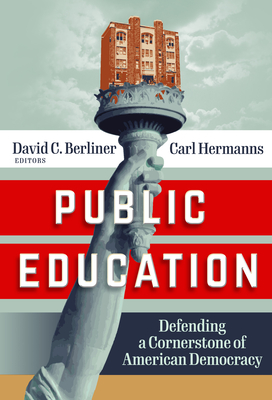
The newly published book Public Education: Defending a Cornerstone of American Democracy is a compilation of 29-essays edited by David C. Berliner and Carl Hermanns. All of the essays are written by accomplished award winning educators and historians. Gloria Ladson-Billings, known for her work on Culturally Relevant Pedagogy wrote,

“Some years ago, when the school choice movement began to gain attention, I argued that we were looking at the beginnings of the plan to destroy public education. There are those who declared I was being ‘alarmist.’ But I made this pronouncement after looking at the ways other aspects of public services have faced severe erosion.” (Education 226)

She also speculated that a contributing factor for the loss of consensus to support public schooling is the long-term campaign by powerful interest groups to portray public education as failing.

In another essay, Education Historian and former US Assistant Secretary of Education Diane Ravitch reported that in 1984 the Republican Party for the first time called for prayer in school and “choice.” She stated,

“Despite the sordid history of school choice and its origins in the segregationist movement, the term became a rallying cry for critics of public education. Right-wing think tanks, libertarian billionaires, and groups like the American Legislative Exchange Council – an organization that brought together far-right extremists, big corporate money, and other who wanted to reduce government regulation and unleash free enterprise – unleashed an unmodulated campaign of vilification against public schools.” (Education 27)

Duke University Professor of History and Public Policy Nancy MacLean, this past September published a new research paper at the Institute of New Economic Thinking – How Milton Friedman Exploited White Supremacy to Privatize Education.” She is the author of the must read book Democracy in Chains: The Deep History of the Radical Right’s Stealth Plan for America.” In her new paper MacLean states,

“This paper traces the origins of today’s campaigns for school vouchers and other modes of public funding for private education to efforts by Milton Friedman beginning in 1955. It reveals that the endgame of the “school choice” enterprise for libertarians was not then—and is not now–to enhance education for all children; it was a strategy, ultimately, to offload the full cost of schooling onto parents as part of a larger quest to privatize public services and resources.”

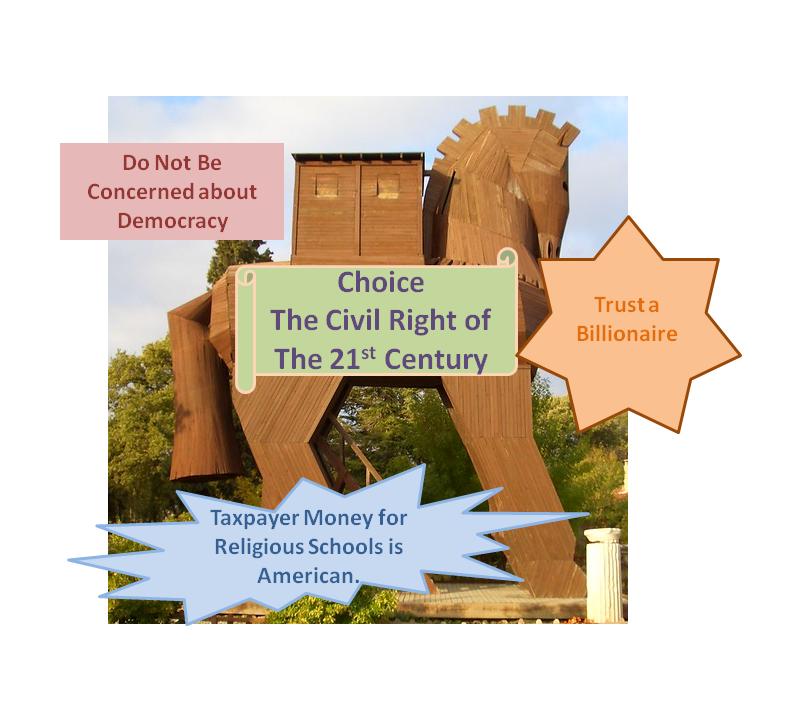
A New Trojan Horse

The Gateway Drug: Charter Schools

An article by the Education Law Center’s Wendy Lecker states,

“As noted in a 1996 Detroit Metro Times article, while the DeVos’ ultimate aim was to abolish public education and steer public funds to parochial schools, they knew not to be blatant about that goal. Thus, they chose a vehicle that blurred the lines between public and private schools- a “gateway drug” to privatizing public education: charter schools.”

After John Walton read the 1983 Reagan administration publication ‘“A Nation at Risk’ with its ominous warnings about the failings of public education,” he convinced his family to direct their philanthropy toward reforming public education. Throughout the 1990s he campaigned endlessly for new voucher legislation and saw his efforts repeatedly rebuffed. Shortly before his death in 2005, John joined Don Fisher and Buzz Woolley in establishing the Charter School Growth fund. Around the same time the Walton Family Foundation began financing charter school startups in communities across America.

Jeff Bryant interviewed Jeffry Henig of Teachers College about the Walton’s move to supporting charter schools. Bryant asserted,

“Henig believes many conservatives view charter schools as a way to ‘soften the ground’ for potentially more private options, though he isn’t entirely sure ‘the Waltons view charters as a Trojan Horse for eventually providing vouchers universally.’”

Former Secretary of Education Betsy DeVos has carried on a relentless attack on public education that continues today. One of the images she sells is viewing students as having a backpack full of taxpayer money which each school age child’s parents spends on education services. In her essay “Public Education at a Crossroads: Will Horace Mann’s Common School Survive the Era of Choice?” educator, administrator and public school advocate Carol Burris warns,

 “Given the anti-tax, anti-government proclivities of those who espouse this type of funding scheme, it is likely that fewer and fewer tax dollars would be place in the backpack over time. Parents once again would assume the sole responsibility for educating their children, buying what services they could afford, with the poor relying on charity.” (Education 239)

A Pillar of Democracy: Public Education

In the essay “Values and Education Policy” Edward Fiske and Helen Ladd tell us, “Good education policy making is rooted in coherent and enlightened educational values.” (Education 33) They begin by discussing the values expressed by Horace Mann who successfully implemented his vision of “common schools.” Today’s public school system is very much a result of that vision and his leadership. Some of the issues Mann addressed are the same issues driving “choice” today. Fisk and Ladd share,

“The idea of taxing all citizens, including those of the privileged classes who already enjoyed access to private education, in order to finance the education of poor and working-class children was viewed as both wasteful and as an infringement of property rights. Mann argued that free schooling served the collective interests of all citizens, rich and poor alike. ‘Jails and state prisons are the complement of schools,’ he wrote. ‘So many less as you have the latter, so many more you must have of the former.’”

“He famously declared, ‘Education, then, beyond all other devices of human origin, is the great equalizer of the conditions of men – the balance-wheel of the social machinery.’” (Education 34-36)

The authors conclude,

“Proponents of citizenship education are struggling to find a place in school curricula. Powerful private foundations and individuals, including the recent U.S. Secretary of Education, are raising millions of dollars to undermine the concept of universal education by privatizing public education and, by means of vouchers and charter schools, to break the link between publicly supported schools and democratically elected officials. Racial resegregation of schools is now pervasive, and courts are retreating from the notion that public funds should not be used to further sectarian religious instruction.” (Education 45)

For a long time, Richard and Betsy DeVos have been working to obliterate the separation of church and state, and privatize public education. In a 2001 interview conducted at the Gathering, Richard  lamented how awful it was that public schools had replaced churches as the center of communities. He did not identify whose church would be accepted as the new community center, but it seems certain to be some flavor of Christianity.

Public Education Shares Informed Discourse

Thirty-two of America’s most accomplished education thinkers and practitioners share their insights. All of them have more than two-decades of experience practicing, researching and debating education policy. None of them are billionaires trying to offload their tax burden or implement self-centered libertarian ideology.

In these pages, there is general respect for Horace Mann’s education advocacy and the public school system but also recognition of associated problems. The common schools were not just the “great equalizer” but also the great homogenizer. They indoctrinated students with a protestant Anglo-Saxon ethic. There is nuanced discussion here about the great foundation for democracy (public schools) needing to inspire not indoctrinate. And some of the authors reject the “great equalizer” belief as a myth.

Professor Ken Zeichner discusses the extreme segregation of public schooling in the United States, speculating they are “possibly more segregated today than it was in the 1960s.” (Education 178) He says in non-dominant communities, families and community members are excluded from real participation in school affairs. He recommends community centered engagement versus school centered engagement. Unfortunately he reports, “Both federal legislation and school practices have encouraged school-centric as opposed to community-centric family and community engagement, creating mutual distrust between families and schools.” (Education 179)

University of Georgia’s Peter Smagorinsky shares, “According to [Betsy] DeVos, those who direct the prevailing K-12 system are ‘trapped in an outdated education model,’ beholden to the ‘wrong and manipulative’ theories of Horace Mann and John Dewey.’” For people not on the extreme right this sounds like nonsense. However, Smagorinsky cautions that people’s positions “are largely emotional and the argumentative reasoning is used as a post hoc means of justifying an established position, … it’s unlikely the Culture Wars will end any time soon, because no one can win them with logic or facts.”

I will end my taste of what is in this wonderful compilation with a quote from one of the editors, David Berliner. He ran through a litany of the scandals arising from both the charter and voucher school movements fueled by unregulated taxpayer dollars. Then personally gratifying to me he wrote, “But Tom Ultican, a thoughtful and passionate defender of public schooling, has a reminder to Americans about the origins of the charter and voucher movement in our nation,”

“Birthed in the bowels of the 1950s segregationist south, school choice has never been about improving education. It is about white supremacy, profiting off taxpayers, cutting taxes, selling market-based solutions and financing religion. School choice ideology has a long dark history of dealing significant harm to public education.

“Milton Friedman first recommended school vouchers in a 1955 essay. In 2006, he was asked by a conservative group of legislators what he envisioned back then. PRWatch [published by the Center for Media and Democracy] reports that he said, ‘It had nothing whatsoever to do with helping ‘indigent’ children; no, he explained to thunderous applause, vouchers were all about ‘abolishing the public school system.’” (Education 280-281)