Tag Archives: Kamala Harris

Kamala Harris and Public Education

31 Jul

By Thomas Ultican 7/31/2024

Democratic presidential candidate, Kamala Harris, has a good record with public education. Her opponent, who appointed Betsy DeVos Secretary of Education, disagrees and says she is a “radical liberal,” responsible for Mr. Biden’s most left-leaning policies. It is unlikely he has any actual knowledge of what she might have been responsible for. To this fascist leaning fellow, the entire Democratic Party and a slice of the GOP look like “radical liberals.” With the two major candidates for president, there is a clear difference in education policy: Harris is pro-public education, Trump wants to end it.
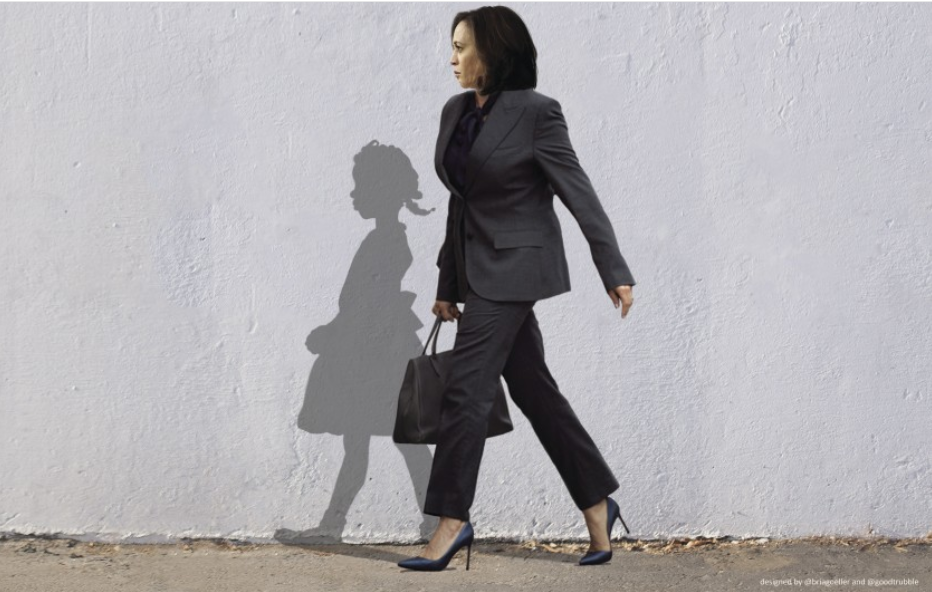
Ruby Bridges’ Shadow and Kamala Harris

Her Record

In a 2020 run for President, Harris stated at a Houston rally, “You can judge a society by the way it treats its children, and one of the greatest expressions of love that a society can give to its children is educating those children with resources they need.” At that time, she identified the “pay gap” between teachers and other college graduates, as undermining the required resources. She wrote in the Washington Post:

As president, I will make the largest federal investment in teacher pay in U.S. history. We will fully close the teacher pay gap during my first term, and provide the average teacher a $13,500 raise.”

Her plan would have included $315 billion in federal funding over 10 years to subsidize pay for K-12 educators and reward state and local governments for raising teacher’s salaries. This was to be paid for by adjusting estate taxes.

She has yet to mention teachers’ pay in 2024 but, obviously, it is something to which she has given a lot of thought and believes needs attention.

In 2019, as California’s U.S. senator, considering a presidential run, she supported the teachers strike in Los Angeles. Harris wrote, “Los Angeles teachers work day in and day out to inspire and educate the next generation of leaders.” Besides wage increases, teachers were demanding smaller class sizes and more support staff. The union victory in the strike was a defeat for pro-charter school billionaire Eli Broad and the California charter school movement.

Cecily Myart-Cruz, current president of the United Teachers of Los Angeles, remembered Harris’s support “was such a boost.”

In July 2020, the President of the United States and his Secretary of Education demanded schools open with in-person classes five days a week. Parents were worried about the safety of their children and teachers were frightened.

President Trump tweeted,

“In Germany, Denmark, Norway, Sweden and many other countries, SCHOOLS ARE OPEN WITH NO PROBLEMS. The Dems think it would be bad for them politically if U.S. schools open before the November Election, but is important for the children & families. May cut off funding if not open!”

Michelle Goldberg of NY Times wrote, “… with their crude attempts at coercion, they’ve politicized school reopening just as Trump politicized mask-wearing and hydroxychloroquine.” It was the beginning of a rightwing offensive toward public schools, eventually leading to open bigotry, attacks on school board meetings and book banning.

Harris and Orange County Congresswoman, Katie Porter, responded to Trump with a letter agreeing that in-person schooling was crucial for children’s well-being and for parents’ ability to work. They also wrote that lives could be at risk if schools reopened without stringent safety measures such as social distancing, regular randomized virus testing and virus contact tracing.

These were never seriously addressed by Trump.

In some liberal-leaning states, including California, millions of students went 18 months without in-school classes. However outcomes have not matched expectations. In New York, which opened schools in fall 2020, their 2022 reading and math scores fell while in Los Angeles, math and reading scores improved. Commissioner, Peggy Carr, of the National Center for Education statistics reported, “There’s nothing in this data that tells us there is a measurable difference in the performance between states and districts based solely on how long schools were closed.”

Last week, when Harris addressed the American Federation of Teachers (AFT) convention in Houston, Michael Whatley, chairman of the Republican National Committee, accused her of “already ignoring parents and getting cozy with the same teachers union bosses who she allowed to dictate school reopening guidance and keep kids out of the classrooms.”

Republicans believe that by not enthusiastically embracing Trump’s open school edict and siding with teachers unions made her vulnerable to political attack. However, his “divide-and-conquer” incompetent management of the COVID crisis and demand to open schools without preparations makes him more exposed to current criticism.

At last Tuesday’s AFT convention, Harris shared education issues to be focused on between now and Election Day: student loan forgiveness, protecting schools from gun violence and resisting Republican attempts to restrict curriculums.

In 2023, she flew to Florida to take on Gov. Ron DeSantis’ attacks on what he dismissed as “woke indoctrination” in schools. Harris was particularly incensed by the state’s middle school standards, arguing that enslaved people “developed skills that could, in some instances, be applied for their personal benefit.” 

As attorney-general in the state of California, she went after for-profit colleges, accusing them of false advertising and intentionally misrepresenting to students the benefits provided. She won a $1 billion judgment  against the California-based Corinthians Colleges Inc. stating, “For years, Corinthian profited off the backs of poor people – now they have to pay.”

Harris was not blowing political smoke when kicking off her campaign saying in her long career as a prosecutor, she has taken on all kinds of predators:

“Predators who abused women, fraudsters who ripped off consumers, cheaters who broke the rules for their own gain. So hear me when I say, I know Donald Trump’s type.”

EducationWeek says Harris is unlikely to stray far from Biden’s education agenda. She will continue working to overcome court challenges against forgiving student loan debt and expanding protections for LGBTQ+ students and school staff through a rewrite of rules for Title IX, the nation’s landmark sex discrimination law.

It also states, “On the Republican side, the party has proposed a platform that calls for eliminating the U.S. Department of Education, defunding schools that teach ‘critical race theory’ or ‘gender ideology,’ and universal private school choice.”

This is disingenuous. No k-12 schools teach “critical race theory” and never have nor do they teach “gender ideology.” These are false claims designed to scare and divide people in order to garner votes. “Universal private school choice” is a scheme to end universal taxpayer funded public education.

Conclusions

Kamala Harris is a strong supporter of public education and embraces our nation’s outstanding teaching force which she wants to enhance. She will be dealing with people who believe public education is too expensive and charter schools are helpful but her track record says she will protect this important foundation for American democracy and national achievement.

The soon-to-be Madam President has good instincts and I look forward to her pro-public education administration!
California Virtual Academies Spotlighted Again!

3 Dec

By Thomas Ultican 12/3/2023

California Virtual Academies (CAVA) received an unfair labor practices complaint from their teachers union. As part of contract negotiations, the union requested a “K12 product list with prices for our school for both the 2021-2022 and 2022-2023 school years.” CAVA lawyers declined, saying it was “confidential, proprietary information.” On 11/2/2023, union lawyers responded with a legal action, claiming the information was their legal right.

Kristen Taketa, reporting for the San Diego Union, noted the concern of teachers over how money is being spent and wrote they “echo more wide-ranging questions about CAVA’s finances and use of public dollars that have dogged the network for more than a decade.”    

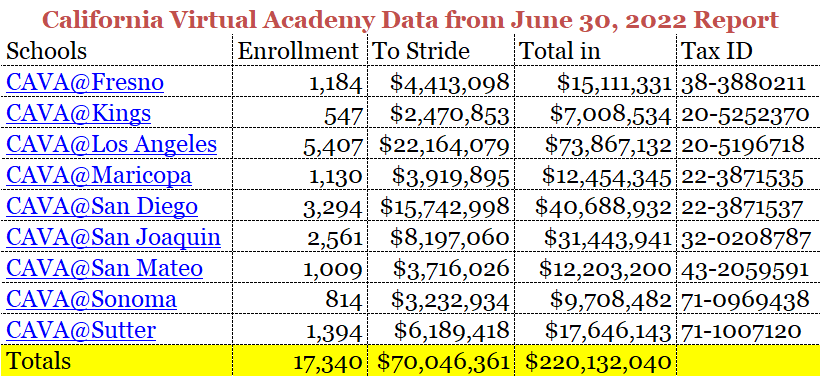
Financial records show Stride (formally known as K12) took in over $70 million from all nine CAVA schools in the 2021/22 school year. High costs, charged by Stride, kept the schools running deficits.

Who is CAVA

K12/Stride set up the CAVA network in 2002 that grew to nine charter schools, authorized by small districts. None of them had more than 15,000 students and four had less than 2,000. This means small cash-strapped districts get 1 to 2 percent of CAVA state funding to monitor the schools, with insufficient resources to do more than review some submitted paperwork.

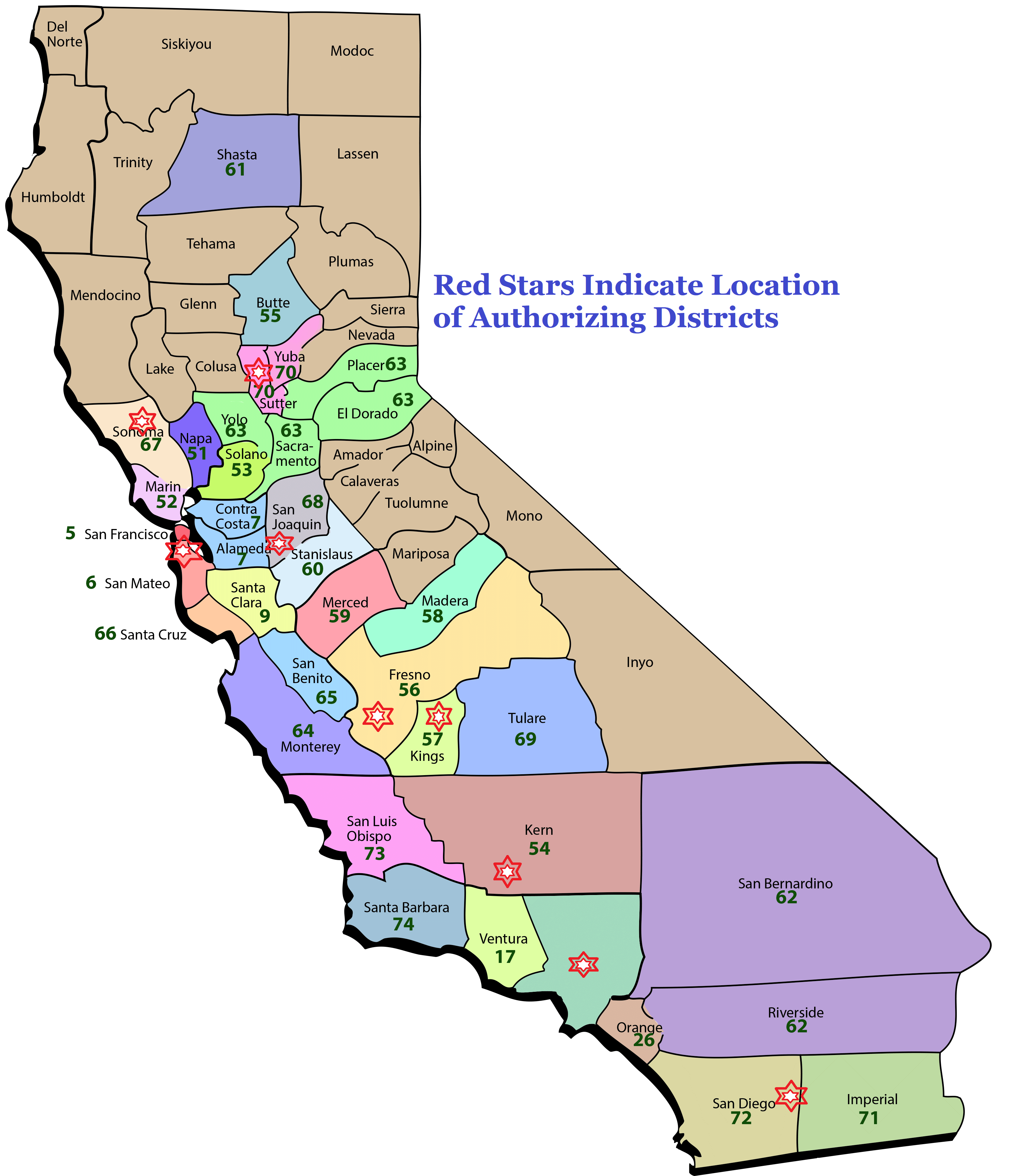
Red stars on the California county map indicate authorizing district locations. This is important because, under California law, a cyber charters can only service its authorizing county and the bordering counties. The map shows CAVA services almost all population centers in the state.

The nine CAVA schools are organized as non-profits with their own boards. California law says only non-profit organizations may operate charter schools.

A Wikipedia entry says, “California Virtual Academies follow the educational principles of E.D. Hirsch Jr.” In the debate between behaviorism and “constuctivism”, Hirch came down squarely on the side of behaviorism. Education writer, Alfie Kohn said, “E. D. Hirsch Jr.’s Dictionary of Cultural Literacy, which popularized what we might call the ‘bunch o’ facts’ approach to education, was enthusiastically endorsed in Phyllis Schlafly’s Eagle Forum newsletter.” (Page 11) In other words, the CAVA foundational philosophy of education is not widely embraced.

K12 was founded by former McKinsey & Co. consultant and banker, Ronald J. Packard. Discussions toward its founding began in 1999 and the company opened its doors in 2000, focusing on the homeschooling market. Original investors included “junk-bond king” and felon, Michael Milken, his brother Lowell, Andrew Tisch, Larry Ellison and others. Ronald Reagan’s Secretary of Education, William Bennett, was hired as the company’s first chairman of the board.

Legal and Labor Issues

Because of the close ties between K12 and CAVA, a loud objection was raised by activists, claiming the schools were little more than a front of the for-profit company. It was noted that K12 created the schools, chose the boards and holds exclusive no-bid contracts with CAVA. 

In early 2016, Jessica Calefati of San Jose’s The Mercury News reported, “Accountants and financial analysts interviewed by this newspaper, including several who specialize in school finance, say they’ve never seen anything quite like the arrangement between K12 and the public online academies.”

Many profit-minded companies in California have tried to sidestep the laws, requiring charters to be run by non-profits. LA Times reporter Howard Blume wrote:

“K12’s strategy allegedly involved driving the opening of nonprofit charters up and down the state. These schools then contracted with K12 for “substantially all of the management, technology and academic support services in addition to curriculum, learning systems and instructional services,” according to a state complaint filed last week.

“The CAVA nonprofits became shells for the activities of the for-profit corporation, according to allegations in a second, separate complaint, which was filed under the authority of the state in conjunction with whistleblower Susie Kaplar, a former CAVA teacher.”

In the same 2016 article, Blume quoted then California Attorney General, Kamala Harris, saying, “K12 and its schools misled parents and the state of California by claiming taxpayer dollars for questionable student attendance, misstating student success and parent satisfaction, and loading nonprofit charities with debt.” The non-profit charities referenced were the nine CAVA schools.

Later in July of 2016, Attorney General Harris reported:

“As part of the settlement, which is subject to court approval, K12 will provide approximately $160 million in debt relief to the non-profit schools it manages—“balanced budget credits” that were accrued by the schools as a result of the fee structure K12 used in its contracts—and will pay $8.5 million in settlement of all claims.  In addition, K12 has agreed to implement significant reforms of its contracts with the CAVA Schools, undergo independent reviews of its services for students with disabilities, ensure accuracy of all advertisements, provide teachers with sufficient information and training to prevent improper claiming of attendance dollars, and change policies and practices to prevent the kinds of conduct that led to this investigation and agreement.”

Rachel Cohen reporting in Atlantic magazine shared:

“K12 emphasized it had admitted no wrongdoing, and said the attorney general ‘grossly mischaracterized the value of the settlement just as it did with regard to the issues it investigated.’ In an email to The Atlantic, the K12 spokesperson Michael Kraft disputed the AG’s characterization of the schools as indebted.”

At the same time, the CAVA network and K12 were also developing growing dissatisfaction amongst their teacher ranks. Brianna Carroll, a fourth-year CAVA teacher, claimed, “Teachers were concerned about the instability their students were experiencing.” She said they began discussing the reality of low salaries and substandard working conditions, making it hard for CAVA to retain teachers and creating “an unstable environment for students.”

Sarah Vigrass, a 10-year CAVA teacher, observed:

“Changes in management at K12 and an increased emphasis on profits had led to changes at CAVA that shortchanged students. When I started teaching there, families would start the year getting these great boxes of art supplies, textbooks and curriculum, and teachers had time to build relationships with students and families. A lot of that went away.”

In 2013, CAVA teachers reached out to the California Teachers Association (CTA), an affiliate of the National Education Association, for help. With more than 700 teachers, working at nine campuses, spread out across California, bargaining with an anti-union K12 was tough. In 2014, despite management opposition, teachers voted overwhelmingly to be represented by California Virtual Educators United (CVEU)/CTA.

A 17-month legal battle followed, with CAVA claiming that each one of their campuses was a separate school and therefore, a separate bargaining unit. In October 2015, the Public Employment Relations Board (PERB) rejected CAVA’s arguments, granting CVEU exclusive recognition. CAVA again appealed but was rebuffed by PERB in June 2016. In September of that year, CVEU and CAVA began negotiations for their first contract. In April 2018, CVEU members voted by a 98 percent margin to ratify a contract agreement with CAVA.

One of the big concerns of teachers was the poor performance of their students. In a two-part investigationThe Mercury News reported that fewer than half of CAVA students graduate and “almost none” pass the courses required for admission to the California State University and the University of California.

John Fensterwald reporting for EdSource said:

“A study of online charters in California by the Center for Research on Education Outcomes, or CREDO, at Stanford University found that online students were far behind their classroom-based peers. Based on test scores, CAVA students on average fell a third of a year behind their peers in math.”

Even the California Charter Schools Association (CCSA) criticized K12, stating:

“CCSA condemns the predatory and dishonest practices employed by K12 Inc. to dupe parents using misleading marketing schemes, siphon taxpayer dollars with inflated student attendance data, and coerce CAVA School nonprofit employees into dubious contracting arrangements,”

Conclusion

Under a new name, Stride, K12 still profits wildly from California taxpayers. CAVA schools are the only cyber schools in America running deficits. They get full per-student money from the state, maintain and operate no buildings … why are they financially strapped???

The unfair labor practices claim filed by CVEU has potential to reveal Stride’s enormous greed and malfeasance.

California cyber charters ought to be run by large school districts with elected boards and not for-profit companies, located on the east coast.